FRANCIS SCHAEFFER ANALYZES ART AND CULTURE Part 3 PAUL GAUGUIN’S 3 QUESTIONS: “Where do we come from? What art we? Where are we going? and his conclusion was a suicide attempt” (Feature on artist Mike Kelley Part A)

___________________

#02 How Should We Then Live? (Promo Clip) Dr. Francis Schaeffer

The clip above is from episode 9 THE AGE OF PERSONAL PEACE AND AFFLUENCE

10 Worldview and Truth

In above clip Schaeffer quotes Paul’s speech in Greece from Romans 1 (from Episode FINAL CHOICES)

Two Minute Warning: How Then Should We Live?: Francis Schaeffer at 100

A Christian Manifesto Francis Schaeffer

Published on Dec 18, 2012

A video important to today. The man was very wise in the ways of God. And of government. Hope you enjoy a good solis teaching from the past. The truth never gets old.


_________________________________________________________________________________________________

Dr. Francis Schaeffer examines the Age of Non-Reason and he mentions the work of Paul Gauguin.

paul gauguin march 1891 ,

How Should We then Live Episode 7 small (Age of Nonreason)

Paul Gauguin

Paul Gauguin

Paul Gauguin was born in Paris, France, on June 7, 1848, to a French father, a journalist from Orléans, and a mother of Spanish Peruvian descent. When Paul was three his parents sailed for Lima, Peru, after the victory of Louis Napoleon (1769–1821). His father died during the trip. Gauguin and his mother remained in Lima for four years. There the young Gauguin lived a comfortable life. Gauguin then returned to Orléans, and eventually found his way back to Paris.

Below is from an article by Brian Thomas and is based on Francis Schaeffer’s film series “How should we then live?” In this article you will see some of the thoughts that the artist Paul Gauguin had before deciding to attempt to commit suicide.

________________________________

Gauguin as an artist strived to give his work a more human touch, expressing feelings and knowledge and human reactions to the realities of life, while at the same time freeing himself as an artist to express color and design boldly, overcoming the narrowness of merely copying what the eye can register as the Impressionists painted. In an attempt to obtain his goal of “regaining humanity,” as he called it, he moved to Tahiti in 1891. It was here that he painted his greatest work in 1897: Whence? What? Whither?

During the course of 1897 Gauguin referred increasingly to his own death, alluding to suicide in letters and his journal. In the autumn he noted that “The artist dies, his heirs make a grab for his works, sort out the copyright, his estate, and whatever else there might be to do. Now he has been stripped to the bone. I think about these things, and am going to strip myself first: it gives me a sense of relief.”

As Gauguin contemplated taking his own life he set out to create a painting that would leave a lasting legacy of his faith, worldview, artistic insight and intentions by asking three metaphysical questions: Where do we come from? What art we? Where are we going?


In a letter to friend Daniel de Monfreid, he describes the painting as a “philosophical work” which could be compared to the Gospels. We must read the work, he said, from right to left and interprets it as such:

“In the bottom right-hand corner there is a sleeping child, then three covering women. Two figures dressed in purple are deep in conversation. A crouching figure, which defies perspective, and is meant to do so, looks very large. This figure is raising its arm and looking in astonishment at the two women who dare to think about their own fate. The central figure is picking fruit from a tree. Two cats by a child…a white goat. The idol is raising both its arms with rhythmic energy and seems to be pointing to somewhere beyond here. A covering girl appears to be listening to the idol. An old woman, close to the end of life, completes the circle. She is ready to accept her fate. At her feet a strange, white bird with a lizard in its talons symbolizes the futility of empty words…”

Where do we come from? A baby lies next to some young women as the source of life. What are we? A woman stands reaching for the apple, a probable reference to Eve in the garden and man’s fall into sin and ruin. Where are we going? From right to left we see the process of ageing taking place culminating in an old woman, “ready to accept her fate.” Art historian H.R. Rookmaaker suggests that in the background “mysterious figures, in sad colors, standing near the tree of knowledge, are sad as a result of that knowledge.”

It is interesting to note that a few days after completing this work, Gauguin went off into the woods and swallowed a large amount of arsenic. But his body rejected it and he was unable to keep the poison down.

I give this example to show how form and content can beautifully integrate in such a way as to make the work a more powerful vehicle of expression. It should be obvious to the reader by now that I do not share Gauguin’s unfortunate outlook on life, but as an artist and a Christian, I appreciate the thought and purpose behind his masterpiece. Both the aesthetic quality and intellectual content marry to form an important and thought-provoking piece of art. The creators of the religious kitsch that line the shelves at your local happy Christian bookstore could learn much from the serious attention Gauguin put into his work.

As Schaeffer was quick to warn, we should not judge art by this criterion alone, but view all works of art by its technique, validity, worldview, and suiting of form to content to gain a deeper understanding, appreciation, and true evaluation.

____________________

If we live in a futile existence is our only logical choice a suicide attempt? It seems that more and more artists are telling us that we live in a chance universe and there is no future for us. Didn’t Jackson Pollock also attempt to display that?(This can be seen clearly in episode 8 “The Age of Fragmentation” in How Should we then live?) How do secular people answer these 3 questions:  Where do we come from? What art we? Where are we going?

The Best Art References in Woody Allen FilmsImage via Complex / APJAC Productions

Film: Play It Again, Sam (1972)

In 1972’s Play It Again, Sam, Allen plays a film critic trying to get over his wife’s leaving him by dating again. In one scene, Allen tries to pick up a depressive woman in front of the early Jackson Pollock work. This painting, because of its elusive title, has been the subject of much debate as to what it portrays. This makes for a nifty gag when Allen strolls up and asks the suicidal belle, “What does it say to you?”

______________

Woody Allen in Play It Again Sam

Uploaded on May 20, 2009

Scene from ‘Play it Again Sam’ (1972)

____________

Allan: That’s quite a lovely Jackson Pollock, isn’t it?

Museum Girl: Yes, it is.

Allan: What does it say to you?

Museum Girl: It restates the negativeness of the universe. The hideous lonely emptiness of existence. Nothingness. The predicament of Man forced to live in a barren, Godless eternity like a tiny flame flickering in an immense void with nothing but waste, horror and degradation, forming a useless bleak straitjacket in a black absurd cosmos.

Allan: What are you doing Saturday night?

Museum Girl: Committing suicide.

Allan: What about Friday night?

___________

Guardians of the Secret

1943

painting | oil on canvas

The SFMOMA building is closed for expansion. Many of the works in our collection are on view at other institutions as part of our On the Go program.
  • Guardians of the Secret

    Jackson Pollock, Guardians of the Secret, 1943; oil on canvas, 48 3/8 in. x 75 3/8 in. (122.89 cm x 191.47 cm); Collection SFMOMA, Albert M. Bender Collection, Albert M. Bender Bequest Fund purchase; © Pollock-Krasner Foundation / Artists Rights Society (ARS), New York

_____________

I have spent a lot of time talking about Woody Allen films on this blog and looking at his worldview. He has a hopeless, meaningless, nihilistic worldview that believes we are going to turn to dust and there is no afterlife. Even though he has this view he has taken the opportunity to look at the weaknesses of his own secular view. I salute him for doing that. That is why I have returned to his work over and over and presented my own Christian worldview as an alternative. Over and over Woody Allen has answered these 3 questions in his films: Where do we come from? What art we? Where are we going?

Woody Allen has said on several occasions that he laughs at his fate when he truly feels like crying. In the film series HOW SHOULD WE THEN LIVE episode “The Age of Non Reason ”  we see modern humanist man act on his belief that we live in a closed system that was produced by chance with no God. Therefore, man’s only alternative is to look to chance and non reason for our search for meaning in life and for moral guidance. Schaeffer rightly points out that without the hope of finding the answer to moral questions or a hope of purpose, secular man turned to the area of non reason and he opens this episode with a discussion on Paul Gauguin and his attempt at suicide. Below is an article by Mark Beuving that quotes from Schaeffer’s “Age of Non reason” episode.

How Should We then Live Episode 7 small (Age of Nonreason)

What Art Can’t Do

Mark Beuving —  January 24, 2012
Leonardo Da Vinci was brilliant. And not just in one area. He showed great skill in chemistry, music, architecture, anatomy, engineering, etc. Yet as he explored the world in an effort to find meaning, he realized that meaning would not be discovered through the sciences. You simply cannot begin with the individual things of this world and derive meaning through examining them. (This is a concept I explored in a previous post: What Science Can’t Do.)Realizing that finding meaning through science was futile, Da Vinci set out to find it through art. He had hopes of painting the soul or essence of man. Of course he failed. But Da Vinci is not alone in thinking that meaning can be found through the arts. If we can’t find meaning through the sciences, perhaps the poets, painters, and musicians of this world can point us toward the meaning of life.

Whence Come We? What Are We? Whither Do We Go? by Paul Gauguin (1897-1898)The French painter Paul Gauguin’s search for meaning culminated in his painting, Whence Come We? What Are We? Whither Do We Go? (1897-1898). But as we know, these important questions could not be answered through art. He writes about the painting:

“Whither? Close to the death of an old woman, a strange stupid bird concludes: What? O sorrow, thou art my master. Fate how cruel thou art, and always vanquished. I revolt.” (Cited by Francis Schaeffer in How Should We Then Live?)

Meaning is elusive, but only if we are looking for it in the wrong places.

Meaning is closely related to art. There is an important link between the two. Art is mankind’s constant wrestling with meaning. We find our existence and experience with the world intriguing, so we create works of art—works that go beyond propositions and rationality—in an attempt to identify and record the significance of life.

Art wrestles with meaning and can be a powerful means of communicating meaning. In fact, much of God’s revelation to us in the Bible is encapsulated in beautiful and complex forms of literary art. But art alone can never create meaning. It can present it, challenge it, illuminate it, etc., but art can never produce the meaning we are searching for. Many artists over the years have looked to their art to give them meaning. Some have thought that the meaning won’t be found in the artistic objects themselves, but in the very process of creating art. Either way, art simply cannot do what these romantic minds have hoped it would.

We misuse art when we try to pull ultimate meaning out of it. The best art is a response to the meaning that has been discovered in God, in the world, and in the human experience. Art carries and conveys meaning, but it will never be the source of meaning.

Though we seek substitutes all the time, God alone is the source of meaning. And once we find meaning in Him, we can explore that meaning in powerful ways through the art we create.

___________________

How Should We then Live Episode 7 small (Age of Nonreason)

________________

I want to take a look at the life of the artist Mike Kelley and his atheist belief system. Then I want to explore what hard rock bands have to say about the issue of suicide. This is because Mike came out of the  hard rock band DESTROY ALL MONSTERS   (with the members  Niagara, Cary Loren,  Jim Shaw,  Larry Miller, Ben Miller, Mike Powers,Ron Asheton,and  Michael Davis, and he was associated with other rock bands such as Sproton Layer,  The Stooges, and MC5). Furthermore, I want to take a look at the issue of suicide and what some of the causes of suicide are. Could have Mike’s atheistic point of view contributed to his suicide? Maybe we can learn from it and help other young people to turn from considering suicide. I believe that putting a lasting hope in people’s lives can help accomplish that objective. We need positive answers to these 3 questions:Where do we come from? What art we? Where are we going?

“I see a lot of things that seem to be nostalgic for the old avant-garde, like redoing of works that have already been done, and I don’t know if it’s trying to go back to those values or if it’s simple laziness. It’s like with contemporary music—I hear a lot of things that sound like I’ve heard them before. It’s almost like, ‘Well, what’s the voice of this generation?’ Maybe there isn’t one.”–MK

Bored – Destroy all Monsters

Uploaded on Oct 15, 2008

Oldschool! m/

_____________________

Destroy all Monsters – Child of the Night

Uploaded on Sep 10, 2011

1974-1976

__________________

Mike Kelley taking part in his three short dance/performance pieces for Performa 09 known as “Day Is Done Judson Church Dance.” (photos by the author)

Mike Kelley: Bad Boy | Art21 “Exclusive”

Uploaded on Aug 6, 2010

Episode #117: Mike Kelley sets the record straight about being called a “bad boy” throughout his career, describing the shifting tastes of critics and artists towards abject art in recent years.

Mike Kelley’s work ranges from highly symbolic and ritualistic performance pieces, to arrangements of stuffed-animal sculptures, to wall-sized drawings, to multi-room installations that restage institutional environments (schools, offices, zoos), to extended collaborations with artists such as Paul McCarthy, Tony Oursler, and the band Sonic Youth. His work questions the legitimacy of ‘normative’ values and systems of authority, and attacks the sanctity of cultural attitudes toward family, religion, sexuality, art history, and education. He also comments on and undermines the legitimacy of the concept of victim or trauma culture, which posits that almost all behavior results from some form of repressed abuse. Kelley’s aesthetic mines the rich and often overlooked history of vernacular art in America, and his practice borrows heavily from the confrontational, politically conscious “by all means necessary” attitude of punk music.

Learn more about Mike Kelley: http://www.art21.org/artists/mike-kelley

VIDEO | Producer: Wesley Miller & Nick Ravich. Interview: Susan Sollins. Camera: Norbert Arnsteiner & Nancy Schreiber. Sound: Stacy Hruby & Ullrich Vlasak. Editor: Paulo Padilha. Artwork Courtesy: Mike Kelley. Special Thanks: MUMOK, Vienna.

______________________

“105 Minutes with Mike” : Mike Kelley Interview (Full) 2004

Published on Feb 1, 2013

Artist Mike Kelley. 1954-2012. Art, politics, Dali, New York art scene, Koons, reading from print work and more. Interviewed by Gerry Fialka. Filmed by Eli Elliott. 2004. Uploaded Feb. 1. 2012.

_________________
In the above video Mike Kelley notes at the 46:40 mark  “Art making is making your sickness everyone else’s  sickness. I don’t buy the delusion that art is a curative process. I think art is an analytical process. You can choose to use it for healthy purposes or you do not... I don’t think art every cures you. It just makes you aware of the problems you have.” In an interview with John Welchman (at the 1:16:45 mark in the video below), Mike Kelley stated, “I am a Marxist and a materialist.” Since Mike comes to the table with a materialistic worldview that rejects the notion that humans were put on this world for any purpose in their lives then he did not believe they had any hope for an afterlife and also he could not find any final  answers to the problems that face humankind? Kelley said in the interview (at 1:37:10 mark in the video below) with Welchman, “I am not a believer in any kind of religion.”
In the above video at 7:30 mark Mike Kelley says that Zappa was the best besides John Cage. John Cage attempted to put forth music that was a result of chance and you can see at the 13:20 mark that Kelley said we are creative because of Darwinism luck and he didn’t think there was a reason besides that. Ironically he seems to contradict himself at the 18:30 mark when he says that creativity may be a sign of our humanity.
Many that accept that all there is to this world is chance and matter have turned to drugs as a leap into the area of non-reason and notice at the 24:00 mark in the above video that Kelley comments that if you stay on LSD all the time you will be screwed up all the time and you have to come back to reality sometime.

Mike Kelley with John Welchman

Pioneering Artist Mike Kelley Dies at 57

Over four decades, through bands, writing and his art, Kelley altered the course of contemporary art

By Andrew Russeth and Dan Duray 2/01/12 1:29pm

kelley portrait Pioneering Artist Mike Kelley Dies at 57

Mike Kelley.

Mike Kelley, one of the most critically acclaimed artists of his generation, has died at the age of 57, at his home in South Pasadena, Calif. According to several sources close to the artist that Gallerist has spoken with, the cause of death was suicide.

The artist had recently been selected for the 2012 Whitney Biennial, an exhibition that he has participated in seven times in the past. He has had major one-person exhibitions at the Whitney Museum, the Los Angeles County Museum of Art, the Louvre, MUMOK, Vienna, and numerous other museums.

> Click to see images of Kelley’s art.

A sergeant in the South Pasadena police department told Gallerist that officers responded to the apparent suicide following a 911 call made at 7:47 p.m. by a friend who had stopped by Kelley’s house to check up on him. The friend hadn’t heard from Kelley since Sunday and, unable to gain entry to the home, called the police. Kelley was pronounced dead on the scene. Though police records show no mention of a note, officers said the friend who called 911 mentioned that Kelley had been depressed following a September break-up.

Kelley was born in 1954 in Detroit (he described himself as a “blue-collar anarchist”), and his childhood there provided material for many of his works. In 2010, he produced a sculpture modeled on his childhood home and carted it around the city on the back of a flatbed truck, for a special project with the city’s Museum of Contemporary Art.

In 1974, he founded the band Destroy All Monsters with Cary Loren, Niagara (Loren’s then-girlfriend) and Jim Shaw. They made noisy, feedback-drenched music that was influenced by the other local bands at the time, The Stooges and the MC5. Destroy All Monsters was recently the subject of two retrospectives, at the Prism Gallery in Los Angeles and at the Boston University Art Gallery. Kelley left the band in 1976, to attend graduate school at CalArts.

One of his earliest installations, The Little Girl’s Room (1980), is up now in the “Under the Big Black Sun” exhibition of California art at The Los Angeles Museum of Contemporary Art (LA MoCA), organized by Paul Schimmel, the museum’s chief curator. The piece is based on a performance script centered around a child’s dream-within-a-dream in which the child imagines “the face of a pimp-like man whose smile reveals an infinity of sharp teeth.”

“I could go to Mike about a subject dealing with American art at the beginning of the century or whenever and he would know so much you would wonder if there was anything he doesn’t know,” Mr. Schimmel, who met Kelley in 1981, told Gallerist. “I think Mike is arguably the key individual who changed the world’s perception of Los Angeles art.”

Kelley’s studio released a statement this afternoon saying, “Mike was an irresistible force in contemporary art…. We cannot believe he is gone. But we know his legacy will continue to touch and challenge anyone who crosses its path. We will miss him. We will keep him with us.”

Correction (4:30 pm): An earlier version of this article stated Mike Kelley’s age as 58. He was 57.

arusseth@observer.com

_____________

Now let’s turn to what hard rock bands have to say about suicide.

Papa Roach – Last Resort (Censored Version)

This concerns the song “The Last Resort.”

Amy Winehouse died a few months ago and it was a tragic loss. That really troubled me that she did not seek spiritual help instead of turning to drugs and alcohol. This post today will give hope to those who feel like it is all hopeless.

Walt Mueller noted, The band’s place in the pop music landscape was established with the release of their breakout single, “Last Resort,” which was quickly picked up by MTV and nominated for a “Best New Artist Video” award at the 2000 Video Music Awards. The song is a gut-wrenching first-person chronicle of hopelessness that’s gone so deep the singer is seriously contemplating suicide.   But the band is adamant about the fact that the song is about fighting to survive by overcoming depression, rather than allowing it to lead to suicide. “It’s not saying I can’t go on living. It’s saying I can’t go on living this way,” says Dick (Spin, 10/00).

I know there are some curse words in the following song. I have eliminated both times the curse word is used. I really think that there needs to be a response to the young people who are saying things like the words in this song Here are some of the words:

Do you even care if I die pleading, Would it be wrong, would it be right, If I took my life tonight, Chances are that I might, and I’m contemplating suicide, ‘Cause I’m losing my sight, losing my mind, Wish somebody would tell me I’m fine, Nothing’s alright, nothing is fine, I’m running and I’m crying, I never realized I was spread too thin, Till it was too late andI was empty within, Hungry, feeding on my chaos and living in sin, Downward spiral, where do i begin, It all started when i lost my mother, No love for myself and no love for another,Searching to find a love upon a higher level, finding nothing but QUESTIONS AND DEVILS, I can’t go on living this way, Cut my life into pieces, This is my last resort.

My response to these words:”Do you even care if I die pleading, Would it be wrong, would it be right, If I took my life tonight, Chances are that I might, and I’m contimplating suicide” is that you should plead to someone who can do something about your situation and that is Christ!!!!

Below David Powlison asserts:

How do you get the living hope that God offers you in Jesus? By asking. Jesus said, “Ask and it will be given to you; seek and you will find; knock and the door will be opened to you. For everyone who asks receives; he who seeks finds; and to him who knocks, the door will be opened” (Matthew 7:7-8).

Suicide operates in a world of death, despair, and aloneness. Jesus Christ creates a world of life, hope, and community. Ask God for help, and keep on asking. Don’t stop asking. You need Him to fill you every day with the hope of the resurrection.

Below is a portion of the article “Papa Roach—Infesting and reflecting youth culture by Walt Mueller. 

Papa Roach’s Music

In a day and age where the walls are crumbling between what had been a variety of distinctive popular music genres, Papa Roach is like many other chart-topping bands whose music combines sounds that were once distinct. Coby Dick’s raspy and throat-wrenching vocals join with music that incorporates sounds of rap, rock, thrash, funk and metal. Listeners familiar with popular music will hear the influence of Faith No More, the band Dick cites as one of his early favorites. Similar contemporary bands include Korn, Limp Bizkit, The Deftones and P.O.D.

Reviewer Tim Kennedy of Spin describes the resulting sound as “an amalgam of below-the-belt guitar riffage, punk-rock urgency, and half-sung, half-rapped vocals (10/00). Rolling Stone’s Anthony Bozza says listening to Papa Roach is “like standing on a precipice—sustained tension and the threat of a tumble” (8/31/00).

The sound combines with Dick’s lyrics in a powerful and emotional blend that addresses the reality of life for kids who have been burned over and over again. Tobin Esperance says, “We write about things that have happened to our singer, specifically, and friends around us. It’s real life stuff. We’re not writing about s___ that we don’t know about, like girls and cars and money … we only know real life bulls___ that happens” (nyrock.com). Coby Dick says of his autobiographical music, “I’m venting my emotions. It’s blunt” (Rolling Stone, 8/31/00). He says “Papa Roach, lyrically, is my counseling” (Billboard,6/10/00). 

Infest (2000)

Papa Roach released the album they now consider their first in April of 2000. The album quickly began to sell as a result of radio and MTV exposure, went gold after two months thanks to scoring with MTV’s Total Request Live audience, and had gone double platinum by September 2000.

Papa Roach offers an introduction to their music, mission, message and intentions on the album’s title cut. After introducing himself to his listeners, Coby Dick informs them his “God-given talent is to rock all the nations.” In this, the band’s “first manifesto,” the group lays out their plan to “infest” the world and young minds (“wrap you in my thoughts”) with an angry musical message of anarchy and rebellion against a messed-up world that’s let them down: “We’re going to infest/We’re getting in your head/What is wrong with the world today/The government, media or your family.” Institutions and people are not to be trusted. In fact, “First they shackle your feet/Then they stand you in a line/Then they beat you like meat/Then they grab you by your mind … people are the problem today.” Dick admits the struggle so many young people feel: “the game of life is crazy.” Alone in this sea of brokenness and hopelessness, Dick asks, “Would you cry if I died today/I think it be better if you did not say.”

The band’s place in the pop music landscape was established with the release of their breakout single, “Last Resort,” which was quickly picked up by MTV and nominated for a “Best New Artist Video” award at the 2000 Video Music Awards. The song is a gut-wrenching first-person chronicle of hopelessness that’s gone so deep the singer is seriously contemplating suicide. (See lyrics on page 7.) The fact that “Last Resort” is part of the mainstream pop music landscape indicates it is connecting with more and more kids who see it as an expression of their own inner struggles. For casual listeners, the song is very confusing. Listening to the song reveals the criticisms claiming the song promotes suicide could certainly be warranted. Kids who are riding the fence because of numerous other problems in their lives could interpret the song in a way that would give them permission to go over the edge, especially if they don’t know the story behind the song. But the band is adamant about the fact that the song is about fighting to survive by overcoming depression, rather than allowing it to lead to suicide. “It’s not saying I can’t go on living. It’s saying I can’t go on living this way,” says Dick (Spin, 10/00). He also says, “Last Resort” has “a positive edge to it, as far as like, ‘Don’t succumb to it. Keep yourself afloat.’ With these problems in your life, find a friend you can confide in” (Sonicnet.com). Based on the band’s resolve to survive like a roach, one would have to take them at their word. The song chronicles the suicide attempt of one of Coby Dick’s former roommates. After his “unsuccessful” attempt, the young man “turned to God” … Dick claims the attempt was what killed the rotting part of his roommate’s soul. The song has definitely connected. “We’ve gotten so many e-mails from people who tell us ‘Last Resort’ saved their lives,” says Dick. “It makes some people feel less alone” (Rolling Stone,8/31/00)…

“Between Angels and Insects” is an insightful rant against American greed and materialism. Dick says he wrote the song to remind himself that the things the band’s success will bring are not the things that make one happy. The lyrics are powerful and excerpts could serve to spark discussion with teens about the false promises of materialism: “Diamond rings get you nothing/But a life-long lesson/And your pocketbook stressin’/You’re a slave to the system/Working jobs that you hate/For s___ that you don’t need/It’s too bad the world is based on greed/Step back and stop thinking ‘bout yourself … ‘cause everything is nothing/And emptiness is in everything … Possessions they are never gonna fill the void … the things you own, own you.” When discussing the message of the song Buckner says, “all the worldly things that people equate with happiness—do they necessarily make you happy? You can have Rolexes and diamond rings and cars and houses … but really the things that make you happy are peace of mind and passion in your life” (Alternative Press, 10/00).

Help for the Suicidal

God offers you true, living hope–not a false hope based on your death.
By David Powlison

WHAT YOU NEED TO DO

It’s easy to see the risk factors for suicide—depression, suffering, disillusioning experiences, failure—but there are also ways to get your life back on track by building protective factors into your life.

Ask for help

How do you get the living hope that God offers you in Jesus? By asking. Jesus said, “Ask and it will be given to you; seek and you will find; knock and the door will be opened to you. For everyone who asks receives; he who seeks finds; and to him who knocks, the door will be opened” (Matthew 7:7-8).

Suicide operates in a world of death, despair, and aloneness. Jesus Christ creates a world of life, hope, and community. Ask God for help, and keep on asking. Don’t stop asking. You need Him to fill you every day with the hope of the resurrection.

At the same time you are asking God for help, tell other people about your struggle with hopelessness. God uses His people to bring life, light, and hope. Suicide, by definition, happens when someone is all alone. Getting in relationship with wise, caring people will protect you from despair and acting out of despair.

But what if you are bereaved and alone? If you know Jesus, you still have a family—His family is your family. Become part of a community of other Christians. Look for a church where Jesus is at the center of teaching and worship. Get in relationship with people who can help you, but don’t stop with getting help. Find people to love, serve, and give to. Even if your life has been stripped barren by lost relationships, God can and will fill your life with helpful and healing relationships.

Grow in godly life skills

Another protective factor is to grow in godly living. Many of the reasons for despair come from not living a godly, fruitful life. You need to learn the skills that make godly living possible. What are some of those skills?

  • Conflict resolution. Learn to problem-solve by entering into human difficulties and growing through them. (See Ask the Christian Counselor article, “Fighting the Right Way.”)
  • Seek and grant forgiveness. Hopeless thinking is often the result of guilt and bitterness.
  • Learn to give to others. Suicide is a selfish act. It’s a lie that others will be better off without you. Work to replace your faulty thinking with reaching out to others who are also struggling. Take what you have learned in this article and pass it on to at least one other person. Whatever hope God gives you, give to someone who is struggling with despair.

Live for God

When you live for God, you have genuine meaning in your life. This purpose is far bigger than your suffering, your failures, the death of your dreams, and the disillusionment of your hopes. Living by faith in God for His purposes will protect you from suicidal and despairing thoughts. God wants to use your personality, your skills, your life situation, and even your struggle with despair to bring hope to others.

He has already prepared good works for you to do. Paul says, “For we are his workmanship, created in Christ Jesus for good works, which God prepared beforehand, that we should walk in them” (Ephesians 2:10). As you step into the good works God has prepared for you—you will find that meaning, purpose, and joy.

__________________

__________
__________________

Francis Schaeffer has written extensively on art and culture spanning the last 2000 years and here are some posts I have done on this subject before : Francis Schaeffer’s “How should we then live?” Video and outline of episode 10 “Final Choices” , episode 9 “The Age of Personal Peace and Affluence”, episode 8 “The Age of Fragmentation”, episode 7 “The Age of Non-Reason” , episode 6 “The Scientific Age” , episode 5 “The Revolutionary Age” ,  episode 4 “The Reformation”,  episode 3 “The Renaissance”, episode 2 “The Middle Ages,”, and  episode 1 “The Roman Age,” . My favorite episodes are number 7 and 8 since they deal with modern art and culture primarily.(Joe Carter rightly noted, “Schaeffer—who always claimed to be an evangelist and not a philosopher—was often criticized for the way his work oversimplified intellectual history and philosophy.”To those critics I say take a chill pill because Schaeffer was introducing millions into the fields of art and culture!!!! !!! More people need to read his works and blog about them because they show how people’s worldviews affect their lives! Francis Schaeffer’s works  are the basis for a large portion of my blog posts and they have stood the test of time. In fact, many people would say that many of the things he wrote in the 1960’s  were right on  in the sense he saw where our western society was heading and he knew that abortion, infanticide and youth enthansia were moral boundaries we would be crossing  in the coming decades because of humanism and these are the discussions we are having now!)

There is evidence that points to the fact that the Bible is historically true asSchaeffer pointed out in episode 5 of WHATEVER HAPPENED TO THE HUMANRACE? There is a basis then for faith in Christ alone for our eternal hope. This linkshows how to do that.

____________________

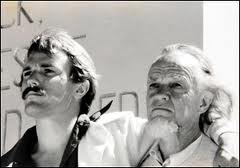
Francis Schaeffer with his son Franky pictured below. Francis and Edith (who passed away in 2013) opened L’ Abri in 1955 in Switzerland.
_____________
Related posts:

Francis Schaeffer’s “How should we then live?” Video and outline of episode 10 “Final Choices” (Schaeffer Sundays)

E P I S O D E 1 0   Dr. Francis Schaeffer – Episode X – Final Choices 27 min FINAL CHOICES I. Authoritarianism the Only Humanistic Social Option One man or an elite giving authoritative arbitrary absolutes. A. Society is sole absolute in absence of other absolutes. B. But society has to be […]

Francis Schaeffer’s “How should we then live?” Video and outline of episode 9 “The Age of Personal Peace and Affluence” (Schaeffer Sundays)

E P I S O D E 9 Dr. Francis Schaeffer – Episode IX – The Age of Personal Peace and Affluence 27 min T h e Age of Personal Peace and Afflunce I. By the Early 1960s People Were Bombarded From Every Side by Modern Man’s Humanistic Thought II. Modern Form of Humanistic Thought Leads […]

Francis Schaeffer’s “How should we then live?” Video and outline of episode 8 “The Age of Fragmentation” (Schaeffer Sundays)

E P I S O D E 8 Dr. Francis Schaeffer – Episode VIII – The Age of Fragmentation 27 min I saw this film series in 1979 and it had a major impact on me. T h e Age of FRAGMENTATION I. Art As a Vehicle Of Modern Thought A. Impressionism (Monet, Renoir, Pissarro, Sisley, […]

Francis Schaeffer’s “How should we then live?” Video and outline of episode 7 “The Age of Non-Reason” (Schaeffer Sundays)

E P I S O D E 7 Dr. Francis Schaeffer – Episode VII – The Age of Non Reason I am thrilled to get this film series with you. I saw it first in 1979 and it had such a big impact on me. Today’s episode is where we see modern humanist man act […]

Francis Schaeffer’s “How should we then live?” Video and outline of episode 6 “The Scientific Age” (Schaeffer Sundays)

E P I S O D E 6 How Should We Then Live 6#1 Uploaded by NoMirrorHDDHrorriMoN on Oct 3, 2011 How Should We Then Live? Episode 6 of 12 ________ I am sharing with you a film series that I saw in 1979. In this film Francis Schaeffer asserted that was a shift in […]

Francis Schaeffer’s “How should we then live?” Video and outline of episode 5 “The Revolutionary Age” (Schaeffer Sundays)

E P I S O D E 5 How Should We Then Live? Episode 5: The Revolutionary Age I was impacted by this film series by Francis Schaeffer back in the 1970′s and I wanted to share it with you. Francis Schaeffer noted, “Reformation Did Not Bring Perfection. But gradually on basis of biblical teaching there […]

Francis Schaeffer’s “How should we then live?” Video and outline of episode 4 “The Reformation” (Schaeffer Sundays)

Dr. Francis Schaeffer – Episode IV – The Reformation 27 min I was impacted by this film series by Francis Schaeffer back in the 1970′s and I wanted to share it with you. Schaeffer makes three key points concerning the Reformation: “1. Erasmian Christian humanism rejected by Farel. 2. Bible gives needed answers not only as to […]

“Schaeffer Sundays” Francis Schaeffer’s “How should we then live?” Video and outline of episode 3 “The Renaissance”

Francis Schaeffer’s “How should we then live?” Video and outline of episode 3 “The Renaissance” Francis Schaeffer: “How Should We Then Live?” (Episode 3) THE RENAISSANCE I was impacted by this film series by Francis Schaeffer back in the 1970′s and I wanted to share it with you. Schaeffer really shows why we have so […]

Francis Schaeffer’s “How should we then live?” Video and outline of episode 2 “The Middle Ages” (Schaeffer Sundays)

  Francis Schaeffer: “How Should We Then Live?” (Episode 2) THE MIDDLE AGES I was impacted by this film series by Francis Schaeffer back in the 1970′s and I wanted to share it with you. Schaeffer points out that during this time period unfortunately we have the “Church’s deviation from early church’s teaching in regard […]

Francis Schaeffer’s “How should we then live?” Video and outline of episode 1 “The Roman Age” (Schaeffer Sundays)

Francis Schaeffer: “How Should We Then Live?” (Episode 1) THE ROMAN AGE   Today I am starting a series that really had a big impact on my life back in the 1970′s when I first saw it. There are ten parts and today is the first. Francis Schaeffer takes a look at Rome and why […]

Francis Schaeffer: “Whatever Happened to the Human Race” (Episode 5) TRUTH AND HISTORY

Francis Schaeffer: “Whatever Happened to the Human Race” (Episode 5) TRUTH AND HISTORY Published on Oct 7, 2012 by AdamMetropolis This crucial series is narrated by the late Dr. Francis Schaeffer and former Surgeon General Dr. C. Everett Koop. Today, choices are being made that undermine human rights at their most basic level. Practices once […]

Francis Schaeffer: “Whatever Happened to the Human Race” (Episode 4) THE BASIS FOR HUMAN DIGNITY

The opening song at the beginning of this episode is very insightful. Francis Schaeffer: “Whatever Happened to the Human Race” (Episode 4) THE BASIS FOR HUMAN DIGNITY Published on Oct 7, 2012 by AdamMetropolis This crucial series is narrated by the late Dr. Francis Schaeffer and former Surgeon General Dr. C. Everett Koop. Today, choices […]

Francis Schaeffer: “Whatever Happened to the Human Race” (Episode 3) DEATH BY SOMEONE’S CHOICE

Francis Schaeffer: “Whatever Happened to the Human Race” (Episode 3) DEATH BY SOMEONE’S CHOICE Published on Oct 6, 2012 by AdamMetropolis This crucial series is narrated by the late Dr. Francis Schaeffer and former Surgeon General Dr. C. Everett Koop. Today, choices are being made that undermine human rights at their most basic level. Practices […]

Francis Schaeffer: “Whatever Happened to the Human Race?” (Episode 2) SLAUGHTER OF THE INNOCENTS

Francis Schaeffer: “Whatever Happened to the Human Race?” (Episode 2) SLAUGHTER OF THE INNOCENTS Published on Oct 6, 2012 by AdamMetropolis This crucial series is narrated by the late Dr. Francis Schaeffer and former Surgeon General Dr. C. Everett Koop. Today, choices are being made that undermine human rights at their most basic level. Practices […]

Francis Schaeffer: “Whatever Happened to the Human Race” (Episode 1) ABORTION OF THE HUMAN RACE

It is not possible to know where the pro-life evangelicals are coming from unless you look at the work of the person who inspired them the most. That person was Francis Schaeffer.  I do care about economic issues but the pro-life issue is the most important to me. Several years ago Adrian Rogers (past president of […]

The Characters referenced in Woody Allen’s “Midnight in Paris” (Part 29, Pablo Picasso)

In his weekly opinion piece, Andy Rooney shares his views on public art. I have really enjoyed this series on the characters referenced in the film “Midnight in Paris.” I can’t express how much I have learned during this series on the characters referenced in Woody Allen’s latest movie “Midnight  in Paris.” Today I am looking […]

Picasso painting “The acrobat” in Woody Allen movie “Midnight in Paris”

Pablo Picasso, ‘The acrobat,’ January 18, 1930 Picasso Dreamed About Limbs by DAVE SEGAL The Acrobat (1930) is a simple, surreal cartoon, almost comical in its minimalism. It’s practically a one-line drawing that was seemingly slapdashed off in a few minutes, offering a barely feasible depiction of the body’s pliability. With utmost economy (a black […]

The characters referenced in Woody Allen’s movie “Midnight in Paris” (Part 23,Adriana, fictional mistress of Picasso)

(UPDATE: A reader that used the username “therealchirpy” notes, “Although any affair with Picasso may be fictional, isn’t the ‘Adriana’ referred to in Allen’s ‘Midnight in Paris’ based on Hemingway’s mistress Adriana Ivancich.” I have found some evidence for that. I read a review that draws that same conclusion although some have said that Hemingway […]

“Woody Wednesday” Here is a list of the top 100 most Spiritually Significant films and Woody Allen’s movie “Crimes and Misdemeanors” made the list!

Woody Allen’s film “Crimes and Misdemeanors” makes the top 100 list!!! I have written about this movie over and over and over and I have even discussed this movie on the Arkansas Times Blog. Here is a list of the top 100 most Spiritually Significant films and Woody Allen’s movie “Crimes and Misdemeanors” made the […]

“Woody Wednesday” A fine review of Woody Allen’s good movie “Another Woman”

A fine review of a good Woody Allen movie. Another Woman An unfairly overlooked semi-classic that improves on Allen’s Bergmanesque dramas, thanks to a formidable cast that includes Gena Rowlands. 2011-09-12 Woody Allen Trevor Gilks 1988 Another Woman, like September, looks like an inessential Woody Allen film. It is yet another unpopular, moderately reviewed movie […]

“Woody Wednesday” A review of Woody Allens movies from John Dart

I enjoyed this review from the 1970′s of Woody Allen movies from John Dart. Woody Allen, Theologian by John Dart Formerly religion religion writer for the Los Angeles Times, John Dart is news editor of the Christian Century magazine. This article appeared in the Christian Century June 22-29, 1977, p. 585. Copyright by the Christian […]

“Woody Wednesday” A review of the movie “Whatever Works” by an Evangelical

A review of the movie “Whatever Works” by an Evangelical. Woody Allen’s nihilist liberalism goes activist Echoing a remark by Malcolm Muggeridge, Mark Richardson at Oz Conservative writes that liberalism is the last surviving extreme ideology, and he gives several example of what he means by this extremism. I added to the thread my own […]

“Woody Wednesday” A review of the Woody Allen movie “Another Woman”

A very interesting review. Eileen A. Joy Southern Illinois University Edwardsville Dept. of English Language and Literature ejoy@siue.edu College of Arts & Sciences Spring Colloquium “Thinking About the University” 9 – 11 April, 2007 Session 2 (Friday, Apr. 11): Staring Back in the Mirror: Professors Consider Their Depiction in Literature and Film “You Must Change […]

By Everette Hatcher III | Posted in Woody Allen | Edit | Comments (0)

___________

The federal government should eliminate the food stamp program or at least hand it over the states!!!!!!

Downsize the Department of Agriculture

Published on Jan 6, 2014

http://www.downsizinggovernment.org/a…

The Department of Agriculture provides an array of subsidies for farmers and imposes extensive regulations on agricultural markets. It operates the food stamp and school lunch programs, and it administers numerous subsidy programs for rural parts of the nation. The Forest Service is also within the Department of Agriculture.

The department spent around $150 billion in 2013, or almost $1,300 for every U.S. household. It operates about 240 subsidy programs and employs 93,000 workers in about 7,000 offices across the country.

______________________

The federal government should eliminate the food stamp program or at least hand it over the  states!!!!!!

January 7, 2014 3:23PM

Downsize the Department of Agriculture

The Department of Agriculture spends over $150 billion dollars per year on various programs related to agriculture and food. It spends tens of billions on farm subsidies that largely go to growers of just a few crops: wheat, corn, soybeans, rice, and cotton. Beyond this, it subsidizes food through the federal food stamp program, which is rife with waste and corruption. It also regulates many agricultural products, most notably milk and sugar, setting minimum prices which artificially keep food prices high for consumers.

The federal government has little reason to be engaging in any of these activities, which should be left to the states in the case of food stamps, or eliminated entirely in the case of regulations or subsidies. This could save taxpayers $140 billion per year. To that end we’ve created a short video which makes these and other points, which you can watch below:

Related posts:

Americans know that we must have work requirements for food stamps!!!!

____________ Americans know that we must have work requirements for food stamps!!!! Americans Support Stronger Work Requirements for Food Stamps Rachel Sheffield October 30, 2013 at 12:02 pm Newscom Nearly three-quarters of Americans believe that the food stamps program should include stronger work requirements, according to the October Food Demand Survey (FooDS) out of Oklahoma […]

The Dysfunction in Washington is Republicans and Democrats that are unwilling to cut spending in order to vote for more programs (Democrats want more food stamps etc but Republicans vote for their pet programs and wars too like No Child Left Behind Act, the Iraq war, the prescription drug entitlement, and the TARP bailout).

The Dysfunction in Washington is Republicans and Democrats that are unwilling to cut spending in order to vote for more programs (Democrats want more food stamps etc but Republicans vote for their pet programs and wars too like No Child Left Behind Act, the Iraq war, the prescription drug entitlement, and the TARP bailout). If […]

We don’t need to recruit people to be on food stamps but kick people off!!!

We don’t need to recruit people to be on food stamps but kick people off!!! Seven Reasons to Reform Food Stamps T. Elliot Gaiser July 4, 2013 at 12:00 pm Newscom Food stamps were a popular topic of conversation last month as Congress debated the farm bill. This decades-old Great Society program is in much […]

If increase in food stamps was just because of recession then why spending go from $19.8 billion in 2000 to $37.9 billion in 2007?

If the increase in food stamps was just because of the recession then why did the spending go from $19.8 billion in 2000 to $37.9 billion in 2007? The Facts about Food Stamps Everyone Should Hear Rachel Sheffield and T. Elliot Gaiser May 27, 2013 at 12:00 pm (7) Newscom A recent US News & […]

Tell the 48 million food stamps users to eat more broccoli!!!!

Welfare Can And Must Be Reformed             Uploaded on Jun 29, 2010 If America does not get welfare reform under control, it will bankrupt America. But the Heritage Foundation’s Robert Rector has a five-step plan to reform welfare while protecting our most vulnerable. __________________________ We got to slow down the growth of Food Stamps. One […]

We have too many people getting dependent on food stamps

We have too many people getting dependent on food stamps. WSJ: Food Stamp Rolls Remain High Despite Economic Improvement Rachel Sheffield April 4, 2013 at 2:30 pm Newscom The Wall Street Journal (WSJ) reported last week that even with improvements in the economy, food stamp participation rates have reached all-time highs. Since 2008, enrollment has […]

Republicans for more food stamps?

Eight Reasons Why Big Government Hurts Economic Growth __________________ We got to cut spending and we must first start with food stamp program and we need some Senators that are willing to make the tough cuts. Food Stamp Republicans Posted by Chris Edwards Newt Gingrich had fun calling President Obama the “food stamp president,” but […]

Obama promotes food stamps but Milton Friedman had a better suggestion

Milton Friedman’s negative income tax explained by Friedman in 1968: We need to cut back on the Food Stamp program and not try to increase it. What really upsets me is that when the government gets involved in welfare there is a welfare trap created for those who become dependent on the program. Once they […]

400% increase in food stamps since 2000

Welfare Can And Must Be Reformed Uploaded by HeritageFoundation on Jun 29, 2010 If America does not get welfare reform under control, it will bankrupt America. But the Heritage Foundation’s Robert Rector has a five-step plan to reform welfare while protecting our most vulnerable. __________________________ If welfare increases as much as it has in the […]

The food stamp bill would be more costly than the Obama Stimulus!!!!!

The food stamp bill would be more costly than the Obama Stimulus!!!!! Farm Bills Would Cost More Than Obama Stimulus Daren Bakst October 28, 2013 at 3:56 pm The House and Senate are considering farm bill legislation this week whose costs should raise red flags for all Americans. In fact, the House and Senate versions […]

Debating Kermit Gosnell Trial, Abortion and infanticide with Ark Times Bloggers Part 2

__

C. Everett Koop, 1980s.jpg
Surgeon General of the United States
In office
January 21, 1982 – October 1, 1989
President Ronald Reagan
George H. W. Bush
Francis Schaeffer
Francis Schaeffer.jpg

Founder of the L’Abri community
Born Francis August Schaeffer
January 30, 1912

Died May 15, 1984 (aged 72)

I truly believe that many of the problems we have today in the USA are due to the advancement of humanism in the last few decades in our society. Ronald Reagan appointed the evangelical Dr. C. Everett Koop to the position of Surgeon General in his administration. He partnered with Dr. Francis Schaeffer in making the video below. It is very valuable information for Christians to have.  Actually I have included a video below that includes comments from him on this subject.


Francis Schaeffer Whatever Happened to the Human Race (Episode 1) ABORTION


Francis Schaeffer: What Ever Happened to the Human Race? (Full-Length Documentary)


I have gone back and forth and back and forth with many liberals on the Arkansas Times Blog on many issues such as abortion, human rights, welfare, poverty, gun control  and issues dealing with popular culture . This time around I have discussed morality with the Ark Times Bloggers and particularly the trial of the abortionist Dr. Kermit Gosnell and through that we discuss infanticide, abortion and even partial birth abortion. Here are some of my favorite past posts on the subject of Gosnell: ,Abby Johnson comments on Dr. Gosnell’s guilty verdict, Does President Obama care about Kermit Gosnell verdict?,  Dr. Gosnell Trial mostly ignored by media,  Kermit Gosnell is guilty of same crimes of abortion clinics are says Jennifer Mason,  Denny Burk: Is Dr. Gosnell the usual case or not?, Pro-life Groups thrilled with Kermit Gosnell guilty verdict,  Reactions to Dr. Gosnell guilty verdict from pro-life leaders,  Kermit Gosnell and Planned Parenthood supporting infanticide?, Owen Strachan on Dr. Gosnell Trial, Al Mohler on Kermit Gosnell’s abortion practice, Finally we get justice for Dr. Kermit Gosnell .

In July of 2013 I went back and forth with several bloggers from the Ark Times Blog concerning Dr. Kermit Gosnell’s abortion practice and his trial which had finished up in the middle of May:

Couldn’t be better wrote, “No, Saline, failure of the state of PA to monitor the doctors in their state, all of them, is the cause of how a Dr Giosnell gets by. That is a system failure by the state government of PA and had zero, nothing, naught, to do whether it was an abortion clinic or a foot surgeon or an ENT speciialist. Bad doctors are bad doctors, no matter what their speciality is. You won’t find one person on the blog who defends Gosnell.”

___________

Many of my relatives grew up in the Methodist Church and many of them have regretted the liberal direction the church has taken in the last few years. I enjoyed reading the words below of Matt O’Reilly on the recent statement of the United Methodist Church on the Gosnell verdict. Matt is the pastor of First United Methodist Church in Union Springs, Alabama, and an adjunct member of the faculties of New Testament at Wesley Biblical Seminary and Asbury Theological Seminary.

______________

The General Board of Church and Society (GBCS) has released a statement on the guilty verdict handed down earlier this week in the trial of Kermit Gosnell, who killed numerous newborns and at least one woman. I’m glad the statement from GBCS condemned the horrible crimes committed by the former abortion practitioner as reprehensible. They certainly were. I’m also very glad that the statement does not contradict our United Methodist Social Principles. There are, nevertheless, a variety of features that make the statement inadequate….The statement goes on to say that both supporters and opponents of abortion find Gosnell’s crimes reprehensible. This only is accurate to a degree. IT WOULD HAVE BEEN MORE ACCURATE TO SAY THAT SOME ABORTION SUPPORTERS FIND GOSNELL’S CRIMES REPREHENSIBLE. A GROWING NUMBER OF ABORTION ADVOCATES ARE ALSO CALLING FOR THE LEGALIZATION OF INFANTICIDE. Ethicist Peter Singer has been saying this for years, and others are beginning to join him. The key example is the most recent edition of the Journal of Medical Ethics, which is devoted to debating infanticide and contains articles arguing both for and against the killing of newborns. I point to other examples of this trend in a recent piece for The United Methodist Reporter, and you can follow Michael Bird who is chronicling the “Infanticide Blitz”. This is a debate we are now having. Certainly not all supporters of abortion reject infanticide, but GBCS should not lead us to think that supporters of abortion are of one mind with regard to infanticide. Many abortion advocates find Gosnell’s crimes horrific, but the arguments that gave us constitutionally protected abortion are being applied to newborns in a growing number of diverse arenas. The folks at GBCS need to read the relevant journals and websites and do their homework rather more carefully in order to stay on top of this highly important issue.

________________
http://www.mattoreilly.net/2013/05/gbcsumc…

Related posts:

GBCSUMC on Gosnell: What’s abortion got to do with it? #UMC

Many in the world today are taking a long look at the abortion industry because of the May 14, 2013 guilty verdict and life term penalty handed down by a jury (which included 9 out of 12 pro-choice jurors)  to Dr. Kermit Gosnell. During this time of reflection I wanted to put forth some of the […]

Kermit Gosnell and the irony of the coat hanger back alley argument

Many in the world today are taking a long look at the abortion industry because of the May 14, 2013 guilty verdict and life term penalty handed down by a jury (which included 9 out of 12 pro-choice jurors)  to Dr. Kermit Gosnell. During this time of reflection I wanted to put forth some of the […]

History’s Jury Is Out: Has Gosnell Rocked Our Conscience?

Many in the world today are taking a long look at the abortion industry because of the May 14, 2013 guilty verdict and life term penalty handed down by a jury (which included 9 out of 12 pro-choice jurors)  to Dr. Kermit Gosnell. During this time of reflection I wanted to put forth some of the […]

Evangelical Blogger Lists Eight Reasons the Media Are Ignoring the Gosnell Murder Trial

Many in the world today are taking a long look at the abortion industry because of the May 14, 2013 guilty verdict and life term penalty handed down by a jury (which included 9 out of 12 pro-choice jurors)  to Dr. Kermit Gosnell. During this time of reflection I wanted to put forth some of the […]

Cornerstone Executive Ashley Pratte on Gosnell Trial Verdict

Many in the world today are taking a long look at the abortion industry because of the May 14, 2013 guilty verdict and life term penalty handed down by a jury (which included 9 out of 12 pro-choice jurors)  to Dr. Kermit Gosnell. During this time of reflection I wanted to put forth some of the […]

Dr. Gosnell Trial ignored for a while by mainstream media

Many in the world today are taking a long look at the abortion industry because of the May 14, 2013 guilty verdict and life term penalty handed down by a jury (which included 9 out of 12 pro-choice jurors)  to Dr. Kermit Gosnell. During this time of reflection I wanted to put forth some of the […]

ANALYSIS: Will the Kermit Gosnell verdict change the abortion debate?

Many in the world today are taking a long look at the abortion industry because of the May 14, 2013 guilty verdict and life term penalty handed down by a jury (which included 9 out of 12 pro-choice jurors)  to Dr. Kermit Gosnell. During this time of reflection I wanted to put forth some of the […]

What’s So Bad About Kermit Gosnell?

Many in the world today are taking a long look at the abortion industry because of the May 14, 2013 guilty verdict and life term penalty handed down by a jury (which included 9 out of 12 pro-choice jurors)  to Dr. Kermit Gosnell. During this time of reflection I wanted to put forth some of the […]

Kermit Gosnell and the Gospel

Many in the world today are taking a long look at the abortion industry because of the May 14, 2013 guilty verdict and life term penalty handed down by a jury (which included 9 out of 12 pro-choice jurors)  to Dr. Kermit Gosnell. During this time of reflection I wanted to put forth some of the […]

VIDEO: Kermit Gosnell killings like ‘weeding your garden’

Many in the world today are taking a long look at the abortion industry because of the May 14, 2013 guilty verdict and life term penalty handed down by a jury (which included 9 out of 12 pro-choice jurors)  to Dr. Kermit Gosnell. During this time of reflection I wanted to put forth some of the […]

Gosnell: The Silence is Deafening

Many in the world today are taking a long look at the abortion industry because of the May 14, 2013 guilty verdict and life term penalty handed down by a jury (which included 9 out of 12 pro-choice jurors)  to Dr. Kermit Gosnell. During this time of reflection I wanted to put forth some of the […]

Five Thoughts on the Gosnell Conviction

Many in the world today are taking a long look at the abortion industry because of the May 14, 2013 guilty verdict and life term penalty handed down by a jury (which included 9 out of 12 pro-choice jurors)  to Dr. Kermit Gosnell. During this time of reflection I wanted to put forth some of the […]

Implications of the Kermit Gosnell Verdict

Many in the world today are taking a long look at the abortion industry because of the May 14, 2013 guilty verdict and life term penalty handed down by a jury (which included 9 out of 12 pro-choice jurors)  to Dr. Kermit Gosnell. During this time of reflection I wanted to put forth some of the […]

Godly comments on Dr. Kermit Gosnell

Many in the world today are taking a long look at the abortion industry because of the May 14, 2013 guilty verdict and life term penalty handed down by a jury (which included 9 out of 12 pro-choice jurors)  to Dr. Kermit Gosnell. During this time of reflection I wanted to put forth some of the […]

Dr. Gosnell Trial has prompted closer look at Albuquerque abortion clinic

Many in the world today are taking a long look at the abortion industry because of the May 14, 2013 guilty verdict and life term penalty handed down by a jury (which included 9 out of 12 pro-choice jurors)  to Dr. Kermit Gosnell. During this time of reflection I wanted to put forth some of the […]

Why won’t President Obama comment on Dr. Gosnell Trial?

Many in the world today are taking a long look at the abortion industry because of the May 14, 2013 guilty verdict and life term penalty handed down by a jury (which included 9 out of 12 pro-choice jurors)  to Dr. Kermit Gosnell. During this time of reflection I wanted to put forth some of the […]

Dr. Alveda King reacts to guilty verdict of Kermit Gosnell

Francis Schaeffer: “Whatever Happened to the Human Race” (Episode 1) ABORTION OF THE HUMAN RACE Published on Oct 6, 2012 by AdamMetropolis ________________ What a great article below: Dr. Alveda King: Guilty Gosnell Verdict May Spark More Justice for Women and Babies Contact: Eugene Vigil, King for America, 470-244-3302 PHILADELPHIA, May 13, 2013 /Christian Newswire/ […]

Kristen Hatten: Dr. Gosnell guilty verdict, but what about the rest?

Many in the world today are taking a long look at the abortion industry because of the May 14, 2013 guilty verdict and life term penalty handed down by a jury (which included 9 out of 12 pro-choice jurors)  to Dr. Kermit Gosnell. During this time of reflection I wanted to put forth some of the […]

Lila Rose of Live Action comments on Kermit Gosnell guilty verdict

Francis Schaeffer: “Whatever Happened to the Human Race” (Episode 1) ABORTION OF THE HUMAN RACE Published on Oct 6, 2012 by AdamMetropolis ________________ May 14, 2013 Murdered Thousands, Convicted for Three: The Kermit Gosnell Verdict By Drew Belsky Read more: http://www.americanthinker.com/2013/05/murdered_thousands_convicted_for_three_the_kermit_gosnell_verdict.html#ixzz2TMstLk1c Follow us: @AmericanThinker on Twitter | AmericanThinker on FacebookPhiladelphia abortionist Kermit Gosnell was convicted […]

Gerard M. Nadal: Dr. Gosnell Guilty, but now what?

Many in the world today are taking a long look at the abortion industry because of the May 14, 2013 guilty verdict and life term penalty handed down by a jury (which included 9 out of 12 pro-choice jurors)  to Dr. Kermit Gosnell. During this time of reflection I wanted to put forth some of the […]

Reince Priebus on Kermit Gosnell guilty verdict

Francis Schaeffer: “Whatever Happened to the Human Race” (Episode 1) ABORTION OF THE HUMAN RACE Published on Oct 6, 2012 by AdamMetropolis ________________ A Verdict Doesn’t End the Gosnell Story By: Chairman Reince Priebus (Diary)  |  May 13th, 2013 at 03:27 PM  |  28 RESIZE: AAA The horrors that unfolded in the clinic of Dr. […]

Kirsten Powers of USA Today on Dr. Gosnell Trial

Many in the world today are taking a long look at the abortion industry because of the May 14, 2013 guilty verdict and life term penalty handed down by a jury (which included 9 out of 12 pro-choice jurors)  to Dr. Kermit Gosnell. During this time of reflection I wanted to put forth some of the […]

Top 10 Revelations of Kermit Gosnell Trial

Francis Schaeffer: “Whatever Happened to the Human Race” (Episode 1) ABORTION OF THE HUMAN RACE Published on Oct 6, 2012 by AdamMetropolis ________________ All-American Horror Story: Top 10 Kermit Gosnell Trial Revelations by Kristan Hawkins | Washington, DC | LifeNews.com | 4/12/13 3:38 PM Since so many in the media have failed/refused to report on […]

Denny Burk: We have to learn from Dr. Gosnell’s Crimes

Many in the world today are taking a long look at the abortion industry because of the May 14, 2013 guilty verdict and life term penalty handed down by a jury (which included 9 out of 12 pro-choice jurors)  to Dr. Kermit Gosnell. During this time of reflection I wanted to put forth some of the […]

Tony Perkins on Kermit Gosnell Trial

Francis Schaeffer: “Whatever Happened to the Human Race” (Episode 1) ABORTION OF THE HUMAN RACE Published on Oct 6, 2012 by AdamMetropolis _____________ Tony Perkins: Gosnell Trial – FOX News Published on May 13, 2013 Tony Perkins: Gosnell Trial – FOX News ________________ Hey Obama, Kermit Gosnell Is What a Real War on Women Looks Like […]

Ross Douthat of NY Times on Dr. Gosnell

Many in the world today are taking a long look at the abortion industry because of the May 14, 2013 guilty verdict and life term penalty handed down by a jury (which included 9 out of 12 pro-choice jurors)  to Dr. Kermit Gosnell. During this time of reflection I wanted to put forth some of the […]

Family Research Council happy with Kermit Gosnell Guilty Verdict

Francis Schaeffer: “Whatever Happened to the Human Race” (Episode 1) ABORTION OF THE HUMAN RACE Published on Oct 6, 2012 by AdamMetropolis ___ _____________ Tony Perkins: Gosnell Trial – FOX News Published on May 13, 2013 Tony Perkins: Gosnell Trial – FOX News ________________ Family Research Council Praises Jury for Bringing Justice to Victims of Abortionist […]

Peter Jones on Infanticide and Dr. Gosnell

Many in the world today are taking a long look at the abortion industry because of the May 14, 2013 guilty verdict and life term penalty handed down by a jury (which included 9 out of 12 pro-choice jurors)  to Dr. Kermit Gosnell. During this time of reflection I wanted to put forth some of the […]

Is Dr. Gosnell a “one-of-a-kind anomaly”?

Many in the world today are taking a long look at the abortion industry because of the May 14, 2013 guilty verdict and life term penalty handed down by a jury (which included 9 out of 12 pro-choice jurors)  to Dr. Kermit Gosnell. During this time of reflection I wanted to put forth some of the […]

Kermit Gosnell and the Logic of “Pro-Choice”

Francis Schaeffer: “Whatever Happened to the Human Race” (Episode 1) ABORTION OF THE HUMAN RACE Published on Oct 6, 2012 by AdamMetropolis ________________ _____________ Tony Perkins: Gosnell Trial – FOX News Published on May 13, 2013 Tony Perkins: Gosnell Trial – FOX News ________________ Kermit Gosnell and the Logic of “Pro-Choice” by  Matthew J. Franck within […]

______________________

Do New York late term abortionists need more attention like Dr. Gosnell did?

Many in the world today are taking a long look at the abortion industry because of the May 14, 2013 guilty verdict and life term penalty handed down by a jury (which included 9 out of 12 pro-choice jurors)  to Dr. Kermit Gosnell. During this time of reflection I wanted to put forth some of the […]

Dr. Gosnell Trial has prompted Texas authorities to take closer look a Houston abortionist

Many in the world today are taking a long look at the abortion industry because of the May 14, 2013 guilty verdict and life term penalty handed down by a jury (which included 9 out of 12 pro-choice jurors)  to Dr. Kermit Gosnell. During this time of reflection I wanted to put forth some of the […]

Father Frank Pavone reacts to Kermit Gosnell guilty verdict

Francis Schaeffer: “Whatever Happened to the Human Race” (Episode 1) ABORTION OF THE HUMAN RACE Published on Oct 6, 2012 by AdamMetropolis ________________ Fr. Pavone: Right to choose must yield to right to life STATEN ISLAND, NY — Father Frank Pavone, National Director of Priests for Life, had the following comment on the verdict in […]

NAF reacts to Dr. Gosnell guilty verdict

Many in the world today are taking a long look at the abortion industry because of the May 14, 2013 guilty verdict and life term penalty handed down by a jury (which included 9 out of 12 pro-choice jurors)  to Dr. Kermit Gosnell. During this time of reflection I wanted to put forth some of the […]

Hope for Kermit Gosnell’s repentance?

Francis Schaeffer: “Whatever Happened to the Human Race” (Episode 1) ABORTION OF THE HUMAN RACE Published on Oct 6, 2012 by AdamMetropolis ________________ The truth of abortion … the hope for Gosnell’s repentance A conviction in the murder trial of Philadelphia abortionist Kermit Gosnell has boosted the efforts of pro-lifers to demonstrate what abortion really […]

The Selfishness of Chris Evert Part 5 (Includes videos and Pictures)

The Selfishness of Chris Evert Part 2 (Includes videos and Pictures) _________________________________ _____________________ _______________________ __________________________ Tennis – Wimbledon 1974 [ Official Film ] – 05/05 Published on May 1, 2012 John Newcombe, Ken Rosewall, Bjor Borg, Jimmy Connors, Cris Evert… ___________________ Jimmy Connors Reflects Published on May 13, 2013 Jimmy Connors visits “SportsCenter” to discuss his memoir, […]

WOODY WEDNESDAY Review of Woody Allen’s latest movie “Blue Jasmine” Part 3

I have spent alot of time talking about Woody Allen films on this blog and looking at his worldview. He has a hopeless, meaningless, nihilistic worldview that believes we are going to turn to dust and there is no afterlife. Even though he has this view he has taken the opportunity to look at the weaknesses of his own secular view. I salute him for doing that. That is why I have returned to his work over and over and presented my own Christian worldview as an alternative.

My interest in Woody Allen is so great that I have a “Woody Wednesday” on my blog www.thedailyhatch.org every week. Also I have done over 30 posts on the historical characters mentioned in his film “Midnight in Paris.” (Salvador Dali, Ernest Hemingway,T.S.Elliot,  Cole Porter,Paul Gauguin,  Luis Bunuel, and Pablo Picasso were just a few of the characters.)

Today we are looking at a review of Woody Allen’s latest movie Blue Jasmine.

Blue Jasmine – Official Trailer (HD) Cate Blanchett, Alec Baldwin

Published on Jun 7, 2013

http://www.joblo.com – “Blue Jasmine” – Official Trailer

A New York housewife struggles through a life crisis.

Director: Woody Allen

Writer: Woody Allen

Stars: Cate Blanchett, Alec Baldwin, Peter Sarsgaard, Louis C.K.

In theaters: July 26, 2013

_____________________________

A Review below:

Blue Jasmine Movie Review

“How to Cure Inflation” in Milton Friedman’s FREE TO CHOOSE Part 4 of 7 “The job of the Federal Reserve is to control the money supply”

In 1980 I read the book FREE TO CHOOSE by Milton Friedman and it really enlightened me a tremendous amount.  I suggest checking out these episodes and transcripts of Milton Friedman’s film series FREE TO CHOOSE: “The Failure of Socialism” and “What is wrong with our schools?”  and “Created Equal”  and  From Cradle to Grave, and – Power of the Market.“If we could just stop the printing presses, we would stop inflation,” Milton Friedman says in “How to Cure Inflation” from the Free To Choose series. Now as then, there is only one cause of inflation, and that is when governments print too much money. Milton explains why it is that politicians like inflation, and why wage and price controls are not solutions to the problem.

In this episode Friedman noted, “The job of the Federal Reserve is not to run government spending; it’s not to run government taxation. The job of the Federal Reserve is to control the money supply and I believe, frankly, I have always believed as you know, that these are excuses and not reasons for the performance.”
DISCUSSION
Participants: Robert McKenzie, Moderator; Milton Friedman; Congressman Clarence J. Brown; William M. Martin, Chairman of Federal Reserve 1951_1970; Beryl W. Sprinkel, Executive Vice President, Harris Bank, Chicago; Otmar Emminger, President, Ieutsche Bundesbank, Frankfurt West Germany
MCKENZIE: And here at the Harper Library of the University of Chicago, our distinguished guests have their own ideas, too. So, lets join them now.
BROWN: If you could control the money supply, you can certainly cut back or control the rate of inflation. I’d have to say that that prescription is a little bit easier to write than it is to fill. I think there are some other ways to do it and I would relate the money supply __ I think inflation is a measure of the relationship between money and the goods and services that money is meant to cover. And so if you can stimulate the goods, the production of goods and services, it’s helpful. It’s a little tougher to control the money supply, although I think it can be done, than just saying that you should control it, because we’ve got the growth of credit cards, which is a form of money; created, in effect, by the free enterprise system. It isn’t all just printed in Washington, but that may sound too defensive. I think he was right in saying that the inflation is Washington based.
MCKENZIE: Mr. Martin, nobody has been in the firing line longer than you, 17 years head of the Fed. Could you briefly comment on that and we’ll go around the group.
MARTIN: I want to say 19 years.
(Laughter)
MARTIN: I wouldn’t be out here if it weren’t for Milton Friedman, today. He came down and gave us advice from time to time.
FRIEDMAN: You’ve never taken it.
(Laughter)
MCKENZIE: He’s going to do some interviewing later, I warn you.
MARTIN: And I’m rather glad we didn’t take it __
(Laughter)
MARTIN: __ all the time.
SPRINKEL: In your 19 years as Chairman of the Federal Reserve, Bill, the average growth in the money supply was 3.1 percent per year. The inflation rate was 2.2 percent. Since you left, the money supply has exactly doubled. The inflation rate is average over 7 percent, and, of course, in recent times the money supply has been growing in double-digit territory as has our inflation rate.
EMMINGER: May I, first of all, confirm two facts which have been so vividly brought out in the film of Professor Friedman; namely, that at the basis of the relatively good performance of Western Germany were really two events. One, the establishment of a new sound money which we try to preserve sound afterwards. And, secondly, the jump overnight into a free market economy without any controls over prices and wages. These are the two fundamental facts. We have tried to preserve monetary stability by just trying to follow this prescription of Professor Friedman; namely, monetary discipline. Keeping monetary growth relatively moderate. I must, however, warn you it’s not so easy as it looks. If you just say, governments have to have the courage to persist in that course.
FRIEDMAN: Nobody does disagree with the proposition that excessive growth in money supply is an essential element in the inflationary process and that the real problem is not what to do, but how to have the courage and the will to do it. And I want to go and start, if I may, on that subject; because I think that’s what we ought to explore. Why is it we haven’t had the courage and don’t, and under what circumstances will we? And I want to start with Bill Martin because his experience is a very interesting experience. His 19 years was divided into different periods. In the first period, that average that Beryl Sprinkel spoke about, averaged two very different periods. An early period of very slow growth and slow inflation; a later period of what at the time was regarded as creeping inflation __ now we’d be delighted to get back to it. People don’t remember that at the time that Mr. Nixon introduced price and wage controls in 1971 to control an outrageous inflation, the rate of inflation was four-and-a-half percent per year. Today we’d regard that as a major achievement; but the part of the period when you were Chairman, was a period when the inflation rate was starting to creep up and money growth rate was also creeping up. Now if I go from your period, you were eloquent in your statements to the public, to the press, to everyone, about the evils of inflation, and about the determination on the Federal Reserve not to be the architect of inflation. Your successor, Arthur Burns, was just as eloquent. Made exactly the same kinds of statements as effectively, and again over and over again said the Federal Reserve will not be the architect of inflation. His successor, Mr. G. William Miller, made the same speeches, and the same statements, and the same protestations. His successor, Paul Volcker, he is making the same statements. Now my question to you is: Why is it that there has been such a striking difference between the excellent pronouncements of all Chairmen of the Fed, therefore it’s not personal on you. You have a lot of company, unfortunately for the country. Why is it that there has been such a wide diversion between the excellent pronouncements on the one hand and what I regard as a very poor performance on the other?
MARTIN: Because monetary policy is not the only element. Fiscal policy is equally important.
FRIEDMAN: You’re shifting the buck to the Treasury.
MARTIN: Yes.
FRIEDMAN: To the Congress. We’ll get to Mr. Brown, don’t worry.
MARTIN: Yeah, that’s right.
(Laughter)
MARTIN: The relationship of fiscal policy to monetary policy is one of the important things.
MCKENZIE: Would you remind us, the general audience, when you say “fiscal policy”, what you mean in distinction to “monetary policy”?
MARTIN: Well, taxation.
MCKENZIE: Yeah.
MARTIN: The raising revenue.
FRIEDMAN: And spending.
MARTIN: And spending.
FRIEDMAN: And deficits.
MARTIN: And deficits, yes, exactly. And I think that you have to realize that when I’ve talked for a long time about the independence of the Federal Reserve. That’s independence within the government, not independence of the government. And I’ve worked consistently with the Treasury to try to see that the government is financed. Now this gets back to spending. The government says they’re gonna spend a certain amount, and then it turns out they don’t spend that amount. It doubles.
FRIEDMAN: The job of the Federal Reserve is not to run government spending; it’s not to run government taxation. The job of the Federal Reserve is to control the money supply and I believe, frankly, I have always believed as you know, that these are excuses and not reasons for the performance.
MARTIN: Well that’s where you and I differ, because I think we would be irresponsible if we didn’t take into account the needs and what the government is saying and doing. I think if we just went on our own, irresponsibly, I say it on this, because I was in the Treasury before I came to this __
FRIEDMAN: I know. I know.
MARTIN: __ go to the Fed; and I know the other side of the picture. I think we’d be rightly condemned by the American people and by the electorate.
FRIEDMAN: Every central bank in this world, including the German Central Bank, including the Federal Reserve System, has the technical capacity to make the money supply do over a period of two or three or four months, not daily, but over a period, has the technical capacity to control it.
(Several people talking at once.)
FRIEDMAN: I cannot explain the kind of excessive money creation that has occurred, in terms of the technical incapacity of the Federal Reserve System or of the German Central Bank, or of the Bank of England, or any other central bank in the world.
EMMINGER: I wouldn’t say technically we are incapable of doing that, although we have never succeeded in controlling the money supply month that way. But I would say we can, technically, control it half yearly, from one half-year period to the next and that would be sufficient __
FRIEDMAN: That would be sufficient.
EMMINGER: __ for controlling inflation. But however I __
VOICE OFF SCREEN: It doesn’t move.
FRIEDMAN: I’m an economic scientist, and I’m trying to observe phenomena, and I observe that every Federal Reserve Chairman says one thing and does another. I don’t mean he does, the system does.
MCKENZIE: Yeah. How different is your setup in Germany? You’ve heard this problem of governments getting committed to spending and the Fed having, one way or the other, to accommodate itself to it. Now what’s your position on this very interesting problem?
EMMINGER: We are very independent of the government, from the government, but, on the other hand, we are an advisor of the government. Also on the budget deficits and they would not easily go before Parliament with a deficit which much of it is openly criticized and disapproved by the same bank. Why because we have a tradition in our country that we can also publicly criticize the government on his account. And second, as if happened in our case too, the government goes beyond what is tolerable for the sake of moral equilibrium. We have let it come through in the capital markets. That is to say they have enough interest rates that has drawn public criticism and that has had some effect on their attitude.

Related posts:

“The Power of the Market” episode of Free to Choose in 1990 by Milton Friedman (Part 1)

Milton Friedman The Power of the Market 1-5 How can we have personal freedom without economic freedom? That is why I don’t understand why socialists who value individual freedoms want to take away our economic freedoms.  I wanted to share this info below with you from Milton Friedman who has influenced me greatly over the […]

“Friedman Friday,” EPISODE “The Failure of Socialism” of Free to Choose in 1990 by Milton Friedman (Part 1)

Milton Friedman: Free To Choose – The Failure Of Socialism With Ronald Reagan (Full) Published on Mar 19, 2012 by NoNationalityNeeded Milton Friedman’s writings affected me greatly when I first discovered them and I wanted to share with you. We must not head down the path of socialism like Greece has done. Abstract: Ronald Reagan […]

________________

“Friedman Friday” (“Free to Choose” episode 3 – Anatomy of a Crisis. part 3 of 7)

Worse still, America’s depression was to become worldwide because of what lies behind these doors. This is the vault of the Federal Reserve Bank of New York. Inside is the largest horde of gold in the world. Because the world was on a gold standard in 1929, these vaults, where the U.S. gold was stored, […]

“Friedman Friday” (Part 16) (“Free to Choose” episode 3 – Anatomy of a Crisis. part 2 of 7)

  George Eccles: Well, then we called all our employees together. And we told them to be at the bank at their place at 8:00 a.m. and just act as if nothing was happening, just have a smile on their face, if they could, and me too. And we have four savings windows and we […]

“Friedman Friday” (“Free to Choose” episode 3 – Anatomy of a Crisis. part 1of 7)

Milton Friedman’s Free to Choose (1980), episode 3 – Anatomy of a Crisis. part 1 FREE TO CHOOSE: Anatomy of Crisis Friedman Delancy Street in New York’s lower east side, hardly one of the city’s best known sites, yet what happened in this street nearly 50 years ago continues to effect all of us today. […]

By Everette Hatcher III | Also posted in Current Events | Edit | Comments (0)

____________________________

_____________


________________________________________________

_____________________________________________

Friedman Friday” Free to Choose by Milton Friedman: Episode “What is wrong with our schools?” (Part 3 of transcript and video)

Friedman Friday” Free to Choose by Milton Friedman: Episode “What is wrong with our schools?” (Part 3 of transcript and video) Here is the video clip and transcript of the film series FREE TO CHOOSE episode “What is wrong with our schools?” Part 3 of 6.   Volume 6 – What’s Wrong with our Schools Transcript: If it […]

Friedman Friday” Free to Choose by Milton Friedman: Episode “What is wrong with our schools?” (Part 2 of transcript and video)

Here is the video clip and transcript of the film series FREE TO CHOOSE episode “What is wrong with our schools?” Part 2 of 6.   Volume 6 – What’s Wrong with our Schools Transcript: Groups of concerned parents and teachers decided to do something about it. They used private funds to take over empty stores and they […]

By Everette Hatcher III | Also posted in Vouchers | Edit | Comments (1)

Friedman Friday” Free to Choose by Milton Friedman: Episode “What is wrong with our schools?” (Part 1 of transcript and video)

Here is the video clip and transcript of the film series FREE TO CHOOSE episode “What is wrong with our schools?” Part 1 of 6.   Volume 6 – What’s Wrong with our Schools Transcript: Friedman: These youngsters are beginning another day at one of America’s public schools, Hyde Park High School in Boston. What happens when […]

By Everette Hatcher III | Also posted in Vouchers | Tagged , , , , | Edit | Comments (0)

Friedman Friday” Free to Choose by Milton Friedman: Episode “Created Equal” (Part 3 of transcript and video)

Friedman Friday” Free to Choose by Milton Friedman: Episode “Created Equal” (Part 3 of transcript and video) Liberals like President Obama want to shoot for an equality of outcome. That system does not work. In fact, our free society allows for the closest gap between the wealthy and the poor. Unlike other countries where free enterprise and other […]

Free to Choose by Milton Friedman: Episode “Created Equal” (Part 2 of transcript and video)

Free to Choose by Milton Friedman: Episode “Created Equal” (Part 2 of transcript and video) Liberals like President Obama want to shoot for an equality of outcome. That system does not work. In fact, our free society allows for the closest gap between the wealthy and the poor. Unlike other countries where free enterprise and other freedoms are […]

Free to Choose by Milton Friedman: Episode “Created Equal” (Part 1 of transcript and video)

 Milton Friedman and Ronald Reagan Liberals like President Obama (and John Brummett) want to shoot for an equality of outcome. That system does not work. In fact, our free society allows for the closest gap between the wealthy and the poor. Unlike other countries where free enterprise and other freedoms are not present.  This is a seven part series. […]

Milton Friedman Friday: (“Free to Choose” episode 4 – From Cradle to Grave, Part 3 of 7)

 I am currently going through his film series “Free to Choose” which is one the most powerful film series I have ever seen. PART 3 OF 7 Worse still, America’s depression was to become worldwide because of what lies behind these doors. This is the vault of the Federal Reserve Bank of New York. Inside […]

By Everette Hatcher III | Edit | Comments (0)

Milton Friedman Friday:(“Free to Choose” episode 4 – From Cradle to Grave, Part 2 of 7)

 I am currently going through his film series “Free to Choose” which is one the most powerful film series I have ever seen. For the past 7 years Maureen Ramsey has had to buy food and clothes for her family out of a government handout. For the whole of that time, her husband, Steve, hasn’t […]

Friedman Friday:(“Free to Choose” episode 4 – From Cradle to Grave, Part 1 of 7)

Friedman Friday:(“Free to Choose” episode 4 – From Cradle to Grave, Part 1 of 7) Volume 4 – From Cradle to Grave Abstract: Since the Depression years of the 1930s, there has been almost continuous expansion of governmental efforts to provide for people’s welfare. First, there was a tremendous expansion of public works. The Social Security Act […]

By Everette Hatcher III | Edit | Comments (0)

“Friedman Friday” (“Free to Choose” episode 1 – Power of the Market. part 3 of 7)

  _________________________   Pt3  Nowadays there’s a considerable amount of traffic at this border. People cross a little more freely than they use to. Many people from Hong Kong trade in China and the market has helped bring the two countries closer together, but the barriers between them are still very real. On this side […]

“Friedman Friday” (“Free to Choose” episode 1 – Power of the Market. part 2 of 7)

  Aside from its harbor, the only other important resource of Hong Kong is people __ over 4_ million of them. Like America a century ago, Hong Kong in the past few decades has been a haven for people who sought the freedom to make the most of their own abilities. Many of them are […]

“Friedman Friday” (“Free to Choose” episode 1 – Power of the Market. part 1of 7)

“FREE TO CHOOSE” 1: The Power of the Market (Milton Friedman) Free to Choose ^ | 1980 | Milton Friedman Posted on Monday, July 17, 2006 4:20:46 PM by Choose Ye This Day FREE TO CHOOSE: The Power of the Market Friedman: Once all of this was a swamp, covered with forest. The Canarce Indians […]

By Everette Hatcher III | Posted in Current Events, Milton Friedman | Edit | Comments (0)

“Friedman Friday,” EPISODE “The Failure of Socialism” of Free to Choose in 1990 by Milton Friedman (Part 1)

Milton Friedman: Free To Choose – The Failure Of Socialism With Ronald Reagan (Full) Published on Mar 19, 2012 by NoNationalityNeeded Milton Friedman’s writings affected me greatly when I first discovered them and I wanted to share with you. We must not head down the path of socialism like Greece has done. Abstract: Ronald Reagan […]

By Everette Hatcher III | Posted in Milton Friedman, President Obama | Edit | Comments (1)

Open letter to President Obama (Part 492) (Plagued by Rising Costs and Vulnerable to Fraud, It’s Time to Focus Attention on the Disability Progam)

Open letter to President Obama (Part 492)

(Emailed to White House on 4-15-13.)

President Obama c/o The White House 1600 Pennsylvania Avenue NW Washington, DC 20500

Dear Mr. President,

I know that you receive 20,000 letters a day and that you actually read 10 of them every day. I really do respect you for trying to get a pulse on what is going on out here.

___________________

Your administration has created less jobs than people it has on disability. At least according to this article below.

Plagued by Rising Costs and Vulnerable to Fraud, It’s Time to Focus Attention on the Disability Progam

April 12, 2013 by Dan Mitchell

When I think of the disability program, I think of the bum who is collecting a check so he can be an “adult baby” and indulge his fetish of wearing diapers. Though I guess that’s not as bad as the situation in Greece, where you can get a disability payment for being a pedophile.

But this is a much bigger and more serious issue. Earlier this morning, I took part in a joint Brooking Institution/American Enterprise Institute/Secretary’s Innovation Group conference on the disability insurance program.

I only had a minor role, posing question to Mark Duggan of the University of Pennsylvania and Stephen Goss of the Social Security Administration, but it was a very useful exercise because I was exposed to some sobering details about the program.

Let’s review a couple of Professor Duggan’s charts, starting with a look at how the disability rate has exploded in the past 22 years.

Disability Slide 2

And here is some very disturbing data showing that much of the increase is in the areas that are most subject to abuse because of subjective judgements about “bad backs” and “depression.”

Disability Slide 1

Hmmm…, I’m a bit depressed about the ever-rising burden of government. Maybe I should get a check from the government!

Joking aside, I briefly touched on this issue in a recent CNBC interview. Here’s the segment dealing with the disability program and the disturbing rise in dependency.

I’m not overly impressed by the counter-argument from Christian Weller. Does he really want us to believe that the service sector jobs of today are more disabling than the manufacturing jobs of 20-plus years ago?

This is a depressing topic, so let’s close with a couple of cartoons, starting with this gem from Chip Bok.

Disability Cartoon 1

It’s amusing, but keep in mind that we have an unusually high joblessness rate right now, but it would be even higher if we counted the people who shifted to this other form of unemployment dependency.

And here’s a Chuck Asay cartoon that I really like because he augments my argument in the interview that it hurts the economy when you lure workers out of the job market and make them wards of the state.

Disability Cartoon 2

Asay takes it one step farther and shows the lifeboat sinking. That’s basically what will happen if we don’t adopt the entitlement reforms that are needed to rein in the welfare state.

P.S. If you want some jokes referencing the disability program, we have the politically correct version of The Little Red Hen, as well as two very similar jokes about Jesus performing miracles and how liberals differ from conservatives and libertarians.

______________________

Thank you so much for your time. I know how valuable it is. I also appreciate the fine family that you have and your commitment as a father and a husband.

Sincerely,

Everette Hatcher III, 13900 Cottontail Lane, Alexander, AR 72002, ph 501-920-5733, lowcostsqueegees@yahoo.com

Related posts:

Dan Mitchell on Obamacare (includes cartoons on Obamacare)

Some very good points by Dan Mitchell of the Cato Institute on Obamacare: Why We Should Be Optimistic about Repealing Obamacare and Fixing the Healthcare System April 10, 2013 by Dan Mitchell I’m going to make an assertion that seems utterly absurd. The enactment of Obamacare may have been good news. Before sending a team of medical […]

Dan Mitchell’s blog has great cartoon that demonstrates what President Obama has been doing the last 4 years!!!

I have put up lots of cartoons from Dan Mitchell’s blog before and they have got lots of hits before. Many of them have dealt with the economy, eternal unemployment benefits, socialism,  Greece,  welfare state or on gun control.     I’ve Obtained a Secret Pre-Release Copy of Obama’s Budget April 9, 2013 by Dan Mitchell The President is supposed to release […]

Dan Mitchell’s tribute to Margaret Thatcher

Very well said by Dan Mitchell. A Tribute to Margaret Thatcher April 8, 2013 by Dan Mitchell The woman who saved the United Kingdom has died. A Great Woman I got to meet Margaret Thatcher a couple of times and felt lucky each time that I was in the presence of someone who put her nation’s […]

Dan Mitchell, Ron Paul, and Milton Friedman on Immigration Debate (includes editorial cartoon)

I like Milton Friedman’s comments on this issue of immigration   and Ron Paul and Dan Mitchell do well on the issue too. Question of the Week: What’s Your Take on the Immigration Debate? April 7, 2013 by Dan Mitchell A reader from overseas wonders about my views on immigration, particularly amnesty. I confess that this is one of […]

Dan Mitchell on Texas v. California (includes editorial cartoon)

We should lower federal taxes because jobs are going to states like Texas that have low taxes. What Can We Learn by Comparing the Employment Situation in Texas vs. California? April 3, 2013 by Dan Mitchell One of the great things about federalism, above and beyond the fact that it both constrains the power of governments […]

Cartoons from Dan Mitchell’s blog on Obamacare

Third-Party Payer is the Biggest Economic Problem With America’s Health Care System Published on Jul 10, 2012 This mini-documentary from the Center for Freedom and Prosperity Foundation explains that “third-party payer” is the main problem with America’s health care system. This is why undoing Obamacare, while desirable, is just a small first step if we […]

Obamacare cartoons from Dan Mitchell’s blog

I have put up lots of cartoons from Dan Mitchell’s blog before and they have got lots of hits before. Many of them have dealt with the economy, eternal unemployment benefits, socialism,  Greece,  welfare state or on gun control. The funniest cartoon is the one with “Nurse Sebelius” stuffing the huge capsule down the kid’s throat!!! Obamacare […]

Editorial cartoon from Dan Mitchell’s blog on California’s sorry state of affairs

I have put up lots of cartoons from Dan Mitchell’s blog before and they have got lots of hits before. Many of them have dealt with the sequester, economy, eternal unemployment benefits, socialism,  minimum wage laws, tax increases, social security, high taxes in California, Obamacare,  Greece,  welfare state or on gun control. President Obama’s favorite state must be California because […]

Dan Mitchell of the Cato Institute:HUD has to go!!!! (includes political cartoon)

You want a suggestion on how to cut the government then start at HUD. I would prefer to eliminate all of it. Here are Dan Mitchell’s thoughts below: Sequestration’s Impact on HUD: Just 358 More Days and Mission Accomplished March 12, 2013 by Dan Mitchell As part of my “Question of the Week” series, I had […]

Dan Mitchell: Cartoonists React to the Senate Democratic Budget

I read that President Obama in his meetings with the Republicans would not even say that a balanced budget was a goal. According to the budget presented by the Democratic Senate he is in agreement with their approach. Cartoonists have taken the opportunity to poke fun at that below. I  have put up lots of cartoons […]

Here are some suggestions on cutting the federal government from the Heritage Foundation!!!

_____________

Here are some suggestions on cutting the federal government from the Heritage Foundation!!!

After reaching an agreement to spend nearly $45 billion more in 2014 than allowed under the sequestration spending caps, Congress still needs to pass the now over $1 trillion discretionary spending bill into law. As congressional appropriators are adding the final touches to the omnibus bill expected the week of January 6, they would be wise to eliminate any and all of the following 10 programs:

  1. The U.S. Department of Housing and Urban Development Community Development Block Grant (CDBG) program Savings[1]: $3.1 billion[2]

The CDBG program duplicates other federal housing and economic development programs, and has deviated from its original purpose of providing housing assistance and economic development to low-income communities. Instead, the grants have been diverted to wasteful parochial projects, which include funding a pet-shampoo company and issuing risky business loans. Congress should eliminate the CDBG program and devolve the activities it funds to the states.[3]

  1. The Department of Education competitive grant programs under the Elementary and Secondary Education Act (ESEA) Savings: $2 billion

The bulk of spending authorized under No Child Left Behind (NCLB) comes via formula grant programs such as Title I (funding for low-income school districts). However, there are numerous niche competitive grant programs, which have multiplied as federal government intervention into education has grown over the decades. These programs—of which there are roughly 60—range from federal art education programs and “Ready-to-Learn Television” to “Smaller Learning Communities.” Most recently, the Race to the Top program gave preference for grant applications to those states that agreed to adopt national education standards and tests, an area regarded by tradition and law as a state and local matter. Many competitive grant programs under NCLB are duplicative or ineffective, and should be terminated. Congress should eliminate the majority of these competitive grant programs.

  1. Job Corps Savings: $1.6 billion

Job Corps is a residential job-training program that seeks to serve disadvantaged youths ages 16 to 24, and has an abysmal record.[4] Numerous studies have found Job Corps to be ineffective at substantially increasing participants’ wages and moving them into full-time employment. Even worse, as The Heritage Foundation’s David Muhlhausen testified before the House Ways and Means Subcommittee on Human Resources on July 17, 2013, Job Corps has been shown to have negative effects. Based on a multisite experimental evaluation, Job Corps participants were less likely to earn a high school diploma than non-participants in a control group. Participants in the program also worked fewer weeks and worked fewer hours per week than similar teens and tweens in the control group.[5]

  1. U.S. Department of Agriculture Food for Peace Title II grants Savings: $1.5 billion

Food for Peace Title II grants make up the largest part of the federal food aid budget. The legal requirements binding the program make it inefficient and unnecessarily costly. Food must be purchased in the U.S. and then shipped across oceans in U.S.-flagged vessels, adding unnecessary logistical challenges to already-higher costs. In 2013, the Obama Administration proposed shifting the funding from the U.S. Department of Agriculture (USDA) Food for Peace program to the U.S. Agency for International Development (USAID), and reducing purchase and shipping restrictions. Congress should eliminate the purchase and shipping restrictions; Congress should also eliminate USDA funding for the program and require USAID to support the program with existing development funding.[6]

  1. The Department of Transportation’s Transportation Alternatives Program (TAP) Savings: $800 million[7]

The Transportation Alternatives Program (TAP) funds bicycle paths, sidewalks and nature paths, community preservation and landscaping, despite the fact that such projects are purely local matters. Therefore they should be funded using local funds, by those who will benefit from the infrastructure. Federal funding for the TAP program comes from federal gas tax dollars deposited into the Highway Trust Fund—money that is intended for highway and bridge programs that benefit the motorists who pay the gas tax that funds the program. If the states and localities were responsible for managing and funding TAP activities, they would be free to spend money on projects that they value and, because they bear the full costs, would have an incentive to avoid funding low-value projects when higher-value priorities exist. Congress should eliminate this program and focus federal transportation dollars on national projects.[8]

  1. The U.S. Department of Agriculture Conservation Technical Assistance program Savings: $730 million[9]

The Natural Resources Conservation Service (NRCS) runs a costly technical-assistance program to help landowners maintain private land, enhance recreational opportunities for landowners, and improve the aesthetic character of private land. Private landowners are the best stewards of their land without government assistance, and can seek out private solutions if technical assistance is necessary. Taxpayers should not be forced to subsidize advice on how private landowners can best use their land or improve its visual appearance. The Ryan–Murray budget authorizes the NRCS to collect up to $150 per conservation plan to cover some of the costs provided to recipients of the technical assistance. If these user fees were employed to offset the taxpayer funding of technical assistance, rather than to increase discretionary spending in other areas, they would be a sound way to lessen the burden on taxpayers. Better yet, Congress should eliminate all funding for the program.

  1. The Department of Transportation Essential Air Service (EAS) program Savings: $200 million[10]

Following airline deregulation in 1978, Congress started subsidizing commercial flights in rural communities through the supposedly temporary Essential Air Service (EAS) program. Over three decades later, federal taxpayers are still funding these subsidies through the program. It is not federal taxpayers’ responsibility to subsidize the flights of rural passengers who opt for air travel when cheaper or unsubsidized travel alternatives, such as ferries, are often available. Any subsidies for these flights should come from the local or state level, which are benefitting from the service—not from the federal government.

  1. The Department of Energy’s Advanced Manufacturing Program Savings: $120 million

The Department of Energy’s Advanced Manufacturing Program subsidizes activities leading to greater energy efficiency in American manufacturing processes with the goal of helping American manufacturers better compete globally. Manufacturers are well aware that energy represents a significant input cost, and face sufficient incentives to find ways to lower costs and gain a competitive advantage. American manufacturers will make energy-efficiency upgrades if they consider available technology promising, worth the risk, and the best use of their investment dollars. Congress should eliminate all funding for this corporate welfare program.[11]

  1. The Rural Business Program Account Savings: $100 million

The Rural Business Program Account deals with business and industry-guaranteed loans and rural business enterprise grants. Private capital will find its way to worthy rural investments. The federal government should not play venture capitalist with taxpayer money, including trying to serve allegedly underserved areas. Private actors will serve the area if it makes sound business sense. Congress should eliminate all funding for the Rural Business Program Account.

  1. All State Department funding for the United Nations Population Fund (UNFPA) Savings: $35 million

The United Nations Population Fund (UNFPA) faces continued allegations that it has been complicit in China’s coercive one-child policy, which is often enforced through forced abortions and forced sterilizations.[12] Development assistance is in many cases better provided on a decentralized, private level with stakeholders demanding transparency and seeking the best ways to assist populations in need. Congress has previously deniedfunding for UNFPA, or stipulated that no funds shall be spent in China. Congress should eliminate all funding for UNFPA.

Total Savings: $10.2 Billion. These savings represent merely a small subset of program eliminations[13] and spending cuts[14] that are necessary to cut the government down to size. First and foremost, Congress should not boost the budget from the current, extended FY 2013, appropriation level of $988 billion to above $1 trillion, and instead should reduce the budget to below the FY 2014 sequestration spending level of $967 billion—as House appropriators accomplished in their spending bills.[15] The House appropriations bill also moved in the right direction in four of the mentioned areas: (1) cutting funding for the USDA international food aid program, (2) prohibiting funding for Race to the Top and other competitive education grants, (3) cutting funding for community development block grants, (4) and prohibiting funding for UNFPA.

Yet more effective than reducing funds temporarily is to eliminate programs that are better suited for management at a state, local, or private level permanently. Doing so would save American taxpayers money in the long run and reduce the size and scope of the federal government—saving even more money, and reducing federal intervention in local government and market functions.

—Romina Boccia is the Grover M. Hermann Fellow in Federal Budgetary Affairs in the Thomas A. Roe Institute for Economic Policy Studies at The Heritage Foundation.

Show references in this report

[1] Unless noted otherwise, savings are for one year, based on 2013 outlays.

[2] U.S. Department of Housing and Urban Development, “CPD Appropriations Budget,” http://portal.hud.gov/hudportal/HUD?src=/program_offices/comm_planning/about/budget (accessed December 31, 2013).

[3] Emily Goff, “How to Cut $30 Billion More from the THUD Bill,” Heritage Foundation Issue Brief No. 3984, July 1, 2013, http://www.heritage.org/research/reports/2013/07/how-to-cut-from-transportation-housing-and-urban-development-appropriations.

[4] David B. Muhlhausen, “Job Corps: An Unfailing Record of Failure,” Heritage Foundation WebMemo No. 2423, May 5, 2009, http://www.heritage.org/research/reports/2009/05/job-corps-an-unfailing-record-of-failure.

[5] David B. Muhlhausen, “Evaluating Federal Social Programs: Finding Out What Works and What Does Not,” testimony before the Subcommittee on Human Resources, Committee on Ways and Means, U.S. House of Representatives, July 17, 2013, http://waysandmeans.house.gov/uploadedfiles/david_muhlhausen_testimony_071713.pdf (accessed December 31, 2013).

[6] Bryan Riley and Brett D. Schaefer, “U.S. Food Aid Should Focus on Combating Hunger and Malnutrition in Poor Nations,” Heritage Foundation, Issue Brief No. 3910, April 15, 2013, http://www.heritage.org/research/reports/2013/04/us-food-aid-should-focus-on-combating-hunger-and-malnutrition-in-poor-nations.

[7] U.S. Department of Transportation, “Transportation Alternatives Program (TAP) Guidance,” http://www.fhwa.dot.gov/map21/guidance/guidetap.cfm (accessed December 31, 2013).

[8] Emily Goff, “Empowering the States by Turning over the Federal Highway Program,” Heritage Foundation Issue Brief No. 4087, November 15, 2013, http://www.heritage.org/research/reports/2013/11/impact-of-turning-over-the-federal-highway-program-to-the-states.

[9] Megan Stubbs, “Agricultural Conservation: A Guide to Programs,” Congressional Research Service, February 5, 2013, http://www.fas.org/sgp/crs/misc/R40763.pdf (accessed December 31, 2013).

[10] “Essential Air Service: Illustrating Coming Changes to the Program,” Taxpayers for Common Sense, April 4, 2013, http://www.taxpayer.net/library/article/essential-air-service-illustrating-coming-changes-to-the-program (accessed December 31, 2013).

[11] Nicolas D. Loris, “Eliminate Advanced Manufacturing and Alternative Fuel Programs,” The Heritage Foundation, The Foundry, July 9, 2013, http://blog.heritage.org/2013/07/09/eliminate-advanced-manufacturing-and-alternative-fuel-programs/.

[12] Steven W. Mosher, “China’s One-Child Policy and the UNFPA: A Silent But Deadly Partnership,” Charlotte Lozier Institute, testimony, July 10, 2012, http://www.lozierinstitute.org/pri-president-steven-moshers-testimony-from-human-rights-panel-on-chinas-one-child-policy/ (accessed December 31, 2013).

[13] Patrick Louis Knudsen, “Tight Budget? Congress Can Save $42 Billion by Eliminating Bad Government Programs,” Heritage Foundation Backgrounder No. 2837, August 29, 2013, http://www.heritage.org/research/reports/2013/08/tight-budget-congress-can-save-42-billion-by-eliminating-bad-government-programs.

[14] Patrick Louis Knudsen, “$150 Billion in Spending Cuts to Offset Defense Sequestration,” Heritage Foundation Backgrounder No. 2744, November 15, 2012, http://www.heritage.org/research/reports/2012/11/150-billion-in-spending-cuts-to-offset-defense-sequestration.

[15] Alison Fraser and Romina Boccia, “House Appropriations Plan Delivers Sequestration Cuts and Protects Defense,” The Heritage Foundation, The Foundry, May 22, 2013, http://blog.heritage.org/2013/05/22/house-appropriations-plan-delivers-sequestration-cuts-and-protects-defense/.

Related posts:

If you want to cut government waste then stop allowing people to get addicted to government programs!!!!

______________ If you want to cut government waste then stop allowing people  to get addicted to government programs!!!! November 3, 2013 1:07PM Lindbeck’s Law: The Self-Destructive Nature of Expanding Government Benefits By Alan Reynolds Share Relevant foresight from Swedish economist Assar Lindbeck, “Hazardous Welfare State Dynamics,” American Economic Review, May 1995: The basic dilemma of […]

We got to shutdown government waste now!!!

We got to shutdown government waste now!!! October 2, 2013 11:16AM Shutdown Could Shut Down Waste By Chris Edwards Share A benefit of the government shutdown may be that it slows the stream of waste and bad behavior flowing from the federal bureaucracy. Catching up on my reading, I noticed these items in just the […]

Open letter to President Obama (Part 440) A suggestion to cut some wasteful spending out of the government Part 6 (includes editorial cartoon)

(Emailed to White House on 3-15-13.) President Obama c/o The White House 1600 Pennsylvania Avenue NW Washington, DC 20500 Dear Mr. President, I know that you receive 20,000 letters a day and that you actually read 10 of them every day. I really do respect you for trying to get a pulse on what is […]

Open letter to President Obama (Part 438) A suggestion to cut some wasteful spending out of the government Part 5 (includes editorial cartoon)

(Emailed to White House on 3-15-13.) President Obama c/o The White House 1600 Pennsylvania Avenue NW Washington, DC 20500 Dear Mr. President, I know that you receive 20,000 letters a day and that you actually read 10 of them every day. I really do respect you for trying to get a pulse on what is […]

Open letter to President Obama (Part 436) A suggestion to cut some wasteful spending out of the government Part 4 (includes editorial cartoon)

(Emailed to White House on 3-15-13.) President Obama c/o The White House 1600 Pennsylvania Avenue NW Washington, DC 20500 Dear Mr. President, I know that you receive 20,000 letters a day and that you actually read 10 of them every day. I really do respect you for trying to get a pulse on what is […]

Open letter to President Obama (Part 434) A suggestion to cut some wasteful spending out of the government Part 3 (includes editorial cartoon)

(Emailed to White House on 3-15-13.) President Obama c/o The White House 1600 Pennsylvania Avenue NW Washington, DC 20500 Dear Mr. President, I know that you receive 20,000 letters a day and that you actually read 10 of them every day. I really do respect you for trying to get a pulse on what is […]

Open letter to President Obama (Part 432) A suggestion to cut some wasteful spending out of the government Part 2 (includes editorial cartoon)

(Emailed to White House on 3-15-13.) President Obama c/o The White House 1600 Pennsylvania Avenue NW Washington, DC 20500 Dear Mr. President, I know that you receive 20,000 letters a day and that you actually read 10 of them every day. I really do respect you for trying to get a pulse on what is […]

Open letter to President Obama (Part 430) A suggestion to cut some wasteful spending out of the government Part 1 (includes editorial cartoon)

(Emailed to White House on 3-15-13.) President Obama c/o The White House 1600 Pennsylvania Avenue NW Washington, DC 20500 Dear Mr. President, I know that you receive 20,000 letters a day and that you actually read 10 of them every day. I really do respect you for trying to get a pulse on what is […]

We need to stop wasteful government spending by privatizing the post office!!

We need to stop wasteful government spending by privatizing the post office!! Postal Service Won’t Shut Down but Will Default on Its Debt James Gattuso October 1, 2013 at 9:30 am Newscom The U.S. Postal Service (USPS) defaulted on its debt last night. No, it has nothing to do with the partial shutdown of the […]

President Obama and government spending (GSA Govt waste tip of iceberg)

I wish President Obama would try to cut spending instead of increasing spending and our debt. Two Very Good GSA Waste Cartoons April 21, 2012 by Dan Mitchell One of my first blog posts back in 2009 featured a column about the Social Security Administration squandering $750,000 on a “conference” at a fancy golf resort in […]

Open letter to President Obama (Part 491) (Review of Francis Schaeffer’s book and film series “How should we then live?” by Douglas Groothuis, Ph.D.)

Open letter to President Obama (Part 491)

(Emailed to White House on 5-3-13.)

President Obama c/o The White House 1600 Pennsylvania Avenue NW Washington, DC 20500

Dear Mr. President,

I know that you receive 20,000 letters a day and that you actually read 10 of them every day. I really do respect you for trying to get a pulse on what is going on out here. I have a pro-life point of view because I am a Christian and I base my views on an interpretation of the Bible. Francis Schaeffer’s teachings probably influenced me more in this area than any other person. In 1979 he teamed up with Dr. C. Everett Koop and put together the film series WHATEVER HAPPENED TO THE HUMAN RACE? and here is the first episode with covers the issue of abortion. Since you are also a Christian Mr. President I thought would take a great interest in what they had to say.

Francis Schaeffer Whatever Happened to the Human Race (Episode 1) ABORTION

Francis Schaeffer: What Ever Happened to the Human Race? (Full-Length Documentary)


Part 1 on abortion runs from 00:00 to 39:50, Part 2 on Infanticide runs from 39:50 to 1:21:30, Part 3 on Youth Euthanasia runs from 1:21:30 to 1:45:40, Part 4 on the basis of human dignity runs from 1:45:40 to 2:24:45 and Part 5 on the basis of truth runs from 2:24:45 to 3:00:04


Below you will see more about my pro-life views.

____________________

Episode VII – The Age of Non Reason

____________________

Episode 8: The Age Of Fragmentation

Published on Jul 24, 2012

Dr. Schaeffer’s sweeping epic on the rise and decline of Western thought and Culture

_______________________

I love the works of Francis Schaeffer and I have been on the internet reading several blogs that talk about Schaeffer’s work and the work below  by Douglas Groothuis was really helpful. Schaeffer’s film series “How should we then live?  Wikipedia notes, “According to Schaeffer, How Should We Then Live traces Western history from Ancient Rome until the time of writing (1976) along three lines: the philosophic, scientific, and religious.[3] He also makes extensive references to art and architecture as a means of showing how these movements reflected changing patterns of thought through time. Schaeffer’s central premise is: when we base society on the Bible, on the infinite-personal God who is there and has spoken,[4] this provides an absolute by which we can conduct our lives and by which we can judge society.  Here are some posts I have done on this series: Francis Schaeffer’s “How should we then live?” Video and outline of episode 10 “Final Choices” , episode 9 “The Age of Personal Peace and Affluence”, episode 8 “The Age of Fragmentation”, episode 7 “The Age of Non-Reason” , episode 6 “The Scientific Age” ,  episode 5 “The Revolutionary Age” , episode 4 “The Reformation”,  episode 3 “The Renaissance”, episode 2 “The Middle Ages,”, and  episode 1 “The Roman Age,” .

In the film series “WHATEVER HAPPENED TO THE HUMAN RACE?” the arguments are presented  against abortion (Episode 1),  infanticide (Episode 2),   euthanasia (Episode 3), and then there is a discussion of the Christian versus Humanist worldview concerning the issue of “the basis for human dignity” in Episode 4 and then in the last episode a close look at the truth claims of the Bible.

Probably the most troubling comments below are these:

________________

As Os Guinness put it in The American Hour (Free Press, 1992), post-Christian Western culture is in the throes of a “crisis of moral authority.” Without a transcendent source for meaning and law, societies move into either anarchy or authoritarianism, such as Marxism. In spite of this dire situation, many in the West (including many Christians) opt for pursuing “personal peace and affluence” above any passion for justice and goodness that honor God. Schaeffer thus warns of “sociological law” that is cut off from any stable source of meaning and authority, and instead relies on either the assertion of “arbitrary absolutes” based on a fifty-one percent majority vote or the dictates of a statist government that is unaccountable to either the people or to God. If the state declares the unborn (or anyone else) to possess no rights, their rights are taken away by legal fiat. (Schaeffer elaborated on this point in Whatever Happened to the Human Race, co-authored with C. Everett Koop in 1979.)

Schaeffer also warned that modern culture is susceptible to manipulation through the media, especially through television. “Television manipulates viewers just by its normal way of operating,” because its images seem so compelling. The truth, however, is otherwise because the viewer is not granted a pristine receipt of objective reality, but an “edited symbol or an edited image of the event” (240).

What Schaeffer warned about is happening in our midst today. While America’s Declaration of Independence declares that “all men are created equal” and “endowed by our Creator with certain inalienable rights,” society allows abortion on demand at any stage of pregnancy. In April of 2005, the world watched as a severely disabled but not terminally ill woman, Terry Schiavo, was dehydrated to death—simply because her legal guardian husband and his lawyer did not want her to live.

____________

Francis Schaeffer

Great review:

How Should We Then Live?

  • Francis A. Schaeffer
  • Jun 1, 2005
  • Series: Volume 8 – 2005

Francis A. Schaeffer, How Should We Then Live? The Rise and Decline of Western Thought and Culture. L’Abri 50th Anniversary Edition. Wheaton, IL: Crossway Books, 2005. Original publication, 1976. 288 pages.

We should be grateful to Crossway publishers for recently reissuing several important works by Francis A. Schaeffer (1912-1984). At once an evangelist, apologist, theologian, and social critic, Schaeffer’s work inspired a generation of evangelicals to adopt a robust and well-integrated Christian worldview and to live out its convictions courageously. It is a shame and a scandal that some postmodernist-leaning evangelicals have dismissed Schaeffer as an outmoded “rationalist” or “modernist.” There is, in truth, nothing outmoded about this remarkable man’s passion or vision.

I first encountered Schaeffer’s writings a few months after my conversion in the summer of 1976. At the time I was intellectually adrift, unsure of how my faith related to the world of ideas. By reading The God Who is There (InterVarsity Press, 1968) a new, refreshing, and inviting world unfolded before me. Christianity, Schaeffer explained, is not merely something that is personally meaningful and instructive for individual behavior. Christianity is, rather, “true to what is.” It speaks credibly to all the things that matter most. Nothing should be shunted aside as merely “secular,” since Jesus Christ is Lord of all. The Christian has nothing to fear from the world of ideas because the Christian worldview is sufficient to meet the intellectual challenges posed by secular philosophy or by other religions. Moreover, Christianity offers the world “true truth” (as Schaeffer put it) that cannot be found by any other means. Without this revelation, men and women are lost, both philosophically (they do not know who they are) and morally (they do not know how to live).

Schaeffer’s message was heady stuff to young Christian thinkers in the 1970s and early 1980s. He confidently, but not arrogantly, ranged over literature, music, painting, philosophy, theology, and ethics—and seemed to bring it all together conceptually and historically for Christian critique. He painted with a broad and colorful brush, despite his rather lackluster prose. (In his book In Philosophy and Christian Faith [InterVarsity, 1968], Colin Brown referred to his approach as “swashbuckling.”) Despite his lack of professorial status or an earned doctorate, Schaeffer became one of evangelicalism’s most influential thinkers. To borrow a Quaker phrase, he “spoke to the condition” of many searching people. Furthermore, he lived out his convictions about reaching the lost. He considered himself an evangelist above all. His books, which came later in his life, were forged through conversations with young believers and unbelievers who were trying to make sense of intellectual trends sweeping Europe and the United States, such as existentialism, Marxism, and Eastern thought. These conversations were carried on at a retreat center in the Swiss Alps called L’Abri (meaning “shelter”), founded by Schaeffer and his wife Edith (also an author). The Schaeffers lived out a radical theology of community long before the subject became popular among evangelicals.

In this ambitious book, Schaeffer canvasses nothing less than the history of Western civilization up until the time of his writing. (The book was paired with a film series of the same name that is still available.) On one level, scholars might say that the whole project is pretentious. How could this feat be accomplished in one medium-sized volume, especially when written by someone lacking bona fide academic credentials? But Schaeffer did not attempt an encyclopedic effort, as he makes clear in his “Author’s Note.” He focused on how worldviews affect cultures, beginning with ancient Rome, whose polytheistic worldview could not support its civilization. I first read this volume and saw the films while in college in the middle to late 1970s. Schaeffer was covering wide swaths of ground, but what he claimed made sense, given my knowledge as a philosophy major who had taken Western Civilization. (Since most universities stopped requiring Western Civilization courses some years ago, it becomes all the more imperative for those so deprived to study this volume.) Reading the book recently, I was impressed by its clarity, insights, and its qualifications and lack of grandiosity.

Schaeffer argued that there is a flow to biblical history (see his Joshua and the Flow of Biblical History) and a flow to extra-biblical history. As Schaeffer states it in the opening sentences of the book, “There is a flow to history and culture. This flow is rooted and has its wellspring in the thoughts of people. People are unique in the inner life of the mind—what they are in their thought world determines how they act. This is true of their value systems and it is true of their creativity. It is true of their corporate actions, such as political decisions, and it is true of their personal lives” (19).

Schaeffer spends one chapter each on ancient Rome and the Middle Ages, then moves to the Renaissance, which introduced significant themes into the modern West such as the rediscovery of nature as valuable in itself (seen in its art) and, more auspiciously, the sense of human autonomy from Christian claims on reality as expressed in Scripture. As a man of the Reformation, Schaeffer devotes two chapters to that period, explaining both its history and theological convictions clearly and cogently. He notes that the Reformation worldview was felicitous not only for the church, but for culture as a whole. This is because it challenged ecclesiastical authoritarianism and opened the doors to freedom of religion and representative forms of government—not that this was achieved all at once.

The Enlightenment further developed the Renaissance themes of autonomy from received religious authority and gave anchorage to a more secular worldview. While modern science was inspired by an essentially Christian worldview, which taught that nature was knowable and valuable because created by a good and rational God, secularized science removed God from the picture. This made nature a self-enclosed system, the received view of the institutions of science in the West today. Post-Enlightenment philosophy also lost the sense of unity and purpose given by a Christian worldview and struggled to find any objective meaning in human affairs or the universe as a whole. This was especially evident in existentialism, which heralded the meaninglessness of life as well as the need to assert personal meaning in spite of it all (and for no objective reason whatsoever). While the blush is off the rose of existentialism today, secular postmodernists offer similar answers. They too have escaped from reason into a world of nonsense posing as profundity. (On this see my book, Truth Decay: Defending Christianity Against the Challenges of Postmodernism [InterVarsity, 2000].)

A veteran of the Fundamentalist-Modernist split, Schaeffer also warns of the dangers of theological liberalism, a theology drained of biblical content but replete with traditional theological words. Schaeffer rightly exposes this as little more than naturalism in religious garb. The Bible is not a record of humans groping about in hopes of encountering the unnamable sacred. It is, rather, God’s true and rational propositional revelation. Schaeffer further explores the “breakdown” of modern art and culture in general, never without strong feeling for the “lostness of modern man,” as he put it.

The last three chapters lament that modern Western society has lost its worldview moorings; it has largely forfeited the Reformation base that helped constitute its greatness. As such, it is imperiled. As Os Guinness put it in The American Hour (Free Press, 1992), post-Christian Western culture is in the throes of a “crisis of moral authority.” Without a transcendent source for meaning and law, societies move into either anarchy or authoritarianism, such as Marxism. In spite of this dire situation, many in the West (including many Christians) opt for pursuing “personal peace and affluence” above any passion for justice and goodness that honor God. Schaeffer thus warns of “sociological law” that is cut off from any stable source of meaning and authority, and instead relies on either the assertion of “arbitrary absolutes” based on a fifty-one percent majority vote or the dictates of a statist government that is unaccountable to either the people or to God. If the state declares the unborn (or anyone else) to possess no rights, their rights are taken away by legal fiat. (Schaeffer elaborated on this point in Whatever Happened to the Human Race, co-authored with C. Everett Koop in 1979.)

Schaeffer also warned that modern culture is susceptible to manipulation through the media, especially through television. “Television manipulates viewers just by its normal way of operating,” because its images seem so compelling. The truth, however, is otherwise because the viewer is not granted a pristine receipt of objective reality, but an “edited symbol or an edited image of the event” (240).

What Schaeffer warned about is happening in our midst today. While America’s Declaration of Independence declares that “all men are created equal” and “endowed by our Creator with certain inalienable rights,” society allows abortion on demand at any stage of pregnancy. In April of 2005, the world watched as a severely disabled but not terminally ill woman, Terry Schiavo, was dehydrated to death—simply because her legal guardian husband and his lawyer did not want her to live.

One can take issue with Schaeffer at some points. One who paints with a broad bush may blur some themes and obscure others, but the strengths of this book greatly outnumber its weaknesses. How Should We Then Live remains an incisive and prophetic work that should not be ignored. We need big-picture thinkers (or generalists) to help us orient ourselves historically, theologically, and ethically. Francis Schaeffer was such a thinker. Let us give him the last word. “This book is written in the hope that this generation may turn from the greatest wickedness, the placing of any created thing in the place of the Creator, and that this generation may get its feet out of the paths of death and may live” (258).

Douglas Groothuis, Ph.D.
Professor of Philosophy
Denver Seminary
June 2005

__________________

______________________

Thank you so much for your time. I know how valuable it is. I also appreciate the fine family that you have and your commitment as a father and a husband.

Sincerely,

Everette Hatcher III, 13900 Cottontail Lane, Alexander, AR 72002, ph 501-920-5733, lowcostsqueegees@yahoo.com

Related posts:

Francis Schaeffer’s wife Edith passes away on Easter weekend 2013 Part 7 (includes pro-life editorial cartoon)

The Francis and Edith Schaeffer Story Pt.1 – Today’s Christian Videos The Francis and Edith Schaeffer Story – Part 3 of 3 Francis Schaeffer: “Whatever Happened to the Human Race” (Episode 1) ABORTION OF THE HUMAN RACE Published on Oct 6, 2012 by AdamMetropolis ________________ Picture of Francis Schaeffer and his wife Edith from the […]

The Mark of the Christian by Francis Schaeffer Part 1

  THE MARK OF A CHRISTIAN – CLASS 1 – Introduction Published on Mar 7, 2012 This is the introductory class on “The Mark Of A Christian” by Francis Schaeffer. The class was originally taught at Redeemer Presbyterian Church in Overland Park, KS by Dan Guinn from FrancisSchaefferStudies.org as part of the adult Sunday School hour […]

Francis Schaeffer’s wife Edith passes away on Easter weekend 2013 Part 6 (includes pro-life editorial cartoon and tribute from son-in-law Ranald Macaulay)

The Francis and Edith Schaeffer Story Pt.1 – Today’s Christian Videos The Francis and Edith Schaeffer Story – Part 3 of 3 Francis Schaeffer: “Whatever Happened to the Human Race” (Episode 1) ABORTION OF THE HUMAN RACE Published on Oct 6, 2012 by AdamMetropolis ________________ Picture of Francis Schaeffer and his wife Edith from the […]

Francis Schaeffer’s wife Edith passes away on Easter weekend 2013 Part 5 (includes pro-life editorial cartoon)

The Francis and Edith Schaeffer Story Pt.1 – Today’s Christian Videos The Francis and Edith Schaeffer Story – Part 3 of 3 Francis Schaeffer: “Whatever Happened to the Human Race” (Episode 1) ABORTION OF THE HUMAN RACE Published on Oct 6, 2012 by AdamMetropolis ________________ Picture of Francis Schaeffer and his wife Edith from the […]

Francis Schaeffer’s wife Edith passes away on Easter weekend 2013 Part 4 (includes pro-life editorial cartoon)

The Francis and Edith Schaeffer Story Pt.1 – Today’s Christian Videos The Francis and Edith Schaeffer Story – Part 3 of 3 Francis Schaeffer: “Whatever Happened to the Human Race” (Episode 1) ABORTION OF THE HUMAN RACE Published on Oct 6, 2012 by AdamMetropolis ________________ Picture of Francis Schaeffer and his wife Edith from the […]

Francis Schaeffer’s wife Edith passes away on Easter weekend 2013 Part 3 (includes pro-life editorial cartoon)

The Francis and Edith Schaeffer Story Pt.1 – Today’s Christian Videos The Francis and Edith Schaeffer Story – Part 3 of 3 Francis Schaeffer: “Whatever Happened to the Human Race” (Episode 1) ABORTION OF THE HUMAN RACE Published on Oct 6, 2012 by AdamMetropolis ________________ Picture of Francis Schaeffer and his wife Edith from the […]

“Schaeffer Sundays” Francis Schaeffer’s own words concerning humanist dominated public schools in USA even though country was founded on a Christian base

Francis Schaeffer: “Whatever Happened to the Human Race?” (Episode 2) SLAUGHTER OF THE INNOCENTS Published on Oct 6, 2012 by AdamMetropolis The 45 minute video above is from the film series created from Francis Schaeffer’s book “Whatever Happened to the Human Race?” with Dr. C. Everett Koop. This book  really helped develop my political views concerning […]

“Schaeffer Sundays” Francis Schaeffer’s own words concerning where the Bible-believing Christians been the last few decades

Francis Schaeffer: “Whatever Happened to the Human Race” (Episode 1) ABORTION OF THE HUMAN RACE Published on Oct 6, 2012 by AdamMetropolis The 45 minute video above is from the film series created from Francis Schaeffer’s book “Whatever Happened to the Human Race?” with Dr. C. Everett Koop. This book  really helped develop my political views […]

Taking on Ark Times Bloggers on various issues Part E “Moral absolutes and abortion” Francis Schaeffer Quotes part 5(includes the film SLAUGHTER OF THE INNOCENTS) (editorial cartoon)

I have gone back and forth and back and forth with many liberals on the Arkansas Times Blog on many issues such as abortion, human rights, welfare, poverty, gun control  and issues dealing with popular culture. Here is another exchange I had with them a while back. My username at the Ark Times Blog is Saline […]

“Schaeffer Sundays” Francis Schaeffer’s own words concerning religious liberals and humanists

Francis Schaeffer: “Whatever Happened to the Human Race” (Episode 5) TRUTH AND HISTORY Published on Oct 7, 2012 by AdamMetropolis The 45 minute video above is from the film series created from Francis Schaeffer’s book “Whatever Happened to the Human Race?” with Dr. C. Everett Koop. This book  really helped develop my political views concerning abortion, […]

Truth Tuesday:The Lasting Legacy of Francis Schaeffer by Barry Hankins

The Lasting Legacy of Francis Schaeffer by Barry Hankins

How Should We Then Live? Episode 5: The Revolutionary Age

Episode VII – The Age of Non Reason

Published on Jul 24, 2012

Dr. Schaeffer’s sweeping epic on the rise and decline of Western thought and Culture

_______________________

I love the works of Francis Schaeffer and I have been on the internet reading several blogs that talk about Schaeffer’s work and the work below   by Barry Hankins was really helpful. Schaeffer’s film series “How should we then live?  Wikipedia notes, “According to Schaeffer, How Should We Then Live traces Western history from Ancient Rome until the time of writing (1976) along three lines: the philosophic, scientific, and religious.[3] He also makes extensive references to art and architecture as a means of showing how these movements reflected changing patterns of thought through time. Schaeffer’s central premise is: when we base society on the Bible, on the infinite-personal God who is there and has spoken,[4] this provides an absolute by which we can conduct our lives and by which we can judge society.  Here are some posts I have done on this series: Francis Schaeffer’s “How should we then live?” Video and outline of episode 10 “Final Choices” , episode 9 “The Age of Personal Peace and Affluence”, episode 8 “The Age of Fragmentation”, episode 7 “The Age of Non-Reason” , episode 6 “The Scientific Age” ,  episode 5 “The Revolutionary Age” , episode 4 “The Reformation”,  episode 3 “The Renaissance”, episode 2 “The Middle Ages,”, and  episode 1 “The Roman Age,” .

In the film series “WHATEVER HAPPENED TO THE HUMAN RACE?” the arguments are presented  against abortion (Episode 1),  infanticide (Episode 2),   euthanasia (Episode 3), and then there is a discussion of the Christian versus Humanist worldview concerning the issue of “the basis for human dignity” in Episode 4 and then in the last episode a close look at the truth claims of the Bible.

Francis Schaeffer

Related posts:

Taking on Ark Times Bloggers on various issues Part A “The Pro-life Issue” (Francis Schaeffer Quotes Part 1 includes the film SLAUGHTER OF THE INNOCENTS) (editorial cartoon)

I have gone back and forth and back and forth with many liberals on the Arkansas Times Blog on many issues such as abortion, human rights, welfare, poverty, gun control  and issues dealing with popular culture. Here is another exchange I had with them a while back. My username at the Ark Times Blog is Saline […]

“Schaeffer Sunday” Francis Schaeffer: “Whatever Happened to the Human Race” (Episode 1) ABORTION OF THE HUMAN RACE

It is not possible to know where the pro-life evangelicals are coming from unless you look at the work of the person who inspired them the most. That person was Francis Schaeffer.  I do care about economic issues but the pro-life issue is the most important to me. Several years ago Adrian Rogers (past president of […]

The movie “Les Miserables” and Francis Schaeffer

I got this off a Christian blog spot. This person makes some good points and quotes my favorite Christian philosopher Francis Schaeffer too. Prostitution, Chaos, and Christian Art The newest theatrical release of Victor Hugo’s 1862 novel “Les Miserables” was released on Christmas, but many Christians are refusing to see the movie. The reason simple — […]

“Schaeffer Sunday” Francis Schaeffer is one of the great evangelical theologians of our modern day

Francis Schaeffer was truly a great man and I enjoyed reading his books. A theologian #2: Rev. Francis Schaeffer Duriez, Colin. Francis Schaeffer: An Authentic Life. Wheaton, IL: Crossway Books, 2008. Pp. 240. Francis Schaeffer is one of the great evangelical theologians of our modern day. I was already familiar with some of his books and his […]

“Schaeffer Sundays” Francis Schaeffer’s own words concerning infanticide and youth enthansia

Francis Schaeffer: “Whatever Happened to the Human Race?” (Episode 2) SLAUGHTER OF THE INNOCENTS Published on Oct 6, 2012 by AdamMetropolis ___________ The 45 minute video above is from the film series created from Francis Schaeffer’s book “Whatever Happened to the Human Race?” with Dr. C. Everett Koop. This book  really helped develop my political views […]

Francis Schaeffer’s wife Edith passes away on Easter weekend 2013 Part 7 (includes pro-life editorial cartoon)

The Francis and Edith Schaeffer Story Pt.1 – Today’s Christian Videos The Francis and Edith Schaeffer Story – Part 3 of 3 Francis Schaeffer: “Whatever Happened to the Human Race” (Episode 1) ABORTION OF THE HUMAN RACE Published on Oct 6, 2012 by AdamMetropolis ________________ Picture of Francis Schaeffer and his wife Edith from the […]

The Mark of the Christian by Francis Schaeffer Part 1

  THE MARK OF A CHRISTIAN – CLASS 1 – Introduction Published on Mar 7, 2012 This is the introductory class on “The Mark Of A Christian” by Francis Schaeffer. The class was originally taught at Redeemer Presbyterian Church in Overland Park, KS by Dan Guinn from FrancisSchaefferStudies.org as part of the adult Sunday School hour […]

“Schaeffer Sundays” Francis Schaeffer’s own words concerning humanist dominated public schools in USA even though country was founded on a Christian base

Francis Schaeffer: “Whatever Happened to the Human Race?” (Episode 2) SLAUGHTER OF THE INNOCENTS Published on Oct 6, 2012 by AdamMetropolis The 45 minute video above is from the film series created from Francis Schaeffer’s book “Whatever Happened to the Human Race?” with Dr. C. Everett Koop. This book  really helped develop my political views concerning […]

“Schaeffer Sundays” Francis Schaeffer’s own words concerning where the Bible-believing Christians been the last few decades

Francis Schaeffer: “Whatever Happened to the Human Race” (Episode 1) ABORTION OF THE HUMAN RACE Published on Oct 6, 2012 by AdamMetropolis The 45 minute video above is from the film series created from Francis Schaeffer’s book “Whatever Happened to the Human Race?” with Dr. C. Everett Koop. This book  really helped develop my political views […]

Taking on Ark Times Bloggers on various issues Part E “Moral absolutes and abortion” Francis Schaeffer Quotes part 5(includes the film SLAUGHTER OF THE INNOCENTS) (editorial cartoon)

I have gone back and forth and back and forth with many liberals on the Arkansas Times Blog on many issues such as abortion, human rights, welfare, poverty, gun control  and issues dealing with popular culture. Here is another exchange I had with them a while back. My username at the Ark Times Blog is Saline […]

“Schaeffer Sundays” Francis Schaeffer’s own words concerning religious liberals and humanists

Francis Schaeffer: “Whatever Happened to the Human Race” (Episode 5) TRUTH AND HISTORY Published on Oct 7, 2012 by AdamMetropolis The 45 minute video above is from the film series created from Francis Schaeffer’s book “Whatever Happened to the Human Race?” with Dr. C. Everett Koop. This book  really helped develop my political views concerning abortion, […]

Why are we paying deceased farmers?

The Government Episode 1

Published on Jul 24, 2013

Follow the day-to-day office life of a federal agency trying desperately to spend their way to a bigger budget.

_________________________

Many people know that the federal government is very bad about wasting money and here is another illustration of where they waste it.  Why are we paying deceased farmers?

July 29, 2013 4:35PM

Farm Subsidies for the Deceased

A new report from the Government Accountability Office says that although the USDA has gotten better at not paying out farm subsidies to dead farmers, it’s still forking out millions of dollars to the dearly taxpayer-dependent departed:

…GAO did a data review for fiscal year 2008 to April 2012, and estimates that [the USDA’s Natural Resources Conservation Service] $10.6 million payments on behalf of 1,103 deceased individuals 1 year or more after their death. Some of these payments may have been proper, but NRCS cannot be certain because it neither identifies which of its payments were made to deceased individuals, nor reviews each of these payments.

…GAO matched every policyholder’s Social Security number in [the USDA’s Risk Management Agency’s] crop insurance subsidy and administrative allowance data for crop insurance years 2008 to 2012 with SSA’s master list of deceased individuals and found that $22 million in subsidies and allowances may have been provided on behalf of an estimated 3,434 program policyholders 2 or more years after death. Many of these subsidies and allowances may have been proper, but without reviewing each subsidy and allowance made on behalf of deceased individuals, RMA cannot be certain that these subsidies and allowances are proper.

Galling as it is, the volume of handouts going to the deceased is trivial compared to the amount (around $20 billion annually) going to the living. So let’s keep in mind that the real outrage continues to be the very existence of these reverse Robin Hood agriculture subsidy programs. Dead or alive, theft is theft.

Related posts:

We don’t need to recruit people to be on food stamps but kick people off!!!

We don’t need to recruit people to be on food stamps but kick people off!!! Seven Reasons to Reform Food Stamps T. Elliot Gaiser July 4, 2013 at 12:00 pm Newscom Food stamps were a popular topic of conversation last month as Congress debated the farm bill. This decades-old Great Society program is in much […]

If increase in food stamps was just because of recession then why spending go from $19.8 billion in 2000 to $37.9 billion in 2007?

If the increase in food stamps was just because of the recession then why did the spending go from $19.8 billion in 2000 to $37.9 billion in 2007? The Facts about Food Stamps Everyone Should Hear Rachel Sheffield and T. Elliot Gaiser May 27, 2013 at 12:00 pm (7) Newscom A recent US News & […]

Tell the 48 million food stamps users to eat more broccoli!!!!

Welfare Can And Must Be Reformed             Uploaded on Jun 29, 2010 If America does not get welfare reform under control, it will bankrupt America. But the Heritage Foundation’s Robert Rector has a five-step plan to reform welfare while protecting our most vulnerable. __________________________ We got to slow down the growth of Food Stamps. One […]

Republicans for more food stamps?

Eight Reasons Why Big Government Hurts Economic Growth __________________ We got to cut spending and we must first start with food stamp program and we need some Senators that are willing to make the tough cuts. Food Stamp Republicans Posted by Chris Edwards Newt Gingrich had fun calling President Obama the “food stamp president,” but […]

Obama promotes food stamps but Milton Friedman had a better suggestion

Milton Friedman’s negative income tax explained by Friedman in 1968: We need to cut back on the Food Stamp program and not try to increase it. What really upsets me is that when the government gets involved in welfare there is a welfare trap created for those who become dependent on the program. Once they […]

400% increase in food stamps since 2000

Welfare Can And Must Be Reformed Uploaded by HeritageFoundation on Jun 29, 2010 If America does not get welfare reform under control, it will bankrupt America. But the Heritage Foundation’s Robert Rector has a five-step plan to reform welfare while protecting our most vulnerable. __________________________ If welfare increases as much as it has in the […]

Lawmakers need to encourage self-sufficiency and work through food assistance programs and not laziness.

Lawmakers need to encourage self-sufficiency and work through food assistance programs and not laziness. 101 Million Americans Received Food Aid Last Year T. Elliot Gaiser July 18, 2013 at 5:35 pm Newscom Nearly one-third of Americans received government-funded food aid in 2012, according to a new report from the U.S. Department of Agriculture (USDA). As […]

Why can’t we cut the Food Stamp budget?

Why can’t we cut the Food Stamp budget? Should Food Stamps Be in Farm Bill? Congressman Seeks to Split Legislation Kelsey Harris June 17, 2013 at 10:38 pm Bill Clark/Roll Call Photos/Newscom Representative Marlin Stutzman (R-IN), a fourth-generation farmer, is asking his House colleagues to separate the food stamp program from the “farm” bill. Stutzman […]

Food stamp spending has doubled under the Obama Administration

The sad fact is that Food stamp spending has doubled under the Obama Administration. A Bumper Crop of Food Stamps Amy Payne May 21, 2013 at 7:01 am Tweet this Where do food stamps come from? They come from taxpayers—certainly not from family farms. Yet the “farm” bill, a recurring subsidy-fest in Congress, is actually […]

Which states are the leaders in food stamp consumption?

I am glad that my state of Arkansas is not the leader in food stamps!!! Mirror, Mirror, on the Wall, Which State Has the Highest Food Stamp Usage of All? March 19, 2013 by Dan Mitchell The food stamp program seems to be a breeding ground of waste, fraud, and abuse. Some of the horror stories […]

By Everette Hatcher III | Posted in Cato Institute, Economist Dan Mitchell, spending out of control | Edit | Comments (0