D Day was 68 years ago, Joe Speaks of Arkansas was captured twice during the European battles

—

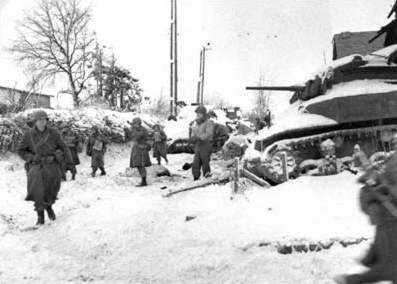
File:117th Infantry North Carolina NG at St. Vith 1945.jpg

American soldiers of the 117th Infantry Regiment, Tennessee National Guard, part of the 30th Infantry Division, move past a destroyed American M5A1 “Stuart” tank on their march to recapture the town of St. Vith during the Battle of the Bulge, January 1945

—
I have so much respect for war heroes and I wanted to remember them today which 68 years after D Day. Below I have the story of Joe Speaks who fought in Europe and was captured twice by the Germans.

American GI's clamber into a landing craft as they prepare to hit the beaches along France's Normandy coast in June 1944. The World War II operation was part of the massive Allied D-Day invasion to chase German forces out of France. An armada of landing vessels sits in the background under barrage balloons. (AP Photo/Wartime Pool)

Photo by Associated Press

American GI’s clamber into a landing craft as they prepare to hit the beaches along France’s Normandy coast in June 1944. The World War II operation was part of the massive Allied D-Day invasion to chase German forces out of France. An armada of landing vessels sits in the background under barrage balloons. (AP Photo/Wartime Pool)

If you would like to read some great stories about some fine soldiers who fought to defend our country then click on the links below. All the soldiers are from Arkansas and I have been writing their stories for a local paper called “The Benton Courier” (now known as “The Saline Courier”).

A U.S. Coast Guard landing barge, tightly packed with helmeted soldiers, approaches the shore at Normandy, France, during initial Allied landing operations, June 6, 1944. These barges ride back and forth across the English Channel, bringing wave after wave of reinforcement troops to the Allied beachheads. (AP Photo)

Photo by Associated Press

A U.S. Coast Guard landing barge, tightly packed with helmeted soldiers, approaches the shore at Normandy, France, during initial Allied landing operations, June 6, 1944. These barges ride back and forth across the English Channel, bringing wave after wave of reinforcement troops to the Allied beachheads. (AP Photo)

Story of Joe Speaks:

On Sunday June 27th, 2010 in the article “Heroes among us,” Benton Courier, there was a story about Larry’s father Joe. Here is a portion of that article:

Larry Joe Speaks of Cabot is my wife’s cousin, and recently he told me about his father’s time in World War II. Joe Speaks (originally from Waldron , Ark. ) arrived in Normandy six days after D-Day (June 6, 1944), and he was involved in the Battle of the Bulge and he fought at Bastogne . The Battle of the Bulge was the bloodiest of the battles that U.S. forces experienced in World War II; the 19,000 American dead were unsurpassed by those of any other engagement. 

During one day of intense fighting, Speaks was so focused on shooting and reloading during the heat of the action that he did not realize that his leg had been struck by shrapnel during the battle. As soon as the battle was over, a fellow soldier pointed out that his boot was filled with blood. Speaks said he had not felt a thing.  

In another battle, Speaks was on the second floor of a building involved in a machine gun battle with the Germans. Then in the middle of the battle, the soldier in charge of getting the ammunition from downstairs did not return. So Speaks went downstairs to get the ammunition and discovered the Germans were holding everyone at gunpoint. Speaks asked the lieutenant upstairs to come down because the situation was hopeless, but the lieutenant refused.  

Then the Germans took their prisoners and backed off some and bombed the building. For the next two weeks, the American prisoners were forced to march back and forth next to that building with the lieutenant’s boot still sticking out of the rumble.  

When the Germans were not looking, Speaks and another soldier took off running and escaped. They made it to a farm owned by a German lady, and they made up a story that Hitler had been killed and the lady broke down and cried. She allowed them to stay in the barn until the end of the war.  

Joe Speaks passed away on March 1, 1999, at age 73 and was buried in Sheridan . He had received two Purple Hearts, a Silver Cross and a Silver Eagle.

In this June 6, 1944 file photo, while under attack of heavy machine gun fire from the German coastal defense forces, American soldiers wade ashore off the ramp of a U.S. Coast Guard landing craft during the Allied landing operations at the Normandy. (AP Photo)

Photo by Associated Press

In this June 6, 1944 file photo, while under attack of heavy machine gun fire from the German coastal defense forces, American soldiers wade ashore off the ramp of a U.S. Coast Guard landing craft during the Allied landing operations at the Normandy. (AP Photo)

Related posts:

Veterans Day 2011 Part 9:Roy “Roxy” Oxenrider survived Korean War’s Toughest Battle

Picture of Roy after he had recovered at the hospital. Picture of Roy below in the hospital recovering from his injuries followed by a picture of Roy encouraging another soldier who was in the hospital:  Below is an article that was published in November of 2010 in the Saline Courier: Saline County War Hero Bryant […]

Veterans Day 2011 Part 8 Leon McDaniel of World War II (second post)

Okinawa – At the Emperor’s Doorstep” episode from “WWII: GI Diary”….. This old 1978 TV docu-drama was narrated by Lloyd Bridges and told the stories of real soldiers/sailors/pilots and their first-hand experiences in battle. Archival footage and good background music really made the stories come alive…..about 25 episodes were made. Video converted from really old […]

Veterans Day 2011 Part 7:You have heard of Jimmy Doolittle, but what about Leon A. McDaniel?

President Reagan and Senator Barry Goldwater present the fourth star to General Jimmy Doolittle during a White House ceremony in the Indian Treaty room, OEOB. 6/20/85. I love the movie “Pearl Harbor” with Ben Affleck and it tells the story of Jimmy Doolittle.  He was born in 1896 and died in 1993. He is pictured […]

Veterans Day 2011 Part 6 (A look back at Okinawa)

This portion below appeared in an article I did for the Saline Courier about 18 months ago: I went to the First Baptist Church in Little Rock from 1983 to 1997, and during that time I became friends with Walter Dickinson Sr. In fact, we used to attend a weekly luncheon together on Thursdays.  Just […]

Veterans Day 2011 Part 5 (A look back at the “Battle of the Bulge”)

The Lost Evidence: The Battle Of The Bulge (1/5) This article was published in the Saline Courier about 18 months ago: When we celebrate July 4th we are focusing on the freedoms that so many soldiers have fought for over the last 234 years. That focus has been highlighted for me since my son Hunter […]

Veterans Day 2011 Part 4

  This is taken from an article that appeared in the Saline Courier about a year ago: Bravery is not just limited to one generation, but Americans have had it in every generation. It makes me think about those who are currently serving in our military. Jon Chris Roberts who is graduate of Benton High […]

Veterans Day 2011 Part 3 (A look back at World War 1)

I was born in Tennessee and everyone in Tennessee knows the name of Alvin York. Above is a clip about his accomplishments in War World I. Cara Gist of Shannon Hills tells me that her grandfather Herbert S. Apple of Salado, Arkansas (near Batesville) fought in World War I. He served in France and fought […]

Veterans Day 2011 Part 2 (Bataan Death March)

My longtime friend Craig Carney is originally  from Jacksonville, and  he told me a couple of years ago about a friend of his parents from Jacksonville, Arkansas named Silas Legrow. Legrow  was going to speak at the Jacksonville Museum of Military History on April 17, 2008 about his experience in the March of 1942 when […]

Veterans Day 2011 (Black Hawk Down and North Little Rock’s Donavan “Bull” Briley)

The Background Facts of The Black Hawk Down (1/7) Uploaded by WarDocumentary on Feb 14, 2011 The movie Black Hawk Down was based on an actual event that took place in Mogadishu, Somalia. This documentary explains the event. _______________________________ On October 3, 2003 my son  played quarterback at the Arkansas Baptist High School Football game […]

War Hero Joe Speaks and D Day pictures

 Below I have the story of Joe Speaks who fought in Europe and was captured twice by the Germans. Photo by Associated Press American GI’s clamber into a landing craft as they prepare to hit the beaches along France’s Normandy coast in June 1944. The World War II operation was part of the massive Allied […]

D-Day Landings,”Saving Private Ryan” most frightening and realistic 15 minutes ever

Saving Private Ryan – Omaha Beach Part 1 – HD Saving Private Ryan – Omaha Beach Scene Part 2 – Super High Quality Saving Private Ryan – Omaha Beach Scene Part 3 – Super High Quality Saving Private Ryan opens with a 30-minute cinematic tour de force that is without a doubt one of the […]

German prisoners of war are led away by Allied forces from Utah Beach, on June 6, 1944, during landing operations at the Normandy coast, France. (AP Photo)

Photo by Associated Press

German prisoners of war are led away by Allied forces from Utah Beach, on June 6, 1944, during landing operations at the Normandy coast, France. (AP Photo)

Gen. Dwight D. Eisenhower visits paratroopers, including Bill Hayes, at center behind Ike's right hand, in England on June 5, 1944, moments before the troops boarded transport planes bound for Normandy and the June 6 D-Day invasion. Hayes, who now lives in Fargo, N.D., recalls how he told Eisenhower that he was 'damned scared' before the mission, his first combat jump of the war.  This photo became a pre-invasion classic and continues to bring Hayes a measure of celebrity. (AP Photo/File)

Photo by Associated Press

Gen. Dwight D. Eisenhower visits paratroopers, including Bill Hayes, at center behind Ike’s right hand, in England on June 5, 1944, moments before the troops boarded transport planes bound for Normandy and the June 6 D-Day invasion. Hayes, who now lives in Fargo, N.D., recalls how he told Eisenhower that he was “damned scared” before the mission, his first combat jump of the war. This photo became a pre-invasion classic and continues to bring Hayes a measure of celebrity. (AP Photo/File)

This was the scene along a section of Omaha Beach in June, 1944 during Operation Overlord, the code name for the Normandy invasion during World War II. Large landing craft put troops and supplies on shore at Omaha, one of five invasion beaches. In background is part of the fleet of 2,727 ships that brought the allied troops from Britain.  In the air are barrage balloons, designed to entangle low-flying attack aircraft in their cables. (AP Photo/files)

Photo by Associated Press

This was the scene along a section of Omaha Beach in June, 1944 during Operation Overlord, the code name for the Normandy invasion during World War II. Large landing craft put troops and supplies on shore at Omaha, one of five invasion beaches. In background is part of the fleet of 2,727 ships that brought the allied troops from Britain. In the air are barrage balloons, designed to entangle low-flying attack aircraft in their cables. (AP Photo/files)

Members of an American landing unit help their exhausted comrades ashore during the Normandy invasion, June 6, 1944. The men reached the zone code-named Utah Beach, near Sainte Mere Eglise, on a life raft after their landing craft was hit and sunk by German coastal defenses.  (AP Photo)

Photo by Associated Press

Members of an American landing unit help their exhausted comrades ashore during the Normandy invasion, June 6, 1944. The men reached the zone code-named Utah Beach, near Sainte Mere Eglise, on a life raft after their landing craft was hit and sunk by German coastal defenses. (AP Photo)

U.S. Air Force photograph of P-38's streaking towards France on D-Day.

Photo by U.S. Air Force

U.S. Air Force photograph of P-38′s streaking towards France on D-Day.

Men of the American assault troops of the 16th Infantry Regiment, injured while storming a coastal area code-named Omaha Beach during the Allied invasion of the Normandy, wait by the chalk cliffs at Collville-sur-Mer for evacuation to a field hospital for further treatment, June 6, 1944.  (AP Photo)

Photo by Associated Press

Men of the American assault troops of the 16th Infantry Regiment, injured while storming a coastal area code-named Omaha Beach during the Allied invasion of the Normandy, wait by the chalk cliffs at Collville-sur-Mer for evacuation to a field hospital for further treatment, June 6, 1944. (AP Photo)

2006 Razorback Football Results (part 1)

In 2006 my son Hunter told me after the whipping we took against USC that Arkansas would not lose again the rest of the regular season. I laughed and told him that he was dreaming. Eleven games later we stood the whole game as the #6 Razorbacks lost a close game in Little Rock to the LSU Tigers to finish 10-2 on the year. The Hogs had a chance to stay in the national title hunt until they lost that second game the last day of the regular season. In fact, they only lost to top 5 teams that year. One of the biggest victories down the stretch was over the 13th ranked Tennesseee Vols in Fayetteville.  ESPN’s gameday was in town. Here is a recap of the games that year from Wikipedia:

Game notes

USC

  1 2 3 4 Total
USC 3 13 14 20 50
Arkansas 0 7 0 7 14

USC and Arkansas both came into the game with a number of question marks, as USC had lost stars Reggie Bush and Matt Leinart to the NFL, and Arkansas’s star running back Darren McFadden was injured in an off-field incident. Although the game was close until the latter minutes of the second quarter, a combination USC’s high-powered offense wearing out Arkansas’s defense, and running back Felix Jones’ three fumbles, stretched the margin in the second half to the final score.
Robert Johnson was removed as the starting quarterback this week, replaced by Mitch Mustain.

Utah State

  1 2 3 4 Total
Utah State 0 0 0 0 0
Arkansas 0 14 6 0 20

After the Razorback’s hard loss at home against the USC Trojans, the Hogs were looking to bounce back against Utah State. Mustain had replaced Johnson as the starting quarterback, but the Arkansas offense stalled early, losing a fumble at the Aggie 1-yard line. But under the shoulders of McFadden and Jones, Arkansas bounced back for 3 touchdowns. The Arkansas defense played valiantly in showing of revenge for the embarrassment of the previous game, and the offense, while not up to form, still played well.

Vanderbilt

  1 2 3 4 Total
Arkansas 7 7 7 0 21
Vanderbilt 7 6 0 6 19

In Week 3, Arkansas traveled to Vanderbilt University for its first away game of the season. This game proved to be a good early match against two teams not predicted to fare well in SEC play. The game began with alternating possessions, but neither team took a large lead. But at the end of the first half, a busted extra point attempt by the Commodores gave Arkansas a 14-13 lead. During the fourth quarter, Arkansas and Vanderbilt both scored, but because of Vanderbilt’s situation, they opted to go for a two point conversion, and failed. Although they got one last possession, a missed field goal ended Vanderbilt’s chance of victory.

Alabama

  1 2 3 4 OT 2OT Total
#22 Alabama 0 10 0 7 0 6 23
Arkansas 3 0 14 0 0 7 24

The Crimson Tide offense (white) backed up on their goalline.

This game was well played by both teams playing evenly matched with Alabama leading at halftime 10-3. However Arkansas bounced back with a touchdown from Darren McFadden and a fumble return for a touchdown by Randy Kelly, making the score 17-10 at the end of the third quarter in favor of the Razorbacks. Alabama answered by scoring a touchdown in the fourth, tying the game and eventually sending it into overtime. During regulation, Alabama kicker Leigh Tiffin had missed two field goal attempts wide right. And after a scoreless first overtime, the Crimson Tide scored but again missed the extra point. On the next series quarterback Mitch Mustain threw a touchdown pass to tight end Ben Cleveland to tie the game, and the Razorbacks won it with a completed extra point by Jeremy Davis.

Auburn

  1 2 3 4 Total
Arkansas 10 7 7 3 27
#2 Auburn 0 10 0 0 10

In an SEC West bout, the Arkansas Razorbacks visited the #2 ranked Auburn Tigers at Jordan-Hare Stadium. The Hogs scored first with a 34 yard field goal by Jeremy Davis to make it 3-0 with 7:56 left in the first quarter. Arkansas scored again with a 50 yard pass from Mitch Mustain to Marcus Monk to make it a surprising 10-0 lead with 3:43 remaining in the first quarter. On the first play of the second quarter Auburn countered with a 24 yard TD strike from Brandon Cox to Rodgeriqus Smith to make the score 10-7. With 5:00 left to go in the first half, Arkansas came back with Darren McFadden running for a 63 yard TD making it 17-7. However, Auburn kicker John Vaughn kicked a 36 yard field goal to make the score 17-10 with 1:50 remaining in the first half. After the half, it was all Arkansas as their defense kept Auburn from scoring. With 4:54 left in the third quarter Felix Jones ran in a 1 yard TD. And with 3:34 left in the game, Arkansas sealed it with a 22 yard field goal from Jeremy Davis. With the win the Hogs had control of their own destiny in the SEC West.

Southeast Missouri State

  1 2 3 4 Total
Southeast Missouri State 0 0 7 0 7
#23 Arkansas 14 28 14 7 63

On Arkansas’ homecoming they faced the Redhawks from Southeast Missouri State. From the get-go, it was clear Arkansas was going to dominate this game. Darren McFadden scored the first two touchdowns making it 14-0 at the end of the first quarter. In the second quarter the Hogs burst wide open and scored four touchdowns; two coming from Felix Jones and one coming from Michael Smith, and an interception return by DT Keith Jackson. At the Half, the score was 42-0. The Hogs scored three times in the second half, with the Redhawks only score coming in the third quarter by a 8 yard run from John Radney. The final score was 63-7.

Ole Miss

  1 2 3 4 Total
Ole Miss 0 3 0 0 3
#18 Arkansas 14 7 7 10 38

In an SEC West match, #18 Arkansas Razorbacks squared off with the Ole Miss Rebels at Razorback Stadium. Felix Jones returned the opening kickoff 100 yards for a touchdown making the score 7-0. Darren McFadden ran in the next score from 4 yards to make the score 14-0 with 9:43 left in the first quarter. Peyton Hillis scored from 1 yard out to make it 21-0 with 8:27 left in the second quarter. Ole Miss scored a field goal by Joshua Shene from 27 yards out to make it 21-3. After the half, Darren McFadden scored with a 70 yard screen pass from Mitch Mustain making it 28-3. In the fourth, Arkansas scored on a Jeremy Davis field goal and a London Crawford touchdown catch making it 38-3 at the final. With this win, Arkansas became bowl eligible after a two year absence.

Louisiana-Monroe

  1 2 3 4 Total
#14 Arkansas 7 16 14 7 44
Louisiana-Monroe 7 0 0 3 10

The 14th ranked Arkansas Razorbacks returned to Little Rock to face the Sun Belt’s Louisiana Monroe Warhawks. The Warhawks struck first with a 17 yard pass from Kinsmon Lancaster to Lagregory Sapp for a TD. With the score 7-0, the warhawks were fired up. With 7:41 left in the first quarter, Felix Jones rushed in a 7 yard TD, however Jeremy Davis missed the extra point to make the score 7-6. Arkansas scored in the second quarter with a 12 yard TD pass from Mitch Mustain to Marcus Monk, and completed a two point conversion to make it 14-7. With 4:14 left in the first half, the Warhawks’ Calvin Dawson was tackled in their own endzone for a safety making it 16-7. Nearing the end of the first half, RB Darren McFadden threw a 10 yard TD pass to Wes Murphy. The score at the Half was 23-7. In the third quarter, Darren McFadden rushed 18 yards for a touchdown but was flagged for excessive celebration. The penalty was counted on the extra point and Jeremy Davis missed it and the score was 29-7. Later, Mitch Mustain threw a 12 yard TD pass to Marcus Monk, and a two point conversion made it 37-7. In the fourth, Michael Smith rushed for a 3 yard TD to make it 44-7. The Warhawks scored a field goal late in the game to make the final 44-10.

South Carolina

  1 2 3 4 Total
#12 Arkansas 7 16 3 0 26
South Carolina 3 3 7 7 20

The 12th ranked Arkansas Razorbacks went on the road to face a dangerous South Carolina Gamecocks team at Williams-Brice Stadium in Columbia, South Carolina. The Gamecocks scored on their second drive with a field goal from 3 yards by Ryan Succop after an interception gave South Carolina great field position. Arkansas countered with a 43 yard TD run from Darren McFadden making the score 7-3 at the end of the first quarter. In the second quarter, Darren McFadden rushed for a 14 yard TD to make the score 14-3. With 9:19 remaining in the first half, the Gamecocks scored another field goal from Ryan Succop to make it 14-6. Arkansas then blocked a punt and the Gamecocks recovered it in their own endzone for a safety to make it 16-6. And with 0:02 left in the first half, Casey Dick through a 50 yard hail- mary that was tipped off two Gamecock defenders and into the hands of Marcus Monk to make it 23-6 going into the half. During the half, Steve Spurrier replaced Gamecock quarterback Syvelle Newton with Blake Mitchell who came out swingin’. After an Arkansas field goal, Mitchell threw 13 yard TD pass to Kevin McKinley to make it 26-13 at the end of the third. In the fourth, Mitchell threw a 10 yard TD pass to Sydney Rice to make it 26-20. After a missed field goal by Arkansas, Mitchell drove the field in an attempt to win the game but was intercepted by Darius Vinnet to make the final 26-20. In this game Houston Nutt switched quarterback Mitch Mustain with Casey Dick.

Tennessee

  1 2 3 4 Total
#13 Tennessee 0 7 0 7 14
#11 Arkansas 7 21 0 3 31

ESPN’s College Game Day came to Fayetteville this week to host the matchup between the 11th ranked Arkansas Razorbacks and the 13th ranked Tennessee Volunteers. In the first quarter, Casey Dick through a 10 yard TD pass to Marcus Monk for a 7-0 lead. In the second quarter, Darren McFadden ran 17 yards for a TD to make it 14-0. Tennessee bounced back with a 27 yard TD pass from Jonathan Crompton to Robert Meachem to make the score 14-7. With 6:51 remaining in the half, Darren McFadden threw a 12 TD pass to Marcus Monk to make it 21-7. Darren McFadden also ran in a 5 yard TD score to end the half with a score of 28-7. After a scoreless third quarter Arkansas hit a 28 yard field goal while Jonathan Crompton hit Bret Smith for a 39 yard TD pass late in the game to make the final 31-14.

University of tennessee football Coach Phillip Fulmer signals for a time out during an October 9, 1993 game against Arkansas.

Photo by HEATHER STONE/KNOXVILLE NEWS SENTINEL

University of tennessee football Coach Phillip Fulmer signals for a time out during an October 9, 1993 game against Arkansas.

Planned Parenthood up to some more tricks

It is really sad to me that abortion is so easy to get in the USA.

Ericka Andersen

May 30, 2012 at 3:03 pm

The War on Baby Girls: Part 1 – Undercover in Texas

Think sex-selective abortions—known as gendercide—happen only in China? Wrong. This week, Live Action films produced an undercover video of a Texas Planned Parenthood employee explaining to a patient how to easily obtain an abortion if her unborn child were a girl and not a boy. The employee also gave the patient guidance on committing Medicaid fraud while she waited to find out the baby’s sex—but that point deserves a separate discussion altogether.

Sex-selective abortions have been publicly debated recently due to forced abortion opponent and Chinese dissident Chen Guangchang. Guangcheng found himself in danger because of his opposition to China’s one-child policy that often perpetuates gendercide. It has caused a heated and necessary discussion of the issue worldwide.

Americans aren’t taking sex-selective abortion lightly. Tomorrow, a bill that would ban sex-selective abortions in the U.S. is up for a vote in the House. The Prenatal Nondiscrimination Act (PRENDA) would also punish doctors if they perform gendercide, which usually occurs in the second or third trimester, when the baby’s sex is clearly determined.

The option may seem rare, but the facts speak for themselves. For Chinese, Korean, and Indian parents having families and raising children in the U.S., researchers found that a firstborn girl often skews the sex ratio of the following children. For second births, the male-female ratio was 117 to 100, and for third births, it was 151 to 100 if the couple already had two girls.

Girls receive the brunt of gendercide due to cultural stigma, and that’s not going to change. Unless sex-selective abortion is outlawed, the human rights of unborn children, especially girls, will continue to be violated in the United States.

Earlier this year, Heritage reported a sobering statement from Steven W. Mosher, president of the Population Research Institute. In a congressional hearing, Mosher said that until recent negative publicity, “It was not unusual to find abortionists advertising the availability of sex-selective abortions in newspapers such as The New York Times.”

Thankfully, such publicity surfaced, and now America can debate this horrific practice in the light of day. Today, the world is missing more than 160 million women because of gendercide. While the U.S. can’t end the practice worldwide, it can restore human rights to unborn children in America.

The PRENDA bill is sponsored by Representative Trent Franks (R–AZ), who said, “As Americans, all of us know in our hearts that aborting a little baby because…she is a little girl instead of a little boy is fundamentally wrong, and represents a betrayal of the precious truth that all human beings are created equal.”

Pro-abortion feminist organizations like NARAL are claiming that PRENDA discriminates against women by interfering with their “choice” to abort female babies. It is hard to imagine a position more retrograde toward women than one that allows for their systematic elimination.

As Heritage’s Jennifer Marshall and Sarah Torre wrote recently, “If there is equality between women and men, it’s rooted in our nature and purpose as human beings. Denying that fundamental dignity inherent in all human life destroys the very basis of equality.”

On behalf of the millions of girls whose lives have been taken, let’s finally unite behind the clear and uncontroversial principle that gendercide is wrong and that America should do something to stop it.

Hank Hanegraaff on the issue of abortion (Part 8)

Francis Schaeffer February 21, 1982 (Part 1)

Uploaded by on Feb 21, 2008

READ THIS FIRST: In decline of all civilizations we first see a war against the freedom of ideas. Discussion is limited or prohibited. Speakers at universities are shouted down. Corruption takes over city governments and towns as dishonesty and corruption expands. Small stores have to shut down because none are honest enough to run a cash register. The stock of stores is looted by employees and pilfered and shop owners flee. Stock markets are rife with manipulation and the plague of dishonesty. We have learned that sound and lasting civilized ideas are built upon very rare and special foundations. Frances Schaeffer is one guy who has sparked my own thinking and study. He has influenced my writing and prison ministry greatly. Humans must be convinced intellectually, historically and reasonably as well as through the Biblical teachings. Francis Shaeffer has helped all of us wade through this vast propaganda sewer to approach fundamental questions, one of which is: “Why do nations and empires decline?”

_______________

Francis Schaeffer February 21, 1982 (Part 2)

Francis Schaeffer rightly identified abortion as the key issue.

Have We Given Up on the Issue of Abortion?

By: Hank Hanegraaff

Imagine living in a country in which members of Congress would mandate researchers ‘either destroy embryos or risk imprisonment.’ Imagine a nation that not only permits the killing of the most vulnerable among us but mandates such mayhem for the purposes of research. Imagine no further—the day has arrived. As the former Supreme Court nominee Robert Bork has well said, we have began inexorably “slouching toward Gomorrah.”[1]I’ll never forgot the words of George Will, when he said, “we are experiencing the slow motion barbarization of America.”

The founders of our Republic could only in their darkest nightmares have imagined relativism trumping objective moral standards in a free society. The rise of technology and the fall of ethical consensus have brought us to a society full of moral dilemmas. This stark reality was born out in 1973 when Christians quietly passed in a battle in the war against abortion.

The far reaching impact of that abdication is felt in the raging battle over embryonic stem cell research. In the wake of the current moral and ethical tsunami, it is incumbent upon Christians to not only provide relief but bring the rebuilding process. Nothing less than Western Civilization is at stake.

I’ll never forget what Christian philosopher Francis Schaeffer said many years ago: abortion would be the watershed issue of our era. “Of all the subjects related to the erosion of the sanctity of human life abortion is the keystone.”[2] Of course, his warning tragically fell on deaf ears.

Consider the statements of some of the leading spiritual and secular leaders of our age. Beverly Harrison, a professor of Christian Ethics at Union Theological Seminary, “Infanticide is not a great wrong. I do not want to be construed as condemning women who under certain circumstances quietly put their infants to death.”[3]Esther Langston, Professor of Social Work at the University of Nevada, “What we are saying is that abortion becomes one of the choices and the person has the right to choose whatever it is that is… best for them in the situation in which they find themselves: be it abortion, keep the baby, adopt the baby, sell the baby, leave the baby in a dumpster, put it on your porch, whatever. It’s the person’s right to choose.”[4] Margaret Sanger, the founder of Planned Parenthood, who famously remarked “that the most merciful thing a large family can do for one of its infant members is to kill it.”[5]

Where does this slippery slope lead? Think only to the words of James Watson, the Nobel prize winner and the co-discover of the structure of DNA, “Because of the limitations of present detection methods most birth defects are not discovered until birth; however, if a child was not declared alive until three days after birth the doctor would allow the child to die if the parents so chose and save a lot of misery and suffering.”[6]

This is the epoch in which we find ourselves. In view of this reality, we should go back to the words of Scripture. “For you created my inmost being; you knit me together in my mother’s womb I praise you because I am fearfully and wonderfully made” (Ps. 139:13). A song was written with those words in mind. It was haunting, not only to hear the music but to see the images. It was the first pro-life song by Cindee Martin Morgan, who is the daughter of the late Dr. Walter Martin, the founder and former president of CRI. It was recorded by her daughter Sharon at the tender age of seven. We featured that song on the Bible Answer Man broadcast and we lauded the fact that Cindee Martin Morgan and her husband Rick Morgan were vigilant in the battle against abortion.

The reason we did that is because the reality is today there are very few Christians who will put their lives on the line for this issue. Christians have become apathetic. There was a recent Pew Research Poll that found that among all respondents to the poll concern about the abortion issues has dropped. Only 15% of respondents said that abortion was a critical issue.[7] It’s an issue to which we have been anesthetized to. This does not mean that we shouldn’t be involved in the debate or the discussion. It’s a watershed issue of our era; we should be involved.

So Cindee and Rick have continued the battle, recognizing it’s not about whether we win or lose. It’s about being faithful with the platform that God gives us. They have now come out with a new pro-life song called, “Who will Save the Little Ones?” It’s a call to lawful action on behalf of the unborn. You can hear this at our Website (http://www.equip.org/site/savethelittleones). I also did an hour long interview with Cindee and Rick on October 6, 2009; this can be heard also at our Website (http://www.equip.org/broadcasts/who-will-save-the-little-ones-20090610). To visit their Website go to (http://www.MtMoriahMusic.com) Also to equip you in defending the Pro-Life position we recommend the book Whose Ethics? Whose Morals? available at our Website or by calling 1-888-7000-0274.

“Woody Wednesdays” Woody Allen on God and Death

Good website on Woody Allen

How can I believe in God when just last week I got my tongue caught in the roller of an electric typewriter?

If Jesus Christ came back today and saw what was being done in his name, he’d never stop throwing up.

If only God would give me some clear sign! Like making a large deposit in my name in a Swiss bank.

As the poet said, ‘Only God can make a tree’ — probably because it’s so hard to figure out how to get the bark on.

Not only is there no God, but try getting a plumber on weekends.

To you I’m an atheist; to God, I’m the Loyal Opposition.

______________________

Good website on Woody Allen quotes on death:

I don’t want to achieve immortality through my work… I want to achieve it through not dying.

Eternal nothingness is fine if you happen to be dressed for it.

It is impossible to experience one’s death objectively and still carry a tune.

Woody Allen on DeathDeath is an acquired trait.

Death is one of the few things that can be done as easily lying down.

Death should not be seen as the end, but as a very effective way to cut down expenses.

I do not believe in an after life, although I am bringing a change of underwear.

There are worse things in life than death. Have you ever spent an evening with an insurance salesman?

It’s not that I’m afraid to die, I just don’t want to be there when it happens.

Woody Allen on Death On the plus side, death is one of the few things that can be done just as easily lying down.

Thought: Why does man kill? He kills for food. And not only food: frequently there must be a beverage.

If there is reincarnation, I’d like to come back as Warren Beatty’s fingertips.

Dying is one of the few things that can be done as easily lying down.

He was so depressed, he tried to commit suicide by inhaling next to an Armenian.

Should the 10 Commandments be banned from public life?(Part 5, David Barton’s Affidavit in support on 10 Commandments)


I read back on Dec 8, 2011 that Tony Perkins, president of Family Research Council, a social conservative advocacy organization, said in 2011 that President Obama has been “hostile” and “disdainful” toward Christianity. Rick Perry actually said President Obama had a war on religion. One of the most basic things that our founding fathers did is base our laws on the ten commandments. At the Supreme Court there is one depiction showing Moses sitting, holding two blank stone tablets. There is one depiction showing Moses standing holding one stone tablet. There are two stone tablets depicted with Roman Numbers I-X carved in the oak doors.

David Barton has studied the history of the founding of our country for many years and I wanted to share a portion of adocument he wrote concerning the 10 Commandments:

David Barton – 01/03/2001
(View the footnoted version on Liberty Council’s website)

UNITED STATES DISTRICT COURT

EASTERN DISTRICT OF KENTUCKY

LONDON DIVISION

SARAH DOE and THOMAS DOE, on behalf

of themselves and their minor child, JAN DOE

Plaintiffs,

v Civil Action No. 99-508

HARLAN COUNTY SCHOOL DISTRICT;

DON MUSSELMAN, in his official capacity

as Superintendent of the Harlan Country

School District,

Defendents.

______________________________________________

AFFIDAVIT OF DAVID BARTON IN SUPPORT OF DEFENDANTS’ OPPOSITION TO PLAINTIFFS’ MOTION FOR CONTEMPT, OR, IN THE ALTERNATIVE, FOR SUPPLEMENTAL PRELIMINARY INJUNCTION

STATE OF TEXAS

COUNTY OF PARKER

HOW THE TEN COMMANDMENTS ARE EXPRESSED

IN CIVIL LAW IN AMERICAN HISTORY

Honor God’s name.

26. Civil laws enacted to observe this commandment were divided into two categories: laws prohibiting blasphemy and laws prohibiting swearing and profanity. Noah Webster, an American legislator and judge, affirms that both of these categories of laws were derived from the third commandment of the Decalogue:

When in obedience to the third commandment of the Decalogue you would avoid profane swearing, you are to remember that this alone is not a full compliance with the prohibition which [also] comprehends all irreverent words or actions and whatever tends to cast contempt on the Supreme Being or on His word and ordinances [i.e., blasphemy].

27. Reflecting the civil enactment of these two categories embodying the third commandment, a 1610 Virginia law declared:

2. That no man speak impiously or maliciously against the holy and blessed Trinity or any of the three persons . . . upon pain of death.

3. That no man blaspheme God’s holy name upon the pain of death.

28. A 1639 law of Connecticut similarly declared:

If any person shall blaspheme the name of God the Father, Son, or Holy Ghost, with direct, express, presumptuous or high-handed blasphemy, or shall curse in the like manner, he shall be put to death. Lev. 24.15, 16.

29. Similar laws can be found in Massachusetts in 1641, Connecticut in 1642, New Hampshire in 1680, Pennsylvania in 1682, 1700, and 1741, South Carolina in 1695, North Carolina in 1741, etc. Additionally, prominent Framers also enforced the Decalogue’s third command.

30. For example, Commander-in-Chief George Washington issued numerous military orders during the American Revolution that first prohibited swearing and then ordered an attendance on Divine worship, thus relating the prohibition against profanity to a religious duty. Typical of these orders, on July 4, 1775, Washington declared:

The General most earnestly requires and expects a due observance of those articles of war established for the government of the army which forbid profane cursing, swearing, and drunkenness; and in like manner requires and expects of all officers and soldiers not engaged on actual duty, a punctual attendance on Divine Service to implore the blessings of Heaven upon the means used for our safety and defense.

31. Washington began issuing such orders to his troops as early as 1756 during the French and Indian War, and continued the practice throughout the American Revolution, issuing similar orders in 1776, 1777, 1778, etc.

32. This civil prohibition against blasphemy and profanity drawn from the Decalogue continued well beyond the Founding Era. It subsequently appeared in the 1784 laws in Connecticut, the 1791 laws of New Hampshire, the 1791 laws of Vermont, the 1792 laws of Virginia, the 1794 laws of Pennsylvania, the 1821 laws of Maine, the 1834 laws of Tennessee, the 1835 laws of Massachusetts, the 1836 laws of New York, etc.

Charles Murray: Do we need the Dept of Education? (Part 2)

Another great article from Hillsdale College. Today we look at the Dept of Education. This is a three part series from Charles Murray. Here is part two:

January 2012

Charles Murray
American Enterprise Institute

Do We Need the Department of Education?

Charles Murray is the W.H. Brady Scholar at the American Enterprise Institute. He received his B.A. in history at Harvard University and his Ph.D. in political science from the Massachusetts Institute of Technology. He has written for numerous newspapers and journals, including the Washington Post, the Wall Street Journal, the New York Times, the Weekly Standard, Commentary, and National Review. His books include Losing Ground: American Social Policy 1950-1980, What It Means to Be a Libertarian, and Real Education: Four Simple Truths for Bringing America’s Schools Back to Reality. His new book, Coming Apart: The State of White America, 1960-2010, will be published at the end of January.

The following is adapted from a speech delivered in Atlanta, Georgia, on October 28, 2011, at a conference on “Markets, Government, and the Common Good,” sponsored by Hillsdale College’s Center for the Study of Monetary Systems and Free Enterprise.

THE CASE FOR the Department of Education could rest on one or more of three legs: its constitutional appropriateness, the existence of serious problems in education that could be solved only at the federal level, and/or its track record since it came into being. Let us consider these in order.

(Last time I covered part 1)

(2) Are there serious problems in education that can be solved only at the federal level?

The first major federal spending on education was triggered by the launch of the first space satellite, Sputnik, in the fall of 1957, which created a perception that the United States had fallen behind the Soviet Union in science and technology. The legislation was specifically designed to encourage more students to go into math and science, and its motivation is indicated by its title: The National Defense Education Act of 1958. But what really ensnared the federal government in education in the 1960s had its origins elsewhere—in civil rights. The Supreme Court declared segregation of the schools unconstitutional in 1954, but—notwithstanding a few highly publicized episodes such as the integration of Central High School in Little Rock and James Meredith’s admission to the University of Mississippi—the pace of change in the next decade was glacial.

Was it necessary for the federal government to act? There is a strong argument for “yes,” especially in the case of K-12 education. Southern resistance to desegregation proved to be both stubborn and effective in the years following Brown v. Board of Education. Segregation of the schools had been declared unconstitutional, and constitutional rights were being violated on a massive scale. But the question at hand is whether we need a Department of Education now, and we have seen a typical evolution of policy. What could have been justified as a one-time, forceful effort to end violations of constitutional rights, lasting until the constitutional wrongs had been righted, was transmuted into a permanent government establishment. Subsequently, this establishment became more and more deeply involved in American education for purposes that have nothing to do with constitutional rights, but instead with a broader goal of improving education.

The reason this came about is also intimately related to the civil rights movement. Over the same years that school segregation became a national issue, the disparities between black and white educational attainment and test scores came to public attention. When the push for President Johnson’s Great Society programs began in the mid-1960s, it was inevitable that the federal government would attempt to reduce black-white disparities, and it did so in 1965 with the passage of two landmark bills—the Elementary and Secondary Education Act and the Higher Education Act. The Department of Education didn’t come into being until 1980, but large-scale involvement of the federal government in education dates from 1965.

Top football stadiums in the country (Part 10)

Tennessee Football – Johnny Majors – GREAT – Joining the VOLS in 1952

Uploaded by on Sep 3, 2010

Johnny Majors from Huntland, TN tried out for the UT Football team weighing 150 pounds. His Father, Shirley Majors his HS Coach,encourage him and then 4 younger brothers all to be Vols. Johnny Majors was the runner-up in 1956 for the Heisman Trophy to Paul Horning, on a loosing Notre Dame team. So much for Northern politics with writers.

Here is a list of the top football stadiums in the country.

Power Ranking All 124 College Football Stadiums  

By Alex Callos

(Featured Columnist) on April 19, 2012 

When it comes to college football stadiums, for some teams, it is simply not fair. Home-field advantage is a big thing in college football, and some teams have it way more than others.

There are 124 FBS college football teams, and when it comes to the stadiums they play in, they are obviously not all created equal.

There is a monumental difference from the top teams on the list to the bottom teams on the list. Either way, here it is: a complete ranking of the college football stadiums 1-124.

_________________

In 1980 I got to attend the Pitt Panthers at Tennessee game in Knoxville. Jackie Sherrill was the Panthers coach and Johnny Majors was the Vols coach. Johnny Majors had been hired away from Arkansas to be the head football coach at Iowa St and his assistants were Larry Lacewell, Jackie Sherrill and Jimmy Johnson.

A few months ago I posted this about Johnny Majors:

Today Johnny Majors spoke at the Little Rock Touchdown Club. Majors told several revealing stories about his time at Arkansas from 1964-1968 when he was an assistant coach under Frank Broyles. One of the funniest stories concerned fellow assistant coach Jim MacKenzie who knew how to play Broyles at times according to Majors.

One such occasion the assistant coaches were being pressed into working long hours by Broyles during a time that Broyles thought he needed to see some progress with the team. Earlier the assistant coaches had been allowed to leave at noon and go fishing or play golf when the razorbacks had been winning almost all their games.

It was in July and Majors and some of the other coaches wanted to go play golf. Coach Broyles came into the room and asked how things were going. Coach MacKenzie asked Broyles what were the shots Broyles had on the first hole on Augusta when he got that 72. Broyles went to the chalk board and erased the plays and began to draw the placement of the ball on the first hole as he outlined the birdie he got .

By the time Broyles recalled the first 5 holes, he put down the chalk and said that it appeared we were all caught up around here and we should go play some golf!!!!

54. Mountaineer Field: West Virginia Mountaineers

250px-wvu_opening_game_mountaineer_field_display_image

Morgantown is a great college town, and even though the stadium only technically seats 60,000, there has been more than 70,000 at a home game before.

For the past 40 years, they have played John Denver’s “Take Me Home, Country Roads” at every home game. The fans here are a little rowdier than most other places in the country as well.

While loud is one word to describe the fans, hostile may be an even better adjective. A trip here is certainly a unique experience for anyone.


53. Boone Pickens Stadium: Oklahoma State Cowboys

71711_original_display_image

Boone Pickens Stadium has been around since 1920 and was known as Lewis Field from 1913-1920. The capacity here is right at 60,000, and over the past 10 years, there have been a lot of renovations that have this place up to date.

There is an extremely large student section here, and they are known to hit the stadium walls with large sticks, creating quite a loud environment.

A lot of traditions take place here, from the O-S-U- chant started by a gunshot from Pistol Pete to a wave every time there is a Cowboys touchdown.


52. Lane Stadium: Virginia Tech Hokies

250px-lane_upperstands_display_image

This stadium has more of an old school feel, as nearly all of the fans sit on bleachers in the 66,233-seat facility.

It was built in 1965, and there are a few luxury press boxes that have since been added, but for the most part, this stadium is filled with loud fans sitting on bleachers.

The fans here always show up now matter how good the Hokies are, and they are one of the loudest groups in the ACC.


51. Gaylord Family Oklahoma Memorial Stadium: Oklahoma Sooners

Aerial_display_image

There is a lot of history and tradition as far as this football program goes, and they have an old stadium to go along with that history.

Originally built in 1925, this stadium now seats 82,112 people and is always filled to capacity.

Tailgating here is some of the best in the country, and The Pride of Oklahoma marching band leads fans into the stadium.

This is a true college football experience.


50. Heinz Field: Pittsburgh Panthers

Heinz_580_display_image

Many people know Heinz Field as being the home of the Pittsburgh Steelers, but this new stadium also plays home to the Pittsburgh Panthers.

Located in downtown Pittsburgh and built in 2001, this stadium seats 65,050 people, and while it is always filled on Sundays, that is not the case every Saturday.

They still do turn out to support their Panthers, particularly when they are winning. With everything fully updated and not a bad seat in the house, this is a great place to watch any type of football game.

Canada’s conservative government has them heading the right direction

If we cut spending and balance our budget and enact pro-market reforms then our economy would boom too.  

______________

Those Sneaky Canadians Are Overtaking the United States

May 30, 2012 by Dan Mitchell

I’m not quite ready to trade places with Canada, but it may just be a matter of time. Like Germany and Sweden, they seem to be slowly but surely trying to move in the right direction.

I’ve already commented on good Canadian fiscal policy (including a much-needed lesson for Paul Krugman), and I’ve also praised our northern neighbors for privatizing their air traffic control system and opposing global bank taxes.

But I’ve just been skating along the surface. My Cato colleague Chris Edwards (a Canadian transplant) has just written up a report with some of the key details.

Two decades ago Canada suffered a deep recession and teetered on the brink of a debt crisis caused by rising government spending. The Wall Street Journalsaid that growing debt was making Canada an “honorary member of the third world” with the “northern peso” as its currency. But Canada reversed course and cut spending, balanced its budget, and enacted various pro-market reforms. The economy boomed, unemployment plunged, and the formerly weak Canadian dollar soared to reach parity with the U.S. dollar. …[In] the early 1990s combined federal, provincial, and local spending peaked at more than half of gross domestic product (GDP). In the 1993 elections, Prime Minister Jean Chretien’s Liberals gained power promising fiscal restraint, but this was the party of Trudeau, and so major reforms seemed unlikely. In the first Liberal budget in 1994, Finance Minister Paul Martin provided some modest spending restraint. But in his second budget in 1995, he began serious cutting. In just two years, total noninterest spending fell by 10 percent, which would be like the U.S. Congress chopping $340 billion from this year’s noninterest federal spending of $3.4 trillion. When U.S. policymakers talk about “cutting” spending, they usually mean reducing spending growth rates, but the Canadians actually spent less when they reformed their budget in the 1990s. The Canadian government cut defense, unemployment insurance, transportation, business subsidies, aid to provincial governments, and many other items. After the first two years of cuts, the government held spending growth to about 2 percent for the next three years. With this restraint, federal spending as a share of GDP plunged from 22 percent in 1995 to 17 percent by 2000. The spending share kept falling during the 2000s to reach 15 percent by 2006, which was the lowest level since the 1940s. …The spending reforms of the 1990s allowed the Canadian federal government to balance its budget every year between 1998 and 2008. The government’s debt plunged from 68 percent of GDP in 1995 to just 34 percent today.

Total government spending, including sub-national units such as states and provinces, is still slightly higher in Canada than in the United States. But I suspect that will change within the next five years.

Not surprisingly, good spending policy leads to good tax policy, as Chris explains.

a slimmed-down Canadian government under the Liberals enjoyed large budget surpluses and pursued an array of tax cuts. The Conservatives continued cutting after they assumed power in 2006. During the 2000s the top capital gains tax rate was cut to 14.5 percent, special “capital taxes” on businesses were mainly abolished, income taxes were trimmed, and income tax brackets were fully indexed for inflation. Another reform was the creation of Tax-Free Savings Accounts, which are like Roth IRAs in the United States, except more flexible. The most dramatic cuts were to corporate taxes. The federal corporate tax rate was cut from 29 percent in 2000 to 15 percent in 2012. Most provinces also trimmed their corporate taxes, so that the overall average rate in Canada is just 27 percent today. By contrast, the average U.S. federal-state rate is 40 percent. …Canada’s federal corporate tax rate has been cut from 38 percent in the early 1980s to just 15 percent today. Despite the much lower rate, tax revenues have not declined. Indeed, corporate tax revenues averaged 2.1 percent of GDP during the 1980s and a slightly higher 2.3 percent during the 2000s.

The Laffer Curve effect of higher tax revenue shouldn’t be surprising, though American policymakers still operate in a fantasy world where taxes are assumed to have no impact on the economy and no impact on taxable income.

But that’s a secondary point. The main lesson of this research by Chris is that it is both possible and desirable to shrink the burden of government spending.

And it’s not just Canada that has done the right thing. This video outlines past reforms in Ireland, Slovakia, and New Zealand as well.

P.S. Other than the cold weather, another reason why I don’t quite yet want to trade places with Canada is the government-run healthcare system. Right now, high-ranking politicians from the frozen wastelands can escape to America when they fall ill. If we copy Canada (and we’re already pretty far down that path), then where will we be able to go to get high-quality and cutting-edge care?

P.P.S. The Canadians aren’t know for having a sense of humor, but the person who wrote this parody about emigrating American leftists definitely has a good sense of humor.

Hank Hanegraaff on the issue of abortion (Part 7)

I am hoping that we start to respect the lives of the unborn in the USA in the future more than we have in the past.

The Bible and Abortion: A Biblical View of Abortion


THE BIBLE AND ABORTION- IntroductionAbortion (as a medical procedure) is never mentioned in the Bible. So that must mean that the Bible has nothing relevant to say on the subject, Right?  THE BIBLE AND ABORTION- What Does the Bible Say?Abortion is one of the most critical issues of our generation. Christians need to consider carefully what the Bible has to say on the subject.THE BIBLE AND ABORTION- The Bible Condemns MurderFirst of all, the Bible clearly condemns murder, and by murder I don’t mean all killing. The Bible obviously allows animals to be killed, accidental killing of human beings is not condemned, and human beings may, in fact, be deliberately killed if they’ve committed a capital offense. You see the real issue is murder not killing, and murder is the intentional killing of an innocent human being.THE BIBLE AND ABORTION- Is Abortion Murder?So once again the question, is abortion murder?  First of all, abortion certainly kills something: because obviously the fetus is a living organism, biologically distinct from the mother. The fetus also is certainly innocent — no one aborts a fetus because of something the fetus has supposedly done. And, with the exception of abortion to save the mother’s life, abortion is always done with the clear intent of killing the fetus. Therefore, the question of whether abortion is murder turns entirely on whether the fetus is or is not a human being.THE BIBLE AND ABORTION- A Fetus Is a Human BeingNumerous philosophers and scientists have shown conclusively that the fetus is a human being from the moment of conception. In addition, the Bible, which ought to be our first authority, supports the very same conclusion. For example, in Psalm 51 David confesses that he was a sinner by nature from his very conception in the womb (Psa. 51:5).THE BIBLE AND ABORTION- ConclusionThe conclusion is this: abortion is the intentional killing of an innocent human being, and therefore it has to be regarded as murder. The only exception, as I have already indicated, would be in cases where the child must be aborted or the mother will die.THE BIBLE AND ABORTION- Abortion is MurderIn short, while the Bible does not mention abortion specifically, it is clear by implication that abortion is murder. And don’t forget that Psalm 139 tells us that God created our inmost being, He knit us together in our mother’s womb and that all the days ordained for us were written in his book before even one of them came to be.On the Bible and abortion, that’s the CRI Perspective. I’m Hank Hanegraaff.

March 17th, 2009 by CRI | Type: Standard

Filed Under: Current Events and Christianity, Perspectives