Category Archives: Taxes

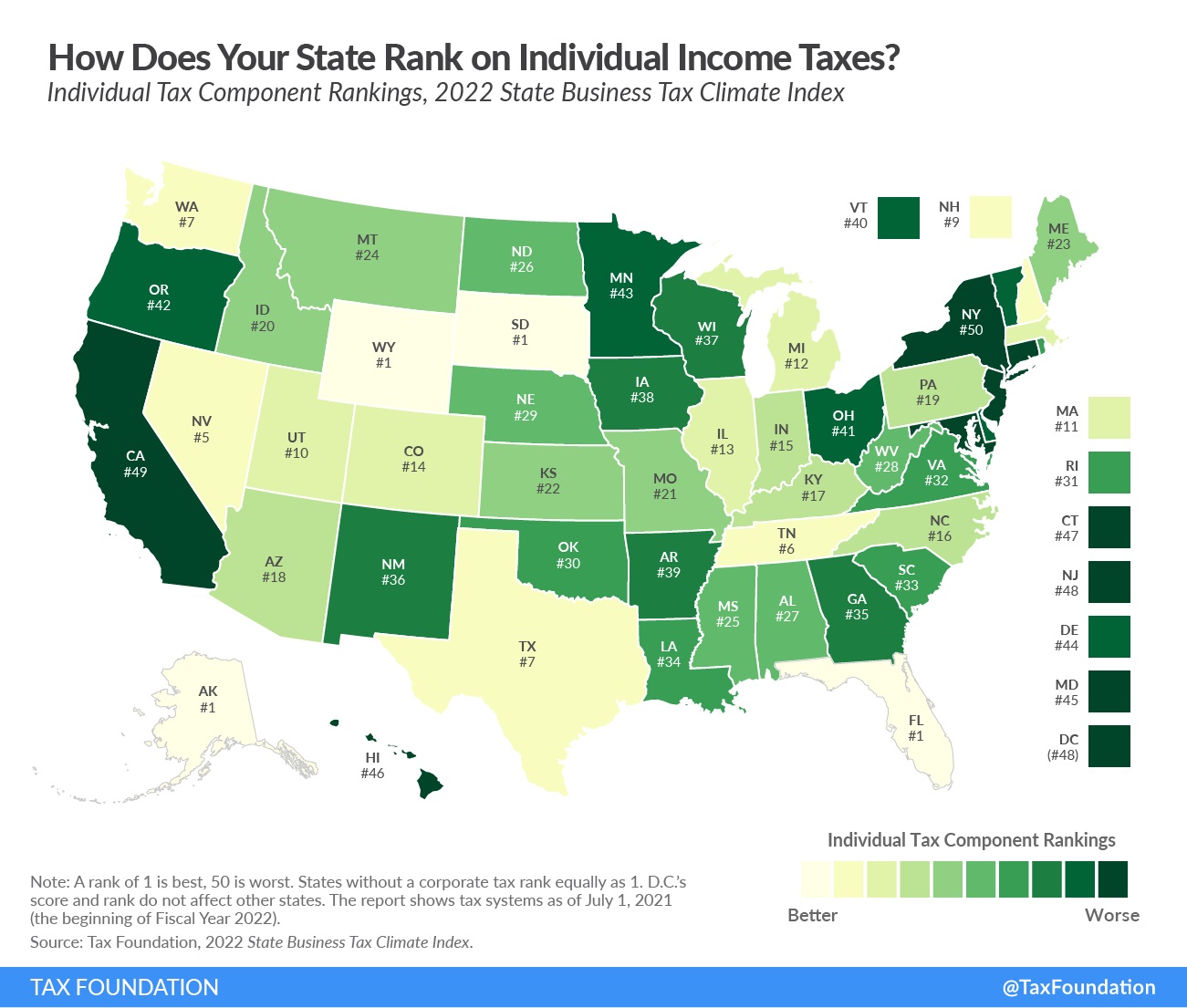
DAN MITCHELL ARTICLE “Courtesy of the Tax Foundation, here are the states that have lowered personal income tax rates and/or corporate income tax rates in 2021 and 2022!”

_________

The Feel-Good Map of 2022

I’ve already shared the “feel-good story” for 2022, so today I’m going to share this year’s feel-good map.

Courtesy of the Tax Foundation, here are the states that have lowered personal income tax rates and/or corporate income tax rates in 2021 and 2022. I’ve previously written about these reforms (both this year and last year), but more and more states and lowering tax burdens, giving us a new reason to write about this topic.
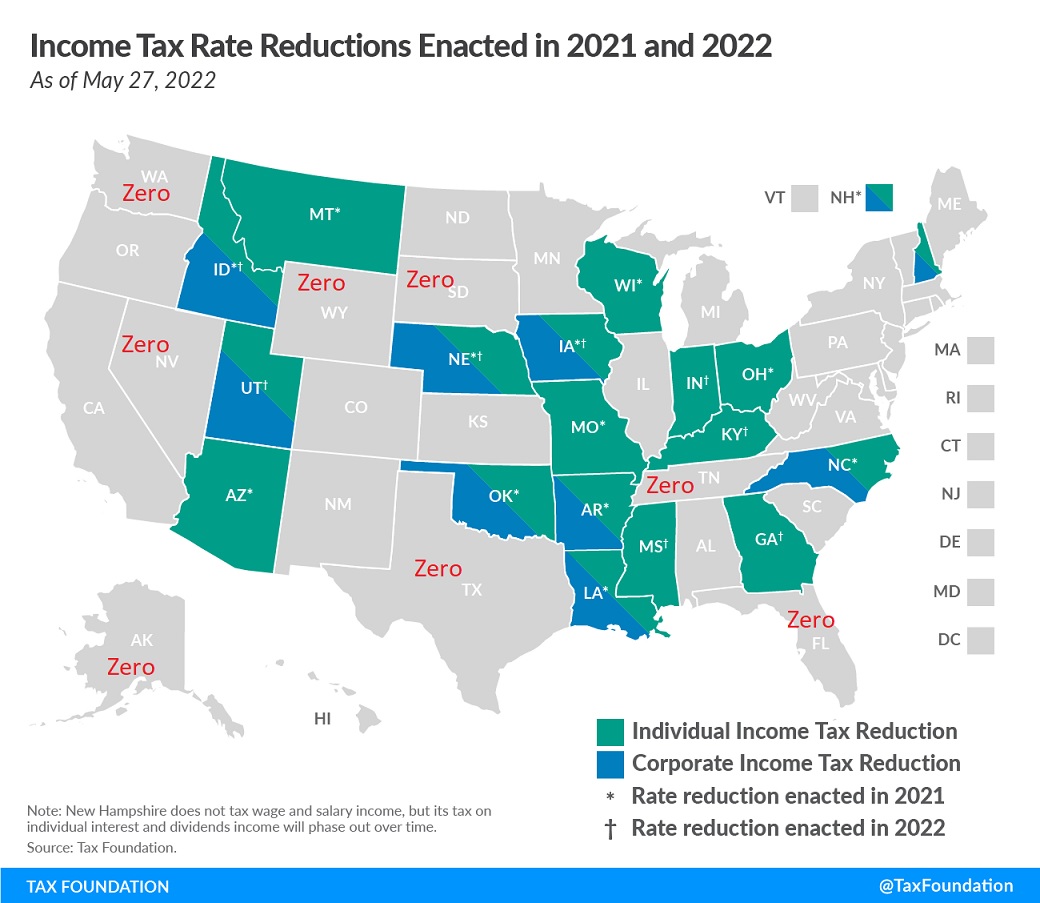
The map is actually even better than it looks because there are several states that don’t have any income taxes, so it’s impossible for them to lower rates. I’ve labelled them with a red zero.

And when you add together the states with no income tax with the states that are reducing income tax rates, more than half of them are either at the right destination (zero) or moving in that direction.

That’s very good news.

And here’s more good news from the Tax Foundation. The flat tax club is expanding.
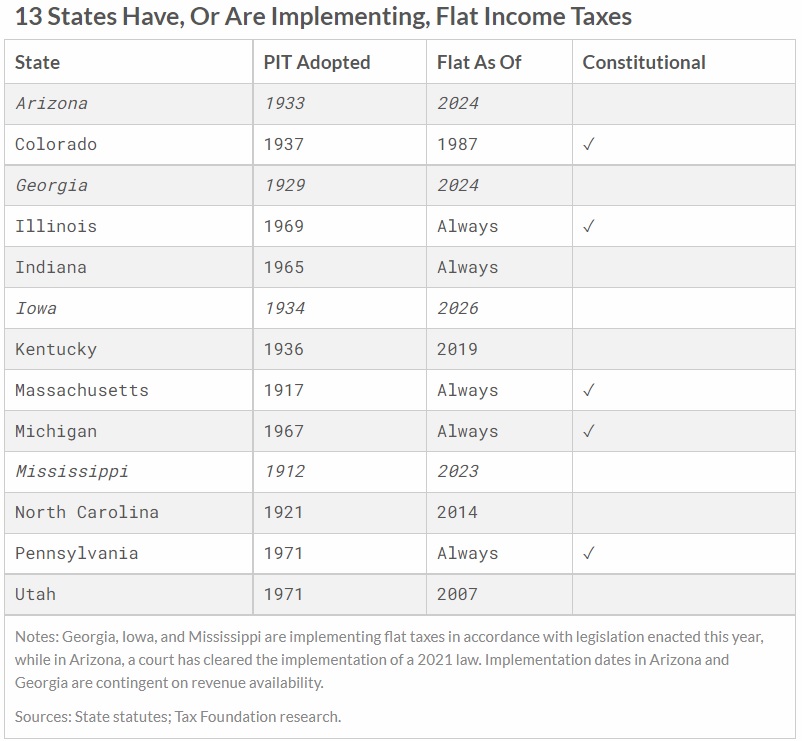
I prefer the states with no income taxes, but low-rate flat taxes are the next best approach.

P.S. According to the Tax Foundation, New York and Washington, D.C. have moved in the wrong direction. Both increased income tax burdens in 2021. No wonder people are moving away.

P.P.S. If I had to pick the states with the best reforms, I think Iowa and Arizona belong at the top of the list.

Texas vs. California, Part VII

To begin the seventh edition of our series comparing policy in Texas and California (previous entries in March 2010, February 2013, April 2013, October 2018, June 2019, and December 2020), here’s a video from Prager University.

There will be a lot of information in today’s column, so if you’re pressed for time, here are three sentences that tell you what you need to know.
California has all sorts of natural advantages over Texas, especially endless sunshine and beautiful topography.

Texas has better government policy than California, most notably in areas such as taxation and regulation.

Since people are moving from the Golden State to the Lone Star State, public policy seems to matter more than natural beauty.

Now let’s look at a bunch of evidence to support those three sentences.

We’ll start with an article by Joel Kotkin of Chapman University.

If one were to explore the most blessed places on earth, California, my home for a half century, would surely be up there. …its salubrious climate, spectacular scenery, vast natural resources… President Biden recently suggested that he wants to “make America California again”. Yet…he should consider whether the California model may be better seen as a cautionary tale than a roadmap to a better future… California now suffers the highest cost-adjusted poverty rate in the country, and the widest gap between middle and upper-middle income earners. …the state has slowly morphed into a low wage economy. Over the past decade, 80% of the state’s jobs have paid under the median wage — half of which are paid less than $40,000…minorities do better today outside of California, enjoying far higher adjusted incomes and rates of homeownership in places like Atlanta and Dallas than in San Francisco and Los Angeles. Almost one-third of Hispanics, the state’s largest ethnic group, subsist below the poverty line, compared with 21% outside the state. …progressive…policies have not brought about greater racial harmony, enhanced upward mobility and widely based economic growth.

Next we have some business news from the San Francisco Chronicle.

Business leaders fear tech giant Oracle’s recent announcement that it is leaving the Bay Area for Austin, Texas, will lead to more exits unless some fundamental political and economic changes are made to keep the region attractive and competitive. “This is something that we have been warning people about for several years. California is not business friendly, we should be honest about it,” said Kenneth Rosen, chairman of the UC Berkeley Fisher Center for Real Estate and Urban Economics.Bay Area Council President Jim Wunderman said… “From consulting companies to tax lawyers to bankers and commercial real estate firms, every person I talk with who provides services to big Bay Area corporations are telling me that their clients are strategizing about leaving…” Charles Schwab, McKesson and Hewlett Packard Enterprise have all exited the high-cost, high-tax, high-regulation Bay Area for a less-expensive, less-regulated and business-friendlier political climate. All of them rode off to Texas. …the pace of the departures appears to be increasing. …A recent online survey of 2,325 California residents, taken between Nov. 4 and Nov. 23 by the Public Policy Institute of California, found 26% of residents have seriously considered moving out of state and that 58% say that the American Dream is harder to achieve in California than elsewhere.

Are California politicians trying to make things better, in hopes of stopping out-migration to places such as Texas?

Not according to this column by Hank Adler in the Wall Street Journal.

California’s Legislature is considering a wealth tax on residents, part-year residents, and any person who spends more than 60 days inside the state’s borders in a single year. Even those who move out of state would continue to be subject to the tax for a decade… Assembly Bill 2088 proposes calculating the wealth tax based on current world-wide net worth each Dec. 31. For part-year and temporary residents, the tax would be proportionate based on their number of days in California. The annual tax would be on current net worth and therefore would include wealth earned, inherited or obtained through gifts or estates long before and long after leaving the state. …The authors of the bill estimate the wealth tax will provide Sacramento $7.5 billion in additional revenue every year. Another proposal—to increase the top state income-tax rate to 16.8%—would annually raise another $6.8 billion. Today, California’s wealthiest 1% pay approximately 46% of total state income taxes. …the Legislature looks to the wealthiest Californians to fill funding gaps without considering the constitutionality of the proposals and the ability of people and companies to pick up and leave the state, which news reports suggest they are doing in large numbers. …As of this moment, there are no police roadblocks on the freeways trying to keep moving trucks from leaving California. If A.B. 2088 becomes law, the state may need to consider placing some.

The late (and great) Walter Williams actually joked back in 2012that California might set up East German-style border checkpoints. Let’s hope satire doesn’t become reality.

But what isn’t satire is that people are fleeing the state (along with other poorly governed jurisdictions).

Simply state, the blue state model of high taxes and big government is not working (just as it isn’t working in countries with high taxes and big government).

Interestingly, even the New York Times recognizes that there is a problem in the state that used to be a role model for folks on the left.

Opining for that outlet at the start of the month, Brett Stephens raised concerns about the Golden State.

…today’s Democratic leaders might look to the very Democratic state of California as a model for America’s future. You remember California: People used to want to move there, start businesses, raise families, live their American dream. These days, not so much. Between July 2019 and July 2020, more people — 135,400 to be precise — left the state than moved in… No. 1 destination: Texas, followed by Arizona, Nevada and Washington. Three of those states have no state income tax.

California, by contrast, has very high taxes. Not just an onerous income tax, but high taxes across the board.

Californians also pay some of the nation’s highest sales tax rates (8.66 percent) and corporate tax rates (8.84 percent), as well as the highest taxes on gasoline (63 cents on a gallon as of January, as compared with 20 cents in Texas).

Sadly, these high taxes don’t translate into good services from government.

The state ranks 21st in the country in terms of spending per public school pupil, but 27th in its K-12 educational outcomes. It ties Oregon for third place among states in terms of its per capita homeless rate. Infrastructure? As of 2019, the state had an estimated $70 billion in deferred maintenance backlog. Debt? The state’s unfunded pension liabilities in 2019 ran north of $1.1 trillion, …or $81,300 per household.

Makes you wonder whether the rest of the nation should copy that model?

Democrats hold both U.S. Senate seats, 42 of its 53 seats in the House, have lopsided majorities in the State Assembly and Senate, run nearly every big city and have controlled the governor’s mansion for a decade. If ever there was a perfect laboratory for liberal governance, this is it. So how do you explain these results? …If California is a vision of the sort of future the Biden administration wants for Americans, expect Americans to demur.

Some might be tempted to dismiss Stephens’ column because he is considered the token conservative at the New York Times.

But Ezra Klein also acknowledges that California has a problem, and nobody will accuse him of being on the right side of the spectrum.

Here’s some of what he wrote in his column earlier this month for the New York Times.

I love California. I was born and raised in Orange County. I was educated in the state’s public schools and graduated from the University of California system… But for that very reason, our failures of governance worry me. California has the highest poverty rate in the nation,when you factor in housing costs, and vies for the top spot in income inequality, too. …but there’s a reason 130,000 more people leave than enter each year. California is dominated by Democrats, but many of the people Democrats claim to care about most can’t afford to live there. …California, as the biggest state in the nation, and one where Democrats hold total control of the government, carries a special burden. If progressivism cannot work here, why should the country believe it can work anywhere else?

Kudos to Klein for admitting problems on his side (just like I praise the few GOPers who criticized Trump’s big-government policies).

But his column definitely had some quirky parts, such as when he wrote that, “There are bright spots in recent years…a deeply progressive plan to tax the wealthy.”

That’s actually a big reason for the state’s decline, not a “bright spot.”

I’m not the only one to recognize the limitations of his column.

Kevin Williamson wrote an entire rebuttal for National Review.

Who but Ezra Klein could survey the wreck left-wing Democrats have made of California and conclude that the state’s problem is its excessive conservatism? …Klein the rhetorician anticipates objections on this front and writes that he is not speaking of “the political conservatism that privatizes Medicare, but the temperamental conservatism that” — see if this formulation sounds at all familiar — “stands athwart change and yells ‘Stop!’”…California progressives have progressive policies and progressive power, and they like it that way. That is the substance of their conservatism. …Klein and others of his ilk like to present themselves as dispassionate pragmatists, enlightened empiricists who only want to do “what works.” …Klein mocks San Francisco for renaming schools (Begone, Abraham Lincoln!) while it has no plan to reopen them, but he cannot quite see that these are two aspects of a single phenomenon. …Klein…must eventually understand that the troubles he identifies in California are baked into the progressive cake. …That has real-world consequences, currently on display in California to such a spectacular degree that even Ezra Klein is able dimly to perceive them. Maybe he’ll learn something.

I especially appreciate this passage since it excoriates rich leftists for putting teacher unions ahead of disadvantaged children.

Intentions do not matter very much, and mere stated intentions matter even less. Klein is blind to that, which is why he is able to write, as though there were something unusual on display: “For all the city’s vaunted progressivism, [San Francisco] has some of the highest private school enrollment numbers in the country.” Rich progressives have always been in favor of school choice and private schools — for themselves. They only oppose choice for poor people, whose interests must for political reasons be subordinated to those of the public-sector unions from which Democrats in cities such as San Francisco derive their power.

Let’s conclude with some levity.

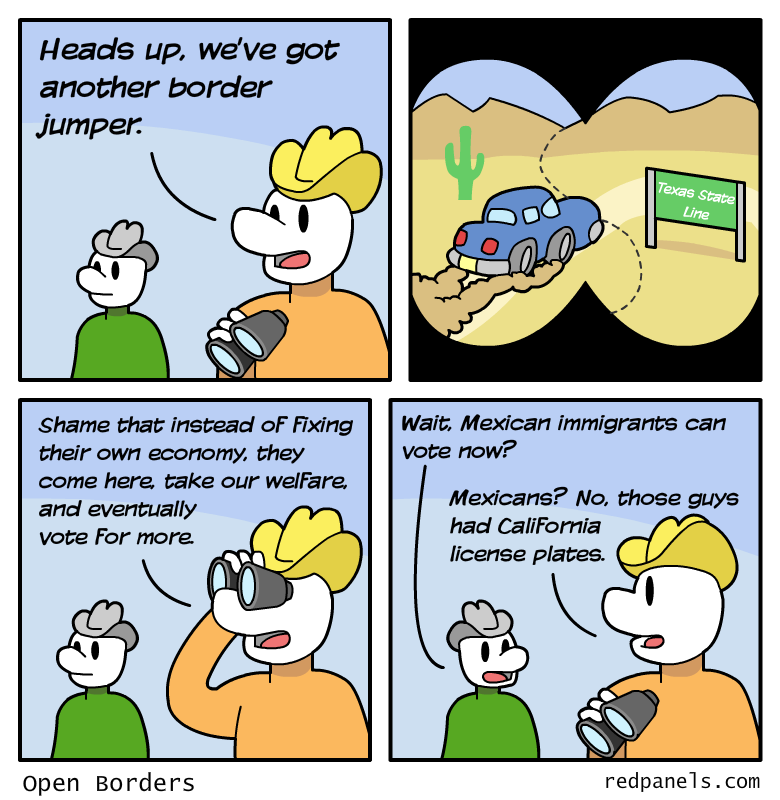
Here’s a meme that contemplates whether California emigrants bring bad voting habits with them.
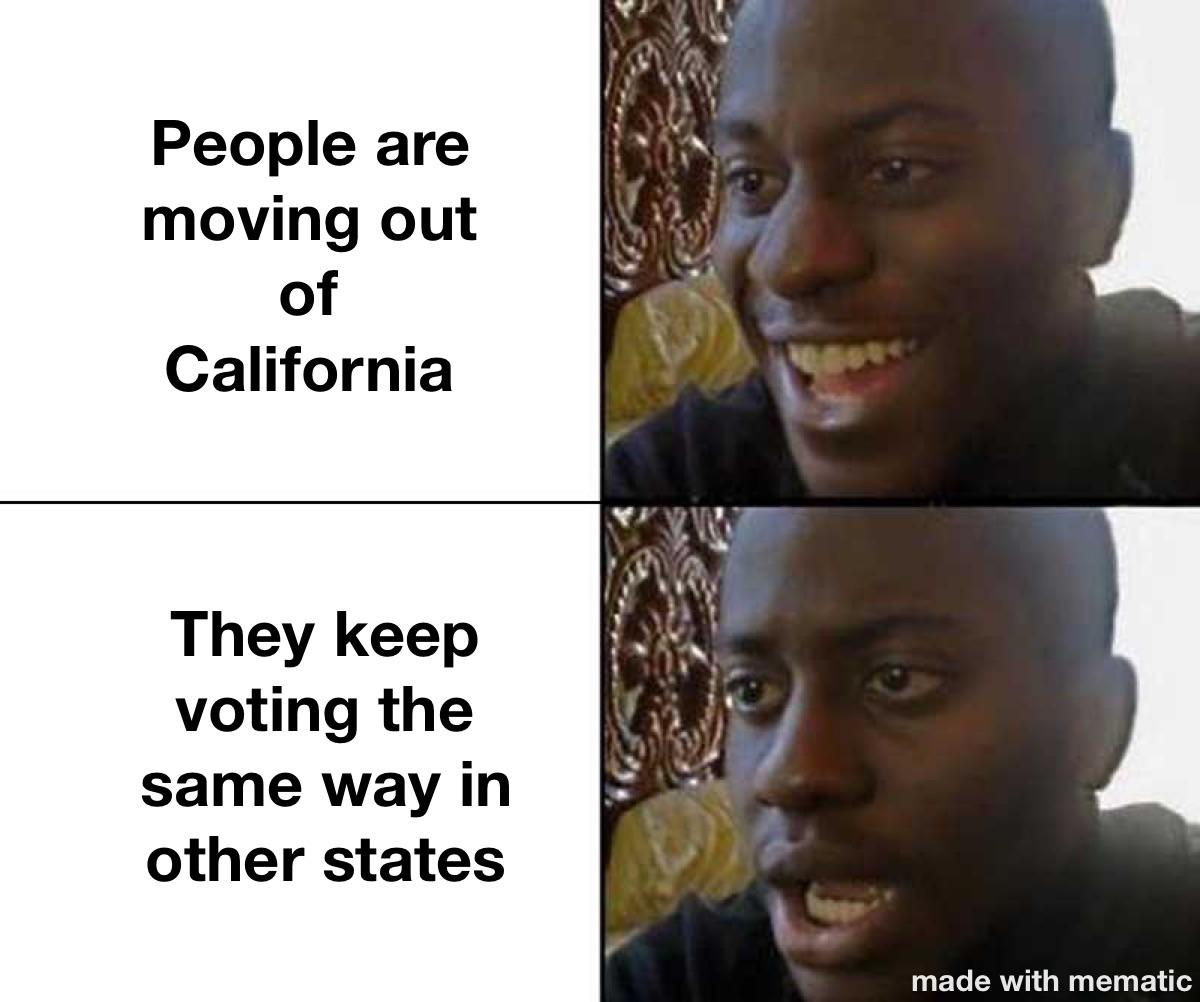
Though that’s apparently more of a problem in Colorado rather than in Texas.

And here’s some clever humor from Genesius Times.
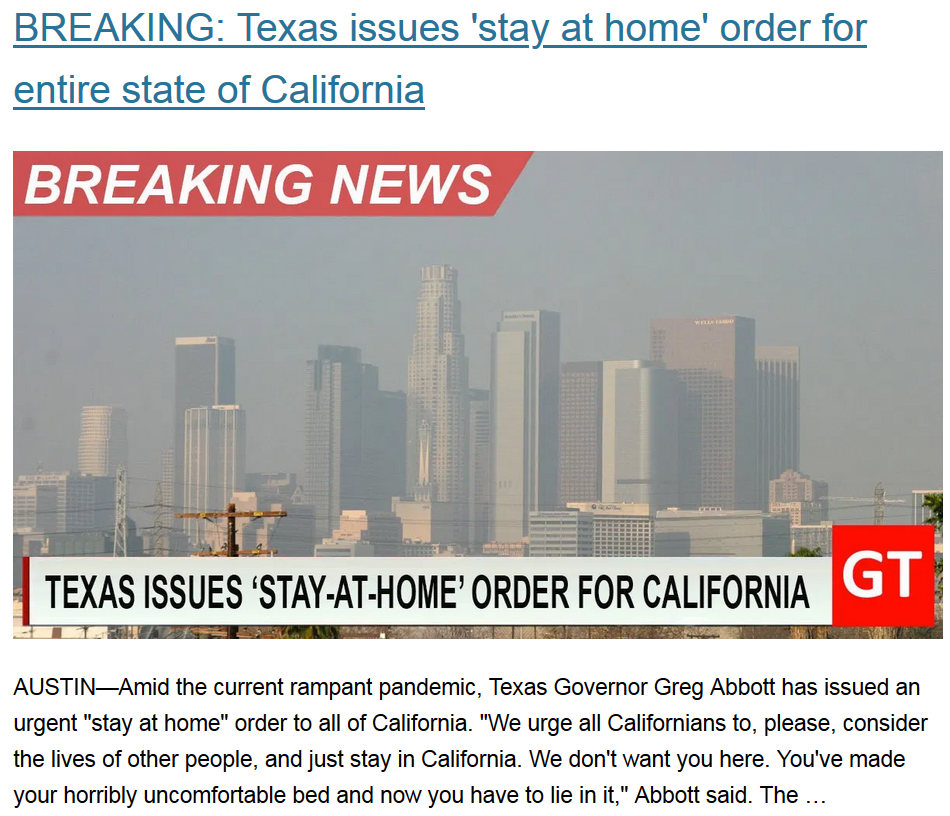
P.S. My favorite California-themed humor (not counting the state’s elected officials) can be found here, hereherehere, and here.

High-tax states are languishing but  zero-income-tax states such as Texas are growing rapidly!!!!

Much of my writing is focused on the real-world impact of government policy, and this is why I repeatedly look at the relative economic performance of big government jurisdictions and small government jurisdictions.

But I don’t just highlight differences between nations. Yes, it’s educational to look at North Korea vs. South Korea or Chile vs. Venezuela vs. Argentina, but I also think you can learn a lot by looking at what’s happening with different states in America.

So we’ve looked at high-tax states that are languishing, such as California and Illinois, and compared them to zero-income-tax states such as Texas.

With this in mind, you can understand that I was intrigued to see that even the establishment media is noticing that Texas is out-pacing the rest of the nation.

Here are some excerpts from a report by CNN Money on rapid population growth in Texas.

More Americans moved to Texas in recent years than any other state: A net gain of more than 387,000 in the latest Census for 2013. …Five Texas cities — Austin, Houston, San Antonio, Dallas and Fort Worth — were among the top 20 fastest growing large metro areas. Some smaller Texas metro areas grew even faster. In oil-rich Odessa, the population grew 3.3% and nearby Midland recorded a 3% gain.

But why is the population growing?

Well, CNN Money points out that low housing prices and jobs are big reasons.

And on the issue of housing, the article does acknowledge the role of “easy regulations” that enable new home construction.

But on the topic of jobs, the piece contains some good data on employment growth, but no mention of policy.

Jobs is the No. 1 reason for population moves, with affordable housing a close second. …Jobs are plentiful in Austin, where the unemployment rate is just 4.6%. Moody’s Analytics projects job growth to average 4% a year through 2015. Just as important, many jobs there are well paid: The median income of more than $75,000 is nearly 20% higher than the national median.

That’s it. Read the entire article if you don’t believe me, but the reporter was able to write a complete article about the booming economy in Texas without mentioning – not even once – that there’s no state income tax.

But that wasn’t the only omission.

The article doesn’t mention that Texas is the 4th-best state in the Tax Foundation’s ranking of state and local tax burdens.

The article doesn’t mention that Texas was the least oppressive state in the Texas Public Policy Foundation’s Soft Tyranny Index.

The article doesn’t mention that Texas was ranked #20 in a study of the overall fiscal condition of the 50 states.

The article doesn’t mention that Texas is in 4th place in a combined ranking of economic freedom in U.S. state and Canadian provinces.

The article doesn’t mention that Texas was ranked #11 in the Tax Foundation’s State Business Tax Climate Index.

The article doesn’t mention that Texas is in 14th place in the Mercatus ranking of overall freedom for the 50 states (and in 10th place for fiscal freedom).

By the way, I’m not trying to argue that Texas is the best state.

Indeed, it only got the top ranking in one of the measures cited above.

My point, instead, is simply to note that it takes willful blindness to write about the strong population growth and job performance of Texas without making at least a passing reference to the fact that it is a low-tax, pro-market state.

At least compared to other states. And especially compared to the high-tax states that are stagnating.

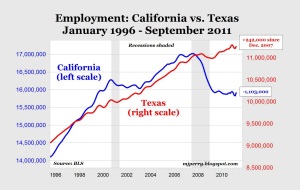
Such as California, as illustrated by this data and this data, as well as this Lisa Benson cartoon.

Such as Illinois, as illustrated by this data and this Eric Allie cartoon.
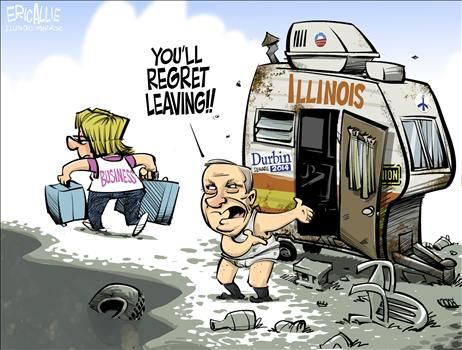
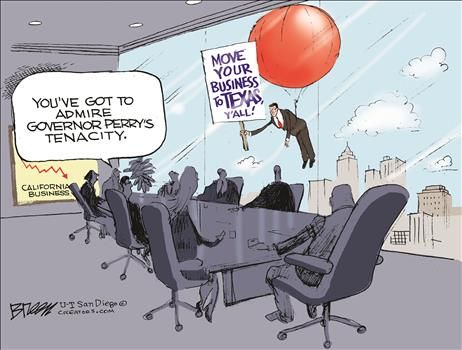
And I can’t resist adding this Steve Breen cartoon, if for no other reason that it reminds me of another one of his cartoons that I shared last year.
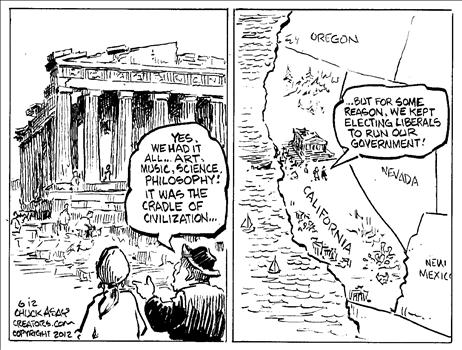
Speaking of humor, this Chuck Asay cartoon speculates on how future archaeologists will view California. And this joke about Texas, California, and a coyote is among my most-viewed blog posts.

All jokes aside, I want to reiterate what I wrote above. Texas is far from perfect. There’s too much government in the Lone Star state. It’s only a success story when compared to California.

P.S. Paul Krugman has tried to defend California, which has made him an easy target. I debunked him earlier this year, and I also linked to a superb Kevin Williamson takedown of Krugman at the bottom of this post.

P.P.S. Once again, I repeat the two-part challenge I’ve issued to the left. I’ll be happy if any statists can successfully respond to just one of the two questions I posed.

Related posts:

California is the Greece of the USA, but Texas is not perfect either!!!

California is the Greece of the USA, but Texas is not perfect either!!! Just Because California Is Terrible, that Doesn’t Mean Texas Is Perfect January 21, 2013 by Dan Mitchell Texas is in much better shape than California. Taxes are lower, in part because Texas has no state income tax. No wonder the Lone Star State […]

Dan Mitchell on Texas v. California (includes editorial cartoon)

We should lower federal taxes because jobs are going to states like Texas that have low taxes. (We should lower state taxes too!!) What Can We Learn by Comparing the Employment Situation in Texas vs. California? April 3, 2013 by Dan Mitchell One of the great things about federalism, above and beyond the fact that it […]

Ark Times blogger claims California is better than Texas but facts don’t bear that out (3 great political cartoons)

I got on the Arkansas Times Blog and noticed that a person on there was bragging about the high minimum wage law in San Francisco and how everything was going so well there. On 2-15-13 on the Arkansas Times Blog I posted: Couldn’t be better (the person using the username “Couldn’t be better)  is bragging […]

California burdensome government causing some of business community to leave for Texas

Does Government Have a Revenue or Spending Problem? People say the government has a debt problem. Debt is caused by deficits, which is the difference between what the government collects in tax revenue and the amount of government spending. Every time the government runs a deficit, the government debt increases. So what’s to blame: too […]

Arkansas Times blogger picks California business environment over Texas, proves liberals don’t live in real world(Part 2)

       Former California Governor Arnold Schwarzenegger with his family   I posted a portion of an article by John Fund of the Wall Street Journal that pointed out that many businesses are leaving California because of all of their government red tape and moving to Texas. My username is SalineRepublican and this is […]

John Fund’s talk in Little Rock 4-27-11(Part 4):Responding to liberals who criticize states like Texas that don’t have the red tape that California has

John Fund at Chamber Day, Part 1 Last week I got to attend the first ever “Conservative Lunch Series” presented by  KARN and Americans for Prosperity Foundation at the Little Rock Hilton on University Avenue. This monthly luncheon will be held the fourth Wednesday of every month. The speaker for today’s luncheon was John Fund. John […]

California and France have raised taxes so much that it has hurt economic growth!!!

___________ California and France have raised taxes so much that it has hurt economic growth!!! Mirror, Mirror, on the Wall, which Nation and State Punish Success Most of All? September 25, 2014 by Dan Mitchell I’ve shared some interested rankings on tax policy, including a map from the Tax Foundation showing which states have the earliest […]

Jerry Brown raised taxes in California and a rise in the minimum wage, but it won’t work like Krugman thinks!!!

___________   Jerry Brown raised taxes in California and a rise in the minimum wage, but it won’t work like Krugman thinks!!!! This cartoon below shows what will eventually happen to California and any other state that keeps raising taxes higher and higher.   Krugman’s “Gotcha” Moment Leaves Something to Be Desired July 25, 2014 by […]

Open letter to President Obama (Part 573) Are the states of Illinois and California going to join Detroit in Bankruptcy one day?

Open letter to President Obama (Part 573) (Emailed to White House on 7-29-13.) President Obama c/o The White House 1600 Pennsylvania Avenue NW Washington, DC 20500 Dear Mr. President, I know that you receive 20,000 letters a day and that you actually read 10 of them every day. I really do respect you for trying to get […]

Open letter to President Obama (Part 561) We should lower federal taxes because jobs are going to states like Texas that have low taxes

Open letter to President Obama (Part 561) (Emailed to White House on 6-25-13.) President Obama c/o The White House 1600 Pennsylvania Avenue NW Washington, DC 20500 Dear Mr. President, I know that you receive 20,000 letters a day and that you actually read 10 of them every day. I really do respect you for trying to get […]

Dan Mitchell: Good tax policy should strive to solve the three major problems that plague today’s income tax: 1. Punitive tax rates on productive behavior 2. Double taxation of saving and investment 3. Corrupt, complex, and inefficient loopholes.

Lower Taxes on Capital = More Prosperity

Good tax policy should strive to solve the three major problems that plague today’s income tax.

  1. Punitive tax rates on productive behavior.
  2. Double taxation of saving and investment
  3. Corrupt, complex, and inefficient loopholes.

Today, let’s focus on the second item. If the goal is to minimize the economic damage of taxation, both labor and capital should be taxed at the lowest-possible rate.

But, as illustrated by the chart, the internal revenue code imposes widespread “double taxation” on income that is saved and invested.

Actually, it’s more than double taxation. Between the capital gains tax, corporate income tax, double tax on dividends, and death tax, there are multiple layers of tax on income from saving and investment.

So even if statutory tax rates are low, effective tax rates can be very high when you consider how the IRS gets several bites at the apple.

This is why good tax reform plans eliminate the tax bias against capital.

But we don’t want the perfect to be the enemy of the good. Simply lowering tax rates on capital also would be a step in the right direction.

And such an approach would produce meaningful economic benefits, as explained in a new Federal Reserve study by Saroj Bhattarai, Jae Won Lee, Woong Yong Park, and Choongryul Yang.

…capital tax cuts, as expected, have expansionary long-run aggregate effects on the economy. For instance, with a permanent reduction of the capital tax rate from 35% to 21%, output in the new steady state, compared to the initial steady state, is greater by 4.24%… A reduction in the capital tax rate leads to a decrease in the rental rate of capital, raising demand for capital by firms. This stimulates investment and capital accumulation. A larger amount of capital stock, in turn, makes workers more productive, raising wages and hours. Finally, given the increase in the factors of production, output expands.

This is all good news.

But our left-leaning friends might not be happybecause some people get richer faster than other people get richer.

This aggregate expansion however, is coupled with worsening…inequality in our model. For instance, skilled wages increase by 4.66% while unskilled wages increases by only 0.56%, driven by capital-skill complementarity.

For what it is worth, I agree with Margaret Thatcherabout adopting policies that help all groups enjoy higher living standards.

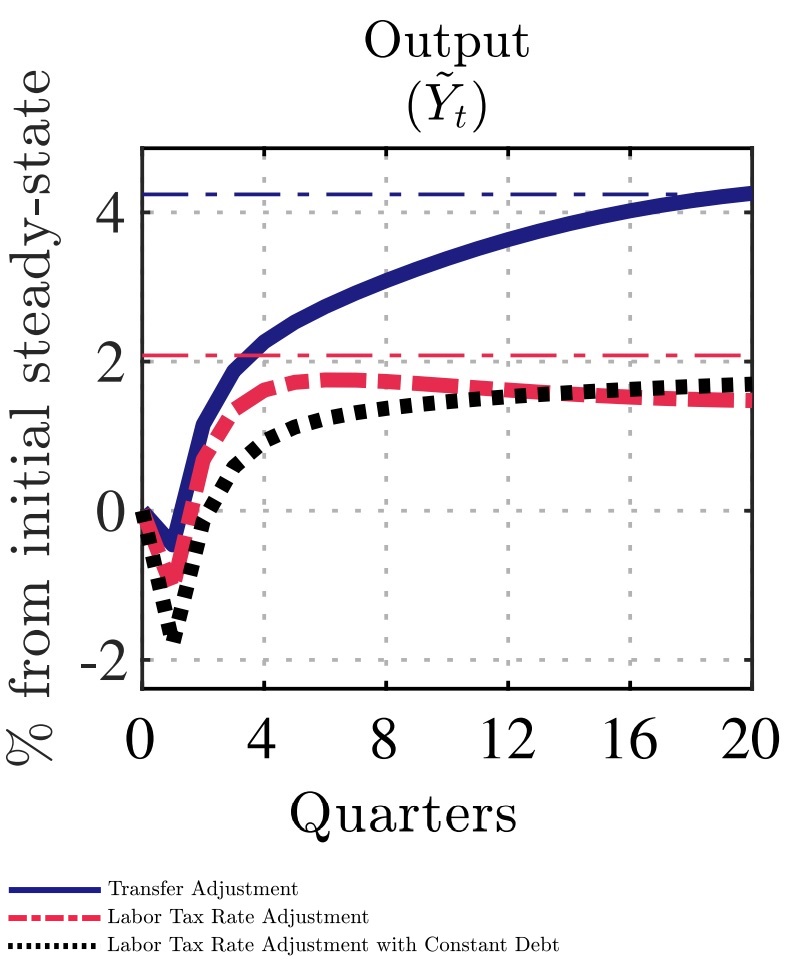
Here’s a chart for wonky readers. It shows how quickly the economy grows depending on how lower capital taxes are offset.

And here’s some of the explanatory text.

The main takeaway if that you get the most growth when you also lower the burden of redistribution spending.

The three financing schemes under consideration…produce different effects on aggregate output because each scheme influences workers’ labor supply decisions differently. …lump-sum transfer cuts…boosts unskilled hours and in turn, contributes to greater aggregate output… In comparison, a rise in the labor or consumption tax rate decreases the effective wage rate (as is well-understood) and additionally, weakens the wealth effect for the unskilled household. These two mechanisms work together to generate a smaller aggregate expansion under the distortionary tax adjustments. …we show that the capital tax cut has different welfare implications for each type of household depending on time horizon and policy adjustments. …The tax reform benefits the skilled households the most when transfers adjust, whereas the unskilled households prefer distortionary financing to avoid a significant reduction in transfer incomes.

The secondary takeaway from this research is that it would be bad for the economy (and bad for both rich people and poor people) if Joe Biden’s class-warfare tax policy was enacted.

But if you read this, this, this, and this, you already knew that.

I enjoyed this article below because it demonstrates that the Laffer Curve has been working for almost 100 years now when it is put to the test in the USA. I actually got to hear Arthur Laffer speak in person in 1981 and he told us in advance what was going to happen the 1980’s and it all came about as he said it would when Ronald Reagan’s tax cuts took place. I wish we would lower taxes now instead of looking for more revenue through raised taxes. We have to grow the economy:

What Mitt Romney Said Last Night About Tax Cuts And The Deficit Was Absolutely Right. And What Obama Said Was Absolutely Wrong.

Mitt Romney repeatedly said last night that he would not allow tax cuts to add to the deficit.  He repeatedly said it because over and over again Obama blathered the liberal talking point that cutting taxes necessarily increased deficits.

Romney’s exact words: “I want to underline that — no tax cut that adds to the deficit.”

Meanwhile, Obama has promised to cut the deficit in half during his first four years – but instead gave America the highest deficits in the history of the entire human race.

I’ve written about this before.  Let’s replay what has happened every single time we’ve ever cut the income tax rate.

The fact of the matter is that we can go back to Calvin Coolidge who said very nearly THE EXACT SAME THING to his treasury secretary: he too would not allow any tax cuts that added to the debt.  Andrew Mellon – quite possibly the most brilliant economic mind of his day – did a great deal of research and determined what he believed was the best tax rate.  And the Coolidge administration DID cut income taxes and MASSIVELY increased revenues.  Coolidge and Mellon cut the income tax rate 67.12 percent (from 73 to 24 percent); and revenues not only did not go down, but they went UP by at least 42.86 percent (from $700 billion to over $1 billion).

That’s something called a documented fact.  But that wasn’t all that happened: another incredible thing was that the taxes and percentage of taxes paid actually went UP for the rich.  Because as they were allowed to keep more of the profits that they earned by investing in successful business, they significantly increased their investments and therefore paid more in taxes than they otherwise would have had they continued sheltering their money to protect themselves from the higher tax rates.  Liberals ignore reality, but it is simply true.  It is a fact.  It happened.

Then FDR came along and raised the tax rates again and the opposite happened: we collected less and less revenue while the burden of taxation fell increasingly on the poor and middle class again.  Which is exactly what Obama wants to do.

People don’t realize that John F. Kennedy, one of the greatest Democrat presidents, was a TAX CUTTER who believed the conservative economic philosophy that cutting tax rates would in fact increase tax revenues.  He too cut taxes, and he too increased tax revenues.

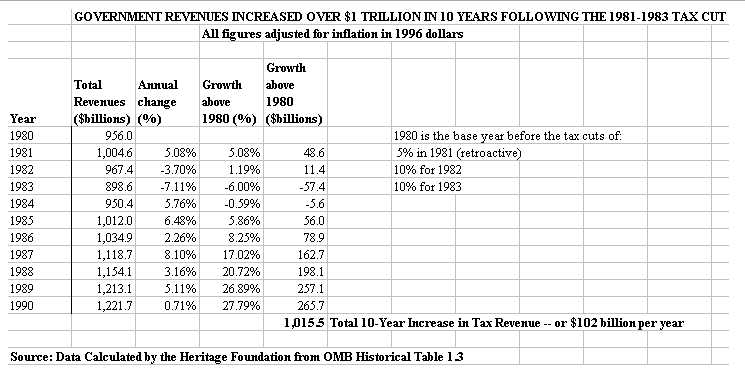
So we get to Ronald Reagan, who famously cut taxes.  And again, we find that Reagan cut that godawful liberal tax rate during an incredibly godawful liberal-caused economic recession, and he increased tax revenue by 20.71 percent (with revenues increasing from $956 billion to $1.154 trillion).  And again, the taxes were paid primarily by the rich:

“The share of the income tax burden borne by the top 10 percent of taxpayers increased from 48.0 percent in 1981 to 57.2 percent in 1988. Meanwhile, the share of income taxes paid by the bottom 50 percent of taxpayers dropped from 7.5 percent in 1981 to 5.7 percent in 1988.”

So we get to George Bush and the Bush tax cuts that liberals and in particular Obama have just demonized up one side and demagogued down the other.  And I can simply quote the New York Times AT the time:

Sharp Rise in Tax Revenue to Pare U.S. Deficit By EDMUND L. ANDREWS Published: July 13, 2005

WASHINGTON, July 12 – For the first time since President Bush took office, an unexpected leap in tax revenue is about to shrink the federal budget deficit this year, by nearly $100 billion.

A Jump in Corporate Payments On Wednesday, White House officials plan to announce that the deficit for the 2005 fiscal year, which ends in September, will be far smaller than the $427 billion they estimated in February.

Mr. Bush plans to hail the improvement at a cabinet meeting and to cite it as validation of his argument that tax cuts would stimulate the economy and ultimately help pay for themselves.

Based on revenue and spending data through June, the budget deficit for the first nine months of the fiscal year was $251 billion, $76 billion lower than the $327 billion gap recorded at the corresponding point a year earlier.

The Congressional Budget Office estimated last week that the deficit for the full fiscal year, which reached $412 billion in 2004, could be “significantly less than $350 billion, perhaps below $325 billion.”

The big surprise has been in tax revenue, which is running nearly 15 percent higher than in 2004. Corporate tax revenue has soared about 40 percent, after languishing for four years, and individual tax revenue is up as well
.

And of course the New York Times, as reliable liberals, use the adjective whenever something good happens under conservative policies and whenever something bad happens under liberal policies: ”unexpected.”   But it WASN’T ”unexpected.”  It was EXACTLY what Republicans had said would happen and in fact it was exactly what HAD IN FACT HAPPENED every single time we’ve EVER cut income tax rates.

The truth is that conservative tax policy has a perfect track record: every single time it has ever been tried, we have INCREASED tax revenues while not only exploding economic activity and creating more jobs, but encouraging the wealthy to pay more in taxes as well.  And liberals simply dishonestly refuse to acknowledge documented history.

Meanwhile, liberals also have a perfect record … of FAILUREThey keep raising taxes and keep not understanding why they don’t get the revenues they predicted.

The following is a section from my article, “Tax Cuts INCREASE Revenues; They Have ALWAYS Increased Revenues“, where I document every single thing I said above:

The Falsehood That Tax Cuts Increase The Deficit

Now let’s take a look at the utterly fallacious view that tax cuts in general create higher deficits.

Let’s take a trip back in time, starting with the 1920s.  From Burton Folsom’s book, New Deal or Raw Deal?:

In 1921, President Harding asked the sixty-five-year-old [Andrew] Mellon to be secretary of the treasury; the national debt [resulting from WWI] had surpassed $20 billion and unemployment had reached 11.7 percent, one of the highest rates in U.S. history.  Harding invited Mellon to tinker with tax rates to encourage investment without incurring more debt. Mellon studied the problem carefully; his solution was what is today called “supply side economics,” the idea of cutting taxes to stimulate investment.  High income tax rates, Mellon argued, “inevitably put pressure upon the taxpayer to withdraw this capital from productive business and invest it in tax-exempt securities. . . . The result is that the sources of taxation are drying up, wealth is failing to carry its share of the tax burden; and capital is being diverted into channels which yield neither revenue to the Government nor profit to the people” (page 128).

Mellon wrote, “It seems difficult for some to understand that high rates of taxation do not necessarily mean large revenue to the Government, and that more revenue may often be obtained by lower taxes.”  And he compared the government setting tax rates on incomes to a businessman setting prices on products: “If a price is fixed too high, sales drop off and with them profits.”

And what happened?

“As secretary of the treasury, Mellon promoted, and Harding and Coolidge backed, a plan that eventually cut taxes on large incomes from 73 to 24 percent and on smaller incomes from 4 to 1/2 of 1 percent.  These tax cuts helped produce an outpouring of economic development – from air conditioning to refrigerators to zippers, Scotch tape to radios and talking movies.  Investors took more risks when they were allowed to keep more of their gains.  President Coolidge, during his six years in office, averaged only 3.3 percent unemployment and 1 percent inflation – the lowest misery index of any president in the twentieth century.

Furthermore, Mellon was also vindicated in his astonishing predictions that cutting taxes across the board would generate more revenue.  In the early 1920s, when the highest tax rate was 73 percent, the total income tax revenue to the U.S. government was a little over $700 million.  In 1928 and 1929, when the top tax rate was slashed to 25 and 24 percent, the total revenue topped the $1 billion mark.  Also remarkable, as Table 3 indicates, is that the burden of paying these taxes fell increasingly upon the wealthy” (page 129-130).

Now, that is incredible upon its face, but it becomes even more incredible when contrasted with FDR’s antibusiness and confiscatory tax policies, which both dramatically shrunk in terms of actual income tax revenues (from $1.096 billion in 1929 to $527 million in 1935), and dramatically shifted the tax burden to the backs of the poor by imposing huge new excise taxes (from $540 million in 1929 to $1.364 billion in 1935).  See Table 1 on page 125 of New Deal or Raw Deal for that information.

FDR both collected far less taxes from the rich, while imposing a far more onerous tax burden upon the poor.

It is simply a matter of empirical fact that tax cuts create increased revenue, and that those [Democrats] who have refused to pay attention to that fact have ended up reducing government revenues even as they increased the burdens on the poorest whom they falsely claim to help.

Let’s move on to John F. Kennedy, one of the most popular Democrat presidents ever.  Few realize that he was also a supply-side tax cutter.

Kennedy said:

“It is a paradoxical truth that tax rates are too high and tax revenues are too low and the soundest way to raise the revenues in the long run is to cut the rates now … Cutting taxes now is not to incur a budget deficit, but to achieve the more prosperous, expanding economy which can bring a budget surplus.”

– John F. Kennedy, Nov. 20, 1962, president’s news conference


“Lower rates of taxation will stimulate economic activity and so raise the levels of personal and corporate income as to yield within a few years an increased – not a reduced – flow of revenues to the federal government.”

– John F. Kennedy, Jan. 17, 1963, annual budget message to the Congress, fiscal year 1964

“In today’s economy, fiscal prudence and responsibility call for tax reduction even if it temporarily enlarges the federal deficit – why reducing taxes is the best way open to us to increase revenues.”

– John F. Kennedy, Jan. 21, 1963, annual message to the Congress: “The Economic Report Of The President”


“It is no contradiction – the most important single thing we can do to stimulate investment in today’s economy is to raise consumption by major reduction of individual income tax rates.”

– John F. Kennedy, Jan. 21, 1963, annual message to the Congress: “The Economic Report Of The President”


“Our tax system still siphons out of the private economy too large a share of personal and business purchasing power and reduces the incentive for risk, investment and effort – thereby aborting our recoveries and stifling our national growth rate.”

– John F. Kennedy, Jan. 24, 1963, message to Congress on tax reduction and reform, House Doc. 43, 88th Congress, 1st Session.


“A tax cut means higher family income and higher business profits and a balanced federal budget. Every taxpayer and his family will have more money left over after taxes for a new car, a new home, new conveniences, education and investment. Every businessman can keep a higher percentage of his profits in his cash register or put it to work expanding or improving his business, and as the national income grows, the federal government will ultimately end up with more revenues.”

– John F. Kennedy, Sept. 18, 1963, radio and television address to the nation on tax-reduction bill

Which is to say that modern Democrats are essentially calling one of their greatest presidents a liar when they demonize tax cuts as a means of increasing government revenues.

So let’s move on to Ronald Reagan.  Reagan had two major tax cutting policies implemented: the Economic Recovery Tax Act (ERTA) of 1981, which was retroactive to 1981, and the Tax Reform Act of 1986.

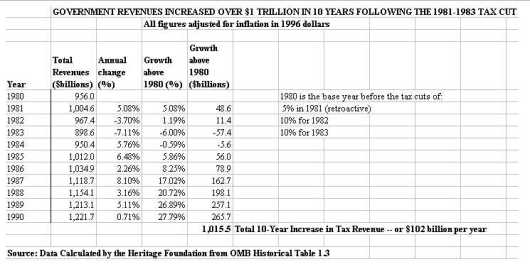
Did Reagan’s tax cuts decrease federal revenues?  Hardly:

We find that 8 of the following 10 years there was a surplus of revenue from 1980, prior to the Reagan tax cuts.  And, following the Tax Reform Act of 1986, there was a MASSIVE INCREASEof revenue.

So Reagan’s tax cuts increased revenue.  But who paid the increased tax revenue?  The poor?  Opponents of the Reagan tax cuts argued that his policy was a giveaway to the rich (ever heard that one before?) because their tax payments would fall.  But that was exactly wrong.  In reality:

“The share of the income tax burden borne by the top 10 percent of taxpayers increased from 48.0 percent in 1981 to 57.2 percent in 1988. Meanwhile, the share of income taxes paid by the bottom 50 percent of taxpayers dropped from 7.5 percent in 1981 to 5.7 percent in 1988.”

So Ronald Reagan a) collected more total revenue, b) collected more revenue from the rich, while c) reducing revenue collected by the bottom half of taxpayers, and d) generated an economic powerhouse that lasted – with only minor hiccups – for nearly three decades.  Pretty good achievement considering that his predecessor was forced to describe his own economy as a “malaise,” suffering due to a “crisis of confidence.” Pretty good considering that President Jimmy Carter responded to a reporter’s question as to what he would do about the problem of inflation by answering, “It would be misleading for me to tell any of you that there is a solution to it.”

Reagan whipped inflation.  Just as he whipped that malaise and that crisis of confidence.

________

The Laffer Curve, Part III: Dynamic Scoring

Dan Mitchell: Since athletes respond to incentives (just like entrepreneurs, inventors, and scientists), we should not be surprised that Prof. Hembre found that teams in lower-tax states now enjoy more success!

If You Want Your Team to Win, Support Lower Taxes

Back in 2018, I shared some academic research on the relationship between state tax rates and the performance of professional football teams.

The main takeaway is that teams based in high-tax states did not win as many games, on average, as teams based in low-tax states.

So if you want your favorite team to win, support better tax policy.

Though there are no guarantees. A team from high-tax California just won the Super Bowl, so it goes without saying that taxes are not the only factor that determines team success.

But it presumably means that teams in states like California and New York have to overcome a built-in disadvantage.

Let’s take a look at some new research on this issue. Professor Erik Hembre of the University of Illinois at Chicago authored a study that’s been published by International Tax and Public Finance.

Here’s the question he wanted to answer.

Do higher state income taxes harm firms? …This paper examines the state income tax burden in a unique market, professional sports, where teams—the capital in question—are highly immobile and players—the labor—are highly mobileto test whether higher state income tax hinders team performance. Anecdotal evidence suggests higher state income taxes disadvantage professional sports teams. Across the four major US sports leagues, of the forty-nine franchises with long championship droughts, only four are from states that do not have an income tax, while twenty are from the highest taxed states.

Here’s his methodology, which takes advantage of the fact that free agency gave players new-found ability to play where they could keep more of their earnings.

To test the link between state income taxes and team performance, this paper analyzes team performance in the four major US professional sports leagues: the National Basketball Association (NBA), the National Football League (NFL), the National Hockey League (NHL), and Major League Baseball (MLB). To address concerns that the association between team performance and income tax rates may be coincidental, I examine how the tax rate effect changed with the adoption of free agency. Achieving free agency has been a milestone for players’ associations, paramount both for increasing player mobility across teams and for forcing teams to compete for player services without restrictions.

Since athletes respond to incentives (just like entrepreneurs, inventors, and scientists), we should not be surprised that Prof. Hembre found that teams in lower-tax states now enjoy more success.

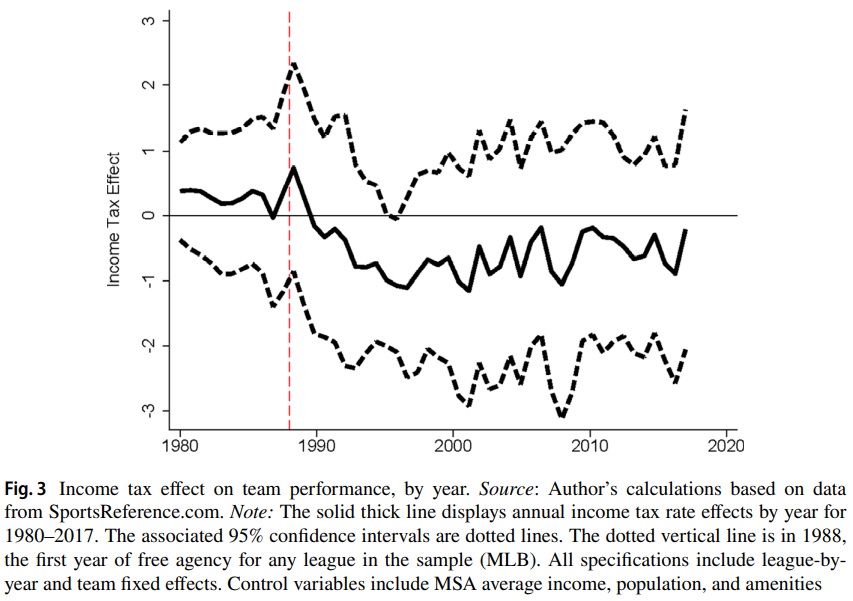
I compare the link between tax rates and team winning percentage before and after the introduction of free agency in each league using within-team variation in top state marginal income tax rates. Prior to free agency, there was a small positive association between income tax rates and winning. After the introduction of free agency, changes in state income tax rates significantly influence team performance. Each percentage point increase in the top marginal income tax rate is associated with a 0.70 percentage point decrease in win percentage. The tax rate effect on team performance is robust to a variety of specifications, such as controlling for sales and property taxes or alternative tax rate measures. Changing the outcome measure to be championships or finals appearances also yields similar results. The estimated effect size is non-trivial. The main analysis effect size of − 0.70 means that a one standard deviation increase in tax rate will result in 2.05 fewer wins over an 82 game season. …Figure 3 presents the annual point estimates (훽2) and 95% confidence intervals of the income tax rate effects between 1980 and 2017. …in all 9 years prior to any league having free agency, there was a positive income tax effect estimate. This relationship changed shortly after the introduction of free agency and since 1990 the annual income tax effect has remained negative.

Here’s the aforementioned Figure 3 for my wonky readers.

As a fan of better tax policy, I like Prof. Hembre’s findings.

As a fan of the New York Yankees, I don’t like his findings

P.S. Here’s one final tidbit that will appeal to fans of the Raiders.

Considering an extreme case, the recent relocation of the Oakland Raiders from a high income tax state (California) to a no income tax state (Nevada) projects a winning percentage increase of 8.6 percentage points or about 1 game per NFL season

P.P.S. I’ll close by reiterating my caveat about taxes being just one piece of the puzzle. After all, I speculated that taxes may have played a role in LeBron James going from Cleveland to Miami many years ago. But he has since migrated to high-tax California. Though many pro athletes have moved away from the not-so-Golden States, so the general points is still accurate.

P.P.P.S. I feel sorry for Cam Newton, who paid a marginal tax rate of nearly 200 percent on his bonus for playing in the 2016 Super Bowl.

P.P.P.P.S. Taxes also impact choices on how often to box and where to box.

P.P.P.P.P.S. Needless to say, these principles also apply in other nations.

The Laffer Curve, Part I: Understanding the Theory

Uploaded by on Jan 28, 2008

The Laffer Curve charts a relationship between tax rates and tax revenue. While the theory behind the Laffer Curve is widely accepted, the concept has become very controversial because politicians on both sides of the debate exaggerate. This video shows the middle ground between those who claim “all tax cuts pay for themselves” and those who claim tax policy has no impact on economic performance. This video, focusing on the theory of the Laffer Curve, is Part I of a three-part series. Part II reviews evidence of Laffer-Curve responses. Part III discusses how the revenue-estimating process in Washington can be improved. For more information please visit the Center for Freedom and Prosperity’s web site: http://www.freedomandprosperity.org

___________

After reading Milton Friedman’s book “Free to Choose” in 1980, I had the opportunity in 1981 to hear Arthur Laffer speak about what great economic expansion we were about to have in the USA because of Reagan’s 25% across the board tax cuts on income taxes and sure enough he was right. In fact, our economy expanded so much that the world took notice. Basically from 1980 to 2007 we dropped our top income tax rate from 73% to 39% which is a decrease of 34% and the world saw what we did and followed along. The drop of the industrialized countries during this same time was 26% (from 68% to 42% on average).

Take a look below at this chart:

Table 42.2
Top Individual Income Tax Rates in the OECD (percent)
Change
Country 1980 1985 1990 1995 2000 2005 2007 1980–2007
Australia 62 60 49 47 47 47 45 17
Austria 62 62 50 50 50 50 50 12
Belgium 76 76 58 61 60 53 53 24
Britain 83 60 40 40 40 40 40 43
Canada 64 57 49 49 48 44 44 20
Czech Rep. n.a. n.a. n.a. 43 32 32 32 11
Denmark 66 73 68 64 59 59 59 7
Finland 68 67 60 57 54 53 52 16
France 60 65 60 62 61 56 49 11
Germany 65 65 53 57 56 44 47 18
Greece 60 63 50 45 43 40 40 20
Hungary n.a. n.a. 50 44 40 38 36 14
Iceland 63 56 40 47 45 39 36 27
Ireland 60 65 58 48 42 42 41 19
Italy 72 81 66 67 51 44 44 28
Japan 75 70 65 65 50 50 50 25
Korea 89 65 64 48 44 39 39 50
Luxembourg 57 57 56 50 47 39 39 18
Mexico 55 55 40 35 40 30 28 27
Netherlands 72 72 60 60 52 52 52 20
New Zealand 62 66 33 33 39 39 39 23
Norway 75 64 51 42 48 40 40 35
Poland n.a. n.a. n.a. 45 40 40 40 5
Portugal 84 69 40 40 40 40 42 42
Slovakia n.a. n.a. n.a. 42 42 19 19 23
Spain 66 66 56 56 48 40 39 27
Sweden 87 80 65 50 55 56 56 32
Switzerland 38 40 38 37 36 34 34 4
Turkey 75 63 50 55 45 40 40 35
United States 73 55 38 43 43 39 39 34
Average 68 64 52 49 47 43 42 26
SOURCE: James Gwartney and Robert Lawson, Economic Freedom of the World (Vancouver: Fraser Institute,
2007), as updated to 2007 by the authors. Data includes the national and average subnational tax rates.
NOTE: n.a. not applicable.

___________

I know that Max Brantley and many of his friends over the Arkansas Times like to say that the Reagan tax cuts increased the deficit but that clearly is not true.

Peter Sperry noted:

President Ronald Reagan’s record includes sweeping economic reforms and deep across-the-board tax cuts, market deregulation, and sound monetary policies to contain inflation. His policies resulted in the largest peacetime economic boom in American history and nearly 35 million more jobs. As the Joint Economic Committee reported in April 2000:2

In 1981, newly elected President Ronald Reagan refocused fiscal policy on the long run. He proposed, and Congress passed, sharp cuts in marginal tax rates. The cuts increased incentives to work and stimulated growth. These were funda-mental policy changes that provided the foundation for the Great Expansion that began in December 1982.

HOW DID THE REAGAN TAX CUTS AFFECT THE U.S. TREASURY?

Many critics of reducing taxes claim that the Reagan tax cuts drained the U.S. Treasury. The reality is that federal revenues increased significantly between 1980 and 1990:

  • Total federal revenues doubled from just over $517 billion in 1980 to more than $1 trillion in 1990. In constant inflation-adjusted dollars, this was a 28 percent increase in revenue.3
  • As a percentage of the gross domestic product (GDP), federal revenues declined only slightly from 18.9 percent in 1980 to 18 percent in 1990.4
  • Revenues from individual income taxes climbed from just over $244 billion in 1980 to nearly $467 billion in 1990.5 In inflation-adjusted dollars, this amounts to a 25 percent increase.
  • The Laffer Curve, Part II: Reviewing the EvidenceThis video is second installment of a three-part series. Part I reviews theoretical relationship between tax rates, taxable income, and tax revenue. Part III discusses how the revenue-estimating process in Washington can be improved. For more information please visit the Center for Freedom and Prosperity’s web site: http://www.freedomandprosperity.org.The Laffer Curve, Part III: Dynamic Scoring

Dan Mitchell: Biden’s Nonsensical Class-Warfare Tweet

Biden’s Nonsensical Class-Warfare Tweet

Trump had some economically illiterate tweets about trade during his presidency, including the infamous one about being “Tariff Man.”

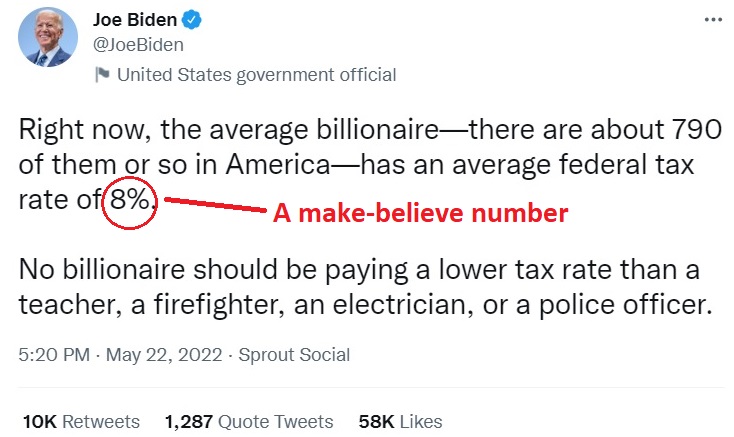
I think Joe Biden must be feeling envious that Trump got so much attention, so he has issued a tweetshowing that he also suffers from economic illiteracy.

Or maybe Biden’s problem is dishonesty because his tweet is based on a make-believe number about the the average tax rate paid by billionaires.

For what it’s worth, this isn’t the first time that Biden has issued a tweet based on fake numbers.

In the previous instance, he deliberately confused the distinction between the financial concept of book income and and cash-flow concept of taxable income.

What accounts for his most recent error?

Reporting for the Wall Street Journal, Richard Rubin and Rachel Louise Ensign explain how the Biden Administration concocted this number.

What do the wealthy pay in federal taxes? On paper, the top marginal income-tax rate is 37% on ordinary income and 23.8% on capital gains. Government estimates put high-income filers’ average rates in the mid-20s. A new Biden administration analysis, however, pegs the average tax rate for the 400 wealthiest households at 8.2% from 2010 to 2018. …It’s far below traditional estimates from government number crunchers… Recent estimates of a broader group of rich people from the Congressional Budget Office, Treasury Department and the Joint Committee on Taxation fall between 23% and 26%.

So how does the Biden Administration get a number that is radically different than other sources?

By artificially inflating the income of rich people by asserting that changes in wealth should count as income.

White House…economists Greg Leiserson and Danny Yagan..include increases in unrealized capital gains. That is the change in the value of assets, including stocks, that haven’t been sold. …Conventional analyses and the current income-tax law don’t include unrealized gains.

At the risk of making a wonky point, “conventional analysis” and “income-tax law” don’t include unrealized capital gains as income because, well, changes in net worth are not income.

And the fact that some folks on the left want to tax people on unrealized capital gains doesn’t change that reality.

To understand why that would be wretched policy, let’s cite examples that apply to those of us who, sadly, are not billionaires.

  • Imagine filing your taxes next year and having to pay more money to the IRS simply because Zillow estimated that your house rose in value.
  • Imagine that you’re filling out your 1040 form next year and you have to pay more money to the IRS  simply because your IRA or 401(k) rose in value.

Both of these examples sound absurd because they would be absurd. And if a policy is absurd and unfair for regular people, it’s also absurd and unfair for rich people.

Since I’m a fiscal wonk, I’ll close by making the point that the Biden Administration wants to take a bad tax(capital gains tax) and make it worse (by taxing paper gains in addition to actual gains).

The net result is that we would have a backdoor wealth tax – a approach that is so anti-growth that even most European governments have repealed those levies.

But since Joe Biden is motivated by class warfare (see here, here, here, and here), he apparently doesn’t care about the economic consequences.

P.S. Biden once claimed that it is “patriotic” to pay higher taxes, but he then played Benedict Arnoldwith his own tax return.

I enjoyed this article below because it demonstrates that the Laffer Curve has been working for almost 100 years now when it is put to the test in the USA. I actually got to hear Arthur Laffer speak in person in 1981 and he told us in advance what was going to happen the 1980’s and it all came about as he said it would when Ronald Reagan’s tax cuts took place. I wish we would lower taxes now instead of looking for more revenue through raised taxes. We have to grow the economy:

What Mitt Romney Said Last Night About Tax Cuts And The Deficit Was Absolutely Right. And What Obama Said Was Absolutely Wrong.

Mitt Romney repeatedly said last night that he would not allow tax cuts to add to the deficit.  He repeatedly said it because over and over again Obama blathered the liberal talking point that cutting taxes necessarily increased deficits.

Romney’s exact words: “I want to underline that — no tax cut that adds to the deficit.”

Meanwhile, Obama has promised to cut the deficit in half during his first four years – but instead gave America the highest deficits in the history of the entire human race.

I’ve written about this before.  Let’s replay what has happened every single time we’ve ever cut the income tax rate.

The fact of the matter is that we can go back to Calvin Coolidge who said very nearly THE EXACT SAME THING to his treasury secretary: he too would not allow any tax cuts that added to the debt.  Andrew Mellon – quite possibly the most brilliant economic mind of his day – did a great deal of research and determined what he believed was the best tax rate.  And the Coolidge administration DID cut income taxes and MASSIVELY increased revenues.  Coolidge and Mellon cut the income tax rate 67.12 percent (from 73 to 24 percent); and revenues not only did not go down, but they went UP by at least 42.86 percent (from $700 billion to over $1 billion).

That’s something called a documented fact.  But that wasn’t all that happened: another incredible thing was that the taxes and percentage of taxes paid actually went UP for the rich.  Because as they were allowed to keep more of the profits that they earned by investing in successful business, they significantly increased their investments and therefore paid more in taxes than they otherwise would have had they continued sheltering their money to protect themselves from the higher tax rates.  Liberals ignore reality, but it is simply true.  It is a fact.  It happened.

Then FDR came along and raised the tax rates again and the opposite happened: we collected less and less revenue while the burden of taxation fell increasingly on the poor and middle class again.  Which is exactly what Obama wants to do.

People don’t realize that John F. Kennedy, one of the greatest Democrat presidents, was a TAX CUTTER who believed the conservative economic philosophy that cutting tax rates would in fact increase tax revenues.  He too cut taxes, and he too increased tax revenues.

So we get to Ronald Reagan, who famously cut taxes.  And again, we find that Reagan cut that godawful liberal tax rate during an incredibly godawful liberal-caused economic recession, and he increased tax revenue by 20.71 percent (with revenues increasing from $956 billion to $1.154 trillion).  And again, the taxes were paid primarily by the rich:

“The share of the income tax burden borne by the top 10 percent of taxpayers increased from 48.0 percent in 1981 to 57.2 percent in 1988. Meanwhile, the share of income taxes paid by the bottom 50 percent of taxpayers dropped from 7.5 percent in 1981 to 5.7 percent in 1988.”

So we get to George Bush and the Bush tax cuts that liberals and in particular Obama have just demonized up one side and demagogued down the other.  And I can simply quote the New York Times AT the time:

Sharp Rise in Tax Revenue to Pare U.S. Deficit By EDMUND L. ANDREWS Published: July 13, 2005

WASHINGTON, July 12 – For the first time since President Bush took office, an unexpected leap in tax revenue is about to shrink the federal budget deficit this year, by nearly $100 billion.

A Jump in Corporate Payments On Wednesday, White House officials plan to announce that the deficit for the 2005 fiscal year, which ends in September, will be far smaller than the $427 billion they estimated in February.

Mr. Bush plans to hail the improvement at a cabinet meeting and to cite it as validation of his argument that tax cuts would stimulate the economy and ultimately help pay for themselves.

Based on revenue and spending data through June, the budget deficit for the first nine months of the fiscal year was $251 billion, $76 billion lower than the $327 billion gap recorded at the corresponding point a year earlier.

The Congressional Budget Office estimated last week that the deficit for the full fiscal year, which reached $412 billion in 2004, could be “significantly less than $350 billion, perhaps below $325 billion.”

The big surprise has been in tax revenue, which is running nearly 15 percent higher than in 2004. Corporate tax revenue has soared about 40 percent, after languishing for four years, and individual tax revenue is up as well
.

And of course the New York Times, as reliable liberals, use the adjective whenever something good happens under conservative policies and whenever something bad happens under liberal policies: ”unexpected.”   But it WASN’T ”unexpected.”  It was EXACTLY what Republicans had said would happen and in fact it was exactly what HAD IN FACT HAPPENED every single time we’ve EVER cut income tax rates.

The truth is that conservative tax policy has a perfect track record: every single time it has ever been tried, we have INCREASED tax revenues while not only exploding economic activity and creating more jobs, but encouraging the wealthy to pay more in taxes as well.  And liberals simply dishonestly refuse to acknowledge documented history.

Meanwhile, liberals also have a perfect record … of FAILUREThey keep raising taxes and keep not understanding why they don’t get the revenues they predicted.

The following is a section from my article, “Tax Cuts INCREASE Revenues; They Have ALWAYS Increased Revenues“, where I document every single thing I said above:

The Falsehood That Tax Cuts Increase The Deficit

Now let’s take a look at the utterly fallacious view that tax cuts in general create higher deficits.

Let’s take a trip back in time, starting with the 1920s.  From Burton Folsom’s book, New Deal or Raw Deal?:

In 1921, President Harding asked the sixty-five-year-old [Andrew] Mellon to be secretary of the treasury; the national debt [resulting from WWI] had surpassed $20 billion and unemployment had reached 11.7 percent, one of the highest rates in U.S. history.  Harding invited Mellon to tinker with tax rates to encourage investment without incurring more debt. Mellon studied the problem carefully; his solution was what is today called “supply side economics,” the idea of cutting taxes to stimulate investment.  High income tax rates, Mellon argued, “inevitably put pressure upon the taxpayer to withdraw this capital from productive business and invest it in tax-exempt securities. . . . The result is that the sources of taxation are drying up, wealth is failing to carry its share of the tax burden; and capital is being diverted into channels which yield neither revenue to the Government nor profit to the people” (page 128).

Mellon wrote, “It seems difficult for some to understand that high rates of taxation do not necessarily mean large revenue to the Government, and that more revenue may often be obtained by lower taxes.”  And he compared the government setting tax rates on incomes to a businessman setting prices on products: “If a price is fixed too high, sales drop off and with them profits.”

And what happened?

“As secretary of the treasury, Mellon promoted, and Harding and Coolidge backed, a plan that eventually cut taxes on large incomes from 73 to 24 percent and on smaller incomes from 4 to 1/2 of 1 percent.  These tax cuts helped produce an outpouring of economic development – from air conditioning to refrigerators to zippers, Scotch tape to radios and talking movies.  Investors took more risks when they were allowed to keep more of their gains.  President Coolidge, during his six years in office, averaged only 3.3 percent unemployment and 1 percent inflation – the lowest misery index of any president in the twentieth century.

Furthermore, Mellon was also vindicated in his astonishing predictions that cutting taxes across the board would generate more revenue.  In the early 1920s, when the highest tax rate was 73 percent, the total income tax revenue to the U.S. government was a little over $700 million.  In 1928 and 1929, when the top tax rate was slashed to 25 and 24 percent, the total revenue topped the $1 billion mark.  Also remarkable, as Table 3 indicates, is that the burden of paying these taxes fell increasingly upon the wealthy” (page 129-130).

Now, that is incredible upon its face, but it becomes even more incredible when contrasted with FDR’s antibusiness and confiscatory tax policies, which both dramatically shrunk in terms of actual income tax revenues (from $1.096 billion in 1929 to $527 million in 1935), and dramatically shifted the tax burden to the backs of the poor by imposing huge new excise taxes (from $540 million in 1929 to $1.364 billion in 1935).  See Table 1 on page 125 of New Deal or Raw Deal for that information.

FDR both collected far less taxes from the rich, while imposing a far more onerous tax burden upon the poor.

It is simply a matter of empirical fact that tax cuts create increased revenue, and that those [Democrats] who have refused to pay attention to that fact have ended up reducing government revenues even as they increased the burdens on the poorest whom they falsely claim to help.

Let’s move on to John F. Kennedy, one of the most popular Democrat presidents ever.  Few realize that he was also a supply-side tax cutter.

Kennedy said:

“It is a paradoxical truth that tax rates are too high and tax revenues are too low and the soundest way to raise the revenues in the long run is to cut the rates now … Cutting taxes now is not to incur a budget deficit, but to achieve the more prosperous, expanding economy which can bring a budget surplus.”

– John F. Kennedy, Nov. 20, 1962, president’s news conference


“Lower rates of taxation will stimulate economic activity and so raise the levels of personal and corporate income as to yield within a few years an increased – not a reduced – flow of revenues to the federal government.”

– John F. Kennedy, Jan. 17, 1963, annual budget message to the Congress, fiscal year 1964

“In today’s economy, fiscal prudence and responsibility call for tax reduction even if it temporarily enlarges the federal deficit – why reducing taxes is the best way open to us to increase revenues.”

– John F. Kennedy, Jan. 21, 1963, annual message to the Congress: “The Economic Report Of The President”


“It is no contradiction – the most important single thing we can do to stimulate investment in today’s economy is to raise consumption by major reduction of individual income tax rates.”

– John F. Kennedy, Jan. 21, 1963, annual message to the Congress: “The Economic Report Of The President”


“Our tax system still siphons out of the private economy too large a share of personal and business purchasing power and reduces the incentive for risk, investment and effort – thereby aborting our recoveries and stifling our national growth rate.”

– John F. Kennedy, Jan. 24, 1963, message to Congress on tax reduction and reform, House Doc. 43, 88th Congress, 1st Session.


“A tax cut means higher family income and higher business profits and a balanced federal budget. Every taxpayer and his family will have more money left over after taxes for a new car, a new home, new conveniences, education and investment. Every businessman can keep a higher percentage of his profits in his cash register or put it to work expanding or improving his business, and as the national income grows, the federal government will ultimately end up with more revenues.”

– John F. Kennedy, Sept. 18, 1963, radio and television address to the nation on tax-reduction bill

Which is to say that modern Democrats are essentially calling one of their greatest presidents a liar when they demonize tax cuts as a means of increasing government revenues.

So let’s move on to Ronald Reagan.  Reagan had two major tax cutting policies implemented: the Economic Recovery Tax Act (ERTA) of 1981, which was retroactive to 1981, and the Tax Reform Act of 1986.

Did Reagan’s tax cuts decrease federal revenues?  Hardly:

We find that 8 of the following 10 years there was a surplus of revenue from 1980, prior to the Reagan tax cuts.  And, following the Tax Reform Act of 1986, there was a MASSIVE INCREASEof revenue.

So Reagan’s tax cuts increased revenue.  But who paid the increased tax revenue?  The poor?  Opponents of the Reagan tax cuts argued that his policy was a giveaway to the rich (ever heard that one before?) because their tax payments would fall.  But that was exactly wrong.  In reality:

“The share of the income tax burden borne by the top 10 percent of taxpayers increased from 48.0 percent in 1981 to 57.2 percent in 1988. Meanwhile, the share of income taxes paid by the bottom 50 percent of taxpayers dropped from 7.5 percent in 1981 to 5.7 percent in 1988.”

So Ronald Reagan a) collected more total revenue, b) collected more revenue from the rich, while c) reducing revenue collected by the bottom half of taxpayers, and d) generated an economic powerhouse that lasted – with only minor hiccups – for nearly three decades.  Pretty good achievement considering that his predecessor was forced to describe his own economy as a “malaise,” suffering due to a “crisis of confidence.” Pretty good considering that President Jimmy Carter responded to a reporter’s question as to what he would do about the problem of inflation by answering, “It would be misleading for me to tell any of you that there is a solution to it.”

Reagan whipped inflation.  Just as he whipped that malaise and that crisis of confidence.

________

The Laffer Curve, Part III: Dynamic Scoring

Dan Mitchell article: Debunking Biden’s Absurd “Cut the Deficit” Claim

A.F. Branco for Oct 21, 2021

Debunking Biden’s Absurd “Cut the Deficit” Claim

After almost 16 months in office, what is President Biden’s track record on fiscal policy?

The good news is that his big tax-and-spend plan to “build back better” has not been approved by Congress (and fingers crossed that it stays that way).

The bad news is that he has done other things, such as getting a fake stimulus though Congress, as well as a so-called infrastructure package.

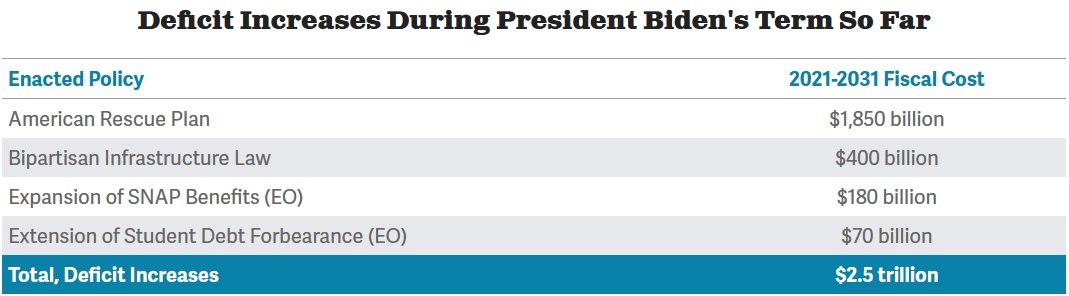
The Committee for a Responsible Federal Budget put together an estimate of his major initiatives.

By the way, the CRFB folks fixate on how these initiative impact the deficit. What we really should be concerned about is how much money is being spent.

But let’s set that aside and focus instead on a jaw-dropping claim from the White House.

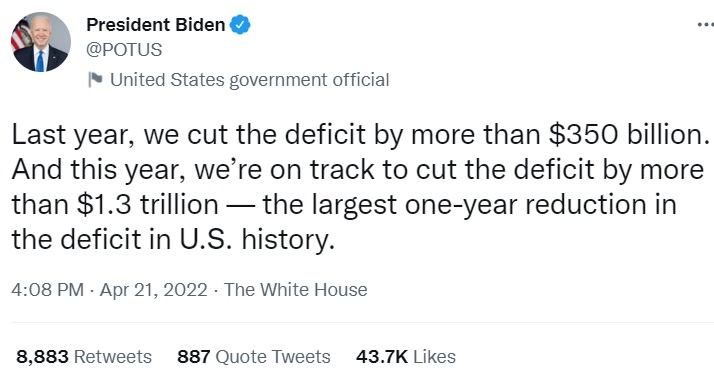
Even though all of his major initiatives have increased red ink, he is patting himself on the backfor lower deficits.

For what it is worth, Biden’s claim is semi-accurate. It is true that budget deficits are temporarily falling.

But not because of him. Instead, red ink is falling because there was massive, one-time, multi-trillion dollar emergency spending for the COVID pandemic in 2020. That spending began to wind down in 2021 and it has mostly dissipated this year, so of course deficits have fallen.

For Biden to take credit for this drop would be akin to Truman taking credit for the big drop in red ink after World War II ended.

Eric Boehm of Reason wrote a column that debunks Biden’s ludicrous claim.

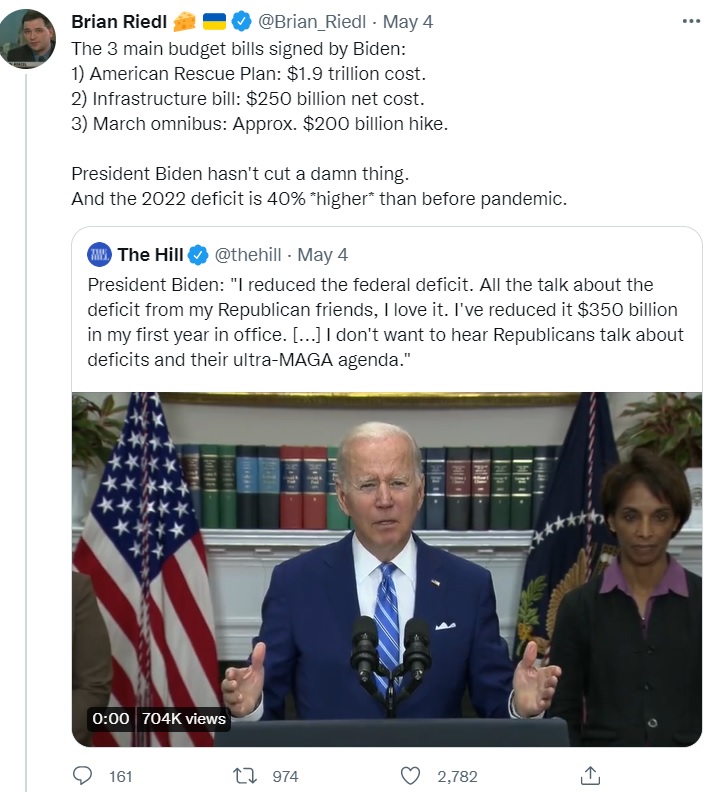
…this year’s budget deficit is forecasted to be the third or fourth-largest in American history—but President Joe Biden claims…his administration is overseeing a period of fiscal austerity. …Here are some words that actually tumbled out of the president’s mouth at a press conference… “We’re on track to cut the federal deficit by another $1.5 trillion by the end of this fiscal year. …on top of us having a $350 billion drop in the deficit last year, my first year as president,” Biden continued.…Those facts, however, exclude a few key details. …Biden took office the year after the budget deficit hit previously unimaginable highs due to a completely unprecedented spending binge triggered by a once-in-a-generation public health disaster. …if you look at the actual budgetary baselines published by the Congressional Budget Office—that is, the ongoing amount of annual federal spending absent any emergency stimulus bills like the ones passed on several occasions during the height of the pandemic—Biden has overseen a noticeable increase in the deficit above the pre-pandemic baseline. According to the Committee for a Responsible Federal Budget, a fiscal watchdog group that advocates for lower deficits, Biden’s policies have added about $2.5 trillion to the deficit over the next 10 years.

Brian Riedl is now with the Manhattan Institute, but we used to work together earlier this century at the Heritage Foundation. One of his admirable traits is that he hasn’t lost the ability to be outraged.

That comes through in his tweet about Biden’s supposed accomplishment.

By the way, I’m not making a partisan point. I have no doubt Trump would have done the same thing.

After all, politicians are probably the least ethical people in the nation. And Washington brings out the worst of the worst.

Biden talks up deficit reduction, as watchdog says it’s ‘highly misleading’

Last Updated: May 4, 2022 at 11:50 a.m. ETFirst Published: May 4, 2022 at 10:22 a.m. ET

President: ‘Bringing down the deficit is one way to ease inflationary pressures’

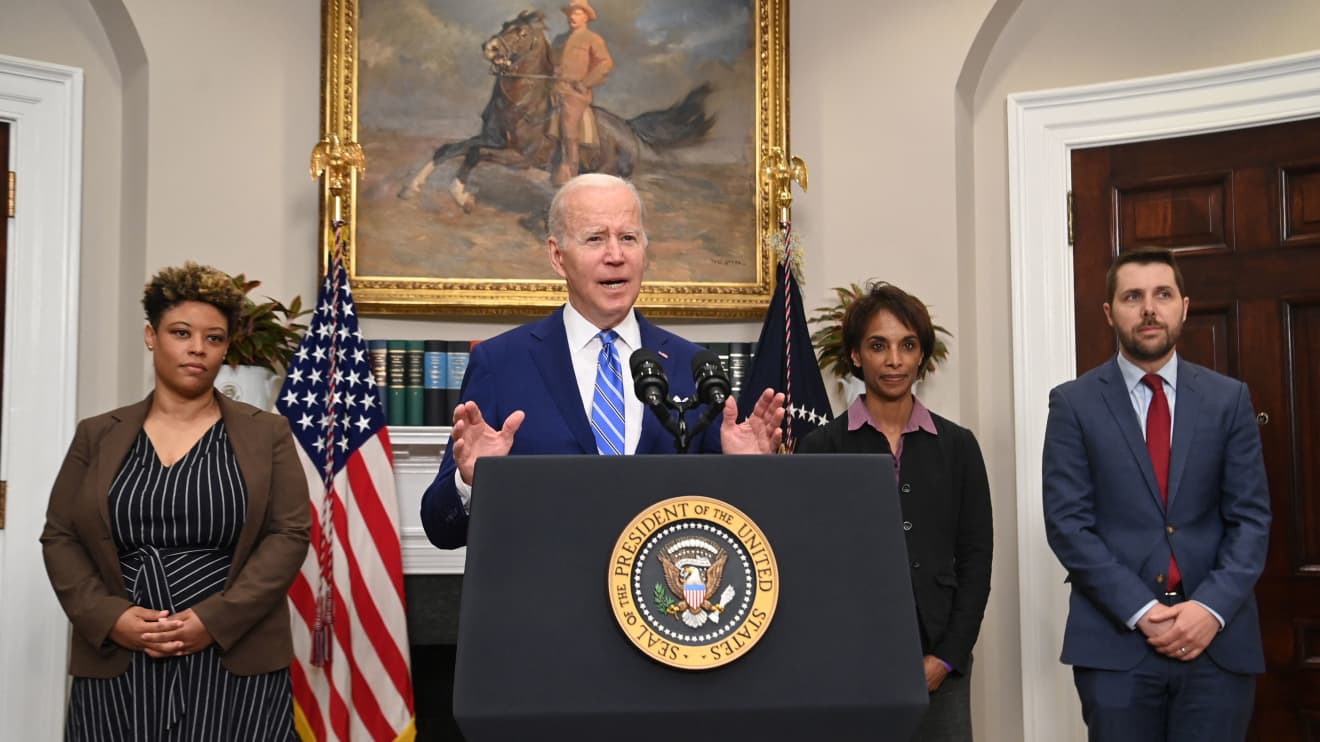
President Joe Biden speaks Wednesday about the economy at the White House. Also pictured (L-R) are Shalanda Young, director of the Office of Management and Budget; Cecilia Rouse, chair of the Council of Economic Advisers; and Brian Deese, director of the National Economic Council.

AFP/GETTY IMAGES

President Joe Biden on Wednesday delivered an economic speech that highlighted cuts to the federal deficit, even as some watchdogs have criticized his rhetoric around reducing red ink.

“The bottom line is the deficit went up every year under my predecessor, before the pandemic and during the pandemic, and it’s gone down both years since I’ve been here. Period. They’re the facts,” Biden said at the White House.

“Why is it important? Because bringing down the deficit is one way to ease inflationary pressures.”

The president has been talking up fiscal deficit reduction as a way to win over a key Democratic senator — West Virginia’s Joe Manchin — who has blocked Biden’s Build Back Better spending plan and wants to see Washington focused on closing the budget gap and fighting high inflation.

Biden’s rhetoric on eliminating red ink has drawn flak from the Committee for a Responsible Federal Budget, a nonpartisan watchdog organization.

“While President Biden’s Fiscal Year (FY) 2023 budget calls for $1.05 trillion of welcomed deficit reduction, the administration has largely been focused on taking credit for the expected $1.3 trillion fall in the deficit between FY 2021 and 2022,” the organization said in a blog post last month.

“The administration touting this victory is highly misleading; deficits are falling mainly because COVID relief is ending, and deficits will remain high even after this decline.”

Biden on Thursday said his administration revealed this week that it’s on track to cut the federal deficit by $1.5 trillion by the end of the current fiscal year, adding that it’s “the biggest decline in a single year ever in American history.”

The president’s remarks come after his Treasury Department on Monday surprised observers by announcing that it plans to pay down $26 billion in debt in the second quarter.

“For the first time since 2016, the Treasury Department is planning to pay down the national debt issued to the public this quarter,” he said on Wednesday. “For all the talk Republicans make about deficits, it didn’t happen a single quarter under my predecessor, not once.”

Biden’s speech initially had been planned for 2 p.m. Eastern, but the White House moved up the scheduled time for his remarks by three hours.

The Federal Reserve at 2 p.m. Eastern is expected to announce its biggest hike in interest rates in 20 years — a half-percentage-point rise — as the American central bank aims to combat the highest U.S. inflation in 40 years. Fed Chairman Jerome Powell is due to speak at a news conference at 2:30 p.m.

March 31, 2021

President Biden  c/o The White House
1600 Pennsylvania Avenue NW
Washington, DC 20500

Dear Mr. President,

Please explain to me if you ever do plan to balance the budget while you are President? I have written these things below about you and I really do think that you don’t want to cut spending in order to balance the budget. It seems you ever are daring the Congress to stop you from spending more.

President Barack Obama speaks about the debt limit in the East Room of the White House in Washington. | AP Photo

“The credit of the United States ‘is not a bargaining chip,’ Obama said on 1-14-13. However, President Obama keeps getting our country’s credit rating downgraded as he raises the debt ceiling higher and higher!!!!

Washington Could Learn a Lot from a Drug Addict

Just spend more, don’t know how to cut!!! Really!!! That is not living in the real world is it?

Making more dependent on government is not the way to go!!

Why is our government in over 16 trillion dollars in debt? There are many reasons for this but the biggest reason is people say “Let’s spend someone else’s money to solve our problems.” Liberals like Max Brantley have talked this way for years. Brantley will say that conservatives are being harsh when they don’t want the government out encouraging people to be dependent on the government. The Obama adminstration has even promoted a plan for young people to follow like Julia the Moocher.  

David Ramsey demonstrates in his Arkansas Times Blog post of 1-14-13 that very point:

Arkansas Politics / Health Care Arkansas’s share of Medicaid expansion and the national debt

Posted by on Mon, Jan 14, 2013 at 1:02 PM

Baby carrot Arkansas Medicaid expansion image

Imagine standing a baby carrot up next to the 25-story Stephens building in Little Rock. That gives you a picture of the impact on the national debt that federal spending in Arkansas on Medicaid expansion would have, while here at home expansion would give coverage to more than 200,000 of our neediest citizens, create jobs, and save money for the state.

Here’s the thing: while more than a billion dollars a year in federal spending would represent a big-time stimulus for Arkansas, it’s not even a drop in the bucket when it comes to the national debt.

Currently, the national debt is around $16.4 trillion. In fiscal year 2015, the federal government would spend somewhere in the neighborhood of $1.2 billion to fund Medicaid expansion in Arkansas if we say yes. That’s about 1/13,700th of the debt.

It’s hard to get a handle on numbers that big, so to put that in perspective, let’s get back to the baby carrot. Imagine that the height of the Stephens building (365 feet) is the $16 trillion national debt. That $1.2 billion would be the length of a ladybug. Of course, we’re not just talking about one year if we expand. Between now and 2021, the federal government projects to contribute around $10 billion. The federal debt is projected to be around $25 trillion by then, so we’re talking about 1/2,500th of the debt. Compared to the Stephens building? That’s a baby carrot.

______________

Here is how it will all end if everyone feels they should be allowed to have their “baby carrot.”

How sad it is that liberals just don’t get this reality.

Here is what the Founding Fathers had to say about welfare. David Weinberger noted:

While living in Europe in the 1760s, Franklin observed: “in different countries … the more public provisions were made for the poor, the less they provided for themselves, and of course became poorer. And, on the contrary, the less was done for them, the more they did for themselves, and became richer.”

Alexander Fraser Tytler, Lord Woodhouselee (15 October 1747 – 5 January 1813) was a Scottish lawyer, writer, and professor. Tytler was also a historian, and he noted, “A democracy cannot exist as a permanent form of government. It can only exist until the majority discovers it can vote itself largess out of the public treasury. After that, the majority always votes for the candidate promising the most benefits with the result the democracy collapses because of the loose fiscal policy ensuing, always to be followed by a dictatorship, then a monarchy.”

Thomas Jefferson to Joseph Milligan

April 6, 1816

[Jefferson affirms that the main purpose of society is to enable human beings to keep the fruits of their labor. — TGW]

To take from one, because it is thought that his own industry and that of his fathers has acquired too much, in order to spare to others, who, or whose fathers have not exercised equal industry and skill, is to violate arbitrarily the first principle of association, “the guarantee to every one of a free exercise of his industry, and the fruits acquired by it.” If the overgrown wealth of an individual be deemed dangerous to the State, the best corrective is the law of equal inheritance to all in equal degree; and the better, as this enforces a law of nature, while extra taxation violates it.

[From Writings of Thomas Jefferson, ed. Albert E. Bergh (Washington: Thomas Jefferson Memorial Association, 1904), 14:466.]

_______

Jefferson pointed out that to take from the rich and give to the poor through government is just wrong. Franklin knew the poor would have a better path upward without government welfare coming their way. Milton Friedman’s negative income tax is the best method for doing that and by taking away all welfare programs and letting them go to the churches for charity.

_____________

_________

Thank you so much for your time. I know how valuable it is. I also appreciate the fine family that you have and your commitment as a father and a husband.

Sincerely,

Everette Hatcher III, 13900 Cottontail Lane, Alexander, AR 72002, ph 501-920-5733

Williams with Sowell – Minimum Wage

Thomas Sowell

Thomas Sowell – Reducing Black Unemployment

By WALTER WILLIAMS

—-

Ronald Reagan with Milton Friedman
Milton Friedman The Power of the Market 2-5

Related posts:

Welfare Spending Shattering All-Time Highs

  We got to act fast and get off this path of socialism. Morning Bell: Welfare Spending Shattering All-Time Highs Robert Rector and Amy Payne October 18, 2012 at 9:03 am It’s been a pretty big year for welfare—and a new report shows welfare is bigger than ever. The Obama Administration turned a giant spotlight […]

We need more brave souls that will vote against Washington welfare programs

We need to cut Food Stamp program and not extend it. However, it seems that people tell the taxpayers back home they are going to Washington and cut government spending but once they get up there they just fall in line with  everyone else that keeps spending our money. I am glad that at least […]
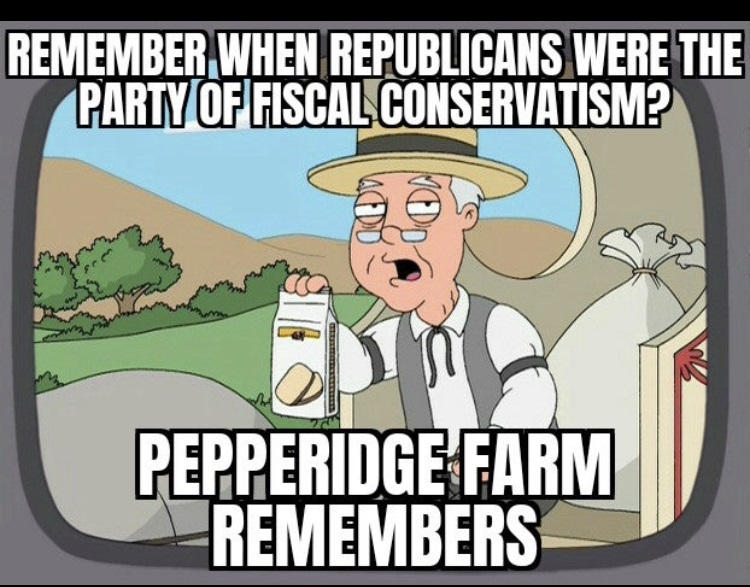
Welfare programs are not the answer for the poor

Government Must Cut Spending Uploaded by HeritageFoundation on Dec 2, 2010 The government can cut roughly $343 billion from the federal budget and they can do so immediately. __________ Liberals argue that the poor need more welfare programs, but I have always argued that these programs enslave the poor to the government. Food Stamps Growth […]

Private charities are best solution and not government welfare

Milton Friedman – The Negative Income Tax Published on May 11, 2012 by LibertyPen In this 1968 interview, Milton Friedman explained the negative income tax, a proposal that at minimum would save taxpayers the 72 percent of our current welfare budget spent on administration. http://www.LibertyPen.com Source: Firing Line with William F Buckley Jr. ________________ Milton […]
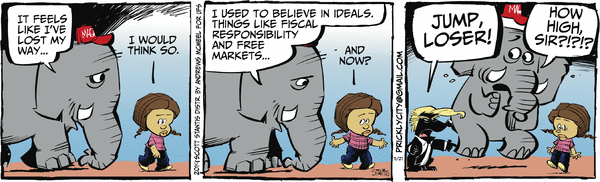
The book “After the Welfare State”

Dan Mitchell Commenting on Obama’s Failure to Propose a Fiscal Plan Published on Aug 16, 2012 by danmitchellcato No description available. ___________ After the Welfare State Posted by David Boaz Cato senior fellow Tom G. Palmer, who is lecturing about freedom in Slovenia and Tbilisi this week, asked me to post this announcement of his […]
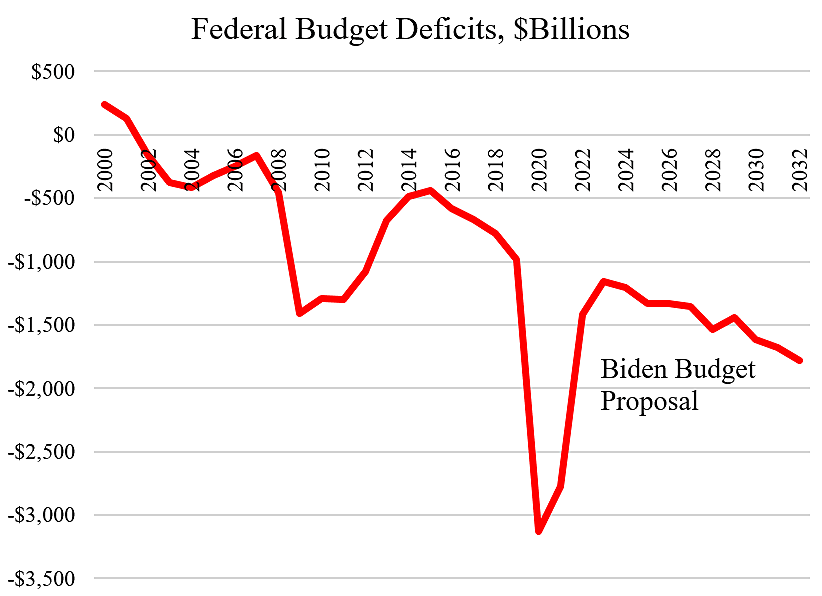
President Obama responds to Heritage Foundation critics on welfare reform waivers

Is President Obama gutting the welfare reform that Bill Clinton signed into law? Morning Bell: Obama Denies Gutting Welfare Reform Amy Payne August 8, 2012 at 9:15 am The Obama Administration came out swinging against its critics on welfare reform yesterday, with Press Secretary Jay Carney saying the charge that the Administration gutted the successful […]

Welfare reform part 3

Thomas Sowell – Welfare Welfare reform was working so good. Why did we have to abandon it? Look at this article from 2003. The Continuing Good News About Welfare Reform By Robert Rector and Patrick Fagan, Ph.D. February 6, 2003 Six years ago, President Bill Clinton signed legislation overhauling part of the nation’s welfare system. […]

Welfare reform part 2

Uploaded by ForaTv on May 29, 2009 Complete video at: http://fora.tv/2009/05/18/James_Bartholomew_The_Welfare_State_Were_In Author James Bartholomew argues that welfare benefits actually increase government handouts by ‘ruining’ ambition. He compares welfare to a humane mousetrap. —– Welfare reform was working so good. Why did we have to abandon it? Look at this article from 2003. In the controversial […]

Why did Obama stop the Welfare Reform that Clinton put in?

Thomas Sowell If the welfare reform law was successful then why change it? Wasn’t Bill Clinton the president that signed into law? Obama Guts Welfare Reform Robert Rector and Kiki Bradley July 12, 2012 at 4:10 pm Today, the Obama Department of Health and Human Services (HHS) released an official policy directive rewriting the welfare […]

“Feedback Friday” Letter to White House generated form letter response July 10,2012 on welfare, etc (part 14)

I have been writing President Obama letters and have not received a personal response yet.  (He reads 10 letters a day personally and responds to each of them.) However, I did receive a form letter in the form of an email on July 10, 2012. I don’t know which letter of mine generated this response so I have […]

Biden talks up deficit reduction, as watchdog says it’s ‘highly misleading’

A.F. Branco for Oct 21, 2021

Biden talks up deficit reduction, as watchdog says it’s ‘highly misleading’

Last Updated: May 4, 2022 at 11:50 a.m. ETFirst Published: May 4, 2022 at 10:22 a.m. ET

President: ‘Bringing down the deficit is one way to ease inflationary pressures’

President Joe Biden speaks Wednesday about the economy at the White House. Also pictured (L-R) are Shalanda Young, director of the Office of Management and Budget; Cecilia Rouse, chair of the Council of Economic Advisers; and Brian Deese, director of the National Economic Council.

AFP/GETTY IMAGES

President Joe Biden on Wednesday delivered an economic speech that highlighted cuts to the federal deficit, even as some watchdogs have criticized his rhetoric around reducing red ink.

“The bottom line is the deficit went up every year under my predecessor, before the pandemic and during the pandemic, and it’s gone down both years since I’ve been here. Period. They’re the facts,” Biden said at the White House.

“Why is it important? Because bringing down the deficit is one way to ease inflationary pressures.”

The president has been talking up fiscal deficit reduction as a way to win over a key Democratic senator — West Virginia’s Joe Manchin — who has blocked Biden’s Build Back Better spending plan and wants to see Washington focused on closing the budget gap and fighting high inflation.

Biden’s rhetoric on eliminating red ink has drawn flak from the Committee for a Responsible Federal Budget, a nonpartisan watchdog organization.

“While President Biden’s Fiscal Year (FY) 2023 budget calls for $1.05 trillion of welcomed deficit reduction, the administration has largely been focused on taking credit for the expected $1.3 trillion fall in the deficit between FY 2021 and 2022,” the organization said in a blog post last month.

“The administration touting this victory is highly misleading; deficits are falling mainly because COVID relief is ending, and deficits will remain high even after this decline.”

Biden on Thursday said his administration revealed this week that it’s on track to cut the federal deficit by $1.5 trillion by the end of the current fiscal year, adding that it’s “the biggest decline in a single year ever in American history.”

The president’s remarks come after his Treasury Department on Monday surprised observers by announcing that it plans to pay down $26 billion in debt in the second quarter.

“For the first time since 2016, the Treasury Department is planning to pay down the national debt issued to the public this quarter,” he said on Wednesday. “For all the talk Republicans make about deficits, it didn’t happen a single quarter under my predecessor, not once.”

Biden’s speech initially had been planned for 2 p.m. Eastern, but the White House moved up the scheduled time for his remarks by three hours.

The Federal Reserve at 2 p.m. Eastern is expected to announce its biggest hike in interest rates in 20 years — a half-percentage-point rise — as the American central bank aims to combat the highest U.S. inflation in 40 years. Fed Chairman Jerome Powell is due to speak at a news conference at 2:30 p.m.

March 31, 2021

President Biden  c/o The White House
1600 Pennsylvania Avenue NW
Washington, DC 20500

Dear Mr. President,

Please explain to me if you ever do plan to balance the budget while you are President? I have written these things below about you and I really do think that you don’t want to cut spending in order to balance the budget. It seems you ever are daring the Congress to stop you from spending more.

President Barack Obama speaks about the debt limit in the East Room of the White House in Washington. | AP Photo

“The credit of the United States ‘is not a bargaining chip,’ Obama said on 1-14-13. However, President Obama keeps getting our country’s credit rating downgraded as he raises the debt ceiling higher and higher!!!!

Washington Could Learn a Lot from a Drug Addict

Just spend more, don’t know how to cut!!! Really!!! That is not living in the real world is it?

Making more dependent on government is not the way to go!!

Why is our government in over 16 trillion dollars in debt? There are many reasons for this but the biggest reason is people say “Let’s spend someone else’s money to solve our problems.” Liberals like Max Brantley have talked this way for years. Brantley will say that conservatives are being harsh when they don’t want the government out encouraging people to be dependent on the government. The Obama adminstration has even promoted a plan for young people to follow like Julia the Moocher.  

David Ramsey demonstrates in his Arkansas Times Blog post of 1-14-13 that very point:

Arkansas Politics / Health Care Arkansas’s share of Medicaid expansion and the national debt

Posted by on Mon, Jan 14, 2013 at 1:02 PM

Baby carrot Arkansas Medicaid expansion image

Imagine standing a baby carrot up next to the 25-story Stephens building in Little Rock. That gives you a picture of the impact on the national debt that federal spending in Arkansas on Medicaid expansion would have, while here at home expansion would give coverage to more than 200,000 of our neediest citizens, create jobs, and save money for the state.

Here’s the thing: while more than a billion dollars a year in federal spending would represent a big-time stimulus for Arkansas, it’s not even a drop in the bucket when it comes to the national debt.

Currently, the national debt is around $16.4 trillion. In fiscal year 2015, the federal government would spend somewhere in the neighborhood of $1.2 billion to fund Medicaid expansion in Arkansas if we say yes. That’s about 1/13,700th of the debt.

It’s hard to get a handle on numbers that big, so to put that in perspective, let’s get back to the baby carrot. Imagine that the height of the Stephens building (365 feet) is the $16 trillion national debt. That $1.2 billion would be the length of a ladybug. Of course, we’re not just talking about one year if we expand. Between now and 2021, the federal government projects to contribute around $10 billion. The federal debt is projected to be around $25 trillion by then, so we’re talking about 1/2,500th of the debt. Compared to the Stephens building? That’s a baby carrot.

______________

Here is how it will all end if everyone feels they should be allowed to have their “baby carrot.”

How sad it is that liberals just don’t get this reality.

Here is what the Founding Fathers had to say about welfare. David Weinberger noted:

While living in Europe in the 1760s, Franklin observed: “in different countries … the more public provisions were made for the poor, the less they provided for themselves, and of course became poorer. And, on the contrary, the less was done for them, the more they did for themselves, and became richer.”

Alexander Fraser Tytler, Lord Woodhouselee (15 October 1747 – 5 January 1813) was a Scottish lawyer, writer, and professor. Tytler was also a historian, and he noted, “A democracy cannot exist as a permanent form of government. It can only exist until the majority discovers it can vote itself largess out of the public treasury. After that, the majority always votes for the candidate promising the most benefits with the result the democracy collapses because of the loose fiscal policy ensuing, always to be followed by a dictatorship, then a monarchy.”

Thomas Jefferson to Joseph Milligan

April 6, 1816

[Jefferson affirms that the main purpose of society is to enable human beings to keep the fruits of their labor. — TGW]

To take from one, because it is thought that his own industry and that of his fathers has acquired too much, in order to spare to others, who, or whose fathers have not exercised equal industry and skill, is to violate arbitrarily the first principle of association, “the guarantee to every one of a free exercise of his industry, and the fruits acquired by it.” If the overgrown wealth of an individual be deemed dangerous to the State, the best corrective is the law of equal inheritance to all in equal degree; and the better, as this enforces a law of nature, while extra taxation violates it.

[From Writings of Thomas Jefferson, ed. Albert E. Bergh (Washington: Thomas Jefferson Memorial Association, 1904), 14:466.]

_______

Jefferson pointed out that to take from the rich and give to the poor through government is just wrong. Franklin knew the poor would have a better path upward without government welfare coming their way. Milton Friedman’s negative income tax is the best method for doing that and by taking away all welfare programs and letting them go to the churches for charity.

_____________

_________

Thank you so much for your time. I know how valuable it is. I also appreciate the fine family that you have and your commitment as a father and a husband.

Sincerely,

Everette Hatcher III, 13900 Cottontail Lane, Alexander, AR 72002, ph 501-920-5733

Williams with Sowell – Minimum Wage

Thomas Sowell

Thomas Sowell – Reducing Black Unemployment

By WALTER WILLIAMS

—-

Ronald Reagan with Milton Friedman
Milton Friedman The Power of the Market 2-5

Related posts:

Welfare Spending Shattering All-Time Highs

  We got to act fast and get off this path of socialism. Morning Bell: Welfare Spending Shattering All-Time Highs Robert Rector and Amy Payne October 18, 2012 at 9:03 am It’s been a pretty big year for welfare—and a new report shows welfare is bigger than ever. The Obama Administration turned a giant spotlight […]

We need more brave souls that will vote against Washington welfare programs

We need to cut Food Stamp program and not extend it. However, it seems that people tell the taxpayers back home they are going to Washington and cut government spending but once they get up there they just fall in line with  everyone else that keeps spending our money. I am glad that at least […]

Welfare programs are not the answer for the poor

Government Must Cut Spending Uploaded by HeritageFoundation on Dec 2, 2010 The government can cut roughly $343 billion from the federal budget and they can do so immediately. __________ Liberals argue that the poor need more welfare programs, but I have always argued that these programs enslave the poor to the government. Food Stamps Growth […]

Private charities are best solution and not government welfare

Milton Friedman – The Negative Income Tax Published on May 11, 2012 by LibertyPen In this 1968 interview, Milton Friedman explained the negative income tax, a proposal that at minimum would save taxpayers the 72 percent of our current welfare budget spent on administration. http://www.LibertyPen.com Source: Firing Line with William F Buckley Jr. ________________ Milton […]

The book “After the Welfare State”

Dan Mitchell Commenting on Obama’s Failure to Propose a Fiscal Plan Published on Aug 16, 2012 by danmitchellcato No description available. ___________ After the Welfare State Posted by David Boaz Cato senior fellow Tom G. Palmer, who is lecturing about freedom in Slovenia and Tbilisi this week, asked me to post this announcement of his […]

President Obama responds to Heritage Foundation critics on welfare reform waivers

Is President Obama gutting the welfare reform that Bill Clinton signed into law? Morning Bell: Obama Denies Gutting Welfare Reform Amy Payne August 8, 2012 at 9:15 am The Obama Administration came out swinging against its critics on welfare reform yesterday, with Press Secretary Jay Carney saying the charge that the Administration gutted the successful […]

Welfare reform part 3

Thomas Sowell – Welfare Welfare reform was working so good. Why did we have to abandon it? Look at this article from 2003. The Continuing Good News About Welfare Reform By Robert Rector and Patrick Fagan, Ph.D. February 6, 2003 Six years ago, President Bill Clinton signed legislation overhauling part of the nation’s welfare system. […]

Welfare reform part 2

Uploaded by ForaTv on May 29, 2009 Complete video at: http://fora.tv/2009/05/18/James_Bartholomew_The_Welfare_State_Were_In Author James Bartholomew argues that welfare benefits actually increase government handouts by ‘ruining’ ambition. He compares welfare to a humane mousetrap. —– Welfare reform was working so good. Why did we have to abandon it? Look at this article from 2003. In the controversial […]

Why did Obama stop the Welfare Reform that Clinton put in?

Thomas Sowell If the welfare reform law was successful then why change it? Wasn’t Bill Clinton the president that signed into law? Obama Guts Welfare Reform Robert Rector and Kiki Bradley July 12, 2012 at 4:10 pm Today, the Obama Department of Health and Human Services (HHS) released an official policy directive rewriting the welfare […]

“Feedback Friday” Letter to White House generated form letter response July 10,2012 on welfare, etc (part 14)

I have been writing President Obama letters and have not received a personal response yet.  (He reads 10 letters a day personally and responds to each of them.) However, I did receive a form letter in the form of an email on July 10, 2012. I don’t know which letter of mine generated this response so I have […]

Dan Mitchell: As Professor Friedman explained, the economics of price controls are very clear. When politicians and bureaucrats suppress prices, you get shortages (as all students should learn in their introductory economics classes)

<img srcset="https://s-libertaddigital-com.cdn.ampproject.org/i/s/s.libertaddigital.com/2022/01/04/300/0/miltonfriedman.jpg.webp 300w, https://s-libertaddigital-com.cdn.ampproject.org/i/s/s.libertaddigital.com/2022/01/04/600/0/miltonfriedman.jpg.webp 600w, https://s-libertaddigital-com.cdn.ampproject.org/i/s/s.libertaddigital.com/2022/01/04/1200/0/miltonfriedman.jpg.webp 1200w" alt="El economista, Milton Friedman (1912-2006) | <span>Alamy

Portrait of Milton Friedman.jpg


The Case Against Price Controls, Part III

In Part I of this series, Professor Don Boudreaux explained the folly of price controls, and Professor Antony Davies was featured in Part II.

Now let’s see some commentary from the late, great, Milton Friedman.

As Professor Friedman explained, the economics of price controls are very clear.

When politicians and bureaucrats suppress prices, you get shortages (as all students should learn in their introductory economics classes).

Sometimes that happens with price controls on specific sectors, such as rental housing in poorly governed cities.

Sometimes it happens because of economy-wide price controls, as we saw during Richard Nixon’s disastrous presidency.

In all cases, price controls are imposed by politicians who are stupid or evil. That’s blunt language, but it’s the only explanation.

Sadly, there will never be a shortage of those kinds of politicians, as can be seen from this column in the Wall Street Journal by Andy Kessler.

Here are some excerpts.

On the 2020 campaign trail, Joe Biden declared, “ Milton Friedman isn’t running the show anymore.” Wrong! …Lo and behold, inflation is running at 7.9%, supply chains are tight, and many store shelves are empty. Friedman’s adage “Inflation is always and everywhere a monetary phenomenon” has stood the test of time. But what scares me most is the likely policy responses by the Biden administration that would pour salt into this self-inflicted wound.It feels as if price controls are coming. …Prices set by producers are signals, and consumers whisper feedback billions of times a day by buying or not buying products. Mess with prices and the economy has no guide. The Soviets instituted price controls on everything from subsidized “red bread” to meat, often resulting in empty shelves. President Franklin D. Roosevelt’s National Recovery Agency fixed prices, prolonging the Depression, all in the name of “fair competition.” …Price controls don’t work. Never have, never will. But we keep instituting them. Try finding a cheap apartment in rent-controlled New York City. …Sen. Elizabeth Warren, a leader among our economic illiterate, noted in February that high prices are caused in part by “giant corporations…”

He closes with a very succinct and sensible observation.

Want to whip inflation now? Forget all the Band-Aids and government controls. Instead, as Friedman suggests, stop printing money.

In other words, Mr. Kessler is suggesting that politicians do the opposite of Mitchell’s Law.

Instead of using one bad policy (inflation) as an excuse to impose a second bad policy (price controls), he wants them to undo the original mistake.

Will Joe Biden and Elizabeth Warren take his advice?

That’s doubtful, but I’m hoping there are more rational people in the rooms where these decisions get made.

Maybe some of them will have read this column from Professor Boudreaux.

Prices are among the visible results of the invisible hand’s successful operation, as well as the single most important source of this success. Each price objectively summarizes an inconceivably large number of details that must be taken account of if the economy is to perform even moderately well. Consider the price of a loaf of a particular kind and brand of bread.…The price at the supermarket of a loaf of bread, a straightforward $4.99, is the distillation of the economic results of the interaction of an unfathomably large number of details from around the globe about opportunities, trade-offs, and preferences. The invisible hand of the market causes these details to be visibly summarized not only in the price of bread, but in the prices of all other consumer goods and services, as well as in the prices of each of the inputs used in production. …These market prices also give investors and entrepreneurs guidance on how to deploy scarce resources in ways that produce that particular mix of goods and services that will today be of greatest benefit for consumers.

I have two comments.

First, Don obviously buys fancier bread than my $1.29-a-loaf store brand (used to be 99 cents, so thanks for nothing to the Federal Reserve).

Second, and far more important, he’s pointing out that market-based prices play an absolutely critical role in coordinating the desires of consumers and producers.

When politicians interfere with prices, it’s akin to throwing sand in the gears of a machine.

For more information on the role of prices, I strongly recommend these videos from Professors Russ Roberts, Howard Baetjer, and Alex Tabarrok.

By Ryan Bourne and Brad Subramaniam

Anti‐​price gouging laws prolonged shortages of certain goods that were in high demand early in the pandemic. Some analysis suggests these laws even worsened public health outcomes, because ongoing shortages of, say, hand sanitizer and toilet paper, led to consumers in states with these regulations searching for them more at physical retailers, actually increasing transmission of the virus.

But there’s an interesting question that’s often underexplored in regard to these laws: how does the expectation that these price controls will be triggered shape people’s beliefs about products’ availability and so customer search behavior?

That’s the topic of another fascinating new paper by economists Rik Chakraborti and Gavin Roberts. Using data for online searches for hand sanitizer and toilet paper across states, they harness the variation in when laws were introduced to research the question: is consumer search behaviour different in states with new anti‐​price gouging legislation introduced during the pandemic from states with pre‐​existing anti‐​price gouging laws?

Economic theory would suggest that any anti‐​price gouging legislation, whenever introduced, would lead to more consumer search for goods, due to the induced shortages. And, sure enough, after controlling for the effects of lockdowns, rising infections, and declines in travel which plagued the early stages of the pandemic, consumers in states with anti‐​price gouging laws were significantly more likely to search online for toilet paper and hand sanitizer than those in states without such laws.

More searching presumably reflects higher levels of hoarding and panic‐​buying creating the shortages—after all, having to resort to online shopping for goods that are commonly bought in stores means the local grocery or drug store has probably been emptied already.

But theory would also suggest that customers in states with past experience of anti‐​price gouging laws might search even more intensely, because people come to expect shortages again when crises hit. In other words, those who have experienced shortages before might be more likely to hoard and panic buy this time around, leading to even higher online search than in situations where new laws are introduced for the first time.

Again, Chakraborti and Roberts’ paper suggests economic theory is correct. States with anti‐​price gouging regulations on the books before the pandemic saw Google Shopping searches for hand sanitizer jump by 153 percent and toilet paper searches nearly double (a 99 percent increase) relative to states without anti‐​price gouging laws. This uplift was much larger than in states where the laws were introduced during the pandemic (100 percent and 46 percent, respectively).

The long and short is that consumers in states with pre‐​existing price controls searched most intensely online for hand sanitizer and toilet paper. This suggests customers learned from previous experience of these price regulations’ effects, with the higher search levels reflecting greater hoarding and panic buying in anticipation of shortages to come. As the authors state, this implies that longstanding anti‐​price gouging legislation is even worse for economic welfare than we might think. The anticipation of shortages actually compounds shortages as consumers become more “experienced,” with excessive and fruitless searching for products the wasteful result.

For more on the basics of anti‐​price gouging legislation in the pandemic, see my book Economics In One Virus. Other Cato pieces can be found here, here, and here.

Government, Markets, and the Supply Chain

Way back in 2009, I shared a meme that succinctly summarizes how Washington operates.

It’s basically a version of Mitchell’s Law. To elaborate, governments cause problems and politicians then use those problems as an excuse to make government even bigger.

Lather, rinse, repeat.

I worry the same thing may be about to happen because of the current concern about “supply chain” issues, perhaps best illustrated by the backlog of ships at key ports, leading to shortages of key goods.

Some of this mess is fallout from the coronavirus pandemic, but it’s being exacerbated by bad policy.

In a column for Reason, J.D. Tuccille points out that government is the problem, not the solution.

…supply-chain issues…create shortages and push prices up around the world. …Lockdowns also changed people’s lives, closing offices and factories and confining people at home. That resulted in massive and unpredictable shifts in demand and unreliable supply. …”Market economies tend to be pretty good at getting food on the supermarket shelves and fuel in petrol stations, if left to themselves,” agrees Pilkington. “That last part is key: if left to themselves. Heavy-handed interference in market economies tends to produce the same pathologies we see in socialist economies, including shortages and inflation. That has been the unintended consequence of lockdown.” …The danger is that people see economic problems caused by earlier fiddling and then demand even more government intervention. …if the government were to further meddle in the market to allocate products made scarce by earlier actions, it’s hard to see how the result wouldn’t be anything other than increased supply chain chaos.

Allysia Finley opines for the Wall Street Journal about California’s role in the supply-chain mess.

The backup of container ships at the Long Beach and Los Angeles ports has grown in recent weeks… The two Southern California ports handle only about 40% of containers entering the U.S., mostly from Asia. Yet ports in other states seem to be handling the surge better. Gov. Ron DeSantis said last month that Florida’s seaports had open capacity.So what’s the matter with California? State labor and environmental policies. …business groups recently asked Gov. Gavin Newsom to declare a state of emergency and suspend labor and environmental laws that are interfering with the movement of goods. …One barrier is a law known as AB5. …Trucking companies warned that the law could put small carriers out of business and cause drivers to leave the state. …there’s little doubt the law hinders efficiency and productivity. …State officials have also pressed localities to attach green mandates to permits for new warehouses, which can be poison pills. …This boatload of regulations is making it more expensive and difficult to store goods arriving at California ports.

Needless to say, I’m not surprised California is making things worse.

The state seems to have some of the nation’s worst politicians.

But let’s set that aside and close with some discussion about one of the differences between government and the private sector.

This may surprise some readers, but people and businesses in the private sector make mistakes all the time.

So part of the supply-chain mess presumably is a result of companies and entrepreneurs making bad guesses.

That being said, there’s a big feedback mechanism in the private sector. It’s called profit and loss.

So when mistakes are made, there’s a big incentive to quickly change.

With government, by contrast, there’s very little flexibility (as we saw during the pandemic). And when politicians and bureaucrats do act, they often respond to political incentives that lead them to make things worse.

Big-Government Republicans Enable Big-Government Democrats

I get asked why I frequently criticize Republicans.

My response is easy. I care about results rather than rhetoric. And while GOP politicians often pay lip service to the principles of limited government,they usually increase spending even faster than Democrats.

Indeed, Republicans are even worse than Democrats when measuring the growth of domestic spending!

This is bad news because it means the burden of government expands when Republicans are in charge.

And, as Gary Abernathy points out in a column for the Washington Post, Republicans then don’t have the moral authority to complain when Democrats engage in spending binges.

President Biden is proposing another $3 trillion in spending… There are objections, but none that can be taken seriously. …Republicans had lost their standing as the party of fiscal responsibility when most of them succumbed to the political virus of covid fever and rubber-stamped around $4 trillion in “covid relief,”… With Trump out and Biden in, Republicans suddenly pretended that their 2020 spending spree happened in some alternate universe.But the GOP’s united opposition to Biden’s $1.9 trillion package won’t wash off the stench of the hypocrisy. …I noted a year ago that we had crossed the Rubicon, that our longtime flirtation with socialism had become a permanent relationship. Congratulations, Bernie Sanders. The GOP won’t become irrelevant because of its association with Trump, as some predict. It will diminish because it is bizarrely opposing now that which it helped make palatable just last year. Fiscal responsibility is dead, and Republicans helped bury it. Put the shovels away, there’s no digging it up now.

For what it’s worth, I hope genuine fiscal responsibility isn’t dead.

Maybe it’s been hibernating ever since Reagan left office (like Pepperidge Farm, I’m old enough to remember those wonderful years).

Subsequent Republican presidents liked to copy Reagan’s rhetoric, but they definitely didn’t copy his policies.

  • Spending restraint was hibernating during the presidency of George H.W. Bush.
  • Spending restraint also was hibernating during the presidency of George W. Bush.
  • And spending restraint was hibernating during the presidency of Donald Trump.

I’m not the only one to notice GOP hypocrisy.

Here are some excerpts from a 2019 column in the Washington Post by Fareed Zakaria.

In what Republicans used to call the core of their agenda — limited government — Trump has been profoundly unconservative. …Trump has now added more than $88 billion in taxes in the form of tariffs, according to the right-leaning Tax Foundation. (Despite what the president says, tariffs are taxes on foreign goods paid by U.S. consumers.) This has had the effect of reducing gross domestic product and denting the wages of Americans.…For decades, conservatives including Margaret Thatcher and Ronald Reagan preached to the world the virtues of free trade. But perhaps even more, they believed in the idea that governments should not pick winners and losers in the economy… Yet the Trump administration…behaved like a Central Planning Agency, granting exemptions on tariffs to favored companies and industries, while refusing them to others. …In true Soviet style, lobbyists, lawyers and corporate executives now line up to petition government officials for these treasured waivers, which are granted in an opaque process… On the core issue that used to define the GOP — economics — the party’s agenda today is state planning and crony capitalism.

Zakaria is right about Republicans going along with most of Trump’s bad policies (as illustrated by this cartoon strip).*

The bottom line is that Republicans would be much more effective arguing against Biden’s spending orgy had they also argued for spending restraint when Trump was in the White House.

P.S. It will be interesting to see what happens in the near future. Will the GOP be a small-government Reagan party or a big-government Trump party?

Or maybe it will go back to being a Nixon-type party, which would mean bigger government but without mean tweets. And there are plenty of options.

If they make the wrong choice (anything other than Reaganism), Margaret Thatcher has already warned us about the consequences.

*To be fair, Republicans also went along with Trump’s good policies. It’s just unfortunate that spending restraint wasn’t one of them.

—-

March 31, 2021

President Biden  c/o The White House
1600 Pennsylvania Avenue NW
Washington, DC 20500

Dear Mr. President,

Please explain to me if you ever do plan to balance the budget while you are President? I have written these things below about you and I really do think that you don’t want to cut spending in order to balance the budget. It seems you ever are daring the Congress to stop you from spending more.

President Barack Obama speaks about the debt limit in the East Room of the White House in Washington. | AP Photo


“The credit of the United States ‘is not a bargaining chip,’ Obama said on 1-14-13. However, President Obama keeps getting our country’s credit rating downgraded as he raises the debt ceiling higher and higher!!!!

Washington Could Learn a Lot from a Drug Addict

Just spend more, don’t know how to cut!!! Really!!! That is not living in the real world is it?

Making more dependent on government is not the way to go!!

Why is our government in over 16 trillion dollars in debt? There are many reasons for this but the biggest reason is people say “Let’s spend someone else’s money to solve our problems.” Liberals like Max Brantley have talked this way for years. Brantley will say that conservatives are being harsh when they don’t want the government out encouraging people to be dependent on the government. The Obama adminstration has even promoted a plan for young people to follow like Julia the Moocher.  

David Ramsey demonstrates in his Arkansas Times Blog post of 1-14-13 that very point:

Arkansas Politics / Health Care Arkansas’s share of Medicaid expansion and the national debt

Posted by on Mon, Jan 14, 2013 at 1:02 PM

Baby carrot Arkansas Medicaid expansion image


Imagine standing a baby carrot up next to the 25-story Stephens building in Little Rock. That gives you a picture of the impact on the national debt that federal spending in Arkansas on Medicaid expansion would have, while here at home expansion would give coverage to more than 200,000 of our neediest citizens, create jobs, and save money for the state.

Here’s the thing: while more than a billion dollars a year in federal spending would represent a big-time stimulus for Arkansas, it’s not even a drop in the bucket when it comes to the national debt.

Currently, the national debt is around $16.4 trillion. In fiscal year 2015, the federal government would spend somewhere in the neighborhood of $1.2 billion to fund Medicaid expansion in Arkansas if we say yes. That’s about 1/13,700th of the debt.

It’s hard to get a handle on numbers that big, so to put that in perspective, let’s get back to the baby carrot. Imagine that the height of the Stephens building (365 feet) is the $16 trillion national debt. That $1.2 billion would be the length of a ladybug. Of course, we’re not just talking about one year if we expand. Between now and 2021, the federal government projects to contribute around $10 billion. The federal debt is projected to be around $25 trillion by then, so we’re talking about 1/2,500th of the debt. Compared to the Stephens building? That’s a baby carrot.

______________

Here is how it will all end if everyone feels they should be allowed to have their “baby carrot.”

How sad it is that liberals just don’t get this reality.

Here is what the Founding Fathers had to say about welfare. David Weinberger noted:

While living in Europe in the 1760s, Franklin observed: “in different countries … the more public provisions were made for the poor, the less they provided for themselves, and of course became poorer. And, on the contrary, the less was done for them, the more they did for themselves, and became richer.”

Alexander Fraser Tytler, Lord Woodhouselee (15 October 1747 – 5 January 1813) was a Scottish lawyer, writer, and professor. Tytler was also a historian, and he noted, “A democracy cannot exist as a permanent form of government. It can only exist until the majority discovers it can vote itself largess out of the public treasury. After that, the majority always votes for the candidate promising the most benefits with the result the democracy collapses because of the loose fiscal policy ensuing, always to be followed by a dictatorship, then a monarchy.”

Thomas Jefferson to Joseph Milligan

April 6, 1816

[Jefferson affirms that the main purpose of society is to enable human beings to keep the fruits of their labor. — TGW]

To take from one, because it is thought that his own industry and that of his fathers has acquired too much, in order to spare to others, who, or whose fathers have not exercised equal industry and skill, is to violate arbitrarily the first principle of association, “the guarantee to every one of a free exercise of his industry, and the fruits acquired by it.” If the overgrown wealth of an individual be deemed dangerous to the State, the best corrective is the law of equal inheritance to all in equal degree; and the better, as this enforces a law of nature, while extra taxation violates it.

[From Writings of Thomas Jefferson, ed. Albert E. Bergh (Washington: Thomas Jefferson Memorial Association, 1904), 14:466.]

_______

Jefferson pointed out that to take from the rich and give to the poor through government is just wrong. Franklin knew the poor would have a better path upward without government welfare coming their way. Milton Friedman’s negative income tax is the best method for doing that and by taking away all welfare programs and letting them go to the churches for charity.

_____________

_________

Thank you so much for your time. I know how valuable it is. I also appreciate the fine family that you have and your commitment as a father and a husband.

Sincerely,

Everette Hatcher III, 13900 Cottontail Lane, Alexander, AR 72002, ph 501-920-5733

Williams with Sowell – Minimum Wage

Thomas Sowell

Thomas Sowell – Reducing Black Unemployment

By WALTER WILLIAMS

—-

Ronald Reagan with Milton Friedman
Milton Friedman The Power of the Market 2-5

Related posts:

Welfare Spending Shattering All-Time Highs

  We got to act fast and get off this path of socialism. Morning Bell: Welfare Spending Shattering All-Time Highs Robert Rector and Amy Payne October 18, 2012 at 9:03 am It’s been a pretty big year for welfare—and a new report shows welfare is bigger than ever. The Obama Administration turned a giant spotlight […]

We need more brave souls that will vote against Washington welfare programs

We need to cut Food Stamp program and not extend it. However, it seems that people tell the taxpayers back home they are going to Washington and cut government spending but once they get up there they just fall in line with  everyone else that keeps spending our money. I am glad that at least […]

Welfare programs are not the answer for the poor

Government Must Cut Spending Uploaded by HeritageFoundation on Dec 2, 2010 The government can cut roughly $343 billion from the federal budget and they can do so immediately. __________ Liberals argue that the poor need more welfare programs, but I have always argued that these programs enslave the poor to the government. Food Stamps Growth […]

Private charities are best solution and not government welfare

Milton Friedman – The Negative Income Tax Published on May 11, 2012 by LibertyPen In this 1968 interview, Milton Friedman explained the negative income tax, a proposal that at minimum would save taxpayers the 72 percent of our current welfare budget spent on administration. http://www.LibertyPen.com Source: Firing Line with William F Buckley Jr. ________________ Milton […]

The book “After the Welfare State”

Dan Mitchell Commenting on Obama’s Failure to Propose a Fiscal Plan Published on Aug 16, 2012 by danmitchellcato No description available. ___________ After the Welfare State Posted by David Boaz Cato senior fellow Tom G. Palmer, who is lecturing about freedom in Slovenia and Tbilisi this week, asked me to post this announcement of his […]

President Obama responds to Heritage Foundation critics on welfare reform waivers

Is President Obama gutting the welfare reform that Bill Clinton signed into law? Morning Bell: Obama Denies Gutting Welfare Reform Amy Payne August 8, 2012 at 9:15 am The Obama Administration came out swinging against its critics on welfare reform yesterday, with Press Secretary Jay Carney saying the charge that the Administration gutted the successful […]

Welfare reform part 3

Thomas Sowell – Welfare Welfare reform was working so good. Why did we have to abandon it? Look at this article from 2003. The Continuing Good News About Welfare Reform By Robert Rector and Patrick Fagan, Ph.D. February 6, 2003 Six years ago, President Bill Clinton signed legislation overhauling part of the nation’s welfare system. […]

Welfare reform part 2

Uploaded by ForaTv on May 29, 2009 Complete video at: http://fora.tv/2009/05/18/James_Bartholomew_The_Welfare_State_Were_In Author James Bartholomew argues that welfare benefits actually increase government handouts by ‘ruining’ ambition. He compares welfare to a humane mousetrap. —– Welfare reform was working so good. Why did we have to abandon it? Look at this article from 2003. In the controversial […]

Why did Obama stop the Welfare Reform that Clinton put in?

Thomas Sowell If the welfare reform law was successful then why change it? Wasn’t Bill Clinton the president that signed into law? Obama Guts Welfare Reform Robert Rector and Kiki Bradley July 12, 2012 at 4:10 pm Today, the Obama Department of Health and Human Services (HHS) released an official policy directive rewriting the welfare […]

“Feedback Friday” Letter to White House generated form letter response July 10,2012 on welfare, etc (part 14)

I have been writing President Obama letters and have not received a personal response yet.  (He reads 10 letters a day personally and responds to each of them.) However, I did receive a form letter in the form of an email on July 10, 2012. I don’t know which letter of mine generated this response so I have […]

Biden’s Budget Deficits 

A.F. Branco for Oct 21, 2021


The Biden administration has released its federal budget for 2023. One of the themes is deficit reduction. The president says the budget “keeps us on track to reduce the deficit this year to less than half of what it was before I took office.” The administration will be “the first in history to reduce the deficit by more than $1 trillion in a single year.”

Finally, someone is taking an axe to the bloated federal budget!

Or maybe not. Under the Biden budget:

  • Deficits are currently falling, but would start rising again in 2024, as shown in the chart.
  • Spending would rise from $5.85 trillion this year to $8.87 trillion in 2032.
  • Debt held by the public would rise from $24.8 trillion this year to $39.5 trillion in 2032, or 102.4 percent of GDP to 106.7 percent.
  • Taxes would be increased $2.5 trillion over 10 years, but these hikes likely won’t pass Congress, so deficits would be higher than proposed unless spending is restrained.
  • Interest rates on federal debt are projected to remain low, with the rate on 10‐​year debt only rising to 3.3 percent by 2032. Thus the budget says the “burden of debt would stay low,” which seems very optimistic. Every 1 percentage point increase in average borrowing costs on $25 trillion of federal debt is $250 billion in added annual interest outlays.
d

March 31, 2021

President Biden  c/o The White House
1600 Pennsylvania Avenue NW
Washington, DC 20500

Dear Mr. President,

Please explain to me if you ever do plan to balance the budget while you are President? I have written these things below about you and I really do think that you don’t want to cut spending in order to balance the budget. It seems you ever are daring the Congress to stop you from spending more.

President Barack Obama speaks about the debt limit in the East Room of the White House in Washington. | AP Photo

“The credit of the United States ‘is not a bargaining chip,’ Obama said on 1-14-13. However, President Obama keeps getting our country’s credit rating downgraded as he raises the debt ceiling higher and higher!!!!

Washington Could Learn a Lot from a Drug Addict

Just spend more, don’t know how to cut!!! Really!!! That is not living in the real world is it?

Making more dependent on government is not the way to go!!

Why is our government in over 16 trillion dollars in debt? There are many reasons for this but the biggest reason is people say “Let’s spend someone else’s money to solve our problems.” Liberals like Max Brantley have talked this way for years. Brantley will say that conservatives are being harsh when they don’t want the government out encouraging people to be dependent on the government. The Obama adminstration has even promoted a plan for young people to follow like Julia the Moocher.  

David Ramsey demonstrates in his Arkansas Times Blog post of 1-14-13 that very point:

Arkansas Politics / Health Care Arkansas’s share of Medicaid expansion and the national debt

Posted by on Mon, Jan 14, 2013 at 1:02 PM

Baby carrot Arkansas Medicaid expansion image

Imagine standing a baby carrot up next to the 25-story Stephens building in Little Rock. That gives you a picture of the impact on the national debt that federal spending in Arkansas on Medicaid expansion would have, while here at home expansion would give coverage to more than 200,000 of our neediest citizens, create jobs, and save money for the state.

Here’s the thing: while more than a billion dollars a year in federal spending would represent a big-time stimulus for Arkansas, it’s not even a drop in the bucket when it comes to the national debt.

Currently, the national debt is around $16.4 trillion. In fiscal year 2015, the federal government would spend somewhere in the neighborhood of $1.2 billion to fund Medicaid expansion in Arkansas if we say yes. That’s about 1/13,700th of the debt.

It’s hard to get a handle on numbers that big, so to put that in perspective, let’s get back to the baby carrot. Imagine that the height of the Stephens building (365 feet) is the $16 trillion national debt. That $1.2 billion would be the length of a ladybug. Of course, we’re not just talking about one year if we expand. Between now and 2021, the federal government projects to contribute around $10 billion. The federal debt is projected to be around $25 trillion by then, so we’re talking about 1/2,500th of the debt. Compared to the Stephens building? That’s a baby carrot.

______________

Here is how it will all end if everyone feels they should be allowed to have their “baby carrot.”

How sad it is that liberals just don’t get this reality.

Here is what the Founding Fathers had to say about welfare. David Weinberger noted:

While living in Europe in the 1760s, Franklin observed: “in different countries … the more public provisions were made for the poor, the less they provided for themselves, and of course became poorer. And, on the contrary, the less was done for them, the more they did for themselves, and became richer.”

Alexander Fraser Tytler, Lord Woodhouselee (15 October 1747 – 5 January 1813) was a Scottish lawyer, writer, and professor. Tytler was also a historian, and he noted, “A democracy cannot exist as a permanent form of government. It can only exist until the majority discovers it can vote itself largess out of the public treasury. After that, the majority always votes for the candidate promising the most benefits with the result the democracy collapses because of the loose fiscal policy ensuing, always to be followed by a dictatorship, then a monarchy.”

Thomas Jefferson to Joseph Milligan

April 6, 1816

[Jefferson affirms that the main purpose of society is to enable human beings to keep the fruits of their labor. — TGW]

To take from one, because it is thought that his own industry and that of his fathers has acquired too much, in order to spare to others, who, or whose fathers have not exercised equal industry and skill, is to violate arbitrarily the first principle of association, “the guarantee to every one of a free exercise of his industry, and the fruits acquired by it.” If the overgrown wealth of an individual be deemed dangerous to the State, the best corrective is the law of equal inheritance to all in equal degree; and the better, as this enforces a law of nature, while extra taxation violates it.

[From Writings of Thomas Jefferson, ed. Albert E. Bergh (Washington: Thomas Jefferson Memorial Association, 1904), 14:466.]

_______

Jefferson pointed out that to take from the rich and give to the poor through government is just wrong. Franklin knew the poor would have a better path upward without government welfare coming their way. Milton Friedman’s negative income tax is the best method for doing that and by taking away all welfare programs and letting them go to the churches for charity.

_____________

_________

Thank you so much for your time. I know how valuable it is. I also appreciate the fine family that you have and your commitment as a father and a husband.

Sincerely,

Everette Hatcher III, 13900 Cottontail Lane, Alexander, AR 72002, ph 501-920-5733

Williams with Sowell – Minimum Wage

Thomas Sowell

Thomas Sowell – Reducing Black Unemployment

By WALTER WILLIAMS

—-

Ronald Reagan with Milton Friedman
Milton Friedman The Power of the Market 2-5

Related posts:

Welfare Spending Shattering All-Time Highs

  We got to act fast and get off this path of socialism. Morning Bell: Welfare Spending Shattering All-Time Highs Robert Rector and Amy Payne October 18, 2012 at 9:03 am It’s been a pretty big year for welfare—and a new report shows welfare is bigger than ever. The Obama Administration turned a giant spotlight […]

We need more brave souls that will vote against Washington welfare programs

We need to cut Food Stamp program and not extend it. However, it seems that people tell the taxpayers back home they are going to Washington and cut government spending but once they get up there they just fall in line with  everyone else that keeps spending our money. I am glad that at least […]

Welfare programs are not the answer for the poor

Government Must Cut Spending Uploaded by HeritageFoundation on Dec 2, 2010 The government can cut roughly $343 billion from the federal budget and they can do so immediately. __________ Liberals argue that the poor need more welfare programs, but I have always argued that these programs enslave the poor to the government. Food Stamps Growth […]

Private charities are best solution and not government welfare

Milton Friedman – The Negative Income Tax Published on May 11, 2012 by LibertyPen In this 1968 interview, Milton Friedman explained the negative income tax, a proposal that at minimum would save taxpayers the 72 percent of our current welfare budget spent on administration. http://www.LibertyPen.com Source: Firing Line with William F Buckley Jr. ________________ Milton […]

The book “After the Welfare State”

Dan Mitchell Commenting on Obama’s Failure to Propose a Fiscal Plan Published on Aug 16, 2012 by danmitchellcato No description available. ___________ After the Welfare State Posted by David Boaz Cato senior fellow Tom G. Palmer, who is lecturing about freedom in Slovenia and Tbilisi this week, asked me to post this announcement of his […]

President Obama responds to Heritage Foundation critics on welfare reform waivers

Is President Obama gutting the welfare reform that Bill Clinton signed into law? Morning Bell: Obama Denies Gutting Welfare Reform Amy Payne August 8, 2012 at 9:15 am The Obama Administration came out swinging against its critics on welfare reform yesterday, with Press Secretary Jay Carney saying the charge that the Administration gutted the successful […]

Welfare reform part 3

Thomas Sowell – Welfare Welfare reform was working so good. Why did we have to abandon it? Look at this article from 2003. The Continuing Good News About Welfare Reform By Robert Rector and Patrick Fagan, Ph.D. February 6, 2003 Six years ago, President Bill Clinton signed legislation overhauling part of the nation’s welfare system. […]

Welfare reform part 2

Uploaded by ForaTv on May 29, 2009 Complete video at: http://fora.tv/2009/05/18/James_Bartholomew_The_Welfare_State_Were_In Author James Bartholomew argues that welfare benefits actually increase government handouts by ‘ruining’ ambition. He compares welfare to a humane mousetrap. —– Welfare reform was working so good. Why did we have to abandon it? Look at this article from 2003. In the controversial […]

Why did Obama stop the Welfare Reform that Clinton put in?

Thomas Sowell If the welfare reform law was successful then why change it? Wasn’t Bill Clinton the president that signed into law? Obama Guts Welfare Reform Robert Rector and Kiki Bradley July 12, 2012 at 4:10 pm Today, the Obama Department of Health and Human Services (HHS) released an official policy directive rewriting the welfare […]

“Feedback Friday” Letter to White House generated form letter response July 10,2012 on welfare, etc (part 14)

I have been writing President Obama letters and have not received a personal response yet.  (He reads 10 letters a day personally and responds to each of them.) However, I did receive a form letter in the form of an email on July 10, 2012. I don’t know which letter of mine generated this response so I have […]

Dan Mitchell article Tax Policy, Tax Reform, and State Competitiveness

Tax Policy, Tax Reform, and State Competitiveness

I wrote two months ago about Iowa lawmakers voting for a simple and fair flat tax.

I explained how this reform would make the state more competitive, but I want to build upon that argument with some of the Tax Foundation’s data.

Starting with this map from the State Business Tax Climate Index, which shows Iowa in 38th place for individual income taxes.

That low ranking is where the state’s tax code was as of July 1, 2021, so it obviously doesn’t reflect the reforms enacted earlier this year.

So where will the state rank with the new flat tax?

The Tax Foundation crunched the data and shows the state will jump to #15 in the rankings.

The above table shows that the jump is even more impressive when you factor in some modest pro-growth changes that took place a few years ago.

What a huge improvement over just a few years. The only state that may beat Iowa for fastest and biggest increase in tax competitiveness is North Carolina, which jumped 30 spots in just one year.

P.S. Politicians in New York must be upset that there’s no way for them to drop lower than #50. But at least they can take comfort in the fact that they are worse than California.

We should lower federal taxes because jobs are going to states like Texas that have low taxes. (We should lower state taxes too!!)

One of the great things about federalism, above and beyond the fact that it both constrains the power of governments and is faithful to the Constitution, is that is turns every state into an experiment.

We can learn what works best (though the President seems incapable of learning the right lesson).

We know, for instance, that people are leaving high-tax states and migrating to low-tax states.

We also know that low-tax states grow faster and create more jobs.

I particularly enjoy comparisons between Texas and California. Michael Barone, for instance, documented how the Lone Star State is kicking the you-know-what out of the Golden State in terms of overall economic performance.

I also shared a specific example of high-quality jobs moving from San Francisco to Houston. And I was also greatly amused by this story (and accompanying cartoons) about Texas “poaching” jobs from California.

In this discussion with Stuart Varney of Fox News, we discuss how Texas is leading the nation in job creation.

But there’s another part of this discussion that is very much worth highlighting.

As illustrated by the chart, we are enduring the worst overall job performance in any business cycle since the end of World War II.

I note in the interview that Obama inherited a bad economy and that Bush got us in the ditch in the first place with all his wasteful spending and misguided intervention.

But Obama also deserves criticism for doubling down on those failed policies.

His so-called stimulus was a flop. Dodd-Frank is a regulatory nightmare. Obamacare is looking worse and worse every day.

No wonder job creation is so anemic.

The real moral of the story, though, is that the poor are the biggest victims of Obama’s statism. They’re the ones who have been most likely to lose jobs. They’ve been the ones to suffer because of stagnant incomes.

Sort of brings to mind the old joke that leftists must really like poor people because they create more of them whenever they’re in charge.

P.S. Speaking of jokes, here’s an amusing comparison of Texas and California. If you want some California-specific humor, this Chuck Asay cartoon is great. And to maintain balance, here’s a Texas-specific joke on how to respond to an attacker.

P.P.S. To close on a serious point, California would be deteriorating even faster if it wasn’t for the fact that the state and local tax deduction basically means that the rest of the country is subsidizing the high tax rates in the not-so-Golden State. Another good argument for the flat tax.

P.P.P.S. At the bottom of this post, you’ll find a great Kevin Williamson column dismantling some sloppy anti-Texas analysis by Paul Krugman.

________________

Even though Chuck Asay is one of my favorite cartoonists (see herehereherehere, and here), I was not a big fan of one of his recent two-frame cartoons.

But he has more than made up for that slight transgression with this new gem.

I’m biased, of course, since I’ve already written about California being the Greece of America, but there’s plenty of evidence to justify Asay’s cartoon.

Dan Mitchell “Biden has embraced a reckless Bernie Sanders-type agenda of budget profligacy, class-warfare taxes, regulatory excess, and crass protectionism that is too extreme for sane people on the left”

[

The Failure of Bidenomics, Part II

Yesterday’s column explained that Biden’s proposals to expand the welfare state were bad news, in part because government subsidies often lead to inefficiency and higher prices.

That’s not a smart strategy when inflation already is at 40-year highs.

President Biden did address the topic of rising prices during his speech, but his approach was so incoherent that even Larry Summers (Treasury Secretary for Bill Clinton and head of the National Economic Council for Barack Obama) felt compelled to share some critical tweets.

This is remarkable. I’ve spent the past three decades fighting against some of Summers’ bad ideas on fiscal policy (he was a big supporter of the OECD’s anti-tax competition project, for instance).

But now we’re sort of on the same side (at least on a few issues) because Biden has embraced a reckless Bernie Sanders-type agenda of budget profligacy, class-warfare taxes, regulatory excess, and crass protectionism that is too extreme for sane people on the left.

Along with a head-in-the-sand view of monetary policy.

In a column for Canada’s Fraser Institute, Robert O’Quinn and I addressed Biden’s strange comments on inflation.

Here’s some of what we wrote on that topic.

After a disastrous first year pursuing an agenda that became increasingly unpopular, President Biden had an opportunity to reset his administration in a centrist direction as part of his first State of the Union Address. But he didn’t.On every domestic issue, he catered to the Democratic Party’s hardcore left-wing activists… Inflation, as Nobel laureate Milton Friedman observed, is always and everywhere a monetary phenomenon. …In his speech, Biden ignored the true cause of inflation. Instead, he offered a grab bag of statist ideas such as aggressive antitrust enforcement, price controls on prescription drugs, and tax credits for energy conservation and green energy—policies that, whatever their merits, have little or nothing to do with inflation.

Our basic message is that Biden ignored the real cause of inflation (bad monetary policy by the Federal Reserve) and instead came up with ideas (either bad or irrelevant) to addresses the symptom(s) of inflation.

We also noted that Biden’s nominees to the Federal Reserve are underwhelming.

Moreover, he has been pushing three controversial nominees to the Federal Reserve Board—Sarah Bloom Raskin, Lisa Cook and Philip Jefferson—who lack monetary expertise and are generally regarded as inflation doves. Raskin’s primary “qualification” is her support for using the Fed’s regulatory powers to divert credit away from oil and natural gas production. Cook and Jefferson have primarily written about poverty and race, which are outside of the Fed’s legislative mandate.

What we need is a president – like Ronald Reagan – who understands that the inflation genie needs to be put back in the bottle and thus pushes the Federal Reserve in the right direction.

Instead, we have a president who thinks it’s a place where left-leaning activists should get patronage appointments.

P.S. If you have the time and interest, here’s an 40-minute videoexplaining the Federal Reserve’s track record of bad monetary policy.

P.P.S. If you’re constrained for time, I recommend this five-minute video on alternatives to the Federal Reserve and this six-minute video on how people can protect themselves from bad monetary policy.

The Best President in Recent History

Since I view Ronald Reagan as an honorary libertarian, I was very happy back in 2013 to see that he won a landslide victory over Barack Obama in a hypothetical poll.

This meant that voters either were old enough to personally experience the benefits of Reaganomics, or they managed to learn some history (in spite of a biased education establishment).

Well, now I have another reason to be happy. According to a new poll shared by Paul Bedard of the Washington Examiner, nearly 70 percent of respondents have a favorable impression of Reagan, easily the best result for all recent presidents.

Reagan also is disliked by the smallest percentage of respondents, a fact that almost surely irks some of my Reagan-hating friends.

And definitely irks Paul Krugman.

My two cents for today is that the current fight between Trumpism and establishment Republicanism is merely stylistic. If you crunch the numbers, you’ll see that both camps are big spenders.

I much prefer Reaganism.

Let’s wrap up with this cartoon strip that captures my sentiments.

P.S. Here’s an amusing story from Reagan about socialism (h/t: Don Boudreaux).

Not quite as good as this video, and it’s not even good enough to get added to this collection of Reagan videos, but it is a good description of why socialism is a failure.

P.S. There was one other president in the 20th century who deserves praise and applause.

Tax Cartels Mean Ever-Higher Tax Rates

When President Biden proposed a “global minimum tax” for businesses, I immediately warned that would lead to ever-increasing tax rates.

Ross Kaminsky of KHOW and I discussed how this is already happening.

I hate being right, but it’s always safe to predict that politicians and bureaucrats will embrace policies that give more power to government.

Especially when they are very anxious to stifle tax competition.

For decades, people in government have been upset that the tax cuts implemented by Ronald Reagan and Margaret Thatchertriggered a four-decade trend of lower tax rates and pro-growth tax reform.

That’s the reason Biden and his Treasury Secretary proposed a 15 percent minimum tax rate for businesses.

And it’s the reason they now want the rate to be even higher.

Though even I’m surprised that they’re already pushing for that outcome when the original pact hasn’t even been approved or implemented.

Here are some passages from a report by Reuters.

Treasury Secretary Janet Yellen will press G20 counterparts this week for a global minimum corporate tax rate above the 15% floor agreed by 130 countries last week…the global minimum tax rate…is tied to the outcome of legislation to raise the U.S. minimum tax rate, a Treasury official said.The Biden administration has proposed doubling the U.S. minimum tax on corporations overseas intangible income to 21% along with a new companion “enforcement” tax that would deny deductions to companies for tax payments to countries that fail to adopt the new global minimum rate. The officials said several countries were pushing for a rate above 15%, along with the United States.

Other kleptocratic governments naturally want the same thing.

A G7 proposal for a global minimum tax rate of 15% is too low and a rate of at least 21% is needed, Argentina’s finance minister said on Monday, leading a push by some developing countries… “The 15% rate is way too low,” Argentine Finance Minister Martin Guzman told an online panel hosted by the Independent Commission for the Reform of International Corporate Taxation. …”The minimum rate being proposed would not do much to countries in Africa…,” Mathew Gbonjubola, Nigeria’s tax policy director, told the same conference.

Needless to say, I’m not surprised that Argentina is on the wrong side.

And supporters of class warfare also are agitating for a higher minimum rate. Here are some excerpts from a column in the New York Times by Gabriel Zucman and Gus Wezerek.

In the decades after World War II, close to 50 percent of American companies’ earnings went to state and federal taxes. …it was a golden period. …President Biden should be applauded for trying to end the race to the bottom on corporate tax rates. But even if Congress approves the 15 percent global minimum corporate tax, it won’t be enough. …the Biden administration to give working families a real leg up, it should push Congress to enact a 25 percent minimum tax, which would bring in about $200 billion in additional revenue each year. …With a 25 percent minimum corporate tax, the Biden administration would begin to reverse decades of growing inequality. And it would encourage other countries to do the same, replacing a race to the bottom with a sprint to the top.

I can’t resist making two observations about this ideological screed.

  1. Even the IMF and OECD agree that the so-called race to the bottom has not led to a decline in corporate tax revenues, even when measured as a share of economic output.
  2. Since companies legally avoid rather than illegally evade taxes, the headline of the column is utterly dishonest – but it’s what we’ve learned to expect from the New York Times.

The only good thing about the Zucman-Wezerek column is that it includes this chart showing how corporate tax rates have dramatically declined since 1980.

P.S. For those interested, the horizontal line at the bottom is for Bermuda, though other jurisdictions (such as Monaco and the Cayman Islands) also deserve credit for having no corporate income taxes.

P.P.S. If you want to know why high corporate tax rates are misguided, click here. And if you want to know why Biden’s plan to raise the U.S. corporate tax rate is misguided, click here. Or here. Or here.

P.P.P.S. And if you want more information about why Biden’s global tax cartel is bad, click here, here, and here.

I enjoyed this article below because it demonstrates that the Laffer Curve has been working for almost 100 years now when it is put to the test in the USA. I actually got to hear Arthur Laffer speak in person in 1981 and he told us in advance what was going to happen the 1980’s and it all came about as he said it would when Ronald Reagan’s tax cuts took place. I wish we would lower taxes now instead of looking for more revenue through raised taxes. We have to grow the economy:

What Mitt Romney Said Last Night About Tax Cuts And The Deficit Was Absolutely Right. And What Obama Said Was Absolutely Wrong.

Mitt Romney repeatedly said last night that he would not allow tax cuts to add to the deficit.  He repeatedly said it because over and over again Obama blathered the liberal talking point that cutting taxes necessarily increased deficits.

Romney’s exact words: “I want to underline that — no tax cut that adds to the deficit.”

Meanwhile, Obama has promised to cut the deficit in half during his first four years – but instead gave America the highest deficits in the history of the entire human race.

I’ve written about this before.  Let’s replay what has happened every single time we’ve ever cut the income tax rate.

The fact of the matter is that we can go back to Calvin Coolidge who said very nearly THE EXACT SAME THING to his treasury secretary: he too would not allow any tax cuts that added to the debt.  Andrew Mellon – quite possibly the most brilliant economic mind of his day – did a great deal of research and determined what he believed was the best tax rate.  And the Coolidge administration DID cut income taxes and MASSIVELY increased revenues.  Coolidge and Mellon cut the income tax rate 67.12 percent (from 73 to 24 percent); and revenues not only did not go down, but they went UP by at least 42.86 percent (from $700 billion to over $1 billion).

That’s something called a documented fact.  But that wasn’t all that happened: another incredible thing was that the taxes and percentage of taxes paid actually went UP for the rich.  Because as they were allowed to keep more of the profits that they earned by investing in successful business, they significantly increased their investments and therefore paid more in taxes than they otherwise would have had they continued sheltering their money to protect themselves from the higher tax rates.  Liberals ignore reality, but it is simply true.  It is a fact.  It happened.

Then FDR came along and raised the tax rates again and the opposite happened: we collected less and less revenue while the burden of taxation fell increasingly on the poor and middle class again.  Which is exactly what Obama wants to do.

People don’t realize that John F. Kennedy, one of the greatest Democrat presidents, was a TAX CUTTER who believed the conservative economic philosophy that cutting tax rates would in fact increase tax revenues.  He too cut taxes, and he too increased tax revenues.

So we get to Ronald Reagan, who famously cut taxes.  And again, we find that Reagan cut that godawful liberal tax rate during an incredibly godawful liberal-caused economic recession, and he increased tax revenue by 20.71 percent (with revenues increasing from $956 billion to $1.154 trillion).  And again, the taxes were paid primarily by the rich:

“The share of the income tax burden borne by the top 10 percent of taxpayers increased from 48.0 percent in 1981 to 57.2 percent in 1988. Meanwhile, the share of income taxes paid by the bottom 50 percent of taxpayers dropped from 7.5 percent in 1981 to 5.7 percent in 1988.”

So we get to George Bush and the Bush tax cuts that liberals and in particular Obama have just demonized up one side and demagogued down the other.  And I can simply quote the New York Times AT the time:

Sharp Rise in Tax Revenue to Pare U.S. Deficit By EDMUND L. ANDREWS Published: July 13, 2005

WASHINGTON, July 12 – For the first time since President Bush took office, an unexpected leap in tax revenue is about to shrink the federal budget deficit this year, by nearly $100 billion.

A Jump in Corporate Payments On Wednesday, White House officials plan to announce that the deficit for the 2005 fiscal year, which ends in September, will be far smaller than the $427 billion they estimated in February.

Mr. Bush plans to hail the improvement at a cabinet meeting and to cite it as validation of his argument that tax cuts would stimulate the economy and ultimately help pay for themselves.

Based on revenue and spending data through June, the budget deficit for the first nine months of the fiscal year was $251 billion, $76 billion lower than the $327 billion gap recorded at the corresponding point a year earlier.

The Congressional Budget Office estimated last week that the deficit for the full fiscal year, which reached $412 billion in 2004, could be “significantly less than $350 billion, perhaps below $325 billion.”

The big surprise has been in tax revenue, which is running nearly 15 percent higher than in 2004. Corporate tax revenue has soared about 40 percent, after languishing for four years, and individual tax revenue is up as well
.

And of course the New York Times, as reliable liberals, use the adjective whenever something good happens under conservative policies and whenever something bad happens under liberal policies: ”unexpected.”   But it WASN’T ”unexpected.”  It was EXACTLY what Republicans had said would happen and in fact it was exactly what HAD IN FACT HAPPENED every single time we’ve EVER cut income tax rates.

The truth is that conservative tax policy has a perfect track record: every single time it has ever been tried, we have INCREASED tax revenues while not only exploding economic activity and creating more jobs, but encouraging the wealthy to pay more in taxes as well.  And liberals simply dishonestly refuse to acknowledge documented history.

Meanwhile, liberals also have a perfect record … of FAILUREThey keep raising taxes and keep not understanding why they don’t get the revenues they predicted.

The following is a section from my article, “Tax Cuts INCREASE Revenues; They Have ALWAYS Increased Revenues“, where I document every single thing I said above:

The Falsehood That Tax Cuts Increase The Deficit

Now let’s take a look at the utterly fallacious view that tax cuts in general create higher deficits.

Let’s take a trip back in time, starting with the 1920s.  From Burton Folsom’s book, New Deal or Raw Deal?:

In 1921, President Harding asked the sixty-five-year-old [Andrew] Mellon to be secretary of the treasury; the national debt [resulting from WWI] had surpassed $20 billion and unemployment had reached 11.7 percent, one of the highest rates in U.S. history.  Harding invited Mellon to tinker with tax rates to encourage investment without incurring more debt. Mellon studied the problem carefully; his solution was what is today called “supply side economics,” the idea of cutting taxes to stimulate investment.  High income tax rates, Mellon argued, “inevitably put pressure upon the taxpayer to withdraw this capital from productive business and invest it in tax-exempt securities. . . . The result is that the sources of taxation are drying up, wealth is failing to carry its share of the tax burden; and capital is being diverted into channels which yield neither revenue to the Government nor profit to the people” (page 128).

Mellon wrote, “It seems difficult for some to understand that high rates of taxation do not necessarily mean large revenue to the Government, and that more revenue may often be obtained by lower taxes.”  And he compared the government setting tax rates on incomes to a businessman setting prices on products: “If a price is fixed too high, sales drop off and with them profits.”

And what happened?

“As secretary of the treasury, Mellon promoted, and Harding and Coolidge backed, a plan that eventually cut taxes on large incomes from 73 to 24 percent and on smaller incomes from 4 to 1/2 of 1 percent.  These tax cuts helped produce an outpouring of economic development – from air conditioning to refrigerators to zippers, Scotch tape to radios and talking movies.  Investors took more risks when they were allowed to keep more of their gains.  President Coolidge, during his six years in office, averaged only 3.3 percent unemployment and 1 percent inflation – the lowest misery index of any president in the twentieth century.

Furthermore, Mellon was also vindicated in his astonishing predictions that cutting taxes across the board would generate more revenue.  In the early 1920s, when the highest tax rate was 73 percent, the total income tax revenue to the U.S. government was a little over $700 million.  In 1928 and 1929, when the top tax rate was slashed to 25 and 24 percent, the total revenue topped the $1 billion mark.  Also remarkable, as Table 3 indicates, is that the burden of paying these taxes fell increasingly upon the wealthy” (page 129-130).

Now, that is incredible upon its face, but it becomes even more incredible when contrasted with FDR’s antibusiness and confiscatory tax policies, which both dramatically shrunk in terms of actual income tax revenues (from $1.096 billion in 1929 to $527 million in 1935), and dramatically shifted the tax burden to the backs of the poor by imposing huge new excise taxes (from $540 million in 1929 to $1.364 billion in 1935).  See Table 1 on page 125 of New Deal or Raw Deal for that information.

FDR both collected far less taxes from the rich, while imposing a far more onerous tax burden upon the poor.

It is simply a matter of empirical fact that tax cuts create increased revenue, and that those [Democrats] who have refused to pay attention to that fact have ended up reducing government revenues even as they increased the burdens on the poorest whom they falsely claim to help.

Let’s move on to John F. Kennedy, one of the most popular Democrat presidents ever.  Few realize that he was also a supply-side tax cutter.

Kennedy said:

“It is a paradoxical truth that tax rates are too high and tax revenues are too low and the soundest way to raise the revenues in the long run is to cut the rates now … Cutting taxes now is not to incur a budget deficit, but to achieve the more prosperous, expanding economy which can bring a budget surplus.”

– John F. Kennedy, Nov. 20, 1962, president’s news conference


“Lower rates of taxation will stimulate economic activity and so raise the levels of personal and corporate income as to yield within a few years an increased – not a reduced – flow of revenues to the federal government.”

– John F. Kennedy, Jan. 17, 1963, annual budget message to the Congress, fiscal year 1964

“In today’s economy, fiscal prudence and responsibility call for tax reduction even if it temporarily enlarges the federal deficit – why reducing taxes is the best way open to us to increase revenues.”

– John F. Kennedy, Jan. 21, 1963, annual message to the Congress: “The Economic Report Of The President”


“It is no contradiction – the most important single thing we can do to stimulate investment in today’s economy is to raise consumption by major reduction of individual income tax rates.”

– John F. Kennedy, Jan. 21, 1963, annual message to the Congress: “The Economic Report Of The President”


“Our tax system still siphons out of the private economy too large a share of personal and business purchasing power and reduces the incentive for risk, investment and effort – thereby aborting our recoveries and stifling our national growth rate.”

– John F. Kennedy, Jan. 24, 1963, message to Congress on tax reduction and reform, House Doc. 43, 88th Congress, 1st Session.


“A tax cut means higher family income and higher business profits and a balanced federal budget. Every taxpayer and his family will have more money left over after taxes for a new car, a new home, new conveniences, education and investment. Every businessman can keep a higher percentage of his profits in his cash register or put it to work expanding or improving his business, and as the national income grows, the federal government will ultimately end up with more revenues.”

– John F. Kennedy, Sept. 18, 1963, radio and television address to the nation on tax-reduction bill

Which is to say that modern Democrats are essentially calling one of their greatest presidents a liar when they demonize tax cuts as a means of increasing government revenues.

So let’s move on to Ronald Reagan.  Reagan had two major tax cutting policies implemented: the Economic Recovery Tax Act (ERTA) of 1981, which was retroactive to 1981, and the Tax Reform Act of 1986.

Did Reagan’s tax cuts decrease federal revenues?  Hardly:

We find that 8 of the following 10 years there was a surplus of revenue from 1980, prior to the Reagan tax cuts.  And, following the Tax Reform Act of 1986, there was a MASSIVE INCREASEof revenue.

So Reagan’s tax cuts increased revenue.  But who paid the increased tax revenue?  The poor?  Opponents of the Reagan tax cuts argued that his policy was a giveaway to the rich (ever heard that one before?) because their tax payments would fall.  But that was exactly wrong.  In reality:

“The share of the income tax burden borne by the top 10 percent of taxpayers increased from 48.0 percent in 1981 to 57.2 percent in 1988. Meanwhile, the share of income taxes paid by the bottom 50 percent of taxpayers dropped from 7.5 percent in 1981 to 5.7 percent in 1988.”

So Ronald Reagan a) collected more total revenue, b) collected more revenue from the rich, while c) reducing revenue collected by the bottom half of taxpayers, and d) generated an economic powerhouse that lasted – with only minor hiccups – for nearly three decades.  Pretty good achievement considering that his predecessor was forced to describe his own economy as a “malaise,” suffering due to a “crisis of confidence.” Pretty good considering that President Jimmy Carter responded to a reporter’s question as to what he would do about the problem of inflation by answering, “It would be misleading for me to tell any of you that there is a solution to it.”

Reagan whipped inflation.  Just as he whipped that malaise and that crisis of confidence.

________

The Laffer Curve, Part III: Dynamic Scoring