Below is an excellent plan to balance the budget through spending cuts from Chris Edwards of the Cato Institute written in April of 2011. I thought you might find these suggestions helpful. Here is the second part.
Table 1 lists the proposed annual cuts for the balanced budget plan. By 2021, these include $150 billion in defense cuts and $490 billion in cuts to Medicare, Medicaid, Social Security, and the 2010 health care law. The table also includes other discretionary and entitlement cuts valued at $445 billion in 2011. With the assumed revenues, all these spending cuts would be saving the government $260 billion in annual interest costs by 2021.7 All in all, total spending in 2021 under this plan would be about $1.4 trillion lower than under either the CBO baseline or the president’s budget.
As a technical note, most of the figures in Table 1 are outlays for fiscal 2011 from President Obama’s fiscal 2012 budget.8 These cuts are expressed in 2011 dollars, but I’ve assumed that the value of these cuts would grow over time at the same rate as discretionary spending in the CBO baseline. The cuts in Table 1 marked with an asterisk are expressed in 2021 dollars and are generally based on CBO estimates.
The reforms listed in the table are deeper than the “duplication” and “waste” items often mentioned by federal policymakers, such as earmarks. The reality is that the nation faces a fiscal emergency, and we need to cut hundreds of billions of dollars of “meat” from federal departments, not just the obvious “fat.” If the activities to be cut are useful to society, then state governments or private groups should fund them, and those entities would probably be more efficient at doing so.
The cuts in Table 1 are illustrative of how to begin getting the federal budget under control. Further reforms are needed in addition to these cuts, particularly structural changes to Medicare. But the important thing is to start cutting right away because the longer we wait, the deeper the pile of debt we will have to dig out from.
Table 1 includes cuts to individual and business subsidies, cuts to state aid, cuts to military expenses, cuts to the growth in entitlement programs, and privatization of federal activities. The sections following the table discuss these various types of cuts, and further analysis of the cuts is available at www.DownsizingGovernment.org.
Table 1
Proposed Federal Budget Cuts
Agency and Activity
Annual Savings
$ billion
Department of Agriculture
End farm subsidies
29.5
Cut food subsidies by 50 percent
52.7
End rural subsidies
4.2
Total cuts
86.4
Department of Commerce
End telecom subsidies
2.3
End economic development subsidies
0.6
Total cuts
2.9
Department of Defense
Enact Preble/Friedman reforms**
150.0
Department of Education
End K-12 education subsidies
52.7
End student aid and all other programs
33.1
Total cuts (terminate the department)
85.8
Department of Energy
End subsidies for energy efficiency
10.2
End subsidies for vehicle technologies
5.2
End the technology loan program
1.2
End electricity research subsidies
2.0
End fossil energy research
1.1
Privatize the power marketing administrations
0.5
End nuclear energy subsidies
0.6
Total cuts
20.8
Department of Health and Human Services
Block grant Medicaid and freeze spending**
226.0
Repeal 2010 health care law**
87.0
Increase Medicare premiums**
39.8
Cut non-Medicaid state/local grants by 50%
37.7
Cut Medicare payment error rate by 50%
28.6
Increase Medicare deductibles**
12.6
Tort reform
10.0
Total cuts
441.7
Department of Housing and Urban Development
End rental assistance
28.6
End community development subsidies
15.0
End public housing subsidies
8.9
End housing finance and all other programs
8.3
Total cuts (terminate the department)
60.8
Department of Justice
End state and local grants
5.0
Department of Labor
End employment and training services
4.8
End Job Corps
1.7
End Community Service for Seniors
0.8
End trade adjustment assistance
1.3
Total cuts
8.6
Social Security
Price index initial benefits**
41.1
Raise the normal retirement age**
31.4
Cut Social Security disability program by 10%
13.2
Total cuts
85.7
Department of Transportation
End urban transit grants (federal fund savings)
5.8
Privatize air traffic control (federal fund savings)
5.8
Privatize Amtrak and end rail subsidies
2.9
Total cuts
14.5
Department of the Treasury
Cut earned income tax credit by 50%
22.5
End refundable part of child tax credit
22.9
Total cuts
45.4
Other Savings
Cut federal civilian compensation costs 10%
29.6
Cut foreign development aid by 50%
5.2
Cut NASA spending by 50%
9.8
Privatize the Corps of Engineers (Civil Works)
10.6
Repeal Davis-Bacon labor rules
9.0
End EPA state and local grants
6.5
End foreign military financing
5.4
End subsidies for the Corp. for Nat. Comm. Srv.
0.6
End subsidies to the Corp. for Public Broadcasting
0.5
End the Neighborhood Reinvestment Corp.
0.2
Total cuts
77.4
Grand total annual spending cuts
$1,084.9
Note: Data items are outlays for fiscal 2011, but items with ** refer to the value of savings in 2021.
Thank you so much for your time. I know how valuable it is. I also appreciate the fine family that you have and your commitment as a father and a husband.
Sincerely,
Everette Hatcher III, 13900 Cottontail Lane, Alexander, AR 72002, ph 501-920-5733, lowcostsqueegees@yahoo.com
In the last few years the number of people receiving Food Stamps has skyrocketed. President Obama has not cut any federal welfare programs but has increased them, and he has used class warfare over and over the last few months and according to him equality at the finish line is the equality that we should all be talking about. However, socialism has never worked and it has always killed incentive to produce more. Milton Friedman shows in this film series below how so many people get caught in the “Welfare Trap.” Friedman also gives a great solution to this problem in the “negative income tax.” I am glad that I had the chance to be studying his work for over 30 years now.
In 1980 when I first sat down and read the book “Free to Choose” I was involved in Ronald Reagan’s campaign for president and excited about the race. Milton Friedman’s books and film series really helped form my conservative views. Take a look at one of my favorite films of his:
Friedman Friday:(“Free to Choose” episode 4 – From Cradle to Grave, Part 1 of 7)
Volume 4 – From Cradle to Grave
Abstract:
Since the Depression years of the 1930s, there has been almost continuous expansion of governmental efforts to provide for people’s welfare. First, there was a tremendous expansion of public works. The Social Security Act followed close behind. Soon other efforts extended governmental activities in all areas of the welfare sector. Growth of governmental welfare activity continued unabated, and today it has reached truly staggering proportions. Travelling in both Britain and the U.S., Milton Friedman points out that though many government welfare programs are well intentioned, they tend to have pernicious side effects. In Dr. Friedman’s view, perhaps the most serious shortcoming of governmental welfare activities is their tendency to strip away individual independence and dignity. This is because bureaucrats in welfare agencies are placed in positions of tremendous power over welfare recipients, exercising great influence over their lives. Because people never spend someone else’s money as carefully as they spend their own, inefficiency, waste, abuse, theft, and corruption are inevitable. In addition, welfare programs tend to be self-perpetuating because they destroy work incentives. Indeed, it is often in the welfare recipients’ best interests to remain unemployed. Dr. Friedman suggests a negative income tax as a way of helping the poor. The government would pay money to people falling below a certain income level. As they obtained jobs and earned money, they would continue to receive some payments from the government until their outside income reached a certain ceiling. This system would make people better off who sought work and earned income. This contrasts with many of today’s programs where one dollar earned means nearly one dollar lost in welfare payments.
Friedman: After the 2nd World War, New York City authorities retained rent control supposedly to help their poorer citizens. The intentions were good. This in the Bronx was one result.
By the 50’s the same authorities were taxing their citizens. Including those who lived in the Bronx and other devastated areas beyond the East River to subsidize public housing. Another idea with good intentions yet poor people are paying for this, subsidized apartments for the well-to-do. When government at city or federal level spends our money to help us, strange things happen.
The idea that government had to protect us came to be accepted during the terrible years of the Depression. Capitalism was said to have failed. And politicians were looking for a new approach.
Franklin Delano Roosevelt was a candidate for the presidency. He was governor of New York State. At the governor’s mansion in Albany, he met repeatedly with friends and colleagues to try to find some way out of the Depression. The problems of the day were to be solved by government action and government spending. The measures that FDR and his associates discussed here derived from a long line of past experience. Some of the roots of these measures go back to Bismark’s Germany at the end of the 19th Century. The first modern state to institute old age pensions and other similar measures on the part of government. In the early 20th Century Great Britain followed suit under Lloyd George and Churchill. It too instituted old age pensions and similar plans.
These precursors of the modern welfare state had little effect on practice in the United States. But they did have a very great effect on the intellectuals on the campus like those who gathered here with FDR. The people who met here had little personal experience of the horrors of the Depression but they were confident that they had the solution. In their long discussions as they sat around this fireplace trying to design programs to meet the problems raised by the worst Depression in the history of the United States, they quite naturally drew upon the ideas that were prevalent at the time. The intellectual climate had become one in which it was taken for granted that government had to play a major role in solving the problems in providing what came later to be called Security from Cradle to Grave.
Roosevelt’s first priority after his election was to deal with massive unemployment. A Public Works program was started. The government financed projects to build highways, bridges and dams. The National Recovery Administration was set up to revitalize industry. Roosevelt wanted to see America move into a new era. The Social Security Act was passed and other measures followed. Unemployment benefits, welfare payments, distribution of surplus food. With these measures, of course, came rules, regulations and red tape as familiar today as they were novel then. The government bureaucracy began to grow and it’s been growing ever since.
This is just a small part of the Social Security empire today. Their headquarters in Baltimore has 16 rooms this size. All these people are dispensing our money with the best possible intentions. But at what cost?
In the 50 years since the Albany meetings, we have given government more and more control over our lives and our income. In New York State alone, these government buildings house 11,000 bureaucrats. Administering government programs that cost New York taxpayers 22 billion dollars. At the federal level, the Department of Health, Education and Welfare alone has a budget larger than any government in the world except only Russia and the United States.
Yet these government measures often do not help the people they are supposed to. Richard Brown’s daughter, Helema, needs constant medical attention. She has a throat defect and has to be connected to a breathing machine so that she’ll survive the nights. It’s expensive treatment and you might expect the family to qualify for a Medicaid grant.
Richard Brown: No, I don’t get it, cause I’m not eligible for it. I make a few dollars too much and the salary that I make I can’t afford to really live and to save anything is out of the question. And I mean, I live, we live from payday to payday. I mean literally from payday to payday.
Friedman: His struggle isn’t made any easier by the fact that Mr. Brown knows that if he gave up his job as an orderly at the Harlem Hospital, he would qualify for a government handout. And he’d be better off financially.
Hospital Worker: Mr. Brown, do me a favor please? There is a section patient.
Friedman: It’s a terrible pressure on him. But he is proud of the work that he does here and he’s strong enough to resist the pressure.
Richard Brown: I’m Mr. Brown. Your fully dilated and I’m here to take you to the delivery. Try not to push, please. We want to have a nice sterile delivery.
Friedman: Mr. Brown has found out the hard way that welfare programs destroy an individual’s independence.
Richard Brown: We’ve considered welfare. We went to see, to apply for welfare but, we were told that we were only eligible for $5.00 a month. And, to receive this $5.00 we would have to cash in our son’s savings bonds. And that’s not even worth it. I don’t believe in something for nothing anyway.
Mrs. Brown: I think a lot of people are capable of working and are willing to work, but it’s just the way it is set up. It, the mother and the children are better off if the husband isn’t working or if the husband isn’t there. And this breaks up so many poor families.
Friedman: One of the saddest things is that many of the children whose parents are on welfare will in their turn end up in the welfare trap when they grow up. In this public housing project in the Bronx, New York, 3/4’s of the families are now receiving welfare payments.
Well Mr. Brown wanted to keep away from this kind of thing for a very good reason. The people who get on welfare lose their human independence and feeling of dignity. They become subject to the dictates and whims of their welfare supervisor who can tell them whether they can live here or there, whether they may put in a telephone, what they may do with their lives. They are treated like children, not like responsible adults and they are trapped in the system. Maybe a job comes up which looks better than welfare but they are afraid to take it because if they lose it after a few months it maybe six months or nine months before they can get back onto welfare. And as a result, this becomes a self-perpetuating cycle rather than simply a temporary state of affairs.
Things have gone even further elsewhere. This is a huge mistake. A public housing project in Manchester, England.
Well we’re 3,000 miles away from the Bronx here but you’d never know it just by looking around. It looks as if we are at the same place. It’s the same kind of flats, the same kind of massive housing units, decrepit even though they were only built 7 or 8 years ago. Vandalism, graffiti, the same feeling about the place. Of people who don’t have a great deal of drive and energy because somebody else is taking care of their day to day needs because the state has deprived them of an incentive to find jobs to become responsible people to be the real support for themselves and their families.
I am currently going through his film series “Free to Choose” which is one the most powerful film series I have ever seen. TEMIN: We don’t think the big capital arose before the government did? VON HOFFMAN: Listen, what are we doing here? I mean __ defending big government is like defending death and taxes. […]
I am currently going through his film series “Free to Choose” which is one the most powerful film series I have ever seen worked pretty well for a whole generation. Now anything that works well for a whole generation isn’t entirely bad. From the fact __ from that fact, and the undeniable fact that things […]
Uploaded by YAFTV on Aug 19, 2009 Nobel Laureate Dr. Milton Friedman discusses the principles of Ronald Reagan during this talk for students at Young America’s Foundation’s 25th annual National Conservative Student Conference MILTON FRIEDMAN ON RONALD REAGAN In Friday’s WSJ, Milton Friedman reflectedon Ronald Reagan’s legacy. (The link should work for a few more […]
I am currently going through his film series “Free to Choose” which is one the most powerful film series I have ever seen. PART 5 of 7 MCKENZIE: Ah, well, that’s not on our agenda actually. (Laughter) VOICE OFF SCREEN: Why not? MCKENZIE: I boldly repeat the question, though, the expectation having been __ having […]
Milton Friedman’s solution to limiting poverty Liberals just don’t get it. They should listen to Milton Friedman (who is quoted in this video below concerning the best way to limit poverty). New Video Shows the War on Poverty Is a Failure Posted by Daniel J. Mitchell The Center for Freedom and Prosperity has released another […]
I am currently going through his film series “Free to Choose” which is one the most powerful film series I have ever seen. PART 4 of 7 The massive growth of central government that started after the depression has continued ever since. If anything, it has even speeded up in recent years. Each year there […]
I am currently going through his film series “Free to Choose” which is one the most powerful film series I have ever seen. PART 3 OF 7 Worse still, America’s depression was to become worldwide because of what lies behind these doors. This is the vault of the Federal Reserve Bank of New York. Inside […]
I am currently going through his film series “Free to Choose” which is one the most powerful film series I have ever seen. For the past 7 years Maureen Ramsey has had to buy food and clothes for her family out of a government handout. For the whole of that time, her husband, Steve, hasn’t […]
Friedman Friday:(“Free to Choose” episode 4 – From Cradle to Grave, Part 1 of 7) Volume 4 – From Cradle to Grave Abstract: Since the Depression years of the 1930s, there has been almost continuous expansion of governmental efforts to provide for people’s welfare. First, there was a tremendous expansion of public works. The Social Security Act […]
We got to cut spending and stop raising the debt ceiling!!!
When Governments Cut Spending
Uploaded on Sep 28, 2011
Do governments ever cut spending? According to Dr. Stephen Davies, there are historical examples of government spending cuts in Canada, New Zealand, Sweden, and America. In these cases, despite popular belief, the government spending cuts did not cause economic stagnation. In fact, the spending cuts often accelerated economic growth by freeing up resources for the private sector.
_______________
I just don’t understand why we have to run our private budgets on a balanced basis but the federal government does not!!!
Below is an excellent plan to balance the budget through spending cuts from Chris Edwards of the Cato Institute written in April of 2011. As President you should take the bull by the horns and offer some spending cuts suggestions so we can balance the budget. Here is the first part.
Federal spending is soaring, and government debt is piling up at more than a trillion dollars a year. Official projections show rivers of red ink for years to come unless policymakers enact major budget reforms. Unless spending is cut, the United States is headed for economic ruin.
The results of the 2010 elections made clear that Americans want an end to the spending spree in Washington. People fear that today’s spendthrift policies may lead to large tax increases and a lower standard of living for themselves and their children. The public has given Congress marching orders to start cutting spending and rein in debt.
Policymakers should implement an emergency plan of cuts to defense, domestic, and entitlement programs. This essay proposes spending cuts of more than $1 trillion annually by 2021, which would balance the budget without resorting to damaging tax increases. Federal spending would be reduced to 18.0 percent of gross domestic product by 2021 under the plan, which compares to President Obama’s projected spending that year of 24.2 percent of GDP.
Each of the spending cuts proposed here would make sense whether or not the government was running deficits. That’s because many federal programs reduce individual freedom and cause economic distortions. If these programs were cut, resources would flow from lower-return government activities to higher-return activities in the private sector.
In recent decades, the federal government has expanded into hundreds of areas that should be left to state and local governments, businesses, charities, and individuals. That expansion is sucking the life out of the private economy and creating a top-down bureaucratic society that is alien to American traditions. Cutting federal spending would enhance civil liberties by dispersing power from Washington.
The need to cut spending and debt is urgent. Numerous committees, think tanks, and members of Congress have proposed plans to tackle ongoing deficits, including the House Budget Committee, the House Republican Study Committee, Senator Rand Paul (R-KY), and President Obama’s National Commission on Fiscal Responsibility and Reform. The various plans are not in agreement about the role of taxes in reducing deficits, but there is fairly broad support for substantial spending cuts, particularly cuts to entitlement programs.
The plan presented here does not include tax increases. Official budget projections show that federal debt is exploding because spending is at abnormally high levels. With the 2001 and 2003 tax cuts in place, and with continued relief from the alternative minimum tax, federal revenues are expected to rise to at least 18 percent of GDP in coming years, which is about the average over recent decades. By contrast, it is federal spending—currently at more than 24 percent of GDP—that is above normal levels. During the last two years of the Clinton administration a decade ago, federal spending was just 18 percent of GDP.
Some analysts claim that cutting government spending would hurt the economy, but that idea is based on faulty Keynesian theories. In fact, federal spending cuts would shift resources from often mismanaged and damaging government programs to the more productive private sector, thus increasing overall GDP. Consider Canada’s experience. In the mid-1990s, the country faced a debt crisis caused by runaway government spending—similar to our current situation. The Canadian government changed course and slashed total spending 10 percent in just two years and then held it roughly flat for another three years.1 The Canadian economy did not sink into recession, but was instead launched on a 15-year economic boom.
Policymakers shouldn’t think of spending cuts as a necessary evil needed to reduce debt. Rather, the government’s fiscal mess is an opportunity to make reforms that would spur growth and expand individual freedom. The plan below includes a menu of spending cut options for Congress, and further reforms are described at www.DownsizingGovernment.org.
This section illustrates how a reduction in spending could eliminate the federal budget deficit over 10 years. It shows projections of revenues and spending as a share of GDP based on the March 2011 Congressional Budget Office estimates.2 My projections for revenues assume the extension of the 2001 and 2003 income tax cuts, extension of alternative minimum tax relief, and repeal of the tax increases in the 2010 health care law.3 My projections for spending adjust the CBO baseline to include more realistic assumptions regarding troop reductions in Iraq and Afghanistan and the extension of the Medicare “doc fix.”4
In Figure 1, the bottom line shows that federal revenues with tax relief in place are expected to rise to 18.0 percent of GDP by 2021 as the economy recovers and resumes normal growth. The top line shows President Obama’s proposed spending based on his fiscal 2012 budget.5 As a share of GDP, spending is expected to dip the next few years as funding from the 2009 “stimulus” bill peters out and war costs fall, but spending is expected to start rising again after that. That high spending path would lead to higher taxes, higher debt, or both.
Figure 1.
Projected Federal Revenues and Spending Percent of GDP
The middle line in the chart shows spending under the balanced budget plan. Under this plan, spending cuts of more than $1 trillion annually by 2021 would be phased in over 10 years.6 Those cuts would generate substantial interest savings by 2021, and total federal spending would fall to 18.0 percent of GDP—the same level as federal revenues that year. With those cuts, federal public debt would peak at 75 percent of GDP in 2013 and then fall to 64 percent of GDP by 2021
_____________
Thank you so much for your time. I know how valuable it is. I also appreciate the fine family that you have and your commitment as a father and a husband.
Sincerely,
Everette Hatcher III, 13900 Cottontail Lane, Alexander, AR 72002, ph 501-920-5733, lowcostsqueegees@yahoo.com
This week, House Republican freshmen Members held a press conference to discuss the importance of passing a balanced budget amendment to the United States Constitution and how now is the time for a permanent solution to our nation’s spending-driven debt crisis. We need a balanced budget amendment to ensure a prosperous future for our children and grandchildren. It’s the right thing to do.
______________
Dear Senator Pryor,
Why not pass the Balanced Budget Amendment? As you know that federal deficit is at all time high (1.6 trillion deficit with revenues of 2.2 trillion and spending at 3.8 trillion).
On my blog www.HaltingArkansasLiberalswithTruth.com I took you at your word and sent you over 100 emails with specific spending cut ideas. However, I did not see any of them in the recent debt deal that Congress adopted. Now I am trying another approach. Every week from now on I will send you an email explaining different reasons why we need the Balanced Budget Amendment. It will appear on my blog on “Thirsty Thursday” because the government is always thirsty for more money to spend.
Over and over in the past Milton Friedman pleaded for restraint in our federal spending. Below you will see a fine article supporting the Balanced Budget Amendment and it points out that Friedman favored this mechanism to control our spending.
The question is how to solve our problem of unsustainable debt.
The United States of America is on the road to bankruptcy, with a federal debt of more than $14.2 trillion, almost half of which is owned by foreign countries. (Communist China alone owns fully a quarter of the foreign-held portion). The problem is so well known that it almost came as an anticlimax when Standard & Poor’s recently downgraded U.S. debt from its coveted AAA rating to an unheard-of AA+. As for the budget deficit, it is expected to total $1.3 trillion for this year alone, with tax revenues of about $2.3 trillion and total expenditures of about $3.6 trillion. If a household ran its budget like that, we would say it was headed for a rude shock.
Making matters worse is that our debt is structural rather than cyclical: the federal budget is in deficit both in good economic times and bad. When George W. Bush took office in 2001, the gross federal debt was $5.76 trillion. When he left eight years later, the debt was up to $10.626 trillion, an increase of $607 billion a year. During Barack Obama’s presidency it has risen by $1.7 trillion a year and now almost 40 percent higher than when he took office. Deficits of this size are quite simply unsustainable.
The only way to fix this mess is to radically cut federal spending, cap the budget with pay-as-you-go spending rules, and then enact a balanced budget amendment (BBA).
The most important point is that we need to cut spending, not raise taxes. Total federal spending as a percentage of Gross Domestic Product (GDP) has skyrocketed from around 18 percent, when George W. Bush became president, to more than 25 percent today. This shows that our current deficit problem is entirely due to overspending. If tomorrow we cut spending back to the levels of January 20, 2001, when Bush took office, the deficit would almost disappear.
Then we need to cap and balance the budget, once we’ve cut overall spending back to 2001 levels. To do this effectively, we need to enact a federal BBA to the U.S. Constitution. This amendment should have several features.
First, it should require that the president submit to Congress each year a balanced federal budget with no fiscal gimmicks. Presidential failure to do so would be an impeachable offense. Congress should be constitutionally required to hold a vote in both houses on the president’s proposed budget within three months, with the president and Congress having up to six months to adopt a final budget in any given calendar year (this requirement should be waivable during any time of declared war for up to two years). If they fail to do that, all federal spending except for payments on the debt should be frozen at levels 10 percent lower than in the preceding fiscal year. To help impose this, any one of the several states should have standing to sue in the Supreme Court’s original jurisdiction for enforcement of this requirement.
Second, the BBA should cap federal spending at 18 percent of GDP. A spending cap of this proportion would keep the federal government at the size it was under President Bill Clinton — hardly onerous or severe. The amendment should require a two-thirds vote of both houses of Congress to enact any new taxes or to raise tax rates. Votes to raise the national debt limit should also require a two-thirds majority. These provisions are essential to prevent a BBA from becoming just an excuse to raise taxes.
THE USUAL RESPONSE to calls for such an amendment is that we ought not tamper with the Constitution. Critics of a BBA also claim it is not needed since a majority of Congress could balance the budget today if it really wanted to. There are at least five reasons why those critics are dead wrong.
First, it is a core principle of American constitutionalism that there be no taxation without representation. The American Revolution was fought in part to prevent taxation by a British Parliament in which Americans were not represented. When Congress borrows 40 cents of every dollar it spends, as it is doing today, it passes the burden of paying for current spending on to our children and grandchildren who cannot vote right now — nothing less than taxation without representation.
Second, a core purpose of the Constitution is to protect fundamental principles like freedom of speech and of the press from being whittled away during moments of legislative passion. Exactly the same argument holds true with respect to spending more money than the government collects in tax revenue. Constitutionalizing the balanced budget requirement is as necessary as constitutionalizing the protection of freedom of speech and of the press. This is an argument that was first made more than 30 years ago by Noble Prize laureate Milton Friedman. It is just as true today as it was then.
Third, there is an economic reason why it is easier to assemble lobbies for government spending than it is to assemble a nationwide lobby for a balanced budget. Consider the farm lobby that argues for agricultural price supports, or the AARP that lobbies for benefits for the elderly. It is cheaper and easier for small groups with a shared common interest to lobby Congress than for a large, diffuse majority of the American population to do the same. That’s why the silent majority is silent. A BBA in the Constitution would prevent the special interests from ripping off the children and grandchildren of the silent majority. James Madison wrote in The Federalist No. 51 that the secret of constitutional government was to make ambition counteract ambition. The way to check and balance over-spending is to constitutionalize a pay-as-you-go rule while making tax increases hard to enact.
Fourth, yet another economic reason for a BBA is that it would reduce risk and thereby promote investment. When people are looking for a place to invest, one of their first questions is how risky is the investment and how large is the potential reward. Foreign and American investors since World War II have invested in the U.S. and in its debt because our Constitution of checks and balances makes it hard to do crazy things like nationalize industries or set up a single payer health insurance monopoly.
A BBA would reduce further the risk of investing in the U. S., and that would promote investment and economic growth by constitutionally committing itself not to overspend. The risk of inflationary devaluation of the dollar would thus go way down. This in turn would bolster the dollar as the world’s reserve currency. It would also prevent federal borrowing from crowding out private sector borrowing in the U.S. This would free up a capital for investment in job-creating ventures.
A fifth argument for the BBA paradoxically grows out of one of the arguments commonly made against it: it would be purely symbolic. Or as James Madison would have said, “a mere parchment barrier” against overspending.
This criticism fails for many reasons. A BBA of the kind I argue for would have enforcement teeth. Presidential failure to submit a good-faith balanced budget would be a specific ground for impeachment. Then too, if Congress failed to enact a balanced budget, state governments could sue for an across theboard spending cut of 10 percent.
But suppose Congress wimps out and enacts a BBA without teeth. Would such a symbolic victory be worth anything? The answer again is clearly yes. Almost every state has some form of a balanced budget requirement in its constitution or law. The fact is that balanced budget requirements actually do work at the state level. This strongly suggests they would work at the federal level as well.
CONSTITUTIONAL PROVISIONS, even symbolic ones, set the agenda of political debate. The Second and Tenth Amendments clearly do that in the U.S. today, even though the federal courts almost never enforce them. A BBA would work very much the same way.
The case for a BBA is so powerful that Germany and Switzerland — both models of fiscal sobriety — actually require a balanced budget in their own constitutions. And now Germany and France have actually proposed requiring that all Eurozone countries amend their national constitutions to require a balanced budget. What is good enough for almost every state in the Union and for many countries of Europe is certainly worth trying at the federal level here.
So what harm could come from enacting a BBA to the U.S. Constitution? Is there any argument against such an amendment that outweighs the arguments in favor of it?
One concern conservatives have is that it might lead to tax increases. I share that concern and therefore would couple it with a super-majority requirement for tax increases. That should make a BBA clearly appealing to conservatives of all stripes. But what if such an amendment gets ratified that does not protect against tax increases? Would we then be worse off?
I think the answer is no. It is harder politically for Congress to tax real people living today than it is to borrow money from the children and grandchildren of the silent majority. People living today will mobilize in many ways against tax increases. The correct solution is to cut, cap, and balance, but I would not let concerns about tax increases stop us from doing what virtually every state constitution does.
Another real concern for conservatives is that a BBA could lead to dangerous cuts in spending on national defense. This concern I share. The U.S. is a world leader and the greatest force for liberty and economic opportunity in history. We must always be ready to defend liberty worldwide.
The problem is, however, that current levels of deficit spending — almost half of which is financed by foreign countries — is itself a threat to U.S. global might. We simply cannot defend liberty in Asia, for example, if we continue to borrow massively from the Chinese. We cannot defend freedom in Arab countries while being so dependent on Saudi Arabia and others for imported oil and purchases of our debt. The status quo is at least as threatening to America’s military might as is living under a BBA, for the status quo is not sustainable.
Finally, some conservatives argue that the solution to congressional deficit spending is a line item veto amendment giving the president the same power over spending enjoyed by a majority of state governors. I am quite skeptical about such an amendment because of the enormous power it would shift from Congress to the president. Imagine for a moment that President Obama could threaten senators or representatives with line item vetoes of locally important spending projects unless they voted his way on socialized medicine. Or on a card check law reform making it easy to fraudulently form a union. Do we really want to cede that much power from Congress to the president? I do not think so.
In sum, we need to cut, cap, and balance. To do that permanently, we must enact a BBA. Nothing less than the future of government of the people, by the people, and for the people is at stake.
I think Max Brantley of the Arkansas Times Blog was right to point out on 2-6-13 that Hillary Clinton may be tough for Republicans to beat in 2016. He noted, “A former campaigner for George H.W. Bush writes in the Daily Beast that Hillary Rodham Clinton is a particularly dangerous opponent for Republicans in 2016, as evidenced by her popularity among voters in Texas and Kentucky over Republican candidates.”
The main problem for Hillary will be the performance of Obamacare. If it works well then I see Republicans having a hard time winning in 2016, but if it does not work well and there are lines then watch out for a Republican win.
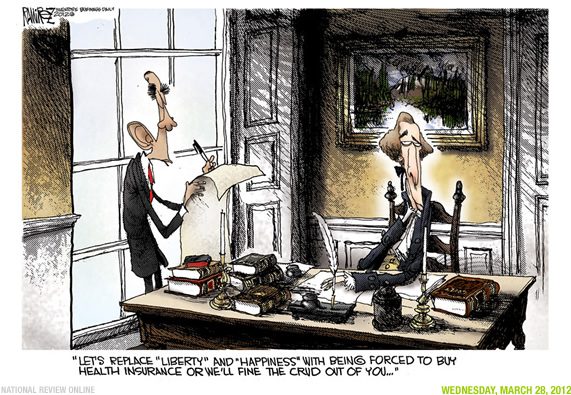
I’ve repeatedly said that Michael Ramirez is a good political cartoonist (see here, here, here, here, here, and here), and he’s proved his worth in this cartoon that cleverly mocks the cavalier attitude that statists have about America’s founding principles.
And here are two more Ramirez cartoons, including one that also uses the theme of Obama vs the Founding Fathers.
I came on here on Friday and predicted that Romney would win 301 to 237. My view was skewed by something I read on Jason Tolbert’s blog recently: Our neighbors in Tennessee started casting ballots this week. Jim Geraghty with National Review notes a dramatic swing in what looks like good news for Republicans. His […]
I predict that President Obama will lose to Mitt Romney because so many of the battleground states will go for Romney because of the horrible economies in their states. Real Clear Politics as of 11:14 am on 10-19-12 had President Obama with 201 electorial votes locked up and Mitt Romney with 206. I think that […]
I have a lot of respect for Max Brantley of the Arkansas Times Blog and Dan Mitchell of the Cato Institute for their political analysis. They both have picked Obama to win today. I parted company and chose Romney to win 301 to 237. Knowing how Dan Mitchell thinks leads me to believe that he […]
Dan Mitchell Discussing Dishonest Budget Numbers with John Stossel Uploaded by danmitchellcato on Feb 11, 2012 No description available. ______________ Dan Mitchell of the Cato Institute has shown before how excessive spending at the federal level has increased in recent years. A Humorous Look at Obama’s Screwy Budget Math May 31, 2012 by Dan Mitchell I’ve […]
Another great carton on President Obama’s efforts to create jobs!!! A Simple Lesson about Job Creation for Barack Obama December 7, 2011 by Dan Mitchell Even though leftist economists such as Paul Krugman and Larry Summers have admitted that unemployment insurance benefits are a recipe for more joblessness, the White House is arguing that Congress should […]
Dan Mitchell hits the nail on the head and sometimes it gets so sad that you just have to laugh at it like Conan does. In order to correct this mess we got to get people off of government support and get them in the private market place!!!! Chuck Asay’s New Cartoon Nicely Captures Mentality […]
Sometimes it is so crazy that you just have to laugh a little. The European Mess, Captured by a Cartoon June 22, 2012 by Dan Mitchell The self-inflicted economic crisis in Europe has generated some good humor, as you can see from these cartoons by Michael Ramirez and Chuck Asay. But for pure laughter, I don’t […]
Dan Mitchell Discussing Dishonest Budget Numbers with John Stossel Uploaded by danmitchellcato on Feb 11, 2012 No description available. ______________ Dan Mitchell of the Cato Institute has shown before how excessive spending at the federal level has increased in recent years. A Humorous Look at Obama’s Screwy Budget Math May 31, 2012 by Dan Mitchell I’ve […]
Another great carton on President Obama’s efforts to create jobs!!! A Simple Lesson about Job Creation for Barack Obama December 7, 2011 by Dan Mitchell Even though leftist economists such as Paul Krugman and Larry Summers have admitted that unemployment insurance benefits are a recipe for more joblessness, the White House is arguing that Congress should […]
Cato Institute scholar Dan Mitchell is right about Greece and the fate of socialism: Two Pictures that Perfectly Capture the Rise and Fall of the Welfare State July 15, 2011 by Dan Mitchell In my speeches, especially when talking about the fiscal crisis in Europe (or the future fiscal crisis in America), I often warn that […]
Cato Institute scholar Dan Mitchell is right about Greece and the fate of socialism: Two Pictures that Perfectly Capture the Rise and Fall of the Welfare State July 15, 2011 by Dan Mitchell In my speeches, especially when talking about the fiscal crisis in Europe (or the future fiscal crisis in America), I often warn that […]
We need to pass a Balanced Budget Amendment!!!! It is obvious to me that if President Obama gets his hands on more money then he will continue to spend away our children’s future. He has already taken the national debt from 11 trillion to 16 trillion in just 4 years. Over, and over, and over, and over, and over and over I have written Speaker Boehner and the Congressmen (Griffin, Womack, Crawford) in Arkansas concerning this. I am hoping they will stand up against this reckless spending that our federal government has done and will continue to do if given the chance.
Lacy Hunt, executive director at Hoisington Investment Management, believes the debt problem in the United States and the other major economies is far worse than most realize, and he thinks an amendment to the constitution mandating a balanced Federal budget may be the only thing that can save us from a disastrous outcome.
“The ‘Keynesian Endgame’ that is increasingly part of the lexicon refers to a government becoming so excessively indebted that it loses access to credit,” he said at the Fixed-Income Management 2012 conference in San Francisco.
While historically low yields on US Treasury debt would seem to indicate that losing access to credit markets is not an imminent prospect for the United States, Hunt warned that debt accumulation trends in the United States are having increasingly negative economic effects that could take a long time to reverse.
Worse, interest rates won’t provide the early warning system many expect, a consequence of financially repressive Fed policies. By the time rates signal a problem, it may be too late to do anything about it, according to Hunt, who previously served as the chief economist for HSBC and a senior economist for the Federal Reserve Bank of Dallas.
Hunt traced the roots of the US debt problems to the election of 1960, when both major political parties favored greater government involvement in the economy, a policy advocated at the time by Yale economist James Tobin. But contrary to what many believe, deficit spending has not improved the economic outcome.
“Physical investment must equal savings and income over the long term,” Hunt said, citing two studies that suggest that debt accumulation beyond certain thresholds negatively impacts economic growth. In a 2011 study published in the Journal of Economic Surveys, Andreas Bergh of Lund University and Magnus Henrekson of the Research Institute of Industrial Economics found “an increase in government size by 10 percentage points is associated with a 0.5% to 1% lower annual growth rate.” This reinforced the findings of a study commissioned by the ECB, which concluded that the “negative growth rate effect of high debt may start from levels of around 70–80% of GDP.”
US aggregate public and private debt is now upwards of 350% of GDP (not including unfunded liabilities, which would bring debt-to-GDP to 750%), and Hunt noted that much of this is what he called “unproductive debt,” taken on to fuel consumption rather than generate lasting economic benefit.
“We’re in way over our head, and the mix is wrong,” he said, referring to the amount of US debt. According to Hunt, consumptive debt crowds out productive investment and weakens the overall economy over time, as the velocity of money falls despite increasing government spending. This is happening now.
“The business cycle is no longer really operating, and GDP growth is being misinterpreted. GDP measures spending, not prosperity,” Hunt said. “While GDP has gone up, real incomes have declined,” and the symptoms of economic dysfunction in the United States are becoming all too apparent:
In the first 12 quarters of the current US expansion, the Misery Index has averaged 11.5%, compared with 9.7% in the first three years of all previous post-war expansions.
The way out of this mess? The solution, according to Hunt, is a sustained increase in savings, sometimes referred to as “austerity.”
“The way you reverse over-indebtedness is by living within your means,” he said, suggesting that economist David Hume was correct when he wrote in 1752 that “the normal course of government activity should be to run a surplus.”
Japan, meanwhile, presents an example of what not to do, according to Hunt. “Japan has reduced the savings rate, trying to reduce indebtedness,” and over two decades has failed to generate sustainable economic growth, he said. The United States is “now on that path.”
Please note that the content of this site should not be construed as investment advice, nor do the opinions expressed necessarily reflect the views of CFA Institute.
We got to stop all the red ink. How can keep our federal spending at the high level it is at now and not end up in Greece? As the president you should take the bull by the horns and balance the budget!!!!
But this progress didn’t last long. Thanks to George Bush’s reckless spending policies, the federal budget grew about twice as fast as the economy, jumping by nearly 90 percent in just eight years This pushed federal spending up to about 25 percent of GDP.
President Obama promised hope and change, but he has kept spending at this high level rather than undoing the mistakes of his predecessor.
This new video from the Center for Freedom and Prosperity Foundation uses examples of waste, fraud, and abuse to highlight President Obama’s failed fiscal policy.
This mini-documentary from the Center for Freedom and Prosperity Foundation highlights egregious examples of wasteful spending from the so-called stimulus legislation and explains why government spending hurts economic performance.
____________________
Good stuff, though the video actually understates the indictment against Obama. There is no mention, for instance, about all the new spending for Obamacare that will begin to take effect over the next few years.
But not everything can be covered in a 5-minute video. And I suspect the video is more effective because it closes instead with some discussion of the corrupt insider dealing of Obama’s so-called green energy programs.
__________
Thank you so much for your time. I know how valuable it is. I also appreciate the fine family that you have and your commitment as a father and a husband.
Sincerely,
Everette Hatcher III, 13900 Cottontail Lane, Alexander, AR 72002, ph 501-920-5733, lowcostsqueegees@yahoo.com
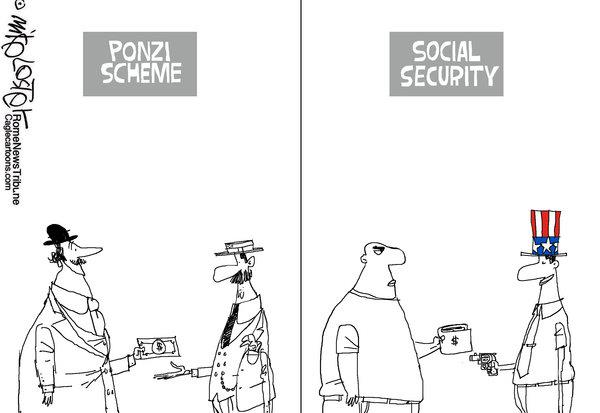
For nearly three decades Social Security produced big surpluses, collecting more in taxes from workers than it paid in benefits to retirees, disabled workers, spouses and children. The surpluses also helped mask the size of the budget deficit being generated by the rest of the federal government. Those days are over. Since 2010, Social Security has been paying out more in benefits than it collects in taxes… The projected shortfall in 2033 is $623 billion, according to the trustees’ latest report. It reaches $1 trillion in 2045 and nearly $7 trillion in 2086, the end of a 75-year period used by Social Security’s number crunchers because it covers the retirement years of just about everyone working today. Add up 75 years’ worth of shortfalls and you get an astonishing figure: $134 trillion. Adjusted for inflation, that’s $30.5 trillion in 2012 dollars, or eight times the size of this year’s entire federal budget.
My only complaint is that the story does include some analysis of the Social Security Trust Fund, even though that supposed Fund is nothing but a pile of IOUs – money that one part of the government promises to give to another part of the government.
But let’s set that aside. Another interesting tidbit from the story is this quote from one of the kleptocrats at the American Association of Retired Persons. Note that he implicitly rules out any changes other than those that enable the government to “pay the benefits we promised.” But that shouldn’t be a surprise. AARP is part of the left-wing coalition.
“I’m not suggesting we need to wait 20 years but we do have time to make changes to Social Security so that we can pay the benefits we promised,” said David Certner, AARP’s legislative policy director. “Let’s face it. Relative to a lot of other things right now, Social Security is in pretty good shape.”
But I will say that Mr. Certner is sort of correct about Social Security being in better shape than Medicare and Medicaid. But that’s like saying the guy with lung cancer who is 75 lbs overweight is in better shape than the two guys with brain tumors who are both 150 lbs overweight.
If you have to engage in fiscal triage, it would be smart to first address Medicare and Medicaid, but Social Security also needs reform. And not the kind of statist reform the folks at AARP would like to see.
By the way, you probably won’t be surprised to learn that President Obama’s approach is similar to the left-wingers at AARP. Here’s a video I narrated about his preferred policy.
It seems that the question doesn’t matter with this administration. The answer is always to impose more class-warfare tax policy.
Thank you so much for your time. I know how valuable it is. I also appreciate the fine family that you have and your commitment as a father and a husband.
Sincerely,
Everette Hatcher III, 13900 Cottontail Lane, Alexander, AR 72002, ph 501-920-5733, lowcostsqueegees@yahoo.com
For almost a year now I have been writing an open letter to Senator Mark Pryor every week in what I call “Thirsty Thursday” because the government is always thirsty for more of our money and the only way to stop it is to pass the BALANCED BUDGET AMENDMENT!!!!! I have electronically sent all of these letters to him before I post them on the blog. Below are some of the links. Check them out:
Dear Senator Pryor,
Why not pass the Balanced Budget Amendment? As you know that federal deficit is at all time high (1.6 trillion deficit with revenues of 2.2 trillion and spending at 3.8 trillion).
On my blog www.HaltingArkansasLiberalswithTruth.com I took you at your word and sent you over 100 emails with specific spending cut ideas. However, I did not see any of them in the recent debt deal that Congress adopted. Now I am trying another approach. Every week from now on I will send you an email explaining different reasons why we need the Balanced Budget Amendment. It will appear on my blog on “Thirsty Thursday” because the government is always thirsty for more money to spend.
In this paper below you will read:
America cannot raise taxes to continue overspending, because tax hikes shrink our economy and grow our government. America cannot borrow more to continue overspending, because borrowing puts an enormous financial burden on the American children of tomorrow. A BBA will help address this long-term problem because, after the multi-year process for securing ratification of the BBA by three-quarters of the states, the BBA will keep federal spending under control in subsequent years.
Washington has not been able to cut spending so the BBA is needed to force Washington to do the right thing. Your father David Pryor was the governor of Arkansas and he knew what it meant to have a balanced budget by mandate.
Thank you again for this opportunity to share my ideas with you.
Two key principles should govern congressional consideration of an amendment to the U.S. Constitution that requires the federal government to balance its budget:
First Principle: A Balanced Budget Amendment (BBA) is important to help bring long-term fiscal responsibility to America’s future when the BBA takes effect after ratification by three-quarters of the state legislatures; it is equally important for Congress to cut spending nowto address the current overspending crisis.
Second Principle: An effective BBA will include three elements to: (a) control spending, taxation, and borrowing, (b) ensure the defense of America, and (c) enforce the requirement to balance the budget.
Cuts for the Future, Cuts for the Present
Federal spending is out of control—both obligations for the future and spending right now.
Congress must get spending under control in the long term. America cannot raise taxes to continue overspending, because tax hikes shrink our economy and grow our government. America cannot borrow more to continue overspending, because borrowing puts an enormous financial burden on the American children of tomorrow. A BBA will help address this long-term problem because, after the multi-year process for securing ratification of the BBA by three-quarters of the states, the BBA will keep federal spending under control in subsequent years.
Congress also must get spending under control in theshort term. Federal overspending is not simply about the future, but also about the present. Under the President’s Fiscal Year 2012 Budget Submission, measured by the Congressional Budget Office, the federal government will spend $1.2 trillion more than it will take in, a gargantuan burden of additional debt forced on future generations to pay current bills.
Thus, America needs both a Balanced Budget Amendment for the long term and deep cuts in federal spending starting right now, without waiting for a BBA to take effect. As Congress considers budget resolutions, appropriations bills, appropriations continuing resolutions, and debt limit bills, Congress should take every opportunity now to cut federal spending, including for the biggest overspending problem: the ever-growing entitlement programs.
Congress should recognize that the best way to encourage state legislatures to ratify a BBA is to demonstrate, through consistent congressional cuts in spending, that the American people have the will to accept spending cuts to balance the budget.
Elements of a Successful Balanced Budget Amendment
A successful BBA will:
Control spending, taxing, and borrowing through a requirement to balance the budget.The BBA should cap annual spending at a level not exceeding either: (a) a specified percentage of the value of goods and services the economy produces in a year (known as gross domestic product, or GDP), or (b) the level of revenues. To ensure that Congress cannot simply balance the budget by continually raising taxes instead of cutting overspending, the BBA should require Congress to act by supermajority votes if Members wish to raise taxes. Any authority the BBA grants Congress to deal with economic slowdowns, by waiving temporarily the requirement that spending not exceed the GDP percentage or revenue level, should specify the amount of above-revenue spending allowed and require supermajority votes.
Defend America. The BBA should allow Congress by supermajority votes to waive temporarily compliance with the balanced budget requirement when waiver is essential to pay for the defense of Americans from attack.
Enforce the balanced budget requirement. The BBA should provide for its own enforcement, but must specifically exclude courts from any enforcement of the BBA, so unelected judges do not make policy decisions such as determining the appropriate level of funding for federal programs. A government that spends money in excess of its revenues must borrow to cover the difference. Therefore, to enforce the requirement to balance the budget, the BBA should prohibit government issuance of debt, except when necessary to finance a temporary deficit resulting from congressional supermajority votes discussed above.
America is in a fiscal crisis. Our government spends too much. Overspending must stop immediately. Overspending will stop only if Congress cuts spending now, including with respect to the ever-expanding entitlement programs. For the future, Congress and three-quarters of state legislatures can adopt and ratify a Balanced Budget Amendment to the U.S. Constitution to anchor the American willingness to live within a balanced budget.
David S. Addington is Vice President for Domestic and Economic Policy, and J. D. Foster, Ph.D., is Norman B. Ture Senior Fellow in the Economics of Fiscal Policy, at The Heritage Foundation.
Dear Senator Pryor, Why not pass the Balanced Budget amendment? As you know that federal deficit is at all time high (1.6 trillion deficit with revenues of 2.2 trillion and spending at 3.8 trillion). On my blog http://www.HaltingArkansasLiberalswithTruth.com I took you at your word and sent you over 100 emails with specific spending cut ideas. However, […]
Dear Senator Pryor, Why not pass the Balanced Budget Amendment? As you know that federal deficit is at all time high (1.6 trillion deficit with revenues of 2.2 trillion and spending at 3.8 trillion). On my blog http://www.HaltingArkansasLiberalswithTruth.com I took you at your word and sent you over 100 emails with specific spending cut ideas. However, […]
Dear Senator Pryor, Why not pass the Balanced Budget Amendment? As you know that federal deficit is at all time high (1.6 trillion deficit with revenues of 2.2 trillion and spending at 3.8 trillion). On my blog www.HaltingArkansasLiberalswithTruth.com I took you at your word and sent you over 100 emails with specific spending cut ideas. However, I did […]
Dear Senator Pryor, Why not pass the Balanced Budget Amendment? As you know that federal deficit is at all time high (1.6 trillion deficit with revenues of 2.2 trillion and spending at 3.8 trillion). On my blog www.HaltingArkansasLiberalswithTruth.com I took you at your word and sent you over 100 emails with specific spending cut ideas. However, I did […]
Dear Senator Pryor, Why not pass the Balanced Budget Amendment? As you know that federal deficit is at all time high (1.6 trillion deficit with revenues of 2.2 trillion and spending at 3.8 trillion). On my blog www.HaltingArkansasLiberalswithTruth.com I took you at your word and sent you over 100 emails with specific spending cut ideas. However, I did […]
Dear Senator Pryor, Why not pass the Balanced Budget Amendment? As you know that federal deficit is at all time high (1.6 trillion deficit with revenues of 2.2 trillion and spending at 3.8 trillion). On my blog www.HaltingArkansasLiberalswithTruth.com I took you at your word and sent you over 100 emails with specific spending cut ideas. However, I did […]
Dear Senator Pryor, Why not pass the Balanced Budget Amendment? As you know that federal deficit is at all time high (1.6 trillion deficit with revenues of 2.2 trillion and spending at 3.8 trillion). On my blog www.HaltingArkansasLiberalswithTruth.com I took you at your word and sent you over 100 emails with specific spending cut ideas. However, I did […]
Dear Senator Pryor, Why not pass the Balanced Budget Amendment? As you know that federal deficit is at all time high (1.6 trillion deficit with revenues of 2.2 trillion and spending at 3.8 trillion). On my blog www.HaltingArkansasLiberalswithTruth.com I took you at your word and sent you over 100 emails with specific spending cut ideas. However, I did […]






 The Daily Hatch