Category Archives: spending out of control

George Will on Balanced Budget Amendment

We need to pass a Balanced Budget Amendment!!!! It is obvious to me that if President Obama gets his hands on more money then he will continue to spend away our children’s future. He has already taken the national debt from 11 trillion to 16 trillion in just 4 years. Over, and over, and over, and over, and over and over I have written Speaker Boehner and the Congressmen (Griffin, Womack, Crawford) in Arkansas concerning this. I am hoping they will stand up against this reckless spending that our federal government has done and will continue to do if given the chance.

I have written and emailed Senator Pryor over, and over again with spending cut suggestions but he has ignored all of these good ideas in favor of keeping the printing presses going as we plunge our future generations further in debt. I am convinced if he does not change his liberal voting record that he will no longer be our senator in 2014.

I have written hundreds of letters and emails to President Obama and I must say that I have been impressed that he has had the White House staff answer so many of my letters. However, his policies have not changed. He is committed to cutting nothing from the budget that I can tell. 

___________

In January of 2013 I read this fine article by George Will:

George F. Will
George F. Will
Opinion Writer
 

Time for a balanced-budget amendment

Democrats not allergic to arithmetic must know the cost of their “fiscal cliff” victory. When they flinched from allowing all of George W. Bush’s tax rates, especially those on middle-class incomes, to expire, liberalism lost its nerve and began what will be a long slide into ludicrousness.

Those temporary rates were enacted in 2001, when only 28 House Democrats supported them, and in 2003, when only seven did. But with the “American Taxpayer Relief Act of 2012” — did liberals think about that title? — 172 House Democrats voted to make the Bush income-tax rates permanent for all but 0.7 percent of taxpayers — individuals earning more than $400,000 and couples earning more than $450,000.

Liberals could have had a revenue increase of $3.7 trillion over 10 years. Instead, they surrendered nearly $3.1 trillion of that. They cannot have repeated bites at this apple. They cannot now increase government revenue as a share of gross domestic product through tax reform because Republicans insist that the Taxpayer Relief Act closed the revenue question. And because tax reform is dead for the foreseeable future, so are hopes for a revenue surge produced by vigorous economic growth.

No numerate person thinks that today’s entitlement state, let alone the steady expansion of it that is liberalism’s aspiration, can be funded by taxing the income of the 0.7 percent of taxpayers whose rates were just raised. Or the 2 percent whose rates would have been raised had liberals and their president simply allowed the automatic increase of rates for individuals earning more than $200,000 and couples earning more than $250,000.

Because 82 percent of American earners pay more in payroll taxes than income taxes, no politically conceivable or economically feasible middle-class tax rate can fund the entitlement state. And America’s political culture rules out funding it with new consumption or energy taxes. By rescuing almost everyone from the restoration of Clinton-era rates, liberals abandoned any pretense of paying for their program of ever- expanding entitlements. Instead, they made trillion-dollar deficits their program.

From 1950 to 2000, economic growth averaged 3.6 percent; since then, it has averaged less than 2 percent. Liberals think today’s correlation between the slow economic growth and rapid governmental growth — including under George W. Bush — is a coincidence. Conservatives do not. And they note some recent actions, done in December’s bright light of public attention and fiscal anxiety, which indicate that this government’s indiscipline is incorrigible and shameless. Consider one detail in the Taxpayer Relief Act, and an issue pertinent to the aftermath of Hurricane Sandy.

Years ago, Congress decided that, to save the planet, there should be tax credits to bribe Americans to buy electric cars. Sen. Ron Wyden (D-Ore.) believes it only fair that buyers of electric motorcycles, some of which are made in Oregon, not get left out of the bribery business. Thanks to the Taxpayer Relief Act, they won’t.

People who choose to live in places vulnerable to flooding believe it would be unfair that the cost of their property insurance fully reflect this risk. So government subsidizes their insurance, and hence their decision to live where there is increased risk of property damage that, when it happens, the government helps pay to rebuild.

Today’s government, whose railroad, Amtrak, lost $834 million over the past 10 years just on its food service, has neither wit nor will to stop subsidizing electric motorcycles or to reform flood insurance. Hence Republicans should rally ’round one of several well-refined constitutional amendments requiring balanced budgets. Such an amendment would be popular everywhere, but especially in six states important in 22 months.

Republicans need to gain six seats to win Senate control in 2014, when Democrats will be defending 20 seats, Republicans only 13. Six Democratic incumbents represent states in which Barack Obama received less than 42 percent of the 2012 vote — Montana’s Max Baucus (41.7), Alaska’s Mark Begich (40.8), Louisiana’s Mary Landrieu (40.6), South Dakota’s Tim Johnson (39.9), Arkansas’s Mark Pryor (36.9) and West Virginia’s Jay Rockefeller (35.5).

Sixty-seven Senate votes are needed to send a proposed amendment to the states for ratification. There are 45 Republican senators. There are nowhere near 22 Democrats who would vote for an amendment Republicans could support. Still, Republicans, whose divisions cause Democratic gloating, could use a balanced-budget amendment to divide Democrats who threw the remnants of their fiscal self-respect off the cliff.

georgewill@washpost.com

Open letter to President Obama (Part 243)


President Obama c/o The White House
1600 Pennsylvania Avenue NW
Washington, DC 20500

Dear Mr. President,

I know that you receive 20,000 letters a day and that you actually read 10 of them every day. I really do respect you for trying to get a pulse on what is going on out here.

Not many people know the truth about Robin Hood. Robin Hood was not a left-wing hero who stole from the rich and redistributed to the poor. That is what you are trying to do though Mr. President.

When I was a kid, I was a big fan of Robin Hood. I remember reading at least two books recounting the legend and I watched the Errol Flynn version of the movie several times.

And, as an adult, I saw both the Kevin Costner and Russell Crowe versions of Robin Hood.

“I’m not an occupy-Wall-Street moocher”

None of this makes me an expert, but it does allow me to state with some confidence that Robin Hood was not a left-wing hero who stole from the rich and redistributed to the poor.

Instead, he was a quasi-libertarian tax protestor. Okay, maybe it’s an exaggeration to claim he was a libertarian, but Robin Hood was on the side of ordinary people who were being exploited by incessant tax demands from the ruling class. His main enemies were Prince John and the Sheriff on Nottingham, not the medieval equivalents of Wall Street.

In the Russell Crowe version of the movie, Robin Hood even gives a speech about the importance of liberty.

So you can imagine how irked I get when statists agitate for things such as the “Robin Hood Tax” in this moronic video. But what motivated me today is a story in the Financial Times about a Cesar Chavez wannabee politician from Spain.

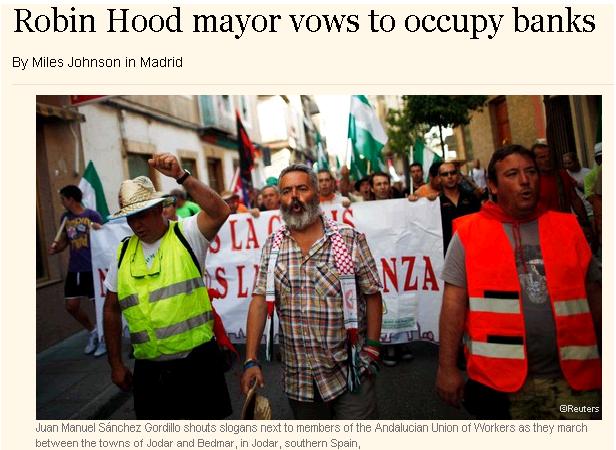
For Spain’s ruling politicians he is a criminal; for his supporters he is Robin Hood, stealing from supermarkets and redistributing the food to the poor. Juan Manuel Sánchez Gordillo, the mayor of Marinaleda, a southern town with a population of 2,600, has been catapulted to cult hero status in Spain after setting out this week on an anti-austerity march across Andalucia – occupying banks and stealing food… “We are fighting a war for the poor … going to jail is not important for me, it would be an honour,” Mr Sánchez Gordillo told the Financial Times. “We are going to occupy all of the banks and supermarkets we are able to in Andalucia. The robbers who have caused this crisis must pay the consequences for what they have done.”

But if the Mayor really wants to make robbers pay, he should march straight to jail and turn himself in. Not for the empty publicity stunt of robbing grocery stores, but for being part of a political class that has dramatically increased the burden of government spending in Spain, from about 30 percent of GDP in 1980 to well over 40 percent today.

But don’t hold your breath waiting for self-awareness from this clown.

Not surprisingly, unions are part of the protest. I’m guessing that Mr. Canamero represents government employees.

On Friday, the marchers, who plan to sleep in the open or in parks, occupied a branch of Banco Santander in the town of Mancha Real in the province of Jaén before leaving later in the day. Diego Canamero, head of the Andalucian Workers Union, was in the branch on Friday. He said critics of the protests were politicians protecting their own interests. “These are symbolic actions against an unsustainable economic situation,” he said. “The bankers rob us, and take our money to tax havens…”

The dig against tax havens is particularly laughable. Ordinary Spaniards should hope and pray that their deposits in the local banks are safely re-deposited in banks based in well-run and honest jurisdictions such as Switzerland, the Cayman Islands, or Singapore.

And if they’re smart, they already cut out the middleman and directly placed their savings in one of these low-tax jurisdictions. That way, they’re not only at much less risk of a bank collapse, but they also have greater ability to protect their assets from the venal and incompetent tax-hungry political elite.

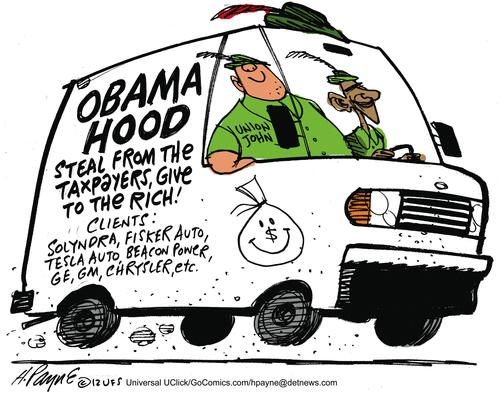
Returning to the mischaracterization of Robin Hood, this Payne cartoon does a good job of capturing my thoughts.

I especially like how Payne shows that the left-wing version of Robin Hood is all about a perniciously corrupt version of redistribution (though he should have included the Export-Import Bank on the side of the van). The genuine poor get crumbs while the well-connected interests make out like bandits.

P.S. Other good Payne cartoons can be seen here, here, herehereherehere, and here.

___________

Thank you so much for your time. I know how valuable it is. I also appreciate the fine family that you have and your commitment as a father and a husband.

Sincerely,

Everette Hatcher III, 13900 Cottontail Lane, Alexander, AR 72002, ph 501-920-5733, lowcostsqueegees@yahoo.com

Open letter to President Obama (Part 242)


President Obama c/o The White House
1600 Pennsylvania Avenue NW
Washington, DC 20500

Dear Mr. President,

I know that you receive 20,000 letters a day and that you actually read 10 of them every day. I really do respect you for trying to get a pulse on what is going on out here.

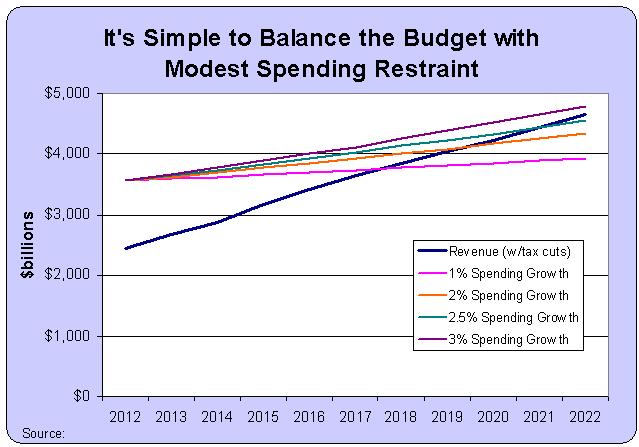
It is really simple after all to balance the budget according to Dan Mitchell of the Cato Institute.

Now that new numbers have been released by the Congressional Budget Office, it’s time once again for me to show how easy it is to balance the budget with modest spending restraint (though please remember our goal should be smaller government, not fiscal balance).

  • I first did this back in September 2010, and showed that we could balance the budget in 10 years if federal spending was limited so it grew by 2 percent annually.
  • I repeated the exercise in January 2011 after new CBO numbers were released, and re-confirmed that a spending cap of 2 percent would eliminate red ink in just 10 years.
  • In August of that year, following the release of the CBO Update, I showed again that the budget could be balanced by limiting spending so it climbed by 2 percent per year.
  • Most recently, back in January after CBO produced the new Economic and Budget Outlook, I crunched the numbers again and showed how a spending cap of 2 percent would balance the budget.

I’m happy to say that the new numbers finally give me some different results. We can now balance the budget if spending grows 2.5 percent annually.

In other words, spending can grow faster than inflation and the budget can be balanced with no tax hikes.

And here’s the video I narrated almost two years ago on this topic. The numbers have changed a bit, but the analysis is exactly the same.

In other words, ignore the politicians, bureaucrats, lobbyists, and special interests when they say we have to raises taxes because otherwise the budget would have to be cut by trillions of dollars. They’re either stupid or lying (mostly the latter, deliberately using the dishonest version of Washington budget math).

Modest fiscal restraint is all that we need, though it would be preferable to make genuine cuts in the burden of government spending.

______

Thank you so much for your time. I know how valuable it is. I also appreciate the fine family that you have and your commitment as a father and a husband.

Sincerely,

Everette Hatcher III, 13900 Cottontail Lane, Alexander, AR 72002, ph 501-920-5733, lowcostsqueegees@yahoo.com

Open letter to President Obama (Part 239)

Is Washington Bankrupting America?

Uploaded by on Apr 20, 2010

Be first to receive our videos and other timely info about economic policy. Subscribe at http://www.bankruptingamerica.org
————————-
According to a recent poll, 74 percent of likely voters are extremely or very concerned about the current level of government spending. And 58 percent think the level of spending is unsustainable.

Is the public right? Is Washington bankrupting America? Some facts from the video:

Spending per household has risen over 40 percent in the last 10 years and is set to do so again in the next 10 pushing debt (and interest on the debt) to unprecedented levels. But that’s just a result of PAST spending…

Our government owes $106 trillion in FUTURE spending commitments – that cannot be paid for.

We can solve it, but politicians will have to make tough choices. Increasing taxes can’t do the trick ($106 trillion is equivalent to taking all of the taxable income from every American nine times over), nor is it fair to saddle taxpayers with a problem created by government irresponsibility.

We need real spending reform. Merely returning to the spending per household levels of the 1990s would balance the budget in three years.

___________


President Obama c/o The White House
1600 Pennsylvania Avenue NW
Washington, DC 20500

Dear Mr. President,

I know that you receive 20,000 letters a day and that you actually read 10 of them every day. I really do respect you for trying to get a pulse on what is going on out here.

When are we going to see REAL SPENDING CUTS? I am tired of this being talked about but not done.

I’m in Slovenia where I just finished indoctrinating educating a bunch of students on the importance of Mitchell’s Golden Rule as a means of restraining the burden of government spending.

And I emphasized that the fiscal problem in Europe is the size of government, not the fact that nations are having a hard time borrowing money. As explained in this video, spending is the disease and deficits are one of the symptoms.

This is also an issue in the United States, and Steve Moore of the Wall Street Journal is worried that the GOP ticket is debt-obsessed and doesn’t have sufficient enthusiasm for lower tax rates and tax reform.

Stylistically, Paul Ryan’s Republican convention speech last night was a grand slam. …But was it the growth message that supply-siders wanted to hear, or debt-clock obsession? There were clearly apocalyptic claims. “Before the math and the momentum overwhelm us all, we are going to solve this nation’s economic problems,” said Mr. Ryan in reference to the federal rea ink. “I’m going to level with you; we don’t have that much time.” …In fact, he talked about turning around the economy with “tax fairness.” Ugh, that’s an Obama term. …Larry Kudlow of CNBC and a former Reagan economist tells me, “Paul’s speech just didn’t have the growth, tax-cutting message. We didn’t even get the words tax reform. I don’t know what happened, but it worries me.” It’s a question of priorities. Are Mitt Romney and Paul Ryan signaling that they will put spending cuts ahead of pro-growth tax-rate cuts?

I share Steve’s concern, but with a twist.

I’m not worried that the Republicans will put spending cuts ahead of tax cuts. I’m worried that they won’t do spending cuts at all (even using the dishonest DC definition) and therefore wind up getting seduced into some sort of tax-increase deal that facilitates bigger government.

As a general rule, it is always good to do spending cuts (however defined). And it is always good to lower tax rates. And if you can do both at the same time, even better.

But since I have low expectations, I’ll be delighted if we “merely” manage to get entitlement reform during a Romney-Ryan Administration. That would mean some progress on the spending side and presumably reduce the risk of bad things (like a VAT!) on the revenue side.

_________

Thank you so much for your time. I know how valuable it is. I also appreciate the fine family that you have and your commitment as a father and a husband.

Sincerely,

Everette Hatcher III, 13900 Cottontail Lane, Alexander, AR 72002, ph 501-920-5733, lowcostsqueegees@yahoo.com

Dear Senator Pryor, why not pass the Balanced Budget Amendment? (“Thirsty Thursday”, Open letter to Senator Pryor)

Mark Levin and Senator Hatch discuss the balanced budget amendment and it’s importance.

Uploaded by on Jan 28, 2011

Mark Levin interviews Senator Hatch 1/27/2011 about the balanced budget amendment. Mark is very excited about the balanced budget amendment being proposed by Senator Orin Hatch and John Cornyn and he discusses the amendment with Senator Hatch. Senator Hatch explains the bill it’s ramifications and limitations. Senator Hatch actually worked on this bill with renowned economist Milton Friedman. This ammendment is the first big step in saving our country.

_______________

Dear Senator Pryor,

Why not pass the Balanced  Budget Amendment? As you know that federal deficit is at all time high (1.6 trillion deficit with revenues of 2.2 trillion and spending at 3.8 trillion).

On my blog www.HaltingArkansasLiberalswithTruth.com I took you at your word and sent you over 100 emails with specific spending cut ideas. However, I did not see any of them in the recent debt deal that Congress adopted. Now I am trying another approach. Every week from now on I will send you an email explaining different reasons why we need the Balanced Budget Amendment. It will appear on my blog on “Thirsty Thursday” because the government is always thirsty for more money to spend.

I really wish we would restraint the growth of the federal budget and the only way to do that is to pass the Balanced Budget Amendment. My favorite economist was Milton Friedman and he discusses that below:


Written By : John Hawkins
February 25, 2012


Yesterday, I did a twenty minute interview by phone with Milton Friedman. Of course, Mr. Friedman has an INCREDIBLE resume. He won the 1976 Nobel Memorial Prize for economic science, won the “Presidential Medal of Freedom in 1988 and received the National Medal of Science the same year”.

He was also an “economic adviser to Senator Barry Goldwater in his unsuccessful campaign for the presidency in 1964, to Richard Nixon in his successful 1968 campaign, to President Nixon subsequently, and to Ronald Reagan in his 1980 campaign.”

There is much, much, more I could add. But I think the fact that Mr. Friedman finished in a tie for the 15 slot when RWN had conservative bloggers select, “The Greatest Figures Of The 20th Century gives you some idea of Mr. Friedman’s stature.

Enjoy the interview!

John Hawkins: Slate’s Chris Suellentrop has pointed out that Howard Dean has said “that he would demand that other countries adopt the exact same labor, environmental, health, and safety standards as the United States” if they wanted trade agreements with us (Dean said something similar to the WAPO). If that policy were ever implemented, what sort of damage do you think it would cause to the US economy?

Milton Friedman: I think it would cause immense damage, not to the US economy, but to other economies around the world — much more to the others than to us.

John Hawkins: Really? So you don’t really think it would hurt the US economy that much?

Milton Friedman: It would hurt the US economy, but it would be disastrous for the countries that are smaller than we are. World trade depends on differences among countries, not similarities. Different countries are in different stages of development. It is appropriate for them to have different patterns, different policies for ecology, labor standards, and so forth.

From my point of view, we in the United States have gone overboard in respect to the extent of regulation and detailed control of labor standards, industry, and the like. It’s bad for us, but fortunately we had two hundred years of relatively free development to provide a strong basis to sustain the cost. But to impose this on other countries that are not at that stage would be a disgraceful thing to do.

John Hawkins: Because it would keep them from ever getting to the point we’re at?

Milton Friedman: That’s right.

John Hawkins: Do you think George Bush, with the economy being as it was, did the right thing by cutting taxes?

Milton Friedman: I am in favor of cutting taxes under any circumstances and for any excuse, for any reason, whenever it’s possible. The reason I am is because I believe the big problem is not taxes, the big problem is spending. The question is, “How do you hold down government spending?” Government spending now amounts to close to 40% of national income not counting indirect spending through regulation and the like. If you include that, you get up to roughly half. The real danger we face is that number will creep up and up and up. The only effective way I think to hold it down, is to hold down the amount of income the government has. The way to do that is to cut taxes.

John Hawkins: Now let me ask you about that. In the Reagan years, we cut taxes and it ended up leading to economic growth which increased the amount of revenue that came into the government.

Milton Friedman: Well, economic growth will inevitably increase the amount of revenue coming into the government. But so far as the Reagan years were concerned, we have to be careful there. There were initial cuts in 1981-1982 and then there was a very good income tax law in 1986. But in between that, there were increases in taxes as well. So it’s not an entirely clear picture that you can attribute the growth in revenue entirely to the tax reductions. But it’s a hard thing to disentangle the effects of several things happening at the same time. In particular, there’s no doubt that growth is very favorable to government revenue.

John Hawkins: Well let me ask you a related question about holding down the deficit. Really, I’m not seeing much political will on either side of the aisle to hold down costs. Do you think we should consider a Balanced Budget Amendment?

Milton Friedman: What we should consider and what has been considered is a Tax And Spending Limitation Amendment, an amendment to hold down total spending. I don’t think it needs to be in the form of a Balanced Budget Amendment, but that’s one form it can take.

John Hawkins: So would you favor for example a 3/5th’s majority to raise taxes like they suggested in the “Contract with America”?

Milton Friedman: Yes, but the example that comes to mind really is the Colorado Tax And Expenditure Limitation Amendment that requires the spending to increase no more from year to year than population and inflation. Also, it requires that any revenues in excess of spending have to be returned to the taxpayers.

Congressman Bob Goodlatte sees the importance of the Balanced Budget Amendment

We need to pass a Balanced Budget Amendment!!!! It is obvious to me that if President Obama gets his hands on more money then he will continue to spend away our children’s future. He has already taken the national debt from 11 trillion to 16 trillion in just 4 years. Over, and over, and over, and over, and over and over I have written Speaker Boehner and the Congressmen (Griffin, Womack, Crawford) in Arkansas concerning this. I am hoping they will stand up against this reckless spending that our federal government has done and will continue to do if given the chance.

I have written and emailed Senator Pryor over, and over again with spending cut suggestions but he has ignored all of these good ideas in favor of keeping the printing presses going as we plunge our future generations further in debt. I am convinced if he does not change his liberal voting record that he will no longer be our senator in 2014.

I have written hundreds of letters and emails to President Obama and I must say that I have been impressed that he has had the White House staff answer so many of my letters. However, his policies have not changed. He is committed to cutting nothing from the budget that I can tell. 

We need to pass the Balanced Budget Amendment soon. I am glad that at least some people see the importance of that.

WASHINGTON, DC —

Roanoke Congressman Bob Goodlatte hopes things will be different this time, for his balanced budget amendment bill.

The new Chairman of the House Judiciary Committee introduced the bills on Thursday, with the start of the 113th Congress.  Rep. Goodlatte (R-6th) had introduced the bills in the prior three Congresses, but they have not been adopted.

“When I introduced these bills two years ago, the national debt had topped an unprecedented $14 trillion,” wrote Rep. Goodlatte in a news release.  “Today, the national debt has soared well past a staggering $16 trillion.  This rapid increase in debt and four consecutive trillion dollar plus budget deficits are clear signs that Washington has a serious spending problem.”

Goodlatte’s bill would:

  • Require Congress to not spend more money than the country takes in
  • Require the President to submit a balanced budget to Congress
  • Require a 3/5th majority vote to increase the federal debt limit

The bill provides exceptions in times of national emergencies.

Goodlatte noted that 49 of the 50 U.S. states, including Virginia, have a balanced budget requirement.

5th District Congressman Robert Hurt (R-Chatham) signed on as a co-sponsor of Rep. Goodlatte’s bill.

“For far too long, members of both parties have chosen the politically expedient course over what is in the best interest of our nation – casting aside meaningful proposals for deficit reduction and carrying our nation further along on a careless spending binge.  As a result, we have witnessed the devastating consequences for the people of Virginia’s 5th District and those all across our country as unemployment levels have remained unacceptably high and the debt continues to grow. At a time when we are borrowing 45 cents on the dollar and rapidly adding to a more than $16 trillion debt, there is no greater duty to those we represent than to get serious about fixing this spending-driven debt crisis,” Rep. Hurt wrote in a news release.

Cartoons from Dan Mitchell’s blog that demonstrate what Obama is doing to our economy Part 2

Max Brantley is wrong about Tom Cotton’s accusation concerning the rise of welfare spending under President Obama. Actually welfare spending has been increasing for the last 12 years and Obama did nothing during his first four years to slow down the rate of increase of welfare spending.

Rachel Sheffield of the Heritage Foundation has noted:

The number of Americans on food stamps (or, as it is now called, the Supplemental Nutrition Assistance Program, or SNAP) is higher than ever before, according to a new Congressional Budget Office report. Since 2007, rolls have grown by 70 percent. And participation rates are expected to increase over the next two years.

While some of the growth can be attributed to the recession, participation rates were steadily climbing prior to the recession. Since 2000, the number of Americans on food stamps has jumped by roughly 260 percent, from 17.2 million to 44.7 million in 2011.

Naturally, government spending on food stamps has also jumped, from approximately $20 billion in 2000 to a whopping $78 billion last year, a nearly 400 percent increase.

DAN MITCHELL’S BLOG HAS A GREAT CARTOON THAT SHOWS WHAT EVENTUALLY WILL HAPPEN IF THE GOVERNMENT CONTINUES TO INCREASE THE WELFARE STATE!!!

I have put up lots of carton’s from Dan Mitchell’s blog before and they have got lots of hits before. Many of them have dealt with the economy, eternal unemployment benefits, socialism,  Greece,  welfare state or on gun control.

The third-most viewed post in the history of this blog, with more than 22,000 views, is this set of cartoons showing how the welfare state begins and how it ends.

A similar theme can be found in this great new cartoon from Chuck Asay.

And just in case you think Asay is being unfair, keep in mind that folks like Obama and Pelosi actually have claimed that more unemployment benefits is “stimulus.” Yes, you read correctly. Subsidizing unemployment is good for growth to these strange ideologues.

Asay’s cartoon is so good that it may dethrone my previous top choice. Though sometimes I am most impressed by this one showing why parasites shouldn’t kill their host animal.

I’d be curious to know which one all of you think is most effective.

And since Asay’s work is almost always worth sharing, you can find more of my top picks hereherehere, and here.

Sometimes it is tragic that you got to laugh about it.

Related posts:

Cartons on Obama’s budget math

Dan Mitchell Discussing Dishonest Budget Numbers with John Stossel Uploaded by danmitchellcato on Feb 11, 2012 No description available. ______________ Dan Mitchell of the Cato Institute has shown before how excessive spending at the federal level has increased in recent years. A Humorous Look at Obama’s Screwy Budget Math May 31, 2012 by Dan Mitchell I’ve […]

Obama on creating jobs!!!!(Funny Carton)

Another great carton on President Obama’s efforts to create jobs!!! A Simple Lesson about Job Creation for Barack Obama December 7, 2011 by Dan Mitchell Even though leftist economists such as Paul Krugman and Larry Summers have admitted that unemployment insurance benefits are a recipe for more joblessness, the White House is arguing that Congress should […]

Get people off of government support and get them in the private market place!!!!(great carton too)

Dan Mitchell hits the nail on the head and sometimes it gets so sad that you just have to laugh at it like Conan does. In order to correct this mess we got to get people off of government support and get them in the private market place!!!! Chuck Asay’s New Cartoon Nicely Captures Mentality […]

Funny carton from Dan Mitchell’s blog on Greece

Sometimes it is so crazy that you just have to laugh a little. The European Mess, Captured by a Cartoon June 22, 2012 by Dan Mitchell The self-inflicted economic crisis in Europe has generated some good humor, as you can see from these cartoons by Michael Ramirez and Chuck Asay. But for pure laughter, I don’t […]

Cartons on Obama’s budget math

Dan Mitchell Discussing Dishonest Budget Numbers with John Stossel Uploaded by danmitchellcato on Feb 11, 2012 No description available. ______________ Dan Mitchell of the Cato Institute has shown before how excessive spending at the federal level has increased in recent years. A Humorous Look at Obama’s Screwy Budget Math May 31, 2012 by Dan Mitchell I’ve […]

Obama on creating jobs!!!!(Funny Carton)

Another great carton on President Obama’s efforts to create jobs!!! A Simple Lesson about Job Creation for Barack Obama December 7, 2011 by Dan Mitchell Even though leftist economists such as Paul Krugman and Larry Summers have admitted that unemployment insurance benefits are a recipe for more joblessness, the White House is arguing that Congress should […]

2 cartons illustrate the fate of socialism from the Cato Institute

Cato Institute scholar Dan Mitchell is right about Greece and the fate of socialism: Two Pictures that Perfectly Capture the Rise and Fall of the Welfare State July 15, 2011 by Dan Mitchell In my speeches, especially when talking about the fiscal crisis in Europe (or the future fiscal crisis in America), I often warn that […]

2 cartons illustrate the fate of socialism from the Cato Institute

Cato Institute scholar Dan Mitchell is right about Greece and the fate of socialism: Two Pictures that Perfectly Capture the Rise and Fall of the Welfare State July 15, 2011 by Dan Mitchell In my speeches, especially when talking about the fiscal crisis in Europe (or the future fiscal crisis in America), I often warn that […]


Open letter to President Obama (Part 236)


President Obama c/o The White House
1600 Pennsylvania Avenue NW
Washington, DC 20500

Dear Mr. President,

I know that you receive 20,000 letters a day and that you actually read 10 of them every day. I really do respect you for trying to get a pulse on what is going on out here.

Below is an excellent plan to balance the budget through spending cuts from Chris Edwards of the Cato Institute written in April of 2011. Here is the fourth and final part. I hope you will take advantage at least of some of these suggestions below.

A Plan to Cut Spending and Balance the Federal Budget

by Chris Edwards, Cato Institute

Medicare, Medicaid, and Social Security

The projected growth in Medicare, Medicaid, and Social Security is the main cause of America’s looming fiscal crisis. Budget experts and policymakers across the political spectrum understand the need to restructure these programs. The reforms listed in Table 1 include repealing the 2010 health care law and some initial efforts to control health care and Social Security costs.

For Social Security, the growth in initial benefits would be indexed to prices rather than wages, which would slow benefit growth over time. The proposal would save $41 billion annually by 2021 and growing amounts after that, according to the CBO.14 The plan also includes a CBO option to modestly raise the program’s normal retirement age.15

Medicaid should be converted from an open-ended matching grant program to a block grant, which would provide a fixed amount of funds to each state but allow state policymakers more program flexibility. That was the successful approach used for welfare reform in 1996. Converting Medicaid to a block grant would reduce federal costs, while encouraging innovation and cost reductions by the states. Setting the Medicaid block grant at the 2011 level of Medicaid spending would result in saving more than $200 billion annually within a decade.

The plan includes some modest Medicare changes based on CBO estimates, including increasing deductibles for services and increasing premiums for Part B to cover 35 percent of the program’s costs.16 The plan would repeal the 2010 health care law, including the higher revenues and spending. It further assumes that the Medicare improper payment rate, which is at least 10 percent, would be cut in half.

However, much larger reforms to the program are needed. Cato scholars have proposed moving to a system based on individual vouchers, personal savings, and consumer choice for elderly health care.17 The House Budget Committee has similarly proposed a plan to convert Medicare into a consumer-driven health system.18 Such reforms would create strong incentives for providers and patients to improve system quality and efficiency.

Privatization

In recent decades, governments around the world have sold off state-owned assets to private investors.19 Airports, railroads, electric utilities, post offices, and other assets have been privatized. Privatization generally leads to reduced costs, higher-quality services, and increased innovation in formerly moribund government industries.

There are many federal assets that should be privatized. Table 1 includes the privatization of Amtrak, the air traffic control system, and the Army Corps of Engineers. Such reforms would reduce federal budget deficits and help spur economic growth.

Consider the nation’s air traffic control system, which is run by the Federal Aviation Administration.20 The FAA has struggled to expand capacity and upgrade its technology, and its modernization efforts have often fallen behind schedule and gone over budget. A series of incidents in 2011 indicated that the agency has serious workforce management problems. The air traffic control system needs major improvements to meet rising travel demands, but the FAA may not be capable of meeting the challenge.

The good news is that a number of countries have restructured their air traffic control systems and provide good models for U.S. reforms. Canada privatized its air traffic control system in 1996, setting up a private, nonprofit corporation, Nav Canada. The company is self-supporting from charges on aviation users. The Canadian system has received high marks for sound finances, solid management, and investment in new technologies.21 Aside from those advantages, a privatized system in the United States would save about $6 billion a year in general fund taxpayer costs.

Conclusions

Official projections show that without reforms federal spending will soar to more than 40 percent of GDP by 2050, and even higher after that. State and local spending comes on top of that, with the result that governments would consume more than half of the entire U.S. economy.

However, it seems inconceivable that voters and taxpayers would let the government grow to anywhere near that large. Indeed, the results of the 2010 elections indicate that there is already widespread disapproval of big government. It is also unlikely that the government would be able to raise taxes much above current levels to support higher spending because of our increasingly globalized economy.22

The upshot is that we will have to make major spending cuts sooner or later, and it would be better to make them sooner before we accumulate even more debt. Policymakers can start with the menu of cuts presented here, and then they should pursue other reforms such as restructuring Medicare. Leaders of other industrial nations have pursued vigorous cost-cutting when their government debt got out of control, and there is no reason why our political leaders shouldn’t do the same.


2 Congressional Budget Office, “Preliminary Analysis of the President’s Budget for 2012,” March 2011.

3 For these estimates, see Congressional Budget Office, “The Budget and Economic Outlook: Fiscal Years 2011 to 2021,” January 2011, p. 22.

4 For estimates of these adjustments, see Congressional Budget Office, “The Budget and Economic Outlook: Fiscal Years 2011 to 2021,” January 2011, p. 22.

5 This is the president’s budget as estimated by the CBO. See Congressional Budget Office, “Preliminary Analysis of the President’s Budget for 2012,” March 2011.

6 I assume that discretionary spending cuts are phased-in over 10 years, one-tenth each year. The proposed changes to Medicaid, Medicare, and Social Security would begin right away, but the savings would increase over time.

7 I modeled interest costs using CBO baseline projections regarding interest rates. I adjusted for the fact that public debt is projected to grow faster than indicated by the compounding of annual deficits in coming years.

8 In particular, see Budget of the U.S. Government, Fiscal Year 2012, Analytical Perspectives (Washington: Government Printing Office, February 2011), Table 33-1.

10 Budget of the U.S. Government, Fiscal Year 2012, Analytical Perspectives (Washington: Government Printing Office, February 2011). See also Chris Edwards, “Federal Aid-to-State Programs Top 1,100,” Cato Institute Tax and Budget Bulletin no. 63, February 2011. Note that these state aid programs are a subset of the 2,000 total subsidy programs mentioned earlier.

13 Aside from the costs of the Iraq and Afghanistan wars, Department of Defense spending will be about $560 billion in fiscal 2011, up from $290 billion in fiscal 2001.

14 Congressional Budget Office, “Reducing the Deficit: Spending and Revenue Options,” March 2011.

15 Congressional Budget Office, “Reducing the Deficit: Spending and Revenue Options,” March 2011.

16 The savings for these options are from Congressional Budget Office, “Reducing the Deficit: Spending and Revenue Options,” March 2011.

18 House Committee on the Budget, “The Path to Prosperity,” April 2011. See also Rep. Paul Ryan (R-WI), “A Roadmap for America’s Future, Version 2.0,” January 2010.

21 For example, see Glen McDougall and Alasdair S. Roberts, “Commercializing Air Traffic Control: Have the Reforms Worked?” Suffolk University Law School, February 17, 2009.

22 This theme is explored in Chris Edwards and Daniel Mitchell, Global Tax Revolution (Washington: Cato Institute, 2008).

___________

Thank you so much for your time. I know how valuable it is. I also appreciate the fine family that you have and your commitment as a father and a husband.

Sincerely,

Everette Hatcher III, 13900 Cottontail Lane, Alexander, AR 72002, ph 501-920-5733, lowcostsqueegees@yahoo.com

Open letter to President Obama (Part 235)


President Obama c/o The White House
1600 Pennsylvania Avenue NW
Washington, DC 20500

Dear Mr. President,

I know that you receive 20,000 letters a day and that you actually read 10 of them every day. I really do respect you for trying to get a pulse on what is going on out here.

Below is an excellent plan to balance the budget through spending cuts from Chris Edwards of the Cato Institute written in April of 2011. Why not take advantage of this paper to help balance the budget? Here is the third part.

A Plan to Cut Spending and Balance the Federal Budget

by Chris Edwards, Cato Institute

Introduction
Reducing Spending over 10 Years
Spending Cut Details
Subsidies to Individuals and Businesses
Aid to State and Local Governments
Military Expenses
Medicare, Medicaid, and Social Security
Privatization
Conclusions

Subsidies to Individuals and Businesses

The federal government operates more than 2,000 separate subsidy programs, a doubling of subsidy programs since the mid-1980s.9 The scope of federal activities has greatly expanded in recent decades, along with the size of the federal budget. The federal government subsidizes farm businesses, retirees, school lunches, rural utilities, the energy industry, rental housing, public broadcasting, job training, foreign aid activities, foreign purchases of weapons, urban transit services, and many other types of activities and people.

Each subsidy program costs money, generates a bureaucracy, spawns lobby groups, and encourages more people to demand freebies from the government. Individuals, businesses, and nonprofit groups that become hooked on federal subsidies essentially become tools of the state. They lose their independence, they have less incentive to innovate, and they shy away from criticizing the government.

Table 1 includes cuts to subsidies in agriculture, commerce, energy, housing, foreign aid, and other areas. These cuts wouldn’t eliminate all of the unjustified subsidies in the federal budget, but they would be a good start. Government subsidies are like addictive drugs, undermining America’s traditions of individual reliance, voluntary charity, and entrepreneurialism.

Aid to State and Local Governments

Under the Constitution, the federal government was assigned specific limited powers, and most government functions were left to the states. To ensure that people understood the limits on federal power, the Framers added the Constitution’s Tenth Amendment: “The powers not delegated to the United States by the Constitution, nor prohibited by it to the States, are reserved to the States respectively, or to the people.” The amendment embodies federalism, the idea that federal and state governments have separate areas of activity and that federal responsibilities are supposed to be “few and defined,” as James Madison noted.

Unfortunately, policymakers and the courts have mainly discarded federalism in recent decades. Congress has undertaken many activities that were traditionally reserved to state and local governments through the mechanism of “grants-in-aid.” Grant programs are subsidies that are combined with federal regulatory controls to micromanage state and local activities. In fiscal 2011, federal aid to the states will total $625 billion, which will be distributed through more than 1,100 separate programs.10

The theory behind grants-in-aid is that the federal government can operate programs in the national interest to efficiently solve local problems. However, the federal aid system does not work that way in practice. Most federal politicians are consumed by the competitive scramble to maximize subsidies for their states, regardless of efficiency, fairness, or any appreciation of overall budget limitations.

Furthermore, federal aid stimulates overspending by state governments and creates a web of complex federal regulations that destroy state innovation. At all levels of the aid system, the focus is on regulatory compliance and spending, not on delivering quality public services. The aid system destroys government accountability because each level of government can blame the other levels when programs fail. It is a “triumph of expenditure without responsibility.”

The federal aid system is a roundabout funding system for state and local activities. It serves no important economic purpose. By federalizing state and local activities, we are asking Congress to do the impossible—to efficiently plan for the competing needs of a diverse country of more than 300 million people.

The grants-in-aid system should be dramatically cut. Policymakers need to revive federalism and begin to terminate grant programs. Table 1 includes cuts to grants in the areas of agriculture, education, health care, justice, and transportation. The justice grants, for example, are for funding such items as bulletproof vests for local police.11 There is no reason why such activities should not be funded at the city or county level.

Military Expenses

Cato Institute defense experts Christopher Preble and Benjamin Friedman have proposed a lengthy list of cuts to U.S. military spending totaling $1.2 trillion over 10 years.12 Within 10 years, their proposal would reduce spending by about $150 billion annually, based on a strategy of restraint and reduced intervention abroad.

In proposing their plan, Preble and Friedman argue that the United States would be better off taking a wait-and-see approach to distant threats, while letting friendly nations bear more of the costs of their own defense. They note that U.S. policymakers support many extraneous missions for the military aside from the basic requirement to defend the nation. There is no doubt that America’s military budget is bloated. Even aside from the wars in Iraq and Afghanistan, Department of Defense spending roughly doubled between 2001 and 2011.13

___________

Thank you so much for your time. I know how valuable it is. I also appreciate the fine family that you have and your commitment as a father and a husband.

Sincerely,

Everette Hatcher III, 13900 Cottontail Lane, Alexander, AR 72002, ph 501-920-5733, lowcostsqueegees@yahoo.com

We need school choice and the voucher program that Milton Friedman envisioned

 Funding Government by the Minute

Published on Mar 28, 2012

At the rate the federal government spends, it runs out of money on July 31. What programs should be cut to balance the budget and fund the government for the remaining five months of the year? Cutting NASA might buy two days; cutting the Navy could buy fifteen. It seems that balancing the budget may require more than just cutting government programs. What should be done?

_____________

We need school choice and the voucher program that Milton Friedman envisioned.

Head Start: Another Costly Government Failure

January 24, 2013 by Dan Mitchell

What’s more realistic: A unicorn, Bigfoot, the Loch Ness Monster, or a successful government program?

This isn’t a trick question. Even though I’ve presented both theoretical and empirical arguments against government spending, that doesn’t mean every government program is a failure.

I suppose the answer depends on the definition of success.

Government roads do enable me to get from Virginia to Washington every day. And the Post Office usually gets mail from one side of the country to another. By that standard, many government programs and activities yield positive results.

But if the question is whether government achieves anything in a cost-efficient manner, you’re probably better off searching under your bed for unicorns.

If you pose this question to someone on the left, however, don’t be surprised if they point to Head Start. The conventional wisdom in Washington is that this program gives low-income kids a critical leg up before they start school.

I would like this to be true. I may not be fond of big and bloated government, but the best interests of these kids are more important than my desire for a talking point against the welfare state.

So what does the evidence say?

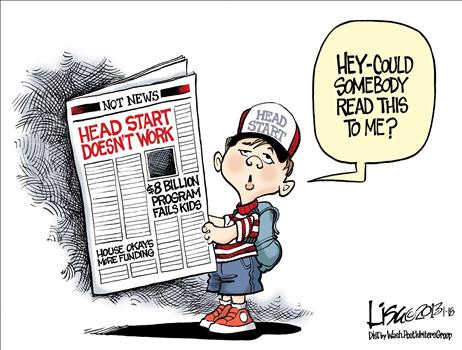
Head Start CartoonHere’s what the Washington Examiner wrote about the program, starting with an explanation of what the program is supposed to accomplish.

There are few institutions more sacrosanct in Washington than President Johnson’s Head Start program. The federal government spent more than $7.9 billion on the program in 2012 alone to provide preschool services for nearly 1 million low-income Americans. The program represents everything that is supposedly great about the liberal welfare state. It redistributes resources from wealthy to poor. It uses the power of the federal government to combat inequality by giving poor and minority students an educational boost before they fall behind their wealthier peers. There’s just one problem: It doesn’t work.

Is that an empty assertion? Nope, it’s the evidence from the government’s own research.

The ongoing randomized study of Head Start was based on a nationally representative sample of 5,000 children who applied for the program in 2002. Approximately half of the subjects received Head Start services, while the other half did not. The students were then tested on their language, literacy, math and school performance skills. …the 2010 Head Start Impact Study report notes, “the benefits of access to Head Start at age four are largely absent by 1st grade for the program population as a whole.” Specifically, the language, literacy, math and school performance skills of the Head Start children all failed to improve. …Now, the HHS has finally published a follow-up to its 2010 study that follows the same children through the end of third grade. And again, the HHS has concluded that Head Start is ineffective, concluding that Heat Start resulted in “very few impacts … in any of the four domains of cognitive, social-emotional, health and parenting practices.” And those impacts that were found “did not show a clear pattern of favorable or unfavorable impacts for children.”

So what’s this costing the nation (above and beyond the failure to improve the lives of children)?

Since 1965, the federal government has spent $180 billion on Head Start. …Does that sound like a program you’d want to spend $8 billion on next year?

Now imagine the good things that would have happened if that money was left in the economy’s productive sector.

Or, if you like government, but at least want good results, imagine the good things that would have happened if state and local governments shifted $180 billion from the failed school monopoly into genuine school choice programs.

But let’s close on an optimistic note. As far as I know, there’s no evidence that Head Start actually damages children. It’s just wasted money.

That’s a much better track record than other welfare state programs.

Related posts:

Milton Friedman’s views on vouchers have not been tried?

On the Arkansas Times Blog the person using the username “Jake da Snake” noted, “Friedman also railed long and hard for school vouchers to be adopted, to little avail…” (June 11, 2011). Milton Friedman firmly believed, “competition is a way in which both public and private schools can be required to satisfy their customers.” Here […]

Listing of transcripts and videos of Free to Choose by Milton Friedman: Episode “What is wrong with our schools?” on www.theDailyHatch.org

Everywhere school vouchers have been tried they have been met with great success. Why do you think President Obama got rid of them in Washington D.C.? It was a political disaster for him because the school unions had always opposed them and their success made Obama’s allies look bad. In 1980 when I first sat […]

The Welfare trap can be destroyed by Milton Friedman’s negative income tax

The best way to destroy the welfare trap is to put in Milton Friedman’s negative income tax. A Picture of How Redistribution Programs Trap the Less Fortunate in Lives of Dependency I wrote last year about the way in which welfare programs lead to very high implicit marginal tax rates on low-income people. More specifically, they […]

Listing of transcripts and videos of Free to Choose by Milton Friedman: Episode “What is wrong with our schools?” on www.theDailyHatch.org

Everywhere school vouchers have been tried they have been met with great success. Why do you think President Obama got rid of them in Washington D.C.? It was a political disaster for him because the school unions had always opposed them and their success made Obama’s allies look bad. In 1980 when I first sat […]

Dear Senator Pryor, why not pass the Balanced Budget Amendment? (“Thirsty Thursday”, Open letter to Senator Pryor, quotes Milton Friedman)

Broun Introduces Balanced Budget Amendment Uploaded by RepPaulBroun on Feb 23, 2010 No description available. _______________ Dear Senator Pryor, Why not pass the Balanced  Budget Amendment? As you know that federal deficit is at all time high (1.6 trillion deficit with revenues of 2.2 trillion and spending at 3.8 trillion). On my blog http://www.HaltingArkansasLiberalswithTruth.com I took […]

Listing of transcripts and videos of Free to Choose by Milton Friedman: Episode “What is wrong with our schools?” on www.theDailyHatch.org

Everywhere school vouchers have been tried they have been met with great success. Why do you think President Obama got rid of them in Washington D.C.? It was a political disaster for him because the school unions had always opposed them and their success made Obama’s allies look bad. In 1980 when I first sat […]