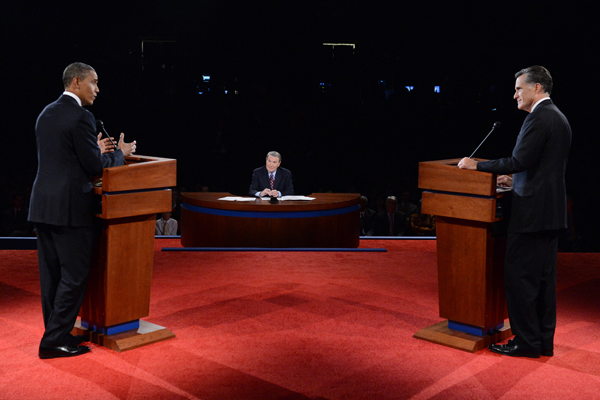
Setting the record straight on the first presidential debate is very easy if you are a reader of the Heritage Foundation website!!! Here are some examples below taken from Romina Boccia‘s excellent article from October 4, 2012:
During last night’s presidential debate, claims were flying fast and furious. Some of these claims were true, others false. Here are the top 10—see which ones you can guess as either true or false.
4. Romney would cut taxes by $5 trillion.
Obama: “Governor Romney’s central economic plan calls for a $5 trillion tax cut.”
False.Governor Romney’s tax plan doesn’t cut taxes. His plan is revenue neutral.
5. Dodd–Frank promises to bail out “too-big-to-fail” firms.
Romney: “Dodd–Frank was passed. And it includes within it a number of provisions that I think has some unintended consequences that are harmful to the economy. One is it designates a number of banks as too big to fail, and they’re effectively guaranteed by the federal government.”
6. The oil industry receives $4 billion in corporate welfare that other businesses don’t get.
Obama: “The oil industry gets $4 billion a year in corporate welfare. Basically, they get deductions that those small businesses that Governor Romney refers to, they don’t get.”
False.A large part of that $4 billion figure comes from a broadly available tax provision and expensing options. These are neither subsidies nor corporate welfare. The tax deduction, under Internal Revenue Code Section 199, goes to all domestic manufacturing. Producers of clothing, roads, electricity, water, renewable energy projects, and many other things produced in the United States are eligible for the manufacturer’s tax deduction—including Hollywood movies.
__________
Thank you so much for your time. I know how valuable it is. I also appreciate the fine family that you have and your commitment as a father and a husband.
Sincerely,
Everette Hatcher III, 13900 Cottontail Lane, Alexander, AR 72002, ph 501-920-5733, lowcostsqueegees@yahoo.com
FIRST PRESIDENTIAL DEBATE – Barack Obama VS Mitt Romney (Part 4)
Setting the record straight on the first presidential debate is very easy if you are a reader of the Heritage Foundation website!!! Here are some examples below taken from Romina Boccia‘s excellent article from October 4, 2012:
During last night’s presidential debate, claims were flying fast and furious. Some of these claims were true, others false. Here are the top 10—see which ones you can guess as either true or false.
1. Governor Mitt Romney’s tax plan would burden the middle class.
President Obama: “[I]ndependent studies looking at this said the only way to meet Governor Romney’s pledge of not reducing the deficit or—or—or not adding to the deficit is by burdening middle-class families.”
Former Governor Romney: “You’ve raised [taxes] by $1 trillion under Obamacare [and] cut Medicare by $716 billion.”
True.Over the coming decade, Obamacare’s taxes will reach $1 trillion, including new taxes on workers’ wages and capital income, as well as taxes on insurers and manufacturers of medical products. Obamacare also cuts Medicare by $716 billion from 2013 to 2022 and uses the savings to pay for other provisions in Obamacare, not to help shore up Medicare’s finances. Many of Obamacare’s 18 new or increased taxes and penalties would fall directly on the middle class—like the ever-controversial individual mandate tax, which is primarily paid by middle- and low-income Americans, as reported by the Congressional Budget Office.
3. Seniors would receive vouchers under Medicare reform.
Obama: “The idea, which was originally presented by Congressman Ryan, your running mate, is that we would give a voucher to seniors and they could go out in the private marketplace and buy their own health insurance.”
False.There is no premium support proposal that would issue seniors a voucher. The Ryan proposal, like all major premium support models, is a defined-contribution system that would provide direct payment from the government to a health plan of a person’s choice, including traditional Medicare. Health plans would have to meet government standards, including benefit standards of the traditional Medicare program, plus new and much-needed protections against the costs of catastrophic illness. Moreover, Congressman Ryan is not the first to propose premium support; its origins are bipartisan and date back to the 1990s.
_______
Thank you so much for your time. I know how valuable it is. I also appreciate the fine family that you have and your commitment as a father and a husband.
Sincerely,
Everette Hatcher III, 13900 Cottontail Lane, Alexander, AR 72002, ph 501-920-5733, lowcostsqueegees@yahoo.com
FIRST PRESIDENTIAL DEBATE – Barack Obama VS Mitt Romney (Part 2)
But let’s think of this from Julia’s perspective and speculate about what it will mean for her life. Shouldn’t we worry whether a life on the dole will destroy her spirit?
Or perhaps that question is too abstract, so let’s make it more personal. Would we ever want any of our children and grandchildren to become wards of the state, living empty and hollow lives of dependency and never achieving anything?
The answer is no, of course, because we want our loved ones to have good and happy lives.
So why, then, would anybody want to impose that fate on a stranger? And this isn’t an abstract question. That’s what the welfare state does, every day, over and over again, subsidizing poverty and sloth.
Now we have another video, this one from the folks at The Commentator, showing a news report from London that should anger all taxpayers. But it also should upset all people who care about rescuing people from government-induced emptiness.
I’m almost at a loss for words. At the risk of making sweeping judgments based on a short news clip, it appears that this poor woman’s life has been destroyed by government dependency.
And if you’re wondering how someone could ever allow themselves to be caught in the quicksand of the welfare state, don’t forget the story of Natalija, as well the expose about Danny and Gina. They are all healthy young people who made rational economic decisions to mooch since they could enjoy more comfortable lives.
Just in case you think that’s an isolated example, look at this remarkable chart revealing how life on the dole can be much more remunerative than a life of striving and work (you can see similar charts for the U.K. by clicking here).
Let’s return to the woman in the video. I confess that I’m a bit conflicted. Should I feel sorry for Ms. MacDonald or should I look down on her?
The government has wrecked her life with handouts, yet there are probably people just like her who made the choice to avoid dependency and climb out of poverty. If you believe in free will, then she deserves some scorn.
That being said, I’m much more willing to heap abuse on Natalija, Gina, and Danny. They’re young and they should know better. Then again, in 30 years, how will they be different from the woman in the video?
These questions don’t have any good answers, so let’s close with a few examples of how the welfare state subsidizes some truly odd behavior.
John Allison,President and Chief Executive Officer,Cato Institute
Arthur Brooks, President, AMerican Enterprise Institute
Dr. Edwin Feulner, President The Heritage Foundation
Moderator: Lawson Bader, President, Competitive Enterprise
____________
I hope the conservatives can get their message out better the next time around.
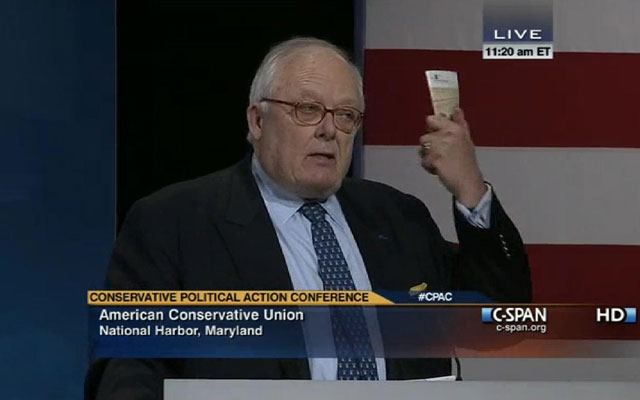
Ed Feulner speaks during his panel at the 40th Annual CPAC
How do conservatives continue to advance their ideas?
That was the big question answered by retiring Heritage President Dr. Ed Feulner, who led off a panel discussion also featuring the presidents of other leading think tanks at the Conservative Political Action Conference (CPAC) over the weekend.
“One of our objectives coming out of CPAC has to be to add and multiply, not to divide and subtract,” said Feulner. “We’ve got to be able to talk fundamentally about what we agree on, and about what’s best for all the American people in terms of opening up that ladder of opportunity.”
Arthur Brooks, president of the American Enterprise Institute, said that often, conservatives are too busy fighting about policy instead of fighting for people.
“We’re doing exactly what it takes to lose the argument,” said Brooks. “Do you want to win? Start fighting for people, instead of fighting against things.”
Feulner emphasized that think tanks have a significant role in demonstrating how conservative ideas help people.
“There are basically two kinds of politics in the United States. There is what we all worked in and were involved in last November, electoral politics. Then there is what we now have, policy politics: what happens after the guys and gals are elected and sworn in,” he said.
John Allison, president of the Cato Institute, said he was optimistic about the future of limited government and liberty, because progressive policies are unsustainable.
“They have made huge promises that cannot be fulfilled. They have offered something that is a big lie,” said Allison. “So one of our tasks is really helping people see that what’s being offered won’t work.”
Feulner said one of the ways think tanks can help demonstrate that conservatives care about people is to change how policy organizations measure success.
“We measure inputs—how many people work for us, what’s the size of our budget, all that. Then you go through a stage and you measure outputs—how many conferences did you have, how papers did you produce, how many times were your gals and guys on TV,” he said. “What we have to get to, is how do we measure outcomes?”
“You’ve got to personalize things,” said Feulner. “You can’t talk to people about billions and trillions. You’ve got to bring it down to real numbers.”
Nobel Laureate Dr. Milton Friedman discusses the principles of Ronald Reagan during this talk for students at Young America’s Foundation’s 25th annual National Conservative Student Conference
_______________
President Obama c/o The White House
1600 Pennsylvania Avenue NW
Washington, DC 20500
Passing the Balanced Budget Amendment would be what the founding fathers would have wanted. Look at what my favorite economist once said.
“The amendment is very much in the spirit of the first 10 amendments — the Bill of Rights. Their purpose was to limit the government in order to free the people. Similarly, the purpose of the balanced-budget-and-tax-limitation amendment is to limit the government in order to free the people — this time from excessive taxation.”
“The balanced budget amendment has good aspects, but it is simply not good enough in dealing with fundamental constitutional change for our country.” And thus with that 23-word statement in 1997, Democrat Sen. Robert Torricelli of New Jersey sunk conservative spirits. No longer did the U.S. Senate have the two-thirds it needed to enshrine a fundamental principle of governing into the highest law of the land: that politicians should pay for what they spend.
Controversial, I know. Pfft.
Due to Democrat Torricelli’s jellyfish backbone, the 1997 Balanced Budget Amendment fell one vote short of hitting the needed threshold, which was the same margin of failure as just one year before. And liberals couldnt have been happier. Their penchant for obligating the taxpayers of tomorrow to pay for the spending binges of today remained unbroken.
Not that the dissenting senators worded their objections that way. Nope. To Vermont’s incorrigible leftist Sen. Patrick Leahy, inserting a mechanism into the Constitution that would enable our government’s books to mirror the realities American businesses and families face daily was “bumper sticker politics” and “sloganeering.” The way toward rectifying Uncle Sam’s balance sheet was, according to Leahy, “political courage,” not tinkering with the Constitution. Thirty-three of Leahy’s Democratic colleagues agreed.
Mind-Boggling Debt
Of course, by “political courage,” Leahy didnt mean reforming our insolvent entitlement systems or abolishing many of the improvident, senseless, and unconstitutional government bureaucracies and programs in existence. Nah. He meant tax increases on the rich. You know the drill, people.
Prescience, however, is not a valued commodity in Washington, D.C., as lawmakers pursue policies that are in the best interest of their reelection, not of the republic.
When the balanced budget amendment failed in 1997, the federal deficit stood at just $22 billion and the national debt hovered around 5.5 trillion — meager compared with today’s obscene figures, where we have a deficit topping $1.6 trillion this year alone accompanied by a mind-boggling debt of $14 trillion and growing.
To put our debt in perspective, Kobe Bryant makes $25 million playing for the Los Angeles Lakers. Any guesses on how many seasons Kobe would have to play in order to pay off today’s national debt? How about a whopping 560,000. That’s chilling, and quite frankly, incomprehensible.
Heck, we’ve run deficits in 54 of the last 60 years, as the National Taxpayer Union points out. That’s a figure that would make Keynes himself blink.
Ironically, Leahy was on the right track when he spoke of the need for political courage. This country desperately needs it, but it must manifest itself in the form of politicians who will defend the property rights of all Americans as opposed to the current lawmaking that treats this nation’s treasury as a personal ATM card.
The brute political courage we need is for politicians to plug Congress’s desire to ransack the appropriations process to engineer winners and losers in the marketplace and thus perpetuate a class of constituents whose inspiration to vote is driven by keeping the government gravy train on a track straight to their bank accounts.
Thanks to the midterm elections, the time for real political courage is now: The balanced budget amendment is making a comeback thanks to one veteran and one freshman senator.
“The people are calling for it. They are clamoring for it. They’re demanding it,” said newly elected Utah Sen. Mike Lee, who has 19 of his colleagues, including Jim DeMint and Rand Paul, rallying in support of his balanced budget amendment. “The American people overwhelmingly demand it, and if members of Congress value their jobs, they are going to vote for it,” he told Human Events in an exclusive interview.
Lee’s a Tea Party faithful who believes his job boils down to this bare-bones task: produce a government in the original mold of the Constitution, which is to say, one whose legislative reach is restricted and clearly defined. In other words, a federal government that looks absolutely nothing like what we have today.
Opportune Time Needed
Lee is so intent on getting a vote on his balanced budget amendment that he’s ready to filibuster the vote on whether or not to raise the debt ceiling as a tactical move.
“I can tell you that there are a lot of people who will not even consider it [a vote on the debt limit] without a balanced budget amendment first being proposed by Congress,” he said emphatically.
That’s certainly one approach — to hold the Senate hostage until real, austere statutory spending limits are adopted.
Utah’s senior Sen. Orrin Hatch doesnt see it that way. He’s looking for a vote on his balanced budget amendment too, but at a time believed to be the most opportune for passage. He hasn’t set firm timetables or made any strict demands.
“You have to have a bipartisan vote. You have to have a President that does care, and you have to have a setting in time where people can’t do anything but vote for it,” Hatch explained. “Right now, I don’t think we have that.”
If youre keeping score, the two senators from Utah both have competing balanced budget amendments floating around the Senate. In some ways, these jockeying amendments are a reflection of the Tea Party being a big kid on the block within the GOP.
Hatch, though, has been in the Senate for more than three decades, and is confident that he can get a balanced budget amendment through, which is why he’s taking a softer tone and insisting on waiting for the best moment to accomplish that.
And there’s something to be said for Hatch’s, well, “political,” approach. He’s shepherded the balanced budget amendment since 1982, when it was approved in the Senate, but torpedoed in the House by then-Speaker Tip O’Neill. And, as noted above, Hatch came painstakingly close twice in the Senate, both in 1996 and 1997.
“It’s every bit as difficult now, but it’s important that we bring it up and that we make all the strides we can,” he said.
The long-serving senator has 32 co-sponsors for his bill, including Chuck Grassley of Iowa, who is the ranking member on the Judiciary Committee.
When it comes down to it, both Hatch and Lee’s amendments have the same goal: ending profligate spending. In fact, as Nobel Laureate James Buchanan said, “The balanced budget norm is ultimately based on the acceptance of the classic principles of public finance, meaning that politicians shouldn’t spend more than they are willing to generate in tax revenues, except during periods of extreme and temporary emergency.”
Wait, why is this concept controversial again? Because it handcuffs Big Government believers from exerting influence over our personal decision making, thats why.
Courts Involved
There are notable differences between the balanced budget amendments of Hatch and Lee, which we lay out in detail in the accompanying chart. While Mike Lee would restrict government spending to 18% of the gross domestic product (GDP), Hatch’s limits the figure to 20%. The 40-year average of tax receipts to GDP is around 18%, and Hatch knows this to be the case, but, to quote him, “If you get it too low, then you lose any chance with the Democrats.” And that, right there, encapsulates the internal friction the GOP will face with this budding Tea Party caucus going head-to-head with those who are willing to work with Democrats to deliver a final product.
But there’s more: Hatch’s proposal allows a simple majority vote to waive the balanced budget requirement when there’s a declaration of war or a designated military conflict, whereas Lee’s amendment provides no such exception. His threshold is much higher — a two-thirds vote.
When aren’t we in a military conflict? Lee quips.
There are also differences in the enforcement mechanism. Lee would grant standing in federal court to members of Congress if flagrant violations of the amendment occur. Hatch doesnt want the courts anywhere near enforcement, believing that public pressure placed on politicians instead provides the best form of accountability. Plus, “Who wants the courts doing it?” asked Hatch, alluding to their predilection toward activism.
Lee himself acknowledges that court intervention would be rare, but that the mere possibility that it could occur would add some additional incentive to Congress to make sure that it stays within their restrictions.
So far, so good.
But procedurally, how would our gargantuan budget ever get balanced? We’re dealing with trillions of dollars here, after all, a highly complex web of arithmetic. Congress must make a good-faith effort, say Hatch and Lee, to use the best possible projections of spending and receipts. Even with the accurate projections, economic conditions change throughout the year that may inhibit the Feds’ budget from being balanced, such as underestimating costs, which happens more frequently than not these days. If such a scenario plays out, and a fiscal year does end with a deficit, such spending cuts can be incorporated into the next fiscal year’s budget and make up the difference on the back end. Under both plans, by the way, two-thirds of Congress would be needed to raise taxes, so it would be more likely than not that the budget would be balanced by spending cuts, not tax increases.
Hey, were all game for that.
Naturally, getting a balanced budget amendment adopted as part of the Constitution will not be an easy feat. And not because of the numerical hurdles and multiple steps needed to get any amendment through the Constitution (the process should be difficult). It’s because Democrats will kick and scream over the severe cuts to spending that would ensue after the adoption of a balanced budget amendment.
Heck, Senate Majority Leader Harry Reid and his left-wing posse went apoplectic at a proposed spending reduction of $61 billion over the next seven months, calling it “extreme” and “draconian.” Just $61 billion. Thats it. To realize just how absurd such objections were, $61 billion is only a one-third of the money needed to cover the interest payments for U.S. bondholders this year alone.
Imagine when formal debate begins on the need to cut trillions in spending to rein in our deficit? Democrats may cut off their right arms in protest.
“This is exhibit A for why we need a balanced budget amendment,” responded Lee. “Politicians have reached the conclusion that they are the bad guys unless they say ‘yes’ to more spending, and it’s in light of that aspect of human nature that particularly tends to affect politicians, and that’s why we need a constitutional amendment.”
Unified GOP Caucus
“If this is going to get passed in the next two years,” says Hatch, “President Obama will have to step to the plate. Ultimately you’ll need presidential leadership because everybody knows that you’re not going to get spending under control until we take on entitlements as well. You cannot do it without presidential leadership.”
Remider: There’s always new presidential leadership come 2012. Well, we hope so anyway.
In the end, expect the GOP to have a unified caucus on a merger of the Hatch and Lee balanced budget amendments. It’s hard enough (almost impossible) to get one through when Democrats are in control of the Senate and the presidency, so the Republicans will need a unified front like they’ve had in the past.
A balanced budget amendment restricts the power of lawmakers, and that’s why the left despises it, and will work vigorously to defeat it. Get ready.
In the end, it is exactly what the Constitution needs. And esteemed economist Milton Friedman identified why two decades ago.
Said Friedman: “The amendment is very much in the spirit of the first 10 amendments — the Bill of Rights. Their purpose was to limit the government in order to free the people. Similarly, the purpose of the balanced-budget-and-tax-limitation amendment is to limit the government in order to free the people — this time from excessive taxation.”
If we cannot cut the Welfare State under these distressing economic conditions, then we’ll never do it. Now’s the time.
____________
Thank you so much for your time. I know how valuable it is. I also appreciate the fine family that you have and your commitment as a father and a husband.
Sincerely,
Everette Hatcher III, 13900 Cottontail Lane, Alexander, AR 72002, ph 501-920-5733, lowcostsqueegees@yahoo.com
Why do I keep writing and email Senator Pryor suggestions on how to cut our budget? I gave him hundreds of ideas about how to cut spending and as far as I can tell he has taken none of my suggestions. You can find some of my suggestions here, here, here, here, here, here, here, here, here, here, here, here, here, here, here, here, here, here, here, here, and here, and they all were emailed to him. In fact, I have written 13 posts pointing out reasons why I believe Senator Pryor’s re-election attempt will be unsuccessful. HERE I GO AGAIN WITH ANOTHER EMAIL I JUST SENT TO SENATOR PRYOR!!!
Dear Senator Pryor,
Why not pass the Balanced Budget amendment? As you know that federal deficit is at all time high (1.6 trillion deficit with revenues of 2.2 trillion and spending at 3.8 trillion).
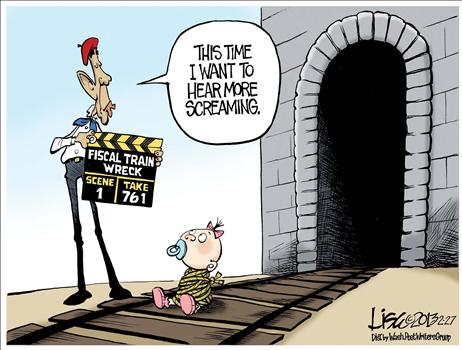
On my blog www.thedailyhatch.org . I took you at your word and sent you over 100 emails with specific spending cut ideas. (Actually there were over 160 emails with specific spending cut suggestions.) However, I did not see any of them in the recent debt deal that Congress adopted although you did respond to me several times. Now I am trying another approach. Every week from now on I will send you an email explaining different reasons why we need the Balanced Budget Amendment. It will appear on my blog on “Thirsty Thursday” because the government is always thirsty for more money to spend. Today I actually have included a great article below from the Heritage Foundation concerning an area of our federal budget that needs to be cut down to size. The funny thing about the Sequester and the 2.4% of cuts in future increases is that President Obama set these up and then he acted like the sky was falling in as the cartoons indicate in the newspapers.
IF YOU TRULY WANT TO CUT THE BUDGET AND BALANCE THE BUDGET THEN SUBMIT THESE POTENTIAL BUDGET CUTS PRESENTED BELOW!!
The Environmental Protection Agency (EPA) announced plans to furlough all of its employees and shut down for three days this year to absorb sequestration’s spending cuts. But the sequester cuts do not have to lead to shutdowns.
Heritage has highlighted the EPA’s track record of wasting taxpayer dollars on projects ranging from the ineffective to the absurd in its Federal Spending by the Numbers 2012 report. For example, the EPA:
Awarded a $141,450 grant under the Clean Air Act to fund a Chinese study on pig manure;
Funded a $67,926 poster contest at just one college, Syracuse University, that yielded fewer than 10 entries; and
Gave $1.2 million to the United Nations for the “promotion” of so-called clean fuels.
If only the waste ended there. In 2012 the EPA spent nearly $3.7 million on 20 conferences with price tags above $100,000—an average of $182,847 per conference. Further, a recent Inspector General report revealed that the EPA has 430,000 square feet of underutilized space, which costs taxpayers more than $20 million annually.
Such examples are low-hanging fruit, but more costly agency initiatives could be eliminated, too. For example, the EPA awarded $1.5 billion in federal grants for cellulosic ethanol producers (fuel made out of wood chips and grass clippings) and issued a production mandate of 500 million gallons of this fuel by 2012.
Demand for ethanol is contrived; it exists only because Congress and the President have mandated its use. And because government created the demand—not the market—taxpayers must subsidize its production. Such subsidies waste taxpayer money and distort market activity.
Heritage experts Jack Spencer, Nicolas Loris, and Katie Tubb argue instead for freedom-based reforms, writing that Congress should:
Prohibit the EPA from regulating carbon dioxide, saving families who rely on the 82 percent of the energy used in the United States that produce greenhouse gases;
Stop the EPA’s regulatory overreach, which is artificially driving the cost of energy higher, harming job creation, and providing little to no environmental benefit; and
Repeal the EPA’s energy efficiency initiatives, which drive up gas prices and restrict consumer choice.
Such reforms would save taxpayers money by reducing the scope of the EPA’s ever-expanding mission, and they would also serve the needs of the economy by lightening the heavy regulatory burden on America’s businesses.
In the meantime, given the tremendous harm that the EPA’s overreaching agenda has on job creation and the economy, if its plans to furlough employees for a few days come to pass, the entire country just might actually be better off.
__________
From Dan Mitchell’s blog:
Last but not least, Lisa Benson makes fun of Obama for his never-ending efforts to instill panic.
Let’s keep our fingers crossed that the sequester happens on March 1. Then, even if the Obama Administration deliberately tries to cause inconvenience for the American people, we’ll see that the world doesn’t come to an end.
The Balanced Budget Amendment is the only thing I can think of that would force Washington to cut spending. We have only a handful of balanced budgets in the last 60 years, so obviously what we are doing is not working. We are passing along this debt to the next generation. YOUR APPROACH HAS BEEN TO REJECT THE BALANCED BUDGET “BECAUSE WE SHOULD CUT THE BUDGET OURSELF,” WELL THEN HERE IS YOUR CHANCE!!!! SUBMIT THESE CUTS!!!!
Thank you for this opportunity to share my ideas with you.
The problem with the debt ceiling is very clear to me. We need to get serious about cutting federal spending. I am so upset about it that I have emailed over 100 emails to Senator Pryor concerning specific spending suggestions. I get emails from back from Senator Pryor like the one below. This means that […]
Senator Pryor asks for Spending Cut Suggestions! Here are a few!(Part 164) Senator Mark Pryor wants our ideas on how to cut federal spending. Take a look at this video clip below: Senator Pryor has asked us to send our ideas to him at cutspending@pryor.senate.gov and I have done so in the past and will continue to […]
Senator Pryor asks for Spending Cut Suggestions! Here are a few!(Part 163) Senator Mark Pryor wants our ideas on how to cut federal spending. Take a look at this video clip below: Senator Pryor has asked us to send our ideas to him at cutspending@pryor.senate.gov and I have done so in the past and will continue to […]
Senator Pryor asks for Spending Cut Suggestions! Here are a few!(Part 162) Senator Mark Pryor wants our ideas on how to cut federal spending. Take a look at this video clip below: Senator Pryor has asked us to send our ideas to him at cutspending@pryor.senate.gov and I have done so in the past and will continue to […]
Three very good video tours below from Senator Mark Pryor. Published on Jun 13, 2012 by SenatorPryor Episode 1: Arkansans in the Capitol Published on Jul 9, 2012 by SenatorPryor Episode 2: The Crypt and the Old Supreme Court Published on Aug 20, 2012 by SenatorPryor Episode 3: The Senate Chamber If you want to […]
Senator Pryor asks for Spending Cut Suggestions! Here are a few!(Part 161) Senator Mark Pryor wants our ideas on how to cut federal spending. Take a look at this video clip below: Senator Pryor has asked us to send our ideas to him at cutspending@pryor.senate.gov and I have done so in the past and will continue to […]
Senator Mark Pryor wants our ideas on how to cut federal spending and I sent them to him but he didn’t take any of my suggestions. However, he did take time to get back to me today, but I am not too impressed with Senator Pryor’s response. I gave him hundreds of ideas about how […]
Senator Pryor asks for Spending Cut Suggestions! Here are a few!(Part 160) Senator Mark Pryor wants our ideas on how to cut federal spending. Take a look at this video clip below: Senator Pryor has asked us to send our ideas to him at cutspending@pryor.senate.gov and I have done so in the past and will continue to […]
Senator Pryor asks for Spending Cut Suggestions! Here are a few!(Part 159) Senator Mark Pryor wants our ideas on how to cut federal spending. Take a look at this video clip below: Senator Pryor has asked us to send our ideas to him at cutspending@pryor.senate.gov and I have done so in the past and will continue to […]
Senator Mark Pryor wants our ideas on how to cut federal spending. Take a look at this video clip below: Senator Pryor has asked us to send our ideas to him at cutspending@pryor.senate.gov and I have done so in the past and will continue to do so in the future. On May 11, 2011, I emailed to […]
Office of the Majority Whip | Balanced Budget Amendment Video In 1995, Congress nearly passed a constitutional amendment mandating a balanced budget. The Balanced Budget Amendment would have forced the federal government to live within its means. This Balanced Budget Amendment failed by one vote. 16 years later, Congress has the chance to get it […]
Sadly Senator Pryor has voted against the Balanced Budget Amendment over and over in his long time in the Senate. Senator Pryor: “There are a lot of people who think a balanced-budget amendment solves all the fiscal problems. I completely disagree.” (Peter Urban, Pryor Tilts Balanced Budget, Southwest Times Record, 11/17/11) Dear Senator Pryor, Why […]
Mark Levin and Senator Hatch discuss the balanced budget amendment and it’s importance. Uploaded by loveconstitution on Jan 28, 2011 Mark Levin interviews Senator Hatch 1/27/2011 about the balanced budget amendment. Mark is very excited about the balanced budget amendment being proposed by Senator Orin Hatch and John Cornyn and he discusses the amendment with […]
Dr. Jay Barth with Hendrix College comments on our latest poll results on Arkansas politics (clip from Talkbusiness) Talk Business reported today in the article “Poll Shows Beebe Strength, Pryor Shaky,” the following: A new Talk Business-Hendrix College Poll shows Gov. Mike Beebe (D) maintaining his high job approval rating, while Sen. Mark Pryor (D) […]
U.S. Sen. Mark Pryor at the 2009 Democratic Party Jefferson Jackson Dinner, Arkansas’s largest annual political event. Mark Pryor is up for re-election to the Senate in 2014. It is my opinion that the only reason he did not have an opponent in 2008 was because the Republicans in Arkansas did not want to go […]
Michael Tanner, a senior fellow at the CATO institute, explains that the rate of return on social security will be much lower for todays youth. Steve Brawner wrote in his article “Tiptoeing toward the third rail,” (Arkansas News Bureau, Jan 9,): Social Security has long been considered the “third rail” for American politicians, meaning it’s […]
HALT:HaltingArkansasLiberalswithTruth.com CBS — October 19, 2010 — New York Times’ Jeff Zeleny talks to Jan Crawford about the state of Democrats in the South… Are they a dying species? In the article “Southern Democrat much closer to extinction after GOP wave,” (Washington Times, Nov 4, 2010), Ben Evans notes: After this week’s elections, the […]
HALT:HaltingArkansasLiberalswithTruth.com Roland Martin appears on Rick’s List with Rick Sanchez and the Best Political Team on television (Candy Crowley, John King, Jeffery Toobin, Ed Rollins, Gloria Borger and Victoria Toensing) to discuss day two of the Elena Kagan Supreme Court confirmation hearings. During the analysis, Senator Graham and Elena Kagan had an interesting exchange over […]
My hero Milton Friedman was a big supporter of the Balanced Budget Amendment and in an article on this subject in 1983 he wrote:
“The key problem is not deficits but the size of government spending. […] I have never supported an amendment directed solely at a balanced budget. I have written repeatedly that while I would prefer that the budget be balanced, I would rather have government spend $500 billion and run a deficit of $100 billion than have it spend $800 billion with a balanced budget. It matters greatly how the budget is balanced, whether by cutting spending or by raising taxes.”
As a member of the Conservative Action Project, CEO Susan Carleson and leaders of 28 other organizations, representing a broad cross section of the conservative movement, are united in supporting a Balanced Budget Amendment that actually reins in national spending and increasing our national debt – without raising taxes.
MEMO FOR THE MOVEMENT: A Balanced Budget Amendment — in addition to balancing the budget — should make it difficult to raise taxes, tough to increase the debt, and prohibit any court from ordering a tax increase or deciding budget priorities.
“I wish it were possible to obtain a single amendment to our Constitution. I would be willing to depend on that alone for the reduction of the administration of our government; I mean an additional article taking from the Federal Government the power of borrowing.”
Thomas Jefferson, 1798
RE: In accordance with the Budget Control Act of 2011, sometime between October 1 and December 31, 2011 both houses of Congress must vote on a balanced budget amendment (BBA) to the U.S. Constitution. It is important that any such amendment must protect taxpayers by not forcing automatic tax increases to keep revenues in line with rising expenditures. Our fiscal problems are caused not by under taxation–but by over-spending.
ISSUE-IN-BRIEF: Not all balanced budget Amendments were created equal. The most comprehensive BBA proposed is S.J. Resolution 10 co-sponsored by all 47 Republican members of the United States Senate. It caps spending at 18% of GDP; requires a 2/3 vote of congress to raise taxes; requires a 3/5 vote of congress to increase the debt ceiling; and prohibits any court from ordering an increase in taxes. Proposed BBA’s that do less can have the unintended effect of managing a tax increase instead of limiting spending and would be counter-productive and must be opposed.
A STRONG BBA MUST BE EASY TO UNDERSTAND AND NOT HAVE LOOPHOLES:
Require a Balanced Budget every year: The federal debt is on track to consume our country’s entire Gross Domestic Product. The BBA would force Washington to live within its means.
Prohibit Perpetual Deficit Spending: Deficit spending is a tax on future earnings.
A debt ceiling will actually be a ceiling: The debt ceiling has been raised 11 times in the past decade. S.J. 10–co-sponsored by 47 members of the U.S. Senate– would require a three-fifths majority in both chambers to raise the debt ceiling. This is also an important provision to prevent cheating and other budget gimmicks because actual spending cannot exceed actual revenue for long without hitting the debt limit.
Congress may waive BBA requirement by simple majority if a declaration of war is in effect; and it would require a three-fifths majority to waive if the country is engaged in a military conflict that causes an imminent and serious military threat to our national security.
Courts setting any budget priorities would be a problem. Court-ordered military cuts or activist “declaratory judgments” requiring increased welfare spending would also be intolerable. S.J. 10 can be improved with an explicit ban on courts exercising jurisdiction on any of these essential political questions.
A “Weak” BBA will increase the size of Government and pave the way for Tax Increases:
Unlike other proposals, such as a “Weak” BBA, not only should a BBA have a supermajority requirement to raise taxes, there should be no loopholes for creative accounting.
Without a limitation on tax increases and a specific prohibition on courts ordering revenue increases a “Weak” BBA would allow judges the power to implement higher taxes to bring the budget into balance.
A “Weak” BBA would allow a simple majority of Members of Congress to raise the federal debt ceiling and continue to borrow against future generations. That’s why there is a three-fifths majority requirement to raise the debt ceiling in S.J. 10
Why the Tax Hike Limitation Component is Important to any BBA:
“The key problem is not deficits but the size of government spending. […] I have never supported an amendment directed solely at a balanced budget. I have written repeatedly that while I would prefer that the budget be balanced, I would rather have government spend $500 billion and run a deficit of $100 billion than have it spend $800 billion with a balanced budget. It matters greatly how the budget is balanced, whether by cutting spending or by raising taxes.”
Americans Support a Balanced Budget Amendment:
Americans have always overwhelmingly support a balanced budget amendment. A Fox News poll (June 30), shows support is 72-20.
On Message, Inc., on behalf of Let Freedom Ring, shows 81% of the American people (including 74% of Democrats) support Congress balancing their budget every year. In addition 66% of Americans favor capping federal spending at the historically average 18% of GDP.
“Of course, the best way to permanently reduce spending would be to enact a balanced-budget amendment to the Constitution requiring a supermajority in both houses of Congress to run an annual deficit, raise tax rates, or increase the debit ceiling.”
James A. Baker III, Ronald Reagan’s Secretary of the Treasury from 1985-1988
_____________
Thank you so much for your time. I know how valuable it is. I also appreciate the fine family that you have and your commitment as a father and a husband.
Sincerely,
Everette Hatcher III, 13900 Cottontail Lane, Alexander, AR 72002, ph 501-920-5733, lowcostsqueegees@yahoo.com
Ronald Reagan was a firm believer in the Balanced Budget Amendment and Milton Friedman was a key advisor to Reagan. Friedman’s 1980 film series taught the lesson of restraining growth of the federal budget.
Vital changes needed to keep road to further reforms open
There is a problem brewing in the House of Representatives of which most conservatives in and outside Congress are largely unaware. It has to do with H.J. Res. 1 – the balanced budget amendment – soon to be voted on per the debt-ceiling “deal” struck by Congress and the president. While H.J. Res. 1 is a solid first effort – and we have urged support for it as a symbolic vote – it is possibly fatally flawed and should be revised.
After years of indifference to constitutional fiscal discipline, Congress is once again stirring. In 1982, then-President Ronald Reagan, convened a federal amendment drafting committee led by Milton Friedman, Jim Buchanan, Bill Niskanen, Walter Williams and many others, and fashioned Senate Joint Resolution 58, a tax limitation-balanced budget amendment, which garnered 67 votes in the Senate under the able leadership of Sen. Orrin G. Hatch, Utah Republican. After a successful discharge petition forced a House vote, the amendment failed to achieve the two-thirds vote necessary in a Tip O’Neill-Jim Wright-controlled House. In 1996, Newt Gingrich and company came within one vote of passing a fiscal amendment in the House.
Currently, H.J. Res. 1 is designed as a classic balanced budget amendment in which outlays can be as great as, but no more than, receipts for that year. However, it requires an estimate of receipts, which is notoriously faulty, and it does not necessarily produce surpluses with which to pay down our massive debt. Furthermore, it contains a second limit on outlays – “not more than 18 percent of the economic output of the United States” – without defining such output or resolving the inevitable conflict between the outlay calculations in the two provisions.
This could be fixed by restructuring the amendment as a spending or outlay limit based on prior year receipts or outlays (known numbers), adjusted only for inflation and population changes. This will produce surpluses in most years with which to pay down debts and will reduce government spending as a share of gross domestic product over time, right-sizing government and increasing the rate of economic growth for the benefit of all citizens, especially those least able to compete.
Section 4 of H.J. Res. 1 might best be described as a supreme example of the law of unintended consequences. This section imposes on the president a constitutional responsibility to present a balanced budget. Surely, the drafters were saying to themselves “We’ll fix that guy in the White House. Now he will have to fess up and either propose specific tax increases or specific spending cuts. He won’t be able to duck reality any longer.” The only problem is that this section is at odds with our Constitution in that it gives the president a constitutional power over fiscal matters never intended by the Founders.
For much of our history, the president did not propose a budget. In the Budget and Accounting Act of 1921, which established the Bureau of the Budget, now the Office of Management and Budget and the General Accounting Office, the president was statutorily authorized to propose a budget. Presidents have always shaped the budget and spending using their negotiating opportunities and veto pen. Wearing their chief administrator hat, earlier presidents sought to save money from the amounts appropriated by Congress, getting things done for less, impounding funds they did not think essential to spend. Congress‘ ceiling on an appropriation was not also the spending floor for the president, as it is now.
Section 4 appears to give the president co-equal power with Congress not only to present a budget but to shape it, in conflict with congressional budget authority. At a minimum, it is likely to create a conflict over the amount of allowed annual spending. The president surely will be guided by his own Office of Management and Budget, whose budget and receipts calculations will undoubtedly differ from the Congressional Budget Office’s numbers that will direct Congress. We should not start the budget process each year with this kind of conflict.
It would be better to restore the historic role of the president to impound and otherwise reduce expenditures by repealing and revising appropriate portions of the Congressional Budget and Impoundment Control Act of 1974 so a fiscally conservative president is a revitalized partner in cutting the size of government.
Section 5 requires a supermajority vote for “a bill to increase revenues.” Whether one agrees or disagrees with making tax increases more difficult, this language is troublesome because it requires some government bureaucrat or bureaucracy to make a calculation or estimate of the effect of tax law changes on revenues. Proponents of a bill to increase cash flow to the government will argue that their tax law changes are “revenue neutral” and will likely persuade the Joint Committee on Taxation or Congressional Budget Office to back them up. Once again, estimators would be in control.
If we ever expect to convert our income-based tax system to a consumption tax, better not to require a two-thirds vote as liberals will use such a supermajority voting rule to stymie tax system reform.
There are other issues, as well, with debt limit and national emergency supermajority votes and definitions. While this balanced budget amendment – H.J. Res. 1 – has deserved a “yes” vote as a demonstration of commitment to constitutional fiscal discipline, it can and must be revised before the showdown vote in the House this fall.
Lewis K. Uhler is president of the National Tax Limitation Committee.
_________________
Thank you so much for your time. I know how valuable it is. I also appreciate the fine family that you have and your commitment as a father and a husband.
Sincerely,
Everette Hatcher III, 13900 Cottontail Lane, Alexander, AR 72002, ph 501-920-5733, lowcostsqueegees@yahoo.com
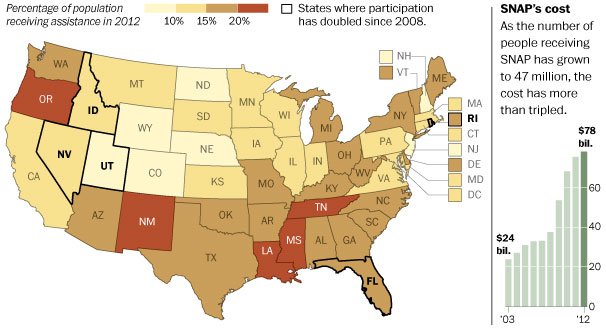
One way of measuring the cost of the program, both to taxpayers and to the people who get trapped in dependency, is to see what share of a state’s population is utilizing the program.
A couple of things stand out. I can understand Mississippi, Louisiana, and New Mexico being among the worst states because they have relatively low average incomes. And that’s sort of an excuse for Tennessee, though it’s worth noting that economically and demographically similar states such as Georgia and Alabama don’t fall into the same dependency trap.
Why such a significant handout culture?
But the state that stands out is Oregon. Based on the state’s income, there’s no reason for more than 20 percent of resident’s to be on the dole. The state does get a “high” ranking on the Moocher Index, so there’s some evidence of an entitlement mentality. And welfare handouts also are above average in the Beaver State as well.
It’s also disappointing to see that food stamp dependency has doubled since 2008 in Florida, Rhode Island, Nevada, Utah, and Idaho. Though it’s a credit to the people of Utah that they’re still in the least-dependent category. But the trend obviously is very bad.
And it’s also depressing to look at the bar chart on the right and see that spending on the program has tripled in the past 10 years. Heck, food stamps were about 70 percent of the cost of a recent Senate “farm bill.”
P.S. A local state legislator asked an official in Richmond why Virginia got such a bad score in the ranking of teachers compared to education bureaucrats. The good news, so to speak, is that Virginia is not as bad as suggested by the official numbers. According to the response sent to this lawmaker, “VDOE has determined that the data it reported on school division personnel and assignments to NCES for 2005-2006 through 2009-2010 through the US Department of Education’s EdFacts Portal were inaccurate.”
The bad news, as you can see from this table, is that there are still more edu-crats than teachers, but the ratio apparently isn’t as bad with this updated data.
P.P.S. I guess I should give the left-wing Washington Post some credit for sharing the map on food stamp dependency. And, to be fair, the paper did reprint this remarkable chart showing how bad Obama’s record is on jobs compared to Reagan and Clinton. And the paper also printed this chart showing how the economy’s performance is way below average under Obama.
With a target-rich environment of waste, fraud, and abuse in Washington, that wasn’t an easy question to answer. But I decided to pick the Department of Housing and Urban Development, and I had some good reasons for that choice.
Well, thanks to the sequester, we can say that we’ve achieved 1.9 percent of our goal. Here are some blurbs from a Reuters report.
The U.S. Department of Housing and Urban Development on Monday said it plans to shut its doors for a total of seven days between May and September due to budget cuts and will furlough more than 9,000 employees on those days. …The agency will determine the exact shutdown dates at a later time.
The motto of special interests
This is what I call a good start.
You won’t be surprised to learn, though, that the bureaucracy is whining that these tiny cutbacks will have horrible effects.
In cataloging the impact of sequestration to a Senate panel last month, HUD Secretary Shaun Donovan warned lawmakers that the government spending cuts would have harsh consequences for housing programs and could threaten Superstorm Sandy recovery efforts in the U.S. Northeast. “The ripple effects are enormous because of how central housing is to our economy,” Donovan told lawmakers.
Well, I hope that the “cuts” will have “harsh consequences for housing programs.” I’ve read Article I, Section VIII, of the Constitution, and nowhere does it say that housing is a function of the federal government.


 To put our debt in perspective, Kobe Bryant makes $25 million playing for the Los Angeles Lakers. Any guesses on how many seasons Kobe would have to play in order to pay off today’s national debt? How about a whopping 560,000. That’s chilling, and quite frankly, incomprehensible.
 Utah’s senior Sen. Orrin Hatch doesnt see it that way. He’s looking for a vote on his balanced budget amendment too, but at a time believed to be the most opportune for passage. He hasn’t set firm timetables or made any strict demands.
 “If this is going to get passed in the next two years,” says Hatch, “President Obama will have to step to the plate. Ultimately you’ll need presidential leadership because everybody knows that you’re not going to get spending under control until we take on entitlements as well. You cannot do it without presidential leadership.”


 Why such a significant handout culture?

 The motto of special interests
 Most worthless department in Washington?


 The Daily Hatch