Back in 2010, I put together a “Moocher Index” as a rough measure of which states had the highest levels of welfare dependency after adjusting for poverty rates.
My goal was to answer this question.
Is there a greater willingness to sign up for income redistribution programs, all other things being equal, from one state to another?
It turned out that there were huge differences among states. Nearly 18 percent of non-poor Vermont residents were utilizing one or more welfare programs, putting them at the top of the Moocher Index.
In Nevada, by contrast, less the 4 percent of non-poor residents had their snouts in the public trough.
Does this mean Nevada residents are more self-reliant and Vermont residents are culturally statist?
To be perfectly frank, I don’t know, in part because the Moocher Index was an indirect measure of attitudes about dependency.
So I was very interested when I came across some state-by-state numbers from the Department of Agriculture showing food stamp participation compared to food stamp eligibility.
There are some clear similarities between these food stamp numbers and the Moocher Index. Maine and Vermont are in the top 3 of both lists, which doesn’t reflect well on people from that part of the country.
And Nevada and Colorado are in the bottom 10 of both lists.
But there’s no consistent pattern. Mississippi and Hawaii are in the top 10 of the Moocher Index but bottom 10 for food stamp utilization.
What really stands out, though, is that the people of California win the prize for self reliance, at least with regard to food stamps. Only 55 percent of eligible people from the Golden State have signed up for the program. Doesn’t make sense when you look at some of the crazy things that are approved by California voters, but I assume the numbers are accurate.
I’m also surprised that folks from New Jersey are relatively unlikely to utilize food stamps.
On the other hand, why are Tennessee residents so willing to use my wallet to buy food?
Oregon, not surprisingly, always does poorly, whether we’re looking at a map or a list.
Let’s close with a few real-world examples of what we’re getting in exchange for the tens of billions of dollars that are being spent each year for food stamps.
I have written about the tremendous increase in the food stamp program the last 9 years before and that means that both President Obama and Bush were guilty of not trying to slow down it’s growth. Furthermore, Republicans have been some of the biggest supporters of the food stamp program. Milton Friedman had a […]
I have put up lots of cartoons from Dan Mitchell’s blog before and they have got lots of hits before. Many of them have dealt with the economy, eternal unemployment benefits, socialism, Greece, welfare state or on gun control. Big government will destroy the human spirit. Political Cartoon: Smothered by Big Government December 16, 2011 by Dan Mitchell […]
Welfare state may drag England down the tubes!!!! Very Funny but Very Un-PC British Video on Welfare and Immigration May 19, 2013 by Dan Mitchell I’ve shared this bit of political incorrect terrorism humor from England, as well asthis somewhat un-PC bit of tax humor. But perhaps motivated by the scandal of giving welfare to terrorists, this new video is […]
I have put up lots of cartoons from Dan Mitchell’s blog before and they have got lots of hits before. Many of them have dealt with the economy, eternal unemployment benefits, socialism, Greece, welfare state or on gun control. Reagan inherited a sluggish economy like President Obama did but he cut taxes and regulations and got the […]
I have put up lots of cartoons from Dan Mitchell’s blog before and they have got lots of hits before. Many of them have dealt with the economy, eternal unemployment benefits, socialism, Greece, welfare state or on gun control. The sad truth is Obama is wrong about the mean rich people keeping this county down. The Grinch […]
I thought it was great when the Republican Congress and Bill Clinton put in welfare reform but now that has been done away with and no one has to work anymore it seems. In fact, over 40% of the USA is now on the government dole. What is going to happen when that figure gets over […]
Senator Pryor pictured below: Why do I keep writing and email Senator Pryor suggestions on how to cut our budget? I gave him hundreds of ideas about how to cut spending and as far as I can tell he has taken none of my suggestions. You can find some of my suggestions here, here, here, […]
What Are the Dangers of Too Much Debt? Published on Mar 20, 2012 Interest payments on U.S. government debt are three times spending in the Iraq and Afghanistan wars already, and that is with the lowest interest rate we have seen since the 1960s. A rise in interest rates would increase interest payments dramatically. What […]
I have put up lots of cartoons from Dan Mitchell’s blog before and they have got lots of hits before. Many of them have dealt with the economy, eternal unemployment benefits, socialism, Greece, welfare state or on gun control. Getting votes for handing out government services!!!! That is exactly what President Obama did by almost doubling our food stamp rolls. An […]
President Obama has really cranked up the welfare state (Bush really never slowed it down either) and I think this cartoon below is really appropriate. A Real-Life Example of How Government Handouts Create Life-Sapping Dependency February 7, 2013 by Dan Mitchell Remember Julia, the mythical moocher created by the Obama campaign to show the joys of […]
I have put up lots of cartoon’s from Dan Mitchell’s blog before and they have got lots of hits before. Many of them have dealt with the economy, eternal unemployment benefits, socialism, Greece, welfare state or on gun control. Want to Know How to Define Regime Uncertainty? October 13, 2010 by Dan Mitchell My previous post looked at […]
People will move when you raise the taxes too much!!!! Final Score: Dwight Howard 8,000,000 – Jerry Brown 0 July 7, 2013 by Dan Mitchell I feel sorry for the people of California. They’re in a state that faces a very bleak future. And why does the Golden State have a not-so-golden outlook? Because interest groups have effective […]
Senator Pryor pictured below: Why do I keep writing and email Senator Pryor suggestions on how to cut our budget? I gave him hundreds of ideas about how to cut spending and as far as I can tell he has taken none of my suggestions. You can find some of my suggestions here, here, here, […]
I have put up lots of cartoons from Dan Mitchell’s blog before and they have got lots of hits before. Many of them have dealt with the economy, eternal unemployment benefits, socialism, Greece, welfare state or on gun control. President Obama has always strongly supported the unions but these teacher unions don’t give a hoot about the […]
I have put up lots of cartoons from Dan Mitchell’s blog before and they have got lots of hits before. Many of them have dealt with the economy, eternal unemployment benefits, socialism, Greece, welfare state or on gun control. President Obama really does think that all his answers lie in raising taxes on the rich when the […]
Why do I keep writing and email Senator Pryor suggestions on how to cut our budget? I gave him hundreds of ideas about how to cut spending and as far as I can tell he has taken none of my suggestions. You can find some of my suggestions here, here, here, here, here, here, here, here, here, here, here, here, here, here, here, here, here, here, here, here, and here, and they all were emailed to him. In fact, I have written 13 posts pointing out reasons why I believe Senator Pryor’s re-election attempt will be unsuccessful. HERE I GO AGAIN WITH ANOTHER EMAIL I JUST SENT TO SENATOR PRYOR!!!
Dear Senator Pryor,
Why not pass the Balanced Budget amendment? As you know that federal deficit is at all time high (1.6 trillion deficit with revenues of 2.2 trillion and spending at 3.8 trillion).
On my blog www.thedailyhatch.org . I took you at your word and sent you over 100 emails with specific spending cut ideas. (Actually there were over 160 emails with specific spending cut suggestions.) However, I did not see any of them in the recent debt deal that Congress adopted although you did respond to me several times. Now I am trying another approach. Every week from now on I will send you an email explaining different reasons why we need the Balanced Budget Amendment. It will appear on my blog on “Thirsty Thursday” because the government is always thirsty for more money to spend. Today I actually have included a great article below from the Heritage Foundation concerning an area of our federal budget that needs to be cut down to size. The funny thing about the Sequester and the 2.4% of cuts in future increases is that President Obama set these up and then he acted like the sky was falling in as the cartoons indicate in the newspapers.
IF YOU TRULY WANT TO CUT THE BUDGET AND BALANCE THE BUDGET THEN SUBMIT THESE POTENTIAL BUDGET CUTS PRESENTED BELOW!!
_______________
Does Government Have a Revenue or Spending Problem?
People say the government has a debt problem. Debt is caused by deficits, which is the difference between what the government collects in tax revenue and the amount of government spending. Every time the government runs a deficit, the government debt increases. So what’s to blame: too much spending, or too little tax revenue? Economics professor Antony Davies examines the data and concludes that the root cause of the debt is too much government spending.
_______________
We got to cut wasteful spending out of the government and here is another fine suggestion from the Heritage Foundation.
The massive spending bill, or continuing resolution, released by the Senate this week continues spending on programs which are inappropriate or wasteful and fails to adopt good policies in many areas. Here’s a rundown of some of the worst offenders in the Senate bill:
Supplemental Nutrition Assistance Program (SNAP):$77.2 billion. The recommendation continues record-high food stamp benefits. Food stamp spending has approximately doubled since President Obama came to office. It is one of the largest and fastest growing federal welfare programs. The federal government operates 80 federal welfare programs at a cost of nearly $1 trillion a year. Over 10 of these provide food assistance.
Food stamp spending should be rolled back to pre-recession levels. Able-bodied adults without dependents who receive food stamp benefits should be required to work or prepare for work as a condition of receiving benefits.
—Rachel Sheffield, Research Associate
Job Corps: $30 million added to the funding level already provided under sequestration. This program should be terminated, because a scientifically rigorous impact evaluation of Job Corps participants were less likely to obtain high school degrees, were no more likely to attend or complete college, and earned only $0.22 more in hourly wages than non-participants. Further, the Department of Labor Office of Inspector General estimates each Job Corps participant who is successfully placed into any job costs taxpayers $76,574.
Violence Against Women Act (VAWA) grants: $416.5 million. VAWA grants should be terminated, because these services should be funded locally. Using federal agencies to fund the routine operations of domestic violence programs that state and local governments could provide is a misuse of federal resources and a distraction from concerns that are truly the province of the federal government.
Office of Justice Programs (OJP) grants: $1.1 billion. OJP grants should be terminated, because these grants assign functions to the federal government that fall within the expertise, jurisdiction, and constitutional responsibilities of state and local governments. Further, the Edward Byrne Memorial Justice Assistance Grants ($392 million) within OJP have been used to place criminals on the street without posting bail.
Office of Juvenile Justice and Delinquency Prevention (OJJDP): $279.5 million. OJJDP grants should be terminated, because these grants fund juvenile justice and prevention programs that fall under the unique responsibilities of state and local governments. Further, there is little evidence that these grants are effective at preventing delinquency.
Community Oriented Policing Services (COPS): $225.5 million. COPS grants should be terminated, because these grants assign functions to the federal government that fall within the expertise, jurisdiction, and constitutional responsibilities of state and local governments. Further COPS grants were used to supplant local funds and had little to no effect on reducing crime.
FEMA Fire Grants: $675 million. Fire grants should be terminated. Fire grants, which subsidize the routine operations of local fire departments, are ineffective at reducing fire-related deaths and injuries of firefighters and civilians. Fire grants incorrectly encourage local fire departments to become increasingly dependent on federal funding.
—David B. Muhlhausen, Ph.D., Research Fellow in Empirical Policy Analysis
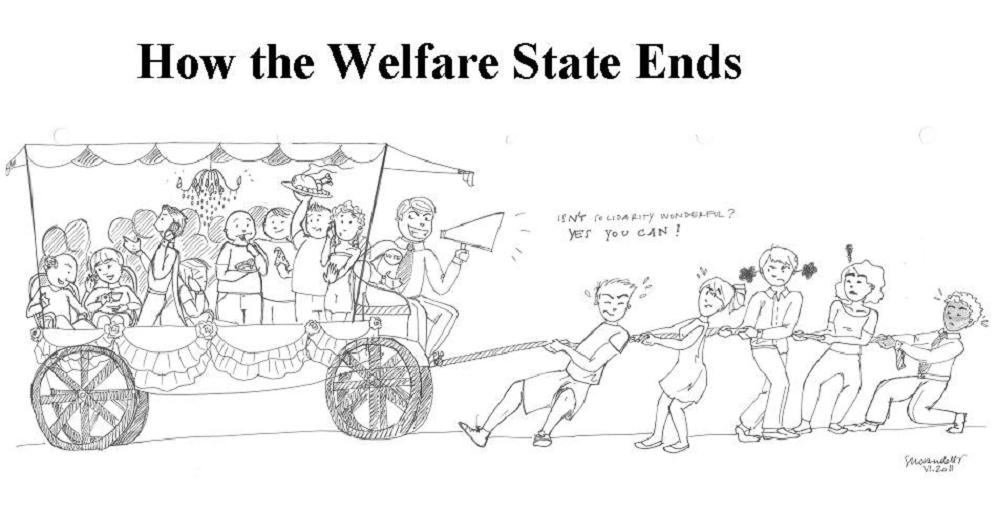
In my speeches, especially when talking about the fiscal crisis in Europe (or the future fiscal crisis in America), I often warn that the welfare state reaches a point-of-no-return when the number of people riding in the wagon begins to outnumber the number of people pulling the wagon.
To be more specific, if more than 50 percent of the population is dependent on government (employed in the bureaucracy, living off welfare, receiving pensions, etc), it becomes rather difficult to form a coalition to fix the mess. This may explain why Greek politicians have resisted significant reforms, even though the nation faces a fiscal death spiral.
But you don’t need me to explain this relationship. One of our Cato interns, Silvia Morandotti, used her artistic skills to create two images (click pictures for better resolution) that show what a welfare state looks like when it first begins and what it eventually becomes.
These images are remarkably accurate. The welfare state starts with small programs targeted at a handful of genuinely needy people. But as politicians figure out the electoral benefits of expanding programs and people figure out the that they can let others work on their behalf, the ratio of producers to consumers begins to worsen.
Then things get really interesting. Small nations such as Greece can rely on permanent bailouts from bigger countries and the IMF, but sooner or later, as larger nations begin to go bankrupt, that approach won’t be feasible.
I often conclude my speeches by joking with the audience that it’s time to stock up on canned goods, bottled water, and ammo. Many people, I’m finding, don’t think that line very funny.
If you spend too much then people won’t want to work anymore.
_______________
The Balanced Budget Amendment is the only thing I can think of that would force Washington to cut spending. We have only a handful of balanced budgets in the last 60 years, so obviously what we are doing is not working. We are passing along this debt to the next generation. YOUR APPROACH HAS BEEN TO REJECT THE BALANCED BUDGET “BECAUSE WE SHOULD CUT THE BUDGET OURSELF,” WELL THEN HERE IS YOUR CHANCE!!!! SUBMIT THESE CUTS!!!!
Thank you for this opportunity to share my ideas with you.
The problem with the debt ceiling is very clear to me. We need to get serious about cutting federal spending. I am so upset about it that I have emailed over 100 emails to Senator Pryor concerning specific spending suggestions. I get emails from back from Senator Pryor like the one below. This means that […]
Senator Pryor asks for Spending Cut Suggestions! Here are a few!(Part 164) Senator Mark Pryor wants our ideas on how to cut federal spending. Take a look at this video clip below: Senator Pryor has asked us to send our ideas to him at cutspending@pryor.senate.gov and I have done so in the past and will continue to […]
Senator Pryor asks for Spending Cut Suggestions! Here are a few!(Part 163) Senator Mark Pryor wants our ideas on how to cut federal spending. Take a look at this video clip below: Senator Pryor has asked us to send our ideas to him at cutspending@pryor.senate.gov and I have done so in the past and will continue to […]
Senator Pryor asks for Spending Cut Suggestions! Here are a few!(Part 162) Senator Mark Pryor wants our ideas on how to cut federal spending. Take a look at this video clip below: Senator Pryor has asked us to send our ideas to him at cutspending@pryor.senate.gov and I have done so in the past and will continue to […]
Three very good video tours below from Senator Mark Pryor. Published on Jun 13, 2012 by SenatorPryor Episode 1: Arkansans in the Capitol Published on Jul 9, 2012 by SenatorPryor Episode 2: The Crypt and the Old Supreme Court Published on Aug 20, 2012 by SenatorPryor Episode 3: The Senate Chamber If you want to […]
Senator Pryor asks for Spending Cut Suggestions! Here are a few!(Part 161) Senator Mark Pryor wants our ideas on how to cut federal spending. Take a look at this video clip below: Senator Pryor has asked us to send our ideas to him at cutspending@pryor.senate.gov and I have done so in the past and will continue to […]
Senator Mark Pryor wants our ideas on how to cut federal spending and I sent them to him but he didn’t take any of my suggestions. However, he did take time to get back to me today, but I am not too impressed with Senator Pryor’s response. I gave him hundreds of ideas about how […]
Senator Pryor asks for Spending Cut Suggestions! Here are a few!(Part 160) Senator Mark Pryor wants our ideas on how to cut federal spending. Take a look at this video clip below: Senator Pryor has asked us to send our ideas to him at cutspending@pryor.senate.gov and I have done so in the past and will continue to […]
Senator Pryor asks for Spending Cut Suggestions! Here are a few!(Part 159) Senator Mark Pryor wants our ideas on how to cut federal spending. Take a look at this video clip below: Senator Pryor has asked us to send our ideas to him at cutspending@pryor.senate.gov and I have done so in the past and will continue to […]
Senator Mark Pryor wants our ideas on how to cut federal spending. Take a look at this video clip below: Senator Pryor has asked us to send our ideas to him at cutspending@pryor.senate.gov and I have done so in the past and will continue to do so in the future. On May 11, 2011, I emailed to […]
Office of the Majority Whip | Balanced Budget Amendment Video In 1995, Congress nearly passed a constitutional amendment mandating a balanced budget. The Balanced Budget Amendment would have forced the federal government to live within its means. This Balanced Budget Amendment failed by one vote. 16 years later, Congress has the chance to get it […]
Sadly Senator Pryor has voted against the Balanced Budget Amendment over and over in his long time in the Senate. Senator Pryor: “There are a lot of people who think a balanced-budget amendment solves all the fiscal problems. I completely disagree.” (Peter Urban, Pryor Tilts Balanced Budget, Southwest Times Record, 11/17/11) Dear Senator Pryor, Why […]
Mark Levin and Senator Hatch discuss the balanced budget amendment and it’s importance. Uploaded by loveconstitution on Jan 28, 2011 Mark Levin interviews Senator Hatch 1/27/2011 about the balanced budget amendment. Mark is very excited about the balanced budget amendment being proposed by Senator Orin Hatch and John Cornyn and he discusses the amendment with […]
Dr. Jay Barth with Hendrix College comments on our latest poll results on Arkansas politics (clip from Talkbusiness) Talk Business reported today in the article “Poll Shows Beebe Strength, Pryor Shaky,” the following: A new Talk Business-Hendrix College Poll shows Gov. Mike Beebe (D) maintaining his high job approval rating, while Sen. Mark Pryor (D) […]
U.S. Sen. Mark Pryor at the 2009 Democratic Party Jefferson Jackson Dinner, Arkansas’s largest annual political event. Mark Pryor is up for re-election to the Senate in 2014. It is my opinion that the only reason he did not have an opponent in 2008 was because the Republicans in Arkansas did not want to go […]
Michael Tanner, a senior fellow at the CATO institute, explains that the rate of return on social security will be much lower for todays youth. Steve Brawner wrote in his article “Tiptoeing toward the third rail,” (Arkansas News Bureau, Jan 9,): Social Security has long been considered the “third rail” for American politicians, meaning it’s […]
HALT:HaltingArkansasLiberalswithTruth.com CBS — October 19, 2010 — New York Times’ Jeff Zeleny talks to Jan Crawford about the state of Democrats in the South… Are they a dying species? In the article “Southern Democrat much closer to extinction after GOP wave,” (Washington Times, Nov 4, 2010), Ben Evans notes: After this week’s elections, the […]
HALT:HaltingArkansasLiberalswithTruth.com Roland Martin appears on Rick’s List with Rick Sanchez and the Best Political Team on television (Candy Crowley, John King, Jeffery Toobin, Ed Rollins, Gloria Borger and Victoria Toensing) to discuss day two of the Elena Kagan Supreme Court confirmation hearings. During the analysis, Senator Graham and Elena Kagan had an interesting exchange over […]
After the housing bubble burst, the Bush and Obama administrations turned to stimulus in an effort to “create jobs.” Does such spending lead to economic improvement? Prof. Antony Davies examines the data to see how increases in federal spending relate to economic growth from 1955 to the present. The evidence shows that there is no connection between federal spending and economic improvement; instead, stimulus money only increases government debt. After three years of stimulus spending, the unemployment rate remains at 9 percent. “One thing that has changed,” Davies says, “is that our government is now $4.6 trillion further in debt than it was before the stimulus efforts.”
__________________
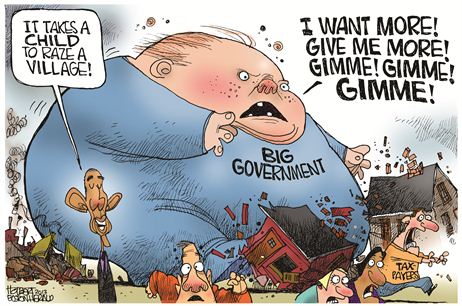
Some more true cartons from Dan Mitchell’s blog on the President’s love of big government.
Regular readers know that I get very excited when I see signs that more and more people are realizing that the real fiscal problem is big government. Even if the sound analysis comes from foreigners or international bureaucracies.
In this 1968 interview, Milton Friedman explained the negative income tax, a proposal that at minimum would save taxpayers the 72 percent of our current welfare budget spent on administration. http://www.LibertyPen.com
Source: Firing Line with William F Buckley Jr.
________________
Milton Friedman describes the welfare state’s effect on private charitable activity
I watched the video by the Democrat National Convention on 9-6-12 that showed your beautiful wife saying about your family: “We sit around the dinner table (with our kids) and he is he last to be asked, ‘Oh yeah, how was your day Dad?’ You know really he is an afterthought.”
As a father and a husband I want to thank you for demonstrating to others that men need to keep their priorities straight.
Don’t you think that private charities would do a better job than the government in helping the poor?
Liberals often appeal to morality in policy debates with conservatives—with much success. But conservatives should not cede the moral high ground. In fact, a strong case for conservatism can be made on the basis of morality.
Consider why shrinking government is moral. The more the federal government provides for people, the more it deprives them not only of their dignity, but of one of the most sacred rights, penned by Thomas Jefferson: the right to pursue happiness. Why? Because fulfilling happiness comes from earned success, not from unearned handouts.
Think about the person we all knew growing up whose parents spoiled him or her. Even if that person wasn’t unhappy at the time (though chances are he or she was unhappy), it teaches that individual to expect handouts, which will likely result in an unhappy adulthood. Sewing the seeds of entitlement is a recipe for misery.
During the recent recession, unemployment benefits were extended from six months to nearly two years . Does not an extension of such length send the message to people who receive them that they can depend on government? How dignifying is that?
Certainly in tough times people may need help, but the tragedy of governmental aid is that it crowds out assistance from families, private charities and local communities, which is much more personal, not to mention much more effective. Jonathan Gruber, an economist from MIT, conducted a study of the New Deal government in the 1930s, and concluded that private charity spending “fell by 30% in response to the New Deal, and that government relief spending can explain virtually all of the decline in charitable church activity observed between 1933 and 1939.”
Private charities are able to make distinctions between people who truly need help and those who do not, as well as between those who need material assistance and those who need moral refocus, personal counseling, relationship repair or spiritual commitment. Government, no matter how well-intentioned, does not and cannot make such distinctions. In fact, the more ubiquitous government programs become, the less needed families and communities are to help those who require it.
Though well-intentioned, leftism’s commitment to government undermines both the individual pursuit of happiness, which results from earned success, and private charity of families and communities who can best provide it to those experiencing hardship. Conservatism, on the other hand, is committed to both, and is precisely why moving the country to the right is moral.
_________________
Thank you so much for your time. I know how valuable it is. I also appreciate the fine family that you have and your commitment as a father and a husband.
Sincerely,
Everette Hatcher III, 13900 Cottontail Lane, Alexander, AR 72002, ph 501-920-5733, lowcostsqueegees@yahoo.com
Nearly one-third of Americans received government-funded food aid in 2012, according to a new report from the U.S. Department of Agriculture (USDA).
As Heritage Foundation expert Robert Rector has explained, there are roughly a dozen federal food assistance programs operating today. The USDA reports that 59 percent of households that participated in one of the four largest food assistance programs—food stamps, school breakfasts, school lunches, and WIC—end up receiving benefits from “two or more programs.” This indicates significant duplication, “providing participants total benefits in excess of 100 percent of daily nutritional needs.”
The welfare system also operates many means-tested welfare programs beyond food assistance. The federal government funds roughly 80 welfare programs, including 12 providing social services, 12 educational assistance programs, and 11 housing assistance programs—at a cost of nearly $1 trillion a year.
The size of today’s welfare system demonstrates the need for both opportunity-based economic policies and critical reforms to promote self-sufficiency through work. For decades, the federal government has been pouring taxpayer dollars into an increasing number of welfare programs in an attempt to tackle poverty.
Yet this system has proven ineffective at helping individuals and families reach self-sufficiency. As Heritage expert Robert Rector writes, “Except in very limited cases, such as those involving serious malnutrition, welfare programs do not yield fewer problems and better life outcomes for children.” Welfare can even have harmful consequences for families, eroding personal responsibility across multiple generations. Heritage experts David Azerrad and Rea Hederman explain that welfare
takes away a crucial ingredient of happiness: the incentive to work, to save, to improve oneself.… It fosters dependence in welfare recipients, which in turn often carries over to children. Studies have shown—not surprisingly but nonetheless quite tragically—that welfare is increasingly intergenerational.
Lawmakers have a duty to American families and to the next generation. Policymakers should transform these programs into vehicles of self-sufficiency, personal responsibility, and human dignity through positive reforms that encourage work. Such reforms will begin lifting America from a welfare state where 101 million receive government support to the opportunity society envisioned by the men and women who founded this nation.
If the increase in food stamps was just because of the recession then why did the spending go from $19.8 billion in 2000 to $37.9 billion in 2007? The Facts about Food Stamps Everyone Should Hear Rachel Sheffield and T. Elliot Gaiser May 27, 2013 at 12:00 pm (7) Newscom A recent US News & […]
Welfare Can And Must Be Reformed Uploaded on Jun 29, 2010 If America does not get welfare reform under control, it will bankrupt America. But the Heritage Foundation’s Robert Rector has a five-step plan to reform welfare while protecting our most vulnerable. __________________________ We got to slow down the growth of Food Stamps. One […]
Eight Reasons Why Big Government Hurts Economic Growth __________________ We got to cut spending and we must first start with food stamp program and we need some Senators that are willing to make the tough cuts. Food Stamp Republicans Posted by Chris Edwards Newt Gingrich had fun calling President Obama the “food stamp president,” but […]
Milton Friedman’s negative income tax explained by Friedman in 1968: We need to cut back on the Food Stamp program and not try to increase it. What really upsets me is that when the government gets involved in welfare there is a welfare trap created for those who become dependent on the program. Once they […]
Welfare Can And Must Be Reformed Uploaded by HeritageFoundation on Jun 29, 2010 If America does not get welfare reform under control, it will bankrupt America. But the Heritage Foundation’s Robert Rector has a five-step plan to reform welfare while protecting our most vulnerable. __________________________ If welfare increases as much as it has in the […]
Why can’t we cut the Food Stamp budget? Should Food Stamps Be in Farm Bill? Congressman Seeks to Split Legislation Kelsey Harris June 17, 2013 at 10:38 pm Bill Clark/Roll Call Photos/Newscom Representative Marlin Stutzman (R-IN), a fourth-generation farmer, is asking his House colleagues to separate the food stamp program from the “farm” bill. Stutzman […]
The sad fact is that Food stamp spending has doubled under the Obama Administration. A Bumper Crop of Food Stamps Amy Payne May 21, 2013 at 7:01 am Tweet this Where do food stamps come from? They come from taxpayers—certainly not from family farms. Yet the “farm” bill, a recurring subsidy-fest in Congress, is actually […]
I am glad that my state of Arkansas is not the leader in food stamps!!! Mirror, Mirror, on the Wall, Which State Has the Highest Food Stamp Usage of All? March 19, 2013 by Dan Mitchell The food stamp program seems to be a breeding ground of waste, fraud, and abuse. Some of the horror stories […]
Government Must Cut Spending Uploaded by HeritageFoundation on Dec 2, 2010 The government can cut roughly $343 billion from the federal budget and they can do so immediately. __________ We are becoming a country filled with people that dependent on the federal government when we should be growing our economy by lowering taxes and putting […]
Uploaded by oversightandreform on Mar 6, 2012 Learn More at http://oversight.house.gov The Oversight Committee is examining reports of food stamp merchants previously disqualified who continue to defraud the program. According to a Scripps Howard News Service report, food stamp fraud costs taxpayers hundreds of millions every year. Watch the Oversight hearing live tomorrow at 930 […]
Do governments ever cut spending? According to Dr. Stephen Davies, there are historical examples of government spending cuts in Canada, New Zealand, Sweden, and America. In these cases, despite popular belief, the government spending cuts did not cause economic stagnation. In fact, the spending cuts often accelerated economic growth by freeing up resources for the private sector.
DEBT LIMIT – A GUIDE TO AMERICAN FEDERAL DEBT MADE EASY.
A satirical short film taking a look at the national debt and how it applies to just one family. Watch the guy from the Ferris Bueller Superbowl Spot! Produced by Seth William Meier, DP/Edited by Craig Evans, 1st AC Brian Andrews, Sound Mixer Gus Salazar, Written and Directed by Brian Stepanek. Help us spread the word by clicking ads or at http://www.debtlimitusa.org.
________
Is Canada moving in a conservative direction to tackle their fiscal problems while the USA is going over the fiscal cliff? I was impressed by this statement below from this article from www.heritage.org :
In Canada, federal spending has been trending downward since 1993, according to Cato’s Chris Edwards. Canadians have cut spending in virtually every area except health care. The federal government now accounts for only 38 percent of total government spending. In the U.S., by contrast, the federal government accounts for 71 percent of total government spending.
It seems to me that we need to learn this important lesson from our neighbor from the north: CUT SPENDING AND LOWER TAXES AND GIVE MORE CONTROL BACK TO THE LOCAL GOVERNMENTS!!!!
Congressional lawmakers met last week to try to hammer out a deal to avert the fiscal cliff. Democrats insist on revenue increases as part of such a deal, saying new revenue is the only way to significantly reduce the national debt. However, it is not a lack of revenue that is driving U.S. debt; it is unrestrained federal spending. American lawmakers looking to solve America’s looming fiscal crisis need not look further than Canada.
Highlighted at a recent Cato Institute conference, our neighbor—and competitor—to the north serves as a good example of what it takes to return to a strong economy. The Great White North has turned around its fiscal situation and is now experiencing financial stability and economic growth.
In Canada, federal spending has been trending downward since 1993, according to Cato’s Chris Edwards. Canadians have cut spending in virtually every area except health care. The federal government now accounts for only 38 percent of total government spending. In the U.S., by contrast, the federal government accounts for 71 percent of total government spending.
The Canadian government, among other changes, altered benefit schedules for the Canadian Pension Plan to reduce the total amount of benefits paid.
In a similar vein, The Heritage Foundation suggests a variety of benefit changes to Social Security that would strengthen the program’s finances, for example, by raising the eligibility age slightly and replacing cost of living adjustments with the Chained Consumer Price Index for a more targeted measure of inflation in consumer goods. Bolder changes include gradually introducing a flat benefit that targets scarce resources to those seniors who need them the most and provides all seniors with protection from poverty in retirement.
Canada also cut corporate income tax rates. The U.S. has the highest rate among its competitors in the industrialized world. The combined federal and state corporate rate in the U.S. is over 39 percent. Canada now has a combined rate of only 25 percent.
Contrary to popular expectations, lower corporate tax rates have not resulted in significantly reduced corporate tax revenue in Canada. Instead, corporations based in Canada have reported more income since lower tax rates went into place. And Canada is experiencing low unemployment and a strong Canadian dollar.
The Heritage Foundation’s New Flat Tax would replace today’s complex tax system for individuals and business with a simple, neutral, and transparent tax system that would allow America to achieve its full economic potential.
Europe has not followed Canada’s example, and the resulting severe debt crises are sending people to the streets in an outbreak of violent protests. Out-of-control government spending and deficits have resulted in massive borrowing, which has led to bailouts for many European countries.
Here in the United States, we have all the ingredients necessary to create a similar debt crisis in the not-so-distant future. Over the past four decades, federal spending has increased 288 percent, nearly quadrupling in real terms. Thirty-two cents out of every dollar spent was borrowed in 2012. Debt held by the public is a staggering 73 percent of GDP, and our government has run trillion-dollar budget deficits four years in a row.
In less than 10 years, the U.S.’s publicly held debt will surpass the size of the entire U.S. economy and is projected to continue skyrocketing from there. (continues below chart)
To make matters worse, there is a dark demographic cloud on the horizon. In all Western nations, the proportion of older people as a share of the population is increasing. In the U.S., baby boomers are increasingly reaching retirement age, and in Europe, fertility rates are well below replacement level. As the populations of these countries age, entitlements will eat up an ever-increasing share of federal spending and place a greater strain on a smaller share of working-age taxpayers.
Solving America’s spending and debt challenges is possible. Canada’s example illustrates some of the steps this will take—including major cuts to federal spending, tax reform, and entitlement reform. If our leaders can find the courage to pursue this path, we can avoid an economic collapse and Save the American Dream.
Paul Bremmer is currently a member of the Young Leaders Program at The Heritage Foundation. For more information on interning at Heritage, please visit: http://www.heritage.org/about/departments/ylp.cfm.
_____________
_____________
Thank you so much for your time. I know how valuable it is. I also appreciate the fine family that you have and your commitment as a father and a husband.
Sincerely,
Everette Hatcher III, 13900 Cottontail Lane, Alexander, AR 72002, ph 501-920-5733, lowcostsqueegees@yahoo.com
Why do I keep writing and email Senator Pryor suggestions on how to cut our budget? I gave him hundreds of ideas about how to cut spending and as far as I can tell he has taken none of my suggestions. You can find some of my suggestions here, here, here, here, here, here, here, here, here, here, here, here, here, here, here, here, here, here, here, here, and here, and they all were emailed to him. In fact, I have written 13 posts pointing out reasons why I believe Senator Pryor’s re-election attempt will be unsuccessful. HERE I GO AGAIN WITH ANOTHER EMAIL I JUST SENT TO SENATOR PRYOR!!!
Dear Senator Pryor,
Why not pass the Balanced Budget amendment? As you know that federal deficit is at all time high (1.6 trillion deficit with revenues of 2.2 trillion and spending at 3.8 trillion).
On my blog www.thedailyhatch.org . I took you at your word and sent you over 100 emails with specific spending cut ideas. (Actually there were over 160 emails with specific spending cut suggestions.) However, I did not see any of them in the recent debt deal that Congress adopted although you did respond to me several times. Now I am trying another approach. Every week from now on I will send you an email explaining different reasons why we need the Balanced Budget Amendment. It will appear on my blog on “Thirsty Thursday” because the government is always thirsty for more money to spend. Today I actually have included a great article below from the Heritage Foundation concerning an area of our federal budget that needs to be cut down to size. The funny thing about the Sequester and the 2.4% of cuts in future increases is that President Obama set these up and then he acted like the sky was falling in as the cartoons indicate in the newspapers.
IF YOU TRULY WANT TO CUT THE BUDGET AND BALANCE THE BUDGET THEN SUBMIT THESE POTENTIAL BUDGET CUTS PRESENTED BELOW!!
_______________
What Are the Dangers of Too Much Debt?
Published on Mar 20, 2012
Interest payments on U.S. government debt are three times spending in the Iraq and Afghanistan wars already, and that is with the lowest interest rate we have seen since the 1960s. A rise in interest rates would increase interest payments dramatically. What can the U.S. government do today to prevent a crisis from happening when interest rates go up?
___________________
We got to cut wasteful spending out of the government and here is another fine suggestion from the Heritage Foundation.
The massive spending bill, or continuing resolution, released by the Senate this week continues spending on programs which are inappropriate or wasteful and fails to adopt good policies in many areas. Here’s a rundown of some of the worst offenders in the Senate bill:
Consumer Product Safety Commission (CPSC). Unlike the budget passed by the House, the Senate bill seeks to restore government spending to fund the failed CPSC product safety database. CPSC decision making with respect to the database has previously been called “arbitrary and capricious” by the courts.
Since it was implemented in 2011, manufacturers have shown that the CPSC database is seriously flawed. The database allows the public to submit unproven claims of harm with the CPSC and gives manufacturers only 10 days to challenge these claims; however, the CPSC itself has final authority to publish reports of such claims, even if they are disproved by the manufacturer. The accuracy of the CPSC reports is thus seriously questionable, and is a one-stop shop for tort lawyers seeking new clients or seeking “evidence” for their current lawsuits.
Furthermore, last October, in Company Doe v. Inez Tenenbaum, a federal court in Maryland overturned a decision of the CPSC to publish a report as “arbitrary and capricious,” because the CPSC report was “misleading and fail[ed] to relate[] to the [manufacturer’s] product in any way.” Indeed, the CPSC database is a concrete example of government waste: It is a shame that the Senate bill seeks to restore government spending to publishing misleading claims that damage business growth and likely lead to additional frivolous lawsuits.
A similar theme can be found in this great new cartoon from Chuck Asay.
And just in case you think Asay is being unfair, keep in mind that folks like Obama and Pelosi actually have claimed that more unemployment benefits is “stimulus.” Yes, you read correctly. Subsidizing unemployment is good for growth to these strange ideologues.
I’d be curious to know which one all of you think is most effective.
And since Asay’s work is almost always worth sharing, you can find more of my top picks here, here, here, and here.
_______________
The Balanced Budget Amendment is the only thing I can think of that would force Washington to cut spending. We have only a handful of balanced budgets in the last 60 years, so obviously what we are doing is not working. We are passing along this debt to the next generation. YOUR APPROACH HAS BEEN TO REJECT THE BALANCED BUDGET “BECAUSE WE SHOULD CUT THE BUDGET OURSELF,” WELL THEN HERE IS YOUR CHANCE!!!! SUBMIT THESE CUTS!!!!
Thank you for this opportunity to share my ideas with you.
The problem with the debt ceiling is very clear to me. We need to get serious about cutting federal spending. I am so upset about it that I have emailed over 100 emails to Senator Pryor concerning specific spending suggestions. I get emails from back from Senator Pryor like the one below. This means that […]
Senator Pryor asks for Spending Cut Suggestions! Here are a few!(Part 164) Senator Mark Pryor wants our ideas on how to cut federal spending. Take a look at this video clip below: Senator Pryor has asked us to send our ideas to him at cutspending@pryor.senate.gov and I have done so in the past and will continue to […]
Senator Pryor asks for Spending Cut Suggestions! Here are a few!(Part 163) Senator Mark Pryor wants our ideas on how to cut federal spending. Take a look at this video clip below: Senator Pryor has asked us to send our ideas to him at cutspending@pryor.senate.gov and I have done so in the past and will continue to […]
Senator Pryor asks for Spending Cut Suggestions! Here are a few!(Part 162) Senator Mark Pryor wants our ideas on how to cut federal spending. Take a look at this video clip below: Senator Pryor has asked us to send our ideas to him at cutspending@pryor.senate.gov and I have done so in the past and will continue to […]
Three very good video tours below from Senator Mark Pryor. Published on Jun 13, 2012 by SenatorPryor Episode 1: Arkansans in the Capitol Published on Jul 9, 2012 by SenatorPryor Episode 2: The Crypt and the Old Supreme Court Published on Aug 20, 2012 by SenatorPryor Episode 3: The Senate Chamber If you want to […]
Senator Pryor asks for Spending Cut Suggestions! Here are a few!(Part 161) Senator Mark Pryor wants our ideas on how to cut federal spending. Take a look at this video clip below: Senator Pryor has asked us to send our ideas to him at cutspending@pryor.senate.gov and I have done so in the past and will continue to […]
Senator Mark Pryor wants our ideas on how to cut federal spending and I sent them to him but he didn’t take any of my suggestions. However, he did take time to get back to me today, but I am not too impressed with Senator Pryor’s response. I gave him hundreds of ideas about how […]
Senator Pryor asks for Spending Cut Suggestions! Here are a few!(Part 160) Senator Mark Pryor wants our ideas on how to cut federal spending. Take a look at this video clip below: Senator Pryor has asked us to send our ideas to him at cutspending@pryor.senate.gov and I have done so in the past and will continue to […]
Senator Pryor asks for Spending Cut Suggestions! Here are a few!(Part 159) Senator Mark Pryor wants our ideas on how to cut federal spending. Take a look at this video clip below: Senator Pryor has asked us to send our ideas to him at cutspending@pryor.senate.gov and I have done so in the past and will continue to […]
Senator Mark Pryor wants our ideas on how to cut federal spending. Take a look at this video clip below: Senator Pryor has asked us to send our ideas to him at cutspending@pryor.senate.gov and I have done so in the past and will continue to do so in the future. On May 11, 2011, I emailed to […]
Office of the Majority Whip | Balanced Budget Amendment Video In 1995, Congress nearly passed a constitutional amendment mandating a balanced budget. The Balanced Budget Amendment would have forced the federal government to live within its means. This Balanced Budget Amendment failed by one vote. 16 years later, Congress has the chance to get it […]
Sadly Senator Pryor has voted against the Balanced Budget Amendment over and over in his long time in the Senate. Senator Pryor: “There are a lot of people who think a balanced-budget amendment solves all the fiscal problems. I completely disagree.” (Peter Urban, Pryor Tilts Balanced Budget, Southwest Times Record, 11/17/11) Dear Senator Pryor, Why […]
Mark Levin and Senator Hatch discuss the balanced budget amendment and it’s importance. Uploaded by loveconstitution on Jan 28, 2011 Mark Levin interviews Senator Hatch 1/27/2011 about the balanced budget amendment. Mark is very excited about the balanced budget amendment being proposed by Senator Orin Hatch and John Cornyn and he discusses the amendment with […]
Dr. Jay Barth with Hendrix College comments on our latest poll results on Arkansas politics (clip from Talkbusiness) Talk Business reported today in the article “Poll Shows Beebe Strength, Pryor Shaky,” the following: A new Talk Business-Hendrix College Poll shows Gov. Mike Beebe (D) maintaining his high job approval rating, while Sen. Mark Pryor (D) […]
U.S. Sen. Mark Pryor at the 2009 Democratic Party Jefferson Jackson Dinner, Arkansas’s largest annual political event. Mark Pryor is up for re-election to the Senate in 2014. It is my opinion that the only reason he did not have an opponent in 2008 was because the Republicans in Arkansas did not want to go […]
Michael Tanner, a senior fellow at the CATO institute, explains that the rate of return on social security will be much lower for todays youth. Steve Brawner wrote in his article “Tiptoeing toward the third rail,” (Arkansas News Bureau, Jan 9,): Social Security has long been considered the “third rail” for American politicians, meaning it’s […]
HALT:HaltingArkansasLiberalswithTruth.com CBS — October 19, 2010 — New York Times’ Jeff Zeleny talks to Jan Crawford about the state of Democrats in the South… Are they a dying species? In the article “Southern Democrat much closer to extinction after GOP wave,” (Washington Times, Nov 4, 2010), Ben Evans notes: After this week’s elections, the […]
HALT:HaltingArkansasLiberalswithTruth.com Roland Martin appears on Rick’s List with Rick Sanchez and the Best Political Team on television (Candy Crowley, John King, Jeffery Toobin, Ed Rollins, Gloria Borger and Victoria Toensing) to discuss day two of the Elena Kagan Supreme Court confirmation hearings. During the analysis, Senator Graham and Elena Kagan had an interesting exchange over […]
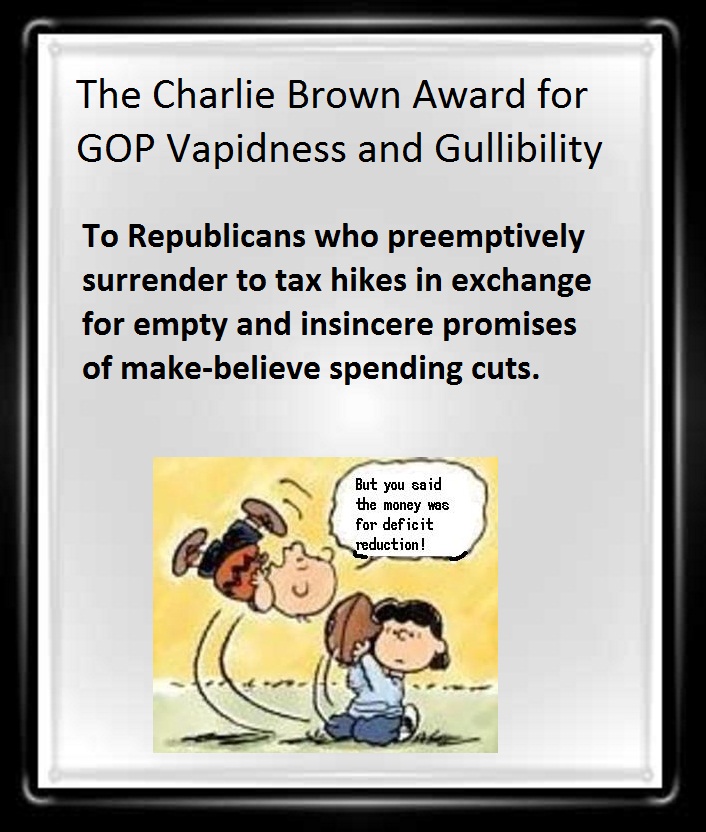
I truly do wonder how smart our elected representatives are in Washington. Mr President I know you are a Harvard graduate and these comments I guess are really aimed at my Republican friends mostly.I got up on 12-20-12 and read this article below from the Heritage Foundation with the reference to Charlie Brown getting fooled by Lucy again when he runs up and tries to kick the football and of course she moves it again.
Liberals in Congress have always tried to fool conservatives by promising future cuts if they provide higher taxes now. (This article below appeared on www.heritage.org on 12-20-12.)
Obama’s “Lucy Move the Football” Fiscal Cliff Plan Still Not Balanced
Volleys of negotiating counter-offers are coming in faster now that Christmas break and the looming fiscal cliff are just around the corner.
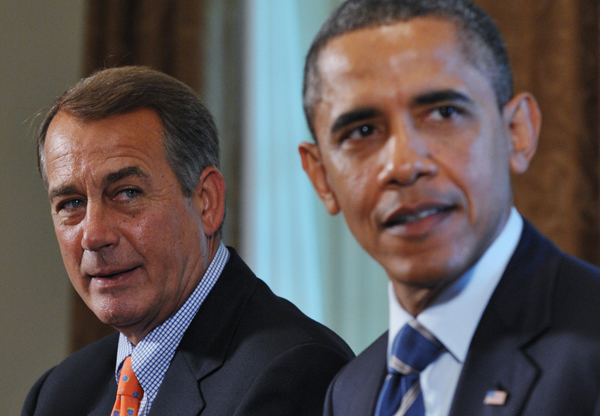
While there is much unsatisfactory with Speaker of the House John Boehner’s (R–OH) Sunday night proposal, let us not forget that the reason we are watching this needless, high stakes drama unfold is due to President Obama’s intractable insistence on tax increases on America’s high earners. After all, he and Congress could simply and quickly pass a bill to extend all current policies and avoid the fiscal cliff entirely—if he wanted to. No, this is really about hiking taxes on high earners. Thus the charade of deficit reduction continues.
Obama’s latest counteroffer is no more acceptable than his first offer. Short on details concerning actual spending reductions, especially on entitlements, it is replete with his requisite tax hikes and (we are shocked) new stimulus spending. The cherry on top is an extension of the debt limit for two years, essentially handing over authority to raise it to the President.
Right.
The President originally called for around $800 billion in tax hikes on America’s “highest” earners—those earning $250,000 and up. A ridiculous demand when the economy is still struggling under his big spending and regulatory policies, and one which would squarely hit smaller businesses. You know, the ones who actually create jobs.
Yet, just like Lucy and the football, when Boehner and company offered up $800 billion in tax hikes, Obama quickly doubled his demand to $1.5 trillion in tax hikes—again, all from the highest earners. They, he tells us, can afford to pay a little more. Never mind, of course, that the top 1 percent of earners already pay 37 percent of all income taxes. Somehow we are to believe this is a “balanced approach.”
Obama pitches all this on the pretext that we can simply go back to the tax rates we had under Clinton. Wrong! His dirty little tax secret is that he has already hiked taxes on high earners under Obamacare. First the law added a surtax of 0.9 percent in addition to the Medicare payroll tax on those earning over $250,000. For the first time ever, Obamacare will apply this higher rate of 3.8 percent to investment income on January 1. Obama won’t tell you that going back to Clinton-era tax rates will actually result in higher taxes on wages, dividends, and capital gains.
They say if you want less of something, then tax it. For Obama, this works fine on financial transactions, carbon emissions, driving, and junk food. But evidently, for him, not so much on a strong vibrant economy. And those Clinton boom years? They weren’t ushered in after the Clinton tax hike—only after the Clinton–Gingrich tax cut!
Rather than working with Republicans on tax proposals that will actually grow the economy, Obama is now simply fighting over his definition of “high income” while we are left to wonder how much this $1.2 trillion tax hike will slow the economy.
As for the $1.2 trillion spending reductions, the only reason they are there is because Boehner insisted on them. But $100 billion in cuts would whack the defense budget, which is already reeling from earlier budget cuts. Yet the real spending and debt crisis comes from unaffordable entitlement programs. While Obama is insisting on balance on the tax side, he is sorely lacking in leadership here. As a recent Washington Post editorial opined:
Elections do have consequences, and Mr. Obama ran on a clear platform of increasing taxes on the wealthy. But he was clear on something else, too: Deficit reduction must be “balanced,” including spending cuts as well as tax increases. Since 60 percent of the federal budget goes to entitlement programs such as Medicare, Medicaid and Social Security, there’s no way to achieve balance without slowing the rate of increase of those programs.
We know Obama is open to changing the inflation calculation and slowing the benefit growth in Social Security. But what else? What about the proposals in his own budget, which would increase premiums on Medicare? He could easily broaden his proposals with additional uncontroversial steps to begin the process of strengthening and reining in Social Security and Medicare. All he needs to do is lead.
Some polls may show that Americans think taxes should be part of a deficit deal; but what the polls do not always show is their utter distrust that Washington would use new revenues to actually reduce the deficit. Here, Obama does not let them down. He reportedly wants $80 billion in new spending on infrastructure and unemployment benefits.
In exchange for all of this, he wants to raise the debt limit by enough to fuel his big spending goals for two years. This is utterly unacceptable. Americans know you cannot reduce the deficit when you plan to actually spend more. Americans also know that when Washington lifts the debt limit, it will not control spending. The debt limit puts the very pressure lawmakers need to account for out-of-control spending and make vital course corrections to bring spending under control, lest we face a Euro-style debt crisis in the future.
White House Press Secretary Jay Carney is actually insisting that “[t]he President’s proposal is the only proposal we have seen that achieves the balance that is so necessary.” Balance, evidently, is in the eyes of the beholder. As the Post noted, 60 percent of the budget stems from entitlements.
In just 13 short years—by the time today’s kindergarteners enter college—entitlements and interest on the debt will eat up all tax revenues. A truly balanced approach must start where the problem starts—with substantive reforms to entitlements. While the President maintains that you cannot cut your way to prosperity, you certainly cannot tax your way there.
_______________
Below is a speech by George W. Bush honoring Milton Friedman:
Milton Friedman Honored for Lifetime Achievements 2002/5/9
Milton Friedman said that getting George Bush I to be his vice president was his biggest mistake because he knew that Bush was not a true conservative and sure enough George Bush did raise taxes when he later became President. I wonder if Jeb Bush has the same genes as his father.
What we need is some people in Washington that are brave enough to say that we have taken too much of the american people’s money and we have to make the painful spending cuts in order to balance the budget and not ask for any more tax increases!!!! Arkansas’ congressman Rick Crawford has also made the Charlie Brown mistake.
But I then pointed out that all of those scenarios were total fantasies and that it would be more realistic to envision me playing center field for the New York Yankees.
That’s why I like the anti-tax pledge of Americans for Tax Reform. You don’t solve America’s fiscal problems by saying no to all tax increases, but at least you don’t move in the wrong direction at a faster rate.
Notwithstanding the principled and pragmatic arguments against putting tax increases on the table, some Republicans – in a triumph of hope over experience – are preemptively acquiescing to tax hikes.
Jeb Bush, the former Florida governor, said Friday that he could back a broad deficit plan that increased taxes, a stance that puts him at odds with other prominent Republicans. Bush told a House panel he could get behind a plan that combined 10 dollars in spending cuts for every dollar of new revenue… “The problem is the 10 never materializes,” [Congressman Paul] Ryan said after Bush said he could support a revenue-increasing deficit deal. Norquist also has criticized deficit deals crafted in 1982 and 1990 – the latter agreed to by then-President George H.W. Bush, Jeb’s father – for failing to deliver on the spending side.
Kudos to Paul Ryan for making the obvious point about make-believe spending cuts. And Grover is correct about the failure of previous budget deals.
Indeed, I cited a New York Times column that inadvertently revealed that the only budget deal that worked was the 1997 pact that cut taxes rather than raised them.
Sen. Lindsey Graham (R-S.C.) said Tuesday he believed Republicans should consider eliminating loopholes in the tax code even if they aren’t replaced by additional tax cuts, a move that would break with an anti-tax pledge many GOP lawmakers have signed with activist Grover Norquist. “When you eliminate a deduction, it’s OK with me to use some of that money to get us out of debt. That’s where I disagree with the pledge,” Graham told ABC News. …”I’m willing to move my party, or try to, on the tax issue. I need someone on the Democratic side being willing to move their party on structural changes to entitlements.” Graham said, for instance, he would support a plan that included $4 in spending cuts for every $1 in tax increases. During a Republican debate last August, all eight Republican candidates in attendance said they would reject a proposal to trade $10 in spending cuts for even $1 in tax increases.
In some sense, Senator Graham’s comments are reasonable. With real spending cuts and less-damaging forms of tax hikes, an acceptable deal is possible. But only in Fantasia, not in Washington.
In the real world, all that Senator Graham has done is to move the debate slightly to the left.
But I do have nightmares about government getting even bigger, and that’s why I don’t want tax increases on the table. I don’t even want them in the room. Or the house. Or the neighborhood.
That’s why Jeb Bush and Lindsey Graham are the newest winners of the Charlie Brown Award. They’ve put blood in the water. I wonder if they’ll act surprised when hungry sharks show up looking for a meal?
_____________
In 1982 the Democrats promised future spending cuts if Ronald Reagan would agree to a tax increase, but you guessed it, the taxes were increased and the spending cuts never came. THE REAL PROBLEM IS NOT THAT WE DON’T HAVE ENOUGH TAXES BUT WE DON’T WANT TO CUT SPENDING!!!
Washington Could Learn a Lot from a Drug Addict
Concerning spending cuts Reagan believed, that members of Congress “wouldn’t lie to him when he should have known better.” However, can you believe a drug addict when he tells you he is not ever going to do his habit again? Congress is addicted to spending too much money. Lee Edwards wrote in his article “Golden Years” about Ronald Reagan:
Sometimes Reagan went along with a pragamatist like chief of staff James Baker, who persuaded the president to accept the Tax Equity and Fiscal Responsibility Act of 1982 (TEFRA), which turned out to be the great tax increase of 1982 — $98 billion over the next three years. That was too much for eighty-nine House Republicans (including second-term Congressman Newt Gingrich of Georgia) or for prominent conservative organizations from the American Conservative Union like the Conservative Caucus and the U.S. Chamber of Commerce, which all opposed the measure.
Baker assured his boss that Congress would approve three dollars in spending cuts for every dollar of tax increase. To Reagan, TEFRA looked like a pretty good “70 percent” deal. But Congress wound up cutting less than twenty-seven cents for every new tax dollar. What had seemed to be an acceptable 70-30 compromise turned out to be a 30-70 surrender. Ed Meese described TEFRA as “the greatest domestic error of the Reagan administration,” although it did leave untouched the individual tax rate reductions approved the previous year. (TEFRA was built on a series of business and excise taxes plus the removal of business tax deductions.)[xxx]
The basic problem was that Reagan believed, as Lyn Nofziger put it, that members of Congress “wouldn’t lie to him when he should have known better.”[xxxi] As a result of TEFRA, Reagan learned to “trust but verify,” whether he was dealing with a Speaker of the House or a president of the Soviet Union.
______________
_____________
Thank you so much for your time. I know how valuable it is. I also appreciate the fine family that you have and your commitment as a father and a husband.
Sincerely,
Everette Hatcher III, 13900 Cottontail Lane, Alexander, AR 72002, ph 501-920-5733, lowcostsqueegees@yahoo.com
Does Government Have a Revenue or Spending Problem?
People say the government has a debt problem. Debt is caused by deficits, which is the difference between what the government collects in tax revenue and the amount of government spending. Every time the government runs a deficit, the government debt increases. So what’s to blame: too much spending, or too little tax revenue? Economics professor Antony Davies examines the data and concludes that the root cause of the debt is too much government spending.
____________
(This letter was emailed to White House on 12-12-12.)
President Obama c/o The White House
1600 Pennsylvania Avenue NW
Washington, DC 20500
When you try and tax and spend too much then the business community will try and relocate to another state. That is exactly what is happening in California today. We need to lower taxes if we want to grow the economy.
Hopefully we’re all disgusted when insiders rig the system to rip off taxpayers. And I suspect you’re not surprised to see that the worst example on that list comes from California, which is in a race with Illinois to see which state can become the Greece of America.
The numbers are even larger in California, where a state psychiatrist was paid $822,000, a highway patrol officer collected $484,000 in pay and pension benefits and 17 employees got checks of more than $200,000 for unused vacation and leave. The best-paid staff in other states earned far less for the same work, according to the data.
Wow, $822,000 for a state psychiatrist. Not bad for government work. So what is Governor Jerry Brown doing to fix the mess? As you might expect, he’s part of the problem.
…the state’s highest-paid employees make far more than comparable workers elsewhere in almost all job and wage categories, from public safety to health care, base pay to overtime. …California has set a pattern of lax management, inefficient operations and out-of-control costs. …In California, Governor Jerry Brown hasn’t curbed overtime expenses that lead the 12 largest states or limited payments for accumulated vacation time that allowed one employee to collect $609,000 at retirement in 2011. …Last year, Brown waived a cap on accrued leave for prison guards while granting them additional paid days off. California’s liability for the unused leave of its state workers has more than doubled in eight years, to $3.9 billion in 2011, from $1.4 billion in 2003, according to the state’s annual financial reports. …The per-worker costs of delivering services in California vastly exceed those even in New York, New Jersey, Illinois and Ohio.
I suppose the silver lining to that dark cloud is that many bureaucrats now rank as part of the top 1 percent, so they’ll have to recycle some of their loot back to the political vultures in Sacramento.
But the biggest impact of the tax hike – as shown in the Ramirez cartoon – will be to accelerate the shift of entrepreneurs, investors, and small business owners to states that don’t steal as much. Indeed, a study from the Manhattan Institute looks at the exodus to lower-tax states.
The data also reveal the motives that drive individuals and businesses to leave California. One of these, of course, is work. …Taxation also appears to be a factor, especially as it contributes to the business climate and, in turn, jobs. Most of the destination states favored by Californians have lower taxes. States that have gained the most at California’s expense are rated as having better business climates. The data suggest that many cost drivers—taxes, regulations, the high price of housing and commercial real estate, costly electricity, union power, and high labor costs—are prompting businesses to locate outside California, thus helping to drive the exodus.
Thank you so much for your time. I know how valuable it is. I also appreciate the fine family that you have and your commitment as a father and a husband.
Sincerely,
Everette Hatcher III, 13900 Cottontail Lane, Alexander, AR 72002, ph 501-920-5733, lowcostsqueegees@yahoo.com

 My goal was to answer this question.
 On the other hand, why are Tennessee residents so willing to use my wallet to buy food?






 The Daily Hatch