Category Archives: spending out of control

Dear Senator Pryor, here are some spending cut suggestions (“Thirsty Thursday”, Open letter to Senator Pryor)

Senator Pryor pictured below:

Why do I keep writing and email Senator Pryor suggestions on how to cut our budget? I gave him hundreds of ideas about how to cut spending and as far as I can tell he has taken none of my suggestions. You can find some of my suggestions herehereherehere, hereherehereherehere, herehereherehereherehereherehereherehere,  here, and  here, and they all were emailed to him. In fact, I have written 13 posts pointing out reasons why I believe Senator Pryor’s re-election attempt will be unsuccessful. HERE I GO AGAIN WITH ANOTHER EMAIL I JUST SENT TO SENATOR PRYOR!!!

Dear Senator Pryor,

Why not pass the Balanced  Budget amendment? As you know that federal deficit is at all time high (1.6 trillion deficit with revenues of 2.2 trillion and spending at 3.8 trillion).

On my blog www.thedailyhatch.org . I took you at your word and sent you over 100 emails with specific spending cut ideas. (Actually there were over 160 emails with specific spending cut suggestions.) However, I did not see any of them in the recent debt deal that Congress adopted although you did respond to me several times. Now I am trying another approach. Every week from now on I will send you an email explaining different reasons why we need the Balanced Budget Amendment. It will appear on my blog on “Thirsty Thursday” because the government is always thirsty for more money to spend. Today I actually have included a great article below from the Heritage Foundation concerning an area of our federal budget that needs to be cut down to size. The funny thing about the Sequester and the 2.4% of cuts in future increases is that President Obama set these up and then he acted like the sky was falling in as the cartoons indicate in the newspapers.

IF YOU TRULY WANT TO CUT THE BUDGET AND BALANCE THE BUDGET THEN SUBMIT THESE POTENTIAL BUDGET CUTS PRESENTED BELOW!!

___________

_____________________________________

Milton Friedman On Charlie Rose (Part One)

The late Milton Friedman discusses economics and otherwise with Charlie Rose.

_________________________________________

Milton Friedman: Life and ideas – Part 01

Milton Friedman: Life and ideas

A brief biography of Milton Friedman

_____________________________________

Stossel – “Free to Choose” (Milton Friedman) 1/6

6-10-10. pt.1 of 6. Stossel discusses Milton Friedman’s 1980 book, “Free to Choose”, which was smuggled in and read widely in Eastern Europe during the Cold War by many countries under Soviet rule. Read and admired the world over by the likes of Margaret Thatcher and Ronald Reagan, this book served as the inspiration for many of the Soviet sattellite countries’ economies once they achieved freedom after the fall of the Soviet Union.

_________________________________________

Milton Friedman on Medical Care [1/6]

I have said before that we need to make some major cuts in defense and I have given specific recommendations. Here is a fine article below from Dan Mitchell with some good observations:

Buying Friends at the State Department

July 3, 2013 by Dan Mitchell

Notwithstanding the title of this post, I’m not writing about how the government wastes foreign aid money in an attempt to bribe foreign governments into supporting the United States.

Instead, this is a story about how politicians and bureaucrats throw our money down the toilet.

Let’s start by looking at some aggravating and nauseating example of government boondoggles.

Every one of these stories is a disgusting example of how the political class in Washington squanders our money in a frivolous manner, generally in ways that line the pockets of well-connected insiders.

And as you might imagine, every day brings new revelations of waste. The latest boondoggle to catch my eye is from the State Department, which has been pissing away money in an attempt to “buy friends.”

Here’s some of what Foreign Policy reported on this scandal.

…web-savvy State Department employees spent $630,000 to earn more Facebook “likes,” in an effort that struggled to reach its target audience, according to a searing Inspector General’s report… Between 2011 and March 2013, the department’s Bureau of the International Information Programs, tried to boost the seeming popularity of the department’s Facebook properties by advertising and page improvements. But the results weren’t so good… “Many in the bureau criticize the advertising campaigns as ‘buying fans’ who may have once clicked on an ad or ‘liked’ a photo but have no real interest in the topic and have never engaged further,” reads the Inspector General report.

Gee, isn’t this just great. My tax dollars are being flushed down a toilet so some geeks at the State Department could create the illusion that more people liked some propaganda pages.

But we’re talking about government, so let’s not forget mindless duplication.

The IG report stings — especially because the Bureau of International Information and Programs is supposed to be Foggy Bottom’s epicenter of online savvy. …overlap and coordination issues trouble the various bureau’s 150 social media accounts. The report also mentions a “pervasive perception of cronyism” exacerbating its already “serious morale problem.” …Some of the issues are rather tedious, like whether embassy staffers should go to the Office of Web Engagement or the Office of Innovative Engagement for advice on social media.

Perhaps I’m just old fashioned, but why on earth am I paying for an “Office of Web Engagement” and an “Office of Innovative Engagement.” Not only that, but I’m paying for them to squabble over who gets to hold more meetings and produce more memos?!?

Since I’m a peacemaker, I have a very simply solution to that controversy. Let’s abolish both of those worthless parts of the federal behemoth.

Let’s close by looking at the big picture. My leftist friends, when confronted by this boondoggle, or other examples of government waste, have a formulaic response: “You’re fixating on a trivial issue that equals only an infinitesimally small share of the budget,” they say, “entitlements account for the lion’s share of federal spending.”

That’s true, but since they oppose genuine entitlement reform, I’m not sure that point they’re trying to make.

But even if entitlements somehow didn’t exist and the overall fiscal outlook was positive rather than negative, would that justify waste in government?

It’s never a good idea to give more money to the crowd in Washington. They have no incentive to behave in a prudent fashion. Reminds me of these wise words of advice from Milton Friedman.

There are four ways to spend money.

1. You can spend your own money on yourself. When you do that, why you really watch out for what you’re doing, and you try to get the most for your money.

2. Then you can spend your own money on somebody else. For example, I buy a birthday present for someone. Well then, I’m not so careful about the content of the present, but I’m very careful about the cost.

3. Then, I can spend somebody else’s money on myself. And if I spend somebody else’s money on myself, then I’m going to have a good lunch!

4. Finally, I can spend somebody else’s money on somebody else. And if I spend somebody else’s money on somebody else, I’m not concerned about how much it costs, and I’m not concerned about what I get.

And that’s government. And that’s close to 40 percent of our national income.

P.S. But don’t forget that the bloated government Friedman warns us about also is the major source and cause of corruption in Washington.

I suggest checking out these episodes of Milton Friedman’s film series FREE TO CHOOSE: “The Failure of Socialism” and “What is wrong with our schools?”  and “Created Equal”  and  From Cradle to Grave, and – Power of the Market.

_______________

The Balanced Budget Amendment is the only thing I can think of that would force Washington to cut spending. We have only a handful of balanced budgets in the last 60 years, so obviously what we are doing is not working. We are passing along this debt to the next generation. YOUR APPROACH HAS BEEN TO REJECT THE BALANCED BUDGET “BECAUSE WE SHOULD CUT THE BUDGET OURSELF,” WELL THEN HERE IS YOUR CHANCE!!!! SUBMIT THESE CUTS!!!!

Thank you for this opportunity to share my ideas with you.

Sincerely,

Everette Hatcher, lowcostsqueegees@yahoo.com www.thedailyhatch.org, 13900 Cottontail Lane, Alexander, AR 72002, ph 501-920-5733

Related posts:Milton Friedman’s “Free to Choose” film transcripts and videos here on http://www.thedailyhatch.org

I have many posts on my blog that include both the transcript and videos of Milton Friedman’s film series “Free to Choose” and here are the episodes that I have posted.

_____________

Here are the posts and you can find the links in order below this.

The Power of the Market from 1990

The Failure of Socialism from 1990

The Anatomy of a Crisis from 1980

What is wrong with our schools?  from 1980

Created Equal from 1980

From Cradle to Grave from 1980

The Power of the Market 1980

Debate on Inflation from 1980

Milton Friedman is the short one!!!

Milton Friedman’s Free to Choose (1980), episode 3 – Anatomy of a Crisis. part 1

“The Power of the Market” episode of Free to Choose in 1990 by Milton Friedman (Part 5)

Milton Friedman The Power of the Market 5-5 How can we have personal freedom without economic freedom? That is why I don’t understand why socialists who value individual freedoms want to take away our economic freedoms.  I wanted to share this info below with you from Milton Friedman who has influenced me greatly over the […]

“The Power of the Market” episode of Free to Choose in 1990 by Milton Friedman (Part 4)

Milton Friedman The Power of the Market 4-5 How can we have personal freedom without economic freedom? That is why I don’t understand why socialists who value individual freedoms want to take away our economic freedoms.  I wanted to share this info below with you from Milton Friedman who has influenced me greatly over the […]

“The Power of the Market” episode of Free to Choose in 1990 by Milton Friedman (Part 3)

Milton Friedman The Power of the Market 3-5 How can we have personal freedom without economic freedom? That is why I don’t understand why socialists who value individual freedoms want to take away our economic freedoms.  I wanted to share this info below with you from Milton Friedman who has influenced me greatly over the […]

“The Power of the Market” episode of Free to Choose in 1990 by Milton Friedman (Part 2)

Milton Friedman The Power of the Market 2-5 How can we have personal freedom without economic freedom? That is why I don’t understand why socialists who value individual freedoms want to take away our economic freedoms.  I wanted to share this info below with you from Milton Friedman who has influenced me greatly over the […]

“The Power of the Market” episode of Free to Choose in 1990 by Milton Friedman (Part 1)

Milton Friedman The Power of the Market 1-5 How can we have personal freedom without economic freedom? That is why I don’t understand why socialists who value individual freedoms want to take away our economic freedoms.  I wanted to share this info below with you from Milton Friedman who has influenced me greatly over the […]

Milton Friedman’s Free to Choose (1980), episode 3 – Anatomy of a Crisis. part 1

“Friedman Friday” EPISODE “The Failure of Socialism” of Free to Choose in 1990 by Milton Friedman (Part 5)

Milton Friedman: Free To Choose – The Failure Of Socialism With Ronald Reagan (Full) Published on Mar 19, 2012 by NoNationalityNeeded Milton Friedman’s writings affected me greatly when I first discovered them and I wanted to share with you. Abstract: Ronald Reagan introduces this program, and traces a line from Adam Smith’s “The Wealth of […]

“Friedman Friday” EPISODE “The Failure of Socialism” of Free to Choose in 1990 by Milton Friedman (Part 4)

Milton Friedman: Free To Choose – The Failure Of Socialism With Ronald Reagan (Full) Published on Mar 19, 2012 by NoNationalityNeeded Milton Friedman’s writings affected me greatly when I first discovered them and I wanted to share with you. Abstract: Ronald Reagan introduces this program, and traces a line from Adam Smith’s “The Wealth of […]

“Friedman Friday” EPISODE “The Failure of Socialism” of Free to Choose in 1990 by Milton Friedman (Part 3)

Milton Friedman: Free To Choose – The Failure Of Socialism With Ronald Reagan (Full) Published on Mar 19, 2012 by NoNationalityNeeded Milton Friedman’s writings affected me greatly when I first discovered them and I wanted to share with you. Abstract: Ronald Reagan introduces this program, and traces a line from Adam Smith’s “The Wealth of […]

“Friedman Friday” EPISODE “The Failure of Socialism” of Free to Choose in 1990 by Milton Friedman (Part 2)

Milton Friedman: Free To Choose – The Failure Of Socialism With Ronald Reagan (Full) Published on Mar 19, 2012 by NoNationalityNeeded Milton Friedman’s writings affected me greatly when I first discovered them and I wanted to share with you. Abstract: Ronald Reagan introduces this program, and traces a line from Adam Smith’s “The Wealth of […]

“Friedman Friday,” EPISODE “The Failure of Socialism” of Free to Choose in 1990 by Milton Friedman (Part 1)

Milton Friedman: Free To Choose – The Failure Of Socialism With Ronald Reagan (Full) Published on Mar 19, 2012 by NoNationalityNeeded Milton Friedman’s writings affected me greatly when I first discovered them and I wanted to share with you. We must not head down the path of socialism like Greece has done. Abstract: Ronald Reagan […]

________________

“Friedman Friday” (“Free to Choose” episode 3 – Anatomy of a Crisis. part 7of 7)

TEMIN: We don’t think the big capital arose before the government did? VON HOFFMAN: Listen, what are we doing here? I mean __ defending big government is like defending death and taxes. When was the last time you met anybody that was in favor of big government? FRIEDMAN: Today, today I met Bob Lekachman, I […]

By Everette Hatcher III | Also posted in Current Events | Edit | Comments (0)

Open letter to President Obama (Part 536) If America does not get welfare reform under control, it will bankrupt America

Open letter to President Obama (Part 536)

(Emailed to White House on 6-6-13.)

President Obama c/o The White House 1600 Pennsylvania Avenue NW Washington, DC 20500

Dear Mr. President,

I know that you receive 20,000 letters a day and that you actually read 10 of them every day. I really do respect you for trying to get a pulse on what is going on out here.

I have been writing on my blog for over two years now concerning the disturbing trend of more and more people becoming dependent on the federal government for more of their income than ever before. This encourages laziness in my view and in the case of the food stamp system many people find themselves in what Milton Friedman calls the “Welfare Trap.”  (Much of this trend started under President Bush and had Republican support.) I wanted to point out that we should cut back on government spending and let the private economy do it’s magic.

Welfare Can And Must Be Reformed

            Uploaded on Jun 29, 2010

If America does not get welfare reform under control, it will bankrupt America. But the Heritage Foundation’s Robert Rector has a five-step plan to reform welfare while protecting our most vulnerable.

__________________________
 Will Rogers has a great quote that I love. He noted, “Lord, the money we do spend on Government and it’s not one bit better than the government we got for one-third the money twenty years ago”(Paula McSpadden Love, The Will Rogers Book, (1972) p. 20.)
We got to slow down the growth of Food Stamps. One way to do it is to tell the 48 million food stamps users to eat more broccoli!!!!
APRIL 19, 2013 1:14PM

Food Stamp Fraud and Twinkies

The federal food stamp program—now called SNAP—is attracting a lot of media coverage. One reason for this is that the program’s costs have exploded—spending more than quadrupled during the Bush-Obama years to $82 billion in 2013 (see here and here p. 16). The Clinton, Bush, and Obama administrations all took steps to loosen the purse strings on food stamp eligibility, and those changes have led to the ballooning costs of recent years during the stagnant economy.

Aside from the rising costs, two other aspects of SNAP have garnered interest. One is food stamp fraud. The other is the program’s “Twinkie problem”: taxpayers are paying for billions of dollars of junk food, which seems like a huge waste of money to most people.

These two issues have come together in a high-profile effort by a group of media organizations that is demanding greater transparency in SNAP operations. The organizations—led by the Association of Health Care Journalists (AHCJ)—have sent a letter to Agriculture Secretary Tom Vilsack (whose agency oversees SNAP) asking for full disclosure about where food stamps are being spent and what they are being spent on. The Daily Caller reports on the issue here.

Let’s look at the fraud issue. The government claims that the food stamp trafficking rate is just 1 percent and the general overpayment rate is just 4 percent. I suspect that the real rates are much higher, for three reasons: First, the overall costs of SNAP and the number of beneficiaries have skyrocketed. Second, SNAP is ideally suited for abuse: the USDA has few investigators to police the roughly 200,000 SNAP retailers, any of whom could be scamming the system. Third, overpayment rates on other federal subsidy programs are often around 10 percent. Medicare and Medicaid overpayments are in that range, for example, and overpayments have long been around 20 percent in the EITC program.

The AHCJ-led effort is asking the USDA to release data on food stamp purchases by retail outlet. This would be a very useful resource for investigators across the nation to help the government reduce waste and fraud. Are food stamps being cashed in at liquor stores? Which corner stores have unusually high food stamp usage? Let’s get detailed SNAP data on the Internet and allow journalists and the public to help answer these questions. After all, scandal after scandal illustrate that the federal government is lousy at policing programs itself.

The journalists are also asking the USDA to provide detailed breakdowns of the types of food being purchased with SNAP money. It’s remarkable that in an era of Bloomberg-style efforts to restrict private food choices, the government itself runs a giant $82 billion program that subsidizes junk food. How much junk food? We don’t know, and that’s what many journalists want to find out.

Food stamps can be used to purchase just about any edible item other than alcohol, hot food, restaurant meals, and live animals. The USDA explains the rules here and specifically notes that “soft drinks, candy, cookies, snack crackers, and ice cream” are allowed.

Many health experts would like to ban junk food purchases in the food stamp program because they want Americans to eat more nutritious food. I’m a libertarian, so I don’t want the government telling people what to eat. But I think banning junk food in SNAP would be a good step for a different reason: it would greatly reduce demand for the program and thus cut taxpayer costs. If we told the 48 million users of food stamps that they could only use their electronic subsidy cards to buy items like spinach and broccoli, a lot fewer people would use the program and they would buy less stuff.

Why has the USDA been stonewalling journalists on providing SNAP program data? I’m guessing that federal officials don’t want to be embarrassed about: 1) how much taxpayer money goes toward junk food, and 2) the endless series of stories about SNAP fraud that would likely be generated if journalists could explore the program’s operational details.

Optimally, SNAP should be terminated altogether and food subsidy activities left to the states—or better, to private charities. But until that reform happens, the current effort to pry open the workings of this giant hand-out program would be big step in the right direction.

Some links of interest:

A leaked database of food stamp usage in Massachusetts. This is the type of data that should be released nationally by the USDA.

A study on the corporate lobbying surrounding food stamps. This liberal group doesn’t want to cut spending, but it provides an excellent summary of the junk food issue, transparency, and the benefits of SNAP to the banking industry.

WaPo columnist Charles Lane on SNAP junk food.

Some of Tad DeHaven’s analyses of food stamps are herehereherehere, and here.

My overview of federal food subsidies.


_______________________

Thank you so much for your time. I know how valuable it is. I also appreciate the fine family that you have and your commitment as a father and a husband.

Sincerely,

Everette Hatcher III, 13900 Cottontail Lane, Alexander, AR 72002, ph 501-920-5733, lowcostsqueegees@yahoo.com


Related posts:

Republicans for more food stamps?

Eight Reasons Why Big Government Hurts Economic Growth __________________ We got to cut spending and we must first start with food stamp program and we need some Senators that are willing to make the tough cuts. Food Stamp Republicans Posted by Chris Edwards Newt Gingrich had fun calling President Obama the “food stamp president,” but […]

Obama promotes food stamps but Milton Friedman had a better suggestion

Milton Friedman’s negative income tax explained by Friedman in 1968: We need to cut back on the Food Stamp program and not try to increase it. What really upsets me is that when the government gets involved in welfare there is a welfare trap created for those who become dependent on the program. Once they […]

400% increase in food stamps since 2000

Welfare Can And Must Be Reformed Uploaded by HeritageFoundation on Jun 29, 2010 If America does not get welfare reform under control, it will bankrupt America. But the Heritage Foundation’s Robert Rector has a five-step plan to reform welfare while protecting our most vulnerable. __________________________ If welfare increases as much as it has in the […]

Which states are the leaders in food stamp consumption?

I am glad that my state of Arkansas is not the leader in food stamps!!! Mirror, Mirror, on the Wall, Which State Has the Highest Food Stamp Usage of All? March 19, 2013 by Dan Mitchell The food stamp program seems to be a breeding ground of waste, fraud, and abuse. Some of the horror stories […]

Food Stamp Program is constantly ripped off and should be discontinued

Uploaded by oversightandreform on Mar 6, 2012 Learn More at http://oversight.house.gov The Oversight Committee is examining reports of food stamp merchants previously disqualified who continue to defraud the program. According to a Scripps Howard News Service report, food stamp fraud costs taxpayers hundreds of millions every year. Watch the Oversight hearing live tomorrow at 930 […]

“Friedman Friday” Milton Friedman remembered at 100 years from his birth (Part 5)

Testing Milton Friedman – Preview Uploaded by FreeToChooseNetwork on Feb 21, 2012 2012 is the 100th anniversary of Milton Friedman’s birth. His work and ideas continue to make the world a better place. As part of Milton Friedman’s Century, a revival of the ideas featured in the landmark television series Free To Choose are being […]

“Friedman Friday” Milton Friedman remembered at 100 years from his birth (Part 4)

I ran across this very interesting article about Milton Friedman from 2002: Friedman: Market offers poor better learningBy Tamara Henry, USA TODAY By Doug Mills, AP President Bush honors influential economist Milton Friedman for his 90th birthday earlier this month. About an economist Name:Milton FriedmanAge: 90Background: Winner of the 1976 Nobel Prize for economic science; […]

“Friedman Friday” Milton Friedman remembered at 100 years from his birth (Part 2)

Testing Milton Friedman – Preview Uploaded by FreeToChooseNetwork on Feb 21, 2012 2012 is the 100th anniversary of Milton Friedman’s birth. His work and ideas continue to make the world a better place. As part of Milton Friedman’s Century, a revival of the ideas featured in the landmark television series Free To Choose are being […]

Open letter to President Obama (Part 534) HUD needs to be eliminated

Open letter to President Obama (Part 534)

(Emailed to White House on 6-10-13.)

President Obama c/o The White House 1600 Pennsylvania Avenue NW Washington, DC 20500

Dear Mr. President,

I know that you receive 20,000 letters a day and that you actually read 10 of them every day. I really do respect you for trying to get a pulse on what is going on out here.

The federal government debt is growing so much that it is endangering us because if things keep going like they are now we will not have any money left for the national defense because we are so far in debt as a nation. We have been spending so much on our welfare state through food stamps and other programs that I am worrying that many of our citizens are becoming more dependent on government and in many cases they are losing their incentive to work hard because of the welfare trap the government has put in place. Other nations in Europe have gone down this road and we see what mess this has gotten them in. People really are losing their faith in big government and they want more liberty back. It seems to me we have to get back to the founding  principles that made our country great.  We also need to realize that a big government will encourage waste and corruption. The recent scandals in our government have proved my point. In fact, the jokes you made at Ohio State about possibly auditing them are not so funny now that reality shows how the IRS was acting more like a monster out of control. Also raising taxes on the job creators is a very bad idea too. The Laffer Curve clearly demonstrates that when the tax rates are raised many individuals will move their investments to places where they will not get taxed as much.

You want a suggestion on how to cut the government then start at HUD. I would prefer to eliminate all of it. Here are Dan Mitchell’s thoughts below:

As part of my “Question of the Week” series, I had to decide which department of the federal government was most deserving of abolition.

With a target-rich environment of waste, fraud, and abuse in Washington, that wasn’t an easy question to answer. But I decided to pick the Department of Housing and Urban Development, and I had some good reasons for that choice.

Well, thanks to the sequester, we can say that we’ve achieved 1.9 percent of our goal. Here are some blurbs from a Reuters report.

The U.S. Department of Housing and Urban Development on Monday said it plans to shut its doors for a total of seven days between May and September due to budget cuts and will furlough more than 9,000 employees on those days. …The agency will determine the exact shutdown dates at a later time.

The motto of special interests

This is what I call a good start.

You won’t be surprised to learn, though, that the bureaucracy is whining that these tiny cutbacks will have horrible effects.

In cataloging the impact of sequestration to a Senate panel last month, HUD Secretary Shaun Donovan warned lawmakers that the government spending cuts would have harsh consequences for housing programs and could threaten Superstorm Sandy recovery efforts in the U.S. Northeast. “The ripple effects are enormous because of how central housing is to our economy,” Donovan told lawmakers.

Well, I hope that the “cuts” will have “harsh consequences for housing programs.” I’ve read Article I, Section VIII, of the Constitution, and nowhere does it say that housing is a function of the federal government.

And I’ve also explained that disaster relief is not Washington’s responsibility.

Most worthless department in Washington?

Last but not least, I agree that housing is important to our economy. But that’s precisely why I don’t want the federal government involved.

Didn’t we learn from the Fannie Mae/Freddie Mac debacle that bad things happen when the federal government tries to subsidize that sector.

Heck, I don’t even want tax preferences for housing.

No wonder I picked the Department of Housing and Urban Development for the background for my video on bloated and wasteful bureaucracy.

___________

Here is a cartoon that illustrates perfectly what I think of this department:

Payne Sequester Cartoon

Very good cartoon.

_____________

Thank you so much for your time. I know how valuable it is. I also appreciate the fine family that you have and your commitment as a father and a husband.

Sincerely,

Everette Hatcher III, 13900 Cottontail Lane, Alexander, AR 72002, ph 501-920-5733, lowcostsqueegees@yahoo.com

“Friedman Friday,” EPISODE “The Failure of Socialism” of Free to Choose in 1990 by Milton Friedman (Part 1)

Milton Friedman: Free To Choose – The Failure Of Socialism With Ronald Reagan (Full)

Published on Mar 19, 2012 by

Milton Friedman’s writings affected me greatly when I first discovered them and I wanted to share with you. We must not head down the path of socialism like Greece has done.

Ronald Reagan introduces this program, and traces a line from Adam Smith’s “The Wealth of Nations” to Milton Friedman’s work, describing Free to Choose as “a survival kit for you, for our nation and for freedom.” Dr. Friedman travels to Hungary and Czechoslovakia to learn how Eastern Europeans are rebuilding their collapsed economies. His conclusion: they must accept the verdict of history that governments create no wealth. Economic freedom is the only source of prosperity. That means free, private markets. Attempts to find a “third way” between socialism and free markets are doomed from the start. If the people of Eastern Europe are given the chance to make their own choices they will achieve a high level of prosperity. Friedman tells us individual stories about how small businesses struggle to survive against the remains of extensive government control. Friedman says, “Everybody knows what needs to be done. The property that is now in the hands of the state, needs to be gotten into the hands of private people who can use it in accordance with their own interests and values.” Eastern Europe has observed the history of free markets in the United States and wants to copy our success. After the documentary, Dr. Friedman talks further about government and the economy with Gary Becker of the University of Chicago and Samuel Bowles of the University of Massachusetts. In a wide-ranging discussion, they disagree about the results of economic controls in countries around the world, with Friedman defending his thesis that the best government role is the smallest one.
___________
Below is a portion of the transcript of the program and above you will find the complete video of the program:
 

Ronald Reagan: In 1980, a friend of mine did something of rare importance that some historians might miss. Dr. Milton Friedman, a scientist, a careful thinker, and a great teacher first presented his TV series Free to Choose. His TV series was about choices, risks, freedom, equality, and making a better future for all of us.

In 1976, the 200th birth of our nation, Milton Friedman won the Nobel Peace Prize in economics. Two hundred years earlier, in the same year as the Declaration of Independence, Adam Smith, the Scotsman, published a book entitled The Wealth Of Nations. The United States was the first country to apply the ideas in Adam Smith’s book. Those ideas have led to our prosperity and given us our freedom.

In Free to Choose, Milton Friedman shows us how those ideas can help us today. In this program, Milton and his wife Rose, take us on a brief tour of Eastern Europe. They wanted to see if the Czechs, Hungarians and Poles were taking the steps needed to achieve prosperity and a lasting freedom. In fact, a member of the Polish Parliament has said that Milton Friedman’s Free to Choose was a major influence on the Polish drive for freedom.

I find it exciting to watch the rebirth of freedom in Eastern Europe. Being free to choose should be every person’s birthright. Everywhere in the world, and especially here in the United States, we need to keep government on the sidelines. Let the people develop their own skills, solve their own problems, better their own lives. I don’t think it is an exaggeration to call Milton Friedman’s Free to Choose, a survival kit for you, for our nation and for freedom.

Friedman: Those are the parliament buildings. This is the river Danube and I am in Budapest, the capitol of Hungary. Over there somewhere is Czechoslovakia, over there Poland, and farther away yet, the Soviet Union. Socialist states that started out with the very best of intentions, intending only to improve the lots of their citizens, they all ended up making the people poor, miserable and into slaves. And every one of them has been learning that lesson that socialism is a failure. They are all trying to move in the direction of a free, private market.

What happened here in Eastern Europe was a major event. The first time in history that the totalitarian countries decided to move toward free markets. Will they succeed? That is a question that brought my wife Rose and me here. As economists, we wanted to witness the most exciting experiment in political and economic organization that is likely to occur in our lifetime.

In the center of Prague, there is a famous cafe, a relic from the days when Czechoslovakia was one of the wealthiest countries in the world. Today, we find only faded elegance, a pale echo of a productive past that was created by market incentives. What happened? Communist central control __ that is what happened. The same culture, the same people, the same resources who wanted different outcomes of vastly lower standard of living, the result of substituting orders from the top for incentives from below. Who says economic institutions don’t matter?

A year ago, right outside that cafe, hundreds of thousands of Czechs massed in Wensisloss Square to demand their freedom. This is where it all happened. In three days they got political freedom. The hopes were high. They thought economic miracles would follow quickly. Yet now it is a year later and almost nothing has happened. Political freedom can be achieved rapidly; economic freedom and prosperity is a very different thing. That’s what is beginning to dawn on these people. In reality they are not yet free. They are still the victims of thousands of controls the communists put in place.

If the newly elected governments are going to keep the support of the people, they must give them real freedom and they’ve got to do it fast. That was the secret of Margaret Thatcher’s success in England. She had a well worked out program and she put it into effect right after coming into office. It was the secret of Ronald Reagan’s program. On the other hand, Manahem Began in Israel came in without any plans whatsoever, and he ended up a failure. If Czechoslovakia is going to achieve the objectives of its revolution, it must move rapidly to put into effect the economic institutions which alone can convert political freedom into economic and human freedom. Those institutions are the institutions of free, private markets.

There are examples all over the place of both the opportunities and the problems. Yuri Malick wants to publish a magazine for people who are trying to set up their own private businesses in Czechoslovakia. He runs it from his living room. It’s a small family enterprise. The magazine is packed with information for would-be businessmen on how to thread their way through the jungle of bureaucratic regulations that still exist. The irony is that some of those very regulations are preventing him from getting his business off the ground. For a start, he needs to obtain 15 separate government licenses before he can distribute the magazine. After nearly a year, he still hasn’t got them. He has had to come here again and again to this government licensing bureau to try to persuade a bureaucrat to allow him to do business.

Yet again, it’s not his lucky day. Yuri Malick doesn’t give in easily, but things are not looking too hopeful. The man he has got to see is not available and no one else is interested in his problem. The Cheque government owns all the newsstands, the book shops, the nationwide distribution system which is controlled from here. There is one way, and only one way, to put an end to all this nonsense, the government must get out of business and stay out. It must transfer these assets into private hands.

These are the kinds of forms you have to fill out in this country in a place like that if you want to start a business or get anything done. But if you think that only happens here, tell me when was the last time you stood in line to get a driver’s license or a registration plate, or do you know anybody in Britain, France, Germany or the United States who has built a house sometime in the last 10 years. Ask him what he went through.

Dear Senator Pryor, here are some spending cut suggestions (“Thirsty Thursday”, Open letter to Senator Pryor)

Senator Pryor pictured below:

Why do I keep writing and email Senator Pryor suggestions on how to cut our budget? I gave him hundreds of ideas about how to cut spending and as far as I can tell he has taken none of my suggestions. You can find some of my suggestions herehereherehere, hereherehereherehere, herehereherehereherehereherehereherehere,  here, and  here, and they all were emailed to him. In fact, I have written 13 posts pointing out reasons why I believe Senator Pryor’s re-election attempt will be unsuccessful. HERE I GO AGAIN WITH ANOTHER EMAIL I JUST SENT TO SENATOR PRYOR!!!

Dear Senator Pryor,

Why not pass the Balanced  Budget amendment? As you know that federal deficit is at all time high (1.6 trillion deficit with revenues of 2.2 trillion and spending at 3.8 trillion).

On my blog www.thedailyhatch.org . I took you at your word and sent you over 100 emails with specific spending cut ideas. (Actually there were over 160 emails with specific spending cut suggestions.) However, I did not see any of them in the recent debt deal that Congress adopted although you did respond to me several times. Now I am trying another approach. Every week from now on I will send you an email explaining different reasons why we need the Balanced Budget Amendment. It will appear on my blog on “Thirsty Thursday” because the government is always thirsty for more money to spend. Today I actually have included a great article below from the Heritage Foundation concerning an area of our federal budget that needs to be cut down to size. The funny thing about the Sequester and the 2.4% of cuts in future increases is that President Obama set these up and then he acted like the sky was falling in as the cartoons indicate in the newspapers.

IF YOU TRULY WANT TO CUT THE BUDGET AND BALANCE THE BUDGET THEN SUBMIT THESE POTENTIAL BUDGET CUTS PRESENTED BELOW!!

___________

Obama wants to expand government’s powers when the government is the cause of lots of our problems!!!

I suggested last year that President Obama adopt “my work here is done” as a campaign slogan.

Admittedly, that was merely an excuse to share this rather amusing poster (and you can see the same hands-on-hips pose, by the way, in this clever Michael Ramirez cartoon).

But I want to make a serious point.

For those of us who want the prosperity and liberty made possible by smaller government and free markets, it would be ideal if the President actually did think his work was done. If that was the case, presumably he wouldn’t propose new schemes to expand the size and scope of the public sector.

Unfortunately, that’s not the case. Indeed, he bragged about providing handouts, subsidies, and bailouts for housing in his recent pivot-to-the-economy speech and he specifically stated “We’re not done yet.”

As I said in this interview on FBN, that phrase could replace “I’m from Washington and I’m here to help you” as the most frightening sentence in the English language.

_______

Obama’s phrase is particularly distressing since he wants more intervention in housing markets – yet it was misguided government intervention that caused the housing bubble and financial crisis in the first place!

Simply stated, you don’t solve the problems caused by the Fed’s easy-money policy with more government. And you don’t solve the problems caused by corrupt Fannie Mae-Freddie Mac subsidies with more government.

The right approach is to get government out of housing altogether. That means getting rid of the Department of Housing and Urban Development. It means privatizing Fannie Mae and Freddie Mac. It even means eliminating preferences for housing in the tax code as part of a shift to a simple and fair system like the flat tax.

Once we achieve all these goals, then we can say “we’re done”…and move on to our other objectives, like dealing with the damage caused by government in the health sector, the education sector, the financial markets sector, etc, etc…

P.S. Some people doubtlessly will complain that bad things will happen if the government no longer is involved in housing, but I think we’ll survive just fine without bureaucrats screwing over poor people and mandating “emotional support” animals in college dorms.

_______________

Last year, I shared a potential slogan for Obama’s re-election campaign (followed by a warning about the big challenge he would face if victorious).

Now we have a new Michael Ramirez cartoon that has a similar theme.

Super-Obama Cartoon

___________

______________

The Balanced Budget Amendment is the only thing I can think of that would force Washington to cut spending. We have only a handful of balanced budgets in the last 60 years, so obviously what we are doing is not working. We are passing along this debt to the next generation. YOUR APPROACH HAS BEEN TO REJECT THE BALANCED BUDGET “BECAUSE WE SHOULD CUT THE BUDGET OURSELF,” WELL THEN HERE IS YOUR CHANCE!!!! SUBMIT THESE CUTS!!!!

Thank you for this opportunity to share my ideas with you.

Sincerely,

Everette Hatcher, lowcostsqueegees@yahoo.com www.thedailyhatch.org, 13900 Cottontail Lane, Alexander, AR 72002, ph 501-920-5733

Related posts:

(0)

Obama is condemned by his own words from 2008 by encouraging housing loans to unworthy credit borrowers

Obama is condemned by his own words from 2008 by encouraging housing loans to unworthy credit borrowers. Housing Finance Nominee: Expect Big Government Housing Policies Doomed to Fail John Ligon May 3, 2013 at 10:00 am Polaris/Newscom President Obama nominated Representative Mel Watt (D–NC) as new chief regulator to the Federal Housing Finance Agency (FHFA), […]

“Feedback Friday” Letter to White House generated form letter response June 18 2012 on green technologies (part 15)

I have been writing President Obama letters and have not received a personal response yet.  (He reads 10 letters a day personally and responds to each of them.) However, I did receive a form letter in the form of an email on June 18, 2012. I don’t know which letter of mine generated this response so I have […]

An open letter to President Obama (Part 25 of my response to State of Union Speech 1-24-12)

Sen. Paul Delivers State of the Union Response – Jan. 24, 2012 Uploaded by SenatorRandPaul on Jan 24, 2012 Sen. Rand Paul delivered the following Republican response to President Barack Obama’s State of the Union Address this evening   President Obama’s state of the union speech Jan 24, 2012 President Obama c/o The White House 1600 Pennsylvania […]

Open letter to President Obama (Part 370)

(This letter was emailed to White House on 12-20-12.) President Obama c/o The White House 1600 Pennsylvania Avenue NW Washington, DC 20500 Dear Mr. President, I know that you receive 20,000 letters a day and that you actually read 10 of them every day. I really do respect you for trying to get a pulse […]

17 Reasons the large national debt is a big deal!!!

17 Reasons the large national debt is a big deal!!! We got to stop spending so much money and start paying off our national debt or the future of our children and grandchildren will be very sad indeed. Everyone knows that entitlement spending must be cut but it seems we are not brave enough to […]

Why does the Obama administration want to get people with bad credit loans? (includes editorial cartoon)

Why does the Obama administration want to get people with bad credit loans? Apparently Learning Nothing from the Fannie Mae-Freddie Mac Disaster, the Obama Administration Wants to Subsidize Banks to Make More Dodgy Loans April 3, 2013 by Dan Mitchell Let’s assume you didn’t understand how a garbage disposal worked and, for whatever reason, you decided […]

_

Will we ever learn from Solyndra or we doomed to keep throwing federal money down the drain?

Will we ever learn from Solyndra or we doomed to keep throwing federal money down the drain?

February 21, 2014 3:54PM

Another $6.5 Billion in DOE Loan Guarantees

            By   Nicole Kaeding

After Solyndra collapsed, the Department of Energy (DOE) should have learned its lesson. Guaranteeing loans for energy and industrial companies is a bad idea. The failures of Beacon Power and Fisker Automotive should have driven home the message. Now, we have further proof that the DOE isn’t paying attention.

Yesterday, DOE Secretary Ernest Moniz traveled to Georgia to announce $6.5 billion in loan guarantees for two new nuclear reactors already under construction.

The loan, like so many others, has the markings of an incredible risky use of taxpayer dollars. According to the Washington Post, the project is already 21 months behind schedule. Additionally, Southern Company, the largest shareholder of the project, had its ratings’ outlook downgraded from “stable” to “negative” by Standard and Poor’s last year, in part because of “cost overruns” at the Georgia facility.

Even more frustrating, the company already had private loans in place to finance construction. Now we, the taxpayers, will save the company $250 million a year in interest costs by bearing the full burden of default.

The company also benefits from $2 billion in other federal tax credits, according to its CEO.

Some deal.

Related posts:

Cutting aid programs would be a great way to reduce government waste!!!

______________________________ Cutting aid programs would be a great way to reduce government waste!!! JANUARY 14, 2014 10:52AM Wasteful Federal Aid to the States By CHRIS EDWARDS SHARE Photo credit: House Committee on Oversight and Government Reform In my testimony last week to the House Oversight Committee, I focused on aid-to-state programs as a major source of waste in […]

If you want to cut government waste then stop allowing people  to get addicted to government programs!!!!

______________ If you want to cut government waste then stop allowing people  to get addicted to government programs!!!! November 3, 2013 1:07PM Lindbeck’s Law: The Self-Destructive Nature of Expanding Government Benefits By Alan Reynolds Share Relevant foresight from Swedish economist Assar Lindbeck, “Hazardous Welfare State Dynamics,” American Economic Review, May 1995: The basic dilemma of […]

We got to shutdown government waste now!!!

We got to shutdown government waste now!!! October 2, 2013 11:16AM Shutdown Could Shut Down Waste By Chris Edwards Share A benefit of the government shutdown may be that it slows the stream of waste and bad behavior flowing from the federal bureaucracy. Catching up on my reading, I noticed these items in just the […]

The Milwaukee school choice program increased academic performance, graduation rates and college enrollment and was half the cost per pupil!


The Milwaukee school choice program increased academic performance, graduation rates and college enrollment and was half the cost per pupil!

February 25, 2014 9:01AM

Pounding the Table, Not the Facts, on School Choice

            By   Jason Bedrick

There’s an old legal proverb about how to win a court case: “If the law is on your side, pound the law. If the facts are on your side, pound the facts. If neither is on your side, pound the table.” In this factually-challenged attack on school choice, two lawyers at the UNC Center for Civil Rights do a great deal of table pounding.

Despite mountains of evidence to the contrary, the lawyers charge that school choice programs don’t work and that they increase racial segregation. For example, they claim:

…in states with [school choice] programs, student achievement at the private schools is no better, and often worse, than in the public schools. In fact, in Milwaukee and Cleveland, whose voucher programs are the country’s longest running, traditional public school students outperform voucher students on available proficiency measures.

Even read in the most charitable light, the lawyers misleadingly compare apples and orangutans. Participants in school choice programs are generally more disadvantaged than the general population, so it is absurd to compare their average performance against the general population, which includes all the students in wealthy “public” school districts (where low-income parents have been arrested for trying to enroll their kids). Government school advocates rightly object when someone compares average private school performance to average government school performance. The private schools outperform government schools on average, but because both parents and the private schools select each other, the comparison breaks down. The same is true here.

A meaningful comparison requires a randomized-controlled trial, which is the gold standard of social science research because the process of randomization allows researchers to compare like against like and to isolate the effect of the “treatment” (in this case, the offer of a school choice scholarship). Fortunately, there have been 12 such studies addressing this very question from highly-respected institutions like Harvard University and the Brookings Institution. Eleven found that school choice programs lead to positive student outcomes, including higher academic performance and higher rates of high school graduation and college matriculation. One study found no statistically significant difference and none found a negative impact.


These studies include evaluations of the Milwaukee and Cleveland school voucher programs that the lawyers falsely claimed were underperforming vis-a-vis government schools. In fact, a longitudinal study of the Milwaukee program found that it increased academic performance, graduation rates, and college enrollment (and did so at about half the cost per pupil):

“Students enrolled in the Milwaukee voucher program are more likely to graduate from high school and go to college than their public school counterparts, boast significantly improved reading scores, represent a more diverse cross-section of the city, and are improving the results of traditional public school students,” said the study’s press release.

“Among the new findings are that students enrolled in the Milwaukee Parental Choice Program (MPCP)—the nation’s oldest private school choice program currently in operation—not only graduate from high school on time by seven percentage points more than students enrolled in Milwaukee Public Schools (MPS), but they are also more likely to enroll in a four-year college and persist in college.”

In other words, the lawyers’ assertion that the achievement of school choice students is “is no better, and often worse” is flat out false. It’s not possible to state with any certainty where they’re getting their faulty information (quite possibly the usual suspects), but President Obama made similarly false claims in a recent TV interview, prompting prominent researchers including of Paul E. Peterson of Harvard University and Patrick Wolf of the University of Arkansas to correct the record:

The faulty empirical claims about the effectiveness of school choice programs were bad enough, but the lawyers’ greater offense was cynically raising the specter of racial segregation:

We also know the historical links between racism and private schools. In 1964, 83 private schools enrolled approximately 9,500 students in N.C. But from 1968 to 1972 – when advocates and the federal government began to enforce meaningful school desegregation – the state jumped from 174 private schools and 18,000 students, to 263 schools and over 50,000 students. Surging enrollment in non-public schools was often concentrated in areas with high concentrations of African-American students , and the segregative legacy of these private schools and academies continues to this day:

Bertie County is 62 percent African American. Lawrence Academy was founded in Bertie County in 1968. Its student body is 98 percent white.

Halifax County is 53 percent African-American. Halifax Academy and Hobgood Academy were both founded in 1969. Halifax Academy is 98 percent white; Hobgood Academy is 95 percent white.

Hertford County is over 60 percent African-American. Ridgecroft School, founded in 1968, is 97 percent white.

Northampton County is 58 percent African-American, but Northeast Academy, established in 1966, is 99 percent white.

First, it’s absurd to link the history of segregation solely to private schools when the public schools were segregated for over a century. This is especially absurd since inter-district segregation is now higher among government schools than 50 years ago.

Second, these anecdotes tell us absolutely nothing without context. It’s possible that these schools are illegally discriminating on the basis of race, but it’s also possible that this merely reflects the fact that, under the status quo, wealthier whites are better able to afford private school than less wealthy blacks, which is exactly the inequity that NC’s school voucher program seeks to address.

It’s telling that the lawyers refrained from citing any of the empirical evidence on the matter:

Eight empirical studies have examined school choice and racial segregation in schools. Of these, seven find that school choice moves students from more segregated schools into less segregated schools. One finds no net effect on segregation from school choice. No empirical study has found that choice increases racial segregation.

Additionally, a recent study from the Louisiana Department of Education also found that the state’s school voucher program improves racial integration. More than 85 percent of the scholarship recipients in Louisiana are black. Likewise, school choice programs in other states disproportionately benefit minority students, including 81 percent of scholarship students in Milwaukee, Wisconsin, and 78 percent in Florida.

The lawyers concluded that it is “a twisted irony that the leaders of the voucher movement claim a racial justice rationale for their scheme.” In fact, the twisted irony is that an organization with the words “civil rights” in their title would work so hard to deprive minorities of the ability to choose the schools that work best for their own kids. They’re joined by other defenders of the government school monopoly who are suing to block North Carolina’s nascent school choice program. If these self-proclaimed “civil rights” lawyers really cared about racial justice, they would stop standing in the school house door.


Related posts:

Cutting aid programs would be a great way to reduce government waste!!!

______________________________ Cutting aid programs would be a great way to reduce government waste!!! JANUARY 14, 2014 10:52AM Wasteful Federal Aid to the States By CHRIS EDWARDS SHARE Photo credit: House Committee on Oversight and Government Reform In my testimony last week to the House Oversight Committee, I focused on aid-to-state programs as a major source of waste in […]

If you want to cut government waste then stop allowing people  to get addicted to government programs!!!!

______________ If you want to cut government waste then stop allowing people  to get addicted to government programs!!!! November 3, 2013 1:07PM Lindbeck’s Law: The Self-Destructive Nature of Expanding Government Benefits By Alan Reynolds Share Relevant foresight from Swedish economist Assar Lindbeck, “Hazardous Welfare State Dynamics,” American Economic Review, May 1995: The basic dilemma of […]

We got to shutdown government waste now!!!

We got to shutdown government waste now!!! October 2, 2013 11:16AM Shutdown Could Shut Down Waste By Chris Edwards Share A benefit of the government shutdown may be that it slows the stream of waste and bad behavior flowing from the federal bureaucracy. Catching up on my reading, I noticed these items in just the […]

National Flood Insurance Program (NFIP) has encouraged people to build in flood-prone areas!


National Flood Insurance Program (NFIP) has encouraged people to build in flood-prone areas! This is a program that needs to be eliminated.

February 26, 2014 11:29AM

Folly of Federal Flood Insurance

            By   Chris Edwards

Subsidized flood insurance is one of the many federal programs that is counter to both sound economic policy and sound environmental policy. Congress created the National Flood Insurance Program (NFIP) in 1968 to help homeowners in flood-prone areas purchase insurance. The FEMA-run program covers floods from river surges and storms on the seacoasts.

In recent years, the NFIP has gone hugely into debt and it may be bailed-out by taxpayers at some point. The program has encouraged people to build homes in areas that are too hazardous to safely occupy. It has encouraged towns to expand development in flood-prone areas. And the program undermines constitutional federalism by prompting the federal government to reach its regulatory tentacles into local zoning issues.

The NFIP subsidizes wealthy people with multiple payouts after their homes on the seacoasts are repeatedly destroyed. The program is very bad policy—a seemingly good idea to policymakers in the 1960s that has ended up creating growing distortions.

When I started reading about the NFIP recently, I was surprised to learn that Congress made sensible reforms to it in 2012 under the Biggert-Waters Act. The best reform would be a complete repeal of the NFIP, but in the meantime the 2012 law was a good start at reducing the program’s costs and distortions.

Alas, the prospect of Congress staying on a pro-market, pro-environment reform path was apparently too good to be true. No sooner had the ink dried on the 2012 law than members of Congress began trying to reverse the reforms.

This week, Congress will be voting on a bill that backtracks on the 2012 reforms. I have not studied the details of the new bill, but Diane Katz at the Heritage Foundation has penned a nice overview.


Related posts:

Cutting aid programs would be a great way to reduce government waste!!!

______________________________ Cutting aid programs would be a great way to reduce government waste!!! JANUARY 14, 2014 10:52AM Wasteful Federal Aid to the States By CHRIS EDWARDS SHARE Photo credit: House Committee on Oversight and Government Reform In my testimony last week to the House Oversight Committee, I focused on aid-to-state programs as a major source of waste in […]

If you want to cut government waste then stop allowing people  to get addicted to government programs!!!!

______________ If you want to cut government waste then stop allowing people  to get addicted to government programs!!!! November 3, 2013 1:07PM Lindbeck’s Law: The Self-Destructive Nature of Expanding Government Benefits By Alan Reynolds Share Relevant foresight from Swedish economist Assar Lindbeck, “Hazardous Welfare State Dynamics,” American Economic Review, May 1995: The basic dilemma of […]

We got to shutdown government waste now!!!

We got to shutdown government waste now!!! October 2, 2013 11:16AM Shutdown Could Shut Down Waste By Chris Edwards Share A benefit of the government shutdown may be that it slows the stream of waste and bad behavior flowing from the federal bureaucracy. Catching up on my reading, I noticed these items in just the […]

Dear Senator Pryor, here are some spending cut suggestions (“Thirsty Thursday”, Open letter to Senator Pryor)

Dear Senator Pryor, here are some spending cut suggestions (“Thirsty Thursday”, Open letter to Senator Pryor)

Senator Pryor pictured below:

Why do I keep writing and email Senator Pryor suggestions on how to cut our budget? I gave him hundreds of ideas about how to cut spending and as far as I can tell he has taken none of my suggestions. You can find some of my suggestions herehereherehere, hereherehereherehere, herehereherehereherehereherehereherehere,  here, and  here, and they all were emailed to him. In fact, I have written 13 posts pointing out reasons why I believe Senator Pryor’s re-election attempt will be unsuccessful. HERE I GO AGAIN WITH ANOTHER EMAIL I JUST SENT TO SENATOR PRYOR!!!

Dear Senator Pryor,

Why not pass the Balanced  Budget amendment? As you know that federal deficit is at all time high (1.6 trillion deficit with revenues of 2.2 trillion and spending at 3.8 trillion).

On my blog www.thedailyhatch.org . I took you at your word and sent you over 100 emails with specific spending cut ideas. (Actually there were over 160 emails with specific spending cut suggestions.) However, I did not see any of them in the recent debt deal that Congress adopted although you did respond to me several times. Now I am trying another approach. Every week from now on I will send you an email explaining different reasons why we need the Balanced Budget Amendment. It will appear on my blog on “Thirsty Thursday” because the government is always thirsty for more money to spend. Today I actually have included a great article below from the Heritage Foundation concerning an area of our federal budget that needs to be cut down to size. The funny thing about the Sequester and the 2.4% of cuts in future increases is that President Obama set these up and then he acted like the sky was falling in as the cartoons indicate in the newspapers.

IF YOU TRULY WANT TO CUT THE BUDGET AND BALANCE THE BUDGET THEN SUBMIT THESE POTENTIAL BUDGET CUTS PRESENTED BELOW!!

___________

The Government Episode 1

Published on Jul 24, 2013

Follow the day-to-day office life of a federal agency trying desperately to spend their way to a bigger budget.

_________________________

Many people know that the federal government is very bad about wasting money and here is another illustration of where they waste it.  Why are we paying deceased farmers?

July 29, 2013 4:35PM

Farm Subsidies for the Deceased

A new report from the Government Accountability Office says that although the USDA has gotten better at not paying out farm subsidies to dead farmers, it’s still forking out millions of dollars to the dearly taxpayer-dependent departed:

…GAO did a data review for fiscal year 2008 to April 2012, and estimates that [the USDA’s Natural Resources Conservation Service] $10.6 million payments on behalf of 1,103 deceased individuals 1 year or more after their death. Some of these payments may have been proper, but NRCS cannot be certain because it neither identifies which of its payments were made to deceased individuals, nor reviews each of these payments.

…GAO matched every policyholder’s Social Security number in [the USDA’s Risk Management Agency’s] crop insurance subsidy and administrative allowance data for crop insurance years 2008 to 2012 with SSA’s master list of deceased individuals and found that $22 million in subsidies and allowances may have been provided on behalf of an estimated 3,434 program policyholders 2 or more years after death. Many of these subsidies and allowances may have been proper, but without reviewing each subsidy and allowance made on behalf of deceased individuals, RMA cannot be certain that these subsidies and allowances are proper.

Galling as it is, the volume of handouts going to the deceased is trivial compared to the amount (around $20 billion annually) going to the living. So let’s keep in mind that the real outrage continues to be the very existence of these reverse Robin Hood agriculture subsidy programs. Dead or alive, theft is theft.

_______________

The Balanced Budget Amendment is the only thing I can think of that would force Washington to cut spending. We have only a handful of balanced budgets in the last 60 years, so obviously what we are doing is not working. We are passing along this debt to the next generation. YOUR APPROACH HAS BEEN TO REJECT THE BALANCED BUDGET “BECAUSE WE SHOULD CUT THE BUDGET OURSELF,” WELL THEN HERE IS YOUR CHANCE!!!! SUBMIT THESE CUTS!!!!

Thank you for this opportunity to share my ideas with you.

Sincerely,

Everette Hatcher, lowcostsqueegees@yahoo.com www.thedailyhatch.org, 13900 Cottontail Lane, Alexander, AR 72002, ph 501-920-5733

Related posts:

We don’t need to recruit people to be on food stamps but kick people off!!!

We don’t need to recruit people to be on food stamps but kick people off!!! Seven Reasons to Reform Food Stamps T. Elliot Gaiser July 4, 2013 at 12:00 pm Newscom Food stamps were a popular topic of conversation last month as Congress debated the farm bill. This decades-old Great Society program is in much […]

If increase in food stamps was just because of recession then why spending go from $19.8 billion in 2000 to $37.9 billion in 2007?

If the increase in food stamps was just because of the recession then why did the spending go from $19.8 billion in 2000 to $37.9 billion in 2007? The Facts about Food Stamps Everyone Should Hear Rachel Sheffield and T. Elliot Gaiser May 27, 2013 at 12:00 pm (7) Newscom A recent US News & […]

Tell the 48 million food stamps users to eat more broccoli!!!!

Welfare Can And Must Be Reformed             Uploaded on Jun 29, 2010 If America does not get welfare reform under control, it will bankrupt America. But the Heritage Foundation’s Robert Rector has a five-step plan to reform welfare while protecting our most vulnerable. __________________________ We got to slow down the growth of Food Stamps. One […]

Republicans for more food stamps?

Eight Reasons Why Big Government Hurts Economic Growth __________________ We got to cut spending and we must first start with food stamp program and we need some Senators that are willing to make the tough cuts. Food Stamp Republicans Posted by Chris Edwards Newt Gingrich had fun calling President Obama the “food stamp president,” but […]

Obama promotes food stamps but Milton Friedman had a better suggestion

Milton Friedman’s negative income tax explained by Friedman in 1968: We need to cut back on the Food Stamp program and not try to increase it. What really upsets me is that when the government gets involved in welfare there is a welfare trap created for those who become dependent on the program. Once they […]

400% increase in food stamps since 2000

Welfare Can And Must Be Reformed Uploaded by HeritageFoundation on Jun 29, 2010 If America does not get welfare reform under control, it will bankrupt America. But the Heritage Foundation’s Robert Rector has a five-step plan to reform welfare while protecting our most vulnerable. __________________________ If welfare increases as much as it has in the […]

Lawmakers need to encourage self-sufficiency and work through food assistance programs and not laziness.

Lawmakers need to encourage self-sufficiency and work through food assistance programs and not laziness. 101 Million Americans Received Food Aid Last Year T. Elliot Gaiser July 18, 2013 at 5:35 pm Newscom Nearly one-third of Americans received government-funded food aid in 2012, according to a new report from the U.S. Department of Agriculture (USDA). As […]

Why can’t we cut the Food Stamp budget?

Why can’t we cut the Food Stamp budget? Should Food Stamps Be in Farm Bill? Congressman Seeks to Split Legislation Kelsey Harris June 17, 2013 at 10:38 pm Bill Clark/Roll Call Photos/Newscom Representative Marlin Stutzman (R-IN), a fourth-generation farmer, is asking his House colleagues to separate the food stamp program from the “farm” bill. Stutzman […]

Food stamp spending has doubled under the Obama Administration

The sad fact is that Food stamp spending has doubled under the Obama Administration. A Bumper Crop of Food Stamps Amy Payne May 21, 2013 at 7:01 am Tweet this Where do food stamps come from? They come from taxpayers—certainly not from family farms. Yet the “farm” bill, a recurring subsidy-fest in Congress, is actually […]

Which states are the leaders in food stamp consumption?

I am glad that my state of Arkansas is not the leader in food stamps!!! Mirror, Mirror, on the Wall, Which State Has the Highest Food Stamp Usage of All? March 19, 2013 by Dan Mitchell The food stamp program seems to be a breeding ground of waste, fraud, and abuse. Some of the horror stories […]

By Everette Hatcher III | Posted in Cato InstituteEconomist Dan Mitchellspending out of control | Edit | Comments (0

Open letter to President Obama (Part 526) If the increase in food stamps was just because of the recession then why did the spending go from $19.8 billion in 2000 to $37.9 billion in 2007?

Open letter to President Obama (Part 526)

(Emailed to White House on 6-6-13.)

President Obama c/o The White House 1600 Pennsylvania Avenue NW Washington, DC 20500

Dear Mr. President,

I know that you receive 20,000 letters a day and that you actually read 10 of them every day. I really do respect you for trying to get a pulse on what is going on out here.

I have been writing on my blog for over two years now concerning the disturbing trend of more and more people becoming dependent on the federal government for more of their income than ever before. This encourages laziness in my view and in the case of the food stamp system many people find themselves in what Milton Friedman calls the “Welfare Trap.”  (Much of this trend started under President Bush and had Republican support.) I wanted to point out that we should cut back on government spending and let the private economy do it’s magic.

If the increase in food stamps was just because of the recession then why did the spending go from $19.8 billion in 2000 to $37.9 billion in 2007?

 and 

May 27, 2013 at 12:00 pm

(7)

Newscom

Newscom

A recent US News & World Report article set out to unveil the “facts” about food stamps.

What are the so-called “facts”?

For one, the article claims that the food stamps program is not “bloated,” but rather, the surge in participation and spending is a result of the program “doing what it’s supposed to do.”

But what is it “supposed to do”?

Food stamps (or the Supplemental Nutrition Assistance Program (SNAP), as it is now called) were designed to ensure that Americans without the ability to provide for themselves are able to receive basic nutrition. However, application loopholes and policy changes over the past decade or so have allowed recipients to bypass income and asset tests, meaning many people are receiving food stamps who would not have been eligible under the program’s original purposes.

One of the changes in eligibility requirements is “broad-based categorical eligibility.” This type of eligibility means that an individual who receives any service under another welfare program, such as Temporary Assistance for Needy Families (TANF)—even something as small as a TANF brochure—can be deemed eligible for food stamps. A full 50 percent of all food stamp recipients now enroll in the program through this broad-based categorical eligibility procedure. As Heritage welfare experts Robert Rector and Kiki Bradley write:

In states using this loophole, a middle-class family with one earner who becomes unemployed for one or two months can receive $668 per month in food stamps even if the family has $20,000 in cash sitting in the bank. Because of this, food stamps has been transformed from a program for the truly needy to a routine bonus payment stacked on top of conventional unemployment benefits.

In addition, the U.S. Department of Agriculture (USDA) has operated substantial outreach programs to pull more people onto the food stamp rolls. Some states have gone so far as to hire food stamp recruiters, tasked with filling a monthly quota of new food stamp enrollees.

Another “fact,” according to the author, is that much of the growth in food stamp costs is due to the recession and is temporary.

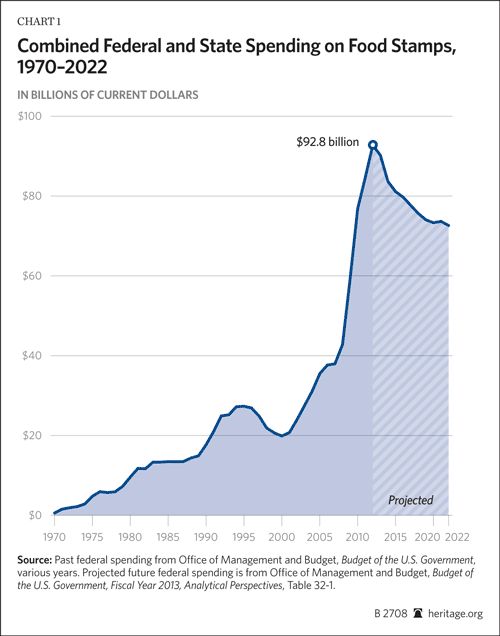
That’s partially true. Food stamp spending has roughly doubled in the past four years, and part of this is clearly due to the recession. However, food stamp spending has been on an upward climb since the program began back in the 1960s. In the decade prior to the recession, total government food stamp spending nearly doubled, from $19.8 billion in 2000 to $37.9 trillion in 2007.

Bfoodstampreform2012chart1

Moreover, according to Obama’s budget plans, food stamp spending will not return to pre-recession levels when the economy improves. “For most of the next decade, food stamp spending, adjusted for inflation and population growth, would remain at nearly twice the levels seen during the non-recessionary periods under President Bill Clinton,” note Rector and Bradley.

What’s more, food stamps are just one of roughly 80 federally funded means-tested welfare programs. The total cost of government welfare spending has been on a nearly continual climb over the past five decades and has increased 16-fold, to nearly $1 trillion annually, since the 1960s. Welfare is the fastest growing part of government spending, and under Obama’s fiscal year 2013 budget, total welfare spending will permanently increase from 4.5 percent of gross domestic product (GDP) to 6 percent of GDP.

US News & World Report also suggests as a “fact” that most food stamp recipients work.

However, a significant portion of able-bodied recipients of food stamps perform little to no work. Of the roughly 10.5 million households receiving food stamps containing an able-bodied, non-elderly adult (there are approximately 20 million households receiving food stamps total), more than half—5.5 million—performed no work during a given month in 2010. Another 1.5 million to 2 million performed fewer than 30 hours of work per week. This isn’t unique to the recession, but is typical even during good economic times.

The food stamp program is just one of dozens that comprise the complex system of federal means-tested welfare programs. Instead of continuing to pour more dollars into these programs, which have failed to promote self-sufficiency, policymakers should roll back aggregate spending on means-tested welfare to pre-recession levels when employment recovers. Likewise, programs like food stamps should be reformed to promote self-reliance through work, empowering individuals and families to become free from government dependence.


_______________________

Thank you so much for your time. I know how valuable it is. I also appreciate the fine family that you have and your commitment as a father and a husband.

Sincerely,

Everette Hatcher III, 13900 Cottontail Lane, Alexander, AR 72002, ph 501-920-5733, lowcostsqueegees@yahoo.com

Related posts:

Tell the 48 million food stamps users to eat more broccoli!!!!

Welfare Can And Must Be Reformed             Uploaded on Jun 29, 2010 If America does not get welfare reform under control, it will bankrupt America. But the Heritage Foundation’s Robert Rector has a five-step plan to reform welfare while protecting our most vulnerable. __________________________ We got to slow down the growth of Food Stamps. One […]

Republicans for more food stamps?

Eight Reasons Why Big Government Hurts Economic Growth __________________ We got to cut spending and we must first start with food stamp program and we need some Senators that are willing to make the tough cuts. Food Stamp Republicans Posted by Chris Edwards Newt Gingrich had fun calling President Obama the “food stamp president,” but […]

Obama promotes food stamps but Milton Friedman had a better suggestion

Milton Friedman’s negative income tax explained by Friedman in 1968: We need to cut back on the Food Stamp program and not try to increase it. What really upsets me is that when the government gets involved in welfare there is a welfare trap created for those who become dependent on the program. Once they […]

400% increase in food stamps since 2000

Welfare Can And Must Be Reformed Uploaded by HeritageFoundation on Jun 29, 2010 If America does not get welfare reform under control, it will bankrupt America. But the Heritage Foundation’s Robert Rector has a five-step plan to reform welfare while protecting our most vulnerable. __________________________ If welfare increases as much as it has in the […]

Food stamp spending has doubled under the Obama Administration

The sad fact is that Food stamp spending has doubled under the Obama Administration. A Bumper Crop of Food Stamps Amy Payne May 21, 2013 at 7:01 am Tweet this Where do food stamps come from? They come from taxpayers—certainly not from family farms. Yet the “farm” bill, a recurring subsidy-fest in Congress, is actually […]

Which states are the leaders in food stamp consumption?

I am glad that my state of Arkansas is not the leader in food stamps!!! Mirror, Mirror, on the Wall, Which State Has the Highest Food Stamp Usage of All? March 19, 2013 by Dan Mitchell The food stamp program seems to be a breeding ground of waste, fraud, and abuse. Some of the horror stories […]

Why not cancel the foodstamp program and let the churches step in?

Government Must Cut Spending Uploaded by HeritageFoundation on Dec 2, 2010 The government can cut roughly $343 billion from the federal budget and they can do so immediately. __________ We are becoming a country filled with people that dependent on the federal government when we should be growing our economy by lowering taxes and putting […]

Food Stamp Program is constantly ripped off and should be discontinued

Uploaded by oversightandreform on Mar 6, 2012 Learn More athttp://oversight.house.gov The Oversight Committee is examining reports of food stamp merchants previously disqualified who continue to defraud the program. According to a Scripps Howard News Service report, food stamp fraud costs taxpayers hundreds of millions every year. Watch the Oversight hearing live tomorrow at 930 […]

Open letter to President Obama (Part 326)

(This letter was emailed to White House on 11-21-11.) President Obama c/o The White House 1600 Pennsylvania Avenue NW Washington, DC 20500 Dear Mr. President, I know that you receive 20,000 letters a day and that you actually read 10 of them every day. I really do respect you for trying to get a pulse […]

Welfare state may drag England down the tubes!!!!

Welfare state may drag England down the tubes!!!! Very Funny but Very Un-PC British Video on Welfare and Immigration May 19, 2013 by Dan Mitchell I’ve shared this bit of political incorrect terrorism humor from England, as well asthis somewhat un-PC bit of tax humor. But perhaps motivated by the scandal of giving welfare to terrorists, this new video is […]