Category Archives: spending out of control

If you want to cut spending in a serious way you have to look at Entitlement Spending!

___________

If you want to cut spending in a serious way you have to look at Entitlement Spending!

April 7, 2014 1:06PM

50 Years of Federal Spending

Fifty years ago, one of the biggest-spending presidents in U.S. history was settling into office after coming to power the prior November. Lyndon Johnson signed into law Medicare, Medicaid, and hundreds of subsidy programs for the states and cities.

Johnson was followed in office by one of the worst presidents of the 20th century in terms of domestic policy. Richard Nixon added and expanded many programs, and he helped to cement in place the array of new federal interventions pioneered by Johnson.

The chart below shows federal spending over the five decades since Johnson. Spending is divided into four components and measured as a share of gross domestic product (GDP).

Blue Line: Entitlement spending soared from the mid-1960s to the early-1980s. Medicare and Medicaid grew rapidly after being created in 1965, and Nixon signed into law numerous large increases in Social Security for current recipients. A month before the 1972 election, Social Security recipients received a letter informing them that Nixon had just signed a law bumping up their benefits by 20 percent. The recent spike in spending stems from increases in Medicare, Medicaid, food stamps, and other programs.

Black Line: Defense spending spiked in the late 1960s due to the Vietnam War. The number of U.S. troops in Vietnam peaked in 1968, then fell steadily after that. The Ronald Reagan and George W. Bush defense build-ups are also visible on the chart.

Red Line: Defense spending fell as a share of GDP in the 1970s, while nondefense discretionary spending rose. Then in the 1980s and 1990s, nondefense spending was restrained under Reagan and Bill Clinton, but then rose under George W. Bush in the 2000s.

Green Line: Bush and Barack Obama have been lucky budgeters because federal interest costs have been low during the past decade, despite the large deficits run by these two presidents. The luck won’t last: under its baseline, CBO projects that interest costs will rise from 1.3 percent of GDP today, to 2.7 percent by 2020, and to 4.1 percent by 2030.

Related posts:

Open letter to President Obama (Part 430) A suggestion to cut some wasteful spending out of the government Part 1 (includes editorial cartoon)

(Emailed to White House on 3-15-13.) President Obama c/o The White House 1600 Pennsylvania Avenue NW Washington, DC 20500 Dear Mr. President, I know that you receive 20,000 letters a day and that you actually read 10 of them every day. I really do respect you for trying to get a pulse on what is […]

If you want to cut wasteful spending then the disability program must be reformed radically!!!

If you want to cut wasteful spending then the disability program must be reformed radically!!! October 7, 2013 1:19PM 60 Minutes Disability Investigation By Chris Edwards Share The abuse and overspending in government disability programs is so bad that even National Public Radio and 60 Minutes have taken notice. On the heels of this excellent […]

If you really want to cut wasteful spending then why not shut down Dept of Housing and Urban Development, Dept of Education and SBA?

If you really want to cut wasteful spending then why not shut down Dept of Housing and Urban Development, Dept of Education and SBA? There are many other areas that should be cut but these should be shut down!!!   October 7, 2013 4:57PM Close Washington to Dismantle the Welfare-Warfare State By Doug Bandow Share […]

We need to stop wasteful government spending by privatizing the post office!!

We need to stop wasteful government spending by privatizing the post office!! Postal Service Won’t Shut Down but Will Default on Its Debt James Gattuso October 1, 2013 at 9:30 am Newscom The U.S. Postal Service (USPS) defaulted on its debt last night. No, it has nothing to do with the partial shutdown of the […]

President Obama and government spending (GSA Govt waste tip of iceberg)

I wish President Obama would try to cut spending instead of increasing spending and our debt. Two Very Good GSA Waste Cartoons April 21, 2012 by Dan Mitchell One of my first blog posts back in 2009 featured a column about the Social Security Administration squandering $750,000 on a “conference” at a fancy golf resort in […]

Open letter to President Obama (Part 556) Who Really Gets Farm Bill Money (INFOGRAPHIC)

Open letter to President Obama (Part 556)

(Emailed to White House on 6-6-13.)

President Obama c/o The White House 1600 Pennsylvania Avenue NW Washington, DC 20500

Dear Mr. President,

I know that you receive 20,000 letters a day and that you actually read 10 of them every day. I really do respect you for trying to get a pulse on what is going on out here.

I have been writing on my blog for over two years now concerning the disturbing trend of more and more people becoming dependent on the federal government for more of their income than ever before. This encourages laziness in my view and in the case of the food stamp system many people find themselves in what Milton Friedman calls the “Welfare Trap.”  (Much of this trend started under President Bush and had Republican support.) I wanted to point out that we should cut back on government spending and let the private economy do it’s magic.

We got to cut the farm bill because it is poorly designed and should be eliminated all together.

May 30, 2013 at 7:01 am

Whenever Congress throws too much into one bill, special interests profit. The massive farm bill—which is already 80 percent food stamps—is no exception.

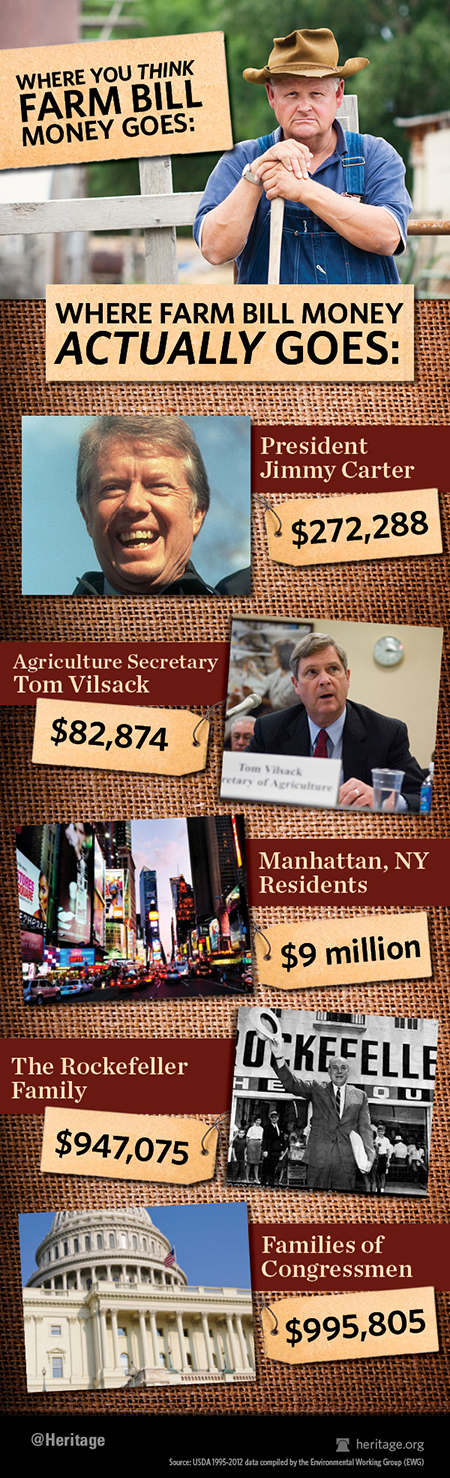
So what about the rest of the bill—the farm-related part? Heritage’s Diane Katz reports that it includes subsidies for more than a few surprising recipients. SHARE our infographic to spread the word.

FarmBill_RichandFamous_450pixels

Read the Morning Bell and more en español every day at Heritage Libertad.


_______________________

Thank you so much for your time. I know how valuable it is. I also appreciate the fine family that you have and your commitment as a father and a husband.

Sincerely,

Everette Hatcher III, 13900 Cottontail Lane, Alexander, AR 72002, ph 501-920-5733, lowcostsqueegees@yahoo.com

Related posts:

Congress needs to remove subsidies from the farm bill, not expand them

Congress needs to remove subsidies from the farm bill, not expand them Farm Bill Wastes More Taxpayer Money on Green Subsidies Nicolas Loris May 13, 2013 at 11:27 am Design Pics / Dave Reede/Dave Reede/Newscom Slapping the word rural in front of a bunch of green subsidies does not mean they’re not subsidies. But that’s […]

If increase in food stamps was just because of recession then why spending go from $19.8 billion in 2000 to $37.9 billion in 2007?

If the increase in food stamps was just because of the recession then why did the spending go from $19.8 billion in 2000 to $37.9 billion in 2007? The Facts about Food Stamps Everyone Should Hear Rachel Sheffield and T. Elliot Gaiser May 27, 2013 at 12:00 pm (7) Newscom A recent US News & […]

Food stamp spending has doubled under the Obama Administration

The sad fact is that Food stamp spending has doubled under the Obama Administration. A Bumper Crop of Food Stamps Amy Payne May 21, 2013 at 7:01 am Tweet this Where do food stamps come from? They come from taxpayers—certainly not from family farms. Yet the “farm” bill, a recurring subsidy-fest in Congress, is actually […]

Agriculture Dept is bloated

Agriculture: Downsizing The Federal Government Uploaded on Dec 19, 2008 Agriculture is easily the most distorted sector, with high tariffs and, in developed countries at least, large amounts of government subsidies through price supports and direct payments. On the other hand, developing countries, who have a comparative advantage in these products, cannot afford to subsidize […]

Which states are the leaders in food stamp consumption?

I am glad that my state of Arkansas is not the leader in food stamps!!! Mirror, Mirror, on the Wall, Which State Has the Highest Food Stamp Usage of All? March 19, 2013 by Dan Mitchell The food stamp program seems to be a breeding ground of waste, fraud, and abuse. Some of the horror stories […]

Open letter to President Obama (Part 255)

Government Must Cut Spending Uploaded by HeritageFoundation on Dec 2, 2010 The government can cut roughly $343 billion from the federal budget and they can do so immediately. __________   President Obama c/o The White House 1600 Pennsylvania Avenue NW Washington, DC 20500 Dear Mr. President, I know that you receive 20,000 letters a day […]

Mission accomplished!!! Rick Crawford joins Tea Party Republicans and votes against kick the can down the road “fiscal cliff deal”

  _________________ President Ronald Reagan wisely said: “The federal government has taken too much tax money from the people, too much authority from the states, and too much liberty with the Constitution.” You would think that the Republicans who talk so much of cutting spending would try to get a plan that cuts spending 3 […]

Representative Crawford reads and responds to my letter

  I recently wrote an open letter to Congressman Rick Crawford and I put it on his facebook page. I personally do not have a facebook page so I used my son Wilson’s facebook page and here is what Congressman Crawford said: Wilson- I agree with you that we have a spending problem and not […]

By Everette Hatcher III | Posted in President Obama, Speaker of the House John Boehner, spending out of control, Taxes | Edit | Comments (0)

FRIEDMAN FRIDAY “The Failure of Socialism” episode of Free to Choose in 1990 by Milton Friedman (Part 5)

Milton Friedman: Free To Choose – The Failure Of Socialism With Ronald Reagan (Full)

Published on Mar 19, 2012 by

Milton Friedman’s writings affected me greatly when I first discovered them and I wanted to share with you.

Ronald Reagan introduces this program, and traces a line from Adam Smith’s “The Wealth of Nations” to Milton Friedman’s work, describing Free to Choose as “a survival kit for you, for our nation and for freedom.” Dr. Friedman travels to Hungary and Czechoslovakia to learn how Eastern Europeans are rebuilding their collapsed economies. His conclusion: they must accept the verdict of history that governments create no wealth. Economic freedom is the only source of prosperity. That means free, private markets. Attempts to find a “third way” between socialism and free markets are doomed from the start. If the people of Eastern Europe are given the chance to make their own choices they will achieve a high level of prosperity. Friedman tells us individual stories about how small businesses struggle to survive against the remains of extensive government control. Friedman says, “Everybody knows what needs to be done. The property that is now in the hands of the state, needs to be gotten into the hands of private people who can use it in accordance with their own interests and values.” Eastern Europe has observed the history of free markets in the United States and wants to copy our success. After the documentary, Dr. Friedman talks further about government and the economy with Gary Becker of the University of Chicago and Samuel Bowles of the University of Massachusetts. In a wide-ranging discussion, they disagree about the results of economic controls in countries around the world, with Friedman defending his thesis that the best government role is the smallest one.
___________
Below is a portion of the transcript of the program and above you will find the complete video of the program:
 

DISCUSSION

Hello, I am Linda Chavez and welcome to Free to Choose. Joining Dr. Friedman for a discussion of the failure of socialism are Gary Becker from the University of Chicago and Samuel Bowles of the University of Massachusetts. Dr. Bowles, I think we can all agree that socialism has failed Eastern Europe. Dr. Friedman believes that the path out of that is the free market and I think he thinks there are lessons for the United States. What do you think?

Bowles: The homeless people are homeless because they are poor and they are out of work. They are not homeless because of rent control.

Friedman: I beg your pardon. All of them aren’t. Of course there are some like that, but the existence of rent control has certainly increased the number of homeless.

Becker: Many people are homeless because they are mentally ill. But the homeless is a tiny fraction. Housing policy in the United States should not be oriented around the homeless because that is a tiny part of the problem in any major city, and certainly outside of major cities. If you look at the bulk of housing in the United States, I see no evidence that it cannot be adequately provided by the private sector.

Bowles: Let’s talk about incentives because I know both of you like to talk about incentives a lot. I think incentives are terribly important. Milton says in the show, and I agree with him, that we have to choose between taking orders from the top down, or incentives at the bottom. Now Milton’s idea of how do you get the incentives down at the bottom is essentially a view of an economy in which individuals, through their ownership of property, can own the results of their hard work and their innovation. It is a great idea. It doesn’t exist anywhere and it can’t exist. When I read your stuff Milton and when I watch you on TV, I think, you know, Milton has this idea of, Charlie Brown and Linus are going to have a lemonade stand and Lucy is going to have another lemonade stand and that is your idea of capitalism. But that is a myth. That is not what capitalism is. We don’t have thousands and millions of little firms competing on a level playing field. We have giant industrial corporations that use their power to their own advantage and to the disadvantage of others. That is what you have to be able to deal with you if you want to be relevant to the modern world. That is what the countries that I talked about, Sweden, Korea, Norway, Japan, are very good at doing __ dealing with the problem of economic power so that the power of those institutions can be used by and large for public good. If you ignore them with this lemonade stand capitalism myth, you are simply giving those powerful spenders of wealth and affluence free rein.

Friedman: Gary, it is a strange thing that not a single one of the countries that you have described has a standard of living as high as that of the United States with respect to the bulk of its population.

Bowles: Yes and the United States got its standard of living through precisely the policies that you have opposed such as protecting our industrial base from . . . . . .

Becker: I would be very happy to go back to the 19th century U.S. policy. It was a tiny part. The government, sure they did some things, but as a tiny part of the economy and let’s go back to a resource that went through the government at that time what was it? Ten percent of the maximum. The largest employer of the government was the postal system. That is the main thing the government was doing. Some tariff policies probably hurt us and a few other activities. Let me come back to the other issue raised then. There are millions and millions of companies in the United States. It is true that in some sectors these are very large companies like in manufacturing. But what I think has happened, particularly in the modern world, is these large companies are now having to compete with large countries from elsewhere. It is not capitalism. It is the political sector that is limiting that competition, partly at the behest of these companies, but also at the behest of the employees of these companies to limit the competition from abroad, but most industries, it would be hard put for you to argue now that even the large companies aren’t facing significant competition in the United States markets, not only from domestic companies, but from large companies based abroad.

Bowles: Oh, I agree with that completely. But what I am concerned about is this. If you work at General Motors or IBM and you are a secretary or you are a production worker, what you are getting there is you are getting orders from the top down. You don’t own your work. You don’t own the results of your work. When you talk about incentives from the bottom, if you want to get incentives from the bottom, you have to get the people who work at the bottom to own the results of their work and to have a say in how their work is going to be used. You can do that if you . . . like employee ownership and employee control. That is what made Wierton Steel from almost bankruptcy to one of the most successful steel companies in the United States __ employee ownership and control. The same with Columbia Aluminum, one of the most efficient aluminum companies in the United States. It went from shutdown to being a very successful company through employee ownership and employee control over their production processes. That is what I call putting incentives at the bottom where they belong, but you never advocate that.

Becker: I am not against employee ownership, but you have to permit employee ownership to compete on a level playing field against other forms. We permitted that in the United States, up until 1975, when you had trivial employee ownership in the United States. That to me suggests that workers didn’t want it.

Chavez: Dr. Friedman, who owns companies now? Are these in the hands of a small number of people or is it stockholders?

Friedman: No, it is the stockholders who own it and a very large fraction of that is owned in pension plans which are for the benefit of the employees. But of course, Gary is right, what produced the spate of employee ownership was government subsidy through ESOP’s since 1975.

Friedman: I think that is disgraceful.

Becker: That is the only reason you have gotten the growth of employee ownership in the United States. We have 5,000 or 6,000 employee owned companies now in the United States, and you take away these subsidies and they think that would go down to 1,000 or so, and let them be there, that is fine. Let the market determine which form is most desired and which form is most efficient.

Chavez: Gentlemen, obviously we have not exhausted this subject, but we are out of time. Thank you for watching Free to Choose. Next week we will be discussing the failure of our schools. We send our kids to school hoping that they will receive something that will benefit them in the future for when they go out here and compete in the job market. Unfortunately, none of that is taking place out of Hyde Park.

Dear Senator Pryor, here are some spending cut suggestions (“Thirsty Thursday”, Open letter to Senator Pryor)

Senator Pryor pictured below:

Why do I keep writing and email Senator Pryor suggestions on how to cut our budget? I gave him hundreds of ideas about how to cut spending and as far as I can tell he has taken none of my suggestions. You can find some of my suggestions herehereherehere, hereherehereherehere, herehereherehereherehereherehereherehere,  here, and  here, and they all were emailed to him. In fact, I have written 13 posts pointing out reasons why I believe Senator Pryor’s re-election attempt will be unsuccessful. HERE I GO AGAIN WITH ANOTHER EMAIL I JUST SENT TO SENATOR PRYOR!!!

Dear Senator Pryor,

Why not pass the Balanced  Budget amendment? As you know that federal deficit is at all time high (1.6 trillion deficit with revenues of 2.2 trillion and spending at 3.8 trillion).

On my blog www.thedailyhatch.org . I took you at your word and sent you over 100 emails with specific spending cut ideas. (Actually there were over 160 emails with specific spending cut suggestions.) However, I did not see any of them in the recent debt deal that Congress adopted although you did respond to me several times. Now I am trying another approach. Every week from now on I will send you an email explaining different reasons why we need the Balanced Budget Amendment. It will appear on my blog on “Thirsty Thursday” because the government is always thirsty for more money to spend. Today I actually have included a great article below from the Heritage Foundation concerning an area of our federal budget that needs to be cut down to size. The funny thing about the Sequester and the 2.4% of cuts in future increases is that President Obama set these up and then he acted like the sky was falling in as the cartoons indicate in the newspapers.

IF YOU TRULY WANT TO CUT THE BUDGET AND BALANCE THE BUDGET THEN SUBMIT THESE POTENTIAL BUDGET CUTS PRESENTED BELOW!!

___________

_____________________________________

Milton Friedman On Charlie Rose (Part One)

The late Milton Friedman discusses economics and otherwise with Charlie Rose.

_________________________________________

Milton Friedman: Life and ideas – Part 01

Milton Friedman: Life and ideas

A brief biography of Milton Friedman

_____________________________________

Stossel – “Free to Choose” (Milton Friedman) 1/6

6-10-10. pt.1 of 6. Stossel discusses Milton Friedman’s 1980 book, “Free to Choose”, which was smuggled in and read widely in Eastern Europe during the Cold War by many countries under Soviet rule. Read and admired the world over by the likes of Margaret Thatcher and Ronald Reagan, this book served as the inspiration for many of the Soviet sattellite countries’ economies once they achieved freedom after the fall of the Soviet Union.

_________________________________________

I first saw Thomas Sowell on the show FREE TO CHOOSE on the debate team that Milton Friedman chose. I suggest checking out these episodes of Milton Friedman’s film series FREE TO CHOOSE: “The Failure of Socialism” and “What is wrong with our schools?”  and “Created Equal”  and  From Cradle to Grave, and – Power of the Market. Below he is the subject of a fine article that shows how our government is wasting so much money on the welfare trap. We should stop trapping people in welfare and let the free market offer them a chance to do better. Obviously what we are doing now is not working. The best way to destroy the welfare trap is to put in Milton Friedman’s negative income tax.  Of course, all welfare programs should be eliminated at the same time.

Thomas Sowell Explains How the Welfare State Hurts the Poor

July 3, 2013 by Dan Mitchell

Political cartoonists like Michael Ramirez and Chuck Asay are effective because they convey so much with images.

But we need more than clever cartoons if we’re going to educate the general population about how government harms the economy and undermines freedom.

He just turned 83, and let’s hope he has another 20 years of columns to write

And that’s why Thomas Sowell is so invaluable. He’s one of the nation’s top economic thinkers, but he also writes for mass audiences and his columns are masterful combinations of logic and persuasion.

His latest column about poverty is a good example. In this first excerpt, he succinctly explains that official poverty is not the same as destitution.

“Poverty” once had some concrete meaning — not enough food to eat or not enough clothing or shelter to protect you from the elements, for example. Today it means whatever the government bureaucrats, who set up the statistical criteria, choose to make it mean. And they have every incentive to define poverty in a way that includes enough people to justify welfare state spending. Most Americans with incomes below the official poverty level have air-conditioning, television, own a motor vehicle and, far from being hungry, are more likely than other Americans to be overweight. But an arbitrary definition of words and numbers gives them access to the taxpayers’ money.

He then makes a very important point about economic incentives.

Even when they have the potential to become productive members of society, the loss of welfare state benefits if they try to do so is an implicit “tax” on what they would earn that often exceeds the explicit tax on a millionaire. If increasing your income by $10,000 would cause you to lose $15,000 in government benefits, would you do it? In short, the political left’s welfare state makes poverty more comfortable, while penalizing attempts to rise out of poverty.

Since columnists are limited to about 800 words, Sowell doesn’t have leeway to give details, but his explanation of how the government traps people in poverty is the rhetorical version of this amazing chart.

He concludes with some powerful observation about who really benefits from the welfare state.

…the left’s agenda is a disservice to [the poor], as well as to society.  …The agenda of the left — promoting envy and a sense of grievance, while making loud demands for “rights” to what other people have produced — is a pattern that has been widespread in countries around the world. This agenda has seldom lifted the poor out of poverty. But it has lifted the left to positions of power and self-aggrandizement, while they promote policies with socially counterproductive results.

But his main message (similar to this video and illustrated by this chart) is that the welfare state hurts the poor even more than it hurts taxpayers.

P.S. As a big fan of Professor Sowell, I’ve cited his columns more than 20 times. My favorite examples of his writing can be viewed hereherehereherehere,hereherehere,hereherehereherehereherehereherehereherehere, and here. And you can see him in action here.

_______________

The Balanced Budget Amendment is the only thing I can think of that would force Washington to cut spending. We have only a handful of balanced budgets in the last 60 years, so obviously what we are doing is not working. We are passing along this debt to the next generation. YOUR APPROACH HAS BEEN TO REJECT THE BALANCED BUDGET “BECAUSE WE SHOULD CUT THE BUDGET OURSELF,” WELL THEN HERE IS YOUR CHANCE!!!! SUBMIT THESE CUTS!!!!

Thank you for this opportunity to share my ideas with you.

Sincerely,

Everette Hatcher, lowcostsqueegees@yahoo.com www.thedailyhatch.org, 13900 Cottontail Lane, Alexander, AR 72002, ph 501-920-5733

Related posts:Milton Friedman’s “Free to Choose” film transcripts and videos here on http://www.thedailyhatch.org

I have many posts on my blog that include both the transcript and videos of Milton Friedman’s film series “Free to Choose” and here are the episodes that I have posted.

_____________

Here are the posts and you can find the links in order below this.

The Power of the Market from 1990

The Failure of Socialism from 1990

The Anatomy of a Crisis from 1980

What is wrong with our schools?  from 1980

Created Equal from 1980

From Cradle to Grave from 1980

The Power of the Market 1980

Debate on Inflation from 1980

Milton Friedman is the short one!!!

Milton Friedman’s Free to Choose (1980), episode 3 – Anatomy of a Crisis. part 1

“The Power of the Market” episode of Free to Choose in 1990 by Milton Friedman (Part 5)

Milton Friedman The Power of the Market 5-5 How can we have personal freedom without economic freedom? That is why I don’t understand why socialists who value individual freedoms want to take away our economic freedoms.  I wanted to share this info below with you from Milton Friedman who has influenced me greatly over the […]

“The Power of the Market” episode of Free to Choose in 1990 by Milton Friedman (Part 4)

Milton Friedman The Power of the Market 4-5 How can we have personal freedom without economic freedom? That is why I don’t understand why socialists who value individual freedoms want to take away our economic freedoms.  I wanted to share this info below with you from Milton Friedman who has influenced me greatly over the […]

“The Power of the Market” episode of Free to Choose in 1990 by Milton Friedman (Part 3)

Milton Friedman The Power of the Market 3-5 How can we have personal freedom without economic freedom? That is why I don’t understand why socialists who value individual freedoms want to take away our economic freedoms.  I wanted to share this info below with you from Milton Friedman who has influenced me greatly over the […]

“The Power of the Market” episode of Free to Choose in 1990 by Milton Friedman (Part 2)

Milton Friedman The Power of the Market 2-5 How can we have personal freedom without economic freedom? That is why I don’t understand why socialists who value individual freedoms want to take away our economic freedoms.  I wanted to share this info below with you from Milton Friedman who has influenced me greatly over the […]

“The Power of the Market” episode of Free to Choose in 1990 by Milton Friedman (Part 1)

Milton Friedman The Power of the Market 1-5 How can we have personal freedom without economic freedom? That is why I don’t understand why socialists who value individual freedoms want to take away our economic freedoms.  I wanted to share this info below with you from Milton Friedman who has influenced me greatly over the […]

Milton Friedman’s Free to Choose (1980), episode 3 – Anatomy of a Crisis. part 1

“Friedman Friday” EPISODE “The Failure of Socialism” of Free to Choose in 1990 by Milton Friedman (Part 5)

Milton Friedman: Free To Choose – The Failure Of Socialism With Ronald Reagan (Full) Published on Mar 19, 2012 by NoNationalityNeeded Milton Friedman’s writings affected me greatly when I first discovered them and I wanted to share with you. Abstract: Ronald Reagan introduces this program, and traces a line from Adam Smith’s “The Wealth of […]

“Friedman Friday” EPISODE “The Failure of Socialism” of Free to Choose in 1990 by Milton Friedman (Part 4)

Milton Friedman: Free To Choose – The Failure Of Socialism With Ronald Reagan (Full) Published on Mar 19, 2012 by NoNationalityNeeded Milton Friedman’s writings affected me greatly when I first discovered them and I wanted to share with you. Abstract: Ronald Reagan introduces this program, and traces a line from Adam Smith’s “The Wealth of […]

“Friedman Friday” EPISODE “The Failure of Socialism” of Free to Choose in 1990 by Milton Friedman (Part 3)

Milton Friedman: Free To Choose – The Failure Of Socialism With Ronald Reagan (Full) Published on Mar 19, 2012 by NoNationalityNeeded Milton Friedman’s writings affected me greatly when I first discovered them and I wanted to share with you. Abstract: Ronald Reagan introduces this program, and traces a line from Adam Smith’s “The Wealth of […]

“Friedman Friday” EPISODE “The Failure of Socialism” of Free to Choose in 1990 by Milton Friedman (Part 2)

Milton Friedman: Free To Choose – The Failure Of Socialism With Ronald Reagan (Full) Published on Mar 19, 2012 by NoNationalityNeeded Milton Friedman’s writings affected me greatly when I first discovered them and I wanted to share with you. Abstract: Ronald Reagan introduces this program, and traces a line from Adam Smith’s “The Wealth of […]

“Friedman Friday,” EPISODE “The Failure of Socialism” of Free to Choose in 1990 by Milton Friedman (Part 1)

Milton Friedman: Free To Choose – The Failure Of Socialism With Ronald Reagan (Full) Published on Mar 19, 2012 by NoNationalityNeeded Milton Friedman’s writings affected me greatly when I first discovered them and I wanted to share with you. We must not head down the path of socialism like Greece has done. Abstract: Ronald Reagan […]

________________

“Friedman Friday” (“Free to Choose” episode 3 – Anatomy of a Crisis. part 7of 7)

TEMIN: We don’t think the big capital arose before the government did? VON HOFFMAN: Listen, what are we doing here? I mean __ defending big government is like defending death and taxes. When was the last time you met anybody that was in favor of big government? FRIEDMAN: Today, today I met Bob Lekachman, I […]

By Everette Hatcher III | Also posted in Current Events | Edit |

FRIEDMAN FRIDAY “The Failure of Socialism” episode of Free to Choose in 1990 by Milton Friedman (Part 4)

Milton Friedman: Free To Choose – The Failure Of Socialism With Ronald Reagan (Full)

Published on Mar 19, 2012 by

Milton Friedman’s writings affected me greatly when I first discovered them and I wanted to share with you.

Ronald Reagan introduces this program, and traces a line from Adam Smith’s “The Wealth of Nations” to Milton Friedman’s work, describing Free to Choose as “a survival kit for you, for our nation and for freedom.” Dr. Friedman travels to Hungary and Czechoslovakia to learn how Eastern Europeans are rebuilding their collapsed economies. His conclusion: they must accept the verdict of history that governments create no wealth. Economic freedom is the only source of prosperity. That means free, private markets. Attempts to find a “third way” between socialism and free markets are doomed from the start. If the people of Eastern Europe are given the chance to make their own choices they will achieve a high level of prosperity. Friedman tells us individual stories about how small businesses struggle to survive against the remains of extensive government control. Friedman says, “Everybody knows what needs to be done. The property that is now in the hands of the state, needs to be gotten into the hands of private people who can use it in accordance with their own interests and values.” Eastern Europe has observed the history of free markets in the United States and wants to copy our success. After the documentary, Dr. Friedman talks further about government and the economy with Gary Becker of the University of Chicago and Samuel Bowles of the University of Massachusetts. In a wide-ranging discussion, they disagree about the results of economic controls in countries around the world, with Friedman defending his thesis that the best government role is the smallest one.
___________
Below is a portion of the transcript of the program and above you will find the complete video of the program:
 

DISCUSSION

Hello, I am Linda Chavez and welcome to Free to Choose. Joining Dr. Friedman for a discussion of the failure of socialism are Gary Becker from the University of Chicago and Samuel Bowles of the University of Massachusetts. Dr. Bowles, I think we can all agree that socialism has failed Eastern Europe. Dr. Friedman believes that the path out of that is the free market and I think he thinks there are lessons for the United States.

Chavez: I would like to bring this discussion back to the United States for a moment. What about socialism in the United States. There has been one area where we have tried to redistribute wealth. We have done that through our welfare policies and social security. Has that worked?

Friedman: For some people, it benefited, but taken as a whole, I think it has been a failure.

Becker: I agree with that. I think the big problem in the United States has been, of course, some of the welfare programs have been successful. But by trying to do too many things, the government is no longer doing the things that it should be doing. We all agree there are many things government should be doing. I agree with Milton __ he is a strong man to be say this is an issue between no government and 100% government. The question is what are the tasks that government should be doing. I believe the tasks are, of course, defense against outside aggression, internal protection, some infrastructure, protection of the people can’t make it. In every one of these areas, we are not doing very well. I think we are not doing well mainly because we are trying to do a lot of things we shouldn’t be doing. They can’t do all of them.

Chavez: I couldn’t help but think, Dr. Bowles, as I watched that film that the public housing area that we saw in Eastern Europe and the problems that we have here in the United States. Aren’t there some lessons to be learned?

Bowles: There is absolutely no reason why housing shouldn’t be privately owned. That does not mean that the government has no role in housing. It seems to me that housing is precisely something that ought to be a matter of private property. But we also know, from the experience of this country, that the market itself doesn’t provide housing that the rest of the public thinks is adequate for the vast majority of poor people in this country. Now that doesn’t mean it has to be done by government building the houses, but it certainly does mean that something has to be done or we are going to have the kind of homeless crisis that we have in this country and they are getting one in Eastern Europe too.

Becker: The homeless crisis is a tiny fraction of the population of the United States. Let’s not make that a major part of the housing problem in the United States. I am not at all convinced that there is any evidence suggesting that the private system cannot provide adequate housing. I think there is a good case to be made that there are poor people in this country and the government obviously has to help them out. We all agree on that. But should they be doing it by building housing or by giving them income and permitting them to spend as they see fit. I see no evidence from the U.S. or any other country who were better off when then government takes a major role in housing or any of these other particular activities that allocate resources.

Friedman: What role has been played in the difficulty of getting housing by government interventions? By rent control? By excessive building code regulations, many of which are designed to protect the interests of special groups. Government played a very large role.

Dear Senator Pryor, here are some spending cut suggestions (“Thirsty Thursday”, Open letter to Senator Pryor)

Senator Pryor pictured below:

Why do I keep writing and email Senator Pryor suggestions on how to cut our budget? I gave him hundreds of ideas about how to cut spending and as far as I can tell he has taken none of my suggestions. You can find some of my suggestions herehereherehere, hereherehereherehere, herehereherehereherehereherehereherehere,  here, and  here, and they all were emailed to him. In fact, I have written 13 posts pointing out reasons why I believe Senator Pryor’s re-election attempt will be unsuccessful. HERE I GO AGAIN WITH ANOTHER EMAIL I JUST SENT TO SENATOR PRYOR!!!

Dear Senator Pryor,

Why not pass the Balanced  Budget amendment? As you know that federal deficit is at all time high (1.6 trillion deficit with revenues of 2.2 trillion and spending at 3.8 trillion).

On my blog www.thedailyhatch.org . I took you at your word and sent you over 100 emails with specific spending cut ideas. (Actually there were over 160 emails with specific spending cut suggestions.) However, I did not see any of them in the recent debt deal that Congress adopted although you did respond to me several times. Now I am trying another approach. Every week from now on I will send you an email explaining different reasons why we need the Balanced Budget Amendment. It will appear on my blog on “Thirsty Thursday” because the government is always thirsty for more money to spend. Today I actually have included a great article below from the Heritage Foundation concerning an area of our federal budget that needs to be cut down to size. The funny thing about the Sequester and the 2.4% of cuts in future increases is that President Obama set these up and then he acted like the sky was falling in as the cartoons indicate in the newspapers.

IF YOU TRULY WANT TO CUT THE BUDGET AND BALANCE THE BUDGET THEN SUBMIT THESE POTENTIAL BUDGET CUTS PRESENTED BELOW!!

___________

If you to cut the size of government then you don’t add a program like Obamacare. It will grow government like nothing ever has in American history.

The political elitists in Washington are worried that the American people are lukewarm – or even downright hostile – about Obamacare.

You can imagine two of them having a conversation, with the first saying, “Don’t these stupid peasants realize we’re giving them stuff?!?” and the second responding “We need the riff-raff in flyover country to feel grateful so they’re more likely to vote in favor of continued dependency!”

It never occurs to them that maybe, just maybe, people value freedom. Or, even if they don’t care about liberty, perhaps they object to the fact that government costs a lot and delivers very little. Nobody likes paying for a steak and getting a hamburger, after all.

But the statists think it’s just a matter of messaging, and this mindset is even seen in news coverage.

Here’s some of what Politico wrote today.

Obamacare MessagingThe Obama administration and its health-law allies are gearing up this summer to slice through three years of confusion and opposition to Obamacare. They’ve got their work cut out for them. Obamacare won’t have a shot at success unless millions of people sign up for insurance — the healthy as well as the sick. …Organizing for Action, spun off from President Barack Obama’s campaign operation, went up with a seven-figure TV ad buy in June, touting the new benefits and promising to offer “the truth” about the law. Enroll America, a nonprofit group with ties to the White House, wants to leverage the grass roots across the country and engage big-name celebrities for the cause.

To put it mildly, they have their work cut out for them.

Thanks to absurd regulations and mandates that prevent the insurance market from working properly, young people and healthy people will have to pay far more than the market rate to obtain insurance.

Needless to say, not that many people will be dumb enough to take that deal, regardless of how many empty-headed Hollywood millionaires take part in a PR campaign telling them it’s the “cool” thing to do.

Especially when another brainless part of Obamacare basically allows people to wait until they get sick and then get insurance. If you’re wondering how that will work, just imagine how auto insurance would work if you could wait until after your DUI accident to get a policy – and you got subsidized by all the responsible drivers!

Obamacare defenders may delude themselves into believing that the mandate will work, but the penalty for noncompliance (oops, apologies Chief Justice Roberts, I meant the “tax” for noncompliance) is a lot less than the cost of an insurance policy.

And I don’t think the American people will be pleased when the army of new IRS agents starts harassing them to sign up for a bad deal.

It’s almost enough to make me feel sorry for the hacks at OFA and elsewhere who are trying to sell this lemon.

Simply stated, it doesn’t matter how much lipstick you put on a pig.

Let’s close with some amusing Obamacare cartoons, starting with one by Bob Gorrell which sort of shows how the IRS will enforce the new law.

Obamacare Cartoon 7

By the way, my favorite IRS-related Obamacare cartoon can be seen here.

Here’s a good cartoon by Steve Breen about the cost of the new law.

Obamacare cartoon 8

For what it’s worth, some of us were predicting runaway costs even before the legislation was enacted.

Let’s finish with this amusing cartoon by Gary Varvel. Technically speaking, Nancy Pelosi was right.

Obamacare Cartoon 9

Though I imagine she thinks we just need some clever messaging so we understand why it’s okay that bad things are happening to childrenretirees, and low-income workers.

Let’s conclude with some optimism. Click here to read my six-part hypothesis on why this bad law can be repealed.

_______________

The Balanced Budget Amendment is the only thing I can think of that would force Washington to cut spending. We have only a handful of balanced budgets in the last 60 years, so obviously what we are doing is not working. We are passing along this debt to the next generation. YOUR APPROACH HAS BEEN TO REJECT THE BALANCED BUDGET “BECAUSE WE SHOULD CUT THE BUDGET OURSELF,” WELL THEN HERE IS YOUR CHANCE!!!! SUBMIT THESE CUTS!!!!

Thank you for this opportunity to share my ideas with you.

Sincerely,

Everette Hatcher, lowcostsqueegees@yahoo.com www.thedailyhatch.org, 13900 Cottontail Lane, Alexander, AR 72002, ph 501-920-5733

Related posts:

Dying laughing at Obamacare

When our government is spending over a trillion dollars they don’t have and then they put in another big government program then watch out. Costs will go through the roof because the government will run Obamacare about as good as it runs the post office. Sometimes things get so sad that you just have to […]

‘Why Indiana Shouldn’t Fall for Obamacare’s Medicaid Expansion’

Expanding government is not right. Take a look at this article: APRIL 25, 2013 6:35PM ‘Why Indiana Shouldn’t Fall for Obamacare’s Medicaid Expansion’ By  MICHAEL F. CANNON SHARE My latest oped, in the Indy Star: Meanwhile, many [Medicaid] enrollees can’t even find a doctor. One-third of primary care physicians won’t take new Medicaid patients. Only 20 percent of […]

If Obamacare is so wonderful then why are so many people trying to get exemptions?

If Obamacare is so wonderful then why are so many people trying to get exemptions? The Heritage foundation ran a fine article on this too.  Should Politicians Be Allowed to Exempt Themselves and their Staff from Obamacare? April 25, 2013 by Dan Mitchell I get upset by a lot of what happens in the corridors of power, […]

Reason’s Peter Suderman highlights six reasons why states should refuse to implement any part of ObamaCare

Jacque Martin asks CATO Institute Michael Cannon about Obamacare Published on Mar 19, 2013 The CATO Institute’s Michael Cannon spoke at the Arkansas Conservative Caucus on Tuesday March 19th. Several conservatives were present. Cannon talked about how to defeat Obamacare in Arkansas & how the states can stop Obamacare on a national level. Jacque Martin […]

Dan Mitchell on Obamacare (includes cartoons on Obamacare)

Some very good points by Dan Mitchell of the Cato Institute on Obamacare: Why We Should Be Optimistic about Repealing Obamacare and Fixing the Healthcare System April 10, 2013 by Dan Mitchell I’m going to make an assertion that seems utterly absurd. The enactment of Obamacare may have been good news. Before sending a team of medical […]

Obama up to his Chicago style politics and tricks with Obamacare

Nic Horton Medicaid Expansion will “Cost Almost Double than Doing Nothing” part I It is amazing to me that Repubican lawmakers are considering taking President Obama’s advice on anything in light of this article below. March 25, 2013 4:26PM Here’s Your Free Health Care. Would You Care to Vote? By Michael F. Cannon Share Tweet […]

Will President Obama keep his word concerning Obamacare?

A Red-Ink Train Wreck: The Real Fiscal Cost of Government-Run Healthcare Uploaded on Nov 9, 2009 This CF&P Foundation video explains why healthcare proposals in Washington will result in bloated government and higher deficits. This mini-documentary exposes the pervasive inaccuracy of congressional forecasts and succinctly lists 12 reasons why Obamacare will be a budget buster. […]

Republicans in Arkansas messing up by endorsing Obamacare

  Enlarge image Credit Nathan Vandiver / KUAR Michael Cannon of the Cato Institute told lawmakers March 19, 2013 that abandoning plans to partner with the federal government on a health insurance exchange would both benefit the state and reduce the power of the Affordable Care Act. __________________ I am very pleased with the Republican lawmakers in […]

Cartoons from Dan Mitchell’s blog on Obamacare

Third-Party Payer is the Biggest Economic Problem With America’s Health Care System Published on Jul 10, 2012 This mini-documentary from the Center for Freedom and Prosperity Foundation explains that “third-party payer” is the main problem with America’s health care system. This is why undoing Obamacare, while desirable, is just a small first step if we […]

Obamacare cartoons from Dan Mitchell’s blog

I have put up lots of cartoons from Dan Mitchell’s blog before and they have got lots of hits before. Many of them have dealt with the economy, eternal unemployment benefits, socialism,  Greece,  welfare state or on gun control. The funniest cartoon is the one with “Nurse Sebelius” stuffing the huge capsule down the kid’s throat!!! Obamacare […]

Dan Mitchell on privatizing the post office!!!

Dan Mitchell on privatizing the post office!!!


It’s not often that I agree with the Washington Post, but a government-run monopoly is not the best way to get mail delivered.

Moreover, it’s not often that I agree with the timid (and sometimes reprehensible) Tory-led government in the United Kingdom, but they just put the Royal Mail into the private sector. And that’s something deserving of loud applause.

Here’s a slice of the big news from the Financial Times.

The goal of privatising Royal Mail had defeated governments for 40 years. …Even prime minister Margaret Thatcher balked at the political risk of selling off a public service that carried the Queen’s head on its stamps. This time, the legislation went through parliament.

My Cato colleague, Chris Edwards, is suitably impressed.

Here’s some of what he wrote for Cato-at-Liberty.

Britain privatized its Royal Mail in 2013, proceeding with an initial public offering of shares that raised about $2.7 billion. …privatization in Britain has been hugely successful. Prime Minister Cameron should be applauded for having the guts to build on the privatization reform legacy of Thatcher, Major, and Blair. Meanwhile on this side of the pond, Republican Darrell Issa is having trouble getting his own nominally conservative party to accept even small changes to the broken government postal system.

Not surprisingly, some folks in Washington think we should move in the wrong direction by retaining the monopoly and allowing the Postal Service to enter new lines of business.

In this interview with Neil Cavuto, I explain why the Postal Service should be unleashed – but only after getting weaned from the taxpayer teat.


________

You’ll notice that I took the opportunity to explain that many poor people can’t afford banking services in part because government “anti-money laundering” rules impose very high costs on banks.

And since I’ve already mentioned that I have strange bedfellows at the Washington Post and UK government on the issue of postal privatization, I may as well note that the World Bank agrees with me about the poor being disadvantaged by these ill-advised financial regulations.

Let’s close with a good cartoon by Jerry Holbert.

Postal Service Cartoon

It’s not as good as his classics about Obamacare, sequestration, big government, and Patty Murray’s budget, but obviously very appropriate for today’s topic.

P.S. In there was a contest for government stupidity, the Japanese might be front runners.

No, I’m not talking about their bizarre policy of regulating coffee enemas.

Instead, I’m baffled by the notion of government-funded dating. I’m not joking. Check out these excerpts from the British press.

The Japanese government is funding matchmaking events in a desperate attempt to boost a birth rate that has halved over the past six decades. …The support of marriage – and the active encouragement of young people to settle down – is regarded by government policy-makers as a key strategy for boosting the nation’s birth rate. …Matchmaking events organised by local authorities, where young singles are introduced to one another in romantic settings, are becoming increasingly common in areas such as rural Kochi, a prefecture around 500 miles west of Tokyo.

By the way, Japan does have a severe demographic problem.

And when you mix falling birthrates and increasing longevity with a tax-and-transfer welfare state, the results are catastrophic.

But the right way to deal with that problem is with genuine entitlement reform, not another bound-to-fail government-run version of Match.com.

P.P.S. If you like making fun of foreign governments, here are some more examples.

Taxpayer-financed friends for mass murderers in Norway.

Spending 800,000 euro to collect 25,000 euro of tax in Germany.

Giving welfare handouts to foreigners in the United Kingdom.

Remember, nothing is too stupid for government.

__________________

Related posts:

We need to stop wasteful government spending by privatizing the post office!!

We need to stop wasteful government spending by privatizing the post office!! Postal Service Won’t Shut Down but Will Default on Its Debt James Gattuso October 1, 2013 at 9:30 am Newscom The U.S. Postal Service (USPS) defaulted on its debt last night. No, it has nothing to do with the partial shutdown of the […]

Why increase the stamp prices again when we could save money by privatizing the post office!!!!!

Why increase the stamp prices again when we could save money by privatizing the post office!!!!! SEPTEMBER 5, 2013 4:57PM U.S. Postal Service Likely to Seek “Emergency” Increase in Stamp Prices By TAD DEHAVEN SHARE The U.S. Postal Service is structured to subsist on the revenues it generates from the sale of its products and services. In […]

Cato Institute on privatizing the post office

Should we junk the mail and privatize the USPS? w/ Tad DeHaven Uploaded by thomhartmann on Aug 10, 2009 http://www.thomhartmann.com With a deficit of almost 16 billion in 2011 the post office must be closed and private firms can take over. This is a complete joke now. Privatizing the U.S. Postal Service Print PDF by […]

Dear Senator Pryor, here are some spending cut suggestions (“Thirsty Thursday”, Open letter to Senator Pryor)

Senator Pryor pictured below: Why do I keep writing and email Senator Pryor suggestions on how to cut our budget? I gave him hundreds of ideas about how to cut spending and as far as I can tell he has taken none of my suggestions. You can find some of my suggestions here, here, here, here, here, here, here, here, here, here, here, here, here, here, here, here, here, here, here,  here, and  here, and they […]

Big government means overpaid bureaucrats who loaf and it encourages dishonesty!!!!

Many people that wok in the government are decent people, but also there is another side to this story too. Big government means overpaid bureaucrats who loaf and it encourages dishonesty!!!! Are Government Bureaucrats Corrupt and Dishonest? January 25, 2014 by Dan Mitchell I don’t like government bureaucrats. Actually, let me re-phrase that statement. I know lots of […]

Since 2000 USA expanded the welfare state faster than almost every European nation!!!

____________ Dan Mitchell Discussing Food Stamps, Dependency and Faux Compassion on Kudlow’s CNBC Show ________________ Since 2000 USA expanded the welfare state faster than almost every European nation!!! Mirror, Mirror, on the Wall, Which Nation Has Increased Welfare Spending the Fastest of All? January 18, 2014 by Dan Mitchell There’s an old joke about two guys camping […]

Obama is far behind other presidents on job creation!!!!

__________ Obama is far behind other presidents on job creation!!!! Deconstructing Obama’s Dismal Record on Jobs January 19, 2014 by Dan Mitchell According to the most recent numbers from the Bureau of Labor Statistics, the unemployment rate has dropped to 6.7 percent. Is this good news? Well, it’s depends on your benchmark. Compared to France’s anemic economyand double-digit levels of […]

Here are some suggestions on cutting the federal government from the Heritage Foundation!!!

_____________ Here are some suggestions on cutting the federal government from the Heritage Foundation!!! ___________ January 3, 2014 10 Programs to Eliminate in the January 2014 Spending Bill—and Save $10.2 Billion By Romina Boccia After reaching an agreement to spend nearly $45 billion more in 2014 than allowed under the sequestration spending caps, Congress still […]


________

Open letter to President Obama (Part 546) A Bumper Crop of Food Stamps

Open letter to President Obama (Part 546)

(Emailed to White House on 6-6-13.)

President Obama c/o The White House 1600 Pennsylvania Avenue NW Washington, DC 20500

Dear Mr. President,

I know that you receive 20,000 letters a day and that you actually read 10 of them every day. I really do respect you for trying to get a pulse on what is going on out here.

I have been writing on my blog for over two years now concerning the disturbing trend of more and more people becoming dependent on the federal government for more of their income than ever before. This encourages laziness in my view and in the case of the food stamp system many people find themselves in what Milton Friedman calls the “Welfare Trap.”  (Much of this trend started under President Bush and had Republican support.) I wanted to point out that we should cut back on government spending and let the private economy do it’s magic.

The sad fact is that Food stamp spending has doubled under the Obama Administration.

May 21, 2013 at 7:01 am

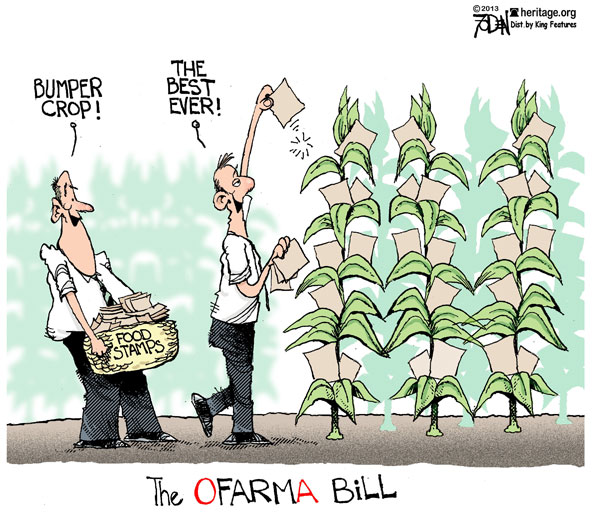
Cartoon by Glenn Foden

Tweet this

Where do food stamps come from?

They come from taxpayers—certainly not from family farms. Yet the “farm” bill, a recurring subsidy-fest in Congress, is actually 80 percent food stamps and other government nutrition programs.

The food stamps sweeten the farm deal for lawmakers, who admit that the combination works for their political purposes. As Heritage experts Daren Bakst and Diane Katz explain:

The food stamp portion creates a reason for urban representatives to support farm subsidies, and for farm-state lawmakers to support food stamps.

Talk of de-politicizing agriculture programs and welfare policy is met with stiff resistance. For example, Senator Thad Cochran (R–MS), ranking Republican on the Senate Agriculture Committee, recently told the North American Agricultural Journalists group that food stamps should continue to be included in the farm bill “purely from a political perspective. It helps get the farm bill passed.”

Food stamps are there to help “get the farm bill passed.” And the relation of the rest of the farm bill to farming is also questionable. Bakst and Katz note that “Congress has expanded the farm bill over time into a costly compilation of disparate programs. Along with agriculture and food stamps, the legislation includes dozens of forestry, conservation, energy, and rural development programs.”

It has become the norm that Congress lumps billions—even trillions—of dollars in taxpayer-funded programs together into huge bills. This allows them to sneak in plenty of special-interest pork.

Each of these programs deserves to be evaluated on its own, and taxpayers deserve transparency from Congress about how it plans to spend our money.

For example, food stamps are a massive program that needs a careful look. Food stamp spending has doubled under the Obama Administration, and participation is at historic highs. Recruiters hold bingo games and other “parties” to try to get more people on the food stamp rolls.

Farm commodity programs are also a major concern and in dire need of reform. Congress may eliminate the egregious direct payment program, which pays farmers for doing nothing. However, instead of stopping there, both the House and Senate farm bills would replace direct payments with programs that could wind up being even costlier.

Food stamps and farming ultimately have to do with food, but that’s about all they have in common. Making the farm bill 80 percent food stamps just doesn’t make sense.


_______________________

Thank you so much for your time. I know how valuable it is. I also appreciate the fine family that you have and your commitment as a father and a husband.

Sincerely,

Everette Hatcher III, 13900 Cottontail Lane, Alexander, AR 72002, ph 501-920-5733, lowcostsqueegees@yahoo.com

Related posts:

Tell the 48 million food stamps users to eat more broccoli!!!!

Welfare Can And Must Be Reformed             Uploaded on Jun 29, 2010 If America does not get welfare reform under control, it will bankrupt America. But the Heritage Foundation’s Robert Rector has a five-step plan to reform welfare while protecting our most vulnerable. __________________________ We got to slow down the growth of Food Stamps. One […]


Republicans for more food stamps?

Eight Reasons Why Big Government Hurts Economic Growth __________________ We got to cut spending and we must first start with food stamp program and we need some Senators that are willing to make the tough cuts. Food Stamp Republicans Posted by Chris Edwards Newt Gingrich had fun calling President Obama the “food stamp president,” but […]


Obama promotes food stamps but Milton Friedman had a better suggestion

Milton Friedman’s negative income tax explained by Friedman in 1968: We need to cut back on the Food Stamp program and not try to increase it. What really upsets me is that when the government gets involved in welfare there is a welfare trap created for those who become dependent on the program. Once they […]


400% increase in food stamps since 2000

Welfare Can And Must Be Reformed Uploaded by HeritageFoundation on Jun 29, 2010 If America does not get welfare reform under control, it will bankrupt America. But the Heritage Foundation’s Robert Rector has a five-step plan to reform welfare while protecting our most vulnerable. __________________________ If welfare increases as much as it has in the […]


Which states are the leaders in food stamp consumption?

I am glad that my state of Arkansas is not the leader in food stamps!!! Mirror, Mirror, on the Wall, Which State Has the Highest Food Stamp Usage of All? March 19, 2013 by Dan Mitchell The food stamp program seems to be a breeding ground of waste, fraud, and abuse. Some of the horror stories […]


Why not cancel the foodstamp program and let the churches step in?

Government Must Cut Spending Uploaded by HeritageFoundation on Dec 2, 2010 The government can cut roughly $343 billion from the federal budget and they can do so immediately. __________ We are becoming a country filled with people that dependent on the federal government when we should be growing our economy by lowering taxes and putting […]


Food Stamp Program is constantly ripped off and should be discontinued

Uploaded by oversightandreform on Mar 6, 2012 Learn More at http://oversight.house.gov The Oversight Committee is examining reports of food stamp merchants previously disqualified who continue to defraud the program. According to a Scripps Howard News Service report, food stamp fraud costs taxpayers hundreds of millions every year. Watch the Oversight hearing live tomorrow at 930 […]


Welfare state may drag England down the tubes!!!!

Welfare state may drag England down the tubes!!!! Very Funny but Very Un-PC British Video on Welfare and Immigration May 19, 2013 by Dan Mitchell I’ve shared this bit of political incorrect terrorism humor from England, as well asthis somewhat un-PC bit of tax humor. But perhaps motivated by the scandal of giving welfare to terrorists, this new video is […]


Open letter to President Obama (Part 321)

Government Must Cut Spending Uploaded by HeritageFoundation on Dec 2, 2010 The government can cut roughly $343 billion from the federal budget and they can do so immediately. __________   President Obama c/o The White House 1600 Pennsylvania Avenue NW Washington, DC 20500 Dear Mr. President, I know that you receive 20,000 letters a day […]


Agriculture Dept is bloated

Agriculture: Downsizing The Federal Government Uploaded on Dec 19, 2008 Agriculture is easily the most distorted sector, with high tariffs and, in developed countries at least, large amounts of government subsidies through price supports and direct payments. On the other hand, developing countries, who have a comparative advantage in these products, cannot afford to subsidize […]

FRIEDMAN FRIDAY “The Failure of Socialism” episode of Free to Choose in 1990 by Milton Friedman (Part 3)

Milton Friedman: Free To Choose – The Failure Of Socialism With Ronald Reagan (Full)

Published on Mar 19, 2012 by

Milton Friedman’s writings affected me greatly when I first discovered them and I wanted to share with you.

Ronald Reagan introduces this program, and traces a line from Adam Smith’s “The Wealth of Nations” to Milton Friedman’s work, describing Free to Choose as “a survival kit for you, for our nation and for freedom.” Dr. Friedman travels to Hungary and Czechoslovakia to learn how Eastern Europeans are rebuilding their collapsed economies. His conclusion: they must accept the verdict of history that governments create no wealth. Economic freedom is the only source of prosperity. That means free, private markets. Attempts to find a “third way” between socialism and free markets are doomed from the start. If the people of Eastern Europe are given the chance to make their own choices they will achieve a high level of prosperity. Friedman tells us individual stories about how small businesses struggle to survive against the remains of extensive government control. Friedman says, “Everybody knows what needs to be done. The property that is now in the hands of the state, needs to be gotten into the hands of private people who can use it in accordance with their own interests and values.” Eastern Europe has observed the history of free markets in the United States and wants to copy our success. After the documentary, Dr. Friedman talks further about government and the economy with Gary Becker of the University of Chicago and Samuel Bowles of the University of Massachusetts. In a wide-ranging discussion, they disagree about the results of economic controls in countries around the world, with Friedman defending his thesis that the best government role is the smallest one.
___________
Below is a portion of the transcript of the program and above you will find the complete video of the program:
 
 
 DISCUSSIONHello, I am Linda Chavez and welcome to Free to Choose. Joining Dr. Friedman for a discussion of the failure of socialism are Gary Becker from the University of Chicago and Samuel Bowles of the University of Massachusetts. Dr. Bowles, I think we can all agree that socialism has failed Eastern Europe. Dr. Friedman believes that the path out of that is the free market and I think he thinks there are lessons for the United States. What do you think?Chavez: I would like to bring this discussion back to the United States for a moment. What about socialism in the United States. There has been one area where we have tried to redistribute wealth. We have done that through our welfare policies and social security. Has that worked?

Bowles: Well, there is much to celebrate in Eastern Europe __ not only the elimination of dictatorial rule. I go back on that a long time. I was in the Soviet Union in the late 50’s (1958 and 1959) as a musician and I met many Russian musicians and made friends with a lot of Russian people who found themselves harassed and victimized by the police. In fact, my own musical group was prevented from singing a couple of times by the police. That is all on the way out and I hope it is gone for good. Equally welcome is the end of this myth of a centrally planned society. That is gone too and I hope that basically the lesson is learned. But Milton seems to think that we have to choose between either a centrally planned society or a society in which we have markets which are basically unregulated. So the choice is really between all or nothing.

I don’t think that is the choice. I think what Milton is posing for us is a model which is as unrealistic as a centrally planned model. It is outdated, it won’t work, it is extreme, and I think it is undemocratic. I think that we have choices in between, what Milton called the third way, a way that he said wouldn’t work, has been shown to work around the world. I think that Eastern Europe would be very ill-advised to take Milton’s advise on this. Yet, the last time anybody took Milton’s advise on economic policy was Ronald Reagan and Ronald Reagan has put the U.S. economy into a situation where it can’t pay its bills and is facing mounting economic instability and difficulties.

Chavez: Dr. Friedman, what about this midway path?

Friedman: First of all, I utterly reject what Sam says about the results of Ronald Reagan’s changes. We had a decade of extraordinary growth, increased employment in which inflation was brought down sharply. Ronald Reagan came into office at a period of very high inflation, and so on. But this program is not about the Reagan administration. This program is about Eastern Europe and I want to go to Eastern Europe.

I believe Sam is completely wrong in saying that the model I propose is outdated. I believe that what he calls obsolete is something very different. You have had the third way __ you have had it in the United States; you have had it in Sweden; you have had it in Britain; you’ve had it elsewhere. In every case it has been built on the foundation of a long period of what I call the first way. The United States had 150 years of essentially a free private market before it launched on this period of the welfare state. The same thing was true in Britain, the same thing was true in Sweden. I believe he will find it very difficult to site any example of a country which started from a very low level and immediately adopted that combination of policies.

Becker: Let me add something on that. I think the lesson that we learned from what happened in Eastern Europe goes beyond simply that central planning doesn’t work. I think we all agree that it doesn’t work. But it is more than that __ it is the role of private property in the system and the incentives provided by private property.

I don’t know what socialism means anymore, but I remember when I was in Poland I asked the head of the ideology department is private property consistent with socialism? He said, it may be. Then I asked him, well what is the difference between socialism and capitalism. His answer was, we are still working on that. I think what we have seen is a rejection of the ideas associated with traditional socialism which are suppression of private property, government ownership of property, and so on.

Now, how far should we move in the other direction? I think that is question you are asking Sam, and is there a middle way. I think the middle ways that have been successful have all been largely reliant on private property, private ownership, private incentives. The difficult question is one that Milton raised in the documentary. How far can you redistribute income and make it consistent with effective incentives?

I don’t think we know the boundary point, whether 30% of the income being redistributed is too much, 40%, 50% __ my own feeling is that we have gone much too far in Sweden and some of the other Scandinavian countries, and they are beginning to step back from this. They are lowering maximum tax rates to 50% now __ they were up to 80%. So I think there is a third way, but that third way is going to be a lot closer to unregulated market than toward a socialist organization of resources and a suppression of private property.

Bowles: Let’s get back to the particulars though. You talk about Sweden and you talk about the third way failing, and Milton says nobody has ever really gotten rich on the third way __ they have only benefited from that. Let’s talk about the United States. The period you described included a very long period in which the United States was a highly protectionist country in which our industrial base was developed from Alexander Hamilton on for some time, and then during the late 19th and early 20th century. To call that a free market solution would be against everything you have taught. Or, if one wants to go back into the 19th century, the huge subsidies of the railroads were, of course, an intervention in the market.

In the case of England that you talk about, the same is true. The role of the British Navy and for example the Parliament in actually establishing the private property which is what you favor. This was done by a government intervention. We talk about the other cases. Talk about Sweden or about Korea. These are two countries which I think are justly admired for their economic performance. Both countries have income distributions far more equal than the United States.

In Sweden, over the half the GNP is taxed. Now, people in this country would say that obviously they have gone too far. But let’s look at the test of the market. Sweden and Korea have been defeating the United States in world markets. Exports have grown five percent per year during the Reagan/Bush years in Sweden. In the United States, they have grown one percent per year. In Korea we know they have grown much better. If you want to go on to Norway, where much of the investing is done by the government, they have grown their exports even faster than Sweden. Meanwhile, we can’t compete in world markets.

So the lesson of these countries is if you look at the facts Milton, a combination of government regulation and the market works. I agree with Gary. I think private property is extremely important because the incentives associated with owning the results of your work is essential. But private property does not mean that we have to let the market go unregulated and all the evidence says that the countries that are beating us in the world market today don’t do it. They are not that dumb. Japan doesn’t do it; Korea doesn’t do it; Sweden doesn’t do it.

Friedman: Let’s not throw straw men around. Obviously I am not in favor of no government. Government has some very important roles to play. Those are very limited. You take the case of the United States during the 19th century and of Britain in the 19th century. At the time of Queen Victoria’s jubilee in 1899, total government spending in Britain was 10% of the national income. Up until 1929 in the United States, except for periods of great war, total government spending in the United States was about 10% of national income. Now that is a very far cry from a government which spends over half of the national income . . . . and a little less than half in the United States.

Bowles: You are opposed to capital controls. You are opposed to telling people they can’t move their money internationally. That is what Korea does. You are opposed to . . .

Friedman: I think Korea makes a mistake by doing it.

Bowles: Korea has beaten us by exactly the policies you are posing.

Friedman: So has Hong Kong. Hong Kong has beaten us by the policies I am proposing.

Bowles: . . . if Korea is not a middle way and if Sweden is not a middle way, then I would like to know what you call it.

Becker: Korea is a lot closer to a market-oriented economy than any of the economies we have been talking about.

Bowles: The government approves the heads of the banks in Korea. They have nationalized their steel industry and have one of the most efficient plants in the world at Palhang. If you call that a private economy . . .

Becker: What fraction of resources in Korea goes through the government?

Bowles: A tremendous fraction if you take account of the fact that the banks are centrally run and they control the credit allocations there and they don’t let people take their money out of the . . .


Dear Senator Pryor, here are some spending cut suggestions (“Thirsty Thursday”, Open letter to Senator Pryor)

Senator Pryor pictured below:

Why do I keep writing and email Senator Pryor suggestions on how to cut our budget? I gave him hundreds of ideas about how to cut spending and as far as I can tell he has taken none of my suggestions. You can find some of my suggestions herehereherehere, hereherehereherehere, herehereherehereherehereherehereherehere,  here, and  here, and they all were emailed to him. In fact, I have written 13 posts pointing out reasons why I believe Senator Pryor’s re-election attempt will be unsuccessful. HERE I GO AGAIN WITH ANOTHER EMAIL I JUST SENT TO SENATOR PRYOR!!!

Dear Senator Pryor,

Why not pass the Balanced  Budget amendment? As you know that federal deficit is at all time high (1.6 trillion deficit with revenues of 2.2 trillion and spending at 3.8 trillion).

On my blog www.thedailyhatch.org . I took you at your word and sent you over 100 emails with specific spending cut ideas. (Actually there were over 160 emails with specific spending cut suggestions.) However, I did not see any of them in the recent debt deal that Congress adopted although you did respond to me several times. Now I am trying another approach. Every week from now on I will send you an email explaining different reasons why we need the Balanced Budget Amendment. It will appear on my blog on “Thirsty Thursday” because the government is always thirsty for more money to spend. Today I actually have included a great article below from the Heritage Foundation concerning an area of our federal budget that needs to be cut down to size. The funny thing about the Sequester and the 2.4% of cuts in future increases is that President Obama set these up and then he acted like the sky was falling in as the cartoons indicate in the newspapers.

IF YOU TRULY WANT TO CUT THE BUDGET AND BALANCE THE BUDGET THEN SUBMIT THESE POTENTIAL BUDGET CUTS PRESENTED BELOW!!

___________

Lawmakers need to encourage self-sufficiency and work through food assistance programs and not laziness.

July 18, 2013 at 5:35 pm

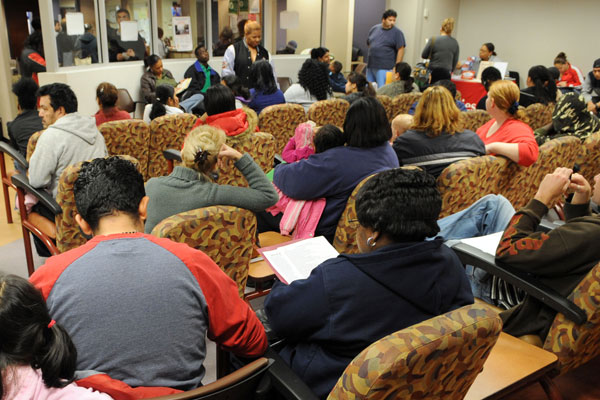
Medicaid Food Stamps Waiting Room

Newscom

Nearly one-third of Americans received government-funded food aid in 2012, according to a new report from the U.S. Department of Agriculture (USDA).

As Heritage Foundation expert Robert Rector has explained, there are roughly a dozen federal food assistance programs operating today. The USDA reports that 59 percent of households that participated in one of the four largest food assistance programs—food stamps, school breakfasts, school lunches, and WIC—end up receiving benefits from “two or more programs.” This indicates significant duplication, “providing participants total benefits in excess of 100 percent of daily nutritional needs.”

The welfare system also operates many means-tested welfare programs beyond food assistance. The federal government funds roughly 80 welfare programs, including 12 providing social services, 12 educational assistance programs, and 11 housing assistance programs—at a cost of nearly $1 trillion a year.

The size of today’s welfare system demonstrates the need for both opportunity-based economic policies and critical reforms to promote self-sufficiency through work. For decades, the federal government has been pouring taxpayer dollars into an increasing number of welfare programs in an attempt to tackle poverty.

Yet this system has proven ineffective at helping individuals and families reach self-sufficiency. As Heritage expert Robert Rector writes, “Except in very limited cases, such as those involving serious malnutrition, welfare programs do not yield fewer problems and better life outcomes for children.” Welfare can even have harmful consequences for families, eroding personal responsibility across multiple generations. Heritage experts David Azerrad and Rea Hederman explain that welfare

takes away a crucial ingredient of happiness: the incentive to work, to save, to improve oneself.… It fosters dependence in welfare recipients, which in turn often carries over to children. Studies have shown—not surprisingly but nonetheless quite tragically—that welfare is increasingly intergenerational.

Lawmakers have a duty to American families and to the next generation. Policymakers should transform these programs into vehicles of self-sufficiency, personal responsibility, and human dignity through positive reforms that encourage work. Such reforms will begin lifting America from a welfare state where 101 million receive government support to the opportunity society envisioned by the men and women who founded this nation.

_______________

The Balanced Budget Amendment is the only thing I can think of that would force Washington to cut spending. We have only a handful of balanced budgets in the last 60 years, so obviously what we are doing is not working. We are passing along this debt to the next generation. YOUR APPROACH HAS BEEN TO REJECT THE BALANCED BUDGET “BECAUSE WE SHOULD CUT THE BUDGET OURSELF,” WELL THEN HERE IS YOUR CHANCE!!!! SUBMIT THESE CUTS!!!!

Thank you for this opportunity to share my ideas with you.

Sincerely,

Everette Hatcher, lowcostsqueegees@yahoo.com www.thedailyhatch.org, 13900 Cottontail Lane, Alexander, AR 72002, ph 501-920-5733

Related posts:

If increase in food stamps was just because of recession then why spending go from $19.8 billion in 2000 to $37.9 billion in 2007?

If the increase in food stamps was just because of the recession then why did the spending go from $19.8 billion in 2000 to $37.9 billion in 2007? The Facts about Food Stamps Everyone Should Hear Rachel Sheffield and T. Elliot Gaiser May 27, 2013 at 12:00 pm (7) Newscom A recent US News & […]

Tell the 48 million food stamps users to eat more broccoli!!!!

Welfare Can And Must Be Reformed             Uploaded on Jun 29, 2010 If America does not get welfare reform under control, it will bankrupt America. But the Heritage Foundation’s Robert Rector has a five-step plan to reform welfare while protecting our most vulnerable. __________________________ We got to slow down the growth of Food Stamps. One […]

Republicans for more food stamps?

Eight Reasons Why Big Government Hurts Economic Growth __________________ We got to cut spending and we must first start with food stamp program and we need some Senators that are willing to make the tough cuts. Food Stamp Republicans Posted by Chris Edwards Newt Gingrich had fun calling President Obama the “food stamp president,” but […]

Obama promotes food stamps but Milton Friedman had a better suggestion

Milton Friedman’s negative income tax explained by Friedman in 1968: We need to cut back on the Food Stamp program and not try to increase it. What really upsets me is that when the government gets involved in welfare there is a welfare trap created for those who become dependent on the program. Once they […]

400% increase in food stamps since 2000

Welfare Can And Must Be Reformed Uploaded by HeritageFoundation on Jun 29, 2010 If America does not get welfare reform under control, it will bankrupt America. But the Heritage Foundation’s Robert Rector has a five-step plan to reform welfare while protecting our most vulnerable. __________________________ If welfare increases as much as it has in the […]

Why can’t we cut the Food Stamp budget?

Why can’t we cut the Food Stamp budget? Should Food Stamps Be in Farm Bill? Congressman Seeks to Split Legislation Kelsey Harris June 17, 2013 at 10:38 pm Bill Clark/Roll Call Photos/Newscom Representative Marlin Stutzman (R-IN), a fourth-generation farmer, is asking his House colleagues to separate the food stamp program from the “farm” bill. Stutzman […]

Food stamp spending has doubled under the Obama Administration

The sad fact is that Food stamp spending has doubled under the Obama Administration. A Bumper Crop of Food Stamps Amy Payne May 21, 2013 at 7:01 am Tweet this Where do food stamps come from? They come from taxpayers—certainly not from family farms. Yet the “farm” bill, a recurring subsidy-fest in Congress, is actually […]

Which states are the leaders in food stamp consumption?

I am glad that my state of Arkansas is not the leader in food stamps!!! Mirror, Mirror, on the Wall, Which State Has the Highest Food Stamp Usage of All? March 19, 2013 by Dan Mitchell The food stamp program seems to be a breeding ground of waste, fraud, and abuse. Some of the horror stories […]

Why not cancel the foodstamp program and let the churches step in?

Government Must Cut Spending Uploaded by HeritageFoundation on Dec 2, 2010 The government can cut roughly $343 billion from the federal budget and they can do so immediately. __________ We are becoming a country filled with people that dependent on the federal government when we should be growing our economy by lowering taxes and putting […]

Food Stamp Program is constantly ripped off and should be discontinued

Uploaded by oversightandreform on Mar 6, 2012 Learn More at http://oversight.house.gov The Oversight Committee is examining reports of food stamp merchants previously disqualified who continue to defraud the program. According to a Scripps Howard News Service report, food stamp fraud costs taxpayers hundreds of millions every year. Watch the Oversight hearing live tomorrow at 930 […]

By Everette Hatcher III | Posted in spending out of control | Edit | Comments (0)