Category Archives: spending out of control

Dan Mitchell article Biden, the Minimum Wage, and Political Fantasy

Biden, the Minimum Wage, and Political Fantasy

While I understandably don’t like politicians, I rarely think they are stupid. They do lots of idiotic things, of course, but they are making calculated decisions that it’s okay to hurt the economy if they achieve some political benefit. That’s immoral, but not dumb.

However, sometimes politicians say things so absurdly inaccurate that it makes me wonder if they actually are…what’s the politically correct term?…cognitively challenged.

Consider, for instance, some of Donald Trump’s trade tweets, which were jaw-dropping examples of economic illiteracy.
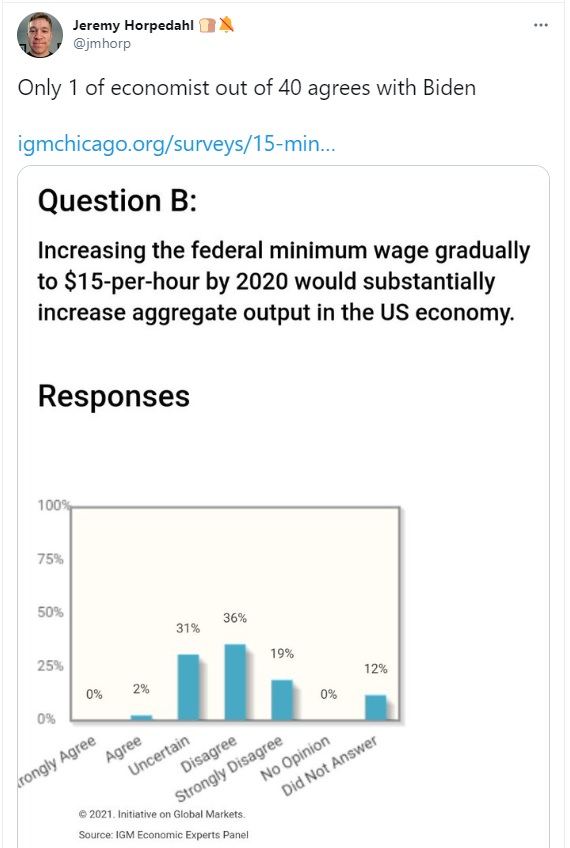
Moreover, it appears that “all” doesn’t include the Congressional Budget Office.

The bean counters at CBO don’t have a reputation for being fire-breathing libertarians, so it’s especially noteworthy that its new estimates show that a higher minimum wage will reduce economic output, destroy 1.4 million jobs, raise prices, and increase the burden of government spending.

As the old joke goes, “other than that, Mrs. Lincoln, what did you think of the play?”

And “all” doesn’t include America’s premier source for financial news. The Wall Street Journal opined on Biden’s plan this morning.

…his proposal for a $15 federal minimum wage…by 2025, according to the CBO’s new average estimate, would result in a loss of 1.4 million jobs.The idled workers would be disproportionately younger and less educated, and CBO projects that half of themwould drop out of the labor force. …The federal budget deficit through 2031 would increase $54 billion, CBO says, as the government spent more on unemployment benefits and health-care programs. …setting the minimum wage at a high of $15 would essentially put the country through an economic experiment. This would mean imposing the urban labor costs of San Francisco and Manhattan on every out-of-the-way gas station in rural America.

Of course, we’ve already experienced some real-world experiments.

Higher minimum wages already have wreaked havoc and destroyed jobs in places such as Seattle, New York City, Oakland, and Washington, DC, so we already have plenty of evidence (and don’t forget the European data as well).

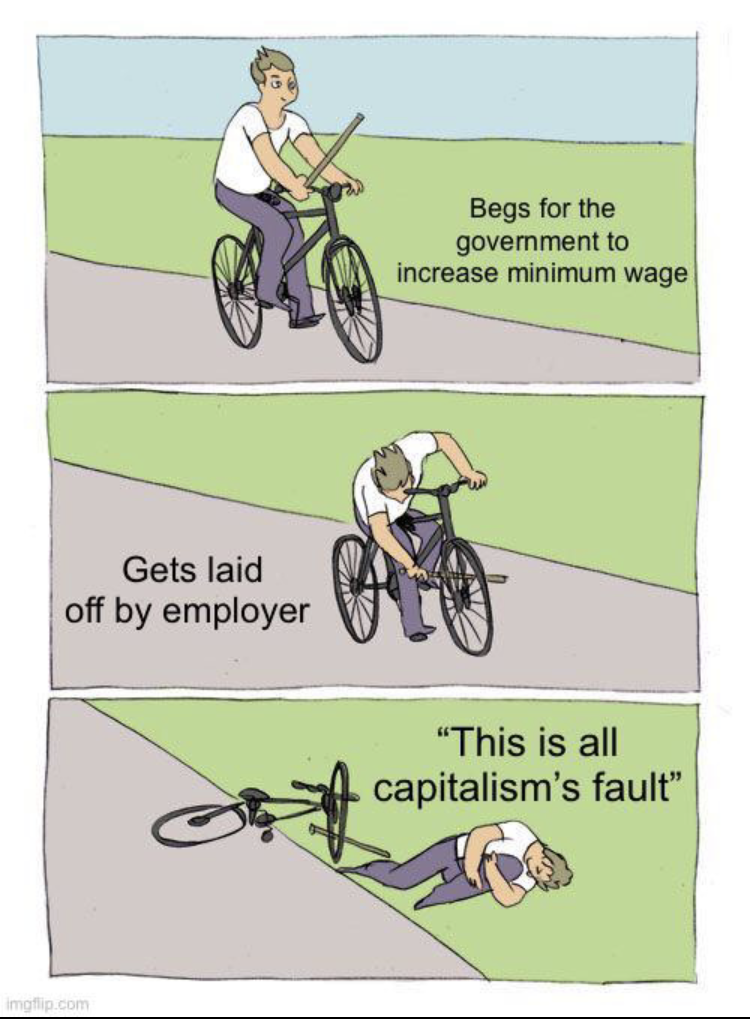
I’ll close with this clever cartoon strip, which mocks people who support higher mandated wages for reasons of naivete rather than stupidity.
P.S. Here’s my most recent interview about the minimum wage, here’s the interview that got me most frustrated, and here’s my interview debate with Biden’s economic advisor.

P.P.S. I strongly recommend this video on the topic from the Center for Freedom and Prosperity.

And now Joe Biden is showing he can be similarly detached from the real world, claiming this past weekend that a $15-per-hour minimum wage is a good idea because, “all the economics show that if you do that the whole economy rises.”

Though maybe that’s true if one can somehow claim that “1 out of 40” is the same as “all.”

The Distorted Minimum Wage Debate

It sometimes feels as if advocates and opponents of minimum wage hikes are talking in different universes. In large part, that stems from completely opposite interpretations of the balance of the academic literature on the subject.

Research on the minimum wage in the U.S. has been extensive, yet one can read Paul Krugman claiming “There’s just no evidence that raising the minimum wage costs jobs, at least when the starting point is as low as it is in modern America,” right through to other academics concluding “There is considerable support for the competitive market hypothesis that an effective minimum wage would result in lower employment.”

Which view better reflects our understanding? In a new working paper, economists David Neumark and Peter Shirley assemble the entire set of published papers that examine the impact of minimum wage hikes on employment outcomes at the state and local level in the U.S. since 1992. Contacting the researchers who wrote the papers, they identify those researchers’ “core” or preferred results in each case whenever possible, using the gathered estimates to summarize the last three decades of research.

Their conclusions, contrary to what you might read in the rest of the media, are clear:

  • The overwhelming majority of papers analyzing the U.S. estimate a negative effect on employment of minimum wage hikes (79.3 percent of them). In fact more than half of all papers have a negative impact that is statistically significant at the 10% level or more.
  • The negative impact is stronger for teens, young adults, and less‐​educated workers, and especially strong for directly affected workers (those who see their wage rate increase automatically through the policy.)
  • There is no evidence of these impacts becoming less negative in studies from more recent years.
  • Studies that look at the impact of minimum wage hikes on low‐​wage industries (rather than population groups) are less likely to find a negative impact on employment. But these are less good at identifying the impact of a wage floor hike on low‐​wage workers as a group, because the proportion of workers directly affected is obviously smaller, and the employment results may reflect employers substituting low‐​skilled labor for higher‐​skilled labor.

Neumark and Shirley summarize their findings by saying: “our evidence indicates that concluding that the body of research evidence fails to find disemployment effects of minimum wages requires discarding or ignoring most of the evidence.”

Next time someone says “there’s no evidence the minimum wage costs jobs or hours,” point them in the direction of this paper, or indeed the Cato Policy Analysis of University of California, San Diego economist Jeffrey Clemens, who concluded that the “new conventional wisdom misreads the totality of recent evidence for the negative effects of minimum wages. Several strands of research arrive regularly at the conclusion that high minimum wages reduce opportunities for disadvantaged individuals.”

Cato scholars have also written on the economic arguments used to justify a $15 federal minimum wage, the particular risks of hiking minimum wages during this pandemic, and why there is no free lunch where minimum wage hikes are concerned (even if employment does not fall).

Ep. 4 – From Cradle to Grave [6/7]. Milton Friedman’s Free to Choose (1980)

February 9, 2021

President Biden c/o The White House
1600 Pennsylvania Avenue NW
Washington, DC 20500

Dear Mr. President,

Thank you for taking time to have your office try and get a pulse on what is going on out here in the country.

I read this article on January 15, 2021 about your announcement the previous night concerning your first proposal to Congress. Biden’s $1.9 Trillion COVID Relief Package Includes More Stimulus Checks, State Government Bailout, $15 Federal Minimum Wage

I wanted to let you know what I think about the minimum wage increase you have proposed for the whole country and I wanted to quote Milton Friedman who you are familiar with and you made it clear in July that you didn’t care for his views! Let me challenge you to take a closer look at what he had to say!

Milton Friedman on the minimum wage

All too often, the policy debates of today are simply refights of the battles of yesteryear. As a result, old arguments often retain a striking relevance.

In February 1973, economist Milton Friedman gave an interview to Playboy magazine. It was a wide ranging interview, covering topics from monetary policy to political philosophy. Friedman was an economist with a rare gift for translating technical arguments into clear prose (as you will find in his books Capitalism and Freedom and Free to Choose). His remarks on the minimum wage, as given in that interview, are startlingly contemporary.

PLAYBOY: But you prefer the laissez-faire—free-enterprise—approach.
FRIEDMAN: Generally. Because I think the government solution to a problem is usually as bad as the problem and very often makes the problem worse. Take, for example, the minimum wage, which has the effect of making the poor people at the bottom of the wage scale—those it was designed to help—worse off than before.

PLAYBOY: How so?
FRIEDMAN: If you really want to get a feeling about the minimum wage, there’s nothing more instructive than going to the Congressional documents to read the proposals to raise the minimum wage and see who testifies. You very seldom find poor people testifying in favor of the minimum wage. The people who do are those who receive or pay wages much higher than the minimum. Frequently Northern textile manufacturers. John F. Kennedy, when he was in Congress, said explicitly that he was testifying in favor of a rise in the minimum wage because he wanted protection for the New England textile industry against competition from the so-called cheap labor of the South. But now look at it from the point of that cheap labor. If a high minimum wage makes unfeasible an otherwise feasible venture in the South, are people in the South benefited or harmed? Clearly harmed, because jobs otherwise available for them are no longer available. A minimum-wage law is, in reality, a law that makes it illegal for an employer to hire a person with limited skills.

PLAYBOY: Isn’t it, rather, a law that requires employers to pay a fair and livable wage?
FRIEDMAN: How is a person better off unemployed at a dollar sixty an hour than employed at a dollar fifty? No hours a week at a dollar sixty comes to nothing. Let’s suppose there’s a teenager whom you as an employer would be perfectly willing to hire for a dollar fifty an hour. But the law says, no, it’s illegal for you to hire him at a dollar fifty an hour. You must hire him at a dollar sixty. Now, if you hire him at a dollar sixty, you’re really engaging in an act of charity. You’re paying a dollar fifty for his services and you’re giving him a gift of 10 cents. That’s something few employers, quite naturally, are willing to do or can afford to do without being put out of business by less generous competitors. As a result, the effect of a minimum-wage law is to produce unemployment among people with low skills. And who are the people with low skills? In the main, they tend to be teenagers and blacks, and women who have no special skills or have been out of the labor force and are coming back. This is why there are abnormally high unemployment rates among these groups.

_____________

Thank you so much for your time. I know how valuable it is. I also appreciate the fine family that you have and your commitment as a father and a husband.

Sincerely,

Everette Hatcher III, 13900 Cottontail Lane, Alexander, AR 72002, ph 501-920-5733

Williams with Sowell – Minimum Wage
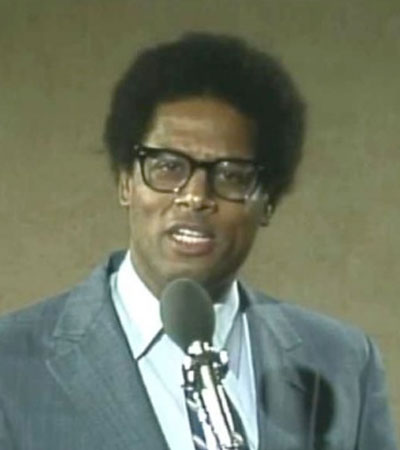
Thomas Sowell

Thomas Sowell – Reducing Black Unemployment

By WALTER WILLIAMS

—-

Ronald Reagan with Milton Friedman
Milton Friedman The Power of the Market 2-5

MY OPEN LETTER TO VICE PRESIDENT KAMALA HARRIS PART 4 “Is it true that your administration has set things in motion that will hurt women’s sports?”

A.F. Branco for Jan 12, 2022

Kamala Harris official photo (cropped2).jpg


Honorable Vice President Kamala Harris c/o The White House

1600 Pennsylvania Avenue NW
Washington, DC 20500

Dear Mrs. Vice President,

“Is it true that your administration has set things in motion that will hurt women’s sports?”

Tucker Carlson: Biden brings ‘equality’ to girls’ sports, and who knows what’s next?

Forget women’s empowerment, it takes a real civil rights leader to use federal power to humiliate and endanger women on behalf of biological men

You may have missed it, but Joe Bidendevoted part of his very first day in officeto addressing one of this nation’s most pressing problems: Girls’ sports.

The main problem with girls’ sports, obviously, is that they lack diversity: Only girls get to play. That’s wrong, and Joe Biden plans to fix it; to break the turf ceiling, if you will.

Now, for the first time in history, men will be allowed to compete in, for example, girls’ field hockey, and then change in the girls’ locker room afterward. Joe Biden has signed an executive order requiring it. Even Barack Obama didn’t do that.

This makes Joe Biden a #civilrightshero. There’s been a lot of talk recently about women’s empowerment, but it takes a real leader, a once-in-a-generation moral visionary, to go further than that and use federal power to humiliate and endanger women on behalf of biological men. That is next-level feminism. That is real empowerment.

That’s the Joe Biden program, and he’s been planning it for years. This is what he said last February:

BIDEN: Well, no, the animating promise of this country, that all men and women are created equal, has never been fulfilled.

By “equal,” Joe Biden means “identical”. There are no differences between men and women, that’s the position. Those gender categories we’ve heard about since the dawn of recorded history are fake. So there’s no reason to protect women from men under any circumstances, because the whole idea of men and women isn’t real.

Not everyone believes this, of course. Science isn’t always popular (or the peasants don’t understand it). There are still troglodytes out there in the year 2021 who are trying to keep men out of women’s sports. Yes, Donald Trump is gone. But that doesn’t mean hate has taken a holiday.

 –

But Joe Biden is not intimidated by that. He doesn’t care that pretty much no one in America agrees with him or even understands what he’s talking about. When Joe Biden watches girls’ gymnastics, as he frequently does, and doesn’t see a single biological man walking the balance beam or swinging from the uneven bars, he doesn’t just sit back and accept the status quo. He acts with force and certainty.

 –

Now, activism like that may seem modern, but it’s not new for Joe Biden. For 60 years, he has been fighting transphobia. Way back in the summer of 1962, decades before it was fashionable, Joe Biden confronted a vicious transphobe called Corn Pop, who wanted to keep men out of the girls’ changing room at a public pool in Wilmington. It was a different time back then, but Joe Biden wouldn’t have it. He threatened to beat Corn Pop with a six-foot chain, and that was just the beginning.

Decades later, Joe Biden flew all the way to South Africa to free Nelson Mandela from prison. Most of us assumed he was risking his life to fight the racist policies of the South African government. What we didn’t know was that Joe Biden was actually fighting a more insidious foe, gender apartheid. Robben Island was men-only, segregated by sex, if you can imagine.

But the fight isn’t over yet. Joe Biden’s holy war of liberation continues. Even now, in this supposedly liberated time, groups of women still saunter to the ladies room together in restaurants across America with not a single man joining them in the stall. That happens, believe it or not. It happens right now. There are still sexually segregated public showers in this nation, not to mention dressing rooms in retail stores, that men aren’t allowed to enter.  And what about your house? How many boys slept over at your seventh grade daughter’s most recent slumber party?

year-old child decides, ‘You know, I decided I want to be transgender. That’s what I think I’d like to be. It’ll make my life a lot easier. There should be zero discrimination

Joe Biden has a solution. Sixty years ago, he fought Corn Pop with a chain to protect the right of biological men to be present when girls change into their bathing suits, and he’ll bring that same moral clarity to your daughter’s lacrosse team.

CLICK HERE TO GET THE FOX NEWS APP

Leadership like that will change this country. In time, you won’t hear people claiming to be the first female this or first female that because honestly, in a truly liberated society, who can say what’s female? Why shouldn’t Mike Pence announce that actually, he was the first woman to serve as vice president? Who could call him wrong?

Not us. We don’t do hate speech here.

This article is adapted from Tucker Carlson’s opening commentary on the Jan. 22, 2021 edition of “Tucker Carlson Tonight.”


Joe Biden’s First Day Began the End of Girls’ Sports

An executive order rigs competition by requiring that biological boys be allowed to compete against girls.

President Biden signs an executive order in the Oval Office, Jan. 20.

President Biden signs an executive order in the Oval Office, Jan. 20.

PHOTO: DOUG MILLS/POOL/SHUTTERSTOCK

Amid Inauguration Day talk of shattered glass ceilings, on Wednesday President Biden delivered a body blow to the rights of women and girls: the Executive Order on Preventing and Combating Discrimination on the Basis of Gender Identity or Sexual Orientation. On day one, Mr. Biden placed all girls’ sports and women’s safe spaces in the crosshairs of the administrative state.

The order declares: “Children should be able to learn without worrying about whether they will be denied access to the rest room, the locker room, or school sports. . . . All persons should receive equal treatment under the law, no matter their gender identity or sexual orientation.” The order purports to direct administrative agencies to begin promulgating regulations that would enforce the Supreme Court’s 2020 decision Bostock v. Clayton County. In fact, it goes much further.

In Bostock, the justices held that Title VII of the Civil Rights Act of 1964 prohibited an employer from firing an employee on the basis of homosexuality or “transgender status.” Justice Neil Gorsuch, writing for a 6-3 majority, took pains to clarify that the decision was limited to employment and had no bearing on “sex-segregated bathrooms, locker rooms, and dress codes”—all regulated under Title IX of the 1972 Education Amendments. “Under Title VII, too,” the majority added, “we do not purport to address bathrooms, locker rooms, or anything else of the kind.”

The Biden executive order is far more ambitious. Any school that receives federal funding—including nearly every public high school—must either allow biological boys who self-identify as girls onto girls’ sports teams or face administrative action from the Education Department. If this policy were to be broadly adopted in anticipation of the regulations that are no doubt on the way, what would this mean for girls’ and women’s sports?

“Finished. Done,” Olympic track-and-field coach Linda Blade told me. “The leadership skills, all the benefits society gets from letting girls have their protected category so that competition can be fair, all the advances of women’s rights—that’s going to be diminished.” Ms. Blade noted that parents of teen girls are generally uninterested in watching their daughters demoralized by the blatant unfairness of a rigged competition.

I say rigged because in contests of strength and speed, the athletic chasm between the sexes, which opens at puberty, is both permanent and unbridgeable. Once male puberty is complete, testosterone suppression doesn’t undo the biological advantages men possess: larger hearts, lungs and bones, greater bone density, more-oxygenated blood, more fast-twitch muscle fiber and vastly greater muscle mass.

It should be no surprise, then, that the two trans-identified biological males permitted to compete in Connecticut state track finals against girls—neither of whom was a top sprinter as a boy—consistently claimed top spots competing as girls. They eliminated girls from advancement to regional championships, scouting and scholarship opportunities and trophies, and they set records no girl may ever equal.

How big is this performance gap? To take one example cited by the Connecticut female runners in their complaint against the Connecticut Interscholastic Athletic Conference, the fastest female sprinter in the world is American runner Allyson Felix, a woman with more gold medals than Usain Bolt. Her lifetime best for the 400-meter run is 49.26 seconds. Based on 2018 data, nearly 300 high-school boys in the U.S. alone could beat it.

Even if allowing biological boys to join girls’ teams means girls can’t win, isn’t it still worth trying out for the team? Actually, no—even in sports that involve no contact and little injury risk, like running or tennis. It isn’t merely the trophies and scholarships and opportunities at stake. It isn’t even all the benefits sports have so long provided to young women—in self-esteem and health and camaraderie with friends. It isn’t merely that girls who participate in sports tend to earn better grades, that so many female Fortune 500 executives were athletes, or that sports force teen girls out of their own heads, where they might otherwise sit and stew to their detriment.

It’s the profound and glaring injustice of it: the spectacular records and achievements that Jackie Joyner, Althea Gibson and Wilma Rudolph would never have achieved had the world pitted their bodies against men.

Yet here we are. Decades of women’s achievement and opportunity rolled back by executive fiat. Battered women’s shelters, women’s jails and other safe spaces that receive federal funding and constitute “dwellings” under the Fair Housing Act may be next. Women’s rights turn out to be cheap and up for grabs. Who will voice objection?

Certainly not those caught up in the “historic” moment of the first female vice president. Hillary Clinton swooned on Twitter : “It delights me to think that what feels historical and amazing to us today—a woman sworn in to the vice presidency—will seem normal, obvious, ‘of course’ to Kamala’s grand-nieces as they grow up.” If only this je ne sais quoi weren’t accompanied by a far more material theft of female opportunity.

Ms. Shrier is author of “Irreversible Damage: The Transgender Craze Seducing Our Daughters.”

I must say I share your love for the LION, WITCH AND THE WARDROBE by C.S. Lewis. Sadly he died on the same day as two other notable gentleman (JFK and Aldous Huxley). Just like you I have a love for books! 

Thank you so much for your time.

Sincerely,

Everette Hatcher III, 13900 Cottontail Lane, Alexander, AR 72002, ph 501-920-5733

Related posts:

Milton Friedman’s Free to Choose (1980), episode 3 – Anatomy of a Crisis. part 1

“The Power of the Market” episode of Free to Choose in 1990 by Milton Friedman (Part 5)

Milton Friedman The Power of the Market 5-5 How can we have personal freedom without economic freedom? That is why I don’t understand why socialists who value individual freedoms want to take away our economic freedoms.  I wanted to share this info below with you from Milton Friedman who has influenced me greatly over the […]

“The Power of the Market” episode of Free to Choose in 1990 by Milton Friedman (Part 4)

Milton Friedman The Power of the Market 4-5 How can we have personal freedom without economic freedom? That is why I don’t understand why socialists who value individual freedoms want to take away our economic freedoms.  I wanted to share this info below with you from Milton Friedman who has influenced me greatly over the […]

“The Power of the Market” episode of Free to Choose in 1990 by Milton Friedman (Part 3)

Milton Friedman The Power of the Market 3-5 How can we have personal freedom without economic freedom? That is why I don’t understand why socialists who value individual freedoms want to take away our economic freedoms.  I wanted to share this info below with you from Milton Friedman who has influenced me greatly over the […]

“The Power of the Market” episode of Free to Choose in 1990 by Milton Friedman (Part 2)

Milton Friedman The Power of the Market 2-5 How can we have personal freedom without economic freedom? That is why I don’t understand why socialists who value individual freedoms want to take away our economic freedoms.  I wanted to share this info below with you from Milton Friedman who has influenced me greatly over the […]

“The Power of the Market” episode of Free to Choose in 1990 by Milton Friedman (Part 1)

Milton Friedman The Power of the Market 1-5 How can we have personal freedom without economic freedom? That is why I don’t understand why socialists who value individual freedoms want to take away our economic freedoms.  I wanted to share this info below with you from Milton Friedman who has influenced me greatly over the […]

“Friedman Friday” EPISODE “The Failure of Socialism” of Free to Choose in 1990 by Milton Friedman (Part 5)

Milton Friedman: Free To Choose – The Failure Of Socialism With Ronald Reagan (Full) Published on Mar 19, 2012 by NoNationalityNeeded Milton Friedman’s writings affected me greatly when I first discovered them and I wanted to share with you. Abstract: Ronald Reagan introduces this program, and traces a line from Adam Smith’s “The Wealth of […]

“Friedman Friday” EPISODE “The Failure of Socialism” of Free to Choose in 1990 by Milton Friedman (Part 4)

Milton Friedman: Free To Choose – The Failure Of Socialism With Ronald Reagan (Full) Published on Mar 19, 2012 by NoNationalityNeeded Milton Friedman’s writings affected me greatly when I first discovered them and I wanted to share with you. Abstract: Ronald Reagan introduces this program, and traces a line from Adam Smith’s “The Wealth of […]

“Friedman Friday” EPISODE “The Failure of Socialism” of Free to Choose in 1990 by Milton Friedman (Part 3)

Milton Friedman: Free To Choose – The Failure Of Socialism With Ronald Reagan (Full) Published on Mar 19, 2012 by NoNationalityNeeded Milton Friedman’s writings affected me greatly when I first discovered them and I wanted to share with you. Abstract: Ronald Reagan introduces this program, and traces a line from Adam Smith’s “The Wealth of […]

“Friedman Friday” EPISODE “The Failure of Socialism” of Free to Choose in 1990 by Milton Friedman (Part 2)

Milton Friedman: Free To Choose – The Failure Of Socialism With Ronald Reagan (Full) Published on Mar 19, 2012 by NoNationalityNeeded Milton Friedman’s writings affected me greatly when I first discovered them and I wanted to share with you. Abstract: Ronald Reagan introduces this program, and traces a line from Adam Smith’s “The Wealth of […]

“Friedman Friday,” EPISODE “The Failure of Socialism” of Free to Choose in 1990 by Milton Friedman (Part 1)

Milton Friedman: Free To Choose – The Failure Of Socialism With Ronald Reagan (Full) Published on Mar 19, 2012 by NoNationalityNeeded Milton Friedman’s writings affected me greatly when I first discovered them and I wanted to share with you. We must not head down the path of socialism like Greece has done. Abstract: Ronald Reagan […]

Williams with Sowell – Minimum Wage

Thomas Sowell

Thomas Sowell – Reducing Black Unemployment

By WALTER WILLIAMS

—-

Ronald Reagan with Milton Friedman
Milton Friedman The Power of the Market 2-5

MY OPEN LETTER TO VICE PRESIDENT KAMALA HARRIS PART 3 “Do you support charter schools like President Obama did?”

Kamala Harris official photo (cropped2).jpg


February 3, 2021

Honorable Vice President Kamala Harris c/o The White House

1600 Pennsylvania Avenue NW
Washington, DC 20500

Dear Mrs. Vice President,

Do you support charter schools like President Obama did?

What Matters More to Biden: Union Bosses or Poor Children?

I have a Bureaucrat Hall of Fame to highlight government employees who have turned sloth and overcompensation into an art form, and I have a Moocher Hall of Fame to illustrate the destructive entitlement mindset that exists when politicians pay people to do nothing.

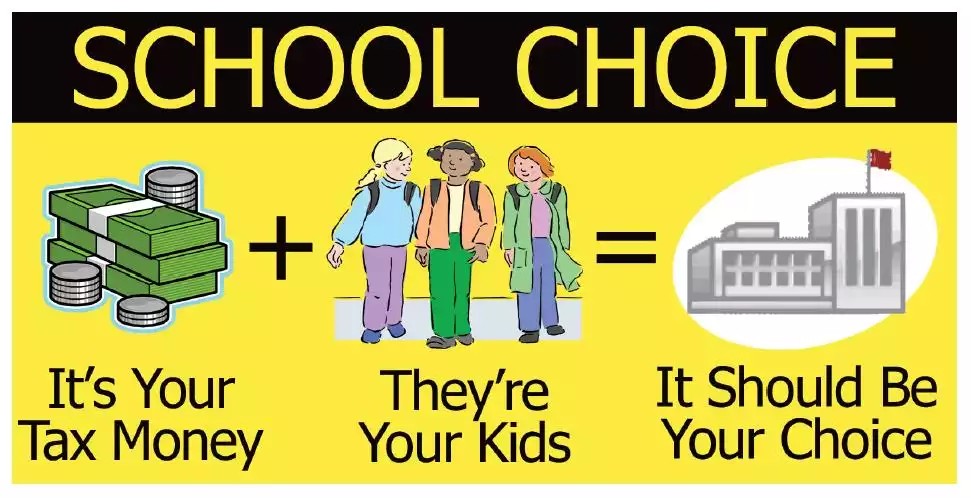
I’m now thinking we also need another Hall of Fame to bring attention to the despicable people who oppose school choice because currying favor with teacher unions is more importantthan giving poor children an opportunityfor a good education.

Some of the charter members would include:

And we many need to include Joe Biden on this tawdry list.

We’ll know soon enough. There’s a federally funded school choice program in Washington, DC, and time will tell whether the President intends to kill it.

In a column for the Wall Street Journal, Virginia Walden Ford expresses hope that President Biden won’t sacrifice the needs of minority children in the nation’s capital.

I hope his administration doesn’t tear down a program that has brought hope to thousands of African-American childrenin the District of Columbia. In 2004, Congress created the D.C. Opportunity Scholarship Program. …In 2020-21, 82% of scholarship recipients identified as African-American and another 12% as Hispanic. While scholarships for poor children of color should hold bipartisan appeal, the…2020 Biden-Sanders “unity” platform went out of its way to recommend defunding the program.

Ms. Ford isn’t opposed to government schools, but she does want poor kids to have the same opportunity as Joe Biden’s kids.

I strongly support both public education and school choice. I attended public schools, and my father served as the first African-American school administratorin Little Rock, Ark.—for which my family received a burning cross on our front yard. …What really undermines public education is attempts from elites to keep good education for themselves… Mr. Biden’s children went to private schools. Why shouldn’t my former neighbors in Southeast Washington have the opportunity to do so too?

I’ll close by observing that many of the people opposing school choice are total hypocrites. They send their kids to private schools while fighting to deny hope and opportunity for children from poor families.

Including Senator Elizabeth Warren and Obama’s Education Secretary, both of whom also would be charter members of a new Hall of Fame for policy makers who care more about union bosses than poor kids.

There are folks on the left who have genuine integrity on this issue, including the editors at the Washington Post.

P.S. At the risk of stating the obvious, the solution is not dumping more money into government-run schools. We’ve tried that and tried that and tried that, over and over again, and it never works.

P.P.S. For example, Bush’s No Child Left Behind (which I call No Bureaucrat Left Behind) was a failure, as was Obama’s Common Core.

P.P.P.S. Instead of throwing good money after bad and imposing more centralization, getting rid of the Department of Education in Washingtonwould be a far-preferable approach (we’d be copying Canada with that approach).

P.P.P.P.S. If you want evidence on the benefits of school choice, click here, here, here, here, here, and here.

P.P.P.P.P.S. There’s also international evidence from SwedenChileCanada, and the Netherlands, all of which shows superior results when competition replaces government education monopolies.

I have put up lots of cartoons from Dan Mitchell’s blog before and they have got lots of hits before. Many of them have dealt with the economy, eternal unemployment benefits, socialism,  Greece,  welfare state or on gun control.

I thought it was great when the Republican Congress and Bill Clinton put in welfare reform but now that has been done away with and no one has to work anymore it seems. In fact, over 40% of the USA is now on the government dole. What is going to happen when that figure gets over 50%? Maybe this cartoon below will be true.

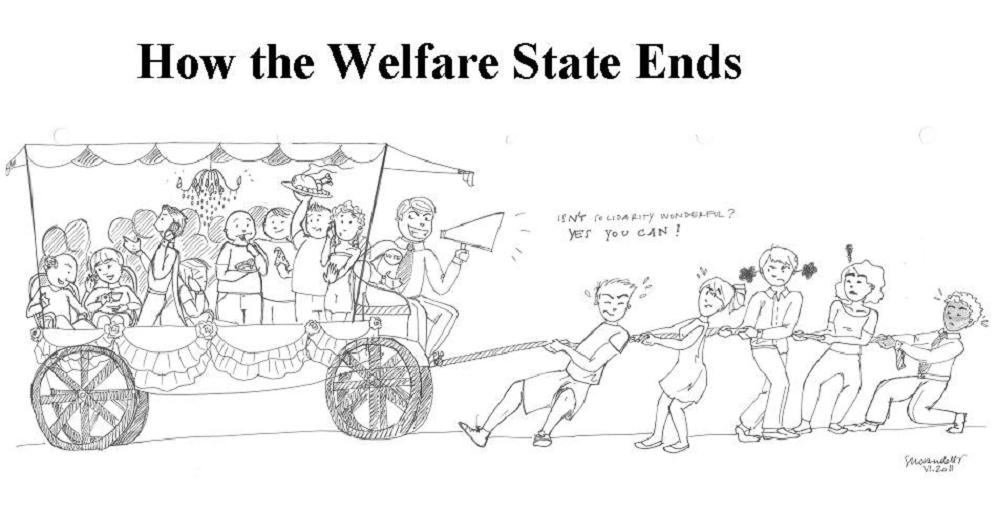
The all-time, most-viewed post on this blog is this set of cartoons showing how the welfare state begins and how it eventually becomes an unsustainable mess.

The great Chuck Asay has a cartoon that takes the next step, showing what happens when the looters and moochers who ride in the wagon get pitted against those who are pulling the wagon.

Since I’m not a Romney fan (for a bunch of reasons outlined here), I would have preferred if the cartoon didn’t imply anything about the current election and instead focused on the rhetorical question of what happens to a society when those living off the government outnumber those who get stuck picking up the tab.

It also would have been more accurate to have the two slave drivers somehow identified as “politicians” and the “IRS.”

But it’s a very clever cartoon, so it’s worth sharing even if I’m nitpicking.

You can see my favorite Asay cartoons here, here, herehere, here, here, here, here, here, here, herehereherehere, and here.

I must say I share your love for the LION, WITCH AND THE WARDROBE by C.S. Lewis. Sadly he died on the same day as two other notable gentleman (JFK and Aldous Huxley). Just like you I have a love for books!

Thank you so much for your time.

Sincerely,

Everette Hatcher III, 13900 Cottontail Lane, Alexander, AR 72002, ph 501-920-5733

Related posts:

Milton Friedman’s Free to Choose (1980), episode 3 – Anatomy of a Crisis. part 1

“The Power of the Market” episode of Free to Choose in 1990 by Milton Friedman (Part 5)

Milton Friedman The Power of the Market 5-5 How can we have personal freedom without economic freedom? That is why I don’t understand why socialists who value individual freedoms want to take away our economic freedoms.  I wanted to share this info below with you from Milton Friedman who has influenced me greatly over the […]

“The Power of the Market” episode of Free to Choose in 1990 by Milton Friedman (Part 4)

Milton Friedman The Power of the Market 4-5 How can we have personal freedom without economic freedom? That is why I don’t understand why socialists who value individual freedoms want to take away our economic freedoms.  I wanted to share this info below with you from Milton Friedman who has influenced me greatly over the […]

“The Power of the Market” episode of Free to Choose in 1990 by Milton Friedman (Part 3)

Milton Friedman The Power of the Market 3-5 How can we have personal freedom without economic freedom? That is why I don’t understand why socialists who value individual freedoms want to take away our economic freedoms.  I wanted to share this info below with you from Milton Friedman who has influenced me greatly over the […]

“The Power of the Market” episode of Free to Choose in 1990 by Milton Friedman (Part 2)

Milton Friedman The Power of the Market 2-5 How can we have personal freedom without economic freedom? That is why I don’t understand why socialists who value individual freedoms want to take away our economic freedoms.  I wanted to share this info below with you from Milton Friedman who has influenced me greatly over the […]

“The Power of the Market” episode of Free to Choose in 1990 by Milton Friedman (Part 1)

Milton Friedman The Power of the Market 1-5 How can we have personal freedom without economic freedom? That is why I don’t understand why socialists who value individual freedoms want to take away our economic freedoms.  I wanted to share this info below with you from Milton Friedman who has influenced me greatly over the […]

“Friedman Friday” EPISODE “The Failure of Socialism” of Free to Choose in 1990 by Milton Friedman (Part 5)

Milton Friedman: Free To Choose – The Failure Of Socialism With Ronald Reagan (Full) Published on Mar 19, 2012 by NoNationalityNeeded Milton Friedman’s writings affected me greatly when I first discovered them and I wanted to share with you. Abstract: Ronald Reagan introduces this program, and traces a line from Adam Smith’s “The Wealth of […]

“Friedman Friday” EPISODE “The Failure of Socialism” of Free to Choose in 1990 by Milton Friedman (Part 4)

Milton Friedman: Free To Choose – The Failure Of Socialism With Ronald Reagan (Full) Published on Mar 19, 2012 by NoNationalityNeeded Milton Friedman’s writings affected me greatly when I first discovered them and I wanted to share with you. Abstract: Ronald Reagan introduces this program, and traces a line from Adam Smith’s “The Wealth of […]

“Friedman Friday” EPISODE “The Failure of Socialism” of Free to Choose in 1990 by Milton Friedman (Part 3)

Milton Friedman: Free To Choose – The Failure Of Socialism With Ronald Reagan (Full) Published on Mar 19, 2012 by NoNationalityNeeded Milton Friedman’s writings affected me greatly when I first discovered them and I wanted to share with you. Abstract: Ronald Reagan introduces this program, and traces a line from Adam Smith’s “The Wealth of […]

“Friedman Friday” EPISODE “The Failure of Socialism” of Free to Choose in 1990 by Milton Friedman (Part 2)

Milton Friedman: Free To Choose – The Failure Of Socialism With Ronald Reagan (Full) Published on Mar 19, 2012 by NoNationalityNeeded Milton Friedman’s writings affected me greatly when I first discovered them and I wanted to share with you. Abstract: Ronald Reagan introduces this program, and traces a line from Adam Smith’s “The Wealth of […]

“Friedman Friday,” EPISODE “The Failure of Socialism” of Free to Choose in 1990 by Milton Friedman (Part 1)

Milton Friedman: Free To Choose – The Failure Of Socialism With Ronald Reagan (Full) Published on Mar 19, 2012 by NoNationalityNeeded Milton Friedman’s writings affected me greatly when I first discovered them and I wanted to share with you. We must not head down the path of socialism like Greece has done. Abstract: Ronald Reagan […]

Williams with Sowell – Minimum Wage

Thomas Sowell

Thomas Sowell – Reducing Black Unemployment

By WALTER WILLIAMS

—-

Ronald Reagan with Milton Friedman
Milton Friedman The Power of the Market 2-5

MY OPEN LETTER TO VICE PRESIDENT KAMALA HARRIS PART 2 “Do you and President want measures put in to help safeguard fair elections?”

Kamala Harris official photo (cropped2).jpg


February 2, 2021

Honorable Vice President Kamala Harris c/o The White House

1600 Pennsylvania Avenue NW
Washington, DC 20500

Dear Mrs. Vice President,

I was hoping that you agree with the idea of legal and fair elections and I hope you like this article below:

9 Election Reforms States Can Implement to Prevent Mistakes and Vote Fraud

Hans von Spakovsky @HvonSpakovsky / February 02, 2021

All voters nationwide should be required to validate his or her identity with a government-issued photo ID to vote in person or by absentee ballot. Pictured: Signs greet voters arriving at the Ruckersville Volunteer Fire Company polling station in Ruckersville, Va., on Election Day, Nov. 3. (Photo: Bill Clark/CQ-Roll Call/Getty Images)

REPORT THIS AD

Hans von Spakovsky@HvonSpakovsky

Hans von Spakovsky is an authority on a wide range of issues—including civil rights, civil justice, the First Amendment, immigration, the rule of law and government reform—as a senior legal fellow in The Heritage Foundation’s Edwin Meese III Center for Legal and Judicial Studies and manager of the think tank’s Election Law Reform Initiative. Read his research.

Election fraud is real.

The Heritage Foundation’s Election Fraud Database, which has chronicled more than 1,300 cases of election fraud, proves that election fraud does occur in American elections.

Errors and omissions by election officials and careless, shoddy election practices and procedures or lack of training can also cause and have caused problems for voters and candidates alike.

But it doesn’t have to be this way. States can, and should, take action to restore integrity to our elections.

The Left has declared war on our culture, but we should never back down, nor compromise our principles. Learn more now >>

Here’s a list of best practices states should adopt for elections.

  1. Verify the accuracy of voter registration lists. Computerized statewide voter-registration lists should be designed to be interoperable so that they can communicate seamlessly with other state record databases to allow frequent exchanges and comparisons of information.

For example, when an individual changes the residence address on his or her driver’s license, that information should be sent to state election officials so that the voter-registration address of the individual is also changed to his or her new Department of Motor Vehicles residence address.

2. Verify citizenship of voters. Only lawful citizens can vote in federal elections. States should, therefore, require proof of citizenship to register to vote, as well as verify the citizenship of registered voters with the records of the Department of Homeland Security, including access to the E-Verify system.

3. Require voter ID. A voter should be required to validate his or her identity with government-issued photo ID to vote in-person or by absentee ballot (as states such as Alabama and Kansas require). Government-issued IDs should be free for those who cannot afford one.

4. Limit absentee ballots. Absentee ballotsshould be reserved for those individuals who are too disabled to vote in person or who will be out of town on Election Day and all early-voting days.

5. Prevent vote trafficking. Vote-trafficking (also called “vote harvesting”) by third parties should be banned. That would ensure that candidates, campaign staffers, party activists, and political consultants are prohibited from picking up and potentially mishandling or changing absentee ballots and pressuring or coercing vulnerable voters in their homes. In other words, a political group can’t offer to pick up ballots and then bring them to the polling place and/or mail them, with no third party supervising that group’s behavior in the interim.

6. Allow election observers complete access to the election process. Political parties, candidates, and third-party organizations should all be allowed to have observers in every aspect of the election process, because transparency is essential to a fair and secure system. The only limitation on such observers is that they cannot interfere with the voting and counting process.

However, a representative of the election office should be present to answer the questions of the observers. They should be legally allowed to be in a position—exactly like election officials—to observe everything going on, other than the actual voting by individuals. Election officials should be prohibited from stationing observers so far away that they cannot observe the process, including such procedures as the opening of absentee ballots and the verification process.

7. Provide voting assistance. Any individuals providing assistance to a voter in a voting booth because the voter is illiterate, disabled, or otherwise requires assistance should be required to complete a form, to be filed with poll election officials, providing their name, address, contact information, and the reason they are providing assistance. They should also be required to provide a photo ID.

8. Prohibit early vote counting. To avoid premature release of election results, the counting of ballots, including absentee and early votes, should not begin until the polls close at the end of Election Day. However, if a state insists on beginning the count before Election Day, it should ban the release of results until the evening of Election Day, subject to criminal penalties.

9. Provide state legislatures with legal standing. State legislatures must ensure that they have legal standing—either through a specific state law or through a constitutional amendment if that is required—to sue other state officials, such as governors or secretaries of state, who make or attempt to make unauthorized changes in state election laws.

For example, if a secretary of state extends the deadline set by state law for the receipt of absentee ballots, legislatures should have legal standing to contest that unilateral change that overrides state law. They should be classified as a necessary party in any lawsuit. And voters should be provided by state law with the ability to file a writ of mandamus against any state or local official who fails to abide by, or enforce, a state election-law requirement.

In 2020, Pennsylvania Secretary of State Kathy Boockvar made changes to election law unilaterally. We need to ensure that can’t happen again in other states or in future elections.

Along with these nine (and other) reforms, there are specific measures states shouldn’t take.

For instance, there should be no same-day registration for voting. Registration should be required before Election Day to give election officials sufficient time to verify the accuracy of the registration information contained on a registration form and to confirm the eligibility of the potential voter.

There also shouldn’t be automatic voter registration. States should comply with the National Voter Registration Act and provide registration opportunities at state agencies. However, all individuals should be asked at the time of the state agency transaction, such as the application for a driver’s license, whether they want to register to vote.

No one should be automatically registered without their consent or knowledge, since this can lead to multiple registrations by the same individual, as well as the registration of ineligible individuals, such as noncitizens.

As we all know, elections have consequences. That’s why it’s crucial to ensure that every vote counts and isn’t diluted by election fraud and other problems. It’s time for states to implement these reforms to ensure voters will have faith in our elections.

This op-ed has been adapted from a Heritage Foundation report. To learn more, read the full report, “The Facts About Election Integrity and the Need for States to Fix Their Election Systems.”

Have an opinion about this article? To sound off, please email letters@DailySignal.com and we will consider publishing your remarks in our regular “We Hear You” feature.

I must say I share your love for the LION, WITCH AND THE WARDROBE by C.S. Lewis. Sadly he died on the same day as two other notable gentleman (JFK and Aldous Huxley). Just like you I have a love for books!

Thank you so much for your time.

Sincerely,

Everette Hatcher III, 13900 Cottontail Lane, Alexander, AR 72002, ph 501-920-5733

Related posts:

Milton Friedman’s Free to Choose (1980), episode 3 – Anatomy of a Crisis. part 1

“The Power of the Market” episode of Free to Choose in 1990 by Milton Friedman (Part 5)

Milton Friedman The Power of the Market 5-5 How can we have personal freedom without economic freedom? That is why I don’t understand why socialists who value individual freedoms want to take away our economic freedoms.  I wanted to share this info below with you from Milton Friedman who has influenced me greatly over the […]

“The Power of the Market” episode of Free to Choose in 1990 by Milton Friedman (Part 4)

Milton Friedman The Power of the Market 4-5 How can we have personal freedom without economic freedom? That is why I don’t understand why socialists who value individual freedoms want to take away our economic freedoms.  I wanted to share this info below with you from Milton Friedman who has influenced me greatly over the […]

“The Power of the Market” episode of Free to Choose in 1990 by Milton Friedman (Part 3)

Milton Friedman The Power of the Market 3-5 How can we have personal freedom without economic freedom? That is why I don’t understand why socialists who value individual freedoms want to take away our economic freedoms.  I wanted to share this info below with you from Milton Friedman who has influenced me greatly over the […]

“The Power of the Market” episode of Free to Choose in 1990 by Milton Friedman (Part 2)

Milton Friedman The Power of the Market 2-5 How can we have personal freedom without economic freedom? That is why I don’t understand why socialists who value individual freedoms want to take away our economic freedoms.  I wanted to share this info below with you from Milton Friedman who has influenced me greatly over the […]

“The Power of the Market” episode of Free to Choose in 1990 by Milton Friedman (Part 1)

Milton Friedman The Power of the Market 1-5 How can we have personal freedom without economic freedom? That is why I don’t understand why socialists who value individual freedoms want to take away our economic freedoms.  I wanted to share this info below with you from Milton Friedman who has influenced me greatly over the […]

“Friedman Friday” EPISODE “The Failure of Socialism” of Free to Choose in 1990 by Milton Friedman (Part 5)

Milton Friedman: Free To Choose – The Failure Of Socialism With Ronald Reagan (Full) Published on Mar 19, 2012 by NoNationalityNeeded Milton Friedman’s writings affected me greatly when I first discovered them and I wanted to share with you. Abstract: Ronald Reagan introduces this program, and traces a line from Adam Smith’s “The Wealth of […]

“Friedman Friday” EPISODE “The Failure of Socialism” of Free to Choose in 1990 by Milton Friedman (Part 4)

Milton Friedman: Free To Choose – The Failure Of Socialism With Ronald Reagan (Full) Published on Mar 19, 2012 by NoNationalityNeeded Milton Friedman’s writings affected me greatly when I first discovered them and I wanted to share with you. Abstract: Ronald Reagan introduces this program, and traces a line from Adam Smith’s “The Wealth of […]

“Friedman Friday” EPISODE “The Failure of Socialism” of Free to Choose in 1990 by Milton Friedman (Part 3)

Milton Friedman: Free To Choose – The Failure Of Socialism With Ronald Reagan (Full) Published on Mar 19, 2012 by NoNationalityNeeded Milton Friedman’s writings affected me greatly when I first discovered them and I wanted to share with you. Abstract: Ronald Reagan introduces this program, and traces a line from Adam Smith’s “The Wealth of […]

“Friedman Friday” EPISODE “The Failure of Socialism” of Free to Choose in 1990 by Milton Friedman (Part 2)

Milton Friedman: Free To Choose – The Failure Of Socialism With Ronald Reagan (Full) Published on Mar 19, 2012 by NoNationalityNeeded Milton Friedman’s writings affected me greatly when I first discovered them and I wanted to share with you. Abstract: Ronald Reagan introduces this program, and traces a line from Adam Smith’s “The Wealth of […]

“Friedman Friday,” EPISODE “The Failure of Socialism” of Free to Choose in 1990 by Milton Friedman (Part 1)

Milton Friedman: Free To Choose – The Failure Of Socialism With Ronald Reagan (Full) Published on Mar 19, 2012 by NoNationalityNeeded Milton Friedman’s writings affected me greatly when I first discovered them and I wanted to share with you. We must not head down the path of socialism like Greece has done. Abstract: Ronald Reagan […]

Williams with Sowell – Minimum Wage

Thomas Sowell

Thomas Sowell – Reducing Black Unemployment

By WALTER WILLIAMS

—-

Ronald Reagan with Milton Friedman
Milton Friedman The Power of the Market 2-5

Time Is Ours to Win War on Government Waste

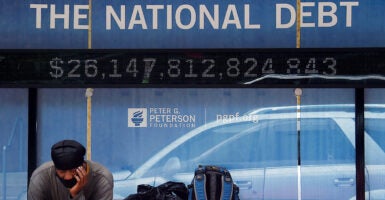
A man waits at a bus stop in Washington, D.C., that displays the national debt of the United States, June 19, 2020. (Photo: Olivier Douliery/AFP/Getty Images)

In the last 20 years, our country’s national debt has exploded.

In 2001, when George W. Bush took office, the national debt was $5.8 trillion. It took around 225 years—booms, busts, depressions, wars, etc.—to amass that much national debt. In just eight years, Bush and a compliant Congress doubled the number to $11.7 trillion. In Barack Obama’s two terms, another $8.6 trillion was added.

During the past four years, Donald Trump and Congress fought many battles, but not over this: In that time, America’s future was mortgaged to the tune of another $6.7 trillion.

Today, the national debt is around $27 trillion, a fourfold increase in the last two decades. That doesn’t count unfunded mandates. And there is no end in sight.

The Left has declared war on our culture, but we should never back down, nor compromise our principles. Learn more now >>

Whenever human beings gather to accomplish a task, any task, without strong and effective oversight, a natural evolution takes place. Whether it be in business, academia, philanthropy, or government, every activity morphs from the original goal to self-aggrandizement.

In government, this process is particularly toxic. There are no profits, let alone a profit motive. No concern with productivity. No incentive to turn off the proverbial lights. No measure of success. No motivation to end counterproductive activities.

Add to this mix the influence of public employee unions. Franklin Delano Roosevelt and Harry Truman were opposed to them for reasons that long ago became apparent. The goal of all unions is self-preservation—just as management’s is to maximize profits.

But public employee unions add two other noxious elements to the mix: (1) defending job incompetence and (2) heavy-handed involvement in the electoral process in a search for pliant politicians who can help them achieve their objectives by spending ever more of the public’s money.

Now, out of the blue, the experts-for-hire have a new scheme to justify continued fiscal irresponsibility: modern monetary theory. It holds that so long as interest rates are lower than inflation rates, politicians can spend away. That is not a theory. It is idle wordplay, and the victim of such sophistry is the American taxpayer—and future generations of American taxpayers.

Never in our history has fiscal soundness been more important. The exploding annual deficits of the last 20 years have produced a national debt as a percentage of the gross domestic product that is as high as it was during World War II even though our nation is at peace.

Moreover, many severely underfunded programs such as Social Security and Medicaid are not included in today’s debt calculations, although they should be.

The passage of a 5,593-page must-pass-quickly bill in December was indisputable evidence that the national debt will never be addressed from the top down. That legislation was sent to the Senate two hours before the vote. Who can read 2,800 pages per hour, 47 pages per minute? How can responsible lawmakers vote on bills they have not read?

While our political leaders have repeatedly told us how important this bill was to the survival of so many Americans, they delayed the bill for months for political reasons.

A crucial-to-the-survival-of-so-many-Americans pork-filled bill? Some $10 million to Pakistan for “gender programs”? Another $700 million to Sudan for Lord knows what? And on and on and on.

History has a clear and repeated message: If we do not address this exploding debt, it will bring to life all-knowing leaders, leaders who Friedrich Hayek said possessed the “fatal conceit.” They think they know more than is knowable. Leaders who have all the answers for everything they define as a problem: more regulations, more government control, more taxes.

This is a noxious cure that has never succeeded, one that has left country after country in economic tatters.

Fortunately, the world in changing. Today, we have the means to address this financial irresponsibility, this threat to our country, as our Founders envisioned it. We are immersed in the Information Age, the Big Data world, the Cloud world, the Bitcoin world.

The cost of communications is close to zero. Smartphones, iPads, and computers are a crucial part of everyday life. With the touch of a finger, one click, information on every topic is available 24 hours a day.

Buy anything. Sell anything. Today, instant access to information is embedded in our culture. Why should government expenditures be exempt?

Transparency has always been the best antidote to rein in profligate government spending. Having instant information at our fingertips gives fiscally responsible Americans a powerful new weapon in the War on Waste.

Today, there is no reason why every local, state, and federal government expenditure is not online, in real time, available to every citizen. Taxpayers should be able to attend a school board meeting and pull up school expenses on their phones.

Open the Books has a formidable weapon to unleash the voting public’s ability to address this exploding national debt, this lack of transparency, this threat to our democracy—the Open the Books Government Expenditure Library, which contains over 5 billion (and growing) local, state, and federal government expenditures.

Last year, we filed 41,500 Freedom of Information Act requests. We sued several government entities to encourage them to provide us the same information we collect from other states.

The Open the Books Government Expenditure Library is open to everyone: citizens, politicians, students, academics, scholars, journalists, think tanks—everyone, 24-hours a day, seven days a week.

Transparency can be as revolutionary as the internet has been for the economic well-being of the world. Transparency cannot only enhance the odds of the survival of this, the greatest country in the history of the world, but, over time, it will contribute to our prosperity, our health, and our happiness.

Wasted taxpayer dollars are not just nonproductive. Waste allowed to exist encourages more waste. Fraud allowed to exist encourages more fraud. A financially sound economy, one that works to remove waste, fraud, duplication, and incompetence, will increase respect for government, for the rule of law.

Open the Books places the future of this great country more firmly in the hands of the voters. To ensure our elected officials realize this, we have to communicate continuously with them what we expect and how we will vote.

I suggest we begin with one clear public statement: “I will never vote for anyone who has voted for a bill they have not read.” Register that statement at OpenTheBooks.com/READTHEBILL.

Obviously, our elected officials are unwilling to address this explosive, increasingly crucial national debt problem. Fortunately, we the taxpaying voters today have a weapon at our fingertips to successfully wage a War on Waste. Successful because our political leaders will quickly recognize that if they want to be reelected, they will have to respond accordingly.

The Daily Signal publishes a variety of perspectives. Nothing written here is to be construed as representing the views of The Heritage Foundation.

Have an opinion about this article? To sound off, please email letters@DailySignal.com and we will consider publishing your remarks in our regular “We Hear You” feature.

Originally published by RealClearPolitics

March 31, 2021

President Biden  c/o The White House
1600 Pennsylvania Avenue NW
Washington, DC 20500

Dear Mr. President,

Please explain to me if you ever do plan to balance the budget while you are President? I have written these things below about you and I really do think that you don’t want to cut spending in order to balance the budget. It seems you ever are daring the Congress to stop you from spending more.

President Barack Obama speaks about the debt limit in the East Room of the White House in Washington. | AP Photo

“The credit of the United States ‘is not a bargaining chip,’ Obama said on 1-14-13. However, President Obama keeps getting our country’s credit rating downgraded as he raises the debt ceiling higher and higher!!!!

Washington Could Learn a Lot from a Drug Addict

Just spend more, don’t know how to cut!!! Really!!! That is not living in the real world is it?

Making more dependent on government is not the way to go!!

Why is our government in over 16 trillion dollars in debt? There are many reasons for this but the biggest reason is people say “Let’s spend someone else’s money to solve our problems.” Liberals like Max Brantley have talked this way for years. Brantley will say that conservatives are being harsh when they don’t want the government out encouraging people to be dependent on the government. The Obama adminstration has even promoted a plan for young people to follow like Julia the Moocher.  

David Ramsey demonstrates in his Arkansas Times Blog post of 1-14-13 that very point:

Arkansas Politics / Health Care Arkansas’s share of Medicaid expansion and the national debt

Posted by on Mon, Jan 14, 2013 at 1:02 PM

Baby carrot Arkansas Medicaid expansion image

Imagine standing a baby carrot up next to the 25-story Stephens building in Little Rock. That gives you a picture of the impact on the national debt that federal spending in Arkansas on Medicaid expansion would have, while here at home expansion would give coverage to more than 200,000 of our neediest citizens, create jobs, and save money for the state.

Here’s the thing: while more than a billion dollars a year in federal spending would represent a big-time stimulus for Arkansas, it’s not even a drop in the bucket when it comes to the national debt.

Currently, the national debt is around $16.4 trillion. In fiscal year 2015, the federal government would spend somewhere in the neighborhood of $1.2 billion to fund Medicaid expansion in Arkansas if we say yes. That’s about 1/13,700th of the debt.

It’s hard to get a handle on numbers that big, so to put that in perspective, let’s get back to the baby carrot. Imagine that the height of the Stephens building (365 feet) is the $16 trillion national debt. That $1.2 billion would be the length of a ladybug. Of course, we’re not just talking about one year if we expand. Between now and 2021, the federal government projects to contribute around $10 billion. The federal debt is projected to be around $25 trillion by then, so we’re talking about 1/2,500th of the debt. Compared to the Stephens building? That’s a baby carrot.

______________

Here is how it will all end if everyone feels they should be allowed to have their “baby carrot.”

How sad it is that liberals just don’t get this reality.

Here is what the Founding Fathers had to say about welfare. David Weinberger noted:

While living in Europe in the 1760s, Franklin observed: “in different countries … the more public provisions were made for the poor, the less they provided for themselves, and of course became poorer. And, on the contrary, the less was done for them, the more they did for themselves, and became richer.”

Alexander Fraser Tytler, Lord Woodhouselee (15 October 1747 – 5 January 1813) was a Scottish lawyer, writer, and professor. Tytler was also a historian, and he noted, “A democracy cannot exist as a permanent form of government. It can only exist until the majority discovers it can vote itself largess out of the public treasury. After that, the majority always votes for the candidate promising the most benefits with the result the democracy collapses because of the loose fiscal policy ensuing, always to be followed by a dictatorship, then a monarchy.”

Thomas Jefferson to Joseph Milligan

April 6, 1816

[Jefferson affirms that the main purpose of society is to enable human beings to keep the fruits of their labor. — TGW]

To take from one, because it is thought that his own industry and that of his fathers has acquired too much, in order to spare to others, who, or whose fathers have not exercised equal industry and skill, is to violate arbitrarily the first principle of association, “the guarantee to every one of a free exercise of his industry, and the fruits acquired by it.” If the overgrown wealth of an individual be deemed dangerous to the State, the best corrective is the law of equal inheritance to all in equal degree; and the better, as this enforces a law of nature, while extra taxation violates it.

[From Writings of Thomas Jefferson, ed. Albert E. Bergh (Washington: Thomas Jefferson Memorial Association, 1904), 14:466.]

_______

Jefferson pointed out that to take from the rich and give to the poor through government is just wrong. Franklin knew the poor would have a better path upward without government welfare coming their way. Milton Friedman’s negative income tax is the best method for doing that and by taking away all welfare programs and letting them go to the churches for charity.

_____________

_________

Thank you so much for your time. I know how valuable it is. I also appreciate the fine family that you have and your commitment as a father and a husband.

Sincerely,

Everette Hatcher III, 13900 Cottontail Lane, Alexander, AR 72002, ph 501-920-5733

Williams with Sowell – Minimum Wage

Thomas Sowell

Thomas Sowell – Reducing Black Unemployment

By WALTER WILLIAMS

—-

Ronald Reagan with Milton Friedman
Milton Friedman The Power of the Market 2-5

Related posts:

Welfare Spending Shattering All-Time Highs

  We got to act fast and get off this path of socialism. Morning Bell: Welfare Spending Shattering All-Time Highs Robert Rector and Amy Payne October 18, 2012 at 9:03 am It’s been a pretty big year for welfare—and a new report shows welfare is bigger than ever. The Obama Administration turned a giant spotlight […]

We need more brave souls that will vote against Washington welfare programs

We need to cut Food Stamp program and not extend it. However, it seems that people tell the taxpayers back home they are going to Washington and cut government spending but once they get up there they just fall in line with  everyone else that keeps spending our money. I am glad that at least […]

Welfare programs are not the answer for the poor

Government Must Cut Spending Uploaded by HeritageFoundation on Dec 2, 2010 The government can cut roughly $343 billion from the federal budget and they can do so immediately. __________ Liberals argue that the poor need more welfare programs, but I have always argued that these programs enslave the poor to the government. Food Stamps Growth […]

Private charities are best solution and not government welfare

Milton Friedman – The Negative Income Tax Published on May 11, 2012 by LibertyPen In this 1968 interview, Milton Friedman explained the negative income tax, a proposal that at minimum would save taxpayers the 72 percent of our current welfare budget spent on administration. http://www.LibertyPen.com Source: Firing Line with William F Buckley Jr. ________________ Milton […]

The book “After the Welfare State”

Dan Mitchell Commenting on Obama’s Failure to Propose a Fiscal Plan Published on Aug 16, 2012 by danmitchellcato No description available. ___________ After the Welfare State Posted by David Boaz Cato senior fellow Tom G. Palmer, who is lecturing about freedom in Slovenia and Tbilisi this week, asked me to post this announcement of his […]

President Obama responds to Heritage Foundation critics on welfare reform waivers

Is President Obama gutting the welfare reform that Bill Clinton signed into law? Morning Bell: Obama Denies Gutting Welfare Reform Amy Payne August 8, 2012 at 9:15 am The Obama Administration came out swinging against its critics on welfare reform yesterday, with Press Secretary Jay Carney saying the charge that the Administration gutted the successful […]

Welfare reform part 3

Thomas Sowell – Welfare Welfare reform was working so good. Why did we have to abandon it? Look at this article from 2003. The Continuing Good News About Welfare Reform By Robert Rector and Patrick Fagan, Ph.D. February 6, 2003 Six years ago, President Bill Clinton signed legislation overhauling part of the nation’s welfare system. […]

Welfare reform part 2

Uploaded by ForaTv on May 29, 2009 Complete video at: http://fora.tv/2009/05/18/James_Bartholomew_The_Welfare_State_Were_In Author James Bartholomew argues that welfare benefits actually increase government handouts by ‘ruining’ ambition. He compares welfare to a humane mousetrap. —– Welfare reform was working so good. Why did we have to abandon it? Look at this article from 2003. In the controversial […]

Why did Obama stop the Welfare Reform that Clinton put in?

Thomas Sowell If the welfare reform law was successful then why change it? Wasn’t Bill Clinton the president that signed into law? Obama Guts Welfare Reform Robert Rector and Kiki Bradley July 12, 2012 at 4:10 pm Today, the Obama Department of Health and Human Services (HHS) released an official policy directive rewriting the welfare […]

“Feedback Friday” Letter to White House generated form letter response July 10,2012 on welfare, etc (part 14)

I have been writing President Obama letters and have not received a personal response yet.  (He reads 10 letters a day personally and responds to each of them.) However, I did receive a form letter in the form of an email on July 10, 2012. I don’t know which letter of mine generated this response so I have […]

MY OPEN LETTER TO VICE PRESIDENT KAMALA HARRIS PART 1 David Ditch noted: Congress has already approved over $4 trillion in response to the pandemic, much of which is still available or in the process of being distributed. The idea that Congress has been “undershooting” the response is ridiculous!

Kamala Harris official photo (cropped2).jpg

February 1, 2021
Honorable Vice President Kamala Harris c/o The White House

1600 Pennsylvania Avenue NW
Washington, DC 20500

Dear Mrs. Vice President,

Let me encourage you to read this article below: 

I must say I share your love for the LION, WITCH AND THE WARDROBE by C.S. Lewis. Sadly he died on the same day as two other notable gentleman (JFK and Aldous Huxley). Just like you I have a love for books!

Debt

Calling for stimulus spending in response to COVID-19, Majority Leader Charles Schumer, D-N.Y., stated on Jan. 28, “The dangers of undershooting our response are far greater than overshooting it.” (Photo: Tom Williams/CQ-Roll Call, Inc./Getty Images)

The combination of unified control of the federal government along with the COVID-19 pandemic has seemingly caused some elected officials to think there are no consequences to new spending proposals. However, they must wake up to the dangers posed by recklessly adding to the national debt.

On Thursday, Majority Leader Charles Schumer, D-N.Y., exemplified this mindset by saying, “The dangers of undershooting our response are far greater than overshooting it. We should have learned the lesson, from 2008 and 2009, when Congress was too timid and constrained in its response to the global financial crisis.”

>>> What’s the best way for America to reopen and return to business? The National Coronavirus Recovery Commission, a project of The Heritage Foundation, assembled America’s top thinkers to figure that out. So far, it has made more than 260 recommendations. Learn more here.

This is wrong on several fronts.

The Left has declared war on our culture, but we should never back down, nor compromise our principles. Learn more now >>

First, the stimulus spending that took place in the wake of the Great Recession was ineffective at creating jobs, and in some ways slowed the economy by creating perverse incentives and crowding out private activity.

Second, despite the difficulties associated with the pandemic, the economy is currently in much better shape than it was during the last recession.

The national unemployment rate hit 10% in October 2009 and stayed above 8% through August 2012. In contrast, the COVID-19 recession caused unemployment to spike to 14.8% in April 2020, but it fell below 7% by October.

Third, Congress has already approved over $4 trillion in response to the pandemic, much of which is still available or in the process of being distributed. The idea that Congress has been “undershooting” the response is ridiculous.

Most importantly, Schumer and other leftists in Congress are ignoring the very real danger posed by adding to the $27.8 trillion federal debt, which is over $210,000 for every U.S. household.

Even after the pandemic is over and the economy returns to normal, we will face serious problems as a result of the federal government’s broken finances.

Over $21 trillion worth of federal debt obligations are traded on the open market. While interest rates are low today, Congress has no control over what those rates will be as the debt turns over and requires refinancing.

Credit rating agencies are growing concernedabout the sustainability of America’s finances. If demand for our debt goes down, that will force the Treasury to offer higher interest rates.

Higher interest rates on so much debt would add up very quickly, which makes this a serious risk to economic growth and future prosperity. That means we need to put an end to massive deficits and eventually shrink the debt, either in absolute terms or in relation to the size of the economy, to reduce the risk to current and future generations.

This will be impossible unless legislators address the driving force behind long-term debt and deficits: unsustainable benefit programs such as Social Security and Medicare.

Major trust funds will run dry all too soon. Medicare Part A (hospital insurance) goes broke in 2024, Social Security Disability Insurance in 2026, and the Social Security retirement fund in 2031. These are programs that tens of millions of people rely on, and trust fund insolvency would cause serious upheaval, especially for Social Security.

Annual deficits for the federal government and these major benefit programs are too large to close overnight. Deficits were already high during the years of strong economic growth prior to the pandemic, and then exploded in 2020.

Reforms aiming to slow the growth of spending on Social Security and Medicare can have a significant effect, but only if those reforms are in place several years before the trust funds run out. The longer we wait, the more drastic the necessary changes become.

Besides reforming large benefit programs, there are many other ways for Congress to improve the nation’s financial health. These include refocusing the federal government on core priorities, eliminating wasteful spending, returning to a regular budget process, and strengthening economic growth.

What would not help this massive and growing problem is spending trillions of dollars we don’t have on more “relief” legislation that would do little to help the economy. Hopefully Congress will come to its senses and recognize that it has a responsibility to use taxpayer dollars wisely.

Have an opinion about this article? To sound off, please email letters@DailySignal.com and we will consider publishing your remarks in our regular “We Hear You” feature.

—-

Thank you so much for your time.

Sincerely,

Everette Hatcher III, 13900 Cottontail Lane, Alexander, AR 72002, ph 501-920-5733

Related posts:

Milton Friedman’s Free to Choose (1980), episode 3 – Anatomy of a Crisis. part 1

“The Power of the Market” episode of Free to Choose in 1990 by Milton Friedman (Part 5)

Milton Friedman The Power of the Market 5-5 How can we have personal freedom without economic freedom? That is why I don’t understand why socialists who value individual freedoms want to take away our economic freedoms.  I wanted to share this info below with you from Milton Friedman who has influenced me greatly over the […]

“The Power of the Market” episode of Free to Choose in 1990 by Milton Friedman (Part 4)

Milton Friedman The Power of the Market 4-5 How can we have personal freedom without economic freedom? That is why I don’t understand why socialists who value individual freedoms want to take away our economic freedoms.  I wanted to share this info below with you from Milton Friedman who has influenced me greatly over the […]

“The Power of the Market” episode of Free to Choose in 1990 by Milton Friedman (Part 3)

Milton Friedman The Power of the Market 3-5 How can we have personal freedom without economic freedom? That is why I don’t understand why socialists who value individual freedoms want to take away our economic freedoms.  I wanted to share this info below with you from Milton Friedman who has influenced me greatly over the […]

“The Power of the Market” episode of Free to Choose in 1990 by Milton Friedman (Part 2)

Milton Friedman The Power of the Market 2-5 How can we have personal freedom without economic freedom? That is why I don’t understand why socialists who value individual freedoms want to take away our economic freedoms.  I wanted to share this info below with you from Milton Friedman who has influenced me greatly over the […]

“The Power of the Market” episode of Free to Choose in 1990 by Milton Friedman (Part 1)

Milton Friedman The Power of the Market 1-5 How can we have personal freedom without economic freedom? That is why I don’t understand why socialists who value individual freedoms want to take away our economic freedoms.  I wanted to share this info below with you from Milton Friedman who has influenced me greatly over the […]

“Friedman Friday” EPISODE “The Failure of Socialism” of Free to Choose in 1990 by Milton Friedman (Part 5)

Milton Friedman: Free To Choose – The Failure Of Socialism With Ronald Reagan (Full) Published on Mar 19, 2012 by NoNationalityNeeded Milton Friedman’s writings affected me greatly when I first discovered them and I wanted to share with you. Abstract: Ronald Reagan introduces this program, and traces a line from Adam Smith’s “The Wealth of […]

“Friedman Friday” EPISODE “The Failure of Socialism” of Free to Choose in 1990 by Milton Friedman (Part 4)

Milton Friedman: Free To Choose – The Failure Of Socialism With Ronald Reagan (Full) Published on Mar 19, 2012 by NoNationalityNeeded Milton Friedman’s writings affected me greatly when I first discovered them and I wanted to share with you. Abstract: Ronald Reagan introduces this program, and traces a line from Adam Smith’s “The Wealth of […]

“Friedman Friday” EPISODE “The Failure of Socialism” of Free to Choose in 1990 by Milton Friedman (Part 3)

Milton Friedman: Free To Choose – The Failure Of Socialism With Ronald Reagan (Full) Published on Mar 19, 2012 by NoNationalityNeeded Milton Friedman’s writings affected me greatly when I first discovered them and I wanted to share with you. Abstract: Ronald Reagan introduces this program, and traces a line from Adam Smith’s “The Wealth of […]

“Friedman Friday” EPISODE “The Failure of Socialism” of Free to Choose in 1990 by Milton Friedman (Part 2)

Milton Friedman: Free To Choose – The Failure Of Socialism With Ronald Reagan (Full) Published on Mar 19, 2012 by NoNationalityNeeded Milton Friedman’s writings affected me greatly when I first discovered them and I wanted to share with you. Abstract: Ronald Reagan introduces this program, and traces a line from Adam Smith’s “The Wealth of […]

“Friedman Friday,” EPISODE “The Failure of Socialism” of Free to Choose in 1990 by Milton Friedman (Part 1)

Milton Friedman: Free To Choose – The Failure Of Socialism With Ronald Reagan (Full) Published on Mar 19, 2012 by NoNationalityNeeded Milton Friedman’s writings affected me greatly when I first discovered them and I wanted to share with you. We must not head down the path of socialism like Greece has done. Abstract: Ronald Reagan […]

Williams with Sowell – Minimum Wage

Thomas Sowell

Thomas Sowell – Reducing Black Unemployment

By WALTER WILLIAMS

—-

Ronald Reagan with Milton Friedman
Milton Friedman The Power of the Market 2-5

Montana Lawmaker Outlines Troubling Implications of Biden’s Executive Actions

-—-

Rep. Matt Rosendale, R-Mont., seen here speaking at a campaign rally at the Bozeman Yellowstone International Airport in Belgrade, Montana, Nov. 3, 2018, joins “The Daily Signal Podcast” to explain his top policy priorities. (Photo: William Campbell/Corbis/Getty Images)

Freshman Rep. Matt Rosendale, R-Mont., has entered the House with a bold plan to develop America’s natural resources and push back on the agenda of the far left.

Rosendale joined “The Daily Signal Podcast” during a recent trip to the U.S.- Mexico border to discuss why he ran for Congress, his former service in the Montana Legislature, the divisive moment the country finds itself in, and much more.

We also cover these stores:

  • House Democrats put forward their case against former President Donald Trump in the impeachment trial slated to begin next week in the Senate.
  • Two lawyers representing Trump in the impeachment trial lay out their defense.
  • Florida Gov. Ron DeSantis says his state is committed to taking action against censorship by big tech companies.

Listen to the podcast below or read the lightly edited transcript.

The Daily Signal Podcast” is available on Ricochet, Apple PodcastsPippaGoogle Play, and Stitcher. All of our podcasts can be found at DailySignal.com/podcasts. If you like what you hear, please leave a review. You also can write to us at letters@dailysignal.com.

Rachel del Guidice: Hi, everyone. This is Rachel del Guidice with The Daily Signal Podcast. I am here joined by Congressman Matt Rosendale of Montana. He is a new congressmen in this new Congress. And I’m just so happy to have you with us today.

Rep. Matt Rosendale: Good to be here. Thank you for having me, Rachel.

Del Guidice: Well, it’s great to have you with us. I want to start off talking about your service in Montana before running for Congress, so tell us a little bit about that and then also what led you to run for Congress.

Rosendale: Actually, 10 years ago, I was riding my horse four or five days a week and chasing cows around the ranch, and I really didn’t expect that I would be in this position right now.

I’ve been very engaged in politics my entire life, but I was building a business, I’m raising a family, and so I never really had the time that was necessary, what I felt, to dedicate to public service.

Once my boys were out of college and the community really came to me, and I found myself as chairman of the local AG association and president of the parish council at the Catholic church.

I’m very active in the church and they said, “Look, we are not getting proper representation in Eastern Montana in the Legislature,” and so folks recruited me to run for the Legislature, and I entered in 2010. I was elected to the [state] House. In 2012, I was elected to the [state] Senate. And in 2014, my colleagues elected me as the Senate majority leader.

It just really happened very quickly. And I’ve always said that I just want to serve where I can be the most effective for my community, and my community means my county, my state, or my nation.

Then the folks encouraged me to run for the open U.S. House seat because Greg Gianforte had disclosed that he was not seeking reelection. He was going to run for governor. And I obviously ran for the House seat and was able to win it.

Del Guidice: Well, congratulations. Before talking about going into Congress, what are some of the issues that you worked on in the Montana State House that you really saw [are] important to Montanans and really affected what you did on day to day there?

Rosendale: Sure. Really, the things that I focused on [were] trying to really lower the regulatory and tax burden on our businesses and put people in a better position to either start or expand businesses and grow job opportunities.

Then the last four years, I have been serving as the state auditor, which in Montana means I was the commissioner of securities and insurance. I’ve really focused the bulk of my efforts on trying to do something about the cost and the access to health care.

It has not been addressed. We still are dealing with these problems, but I was able to make some great strides to reduce the calls, to expand access, to guarantee coverage for preexisting conditions, and actually, in many cases, improve the quality of health care that people were receiving and start beginning to bend the cost curve down. Health care is a really big deal.

I sat on the state land board. We were responsible for managing 5.2 million acres of state school trust lands. Any agricultural lease, any mineral lease, any pipeline easement that protects harvesting of timber, all of those agreements were run through the state land board, and we would approve those.

We were generating somewhere between $40 and $45 million a year to put toward the K-12 education system for the state of Montana.

Del Guidice: Before we get to Congress, I have to ask you, you have a ranch out in Montana. Tell us about the ranch and what you do there.

Rosendale: I miss it a lot is what I do. People often ask me, “Do you get back to the ranch that often?” I said, “Yes, every night, just as soon as I close my eyes.”

It’s a wonderful place. It is about 20 miles north of a little town by the name of Glendive. It is on the Yellowstone River. By the time the Yellowstone River gets to me and my property, it’s been flowing about 600 miles, so it’s a big river. It’s not just a little trout stream.

And I’m very blessed, my wife Jean and I are very blessed to have the ranch and our sons. I have three sons. We have enjoyed every moment that we’ve been there.

Del Guidice: That’s awesome. I want to switch talking a little bit about Congress. You’re a new member there. What have been your reflections, before we get started talking about what you want to do? What have your reflections been on starting off at such a turbulent time in history right now?

Rosendale: It is and I will tell you my initial thought was that I was disappointed on swearing-in day. I have to tell you.

After going through swearing-in at the state Legislature, where we convene every other year, and you haven’t seen your colleagues from across the aisle. Your colleagues that are of the same party, you haven’t seen each other regularly for quite some time. We would come together and people would embrace, and they would greet each other.

The speaker, regardless of who they were, gave a very, very positive message to try to set the tone on trying to get work done.

Complete opposite, Day One, United States Congress, and I was disappointed. I thought that [House Speaker Nancy] Pelosi delivered a very divisive message, and it was just not the same tone and tenor that I had hoped that we were going to start off with.

You deal with that, and you can’t let that one unfortunate day affect the work that you want to accomplish as you go forward.

Then, obviously, we’ve had a tumultuous time over the last three weeks, and we have gotten through that. We are beyond that and now, finally, I was told what committees I’m going to serve on.

I’m going to be on [the] Natural Resources and Veterans’ Affairs [committees], two committees that are going to be extremely important to the state of Montana. I’m looking forward to getting to work, quite frankly. I mean, this is what the people elected me for, and this is what I want to do.

Del Guidice: You talk about getting to work. What are some of the things that are top-line on your heart and mind as issues that you want to work on in Congress as you go forward?

Rosendale: Sure. On natural resources, there are so many natural resources that are located within our state that I want to make sure that they can be developed and utilized in a safe and environmentally sound method, and we can do that.

We’ve seen the practices have changed over the last several years and whether we’re talking about the new copper mine that has been permitted near White Sulphur Spring or whether we’re talking about a better management of our public lands where our national forests are located, so that we don’t have to watch them burn thousands and thousands of acres in the summer, we can actually harvest that timber and put it to good use.

Certainly, we want to make sure that our oil and gas resources are developed. That is a place where we’re going to have conflict with the new administration.

President [Joe] Biden has demonstrated by revoking the permit for the Keystone XL pipeline and revoking, at least for a stated period of time, any leases or drilling on public lands, that’s a problem. …

We have four refineries located in our state and in addition to having four refineries located in our state, we have a lot of people that work for those refineries and the ancillary businesses that feed them. The development of those energy resources not only drives a pretty good segment of our economy, but it also contributes dramatically to our national security.

This is something that we’ve seen over the last just four years under the previous administration, where we were able to go from being dependent upon other countries that were not friendly to the United States, to actually being not only energy independent, but energy dominant, so that we can start looking to our allies and helping them with their energy needs, so that they’re not dependent on some of these unfriendly nations either.

Del Guidice: Let’s talk a little bit too about the state of play where things are at. As you mentioned, we have a Democrat in the White House. President Biden is there. Now the House and Senate are both in Democrat control.

As you look forward into the coming weeks and months and years, we’ve heard talk of possibly Democrats voting to make D.C. and Puerto Rico a state; different policies like the Green New Deal—talk of that being implemented—the Equality Act.

In your perspective, where do you think and how do you think conservatives should work so that that type of policy is responded to in an adequate way?

Rosendale: That is [a] very good question. Obviously, in the House, the majority rules anything and so that is all it takes.

I hope that all my friends that are out there listening right now recognize when they were calling for the end to the filibuster, maybe that wasn’t such a good idea because, obviously, we’re going to end up being in the minority sometime or another, which is right now, where that could work against us.

Quite frankly, thank goodness there is still a filibuster in place because what I’m hoping is that the most damaging of those agenda items will be able to be stopped in the Senate, because they won’t have a 60-vote majority to be able to start pushing any of those issues forward onto the floor.

However, the Democrats do have control over the reconciliation process through budget, and it’s my understanding that they have not only this year’s budget, but they have ’21, ’22, and ’23 fiscal years that they’re able to utilize for reconciliation.

I also understand that right now, none of those most damaging agenda items can be attached to reconciliation to be pushed through.

I’m thinking that the Biden administration is going to try to use their executive powers to implement some of these things and fortunately then, it’s going to fall to our attorneys general across the country to be able to file lawsuits and keep these things from being implemented upon the states.

I have a very good relationship with my state attorney general. We came into the state Legislature as freshmen together in 2010. We’re very good friends. And I’ve already had a meeting, sat down and talked with him, and said, “We need to make sure that we are working together to push back on some of these most damaging issues.”

Del Guidice: Well, we were just on a trip to the border, got to see a bunch of different things.

One of the things that stood out to me was in different areas, since President Biden’s administration has stopped construction on the border wall, there’s these big areas of border wall that had been completed, but there’s so many different spots where they still need to finish and all of that’s being halted.

Congressman, can you tell me a little bit about your reflections from what you’ve seen and also just your thoughts on what else needs to happen here?

Rosendale: A couple of points that I took away from the border trip were, No. 1, as you said, to have just an immediate halt to all that construction was unfortunate.

On Day One, President Biden started killing jobs. And this isn’t rhetoric. These are just plain, simple facts—whether we’re talking about the closure of the Keystone pipeline, whether we’re talking about the halting of oil and gas permits on public properties. I mean, all of this started killing jobs immediately.

What we also saw was it was killing jobs immediately as we went down to the border, and we saw equipment parked and, like you say, construction on the wall halted and construction sites that were not complete. They hadn’t even finished the work that they were doing.

In the conversations with the different law enforcement people, the Border Patrol security and the local residents, they have major, major concerns about how this is going to impact the area going forward.

It was interesting to hear them say that the populations of people that are coming across the border on different areas are different types of people that they’re dealing with.

You have more of a criminal element in the mountainous, more isolated areas, as opposed to more of people that are just trying to seek an improvement in their life that are closer to the urban areas, as they are trying to come across the border.

I think one of the takeaways that everybody in our country needs to understand is that the people that I spoke to down at the border—whether we were talking about Border Patrol, whether we were talking about the local ranchers or the local authorities, the sheriff’s departments, and things like that—were very compassionate and cognizant of what was going on with these people that were coming in illegally to enter our country, and they felt bad for the ones that were being so harshly treated by this criminal element that was helping get them into our country.

They want to see the suffering, the human suffering stop. And the best way for us to keep that human suffering from taking place is to stop providing an incentive and a free pass for people to enter into our country.

Once they’ve recognize that they cannot just walk in and the deterrent is there, you won’t have this wall of humanity that’s trying to attack the border.

Del Guidice: Well, as we wrap up, we talked a little bit about how divisive everything is right now and as a man of faith, also as a leader in your community, and now in your country, what are some parting words you’d like to leave, not only to your constituents in Montana, … but the rest of the country, and what our outlook should be as we just try to move on and move up?

Rosendale: I think that, again, as a man of faith, I do place my faith in God and I pray daily that we can improve what is taking place here.

My hope is that I will be able to connect with enough other like-minded individuals in Congress, regardless of what side of the aisle that they’re sitting on, that we can basically take personalities and set them aside and look at what has proven to work to benefit our country in the past.

Because, look, you can talk about personalities all day long, but if we are really focused on improving the economy, expanding jobs, trying to make sure that we do something about health care, then let’s talk about those things and get everything else off of the table. And that’s what’s going to put our country in a better position, which means that the lives will be better for the people that we serve.

Del Guidice: Congressman Rosendale, thank you so much for joining us on “The Daily Signal Podcast.” It’s been great having you with us.

Rosendale: Thank you so much, Rachel. Good to see you.

President Biden and Labor Unions

Joe Biden is old. He has been in politics since 1970 and holds antiquated views. On the campaign trail, he used expressions such as “malarkey” and said that kids should listen to the “record player.”

President Biden’s views on labor unions are similarly archaic. Unions appear to be central to his view of the economy, yet few private‐​sector workers are in unions today. This Biden campaign statement, which is ostensibly about clean energy, promotes labor unions 32 times. Biden wants to “create millions of good, union jobs rebuilding America’s crumbling infrastructure,” wants to “ensure these investments create good, union jobs that expand the middle class,” and so on. Spending on cars, energy, manufacturing, railroads, airports, broadband, and everything else in Biden’s plan is about union jobs, over and over ad nauseam.

The focus is pathological. I say that because union members account for just 6 percent of private‐​sector employment today, yet Biden’s statement reads as if unions dominate the workforce, are the bulwark of the middle class, and are central to the economy. They are not and will not be going forward. The economy is too dynamic and competitive, and Americans have increasingly rejected unions in the private sector, as shown in the chart below.

The Biden statement repeatedly stresses “choice.” Biden wants to “provide workers with the choice to join a union and bargain collectively.” But “collective bargaining” is a euphemism for monopoly unionism and the denial of choice. It violates freedom of association, as Charles Baird explains here. The frequent use of the word “choice” is an attempt to mask the reality of coercive labor unionism under current federal law.

Even if collective bargaining was reasonable in theory, frequent corruption scandals reveal that labor union leaders abuse their special privileges. Most recently, the

Justice Department reached a civil settlement with the United Auto Workers union, marking a major turning point in a multiyear corruption investigation that has sent several former labor leaders to prison. The sprawling probe, led by the U.S. attorney’s office in Detroit, has penetrated the UAW’s top ranks and exposed what federal prosecutors described as a culture of corruption among its leadership built around kickback schemes, embezzlement and other illicit activities.

Why would any policymaker want to strengthen such organizations? Yet that is the direction of President Biden. His proposals would move backwards by reinforcing the coercive nature of federal labor union law, which is incompatible with personal freedom and the modern economy.

The chart shows that private‐​sector union membership has fallen from 32 percent of the workforce in 1960 to just 6 percent today.

graph of union share

Note: Chart data from unionstats, Barry Hirsch, and BLS.

With a $15 federal minimum wage, any jobs that don’t produce at least $36,000 per year in goods and services will eventually be eliminated—either because businesses close their doors, outsource their labor, or automate low-skilled jobs. (Photo: Moyo Studio/Getty Images)

President Joe Biden has proposed a nationwide $15 minimum wage as part of his so-called “American Rescue Plan.” Talk about bad timing: Raising labor prices on businesses that are struggling to stay afloat is like throwing them a load of bricks instead of a life preserver.

State and local governments raising their minimum wages is one thing, but to more than double the federal minimum, from $7.25 to $15 per hour?

Nearly one in every five restaurants permanently closed their doors in 2020 as 30 large retail and restaurant companies filed for bankruptcy.

Meanwhile, employment in food services (restaurants and bars) fell 19% in 2020 as retail clothing jobs dropped 24% and accommodations (hotels) jobs plummeted 32%.

The Left has declared war on our culture, but we should never back down, nor compromise our principles. Learn more now >>

Although very few people—only about 1% of all workers and 0.1% of single parents—make the $7.25 minimum wage, a good portion of restaurant, retail, and hotel jobs pay less than $15 per hour.

No one would suggest raising the rent on households who are months behind on their payments, so how could raising labor prices help businesses?

For a restaurant with five full-time workers making minimum wage, a doubling of the federal minimum wage would mean an extra $85,800 in wages and employment taxes. With restaurant profit margins of about 5%, that could require an extra $1.7 million in food sales ($4,700 more per day)—a seemingly impossible feat in normal times, let alone in the middle of a global pandemic.

Higher wages are a great thing—especially when the gains accrue to lower-income workers. But the only way to achieve actual wage increases—that is, lasting wage increases that don’t take jobs and incomes from others—is for workers to become more productive.

To that end, government mandates are powerless. A $15 minimum wage won’t help workers gain education and experience or provide them with technology that will enable them to produce more value and earn larger incomes. In fact, it could cause the opposite, by shifting employers’ resources away from training and investments to wages instead.

Moreover, raising wages by government fiat hurts many workers in the short and long run by cutting off the bottom rungs of the career ladder.

A $15 federal minimum wage translates into over $36,000 per year in wages and mandated taxes and benefits paid by employers. That means that any jobs that don’t produce at least $36,000 per year in goods and services will eventually be eliminated—either because businesses close their doors, outsource their labor, or automate low-skilled jobs.

That’s why even liberal economists and the nonpartisan Congressional Budget Office caution that a $15 federal minimum wage would lead to a survival-of-the-fittest labor market, reduce future incomes, and disproportionately harm African Americans and women.

The former chair of President Barack Obama’s White House Council of Economic Advisers, Alan Krueger, warned in 2015, “Research suggests that a minimum wage set as high as $12 an hour will do more good than harm for low-wage workers, but a $15-an-hour national minimum wage would put us in uncharted waters, and risk undesirable and unintended consequences.”

Those consequences would be unequal across the country. Large cities with high costs of living—many of which already have or are on the path to a $15 minimum wage—may not experience huge consequences. But non-urban areas and places with lower costs of living could be devastated.

Imagine if policymakers were proposing a minimum wage hike to nearly $36—ensuring that all full-time workers earned at least $74,000 per year.

Most people would say that’s too much, realizing that such a high minimum wage would have massive consequences in terms of lost jobs, increased prices, and a complete and utter disruption of the American labor market and economy.

Yet, $15 per hour in Mississippi would be equivalent to $35.74 per hour in D.C., where federal lawmakers seek to impose a national standard across the U.S.

Minimum wages are best left to local governments, where decisions can be made based on economic conditions and the cost of living.

If a local government sets its minimum wage above the market wage, at least workers and business owners who lose their jobs and businesses can move to places where it’s still possible for them to earn a living.

But if policymakers impose an excessively high nationwide minimum wage across 50 very diverse states and more than 3,000 counties, there will be nowhere else for the harmed to go.

Instead of mandating policies that irrefutably harm some people to the benefit of others, policymakers should focus on opening doors to income opportunities for all workers.

Reducing barriers to jobs and income gains is what helped contribute to the 14.6% increase in wages for workers at the 10th percentile of earners (those earning about $10 per hour) between 2016 and 2019.

Lawmakers at all levels should be seeking to help Americans recover and gain new opportunities instead of permanently wiping out existing ones.

©2021 Tribune Content Agency, LLC.

Have an opinion about this article? To sound off, please email letters@DailySignal.com and we will consider publishing your remarks in our regular “We Hear You” feature.

Ep. 4 – From Cradle to Grave [6/7]. Milton Friedman’s Free to Choose (1980)

February 9, 2021

President Biden c/o The White House
1600 Pennsylvania Avenue NW
Washington, DC 20500

Dear Mr. President,

Thank you for taking time to have your office try and get a pulse on what is going on out here in the country.

I read this article on January 15, 2021 about your announcement the previous night concerning your first proposal to Congress. Biden’s $1.9 Trillion COVID Relief Package Includes More Stimulus Checks, State Government Bailout, $15 Federal Minimum Wage

I wanted to let you know what I think about the minimum wage increase you have proposed for the whole country and I wanted to quote Milton Friedman who you are familiar with and you made it clear in July that you didn’t care for his views! Let me challenge you to take a closer look at what he had to say!

Milton Friedman on the minimum wage

All too often, the policy debates of today are simply refights of the battles of yesteryear. As a result, old arguments often retain a striking relevance.

In February 1973, economist Milton Friedman gave an interview to Playboy magazine. It was a wide ranging interview, covering topics from monetary policy to political philosophy. Friedman was an economist with a rare gift for translating technical arguments into clear prose (as you will find in his books Capitalism and Freedom and Free to Choose). His remarks on the minimum wage, as given in that interview, are startlingly contemporary.

PLAYBOY: But you prefer the laissez-faire—free-enterprise—approach.
FRIEDMAN: Generally. Because I think the government solution to a problem is usually as bad as the problem and very often makes the problem worse. Take, for example, the minimum wage, which has the effect of making the poor people at the bottom of the wage scale—those it was designed to help—worse off than before.

PLAYBOY: How so?
FRIEDMAN: If you really want to get a feeling about the minimum wage, there’s nothing more instructive than going to the Congressional documents to read the proposals to raise the minimum wage and see who testifies. You very seldom find poor people testifying in favor of the minimum wage. The people who do are those who receive or pay wages much higher than the minimum. Frequently Northern textile manufacturers. John F. Kennedy, when he was in Congress, said explicitly that he was testifying in favor of a rise in the minimum wage because he wanted protection for the New England textile industry against competition from the so-called cheap labor of the South. But now look at it from the point of that cheap labor. If a high minimum wage makes unfeasible an otherwise feasible venture in the South, are people in the South benefited or harmed? Clearly harmed, because jobs otherwise available for them are no longer available. A minimum-wage law is, in reality, a law that makes it illegal for an employer to hire a person with limited skills.

PLAYBOY: Isn’t it, rather, a law that requires employers to pay a fair and livable wage?
FRIEDMAN: How is a person better off unemployed at a dollar sixty an hour than employed at a dollar fifty? No hours a week at a dollar sixty comes to nothing. Let’s suppose there’s a teenager whom you as an employer would be perfectly willing to hire for a dollar fifty an hour. But the law says, no, it’s illegal for you to hire him at a dollar fifty an hour. You must hire him at a dollar sixty. Now, if you hire him at a dollar sixty, you’re really engaging in an act of charity. You’re paying a dollar fifty for his services and you’re giving him a gift of 10 cents. That’s something few employers, quite naturally, are willing to do or can afford to do without being put out of business by less generous competitors. As a result, the effect of a minimum-wage law is to produce unemployment among people with low skills. And who are the people with low skills? In the main, they tend to be teenagers and blacks, and women who have no special skills or have been out of the labor force and are coming back. This is why there are abnormally high unemployment rates among these groups.

_____________

Thank you so much for your time. I know how valuable it is. I also appreciate the fine family that you have and your commitment as a father and a husband.

Sincerely,

Everette Hatcher III, 13900 Cottontail Lane, Alexander, AR 72002, ph 501-920-5733

Williams with Sowell – Minimum Wage

Thomas Sowell

Thomas Sowell – Reducing Black Unemployment

By WALTER WILLIAMS

—-

Ronald Reagan with Milton Friedman
Milton Friedman The Power of the Market 2-5

President Biden and Labor Unions

President Biden and Labor Unions

Joe Biden is old. He has been in politics since 1970 and holds antiquated views. On the campaign trail, he used expressions such as “malarkey” and said that kids should listen to the “record player.”

President Biden’s views on labor unions are similarly archaic. Unions appear to be central to his view of the economy, yet few private‐​sector workers are in unions today. This Biden campaign statement, which is ostensibly about clean energy, promotes labor unions 32 times. Biden wants to “create millions of good, union jobs rebuilding America’s crumbling infrastructure,” wants to “ensure these investments create good, union jobs that expand the middle class,” and so on. Spending on cars, energy, manufacturing, railroads, airports, broadband, and everything else in Biden’s plan is about union jobs, over and over ad nauseam.

The focus is pathological. I say that because union members account for just 6 percent of private‐​sector employment today, yet Biden’s statement reads as if unions dominate the workforce, are the bulwark of the middle class, and are central to the economy. They are not and will not be going forward. The economy is too dynamic and competitive, and Americans have increasingly rejected unions in the private sector, as shown in the chart below.

The Biden statement repeatedly stresses “choice.” Biden wants to “provide workers with the choice to join a union and bargain collectively.” But “collective bargaining” is a euphemism for monopoly unionism and the denial of choice. It violates freedom of association, as Charles Baird explains here. The frequent use of the word “choice” is an attempt to mask the reality of coercive labor unionism under current federal law.

Even if collective bargaining was reasonable in theory, frequent corruption scandals reveal that labor union leaders abuse their special privileges. Most recently, the

Justice Department reached a civil settlement with the United Auto Workers union, marking a major turning point in a multiyear corruption investigation that has sent several former labor leaders to prison. The sprawling probe, led by the U.S. attorney’s office in Detroit, has penetrated the UAW’s top ranks and exposed what federal prosecutors described as a culture of corruption among its leadership built around kickback schemes, embezzlement and other illicit activities.

Why would any policymaker want to strengthen such organizations? Yet that is the direction of President Biden. His proposals would move backwards by reinforcing the coercive nature of federal labor union law, which is incompatible with personal freedom and the modern economy.

The chart shows that private‐​sector union membership has fallen from 32 percent of the workforce in 1960 to just 6 percent today.

graph of union share

Note: Chart data from unionstats, Barry Hirsch, and BLS.

With a $15 federal minimum wage, any jobs that don’t produce at least $36,000 per year in goods and services will eventually be eliminated—either because businesses close their doors, outsource their labor, or automate low-skilled jobs. (Photo: Moyo Studio/Getty Images)

President Joe Biden has proposed a nationwide $15 minimum wage as part of his so-called “American Rescue Plan.” Talk about bad timing: Raising labor prices on businesses that are struggling to stay afloat is like throwing them a load of bricks instead of a life preserver.

State and local governments raising their minimum wages is one thing, but to more than double the federal minimum, from $7.25 to $15 per hour?

Nearly one in every five restaurants permanently closed their doors in 2020 as 30 large retail and restaurant companies filed for bankruptcy.

Meanwhile, employment in food services (restaurants and bars) fell 19% in 2020 as retail clothing jobs dropped 24% and accommodations (hotels) jobs plummeted 32%.

The Left has declared war on our culture, but we should never back down, nor compromise our principles. Learn more now >>

Although very few people—only about 1% of all workers and 0.1% of single parents—make the $7.25 minimum wage, a good portion of restaurant, retail, and hotel jobs pay less than $15 per hour.

No one would suggest raising the rent on households who are months behind on their payments, so how could raising labor prices help businesses?

For a restaurant with five full-time workers making minimum wage, a doubling of the federal minimum wage would mean an extra $85,800 in wages and employment taxes. With restaurant profit margins of about 5%, that could require an extra $1.7 million in food sales ($4,700 more per day)—a seemingly impossible feat in normal times, let alone in the middle of a global pandemic.

Higher wages are a great thing—especially when the gains accrue to lower-income workers. But the only way to achieve actual wage increases—that is, lasting wage increases that don’t take jobs and incomes from others—is for workers to become more productive.

To that end, government mandates are powerless. A $15 minimum wage won’t help workers gain education and experience or provide them with technology that will enable them to produce more value and earn larger incomes. In fact, it could cause the opposite, by shifting employers’ resources away from training and investments to wages instead.

Moreover, raising wages by government fiat hurts many workers in the short and long run by cutting off the bottom rungs of the career ladder.

A $15 federal minimum wage translates into over $36,000 per year in wages and mandated taxes and benefits paid by employers. That means that any jobs that don’t produce at least $36,000 per year in goods and services will eventually be eliminated—either because businesses close their doors, outsource their labor, or automate low-skilled jobs.

That’s why even liberal economists and the nonpartisan Congressional Budget Office caution that a $15 federal minimum wage would lead to a survival-of-the-fittest labor market, reduce future incomes, and disproportionately harm African Americans and women.

The former chair of President Barack Obama’s White House Council of Economic Advisers, Alan Krueger, warned in 2015, “Research suggests that a minimum wage set as high as $12 an hour will do more good than harm for low-wage workers, but a $15-an-hour national minimum wage would put us in uncharted waters, and risk undesirable and unintended consequences.”

Those consequences would be unequal across the country. Large cities with high costs of living—many of which already have or are on the path to a $15 minimum wage—may not experience huge consequences. But non-urban areas and places with lower costs of living could be devastated.

Imagine if policymakers were proposing a minimum wage hike to nearly $36—ensuring that all full-time workers earned at least $74,000 per year.

Most people would say that’s too much, realizing that such a high minimum wage would have massive consequences in terms of lost jobs, increased prices, and a complete and utter disruption of the American labor market and economy.

Yet, $15 per hour in Mississippi would be equivalent to $35.74 per hour in D.C., where federal lawmakers seek to impose a national standard across the U.S.

Minimum wages are best left to local governments, where decisions can be made based on economic conditions and the cost of living.

If a local government sets its minimum wage above the market wage, at least workers and business owners who lose their jobs and businesses can move to places where it’s still possible for them to earn a living.

But if policymakers impose an excessively high nationwide minimum wage across 50 very diverse states and more than 3,000 counties, there will be nowhere else for the harmed to go.

Instead of mandating policies that irrefutably harm some people to the benefit of others, policymakers should focus on opening doors to income opportunities for all workers.

Reducing barriers to jobs and income gains is what helped contribute to the 14.6% increase in wages for workers at the 10th percentile of earners (those earning about $10 per hour) between 2016 and 2019.

Lawmakers at all levels should be seeking to help Americans recover and gain new opportunities instead of permanently wiping out existing ones.

©2021 Tribune Content Agency, LLC.

Have an opinion about this article? To sound off, please email letters@DailySignal.com and we will consider publishing your remarks in our regular “We Hear You” feature.

Ep. 4 – From Cradle to Grave [6/7]. Milton Friedman’s Free to Choose (1980)

February 9, 2021

President Biden c/o The White House
1600 Pennsylvania Avenue NW
Washington, DC 20500

Dear Mr. President,

Thank you for taking time to have your office try and get a pulse on what is going on out here in the country.

I read this article on January 15, 2021 about your announcement the previous night concerning your first proposal to Congress. Biden’s $1.9 Trillion COVID Relief Package Includes More Stimulus Checks, State Government Bailout, $15 Federal Minimum Wage

I wanted to let you know what I think about the minimum wage increase you have proposed for the whole country and I wanted to quote Milton Friedman who you are familiar with and you made it clear in July that you didn’t care for his views! Let me challenge you to take a closer look at what he had to say!

Milton Friedman on the minimum wage

All too often, the policy debates of today are simply refights of the battles of yesteryear. As a result, old arguments often retain a striking relevance.

In February 1973, economist Milton Friedman gave an interview to Playboy magazine. It was a wide ranging interview, covering topics from monetary policy to political philosophy. Friedman was an economist with a rare gift for translating technical arguments into clear prose (as you will find in his books Capitalism and Freedom and Free to Choose). His remarks on the minimum wage, as given in that interview, are startlingly contemporary.

PLAYBOY: But you prefer the laissez-faire—free-enterprise—approach.
FRIEDMAN: Generally. Because I think the government solution to a problem is usually as bad as the problem and very often makes the problem worse. Take, for example, the minimum wage, which has the effect of making the poor people at the bottom of the wage scale—those it was designed to help—worse off than before.

PLAYBOY: How so?
FRIEDMAN: If you really want to get a feeling about the minimum wage, there’s nothing more instructive than going to the Congressional documents to read the proposals to raise the minimum wage and see who testifies. You very seldom find poor people testifying in favor of the minimum wage. The people who do are those who receive or pay wages much higher than the minimum. Frequently Northern textile manufacturers. John F. Kennedy, when he was in Congress, said explicitly that he was testifying in favor of a rise in the minimum wage because he wanted protection for the New England textile industry against competition from the so-called cheap labor of the South. But now look at it from the point of that cheap labor. If a high minimum wage makes unfeasible an otherwise feasible venture in the South, are people in the South benefited or harmed? Clearly harmed, because jobs otherwise available for them are no longer available. A minimum-wage law is, in reality, a law that makes it illegal for an employer to hire a person with limited skills.

PLAYBOY: Isn’t it, rather, a law that requires employers to pay a fair and livable wage?
FRIEDMAN: How is a person better off unemployed at a dollar sixty an hour than employed at a dollar fifty? No hours a week at a dollar sixty comes to nothing. Let’s suppose there’s a teenager whom you as an employer would be perfectly willing to hire for a dollar fifty an hour. But the law says, no, it’s illegal for you to hire him at a dollar fifty an hour. You must hire him at a dollar sixty. Now, if you hire him at a dollar sixty, you’re really engaging in an act of charity. You’re paying a dollar fifty for his services and you’re giving him a gift of 10 cents. That’s something few employers, quite naturally, are willing to do or can afford to do without being put out of business by less generous competitors. As a result, the effect of a minimum-wage law is to produce unemployment among people with low skills. And who are the people with low skills? In the main, they tend to be teenagers and blacks, and women who have no special skills or have been out of the labor force and are coming back. This is why there are abnormally high unemployment rates among these groups.

_____________

Thank you so much for your time. I know how valuable it is. I also appreciate the fine family that you have and your commitment as a father and a husband.

Sincerely,

Everette Hatcher III, 13900 Cottontail Lane, Alexander, AR 72002, ph 501-920-5733

Williams with Sowell – Minimum Wage

Thomas Sowell

Thomas Sowell – Reducing Black Unemployment

By WALTER WILLIAMS

—-

Ronald Reagan with Milton Friedman
Milton Friedman The Power of the Market 2-5

Schumer Is Wrong About Debt. Congress Must Take Debt Danger Seriously, Not Spend Recklessly

Debt

Calling for stimulus spending in response to COVID-19, Majority Leader Charles Schumer, D-N.Y., stated on Jan. 28, “The dangers of undershooting our response are far greater than overshooting it.” (Photo: Tom Williams/CQ-Roll Call, Inc./Getty Images)

The combination of unified control of the federal government along with the COVID-19 pandemic has seemingly caused some elected officials to think there are no consequences to new spending proposals. However, they must wake up to the dangers posed by recklessly adding to the national debt.

On Thursday, Majority Leader Charles Schumer, D-N.Y., exemplified this mindset by saying, “The dangers of undershooting our response are far greater than overshooting it. We should have learned the lesson, from 2008 and 2009, when Congress was too timid and constrained in its response to the global financial crisis.”

>>> What’s the best way for America to reopen and return to business? The National Coronavirus Recovery Commission, a project of The Heritage Foundation, assembled America’s top thinkers to figure that out. So far, it has made more than 260 recommendations. Learn more here.

This is wrong on several fronts.

The Left has declared war on our culture, but we should never back down, nor compromise our principles. Learn more now >>

First, the stimulus spending that took place in the wake of the Great Recession was ineffective at creating jobs, and in some ways slowed the economy by creating perverse incentives and crowding out private activity.

Second, despite the difficulties associated with the pandemic, the economy is currently in much better shape than it was during the last recession.

The national unemployment rate hit 10% in October 2009 and stayed above 8% through August 2012. In contrast, the COVID-19 recession caused unemployment to spike to 14.8% in April 2020, but it fell below 7% by October.

Third, Congress has already approved over $4 trillion in response to the pandemic, much of which is still available or in the process of being distributed. The idea that Congress has been “undershooting” the response is ridiculous.

Most importantly, Schumer and other leftists in Congress are ignoring the very real danger posed by adding to the $27.8 trillion federal debt, which is over $210,000 for every U.S. household.

Even after the pandemic is over and the economy returns to normal, we will face serious problems as a result of the federal government’s broken finances.

Over $21 trillion worth of federal debt obligations are traded on the open market. While interest rates are low today, Congress has no control over what those rates will be as the debt turns over and requires refinancing.

Credit rating agencies are growing concernedabout the sustainability of America’s finances. If demand for our debt goes down, that will force the Treasury to offer higher interest rates.

Higher interest rates on so much debt would add up very quickly, which makes this a serious risk to economic growth and future prosperity. That means we need to put an end to massive deficits and eventually shrink the debt, either in absolute terms or in relation to the size of the economy, to reduce the risk to current and future generations.

This will be impossible unless legislators address the driving force behind long-term debt and deficits: unsustainable benefit programs such as Social Security and Medicare.

Major trust funds will run dry all too soon. Medicare Part A (hospital insurance) goes broke in 2024, Social Security Disability Insurance in 2026, and the Social Security retirement fund in 2031. These are programs that tens of millions of people rely on, and trust fund insolvency would cause serious upheaval, especially for Social Security.

Annual deficits for the federal government and these major benefit programs are too large to close overnight. Deficits were already high during the years of strong economic growth prior to the pandemic, and then exploded in 2020.

Reforms aiming to slow the growth of spending on Social Security and Medicare can have a significant effect, but only if those reforms are in place several years before the trust funds run out. The longer we wait, the more drastic the necessary changes become.

Besides reforming large benefit programs, there are many other ways for Congress to improve the nation’s financial health. These include refocusing the federal government on core priorities, eliminating wasteful spending, returning to a regular budget process, and strengthening economic growth.

What would not help this massive and growing problem is spending trillions of dollars we don’t have on more “relief” legislation that would do little to help the economy. Hopefully Congress will come to its senses and recognize that it has a responsibility to use taxpayer dollars wisely.

Have an opinion about this article? To sound off, please email letters@DailySignal.com and we will consider publishing your remarks in our regular “We Hear You” feature.

—-

March 31, 2021

President Biden  c/o The White House
1600 Pennsylvania Avenue NW
Washington, DC 20500

Dear Mr. President,

Please explain to me if you ever do plan to balance the budget while you are President? I have written these things below about you and I really do think that you don’t want to cut spending in order to balance the budget. It seems you ever are daring the Congress to stop you from spending more.

President Barack Obama speaks about the debt limit in the East Room of the White House in Washington. | AP Photo

“The credit of the United States ‘is not a bargaining chip,’ Obama said on 1-14-13. However, President Obama keeps getting our country’s credit rating downgraded as he raises the debt ceiling higher and higher!!!!

Washington Could Learn a Lot from a Drug Addict

Just spend more, don’t know how to cut!!! Really!!! That is not living in the real world is it?

Making more dependent on government is not the way to go!!

Why is our government in over 16 trillion dollars in debt? There are many reasons for this but the biggest reason is people say “Let’s spend someone else’s money to solve our problems.” Liberals like Max Brantley have talked this way for years. Brantley will say that conservatives are being harsh when they don’t want the government out encouraging people to be dependent on the government. The Obama adminstration has even promoted a plan for young people to follow like Julia the Moocher.  

David Ramsey demonstrates in his Arkansas Times Blog post of 1-14-13 that very point:

Arkansas Politics / Health Care Arkansas’s share of Medicaid expansion and the national debt

Posted by on Mon, Jan 14, 2013 at 1:02 PM

Baby carrot Arkansas Medicaid expansion image

Imagine standing a baby carrot up next to the 25-story Stephens building in Little Rock. That gives you a picture of the impact on the national debt that federal spending in Arkansas on Medicaid expansion would have, while here at home expansion would give coverage to more than 200,000 of our neediest citizens, create jobs, and save money for the state.

Here’s the thing: while more than a billion dollars a year in federal spending would represent a big-time stimulus for Arkansas, it’s not even a drop in the bucket when it comes to the national debt.

Currently, the national debt is around $16.4 trillion. In fiscal year 2015, the federal government would spend somewhere in the neighborhood of $1.2 billion to fund Medicaid expansion in Arkansas if we say yes. That’s about 1/13,700th of the debt.

It’s hard to get a handle on numbers that big, so to put that in perspective, let’s get back to the baby carrot. Imagine that the height of the Stephens building (365 feet) is the $16 trillion national debt. That $1.2 billion would be the length of a ladybug. Of course, we’re not just talking about one year if we expand. Between now and 2021, the federal government projects to contribute around $10 billion. The federal debt is projected to be around $25 trillion by then, so we’re talking about 1/2,500th of the debt. Compared to the Stephens building? That’s a baby carrot.

______________

Here is how it will all end if everyone feels they should be allowed to have their “baby carrot.”

How sad it is that liberals just don’t get this reality.

Here is what the Founding Fathers had to say about welfare. David Weinberger noted:

While living in Europe in the 1760s, Franklin observed: “in different countries … the more public provisions were made for the poor, the less they provided for themselves, and of course became poorer. And, on the contrary, the less was done for them, the more they did for themselves, and became richer.”

Alexander Fraser Tytler, Lord Woodhouselee (15 October 1747 – 5 January 1813) was a Scottish lawyer, writer, and professor. Tytler was also a historian, and he noted, “A democracy cannot exist as a permanent form of government. It can only exist until the majority discovers it can vote itself largess out of the public treasury. After that, the majority always votes for the candidate promising the most benefits with the result the democracy collapses because of the loose fiscal policy ensuing, always to be followed by a dictatorship, then a monarchy.”

Thomas Jefferson to Joseph Milligan

April 6, 1816

[Jefferson affirms that the main purpose of society is to enable human beings to keep the fruits of their labor. — TGW]

To take from one, because it is thought that his own industry and that of his fathers has acquired too much, in order to spare to others, who, or whose fathers have not exercised equal industry and skill, is to violate arbitrarily the first principle of association, “the guarantee to every one of a free exercise of his industry, and the fruits acquired by it.” If the overgrown wealth of an individual be deemed dangerous to the State, the best corrective is the law of equal inheritance to all in equal degree; and the better, as this enforces a law of nature, while extra taxation violates it.

[From Writings of Thomas Jefferson, ed. Albert E. Bergh (Washington: Thomas Jefferson Memorial Association, 1904), 14:466.]

_______

Jefferson pointed out that to take from the rich and give to the poor through government is just wrong. Franklin knew the poor would have a better path upward without government welfare coming their way. Milton Friedman’s negative income tax is the best method for doing that and by taking away all welfare programs and letting them go to the churches for charity.

_____________

_________

Thank you so much for your time. I know how valuable it is. I also appreciate the fine family that you have and your commitment as a father and a husband.

Sincerely,

Everette Hatcher III, 13900 Cottontail Lane, Alexander, AR 72002, ph 501-920-5733

Williams with Sowell – Minimum Wage

Thomas Sowell

Thomas Sowell – Reducing Black Unemployment

By WALTER WILLIAMS

—-

Ronald Reagan with Milton Friedman
Milton Friedman The Power of the Market 2-5

Related posts:

Welfare Spending Shattering All-Time Highs

  We got to act fast and get off this path of socialism. Morning Bell: Welfare Spending Shattering All-Time Highs Robert Rector and Amy Payne October 18, 2012 at 9:03 am It’s been a pretty big year for welfare—and a new report shows welfare is bigger than ever. The Obama Administration turned a giant spotlight […]

We need more brave souls that will vote against Washington welfare programs

We need to cut Food Stamp program and not extend it. However, it seems that people tell the taxpayers back home they are going to Washington and cut government spending but once they get up there they just fall in line with  everyone else that keeps spending our money. I am glad that at least […]

Welfare programs are not the answer for the poor

Government Must Cut Spending Uploaded by HeritageFoundation on Dec 2, 2010 The government can cut roughly $343 billion from the federal budget and they can do so immediately. __________ Liberals argue that the poor need more welfare programs, but I have always argued that these programs enslave the poor to the government. Food Stamps Growth […]

Private charities are best solution and not government welfare

Milton Friedman – The Negative Income Tax Published on May 11, 2012 by LibertyPen In this 1968 interview, Milton Friedman explained the negative income tax, a proposal that at minimum would save taxpayers the 72 percent of our current welfare budget spent on administration. http://www.LibertyPen.com Source: Firing Line with William F Buckley Jr. ________________ Milton […]

The book “After the Welfare State”

Dan Mitchell Commenting on Obama’s Failure to Propose a Fiscal Plan Published on Aug 16, 2012 by danmitchellcato No description available. ___________ After the Welfare State Posted by David Boaz Cato senior fellow Tom G. Palmer, who is lecturing about freedom in Slovenia and Tbilisi this week, asked me to post this announcement of his […]

President Obama responds to Heritage Foundation critics on welfare reform waivers

Is President Obama gutting the welfare reform that Bill Clinton signed into law? Morning Bell: Obama Denies Gutting Welfare Reform Amy Payne August 8, 2012 at 9:15 am The Obama Administration came out swinging against its critics on welfare reform yesterday, with Press Secretary Jay Carney saying the charge that the Administration gutted the successful […]

Welfare reform part 3

Thomas Sowell – Welfare Welfare reform was working so good. Why did we have to abandon it? Look at this article from 2003. The Continuing Good News About Welfare Reform By Robert Rector and Patrick Fagan, Ph.D. February 6, 2003 Six years ago, President Bill Clinton signed legislation overhauling part of the nation’s welfare system. […]

Welfare reform part 2

Uploaded by ForaTv on May 29, 2009 Complete video at: http://fora.tv/2009/05/18/James_Bartholomew_The_Welfare_State_Were_In Author James Bartholomew argues that welfare benefits actually increase government handouts by ‘ruining’ ambition. He compares welfare to a humane mousetrap. —– Welfare reform was working so good. Why did we have to abandon it? Look at this article from 2003. In the controversial […]

Why did Obama stop the Welfare Reform that Clinton put in?

Thomas Sowell If the welfare reform law was successful then why change it? Wasn’t Bill Clinton the president that signed into law? Obama Guts Welfare Reform Robert Rector and Kiki Bradley July 12, 2012 at 4:10 pm Today, the Obama Department of Health and Human Services (HHS) released an official policy directive rewriting the welfare […]

“Feedback Friday” Letter to White House generated form letter response July 10,2012 on welfare, etc (part 14)

I have been writing President Obama letters and have not received a personal response yet.  (He reads 10 letters a day personally and responds to each of them.) However, I did receive a form letter in the form of an email on July 10, 2012. I don’t know which letter of mine generated this response so I have […]

The Distorted Minimum Wage Debate

The Distorted Minimum Wage Debate

It sometimes feels as if advocates and opponents of minimum wage hikes are talking in different universes. In large part, that stems from completely opposite interpretations of the balance of the academic literature on the subject.

Research on the minimum wage in the U.S. has been extensive, yet one can read Paul Krugman claiming “There’s just no evidence that raising the minimum wage costs jobs, at least when the starting point is as low as it is in modern America,” right through to other academics concluding “There is considerable support for the competitive market hypothesis that an effective minimum wage would result in lower employment.”

Which view better reflects our understanding? In a new working paper, economists David Neumark and Peter Shirley assemble the entire set of published papers that examine the impact of minimum wage hikes on employment outcomes at the state and local level in the U.S. since 1992. Contacting the researchers who wrote the papers, they identify those researchers’ “core” or preferred results in each case whenever possible, using the gathered estimates to summarize the last three decades of research.

Their conclusions, contrary to what you might read in the rest of the media, are clear:

  • The overwhelming majority of papers analyzing the U.S. estimate a negative effect on employment of minimum wage hikes (79.3 percent of them). In fact more than half of all papers have a negative impact that is statistically significant at the 10% level or more.
  • The negative impact is stronger for teens, young adults, and less‐​educated workers, and especially strong for directly affected workers (those who see their wage rate increase automatically through the policy.)
  • There is no evidence of these impacts becoming less negative in studies from more recent years.
  • Studies that look at the impact of minimum wage hikes on low‐​wage industries (rather than population groups) are less likely to find a negative impact on employment. But these are less good at identifying the impact of a wage floor hike on low‐​wage workers as a group, because the proportion of workers directly affected is obviously smaller, and the employment results may reflect employers substituting low‐​skilled labor for higher‐​skilled labor.

Neumark and Shirley summarize their findings by saying: “our evidence indicates that concluding that the body of research evidence fails to find disemployment effects of minimum wages requires discarding or ignoring most of the evidence.”

Next time someone says “there’s no evidence the minimum wage costs jobs or hours,” point them in the direction of this paper, or indeed the Cato Policy Analysis of University of California, San Diego economist Jeffrey Clemens, who concluded that the “new conventional wisdom misreads the totality of recent evidence for the negative effects of minimum wages. Several strands of research arrive regularly at the conclusion that high minimum wages reduce opportunities for disadvantaged individuals.”

Cato scholars have also written on the economic arguments used to justify a $15 federal minimum wage, the particular risks of hiking minimum wages during this pandemic, and why there is no free lunch where minimum wage hikes are concerned (even if employment does not fall).

Ep. 4 – From Cradle to Grave [6/7]. Milton Friedman’s Free to Choose (1980)

February 9, 2021

President Biden c/o The White House
1600 Pennsylvania Avenue NW
Washington, DC 20500

Dear Mr. President,

Thank you for taking time to have your office try and get a pulse on what is going on out here in the country.

I read this article on January 15, 2021 about your announcement the previous night concerning your first proposal to Congress. Biden’s $1.9 Trillion COVID Relief Package Includes More Stimulus Checks, State Government Bailout, $15 Federal Minimum Wage

I wanted to let you know what I think about the minimum wage increase you have proposed for the whole country and I wanted to quote Milton Friedman who you are familiar with and you made it clear in July that you didn’t care for his views! Let me challenge you to take a closer look at what he had to say!

Milton Friedman on the minimum wage

All too often, the policy debates of today are simply refights of the battles of yesteryear. As a result, old arguments often retain a striking relevance.

In February 1973, economist Milton Friedman gave an interview to Playboy magazine. It was a wide ranging interview, covering topics from monetary policy to political philosophy. Friedman was an economist with a rare gift for translating technical arguments into clear prose (as you will find in his books Capitalism and Freedom and Free to Choose). His remarks on the minimum wage, as given in that interview, are startlingly contemporary.

PLAYBOY: But you prefer the laissez-faire—free-enterprise—approach.
FRIEDMAN: Generally. Because I think the government solution to a problem is usually as bad as the problem and very often makes the problem worse. Take, for example, the minimum wage, which has the effect of making the poor people at the bottom of the wage scale—those it was designed to help—worse off than before.

PLAYBOY: How so?
FRIEDMAN: If you really want to get a feeling about the minimum wage, there’s nothing more instructive than going to the Congressional documents to read the proposals to raise the minimum wage and see who testifies. You very seldom find poor people testifying in favor of the minimum wage. The people who do are those who receive or pay wages much higher than the minimum. Frequently Northern textile manufacturers. John F. Kennedy, when he was in Congress, said explicitly that he was testifying in favor of a rise in the minimum wage because he wanted protection for the New England textile industry against competition from the so-called cheap labor of the South. But now look at it from the point of that cheap labor. If a high minimum wage makes unfeasible an otherwise feasible venture in the South, are people in the South benefited or harmed? Clearly harmed, because jobs otherwise available for them are no longer available. A minimum-wage law is, in reality, a law that makes it illegal for an employer to hire a person with limited skills.

PLAYBOY: Isn’t it, rather, a law that requires employers to pay a fair and livable wage?
FRIEDMAN: How is a person better off unemployed at a dollar sixty an hour than employed at a dollar fifty? No hours a week at a dollar sixty comes to nothing. Let’s suppose there’s a teenager whom you as an employer would be perfectly willing to hire for a dollar fifty an hour. But the law says, no, it’s illegal for you to hire him at a dollar fifty an hour. You must hire him at a dollar sixty. Now, if you hire him at a dollar sixty, you’re really engaging in an act of charity. You’re paying a dollar fifty for his services and you’re giving him a gift of 10 cents. That’s something few employers, quite naturally, are willing to do or can afford to do without being put out of business by less generous competitors. As a result, the effect of a minimum-wage law is to produce unemployment among people with low skills. And who are the people with low skills? In the main, they tend to be teenagers and blacks, and women who have no special skills or have been out of the labor force and are coming back. This is why there are abnormally high unemployment rates among these groups.

_____________

Thank you so much for your time. I know how valuable it is. I also appreciate the fine family that you have and your commitment as a father and a husband.

Sincerely,

Everette Hatcher III, 13900 Cottontail Lane, Alexander, AR 72002, ph 501-920-5733

Williams with Sowell – Minimum Wage

Thomas Sowell

Thomas Sowell – Reducing Black Unemployment

By WALTER WILLIAMS

—-

Ronald Reagan with Milton Friedman
Milton Friedman The Power of the Market 2-5