Category Archives: President Obama

Dan Mitchell “Nazis were socialists!”

Were Hitler’s National Socialists Really Socialists?

How should Nazism be classified, particularly when compared to socialism? Are these ideologies at opposite ends of a spectrum, or are they simply different sides of the same collectivist coin?

In my humble opinion, both views are correct, which is why I think this triangle is the best way to classify various ideologies.

Nazis are motivated by race hatred and the socialists are motivated by class hatred, so they basically are at opposite ends at the bottom of the triangle.

But both ideologies are against free markets and both put the state over the individual, so they are far away from libertarianism(or classical liberalism) when looking from top to bottom.

These different ways of looking at the issue explain why Glenn Kessler of the Washington Post created a controversy when he decided to “fact check” this statement from gadfly Congresswoman Marjorie Taylor Greene.

According to Kessler, Greene deserved “four Pinocchios” for asserting that Hitler and the Nazis were socialists.

The full name of Hitler’s party was Nationalsozialistische Deutsche Arbeiterpartei. In English, that translates to National Socialist German Workers’ Party. But it was not a socialist party; it was a right-wing, ultranationalist party dedicated to racial purity, territorial expansion and anti-Semitism — and total political control.…the 1920 Nazi party platform…there are…passages denouncing banks, department stores and “interest slavery.” That could be seen as “a quasi-Marxist rejection of free markets. But these were also typical criticisms in the anti-Semitic playbook …Hitler adamantly rejected socialist ideas, dismantled or banned left-leaning parties and disapproved of trade unions. …We suggest Greene brush up on her history… She earns Four Pinocchios.

This is a remarkable. The Nazis called themselves socialists, yet Kessler says Greene is lying for saying the same thing.

I’m not the only one to notice this bizarre example of media bias.

Professor Hannes Gissurarson from Iceland debunked Kessler’s hack analysis.

A ‘fact-checker’ at Washington Post, Glenn Kessler, asserts that a Republican Member of the House of Representatives is wrong in a recent comment on Hitler’s national socialism. It is not, as she had said, a branch of socialism. Kessler writes that the German Nazi Party, despite its name (the National-Socialist Workers’ Party), ‘was not a socialist party…’ In support of his case, Kessler quotes the first eight of the 25 points in the 1920 Nazi political programme… He lukewarmly concedes that in the Nazi programme there were also passages denouncing capitalism. But why does he not quote them as well? …It is hard not to discern the socialist overtones in these points. Why did the Washington Post fact-checker not quote them in full like the first eight? …according to Hayek national socialism could be considered to be the rebellious socialism of the lower middle class… Traditional socialists, democrats as well as communists, shared with Hitler’s national socialists the belief that conscious organisation had to replace the spontaneous order… Hayek is certainly right that there are strong family resemblances between traditional socialism and national socialism. Both are totalitarian creeds.

Professor David Henderson also eviscerated Kessler’s sloppy column.

Glenn Kessler, the Post‘s official fact checker, …analyzes various statements and claims to determine whether they are true. If he finds them false, he awards them Pinocchios, with the number of Pinocchios depending on the degree of falsehood. The highest number of Pinocchios he awards is 4. On May 29, Glenn Kessler earned his own Pinocchios. …Nazis…really were a socialist party. …Kessler attempts to buttress his case by listing the first 8 of 25 planks in the 1920 Nazi Party platform. Those planks do help his case that the Nazis were anti-Semitic (duh) and nationalists (ditto duh). But what about the other 17 planks? …pretty socialistic.

Here are some of those planks that Kessler conveniently omitted.

11. Abolition of unearned (work and labour) incomes. Breaking of rent-slavery. …

13. We demand the nationalization of all (previous) associated industries (trusts).

14. We demand a division of profits of all heavy industries.

15. We demand an expansion on a large scale of old age welfare. …

17. We demand a land reform suitable to our needs, provision of a law for the free expropriation of land for the purposes of public utility, abolition of taxes on land and prevention of all speculation in land.

Henderson also zings Kessler for using a misleading quote from Martin Niemoller.

By the way, the Nazis didn’t merely advocate for socialism in an early platform. They also implemented statist policies once they took power.

Back in 2007, Michael Moynihan wrote about the Nazi welfare state in a book review for Reason.

…the Nazis maintained popular support—a necessary precondition for the “final solution”—not because of terror or ideological affinity but through a simple system of “plunder,” “bribery,” and a generous welfare state. …Requisitioned Jewish property, resources stolen from the conquered, and punitive taxes levied on local businesses insulated citizens from shortages and allowed the regime to create a “racist-totalitarian welfare state.”…To understand Hitler’s popularity, …”it is necessary to focus on the socialist aspect of National Socialism.” …Adolf Eichmann viewed National Socialism and communism as “quasi-siblings,” explaining in his memoirs that he “inclined towards the left and emphasized socialist aspects every bit as much as nationalist ones.” As late as 1944, Propaganda Minister Josef Goebbels publicly celebrated “our socialism,” reminding his war-weary subjects that Germany “alone [has] the best social welfare measures.” Contrast this, he advised, with the Jews, who were the very “incarnation of capitalism.” …Hitler implemented a variety of interventionist economic policies, including price and rent controls, exorbitant corporate taxes, frequent “polemics against landlords,” subsidies to German farmers…and harsh taxes on capital gains, which Hitler himself had denounced as “effortless income.”

The bottom line is that the Nazis are justifiably hated for reasons that have nothing to do with economic policy.

But it’s also true that their economic policy was a version of socialism (fascism involves government control rather than government ownership, but the result is the same).

Here are two videos from Prager University for those who want more information. First, we can learn about communism and Nazism.

Second, we can learn about the history of fascism.

Let’s wrap up by quoting George Will on the interrelated ideas of fascism, Nazism, and socialism.

Fascism…was a recoil against Enlightenment individualism: the idea that good societies allow reasoning, rights-bearing people to define for themselves the worthy life. …Mussolini, a fervent socialist until his politics mutated into a rival collectivism, distilled fascism to this: “Everything within the state, nothing outside the state, nothing against the state.” The Nazi Party — the National Socialist German Workers’ Party — effected a broad expansion of socialism’s agenda…

Last, but not least, here’s a reminder that we should be very wary of demagogues who promise goodies.
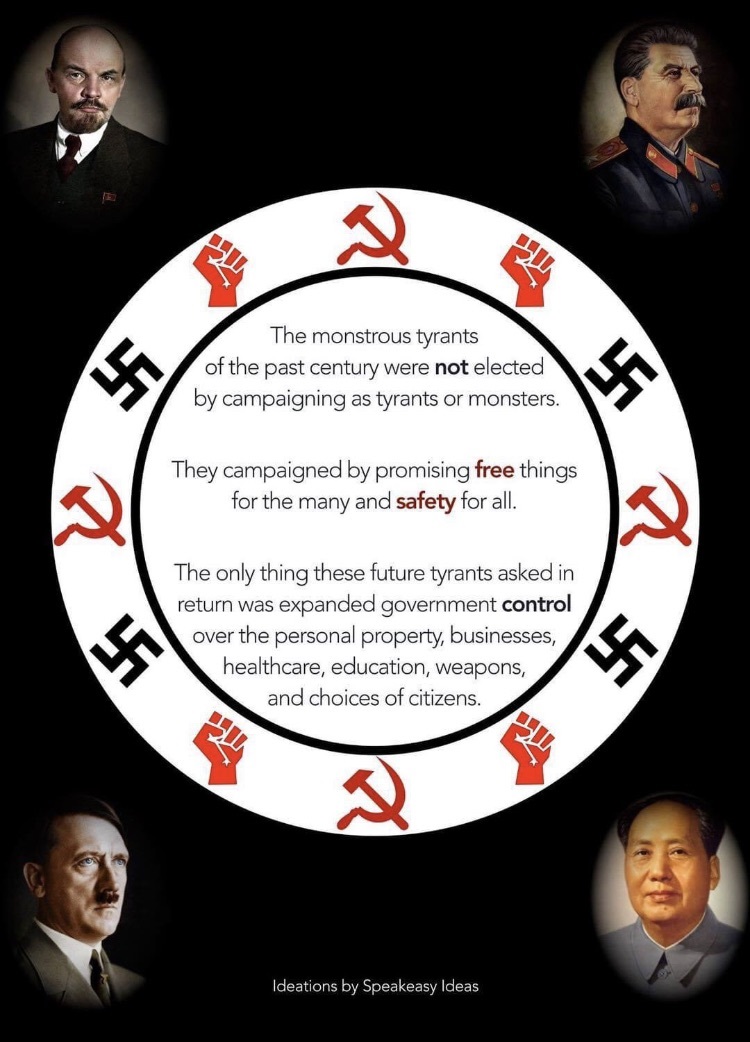
P.S. Kessler should have “fact checked” the last part of Rep. Greene’s statement. As much as I dislike “democratic socialism,” today’s Democrats are not trying to impose a totalitarian system.

Prosperity and Taxation: What Can We Learn from the 1930s

The United States conducted an experiment in the 1980s. Reagan dramatically lowered the top tax rate on households, dropping it from 70 percent to 28 percent.

Folks on the left bitterly resisted Reagan’s “supply-side” agenda, arguing that “the rich won’t pay enough” and “the government will be starved of revenue.”

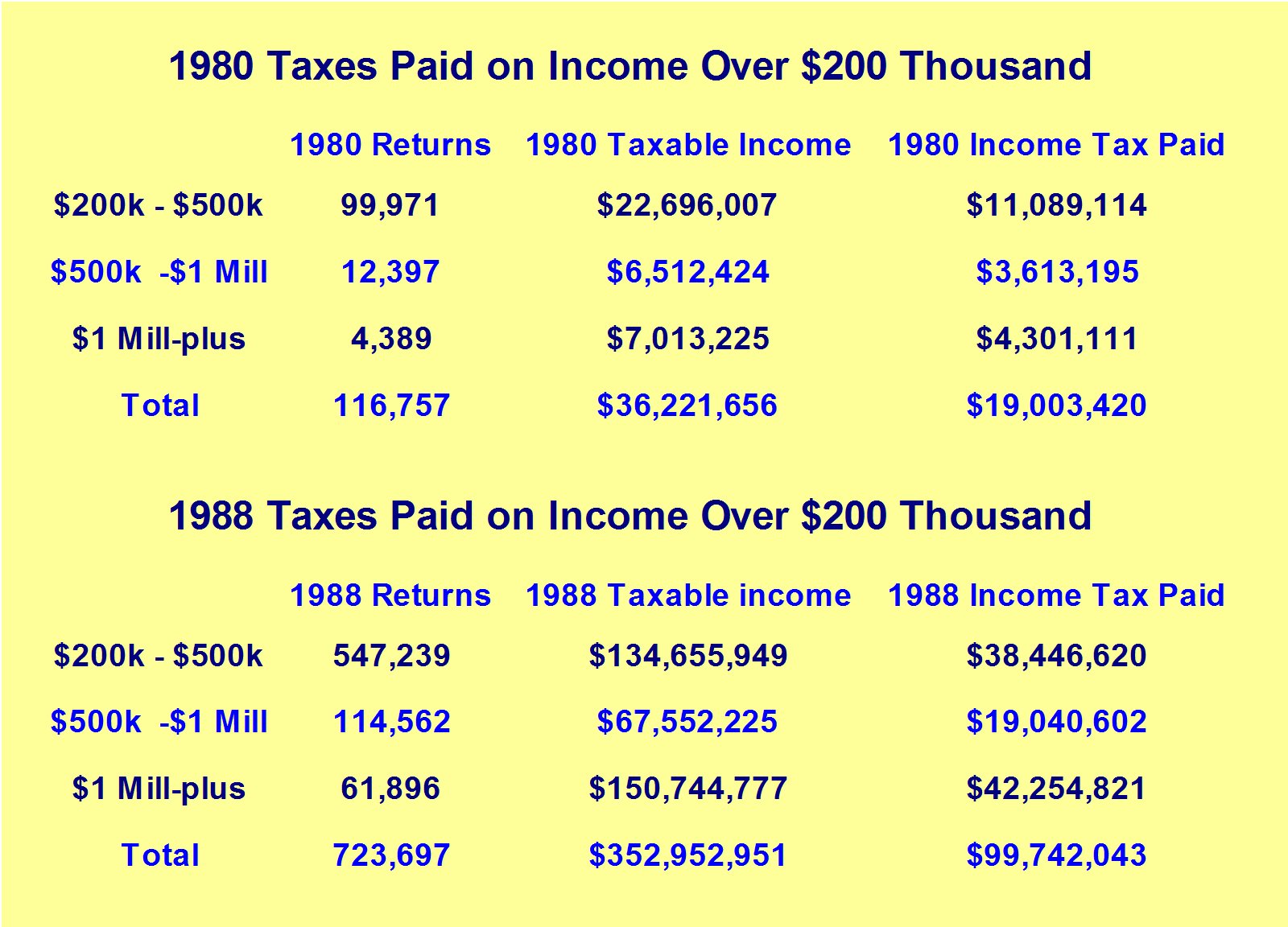
Fortunately, we can look at IRS data to see what happened to tax payments from those making more than $200,000 per year.

Lo and behold, it turns out that Reaganomics was a big success. Uncle Sam collected five times as much money when the rate was slashed.

As I’ve previously written, this was the Laffer Curve on steroids. Even when you consider other factors (population growth, inflation, other reforms, etc), there’s little doubt that we got a big “supply-side effect” from Reagan’s tax reforms.

Now Biden wants to run this experiment in reverse.

Based on basic economics, his approach won’t succeed. But let’s augment theory by examining what actually happened when Hoover and Roosevelt raised tax rates in the 1930s.

Alan Reynolds reviewed tax policy in the 1920s and 1930s, but let’s focus on what he wrote about the latter decade. He starts with some general observations.

Large increases in marginal tax rates on incomes above $50,000 in the 1930s were almost always matched by large reductions in the amount of high income reported and taxed…An earlier generation of economists found that raising tax rates on incomes, profits, and sales in the 1930s was inexcusably destructive. In 1956, MIT economist E. Cary Brown pointed to the “highly deflationary impact” of the Revenue Act of 1932, which pushed up rates virtually across the board, but notably on the lower‐​and middle‐​income groups.

He then gets to the all-important issue of higher tax rates leading to big reductions in taxable income.

In Figure 1, the average marginal tax rate is an unweighted average of statutory tax brackets applying to all income groups reporting more than $50,000 of income. After President Hoover’s June 1932 tax increase (retroactive to January) the number of tax brackets above $50,000 quadrupled from 8 to 32, ranging from 31 percent to 63 percent. The average of many marginal tax rates facing incomes higher than $50,000 increased from 21.5 percent in 1931 to 47 percent in 1932, and 61.9 percent in 1936. One of the most striking facts in Figure 1 is that the amount of reported income above $50,000 was almost cut in half in a single year—from $1.31 billion in 1931 to $776.7 million in 1932.

Here’s the aforementioned Figure 1. You can see that taxable income soared when tax rates were slashed in the 1920s.

But when tax rates were increased in the 1930s, taxable income collapsed and never recovered.
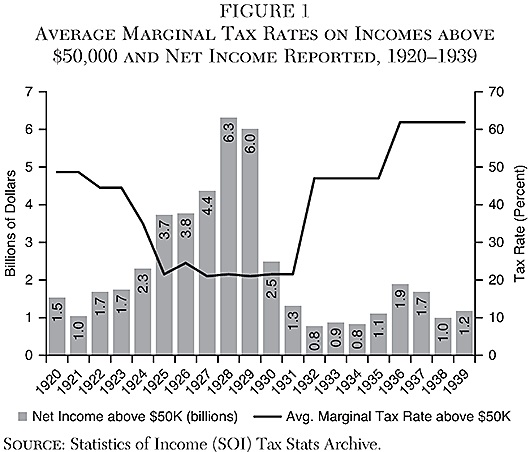
What’s the lesson from this chart? As Alan explained, the lesson is that high tax rates lead to rich people earning and declaring less taxable income (they still have that ability today).

In the eight years from 1932 to 1939, the economy was in cyclical contraction for only 28 months. Even in 1940, after two huge increases in income tax rates, individual income tax receipts remained lower ($1,014 million) than they had been in the 1930 slump ($1,045 million) when the top tax rate was 25 percent rather than 79 percent. Eight years of prolonged weakness in high incomes and personal tax revenue after tax rates were hugely increased in 1932 cannot be easily brushed away as merely cyclical, rather than a behavioral response to much higher tax rates on additional (marginal) income. Just as income (and tax revenue) from high‐​income taxpayers rose spectacularly after top tax rates fell from 1921 to 1928, high incomes and revenue fell just as spectacularly in 1932 when top tax rates rose.

One big takeaway is that Hoover and FDR were two peas in a pod.

Both imposed bad tax policy.

From 1930 to 1937, unlike 1923–25, virtually all federal and state tax rates on incomes and sales were repeatedly increased, and many new taxes were added, such as the Smoot‐​Hawley tariffs in 1930, taxes on alcoholic beverages in December 1933, and a Social Security payroll tax in 1937. Annual growth of per capita GDP from 1929 to 1939 was essentially zero. …To summarize: all the repeated increases in tax rates and reductions of exemptions enacted by presidents Hoover and Roosevelt in 1932–36 did not even manage to keep individual income tax collections as high in 1939–40 (in dollars or as a percent of GDP) as they had been in 1929–30. The experience of 1930 to 1940 decisively repudiated any pretense that doubling or tripling marginal tax rates on a much broader base proved to be a revenue‐​maximizing plan.

Alan closes with an observation that should raise alarm bells.

It turns out that the higher tax rates on the rich were simply the camel’s nose under the tent. The real agenda was extending the income tax to those with more modest incomes.

The most effective and sustained changes in personal taxes after 1931 were not the symbolic attempts to “soak the rich,” but rather the changes deliberately designed to convert the income tax from a class tax to a mass tax. The exemption for married couples was reduced from $3,500 to $2,500 in 1932, $2,000 in 1940, and $1,500 in 1941. Making more low incomes taxable quadrupled the number of tax returns from 3.7 million in 1930 to 14.7 million in 1940… The lowest tax rate was also raised from 1.1 percent to 4 percent in 1932, 4.4 percent in 1940, and 10 percent in 1941.

The same thing will happen today if Biden succeeds in raising taxes on the rich. Those tax hikes won’t collect much revenue, but politicians will increase spending anyhow. They’ll then use high deficits as an excuse for higher taxes on lower-income and middle-class taxpayers (some of the options include financial taxes, carbon taxes, and value-added taxes).

Lather, rinse, repeat. Until the United States is Europe. And that will definitely be bad news for ordinary people.

P.S. Here’s what we can learn about tax policy in the 1920s. And the 1950s.

P.P.S. The 1920s and 1930s also can teach us an important lesson about growth and inequality.

Sloppy or Dishonest Fiscal Analysis from the Washington Post

Good fiscal policy means low tax rates and spending restraint.

And that’s a big reason why I’m a fan of Reaganomics.

Unlike other modern presidents (including other Republicans), Reagan successfully reduced the tax burden while also limiting the burden of government spending.

President Biden wants to take the opposite approach.

A few days ago, Dan Balz of the Washington Post provided some “news analysis” about Biden’s fiscal agenda. Some of what he wrote was accurate, noting that the president wants to increase spending by an additional $6 trillion over the next 10 years.
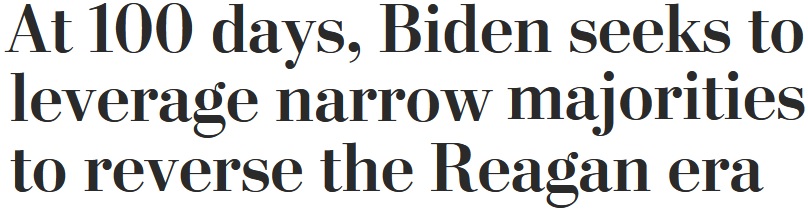
…the scope and implications of his domestic agenda have come sharply into focus. Together they represent the most dramatic shift in federal economic and social welfare policy since Ronald Reagan was elected 40 years ago.…The politics of redistribution, which are at the heart of what Biden is proposing, could test decades of assumptions that Democrats should be afraid of being tagged as the party of big government. …Together, the already approved coronavirus relief plan, the infrastructure proposal that was unveiled a few weeks ago and the newly proposed plan to invest in social welfare programs would total roughly $6 trillion.

But Mr. Balz then decided to be either sloppy or dishonest, writing that we’ve had decades of Reagan-style policies that have squeezed domestic spending and disproportionately lowered tax burden for rich people.

Reagan’s small-government philosophy resulted in a decades-long squeeze on the federal government, especially domestic spending, and on tax policies that mainly benefited the wealthiest Americans. …Government spending on social safety-net programs has been reduced compared with previous years.

Balz is wrong, wildly wrong.

You don’t have to take my word for it. Here’s a chart, taken from an October 2020 report by the Congressional Budget Office. As you can see, people in the lowest income quintile have been the biggest winners,, with their average tax rate dropping from about 10 percent to about 2 percent..
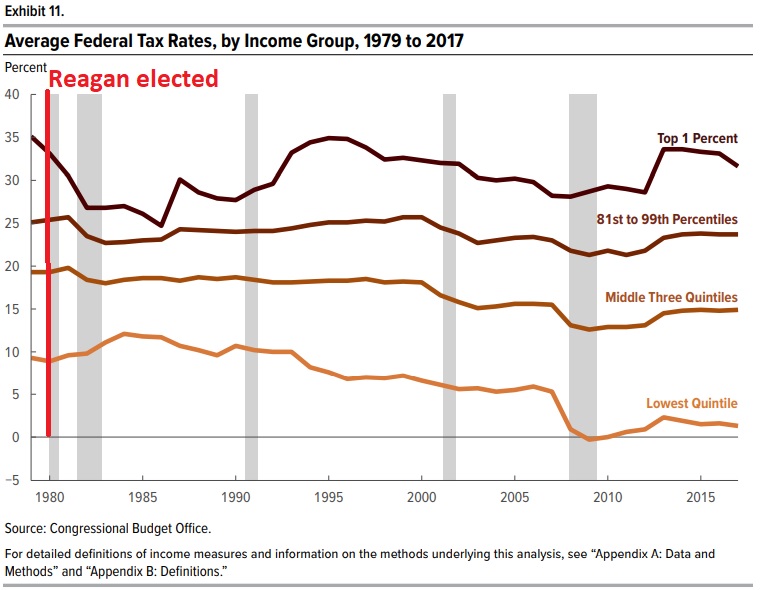
Here’s a chart showing marginal tax rates from a January 2019 CBO report. As you can see, Reagan lowered marginal tax rates for everyone, but Balz’s assertion that the rich got the lion’s share of the benefits is hard to justify considering that people in the bottom quintile now have negative marginal tax rates.
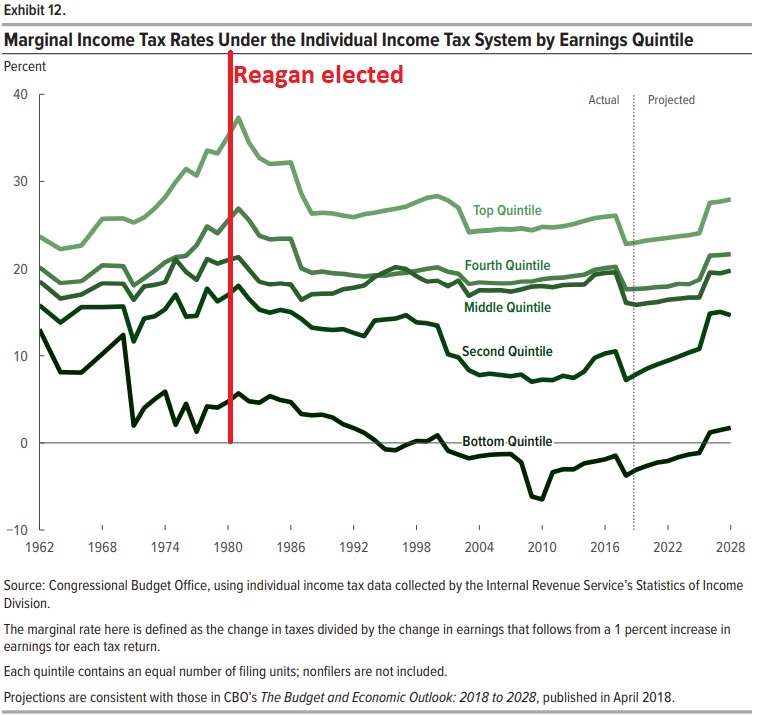
Balz’s mistakes on tax policy are significant.

But his biggest error (or worst dishonesty) occurred when he wrote about a “decades-long squeeze” on domestic spending and asserted that “spending on social safety-net programs has been reduced.”

A quick visit to the Office of Management and Budget’s Historical Tables is all that’s needed to debunk this nonsense. Here’s a chart, based on Table 8.2, showing the inflation-adjusted growth of entitlements and domestic discretionary programs.
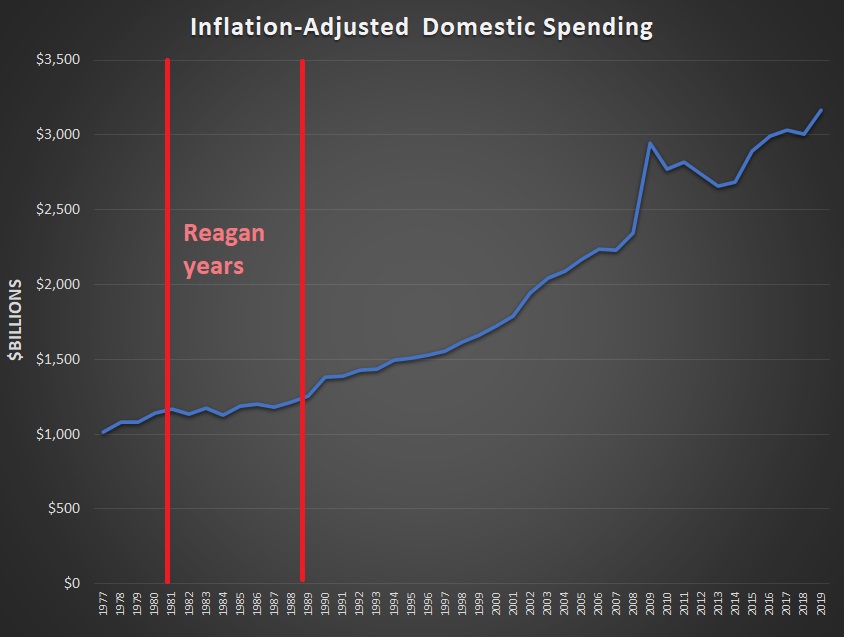
Call me crazy, but I’m seeing a rapid increase in domestic spending after Reagan left office.

P.S. There’s a pattern of lazy/dishonest fiscal reporting at the Washington Post.

P.P.S. I also can’t resist noting that Balz wrote how Biden wants to “invest” in social welfare programs, as if there’s some sort of positive return from creating more dependency. Reminds me of this Chuck Asay cartoon from the Obama years.

March 3, 2021

President Biden c/o The White House
1600 Pennsylvania Avenue NW
Washington, DC 20500

Dear Mr. President,

______________________________

Dan Mitchell shows how ignoring the Laffer Curve is like running a stop sign!!!!

I’m thinking of inventing a game, sort of a fiscal version of Pin the Tail on the Donkey.

Only the way it will work is that there will be a map of the world and the winner will be the blindfolded person who puts their pin closest to a nation such asAustralia or Switzerland that has a relatively low risk of long-run fiscal collapse.
That won’t be an easy game to win since we have data from the BISOECD, and IMF showing that government is growing far too fast in the vast majority of nations.

We also know that many states and cities suffer from the same problems.

A handful of local governments already have hit the fiscal brick wall, with many of them (gee, what a surprise) from California.

The most spectacular mess, though, is about to happen in Michigan.

The Washington Post reports that Detroit is on the verge of fiscal collapse.

After decades of sad and spectacular decline, it has come to this for Detroit: The city is $19 billion in debt and on the edge of becoming the nation’s largest municipal bankruptcy. An emergency manager says the city can make good on only a sliver of what it owes — in many cases just pennies on the dollar.

This is a dog-bites-man story. Detroit’s problems are the completely predictable result of excessive government. Just as statism explains the problems of Greece. And the problems of California. And the problems of Cyprus. And theproblems of Illinois.

I could continue with a long list of profligate governments, but you get the idea. Some of these governments are collapsing at a quicker pace and some at a slower pace. But all of them are in deep trouble because they don’t follow my Golden Rule about restraining the burden of government spending so that it grows slower than the private sector.

Detroit obviously is an example of a government that is collapsing sooner rather than later.

Why? Simply stated, as the size and scope of the public sector increased, that created very destructive economic and political dynamics.

More and more people got lured into the wagon of government dependency, which puts an ever-increasing burden on a shrinking pool of producers.

Meanwhile, organized interest groups such as government bureaucrats used their political muscle to extract absurdly excessive compensation packages, putting an even larger burden of the dwindling supply of taxpayers.

But that’s not the main focus of this post. Instead, I want to highlight a particular excerpt from the article and make a point about how too many people are blindly – perhaps willfully – ignorant of the Laffer Curve.

Check out this sentence.

Property tax collections are down 20 percent and income tax collections are down by more than a third in just the past five years — despite some of the highest tax rates in the state.

This is a classic “Fox Butterfield mistake,” which occurs when someone fails to recognize a cause-effect relationship. In this case, the reporter should have recognized that tax collections are down because Detroit has very high tax rates.

The city has a lot more problems than just high tax rates, of course, but can there be any doubt that productive people have very little incentive to earn and report taxable income in Detroit?

And that’s the essential insight of the Laffer Curve. Politicians can’t – or at least shouldn’t – assume that a 20 percent increase in tax rates will lead to a 20 percent increase in tax revenue. They also have to consider the degree to which a higher tax rate will cause a change in taxable income.

In some cases, higher tax rates will discourage people from earning more taxable income.

In some cases, higher tax rates will discourage people from reporting all the income they earn.

In some cases, higher tax rates will encourage people to utilize tax loopholes to shrink their taxable income.

In some cases, higher tax rates will encourage migration, thus causing taxable income to disappear.

Here’s my three-part video series on the Laffer Curve. Much of this is common sense, though it needs to be mandatory viewing for elected officials (as well as the bureaucrats at the Joint Committee on Taxation).

The Laffer Curve, Part I: Understanding the Theory

Uploaded by  on Jan 28, 2008

The Laffer Curve charts a relationship between tax rates and tax revenue. While the theory behind the Laffer Curve is widely accepted, the concept has become very controversial because politicians on both sides of the debate exaggerate. This video shows the middle ground between those who claim “all tax cuts pay for themselves” and those who claim tax policy has no impact on economic performance. This video, focusing on the theory of the Laffer Curve, is Part I of a three-part series. Part II reviews evidence of Laffer-Curve responses. Part III discusses how the revenue-estimating process in Washington can be improved. For more information please visit the Center for Freedom and Prosperity’s web site: http://www.freedomandprosperity.org

Part 2

Part 3

P.S. Just in case it’s not clear from the videos, we don’t want to be at the revenue-maximizing point on the Laffer Curve.

P.P.S. Amazingly, even the bureaucrats at the IMF recognize that there’s a point when taxes are so onerous that further increases don’t generate revenue.

P.P.P.S. At least CPAs understand the Laffer Curve, probably because they help their clients reduce their tax exposure to greedy governments.

P.P.P.P.S. I offered a Laffer Curve lesson to President Obama, but I doubt it had any impact.

___________________________

Thank you so much for your time. I know how valuable it is. I also appreciate the fine family that you have and your commitment as a father and a husband.

Sincerely,

Everette Hatcher III, 13900 Cottontail Lane, Alexander, AR 72002, ph 501-920-5733,

Williams with Sowell – Minimum Wage
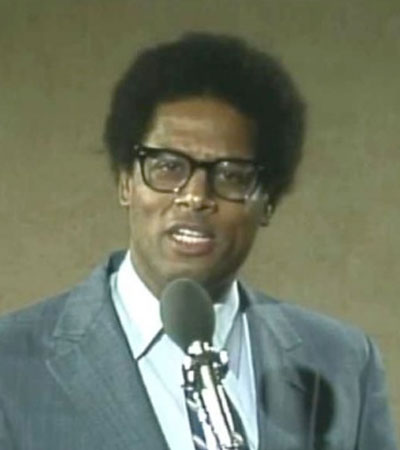
Thomas Sowell

Thomas Sowell – Reducing Black Unemployment

By WALTER WILLIAMS

—-

Ronald Reagan with Milton Friedman
Milton Friedman The Power of the Market 2-5

Related posts:

Dan Mitchell: Question of the Week: Has the European Fiscal Crisis Ended?

We got to cut spending or we will be in a fiscal crisis like Greece!!! Question of the Week: Has the European Fiscal Crisis Ended? January 12, 2013 by Dan Mitchell I’ve frequently commented on Europe’s fiscal mess and argued that excessive government spending is responsible for both the sovereign debt crisis and the economic stagnation […]

Taxes made simple by Dan Mitchell of the Cato Institute

The Flat Tax: How it Works and Why it is Good for America Uploaded by afq2007 on Mar 29, 2010 This Center for Freedom and Prosperity Foundation video shows how the flat tax would benefit families and businesses, and also explains how this simple and fair system would boost economic growth and eliminate the special-interest […]

Cartoons from Dan Mitchell’s blog that demonstrate what Obama is doing to our economy (Obama’s out of control spending not helped by raising taxes on rich)

I have put up lots of cartoons from Dan Mitchell’s blog before and they have got lots of hits before. Many of them have dealt with the economy, eternal unemployment benefits, socialism,  Greece,  welfare state or on gun control. President Obama really does think that all his answers lie in raising taxes on the rich when the […]

Dan Mitchell of the Cato Institute gives overview of economic policy and he praises Clinton and Reagan

__________ President Reagan, Nancy Reagan, Tom Selleck, Dudley Moore, Lucille Ball at a Tribute to Bob Hope’s 80th birthday at the Kennedy Center. 5/20/83. __________________________ Dan Mitchell is very good at giving speeches and making it very simple to understand economic policy and how it affects a nation. Mitchell also talks about slowing the growth […]

Cartoons from Dan Mitchell’s blog that demonstrate what Obama is doing to our economy (cartoon on entitlements)

The Laffer Curve – Explained Uploaded by Eddie Stannard on Nov 14, 2011 This video explains the relationship between tax rates, taxable income, and tax revenue. The key lesson is that the Laffer Curve is not an all-or-nothing proposition, where we have to choose between the exaggerated claim that “all tax cuts pay for themselves” […]

Open letter to President Obama (Part 296) (Laffer curve strikes again!!)

President Obama c/o The White House 1600 Pennsylvania Avenue NW Washington, DC 20500 Dear Mr. President, I know that you receive 20,000 letters a day and that you actually read 10 of them every day. I really do respect you for trying to get a pulse on what is going on out here. The way […]

Open letter to President Obama (Part 282, How the Laffer Curve worked in the 20th century over and over again!!!)

Dan Mitchell does a great job explaining the Laffer Curve President Obama c/o The White House 1600 Pennsylvania Avenue NW Washington, DC 20500 Dear Mr. President, I know that you receive 20,000 letters a day and that you actually read 10 of them every day. I really do respect you for trying to get a […]

Laffer curve hits tax hikers pretty hard (includes cartoon)

I have put up lots of cartoons from Dan Mitchell’s blog before and they have got lots of hits before. Many of them have dealt with the economy, eternal unemployment benefits, socialism,  Greece,  welfare state or on gun control. Today’s cartoon deals with the Laffer curve. Revenge of the Laffer Curve…Again and Again and Again March 27, 2013 […]

Editorial cartoon from Dan Mitchell’s blog on California’s sorry state of affairs

I have put up lots of cartoons from Dan Mitchell’s blog before and they have got lots of hits before. Many of them have dealt with the sequester, economy, eternal unemployment benefits, socialism,  minimum wage laws, tax increases, social security, high taxes in California, Obamacare,  Greece,  welfare state or on gun control. President Obama’s favorite state must be California because […]

Portugal and the Laffer Curve

Class Warfare just don’t pay it seems. Why can’t we learn from other countries’ mistakes? Class Warfare Tax Policy Causes Portugal to Crash on the Laffer Curve, but Will Obama Learn from this Mistake? December 31, 2012 by Dan Mitchell Back in mid-2010, I wrote that Portugal was going to exacerbate its fiscal problems by raising […]

Political arguments against higher taxes from Dan Mitchell

Republicans would be stupid to raise taxes. Don’t Get Bamboozled by the Fiscal Cliff: Five Policy Reasons and Five Political Reasons Why Republicans Should Keep their No-Tax-Hike Promises December 6, 2012 by Dan Mitchell The politicians claim that they are negotiating about how best to reduce the deficit. That irks me because our fiscal problem is […]

President Obama ignores warnings about Laffer Curve

The Laffer Curve – Explained Uploaded by Eddie Stannard on Nov 14, 2011 This video explains the relationship between tax rates, taxable income, and tax revenue. The key lesson is that the Laffer Curve is not an all-or-nothing proposition, where we have to choose between the exaggerated claim that “all tax cuts pay for themselves” […]

Dan Mitchell looks at Obama’s tax record

Dan Mitchell’s article and the video from his organization takes a hard look at President Obama’s tax record. Dissecting Obama’s Record on Tax Policy October 30, 2012 by Dan Mitchell The folks at the Center for Freedom and Prosperity have been on a roll in the past few months, putting out an excellent series of videos […]

Dan Mitchell: “Romney is Right that You Can Lower Tax Rates and Reduce Tax Preferences without Hurting the Middle Class”

The Laffer Curve, Part I: Understanding the Theory Uploaded by afq2007 on Jan 28, 2008 The Laffer Curve charts a relationship between tax rates and tax revenue. While the theory behind the Laffer Curve is widely accepted, the concept has become very controversial because politicians on both sides of the debate exaggerate. This video shows […]

The Laffer Curve Wreaks Havoc in the United Kingdom

I got to hear Arthur Laffer speak back in 1981 and he predicted what would happen in the next few years with the Reagan tax cuts and he was right with every prediction. The Laffer Curve Wreaks Havoc in the United Kingdom July 1, 2012 by Dan Mitchell Back in 2010, I excoriated the new […]

By Everette Hatcher III | Posted in Cato Institute | Tagged  | Edit | Comments (0)

Dan Mitchell: Maryland to Texas, but Not Okay to Move from the United States to Singapore?

You can’t blame someone for leaving one state for another if they have a better an opportunity to make money. Maryland to Texas, but Not Okay to Move from the United States to Singapore? July 12, 2012 by Dan Mitchell I’ve commented before about entrepreneurs, investors, and small business owners migrating from high tax states such […]

Liberals act like the Laffer Curve does not exist.

Raising taxes will not work. Liberals act like the Laffer Curve does not exist. The Laffer Curve Shows that Tax Increases Are a Very Bad Idea – even if They Generate More Tax Revenue April 10, 2012 by Dan Mitchell The Laffer Curve is a graphical representation of the relationship between tax rates, tax revenue, and […]

Dan Mitchell shows why soak-the-rich tax policy does not work

Dan Mitchell of the Cato Institute shows why Obama’s plan to tax the rich will not solve our deficit problem.   Explaining in the New York Post Why Obama’s Soak-the-Rich Tax Policy Is Doomed to Failure April 17, 2012 by Dan Mitchell I think high tax rates on certain classes of citizens are immoral and discriminatory. If the […]

Dan Mitchell of the Cato Institute takes on liberals on PBS

You want the rich to pay more? Dan Mitchell observed:I explained that “rich” taxpayers declared much more income and paid much higher taxes after Reagan reduced the top tax rate from 70 percent to 28 percent. Liberals don’t understand good tax policies. Against 3-1 Odds, Promoting Good Tax Policy on Government TV April 12, 2012 by […]

Dan Mitchell of the Cato Institute takes on the Buffett Rule

Class warfare again from President Obama.  Rejecting the Buffett Rule and Fighting Obama’s Class Warfare on CNBC April 10, 2012 by Dan Mitchell I’ve already explained why Warren Buffett is either dishonest or clueless about tax policy. Today, on CNBC, I got to debate the tax scheme that President Obama has named after the Omaha investor. […]

By Everette Hatcher III | Posted in Cato InstituteTaxes | Edit | Comments (0)
Dan Mitchell: Biden’s Class-Warfare Agenda Is Bad News According to Academic Research on Taxes and Growth

Biden’s Class-Warfare Agenda Is Bad News According to Academic Research on Taxes and Growth

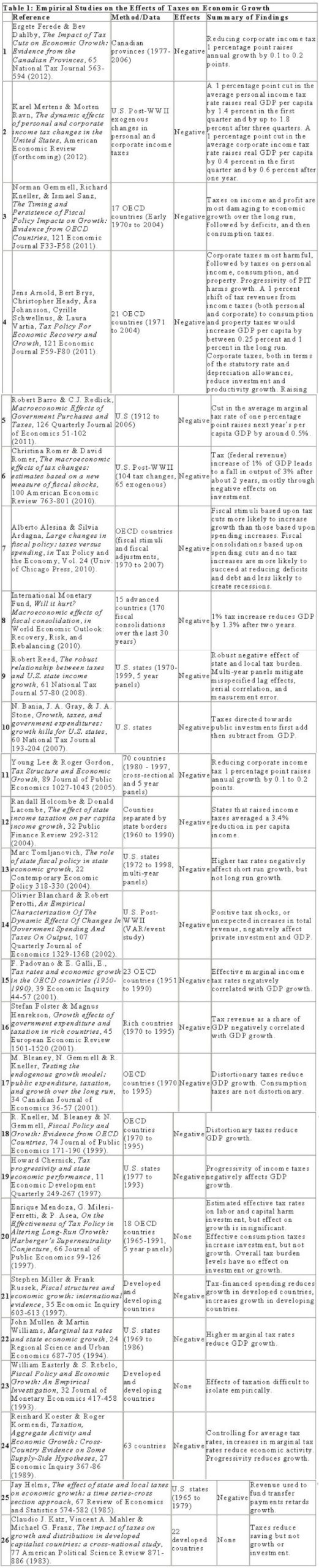
Back in 2013, the Tax Foundation published a report that reviewed 26 academic studies on taxes and growth.

That scholarly research produced a very clear message: The overwhelming consensus was that higher tax rates were bad news for prosperity.

Especially soak-the-rich tax increases that reduced incentives for productive activities such as work, saving, investment, and entrepreneurship.

That compilation of studies was very useful because then-President Obama was a relentless advocate of class-warfare tax policy.

And he partially succeeded with an agreement on how to deal with the so-called “fiscal cliff.”

Well, as Yogi Berra might say, it’s “deju vu all over again.” Joe Biden is in the White House and he’s proposing a wide range of tax increases.

It’s unclear whether Biden will gain approval for his proposals, but I’ve already produced a four-part series on why they are very misguided.

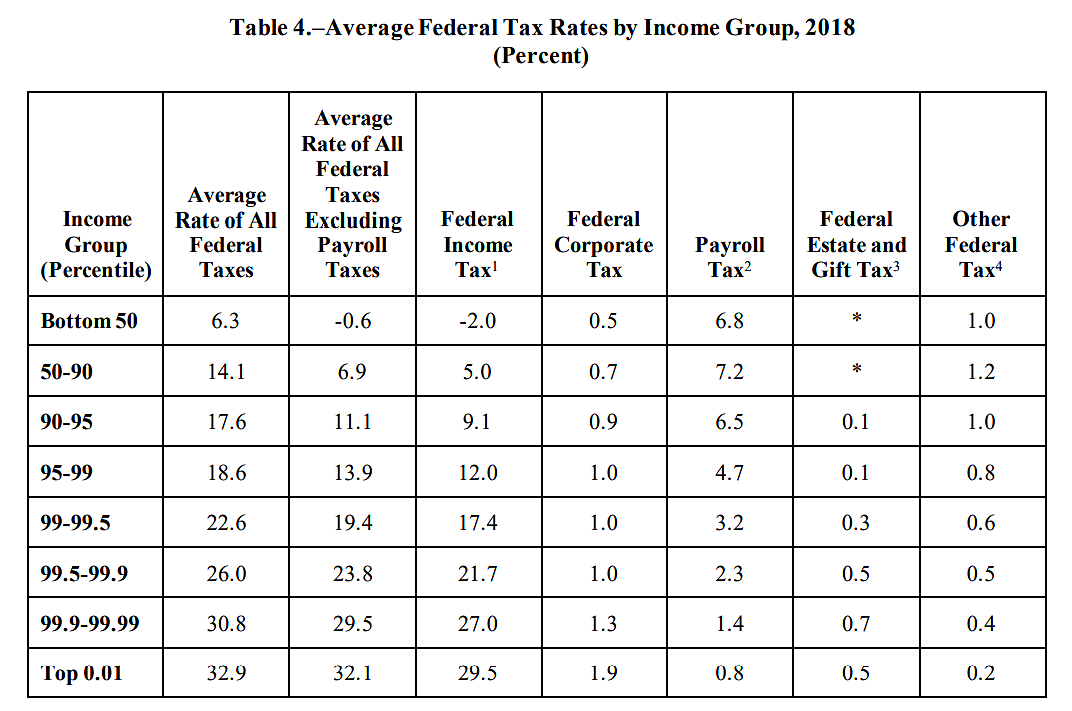
  • In Part I, I showed that the tax code already is biasedagainst upper-income taxpayers.
  • In Part II, I explained how the tax hike would have Laffer-Curve implications, meaning politicians would not get a windfall of tax revenue.
  • In Part II, I pointed out that the plan would saddle Americawith the developed world’s highest corporate tax burden.
  • In Part IV, I shared data on the negative economic impactof higher taxes on productive behavior.

The bottom line is that the United States should not copy Franceby penalizing entrepreneurs, innovators, investors, and business owners.

Particularly since the rest of us are usually collateral damagewhen politicians try to punish successful taxpayers.

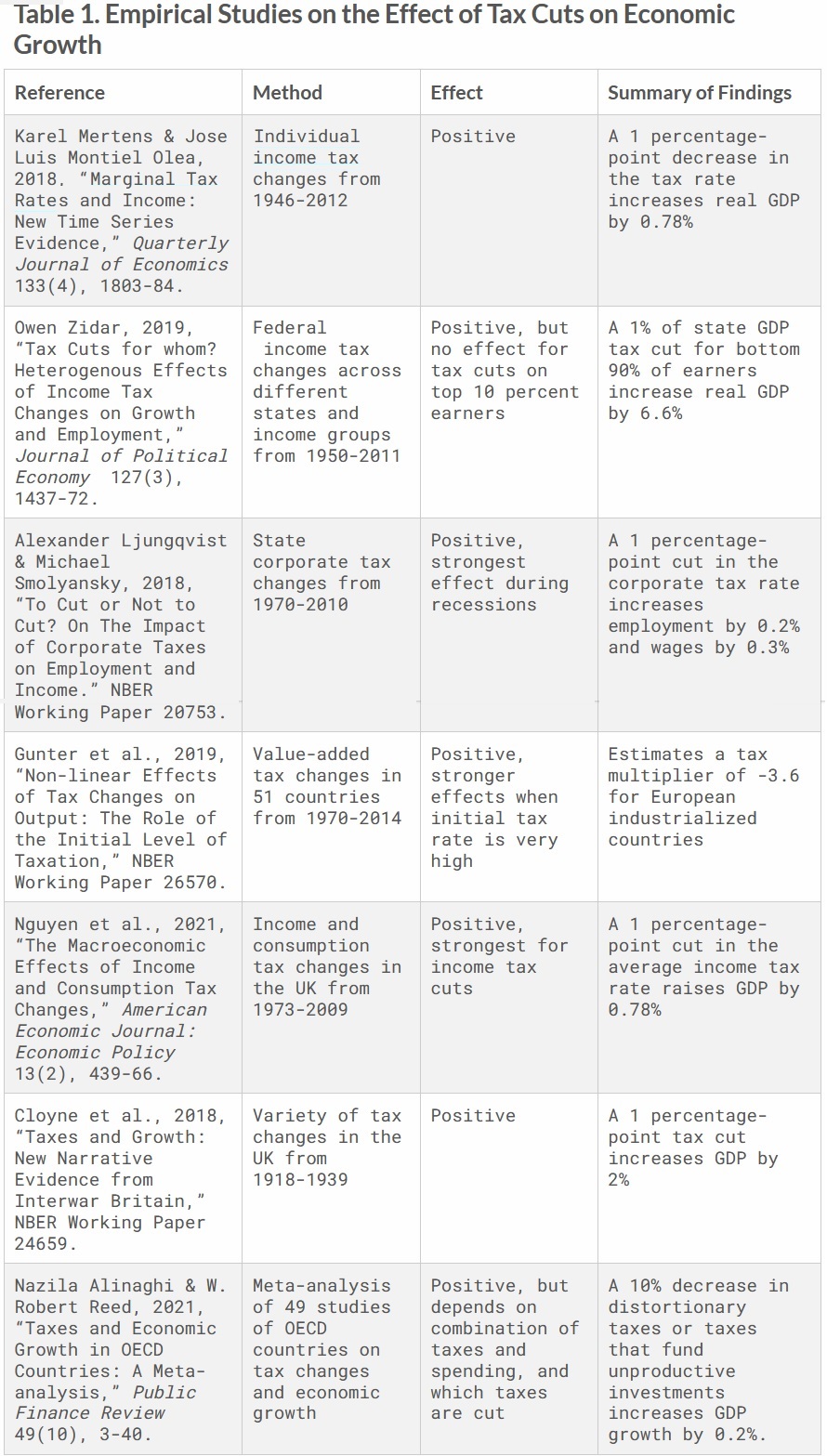
So it’s serendipity that the Tax Foundation has just updated it’s list of research with a new report looking at seven new high-level academic studies.

Here’s some of what the report says about class-warfare tax policy.

With the Biden administration proposing a variety of new taxes, it is worth revisiting the literature on how taxes impact economic growth. …we review this new evidence, again confirming our original findings:Taxes, particularly on corporate and individual income, harm economic growth. …We investigate papers in top economics journals and National Bureau of Economic Research (NBER) working papers over the past few years, considering both U.S. and international evidence. This research covers a wide variety of taxes, including income, consumption, and corporate taxation.

And here’s the table summarizing the impact of lower tax rates on economic performance, so it’s easy to infer what will happen if tax rates are increased instead.

Some of these findings may not seem very significant, such as changes in key economic indicators of 0.2%, 0.78%, or 0.3%.

But remember that even small changes in economic growth can lead to big changes in national prosperity.

P.S. In an ideal world, Washington would be working to boost living standards by adopting a flat tax. In the real world, the best-case scenario is simply avoiding policies that will make America less competitive.

Red States vs Blue States, Part II

Last year, I compared the economic performance of red states and blue states.

My big takeaway from that column is that we should pay attention to the data on internal migration. More specifically, there’s a reason why Americans have been moving from high-tax states to low-tax states.

Today’s let’s follow up on that discussion.

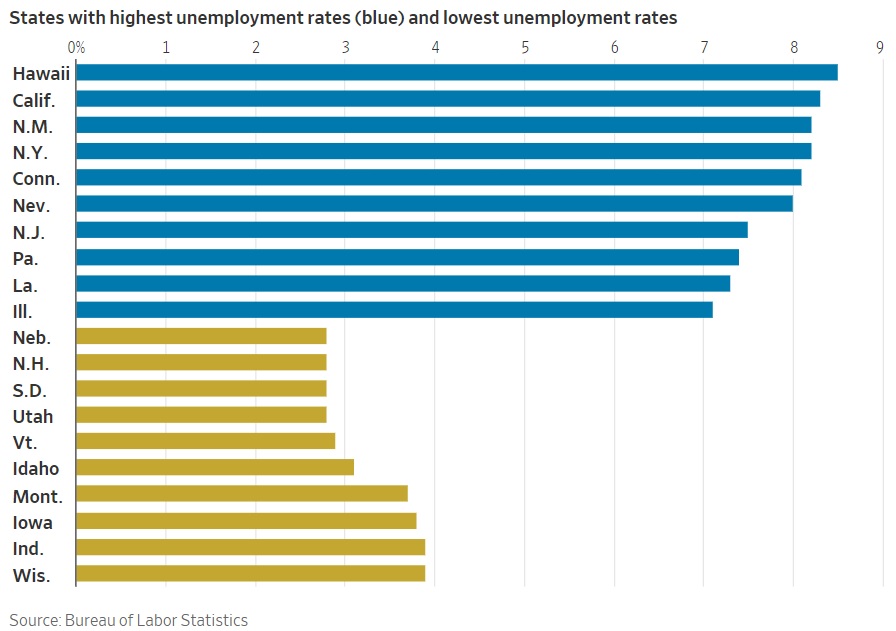
Today’s Wall Street Journal has an editorial on the gap between blue states and red states. This accompanying illustration shows that there is a clear relationship between joblessness and the degree to which states pursue big-government policies.

And here’s how the WSJ explained the big differences.

The unemployment rate in April nationwide was 6.1%, but this obscures giant variations in the states. With some exceptions, those run by Democrats such as California (8.3%) and New York (8.2%) continued to suffer significantly higher unemployment than those led by Republicans such as South Dakota (2.8%) and Montana (3.7%). It’s rare to see differences that are so stark based on party control in states.But the current partisan differences reflect different policy choices over the length and severity of pandemic lockdowns and now government benefits such as jobless insurance. Nine of the 10 states with the lowest unemployment rates are led by Republicans. The exception is Wisconsin whose Supreme Court last May invalidated Democratic Gov. Tony Evers’s lockdown. …Most states in the Midwest, South and Mountain West aren’t far off their pre-pandemic employment peaks. One obstacle to a faster recovery may be the $300 federal unemployment bonus, which many GOP governors are rejecting. Meantime, states with Democratic governments continue to reward workers for sitting on the couch. The longer that workers stay unemployed, the harder it will be to get them to return to work.

For what it’s worth, I’m more upset about the subsidized unemployment than the differences in lockdown policies, particularly because the former is more indicative of economic illiteracy.

P.S. One of the worst parts of Biden’s waste-filled stimulus planis that it gave a big bailout for states, based on a formula that actually rewarded them for having bad numbers.

P.P.S. Click here and here if you want to peruse comprehensive measures of state economic policy.

Sloppy or Dishonest Fiscal Analysis from the Washington Post

Good fiscal policy means low tax rates and spending restraint.

And that’s a big reason why I’m a fan of Reaganomics.

Unlike other modern presidents (including other Republicans), Reagan successfully reduced the tax burden while also limiting the burden of government spending.

President Biden wants to take the opposite approach.

A few days ago, Dan Balz of the Washington Post provided some “news analysis” about Biden’s fiscal agenda. Some of what he wrote was accurate, noting that the president wants to increase spending by an additional $6 trillion over the next 10 years.

…the scope and implications of his domestic agenda have come sharply into focus. Together they represent the most dramatic shift in federal economic and social welfare policy since Ronald Reagan was elected 40 years ago.…The politics of redistribution, which are at the heart of what Biden is proposing, could test decades of assumptions that Democrats should be afraid of being tagged as the party of big government. …Together, the already approved coronavirus relief plan, the infrastructure proposal that was unveiled a few weeks ago and the newly proposed plan to invest in social welfare programs would total roughly $6 trillion.

But Mr. Balz then decided to be either sloppy or dishonest, writing that we’ve had decades of Reagan-style policies that have squeezed domestic spending and disproportionately lowered tax burden for rich people.

Reagan’s small-government philosophy resulted in a decades-long squeeze on the federal government, especially domestic spending, and on tax policies that mainly benefited the wealthiest Americans. …Government spending on social safety-net programs has been reduced compared with previous years.

Balz is wrong, wildly wrong.

You don’t have to take my word for it. Here’s a chart, taken from an October 2020 report by the Congressional Budget Office. As you can see, people in the lowest income quintile have been the biggest winners,, with their average tax rate dropping from about 10 percent to about 2 percent..

Here’s a chart showing marginal tax rates from a January 2019 CBO report. As you can see, Reagan lowered marginal tax rates for everyone, but Balz’s assertion that the rich got the lion’s share of the benefits is hard to justify considering that people in the bottom quintile now have negative marginal tax rates.

Balz’s mistakes on tax policy are significant.

But his biggest error (or worst dishonesty) occurred when he wrote about a “decades-long squeeze” on domestic spending and asserted that “spending on social safety-net programs has been reduced.”

A quick visit to the Office of Management and Budget’s Historical Tables is all that’s needed to debunk this nonsense. Here’s a chart, based on Table 8.2, showing the inflation-adjusted growth of entitlements and domestic discretionary programs.

Call me crazy, but I’m seeing a rapid increase in domestic spending after Reagan left office.

P.S. There’s a pattern of lazy/dishonest fiscal reporting at the Washington Post.

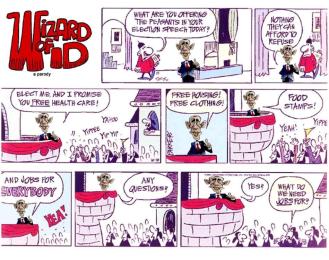
P.P.S. I also can’t resist noting that Balz wrote how Biden wants to “invest” in social welfare programs, as if there’s some sort of positive return from creating more dependency. Reminds me of this Chuck Asay cartoon from the Obama years.

March 3, 2021

President Biden c/o The White House
1600 Pennsylvania Avenue NW
Washington, DC 20500

Dear Mr. President,

______________________________

Dan Mitchell shows how ignoring the Laffer Curve is like running a stop sign!!!!

I’m thinking of inventing a game, sort of a fiscal version of Pin the Tail on the Donkey.

Only the way it will work is that there will be a map of the world and the winner will be the blindfolded person who puts their pin closest to a nation such asAustralia or Switzerland that has a relatively low risk of long-run fiscal collapse.

That won’t be an easy game to win since we have data from the BISOECD, and IMF showing that government is growing far too fast in the vast majority of nations.

We also know that many states and cities suffer from the same problems.

A handful of local governments already have hit the fiscal brick wall, with many of them (gee, what a surprise) from California.

The most spectacular mess, though, is about to happen in Michigan.

The Washington Post reports that Detroit is on the verge of fiscal collapse.

After decades of sad and spectacular decline, it has come to this for Detroit: The city is $19 billion in debt and on the edge of becoming the nation’s largest municipal bankruptcy. An emergency manager says the city can make good on only a sliver of what it owes — in many cases just pennies on the dollar.

This is a dog-bites-man story. Detroit’s problems are the completely predictable result of excessive government. Just as statism explains the problems of Greece. And the problems of California. And the problems of Cyprus. And theproblems of Illinois.

I could continue with a long list of profligate governments, but you get the idea. Some of these governments are collapsing at a quicker pace and some at a slower pace. But all of them are in deep trouble because they don’t follow my Golden Rule about restraining the burden of government spending so that it grows slower than the private sector.

Detroit obviously is an example of a government that is collapsing sooner rather than later.

Why? Simply stated, as the size and scope of the public sector increased, that created very destructive economic and political dynamics.

More and more people got lured into the wagon of government dependency, which puts an ever-increasing burden on a shrinking pool of producers.

Meanwhile, organized interest groups such as government bureaucrats used their political muscle to extract absurdly excessive compensation packages, putting an even larger burden of the dwindling supply of taxpayers.

But that’s not the main focus of this post. Instead, I want to highlight a particular excerpt from the article and make a point about how too many people are blindly – perhaps willfully – ignorant of the Laffer Curve.

Check out this sentence.

Property tax collections are down 20 percent and income tax collections are down by more than a third in just the past five years — despite some of the highest tax rates in the state.

This is a classic “Fox Butterfield mistake,” which occurs when someone fails to recognize a cause-effect relationship. In this case, the reporter should have recognized that tax collections are down because Detroit has very high tax rates.

The city has a lot more problems than just high tax rates, of course, but can there be any doubt that productive people have very little incentive to earn and report taxable income in Detroit?

And that’s the essential insight of the Laffer Curve. Politicians can’t – or at least shouldn’t – assume that a 20 percent increase in tax rates will lead to a 20 percent increase in tax revenue. They also have to consider the degree to which a higher tax rate will cause a change in taxable income.

In some cases, higher tax rates will discourage people from earning more taxable income.

In some cases, higher tax rates will discourage people from reporting all the income they earn.

In some cases, higher tax rates will encourage people to utilize tax loopholes to shrink their taxable income.

In some cases, higher tax rates will encourage migration, thus causing taxable income to disappear.

Here’s my three-part video series on the Laffer Curve. Much of this is common sense, though it needs to be mandatory viewing for elected officials (as well as the bureaucrats at the Joint Committee on Taxation).

The Laffer Curve, Part I: Understanding the Theory

Uploaded by  on Jan 28, 2008

The Laffer Curve charts a relationship between tax rates and tax revenue. While the theory behind the Laffer Curve is widely accepted, the concept has become very controversial because politicians on both sides of the debate exaggerate. This video shows the middle ground between those who claim “all tax cuts pay for themselves” and those who claim tax policy has no impact on economic performance. This video, focusing on the theory of the Laffer Curve, is Part I of a three-part series. Part II reviews evidence of Laffer-Curve responses. Part III discusses how the revenue-estimating process in Washington can be improved. For more information please visit the Center for Freedom and Prosperity’s web site: http://www.freedomandprosperity.org

Part 2

Part 3

P.S. Just in case it’s not clear from the videos, we don’t want to be at the revenue-maximizing point on the Laffer Curve.

P.P.S. Amazingly, even the bureaucrats at the IMF recognize that there’s a point when taxes are so onerous that further increases don’t generate revenue.

P.P.P.S. At least CPAs understand the Laffer Curve, probably because they help their clients reduce their tax exposure to greedy governments.

P.P.P.P.S. I offered a Laffer Curve lesson to President Obama, but I doubt it had any impact.

___________________________

Thank you so much for your time. I know how valuable it is. I also appreciate the fine family that you have and your commitment as a father and a husband.

Sincerely,

Everette Hatcher III, 13900 Cottontail Lane, Alexander, AR 72002, ph 501-920-5733,

Williams with Sowell – Minimum Wage

Thomas Sowell

Thomas Sowell – Reducing Black Unemployment

By WALTER WILLIAMS

—-

Ronald Reagan with Milton Friedman
Milton Friedman The Power of the Market 2-5

Related posts:

Dan Mitchell: Question of the Week: Has the European Fiscal Crisis Ended?

We got to cut spending or we will be in a fiscal crisis like Greece!!! Question of the Week: Has the European Fiscal Crisis Ended? January 12, 2013 by Dan Mitchell I’ve frequently commented on Europe’s fiscal mess and argued that excessive government spending is responsible for both the sovereign debt crisis and the economic stagnation […]

Taxes made simple by Dan Mitchell of the Cato Institute

The Flat Tax: How it Works and Why it is Good for America Uploaded by afq2007 on Mar 29, 2010 This Center for Freedom and Prosperity Foundation video shows how the flat tax would benefit families and businesses, and also explains how this simple and fair system would boost economic growth and eliminate the special-interest […]

Cartoons from Dan Mitchell’s blog that demonstrate what Obama is doing to our economy (Obama’s out of control spending not helped by raising taxes on rich)

I have put up lots of cartoons from Dan Mitchell’s blog before and they have got lots of hits before. Many of them have dealt with the economy, eternal unemployment benefits, socialism,  Greece,  welfare state or on gun control. President Obama really does think that all his answers lie in raising taxes on the rich when the […]

Dan Mitchell of the Cato Institute gives overview of economic policy and he praises Clinton and Reagan

__________ President Reagan, Nancy Reagan, Tom Selleck, Dudley Moore, Lucille Ball at a Tribute to Bob Hope’s 80th birthday at the Kennedy Center. 5/20/83. __________________________ Dan Mitchell is very good at giving speeches and making it very simple to understand economic policy and how it affects a nation. Mitchell also talks about slowing the growth […]

Cartoons from Dan Mitchell’s blog that demonstrate what Obama is doing to our economy (cartoon on entitlements)

The Laffer Curve – Explained Uploaded by Eddie Stannard on Nov 14, 2011 This video explains the relationship between tax rates, taxable income, and tax revenue. The key lesson is that the Laffer Curve is not an all-or-nothing proposition, where we have to choose between the exaggerated claim that “all tax cuts pay for themselves” […]

Open letter to President Obama (Part 296) (Laffer curve strikes again!!)

President Obama c/o The White House 1600 Pennsylvania Avenue NW Washington, DC 20500 Dear Mr. President, I know that you receive 20,000 letters a day and that you actually read 10 of them every day. I really do respect you for trying to get a pulse on what is going on out here. The way […]

Open letter to President Obama (Part 282, How the Laffer Curve worked in the 20th century over and over again!!!)

Dan Mitchell does a great job explaining the Laffer Curve President Obama c/o The White House 1600 Pennsylvania Avenue NW Washington, DC 20500 Dear Mr. President, I know that you receive 20,000 letters a day and that you actually read 10 of them every day. I really do respect you for trying to get a […]

Laffer curve hits tax hikers pretty hard (includes cartoon)

I have put up lots of cartoons from Dan Mitchell’s blog before and they have got lots of hits before. Many of them have dealt with the economy, eternal unemployment benefits, socialism,  Greece,  welfare state or on gun control. Today’s cartoon deals with the Laffer curve. Revenge of the Laffer Curve…Again and Again and Again March 27, 2013 […]

Editorial cartoon from Dan Mitchell’s blog on California’s sorry state of affairs

I have put up lots of cartoons from Dan Mitchell’s blog before and they have got lots of hits before. Many of them have dealt with the sequester, economy, eternal unemployment benefits, socialism,  minimum wage laws, tax increases, social security, high taxes in California, Obamacare,  Greece,  welfare state or on gun control. President Obama’s favorite state must be California because […]

Portugal and the Laffer Curve

Class Warfare just don’t pay it seems. Why can’t we learn from other countries’ mistakes? Class Warfare Tax Policy Causes Portugal to Crash on the Laffer Curve, but Will Obama Learn from this Mistake? December 31, 2012 by Dan Mitchell Back in mid-2010, I wrote that Portugal was going to exacerbate its fiscal problems by raising […]

Political arguments against higher taxes from Dan Mitchell

Republicans would be stupid to raise taxes. Don’t Get Bamboozled by the Fiscal Cliff: Five Policy Reasons and Five Political Reasons Why Republicans Should Keep their No-Tax-Hike Promises December 6, 2012 by Dan Mitchell The politicians claim that they are negotiating about how best to reduce the deficit. That irks me because our fiscal problem is […]

President Obama ignores warnings about Laffer Curve

The Laffer Curve – Explained Uploaded by Eddie Stannard on Nov 14, 2011 This video explains the relationship between tax rates, taxable income, and tax revenue. The key lesson is that the Laffer Curve is not an all-or-nothing proposition, where we have to choose between the exaggerated claim that “all tax cuts pay for themselves” […]

Dan Mitchell looks at Obama’s tax record

Dan Mitchell’s article and the video from his organization takes a hard look at President Obama’s tax record. Dissecting Obama’s Record on Tax Policy October 30, 2012 by Dan Mitchell The folks at the Center for Freedom and Prosperity have been on a roll in the past few months, putting out an excellent series of videos […]

Dan Mitchell: “Romney is Right that You Can Lower Tax Rates and Reduce Tax Preferences without Hurting the Middle Class”

The Laffer Curve, Part I: Understanding the Theory Uploaded by afq2007 on Jan 28, 2008 The Laffer Curve charts a relationship between tax rates and tax revenue. While the theory behind the Laffer Curve is widely accepted, the concept has become very controversial because politicians on both sides of the debate exaggerate. This video shows […]

The Laffer Curve Wreaks Havoc in the United Kingdom

I got to hear Arthur Laffer speak back in 1981 and he predicted what would happen in the next few years with the Reagan tax cuts and he was right with every prediction. The Laffer Curve Wreaks Havoc in the United Kingdom July 1, 2012 by Dan Mitchell Back in 2010, I excoriated the new […]

By Everette Hatcher III | Posted in Cato Institute | Tagged  | Edit | Comments (0)

Dan Mitchell: Maryland to Texas, but Not Okay to Move from the United States to Singapore?

You can’t blame someone for leaving one state for another if they have a better an opportunity to make money. Maryland to Texas, but Not Okay to Move from the United States to Singapore? July 12, 2012 by Dan Mitchell I’ve commented before about entrepreneurs, investors, and small business owners migrating from high tax states such […]

Liberals act like the Laffer Curve does not exist.

Raising taxes will not work. Liberals act like the Laffer Curve does not exist. The Laffer Curve Shows that Tax Increases Are a Very Bad Idea – even if They Generate More Tax Revenue April 10, 2012 by Dan Mitchell The Laffer Curve is a graphical representation of the relationship between tax rates, tax revenue, and […]

Dan Mitchell shows why soak-the-rich tax policy does not work

Dan Mitchell of the Cato Institute shows why Obama’s plan to tax the rich will not solve our deficit problem.   Explaining in the New York Post Why Obama’s Soak-the-Rich Tax Policy Is Doomed to Failure April 17, 2012 by Dan Mitchell I think high tax rates on certain classes of citizens are immoral and discriminatory. If the […]

Dan Mitchell of the Cato Institute takes on liberals on PBS

You want the rich to pay more? Dan Mitchell observed:I explained that “rich” taxpayers declared much more income and paid much higher taxes after Reagan reduced the top tax rate from 70 percent to 28 percent. Liberals don’t understand good tax policies. Against 3-1 Odds, Promoting Good Tax Policy on Government TV April 12, 2012 by […]

Dan Mitchell of the Cato Institute takes on the Buffett Rule

Class warfare again from President Obama.  Rejecting the Buffett Rule and Fighting Obama’s Class Warfare on CNBC April 10, 2012 by Dan Mitchell I’ve already explained why Warren Buffett is either dishonest or clueless about tax policy. Today, on CNBC, I got to debate the tax scheme that President Obama has named after the Omaha investor. […]

By Everette Hatcher III | Posted in Cato InstituteTaxes | Edit | Comments (0)
Dan Mitchell: Red States vs Blue States, Part II

Red States vs Blue States, Part II

Last year, I compared the economic performance of red states and blue states.

My big takeaway from that column is that we should pay attention to the data on internal migration. More specifically, there’s a reason why Americans have been moving from high-tax states to low-tax states.

Today’s let’s follow up on that discussion.

Today’s Wall Street Journal has an editorial on the gap between blue states and red states. This accompanying illustration shows that there is a clear relationship between joblessness and the degree to which states pursue big-government policies.

And here’s how the WSJ explained the big differences.

The unemployment rate in April nationwide was 6.1%, but this obscures giant variations in the states. With some exceptions, those run by Democrats such as California (8.3%) and New York (8.2%) continued to suffer significantly higher unemployment than those led by Republicans such as South Dakota (2.8%) and Montana (3.7%). It’s rare to see differences that are so stark based on party control in states.But the current partisan differences reflect different policy choices over the length and severity of pandemic lockdowns and now government benefits such as jobless insurance. Nine of the 10 states with the lowest unemployment rates are led by Republicans. The exception is Wisconsin whose Supreme Court last May invalidated Democratic Gov. Tony Evers’s lockdown. …Most states in the Midwest, South and Mountain West aren’t far off their pre-pandemic employment peaks. One obstacle to a faster recovery may be the $300 federal unemployment bonus, which many GOP governors are rejecting. Meantime, states with Democratic governments continue to reward workers for sitting on the couch. The longer that workers stay unemployed, the harder it will be to get them to return to work.

For what it’s worth, I’m more upset about the subsidized unemployment than the differences in lockdown policies, particularly because the former is more indicative of economic illiteracy.

P.S. One of the worst parts of Biden’s waste-filled stimulus planis that it gave a big bailout for states, based on a formula that actually rewarded them for having bad numbers.

P.P.S. Click here and here if you want to peruse comprehensive measures of state economic policy.

Sloppy or Dishonest Fiscal Analysis from the Washington Post

Good fiscal policy means low tax rates and spending restraint.

And that’s a big reason why I’m a fan of Reaganomics.

Unlike other modern presidents (including other Republicans), Reagan successfully reduced the tax burden while also limiting the burden of government spending.

President Biden wants to take the opposite approach.

A few days ago, Dan Balz of the Washington Post provided some “news analysis” about Biden’s fiscal agenda. Some of what he wrote was accurate, noting that the president wants to increase spending by an additional $6 trillion over the next 10 years.

…the scope and implications of his domestic agenda have come sharply into focus. Together they represent the most dramatic shift in federal economic and social welfare policy since Ronald Reagan was elected 40 years ago.…The politics of redistribution, which are at the heart of what Biden is proposing, could test decades of assumptions that Democrats should be afraid of being tagged as the party of big government. …Together, the already approved coronavirus relief plan, the infrastructure proposal that was unveiled a few weeks ago and the newly proposed plan to invest in social welfare programs would total roughly $6 trillion.

But Mr. Balz then decided to be either sloppy or dishonest, writing that we’ve had decades of Reagan-style policies that have squeezed domestic spending and disproportionately lowered tax burden for rich people.

Reagan’s small-government philosophy resulted in a decades-long squeeze on the federal government, especially domestic spending, and on tax policies that mainly benefited the wealthiest Americans. …Government spending on social safety-net programs has been reduced compared with previous years.

Balz is wrong, wildly wrong.

You don’t have to take my word for it. Here’s a chart, taken from an October 2020 report by the Congressional Budget Office. As you can see, people in the lowest income quintile have been the biggest winners,, with their average tax rate dropping from about 10 percent to about 2 percent..

Here’s a chart showing marginal tax rates from a January 2019 CBO report. As you can see, Reagan lowered marginal tax rates for everyone, but Balz’s assertion that the rich got the lion’s share of the benefits is hard to justify considering that people in the bottom quintile now have negative marginal tax rates.

Balz’s mistakes on tax policy are significant.

But his biggest error (or worst dishonesty) occurred when he wrote about a “decades-long squeeze” on domestic spending and asserted that “spending on social safety-net programs has been reduced.”

A quick visit to the Office of Management and Budget’s Historical Tables is all that’s needed to debunk this nonsense. Here’s a chart, based on Table 8.2, showing the inflation-adjusted growth of entitlements and domestic discretionary programs.

Call me crazy, but I’m seeing a rapid increase in domestic spending after Reagan left office.

P.S. There’s a pattern of lazy/dishonest fiscal reporting at the Washington Post.

P.P.S. I also can’t resist noting that Balz wrote how Biden wants to “invest” in social welfare programs, as if there’s some sort of positive return from creating more dependency. Reminds me of this Chuck Asay cartoon from the Obama years.

March 3, 2021

President Biden c/o The White House
1600 Pennsylvania Avenue NW
Washington, DC 20500

Dear Mr. President,

______________________________

Dan Mitchell shows how ignoring the Laffer Curve is like running a stop sign!!!!

I’m thinking of inventing a game, sort of a fiscal version of Pin the Tail on the Donkey.

Only the way it will work is that there will be a map of the world and the winner will be the blindfolded person who puts their pin closest to a nation such asAustralia or Switzerland that has a relatively low risk of long-run fiscal collapse.

That won’t be an easy game to win since we have data from the BISOECD, and IMF showing that government is growing far too fast in the vast majority of nations.

We also know that many states and cities suffer from the same problems.

A handful of local governments already have hit the fiscal brick wall, with many of them (gee, what a surprise) from California.

The most spectacular mess, though, is about to happen in Michigan.

The Washington Post reports that Detroit is on the verge of fiscal collapse.

After decades of sad and spectacular decline, it has come to this for Detroit: The city is $19 billion in debt and on the edge of becoming the nation’s largest municipal bankruptcy. An emergency manager says the city can make good on only a sliver of what it owes — in many cases just pennies on the dollar.

This is a dog-bites-man story. Detroit’s problems are the completely predictable result of excessive government. Just as statism explains the problems of Greece. And the problems of California. And the problems of Cyprus. And theproblems of Illinois.

I could continue with a long list of profligate governments, but you get the idea. Some of these governments are collapsing at a quicker pace and some at a slower pace. But all of them are in deep trouble because they don’t follow my Golden Rule about restraining the burden of government spending so that it grows slower than the private sector.

Detroit obviously is an example of a government that is collapsing sooner rather than later.

Why? Simply stated, as the size and scope of the public sector increased, that created very destructive economic and political dynamics.

More and more people got lured into the wagon of government dependency, which puts an ever-increasing burden on a shrinking pool of producers.

Meanwhile, organized interest groups such as government bureaucrats used their political muscle to extract absurdly excessive compensation packages, putting an even larger burden of the dwindling supply of taxpayers.

But that’s not the main focus of this post. Instead, I want to highlight a particular excerpt from the article and make a point about how too many people are blindly – perhaps willfully – ignorant of the Laffer Curve.

Check out this sentence.

Property tax collections are down 20 percent and income tax collections are down by more than a third in just the past five years — despite some of the highest tax rates in the state.

This is a classic “Fox Butterfield mistake,” which occurs when someone fails to recognize a cause-effect relationship. In this case, the reporter should have recognized that tax collections are down because Detroit has very high tax rates.

The city has a lot more problems than just high tax rates, of course, but can there be any doubt that productive people have very little incentive to earn and report taxable income in Detroit?

And that’s the essential insight of the Laffer Curve. Politicians can’t – or at least shouldn’t – assume that a 20 percent increase in tax rates will lead to a 20 percent increase in tax revenue. They also have to consider the degree to which a higher tax rate will cause a change in taxable income.

In some cases, higher tax rates will discourage people from earning more taxable income.

In some cases, higher tax rates will discourage people from reporting all the income they earn.

In some cases, higher tax rates will encourage people to utilize tax loopholes to shrink their taxable income.

In some cases, higher tax rates will encourage migration, thus causing taxable income to disappear.

Here’s my three-part video series on the Laffer Curve. Much of this is common sense, though it needs to be mandatory viewing for elected officials (as well as the bureaucrats at the Joint Committee on Taxation).

The Laffer Curve, Part I: Understanding the Theory

Uploaded by  on Jan 28, 2008

The Laffer Curve charts a relationship between tax rates and tax revenue. While the theory behind the Laffer Curve is widely accepted, the concept has become very controversial because politicians on both sides of the debate exaggerate. This video shows the middle ground between those who claim “all tax cuts pay for themselves” and those who claim tax policy has no impact on economic performance. This video, focusing on the theory of the Laffer Curve, is Part I of a three-part series. Part II reviews evidence of Laffer-Curve responses. Part III discusses how the revenue-estimating process in Washington can be improved. For more information please visit the Center for Freedom and Prosperity’s web site: http://www.freedomandprosperity.org

Part 2

Part 3

P.S. Just in case it’s not clear from the videos, we don’t want to be at the revenue-maximizing point on the Laffer Curve.

P.P.S. Amazingly, even the bureaucrats at the IMF recognize that there’s a point when taxes are so onerous that further increases don’t generate revenue.

P.P.P.S. At least CPAs understand the Laffer Curve, probably because they help their clients reduce their tax exposure to greedy governments.

P.P.P.P.S. I offered a Laffer Curve lesson to President Obama, but I doubt it had any impact.

___________________________

Thank you so much for your time. I know how valuable it is. I also appreciate the fine family that you have and your commitment as a father and a husband.

Sincerely,

Everette Hatcher III, 13900 Cottontail Lane, Alexander, AR 72002, ph 501-920-5733,

Williams with Sowell – Minimum Wage

Thomas Sowell

Thomas Sowell – Reducing Black Unemployment

By WALTER WILLIAMS

—-

Ronald Reagan with Milton Friedman
Milton Friedman The Power of the Market 2-5

Related posts:

Dan Mitchell: Question of the Week: Has the European Fiscal Crisis Ended?

We got to cut spending or we will be in a fiscal crisis like Greece!!! Question of the Week: Has the European Fiscal Crisis Ended? January 12, 2013 by Dan Mitchell I’ve frequently commented on Europe’s fiscal mess and argued that excessive government spending is responsible for both the sovereign debt crisis and the economic stagnation […]

Taxes made simple by Dan Mitchell of the Cato Institute

The Flat Tax: How it Works and Why it is Good for America Uploaded by afq2007 on Mar 29, 2010 This Center for Freedom and Prosperity Foundation video shows how the flat tax would benefit families and businesses, and also explains how this simple and fair system would boost economic growth and eliminate the special-interest […]

Cartoons from Dan Mitchell’s blog that demonstrate what Obama is doing to our economy (Obama’s out of control spending not helped by raising taxes on rich)

I have put up lots of cartoons from Dan Mitchell’s blog before and they have got lots of hits before. Many of them have dealt with the economy, eternal unemployment benefits, socialism,  Greece,  welfare state or on gun control. President Obama really does think that all his answers lie in raising taxes on the rich when the […]

Dan Mitchell of the Cato Institute gives overview of economic policy and he praises Clinton and Reagan

__________ President Reagan, Nancy Reagan, Tom Selleck, Dudley Moore, Lucille Ball at a Tribute to Bob Hope’s 80th birthday at the Kennedy Center. 5/20/83. __________________________ Dan Mitchell is very good at giving speeches and making it very simple to understand economic policy and how it affects a nation. Mitchell also talks about slowing the growth […]

Cartoons from Dan Mitchell’s blog that demonstrate what Obama is doing to our economy (cartoon on entitlements)

The Laffer Curve – Explained Uploaded by Eddie Stannard on Nov 14, 2011 This video explains the relationship between tax rates, taxable income, and tax revenue. The key lesson is that the Laffer Curve is not an all-or-nothing proposition, where we have to choose between the exaggerated claim that “all tax cuts pay for themselves” […]

Open letter to President Obama (Part 296) (Laffer curve strikes again!!)

President Obama c/o The White House 1600 Pennsylvania Avenue NW Washington, DC 20500 Dear Mr. President, I know that you receive 20,000 letters a day and that you actually read 10 of them every day. I really do respect you for trying to get a pulse on what is going on out here. The way […]

Open letter to President Obama (Part 282, How the Laffer Curve worked in the 20th century over and over again!!!)

Dan Mitchell does a great job explaining the Laffer Curve President Obama c/o The White House 1600 Pennsylvania Avenue NW Washington, DC 20500 Dear Mr. President, I know that you receive 20,000 letters a day and that you actually read 10 of them every day. I really do respect you for trying to get a […]

Laffer curve hits tax hikers pretty hard (includes cartoon)

I have put up lots of cartoons from Dan Mitchell’s blog before and they have got lots of hits before. Many of them have dealt with the economy, eternal unemployment benefits, socialism,  Greece,  welfare state or on gun control. Today’s cartoon deals with the Laffer curve. Revenge of the Laffer Curve…Again and Again and Again March 27, 2013 […]

Editorial cartoon from Dan Mitchell’s blog on California’s sorry state of affairs

I have put up lots of cartoons from Dan Mitchell’s blog before and they have got lots of hits before. Many of them have dealt with the sequester, economy, eternal unemployment benefits, socialism,  minimum wage laws, tax increases, social security, high taxes in California, Obamacare,  Greece,  welfare state or on gun control. President Obama’s favorite state must be California because […]

Portugal and the Laffer Curve

Class Warfare just don’t pay it seems. Why can’t we learn from other countries’ mistakes? Class Warfare Tax Policy Causes Portugal to Crash on the Laffer Curve, but Will Obama Learn from this Mistake? December 31, 2012 by Dan Mitchell Back in mid-2010, I wrote that Portugal was going to exacerbate its fiscal problems by raising […]

Political arguments against higher taxes from Dan Mitchell

Republicans would be stupid to raise taxes. Don’t Get Bamboozled by the Fiscal Cliff: Five Policy Reasons and Five Political Reasons Why Republicans Should Keep their No-Tax-Hike Promises December 6, 2012 by Dan Mitchell The politicians claim that they are negotiating about how best to reduce the deficit. That irks me because our fiscal problem is […]

President Obama ignores warnings about Laffer Curve

The Laffer Curve – Explained Uploaded by Eddie Stannard on Nov 14, 2011 This video explains the relationship between tax rates, taxable income, and tax revenue. The key lesson is that the Laffer Curve is not an all-or-nothing proposition, where we have to choose between the exaggerated claim that “all tax cuts pay for themselves” […]

Dan Mitchell looks at Obama’s tax record

Dan Mitchell’s article and the video from his organization takes a hard look at President Obama’s tax record. Dissecting Obama’s Record on Tax Policy October 30, 2012 by Dan Mitchell The folks at the Center for Freedom and Prosperity have been on a roll in the past few months, putting out an excellent series of videos […]

Dan Mitchell: “Romney is Right that You Can Lower Tax Rates and Reduce Tax Preferences without Hurting the Middle Class”

The Laffer Curve, Part I: Understanding the Theory Uploaded by afq2007 on Jan 28, 2008 The Laffer Curve charts a relationship between tax rates and tax revenue. While the theory behind the Laffer Curve is widely accepted, the concept has become very controversial because politicians on both sides of the debate exaggerate. This video shows […]

The Laffer Curve Wreaks Havoc in the United Kingdom

I got to hear Arthur Laffer speak back in 1981 and he predicted what would happen in the next few years with the Reagan tax cuts and he was right with every prediction. The Laffer Curve Wreaks Havoc in the United Kingdom July 1, 2012 by Dan Mitchell Back in 2010, I excoriated the new […]

By Everette Hatcher III | Posted in Cato Institute | Tagged  | Edit | Comments (0)

Dan Mitchell: Maryland to Texas, but Not Okay to Move from the United States to Singapore?

You can’t blame someone for leaving one state for another if they have a better an opportunity to make money. Maryland to Texas, but Not Okay to Move from the United States to Singapore? July 12, 2012 by Dan Mitchell I’ve commented before about entrepreneurs, investors, and small business owners migrating from high tax states such […]

Liberals act like the Laffer Curve does not exist.

Raising taxes will not work. Liberals act like the Laffer Curve does not exist. The Laffer Curve Shows that Tax Increases Are a Very Bad Idea – even if They Generate More Tax Revenue April 10, 2012 by Dan Mitchell The Laffer Curve is a graphical representation of the relationship between tax rates, tax revenue, and […]

Dan Mitchell shows why soak-the-rich tax policy does not work

Dan Mitchell of the Cato Institute shows why Obama’s plan to tax the rich will not solve our deficit problem.   Explaining in the New York Post Why Obama’s Soak-the-Rich Tax Policy Is Doomed to Failure April 17, 2012 by Dan Mitchell I think high tax rates on certain classes of citizens are immoral and discriminatory. If the […]

Dan Mitchell of the Cato Institute takes on liberals on PBS

You want the rich to pay more? Dan Mitchell observed:I explained that “rich” taxpayers declared much more income and paid much higher taxes after Reagan reduced the top tax rate from 70 percent to 28 percent. Liberals don’t understand good tax policies. Against 3-1 Odds, Promoting Good Tax Policy on Government TV April 12, 2012 by […]

Dan Mitchell of the Cato Institute takes on the Buffett Rule

Class warfare again from President Obama.  Rejecting the Buffett Rule and Fighting Obama’s Class Warfare on CNBC April 10, 2012 by Dan Mitchell I’ve already explained why Warren Buffett is either dishonest or clueless about tax policy. Today, on CNBC, I got to debate the tax scheme that President Obama has named after the Omaha investor. […]

By Everette Hatcher III | Posted in Cato InstituteTaxes | Edit | Comments (0)

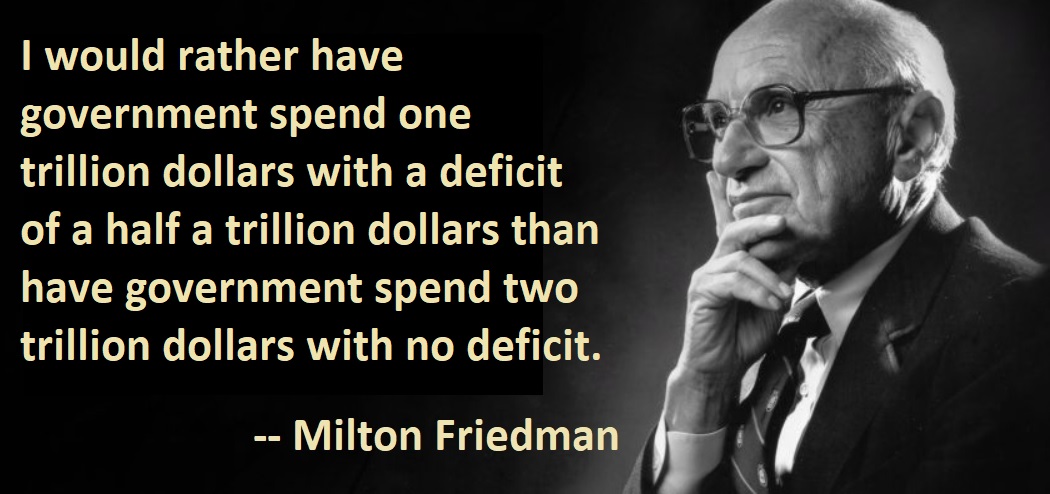
MILTON FRIEDMAN: “I would rather have government spend one trillion dollars with a deficit of a half a trillion dollars than have government spend two trillion dollars with no deficit.” (article by Dan Mitchell)

The CRFB Fiscal Quiz

I’ve shared all sorts of online quizzes that supposedly can detect things such as whether you’re a pure libertarian.

Or even whether you’re a communist.

Today, courtesy of the folks at the Committee for a Responsible Budget, you can agree or disagree with 24 statements to determine your “budget personality.”

I have some quibbles about some of the wording (for instance, I couldn’t answer “neither” when asked to react to: “The government should spend more money on children than on seniors”).

But I can’t quibble with the results. Given the potential outcomes, I’m glad to be a “Minimalist” who is “in favor of smaller government.”

Though I’m disappointed that I apparently didn’t get a perfect score on “Size of Government.”

And I need to explain why I got a mediocre score on the topic of “Fiscal Responsibility.”

The budget geeks at the Committee for a Responsible Federal Budget (CRFB) have a well-deserved reputation for rigorous analysis. I regularly cite their numbers and appreciate the work that they do.

That being said, they mistakenly focus on deficits and debt when the real problem is too much government.

I agree with Milton Friedman, who wisely observed that ““I would rather have government spend one trillion dollars with a deficit of a half a trillion dollars than have government spend two trillion dollars with no deficit.”

The folks at CRFB would disagree.

Indeed, they are so fixated on red ink that they would welcome tax increases.

At the risk of understatement, that would be a very bad approach.

The evidence from Europe shows that higher taxes simply lead to higher spending. And more debt.

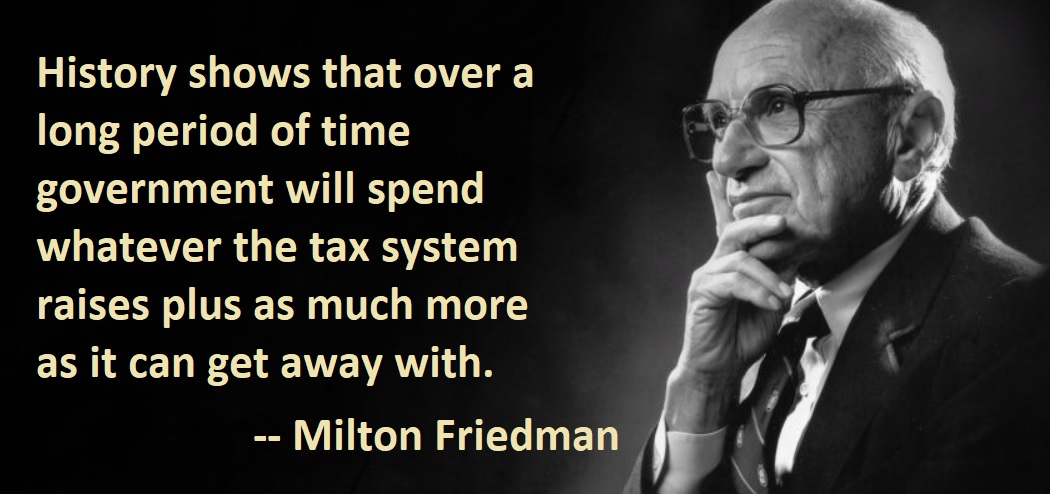
Indeed, Milton Friedman also commented on this issue, warning that, “History shows that over a long period of time government will spend whatever the tax system raises plus as much more as it can get away with.”

The bottom line is that CRFB not only has the wrong definition of “Fiscal Responsibility,” but they also support policies that would make matters worse – even from their perspective!

EP 4 – From Cradle to Grave [6/7]. Milton Friedman’s Free to Choose (1980)

March 1, 2021

President Biden c/o The White House
1600 Pennsylvania Avenue NW
Washington, DC 20500

Dear Mr. President,

Thank you for taking time to have your office try and get a pulse on what is going on out here in the country. I wanted to let you know what I think about the minimum wage increase you have proposed for the whole country and I wanted to quote Milton Friedman who you are familiar with and you made it clear in July that you didn’t care for his views! Let me challenge you to take a closer look at what he had to say!

Four Progressive Minimum Wage Myths Debunked

Democrats are just making things up to advance their job-killing cause.

|

_____________

Thank you so much for your time. I know how valuable it is. I also appreciate the fine family that you have and your commitment as a father and a husband.

Sincerely,

Everette Hatcher III, 13900 Cottontail Lane, Alexander, AR 72002, ph 501-920-5733

Williams with Sowell – Minimum Wage

Thomas Sowell

Thomas Sowell – Reducing Black Unemployment

By WALTER WILLIAMS

—-

Ronald Reagan with Milton Friedman
Milton Friedman The Power of the Market 2-5

At a recent Senate hearing, Senator Elizabeth Warren worried that we would “let rich people keep paying taxes at about half the rate as everyone else.” (At 2:03). Senator Warren, President Biden, and other political leaders often say that people at the top are not paying their “fair share” of taxes. IS THIS CORRECT?

MAY 14, 2021 3:02PM

Tax Rates by Income Level


At a recent Senate hearing, Senator Elizabeth Warren worried that we would “let rich people keep paying taxes at about half the rate as everyone else.” (At 2:03). Senator Warren, President Biden, and other political leaders often say that people at the top are not paying their “fair share” of taxes.

I heard many similar complaints Wednesday at a Ways and Means subcommittee hearing. I testified about problems with the president’s tax plan, but the other panelists and numerous committee members focused on how federal taxation supposedly favors the rich and high earners.

As a general matter, the narrative that the well‐​off have a lighten tax burden than the rest of us is nonsense. There are certainly unjustified tax breaks that benefit high earners, such as the income tax exemption on municipal bonds. But data on overall tax rates show clearly that households at the top pay far higher tax rates, on average, than households in the middle or at the bottom. Let’s look at three authoritative data sources.

Internal Revenue Service (IRS)

Table 1 shows IRS data for average effective income tax rates in 2017 and 2018. That is, total income taxes paid divided by income for each percentile group. Income is AGI. The data is from here and here.

  • The tax rates on the highest‐​income groups are far higher than on the lower‐​income groups.
  • The data do not include the refundable portions of low‐​income tax credits, so it overstates the net taxes on the bottom 50 percent group.
  • The 2017 Tax Cuts and Jobs Act (TCJA) cut income taxes for 2018. The table shows that the top‐​end tax cuts of about 5 percent were smaller in percentage terms than cuts for the middle and bottom groups.
  • A complaint expressed at the Wednesday hearing was that top earners make out like bandits because they receive substantial capital gains, which faces lower tax rates than ordinary income. The top 0.001 percent group does report a lot of capital gains, which pushes the group’s tax rate lower than the 1 percent group. However, the tax rate on the 0.001 percent group is still far higher than the rates on the middle and lower groups.
s

Tax Policy Center (TPC)

Table 2 shows average effective tax rate data from TPC along with my calculations of percent change. (Data from T20-0033 and T20-0035). These are total federal taxes, including individual income, corporate income, payroll, estates, and excises. TPC’s measure of income is broader than the IRS measure. The table shows data for 2017 and 2018, before and after the TCJA.

  • Tax rates in 2018 ranged from 3.0 percent at the bottom to 28.7 percent at the top. The highest earners have an average tax rate twice the rate of those in the middle and almost ten times the rate of those at the bottom. Senator Warren’s comment about the rich paying “half the rate” is ridiculous.
  • The TCJA cut overall federal taxes a similar percentage across the board.Note that a percentage cut in the average effective tax rate is the same as the percentage cut in actual tax dollars paid.
d

Joint Committee on Taxation (JCT)

The JCT released a report Monday with various tax distribution estimates. The report’s Table 4 below shows average effective tax rates for all federal taxes, including individual income, corporate income, payroll, estate, and other. Like TPC, the JCT uses a broad income measure.

  • The average tax rate ranges from 6.3 percent on the bottom half to 32.9 percent on the top 0.01 percent. The rate on the top group is more than double the rate on the upper‐​middle income group (50–90 percentile).
  • Despite complaints that individuals at the top receive a lot of capital gains at low tax rates, the overall tax rate on the top 0.01 percent group is higher than all the other groups.
  • Just looking at individual income taxes, the average rate goes from -2.0 percent to 29.5 percent. That bottom half, on net, do not pay any federal income taxes. Rather, they receive subsidies (refundable credits) from the U.S. Treasury.
  • While the bottom 50 and 50–90 percent groups paid the highest payroll tax rates, the large income tax payments by the top groups produced overall rates much higher at the top end.

One of the panelists at the hearing complained that over the last several decades, “changes in tax policy have also tended to favor the highest‐​income taxpayers.” The chart here from the Congressional Budget Office clearly shows that statement is not correct. For all federal taxes, the average tax rate for the top 1 percent has hovered around 30 percent, while the rates on the bottom quintile and three middle quintiles have fallen.

The same panelist further claimed that over the past several decades, “reduced rates on high‐​income taxpayers have not only made the tax system less progressive but also impaired other fiscal goals.” This claim about “less progressive” is also not correct. The JCT report noted, “Since 1985, the progressivity of the Federal tax system has increased every decade.”

l
RELATED TAGS

March 3, 2021

President Biden c/o The White House
1600 Pennsylvania Avenue NW
Washington, DC 20500

Dear Mr. President,

______________________________

Dan Mitchell shows how ignoring the Laffer Curve is like running a stop sign!!!!

I’m thinking of inventing a game, sort of a fiscal version of Pin the Tail on the Donkey.

Only the way it will work is that there will be a map of the world and the winner will be the blindfolded person who puts their pin closest to a nation such asAustralia or Switzerland that has a relatively low risk of long-run fiscal collapse.

That won’t be an easy game to win since we have data from the BISOECD, and IMF showing that government is growing far too fast in the vast majority of nations.

We also know that many states and cities suffer from the same problems.

A handful of local governments already have hit the fiscal brick wall, with many of them (gee, what a surprise) from California.

The most spectacular mess, though, is about to happen in Michigan.

The Washington Post reports that Detroit is on the verge of fiscal collapse.

After decades of sad and spectacular decline, it has come to this for Detroit: The city is $19 billion in debt and on the edge of becoming the nation’s largest municipal bankruptcy. An emergency manager says the city can make good on only a sliver of what it owes — in many cases just pennies on the dollar.

This is a dog-bites-man story. Detroit’s problems are the completely predictable result of excessive government. Just as statism explains the problems of Greece. And the problems of California. And the problems of Cyprus. And theproblems of Illinois.

I could continue with a long list of profligate governments, but you get the idea. Some of these governments are collapsing at a quicker pace and some at a slower pace. But all of them are in deep trouble because they don’t follow my Golden Rule about restraining the burden of government spending so that it grows slower than the private sector.

Detroit obviously is an example of a government that is collapsing sooner rather than later.

Why? Simply stated, as the size and scope of the public sector increased, that created very destructive economic and political dynamics.

More and more people got lured into the wagon of government dependency, which puts an ever-increasing burden on a shrinking pool of producers.

Meanwhile, organized interest groups such as government bureaucrats used their political muscle to extract absurdly excessive compensation packages, putting an even larger burden of the dwindling supply of taxpayers.

But that’s not the main focus of this post. Instead, I want to highlight a particular excerpt from the article and make a point about how too many people are blindly – perhaps willfully – ignorant of the Laffer Curve.

Check out this sentence.

Property tax collections are down 20 percent and income tax collections are down by more than a third in just the past five years — despite some of the highest tax rates in the state.

This is a classic “Fox Butterfield mistake,” which occurs when someone fails to recognize a cause-effect relationship. In this case, the reporter should have recognized that tax collections are down because Detroit has very high tax rates.

The city has a lot more problems than just high tax rates, of course, but can there be any doubt that productive people have very little incentive to earn and report taxable income in Detroit?

And that’s the essential insight of the Laffer Curve. Politicians can’t – or at least shouldn’t – assume that a 20 percent increase in tax rates will lead to a 20 percent increase in tax revenue. They also have to consider the degree to which a higher tax rate will cause a change in taxable income.

In some cases, higher tax rates will discourage people from earning more taxable income.

In some cases, higher tax rates will discourage people from reporting all the income they earn.

In some cases, higher tax rates will encourage people to utilize tax loopholes to shrink their taxable income.

In some cases, higher tax rates will encourage migration, thus causing taxable income to disappear.

Here’s my three-part video series on the Laffer Curve. Much of this is common sense, though it needs to be mandatory viewing for elected officials (as well as the bureaucrats at the Joint Committee on Taxation).

The Laffer Curve, Part I: Understanding the Theory

Uploaded by  on Jan 28, 2008

The Laffer Curve charts a relationship between tax rates and tax revenue. While the theory behind the Laffer Curve is widely accepted, the concept has become very controversial because politicians on both sides of the debate exaggerate. This video shows the middle ground between those who claim “all tax cuts pay for themselves” and those who claim tax policy has no impact on economic performance. This video, focusing on the theory of the Laffer Curve, is Part I of a three-part series. Part II reviews evidence of Laffer-Curve responses. Part III discusses how the revenue-estimating process in Washington can be improved. For more information please visit the Center for Freedom and Prosperity’s web site: http://www.freedomandprosperity.org

Part 2

Part 3

P.S. Just in case it’s not clear from the videos, we don’t want to be at the revenue-maximizing point on the Laffer Curve.

P.P.S. Amazingly, even the bureaucrats at the IMF recognize that there’s a point when taxes are so onerous that further increases don’t generate revenue.

P.P.P.S. At least CPAs understand the Laffer Curve, probably because they help their clients reduce their tax exposure to greedy governments.

P.P.P.P.S. I offered a Laffer Curve lesson to President Obama, but I doubt it had any impact.

___________________________

Thank you so much for your time. I know how valuable it is. I also appreciate the fine family that you have and your commitment as a father and a husband.

Sincerely,

Everette Hatcher III, 13900 Cottontail Lane, Alexander, AR 72002, ph 501-920-5733,

Williams with Sowell – Minimum Wage

Thomas Sowell

Thomas Sowell – Reducing Black Unemployment

By WALTER WILLIAMS

—-

Ronald Reagan with Milton Friedman
Milton Friedman The Power of the Market 2-5

Related posts:

Dan Mitchell: Question of the Week: Has the European Fiscal Crisis Ended?

We got to cut spending or we will be in a fiscal crisis like Greece!!! Question of the Week: Has the European Fiscal Crisis Ended? January 12, 2013 by Dan Mitchell I’ve frequently commented on Europe’s fiscal mess and argued that excessive government spending is responsible for both the sovereign debt crisis and the economic stagnation […]

Taxes made simple by Dan Mitchell of the Cato Institute

The Flat Tax: How it Works and Why it is Good for America Uploaded by afq2007 on Mar 29, 2010 This Center for Freedom and Prosperity Foundation video shows how the flat tax would benefit families and businesses, and also explains how this simple and fair system would boost economic growth and eliminate the special-interest […]

Cartoons from Dan Mitchell’s blog that demonstrate what Obama is doing to our economy (Obama’s out of control spending not helped by raising taxes on rich)

I have put up lots of cartoons from Dan Mitchell’s blog before and they have got lots of hits before. Many of them have dealt with the economy, eternal unemployment benefits, socialism,  Greece,  welfare state or on gun control. President Obama really does think that all his answers lie in raising taxes on the rich when the […]

Dan Mitchell of the Cato Institute gives overview of economic policy and he praises Clinton and Reagan

__________ President Reagan, Nancy Reagan, Tom Selleck, Dudley Moore, Lucille Ball at a Tribute to Bob Hope’s 80th birthday at the Kennedy Center. 5/20/83. __________________________ Dan Mitchell is very good at giving speeches and making it very simple to understand economic policy and how it affects a nation. Mitchell also talks about slowing the growth […]

Cartoons from Dan Mitchell’s blog that demonstrate what Obama is doing to our economy (cartoon on entitlements)

The Laffer Curve – Explained Uploaded by Eddie Stannard on Nov 14, 2011 This video explains the relationship between tax rates, taxable income, and tax revenue. The key lesson is that the Laffer Curve is not an all-or-nothing proposition, where we have to choose between the exaggerated claim that “all tax cuts pay for themselves” […]

Open letter to President Obama (Part 296) (Laffer curve strikes again!!)

President Obama c/o The White House 1600 Pennsylvania Avenue NW Washington, DC 20500 Dear Mr. President, I know that you receive 20,000 letters a day and that you actually read 10 of them every day. I really do respect you for trying to get a pulse on what is going on out here. The way […]

Open letter to President Obama (Part 282, How the Laffer Curve worked in the 20th century over and over again!!!)

Dan Mitchell does a great job explaining the Laffer Curve President Obama c/o The White House 1600 Pennsylvania Avenue NW Washington, DC 20500 Dear Mr. President, I know that you receive 20,000 letters a day and that you actually read 10 of them every day. I really do respect you for trying to get a […]

Laffer curve hits tax hikers pretty hard (includes cartoon)

I have put up lots of cartoons from Dan Mitchell’s blog before and they have got lots of hits before. Many of them have dealt with the economy, eternal unemployment benefits, socialism,  Greece,  welfare state or on gun control. Today’s cartoon deals with the Laffer curve. Revenge of the Laffer Curve…Again and Again and Again March 27, 2013 […]

Editorial cartoon from Dan Mitchell’s blog on California’s sorry state of affairs

I have put up lots of cartoons from Dan Mitchell’s blog before and they have got lots of hits before. Many of them have dealt with the sequester, economy, eternal unemployment benefits, socialism,  minimum wage laws, tax increases, social security, high taxes in California, Obamacare,  Greece,  welfare state or on gun control. President Obama’s favorite state must be California because […]

Portugal and the Laffer Curve

Class Warfare just don’t pay it seems. Why can’t we learn from other countries’ mistakes? Class Warfare Tax Policy Causes Portugal to Crash on the Laffer Curve, but Will Obama Learn from this Mistake? December 31, 2012 by Dan Mitchell Back in mid-2010, I wrote that Portugal was going to exacerbate its fiscal problems by raising […]

Political arguments against higher taxes from Dan Mitchell

Republicans would be stupid to raise taxes. Don’t Get Bamboozled by the Fiscal Cliff: Five Policy Reasons and Five Political Reasons Why Republicans Should Keep their No-Tax-Hike Promises December 6, 2012 by Dan Mitchell The politicians claim that they are negotiating about how best to reduce the deficit. That irks me because our fiscal problem is […]

President Obama ignores warnings about Laffer Curve

The Laffer Curve – Explained Uploaded by Eddie Stannard on Nov 14, 2011 This video explains the relationship between tax rates, taxable income, and tax revenue. The key lesson is that the Laffer Curve is not an all-or-nothing proposition, where we have to choose between the exaggerated claim that “all tax cuts pay for themselves” […]

Dan Mitchell looks at Obama’s tax record

Dan Mitchell’s article and the video from his organization takes a hard look at President Obama’s tax record. Dissecting Obama’s Record on Tax Policy October 30, 2012 by Dan Mitchell The folks at the Center for Freedom and Prosperity have been on a roll in the past few months, putting out an excellent series of videos […]

Dan Mitchell: “Romney is Right that You Can Lower Tax Rates and Reduce Tax Preferences without Hurting the Middle Class”

The Laffer Curve, Part I: Understanding the Theory Uploaded by afq2007 on Jan 28, 2008 The Laffer Curve charts a relationship between tax rates and tax revenue. While the theory behind the Laffer Curve is widely accepted, the concept has become very controversial because politicians on both sides of the debate exaggerate. This video shows […]

The Laffer Curve Wreaks Havoc in the United Kingdom

I got to hear Arthur Laffer speak back in 1981 and he predicted what would happen in the next few years with the Reagan tax cuts and he was right with every prediction. The Laffer Curve Wreaks Havoc in the United Kingdom July 1, 2012 by Dan Mitchell Back in 2010, I excoriated the new […]

By Everette Hatcher III | Posted in Cato Institute | Tagged  | Edit | Comments (0)

Dan Mitchell: Maryland to Texas, but Not Okay to Move from the United States to Singapore?

You can’t blame someone for leaving one state for another if they have a better an opportunity to make money. Maryland to Texas, but Not Okay to Move from the United States to Singapore? July 12, 2012 by Dan Mitchell I’ve commented before about entrepreneurs, investors, and small business owners migrating from high tax states such […]

Liberals act like the Laffer Curve does not exist.

Raising taxes will not work. Liberals act like the Laffer Curve does not exist. The Laffer Curve Shows that Tax Increases Are a Very Bad Idea – even if They Generate More Tax Revenue April 10, 2012 by Dan Mitchell The Laffer Curve is a graphical representation of the relationship between tax rates, tax revenue, and […]

Dan Mitchell shows why soak-the-rich tax policy does not work

Dan Mitchell of the Cato Institute shows why Obama’s plan to tax the rich will not solve our deficit problem.   Explaining in the New York Post Why Obama’s Soak-the-Rich Tax Policy Is Doomed to Failure April 17, 2012 by Dan Mitchell I think high tax rates on certain classes of citizens are immoral and discriminatory. If the […]

Dan Mitchell of the Cato Institute takes on liberals on PBS

You want the rich to pay more? Dan Mitchell observed:I explained that “rich” taxpayers declared much more income and paid much higher taxes after Reagan reduced the top tax rate from 70 percent to 28 percent. Liberals don’t understand good tax policies. Against 3-1 Odds, Promoting Good Tax Policy on Government TV April 12, 2012 by […]

Dan Mitchell of the Cato Institute takes on the Buffett Rule

Class warfare again from President Obama.  Rejecting the Buffett Rule and Fighting Obama’s Class Warfare on CNBC April 10, 2012 by Dan Mitchell I’ve already explained why Warren Buffett is either dishonest or clueless about tax policy. Today, on CNBC, I got to debate the tax scheme that President Obama has named after the Omaha investor. […]

By Everette Hatcher III | Posted in Cato InstituteTaxes | Edit | Comments (0)
Comparing Rolling Stones’ Song HANG FIRE to the Way People in USA are reacting to President Biden increasing Unemployment Benefits!

Rolling Stones – Hang Fire LIVE East Rutherford, New Jersey ’81

Comparing Rolling Stones’ Song HANG FIRE to the Way People in USA are reacting to President Biden increasing Unemployment  Benefits!

https://youtu.be/3xbtlW16Gts

Dan Henninger also opined for the WSJ. Here’s some of what he wrote.

By making unemployment insurance competitive with market wage rates in a pandemic, the Biden Democrats may have done long-term damage to the American work ethic. …The welfare reforms of the 1990s were based on the realization that transfer payments undermined the work ethic. The Biden-Sanders Democrats are dropping that work requirement for recipients of cash payments.

https://youtu.be/o-u81UnQ16Q

Reminds me of a Rolling Stones song HANG FIRE in which peoples’ desires are to sit around and be lazy and dream about winning a lot at the casino! Check out these lyrics:

In the sweet old country where I come from
Nobody ever works
Yeah nothing gets done

We hang fire, we hang fire
You know marrying money is a full time job
I don’t need the aggravation
I’m a lazy slob

I hang fire, I hang fire
Hang fire, put it on the wire baby
Hang fire, hang fire put it on the wire baby, go ahead
Hang fire
We’ve got nothing to eat
We got nowhere to work
Nothing to drink
We just lost our shirts
I’m on the dole
We ain’t for hire
Say what the hell
Say what the hell, hang fire
Hang fire, hang fire, hang fire, put it on the wire, baby
Hang fire, hang fire, hang fire, hang fire
Hang fire, hang fire, put it on the wire, baby
Doo doo doo
Doo doo doo
Doo doo doo
Doo doo
Doo doo doo
Doo doo doo
Doo doo doo
Doo doo, hang fire, hang fire, hang fire
Doo doo doo
Doo doo doo
Doo doo doo, hang fire, hang fire, put it on the wire, baby
Doo doo
Doo doo doo
Doo doo doo
Doo doo doo
Doo doo
Yeah ten thousand dollars, go have some fun
Put it all on at a hundred to one

Hang fire, hang fire, hang fire, put it on the wire, baby
Doo doo
Doo doo, hang fire, hang fire put it on the wire
Hang fire, hang fire, hang fire, hang fire
Put it on the wire, baby
Put it on the wire


Subsidized Unemployment and the Work Ethic

I wrote two days ago about subsidized unemployment, followed later in the day by this interview.

https://youtu.be/cXfXpgVAefE

This controversy raises a fundamental economic issue.

I explained in the interview that employers only hire people when they expect a new worker will generate at least enough revenue to cover the cost of employment.

There’s a similar calculation on the part of individuals, as shown by this satirical cartoon strip.

People decide to take jobs when they expect the additional after-tax income they earn will compensate them for the loss of leisure and/or the unpleasantness of working.

Which is why many people are now choosing not to work since the government has increased the subsidies for idleness (a bad policy that began under Trump).

The Wall Street Journal editorialized about this issue a couple of days ago.

White House economists say there’s no “measurable” evidence that the $300 federal unemployment bonus is discouraging unemployed people from seeking work. They were rebutted by Tuesday’s Bureau of Labor Statistics’ Jolts survey, which showed a record 8.1 million job openings in March.…But these jobs often pay less than what most workers could make on unemployment. That explains why the number of job openings in many industries increased more than the number of new hires in March. …The number of workers who quit their jobs also grew by 125,000. …some quitters may be leaving their jobs because they figure they can make more unemployed for the next six months after Democrats extended the bonus into September.

Dan Henninger also opined on the issue for the WSJ. Here’s some of what he wrote.

President Biden said, “People will come back to work if they’re paid a decent wage.” But what if he’s wrong? What if his $300 unemployment insurance bonus on top of the checks sent directly to millions of people (which began during the Trump presidency) turns out to be a big, long-term mistake? …Mr. Biden and the left expect these outlays effectively to raise the minimum wage by forcing employers to compete with Uncle Sam’s money. …Ideas have consequences. By making unemployment insurance competitive with market wage rates in a pandemic, the Biden Democrats may have done long-term damage to the American work ethic. …The welfare reforms of the 1990s were based on the realization that transfer payments undermined the work ethic. The Biden-Sanders Democrats are dropping that work requirement for recipients of cash payments.

Amen.

I made similar arguments about the erosion of the work ethic last year when discussing this issue.

And this concern applies to other forms of redistribution. Including, most notably, the foolish idea of big per-child handouts.

P.S. The WSJ editorial cited above mentioned the Labor Department’s JOLT data. Those numbers are also useful if you want proof that federal bureaucrats are overpaid, and you’ll also see that the same thing is true for state and local government employees.

The Upside-Down Morality and Economic Illiteracy of Class Warfare

My Eighth Theorem of Government is very simple.

If someone writes and talks about poverty, I generally assume that they care about poor people. They may have good ideas for helping the poor, or they may have bad ideas. But I usually don’t doubt their sincerity.

But when someone writes and talks about inequality, I worry that they don’t really care about the less fortunate and that they’re instead motivated by envy, resentment, and jealousy of rich people.

And this concern probably applies to a couple of law professors, Michael Heller of Columbia and James Salzman of UCLA. They recently wrote a column for the Washington Post on how the government should grab more money from the private sector when rich people die.

They seem particularly agitated that states such as South Dakota have strong asset-protection laws that limit the reach of the death tax.

Income inequality has widened. One…way to tackle the problem. Instead of focusing only on taxing wealth accumulation, we can address the hidden flip side — wealth transmission. …The place to start is South Dakota… The state has created…wealth-sheltering tools including the aptly named “dynasty trust.” …Congress can…plug holes in our leaky estate tax system. One step would be to tax trusts at the passage of each generation and limit generation-skipping tax-exempt trusts. A bigger step would be to ensure that appreciated stocks…are taxed… Better still, let’s start anew. Ditch the existing estate tax and replace it with an inheritance tax

There’s nothing remarkable in their proposals. Just a typical collection of tax-the-rich schemes one might expect from a couple of academics.

But I can’t resist commenting on their article because of two inadvertent admissions.

First, we have a passage that reveals a twisted sense of morality. They apparently think it’s a “heist” if people keep their own money.

America’s ultra-wealthy have pulled off a brilliantly designed heist, with a string of South Dakota governors as accomplices.

For all intents and purposes, the law professors are making an amazing claim that it’s stealing if you don’t meekly surrender your money to politicians.

Apparently they agree with Richard Murphy that all income belongs to the government and it’s akin to an entitlement program or “state aid” if politicians let you keep a slice.

Second, the law professors make the mistake of trying to be economists. They want readers to think the national economy suffers if money stays in the private sector.

Nearly no one in South Dakota complains, because the harm falls on the national economy… We all suffer high and hidden costs…getting less in government services. …South Dakota locks away resources that could spark entrepreneurial innovation.

According to their analysis, a nation such as Singapore must be very poor while a country such as Greece must be very rich.

Needless to say, the opposite is true. Larger burdens of government spending are associated with less prosperity and dynamism.

I’ll offer one final observation. Professors Heller and Salzman obviously want more and more taxes on the rich.

But I wonder what they would say if confronted with the data showing that the United States already collects a greater share of tax revenue from the rich than any other OECD country.

P.S. The reason the U.S. collects proportionately more taxes from the rich is that other developed countries have bigger welfare states, and that necessarily leads to much higher tax burdens on lower-income and middle-class taxpayers (as honest folks on the left acknowledge).


Milton Friedman’s Free to Choose – Ep.4 (1/7) – From Cradle to Grave

File:President Ronald Reagan and Nancy Reagan in The East Room Congratulating Milton Friedman Receiving The Presidential Medal of Freedom.jpg

January 21, 2021

President Biden c/o The White House
1600 Pennsylvania Avenue NW
Washington, DC 20500

Dear Mr. President,

With the national debt increasing faster than ever we must make the hard decisions to balance the budget now. If we wait another decade to balance the budget then we will surely risk our economic collapse.

The first step is to remove all welfare programs and replace them with the negative income tax program that Milton Friedman first suggested.

Milton Friedman points out that though many government welfare programs are well intentioned, they tend to have pernicious side effects. In Dr. Friedman’s view, perhaps the most serious shortcoming of governmental welfare activities is their tendency to strip away individual independence and dignity. This is because bureaucrats in welfare agencies are placed in positions of tremendous power over welfare recipients, exercising great influence over their lives. In addition, welfare programs tend to be self-perpetuating because they destroy work incentives. Dr. Friedman suggests a negative income tax as a way of helping the poor. The government would pay money to people falling below a certain income level. As they obtained jobs and earned money, they would continue to receive some payments from the government until their outside income reached a certain ceiling. This system would make people better off who sought work and earned income.

Here is a transcript of a portion of the “Free to Choose” program called “From Cradle to Grave” (program #4 in the 10 part series):

Transcript:
Friedman: After the 2nd World War, New York City authorities retained rent control supposedly to help their poorer citizens. The intentions were good. This in the Bronx was one result.
By the 50′s the same authorities were taxing their citizens. Including those who lived in the Bronx and other devastated areas beyond the East River to subsidize public housing. Another idea with good intentions yet poor people are paying for this, subsidized apartments for the well-to-do. When government at city or federal level spends our money to help us, strange things happen.
The idea that government had to protect us came to be accepted during the terrible years of the Depression. Capitalism was said to have failed. And politicians were looking for a new approach.
Franklin Delano Roosevelt was a candidate for the presidency. He was governor of New York State. At the governor’s mansion in Albany, he met repeatedly with friends and colleagues to try to find some way out of the Depression. The problems of the day were to be solved by government action and government spending. The measures that FDR and his associates discussed here derived from a long line of past experience. Some of the roots of these measures go back to Bismark’s Germany at the end of the 19th Century. The first modern state to institute old age pensions and other similar measures on the part of government. In the early 20th Century Great Britain followed suit under Lloyd George and Churchill. It too instituted old age pensions and similar plans.
These precursors of the modern welfare state had little effect on practice in the United States. But they did have a very great effect on the intellectuals on the campus like those who gathered here with FDR. The people who met here had little personal experience of the horrors of the Depression but they were confident that they had the solution. In their long discussions as they sat around this fireplace trying to design programs to meet the problems raised by the worst Depression in the history of the United States, they quite naturally drew upon the ideas that were prevalent at the time. The intellectual climate had become one in which it was taken for granted that government had to play a major role in solving the problems in providing what came later to be called Security from Cradle to Grave.
Roosevelt’s first priority after his election was to deal with massive unemployment. A Public Works program was started. The government financed projects to build highways, bridges and dams. The National Recovery Administration was set up to revitalize industry. Roosevelt wanted to see America move into a new era. The Social Security Act was passed and other measures followed. Unemployment benefits, welfare payments, distribution of surplus food. With these measures, of course, came rules, regulations and red tape as familiar today as they were novel then. The government bureaucracy began to grow and it’s been growing ever since.
This is just a small part of the Social Security empire today. Their headquarters in Baltimore has 16 rooms this size. All these people are dispensing our money with the best possible intentions. But at what cost?
In the 50 years since the Albany meetings, we have given government more and more control over our lives and our income. In New York State alone, these government buildings house 11,000 bureaucrats. Administering government programs that cost New York taxpayers 22 billion dollars. At the federal level, the Department of Health, Education and Welfare alone has a budget larger than any government in the world except only Russia and the United States.
Yet these government measures often do not help the people they are supposed to. Richard Brown’s daughter, Helema, needs constant medical attention. She has a throat defect and has to be connected to a breathing machine so that she’ll survive the nights. It’s expensive treatment and you might expect the family to qualify for a Medicaid grant.
Richard Brown: No, I don’t get it, cause I’m not eligible for it. I make a few dollars too much and the salary that I make I can’t afford to really live and to save anything is out of the question. And I mean, I live, we live from payday to payday. I mean literally from payday to payday.
Friedman: His struggle isn’t made any easier by the fact that Mr. Brown knows that if he gave up his job as an orderly at the Harlem Hospital, he would qualify for a government handout. And he’d be better off financially.
Hospital Worker: Mr. Brown, do me a favor please? There is a section patient.
Friedman: It’s a terrible pressure on him. But he is proud of the work that he does here and he’s strong enough to resist the pressure.
Richard Brown: I’m Mr. Brown. Your fully dilated and I’m here to take you to the delivery. Try not to push, please. We want to have a nice sterile delivery.
Friedman: Mr. Brown has found out the hard way that welfare programs destroy an individual’s independence.
Richard Brown: We’ve considered welfare. We went to see, to apply for welfare but, we were told that we were only eligible for $5.00 a month. And, to receive this $5.00 we would have to cash in our son’s savings bonds. And that’s not even worth it. I don’t believe in something for nothing anyway.
Mrs. Brown: I think a lot of people are capable of working and are willing to work, but it’s just the way it is set up. It, the mother and the children are better off if the husband isn’t working or if the husband isn’t there. And this breaks up so many poor families.
Friedman: One of the saddest things is that many of the children whose parents are on welfare will in their turn end up in the welfare trap when they grow up. In this public housing project in the Bronx, New York, 3/4′s of the families are now receiving welfare payments.
Well Mr. Brown wanted to keep away from this kind of thing for a very good reason. The people who get on welfare lose their human independence and feeling of dignity. They become subject to the dictates and whims of their welfare supervisor who can tell them whether they can live here or there, whether they may put in a telephone, what they may do with their lives. They are treated like children, not like responsible adults and they are trapped in the system. Maybe a job comes up which looks better than welfare but they are afraid to take it because if they lose it after a few months it maybe six months or nine months before they can get back onto welfare. And as a result, this becomes a self-perpetuating cycle rather than simply a temporary state of affairs.
Things have gone even further elsewhere. This is a huge mistake. A public housing project in Manchester, England.
Well we’re 3,000 miles away from the Bronx here but you’d never know it just by looking around. It looks as if we are at the same place. It’s the same kind of flats, the same kind of massive housing units, decrepit even though they were only built 7 or 8 years ago. Vandalism, graffiti, the same feeling about the place. Of people who don’t have a great deal of drive and energy because somebody else is taking care of their day to day needs because the state has deprived them of an incentive to find jobs to become responsible people to be the real support for themselves and their families.
_______________

Thank you so much for your time. I know how valuable it is. I also appreciate the fine family that you have and your commitment as a father and a husband.

Sincerely,

Everette Hatcher III, 13900 Cottontail Lane, Alexander, AR 72002, ph 501-920-5733

Related posts:

Washington is lecturing us about eating too much when they are spending addicts!!!!

Washington is lecturing us about eating too much when they are spending addicts!!!! Let’s Fix the Real Obesity Problem in Washington May 11, 2013 by Dan Mitchell Whenever someone proposes that we need more intervention from the federal government, I always go to the Constitution and check Article I, Section VIII. This is because I’m old fashioned and […]

Dan Mitchell of the Cato Institute:HUD has to go!!!! (includes political cartoon)

You want a suggestion on how to cut the government then start at HUD. I would prefer to eliminate all of it. Here are Dan Mitchell’s thoughts below: Sequestration’s Impact on HUD: Just 358 More Days and Mission Accomplished March 12, 2013 by Dan Mitchell As part of my “Question of the Week” series, I had […]

Coldplay the documentary with pictures and videos (Part 6 )

Coldplay Max Masters – Part 7 of 7 Chris Martin revealed in his interview with Howard Stern that he was rasied an evangelical Christian but he has left the church. I believe that many words that he puts in his songs today are generated from the deep seated Christian beliefs from his childhood that find […]

Open letter to President Obama (Part 138 B)

Real Time with Bill Maher March 16 2012 – Alexandra Pelosi Interviews Welfare Recipients in NYC Published on Mar 18, 2012 by vclubscenedotcom Real Time with Bill Maher March 16 2012 – Alexandra Pelosi Interviews Welfare Recipients __________ President Obama c/o The White House 1600 Pennsylvania Avenue NW Washington, DC 20500 Dear Mr. President, I […]

Are conservatives generous or are liberals?

Real Time with Bill Maher March 16 2012 – Alexandra Pelosi Interviews Welfare Recipients in NYC Published on Mar 18, 2012 by vclubscenedotcom Real Time with Bill Maher March 16 2012 – Alexandra Pelosi Interviews Welfare Recipients __________ Liberals like the idea of the welfare state while conservatives suggest charity through private organizations serve the […]

Democrats lied about spending cuts in 1982 and 1990

Washington Could Learn a Lot from a Drug Addict What kind of intervention does Congress need to get it to spend with its spending addiction? Back in 1982 Reagan was promised $3 in cuts for every $1 in tax increases but the cuts never came. In 1990 Bush was promised 2 for 1 but they […]

Transcript and video of Republican Debate June 13, 2011 New Hampshire (Part 4)

Republican Presidential Debate In New Hampshire pt.4 Rep. Ron Paul, R-Texas gestures as he answers a question as former Massachusetts Gov. Mitt Romney, left, and former Minnesota Gov. Tim Pawlenty, listen during the first New Hampshire Republican presidential debate at St. Anselm College in Manchester, N.H., Monday, June 13, 2011. (AP Photo/Jim Cole) KING: Welcome […]

Senator Pryor asks for Spending Cut Suggestions! Here are a few!(Part 1) (Al Green, Famous Arkansan)

  Senator Mark Pryor wants our ideas on how to cut federal spending. Take a look at this video clip below: Senator Pryor has asked us to send our ideas to him at cutspending@pryor.senate.gov and I have done so (at 4:04 pm CST on April 7th, 2011, and will continue to do so in the […]

Six great economic crossroads of the 20th and 21st centuries examined by Michael Reagan

I found this article very interesting. The Kennedy-Reagan Truth vs. the Obama Delusion by Jim Denney In his book The New Reagan Revolution, Michael Reagan examined six great economic crossroads of the 20th and 21st centuries. These six critical junctures in the history of the United States serve as economic laboratories to test two contrasting economic […]

Dumas:Lowering Capital Gains Tax Bad Idea

HALT:HaltingArkansasLiberalswithTruth.com This video clip gives 6 reasons why the Capital Gains Tax should be abolished Ernest Dumas in his article “Tax work not wealth,” (Arkansas Times, Nov 25, 2010) asserts, “The (capital gains) tax rate was raised in 1976 under President Gerald Ford and economic growth accelerated. President Jimmy Carter cut the top rate from 39 […]

By Everette Hatcher III | Posted in Arkansas Times, Cato Institute, Ernest Dumas, Taxes | Edit |

International Comparisons of Capital Tax Burdens by Dan Mitchell

International Comparisons of Capital Tax Burdens

There are three important principles for sensible tax policy.

  1. Low marginal tax rates on productive behavior
  2. No tax bias against capital (i.e., saving and investment)
  3. No tax preferences that distort the economy

Today, let’s focus on #2.

I’ve written many times about why double taxation is a bad idea. This occurs when governments – thanks to capital gains taxes, dividend taxes, death taxes, etc – impose harsher tax burdens on income that is saved and invested compared to income that is immediately consumed.

Which is a bad idea since wages for workers are linked to productivity, which is linked to the amount of capital.

Which countries imposes the heaviest tax burdens on capital? According to a new report from the Tax Foundation, Canada is the worst of the worst (somewhat surprising), followed by Denmark (no surprise) and France (also no surprise).

The nations of Eastern Europe, along with Ireland, win the prize for the lowest tax burdens on capital.

The authors of the report, Jacob Lundberg and Johannes Nathell, make a much-needed point about why governments should not penalize saving and investment.

…capital should not be taxed at all. Taxing capital distorts individuals’ savings decisions. By reducing the return on savings, capital taxes penalize those who postpone their consumption rather than consuming their income as it is earned. Due to compounding interest, capital taxation penalizes saving more the longer the saving horizon is. For long saving horizons, the distortion is very large. This leads to lower saving, a lower capital stock, and lower GDP. Therefore, not taxing capital is in the interest of everyone, even those who spend everything they earn.

The report also contains this fascinating map comparing capital taxation in European nations.

At the risk of stating the obvious, it’s better to be a lighter-colored nation.

This is fascinating data for tax wonks, but it might not perfectly capture the relative attractiveness (or unattractiveness) of various countries. I think two caveats are warranted.

First, it’s quite likely that some Western European nations accumulated lots of capital and generated lots of wealth back in the 1800s and early 1900s when the burden of government was very small and taxes were very low. If some of the capital from that period is still generating returns (and thus tax revenue), it may overstate the tax burden on current saving and investment.

Second, the methodology looks at capital revenues as a percentage of capital income. This perfectly reasonable approach overlooks the fact that tax rates have an effect on the amount of income that is both earned and reported. This is the core insight of the Laffer Curve and it could mean that some countries show high levels of revenue in part because tax burdens are modest (and vice-versa).

That being said, I wouldn’t expect major changes in the rankings, even if there was a way to address these concerns.

The bottom line is that we know how to define good tax policy, but very few governments have an interest in maximizing liberty and prosperity. The challenge is that politicians 1) usually want more money so they can buy more votes, but 2) sometimes let envy trump their desire for more revenue.

Prosperity and Taxation: What Can We Learn from the 1930s

The United States conducted an experiment in the 1980s. Reagan dramatically lowered the top tax rate on households, dropping it from 70 percent to 28 percent.

Folks on the left bitterly resisted Reagan’s “supply-side” agenda, arguing that “the rich won’t pay enough” and “the government will be starved of revenue.”

Fortunately, we can look at IRS data to see what happened to tax payments from those making more than $200,000 per year.

Lo and behold, it turns out that Reaganomics was a big success. Uncle Sam collected five times as much money when the rate was slashed.

As I’ve previously written, this was the Laffer Curve on steroids. Even when you consider other factors (population growth, inflation, other reforms, etc), there’s little doubt that we got a big “supply-side effect” from Reagan’s tax reforms.

Now Biden wants to run this experiment in reverse.

Based on basic economics, his approach won’t succeed. But let’s augment theory by examining what actually happened when Hoover and Roosevelt raised tax rates in the 1930s.

Alan Reynolds reviewed tax policy in the 1920s and 1930s, but let’s focus on what he wrote about the latter decade. He starts with some general observations.

Large increases in marginal tax rates on incomes above $50,000 in the 1930s were almost always matched by large reductions in the amount of high income reported and taxed…An earlier generation of economists found that raising tax rates on incomes, profits, and sales in the 1930s was inexcusably destructive. In 1956, MIT economist E. Cary Brown pointed to the “highly deflationary impact” of the Revenue Act of 1932, which pushed up rates virtually across the board, but notably on the lower‐​and middle‐​income groups.

He then gets to the all-important issue of higher tax rates leading to big reductions in taxable income.

In Figure 1, the average marginal tax rate is an unweighted average of statutory tax brackets applying to all income groups reporting more than $50,000 of income. After President Hoover’s June 1932 tax increase (retroactive to January) the number of tax brackets above $50,000 quadrupled from 8 to 32, ranging from 31 percent to 63 percent. The average of many marginal tax rates facing incomes higher than $50,000 increased from 21.5 percent in 1931 to 47 percent in 1932, and 61.9 percent in 1936. One of the most striking facts in Figure 1 is that the amount of reported income above $50,000 was almost cut in half in a single year—from $1.31 billion in 1931 to $776.7 million in 1932.

Here’s the aforementioned Figure 1. You can see that taxable income soared when tax rates were slashed in the 1920s.

But when tax rates were increased in the 1930s, taxable income collapsed and never recovered.

What’s the lesson from this chart? As Alan explained, the lesson is that high tax rates lead to rich people earning and declaring less taxable income (they still have that ability today).

In the eight years from 1932 to 1939, the economy was in cyclical contraction for only 28 months. Even in 1940, after two huge increases in income tax rates, individual income tax receipts remained lower ($1,014 million) than they had been in the 1930 slump ($1,045 million) when the top tax rate was 25 percent rather than 79 percent. Eight years of prolonged weakness in high incomes and personal tax revenue after tax rates were hugely increased in 1932 cannot be easily brushed away as merely cyclical, rather than a behavioral response to much higher tax rates on additional (marginal) income. Just as income (and tax revenue) from high‐​income taxpayers rose spectacularly after top tax rates fell from 1921 to 1928, high incomes and revenue fell just as spectacularly in 1932 when top tax rates rose.

One big takeaway is that Hoover and FDR were two peas in a pod.

Both imposed bad tax policy.

From 1930 to 1937, unlike 1923–25, virtually all federal and state tax rates on incomes and sales were repeatedly increased, and many new taxes were added, such as the Smoot‐​Hawley tariffs in 1930, taxes on alcoholic beverages in December 1933, and a Social Security payroll tax in 1937. Annual growth of per capita GDP from 1929 to 1939 was essentially zero. …To summarize: all the repeated increases in tax rates and reductions of exemptions enacted by presidents Hoover and Roosevelt in 1932–36 did not even manage to keep individual income tax collections as high in 1939–40 (in dollars or as a percent of GDP) as they had been in 1929–30. The experience of 1930 to 1940 decisively repudiated any pretense that doubling or tripling marginal tax rates on a much broader base proved to be a revenue‐​maximizing plan.

Alan closes with an observation that should raise alarm bells.

It turns out that the higher tax rates on the rich were simply the camel’s nose under the tent. The real agenda was extending the income tax to those with more modest incomes.

The most effective and sustained changes in personal taxes after 1931 were not the symbolic attempts to “soak the rich,” but rather the changes deliberately designed to convert the income tax from a class tax to a mass tax. The exemption for married couples was reduced from $3,500 to $2,500 in 1932, $2,000 in 1940, and $1,500 in 1941. Making more low incomes taxable quadrupled the number of tax returns from 3.7 million in 1930 to 14.7 million in 1940… The lowest tax rate was also raised from 1.1 percent to 4 percent in 1932, 4.4 percent in 1940, and 10 percent in 1941.

The same thing will happen today if Biden succeeds in raising taxes on the rich. Those tax hikes won’t collect much revenue, but politicians will increase spending anyhow. They’ll then use high deficits as an excuse for higher taxes on lower-income and middle-class taxpayers (some of the options include financial taxes, carbon taxes, and value-added taxes).

Lather, rinse, repeat. Until the United States is Europe. And that will definitely be bad news for ordinary people.

P.S. Here’s what we can learn about tax policy in the 1920s. And the 1950s.

P.P.S. The 1920s and 1930s also can teach us an important lesson about growth and inequality.

Sloppy or Dishonest Fiscal Analysis from the Washington Post

Good fiscal policy means low tax rates and spending restraint.

And that’s a big reason why I’m a fan of Reaganomics.

Unlike other modern presidents (including other Republicans), Reagan successfully reduced the tax burden while also limiting the burden of government spending.

President Biden wants to take the opposite approach.

A few days ago, Dan Balz of the Washington Post provided some “news analysis” about Biden’s fiscal agenda. Some of what he wrote was accurate, noting that the president wants to increase spending by an additional $6 trillion over the next 10 years.

…the scope and implications of his domestic agenda have come sharply into focus. Together they represent the most dramatic shift in federal economic and social welfare policy since Ronald Reagan was elected 40 years ago.…The politics of redistribution, which are at the heart of what Biden is proposing, could test decades of assumptions that Democrats should be afraid of being tagged as the party of big government. …Together, the already approved coronavirus relief plan, the infrastructure proposal that was unveiled a few weeks ago and the newly proposed plan to invest in social welfare programs would total roughly $6 trillion.

But Mr. Balz then decided to be either sloppy or dishonest, writing that we’ve had decades of Reagan-style policies that have squeezed domestic spending and disproportionately lowered tax burden for rich people.

Reagan’s small-government philosophy resulted in a decades-long squeeze on the federal government, especially domestic spending, and on tax policies that mainly benefited the wealthiest Americans. …Government spending on social safety-net programs has been reduced compared with previous years.

Balz is wrong, wildly wrong.

You don’t have to take my word for it. Here’s a chart, taken from an October 2020 report by the Congressional Budget Office. As you can see, people in the lowest income quintile have been the biggest winners,, with their average tax rate dropping from about 10 percent to about 2 percent..

Here’s a chart showing marginal tax rates from a January 2019 CBO report. As you can see, Reagan lowered marginal tax rates for everyone, but Balz’s assertion that the rich got the lion’s share of the benefits is hard to justify considering that people in the bottom quintile now have negative marginal tax rates.

Balz’s mistakes on tax policy are significant.

But his biggest error (or worst dishonesty) occurred when he wrote about a “decades-long squeeze” on domestic spending and asserted that “spending on social safety-net programs has been reduced.”

A quick visit to the Office of Management and Budget’s Historical Tables is all that’s needed to debunk this nonsense. Here’s a chart, based on Table 8.2, showing the inflation-adjusted growth of entitlements and domestic discretionary programs.

Call me crazy, but I’m seeing a rapid increase in domestic spending after Reagan left office.

P.S. There’s a pattern of lazy/dishonest fiscal reporting at the Washington Post.

P.P.S. I also can’t resist noting that Balz wrote how Biden wants to “invest” in social welfare programs, as if there’s some sort of positive return from creating more dependency. Reminds me of this Chuck Asay cartoon from the Obama years.

March 3, 2021

President Biden c/o The White House
1600 Pennsylvania Avenue NW
Washington, DC 20500

Dear Mr. President,

______________________________

Dan Mitchell shows how ignoring the Laffer Curve is like running a stop sign!!!!

I’m thinking of inventing a game, sort of a fiscal version of Pin the Tail on the Donkey.

Only the way it will work is that there will be a map of the world and the winner will be the blindfolded person who puts their pin closest to a nation such asAustralia or Switzerland that has a relatively low risk of long-run fiscal collapse.

That won’t be an easy game to win since we have data from the BISOECD, and IMF showing that government is growing far too fast in the vast majority of nations.

We also know that many states and cities suffer from the same problems.

A handful of local governments already have hit the fiscal brick wall, with many of them (gee, what a surprise) from California.

The most spectacular mess, though, is about to happen in Michigan.

The Washington Post reports that Detroit is on the verge of fiscal collapse.

After decades of sad and spectacular decline, it has come to this for Detroit: The city is $19 billion in debt and on the edge of becoming the nation’s largest municipal bankruptcy. An emergency manager says the city can make good on only a sliver of what it owes — in many cases just pennies on the dollar.

This is a dog-bites-man story. Detroit’s problems are the completely predictable result of excessive government. Just as statism explains the problems of Greece. And the problems of California. And the problems of Cyprus. And theproblems of Illinois.

I could continue with a long list of profligate governments, but you get the idea. Some of these governments are collapsing at a quicker pace and some at a slower pace. But all of them are in deep trouble because they don’t follow my Golden Rule about restraining the burden of government spending so that it grows slower than the private sector.

Detroit obviously is an example of a government that is collapsing sooner rather than later.

Why? Simply stated, as the size and scope of the public sector increased, that created very destructive economic and political dynamics.

More and more people got lured into the wagon of government dependency, which puts an ever-increasing burden on a shrinking pool of producers.

Meanwhile, organized interest groups such as government bureaucrats used their political muscle to extract absurdly excessive compensation packages, putting an even larger burden of the dwindling supply of taxpayers.

But that’s not the main focus of this post. Instead, I want to highlight a particular excerpt from the article and make a point about how too many people are blindly – perhaps willfully – ignorant of the Laffer Curve.

Check out this sentence.

Property tax collections are down 20 percent and income tax collections are down by more than a third in just the past five years — despite some of the highest tax rates in the state.

This is a classic “Fox Butterfield mistake,” which occurs when someone fails to recognize a cause-effect relationship. In this case, the reporter should have recognized that tax collections are down because Detroit has very high tax rates.

The city has a lot more problems than just high tax rates, of course, but can there be any doubt that productive people have very little incentive to earn and report taxable income in Detroit?

And that’s the essential insight of the Laffer Curve. Politicians can’t – or at least shouldn’t – assume that a 20 percent increase in tax rates will lead to a 20 percent increase in tax revenue. They also have to consider the degree to which a higher tax rate will cause a change in taxable income.

In some cases, higher tax rates will discourage people from earning more taxable income.

In some cases, higher tax rates will discourage people from reporting all the income they earn.

In some cases, higher tax rates will encourage people to utilize tax loopholes to shrink their taxable income.

In some cases, higher tax rates will encourage migration, thus causing taxable income to disappear.

Here’s my three-part video series on the Laffer Curve. Much of this is common sense, though it needs to be mandatory viewing for elected officials (as well as the bureaucrats at the Joint Committee on Taxation).

The Laffer Curve, Part I: Understanding the Theory

Uploaded by  on Jan 28, 2008

The Laffer Curve charts a relationship between tax rates and tax revenue. While the theory behind the Laffer Curve is widely accepted, the concept has become very controversial because politicians on both sides of the debate exaggerate. This video shows the middle ground between those who claim “all tax cuts pay for themselves” and those who claim tax policy has no impact on economic performance. This video, focusing on the theory of the Laffer Curve, is Part I of a three-part series. Part II reviews evidence of Laffer-Curve responses. Part III discusses how the revenue-estimating process in Washington can be improved. For more information please visit the Center for Freedom and Prosperity’s web site: http://www.freedomandprosperity.org

Part 2

Part 3

P.S. Just in case it’s not clear from the videos, we don’t want to be at the revenue-maximizing point on the Laffer Curve.

P.P.S. Amazingly, even the bureaucrats at the IMF recognize that there’s a point when taxes are so onerous that further increases don’t generate revenue.

P.P.P.S. At least CPAs understand the Laffer Curve, probably because they help their clients reduce their tax exposure to greedy governments.

P.P.P.P.S. I offered a Laffer Curve lesson to President Obama, but I doubt it had any impact.

___________________________

Thank you so much for your time. I know how valuable it is. I also appreciate the fine family that you have and your commitment as a father and a husband.

Sincerely,

Everette Hatcher III, 13900 Cottontail Lane, Alexander, AR 72002, ph 501-920-5733,

Williams with Sowell – Minimum Wage

Thomas Sowell

Thomas Sowell – Reducing Black Unemployment

By WALTER WILLIAMS

—-

Ronald Reagan with Milton Friedman
Milton Friedman The Power of the Market 2-5

Related posts:

Dan Mitchell: Question of the Week: Has the European Fiscal Crisis Ended?

We got to cut spending or we will be in a fiscal crisis like Greece!!! Question of the Week: Has the European Fiscal Crisis Ended? January 12, 2013 by Dan Mitchell I’ve frequently commented on Europe’s fiscal mess and argued that excessive government spending is responsible for both the sovereign debt crisis and the economic stagnation […]

Taxes made simple by Dan Mitchell of the Cato Institute

The Flat Tax: How it Works and Why it is Good for America Uploaded by afq2007 on Mar 29, 2010 This Center for Freedom and Prosperity Foundation video shows how the flat tax would benefit families and businesses, and also explains how this simple and fair system would boost economic growth and eliminate the special-interest […]

Cartoons from Dan Mitchell’s blog that demonstrate what Obama is doing to our economy (Obama’s out of control spending not helped by raising taxes on rich)

I have put up lots of cartoons from Dan Mitchell’s blog before and they have got lots of hits before. Many of them have dealt with the economy, eternal unemployment benefits, socialism,  Greece,  welfare state or on gun control. President Obama really does think that all his answers lie in raising taxes on the rich when the […]

Dan Mitchell of the Cato Institute gives overview of economic policy and he praises Clinton and Reagan

__________ President Reagan, Nancy Reagan, Tom Selleck, Dudley Moore, Lucille Ball at a Tribute to Bob Hope’s 80th birthday at the Kennedy Center. 5/20/83. __________________________ Dan Mitchell is very good at giving speeches and making it very simple to understand economic policy and how it affects a nation. Mitchell also talks about slowing the growth […]

Cartoons from Dan Mitchell’s blog that demonstrate what Obama is doing to our economy (cartoon on entitlements)

The Laffer Curve – Explained Uploaded by Eddie Stannard on Nov 14, 2011 This video explains the relationship between tax rates, taxable income, and tax revenue. The key lesson is that the Laffer Curve is not an all-or-nothing proposition, where we have to choose between the exaggerated claim that “all tax cuts pay for themselves” […]

Open letter to President Obama (Part 296) (Laffer curve strikes again!!)

President Obama c/o The White House 1600 Pennsylvania Avenue NW Washington, DC 20500 Dear Mr. President, I know that you receive 20,000 letters a day and that you actually read 10 of them every day. I really do respect you for trying to get a pulse on what is going on out here. The way […]

Open letter to President Obama (Part 282, How the Laffer Curve worked in the 20th century over and over again!!!)

Dan Mitchell does a great job explaining the Laffer Curve President Obama c/o The White House 1600 Pennsylvania Avenue NW Washington, DC 20500 Dear Mr. President, I know that you receive 20,000 letters a day and that you actually read 10 of them every day. I really do respect you for trying to get a […]

Laffer curve hits tax hikers pretty hard (includes cartoon)

I have put up lots of cartoons from Dan Mitchell’s blog before and they have got lots of hits before. Many of them have dealt with the economy, eternal unemployment benefits, socialism,  Greece,  welfare state or on gun control. Today’s cartoon deals with the Laffer curve. Revenge of the Laffer Curve…Again and Again and Again March 27, 2013 […]

Editorial cartoon from Dan Mitchell’s blog on California’s sorry state of affairs

I have put up lots of cartoons from Dan Mitchell’s blog before and they have got lots of hits before. Many of them have dealt with the sequester, economy, eternal unemployment benefits, socialism,  minimum wage laws, tax increases, social security, high taxes in California, Obamacare,  Greece,  welfare state or on gun control. President Obama’s favorite state must be California because […]

Portugal and the Laffer Curve

Class Warfare just don’t pay it seems. Why can’t we learn from other countries’ mistakes? Class Warfare Tax Policy Causes Portugal to Crash on the Laffer Curve, but Will Obama Learn from this Mistake? December 31, 2012 by Dan Mitchell Back in mid-2010, I wrote that Portugal was going to exacerbate its fiscal problems by raising […]

Political arguments against higher taxes from Dan Mitchell

Republicans would be stupid to raise taxes. Don’t Get Bamboozled by the Fiscal Cliff: Five Policy Reasons and Five Political Reasons Why Republicans Should Keep their No-Tax-Hike Promises December 6, 2012 by Dan Mitchell The politicians claim that they are negotiating about how best to reduce the deficit. That irks me because our fiscal problem is […]

President Obama ignores warnings about Laffer Curve

The Laffer Curve – Explained Uploaded by Eddie Stannard on Nov 14, 2011 This video explains the relationship between tax rates, taxable income, and tax revenue. The key lesson is that the Laffer Curve is not an all-or-nothing proposition, where we have to choose between the exaggerated claim that “all tax cuts pay for themselves” […]

Dan Mitchell looks at Obama’s tax record

Dan Mitchell’s article and the video from his organization takes a hard look at President Obama’s tax record. Dissecting Obama’s Record on Tax Policy October 30, 2012 by Dan Mitchell The folks at the Center for Freedom and Prosperity have been on a roll in the past few months, putting out an excellent series of videos […]

Dan Mitchell: “Romney is Right that You Can Lower Tax Rates and Reduce Tax Preferences without Hurting the Middle Class”

The Laffer Curve, Part I: Understanding the Theory Uploaded by afq2007 on Jan 28, 2008 The Laffer Curve charts a relationship between tax rates and tax revenue. While the theory behind the Laffer Curve is widely accepted, the concept has become very controversial because politicians on both sides of the debate exaggerate. This video shows […]

The Laffer Curve Wreaks Havoc in the United Kingdom

I got to hear Arthur Laffer speak back in 1981 and he predicted what would happen in the next few years with the Reagan tax cuts and he was right with every prediction. The Laffer Curve Wreaks Havoc in the United Kingdom July 1, 2012 by Dan Mitchell Back in 2010, I excoriated the new […]

By Everette Hatcher III | Posted in Cato Institute | Tagged  | Edit | Comments (0)

Dan Mitchell: Maryland to Texas, but Not Okay to Move from the United States to Singapore?

You can’t blame someone for leaving one state for another if they have a better an opportunity to make money. Maryland to Texas, but Not Okay to Move from the United States to Singapore? July 12, 2012 by Dan Mitchell I’ve commented before about entrepreneurs, investors, and small business owners migrating from high tax states such […]

Liberals act like the Laffer Curve does not exist.

Raising taxes will not work. Liberals act like the Laffer Curve does not exist. The Laffer Curve Shows that Tax Increases Are a Very Bad Idea – even if They Generate More Tax Revenue April 10, 2012 by Dan Mitchell The Laffer Curve is a graphical representation of the relationship between tax rates, tax revenue, and […]

Dan Mitchell shows why soak-the-rich tax policy does not work

Dan Mitchell of the Cato Institute shows why Obama’s plan to tax the rich will not solve our deficit problem.   Explaining in the New York Post Why Obama’s Soak-the-Rich Tax Policy Is Doomed to Failure April 17, 2012 by Dan Mitchell I think high tax rates on certain classes of citizens are immoral and discriminatory. If the […]

Dan Mitchell of the Cato Institute takes on liberals on PBS

You want the rich to pay more? Dan Mitchell observed:I explained that “rich” taxpayers declared much more income and paid much higher taxes after Reagan reduced the top tax rate from 70 percent to 28 percent. Liberals don’t understand good tax policies. Against 3-1 Odds, Promoting Good Tax Policy on Government TV April 12, 2012 by […]

Dan Mitchell of the Cato Institute takes on the Buffett Rule

Class warfare again from President Obama.  Rejecting the Buffett Rule and Fighting Obama’s Class Warfare on CNBC April 10, 2012 by Dan Mitchell I’ve already explained why Warren Buffett is either dishonest or clueless about tax policy. Today, on CNBC, I got to debate the tax scheme that President Obama has named after the Omaha investor. […]

By Everette Hatcher III | Posted in Cato InstituteTaxes | Edit | Comments (0)

Subsidized Unemployment and the Work Ethic by Daniel Mitchell


Subsidized Unemployment and the Work Ethic

I wrote two days ago about subsidized unemployment, followed later in the day by this interview.

https://youtu.be/cXfXpgVAefE

This controversy raises a fundamental economic issue.

I explained in the interview that employers only hire people when they expect a new worker will generate at least enough revenue to cover the cost of employment.

There’s a similar calculation on the part of individuals, as shown by this satirical cartoon strip.

People decide to take jobs when they expect the additional after-tax income they earn will compensate them for the loss of leisure and/or the unpleasantness of working.

Which is why many people are now choosing not to work since the government has increased the subsidies for idleness (a bad policy that began under Trump).

The Wall Street Journal editorialized about this issue a couple of days ago.

White House economists say there’s no “measurable” evidence that the $300 federal unemployment bonus is discouraging unemployed people from seeking work. They were rebutted by Tuesday’s Bureau of Labor Statistics’ Jolts survey, which showed a record 8.1 million job openings in March.…But these jobs often pay less than what most workers could make on unemployment. That explains why the number of job openings in many industries increased more than the number of new hires in March. …The number of workers who quit their jobs also grew by 125,000. …some quitters may be leaving their jobs because they figure they can make more unemployed for the next six months after Democrats extended the bonus into September.

Dan Henninger also opined on the issue for the WSJ. Here’s some of what he wrote.

President Biden said, “People will come back to work if they’re paid a decent wage.” But what if he’s wrong? What if his $300 unemployment insurance bonus on top of the checks sent directly to millions of people (which began during the Trump presidency) turns out to be a big, long-term mistake? …Mr. Biden and the left expect these outlays effectively to raise the minimum wage by forcing employers to compete with Uncle Sam’s money. …Ideas have consequences. By making unemployment insurance competitive with market wage rates in a pandemic, the Biden Democrats may have done long-term damage to the American work ethic. …The welfare reforms of the 1990s were based on the realization that transfer payments undermined the work ethic. The Biden-Sanders Democrats are dropping that work requirement for recipients of cash payments.

Amen.

I made similar arguments about the erosion of the work ethic last year when discussing this issue.

And this concern applies to other forms of redistribution. Including, most notably, the foolish idea of big per-child handouts.

P.S. The WSJ editorial cited above mentioned the Labor Department’s JOLT data. Those numbers are also useful if you want proof that federal bureaucrats are overpaid, and you’ll also see that the same thing is true for state and local government employees.

The Upside-Down Morality and Economic Illiteracy of Class Warfare

My Eighth Theorem of Government is very simple.

If someone writes and talks about poverty, I generally assume that they care about poor people. They may have good ideas for helping the poor, or they may have bad ideas. But I usually don’t doubt their sincerity.

But when someone writes and talks about inequality, I worry that they don’t really care about the less fortunate and that they’re instead motivated by envy, resentment, and jealousy of rich people.

And this concern probably applies to a couple of law professors, Michael Heller of Columbia and James Salzman of UCLA. They recently wrote a column for the Washington Post on how the government should grab more money from the private sector when rich people die.

They seem particularly agitated that states such as South Dakota have strong asset-protection laws that limit the reach of the death tax.

Income inequality has widened. One…way to tackle the problem. Instead of focusing only on taxing wealth accumulation, we can address the hidden flip side — wealth transmission. …The place to start is South Dakota… The state has created…wealth-sheltering tools including the aptly named “dynasty trust.” …Congress can…plug holes in our leaky estate tax system. One step would be to tax trusts at the passage of each generation and limit generation-skipping tax-exempt trusts. A bigger step would be to ensure that appreciated stocks…are taxed… Better still, let’s start anew. Ditch the existing estate tax and replace it with an inheritance tax

There’s nothing remarkable in their proposals. Just a typical collection of tax-the-rich schemes one might expect from a couple of academics.

But I can’t resist commenting on their article because of two inadvertent admissions.

First, we have a passage that reveals a twisted sense of morality. They apparently think it’s a “heist” if people keep their own money.

America’s ultra-wealthy have pulled off a brilliantly designed heist, with a string of South Dakota governors as accomplices.

For all intents and purposes, the law professors are making an amazing claim that it’s stealing if you don’t meekly surrender your money to politicians.

Apparently they agree with Richard Murphy that all income belongs to the government and it’s akin to an entitlement program or “state aid” if politicians let you keep a slice.

Second, the law professors make the mistake of trying to be economists. They want readers to think the national economy suffers if money stays in the private sector.

Nearly no one in South Dakota complains, because the harm falls on the national economy… We all suffer high and hidden costs…getting less in government services. …South Dakota locks away resources that could spark entrepreneurial innovation.

According to their analysis, a nation such as Singapore must be very poor while a country such as Greece must be very rich.

Needless to say, the opposite is true. Larger burdens of government spending are associated with less prosperity and dynamism.

I’ll offer one final observation. Professors Heller and Salzman obviously want more and more taxes on the rich.

But I wonder what they would say if confronted with the data showing that the United States already collects a greater share of tax revenue from the rich than any other OECD country.

P.S. The reason the U.S. collects proportionately more taxes from the rich is that other developed countries have bigger welfare states, and that necessarily leads to much higher tax burdens on lower-income and middle-class taxpayers (as honest folks on the left acknowledge).


Milton Friedman’s Free to Choose – Ep.4 (1/7) – From Cradle to Grave

File:President Ronald Reagan and Nancy Reagan in The East Room Congratulating Milton Friedman Receiving The Presidential Medal of Freedom.jpg

January 21, 2021

President Biden c/o The White House
1600 Pennsylvania Avenue NW
Washington, DC 20500

Dear Mr. President,

With the national debt increasing faster than ever we must make the hard decisions to balance the budget now. If we wait another decade to balance the budget then we will surely risk our economic collapse.

The first step is to remove all welfare programs and replace them with the negative income tax program that Milton Friedman first suggested.

Milton Friedman points out that though many government welfare programs are well intentioned, they tend to have pernicious side effects. In Dr. Friedman’s view, perhaps the most serious shortcoming of governmental welfare activities is their tendency to strip away individual independence and dignity. This is because bureaucrats in welfare agencies are placed in positions of tremendous power over welfare recipients, exercising great influence over their lives. In addition, welfare programs tend to be self-perpetuating because they destroy work incentives. Dr. Friedman suggests a negative income tax as a way of helping the poor. The government would pay money to people falling below a certain income level. As they obtained jobs and earned money, they would continue to receive some payments from the government until their outside income reached a certain ceiling. This system would make people better off who sought work and earned income.

Here is a transcript of a portion of the “Free to Choose” program called “From Cradle to Grave” (program #4 in the 10 part series):

Transcript:
Friedman: After the 2nd World War, New York City authorities retained rent control supposedly to help their poorer citizens. The intentions were good. This in the Bronx was one result.
By the 50′s the same authorities were taxing their citizens. Including those who lived in the Bronx and other devastated areas beyond the East River to subsidize public housing. Another idea with good intentions yet poor people are paying for this, subsidized apartments for the well-to-do. When government at city or federal level spends our money to help us, strange things happen.
The idea that government had to protect us came to be accepted during the terrible years of the Depression. Capitalism was said to have failed. And politicians were looking for a new approach.
Franklin Delano Roosevelt was a candidate for the presidency. He was governor of New York State. At the governor’s mansion in Albany, he met repeatedly with friends and colleagues to try to find some way out of the Depression. The problems of the day were to be solved by government action and government spending. The measures that FDR and his associates discussed here derived from a long line of past experience. Some of the roots of these measures go back to Bismark’s Germany at the end of the 19th Century. The first modern state to institute old age pensions and other similar measures on the part of government. In the early 20th Century Great Britain followed suit under Lloyd George and Churchill. It too instituted old age pensions and similar plans.
These precursors of the modern welfare state had little effect on practice in the United States. But they did have a very great effect on the intellectuals on the campus like those who gathered here with FDR. The people who met here had little personal experience of the horrors of the Depression but they were confident that they had the solution. In their long discussions as they sat around this fireplace trying to design programs to meet the problems raised by the worst Depression in the history of the United States, they quite naturally drew upon the ideas that were prevalent at the time. The intellectual climate had become one in which it was taken for granted that government had to play a major role in solving the problems in providing what came later to be called Security from Cradle to Grave.
Roosevelt’s first priority after his election was to deal with massive unemployment. A Public Works program was started. The government financed projects to build highways, bridges and dams. The National Recovery Administration was set up to revitalize industry. Roosevelt wanted to see America move into a new era. The Social Security Act was passed and other measures followed. Unemployment benefits, welfare payments, distribution of surplus food. With these measures, of course, came rules, regulations and red tape as familiar today as they were novel then. The government bureaucracy began to grow and it’s been growing ever since.
This is just a small part of the Social Security empire today. Their headquarters in Baltimore has 16 rooms this size. All these people are dispensing our money with the best possible intentions. But at what cost?
In the 50 years since the Albany meetings, we have given government more and more control over our lives and our income. In New York State alone, these government buildings house 11,000 bureaucrats. Administering government programs that cost New York taxpayers 22 billion dollars. At the federal level, the Department of Health, Education and Welfare alone has a budget larger than any government in the world except only Russia and the United States.
Yet these government measures often do not help the people they are supposed to. Richard Brown’s daughter, Helema, needs constant medical attention. She has a throat defect and has to be connected to a breathing machine so that she’ll survive the nights. It’s expensive treatment and you might expect the family to qualify for a Medicaid grant.
Richard Brown: No, I don’t get it, cause I’m not eligible for it. I make a few dollars too much and the salary that I make I can’t afford to really live and to save anything is out of the question. And I mean, I live, we live from payday to payday. I mean literally from payday to payday.
Friedman: His struggle isn’t made any easier by the fact that Mr. Brown knows that if he gave up his job as an orderly at the Harlem Hospital, he would qualify for a government handout. And he’d be better off financially.
Hospital Worker: Mr. Brown, do me a favor please? There is a section patient.
Friedman: It’s a terrible pressure on him. But he is proud of the work that he does here and he’s strong enough to resist the pressure.
Richard Brown: I’m Mr. Brown. Your fully dilated and I’m here to take you to the delivery. Try not to push, please. We want to have a nice sterile delivery.
Friedman: Mr. Brown has found out the hard way that welfare programs destroy an individual’s independence.
Richard Brown: We’ve considered welfare. We went to see, to apply for welfare but, we were told that we were only eligible for $5.00 a month. And, to receive this $5.00 we would have to cash in our son’s savings bonds. And that’s not even worth it. I don’t believe in something for nothing anyway.
Mrs. Brown: I think a lot of people are capable of working and are willing to work, but it’s just the way it is set up. It, the mother and the children are better off if the husband isn’t working or if the husband isn’t there. And this breaks up so many poor families.
Friedman: One of the saddest things is that many of the children whose parents are on welfare will in their turn end up in the welfare trap when they grow up. In this public housing project in the Bronx, New York, 3/4′s of the families are now receiving welfare payments.
Well Mr. Brown wanted to keep away from this kind of thing for a very good reason. The people who get on welfare lose their human independence and feeling of dignity. They become subject to the dictates and whims of their welfare supervisor who can tell them whether they can live here or there, whether they may put in a telephone, what they may do with their lives. They are treated like children, not like responsible adults and they are trapped in the system. Maybe a job comes up which looks better than welfare but they are afraid to take it because if they lose it after a few months it maybe six months or nine months before they can get back onto welfare. And as a result, this becomes a self-perpetuating cycle rather than simply a temporary state of affairs.
Things have gone even further elsewhere. This is a huge mistake. A public housing project in Manchester, England.
Well we’re 3,000 miles away from the Bronx here but you’d never know it just by looking around. It looks as if we are at the same place. It’s the same kind of flats, the same kind of massive housing units, decrepit even though they were only built 7 or 8 years ago. Vandalism, graffiti, the same feeling about the place. Of people who don’t have a great deal of drive and energy because somebody else is taking care of their day to day needs because the state has deprived them of an incentive to find jobs to become responsible people to be the real support for themselves and their families.
_______________

Thank you so much for your time. I know how valuable it is. I also appreciate the fine family that you have and your commitment as a father and a husband.

Sincerely,

Everette Hatcher III, 13900 Cottontail Lane, Alexander, AR 72002, ph 501-920-5733

Related posts:

Washington is lecturing us about eating too much when they are spending addicts!!!!

Washington is lecturing us about eating too much when they are spending addicts!!!! Let’s Fix the Real Obesity Problem in Washington May 11, 2013 by Dan Mitchell Whenever someone proposes that we need more intervention from the federal government, I always go to the Constitution and check Article I, Section VIII. This is because I’m old fashioned and […]

Dan Mitchell of the Cato Institute:HUD has to go!!!! (includes political cartoon)

You want a suggestion on how to cut the government then start at HUD. I would prefer to eliminate all of it. Here are Dan Mitchell’s thoughts below: Sequestration’s Impact on HUD: Just 358 More Days and Mission Accomplished March 12, 2013 by Dan Mitchell As part of my “Question of the Week” series, I had […]

Coldplay the documentary with pictures and videos (Part 6 )

Coldplay Max Masters – Part 7 of 7 Chris Martin revealed in his interview with Howard Stern that he was rasied an evangelical Christian but he has left the church. I believe that many words that he puts in his songs today are generated from the deep seated Christian beliefs from his childhood that find […]

Open letter to President Obama (Part 138 B)

Real Time with Bill Maher March 16 2012 – Alexandra Pelosi Interviews Welfare Recipients in NYC Published on Mar 18, 2012 by vclubscenedotcom Real Time with Bill Maher March 16 2012 – Alexandra Pelosi Interviews Welfare Recipients __________ President Obama c/o The White House 1600 Pennsylvania Avenue NW Washington, DC 20500 Dear Mr. President, I […]

Are conservatives generous or are liberals?

Real Time with Bill Maher March 16 2012 – Alexandra Pelosi Interviews Welfare Recipients in NYC Published on Mar 18, 2012 by vclubscenedotcom Real Time with Bill Maher March 16 2012 – Alexandra Pelosi Interviews Welfare Recipients __________ Liberals like the idea of the welfare state while conservatives suggest charity through private organizations serve the […]

Democrats lied about spending cuts in 1982 and 1990

Washington Could Learn a Lot from a Drug Addict What kind of intervention does Congress need to get it to spend with its spending addiction? Back in 1982 Reagan was promised $3 in cuts for every $1 in tax increases but the cuts never came. In 1990 Bush was promised 2 for 1 but they […]

Transcript and video of Republican Debate June 13, 2011 New Hampshire (Part 4)

Republican Presidential Debate In New Hampshire pt.4 Rep. Ron Paul, R-Texas gestures as he answers a question as former Massachusetts Gov. Mitt Romney, left, and former Minnesota Gov. Tim Pawlenty, listen during the first New Hampshire Republican presidential debate at St. Anselm College in Manchester, N.H., Monday, June 13, 2011. (AP Photo/Jim Cole) KING: Welcome […]

Senator Pryor asks for Spending Cut Suggestions! Here are a few!(Part 1) (Al Green, Famous Arkansan)

  Senator Mark Pryor wants our ideas on how to cut federal spending. Take a look at this video clip below: Senator Pryor has asked us to send our ideas to him at cutspending@pryor.senate.gov and I have done so (at 4:04 pm CST on April 7th, 2011, and will continue to do so in the […]

Six great economic crossroads of the 20th and 21st centuries examined by Michael Reagan

I found this article very interesting. The Kennedy-Reagan Truth vs. the Obama Delusion by Jim Denney In his book The New Reagan Revolution, Michael Reagan examined six great economic crossroads of the 20th and 21st centuries. These six critical junctures in the history of the United States serve as economic laboratories to test two contrasting economic […]

Dumas:Lowering Capital Gains Tax Bad Idea

HALT:HaltingArkansasLiberalswithTruth.com This video clip gives 6 reasons why the Capital Gains Tax should be abolished Ernest Dumas in his article “Tax work not wealth,” (Arkansas Times, Nov 25, 2010) asserts, “The (capital gains) tax rate was raised in 1976 under President Gerald Ford and economic growth accelerated. President Jimmy Carter cut the top rate from 39 […]

By Everette Hatcher III | Posted in Arkansas Times, Cato Institute, Ernest Dumas, Taxes | Edit |

Prosperity and Taxation: What Can We Learn from the 1930s by Dan Mitchell

Prosperity and Taxation: What Can We Learn from the 1930s

The United States conducted an experiment in the 1980s. Reagan dramatically lowered the top tax rate on households, dropping it from 70 percent to 28 percent.

Folks on the left bitterly resisted Reagan’s “supply-side” agenda, arguing that “the rich won’t pay enough” and “the government will be starved of revenue.”

Fortunately, we can look at IRS data to see what happened to tax payments from those making more than $200,000 per year.

Lo and behold, it turns out that Reaganomics was a big success. Uncle Sam collected five times as much money when the rate was slashed.

As I’ve previously written, this was the Laffer Curve on steroids. Even when you consider other factors (population growth, inflation, other reforms, etc), there’s little doubt that we got a big “supply-side effect” from Reagan’s tax reforms.

Now Biden wants to run this experiment in reverse.

Based on basic economics, his approach won’t succeed. But let’s augment theory by examining what actually happened when Hoover and Roosevelt raised tax rates in the 1930s.

Alan Reynolds reviewed tax policy in the 1920s and 1930s, but let’s focus on what he wrote about the latter decade. He starts with some general observations.

Large increases in marginal tax rates on incomes above $50,000 in the 1930s were almost always matched by large reductions in the amount of high income reported and taxed…An earlier generation of economists found that raising tax rates on incomes, profits, and sales in the 1930s was inexcusably destructive. In 1956, MIT economist E. Cary Brown pointed to the “highly deflationary impact” of the Revenue Act of 1932, which pushed up rates virtually across the board, but notably on the lower‐​and middle‐​income groups.

He then gets to the all-important issue of higher tax rates leading to big reductions in taxable income.

In Figure 1, the average marginal tax rate is an unweighted average of statutory tax brackets applying to all income groups reporting more than $50,000 of income. After President Hoover’s June 1932 tax increase (retroactive to January) the number of tax brackets above $50,000 quadrupled from 8 to 32, ranging from 31 percent to 63 percent. The average of many marginal tax rates facing incomes higher than $50,000 increased from 21.5 percent in 1931 to 47 percent in 1932, and 61.9 percent in 1936. One of the most striking facts in Figure 1 is that the amount of reported income above $50,000 was almost cut in half in a single year—from $1.31 billion in 1931 to $776.7 million in 1932.

Here’s the aforementioned Figure 1. You can see that taxable income soared when tax rates were slashed in the 1920s.

But when tax rates were increased in the 1930s, taxable income collapsed and never recovered.

What’s the lesson from this chart? As Alan explained, the lesson is that high tax rates lead to rich people earning and declaring less taxable income (they still have that ability today).

In the eight years from 1932 to 1939, the economy was in cyclical contraction for only 28 months. Even in 1940, after two huge increases in income tax rates, individual income tax receipts remained lower ($1,014 million) than they had been in the 1930 slump ($1,045 million) when the top tax rate was 25 percent rather than 79 percent. Eight years of prolonged weakness in high incomes and personal tax revenue after tax rates were hugely increased in 1932 cannot be easily brushed away as merely cyclical, rather than a behavioral response to much higher tax rates on additional (marginal) income. Just as income (and tax revenue) from high‐​income taxpayers rose spectacularly after top tax rates fell from 1921 to 1928, high incomes and revenue fell just as spectacularly in 1932 when top tax rates rose.

One big takeaway is that Hoover and FDR were two peas in a pod.

Both imposed bad tax policy.

From 1930 to 1937, unlike 1923–25, virtually all federal and state tax rates on incomes and sales were repeatedly increased, and many new taxes were added, such as the Smoot‐​Hawley tariffs in 1930, taxes on alcoholic beverages in December 1933, and a Social Security payroll tax in 1937. Annual growth of per capita GDP from 1929 to 1939 was essentially zero. …To summarize: all the repeated increases in tax rates and reductions of exemptions enacted by presidents Hoover and Roosevelt in 1932–36 did not even manage to keep individual income tax collections as high in 1939–40 (in dollars or as a percent of GDP) as they had been in 1929–30. The experience of 1930 to 1940 decisively repudiated any pretense that doubling or tripling marginal tax rates on a much broader base proved to be a revenue‐​maximizing plan.

Alan closes with an observation that should raise alarm bells.

It turns out that the higher tax rates on the rich were simply the camel’s nose under the tent. The real agenda was extending the income tax to those with more modest incomes.

The most effective and sustained changes in personal taxes after 1931 were not the symbolic attempts to “soak the rich,” but rather the changes deliberately designed to convert the income tax from a class tax to a mass tax. The exemption for married couples was reduced from $3,500 to $2,500 in 1932, $2,000 in 1940, and $1,500 in 1941. Making more low incomes taxable quadrupled the number of tax returns from 3.7 million in 1930 to 14.7 million in 1940… The lowest tax rate was also raised from 1.1 percent to 4 percent in 1932, 4.4 percent in 1940, and 10 percent in 1941.

The same thing will happen today if Biden succeeds in raising taxes on the rich. Those tax hikes won’t collect much revenue, but politicians will increase spending anyhow. They’ll then use high deficits as an excuse for higher taxes on lower-income and middle-class taxpayers (some of the options include financial taxes, carbon taxes, and value-added taxes).

Lather, rinse, repeat. Until the United States is Europe. And that will definitely be bad news for ordinary people.

P.S. Here’s what we can learn about tax policy in the 1920s. And the 1950s.

P.P.S. The 1920s and 1930s also can teach us an important lesson about growth and inequality.

Sloppy or Dishonest Fiscal Analysis from the Washington Post

Good fiscal policy means low tax rates and spending restraint.

And that’s a big reason why I’m a fan of Reaganomics.

Unlike other modern presidents (including other Republicans), Reagan successfully reduced the tax burden while also limiting the burden of government spending.

President Biden wants to take the opposite approach.

A few days ago, Dan Balz of the Washington Post provided some “news analysis” about Biden’s fiscal agenda. Some of what he wrote was accurate, noting that the president wants to increase spending by an additional $6 trillion over the next 10 years.

…the scope and implications of his domestic agenda have come sharply into focus. Together they represent the most dramatic shift in federal economic and social welfare policy since Ronald Reagan was elected 40 years ago.…The politics of redistribution, which are at the heart of what Biden is proposing, could test decades of assumptions that Democrats should be afraid of being tagged as the party of big government. …Together, the already approved coronavirus relief plan, the infrastructure proposal that was unveiled a few weeks ago and the newly proposed plan to invest in social welfare programs would total roughly $6 trillion.

But Mr. Balz then decided to be either sloppy or dishonest, writing that we’ve had decades of Reagan-style policies that have squeezed domestic spending and disproportionately lowered tax burden for rich people.

Reagan’s small-government philosophy resulted in a decades-long squeeze on the federal government, especially domestic spending, and on tax policies that mainly benefited the wealthiest Americans. …Government spending on social safety-net programs has been reduced compared with previous years.

Balz is wrong, wildly wrong.

You don’t have to take my word for it. Here’s a chart, taken from an October 2020 report by the Congressional Budget Office. As you can see, people in the lowest income quintile have been the biggest winners,, with their average tax rate dropping from about 10 percent to about 2 percent..

Here’s a chart showing marginal tax rates from a January 2019 CBO report. As you can see, Reagan lowered marginal tax rates for everyone, but Balz’s assertion that the rich got the lion’s share of the benefits is hard to justify considering that people in the bottom quintile now have negative marginal tax rates.

Balz’s mistakes on tax policy are significant.

But his biggest error (or worst dishonesty) occurred when he wrote about a “decades-long squeeze” on domestic spending and asserted that “spending on social safety-net programs has been reduced.”

A quick visit to the Office of Management and Budget’s Historical Tables is all that’s needed to debunk this nonsense. Here’s a chart, based on Table 8.2, showing the inflation-adjusted growth of entitlements and domestic discretionary programs.

Call me crazy, but I’m seeing a rapid increase in domestic spending after Reagan left office.

P.S. There’s a pattern of lazy/dishonest fiscal reporting at the Washington Post.

P.P.S. I also can’t resist noting that Balz wrote how Biden wants to “invest” in social welfare programs, as if there’s some sort of positive return from creating more dependency. Reminds me of this Chuck Asay cartoon from the Obama years.

March 3, 2021

President Biden c/o The White House
1600 Pennsylvania Avenue NW
Washington, DC 20500

Dear Mr. President,

______________________________

Dan Mitchell shows how ignoring the Laffer Curve is like running a stop sign!!!!

I’m thinking of inventing a game, sort of a fiscal version of Pin the Tail on the Donkey.

Only the way it will work is that there will be a map of the world and the winner will be the blindfolded person who puts their pin closest to a nation such asAustralia or Switzerland that has a relatively low risk of long-run fiscal collapse.

That won’t be an easy game to win since we have data from the BISOECD, and IMF showing that government is growing far too fast in the vast majority of nations.

We also know that many states and cities suffer from the same problems.

A handful of local governments already have hit the fiscal brick wall, with many of them (gee, what a surprise) from California.

The most spectacular mess, though, is about to happen in Michigan.

The Washington Post reports that Detroit is on the verge of fiscal collapse.

After decades of sad and spectacular decline, it has come to this for Detroit: The city is $19 billion in debt and on the edge of becoming the nation’s largest municipal bankruptcy. An emergency manager says the city can make good on only a sliver of what it owes — in many cases just pennies on the dollar.

This is a dog-bites-man story. Detroit’s problems are the completely predictable result of excessive government. Just as statism explains the problems of Greece. And the problems of California. And the problems of Cyprus. And theproblems of Illinois.

I could continue with a long list of profligate governments, but you get the idea. Some of these governments are collapsing at a quicker pace and some at a slower pace. But all of them are in deep trouble because they don’t follow my Golden Rule about restraining the burden of government spending so that it grows slower than the private sector.

Detroit obviously is an example of a government that is collapsing sooner rather than later.

Why? Simply stated, as the size and scope of the public sector increased, that created very destructive economic and political dynamics.

More and more people got lured into the wagon of government dependency, which puts an ever-increasing burden on a shrinking pool of producers.

Meanwhile, organized interest groups such as government bureaucrats used their political muscle to extract absurdly excessive compensation packages, putting an even larger burden of the dwindling supply of taxpayers.

But that’s not the main focus of this post. Instead, I want to highlight a particular excerpt from the article and make a point about how too many people are blindly – perhaps willfully – ignorant of the Laffer Curve.

Check out this sentence.

Property tax collections are down 20 percent and income tax collections are down by more than a third in just the past five years — despite some of the highest tax rates in the state.

This is a classic “Fox Butterfield mistake,” which occurs when someone fails to recognize a cause-effect relationship. In this case, the reporter should have recognized that tax collections are down because Detroit has very high tax rates.

The city has a lot more problems than just high tax rates, of course, but can there be any doubt that productive people have very little incentive to earn and report taxable income in Detroit?

And that’s the essential insight of the Laffer Curve. Politicians can’t – or at least shouldn’t – assume that a 20 percent increase in tax rates will lead to a 20 percent increase in tax revenue. They also have to consider the degree to which a higher tax rate will cause a change in taxable income.

In some cases, higher tax rates will discourage people from earning more taxable income.

In some cases, higher tax rates will discourage people from reporting all the income they earn.

In some cases, higher tax rates will encourage people to utilize tax loopholes to shrink their taxable income.

In some cases, higher tax rates will encourage migration, thus causing taxable income to disappear.

Here’s my three-part video series on the Laffer Curve. Much of this is common sense, though it needs to be mandatory viewing for elected officials (as well as the bureaucrats at the Joint Committee on Taxation).

The Laffer Curve, Part I: Understanding the Theory

Uploaded by  on Jan 28, 2008

The Laffer Curve charts a relationship between tax rates and tax revenue. While the theory behind the Laffer Curve is widely accepted, the concept has become very controversial because politicians on both sides of the debate exaggerate. This video shows the middle ground between those who claim “all tax cuts pay for themselves” and those who claim tax policy has no impact on economic performance. This video, focusing on the theory of the Laffer Curve, is Part I of a three-part series. Part II reviews evidence of Laffer-Curve responses. Part III discusses how the revenue-estimating process in Washington can be improved. For more information please visit the Center for Freedom and Prosperity’s web site: http://www.freedomandprosperity.org

Part 2

Part 3

P.S. Just in case it’s not clear from the videos, we don’t want to be at the revenue-maximizing point on the Laffer Curve.

P.P.S. Amazingly, even the bureaucrats at the IMF recognize that there’s a point when taxes are so onerous that further increases don’t generate revenue.

P.P.P.S. At least CPAs understand the Laffer Curve, probably because they help their clients reduce their tax exposure to greedy governments.

P.P.P.P.S. I offered a Laffer Curve lesson to President Obama, but I doubt it had any impact.

___________________________

Thank you so much for your time. I know how valuable it is. I also appreciate the fine family that you have and your commitment as a father and a husband.

Sincerely,

Everette Hatcher III, 13900 Cottontail Lane, Alexander, AR 72002, ph 501-920-5733,

Williams with Sowell – Minimum Wage

Thomas Sowell

Thomas Sowell – Reducing Black Unemployment

By WALTER WILLIAMS

—-

Ronald Reagan with Milton Friedman
Milton Friedman The Power of the Market 2-5

Related posts:

Dan Mitchell: Question of the Week: Has the European Fiscal Crisis Ended?

We got to cut spending or we will be in a fiscal crisis like Greece!!! Question of the Week: Has the European Fiscal Crisis Ended? January 12, 2013 by Dan Mitchell I’ve frequently commented on Europe’s fiscal mess and argued that excessive government spending is responsible for both the sovereign debt crisis and the economic stagnation […]

Taxes made simple by Dan Mitchell of the Cato Institute

The Flat Tax: How it Works and Why it is Good for America Uploaded by afq2007 on Mar 29, 2010 This Center for Freedom and Prosperity Foundation video shows how the flat tax would benefit families and businesses, and also explains how this simple and fair system would boost economic growth and eliminate the special-interest […]

Cartoons from Dan Mitchell’s blog that demonstrate what Obama is doing to our economy (Obama’s out of control spending not helped by raising taxes on rich)

I have put up lots of cartoons from Dan Mitchell’s blog before and they have got lots of hits before. Many of them have dealt with the economy, eternal unemployment benefits, socialism,  Greece,  welfare state or on gun control. President Obama really does think that all his answers lie in raising taxes on the rich when the […]

Dan Mitchell of the Cato Institute gives overview of economic policy and he praises Clinton and Reagan

__________ President Reagan, Nancy Reagan, Tom Selleck, Dudley Moore, Lucille Ball at a Tribute to Bob Hope’s 80th birthday at the Kennedy Center. 5/20/83. __________________________ Dan Mitchell is very good at giving speeches and making it very simple to understand economic policy and how it affects a nation. Mitchell also talks about slowing the growth […]

Cartoons from Dan Mitchell’s blog that demonstrate what Obama is doing to our economy (cartoon on entitlements)

The Laffer Curve – Explained Uploaded by Eddie Stannard on Nov 14, 2011 This video explains the relationship between tax rates, taxable income, and tax revenue. The key lesson is that the Laffer Curve is not an all-or-nothing proposition, where we have to choose between the exaggerated claim that “all tax cuts pay for themselves” […]

Open letter to President Obama (Part 296) (Laffer curve strikes again!!)

President Obama c/o The White House 1600 Pennsylvania Avenue NW Washington, DC 20500 Dear Mr. President, I know that you receive 20,000 letters a day and that you actually read 10 of them every day. I really do respect you for trying to get a pulse on what is going on out here. The way […]

Open letter to President Obama (Part 282, How the Laffer Curve worked in the 20th century over and over again!!!)

Dan Mitchell does a great job explaining the Laffer Curve President Obama c/o The White House 1600 Pennsylvania Avenue NW Washington, DC 20500 Dear Mr. President, I know that you receive 20,000 letters a day and that you actually read 10 of them every day. I really do respect you for trying to get a […]

Laffer curve hits tax hikers pretty hard (includes cartoon)

I have put up lots of cartoons from Dan Mitchell’s blog before and they have got lots of hits before. Many of them have dealt with the economy, eternal unemployment benefits, socialism,  Greece,  welfare state or on gun control. Today’s cartoon deals with the Laffer curve. Revenge of the Laffer Curve…Again and Again and Again March 27, 2013 […]

Editorial cartoon from Dan Mitchell’s blog on California’s sorry state of affairs

I have put up lots of cartoons from Dan Mitchell’s blog before and they have got lots of hits before. Many of them have dealt with the sequester, economy, eternal unemployment benefits, socialism,  minimum wage laws, tax increases, social security, high taxes in California, Obamacare,  Greece,  welfare state or on gun control. President Obama’s favorite state must be California because […]

Portugal and the Laffer Curve

Class Warfare just don’t pay it seems. Why can’t we learn from other countries’ mistakes? Class Warfare Tax Policy Causes Portugal to Crash on the Laffer Curve, but Will Obama Learn from this Mistake? December 31, 2012 by Dan Mitchell Back in mid-2010, I wrote that Portugal was going to exacerbate its fiscal problems by raising […]

Political arguments against higher taxes from Dan Mitchell

Republicans would be stupid to raise taxes. Don’t Get Bamboozled by the Fiscal Cliff: Five Policy Reasons and Five Political Reasons Why Republicans Should Keep their No-Tax-Hike Promises December 6, 2012 by Dan Mitchell The politicians claim that they are negotiating about how best to reduce the deficit. That irks me because our fiscal problem is […]

President Obama ignores warnings about Laffer Curve

The Laffer Curve – Explained Uploaded by Eddie Stannard on Nov 14, 2011 This video explains the relationship between tax rates, taxable income, and tax revenue. The key lesson is that the Laffer Curve is not an all-or-nothing proposition, where we have to choose between the exaggerated claim that “all tax cuts pay for themselves” […]

Dan Mitchell looks at Obama’s tax record

Dan Mitchell’s article and the video from his organization takes a hard look at President Obama’s tax record. Dissecting Obama’s Record on Tax Policy October 30, 2012 by Dan Mitchell The folks at the Center for Freedom and Prosperity have been on a roll in the past few months, putting out an excellent series of videos […]

Dan Mitchell: “Romney is Right that You Can Lower Tax Rates and Reduce Tax Preferences without Hurting the Middle Class”

The Laffer Curve, Part I: Understanding the Theory Uploaded by afq2007 on Jan 28, 2008 The Laffer Curve charts a relationship between tax rates and tax revenue. While the theory behind the Laffer Curve is widely accepted, the concept has become very controversial because politicians on both sides of the debate exaggerate. This video shows […]

The Laffer Curve Wreaks Havoc in the United Kingdom

I got to hear Arthur Laffer speak back in 1981 and he predicted what would happen in the next few years with the Reagan tax cuts and he was right with every prediction. The Laffer Curve Wreaks Havoc in the United Kingdom July 1, 2012 by Dan Mitchell Back in 2010, I excoriated the new […]

By Everette Hatcher III | Posted in Cato Institute | Tagged  | Edit | Comments (0)

Dan Mitchell: Maryland to Texas, but Not Okay to Move from the United States to Singapore?

You can’t blame someone for leaving one state for another if they have a better an opportunity to make money. Maryland to Texas, but Not Okay to Move from the United States to Singapore? July 12, 2012 by Dan Mitchell I’ve commented before about entrepreneurs, investors, and small business owners migrating from high tax states such […]

Liberals act like the Laffer Curve does not exist.

Raising taxes will not work. Liberals act like the Laffer Curve does not exist. The Laffer Curve Shows that Tax Increases Are a Very Bad Idea – even if They Generate More Tax Revenue April 10, 2012 by Dan Mitchell The Laffer Curve is a graphical representation of the relationship between tax rates, tax revenue, and […]

Dan Mitchell shows why soak-the-rich tax policy does not work

Dan Mitchell of the Cato Institute shows why Obama’s plan to tax the rich will not solve our deficit problem.   Explaining in the New York Post Why Obama’s Soak-the-Rich Tax Policy Is Doomed to Failure April 17, 2012 by Dan Mitchell I think high tax rates on certain classes of citizens are immoral and discriminatory. If the […]

Dan Mitchell of the Cato Institute takes on liberals on PBS

You want the rich to pay more? Dan Mitchell observed:I explained that “rich” taxpayers declared much more income and paid much higher taxes after Reagan reduced the top tax rate from 70 percent to 28 percent. Liberals don’t understand good tax policies. Against 3-1 Odds, Promoting Good Tax Policy on Government TV April 12, 2012 by […]

Dan Mitchell of the Cato Institute takes on the Buffett Rule

Class warfare again from President Obama.  Rejecting the Buffett Rule and Fighting Obama’s Class Warfare on CNBC April 10, 2012 by Dan Mitchell I’ve already explained why Warren Buffett is either dishonest or clueless about tax policy. Today, on CNBC, I got to debate the tax scheme that President Obama has named after the Omaha investor. […]

By Everette Hatcher III | Posted in Cato InstituteTaxes | Edit | Comments (0)

Dan Mitchell article “A Practical Reason to Oppose Wealth Taxation

A Practical Reason to Oppose Wealth Taxation

As an economist, I strongly oppose the wealth tax (as well as other forms of double taxation) because it’s foolish to impose additional layers of tax that penalize saving and investment.

Especially since there’s such a strong relationship between investment and worker compensation.

The politicians may tell us they’re going to “soak the rich,” but the rest of us wind up getting wet.

That being said, there are also administrative reasons why wealth taxation is a fool’s game. One of them, which I mentioned as part of a recent tax debate, is the immense headache of trying to measure wealth every single year.

Yes, that’s not difficult if someone has assets such as stock in General Motors or Amazon. Bureaucrats from the IRS can simply go to a financial website and check the value for any given day.

But the value of many assets is very subjective (patents, royalties, art, heirlooms, etc), and that will create a never-ending source of conflict between taxpayers and the IRS if that awful levy is ever imposed.

Let’s look at a recent dispute involving another form of destructive double taxation. The New York Times has an interesting story about a costly dispute involving the death tax to be imposed on Michael Jackson’s family.

Michael Jackson died in 2009… But there was another matter that has taken more than seven years to litigate: Jackson’s tax bill with the Internal Revenue Service, in which the government and the estate held vastly different views about what Jackson’s name and likeness were worth when he died.The I.R.S. thought they were worth $161 million. …Judge Mark V. Holmes of United States Tax Court ruled that Jackson’s name and likeness were worth $4.2 million, rejecting many of the I.R.S.’s arguments. The decision will significantly lower the estate’s tax burden… In a statement, John Branca and John McClain, co-executors of the Jackson estate, called the decision “a huge, unambiguous victory for Michael Jackson’s children.”

I’m glad the kids won this battle.

Michael Jackson paid tax when he first earned his money. Those earnings shouldn’t be taxed again simply because he died.

But the point I want to focus on today is that a wealth tax would require these kinds of fights every single year.

Given all the lawyers and accountants this will require, that goes well beyond adding insult to injury. Lots of time and money will need to be spent in order to (hopefully) protect households from a confiscatory tax that should never exist.

P.S. The potential administrative nightmare of wealth taxation, along with Biden’s proposal to tax unrealized capital gains at death, help to explain why the White House is proposing to turbo-charge the IRS’s budget with an additional $80 billion.


Five Visuals that Explain Why Higher Corporate Income Tax Rates Are Bad for America

I have a four-part series (here, here, here, and here) about the conceptual downsides of Joe Biden’s class-warfare approach to tax policy.

Now it’s time to focus on the component parts of his agenda. Today’s column will review his plan for a big increase in the corporate tax rate. But since I’ve written about corporate tax rates over and over and over again, we’re going to approach this issue is a new way.

I’m going to share five visuals that (hopefully) make a compelling case why higher tax rates on companies would be a big mistake.

Visual #1

One thing every student should learn from an introductory economics class is that corporations don’t actually pay tax. Instead, businesses collect taxes that are actually borne by workers, consumers, and investors.

There’s lots of debate in the profession, of course, about which group bears what share of the tax. But there’s universal agreement that higher taxes lead to less investment, which leads to less productivity, which leads to lower pay.

Here’s a depiction of the relationship of corporate taxes and worker pay.

asdf

Visual #2

The previous image explains the theory. Now it’s time for some evidence.

Here’s a look at how much faster wages have grown in countries with low corporate tax rates compared to nations with high corporate tax rates.

Biden, for reasons beyond my comprehension, wants America on the red line.

And his staff economists apparently don’t understand (or don’t care about) the link between investment and wages.

Visual #3

Here’s some more evidence.

And it comes from an unexpected source, the pro-tax Organization for Economic Cooperation and Development(OECD).

Even economists at that Paris-based bureaucracy have produced studies confirming that lower tax rates lead to higher disposable income for people.

Needless to say, if lower tax rates lead to more disposable income, then higher tax rates will lead to less disposable income.

We should have learned during the Obama years that ordinary people pay the price when politicians practice class warfare.

Visual #4

It’s very bad news that Biden wants a big increase in the corporate tax rate, but let’s not forget that the IRS double-taxes corporate income (i.e., that same income is subject to a second layer of tax when shareholders receive dividends).

The combined effect, as shown in this visual, is that the United States will have the dubious honor of having the highest effective corporate tax rate in the entire developed world.

Call me crazy, but I don’t think that’s a recipe for jobs and investment in America.

Visual #5

The economic damage of higher corporate tax rates means that there is less taxable income (i.e., we need to remember the Laffer Curve).

Will the damage be so extensive, causing taxable income to fall so much, that the IRS collects less revenue with a higher tax rate?

We’ll learn the answer to that question over time, but we have some very strong evidence from the IMF that lower corporate tax rates don’t lead to less revenue. As you can see from this chart, revenues held steady as tax rates plummeted over the past few decades.

In other words, lower rates led to enough additional economic activity that governments have collected just as much money with lower tax rates. But now Biden wants to run this experiment in reverse.

It’s possible the government will collect more revenue, of course, but only at a very high cost to workers, consumers, and shareholders.

By the way, there’s OECD data showing the exact same thing.

Those pictures probably tell you everything you need to know about this issue.

But let’s add some more analysis. The Wall Street Journal opined today on Biden’s class-warfare agenda. Here are some of the key passages from the editorial.

The bill for President Biden’s agenda is coming due, starting with Wednesday’s proposal for the largest corporate tax increase in decades. …Mr. Biden’s corporate increase amounts to the restoration of the Obama-era corporate tax burden, only much more so. …Mr. Biden wants to raise the corporate rate back up to 28%, but that’s the least of his proposals. He also wants to add penalties that would make inversions punitive, and he’d impose a global minimum corporate tax of 21%. This would shoot the tax burden on U.S. companies back toward the top of the developed world list. …The larger Biden goal is to end global tax competition… “The United States can lead the world to end the race to the bottom on corporate tax rates,” says the White House fact sheet. Mr. Biden says he wants “other countries to adopt strong minimum taxes on corporations” so nations like Ireland can no longer compete for capital with lower tax rates. This has long been the dream of the French and Germans, working through the Organization for Economic Cooperation and Development. …All of this is in addition to the looming Biden tax increases on dividends, capital gains and other investment income. …Mr. Biden’s corporate tax increases will hit the middle class hard—in the value of their 401(k)s, the size of their pay packets, and what they pay for goods and services.

Amen.

Let’s conclude with some gallows humor.

This meme shows how some of our leftist friends will celebrate if the tax increase is imposed.

P.S. Here’s a depressing final observation. Decades of experience have led me to conclude that many folks on the left support class-warfare tax policy because they are primarily motivated by a spiteful desire to punish success rather than provide upward mobility for the poor.

Free-market economics meets free-market policies at The Heritage Foundation’s Tenth Anniversary dinner in 1983. Nobel Laureate Milton Friedman and his wife Rose with President Ronald Reagan and Heritage President Ed Feulner.

Free-market economics meets free-market policies at The Heritage Foundation’s Tenth Anniversary dinner in 1983. Nobel Laureate Milton Friedman and his wife Rose with President Ronald Reagan and Heritage President Ed Feulner.

Since the passing of Milton Friedman who was my favorite economist, I have been reading the works of Daniel Mitchell and he quotes Milton Friedman a lot, and you can reach Dan’s website here.

Mitchell in February 2011.
Wikipedia noted concerning Dan:


Mitchell’s career as an economist began in the United States Senate, working for Oregon Senator Bob Packwood and the Senate Finance Committee. He also served on the transition team of President-Elect Bush and Vice President-Elect Quayle in 1988. In 1990, he began work at the Heritage Foundation. At Heritage, Mitchell worked on tax policy issues and began advocating for income tax reform.[1]

In 2007, Mitchell left the Heritage Foundation, and joined the Cato Institute as a Senior Fellow. Mitchell continues to work in tax policy, and deals with issues such as the flat tax and international tax competition.[2]

In addition to his Cato Institute responsibilities, Mitchell co-founded the Center for Freedom and Prosperity, an organization formed to protect international tax competition.[1]


January 27, 2021

President Biden, c/o The White House 1600 Pennsylvania Avenue NW Washington, DC 20500

Dear Mr. President,

The federal government debt is growing so much that it is endangering us because if things keep going like they are now we will not have any money left for the national defense because we are so far in debt as a nation. We have been spending so much on our welfare state through food stamps and other programs that I am worrying that many of our citizens are becoming more dependent on government and in many cases they are losing their incentive to work hard because of the welfare trap the government has put in place. Other nations in Europe have gone down this road and we see what mess this has gotten them in. People really are losing their faith in big government and they want more liberty back. It seems to me we have to get back to the founding  principles that made our country great.  We also need to realize that a big government will encourage waste and corruption. The recent scandals in our government have proved my point. In fact, the jokes you made at Ohio State about possibly auditing them are not so funny now that reality shows how the IRS was acting more like a monster out of control. Also raising taxes on the job creators is a very bad idea too. The Laffer Curve clearly demonstrates that when the tax rates are raised many individuals will move their investments to places where they will not get taxed as much.

What did we learn from the Laffer Curve in the 1980’s? Lowering top tax rate from 70% to 28% from 1980 to 1988 and those earning over $200,000 paid 99 billion in taxes instead of 19 billion!!!!

One of my frustrating missions in life is to educate policy makers on the Laffer Curve.

This means teaching folks on the left that tax policy affects incentives to earn and report taxable income. As such, I try to explain, this means it is wrong to assume a simplistic linear relationship between tax rates and tax revenue. If you double tax rates, for instance, you won’t double tax revenue.

But it also means teaching folks on the right that it is wildly wrong to claim that “all tax cuts pay for themselves” or that “tax increases always mean less revenue.” Those results occur in rare circumstances, but the real lesson of the Laffer Curve is that some types of tax policy changes will result in changes to taxable income, and those shifts in taxable income will partially offset the impact of changes in tax rates.

However, even though both sides may need some education, it seems that the folks on the left are harder to teach – probably because the Laffer Curve is more of a threat to their core beliefs.

If you explain to a conservative politician that a goofy tax cut (such as a new loophole to help housing) won’t boost the economy and that the static revenue estimate from the bureaucrats at the Joint Committee on Taxation is probably right, they usually understand.

But liberal politicians get very agitated if you tell them that higher marginal tax rates on investors, entrepreneurs, and small business owners probably won’t generate much tax revenue because of incentives (and ability) to reduce taxable income.

To be fair, though, some folks on the left are open to real-world evidence. And this IRS data from the 1980s is particularly effective at helping them understand the high cost of class-warfare taxation.

There’s lots of data here, but pay close attention to the columns on the right and see how much income tax was collected from the rich in 1980, when the top tax rate was 70 percent, and how much was collected from the rich in 1988, when the top tax rate was 28 percent.

The key takeaway is that the IRS collected fives times as much income tax from the rich when the tax rate was far lower. This isn’t just an example of the Laffer Curve. It’s the Laffer Curve on steroids and it’s one of those rare examples of a tax cut paying for itself.

Folks on the right, however, should be careful about over-interpreting this data. There were lots of factors that presumably helped generate these results, including inflation, population growth, and some of Reagan’s other policies. So we don’t know whether the lower tax rates on the rich caused revenues to double, triple, or quadruple. Ask five economists and you’ll get nine answers.

But we do know that the rich paid much more when the tax rate was much lower.

This is an important lesson because Obama wants to run this experiment in reverse. He hasn’t proposed to push the top tax rate up to 70 percent, thank goodness, but the combined effect of his class-warfare policies would mean a substantial increase in marginal tax rates.

We don’t know the revenue-maximizing point of the Laffer Curve, but Obama seems determined to push tax rates so high that the government collects less revenue. Not that we should be surprised. During the 2008 campaign, he actually said he would like higher tax rates even if the government collected less revenue.

That’s class warfare on steroids, and it definitely belong on the list of the worst things Obama has ever said.

But I don’t care about the revenue-maximizing point of the Laffer Curve. Policy makers should set tax rates so we’re at the growth-maximizing level instead.

To broaden the understanding of the Laffer Curve, share these three videos with your friends and colleagues.

This first video explains the theory of the Laffer Curve.

The Laffer Curve, Part I: Understanding the Theory

Uploaded on Jan 28, 2008

The Laffer Curve charts a relationship between tax rates and tax revenue. While the theory behind the Laffer Curve is widely accepted, the concept has become very controversial because politicians on both sides of the debate exaggerate. This video shows the middle ground between those who claim “all tax cuts pay for themselves” and those who claim tax policy has no impact on economic performance. This video, focusing on the theory of the Laffer Curve, is Part I of a three-part series. Part II reviews evidence of Laffer-Curve responses. Part III discusses how the revenue-estimating process in Washington can be improved. For more information please visit the Center for Freedom and Prosperity’s web site: http://www.freedomandprosperity.org

  • Category

    News & Politics

    _____________________________________

    This second video reviews some of the real-world evidence.

    The Laffer Curve, Part II: Reviewing the Evidence

    Uploaded on Feb 24, 2008

    This video reviews real-world evidence showing that changes in marginal tax rates can have a significant impact on taxable income, thus leading to substantial amounts of revenue feedback. In a few cases, tax-rate reductions even “pay for themselves,” though the key lesson is the more modest point that pro-growth changes in tax policy will have a positive impact on economic performance and that good tax cuts therefore do not “cost” the government much in terms of foregone tax revenue.

    This video is second installment of a three-part series. Part I reviews theoretical relationship between tax rates, taxable income, and tax revenue. Part III discusses how the revenue-estimating process in Washington can be improved. For more information please visit the Center for Freedom and Prosperity’s web site: http://www.freedomandprosperity.org.

    ___________________

    And this video exposes the biased an inaccurate “static scoring” of the Joint Committee on Taxation.

    The Laffer Curve, Part III: Dynamic Scoring

    Uploaded on May 28, 2008

    A video by CF&P Foundation that builds on the discussion of theory in Part I and evidence in Part II, this concluding video in the series on the Laffer Curve explains how the Joint Committee on Taxation’s revenue-estimating process is based on the absurd theory that changes in tax policy – even dramatic reforms such as a flat tax – do not effect economic growth. In other words, the current system assumes the Laffer Curve does not exist. Because of congressional budget rules, this leads to a bias for tax increases and against tax cuts. The video explains that “static scoring” should be replaced with “dynamic scoring” so that lawmakers will have more accurate information when making decisions about tax policy. For more information please visit the Center for Freedom and Prosperity’s web site: http://www.freedomandprosperity.org.

    ________________

    And once we educate everybody about the Laffer Curve, we can then concentrate on teaching them about the equivalent relationship on the spending side of the fiscal ledger, the Rahn Curve.

_____________

Thank you so much for your time. I know how valuable it is. I also appreciate the fine family that you have and your commitment as a father and a husband.

Sincerely,

Everette Hatcher III, 13900 Cottontail Lane, Alexander, AR 72002, ph 501-920-5733,

Related posts:

Milton Friedman’s Free to Choose (1980), episode 3 – Anatomy of a Crisis. part 1

“The Power of the Market” episode of Free to Choose in 1990 by Milton Friedman (Part 5)

Milton Friedman The Power of the Market 5-5 How can we have personal freedom without economic freedom? That is why I don’t understand why socialists who value individual freedoms want to take away our economic freedoms.  I wanted to share this info below with you from Milton Friedman who has influenced me greatly over the […]

“The Power of the Market” episode of Free to Choose in 1990 by Milton Friedman (Part 4)

Milton Friedman The Power of the Market 4-5 How can we have personal freedom without economic freedom? That is why I don’t understand why socialists who value individual freedoms want to take away our economic freedoms.  I wanted to share this info below with you from Milton Friedman who has influenced me greatly over the […]

“The Power of the Market” episode of Free to Choose in 1990 by Milton Friedman (Part 3)

Milton Friedman The Power of the Market 3-5 How can we have personal freedom without economic freedom? That is why I don’t understand why socialists who value individual freedoms want to take away our economic freedoms.  I wanted to share this info below with you from Milton Friedman who has influenced me greatly over the […]

“The Power of the Market” episode of Free to Choose in 1990 by Milton Friedman (Part 2)

Milton Friedman The Power of the Market 2-5 How can we have personal freedom without economic freedom? That is why I don’t understand why socialists who value individual freedoms want to take away our economic freedoms.  I wanted to share this info below with you from Milton Friedman who has influenced me greatly over the […]

“The Power of the Market” episode of Free to Choose in 1990 by Milton Friedman (Part 1)

Milton Friedman The Power of the Market 1-5 How can we have personal freedom without economic freedom? That is why I don’t understand why socialists who value individual freedoms want to take away our economic freedoms.  I wanted to share this info below with you from Milton Friedman who has influenced me greatly over the […]

Open letter to President Obama (Part 296) (Laffer curve strikes again!!)

President Obama c/o The White House 1600 Pennsylvania Avenue NW Washington, DC 20500 Dear Mr. President, I know that you receive 20,000 letters a day and that you actually read 10 of them every day. I really do respect you for trying to get a pulse on what is going on out here. The way […]

Open letter to President Obama (Part 282, How the Laffer Curve worked in the 20th century over and over again!!!)

Dan Mitchell does a great job explaining the Laffer Curve President Obama c/o The White House 1600 Pennsylvania Avenue NW Washington, DC 20500 Dear Mr. President, I know that you receive 20,000 letters a day and that you actually read 10 of them every day. I really do respect you for trying to get a […]

Laffer curve hits tax hikers pretty hard (includes cartoon)

I have put up lots of cartoons from Dan Mitchell’s blog before and they have got lots of hits before. Many of them have dealt with the economy, eternal unemployment benefits, socialism,  Greece,  welfare state or on gun control. Today’s cartoon deals with the Laffer curve. Revenge of the Laffer Curve…Again and Again and Again March 27, 2013 […]

Portugal and the Laffer Curve

Class Warfare just don’t pay it seems. Why can’t we learn from other countries’ mistakes? Class Warfare Tax Policy Causes Portugal to Crash on the Laffer Curve, but Will Obama Learn from this Mistake? December 31, 2012 by Dan Mitchell Back in mid-2010, I wrote that Portugal was going to exacerbate its fiscal problems by raising […]

President Obama ignores warnings about Laffer Curve

The Laffer Curve – Explained Uploaded by Eddie Stannard on Nov 14, 2011 This video explains the relationship between tax rates, taxable income, and tax revenue. The key lesson is that the Laffer Curve is not an all-or-nothing proposition, where we have to choose between the exaggerated claim that “all tax cuts pay for themselves” […]

Harding,Kennedy and Reagan proved that the Laffer Curve works

 I enjoyed this article below because it demonstrates that the Laffer Curve has been working for almost 100 years now when it is put to the test in the USA. I actually got to hear Arthur Laffer speak in person in 1981 and he told us in advance what was going to happen the 1980′s […]

The Laffer Curve Wreaks Havoc in the United Kingdom

I got to hear Arthur Laffer speak back in 1981 and he predicted what would happen in the next few years with the Reagan tax cuts and he was right with every prediction. The Laffer Curve Wreaks Havoc in the United Kingdom July 1, 2012 by Dan Mitchell Back in 2010, I excoriated the new […]

Liberals act like the Laffer Curve does not exist.

Raising taxes will not work. Liberals act like the Laffer Curve does not exist. The Laffer Curve Shows that Tax Increases Are a Very Bad Idea – even if They Generate More Tax Revenue April 10, 2012 by Dan Mitchell The Laffer Curve is a graphical representation of the relationship between tax rates, tax revenue, and […]

Open letter to President Obama (Part 328)

(This letter was emailed to White House on 11-21-11.) President Obama c/o The White House 1600 Pennsylvania Avenue NW Washington, DC 20500 Dear Mr. President, I know that you receive 20,000 letters a day and that you actually read 10 of them every day. I really do respect you for trying to get a pulse […]

Two Lessons from Coolidge: Small government is the best way to achieve competent and effective government and Higher tax rates don’t automatically lead to more tax revenue

Will Rogers has a great quote that I love. He noted, “Lord, the money we do spend on Government and it’s not one bit better than the government we got for one-third the money twenty years ago”(Paula McSpadden Love, The Will Rogers Book, (1972) p. 20.) Dan Mitchell praises Calvin Coolidge for keeping the federal government small. […]

By Everette Hatcher III | Posted in Cato Institute, Economist Dan Mitchell, spending out of control, Taxes | Edit |