Category Archives: President Obama

“Feedback Friday” Letter to White House generated form letter response (on abortion) April 16, 2012 (part 5)

I have been writing President Obama letters and have not received a personal response yet.  (He reads 10 letters a day personally and responds to each of them.) However, I did receive a form letter in the form of an email on April 16, 2011. First you will see my letter to him which was mailed around April 9th(although there are several other letters I mailed about that same time on this issue.)

KIreland.jpg 

Science Matters #2: Former supermodel Kathy Ireland tells Mike Huckabee about how she became pro-life after reading what the science books have to say.

President Obama c/o The White House
1600 Pennsylvania Avenue NW
Washington, DC 20500

Dear Mr. President,

I know that you receive 20,000 letters a day and that you actually read 10 of them every day. I really do respect you for trying to get a pulse on what is going on out here.

I wanted to talk to you today about your views on abortion. Everyone remembers Kathy Ireland from her Sports Illustrated days and actually she has became a very successful business person.  However, I wanted to talk about her pro-life views.

_____________

Back on April 27, 2009 Fox News ran a story by Hollie McKay(Supermodel Kathy Ireland Lashes Out Against Pro Choice,”) on  Ireland.

It’s no secret that the majority of Hollywood stars are strong advocates for a woman’s right to choose whether or not she wants to terminate a pregnancy, however former “Sports Illustrated” supermodel-turned-entrepreneur-turned-author Kathy Ireland has gone against the grain of the glitterati and spoken out against abortion.

“My entire life I was pro-choice — who was I to tell another woman what she could or couldn’t do with her body? But when I was 18, I became a Christian and I dove into the medical books, I dove into science,” Ireland told Tarts while promoting her insightful new book “Real Solutions for Busy Mom: Your Guide to Success and Sanity.”

“What I read was astounding and I learned that at the moment of conception a new life comes into being. The complete genetic blueprint is there, the DNA is determined, the blood type is determined, the sex is determined, the unique set of fingerprints that nobody has had or ever will have is already there.”

However Ireland admitted that she did everything she could to avoid becoming a believer in pro-life.

“I called Planned Parenthood and begged them to give me their best argument and all they could come up with that it is really just a clump of cells and if you get it early enough it doesn’t even look like a baby. Well, we’re all clumps of cells and the unborn does not look like a baby the same way the baby does not look like a teenager, a teenager does not look like a senior citizen. That unborn baby looks exactly the way human beings are supposed to look at that stage of development. It doesn’t suddenly become a human being at a certain point in time,” Ireland argued. “I’ve also asked leading scientists across our country to please show me some shred of evidence that the unborn is not a human being. I didn’t want to be pro-life, but this is not a woman’s rights issue but a human rights issue.”

My good friend Dr. Kevin R. Henke is a scientist and also an atheistic evolutionist. I had a lot of discussions with Kevin over religious views. I remember going over John 7:17 with him one day. It says:

John 7:17 (Amplified Bible)

17If any man desires to do His will (God’s pleasure), he will know (have the needed illumination to recognize, and can tell for himself) whether the teaching is from God or whether I am speaking from Myself and of My own accord and on My own authority.

I challenged Kevin to read a chapter a day of the Book of John and pray to God and ask God, “Dear God, if you are there then reveal yourself to me, and I pledge to serve you the rest of my life.”

Kevin did that and he even wrote down the thoughts that came to his mind and sent it to me and these thoughts filled a notebook.

Kevin did not become a Christian, but I am still praying for him. I do respect Kevin because he is an honest man. Interestingly enough he  told me that he was pro-life because the unborn baby has all the genetic code at  the time of conception that they will have for the rest of their life. Below are some other comments by other scientists:

Dr. Hymie Gordon (Mayo Clinic): “By all criteria of modern molecular biology, life is present from the moment of conception.”

Dr. Micheline Matthews-Roth (Harvard University Medical School): “It is scientifically correct to say that an individual human life begins at conception.”

Dr. Alfred Bongioanni (University of Pennsylvania): “I have learned from my earliest medical education that human life begins at the time of conception.”

Dr. Jerome LeJeune, “the Father of Modern Genetics” (University of Descartes, Paris): “To accept the fact that after fertilization has taken place a new human has come into being is no longer a matter of taste or opinion . . . it is plain experimental evidence.”

__

Thank you so much for your time. I know how valuable it is. I also appreciate the fine family that you have and your committment as a father and a husband.

Sincerely,

Everette Hatcher III, 13900 Cottontail Lane, Alexander, AR 72002, ph 501-920-5733, lowcostsqueegees@yahoo.com

_______________

I actually mailed this to President Obama about a week ago and got this email back:

The White House, Washington


April 16, 2012

Dear Everette:

Thank you for taking the time to share your views on abortion.  This is a heart-wrenching issue, and I appreciate your input and thoughts.

I am committed to making my Administration the most open and transparent in history, and part of delivering on that promise is hearing from people like you.  I take seriously your opinions and respect your point of view on this issue.  Please know that your concerns will be on my mind in the days ahead.

Thank you, again, for writing.  I encourage you to visit www.WhiteHouse.gov to learn more about my Administration or to contact me in the future.

Sincerely,

Barack Obama

Here are some other of my letters to the White House:

Letter to White House generated form letter response April 3, 2011 (part 4)

I have been writing President Obama letters and have not received a personal response yet.  (He reads 10 letters a day personally and responds to each of them.) However, I did receive a form letter in the form of an email on April 3, 2011. I don’t know which letter of mine generated this response so I have linked […]

Open letters to President Obama displayed here on www.thedailyhatch.org

I have been writing letters to President Obama almost all of 2012. I have received several responses from the White House but none of the responses have been personal responses from the President. Below is a letter I wrote to the President and a form letter response that I got followed by links to other […]

An open letter to President Obama (Part 65)

Leader Cantor On CNN Responding To President Obama’s State of the Union Address Uploaded by EricCantor on Jan 25, 2012 ______________ President Obama c/o The White House 1600 Pennsylvania Avenue NW Washington, DC 20500 Dear Mr. President, I know that you receive 20,000 letters a day and that you actually read 10 of them every day. I […]

An open letter to President Obama (Part 64)

Sen. Paul Delivers State of the Union Response – Jan. 24, 2012 Uploaded by SenatorRandPaul on Jan 24, 2012 Sen. Rand Paul delivered the following Republican response to President Barack Obama’s State of the Union Address this evening. _________________ President Obama c/o The White House 1600 Pennsylvania Avenue NW Washington, DC 20500 Dear Mr. President, […]

An open letter to President Obama (Part 63)

Rep Michael Burgess response Uploaded by MichaelCBurgessMD on Jan 25, 2012 This week Dr. Burgess provides an update from Washington and responds to President Obama’s State of the Union address. _______________ President Obama c/o The White House 1600 Pennsylvania Avenue NW Washington, DC 20500 Dear Mr. President, I know that you receive 20,000 letters a day […]

An open letter to President Obama (Part 62)

Rep Michael Burgess response Uploaded by MichaelCBurgessMD on Jan 25, 2012 This week Dr. Burgess provides an update from Washington and responds to President Obama’s State of the Union address. Sen. Toomey responds to State of the Union address 2012 President Obama c/o The White House 1600 Pennsylvania Avenue NW Washington, DC 20500 Dear Mr. […]

“Feedback Friday” Letter to White House generated form letter response March 7, 2011 (part 3)

I have been writing President Obama letters and have not received a personal response yet.  (He reads 10 letters a day personally and responds to each of them.) However, I did receive a form letter in the form of an email on March 7, 2011. I don’t know which letter of mine generated this response so I have […]

An open letter to President Obama (Part 61)

Rep. James Lankford Responds to President Obama’s $3.8 Trillion Budget Uploaded by RepLankford on Feb 13, 2012 Rep. James Lankford (R-OK) responded to President Obama’s FY 2013 budget proposal that fails to cut the deficit in half by the end of his first term as promised. The budget also delayed the tough decisions to cut spending and […]

An open letter to President Obama (Part 60)

_________________________ Corker Says President’s 2012 Budget Proposal Shows “Lack of Urgency” on Spending Uploaded by senatorcorker on Feb 14, 2011 In remarks on the Senate floor today, U.S. Senator Bob Corker, R-Tenn., expressed disappointment in President Obama’s 2012 budget proposal, saying it displayed a “lack of urgency” to get federal spending under control. Corker has introduced the […]

An open letter to President Obama (Part 59)

  President Obama c/o The White House 1600 Pennsylvania Avenue NW Washington, DC 20500 Dear Mr. President, I know that you receive 20,000 letters a day and that you actually read 10 of them every day. I really do respect you for trying to get a pulse on what is going on out here. Dan Mitchell of […]

An open letter to President Obama (Part 58) “Our national debt threatens our security”

Liam Fox Issues a Warning to America Uploaded by HeritageFoundation on Feb 28, 2012 Britain’s Liam Fox has a warning for America: Fix the debt problem now or suffer the consequences of less power on the world stage. The former U.K. secretary of state for defense visited Heritage to explain why the America’s debt is […]

An open letter to President Obama and a form letter response!!!!(Part 58)

  Science Matters #2: Former supermodel Kathy Ireland tells Mike Huckabee about how she became pro-life after reading what the science books have to say. President Obama c/o The White House 1600 Pennsylvania Avenue NW Washington, DC 20500 Dear Mr. President, I know that you receive 20,000 letters a day and that you actually read […]

An open letter to President Obama (Part 57)

President Obama c/o The White House 1600 Pennsylvania Avenue NW Washington, DC 20500 Dear Mr. President, I know that you receive 20,000 letters a day and that you actually read 10 of them every day. I really do respect you for trying to get a pulse on what is going on out here. Over the […]

“Feedback Friday” Letter to White House generated form letter response Jan 27, 2011 (part 2)

I have been writing President Obama letters and have not received a personal response yet.  (He reads 10 letters a day personally and responds to each of them.) However, I did receive a form letter in the form of an email on January 27, 2011. I don’t know which letter of mine generated this response so I have […]

“Feedback Friday” Letter to White House generated form letter response Jan 25, 2011 (part 1)

I have been writing President Obama letters and have not received a personal response yet.  (He reads 10 letters a day personally and responds to each of them.) However, I did receive a form letter in the form of an email on January 25, 2011. I don’t know which letter of mine generated this response so I have […]


Open letter to President Obama (Part 70)

President Obama c/o The White House
1600 Pennsylvania Avenue NW
Washington, DC 20500

Dear Mr. President,

I know that you receive 20,000 letters a day and that you actually read 10 of them every day. I really do respect you for trying to get a pulse on what is going on out here.

I fear that your corporate tax plan will backfire.

J.D. Foster, Ph.D.

February 22, 2012 at 1:03 pm

With his corporate tax reform “framework,” President Obama today added another element to his ultimately harmful economic agenda.

Previously announced anti-growth policies include massive budget deficits, a huge tax hike on individuals and small businesses in 2013, and his proposal to nearly triple the dividend tax rate.

His new proposal starts strong by reducing the federal corporate income tax rate to 28 percent from the current 35 percent. This is a good and long-overdue policy change. Regrettably, he marries rate reduction to a net corporate tax hike based in part on extending his policy to hammer and ultimately deconstruct U.S. multinational companies. The net effect is that his corporate tax reform would do more harm than good, representing yet another missed opportunity to help American workers.

The U.S. corporate tax rate is the world’s second highest—and soon to be highest in the world by far. The average of the OECD nations (nations considered to have developed economies) excluding the U.S. is just over 25 percent. The combined state and federal U.S. rate is nearly 40 percent. It is miraculous that U.S. companies can compete at all in the global economy with such a tremendous handicap.

At the same time, economists and policymakers increasingly understand that while the tax is paid almost exclusively out of profits that would otherwise go to the shareholders, the true economic burden falls primarily on workers. The reason is simply that the higher the effective corporate tax burden, the higher the hurdle rate on corporate investment. (The hurdle rate is the minimum rate a business must earn on investment to make the investment.) The higher the hurdle rate, the less investment takes place. The less investment takes place, the slower labor productivity grows, and the slower labor productivity grows, the slower wages grow.

This may seem a long chain of events, but every link in the chain is solid steel. In the end, it means the higher the corporate tax is, the lower workers’ wages are. This is why Democrats like President Obama and Senator Ron Wyden (D–OR) are now joining with Republicans anxious to see a lower corporate income tax rate. It’s certainly not to reward corporate executives or shareholders but to protect workers from further degradation of their wages.

Unfortunately, President Obama marries this extremely important policy to two very bad policies. He calls this corporate tax reform. But tax reform is revenue neutral. His policy is to expand the tax base—the measure of income subject to tax—by closing “loopholes and subsidies” so that the net effect is to increase corporate taxes substantially. That’s not tax reform. That’s just another tax hike in disguise. So Obama argues that we need corporate tax reform for economic growth and then proposes corporate tax hikes that would inhibit growth. Go figure.

There’s no doubt the corporate income tax code is laden with loopholes and subsidies, just as there is no doubt the President’s recently released budget adds to the list some of his own. His framework lists a handful of minor proposals carried over from his budget and then references three areas for reform without providing any details. Specifically, he references depreciation schedules, suggesting significantly higher taxes on business investment. He suggests paring back the deduction for interest expense, again raising the hurdle rate on business investment. And he suggests “establishing greater parity between large corporations and large non-corporate counterparts,” which is generally assumed to be code for levying a dividend tax on distributed profits of these non-corporate businesses.

Debating tax deductions is a Washington parlor game. However, suppose Obama chose wisely and that every such subsidy or loophole mentioned is a valid target for repeal. Rather than raising tax burdens, he should then cut the corporate tax rate further. Recall that the average of the OECD (excluding the U.S.) is just over 25 percent. At a 28 percent federal rate, the combined federal and state tax rate would then be nearly 33 percent, still well above that of the nation’s competitors. The U.S. federal rate needs to come down further, and Obama’s additional base broadening would permit it. But instead, Obama takes a pass on further rate reduction in favor of taking the cash for the federal government.

Raising corporate taxes is his first big mistake. Targeting U.S. multinationals specifically for higher taxes is his second. The issue is complicated, but it boils down to some simple points. U.S. multinationals compete on a global stage, earning income at home and abroad. Income earned abroad is taxed by the foreign government. The U.S. also taxes income earned abroad and employs some complex rules to prevent double taxation. In contrast, most of the rest of the world now recognizes the folly of adding domestic tax to the tax their companies pay overseas. This would just make their companies and their workers less competitive at home and abroad, as it does for U.S. companies today.

President Obama, however, wants to make an economically harmful policy worse by taxing U.S. companies’ foreign earnings even more heavily. The vision Obama outlines is to punish firms that outsource jobs and incentivize “insourcing.” The net effect, however, would be quite different. The net effect is to put a “for sale” sign on every profitable U.S. multinational company. The buyers, however, won’t be U.S. companies. The buyers will all be foreign companies.

The reason for this tax-induced fire sale is fairly simple: The reach of U.S. tax policy into income earned overseas extends only when it applies to U.S. companies. The U.S. has no taxing jurisdiction when it comes to the foreign earnings of foreign companies. For example, the U.S. taxes Toyota on what Toyota earns in the U.S. But the U.S. does not tax Toyota on what Toyota earns in Japan.

Suppose a U.S. company like HP earned all of its foreign income through a single foreign subsidiary called Globalsub. Now suppose Globalsub were taxed under Obama’s plan. Globalsub’s foreign profits would then be subject to foreign tax and an even more punitive U.S. tax.

If a foreign company like Sony were to buy HP, shifting Globalsub out of HP into its own foreign operations, then all of Globalsub’s profits would immediately be exempt from U.S. taxes. This sort of tax arbitrage would be very big business. It would also substantially reduce U.S. tax revenues.

Sound far-fetched? It isn’t. Remember when Mercedes-Benz bought Chrysler in 1998? Had Chrysler bought Mercedes instead, all of the German company’s profits would have been subject to U.S. tax, rendering the entire operation uncompetitive. This was all laid bare by John Loffredo, then the tax counsel for Chrysler, in testimony before the House Ways and Means Committee.

Another high-profile example occurred when the Belgian company InBev bought Anheuser-Busch in 2008 for $52 billion. The more U.S. tax policy in this area gets out of step with worldwide norms, the more U.S. companies become natural targets for foreign acquirers. President Obama’s tax policies would make matters much, much worse.

The right solution is to pursue a revenue-neutral corporate tax reform, reducing the corporate tax rate as far as sound base broadening will allow. At the same time, in international matters the U.S. should move in exactly the opposite direction from what President Obama proposes so that U.S. companies can compete globally and not become tax-induced targets for foreign acquirers.

________________

Thank you so much for your time. I know how valuable it is. I also appreciate the fine family that you have and your committment as a father and a husband.

Sincerely,

Everette Hatcher III, 13900 Cottontail Lane, Alexander, AR 72002, ph 501-920-5733, lowcostsqueegees@yahoo.com

Stimulus programs never work

The stimulus did not work for the USA and it has never worked.

There’s an old saying that insanity is doing the same thing over and over again while expecting different results. This certainly is a good description of Keynesians, who relentlessly push more government spending as some sort of magic potion for the economy – notwithstanding a record of failure.

The latest example if Larry Summers, the former economist for the Obama White House, who says Europeans need to make government bigger.

Here is some of what he writes for today’s Washington Post.

European efforts to contain crisis have fallen short. …Much of what is being urged on and in Europe is likely to be not just ineffective but counterproductive to maintaining the monetary union, restoring normal financial conditions and government access to markets, and reestablishing economic growth. The premise of European policymaking is that countries are overindebted and so unable to access markets on reasonable terms, and that the high interest rates associated with excessive debt hurt the financial system and inhibit growth. The strategy is to provide financing while insisting on austerity, in hopes that countries can rein in their excessive spending enough to restore credibility, bring down interest rates and restart economic growth.

The good news is that Summers recognizes that there has been “excessive spending.” The bad news is that he uses the wrong definition of austerity.

Many European nations seem to think higher taxes are a sign of fiscal conservatism (see this post by Veronique de Rugy for a good discussion of this confusion). Summers accepts that approach, and says that policy makers should choose a Keynesian policy instead.

Unfortunately, Europe has misdiagnosed its problems in important respects and set the wrong strategic course. …Europe’s problem countries are in trouble because the financial crisis underway since 2008 has damaged their financial systems and led to a collapse in growth. High deficits are much more a symptom than a cause of their problems. And treating symptoms rather than underlying causes is usually a good way to make a patient worse. …The right focus for Europe is on growth; in this dimension, increased austerity is a step in the wrong direction.

There’s more good news. Summers is right in stating that Europe suffers from low growth. And I agree with him that the European version of austerity – higher taxes – is not a solution.

But, as always, there is a catch. Summers has the wrong approach on how to encourage growth. He wants Keynesian spending, and here is his defense.

 Skeptics will rightly wonder how a prescription for more spending by countries that already have trouble borrowing can be correct. The answer lies in the difference between borrowing by individuals and countries. Normally, an individual helps his creditors by borrowing less; but a person who stops borrowing to finance commuting to his job does his creditors no favor. A country’s income is determined by spending, so a country that pursues austerity to the point where its economy is driven into a downward spiral does its creditors no favor.

Sounds semi-reasonable. After all, everyone understands that it is important to get to their place of employment. Sometimes you spend money to make money.

But here’s the problem. Can anyone name anything in so-called stimulus schemes that actually increase a nation’s productive capacity? As we saw with Obama’s failed stimulus, lots of money gets distributed, but the main purpose seems to be buying votes and creating dependency.

What about jobs? A miserable failure.

Adding insult to injury, you probably won’t be surprised to learn that American taxpayers are supposed to pick up the lion’s share of the tab for the new spending in Europe since Summers wants the IMF to be the sugar daddy.

Going forward, the IMF and international community should condition further support not merely on individual countries’ actions but on a common European commitment to growth.

This approach is illogical, as explained in this video.

And let’s consider the historical record. Nations that have tried this type of “stimulus” have not fared well. Big spending increase under Hoover and Roosevelt failed in the 1930s. Japan tried several Keynesian packages and failed in the 1990s. Bush failed in 2008 and Obama failed in 2009.

Germany did not go with a big program of government spending, and they did better than the United States. The same is true about Canada. But the real success story is the Baltic nations. They imposed real spending restraint, not the fake austerity found in places such as the United Kingdom.

And even though it caused some short-term pain since there’s a short-term cost when labor and capital get redeployed to more productive uses, the Baltic nations are now in much better shape that the European nations that have floundered because they limited themselves to the no-win choice of Keynesianism and tax hikes.

Open letter to President Obama (Part 69)

Uploaded by on May 3, 2011

This Economics 101 video from the Center for Freedom and Prosperity gives seven reasons why the political elite are wrong to push for more taxes. If allowed to succeed, the hopelessly misguided pushing to raise taxes would only worsen our fiscal mess while harming the economy.

The seven reasons provided by the video against this approach are as follows:

1) Tax increases are not needed;
2) Tax increases encourage more spending;
3) Tax increases harm economic performance;
4) Tax increases foment social discord;
5) Tax increases almost never raise as much revenue as projected;
6) Tax increases encourage more loopholes; and,
7) Tax increases undermine competitiveness

_____________________

President Obama c/o The White House
1600 Pennsylvania Avenue NW
Washington, DC 20500

Dear Mr. President,

I know that you receive 20,000 letters a day and that you actually read 10 of them every day. I really do respect you for trying to get a pulse on what is going on out here.

I found this paper below very interesting. It shows that just raising tax rates will not get the intended result.

Curtis Dubay

February 22, 2012 at 3:49 pm

President Obama is insistent that taxes must go up to close the deficit. He says it’s just common sense that taxes must go up, because the math says so. But if he gets his way, the numbers won’t add up the way he says they will.

President Obama wants to raise taxes on “the rich.” But the Treasury will never collect the revenue he says will come from such hikes, because the rich will change their behavior to escape the punitive levies.

Case in point from Britain, where Parliament recently implemented a 50 percent tax rate on the rich:

The Treasury received £10.35 billion in income tax payments from those paying by self-assessment last month, a drop of £509 million compared with January 2011. Most other taxes produced higher revenues over the same period. Senior sources said that the first official figures indicated that there had been “manoeuvring” by well-off Britons to avoid the new higher rate. The figures will add to pressure on the Coalition to drop the levy amid fears it is forcing entrepreneurs to relocate abroad.

This should be no surprise. When governments raise taxes on the rich, the rich change their behavior to avoid the higher taxes. Liberals understand this phenomenon when they raise taxes on cigarettes to discourage smoking, but they never seem to apply the same principle to income. If you tax income more heavily, you’ll end up with less income to tax, just like if you raise taxes on cigarettes, smokers purchase fewer packs.

When tax rates on the rich go up, the rich can respond in a number of ways:

  • Work less. They can work less, thereby earning less income to tax. This makes sense for high earners when their rate hits or exceeds 50 percent. Who wants to work when you take home half or less of the additional money you earn?
  • Earn differently. They can also change the composition of their income. In the U.S., capital gains and dividends are properly taxed at a lower rate than wage and salary income (ideally, they wouldn’t be taxed at all). Since the rich are often business owners, they can shift their compensation from wages and salaries to these less-taxed forms. They can also take compensation in forms that are excluded from taxation, like more comprehensive health insurance plans.
  • Seek shelter. Lastly, when the IRS comes calling for more, the rich can pay high-priced lawyers and accountants to scrounge the tax code for every last deduction, credit, and exemption to minimize their tax liability. This diverts resources that could’ve gone into creating jobs in other areas of the economy.

Taxing the rich more heavily distracts from the real cause of our debt and deficit woes: entitlements like Social Security and Medicare driving overspending. Washington has an overspending problem, not an under-taxing one. It would be better for Congress and the President to focus on the true cause of the problem than to waste time on counterproductive tax hikes that would never raise the expected revenue and would slow the already stagnant economy to boot.

_____

Thank you so much for your time. I know how valuable it is. I also appreciate the fine family that you have and your committment as a father and a husband.

Sincerely,

Everette Hatcher III, 13900 Cottontail Lane, Alexander, AR 72002, ph 501-920-5733, lowcostsqueegees@yahoo.com

Overspending Obama style

This excessive spending by Washington today is not responsible government in action.

Obama’s Comments: A Gift that Keeps on Giving

Posted by Roger Pilon

Today POLITICO Arena asks:

Does Senator Grassley’s tweet, that the American people “r not stupid as this x prof of con law,” make an important point or was it disrespectful? Is this a sign that Obama’s Supreme Court comments won’t be going away?

There’s enough disrespect to go around – for the president (Grassley), for the Supreme Court (Obama). It’s the larger question about Obama’s comments on the Court and the Constitution that’s more important, because it’s not going away, and for good reason. Look no further than to this morning’s Washington Post, where E.J. Dionne Jr. is falling all over himself in defense of Obama. After the Court’s oral arguments over ObamaCare, it’s finally dawning on modern liberals that their project for ubiquitous government is under serious political and even legal attack, so they’re fighting back.

Like others in the liberal establishment last week, Dionne links Obama’s and Franklin Roosevelt’s attacks on the Court. But he links those in turn to Obama’s ”social Darwinism” attack next day on the Ryan-Romney budget — a budget, Dionne writes, that would cut back “student loans, medical and scientific research grants, Head Start, feeding programs for the poor, and possibly even the weather service.” Indeed, it’s “so far to the right,” Obama said, that it makes the Republicans’ 1994 Contract With America “look like the New Deal.”

What Obama and his liberal apologists fail to accept, of course, is that their welfare-state project is spent, literally. They pose as defenders of welfare programs for the poor and, now, the middle class, while either ignoring the deficits and debt those programs have run up or, at best, arguing that taxing the rich will solve the problem, all evidence to the contrary notwithstanding. Thus the Democratic Senate has failed to pass a budget in over a thousand days, and no one gives the administration’s budget a moment’s thought. Their pose is just that, because unless we come to grips with these systemic problems, there will be no student loans, Head Start, and all the rest, because “entitlements” and service on the debt will consume everything, until they too will go by the way.

Our Constitution for limited government was written to avoid this dilemma. Roosevelt and his “Brain Trust” thought they were wiser than the Framers, much like today’s liberals. Grassley’s mistake was in choosing the wrong word. It’s not “stupid,” it’s “irresponsible.” Santa Claus comes only once a year. The rest of the year we have to behave like adults.

I have posted many times about the overspending in Washington. Here are a few of those posts listed below:

Conan hires comics to invent mythical wasteful programs

Sometimes it is tragic that you got to laugh about it. Dear Conan, Reckless Government Spending Is Worse Than You Think Brandon Stewart August 10, 2011 at 7:31 pm Late-night comedian Conan O’Brien’s blog has a new post parodying Washington’s excessive spending. “Team Coco has found out why our government is so broke,” the blog explains, “They’ve […]

Stimulus did not work (Great advice from a letter to the editor series)

I read this letter below from the Arkansas Democrat Gazette on August 13,  2011: Time to stop insanity The president has told us for 2 1/2 years that he is focusing “like a laser” on jobs. Well, looks like it’s time to replace this “Jobs Guy” with someone who has actually had some experience running […]

Senator Pryor asks for Spending Cut Suggestions! Here are a few!(Part 142)

Senator Mark Pryor wants our ideas on how to cut federal spending. Take a look at this video clip below: Senator Pryor has asked us to send our ideas to him at cutspending@pryor.senate.gov and I have done so in the past and will continue to do so in the future. On May 11, 2011,  I emailed to […]

Listing of transcripts and videos of “Free to Choose” episode 4 – From Cradle to Grave on www.theDailyHatch.org

In the last few years the number of people receiving Food Stamps has skyrocketed. President Obama has not cut any federal welfare programs but has increased them, and he  has used class warfare over and over the last few months and according to him equality at the finish line is the equality that we should […]

Obama’s big government solutions have not worked

Government Spending Doesn’t Create Jobs Uploaded by catoinstitutevideo on Sep 7, 2011 Share this on Facebook: http://on.fb.me/qnjkn9 Tweet it: http://tiny.cc/o9v9t In the debate of job creation and how best to pursue it as a policy goal, one point is forgotten: Government doesn’t create jobs. Government only diverts resources from one use to another, which doesn’t […]

“Feedback Friday” Letter to White House generated form letter response Jan 25, 2011 (part 1)

I have been writing President Obama letters and have not received a personal response yet.  (He reads 10 letters a day personally and responds to each of them.) However, I did receive a form letter in the form of an email on January 25, 2011. I don’t know which letter of mine generated this response so I have […]

President Obama’s plan is failing and he is attacking all opposing plans

I really believe that we should balance the budget now!!! I really don’t understand how people can seriously think that bringing in 2.2 trillion while spending almost double that can continue very long without us heading to Greece. President Obama recently was critical of Paul Ryan’s plan and he said some very hateful words like […]

Dear Senator Pryor, why not pass the Balanced Budget Amendment? (“Thirsty Thursday”, Open letter to Senator Pryor)

Dear Senator Pryor, Why not pass the Balanced  Budget Amendment? As you know that federal deficit is at all time high (1.6 trillion deficit with revenues of 2.2 trillion and spending at 3.8 trillion). On my blog http://www.HaltingArkansasLiberalswithTruth.com I took you at your word and sent you over 100 emails with specific spending cut ideas. However, […]

Heritage Foundation Videos and Interviews are displayed on www.thedailyhatch.org

Sen. Mitch McConnell: Americans Don’t Approve of Anything Obama Has Done Uploaded by HeritageFoundation on Dec 8, 2011 In an exclusive interview at The Heritage Foundation, Senate Minority Leader Mitch McConnell (R-KY) sharply criticized President Obama for engaging in class warfare and accused him of shifting the focus away from his own failed policies in […]

Dan Mitchell of the Cato Institute on President Obama’s “Social Darwinism speech”

Dan Mitchell of the Cato Institute rightly has pointed out that President Obama is off base to be critical of Paul Ryan’s budget since it allows the government to grow by over 3% each year and he wished that the Republicans would taking a sharper knife to the budget cuts!!!! Appearing on PBS to Debate […]

Open letter to President Obama (Part 68)

Rep Michael Burgess response

Uploaded by on Jan 25, 2012

President Obama c/o The White House
1600 Pennsylvania Avenue NW
Washington, DC 20500

Dear Mr. President,

I know that you receive 20,000 letters a day and that you actually read 10 of them every day. I really do respect you for trying to get a pulse on what is going on out here.

Taxes are going to be higher under this proposal.

Obama’s Budget Badly Undercounts Tax Hikes

By
February 29, 2012

President Obama’s fiscal year 2013 budget proposal explicitly claims a $1.561 trillion tax hike over 10 years, as reported by the White House Office of Management and Budget (OMB).[1] This is a vast understatement, because that figure fails to account for all of the President’s tax increases and improperly claims credit for reducing tax receipts from tax cuts that are not new policies.

Numbers Do Not Match

The indication that something is amiss with the $1.561 trillion tax hike figure is that it is substantially smaller than the estimate in the Treasury Department’s “Green Book.” The Green Book provides an in-depth explanation of the President’s numerous tax policy changes in the budget. Treasury releases it separately when OMB releases the budget. The Green Book estimates that the President wants to raise taxes by $1.689 trillion.[2] That is $128 billion more than the OMB figure.

The OMB and Treasury estimates should match. The Treasury Department is responsible for estimating the revenue effects of the President’s tax policies for OMB, and OMB uses those estimates in its budget tables.

The reason for the difference is that OMB puts more than $154 billion of tax hikes the President wants outside the tax section of the table, where OMB lists the revenue effect of most of the President’s tax policy changes. This is also where OMB calculates the net revenue effect of the President’s tax hikes and cuts.[3] The Treasury estimate in the Green Book properly accounts for these tax hikes with the other tax changes in the budget.[4]

While OMB does account for these other tax hikes elsewhere in the table, putting them in areas other than the tax section misleads readers to believe that the President’s tax hikes are smaller than they are in reality. After all, it is sensible to find the line in the OMB table that states the net effect of the President’s tax policies and assume that it is the total amount.

The biggest missing tax hike from the tax section is the “Financial Crisis Responsibility Fee,” better known as the bank tax. OMB put this tax in the Treasury Department’s section of the table.[5] This tax hike adds another $61 billion to the President’s tax hike total. Also included in the Treasury Department’s section is a $44 billion tax hike from allowing the IRS to adjust a program integrity cap. OMB put a $48 billion increase of the unemployment tax in a footnote of the Labor Department’s section[6] and a $1 billion hike of user fees for commercial navigation of inland waterways in the Veterans Affairs’ section (Corps of Engineers).[7] These hidden tax hikes account for the missing $154 billion.

OMB also failed to account for a relatively small amount of tax cuts in its total tax hike figure. Those tax cuts total $26 billion. Subtracting that sum from the $154 billion missing tax hikes figure arrives at the missing $128 billion of net tax hikes OMB misclassified that should be included in President Obama’s total tax hike.

Credit Where Credit Is Not Due

Adding the missing tax hikes that OMB misplaced is necessary, but not sufficient, to arrive at the final tally of President Obama’s tax hikes. Both OMB and Treasury give the President credit for tax cuts that are not new policies and therefore wrongly reduce the amount he plans to increase revenue.

These policies include extending the payroll tax holiday ($31 billion), the American Opportunity Tax Credit ($137 billion), the Research and Experimentation Credit ($109 billion), the group of tax-reducing policies known as the “tax extenders” ($34 billion), and several other tax provisions that have long been part of the tax code ($6 billion).[8] These pre-existing tax cuts that President Obama does not deserve credit for equal $317 billion.

Properly remove that $317 billion of previous tax cuts from the President’s net tax hike as reported by OMB, add the missing $128 billion of tax hikes, and the President actually calls for raising taxes by more than $2 trillion over 10 years. That is 31 percent more than the OMB figure suggests the President wants to raise taxes.

Use the Correct Figure

Congress should disregard the misleading tax hike figure from OMB’s table and use the correct $2 trillion amount when referring to the total tax hikes in the President’s budget. Members of Congress should question OMB as to why they chose to mislead readers about the total tax hike that President Obama has called for on American taxpayers.

Curtis S. Dubay is a Senior Analyst in Tax Policy in the Thomas A. Roe Institute for Economic Policy Studies at The Heritage Foundation

______________

Thank you so much for your time. I know how valuable it is. I also appreciate the fine family that you have and your committment as a father and a husband.

Sincerely,

Everette Hatcher III, 13900 Cottontail Lane, Alexander, AR 72002, ph 501-920-5733, lowcostsqueegees@yahoo.com

Obama’s budget versus Paul Ryan’s budget

Obama Calls GOP Budget Plan “Prescription for Decline”

Uploaded by on Apr 3, 2012

In a blistering attack on the House-Passed Republican budget Tuesday, President Obama called the plan proposed by Rep. Paul Ryan a “Trojan Horse” and “a prescription for decline.” Judy Woodruff, Jared Bernstein of the Center on Budget and Policy Priorities and the CATO Institute’s Daniel Mitchell discuss the GOP budget plan.

_______

President Obama was really hard on Paul Ryan for his plan, but Obama’s plan will NEVER LEAD TO A BALANCED BUDGET.

Obama’s And Paul Ryan’s Conflicting Budget Visions

by Michael D. Tanner

Michael Tanner is a senior fellow at the Cato Institute and author of Leviathan on the Right: How Big-Government Conservatism Brought Down the Republican Revolution.

Added to cato.org on April 6, 2012

This article appeared in Fiscal Times on April 6, 2012.

With his speech to news editors and executives this week, President Obama has made it clear that he plans to run a starkly ideological campaign, contrasting his vision for the future of the country with that of his Republican opponents. And, he plans to make the Republican budget, written by rising GOP star Rep. Paul Ryan of Wisconsin and embraced by presumptive Republican nominee Mitt Romney, exhibit one in that contrast. It would be worthwhile therefore to actually compare that budget with the one proposed by the president.

Deficits and Debt
The president’s budget proposal would reduce future deficits — at least until 2018 — but would never achieve balance. By 2018, the president projects deficits to fall to only $575 billion. After that, they begin rising again, reaching $704 billion by 2022. Overall, the president’s budget would add an additional $6.7 trillion to the national debt over the next 10 years.

Paul Ryan does better when it comes to deficit reduction, but only because the president has set such a low bar. Unlike the president, Ryan would eventually balance the budget — but not until 2040 or so. He does, however, generally run much lower annual deficits than the president would, and adds $3.3 trillion less to the national debt over the next 10 years.

Obama and Ryan have presented two distinct visions of the future.

Over the longer-term, the differences are much more pronounced. By 2050, for instance, Ryan would be running a surplus equal to as much as 3 percent of GDP. The president’s budget, in contrast, projects that we would still face budget deficits in excess of 6 percent of GDP.

Government Spending
Neither President Obama nor Paul Ryan actually cuts government spending. Rather, both are playing the time-honored game of calling a reduction in the rate of increase a “cut.” Thus, the president would increase federal spending from $3.8 trillion in 2013 to $5.82 trillion in 2022. That might not be as big an increase there might otherwise be, but in no way can it be called a cut. Meanwhile, Ryan, who is being accused of “thinly veiled Social Darwinism,” would actually increase spending from $3.53 trillion in 2013 to $4.88 trillion in 2022.

The president warns that Ryan’s spending “cuts” would “gut” the social safety net. And, it is true that Ryan’s budget knife falls more heavily on domestic discretionary spending than does the president’s — but only relatively. Over the next 10 years, Ryan would spend $352 billion less on those programs than would Obama, an average of just $35.2 billion per year in additional cuts. Given that domestic discretionary spending under the president’s budget will total more than $4 trillion over the next decade, Ryan’s cuts look less than draconian.

One area where the president appears to have the better argument is on defense spending. Ryan would undo the defense spending sequester agreed to under last year’s debt-ceiling compromise, and would spend $203 billion more over 10 years than was agreed to. Obama would cut defense by an additional $240 billion. Given our budget problems and the lack of a conventional military threat, Ryan’s plan to spare defense seems shortsighted.

Taxes
The president would increase tax revenue to 20.1 percent of GDP. That’s a huge increase from the current 15.4 percent, and higher than the post-World War II average of 18 percent. His budget includes tax hikes on people and small businesses making as little as $200,000 per year, as well as the usual panoply of tax hikes on energy products, businesses, investment and pretty much anything else the president can think of.

The president also continues to push for the so-called Buffet Rule, a new 30 percent minimum tax on the rich, based on the misleading claim that Warren Buffett pays a lower tax rate than his secretary. The Buffett Rule would raise very little revenue — less than $3.2 billion per year on average according to the Congressional Budget Office — but the president is pushing it as a matter of fairness.

Ryan would also allow taxes to increase as a percentage of GDP, returning to roughly their historical average around 18 percent of GDP. However, he is also calling for a major reform of the U.S. tax code. Ryan would replace the current four tax rates with two: 15 and 25 percent. He would also lower the current 38 percent corporate tax rate, the world’s highest, to 25 percent. At the same time, he would broaden the taxable base by eliminating many current deductions and loopholes. Unfortunately, Ryan has ducked the unpopular task of actually spelling out which loopholes would be eliminated.

Entitlement Reform
Perhaps the biggest disagreement between the president and Ryan is over how to reform the entitlement programs that are driving this country toward bankruptcy. Ryan would restructure Medicare for those under age 55 to give recipients a choice between the traditional program and a voucher that would allow them to purchase private insurance. That plan, drafted together with Democratic Sen. Ron Wyden of Oregon, would have little impact in the short-term — in 2022, it would spend just $21 billion less than the president’s budget — but over the longer term would reduce Medicare’s unfunded liability, which the Medicare trustees put at $24.6 trillion, by trillions of dollars.

The president makes no significant changes to Medicare, relying instead on expansion of changes contained in the new health care law to save a projected $364 billion over the next 10 years.

Ryan would also turn the current Medicaid program to the states in the form of a federal block grant, while reducing spending by $810 billion over 10 years. States would have far more freedom to experiment with ways to reform the system, but would likely receive less federal funds over the long term. Obama, by contrast, leaves the program unchanged, while significantly expanding eligibility under the health care law.

Unsurprisingly in an election year, both Ryan and the president punt on Social Security reform. Neither offers any reform of the troubled retirement system, despite its $21 trillion in unfunded liabilities.

Two Visions
The United States is teetering on the edge of Greek-style bankruptcy. Our total indebtedness, including the unfunded liabilities of Social Security and Medicare, could run as high as $130 trillion, more than 900 percent of GDP. In the face of this looming crisis, Obama and Ryan have presented two distinct visions of the future. The president offers a bigger government, paid for with more debt and higher taxes. Ryan’s vision may be maddeningly timid and vague in places, but it takes important steps toward a smaller, less costly, and less intrusive government.

If that’s the debate that President Obama wants to have, let’s do it.

An open letter to President Obama (Part 67)

President Obama c/o The White House
1600 Pennsylvania Avenue NW
Washington, DC 20500

Dear Mr. President,

I know that you receive 20,000 letters a day and that you actually read 10 of them every day. I really do respect you for trying to get a pulse on what is going on out here.

In this article below you will see that the American people do not want Obamacare but yet it is being crammed down their throats and all the regulations that go with that too.

Sickening Regulation

by Michael D. Tanner

Michael Tanner is a senior fellow at the Cato Institute and author of Leviathan on the Right: How Big-Government Conservatism Brought Down the Republican Revolution.

Added to cato.org on February 29, 2012

This article appeared in National Review (Online) on February 29, 2012.

Never underestimate the brilliance of our federal bureaucracy.

The Department of Health and Human Services has announced that it must delay implementation of new reimbursement codes for Medicare. Those new regulations would have increased the total number of reimbursement codes from the current 18,000 to more than 140,000 separate codes. The delay will undoubtedly come as a relief for physicians who will have additional time to try to understand the bureaucratic complexity of rules that, for example, apply 36 different codes for treating a snake bite, depending on the type of snake, its geographical region, and whether the incident was accidental, intentional self-harm, assault, or undetermined. The new codes also thoroughly differentiate between nine different types of hang-gliding injuries, four different types of alligator attacks, and the important difference between injuries sustained by walking into a wall and those resulting from walking into a lamppost.

And Democrats wonder why Americans still resist having the government control our health care?

Less than a month before the Supreme Court hears arguments on the constitutionality of Obamacare, the American people have already reached their judgment. According to the latest USA Today poll, fully 75 percent of Americans believe the new health-care law’s individual mandate is unconstitutional. And if the Court doesn’t throw Obamacare out, Americans want Congress to do so: Half of voters want the law repealed, compared to 44 percent who want it retained. Moreover, those who want it repealed feel much more intensely about it. Fully 32 percent “strongly support” repeal, compared to just 18 percent who “strongly oppose” it. This is consistent with other polls — for example, the latest Rasmussen poll has 53 percent of likely voters supporting repeal, with just 38 percent opposed — and virtually unchanged since the law passed.

[F]ully 75 percent of Americans believe the new health-care law’s individual mandate is unconstitutional.

Despite constant predictions by the media and the laws supporters, Obamacare is not becoming more popular.

The public seems to understand that government intervention does not generally make things less expensive. And there are good reasons for the public’s skepticism. For example, the Congressional Budget Office reported in December that at least six programs that were supposed to save money under Obamacare not only don’t, but some actually are increasing costs. And Jonathan Gruber, one of the architects of both Obamacare and its precursor Romneycare, now says that premiums are likely to rise under the new health-care law. In fact, Gruber warns that, even after receiving government subsidies, some individuals will end up paying more than they would have without the reform. Gee, thanks, Mr. President.

And the public understands that imposing new taxes, mandates, and regulations will do nothing to create jobs in a struggling economy. In fact, a poll released last month by the Chamber of Commerce showed that for 74 percent of small businesses they’re “causing an impediment to job creation.”

At the same time, the controversy over the administration’s contraception mandate has brought home to voters just how coercive the health-care law really is.

Most of all, Americans understand that, from the beginning, the debate over health-care reform has been about control. The Obama administration believes that decisions about health care are simply too important and too complex for the average American and his doctor to make for themselves. Only the experts in Washington can get those decisions right. After all, only Washington can understand the difference between a burn from a hot toaster (Code No. X15.1) and a burn from an electronic-game keyboard (Code No. Y93.C1).

Unfortunately for the Obama administration, the American people just don’t believe them.

__________-

Thank you so much for your time. I know how valuable it is. I also appreciate the fine family that you have and your committment as a father and a husband.

Sincerely,

Everette Hatcher III, 13900 Cottontail Lane, Alexander, AR 72002, ph 501-920-5733, lowcostsqueegees@yahoo.com

An open letter to President Obama (Part 66)

Sen. Toomey responds to State of the Union address 2012

Leader Cantor On CNN Responding To President Obama’s State of the Union Address

President Obama c/o The White House
1600 Pennsylvania Avenue NW
Washington, DC 20500

Dear Mr. President,

I know that you receive 20,000 letters a day and that you actually read 10 of them every day. I really do respect you for trying to get a pulse on what is going on out here.

Here is an excellent piece from the Heritage Foundation with a reaction to the president’s proposed budget:

Obama’s Energy Budget: The Antithesis of a Market-Driven Energy Economy – Nicolas Loris

If only entrepreneurs had President Obama’s vision of what technologies are going to be successful and profitable in the future. Sadly, the President’s vision seems to suggest that America’s innovators lack the ingenuity and expertise to meet our country’s needs, leaving the taxpayer to pick up the dropped ball. In a nutshell, that’s President Obama’s fiscal year 2013 Department of Energy (DOE) budget. It completely rejects the notion of a market-based energy industry and wastes taxpayer dollars at a time when we desperately need to curtail out-of-control spending. Whether it’s renewable energy, energy efficiency, nuclear, or fossil fuels, the President’s blueprint is all wrong. Not the Government’s Role to Make Energy Technologies Cost Competitive Each year, the President’s budget has moved further away from basic research and more into commercializing politically preferred technologies.

For instance, the 2013 budget proposes to spend $310 million on the SunShot Initiative, a program to make solar energy cost-competitive without subsidies by 2020. The oxymoronic part of this proposal is that the program itself is a $310 million subsidy. And it’s a perfect example of the President’s attempt to hand over America’s energy economy to the DOE. This is an attempt that’s been tried and failed. And it’s not just solar getting a handout—there’s money for wind, geothermal, biofuels, advanced vehicles, energy efficiency, nuclear energy, and even natural gas. Government has no business trying to make private-sector projects cost-competitive. It’s neither appropriate nor necessary. There’s a robust demand for energy domestically and globally that is met with a wide variety of energy sources. According to analysis by HSBC Holdings PLC, the global market for low-carbon energy and energy efficiency will reach $2.2 trillion in the next decade. That’s all the incentive solar needs. If a technology or a company cannot capture part of that market, it doesn’t deserve to be in business, and it certainly needs no help from the taxpayer. Consumers and Businesses Know How to Save Money Energy efficiency spending programs and legislation have largely enjoyed bipartisan support because the practices of being resourceful and saving money are inherently desired. But it’s because they’re inherently good things that we don’t need government mandates, rebate programs, or spending initiatives to make businesses and homeowners more energy efficient. The President’s overview highlights that “the Budget provides DOE with $290 million to expand R&D on innovative manufacturing processes and advanced industrial materials that will enable U.S. companies to cut the costs of manufacturing by using less energy, while improving product quality and accelerating product development.”

Businesses do not need taxpayer dollars to improve efficiency and cut costs; they make those investments all the time with their own money. Nestle’s newest water bottle uses 60 percent less plastic than the one they first introduced in mid-1990s. Businesses make these investments every day to be more competitive and pass the savings onto consumers to capture a larger market share. Energy efficiency programs take an overly simplistic view of how our economy works and fail to take into account the tradeoffs energy consumers and businesses consider when making decisions. Subsidize One Fossil Fuel, Punish Another? In his State of Union speech, President Obama claimed that our country’s natural gas boom came largely as a result of public funding. While nothing could be further from the truth, the President wants to unnecessarily dump money into an already-booming industry. The budget proposal includes $421 million in fossil energy research and development, including $12 million “aimed at advancing technology and methods to safely and responsibly develop America’s natural gas resources.” Much of the $421 million is subsidies for the fossil fuel industry for research and spending that can be done by the private sector. Most of this funding focuses on technologies that will reduce carbon dioxide emissions. The program includes a clean coal power initiative, research on fuels and power systems to reduce fossil power plant emissions, innovations for existing plants, integrated gasification combined cycle, advanced turbines, carbon sequestration, and natural gas technologies. All of these programs need to go. The Administration proposed a phase-out of fossil fuel subsidies, significantly cutting funding for the Office of Fossil Energy. But the Administration is doing so less because it is good economic policy (which it is) and more to promote an environmental policy of Administration-preferred clean energy sources. When the Administration does talk about eliminating fossil fuel subsidies, they’re not actually removing subsidies but imposing targeted tax hikes on the oil industry by removing broadly available tax deductions. The President’s anti-subsidy rhetoric is on track, but actually defining what’s a subsidy is a different story.

Unsurprisingly, President Obama’s budget proposal for energy is largely a carbon copy of last year’s, with an even stronger government push for renewable energy and energy efficiency programs. It hands DOE unprecedented control over America’s energy economy, which has successfully been driven by the private sector. The DOE budget proposal doesn’t need a scalpel taken to it; it needs a hatchet.

 __________________

I believe in the free market and basically if an industry is successful then it will grow and if it is not then it will disappear. It is no place for the federal government to try and re-arrange everything.

Thank you so much for your time. I know how valuable it is. I also appreciate the fine family that you have and your committment as a father and a husband.

Sincerely,

Everette Hatcher III, 13900 Cottontail Lane, Alexander, AR 72002, ph 501-920-5733, lowcostsqueegees@yahoo.com

Reagan and Clinton had good fiscal policies according to Cato Institute

Uploaded by on Dec 16, 2010

http://blog.heritage.org/2010/12/16/new-video-pork-filled-spending-bill-just-… Despite promises from President Obama last year and again last month that he opposed reckless omnibus spending bills and earmarks, the White House and members of Congress are now supporting a reckless $1.1 trillion spending bill reportedly stuffed with roughly 6,500 earmarks.

________________________

Below you see an article and videos by Dan Mitchell of the Cato Institute concerning Reagan and Clinton. First lets look at where we are now with Obama.

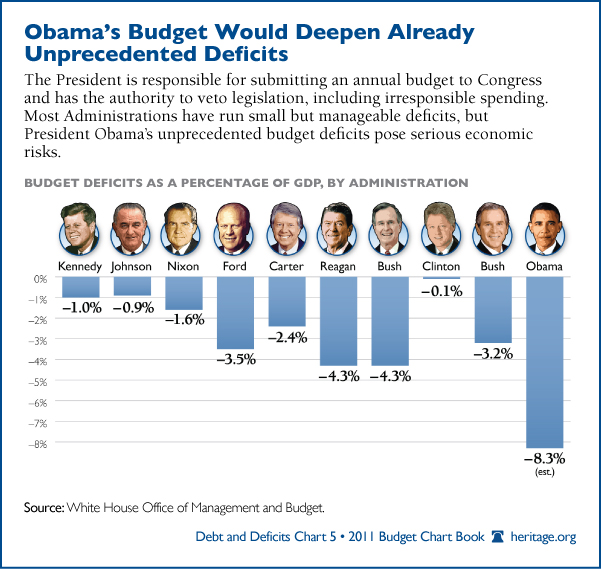
Over the last 10 presidents was have had 16.9% of GDP of deficits total from five Republican presidents and 12.7% total from Democratic presidents. However, what is most disturbing is that 8.3% of the 12.7% comes from the Obama administration who is currently in power and we are no longer in the cold war era. That is almost double the total of all the other four Democratic presidents combined under just one president. Take a look at the chart below from the Heritage Foundation:

Rob Bluey

January 1, 2012 at 9:56 am

Over the past 50 years, 10 U.S. presidents have made annual budget requests to Congress, projecting deficits both big and small. But no other president compares to Barack Obama when it comes to the size and scale of the current budget deficit facing the United States.

The country is facing an 8.3 percent estimated average national deficit of a two-term Obama administration — the biggest of the past 50 years. By comparison, the current estimate for Obama is nearly double the percentage under Presidents Ronald Reagan and George H.W. Bush — and they were fighting the Cold War.

Political party doesn’t tell the whole story, however. President Bill Clinton leads the pack of presidents since 1961, according to data from the White House Office of Management and Budget. Heritage put together this graphic as part of our Budget Chart Book.

So what does the current trajectory mean for the United States? We’re certainly no longer looking at a continuation of manageable deficits in the years to come. This is a dramatic change in the magnitude of annual shortfalls at the federal level. That’s one reason Heritage came up with a plan to fix the debt crisis.

If you have a suggestion for a chart we should feature in the future, please post a comment below, email us at scribe@heritage.org, or send me at tweet @RobertBluey.

_______________________
Here is a perspective from Dan Mitchell of the Cato Institute:

To Fix the Budget, Bring Back Reagan…or Even Clinton

Posted by Daniel J. Mitchell

President Obama unveiled his fiscal year 2012 budget today, and there’s good news and bad news. The good news is that there’s no major initiative such as the so-called stimulus scheme or the government-run healthcare proposal. The bad news, though, is that government is far too big and Obama’s budget does nothing to address this problem.

But perhaps the folks on Capitol Hill will be more responsible and actually try to save America from becoming a big-government, European-style welfare state. The solution may not be easy, but it is simple. Lawmakers merely need to restrain the growth of government spending so that it grows slower than the private economy.

Actual spending cuts would be the best option, of course, but limiting the growth of spending is all that’s needed to slowly shrink the burden of government spending relative to gross domestic product.

Fortunately, we have two role models from recent history that show it is possible to control the federal budget. This video from the Center for Freedom and Prosperity uses data from the Historical Tables of the Budget to demonstrate the fiscal policy achievements of both Ronald Reagan and Bill Clinton.

Spending Restraint, Part I: Lessons from Ronald Reagan and Bill Clinton

Uploaded by on Feb 14, 2011

Ronald Reagan and Bill Clinton both reduced the relative burden of government, largely because they were able to restrain the growth of domestic spending. The mini-documentary from the Center for Freedom and Prosperity uses data from the Historical Tables of the Budget to show how Reagan and Clinton succeeded and compares their record to the fiscal profligacy of the Bush-Obama years.

_____________________


Some people will want to argue about who gets credit for the good fiscal policy of the 1980s and 1990s.

Bill Clinton’s performance, for instance, may not have been so impressive if he had succeeded in pushing through his version of government-run healthcare or if he didn’t have to deal with a Republican Congress after the 1994 elections. But that’s a debate for partisans. All that matters is that the burden of government spending fell during Bill Clinton’s reign, and that was good for the budget and good for the economy. And there’s no question he did a much better job than George W. Bush.

Indeed, a major theme in this new video is that the past 10 years have been a fiscal disaster. Both Bush and Obama have dramatically boosted the burden of government spending — largely because of rapid increases in domestic spending.

This is one of the reasons why the economy is weak. For further information, this video looks at the theoretical case for small government and this video examines the empirical evidence against big government.

Another problem is that many people in Washington are fixated on deficits and debt, but that’s akin to focusing on symptoms and ignoring the underlying disease. To elaborate, this video explains that America’s fiscal problem is too much spending rather than too much debt.

Last but not least, this video reviews the theory and evidence for the “Rahn Curve,” which is the notion that there is a growth-maximizing level of government outlays. The bad news is that government already is far too big in the United States. This is undermining prosperity and reducing competitiveness.

Spending Restraint, Part II: Lessons from Canada, Ireland, Slovakia, and New Zealand

Uploaded by on Feb 22, 2011

Nations can make remarkable fiscal progress if policy makers simply limit the growth of government spending. This video, which is Part II of a series, uses examples from recent history in Canada, Ireland, Slovakia, and New Zealand to demonstrate how it is possible to achieve rapid improvements in fiscal policy by restraining the burden of government spending. Part I of the series examined how Ronald Reagan and Bill Clinton were successful in controlling government outlays — particularly the burden of domestic spending programs. http://www.freedomandprosperity.org