http://www.tinshipproductions.com Chattanooga Tea Party’s Liberty Forum Saturday, February 25, 2012
This speech is unedited and shown in it’s entire 55 minutes.
___________________
President Obama c/o The White House
1600 Pennsylvania Avenue NW
Washington, DC 20500
Urging Congress to spend more money on infrastucture, Rep. John Sarbanes (Big Government-Maryland) says, ”You’ve got to kind of get past this mentality that you can’t spend any money at all.”
Right. Because it’s that kind of attitude that has given us a federal budget of $3.8 trillion, up more than 100 percent in a decade, and spending at permanently higher levels of GDP:
Thank you so much for your time. I know how valuable it is. I also appreciate the fine family that you have and your committment as a father and a husband.
Sincerely,
Everette Hatcher III, 13900 Cottontail Lane, Alexander, AR 72002, ph 501-920-5733, lowcostsqueegees@yahoo.com
The government can not spend themselves out of a recession. It doesn’t work. Japan did 8 stimulus packages in the last 20 years but it has never worked. The best approach to get out of a recession was done by Ronald Reagan in the early 1980’s when he cut taxes then we experienced 7% economic growth. However, somehow Max Brantley of the Arkansas Times claims today that the stimulus did work and that we should have done more!!!
Mired in excruciating negotiations over the budget and the debt ceiling, President Barack Obama might reflect that things didn’t have to turn out this way. The impasse grows mainly out of one major decision he made early on: pushing through a giant stimulus.
When he took office in January 2009, this was his first priority. The following month, Obama signed the American Recovery and Reinvestment Act, with a price tag eventually put at $862 billion.
It was, he said at the time, the most sweeping economic recovery package in our history,” and would “create or save three and a half million jobs over the next two years.”
The president was right about the first claim. As a share of gross domestic output, it was the largest fiscal stimulus program ever tried in this country. But the second claim doesn’t stand up so well. Today, total nonfarm employment is down by more than a million jobs.
What Obama didn’t foresee is that his program would spark a populist backlash and give rise to the tea party. Where would Michele Bachmann be if the stimulus had never been enacted — or if it had been a brilliant success?
To say it has not been is to understate the obvious. The administration says the results look meager because the economy was weaker than anyone realized. Maybe so, but fiscal policy is a clumsy and uncertain tool for stimulating growth, which the past two years have not vindicated.
The package had three main components: tax cuts, aid to state governments and spending on infrastructure projects. Tax cuts would induce consumers to buy stuff. State aid would prop up spending by keeping government workers employed. Infrastructure outlay would generate hiring to build roads, bridges and other public works.
That was the alluring theory, which vaporized on contact with reality. The evidence amassed so far by economists indicates that the stimulus has come up empty in every possible way.
Consider the tax cuts. Wage-earners saw their take-home pay rise as the IRS reduced withholding. But as with past rebates and one-time tax cuts, consumers proved reluctant to perform their assigned role.
Claudia Sahm of the Federal Reserve Board and Joel Slemrod and Matthew Shapiro of the University of Michigan found that only 13 percent of households indicated they would spend most of the windfall. The rest said they preferred to put it in the bank or pay off debts — neither of which boosts the sale of goods and services.
This puny yield was even worse than that of the 2008 tax rebate devised by President George W. Bush. Neither attempt, the study reported, “was very effective in stimulating spending in the near term.”
The idea behind channeling money to state governments is that it would reduce the paring of government payrolls, thus preserving the spending power of public employees. But the plan went awry, according to a paper by Dartmouth College economists James Feyrer and Bruce Sacerdote published by the National Bureau of Economic Research.
“Transfers to the states to support education and law enforcement appear to have little effect,” they concluded. Most likely, they said, states used the money to avoid raising taxes or borrowing money.
That’s right: The federal government took out loans that it will have to cover with future tax increases … so states don’t have to. It’s like paying your Visa bill with your MasterCard.
The public works component could have been called public non-works. It sounds easy for Washington to pay contractors to embark on “shovel-ready projects” that needed only money to get started. The administration somehow forgot that even when the need is urgent, the government moves at the speed of a glacier.
John Cogan and John Taylor, affiliated with Stanford University and the Hoover Institution, reported earlier this year that out of that $862 billion, a microscopic $4 billion has been used to finance infrastructure. Even Obama has been chagrined.
“There’s no such thing as shovel-ready projects,” he complained last year.
Even if jobs were somehow created or saved by this ambitious effort, they came at a prohibitive price. Feyrer and Sacerdote say the costs may have been as high as $400,000 perjob.
Based on all this evidence, we don’t really know whether the federal government can use fiscal policy to engineer a recovery. We do know it can go broke trying.
__________________________
Thank you so much for your time. I know how valuable it is. I also appreciate the fine family that you have and your committment as a father and a husband.
Sincerely,
Everette Hatcher III, 13900 Cottontail Lane, Alexander, AR 72002, ph 501-920-5733, lowcostsqueegees@yahoo.com
This Economics 101 video from the Center for Freedom and Prosperity gives seven reasons why the political elite are wrong to push for more taxes. If allowed to succeed, the hopelessly misguided pushing to raise taxes would only worsen our fiscal mess while harming the economy.
The seven reasons provided by the video against this approach are as follows:
1) Tax increases are not needed;
2) Tax increases encourage more spending;
3) Tax increases harm economic performance;
4) Tax increases foment social discord;
5) Tax increases almost never raise as much revenue as projected;
6) Tax increases encourage more loopholes; and,
7) Tax increases undermine competitiveness
_____________________
President Obama c/o The White House
1600 Pennsylvania Avenue NW
Washington, DC 20500
Francois Hollande is a man on a mission—to increase the top rate of tax on income to 75 percent. The Socialist candidate, who is poised to beat Nicolas Sarkozy in the French presidential election, said, “Above 1m euros [£847,000; $1.3m], the tax rate should be 75% because it’s not possible to have that level of income.”
Hollande’s “unassailable” logic aside, the measure would remind those who are too young to remember the 1970s of what happens when the rapacious state makes work really unprofitable. I can just see the Whitehall mandarins wring their hands with joy as thousands of French high-earners, from actors to businessmen, pour across the English Channel to London. If anything, the disastrous effect of the French tax will be greater than four decades ago—the world, after all, has become even more competitive and the cost of relocation has fallen appreciably. Karl Marx is supposed to have said that “history repeats itself, first as tragedy, second as farce.” Hollande may well prove him right.
Thank you so much for your time. I know how valuable it is. I also appreciate the fine family that you have and your committment as a father and a husband.
Sincerely,
Everette Hatcher III, 13900 Cottontail Lane, Alexander, AR 72002, ph 501-920-5733, lowcostsqueegees@yahoo.com
I know that you have complained about not getting all your appointments through the Senate. Max Brantley called it a cold war between the White House and the Republicans in the Senate over these appointments that were being held up. Today he jumps on this again in the Arkansas Times Blog (March 2, 2012).
Where did this “cold war” start? I contend that it started back during the Bush years when Mark Pryor and his Democratic buddies were holding up judges like Miguel Estrada for no good reason.
Paul Greenberg in the editorial “Dept. of Hypocrisy: Mark Pryor’s Selective Outrage,” (May 3, 2010) pointed out that Pryor was angry that Republicans were holding up the President’s picks for the federal bench. ”There’s just no place for this in the Senate,” he huffs. “There’s no place just to play partisan political games with these judicial appointments.” Greenberg went on to show how hypocritical this was of Pryor.
Liberal columnists seem to be the most hypocritical though. Take a look at this article below that shows how the NY Times keeps changing their opinion on this according to who is in the White House:
In an editorial last month, The New York Times argued that the Senate should adopt President Obama’s plan requiring the Senate to vote on judicial nominees within 90 days—thus eliminating the filibuster as applied to those nominations. The Times notes that this is a “major change in position” from its stance that the filibuster “goes to the center of the peculiar but effective form of government America cherishes.” As Ed Whelan pointed out, this is not the first time the Times has reversed course on the use of the filibuster. In 1995, the Times argued that the Senate, or “the greatest obstructive body,” should stop using the filibuster as it had “become the tool of the sore loser.”
Whelan noted that coincidentally, the Times opposed the filibuster when Senate Republicans used it to stall President Clinton’s executive-branch nominees but “hailed” its existence when it was used to block a number of President Bush’s judicial nominees. So, we won’t be surprised when the Times’ latest reluctant revelation that the filibuster “threaten[s] to paralyze government” us reversed yet again during the next Republican administration.
As for Obama, he voted as a Senator to filibuster a number of President Bush’s nominees—including Supreme Court Associate Justice Samuel Alito and Court of Appeals Judges Janice Rogers Brown, William Pryor, Priscilla Owen, and Leslie Southwick (and as Whelan discusses, Senator Obama not only voted for filibuster but led the unsuccessful attack against Southwick). As president, Obama now opposes the filibuster since it’s been used to thwart some of his nominees, including Goodwin Liu and Caitlin Halligan.
What the Times doesn’t discuss is one rather obvious reason why President Obama is calling for the Senate to change its rules now. The proposal itself raises the stakes if conservatives in the Senate slow down confirmation of judicial nominations to challenge the President’s recent unconstitutional “recess” appointments to the Consumer Financial Protection Bureau and the NLRB. As Hans von Spakovsky discusses in this recent piece, conservative senators have yet to take meaningful action in response to the president’s purported recess appointments, but there reportedly are some senators who want to follow in the steps of Senator Robert Byrd, who infamously challenged President Reagan’s recess appointments by holding up a variety of Executive Branch nominees and even 5,000 military promotions. Eliminating the filibuster would further neuter the Senate in the face of future, illegal recess appointments—as the New York Times certainly knows.
______________
Thank you so much for your time. I know how valuable it is. I also appreciate the fine family that you have and your committment as a father and a husband.
Sincerely,
Everette Hatcher III, 13900 Cottontail Lane, Alexander, AR 72002, ph 501-920-5733, lowcostsqueegees@yahoo.com
It’s understandable that the Obama Administration is concerned about the issue. These four charts show that the labor market is in terrible shape.
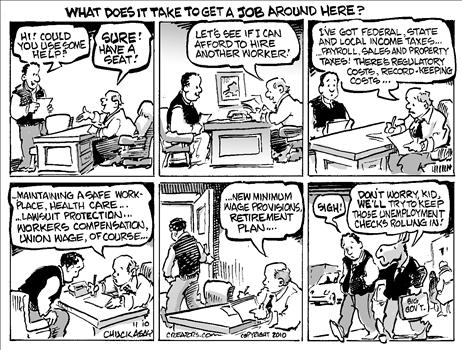
But how can we convince the President that more government is just making a bad situation even worse? What will it take to educate him about the need to reduce government-imposed barriers to job creation?
Narrated by Hiwa Alaghebandian of the American Enterprise Institute, the mini-documentary explains how needless complexity creates an added burden – sort of like a hidden tax that we pay for the supposed privilege of paying taxes.
__________
The Onerous Compliance Cost of the Internal Revenue Code
The tax system is a complicated nightmare that forces taxpayers to devote ever-larger amounts of time, money, energy, and other resources in hopes of complying with the internal revenue code and avoiding IRS persecution. This CF&P Foundation video shows that this corrupt mess is the result of 97 years of social engineering and industrial policy that began almost immediately after that dark day in 1913 that the income tax was created. www.freedomandprosperity.org
______________________
Two things from the video are worth highlighting.
First, we should make sure to put most of the blame on Congress. As Ms. Alaghebandian notes, the IRS is in the unenviable position of trying to enforce Byzantine tax laws. Yes, there are examples of grotesque IRS abuse, but even the most angelic group of bureaucrats would have a hard time overseeing 70,000-plus pages of laws and regulations (by contrast, the Hong Kong flat tax, which has been in place for more than 60 years, requires less than 200 pages).
Second, we should remember that compliance costs are just the tip of the iceberg. The video also briefly mentions three other costs.
The budgetary burden of the IRS, which is a staggering $12.5 billion. This is the money we spend to employ an army of tax bureaucrats that is larger than the CIA and FBI combined.
Thank you so much for your time. I know how valuable it is. I also appreciate the fine family that you have and your committment as a father and a husband.
Sincerely,
Everette Hatcher III, 13900 Cottontail Lane, Alexander, AR 72002, ph 501-920-5733, lowcostsqueegees@yahoo.com
In the debate of job creation and how best to pursue it as a policy goal, one point is forgotten: Government doesn’t create jobs. Government only diverts resources from one use to another, which doesn’t create new employment.
Video produced by Caleb Brown and Austin Bragg.
___________________________
Keynesian Catastrophe: Big Money, Big Government & Big Lies
Based on a theory known as Keynesianism, politicians are resuscitating the notion that more government spending can stimulate an economy. This mini-documentary produced by the Center for Freedom and Prosperity Foundation examines both theory and evidence and finds that allowing politicians to spend more money is not a recipe for better economic performance.
___________________
Obama’s So-Called Stimulus: Good For Government, Bad For the Economy
President Obama wants Congress to dramatically expand the burden of government spending. This CF&P Foundation mini-documentary explains why such a policy, based on the discredited Keynesian theory of economics, will not be successful. Indeed, the video demonstrates that Obama is proposing – for all intents and purposes – to repeat Bush’s mistakes. Government will be bigger, even though global evidence shows that nations with small governments are more prosperous.
____________
Big Government Is Not Stimulus: Why Keynes Was Wrong (The Condensed Version)
The CF&P Foundation has released a condensed version of our successful mini-documentary explaining why so-called stimulus schemes do not work. Based on a theory known as Keynesianism, politicians are resuscitating the notion that more government spending can stimulate an economy. This mini-documentary produced by the Center for Freedom and Prosperity Foundation examines both theory and evidence and finds that allowing politicians to spend more money is not a recipe for better economic performance.
_________________
Eight Reasons Why Big Government Hurts Economic Growth
This Center for Freedom and Prosperity Foundation video analyzes how excessive government spending undermines economic performance. While acknowledging that a very modest level of government spending on things such as “public goods” can facilitate growth, the video outlines eight different ways that that big government hinders prosperity. This video focuses on theory and will be augmented by a second video looking at the empirical evidence favoring smaller government.
___________________
Keynesian Economics Is Wrong: Economic Growth Causes Consumer Spending, Not the Other Way
Politicians and journalists who fixate on consumer spending are putting the cart before the horse. Consumer spending generally is a consequence of growth, not the cause of growth. This Center for Freedom and Prosperity video helps explain how to achieve more prosperity by looking at the differences between gross domestic product and gross domestic income. www.freedomandprosperity.org
_____________
Deficits, Debts and Unfunded Liabilities: The Consequences of Excessive Government Spending
Huge budget deficits and record levels of national debt are getting a lot of attention, but this video explains that unfunded liabilities for entitlement programs are Americas real red-ink challenge. More important, this CF&P mini-documentary reveals that deficits and debt are symptoms of the real problem of an excessive burden of government spending. www.freedomandprosperity.org
___________
Now that I have been critical of the Democrat President, I wanted to show that I am not concerned about taking up for Republicans but looking at the facts. President Clinton did increase government spending at a slower rate than many other presidents. Here are two videos that praise both Reagan and Clinton for both accomplished this feat.
Spending Restraint, Part I: Lessons from Ronald Reagan and Bill Clinton
Ronald Reagan and Bill Clinton both reduced the relative burden of government, largely because they were able to restrain the growth of domestic spending. The mini-documentary from the Center for Freedom and Prosperity uses data from the Historical Tables of the Budget to show how Reagan and Clinton succeeded and compares their record to the fiscal profligacy of the Bush-Obama years.
______________
Spending Restraint, Part II: Lessons from Canada, Ireland, Slovakia, and New Zealand
Nations can make remarkable fiscal progress if policy makers simply limit the growth of government spending. This video, which is Part II of a series, uses examples from recent history in Canada, Ireland, Slovakia, and New Zealand to demonstrate how it is possible to achieve rapid improvements in fiscal policy by restraining the burden of government spending. Part I of the series examined how Ronald Reagan and Bill Clinton were successful in controlling government outlays — particularly the burden of domestic spending programs. www.freedomandprosperity.org
Lawmakers are considering extending temporary payroll tax cuts. But the policy is based on faulty Keynesian theories and misplaced confidence in the government’s ability to micromanage short-run growth.
In textbook Keynesian terms, federal deficits stimulate growth by goosing “aggregate demand,” or consumer spending. Since the recession began, we’ve had a lot of goosing — deficits were $459 billion in 2008, $1.4 trillion in 2009, $1.3 trillion in 2010, and $1.3 trillion in 2011. Despite that huge supposed stimulus, unemployment remains remarkably high and the recovery has been the slowest since World War II.
Policymakers should ignore the Keynesians and their faulty models, and instead focus on reforms to aid long-run growth…
Yet supporters of extending payroll tax cuts think that adding another $265 billion to the deficit next year will somehow spur growth. That “stimulus” would be on top of the $1 trillion in deficit spending that is already expected in 2012. Far from helping the economy, all this deficit spending is destabilizing financial markets, scaring businesses away from investing, and imposing crushing debt burdens on young people.
For three years, policymakers have tried to manipulate short-run economic growth, and they have failed. They have put too much trust in macroeconomists, who are frankly lousy at modeling the complex workings of the short-run economy. In early 2008, the Congressional Budget Office projected that economic growth would strengthen in subsequent years, and thus completely missed the deep recession that had already begun. And then there was the infamously bad projection by Obama’s macroeconomists that unemployment would peak at 8 percent and then fall steadily if the 2009 stimulus plan was passed.
Some of the same Keynesian macroeconomists who got it wrong on the recession and stimulus are now claiming that a temporary payroll tax break would boost growth. But as Stanford University economist John Taylor has argued, the supposed benefits of government stimulus have been “built in” or predetermined by the underlying assumptions of the Keynesian models.
Policymakers should ignore the Keynesians and their faulty models, and instead focus on reforms to aid long-run growth, which economists know a lot more about. Cutting the corporate tax rate, for example, is an overdue reform with bipartisan support that would enhance America’s long-run productivity and competitiveness.
If Congress is intent on cutting payroll taxes, it should do so within the context of long-run fiscal reforms. One idea is to allow workers to steer a portion of their payroll taxes into personal retirement accounts, as Chile and other nations have done. That reform would feel like a tax cut to workers because they would retain ownership of the funds, and it would begin solving the long-term budget crisis that looms over the economy.
Dan Mitchell discusses the effectiveness of the stimulus Uploaded by catoinstitutevideo on Nov 3, 2009 11-2-09 When I think of all our hard earned money that has been wasted on stimulus programs it makes me sad. It has never worked and will not in the future too. Take a look at a few thoughts from […]
Government Spending Doesn’t Create Jobs Uploaded by catoinstitutevideo on Sep 7, 2011 Share this on Facebook: http://on.fb.me/qnjkn9 Tweet it: http://tiny.cc/o9v9t In the debate of job creation and how best to pursue it as a policy goal, one point is forgotten: Government doesn’t create jobs. Government only diverts resources from one use to another, which doesn’t […]
In his recent article Ernie Dumas sticks to his guns that we should balance the budget without being forced to with a “Balanced Budget Amendment,” but I wonder how well that has worked so far? I have made this a key issue for this blog in the past as you can tell below: Dear Senator […]
(Picture from Arkansas Times Blog) When I think about all the anger and hate coming from the Occupy Wall Street crowd, I wonder if they have read this story below? Solyndra: Crooked Politics or Just Bad Economics? Posted by David Boaz Amy Harder has a good take on the Solyndra issue in National Journal Daily […]
Dear Senator Pryor, why not pass the Balanced Budget Amendment? (Part 13 Thirsty Thursday, Open letter to Senator Pryor) Office of the Majority Whip | Balanced Budget Amendment Video In 1995, Congress nearly passed a constitutional amendment mandating a balanced budget. The Balanced Budget Amendment would have forced the federal government to live within its […]
Andrew Demillo pointed this out and also Jason Tolbert noted: PRYOR OPPOSES THE OBAMA JOBS BILL THAT HE VOTED TO ADVANCE Sen. Mark Pryor has been traveling around the state touting a six-part jobs plan that he says “includes a number of bipartisan initiatives, is aimed at creating jobs by setting the table for growth, encouraging new […]
Is a lack of money the problem for our public schools? Everything You Need to Know About Public School Spending in Less Than 2½ Minutes Posted by Adam Schaeffer Neal McCluskey gutted the President’s new “Save the Teachers” American Jobs Act sales pitch a good while back, as did Andrew Coulson here. Thankfully, it seems […]
Real Time with Bill Maher March 16 2012 – Alexandra Pelosi Interviews Welfare Recipients
_________________________
Alexandra Pelosi (Nancy’s daughter) did a great job of showing in this clip on Bill Maher’s show on how many people who receive welfare benefits are really able bodied people who have no desire to get a job. Some of them have mutiple children with several women and many of them feel that they are owed their benefits by Obama because they voted for him. Dan Mitchell does a great job below showing the mentality of Obama’s re-election campaign which encourages people to add up all the benefits people can get from big government and how they can outgive Romney!!!
Back in 2010, I declared that Olga Stefou was a symbol of everything that’s wrong with the Greek welfare state.
She was one of the protesters and – if the story captured her thoughts accurately – she displayed an unlimited entitlement mentality. Sort of helps one understand why this cartoon is so accurate.
Now we have an American version of Olga. Her name is Julia, and she is just as much of a moocher.
The good news, though, is that Julia is only a make-believe leech. She’s been created by the Obama campaign to show how big government can provide cradle-to-grave handouts.
The full series can be found at this link, and here’s a screenshot of the handouts that Julia might take at age 31.
Poor Julia is getting mercilessly mocked as everything from a deadbeat to a New Soviet Woman. But I realize my circle of friends, acquaintances, and contacts are not a representative sample.
http://www.tinshipproductions.com Chattanooga Tea Party’s Liberty Forum Saturday, February 25, 2012
This speech is unedited and shown in it’s entire 55 minutes.
__________________
President Obama c/o The White House
1600 Pennsylvania Avenue NW
Washington, DC 20500
Three years after being rescued by a taxpayer bailout, General Motors recently announced some rather ambitious profit targets for 2012. But even if it meets these targets—a big if—taxpayers should not wait on one foot to recover their remaining “investment” in the company.
There is no doubt that GM has returned from the brink. It made $8 billion last year, a record high, and regained enough global market share to once again become the world’s biggest automaker, a title it had lost to Toyota. More impressive, it is planning to bump its profit margins from 6 percent last year to 10 percent this year, on par with its best-in-class rivals such as Hyundai and BMW. This, it hopes, will allow it to post $10 billion in profits this year, something that only 17 public companies managed to do in 2010.
How did investors react to all this hope and cheer? With a giant yawn: GM’s stock price, which has been hovering around $25 for months, barely budged. That’s $8 below GM’s IPO price. And it’s $30 below what’s needed for taxpayers to recover the $30 billion they still have stuck in the company.
If investors aren’t buying GM’s rosy scenarios, it’s for some good reasons. Peter De Lorenzo, editor of Auto Extremist, notes that GM is facing the most competitive market in history and investors are dubious that it can deliver. GM’s $8 billion in profits last year resulted partly from the tsunami in Japa that disrupted Toyota and Honda’s global supply chain.
Both are back this year and more formidable than ever. While GM reported a 6 percent drop in January sales in North America from a year earlier, its foreign competitors posted impressive gains. GM will have a hard time matching last year’s performance, let alone upping it if it has even one more month like January, De Lorenzo notes.
Tougher competition in North America is not GM’s only worry. Its sales in China are slowing. Also, Europe will probably remain a trouble spot. GM suffered $2 billion in losses in Europe last year, thanks to Opel, its hopelessly bloated German brand. But GM has been unable to obtain permission from the German government to restructure its labor costs, even as European sales plummet in an economic meltdown.
Toyota and Honda don’t have the same exposure in Europe and hence have less to worry about. What’s more, GM’s global pension obligations are underfunded to the tune of $22 billion, about $10 billion in the United States alone.
If GM manages to address all these issues, notes Sean McAlinden of the Center for Automotive Research, its share price might go up $40 to $45, leaving taxpayers still $5 billion to $8 billion in the red. But that’s under the best scenario. If stock prices remain at the current $25 level, the losses could mount up to $15 billion. That’s not counting the $15 billion in tax write-offs that GM got as part of the bankruptcy deal. All in all, taxpayers are facing somewhere from $20 billion to $30 billion in losses.
That’s not all the exposure that taxpayers will have going forward. The GM bailout has distorted the playing field so badly that its competitors are demanding their own handouts to even things out.
For example, McAlinden notes, the administration gave GM about $10 billion more than was strictly necessary to finance its bankruptcy. The money contributed to GM’s nice $33 billion cash cushion right now. GM could use this money to buy its own stock and bid up prices, mitigating taxpayer losses—or pay dividends. But McAlinden doesn’t believe that’s what GM will do. It could use the money to pay off its obligations to the union health-care trust fund, making this a direct infusion of cash from taxpayers to unions.
Or it will use the money toward product development, putting its competitors at a disadvantage. Moreover, because all but $10 billion of the bailout money GM got was in the form of equity, the company has no debt service costs. Ford by contrast, is still servicing the $23 billion in debt it took to avoid a bailout.
This is unfair, and the Obama administration knows it, which is perhaps one reason it quickly approved a $5.6 billion retooling loan for Ford. That, in turn, elicited howls of protest from Chrysler’s Sergio Marchionne. The administration gave Marchionne’s parent company, Fiat, the majority stake in Chrysler without asking Fiat to contribute a single euro of its own.
Yet Marchionne complains that the administration hasn’t been generous enough. In contrast with GM, it forced Chrysler to service the bailout loan. Now it’s dragging its feet in approving Chrysler’s new retooling loans, he claims.
Bailout supporters maintain that it was a one-time deal necessary to shore up companies in acute economic times. In reality, the rush for the bailout’s spoils has produced ripple effects that may well haunt the economy for a long time.
As President Barack Obama campaigns to keep his job, he will spin the bailout as a success story that saved millions of American jobs. But taxpayers should bear in mind that the hit to their wallets will be substantial and will probably grow in years to come.
Shikha Dalmia is a senior analyst at Reason Foundation and a columnist at The Daily. This colum originally appeared in Bloomberg news.
____________
Thank you so much for your time. I know how valuable it is. I also appreciate the fine family that you have and your committment as a father and a husband.
Sincerely,
Everette Hatcher III, 13900 Cottontail Lane, Alexander, AR 72002, ph 501-920-5733, lowcostsqueegees@yahoo.com
In this article below you will see that the American people do not want Obamacare but yet it is being crammed down their throats and all the regulations that go with that too. Sickening Regulation by Michael D. Tanner Michael Tanner is a senior fellow at the Cato Institute and author of Leviathan on the […]
Gerard Matthews wrote on March 21, 2012 in the Arkansas Times: Children cannot be denied coverage because of a pre-existing condition. Young people can stay on their parents’ health insurance plan until they are 26 years old. Preventive services, which will ultimately help control health care costs, have been added to some plans at no […]
Michael Cannon on Medicare and Healthcare In his article, “Medicaid and the consequences,” Arkansas Democrat-Gazette, March 20, 2012, (paywall), Brummett admits, “Medicaid will break the bank of state government if we don’t do something.” However, he never gets around to saying that Obamacare is going to ruin the state financially. It will expand this failing […]
On March 19, 2012 Jason Tolbert pointed out that the Democrats in Little Rock were using Obama’s talking points concerning Obamacare, but it appears to me that they go down with the ship according to the mood in the country. Take a look at this fine article from the Cato Institute. In this article below […]
Setting Biden Straight on Obamacare’s Anti-Conscience Mandate Uploaded by HeritageFoundation on Mar 3, 2012 Vice President Biden didn’t get the story quite straight. As the Obama Administration reels from the backlash for Obamacare’s anti-conscience mandate that forces religious employers to provide coverage and pay for abortion-inducing drugs, Biden yesterday set out to convince America that […]
It seems that government was in control of the desert then we would have a shortage of sand as Milton Friedman used to quip. You Keep Using the Word ‘Affordable.’ I Do Not Think It Means What You Think It Means. Posted by Michael F. Cannon The federal government gave a $10 million “affordability” prize […]
Uploaded by HarrysRetroArchive on Aug 7, 2010 The stooges join the “Women Haters” club and vow to have nothing to do with the fair sex. Larry marries a girl anyway and attempts to hide the fact from Moe and Curly as they take a train trip. Director: Archie Gottler Cast: Marjorie White, A.R. Haysel, Monte […]
Religious Liberty: Obamacare’s First Casualty Uploaded by HeritageFoundation on Feb 22, 2012 http://blog.heritage.org/2012/02/22/morning-bell-religious-liberty-under-attack/ | The controversy over the Obama Administration’s anti-conscience mandate and the fight for religious liberty only serves to highlight the inherent flaws in Obamacare. This conflict is a natural result of the centralization laid out under Obamacare and will only continue until […]
Religious Liberty: Obamacare’s First Casualty Uploaded by HeritageFoundation on Feb 22, 2012 http://blog.heritage.org/2012/02/22/morning-bell-religious-liberty-under-attack/ | The controversy over the Obama Administration’s anti-conscience mandate and the fight for religious liberty only serves to highlight the inherent flaws in Obamacare. This conflict is a natural result of the centralization laid out under Obamacare and will only continue until […]
Somebody will pay. You can bet on that. Obama’s Political Prophylactic Posted by Roger Pilon “White House compromise still guarantees contraceptive coverage for women,” reads theWashington Post headline coming out of President Obama’s press conference this afternoon. Trying to tamp down the escalating political storm his administration created three weeks ago when it ruled that, under Obamacare, employers with […]
_____________________________________________________ I would like to respond the idea of a single payer healthcare system by quoting from David Hogberg’s article “Free Market Cure – The Myths of Single-Payer Health Care.” He notes: A single-payer health care system is one in which a single-entity — the government — collects almost all of the revenue for and pays almost all of […]