Category Archives: President Obama

Obama promotes food stamps but Milton Friedman had a better suggestion

Milton Friedman’s negative income tax explained by Friedman in 1968:

We need to cut back on the Food Stamp program and not try to increase it. What really upsets me is that when the government gets involved in welfare there is a welfare trap created for those who become dependent on the program. Once they go out and get a job then they are stripped away from the welfare program and that encourages them to avoid working and sit on the couch. (Milton Friedman’s negative income tax is a good solution.)

Now we have the government running ads trying to get people to join this type of lifestyle. I think it is the most cruel thing you can do to a struggling poor person. Working is the only way a person can climb up the ladder and falling in the welfare trap hurts the poor’s chance of succeeding in the future.

Obama’s Using Our Tax Dollars to Leverage More Food Stamp Dependency

June 26, 2012 by Dan Mitchell

In past posts, I’ve groused about food stamp abuse, including people using them to buy luxury coffee at Starbucks and to purchase steaks and lobster. I’ve complained about college kids scamming the program, the “Octo-Mom” mooching off the program, and the Obama Administration rewarding states that sign up more food stamp recipients.

Well, the Obama White House is doubling down on creating more dependency, spending tax dollars to increase the number of people on food stamps.

Here are some of disturbing details from a CNN report.

More than one in seven Americans are on food stamps, but the federal government wants even more people to sign up for the safety net program. The U.S. Department of Agriculture has been running radio ads for the past four months encouraging those eligible to enroll. …The department is spending between $2.5 million and $3 million on paid spots, and free public service announcements are also airing. The campaign can be heard in California, Texas, North Carolina, South Carolina, Ohio, and the New York metro area. …President Bush launched a recruitment campaign, which pushed average participation up by 63% during his eight years in office. The USDA began airing paid radio spots in 2004. President Obama’s stimulus act made it easier for childless, jobless adults to qualify for the program and increased the monthly benefit by about 15% through 2013.

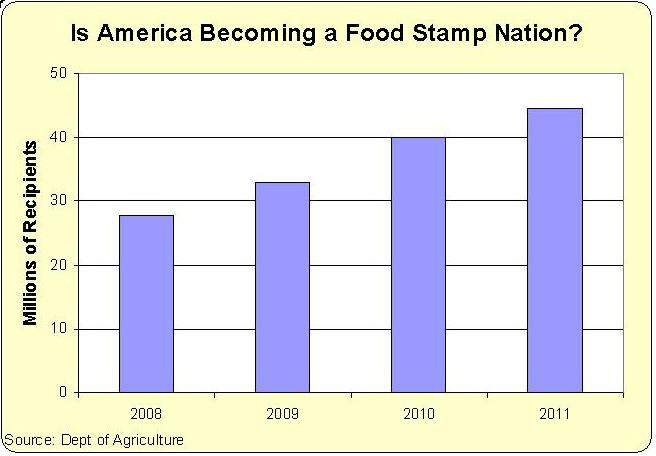
Last year, I semi-defended Newt Gingrich when he was attacked for calling Obama the “Food Stamp” President. Citing this chart, I wrote that, “It certainly looks like America is becoming a food stamp nation.”
But my bigger point is that welfare is bad for both taxpayers and the people who get trapped into relying on big government.

The ideal approach, as explained in this video, is to get the federal government out of the business of redistributing income. We are far more likely to get better results if we let states experiment with different approaches.

House Republicans, to their credit, already want to do this with Medicaid. So why not block grant all social welfare programs?

The icing on the cake is that no longer would the federal government be running ads to lure people into dependency.

Related posts:

We can no longer afford the welfare state (Part 7)

Ep. 4 – From Cradle to Grave [7/7]. Milton Friedman’s Free to Choose (1980) With the national debt increasing faster than ever we must make the hard decisions to balance the budget now. If we wait another decade to balance the budget then we will surely risk our economic collapse. The first step is to […]

We can no longer afford the welfare state (Part 6)

Ep. 4 – From Cradle to Grave [6/7]. Milton Friedman’s Free to Choose (1980) With the national debt increasing faster than ever we must make the hard decisions to balance the budget now. If we wait another decade to balance the budget then we will surely risk our economic collapse. The first step is to […]

We can no longer afford the welfare state (Part 5)

Ep. 4 – From Cradle to Grave [5/7]. Milton Friedman’s Free to Choose (1980) With the national debt increasing faster than ever we must make the hard decisions to balance the budget now. If we wait another decade to balance the budget then we will surely risk our economic collapse. The first step is to […]

We can no longer afford the welfare state (Part 4)

 Ep. 4 – From Cradle to Grave [4/7]. Milton Friedman’s Free to Choose (1980) With the national debt increasing faster than ever we must make the hard decisions to balance the budget now. If we wait another decade to balance the budget then we will surely risk our economic collapse. The first step is to […]

We can no longer afford the welfare state (Part 3)

Ep. 4 – From Cradle to Grave [3/7]. Milton Friedman’s Free to Choose (1980) With the national debt increasing faster than ever we must make the hard decisions to balance the budget now. If we wait another decade to balance the budget then we will surely risk our economic collapse. The first step is to […]

We can no longer afford the welfare state (Part 2)

With the national debt increasing faster than ever we must make the hard decisions to balance the budget now. If we wait another decade to balance the budget then we will surely risk our economic collapse. The first step is to remove all welfare programs and replace them with the negative income tax program that […]

We can no longer afford the welfare state (Part 1)

Milton Friedman – The Negative Income Tax Published on May 11, 2012 by LibertyPen In this 1968 interview, Milton Friedman explained the negative income tax, a proposal that at minimum would save taxpayers the 72 percent of our current welfare budget spent on administration. http://www.LibertyPen.com Source: Firing Line with William F Buckley Jr. ________________ Milton […]

Open letter to President Obama (Part 110)

The Rahn Curve and the Growth-Maximizing Level of Government

Uploaded by on Jun 29, 2010

Government spending can promote economic growth if money is used for core “public goods” such as rule of law and property rights. But the burden of government spending in the United States and other industrialized nations is far higher than needed to finance such activities. Citing scholarly studies, this CF&P Foundation video examines the Rahn Curve, which graphically illustrates the negative impact of excessive government spending. www.freedomandprosperity.org

___________

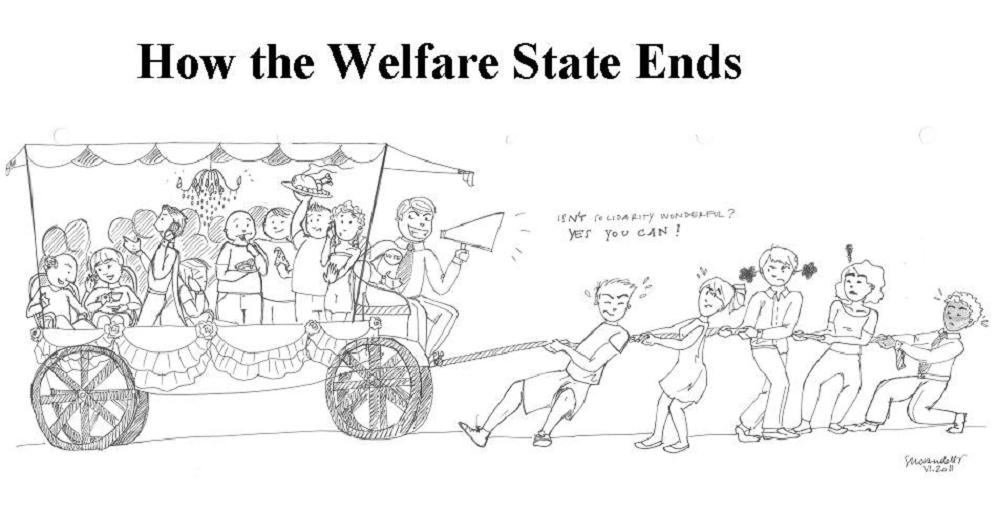
These images are remarkably accurate. The welfare state starts with small programs targeted at a handful of genuinely needy people. But as  politicians figure out the electoral benefits of expanding programs and people figure out the that they can let others work on their behalf, the ratio of producers to consumers begins to worsen.

_________

President Obama c/o The White House
1600 Pennsylvania Avenue NW
Washington, DC 20500

Dear Mr. President,

I know that you receive 20,000 letters a day and that you actually read 10 of them every day. I really do respect you for trying to get a pulse on what is going on out here.

When the government gets so big that it distorts the behavior of the private market then it is too big. The federal government is  now spending 24.8% of GDP and traditionally for the first 150 years of our nation’s history we spent under 5% unless in wartime. This massive spending now by the federal encourages people to lie in order to get money for the government too instead of trying to work hard to earn money in the private market.

Why is big government bad for an economy? The easy answer is that big government usually means high tax rates, and this penalizes work, saving, investment, and entrepreneurship. And perhaps some of the spending is financed by borrowing, and this diverts money from private investment.

That’s a correct answer, but it’s only part of the story. In most cases, there is added damage because politicians spend money in ways that further undermine incentives to produce.

For instance, let’s assume a government spends $1 billion on some sort of redistribution program. Extracting that money from the productive sector of the economy obviously will cause some damage, but it’s also important to estimate how the supposed beneficiaries of the money will react. What if they decide to earn less income in order to be eligible for the handouts, as even the statists at the OECD have recognized?

In other words, it hurts the economy when government collects money, and it often hurts the economy when government spends money. Sort of a perverse 2-for-1 special (though “Rahn Curve” analysis does show that some types of spending – on core public goods – is correlated with better economic performance)

Let’s look at an example from Greece, showing how handouts distort behavior and corrupt people. Here are some remarkable tidbits from a Wall Street Journal story.

The Greek health ministry is investigating on Zakynthos after local officials flagged records showing what they said is an implausibly high number of disability claims for blindness. About 1.8% of the island’s population of 39,000 claimed the benefit last year, according to the health ministry. That is around nine times the prevalence of blindness estimated for many European countries in a 2004 study published in a World Health Organization journal. Among those who put in for the blindness benefit on Zakynthos, a local official said, were a taxi driver and a bird hunter. …But the island is hardly alone, according to health ministry officials, who say fraudulent disability claims are a problem across the nation… Zakynthos Mayor Stelios Bozikis on a Greek television talk show said residents angry about the benefits crackdown and other financial overhauls pelted him with yogurt at a recent event.

Before sneering at the Greeks, keep in mind that “disability” claims also are rising in the United States, which is rather remarkable since jobs have become less arduous over time. Heck, the Social Security Administration decided to give disability payments to a grown man who gets his jollies by wearing diapers.

I’m not sure if that’s better or worse than the Greek government deciding to reward pedophiles with disability payments, but taxpayers are getting screwed in both examples.

Let’s go back to the story and look at a rough estimate of how much fraud exists.

In an attempt to root out fraud, the Greek health ministry recently required disability claimants nationwide to register in a centralized database, appearing in person or sending a representative. The registration resulted in 36,000 fewer disability claims than in 2011, the health ministry said. The ministry alleges these dropped claims were fraudulent, in many cases reflecting multiple claims for the same disability or payments in the name of dead beneficiaries. It also alleges that some doctors accepted money for false diagnoses and some local politicians signed off on the benefits to win support, and said it is giving public prosecutors information about areas where it suspects a high level of fraud. Only 190 of the nearly 700 people it says had been collecting the blindness benefit on Zakynthos participated in the registration, the ministry said.

I have no idea if Zakynthos is representative, but that’s an incredibly high fraud rate. And this is just a glimpse at the workings of one government program. Now multiply that by some large number and you’ll begin to understand the damage caused by government.

And America is not immune. When politicians make it easier to ride in the wagon than to pull the wagon (as this cartoon illustrates), society sooner or later gets in trouble.

____________

Thank you so much for your time. I know how valuable it is. I also appreciate the fine family that you have and your commitment as a father and a husband.

Sincerely,

Everette Hatcher III, 13900 Cottontail Lane, Alexander, AR 72002, ph 501-920-5733, lowcostsqueegees@yahoo.com

Open letter to President Obama (Part 109)

Government Spending Doesn’t Create Jobs

Uploaded by on Sep 7, 2011

Share this on Facebook: http://on.fb.me/qnjkn9 Tweet it: http://tiny.cc/o9v9t

In the debate of job creation and how best to pursue it as a policy goal, one point is forgotten: Government doesn’t create jobs. Government only diverts resources from one use to another, which doesn’t create new employment.

Video produced by Caleb Brown and Austin Bragg.

_________

President Obama c/o The White House
1600 Pennsylvania Avenue NW
Washington, DC 20500

Dear Mr. President,

I know that you receive 20,000 letters a day and that you actually read 10 of them every day. I really do respect you for trying to get a pulse on what is going on out here.

Judging from what you had to say in your State of the Union address you haven’t changed at all. You still believe we should make “investments” but what you really mean is that government can provide everyone jobs. I just don’t believe that and I don’t believe you are brave enough to make the tough cuts in government spending to bring down out federal spending from almost 25% of GDP to more acceptable levels like under 19% under Clinton.

After saddling the nation with trillion-dollar boondoggles like the faux stimulus and Obamacare, I’m not sure it’s possible for Obama to reinvent himself as a budget cutter before the election.

But I welcome converts, even ones that are insincere, so I’m happy he’s at least pretending to want to deal with waste and duplication in the federal budget.

Here’s a blurb from the Daily Beast about his new idea.

President Barack Obama is seeking the power to merge agencies in a bid to shrink the federal government in a sweeping move. Obama will ask Congress to give him authority to consolidate six trade and commerce agencies that have overlapping programs, cutting up to 2,000 jobs and saving $3 billion over 10 years. He’ll call for a vote by Congress within 90 days.

But I’ll definitely wait to see the fine print. After all, the President claimed in 2009 that he was directing his Cabinet to find $100 million of budget cuts.

“I hate pretending to be a fiscal conservative”

But even that trivial gesture (almost immeasurably small compared to t a$3.6 trillion budget) turned out to be empty rhetoric.

And even if he’s serious about this latest plan, $3 billion of saving over 10 years is chicken feed compared to all of his new spending.

But if you allow me to modify an old saying, a journey of tens of trillions of dollars begins with the first $3 billion.

__________

Thank you so much for your time. I know how valuable it is. I also appreciate the fine family that you have and your commitment as a father and a husband.

Sincerely,

Everette Hatcher III, 13900 Cottontail Lane, Alexander, AR 72002, ph 501-920-5733, lowcostsqueegees@yahoo.com

Open letter to President Obama (Part 108)

The Economic Case for Tax Havens

Uploaded by on Sep 10, 2008

Statist politicians and international bureaucracies such as the OECD and UN routinely attack tax havens, claiming that they lead to “harmful tax competition.” Yet at no point do critics bother to provide any evidence for this claim. This mini-documentary from the Center for Freedom and Prosperity looks at the empirical data and scholarly research and reports that tax havens actually have a very positive impact on the global economy.

______________

President Obama c/o The White House
1600 Pennsylvania Avenue NW
Washington, DC 20500

Dear Mr. President,

I know that you receive 20,000 letters a day and that you actually read 10 of them every day. I really do respect you for trying to get a pulse on what is going on out here.

The size of government needs to be reduced. Eventually people will revolt against the tremendous amount of taxes they are forced to pay. Furthermore, corrupt scams like Solyndra and bailouts make people resent paying their taxes and people will look for tax havens in other countries if taxes are not reduced. Please look at ways to decrease taxes so people will not flee with their money!!!

I wrote last year about a backlash from long-suffering Greek taxpayers. These people – the ones pulling the wagon rather than riding in the wagon – are being raped and pillaged by a political class that is trying to protect the greedy interest groups that benefit from Greece’s bloated public sector.

We now have another group of taxpayers who are fighting back against greedy government. My ancestors in Ireland have decided that enough is enough and there is widespread civil disobedience against a new property tax.

Here are the key details from an AP report.

The Serfs Fight Back

Ireland is facing a revolt over its new property tax. The government said less than half of the country’s 1.6 million households paid the charge by Saturday’s deadline to avoid penalties. And about 5,000 marched in protest against the annual conference of Prime Minister Enda Kenny’s Fine Gael party. Emotions ran raw as police backed by officers on horseback stopped demonstrators from entering the Dublin Convention Centre. …One man mistakenly identified as the government minister responsible for collecting the tax had to be rescued by police from an angry scrum. Kenny said his government had no choice, but to impose the new charge as part of the nation’s efforts to emerge from an international bailout. …The charge this year is a flat-fee €100 ($130) per dwelling, but is expected to rise dramatically next year once Ireland starts to vary the charge based on a property’s estimated value. Anti-tax campaigners have urged the public to ignore the tax demand, arguing that the government doesn’t have the power to collect it.

What makes this new tax so outrageous is that Irish taxpayers already have been victimized with higher income tax rates and a more onerous value-added tax. Yet they weren’t the ones to cause the nation’s fiscal crisis. Ireland is in trouble for two reasons, and both deal with the spending side of the fiscal equation.

1. The burden of government spending exploded last decade, more than doubling in less than 10 years. This wiped out all the gains from fiscal restraint in the 1980s and 1990s.

2. Irish politicians decided to give a bailout not only to depositors of the nation’s failed banks, but also to bondholders. This is a grotesque transfer of wealth from ordinary people to those with higher incomes – and therefore a violation of Mitchell’s Guide to an Ethical Bleeding Heart.

It’s worth noting that academic studies find that tax evasion is driven largely by high tax rates. This makes sense since there is more incentive to hide money when the government is being very greedy. But there is also evidence that tax evasion rises when people perceive that government is wasting money and being corrupt.

Heck, no wonder the Irish people are up in arms. They’re being asked to cough up more money to finance a bailout that was both corrupt and wasteful.

Let’s close by looking at American attitudes about tax evasion. Here’s part of a column from Forbes, which expresses surprise that Americans view tax evasion more favorably than behaviors such as shoplifting and littering.

A new survey suggests Americans consider cheating on their taxes more socially acceptable than shoplifting, drunk driving or even throwing trash out the window of a moving car. …only 66% of  the participants said they “completely agree” that “everyone who cheats on their taxes should be held accountable”  and only 72% completely agreed that “it’s every American’s civic duty to pay their fair share of taxes”–suggesting, as the Shelton study does, that perhaps disapproval of tax evasion is not as strong as, say, disapproval of stealing from private businesses.

I’m not sure, though, why anybody would be shocked by these results. We have a government in Washington that is pervasively corrupt, funneling money to corrupt scams like Solyndra.

These same people want higher tax rates, which will further encourage people to protect their income.

If we really want to promote better tax compliance, whether in the U.S., Ireland, or anywhere in the world, there are two simple answers. First, enact a simple and fair flat tax to keep rates low. Second, shrink government to its proper size, which will automatically reduce waste and limit opportunities for corruption.

But none of this is in the interests of the political class, so don’t hold your breath waiting for these reforms.

____________

Thank you so much for your time. I know how valuable it is. I also appreciate the fine family that you have and your commitment as a father and a husband.

Sincerely,

Everette Hatcher III, 13900 Cottontail Lane, Alexander, AR 72002, ph 501-920-5733, lowcostsqueegees@yahoo.com

________

The Moral Case for Tax Havens

Uploaded by on Oct 22, 2008

This Center for Freedom and Prosperity Foundation video demonstrates that low-tax jurisdictions offer millions of people around the world a safe haven from tyrannical and oppressive government. For this, and many other reasons, there is a powerful moral case for preserving and promoting tax havens. This mini-documentary is the second installment of a three-part series on the beneficial impact of low-tax jurisdictions. In addition to showing how tax havens promote human rights and individual liberty, the video exposes the hypocritical anti-tax competition efforts of statist international bureaucracies such as the Organization for Economic Cooperation and Development. For more information: http://www.freedomandprosperity.org Link to Part 1 — The Economic Case for Tax Havens: http://www.youtube.com/watch?v=yi0lkJBTi58

Related posts:

Here are some posts that include videos from Dan Mitchell:

Videos by Cato Institute on failed stimulus plans

In this post I have gathered several videos from the Cato Institute concerning the subject of failed stimulus plans. _____ Government Spending Doesn’t Create Jobs Uploaded by catoinstitutevideo on Sep 7, 2011 Share this on Facebook: http://on.fb.me/qnjkn9 Tweet it: http://tiny.cc/o9v9t In the debate of job creation and how best to pursue it as a policy […]

Balanced Budget Amendment the answer? Boozman says yes, Pryor no, Part 28 (Input from Norm Coleman, former Republican Senator from MN)

  It’s Simple to Balance The Budget Without Higher Taxes Steve Brawner in his article “Safer roads and balanced budgets,” Arkansas News Bureau, April 13, 2011, noted: The disagreement is over the solutions — on what spending to cut; what taxes to raise (basically none ever, according to Boozman); whether or not to enact a […]

Obama’s plan is not too smart on taxes

Dan Mitchell did a great article concerning the affect of raising taxes in these two areas and horrible results: How Can Obama Look at these Two Charts and Conclude that America Should Have Higher Double Taxation of Dividends and Capital Gains? Posted by Daniel J. Mitchell As discussed yesterday, the most important number in Obama’s […]

______________

Tax Havens: Myths vs. Facts

Uploaded by on Dec 1, 2008

The Center for Freedom and Prosperity Foundation has produced videos showing the economic and moral benefits of so-called tax havens. This final video in the three-part series addresses some of the most common myths put forth by politicians from high-tax nations. Using academic research and data from international organizations, the video shows that the most common attacks made against low-tax jurisdictions are empty demagoguery.

Open letter to President Obama (Part 107)

Sweden produced ABBA in the 1970’s, but now they are producing some pretty good economic policies.

One of my favorite groups growing up was ABBA. Here are some of my favorite songs:

_______________

President Obama c/o The White House
1600 Pennsylvania Avenue NW
Washington, DC 20500

Dear Mr. President,

I know that you receive 20,000 letters a day and that you actually read 10 of them every day. I really do respect you for trying to get a pulse on what is going on out here.

I have been impressed recently with Sweden’s resolve to cut taxes and how that has caused growth.

Sweden has a very large and expensive welfare state, but it’s actually becoming a bit of a role model for economic reform. I’ve already commented on the country’s impressive school choice system and noted that the Swedes have partially privatized their Social Security system.

I even wrote a Cato study looking at the good and bad features of economic policy in the Nordic nations, and cited a Swedish parliamentarian who explained that his nation became rich because of small government and free markets and how he is hopeful his country is returning to its libertarian roots.

Notwithstanding the many admirable features of Sweden, I never thought they would be moving in the right direction on fiscal policy while the United States was heading in the opposite direction.

Yet that’s the case. We all know that America has had made many mistakes during the Bush-Obama years, particularly with failed stimulus schemes in 2008 and 2009.

Sweden, by contrast, has put in place pro-growth reforms. Here’s what Fraser Nelson wrote for the UK-based Spectator.

Can we trade Geithner for Borg?

When Europe’s finance ministers meet for a group photo, it’s easy to spot the rebel — Anders Borg has a ponytail and earring. What actually marks him out, though, is how he responded to the crash. While most countries in Europe borrowed massively, Borg did not. Since becoming Sweden’s finance minister, his mission has been to pare back government. His ‘stimulus’ was a permanent tax cut. …Three years on, it’s pretty clear who was right. ‘Look at Spain, Portugal or the UK, whose governments were arguing for large temporary stimulus,’ he says. ‘Well, we can see that very little of the stimulus went to the economy. But they are stuck with the debt.’ Tax-cutting Sweden, by contrast, had the fastest growth in Europe last year, when it also celebrated the abolition of its deficit. …‘Everybody was told “stimulus, stimulus, stimulus”,’ he says — referring to the EU, IMF and the alphabet soup of agencies urging a global, debt-fuelled spending splurge. Borg, an economist, couldn’t work out how this would help. ‘It was surprising that Europe, given what we experienced in the 1970s and 80s with structural unemployment, believed that short-term Keynesianism could solve the problem.’ …He continued to cut taxes and cut welfare-spending to pay for it; he even cut property taxes for the rich to lure entrepreneurs back to Sweden. The last bit was the most unpopular, but for Borg, economic recovery starts with entrepreneurs. If cutting taxes for the rich encouraged risk-taking, then it had to be done.

The article notes that government is still far too large in Sweden, but it’s also clear that moving in the right direction generates immediate benefits.

I posted a video back in 2010, narrated by a Swedish economics student, and asked a rhetorical question of why Obama wants to make America more like Sweden when the Swedes are moving in the other direction.

Unfortunately, there was no good answer then and there’s no good answer now.

Let’s close with some irony. Last year, I cited a study showing how large public sectors undermine economic performance. The study was written by two Swedish economists. In addition to trading Geithner for Borg, perhaps we can ship Krugman to Stockholm and bring those economists to America.

______________________

Thank you so much for your time. I know how valuable it is. I also appreciate the fine family that you have and your commitment as a father and a husband.

Sincerely,

Everette Hatcher III, 13900 Cottontail Lane, Alexander, AR 72002, ph 501-920-5733, lowcostsqueegees@yahoo.com

Open letter to President Obama (Part 106)

President Obama c/o The White House
1600 Pennsylvania Avenue NW
Washington, DC 20500

Dear Mr. President,

I know that you receive 20,000 letters a day and that you actually read 10 of them every day. I really do respect you for trying to get a pulse on what is going on out here.

You want the rich to pay more? Dan Mitchell observed:I explained that “rich” taxpayers declared much more income and paid much higher taxes after Reagan reduced the top tax rate from 70 percent to 28 percent.

Liberals don’t understand good tax policies.

With the clock ticking ever closer to the tax-filing deadline, this is the time of year we should be especially cognizant of America’s awful tax system.

Disdain for the corrupt tax code certainly motivates me. As such, even though the panel was stacked against me with three proponents of Obama’s class warfare approach, I hope I did a decent job of defending good tax policy against the statists in this debate on government-subsidized TV.

___________

Dan Mitchell Battling against Tax Hikes and Class Warfare on PBS

Published on Apr 12, 2012 by

No description available.

____________

My most effective moment (I think) was when I explained that “rich” taxpayers declared much more income and paid much higher taxes after Reagan reduced the top tax rate from 70 percent to 28 percent.

I also had a couple of good lines when discussing the value-added tax.

Nonetheless, I think I was disadvantaged by the editing process since many of my comments from our hour-long taping got cut out. If you are sufficiently masochistic, you can listen to the entire program at this link.

I’ll close with an observation. If you support freedom and liberty and work in public policy, you better get used to being outnumbered. When I testified to the Ways & Means Committee about the VAT, I was a lone voice against this pernicious tax while the other four witnesses supported making America more like Greece.

And when I appeared on an English-language French TV program to debate tax havens, I had to battle three statists.

But at least I have truth on my side, so that compensates.

________________

Thank you so much for your time. I know how valuable it is. I also appreciate the fine family that you have and your commitment as a father and a husband.

Sincerely,

Everette Hatcher III, 13900 Cottontail Lane, Alexander, AR 72002, ph 501-920-5733, lowcostsqueegees@yahoo.com

Republican presidents besides Reagan have done a bad job of slowing the growth of spending

Spending Restraint, Part I: Lessons from Ronald Reagan and Bill Clinton

Uploaded by on Feb 14, 2011

Ronald Reagan and Bill Clinton both reduced the relative burden of government, largely because they were able to restrain the growth of domestic spending. The mini-documentary from the Center for Freedom and Prosperity uses data from the Historical Tables of the Budget to show how Reagan and Clinton succeeded and compares their record to the fiscal profligacy of the Bush-Obama years.

___________________

Ronald Reagan was my hero and he did slow the growth of federal spending. In this post I did want to admit that Republicans have spent way too much in the past too, but we do have some spending cut heroes too. I have a lot of respect for Tea Party heroes like Tim Huelskamp and Justin Amash who are willing to propose deep spending cuts so we can eventually balance our budget.  

 Look at how things have been going the last four years and no matter how anyone tries to spin it, we are going down the financial drain fast. We got to balance the budget as soon as possible. Dan Mitchell of the Cato Institute showed in an article that I posted earlier about how much spending has exploded the last four years.

John Brummett wrote in the online addition of the Arkansas Democrat-Gazette on May 30, 2012:

Obama did indeed run up the deficit with a stimulus measure to keep the economy from collapsing as he entered office…But in regard to budgets that he actually has proposed as president, beginning with the one for the fiscal year starting nearly a year after his election, Obama has raised spending at a slower rate than Clinton…

Republicans simply are more effective than Democrats at declaring a simple untruth loudly and repetitively through a pliable and powerful echo chamber of talk radio and cable news, thus embedding that untruth beneath the superficial consciousness of people otherwise disengaged.

__________

Now the truth of the matter is that Obama has spent around 25% of GDP when Clinton and most of the other presidents spent 20% or less. This fact allow disproves Brummett’s assertions listed above, but I will admit the Republicans have been guilty of spending too much also.

Dan Mitchell of the Cato Institute sets the record straight concerning the Republican’s spending which has been excessive too at times:

In a post last week, I explained that Obama has been a big spender, but noted his profligacy is disguised because TARP outlays caused a spike in spending during Bush’s last fiscal year (FY2009, which began October 1, 2008). Meanwhile, repayments from banks in subsequent years count as “negative spending,” further hiding the underlying trend in outlays.

When you strip away those one-time factors, it turns out that Obama has allowed domestic spending to increase at the fastest rate since Richard Nixon.

I then did another post yesterday, where I looked at total spending (other than interest payments and bailout costs) and showed that Obama has presided over the biggest spending increases since Lyndon Johnson.

Looking at the charts, it’s also rather obvious that party labels don’t mean much. Bill Clinton presided during a period of spending restraint, while every Republican other than Reagan has a dismal track record.

President George W. Bush, for instance, scores below both Clinton and Jimmy Carter, regardless of whether defense outlays are included in the calculations. That’s not a fiscally conservative record, even if you’re grading on a generous curve.

This leads Jonah Goldberg to offer some sage advice to the GOP.

Here’s a simple suggestion for Mitt Romney: Admit that the Democrats have a point. Right before the Memorial Day weekend, Washington was consumed by a debate over how much Barack Obama has spent as president, and it looks like it’s picking up again. …all of these numbers are a sideshow: Republicans in Washington helped create the problem, and Romney should concede the point. Focused on fighting a war, Bush — never a tightwad to begin with — handed the keys to the Treasury to Tom DeLay and Denny Hastert, and they spent enough money to burn a wet mule. On Bush’s watch, education spending more than doubled, the government enacted the biggest expansion in entitlements since the Great Society (Medicare Part D), and we created a vast new government agency (the Department of Homeland Security). …Nearly every problem with spending and debt associated with the Bush years was made far worse under Obama. The man campaigned as an outsider who was going to change course before we went over a fiscal cliff. Instead, when he got behind the wheel, as it were, he hit the gas instead of the brakes — and yet has the temerity to claim that all of the forward momentum is Bush’s fault. …Romney is under no obligation to defend the Republican performance during the Bush years. Indeed, if he’s serious about fixing what’s wrong with Washington, he has an obligation not to defend it. This is an argument that the Tea Party — which famously dealt Obama’s party a shellacking in 2010 — and independents alike are entirely open to. Voters don’t want a president to rein in runaway Democratic spending; they want one to rein in runaway Washington spending.

Jonah’s point about “fixing what’s wrong with Washington” is not a throwaway line. Romney has pledged to voters that he won’t raise taxes. He also has promised to bring the burden of federal spending down to 20 percent of GDP by the end of a first term.

But even those modest commitments will be difficult to achieve if he isn’t willing to gain credibility with the American people by admitting that Republicans helped create the fiscal mess in Washington. Especially since today’s GOP leaders in the House and Senate were all in office last decade and voted for Bush’s wasteful spending.

It actually doesn’t even take much to move fiscal policy in the right direction. All that’s required is to restrain spending so that is grows more slowly than the private sector (with the kind of humility you only find in Washington, I call this “Mitchell’s Golden Rule“). The entitlement reforms in the Ryan budget would be a good start, along with some much-needed pruning of discretionary spending.

And if you address the underlying problem by limiting spending growth to about 2 percent annually, you can balance the budget in about 10 years. No need for higher taxes, notwithstanding the rhetoric of the fiscal frauds in Washington who salivate at the thought of another failed 1990s-style tax hike deal.

Open letter to President Obama (Part 105)

Obama on Ryan Plan: “It’s Laughable. It Is a Trojan Horse. It’s Thinly-Veiled Social Darwinism.”

President Obama c/o The White House
1600 Pennsylvania Avenue NW
Washington, DC 20500

Dear Mr. President,

I know that you receive 20,000 letters a day and that you actually read 10 of them every day. I really do respect you for trying to get a pulse on what is going on out here.

Dan Mitchell of the Cato Institute has hit a home run with this post. If Congressman Paul Ryan could get criticized for wanting to bring down our federal spending to around 20% in 11 years  and earn the label of “social darwinist” from you  then surely you would have thought President Clinton’s effort to cut spending to 18.2 % of GDP in 2001 as extremely devilish.

President Obama Accuses Bill Clinton of “Thinly Veiled Social Darwinism”

April 3, 2012 by Dan Mitchell

Actually, Bill Clinton must be something even worse than a social Darwinist. That’s because the title of this post is wrong. Obama said that Paul Ryan’s plan (which allows spending to grow by an average of 3.1 percent per year over the next decade) is a form of “social Darwinism.”

Proponent of social Darwinism?

But the proposal from the House Budget Committee Chairman only reduces the burden of federal spending to 20.25 percent of GDP by the year 2023.

Yet when Bill Clinton left office in 2001, following several years of spending restraint, the federal government was consuming 18.2 percent of economic output.

And by the President’s reasoning, this must make Clinton something worse than a Darwinist. Perhaps Marquis de Sade or Hannibal Lecter.

Here’s a blurb from the New York Times on Obama’s speech.

Mr. Obama’s attack, in a speech during a lunch with editors and reporters from The Associated Press, was part of a broader indictment of the Republican economic blueprint for the nation. The Republican budget, and the philosophy it represents, he said in remarks prepared for delivery, is “antithetical to our entire history as a land of opportunity and upward mobility for everyone who’s willing to work for it.” …“Disguised as a deficit reduction plan, it’s really an attempt to impose a radical vision on our country. It’s nothing but thinly veiled social Darwinism,” Mr. Obama said. “By gutting the very things we need to grow an economy that’s built to last — education and training, research and development — it’s a prescription for decline.”

I’m particularly amused by the President’s demagoguery that Ryan’s plan is “antithetical to our entire history” and “a radical vision.”

Is he really unaware that a small and constrained central government is part of America’s history and vision? Doesn’t he know that the federal government, for two-thirds of our nation’s history, consumed less than 5 percent of GDP?

Of course, that was back in the dark ages when people in Washington actually believed that the Constitution’s list of enumerated powers in Article 1, Section 8, actually enumerated the powers of the federal government. How quaint.

No wonder this Ramirez cartoon is so effectively amusing. It certainly seems to capture the President’s view of America’s founding principles.

_______________

Thank you so much for your time. I know how valuable it is. I also appreciate the fine family that you have and your commitment as a father and a husband.

Sincerely,

Everette Hatcher III, 13900 Cottontail Lane, Alexander, AR 72002, ph 501-920-5733, lowcostsqueegees@yahoo.com

Open letter to President Obama (Part 104)

President Obama c/o The White House
1600 Pennsylvania Avenue NW
Washington, DC 20500

Dear Mr. President,

I know that you receive 20,000 letters a day and that you actually read 10 of them every day. I really do respect you for trying to get a pulse on what is going on out here.

Class warfare is not going to help anybody. The best policy is to lower government spending and lower taxes. Take a look at the comments by Dan Mitchell of the Cato Institute.

I’ve already explained why Warren Buffett is either dishonest or clueless about tax policy. Today, on CNBC, I got to debate the tax scheme that President Obama has named after the Omaha investor.

One of my big points was that the United States already has a self-destructive set of tax laws for investment. As such, it would be very foolish to increase the double taxation of income that is saved and invested.

Dan Mitchell Debating the Buffett Rule on CNBC

Published on Apr 10, 2012 by

No description available.

______________

And my closing point, which I snuck in before they could go off air, was that the left should want lower tax rates if they want more revenue from the rich. It’s called the Laffer Curve.

___________

Thank you so much for your time. I know how valuable it is. I also appreciate the fine family that you have and your commitment as a father and a husband.

Sincerely,

Everette Hatcher III, 13900 Cottontail Lane, Alexander, AR 72002, ph 501-920-5733, lowcostsqueegees@yahoo.com

Open letter to President Obama (Part 103)

President Obama c/o The White House
1600 Pennsylvania Avenue NW
Washington, DC 20500

Dear Mr. President,

I know that you receive 20,000 letters a day and that you actually read 10 of them every day. I really do respect you for trying to get a pulse on what is going on out here.

I personally saw Arthur Laffer speak in 1981 and he predicted what would happen in the next few years because of the Reagan tax cuts and he was right. Why do liberals ignore these facts? Raising taxes will not work. Liberals act like the Laffer Curve does not exist.

The Laffer Curve is a graphical representation of the relationship between tax rates, tax revenue, and taxable income. It is frequently cited by people who want to explain the common-sense notion that punitive tax rates may not generate much additional revenue if people respond in ways that result in less taxable income.

Unfortunately, some people misinterpret the insights of the Laffer Curve. Politicians, for instance, tend to either pretend it doesn’t exist, or they embrace it with excessive zeal and assume all tax cuts “pay for themselves.”

Another problem is that people assume that tax rates should be set at the revenue-maximizing level. I explained back in 2010 that this was wrong. Policy makers should strive to set tax rates at the growth-maximizing level. But since a growth-generating tax is about as common as a unicorn, what this really means is that tax rates should be set to produce enough revenue to finance the growth-maximizing level of government – as illustrated by the Rahn Curve.

That’s the theory of the Laffer Curve. What about the evidence? Where are the revenue-maximizing and growth-maximizing points on the Laffer Curve?

Well, ask five economists and you’ll get nine answers. In part, this is because the answers vary depending on the type of tax, the country, and the time frame. In other words, there is more than one Laffer Curve.

With those caveats in mind, we have some very interesting research produced by two economists, one from the Federal Reserve and the other from the University of Chicago. They have authored a new study that attempts to measure the revenue-maximizing point on the Laffer Curve for the United States and several European nations. Here’s an excerpt from their research.

Figure 6 shows the comparison for the US and EU-14. Interestingly, the capital tax Laffer curve is affected only very little across countries when human capital is introduced. By contrast, the introduction of human capital has important effects for the labor income tax Laffer curve. Several countries are pushed on the slippery slope sides of their labor tax Laffer curves. …human capital turns labor into a stock variable rather than a flow variable as in the baseline model. Higher labor taxes induce households to work less and to acquire less human capital which in turn leads to lower labor income. Consequently, the labor tax base shrinks much more quickly when labor taxes are raised.

There’s a bit of jargon in this passage, so here are the charts from Figure 6. They look complex, but here are the basic facts to make them easy to understand.

The top chart shows the Laffer Curve for labor taxation, and the bottom chart shows the Laffer Curve for capital taxation. And both charts show different curves for the United States and an average of 14 European nations. Last but not least, the charts show how the Laffer Curves change is you add some real-world assumptions about the role of human capital.

Some people will look at these charts and conclude that there should be higher tax rates. After all, neither the U.S. or E.U. nations are at the revenue-maximizing  point (though the paper explains that some European nations actually are on the downward-sloping portion of the curve for capital taxes).

But let’s think about what higher tax rates imply, and we’ll focus on the United States. According to the first chart, labor taxes could be approximately doubled before getting to the downward-sloping portion of the curve. But notice that this means that tax revenues only increase by about 10 percent.

This implies that taxable income would be significantly smaller, presumably because of lower output, but also perhaps due to some combination of tax avoidance and tax evasion.

The key factoid (assuming my late-at-night, back-of-the-envelope calculations are right) is that this study implies that the government would reduce private-sector taxable income by about $20 for every $1 of new tax revenue.

Does that seem like good public policy? Ask yourself what sort of politicians are willing to destroy so much private sector output to get their greedy paws on a bit more revenue.

What about capital taxation? According to the second chart, the government could increase the tax rate from about 40 percent to 70 percent before getting to the revenue-maximizing point.

But that 75 percent increase in the tax rate wouldn’t generate much tax revenue, not even a 10 percent increase. So the question then becomes whether it’s good public policy to destroy a large amount of private output in exchange for a small increase in tax revenue.

Once again, the loss of taxable income to the private sector would dwarf the new revenue for the political class. And the question from above bears repeating. What should we think about politicians willing to make that trade?

And that’s the real lesson of the Laffer Curve. Yes, the politicians usually can collect more revenue, but the concomitant damage to the private sector is very large and people have lower living standards. So that leaves us with one final question. Do we think government spending has a sufficiently high rate-of-return to justify that kind of burden? This Rahn Curve video provides the answer.

______________

Thank you so much for your time. I know how valuable it is. I also appreciate the fine family that you have and your commitment as a father and a husband.

Sincerely,

Everette Hatcher III, 13900 Cottontail Lane, Alexander, AR 72002, ph 501-920-5733, lowcostsqueegees@yahoo.com

__________