Category Archives: President Obama

Open letter to President Obama (Part 102)

President Obama c/o The White House
1600 Pennsylvania Avenue NW
Washington, DC 20500

Dear Mr. President,

I know that you receive 20,000 letters a day and that you actually read 10 of them every day. I really do respect you for trying to get a pulse on what is going on out here.

I see a few problems with Obamacare. Although you promised that it would cover everyone,  Obamacare will not give everyone coverage!!! Also there are religious values that Obamacare would trangress. For instance, you promised Ben Nelson and other prolife members of Congress that these healthcare plans would not cover abortion.

I also anticipate a  drop in quality we will be seeing and it seems stupid to shove millions into an already bankrupt Medicaid system that will bankrupt Arkansas’ state government.

The real question is how efficient is the government versus the private market. Take your $50 lightbulb.

I’ve written about the government’s war on consumer-friendly light bulbs (and also similar attacks on working toilets and washing machines that actually clean), so I’m generally not surprised by bureaucratic nonsense.

But even I’m shocked the federal government gave an affordability award for a light bulb that costs $50. I’m not making this up. Here’s a blurb from ABC News.

The U.S. government has awarded appliance-maker Philips $10 million for devising an “affordable” alternative to today’s standard 60-watt incandescent bulb. That standard bulb sells for around $1. The Philips alternative sells for $50. Of course, the award-winner is no ordinary bulb. It uses only one-sixth the energy of an incandescent. And it lasts 30,000 hours–about 30 times as long. In fact, if you don’t drop it, it may last 10 years or more. But only the U.S. Government (in this case, the Department of Energy) could view a $50 bulb as cheap.

Isn’t that wonderful? My tax dollars were used to reward a company that produced a light bulb I can’t afford.

Lisa Benson has a very good cartoon about this light bulb, as well as the less-than-shocking news that Obamacare will be more costly than originally forecast.

If you like Lisa’s work, there are some other good examples here and here.

Obamacare, Two Years Later

by Michael D. Tanner

Michael Tanner is a senior fellow at the Cato Institute and author of Leviathan on the Right: How Big-Government Conservatism Brought Down the Republican Revolution.

Added to cato.org on March 21, 2012

This article appeared in National Review Online on March 21, 2012.

This week marks two years since of the passage of the Patient Protection and Affordable Care Act, and if the Obama administration has chosen to all but ignore the second anniversary of Obamacare, the rest of us should pause and reflect on just what a monumental failure of policy the health-care-reform law has been.

What’s more, it has been a failure on its own terms. After all, when health-care reform was passed, we were promised that it would do three things: 1) provide health-insurance coverage for all Americans; 2) reduce insurance costs for individuals, businesses, and government; and 3) increase the quality of health care and the value received for each dollar of health-care spending. At the same time, the president and the law’s supporters in Congress promised that the legislation would not increase the federal-budget deficit or unduly burden the economy. And it would do all these things while letting those of us who were happy with our current health insurance keep it unchanged. Two years in, we can see that none of these things is true.

Obamacare is a costly and dangerous failure.

For example, we now know that, contrary to claims made when the bill passed, the law will not come close to achieving universal coverage. In fact, as time goes by, it looks as if the bill will cover fewer and fewer people than advertised. According to a report from the Congressional Budget Office released last week, Obamacare will leave 27 million Americans uninsured by 2022. This represents an increase of 2–4 million uninsured over previous reports. Moreover, it should be noted that, of the 23 million Americans who will gain coverage under Obamacare, 17 million will not be covered by real insurance, but will simply be dumped into the Medicaid system, with all its problems of access and quality. Thus, only about 20 million Americans will receive actual insurance coverage under Obamacare. That’s certainly an improvement over the status quo, but it’s also a far cry from universal coverage — and not much bang for the buck, given Obamacare’s ever-rising cost.

At the same time, the legislation is a major failure when it comes to controlling costs. While we were once told that health-care reform would “bend the cost curve down,” we now know that Obamacare will actually increase U.S. health-care spending. This should come as no surprise: If you are going to provide more benefits to more people, it is going to cost you more money. The law contained few efforts to actually contain health-care costs, and the CBO now reports that many of the programs it did contain, such as disease management and care coordination, will not actually reduce costs. As the CBO noted, “in nearly every program involving disease management and care coordination, spending was either unchanged or increased relative to the spending that would have occurred in the absence of the program, when the fees paid to the participating organization were considered.”

This failure to control costs means that the law will add significantly to the already-crushing burden of government spending, taxes, and debt. According to the CBO, Obamacare will cost $1.76 trillion by 2022. To be fair, some media outlets misreported this new estimate as a doubling of the law’s originally estimated cost of $940 billion. In reality, most of the increased cost estimate is the result, not of increased programmatic costs, but of an extra two years of implementation. Still, many observers warned at the time that the original $940 million estimate was misleading because it included only six years of actual expenditures, with the ten-year budget window. The new estimate is, therefore, a more accurate measure of how expensive this law will be. Yet even this estimate covers only eight years of implementation. And it leaves out more than $115 billion in important implementation costs, as well as costs of the so-called doc fix. It also double-counts Social Security taxes and Medicare savings. Some studies suggest a better estimate of Obamacare’s real ten-year cost could run as high as $2.7–3 trillion. And this does not even include the over $4.3 trillion in costs shifted to businesses, individuals, and state governments.

All this spending means that we will pay much more in debt and taxes. But we will also pay more in insurance premiums. Once upon a time, the president promised us that health-care reform would lower our insurance premiums by $2,500 per year. That claim has long since been abandoned. Insurance premiums are continuing to rise at record rates. And, while there are many factors driving premiums up, Obamacare itself is one of them. According to the Kaiser Family Foundation, insurance premiums had been rising at roughly 5 percent per year pre-Obamacare. That jumped to 9 percent last year. And roughly half that four-percentage-point increase can be directly attributed to Obamacare. Even Jonathan Gruber of MIT, one of the architects of both Obamacare and Romneycare, now admits that many individuals will end up paying more for insurance than they would have without the reform — even after taking into account government subsidies — and that those increases will be substantial. According to Gruber, “after the application of tax subsidies, 59 percent of the individual market will experience an average premium increase of 31 percent.”

Finally, if the past two years should have taught us anything, it is that we may not be able to keep our current insurance, even if we are happy with it. The CBO suggests that as many as 20 million workers could lose their employer-provided health insurance as a result of Obamacare. Instead, they will be dumped into government-run insurance exchanges. And, the recent dust-up over insurance coverage for contraceptives is a clear illustration of how the government will now be designing insurance plans for all of us. Regardless of how one feels about the contraceptive mandate itself, it is just the tip of the iceberg as government mandates tell employers what insurance they must provide, and tell us what insurance we must buy, even if that insurance is more expensive, contains benefits we don’t want, or violates our consciences.

Next week, Obamacare will slouch its way to the Supreme Court. How the justices decide will be based on questions of constitutional law. Their decision will set a crucial precedent in setting the boundaries between government power and individual rights. But regardless of whether the Court upholds Obamacare or strikes it down, in whole or in part, we should understand that, simply as a matter of health-care reform, Obamacare is a costly and dangerous failure.

____________

Thank you so much for your time. I know how valuable it is. I also appreciate the fine family that you have and your commitment as a father and a husband.

Sincerely,

Everette Hatcher III, 13900 Cottontail Lane, Alexander, AR 72002, ph 501-920-5733, lowcostsqueegees@yahoo.com

Michael Cannon on Medicare and Healthcare

“Feedback Friday” Letter to White House generated form letter response (on government spending) July 6, 2012 (part 10)

I have been writing President Obama letters and have not received a personal response yet.  (He reads 10 letters a day personally and responds to each of them.) However, I did receive a form letter in the form of an email July 6,  2012. I don’t know which letter of mine generated this response, but if I had to guess then I think it would be this one below.

Obama on Ryan Plan: “It’s Laughable. It Is a Trojan Horse. It’s Thinly-Veiled Social Darwinism.”

President Obama c/o The White House
1600 Pennsylvania Avenue NW
Washington, DC 20500

Dear Mr. President,

I know that you receive 20,000 letters a day and that you actually read 10 of them every day. I really do respect you for trying to get a pulse on what is going on out here.

Dan Mitchell of the Cato Institute has hit a home run with this post. If Congressman Paul Ryan could get criticized for wanting to bring down our federal spending to around 20% in 11 years  and earn the label of “social darwinist” from you  then surely you would have thought President Clinton’s effort to cut spending to 18.2 % of GDP in 2001 as extremely devilish.

President Obama Accuses Bill Clinton of “Thinly Veiled Social Darwinism”

April 3, 2012 by Dan Mitchell

Actually, Bill Clinton must be something even worse than a social Darwinist. That’s because the title of this post is wrong. Obama said that Paul Ryan’s plan (which allows spending to grow by an average of 3.1 percent per year over the next decade) is a form of “social Darwinism.”

Proponent of social Darwinism?

But the proposal from the House Budget Committee Chairman only reduces the burden of federal spending to 20.25 percent of GDP by the year 2023.

Yet when Bill Clinton left office in 2001, following several years of spending restraint, the federal government was consuming 18.2 percent of economic output.

And by the President’s reasoning, this must make Clinton something worse than a Darwinist. Perhaps Marquis de Sade or Hannibal Lecter.

Here’s a blurb from the New York Times on Obama’s speech.

Mr. Obama’s attack, in a speech during a lunch with editors and reporters from The Associated Press, was part of a broader indictment of the Republican economic blueprint for the nation. The Republican budget, and the philosophy it represents, he said in remarks prepared for delivery, is “antithetical to our entire history as a land of opportunity and upward mobility for everyone who’s willing to work for it.” …“Disguised as a deficit reduction plan, it’s really an attempt to impose a radical vision on our country. It’s nothing but thinly veiled social Darwinism,” Mr. Obama said. “By gutting the very things we need to grow an economy that’s built to last — education and training, research and development — it’s a prescription for decline.”

I’m particularly amused by the President’s demagoguery that Ryan’s plan is “antithetical to our entire history” and “a radical vision.”

Is he really unaware that a small and constrained central government is part of America’s history and vision? Doesn’t he know that the federal government, for two-thirds of our nation’s history, consumed less than 5 percent of GDP?

Of course, that was back in the dark ages when people in Washington actually believed that the Constitution’s list of enumerated powers in Article 1, Section 8, actually enumerated the powers of the federal government. How quaint.

No wonder this Ramirez cartoon is so effectively amusing. It certainly seems to capture the President’s view of America’s founding principles.

_______________

Thank you so much for your time. I know how valuable it is. I also appreciate the fine family that you have and your commitment as a father and a husband.

Sincerely,

Everette Hatcher III, 13900 Cottontail Lane, Alexander, AR 72002, ph 501-920-5733, lowcostsqueegees@yahoo.com

The White House, Washington

July 6, 2012

Dear Everette:

Thank you for writing.  I have heard from many Americans about Government spending and our national debt.  I appreciate your perspective. 

I am committed to working in a bipartisan way to solve the financial challenges before us and to construct an economy where every hard-working American gets a fair shot, does their fair share, and plays by the same rules.  By focusing on job creation, security for working families, and fiscal responsibility, we can get people the help they need, prepare for the future, and reduce the Federal deficit. 

This is a make-or-break moment for the middle class and those trying to reach it.  After decades of eroding middle-class security and after a recession that plunged our economy into a crisis from which we are still fighting to recover, it is time to construct an economy built to last.  To put our Nation back on a path of living within our means, we must cut wasteful spending, ask all Americans to shoulder their fair share, and make tough choices on some things we cannot afford.  The Federal Government, like families across America, is going to have to cut spending while protecting investments that are vital to growing our economy and creating jobs.  My proposed budget for Fiscal Year 2013 targets scarce Federal resources to the areas critical to growing our economy and restoring middle-class security:  education and skills for American workers, innovation and manufacturing, clean energy, and infrastructure.  This proposal will reduce our deficit by $4 trillion by 2022 and will help put our country back on a more sustainable fiscal path.    

An economy built to last also demands we renew the American values of fair play and shared responsibility—principles that must guide our approach to solving our Nation’s deficit problem.  As we extend middle-class tax cuts to help working families, I am pursuing the end of costly tax breaks and special deductions for the wealthiest Americans and biggest corporations.  I have repeatedly called on Congress to stop giving away $4 billion a year in oil subsidies to an industry that has never been more profitable, and instead, to pass clean energy tax credits to cultivate a market for innovation in clean energy technology.  I also proposed a fee on big banks and other major financial institutions to recoup taxpayer assistance that was crucial to saving the economy. 

To prevent Congress from worsening our deficit outlook, I pushed for and signed into law pay-as-you-go rules for Congress—rules critical to creating the surpluses of the 1990s.  Additionally, I established the Campaign to Cut Waste, which is aggressively rooting out misspent tax dollars, and sent Congress the Consolidating and Reforming Government Act to reinstate the authority past presidents have had to streamline the Executive Branch and create a leaner, more efficient Federal Government.  Through these and other efforts, we can reduce the deficit and ensure a more stable future for our children.  

To learn more about our budget, please visit www.Budget.gov.  Thank you, again, for writing.

Sincerely,

Barack Obama

Obama’s government going after Apple next?

Dan Mitchell Talking about China, Regulation, and Wealth with Cavuto

We need to lower the amount of regulations on businesses and not raise them.

D.C. Wants a Bite at the Apple

by David Boaz

David Boaz is the executive vice president of the Cato Institute and has played a key role in the development of the Cato Institute and the libertarian movement.

Added to cato.org on May 27, 2012

This article appeared in New York Daily News on May 27, 2012.

Every successful company finds out that it can’t just work on improving its products and serving consumers. Sooner or later, it’s going to have to deal with politicians and regulators sniffing around its business.

Yes, Apple — praised to the skies for being an innovator and job creator by Washington politicians when that narrative serves their interests — has become the latest target of the political class.

According to Politico, the daily newspaper of lobbyists and political consultants, industry giant Apple spent a mere $500,000 in Washington in the first quarter of 2012, compared to more than $7 million Google and Microsoft spent on lobbying and related activities from January through March of this year.

Then Politico lowers the boom: “The company’s attitude toward D.C. — described by critics as ‘don’t bother us’ — has left it without many inside-the-Beltway friends.”

With a rising position in the market has come endless, reflexive scrutiny.

“Don’t bother us”? I say, amen. But Washington says, no way. The attitude on the Potomac is: “Nice little company ya got there, shame if anything happened to it.”

The core problem, as far as Washington sees it? After years as a cute little niche player, Apple has suddenly started producing wildly popular products such as the iPod, the iPhone and the iPad.

With a rising position in the market has come endless, reflexive scrutiny.

The biggest example: The Federal Trade Commission has started rumbling about Apple’s threat to competition. Note the absurdity here. Apple creates whole new products and industries, consumer benefits that didn’t exist before — and the federal government wrings its hands about the possibility that it’s somehow going to “limit” competition in a market it created.

David Boaz is the executive vice president of the Cato Institute and has played a key role in the development of the Cato Institute and the libertarian movement.

More by David Boaz

It’s not just the FTC. The Justice Department’s antitrust division is investigating Apple’s e-book pricing arrangements. The U.S. International Trade Commission has conducted investigations into Apple’s wireless patents (finally clearing Apple in one recent case).

And congressional committees regularly pressure the company about how smartphone apps — which a very savvy consumer marketplace is perfectly capable of monitoring on its own — might threaten privacy or enable illegal activity.

Make no mistake: This will continue unless and until Apple gets with the program and starts spending a few million a year on Washington lobbying.

And even then, it will not stop.

Heard of “too big to fail”? Well, to Washington, Apple is now too big not to nail.

Sadly, I get to write this same column every time a new company makes enough money to draw the attention of the wielders of money and power in Washington. Remember Microsoft? For more than a decade, Microsoft went about its business, developing software, selling it to customers and — legally — making money.

Washington politicians and journalists sneered at the company’s naiveté. A congressional aide said, “They don’t want to play the D.C. game, that’s clear, and they’ve gotten away with it so far. The problem is, in the long run they won’t be able to.”

A major antitrust case and a few other inquiries later, Microsoft got the message. They now play the game.

A decade later, it was Google. After a humble start as a research project by two Stanford students, Google delivered a terrific product — and became the biggest success story of the early 21st century.

But in our modern politicized economy, which author Jonathan Rauch called the “parasite economy,” no good deed goes unpunished for long. Policymakers worried about the company’s size and influence — including in many markets it had ostensibly created — started threatening Google.

Sure enough, Google opened a Washington office, hired well-connected lobbyists and ramped up its spending.

And now Apple.

Make no mistake: A growing drumbeat of questions from Washington puts a damper on innovation. Reflecting on Microsoft’s decline after its decade-long antitrust case, tech expert Adam Thierer wrote in Forbes, “When antitrust hangs like the Sword of Damocles, every decision about how to evolve and innovate becomes a calculated gamble.”

A bigger and bigger priority becomes how to bend the tax and regulatory system so it causes as little pain as possible.

Why? Because government is a weed. The federal budget has grown steadily over the last 60 years or so to about $3.7 trillion. The number of pages in the Federal Register, where new regulations are printed, now grows by about 70,000 every year.

No wonder total spending on lobbyists has doubled in the past decade, to $3.3 billion in 2011.

Dragging Apple into the political swamps is just the latest tragic example.

Cartoons on Obama’s budget math

Dan Mitchell Discussing Dishonest Budget Numbers with John Stossel

Uploaded by on Feb 11, 2012

No description available.

______________

Dan Mitchell of the Cato Institute has shown before how excessive spending at the federal level has increased in recent years.

I’ve been quite involved in the debate over which Presidents were big spenders.

I started with an analytical post that crunched the data from the Office of Management and Budget, and I showed that Obama was only a fiscal conservative if you ignored the budget impact of the TARP bailout.

I then augmented that analysis with a second post showing in more detail that Obama deserves a bad grade because of spending on social welfare programs.

Last but not least, my most recent post stated that Bush also was a big spender and I cited Jonah Goldberg’s excellent column suggesting that Romney should admit that Republicans bear some blame for the fiscal mess in Washington.

So we’ve been entirely too serious about this topic. Time for some cartoons! We’ll start with this gem from Eric Allie.

Now let’s look at a good one from Lisa Benson. The dirt being swept under the carpet is TARP, of course.

I think that’s the first cartoon I’ve used from Mr. Allie, but I have shared Ms. Benson’s work before. You can find some of my favorites here, herehere and here.

P.S. Getting back to the serious issue, much of the debate over Obama’s spending record revolves around TARP, but there’s also some discussion of how to divvy up blame for spending in Bush’s last fiscal year (FY2009, which began October 1, 2008). You can find some of my analysis on that issue here and here.

Open letter to President Obama (Part 101)

John Stossel report “Myth: Gun Control Reduces Crime

President Obama c/o The White House
1600 Pennsylvania Avenue NW
Washington, DC 20500

Dear Mr. President,

I know that you receive 20,000 letters a day and that you actually read 10 of them every day. I really do respect you for trying to get a pulse on what is going on out here.

I know that you support gun control but I wanted to share this article with you and I got this from Dan Mitchell’s blog:

Remember the Fort Hood shootings, when the crazed Islamist killed a bunch of people? How many of us know that Major Hasan had the ability to kill so many people because of a Clinton-era policy limiting gun possession on military bases? In other words, the government created a safe zone for the killer.

This is why “gun-free” zones are stupid at best and more likely to create dangerous environments. If you’re a vile, evil, or crazy person, that’s where you’ll go because nobody can shoot back.

This great Chuck Asay cartoon makes this point, celebrating a recent Colorado Court decision (you can see more of his cartoons herehere, here, here, and here).

The cartoon is superb, but I also recommend this post reviewing a Cato study on the use of guns in self defense. And these posts about Chicago and New York City will probably get you upset.

And here’s some great analysis of gun control by Stephen Hunter, and my NRA-TV interview on the importance of gun ownership if America suffers a European-style societal breakdown.

_________

Thank you so much for your time. I know how valuable it is. I also appreciate the fine family that you have and your commitment as a father and a husband.

Sincerely,

Everette Hatcher III, 13900 Cottontail Lane, Alexander, AR 72002, ph 501-920-5733, lowcostsqueegees@yahoo.com

Related posts:

Gun Control does not work

Great story from the Cato Institute: On the Right Side of the Bullet by Clayton E. Cramer Clayton E. Cramer teaches history at the College of Western Idaho and is the author of Armed America: The Remarkable Story of How and Why Guns Became as American as Apple Pie (Nelson Current, 2007). Added to cato.org […]

Brummett in favor of gun control, but sees that restrictions should be removed in some cases. (Part 2)

Yesterday I got to hear Mike Anderson on 103.7 the buzz. Mike is really firing up the fans and I think he will be a great coach, but not in the first year. People all around me are jumping to conclusions. They tell me that we are going to the final four for sure next […]

Brummett in favor of gun control, but sees that restrictions should be removed in some cases. (Part 1)

HALT:HaltingArkansasLiberalswithTruth.com Gun control debate on Hannity and Combs with Allen Gottlieb Earlier both John Brummett and Max Brantley have made it clear that they support gun control. However, in today’s article Brummett states: Let us first take the matter of guns in church. Several years ago, owing to our gun-addicted culture and to our insistence on […]

Are thousands of children in USA dying in gun accidents?

HALT:HaltingArkansasLiberalswithTruth.com Ronald Reagan and others comment on “Gun Control” efforts Series on Gun Control: Part 6 Max Brantley commented on Jan 8th (Arkansas Times Blog) on the Congresswoman Gabrielle Giffords getting shot and that led to his comments on the state of Arizona laws on guns: “As I said to a pro-carry lobbyist n the […]

Correlation between gun control and murder rates?

HALT:HaltingArkansasLiberalswithTruth.com Series on Gun Control: Part 5 Video on Crime Rates in Switzerland Both John Brummett and Max Brantley have made it clear that they support gun control. They really believe that we should follow the lead of many of the foreign countries that have more strict gun control laws. However, is there a correlation […]

Bill Clinton: Brady Bill’s waiting period saves lives

HALT:HaltingArkansasLiberalswithTruth.com Series on Gun Control: Part 4 John Stossel on Gun Control (2003 clip) Bill Clinton asserted, “The Brady Bill [is] a commonsense law that establishes a five-day waiting period and a background check that has already kept handguns out of the hands of some 60,000 felons, fugitives, and other criminals.” However, what do the […]

Could Gun Control stop school shootings?

HALT:HaltingArkansasLiberalswithTruth.com Series on Gun Control: Part 3 Glenn Beck on School Shootings video clip Just yesterday another school shooting occurred. This one in Omaha, Nebraska: An angry online posting from the 17-year-old boy who opened fire at a Nebraska high school, fatally wounding an assistant principal before later killing himself, offers some clues about why […]

Bill Clinton: Gun Show Loophole must be closed

HALT:HaltingArkansasLiberalswithTruth.com Series on Gun Control: Part 2 Glenn Beck’s guest mentions Mike Ross and 65 other Democrats upset at Gun Control bills sent up by White House “I would close the gun show loophole…” President Clinton on NBC’s Tom Brokaw discusses gun control with the president, April 12, 2000) This is the second in a […]

Gun Control working?

HALT:HaltingArkansasLiberalswithTruth.com John Stossel report “Myth: Gun Control Reduces Crime Both John Brummett and Max Brantley have made it clear that they support gun control. I am going to start a series today debunking popular myths about guns and gun control. During this series on gun control, I will be quoting from an article “Gun Control:Myths […]

Open letter to President Obama (Part 100)

Government Spending Doesn’t Create Jobs

Uploaded by on Sep 7, 2011

Share this on Facebook: http://on.fb.me/qnjkn9 Tweet it: http://tiny.cc/o9v9t

In the debate of job creation and how best to pursue it as a policy goal, one point is forgotten: Government doesn’t create jobs. Government only diverts resources from one use to another, which doesn’t create new employment.

Video produced by Caleb Brown and Austin Bragg.

__________________

President Obama c/o The White House
1600 Pennsylvania Avenue NW
Washington, DC 20500

Dear Mr. President,

I know that you receive 20,000 letters a day and that you actually read 10 of them every day. I really do respect you for trying to get a pulse on what is going on out here.

I really think that Dan Mitchell of the Cato Institute is one of the best at explaining conservative economic policies and how they would benefit us all. Here he takes a look at your economic policies.

In a recent post comparing Reaganomics and Obamanomics, I explained why I think Barack Obama’s policies have been hurting the economy.

In today’s New York Post, I do a full-scale indictment. Here are my bullet points.

* The unemployment rate is still above 8 percent, even though the White House promised it would drop to about 6 percent today if the stimulus was enacted.

* Several million fewer Americans have jobs today than five years ago.

* The poverty rate has jumped to more than 15 percent, with a record number of Americans living below the poverty level of income.

* According to the most recent data, median household income is lower than when the recession began.

* The burden of government spending remains high, and record levels of red ink are a symptom of that bloat in Washington.

* The threat of higher taxes is omnipresent, serving as a Sword of Damocles over the economy’s neck.

* Continued weakness in the housing and financial sectors reminds people that bailouts and intervention have left lots of problems unsolved.

I also explain that some of  the recent good news is in spite of the President’s statist policies.

* The recovery began just as Obama’s stimulus spending ended, thus confirming suspicions that lots of money was wasted as part of a process that hindered the economy’s growth.

* The job numbers only began to improve at the end of 2010, right as Republicans took control of the House and presumably ended Obama’s ability to further shift the nation’s course.

The final point is one deserving of elaboration. People in the private sector necessarily have to make educated guesses about the future economic environment. With this in mind, I think it’s quite reasonable – as I commented last month – to argue that the GOP takeover on Capitol Hill boosted the economy since entrepreneurs could feel more comfortable that the federal government wasn’t going to be imposing additional burdens.

This indictment of Obama’s dismal economic track record does not suggest, I should hasten to add, that Mitt Romney or Rick Santorum would be any better. Both of them seem closer to Bush than Reagan, so it’s not clear they would make any substantive changes in the burden of the federal government.

__________

Thank you so much for your time. I know how valuable it is. I also appreciate the fine family that you have and your commitment as a father and a husband.

Sincerely,

Everette Hatcher III, 13900 Cottontail Lane, Alexander, AR 72002, ph 501-920-5733, lowcostsqueegees@yahoo.com

Related posts:

John Brummett and Rick Crawford don’t see that the real problem is how much government spends!!!!!

Washington Could Learn a Lot from a Drug Addict The problem with Washington is they are addicted to overspending our money and the problem is not that the government needs more money to waste. They survived on less than 4% of GDP the first 150 years that our nation existed (except in wartimes), but this […]

Tea Party solutions versus Occupy Wall Street

Dan Mitchell is right about the “Occupy Wall St crowd” The Arkansas Times Blog reported: Occupy Little Rock occupies Clinton Library parking lot Gabe Gentry Members of the Occupy Little Rock group have set up camp outside the Clinton Library, video contributor Gabe Gentry reports. Around 65 are gathered currently with chimineas and grills and pizzas. Thirty […]

Bigger government hurts economic growth

The Cato Institute videos are always good and these are no different. New Video Has Important Message: Freedom and Prosperity vs. Big Government and Stagnation Posted by Daniel J. Mitchell The folks from the Koch Institute put together a great video a couple of months ago looking at why some nations are rich and others […]

President Obama’s good advice does not apply to USA

Uploaded by WSJDigitalNetwork on Feb 23, 2012 Editorial board member Steve Moore breaks down Mitt Romney’s and President Obama’s tax plans. _____________________ Here is an excellent article by Dan Mitchell of the Cato Institute concerning President Obama great advice for another country. When Obama Rejects Government Intervention and Says It Is Better to “Let the […]

Updated version:Rick Crawford falls for Democrats’ trick:raise taxes first and we will cut spending later

RAISE TAXES: Report says Rick Crawford will break from GOP and back millionaires’ tax. The Arkansas Times reported that Congressman Rick Crawford has a plan that includes raising taxes for 5 years if there is an agreement to pass the Balanced Budget Amendment. However, if after 5 years the Balanced Budget Amendment does not get […]

Ronald Wilson Reagan versus Barrack Obama

Government Spending Doesn’t Create Jobs Uploaded by catoinstitutevideo on Sep 7, 2011 Share this on Facebook: http://on.fb.me/qnjkn9 Tweet it: http://tiny.cc/o9v9t In the debate of job creation and how best to pursue it as a policy goal, one point is forgotten: Government doesn’t create jobs. Government only diverts resources from one use to another, which doesn’t […]

Cato Institute:Spending is our problem Part 6

But we also know that it is difficult to convince politicians to do what’s right for the nation. And if they don’t change the course of fiscal policy, and we leave the federal government on autopilot, then America is doomed to become another Greece. The combination of poorly designed entitlement programs (mostly Medicare and Medicaid) and an aging population […]

Cato Institute:Spending is our problem Part 5

Uploaded by NatlTaxpayersUnion on Feb 15, 2011 Dan Mitchell, Senior Fellow at the Cato Institute, speaks at Moving Forward on Entitlements: Practical Steps to Reform, NTUF’s entitlement reform event at CPAC, on Feb. 11, 2011. People think that we need to raise more revenue but I say we need to cut spending. Take a look […]

Cato Institute:Spending is our problem Part 3

Uploaded by NatlTaxpayersUnion on Feb 15, 2011 Dan Mitchell, Senior Fellow at the Cato Institute, speaks at Moving Forward on Entitlements: Practical Steps to Reform, NTUF’s entitlement reform event at CPAC, on Feb. 11, 2011. ____________________ People think that we need to raise more revenue but I say we need to cut spending. Take a […]

Videos by Cato Institute on failed stimulus plans

In this post I have gathered several videos from the Cato Institute concerning the subject of failed stimulus plans. _____ Government Spending Doesn’t Create Jobs Uploaded by catoinstitutevideo on Sep 7, 2011 Share this on Facebook: http://on.fb.me/qnjkn9 Tweet it: http://tiny.cc/o9v9t In the debate of job creation and how best to pursue it as a policy […]

Open letter to President Obama (Part 99)

The Flat Tax: How it Works and Why it is Good for America

Uploaded by on Mar 29, 2010

This Center for Freedom and Prosperity Foundation video shows how the flat tax would benefit families and businesses, and also explains how this simple and fair system would boost economic growth and eliminate the special-interest corruption of the internal revenue code. www.freedomandprosperity.org

___________________

President Obama c/o The White House
1600 Pennsylvania Avenue NW
Washington, DC 20500

Dear Mr. President,

I know that you receive 20,000 letters a day and that you actually read 10 of them every day. I really do respect you for trying to get a pulse on what is going on out here.

You want to engage in class warfare but the economic facts are on the conservative’s side. In order to get out of this mess, we must lower the taxes of the job creators and lower federal spending at the same time in order to balance the budget before we end up arriving at Greece.

Here is a great article by Dan Mitchell that  makes this issue of taxes very simple:

In my explanations of the Laffer Curve, I’ve shown evidence that high tax rates discourage productive behavior and boost the underground economy.

And if higher tax rates are sufficiently onerous, the resulting reductions in taxable income can completely offset the revenue-generating impact of higher tax rates. Indeed, this is what’s already happened with the “Snooki tax.”

And the same thing happens in reverse. If lower tax rates lead to a big enough increase in taxable income, the government actually collects more revenue – which is exactly what happened when the top tax rate was lowered in the 1980s.

I’ve also tried to explain, shifting from economics to philosophy, that confiscatory tax rates are unfair and immoral. And I’m glad to see that most Americans agree, with 75 percent of all people saying that nobody should ever face a tax rate of more than 30 percent.

Notwithstanding that polling data, though, I fear that many people don’t really understand the economics of taxation. So I’m happy to share this little story that periodically winds up in my inbox.

===============================================

Suppose that every day, ten men go out for beer and the bill for all ten comes to $100. If they paid their bill the way we pay our taxes, it would go something like this…

  • The first four men (the poorest) would pay nothing
  • The fifth would pay $1
  • The sixth would pay $3
  • The seventh would pay $7
  • The eighth would pay $12
  • The ninth would pay $18
  • The tenth man (the richest) would pay $59

So, that’s what they decided to do.

The ten men drank in the bar every day and seemed quite happy with the arrangement, until one day, the owner threw them a curve ball.

“Since you are all such good customers,” he said, “I’m going to reduce the cost of your daily beer by $20″. Drinks for the ten men would now cost just $80.
The group still wanted to pay their bill the way we pay our taxes. So the first four men were unaffected. They would still drink for free. But what about the other six men ? How could they divide the $20 windfall so that everyone would get his fair share?

The bar owner suggested that it would be fair to reduce each man’s bill by a higher percentage the poorer he was, to follow the principle of the tax system they had been using, and he proceeded to work out the amounts he suggested that each should now pay.

  • And so the fifth man, like the first four, now paid nothing (100% saving).
  • The sixth now paid $2 instead of $3 (33% saving).
  • The seventh now paid $5 instead of $7 (28% saving).
  • The eighth now paid $9 instead of $12 (25% saving).
  • The ninth now paid $14 instead of $18 (22% saving).
  • The tenth now paid $49 instead of $59 (16% saving).

Each of the six was better off than before. And the first four continued to drink for free. But, once outside the bar, the men began to compare their savings.

“I only got a dollar out of the $20 saving,” declared the sixth man. He pointed to the tenth man,”but he got $10!”

“Yeah, that’s right,” exclaimed the fifth man. “I only saved a dollar too. It’s unfair that he got ten times more benefit than me!”

“That’s true!” shouted the seventh man. “Why should he get $10 back, when I got only $2? The wealthy get all the breaks!”

“Wait a minute,” yelled the first four men in unison, “we didn’t get anything at all. This new tax system exploits the poor!”

The nine men surrounded the tenth and beat him up.

The next night the tenth man didn’t show up for drinks so the nine sat down and had their beers without him. But when it came time to pay the bill, they discovered something important. They didn’t have enough money between all of them for even half of the bill!

And that, boys and girls, journalists and government ministers, is how our tax system works. The people who already pay the highest taxes will naturally get the most benefit from a tax reduction. Tax them too much, attack them for being wealthy, and they just may not show up anymore. In fact, they might start drinking overseas, where the atmosphere is somewhat friendlier.

===============================================

Very well done. Reminds me of the PC version of the story about the ant and the grasshopper, or perhaps the joke about using two cows to explain various economic and political systems.

And if you like those, you’ll appreciate this modern fable about bureaucracy, featuring an ant and a lion.

______________

Thank you so much for your time. I know how valuable it is. I also appreciate the fine family that you have and your commitment as a father and a husband.

Sincerely,

Everette Hatcher III, 13900 Cottontail Lane, Alexander, AR 72002, ph 501-920-5733, lowcostsqueegees@yahoo.com

Open letter to President Obama (Part 98)

Keynesian Catastrophe: Big Money, Big Government & Big Lies

Uploaded by on Jan 19, 2012

The Cato Institute’s Dan Mitchell explains why Obama’s stimulus was a flop! With Glenn Reynolds.

See more at http://www.pjtv.com and http://www.cato.org

___________________

President Obama c/o The White House
1600 Pennsylvania Avenue NW
Washington, DC 20500

Dear Mr. President,

I know that you receive 20,000 letters a day and that you actually read 10 of them every day. I really do respect you for trying to get a pulse on what is going on out here.

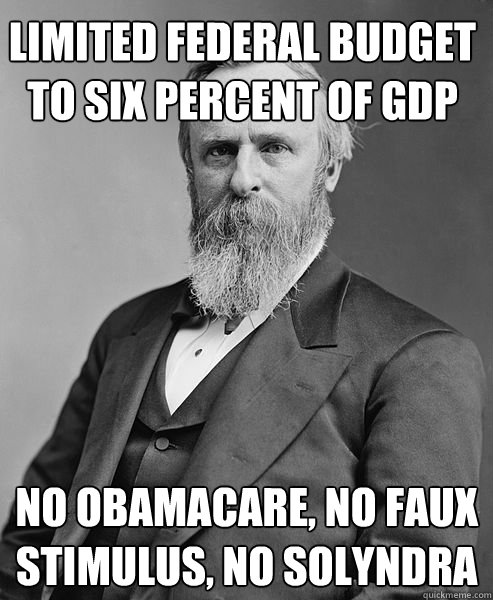
I wonder what the people would have said if Rutherford Hayes had spent 24.7% of GDP a year? You laughed at the thought of Rutherford on Mount Rushmore, but with the economic mess we have now I don’t there is much of a chance that you will end up on there EITHER UNLESS YOU START CUTTING SPENDING. Here is an excellent article by Dan Mitchell of the Cato Institute:

A Simple Choice: Barack Obama or Rutherford Hayes?

March 19, 2012 by Dan Mitchell

Other than my ongoing adulation for Ronald Reagan, occasional praise for Calvin Coolidge, and one post about John F. Kennedy, I don’t have many nice things to say about previous Presidents.

But I feel the need to rise to the defense of Rutherford B. Hayes, who was mocked recently by the current President. This Mark Steyn column is a deliciously vicious commentary on Obama’s speech, so no need for me to delve into the details.

Instead, I want to jump on the bandwagon and produce some posters comparing the 19th President and the 44th President (if you’re not aware, posters of Pres. Hayes with self-created captions have been all over the Internet).

You won’t be surprised to learn that I’m focused on the policy differences between Hayes and Obama.

Most important, Hayes largely was true to the Founding Fathers’ vision of a limited central government. Government spending averaged only about 6 percent of economic output during his tenure (probably less, the data are not very robust, so I took the worst-case numbers) and America was blessedly free of the income tax.

Obama, on the other hand, is repeating all of Bush’s mistakes and making government an even bigger burden, and then compounding his error by pursuing class warfare tax policy.

So which President would you prefer, Hayes or Obama?

_____________

Thank you so much for your time. I know how valuable it is. I also appreciate the fine family that you have and your commitment as a father and a husband.

Sincerely,

Everette Hatcher III, 13900 Cottontail Lane, Alexander, AR 72002, ph 501-920-5733, lowcostsqueegees@yahoo.com

The real truth about Obamacare can be seen on the www.thedailyhatch.org

Michael Cannon on Medicare and Healthcare

You want to know the real truth about Obamacare then check out these videos and articles linked below:

American people do not want Obamacare and the regulations that go with it

In this article below you will see that the American people do not want Obamacare but yet it is being crammed down their throats and all the regulations that go with that too. Sickening Regulation by Michael D. Tanner Michael Tanner is a senior fellow at the Cato Institute and author of Leviathan on the […]

Arkansas Times praises good results of Obamacare

Gerard Matthews wrote on March 21, 2012 in the Arkansas Times: Children cannot be denied coverage because of a pre-existing condition. Young people can stay on their parents’ health insurance plan until they are 26 years old. Preventive services, which will ultimately help control health care costs, have been added to some plans at no […]

Brummett is arguing over the chairs on the Titanic as Obamacare will surely bankrupt state

Michael Cannon on Medicare and Healthcare In his article, “Medicaid and the consequences,” Arkansas Democrat-Gazette, March 20, 2012, (paywall), Brummett admits, “Medicaid will break the bank of state government if we don’t do something.” However, he never gets around to saying that Obamacare is going to ruin the state financially. It will expand this failing […]

If the Democrats want to back Obamacare then let them go down with the ship

On March 19, 2012 Jason Tolbert pointed out that the Democrats in Little Rock were using Obama’s talking points concerning Obamacare, but it appears to me that they go down with the ship according to the mood in the country. Take a look at this fine article from the Cato Institute. In this article below […]

Setting Biden Straight on Obamacare’s Anti-Conscience Mandate

Setting Biden Straight on Obamacare’s Anti-Conscience Mandate Uploaded by HeritageFoundation on Mar 3, 2012 Vice President Biden didn’t get the story quite straight. As the Obama Administration reels from the backlash for Obamacare’s anti-conscience mandate that forces religious employers to provide coverage and pay for abortion-inducing drugs, Biden yesterday set out to convince America that […]

Obama’s affordable lightbulb

It seems that government was in control of the desert then we would have a shortage of sand as Milton Friedman used to quip. You Keep Using the Word ‘Affordable.’ I Do Not Think It Means What You Think It Means. Posted by Michael F. Cannon The federal government gave a $10 million “affordability” prize […]

Brummett misses the boat on Obamacare again

Uploaded by HarrysRetroArchive on Aug 7, 2010 The stooges join the “Women Haters” club and vow to have nothing to do with the fair sex. Larry marries a girl anyway and attempts to hide the fact from Moe and Curly as they take a train trip. Director: Archie Gottler Cast: Marjorie White, A.R. Haysel, Monte […]

Brantley is wrong about Republicans losing debate on Obamacare and conscience

Religious Liberty: Obamacare’s First Casualty Uploaded by HeritageFoundation on Feb 22, 2012 http://blog.heritage.org/2012/02/22/morning-bell-religious-liberty-under-attack/ | The controversy over the Obama Administration’s anti-conscience mandate and the fight for religious liberty only serves to highlight the inherent flaws in Obamacare. This conflict is a natural result of the centralization laid out under Obamacare and will only continue until […]

“War on Women?”

Religious Liberty: Obamacare’s First Casualty Uploaded by HeritageFoundation on Feb 22, 2012 http://blog.heritage.org/2012/02/22/morning-bell-religious-liberty-under-attack/ | The controversy over the Obama Administration’s anti-conscience mandate and the fight for religious liberty only serves to highlight the inherent flaws in Obamacare. This conflict is a natural result of the centralization laid out under Obamacare and will only continue until […]

Is anything “free?”: According to Obama there is

Somebody will pay. You can bet on that. Obama’s Political Prophylactic Posted by Roger Pilon “White House compromise still guarantees contraceptive coverage for women,” reads theWashington Post headline coming out of President Obama’s press conference this afternoon. Trying to tamp down the escalating political storm his administration created three weeks ago when it ruled that, under Obamacare, employers with […]

Single-Payer healthcare system work? (Free Market response, Part 2)

_____________________________________________________ I would like to respond the idea of a single payer healthcare system by quoting from David Hogberg’s article “Free Market Cure – The Myths of Single-Payer Health Care.” He notes: A single-payer health care system is one in which a single-entity — the government — collects almost all of the revenue for and pays almost all of […]


Open letter to President Obama (Part 97)

Michael Cannon on Medicare and Healthcare

President Obama c/o The White House
1600 Pennsylvania Avenue NW
Washington, DC 20500

Dear Mr. President,

I know that you receive 20,000 letters a day and that you actually read 10 of them every day. I really do respect you for trying to get a pulse on what is going on out here.

Arkansas is really in danger in the next few years of going bankrupt if Obamacare in put into effect. It will expand this failing welfare program by putting over half of the reduction in uninsured into the Medicaid program that is already broke. SMOKE AND MIRRORS IS ALL WE ARE GOING TO GET FROM OBAMACARE. Instead, it seems that we could do at that point would be to  move around the chairs on the financial Titanic we will have here in Arkansas!!!!!

Below is a study done by the Heritage Foundation on the future impact of Obamacare on states budgets.

Obamacare and Medicaid: Expanding a Broken Entitlement and Busting State Budgets

By
January 19, 2011

Roughly half of the anticipated gains in insurance coverage from the Patient Protection and Affordable Care Act (PPACA)[1] are achieved through a massive expansion of Medicaid, the joint federal–state health insurance program for the poor. The Medicaid program, with its soaring price tag and dubious level of care for recipients, is in serious need of reform, not expansion. Increasing enrollment in this program by a third is a major flaw of the new health care law.[2]

Summary

Section 2001(a) of PPACA requires states to increase Medicaid eligibility to cover all Americans below 138 percent of the federal poverty level (FPL) beginning January 1, 2014.[3] At that time, the FPL will be about $33,000 for a family of four, excluding the value of any welfare benefits. Section 1201 of the reconciliation bill (H.R. 4872) specifies that the federal government will pick up 100 percent of the cost of providing coverage for the expansion population (those who qualify under the new requirements but were ineligible under the previous state eligibility criteria) between 2014 and 2016. The federal reimbursement for the newly eligible will gradually decline thereafter until 2020, when the federal share of the cost will stay at 90 percent.

States will not receive such a high reimbursement for individuals who apply for Medicaid and were eligible under the previous state eligibility criteria in place when PPACA was signed into law.[4] States will be reimbursed for these individuals at their traditional federal reimbursement, which ranges from 50 percent in the wealthiest states to nearly 75 percent in the poorest states. Nationally, about 12 million individuals are eligible for Medicaid but are not yet enrolled.[5] The state cost of the Medicaid expansion will largely be affected by how many of these individuals sign up for the program, which will probably be increased because of the publicity likely to surround the penalties in the law for not maintaining health insurance.

One provision of PPACA, the maintenance of effort (MOE) requirement in Section 2001(b), impacts states immediately. Under PPACA’s MOE, a state would lose all federal Medicaid funding if it makes eligibility more restrictive than the standards in effect for the state’s program at the time the law was enacted.[6] This essentially freezes the state’s eligibility requirements regardless of the impact on its bottom line.

Not only are states forced to keep eligibility at that level, but they are being forced to raise payments to primary care physicians. Section 1202 of H.R. 4872 requires that states increase Medicaid reimbursement rates for primary care physicians (PCPs) to the same level as the applicable Medicare payment rates for 2013 and 2014. The legislation specifies that the federal government will pay this entire cost—temporarily. This requirement, along with the federal funding for it, expires on January 1, 2015. At that time, states will have to either maintain the physician payment rate themselves or make drastic cuts.

Impact

Instead of reforming Medicaid—by targeting taxpayer dollars to populations truly deserving of public assistance and pursuing fundamental reform of the basic structure—PPACA doubles down on the program’s existing flaws. This will lead to a substantial increase in cost to taxpayers and a dramatic swelling in the number of individuals dependent on the government paying their health care bills.

Increases in Taxes and Pressure on Other Areas of Public Spending. The Congressional Budget Office (CBO) and the Centers for Medicare and Medicaid Services (CMS) project that PPACA will increase federal spending on Medicaid by between $75 billion and $100 billion annually.[7] This dramatic increase is irresponsible given current annual federal budget deficits well in excess of $1 trillion. Further spending on Medicaid will necessitate an increase in federal taxes or cuts to other public programs. Given the evidence of poor health outcomes for Medicaid recipients,[8] the expansion likely fails a cost–benefit analysis.

Massive Increase in Government Dependence and Crowding Out of Private Coverage. CBO projects that PPACA will increase national enrollment in Medicaid by 16 million individuals in 2019, while CMS projects 20 million individuals.[9] The Heritage Foundation estimates that the growth in Medicaid caseloads will range from 9 percent in Massachusetts to 66 percent in Nevada.[10] Recent research by economists Jonathan Gruber and Kosali Simon finds that “the number of privately insured falls by about 60 percent as the number of publicly insured rises.”[11] This means several million individuals below the new income threshold who currently have private coverage will be swept into Medicaid when PPACA takes effect.

Worsening State Budget Problems and Limits on State Options. States are already required to cover children and pregnant women below 133 percent of the FPL, but they have had flexibility to cover or not cover additional populations. That flexibility vanished with the passage of PPACA. In the short term, states cannot reduce eligibility criteria at all in order to deal with budget crises, and after 2014 state Medicaid programs must cover everyone below 138 percent of the FPL.[12] Most states will be forced to either cut benefits or cut provider payment rates. This is a significant problem in many states that already have low payment rates, particularly for PCPs. Setting payment rates lower will further reduce Medicaid patients’ access to providers and will increase use of emergency rooms for basic care needs.[13]

Creation of a Medicaid “Doc Fix.” The federal requirement that states boost Medicaid PCP rates to Medicare levels in 2013 and 2014 seems like a win for states, since federal taxpayers will finance it. However, this requirement will actually create problems for states. The increase in Medicaid payment rates for PCPs may cause other providers to lobby government to increase their rates as well. This would increase the cost to the state. When the federal funds go away, states could reduce payment rates again, but both physicians and their patients are likely to lobby against such a move. The state also has to be concerned with too many doctors leaving the Medicaid program.

Bureaucratic Nightmare and Intergovernmental Tension. The interaction of the Medicaid expansion and the creation of federal subsidies to purchase health insurance on the new state exchanges will create headaches and tensions for policymakers at the federal and state levels. Individuals below 138 percent of the FPL will be enrolled in state Medicaid programs, while many individuals between 138 percent and 400 percent of the FPL will be eligible for subsidies. There will be a lag between income on a household’s W-2 (for the prior year) and current income for eligibility purposes. It also invites a conflict of interest between state policymakers—who are incentivized for individuals to receive subsidies (so the federal government pays the full cost)—and federal policymakers, who will prefer states to share the costs through Medicaid.

A New Direction

Instead of expanding the nation’s fastest-growing entitlement, policies should move toward a fundamental restructuring of the Medicaid program to ensure fiscal sustainability, promote a patient-centered financing model, mainstream families into private coverage, and maintain a limited safety net for those individuals truly in need.

The federal financing structure, which encourages states to overspend, needs to be replaced with a structure that is more fiscally sustainable. In the short term, federal policymakers should, at the very least, allow states greater flexibility with eligibility and benefits so states can better manage their programs, control their costs, and balance their priorities.

Brian Blase is Policy Analyst in the Center for Health Policy Studies at The Heritage Foundation and is a Doctoral Candidate in Economics at George Mason University.

_____________

Thank you so much for your time. I know how valuable it is. I also appreciate the fine family that you have and your commitment as a father and a husband.

Sincerely,

Everette Hatcher III, 13900 Cottontail Lane, Alexander, AR 72002, ph 501-920-5733, lowcostsqueegees@yahoo.com