This mini-documentary from the Center for Freedom and Prosperity Foundation explains that “third-party payer” is the main problem with America’s health care system. This is why undoing Obamacare, while desirable, is just a small first step if we want to reduce costs and boost efficiency
__________
John Brummett in his article “Bad state of mind,” Arkansas Democrat Gazette, July 17, 2012 asserted:
It is self-serving and exciting for us to take three years of full federal funding, and 90 percent federal funding after that, to put a quarter-million more of our desperately poor people on Medicaid.
Brummett disagreed with State Senator Jason Raport that we should not choose to expand Medicaid (as part of Obamacare) and he also takes exception to State Representative Charlie Collins’ view that we should cut the state income tax income tax in order to cause economic growth.
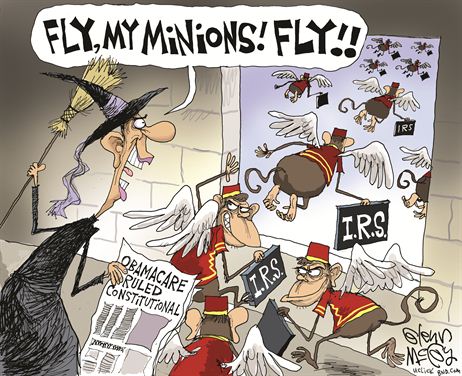
Technically, the Supreme Court decision didn’t give the IRS any more power than it already had been given under the legislation, but the cartoon isn’t claiming otherwise, so it gets points for being accurate and (tragically) amusing.
Next we have a cartoon about Chief Justice Roberts and his new BFF status with Obama. I almost didn’t include it because Roberts deserves nothing but scorn, but I don’t want my feelings to interfere.
Speaking of Roberts, this next cartoon is accurate in many ways.
It’s designed to blame Bush for appointing a Justice who would put establishment approval before fealty to the Constitution, but I think it’s also true because Obama might not have won – and the Democrats certainly wouldn’t have picked up so many seats in the House and Senate – if Bush had not imposed so much statist legislation and weakened the economy, thus paving the way for big Democrat victories in 2006 and 2008.
And here’s a cartoon making the obvious point that Obama prevaricated.
I’ve saved my favorite for last, showing how the Supreme Court botched its responsibility.
In this case, I also would amend this gem by replacing “economy” with “Constitution.”
I hope all these cartoons make you feel a bit better. If not, you can look at some R-rated Obamacare humor here, here, and here. And, just for the heck of it, here’s a PG-rated Obamacare joke to end on a more subdued note.
Obama at campaign event in Roanoke VA 7.13.2012: “If you were successful, somebody along the line gave you some help. There was a great teacher somewhere in your life. Somebody helped to create this unbelievable American system that we have that allowed you to thrive. Somebody invested in roads and bridges. If you’ve got a business — you didn’t build that. Somebody else made that happen.”
I got a simple question. Did Fred Smith come up with the idea for Federal Express and then spend every cent of his own money and gamble to see if his idea was workable or did the government take those risks?
Did you know that Fed Ex started in Little Rock? Entrepreneurs like Fred Smith need to be encouraged, not discouraged by government. This comment by President Obama actually insults them.
Here is a funny Fed Ex Commercial from the 1980’s.
A few more funny commercials from Fed Ex:
I love the movie Castaway:
On July 3, 1981, I was in Prague, Czechoslovakia in the middle of a 20 country student tour. Our group of 48 American students had the opportunity to speak to a Communist government official for over an hour. We asked him several questions. My questions were quite direct and I will share some of them at a later time.
However, I did want to share one question that I asked. I told the official about an entrepreneur from Memphis named Fred Smith. Back in the early 1970’s we heard about how Smith had this crazy idea about delivering overnight packages from LA to San Francisco via Memphis. Sounded like it would not work, but Smith was able to invest all his money and eventually it paid off. His idea was successful.
I asked the simple question: Could something like this happen here in Communist Czechoslovakia? He responded, “No. That is because no private citizen is allowed to own that much capital. The government must do things like that.”
There was no chance for entrepreneurs to exist in communist countries. I was simply pointing out that economic freedom allows an environment for entrepreneurs. Why would someone put the time and energy in putting together a grand plan like Fed Ex when the benefit and reward would just go to a communist government? Entrepreneurship should be encouraged, but many times today in the USA we find that our lawmakers pass laws that discourage entrepreneurs. Now our President has insulted these same entrepreneurs!!!!
That sound you hear is silence—as millions of small business owners and entrepreneurs were left speechless this weekend from President Obama’s latest insult.
The slap in the face to hard-working Americans conveyed Obama’s belief that it takes a village—a heavily subsidized village—to create that venture you’re profiting from:
Obama pushed his policy goals of infrastructure (aka stimulus) spending and “government research” as part of a collectivist utopia “doing things together.” It’s simply stunning that he would tell Americans, “If you’ve got a business—you didn’t build that.”
After all, could individuals be resourceful and hard-working enough to create whole new enterprises? Obama said:
Look, if you’ve been successful, you didn’t get there on your own. You didn’t get there on your own. I’m always struck by people who think, well, it must be because I was just so smart.
It is this view of successful businesses—essentially, “You owe us”—that drives Obama’s continued attacks on the country’s job creators in the form of tax hikes and regulations.
It’s a tough time to be a business owner and entrepreneur in America. Surveys show small business owners are struggling, and they are not expanding or hiring because of tax and regulatory uncertainty. Federal agencies, from Health and Human Services to the Environmental Protection Agency, are regulating them to death. And just last week, President Obama announced his latest economic plan was to hit job creators with a tax increase.
The President’s plan to raise taxes on earnings above $200,000 ($250,000 for joint filers) would hit 1.2 million small-business employers who pay their taxes through the individual income tax, known as flow-through businesses. These businesses that are creating jobs earn almost all—91 percent—of the income earned by flow-through employer-businesses.
The new tax increase could be equivalent to one employee per small business. According to calculations by The Heritage Foundation’s Center for Data Analysis, the average American with $250,000 or more in income can expect an average $24,888 tax increase next year under Obama’s proposed policies. That $24,888 figure is often enough for a salary. So the President could be putting about 1.2 million jobs—perhaps even more—at risk with this tax hike.
Hitting private job creators while advocating more stimulus spending and government jobs. That’s the President’s plan for the economy.
Meanwhile, businesses large and small suffer from the highest corporate tax rate in the developed world. This has long made the U.S. an uncompetitive place for new investment and has driven new jobs to other, more competitive nations, meaning fewer jobs and lower wages for all Americans.
If the U.S. is to see economic recovery, we must encourage entrepreneurship. Stopping the biggest tax increase in American history, Taxmageddon, would be a good place to start. It’s a $494 billion tax hike set to hit on January 1, when a number of tax policies expire and just a few of Obamacare’s new taxes kick in. Businesses are already hesitating on hiring decisions because of the impending effects of these taxes.
Democratic leaders are demanding tax hikes, however, and threatening to allow Taxmageddon for the sake of politics—despite warnings that it would send the U.S. back into recession.
Real recovery will take even more than saving job creators from punishing taxes and regulations. It requires leadership that appreciates and values the long hours that America’s business builders put in and the personal sacrifices they make for their dreams. It will take leaders who say, “If you’ve got a business—you built that. And we want more of that in America.”
Politicians and interest groups claim higher taxes are necessary because it would be impossible to cut spending by enough to get rid of red ink. This Center for Freedom and Prosperity video shows that these assertions are nonsense. The budget can be balanced very quickly by simply limiting the annual growth of federal spending.
____________________
President Obama c/o The White House
1600 Pennsylvania Avenue NW
Washington, DC 20500
People are being told that radical spending cuts are a must if we are to balance the budget, but maybe that is not true. Why don’t you favor holding the line on spending so we can get to a balanced budget? The Republicans are going to beat you up on this issue during the election.
Even though I favor radical reductions in the burden of government, I’ve made the point that good fiscal policy merely requires that government spending grow slower than the private sector – what I call Mitchell’s Golden Rule.
And if lawmakers simply cap the growth of spending, so that it grows by about 2 percent annually, the budget deficit disappears in a decade.
It’s even better to impose more restraint, of course, which is why I’ve said favorable things about Senator Rand Paul’s plan.
There’s also a “Penny Plan” that would reduce primary spending (non-interest spending) by 1 percent each year. As James Carter and Jason Fichtner explain, this degree of fiscal restraint would reduce the burden of government spending to about 18 percent of economic output.
Any viable solution must cut spending growth. Sen. Mike Enzi of Wyoming and Rep. Connie Mack of Florida have introduced legislation in their respective chambers to do just that. Their “Penny Plan” – recently updated to reflect the latest budget developments – calls for reducing federal spending (excluding interest payments) 1 percent a year for five years, balancing the budget in the fifth year. To maintain balance once it’s reached, Mr. Enzi and Mr. Mack would cap federal spending at 18 percent of GDP. By no small coincidence, 18 percent of GDP roughly matches the U.S. long-run average level of taxation since World War II. Is it realistic to think Congress could limit federal spending to 18 percent of GDP? Actually, there is precedent. Federal spending fell as a share of GDP for nine consecutive years before bottoming out at 18.2 percent of GDP in fiscal 2000 and 2001. The Penny Plan would return federal spending, expressed as a share of GDP, near the level achieved during the last two years of the Clinton administration.
The various interest groups that infest Washington would complain about this degree of spending discipline, but Carter and Fichtner make a good point when they say that this simply means the same size government – as a share of GDP – that we had when Bill Clinton left office.
I realize I’m getting old and my memory may not be what it used to be, but I don’t recall people starving in the streets and grannies being ejected from hospitals during the Clinton years. Am I missing something?
__________________
Thank you so much for your time. I know how valuable it is. I also appreciate the fine family that you have and your commitment as a father and a husband.
Sincerely,
Everette Hatcher III, 13900 Cottontail Lane, Alexander, AR 72002, ph 501-920-5733, lowcostsqueegees@yahoo.com
Sen. Mike Lee (R-UT) came to Washington as the a tea-party conservative with the goal of fixing the economy, addressing the debt crisis and curbing the growth of the federal government. It’s an uphill battle for the youngest member of the U.S. Senate, but one he’s prepared to fight.
In the days following Obama’s speech to Congress, Lee sharply criticized the president’s ideas for raising taxes and hiking spending to spur economic growth. As he explained to us, “We need to not be doing more of the same things that made the problem worse. We need to refocus on getting the federal government out of the way rather than making the federal government part of the problem.”
Milton Friedman served as economic advisor for two American Presidents – Richard Nixon and Ronald Reagan. Although Friedman was inevitably drawn into the national political spotlight, he never held public office.
Milton Friedman’s Free to Choose (1980), episode 1 – Power of the Market. part 1
President Obama c/o The White House
1600 Pennsylvania Avenue NW
Washington, DC 20500
Today you are telling us that we must raise taxes in order for us to prosper and grow our economy. I have heard that before and it has never worked!!!!
Liberals like Ernie Dumas and Max Brantley who write for the Arkansas Times have always bragged on the 7% state income tax that Dale Bumpers raised in 1971 and how Arkansas has grown economically since then. However, the facts are quite different.
Until Gov. Dale Bumpers raised income-tax rates and other taxes in 1971, Arkansas had by far the lowest per-capita state and local taxes in the United States. Afterward, we were still 50th but within shouting distance of 49th.
(June 2006) Democratic Gov. Dale Bumpers and the General Assembly raised Arkansas’ top income tax rate to “broaden the tax base” in 1971(1). Yet Arkansas’ per capita income, expressed as a percentage of the U.S. total, has barely improved, moving from 71 (1971) to 77.7 percent (2005) over the 34-year period, according to data from the U.S. Bureau of Economic Analysis. The 1971 income tax increase reversed a decades-long strong growth trend and left Arkansas with the highest income tax rate among bordering states (Mississippi, Missouri, Louisiana, Oklahoma, Tennessee and Texas).
Income Stagnation: The 1930s
One has to turn to the 1930s-the decade of the Great Depression-to find weaker income growth than in recent years.
Arkansas per capita personal income was 44 percent of the U.S. in 1929, the first year data was compiled in the BEA time series. The Great Depression started that year, and by the time it ended in 1933 Arkansas per capita income had fallen to 41 percent of the U.S. By decade’s end (1939) it had returned to 44 percent.
Growth Decades: The 1940s, 1950s & 1960s Arkansas per capita income increased as a percentage of the U.S. in the next three decades. In 1941, at the onset of World War II, Arkansas per capita income was 47 percent of the U.S. It was 59 percent at war’s end in 1945 and again in 1949. It was 56 percent in 1950, 62 percent a decade later in 1960, and 68 percent in 1969. If this growth rate had continued Arkansas would have exceeded 100 percent of the U.S. average in the current decade (2000-2009).
To summarize, Arkansas per capita income increased from 44 to 71 percent of the U.S. total between 1939 and 1971.
Anemic Income Growth (1971-2005) The trend in recent decades is anemic growth in Arkansas per capita personal income. Fiscal policy changes effect economic behavior with a time lag. Arkansas per capita income was 71 percent of the U.S. in 1971 and 76 percent in 1973. Income growth stagnated for the rest of the decade, reaching 77 percent of the U.S. in 1979. It fell to 75 percent in 1989, and was 76 percent in 1999. Today, Arkansas per capita income, at 77.7 percent of the U.S., is barely above its high point of the 1970s.
_____________
We can look at other states and see what their experience is too.
Some of the best evidence about high tax rates vs. low tax rates comes from inside America. Art Laffer (yes, that Art Laffer) and Steve Moore have a great column in today’s Wall Street Journal. It’s sort of Reaganomics vs. Obamanomics, looking at evidence from the states.
Barack Obama is asking Americans to gamble that the U.S. economy can be taxed into prosperity. …Mr. Obama needs a refresher course on the 1920s, 1960s, 1980s and even the 1990s, when government spending and taxes fell and employment and incomes grew rapidly. But if the president wants to see fresher evidence of how taxes matter, he can look to what’s happening in the 50 states. In our new report “Rich States, Poor States,” prepared for the American Legislative Exchange Council, we compare the economic performance of states with no income tax to that of states with high rates. It’s like comparing Hong Kong with Greece… Every year for the past 40, the states without income taxes had faster output growth (measured on a decadal basis) than the states with the highest income taxes. In 1980, for example, there were 10 zero-income-tax states. Over the decade leading up to 1980, those states grew 32.3 percentage points faster than the 10 states with the highest tax rates. Job growth was also much higher in the zero-tax states. The states with the nine highest income tax rates had no net job growth at all, and seven of those nine managed to lose jobs.
Tax rates also lead people to “vote with their feet.” Laffer and Moore look at migration patterns.
Over the past decade, states without an income tax have seen 58% higher population growth than the national average, and more than double the growth of states with the highest income tax rates. …Illinois, Oregon and California are state practitioners of Obamanomics. All have passed soak-the-rich laws like the Buffett Rule (plus economically harmful regulations, like California’s cap-and-trade scheme), and all face big deficits because their economies continue to sink. Illinois has lost one resident every 10 minutes since hiking tax rates in January. California has 10.9% unemployment, having lost 4.8% of its jobs over the past decade. …Every time California, Illinois or New York raises taxes on millionaires, Florida, Texas and Tennessee see an influx of rich people who buy homes, start businesses and shop in the local economy.
Competition among the states is leading some states to make further improvements. Some are even trying to get rid of their income taxes.
Republican governors in Florida, Georgia, Idaho, North Dakota, South Carolina, Ohio, Tennessee, Wisconsin and even Michigan and New Jersey are cutting taxes to lure new businesses and jobs. Asked why he wants to reduce the cost of doing business in Wisconsin, Gov. Scott Walker replies: “I’ve never seen a store get more customers by raising its prices, but I’ve seen customers knock down the doors when they cut prices.” Georgia, Kansas, Missouri and Oklahoma are now racing to become America’s 10th state without an income tax.
I like the quote from Governor Walker. He seems to know what he’s talking about, so it will be interesting to see whether he survives the upcoming recall election. I guess it depends whether voters understand that big government and high tax rates is a recipe for continued decline.
Some states, such as Illinois and California, are filled with voters who refuse to recognize reality. Think of them as the Greece and Spain of America, perhaps because the number of tax-consumers is greater than the number of tax-producers.
Thank you so much for your time. I know how valuable it is. I also appreciate the fine family that you have and your commitment as a father and a husband.
Sincerely,
Everette Hatcher III, 13900 Cottontail Lane, Alexander, AR 72002, ph 501-920-5733, lowcostsqueegees@yahoo.com
_____________
Take a look at all the Milton Friedman clips that I have posted today. These liberals I mentioned above have truly forgotten how powerful the market is if not interferred with by the government.
Milton Friedman’s Free to Choose (1980), episode 1 – Power of the Market. part 2
Milton Friedman served as economic advisor for two American Presidents – Richard Nixon and Ronald Reagan. Although Friedman was inevitably drawn into the national political spotlight, he never held public office. Milton Friedman’s Free to Choose (1980), episode 1 – Power of the Market. part 1 Mike Huckabee recently moved to Florida? Why? The answer […]
What are our choices here in the USA with our huge budget deficit? We could head to Greece or cut our budget until we have it balanced. You would never even consider getting close to a balanced budget while Paul would put in the spending cuts that we need to get the job done.
Senator Paul and his colleagues are highlighting the fact that the plan generates a balanced budget in just five years. That’s a good outcome, but it should be a secondary selling point. All the good results in the plan – including the reduction in red ink and the flat tax – are made possible because the overall burden of federal spending is lowered.
Not surprising, one of the columnists at the Washington Post has a different perspective. In his hyperventilating column today, Dana Milbank says that Senator’s Paul’s proposal is “monstrous” and “nasty” for reining in the federal government.
The tea party darling’s plan would, among other things, cut the average Social Security recipient’s benefits by nearly 40 percent, reduce defense spending by nearly $100 billion below a level the Pentagon calls “devastating,” and end the current Medicare program in two years — even for current recipients, according to the Senate Budget Committee staff. It would eliminate the education, energy, housing and commerce departments, decimate homeland security, eviscerate programs for the poor, and give the wealthy a bonanza by reducing tax rates to 17 percent and eliminating taxes on capital gains and dividends. It is, all in all, quite a nasty piece of work.
Setting aside some of the inaccuracies (Social Security benefits would rise, for instance, but not as fast as they would under current law), I have two reactions to Milbank’s screed.
2. More amusingly, what does he think about the fact that the Senate voted against Obama’s tax-and-spend budget by a stunning margin of 99-0? That’s even worse than the 97-0 vote against the budget Obama proposed last year. The 16 votes for Rand Paul’s budget may not sound like much, but 16 is a lot more than zero.
Setting aside the snarky comments, all that Rand Paul is proposing is to limit the growth of government so that the federal budget grows by an average of about 2 percent annually.
Thank you so much for your time. I know how valuable it is. I also appreciate the fine family that you have and your commitment as a father and a husband.
Sincerely,
Everette Hatcher III, 13900 Cottontail Lane, Alexander, AR 72002, ph 501-920-5733, lowcostsqueegees@yahoo.com
I have been writing President Obama letters and have not received a personal response yet. (He reads 10 letters a day personally and responds to each of them.) However, I did receive a form letter in the form of an email on June 22, 2012. I don’t know which letter of mine generated this response so I have linked several of the letters I sent to him below with the email that I received. I think it could have been this one 84.4 but maybe not. Most likely it was this one below:
http://blog.heritage.org/2012/02/22/morning-bell-religious-liberty-under-attack/ | The controversy over the Obama Administration’s anti-conscience mandate and the fight for religious liberty only serves to highlight the inherent flaws in Obamacare. This conflict is a natural result of the centralization laid out under Obamacare and will only continue until the law is repealed in full.
___________________________
President Obama c/o The White House
1600 Pennsylvania Avenue NW
Washington, DC 20500
Congress recognizes more each day that the Patient Protection and Affordable Care Act, known widely as the Obamacare statute, interferes unconstitutionally with the liberty of Americans. From the Obamacare individual mandate to buy health insurance that awaits the action of the Supreme Court, to the Obamacare mandate that many religious hospitals, charities, and schools abandon the tenets of their faiths and include in their group health insurance for employees coverage of abortion-inducing drugs, contraception, and sterilization, Obamacare assaults the Constitution and American freedom.
Fortunately, Members of Congress and the American people are waking up to the need to repeal the Obamacare statute and move instead to market-based, patient-centered health care. Action in Congress this week to defend religious liberty continues to highlight the need to repeal the Obamacare statute.
The Obama Administration continues to trample on religious liberty by applying the Obamacare statute to mandate that many religious institutions’ group health insurance for employees cover abortion-inducing drugs, contraceptives, and sterilization. The Departments of Health and Human Services (HHS), the Treasury, and Labor published on February 15, 2012 final regulations that compel many religious hospitals, charities, and schools to abandon the tenets of their faiths and comply with that mandate beginning April 16, 2012, or pay fines for maintaining their religious faiths. The final regulations did not include any changes to respect religious liberty that President Obama had led people to expect.
Although Secretary of HHS Sebelius has said that, for one year, she will simply not perform her duty to enforce the final regulations, her decision not to enforce the regulations temporarily as a matter of grace does not eliminate the mandate’s interference with religious liberty. Indeed, her pronouncements reflect a failure to understand that religious liberty in America is an unalienable right with which our Creator has endowed us and a right that our Constitution’s First Amendment protects. Our religious liberty does not arise from the discretion of the Federal Government to do Americans a “favor” and tolerate their religions. Because President Obama and his agents continue to attack the constitutionally-guaranteed right of these religious institutions to free exercise of religion, Members of Congress are stepping forward to protect the Constitution.
Senator Roy Blunt (R-Missouri) has fought for religious liberty against the Obamacare assault. He plans to offer this week Senate Amendment No. 1520 to S. 1813, the highway authorization bill, to protect the right to religious liberty against the Obamacare mandate. The Blunt Amendment notes that, until the enactment of the Obamacare statute in 2010, “the Federal Government has not sought to impose specific coverage or care requirements that infringe on the rights of conscience . . . .” The Blunt Amendment would override the Obamacare mandate that religious institutions provide coverage for abortion-inducing drugs, contraceptives, and sterilization when it is contrary to their faiths, allowing them to keep their faiths and provide health care coverage for their employees.
Senate Majority Leader Harry Reid (D-Nevada) has announced his intention to keep the Senate from voting on the Blunt Amendment by making a motion to “table” — that is, to refuse to consider — the Blunt Amendment. Senator Reid said he considered the Blunt Amendment that protects religious liberty to be a “distracting proposal.” Senator Reid may treat legislation to protect religious liberty as a “distraction,” but hundreds of millions of Americans hold their right to free exercise of religion to be a precious freedom.
President Obama and Senator Reid can man the ramparts of Castle Obamacare against the people for only so long. The American people want their liberty and they shall have it. The Obamacare statute must go.
__________-
Thank you so much for your time. I know how valuable it is. I also appreciate the fine family that you have and your commitment as a father and a husband.
Sincerely,
Everette Hatcher III, 13900 Cottontail Lane, Alexander, AR 72002, ph 501-920-5733, lowcostsqueegees@yahoo.com
___________
Here is the response I got from the White House on June 22, 2012:
June 22, 2012
Dear Friend:
Thank you for writing. President Obama has heard from many Americans about the Administration’s decision to ensure women have access to preventive care with no co-pays or deductibles, including contraceptive services. The President is committed to both preserving religious liberty and protecting women’s health. He appreciates your perspective.
The Affordable Care Act requires insurance companies to cover additional preventive services for women without charging a co-pay or deductible beginning August 1, 2012. These preventive services include well women visits, domestic violence screening, and contraception. The independent Institute of Medicine of the National Academy of Science recommended coverage of these procedures to the Secretary of Health and Human Services. The vast majority of women have relied on contraception at some point in their lives, but too many have struggled to afford it. The scientists and experts at the Institute of Medicine have documented significant health benefits for women that come from using contraception.
Get the facts about the Obama Administration’s plans to implement this policy.
The President understands the importance of the work faith-based organizations do and continues to take the ideas and concerns of religious groups seriously. On February 10, 2012, President Obama announced his Administration will implement this policy in a manner that fully accommodates religious liberty while protecting the health of women. After a transition, if a woman’s employer is a religious non-profit organization, such as a charity or hospital, and has a religious objection to providing contraceptive services as part of its health plan, her insurance company—not the employer—will be required to reach out and provide contraceptive care free of charge. And, consistent with previously existing conscience clauses, no religious doctor will have to prescribe these services. We will ensure religious liberty remains protected, and that women will receive the critical preventive services guaranteed by the law.
Find out more about how the Affordable Care Act impacts you.
Learn about the President’s efforts to provide affordable health care to all Americans.
Thank you, again, for writing.
Sincerely,
The White House
You are receiving this one-time email because you contacted the White House about a particular issue.
If you are interested in receiving regular updates from President Obama and senior White House officials, please visit our subscription page to sign up www.WhiteHouse.gov/get-email-updates.
The White House • 1600 Pennsylvania Avenue, N.W. • Washington, D.C. 20500 • 202-456-1111
Religious Liberty: Obamacare’s First Casualty Uploaded by HeritageFoundation on Feb 22, 2012 http://blog.heritage.org/2012/02/22/morning-bell-religious-liberty-under-attack/ | The controversy over the Obama Administration’s anti-conscience mandate and the fight for religious liberty only serves to highlight the inherent flaws in Obamacare. This conflict is a natural result of the centralization laid out under Obamacare and will only continue until […]
I have been writing President Obama letters and have not received a personal response yet. (He reads 10 letters a day personally and responds to each of them.) However, I did receive a form letter in the form of an email on June 15, 2012. I don’t know which letter of mine generated this response so I have […]
President Obama c/o The White House 1600 Pennsylvania Avenue NW Washington, DC 20500 Dear Mr. President, I know that you receive 20,000 letters a day and that you actually read 10 of them every day. I really do respect you for trying to get a pulse on what is going on out here. In your […]
An economics professor at a local college made a statement that he had never failed a single student before, but had recently failed an entire class. That class had insisted that Obama’s socialism worked and that no one would be poor and no one would be rich, a great equalizer.
The professor then said, “OK, we will have an experiment in this class on Obama’s plan”. All grades will be averaged and everyone will receive the same grade so no one will fail and no one will receive an A…. (substituting grades for dollars – something closer to home and more readily understood by all).
After the first test, the grades were averaged and everyone got a B. The students who studied hard were upset and the students who studied little were happy. As the second test rolled around, the students who studied little had studied even less and the ones who studied hard decided they wanted a free ride too so they studied little.
The second test average was a D! No one was happy.
When the 3rd test rolled around, the average was an F.
As the tests proceeded, the scores never increased as bickering, blame and name-calling all resulted in hard feelings and no one would study for the benefit of anyone else.
To their great surprise, ALL FAILED and the professor told them that socialism would also ultimately fail because when the reward is great, the effort to succeed is great, but when government takes all the reward away, no one will try or want to succeed.
It could not be any simpler than that.
There are five morals to this story:
1. You cannot legislate the poor into prosperity by legislating the wealthy out of prosperity.
2. What one person receives without working for, another person must work for without receiving.
3. The government cannot give to anybody anything that the government does not first take from somebody else.
4. You cannot multiply wealth by dividing it!
5. When half of the people get the idea that they do not have to work because the other half is going to take care of them, and when the other half gets the idea that it does no good to work because somebody else is going to get what they work for, that is the beginning of the end of any nation.
Thank you so much for your time. I know how valuable it is. I also appreciate the fine family that you have and your commitment as a father and a husband.
Sincerely,
Everette Hatcher III, 13900 Cottontail Lane, Alexander, AR 72002, ph 501-920-5733, lowcostsqueegees@yahoo.com
In order to balance the budget we must make deep cuts. Take a look at the study refers to below by Dan Mitchell of the Cato Institute in his fine article on the French mess. Raising taxes has not worked in the thirty countries studied. As President it is your job to make sure we don’t continue to head down this pass of trying to raise taxes on the job creators.
Though, to be fair, France hasn’t gotten to the point where it’s being bailed out (it’s probably just a matter of time).
If you want some good analysis of the situation in Europe, Veronique de Rugy of the Mercatus Center hits the nail on the head in her column in today’s Washington Examiner.
France has yet to cut spending. In fact, to the extent that the French are frustrated with “budget cuts,” it’s only because the increase in future spending won’t be as large as they had planned. The same can be said about the United Kingdom. Spain, Italy and Greece have had no choice to cut some spending. However, in the case of these particular countries, the cuts were implemented alongside large tax increases. …This approach to austerity, also known in the United States as the “balanced approach,” has unfortunately proven a recipe for disaster. In a 2009 paper, Harvard University’s Alberto Alesina and Silvia Ardagna looked at 107 attempts to reduce the ratio of debt to gross domestic product over 30 years in countries in the Organisation for Economic Co-operation and Development. They found fiscal adjustments consisting of both tax increases and spending cuts generally failed to stabilize the debt and were also more likely to cause economic contractions. On the other hand, successful austerity packages resulted from making spending cuts without tax increases. They also found this form of austerity is more likely associated with economic expansion rather than with recession. …While the debate over austerity continues, the evidence seems to point to the conclusion that austerity can be successful, if it isn’t modeled after the “balanced approach.” It’s a lesson for the French and other European countries, as well as for American lawmakers who often seem tempted by the lure of closing budget gaps with higher taxes.
There are obvious lessons from Europe for the United States. If politicians don’t reform entitlement programs, we’re doomed to have our own fiscal crisis at some point in the not-too-distant future.
Only there won’t be anybody there to bail us out.
_____________
Thank you so much for your time. I know how valuable it is. I also appreciate the fine family that you have and your commitment as a father and a husband.
Sincerely,
Everette Hatcher III, 13900 Cottontail Lane, Alexander, AR 72002, ph 501-920-5733, lowcostsqueegees@yahoo.com
If our country is the grow the economy and get our budget balanced it will not be by raising taxes!!! The recipe for success was followed by Ronald Reagan in the 1980’s when he cut taxes and limited spending. As far as limiting spending goes only Bill Clinton (with his Republican Congress) were ability to control the growth of government better than Reagan.
I had the pleasure of hearing Arthur Laffer speak in 1981 and he predicted all the economic growth that we would see because of the Reagan tax cuts and he was right. Unfortunately in California today they have forgotten all of those lessons!!!
President Obama’s fiscal policy is a dismal mixture. On spending, he wants a European-style welfare state. On taxes, he is fixated on class-warfare tax policy.
If we want to know the consequences of that approach, we can look at the ongoing collapse of Greece. Or, if we don’t like overseas examples, we can look at California.
California Controller John Chiang reported last week that April tax collections were a gigantic 20.2%, or $2.44 billion, below 2012-13 budget projections. …Among the biggest surprises is a 21.5% or nearly $2 billion decline in personal income tax payments from what Governor Jerry Brown had anticipated. This reinforces the point that when states rely too heavily on the top 1% of taxpayers to pay the bills, fiscal policy is a roller coaster ride. California is suffering this tax drought even as most other states enjoy a revenue rebound. State tax collections were up nationally by 8.9% last year, according to the Census Bureau, and this year revenues are up by double digits in many states. The state comptroller reports that Texas is enjoying 10.9% growth in its sales taxes (it has no income tax), while California can’t seem to keep up despite one of the highest tax rates in the land.
The WSJ editorial suggests a supply-side response, but you won’t be surprised to learn that the state’s kleptomaniac governor is pushing an Obama-style soak-the-rich tax hike.
This would seem to suggest that California should try cutting tax rates to keep more people and business in the state, but Sacramento is intent on raising them again. Governor Brown and the public-employee unions are sponsoring a ballot initiative in November to raise the state sales tax by a quarter point to 7.5% and to raise the top marginal income-tax rate to 13.3% from 10.3%. This will make the state even more reliant on the fickle revenue streams provided by the rich. Meanwhile, an analysis by Joseph Vranich, who studies migration of businesses from one state to another, finds that since 2009 the flight of businesses out of California “has increased fivefold due to high taxes and regulatory costs.”
But while voters can impose higher taxes, they can’t repeal the laws of economics. So if California voters do the wrong thing, they will learn a hard lesson about the Laffer Curve.
Thank you so much for your time. I know how valuable it is. I also appreciate the fine family that you have and your commitment as a father and a husband.
Sincerely,
Everette Hatcher III, 13900 Cottontail Lane, Alexander, AR 72002, ph 501-920-5733, lowcostsqueegees@yahoo.com