More than two years ago, I explained in a TV interview that the looters and moochers should be careful that they don’t kill the geese that lay the golden eggs. After all, parasites need a healthy host.
The collapse of Europe’s welfare states should be a wake-up call for these people, but that hasn’t stopped the demands for more redistribution in Washington. As Michael Barone noted, the folks on the left assume that there will always be someone to plunder.
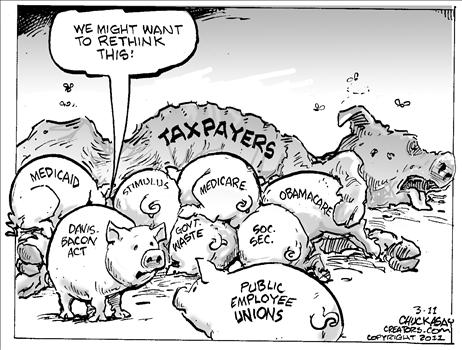
But at least the piglets in this Chuck Asay cartoon are finally waking up to reality.
Thank you so much for your time. I know how valuable it is. I also appreciate the fine family that you have and your commitment as a father and a husband.
Sincerely,
Everette Hatcher III, 13900 Cottontail Lane, Alexander, AR 72002, ph 501-920-5733, lowcostsqueegees@yahoo.com
Ronald Reagan and Bill Clinton both reduced the relative burden of government, largely because they were able to restrain the growth of domestic spending. The mini-documentary from the Center for Freedom and Prosperity uses data from the Historical Tables of the Budget to show how Reagan and Clinton succeeded and compares their record to the fiscal profligacy of the Bush-Obama years.
____________
Why do people want us to believe that President Obama wants to get us back to the way it was under President Clinton when in fact Clinton spent 19.8% of GDP while President Obama’s average is 24.4%
Michael Tanner is a senior fellow at the Cato Institute and author of Leviathan on the Right: How Big-Government Conservatism Brought Down the Republican Revolution.
Lately President Obama has done everything except seduce an intern in his attempt to morph into Bill Clinton. In virtually every speech, he invokes Clinton’s name, trying to link his policies with those of the popular former president. He has even called upon Clinton to place Obama’s name in nomination at the Democratic National Convention.
But, try as he might, Barack Obama, is no Bill Clinton.
President Obama says that he wants to raise taxes back to the level they were under Clinton, but that’s not quite true. Under President Obama’s proposal, the top tax bracket would be raised to 39.6 percent. The president has also called for phasing out high-income taxpayers’ itemized deductions, adding another 1.2 percentage points to the effective tax rate, bringing it to 40.8 percent. Add in the 2.9 percent Medicare tax and the top marginal rate would be 43.7 percent, roughly equal to what it was during the Clinton years. But Obamacare would increase the Medicare tax for high-wage earners to 3.8 percent, pushing the top marginal tax rate under the Obama plan to 44.6 percent, nearly a full point higher than it was under Clinton.
The same is true for capital-gains taxes, interest, and other investment income. President Obama, who once famously said he favored higher capital-gains taxes even if they resulted in decreased revenue, would raise taxes on investment income from the current 15 percent to the 2002 level of 21.2 percent. But that number ignores the 3.8 percent Unearned Income Medicare Contribution (UIMC) tax on interest and capital gains that was imposed by Obamacare. Thus, President Obama would really raise taxes on investment income to 25 percent, much higher than they were under PresidentClinton.
Our current president wants to tax and spend even more than Clinton did.
Or look at it another way: During the eight years of the Clinton presidency, federal tax revenue averaged 19 percent of GDP. If President Obama gets all the tax hikes he wants, taxes would rise to at least 19.8 percent of GDP, and possibly higher.
We should also note that the economic climate was very different during the Clinton administration. Driven in part by the dot-com bubble, the economy was booming. One might argue that it would have been even better had Clinton not raised taxes, but the economy was still able to handle it. In contrast, our current economy is a mess, balancing on the edge of a double-dip recession, with unemployment stuck above 8 percent. That is why, in a moment of candor, even Clinton has argued against raising taxes now.
Perhaps an argument could be made for Clinton-era tax levels, though, if one also had Clinton-era spending levels. Under President Clinton, federal spending averaged 19.8 percent of GDP and actually hit a low of just 18.3 percent. In contrast, spending under President Obama over the past four years has averaged 24.4 percent of GDP. And going forward, the president’s proposed budgets would never spend less than 22 percent of GDP.
As a result, at least some of the revenue from Clinton’s tax hikes actually was used to reduce the national debt. President Obama’s tax increases, on the other hand, would simply fund more federal spending.
It may well be true that President Clinton would never have shown such budget discipline in the absence of a Republican Congress, but the fact is that there was far more spending restraint during the Clinton years than under either of his successors. Indeed, if the post-Clinton budget had simply grown at the rate of inflation plus population, federal spending this year would be roughly $1 trillion less than it is today. Of course, some of the blame for the current level of spending belongs to President Bush, but President Obama has doubled down on Bush’s profligacy, including by converting one-time Bush spending, such as TARP, into permanent spending.
In the end, President Obama would increase taxes more than Bill Clinton did, and cut spending a lot less.
President Clinton was also willing to consider reform of entitlement programs. Indeed, before the Lewinsky scandal forced Clinton to shore up his left flank to protect himself from impeachment, he was even receptive to the idea of allowing younger workers to privately invest a portion of their payroll taxes through personal accounts. Can anyone imagine President Obama, even for a moment, considering a similarly radical overhaul of Social Security or Medicare?
Of course, the signature accomplishment of the Clinton administration was welfare reform. This too may have been pushed on him by a Republican Congress, but President Clinton not only signed it, he embraced it. President Obama has not only increased total welfare spending by $193 billion since taking office, he has actively worked to dismantle the 1996 welfare reform act. His first stimulus bill included funding to help states pay for additional welfare recipients and eliminated many of the incentives that had encouraged states to reduce their welfare rolls. More recently, the Obama administration has announced plans to waive many of welfare reform’s work requirements.
In fact, even rhetorically Obama and Clinton head in different directions. In the wake of the Republican victory in 1994, Clinton declared, “The era of big government is over.” President Obama argues that “the danger of too much government is matched by the perils of too little.”
Given the last twelve years, a little Clinton nostalgia is understandable. But Bill Clinton will not be on the ballot this fall. Barack Obama will be, and that is a big difference.
With the national debt increasing faster than ever we must make the hard decisions to balance the budget now. If we wait another decade to balance the budget then we will surely risk our economic collapse.
The first step is to remove all welfare programs and replace them with the negative income tax program that Milton Friedman first suggested.
Milton Friedman points out that though many government welfare programs are well intentioned, they tend to have pernicious side effects. In Dr. Friedman’s view, perhaps the most serious shortcoming of governmental welfare activities is their tendency to strip away individual independence and dignity. This is because bureaucrats in welfare agencies are placed in positions of tremendous power over welfare recipients, exercising great influence over their lives. In addition, welfare programs tend to be self-perpetuating because they destroy work incentives. Dr. Friedman suggests a negative income tax as a way of helping the poor. The government would pay money to people falling below a certain income level. As they obtained jobs and earned money, they would continue to receive some payments from the government until their outside income reached a certain ceiling. This system would make people better off who sought work and earned income.
Participants: Robert McKenzie, Moderator; Milton Friedman; James R. Dumpson, Chief Administrator, Human Resources Admin., NYC; Thomas Sowell, Professor of Economics, UCLA; Robert Lampman, Professor of Economics, Institute of Poverty; Helen Bohen O’Bannon, Secretary of Welfare, State of Pennsylvania
FRIEDMAN: __ but political reality changes and that’s the important thing. I want to say one more thing about this, this whole problem that we’ve been talking about. And that is, going back to Bob Lampman’s comment, there is one thing that can be said in favor on the welfare program. Unaccustomed as I am to saying anything in favor of it; and that is, that it is the only social program I know of which at least, on the average, give money to people who are in lower income classes than those who pay the taxes. Every other welfare program, not only does a lot of money go to the people who are well off, but on the average the poor are taxed and the well-to-do are subsidized. We in the upper income classes have been very clever at conning the poor suckers at the bottom to pay us nice salaries as bureaucrats and to provide us with nice benefits at their expense, and at least the welfare program doesn’t do that.
MCKENZIE: And you stated with great confidence that it will come, the negative income tax, even though you recognize the hurdles. Why are you so sure it will come?
FRIEDMAN: Because the present system has within it the seeds of its own destruction. There is no way in which a system constructed like the present, in my opinion, can avoid creating more and more social problems, and something is going to have to be done. Nobody has proposed any alternative, so far as I know, there is no effective alternative to the negative income tax and so it gets knocked down and it keeps rising, it gets knocked down and it keeps rising.
MCKENZIE: He finally raised the question though whether in any modern industrial democracy like this one it’s conceivable system to be run without fairly elaborate welfare underpinning of some kind. What do you feel?
O’BANNON: I don’t think it can be because I think essentially the welfare __ set of welfare programs reflect the values of this society that if it didn’t there would have been revolt long before now. Yes, there are rumblings about its cost, and I think that’s primarily a function of rapid rates of inflation eroding real income earning power of the middle-class taxpayer, but I think on one level we wanted to give up the responsibility of caring, the responsibility of day-to-day actual caring and in a technical, modern, industrial society like we have the tax system and the government system is probably __ is a viable alternative. I don’t think we’re going to get out of it. I don’t think you’re going to see private charities who can take my money that I’m free to give, or not give, and essentially make a difference in people’s lives of any substance on any level.
SOWELL: I don’t think it has anything to do with the society being modern, technological or industrial, it has to do with an ideology and particularly an ideology that is very strong among academic intellectuals or in the media, and I think that as time goes on and more and more intelligent ideas replace the kinds of vague visions that dominate today, that the political climate will change and that’s the only thing that stands in the way of reform right now.
MCKENZIE: Jim Dumpson.
DUMPSON: I don’t think you’re going to get rid of the system but I’m interested __ welfare system, I’m interested in Tom’s last statement about academicians and theories and so forth, we forgot that we’re talking about people and we may sit in the ivory tower and talk about whether this system will work and either logically or illogically why it won’t work, at the same time there are masses of people outside who are locked out of the system that you and I are part of and somehow we’ve got to make sure those people are taken care of and the short of not doing it, of course, means that your safety and my safety and the vitality of this government and of our country is at stake. The Mayor of the city of New York asked me, when we had a strike, what would I do if I couldn’t get checks out to people when our workers were on strike and I said to him, “After the first month _ chaos.” And he said, “What do you mean?” I said, “No man or woman in this city of New York, you included Mr. Mayor, will be safe if we cannot take care of people…”
MCKENZIE: We leave this discussion and hope you’ll join us for the next episode of Free To Choose
____________
Thank you so much for your time. I know how valuable it is. I also appreciate the fine family that you have and your commitment as a father and a husband.
Sincerely,
Everette Hatcher III, 13900 Cottontail Lane, Alexander, AR 72002, ph 501-920-5733, lowcostsqueegees@yahoo.com
Social Security is a Ponzi Scheme but Blake who is a blogger said I was off base. Ark Times reader says Social Security is not Ponzi Scheme Social Security Disaster Walter E. Williams Columnist, Townhall.com Politicians who are principled enough to point out the fraud of Social Security, referring to it as a lie and […]
We got to do something soon about Social Security. The Case for Social Security Personal Accounts Posted by Daniel J. Mitchell There are two crises facing Social Security. First the program has a gigantic unfunded liability, largely caused by demographics. Second, the program is a very bad deal for younger workers, making them pay record […]
Senator Obama’s Social Security Tax Plan Uploaded by afq2007 on Jul 23, 2008 In addition to several other tax increases, Senator Barack Obama wants to increase the Social Security payroll tax burden by imposing the tax on income above $250,000. This would be a sharp departure from current law, which only requires that the tax […]
Saving Social Security with Personal Retirement Accounts Uploaded by afq2007 on Jan 10, 2011 There are two crises facing Social Security. First the program has a gigantic unfunded liability, largely thanks to demographics. Second, the program is a very bad deal for younger workers, making them pay record amounts of tax in exchange for comparatively meager benefits. This […]
“Saving the American Dream: The Heritage Plan to Fix the Debt, Cut Spending, and Restore Prosperity,” Heritage Foundation, May 10, 2011 by Stuart Butler, Ph.D. , Alison Acosta Fraser and William Beach is one of the finest papers I have ever read. Over the next few days I will post portions of this paper, but […]
Is Social Security a Ponzi Scheme? I just started a series on this subject. In this article below you will see where the name “Ponzi scheme” came from and if it should be applied to the Social Security System. Ponzi! Ponzi! Ponzi! 9/14/2011 | Email John Stossel | Columnist’s Archive Ponzi! Ponzi! Ponzi! There, I […]
Uploaded by LibertyPen on Jan 8, 2009 Professor Williams explains what’s ahead for Social Security Dan Mitchell on Social Security I have said that Social Security is a Ponzi scheme and sometimes you will hear someone in the public say the same thing. Yes, It Is a Ponzi Scheme by Michael D. Tanner Michael Tanner […]
I got to see Arthur Laffer speak in 1981 in Memphis and he predicted what would happen the next few years with tax revenue as a result of the Reagan Tax Cuts and he was right on every prediction. Why do you continue to say that this has been tried before and does not work?
But I haven’t specifically responded to some recent studies which make rather outlandish claims that the revenue-maximizing tax rate is 70 percent or above.
President Obama and others are demanding that we raise taxes on the “rich,” and two recent academic papers that have gotten a lot of attention claim to show that there will be no ill effects if we do. The first paper, by Peter Diamond of MIT and Emmanuel Saez of the University of California, Berkeley, appeared in the Journal of Economic Perspectives last August. The second, by Mr. Saez, along with Thomas Piketty of the Paris School of Economics and Stefanie Stantcheva of MIT, was published by the National Bureau of Economic Research three months later. Both suggested that federal tax revenues would not decline even if the rate on the top 1% of earners were raised to 73%-83%.
How do they arrive at such high numbers? Alan explains.
The authors arrive at their conclusion through an unusual calculation of the “elasticity” (responsiveness) of taxable income to changes in marginal tax rates. According to a formula devised by Mr. Saez, if the elasticity is 1.0, the revenue-maximizing top tax rate would be 40% including state and Medicare taxes. That means the elasticity of taxable income (ETI) would have to be an unbelievably low 0.2 to 0.25 if the revenue-maximizing top tax rates were 73%-83% for the top 1%. The authors of both papers reach this conclusion with creative, if wholly unpersuasive, statistical arguments.
Is this assumption warranted? Hardly. Alan elaborates, making the same points I’ve made about rich people being different than the rest of us.
But the ETI for all taxpayers is going to be lower than for higher-income earners, simply because people with modest incomes and modest taxes are not willing or able to vary their income much in response to small tax changes. So the real question is the ETI of the top 1%. Harvard’s Raj Chetty observed in 2009 that “The empirical literature on the taxable income elasticity has generally found that elasticities are large (0.5 to 1.5) for individuals in the top percentile of the income distribution.” In that same year, Treasury Department economist Bradley Heim estimated that the ETI is 1.2 for incomes above $500,000 (the top 1% today starts around $350,000).
Alan cites other studies as well, all of which show that Saez, Piketty, Diamond, and Stantcheva, are well outside the mainstream.
For all intents and purposes, they cherry-picked data and made unrealistic assumptions in order to justify class-warfare tax policies.
Thank you so much for your time. I know how valuable it is. I also appreciate the fine family that you have and your commitment as a father and a husband.
Sincerely,
Everette Hatcher III, 13900 Cottontail Lane, Alexander, AR 72002, ph 501-920-5733, lowcostsqueegees@yahoo.com
I have been writing President Obama letters and have not received a personal response yet. (He reads 10 letters a day personally and responds to each of them.) However, I did receive a form letter in the form of an email on June 18, 2012. I don’t know which letter of mine generated this response so I have linked several of the letters I sent to him below with the email that I received. However, I think it was probably this one below:
Sen. Toomey responds to State of the Union address 2012
Leader Cantor On CNN Responding To President Obama’s State of the Union Address
President Obama c/o The White House
1600 Pennsylvania Avenue NW
Washington, DC 20500
Obama’s Energy Budget: The Antithesis of a Market-Driven Energy Economy – Nicolas Loris
If only entrepreneurs had President Obama’s vision of what technologies are going to be successful and profitable in the future. Sadly, the President’s vision seems to suggest that America’s innovators lack the ingenuity and expertise to meet our country’s needs, leaving the taxpayer to pick up the dropped ball. In a nutshell, that’s President Obama’s fiscal year 2013 Department of Energy (DOE) budget. It completely rejects the notion of a market-based energy industry and wastes taxpayer dollars at a time when we desperately need to curtail out-of-control spending. Whether it’s renewable energy, energy efficiency, nuclear, or fossil fuels, the President’s blueprint is all wrong. Not the Government’s Role to Make Energy Technologies Cost Competitive Each year, the President’s budget has moved further away from basic research and more into commercializing politically preferred technologies.
For instance, the 2013 budget proposes to spend $310 million on the SunShot Initiative, a program to make solar energy cost-competitive without subsidies by 2020. The oxymoronic part of this proposal is that the program itself is a $310 million subsidy. And it’s a perfect example of the President’s attempt to hand over America’s energy economy to the DOE. This is an attempt that’s been tried and failed. And it’s not just solar getting a handout—there’s money for wind, geothermal, biofuels, advanced vehicles, energy efficiency, nuclear energy, and even natural gas. Government has no business trying to make private-sector projects cost-competitive. It’s neither appropriate nor necessary. There’s a robust demand for energy domestically and globally that is met with a wide variety of energy sources. According to analysis by HSBC Holdings PLC, the global market for low-carbon energy and energy efficiency will reach $2.2 trillion in the next decade. That’s all the incentive solar needs. If a technology or a company cannot capture part of that market, it doesn’t deserve to be in business, and it certainly needs no help from the taxpayer. Consumers and Businesses Know How to Save Money Energy efficiency spending programs and legislation have largely enjoyed bipartisan support because the practices of being resourceful and saving money are inherently desired. But it’s because they’re inherently good things that we don’t need government mandates, rebate programs, or spending initiatives to make businesses and homeowners more energy efficient. The President’s overview highlights that “the Budget provides DOE with $290 million to expand R&D on innovative manufacturing processes and advanced industrial materials that will enable U.S. companies to cut the costs of manufacturing by using less energy, while improving product quality and accelerating product development.”
Businesses do not need taxpayer dollars to improve efficiency and cut costs; they make those investments all the time with their own money. Nestle’s newest water bottle uses 60 percent less plastic than the one they first introduced in mid-1990s. Businesses make these investments every day to be more competitive and pass the savings onto consumers to capture a larger market share. Energy efficiency programs take an overly simplistic view of how our economy works and fail to take into account the tradeoffs energy consumers and businesses consider when making decisions. Subsidize One Fossil Fuel, Punish Another? In his State of Union speech, President Obama claimed that our country’s natural gas boom came largely as a result of public funding. While nothing could be further from the truth, the President wants to unnecessarily dump money into an already-booming industry. The budget proposal includes $421 million in fossil energy research and development, including $12 million “aimed at advancing technology and methods to safely and responsibly develop America’s natural gas resources.” Much of the $421 million is subsidies for the fossil fuel industry for research and spending that can be done by the private sector. Most of this funding focuses on technologies that will reduce carbon dioxide emissions. The program includes a clean coal power initiative, research on fuels and power systems to reduce fossil power plant emissions, innovations for existing plants, integrated gasification combined cycle, advanced turbines, carbon sequestration, and natural gas technologies. All of these programs need to go. The Administration proposed a phase-out of fossil fuel subsidies, significantly cutting funding for the Office of Fossil Energy. But the Administration is doing so less because it is good economic policy (which it is) and more to promote an environmental policy of Administration-preferred clean energy sources. When the Administration does talk about eliminating fossil fuel subsidies, they’re not actually removing subsidies but imposing targeted tax hikes on the oil industry by removing broadly available tax deductions. The President’s anti-subsidy rhetoric is on track, but actually defining what’s a subsidy is a different story.
Unsurprisingly, President Obama’s budget proposal for energy is largely a carbon copy of last year’s, with an even stronger government push for renewable energy and energy efficiency programs. It hands DOE unprecedented control over America’s energy economy, which has successfully been driven by the private sector. The DOE budget proposal doesn’t need a scalpel taken to it; it needs a hatchet.
__________________
I believe in the free market and basically if an industry is successful then it will grow and if it is not then it will disappear. It is no place for the federal government to try and re-arrange everything.
Thank you so much for your time. I know how valuable it is. I also appreciate the fine family that you have and your committment as a father and a husband.
Sincerely,
Everette Hatcher III, 13900 Cottontail Lane, Alexander, AR 72002, ph 501-920-5733, lowcostsqueegees@yahoo.com
______________
June 18, 2012
Dear Everette:
Thank you for writing. Each day, I hear from concerned men and women who are struggling in this economy. Their stories encourage me to continue working to ensure all Americans can find good jobs so they can support their families and communities.
This is a make-or-break moment for the middle class and those trying to reach it. At stake is the survival of the American promise that if you work hard, you can do well enough to raise a family, own a home, and put enough away for retirement. The defining issue of our time is how to keep that promise alive, and I will not stop working to build an economy that works for everyone—where every hard-working American gets a fair shot, does their fair share, and plays by the same rules. To see my full blueprint for an America built to last, with an economy based on American manufacturing, energy, workers, and values, I encourage you to visit www.WhiteHouse.gov/economy.
Our economy is growing stronger, adding over 2 million private sector jobs in 2011 alone—the best job growth since 2005. Yet, there are still far too many Americans who need jobs. We need to bring about a new era of American manufacturing and make it easier for our companies to create jobs here at home and sell products stamped with “Made in America” all over the world. To turn this vision into a reality, we hosted the “Insourcing American Jobs” forum in January 2012 to bring together business leaders from across our country to discuss one topic: how to encourage companies to bring jobs back to and invest in the United States. To help them do so, I have put forward new tax proposals that reward companies that choose to bring jobs home and invest in America while eliminating tax breaks for companies that move jobs overseas.
I also set a goal of doubling our exports of goods and services by 2014, which will create new manufacturing jobs. We are on track to meet that goal. I was proud to sign trade agreements with South Korea, Colombia, and Panama so our businesses can sell more goods to those markets. I will go anywhere in the world to open up new markets for American products, and I will not stand by when foreign competitors refuse to play by the same rules as the United States. That is why I directed my Administration to create a Trade Enforcement Unit responsible for investigating unfair trade practices in other countries.
We also need to reach for a new era in American energy, with an economy fueled by homegrown and alternative energy sources designed and produced by American workers. American oil production is now at its highest level in 8 years, and in 2011 we relied less on foreign oil than in any of the past 16 years. We have more working oil and gas rigs than the rest of the world combined, and we have opened up millions of new acres for oil and gas exploration where appropriate and safe. We implemented new safety standards and have since approved hundreds of new drilling permits. My Administration has also approved dozens of new pipelines to move oil around, including from Canada, which will help create jobs and encourage more energy production. We are taking every possible action to safely develop a massive, newly accessible supply of natural gas in the United States that will last nearly 100 years and, according to outside experts, will support more than 600,000 jobs by the end of the decade. As we work to create clean, renewable energy jobs, we are ensuring our all-of-the-above energy strategy does not put the health and safety of Americans at risk.
An economy built to last also demands that we cultivate the skills of our students and workers so they remain the best in the world. Employers today are looking for the most skilled, educated workers, and we have a responsibility to provide our workforce with the tools they need to prepare for the jobs of today and compete for the jobs of tomorrow. We made a national commitment to train 2 million workers for good-paying jobs in high-growth and high-demand industries, and my Administration is helping community colleges redesign training programs to become community career centers. With the extension of the payroll tax cut, we also made sure no working American will see their taxes go up this year and the millions of Americans still looking for work will be able to get help with unemployment insurance.
With too many Americans still struggling to stay in their homes, access to the American dream continues to be tested by a mortgage crisis that threatens the stability of families, neighborhoods, and our entire economy. While many Americans have received help, far too many are still unable to refinance their mortgages or obtain loan modifications. This crisis has not only hurt home values nationwide, it has also had a dramatic effect on the credit Americans need to purchase cars, pay college tuition, and grow small businesses.
That is why I will not wait for Congress to act to help homeowners. The Home Affordable Refinance Program has already helped nearly 1 million homeowners improve their financial situations, but until now, eligibility regulations and costs associated with the program have kept it from having a wider impact. Now, a new set of rules will open the program to nearly anyone with a mortgage backed by Fannie Mae or Freddie Mac. For assistance with a foreclosure or to find a local housing counselor, I encourage you to call your mortgage servicer directly, speak with a housing specialist at 1-888-995-HOPE, or contact the Department of Housing and Urban Development at 1-800-569-4287. You can also visit www.HUD.gov/foreclosure and www.MakingHomeAffordable.gov.
Our Nation is recovering from one of the worst economic crises in generations, and we still have a long way to go before every American who wants a job can find one, before every family can regain the sense of security that has been slipping away, and before our communities can get fully back on their feet. From passing the Recovery Act to saving the American auto industry, my Administration has laid a strong foundation for growth, and we continue to take bold action to do what is right for our economy. Today, the tide is finally turning. Businesses have created millions of new jobs, more companies are bringing jobs back and investing in America, manufacturers are hiring, and our economy is growing stronger. While it will take time to fully repair the damage, I am confident our Nation will not only recover, but also prosper in the 21st century. For more information on jobs, health benefits, housing assistance, and other public resources, you may also call 1-800-FEDINFO or visit www.USA.gov.
Sen. Paul Delivers State of the Union Response – Jan. 24, 2012 Uploaded by SenatorRandPaul on Jan 24, 2012 Sen. Rand Paul delivered the following Republican response to President Barack Obama’s State of the Union Address this evening ______________ President Obama c/o The White House 1600 Pennsylvania Avenue NW Washington, DC 20500 Dear Mr. President, […]
Rick Santorum’s (entire) Speech at Chattanooga Tea Party’s Liberty Forum Uploaded by TinShipProd on Feb 25, 2012 http://www.tinshipproductions.com Chattanooga Tea Party’s Liberty Forum Saturday, February 25, 2012 This speech is unedited and shown in it’s entire 55 minutes. ____________ President Obama c/o The White House 1600 Pennsylvania Avenue NW Washington, DC 20500 Dear Mr. President, […]
Uploaded by oversightandreform on Mar 6, 2012 Learn More at http://oversight.house.gov The Oversight Committee is examining reports of food stamp merchants previously disqualified who continue to defraud the program. According to a Scripps Howard News Service report, food stamp fraud costs taxpayers hundreds of millions every year. Watch the Oversight hearing live tomorrow at 930 […]
Uploaded by HeritageForAmerica on Mar 5, 2012 If you listen to the media, conservatives are fading everywhere from Congress to the campaign trail. Nothing could be further from the truth; the strength of conservative principles continues to endure and thrive. There is an awakening across the country, and the fight is on to return power […]
With the national debt increasing faster than ever we must make the hard decisions to balance the budget now. If we wait another decade to balance the budget then we will surely risk our economic collapse.
The first step is to remove all welfare programs and replace them with the negative income tax program that Milton Friedman first suggested.
Milton Friedman points out that though many government welfare programs are well intentioned, they tend to have pernicious side effects. In Dr. Friedman’s view, perhaps the most serious shortcoming of governmental welfare activities is their tendency to strip away individual independence and dignity. This is because bureaucrats in welfare agencies are placed in positions of tremendous power over welfare recipients, exercising great influence over their lives. In addition, welfare programs tend to be self-perpetuating because they destroy work incentives. Dr. Friedman suggests a negative income tax as a way of helping the poor. The government would pay money to people falling below a certain income level. As they obtained jobs and earned money, they would continue to receive some payments from the government until their outside income reached a certain ceiling. This system would make people better off who sought work and earned income.
Participants: Robert McKenzie, Moderator; Milton Friedman; James R. Dumpson, Chief Administrator, Human Resources Admin., NYC; Thomas Sowell, Professor of Economics, UCLA; Robert Lampman, Professor of Economics, Institute of Poverty; Helen Bohen O’Bannon, Secretary of Welfare, State of Pennsylvania
LAMPMAN: I think it’s a viable approach to some part of the problems of poverty. It involves, first of all, cash payments rather than in kind payments as I understand it? It involves payments on a non-categorical basis.
MCKENZIE: What do you mean non-categorical?
LAMPMAN: That is to say, it doesn’t matter whether you’re a female-headed family or a male-headed family or whether you’re young or old, you’re sick or well.
MCKENZIE: If your income falls below a certain level you __
LAMPMAN: Pay some guaranteed income level for people based on family size and then it has a take-back rate which is modest, I suppose, by definition. Now, the question is: How many things you want to use that program to replace? How many things you want to replace with such a negative income tax program.
MCKENZIE: Would you replace everything with it __ just __ we clear that point up. Would you virtually wipe out the remaining forms of welfare if you got this program going?
FRIEDMAN: Yes, I would not __ I think its purpose is precisely to provide a transition between where we are now and where we would like to go because while __ because I agree with you, that given that we’ve corrupted the people on welfare and gotten them on there. We do have an obligation not to throw them out in the street and put them in the difficult adjustment you’ve made. We’ve got to ease the __
MCKENZIE: Yeah. Okay. Right.
FRIEDMAN: __ ease it off __
MCKENZIE: Sure. Yeah.
FRIEDMAN: __ and so __ but I would want to replace all __
MCKENZIE: Yeah. Okay.
FRIEDMAN: __ present welfare programs.
MCKENZIE: Let’s get reactions to this and then we’ll come back to you.
SOWELL: Well, I saw some figures recently which said that if you took all the money spent on poverty in the United States and divided it by all the poverty families you’d come out with a figure of $32,000 per family. Now, the average poverty family is apparently not getting the $32,000 and so clearly someone in between the treasury and those families is getting an awful lot of that money and I think if you simply eliminated the middle man, as they say in the commercials, that there’d be an awful lot of benefit both to the poor and to the taxpayers.
DUMPSON: I’m supportive of the negative income tax concept and the objective of it. I’d like to point out, however, that administratively we have another bureaucracy set up. Somebody has to take into account earnings. Someone has to decide when to pay back that which they’re entitled to. There’s a time lag between the paying back __ the earning and the paying back. There are a variety of problems in there that I will be prepared to accept but I want you to know that government intervention is not going to be eliminated.
O’BANNON: The issue that I have is: Where do children come in? What are their rights under a negative income tax? And are we, by building in a negative income tax, in fact subsidizing the illegitimacy that Tom Sowell is so concerned about?
FRIEDMAN: The major reason it is not feasible today to have a negative income tax is because the present welfare bureaucracy would be out of work. They are the major objectors and as Senator Pat __ he’s now a senator, Pat Moynihan demonstrated in his book on the Nixon program, the chief obstacle to getting it enacted was the welfare bureaucracy. So that I don’t believe these administrative problems, if you got it enacted, would be at all serious.
O’BANNON: I think the other assumption under the negative income tax, and it’s one that I’m not sure I can buy, is that everybody has a minimum level of understanding about how to spend money. In other words, how to use the marketplace to satisfy wishes. And I, as an economist, would say, yes, we do. We __ everybody from age four to a hundred knows how to use money to satisfy wants and that’s the __
FRIEDMAN: But they don’t. They don’t. There are all sorts of problems of people who are not going to be able to. But that’s a minority problem. That’s a problem for private activity and private charity. One thing is sure: They’re spending __ they would be spending their own money and that however knowledgeable you are about money __
O’BANNON: They would be spending my money.
FRIEDMAN: They would be spending my money, but it would be one stage less then. Right now, the welfare worker is spending Mr. A’s money to help Mr. C. And there’s a big takeoff in the middle as Tom Sowell said.
SOWELL: The question is not whether the people on welfare or low incomes can all spend their money effectively; the question is: How effectively do they spend it as compared to how effectively the bureaucrats spend it for them. Comparing anything to perfection or to some arbitrary standard settles nothing. The same thing is true in the education area. They’re saying “Would families be able to spend their __ select schools for their kids under a voucher system,” for example. Well, the question is: Could they possibly do much worse than the current bureaucrats are doing in the public school system.
O’BANNON: Oh __
MCKENZIE: We’ve run on education on another program. Bob Lampman.
(Laughing)
LAMPMAN: I want to quibble with something you said, Tom, about half of the money not going to the poor or something. That doesn’t __ shouldn’t leave the viewer to think that all the money is going to the administrators of programs. A lot of what you are talking about goes to non-poor recipients. For example, social security, as a program, pays a roughly half of its benefits to people who otherwise would not be poor. Unemployment insurance pays about two-thirds of its benefits or so to non-poor persons. And those are, in some definitions, welfare or anti-poverty programs and that’s how statisticians come up with this horrendous sounding discrepancy between the total amount of money spent and the total cash benefits that go to the poor.
SOWELL: Well, I think, I think it’s a perfectly valid point though, because supposedly we were not setting up unemployment benefits and social security in order to keep the affluent.
LAMPMAN: Well, this goes back to its big philosophy, debate we might have. I think that it’s easy to oversimplify things and say that all these programs, including the public schools are there to be a help to the poor and poor only.
FRIEDMAN: Yeah, but I was saying __
LAMPMAN: But let me mention that the negative income tax has some of its impetus in that it would be a way of confining benefit payments to people who are __
SOWELL: Yes. Yes.
LAMPMAN: __ and it would cut out benefits for an awful lot of people who now have expectations that they’re going to get them, not in the form of public assistance, but in the form of social insurance as we use the term.
SOWELL: Well, in order to be made for not disappointing the expectations on which people have built their lives for one generation, but not of continuing for eternity in order to avoid one generation of transition.
MCKENZIE: What are the other hurdles toward getting underway. Now, you said, I don’t know how seriously, the biggest almost the only hurdle is the welfare bureaucracy.
FRIEDMAN: No. Now, there’d be the biggest immediate group of lobbyists that will lobby against it.
MCKENZIE: Yep.
FRIEDMAN: The biggest hurdle in getting it over at the moment is that there is no way of constructing a sensible negative income tax system that will not hurt some people. There will be some people who will get less money than they are now getting under __ particularly those in the upper income groups. Particularly the affluent who are now being subsidized by the welfare and they, will make it politically difficult for the people to put it into effect. The attempt is to put a negative income tax in effect which costs less money, is easier to administer, and yet which doesn’t pay anybody in the society one dollar less than he’s now getting. There’s no way in which you can construct such a program. But, although it’s not politically feasible now, the force of history is on its side, it’s going to become political __
MCKENZIE: Dr. James Dumpson.
DUMPSON: Let’s not say that the __ give the impression that welfare administrators were against negative income tax, the fat program for example, as Moynihan says, because they would lose their jobs, for example. Many of us were opposed to it because of certain features in that program: A $24 __ $2,400 level for a family of four. We were opposed to that. And if one goes down the Congressional record, those who testified, will be shown to be saying, “Yes, we’re for it conceptually. But we’re against this piece and this piece, if you change that you’ll have our support.”
FRIEDMAN: I was in the same position. I first proposed the negative income tax twenty-five years ago but I testified against the final version of the Nixon plan. Why? Because the welfare bureaucrats had led them to introduce changes in it which converted it from a decent satisfactory negative income tax to one which would have been just as bad as what you have now. Would have been added on top of everything else.
O’BANNON: Cold reality.
FRIEDMAN: It’s political reality __
O’BANNON: That’s right.
_____________
Thank you so much for your time. I know how valuable it is. I also appreciate the fine family that you have and your commitment as a father and a husband.
Sincerely,
Everette Hatcher III, 13900 Cottontail Lane, Alexander, AR 72002, ph 501-920-5733, lowcostsqueegees@yahoo.com
With the national debt increasing faster than ever we must make the hard decisions to balance the budget now. If we wait another decade to balance the budget then we will surely risk our economic collapse.
The first step is to remove all welfare programs and replace them with the negative income tax program that Milton Friedman first suggested.
Milton Friedman points out that though many government welfare programs are well intentioned, they tend to have pernicious side effects. In Dr. Friedman’s view, perhaps the most serious shortcoming of governmental welfare activities is their tendency to strip away individual independence and dignity. This is because bureaucrats in welfare agencies are placed in positions of tremendous power over welfare recipients, exercising great influence over their lives. In addition, welfare programs tend to be self-perpetuating because they destroy work incentives. Dr. Friedman suggests a negative income tax as a way of helping the poor. The government would pay money to people falling below a certain income level. As they obtained jobs and earned money, they would continue to receive some payments from the government until their outside income reached a certain ceiling. This system would make people better off who sought work and earned income.
Participants: Robert McKenzie, Moderator; Milton Friedman; James R. Dumpson, Chief Administrator, Human Resources Admin., NYC; Thomas Sowell, Professor of Economics, UCLA; Robert Lampman, Professor of Economics, Institute of Poverty; Helen Bohen O’Bannon, Secretary of Welfare, State of Pennsylvania
O’BANNON: I think the other __ we have a program in Pennsylvania for essentially all of those who are not taken care of by the AFDC program. It’s called the General Assistance Program. And there less than 15 percent are on more than eighteen months. So we have a great turnover. We have essentially young males moving into the welfare system after unemployment compensation, and then moving out when a job opportunity comes along. This, you know, I think the notion of generations of people on welfare is a very small minority in the whole system. That doesn’t mean that the system as presently defined and as the set of programs that we have put together don’t often contradict each other and I’m the first to agree with Dr. Friedman that some of the programs are conflicting. However, I think it is overly broad to say that we turn people into helpless children.
SOWELL: I don’t remember talking to anyone who’s ever been on welfare who didn’t think they were being treated like children while they were on it.
DUMPSON: Of course, I think, you know, you __ one must make a difference, a distinction between a system that was set up to help people and the people who are employed in that system. Look at any public welfare system around the country and we have no, practically few trained people who to work with people. We employ them ill-trained, people who are not equipped to be helping people. We say they’re social workers. They’re not social workers, they have neither the skills, the attitudes, and some of them not even the concerns; so I think one has to separate how a conceptual framework of a system designed to help people and what the country and community puts into that system to implement those programs.
SOWELL: You mean to separate the hopes from the reality.
DUMPSON: I separate the skills that are available in order to implement what the objectives of the program are. I think we have to separate whether we are talking about program objectives, or we’re talking about how it operates. I would be the first to say that the system that I administered had ill-prepared people to do the job that we were set up to do, and I would not say that the system that we set up __
SOWELL: I talked to some social welfare people who think that in fact they were so hamstrung by the system that there was very little they could do to help people to get off welfare; that is to build up skills at jobs, do whatever was necessary to get off welfare. They felt it was the system.
MCKENZIE: Bob Lampman, your comment.
LAMPMAN: The system that we’re stereotyping is one of a great deal of paternalistic interference in individual family’s lives and in fact isn’t it true, Mr. Dumpson, that case load is so high for an individual welfare worker that they can’t do a lot of interfering in individual family lives. Moreover, in the last decade there’s been a real attempt to ease this welfare trap in AFDC by changing the take-back rate and by administering work expenses and child care expenses in such a way as to facilitate work by those who may want to do it; so it’s not quite as harsh a picture as we sometimes get that there is this omniscient welfare worker who’s right there in the living room with the family making all their decisions for them.
FRIEDMAN: I’ve never heard of a government program which was defective in which the people who ran it didn’t say, “If only we had more money to spend on what we’re not being able to accomplish with the amount we’re spending now.”
MCKENZIE: Milton, we’re going to move along now to some of your prescriptions in that film because I think it’s good ground for discussion. The most drastic one was when you said, speaking of an unemployed man, “Supposing you were cruel and took away welfare from this man, he would find a job at some wage, there’d always be a job he could get; he might need some charity on route, private charity, but he would get a job.” Now, I want you to react, those of you, before we come back to Milton on that. Is that a picture that seems plausible to you?
DUMPSON: He may get a job, and he may get a job in what we refer to as the underground economy, and that’s where a number of our youth are now going to get their jobs. Those activities that are illegal, the only opportunities they have for earning their part of a livelihood.
O’BANNON: I think the other issue is that you have a whole group of people who are the single, female head of the household; and yes, cut off welfare tomorrow: What will they do? What will be their immediate response? At what price to their small children and to their middle-aged children? Yes, they’ll get a job, in fact the statistics show that women, in fact, are the most successful through the employment program. But what has to supplement that typically is the provision of some kind of day care arrangement. Either the individual woman has to earn enough money to be able to pay privately for her day care, or in fact, she is quote “subsidized” through this insidious, corrupting program, set of programs, run by the federal government which, in fact, makes her employable and a taxpayer. It’s an interesting notion of trying to get people in a productive mode.
MCKENZIE: Tom Sowell.
SOWELL: It’s incredible the way you start the story in the middle as if there’s a predestined amount of poverty, a predestined amount of unemployment and that the welfare system is not itself in any way responsible for that __
O’BANNON: There is a predestined 20 percent of the bottom half of the population.
SOWELL: I have never __ well, that’s always been true __
(Everyone speaking at once)
O’BANNON: There’s going to be 20 percent at the bottom.
SOWELL: It’s also true that 20 percent of the bottom population doesn’t have to be living on the government and ruled by the government. You mentioned, for example, a female head of household. Many of those, in addition to the grown woman who has all the kids, are teenage pregnancies. There’s not a predestined amount of teenaged pregnancies. I grew up in an era when people, and particularly blacks, were a lot poorer than today, faced a lot more discrimination than today, and in which teenage pregnancy rate was a lot lower than today. I don’t believe there is a predestined amount of teenage pregnancy. A predestined amount of husband desertion. Gutman has done a study of a black family showing that this whole notion that the black family has always been disintegrating, that is nonsense. His studies go up to 1925, the great bulk of black families were intact two-parent families up to 1925 and going all the way back through the era of slavery, so it is now, only within our own time, that we suddenly see this inevitable tragedy which the welfare system says it’s going to rush in to solve.
O’BANNON: We’re talking to Tom about __
SOWELL: To which it is itself a point __
O’BANNON: We’re talking about a very small group. We’re talking about twelve percent of the families are not intact. Are not two-parent families at any one period __
SOWELL: Do you mean __ among welfare recipients __
O’BANNON: No.
SOWELL: __ or the public at large?
O’BANNON: Among the public at large. We’re talking about twelve percent of the families; twelve percent.
SOWELL: That’s right.
O’BANNON: That’s a small number. But __
SOWELL: We’ve got to build on welfare.
O’BANNON: We’re still talking about a significant component of the bottom twenty percent that are the bottom twenty percent. Whether they are above the poverty line or below the poverty line; they are still the bottom twenty percent. And the issue is: What is the responsibility of the other eighty percent; if any, towards those others?
SOWELL: There’s no program plan to eliminate there being a bottom twenty percent?
O’BANNON: No. But it intends to raise the bottom twenty percent so __
SOWELL: We’re raising them by having more __ by having more illegitimacy, more unemployment, by having __
O’BANNON: I’m not making them be __ have illegitimate children. I hope that’s clear.
SOWELL: Oh, I_I__ you don’t have to do that. You simply subsidize it.
FRIEDMAN: We, as human beings, don’t have a responsibility; but I hope we have a compassion and an interest in the bottom twenty percent. And I only want to say to you that the capitalist system, the private enterprise system in the 19th century did a far better job of expressing that sense of compassion than the governmental welfare programs are today. The 19th century, the period which people denigrate as the high tide of capitalism was the period of the greatest outpouring of Ella Mosner in charitable activity that the world has ever known. And one of the things I hold against the welfare system, most seriously, is that it has destroyed private charitable arrangements which are far more effective, far more compassionate, far more person-to-person in helping people who are really, for no fault of their own, in disadvantaged situations.
O’BANNON: I have to disagree with you though, because I think that the whole notion of private property was excluded, whole segments of society were excluded from the notion of private property in the 19th century; namely, women, idiots and imbeciles. And so, I don’t go back to the 19th century and hold it up as any paragon that we would want to replicate today.
MCKENZIE: Anyway. I want Milton now to come to your major prescription, which I know you don’t say is on the agenda for tomorrow, but it lies ahead; that is, the negative income tax. And I’m not sure people fully understand how it would work. We can’t, I think, go to the details of it, but I’d like to get a reaction around the panel first of all, is this a viable approach to the enduring problems of poverty? Negative income tax.
_________________
Thank you so much for your time. I know how valuable it is. I also appreciate the fine family that you have and your commitment as a father and a husband.
Sincerely,
Everette Hatcher III, 13900 Cottontail Lane, Alexander, AR 72002, ph 501-920-5733, lowcostsqueegees@yahoo.com
The Obama Administration came out swinging against its critics on welfare reform yesterday, with Press Secretary Jay Carney saying the charge that the Administration gutted the successful 1996 reform’s work requirements is “categorically false” and “blatantly dishonest.” Even former President Bill Clinton, who signed the reform into law, came out parroting the Obama team’s talking points and saying the charge was “not true.”
The Heritage Foundation’s Robert Rector and Kiki Bradley first broke the story on July 12 that Obama’s Health and Human Services Department (HHS) had rewritten the Clinton-era reform to undo the work requirements, in a move that legal experts Todd Gaziano and Robert Alt determined was patently illegal.
The Administration’s new argument has two parts: denying the Obama Administration’s actions and claiming that Republican governors, including Mitt Romney, tried to do the same thing. In essence, “We did not do what you’re saying, but even if we did, some Republicans did it, too.” Both parts of this argument are easily debunked.
Obama Administration Claim #1: We Didn’t Gut Work Requirements
Ever since the 1996 law passed, Democratic leaders have attempted (unsuccessfully) to repeal welfare’s work standards, blocking reauthorization of the Temporary Assistance for Needy Families program (TANF) and attempting to weaken the requirements. Unable to eliminate “workfare” legislatively, the Obama HHS claimed authority to grant waivers that allow states to get around the work requirements.
Humorously, HHS Secretary Kathleen Sebelius now asserts that the Administration abolished the TANF work requirements to increase work.
HHS now claims that states receiving a waiver must “commit that their proposals will move at least 20 percent more people from welfare to work compared to the state’s prior performance.” But given the normal turnover rate in welfare programs, the easiest way to increase the number of people moving from “welfare to work” is to increase the number entering welfare in the first place.
Bogus statistical ploys like these were the norm before the 1996 reform. The law curtailed use of sham measures of success and established meaningful standards: Participating in work activities meant actual work activities, not “bed rest” or “reading” or doing one hour of job search per month; reducing welfare dependence meant reducing caseloads. Now those standards are gone.
Obama’s HHS claims authority to overhaul every aspect of the TANF work provisions (contained in section 407), including “definitions of work activities and engagement, specified limitations, verification procedures and the calculation of participation rates.” In other words, the whole work program. Sebelius’s HHS bureaucracy declared the existing TANF law a blank slate on which it can design any policy it chooses.
Obama Administration Claim #2: Even If We Did, the Republicans Tried It, Too
Though the Obama Administration is claiming it is not trying to get around the work requirements, it is also claiming that a group of Republican governors tried to do the same thing in 2005. Clinton also said in his statement yesterday that “the recently announced waiver policy was originally requested” by Republican governors.
Heritage welfare expert Robert Rector addressed this claim back on July 19. As Rector explains:
But [the governors’] letter makes no mention at all of waiving work requirements under the Temporary Assistance for Needy Families (TANF) program. In fact, the legislation promoted in the letter—the Personal Responsibility and Individual Development for Everyone (PRIDE) Act—actually would have toughened the federal work standards. It proposed raising the mandatory participation rates imposed on states from 50 percent to 70 percent of the adult TANF caseload and increasing the hours of required work activity.
The governors’ letter actually contradicts the Administration’s main argument: If the law has always permitted HHS to waive the work requirements, then why didn’t the governors just request waivers from then-President George W. Bush? Why would legislation be needed?
Two reasons: First, it has been clear for 15 years that the TANF law did not permit HHS to waive the work requirements. Second, the Republican governors were not seeking to waive the work requirements in the first place.
Obama’s Evolution from Welfare to Work and Back
President Obama had a convenient change of heart regarding welfare reform when it was time to run for President. In 1998, when he was an Illinois state senator, Obama said:
I was not a huge supporter of the federal plan that was signed in 1996. Having said that, I do think that there is a potential political opportunity that arose out of welfare reform. And that is to desegregate the welfare population—meaning the undeserving poor, black folks in cities, from the working poor—deserving, white, rural as well as suburban.
The same year, he reiterated that “the 1996 legislation I did not entirely agree with and probably would have voted against at the federal level.”
But in 2008, when he was running for President, Obama said he had changed his mind about welfare reform: “I was much more concerned 10 years ago when President Clinton initially signed the bill that this could have disastrous results….It had—it worked better than, I think, a lot of people anticipated. And, you know, one of the things that I am absolutely convinced of is that we have to work as a centerpiece of any social policy.”
One of his 2008 campaign ads touted “the Obama record: moved people from welfare to work” and promised that as President, he would “never forget the dignity that comes from work.”
This evolution is unsurprising, considering the vast majority of Americans favor requiring welfare recipients to work.
President Obama has finally accomplished what Democrats have been trying to do for years. He has even gotten President Clinton to turn his back on one of the signature achievements of his Administration to give him political cover—which Clinton was quick to do. In 1996, Clinton had to compromise and allow the tough work requirements to get the legislation passed.
Both Presidents have now revealed their true feelings about welfare—and there’s no denying it.
Is President Obama gutting the welfare reform that Bill Clinton signed into law? Morning Bell: Obama Denies Gutting Welfare Reform Amy Payne August 8, 2012 at 9:15 am The Obama Administration came out swinging against its critics on welfare reform yesterday, with Press Secretary Jay Carney saying the charge that the Administration gutted the successful […]
Thomas Sowell – Welfare Welfare reform was working so good. Why did we have to abandon it? Look at this article from 2003. The Continuing Good News About Welfare Reform By Robert Rector and Patrick Fagan, Ph.D. February 6, 2003 Six years ago, President Bill Clinton signed legislation overhauling part of the nation’s welfare system. […]
Uploaded by ForaTv on May 29, 2009 Complete video at: http://fora.tv/2009/05/18/James_Bartholomew_The_Welfare_State_Were_In Author James Bartholomew argues that welfare benefits actually increase government handouts by ‘ruining’ ambition. He compares welfare to a humane mousetrap. —– Welfare reform was working so good. Why did we have to abandon it? Look at this article from 2003. In the controversial […]
Johan Norberg – Free or Equal – Free to Choose 30 years later 3/5 Published on Jun 10, 2012 by BasicEconomics In 1980 economist and Nobel laureate Milton Friedman inspired market reform in the West and revolutions in the East with his celebrated television series “Free To Choose.” Thirty years later, in this one-hour documentary, […]
I thought it was great when the Republican Congress and Bill Clinton put in welfare reform but now that has been done away with and no one has to work anymore it seems. In fact, over 40% of the USA is now on the government dole. What is going to happen when that figure gets over […]
Thomas Sowell If the welfare reform law was successful then why change it? Wasn’t Bill Clinton the president that signed into law? Obama Guts Welfare Reform Robert Rector and Kiki Bradley July 12, 2012 at 4:10 pm Today, the Obama Department of Health and Human Services (HHS) released an official policy directive rewriting the welfare […]
President Obama c/o The White House 1600 Pennsylvania Avenue NW Washington, DC 20500 Dear Mr. President, I know that you receive 20,000 letters a day and that you actually read 10 of them every day. I really do respect you for trying to get a pulse on what is going on out here. Dan Mitchell […]
I have been writing President Obama letters and have not received a personal response yet. (He reads 10 letters a day personally and responds to each of them.) However, I did receive a form letter in the form of an email on July 10, 2012. I don’t know which letter of mine generated this response so I have […]
Welfare reform was working so good. Why did we have to abandon it? Look at this article from 2003. The Continuing Good News About Welfare Reform By Robert Rector and Patrick Fagan, Ph.D. February 6, 2003 Six years ago, President Bill Clinton signed legislation overhauling part of the nation’s welfare system. The Personal Responsibility and […]
On Thursday, the House Energy and Commerce Committee released a bombshell report, 18 months in the making and 147 pages long, detailing its investigation into bankrupt solar company Solyndra.
Along with the report, the committee released a trove of emails between Solyndra stakeholders and administration officials. They paint a troubling picture of efforts to prop up the company despite its bleak economic outlook, and reactions to the company’s eventual bankruptcy.
Scribe has compiled a list of the top 10 most revealing emails released as part of the investigation.
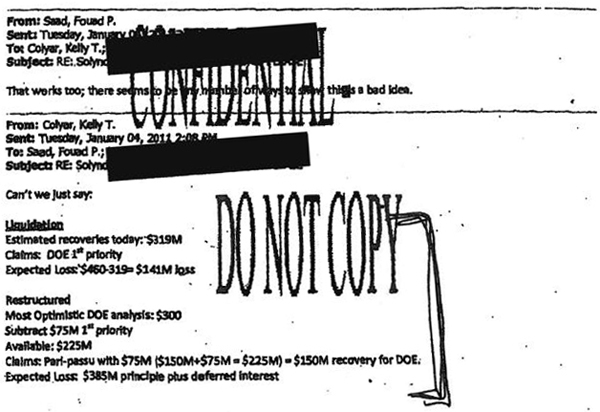
1. The White House Office of Management and Budget held that the Energy Department’s decision to restructure Solyndra’s loan was “a bad idea” and would result in greater taxpayer losses.
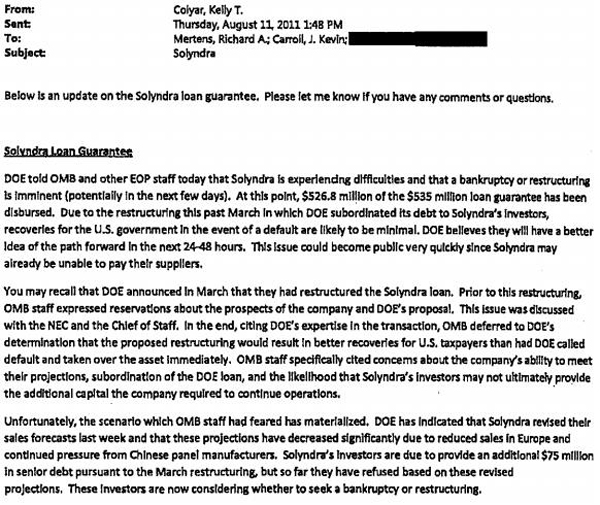
In March of 2011, DOE ignored the advice of White House budget officials and restructured Solyndra’s federally-backed loan, giving private investors priority in the repayment of their investments. DOE insisted that this would produce the greatest returns for taxpayers, but OMB officials, in a series of emails earlier that year, pondered ways to demonstrate to DOE that restructuring the loan would be “a bad idea.”
OMB analyst Kelly Coylar crunched the numbers, and found that DOE would lose about $141 million if it allowed Solyndra to go bankrupt and liquidated its assets. A restructuring agreement, on the other hand, could more than double taxpayer losses, she wrote.
2. White House Chief of Staff Bill Daley was briefed on Solyndra’s troubles before the Energy Department restructured Solyndra’s loan.
The eventual restructuring agreement may have violated federal law, according to the Energy and Commerce Committee. It is of particular note, then, that then-White House Chief of Staff Bill Daley was briefed on the possibility of restructuring Solyndra’s federally-backed loan before that decision was made.
3. President Obama’s Solyndra photo-op was then-CoS Rahm Emanuel’s idea.
Emanuel has repeatedly said that he doesn’t remember anything about the Solyndra loan guarantee process. This email shows that he was heavily involved in White House efforts to promote the loan guarantee, most notably by suggesting the president conduct a photo-op at the company’s Fremont, CA headquarters.
4. Even Solyndra’s investors knew that the company was a bad bet for taxpayers.
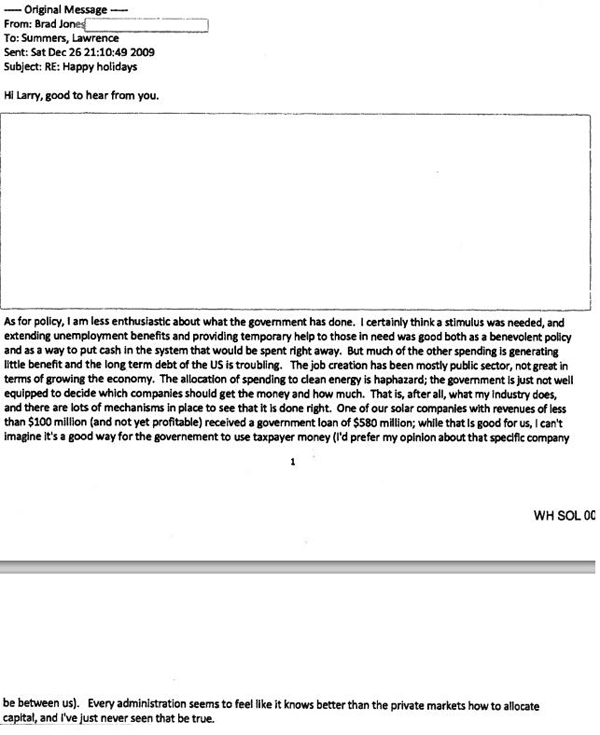
In an email to Lawrence Summers, then the chair of the White House’s National Economic Council, Brad Jones, an advisor with Solyndra investor Redpoint Ventures, said that while the loan guarantee for Solyndra would prove beneficial for Redpoint, “I can’t imagine it’s a good way for the government to use taxpayer money.”
5. Getting federal money was integral to Solyndra’s business model.
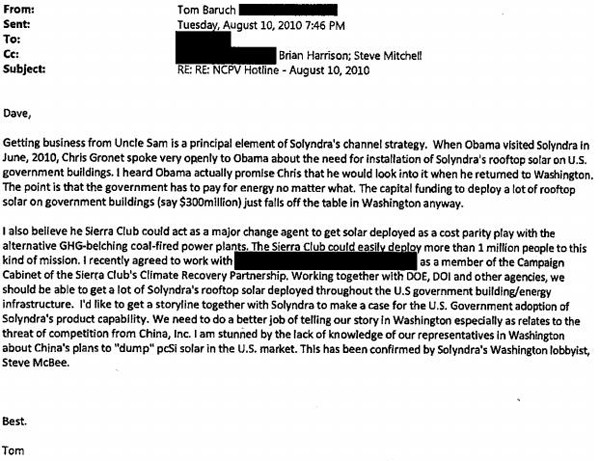
“Getting business from Uncle Sam is a principal element of Solyndra’s channel strategy,” wrote Tom Baruch, founder of Solyndra investor CEMA Capital, in a August 10, 2010 email. When government takes it upon itself to pick winners and losers in the marketplace, securing government funds can be just as lucrative as conducting standard business activities, which inevitably directs more resources into unproductive political activities.
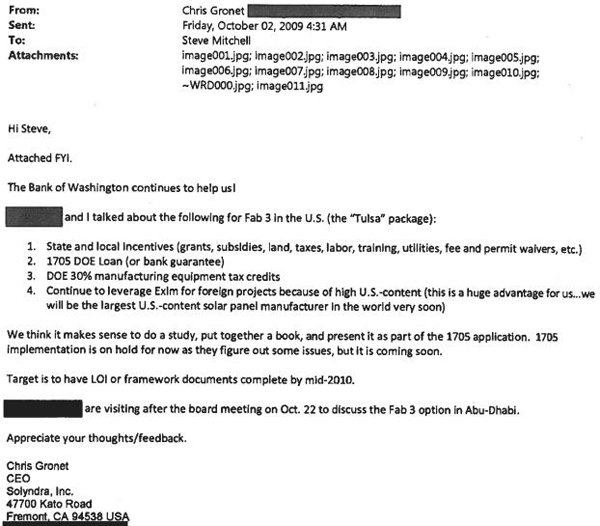
6. Solyndra’s CEO referred to the federal government as the “Bank of Washington.”
Solyndra was quite brazen about its government-centric business strategy, as this email from CEO Chris Gronet demonstrates.
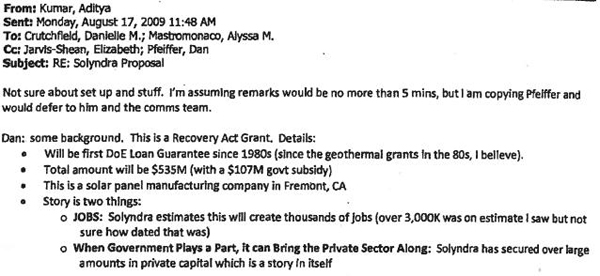
7. Solyndra was supposed to be a model of how government could empower the private sector.
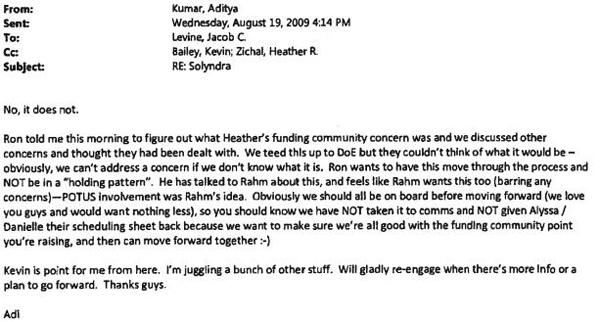
In an email to White House communications staffer Dan Pfeiffer, Aditya Kumar, a senior advisor to the Vice President, said Solyndra exemplified an oft-repeated administration talking point on green energy “investment”: “When Government Plays a Part, it can Bring the Private Sector Along.”
Solyndra did bring the private sector along – all the way to its bankruptcy.
8. The White House and Vice President’s office pressured DOE to move on the Solyndra loan guarantee, which in turn pressured OMB.
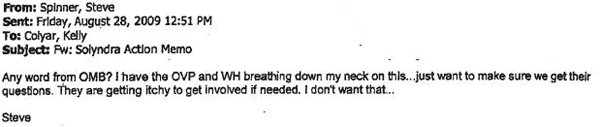
In an August 28, 2009 email to Coylar, DOE official Steve Spinner, who headed up the Department’s Solyndra activities, said, “the OVP [Office of the Vice President] and WH [White House]” were “breathing down my neck” on the proposed Solyndra loan guarantee.
Spinner was trying to speed up OMB’s analysis of the Solyndra project to fit with the White House’s schedule, which had already set a date for the president’s Solyndra photo-op. OMB would later confirm that it had rushed its Solyndra analysis under pressure from the White House.
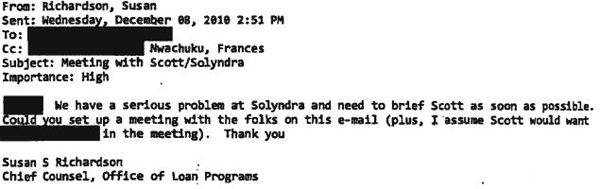
9. Upon news of the bankruptcy, DOE admitted it had “a serious problem at Solyndra.”
Despite numerous attempts since Solyndra’s bankruptcy to downplay the scandal, emails exchanged upon news that the company would go under reveal that the DOE knew just how bad the bankruptcy was. “We have a serious problem at Solyndra,” Susan Richardson, chief counsel of DOE’s Loan Program’s Office, wrote.
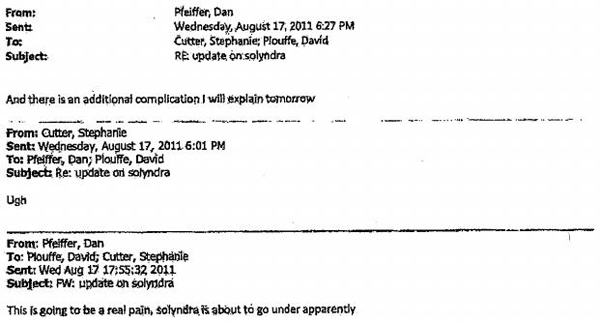
10. The White House’s reaction to Solyndra’s bankruptcy: “Ugh.”
The White House also knew that Solyndra’s bankruptcy posed a problem, as evinced by then-White House advisor Stephanie Cutter’s reaction to the news – in one word: “ugh.”
In an effort to downplay the scandal, Cutter has since insisted that Solyndra was “widely praised as successful and innovative.”





 The Daily Hatch