Category Archives: President Obama

Open letter to President Obama (Part 121)

President Obama c/o The White House
1600 Pennsylvania Avenue NW
Washington, DC 20500

Dear Mr. President,

I know that you receive 20,000 letters a day and that you actually read 10 of them every day. I really do respect you for trying to get a pulse on what is going on out here.

The stimulus did not work for the USA and it has never worked.

There’s an old saying that insanity is doing the same thing over and over again while expecting different results. This certainly is a good description of Keynesians, who relentlessly push more government spending as some sort of magic potion for the economy – notwithstanding a record of failure.

The latest example if Larry Summers, the former economist for the Obama White House, who says Europeans need to make government bigger.

Here is some of what he writes for today’s Washington Post.

European efforts to contain crisis have fallen short. …Much of what is being urged on and in Europe is likely to be not just ineffective but counterproductive to maintaining the monetary union, restoring normal financial conditions and government access to markets, and reestablishing economic growth. The premise of European policymaking is that countries are overindebted and so unable to access markets on reasonable terms, and that the high interest rates associated with excessive debt hurt the financial system and inhibit growth. The strategy is to provide financing while insisting on austerity, in hopes that countries can rein in their excessive spending enough to restore credibility, bring down interest rates and restart economic growth.

The good news is that Summers recognizes that there has been “excessive spending.” The bad news is that he uses the wrong definition of austerity.

Many European nations seem to think higher taxes are a sign of fiscal conservatism (see this post by Veronique de Rugy for a good discussion of this confusion). Summers accepts that approach, and says that policy makers should choose a Keynesian policy instead.

Unfortunately, Europe has misdiagnosed its problems in important respects and set the wrong strategic course. …Europe’s problem countries are in trouble because the financial crisis underway since 2008 has damaged their financial systems and led to a collapse in growth. High deficits are much more a symptom than a cause of their problems. And treating symptoms rather than underlying causes is usually a good way to make a patient worse. …The right focus for Europe is on growth; in this dimension, increased austerity is a step in the wrong direction.

There’s more good news. Summers is right in stating that Europe suffers from low growth. And I agree with him that the European version of austerity – higher taxes – is not a solution.

But, as always, there is a catch. Summers has the wrong approach on how to encourage growth. He wants Keynesian spending, and here is his defense.

 Skeptics will rightly wonder how a prescription for more spending by countries that already have trouble borrowing can be correct. The answer lies in the difference between borrowing by individuals and countries. Normally, an individual helps his creditors by borrowing less; but a person who stops borrowing to finance commuting to his job does his creditors no favor. A country’s income is determined by spending, so a country that pursues austerity to the point where its economy is driven into a downward spiral does its creditors no favor.

Sounds semi-reasonable. After all, everyone understands that it is important to get to their place of employment. Sometimes you spend money to make money.

But here’s the problem. Can anyone name anything in so-called stimulus schemes that actually increase a nation’s productive capacity? As we saw with Obama’s failed stimulus, lots of money gets distributed, but the main purpose seems to be buying votes and creating dependency.

What about jobs? A miserable failure.

Adding insult to injury, you probably won’t be surprised to learn that American taxpayers are supposed to pick up the lion’s share of the tab for the new spending in Europe since Summers wants the IMF to be the sugar daddy.

Going forward, the IMF and international community should condition further support not merely on individual countries’ actions but on a common European commitment to growth.

This approach is illogical, as explained in this video.

And let’s consider the historical record. Nations that have tried this type of “stimulus” have not fared well. Big spending increase under Hoover and Roosevelt failed in the 1930s. Japan tried several Keynesian packages and failed in the 1990s. Bush failed in 2008 and Obama failed in 2009.

Germany did not go with a big program of government spending, and they did better than the United States. The same is true about Canada. But the real success story is the Baltic nations. They imposed real spending restraint, not the fake austerity found in places such as the United Kingdom.

And even though it caused some short-term pain since there’s a short-term cost when labor and capital get redeployed to more productive uses, the Baltic nations are now in much better shape that the European nations that have floundered because they limited themselves to the no-win choice of Keynesianism and tax hikes.

_______________

Thank you so much for your time. I know how valuable it is. I also appreciate the fine family that you have and your commitment as a father and a husband.

Sincerely,

Everette Hatcher III, 13900 Cottontail Lane, Alexander, AR 72002, ph 501-920-5733, lowcostsqueegees@yahoo.com


Open letter to President Obama (Part 120B)

Ep. 4 – From Cradle to Grave [4/7]. Milton Friedman’s Free to Choose (1980)

President Obama c/o The White House
1600 Pennsylvania Avenue NW
Washington, DC 20500

Dear Mr. President,

I know that you receive 20,000 letters a day and that you actually read 10 of them every day. I really do respect you for trying to get a pulse on what is going on out here.

With the national debt increasing faster than ever we must make the hard decisions to balance the budget now. If we wait another decade to balance the budget then we will surely risk our economic collapse.

The first step is to remove all welfare programs and replace them with the negative income tax program that Milton Friedman first suggested.

Milton Friedman points out that though many government welfare programs are well intentioned, they tend to have pernicious side effects. In Dr. Friedman’s view, perhaps the most serious shortcoming of governmental welfare activities is their tendency to strip away individual independence and dignity. This is because bureaucrats in welfare agencies are placed in positions of tremendous power over welfare recipients, exercising great influence over their lives. In addition, welfare programs tend to be self-perpetuating because they destroy work incentives. Dr. Friedman suggests a negative income tax as a way of helping the poor. The government would pay money to people falling below a certain income level. As they obtained jobs and earned money, they would continue to receive some payments from the government until their outside income reached a certain ceiling. This system would make people better off who sought work and earned income.

Here is a  portion of the trancript of the “Free to Choose” program called “From Cradle to Grave” (program #4 in the 10 part series):

DISCUSSION

Participants: Robert McKenzie, Moderator; Milton Friedman; James R. Dumpson, Chief Administrator, Human Resources Admin., NYC; Thomas Sowell, Professor of Economics, UCLA; Robert Lampman, Professor of Economics, Institute of Poverty; Helen Bohen O’Bannon, Secretary of Welfare, State of Pennsylvania

MCKENZIE: The discussion’s already underway here at the University of Chicago, so let’s join it.

DUMPSON: As I looked at the film, I had a growing sense of anger. Anger that that position failed to recognize that the system that was being attacked was necessary in our capitalistic, free enterprise system that by its own failure produces poverty, and therefore requires governmental intervention in the interest of those people caught in the traps of poverty. So, as I sat and looked at the film, and as I hear Dr. Friedman’s statement, I was aroused to the point, as I said, of anger because only half the story is told. We are really blaming again a victim, this time a system, the welfare system, for the failure of other systems to operate in the interest of people.

MCKENZIE: Let’s get other reactions now to that statement: “Trying to do good with other people’s money simply has not worked, the welfare system is rotting away the very fabric of society.” Tom Sowell.

SOWELL: My reaction was just the opposite from __ my anger was at what had been created in the city where I grew up, under very different conditions, during the period of capitalistic failure, during the period when there wasn’t this humanitarianism, and when it was possible for people to live better and to get out of that poverty. Now, I think someone who lived in the very same place where I lived would find it much harder to escape from that poverty because of all these things. Buildings were not abandoned like the buildings that we saw in that film when I lived in Harlem. The crime rate __ they’re all things that are blamed upon the failures of the previous method did not exist. I slept out on the fire escapes in Harlem. I would defy anybody to do that in any part of New York City today.

LAMPMAN: Traditionally in the United States we have tried to avoid some of the welfare trap that was referred to by denying eligibility to people who are able-bodied and not aged and so on. And we’ve therefore tried to close the welfare door to a good number of categories within the poor population. The second point that was emphasized and I think needs to be put in some perspective is that some, but not all, of what we might call welfare programs broadly, have this very strong take-back of benefits as you earn some more money and that I guess is what I would like to single out as the principal problem identified in the film but it is not common to any and all welfare programs that one might think of.

O’BANNON: When the family fails, when the private sector fails to create jobs at a fast enough rate you find that people are unemployed and drift into needing help in order to exist and the welfare system was created in the ’30’s to do exactly that. When the private sector, essentially, failed we have the development of a welfare system, and it’s not corrupting society, it is taking what society _ institutions have left behind: The family breaking up, the economy not expanding fast enough, the health system failing, the educational system not doing its job. We have untrained, unskilled people looking for jobs in a highly technical society or jobs that pay so low that people cannot in fact live at a decent level of humanity. I see the welfare system not corrupting, but in fact taking the remains and attempting to help people live in dignity.

MCKENZIE: So rotting away the fabric of society is not supported __ except perhaps by you, would you back that phrase or so.

SOWELL: Absolutely. You’re saying __ you’re talking about the failures of the other parts of society. What the welfare system and other kinds of governmental programs are doing is paying people to fail insofar as they fail they receive the money; insofar as they succeed, even to a moderate extent, the money is taken away. This is even extended into the school systems where they will give money to schools with low scores; insofar as the school improves its education the money is taken away, so that you are subsidizing people to fail in their own private lives and become more dependent upon the handouts.

O’BANNON: We have expectations built in today about the quality of life, the quality of jobs, the level if income for which one expects in return. Why? Because we look at the level around us that it takes us to have __

SOWELL: No, that’s not why. That’s not why. I may have all sorts of expectations, the question is: What can I do? If someone else is subsidizing my expectations, my expectations would be far higher. But insofar as the Center for Advanced Study was subsidizing my expectations a few years ago, I refused to work at UCLA for the normal full professor’s salary. Why should I when I can get the same money for being at the Center for Advanced Study with no hours, no duties and no classes.

MCKENZIE: Let’s look at another proposition in Milton’s case. The insidious effect on those who receive welfare. They lose their independence and dignity, are treated like children, and so on. Now, Dr. Dumpson, as a former Administrator of a major program, is that a great hazard?

DUMPSON: That is not a great hazard. As a matter of fact, that presumes that people get on welfare, stay on welfare, and therefore have the result that Dr. Friedman’s statement issues. The fact of the matter is that in our AFDC program throughout the country and particularly was this true in New York, there is a graduate __ a turnover of the welfare AFDC roles _ about a third of them go off each year. Now, if these people were so destroyed by the system, when they go off they wouldn’t go into employment, they wouldn’t hold employment, they wouldn’t stay off the roles for six months, eighteen months, twenty-four months, as long as they are able to stay off. So, there’s something wrong with that argument when one looks at people and what they do. People, you know, who are poor are no different from those of us who are not poor and their motivation for self-dependency, self-support and mobility in the economic scale is no different that those of __ than the motives we have, so that they will not let the system __ you remember, Dr. Friedman, the welfare rights organization who refused to let the system squash them down as it was attempting to do. We turned the policies around.

FRIEDMAN: You and I agree completely, that the people who are poor and are on welfare roles are no different from the rest of us. Of course not. They are human beings and they deserve every sympathy and every possibility of making their own way, but the welfare system makes them different.

DUMPSON: But you give them __

FRIEDMAN: It makes it in their interest to be different.

MCKENZIE: How do you account for them going off the roles, Milton?

FRIEDMAN: Oh, but figures are figures and you’ve got to be careful with figures. The fact that a third, there’s a turnover of a third does not mean that there aren’t half who are on all the time. People come on, go off; come on, go off. We’ve got to have the other figures __

DUMPSON: The latest statistic, Dr. Friedman, is that __

FRIEDMAN: __ fraction __

DUMPSON: __ 34 percent of the people on AFDC are on for five years or longer and when one thinks of the purpose of the AFDC program, which was the rearing and support of children, dependent children, minor children, I would submit to you that five years is not a terribly long time for a mother and children to have to be dependent if there’s no other source of income.

_______________

Thank you so much for your time. I know how valuable it is. I also appreciate the fine family that you have and your commitment as a father and a husband.

Sincerely,

Everette Hatcher III, 13900 Cottontail Lane, Alexander, AR 72002, ph 501-920-5733, lowcostsqueegees@yahoo.com

Why did Obama stop the Welfare Reform that Clinton put in?

Thomas Sowell

If the welfare reform law was successful then why change it? Wasn’t Bill Clinton the president that signed into law?

Robert Rector and Kiki Bradley

July 12, 2012 at 4:10 pm

Today, the Obama Department of Health and Human Services (HHS) released an official policy directive rewriting the welfare reform law of 1996. The new policy guts the federal work requirements that were the foundation of the reform law. The Obama directive bludgeons the letter and intent of the actual reform legislation.

Welfare Reform under Clinton

Welfare reform replaced the old Aid to Families with Dependent Children with a new program, Temporary Assistance for Needy Families (TANF). The underlying concept of welfare reform was that able-bodied adults should be required to work or prepare for work as a condition of receiving welfare aid.

The welfare reform law is often characterized as simply giving state governments more flexibility in operating welfare programs. This is a serious misunderstanding. While new law (the Personal Responsibility and Work Opportunity Reconciliation Act of 1996) did grants states more flexibility in some respects, the core of the act was the creation of rigorous new federal work standards that state governments were required to implement.

The welfare reform law was very successful. In the four decades prior to welfare reform, the welfare caseload never experienced a significant decline. But, in the four years after welfare reform, the caseload dropped by nearly half. Employment surged and child poverty among affected groups plummeted. The driving force behind these improvements was the rigorous new federal work requirements contained in the TANF law.

Obama’s Trick to Get Around Work Requirements

Today the Obama Administration issued a new directive stating that the traditional TANF work requirements can be waived or overridden by a legal device called the section 1115 waiver authority under the Social Security law (42 U.S.C. 1315).

Section 1115 states that “the Secretary may waive compliance with any of the requirements” of specified parts of various laws. But this is not an open-ended authority: Any provision of law that can be waived under section 1115 must be listed in section 1115 itself. The work provisions of the TANF program are contained in section 407 (entitled, appropriately, “mandatory work requirements”). Critically, this section, as well as most other TANF requirements, are deliberately not listed in section 1115; they are not waiveable.

In establishing TANF, Congress deliberately exempted or shielded nearly all of the TANF program from the section 1115 waiver authority. They did not want the law to be rewritten at the whim of Health and Human Services (HHS) bureaucrats. Of the roughly 35 sections of the TANF law, only one is listed as waiveable under section 1115. This is section 402.

Section 402 describes state plans—reports that state governments must file to HHS describing the actions they will undertake to comply with the many requirements established in the other sections of the TANF law. The authority to waive section 402 provides the option to waive state reporting requirements only, not to overturn the core requirements of the TANF program contained in the other sections of the TANF law.

The new Obama dictate asserts that because the work requirements, established in section 407, are mentioned as an item that state governments must report about in section 402, all the work requirements can be waived. This removes the core of the TANF program; TANF becomes a blank slate that HHS bureaucrats and liberal state bureaucrats can rewrite at will.

Congressional Research Service: “There Are No TANF Waivers”

In a December 2001 document, “Welfare Reform Waivers and TANF,” the non-partisan Congressional Research Service clarified that the limited authority to waive state reporting requirement in section 402 does not grant authority to override work and other major requirements in the other sections of the TANF law (sections that were deliberately not listed under the section 1115 waiver authority):

Technically, there is waiver authority for TANF state plan requirement; however, [the] major TANF requirements are not in state plans. Effectively, there are no TANF waivers.

Obviously, if the Congress had wanted HHS to be able to waive the TANF work requirements laid out in section 407, it would have listed that section as waiveable under section 1115. It did not do that.

Define “Work”…

In the past, state bureaucrats have attempted to define activities such as hula dancing, attending Weight Watchers, and bed rest as “work.” These dodges were blocked by the federal work standards. Now that the Obama Administration has abolished those standards, we can expect “work” in the TANF program to mean anything but work.

The new welfare dictate issued by the Obama Administration clearly guts the law. The Administration tramples on the actual legislation passed by Congress and seeks to impose its own policy choices—a pattern that has become all too common in this Administration.

The result is the end of welfare reform.

Open letter to President Obama (Part 120)

President Obama c/o The White House
1600 Pennsylvania Avenue NW
Washington, DC 20500

Dear Mr. President,

I know that you receive 20,000 letters a day and that you actually read 10 of them every day. I really do respect you for trying to get a pulse on what is going on out here. 

Dan Mitchell hits the nail on the head and sometimes it gets so sad that you just have to laugh at it like Conan does. In order to correct this mess we got to get people off of government support and get them in the private market place!!!!

The third-most viewed post in the history of this blog, with more than 22,000 views, is this set of cartoons showing how the welfare state begins and how it ends.

A similar theme can be found in this great new cartoon from Chuck Asay.

And just in case you think Asay is being unfair, keep in mind that folks like Obama and Pelosi actually have claimed that more unemployment benefits is “stimulus.” Yes, you read correctly. Subsidizing unemployment is good for growth to these strange ideologues.

Asay’s cartoon is so good that it may dethrone my previous top choice. Though sometimes I am most impressed by this one showing why parasites shouldn’t kill their host animal.

I’d be curious to know which one all of you think is most effective.

And since Asay’s work is almost always worth sharing, you can find more of my top picks hereherehere, and here.

Sometimes it is tragic that you got to laugh about it.

Brandon Stewart

August 10, 2011 at 7:31 pm

Late-night comedian Conan O’Brien’s blog has a new post parodying Washington’s excessive spending. “Team Coco has found out why our government is so broke,” the blog explains, “They’ve been spending all our hard earned tax dollars on some pretty ridiculous programs.” The post contains a list of humorous fake programs and encourages readers submit their own.

But sadly, there’s no need to turn to a crack team of comedy writers to gin up examples of ridiculous government spending. Instead, one need only look to the shenanigans on Capitol Hill to find a list of absurd expenditures of taxpayer dollars. As Heritage has reported, in addition to long-term, substantive reforms$343 billion of wasteful government spending could be cut immediately. And while Conan’s list is populated by a number of outlandish (but fake) programs, there are plenty of REAL government programs that are just as ridiculous. Conan, try these on for size:

  • Washington will spend $2.6 million training Chinese prostitutes to drink more responsibly on the job.
  • Because of overstaffing, the U.S. Postal Service selects 1,125 employees per day to sit in empty rooms. They are not allowed to work, read, play cards, watch television, or do anything. This costs $50 million annually.
  • Stimulus dollars have been spent on mascot costumes, electric golf carts, and a university study examining how much alcohol college freshmen women require before agreeing to casual sex.
  • Washington will spend $615,175 on an archive honoring the Grateful Dead.
  • The Securities and Exchange Commission spent $3.9 million rearranging desks and offices at its Washington, D.C., headquarters.
  • Congress recently gave Alaska Airlines $500,000 to paint a Chinook salmon on a Boeing 737.
  • Washington spends $25 billion annually maintaining unused or vacant federal properties.
  • The Federal Communications Commission spent $350,000 to sponsor NASCAR driver David Gilliland.
  • Washington has spent $3 billion re-sanding beaches—even as this new sand washes back into the ocean.
  • Taxpayers are funding paintings of high-ranking government officials at a cost of up to $50,000 apiece.
  • The Conservation Reserve program pays farmers $2 billion annually not to farm their land.

And the list goes on and on. When it comes to government spending, the truth is often stranger than fiction.

_____________

Thank you so much for your time. I know how valuable it is. I also appreciate the fine family that you have and your commitment as a father and a husband.

Sincerely,

Everette Hatcher III, 13900 Cottontail Lane, Alexander, AR 72002, ph 501-920-5733, lowcostsqueegees@yahoo.com

Brummett and Obama: Raise taxes on rich

In the article “Where the Tax Money Is: Obama targets the middle class while  pretending to tax only the rich,” Wall Street Journal, April 17, 2011 the truth comes out. Here is a portion of the article:

A dominant theme of President Obama’s budget speech last Wednesday was that our fiscal problems would vanish if only the wealthiest Americans were asked “to pay a little more.” Since he’s asking, imagine that instead of proposing to raise the top income tax rate well north of 40%, the President decided to go all the way to 100%.

Let’s stipulate that this is a thought experiment, because Democrats don’t need any more ideas. But it’s still a useful experiment because it exposes the fiscal futility of raising rates on the top 2%, or even the top 5% or 10%, of taxpayers to close the deficit. The mathematical reality is that in the absence of entitlement reform on the Paul Ryan model, Washington will need to soak the middle class—because that’s where the big money is.

***

Consider the Internal Revenue Service’s income tax statistics for 2008, the latest year for which data are available. The top 1% of taxpayers—those with salaries, dividends and capital gains roughly above about $380,000—paid 38% of taxes. But assume that tax policy confiscated all the taxable income of all the “millionaires and billionaires” Mr. Obama singled out. That yields merely about $938 billion, which is sand on the beach amid the $4 trillion White House budget, a $1.65 trillion deficit, and spending at 25% as a share of the economy, a post-World War II record.

Say we take it up to the top 10%, or everyone with income over $114,000, including joint filers. That’s five times Mr. Obama’s 2% promise. The IRS data are broken down at $100,000, yet taxing all income above that level throws up only $3.4 trillion. And remember, the top 10% already pay 69% of all total income taxes, while the top 5% pay more than all of the other 95%.

We recognize that 2008 was a bad year for the economy and thus for tax receipts, as payments by the rich fell along with their income. So let’s perform the same exercise in 2005, a boom year and among the best ever for federal revenue. (Ahem, 2005 comes after the Bush tax cuts that Mr. Obama holds responsible for all the world’s problems.)

In 2005 the top 5% earned over $145,000. If you took all the income of people over $200,000, it would yield about $1.89 trillion, enough revenue to cover the 2012 bill for Medicare, Medicaid and Social Security—but not the same bill in 2016, as the costs of those entitlements are expected to grow rapidly. The rich, in short, aren’t nearly rich enough to finance Mr. Obama’s entitlement state ambitions—even before his health-care plan kicks in.

So who else is there to tax? Well, in 2008, there was about $5.65 trillion in total taxable income from all individual taxpayers, and most of that came from middle income earners. The nearby chart shows the distribution, and the big hump in the center is where Democrats are inevitably headed for the same reason that Willie Sutton robbed banks.

This is politically risky, however, so Mr. Obama’s game has always been to pretend not to increase taxes for middle class voters while looking for sneaky ways to do it. His first budget in 2009 included a “climate revenues” section from the indirect carbon tax of cap and trade, which of course would be passed down to all consumers. Such Democratic luminaries as Nancy Pelosi have often chattered about a European-style value-added tax, or VAT, which from a liberal perspective has the virtue of applying to every level of production or service and therefore is largely hidden from the people who pay it.

Now that those two ideas have failed politically, Mr. Obama is turning as he did last week to limiting tax deductions and other “loopholes,” such as for mortgage interest payments. We support doing away with these distortions too, and so does Mr. Ryan, but in return for lower tax rates. Mr. Obama just wants the extra money, which he says will reduce the deficit but in practice will merely enable more spending.

Keep in mind that the most expensive tax deductions, in terms of lost tax revenue, go mainly to the middle class. These include the deductions for state and local tax payments (especially property taxes), mortgage interest, employer-sponsored health insurance, 401(k) contributions and charitable donations. The irony is that even as Mr. Obama says he merely wants the rich to pay a little bit more, his proposals would make the tax code less progressive than it is today.

Mr. Ryan isn’t proposing controversial entitlement reforms because he likes pointless political risk, or because he likes being berated to his face from a front row seat, as he was on Wednesday. Medicare and Medicaid spending are consistently growing two to three times faster than the rest of the economy, while Medicare’s cash-in-cash-out financing model means that seniors collect far more in benefits than they paid in taxes over their working lifetime. The entitlement state was designed for another era.

***

Mr. Obama’s speech was disgraceful for its demagoguery but also because it contained nothing remotely commensurate to the scale of the problem. If the President had come out for a large tax on the middle class, like a VAT, then at least the country could have debated the choice of paying for the government we have or modernizing it a la Mr. Ryan so it is affordable.

Instead the President will continue targeting the middle class for tax increases to pay for an entitlement state on autopilot, while claiming he only wants to tax the rich. Oh, and we almost forgot: Happy Tax Day.

The real truth about Obamacare can be seen on the www.thedailyhatch.org

Michael Cannon on Medicare and Healthcare

You want to know the real truth about Obamacare then check out these videos and articles linked below:

American people do not want Obamacare and the regulations that go with it

In this article below you will see that the American people do not want Obamacare but yet it is being crammed down their throats and all the regulations that go with that too. Sickening Regulation by Michael D. Tanner Michael Tanner is a senior fellow at the Cato Institute and author of Leviathan on the […]

Arkansas Times praises good results of Obamacare

Gerard Matthews wrote on March 21, 2012 in the Arkansas Times: Children cannot be denied coverage because of a pre-existing condition. Young people can stay on their parents’ health insurance plan until they are 26 years old. Preventive services, which will ultimately help control health care costs, have been added to some plans at no […]

Brummett is arguing over the chairs on the Titanic as Obamacare will surely bankrupt state

Michael Cannon on Medicare and Healthcare In his article, “Medicaid and the consequences,” Arkansas Democrat-Gazette, March 20, 2012, (paywall), Brummett admits, “Medicaid will break the bank of state government if we don’t do something.” However, he never gets around to saying that Obamacare is going to ruin the state financially. It will expand this failing […]

If the Democrats want to back Obamacare then let them go down with the ship

On March 19, 2012 Jason Tolbert pointed out that the Democrats in Little Rock were using Obama’s talking points concerning Obamacare, but it appears to me that they go down with the ship according to the mood in the country. Take a look at this fine article from the Cato Institute. In this article below […]

Setting Biden Straight on Obamacare’s Anti-Conscience Mandate

Setting Biden Straight on Obamacare’s Anti-Conscience Mandate Uploaded by HeritageFoundation on Mar 3, 2012 Vice President Biden didn’t get the story quite straight. As the Obama Administration reels from the backlash for Obamacare’s anti-conscience mandate that forces religious employers to provide coverage and pay for abortion-inducing drugs, Biden yesterday set out to convince America that […]

Obama’s affordable lightbulb

It seems that government was in control of the desert then we would have a shortage of sand as Milton Friedman used to quip. You Keep Using the Word ‘Affordable.’ I Do Not Think It Means What You Think It Means. Posted by Michael F. Cannon The federal government gave a $10 million “affordability” prize […]

Brummett misses the boat on Obamacare again

Uploaded by HarrysRetroArchive on Aug 7, 2010 The stooges join the “Women Haters” club and vow to have nothing to do with the fair sex. Larry marries a girl anyway and attempts to hide the fact from Moe and Curly as they take a train trip. Director: Archie Gottler Cast: Marjorie White, A.R. Haysel, Monte […]

Brantley is wrong about Republicans losing debate on Obamacare and conscience

Religious Liberty: Obamacare’s First Casualty Uploaded by HeritageFoundation on Feb 22, 2012 http://blog.heritage.org/2012/02/22/morning-bell-religious-liberty-under-attack/ | The controversy over the Obama Administration’s anti-conscience mandate and the fight for religious liberty only serves to highlight the inherent flaws in Obamacare. This conflict is a natural result of the centralization laid out under Obamacare and will only continue until […]

“War on Women?”

Religious Liberty: Obamacare’s First Casualty Uploaded by HeritageFoundation on Feb 22, 2012 http://blog.heritage.org/2012/02/22/morning-bell-religious-liberty-under-attack/ | The controversy over the Obama Administration’s anti-conscience mandate and the fight for religious liberty only serves to highlight the inherent flaws in Obamacare. This conflict is a natural result of the centralization laid out under Obamacare and will only continue until […]

Is anything “free?”: According to Obama there is

Somebody will pay. You can bet on that. Obama’s Political Prophylactic Posted by Roger Pilon “White House compromise still guarantees contraceptive coverage for women,” reads theWashington Post headline coming out of President Obama’s press conference this afternoon. Trying to tamp down the escalating political storm his administration created three weeks ago when it ruled that, under Obamacare, employers with […]

Single-Payer healthcare system work? (Free Market response, Part 2)

_____________________________________________________ I would like to respond the idea of a single payer healthcare system by quoting from David Hogberg’s article “Free Market Cure – The Myths of Single-Payer Health Care.” He notes: A single-payer health care system is one in which a single-entity — the government — collects almost all of the revenue for and pays almost all of […]

“Feedback Friday” Letter to White House generated form letter response July 10,2012 on welfare, etc (part 14)

I have been writing President Obama letters and have not received a personal response yet.  (He reads 10 letters a day personally and responds to each of them.) However, I did receive a form letter in the form of an email on July 10, 2012. I don’t know which letter of mine generated this response so I have linked several of the letters I sent to him below with the email that I received. All these letters listed below include articles by Dan Mitchell of the Cato Institute. However, I think it was probably this one below:

The Rahn Curve and the Growth-Maximizing Level of Government

Uploaded by on Jun 29, 2010

Government spending can promote economic growth if money is used for core “public goods” such as rule of law and property rights. But the burden of government spending in the United States and other industrialized nations is far higher than needed to finance such activities. Citing scholarly studies, this CF&P Foundation video examines the Rahn Curve, which graphically illustrates the negative impact of excessive government spending. www.freedomandprosperity.org

___________

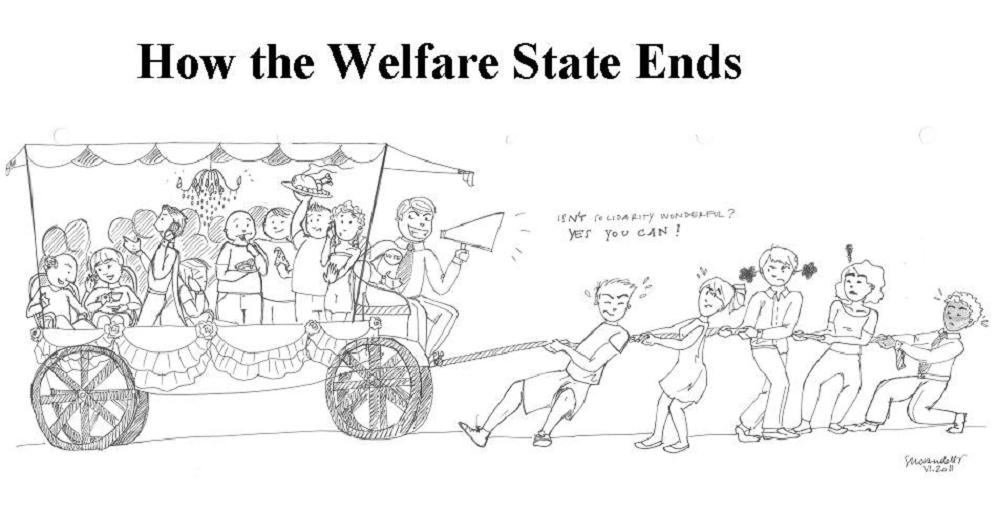
These images are remarkably accurate. The welfare state starts with small programs targeted at a handful of genuinely needy people. But as  politicians figure out the electoral benefits of expanding programs and people figure out the that they can let others work on their behalf, the ratio of producers to consumers begins to worsen.

_________

President Obama c/o The White House
1600 Pennsylvania Avenue NW
Washington, DC 20500

Dear Mr. President,

I know that you receive 20,000 letters a day and that you actually read 10 of them every day. I really do respect you for trying to get a pulse on what is going on out here.

When the government gets so big that it distorts the behavior of the private market then it is too big. The federal government is  now spending 24.8% of GDP and traditionally for the first 150 years of our nation’s history we spent under 5% unless in wartime. This massive spending now by the federal encourages people to lie in order to get money for the government too instead of trying to work hard to earn money in the private market.

Why is big government bad for an economy? The easy answer is that big government usually means high tax rates, and this penalizes work, saving, investment, and entrepreneurship. And perhaps some of the spending is financed by borrowing, and this diverts money from private investment.

That’s a correct answer, but it’s only part of the story. In most cases, there is added damage because politicians spend money in ways that further undermine incentives to produce.

For instance, let’s assume a government spends $1 billion on some sort of redistribution program. Extracting that money from the productive sector of the economy obviously will cause some damage, but it’s also important to estimate how the supposed beneficiaries of the money will react. What if they decide to earn less income in order to be eligible for the handouts, as even the statists at the OECD have recognized?

In other words, it hurts the economy when government collects money, and it often hurts the economy when government spends money. Sort of a perverse 2-for-1 special (though “Rahn Curve” analysis does show that some types of spending – on core public goods – is correlated with better economic performance)

Let’s look at an example from Greece, showing how handouts distort behavior and corrupt people. Here are some remarkable tidbits from a Wall Street Journal story.

The Greek health ministry is investigating on Zakynthos after local officials flagged records showing what they said is an implausibly high number of disability claims for blindness. About 1.8% of the island’s population of 39,000 claimed the benefit last year, according to the health ministry. That is around nine times the prevalence of blindness estimated for many European countries in a 2004 study published in a World Health Organization journal. Among those who put in for the blindness benefit on Zakynthos, a local official said, were a taxi driver and a bird hunter. …But the island is hardly alone, according to health ministry officials, who say fraudulent disability claims are a problem across the nation… Zakynthos Mayor Stelios Bozikis on a Greek television talk show said residents angry about the benefits crackdown and other financial overhauls pelted him with yogurt at a recent event.

Before sneering at the Greeks, keep in mind that “disability” claims also are rising in the United States, which is rather remarkable since jobs have become less arduous over time. Heck, the Social Security Administration decided to give disability payments to a grown man who gets his jollies by wearing diapers.

I’m not sure if that’s better or worse than the Greek government deciding to reward pedophiles with disability payments, but taxpayers are getting screwed in both examples.

Let’s go back to the story and look at a rough estimate of how much fraud exists.

In an attempt to root out fraud, the Greek health ministry recently required disability claimants nationwide to register in a centralized database, appearing in person or sending a representative. The registration resulted in 36,000 fewer disability claims than in 2011, the health ministry said. The ministry alleges these dropped claims were fraudulent, in many cases reflecting multiple claims for the same disability or payments in the name of dead beneficiaries. It also alleges that some doctors accepted money for false diagnoses and some local politicians signed off on the benefits to win support, and said it is giving public prosecutors information about areas where it suspects a high level of fraud. Only 190 of the nearly 700 people it says had been collecting the blindness benefit on Zakynthos participated in the registration, the ministry said.

I have no idea if Zakynthos is representative, but that’s an incredibly high fraud rate. And this is just a glimpse at the workings of one government program. Now multiply that by some large number and you’ll begin to understand the damage caused by government.

And America is not immune. When politicians make it easier to ride in the wagon than to pull the wagon (as this cartoon illustrates), society sooner or later gets in trouble.

____________

Thank you so much for your time. I know how valuable it is. I also appreciate the fine family that you have and your commitment as a father and a husband.

Sincerely,

Everette Hatcher III, 13900 Cottontail Lane, Alexander, AR 72002, ph 501-920-5733, lowcostsqueegees@yahoo.com

The White House, Washington


July 10, 2012

Dear Everette:

Thank you for writing.  As President, it is my privilege to hear from Americans like you who take time to offer their perspective on the serious issues facing our Nation.  I appreciate your message and value your input.

From putting Americans back to work to expanding access to medical care, my Administration continues to take bold action to do what is right for our Nation.  We have enacted the most comprehensive financial reforms in decades, rescued and helped retool our auto industry, expanded student aid to millions of young people, helped level the playing field for working women, and made the largest investment in clean energy in our history.  Because of the courageous acts of our service members, we have been able to end the war in Iraq and take down Osama bin Laden.  We have also made historic commitments to provide for our troops as they return home.  Securing our country’s future will take time, but I will not stop working to rebuild the kind of America where everyone gets a fair shot, everyone does their fair share, and everyone plays by the same rules. 

I am always eager to hear ideas that will help our country adapt to changing times and lead us toward a brighter day.  The enduring American spirit is revealed in the letters I receive, and I remain dedicated to ensuring it is reflected in our efforts to improve the lives of all Americans.

Thank you, again, for sharing your views.  I encourage you to explore www.WhiteHouse.gov to learn more about the ways we are moving America forward.

Sincerely,

Barack Obama

Visit WhiteHouse.gov


Related posts:

Open letter to President Obama (Part 112)

Dan Mitchell on Austerity in Europe 2012 President Obama c/o The White House 1600 Pennsylvania Avenue NW Washington, DC 20500 Dear Mr. President, I know that you receive 20,000 letters a day and that you actually read 10 of them every day. I really do respect you for trying to get a pulse on what […]

A way to understand the current federal budget

I got this off the internet. U.S. Tax revenue: $2,170,000,000,000 Fed budget: $3,820,000,000,000 New debt: $1,650,000,000,000 National debt: $14,271,000,000,000 Recent budget cut: $38,500,000,000 Now, remove 8 zeros and pretend it’s a household budget Annual family income: $21,700 Money the family spent: $38,200 New debt on the credit card: $16,500 Outstanding balance on credit card: $142,710 […]

Open letter to President Obama (Part 111)

President Obama c/o The White House 1600 Pennsylvania Avenue NW Washington, DC 20500 Dear Mr. President, I know that you receive 20,000 letters a day and that you actually read 10 of them every day. I really do respect you for trying to get a pulse on what is going on out here. If our […]

Open letter to President Obama (Part 110)

The Rahn Curve and the Growth-Maximizing Level of Government Uploaded by afq2007 on Jun 29, 2010 Government spending can promote economic growth if money is used for core “public goods” such as rule of law and property rights. But the burden of government spending in the United States and other industrialized nations is far higher […]

Open letter to President Obama (Part 109)

Government Spending Doesn’t Create Jobs Uploaded by catoinstitutevideo on Sep 7, 2011 Share this on Facebook: http://on.fb.me/qnjkn9 Tweet it: http://tiny.cc/o9v9t In the debate of job creation and how best to pursue it as a policy goal, one point is forgotten: Government doesn’t create jobs. Government only diverts resources from one use to another, which doesn’t […]

Open letter to President Obama (Part 108)

The Economic Case for Tax Havens Uploaded by afq2007 on Sep 10, 2008 Statist politicians and international bureaucracies such as the OECD and UN routinely attack tax havens, claiming that they lead to “harmful tax competition.” Yet at no point do critics bother to provide any evidence for this claim. This mini-documentary from the Center […]

Open letter to President Obama (Part 107)

Sweden produced ABBA in the 1970′s, but now they are producing some pretty good economic policies. One of my favorite groups growing up was ABBA. Here are some of my favorite songs: _______________ President Obama c/o The White House 1600 Pennsylvania Avenue NW Washington, DC 20500 Dear Mr. President, I know that you receive 20,000 letters a […]

Open letter to President Obama (Part 106)

President Obama c/o The White House 1600 Pennsylvania Avenue NW Washington, DC 20500 Dear Mr. President, I know that you receive 20,000 letters a day and that you actually read 10 of them every day. I really do respect you for trying to get a pulse on what is going on out here. You want […]

Open letter to President Obama (Part 119B)

Ep. 4 – From Cradle to Grave [3/7]. Milton Friedman’s Free to Choose (1980)

President Obama c/o The White House
1600 Pennsylvania Avenue NW
Washington, DC 20500

Dear Mr. President,

I know that you receive 20,000 letters a day and that you actually read 10 of them every day. I really do respect you for trying to get a pulse on what is going on out here.

With the national debt increasing faster than ever we must make the hard decisions to balance the budget now. If we wait another decade to balance the budget then we will surely risk our economic collapse.

The first step is to remove all welfare programs and replace them with the negative income tax program that Milton Friedman first suggested.

Milton Friedman points out that though many government welfare programs are well intentioned, they tend to have pernicious side effects. In Dr. Friedman’s view, perhaps the most serious shortcoming of governmental welfare activities is their tendency to strip away individual independence and dignity. This is because bureaucrats in welfare agencies are placed in positions of tremendous power over welfare recipients, exercising great influence over their lives. In addition, welfare programs tend to be self-perpetuating because they destroy work incentives. Dr. Friedman suggests a negative income tax as a way of helping the poor. The government would pay money to people falling below a certain income level. As they obtained jobs and earned money, they would continue to receive some payments from the government until their outside income reached a certain ceiling. This system would make people better off who sought work and earned income.

Here is a  portion of the trancript of the “Free to Choose” program called “From Cradle to Grave” (program #4 in the 10 part series):

Friedman: Joe Gardner helped to set up an organization of local black people to protect their own interests. Previously, the blacks had rioted in the streets to try to get their way. Now it was to be done peacefully using government money.

When government funds became available, the Woodlawn Organization got control. They used them to build the kind of houses they wanted. Low rise apartments like these.

The bureaucrats, planners and architects told them that it was uneconomical. That only high-rise blocks would work. They were wrong.

Joe Gardner: A lot of people have this view that, the disadvantaged if you will, have no ideas what their problems are and how to resolve them, that it takes outside professionals to do that. And we say that’s baloney because the outside professional does not feel in his gut what a woman on welfare with six kids living off of a $100 a month in a deteriorated building feels. She can come up with solutions much better than a bureaucrat.

Friedman: The intentions of this local community group are good. They want to rebuild the community as the community wants.

Joe Gardner talking to an elderly woman: I can’t hear you. I said are you pretty pleased with the work we are doing? Yes I am very pleased with it.

Friedman: But government money always corrupts. Look at the number of people rebuilding this garage. It doesn’t make sense except that these are CETA workers paid for by taxpayers money.

Government funds have allowed the organization to take over a whole area of Chicago. They now have their own supermarket.

They’ve built splendid houses for middle class occupiers. Very expensive, protected by the latest security systems. All at the taxpayers expense.

Joe Gardner: In a sense TWA is rapidly becoming a mini-government. At this particular point we have approximately 400 employees. We have an operating budget of, in excess of $5 million per year. So we are large.

Friedman: Large and expanding. Their next project is to redevelop this site. And that’s only the first step in a 20 year plan that will cost $220 million. Most of it coming from the taxpayers.

In the South Bronx, they are very familiar with government protection. Like the rent controls have made it uneconomic for landlords to maintain their buildings. They’ve moved out and the vandals have moved in. The South Bronx is an area where many of the people are on welfare, and where the crime rate is high. But all this could change. A group of local people has begun to renovate these buildings to build new homes. They call themselves “Sweat Equity.” Because at first sweat and effort was all they could put into the project. Only later did they accept a small government grant.

Friedman and Robert Foster: How long ago did you start working on this building? Four months ago for this building right here. And I take it what you are going…to gut the whole thing from beginning to end. Totally gut it. And you’ll have to rewire, right, roof, put new walls up, new floors, new ceilings, new everything in winter and summer whenever there was a chance to work. How many people do you have working here? A good 40 people. How do you keep them working? You know, some of them must want to, get tired of it. We show them what can be done in the future and what will be done in the future. And they get, at first, it’s kind of hard to prove to somebody that in the next three or four years what will come out of it. They can’t see it in long range terms. They only see it in short, they need money right now, not in two years. So we try to show them that it will happen.

Friedman: It’s true they now accept some government money. But so far they’ve managed to retain their original philosophy. That the best way to get something done well is to do it yourself.

Robert Foster: Like what we’re doing. We’re bringing people out of the street and giving them something to look forward to. They have their own apartment, they’ll be taken care of, the area around it, they have a garden, they have something to look forward to. They even get off welfare, you even give them a job. They can drop the welfare and have some self pride. That’s the only thing about it, self pride. The longer you take from the government and sitting back, you’ve got no worries. We’re not sitting back, we’re working. We’re making our money come in. And we are putting it into our building, we’re building ourselves up as well as the buildings.

Friedman: Some of these people are CETA workers. Paid for by the taxpayer. But this isn’t as useful as it might appear.

You ask these fellows which would they rather have, the CETA workers or the money that’s being paid to the CETA workers? Laughter. Which would you rather have?

Robert Foster: The money paid to the workers. Friedman: That’s your answer. That’s very expensive help. In terms of what these people could use with the money. You give these people the amount of money you’re paying to that CETA worker and I’ll bet they’ll have twice as much, three times as much, work. Am I wrong?

Robert Foster: Your right.

Friedman: So it’s a very inefficient way to use their money. The problem is you’ve got bureaucracy and the government bureaucrats, they want to decide what to do. They don’t want to let you decide what to do.

Robert Foster: Exactly.

Friedman: Ask yourself, how does this place get built up in the first place. After all, this was a pretty respectable, solid, substantial region when it was first developed. It wasn’t done through a government project. It was done by people individually having an incentive to put up these buildings and occupying them. What these people we’ve been seeing here are doing is they are trying to restore that feeling and that attitude. You’ll have a far healthier community here that grows out of the self-help of people like the people we’ve been talking to. That it is a paternalistic venture undertaken by governmental civil servants and bureaucrats who have to plan on a large scale for other people.

We must find a way to give everyone caught in the welfare trap the kind of initiative these people have.

The best, or should I say the least bad, solution I have even been able to devise was something called the negative income tax. This is the idea that we should get rid of a large part of the welfare bureaucracy, and for demeaning rules, and we should help people who are poor fundamentally by giving them money.

With a positive income tax, you’re entitled to a certain amount of personal exemptions and deductions. And above that amount you pay tax. But suppose you have no income. Under a negative income tax a fraction of your unused exemptions would be paid to you by the government. Guaranteeing at least a minimum income.

If you earned something, you’d still get a fraction of your unused exemptions. And you’d end up better off.

As your earnings rose, the supplement to your income would become smaller and smaller until your earnings equaled your exemptions. At that point, you’d break even. Neither paying tax nor receiving a subsidy.

It’s not an ideal system. It’s not the system we might have liked to get into, but it’s a system which would have the effect of eliminating the separation of a society into those to receive and those who pay. A separation that tends to destroy the whole social fabric. It would mean that we could each of us take advantage of opportunities that opened up without fearing that if by some chance we lost our jobs, it would be a long time before we could get back on assistance. It would be a system that would give all of us an incentive gradually to improve our lives would perhaps enable us, over time, to work ourselves out of the kind of mess we’ve gotten ourselves into. A mess we’ve gotten ourselves into for the very best of motives but with the very worst of results.

We’ve become increasing dependent on government. We’ve surrendered power to government, nobody has taken it from us. It’s our doing. The results, monumental government spending. Much of it wasted, little of it going to the people whom we would like to see helped. Burdensome taxes, high inflation, a welfare system under which neither those who receive help nor those who pay for it are satisfied. Trying to do good with other people’s money simply has not worked.

_______________

Thank you so much for your time. I know how valuable it is. I also appreciate the fine family that you have and your commitment as a father and a husband.

Sincerely,

Everette Hatcher III, 13900 Cottontail Lane, Alexander, AR 72002, ph 501-920-5733, lowcostsqueegees@yahoo.com

Open letter to President Obama (Part 119.1)

Rep. Fred Upton Blames EPA for Obstructing Alaska Oil Drilling

Uploaded by on Jun 22, 2011

House Energy and Commerce Chairman Fred Upton (R-MI) visited Heritage yesterday and sat down to talk about the high price of gasoline and why more energy production is the answer.

The House of Representatives did pass the bill that the Congressman is talking about but the Senate killed it.
H.R. 2021, the Jobs and Energy Permitting Act of 2011

The bill would eliminate needless permitting delays that have stalled important energy production opportunities off the coast of Alaska. Rather than having exploration air permits repeatedly approved and rescinded by the agency and its review board, the EPA will be required to take final action – granting or denying a permit – within six months. The Jobs and Energy Permitting Act of 2011 would speed up the permit process to help create jobs.

________________

President Obama c/o The White House
1600 Pennsylvania Avenue NW
Washington, DC 20500

Dear Mr. President,

I know that you receive 20,000 letters a day and that you actually read 10 of them every day. I really do respect you for trying to get a pulse on what is going on out here.

Liberals like Max Brantley of the Arkansas Times Blog have always been critical of any votes that would encourage more oil exploration in Alaska, but it is time to do so. We have to get these gas prices down. Take a look at this fine article from the Heritage Foundation:

Mike Brownfield

April 25, 2011 at 12:03 pm

There are an estimated 27 billion barrels of oil waiting to be tapped in the Arctic Ocean, off the coast of Alaska. But after spending five years and nearly $4 billion, Shell Oil Company has been forced to abandon its efforts to drill for oil in the region.

With gas at $4 per gallon and higher, one might think that more oil would be a good thing. So what’s the road block? The Environmental Protection Agency. Fox News reports that the EPA is withholding necessary air permits because of a one square mile village of 245 people, 70 miles from the off-shore drilling site. From Fox News’ Dan Springer:

The EPA’s appeals board ruled that Shell had not taken into consideration emissions from an ice-breaking vessel when calculating overall greenhouse gas emissions from the project. Environmental groups were thrilled by the ruling.

“What the modeling showed was in communities like Kaktovik, Shell’s drilling would increase air pollution levels close to air quality standards,” said Eric Grafe, Earthjustice’s lead attorney on the case.

Who at the EPA made the decision? Springer writes:

The Environmental Appeals Board has four members: Edward Reich, Charles Sheehan, Kathie Stein and Anna Wolgast. All are registered Democrats and Kathie Stein was an activist attorney for the Environmental Defense Fund. Members are appointed by the EPA administrator.

President Barack Obama said in his weekly address on Saturday that “there’s no silver bullet that can bring down gas prices right away,” but that one thing America can do is pursue “safe and responsible production of oil at home.” Too bad his words and his actions are not one and the same. Aside for the EPA’s decision on Shell, the Obama administration has imposed a months-long moratorium on deepwater offshore drilling that curtailed domestic production and sent some seven drilling rigs elsewhere.

The Heritage Foundation’s Nicolas Loris recommends the following actions for Congress and President Obama if they truly want to expand access to America’s domestic energy supply:

  • Allow access to domestic reserves. Permitting exploration of reserves in Alaska, Colorado, Wyoming, and federal waters offshore would inject confidence into the market, create jobs, and stimulate the economy.
  • Roll back regulatory burdens on companies. Strapping companies with onerous regulatory processes only hinders access. Litigation opportunities should be limited and the permitting process made more rational.
  • Issue offshore drilling permits. Lifting the de facto moratorium on offshore drilling permits would gain companies access to domestic resources and increase our domestic energy supply.

Now it’s your turn. What do you think about the EPA’s decision? Join in the conversation by leaving a comment below.

____________

Thank you so much for your time. I know how valuable it is. I also appreciate the fine family that you have and your commitment as a father and a husband.

Sincerely,

Everette Hatcher III, 13900 Cottontail Lane, Alexander, AR 72002, ph 501-920-5733, lowcostsqueegees@yahoo.com
Open letter to President Obama (Part 119)

Uploaded by on Jun 21, 2011

Senator Kay Bailey Hutchison delivered remarks regarding her landmark proposal on entitlement reform, the Defend and Save Social Security Act at the Heritage Foundation’s “Saving Social Security” event. Sen. Hutchison announced that Senator Jon Kyl (R-AZ), member of Biden’s budget working group, has lent his support of her bill as the original cosponsor. At her press conference last week, Sen. Hutchison unveiled her Social Security proposal, and today she reiterated the urgency of putting Social Security on the table in the Biden budget group discussions. Sen. Hutchison sent a letter to Vice President Joe Biden last week urging him to incorporate Social Security reform in the ongoing deficit reduction debates that he is leading.

____________________

President Obama c/o The White House
1600 Pennsylvania Avenue NW
Washington, DC 20500

Dear Mr. President,

I know that you receive 20,000 letters a day and that you actually read 10 of them every day. I really do respect you for trying to get a pulse on what is going on out here. 

Once the baby boomers are finished getting on Social Security (2011 to 2030) there will be nothing left.

There are two serious problems with America’s Social Security system. Almost everyone knows about the first problem, which is that the system is bankrupt, with huge unfunded liabilities of about $30 trillion.

The other crisis is that the system gives workers a lousy level of retirement income compared to the amount of taxes they pay during their working years. Younger workers are particularly disadvantaged, as are African-Americans because of lower life expectancy.

These are critical issues, but perhaps looking at a couple of charts is the best way to illustrate why the Social Security system is inadequate.

Let’s start by looking at some numbers from Australia, where workers set aside 9 percent of their income in personal retirement accounts.

This system, which was made universal by the Labor Party beginning in the 1980s, has turned every Australian worker into a capitalist and generated private wealth of nearly 100 percent of GDP. Here’s a chart, based on data from the Australian Prudential Regulation Authority.

Now let’s look at one of the key numbers generated by America’s tax-and-transfer entitlement system. Here’s a chart showing the projected annual cash-flow deficits for the Social Security system, based on the just-released Trustees’ Report.

By the way, the chart shows inflation-adjusted 2012 dollars. The numbers would look far worse if I used the nominal numbers.

The two charts aren’t analogous, of course, but that’s because there’s nothing to compare. The Social Security system has no savings. Indeed, it discourages people from setting aside income.

And Australia’s superannuation system doesn’t have anything akin to America’s unfunded liabilities. The closest thing to an analogy would be the safety net provision guaranteeing a basic pension to people with limited savings (presumably because of a spotty employment record).

So now ask yourself whether Australia should copy America or America should copy Australia? Seems like a no-brainer.

___________

Thank you so much for your time. I know how valuable it is. I also appreciate the fine family that you have and your commitment as a father and a husband.

Sincerely,

Everette Hatcher III, 13900 Cottontail Lane, Alexander, AR 72002, ph 501-920-5733, lowcostsqueegees@yahoo.com