Category Archives: President Obama

Daniel Mitchell on Paul Ryan’s budget

One thing that stands out about Dan Mitchell is that is not a Democrat or a Republican but a lover of freedom like Milton Friedman was. Take a look at this article of his below.

Posted by Ryan Minto on August 16, 2012

By DANIEL J. MITCHELL

Thanks to several years of fiscal restraint during the 1990s, the burden of federal spending dropped to 18.2% of gross domestic product by the time Bill Clinton left office. The federal budget today consumes more than 24% of economic output, a one-third increase since 2001 in the share of the U.S. economy allocated by politics rather than market forces. That makes the Republican House budget, which would reverse this trend, extremely important for the economic health of the country.

Both political parties deserve blame for the spending spree that’s put America in a fiscal ditch. President George W. Bush was a big spender and President Obama has compounded the damage with his stimulus spending and other programs.

But the era of bipartisan big government may have come to an end. Largely thanks to Rep. Paul Ryan and the fiscal blueprint he prepared as chairman of the House Budget Committee earlier this year, the GOP has begun climbing back on the wagon of fiscal sobriety and has shown at least some willingness to restrain the growth of government.

The Ryan budget has generated considerable controversy in Washington, and it will become even more of an issue now that Mr. Ryan is Mitt Romney’s running mate. So it’s an appropriate time to analyze the plan and consider what it would mean for America.

image

Chad Crowe

The most important headline about the Ryan budget is that it limits the growth rate of federal spending, with outlays increasing by an average of 3.1% annually over the next 10 years. If spending is left on autopilot, by contrast, it would grow by 4.3% (or nearly 39% faster). If President Obama is re-elected, the burden of spending presumably will climb more rapidly.

This comes as a surprise to many people since the press is filled with stories about the Ryan budget imposing trillions of dollars of “savage” and “draconian” spending cuts. All of these stories, however, are based on Washington’s misleading budget process that automatically assumes an ever-expanding government. The 4.3% “base line” increase is the benchmark for measuring “cuts”—even though spending is rising rather than falling, and it’s only the rate of spending growth that is being slowed.

Even limiting spending so it grows by 3.1% per year, as Mr. Ryan proposes, quickly leads to less red ink. This is because federal tax revenues are projected by the House Budget Committee to increase 6.6% annually over the next 10 years if the House budget is approved (and this assumes the Bush tax cuts are made permanent). Since revenues would climb more than twice as fast as spending, the deficit would drop to about 1% of gross domestic product by the end of the 10-year budget window.

To balance the budget within 10 years would require that outlays grow by about 2% each year. Spending in the Ryan budget means the federal budget reaches balance in 2040. There are many who would prefer that the deficit come down more quickly, but from a jobs and growth perspective, it isn’t the deficit that matters.

Rather, what matters for prosperity and living standards is the degree to which labor and capital are used productively. This is why policy makers should focus on reducing the burden of government spending as a share of GDP—leaving more resources in the private economy.

The simple way of making this happen is to follow what I’ve been calling the golden rule of good fiscal policy: The private sector should grow faster than the government. This is what happens with the Ryan budget. The Congressional Budget Office expects nominal economic output (before inflation) to grow about 5% each year over the next decade. So if federal spending grows 3.1% annually, the burden of federal spending slowly shrinks as a share of GDP.

According to the House Budget Committee, the federal budget would consume slightly less than 20% of economic output if the Ryan budget remained in place for 10 years. This would be remarkable progress considering that the federal government is now consuming 24% of GDP vs. Mr. Clinton’s 18.2% in 2001. If Paul Ryan’s policies are social Darwinism, as Mr. Obama and his allies allege, one can only speculate where Bill Clinton ranks in their estimation.

Spending restraint also creates more leeway for good tax policy. Regardless of what you think about deficits, the political reality is that it is difficult to lower tax rates if government borrowing remains at high or rising levels. If deficit spending continues at current levels, then higher tax rates are almost sure to follow. And higher tax rates can’t create an environment conducive to more investment and jobs.

The Ryan budget avoids this unpleasant outcome by addressing the problem of excessive government spending. This makes it possible to extend the 2001 and 2003 tax-rate reductions. It also clears the way for other pro-growth reforms, such as Gov. Romney’s proposed across-the-board 20% income tax cut, a more competitive 25% corporate tax rate, and less double-taxation of dividends and capital gains.

One of the best features of the Ryan budget is that he reforms the two big health entitlements instead of simply trying to save money. Medicaid gets block-granted to the states, building on the success of welfare reform in the 1990s. And Medicare is modernized by creating a premium-support option for people retiring in 2022 and beyond.

This is much better than the traditional Beltway approach of trying to save money with price controls on health-care providers and means testing on health-care consumers. Price controls are notoriously ineffective—because health-care providers adapt by ordering more tests and procedures—and politically unsustainable due to lobbying pressure. Means testing imposes an indirect penalty on people who save and invest during their working years. That should be a nonstarter for a political party that seeks to encourage productive behavior and discourage dependency.

But good entitlement policy also is a godsend for taxpayers, particularly in the long run. Without reform, the burden of federal spending will jump to 35% of GDP by 2040, compared to 18.75% of output under the Ryan budget.

Assuming the GOP ticket prevails in November, Mitt Romney will make the big decisions on fiscal policy. But there is no escaping the fiscal math. If Mr. Romney intends to keep his no-tax-hike promise, he has to restrain the growth of spending. This doesn’t mean he has to go with every detail of the Ryan budget—but it’s certainly a good place to start.

Mr. Mitchell is a senior fellow at the Cato Institute.

A version of this article appeared August 16, 2012, on page A11 in the U.S. edition of The Wall Street Journal, with the headline: What’s Really in the Ryan Budget.

Open letter to President Obama (Part 127 B)

President Obama c/o The White House
1600 Pennsylvania Avenue NW
Washington, DC 20500

Dear Mr. President,

I know that you receive 20,000 letters a day and that you actually read 10 of them every day. I really do respect you for trying to get a pulse on what is going on out here.

I wonder why both Democrats and Republicans are not equally in favor of voter ID laws?

Lachlan Markay

April 9, 2012 at 12:43 pm

A new undercover video by conservative filmmaker James O’Keefe shows a man being offered Attorney General Eric Holder’s District of Columbia ballot. The poll worker caught on film tells the cameraman that he doesn’t need to see identification.

The video, released Monday, contrasts clips from the “sting” with quotes from Holder saying that voter fraud is generally “a problem that does not exist.” Holder’s Justice Department has blocked voter ID laws in South Carolina and Texas on grounds that include the supposed superfluity of those laws.

Eric Holder: There’s No Proof Of ID Fraud…

Uploaded by on Apr 9, 2012

Voter uses Eric Holders name no vote

___________

O’Keefe’s Project Veritas has targeted voter fraud in previous videos. One project, released last month, shows undercover filmmakers registering to vote in Minnesota, where the governor has attempted to block a voter ID bill, using the names of NFL quarterbacks Tim Tebow and Tom Brady.

_______

 Registering Tim Tebow and Tom Brady to Vote in Minnesota

Uploaded by on Feb 7, 2012

ProjectVeritas.com Investigation. Election officials advise no ID necessary to register Timothy Tebow and Thomas Brady to vote in Minnesota. Absentee ballots are discussed, voter registration forms are given out, and Election officials blow the whistle on potential fraud in their own state

_________

While that project had more local focus, the latest Veritas video strikes at the heart of DOJ’s continued opposition to voter ID laws.

Meanwhile, another undercover video highlighted by Scribe last week shows that some of the most vocal opponents of voter ID laws require that visitors to their Washington D.C. offices present ID at the door. That video looks to undercut claims that ID requirements are excessively burdensome and unwarranted.

_______

Undercover Voter ID Investigation: You Will Never Guess Which Liberal

Uploaded by on Apr 3, 2012

What’s wrong with showing identification when you vote? That’s an egregious civil rights violation if you ask the Obama Administration and liberal groups like the Center for American Progress, and the Advancement Project. So what happens if you show up at the front door of these groups without ID? Find out on this PJTV undercover investigation.
______________

It is worth pointing out that the Supreme Court just recently weighed in on voter ID, and found its detractors’ arguments lacking.

The court ruled in 2008 that Indiana’s voter ID law, which the National Conference of State Legislatures says is one of the strictest in the nation, did not constitute an overly-burdensome restriction on voting, and was perfectly justified in the face of potential fraud.

_______

Thank you so much for your time. I know how valuable it is. I also appreciate the fine family that you have and your commitment as a father and a husband.

Sincerely,

Everette Hatcher III, 13900 Cottontail Lane, Alexander, AR 72002, ph 501-920-5733, lowcostsqueegees@yahoo.com

Federal spending by Obama is going up at record pace

Keynesian Economics Is Wrong: Bigger Gov’t Is Not Stimulus

Uploaded by on Dec 15, 2008

Based on a theory known as Keynesianism, politicians are resuscitating the notion that more government spending can stimulate an economy. This mini-documentary produced by the Center for Freedom and Prosperity Foundation examines both theory and evidence and finds that allowing politicians to spend more money is not a recipe for better economic performance.

_____________

I have a lot of respect for Tea Party heroes like Tim Huelskamp , Idaho First District Congressman Raúl R. Labrador, and Justin Amash who are willing to vote against proposals that increase our spending,  and they want to pass the Balanced Budget Amendment.    

It is a fact that we must balance the budget soon. I do not believe that we can wait to balance the budget at some distant time in the future. The financial markets will not allow us a long time to get our house in order. Look at how things have been going the last four years and no matter how anyone tries to spin it, we are going down the financial drain fast.

Mike Brownfield

May 25, 2012 at 8:48 am

There are some things that are so apparent that they’re not even worth mentioning. What goes up must come down. The earth is round. President Barack Obama is a big spender. But this week, some in the media and in the White House are denying one of these totally obvious truths. It shouldn’t be a big surprise which one it is.

On Tuesday, MarketWatch’s Rex Nutting wrote that claims of Obama’s big spending ways are overblown and that the “Obama spending binge never happened.” In a press gaggle on Wednesday, White House spokesman Jay Carney picked up on the argument and claimed that “this President has been–has demonstrated significant fiscal restraint and acted with great fiscal responsibility.”

But sure as the sun rises in the east, not in the west, claims of Obama’s supposed “fiscal restraint” are just plain wrong. Heritage’s J.D. Foster explains:

Federal spending as a share of the economy will average over 24 percent during Obama’s term, and each and every year of that term will see a higher share than during any year since the Second World War. That apparently qualifies as ‘significant fiscal restraint’ Obama-style.

Fiscal responsibility? Obama has had by far the largest budget deficits, driven in large part by the eruption in spending.

Heritage’s Alison Fraser and Emily Goff thoroughly dismantle of the Nutting-Carney claim and point out that President Obama’s near-trillion-dollar stimulus “drove spending to a record 25.2 percent of the economy in 2009 and deficits topped $1 trillion for the first time in the nation’s history.”

You can see the proof for yourself in Heritage’s 2012 edition of the Federal Budget in Pictures. Of the last ten presidents, going back to John F. Kennedy, president Obama’s budget deficits as a percentage of GDP have exploded. And if you take a look at where spending is headed under President Obama’s budget, you’ll see that the country’s debt crisis just keeps getting worse. The President’s FY 2013 budget would increase the debt to 76.5 percent of GDP by 2022, despite $2 trillion in tax hikes. That’s not “fiscal restraint,” no matter how you slice it.

As bad as spending is today, President Obama wants to spend more, especially on transportation, infrastructure, education and research. He says that more spending, paid for with higher taxes, is the key to getting the U.S. economy back on track — even though that strategy has failed miserably over the past three years. Here’s the president’s problem. The American people don’t want Washington to spend more, they want it to spend less. They don’t want Washington to tax more, they want it to tax less. According to a new Rasmussen Reports poll, 53 percent of voters believe that tax cuts help the economy, and most say that more government spending has a negative impact.

The president wants to have it both ways. He’d like to be viewed as someone who cuts taxes and has demonstrated fiscal restraint, but he also wants to keep on taxing and spending. But sure as apples fall from trees and go down, not up, President Obama is a big spender who has done anything but show fiscal restraint. There are some laws of nature that just can’t be denied.

Open letter to President Obama (Part 127)

President Obama c/o The White House
1600 Pennsylvania Avenue NW
Washington, DC 20500

Dear Mr. President,

I know that you receive 20,000 letters a day and that you actually read 10 of them every day. I really do respect you for trying to get a pulse on what is going on out here.

Liberals sometime just lose track of reality. Unemployment benefits were originally set up for a 3 month period, but the Democrats have extended it to almost two years!! What will be the result?

I don’t now why I bothered spending all that time perusing the writings of Paul Krugman and Larry Summers in order to produce my previous blog post when this Michael Ramirez cartoon makes the same point in a much simpler way.

Michael Ramirez

Thank you so much for your time. I know how valuable it is. I also appreciate the fine family that you have and your commitment as a father and a husband.

Sincerely,

Everette Hatcher III, 13900 Cottontail Lane, Alexander, AR 72002, ph 501-920-5733, lowcostsqueegees@yahoo.com

Open letter to President Obama (Part 126 B)

President Obama c/o The White House
1600 Pennsylvania Avenue NW
Washington, DC 20500

Dear Mr. President,

I know that you receive 20,000 letters a day and that you actually read 10 of them every day. I really do respect you for trying to get a pulse on what is going on out here.

The buck stops at your desk. I just don’t understand why you think we can go on and act like everything is okay when we have a trillion dollar deficit. Sometimes you run across some very wise words like I did the other day. Kansas Congressman Tim Huelskamp made the following comment on the irresponsible  Budget Control Act of August 1, 2011:

I refuse to dig America into a deeper and un-scalable hole. I refuse to be complicit in recklessly spending and borrowing on the backs of the next generation. And, I believe conservatives should make good on their promises to cut trillions in spending…”

Ted DeHaven noted his his article, “Freshman Republicans switch from Tea to Kool-Aid,”  Cato Institute Blog, May 17, 2012:

This week the Club for Growth released a study of votes cast in 2011 by the 87 Republicans elected to the House in November 2010. The Club found that “In many cases, the rhetoric of the so-called “Tea Party” freshmen simply didn’t match their records.” Particularly disconcerting is the fact that so many GOP newcomers cast votes against spending cuts.

The study comes on the heels of three telling votes taken last week in the House that should have been slam-dunks for members who possess the slightest regard for limited government and free markets. Alas, only 26 of the 87 members of the “Tea Party class” voted to defund both the Economic Development Administration and the president’s new Advanced Manufacturing Technology Consortia program (see my previous discussion of these votes here) and against reauthorizing the Export-Import Bank (see my colleague Sallie James’s excoriation of that vote here).

One of those Tea Party heroes was Tim Huelskamp of Kansas. Last year I posted this below concerning his conservative views and his willingness to vote against the debt ceiling increase:

August 1, 2011

Congressman Huelskamp: My Constituents and Our Economy Deserve a Long-Term Solution

(WASHINGTON) – Kansas Congressman Tim Huelskamp issued the following statement after voting against the Budget Control Act:

“My fellow freshmen and I were sent to Washington to end tricks and gimmicks that put America in this position,” Congressman Tim Huelskamp said. “I voted ‘no’ today because I refuse to dig America into a deeper and un-scalable hole. I refuse to be complicit in recklessly spending and borrowing on the backs of the next generation. And, I believe conservatives should make good on their promises to cut trillions in spending, enact structural reforms, and fill the role of elected representatives, rather than hand control to an exclusive committee.”

“Back in April – when I voted against the continuing resolution for this year – I said ‘no’ because the cuts were minimal. I came to the same conclusion today: these are paltry cuts compared to the $14.3 trillion in debt we already have and the $7 trillion in new debt we can expect in the next decade. This is not a path to fiscal solvency, it’s a path to fiscal insanity. My constituents and our economy deserve a long-term solution that ends the biggest problem: we simply spend too much.”

“Despite having pledged to the American people an open and transparent process and despite having months to fix this problem, we were asked to vote in the 11th hour for a bill that the public had less than 16 hours to read and understand. The culture of fiscal irresponsibility may not have been created by this Congress, but we were sent here to put an end to it; I’m afraid this bill does not rise to that occasion.”

_________

Thank you so much for your time. I know how valuable it is. I also appreciate the fine family that you have and your commitment as a father and a husband.

Sincerely,

Everette Hatcher III, 13900 Cottontail Lane, Alexander, AR 72002, ph 501-920-5733, lowcostsqueegees@yahoo.com

“Feedback Friday” Letter to White House generated form letter response July 30,2012 on Social Security (part 16)

I have been writing President Obama letters and have not received a personal response yet.  (He reads 10 letters a day personally and responds to each of them.) However, I did receive a form letter in the form of an email on July 30, 2012. I don’t know which letter of mine generated this response so I have linked several of the letters I sent to him below with the email that I received. However, I think it was probably this one below:

President Obama’s state of the union speech Jan 24, 2012

Barack Obama  (Photo by Saul Loeb-Pool/Getty Images)

President Obama c/o The White House
1600 Pennsylvania Avenue NW
Washington, DC 20500

Dear Mr. President,

I know that you receive 20,000 letters a day and that you actually read 10 of them every day. I really do respect you for trying to get a pulse on what is going on out here.

The Heritage Foundation website (www.heritage.org ) has lots of good articles and one that caught my attention was concerning your State of Union Speech on January 24, 2012 and here is a short portion of that article:

Social Security Silence David John

In a night of disappointments, the complete lack of any mention of Social Security other than as an excuse to raise taxes was one of the greatest.  Although the Social Security trustees, several of whom are members of the President’s cabinet, has warned that the program faces perpetual deficits, the President evidently has no plan to protect the retirement security of millions of Americans who face a 25% benefit cut in less than 25 years.  Most officeholders join the President in treating Social Security as an issue that can be discussed later – much later, but the reality is that just like a leaky roof, the longer that the President and Congress waits to fix the program, the more expensive the reforms will be.

Tax Reform? It’s Needed, but There’s A Better Way to GoEmily Goff

President Obama says he is ready and willing to embark on tax reform. This is a welcome statement, as our current tax system is ripe for overhaul. However, instead of piecemeal approaches or solutions that give preferences to one industry or company over another, the President should look to the fundamental reforms that the New Flat Tax, as part of The Heritage Foundation’s Saving the American Dream, would bring.

Obama Doubles Down on the Worst U.S. Tax Policy – J.D. Foster

One of the universally acknowledged banes of the federal income tax has for years been the individual Alternative Minimum Tax.  Borne in its current form in the 1986 tax reform act, this parallel system which runs in parallel to the regular income tax forces taxpayers to calculate their taxes twice and pay the larger of the two.

Today, this tax makes no sense, and most tax reform proposals of sufficient heft seek as a primary goal the repeal of the AMT.  Tonight, President Obama proposed not merely to embrace the AMT in principle, but to extend the principle robustly to the business income tax – to create a new basic minimum tax for businesses.  Once again, when it comes to tax policy, President Obama sees what needs to be done – and does the exact opposite.

___________________

Got to tackle entitlement reform but your speech did not mention that once.

Thank you so much for your time. I know how valuable it is. I also appreciate the fine family that you have and your committment as a father and a husband.

Sincerely,

Everette Hatcher III, 13900 Cottontail Lane, Alexander, AR 72002, ph 501-920-5733, lowcostsqueegees@yahoo.com

The White House, Washington

July 30, 2012

Dear Everette:

Thank you for sharing your thoughts with me.  I have heard from many Americans who are worried about the future of their retirement savings, and I appreciate your perspective.

Retiring with dignity is a promise we must keep to all Americans, and I am working hard to strengthen our retirement system.  That is why I am committed to protecting Social Security and addressing Americans’ concerns.  Social Security cannot be subjected to risky privatization plans because the future of hard-working Americans should not be left to the fluctuations of financial markets.

To better secure their retirement and prepare for unforeseen circumstances, Americans must also save for their future in other ways.  We are laying the foundation for all individuals to participate in workplace retirement accounts.  Employees would be automatically enrolled in pension plans and could opt out if they choose.  Simple and automatic enrollment makes it easier for people to plan for retirement.  This would assist the 75 million working Americans—about half the workforce—who lack access to retirement plans through their employers.  Please join me online to learn more at:  www.whitehouse.gov/agenda/seniors-and-social-security.

Thank you, again, for writing.

Sincerely,

Barack Obama

Visit WhiteHouse.gov

Related posts:

Open letter to President Obama (Part 117.5)

6/6/12 Republican Leadership Press Conference Published on Jun 6, 2012 by HouseConference Today House Republican leaders, joined by Senate Republican Leader Mitch McConnell, discussed the importance of preventing any tax increase to provide certainty to America’s job creators. Even President Bill Clinton and Larry Summers agree — taxes should not be raised on anyone in […]

Open letter to President Obama (Part 117.4)

President Obama c/o The White House 1600 Pennsylvania Avenue NW Washington, DC 20500 Dear Mr. President, I know that you receive 20,000 letters a day and that you actually read 10 of them every day. I really do respect you for trying to get a pulse on what is going on out here. We need […]

Open letter to President Obama (Part 117.3)

A Taxing Distinction for ObamaCare Published on Jun 28, 2012 by catoinstitutevideo http://www.cato.org/publications/commentary/it-now-falls-congress http://www.cato.org/publications/commentary/taxing-decision http://www.cato-at-liberty.org/supreme-court-unlawfully-rewrites-obamacare-to… http://www.cato-at-liberty.org/congress-its-not-a-tax-scotus-yes-it-is/ The Cato Institute’s Roger Pilon, Ilya Shapiro, Michael F. Cannon, Michael D. Tanner and Trevor Burrus evaluate today’s ruling on ObamaCare at the Supreme Court. Video produced by Caleb O. Brown and Austin Bragg. ____________ President Obama c/o The […]

“Feedback Friday” Letter to White House generated form letter response July 16,2012 on small businesses (part 13)

I have been writing President Obama letters and have not received a personal response yet.  (He reads 10 letters a day personally and responds to each of them.) However, I did receive a form letter in the form of an email on July 16, 2012. I don’t know which letter of mine generated this response so I have linked several […]

Open letter to President Obama (Part 117.2)

  President Obama c/o The White House 1600 Pennsylvania Avenue NW Washington, DC 20500 Dear Mr. President, I know that you receive 20,000 letters a day and that you actually read 10 of them every day. I really do respect you for trying to get a pulse on what is going on out here.   […]

Open letter to President Obama (Part 117.1)

Glenn Beck Presents: F.A. Hayek’s “The Road to Serfdom” (Part 2) President Obama c/o The White House 1600 Pennsylvania Avenue NW Washington, DC 20500 Dear Mr. President, I know that you receive 20,000 letters a day and that you actually read 10 of them every day. I really do respect you for trying to get […]

Open letter to President Obama (Part 125B)

Obama Calls GOP Budget Plan “Prescription for Decline”

Uploaded by on Apr 3, 2012

In a blistering attack on the House-Passed Republican budget Tuesday, President Obama called the plan proposed by Rep. Paul Ryan a “Trojan Horse” and “a prescription for decline.” Judy Woodruff, Jared Bernstein of the Center on Budget and Policy Priorities and the CATO Institute’s Daniel Mitchell discuss the GOP budget plan.

_______

President Obama c/o The White House
1600 Pennsylvania Avenue NW
Washington, DC 20500

Dear Mr. President,

I know that you receive 20,000 letters a day and that you actually read 10 of them every day. I really do respect you for trying to get a pulse on what is going on out here.

You were really hard on Paul Ryan for his plan, but your plan will NEVER LEAD TO A BALANCED BUDGET.

Obama’s And Paul Ryan’s Conflicting Budget Visions

by Michael D. Tanner

Michael Tanner is a senior fellow at the Cato Institute and author of Leviathan on the Right: How Big-Government Conservatism Brought Down the Republican Revolution.

Added to cato.org on April 6, 2012

This article appeared in Fiscal Times on April 6, 2012.

With his speech to news editors and executives this week, President Obama has made it clear that he plans to run a starkly ideological campaign, contrasting his vision for the future of the country with that of his Republican opponents. And, he plans to make the Republican budget, written by rising GOP star Rep. Paul Ryan of Wisconsin and embraced by presumptive Republican nominee Mitt Romney, exhibit one in that contrast. It would be worthwhile therefore to actually compare that budget with the one proposed by the president.

Deficits and Debt
The president’s budget proposal would reduce future deficits — at least until 2018 — but would never achieve balance. By 2018, the president projects deficits to fall to only $575 billion. After that, they begin rising again, reaching $704 billion by 2022. Overall, the president’s budget would add an additional $6.7 trillion to the national debt over the next 10 years.

Paul Ryan does better when it comes to deficit reduction, but only because the president has set such a low bar. Unlike the president, Ryan would eventually balance the budget — but not until 2040 or so. He does, however, generally run much lower annual deficits than the president would, and adds $3.3 trillion less to the national debt over the next 10 years.

Obama and Ryan have presented two distinct visions of the future.

Over the longer-term, the differences are much more pronounced. By 2050, for instance, Ryan would be running a surplus equal to as much as 3 percent of GDP. The president’s budget, in contrast, projects that we would still face budget deficits in excess of 6 percent of GDP.

Government Spending
Neither President Obama nor Paul Ryan actually cuts government spending. Rather, both are playing the time-honored game of calling a reduction in the rate of increase a “cut.” Thus, the president would increase federal spending from $3.8 trillion in 2013 to $5.82 trillion in 2022. That might not be as big an increase there might otherwise be, but in no way can it be called a cut. Meanwhile, Ryan, who is being accused of “thinly veiled Social Darwinism,” would actually increase spending from $3.53 trillion in 2013 to $4.88 trillion in 2022.

The president warns that Ryan’s spending “cuts” would “gut” the social safety net. And, it is true that Ryan’s budget knife falls more heavily on domestic discretionary spending than does the president’s — but only relatively. Over the next 10 years, Ryan would spend $352 billion less on those programs than would Obama, an average of just $35.2 billion per year in additional cuts. Given that domestic discretionary spending under the president’s budget will total more than $4 trillion over the next decade, Ryan’s cuts look less than draconian.

One area where the president appears to have the better argument is on defense spending. Ryan would undo the defense spending sequester agreed to under last year’s debt-ceiling compromise, and would spend $203 billion more over 10 years than was agreed to. Obama would cut defense by an additional $240 billion. Given our budget problems and the lack of a conventional military threat, Ryan’s plan to spare defense seems shortsighted.

Taxes
The president would increase tax revenue to 20.1 percent of GDP. That’s a huge increase from the current 15.4 percent, and higher than the post-World War II average of 18 percent. His budget includes tax hikes on people and small businesses making as little as $200,000 per year, as well as the usual panoply of tax hikes on energy products, businesses, investment and pretty much anything else the president can think of.

The president also continues to push for the so-called Buffet Rule, a new 30 percent minimum tax on the rich, based on the misleading claim that Warren Buffett pays a lower tax rate than his secretary. The Buffett Rule would raise very little revenue — less than $3.2 billion per year on average according to the Congressional Budget Office — but the president is pushing it as a matter of fairness.

Ryan would also allow taxes to increase as a percentage of GDP, returning to roughly their historical average around 18 percent of GDP. However, he is also calling for a major reform of the U.S. tax code. Ryan would replace the current four tax rates with two: 15 and 25 percent. He would also lower the current 38 percent corporate tax rate, the world’s highest, to 25 percent. At the same time, he would broaden the taxable base by eliminating many current deductions and loopholes. Unfortunately, Ryan has ducked the unpopular task of actually spelling out which loopholes would be eliminated.

Entitlement Reform
Perhaps the biggest disagreement between the president and Ryan is over how to reform the entitlement programs that are driving this country toward bankruptcy. Ryan would restructure Medicare for those under age 55 to give recipients a choice between the traditional program and a voucher that would allow them to purchase private insurance. That plan, drafted together with Democratic Sen. Ron Wyden of Oregon, would have little impact in the short-term — in 2022, it would spend just $21 billion less than the president’s budget — but over the longer term would reduce Medicare’s unfunded liability, which the Medicare trustees put at $24.6 trillion, by trillions of dollars.

The president makes no significant changes to Medicare, relying instead on expansion of changes contained in the new health care law to save a projected $364 billion over the next 10 years.

Ryan would also turn the current Medicaid program to the states in the form of a federal block grant, while reducing spending by $810 billion over 10 years. States would have far more freedom to experiment with ways to reform the system, but would likely receive less federal funds over the long term. Obama, by contrast, leaves the program unchanged, while significantly expanding eligibility under the health care law.

Unsurprisingly in an election year, both Ryan and the president punt on Social Security reform. Neither offers any reform of the troubled retirement system, despite its $21 trillion in unfunded liabilities.

Two Visions
The United States is teetering on the edge of Greek-style bankruptcy. Our total indebtedness, including the unfunded liabilities of Social Security and Medicare, could run as high as $130 trillion, more than 900 percent of GDP. In the face of this looming crisis, Obama and Ryan have presented two distinct visions of the future. The president offers a bigger government, paid for with more debt and higher taxes. Ryan’s vision may be maddeningly timid and vague in places, but it takes important steps toward a smaller, less costly, and less intrusive government.

If that’s the debate that President Obama wants to have, let’s do it.

____________

Thank you so much for your time. I know how valuable it is. I also appreciate the fine family that you have and your commitment as a father and a husband.

Sincerely,

Everette Hatcher III, 13900 Cottontail Lane, Alexander, AR 72002, ph 501-920-5733, lowcostsqueegees@yahoo.com

Open letter to President Obama (Part 125)

President Obama c/o The White House
1600 Pennsylvania Avenue NW
Washington, DC 20500

Dear Mr. President,

I know that you receive 20,000 letters a day and that you actually read 10 of them every day. I really do respect you for trying to get a pulse on what is going on out here.

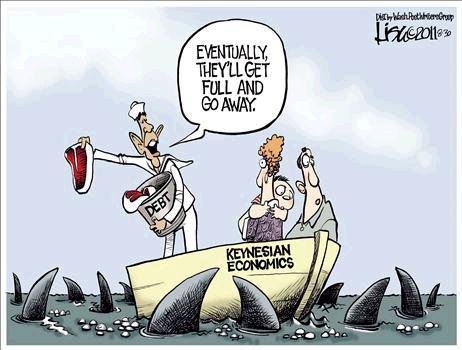
Why did your stimulus idea  not work in 2009?

Keynesian Economics in a Cartoon

September 1, 2011 by Dan Mitchell

I’ve written extensively about the flaws of Keynesian economics, and I’ve even narrated a video on the flaws of Keynesian theory.

But this clever cartoon may be more effective than anything I’ve ever done.

If you like cartoons that teach economics, check out this gem. It’s not on Keynesianism, but it’s very good.

_______________

Thank you so much for your time. I know how valuable it is. I also appreciate the fine family that you have and your commitment as a father and a husband.

Sincerely,

Everette Hatcher III, 13900 Cottontail Lane, Alexander, AR 72002, ph 501-920-5733, lowcostsqueegees@yahoo.com

Open letter to President Obama (Part 124 B)

DEBT LIMIT – A GUIDE TO AMERICAN FEDERAL DEBT MADE EASY.

Uploaded by on Nov 4, 2011

A satirical short film taking a look at the national debt and how it applies to just one family. Watch the guy from the Ferris Bueller Superbowl Spot! Produced by Seth William Meier, DP/Edited by Craig Evans, 1st AC Brian Andrews, Sound Mixer Gus Salazar, Written and Directed by Brian Stepanek. Help us spread the word by clicking ads or at www.debtlimitusa.org

_________________

President Obama c/o The White House
1600 Pennsylvania Avenue NW
Washington, DC 20500

Dear Mr. President,

I know that you receive 20,000 letters a day and that you actually read 10 of them every day. I really do respect you for trying to get a pulse on what is going on out here.

You are the President of the United States and you need to take the bull by the horns and cut some spending now!!!! I read some wise words by Rep. Justin Amash (R-MI) and I wanted to pass them on. He sees how dangerous it is to keep kicking the can down the street: “The Budget Control Act trades $21 billion in cuts next year for a debt ceiling increase of $2.1 trillion. That’s one penny in cuts for each dollar of new debt. The bill does not seriously address the drivers of the federal government’s fiscal crisis. It does not improve entitlement programs. It does not include a balanced budget amendment to the Constitution.”

Michael Tanner of the Cato Institute in his article, “Hitting the Ceiling,” National Review Online, March 7, 2012 noted:

After all, despite all the sturm und drang about spending cuts as part of last year’s debt-ceiling deal, federal spending not only increased from 2011 to 2012, it rose faster than inflation and population growth combined.

We need some national statesmen (and ladies) who are willing to stop running up the nation’s credit card.

Ted DeHaven noted his his article, “Freshman Republicans switch from Tea to Kool-Aid,”  Cato Institute Blog, May 17, 2012:

This week the Club for Growth released a study of votes cast in 2011 by the 87 Republicans elected to the House in November 2010. The Club found that “In many cases, the rhetoric of the so-called “Tea Party” freshmen simply didn’t match their records.” Particularly disconcerting is the fact that so many GOP newcomers cast votes against spending cuts.

The study comes on the heels of three telling votes taken last week in the House that should have been slam-dunks for members who possess the slightest regard for limited government and free markets. Alas, only 26 of the 87 members of the “Tea Party class” voted to defund both the Economic Development Administration and the president’s new Advanced Manufacturing Technology Consortia program (see my previous discussion of these votes here) and against reauthorizing the Export-Import Bank (see my colleague Sallie James’s excoriation of that vote here).

One of those Tea Party heroes was Justin Amash of Michigan. Last year I posted this below concerning his conservative views and his willingness to vote against the debt ceiling increase:

Amash Issues Statement After Debt Ceiling Vote

Representative Votes Against Budget Control Act
Aug 1, 2011 Issues: Spending and Debt
FOR IMMEDIATE RELEASE
August 1, 2011
CONTACT
Will Adams
202.731.2294
will.adams@mail.house.gov

Amash Issues Statement After Debt Ceiling Vote

Representative Votes Against Budget Control Act

Washington, D.C. – Rep. Justin Amash (R-MI) issued the following statement after the vote on the Budget Control Act of 2011:

“The Budget Control Act trades $21 billion in cuts next year for a debt ceiling increase of $2.1 trillion. That’s one penny in cuts for each dollar of new debt. The bill does not seriously address the drivers of the federal government’s fiscal crisis. It does not improve entitlement programs. It does not include a balanced budget amendment to the Constitution. I cannot in good conscience vote for so little reform when so much is at stake.

“I had hoped that Democrats and Republicans would work together to develop a reasonable compromise that is fiscally responsible. I would favor a package that combines eliminating special tax breaks and subsidies with a well-structured balanced budget amendment. I believe that type of package would have broad-based support from the American people. Instead, Congress continues to kick the can down the road.

“We can do better. I look forward to working with my colleagues on both sides of the aisle over the next several months to adopt structural reforms that will put the government back on a sustainable path.”

Thank you so much for your time. I know how valuable it is. I also appreciate the fine family that you have and your commitment as a father and a husband.

Sincerely,

Everette Hatcher III, 13900 Cottontail Lane, Alexander, AR 72002, ph 501-920-5733, lowcostsqueegees@yahoo.com

New Video shows how Obama has run up the national debt

We got to stop all the red ink.

The burden of federal spending in the United States was down to 18.2 percent of gross domestic product when Bill Clinton left office.

But this progress didn’t last long. Thanks to George Bush’s reckless spending policies, the federal budget grew about twice as fast as the economy, jumping by nearly 90 percent in just eight years This pushed federal spending up to about 25 percent of GDP.

President Obama promised hope and change, but he has kept spending at this high level rather than undoing the mistakes of his predecessor.

This new video from the Center for Freedom and Prosperity Foundation uses examples of waste, fraud, and abuse to highlight President Obama’s failed fiscal policy.

Published on Aug 12, 2012 by

This mini-documentary from the Center for Freedom and Prosperity Foundation highlights egregious examples of wasteful spending from the so-called stimulus legislation and explains why government spending hurts economic performance.

____________________

Good stuff, though the video actually understates the indictment against Obama. There is no mention, for instance, about all the new spending for Obamacare that will begin to take effect over the next few years.

But not everything can be covered in a 5-minute video. And I suspect the video is more effective because it closes instead with some discussion of the corrupt insider dealing of Obama’s so-called green energy programs.