Since the beginning of the recession, academics, authoritative international institutions, and most government officials pushed for massive stimulus spending. Sweden bucked the trend, focusing instead on slashing marginal tax rates and peeling government back. How did it fare?
While most countries in Europeborrowed massively, Borg did not. Since becoming Sweden’s finance minister, his mission has been to pare back government. His ‘stimulus’ was a permanent tax cut. To critics, this was fiscal lunacy — the so-called ‘punk tax cutting’ agenda. Borg, on the other hand, thought lunacy meant repeating the economics of the 1970s and expecting a different result.
Three years on, it’s pretty clear who was right. ‘Look atSpain,Portugalor theUK, whose governments were arguing for large temporary stimulus,’ he says. ‘Well, we can see that very little of the stimulus went to the economy. But they are stuck with the debt.’ Tax-cuttingSweden, by contrast, had the fastest growth inEuropelast year, when it also celebrated the abolition of its deficit.
Too bad the U.S. decided against Sweden’s advice. Still, missing one opportunity doesn’t mean we have to miss another: Tax reform is calling.
______________
Thank you so much for your time. I know how valuable it is. I also appreciate the fine family that you have and your commitment as a father and a husband.
Sincerely,
Everette Hatcher III, 13900 Cottontail Lane, Alexander, AR 72002, ph 501-920-5733, lowcostsqueegees@yahoo.com
What do you do when you’re losing a debate? Change the subject. That’s really all you need to know to understand President Obama’s resuscitation of his infamous “Buffett Rule” that would impose a minimum 30 percent effective tax rate on businesses and families earning $1 million.
The Supreme Court gave Obamacare a nasty audition two weeks ago, leaving even staunch defenders of the law grasping for straws while the former constitutional law professor now in the White House outrageously flailed the court for doing exactly what the Constitution intends. So what is the President’s response? Change the subject, of course.
After releasing a non-budget that completely ignored the nation’s near-term, medium-term, and long-term fiscal plight – an extraordinary trifecta not easily achieved – the President then tried to take the House Republicans to task for their proposed real solutions on all three. Nothing highlights irresponsibility like responsible behavior, and so Obama found sharp rhetoric and a frowning visage to be thin gruel when you’ve no policies of your own. Response? Change the subject.
Soaring gas prices have put enormous strains on family budgets and business plans. The President might deflect some of the resulting popular anger if he actually had an energy policy that might produce more energy. Instead, his policies have produced only more examples of why government should not be in the business of picking winners and losers (Solyndra). When your most notable policies relating to gas prices is to kill a major oil pipeline like Keystone, propose algae as an energy source and seek to raise taxes on oil companies, you’ve nowhere to hide. Response? Change the subject.
Then came last Friday’s jobs report, which was universally acknowledged as disappointing: job growth cut in half from the modest levels of previous months, and an unemployment rate that fell only because thousands of Americans just gave up looking. If Washington had merely left the economy to heal itself, performance today would have been much stronger and unemployment markedly lower. Instead, almost everything this Administration has tried has failed noticeably, and voters have noticed. Response? Change the subject.
With nowhere else to go, Obama has fallen back to his most comfortable setting – class warfare. Now that it is painfully obvious the Buffett Rule is the President’s chief policy priority and the centerpiece of his reelection campaign, it is fair to ask, what would the policy do to address any of the nation’s problems?
The answer is – absolutely nothing.
Strengthen the economy? No, when it comes to economic growth the Buffett Rule would weaken the economy. The tax would fall most heavily on job creators like businesses that pay their taxes through the individual income tax, investors, and entrepreneurs. The higher levy would confiscate from them resources they would otherwise use to start new businesses, grow existing businesses, and hire more workers. This will slow economic growth, job creation, and wage increases.
Reduce the budget deficits? More like “budget pixie dust” in the words of House Budget Chairman Paul Ryan (R-WI). According to a recent analysis by the congressional Joint Committee on Taxation, the Buffett Rule would raise $47 billion over ten years. And that assumes no negative economic effects, which are certain to reduce the revenues gained. For perspective, during that period President Obama’s budget calls for adding $6.7 trillion to the national debt. The Buffett Rule would reduce the increase in debt in Obama’s budget by about one half of one percent. No joke.
The Buffett Rule debate is desperate political prestidigitation. President Obama is losing the fight over Obamacare, which remains intensely unpopular. Gas prices show no sign of descending. The economy at best is muddling. And the nation is looking for answers on the budget and the President has none. The President needed a change of subject. For Obama, what better time for a distracting, divisive fight over fairness?
When a President refuses to address the issues the country cares about, they tune out. Obama’s fairness fight is likely to fare about as well as the rest of his policies.
_____________
Thank you so much for your time. I know how valuable it is. I also appreciate the fine family that you have and your commitment as a father and a husband.
Sincerely,
Everette Hatcher III, 13900 Cottontail Lane, Alexander, AR 72002, ph 501-920-5733, lowcostsqueegees@yahoo.com
What future does our country have if we never even attempt to balance our budget. As President it is your duty to take the lead on getting our budget balanced.
I read some wise words by Congressman Jeff Landry (R, LA-03) regarding the debt ceiling deal that was passed on August 1, 2011:”Throughout this debate, the American people have demanded a real cure to America’s spending addiction – a Balanced Budget Amendment to the U.S. Constitution. Unfortunately, today’s Washington deal transforms last week’s strong Balanced Budget requirement into a toothless suggestion.”
If we are going to get the budget to balance it will take a Balanced Budget Amendment to force us to do so. There is no other way around that fact!!!
This week the Club for Growth released a study of votes cast in 2011 by the 87 Republicans elected to the House in November 2010. The Club found that “In many cases, the rhetoric of the so-called “Tea Party” freshmen simply didn’t match their records.” Particularly disconcerting is the fact that so many GOP newcomers cast votes against spending cuts.
The study comes on the heels of three telling votes taken last week in the House that should have been slam-dunks for members who possess the slightest regard for limited government and free markets. Alas, only 26 of the 87 members of the “Tea Party class” voted to defund both the Economic Development Administration and the president’s new Advanced Manufacturing Technology Consortia program (see my previous discussion of these votes here) and against reauthorizing the Export-Import Bank (see my colleague Sallie James’s excoriation of that vote here).
One of those Tea Party heroes was Congressman Jeff Landry (R, LA-03). Last year I posted this below concerning his conservative views and his willingness to vote against the debt ceiling increase:
WASHINGTON, DC – Congressman Jeff Landry (R, LA-03) issued the following statement regarding today’s debt ceiling deal:
“I’m sure by Washington standards, today’s deal is a great accomplishment; but by American standards, it comes up short. Throughout this debate, the American people have demanded a real cure to America’s spending addiction – a Balanced Budget Amendment to the U.S. Constitution. Unfortunately, today’s Washington deal transforms last week’s strong Balanced Budget requirement into a toothless suggestion. And today’s Washington deal puts at risk the security and pay of our brave men and women in uniform. It’s disheartening that Washington continues skirting the problem, instead of passing long-term solutions to end it. As evident by my decision today, I stand with the American people and choose to put the next generation above my next election.”
___________
Thank you so much for your time. I know how valuable it is. I also appreciate the fine family that you have and your commitment as a father and a husband.
Sincerely,
Everette Hatcher III, 13900 Cottontail Lane, Alexander, AR 72002, ph 501-920-5733, lowcostsqueegees@yahoo.com
Why does the federal government have to take so much control of our lives? Back in 1929 the federal government spent 3% of GDP and now it spends 24.8%. Back then in 1929 there was 8.9% by State and local governments for a total of 11.9% and our freedom day was February 12th when we turn our attention to spending our money on the things we need. Now the government spends over 50% of our money and we don’t get our freedom day until sometime in July!!!
The Tax Foundation reported that Tuesday was Tax Freedom Day (TFD), which is the day that Americans stop “working for the government” through their tax payments and start working for themselves.
TFD is calculated by taking total federal, state, and local taxes and dividing by national income to get a ratio representing the share of income that the average person pays in all taxes. That ratio is applied to the 365-day calendar. This year the ratio is 29.2 percent, which translates into April 17 for TFD. Time to party!
But maybe not quite yet…
When I worked at Tax Foundation in 1993, I mailed a letter to Milton Friedman asking about his view on TFD. He kindly responded with a letter and a 1974 Newsweek article in which he proposed a “Personal Independence Day.” That day would be based on total government spending, which is larger than total taxes, and thus our day to celebrate freedom from the government hasn’t yet arrived this year.
In his letter to me, Friedman stressed that total spending is the important variable in assessing the burden of government: “If government spends an amount equal to 50 percent of the national income, only 50 percent is left to be available for private purposes, and that is true however the 50 percent that government spends is financed.” And while some economists focus on how government borrowing may “crowd out” private investment, Friedman said, “What does the crowding out is government spending, however financed, not government deficits.”
In its TFD report, Tax Foundation includes a supplemental calculation looking at spending. The thinktank figures that Americans will work until May 14 this year to be free from the burden of federal, state, and local spending. The Foundation is lacking a snappy name for that important day, but now we are reminded that Friedman has already suggested one.
Friedman hoped that “Personal Independence Day” would complement our national Independence Day of July 4. The latter is the day we celebrate independence from the “Royal Brute of Britain,” as Tom Paine called him in Common Sense. But for Paine and the other Founders, the deeper goal of July 4, 1776 was to create a limited government to ensure the maximum space for the exercise of individual freedom. As Paine noted, private “society in every state is a blessing, but government, even in its best state, is but a necessary evil.”
So Milton Friedman’s Personal Independence Day can be our annual reminder that while our forefathers gave the boot to the “crowned ruffians” of Old Europe, we’ve still got work to do in limiting the power grabbing of our own elected ruffians in Washington.
__________
Thank you so much for your time. I know how valuable it is. I also appreciate the fine family that you have and your commitment as a father and a husband.
Sincerely,
Everette Hatcher III, 13900 Cottontail Lane, Alexander, AR 72002, ph 501-920-5733, lowcostsqueegees@yahoo.com
In the last few years the number of people receiving Food Stamps has skyrocketed. President Obama has not cut any federal welfare programs but has increased them, and he has used class warfare over and over the last few months and according to him equality at the finish line is the equality that we should all be talking about. However, socialism has never worked and it has always killed incentive to produce more. Milton Friedman shows in this film series below how so many people get caught in the “Welfare Trap.” Friedman also gives a great solution to this problem in the “negative income tax.” I am glad that I had the chance to be studying his work for over 30 years now.
In 1980 when I first sat down and read the book “Free to Choose” I was involved in Ronald Reagan’s campaign for president and excited about the race. Milton Friedman’s books and film series really helped form my conservative views. Take a look at one of my favorite films of his:
Friedman Friday:(“Free to Choose” episode 4 – From Cradle to Grave, Part 1 of 7)
Volume 4 – From Cradle to Grave
Abstract:
Since the Depression years of the 1930s, there has been almost continuous expansion of governmental efforts to provide for people’s welfare. First, there was a tremendous expansion of public works. The Social Security Act followed close behind. Soon other efforts extended governmental activities in all areas of the welfare sector. Growth of governmental welfare activity continued unabated, and today it has reached truly staggering proportions. Travelling in both Britain and the U.S., Milton Friedman points out that though many government welfare programs are well intentioned, they tend to have pernicious side effects. In Dr. Friedman’s view, perhaps the most serious shortcoming of governmental welfare activities is their tendency to strip away individual independence and dignity. This is because bureaucrats in welfare agencies are placed in positions of tremendous power over welfare recipients, exercising great influence over their lives. Because people never spend someone else’s money as carefully as they spend their own, inefficiency, waste, abuse, theft, and corruption are inevitable. In addition, welfare programs tend to be self-perpetuating because they destroy work incentives. Indeed, it is often in the welfare recipients’ best interests to remain unemployed. Dr. Friedman suggests a negative income tax as a way of helping the poor. The government would pay money to people falling below a certain income level. As they obtained jobs and earned money, they would continue to receive some payments from the government until their outside income reached a certain ceiling. This system would make people better off who sought work and earned income. This contrasts with many of today’s programs where one dollar earned means nearly one dollar lost in welfare payments.
Friedman: After the 2nd World War, New York City authorities retained rent control supposedly to help their poorer citizens. The intentions were good. This in the Bronx was one result.
By the 50’s the same authorities were taxing their citizens. Including those who lived in the Bronx and other devastated areas beyond the East River to subsidize public housing. Another idea with good intentions yet poor people are paying for this, subsidized apartments for the well-to-do. When government at city or federal level spends our money to help us, strange things happen.
The idea that government had to protect us came to be accepted during the terrible years of the Depression. Capitalism was said to have failed. And politicians were looking for a new approach.
Franklin Delano Roosevelt was a candidate for the presidency. He was governor of New York State. At the governor’s mansion in Albany, he met repeatedly with friends and colleagues to try to find some way out of the Depression. The problems of the day were to be solved by government action and government spending. The measures that FDR and his associates discussed here derived from a long line of past experience. Some of the roots of these measures go back to Bismark’s Germany at the end of the 19th Century. The first modern state to institute old age pensions and other similar measures on the part of government. In the early 20th Century Great Britain followed suit under Lloyd George and Churchill. It too instituted old age pensions and similar plans.
These precursors of the modern welfare state had little effect on practice in the United States. But they did have a very great effect on the intellectuals on the campus like those who gathered here with FDR. The people who met here had little personal experience of the horrors of the Depression but they were confident that they had the solution. In their long discussions as they sat around this fireplace trying to design programs to meet the problems raised by the worst Depression in the history of the United States, they quite naturally drew upon the ideas that were prevalent at the time. The intellectual climate had become one in which it was taken for granted that government had to play a major role in solving the problems in providing what came later to be called Security from Cradle to Grave.
Roosevelt’s first priority after his election was to deal with massive unemployment. A Public Works program was started. The government financed projects to build highways, bridges and dams. The National Recovery Administration was set up to revitalize industry. Roosevelt wanted to see America move into a new era. The Social Security Act was passed and other measures followed. Unemployment benefits, welfare payments, distribution of surplus food. With these measures, of course, came rules, regulations and red tape as familiar today as they were novel then. The government bureaucracy began to grow and it’s been growing ever since.
This is just a small part of the Social Security empire today. Their headquarters in Baltimore has 16 rooms this size. All these people are dispensing our money with the best possible intentions. But at what cost?
In the 50 years since the Albany meetings, we have given government more and more control over our lives and our income. In New York State alone, these government buildings house 11,000 bureaucrats. Administering government programs that cost New York taxpayers 22 billion dollars. At the federal level, the Department of Health, Education and Welfare alone has a budget larger than any government in the world except only Russia and the United States.
Yet these government measures often do not help the people they are supposed to. Richard Brown’s daughter, Helema, needs constant medical attention. She has a throat defect and has to be connected to a breathing machine so that she’ll survive the nights. It’s expensive treatment and you might expect the family to qualify for a Medicaid grant.
Richard Brown: No, I don’t get it, cause I’m not eligible for it. I make a few dollars too much and the salary that I make I can’t afford to really live and to save anything is out of the question. And I mean, I live, we live from payday to payday. I mean literally from payday to payday.
Friedman: His struggle isn’t made any easier by the fact that Mr. Brown knows that if he gave up his job as an orderly at the Harlem Hospital, he would qualify for a government handout. And he’d be better off financially.
Hospital Worker: Mr. Brown, do me a favor please? There is a section patient.
Friedman: It’s a terrible pressure on him. But he is proud of the work that he does here and he’s strong enough to resist the pressure.
Richard Brown: I’m Mr. Brown. Your fully dilated and I’m here to take you to the delivery. Try not to push, please. We want to have a nice sterile delivery.
Friedman: Mr. Brown has found out the hard way that welfare programs destroy an individual’s independence.
Richard Brown: We’ve considered welfare. We went to see, to apply for welfare but, we were told that we were only eligible for $5.00 a month. And, to receive this $5.00 we would have to cash in our son’s savings bonds. And that’s not even worth it. I don’t believe in something for nothing anyway.
Mrs. Brown: I think a lot of people are capable of working and are willing to work, but it’s just the way it is set up. It, the mother and the children are better off if the husband isn’t working or if the husband isn’t there. And this breaks up so many poor families.
Friedman: One of the saddest things is that many of the children whose parents are on welfare will in their turn end up in the welfare trap when they grow up. In this public housing project in the Bronx, New York, 3/4’s of the families are now receiving welfare payments.
Well Mr. Brown wanted to keep away from this kind of thing for a very good reason. The people who get on welfare lose their human independence and feeling of dignity. They become subject to the dictates and whims of their welfare supervisor who can tell them whether they can live here or there, whether they may put in a telephone, what they may do with their lives. They are treated like children, not like responsible adults and they are trapped in the system. Maybe a job comes up which looks better than welfare but they are afraid to take it because if they lose it after a few months it maybe six months or nine months before they can get back onto welfare. And as a result, this becomes a self-perpetuating cycle rather than simply a temporary state of affairs.
Things have gone even further elsewhere. This is a huge mistake. A public housing project in Manchester, England.
Well we’re 3,000 miles away from the Bronx here but you’d never know it just by looking around. It looks as if we are at the same place. It’s the same kind of flats, the same kind of massive housing units, decrepit even though they were only built 7 or 8 years ago. Vandalism, graffiti, the same feeling about the place. Of people who don’t have a great deal of drive and energy because somebody else is taking care of their day to day needs because the state has deprived them of an incentive to find jobs to become responsible people to be the real support for themselves and their families.
I am currently going through his film series “Free to Choose” which is one the most powerful film series I have ever seen. TEMIN: We don’t think the big capital arose before the government did? VON HOFFMAN: Listen, what are we doing here? I mean __ defending big government is like defending death and taxes. […]
I am currently going through his film series “Free to Choose” which is one the most powerful film series I have ever seen worked pretty well for a whole generation. Now anything that works well for a whole generation isn’t entirely bad. From the fact __ from that fact, and the undeniable fact that things […]
Uploaded by YAFTV on Aug 19, 2009 Nobel Laureate Dr. Milton Friedman discusses the principles of Ronald Reagan during this talk for students at Young America’s Foundation’s 25th annual National Conservative Student Conference MILTON FRIEDMAN ON RONALD REAGAN In Friday’s WSJ, Milton Friedman reflectedon Ronald Reagan’s legacy. (The link should work for a few more […]
I am currently going through his film series “Free to Choose” which is one the most powerful film series I have ever seen. PART 5 of 7 MCKENZIE: Ah, well, that’s not on our agenda actually. (Laughter) VOICE OFF SCREEN: Why not? MCKENZIE: I boldly repeat the question, though, the expectation having been __ having […]
Milton Friedman’s solution to limiting poverty Liberals just don’t get it. They should listen to Milton Friedman (who is quoted in this video below concerning the best way to limit poverty). New Video Shows the War on Poverty Is a Failure Posted by Daniel J. Mitchell The Center for Freedom and Prosperity has released another […]
I am currently going through his film series “Free to Choose” which is one the most powerful film series I have ever seen. PART 4 of 7 The massive growth of central government that started after the depression has continued ever since. If anything, it has even speeded up in recent years. Each year there […]
I am currently going through his film series “Free to Choose” which is one the most powerful film series I have ever seen. PART 3 OF 7 Worse still, America’s depression was to become worldwide because of what lies behind these doors. This is the vault of the Federal Reserve Bank of New York. Inside […]
I am currently going through his film series “Free to Choose” which is one the most powerful film series I have ever seen. For the past 7 years Maureen Ramsey has had to buy food and clothes for her family out of a government handout. For the whole of that time, her husband, Steve, hasn’t […]
Friedman Friday:(“Free to Choose” episode 4 – From Cradle to Grave, Part 1 of 7) Volume 4 – From Cradle to Grave Abstract: Since the Depression years of the 1930s, there has been almost continuous expansion of governmental efforts to provide for people’s welfare. First, there was a tremendous expansion of public works. The Social Security Act […]
We need some austerity in the USA and I don’t mean tax increases. That never helps. However, just like many of the European countries we have run away federal government spending that needs to be cut. Why can’t we learn from others mistakes?
The Italian economy contracted for a third quarter in a row, deepening the country’s recession and adding to the fire of the euro crisis. Italy is the third largest economy in the Eurozone, and many view it as the endgame of an eventual collapse of the common currency because it is too big to fail. Neither the EU nor the IMF have enough cash to rescue it. If the country defaults, that would probably spell the end of the euro.
Austerity is being blamed for Italy’s economic troubles. Chiara Corsa, an economist at UniCredit, wrote that “The key factor is austerity, which is weighing heavily on consumption and investment.” Recent local elections saw the rise of anti-austerity parties. Paul Krugman warned about this back in December when he described the austerity push of Prime Minister Mario Monti as “self-defeating” and “delusional.”
However, as is the case for Britain, France and Greece, commentators are unclear about what austerity means for Italy, although many seem to imply spending cuts. For example, if Krugman’s criticism about Italian austerity is consistent with his critiques about austerity elsewhere in Europe, we know he means spending cuts. So let’s take a look and see if there has been any:
* Using GDP deflator.
Source: European Commission, Economic and Financial Affairs.
Spending in nominal terms increased by a yearly average of 4.1% between 2000 and 2009, and then fell slightly the following year. In 2011 government spending was just 0.14% below its 2009 level. As for spending in real terms, there’s no cut whatsoever. And as a share of the economy, total spending reached a peak in 2009 at 51.6% of GDP, and it fell to 49.6% last year, a decline far from significant.
So what’s austerity all about in Italy so far? According to The Financial Times, the “government’s €30 billion austerity package, passed in December, was heavily oriented towards tax increases rather than spending cuts, an emphasis that is now widely recognized by ministers as having driven Italy deeper into recession.” The FT adds that the Monti administration is facing “intense pressure from business, politicians and the public to shift the burden of austerity away from heavy taxation towards cuts in public spending.” As a result, the Italian Prime Minister announced €4.2 billion in spending cuts starting in June, still less than 1% of total public spending. That doesn’t sound savage to me.
But it’s quite fascinating to see the hysteria surrounding non existent spending cuts and its supposedly negative impact on economic growth. For example, last December The Economistwarned:
“But too great an emphasis on austerity in the short run risks sending the continent’s economy into a deep recession; the latest data on Italian industrial production showed an annual fall of 4.1% in October, even before budget cuts were introduced by the new government.”
Interestingly, according to The Economist, spending cuts were somehow responsible for a decline in economic output in Italy even before being implemented!
If austerity is to blame for Italy’s recession, we need to be clear that by austerity we mean mostly tax increases with almost no reduction in government spending.
Thank you so much for your time. I know how valuable it is. I also appreciate the fine family that you have and your commitment as a father and a husband.
Sincerely,
Everette Hatcher III, 13900 Cottontail Lane, Alexander, AR 72002, ph 501-920-5733, lowcostsqueegees@yahoo.com
Michael Tanner is a senior fellow at the Cato Institute and author of Leviathan on the Right: How Big-Government Conservatism Brought Down the Republican Revolution.
New Jersey governor Chris Christie recently warned that America is in danger of becoming a country of “people sitting on the couch waiting for their next government check.” Predictably, the Left was outraged, but Governor Christie wasn’t far off the mark.
During the 2011 debate over raising the debt ceiling, President Obama reminded Americans that the federal government sends out 70 million checks every month. That is probably an underestimate. According to the Washington Post, the president’s number included Social Security, veterans’ benefits, and spending on non-defense contractors and vendors, but not reimbursements to Medicare providers and vendors or electronic transfers to the 21 million households receiving food stamps. (Nor did he include most spending by the Defense Department, which has a payroll of 6.4 million active and retired employees and, on average, cuts checks for nearly 1 million invoices and 660,000 travel-expense claims per month.) The actual number might be closer to 200 million checks every month.
Of course it would be unfair to lump everyone who receives a check from the government in with the people Governor Christie was talking about (though it does say something about the size of government) but, nonetheless, we are becoming a society that relies on government to care for us.
[T]oday, every problem in society prompts calls for government action, response, or funding.
In 1965, just 22 percent of all federal spending was transfer payments. Today it has doubled to 44 percent. That means that nearly half of all federal spending is simply government taking money from one person and giving it to another.
Or look at it another way: In 1965, transfer payments from the federal government made up less than 10 percent of wages and salaries. As recently as 2000, that percentage was just 21 percent. Today, transfer payments are more than a third of salary and wages. Worse, if one includes salaries from government employment, more than half of Americans receive a substantial portion of their income from the government.
Conservatives often criticize transfer payments to the poor, and for good reason. At the federal and state levels combined, we spend nearly $1 trillion per year on anti-poverty or means-tested programs that do more to promote a permanent underclass than to eliminate poverty. But the modern welfare state is much more than programs for the poor. It includes middle-class welfare, such as Social Security and Medicare, which are the real drivers of our future national insolvency. We think of Medicaid as health care for the poor, but as much as two-thirds of Medicaid spending goes to pay for long-term care such as nursing homes for the elderly, much of it for middle-class people sheltering assets. And the modern welfare state also includes corporate welfare, the military-industrial complex, and others living off the taxpayer’s dime. The Export-Import Bank is as much welfare as TANF.
This is the road we are now on. The welfare state started with small programs targeted toward a small number of genuinely needy people. But as politicians figured out the electoral benefits of expanding programs and people realized they could let others work on their behalf, those programs grew until the point at which, today, every problem in society prompts calls for government action, response, or funding.
At the same time, as Governor Christie also noted, this implicitly tells people, “stop dreaming, stop striving.” We demonize those who do succeed, damning them as part of the evil “1 percent.”
This is the real danger of the welfare state. It’s not that it will bankrupt us — though it will. It is that it slowly and insidiously destroys our national character, saps our will to be great, and makes us content with the way things are rather than how they could be. We have seen where this road ends. As Governor Christie warns, it “will not just bankrupt us financially, it will bankrupt us morally.”
Biblical exegesis tells us that the Israelites needed to wander for 40 years in the desert after being released from bondage in Egypt because they couldn’t begin to build a new nation until a new generation grew up that hadn’t been raised in bondage. Those raised in slavery were not trained to think for themselves; they had become dependent on their masters to provide for them. Indeed, when they encountered hardships, many cried for a return to bondage.
Just look to Europe today. The welfare states of Europe are imploding, collapsing under the weight of promises that can no longer be met. Their citizens riot in the streets at the prospect that their government benefits might be reduced.
If anyone wants to know what this next election is really about, Governor Christie just told us.
_____________
Thank you so much for your time. I know how valuable it is. I also appreciate the fine family that you have and your commitment as a father and a husband.
Sincerely,
Everette Hatcher III, 13900 Cottontail Lane, Alexander, AR 72002, ph 501-920-5733, lowcostsqueegees@yahoo.com
To Mitt Romney, Box 149756, Boston, MA 02114-9756 From Everette Hatcher of www.thedailyhatch.org 13900 Cottontail Lane, Alexander, AR 72002
Did we forgive George Bush in 1988 for being pro-choice originally in 1980? We sure did. In fact, my former pastor, Adrian Rogers, had a chance to visit with Bush several times. He told him that the Religious Right did not have enough votes to get him elected on their own, but if he ever went against the pro-life view then they could definately derail his election bid.
Today I am writing you to remind you of the same thing. We in the pro-life movement are firmly behind you but we want to know some of the reasons are passionately pro-life.
Below is a summary of “A Christian Manifesto” which is a very important book written by Francis Schaeffer just a couple of years before his death in 1984.
A Christian Manifesto by Dr. Francis A. Schaeffer
This address was delivered by the late Dr. Schaeffer in 1982 at the Coral Ridge Presbyterian Church, Fort Lauderdale, Florida. It is based on one of his books, which bears the same title.
The January 11 Newsweek has an article about the baby in the womb. The first 5 or 6 pages are marvelous. If you haven’t seen it, you should see if you can get that issue. It’s January 11 and about the first 5 or 6 pages show conclusively what every biologist has known all along, and that is that human life begins at conception. There is no other time for human life to begin, except at conception. Monkey life begins at conception. Donkey life begins at conception. And human life begins at conception. Biologically, there is no discussion — never should have been — from a scientific viewpoint. I am not speaking of religion now. And this 5 or 6 pages very carefully goes into the fact that human life begins at conception. But you flip the page and there is this big black headline, “But is it a person?” And I’ll read the last sentence, “The problem is not determining when actual human life begins, but when the value of that life begins to out weigh other considerations, such as the health or even the happiness of the mother.”
We are not just talking about the health of the mother (it’s a propaganda line), or even the happiness of the mother. Listen! Spell that out! It means that the mother, for her own hedonistic happiness — selfish happiness — can take human life by her choice, by law. Do you understand what I have said? By law, on the basis of her individual choice of what makes her happy. She can take what has been declared to be, in the first five pages [of the article], without any question, human life. In other words, they acknowledge that human life is there, but it is an open question as to whether it is not right to kill that human life if it makes the mother happy.
And basically that is no different than Stalin, Mao, or Hitler, killing who they killed for what they conceived to be the good of society. There is absolutely no line between the two statements — no absolute line, whatsoever. One follows along: Once that it is acknowledged that it is human life that is involved (and as I said, this issue of Newsweek shows conclusively that it is) the acceptance of death of human life in babies born or unborn, opens the door to the arbitrary taking of any human life. From then on, it’s purely arbitrary.
It was this view that opened the door to all that followed in Germany prior to Hitler. It’s an interesting fact here that the only Supreme Court in the Western World that has ruled against easy abortion is the West German Court. The reason they did it is because they knew, and it’s clear history, that this view of human life in the medical profession and the legal profession combined, before Hitler came on the scene, is what opened the way for everything that happened in Hitler’s Germany. And so, the German Supreme Court has voted against easy abortion because they know — they know very well where it leads.
I want to say something tonight. Not many of you are black in this audience. I can’t tell if you are Puerto Rican. But if I were in the minority group in this country, tonight, I would be afraid. I’ve had big gorgeous blacks stand up in our seminars and ask, “Sir, do you think there is a racial twist to all this?” And I have to say, “Right on! You’ve hit it right on the head!” Once this door is opened, there is something to be afraid of. Christians should be deeply concerned, and I cannot understand why the liberal lawyer of the Civil Liberties Union is not scared to death by this open door towards human life. Everyone ought to be frightened who knows anything about history — anything about the history of law, anything about the history of medicine. This is a terrifying door that is open.
Abortion itself would be worth spending much of our lifetimes to fight against, because it is the killing of human life, but it’s only a symptom of the total. What we are facing is Humanism: Man, the measure of all things — viewing final reality being only material or energy shaped by chance — therefore, human life having no intrinsic value — therefore, the keeping of any individual life or any groups of human life, being purely an arbitrary choice by society at the given moment.
The flood doors are wide open. I fear both they, and too often the Christians, do not have just relativistic values (because, unhappily, Christians can live with relativistic values) but, I fear, that often such people as the liberal lawyers of the Civil Liberties Union and Christians, are just plain stupid in regard to the lessons of history. Nobody who knows his history could fail to be shaken at the corner we have turned in our culture. Remember why: because of the shift in the concept of the basic reality!
Now, we cannot be at all surprised when the liberal theologians support these things, because liberal theology is only Humanism using theological terms, and that’s all it ever was, all the way back into Germany right after the Enlightenment. So when they come down on the side of easy abortion and infanticide, as some of these liberal denominations as well as theologians are doing, we shouldn’t be surprised. It follows as night after day.
I have a question to ask you, and that is: Where have the Bible-believing Christians been in the last 40 years? All of this that I am talking about has only come in the last 80 years (I’m 70… I just had my birthday, so just 10 years older than I am). None of this was true in the United States. None of it! And the climax has all come within the last 40 years, which falls within the intelligent scope of many of you sitting in this room. Where have the Bible-believing Christians been? We shouldn’t be surprised the liberal theologians have been no help — but where have we been as we have changed to this other consensus and all the horrors and stupidity of the present moment has come down on out culture? We must recognize that this country is close to being lost. Not, first of all , because of the Humanist conspiracy — I believe that there are those who conspire, but that is not the reason this country is almost lost. This country is almost lost because the Bible-believing Christians, in the last 40 years, who have said that they know that the final reality is this infinite-personal God who is the Creator and all the rest, have done nothing about it as the consensus has changed. There has been a vast silence!
Christians of this country have simply been silent. Much of the Evangelical leadership has not raised a voice. As a matter of fact, it was almost like sticking pins into the Evangelical constituency in most places to get them interested in the issue of human life while Dr. Koop and Franky and I worked on Whatever Happened to the Human Race, a vast, vast silence.
I wonder what God has to say to us? All these freedoms we have. All the secondary blessings we’ve had out of the preaching of the Gospel and we have let it slip through our fingers in the lifetime of most of you here. Not a hundred years ago — it has been in our lifetime in the last 40 years that these things have happened.
It’s not only the Christian leaders. Where have the Christian lawyers been? Why haven’t they been challenging this change in the view of what the First Amendment means, which I’ll deal with in a second. Where have the Christian doctors been — speaking out against the rise of the abortion clinics and all the other things? Where have the Christian businessmen been — to put their lives and their work on the line concerning these things which they would say as Christians are central to them? Where have the Christian educators been — as we have lost our educational system? Where have we been? Where have each of you been? What’s happened in the last 40 years?
Have you tried to balance your personal financial budget in the past? Why shouldn’t the federal government balance their budget?
I read some wise comments by Idaho First District Congressman Raúl R. Labrador concerning the passage of the Budget Control Act on August 1, 2011 and I wanted to point them out: “The legislation lacks a rock solid commitment to passage of a balanced budget amendment, which I believe is necessary to saving our nation.”
I just don’t understand why we don’t have a Balanced Budget Amendment in this country. In Arkansas we have balanced our budget every year because we have a Balanced Budget Law!!!
After all, despite all the sturm und drangabout spending cuts as part of last year’s debt-ceiling deal, federal spending not only increased from 2011 to 2012, it rose faster than inflation and population growth combined.
We need some national statesmen (and ladies) who are willing to stop running up the nation’s credit card.
This week the Club for Growth released a study of votes cast in 2011 by the 87 Republicans elected to the House in November 2010. The Club found that “In many cases, the rhetoric of the so-called “Tea Party” freshmen simply didn’t match their records.” Particularly disconcerting is the fact that so many GOP newcomers cast votes against spending cuts.
The study comes on the heels of three telling votes taken last week in the House that should have been slam-dunks for members who possess the slightest regard for limited government and free markets. Alas, only 26 of the 87 members of the “Tea Party class” voted to defund both the Economic Development Administration and the president’s new Advanced Manufacturing Technology Consortia program (see my previous discussion of these votes here) and against reauthorizing the Export-Import Bank (see my colleague Sallie James’s excoriation of that vote here).
One of those Tea Party heroes was Congressman Labrodor of Idaho. Last year I posted this below concerning his conservative views and his willingness to vote against the debt ceiling increase:
Washington, D.C.—Idaho First District Congressman Raúl R. Labrador today issued the following statement following the passage of the Budget Control Act of 2011.
“The debt ceiling agreement that was considered by Congress today represents a good plan to resolve the uncertainty surrounding the debt ceiling debate. It immediately cuts federal spending and implements new spending caps to prevent government expansion when our economy begins to recover. While this bill has the potential to reduce the size of our budget and the trajectory of government spending, this bill doesn’t go far enough to make the changes necessary to get us out of our fiscal mess.
“I promised my constituents that I would come to Congress to fundamentally change the way the federal government operates. While this legislation is a good first step towards that goal, it also relies on the time honored Washington tradition of delegating problems to commissions instead of solving them ourselves. It places more confidence in its Super Commission than is warranted. The legislation also lacks a rock solid commitment to passage of a balanced budget amendment, which I believe is necessary to saving our nation. With the help of the new members of Congress, the standard operating procedure in Washington has begun to change from spending recklessly to cutting spending sensibly, but there is a lot more that needs to change. ”
____________
Thank you so much for your time. I know how valuable it is. I also appreciate the fine family that you have and your commitment as a father and a husband.
Sincerely,
Everette Hatcher III, 13900 Cottontail Lane, Alexander, AR 72002, ph 501-920-5733, lowcostsqueegees@yahoo.com
Debating whether the United States has gone too far in accumulating debt, with Dan Mitchell, Cato Institute; Christian Weller, Center for American Progress; and CNBC’s Erin Burnett.
_______________
President Obama c/o The White House
1600 Pennsylvania Avenue NW
Washington, DC 20500
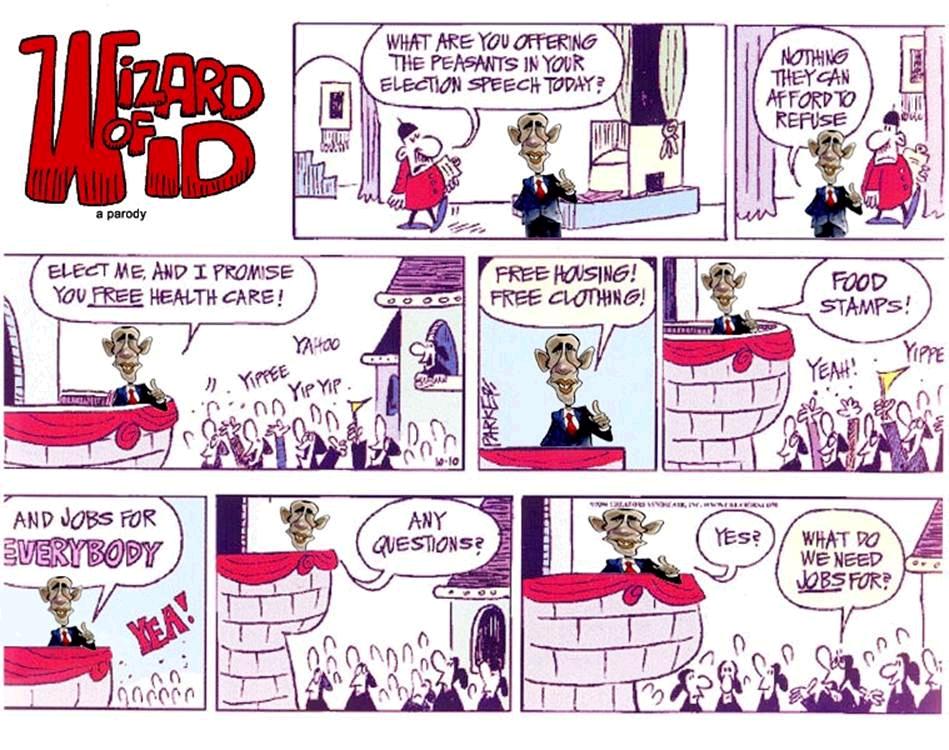
Economists often do a crummy job of teaching people about the impact of fiscal policy on the labor force, largely because we put people to sleep with boring discussions about “labor supply” decisions (my blog post from last year perhaps being an example of this tendency).
From now on, I will try to remember to use this cartoon. It’s a parody of Obama’s policies, but the last slide (or is it a panel?) is a great teaching tool about what happens when politicians turn the safety net into a hammock.
Thank you so much for your time. I know how valuable it is. I also appreciate the fine family that you have and your commitment as a father and a husband.
Sincerely,
Everette Hatcher III, 13900 Cottontail Lane, Alexander, AR 72002, ph 501-920-5733, lowcostsqueegees@yahoo.com





 The Daily Hatch