On the Arkansas Times Blog on June 11, 2011 the person going by the username Jake de Snake noted,”Current empirical evidence indicates that the American welfare is successful in reducing poverty, inequality and mortality considerably. Public pensions, for instance, are estimated to keep 40% of American seniors above the poverty line.”
The conventional wisdom regarding Social Security is based on a fundamental misunderstanding of how the system does—and does not—work. Nobel laureate and Hoover fellow Milton Friedman explains why it is time to end Social Security as we know it.
The journalist Michael Barone recently summed up the conventional wisdom about reforming Social Security: “The content of the reform is fairly clear—individual investment accounts to replace part of the government benefits financed by the payroll tax, later retirement ages, adjusted cost of living increases,” he wrote. And, he added, “suddenly the money to pay for the costs of transition is at hand, in the form of a budget surplus.”
I have italicized “part” and “costs of transition” because they epitomize key defects in conventional wisdom.
Social Security has become less and less attractive as the number of current recipients has grown relative to the number of workers paying taxes, an imbalance that will only get bigger. That explains the widespread support for individual investment accounts. Younger workers, in particular, are skeptical that they will get anything like their money’s worth for the Social Security taxes that they and their employers pay. They believe they would do much better if they could invest the money in their own 401(k) or the equivalent.
But if that is so, why replace only part and not all of government benefits? The standard explanation is that this is not feasible because payroll taxes—or part of them—are needed to pay benefits already committed to present and future retirees. That is how they are now being used, but there is nothing in the nature of things that requires a particular tax to be linked to a particular expenditure.
In 1964, Barry Goldwater was much reviled for suggesting that participation in Social Security be voluntary. I thought it was a good idea then. I still think so.
The link between the payroll tax and benefit payments is part of a confidence game to convince the public that what the Social Security Administration calls a social insurance program is equivalent to private insurance, in that, in the Administration’s words, “the workers themselves contribute to their own future retirement benefit by making regular payments into a joint fund.”
Balderdash. Taxes paid by today’s workers are used to pay today’s retirees. If money is left over, it finances other government spending—though, to maintain the insurance fiction, paper entries are created in a “trust fund” that is simultaneously an asset and a liability of the government. When the benefits that are due exceed the proceeds from payroll taxes, as they will in the not very distant future, the difference will have to be financed by raising taxes, borrowing, creating money, or reducing other government spending. And that is true no matter how large the “trust fund.” The assurance that workers will receive benefits when they retire does not depend on the particular tax used to finance the benefits or on any “trust fund.” It depends solely on the expectation that future Congresses will honor promises made by earlier Congresses—what supporters call “a compact between the generations” and opponents call a Ponzi scheme.
The present discounted value of the promises embedded in the Social Security law greatly exceeds the present discounted value of the expected proceeds from the payroll tax. The difference is an unfunded liability variously estimated at from $4 trillion to $11 trillion—or from slightly larger than the funded federal debt that is in the hands of the public to three times as large. For perspective, the market value of all domestic corporations in the United States at the end of 1997 was roughly $13 trillion.
To see the phoniness of “transition costs” (the supposed net cost of privatizing the current Social Security system), consider the following thought experiment: As of January 1, 2000, the current Social Security system is repealed. To meet current commitments, every participant in the system will receive a government obligation equal to his or her actuarial share of the unfunded liability.
For those already retired, that would be an obligation—a Treasury bill or bond—with a market value equal to the present actuarial value of expected future benefits minus expected future payroll taxes, if any. For everyone else, it would be an obligation due when the individual would have been eligible to receive benefits under the current system. And the maturity value would equal the present value of the benefits the person would have been entitled to, less the present value of the person’s future tax liability, both adjusted for mortality.
The result would be a complete transition to a strictly private system, with every participant receiving what the current law promises. Yet, aside from the cost of distributing the new obligations, the total funded and unfunded debt of the United States would not change by a dollar. There are no “costs of transition.” The unfunded liability would simply have become funded. The compact between the generations would have left as a legacy the newly funded debt.
How would that funded debt be paid when it comes due? By taxing, borrowing, creating money, or reducing other government spending. There are no other ways. There is no more reason to finance the repayment of this part of the funded debt by a payroll tax than any other part. Yet that is the implicit assumption of those who argue that the “costs of transition” mean there can be only partial privatization.
The payroll tax is a bad tax: a regressive tax on productive activity. It should long since have been repealed. Privatizing Social Security would be a good occasion to do so. Should a privatized system be mandatory? The present system is; it is therefore generally taken for granted that a privatized system must or should be as well.
The economist Martin Feldstein, in a 1995 article in the Public Interest, argued that contributions must be mandatory for two reasons: “First, some individuals are too shortsighted to provide for their own retirement,” he wrote. “Second, the alternative of a means-tested program for the aged might encourage some lower-income individuals to make no provision for their old age deliberately, knowing that they would receive the means-tested amount.”
The paternalism of the first reason and the reliance on extreme cases of the second are equally unattractive. More important, Professor Feldstein does not even refer to the clear injustice of a mandatory plan.
The most obvious example is a person with AIDS, who has a short life expectancy and limited financial means, yet would be required to use a significant fraction of his or her earnings to accumulate what is almost certain to prove a worthless asset.
More generally, the fraction of a person’s income that it is reasonable for her or him to set aside for retirement depends on that person’s circumstances and values. It makes no more sense to specify a minimum fraction for all people than to mandate a minimum fraction of income that must be spent on housing or transportation. Our general presumption is that individuals can best judge for themselves how to use their resources. Mr. Feldstein simply asserts that in this particular case the government knows better.
In 1964, Barry Goldwater was much reviled for suggesting that participation in Social Security be voluntary. I thought that was a good idea then; I still think it is. I find it hard to justify requiring 100 percent of the people to adopt a government-prescribed straitjacket to avoid encouraging a few “lower-income individuals to make no provision for their old age deliberately, knowing that they would receive the means-tested amount.” I suspect that, in a voluntary system, many fewer elderly people would qualify for the means-tested amount from imprudence or deliberation than from misfortune.
I have no illusions about the political feasibility of moving to a strictly voluntary system. The tyranny of the status quo and the vested interests that have been created are too strong. I believe, however, that the ongoing discussion about privatizing Social Security would benefit from paying more attention to fundamentals rather than dwelling simply on the nuts and bolts of privatization.
Milton Friedman, recipient of the 1976 Nobel Memorial Prize for economic science, was a senior research fellow at the Hoover Institution from 1977 to 2006. He passed away on Nov. 16, 2006. He was also the Paul Snowden Russell Distinguished Service Professor Emeritus of Economics at the University of Chicago, where he taught from 1946 to 1976, and a member of the research staff of the National Bureau of Economic Research from 1937 to 1981.
Reprinted with minor editorial changes from the New York Times, January 11, 1999, from an article entitled “Social Security Chimeras.” Reprinted by permission.
Available from the Hoover Press is The Essence of Friedman, a volume of essays by the Nobel laureate economist. Also available is Facing the Age Wave, David Wise, editor. To order, call 800-935-2882.
John Brummett in his latest article (Arkansas News Bureau, June 11, 2011) attacks a Republican lawmaker for running a day care that accepts government money and a Republican activist whose husband won a construction project that originated because of President Obama’s stimulus program.
John Brummett observed:
She said a person can’t simply decline to participate in the economy because he disagrees with some of the government policies affecting that economy. But I wasn’t asking her or her husband to do that. I only wanted her to think about moderating her rhetoric and her thinking in light of her experience.
This argument is easily destroyed. Back in 1980 I read the book “Free to Choose” by Milton and Rose Friedman. I noticed that Milton made it clear both in the book and in the film series of the same name that immigration was good for America in the past. However, since the USA changed to a welfare state, we could no longer have a tremendous amount of legal immigration because it was overload the welfare state!!!!
Milton Friedman in a lecture at Stanford asserted:
“I’ve always been amused by a kind of a paradox. Suppose you go around and ask people: ‘The United States before 1914, as you know, had completely free immigration. Anybody could get in a boat and come to these shores and if landed at Ellis Island he was an immigrant. Was that a good thing or a bad thing?”
You will find that hardly a soul who will say that it was a bad thing. Almost everybody will say it was a good thing. ‘But what about today? Do you think we should have free immigration?’ ‘Oh, no,’ they’ll say, ‘We couldn’t possibly have free immigration today. Why, that would flood us with immigrants from India, and God knows where. We’d be driven down to a bare subsistence level.’
What’s the difference? How can people be so inconsistent? Why is it that free immigration was a good thing before 1914 and free immigration is a bad thing today? Well, there is a sense in which that answer is right. There’s a sense in which free immigration, in the same sense as we had it before 1914 is not possible today. Why not?
Because it is one thing to have free immigration to jobs. It is another thing to have free immigration to welfare. And you cannot have both. If you have a welfare state, if you have a state in which every resident is promises a certain minimal level of income, or a minimum level of subsistence, regardless of whether he works or not, produces it or not. Then it really is an impossible thing.
I was perplexed at the time that Friedman’s ideology had to take a backseat to the real world that liberals had taken over!!! That is exactly the case here. I do not favor all the liberal federal spending programs that accounted for 24.7 percentage of GDP while only taking in 14.8% of GDP in taxes.
I have been on record against the stimulus (I have listed the posts below where I have discussed it), but I would gladly bid on any business that I can get. We have to live in the real world that many times the liberal policies have almost destroyed. Unfortunately the liberals have done a great job of running the national deficit up to 1.6 trillion a year because they really believe that stupid ideas like the federal stimulus would work. Actually Brantley loves to mention that the stimulus may not have been enough. Can you believe that? He failed royally the first time and he wants to do it again!!!
Milton Friedman – Illegal Immigration – PT 2
(2 of 2) Professor Friedman fields a question on the dynamics of illegal immigration. http://LibertyPen.com
HALT: Halting Arkansas Liberals with Truth (Paul Ryan outlines what has happened since the stimulus has been passed) Senator Mark Pryor voted for the American Recovery and Reinvestment Act of 2009 which was signed into law by President Obama on February 17, 2009. Both Pryor and Obama thought the economy could be jump started by […]
HALT: Halting Arkansas Liberals with Truth The Republicans have been made out to be the Grinch that stole Christmas because they did not want to extend unemployment benefits again. In fact, we have been told by the Democrats that unemployment benefits will help stimulate the economy, and we should not be trying to help the millionaires while the unemployed could […]
In 1945, I joined George Stigler at the University of Minnesota, from which he had been on leave. After one year there, I accepted an offer from the University of Chicago to teach economic theory, a position opened up by Jacob Viner’s departure for Princeton. Chicago has been my intellectual home ever since. At about the same time, Arthur Burns, then director of research at the National Bureau, persuaded me to rejoin the Bureau’s staff and take responsibility for their study of the role of money in the business cycle.
The combination of Chicago and the Bureau has been highly productive. At Chicago, I established a “Workshop in Money and Banking”. which has enabled our monetary studies to be a cumulative body of work to which many have contributed, rather than a one-man project. I have been fortunate in its participants, who include, I am proud to say, a large fraction of all the leading contributors to the revival in monetary studies that has been such a striking development in our science in the past two decades. At the Bureau, I was supported by Anna J. Schwartz, who brought an economic historian’s skill, and an incredible capacity for painstaking attention to detail, to supplement my theoretical propensities. Our work on monetary history and statistics has been enriched and supplemented by both the empirical studies and the theoretical developments that have grown out of the Chicago Workshop.
In the fall of 1950, I spent a quarter in Paris as a consultant to the U.S. governmental agency administering the Marshall Plan. My major assignment was to study the Schuman Plan, the precursor of the common market. This was the origin of my interest in floating exchange rates, since I concluded that a common market would inevitably founder without floating exchange rates. My essay, The Case for Flexible Exchange Rates, was one product.
During the academic year 1953-54, I was a Fulbright Visiting Professor at Gonville & Caius College, Cambridge University. Because my liberal policy views were “extreme” by any Cambridge standards, I was acceptable to, and able greatly to profit from, both groups into which Cambridge economics was tragically and very deeply divided: D.H. Robertson and the “anti-Keynesians”; Joan Robinson, Richard Kahn and the Keynesian majority.
Beginning in the early 1960s, I was increasingly drawn into the public arena, serving in 1964 as an economic adviser to Senator Goldwater in his unsuccessful quest for the presidency, and, in 1968, as one of a committee of economic advisers during Richard Nixon’s successful quest. In 1966, I began to write a triweekly column on current affairs for Newsweek magazine, alternating with Paul Samuelson and Henry Wallich. However, these public activities have remained a minor avocation – I have consistently refused offers of full-time positions in Washington. My primary interest continues to be my scientific work.
In 1977, I retire from active teaching at the University of Chicago, though retaining a link with the Department and its research activities. Thereafter, I shall continue to spend spring and summer months at our second home in Vermont, where I have ready access to the library at Dartmouth College – and autumn and winter months as a Senior Research Fellow at the Hoover lnstitution of Stanford University.
From Nobel Lectures, Economics 1969-1980, Editor Assar Lindbeck, World Scientific Publishing Co., Singapore, 1992
This autobiography/biography was written at the time of the award and first published in the book series Les Prix Nobel. It was later edited and republished in Nobel Lectures. To cite this document, always state the source as shown above.
Question: Dr. Friedman, you have been quoted as saying the Social Security tax is the worst tax on the books and should be abolished. What would you use as a substitute?
Dr. Friedman: First, you must understand that the Social Security system is not an insurance system. The taxes that people are paying under the system are not in any relevant sense financing the benefits they themselves will ultimately receive. The Social Security system is a combination of a bad tax and a bad expenditure program. I have never heard anybody who would defend either half separately, and taking two bad things and putting them together doesn’t generally make something good. But combining the two, and giving the impression that the system is self-financing, tends to support the fiction that Social Security is really an insurance contract. It’s not an insurance system at all. What it is a scheme whereby people today are paying taxes today to provide payments and benefits to other people today. There is a relationship between the amount beneficiaries receive and the amount they themselves pay, but that relationship is very small. Insofar as there is that relationship, you can justify an element of payroll tax; but insofar as a large part of Social Security benefits are properly to be understood as subsidies, welfare payments, there is no justification for financing them out of a payroll tax. In my opinion, if you are going to finance them, they should come out of federal revenues.
Now you will say to me, “Oh, but that’s “terrible. Does that mean that you’re proposing that we increase other taxes?” No! Let me go back to the fundamental principle: Government is going to spend whatever the tax system will raise plus a little more – lately a good deal more. The only effective way to keep down government spending is 10 keep down the amount of money available to government to spend. There is no other way you can do it. The effect of giving the impression that Society Security is an insurance system by using the payroll tax, and implying that what each individual pays is linked to what he receives – the effect of that has been to make the American people willing to bear a larger tax loan than they otherwise would bear. I argue the other way: Reduce taxes whenever you can! What you should worry about is total spending. If you reduce the payroll tax and throw the burden on the general tax level, that will be an effective way of stopping even worse programs.
In 1977, when I reached the age of 65, I retired from teaching at the University of Chicago. At the invitation of Glenn Campbell, Director of the Hoover Institution at Stanford University, I shifted my scholarly work to Hoover where I remain a Senior Research Fellow. We moved to San Francisco, purchasing an apartment in a high-rise apartment building in which we still reside. The transition of my scholarly activities from Chicago to California was greatly eased by the willingness of Gloria Valentine, my assistant at Chicago, to accompany us west. She remains my indispensable assistant.
Hoover has provided excellent facilities for scholarly work. It enabled me to remain productive and an active member of a lively scholarly community.
Initially we continued to spend spring and summer quarters at Capitaf, our second home in Vermont. However, we soon came to appreciate the inconvenience of maintaining homes a continent apart and began to look in California for a replacement for Capitaf. In 1979, we purchased a house on the ocean in Sea Ranch, a lovely community 110 miles north of San Francisco. In 1981, we disposed of Capitaf and began to spend about half the year at Sea Ranch at intervals of a week or so, spread throughout the year, rather than in one solid block. It proved a fine locale for scholarly work. The Internet plus an assistant at Hoover more than made up for the absence of a library near at hand.
After more than two wonderful decades at Sea Ranch, we sold our house to simplify our lives. We now have one home, our apartment in San Francisco.
To return to the 1970s, not long after we arrived in California, Bob Chitester persuaded us to join him in producing a major television program presenting my economic and social philosophy. The resulting effort, spread over three years, proved the most exciting adventure of our lives. The end result was Free to Choose, ten one-hour programs, each consisting of a half-hour documentary and a half-hour discussion. The first of the ten programs appeared on PBS (Public Broadcasting System) in January 1980. Since then, the series has been shown in many foreign countries.
When we agreed to undertake the project, little did Rose and I realize what was involved in producing a major TV series. As a first step, I gave a series of fifteen lectures over a period of nine months at a wide variety of locations. The lectures and question-and-answer sessions were all videotaped to provide the producers with a basis for planning the programs.
The filming began in March 1978 and continued for the next eight months at locations in the United States and around the world, including Hong Kong, Japan, India, Greece, Germany, and the United Kingdom – in the process generating more than six miles of video and audiotape.
Three months after the end of filming, we returned to London to view the documentaries that Michael Latham, our wonderful producer, and his associates had created from that tape and to dub the voice-overs. Another six months passed before we gathered again in Chicago where we filmed the discussion sessions – one of the most stressful weeks I have ever experienced.
One distinguishing feature of the series was that there was no written script. I talked extemporaneously from notes. When we returned to Capitaf from London with the transcripts of the final documentaries, we set to work to convert them to a book to appear simultaneously with the TV program. The book, Free to Choose (Harcourt Brace Jovanovich, 1980) was the bestseller nonfiction book of 1980 and continues to sell well. It has been translated into more than fourteen foreign languages.
Investing Social Security funds in the stock market would be a fine idea, wouldn’t it? President Clinton thinks so. Nobel laureate and Hoover fellow Milton Friedman thinks not.
President Clinton has proposed that a quarter of the funds set aside for Social Security be invested in the stock market—a truly radical plan.
Margaret Thatcher reversed Britain’s drift to socialism by selling off government-owned enterprises. President Clinton now proposes that the U.S. government do precisely the opposite: buy private equities, thereby becoming a part owner of U.S. enterprises.
I have often speculated that an ingenious way for a socialist to achieve his objective in the United States would be to persuade Congress, in the name of fiscal responsibility, to (1) fully fund obligations under Social Security and (2) invest the accumulating reserves in the private capital market by purchasing equity interests in domestic corporations.
Congress has never adopted a policy of fully funding Social Security, but neither has it adopted a strict pay-as-you-go policy. As is Congress’s wont, it has chosen the middle of the road, where cars can hit you from both directions. It has collected more in current taxes than were needed to pay current benefits yet not enough more to equal the future liability that it was incurring. The excess revenue has been spent in the ordinary course of government business.
The trust fund was created to preserve the fiction that Social Security is insurance. The so-called trust fund is actually a massive sleight of hand.
To preserve the fiction that Social Security is insurance, however, federal government interest-bearing bonds of a corresponding amount have been deposited in a so-called trust fund. That is, one branch of the government, the Treasury, has given an interest-bearing IOU to another branch, the Social Security Administration. Each year thereafter, the Treasury gives the Social Security Administration additional IOUs to cover the interest due. The only way that the Treasury can redeem its debt to the Social Security Administration is to borrow the money from the public, run a surplus in its other activities, or have the Federal Reserve print the money—the same alternatives that would be open to it to pay Social Security benefits if there were no trust fund. But the accounting sleight of hand of a bogus trust fund is counted on to conceal this fact from a gullible public.
Arnold Schwarzenegger did the opening introduction to the film series “Free to Choose” by Milton Friedman, but then Arnold abandoned the principles of Friedman!!!!
Ep. 4 – From Cradle to Grave [4/7]. Milton Friedman’s Free to Choose (1980)
Many people want the government to protect the consumer. A much more urgent problem is to protect the consumer from the government. Milton Friedman
Thanks to Henry Schultz’s friendship with Harold Hotelling, I was offered an attractive fellowship at Columbia for the next year. The year at Columbia widened my horizons still further. Harold Hotelling did for mathematical statistics what Jacob Viner had done for economic theory: revealed it to be an integrated logical whole, not a set of cook-book recipes. He also introduced me to rigorous mathematical economics. Wesley C. Mitchell, John M. Clark and others exposed me to an institutional and empirical approach and a view of economic theory that differed sharply from the Chicago view. Here, too, an exceptional group of fellow students were the most effective teachers.
After the year at Columbia, I returned to Chicago, spending a year as research assistant to Henry Schultz who was then completing his classic, The Theory and Measurement of Demand. Equally important, I formed a lifelong friendship with two fellow students, George J. Stigler and W. Allen Wallis.
Allen went first to New Deal Washington. Largely through his efforts, I followed in the summer of 1935, working at the National Resources Committee on the design of a large consumer budget study then under way. This was one of the two principal components of my later Theory of the Consumption Function.
The other came from my next job – at the National Bureau of Economic Research, where I went in the fall of 1937 to assist Simon Kuznets in his studies of professional income. The end result was our jointly published Incomes from Independent Professional Practice, which also served as my doctoral dissertation at Columbia. That book was finished by 1940, but its publication was delayed until after the war because of controversy among some Bureau directors about our conclusion that the medical profession’s monopoly powers had raised substantially the incomes of physicians relative to that of dentists. More important, scientifically, that book introduced the concepts of permanent and transitory income.
The catalyst in combining my earlier consumption work with the income analysis in professional incomes into the permanent income hypothesis was a series of fireside conversations at our summer cottage in New Hampshire with my wife and two of our friends, Dorothy S. Brady and Margaret Reid, all of whom were at the time working on consumption.
I spent 1941 to 1943 at the U.S. Treasury Department, working on wartime tax policy, and 1943-45 at Columbia University in a group headed by Harold Hotelling and W. Allen Wallis, working as a mathematical statistician on problems of weapon design, military tactics, and metallurgical experiments. My capacity as a mathematical statistician undoubtedly reached its zenith on V. E. Day, 1945.
Ep. 4 – From Cradle to Grave [5/7]. Milton Friedman’s Free to Choose (1980)
Milton Friedman wrote an excellent article, “Speaking the truth about Social Security Reform,” April 12, 1999, Cato Institute and I will posting portions of that article in the next few days. Milton Friedman, winner of the 1976 Nobel Prize in Economics, was a senior research fellow at the Hoover Institution. Originally published in the New York Times January 11, 1999. Here is the fourth portion:
Should Social Security Be Mandatory?
Should a privatized system be mandatory? The
present system is; it is therefore generally taken
for granted that a privatized system must or
should be as well.
The economist Martin Feldstein, in a 1995
article in the
Public Interest
, argued that contributions
must be mandatory for two reasons.
“First, some individuals are too shortsighted to
provide for their own retirement,” he wrote.
“Second, the alternative of a means-tested program
for the aged might encourage some lowerincome
individuals to make no provision for their
old age deliberately, knowing that they would
receive the means-tested amount.”
The paternalism of the first reason and the
reliance on the extreme cases of the second are
equally unattractive. More important, Professor
Feldstein does not even refer to the clear injustice
of a mandatory plan.
The most obvious example is a person with a
terminal disease who has a short life expectancy
and limited financial means, yet would be
required to use a significant fraction of his or her
earnings to accumulate what is almost certain to
prove a worthless asset.
More generally, the fraction of a person’s
income that it is reasonable for him or her to set
aside for retirement depends on that person’s circumstances
and values. It makes no more sense
to specify a minimum fraction for all people than
to mandate a minimum fraction of income that
must be spent on housing or transportation. Our
general presumption is that individuals can best
judge for themselves how to use their resources.
Mr. Feldstein simply asserts that in this particular
case the government knows better.
In 1964, Barry Goldwater was much reviled
for suggesting that participation in Social Securi-
ty be voluntary. I thought that was a good idea
then; I still think it is.
Barry Goldwater’s picture
I find it hard to justify requiring 100 percent of
the people to adopt a government-prescribed
straitjacket to avoid encouraging a few “lowerincome
individuals to make no provision for their
old age deliberately, knowing that they would
receive the means-tested amount.” I suspect that,
in a voluntary system, many fewer elderly people
would qualify for the means-tested amount from
imprudence or deliberation than from misfortune.
_______________________________________
The problem with social security
David John, a Senior research Fellow at the Heritage Foundation, explains his position on Social Security as it relates to taxes and health care. He suggests it would be a good solution for the government to raise the age of retirement.
____________________________________________
I have no illusions about the political feasibility
of moving to a strictly voluntary system. The
tyranny of the status quo, and the vested interests
that have been created, are too strong. However,
I believe that the ongoing discussion about
privatizing Social Security would benefit from
paying more attention to fundamentals, rather
than dwelling simply on the nuts and bolts of privatization.
Mark Levin interviews Senator Hatch 1/27/2011 about the balanced budget amendment. Mark is very excited about the balanced budget amendment being proposed by Senator Orin Hatch and John Cornyn and he discusses the amendment with Senator Hatch. Senator Hatch explains the bill it’s ramifications and limitations. Senator Hatch actually worked on this bill with renowned economist Milton Friedman. This ammendment is the first big step in saving our country.
The disagreement is over the solutions — on what spending to cut; what taxes to raise (basically none ever, according to Boozman); whether or not to enact a balanced budget amendment (Boozman says yes; Pryor no); and on what policies would promote the kind of economic growth that would make this a little easier.
How The amendment is written will depend on the purpose desired. Two competing versions of the balanced budget amendment are before Congress at the present time, one with a supermajority tax limitation provision and one without. Both amendments include a requirement that lawmakers balance the budget unless a deficit has been approved by a supermajority vote of Congress. A third proposal also has been offered, but it is not a true “balanced budget” amendment because it exempts a significant portion of the federal budget before the calculations are made. The three amendments can be described generally as follows:
The Tax Limitation/Balanced Budget Amendment. Sponsored in the House by Representative Joe Barton (R-TX), this amendment contains a prohibition on deficits and debts without a two-thirds vote of Congress. It also includes a special escape clause in case of war. The most important provision of the Barton amendment is its requirement that tax increases also must obtain two-thirds approval.
A Balanced Budget Amendment. Sponsored by Senator Larry Craig (R-ID) and Representatives Charles Stenholm (D-TX) and Dan Schaefer (R-CO), this version is very similar to the Barton tax limitation/balanced budget amendment. It does not include, however, a meaningful provision that prevents efforts to balance the budget by raising taxes. There is a requirement that tax increases be approved by a “constitutional majority” (51 in the Senate and 218 in the House) during a roll call vote, but this is only a small improvement over current law. In addition, only a three-fifths vote would be required to approve deficits or debt. Both this version of the amendment and that of Representative Barton enjoyed significant support in the 104th Congress.
The “Exempt Social Security” Amendment. Led by Senator Byron Dorgan (D-ND), some Members of Congress are proposing an amendment that supposedly would require a balanced budget while allowing politicians to pretend that Social Security did not exist. The most noteworthy feature of this version is its political relevance. Many Members of Congress do not want a balanced budget requirement, but they realize that voting “no” would antagonize voters. Presenting a phony alternative allows these members to vote against a legitimate version of the amendment and, at the same time, tell their constituents that they voted for a balanced budget amendment.
Ron Paul is becoming more and more popular because the country is coming over more to his Libertarian way of thinking. People see the federal government increasing to 24.7 % of GDP when it had been below 4% the first 150 years of our nation’s existence. Just yesterday Jason Tolbert reported that the Libertarian party in Arkansas gathered more than enough signatures to get their candidate on the ballot in Arkansas. I have had an overwhelming response to these blog posts I have done on Ron Paul. This is actually my seventh post. My posting of Milton Friedman videos has been relentless also. People are ready for liberty to return and want to get rid of massive government control of our lives!!!
During his speech, he told the crowd that when Alan Greenspan was Fed chairman, he got Alan Greenspan to sign a copy of a paper Greenspan wrote in 1966 where he called for a gold standard and against the concept of a central bank.
Dr. Paul said that he asked Greenspan if he still held the beliefs as outlined in the 1966 paper, and Greenspan said that he believed every bit in them. Dr. Paul then said he has still not been able to square how Greenspan held those beliefs and could hold the position of Federal Reserve chairman.
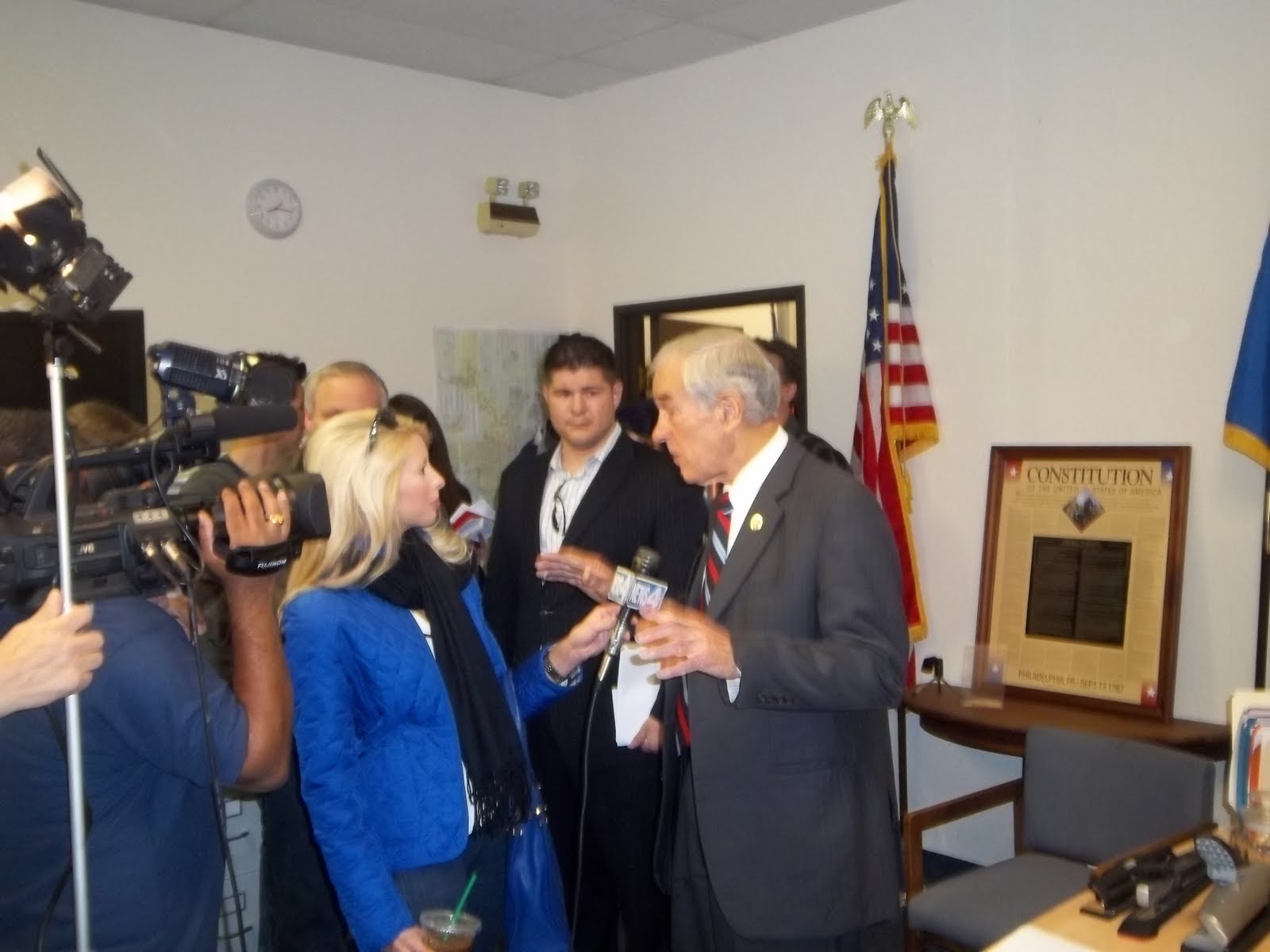
Ron Paul answers questions from a television reporter in Reno, Nevada at a Republican breakfast for Dr. Paul.
On the way to the airport, we talked about the metal in coins again. I mis-spoke and said the current penny had 75% copper. It’s really the nickel that contains 75% copper and Dr. Paul caught my error immediately and politely said, “Oh I think it is a lot less than that.” When I corrected myself and said the pre-1982 penny (which is 95% copper) now has almost 3 cents worth of metal in it. He said with some glee. “They [The Fed] have turned the copper coin into a coin with real value.”
At the airport, an airport employee asked to have his picture taken with Dr. Paul. At the hotel earlier, Dr. Paul posed for a couple of pictures with me but the pictures were a bit dark because of the hotel lighting. I had forgotten, but Dr Paul remembered and said to me, “Let’s get another shot here in the light.”
Dr. Paul then gave another radio interview with a Reno station, and reported back to us that the interviewer asked him to come to the studio next time for an interview.
My visit with Dr. Paul was just about over. I was prepared to head back to the hotel and catch a quick nap, when Dr. Paul leaned over to me, and after what he had called the busiest week of his life, said to me, “I can’t wait to get home so I can go bicycling.”
If you put the federal government in charge of the Sahara Desert, in 5 years there’d be a shortage of sand. Milton Friedman
Ep. 4 – From Cradle to Grave [2/7]. Milton Friedman’s Free to Choose (1980)
Since the Depression years of the 1930s, there has been almost continuous expansion of governmental efforts to provide for people’s welfare. First, there was a tremendous expansion of public works. The Social Security Act followed close behind. Soon other efforts extended governmental activities in all areas of the welfare sector. Growth of governmental welfare activity continued unabated, and today it has reached truly staggering proportions.
Traveling in both Britain and the U.S., Milton Friedman points out that though many government welfare programs are well intentioned, they tend to have pernicious side effects. In Dr. Friedman’s view, perhaps the most serious shortcoming of governmental welfare activities is their tendency to strip away individual independence and dignity. This is because bureaucrats in welfare agencies are placed in positions of tremendous power over welfare recipients, exercising great influence over their lives. Because people never spend someone else’s money as carefully as they spend their own, inefficiency, waste, abuse, theft, and corruption are inevitable. In addition, welfare programs tend to be self-perpetuating because they destroy work incentives. Indeed, it is often in the welfare recipients’ best interests to remain unemployed.
The American economist Milton Friedman challenged the Keynesian orthodoxy with his monetarist theories.
In economics, I had the good fortune to be exposed to two remarkable men: Arthur F. Burns, then teaching at Rutgers while completing his doctoral dissertation for Columbia; and Homer Jones, teaching between spells of graduate work at the University of Chicago. Arthur Burns shaped my understanding of economic research, introduced me to the highest scientific standards, and became a guiding influence on my subsequent career. Homer Jones introduced me to rigorous economic theory, made economics exciting and relevant, and encouraged me to go on to graduate work. On his recommendation, the Chicago Economics Department offered me a tuition scholarship. As it happened, I was also offered a scholarship by Brown University in Applied Mathematics, but, by that time, I had definitely transferred my primary allegiance to economics. Arthur Burns and Homer Jones remain today among my closest and most valued friends.
Though 1932-33, my first year at Chicago, was, financially, my most difficult year; intellectually, it opened new worlds. Jacob Viner, Frank Knight, Henry Schultz, Lloyd Mints, Henry Simons and, equally important, a brilliant group of graduate students from all over the world exposed me to a cosmopolitan and vibrant intellectual atmosphere of a kind that I had never dreamed existed. I have never recovered.
Personally, the most important event of that year was meeting a shy, withdrawn, lovely, and extremely bright fellow economics student, Rose Director. We were married six years later, when our depression fears of where our livelihood would come from had been dissipated, and, in the words of the fairy tale, have lived happily ever after. Rose has been an active partner in all my professional work since that time.
Ep. 4 – From Cradle to Grave [3/7]. Milton Friedman’s Free to Choose (1980)
Milton Friedman wrote an excellent article, “Speaking the truth about Social Security Reform,” April 12, 1999, Cato Institute and I will posting portions of that article in the next few days. Milton Friedman, winner of the 1976 Nobel Prize in Economics, was a senior research fellow at the Hoover Institution. Originally published in the New York Times January 11, 1999. Here is the third portion:
The Myth of Transition Cost
The link between the payroll tax and benefit
payments is part of a confidence game to convince
the public that what the Social Security
Administration calls a social insurance program
is equivalent to private insurance; that, in the
administration’s words, “the workers themselves
contribute to their own future retirement benefit
by making regular payments into a joint fund.”
Balderdash. Taxes paid by today’s workers are
used to pay today’s retirees. If money is left over,
it finances other government spending—though,
to maintain the insurance fiction, paper entries are
created in a “trust fund” that is simultaneously an
asset and a liability of the government. When the
benefits that are due exceed the proceeds from
payroll taxes, as they will in the not very distant
future, the difference will have to be financed by
raising taxes, borrowing, creating money, or
reducing other government spending. And that is
true no matter how large the “trust fund.”
The assurance that workers will receive benefits
when they retire does not depend on the particular
tax used to finance the benefits or on any
“trust fund.” It depends solely on the expectation
that future Congresses will honor promise made
by earlier Congresses—what supporters call “a
compact between the generations” and opponents
call a Ponzi scheme.
The present discounted value of the promises
embedded in the Social Security law greatly
exceeds the present discounted value of the
expected proceeds from the payroll tax. The difference
is an unfunded liability variously estimated
at from $4 trillion to $11 trillion—or from
slightly larger than the funded federal debt that is
in the hands of the public to three times as large.
For perspective, the market value of all domestic
corporations in the United States at the end of
1997 was roughly $13 trillion.
To see the phoniness of “transition costs” (the
supposed net cost of privatizing the current Social
Security system), consider the following thought
experiment: As of January 1, 2005, the current
Social Security system is repealed. To meet current
commitments, every participant in the system will
receive a governmental obligation equal to his or
her actuarial share of the unfunded liability.
For those already retired, that would be an
obligation—a treasury bill or bond—with a market
value equal to the present actuarial value of
expected future benefits minus expected future
payroll taxes, if any. For everyone else, it would be
an obligation due when the individual would have
been eligible to receive benefits under the current
system. The maturity value would equal the present
value of benefits the person would have been
entitled to, less the present value of the person’s
future tax liability, both adjusted for mortality.
The result would be a complete transition to a
strictly private system, with every participant
receiving what current law promises. Yet, aside
from the cost of distributing the new obligations,
Who was Milton Friedman and what did he say about Social Security Reform? (Part 2)
I am favor of cutting taxes under any circumstances and for any excuse, for any reason, whenever it’s possible. Milton Friedman
Ep. 4 – From Cradle to Grave [1/7]. Milton Friedman’s Free to Choose (1980)
Since the Depression years of the 1930s, there has been almost continuous expansion of governmental efforts to provide for people’s welfare. First, there was a tremendous expansion of public works. The Social Security Act followed close behind. Soon other efforts extended governmental activities in all areas of the welfare sector. Growth of governmental welfare activity continued unabated, and today it has reached truly staggering proportions.
In this series I want to both look closely at who Milton Friedman was and what his views were about Social Security reform. Here is the first portion of an autobiography from Nobelprize.org: I was born July 31, 1912, in Brooklyn, N.Y., the fourth and last child and first son of Sarah Ethel (Landau) and Jeno Saul Friedman. My parents were born in Carpatho-Ruthenia (then a province of Austria-Hungary; later, part of inter-war Czechoslovakia, and, currently, of the Soviet Union). They emigrated to the U.S. in their teens, meeting in New York. When I was a year old, my parents moved to Rahway, N.J., a small town about 20 miles from New York City. There, my mother ran a small retail “dry goods” store, while my father engaged in a succession of mostly unsuccessful “jobbing” ventures. The family income was small and highly uncertain; financial crisis was a constant companion. Yet there was always enough to eat, and the family atmosphere was warm and supportive.
Along with my sisters, I attended public elementary and secondary schools, graduating from Rahway High School in 1928, just before my 16th birthday. My father died during my senior year in high school, leaving my mother plus two older sisters to support the family. Nonetheless, it was taken for granted that I would attend college, though, also, that I would have to finance myself.
I was awarded a competitive scholarship to Rutgers University (then a relatively small and predominantly private university receiving limited financial assistance from the State of New Jersey, mostly in the form of such scholarship awards). I was graduated from Rutgers in 1932, financing the rest of my college expenses by the usual mixture of waiting on tables, clerking in a retail store, occasional entrepreneurial ventures, and summer earnings. Initially, I specialized in mathematics, intending to become an actuary, and went so far as to take actuarial examinations, passing several but also failing several. Shortly, however, I became interested in economics, and eventually ended with the equivalent of a major in both fields.
_________________________________
Milton Friedman wrote an excellent article, “Speaking the truth about Social Security Reform,” April 12, 1999, Cato Institute and I will posting portions of that article in the next few days. Milton Friedman, winner of the 1976 Nobel Prize in Economics, was a senior research fellow at the Hoover Institution. Originally published in the New York Times January 11, 1999. Here is the second portion:
Introduction
The journalist Michael Barone recently summed up the conventional wisdom about reforming Social Security. “The content of the reform is fairly clear—individual investment accounts to replace part of the government benefits financed by the payroll tax, later retirement ages, adjusted cost of living increases,” he wrote in the American Enterprise. And, he added, “suddenly the money to pay for the costs of transition is at hand, in the form of a budget surplus.” I have italicized “part” and “costs of transition” because they epitomize key defects in conventional wisdom. Social Security has become less and less attractive as the number of current recipients has grown relative to the number of workers paying taxes, an imbalance that will only get bigger. That explains the widespread support for individual investment accounts. Younger workers, in particular, are skeptical that they will get anything like their money’s worth for the Social Security taxes that they and their employers pay. They believe they would do much better if they could invest the money in their own 401(k)s or the equivalent. But if that is so, why replace only part and not all of government benefits? The standard explanation is that this is not feasible because payroll taxes—or part of them—are needed to pay benefits already committed to present and future retirees. That is how they are now being used, but there is nothing in the nature of things that requires a particular tax to be linked to a particular expenditure. _______________________________________________
If you know anything about me, then you know that in 1980 my political life was forever changed by a man by the name of Milton Friedman. He could take tough questions that I could not answer and provide easy answers backed up with facts. My liberal professors were strong believers in high inheritance taxes.
Milton Friedman shows that this tax does hurt families and our society. The questioner suggests a 100% inheritance tax but that would destroy a society. Liberals try to downplay the harmful effects of the tax by saying it is alright since less than 1% of the USA will be affected, so lets stick it to them despite the harm it causes to family businesses. Milton Friedman shows them how foolish that is!!!
Below are some other posts I did about Milton Friedman’s ideas:


 Barry Goldwater’s picture