Following Tuesday night’s GOP debate in Las Vegas, Rep. Michele Bachmann picked up an endorsement from perhaps the Strip’s biggest star – Mr. Las Vegas himself, Wayne Newton.
During a post-debate interview with Fox’s Greta Van Susteren, Newton, who kept his arm around Bachmann’s shoulder for the entire spot, twice called the Minnesota congresswoman a “beautiful lady” and endorsed her candidacy.
“It looks like you’re on a date,” Van Susteren said of the pair.
“I am an entertainer but first of all, I’m an American and second of all, I’m a Nevadan, and third of all, I will support this beautiful lady as long as she wants to go,” Newton said.
“I watched the entire debate, and I don’t have to tell you how proud I was of this lady because not only did she hold her own, but she kind of stood alone, and I’m not talking about being female,” said Newton, who was in the hall where the debate took place. “I’m talking about the wonderful things and views that she has for America.”
“It’s going to take electing this beautiful lady as president for things to really change because what it means is we have to get everybody back to work and we have to get people back in their homes,” Newton said.
Asked if she’d be cruising the strip looking for additional celebrity endorsements, Bachmann said: “Hey, why not?” she said. “We’ll take support everywhere we can, and it doesn’t get better. This is a picture of America right here. This is like John Wayne, Wayne Newton, so I’m just thrilled.”
Francis Schaeffer and C. Everett Koop were prophetic (jh29) What Ever Happened to the Human Race? I recently heard this Breakpoint Commentary by Chuck Colson and it just reminded me of how prophetic Francis Schaeffer and C. Everett Koop were in the late 1970′s with their book and film series “Whatever happened to the human […]
The LA Times reported: As usual, there was nothing confrontational about Jay Leno’s interview with his political guest, in this case, Rep. Michele Bachmann (R-Minn.). She was on the West Coast on Friday to speak in Orange County and at the state Republican Convention in L.A. and, who knows? Maybe to schmooze some money from […]
Sixty Six who resisted “Sugar-coated Satan Sandwich” Debt Deal (Part 39) This post today is a part of a series I am doing on the 66 Republican Tea Party favorites that resisted eating the “Sugar-coated Satan Sandwich” Debt Deal. Actually that name did not originate from a representative who agrees with the Tea Party, but […]
Both Oppenneimer and Lizza have attacked Francis Schaeffer’s view, but the way to know his views best is to take time to watch his film series. I said that in my first post and I will continue to show all ten episodes of his film series “How should we then live?” This is a series of posts […]
Outstanding rebuttal by Michele Bachmann to President Obama’s speech of September 8, 2011: Unfortunately, it seems, every time the President speaks, his policies have cost the American people jobs and future prosperity. Tonight the President under the veil of one of the most sacred deliberative forums, a joint session of Congress, delivered another political speech […]
Below is a summary of “A Christian Manifesto” which is a very important book written by Francis Schaeffer just a couple of years before his death in 1984.
A Christian Manifesto by Dr. Francis A. Schaeffer
This address was delivered by the late Dr. Schaeffer in 1982 at the Coral Ridge Presbyterian Church, Fort Lauderdale, Florida. It is based on one of his books, which bears the same title.
Now I want to say something with great force, right here. What I have been talking about, whether you know it or not, is true spirituality. This is true spirituality. Spirituality, after you are a Christian and have accepted Christ as your Savior, means that Christ is the Lord of ALL your life — not just your religious life, and if you make a dichotomy in these things, you are denying your Lord His proper place. I don’t care how many butterflies you have in your stomach, you are poor spiritually. True spirituality means that the Lord Jesus Christ is the Lord of all of life, and except for the things that He has specifically told us in the Bible are sinful and we’ve set them aside — all of life is spiritual and all of life is equally spiritual. That includes (as our forefathers did) standing for these things of freedom and standing for these things of human life and all these other matters that are so crucial, if indeed, this living God does exist as we know that He does exist.
We have forgotten our heritage. A lot of the evangelical complex like to talk about the old revivals and they tell us we ought to have another revival. We need another revival — you and I need revival. We need another revival in our hearts. But they have forgotten something. Most of the Christians have forgotten and most of the pastors have forgotten something. That is the factor that every single revival that has ever been a real revival, whether it was the great awakening before the American Revolution; whether it was the great revivals of Scandinavia; whether it was Wesley and Whitefield; wherever you have found a great revival, it’s always had three parts. First, it has called for the individual to accept Christ as Savior, and thankfully, in all of these that I have named, thousands have been saved. Then, it has called upon the Christians to bow their hearts to God and really let the Holy Spirit have His place in fullness in their life. But there has always been, in every revival, a third element. It has always brought SOCIAL CHANGE!
Cambridge historians who aren’t Christians would tell you that if it wasn’t for the Wesley revival and the social change that Wesley’s revival had brought, England would have had its own form of the French Revolution. It was Wesley saying people must be treated correctly and dealing down into the social needs of the day that made it possible for England to have its bloodless revolution in contrast to France’s bloody revolution.
The Wall Street Journal, not too long ago, and I quote it again in A Christian Manifesto, pointed out that it was the Great Awakening, that great revival prior to the founding of the United States, that opened the way and prepared for the founding of the United States. Every one of the great revivals had tremendous social implications. What I am saying is, that I am afraid that we have forgotten our heritage, and we must go on even when the cost is high.
I think the Church has failed to meet its obligation in these last 40 years for two specific reasons. The first is this false, truncated view of spirituality that doesn’t see true spirituality touching all of life. The other thing is that too many Christians, whether they are doctors, lawyers, pastors, evangelists — whatever they are — too many of them are afraid to really speak out because they did not want to rock the boat for their own project. I am convinced that these two reasons, both of which are a tragedy and really horrible for the Christian, are an explanation of why we have walked the road we have walked in the last 40 years.
We must understand, it’s going to cost you to take a stand on these things. There are doctors who are going to get kicked out of hospitals because they refuse to perform abortions; there are nurses that see a little sign on a crib that says, “Do not feed,” and they feed and they are fired. There’s a cost, but I’d ask you, what is loyalty to Christ worth to you? How much do you believe this is true? Why are you a Christian? Are you a Christian for some lesser reason, or are you a Christian because you know that this is the truth of reality? And then, how much do you love the Lord Jesus Christ? How much are you willing to pay the price for loyalty to the Lord Jesus?
Bacon, however, clearly expressed his atheistic pessimism: “Man now realizes that he is an accident, that he is a completely futile being, that he has to play out the game without purpose, other than of his own choosing.” On another occasion, he remarked: “We are born and we die and there’s nothing else. We’re just part of animal life.”
Thus, Bacon, in terms of humanity and the supernatural, reached not only a position of unbelief but of despair. His paintings express modern humanity’s condition: dehumanized man dispossessed of any durable paradise.
________________________
I first read about Francis Bacon in a book written by Francis Schaeffer. I was interested in looking into his art. His art really shows where modern man has come to the place of desperation since modern man has embraced the closed system that does not include God. What is left for man but what time and chance can bring. Bacon admitted that he was very depressed about man’s future and it comes out in his paintings.
I wish he would have read the work of Francis Schaeffer. I have posted links to Schaeffer’s works below.
Photograph of Bacon taken by John Deakin for Vogue, 1962
The Striptease of Humanism
This, then, is “the striptease of humanism,” a gathering crisis of optimism, an escape from reason, a surfacing of subterranean pessimism. Understanding it as the daily climate of our time, we can now analyze more closely certain features of its arrival and of its permanent residue.
First, there is the strong element of surprise. For any who had read Nietzsche, this should not have been so but in fact it was. In 1929 Freud remarked on this in Civilization and Its Discontents: “Man has, as it were, become a prosthetic god. . . . Future ages . . . will increase man’s likeness to God still more. But . . . present day man does not feel happy in his Godlike character.”33 In 1951 Camus felt it still more keenly: “During the last century, man cast off the fetters of religion. Hardly was he free, however, when he created new and utterly intolerable chains. . . . The kingdom of grace has been conquered, but the kingdom of justice is crumbling too. Europe is dying of this deception.”34
The situation is pregnant with irony: There is a crisis of disbelief as well as a crisis of belief. Some religious thinkers may be endlessly reporting the death of God (almost as their contemporary creedal confession), but the fact no longer seems heroic to the perceptive atheist. If the city of God has been razed, who is in need of a home now? Who feels the chill most keenly?
A second feature is the irreversibility of the exposure of humanism. It would be comforting to regard the present pessimism as a cycle, or swing of the pendulum, but there are various reasons why we cannot. For one thing there are new factors which prevent a reversal. Here we come to the difference between Oswald Spengler and Max Weber. Spengler thought the decline of the West was essentially what had happened before. Weber held that what was occurring had never happened before. It was different because, although there were similar symptoms, the “disenchantment of the world” by technology was new. So the situation was irreversible.
These elements of surprise and irreversibility were two features of the arrival of the crisis, but of even greater importance are the various symptomatic features of its continuing presence. We shall now examine these. The key to the understanding of each of them is that they stem from the humanist’s lack of a basis, the loss of center, the death of absolutes.
Alienation
The first symptom is alienation which occurs when the lack of basis is actually seen, felt or experienced. Whenever a man is not fulfilled by his own view of himself, his society or his environment, then he is at odds with himself and feels estranged, alienated and called in question. Optimistic humanism, lacking sufficient basis for the full range of humanness, also lacks sufficient balance, and alienation is inescapable when this is so. First of all this is true today of metaphysical alienation. Denying the optimistic implications of Darwinism, Nietzsche pointed to man’s “ontological predicament”: “Man is a rope, tied between beast and overman — a rope over an abyss.”49 Caught between the all-too-human and the superhuman, man, if he is not to despair, must stretch across an unbridgeable chasm to the revalued ideals of the overman. Nietzsche himself felt mocked, even in madness, by this impossible struggle. As all-too-human he knew only anguish, terror, loneliness, desperation, disgust, “the great seasickness” of the world without God.
This last phrase was picked up by Sartre in his first novel Nausea, a classic of existentialism. Walking in the city park one day, Roquentin was overcome by the nausea of the meaninglessness of life. Looking around him, he concluded, “Every existent is born without reason, prolongs itself out of weakness and dies by chance.”50 He was forced to the unhappy conclusion that the key to life is its fundamental absurdity. Man as man has to reach towards being God in order to fulfill his aspirations, yet with God dead and the world as it is these aspirations are limitations cast back in his face as an absurdity. Sartre’s reluctant conclusion is that “man is a useless passion.”51
The drastic extremity of this is well portrayed in the drama of Samuel Beckett, whose Parisian home and early research in Marcel Proust’s philosophy of time bring him close to the thought world of existentialism. In Waiting for Godot, Godot’s failure to arrive reduces all of life to the level of irrational absurdity.52 In Krapp’s Last Tape, the personality of the old man is completely desiccated by the sequential flow of time shattering his identity into fragments.53 Beckett’s ultimate in economic starkness is Breath, thirty seconds in duration, with no actors nor dialogue nor any props on the stage except miscellaneous rubbish; the whole script is the sigh of human life from a baby’s cry to a man’s last gasp before the grave.
The same metaphysical alienation, expressed in terms of the counter culture, is brilliantly distilled in Yoko Ono’s single line poems in Grapefruit.54All of them are capsules of nihilism, variations on a theme of meaninglessness. “Map Piece” reads, “Draw a map to get lost.” Another called “Lighting Piece” runs, “Light a match and watch it till it goes out.” These are the poetic counterpoint to Breath.
The same sense of alienation can be heard in many expressions of protest chafing at the constricting philosophies and psychologies dominant today. Paul Simon cries out in “Patterns” against the reductionism of determinism that conceives of man as a rat in a cage.55
Jean Luc Godard says much the same in his film La Chinoise.56When love is meaningful, to say “I don’t love you” is tragic, but when love is reduced to the chemistry of the color of the eye or the preference of the sweater color, to say “I don’t love you” is to say almost nothing.
Metaphysical alienation is also seen in the attempt to escape from nihilism through gamesmanship. Whether the games are crass, like the money or success games, or sophisticated and esoteric, like aesthetics or meditation techniques, they are only games created to escape the meaninglessness. Speaking as an artist, Francis Bacon says that man now realizes that he is an accident, a completely futile being and that he can attempt to beguile himself only for a time. Art has become a game by which man distracts himself.57
The heightened tragedy of the contemporary situation is that this is being confirmed, cemented and compounded by a newly felt sociological alienation. This alienation stems partly from the disjointedness of society, but even more from the estrangement induced by a modern technological environment in which men feel unfulfilled, depersonalized, dehumanized and condemned to grow up absurd. Jacques Ellul describes this graphically: “The human being was made to breathe the good air of nature, but what he breathes is an obscure compound of acids and coal tars. He was created for a living environment, but he dwells in a lunar world of stone, cement, asphalt, glass, cast iron and steel. The trees wilt and blanch among sterile and stone facades. Cats and dogs disappear little by little in the city, going the way of the horse. Only rats and men remain to populate a dead world.”58 Man is ill at ease in this environment and the tension demanded of him weighs heavily on his time and nerves, his life and being. If he tries to escape, he is drawn towards an entertainment world of dreams, and if he complies, he falls into a life of crowded, organized routine in which to conform is to feel the malaise of maladjustment.
This alienation, metaphysical and environmental, is an inescapable consequence of humanism and symptomatic of its lack of a basis, making man unfulfillable on the basis of his own views of himself…..
Modern humanism also refuses to touch the danger points, to face the logic of its own premises. It prefers to live in intellectual inconsistency. In The Disinherited Mind Erich Heller says, “In Kafka we have before us the modern mind, seemingly self-sufficient, intelligent, sceptical, ironical, splendidly trained for the great game of pretending that the world it comprehends in sterilized sobriety is the only and ultimate reality there is — yet a mind living in sin with the soul of Abraham. Thus he knows two things at once, and both with equal assurance; that there is no God, and that there must be God.”83
Kafka was not unique. Nietzsche himself, for all his scorn, made his leap of faith. He asserts that any attempt to understand the universe is prompted by man’s will to power but fails to see that his own conception of the will to power must then be admitted by him to be a creation of his will to power. What to Kafka was a weakness is now a disease of almost epidemic proportions. Erich Fromm ponders, “In the nineteenth century the problem was that God is dead, in the twentieth century the problem is that man is dead,”84 but Fromm shies away from exploring the connection between the two. R. D. Laing poses the alternative, “Deus absconditus. Or we have absconded,”85 but his vision of the divine is Eastern, not Christian, and his use of Luther’s concept is merely rhetorical.
Thus optimistic humanism is currently in the throes of a gathering crisis. But we dare not let this negate the humanness of its ideals. What is needed is a stronger humanism, not a weaker one. We need a concern for humanness that has a basis for its ideals and the possibility of their substantial realization.
There are several requirements which any contending solution must satisfy. First, it must provide a basis that will define and demonstrate the individuality of man as human. Here the Eastern conceptions of man with their essential negation of the value of man in this life, the communist subordination of the individual to the state, and the post-Christian failure of Western man to resist the trends of dehumanization point to answers which do not satisfy this first requirement.
Second, it must provide a basis for the fulfillment of an individual’s aspirations. The Eastern religions, communism and humanism again fall short for similar reasons. So also do determinism and existentialism.
Third, it must provide a basis for the substantial healing of man’s alienations in terms of an individual’s becoming more fully himself. Many views falter here.
Fourth, it must provide a basis for community, combining social unity and diversity, and it must avoid the chaos of relativism or the swing to control seen in many modern states and intentional communes.
These together must provide a basis for defining and demonstrating a humanness sufficiently robust to be an anchor against the dehumanization coming from social disruption and the fear of global destruction.
A Third Way is obviously required — one which speaks to the basic situation of humanity, both in individuality and in community. It must provide an answer to existentialism and a fulfillment to optimistic humanism. But this is still to run ahead of ourselves.
With the erosion of the Christian culture and the crisis of humanism, the direction of Western culture is uncertain. Will we see a desperate vacuum from which nihilism will rise? Will we lurch on uneasily to a new technological barbarism? Will a novel mysticism turn the West into the East? Or will the slow disintegration of Western culture herald a decline of power, until the egoism of Western culture is judged by the hammer of the Soviets?
Only the future will show. Curiously, the recent pre-occupation with “the end of ideology” has given rise to a new ideology — futurology. Here evolutionary optimistic humanism has its last chance. If, searching into his future, man finds grounds for believing in himself and his ability to control his future, then secular humanism may become solvent again. This quest forms the story of our next chapter.
Notes
Friedrich Wilhelm Nietzsche, The Gay Science, 125, in The Portable Nietzsche (New York: The Viking Press, 1954), p. 96; C. G. Jung. “Epilogue,” Modern Man in Search of a Soul (New York: Routledge Books, 1933); Bertrand Russell, Has Man a Future? (Harmondsworth: Penguin Books, 1961), p. 110; Federico Fellini, Fellini’s Satyricon, ed. Darlo Zanelli, trans. Eugene Walters and John Matthews (New York: Ballantine Books, 1970), p. 269.
Quoted in Kenneth Clark, Civilisation (London: John Murray Ltd., 1971), p. 104.
Quoted in ibid., p. 101.
Peter Gay, The Enlightenment: An Interpretation (New York: Alfred A. Knopf, Inc., 1966), p. 44.
Ibid.,p.417.
Michael Harrington, The Accidental Century (Harmondsworth: Penguin Books, 1967), p. 31.
Gordon Childe, Man Makes Himself (New York: Mentor Books, 1951).
Julian Huxley, ed., The Humanist Frame (London: George Allen and Unwin Ltd., 1961), p. 44.
Ibid.,p.7.
Algernon Charles Swinburne, “Hymn of Man.”
J. Huxley, p. 6.
Ibid., p. 26.
Harrington, p. 35.
Heinrich Heine, quoted in WaIter Kaufmann, Nietzsche: Philosopher, Psychologist, Antichrist (New York: Meridian Books, 1956), p. 375.
Nietzsche, The Will to Power, 1-2, quoted in Kaufmann, p. 103.
C. S. Lewis, Christian Reflections (London: Geoffrey Bles Ltd., 1967), p. 82.
Frantz Fanon, The Wretched of the Earth, trans. Constance Farrington (Harmondsworth: Penguin Books, 1967), p. 251.
lbid., p.21.
Letter of Aldous Huxley to Sibylle Bedford quoted in Time, May 4, 1970.
J. R. Platt, The Step to Man (New York: John Wiley & Sons Ltd., 1966), p. 196.
Norman O. Brown, Life Against Death (London: Sphere Books Ltd., 1968), p. 267.
See discussion in Nigel Calder, Technopolis (London: MacGibbon & Kee Ltd., 1969), pp. 98-99.
Arnold Toynbee, “Changing Attitudes towards Death in the Modern Western World” in Arnold Toynbee and others, Man’s Concern with Death (London: Hodder and Stoughton Ltd., 1968), p. 125.
Arthur Koestler, The Ghost in the Machine (London: Hutchinson & Co. Ltd., 1967), p. 15.
Viktor E. Frankl, “Reductionism and Nihilism” in Beyond Reductionism, ed. Arthur Koestler and J. R. Smythies (London: Hutchinson & Co. Ltd., 1969), p. 398.
Mortimer J. Adler, The Difference of Man and the Difference It Makes (London: Holt, Rinehart & Winston Ltd., 1967).
Quoted in T. M. Kitwood, What Is Human? (Downers Grove, Ill.: InterVarsity Press, 1970), p. 49.
Nietzsche, Ecce Homo, IV, 1, as quoted in Kaufmann, pp. 83-84.
Harrington, p. 26.
Koestler, p. 313.
Fanon, pp. 251-52.
Harrington, p. 36.
Sigmund Freud, Civilization and Its Discontents, Standard Works of Freud, 21 (London: The Hogarth Press Ltd., 1961), p. 91-92.
Albert Camus, The Rebel, trans. Anthony Bower (Harmondsworth: Penguin Books, 1962), pp. 243-44.
Nietzsche, The Gay Science, 125.
Quoted in Gay, p. 65.
Quoted in Kitwood, p. 54.
Erich Heller, The Disinherited Mind (Harmondsworth: Penguin Books, 1961), p. 75.
Nietzsche, p. 409.
Nietzsche, Thus Spake Zarathustra, I, 11, in The Portable Nietzsche, p. 160.
Fyodor Dostoevsky, The Possessed (New York: Signet Classics, 1962), pp. 384-85.
Camus, The Rebel, p. 199.
Fyodor Dostoevsky, The Brothers Karamazov (Harmondsworth: Penguin Books, Inc., 1968), p. 733.
Quoted in Camus, The Rebel, p. 58.
Quoted in ibid., p. 62.
Quoted in ibid.
Quoted in ibid.
Heller, p. 76.
Nietzsche, Zarathustra’s Prologue, 4, in The Portable Nietzsche, p. 126.
Jean Paul Sartre, Nausea (Harmondsworth: Penguin Books, 1965), p. 191.
Sartre, Being and Nothingness, trans. Hazel E. Barnes (London: Methuen, 1957), p. 566.
Samuel Beckett, Waiting for Godot (London: Faber and Faber Ltd., 1956).
Samuel Beckett, Krapp’s Last Tape (New York: Grove Press, Inc., 1958).
Yoko Ono, Grapefruit (London: Peter Owen Ltd., 1970).
Paul Simon, The Paul Simon Songbook, C.B.S. 62579.
Jean Luc Godard, La Chinoise, filmed 1967.
Quoted in H. R. Rookmaaker, Modern Art and the Death of a Culture (Downers Grove, Ill.: InterVarsity Press, 1970), p. 174.
Jacques Ellul, The Technological Society, trans. John Wilkinson (New York: Alfred A. Knopf, 1970), p.321.
Chores and Roy Medvedev, A Question of Madness (New York: Alfred A. Knopf, 1971).
“Psychoadaptation, or How to Handle Dissenters,” Time,September 27, 1971, p. 45.
lbid., p.44.
Quoted in Harrison Salisbury, “Introduction,” The Prison Diary of Ho Chi Minh (New York: Bantam Books, 1971), p. ix.
Fyodor Dostoevsky, The Idiot (New York: Bantam Books, 1958), p. 71.
Jerzy Grotowski, Towards a Poor Theatre (New York: Simon and Schuster, 1968), p. 123.
Erich Fromm, The Sane Society (New York: Routledge Books, 1956).
R. D. Laing, The Politics of Experience (Harmondsworth: Penguin Books, 1967), p. 24.
Ibid., p.24.
David Cooper, ed., The Dialectics of Liberation (Harmondsworth: Penguin Books, 1968).
Malcolm Muggeridge, Tread Softly for You Tread on My Jokes (Glasgow: William Collins Sons & Co. Ltd.), p. 28.
Ibid., p. 29.
Christopher Booker, The Neophiliacs (Glasgow: Fontana, 1970), p. 70.
Ibid., p. 44.
Ibid., p. 339.
Ernst Fischer, The Necessity of Art, trans. Anna Bostock (Harmondsworth: Penguin Books, 1963).
Lewis Feuer, “What Is Alienation? The Career of a Concept,” New Politics, Spring 1962, pp. 116-34.
Fischer, p. 80.
Erich Frornm, Marx’s Concept of Man (New York: Frederick Ungar Publishing Co., 1961).
Hermann Dooyeweerd, A New Critique of Theoretical Thought, 4 vols. (Nutley, N.J.: The Presbyterian and Reformed Publishing Co., 1957); The Twilight of Western Thought (Nutley, N.J.: Craig Press, 1960).
Francis A. Schaeffer, The God Who Is There (Downers Grove, Ill.: InterVarsity Press, 1968); Escape from Reason(Downers Grove, III.: InterVarsity Press, 1968).
J. A. Rushdoony, “Preface,” Dooyeweerd, The Twilight of Western Thought, p. 9.
Camus, The Rebel, p. 16.
Nietzsche in a letter to Gersdorff, November 7, 1970, quoted in Erich Heller, p. 70.
Ibid., p.181.
Fromm, Sane Society, p. 360.
Laing, The Politics of Experience, p. 118.
Author
Os Guinness is an Englishman born in China during the war with Japan and educated at the University of London. He has traveled widely in the East and lectured to student groups in Europe, the United States and Canada. His major work was with Francis Schaeffer at L’Abri Fellowship in Switzerland.
Today I read an article in the New York Times, “Son of Evangelical Royalty, turns his back and tells the tale,” August 19, 2011. The liberal Max Brantley of the Arkansas Times Blog called this article by Mark Oppenneimer “the best reading of the morning.” Oppenneimer asserted: Edith Schaeffer also wrote books, and in 1977, Frank, an amateur filmmaker, […]
E P I S O D E 1 0 How Should We Then Live 10#1 FINAL CHOICES I. Authoritarianism the Only Humanistic Social Option One man or an elite giving authoritative arbitrary absolutes. A. Society is sole absolute in absence of other absolutes. B. But society has to be led by an elite: John Kenneth […]
E P I S O D E 9 How Should We Then Live 9#1 T h e Age of Personal Peace and Afflunce I. By the Early 1960s People Were Bombarded From Every Side by Modern Man’s Humanistic Thought II. Modern Form of Humanistic Thought Leads to Pessimism Regarding a Meaning for Life and for Fixed […]
E P I S O D E 8 How Should We Then Live 8#1 I saw this film series in 1979 and it had a major impact on me. T h e Age of FRAGMENTATION I. Art As a Vehicle Of Modern Thought A. Impressionism (Monet, Renoir, Pissarro, Sisley, Degas) and Post-Impressionism (Cézanne, Van Gogh, Gauguin, […]
E P I S O D E 7 How Should We Then Live 7#1 I am thrilled to get this film series with you. I saw it first in 1979 and it had such a big impact on me. Today’s episode is where we see modern humanist man act on his belief that we live […]
I have made it clear from day one when I started this blog that Francis Schaeffer, Milton Friedman, Ronald Reagan and Adrian Rogers had been the biggest influences on my political and religious views. Today I am responding to an unfair attack on Francis Schaeffer’s book “A Christian Manifesto.” As you can see on the […]
E P I S O D E 6 How Should We Then Live 6#1 I am sharing with you a film series that I saw in 1979. In this film Francis Schaeffer asserted that was a shift in Modern Science. A. Change in conviction from earlier modern scientists.B. From an open to a closed natural system: […]
E P I S O D E 5 How Should We Then Live 5-1 I was impacted by this film series by Francis Schaeffer back in the 1970′s and I wanted to share it with you. Francis Schaeffer noted, “Reformation Did Not Bring Perfection. But gradually on basis of biblical teaching there was a unique improvement. A. […]
Woody Allen, the film writer, director, and actor, has consistently populated his scripts with characters who exchange dialogue concerning meaning and purpose. In Hannah and Her Sisters a character named Mickey says, “Do you realize what a thread were all hanging by? Can you understand how meaningless everything is? Everything. I gotta get some answers.”{7}
Is there an answer to the question “Is there meaning in life?” Woody Allen does not believe so, but I would like to offer one below.
Good review of “Midnight in Paris” below and the writer also refers to Woody Allen’s view that life is meaningless:
Roger Arpajou /Sony Picture ClassicsOwen Wilson plays Gil, a Hollywood screenwriter on vacation in Paris who wishes he could escape back to the 1920s. David Edelstein says his performance is one of the finest by a lead in a Woody Allen film — and rivals many of Allen’s performances, too.
Roger Arpajou /Sony Picture ClassicsOwen Wilson plays Gil, a Hollywood screenwriter on vacation in Paris who wishes he could escape back to the 1920s. David Edelstein says his performance is one of the finest by a lead in a Woody Allen film — and rivals many of Allen’s performances, too.
Midnight in Paris
Director: Woody Allen
Genre: Comedy, Romance
Running Time: 88 minutes
Rated PG-13 for some sexual references and smoking
With: Rachel McAdams, Marion Cotillard, Michael Sheen, Owen Wilson, Kathy Bates, Adrien Brody
Woody Allen isn’t religious, but he has a rabbinical side, and over the past decade his films have become more and more like Talmudic parables for atheists. On the surface, these movies are streamlined, even breezy, and they often have voice-over narration to get the pesky exposition out of the way fast. Philosophically, Allen has settled on resignation, a cosmic shrug: There’s no God, no justice, people are inconstant, life is meaningless — so where do you wanna eat?
I have a problem, though, buying into the worldview of someone whose world is a closed ecosystem. There’s no evidence that Allen lets any contemporary culture penetrate his hard, defensive shell. Music stopped in the ’40s, if not earlier, ditto literature, ditto film — with a pass for select European directors. He seems locked in a daydream of the past.
The good news is that Allen has made the lure of nostalgia the theme of his supernatural comedy Midnight in Paris, which might be why this is his best, most emotionally pure film in over a decade. It’s a romantic fantasy that’s also a sly act of self-criticism.
The time-traveling hero, Gil, played by Owen Wilson, is a successful Hollywood screenwriter on holiday in Paris with his brisk, upwardly mobile fiancee, Inez, played by Rachel McAdams. Gil considers himself a hack and, to Inez’s horror, wants to write novels instead of movies. How he wishes he could be a writer in Paris — better yet, Paris in the ’20s, alongside Scott and Zelda Fitzgerald, Ernest Hemingway, Gertrude Stein, and all those other giants living high yet creating enduring works of art.
You can almost hear the familiar Woody Allen cadences in the film, yet Owen Wilson isn’t the usual East Coast intellectual Allen hero, and he makes the lines his own. Apart from Mia Farrow in The Purple Rose of Cairo, this is the finest lead performance in an Allen film that wasn’t by Allen — and finer than many of Allen’s, too. You sense the vein of wistfulness under his stoner cool, the longing for definition behind his spaciness. It’s a thrilling moment when he sits forlornly on some steps in the rain at midnight, a vintage automobile rumbles by, the champagne-swilling occupants invite him in, and he’s suddenly back in the ’20s.
EnlargeRoger Arpajou/Sony Picture ClassicsOwen Wilson, playing the time-traveling hero Gil, wants to write novels instead of movies, much to the horror of his fiancee Inez, played by Rachel McAdams.
Roger Arpajou/Sony Picture ClassicsOwen Wilson, playing the time-traveling hero Gil, wants to write novels instead of movies, much to the horror of his fiancee Inez, played by Rachel McAdams.
How? No explanation. Allen just breezes past all that, the way he did in Purple Rose and, before that, in his great 1970s short story, “The Kugelmass Episode,” happily eliminating the sci-fi wheels and pulleys that tend to suck up so much screen time. Gil is just there — counseling Scott about Zelda, drinking with Hemingway, showing parts of his novel to Gertrude Stein, and falling in love with a woman named Adriana, played by a stunningly beautiful Marion Cotillard. Adriana bonds with Gil over his love of the past — except the past she loves is the 1890s and not her vulgar present. His ’20s ideal woman hates the ’20s — a bitter irony.
Allen doesn’t do anything interesting with Scott and Zelda — my guess is he’s too in awe of them. But his Hemingway, played with forthright manly-manliness by Corey Stoll, is a riot; and as Gertrude Stein, Kathy Bates proves that in an absurd context, playing it straight can make you funnier than a thousand clowns.
Midnight in Paris is a doodle, but it’s easy and graceful, and its ambivalent view of nostalgia has all kinds of resonance. As I watched, I felt a different sort of nostalgia: not for the Parisian ’20s but for the days in which Allen regularly turned out freewheeling, pitch-perfect tall tales in print and onscreen. The movie is so good it takes you back to those days, which were the days, my friend.
____________________________________
Below is an excellent article on the meaning of life and it includes a reference to Woody Allen:
Cathy has been married to her husband Dan for twenty years and is the mother of two teenagers. She is very involved in family, church, and community activities. Many consider her to be the model of one that “has it together,” so to speak. Unknown to her family and her many friends, lately she has been thinking a lot about her lifestyle. As a result, she has even questioned whether there is any ultimate meaning or purpose underlying her busyness. At lunch one day she finds herself in an intimate conversation with a good friend named Sarah. Even though they have never talked about such things, Cathy decides to see how Sarah will respond to her questioning. Lets eavesdrop on their conversation.
Cathy: Sarah, Ive been doing some serious thinking lately.
Sarah: Is something wrong?
Cathy: I dont know that I would say something is wrong. I just dont know what to make of these thoughts Ive been having.
Sarah: What thoughts?
Cathy: This may sound like Im going off the deep end or something, but I promise you Im not. Ive just started asking some really heavy questions. And I havent told another soul about it.
Sarah: Well, tell me! You know you can trust me.
Cathy: Okay. But you promise not to laugh or blow it off?
Sarah: Stop being so defensive. Just say it!
Cathy: Sarah, why are you here? I mean, what is your purpose in life?
Sarah: (She pauses before responding flippantly.) Youre right, you have gone off the deep end.
Cathy: Sarah, I need you to be serious with me here!
Sarah: Okay! Im sorry! Im just drawing a blank. Actually, I try not to think about that question.
Cathy: Yeah, well, denying it doesnt work anymore. It just keeps rolling around in my head.
Sarah: Cant you talk to Dan about it?
Cathy: Ive thought about it, but I dont want him to think theres something wrong between us.
Sarah: Well, what about talking to your pastor? I bet hed have some answers.
Cathy: Yeah, Ive thought about that too. Maybe I will.
Is Cathy really “weird,” or is she an example of people that rub shoulders with us each day? And what about Sarah? Was her nervous response typical of how most of us would respond if we were asked questions about meaning and purpose?
James Dobson relates an intriguing story about a remarkable seventeen year old girl who achieved a perfect score on both sections of the “…Scholastic Achievement Test, and a perfect on the tough University of California acceptance index. Never in history has anyone accomplished this intellectual feat, which is almost staggering to contemplate.”{1} Interestingly, though, when a reporter “…asked her, What is the meaning of life? she replied, I have no idea. I would like to know myself.”{2}
This intellectually brilliant young lady has something in common with Cathy and Sarah, doesnt she? She is able to understand complicated subject matter, but she has no idea if life has any meaning.
Our goal in this essay is to see if there is an answer for them, as well as all of us.
The Questions Around Us
As I was driving to my office one day I heard a dramatic radio advertisement for a book. It began something like this: “Would you like to find meaning in life?” As I listened to the remainder of the ad I realized that the books author was focusing on New Age concepts of purpose and meaning. But the striking thing about what was said was that the advertisers obviously believed that they could get the attention of the radio audience by asking about meaning in life. Some may think it is advertising suicide to open an ad with such a question. Or perhaps the author and her publicists are on to something that “strikes a chord” with many people in our culture.
Questions of meaning and purpose are a part of the mental landscape as we enter a new millenium. Some contend this has not always been the case, but that such questions are an unprecedented legacy of the upheavals of the nineteenth and twentieth centuries.{3} Others assert that such questions are a result of mans rejection of God.{4}
Even though most of us dont make such issues a part of our normal conversations, the questions tend to lurk around us. They can be heard in songs, movies, books, magazines, and many other media that permeate our lives. For example, Jackson Browne, an exceptionally reflective songwriter of the 60s and 70s, wrote these haunting lyrics in a song entitled For a Dancer:
Into a dancer you have grown
From a seed somebody else has thrown
Go ahead and throw
Some seeds of your own
And somewhere between the time you arrive
And the time you go
May lie a reason you were alive….{5}
Russell Banks, the author of Affliction and The Sweet Hereafter, both of which became Oscar-nominated films, has this to say about his work: “Im not a morbid man. In my writing, Im just trying to describe the world as straightforwardly as I can. I think most lives are desperate and painful, despite surface appearances. If you consider anyones life for long, you find its without meaning.”{6}
Woody Allen, the film writer, director, and actor, has consistently populated his scripts with characters who exchange dialogue concerning meaning and purpose. In Hannah and Her Sisters a character named Mickey says, “Do you realize what a thread were all hanging by? Can you understand how meaningless everything is? Everything. I gotta get some answers.”{7}
Even television ads have focused on meaning, although in a flippant manner. A few years ago you could watch Michael Jordan running across hills and valleys in order to find a guru. When Jordan finds him he asks, “What is the meaning of life?” The guru answers with a maxim that leads to the product that is the real focus of Jordans quest.
Even though such illustrations can be ridiculous, maybe they serve to lead us beyond the surface of our subject. We often get nervous when we are encouraged to delve into subject matter that might stretch us. When we get involved in conversations that go beyond the more mundane things of everyday life we may tend to get tense and defensive. Actually, this can be a good thing. The Christian shouldnt fear such conversations. Indeed, Im confident that if we go beyond the surface, we can find peace and hope.
Beyond the Surface
Listen to the sober words of a famous writer of the twentieth century:
There is but one truly serious philosophical problem, and that is suicide. Judging whether life is worth living amounts to answering the fundamental question of philosophy…. I see many people die because they judge that life is not worth living. I see others paradoxically getting killed for the ideas or illusions that give them a reason for living (what is called a reason for living is an excellent reason for dying). I therefore conclude that the meaning of life is the most urgent of questions.{8}
These phrases indicate that Albert Camus, author of The Plague, The Stranger, and The Myth of Sisyphus, was not afraid to go beyond the surface. Camus was bold in exposing the thoughts many were having during his lifetime. In fact, his world view made it obligatory. He was struggling with questions of meaning in light of what some called the “death of God.” That is, if there is no God, can we find meaning? Many have concluded that the answer is a resounding “No!” If true, this means that one who believes there is no God is not living consistently with that belief.
William Lane Craig, one of the great Christian thinkers of our time, states that:
Man cannot live consistently and happily as though life were ultimately without meaning, value or purpose. If we try to live consistently within the atheistic worldview, we shall find ourselves profoundly unhappy. If instead we manage to live happily, it is only by giving the lie to our worldview.{9}
Francis Schaeffer agrees with Craigs analysis, but makes even bolder assertions. He also maintains that the Christian can close the hopeless gap that is created in a persons godless worldview. Listen to what he wrote:
It is impossible for any non-Christian individual or group to be consistent to their system in logic or in practice. Thus, when you face twentieth-century man, whether he is brilliant or an ordinary man of the street, a man of the university or the docks, you are facing a man in tension; and it is this tension which works on your behalf as you speak to him.{10}
What happens when we go “beyond the surface” in order to find meaning? Can a Christian worldview stand up to the challenge? I believe it can, but we must stop and think of whether we are willing to accept the challenge. David Henderson, a pastor and writer, gives us reason to pause and consider our response. He writes:
Our lives, like our Daytimers, are busy, busy, busy, full of things to do and places to go and people to see. Many of us, convinced that the opposite of an empty life is a full schedule, remain content to press on and ignore the deeper questions. Perhaps it is out of fear that we stuff our lives to the wallsfear that, were we to stop and ask the big questions, we would discover there are no satisfying answers after all.{11}
Lets jettison any fear and continue our investigation. There are satisfying answers. It is not necessary to “stuff our lives to the walls” in order to escape questions of meaning and purpose. God has spoken to us. Let us begin to pursue His answers.
Eternity in Our Hearts
The book of Ecclesiastes contains numerous phrases that have entered our discourse. One of those phrases states that God “has made everything appropriate in its time. He has also set eternity in their heart. . .” (3:11). What a fascinating statement! Actually, the first part of the verse can be just as accurately translated “beautiful in its time.” Thus “a harmony of purpose and a beneficial supremacy of control pervade all issues of life to such an extent that they rightly challenge our admiration.”{12}The second part of the verse indicates that “man has a deep-seated sense of eternity, of purposes and destinies.”{13}But man cant fathom the vastness of eternal things, even when he believes in the God of eternity. As a result, all people live with what some call a “God-shaped hole.” Stephen Evans believes this hole can be understood through “the desire for eternal life, the desire for eternal meaning, and the desire for eternal love:”{14}
The desire for eternal life is the most evident manifestation of the need for God. Deep in our hearts we feel death should not be, was not meant to be. The second dimension of our craving for eternity is the desire for eternal meaning. We want lives that are eternally meaningful. We crave eternity, and earthly loves resemble eternity enough to kindle our deepest love. Yet earthly loves are not eternal. Our sense that love is the clue to what its all about is right on target, but earthly love itself merely points us in the right direction. What we want is an eternal love, a love that loves us unconditionally, accepts us as we are, while helping us to become all we can become. In short, we want God, the God of Christian faith.{15}
We must trust God for what we cannot see and understand. Or, to put it another way, we continue to live knowing there is meaning, but we struggle to know exactly what it is at all times. We are striving for what the Bible refers to as our future glorification (Rom. 8:30). “There is something self-defeating about human desire, in that what is desired, when achieved, seems to leave the desire unsatisfied.”{16} For example, we attempt to find meaning while searching for what is beautiful. C.S. Lewis referred to this in a sermon entitled The Weight of Glory:
The books or the music in which we thought the beauty was located will betray us if we trust to them; it was not in them, it only came through them, and what came through them was longing. These things–the beauty, the memory of our own past–are good images of what we really desire; but if they are mistaken for the thing itself they turn into dumb idols, breaking the hearts of their worshippers. For they are not the thing itself; they are only the scent of a flower we have not found, the echo of a tune we have not heard, news from a country we have not visited.{17}
Lewis remarkable prose reminds us that meaning must be given to us. “Meaning is never intrinsic; it is always derivative. If my life itself is to have meaning (or a meaning), it thus must derive its meaning from some sort of purposive, intentional activity. It must be endowed with meaning.”{18} Thus we return to God, the giver of meaning.
Meaning: Gods Gift
Think of all the wonderful gifts that God has given you. No doubt you can come up with a lengthy record of Gods goodness. Does your list include meaning or purpose in life? Most people wouldnt think of meaning as part of Gods goodness to us. But perhaps we should. This is because “only a being like God–a creator of all who could eventually, in the words of the New Testament, work all things together for good–only this sort of being could guarantee a completeness and permanency of meaning for human lives.”{19}So how did God accomplish this? The answer rests in His amazing love for us through His Son, Jesus Christ.
Consider the profound words of Carl F.H. Henry: “the eternal and self-revealed Logos, incarnate in Jesus Christ, is the foundation of all meaning.”{20} Bruce Lockerbie puts it like this: “The divine nature manifesting itself in the physical form of Jesus of Nazareth is, in fact, the integrating principle to which all life adheres, the focal point from which all being takes its meaning, the source of all coherence in the universe. Around him and him alone all else may be said to radiate. He is the Cosmic Center.”{21}
Picture a bicycle. When you ride one you are putting your weight on a multitude of spokes that radiate from a hub. All the spokes meet at the center and rotate around it. The bicycle moves based upon the center. Thus it is with Christ. He is the center around whom we move and find meaning. Our focus is on Him.
When the apostle Paul reflected on meaning and purpose in his life in Phillipians 3, he came to this conclusion (emphases added):
7…whatever things were gain to me, those things I have counted as loss for the sake of Christ. 8 More than that, I count all things to be loss in view of the surpassing value of knowing Christ Jesus my Lord, for whom I have suffered the loss of all things, and count them but rubbish in order that I may gain Christ, 9 and may be found in Him, not having a righteousness of my own derived from the Law, but that which is through faith in Christ, the righteousness which comes from God on the basis of faith, 10 that I may know Him, and the power of His resurrection and the fellowship of His sufferings, being conformed to His death; 11 in order that I may attain to the resurrection from the dead.
Did you notice how Christ was central to what Paul had to say about both his past and present? And did you notice that he used phrases such as “knowing Christ,” or “that I may gain Christ?” Such statements appear to be crucial to Pauls sense of meaning and purpose. Paul wants “to know” Christ intimately, which means he wants to know by experience. “Paul wants to come to know the Lord Jesus in that fulness of experimental knowledge which is only wrought by being like Him.”{22}
Personally, Pauls thoughts are important words of encouragement in my life. God through Christ gives meaning and purpose to me. And until I am glorified, I will strive to know Him and be like Him. Praise God for Jesus Christ, His gift of meaning!
Notes
1. James Dobson, Focus on the Family Newsletter (May 1996). 2. Ibid. 3. Gerhard Sauter, The Question of Meaning, trans. and ed. Geoffrey W. Bromiley (Grand Rapids, MI: Eerdmans, 1982). 4. Charles R. Swindoll, Living on the Ragged Edge (Waco, TX: Word, 1985). 5. Jackson Browne, “For a Dancer,” in James F. Harris, Philosophy at 33 1/3 rpm: Themes of Classic Rock Music (Chicago: Open Court, 1993), 68. 6. Russell Banks, in Jerome Weeks, “Continental Divide,” The Dallas Morning News (2 March 1999), 2C. 7. Woody Allen, Hannah and Her Sisters, in Thomas V. Morris, Making Sense of It All: Pascal and the Meaning of Life (Grand Rapids, MI: Eerdmans, 1992), 54. 8. Albert Camus, The Myth of Sisyphus, trans. Justin OBrien (New York: Vintage, 1960), 3-4. 9. William Lane Craig, Reasonable Faith: Christian Truth and Apologetics (Wheaton, IL: Crossway Books, 1994), 71. 10. Francis A. Schaeffer, The God Who Is There (Downers Grove, IL: InterVarsity, 1968), 122. 11. David W. Henderson, Culture Shift: Communicating Gods Truth to Our Changing World (Grand Rapids, MI: Baker, 1998), 186. 12. H.C. Leupold, Exposition of Ecclesiastes (Grand Rapids, MI: Baker, 1952), 90. 13. Ibid., 91. 14. C. Stephen Evans, Why Believe? Reason and Mystery as Pointers to God, revised ed. (Grand Rapids, MI: Eerdmans, 1996), 58-60. 15. Ibid. 16. Alistair McGrath, A Cloud of Witnesses (Grand Rapids, MI: Zondervan, 1990), 127. 17. C.S. Lewis, in “The Weight of Glory,” quoted in Alistair McGrath, A Cloud of Witnesses, 127. 18. Morris, 57. 19. Ibid., 62. 20. Carl F.H. Henry, God Revelation and Authority, Vol. III (Waco, TX: Word, 1979), 195. 21. D. Bruce Lockerbie, The Cosmic Center: The Supremacy of Christ in a Secular Wasteland (Portland, OR: Multnomah, 1986),127-128. 22. Kenneth S. Wuest, Wuests Word Studies From the Greek New Testament, Volume Two (Grand Rapids, MI: Eerdmans, 1973), 93.
About the AuthorJerry Solomon, former Director of Field Ministries and Mind Games Coordinator for Probe Ministries, served as Associate Pastor at Dallas Bible Church after leaving Probe. He received the B.A. (summa cum laude) in Bible and the M.A. (cum laude) in history and theology from Criswell College. He also attended the University of North Texas, Canal Zone College, and Lebanon Valley College. Just before Christmas 2000, Jerry went home to be with the Lord he loved and served.
What is Probe?
Probe Ministries is a non-profit ministry whose mission is to assist the church in renewing the minds of believers with a Christian worldview and to equip the church to engage the world for Christ. Probe fulfills this mission through our Mind Games conferences for youth and adults, our 3-minute daily radio program, and our extensive Web site at www.probe.org.
Further information about Probe’s materials and ministry may be obtained by contacting us at:
Bacon’s work epitomizes the spirit of twentieth century man—a grasping for meaning and dignity within an environment of dehumanization and meaninglessness. He once said: “Nietzsche forecast our future for us—he was the Cassandra of the nineteenth century—he told us it’s all so meaningless we might as well be extraordinary.”
____________
Below is a portion of an article by Os Guinness
“I come too early. My time has not come yet. This tremendous event is still on its way.” Nietzsche“To be a man means to reach toward being God.” Jean Paul Sartre“In seeking to become angels we may become less than men.” Pascal“True civilization does not lie in gas, nor in steam, nor in turntables. It lies in the reduction of the traces of original sin.” Baudelaire“It is becoming more and more obvious, that it is not starvation, not microbes, not cancer but man himself who is mankind’s greatest danger.” Carl Jung
“It is in our hearts that the evil lies, and it is from our hearts that it must be plucked Out.” Bertrand Russell
“Oh great gods, how far he lies from his destination!” Fillini, Fellini’s Satyricon1
Western culture is marked at the present moment by a distinct slowing of momentum, or perhaps, more accurately, by a decline in purposefulness and an increase in cultural introspection. This temporary lull, this vacuum in thought and effective action, has been created by the convergence of three cultural trends, each emphasizing a loss of direction. The first is the erosion of the Christian basis of Western culture, an erosion with deep historical causes and clearly visible results. The second is the failure of optimistic humanism to provide an effective alternative in the leadership of the post-Christian culture. And the third is the failure of our generation’s counter culture to demonstrate a credible alternative to either of the other two — Western Christianity and humanism.
The convergence of these three factors in the late sixties marks this period as especially important. What is at stake is nothing less than the direction of Western man. Only a few years ago the dismissal of Christianity was held to be a prerequisite for cultural advance. The decline of Christianity thus represented a cure for man’s problems, not a cause. So with the dawning of optimistic humanism the decline of Christianity was welcomed. Its adherents would be the only losers.
But that was yesterday. And contemporary yesterdays have a habit of suddenly seeming a hundred years ago. Today the cultural memory of traditional values hangs precariously like late autumn leaves, and in the new wintry bleakness optimism itself is greying. Now it appears that all of Western culture may be the loser.
My purpose is first to examine humanism, partially as a movement in itself but even more as a backdrop against which to appreciate the need for an alternative; then to chart the alternative offered by the counter culture with all its kaleidescopic variety; and finally, to present a third way as a more viable option in the light of man’s current situation. The weaknesses in both humanism and the counter culture are pointed out, not to negate much that has been extremely sensitive and intensely human, but to show the inevitability of their failures. The critique at least serves to illustrate certain mistakes that must not be repeated, and it highlights important questions and dilemmas with which further alternatives must grapple.
A third way is desperately necessary because the present options are growing more obviously unacceptable. And, in fact, there is a Third Way — one which is becoming increasingly welcome to a large number of sensitive searchers and free-spirited individuals who make up a major part of those dissatisfied with things as they are. This Third Way holds the promise of realism without despair, involvement without frustration, hope without romanticism. It combines a concern for humanness with intellectual integrity, a love of truth with a love of beauty, conviction with compassion and deep spirituality. But this is running ahead.
The Surfacing of Pessimism
Now we can see an important point more clearly. Optimistic humanism was only one stream of secular humanism. Its reverse was pessimistic humanism, and if the optimism was characteristically strong in academic circles, it is now evident that pessimism was more prevalent in the wider reality of life. Pessimistic humanism was always there, like a subterranean stream, murky in its depths and dark in its apprehension of dilemmas. It is this subterranean stream that is now threatening to surface and usurp the dignity and dominance of optimistic humanism.
Again we must go back in history to realize the full importance of this surfacing pessimism. Its genius was to see that behind the apparent stability of the nineteenth-century world in which modern humanism was born stood a different reality. Both Nietzsche and Kirkegaard were men who lived in passionate revolt against the smugness of the nineteenth century, particularly against the cheapness of its religious faith and the brash confidence of its secular reasoning, or generally against its shallow optimism, wordy idealism and tendency to conform. Such a smug world was not just false but dangerously foolish, if the true nature of reality lay elsewhere.
It is amazing that this subterranean pessimism was not taken more seriously earlier. But it was derided as the “Devil’s Party” — the poets, philosophers and prophets of chaos and catastrophe — and all too easy to dismiss.13 Some were ignored. Their repeated warnings were simply relegated to the status of cultural myth having only an innocuous respectability. In 1832 Hemrich Heine had said, “Do you hear the little bell tinkle? Kneel down — one brings the sacraments for a dying God.”14 Nietzsche’s later cry of the death of God and his searching diagnosis (“Everything lacks meaning. What does nihilism mean? That the highest values devaluate themselves. The goal is lacking; the answer is lacking to our ‘Why?’”)15 were not taken seriously either. After all, wasn’t Heine a poet, and wasn’t Nietzsche later deranged?
Other warnings were dismissed as only to be expected from the theory or temperament of their particular authors. Repeatedly in the 1930s, George Orwell depicted Western intellectuals as men who in blithe ignorance were sawing off the very branch on which they were sitting. Malcolm Muggeridge in his articles lanced open the “death wish of liberalism.” C. S. Lewis carefully made his exposures in “The Funeral of a Great Myth.”16 But the serious disquiet of Orwell, the humorous if testy honesty of Muggeridge and the gentle clarity and utter reasonableness of C. S. Lewis were before their time. They were predictable. They were ignored.
But the rising tide of disquiet cannot now be ignored. It is becoming the accepted mood of much recent judgment, as a hundred illustrations could quickly show. Writing in 1961 specifically on problems of Western culture, Frantz Fanon mocked, “Look at them today, swaying between atomic and spiritual disintegration.”17 In the same context, Jean Paul Sartre challenged, “Let us look at ourselves if we can bear to, and see what is becoming of us. First we must face that unexpected revelation, the strip tease of our humanism.”18 These two men could easily be dismissed as pessimistic, prejudiced politically and philosophically, but the disquiet does not stop there. Coming closer to the heart of humanism and speaking almost as an heir to a distinguished humanist house, Aldous Huxley described himself this way: “I was born wandering between two worlds, one dead and the other powerless to be born, and have made in a curious way the worst of both.”19 From the world of science John Rader Platt, the American biophysicist, said, “The world has now become too dangerous for anything less than Utopia.”20 Norman O. Brown, a man famous for the lyrical romanticism of his visions, admitted, “Today even the survival of humanity is a utopian hope.”21
There can be no stable equilibrium between optimism and pessimism but only an uneasy oscillation between the two. Optimistic humanism is strong in its stress on the aspirations of man but weak in its understanding of his aberrations. Accordingly, it lacks a base for the fulfillment of the former and its solutions to the latter are deficient; thus its ultimate optimism is eternally romantic. Pessimistic humanism, on the other hand, insists on the absurdity of man’s aspirations and speaks to the heart of his aberrations, but the price of its realism is the constant pull toward despair. This clear contrast throws further light on the current crisis.
Four Pillars of Optimistic Humanism
Optimistic humanism is being exposed as idealism without sufficient ideals. More accurately, its ideals are impossible to attain without a sufficient basis in truth, and this is just what its rationalistic premises are unable to provide. This is the key weakness of each of the four central pillars of optimistic humanism.
The first pillar is the belief in reason. Here optimistic humanism is forced to its initial leap of faith… Much of what was called reasoning is now more properly called rationalizing.
Modern philosophy also has reduced the pretentions of reason. For man, speaking from a finite reference point without divine revelation, to claim to have found a “universal” is not just to be mistaken. The claim itself is meaningless. For most modern men, objectivity, universals or absolutes are in a realm beyond the scope of reason; in this realm there is only the existential, non-rational, subjective understanding of truth.
Both psychology and philosophy have thus clipped the proud wings of rationalism and the unlimited usefulness of reason by itself. By rationalism I do not mean “rationalism” as opposed to “empiricism” but rather the hidden premise common to both — the humanist’s leap of faith in which the critical faculty of reason is tacitly made into an absolute and used as a super-tool to marshal particulars and claim meaning which in fact is proper only to the world of universals.
The second pillar is the belief in progress. The orientation toward the future introduced into Western culture by Christian linear teleology was secularized by the Enlightenment. Ostensibly it had been given objective scientific support by the evolutionary theory. It was widely believed that nature was marching forward inevitably to higher and higher views of life (as expressed, for instance, in the philosophy of Herbert Spencer). But this is now being drastically undermined. Many point to evidence of an evolutionary crisis, somewhat tarnishing the comfortable image of inevitable progress with man at the center of the stage controlling his own evolution. Some even predict the extinction of the human species.
The third pillar is the belief in science as the guide to human progress and the provider of an alternative to both religion and morals. If “evolution is good,” then evolution must be allowed to proceed and the very process of change becomes absolutized.
The fourth pillar is the belief in the self-sufficiency of man. A persistent erosion of man’s view of himself is occurring. The fact that man has made so many significant scientific discoveries points strongly to the significance of man, yet the content of these same scientific discoveries underscores his insignificance. Man finds himself dwarfed bodily by the vast stretches of space and belittled temporally by the long reaches of time. Humanists are caught in a strange dilemma. If they affirm the greatness of man, it is only at the expense of ignoring his aberrations. If they regard human aberrations seriously, they have to escape the dilemma raised, either by blaming the situation on God (and how often those most strongly affirming the non-existence of God have a perverse propensity to question his goodness!) or by reducing man to the point of insignificance where his aberrations are no longer a problem. During World War II, Einstein, plagued by the mounting monstrosity of man against man, was heard to mutter to himself, “After all, this is a small star.”23 He escaped the dilemmas of man’s crime and evil but only at the price of undermining man’s significance.
Notes
Friedrich Wilhelm Nietzsche, The Gay Science, 125, in The Portable Nietzsche (New York: The Viking Press, 1954), p. 96; C. G. Jung. “Epilogue,” Modern Man in Search of a Soul (New York: Routledge Books, 1933); Bertrand Russell, Has Man a Future? (Harmondsworth: Penguin Books, 1961), p. 110; Federico Fellini, Fellini’s Satyricon, ed. Darlo Zanelli, trans. Eugene Walters and John Matthews (New York: Ballantine Books, 1970), p. 269.
Quoted in Kenneth Clark, Civilisation (London: John Murray Ltd., 1971), p. 104.
Quoted in ibid., p. 101.
Peter Gay, The Enlightenment: An Interpretation (New York: Alfred A. Knopf, Inc., 1966), p. 44.
Ibid.,p.417.
Michael Harrington, The Accidental Century (Harmondsworth: Penguin Books, 1967), p. 31.
Gordon Childe, Man Makes Himself (New York: Mentor Books, 1951).
Julian Huxley, ed., The Humanist Frame (London: George Allen and Unwin Ltd., 1961), p. 44.
Ibid.,p.7.
Algernon Charles Swinburne, “Hymn of Man.”
J. Huxley, p. 6.
Ibid., p. 26.
Harrington, p. 35.
Heinrich Heine, quoted in WaIter Kaufmann, Nietzsche: Philosopher, Psychologist, Antichrist (New York: Meridian Books, 1956), p. 375.
Nietzsche, The Will to Power, 1-2, quoted in Kaufmann, p. 103.
C. S. Lewis, Christian Reflections (London: Geoffrey Bles Ltd., 1967), p. 82.
Frantz Fanon, The Wretched of the Earth, trans. Constance Farrington (Harmondsworth: Penguin Books, 1967), p. 251.
lbid., p.21.
Letter of Aldous Huxley to Sibylle Bedford quoted in Time, May 4, 1970.
J. R. Platt, The Step to Man (New York: John Wiley & Sons Ltd., 1966), p. 196.
Norman O. Brown, Life Against Death (London: Sphere Books Ltd., 1968), p. 267.
See discussion in Nigel Calder, Technopolis (London: MacGibbon & Kee Ltd., 1969), pp. 98-99.
Arnold Toynbee, “Changing Attitudes towards Death in the Modern Western World” in Arnold Toynbee and others, Man’s Concern with Death (London: Hodder and Stoughton Ltd., 1968), p. 125.
Arthur Koestler, The Ghost in the Machine (London: Hutchinson & Co. Ltd., 1967), p. 15.
Viktor E. Frankl, “Reductionism and Nihilism” in Beyond Reductionism, ed. Arthur Koestler and J. R. Smythies (London: Hutchinson & Co. Ltd., 1969), p. 398.
Mortimer J. Adler, The Difference of Man and the Difference It Makes (London: Holt, Rinehart & Winston Ltd., 1967).
Quoted in T. M. Kitwood, What Is Human? (Downers Grove, Ill.: InterVarsity Press, 1970), p. 49.
Nietzsche, Ecce Homo, IV, 1, as quoted in Kaufmann, pp. 83-84.
Harrington, p. 26.
Koestler, p. 313.
Fanon, pp. 251-52.
Harrington, p. 36.
Sigmund Freud, Civilization and Its Discontents, Standard Works of Freud, 21 (London: The Hogarth Press Ltd., 1961), p. 91-92.
Albert Camus, The Rebel, trans. Anthony Bower (Harmondsworth: Penguin Books, 1962), pp. 243-44.
Nietzsche, The Gay Science, 125.
Quoted in Gay, p. 65.
Quoted in Kitwood, p. 54.
Erich Heller, The Disinherited Mind (Harmondsworth: Penguin Books, 1961), p. 75.
Nietzsche, p. 409.
Nietzsche, Thus Spake Zarathustra, I, 11, in The Portable Nietzsche, p. 160.
Fyodor Dostoevsky, The Possessed (New York: Signet Classics, 1962), pp. 384-85.
Camus, The Rebel, p. 199.
Fyodor Dostoevsky, The Brothers Karamazov (Harmondsworth: Penguin Books, Inc., 1968), p. 733.
Quoted in Camus, The Rebel, p. 58.
Quoted in ibid., p. 62.
Quoted in ibid.
Quoted in ibid.
Heller, p. 76.
Nietzsche, Zarathustra’s Prologue, 4, in The Portable Nietzsche, p. 126.
Jean Paul Sartre, Nausea (Harmondsworth: Penguin Books, 1965), p. 191.
Sartre, Being and Nothingness, trans. Hazel E. Barnes (London: Methuen, 1957), p. 566.
Samuel Beckett, Waiting for Godot (London: Faber and Faber Ltd., 1956).
Samuel Beckett, Krapp’s Last Tape (New York: Grove Press, Inc., 1958).
Yoko Ono, Grapefruit (London: Peter Owen Ltd., 1970).
Paul Simon, The Paul Simon Songbook, C.B.S. 62579.
Jean Luc Godard, La Chinoise, filmed 1967.
Quoted in H. R. Rookmaaker, Modern Art and the Death of a Culture (Downers Grove, Ill.: InterVarsity Press, 1970), p. 174.
Jacques Ellul, The Technological Society, trans. John Wilkinson (New York: Alfred A. Knopf, 1970), p.321.
Chores and Roy Medvedev, A Question of Madness (New York: Alfred A. Knopf, 1971).
“Psychoadaptation, or How to Handle Dissenters,” Time,September 27, 1971, p. 45.
lbid., p.44.
Quoted in Harrison Salisbury, “Introduction,” The Prison Diary of Ho Chi Minh (New York: Bantam Books, 1971), p. ix.
Fyodor Dostoevsky, The Idiot (New York: Bantam Books, 1958), p. 71.
Jerzy Grotowski, Towards a Poor Theatre (New York: Simon and Schuster, 1968), p. 123.
Erich Fromm, The Sane Society (New York: Routledge Books, 1956).
R. D. Laing, The Politics of Experience (Harmondsworth: Penguin Books, 1967), p. 24.
Ibid., p.24.
David Cooper, ed., The Dialectics of Liberation (Harmondsworth: Penguin Books, 1968).
Malcolm Muggeridge, Tread Softly for You Tread on My Jokes (Glasgow: William Collins Sons & Co. Ltd.), p. 28.
Ibid., p. 29.
Christopher Booker, The Neophiliacs (Glasgow: Fontana, 1970), p. 70.
Ibid., p. 44.
Ibid., p. 339.
Ernst Fischer, The Necessity of Art, trans. Anna Bostock (Harmondsworth: Penguin Books, 1963).
Lewis Feuer, “What Is Alienation? The Career of a Concept,” New Politics, Spring 1962, pp. 116-34.
Fischer, p. 80.
Erich Frornm, Marx’s Concept of Man (New York: Frederick Ungar Publishing Co., 1961).
Hermann Dooyeweerd, A New Critique of Theoretical Thought, 4 vols. (Nutley, N.J.: The Presbyterian and Reformed Publishing Co., 1957); The Twilight of Western Thought (Nutley, N.J.: Craig Press, 1960).
Francis A. Schaeffer, The God Who Is There (Downers Grove, Ill.: InterVarsity Press, 1968); Escape from Reason(Downers Grove, III.: InterVarsity Press, 1968).
J. A. Rushdoony, “Preface,” Dooyeweerd, The Twilight of Western Thought, p. 9.
Camus, The Rebel, p. 16.
Nietzsche in a letter to Gersdorff, November 7, 1970, quoted in Erich Heller, p. 70.
Ibid., p.181.
Fromm, Sane Society, p. 360.
Laing, The Politics of Experience, p. 118.
Author
Os Guinness is an Englishman born in China during the war with Japan and educated at the University of London. He has traveled widely in the East and lectured to student groups in Europe, the United States and Canada. His major work was with Francis Schaeffer at L’Abri Fellowship in Switzerland.
Today I read an article in the New York Times, “Son of Evangelical Royalty, turns his back and tells the tale,” August 19, 2011. The liberal Max Brantley of the Arkansas Times Blog called this article by Mark Oppenneimer “the best reading of the morning.” Oppenneimer asserted: Edith Schaeffer also wrote books, and in 1977, Frank, an amateur filmmaker, […]
E P I S O D E 1 0 How Should We Then Live 10#1 FINAL CHOICES I. Authoritarianism the Only Humanistic Social Option One man or an elite giving authoritative arbitrary absolutes. A. Society is sole absolute in absence of other absolutes. B. But society has to be led by an elite: John Kenneth […]
E P I S O D E 9 How Should We Then Live 9#1 T h e Age of Personal Peace and Afflunce I. By the Early 1960s People Were Bombarded From Every Side by Modern Man’s Humanistic Thought II. Modern Form of Humanistic Thought Leads to Pessimism Regarding a Meaning for Life and for Fixed […]
E P I S O D E 8 How Should We Then Live 8#1 I saw this film series in 1979 and it had a major impact on me. T h e Age of FRAGMENTATION I. Art As a Vehicle Of Modern Thought A. Impressionism (Monet, Renoir, Pissarro, Sisley, Degas) and Post-Impressionism (Cézanne, Van Gogh, Gauguin, […]
E P I S O D E 7 How Should We Then Live 7#1 I am thrilled to get this film series with you. I saw it first in 1979 and it had such a big impact on me. Today’s episode is where we see modern humanist man act on his belief that we live […]
I have made it clear from day one when I started this blog that Francis Schaeffer, Milton Friedman, Ronald Reagan and Adrian Rogers had been the biggest influences on my political and religious views. Today I am responding to an unfair attack on Francis Schaeffer’s book “A Christian Manifesto.” As you can see on the […]
E P I S O D E 6 How Should We Then Live 6#1 I am sharing with you a film series that I saw in 1979. In this film Francis Schaeffer asserted that was a shift in Modern Science. A. Change in conviction from earlier modern scientists.B. From an open to a closed natural system: […]
E P I S O D E 5 How Should We Then Live 5-1 I was impacted by this film series by Francis Schaeffer back in the 1970′s and I wanted to share it with you. Francis Schaeffer noted, “Reformation Did Not Bring Perfection. But gradually on basis of biblical teaching there was a unique improvement. A. […]
Of course, we are meat. We are potential carcasses.
—Francis Bacon
Irish-born Francis Bacon (1909-1992), possibly the greatest painter of the latter half of the twentieth century, quintessentially exemplified modern humanity’s loneliness and alienation. Indeed, Bacon is considered the greatest British painter since William Turner.
Bacon’s paintings cry out for lost values and lost greatness; for a dehumanized humanity deprived of its freedom, love, rationality; for everything the great humanist painters had celebrated in Judeo-Christian and classical tradition.
Bacon’s life illustrates that no man is an island. The influences on his lifestyle and work were multitudinous.
One in particular was his fascination with carnage and carcasses. Bacon, in fact, became fascinated with animal carcasses in butcher shops and even expressed the beauty of the carnage at automobile accidents. He translated his interest in violence to the canvas: “I think of myself as a kind of pulverizing machine into which everything I look at and feel is fed.”
Bacon also used a manual on oral disease as an inspiration for his work, along with Eadweard Muybridge’s Animal Locomotion (1887). What did such books have in common? Robert Hughes in The Shock of the New (1993) writes:
Detachment: the clinical gaze on the human body as a specimen, all its privacy brushed aside. Bacon thought there was a strong analogy between the body’s various availabilities—to inspection, sex, or political coercion.
Bacon’s sources, thus, evoked different forms of abandonment. An early patron described Bacon’s “predilection for portraying people as though they were alone, unaware of any other presence.”
Moreover, as Bacon commented to a friend, “the news-photograph of the thirties was his education in painting. It formalised disrespect. It wrenched the figures of authority out of their high places. It caught them unguarded and inconsequent, ‘racked by tics, their faces distorted, their clothes in disorder, their bodies off balance’.”
Bacon, an atheist, faced constant torment, dissatisfaction and uncertainty, never knowing the security of a traditional religious belief. However, in a perverse way, Bacon was one of the most deeply religious painters of the century. The agony of his unbelief became so acute that the negative in his work—pessimism, loneliness, despair, emptiness, distortion, darkness, stark mortality—became an almost religious attribute. In fact, Bacon had an acute fascination with the crucifixion of Christ. “I’ve always been very moved by pictures about slaughterhouses and meat, and to me they belong very much to the whole thing,” Bacon once said. “I know for religious people, for Christians, the Crucifixion has a totally different signature. But as a nonbeliever, it was just an act of man’s behavior, a way of behavior to another.”
Bacon, however, clearly expressed his atheistic pessimism: “Man now realizes that he is an accident, that he is a completely futile being, that he has to play out the game without purpose, other than of his own choosing.” On another occasion, he remarked: “We are born and we die and there’s nothing else. We’re just part of animal life.”
Thus, Bacon, in terms of humanity and the supernatural, reached not only a position of unbelief but of despair. His paintings express modern humanity’s condition: dehumanized man dispossessed of any durable paradise.
Bacon poignantly illustrates his despair in a number of his paintings. A casual glance at his Crucifixion (1933) reveals that the stick-like limbs of a luminous and fantastic insect were superimposed by Bacon onto the crucifixion of Christ. Biographer Andrew Sinclair writes: “As he said later, he wanted his pictures to look as if a human being had passed between them like a snail, leaving a trail of slime.” Despite his atheism, Bacon identified his own suffering from his homosexuality and anguish with the martyrdom of Christ.
Bacon’s Three Studies for Figures at the Base of a Crucifixion (1944) seems to depict the loss of all hope. One commentator notes: “The forcefulness with which these three Greek Furies…hurl their misery and rage at us proves the extent of his own loss of faith.”
Bacon painted Three Studies under a tremendous hangover. “It’s one of those pictures,” Bacon later said, “that I’ve ever been able to do under drink. I believe that the drink helped me to be a bit freer.”
One art analyst noted that the “figures in the three canvases were joined in the theme of the violence that men did to one another by the power of sex and hatred. The body on the right, lying head down, suggested an inverted crucifixion by Cimabue, which Bacon thought was like ‘a worm crawling…just moving, undulating down the cross’.”
Bacon’s work epitomizes the spirit of twentieth century man—a grasping for meaning and dignity within an environment of dehumanization and meaninglessness. He once said: “Nietzsche forecast our future for us—he was the Cassandra of the nineteenth century—he told us it’s all so meaningless we might as well be extraordinary.”
Bacon’s human corpses (his figures of Christ hung like mutton in a butcher’s shop) showed a belief in the absolute mortality of man without hope of redemption. “Of course, we are meat,” he said, “we are potential carcasses.”
Bacon’s distorted and idiosyncratic images bear eloquent witness to the actual events of the post-war period and more generally to twentieth century humanity’s innate capacity for mass violence. The artist as prophet, Bacon is the extreme voice of despair in which people are totally dehumanized, blurred, decrepit banshees. Robert Hughes writes: “In his work, the image of the classical nude body is simply dismissed; it becomes, instead, a two-legged animal with the various addictions: to sex, the needle, security, or power.”
While it may be true, as Bacon said, that “you only need to think about the meat on your plate” to see the general truth about mankind in his paintings, no modern artist has hammered at the twentieth century human condition with more repetitive pessimism.
Up until recently, the public has been exposed to Bacon’s finished paintings. Now with the release of the artist’s sketches from the Joule Archive, we get a glimpse of the genius at work.
Bacon first met Barry Joule in 1978, when the two men began a friendship that would last fourteen years. In April 1992, Bacon arranged to make a trip to Spain and asked Joule to drive him to the airport. Before they set off, Bacon gave Joule a collection of material, which Joule understood to be a gift. Bacon revealed little about the gift and died a few days later in Madrid.
This amazing bundle turned out to be an old photograph album full of sketches, as well as a number of books and a collection of over 900 photographic images—many of them worked over by hand. The album’s two covers are painted with large crosses, which have given the work its current name—”The X album.” The book’s inside covers feature drawings, and the 68 pages from the album held in the Joule Archive feature a further series of boldly worked oil sketches and collages, filling the front and back of the sheets. Many of the images in the album relate to Francis Bacon’s works from the ‘50s and ‘60s, and arguably, most of the album was executed toward the end of this period.
With Bacon’s Eye: Works on paper attributed to Francis Bacon from the Joule Archive (Barbican Art and 21 Publishing, 2001), we have reproductions from “The X Album.” This amazing work contains images that are, by turn, erotic, beautiful and appalling—yes, typically Bacon.
Today I read an article in the New York Times, “Son of Evangelical Royalty, turns his back and tells the tale,” August 19, 2011. The liberal Max Brantley of the Arkansas Times Blog called this article by Mark Oppenneimer “the best reading of the morning.” Oppenneimer asserted: Edith Schaeffer also wrote books, and in 1977, Frank, an amateur filmmaker, […]
E P I S O D E 1 0 How Should We Then Live 10#1 FINAL CHOICES I. Authoritarianism the Only Humanistic Social Option One man or an elite giving authoritative arbitrary absolutes. A. Society is sole absolute in absence of other absolutes. B. But society has to be led by an elite: John Kenneth […]
E P I S O D E 9 How Should We Then Live 9#1 T h e Age of Personal Peace and Afflunce I. By the Early 1960s People Were Bombarded From Every Side by Modern Man’s Humanistic Thought II. Modern Form of Humanistic Thought Leads to Pessimism Regarding a Meaning for Life and for Fixed […]
E P I S O D E 8 How Should We Then Live 8#1 I saw this film series in 1979 and it had a major impact on me. T h e Age of FRAGMENTATION I. Art As a Vehicle Of Modern Thought A. Impressionism (Monet, Renoir, Pissarro, Sisley, Degas) and Post-Impressionism (Cézanne, Van Gogh, Gauguin, […]
E P I S O D E 7 How Should We Then Live 7#1 I am thrilled to get this film series with you. I saw it first in 1979 and it had such a big impact on me. Today’s episode is where we see modern humanist man act on his belief that we live […]
I have made it clear from day one when I started this blog that Francis Schaeffer, Milton Friedman, Ronald Reagan and Adrian Rogers had been the biggest influences on my political and religious views. Today I am responding to an unfair attack on Francis Schaeffer’s book “A Christian Manifesto.” As you can see on the […]
E P I S O D E 6 How Should We Then Live 6#1 I am sharing with you a film series that I saw in 1979. In this film Francis Schaeffer asserted that was a shift in Modern Science. A. Change in conviction from earlier modern scientists.B. From an open to a closed natural system: […]
E P I S O D E 5 How Should We Then Live 5-1 I was impacted by this film series by Francis Schaeffer back in the 1970′s and I wanted to share it with you. Francis Schaeffer noted, “Reformation Did Not Bring Perfection. But gradually on basis of biblical teaching there was a unique improvement. A. […]
Below is a summary of “A Christian Manifesto” which is a very important book written by Francis Schaeffer just a couple of years before his death in 1984.
A Christian Manifesto by Dr. Francis A. Schaeffer
This address was delivered by the late Dr. Schaeffer in 1982 at the Coral Ridge Presbyterian Church, Fort Lauderdale, Florida. It is based on one of his books, which bears the same title.
And what about our schools? I think I should stress again! By law, you are no more allowed to teach religious values and religious views in our public schools than you are in the schools of Russia tonight. We don’t teach Marxism over here in most of our schools, but as far as all religious teaching (except the religion of Humanism, which is a different kind of a thing) it is just as banned by law from our schools, and our schools are just as secular as the schools in Soviet Russia — just exactly! Not ten years from now. Tonight!
Congress opens with prayer. Why? Because Congress always is opened with prayer. Back there, the founding fathers didn’t consider the 13 provincial congresses that sent representatives to form our country in Philadelphia really open until there was prayer. The Congress in Washington, where Edith and I have just been, speaking to various men in political areas and circles — that Congress is not open until there is prayer. It’s illegal, in many places, for youngsters to merely meet and pray on the geographical location of the public schools. I would repeat, we are not only immoral, we’re stupid. I mean that. I don’t know which is the worst: being immoral or stupid on such an issue. We are not only immoral, we are stupid for the place we have allowed ourselves to come to without noticing.
I would now repeat again the word I used before. There is no other word we can use for our present situation that I have just been describing, except the word TYRANNY! TYRANNY! That’s what we face! We face a world view which never would have given us our freedoms. It has been forced upon us by the courts and the government — the men holding this other world view, whether we want it or not, even though it’s destroying the very freedoms which give the freedoms for the excesses and for the things which are wrong.
We, who are Christians, and others who love liberty, should be acting in our day as the founding fathers acted in their day. Those who founded this country believed that they were facing tyranny. All you have to do is read their writings. That’s why the war was fought. That’s why this country was founded. They believed that God never, never, never wanted people to be under tyrannical governments. They did it not as a pragmatic or economic thing, though that was involved too, I guess, but for principle. They were against tyranny, and if the founding fathers stood against tyranny, we ought to recognize, in this year 1982, if they were back here and one of them was standing right here, he would say the same thing — what you are facing is tyranny. The very kind of tyranny we fought, he would say, in order that we might escape.
And we face a very hidden censorship. Every once in a while, as soon as we begin to talk about the need of re-entering Christian values into the discussion, someone shouts “Khomeni.” Someone says that what you are after is theocracy. Absolutely not! We must make absolutely plain, we are not in favor of theocracy, in name or in fact. But, having said that, nevertheless, we must realize that we already face a hidden censorship — a hidden censorship in which it is impossible to get the other world view presented in something like public television. It’s absolutely impossible.
I could give you a couple of examples. I’ll give you one because it’s so close to me. And that is, that after we made Whatever Happened to the Human Race, Franky made an 80 minute cutting for TV of the first 3 episodes (and people who know television say that it’s one of the best television films they have ever seen technically, so that’s not a problem). Their representative presented it to a director of public television, and as soon as she heard (It happened to be a woman. I’m sure that’s incidental.) that it was against abortion, she said, “We can’t show that. We only shoe things that give both sides.” And, at exactly the same time, they were showing that abominable Hard Choices, which is just straight propaganda for abortion. As I point out, the study guide that went with it (as I quote it in Christian Manifesto[the book] with a long quote) was even worse. It was saying that the only possible view of reality was this material thing — this material reality. They spelled it out in that study guide more clearly than I have tonight as to what the issue is. They said, “that’s it!” What do you call that? That’s hidden censorship.
Dr. Koop, one of the great surgeons of the world, when he was nominated as Surgeon General, much of the press (printed) great swelling things against him — a lot of them not true, a lot of them twisted. Certainly though, lots of space was made for trying to not get his nomination accepted. When it was accepted though, I looked like mad in some of the papers, and in most of them what I found was about one inch on the third page that said that Dr. Koop had been accepted. What do you call that? Just one thing: hidden censorship.
You must realize that this other view is totally intolerant. It is totally intolerant. I do not think we are going to get another opportunity if we do not take it now in this country. I would repeat, we are a long way down the road. I do not think we are going to get another opportunity. If the Christians, specifically, but others also, who love liberty, do not do something about it now, I don’t believe your grandchildren are going to get a chance. In the present so-called conservative swing in the last election, we have an opportunity, but we must remember this, and I would really brand this into your thinking: A conservative Humanism is no better than a liberal Humanism. It’s the Humanism that is wrong, not merely the coloration. And therefore, at the present moment, what we must insist on, to people in our government who represent us, is that we do not just end with words. We must see, at the present opportunity, if it continues, a real change. We mustn’t allow it to just drift off into mere words.
Bacon, however, clearly expressed his atheistic pessimism: “Man now realizes that he is an accident, that he is a completely futile being, that he has to play out the game without purpose, other than of his own choosing.” On another occasion, he remarked: “We are born and we die and there’s nothing else. We’re just part of animal life.”
Thus, Bacon, in terms of humanity and the supernatural, reached not only a position of unbelief but of despair. His paintings express modern humanity’s condition: dehumanized man dispossessed of any durable paradise.
________________________
I first read about Francis Bacon in a book written by Francis Schaeffer. I was interested in looking into his art. His art really shows where modern man has come to the place of desperation since modern man has embraced the closed system that does not include God. What is left for man but what time and chance can bring. Bacon admitted that he was very depressed about man’s future and it comes out in his paintings.
I wish he would have read the work of Francis Schaeffer. I have posted links to Schaeffer’s works below.
Photograph of Bacon taken by John Deakin for Vogue, 1962
This summer, the Metropolitain Museum of Art is hosting the first major Francis Bacon exhibition it has known in twenty years. “Francis Bacon: A Centenary Retrospective” celebrates the 100th anniversary of the artist’s birth. The British painter had the rare luxury of becoming rich and famous in his own lifetime. By his death in 1992, his paintings were already selling for millions, and their value has only risen since.
Bacon is a celebrated and controversial figure in the art world, or any world at that. One New York Times critic wrote, “If paintings could speak, Bacon’s would shriek.” Those who shudder in the presence his works are justified in doing so. The harshness of his critique of humanity is surpassed only by the grotesque nature of his images. Open bleeding flesh, exposed bones and carcasses fill the canvas. His faces and figures are often distorted, made to look broken or mutilated. The violence in his art is palpable. In a televised interview with Charlie Rose, Thomas Campbell, director of the Met, said “These are paintings that are created to evoke a reaction. Their subject matter is disturbing, unpleasant even revolting. But the surface of his paintings is also so engaging… you’re compelled to look.”
Critics, art historians and philosophers alike have offered up explanations as to Bacon’s view on life. He was abused as a child, a lifelong alcoholic who died of sclerosis of the liver, and he reached his prime as a painter during the last years of World War II.
His negative view of humankind was not unfounded. It would be false, however, to romanticize Bacon’s suffering. He rejected people’s complaints about his art being too harsh, stating, “People complain that I show the horrible side of life. I try to show the excitement of life.” In some ways, whether the viewer likes this or not, Bacon felt he was stating facts, not pushing buttons on our delicate sensibilities.
Gary Tinterow, the show’s curator, said this to Rose: “Here is the problem. He was constantly rubbing our face in our own mess, the mess that men and women are capable of doing to one another. He is constantly reminding us of our own bestiality….he would say that his art was the history of Europe in his own time.”
As if to add insult to injury, Bacon had recurring themes of Christian religious art in his work, recognizing the power of tryptichs and iconography. The crucifixion is especially present, representing for him the epitome of what horrible cruelty men are able of inflicting one upon the other. Take Painting 1946, for example. A faceless crucified figure dominates the backdrop, its skinless rib cage exposed. Above it hangs what looks like sausage from a butcher shop, and at the bottom of the canvas are two pieces of a carcass. A disfigured man holds a black umbrella in the centre of the painting. Bacon’s message is clear: we are meat.
Study After Velazquez’s Portrait of Pope Innocent X (“The Screaming Pope”), 1953
Bacon also loved painting popes. His Study after Velzquez’s portrait of Innocent X evokes a renaissance portrait of this pope, except once more, there is a twist. Innocent X’s mouth is open in a scream, barely hidden by black shuttered stripes. Tinterow commented on his take of Christian religion: “He was an old-fashioned militant atheist…there was always a general squeamishness about his take on Christianity.”
What can a Christian’s response be to such art? What should it be? Can we accept the place of violence and darkness in our dialogue with art? Should we take into consideration his contribution to the ongoing debate about human existence? I would be inclined to say we must. We may not like the fact that there is little redemption in Bacon’s work, nor are we obliged to agree with his interpretation of the crucifixion. But there is undeniable power in his works, shocking us even today, some 60 years after their execution. And there is undeniable truth to his take on humanity.
Let us not be too hurt by his distortion of Christianity. He had a much bigger bone to pick with humans than he did with God. “He respected Christian ethics, and maintained that the Christian way of life was amongst the best in the panoply of ways of life,” commented Tinterow. “It’s just that his common sense forbade him from believing in the Church. He recognized, however, that the Church didn’t believe in him. The feeling was mutual.”
Jenna Smith is completing a joint Masters degree in the faculties of music and theology at the Université de Montréal. She lives in Montreal where she directs Innovation-Jeunes, an arts and nutrition centre for teens.
Today I read an article in the New York Times, “Son of Evangelical Royalty, turns his back and tells the tale,” August 19, 2011. The liberal Max Brantley of the Arkansas Times Blog called this article by Mark Oppenneimer “the best reading of the morning.” Oppenneimer asserted: Edith Schaeffer also wrote books, and in 1977, Frank, an amateur filmmaker, […]
E P I S O D E 1 0 How Should We Then Live 10#1 FINAL CHOICES I. Authoritarianism the Only Humanistic Social Option One man or an elite giving authoritative arbitrary absolutes. A. Society is sole absolute in absence of other absolutes. B. But society has to be led by an elite: John Kenneth […]
E P I S O D E 9 How Should We Then Live 9#1 T h e Age of Personal Peace and Afflunce I. By the Early 1960s People Were Bombarded From Every Side by Modern Man’s Humanistic Thought II. Modern Form of Humanistic Thought Leads to Pessimism Regarding a Meaning for Life and for Fixed […]
E P I S O D E 8 How Should We Then Live 8#1 I saw this film series in 1979 and it had a major impact on me. T h e Age of FRAGMENTATION I. Art As a Vehicle Of Modern Thought A. Impressionism (Monet, Renoir, Pissarro, Sisley, Degas) and Post-Impressionism (Cézanne, Van Gogh, Gauguin, […]
E P I S O D E 7 How Should We Then Live 7#1 I am thrilled to get this film series with you. I saw it first in 1979 and it had such a big impact on me. Today’s episode is where we see modern humanist man act on his belief that we live […]
I have made it clear from day one when I started this blog that Francis Schaeffer, Milton Friedman, Ronald Reagan and Adrian Rogers had been the biggest influences on my political and religious views. Today I am responding to an unfair attack on Francis Schaeffer’s book “A Christian Manifesto.” As you can see on the […]
E P I S O D E 6 How Should We Then Live 6#1 I am sharing with you a film series that I saw in 1979. In this film Francis Schaeffer asserted that was a shift in Modern Science. A. Change in conviction from earlier modern scientists.B. From an open to a closed natural system: […]
E P I S O D E 5 How Should We Then Live 5-1 I was impacted by this film series by Francis Schaeffer back in the 1970′s and I wanted to share it with you. Francis Schaeffer noted, “Reformation Did Not Bring Perfection. But gradually on basis of biblical teaching there was a unique improvement. A. […]
He’s built a $360 billion company. That presumably means at least $352 billion of wealth in the hands of people other than himself. And that doesn’t even begin to count how consumers have benefited from his products, the jobs he has created, and the indirect positive impact of his company on suppliers and retailers.
Francis Schaeffer observes in How Should We Then Live: The Rise And Decline Of Western Thought And Culturethat evolutionary theory in the form of humanistic thought has reduced everything to the level of a component in a great universal machine.
Of this outlook, Schaeffer writes, “In one form of reductionism, man is explained by reducing him to the smallest particles which make up his body. Man is seen as being only the molecule or the energy particle, more complex but not intrinsically different (164).”
To prove such an observation is more than Evangelical hyperbole, Schaeffer quotes Harvard University Chemistry Professor George Wald who said, “Four hundred years ago there was a collection of molecules named Shakespeare which produced Hamlet(164).”
In order to remain consistent, those holding to such a perspective have to concede such a masterpiece is not so much the result of creative insight as it is a fortuitous case of gas. And to any naturalist offended by my remarks, they cannot very well complain about them since by their own worldview, I had no control over what I wrote.
After I read that I had the opportunity three times in the 1990’s to correspond with Dr. George Wald of Harvard. In one of his letters he suggested that Atheism and Buddhism are the same thing. I tend to agree. Below is a futher discussion of Buddhism.
For centuries, Buddhism has been the dominant religion of the Eastern world. With the rise of the Asian population in the United States, Buddhism has had a tremendous impact on this country as well. Presently, there are an estimated 300 million Buddhists in the world and 500 thousand in the United States.{1} It remains the dominant religion in the state of Hawaii, and many prominent Americans have accepted this religion, including the former governor of California, Jerry Brown,{2} Tina Turner, Phil Jackson (coach of the Los Angeles Lakers), Richard Gere, and Steven Seagal. The Dalai Lama has become a prominent spiritual figure for many throughout the world.
The Origin of Buddhism
Buddhism began as an offspring of Hinduism in the country of India. The founder was Siddhartha Gautama. It is not easy to give an accurate historical account of the life of Gautama since no biography was recorded until five hundred years after his death. Today, much of his life story is clouded in myths and legends which arose after his death. Even the best historians of our day have several different–and even contradictory–accounts of Gautama’s life.
Siddhartha Gautama was born in approximately 560 B.C. in northern India. His father, Suddhodana, was the ruler over a district near the Himalayas which is today the country of Nepal. Suddhodana sheltered his son from the outside world and confined him to the palace where he surrounded Gautama with pleasures and wealth.
Despite his father’s efforts, however, Gautama one day saw the darker side of life on a trip he took outside the palace walls. He saw four things that forever changed his life: an old man, a sick man, a dead man, and an ascetic. Deeply distressed by the suffering he saw, he decided to leave the luxury of palace life and begin a quest to find the answer to the problem of pain and human suffering.
Gautama left his family and traveled the country seeking wisdom. He studied the Hindu scriptures under Brahmin priests, but became disillusioned with the teachings of Hinduism. He then devoted himself to a life of extreme asceticism in the jungle. He soon concluded, however, that asceticism did not lead to peace and self-realization but merely weakened the mind and body.
Gautama eventually turned to a life of meditation. While deep in meditation under a fig tree known as the Bohdi tree (meaning, “tree of wisdom”), Gautama experienced the highest degree of God-consciousness called nirvana. Gautama then became known as Buddha, the “enlightened one.” He believed he had found the answers to the questions of pain and suffering. His message now needed to be proclaimed to the whole world.
As he began his teaching ministry, he gained a quick audience with the people of India since many had become disillusioned with Hinduism. By the time of his death at age 80, Buddhism had become a major force in India.
Expansion and Development of Buddhism
Buddhism remained mostly in India for three centuries until King Ashoka, who ruled India from 274-232 B.C., converted to Buddhism. Ashoka sent missionaries throughout the world, and Buddhism spread to all of Asia.
Even before its expansion, two distinct branches developed, a conservative and a liberal school of thought. The conservative school is labeled Theravada, and it became the dominant form of Buddhism in Southeast Asia. Thus, it is also called Southern Buddhism. Southern Buddhism has remained closer to the original form of Buddhism. This school follows the Pali Canon of scripture, which, although written centuries after Gautamas death, contains the most accurate recording of his teachings.
The liberal school is Mahayana Buddhism, which traveled to the north into China, Japan, Korea, and Tibet, and is also called Northern Buddhism. As it spread north, it adopted and incorporated beliefs and practices from the local religions of the land. The two branches of Buddhism are so different they appear to be two different religions rather than two branches of the same tree. Here are a few differences.
Theravada Buddhism sees Buddha as a man. Gautama never claimed to be deity, but rather a “way shower.” Mahayana Buddhism, however, worships Buddha as a manifestation of the divine Buddha essence. Since Gautama, many other manifestations or bodhisattvas have appeared. An example is Tibetan Buddhism, which worships the spiritual leader the Dalai Lama as a bodhisattva.
Theravada adheres to the Pali Canon and Buddhas earliest teachings. Since Mahayana believes there have been many manifestations, this branch incorporates many other texts written by the bodhisattvas as part of their canon.
Theravada teaches that each person must attain salvation through their own effort, and this requires one to relinquish earthly desires and live a monastic life. Therefore, only those few who have chosen this lifestyle will attain nirvana. Mahayana teaches that salvation comes through the grace of the bodhisattvas and so many may attain salvation.
Divine beings do not have a place in Theravada. The primary focus is on the individual attaining enlightenment, and a divine being, or speculations of such, only hinders the process. Therefore, several sects of this branch are atheistic. Mahayana, on the other hand, has many diverse views of God since this branch is inclusive, and has adopted the beliefs and practices of various religions. Many schools are pantheistic in their worldview while others are animistic. Buddha is worshipped as a divine being. Some schools pay homage to a particular bodhisattva sent to their people. Other schools have a mixture of gods whom they worship. For example, Japanese Buddhism blended with Shintoism and includes worship of the Shinto gods with the teachings and worship of Buddha.
When speaking with a Buddhist, it is important to understand what branch of Buddhism they are talking about. The two branches are dramatically different. Even within Mahayana Buddhism, the sects can be as different as Theravada is to Mahayana.
The Way of Salvation
The main question Gautama, the founder of Buddhism, sought to answer was, “Why is there pain and suffering?” His belief in reincarnation (the belief that after death one returns to earthly life in a higher or lower form of life according to his good or bad deeds) prompted a second question that also needed to be answered: “How does one break this rebirth cycle?” The basic teachings of Buddhism, therefore, focus on what Gautama believed to be the answer to these questions. These basic tenets are found in the Four Noble Truths and in the Eight-fold Path. Let us begin with the Four Noble Truths.
The First Noble Truth is that there is pain and suffering in the world. Gautama realized that pain and suffering are omnipresent in all of nature and human life. To exist means to encounter suffering. Birth is painful and so is death. Sickness and old age are painful. Throughout life, all living things encounter suffering.
The Second Noble Truth relates to the cause of suffering. Gautama believed the root cause of suffering is desire. It is the craving for wealth, happiness, and other forms of selfish enjoyment which cause suffering. These cravings can never be satisfied for they are rooted in ignorance.
The Third Noble Truth is the end of all suffering. Suffering will cease when a person can rid himself of all desires.
The Fourth Noble Truth is the extinguishing of all desire by following the Eight-fold path. “The Eight-fold path is a system of therapy designed to develop habits which will release people from the restrictions caused by ignorance and craving.”{3}
Here are the eight steps in following the Eight-fold path. The first is the Right View. One must accept the Four Noble Truths. Step two is the Right Resolve. One must renounce all desires and any thoughts like lust, bitterness, and cruelty, and must harm no living creature. Step three is the Right Speech. One must speak only truth. There can be no lying, slander, or vain talk. Step four is the Right Behavior. One must abstain from sexual immorality, stealing, and all killing.
Step five is the Right Occupation. One must work in an occupation that benefits others and harms no one. Step six is the Right Effort. One must seek to eliminate any evil qualities within and prevent any new ones from arising. One should seek to attain good and moral qualities and develop those already possessed. Seek to grow in maturity and perfection until universal love is attained. Step seven is the Right Contemplation. One must be observant, contemplative, and free of desire and sorrow. The eighth is the Right Meditation. After freeing oneself of all desires and evil, a person must concentrate his efforts in meditation so that he can overcome any sensation of pleasure or pain and enter a state of transcending consciousness and attain a state of perfection. Buddhists believe that through self-effort one can attain the eternal state of nirvana.
In Buddhism, ones path to nirvana relies on the effort and discipline of the individual. By contrast, Jesus taught our goal is not a state of non-conscious being, but an eternal relationship with God. There is nothing one can do to earn a right relationship with God. Instead, we must receive His gift of grace, the sacrificial death of His Son, Jesus Christ and this restores our relationship with our creator.
Karma, Samsara, and Nirvana
Three important concepts in understanding Buddhism are karma, samsara, and nirvana.
Karmarefers to the law of cause and effect in a person’s life, reaping what one has sown. Buddhists believe that every person must go through a process of birth and rebirth until he reaches the state of nirvana in which he breaks this cycle. According to the law of karma, “You are what you are and do what you do, as a result of what you were and did in a previous incarnation, which in turn was the inevitable outcome of what you were and did in still earlier incarnations.”{4} For a Buddhist, what one will be in the next life depends on one’s actions in this present life. Unlike Hindus, Buddha believed that a person can break the rebirth cycle no matter what class he is born into.
The second key concept is the law of samsara or transmigration. This is one of the most perplexing and difficult concepts in Buddhism to understand. The law of Samsara holds that everything is in a birth and rebirth cycle. Buddha taught that people do not have individual souls. The existence of an individual self or ego is an illusion. There is no eternal substance of a person, which goes through the rebirth cycle. What is it then that goes through the cycle if not the individual soul? What goes through the rebirth cycle is only a set of feelings, impressions, present moments, and the karma that is passed on. “In other words, as one process leads to another, … so one’s human personality in one existence is the direct cause of the type of individuality which appears in the next.”{5} The new individual in the next life will not be exactly the same person, but there will be several similarities. Just how close in identity they will be is not known.
The third key concept is nirvana. The term means “the blowing out” of existence. Nirvana is very different from the Christian concept of heaven. Nirvana is not a place like heaven, but rather an eternal state of being. It is the state in which the law of karma and the rebirth cycle come to an end. It is the end of suffering; a state where there are no desires and the individual consciousness comes to an end. Although to our Western minds this may sound like annihilation, Buddhists would object to such a notion. Gautama never gave an exact description of nirvana, but his closest reply was this. “There is disciples, a condition, where there is neither earth nor water, neither air nor light, neither limitless space, nor limitless time, neither any kind of being, neither ideation nor non-ideation, neither this world nor that world. There is neither arising nor passing-away, nor dying, neither cause nor effect, neither change nor standstill.”{6}
In contrast to the idea of reincarnation, the Bible teaches in Hebrews 9:27 that “man is destined to die once and after that to face judgment.” A major diverging point between Buddhism and Christianity is that the Bible refutes the idea of reincarnation. The Bible also teaches that in the eternal state, we are fully conscious and glorified individuals whose relationship with God comes to its perfect maturity.
Jesus and Gautama
There is much I admire in the life and teachings of Gautama. Being raised in the Japanese Buddhist culture, I appreciate the ethical teachings, the arts, and architecture influenced by Buddhism. As I studied the life and teachings of Gautama and of Jesus, I discovered some dramatic differences.
First, Buddha did not claim to be divine. Theravada remains true to his teaching that he was just a man. The idea that he was divine was developed in Mahayana Buddhism 700 years after his death. Furthermore, Northern Buddhism teaches that there have been other manifestations of the Buddha or bodhisattvas and some believe Jesus to be one as well. However, Jesus did not claim to be one of many manifestations of God; He claimed to be the one and only Son of God. This teaching was not the creation of his followers but a principle He taught from the beginning of His ministry. In fact, the salvation He preached was dependent on understanding His divine nature.
Second, Buddha claimed to be a way shower. He showed the way to nirvana, but it was up to each follower to find his or her own path. Christ did not come to show the way; He claimed to be the way. While Buddhism teaches that salvation comes through Buddhas teachings, Christ taught salvation is found in Him. When Jesus said, “I am the way the truth and the life” (John 14:6), He was saying He alone is the one who can give eternal life, for He is the source of truth and life. Not only did He make the way possible, He promises to forever be with and empower all who follow Him to live the life that pleases God.
Third, Buddha taught that the way to eliminate suffering and attain enlightenment was to eliminate all desire. Christ taught that one should not eliminate all desire but that one must have the right desire. He stated, “Blessed are they who hunger and thirst for righteousness for they shall be satisfied.” Christ taught that we should desire to know Him above all other wants.
Fourth, Buddha performed no miracles in his lifetime. Christ affirmed His claims to be divine through the miracles He performed. He demonstrated authority over every realm of creation: the spiritual realm, nature, sickness, and death. These miracles confirmed the claims that He was more than a good teacher, but God incarnate.
Finally, Buddha is buried in a grave in Kusinara at the foot of the Himalaya Mountains. Christ, however, is alive. He alone conquered sin and the grave. His death paid the price for sin, and His resurrection makes it possible for all people to enter into a personal and eternal relationship with God.
After a comparative study, I came to realize Buddha was a great teacher who lived a noble life, but Christ is the unique revelation of God who is to be worshipped as our eternal Lord and Savior.
Notes
1. Isamu Yamamoto, Buddhism, Taoism and Other Eastern Religions, (Grand Rapids, Mich.: Zondervan Publishing, 1998), p. 23.
2. Walter Martin, Kingdom of the Cults (Minneapolis: Bethany House 1985), p. 261.
3. Kenneth Boa, Cults, World Religions, and the Occult (Wheaton, Ill.: Victor Books, (1977) p. 35
4. Davis Taylor and Clark Offner, The World’s Religions, Norman Anderson, ed. (Downers Grove, Ill.: InterVarsity, 1975), p. 174.
5. John Noss, Man’s Religions (New York: Macmillan Company, 1968), p. 182.
6. Taylor and Offner, The World’s Religions, p. 177.
Patrick Zukeran is a Hawaii-based research associate with Probe Ministries. He has a B.A. in Religion from Point Loma Nazarene University, a Th.M. from Dallas Theological Seminary, and a D.Min. from Southern Evangelical Seminary. He is an author, radio talk show host, and a national and international speaker on apologetics, cults, world religions, Bible, theology, and current issues. His nationally syndicated radio talk show “Evidence and Answers” is broadcast on the KTLW Network (covering the West Coast), through all of Asia (through World Harvest Radio), and on the web at evidenceandanswers.org. Before joining Probe, Pat served for twelve years as an Associate Pastor. He can be reached at pzukeran@probe.org.
E P I S O D E 1 0 How Should We Then Live 10#1 FINAL CHOICES I. Authoritarianism the Only Humanistic Social Option One man or an elite giving authoritative arbitrary absolutes. A. Society is sole absolute in absence of other absolutes. B. But society has to be led by an elite: John Kenneth […]
E P I S O D E 9 How Should We Then Live 9#1 T h e Age of Personal Peace and Afflunce I. By the Early 1960s People Were Bombarded From Every Side by Modern Man’s Humanistic Thought II. Modern Form of Humanistic Thought Leads to Pessimism Regarding a Meaning for Life and for Fixed […]
E P I S O D E 8 How Should We Then Live 8#1 I saw this film series in 1979 and it had a major impact on me. T h e Age of FRAGMENTATION I. Art As a Vehicle Of Modern Thought A. Impressionism (Monet, Renoir, Pissarro, Sisley, Degas) and Post-Impressionism (Cézanne, Van Gogh, Gauguin, […]
E P I S O D E 7 How Should We Then Live 7#1 I am thrilled to get this film series with you. I saw it first in 1979 and it had such a big impact on me. Today’s episode is where we see modern humanist man act on his belief that we live […]
OWNER TURNS SPRINKLERS ON PRO-LIFE PRAYER VIGIL
In July, I wrote abouta new movement springing up in Arkansas that seeks to combat abortion not with violent protest, but with peaceful prayer demonstrations. It is called “40 Days for Life” and it is having amazing success all over the country.
One of the cities where its impact has been profound is Fayetteville. They first began demonstrating outside abortionist William Harrison’s clinic until he closed his business. They then moved to the Planned Parenthood clinic where abortions are being performed using the RU487 abortion pill. This year, Planned Parenthood moved its clinic to a different location on Crossover Road.
The “40 Days for Life” kicked off their current prayer vigil at this new location on Tuesday. Organizers were thrilled with the large turnout of around 100 people, including former State Sen. Jim Holt and former State Rep. Jim Bob Josh Duggar (son of Jim Bob.) They met to pray outside the clinic on the right of way by the street, but were soon greeted by an unexpected surprise.
As they began their meeting, the owner of the building turned on the newly installed sprinkler system which was pointed in their direction. As the water sprayed them down, the owner came out and began shouting at them to go away. He even called the police and demanded that they be arrested.
The “40 Days for Life” organizers explained to the police that they were on the public right of way and not the owner’s property. Organizers had notified the police in advance of their plans and made sure they had everything in compliance with city ordinances.
But the owner of the building persisted. According those outside the clinic, he is continuing to turn on the sprinklers as the 40 days of events continue.
“It will not deter us,” said Tiffany, who is one the event’s coordinators. “We just show up in our ponchos, hats, and rainboots and carry on.”
Tiffany says that they feel no ill will toward the owners and are praying for them along with the women going into the clinic.
“We hope that we can be a witness to them by our prayerful response,” explained Tiffany.
You can find out more about the demonstrations in Fayetteville as well as the one in Little Rock on the “40 Days for Life” website.
Philosopher and Theologian, Francis A. Schaeffer has argued, “If there are no absolutes by which to judge society, then society is absolute.” Francis Schaeffer, How Shall We Then Live? (Old Tappan NJ: Fleming H Revell Company, 1976), p. 224.
Francis Schaeffer and C. Everett Koop were prophetic (jh29) What Ever Happened to the Human Race? I recently heard this Breakpoint Commentary by Chuck Colson and it just reminded me of how prophetic Francis Schaeffer and C. Everett Koop were in the late 1970′s with their book and film series “Whatever happened to the human […]
A Ronald Reagan radio address from 1975 addresses the topics of abortion and adoption. This comes from a collection of audio commentaries titled “Reagan in His Own Voice.” I just wanted to share with you one of the finest prolife papers I have ever read, and it is by President Ronald Wilson Reagan. I have […]
I have made it clear from day one when I started this blog that Francis Schaeffer, Milton Friedman, Ronald Reagan and Adrian Rogers had been the biggest influences on my political and religious views. Today I am responding to an unfair attack on Francis Schaeffer’s book “A Christian Manifesto.” As you can see on the […]
President and Nancy Reagan talking to Mother Teresa in the Oval Office. 6/20/85. Superbowl commercial with Tim Tebow and Mom. Jason Tolbert wrote a great article this week about a pro-life meeting. He mentons William Harrison who I have written about before on this blog. I used to write letters to the editor a whole […]
I wrote a response to an article on abortion on the Arkansas Times Blog and it generated more hate than enlightenment from the liberals on the blog. However, there was a few thoughtful responses. One is from spunkrat who really did identify the real issue. WHEN DOES A HUMAN LIFE BEGIN? _______________________________________ Posted by spunkrat […]
Superbowl commercial with Tim Tebow and Mom. The Arkansas Times article, “Putting the fetus first: Pro-lifers keep up attack on access, but pro-choice advocates fend off the end to abortion right” by Leslie Newell Peacock is very lengthy but I want to deal with all of it in this new series. click to enlarge ROSE MIMMS: […]
The Arkansas Times article, “Putting the fetus first: Pro-lifers keep up attack on access, but pro-choice advocates fend off the end to abortion right” by Leslie Newell Peacock is very lengthy but I want to deal with all of it in this new series. click to enlarge ROSE MIMMS: Arkansas Right to Life director unswayed by […]
TLC stars Josh and Anna Duggar with their newborn son — TLC I was walking at the Another Duggar Baby! Josh & Anna Duggar Welcome Baby Boy Yahoo News reported: The Duggar family continues to grow! Josh Duggar, 23, – the eldest son of Jim Bob and Michelle – and wife Anna, 22, welcomed their […]
What Ever Happened to the Human Race? ___________________________________________ Philosopher and Theologian, Francis A. Schaeffer has argued, “If there are no absolutes by which to judge society, then society is absolute.” Francis Schaeffer, How Shall We Then Live? (Old Tappan NJ: Fleming H Revell Company, 1976), p. 224. ____________________________________ Francis Schaeffer had a big impact on […]
What Ever Happened to the Human Race? ___________________________________________ Philosopher and Theologian, Francis A. Schaeffer has argued, “If there are no absolutes by which to judge society, then society is absolute.” Francis Schaeffer, How Shall We Then Live? (Old Tappan NJ: Fleming H Revell Company, 1976), p. 224. ____________________________________ Francis Schaeffer had a big impact on […]

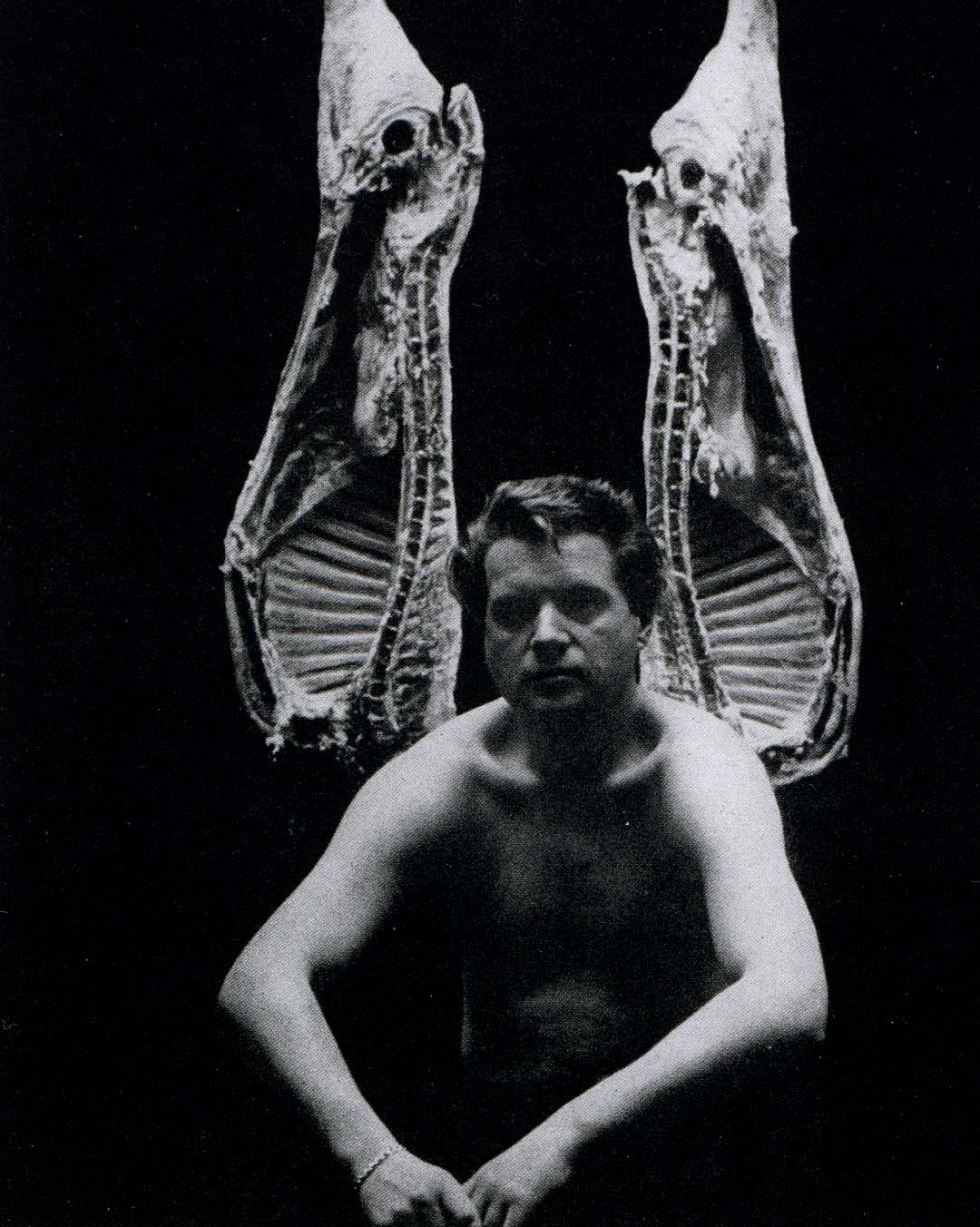


 Irish-born Francis Bacon (1909-1992), possibly the greatest painter of the latter half of the twentieth century, quintessentially exemplified modern humanity’s loneliness and alienation. Indeed, Bacon is considered the greatest British painter since William Turner.
 Up until recently, the public has been exposed to Bacon’s finished paintings. Now with the release of the artist’s sketches from the Joule Archive, we get a glimpse of the genius at work.
 Francis Bacon’s Painting 1946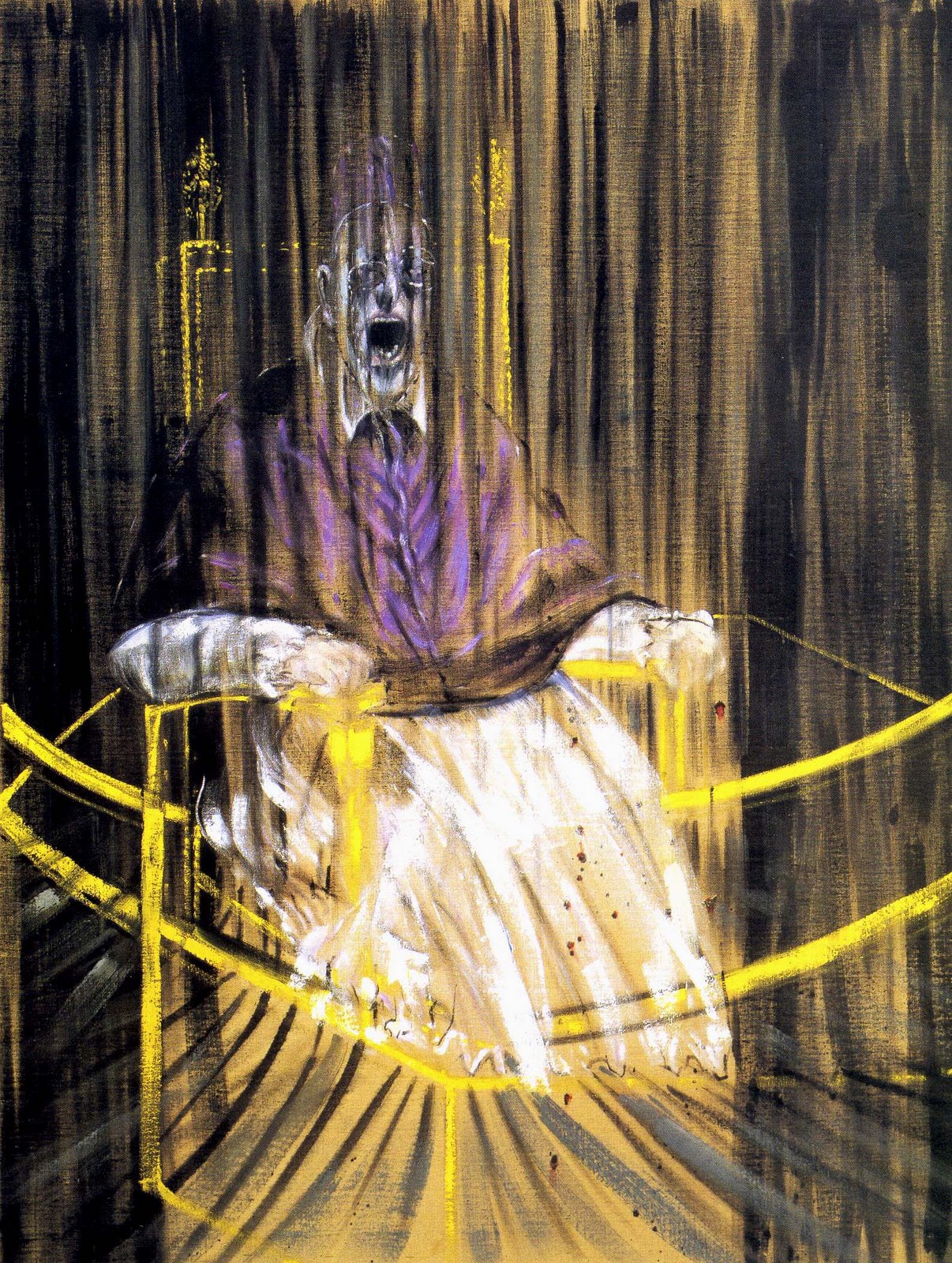


 Patrick Zukeran


 The Daily Hatch