Category Archives: Francis Schaeffer

Abortion debating with Ark Times Bloggers Part 7 “Deitrick Bonhoeffer took up for those who had been declared non-persons by the state”(includes video “Slaughter of the Innocents” and editorial cartoon)

I have debated with Ark Times Bloggers many times in the past on many different subjects. Abortion is probably the most often debated subject and I have noticed that many pro-life individuals are now surfacing on the Arkansas Times Blog.  Here are some examples. Arhogfan501 asserted: This is the beginning of the end for recreational abortion in Arkansas. Songbird777 noted: Babies have a right to live and not be chopped up for someone else’s convenience. The person using the username “baker” commented: Planned Parenthood (PPA) does not nor cannot provide mammograms, indeed no affiliate has the necessary license. PPA is an abortion provider and at some 900 plus killings a day rather prolific.

Here is another debate I got into recently on the Arkansas Times Blog and I go by the username “Saline Republican”:

On 3-22-13 on the Arkansas Times Blog Kimocat said, “Wow, Saline — you sure spend a lot of your life worrying about other people’s zygotes. But it still all boils down to whether one considers an implanted fertilized egg to be the same as a living, breathing person. I do not, and most objective people do not either. If your crazy religion thinks a fertilized egg is “a gift from God.” Fine, believe that. But stop trying to force everyone to believe it too. Your self-righteous indignation is really wearing thin.”

I responded:

I could compare this to the arguments put forth by those who wanted the abolitionists to shut up or to those like Deitrick Bonhoeffer who wrote the famous paper in April of 1933 ““The Church and the Jewish Question.”

Bonhoeffer was explicit about the church’s obligations to fight political injustice. The church, he wrote, must fight evil in three stages: The first was to question state injustice and call the state to responsibility; the second was to help the victims of injustice, whether they were church members or not. Ultimately, however, the church might find itself called “not only to help the victims who have fallen under the wheel, but to fall into the spokes of the wheel itself” in order to halt the machinery of injustice.

______________
Believe it or not lots of the opposition to Bonhoeffer came from the church. This is a human life issue and many nonbelievers have lined up to take up for the unborn children.

____________

The person using the username “Sound Policy” wrote:

Everette’s sole reason for living is to ensure that when a sperm and egg do the do si do that the end product must be carried to term. At the moment of forced birth he is finished with that end product and moves on to the next one. It’s assembly line work. Inspected by No. 666.

Malnutrition, childhood diseases, abusive parents-he doesn’t [care]!

Everette, you’re a poor excuse for a human being. And your cut and paste jobs are laughable. Never learned to think for yourself, huh?

I responded:

Sound policy said I am poor excuse for a human being. I respect you as a human being and I will continue to take up for the smallest and weakest in our society. Today that is the unborn child.

It is sad that in Jan of 1973 with the Roe v. Wade decision struck down almost every abortion law in the nation.

Proverbs 31:8-9 – Speak up for those who can’t speak for themselves

_________________

I truly believe that many of the problems we have today in the USA are due to the advancement of humanism in the last few decades in our society. Ronald Reagan appointed the evangelical Dr. C. Everett Koop to the position of Surgeon General in his administration. He partnered with Dr. Francis Schaeffer in making the video below. It is very valuable information for Christians to have.  Actually I have included a video below that includes comments from him on this subject.

In the film series “WHATEVER HAPPENED TO THE HUMAN RACE?” the arguments are presented  against abortion (Episode 1),  infanticide (Episode 2),   euthenasia (Episode 3), and then there is a discussion of the Christian versus Humanist worldview concerning the issue of “the basis for human dignity” in Episode 4 and then in the last episode a close look at the truth claims of the Bible.

Francis Schaeffer and his wife Edith pictured below.


Francis Schaeffer Whatever Happened to the Human Race (Episode 1) ABORTION

Francis Schaeffer: What Ever Happened to the Human Race? (Full-Length Documentary)


Part 1 on abortion runs from 00:00 to 39:50, Part 2 on Infanticide runs from 39:50 to 1:21:30, Part 3 on Youth Euthanasia runs from 1:21:30 to 1:45:40, Part 4 on the basis of human dignity runs from 1:45:40 to 2:24:45 and Part 5 on the basis of truth runs from 2:24:45 to 3:00:04

Francis Schaeffer and Abortion

There is no question about it: Francis Schaeffer was a prophet. Clear indicators of being a prophet of God include the following traits:
-speaking boldly and uncompromisingly about biblical truth;
-going against the grain and challenging convention;
-speaking truths well ahead of the time, and leading the people of God to where they must be;
-proclaiming unpleasant but necessary truths, etc.

Francis Schaeffer did all this and more. He had such a vitally important ministry, and millions have been impacted by him, including myself. Such an important figure as this deserves all the promotion and endorsement that we can give him. Indeed, I wrote about him in more detail earlier: www.billmuehlenberg.com/2009/10/14/notable-christians-francis-schaeffer/

In many of his books, talks, lectures and articles he hammered home the need for believers to stand strong and loud for the unborn. Many in the evangelical world were simply sleeping through the abortion holocaust, which was especially unleashed with the 1973 Roe v Wade Supreme Court decision.

Here I just want to summarise some of his many words on the issue of abortion. Let me begin with his very important 1981 volume, A Christian Manifesto. In his chapter on “Revival, Revolution, and Reform” he begins this way: “As we turn to the evangelical leadership of this country in the last decades, unhappily, we must come to the conclusion that often it has not been much help. It has shown the mark of the platonic, overly spiritualized Christianity. Spirituality to the evangelical leadership often has not included the Lordship of Christ over the whole spectrum of life.”

He looks at how previous leadership did indeed get involved in the pressing battles of the day. For example, the revivals of Wesley and Whitefield impacted the whole nation, not just the spiritual landscape. The work of Wilberforce and Shaftesbury was not just about saving souls, but transforming society.

“Our evangelical leadership seems to have forgotten its heritage” he says. “Many of the evangelical leadership either were totally silent about abortion, or qualified what they did say about abortion to such an extent that they really said nothing, or less than nothing, as far as the battle for human life was concerned.”

He goes on to write: “We must understand that the question of the dignity of human life is not something on the periphery of Judeo-Christian thinking, but almost in the center of it (though not the center because the center is the existence of God Himself). But the dignity of human life is unbreakably linked to the existence of the personal-infinite God.”

And of course he rightly argued that abortion was just one part of the bigger battle we have with secular humanism: “Certainly every Christian ought to be praying and working to nullify the abominable abortion law. But as we work and pray, we should have in mind not only this important issue as though it stood alone. Rather, we should be struggling and praying that this whole other total entity – the material-energy chance worldview – can be rolled back with all its results across all of life.”

In his earlier 1976 volume, How Should We Then Live (and the 10-part film series that went with it), he looked at the 1973 ruling in some detail. He talked about the decline of absolutes in American law, and how this decision was completely arbitrary. First, it was medically arbitrary, denying the clear understanding of biology and science.

Second, it was legally arbitrary, “disregarding the intent of the Thirteenth and Fourteenth Amendments of the Constitution.” And third, it was at “complete variance with the past Christian consensus. In the pagan Roman Empire, abortion was freely practiced, but Christians took a stand against it. In 314 the Council of Ancyra barred from the taking of the Lord’s Supper for ten years all who procured abortions or made drugs to further abortions.”

If this arbitrary law is accepted by “most modern people, bred with the concept of no absolutes but rather relativity, why wouldn’t arbitrary absolutes in regard to such matters as authoritarian limitations on freedom be equally accepted as long as they were thought to be sociologically helpful? We are left to sociological law without any certainty of limitation.”

Yes he certainly got that right. It was a prophetic insight into where things would lead, and we have certainly arrived, with euthanasia legalised in various places, and academics arguing for the acceptability of infanticide. Indeed, he made the warning quite clear back then: “The door is open. In regard to the fetus, the courts have arbitrarily separated ‘aliveness’ from ‘personhood,’ and if this is so, why not arbitrarily do the same with the aged? So the steps move along, and euthanasia may well become increasingly acceptable.”

In 1979 his book and film series, Whatever Happened to the Human Race?, co-authored with C. Everett Koop, appeared. It looked at the issues of abortion, infanticide, and euthanasia, and sounded a clear alarm for evangelicals to wake up to their social responsibilities. It also argued that abortion rights logically lead to euthanasia and infanticide rights.

In The Great Evangelical Disaster written in 1984 he continues these themes. As he had done elsewhere, he warned about the dangers of accommodation. He said “we must ask where we as evangelicals have been in the battle for truth and morality in our culture. Have we as evangelicals been on the front lines contending for the faith and confronting the moral breakdown over the last forty to sixty years?

Have we been aware that there is a battle going on – not just a heavenly battle, but a life-and-death struggle over what will happen to men and women and children in both this life and the next? . . .Truth demands confrontation. It must be loving confrontation, but there must be confrontation nonetheless.

“Sadly we must say that this has seldom happened. Most of the evangelical world has not been active in the battle, or even been able to see that we are in a battle. And when it comes to the issues of the day the evangelical world most often has said nothing; or worse has said nothing different from what the world would say.

“Here is the great evangelical disaster – the failure of the evangelical world to stand for truth as truth. There is only one word for this – namely accommodation: the evangelical church has accommodated to the world spirit of the age.”

Quite so. And he was fully aware that to win some of these battles we will need to get out of our evangelical ghettoes and start working together with others wherever possible. Some of these battles are just too big and too important to simply lose by default because we are so concerned about our ecclesiastical or theological purity.

Thus Schaeffer saw no problem whatsoever in working with, say, Catholics on the abortion issue, even though he of course had theological differences with them. As he told two British journalists, “I have two words which I would recommend to anybody . . . and they are ‘ally’ and ‘co-belligerent.’ An ally is a person who is a born-again Christian with whom I can go a long way down the road . . . now I don’t say to the very end, because I’m a Presbyterian and I might not be able to form a church with a strong Baptist . . . but we can go a long way down the road – and that’s an ally.

“A co-belligerent is a person who may not have any sufficient basis for taking the right position but takes the right position on a single issue. And I can join with him without any danger as long as I realize that he is not an ally and all we’re talking about is a single issue.”

Those who find this to be a radical, novel, or alarming concept are urged to look here where I develop this concept in much more detail: www.billmuehlenberg.com/2010/09/02/on-co-belligerency/

Perhaps more than any other individual Schaeffer helped to put the abortion issue (and its wider implications) on the map of the evangelical world. He stirred a generation of believers to see their faith must extend beyond pietism and privatism into other areas where it really matters.

In closing, I repeat part of the quote I cited above: “We must understand that the question of the dignity of human life is not something on the periphery of Judeo-Christian thinking”. He understood that 35 years ago. Do we?

Dr. Koop with Francis Schaeffer in their film WHATEVER HAPPENED TO THE HUMAN RACE? made it clear that unborn babies have the right to life. That point is made well in this political cartoon about abortion:

___________

Related posts:

Francis Schaeffer’s prayer for us in USA

 Francis Schaeffer: “Whatever Happened to the Human Race” (Episode 1) ABORTION OF THE HUMAN RACE Published on Oct 6, 2012 by AdamMetropolis The 45 minute video above is from the film series created from Francis Schaeffer’s book “Whatever Happened to the Human Race?” with Dr. C. Everett Koop. This book  really helped develop my political views […]

Francis Schaeffer’s “How should we then live?” Video and outline of episode 10 “Final Choices” (Schaeffer Sundays)

E P I S O D E 1 0   Dr. Francis Schaeffer – Episode X – Final Choices 27 min FINAL CHOICES I. Authoritarianism the Only Humanistic Social Option One man or an elite giving authoritative arbitrary absolutes. A. Society is sole absolute in absence of other absolutes. B. But society has to be […]

Francis Schaeffer’s “How should we then live?” Video and outline of episode 9 “The Age of Personal Peace and Affluence” (Schaeffer Sundays)

E P I S O D E 9 Dr. Francis Schaeffer – Episode IX – The Age of Personal Peace and Affluence 27 min T h e Age of Personal Peace and Afflunce I. By the Early 1960s People Were Bombarded From Every Side by Modern Man’s Humanistic Thought II. Modern Form of Humanistic Thought Leads […]

Francis Schaeffer’s “How should we then live?” Video and outline of episode 8 “The Age of Fragmentation” (Schaeffer Sundays)

E P I S O D E 8 Dr. Francis Schaeffer – Episode VIII – The Age of Fragmentation 27 min I saw this film series in 1979 and it had a major impact on me. T h e Age of FRAGMENTATION I. Art As a Vehicle Of Modern Thought A. Impressionism (Monet, Renoir, Pissarro, Sisley, […]

Francis Schaeffer’s “How should we then live?” Video and outline of episode 7 “The Age of Non-Reason” (Schaeffer Sundays)

E P I S O D E 7 Dr. Francis Schaeffer – Episode VII – The Age of Non Reason I am thrilled to get this film series with you. I saw it first in 1979 and it had such a big impact on me. Today’s episode is where we see modern humanist man act […]

Francis Schaeffer’s “How should we then live?” Video and outline of episode 6 “The Scientific Age” (Schaeffer Sundays)

E P I S O D E 6 How Should We Then Live 6#1 Uploaded by NoMirrorHDDHrorriMoN on Oct 3, 2011 How Should We Then Live? Episode 6 of 12 ________ I am sharing with you a film series that I saw in 1979. In this film Francis Schaeffer asserted that was a shift in […]

Francis Schaeffer’s “How should we then live?” Video and outline of episode 5 “The Revolutionary Age” (Schaeffer Sundays)

E P I S O D E 5 How Should We Then Live? Episode 5: The Revolutionary Age I was impacted by this film series by Francis Schaeffer back in the 1970′s and I wanted to share it with you. Francis Schaeffer noted, “Reformation Did Not Bring Perfection. But gradually on basis of biblical teaching there […]

Francis Schaeffer’s “How should we then live?” Video and outline of episode 4 “The Reformation” (Schaeffer Sundays)

Dr. Francis Schaeffer – Episode IV – The Reformation 27 min I was impacted by this film series by Francis Schaeffer back in the 1970′s and I wanted to share it with you. Schaeffer makes three key points concerning the Reformation: “1. Erasmian Christian humanism rejected by Farel. 2. Bible gives needed answers not only as to […]

“Schaeffer Sundays” Francis Schaeffer’s “How should we then live?” Video and outline of episode 3 “The Renaissance”

Francis Schaeffer’s “How should we then live?” Video and outline of episode 3 “The Renaissance” Francis Schaeffer: “How Should We Then Live?” (Episode 3) THE RENAISSANCE I was impacted by this film series by Francis Schaeffer back in the 1970′s and I wanted to share it with you. Schaeffer really shows why we have so […]

Francis Schaeffer’s “How should we then live?” Video and outline of episode 2 “The Middle Ages” (Schaeffer Sundays)

  Francis Schaeffer: “How Should We Then Live?” (Episode 2) THE MIDDLE AGES I was impacted by this film series by Francis Schaeffer back in the 1970′s and I wanted to share it with you. Schaeffer points out that during this time period unfortunately we have the “Church’s deviation from early church’s teaching in regard […]

Francis Schaeffer’s “How should we then live?” Video and outline of episode 1 “The Roman Age” (Schaeffer Sundays)

Francis Schaeffer: “How Should We Then Live?” (Episode 1) THE ROMAN AGE   Today I am starting a series that really had a big impact on my life back in the 1970′s when I first saw it. There are ten parts and today is the first. Francis Schaeffer takes a look at Rome and why […]

Francis Schaeffer: “Whatever Happened to the Human Race” (Episode 5) TRUTH AND HISTORY

Francis Schaeffer: “Whatever Happened to the Human Race” (Episode 5) TRUTH AND HISTORY Published on Oct 7, 2012 by AdamMetropolis This crucial series is narrated by the late Dr. Francis Schaeffer and former Surgeon General Dr. C. Everett Koop. Today, choices are being made that undermine human rights at their most basic level. Practices once […]

Francis Schaeffer: “Whatever Happened to the Human Race” (Episode 4) THE BASIS FOR HUMAN DIGNITY

The opening song at the beginning of this episode is very insightful. Francis Schaeffer: “Whatever Happened to the Human Race” (Episode 4) THE BASIS FOR HUMAN DIGNITY Published on Oct 7, 2012 by AdamMetropolis This crucial series is narrated by the late Dr. Francis Schaeffer and former Surgeon General Dr. C. Everett Koop. Today, choices […]

Francis Schaeffer: “Whatever Happened to the Human Race” (Episode 3) DEATH BY SOMEONE’S CHOICE

Francis Schaeffer: “Whatever Happened to the Human Race” (Episode 3) DEATH BY SOMEONE’S CHOICE Published on Oct 6, 2012 by AdamMetropolis This crucial series is narrated by the late Dr. Francis Schaeffer and former Surgeon General Dr. C. Everett Koop. Today, choices are being made that undermine human rights at their most basic level. Practices […]

Francis Schaeffer: “Whatever Happened to the Human Race?” (Episode 2) SLAUGHTER OF THE INNOCENTS

Francis Schaeffer: “Whatever Happened to the Human Race?” (Episode 2) SLAUGHTER OF THE INNOCENTS Published on Oct 6, 2012 by AdamMetropolis This crucial series is narrated by the late Dr. Francis Schaeffer and former Surgeon General Dr. C. Everett Koop. Today, choices are being made that undermine human rights at their most basic level. Practices […]

Francis Schaeffer: “Whatever Happened to the Human Race” (Episode 1) ABORTION OF THE HUMAN RACE

It is not possible to know where the pro-life evangelicals are coming from unless you look at the work of the person who inspired them the most. That person was Francis Schaeffer.  I do care about economic issues but the pro-life issue is the most important to me. Several years ago Adrian Rogers (past president of […]

The following essay explores the role that Francis Schaeffer played in the rise of the pro-life movement. It examines the place of How Should We Then Live?, Whatever Happened to the Human Race?, and A Christian Manifesto in that process.

This essay below is worth the read. Schaeffer, Francis – “Francis Schaeffer and the Pro-Life Movement” [How Should We Then Live?, Whatever Happened to the Human Race?, A Christian Manifesto] Editor note: <p> </p> [The following essay explores the role that Francis Schaeffer played in the rise of the pro-life movement.  It examines the place of […]

Who was Francis Schaeffer? by Udo Middelmann

Great article on Schaeffer. Who was Dr. Francis A. Schaeffer? By Francis Schaeffer The unique contribution of Dr. Francis Schaeffer on a whole generation was the ability to communicate the truth of historic Biblical Christianity in a way that combined intellectual integrity with practical, loving care. This grew out of his extensive understanding of the Bible […]

Truth Tuesday:Article on Francis Schaeffer by Fred Sanders

Article on Francis Schaeffer by Fred Sanders

Episode 8: The Age Of Fragmentation

Published on Jul 24, 2012

Dr. Schaeffer’s sweeping epic on the rise and decline of Western thought and Culture

_______________________

I love the works of Francis Schaeffer and I have been on the internet reading several blogs that talk about Schaeffer’s work and the work below   by Fred Sanders was really helpful. Schaeffer’s film series “How should we then live?  Wikipedia notes, “According to Schaeffer, How Should We Then Live traces Western history from Ancient Rome until the time of writing (1976) along three lines: the philosophic, scientific, and religious.[3] He also makes extensive references to art and architecture as a means of showing how these movements reflected changing patterns of thought through time. Schaeffer’s central premise is: when we base society on the Bible, on the infinite-personal God who is there and has spoken,[4] this provides an absolute by which we can conduct our lives and by which we can judge society.  Here are some posts I have done on this series: Francis Schaeffer’s “How should we then live?” Video and outline of episode 10 “Final Choices” episode 9 “The Age of Personal Peace and Affluence”episode 8 “The Age of Fragmentation”episode 7 “The Age of Non-Reason” episode 6 “The Scientific Age”  episode 5 “The Revolutionary Age” episode 4 “The Reformation” episode 3 “The Renaissance”episode 2 “The Middle Ages,”, and  episode 1 “The Roman Age,” .

In the film series “WHATEVER HAPPENED TO THE HUMAN RACE?” the arguments are presented  against abortion (Episode 1),  infanticide (Episode 2),   euthanasia (Episode 3), and then there is a discussion of the Christian versus Humanist worldview concerning the issue of “the basis for human dignity” in Episode 4 and then in the last episode a close look at the truth claims of the Bible.

Francis Schaeffer

Today is Francis Schaeffer’s Birthday

January 30, 2009 By

Francis Schaeffer Francis Schaeffer (1912-1984) has been gone for a quarter of a century now, and responsible evaluation of his impact on Christian culture is just getting underway. Two major biographies have been published recently: Barry Hankins’ Francis Schaeffer and the Shaping of Evangelical America (Eerdmans, 2009) and Colin Duriez’s Francis Schaeffer: An Authentic Life (Crossway, 2008).

Perhaps the evangelical culture at large has passed through some of the same stages I passed through in appreciating Schaeffer. When a friend gave me my first Francis Schaeffer book (How Should We Then Live), it knocked my socks off so far that I had to read it barefoot. This author exuded passion and confidence as he opined about Michelangelo, John Cage, Thomas Aquinas, and the Beatles. He was full of wonder about all these things that I had never heard a Christian critic talking about, and he read the world as if every cultural artifact were a clue that led inexorably to solving his big presuppositional apologetic crime of the century. Here was a renaissance man who could explain Renaissance Man.

Then as I studied more of these things myself, I began to see how tendentious many of Schaeffer’s interpretations were. Whereas at first I had been forced to take his word for it, as I became more familiar with art and philosophy and culture, I was able to render independent judgments on my own, and compare them to his. He hadn’t quite grasped what Aquinas was up to, had he? And the way he described Kant… peculiar. Was cubism really all about the dissolving of form? Had he actually read a single page of Karl Barth, or did he just dismiss him unread? And so on. I think my first judgments about all those things had been pretty facile, and as I refined and developed my understanding, I imputed my facile judgments to Schaeffer’s bold simplifications and generalizations, and told myself I had outgrown Francis Schaeffer.

But when I finally pulled the dusty volumes of Schaeffer’s books back down from the shelf, I had to admit this was still powerful stuff. Anybody who moved as nimbly as Schaeffer over so much territory was bound to work by intuition and rough-and-ready summary. For what it is, this is great stuff. He was fundamentally right about existentialism in its many guises, wasn’t he? And that actually did explain a lot of modern art and music –not all of it, but a lot. Time after time, Schaeffer scored direct hits and said what mattered most for his audience:

It is not more spiritual to believe without asking questions. It is not more biblical. It is less biblical and eventually it will be less spiritual, because the whole man will not be involved… It must be the whole man who comes to understand that the gospel is truth and believes because he is convinced on the basis of good and sufficient reason that it is truth.

I think Schaeffer’s published work continues to speak to new audiences today, and the many students whose lives were changed by personal interaction with him continue to be important influences in the world.

Related posts:

Francis Schaeffer’s wife Edith passes away on Easter weekend 2013 Part 7 (includes pro-life editorial cartoon)

The Francis and Edith Schaeffer Story Pt.1 – Today’s Christian Videos The Francis and Edith Schaeffer Story – Part 3 of 3 Francis Schaeffer: “Whatever Happened to the Human Race” (Episode 1) ABORTION OF THE HUMAN RACE Published on Oct 6, 2012 by AdamMetropolis ________________ Picture of Francis Schaeffer and his wife Edith from the […]

The Mark of the Christian by Francis Schaeffer Part 1

  THE MARK OF A CHRISTIAN – CLASS 1 – Introduction Published on Mar 7, 2012 This is the introductory class on “The Mark Of A Christian” by Francis Schaeffer. The class was originally taught at Redeemer Presbyterian Church in Overland Park, KS by Dan Guinn from FrancisSchaefferStudies.org as part of the adult Sunday School hour […]

Francis Schaeffer’s wife Edith passes away on Easter weekend 2013 Part 6 (includes pro-life editorial cartoon and tribute from son-in-law Ranald Macaulay)

The Francis and Edith Schaeffer Story Pt.1 – Today’s Christian Videos The Francis and Edith Schaeffer Story – Part 3 of 3 Francis Schaeffer: “Whatever Happened to the Human Race” (Episode 1) ABORTION OF THE HUMAN RACE Published on Oct 6, 2012 by AdamMetropolis ________________ Picture of Francis Schaeffer and his wife Edith from the […]

Francis Schaeffer’s wife Edith passes away on Easter weekend 2013 Part 5 (includes pro-life editorial cartoon)

The Francis and Edith Schaeffer Story Pt.1 – Today’s Christian Videos The Francis and Edith Schaeffer Story – Part 3 of 3 Francis Schaeffer: “Whatever Happened to the Human Race” (Episode 1) ABORTION OF THE HUMAN RACE Published on Oct 6, 2012 by AdamMetropolis ________________ Picture of Francis Schaeffer and his wife Edith from the […]

Francis Schaeffer’s wife Edith passes away on Easter weekend 2013 Part 4 (includes pro-life editorial cartoon)

The Francis and Edith Schaeffer Story Pt.1 – Today’s Christian Videos The Francis and Edith Schaeffer Story – Part 3 of 3 Francis Schaeffer: “Whatever Happened to the Human Race” (Episode 1) ABORTION OF THE HUMAN RACE Published on Oct 6, 2012 by AdamMetropolis ________________ Picture of Francis Schaeffer and his wife Edith from the […]

Francis Schaeffer’s wife Edith passes away on Easter weekend 2013 Part 3 (includes pro-life editorial cartoon)

The Francis and Edith Schaeffer Story Pt.1 – Today’s Christian Videos The Francis and Edith Schaeffer Story – Part 3 of 3 Francis Schaeffer: “Whatever Happened to the Human Race” (Episode 1) ABORTION OF THE HUMAN RACE Published on Oct 6, 2012 by AdamMetropolis ________________ Picture of Francis Schaeffer and his wife Edith from the […]

“Schaeffer Sundays” Francis Schaeffer’s own words concerning humanist dominated public schools in USA even though country was founded on a Christian base

Francis Schaeffer: “Whatever Happened to the Human Race?” (Episode 2) SLAUGHTER OF THE INNOCENTS Published on Oct 6, 2012 by AdamMetropolis The 45 minute video above is from the film series created from Francis Schaeffer’s book “Whatever Happened to the Human Race?” with Dr. C. Everett Koop. This book  really helped develop my political views concerning […]

“Schaeffer Sundays” Francis Schaeffer’s own words concerning where the Bible-believing Christians been the last few decades

Francis Schaeffer: “Whatever Happened to the Human Race” (Episode 1) ABORTION OF THE HUMAN RACE Published on Oct 6, 2012 by AdamMetropolis The 45 minute video above is from the film series created from Francis Schaeffer’s book “Whatever Happened to the Human Race?” with Dr. C. Everett Koop. This book  really helped develop my political views […]

Taking on Ark Times Bloggers on various issues Part E “Moral absolutes and abortion” Francis Schaeffer Quotes part 5(includes the film SLAUGHTER OF THE INNOCENTS) (editorial cartoon)

I have gone back and forth and back and forth with many liberals on the Arkansas Times Blog on many issues such as abortion, human rights, welfare, poverty, gun control  and issues dealing with popular culture. Here is another exchange I had with them a while back. My username at the Ark Times Blog is Saline […]

“Schaeffer Sundays” Francis Schaeffer’s own words concerning religious liberals and humanists

Francis Schaeffer: “Whatever Happened to the Human Race” (Episode 5) TRUTH AND HISTORY Published on Oct 7, 2012 by AdamMetropolis The 45 minute video above is from the film series created from Francis Schaeffer’s book “Whatever Happened to the Human Race?” with Dr. C. Everett Koop. This book  really helped develop my political views concerning abortion, […]

Abortion debating with Ark Times Bloggers Part 6 “Slaves and unborn children both we not recognized as humans” (includes reference to Dred Scott and the film THE BASIS FOR HUMAN DIGNITY and editorial cartoon)

I have debated with Ark Times Bloggers many times in the past on many different subjects. Abortion is probably the most often debated subject and I have noticed that many pro-life individuals are now surfacing on the Arkansas Times Blog.  Here are some examples. Arhogfan501 asserted: This is the beginning of the end for recreational abortion in Arkansas. Songbird777 noted: Babies have a right to live and not be chopped up for someone else’s convenience. The person using the username “baker” commented: Planned Parenthood (PPA) does not nor cannot provide mammograms, indeed no affiliate has the necessary license. PPA is an abortion provider and at some 900 plus killings a day rather prolific.

Here is another debate I got into recently on the Arkansas Times Blog and I go by the username “Saline Republican”:

Ruth Gluhareff Pianalto said on the Arkansas Times Blog on 3-22-13:

“This is just the beginning. Our rights, our freedoms are being violated. Choices made for women by the stroke of a pen that should be made by each woman, her family, her Doctor and her God are not Democracy….”

I responded:

How about the rights of the unborn women? Ruth Gluhareff Pianalto are you against gendercide? Gendercide is where the parents are told the sex of the child and if they don’t want that sex then they abort. (The vast majority of these abortions are done because parents want a boy!!!!!)

 Rablib said, “Parents of born children are not required by law to give parts of their bodies, to the point of death, to keep their born children alive. Why should the parent of an unborn fetus be required to do so? That’s slavery of the worst kind.”
I responded:Who suggested that an expectant mother is expected to die because of her child? I am sure there is someone out there extreme enough to say that but why don’t you name that person before you make wild accusations!!!Since you brought up the issue of slavery then let me just say that just like the 1800’s in the USA and the 1930’s in Germany people tried to classify other humans as “nonhuman” and then they treated them like animals!! Now the Supreme Court has classified the unborn child as nonhuman.

John Russell in his article “The Devaluing of Life in America,” states the following:

Former Surgeon General C. Everett Koop and Christian apologist Francis A. Schaeffer issue a stern warning concerning the devaluing of life in America. They quote Psychiatrist Leo Alexander, who served with the office of Chief of Counsel for War Crimes in Nuremberg:

It started with the acceptance of the attitude basic in the euthanasia movement, that there is such a thing as life not worthy to be lived…. …. The first direct order for euthanasia was issued by Hitler on Sept. 1, 1939…. All state institutions were required to report on patients who had been ill for five years or more or who were unable to work, by filling out questionnaires giving name, race, marital status, nationality, next of kin, whether regularly visited and by whom, who bore the financial responsibility and so forth. The decision regarding which patients should be killed was made entirely on the basis of this brief information by expert consultants, most of whom were professors of psychiatry in the key universities. These consultants never saw the patients themselves.

The Nazis set up an organization specifically for the killing of children, which they called, “Realm’s Committee for Scientific Approach to Severe Illness Due to Heredity and Constitution.” Children were transported to the killing centers by “The Charitable Transport Company for the Sick.” “The Charitable Foundation for Institutional Care” collected the cost of killing the children from the relatives, who did not know that they were paying to kill their own kinfolk. The cause of death was falsified on the death certificates. [Francis A. Schaeffer and C. Everett Koop, M.D., Whatever Happened to the Human Race? (Old Tappan, NJ: Fleming H. Revell Company, 1979), pp. 103-107].

IT HASN’T BEEN TOO FAR BACK IN THE HISTORY OF THE UNITED STATES, THAT BLACK PEOPLE WERE SOLD LIKE CATTLE IN OUR SLAVE MARKETS. FOR ECONOMIC REASONS, WHITE SOCIETY HAD CLASSIFIED THEM AS “NONHUMAN.” THE U S SUPREME COURT UPHELD THIS LIE IN ITS FAMOUS DRED SCOTT DECISION.

______________

I truly believe that many of the problems we have today in the USA are due to the advancement of humanism in the last few decades in our society. Ronald Reagan appointed the evangelical Dr. C. Everett Koop to the position of Surgeon General in his administration. He partnered with Dr. Francis Schaeffer in making the video below. It is very valuable information for Christians to have.  Actually I have included a video below that includes comments from him on this subject.

In the film series “WHATEVER HAPPENED TO THE HUMAN RACE?” the arguments are presented  against abortion (Episode 1),  infanticide (Episode 2),   euthenasia (Episode 3), and then there is a discussion of the Christian versus Humanist worldview concerning the issue of “the basis for human dignity” in Episode 4 and then in the last episode a close look at the truth claims of the Bible.

Many liberals actually truly do argue for abortion rights over human rights. Prochoice advocate Elizabeth Williams came out and said that on 1-23-13 in her article on Salon. We hear reasons for abortion such as poverty,and  child abuse,  but why not consider adoption? Instead, the political left will stop at nothing to push the pro-abortion agenda. Why not stop and take an honest look at when life begins for the unborn child and when she begins to feel pain?

Francis Schaeffer: “Whatever Happened to the Human Race” (Episode 4) THE BASIS FOR HUMAN DIGNITY

Published on Oct 7, 2012 by

Ryan T. Anderson

February 7, 2013 at 11:20 am

Photo credit: SNAP/ZUMAPRESS/Newscom

Yesterday we celebrated Ronald Reagan’s 102nd birthday. A little-known fact about President Reagan is that he is the only sitting president to have ever published a book—a book promoting the culture of life.

In Abortion and the Conscience of the Nation, published in 1983, Reagan explained what Roe had wrought for our nation:

The 10th anniversary of the Supreme Court decision in Roe v. Wade is a good time for us to pause and reflect. Our nationwide policy of abortion-on-demand through all nine months of pregnancy was neither voted for by our people nor enacted by our legislators—not a single state had such unrestricted abortion before the Supreme Court decreed it to be national policy in 1973. But the consequences of this judicial decision are now obvious: since 1973, more than 15 million unborn children have had their lives snuffed out by legalized abortions. That is over ten times the number of Americans lost in all our nation’s wars.

As we mourned the 40th anniversary of Roe last month, the number of American lives that have been ended at the hand of an abortionist has sadly grown to 55 million.

Reagan saw Roe for what it was, a travesty of law:

Make no mistake, abortion-on-demand is not a right granted by the Constitution. No serious scholar, including one disposed to agree with the Court’s result, has argued that the framers of the Constitution intended to create such a right. Shortly after the Roe v. Wade decision, Professor John Hart Ely, now Dean of Stanford Law School, wrote that the opinion “is not constitutional law and gives almost no sense of an obligation to try to be.” Nowhere do the plain words of the Constitution even hint at a “right” so sweeping as to permit abortion up to the time the child is ready to be born. Yet that is what the Court ruled.

Reagan encouraged pro-lifers not to lose hope:

Despite the formidable obstacles before us, we must not lose heart. This is not the first time our country has been divided by a Supreme Court decision that denied the value of certain human lives. The Dred Scott decision of 1857 was not overturned in a day, or a year, or even a decade. At first, only a minority of Americans recognized and deplored the moral crisis brought about by denying the full humanity of our black brothers and sisters; but that minority persisted in their vision and finally prevailed. They did it by appealing to the hearts and minds of their countrymen, to the truth of human dignity under God. From their example, we know that respect for the sacred value of human life is too deeply engrained in the hearts of our people to remain forever suppressed. But the great majority of the American people have not yet made their voices heard, and we cannot expect them to—any more than the public voice arose against slavery—until the issue is clearly framed and presented.

So what is the issue, clearly framed and presented? Reagan explained:

I have often said that when we talk about abortion, we are talking about two lives—the life of the mother and the life of the unborn child. Why else do we call a pregnant woman a mother? I have also said that anyone who doesn’t feel sure whether we are talking about a second human life should clearly give life the benefit of the doubt. If you don’t know whether a body is alive or dead, you would never bury it. I think this consideration itself should be enough for all of us to insist on protecting the unborn.

The real question today is not when human life begins, but, What is the value of human life? The abortionist who reassembles the arms and legs of a tiny baby to make sure all its parts have been torn from its mother’s body can hardly doubt whether it is a human being. The real question for him and for all of us is whether that tiny human life has a God-given right to be protected by the law—the same right we have.

As we honor President Reagan’s legacy, let us continue to work to build a culture of life.

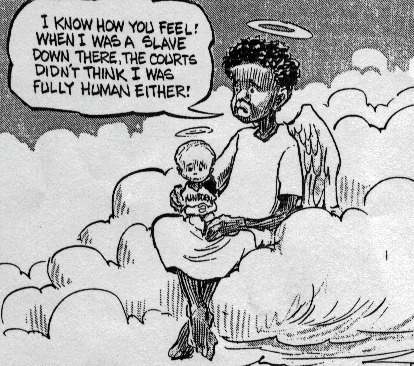
The film “Whatever happened to the human race?” did a great job of comparing the dehumanizing efforts of the slave owners and those of today’s abortion advocates. Here is  a great cartoon that makes the same comparison:

_____________

Related posts:

Francis Schaeffer’s prayer for us in USA

 Francis Schaeffer: “Whatever Happened to the Human Race” (Episode 1) ABORTION OF THE HUMAN RACE Published on Oct 6, 2012 by AdamMetropolis The 45 minute video above is from the film series created from Francis Schaeffer’s book “Whatever Happened to the Human Race?” with Dr. C. Everett Koop. This book  really helped develop my political views […]

Francis Schaeffer’s “How should we then live?” Video and outline of episode 10 “Final Choices” (Schaeffer Sundays)

E P I S O D E 1 0   Dr. Francis Schaeffer – Episode X – Final Choices 27 min FINAL CHOICES I. Authoritarianism the Only Humanistic Social Option One man or an elite giving authoritative arbitrary absolutes. A. Society is sole absolute in absence of other absolutes. B. But society has to be […]

Francis Schaeffer’s “How should we then live?” Video and outline of episode 9 “The Age of Personal Peace and Affluence” (Schaeffer Sundays)

E P I S O D E 9 Dr. Francis Schaeffer – Episode IX – The Age of Personal Peace and Affluence 27 min T h e Age of Personal Peace and Afflunce I. By the Early 1960s People Were Bombarded From Every Side by Modern Man’s Humanistic Thought II. Modern Form of Humanistic Thought Leads […]

Francis Schaeffer’s “How should we then live?” Video and outline of episode 8 “The Age of Fragmentation” (Schaeffer Sundays)

E P I S O D E 8 Dr. Francis Schaeffer – Episode VIII – The Age of Fragmentation 27 min I saw this film series in 1979 and it had a major impact on me. T h e Age of FRAGMENTATION I. Art As a Vehicle Of Modern Thought A. Impressionism (Monet, Renoir, Pissarro, Sisley, […]

Francis Schaeffer’s “How should we then live?” Video and outline of episode 7 “The Age of Non-Reason” (Schaeffer Sundays)

E P I S O D E 7 Dr. Francis Schaeffer – Episode VII – The Age of Non Reason I am thrilled to get this film series with you. I saw it first in 1979 and it had such a big impact on me. Today’s episode is where we see modern humanist man act […]

Francis Schaeffer’s “How should we then live?” Video and outline of episode 6 “The Scientific Age” (Schaeffer Sundays)

E P I S O D E 6 How Should We Then Live 6#1 Uploaded by NoMirrorHDDHrorriMoN on Oct 3, 2011 How Should We Then Live? Episode 6 of 12 ________ I am sharing with you a film series that I saw in 1979. In this film Francis Schaeffer asserted that was a shift in […]

Francis Schaeffer’s “How should we then live?” Video and outline of episode 5 “The Revolutionary Age” (Schaeffer Sundays)

E P I S O D E 5 How Should We Then Live? Episode 5: The Revolutionary Age I was impacted by this film series by Francis Schaeffer back in the 1970′s and I wanted to share it with you. Francis Schaeffer noted, “Reformation Did Not Bring Perfection. But gradually on basis of biblical teaching there […]

Francis Schaeffer’s “How should we then live?” Video and outline of episode 4 “The Reformation” (Schaeffer Sundays)

Dr. Francis Schaeffer – Episode IV – The Reformation 27 min I was impacted by this film series by Francis Schaeffer back in the 1970′s and I wanted to share it with you. Schaeffer makes three key points concerning the Reformation: “1. Erasmian Christian humanism rejected by Farel. 2. Bible gives needed answers not only as to […]

“Schaeffer Sundays” Francis Schaeffer’s “How should we then live?” Video and outline of episode 3 “The Renaissance”

Francis Schaeffer’s “How should we then live?” Video and outline of episode 3 “The Renaissance” Francis Schaeffer: “How Should We Then Live?” (Episode 3) THE RENAISSANCE I was impacted by this film series by Francis Schaeffer back in the 1970′s and I wanted to share it with you. Schaeffer really shows why we have so […]

Francis Schaeffer’s “How should we then live?” Video and outline of episode 2 “The Middle Ages” (Schaeffer Sundays)

  Francis Schaeffer: “How Should We Then Live?” (Episode 2) THE MIDDLE AGES I was impacted by this film series by Francis Schaeffer back in the 1970′s and I wanted to share it with you. Schaeffer points out that during this time period unfortunately we have the “Church’s deviation from early church’s teaching in regard […]

Francis Schaeffer’s “How should we then live?” Video and outline of episode 1 “The Roman Age” (Schaeffer Sundays)

Francis Schaeffer: “How Should We Then Live?” (Episode 1) THE ROMAN AGE   Today I am starting a series that really had a big impact on my life back in the 1970′s when I first saw it. There are ten parts and today is the first. Francis Schaeffer takes a look at Rome and why […]

Francis Schaeffer: “Whatever Happened to the Human Race” (Episode 5) TRUTH AND HISTORY

Francis Schaeffer: “Whatever Happened to the Human Race” (Episode 5) TRUTH AND HISTORY Published on Oct 7, 2012 by AdamMetropolis This crucial series is narrated by the late Dr. Francis Schaeffer and former Surgeon General Dr. C. Everett Koop. Today, choices are being made that undermine human rights at their most basic level. Practices once […]

Francis Schaeffer: “Whatever Happened to the Human Race” (Episode 4) THE BASIS FOR HUMAN DIGNITY

The opening song at the beginning of this episode is very insightful. Francis Schaeffer: “Whatever Happened to the Human Race” (Episode 4) THE BASIS FOR HUMAN DIGNITY Published on Oct 7, 2012 by AdamMetropolis This crucial series is narrated by the late Dr. Francis Schaeffer and former Surgeon General Dr. C. Everett Koop. Today, choices […]

Francis Schaeffer: “Whatever Happened to the Human Race” (Episode 3) DEATH BY SOMEONE’S CHOICE

Francis Schaeffer: “Whatever Happened to the Human Race” (Episode 3) DEATH BY SOMEONE’S CHOICE Published on Oct 6, 2012 by AdamMetropolis This crucial series is narrated by the late Dr. Francis Schaeffer and former Surgeon General Dr. C. Everett Koop. Today, choices are being made that undermine human rights at their most basic level. Practices […]

Francis Schaeffer: “Whatever Happened to the Human Race?” (Episode 2) SLAUGHTER OF THE INNOCENTS

Francis Schaeffer: “Whatever Happened to the Human Race?” (Episode 2) SLAUGHTER OF THE INNOCENTS Published on Oct 6, 2012 by AdamMetropolis This crucial series is narrated by the late Dr. Francis Schaeffer and former Surgeon General Dr. C. Everett Koop. Today, choices are being made that undermine human rights at their most basic level. Practices […]

Francis Schaeffer: “Whatever Happened to the Human Race” (Episode 1) ABORTION OF THE HUMAN RACE

It is not possible to know where the pro-life evangelicals are coming from unless you look at the work of the person who inspired them the most. That person was Francis Schaeffer.  I do care about economic issues but the pro-life issue is the most important to me. Several years ago Adrian Rogers (past president of […]

The following essay explores the role that Francis Schaeffer played in the rise of the pro-life movement. It examines the place of How Should We Then Live?, Whatever Happened to the Human Race?, and A Christian Manifesto in that process.

This essay below is worth the read. Schaeffer, Francis – “Francis Schaeffer and the Pro-Life Movement” [How Should We Then Live?, Whatever Happened to the Human Race?, A Christian Manifesto] Editor note: <p> </p> [The following essay explores the role that Francis Schaeffer played in the rise of the pro-life movement.  It examines the place of […]

Who was Francis Schaeffer? by Udo Middelmann

Great article on Schaeffer. Who was Dr. Francis A. Schaeffer? By Francis Schaeffer The unique contribution of Dr. Francis Schaeffer on a whole generation was the ability to communicate the truth of historic Biblical Christianity in a way that combined intellectual integrity with practical, loving care. This grew out of his extensive understanding of the Bible […]
.

“Sanctity of Life Saturday” Francis Schaeffer’s wife Edith passes away on Easter weekend 2013 Part 6 (includes pro-life editorial cartoon)

Francis Schaeffer Whatever Happened to the Human Race (Episode 1) ABORTION

Francis Schaeffer: What Ever Happened to the Human Race? (Full-Length Documentary)


Part 1 on abortion runs from 00:00 to 39:50, Part 2 on Infanticide runs from 39:50 to 1:21:30, Part 3 on Youth Euthanasia runs from 1:21:30 to 1:45:40, Part 4 on the basis of human dignity runs from 1:45:40 to 2:24:45 and Part 5 on the basis of truth runs from 2:24:45 to 3:00:04

Francis Schaeffer “BASIS FOR HUMAN DIGNITY” Whatever…HTTHR

________________

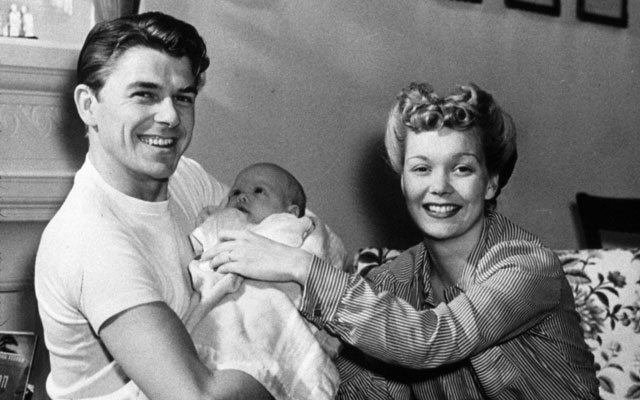
Picture of Francis Schaeffer and his wife Edith from the 1930′s above. I was sad to read about Edith passing away on Easter weekend in 2013. I wanted to pass along this fine article below.

A Message from L’Abri on the Passing of Edith Schaeffer

Written by Staff | Sunday, March 31, 2013

Dear Praying family of Rochester L’Abri,

Our Heavenly Father has taken dear Edith Schaeffer to himself. She passed away quietly in her sleep last night in Gryon, Switzerland where she has been living with her family. We cannot express how deep is our gratitude for her life and we thank the Lord that she is enjoying the Hope that she has so longed for.

Her son-in-law Ranald Macaulay writes as follows:

Dear Friends,

John Sandri called about an hour ago to say that Edith died peacefully in her sleep during the night. It is just three weeks since I was in Gryon with her. In the intervening days John has reported several times that she was much quieter. Doubtless this was mainly the result of her physical decline. But John had had the same sort of experience I had while with her – and which I mentioned in an earlier message – that Edith would become fully aware at times of what one was saying. Recently, for example, he read her her own account of Frank’s birth in Champery. Her eyes were open and alert and there could be no doubt about her reliving that incident vividly.

So I am deeply grateful that she died quietly in her sleep and at rest in herself.

What a lovely person Edith is – and how thankful we are that she has gone at last to her eternal rest. One wonders, too, with her life-long and quite proper excitement about the ‘great tapestry of God’ could she have chosen a more fitting day than Easter Saturday to round off her own amazing contribution to that sublime fabric!

Warm greetings –

Ranald

There will be a funeral in Gryon and then there will be a private burial here in Rochester, where she will be laid to rest alongside Dr. Schaeffer. Sometime later there will be a public memorial here in Rochester. We will keep you all informed.

“I am the Resurrection and the Life. He who believes in me will Live, even though he dies” John 11:25

Yours in Christ,
Jock & Alison McGregor
Rochester L’Abri

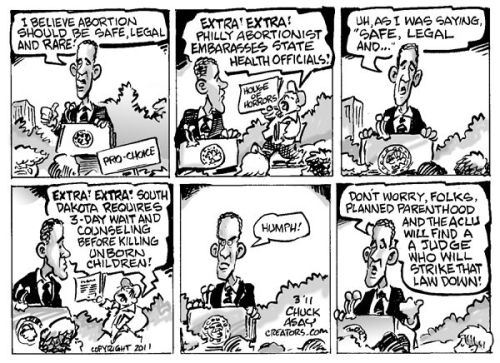
President Obama is doing everything he can to help expand abortion rights as this editorial cartoon shows:

C. Everett Koop

(Francis did a great job in his film series “How Should we then live?” in looking at how humanism has affected art and culture in the Western World in the last 2000 years. My favorite episodes include his study of the Renaissance, the Revolutionary age, the age of Nonreason, and the age of Fragmentation.)

Related posts:

Francis Schaeffer’s “How should we then live?” Video and outline of episode 10 “Final Choices” (Schaeffer Sundays)

E P I S O D E 1 0   Dr. Francis Schaeffer – Episode X – Final Choices 27 min FINAL CHOICES I. Authoritarianism the Only Humanistic Social Option One man or an elite giving authoritative arbitrary absolutes. A. Society is sole absolute in absence of other absolutes. B. But society has to be […]

Francis Schaeffer’s “How should we then live?” Video and outline of episode 9 “The Age of Personal Peace and Affluence” (Schaeffer Sundays)

E P I S O D E 9 Dr. Francis Schaeffer – Episode IX – The Age of Personal Peace and Affluence 27 min T h e Age of Personal Peace and Afflunce I. By the Early 1960s People Were Bombarded From Every Side by Modern Man’s Humanistic Thought II. Modern Form of Humanistic Thought Leads […]

Francis Schaeffer’s “How should we then live?” Video and outline of episode 8 “The Age of Fragmentation” (Schaeffer Sundays)

E P I S O D E 8 Dr. Francis Schaeffer – Episode VIII – The Age of Fragmentation 27 min I saw this film series in 1979 and it had a major impact on me. T h e Age of FRAGMENTATION I. Art As a Vehicle Of Modern Thought A. Impressionism (Monet, Renoir, Pissarro, Sisley, […]

Francis Schaeffer’s “How should we then live?” Video and outline of episode 7 “The Age of Non-Reason” (Schaeffer Sundays)

E P I S O D E 7 Dr. Francis Schaeffer – Episode VII – The Age of Non Reason I am thrilled to get this film series with you. I saw it first in 1979 and it had such a big impact on me. Today’s episode is where we see modern humanist man act […]

Francis Schaeffer’s “How should we then live?” Video and outline of episode 6 “The Scientific Age” (Schaeffer Sundays)

E P I S O D E 6 How Should We Then Live 6#1 Uploaded by NoMirrorHDDHrorriMoN on Oct 3, 2011 How Should We Then Live? Episode 6 of 12 ________ I am sharing with you a film series that I saw in 1979. In this film Francis Schaeffer asserted that was a shift in […]

Francis Schaeffer’s “How should we then live?” Video and outline of episode 5 “The Revolutionary Age” (Schaeffer Sundays)

E P I S O D E 5 How Should We Then Live? Episode 5: The Revolutionary Age I was impacted by this film series by Francis Schaeffer back in the 1970′s and I wanted to share it with you. Francis Schaeffer noted, “Reformation Did Not Bring Perfection. But gradually on basis of biblical teaching there […]

Francis Schaeffer’s “How should we then live?” Video and outline of episode 4 “The Reformation” (Schaeffer Sundays)

Dr. Francis Schaeffer – Episode IV – The Reformation 27 min I was impacted by this film series by Francis Schaeffer back in the 1970′s and I wanted to share it with you. Schaeffer makes three key points concerning the Reformation: “1. Erasmian Christian humanism rejected by Farel. 2. Bible gives needed answers not only as to […]

“Schaeffer Sundays” Francis Schaeffer’s “How should we then live?” Video and outline of episode 3 “The Renaissance”

Francis Schaeffer’s “How should we then live?” Video and outline of episode 3 “The Renaissance” Francis Schaeffer: “How Should We Then Live?” (Episode 3) THE RENAISSANCE I was impacted by this film series by Francis Schaeffer back in the 1970′s and I wanted to share it with you. Schaeffer really shows why we have so […]

Francis Schaeffer’s “How should we then live?” Video and outline of episode 2 “The Middle Ages” (Schaeffer Sundays)

  Francis Schaeffer: “How Should We Then Live?” (Episode 2) THE MIDDLE AGES I was impacted by this film series by Francis Schaeffer back in the 1970′s and I wanted to share it with you. Schaeffer points out that during this time period unfortunately we have the “Church’s deviation from early church’s teaching in regard […]

Francis Schaeffer’s “How should we then live?” Video and outline of episode 1 “The Roman Age” (Schaeffer Sundays)

Francis Schaeffer: “How Should We Then Live?” (Episode 1) THE ROMAN AGE   Today I am starting a series that really had a big impact on my life back in the 1970′s when I first saw it. There are ten parts and today is the first. Francis Schaeffer takes a look at Rome and why […]

Abortion debating with Ark Times Bloggers Part 5 “Should we abort instead of not being able to provide physical needs of child?” (includes the film DEATH BY SOMEONE’S CHOICE and editorial cartoon)

I have debated with Ark Times Bloggers many times in the past on many different subjects. Abortion is probably the most often debated subject and I have noticed that many pro-life individuals are now surfacing on the Arkansas Times Blog.  Here are some examples. Arhogfan501 asserted: This is the beginning of the end for recreational abortion in Arkansas. Songbird777 noted: Babies have a right to live and not be chopped up for someone else’s convenience. The person using the username “baker” commented: Planned Parenthood (PPA) does not nor cannot provide mammograms, indeed no affiliate has the necessary license. PPA is an abortion provider and at some 900 plus killings a day rather prolific.

Here is another debate I got into recently on the Arkansas Times Blog and I go by the username “Saline Republican”:

On 3-22-13 on the Arkansas Times Blog Verla Sweere wrote:

Saline–a real pro-life person respects the lives of those already with us. We want them to have food, shelter, medical care, education and a quality of life you would deny them. Remember your commandments–love thy neighbor as thyself, do not bear false witness, etc. How long since you have given even lip service to those?

I responded:

I would deny that government is the answer to all our problems. However, I do not want unborn babies to be eliminated because of financial problems in our country. If you want the best path to a growing economy then check out the book FREE TO CHOOSE by Milton Friedman.

Baylor University philosopher and bioethicist Baruch Brody has commented:

In an age where we doubt the justice of capital punishment even for very dangerous criminals, killing a fetus who has not done any harm, to avoid a future problem it may pose, seems totally unjust. There are indeed many social problems that could be erased simply by destroying those persons who constitute or cause them, but that is a solution repugnant to the values of society itself. In short, then, if the fetus is a human being, the appeal to its being unwanted justifies no abortions.

Baruch Brody, Abortion and the Sanctity of Human Life: A Philosophical View (Cambridge, MA: M.I.T. Press, 1975), 36-37.

____________

_________________

I truly believe that many of the problems we have today in the USA are due to the advancement of humanism in the last few decades in our society. Ronald Reagan appointed the evangelical Dr. C. Everett Koop to the position of Surgeon General in his administration. He partnered with Dr. Francis Schaeffer in making the video below. It is very valuable information for Christians to have.  Actually I have included a video below that includes comments from him on this subject.

In the film series “WHATEVER HAPPENED TO THE HUMAN RACE?” the arguments are presented  against abortion (Episode 1),  infanticide (Episode 2),   euthenasia (Episode 3), and then there is a discussion of the Christian versus Humanist worldview concerning the issue of “the basis for human dignity” in Episode 4 and then in the last episode a close look at the truth claims of the Bible.

___________


Francis Schaeffer Whatever Happened to the Human Race (Episode 1) ABORTION

Francis Schaeffer: What Ever Happened to the Human Race? (Full-Length Documentary)


Part 1 on abortion runs from 00:00 to 39:50, Part 2 on Infanticide runs from 39:50 to 1:21:30, Part 3 on Youth Euthanasia runs from 1:21:30 to 1:45:40, Part 4 on the basis of human dignity runs from 1:45:40 to 2:24:45 and Part 5 on the basis of truth runs from 2:24:45 to 3:00:04

Francis Schaeffer “BASIS FOR HUMAN DIGNITY” Whatever…HTTHR


Whatever Happened To The Human Race?

– Revisited


Whatever Happened to the Human Race by C. Everett Koop: Book Cover

                                 The British (revised edition), 1980,
Marshall, Morgan and Scott, London.
ISBN 0 551 00830 X

The current US edition, 1983, Crossway Books, Wheaton IL. ISBN 0891072918

This year is the twenty-fifth anniversary of the publication of Whatever Happened To The Human Race? It is a most remarkable book.  In a list of ‘the books that changed me’, this unquestionably ranks in my top five.  I have just re-read it, with unexpected profit.

The entire project
Whatever Happened To The Human Race?
was more than just a book written by a theologian and a doctor, namely, Francis Schaeffer and C Everett Koop.  It was an ambitious project that included the book, a series of five films, plus a study guide.  The book was first published in the US in 1979, with a British version the following year.  The project was launched in the UK in 1980, with a tour of major cities by Schaeffer and Koop.  Later that year, we in Aberystwyth, were among the first in the UK to show the films publicly – at the university, over three consecutive Friday evenings.

Cinematographically, they were not great films.  While they were technically a vast improvement on Schaeffer’s predecessor, How Should We Then Live?, gaffes and bloomers remained.  There were the rather twee shots of Schaeffer in a car junkyard, representing the ugliness of materialistic thinking, and there were the all too healthy-looking ‘slaves’ trudging up the steps of the Lincoln Memorial, depicting the atrocities of slavery.  Yet one haunting image did hit the spot – everyone remembers the hundreds of plastic dolls washed up on the shores of the Dead Sea, portraying the horrors of mass abortion.

As literature, the book was never destined to be a classic.  It was full of Schaeffer’s jerky style with Koop’s medical addenda all a little too obviously interleaved.  Indeed, the two men were not great presenters, either in print, or in public.  In fact, they were a genuinely odd couple.  Schaeffer was the non-establishment theologian, with a goatee beard, dressed in mountain gear, and founder of a study centre for hippies and others in Switzerland.  For this he was vilified and largely ignored by some, while others regarded him as the greatest Christian thinker of the twentieth century.  On the other hand, the dapper Koop, with his austere Dutch-style beard and neat bow tie, was straight from the American establishment, a paediatrician of international renown, who was later to become the Surgeon General of the United States under President Reagan.  What an unlikely pair!

The message of the project
So, you may ask, what was so impressive about Whatever Happened To The Human Race?  Why is it regarded as a landmark in evangelical endeavour?  The answer is quite simple – first, it identified a dreadful problem (rampant abortion, covert infanticide and threatening euthanasia), second, it explained the origin of that problem (the advance of secular humanism coupled with the decline of biblical Christianity) and third, it outlined the solution (Christians must believe that the Bible is true and live and act upon its teachings).  In other words, it was a total package that was both entirely believable for the brain, and fully satisfying for the heart.  And that was Schaeffer’s great gift.  He would take you back into history, often to Genesis, to show the development of an argument, and then he would take you forward to show the logical consequences of that argument, whether it was existentialism, or the resurrection, or genetic engineering.  Once he had systematically shown you the entirety of the problem, you felt much more obligated to respond.  So, forget the weird garb, the squeaky voice and the unpolished prose, it was his rigorously-argued and (usually) convincing content that was king.  Here was the man committed to true truth.  Like no other Christian leader in the twentieth century, Schaeffer had grasped the zeitgeist and he equipped ordinary Christians to engage with the big issues, as well as with unbelieving men and women.

The opening three chapters of Whatever Happened To The Human Race? deal with abortion, infanticide and euthanasia.  Twenty-five years ago, this exposé came as a bombshell to many evangelical Christians – we had no idea what was going on in our local hospitals and clinics.  The sheer logic of Schaeffer and Koop’s argument – that once a society has accepted abortion of the unborn (as we had in 1967), then it would soon be infanticide for the newborn, and finally euthanasia for the elderly –- was appalling.  Yet, twenty-five years on, who can gainsay their prophetic analysis?

The legacy of the project
Furthermore, Whatever Happened To The Human Race? had a credenda and an agenda.  Schaeffer and Koop would never be satisfied with us merely tut-tutting and sitting on our hands.  They wanted us up and doing. ‘Let those of us who share a high view of people use wisely these days when we have influence and the freedom to strike a great blow for the humanity, dignity, and sanctity of individuals’ (p. 90).  Their chapter 6 was entitled ‘Our Personal Response and Social Action’ and it galvanised evangelicals throughout the UK into action, like never before.  As a result many of us got involved with pro-life organisations.  I co-founded Evangelicals for LIFE, in order to encourage believers into the educational, political and caring work of LIFE, which was generally regarded suspiciously as an admirable, but largely Roman Catholic, organisation.  Soon evangelical Christians were becoming local LIFE group treasurers, speakers, carers, chairmen, and so on.  Throughout the 1980s we blossomed and LIFE’s approach and expertise became the paradigm for many newly-formed Christian pro-life groups.

This, above all, was the impact of Whatever Happened To The Human Race?  It got evangelicals informed and then responding in practical ways.  And that legacy is still alive today – look at the proliferation of pro-life publications, pregnancy crisis centres, political lobbying, and so on since 1979.  OK, it is still patchy, still insufficient, but without Whatever Happened To The Human Race?, it would be significantly less.

The importance of chapters 4 and 5
Twenty-five years on, re-reading Whatever Happened To The Human Race?  I was struck not by the rehearsal of the bioethical issues – they have dominated and changed the course of my life since 1979 – but what I found refreshingly gripping were chapters 4 and 5, ‘The Basis for Human Dignity’ and ‘Truth and History’.  I had forgotten them.  In these, modern philosophy, and secular humanism in particular, are given a ‘right old kicking’.  Schaeffer and Koop demonstrate just how irrational and bankrupt they are, and how they inevitably produce the ghastly dehumanisation that surrounds us today.  And twenty-five years on, we have to admit that their thesis was spot on – we do still think that man is nothing more than a machine, we do view ourselves as mere accidents of the universe.  One of their grand sweeping, but entirely accurate, assertions is, ‘Suddenly we find ourselves in a more consistent but uglier world – more consistent because people are taking their low view of man to its natural conclusion, and uglier because humanity is drastically dehumanised’ (p. 9).

After their devastating critique of secular humanism, comes the cavalry – the absolutes of historic, biblical Christianity.  What a puny, limping thing secular humanism is alongside the robustness of true truth. ‘Where all humanistic systems of thought are unable to give an adequate explanation of things, the Bible as God’s statement is adequate’ (p. 124), and (this is sweet!), ‘God gives the pages, and thus God gives the answers’ (p. 125).  Here is evangelism – engaging with modern men and women to show them the paucity of their worldview, and then the genius of Christianity.

The other rousing chapter, entitled ‘Truth and History’ asserts the historicity of the Bible, that is, how Christianity is rooted in history.  If you think that Schaeffer was always entangled with abstruse philosophy, then read this.  It starts with Abraham (the historicity of Adam and Eve has been established in the previous chapter) and ends with Thomas’ declaration, ‘My Lord and my God!’ In between is an exegesis of ‘… all truth finally rests upon the fact that the infinite-personal God exists …’ (p. 135).  Yes, it is heavy-duty apologetic, but also heart-warming exposition.

Whatever Happened To The Human Race?

was a great Christian book.  It still is.  And a revised US version is currently available, as a paperback, from Crossway Books [ISBN 0-89107-291-8].  No other Christian book, published before or after, has attempted, and succeeded, in developing such a fundamental biblical approach to bioethical issues.  My meagre contribution, Responding to the Culture of Death, draws heavily on the Schaeffer and Koop approach, and I gladly acknowledge my indebtedness.

In conclusion …
Whatever Happened To The Human Race?
was also a wake-up call to unaware and lethargic Christians.  Who would dare say, a generation on, that we do not still need its message?  Human life is still cheap, and becoming still cheaper – created in the image of God, destroyed at our convenience.

Let Schaeffer and Koop have the last words.  ‘We challenge you to be a person in this impersonal age … put the people in your life first … come to your senses … you and those around you are people, made in the image of the personal God who created all people in His image.’ (p. 89).  ‘The only thing that can stem this tide [of abortion, infanticide and euthanasia] is the certainty of the absolute uniqueness and value of people.  And the only thing which gives us this is the knowledge that people are made in the image of God.’ (p. 148).  ‘In the end we must realise that the tide of humanism, with its loss of humanness, is not merely a cultural ill, but a spiritual ill that Christ alone can cure’ (p. 157).

R
Related posts:

Francis Schaeffer’s prayer for us in USA

 Francis Schaeffer: “Whatever Happened to the Human Race” (Episode 1) ABORTION OF THE HUMAN RACE Published on Oct 6, 2012 by AdamMetropolis The 45 minute video above is from the film series created from Francis Schaeffer’s book “Whatever Happened to the Human Race?” with Dr. C. Everett Koop. This book  really helped develop my political views […]

Francis Schaeffer’s “How should we then live?” Video and outline of episode 10 “Final Choices” (Schaeffer Sundays)

E P I S O D E 1 0   Dr. Francis Schaeffer – Episode X – Final Choices 27 min FINAL CHOICES I. Authoritarianism the Only Humanistic Social Option One man or an elite giving authoritative arbitrary absolutes. A. Society is sole absolute in absence of other absolutes. B. But society has to be […]

Francis Schaeffer’s “How should we then live?” Video and outline of episode 9 “The Age of Personal Peace and Affluence” (Schaeffer Sundays)

E P I S O D E 9 Dr. Francis Schaeffer – Episode IX – The Age of Personal Peace and Affluence 27 min T h e Age of Personal Peace and Afflunce I. By the Early 1960s People Were Bombarded From Every Side by Modern Man’s Humanistic Thought II. Modern Form of Humanistic Thought Leads […]

Francis Schaeffer’s “How should we then live?” Video and outline of episode 8 “The Age of Fragmentation” (Schaeffer Sundays)

E P I S O D E 8 Dr. Francis Schaeffer – Episode VIII – The Age of Fragmentation 27 min I saw this film series in 1979 and it had a major impact on me. T h e Age of FRAGMENTATION I. Art As a Vehicle Of Modern Thought A. Impressionism (Monet, Renoir, Pissarro, Sisley, […]

Francis Schaeffer’s “How should we then live?” Video and outline of episode 7 “The Age of Non-Reason” (Schaeffer Sundays)

E P I S O D E 7 Dr. Francis Schaeffer – Episode VII – The Age of Non Reason I am thrilled to get this film series with you. I saw it first in 1979 and it had such a big impact on me. Today’s episode is where we see modern humanist man act […]

Francis Schaeffer’s “How should we then live?” Video and outline of episode 6 “The Scientific Age” (Schaeffer Sundays)

E P I S O D E 6 How Should We Then Live 6#1 Uploaded by NoMirrorHDDHrorriMoN on Oct 3, 2011 How Should We Then Live? Episode 6 of 12 ________ I am sharing with you a film series that I saw in 1979. In this film Francis Schaeffer asserted that was a shift in […]

Francis Schaeffer’s “How should we then live?” Video and outline of episode 5 “The Revolutionary Age” (Schaeffer Sundays)

E P I S O D E 5 How Should We Then Live? Episode 5: The Revolutionary Age I was impacted by this film series by Francis Schaeffer back in the 1970′s and I wanted to share it with you. Francis Schaeffer noted, “Reformation Did Not Bring Perfection. But gradually on basis of biblical teaching there […]

Francis Schaeffer’s “How should we then live?” Video and outline of episode 4 “The Reformation” (Schaeffer Sundays)

Dr. Francis Schaeffer – Episode IV – The Reformation 27 min I was impacted by this film series by Francis Schaeffer back in the 1970′s and I wanted to share it with you. Schaeffer makes three key points concerning the Reformation: “1. Erasmian Christian humanism rejected by Farel. 2. Bible gives needed answers not only as to […]

“Schaeffer Sundays” Francis Schaeffer’s “How should we then live?” Video and outline of episode 3 “The Renaissance”

Francis Schaeffer’s “How should we then live?” Video and outline of episode 3 “The Renaissance” Francis Schaeffer: “How Should We Then Live?” (Episode 3) THE RENAISSANCE I was impacted by this film series by Francis Schaeffer back in the 1970′s and I wanted to share it with you. Schaeffer really shows why we have so […]

Francis Schaeffer’s “How should we then live?” Video and outline of episode 2 “The Middle Ages” (Schaeffer Sundays)

  Francis Schaeffer: “How Should We Then Live?” (Episode 2) THE MIDDLE AGES I was impacted by this film series by Francis Schaeffer back in the 1970′s and I wanted to share it with you. Schaeffer points out that during this time period unfortunately we have the “Church’s deviation from early church’s teaching in regard […]

Francis Schaeffer’s “How should we then live?” Video and outline of episode 1 “The Roman Age” (Schaeffer Sundays)

Francis Schaeffer: “How Should We Then Live?” (Episode 1) THE ROMAN AGE   Today I am starting a series that really had a big impact on my life back in the 1970′s when I first saw it. There are ten parts and today is the first. Francis Schaeffer takes a look at Rome and why […]

Francis Schaeffer: “Whatever Happened to the Human Race” (Episode 5) TRUTH AND HISTORY

Francis Schaeffer: “Whatever Happened to the Human Race” (Episode 5) TRUTH AND HISTORY Published on Oct 7, 2012 by AdamMetropolis This crucial series is narrated by the late Dr. Francis Schaeffer and former Surgeon General Dr. C. Everett Koop. Today, choices are being made that undermine human rights at their most basic level. Practices once […]

Francis Schaeffer: “Whatever Happened to the Human Race” (Episode 4) THE BASIS FOR HUMAN DIGNITY

The opening song at the beginning of this episode is very insightful. Francis Schaeffer: “Whatever Happened to the Human Race” (Episode 4) THE BASIS FOR HUMAN DIGNITY Published on Oct 7, 2012 by AdamMetropolis This crucial series is narrated by the late Dr. Francis Schaeffer and former Surgeon General Dr. C. Everett Koop. Today, choices […]

Francis Schaeffer: “Whatever Happened to the Human Race” (Episode 3) DEATH BY SOMEONE’S CHOICE

Francis Schaeffer: “Whatever Happened to the Human Race” (Episode 3) DEATH BY SOMEONE’S CHOICE Published on Oct 6, 2012 by AdamMetropolis This crucial series is narrated by the late Dr. Francis Schaeffer and former Surgeon General Dr. C. Everett Koop. Today, choices are being made that undermine human rights at their most basic level. Practices […]

Francis Schaeffer: “Whatever Happened to the Human Race?” (Episode 2) SLAUGHTER OF THE INNOCENTS

Francis Schaeffer: “Whatever Happened to the Human Race?” (Episode 2) SLAUGHTER OF THE INNOCENTS Published on Oct 6, 2012 by AdamMetropolis This crucial series is narrated by the late Dr. Francis Schaeffer and former Surgeon General Dr. C. Everett Koop. Today, choices are being made that undermine human rights at their most basic level. Practices […]

Francis Schaeffer: “Whatever Happened to the Human Race” (Episode 1) ABORTION OF THE HUMAN RACE

It is not possible to know where the pro-life evangelicals are coming from unless you look at the work of the person who inspired them the most. That person was Francis Schaeffer.  I do care about economic issues but the pro-life issue is the most important to me. Several years ago Adrian Rogers (past president of […]

The following essay explores the role that Francis Schaeffer played in the rise of the pro-life movement. It examines the place of How Should We Then Live?, Whatever Happened to the Human Race?, and A Christian Manifesto in that process.

This essay below is worth the read. Schaeffer, Francis – “Francis Schaeffer and the Pro-Life Movement” [How Should We Then Live?, Whatever Happened to the Human Race?, A Christian Manifesto] Editor note: <p> </p> [The following essay explores the role that Francis Schaeffer played in the rise of the pro-life movement.  It examines the place of […]

Who was Francis Schaeffer? by Udo Middelmann

Great article on Schaeffer. Who was Dr. Francis A. Schaeffer? By Francis Schaeffer The unique contribution of Dr. Francis Schaeffer on a whole generation was the ability to communicate the truth of historic Biblical Christianity in a way that combined intellectual integrity with practical, loving care. This grew out of his extensive understanding of the Bible […]

Taking on Ark Times Bloggers on the “Absurdity of Life without God!!” Part 22 (The idea that humanists and atheists can come up with a logical moral system that rules out murder is not realistic)

The Fruits of Atheism (Part 4)

Uploaded on Apr 10, 2009

Examining the Creation/Evolution Controversy in Light of Reason and Revelation

Evolutionary Hoaxes (Part 1/4)

Uploaded on Apr 10, 2009

Examining the Creation/Evolution Controversy in Light of Reason and Revelation

___________________

Evolutionary Hoaxes (Part 2/4)

Uploaded on Apr 10, 2009

Examining the Creation/Evolution Controversy in Light of Reason and Revelation

The Bible and Science (Part 05)

Why Can’t Morals Be Grounded In Society?

Published on Aug 31, 2012

Dr William Lane Craig was invited by the School of Oriental and African Studies (SOAS) Christian Union, London to give a lecture titled “Can we be good without God?” In this video Dr Craig answers a question about the objectivity of morality. Should we consider morals to be objective? If so, why can’t morals be “abiding” and objectively grounded in society?

The lecture formed part of the Reasonable Faith Tour in October 2011. The Tour was sponsored by Damaris Trust, UCCF and Premier Christian Radio.

The entire lecture “Can We Be Good Without God” can be viewed here: http://youtu.be/jzlEnrJfDBc

For more resources visit Dr Craig’s website: http://www.reasonablefaith.org

We welcome your comments in the Reasonable Faith forums:
http://www.reasonablefaith.org/forums/

Be sure to visit both of our Youtube channels for more videos:
youtube.com/reasonablefaithorg and youtube.com/drcraigvideos

More videos from the tour can be viewed at: http://www.youtube.com/user/Reasonabl…

____________________________________

Dr. Francis schaeffer – The flow of Materialism

(Samuel Beckett example: Life is  meaningless, live in tension with reality)

(Modern man sees no hope for the future and has deluded himself by appealing to nonreason to stay sane. Look at the example of the lady tied to the railroad tracks in this above video as a example.)

Francis and Edith Schaeffer pictured below:

HOW SHOULD WE THEN LIVE? was both a book and a film series.

______________

_________________

Life without God in the picture is absurdity!!!. That was the view of King Solomon when he wrote the Book of Ecclesiastes 3000 years ago and it is the view of many of the modern philosophers todayModern man has tried to come up with a lasting meaning for life without God in the picture (life under the sun), but it is not possible. Without the infinite-personal God of the Bible to reveal moral absolutes then man is left to embrace moral relativism. In a time plus chance universe man is reduced to a machine and can not find a place for values such as love. Both of Francis Schaeffer’s film series have tackled these subjects and he shows how this is reflected in the arts.

Here are some posts I have done on the series “HOW SHOULD WE THEN LIVE? : Francis Schaeffer’s “How should we then live?” Video and outline of episode 10 “Final Choices” episode 9 “The Age of Personal Peace and Affluence”episode 8 “The Age of Fragmentation”episode 7 “The Age of Non-Reason” episode 6 “The Scientific Age”  episode 5 “The Revolutionary Age” episode 4 “The Reformation” episode 3 “The Renaissance”episode 2 “The Middle Ages,”, and  episode 1 “The Roman Age,” .

In the film series “WHATEVER HAPPENED TO THE HUMAN RACE?” the arguments are presented  against abortion (Episode 1),  infanticide (Episode 2),   euthenasia (Episode 3), and then there is a discussion of the Christian versus Humanist worldview concerning the issue of “the basis for human dignity” in Episode 4 and then in the last episode a close look at the truth claims of the Bible.

I have discussed many subjects with my liberal friends over at the Ark Times Blog in the past and I have taken them on now on the subject of the absurdity of life without God in the picture. Most of my responses included quotes from William Lane Craig’s book THE ABSURDITY OF LIFE WITHOUT GOD.  Here is the result of one of those encounters from June of 2013:

I wrote:

Steven E you are right that atheists can live a moral life. I personally know of many atheists who are very fine moral people who have a wonderful marriage and a great family life. I could go on and name a bunch of names. However, I will mention my good friend John George who passed away a couple of years ago after a battle with cancer.

He wrote a book published by Prometheus which was started by Paul Kurtz. Kurtz was the originator of the Humanist Manifesto II. I have corresponded in the past with him and I have found him to be a very kind man. I highly recommend his debate concerning humanism on the John Ankerberg Show.

I do not question the fact that many atheists live moral lives. However, this idea that humanists and atheists can come up with a logical moral system that rules out murder is not realistic. Rationally they can not do it. Without God in the picture then you only have this world of time and chance. If evolution teaches us the survival of the fittest then why would “might makes right” ever be wrong?

I am not going to repeat what I have said in the past about the movie “Crimes and Misdemeanors” but atheists can not come up with a rational reason not to murder in the same circumstances that Woody Allen presents in that movie. Here is the link:

https://thedailyhatch.org/2012/10/23/debati…

William Lane Craig has noted:

If I am right, NO ATHEIST OR AGNOSTIC REALLY LIVES CONSISTENTLY WITH HIS WORLDVIEW. IN SOME WAY HE AFFIRMS MEANING, VALUE, OR PURPOSE WITHOUT AN ADEQUATE BASIS. It is our job to discover those areas and lovingly show him where those beliefs are groundless. We need not attack his values themselves—for they are probably largely correct—but we may agree with him concerning them, and then point out only that he lacks any foundation for those values, whereas the Christian has a foundation. Thus, we need not make him defensive by a frontal attack on his personal values; rather we offer him a foundation for the values he already possesses.

I have found the appeal to moral values to be an especially powerful apologetic to university students. Although students may give lip service to relativism, my experience is that 95 percent can be very quickly convinced that objective moral values do exist after all. All you have to do is produce a few illustrations and let them decide for themselves. Ask what they think of the Hindu practice of suttee (burning widows alive on the funeral pyres of their husbands) or the ancient Chinese custom of crippling women for life by tightly binding their feet from childhood to resemble lotus-blossoms. Point out that without God to provide a transcultural basis for moral values, we’re left with socio-cultural relativism, so that such practices are morally unobjectionable—which scarcely anyone can sincerely accept….We believe certain acts to be genuinely wrong or right. Therefore, one ought to respond to the unbeliever on this score by saying, “You’re exactly right: if God does not exist, then values are merely social conventions. But the point I’m trying to make is that it’s impossible to live consistently and happily with such a worldview.” Push him on the Holocaust or some issue of popular concern like ethnic cleansing, apartheid, or child abuse. Bring it home to him personally, and if he’s honest and you are not threatening, I think he will admit that he does hold to some absolutes. Thus, it’s very important to analyze exactly what the unbeliever’s objection actually attacks before we answer.

I believe that this mode of apologetics can be very effective in helping to bring people to Christ because it does not concern neutral matters but cuts to the heart of the unbeliever’s own existential situation. I remember once, when I was delivering a series of talks at the University of Birmingham in England, that the audience the first night was very hostile and aggressive. The second night I spoke on the absurdity of life without God. This time the largely same audience was utterly subdued: the lions had turned to lambs, and now their questions were no longer attacking but sincere and searching. The remarkable transformation was due to the fact that the message had penetrated their intellectual facade and struck at the core of their existence. I would encourage you to employ this material in evangelistic dorm meetings and fraternity/sorority meetings, where you can compel people to really think about the desperate human predicament in which we all find ourselves.

Related posts:

Francis Schaeffer’s “How should we then live?” Video and outline of episode 10 “Final Choices” (Schaeffer Sundays)

E P I S O D E 1 0   Dr. Francis Schaeffer – Episode X – Final Choices 27 min FINAL CHOICES I. Authoritarianism the Only Humanistic Social Option One man or an elite giving authoritative arbitrary absolutes. A. Society is sole absolute in absence of other absolutes. B. But society has to be […]

Francis Schaeffer’s “How should we then live?” Video and outline of episode 9 “The Age of Personal Peace and Affluence” (Schaeffer Sundays)

E P I S O D E 9 Dr. Francis Schaeffer – Episode IX – The Age of Personal Peace and Affluence 27 min T h e Age of Personal Peace and Afflunce I. By the Early 1960s People Were Bombarded From Every Side by Modern Man’s Humanistic Thought II. Modern Form of Humanistic Thought Leads […]

Francis Schaeffer’s “How should we then live?” Video and outline of episode 8 “The Age of Fragmentation” (Schaeffer Sundays)

E P I S O D E 8 Dr. Francis Schaeffer – Episode VIII – The Age of Fragmentation 27 min I saw this film series in 1979 and it had a major impact on me. T h e Age of FRAGMENTATION I. Art As a Vehicle Of Modern Thought A. Impressionism (Monet, Renoir, Pissarro, Sisley, […]

Francis Schaeffer’s “How should we then live?” Video and outline of episode 7 “The Age of Non-Reason” (Schaeffer Sundays)

E P I S O D E 7 Dr. Francis Schaeffer – Episode VII – The Age of Non Reason I am thrilled to get this film series with you. I saw it first in 1979 and it had such a big impact on me. Today’s episode is where we see modern humanist man act […]

Francis Schaeffer’s “How should we then live?” Video and outline of episode 6 “The Scientific Age” (Schaeffer Sundays)

E P I S O D E 6 How Should We Then Live 6#1 Uploaded by NoMirrorHDDHrorriMoN on Oct 3, 2011 How Should We Then Live? Episode 6 of 12 ________ I am sharing with you a film series that I saw in 1979. In this film Francis Schaeffer asserted that was a shift in […]

Francis Schaeffer’s “How should we then live?” Video and outline of episode 5 “The Revolutionary Age” (Schaeffer Sundays)

E P I S O D E 5 How Should We Then Live? Episode 5: The Revolutionary Age I was impacted by this film series by Francis Schaeffer back in the 1970′s and I wanted to share it with you. Francis Schaeffer noted, “Reformation Did Not Bring Perfection. But gradually on basis of biblical teaching there […]

Francis Schaeffer’s “How should we then live?” Video and outline of episode 4 “The Reformation” (Schaeffer Sundays)

Dr. Francis Schaeffer – Episode IV – The Reformation 27 min I was impacted by this film series by Francis Schaeffer back in the 1970′s and I wanted to share it with you. Schaeffer makes three key points concerning the Reformation: “1. Erasmian Christian humanism rejected by Farel. 2. Bible gives needed answers not only as to […]

“Schaeffer Sundays” Francis Schaeffer’s “How should we then live?” Video and outline of episode 3 “The Renaissance”

Francis Schaeffer’s “How should we then live?” Video and outline of episode 3 “The Renaissance” Francis Schaeffer: “How Should We Then Live?” (Episode 3) THE RENAISSANCE I was impacted by this film series by Francis Schaeffer back in the 1970′s and I wanted to share it with you. Schaeffer really shows why we have so […]

Francis Schaeffer’s “How should we then live?” Video and outline of episode 2 “The Middle Ages” (Schaeffer Sundays)

  Francis Schaeffer: “How Should We Then Live?” (Episode 2) THE MIDDLE AGES I was impacted by this film series by Francis Schaeffer back in the 1970′s and I wanted to share it with you. Schaeffer points out that during this time period unfortunately we have the “Church’s deviation from early church’s teaching in regard […]

Francis Schaeffer’s “How should we then live?” Video and outline of episode 1 “The Roman Age” (Schaeffer Sundays)

Francis Schaeffer: “How Should We Then Live?” (Episode 1) THE ROMAN AGE   Today I am starting a series that really had a big impact on my life back in the 1970′s when I first saw it. There are ten parts and today is the first. Francis Schaeffer takes a look at Rome and why […]

Francis Schaeffer: “Whatever Happened to the Human Race” (Episode 5) TRUTH AND HISTORY

Francis Schaeffer: “Whatever Happened to the Human Race” (Episode 5) TRUTH AND HISTORY Published on Oct 7, 2012 by AdamMetropolis This crucial series is narrated by the late Dr. Francis Schaeffer and former Surgeon General Dr. C. Everett Koop. Today, choices are being made that undermine human rights at their most basic level. Practices once […]

Francis Schaeffer: “Whatever Happened to the Human Race” (Episode 4) THE BASIS FOR HUMAN DIGNITY

The opening song at the beginning of this episode is very insightful. Francis Schaeffer: “Whatever Happened to the Human Race” (Episode 4) THE BASIS FOR HUMAN DIGNITY Published on Oct 7, 2012 by AdamMetropolis This crucial series is narrated by the late Dr. Francis Schaeffer and former Surgeon General Dr. C. Everett Koop. Today, choices […]

Francis Schaeffer: “Whatever Happened to the Human Race” (Episode 3) DEATH BY SOMEONE’S CHOICE

Francis Schaeffer: “Whatever Happened to the Human Race” (Episode 3) DEATH BY SOMEONE’S CHOICE Published on Oct 6, 2012 by AdamMetropolis This crucial series is narrated by the late Dr. Francis Schaeffer and former Surgeon General Dr. C. Everett Koop. Today, choices are being made that undermine human rights at their most basic level. Practices […]

Francis Schaeffer: “Whatever Happened to the Human Race?” (Episode 2) SLAUGHTER OF THE INNOCENTS

Francis Schaeffer: “Whatever Happened to the Human Race?” (Episode 2) SLAUGHTER OF THE INNOCENTS Published on Oct 6, 2012 by AdamMetropolis This crucial series is narrated by the late Dr. Francis Schaeffer and former Surgeon General Dr. C. Everett Koop. Today, choices are being made that undermine human rights at their most basic level. Practices […]

Francis Schaeffer: “Whatever Happened to the Human Race” (Episode 1) ABORTION OF THE HUMAN RACE

It is not possible to know where the pro-life evangelicals are coming from unless you look at the work of the person who inspired them the most. That person was Francis Schaeffer.  I do care about economic issues but the pro-life issue is the most important to me. Several years ago Adrian Rogers (past president of […]

Ecclesiastes, Purpose, Meaning, and the Necessity of God by Suiwen Liang (Quotes Will Durant, Madalyn Murray O’Hair, Stephen Jay Gould,Richard Dawkins, Jean-Paul Sartre,Bertrand Russell, Leo Tolstoy, Loren Eiseley,Aldous Huxley, G.K. Chesterton, Ravi Zacharias, and C.S. Lewis.)

Ecclesiastes 2-3 Published on Sep 19, 2012 Calvary Chapel Spring Valley | Sunday Evening | September 16, 2012 | Derek Neider _____________________________ I have written on the Book of Ecclesiastes and the subject of the meaning of our lives on several occasions on this blog. In this series on Ecclesiastes I hope to show how secular […]

Robert Leroe on Ecclesiastes (Mentions Thomas Aquinas, Princess Diana, Mother Teresa, King Solomon, King Rehoboam, Eugene Peterson, Chuck Swindoll, and John Newton.)

Ecclesiastes 1 Published on Sep 4, 2012 Calvary Chapel Spring Valley | Sunday Evening | September 2, 2012 | Pastor Derek Neider _____________________ I have written on the Book of Ecclesiastes and the subject of the meaning of our lives on several occasions on this blog. In this series on Ecclesiastes I hope to show how […]

Super Bowl, Black Eyed Peas, and the Meaning of Life and Ecclesiastes

Ecclesiastes 8-10 | Still Searching After All These Years Published on Oct 9, 2012 Calvary Chapel Spring Valley | Sunday Evening | October 7, 2012 | Pastor Derek Neider _______________________ Ecclesiastes 11-12 | Solomon Finds His Way Published on Oct 30, 2012 Calvary Chapel Spring Valley | Sunday Evening | October 28, 2012 | Pastor Derek Neider […]

Brian LePort on Ecclesiastes

Ecclesiastes 6-8 | Solomon Turns Over a New Leaf Published on Oct 2, 2012 Calvary Chapel Spring Valley | Sunday Evening | September 30, 2012 | Pastor Derek Neider _____________________ I have written on the Book of Ecclesiastes and the subject of the meaning of our lives on several occasions on this blog. In this series […]

J.W. Wartick on Ecclesiastes

Ecclesiastes 4-6 | Solomon’s Dissatisfaction Published on Sep 24, 2012 Calvary Chapel Spring Valley | Sunday Evening | September 23, 2012 | Pastor Derek Neider ___________________ I have written on the Book of Ecclesiastes and the subject of the meaning of our lives on several occasions on this blog. In this series on Ecclesiastes I hope […]

Overview of the Book of Ecclesiastes

Overview of the Book of Ecclesiastes Overview of the Book of EcclesiastesAuthor: Solomon or an unknown sage in the royal courtPurpose: To demonstrate that life viewed merely from a realistic human perspective must result in pessimism, and to offer hope through humble obedience and faithfulness to God until the final judgment.Date: 930-586 B.C. Ecclesiastes 2-3 Published on Sep 19, […]

Doy Moyer on the Book of Ecclesiastes and Apologetics

Ecclesiastes 1 Published on Sep 4, 2012 Calvary Chapel Spring Valley | Sunday Evening | September 2, 2012 | Pastor Derek Neider _____________________ I have written on the Book of Ecclesiastes and the subject of the meaning of our lives on several occasions on this blog. In this series on Ecclesiastes I hope to show how […]

Solomon was the author of Ecclesiastes

Ecclesiastes 8-10 | Still Searching After All These Years Published on Oct 9, 2012 Calvary Chapel Spring Valley | Sunday Evening | October 7, 2012 | Pastor Derek Neider _______________________ Ecclesiastes 11-12 | Solomon Finds His Way Published on Oct 30, 2012 Calvary Chapel Spring Valley | Sunday Evening | October 28, 2012 | Pastor Derek Neider […]

By Everette Hatcher III | Posted in Current Events | Edit | Comments (0)

Supreme Court to Hear Challenges to Obamacare Anti-Conscience Mandate

________

I have written about this before and I have even emailed the White House about it. Today we have some very good news!!!

Supreme Court to Hear Challenges to Obamacare Anti-Conscience Mandate

and

November 26, 2013 at 2:12 pm

(0)

Today, the Supreme Court announced that it will take up two cases challenging the Obamacare anti-conscience mandate that employers must provide health insurance coverage that includes abortion-inducing drugs, contraceptives, and sterilizations.

Over 80 lawsuits with more than 200 plaintiffs have been filed by religious organizations and other private employers to block the mandate from going into effect. The challengers argue that it violates their free exercise of religion—guaranteed by the First Amendment and the Religious Freedom and Restoration Act (RFRA).

The challenges were brought by the Green family, who run Hobby Lobby, and the Hahns, who operate Conestoga Wood Specialties. The Court should hear oral argument this spring.

The Green family started Hobby Lobby over 40 years ago in their garage and now provides jobs for more than 13,000 individuals. The Hahns’ cabinet manufacturing company in Pennsylvania employs roughly 950 individuals. Both families seek to run their family businesses according to their deeply held beliefs—including providing employee health plans that align with their values.

Under the anti-conscience mandate, however, both Hobby Lobby and Conestoga Wood would be forced to provide and pay for coverage of abortion-inducing drugs such as the “morning after” and “week after” pills, regardless of their religious or moral objections to doing so. Unless these families get over their deeply held beliefs and get in line with the mandate, they risk steep fines of up to $100 per employee per day. That could mean $1.3 million in fines per day for Hobby Lobby and up to $95,000 per day for Conestoga Wood. This choice jeopardizes the family businesses’s economic future and all the jobs they currently provide.

Faced with this dilemma, Hobby Lobby and Conestoga Wood sued to stop the mandate from going into effect, arguing that it violates the First Amendment and RFRA.

The First Amendment states that “Congress shall make no law respecting an establishment of religion, or prohibiting the free exercise thereof.” RFRA reinforces the First Amendment by prohibiting the federal government from “substantially burden[ing] a person’s exercise of religion even if the burden results from a rule of general applicability,” unless it can establish a compelling need to do so that cannot be satisfied by any less restrictive means. The statute broadly defines “religious exercise” as “any exercise of religion, whether or not compelled by, or central to, a system of religious belief,” but it does not define what qualifies as a “person.” Two federal appellate courts have held that family-run businesses—such as Hobby Lobby and Conestoga—are “persons” entitled to protection under RFRA.

Since neither the First Amendment nor RFRA state who may exercise religion, the federal appellate courts have grappled with this question in reviewing the various challenges to the mandate brought by secular for-profit family businesses.

The Supreme Court has acknowledged that businesses enjoy some constitutional rights, such as free speech and protection from unreasonable searches and seizures. These cases provide the Supreme Court the opportunity to add free exercise to that list of protected rights.

The Greens and Hahns seek to operate their family businesses in accordance with their values. Offering health insurance plans that align with their beliefs is just one of many ways these and other owners challenging the mandate exercise their beliefs: One of the challengers closes its stores on Sundays, and many give to charitable causes.

The anti-conscience mandate forces business owners such as the Greens and Hahns to choose between violating their faith and paying crippling fines for sticking to their beliefs. But, as one court noted, religious individuals “do not practice their faith in [a] compartmentalized way.” Free exercise, as another court put it, “strongly connote[s] action” and extends “beyond the walls of a church…to religiously motivated conduct as well as religious belief.”

Americans don’t forfeit their freedoms by going into business, and the anti-conscience mandate is inconsistent with the protection of religious freedom enshrined in the Bill of Rights and in laws such as RFRA. The Greens and Hahns, along with more than 200 other plaintiffs challenging this coercive mandate, remains hopeful that the Supreme Court will recognize that all Americans should be free to live and work in accordance with their faith.


Related posts:

Tomorrow is Hobby Lobby Day!!!

Mike Huckabee does it again. Hobby Lobby Appreciation Day: Stand Up for Religious Freedom Sarah Torre January 4, 2013 at 3:01 pm Saturday, January 5, is Hobby Lobby Appreciation Day—an opportunity for individuals and communities to support the company and its owners’ brave stand against the anti-conscience mandate’s assault on religious freedom. Unless the Green […]

Open letter to President Obama (Part 413)Roe Vs Wade: 40 Years Later (includes the film TRUTH AND HISTORY)

(Emailed to White House on 2-1-13.) President Obama c/o The White House 1600 Pennsylvania Avenue NW Washington, DC 20500 Dear Mr. President, I know that you receive 20,000 letters a day and that you actually read 10 of them every day. I really do respect you for trying to get a pulse on what is […]

Taking on Ark Times Bloggers on various issues Part K “On what basis do you say murder is wrong?”Part 1 (includes film ABORTION OF THE HUMAN RACE)

I have gone back and forth and back and forth with many liberals on the Arkansas Times Blog on many issues such as abortion, human rights, welfare, poverty, gun control  and issues dealing with popular culture. Here is another exchange I had with them a while back. My username at the Ark Times Blog is Saline […]

“Sanctity of Life Saturday” Roe Vs Wade: 40 Years Later (includes the film TRUTH AND HISTORY)

I truly believe that many of the problems we have today in the USA are due to the advancement of humanism in the last few decades in our society. Ronald Reagan appointed the evangelical Dr. C. Everett Koop to the position of Surgeon General in his administration. He partnered with Dr. Francis Schaeffer in making the […]

Roe Vs Wade: 40 Years Later (includes the film TRUTH AND HISTORY)

I truly believe that many of the problems we have today in the USA are due to the advancement of humanism in the last few decades in our society. Ronald Reagan appointed the evangelical Dr. C. Everett Koop to the position of Surgeon General in his administration. He partnered with Dr. Francis Schaeffer in making the […]

Open letter to President Obama (Part 418) Why do religious institutions have to provide a way for their employees to get abortions under Obamacare?

  (Emailed to White House on 1-14-13.) President Obama c/o The White House 1600 Pennsylvania Avenue NW Washington, DC 20500 Dear Mr. President, I know that you receive 20,000 letters a day and that you actually read 10 of them every day. I really do respect you for trying to get a pulse on what […]

Letter from David Kopel of Cato Institute to Senator Cruz on constitutional issues in federal gun control proposals (Great yardsign on gun control)

  Great yardsign on gun control from Dan Mitchell’s blog. Here’s a quiz. What do you do after seeing this sign? Letter to Senator Cruz on constitutional issues in federal gun control proposals David Kopel • February 11, 2013 2:25 pm On Tuesday, the U.S. Senate Judiciary Committee Subcommittee on the Constitution, Civil Rights and Human […]

Why do religious institutions have to provide a way for their employees to get abortions under Obamacare?

Religious Liberty: Obamacare’s First Casualty Why do religious institutions have to provide a way for their employees to get abortions under Obamacare? Take a look at this article below: Americans Recognize Obamacare’s Religious Liberty Problem Sarah Torre December 8, 2012 at 9:00 am Americans see the problem with the religious liberty violation at the leading […]

Truth Tuesday:Review of Francis Schaeffer’s book and film series “How should we then live?” by Douglas Groothuis, Ph.D.

Review of Francis Schaeffer’s book and film series “How should we then live?” by Douglas Groothuis, Ph.D.

Episode VII – The Age of Non Reason

____________________

Episode 8: The Age Of Fragmentation

Published on Jul 24, 2012

Dr. Schaeffer’s sweeping epic on the rise and decline of Western thought and Culture

_______________________

I love the works of Francis Schaeffer and I have been on the internet reading several blogs that talk about Schaeffer’s work and the work below  by Douglas Groothuis was really helpful. Schaeffer’s film series “How should we then live?  Wikipedia notes, “According to Schaeffer, How Should We Then Live traces Western history from Ancient Rome until the time of writing (1976) along three lines: the philosophic, scientific, and religious.[3] He also makes extensive references to art and architecture as a means of showing how these movements reflected changing patterns of thought through time. Schaeffer’s central premise is: when we base society on the Bible, on the infinite-personal God who is there and has spoken,[4] this provides an absolute by which we can conduct our lives and by which we can judge society.  Here are some posts I have done on this series: Francis Schaeffer’s “How should we then live?” Video and outline of episode 10 “Final Choices” episode 9 “The Age of Personal Peace and Affluence”episode 8 “The Age of Fragmentation”episode 7 “The Age of Non-Reason” episode 6 “The Scientific Age”  episode 5 “The Revolutionary Age” episode 4 “The Reformation” episode 3 “The Renaissance”episode 2 “The Middle Ages,”, and  episode 1 “The Roman Age,” .

In the film series “WHATEVER HAPPENED TO THE HUMAN RACE?” the arguments are presented  against abortion (Episode 1),  infanticide (Episode 2),   euthanasia (Episode 3), and then there is a discussion of the Christian versus Humanist worldview concerning the issue of “the basis for human dignity” in Episode 4 and then in the last episode a close look at the truth claims of the Bible.

Francis Schaeffer

Great review:

How Should we then live?

by Douglas Groothuis, Ph.D.:

  • Francis A. Schaeffer

  • Jun 1, 2005
  • Series: Volume 8 – 2005

Francis A. Schaeffer, How Should We Then Live? The Rise and Decline of Western Thought and Culture. L’Abri 50th Anniversary Edition. Wheaton, IL: Crossway Books, 2005. Original publication, 1976. 288 pages.

We should be grateful to Crossway publishers for recently reissuing several important works by Francis A. Schaeffer (1912-1984). At once an evangelist, apologist, theologian, and social critic, Schaeffer’s work inspired a generation of evangelicals to adopt a robust and well-integrated Christian worldview and to live out its convictions courageously. It is a shame and a scandal that some postmodernist-leaning evangelicals have dismissed Schaeffer as an outmoded “rationalist” or “modernist.” There is, in truth, nothing outmoded about this remarkable man’s passion or vision.

I first encountered Schaeffer’s writings a few months after my conversion in the summer of 1976. At the time I was intellectually adrift, unsure of how my faith related to the world of ideas. By reading The God Who is There (InterVarsity Press, 1968) a new, refreshing, and inviting world unfolded before me. Christianity, Schaeffer explained, is not merely something that is personally meaningful and instructive for individual behavior. Christianity is, rather, “true to what is.” It speaks credibly to all the things that matter most. Nothing should be shunted aside as merely “secular,” since Jesus Christ is Lord of all. The Christian has nothing to fear from the world of ideas because the Christian worldview is sufficient to meet the intellectual challenges posed by secular philosophy or by other religions. Moreover, Christianity offers the world “true truth” (as Schaeffer put it) that cannot be found by any other means. Without this revelation, men and women are lost, both philosophically (they do not know who they are) and morally (they do not know how to live).

Schaeffer’s message was heady stuff to young Christian thinkers in the 1970s and early 1980s. He confidently, but not arrogantly, ranged over literature, music, painting, philosophy, theology, and ethics—and seemed to bring it all together conceptually and historically for Christian critique. He painted with a broad and colorful brush, despite his rather lackluster prose. (In his book In Philosophy and Christian Faith [InterVarsity, 1968], Colin Brown referred to his approach as “swashbuckling.”) Despite his lack of professorial status or an earned doctorate, Schaeffer became one of evangelicalism’s most influential thinkers. To borrow a Quaker phrase, he “spoke to the condition” of many searching people. Furthermore, he lived out his convictions about reaching the lost. He considered himself an evangelist above all. His books, which came later in his life, were forged through conversations with young believers and unbelievers who were trying to make sense of intellectual trends sweeping Europe and the United States, such as existentialism, Marxism, and Eastern thought. These conversations were carried on at a retreat center in the Swiss Alps called L’Abri (meaning “shelter”), founded by Schaeffer and his wife Edith (also an author). The Schaeffers lived out a radical theology of community long before the subject became popular among evangelicals.

In this ambitious book, Schaeffer canvasses nothing less than the history of Western civilization up until the time of his writing. (The book was paired with a film series of the same name that is still available.) On one level, scholars might say that the whole project is pretentious. How could this feat be accomplished in one medium-sized volume, especially when written by someone lacking bona fide academic credentials? But Schaeffer did not attempt an encyclopedic effort, as he makes clear in his “Author’s Note.” He focused on how worldviews affect cultures, beginning with ancient Rome, whose polytheistic worldview could not support its civilization. I first read this volume and saw the films while in college in the middle to late 1970s. Schaeffer was covering wide swaths of ground, but what he claimed made sense, given my knowledge as a philosophy major who had taken Western Civilization. (Since most universities stopped requiring Western Civilization courses some years ago, it becomes all the more imperative for those so deprived to study this volume.) Reading the book recently, I was impressed by its clarity, insights, and its qualifications and lack of grandiosity.

Schaeffer argued that there is a flow to biblical history (see his Joshua and the Flow of Biblical History) and a flow to extra-biblical history. As Schaeffer states it in the opening sentences of the book, “There is a flow to history and culture. This flow is rooted and has its wellspring in the thoughts of people. People are unique in the inner life of the mind—what they are in their thought world determines how they act. This is true of their value systems and it is true of their creativity. It is true of their corporate actions, such as political decisions, and it is true of their personal lives” (19).

Schaeffer spends one chapter each on ancient Rome and the Middle Ages, then moves to the Renaissance, which introduced significant themes into the modern West such as the rediscovery of nature as valuable in itself (seen in its art) and, more auspiciously, the sense of human autonomy from Christian claims on reality as expressed in Scripture. As a man of the Reformation, Schaeffer devotes two chapters to that period, explaining both its history and theological convictions clearly and cogently. He notes that the Reformation worldview was felicitous not only for the church, but for culture as a whole. This is because it challenged ecclesiastical authoritarianism and opened the doors to freedom of religion and representative forms of government—not that this was achieved all at once.

The Enlightenment further developed the Renaissance themes of autonomy from received religious authority and gave anchorage to a more secular worldview. While modern science was inspired by an essentially Christian worldview, which taught that nature was knowable and valuable because created by a good and rational God, secularized science removed God from the picture. This made nature a self-enclosed system, the received view of the institutions of science in the West today. Post-Enlightenment philosophy also lost the sense of unity and purpose given by a Christian worldview and struggled to find any objective meaning in human affairs or the universe as a whole. This was especially evident in existentialism, which heralded the meaninglessness of life as well as the need to assert personal meaning in spite of it all (and for no objective reason whatsoever). While the blush is off the rose of existentialism today, secular postmodernists offer similar answers. They too have escaped from reason into a world of nonsense posing as profundity. (On this see my book, Truth Decay: Defending Christianity Against the Challenges of Postmodernism [InterVarsity, 2000].)

A veteran of the Fundamentalist-Modernist split, Schaeffer also warns of the dangers of theological liberalism, a theology drained of biblical content but replete with traditional theological words. Schaeffer rightly exposes this as little more than naturalism in religious garb. The Bible is not a record of humans groping about in hopes of encountering the unnamable sacred. It is, rather, God’s true and rational propositional revelation. Schaeffer further explores the “breakdown” of modern art and culture in general, never without strong feeling for the “lostness of modern man,” as he put it.

The last three chapters lament that modern Western society has lost its worldview moorings; it has largely forfeited the Reformation base that helped constitute its greatness. As such, it is imperiled. As Os Guinness put it in The American Hour (Free Press, 1992), post-Christian Western culture is in the throes of a “crisis of moral authority.” Without a transcendent source for meaning and law, societies move into either anarchy or authoritarianism, such as Marxism. In spite of this dire situation, many in the West (including many Christians) opt for pursuing “personal peace and affluence” above any passion for justice and goodness that honor God. Schaeffer thus warns of “sociological law” that is cut off from any stable source of meaning and authority, and instead relies on either the assertion of “arbitrary absolutes” based on a fifty-one percent majority vote or the dictates of a statist government that is unaccountable to either the people or to God. If the state declares the unborn (or anyone else) to possess no rights, their rights are taken away by legal fiat. (Schaeffer elaborated on this point in Whatever Happened to the Human Race, co-authored with C. Everett Koop in 1979.)

Schaeffer also warned that modern culture is susceptible to manipulation through the media, especially through television. “Television manipulates viewers just by its normal way of operating,” because its images seem so compelling. The truth, however, is otherwise because the viewer is not granted a pristine receipt of objective reality, but an “edited symbol or an edited image of the event” (240).

What Schaeffer warned about is happening in our midst today. While America’s Declaration of Independence declares that “all men are created equal” and “endowed by our Creator with certain inalienable rights,” society allows abortion on demand at any stage of pregnancy. In April of 2005, the world watched as a severely disabled but not terminally ill woman, Terry Schiavo, was dehydrated to death—simply because her legal guardian husband and his lawyer did not want her to live.

One can take issue with Schaeffer at some points. One who paints with a broad bush may blur some themes and obscure others, but the strengths of this book greatly outnumber its weaknesses. How Should We Then Live remains an incisive and prophetic work that should not be ignored. We need big-picture thinkers (or generalists) to help us orient ourselves historically, theologically, and ethically. Francis Schaeffer was such a thinker. Let us give him the last word. “This book is written in the hope that this generation may turn from the greatest wickedness, the placing of any created thing in the place of the Creator, and that this generation may get its feet out of the paths of death and may live” (258).

Douglas Groothuis, Ph.D.
Professor of Philosophy
Denver Seminary
June 2005

Related posts:

Francis Schaeffer’s wife Edith passes away on Easter weekend 2013 Part 7 (includes pro-life editorial cartoon)

The Francis and Edith Schaeffer Story Pt.1 – Today’s Christian Videos The Francis and Edith Schaeffer Story – Part 3 of 3 Francis Schaeffer: “Whatever Happened to the Human Race” (Episode 1) ABORTION OF THE HUMAN RACE Published on Oct 6, 2012 by AdamMetropolis ________________ Picture of Francis Schaeffer and his wife Edith from the […]

The Mark of the Christian by Francis Schaeffer Part 1

  THE MARK OF A CHRISTIAN – CLASS 1 – Introduction Published on Mar 7, 2012 This is the introductory class on “The Mark Of A Christian” by Francis Schaeffer. The class was originally taught at Redeemer Presbyterian Church in Overland Park, KS by Dan Guinn from FrancisSchaefferStudies.org as part of the adult Sunday School hour […]

Francis Schaeffer’s wife Edith passes away on Easter weekend 2013 Part 6 (includes pro-life editorial cartoon and tribute from son-in-law Ranald Macaulay)

The Francis and Edith Schaeffer Story Pt.1 – Today’s Christian Videos The Francis and Edith Schaeffer Story – Part 3 of 3 Francis Schaeffer: “Whatever Happened to the Human Race” (Episode 1) ABORTION OF THE HUMAN RACE Published on Oct 6, 2012 by AdamMetropolis ________________ Picture of Francis Schaeffer and his wife Edith from the […]

Francis Schaeffer’s wife Edith passes away on Easter weekend 2013 Part 5 (includes pro-life editorial cartoon)

The Francis and Edith Schaeffer Story Pt.1 – Today’s Christian Videos The Francis and Edith Schaeffer Story – Part 3 of 3 Francis Schaeffer: “Whatever Happened to the Human Race” (Episode 1) ABORTION OF THE HUMAN RACE Published on Oct 6, 2012 by AdamMetropolis ________________ Picture of Francis Schaeffer and his wife Edith from the […]

Francis Schaeffer’s wife Edith passes away on Easter weekend 2013 Part 4 (includes pro-life editorial cartoon)

The Francis and Edith Schaeffer Story Pt.1 – Today’s Christian Videos The Francis and Edith Schaeffer Story – Part 3 of 3 Francis Schaeffer: “Whatever Happened to the Human Race” (Episode 1) ABORTION OF THE HUMAN RACE Published on Oct 6, 2012 by AdamMetropolis ________________ Picture of Francis Schaeffer and his wife Edith from the […]

Francis Schaeffer’s wife Edith passes away on Easter weekend 2013 Part 3 (includes pro-life editorial cartoon)

The Francis and Edith Schaeffer Story Pt.1 – Today’s Christian Videos The Francis and Edith Schaeffer Story – Part 3 of 3 Francis Schaeffer: “Whatever Happened to the Human Race” (Episode 1) ABORTION OF THE HUMAN RACE Published on Oct 6, 2012 by AdamMetropolis ________________ Picture of Francis Schaeffer and his wife Edith from the […]

“Schaeffer Sundays” Francis Schaeffer’s own words concerning humanist dominated public schools in USA even though country was founded on a Christian base

Francis Schaeffer: “Whatever Happened to the Human Race?” (Episode 2) SLAUGHTER OF THE INNOCENTS Published on Oct 6, 2012 by AdamMetropolis The 45 minute video above is from the film series created from Francis Schaeffer’s book “Whatever Happened to the Human Race?” with Dr. C. Everett Koop. This book  really helped develop my political views concerning […]

“Schaeffer Sundays” Francis Schaeffer’s own words concerning where the Bible-believing Christians been the last few decades

Francis Schaeffer: “Whatever Happened to the Human Race” (Episode 1) ABORTION OF THE HUMAN RACE Published on Oct 6, 2012 by AdamMetropolis The 45 minute video above is from the film series created from Francis Schaeffer’s book “Whatever Happened to the Human Race?” with Dr. C. Everett Koop. This book  really helped develop my political views […]

Taking on Ark Times Bloggers on various issues Part E “Moral absolutes and abortion” Francis Schaeffer Quotes part 5(includes the film SLAUGHTER OF THE INNOCENTS) (editorial cartoon)

I have gone back and forth and back and forth with many liberals on the Arkansas Times Blog on many issues such as abortion, human rights, welfare, poverty, gun control  and issues dealing with popular culture. Here is another exchange I had with them a while back. My username at the Ark Times Blog is Saline […]

“Schaeffer Sundays” Francis Schaeffer’s own words concerning religious liberals and humanists

Francis Schaeffer: “Whatever Happened to the Human Race” (Episode 5) TRUTH AND HISTORY Published on Oct 7, 2012 by AdamMetropolis The 45 minute video above is from the film series created from Francis Schaeffer’s book “Whatever Happened to the Human Race?” with Dr. C. Everett Koop. This book  really helped develop my political views concerning abortion, […]

Open letter to President Obama (Part 461) (Secular Liberals like Joe Biden are Religious by Eric Adams)

Open letter to President Obama (Part 461)

(Emailed to White House on 5-3-13.)

President Obama c/o The White House 1600 Pennsylvania Avenue NW Washington, DC 20500

Dear Mr. President,

I know that you receive 20,000 letters a day and that you actually read 10 of them every day. I really do respect you for trying to get a pulse on what is going on out here. I have a pro-life point of view because I am a Christian and I base my views on an interpretation of the Bible. Francis Schaeffer’s teachings probably influenced more in this area than any other person. In 1979 he teamed up with Dr. C. Everett Koop and put together the film series WHATEVER HAPPENED TO THE HUMAN RACE? and here is the first episode with covers the issue of abortion. Since you are also a Christian Mr. President I thought would take a great interest in what they had to say.

Francis Schaeffer Whatever Happened to the Human Race (Episode 1) ABORTION

Francis Schaeffer Videos

Below you will see more about my pro-life views and also those of Joe Biden.

____________________

Episode VII – The Age of Non Reason

____________________

Episode 8: The Age Of Fragmentation

Published on Jul 24, 2012

Dr. Schaeffer’s sweeping epic on the rise and decline of Western thought and Culture

_______________________

I love the works of Francis Schaeffer and I have been on the internet reading several blogs that talk about Schaeffer’s work and the work below by Eric Adams was really helpful. Schaeffer’s film series “How should we then live?  Wikipedia notes, “According to Schaeffer, How Should We Then Live traces Western history from Ancient Rome until the time of writing (1976) along three lines: the philosophic, scientific, and religious.[3] He also makes extensive references to art and architecture as a means of showing how these movements reflected changing patterns of thought through time. Schaeffer’s central premise is: when we base society on the Bible, on the infinite-personal God who is there and has spoken,[4] this provides an absolute by which we can conduct our lives and by which we can judge society.  Here are some posts I have done on this series: Francis Schaeffer’s “How should we then live?” Video and outline of episode 10 “Final Choices” episode 9 “The Age of Personal Peace and Affluence”episode 8 “The Age of Fragmentation”episode 7 “The Age of Non-Reason” episode 6 “The Scientific Age”  episode 5 “The Revolutionary Age” episode 4 “The Reformation” episode 3 “The Renaissance”episode 2 “The Middle Ages,”, and  episode 1 “The Roman Age,” .

In the film series “WHATEVER HAPPENED TO THE HUMAN RACE?” the arguments are presented  against abortion (Episode 1),  infanticide (Episode 2),   euthanasia (Episode 3), and then there is a discussion of the Christian versus Humanist worldview concerning the issue of “the basis for human dignity” in Episode 4 and then in the last episode a close look at the truth claims of the Bible.

Francis Schaeffer

Have you ever tried having a conversation with a deeply committed liberal? Does it feel like you’re having a conversation with a religious zealot? Well, Dr. Albert Mohler gives us some insight on exactly why it feels that way. Secularism, it seems, is a religion, complete with scriptures, dogmas, priests, a list of sins,  and a sacerdotal elite. These people won’t even consider an opposing viewpoint. If they profess to be Christians, they will just throw their Christian “faith” into an upper storage compartment, and affirm they personally believe in core Christian doctrines, but that those beliefs are private, and personal. The VP debate proves that liberals can compartmentalize their Christian faith from their Secularist faith:

“Well, maybe the title should be one Catholic guy talks about these issues while the other Catholic guy interrupts, mumbles, mugs for the camera, and manages to worry anyone who recalls that he’s one heartbeat away from the Presidency.  That’s hard to fit into a headline, though, so we’ll just have to make do.  Paul Ryan and Joe Biden got this question from Martha Raddatz on faith and abortion almost at the end of the debate, as she noted that this was the first time two Catholics have squared off in these forums.  Ryan gives a personal defense of his opposition to abortion and ties it explicitly to his faith, while Biden, er … compartmentalizes:

Sorry, but speaking as a Catholic, Biden’s answer was nonsense, as was his attempt to interrupt Ryan with some scolding on “social justice.”  That’s not to say that Catholics have no objections to Ryan on that score — they certainly do, although Ryan’s bishop defended at least Ryan’s intent and spirit on his budget proposals.  But the entire Catholic mission of social justice rests on the sacredness of individual human life, beginning at conception — as Biden himself acknowledges in this debate.

The point of social justice is to recognize the sanctity of each human life and act to protect it, be that through shelter, healing, food, and a number of other ways.  However, the most defenseless of all human life is that of the unborn. Furthermore, while one can argue to what extent government should be involved in charitable efforts, the basic function of government is to protect the lives of its people.  Social justice cannot begin without protecting unborn human life (and it can’t end there, either).  That, as Catholics know, is one of the major aspects of the “seamless garment” of Catholic social teaching.

It’s nonsense to say as a government official that you believe that human life starts at conception but that you can’t act to protect it.   Certainly many people believe that human life does not start at conception, but that’s less science- and reason-based than the Catholic doctrine that opposes it. At least, though, that belief doesn’t have that inherent contradiction that Biden expressed last night.

via http://hotair.com/archives/2012/10/12/video-two-catholic-guys-talk-about-abortion-faith-and-religious-liberty/

It was Francis Schaeffer who reminded us of this Existential compartmentalization, and the liberal’s Kierkegaardian “leap of faith. Greg Koukl capture this best:

This is a textbook case of what the late Dr. Francis Schaeffer called an upper story leap. What he described in his book Escape From Reason –which is a short book and is worthy of being read if you want to understand why people think the way this rabbi thinks–is that in the realm of facts and history and science–in other words, all that is measurable–we come up with a conclusion that man is meaningless. Life is meaningless. We are caught in a cause and effect naturalistic system. We are part of the machine. That’s the fact of the matter. That’s what science tells us. Because that is hard to handle, we make what Kierkegaard called a leap of faith and we leap into the upper story of faith and significance. So we make a theological statement of faith that we are valuable and we are worthwhile. Here’s what’s important. The statement about value that we are assuming based on belief in the Bible has nothing to do with reality. That’s why modern religious thinkers who think this way are schizophrenic. They can’t defend their faith in the real world because the point is there is no defense in the real world. The real world speaks against value in human beings so we must take a leap of faith.

via http://www.str.org/site/News2?page=NewsArticle&id=5667

Dr. Mohler quotes Howard P. Kainz, professor emeritus of philosophy at Marquette University, frequently in the following segment:

“Kainz offers a crucial insight here. He suggests that one of the most important factors in the nation’s cultural divide is that persons on both sides are deeply committed to their own creeds and worldviews — even if on one side those creeds are secular.

(Secularist liberals have a creed.)

“This explains why talking about abortion or same-sex ‘marriage,’ for example, with certain liberals is usually futile. It is like trying to persuade a committed Muslim to accept Christ. Because his religion forbids it, he can only do so by converting from Islam to Christianity; he cannot accept Christ as long as he remains firmly committed to Islam. So it is with firmly committed liberals: Their ‘religion’ forbids any concessions to the ‘conservative’ agenda, and as long as they remain committed to their secular ideology, it is futile to hope for such concessions from them.

(Or as the Ferengi Grand Magus Zek complains on Star Trek Deep Space Nine: “it’s like arguing with a Klingon… Yes, I am a trekkie)

Kainz’s argument bears similarities not only to Machen’s observations about the theological scene, but also to Thomas Sowell’s understanding of the larger culture. As Sowell argued in A Conflict of Visions, the basic ideological divide of our times is between those who hold a “constrained vision” over those who hold an “unconstrained vision.” Both worldviews are, in the actual operations of life, reduced to certain “gut feelings” that operate much like religious convictions.

(It boils down to presuppositions)

Kainz concedes that some will resist his designation of secularism as a religion. “Religion in the most common and usual sense connotes dedication to a supreme being or beings,” he acknowledges. Nevertheless, “especially in the last few centuries, ‘religion’ has taken on the additional connotations of dedication to abstract principles or ideals rather than a personal being,” he insists. Kainz dates the rise of this secular religion to the French Enlightenment and its idolatrous worship of reason.

(This “reason” is completely materialistic, and can never move beyond the confines of the physical universe. There is no Special Revelation, and no way to logically move from physics into metaphysics.)

Looking back over the last century, Kainz argues that Marxism and ideological Liberalism have functioned as religious systems for millions of individuals. Looking specifically at Marxism, Kainz argues that the Marxist religion had dogmas, canonical scriptures, priests, theologians, ritualistic observances, parochial congregations, heresies, hagiography, and even an eschatology. Marxism’s dogmas were its core teachings, including economic determinism and the “dictatorship of the proletariat.” Its canonical scriptures included the writings of Marx, Lenin, and Mao Tse Tung. Its priests were those guardians of Marxist purity who functioned as the ideological theorists of the movement. Its ritualistic observances included actions ranging from workers’ strikes to mass rallies. The eschatology of Marxism was to be realized in the appearance of “Communist man” and the new age of Marxist utopia.

Similarly, Kainz argues that modern secular liberalism includes its own dogmas. Among these are the beliefs “that mankind must overcome religious superstition by means of reason; that empirical science can and will eventually answer all the questions about the world and human values that were formerly referred to traditional religion or theology; and that the human race, by constantly invalidating and disregarding hampering traditions, can and will achieve perfectibility.”

(It’s the Utopian dream of optimistic human progress, devoid of any understanding of man’s sin, rebellion, and need of an Intermediary between God and man.)

Kainz also argues that contemporary liberalism has borrowed selectively from the New Testament, turning Jesus’ admonition to “render unto Caesar what is Caesar’s, and to God what is God’s,” as a foundation for “absolute secularism,” enshrined in the language of a wall separating church and state. Thus, “religion [is] reduced to something purely private.”

(This is why groups like the Freedom From Religion are using the billy club of “separation of church and state” to marginalize and Christian expression in this nation. Even the POTUS changed “freedom of religion” to “freedom of worship”. It’s a subtle attempt to grant religious expression only in our houses of worship. Otherwise, keep your non-secular ideas to yourself.)

Secular liberalism also identifies certain sins such as “homophobia” and sexism. As Kainz sees it, the secular scriptures fall into two broad categories: “Darwinist and scientistic writings championing materialist and naturalistic explanations for everything, including morals; and feminist writings exposing the ‘evil’ of patriarchy and tracing male exploitation of females throughout history up to the present.”

(What are the new “Commandments” of Liberalism (whether Modern, or Postmodern)? How about evolution, same-sex marriage, secular feminism, environmentalism, the “green” movement, Moral Relativism, etc.)

The priests and priestesses of secular liberalism constitute its “sacerdotal elite” and tend to be intellectuals who can present liberal values in the public square. Congregations where secular liberals gather include organizations such as Planned Parenthood, the ACLU, the National Organization of Women, and similar bodies. These groups “help supply a sense of affiliation and commonality for the religiously liberal.”

(The use of para-religious liberal groups to further their agenda.)

The rites and rituals of secular liberalism include “gay pride” parades and pro-abortion rallies. Interestingly, the eschatology of this movement is, Kainz argues, the distillation of pragmatism. “In the estimation of the religiously liberal,” Kainz asserts, “all lifestyles and all moralities can approximate this goal, as long as the proscribed illiberal ’sins’ are avoided.”

(Their eschatology is pragmatism: the “ends justifies the means”, and “whatever works”. Their prophet is Saul Alinsky.)

Kainz readily admits that not all liberals are committed to this religious vision of liberalism. As he sees it, “There are many people working for social justice, human rights, international solidarity, and other causes commonly regarded as liberal without a deep ideological commitment.” His point is that conservatives may find common cause and common ground with these non-religiously committed liberals.

(We can and should find common ground with moderate liberals. After all, we share a social concern with them. We, too, as Christians, care about the poor, and we are called to steward this world responsibly. there are many social and political issues we can work cooperatively with liberals to accomplish. It’s practically impossible to work with religious secular liberals on any thing.)

“For many ‘moderate’ liberals, liberalism is a political perspective, not a core ideology,” he observes. “In the culture war it is important for Christians to distinguish between the religiously committed liberal and the moderate liberal. For one thing, Christians should not be surprised when they find no common ground with the former. They may form occasional, even if temporary, alliances with the latter.”

Kainz’s article “Liberalism as Religion: The Culture War Is Between Religious Believer on Both Sides,” appears in the May 2006 edition of Touchstone magazine. His analysis is genuinely helpful in understanding the clash of positions, policies, convictions, and visions that mark our contemporary scene.

Though Kainz does not develop this point, all persons are, in their own way, deeply committed to their own worldview. There is no intellectual possibility of absolute value neutrality — not among human beings, anyway.

The conception of our current cultural conflict as a struggle between two rival religions is instructive and humbling. At the political level, this assessment should serve as a warning that our current ideological divides are not likely to disappear anytime soon. At the far deeper level of theological analysis, this argument serves to remind Christians that evangelism remains central to our mission and purpose. Those who aim at the merely political are missing the forest for the trees, and confusing the temporal for the eternal.

Two rival religions? Machen was right then, and he is right now. The real struggle is between Christianity and Post-Christianity.”

via AlbertMohler.com – Two Rival Religions? Christianity and Post-Christianity.

The only way to effectively change a culture is to make them disciples of Jesus Christ. Share your faith with whoever will listen, and yes, that means even those aggravating secular-religious liberals that drive you nuts. Love them in Jesus’ Name.

simul iustus et peccator,
Eric Adams

__________________________

Thank you so much for your time. I know how valuable it is. I also appreciate the fine family that you have and your commitment as a father and a husband.

Sincerely,

Everette Hatcher III, 13900 Cottontail Lane, Alexander, AR 72002, ph 501-920-5733, lowcostsqueegees@yahoo.com

Related posts:

Taking on Ark Times Bloggers on various issues Part A “The Pro-life Issue” (Francis Schaeffer Quotes Part 1 includes the film SLAUGHTER OF THE INNOCENTS) (editorial cartoon)

I have gone back and forth and back and forth with many liberals on the Arkansas Times Blog on many issues such as abortion, human rights, welfare, poverty, gun control  and issues dealing with popular culture. Here is another exchange I had with them a while back. My username at the Ark Times Blog is Saline […]

“Schaeffer Sunday” Francis Schaeffer: “Whatever Happened to the Human Race” (Episode 1) ABORTION OF THE HUMAN RACE

It is not possible to know where the pro-life evangelicals are coming from unless you look at the work of the person who inspired them the most. That person was Francis Schaeffer.  I do care about economic issues but the pro-life issue is the most important to me. Several years ago Adrian Rogers (past president of […]

The movie “Les Miserables” and Francis Schaeffer

I got this off a Christian blog spot. This person makes some good points and quotes my favorite Christian philosopher Francis Schaeffer too. Prostitution, Chaos, and Christian Art The newest theatrical release of Victor Hugo’s 1862 novel “Les Miserables” was released on Christmas, but many Christians are refusing to see the movie. The reason simple — […]

“Schaeffer Sunday” Francis Schaeffer is one of the great evangelical theologians of our modern day

Francis Schaeffer was truly a great man and I enjoyed reading his books. A theologian #2: Rev. Francis Schaeffer Duriez, Colin. Francis Schaeffer: An Authentic Life. Wheaton, IL: Crossway Books, 2008. Pp. 240. Francis Schaeffer is one of the great evangelical theologians of our modern day. I was already familiar with some of his books and his […]

“Schaeffer Sundays” Francis Schaeffer’s own words concerning infanticide and youth enthansia

Francis Schaeffer: “Whatever Happened to the Human Race?” (Episode 2) SLAUGHTER OF THE INNOCENTS Published on Oct 6, 2012 by AdamMetropolis ___________ The 45 minute video above is from the film series created from Francis Schaeffer’s book “Whatever Happened to the Human Race?” with Dr. C. Everett Koop. This book  really helped develop my political views […]

Francis Schaeffer’s wife Edith passes away on Easter weekend 2013 Part 7 (includes pro-life editorial cartoon)

The Francis and Edith Schaeffer Story Pt.1 – Today’s Christian Videos The Francis and Edith Schaeffer Story – Part 3 of 3 Francis Schaeffer: “Whatever Happened to the Human Race” (Episode 1) ABORTION OF THE HUMAN RACE Published on Oct 6, 2012 by AdamMetropolis ________________ Picture of Francis Schaeffer and his wife Edith from the […]

The Mark of the Christian by Francis Schaeffer Part 1

  THE MARK OF A CHRISTIAN – CLASS 1 – Introduction Published on Mar 7, 2012 This is the introductory class on “The Mark Of A Christian” by Francis Schaeffer. The class was originally taught at Redeemer Presbyterian Church in Overland Park, KS by Dan Guinn from FrancisSchaefferStudies.org as part of the adult Sunday School hour […]

“Schaeffer Sundays” Francis Schaeffer’s own words concerning humanist dominated public schools in USA even though country was founded on a Christian base

Francis Schaeffer: “Whatever Happened to the Human Race?” (Episode 2) SLAUGHTER OF THE INNOCENTS Published on Oct 6, 2012 by AdamMetropolis The 45 minute video above is from the film series created from Francis Schaeffer’s book “Whatever Happened to the Human Race?” with Dr. C. Everett Koop. This book  really helped develop my political views concerning […]

“Schaeffer Sundays” Francis Schaeffer’s own words concerning where the Bible-believing Christians been the last few decades

Francis Schaeffer: “Whatever Happened to the Human Race” (Episode 1) ABORTION OF THE HUMAN RACE Published on Oct 6, 2012 by AdamMetropolis The 45 minute video above is from the film series created from Francis Schaeffer’s book “Whatever Happened to the Human Race?” with Dr. C. Everett Koop. This book  really helped develop my political views […]

Taking on Ark Times Bloggers on various issues Part E “Moral absolutes and abortion” Francis Schaeffer Quotes part 5(includes the film SLAUGHTER OF THE INNOCENTS) (editorial cartoon)

I have gone back and forth and back and forth with many liberals on the Arkansas Times Blog on many issues such as abortion, human rights, welfare, poverty, gun control  and issues dealing with popular culture. Here is another exchange I had with them a while back. My username at the Ark Times Blog is Saline […]

“Schaeffer Sundays” Francis Schaeffer’s own words concerning religious liberals and humanists

Francis Schaeffer: “Whatever Happened to the Human Race” (Episode 5) TRUTH AND HISTORY Published on Oct 7, 2012 by AdamMetropolis The 45 minute video above is from the film series created from Francis Schaeffer’s book “Whatever Happened to the Human Race?” with Dr. C. Everett Koop. This book  really helped develop my political views concerning abortion, […]

By Everette Hatcher III | Posted in Francis Schaeffer | Edit | Comments (0)

______________________

Abortion debating with Ark Times Bloggers Part 4 (includes the film TRUTH AND HISTORY and editorial cartoon)

I have debated with Ark Times Bloggers many times in the past on many different subjects. Abortion is probably the most often debated subject and I have noticed that many pro-life individuals are now surfacing on the Arkansas Times Blog.  Here are some examples. Arhogfan501 asserted: This is the beginning of the end for recreational abortion in Arkansas. Songbird777 noted: Babies have a right to live and not be chopped up for someone else’s convenience. The person using the username “baker” commented: Planned Parenthood (PPA) does not nor cannot provide mammograms, indeed no affiliate has the necessary license. PPA is an abortion provider and at some 900 plus killings a day rather prolific.

Here is another debate I got into recently on the Arkansas Times Blog and I go by the username “Saline Republican”:

The person with the username “the outlier” said on 3-22-13 on the Ark Times Blog:

“You cannot honestly describe yourself as “pro-life”, Saline. You are anti-abortion.”

I responded:

Am I pro-life?
Frank Beckwith put forth a good definition of a pro-life view:

The pro-life position is subject to somewhat varying formulations. The most widely accepted and representative of these can be defined in the following way: The unborn entity is fully human from the moment of conception. Abortion (narrowly defined) results in the intentional death of the unborn entity. Therefore, abortion entails the intentional killing of a human being. This killing is in most cases unjustified, since the unborn human being has a full right to life.

Later I noted:

Special Sanders asserted, “Any person with the slightest intelligence knows that these measures are not going to have the desired effect. If women can’t get abortions in Arkansas, they will get them in other states OR they can and will simply go to the internet and buy abortion methods which while not deemed SAFE, is NOT illegal.
Women in Arkansas simply want access to “safe” abortions with experienced medical professionals in the healthcare field that are skilled in pregnancy terminations.”

_________
Frank Beckwith answers this argument very well concerning the coat hangers:

The chief reason this argument fails is because it commits the fallacy of begging the question. In fact, as we shall see, this fallacy seems to lurk behind a good percentage of the popular arguments for the pro-choice position. One begs the question when one assumes what one is trying to prove. Another way of putting it is to say that the arguer is reasoning in a circle. For example, if one concludes that the Boston Celtics are the best team because no team is as good, one is not giving any reasons for this belief other than the conclusion one is trying to prove, since to claim that a team is the best team is exactly the same as saying that no team is as good. The question-begging nature of the coat-hanger argument is not difficult to discern: only by assuming that the unborn are not fully human does the argument work. If the unborn are not fully human, then the pro-choice advocate has a legitimate concern, just as one would have in overturning a law forbidding appendicitis operations if countless people were needlessly dying of both appendicitis and illegal operations. But if the unborn are fully human, this pro-choice argument is tantamount to saying that because people die or are harmed while killing other people, the state should make it safe for them to do so. Even some pro-choice advocates, who argue for their position in other ways, admit that the coat hanger/back-alley argument is fallacious. For example, pro-choice philosopher Mary Anne Warren clearly recognizes that her position on abortion cannot rest on this argument without it first being demonstrated that the unborn entity is not fully human. She writes that “the fact that restricting access to abortion has tragic side effects does not, in itself, show that the restrictions are unjustified, since murder is wrong regardless of the consequences of prohibiting it…”9 Although it is doubtful whether statistics can establish a particular moral position, it should be pointed out that there has been considerable debate over both the actual number of illegal abortions and the number of women who died as a result of them prior to legalization.10 Prior to Roe, pro-choicers were fond of saying that nearly a million women every year obtained illegal abortions performed with rusty coat hangers in back-alleys that resulted in thousands of fatalities. Given the gravity of the issue at hand, it would go beyond the duty of kindness to call such claims an exaggeration, because several well-attested facts establish that the pro-choice movement was simply lying. First, Dr. Bernard Nathanson — who was one of the original leaders of the American pro-abortion movement and co-founder of N.A.R.A.L. (National Abortion Rights Action League), and who has since become pro-life — admits that he and others in the abortion rights movement intentionally fabricated the number of women who allegedly died as a result of illegal abortions.

How many deaths were we talking about when abortion was illegal? In N.A.R.A.L. we generally emphasized the drama of the individual case, not the mass statistics, but when we spoke of the latter it was always “5,000 to 10,000 deaths a year.” I confess that I knew the figures were totally false, and I suppose the others did too if they stopped to think of it. But in the “morality” of the revolution, it was a useful figure, widely accepted, so why go out of our way to correct it with honest statistics. The overriding concern was to get the laws eliminated, and anything within reason which had to be done was permissible.11

Second, Dr. Nathanson’s observation is borne out in the best official statistical studies available. According to the U.S. Bureau of Vital Statistics, there were a mere 39 women who died from illegal abortions in 1972, the year before Roe v. Wade.12 Dr. Andre Hellegers, the late Professor of Obstetrics and Gynecology at Georgetown University Hospital, pointed out that there has been a steady decrease of abortion-related deaths since 1942. That year there were 1,231 deaths. Due to improved medical care and the use of penicillin, this number fell to 133 by 1968.13 The year before the first state-legalized abortion, 1966, there were about 120 abortion-related deaths.14 This is not to minimize the undeniable fact that such deaths were significant losses to the families and loved ones of those who died. But one must be willing to admit the equally undeniable fact that if the unborn are fully human, these abortion-related maternal deaths pale in comparison to the 1.5 million preborn humans who die (on the average) every year. And even if we grant that there were more abortion-related deaths than the low number confirmed, there is no doubt that the 5,000 to 10,000 deaths cited by the abortion rights movement is a gross exaggeration.15 Third, it is simply false to claim that there were nearly a million illegal abortions per year prior to legalization. There is no reliable statistical support for this claim.16 In addition, a highly sophisticated recent study has concluded that “a reasonable estimate for the actual number of criminal abortions per year in the prelegalization era [prior to 1967] would be from a low of 39,000 (1950) to a high of 210,000 (1961) and a mean of 98,000 per year.17 Fourth, it is misleading to say that pre-Roe illegal abortions were performed by “back-alley butchers” with rusty coat hangers. While president of Planned Parenthood, Dr. Mary Calderone pointed out in a 1960 American Journal of Health article that Dr. Kinsey showed in 1958 that 84% to 87% of all illegal abortions were performed by licensed physicians in good standing. Dr. Calderone herself concluded that “90% of all illegal abortions are presently done by physicians.”18 It seems that the vast majority of the alleged “back-alley butchers” eventually became the “reproductive health providers” of our present day.
FOOTNOTES

9Mary Anne Warren “On the Moral and Legal Status of Abortion,” in The Problem of Abortion, 2nd ed., ed. Joel Feinberg (Belmont, CA: Wadsworth, 1984), 103. 10 See Daniel Callahan, Abortion: Law, Choice, and Morality (New York: Macmillan, 1970), 132-36; and Stephen Krason, Abortion: Politics, Morality, and the Constitution (Lanham, MD: University Press of America, 1984), 301-10. 11 Bernard Nathanson, M.D., Aborting America (New York: Doubleday, 1979), 193. 12 From the U.S. Bureau of Vital Statistics Center for Disease Control, as cited in Dr. and Mrs. J. C. Wilke, Abortion: Questions and Answers, rev. ed. (Cincinnati: Hayes Publishing, 1988), 101-2. 13 From Dr. Hellegers’s testimony before the U.S. Senate Judiciary Committee on Constitutional Amendments, April 25, 1 1974; cited in John Jefferson Davis, Abortion and the Christian (Phillipsburg, NJ: Presbyterian and Reformed, 1984), 75. 14 From the U.S. Bureau of Vital Statistics Center for Disease Control, as cited in Wilke, 101-2. 15 See Davis, 75. 16 See note 10; Callahan, 132-36; Krason, 301-10. 17 Barbara J. Syska, Thomas W. Hilgers, M.D., and Dennis O’Hare, “An Objective Model for Estimating Criminal Abortions and Its Implications for Public Policy,” in New Perspectives on Human Abortion, ed. Thomas Hilgers, M.D., Dennis J. Horan, and David Mall (Frederick, MD: University Publications of America, 1981), 78. 18 Mary Calderone, “Illegal Abortion as a Public Health Problem,” in American Journal of Health 50 (July 1960):949.

_____________

In the film series “WHATEVER HAPPENED TO THE HUMAN RACE?” the arguments are presented  against abortion (Episode 1),  infanticide (Episode 2),   euthenasia (Episode 3), and then there is a discussion of the Christian versus Humanist worldview concerning the issue of “the basis for human dignity” in Episode 4 and then in the last episode a close look at the truth claims of the Bible.

I truly believe that many of the problems we have today in the USA are due to the advancement of humanism in the last few decades in our society. Ronald Reagan appointed the evangelical Dr. C. Everett Koop to the position of Surgeon General in his administration. He partnered with Dr. Francis Schaeffer in making the video below. It is very valuable information for Christians to have.  Actually I have included a video below that includes comments from him on this subject.

___________


Francis Schaeffer Whatever Happened to the Human Race (Episode 1) ABORTION

Francis Schaeffer: What Ever Happened to the Human Race? (Full-Length Documentary)


Part 1 on abortion runs from 00:00 to 39:50, Part 2 on Infanticide runs from 39:50 to 1:21:30, Part 3 on Youth Euthanasia runs from 1:21:30 to 1:45:40, Part 4 on the basis of human dignity runs from 1:45:40 to 2:24:45 and Part 5 on the basis of truth runs from 2:24:45 to 3:00:04

Francis Schaeffer “BASIS FOR HUMAN DIGNITY” Whatever…HTTHR

Francis Schaeffer experienced doubts early in his ministry about Christ and the Bible but he worked his way through that.

Compassionate Engagement: A Brief Survey of the Life of Francis Schaeffer, Part 2 – The Early Years

By Derek Brown on January 6, 2012

Read part one here.  

Francis Schaeffer was born on January 30, 1912 in Germantown, Pennsylvania to middle-class parents of German heritage.  After being converted as a young man, Schaeffer felt a calling from God to be a pastor.  After his graduation from college in 1935, Schaeffer married Edith Seville and then entered Westminster Theological Seminary (in Philadelphia) in September of that same year.  As a result of a split within his denomination (PCUSA), Schaeffer soon found himself transferring to a new seminary, Faith Theological, and relocating his membership to a new denomination, the Bible Presbyterian Church.  From this point, it is most helpful to trace Schaeffer’s life in three phases: his time as a separatist pastor, the prelude and development of the work of L’Abri fellowship, and his involvement as a political activist.

Separatist Pastor
After graduation, Francis and Edith would find themselves in three different cities throughout the United States, as Francis would spend the next ten years serving in pastoral ministry.  In the spring of 1947, the Independent Board of Foreign Missions (of the Bible Presbyterian Church) would invite Schaeffer to make a “fact-finding tour” for three months that summer in order to determine how churches in Europe were faring theologically under the destructive influence of neo-orthodoxy.  The impact of this investigative expedition upon Schaeffer cannot be overstated.  Indeed, as biographer and personal friend Colin Duriez observes, “This tour would change his life—and eventually the lives of countless others throughout Europe and the world” (Francis Schaeffer: An Authentic Life, 63).

When the Schaeffer’s returned to St. Louis, Francis began to receive letters from Europeans, requesting that he return to Europe and help establish the same kind of evangelical work that was being cultivated in America.  The mission agency agreed to these requests and decided to send the Schaeffer’s to Europe permanently so that Francis might help revive European Protestantism.  After six months of preparation in Philadelphia, the Schaeffer’s moved to Switzerland.

While in Europe, Schaeffer delivered an address to the International Council of Christian Churches (an organization of separatist churches).  In the address entitled, “The New Modernism,” Schaeffer, responded to the neo-orthodoxy of Karl Barth.  Schaeffer argued that Barth’s separating of religious truth from the facts of history was both nonsensical and dangerous.  Nevertheless, despite his passionate denunciation of Barth’s teaching, Schaeffer revealed his heart for right use of apologetic reasoning; an approach that would later characterize all of his evangelistic efforts:  “The end of apologetics is not to slay men with our logic, but to lead them to the true Christ, the Christ of the whole Scriptures” (Hankins, 32).  Schaeffer’s address in Geneva would anticipate the direction his thought would begin to take, as he would attempt to wrestle with the writings of prominent thinkers and philosophers and their influence on Christianity; this time would also feature Schaeffer’s break with fundamentalism (Hankins, 40).

Schaeffer was beginning to experience growing doubts about the adequacy of fundamentalism, especially with regard to its focus on strident separatism.  Schaeffer believed the Lord would not bless the efforts of separatist churches if they continued “fight without restraint” against those who differed from their work.  Furthermore, Schaeffer began to grow tired of his old mentor, Carl McIntire’s “insatiable desire to fight against other evangelical Christians and institutions” (Hankins, 46).  By 1954, Schaeffer and McIntire were in open warfare; the feud would eventually lead to Schaeffer’s break from McIntire and separatist churches.  The break, however, would free Schaeffer to pursue what would become his life’s work.

Next: Life at L’Abri

________________

Here is a great pro-life cartoon:

Related

Related posts: