Category Archives: Founding Fathers

Open letter to President Obama (Part 286)

(This letter was mailed before October 15, 2012.)

President Obama c/o The White House
1600 Pennsylvania Avenue NW
Washington, DC 20500

Dear Mr. President,

I know that you receive 20,000 letters a day and that you actually read 10 of them every day. I really do respect you for trying to get a pulse on what is going on out here. 

There have been many articles written by evangelicals like me who fear that our founding fathers would not recognize our country today because secular humanism has rid our nation of spiritual roots. I am deeply troubled by the secular agenda of those who are at war with religion in our public life.

Lillian Kwon quoted somebody that I respect a lot  in her article, “Christianity losing out to Secular Humanism?” :

“Most of the founding fathers of this nation … built the worldview of this nation on the authority of the Word of God,” Ken Ham said. “Because of that, there have been reminders in this culture concerning God’s Word, the God of creation.”

At the time I started this series I was in Boston, MA which was the home of John Adams. I have toured his home and found it very interesting.

David Barton, 05-2008

A Few Declarations of Founding Fathers and  early Statesmen on Jesus Christianity and the Bible

Today we look at John Adams:

John Adams

 JOHN ADAMS:

SIGNER OF THE DECLARATION OF INDEPENDENCE; JUDGE; DIPLOMAT; ONE OF TWO SIGNERS OF THE BILL OF RIGHTS; SECOND PRESIDENT OF THE UNITED STATES 

The general principles on which the fathers achieved independence were the general principles of Christianity. I will avow that I then believed, and now believe, that those general principles of Christianity are as eternal and immutable as the existence and attributes of God.1

The Holy Ghost carries on the whole Christian system in this earth. Not a baptism, not a marriage, not a sacrament can be administered but by the Holy Ghost. . . . There is no authority, civil or religious – there can be no legitimate government but what is administered by this Holy Ghost. There can be no salvation without it. All without it is rebellion and perdition, or in more orthodox words damnation.2

Without religion, this world would be something not fit to be mentioned in polite company: I mean hell.3

The Christian religion is, above all the religions that ever prevailed or existed in ancient or modern times, the religion of wisdom, virtue, equity and humanity.4

Suppose a nation in some distant region should take the Bible for their only law book and every member should regulate his conduct by the precepts there exhibited. . . . What a Eutopia – what a Paradise would this region be!5

I have examined all religions, and the result is that the Bible is the best book in the world.6

___________

Thank you so much for your time. I know how valuable it is. I also appreciate the fine family that you have and your commitment as a father and a husband.

Sincerely,

Everette Hatcher III, 13900 Cottontail Lane, Alexander, AR 72002, ph 501-920-5733, lowcostsqueegees@yahoo.com

James Madison: “If men were angels, no government would be necessary”

1 Of 5 / The Bible’s Influence In America / American Heritage Series / David Barton

_________________

Our founding fathers had some wise things to say about government. They realized that angels don’t govern us.

Because Angels Don’t Govern Us

by Michael D. Tanner

Michael Tanner is a senior fellow at the Cato Institute and author of Leviathan on the Right: How Big-Government Conservatism Brought Down the Republican Revolution.

Added to cato.org on May 2, 2012

This article appeared in National Review (Online) on May 2, 2012.

Now that the first round of spin has passed, we can take a second look at the lessons to be learned from the recent GSA and Secret Service scandals.

First, it really is a bit unfair to blame them on President Obama. The president is not directly involved in the day-to-day management of these agencies. Nor should he be. Moreover, misbehavior by government employees predates the Obama administration by quite a bit. In 460b.c., for example, the Greek Delian League put nine government administrators to death for misusing public funds.

However, none of that lets President Obama entirely off the hook.

Too many on both the left and the right believe that government intervention in the economy or in the lives of individual citizens is necessary because only government can see the larger picture and act in a disinterested way for the benefit of the greater good. Businesses can be corrupt or self-seeking, and individuals may be myopic or make choices that others see as either morally or economically wrong. No doubt this view is correct, at least in some cases. In one way or another, we are all imperfect.

The Obama administration persists in believing that government is wiser than and morally superior to the average American.

President Obama believes that government is different.

Given our flaws as individuals, the Obama administration believes that government should run our health-care system. Left to our own devices, we might fail to buy health insurance or buy insurance that doesn’t include the right package of benefits. Government needs to subsidize “green energy,” because we might decide to buy fuel-inefficient cars. Government needs to oversee the banking industry and housing markets, because banks made loans to people who couldn’t afford to pay them back.

People are prejudiced and selfish. Government is altruistic and “fair.” Markets fail, but not government. As President Obama sees it, government can make us better and lead us to the promised land.

But, as the GSA and Secret Service scandals should remind us, government is made up not of philosopher-economist-saints but of men and women like the rest of us — afflicted by failures, corruption, short-sightedness, and self-interest. The difference is that government gives those imperfect individuals the power to impose their views and desires on the rest of us.

The Founding Fathers understood this. They knew that some government is necessary to protect our rights to “life, liberty, and the pursuit of happiness.” For this reason, they noted in the Declaration of Independence, “governments are instituted among men.” But they also understood that government needs to be carefully limited in its scope and power.

As James Madison wrote in Federalist 51:

If men were angels, no government would be necessary. If angels were to govern men, neither external nor internal controls on government would be necessary. In framing a government which is to be administered by men over men, the great difficulty lies in this: you must first enable the government to control the governed; and in the next place oblige it to control itself.

Indeed, the damage that government can do is far greater than the damage that can be done by business or individuals, because ultimately the state holds a monopoly on the use of force. If I make a mistake, it affects my life and perhaps the lives of my family and a few others. If a business makes a mistake, it can affect thousands more. But if government makes a mistake, it can affect everyone. That is what makes the growing reach of government so dangerous.

That means that, necessary though some restraint on the freedom of individuals and businesses may be, it is even more important to have internal and external controls on the power of government.

The Obama administration’s failure, therefore, is not that it neglected to micromanage the GSA’s expenses or that it couldn’t keep Secret Service agents out of brothels. It is that it wants the practical equivalent of GSA employees and Secret Service agents to run our lives. The Obama administration persists in believing that government is wiser than and morally superior to the average American.

That is a real scandal.

Importance of Morality and Religion in Government

Some people today think that religion is not important in establishing morality in government. Let’s look at what the founders had to say about that. Here is some research that David Barton did.

Importance of Morality and Religion in Government
01/2000

John Adams
Signer of the Declaration of Independence and Second President of the United States

[I]t is religion and morality alone which can establish the principles upon which freedom can securely stand. The only foundation of a free constitution is pure virtue.

(Source: John Adams, The Works of John Adams, Second President of the United States, Charles Francis Adams, editor (Boston: Little, Brown, 1854), Vol. IX, p. 401, to Zabdiel Adams on June 21, 1776.)


[W]e have no government armed with power capable of contending with human passions unbridled by morality and religion. . . . Our constitution was made only for a moral and religious people. It is wholly inadequate to the government of any other.

(Source: John Adams, The Works of John Adams, Second President of the United States, Charles Francis Adams, editor (Boston: Little, Brown, and Co. 1854), Vol. IX, p. 229, October 11, 1798.)


The moment the idea is admitted into society, that property is not as sacred as the laws of God, and that there is not a force of law and public justice to protect it, anarchy and tyranny commence. If “Thou shalt not covet,” and “Thou shalt not steal,” were not commandments of Heaven, they must be made inviolable precepts in every society, before it can be civilized or made free.

(Source: John Adams, The Works of John Adams, Second President of the United States, Charles Francis Adams, editor (Boston: Charles C. Little and James Brown, 1851), Vol. VI, p. 9.)


John Quincy Adams

Sixth President of the United States

The law given from Sinai was a civil and municipal as well as a moral and religious code; it contained many statutes . . . of universal application-laws essential to the existence of men in society, and most of which have been enacted by every nation which ever professed any code of laws.

(Source: John Quincy Adams, Letters of John Quincy Adams, to His Son, on the Bible and Its Teachings (Auburn: James M. Alden, 1850), p. 61.)


There are three points of doctrine the belief of which forms the foundation of all morality. The first is the existence of God; the second is the immortality of the human soul; and the third is a future state of rewards and punishments. Suppose it possible for a man to disbelieve either of these three articles of faith and that man will have no conscience, he will have no other law than that of the tiger or the shark. The laws of man may bind him in chains or may put him to death, but they never can make him wise, virtuous, or happy.

(Source: John Quincy Adams, Letters of John Quincy Adams to His Son on the Bible and Its Teachings (Auburn: James M. Alden, 1850), pp. 22-23.)


Samuel Adams

Signer of the Declaration of Independence

[N]either the wisest constitution nor the wisest laws will secure the liberty and happiness of a people whose manners are universally corrupt.

(Source: William V. Wells, The Life and Public Service of Samuel Adams (Boston: Little, Brown, & Co., 1865), Vol. I, p. 22, quoting from a political essay by Samuel Adams published in The Public Advertiser, 1749.)


Fisher Ames

Framer of the First Amendment

Our liberty depends on our education, our laws, and habits . . . it is founded on morals and religion, whose authority reigns in the heart, and on the influence all these produce on public opinion before that opinion governs rulers.

(Source: Fisher Ames, An Oration on the Sublime Virtues of General George Washington (Boston: Young & Minns, 1800), p. 23.)


Charles Carroll of Carrollton

Signer of the Declaration of Independence

Without morals a republic cannot subsist any length of time; they therefore who are decrying the Christian religion, whose morality is so sublime & pure, [and] which denounces against the wicked eternal misery, and [which] insured to the good eternal happiness, are undermining the solid foundation of morals, the best security for the duration of free governments.

(Source: Bernard C. Steiner, The Life and Correspondence of James McHenry (Cleveland: The Burrows Brothers, 1907), p. 475. In a letter from Charles Carroll to James McHenry of November 4, 1800.)


Oliver Ellsworth

Chief-Justice of the Supreme Court

[T]he primary objects of government are the peace, order, and prosperity of society. . . . To the promotion of these objects, particularly in a republican government, good morals are essential. Institutions for the promotion of good morals are therefore objects of legislative provision and support: and among these . . . religious institutions are eminently useful and important. . . . [T]he legislature, charged with the great interests of the community, may, and ought to countenance, aid and protect religious institutions—institutions wisely calculated to direct men to the performance of all the duties arising from their connection with each other, and to prevent or repress those evils which flow from unrestrained passion.

(Source: Connecticut Courant, June 7, 1802, p. 3, Oliver Ellsworth, to the General Assembly of the State of Connecticut)


Benjamin Franklin

Signer of the Constitution and Declaration of Independence

[O]nly a virtuous people are capable of freedom. As nations become corrupt and vicious, they have more need of masters.

(Source: Benjamin Franklin, The Writings of Benjamin Franklin, Jared Sparks, editor (Boston: Tappan, Whittemore and Mason, 1840), Vol. X, p. 297, April 17, 1787. )


I have lived, Sir, a long time, and the longer I live, the more convincing proofs I see of this truth, that God governs in the affairs of men. And if a sparrow cannot fall to the ground without His notice, is it probable that an empire can rise without his aid? We have been assured, Sir, in the Sacred Writings, that “except the Lord build the House, they labor in vain that build it.” I firmly believe this; and I also believe that without His concurring aid we shall succeed in this political building no better, than the Builders of Babel: We shall be divided by our partial local interests; our projects will be confounded, and we ourselves shall become a reproach and bye word down to future ages. And what is worse, mankind may hereafter from this unfortunate instance, despair of establishing governments by human wisdom and leave it to chance, war and conquest.

I therefore beg leave to move that henceforth prayers imploring the assistance of Heaven, and its blessings on our deliberations be held in this Assembly every morning before we proceed to business, and that one or more of the clergy of this city be requested to officiate in that service.

(Source: James Madison, The Records of the Federal Convention of 1787, Max Farrand, editor (New Haven: Yale University Press, 1911), Vol. I, pp. 450-452, June 28, 1787.)

* For more details on this quote, click here.


Thomas Jefferson

Signer of the Declaration of Independence and Third President of the United States

Give up money, give up fame, give up science, give the earth itself and all it contains rather than do an immoral act. And never suppose that in any possible situation, or under any circumstances, it is best for you to do a dishonorable thing, however slightly so it may appear to you. Whenever you are to do a thing, though it can never be known but to yourself, ask yourself how you would act were all the world looking at you, and act accordingly. Encourage all your virtuous dispositions, and exercise them whenever an opportunity arises, being assured that they will gain strength by exercise, as a limb of the body does, and that exercise will make them habitual. From the practice of the purest virtue, you may be assured you will derive the most sublime comforts in every moment of life, and in the moment of death.

(Source: Thomas Jefferson, The Writings of Thomas Jefferson, Albert Bergh, editor (Washington, DC: Thomas Jefferson Memorial Assoc., 1903), Vol. 5, pp. 82-83, in a letter to his nephew Peter Carr on August 19, 1785.)


The doctrines of Jesus are simple, and tend all to the happiness of mankind.

(Source: Thomas Jefferson, The Writings of Thomas Jefferson, Albert Bergh, editor (Washington, D. C.: Thomas Jefferson Memorial Assoc., 1904), Vol. XV, p. 383.)


I concur with the author in considering the moral precepts of Jesus as more pure, correct, and sublime than those of ancient philosophers.

(Source: Thomas Jefferson, The Writings of Thomas Jefferson, Albert Bergh, editor (Washington, D. C.: Thomas Jefferson Memorial Assoc., 1904), Vol. X, pp. 376-377. In a letter to Edward Dowse on April 19, 1803.)


Richard Henry Lee

Signer of the Declaration of Independence

It is certainly true that a popular government cannot flourish without virtue in the people.

(Source: Richard Henry Lee, The Letters of Richard Henry Lee, James Curtis Ballagh, editor (New York: The MacMillan Company, 1914), Vol. II, p. 411. In a letter to Colonel Mortin Pickett on March 5, 1786.)


James McHenry

Signer of the Constitution

[P]ublic utility pleads most forcibly for the general distribution of the Holy Scriptures. The doctrine they preach, the obligations they impose, the punishment they threaten, the rewards they promise, the stamp and image of divinity they bear, which produces a conviction of their truths, can alone secure to society, order and peace, and to our courts of justice and constitutions of government, purity, stability and usefulness. In vain, without the Bible, we increase penal laws and draw entrenchments around our institutions. Bibles are strong entrenchments. Where they abound, men cannot pursue wicked courses, and at the same time enjoy quiet conscience.

(Source: Bernard C. Steiner, One Hundred and Ten Years of Bible Society Work in Maryland, 1810-1920 (Maryland Bible Society, 1921), p. 14.)


Jedediah Morse

Patriot and “Father of American Geography”

To the kindly influence of Christianity we owe that degree of civil freedom, and political and social happiness which mankind now enjoys. . . . Whenever the pillars of Christianity shall be overthrown, our present republican forms of government, and all blessings which flow from them, must fall with them.

(Source: Jedidiah Morse, A Sermon, Exhibiting the Present Dangers and Consequent Duties of the Citizens of the United States of America (Hartford: Hudson and Goodwin, 1799), p. 9.)


William Penn

Founder of Pennsylvania

[I]t is impossible that any people of government should ever prosper, where men render not unto God, that which is God’s, as well as to Caesar, that which is Caesar’s.

(Source: Fundamental Constitutions of Pennsylvania, 1682. Written by William Penn, founder of the colony of Pennsylvania.)


Pennsylvania Supreme Court

No free government now exists in the world, unless where Christianity is acknowledged, and is the religion of the country.

(Source: Pennsylvania Supreme Court, 1824. Updegraph v. Commonwealth; 11 Serg. & R. 393, 406 (Sup.Ct. Penn. 1824).)


Benjamin Rush

Signer of the Declaration of Independence

The only foundation for a useful education in a republic is to be laid in religion. Without this there can be no virtue, and without virtue there can be no liberty, and liberty is the object and life of all republican governments.

(Source: Benjamin Rush, Essays, Literary, Moral and Philosophical (Philadelphia: Thomas and William Bradford, 1806), p. 8.)


We profess to be republicans, and yet we neglect the only means of establishing and perpetuating our republican forms of government, that is, the universal education of our youth in the principles of Christianity by the means of the Bible. For this Divine Book, above all others, favors that equality among mankind, that respect for just laws, and those sober and frugal virtues, which constitute the soul of republicanism.

(Source: Benjamin Rush, Essays, Literary, Moral and Philosophical (Philadelphia: Printed by Thomas and William Bradford, 1806), pp. 93-94.)


By renouncing the Bible, philosophers swing from their moorings upon all moral subjects. . . . It is the only correct map of the human heart that ever has been published. . . . All systems of religion, morals, and government not founded upon it [the Bible] must perish, and how consoling the thought, it will not only survive the wreck of these systems but the world itself. “The Gates of Hell shall not prevail against it.” [Matthew 1:18]

(Source: Benjamin Rush, Letters of Benjamin Rush, L. H. Butterfield, editor (Princeton, NJ: Princeton University Press, 1951), p. 936, to John Adams, January 23, 1807.)

Remember that national crimes require national punishments, and without declaring what punishment awaits this evil, you may venture to assure them that it cannot pass with impunity, unless God shall cease to be just or merciful.

(Source: Benjamin Rush, An Address to the Inhabitants of the British Settlements in America Upon Slave-Keeping (Boston: John Boyles, 1773), p. 30.)


Joseph Story

Supreme Court Justice

Indeed, the right of a society or government to [participate] in matters of religion will hardly be contested by any persons who believe that piety, religion, and morality are intimately connected with the well being of the state and indispensable to the administrations of civil justice. The promulgation of the great doctrines of religion—the being, and attributes, and providence of one Almighty God; the responsibility to Him for all our actions, founded upon moral accountability; a future state of rewards and punishments; the cultivation of all the personal, social, and benevolent virtues—these never can be a matter of indifference in any well-ordered community. It is, indeed, difficult to conceive how any civilized society can well exist without them.

(Source: Joseph Story, A Familiar Exposition of the Constitution of the United States (New York: Harper & Brothers, 1847), p. 260, §442.)


George Washington

“Father of Our Country”

While just government protects all in their religious rights, true religion affords to government its surest support.

(Source: George Washington, The Writings of George Washington, John C. Fitzpatrick, editor (Washington, D.C.: U.S. Government Printing Office, 1932), Vol. XXX, p. 432 n., from his address to the Synod of the Dutch Reformed Church in North America, October 9, 1789.)


Of all the dispositions and habits which lead to political prosperity, religion and morality are indispensable supports. In vain would that man claim the tribute of patriotism who should labor to subvert these great pillars of human happiness, these firmest props of the duties of man and citizens. The mere politician, equally with the pious man, ought to respect and to cherish them. A volume could not trace all their connexions with private and public felicity. Let it simply be asked, Where is the security for property, for reputation, for life, if the sense of religious obligation desert the oaths, which are the instruments of investigation in Courts of Justice?

And let us with caution indulge the supposition that morality can be maintained without religion. Whatever may be conceded to the influence of refined education on minds of peculiar structure, reason and experience both forbid us to expect that national morality can prevail in exclusion of religious principle. It is substantially true, that virtue or morality is a necessary spring of popular government. The rule, indeed, extends with more or less force to every species of free government. Who, that is a sincere friend to it, can look with indifference upon attempts to shake the foundation of the fabric?

(Source: George Washington, Address of George Washington, President of the United States . . . Preparatory to His Declination (Baltimore: George and Henry S. Keatinge), pp. 22-23. In his Farewell Address to the United States in 1796.)


[T]he [federal] government . . . can never be in danger of degenerating into a monarchy, and oligarchy, an aristocracy, or any other despotic or oppressive form so long as there shall remain any virtue in the body of the people.

(Source: George Washington, The Writings of George Washington, John C. Fitzpatrick, editor (Washington: U. S. Government Printing Office, 1939), Vol. XXIX, p. 410. In a letter to Marquis De Lafayette, February 7, 1788.)

* For the full text of Geo. Washington’s Farewell Address, click here.


Daniel Webster

Early American Jurist and Senator

[I]f we and our posterity reject religious instruction and authority, violate the rules of eternal justice, trifle with the injunctions of morality, and recklessly destroy the political constitution which holds us together, no man can tell how sudden a catastrophe may overwhelm us that shall bury all our glory in profound obscurity.

(Source: Daniel Webster, The Writings and Speeches of Daniel Webster (Boston: Little, Brown, & Company, 1903), Vol. XIII, p. 492. From “The Dignity and Importance of History,” February 23, 1852.)


Noah Webster

Founding Educator

The most perfect maxims and examples for regulating your social conduct and domestic economy, as well as the best rules of morality and religion, are to be found in the Bible. . . . The moral principles and precepts found in the scriptures ought to form the basis of all our civil constitutions and laws. These principles and precepts have truth, immutable truth, for their foundation. . . . All the evils which men suffer from vice, crime, ambition, injustice, oppression, slavery and war, proceed from their despising or neglecting the precepts contained in the Bible. . . . For instruction then in social, religious and civil duties resort to the scriptures for the best precepts.

(Source: Noah Webster, History of the United States, “Advice to the Young” (New Haven: Durrie & Peck, 1832), pp. 338-340, par. 51, 53, 56.)


James Wilson

Signer of the Constitution

Far from being rivals or enemies, religion and law are twin sisters, friends, and mutual assistants. Indeed, these two sciences run into each other. The divine law, as discovered by reason and the moral sense, forms an essential part of both.

(Source: James Wilson, The Works of the Honourable James Wilson (Philadelphia: Bronson and Chauncey, 1804), Vol. I, p. 106.)


Robert Winthrop

Former Speaker of the US House of Representatives

Men, in a word, must necessarily be controlled either by a power within them or by a power without them; either by the Word of God or by the strong arm of man; either by the Bible or by the bayonet.

(Source: Robert Winthrop, Addresses and Speeches on Various Occasions (Boston: Little, Brown & Co., 1852), p. 172 from his “Either by the Bible or the Bayonet.”)

George Washington on the subject of religious liberty

Was George Washington our best president ever? I have written before that I thought that he was.

Julia Shaw

February 18, 2013 at 8:20 am

Instead of celebrating George Washington’s birthday, today we’ve lumped him in together with no-names including Millard Fillmore and William Henry Harrison as we celebrate a generic “Presidents’ Day.”

But George Washington was not simply a President. He was the indispensible man of the American Founding. Washington’s words, thoughts, and deeds as a military commander, a President, and a patriotic leader make him arguably the greatest statesman in our history.

All Presidents can learn from Washington’s leadership in foreign policy, in upholding the rule of law, and—especially now—in the importance of religion and religious liberty. While the Obama Administration claims to be “accommodating” Americans’ religious freedom concerns regarding the Health and Human Services (HHS) Obamacare mandate, it is actually trampling religious freedom. President Washington set a tremendous example for the way that Presidents should handle such conflicts.

Washington knew that religion and morality are essential to creating the conditions for decent politics. “Where,” Washington asked, “is the security for property, for reputation, for life, if the sense of religious obligation desert the oaths which are the instruments of investigation in courts of justice?”

Religion and morality are, Washington wrote, essential to the happiness of mankind: “A volume could not trace all their connections with private and public felicity.”

To match his high praise of religion, Washington had a robust understanding of religious liberty. Freedom allows religion, in the form of morality and through the teachings of religion, to exercise an unprecedented influence over private and public opinion. Religious liberty shapes mores, cultivates virtues, and provides an independent source of moral reasoning and authority. In his letter to the Newport Hebrew congregation—at the time the largest community of Jewish families in America—President Washington grounded America’s religious and civil liberties in natural rights, and not mere toleration.

Washington also confronted the limits of religious liberty. In one letter, Washington praised the Quakers for being good citizens but chastised their pacifism: “Your principles and conduct are well known to me; and it is doing the people called Quakers no more than justice to say, that (except their declining to share with others the burden of the common defense) there is no denomination among us, who are more exemplary and useful citizens.” Yet Washington ended his letter assuring them of his “wish and desire that the laws may always be as extensively accommodated” to their practice.

Such a true accommodation upholds the rule of law and religious liberty, because it allows men and women of religious faith to follow the law and their faith.

In his letter to the Quakers, Washington explained that government is instituted to “protect the persons and consciences of men from oppression.” Further, it was the duty of rulers “not only to abstain from [oppression] themselves, but, according to their stations, to prevent it in others.”

Washington’s advice has gone unheeded.

We are told that religion and politics require a strict separation; that religion is a hindrance to happiness and therefore has been gradually stripped from the public square. We’re told that displays of religious faith don’t support the community but are downright offensive to non-adherents. The Supreme Court has supported and extenuated this tortured logic. Since the 1940s, the Court has put religion and religious liberty into a smaller and smaller box. At best, religion is a private good—but one that and should not be presented to others. And religious beliefs have no bearing on public life.

We can see where this logic goes. Under Obamacare all insurance plans must cover, at no cost to the insured, abortion-inducing drugs, contraceptives, sterilization, and patient education and counseling for women of reproductive age. Illustrating the Obama Administration’s narrow view of religion, only formal houses of worship are afforded an exemption from the coercive mandate. Many other religious employers such as Catholic hospitals, Christian schools, and faith-based pregnancy care centers are forced to provide and pay for coverage of services that, as a matter of faith, they find morally objectionable.

Even the recently proposed “accommodation” to the rule isn’t really an accommodation. As Sarah Torre explains, the suggested fix “fails to encompass many employers—and certainly all individuals—with moral or religious objections to complying with the mandate.” To comply with the mandate requires religious men and women to violate church doctrine and their consciences. Under President Obama, we have returned to religious toleration, as defined by a bureaucrat somewhere.

Maybe that’s why we shouldn’t celebrate all Presidents equally. George Washington “was the directing spirit without which there would have been no independence, no Union, no Constitution, and no Republic,” as one President put it. He set the tone for what the American presidency should be. That’s why he was “first in war, first in peace, and first in the hearts of his countrymen.”

Julia Shaw is a research associate and program manager in Heritage’s B. Kenneth Simon Center for Principles and Politics.

Related posts:

Was George Washington our best president?

1 Of 3 / Faith Of The Founding Fathers / American Heritage Series / David Barton ___________________________ I wonder if George Washington was our best president? I think he probably was. Take a look at this article below: Morning Bell: Washington, the Indispensable Man of the Revolution David Azerrad February 20, 2012 at 8:22 am […]

George Washington at 279 (Born Feb 22, 1732) Part 13

n pictures: Japan earthquake and tsunami In association with // // In the Miyagi port city of Kesennuma, which has a population of 74,000, the waves smashed cars up against houses. Steeling the Mind Bible Conference Pt 5 of 6 David Barton In Washington’s own words: In offering to you, my countrymen, these counsels of […]

George Washington at 279 (Born Feb 22, 1732) Part 12

  Steeling the Mind Bible Conference pt 4 of 6 David Barton In Washington’s own words: The great rule of conduct for us, in regard to foreign nations, is, in extending our commercial relations to have with them as little political connection as possible. So far as we have already formed engagements, let them be […]

George Washington at 279 (Born Feb 22, 1732) Part 11(The Wilburn Brothers, Famous Arkansans)

Steeling the Mind Bible Conference Pt 3 of 6 David Barton In the next few days I will post portions of George Washington’s Farewell speech (which really was just a newspaper article) but since it is so long I will put an outline of the speech that is provided by David Barton of Wallbuilders. Foreign “attachments” are […]

George Washington at 279 (Born Feb 22, 1732) Part 10

Amy Sancetta / ASSOCIATED PRESS No 1: Laettner sinks Kentucky NCAA East Regional final, March 28, 1992 — You’ve seen the replay: With 2.1 seconds remaining, Duke’s Grant Hill hurls a three-quarters court pass to Christian Laettner, who catches it at the free-throw line. He takes one dribble to his right, spins left and shoots […]

George Washington at 279 (Born Feb 22, 1732) Part 9

ASSOCIATED PRESS No. 2: Magic vs. Bird NCAA Championship game, March 26, 1979 — This wasn’t a moment as much as a movement. This was the start of Bird vs. Magic, which only grew in stature after the pair’s rivalry continued to grow in the NBA. But the fans knew. Michigan State’s win against unbeaten […]

George Washington at 279 (Born Feb 22, 1732) Part 8

  Jr / Associated Press No. 3: Texas Western beats Rupp’s runts NCAA Championship game, March 19, 1966 — This moment’s stature has only grown with time. Texas Western (now UTEP) started five black players against Kentucky, which started five white players. Texas Western’s 72-65 victory was a win for the school and the Civil […]

George Washington at 279 (Born Feb 22, 1732) Part 7

  ASSOCIATED PRESS No. 4: Lorenzo Charles dunks Houston NCAA Championship game, April 4, 1983 — Dereck Wittenburg was running out of time. Tied 52-52, N.C. State – a No. 6 seed, playing powerhouse Houston with two future NBA stars in Akeem Olajuwon and Clyde Drexler – had a chance to pull off a huge […]

George Washington at 279 (Born Feb 22, 1732) Part 6

George Washington a Christian? I went to Memphis yesterday and I actually got to walk across a bridge over the Mississippi River. Frankly it was so frightening that I turned around and came back since the bridge was shaking so much. George Washington wore a lot of hats: JUDGE; MEMBER OF THE CONTINENTAL CONGRESS; COMMANDER-IN-CHIEF […]

George Washington at 279 (Born Feb 22, 1732) Part 5

3 Of 3 / Faith Of The Founding Fathers / American Heritage Series / David Barton Last night at 10:45 after a visit to Walmart, I noticed 5 Bryant Policemen running across Reynolds Road and Murphey and I pulled in a parking lot to see all the action. Evidently someone tried to rob the McDonalds […]

George Washington at 279 (Born Feb 22, 1732) Part 4

  HALT:HaltingArkansasLiberalswithTruth.com       George Washington by Gilbert Stuart (1755 – 1828)  Oil on canvas, 1796 ca. – 1805         2 Of 3 / Faith Of The Founding Fathers / American Heritage Series / David Barton I really enjoy the basketball tournaments every year this time of the season when the highschool state playoffs are being […]

George Washington at 279 (Born Feb 22, 1732) Part 3

HALT:HaltingArkansasLiberalswithTruth.com 1 Of 3 / Faith Of The Founding Fathers / American Heritage Series / David Barton My friend Sherwood Haisty Jr. is a minister in Santa Monica, California and he has done a lot of studying on the Founding Fathers. One of his favorites is George Washington. I am going to invite him to […]

George Washington at 279 (Born Feb 22, 1732) Part 2

HALT:HaltingArkansasLiberalswithTruth.com George Washington’s Farewell Address I am hoping to go see UCA boys basketball team play this Saturday. I sat with them on a plane from Dallas to Little Rock this morning. I asked how they did in their game and they said not too good. Coach Williamson was wearing sweats and I told him […]

George Washington at 279 (Born Feb 22, 1732) Part 1

HALT:HaltingArkansasLiberalswithTruth.com Glenn Beck discusses this topic with Peter Lillback and David Barton. Also discussed is the revisionist history done by the Progressives that has created the current widely held view that Washington was a Deist. My son Wilson was born in Sept of 1996.  Shortly after that I got to go on a trip through […]


The Truth about Abraham Lincoln

I really enjoyed the movie and I looked up a lot about the characters mentioned in the movie Lincoln and found all of them correctly represented in the movie. However, today on the Heritage Foundation blog there is an article by Julia Shaw that states, “Representative Joe Courtney (D–CT) recently penned an open letter to the man who wrote the movie Lincoln. The film depicts a divided Connecticut state congressional delegation, with three members voting to uphold slavery. Courtney declares that cannot stand. He clarifies that, in 1865, Connecticut’s representatives voted unanimously to abolish slavery. Lincoln writer Tony Kushner doesn’t apologize for the error. Lincoln is a work of fiction, he says, and real events were exaggerated to add to the drama.”

I totally missed that, but then the same article goes on and debunks 5 other fictions about the man Abraham Lincoln. This would have been the week Lincoln would have turned 204.

Julia Shaw

February 12, 2013 at 3:00 am

Photo credit: Paul Horsted Stock Connection Worldwide/Newscom

Representative Joe Courtney (D–CT) recently penned an open letter to the man who wrote the movie Lincoln. The film depicts a divided Connecticut state congressional delegation, with three members voting to uphold slavery. Courtney declares that cannot stand. He clarifies that, in 1865, Connecticut’s representatives voted unanimously to abolish slavery.

Lincoln writer Tony Kushner doesn’t apologize for the error. Lincoln is a work of fiction, he says, and real events were exaggerated to add to the drama. (The writer of Abraham Lincoln: Vampire Hunter has yet to clarify that his portrayal of the 16th President as a vampire slayer is also fictional.)

Historical accuracy is crucial. So as we celebrate Abraham Lincoln’s 204th birthday this week, let’s separate the fact from fiction about Honest Abe:

1. Lincoln was a tyrant.

Fiction.

Many who make this claim rely primarily on his decision to suspend the writ of habeas corpus at the beginning of the Civil War. As The honorable Frank J. Williams explains, Lincoln defended his decision on constitutional grounds: Since the Constitution does not specify who may suspend habeas corpus “in cases of rebellion or invasion” (Article I, Section 9), he as President did so because Congress was not in session. When Congress did reconvene, Lincoln requested it retroactively approve all the emergency measures he had taken since the commencement of the war, and Congress did.

Critics of Lincoln also fail to mention the most impressive piece of evidence against the tyranny claim: free and competitive elections were held in the midst of the war in 1864. Democrats openly campaigned on a pledge to end the war and drop the slavery issue. They were trounced at the polls.

2. Lincoln didn’t really care about slavery. He was only interested in preserving the Union.

Fiction.

Lincoln believed that slavery was evil and absolutely incompatible with the central American truth of equality. He also believed that it was wrong for a political official to exceed the constitutional authority granted to him. In reality, Lincoln was able to abolish slavery while preserving the Union.

As President of the United States, Lincoln had only the powers granted to him in the Constitution, and the power to abolish slavery was not one of them. Lincoln’s unwillingness as President to abolish slavery unilaterally in the states should be contrasted with his eagerness to outlaw slavery in the territories. Since the Constitution gives the national government power to govern territories—but not to govern states’ domestic policies—Lincoln adamantly opposed allowing slavery in the territories.

3. Lincoln was the father of big government.

Fiction.

President Obama invokes Abraham Lincoln’s legacy to support the vast expansion of the federal government. Yet by any measure, Lincoln was not the father of big government, as Allen C. Geulzo’s Special Report explains.

Ballooning budgets? Nope. The budget expanded to cover the cost of the war, but then shrank again.

Numerous civil servants? Not at all. The entire State Department was staffed by 33 people in 1863, including the Secretary of State, William Seward, and the department’s four security guards.

Expansive bureaucracy? Think again. Between the 1850s and the end of the Civil War, the federal government added seven new agencies (only one of which had any sort of extensive power, and all were lightly staffed) with a total of 22 agencies (there isn’t room to list all of the agencies, commissions, boards, and departments we have now).

If you really want to blame a president for big government, begin with number 28. It’s a Wilsonian world, regrettably.

4. Lincoln’s greatest legacy was preserving the Constitution.

Fact.

Lincoln was deeply committed to the framework of limited government set forth in the Declaration of Independence and the Constitution. He stated that he “never had a feeling politically that did not spring from the sentiments embodied in the Declaration of Independence.” Lincoln vindicated the Constitution against the twin heresies of secession and nullification. Lincoln affirmed the two central principles of the Union: divided sovereignty and equal citizenship based on the natural rights of individuals. His true legacy is therefore preserving the Constitution and the Union.

I am loath to close, dear readers. There are too many facts and fictions to discuss. Though passion, movies, and misguided speeches may have strained our understanding of Lincoln, it must not break our bonds of affection.

Happy birthday, Mr. Lincoln.

Related posts:

Abraham Lincoln quotes Part 2

Abraham Lincoln (Daniel Day-Lewis) Spielberg’s film follows 56-year-old Abraham Lincoln, the 16th president of the United States, from January of 1865 until his death in April. The portrait on the left was taken in 1864. _________- Lincoln quotes: “If I were to try to read, much less answer, all the attacks made on me, this shop […]

Abraham Lincoln quotes Part 1

Abraham Lincoln (Daniel Day-Lewis) Spielberg’s film follows 56-year-old Abraham Lincoln, the 16th president of the United States, from January of 1865 until his death in April. The portrait on the left was taken in 1864. _________- Lincoln quotes: ABRAHAM LINCOLN QUOTES (Including Sources) <!img src=”quotables.gif” width=”364″ height=”80″ alt=”Abraham Lincoln Quotes”> <!img src=”quotables.gif” width=”364″ height=”80″ alt=”Abraham Lincoln […]

Abraham Lincoln’s Second Inaugural Address

Abraham Lincoln (Daniel Day-Lewis) Spielberg’s film follows 56-year-old Abraham Lincoln, the 16th president of the United States, from January of 1865 until his death in April. The portrait on the left was taken in 1864. _________- From David Barton’s website: Abraham Lincoln’s Second Inaugural Address Abraham Lincoln – 03/04/1865 Fellow-Countrymen:At this second appearing to take the […]

New movie about Abraham Lincoln (Part 6)

13 September 2012 Photo by Film Frame – © 2012 – DreamWorks II Distribution Co., LLC. All Rights Reserved. Titles: Lincoln Names: Tommy Lee Jones I have written a lot about Abraham Lincoln in the past as you can tell from the “related posts” noted below. Most of my posts were concerning the movie “The […]

Christian Review of new movie about Abraham Lincoln

8 October 2012 Photo by Larry Busacca – © 2012 Getty Images – Image courtesy gettyimages.com Titles: Lincoln Names: Steven Spielberg, Sally Field, Gloria Reuben, S. Epatha Merkerson, Tony Kushner Steven Spielberg, Sally Field, Gloria Reuben, S. Epatha Merkerson and Tony Kushner at event of Lincoln I have written a lot about Abraham Lincoln in […]

New movie about Abraham Lincoln (Part 5)

13 September 2012 Photo by David James, SMPSP – © 2012 – DreamWorks II Distribution Co., LLC. All Rights Reserved. Titles: Lincoln Names: Daniel Day-Lewis Characters: Abraham Lincoln I have written a lot about Abraham Lincoln in the past as you can tell from the “related posts” noted below. Most of my posts were concerning […]

New movie about Abraham Lincoln (Part 4)

13 September 2012 Photo by David James, SMPSP – © 2012 – DreamWorks II Distribution Co., LLC. All Rights Reserved. Titles: Lincoln Names: Daniel Day-Lewis Characters: Abraham Lincoln I have written a lot about Abraham Lincoln in the past as you can tell from the “related posts” noted below. Most of my posts were concerning […]

New movie about Abraham Lincoln (Part 3)

8 August 2012 Photo by David James – © 2012 – DreamWorks II Distribution Co., LLC. All Rights Reserved. Titles: Lincoln Names: Daniel Day-Lewis Characters: Abraham Lincoln I have written a lot about Abraham Lincoln in the past as you can tell from the “related posts” noted below. Most of my posts were concerning the […]

New movie about Abraham Lincoln (Part 2)

13 September 2012 Photo by Film Frame – © 2012 – DreamWorks II Distribution Co., LLC. All Rights Reserved. Titles: Lincoln Names: Daniel Day-Lewis Characters: Abraham Lincoln I have written a lot about Abraham Lincoln in the past as you can tell from the “related posts” noted below. Most of my posts were concerning the […]

New movie about Abraham Lincoln (Part 1)

13 September 2012 Photo by David James, SMPSP – © 2012 – DreamWorks II Distribution Co., LLC. All Rights Reserved. Titles: Lincoln Names: Daniel Day-Lewis Characters: Abraham Lincoln Still of Daniel Day-Lewis in Lincoln I have written a lot about Abraham Lincoln in the past as you can tell from the “related posts” noted below. […]

More about the historical characters mentioned in the movie “Lincoln” by Steven Spielberg (Part 8) “Some Democrats that voted for amendment”

I have written a lot about Abraham Lincoln in the past as you can tell from the “related posts” noted below. Most of my posts were concerning the movie “The Conspirator” which is one of my favorite movies.  I enjoyed reading about all the historical people involved with Lincoln. Boston Corbett is the man who shot […]

More about the historical characters mentioned in the movie “Lincoln” by Steven Spielberg (Part 7) “Alexander Hamilton Coffroth”

I have written a lot about Abraham Lincoln in the past as you can tell from the “related posts” noted below. Most of my posts were concerning the movie “The Conspirator” which is one of my favorite movies.  I enjoyed reading about all the historical people involved with Lincoln. Boston Corbett is the man who shot […]

More about the historical characters mentioned in the movie “Lincoln” by Steven Spielberg (Part 5) “Elizabeth Keckley”

I have written a lot about Abraham Lincoln in the past as you can tell from the “related posts” noted below. Most of my posts were concerning the movie “The Conspirator” which is one of my favorite movies.  I enjoyed reading about all the historical people involved with Lincoln. Boston Corbett is the man who shot […]

More about the historical characters mentioned in the movie “Lincoln” by Steven Spielberg (Part 6) “Mary Todd Lincoln”

I have written a lot about Abraham Lincoln in the past as you can tell from the “related posts” noted below. Most of my posts were concerning the movie “The Conspirator” which is one of my favorite movies.  I enjoyed reading about all the historical people involved with Lincoln. Boston Corbett is the man who shot […]

More about the historical characters mentioned in the movie “Lincoln” by Steven Spielberg (Part 4) “Wells A. Hutchins”

    I have written a lot about Abraham Lincoln in the past as you can tell from the “related posts” noted below. Most of my posts were concerning the movie “The Conspirator” which is one of my favorite movies.  I enjoyed reading about all the historical people involved with Lincoln. Boston Corbett is the man […]

More about the historical characters mentioned in the movie “Lincoln” by Steven Spielberg (Part 3) “Robert Todd Lincoln”

I have written a lot about Abraham Lincoln in the past as you can tell from the “related posts” noted below. Most of my posts were concerning the movie “The Conspirator” which is one of my favorite movies.  I enjoyed reading about all the historical people involved with Lincoln. Boston Corbett is the man who shot […]

More about the historical characters mentioned in the movie “Lincoln” by Steven Spielberg (Part 2) (Pictures of historical figures)

I have written a lot about Abraham Lincoln in the past as you can tell from the “related posts” noted below. Most of my posts were concerning the movie “The Conspirator” which is one of my favorite movies.  I enjoyed reading about all the historical people involved with Lincoln. Boston Corbett is the man who shot […]

More about the historical characters mentioned in the movie “Lincoln” by Steven Spielberg (Part 1)

13 September 2012 Photo by David James, SMPSP – © 2012 – DreamWorks II Distribution Co., LLC. All Rights Reserved. Titles: Lincoln Names: Joseph Gordon-Levitt, Robert Lincoln Characters: Robert Todd Lincoln I have written a lot about Abraham Lincoln in the past as you can tell from the “related posts” noted below. Most of my […]

Television interview of witness who saw Lincoln shot

  Pretty amazing video clip: Samuel J. Seymour, Last Surviving Witness Of Lincoln Assassination, Appears On Television In 1956 (VIDEO) Thanks to YouTube, this gem in American history has been preserved. In February 1956, two months before his death, 96-year-old Samuel J. Seymour appeared on the CBS television show “I’ve Got A Secret.” His secret: […]


Cartoons from Dan Mitchell’s blog that demonstrate what Obama is doing to our economy Part 1


I have put up lots of cartoons from Dan Mitchell’s blog before and they have got lots of hits before. Many of them have dealt with the economy, eternal unemployment benefits, socialism,  Greece,  welfare state or on gun control.

I think Max Brantley of the Arkansas Times Blog was right to point out on 2-6-13 that Hillary Clinton may be tough for Republicans to beat in 2016. He noted, “A former campaigner for George H.W. Bush writes in the Daily Beast that Hillary Rodham Clinton is a particularly dangerous opponent for Republicans in 2016, as evidenced by her popularity among voters in Texas and Kentucky over Republican candidates.”

The main problem for Hillary will be the performance of Obamacare. If it works well then I see Republicans having a hard time winning in 2016, but if it does not work well and there are lines then watch out for a Republican win.

The Lord knows that I was dreadfully wrong about my 2012 prediction that Obama would lose in Ohio and other swing states. I really doubted the Max Brantley’s prediction of an Obama win and I had to come back and give him credit afterwards for the good prediction.

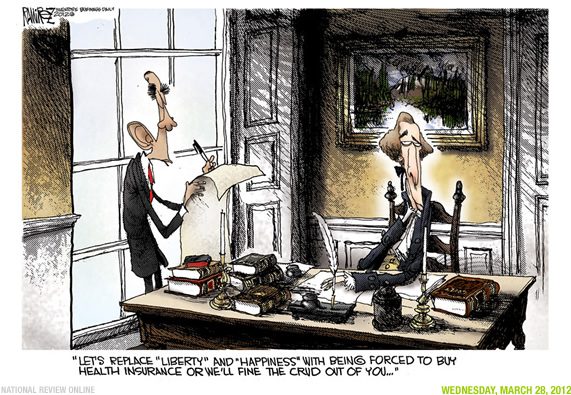
I ran across a funny carton from Dan Mitchell’s blog on President Obama concerning Obamacare.

Obama vs. the Founding Fathers

March 31, 2012 by Dan Mitchell

I’ve repeatedly said that Michael Ramirez is a good political cartoonist (see here, hereherehere, here, and here), and he’s proved his worth in this cartoon that cleverly mocks the cavalier attitude that statists have about America’s founding principles.

And here are two more Ramirez cartoons, including one that also uses the theme of Obama vs the Founding Fathers.

Finally, for those who want some analysis of why schemes like Obamacare are inconsistent with the Constitution, here’s some good analysis by Walter Williams, Thomas Sowell, Philip Klein and Damon Root, and yours truly.

Related posts:

Election result predictions on Romney vs. Obama

I came on here on Friday and predicted that Romney would win 301 to 237. My view was skewed by something I read on Jason Tolbert’s blog recently: Our neighbors in Tennessee started casting ballots this week. Jim Geraghty with National Review notes a dramatic swing in what looks like good news for Republicans. His […]

Projected Presidential election results between Obama and Romney

I predict that President Obama will lose to Mitt Romney because so many of the battleground states will go for Romney because of the horrible economies in their states. Real Clear Politics as of 11:14 am on 10-19-12 had President Obama with 201 electorial votes locked up and Mitt Romney with 206. I think that […]

Are Max Brantley and Dan Mitchell right about Obama winning?

I have a lot of respect for Max Brantley of the Arkansas Times Blog and Dan Mitchell of the Cato Institute for their political analysis. They both have picked Obama to win today. I parted company and chose Romney to win 301 to 237. Knowing how Dan Mitchell thinks leads me to believe that he […]


Cartons on Obama’s budget math

Dan Mitchell Discussing Dishonest Budget Numbers with John Stossel Uploaded by danmitchellcato on Feb 11, 2012 No description available. ______________ Dan Mitchell of the Cato Institute has shown before how excessive spending at the federal level has increased in recent years. A Humorous Look at Obama’s Screwy Budget Math May 31, 2012 by Dan Mitchell I’ve […]

Obama on creating jobs!!!!(Funny Carton)

Another great carton on President Obama’s efforts to create jobs!!! A Simple Lesson about Job Creation for Barack Obama December 7, 2011 by Dan Mitchell Even though leftist economists such as Paul Krugman and Larry Summers have admitted that unemployment insurance benefits are a recipe for more joblessness, the White House is arguing that Congress should […]

Get people off of government support and get them in the private market place!!!!(great carton too)

Dan Mitchell hits the nail on the head and sometimes it gets so sad that you just have to laugh at it like Conan does. In order to correct this mess we got to get people off of government support and get them in the private market place!!!! Chuck Asay’s New Cartoon Nicely Captures Mentality […]

Funny carton from Dan Mitchell’s blog on Greece

Sometimes it is so crazy that you just have to laugh a little. The European Mess, Captured by a Cartoon June 22, 2012 by Dan Mitchell The self-inflicted economic crisis in Europe has generated some good humor, as you can see from these cartoons by Michael Ramirez and Chuck Asay. But for pure laughter, I don’t […]

Cartons on Obama’s budget math

Dan Mitchell Discussing Dishonest Budget Numbers with John Stossel Uploaded by danmitchellcato on Feb 11, 2012 No description available. ______________ Dan Mitchell of the Cato Institute has shown before how excessive spending at the federal level has increased in recent years. A Humorous Look at Obama’s Screwy Budget Math May 31, 2012 by Dan Mitchell I’ve […]

Obama on creating jobs!!!!(Funny Carton)

Another great carton on President Obama’s efforts to create jobs!!! A Simple Lesson about Job Creation for Barack Obama December 7, 2011 by Dan Mitchell Even though leftist economists such as Paul Krugman and Larry Summers have admitted that unemployment insurance benefits are a recipe for more joblessness, the White House is arguing that Congress should […]

2 cartons illustrate the fate of socialism from the Cato Institute

Cato Institute scholar Dan Mitchell is right about Greece and the fate of socialism: Two Pictures that Perfectly Capture the Rise and Fall of the Welfare State July 15, 2011 by Dan Mitchell In my speeches, especially when talking about the fiscal crisis in Europe (or the future fiscal crisis in America), I often warn that […]

2 cartons illustrate the fate of socialism from the Cato Institute

Cato Institute scholar Dan Mitchell is right about Greece and the fate of socialism: Two Pictures that Perfectly Capture the Rise and Fall of the Welfare State July 15, 2011 by Dan Mitchell In my speeches, especially when talking about the fiscal crisis in Europe (or the future fiscal crisis in America), I often warn that […]


Founders Fathers were against welfare state

Why are we spending more and more on welfare every year?  What would the Founding Fathers have to say about this if they were still here today? We will look at that in a little bit.

We need to cut Food Stamp program and not extend it. However, it seems that people tell the taxpayers back home they are going to Washington and cut government spending but once they get up there they just fall in line with  everyone else that keeps spending our money. I am glad that at least these 16 brave Senators voted against doing that. I wish we had some more brave Senators and Representatives up there in Washington. Here are the names of those brave senators: Lamar Alexander (TN), John Barrasso (WY), Roy Blunt (MO), Scott Brown (MA), Dan Coats (IN), Susan Collins (ME), Mike Enzi (WY), Chuck Grassley (IA), John Hoeven (ND), Kay Bailey Hutchison (TX), Mike Johanns (NE), Richard Lugar (IN), Jerry Moran (KS), Pat Roberts (KS), Olympia Snowe (ME),  and John Thune (SD).

Here is what the Founding Fathers had to say about welfare. David Weinberger noted:

While living in Europe in the 1760s, Franklin observed: “in different countries … the more public provisions were made for the poor, the less they provided for themselves, and of course became poorer. And, on the contrary, the less was done for them, the more they did for themselves, and became richer.”

Alexander Fraser Tytler, Lord Woodhouselee (15 October 1747 – 5 January 1813) was a Scottish lawyer, writer, and professor. Tytler was also a historian, and he noted, “A democracy cannot exist as a permanent form of government. It can only exist until the majority discovers it can vote itself largess out of the public treasury. After that, the majority always votes for the candidate promising the most benefits with the result the democracy collapses because of the loose fiscal policy ensuing, always to be followed by a dictatorship, then a monarchy.”

Thomas Jefferson to Joseph Milligan

April 6, 1816


[Jefferson affirms that the main purpose of society is to enable human beings to keep the fruits of their labor. — TGW]


To take from one, because it is thought that his own industry and that of his fathers has acquired too much, in order to spare to others, who, or whose fathers have not exercised equal industry and skill, is to violate arbitrarily the first principle of association, “the guarantee to every one of a free exercise of his industry, and the fruits acquired by it.” If the overgrown wealth of an individual be deemed dangerous to the State, the best corrective is the law of equal inheritance to all in equal degree; and the better, as this enforces a law of nature, while extra taxation violates it.

[From Writings of Thomas Jefferson, ed. Albert E. Bergh (Washington: Thomas Jefferson Memorial Association, 1904), 14:466.]

_______

Jefferson pointed out that to take from the rich and give to the poor through government is just wrong. Franklin knew the poor would have a better path upward without government welfare coming their way. Milton Friedman’s negative income tax is the best method for doing that and by taking away all welfare programs and letting them go to the churches for charity.

Related posts:

Welfare Spending Shattering All-Time Highs

  We got to act fast and get off this path of socialism. Morning Bell: Welfare Spending Shattering All-Time Highs Robert Rector and Amy Payne October 18, 2012 at 9:03 am It’s been a pretty big year for welfare—and a new report shows welfare is bigger than ever. The Obama Administration turned a giant spotlight […]

We need more brave souls that will vote against Washington welfare programs

We need to cut Food Stamp program and not extend it. However, it seems that people tell the taxpayers back home they are going to Washington and cut government spending but once they get up there they just fall in line with  everyone else that keeps spending our money. I am glad that at least […]

Welfare programs are not the answer for the poor

Government Must Cut Spending Uploaded by HeritageFoundation on Dec 2, 2010 The government can cut roughly $343 billion from the federal budget and they can do so immediately. __________ Liberals argue that the poor need more welfare programs, but I have always argued that these programs enslave the poor to the government. Food Stamps Growth […]

Private charities are best solution and not government welfare

Milton Friedman – The Negative Income Tax Published on May 11, 2012 by LibertyPen In this 1968 interview, Milton Friedman explained the negative income tax, a proposal that at minimum would save taxpayers the 72 percent of our current welfare budget spent on administration. http://www.LibertyPen.com Source: Firing Line with William F Buckley Jr. ________________ Milton […]

The book “After the Welfare State”

Dan Mitchell Commenting on Obama’s Failure to Propose a Fiscal Plan Published on Aug 16, 2012 by danmitchellcato No description available. ___________ After the Welfare State Posted by David Boaz Cato senior fellow Tom G. Palmer, who is lecturing about freedom in Slovenia and Tbilisi this week, asked me to post this announcement of his […]

President Obama responds to Heritage Foundation critics on welfare reform waivers

Is President Obama gutting the welfare reform that Bill Clinton signed into law? Morning Bell: Obama Denies Gutting Welfare Reform Amy Payne August 8, 2012 at 9:15 am The Obama Administration came out swinging against its critics on welfare reform yesterday, with Press Secretary Jay Carney saying the charge that the Administration gutted the successful […]

Welfare reform part 3

Thomas Sowell – Welfare Welfare reform was working so good. Why did we have to abandon it? Look at this article from 2003. The Continuing Good News About Welfare Reform By Robert Rector and Patrick Fagan, Ph.D. February 6, 2003 Six years ago, President Bill Clinton signed legislation overhauling part of the nation’s welfare system. […]

Welfare reform part 2

Uploaded by ForaTv on May 29, 2009 Complete video at: http://fora.tv/2009/05/18/James_Bartholomew_The_Welfare_State_Were_In Author James Bartholomew argues that welfare benefits actually increase government handouts by ‘ruining’ ambition. He compares welfare to a humane mousetrap. —– Welfare reform was working so good. Why did we have to abandon it? Look at this article from 2003. In the controversial […]

Why did Obama stop the Welfare Reform that Clinton put in?

Thomas Sowell If the welfare reform law was successful then why change it? Wasn’t Bill Clinton the president that signed into law? Obama Guts Welfare Reform Robert Rector and Kiki Bradley July 12, 2012 at 4:10 pm Today, the Obama Department of Health and Human Services (HHS) released an official policy directive rewriting the welfare […]

“Feedback Friday” Letter to White House generated form letter response July 10,2012 on welfare, etc (part 14)

I have been writing President Obama letters and have not received a personal response yet.  (He reads 10 letters a day personally and responds to each of them.) However, I did receive a form letter in the form of an email on July 10, 2012. I don’t know which letter of mine generated this response so I have […]

Historian David Barton’s videos and articles are displayed here on the www.thedailyhatch.org

David Barton on Glenn Beck – Part 3 of 5

Uploaded by  on Apr 9, 2010

Wallbuilders’ Founder and President David Barton joins Glenn Beck on the Fox News Channel for the full hour to discuss our Godly heritage and how faith was the foundational principle upon which America was built.

_____________

David Barton is a historian  and his videos and articles can be found on www.thedailyhatch.org . Take a look at some of these links below:

President Obama:“do not consider ourselves a Christian nation” (Part 5 of David Barton’s response)

America’s Founding Fathers Deist or Christian? – David Barton 5/6 David Barton provided an excellent response to President Obama’s assertion: “We do not consider ourselves a Christian nation.” Here it is: Is President Obama Correct: Is America No Longer a Christian Nation? Over the past several years, President Barack Obama has repeatedly claimed that America […]

John Hancock’s Thanksgiving proclamation

America’s Founding Fathers Deist or Christian? – David Barton 1/6 I enjoyed this and wanted to pass it on from Wallbuilders: John Hancock – 10/05/1791 The following is the text of a Proclamation for a Day of Thanksgiving and Praise, issued by John Hancock (Signer of the Declaration of Independence), while he was serving as […]

David Barton:The Bible on taxes

1 Of 5 / The Bible’s Influence In America / American Heritage Series / David Barton   David Barton has some great insights on this. http://www.wallbuilders.com/sIFR/font140.swf David Barton – 04/27/2006 Capital Gains Taxes The Capital Gains Tax, which is a tax on profits, actually penalizes a person for success the more profit you make the […]

David Barton: In their words, did the Founding Fathers put their faith in Christ? (Part 4)jh37

David Barton: In their words, did the Founding Fathers put their faith in Christ? (Part 4)jh37 David Barton has put together a great collection of quotes from the founding fathers about their faith in Christ: The Founders As Christians  America’s Founding Fathers Deist or Christian? – David Barton 4/6 Jonathan Trumbull Sr. Governor of Connecticut, […]

Was the Bible banned from our schools by the Founding Fathers? Tourguide David Barton has the answer

Was the Bible banned from our schools by the Founding Fathers? Tourguide David Barton has the answer Watch this short video for the answer. Uploaded by doctorcureton on Mar 11, 2009 Visit http://www.WatchmenPastors.org for more info. To order a DVD of David Barton’s 2 hour Capitol Tour, visit http://www.Wallbuilders.com. Encourage your pastor to participate in […]

David Barton: In their words, did the Founding Fathers put their faith in Christ? (Part 1)jh34

David Barton: In their words, did the Founding Fathers put their faith in Christ? (Part 1) David Barton has put together a great collection of quotes from the founding fathers about their faith in Christ: The Founders As Christians America’s Founding Fathers Deist or Christian? – David Barton 1/6   04/2006 (Note: this is a […]

David Barton: America’s Religious Heritage as demonstrated in Presidential Inaugurations (part 3)

David Barton: America’s Religious Heritage as demonstrated in Presidential Inaugurations (part 3) David Barton on Glenn Beck – Part 3 of 5 Uploaded by ToRenewAmerica on Apr 9, 2010 Wallbuilders’ Founder and President David Barton joins Glenn Beck on the Fox News Channel for the full hour to discuss our Godly heritage and how faith was the foundational […]

Brantley claims Barton is wrong about darwinism pt 7

On June 9th Max Brantley on the Arkansas Times Blog referred to a Mother Jones Article that noted: On Wednesday, Right Wing Watch flagged a recent interview Barton gave with an evangelcial talk show, in which he argues that the Founding Fathers had explicitly rejected Charles Darwin’s theory of evolution. Yes, that Darwin. The one whose seminal work, On the Origin of Species, wasn’t even published […]

George Washington at 279 (Born Feb 22, 1732) Part 13

n pictures: Japan earthquake and tsunami In association with // // In the Miyagi port city of Kesennuma, which has a population of 74,000, the waves smashed cars up against houses. Steeling the Mind Bible Conference Pt 5 of 6 David Barton In Washington’s own words: In offering to you, my countrymen, these counsels of […]


At least the Tea Party stood up for the founding fathers’ idea of limited government

At least the Tea Party stood up for the founding fathers’ idea of limited government. They did not vote for the “fiscal cliff deal” which only cut 15 billion when it raised taxes by 600 billion. They wanted spending cut and I mean real cuts in spending too.

When Governments Cut Spending

Uploaded on Sep 28, 2011

Do governments ever cut spending? According to Dr. Stephen Davies, there are historical examples of government spending cuts in Canada, New Zealand, Sweden, and America. In these cases, despite popular belief, the government spending cuts did not cause economic stagnation. In fact, the spending cuts often accelerated economic growth by freeing up resources for the private sector.

Chuck Asay has produced some great political cartoons, including personal favorites such as the Geithner-Obama tractor, the big-bad-wolf economic climate, and (his all-time best, in my humble opinion) the nothing-left-to-steal warning for statists.

Here’s one that’s quite appropriate for today since the politicians are busy negotiating over how to raise taxes while failing to address the real problem of a federal government that is too big and spending too much.

What makes this cartoon so perceptive is that it shows how many – if not most – Republicans are just as willing and happy as Democrats to exacerbate our fiscal problems.

Asay Kick the Can Cartoon

The only bad news is that the cartoon implies the Tea Party has the ability to stop Obama and the other big spenders from kicking the can down the road.

If only. We’re going to get a tax increase in January and there’s nothing the Tea Party can do to stop that from happening. They can’t force Obama, the Senate, or even the GOP leadership in the House to implement pro-growth spending reforms such as a Swiss-style spending cap.

But at least there are some lawmakers who are fighting to do what’s right. I don’t know if they’ll ever succeed, but at least some folks in Washington understand that something needs to happen to restrain the burden of government spending.

Abraham Lincoln Quotes About Labor and Work

121108_BB_AbrahamLincoln-2x

Abraham Lincoln (Daniel Day-Lewis)

Spielberg’s film follows 56-year-old Abraham Lincoln, the 16th president of the United States, from January of 1865 until his death in April. The portrait on the left was taken in 1864.

_________-


Abraham Lincoln by Nathan Nash

“The prudent, penniless beginner in the world, labors for wages awhile, saves a surplus with which to buy tools or land, for himself; then labors on his own account another while, and at length hires another new beginner to help him. This, say its advocates, is free labor—the just and generous, and prosperous system, which opens the way for all—gives hope to all, and energy, and progress, and improvement of condition to all.” The Collected Works of Abraham Lincoln edited by Roy P. Basler, Volume III, “Address before the Wisconsin State Agricultural Society, Milwaukee, Wisconsin” (September 30, 1859), pp. 478-479.

“No country can sustain, in idleness, more than a small percentage of its numbers. The great majority must labor at something productive.” The Collected Works of Abraham Lincoln edited by Roy P. Basler, Volume III, “Address before the Wisconsin State Agricultural Society, Milwaukee, Wisconsin” (September 30, 1859), p. 479.

“Labor is the true standard of value.” The Collected Works of Abraham Lincoln edited by Roy P. Basler, Volume IV, “Speech at Pittsburgh, Pennsylvania” (February 15, 1861), p. 212.

“The world is agreed that labor is the source from which human wants are mainly supplied. There is no dispute upon this point.” The Collected Works of Abraham Lincoln edited by Roy P. Basler, Volume III, “Address before the Wisconsin State Agricultural Society, Milwaukee, Wisconsin” (September 30, 1859), p. 477.

“I am always for the man who wishes to work.” The Collected Works of Abraham Lincoln edited by Roy P. Basler, Volume VII, “Recommendation For Unidentified Man” (August 15, 1864), p. 495.

“If at any time all labour should cease, and all existing provisions be equally divided among the people, at the end of a single year there could scarcely be one human being left alive—all would have perished by want of subsistence.” The Collected Works of Abraham Lincoln edited by Roy P. Basler, Volume I, “Fragments of a Tariff Discussion” (December 1, 1847), p. 415.

“Labor is the great source from which nearly all, if not all, human comforts and necessities are drawn.” The Collected Works of Abraham Lincoln edited by Roy P. Basler, Volume III, “Speech at Cincinnati, Ohio” (September 17, 1859), p. 459.

“Wanting to work is so rare a merit, that it should be encouraged.” The Collected Works of Abraham Lincoln edited by Roy P. Basler, Volume IV, “Letter to George D. Ramsay” (October 17, 1861), p. 556.

“Beavers build houses; but they build them in nowise differently, or better now, than they did, five thousand years ago. Ants, and honey-bees, provide food for winter; but just in the same way they did, when Solomon referred the sluggard to them as patterns of prudence. Man is not the only animal who labors; but he is the only one who improves his workmanship.” The Collected Works of Abraham Lincoln edited by Roy P. Basler, Volume II, “First Lecture on Discoveries and Inventions” (April 6, 1858), p. 437.

“Property is the fruit of labor…property is desirable…is a positive good in the world. That some should be rich shows that others may become rich, and hence is just encouragement to industry and enterprise. Let not him who is houseless pull down the house of another; but let him labor diligently and build one for himself, thus by example assuring that his own shall be safe from violence when built.” The Collected Works of Abraham Lincoln edited by Roy P. Basler, Volume VII, “Reply to New York Workingmen’s Democratic Republican Association” (March 21, 1864), pp. 259-260.

“Every man is proud of what he does well; and no man is proud of what he does not do well. With the former, his heart is in his work; and he will do twice as much of it with less fatigue. The latter performs a little imperfectly, looks at it in disgust, turns from it, and imagines himself exceedingly tired. The little he has done, comes to nothing, for want of finishing.” The Collected Works of Abraham Lincoln edited by Roy P. Basler, Volume III, “Address before the Wisconsin State Agricultural Society, Milwaukee, Wisconsin” (September 30, 1859), p. 475.

“Labor is prior to, and independent of, capital. Capital is only the fruit of labor, and could never have existed if labor had not first existed. Labor is the superior of capital, and deserves much the higher consideration.” Lincoln’s First Annual Message to Congress, December 3, 1861.

“Upon this subject, the habits of our whole species fall into three great classes—useful labour, useless labour and idleness. Of these the first only is meritorious; and to it all the products of labour rightfully belong; but the two latter, while they exist, are heavy pensioners upon the first, robbing it of a large portion of it’s just rights. The only remedy for this is to, as far as possible, drive useless labour and idleness out of existence.” The Collected Works of Abraham Lincoln edited by Roy P. Basler, Volume I, “Fragments of a Tariff Discussion” (December 1, 1847), p. 412.

“Work, work, work, is the main thing.” The Collected Works of Abraham Lincoln edited by Roy P. Basler, Volume IV, “Letter To John M. Brockman” (September 25, 1860), p. 121.

“And I am glad to know that there is a system of labor -> where the laborer can strike if he wants to! I would to God that such a system prevailed all over the world. The Collected Works of Abraham Lincoln edited by Roy P. Basler, Volume IV, “Speech at Hartford, Connecticut” (March 5, 1860), p. 7.

“If you intend to go to work there is no better place than right where you are; if you do not intend to go to work, you can not get along anywhere.” The Collected Works of Abraham Lincoln edited by Roy P. Basler, Volume II, “Letter To John D. Johnston” (November 4, 1851), p. 111.

“I don’t believe in a law to prevent a man from getting rich; it would do more harm than good. So while we do not propose any war upon capital, we do wish to allow the humblest man an equal chance to get rich with everybody else.” The Collected Works of Abraham Lincoln edited by Roy P. Basler, Volume IV, “Speech at New Haven, Connecticut” (March 6, 1860), p. 24.

“…half finished work generally proves to be labor lost.” The Collected Works of Abraham Lincoln edited by Roy P. Basler, Volume I, “Communication to the People of Sangamon County” (March 9, 1832), p. 5.

“And, inasmuch [as] most good things are produced by labour, it follows that [all] such things of right belong to those whose labour has produced them. But it has so happened in all ages of the world, that some have laboured, and others have, without labour, enjoyed a large proportion of the fruits. This is wrong, and should not continue. To [secure] to each labourer the whole product of his labour, or as nearly as possible, is a most worthy object of any good government.” The Collected Works of Abraham Lincoln edited by Roy P. Basler, Volume I, “Fragments of a Tariff Discussion” (December 1, 1847), p. 412.

“…the working men are the basis of all governments, for the plain reason that they are the most numerous…” The Collected Works of Abraham Lincoln edited by Roy P. Basler, Volume IV, “Speech to Germans at Cincinnati, Ohio” (February 12, 1861), p. 202.

NOTE: All page references to The Collected Works of Abraham Lincoln refer to the 1953 edition published by the Rutgers University Press, New Brunswick, New Jersey.

The wonderful artwork at the top of the page is by Nathan Nash, 25, son of Bill Nash. Be sure to visit Bill’s excellent Lincoln blog here.

Several good single volume sources of authentic Lincoln quotes are: (1) Recollected Words of Abraham Lincoln compiled and edited by Don E. Fehrenbacher and Virginia Fehrenbacher. (2) A Treasury of Lincoln Quotations edited by Fred Kerner. (3) Of the People, By the People, For the People and other Quotations from Abraham Lincoln edited by Gabor S. Boritt. (4) Abe Lincoln Laughing: Humorous Anecdotes from Original Sources by and about Abraham Lincoln edited by P.M. Zall.

Related posts:

New movie about Abraham Lincoln (Part 6)

13 September 2012 Photo by Film Frame – © 2012 – DreamWorks II Distribution Co., LLC. All Rights Reserved. Titles: Lincoln Names: Tommy Lee Jones I have written a lot about Abraham Lincoln in the past as you can tell from the “related posts” noted below. Most of my posts were concerning the movie “The […]

Christian Review of new movie about Abraham Lincoln

8 October 2012 Photo by Larry Busacca – © 2012 Getty Images – Image courtesy gettyimages.com Titles: Lincoln Names: Steven Spielberg, Sally Field, Gloria Reuben, S. Epatha Merkerson, Tony Kushner Steven Spielberg, Sally Field, Gloria Reuben, S. Epatha Merkerson and Tony Kushner at event of Lincoln I have written a lot about Abraham Lincoln in […]

New movie about Abraham Lincoln (Part 5)

13 September 2012 Photo by David James, SMPSP – © 2012 – DreamWorks II Distribution Co., LLC. All Rights Reserved. Titles: Lincoln Names: Daniel Day-Lewis Characters: Abraham Lincoln I have written a lot about Abraham Lincoln in the past as you can tell from the “related posts” noted below. Most of my posts were concerning […]

New movie about Abraham Lincoln (Part 4)

13 September 2012 Photo by David James, SMPSP – © 2012 – DreamWorks II Distribution Co., LLC. All Rights Reserved. Titles: Lincoln Names: Daniel Day-Lewis Characters: Abraham Lincoln I have written a lot about Abraham Lincoln in the past as you can tell from the “related posts” noted below. Most of my posts were concerning […]

New movie about Abraham Lincoln (Part 3)

8 August 2012 Photo by David James – © 2012 – DreamWorks II Distribution Co., LLC. All Rights Reserved. Titles: Lincoln Names: Daniel Day-Lewis Characters: Abraham Lincoln I have written a lot about Abraham Lincoln in the past as you can tell from the “related posts” noted below. Most of my posts were concerning the […]

New movie about Abraham Lincoln (Part 2)

13 September 2012 Photo by Film Frame – © 2012 – DreamWorks II Distribution Co., LLC. All Rights Reserved. Titles: Lincoln Names: Daniel Day-Lewis Characters: Abraham Lincoln I have written a lot about Abraham Lincoln in the past as you can tell from the “related posts” noted below. Most of my posts were concerning the […]

New movie about Abraham Lincoln (Part 1)

13 September 2012 Photo by David James, SMPSP – © 2012 – DreamWorks II Distribution Co., LLC. All Rights Reserved. Titles: Lincoln Names: Daniel Day-Lewis Characters: Abraham Lincoln Still of Daniel Day-Lewis in Lincoln I have written a lot about Abraham Lincoln in the past as you can tell from the “related posts” noted below. […]

More about the historical characters mentioned in the movie “Lincoln” by Steven Spielberg (Part 3) “Robert Todd Lincoln”

I have written a lot about Abraham Lincoln in the past as you can tell from the “related posts” noted below. Most of my posts were concerning the movie “The Conspirator” which is one of my favorite movies.  I enjoyed reading about all the historical people involved with Lincoln. Boston Corbett is the man who shot […]

More about the historical characters mentioned in the movie “Lincoln” by Steven Spielberg (Part 2) (Pictures of historical figures)

I have written a lot about Abraham Lincoln in the past as you can tell from the “related posts” noted below. Most of my posts were concerning the movie “The Conspirator” which is one of my favorite movies.  I enjoyed reading about all the historical people involved with Lincoln. Boston Corbett is the man who shot […]

More about the historical characters mentioned in the movie “Lincoln” by Steven Spielberg (Part 1)

13 September 2012 Photo by David James, SMPSP – © 2012 – DreamWorks II Distribution Co., LLC. All Rights Reserved. Titles: Lincoln Names: Joseph Gordon-Levitt, Robert Lincoln Characters: Robert Todd Lincoln I have written a lot about Abraham Lincoln in the past as you can tell from the “related posts” noted below. Most of my […]