Category Archives: Economist Dan Mitchell

Open letter to President Obama (Part 450) Economist Antony Davies’ video “Will Higher Tax Rates Balance the Budget?” (includes editorial cartoon)


(Emailed to White House on 3-20-13.)

President Obama c/o The White House
1600 Pennsylvania Avenue NW
Washington, DC 20500

Dear Mr. President,

I know that you receive 20,000 letters a day and that you actually read 10 of them every day. I really do respect you for trying to get a pulse on what is going on out here.

I don’t think we should keep raising taxes.

Will Higher Tax Rates Balance the Budget?

Published on Apr 11, 2012

As the U.S. debt and deficit grows, some politicians and economist have called for higher tax rates in order to balance the budget. The question becomes: when the government raises taxes, does it actually collect a larger portion of the US economy?

Professor Antony Davies examines 50 years of economic data and finds that regardless of tax rates, the percentage of GDP that the government collects has remained relatively constant. In other words, no matter how high government sets tax rates, the government gets about the same portion. According to Davies, if we’re concerned about balancing the budget, we should worry less about raising tax revenue and more about growing the economy. The recipe for growth? Lower tax rates and a simplified tax code.

_____________

We are taxed too high and raising taxes at this point will not help.

I suppose I should write something serious about Obama’s class-warfare agenda, but I’m in Iceland and it’s almost time to head into Reykjavik for dinner. So let’s simply enjoy some humor that gets across the points I would make anyhow.

We’ll start with this great cartoon from Lisa Benson. In a perfect world, this monster would be named “Big Government.” But I’m not complaining too much since the obvious implication of the cartoon is that the soak-the-rich tax hikes will make the deficit worse – which implies that politicians will spend the money and/or that there will be a Laffer Curve response leading to less revenue than politicians predict.
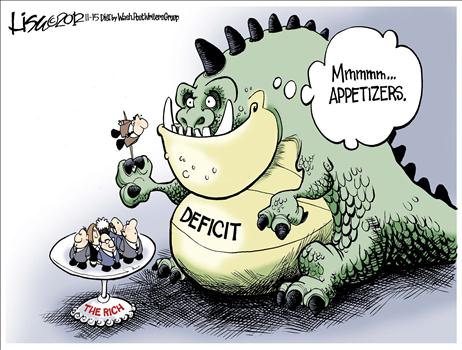
You can see some of my favorite Benson cartoons here, herehereherehereherehere, hereherehere, and here.

Here’s a similar cartoon. But instead of feeding a deficit monster, it shows that a tax hike will enable a bunch of politicians to continue their binging at our expense.
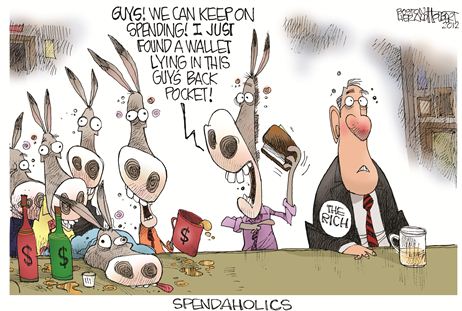
Holbert is relatively new to me. The only other cartoon of his that I’ve used (at least than I can remember) can be seen here.

Our final cartoon isn’t about Obama’s class-warfare proposal, but it does show where we’re going if we allow the politicians to continue down the path of tax-and-spend dependency.

You can see two additional Glenn Foden cartoons by clicking here and here.

I especially like the “spa” comment in the basket cartoon. Sort of reminds me of the “frog” story showing how it would be impossible to impose statism in one fell swoop. People would recognize the danger and immediately revolt, much as a frog would immediately hop out if you tried to drop it in boiling water. But just as you can lure a frog into danger by putting it in lukewarm water and slowing turning up the heat until it’s been too weakened to escape, you can also slowly but surely hook people on dependency by creating little programs and eventually turning them into big programs.

That’s sort of where we are today. The burden of government spending has exploded and will get even worse if we don’t enact serious entitlement reform. But too many people now can’t envision a world other than the status quo and they are fearful of change – even though inaction eventually means a Greek-style fiscal crisis.

P.S. Given the theme of this post, you will probably enjoy this Chuck Asay cartoon and this Henry Payne cartoon. Or perhaps you won’t enjoy them if you stop and think about what they’re really saying. But they are both gems, so try to focus only on the humor.

____________

Thank you so much for your time. I know how valuable it is. I also appreciate the fine family that you have and your commitment as a father and a husband.

Sincerely,

Everette Hatcher III, 13900 Cottontail Lane, Alexander, AR 72002, ph 501-920-5733, lowcostsqueegees@yahoo.com


Open letter to President Obama (Part 448) Michael Cannon of Cato Institute speaks to Arkansas Senators (Part 2 includes editorial cartoon)


(Emailed to White House on 3-20-13.)

President Obama c/o The White House
1600 Pennsylvania Avenue NW
Washington, DC 20500

Dear Mr. President,

I know that you receive 20,000 letters a day and that you actually read 10 of them every day. I really do respect you for trying to get a pulse on what is going on out here.

If a state does not set up an exchange can they avoid the penalties in Obamacare? That is what Michael Cannon told us.

Representative Doug House asks CATO Institute Michael Cannon about Obamacare

Published on Mar 19, 2013

The CATO Institute’s Michael Cannon spoke at the Arkansas Conservative Caucus on Tuesday March 19th. Several conservatives were present. Cannon talked about how to defeat Obamacare in Arkansas & how the states can stop Obamacare on a national level.

Representative Doug House talks about Arkansas Healthcare Exchange attempts in Arkansas. The Liberal Governor Mike Beebe, Jay Bradford, and former Soros Employee Cindi Crone are attempting to implement a portion of Obama’s Government takeover of Healthcare.

___________

The Arkansas Times article on the visit from Michael Cannon is below:

Arkansas Blog

Archives | RSS

Tuesday, March 19, 2013

Michael Cannon calls “private option” crony capitalism

Posted by on Tue, Mar 19, 2013 at 6:07 PM

Michael Cannon image

  • Michael Cannon

As we previewed last week, Michael Cannon — health-care point man for libertarian think tank the Cato Institute — was invited to testify today before the Senate Insurance committee. Cannon is a diehard opponent of the Affordable Care Act, and there were hints on American For Prosperity (AFP)’s website that Cannon might raise objections to the “private option.” Instead, his testimony today was exclusively focused on the decision about whether the state should run its own exchange or opt out and let the feds run the exchange (currently, Arkansas has a state-federal partnership). However, Cannon told reporters afterward that the “private option” was even worse in his view than Medicaid expansion, labeling it “crony capitalism.”

Cannon has a number of arguments against state-run exchanges. The flashiest one is that he is hoping that a legal challenge to the operation of federally run exchanges has the potential to dismantle the entire law. We’ve covered his lawsuit before and won’t get in to the weeds here but you can read about the legal challenge here, and read Cannon’s legal argument in full here.

Sen. Joyce Elliot asked Cannon, “Is your position overall that you want to stop the healthcare law or are you just giving us advice on how to proceed with exchange?”

Cannon’s response: “Both.”

I asked Cannon afterwards why he hadn’t touched on the “private option” for expansion. “This was a hearing on exchanges, I was invited to speak about exchanges,” he said. “I’ll be speaking to some legislators later and I’m sure the Medicaid expansion will come up.”

The “private option” issue is in fact relevant to the exchange question in various ways, the largest being the $20-million-per-year revenue stream from a 2.5 percent state fee on insurances sold on the exchange. Cannon said that he knew of no legal restriction on states imposing the fee even if they opted out of running the exchange, though this seems politically implausible.

In any case, as policy, Cannon thinks the “private option” framework stinks. He already thinks that Medicaid expansion is too expensive and he argued that the “private option” would be even costlier. (I should say that Cannon prefers “Beebe proposal” to “private option.” Pretty surprised he didn’t call it BeebeCare!)

Cannon relied on the CBO numbers we’ve heard, which likely are not applicable to Arkansas. Cannon had not yet seen the DHS study released yesterday but expressed deep skepticism about their findings.

Okay, but who cares what someone from the Cato Institute thinks about what Arkansas should do? I would argue that Cannon’s position may represent one pole of a possible split within the Arkansas GOP on the “private option” between establishment Republicans and the anti-Obamacare base. As I heard one Tea Party member in attendance at the meeting say of the new framework, “if you put lipstick on a pig, it’s still a pig.”

Here’s Cannon:

It’s odd that this is considered a compromise proposal. We’ll compromise by making an unaffordable entitlement program even more unaffordable. It’s also interesting because Congress considered this…amendments were offered and voted down by Democrats who said no we can’t put the Medicaid expansion population in the exchanges because it would be too expensive. So you have to ask the question, if Congress rejected this idea, what on earth are Gov. Beebe and Sec. Sebelius doing talking about an idea that would increase federal and state spending that Congress expressly rejected? 

I gotta hand it to Gov. Beebe and Kathleen Sebelius, they know that there’s this crony capitalism streak among Republicans. If you say, we’re going to increase government spending, they say ‘no that’s bad.’ But if you say ‘we’re going to give the subsidies to private industry,’ they say, ‘hey, I like private industry, that’s good.’ So they’re really playing to that crony capitalist streak in order to get Republicans to implement Obamacare.

They’re drawn to the idea because Republicans hear private coverage and think that’s better than public coverage but really what matters is who’s paying the piper. If it’s government money that you’re spending, it’s going to be government insurance even if you hang the word ‘private’ on it.

Though I support expansion, I think Cannon’s arguments about the “private option” make sense: if you don’t like Obamacare, it follows that you wouldn’t like an alternative that’s likely to cost at least a little more, particularly if that additional spending seems to be in defiance of Congressional intent. Will we hear more arguments along these lines from Republican lawmakers? We’ll see.

Thus far outside conservative groups haven’t made too much noise about the “private option” but I suspect that will change. While Cannon spoke with reporters, an AFP official was standing next to him. I asked her — as I’ve asked Teresa Crossland-Oelke, AFP’s Arkansas state director — whether AFP has a position on the “private option.” They’ve been cagey so far. Republican lawmakers working on the “private option” have told me that their focus is on the policy but have acknowledged that it will be politically important if AFP decides to speak out one way or the other.

In addition to his testimony today, Cannon was also AFP’s guest speaker at the Conservative Caucus Luncheon at the Capitol. Based on tweets from the event, it sounds like Cannon offered the same strong message against the “private option.”

_____________________

While he was in Arkansas Michael Cannon mentioned that the Cato Institute has been way out front on this issue and they were against Obamacare back when it was Romneycare.

I’m delighted that Mitt Romney is floundering because of the government-run healthcare scheme he imposed on Massachusetts. Not only did it pave the way for Obamacare, but it’s also a good indicator of the awful, statist, big-government policies he would impose on all of us if he ever entered the White House.

This cartoon from the Detroit News is a pretty good summary of Mitt’s self-inflicted (and much-deserved) political problem.


___________

Thank you so much for your time. I know how valuable it is. I also appreciate the fine family that you have and your commitment as a father and a husband.

Sincerely,

Everette Hatcher III, 13900 Cottontail Lane, Alexander, AR 72002, ph 501-920-5733, lowcostsqueegees@yahoo.com


Related posts:

Max Brantley of the Ark Times takes on Michael Cannon of the Cato Institute today concerning Obamacare

Max Brantley of the Ark Times takes on Michael Cannon of the Cato Institute today concerning Obamacare. I have posted many links to Cannon’s articles in the past on my blog and on the Arkansas Times liberal blog. The finest article written in my estimation was written on Nov 20, 2012 and here is a […]

Is Michael Cannon of the Cato Institute right about states blocking Obamacare, factchecker says he is wrong.

Cato’s Michael F. Cannon Discusses ObamaCare’s Individual Mandate Is Michael Cannon of the Cato Institute right about states blocking Obamacare, factchecker says he is wrong. I Have Been False* Posted by Michael F. Cannon *According to PolitiFact. In an unconscious parody of everything that’s wrong with the “fact-checker” movement in journalism, PolitiFact Georgia (a project of […]

An ObamaCare Debate Challenge by Michael F. Cannon (editorial cartoon)

Obamacare is a poorly written and because of that the majority of states may never have to put into practice.   February 28, 2013 2:13PM ObamaCare Debate Challenge: Lawrence Wasden Edition By Michael F. Cannon Share Tweet Like Google+1 Congress empowered states to block major provisions of ObamaCare, including its subsidies and employer mandate. All […]

Open letter to President Obama (Part 249)

Is Washington Bankrupting America? Uploaded by BankruptingAmerica on Apr 20, 2010 Be first to receive our videos and other timely info about economic policy. Subscribe at http://www.bankruptingamerica.org ————————- According to a recent poll, 74 percent of likely voters are extremely or very concerned about the current level of government spending. And 58 percent think the […]

The real truth about Obamacare can be seen on the www.thedailyhatch.org

Michael Cannon on Medicare and Healthcare You want to know the real truth about Obamacare then check out these videos and articles linked below: American people do not want Obamacare and the regulations that go with it March 7, 2012 – 8:02 am In this article below you will see that the American people do not […]

The primary cause of higher hospital care and education costs in the USA is?

Is Washington Bankrupting America? Uploaded by BankruptingAmerica on Apr 20, 2010 Be first to receive our videos and other timely info about economic policy. Subscribe at http://www.bankruptingamerica.org ————————- According to a recent poll, 74 percent of likely voters are extremely or very concerned about the current level of government spending. And 58 percent think the […]


25 craziest things the U.S. government spends money on

We got to stop spending so much government money and when we do then dumb things happen.

25 craziest things the U.S. government spends money on

Uploaded on Feb 20, 2012

Government Waste

The Economic Collapse Blog

You are not going to believe some of the things that the U.S. government is spending money on. According to a shocking new report, U.S. taxpayer money is being spent to study World of Warcraft, to study how Americans find love on the Internet, and to study the behavior of male prostitutes in Vietnam. Not only that, but money from the federal government is also being used to renovate a pizzeria in Iowa and to help a library in Tennessee host video game parties. These are just some of the examples in a new report on government waste from Senator Tom Coburn entitled “Wastebook 2010”. Even as tens of millions of American families find themselves suffering through the worst economic downturn in modern history, the U.S. government continues to spend money on some of the craziest and most frivolous things imaginable. Every single year articles are written and news stories are done about the horrific government waste that is taking place and yet every single year it just keeps getting worse. So just what in the world is going on here?

It almost seems as though Congress actually enjoys inventing new ways to waste U.S. taxpayer money. It seems nearly inconceivable that anyone could keep a straight face while trying to justify spending money on many of the things in the list below.

At a time when the U.S. national debt is closing in on 14 trillion dollars, government waste just seems more out of control than ever. The following are 20 of the craziest things that the U.S. government is spending money on….

_________________

Related posts:

The Dysfunction in Washington is Republicans and Democrats that are unwilling to cut spending in order to vote for more programs (Democrats want more food stamps etc but Republicans vote for their pet programs and wars too like No Child Left Behind Act, the Iraq war, the prescription drug entitlement, and the TARP bailout).

The Dysfunction in Washington is Republicans and Democrats that are unwilling to cut spending in order to vote for more programs (Democrats want more food stamps etc but Republicans vote for their pet programs and wars too like No Child Left Behind Act, the Iraq war, the prescription drug entitlement, and the TARP bailout). If […]

Washington better wake up and cut spending or the USA will end up bankrupt like Detroit!!!

Washington better wake up and cut spending or the USA will end up bankrupt like Detroit!!! Atlas Shrugs in Detroit July 25, 2013 by Dan Mitchell About two weeks ago, while making an important point about the Laffer Curve, here’s what I wrote about the fiscal disaster in Detroit. Detroit’s problems are the completely predictable result […]

Lessons from Canada:CUT SPENDING AND LOWER TAXES AND GIVE MORE CONTROL BACK TO THE LOCAL GOVERNMENTS!!!!

When Governments Cut Spending Uploaded on Sep 28, 2011 Do governments ever cut spending? According to Dr. Stephen Davies, there are historical examples of government spending cuts in Canada, New Zealand, Sweden, and America. In these cases, despite popular belief, the government spending cuts did not cause economic stagnation. In fact, the spending cuts often […]

We got to cut spending and this farm bill is the perfect place to start!!!

We got to cut spending and this farm bill is the perfect place to start!!! May 29, 2013 12:33PM Farm Bill Would Increase Spending 47% By Chris Edwards Share House and Senate farm subsidy supporters are pushing to enact the first big farm bill since 2008. Democratic and Republican supporters say that this year’s legislation […]

President Obama will not cut spending ever it appears

President Obama will not cut spending ever it appears. Early Details Show Obama Will Propose a Bait-and-Switch Budget Plan Containing Higher Taxes and More Spending April 5, 2013 by Dan Mitchell Are we about to see a new kinder-and-gentler Obama? Has the tax-and-spend President of the past four years been replaced by a fiscal moderate? That’s […]

We got to cut spending and stop raising the debt ceiling!!!

  We got to cut spending and stop raising the debt ceiling!!! When Governments Cut Spending Uploaded on Sep 28, 2011 Do governments ever cut spending? According to Dr. Stephen Davies, there are historical examples of government spending cuts in Canada, New Zealand, Sweden, and America. In these cases, despite popular belief, the government spending […]

To save the USA from Greece’s fate we must cut spending

Maybe Romney will focus on cutting spending now that Ryan is on board. Is the American Electorate that Dumb? Posted by Roger Pilon Today POLITICO Arena asks: Can Ryan boost Romney’s poll numbers? My response: Ryan is the shot in the arm that Romney needed. If last night’s “60 Minutes” interview of the two is […]

The USA must cut spending and balance budget or end up like Greece

Why can’t we learn the lesson from Europe that we must start to cut spending and balance our budget or we will end up like Greece? Europe’s Crisis Is Because of Too Much Government, Not the Euro Currency July 19, 2012 by Dan Mitchell The mess in Europe has been rather frustrating, largely because almost everybody […]

An award to the person who cut spending by our federal governement the most ($47)

A funny carton. Finally, Some Government Workers Who Want to Cut Spending April 23, 2012 by Dan Mitchell In recent years, taxpayers have been victimized by huge expansions in the burden of government spending. Among the highlights (lowlights would be a much better word): A corrupt bailout of politically connected Wall Street insiders. A bloated healthcare […]

Updated version:Rick Crawford falls for Democrats’ trick:raise taxes first and we will cut spending later

RAISE TAXES: Report says Rick Crawford will break from GOP and back millionaires’ tax. The Arkansas Times reported that Congressman Rick Crawford has a plan that includes raising taxes for 5 years if there is an agreement to pass the Balanced Budget Amendment. However, if after 5 years the Balanced Budget Amendment does not get […]

By Everette Hatcher III | Posted in Cato Institute, Jason Tolbert, spending out of control, Taxes | Edit | Comments (0)

Open letter to President Obama (Part 446) Comparison of crime data and concealed carry gun laws between Houston and Chicago (includes funny gun control posters)


(Emailed to White House on 3-20-13.)

President Obama c/o The White House
1600 Pennsylvania Avenue NW
Washington, DC 20500

Dear Mr. President,

I know that you receive 20,000 letters a day and that you actually read 10 of them every day. I really do respect you for trying to get a pulse on what is going on out here.

Sometimes you just have to look at the facts!!!

In a presumably futile effort to change their minds by learning how they think, I periodically try to figure out the left-wing mind.

Why, for instance, do some people believe in Keynesian economics, when it is premised on the fanciful notion that you can increase “spending power” by taking money out of the economy’s left pocket and putting it in the economy’s right pocket?

I actually think part of the problem is that folks on the left focus on how income is spent rather than how it’s earned, so I sometimes try to get them to understand that economic growth occurs when we produce more rather than consume more. My hope is that they’ll better understand how the economy works if they look at the issue from this perspective.

But I’m getting off track. I don’t want to get too serious because the purpose of this post is to share this satirical look at the how leftists rationalize their anti-gun biases.

Let’s take a look at two cities that are quite similar in terms of demographics and income. But they have very different murder rates. Your job is to pretend you’re a leftist and come up with an explanation.

Houston Chicago Guns Weather

To be fair, we can’t rule out cold weather as a possible explanation given this limited set of data.

Make your own Gun Free Zone

For what it’s worth, however, scholars who actually do real research, like David Kopel and John Lott, reach different conclusions.

Returning to satire, the Houston-Chicago comparison reminds me of this IQ test for criminals and liberals.

And since we’re having some fun with our liberal friends, let’s close with this comparison of liberals, conservatives, and Texans.

I have posted some cartoons featured on Dan Mitchell’s blog before and they are very funny.

I’ve shared a very clever Chuck Asay cartoon about gun-free zones, so let’s now enjoy four posters on the topic.

Let’s begin with a good jab at one of the anti-Second Amendment groups.

But remember the serious point. If you’re a bad guy and know that a potential victim is sure to be unarmed, does that make you happy or sad?

I realize that an anti-gun zealot will respond by arguing that they want a world where the thugs and crooks also will be disarmed, but how likely is it that such people will turn in their weapons? In any event, most criminals are young men and potential victims need guns to compensate for the inability to match the physical strength of their attackers.

Next let’s look at a poster showing the kind of instructions that statists such as Mayor Bloomberg should post in public places.

These clowns expect us to have blind faith in the ability of public authorities, but the odds of a cop being immediately available when trouble strikes are almost nonexistent.

Here’s a poster that captures the blind naiveté of anti-gun activists. I don’t think I need to add any commentary.

Last but not least, here’s a sign that all anti-gun leftists – assuming they have the courage to publicly celebrate their beliefs – should post outside their homes.

If you enjoy these posters, you can view previous editions here, hereherehere, and here.

___________

Thank you so much for your time. I know how valuable it is. I also appreciate the fine family that you have and your commitment as a father and a husband.

Sincerely,

Everette Hatcher III, 13900 Cottontail Lane, Alexander, AR 72002, ph 501-920-5733, lowcostsqueegees@yahoo.com

Open letter to President Obama (Part 444) Antony Davies’ video “Will Higher Tax Rates Balance the Budget?” (includes editorial cartoon)

(Emailed to White House on 3-20-13.)

President Obama c/o The White House
1600 Pennsylvania Avenue NW
Washington, DC 20500

Dear Mr. President,

I know that you receive 20,000 letters a day and that you actually read 10 of them every day. I really do respect you for trying to get a pulse on what is going on out here.

Will Higher Tax Rates Balance the Budget?

Published on Apr 11, 2012

As the U.S. debt and deficit grows, some politicians and economist have called for higher tax rates in order to balance the budget. The question becomes: when the government raises taxes, does it actually collect a larger portion of the US economy?

Professor Antony Davies examines 50 years of economic data and finds that regardless of tax rates, the percentage of GDP that the government collects has remained relatively constant. In other words, no matter how high government sets tax rates, the government gets about the same portion. According to Davies, if we’re concerned about balancing the budget, we should worry less about raising tax revenue and more about growing the economy. The recipe for growth? Lower tax rates and a simplified tax code.

______________

Obama’s position on tax policy made simple below:

I’ve already posted on Obama’s class-warfare approach to tax policy, and I’ve also posted about the pitfalls of a tax system that exempts 50 percent of the population.

Well, here’s a cartoon that cleverly combines both themes.

Not too smart on this.

___________

Thank you so much for your time. I know how valuable it is. I also appreciate the fine family that you have and your commitment as a father and a husband.

Sincerely,

Everette Hatcher III, 13900 Cottontail Lane, Alexander, AR 72002, ph 501-920-5733, lowcostsqueegees@yahoo.com

Open letter to President Obama (Part 440) A suggestion to cut some wasteful spending out of the government Part 6 (includes editorial cartoon)

(Emailed to White House on 3-15-13.)

President Obama c/o The White House
1600 Pennsylvania Avenue NW
Washington, DC 20500

Dear Mr. President,

I know that you receive 20,000 letters a day and that you actually read 10 of them every day. I really do respect you for trying to get a pulse on what is going on out here.

I know that you are looking at cutting spending in order to try and get deficit reduction. I am glad that you have that as your goal and I wanted to pass on a suggestion on where to cut spending.

Funding Government by the Minute

Published on Mar 28, 2012

At the rate the federal government spends, it runs out of money on July 31. What programs should be cut to balance the budget and fund the government for the remaining five months of the year? Cutting NASA might buy two days; cutting the Navy could buy fifteen. It seems that balancing the budget may require more than just cutting government programs. What should be done?

____________________

We got to cut wasteful spending out of the government and here is another fine suggestion from the Heritage Foundation.

Todd Thurman

March 12, 2013 at 5:40 pm

Newscom

The massive spending bill, or continuing resolution, released by the Senate this week continues spending on programs which are inappropriate or wasteful and fails to adopt good policies in many areas. Here’s a rundown of some of the worst offenders in the Senate bill:

Postal Service Saturday delivery: $2 billion. The Senate CR continues—by omission—the prior year’s ban on using the Postal Service’s small appropriation to reduce service levels, effectively mandating Saturday service. This, along with other such congressional restriction, limits the Postal Service’s ability to reduce costs and increases the risk of massive federal subsidies in the near future.

—James Gattuso, Senior Research Fellow in Regulatory Policy

NASA Manned Spacecraft: $1.2 billion. The Orion Multi-Purpose Crew Vehicle is the new manned spacecraft NASA is developing for exploration of the Moon and Mars and for other purposes. Manned space flight is vastly more expensive than robotic exploration and is largely a public relations showcase for NASA to market itself to the American people. NASA’s budget should be pared back to a tight focus on cost-effective projects to advance its core missions.

—J. D. Foster, Norman B. Ture Senior Fellow in the Economics of Fiscal Policy

Regular readers know that I get very excited when I see signs that more and more people are realizing that the real fiscal problem is big government. Even if the sound analysis comes from foreigners or international bureaucracies.

Deficits and debt are bad, to be sure, but they are best understood as symptoms of the underlying disease of excessive spending.

With that in mind, we have two cartoons that correctly identify the real threat to America’s future.

Here’s Lisa Benson showing the President enjoying a dance with his first love at the inaugural.

Big Government Dance Cartoon

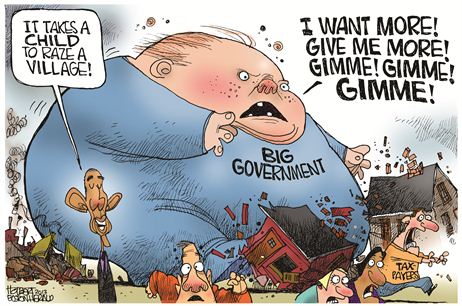
And here’s a Jerry Holbert cartoon capturing the rapacious appetite of a bloated public sector and the impact on society.

Big Government Child Cartoon

As you can see here and here, it’s quite similar to the theme used with great effectiveness by Eric Allie.

Except Holbert seems to emphasize deliberate destructiveness, rather than the blundering incompetence in the Allie cartoons.

But the net effect is still the same. Big government is counter-productive government.

___________

Thank you so much for your time. I know how valuable it is. I also appreciate the fine family that you have and your commitment as a father and a husband.

Sincerely,

Everette Hatcher III, 13900 Cottontail Lane, Alexander, AR 72002, ph 501-920-5733, lowcostsqueegees@yahoo.com

Open letter to President Obama (Part 438) A suggestion to cut some wasteful spending out of the government Part 5 (includes editorial cartoon)

(Emailed to White House on 3-15-13.)

President Obama c/o The White House
1600 Pennsylvania Avenue NW
Washington, DC 20500

Dear Mr. President,

I know that you receive 20,000 letters a day and that you actually read 10 of them every day. I really do respect you for trying to get a pulse on what is going on out here.

I know that you are looking at cutting spending in order to try and get deficit reduction. I am glad that you have that as your goal and I wanted to pass on a suggestion on where to cut spending.

Does Government Have a Revenue or Spending Problem?

People say the government has a debt problem. Debt is caused by deficits, which is the difference between what the government collects in tax revenue and the amount of government spending. Every time the government runs a deficit, the government debt increases. So what’s to blame: too much spending, or too little tax revenue? Economics professor Antony Davies examines the data and concludes that the root cause of the debt is too much government spending.

_______________

We got to cut wasteful spending out of the government and here is another fine suggestion from the Heritage Foundation.

Todd Thurman

March 12, 2013 at 5:40 pm

Newscom

The massive spending bill, or continuing resolution, released by the Senate this week continues spending on programs which are inappropriate or wasteful and fails to adopt good policies in many areas. Here’s a rundown of some of the worst offenders in the Senate bill:

Supplemental Nutrition Assistance Program (SNAP): $77.2 billion. The recommendation continues record-high food stamp benefits. Food stamp spending has approximately doubled since President Obama came to office. It is one of the largest and fastest growing federal welfare programs. The federal government operates 80 federal welfare programs at a cost of nearly $1 trillion a year. Over 10 of these provide food assistance.

Food stamp spending should be rolled back to pre-recession levels. Able-bodied adults without dependents who receive food stamp benefits should be required to work or prepare for work as a condition of receiving benefits.

—Rachel Sheffield, Research Associate

Job Corps: $30 million added to the funding level already provided under sequestration. This program should be terminated, because a scientifically rigorous impact evaluation of Job Corps participants were less likely to obtain high school degrees, were no more likely to attend or complete college, and earned only $0.22 more in hourly wages than non-participants. Further, the Department of Labor Office of Inspector General estimates each Job Corps participant who is successfully placed into any job costs taxpayers $76,574.

Violence Against Women Act (VAWA) grants: $416.5 million. VAWA grants should be terminated, because these services should be funded locally. Using federal agencies to fund the routine operations of domestic violence programs that state and local governments could provide is a misuse of federal resources and a distraction from concerns that are truly the province of the federal government.

Office of Justice Programs (OJP) grants: $1.1 billion. OJP grants should be terminated, because these grants assign functions to the federal government that fall within the expertise, jurisdiction, and constitutional responsibilities of state and local governments. Further, the Edward Byrne Memorial Justice Assistance Grants ($392 million) within OJP have been used to place criminals on the street without posting bail.

Office of Juvenile Justice and Delinquency Prevention (OJJDP): $279.5 million. OJJDP grants should be terminated, because these grants fund juvenile justice and prevention programs that fall under the unique responsibilities of state and local governments. Further, there is little evidence that these grants are effective at preventing delinquency.

Community Oriented Policing Services (COPS): $225.5 million. COPS grants should be terminated, because these grants assign functions to the federal government that fall within the expertise, jurisdiction, and constitutional responsibilities of state and local governments. Further COPS grants were used to supplant local funds and had little to no effect on reducing crime.

FEMA Fire Grants: $675 million. Fire grants should be terminated. Fire grants, which subsidize the routine operations of local fire departments, are ineffective at reducing fire-related deaths and injuries of firefighters and civilians. Fire grants incorrectly encourage local fire departments to become increasingly dependent on federal funding.

David B. Muhlhausen, Ph.D., Research Fellow in Empirical Policy Analysis

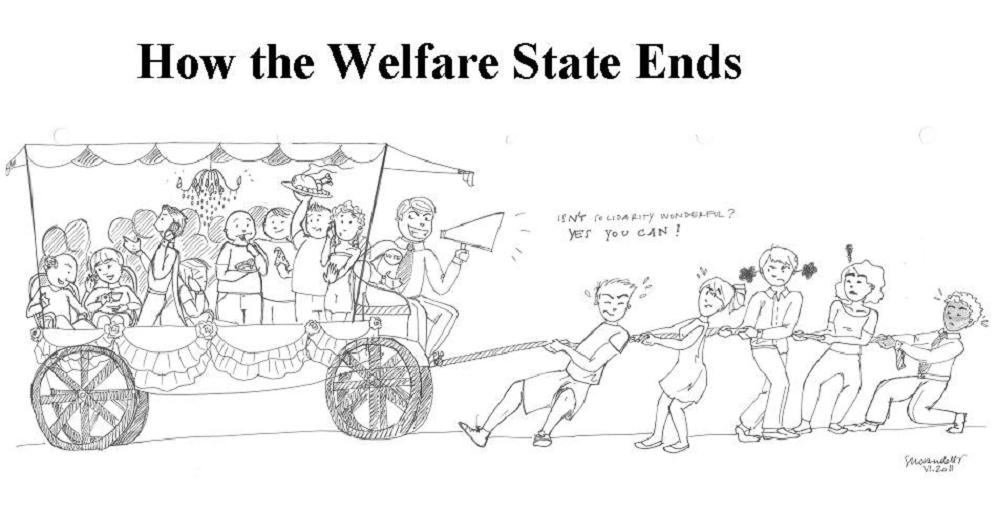
In my speeches, especially when talking about the fiscal crisis in Europe (or the future fiscal crisis in America), I often warn that the welfare state reaches a point-of-no-return when the number of people riding in the wagon begins to outnumber the number of people pulling the wagon.

To be more specific, if more than 50 percent of the population is dependent on government (employed in the bureaucracy, living off welfare, receiving pensions, etc), it becomes rather difficult to form a coalition to fix the mess. This may explain why Greek politicians have resisted significant reforms, even though the nation faces a fiscal death spiral.

But you don’t need me to explain this relationship. One of our Cato interns, Silvia Morandotti, used her artistic skills to create two images (click pictures for better resolution) that show what a welfare state looks like when it first begins and what it eventually becomes.

These images are remarkably accurate. The welfare state starts with small programs targeted at a handful of genuinely needy people. But as  politicians figure out the electoral benefits of expanding programs and people figure out the that they can let others work on their behalf, the ratio of producers to consumers begins to worsen.

Eventually, even though the moochers and looters should realize that it is not in their interest to over-burden the people pulling the wagon, the entire system breaks down.

Then things get really interesting. Small nations such as Greece can rely on permanent bailouts from bigger countries and the IMF, but sooner or later, as larger nations begin to go bankrupt, that approach won’t be feasible.

I often conclude my speeches by joking with the audience that it’s time to stock up on canned goods, bottled water, and ammo. Many people, I’m finding, don’t think that line very funny.

If you spend too much then people won’t want to work anymore.

___________

Thank you so much for your time. I know how valuable it is. I also appreciate the fine family that you have and your commitment as a father and a husband.

Sincerely,

Everette Hatcher III, 13900 Cottontail Lane, Alexander, AR 72002, ph 501-920-5733, lowcostsqueegees@yahoo.com

If you want to cut the size of government then we have to have spending caps!!!

If you want to cut the size of government then we have to have spending caps!!!

Okay, I’ll admit the title of this post is an exaggeration. How to fix the mess at the IRS is a fiscal policy question, and that requires tax reform rather than spending restraint.

But allow me a bit of literary license. We just had a big debt limit battle in Washington and, after a lot of political drama, politicians kicked the can down the road.

So we need to ask ourselves whether that fight accomplished anything?

It did focus attention of the flaws of Obamacare, and I suppose there’s some value in that.

But the debt limit was not a vehicle – as has been the case in the past – for changes in fiscal policy. We didn’t get something good, like the sequester which resulted from the 2011 debt limit legislation. And we didn’t get something bad, like the tax hike in the 1985 debt limit legislation

Some are asking whether we should even have a debt limit. A number of critics have suggested we should get rid of the borrowing cap because it creates the risk of default. I think those concerns are very overblown.

I’m more persuaded by those who argue that the debt limit diverts attention from better options to improve fiscal policy.

Professors Gary Becker and Edward Lazear write in the Wall Street Journal that the debt ceiling is not a very good tool for restraining the growth of government. They look at evidence from the states to warn that fiscal rules that seek to limit borrowing are ineffective.

Many states are required to have “balanced” budgets, but the growth in spending and the size of state governments continues apace. During good times, when tax revenues are high, states “balance” their budgets by spending at the high levels consistent with large revenues. When times get tough, it is difficult if not impossible to eliminate programs that had been initiated during the fat years. Instead, the states resort to budgetary gimmicks, like delaying shortfalls until next year’s “balanced” budget.

Gimmicks are bad, of course, but politicians also respond to fiscal squeezes by raising taxes.

And that can be even worse as the prospect of more revenue leads to a ratchet effect, with periodic tax hikes used to maintain or expand the gravy train of spending. The fiscal mess in Europe is an obvious case study, but if you want a painful example from America, just look at data from Connecticut. The state did quite well without an income tax from the 1600s until 1991.

But then an income tax was imposed, in part to deal with the fiscal shortfall caused by an economic downturn. And, as critics warned, that new tax has produced dismal results. The top rate has jumped from 4.5 percent to 6.5 percent and inflation-adjusted per-capita state government spending has doubled. And there have been zero net private-sector jobs created since the income tax was implemented.

So what’s the answer? Becker and Lazear explain that lawmakers should target the underlying problem of spending rather than the symptom of red ink.

Better than a debt-ceiling rule would be one that controls spending directly, not the debt that results from it. The specifics are less important than the general principle, which is that spending growth should be limited in a way that brings government outlays back down to historic ratios relative to GDP. This would place the attention where it belongs, on spending rather than on the difference between outlays and receipts. Increased spending, coupled with even larger increases in taxes, might bring the deficit down, but it would damage economic growth and well-being.

Well stated. Reducing the overall burden of government spending – measured as a share of economic output – should be the goal of fiscal policy. That’s simply another way of stating my Golden Rule. And there’s a growing body of academic evidence showing that reducing the size of government is a good way of improving economic performance.

I’ve been highlighting the example of Switzerland, which has successfully strengthened its economy and fiscal policy with a spending cap (which, ironically, is called a “debt brake” even though the real effect of the law is to limit how fast spending can increase over time).

Other countries that have limited spending also have achieved some very impressive results. The video at this link looks at evidence from nations such as New Zealand and Canada in the 1990s, and there’s a more recent data about the positive effects of spending restraint in the Baltic nations.

There has been some interest in spending caps on Capitol Hill. Congressman Brady of Texas has proposed a MAP Act that is somewhat similar to Switzerland’s debt brake and Senator Corker of Tennessee has introduced a CAP Act that also would restrain annual spending increases.

Perhaps if some of their colleagues read today’s Becker-Lazear column, they’ll also understand why it’s better to focus on the underlying problem of government spending rather than getting distracted by the symptom of red ink.

John Stossel ~ 17,000,000,000,000 Problems

Related posts:

The Dysfunction in Washington is Republicans and Democrats that are unwilling to cut spending in order to vote for more programs (Democrats want more food stamps etc but Republicans vote for their pet programs and wars too like No Child Left Behind Act, the Iraq war, the prescription drug entitlement, and the TARP bailout).

The Dysfunction in Washington is Republicans and Democrats that are unwilling to cut spending in order to vote for more programs (Democrats want more food stamps etc but Republicans vote for their pet programs and wars too like No Child Left Behind Act, the Iraq war, the prescription drug entitlement, and the TARP bailout). If […]

Washington better wake up and cut spending or the USA will end up bankrupt like Detroit!!!

Washington better wake up and cut spending or the USA will end up bankrupt like Detroit!!! Atlas Shrugs in Detroit July 25, 2013 by Dan Mitchell About two weeks ago, while making an important point about the Laffer Curve, here’s what I wrote about the fiscal disaster in Detroit. Detroit’s problems are the completely predictable result […]

Lessons from Canada:CUT SPENDING AND LOWER TAXES AND GIVE MORE CONTROL BACK TO THE LOCAL GOVERNMENTS!!!!

When Governments Cut Spending Uploaded on Sep 28, 2011 Do governments ever cut spending? According to Dr. Stephen Davies, there are historical examples of government spending cuts in Canada, New Zealand, Sweden, and America. In these cases, despite popular belief, the government spending cuts did not cause economic stagnation. In fact, the spending cuts often […]

We got to cut spending and this farm bill is the perfect place to start!!!

We got to cut spending and this farm bill is the perfect place to start!!! May 29, 2013 12:33PM Farm Bill Would Increase Spending 47% By Chris Edwards Share House and Senate farm subsidy supporters are pushing to enact the first big farm bill since 2008. Democratic and Republican supporters say that this year’s legislation […]

President Obama will not cut spending ever it appears

President Obama will not cut spending ever it appears. Early Details Show Obama Will Propose a Bait-and-Switch Budget Plan Containing Higher Taxes and More Spending April 5, 2013 by Dan Mitchell Are we about to see a new kinder-and-gentler Obama? Has the tax-and-spend President of the past four years been replaced by a fiscal moderate? That’s […]

We got to cut spending and stop raising the debt ceiling!!!

  We got to cut spending and stop raising the debt ceiling!!! When Governments Cut Spending Uploaded on Sep 28, 2011 Do governments ever cut spending? According to Dr. Stephen Davies, there are historical examples of government spending cuts in Canada, New Zealand, Sweden, and America. In these cases, despite popular belief, the government spending […]

To save the USA from Greece’s fate we must cut spending

Maybe Romney will focus on cutting spending now that Ryan is on board. Is the American Electorate that Dumb? Posted by Roger Pilon Today POLITICO Arena asks: Can Ryan boost Romney’s poll numbers? My response: Ryan is the shot in the arm that Romney needed. If last night’s “60 Minutes” interview of the two is […]

The USA must cut spending and balance budget or end up like Greece

Why can’t we learn the lesson from Europe that we must start to cut spending and balance our budget or we will end up like Greece? Europe’s Crisis Is Because of Too Much Government, Not the Euro Currency July 19, 2012 by Dan Mitchell The mess in Europe has been rather frustrating, largely because almost everybody […]

An award to the person who cut spending by our federal governement the most ($47)

A funny carton. Finally, Some Government Workers Who Want to Cut Spending April 23, 2012 by Dan Mitchell In recent years, taxpayers have been victimized by huge expansions in the burden of government spending. Among the highlights (lowlights would be a much better word): A corrupt bailout of politically connected Wall Street insiders. A bloated healthcare […]

Updated version:Rick Crawford falls for Democrats’ trick:raise taxes first and we will cut spending later

RAISE TAXES: Report says Rick Crawford will break from GOP and back millionaires’ tax. The Arkansas Times reported that Congressman Rick Crawford has a plan that includes raising taxes for 5 years if there is an agreement to pass the Balanced Budget Amendment. However, if after 5 years the Balanced Budget Amendment does not get […]

If you want to cut Welfare fraud then go to Flat Tax!!!

________

If you want to cut Welfare fraud then go to Flat Tax!!!

One of my missions in life is fundamental tax reform. I would like to replace the corrupt internal revenue code with a simple and fair flat tax.

Though what I really want is a tax system that minimizes the damage of extracting money from the productive sector of the economy, so I’ll take any system with a low rate, no double taxation, and no distortionary loopholes.

The national sales tax, for instance, also would be a good option if we can first repeal the 16th Amendment so there’s no risk that politicians would pull a bait and switch and saddle us with both an income tax and a sales tax (and in my ultimate fantasy world, we would shrink the federal government to the size envisioned by the Founding Fathers, in which case we probably wouldn’t need any broad-based tax at all).

While I normally make the economic case for tax reform, there are many reasons to fix our broken tax code.

Many Americans, for instance, are rightfully upset that the tax code is a 76.000-page monstrosity that enables the politically well connected to benefit from special provisions.

So we don’t know if the rich are paying an appropriate amount. Some of them are paying too much because of high rates and double taxation, while some of them are paying too little because they have clever lawyers, lobbyists, and accountants.

In an ideal world, if someone like Bill Gates earns 10,000 times as much as I do, then he should pay 10,000 times as much in tax. That’s a core principle of the flat tax.

But this post isn’t about why we need tax reform to promote economic growth or fairness. Instead, I want to focus on tax reform as a way of reducing welfare fraud. The Treasury Department just released a report acknowledging that the IRS made more than $100 billion of improper “earned income credit” payments over the past decade and that about one-fourth of all such payments are in error.

This Fox News article is a good summary. Here are the key details.

The Internal Revenue Service paid out more than $110 billion in tax credits over the past decade to people who didn’t qualify for them, according to a Treasury report released Tuesday. …IRS inspector general J. Russell George said more than one-fifth of all credits paid under the program went to people who didn’t qualify. …George said in a statement. “Unfortunately, it is still distributing more than $11 billion in improper EITC payments each year and that is disturbing.” …The agency said it prevents “nearly $4 billion in improper claims each year and is committed to continuing to work to reduce improper claims.” The EITC is one of the nation’s largest anti-poverty programs. In 2011, more than 27 million families received nearly $62 billion in credits.

Now some background. The “earned income credit” or “earned income tax credit” is actually an income redistribution scheme operated by the IRS. It’s basically a wage subsidy. If someone earns money (the “earned income” part), the law says the IRS should augment that money with a payment from the government (the “credit” or “tax credit” part).

The key thing to understand, though, is that the EITC is “refundable,” which is the government’s term for payments to people who don’t earn enough to owe any income tax. That’s why it’s primarily an income redistribution program. Only it’s operated by the IRS rather than the Department of Health and Human Service or some other welfare agency.

And when government is giving away other people’s money, there are those who will try to abuse the program. That’s true for corporate welfare, and it’s true for traditional welfare like food stamps. And, as we see from the Treasury report, it’s true for the EITC.

That’s the bad news.

The good news is that the EITC has a redeeming feature. Some lawmakers realized traditional welfare programs were very destructive because they paid people not to work. The EITC supposedly offsets that perverse incentive because you get the money only because you earn some income.

But now let’s share some additional bad news. The government takes away the EITC once your income reaches a certain level, and this is equivalent to a big increase in the marginal tax rate on earning additional income.

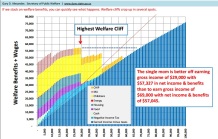
And when you combine the EITC with all the other redistribution programs operated by government, you create a huge dependency trap. Indeed, the chart shows that many of these programs can be larger than the EITC (which is called “negative income tax”).

So let’s adopt a flat tax and get rid of all the bad features of the tax system, including the EITC. Welfare and income redistribution are not proper roles of the federal government.

We’re far more likely to get good results – both for poor people and taxpayers – if we let state and local governments experiment and learn from each other on what actually helps people climb out of poverty.

P.S. I can’t overlook an opportunity to point out that today’s complicated and convoluted tax code is the reason why we have a powerful and intrusive Internal Revenue Service. And never forget that the IRS has a long record of abusive actions.

Related posts:

Open letter to President Obama (Part 432) A suggestion to cut some wasteful spending out of the government Part 2 (includes editorial cartoon)

(Emailed to White House on 3-15-13.) President Obama c/o The White House 1600 Pennsylvania Avenue NW Washington, DC 20500 Dear Mr. President, I know that you receive 20,000 letters a day and that you actually read 10 of them every day. I really do respect you for trying to get a pulse on what is […]

Dear Senator Pryor, here are some spending cut suggestions (“Thirsty Thursday”, Open letter to Senator Pryor)

Senator Pryor pictured below:  Why do I keep writing and email Senator Pryor suggestions on how to cut our budget? I gave him hundreds of ideas about how to cut spending and as far as I can tell he has taken none of my suggestions. You can find some of my suggestions here, here, here, here, here, here, here, here, here, here, here, here, here, here, here, here, here, here, here,  here, and  here, and they […]

Open letter to President Obama (Part 430) A suggestion to cut some wasteful spending out of the government Part 1 (includes editorial cartoon)

(Emailed to White House on 3-15-13.) President Obama c/o The White House 1600 Pennsylvania Avenue NW Washington, DC 20500 Dear Mr. President, I know that you receive 20,000 letters a day and that you actually read 10 of them every day. I really do respect you for trying to get a pulse on what is […]

The Dysfunction in Washington is Republicans and Democrats that are unwilling to cut spending in order to vote for more programs (Democrats want more food stamps etc but Republicans vote for their pet programs and wars too like No Child Left Behind Act, the Iraq war, the prescription drug entitlement, and the TARP bailout).

The Dysfunction in Washington is Republicans and Democrats that are unwilling to cut spending in order to vote for more programs (Democrats want more food stamps etc but Republicans vote for their pet programs and wars too like No Child Left Behind Act, the Iraq war, the prescription drug entitlement, and the TARP bailout). If […]

Dear Senator Pryor, here are some spending cut suggestions (“Thirsty Thursday”, Open letter to Senator Pryor)

Senator Pryor pictured below:  Why do I keep writing and email Senator Pryor suggestions on how to cut our budget? I gave him hundreds of ideas about how to cut spending and as far as I can tell he has taken none of my suggestions. You can find some of my suggestions here, here, here, here, here, here, here, here, here, here, here, here, here, here, here, here, here, here, here,  here, and  here, and they […]

If you want to cut wasteful spending then the disability program must be reformed radically!!!

If you want to cut wasteful spending then the disability program must be reformed radically!!! October 7, 2013 1:19PM 60 Minutes Disability Investigation By Chris Edwards Share The abuse and overspending in government disability programs is so bad that even National Public Radio and 60 Minutes have taken notice. On the heels of this excellent […]

If you really want to cut wasteful spending then why not shut down Dept of Housing and Urban Development, Dept of Education and SBA?

If you really want to cut wasteful spending then why not shut down Dept of Housing and Urban Development, Dept of Education and SBA? There are many other areas that should be cut but these should be shut down!!!   October 7, 2013 4:57PM Close Washington to Dismantle the Welfare-Warfare State By Doug Bandow Share […]

Dear Senator Pryor, here are some spending cut suggestions (“Thirsty Thursday”, Open letter to Senator Pryor)

Senator Pryor pictured below:  Why do I keep writing and email Senator Pryor suggestions on how to cut our budget? I gave him hundreds of ideas about how to cut spending and as far as I can tell he has taken none of my suggestions. You can find some of my suggestions here, here, here, here, here, here, here, here, here, here, here, here, here, here, here, here, here, here, here,  here, and  here, and they […]

We need to stop wasteful government spending by privatizing the post office!!

We need to stop wasteful government spending by privatizing the post office!! Postal Service Won’t Shut Down but Will Default on Its Debt James Gattuso October 1, 2013 at 9:30 am Newscom The U.S. Postal Service (USPS) defaulted on its debt last night. No, it has nothing to do with the partial shutdown of the […]

We need to stop the stupid spending by Bureaucrats!!!

We need to stop the stupid spending by Bureaucrats!!!   Bureaucrats Gone Wild: Government Spends Recklessly as Fiscal Year Ends Rob Bluey September 29, 2013 at 1:55 pm Credit: Tetra Images/Newscom Washington’s reckless spending is driving America into debt — and yet federal bureaucrats continue their wasteful and frivolous ways. The latest example comes courtesy […]

Open letter to President Obama (Part 436) A suggestion to cut some wasteful spending out of the government Part 4 (includes editorial cartoon)

(Emailed to White House on 3-15-13.)

President Obama c/o The White House
1600 Pennsylvania Avenue NW
Washington, DC 20500

Dear Mr. President,

I know that you receive 20,000 letters a day and that you actually read 10 of them every day. I really do respect you for trying to get a pulse on what is going on out here.

I know that you are looking at cutting spending in order to try and get deficit reduction. I am glad that you have that as your goal and I wanted to pass on a suggestion on where to cut spending.

What Are the Dangers of Too Much Debt?

Published on Mar 20, 2012

Interest payments on U.S. government debt are three times spending in the Iraq and Afghanistan wars already, and that is with the lowest interest rate we have seen since the 1960s. A rise in interest rates would increase interest payments dramatically. What can the U.S. government do today to prevent a crisis from happening when interest rates go up?

___________________

We got to cut wasteful spending out of the government and here is another fine suggestion from the Heritage Foundation.

Todd Thurman

March 12, 2013 at 5:40 pm

Newscom

The massive spending bill, or continuing resolution, released by the Senate this week continues spending on programs which are inappropriate or wasteful and fails to adopt good policies in many areas. Here’s a rundown of some of the worst offenders in the Senate bill:

Consumer Product Safety Commission (CPSC). Unlike the budget passed by the House, the Senate bill seeks to restore government spending to fund the failed CPSC product safety database. CPSC decision making with respect to the database has previously been called “arbitrary and capricious” by the courts.

Since it was implemented in 2011, manufacturers have shown that the CPSC database is seriously flawed. The database allows the public to submit unproven claims of harm with the CPSC and gives manufacturers only 10 days to challenge these claims; however, the CPSC itself has final authority to publish reports of such claims, even if they are disproved by the manufacturer. The accuracy of the CPSC reports is thus seriously questionable, and is a one-stop shop for tort lawyers seeking new clients or seeking “evidence” for their current lawsuits.

Furthermore, last October, in Company Doe v. Inez Tenenbaum, a federal court in Maryland overturned a decision of the CPSC to publish a report as “arbitrary and capricious,” because the CPSC report was “misleading and fail[ed] to relate[] to the [manufacturer’s] product in any way.” Indeed, the CPSC database is a concrete example of government waste: It is a shame that the Senate bill seeks to restore government spending to publishing misleading claims that damage business growth and likely lead to additional frivolous lawsuits.

—Andrew Kloster, Legal Fellow

The third-most viewed post in the history of this blog, with more than 22,000 views, is this set of cartoons showing how the welfare state begins and how it ends.

A similar theme can be found in this great new cartoon from Chuck Asay.

And just in case you think Asay is being unfair, keep in mind that folks like Obama and Pelosi actually have claimed that more unemployment benefits is “stimulus.” Yes, you read correctly. Subsidizing unemployment is good for growth to these strange ideologues.

Asay’s cartoon is so good that it may dethrone my previous top choice. Though sometimes I am most impressed by this one showing why parasites shouldn’t kill their host animal.

I’d be curious to know which one all of you think is most effective.

And since Asay’s work is almost always worth sharing, you can find more of my top picks hereherehere, and here.

___________

Thank you so much for your time. I know how valuable it is. I also appreciate the fine family that you have and your commitment as a father and a husband.

Sincerely,

Everette Hatcher III, 13900 Cottontail Lane, Alexander, AR 72002, ph 501-920-5733, lowcostsqueegees@yahoo.com