Category Archives: Current Events

MUSIC MONDAY Beatles Anthology Special Features

You may be interested in links to the other posts I have done on the Beatles and you can click on the link below: FRANCIS SCHAEFFER ANALYZES ART AND CULTURE PART 288, LINKS TO 3 YEARS OF BEATLES POSTS (March of 2015 to Feb of 2018) Featured artist is Mark Dion

Beatles Anthology (1/12) – Special Features

Golden Slumbers
I know it was an old song. Isn’t it?
When did you write it? – It’s not my lyrics… it’s an old…
It’s ancient… it’s like an old lullaby
Trad arranged by McCartney. Trad arranged, with tune…
I put the tune to it-it’s my tune
It was at my dad’s house – we put the traditional drums on it –
and there was some sheet music for learning piano…
and I just liked the lyrics
I couldn’t read the music so I started doing my tune to it
Which album is this? – This was on Abbey Road
You’re George, this is Paul… – No.1 Beatle expert, George Harrison!
Bass and piano so far
Carry That Weight – It goes into Carry That Weight
I don’t think you are on it – Who’s playing bass?
It wasn’t you, was it? – Unless it was over-dubbed
Why would you over-dub a take 1?
Because he was playing the piano
Are you playing bass? Who’s playing piano? – I think I am
So who was playing bass? – He is
I think I over-dubbed it – You can’t play them at the same time
He over-dubbed it. You can hear the sound of it-it’s like direct inject
But then, he played on 17 takes. This is take 1
He was keen! – It’s been over-dubbed by somebody
Maybe I played bass. I played bass on some…
with that 6-string Fender – Sounds like him
It was definitely Paul playing piano – You should be able to tell…
because you’d know how you’d have done it
There’s lots of false starts and breakdowns. That was take 1
So, are you saying the bass couldn’t be over-dubbed because it’s on every take?
It was live – OK, it must have been me or John playing it
Obviously… – It could have been Ringo
We had a 6-string bass, a right-handed bass…
for these kind of conditions
One of the great things about the way this studio was set up…
they were set up for Mrs Mills, Daniel Barenboim, Russ Conway, Peter Sellers…
so they always had all the instruments – grand pianos, harpsichords…
They’ve ended up at my studio ‘cos they were trying to get rid of them here
Neil and Mal would be over here – I thought it was over here
This is where everyone disagrees – They moved them round so much
And my bit on…
Up the cable! Up the cable! was through that door
He’s talking about Yellow Submarine, I think
That’s all it was-natural echo… just in that door there
At that time there was a little board – the desk-up there
The console was just about this big with four faders on it
There was one speaker right in the middle
For a mix it would be funny because everybody would get a fader each…
and have full bass and full treble and one speaker… and that was it
When they invented stereo I thought “What do you want two speakers for?”
Because it ruined the sound from our point of view
When everything came out of two speakers it sounded very naked
Finally someone said, well, you can move things
So everything from then on got panned like mad, you know
But to mix the drums and bass in the middle, you know…
it used to be over on the side
I remember talking to someone at a party at Brian’s house…
and saying “This is a great bit, listen to the drums”…
and it wasn’t on that speaker
We put it on again and had to go to the other speaker to hear the drums
John had a tape with a rough mix of the backing track to I’m Only Sleeping
By the time he got home-he didn’t realise the tape was tails out –
He put it on his tape machine and threaded the tail in forward…
That’s when he came in the next day and said oh, yeah, backwards…
We made him turn the tape over and play it backwards…
and then John and I, or Paul and I played guitars, just random notes…
and then we reversed the tape…
and that was the first time we had a backwards solo
It became easier to do experiments because we’d had a few hits
That was the key – we’d had success
Then it was “Oh, great. Come in lads…”
And as we got more and more success…
we were more able to try some far out ideas
They’d also give us more time
Then you’d have success with a “far out” idea…
and people would say “Wow, this is great!”
We’d come back again and George would be keen to try other ideas
So it became like a free house –
whatever idea we wanted, we’d try it
Can we have Tomorrow Never Knows?
Which take? – All of them
There’s only three – The first take is really weird
Listen to this. It’s like the drums and a guitar at half speed
There’s only two basic takes…
which is 1 and 3
All that… underwater stuff
We should speed that up and see what it was
Listen to the drum part, it’s great
That’s the guitar slowed down at the top
So is that just on it’s own? – That’s his voice
That’s good. With a bit of drums – And a bit of loop
There’s nothing on there – So we have no loops on this tape?
This was just the first run through
He wanted his voice to sound like the Dalai Lama chanting from a hilltop
I said it’s a bit expensive going to Tibet, can we do it here?
I spoke to Geoff Emerick and he had a good idea
He said let’s try putting his voice through a Leslie speaker…
and back again and re-recording it – no one had done that before
That’s how we got the special-effect on his voice
The other things were the tambura drone and Ringo’s drumming
It’s like doing a rhumba
It’s great, I like it
How is he doing that? – What’s that underwater sound?
How’s that drummer doing that, George? – He had to be very brilliant!
There’s no tambura on this
What’s that with the drums?
Sounds like some kind of resonance on the drums
Some residue!
You then changed it afterwards – So that was the first take
John just had the song…
The song was very much influenced by… you know, in those days…
the Indian music had come into our lives…
and Indian music was all in one key – it didn’t modulate
He wanted to try a tune like that – that didn’t change chords
And also because of some of the other influences
He had that Timothy Leary book…
I think it was called Psychedelic Experience…
and some stuff that related to the Tibetan Book of the Dead
And he wrote those words…
and did a kind of… monotone… kind of thing
And also… you know, Paul and…
there were different things going on, different influences…
one of them being avant garde, you know, Stockhausen…
There were a number of experimental things…
that all came together on the one song
Now we’re talking!
Serious music now
So what have we got there? – You’ve got the rhythm on 1
You’ve got the voice on 3… 4 rather
And on tracks 2 and 3 are the various tape loops, guitar and tambura
On that one I brought in some tape loops that I’d done at home…
I just made a lot of little loops and brought them all in –
literally, little pieces of looped tape in a plastic bag –
and we got them all on eight or so machines…
with everyone holding a loop and a pencil…
and got them all running, fed them all into the desk…
and made the little mix that you heard before
All those seagull noises – it’s all sped-up tapes and loops
So that was another little ingredient in that
That wasn’t used, was it?
Bring Phil Collins in!
That one’s really good
I don’t suppose you remember what that loop was made of?
Guitar probably
When we made that record, it would be impossible to reproduce it again…
because the way we made it was the actual mix…
and all over this building, in different rooms…
were tape machines, with loops on them…
and people holding the loops in place with a bit of pencil…
going all the time, being fed to different faders on our control panel…
and we could bring up the sound, like an organ, at any time
So the mix we did was random – it could never be done again
The double-tracked voice is straight and that one has the wobble on it
That’s the best bit – We are gathered here today…!
That’s that piano down… – Is that you?
I don’t know. It sounds like you – It could be me
Sounds like you
Well, there you go – That’s how we did it, really

Beatles Anthology (3/12) – Special Features

The Anthology was originally called The Long And Winding Road
George Martin Producer The boys were to tell their own story rather than entrust it to somebody else
After all, they knew better than anybody what had been going on
And somebody thought it would be a good idea to have an audio equivalent
But it’s no good just doing a soundtrack of a film…
because an awful lot is missing – the vision takes over
So what we’re providing is a complement to it
Something that runs parallel but is pure sound
The main gist of it is, with the music…
to find the most ancient Beatle music possible
To come in chronological order through our various records…
and bring it up to date
We lead the CD with the new song, Free As A Bird…
which we figure is what people are waiting to hear
Then what we do is flash back
Also, as the documentary starts and then goes backwards –
There’s a bit in the opening where it says “Let’s go back, back, back…”
and it backs up until Ringo is about six months old
And then the record, we thought, could work in that respect
There’s a lot of stuff from old tape recorders…
of George, Paul and John singing and playing guitars…
before I was in the band
Then we go into old recordings from when we were about 14 or 15…
which we haven’t heard for ever, you know… things in my front room
These are interesting because…
they include a track where Stuart Sutcliffe was playing
The bass guitar is not very good but it’s historic
We’re talking about a historical thing now
And I, for one, don’t mind it being old and scratchy…
because most of the music I buy is old and scratchy
You know, music that was recorded in the early ’20s and ’30s
I like a bit of tape hiss, personally
It’s not the quality you’re listening to, it’s the story
You see our development happening
We hear some of the stuff at EMI from when I first met them in 1962
There are a couple of tracks… the very early version of Love Me Do…
with Pete Best on drums – which no one’s heard
No tapes exist of that
He found it on an acetate, because they’d cut it onto disc
He found that and it’s been copied onto tape
When I was asked to do this project…
I said there’s no way I’m going to mix this on a modern digital machine…
because it wouldn’t be what people did in those days…
and I’m dealing with old tapes
So I asked EMI if they could find me an old desk
One of their engineers had this one…
and they brought it in and it’s a marvellous machine
This was in number 2 studio, Abbey Road
It was state-of-the-art then, but now it looks so old-fashioned
But it’s appropriate that we use this because it makes a different sound…
so we’re getting right back to the old days in doing this stuff…
and it sounds all the better for it
I’m staying in the old-fashioned mode until the very last moment…
until it goes onto CD so that we keep the authenticity of it
A lot of the tapes we’re working on are 2-track, 4-track, up to 8-track
We still have the old tapes – this is an old box
They’re 1-inch tapes – the 4-track machine is modern…
but it is still the old vintage tapes of 32 years ago
We’re halfway through that CD before I enter the picture
There’s a lot of very early years that hasn’t been heard
Television or radio shows from Sweden…
and various things from the Command Performance
Things shown once on television
We managed to get the soundtracks to some variety show we did
There isn’t a lot of live stuff out so it was a pleasure to hear it…
because they were a great little band
We’ve been listening to every take of every song we’ve done
And we’ve discovered some interesting stuff
Some of the early takes of most numbers are interesting
Seeing how the songs developed and changed
Sometimes they started quite differently to the masters everybody knows
Then we get into cross-fading, like take 1 to take 4
On some of them where we were just working the song out…
We always ran through the song – we very seldom sat around
We’d say let’s do this and that and, like, run it down
And so the attitude from the beginning to 7 takes later…
was like… a mile
It’s not like “Oh, we’ve changed a note”…
We’ve changed the whole thing – working on it and changing it

GEORGE MARTIN:
One of the strengths of the Beatles was that they had eternal curiosity –
an eternal quest for something new
They were always saying “What new sound can we have?”
“What other instruments do you know? Give me a different sound”
They were not content with what they had yesterday

PAUL MCCARTNEY:
One interesting thing was that
we always thought that people like the Supremes made “a good record”
But then the next one was sort of the same record
It was the Supremes sound, the Motown sound
So we really liked the first one, the second one was not so good…
and it paled a bit, you know
So I think we tried not to repeat ourselves

RINGO:
Our song-writing and our playing got better and it all just grew

GEORGE HARRISON:
The music was always there in the background…
reflecting our feelings and our desires…
and all the various things we’d experienced
It goes in leaps and bounds… and it’s pretty interesting

GEORGE MARTIN:
I thought we’d listen to an old recording we’ve been working on
This doesn’t require a great deal of balancing
It was made on the 19th of January, 1967…
and doesn’t require much balancing because it only has 2 tracks
This was the very first time we heard A Day In The Life in the studio
This was the first version – the master came a bit later
This is the version without Paul’s middle bit…
and without the orchestra
John is just singing it, really, for himself
I think it’s charming. OK, Paul, let’s have a listen
I think that early take of John is so natural

Beatles Anthology (4/12) – Special Features

GEORGE MARTIN
He wasn’t expecting people 32 years later to be listening to it

PAUL MCCARTNEY
Sometimes after 19 takes, no matter how professional you are…
the boredom creeps in-you can hear it. It goes perfect…
but on early takes it’s “God, sounds like they’re really enjoying it”
That’s what I like about it

GEORGE HARRISON
As it gets into all the other stuff we found different out-takes…
or maybe a version of something with different vocals to the master…
so what we’ve done is present the alternate version

PAUL MCCARTNEY
You hear the songs for what they are
I know George Martin was wondering why we had to do them again
We said it’s probably a case of “Maybe we can get it a bit better…
“if we put a bit of drums on… or maybe a banjo…”
You’re always trying to get better

GEORGE MARTIN
Normally I don’t think back on the past at all but I’ve had to…
and it’s been a strange experience. Paul actually said to me:
“Hearing ourselves as we were 30 years ago, 25 years ago…
“and hearing us chatting away, it’s a strange experience
“It’s like looking into an old scrapbook – but coming to life”

________________
I think it was the early ’70s, ’70l71…
Neil Aspinall Executive Producer I collected all the footage I could find from around the world…
and we put a documentary together, a film together…
without the Beatles being interviewed or anything like that
It was about an hour and three quarters long…
and I put it on the shelf for 20 years
And it was an extremely interesting story
Derek Taylor Series Consultant But it was very close to the breakup…
so it wasn’t done with that long perspective
It was there on the shelf but I didn’t really think about it
It was a question of getting a lot of other business things together…
and getting control, if we could, of various elements…
of Beatle business, if you like
And when we were in that position, it was easier to do
It was easier to do… than not
I really thought it would happen when Neil said…
there’s going to be an anthology, we’re going to do the whole story
The fellows have agreed and it would be on
And I was very interested in a detached sort of way
I think I mentioned it to everybody in 1990 or ’91…
or something like that
And then we started doing it
I got the production team together… and we started doing it
I’d worked with the three of them before…
Geoff Wonfor Director when I was directing McCartney’s Oratorio for Liverpool
He phoned me up and said he’d had a chat with a mate of mine
I said who do you mean, and he said George Harrison
He said “I didn’t know you’d worked with George”
I said, yeah… He said well he didn’t know you’d worked with me
Andy Matthews Editor I was on my way to the Montreux Jazz Festival
I’d arranged to work on that…
and Geoff rang me out of the blue and told me about it
He said “You’ve got to make your mind up. Are you coming or not?”
The rest is history – Geoff and I arrived down here to empty rooms
Chips Chipperfield Producer I was working at EMllPMI, making television programmes
Geoff was a director who’d worked there
We’d both worked with Paul on the Oratorio and things…
and he’d been asked to do this and nobody had asked me
I said “Why haven’t you asked me, I’d love to do this”
He said “I didn’t think you’d want to, you have a proper job”
A full time job. And Geoff… seemed very happy…
spoke to Neil Aspinall, spoke to Paul…
and I went and talked to Neil and got the job
I was on holiday when the rest of the guys started
Bob Smeaton Series Director & Writer I thought, “bad timing” and I expected to come back…
and find myself surplus to requirements
So I phoned Apple: “I’m Bob Smeaton, I’m going to be working on this job”
They said “Yeah, come down whenever you’re ready”
When I came in we had to really start to think about making the programme
There’s been a phenomenal amount of work done by a very small team
Basically, the whole production has been done by ten people…
including research and everything
We’ve used between 9-10,000 pieces of footage and music
All that’s had to be cleared and logged – it’s been a phenomenal job
I’m useful to have around if the Beatles are being discussed…
but I’m no use on some of the minutiae in detail
I’m not good on things like the mechanics of making a documentary
But on perspectives and insights I can be handy to turn to
And I’m extremely generous with my time… and views
And I get along with them and with Neil
I realise that the one thing we had that nobody else had…
no third party had…
was the surviving Beatles, the three of them…
and all John’s interviews with Yoko’s consent
And so what I decided right from the beginning…
not just now, but 20 years ago when I did the original one…
was not to have some mid-Atlantic voice commentator…
telling the Beatles’ story
It was better for them to tell their own story
and to do that they had to be interviewed
It was months of looking and listening before we put anything together
Also, they’re not the easiest of people to get hold of
It took another three months trying to get hold of them to do an interview
That was the other thing – to get an interviewer
Not a David Frost type who would put everybody on their guard…
but another musician, and that’s how Jules Holland got involved
Jools Holland Interviewer My job was to interview them and ask them about their history…
from their small beginnings right up to the end of it
Some of it was quite hard to talk about, the later parts
There were unhappy moments, and laughter and tears, of course
Because I’m a pianist and a musician more than a hard-nosed interviewer…
I think they found it easier to relax
And so Jules tended to ask questions…
that a trained interviewer wouldn’t ask
With the Elvis episode, he asked if Priscilla was there, which is fine…
but a regular interviewer wouldn’t have asked what was she wearing
It’s not an “in-depth” question, is it?
Do you remember how Priscilla was dressed?
She had a long thing on… and a tiara
I’ve got this picture of her like… as a sort of Barbie doll
with kind of purple gingham and a gingham bow in her very beehive hair
Do you remember seeing Mrs Presley?
No, I don’t
I spent most of the party trying to suss out from his gang…
if anybody had any reefer!
We’d want to know what each programme was going to be
I’d write the main areas and say we’ve got to hit all these bases
Once we knew what we wanted in there…
we had to get that information from the Beatles to make the programme
By the time they got to the third interview-it’s noticeable –
you’ll find that if you ask one of them a question…
if they don’t know the answer, it’s maybe Paul, Ringo or George knows…
so you cut to the other individual, who doesn’t know the answer anyway…
and he’ll say maybe someone else knows the answer
That came from watching what they’d done in their first interviews…
and seeing if you don’t know the answer, pass it on to the next guy…
and then you’ve got quite a nice little cut…
so we gradually got into making this thing
We were always aware that John wasn’t with us to get a quote from him…
but the researchers did such a thorough job…
that you’d need a quote from John and you’d get six or seven
And because he was so succinct in all his interviews…
if you ask him a question, he gives you the answer
We looked through hours of footage of everything we have on John…
and just sort of used…
He’s represented mainly in slow motion because he can’t be talking
Wherever he’s appeared in archive saying anything, we’ve tried to use it
We’ve used all that stuff, you know…
and tried to give them all equal billing
They’ve all seen it and approved it…
so they all agree with what’s in it
If there’s something that somebody wants to change…
or doesn’t like, then we would change it
They left us alone, basically, for three years
There were no major things to change
These are Paul’s Programme 1 changes. There aren’t very many
“Sack the crew!”
They came in occasionally
The three of them came in together, which was fantastic…
to have them in here looking at various parts of it
They have been, in many ways, a joy to work with
They’re still the Beatles…
but I’ve had more problems with a new band making a five grand video
They’ve all been, I think, completely honest and frank…
to the point where some of the things they say aren’t…
You know, if you were doing a safe interview about yourself…
you might not say
But I think they feel the story should be told pretty much as it is
The truth should be known even if sometimes it’s a bit painful
So they talk and that’s what I was…
I was pleased that it wasn’t a show-biz cover-up
The position taken by Apple and by us during the making of it…
has been “This may never be released. That’s why we can’t talk about it”
For a while there was very much a sense of that
I can’t think of any particular moment when we felt it wouldn’t be released
But you always got the sense…
from the phone calls you were getting…
the broadcasters that were phoning up…
people asking questions about it –
you got a sense of what it would be like when it was finished
Now you’ve got to decide what to leave out, what to leave in…
you’ve got a deadline to meet…
getting the music together for a film, getting the rights together…
whatever those rights are-master-use licences, publishing licences…
permission for someone’s name and likeness that you’ve used
If they won’t give it to you or you can’t get a particular song…
then you’ve got to change that bit
It’s the finishing process that –
under pressure because you’ve got a deadline –
that, for me, is always the… what’s the word for it?
It’s the most traumatic time
What’s interesting about this Anthology now…
is that they’ve had a long time to think about it…
to get used to not minding having been Beatles
It’s no longer an embarrassment to them…
and it’s time to, as the clichô goes, reclaim their own history
When I joined, Paul was the only one who’d sleep with me
Well, there was actually a reason for that…
I was never very prejudiced!
When you joined, and you were the new fellow…
and I thought if I hang out with you, they’ll all be like… you know…
so I thought… – Put Paul with him!
Yeah, because it would be all right then
But then it changed – it would be with anybody
It just sort of went on through the different tours
I enjoyed it because it wasn’t the kind of thing we’d done much
As kids, we’d hitch-hiked…
and me and George would end up sleeping in the same bed at some B&B
I hadn’t been away from home much when we started
I hadn’t done any of it ‘cos I’m an only child
At Butlin’s, almost… – Yeah, but I still slept on my own
So it was kind of good, you know…
It was great. Staying in a room with a friend and seeing his habits
You stayed up late didn’t you? You couldn’t sleep
You’d always have the light on… – I was frightened of the dark!
He’d have the light on and you’d have to sleep this way
But it was good. You get to know people that way
You know, my hair… I’m still trying to make it go back…
I’ve got some mousse you can use! …but naturally it just goes forward
We used to use really thick Vaseline to just get it back, like that…
and I remember we went to the swimming baths in Hamburg
We were walking back to the Reeperbahn and it dried and it was all like that
By the evening we saw our friends, Jurgen and Astrid…
and I remember them saying leave it like it is, it’s really good
It was kind of like that and everybody at that time was starting to just…
If they’d said it was naff we’d have changed it…
but because they liked it, we liked it
We didn’t really go with it in a major way, we still…
I remember when John and I went to… He had his 21st…
and he got a hundred quid off his uncle who was a dentist in Edinburgh
Very elevated stuff, that –
we’d never known the likes of anyone who had a relative who was a dentist
Or a hundred quid!
To this day no one has ever given me that-a hundred smackers!
And then, as you can imagine, that was like an inheritance
But John got this hundred quid and said what shall we do?
So we decided to go to Spain to spend the û100
We got as far as Paris – we hitch-hiked –
and decided we’d maybe go to Spain later in the week as we liked Paris
We bumped into Jurgen, our friend – Astrid, Jurgen and Klaus –
and said “Your hair’s nice. Could you do ours like that?”
He said are you sure you want this?
I said yeah, go on, we’re on holiday and all that
We arrived back in Liverpool with this funny hair, forward, as you say…
and everyone was a bit dubious about it but it just fell into the thing then…
and we kept it forward
You did yours but Ringo always had a big grey shock under there
It’s still there – He had to do it to join the band
It’s the only way I could join
But when it came forward you didn’t see his grey bit
He had a beard too – “Shave the beard, keep the sideburns”
We’d got a look going here
I looked like this actually, just before I joined you guys
Only with a suit
We actually saw a London band in Hamburg…
and one of them wore boots with a pointy toe and a Cuban heel…
and we thought “Hmm… they’re good!
“Where did you get those?”
He said in London at Anello & Davide’s
We went to Anello & Davide’s and bought those boots
Then we thought hey, they make them – we’ll get our own made
So the one that became the “Beatle boot” were ones we had made
but the original one… Remember, he had that elastic down the side…
It was a ballet shop – Anello & Davide made ballet stuff-tutus and shoes
It’s where all the little girls went
We’d be getting our Beatle boots made and there’d be these children, you know
No, you had the tutu. I never had one of them
It was Ringo who had his feet bandaged wasn’t it?
To fit those little ballet shoes – I was going to China!
And then later we started realising you could get whatever you wanted
At first they were all the same but then…
We could have them in our size! – I had a cord suit…
What’ll go…? I know… cord boots. Just give them the same fabric
Then we had ankle ones, calf ones, knee high… all kinds
Then there was this one that went…
It was one of the first ones…
It was a cinema commercial for Link furniture…
called Thinking Of Linking – we were at the pictures
Good Intro – Good Intro, yeah
There’s no second verse
Cost 75 quid, my first car – That was a good car
Was it off Johnny Hutch? – What colour was it?
Red and white-hand painted. Painted by hand!
You had a green Anglia – Blue
That was much later though – I took you to get that car
Did you? – I took you up to… – Warrington
And as we were coming home, you were speeding and I was speeding…
We were close to each other and you overtook this car…
I was ready to overtake and just as I got right up his arse…
a dog ran out out in front of him so he slammed on his brakes…
I smashed right into him, broke the fuck out of my car…
It was lucky it was by a garage –
we pushed it into the garage – because I had no licence or insurance
Did I stop? – You just kept going
You just didn’t give a damn! – To this day I never knew about that
Couldn’t we do Blue Moon Of Kentucky?
Just a short version
Did you ever meet Elvis again?
I’ve felt I’ve met him several times – You’ve felt him?
We’ll know when we stand up! – How do you mean, you’ve felt him?
I have some memories that I’ve met him several times
Maybe it was just the one night and I kept bumping into him!
It’s called flashbacks, I think
Did you meet him again? – No. I met him just once
I met him in Madison Square Garden…
a couple of years before the end – it was a bit sad, really
Rhinestone cowboy
He had all them squawking girl singers and trumpet players…
but he had a great rhythm section – James Burton and all that gang
And I just wanted to say get your jeans on…
get your guitar and just do That’s Alright Mama
I saw him in Vegas in the ’70s… …and bugger all that other crap
after the er…
You saw him in Vegas? – Yeah
I only met him that once-that night
When I saw him, I was like, a hippy with all this denim on and long hair
It was in the early ’70s, I went backstage to meet him…
and, you know those big dressing rooms and miles of toilets and stuff…
I was sitting talking to the guys and he was nowhere to be seen…
then finally he came round the corner in that big white outfit with gold things…
and he looked like Ringo-all his beard was… was varnished
All his hair was black and he was all tanned and stuff…
and he seemed like… I thought I was meeting Vishnu or Krishna or somebody…
it was just like… wow! And I just felt like this snotty, grubby little…
“Hello, Elvis, how are you?” and he’s like…”Hi”
And I just wanted to say why don’t you just do That’s Alright Mama…
and get rid of all those chick singers
It was sad, but he did a couple of good tunes
Did you ever meet him again? – Not after that day
But he was great when he was great
This has been a really nice day – It’s been a pleasure for me too
Cool. We won’t have to see you for the next 40 years!
That should end the series – we could end on this note
I think it was Candlestick Park – No, it wasn’t, it was…
This is Candlestick Park
It’s been a very nice day, thanks for having us, George
It’s been really beautiful… I like hanging out with you guys
Little choochie face!
When I went on tour, journalists asked me if the Beatles are getting back together
I had to have some kind of answer for that…
so I said maybe the three of us would do some incidental music…
maybe an instrumental for this new Beatles thing, the Anthology documentary
We were going to just get there and play and see what happened
That seemed OK, but then we thought why not do some new music?
We always had a thing between the three of us –
or the four of us at that time – that if any one of us wasn’t in it…
we weren’t going to get… you know… Roger Waters, and go out as the Beatles
Or Dave Gilmour… We were gonna…
So therefore the only other person who could be in it was John
We kept hitting that wall because this is a documentary on the Beatles
It’s not on Paul, George and Ringo
If we were to do something – the three of us –
as interesting as it may be and as nice as we could make it…
to have John in it is the obvious thing
So, I believe it was Paul who asked Yoko…
is there anything of John’s that never came out? Maybe we could work with it
She sent us these tapes and that’s how it came about
In fact, we didn’t know as much as most Lennon fans…
who already knew about Free As A Bird and Real Love
They’d heard them-we hadn’t
It was really emotional
Just hearing the tape that was sent was pretty emotional
And then we got to the studio and it was difficult for a while
You know, he’s not here – we’re all here, where’s John?
Of course, John’s in heaven
But we had to get over that
We got over it by feeling that he’d gone to lunch or for a cup of tea…
because all the time we were making records…
we weren’t all in the room, all the time, and sometimes we would split
And so we dealt with it in that way – at least that’s how I dealt with it
So when we got in the studio we had a cassette of Free As A Bird
It was very bad quality, it was just a mono cassette…
with John and the piano locked in on one track –
which nobody would normally have to deal with
But Jeff Lynne, the producer, overcame those technical difficulties
It wasn’t easy because they were mono tapes…
Jeff Lynne Co-Producer with John singing and playing, so you couldn’t separate anything
John plays piano on the records too, you know…
which is great because it kept the integrity of that
It wasn’t just his voice, he was doing a performance at the same time
Technically it was virtually impossible but we really worked at it very hard
So, after that, we did a basic track with all these gaps in it…
and then we had to fill in the song… which is what happened
What we did was remake the song –
we changed chords and stuff
Well, I vote for the E suspended. What do you think, audience?
We changed arrangements, we added parts and we wrote lyrics
Then we made the multi-track tape of the song…
and then took John’s voice and laid him into the track
When it started taking shape and John was in there singing…
I think everybody said wow, this really works
I was really thrilled because I’d spent a long, long time on it…
making the vocals fit exactly
And once that happened we were all…
yeah, this is really good, and it’s not doing John a disservice
It’s actually a really good record
I listened to it and I thought it sounds just like them
I’d taken myself away from it for so long it was like listening to it as an outsider
It sounds just like them – it’s brilliant
When George and I were doing the harmonies, it was, like Ringo said…
“It sounds just like the Beatles!”
It wasn’t surprising to me because I went there to work with the Beatles
I always assumed, in my naivety…
that it was going to sound like a Beatles record
It’s going to sound like them if it is them
It sounds like them now. That’s what I think
The first choice was Free As A Bird and we did that in February ’94
And then we didn’t do much except put together the Anthology, recording-wise…
until February ’95 when we went back to my studio with Real Love
Real Love is more of a poppy song
It was more difficult, actually, because we’d already done it
Now we’re doing it again…
so for me, I felt it was more difficult to turn it into a real Beatle track
The thing for me that was not quite as much fun with Real Love…
was it was finished – it had all the words and music
So I didn’t really get to input like we had on Free As A Bird…
which made it more like a Beatles session
This was more like we were side men to John…
which was… joyful and good fun – and I think we did a good job
It was like, better than being a fly on the wall-this was great!
It was beyond my wildest dreams to have actually sat with the three of them
Very few people have, I think
And to be making records with them was just astonishing
It brought back memories, hanging out with Paul and George again
We hadn’t done that in a while
We work well together – that’s the truth of it, you know
That’s a very special thing when you find someone you can talk to
If you find someone you can play music with, that’s really something
I think we had so much of the same background…
you know, our musical background, where we came from…
and what we listened to, you know, in common…
and then all those years we played together
Somehow it’s made a very deep groove in our memories
It doesn’t take much to lock in
Originally we were going to have a bird in the piece…
and you follow the bird as it flies through history –
Joe Pytka Director a bird that takes you through the history of the songs…
visiting the places that inspired the pieces
The bird flies through the Beatles’ lyrics…
through Penny Lane and Helter Skelter
Then Neil said not to use a bird…
because no one could agree on what kind of bird it should be
You never see the bird – the camera is the bird
We made the sound of the wings so the rest of the piece would make sense
We have the loud flapping at the beginning…
so later on you’ll know that it’s a bird taking you through these places
We went back and forth between the guys
We had to send our notes back to the surviving Beatles and Yoko…
for their approval of the ideas
Derek Taylor was incredibly helpful
When we presented a sketch of the idea, he sent us a note back…
which was a beautiful piece of poetry…
which not only reaffirmed the potential of the idea…
but gave us a lot of attitude toward the way the material should be approached
We tried to shoot at all the authentic locations
We shot in Penny Lane and had the Art Department rebuild it as close as possible
We shot the Liver Birds from a helicopter over Liverpool
We shot near the docks which is a reference to John’s father
I’m the poppy girl from Penny Lane
We had huge casting sessions, we had hundreds of people on tape
We went through the tapes in London, Liverpool and Manchester
Almost all the people were local with maybe a few actors from London
Paperback Writer, I think, was an actor from London
But most of them were basically local people
Got it? OK, can you do that?
We’re going to do a banquet of piggies based on the… Sgt Peppercover…
with all the celebrities, all these people having dinner
This will probably have to be done digitally after the production phase
The art director found these fabulous little piggy masks
And instead of this really complicated banquet scene…
we just had these masked children skipping down a lane in Liverpool…
which was much more in keeping with the spirit of the Beatles at that time
We story-boarded all the ideas…
but ignored them completely once we saw things in practicality
There’s nothing story-boarded about the idea at all
You couldn’t story-board because of the way the camera flowed
One shot in particular, the Lotus crashing…
was story-boarded from above so the bird sees from above it
We shot it like that for hours…
and then at the last minute I had the Steadicam operator do some low shots…
and with the flow of the piece, it was much more interesting that way
Much more interesting
The shot from above looked nice on a story board and was clever…
but it was better to bring the bird down…
to see the emotion, the car, the smoke and the people
The video’s made up of referenced archival footage…
footage that we filmed live…
and then bits and pieces were put in at various places…
which were shot on a green screen stage, which is a way to marry –
almost everybody knows what that means now-which marries…
other elements into a live background to enhance it
A couple of shots would be the dog in the Eleanor Rigby cemetery…
The elephant in the hotel was put in in post-production
When Ringo saw the rough cut he wanted this elephant
We hadn’t shot the elephant as part of the piece
Neil called and said Ringo wants an elephant
He says he likes everything but misses his elephant
George wanted a sitar and Ringo wanted an elephant
So we got an elephant and shot it on green screen…
and snuck it in that procession in the ballroom
We used a Russian Akela crane which gives these big sweeping moves
The end shot at Abbey Road couldn’t have been done with a Louma crane
That was the star of the piece
Then we used the Louma crane for more precise shots, smaller shots…
and a Steadicam operator
We also had a tiny remote-controlled helicopter…
with a video camera on it to do intricate shots
The thing that I’m most happy with is the seamlessness of the piece
The transition between scenes isn’t obvious
Many of them are invisible even to people in the industry
So the seamlessness of everything, marrying all these bits and pieces –
archival footage, new footage, green screen, live production footage –
I’m very happy
We were given this piece that represents something incredibly precious…
to untold numbers of people around the world… and we had to protect it
In addition, we had to inspire people, so there was a duality there
One, we want to do something very creative and functional…
and do the job as a professional piece
On the other hand, we had to respect everything that had gone before
I felt that we succeeded in respecting the tradition…
and bringing it forward and inspiring it…
and looking at it in an unusual way…
which even reflects how the song was created
One of the things that’s a little bit heart-breaking…
is the ukelele player at the end
George wanted to play that part and I resisted the idea
I didn’t think we wanted to see contemporary Beatles in the piece
Thinking that they had sampled an archival piece of music…
and it turns out that George had actually performed that on the song…
Had I known that, I would have had him do it
I’m heart-broken about that piece – especially now, more than ever

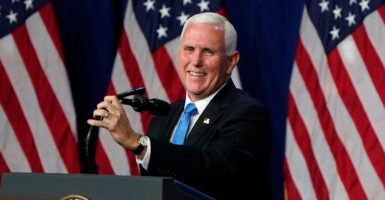
Courts Repeatedly Refused To Consider Trump’s Election Claims On The Merits

—-

Courts Repeatedly Refused To Consider Trump’s Election Claims On The Merits

The losing side needed to know that a fair shake was given, and that justice prevailed, even if it wasn’t the outcome they wanted. That did not happen after Nov. 3.

On Monday, without comment, the Supreme Court ended the last of the 2020 election cases, rejecting Trump v. Wisconsin Election Commission in a one-line order. It was a quiet ending to a tumultuous election season, but like a football game with a contentious call at the end, the debate over who really won will likely go on much longer.

The courts have always served as a pressure-relief valve on our internal disagreements. From the battle with an unscrupulous car dealer to a nasty divorce that requires discernment over how to split everything from the antique Corvette to the kids, wise judges can help to bring peace and healing. Surely, for a nation reeling after a tempestuous presidential election filled with strange occurrences, the courts were needed to bring us together.

We needed the steady hand of impartial jurists. Most of all, the losing side needed to know that a fair shake was given, and that justice prevailed, even if it wasn’t the outcome they wanted. That did not happen after Nov. 3. Despite a stack of cases that worked their way through the legal system, we remain bitterly divided.

A Rasmussen survey last month found that 61 percent of Republicans say Joe Biden did not win the election fairly. That number hasn’t changed much since early January, when 69 percent of GOP voters voiced the same concern. That 34 percent of all voters and 36 percent of independents agree with them is a strong signal that something went terribly amiss in the maelstrom of election cases.

The election is over. There has been an inauguration. So why did ABC’s George Stephanopoulos feel the need to berate a U.S. senator and his audience with the demand, “Can’t you just say the words: This election was not stolen?” Why must he shout, “There were 86 challenges filed by President Trump and his allies in court. All were dismissed!”

Perhaps, the answer lies in the details of those cases, as much in how they were adjudicated as in the final rulings.

Taking Stock of the 2020 Election Case List

Let’s start with some clarity: The list of more than 80 cases includes both the same cases that were appealed through various courts and many that had no direct tie to the president’s legal team or the Republican Party. In reality, there were 28 unique cases filed across the six contested states by President Trump or others on his behalf.

Twelve were filed in Pennsylvania, six in Georgia, and two or three in each of the other states. Of course, there was also the lawsuit filed by the state of Texas against the state of Pennsylvania that had the potential to change the outcome. So let’s call it 29.

To be sure, that is still a lot of cases. Yet to understand why there is still widespread unease with the election, would it not be better to stop demanding conformity and instead dig deeper to see what the courts told us in those cases, and what they did not? A review of them shows that, contrary to a common narrative, few were ever considered on the merits.

Death by Technicalities

First of all, we can recognize that many of the cases produced no useful information relative to election integrity. We learned nothing from a lawsuit dismissed by a state judge in Georgia (Boland v. Raffensperger) on the basis thatthe plaintiff had sued an “improper party” rather than hearing the merits of why the ballot rejection rate allegedly dropped from 1.53 percent in 2018 to 0.15 percent in the 2020 general election.

Also, did 20,000 people vote who do not live in the state, when Georgia’s electoral votes were allotted by an approximately 12,000 margin to Biden? We never learned the answers to those questions nor even examined the evidence, because Georgia Secretary of State Brad Raffensperger was not a candidate for office nor the election superintendent who conducted the election, and therefore per state law, was not liable.

Similarly, a Trump lawsuit in Michigan (Donald J. Trump for President, Inc. v. Benson) alleging state law was violated by the failure to allow access by observers, and seeking to stop counting, was ruled moot since it was not filed until 4:00 p.m. on Nov. 4, after votes were counted. The judge simultaneously relieved the secretary of state of responsibility for any wrongdoing because she had issued guidance requiring admission of credentialed challengers.

So we are left with the memory of the videos of vote counters clapping as Republican observers were evicted and of covers being placed over windows. The judge on this case also said Michigan Secretary of State Jocelyn Benson bore no legal responsibility for video monitoring of drop boxes nor of making video from such surveillance available, despite a recently passed law requiring surveillance of all drop boxes installed after Oct. 1.

A lawsuit in Pennsylvania, Metcalfe v. Wolf, claimed “approximately 144,000 to 288,000 completed mail-in and/or absentee ballots” in Pennsylvania may have been illegal based on testimony from a U.S. Postal Service contractor. The contractor said he was hired to haul a truck of what he believed to be this many completed mail-in ballots from New York to Pennsylvania. The complaint also alleged there was “evidence” of ballots that were backdated at a postal facility in Erie.

The judge tossed it since the state’s Election Code required their request to be filed within 20 days of the alleged violation, which was Nov. 23. They filed Dec. 4. We’ll never know if that truck brought in pallets of completed ballots—an amount sufficient to overturn the state’s Electoral College vote.

In Wisconsin, the Trump v. Evers suit allegedthat violations of state election law had occurred in Milwaukee and Dane Counties as municipal clerks issued absentee ballots without the required written application, that they illegally completed missing info on ballots, that absentee ballots were wrongly cast by voters claiming “Indefinite Confinement” status (and for which no ID was provided), and that Madison’s “Democracy in the Park” event violated election laws.

A divided Wisconsin Supreme Court refused to hear the lawsuit, sidestepping a decision on the merits of the claims and instead ruling the case must first wind its way through lower courts—an effective death sentence given the timing.

Absurdities: When ‘Shall’ Doesn’t Mean Shall

At times, judges resorted to Clintonian wordsmithing to relieve a word of its recognized meaning. A state Supreme Court judge in Pennsylvania was tasked with reviewing the eligibility of 2,349 mail-in ballots that were purportedly defective according to the state Election Code (Ziccarelli v. Allegheny County Board of Elections).

In the court’s decision, he noted “We agree with the Campaign’s observation that…the General Assembly set forth the requirements for how a qualified elector may cast a valid absentee or mail-in ballot … We further agree that these sections of the Election Code specifically provide that each voter ‘shall(emphasis added) fill out, date, and sign’ the declaration on the outside envelope. We do not agree with the Campaign’s contention, however, that because the General Assembly used the word ‘shall’ in this context, it is of necessity that the directive is a mandatory one …”

Indeed. Why even write laws? Perhaps the Pennsylvania Supreme Court would feel differently if their rulings were subjected to such an open interpretation.

A federal lawsuit in the same state (Donald J. Trump for President, Inc. v. Boockvar) included a claim that some Democrat counties implemented a “notice and cure” policy, allowing defective ballots to be fixed and counted, while Republican counties did not, thereby creating an equal protection issue.

The judge found that two individual plaintiffs had indeed been harmed by the denial of their votes, but that they lacked standing since the defendant (Democrat) counties “had nothing to do with the denial of Individual Plaintiff’s ability to vote” as their “ballots were rejected by Lancaster and Fayette [Republican] Counties, neither of which is a party to this case.”

So the judge effectively created a legal “Catch 22” in which one must show direct harm from an unrelated party in order to prevail. Logically, under this standard, no equal protection claim could ever be substantiated.

In a Nov. 5 filing (Donald J. Trump for President, Inc. v. Philadelphia County Board of Elections), Republicans alleged that the Philadelphia County Board was “intentionally refusing to allow any representatives and poll watchers for President Trump and the Republican Party … [and] continuing to count ballots, without any observation” by Republican poll watchers. The Commonwealth Court agreed on appeal that observers be allowed within six feet of vote counting while complying with COVID-19 protocols.

However, the state Supreme Court reversedthat ruling, finding that the Election Code allows the board to make rules “for protecting its workers’ safety from COVID-19 and physical assault,” and that the only requirement is that “one authorized representative of each candidate in an election and one representative from each political party shall be permitted to remain in the room”— not necessarily within close-enough range to observe vote-counting (emphasis original in court decision). So what is the point of an observer who cannot observe anything?

In the case of Ward v. Jackson et al. in Arizona, an issue over election observers was ruled as “untimely” since “the observation procedures for the November general election were materially the same as for the August primary election, and any objection to them should have been brought at a time when any legal deficiencies could have been cured.” Lacking in that statement was an explanation as to why any Republican observers would have been needed in a Democrat-only party primary.

Judicial Blindness: See No Evil

In the same lawsuit (Ward v. Jackson et al.) the judge also rejected a claim of improper signature verification after allowing a review of 100 sample ballots. Plaintiff and defense experts found 6 and 11 percent of signatures, respectively, to be “inconclusive.”

On the same page of his opinion, the judge noted that out of the total 1.9 million mail-in ballots, only approximately 20,000 had been identified as having a signature issue, or 1 percent. There was no explanation as to why poll workers found six times fewer issues with signatures. The math would suggest either a bias to accept, despite signature issues, or that the sample examined was statistically invalid.

Further mystifying, he wrote that “there is no evidence that the manner in which signatures were reviewed was designed to benefit one candidate or another.” But surely fraud can easily benefit the offender alone, even with use of a uniform vote-count procedure. Fill out 1,000 ballots consisting of 500 for Trump and 500 for Biden, then mix in 100 more that are fraudulent for Biden and count them using any method. Who wins? It’s not a hard possibility to imagine, but the judge ignored it.

He also concluded “the evidence does not show illegal votes”—in a state in which an estimated 419,000 illegally present foreign citizensreside, and which went to Biden by a margin of just more than 10,000 votes out of a total of more than 3.2 million.

Importantly, the judge noted at the outset that “the Plaintiff in an election contest has a high burden of proof and the actions of election officials are presumed to be free from fraud and misconduct.” It’s a fair statement of the law. It’s also an indication of the difficulty in prevailing, even when issues exist. Every case across the nation was evaluated under a similar high hurdle, with the status quo treated as sacrosanct.

Too Early and Too Late

Republicans also often found themselves in an impossible “damned if you do, damned if you don’t” situation on the timing of challenges to election laws.

In Georgia Republican Party, Inc. et al. v. Raffensperger et al, candidates Kelly Loeffler and David Perdue sued prior to their U.S. Senate run-offs, alleging harm would occur from unconstitutional election procedures. Their counsel noted (on appeal) that the court “dismissed the case for lack of standing, reasoning that ‘the Supreme Court instructs that a theory of future injury is too speculative to satisfy the well-established requirement that threatened injury must be certainly impending.’” Filed too early.

In the same state, a federal judge dismissed Sidney Powell’s lawsuit (Pearson v. Kemp), in part citing that it was filed too late—it should have been filed before the election. As another example, in Trump v. Wisconsin Elections Commission, a judge dismissed the president’s suit saying it involved “issues he plainly could have raised before the vote occurred.”

Together, it demonstrated the hurdle that many election cases faced—denied before the election as “speculative,” or afterward as too late.

The Clock Ran Out: January 6

Several lawsuits were resolved not by a weighing of merits, but as a practical consequence of the electoral vote on Jan. 6 that certified Biden as the winner of the presidency.

Trump had filed suit on Dec. 4 in Georgia (Trump v. Raffensperger) alleging violations of state election law and the inclusion of specific ineligible votes: 66,247 underage votes, 2,423 persons not registered, 15,700 who had changed address, 1,043 who illegally listed a P.O. box address as their address, 8,718 who died prior to their votes being cast, 92 absentee ballots counted prior to the date those voters requested a ballot, 217 ballots shown as applied for and sent out and received on the same day, and 2,560 votes from felons with uncompleted sentences. These were significant numbers in an election that was decided by fewer than 12,000 votes.

The suit had also noted that 305,701 had applied for an absentee ballot more than 180 days prior to election, thereby violating state law.

The suit had also noted that 305,701 had applied for an absentee ballot more than 180 days prior to election, thereby violating state law. Importantly, it also took issue with the secretary of state’s Consent Decree with Democrats, which allowed signature matching on envelopes and applications, but not versus registration rolls. And it cited the low 0.34 percent rejection rate of mail-in ballots, a tenth of the rate of prior elections, despite a six-fold increase in number of such ballots cast.

The suit was withdrawn on Jan. 7, with none of the issues resolved, the day after Congress met and the matter was rendered moot.

Another Georgia suit (Still v. Raffensperger) alleged that Coffee County Board had been unable to replicate electronic recount results, and that the error was sufficient to put the outcome of that county in doubt, with a potentially similar issue in others across the state. It noted that Raffensperger had forced an arbitrary Dec. 4 deadline to certify the results despite the county’s letter of the same date saying the results “should not be used.”

The legal battle continued, and the state’s counsel eventually demanded in a Jan. 3 letterthat all lawsuits against Kemp, Raffensperger, and the State Elections Board be dropped in order to “cooperatively share information.” Otherwise, they would remain in a “litigation posture”—quite a telling comment. Why was cooperation ever resisted?

Trump’s counsel accepted the offer of dismissal to get information they had requested, but it came as the timeframe to use it ended on Jan. 6. The suit was withdrawn on Jan. 7.

The Supreme Court Punted

The nation’s highest court showed some early inclination for involvement in the brewing election issues, such as Justice Samuel Alito’s order to separate certain late ballots in Pennsylvania in Republican Party of Pennsylvania v. Boockvar. Yet it soon took a different tone. A petition to expedite a hearing was denied and later the court refused the case.

In December, the court rejected a key lawsuit filed by the state of Texas (Texas v. Pennsylvania), and joined by 18 other state attorneys general, alleging that Pennsylvania, Georgia, Michigan, and Wisconsin violated the U.S. Constitution by changing election procedures through non-legislative means. The justices ruled that Texas lacked standing under Article III of the Constitution to challenge the results of the election held by another state.

The court could have held these claims up to the objective light of justice, and either exposed it all as painfully true or wildly false, but it didn’t.

In Kelly v. Pennsylvania, Rep. Mike Kelly claimed that the recently enacted Act 77 to expand mail-in balloting violated the state constitution, as amended in 1967, that “allowed for absentee ballots to be cast in the four (4) exclusive circumstances authorized under Article VII, Section 14.”

He also noted that “the legislature first recognized their constitutional constraints and the need to amend the constitution in order to enact mail-in voting, sought to amend the constitution to lawfully allow for the legislation they intended to pass, and subsequently abandoned their efforts to comply with the constitution and instead enacted Act 77 irrespective of their actual knowledge that they lacked the legal authority to do so unless and until the proposed constitutional amendment was ratified by approval of a majority of the electors …”

A Commonwealth Court judge agreed on Nov. 25 and ordered that any action to certify the election be stopped, pending an evidentiary hearing two days later. However, on Nov. 28, the Supreme Court of Pennsylvania reversed that decision, saying the “Petitioners sought to invalidate the ballots of the millions of Pennsylvania voters who utilized the mail-in voting procedures established by Act 77 and count only those ballots that Petitioners deem to be ‘legal votes.’”

Yes, that is exactly what the plaintiffs sought—the counting of only legal votes. But again, like many other courts, this one relied on a philosophy that excluding any ballots would disenfranchise voters. So they set aside the state constitution for their own preference.

The U.S. Supreme Court refused to expedite an appeal on this case when it would have mattered, then recently refused to hear it at all, a decision Justice Clarence Thomas called “inexplicable” in his dissent.

The Supreme Court also refused to hear any of Sidney Powell’s cases—in Arizona, Wisconsin, and Michigan—and in doing so, deprived Americans of the chance to hear evidence for and against very serious claims that electronic voting machines could be manipulated. Of all of the allegations, perhaps none more so instilled fear into voters as the possibility that our votes could be tampered with and changed, thwarting democracy itself.

Did the machines really show decimal totals for votes rather than integers? Were they designed to flip votes, and in such a way that no audit could trace it? Were these machines connected to the internet on election night, and did data show that foreign actors accessed it? Voters will never know. The court could have held these claims up to the objective light of justice, and either exposed it all as painfully true or wildly false, but it didn’t.

When most needed, the court that once took the time to render a decision on whether a tomato is a fruit or vegetable chose to punt on each of the key presidential election cases. American voters are worse off for it as confidence in elections erodes.

Lessons Learned

President Trump always had a very uphill climb to prevail. This wasn’t a one-state battle as in the George W. Bush versus Al Gore contest. Trump was effectively required to play six-dimensional chess, in six states, all in the span of a few months.

Trump was effectively required to play six-dimensional chess, in six states, all in the span of a few months.

As Andy McCarthy noted, “a brutally tight time frame took effect [upon contesting the election], imposed by state and federal deadlines. It is a drastic departure from the normal litigation pace of investigation, legal research, and the formulation of cognizable claims.” Indeed, it was a nearly impossible task. It was even harder when Trump’s attorneys were influenced and threatened.

In the end, should we be surprised that voters retain a strong sense of skepticism over the outcome of the presidential election? That a man who largely campaigned from his basement, who exhibited signs of age-related mental decline, could handily defeat a vigorous incumbent who drew immense crowds is naturally hard to believe.

The election of 2020, which included more than 155 million votes, was decided by approximately 300,000 votes in six states, or 0.2 percent of the electorate, all of which came by an unnatural flip of results late on election night. Despite judges’ repeated hand-wringing that any court action would disenfranchise millions of voters, the reality is that millions of others may have been disenfranchised, and they instinctively suspect so.

The one thing many voters seem to have learned through the legal chaos is that it’s easier to commit election violations than to stop them. So the electorate remains divided—even after “86 election cases.”

Bob Anderson is a partner and CFO of a hotel development company and a former aerospace engineer who worked on the International Space Station and interned in Reagan’s Strategic Defense Initiative Organization (SDIO) at the Pentagon. He is also a licensed commercial pilot.

7 Ways the 2005 Carter-Baker Report Could Have Averted Problems With 2020 Election

Continue reading

5 Charts Show Why Congress Must Stop Adding to National Debt

Debt Stimulus Package

An enormous “stimulus” package was signed into law on Thursday, which is expected to bring government spending for this year to $6.9 trillion. This will add dramatically add to the national debt, which is currently at $28 trillion. Pictured: Speaker of the House Nancy Pelosi, D-Calif., conducts a news conference on the on the stimulus bill on Tuesday. (Photo: Tom Williams/CQ-Roll Call, Inc./Getty Images)

President Joe Biden signed into law an enormous, debt-financed “stimulus” package on Thursday. This was the final step in a multi-month process to pass a heavily flawed piece of legislation.

We might be tempted to hope that this will finally sate the left’s appetite for big government. After all, the size and scope of government will expand more than 54%—from $4.5 trillion of annual spending in 2019 to about $6.9 trillion this year—once the new spending bill is factored in, based on calculations by experts at The Heritage Foundation.

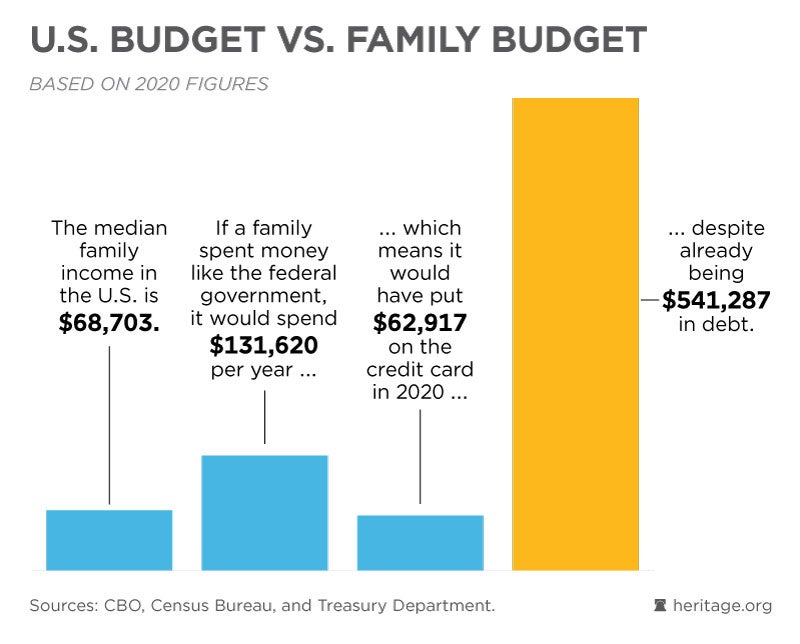
Washington added $4.5 trillion to the national debt over the last year alone. This brings the total debt level to $28 trillion, or roughly $225,000 per U.S. household.

Unfortunately, even that might not be enough to get congressional leaders and the Biden administration to pump the brakes on the spending spree. A planned infrastructure spending package could top $2 trillion, and there is little appetite to pay for it.

Want to keep up with the 24/7 news cycle? Want to know the most important stories of the day for conservatives? Need news you can trust? Subscribe to The Daily Signal’s email newsletter. Learn more >>

There are plenty of reasons why Congress should avoid another bloated spending deal. The nonpartisan Congressional Budget Office issued a report last week detailing one of the most important reasons: our nation’s finances are rapidly heading into dangerous territory.

While the numbers involved can seem incomprehensibly large, these charts can help to visualize the looming disaster.

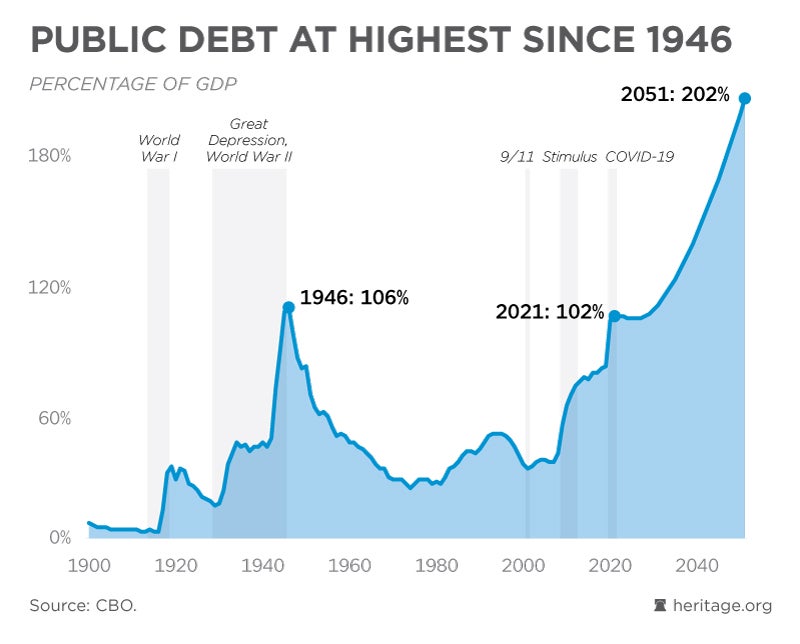
The federal government amassed a record-setting amount of debt during the Great Depression and World War II. When the war was over, federal spending was adjusted from 41% of the economy in 1945 to 11.4% in 1948.

A combination of lower spending and rapid revenue increases from the post-war economic boom meant that the national debt shrank dramatically relative to the economy.

Unfortunately, such rapid debt reduction would be almost impossible to duplicate today.

Even the most optimistic growth forecasts fall well short of what was seen after World War II. More importantly, because most federal spending goes towards established benefit programs like Social Security and Medicare, it would be extremely difficult to cut spending at a similar pace.

However, policies to boost economic growth and restrain spending are still the best way to prevent the national debt from reaching crisis proportions.

In 2020, the federal government spent almost twice as much as it took in from taxes. The new legislative package means that this year’s deficit will likely be even bigger than last year’s.

These sky-high deficits add to an even larger total debt.

Uncle Sam has benefitted from a run of low interest rates over the last several years, blunting the cost of the escalating debt. Yet we can’t assume that this will last forever.

If you went to a bank for a big loan, you would expect them to ask some tough questions about your finances. The same holds true for the global financial system, which we count on to buy our debt.

While short-term federal bonds are still considered a safe investment, markets are demanding much higher yields for longer-term debt. Credit rating agencies have recently warnedthat our credit rating could be downgraded unless steps are taken to address overspending and the debt.

They have also cautioned us that interest rates will rise. This signals that our days of cheap creditcould be coming to an end sooner than we would want. If that happens, America will pay a steep price.

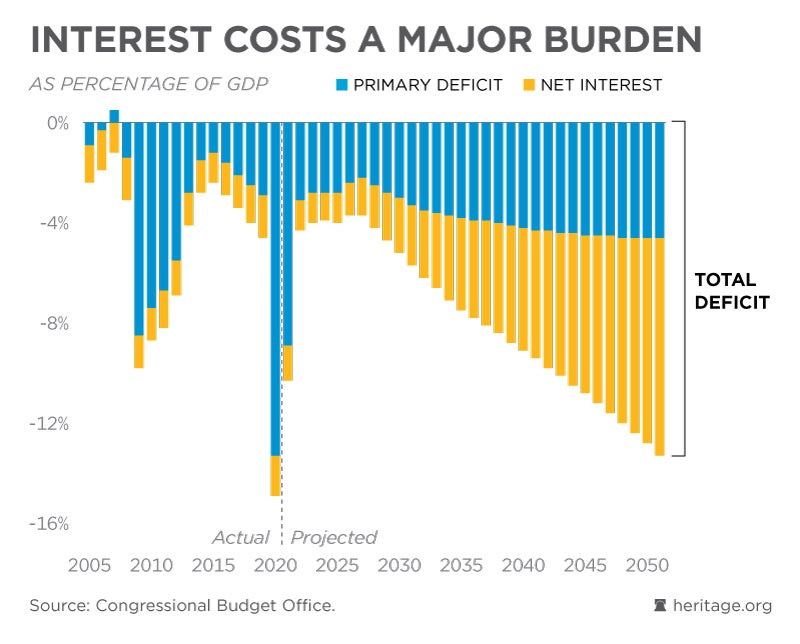
That “steep price” is not metaphorical. The Congressional Budget Office’s new report shows that the cost of servicing the national debt was already set to explode before the stimulus package passed.

Right now, interest on the debt is a burden the economy can handle. However, even a modest interest rate increase—coupled with continued irresponsibility from Washington—will cause interest costs to increase more than five-fold in the next few decades.

This would be an anchor around the neck for the economy, and would make the growth and prosperity we take for granted next to impossible for future generations to experience.

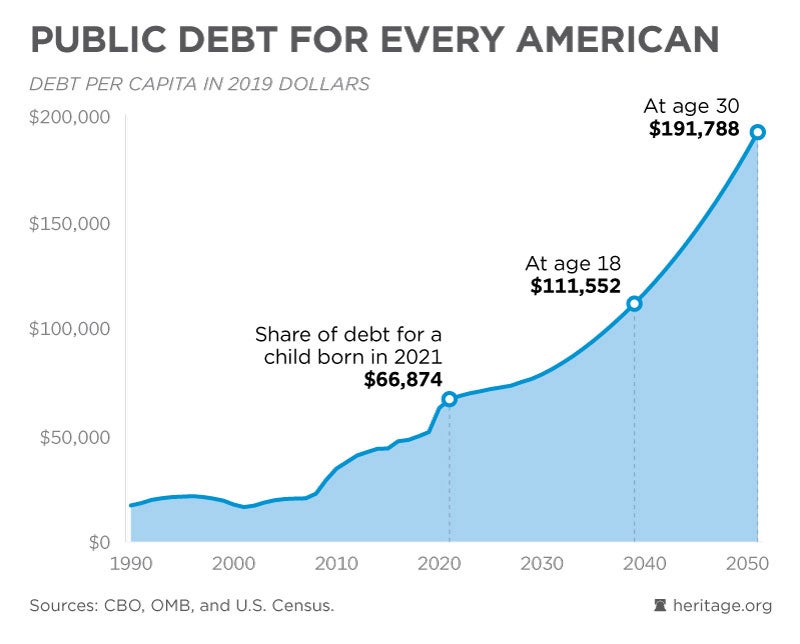
In the not-so-distant past—specifically, the year 2018—the amount of public debt per person was just under $50,000. Today, it stands at nearly $67,000 for every American, including children.

It only gets worse from there. A baby born tomorrow is expected to have over $111,000 in debt to their name when they turn 18, and nearly $192,000 by age 30.

Those numbers do not account for the new stimulus bill, a potential infrastructure package, or expanded benefit programs. Instead, the main reason why debt will skyrocket over the coming years is because federal spending is being allowed to grow without limits.

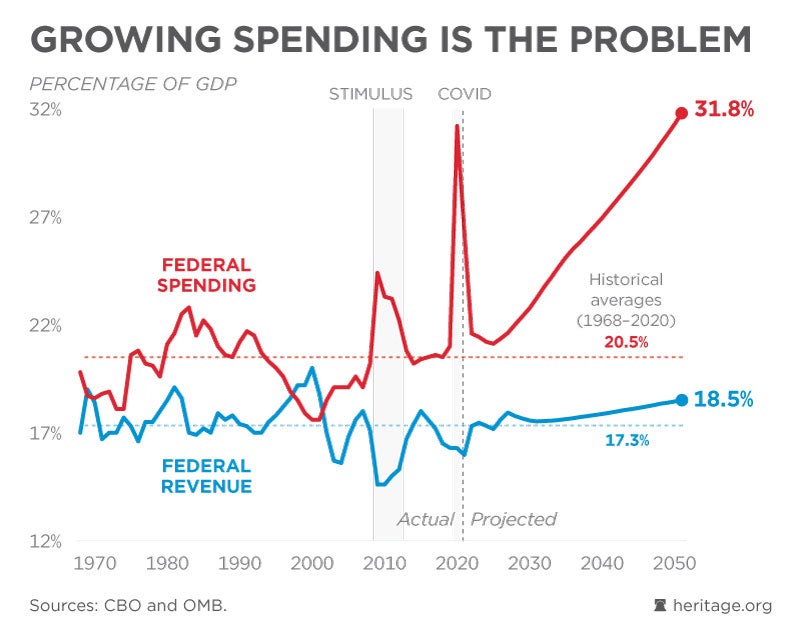
While some on the left blame the 2017 tax cuts for deficits, this chart makes it clear that the culprit for our long-term financial gap is an explosion in federal spending.

Spending was already above the historical average in 2019, and will grow much faster than the economy from 2022 onwards. Meanwhile, revenue will soon return to normal levels.

Why do we expect such a rapid increase in federal spending? A handful of programs, primarily Social Security, Medicare, and Medicaid, have been set up in an unsustainable way. Reforming these programs by balancing the needs of both retirees and future generations would be a tremendous breakthrough.

However, Congress has consistently avoided the issue of unsustainable programs, and has even made things worse by expanding benefits. The longer Washington waits to confront this problem, the more drastic the remedies will have to be.

Experts from The Heritage Foundation have provided legislators with the policy tools they need to address this mounting crisis, meaning members of Congress can’t plead ignorance.

Those in positions of leadership have a responsibility to do the right thing for present and future Americans, and the public must hold them accountable if they do not.

Have an opinion about this article? To sound off, please email letters@DailySignal.com and we will consider publishing your remarks in our regular “We Hear You” feature.

—-

March 31, 2021

President Biden  c/o The White House
1600 Pennsylvania Avenue NW
Washington, DC 20500

Dear Mr. President,

Please explain to me if you ever do plan to balance the budget while you are President? I have written these things below about you and I really do think that you don’t want to cut spending in order to balance the budget. It seems you ever are daring the Congress to stop you from spending more.

President Barack Obama speaks about the debt limit in the East Room of the White House in Washington. | AP Photo

“The credit of the United States ‘is not a bargaining chip,’ Obama said on 1-14-13. However, President Obama keeps getting our country’s credit rating downgraded as he raises the debt ceiling higher and higher!!!!

Washington Could Learn a Lot from a Drug Addict

Just spend more, don’t know how to cut!!! Really!!! That is not living in the real world is it?

Making more dependent on government is not the way to go!!

Why is our government in over 16 trillion dollars in debt? There are many reasons for this but the biggest reason is people say “Let’s spend someone else’s money to solve our problems.” Liberals like Max Brantley have talked this way for years. Brantley will say that conservatives are being harsh when they don’t want the government out encouraging people to be dependent on the government. The Obama adminstration has even promoted a plan for young people to follow like Julia the Moocher.  

David Ramsey demonstrates in his Arkansas Times Blog post of 1-14-13 that very point:

Arkansas Politics / Health Care Arkansas’s share of Medicaid expansion and the national debt

Posted by on Mon, Jan 14, 2013 at 1:02 PM

Baby carrot Arkansas Medicaid expansion image

Imagine standing a baby carrot up next to the 25-story Stephens building in Little Rock. That gives you a picture of the impact on the national debt that federal spending in Arkansas on Medicaid expansion would have, while here at home expansion would give coverage to more than 200,000 of our neediest citizens, create jobs, and save money for the state.

Here’s the thing: while more than a billion dollars a year in federal spending would represent a big-time stimulus for Arkansas, it’s not even a drop in the bucket when it comes to the national debt.

Currently, the national debt is around $16.4 trillion. In fiscal year 2015, the federal government would spend somewhere in the neighborhood of $1.2 billion to fund Medicaid expansion in Arkansas if we say yes. That’s about 1/13,700th of the debt.

It’s hard to get a handle on numbers that big, so to put that in perspective, let’s get back to the baby carrot. Imagine that the height of the Stephens building (365 feet) is the $16 trillion national debt. That $1.2 billion would be the length of a ladybug. Of course, we’re not just talking about one year if we expand. Between now and 2021, the federal government projects to contribute around $10 billion. The federal debt is projected to be around $25 trillion by then, so we’re talking about 1/2,500th of the debt. Compared to the Stephens building? That’s a baby carrot.

______________

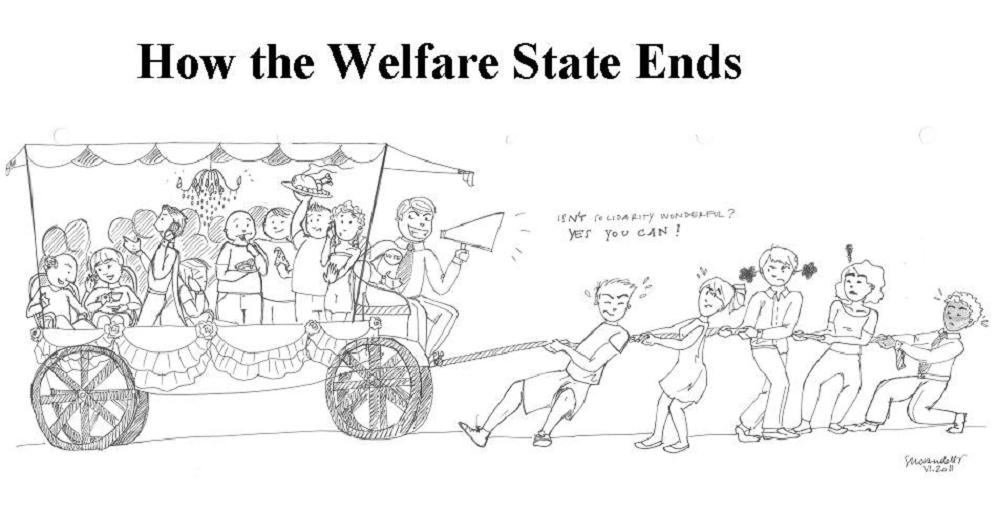
Here is how it will all end if everyone feels they should be allowed to have their “baby carrot.”

How sad it is that liberals just don’t get this reality.

Here is what the Founding Fathers had to say about welfare. David Weinberger noted:

While living in Europe in the 1760s, Franklin observed: “in different countries … the more public provisions were made for the poor, the less they provided for themselves, and of course became poorer. And, on the contrary, the less was done for them, the more they did for themselves, and became richer.”

Alexander Fraser Tytler, Lord Woodhouselee (15 October 1747 – 5 January 1813) was a Scottish lawyer, writer, and professor. Tytler was also a historian, and he noted, “A democracy cannot exist as a permanent form of government. It can only exist until the majority discovers it can vote itself largess out of the public treasury. After that, the majority always votes for the candidate promising the most benefits with the result the democracy collapses because of the loose fiscal policy ensuing, always to be followed by a dictatorship, then a monarchy.”

Thomas Jefferson to Joseph Milligan

April 6, 1816

[Jefferson affirms that the main purpose of society is to enable human beings to keep the fruits of their labor. — TGW]

To take from one, because it is thought that his own industry and that of his fathers has acquired too much, in order to spare to others, who, or whose fathers have not exercised equal industry and skill, is to violate arbitrarily the first principle of association, “the guarantee to every one of a free exercise of his industry, and the fruits acquired by it.” If the overgrown wealth of an individual be deemed dangerous to the State, the best corrective is the law of equal inheritance to all in equal degree; and the better, as this enforces a law of nature, while extra taxation violates it.

[From Writings of Thomas Jefferson, ed. Albert E. Bergh (Washington: Thomas Jefferson Memorial Association, 1904), 14:466.]

_______

Jefferson pointed out that to take from the rich and give to the poor through government is just wrong. Franklin knew the poor would have a better path upward without government welfare coming their way. Milton Friedman’s negative income tax is the best method for doing that and by taking away all welfare programs and letting them go to the churches for charity.

_____________

_________

Thank you so much for your time. I know how valuable it is. I also appreciate the fine family that you have and your commitment as a father and a husband.

Sincerely,

Everette Hatcher III, 13900 Cottontail Lane, Alexander, AR 72002, ph 501-920-5733

Williams with Sowell – Minimum Wage

Thomas Sowell

Thomas Sowell – Reducing Black Unemployment

By WALTER WILLIAMS

—-

Ronald Reagan with Milton Friedman
Milton Friedman The Power of the Market 2-5

Related posts:

Welfare Spending Shattering All-Time Highs

  We got to act fast and get off this path of socialism. Morning Bell: Welfare Spending Shattering All-Time Highs Robert Rector and Amy Payne October 18, 2012 at 9:03 am It’s been a pretty big year for welfare—and a new report shows welfare is bigger than ever. The Obama Administration turned a giant spotlight […]

We need more brave souls that will vote against Washington welfare programs

We need to cut Food Stamp program and not extend it. However, it seems that people tell the taxpayers back home they are going to Washington and cut government spending but once they get up there they just fall in line with  everyone else that keeps spending our money. I am glad that at least […]

Welfare programs are not the answer for the poor

Government Must Cut Spending Uploaded by HeritageFoundation on Dec 2, 2010 The government can cut roughly $343 billion from the federal budget and they can do so immediately. __________ Liberals argue that the poor need more welfare programs, but I have always argued that these programs enslave the poor to the government. Food Stamps Growth […]

Private charities are best solution and not government welfare

Milton Friedman – The Negative Income Tax Published on May 11, 2012 by LibertyPen In this 1968 interview, Milton Friedman explained the negative income tax, a proposal that at minimum would save taxpayers the 72 percent of our current welfare budget spent on administration. http://www.LibertyPen.com Source: Firing Line with William F Buckley Jr. ________________ Milton […]

The book “After the Welfare State”

Dan Mitchell Commenting on Obama’s Failure to Propose a Fiscal Plan Published on Aug 16, 2012 by danmitchellcato No description available. ___________ After the Welfare State Posted by David Boaz Cato senior fellow Tom G. Palmer, who is lecturing about freedom in Slovenia and Tbilisi this week, asked me to post this announcement of his […]

President Obama responds to Heritage Foundation critics on welfare reform waivers

Is President Obama gutting the welfare reform that Bill Clinton signed into law? Morning Bell: Obama Denies Gutting Welfare Reform Amy Payne August 8, 2012 at 9:15 am The Obama Administration came out swinging against its critics on welfare reform yesterday, with Press Secretary Jay Carney saying the charge that the Administration gutted the successful […]

Welfare reform part 3

Thomas Sowell – Welfare Welfare reform was working so good. Why did we have to abandon it? Look at this article from 2003. The Continuing Good News About Welfare Reform By Robert Rector and Patrick Fagan, Ph.D. February 6, 2003 Six years ago, President Bill Clinton signed legislation overhauling part of the nation’s welfare system. […]

Welfare reform part 2

Uploaded by ForaTv on May 29, 2009 Complete video at: http://fora.tv/2009/05/18/James_Bartholomew_The_Welfare_State_Were_In Author James Bartholomew argues that welfare benefits actually increase government handouts by ‘ruining’ ambition. He compares welfare to a humane mousetrap. —– Welfare reform was working so good. Why did we have to abandon it? Look at this article from 2003. In the controversial […]

Why did Obama stop the Welfare Reform that Clinton put in?

Thomas Sowell If the welfare reform law was successful then why change it? Wasn’t Bill Clinton the president that signed into law? Obama Guts Welfare Reform Robert Rector and Kiki Bradley July 12, 2012 at 4:10 pm Today, the Obama Department of Health and Human Services (HHS) released an official policy directive rewriting the welfare […]

“Feedback Friday” Letter to White House generated form letter response July 10,2012 on welfare, etc (part 14)

I have been writing President Obama letters and have not received a personal response yet.  (He reads 10 letters a day personally and responds to each of them.) However, I did receive a form letter in the form of an email on July 10, 2012. I don’t know which letter of mine generated this response so I have […]

Zuckerberg Grant Allowed Outsider to Infiltrate Presidential Election in Wisconsin

—-

Zuckerberg Grant Allowed Outsider to Infiltrate Presidential Election in Wisconsin

Emails and other documents show that grant money from left-leaning groups funded by Facebook CEO Mark Zuckerberg led to Democrats’ infiltrating the presidential election in Wisconsin’s five largest cities. Pictured: A voter casts his ballot last April 7 in a primary election at Journey Church in Kenosha, Wisconsin. (Photo: Kamil Krzacznski/Getty Images)

MADISON, Wis.—When Facebook CEO Mark Zuckerberg and his wife handed out hundreds of millions of dollars last year for a national safe-voting initiative, the “donation” was heralded as vital support to “protect American elections” and to “bolster democracy during the pandemic.”

But what the grant money really purchased in battleground states such as Wisconsin was infiltration of the November presidential elections by liberal groups and Democratic activists, according to hundreds of pages of emails and other documents obtained by Wisconsin Spotlight.

In the city of Green Bay, which received a total of $1.6 million in grant funding from the Zuckerberg-funded Center for Tech and Civic Life, a “grant mentor” who has worked for several Democratic Party candidates, was given access to boxes of absentee ballots before the election.

Michael Spitzer-Rubenstein, Wisconsin state leader for the National Vote at Home Institute, in many ways became the de facto city elections chief.

Want to keep up with the 24/7 news cycle? Want to know the most important stories of the day for conservatives? Need news you can trust? Subscribe to The Daily Signal’s email newsletter. Learn more >>

The emails show Green Bay’s highly partisan Mayor Eric Genrich, a Democrat, and his staff usurping City Clerk Kris Teske’s authority and letting the Zuckerberg-funded “grant team” take over—a clear violation of Wisconsin election statutes, say election law experts.

And the liberal groups were improperly insinuating themselves into the election system and coordinating with what became known as the “Wisconsin 5,” the state’s five largest communities that split more than $6 million in Zuckerberg money.

The emails expose the dangers of handing over the administrative keys to private “fair election” groups with a clear political agenda.

In final official results in Wisconsin, Democrat nominee Joe Biden defeated President Donald Trump by 49.6% to 48.9% of the vote, flipping a state that Trump won in 2016.

State Rep. Janel Brandtjen, R-Menomonee Falls, who chairs the Wisconsin State Assembly’s Campaigns and Elections Committee, said the Green Bay emails, first obtained by state Rep. Shae Sortwell, R-Two Rivers, through an open records request, was to be front and center Wednesday at a hearing before the elections committee.

“Going forward, if we don’t address them, I think we have a breakdown in Wisconsin’s political system,” Brandtjen said.

Outside Help

In July, the Center for Tech and Civic Life announced it was awarding grants totaling $6.3 million to the state’s five largest cities. Green Bay received nearly $1.1 million, and then picked up another half-million dollars in a supplemental grant.

The money ostensibly was to be used to “support election administration in the midst of the COVID-19 pandemic.” The “Wisconsin 5,” heavy Democratic strongholds, worked together to secure the funding.

The grants were thanks to the $250 million “gift” from the CEO of Facebook, the social network giant that has silenced conservative speech. Zuckerberg would drop another $100 million on his “safe elections” agenda before the pivotal November presidential election.

It was clear early on that the grant would come with a side of politics.

“I’ve been reading things on Facebook about people complaining where the million [-dollar grant] is coming from. I think it might get political,” Teske, then-Green Bay city clerk, wrote in a July 14 email to Diana Ellenbecker, the city’s finance director and Teske’s boss.

Teske wrote that Celestine Jeffreys, the mayor’s chief of staff, “talked about having advisers from the organization giving the grant who will be ‘helping us’ with the election and I don’t know anything about that.”

Eventually, the advisers would play an extensive role in “helping” administer Green Bay’s election.

“We are really excited to put the funds to work to make sure that every Green Bay resident has the opportunity to vote safely and securely in August and November,” Genrich said in a press release announcing the grant.

The mayor championed the grant and the Green Bay City Council approved the funding—with conditions from the grant provider.

“CTCL said, if you don’t follow our requirements, we get the money back,” said Erick Kaardal, an appellate law attorney representing the Wisconsin Voters Alliance, which challenged the constitutionality of election procedures in Arizona, Michigan, Pennsylvania, and Wisconsin following the election. “The city had to report to CTCL how it was spending the grant money, then [CTCL] introduced all of the nonprofits.”

Can We Help?

One of the key players involved was Spitzer-Rubenstein, the state leader for election security for the National Vote at Home Institute.

The institute, one of many left-leaning subcontractors in the “election support” network, is tied at the hip to the Center for Tech and Civil Life. CTCL’s founder and executive director is in the “Circle of Advisers” for the National Vote at Home Institute.

Spitzer-Rubenstein, who was tapped as point man for his organization’s efforts in Wisconsin, has a history of working for Democratic campaigns, according to his resume. In 2012, he interned for Melissa Mark-Viverito, a “fiercely liberal” Democrat and former speaker of the New York City Council.

Spitzer-Rubenstein sought to assist Green Bay elections officials correct or “cure” absentee ballots returned to the city clerk.

“Can we help with curing absentee ballots that are missing a signature or witness signature address?” he wrote to Teske, the city clerk, in an Oct. 7 email.

Although the Wisconsin Elections Commission permitted clerks to fix absentee ballot errors or omissions, it didn’t say former Democratic Party operatives could “help.”

The city clerk declined Spitzer-Rubenstein’s offer.

The mayor’s office applied pressure.

“The grant mentors would like to meet with you to discuss, further, the ballot curing process. Please let them know when you’re available,” Jeffreys, Genrich’s chief of staff, demanded of Teske.

Spitzer-Rubenstein assured the clerk that the National Vote at Home Institute had done the same for others.

“We have a process map that we’ve worked out with Milwaukee for their process,” he wrote. “We can also adapt the letter we’re sending out with rejected absentee ballots along with a call script alerting voters (We can also get people to make the calls, too, so you don’t need to worry about it.).”

Jeffreys told Wisconsin Spotlight that she hadn’t seen the emails (though she sent them), so she couldn’t comment on them. She said she probably wouldn’t have time to review them, even if they were sent to her.

Too Much ‘Help’

Teske was losing her patience—and control of her office. Several emails show the city clerk’s growing frustration with the mayor, his chief of staff, the city’s ad hoc elections committee, and the nonprofit interlopers who were making themselves at home in Green Bay election administration.

“As you know I am very frustrated, along with the Clerk’s Office. I don’t know what to do anymore,” the city clerk wrote in late August to Ellenbecker, her boss as finance director. “I am trying to explain the process but it isn’t heard. I don’t feel I can talk to the mayor after the last meeting you, me, Celestine, and the mayor had even though the door is supposedly open. I don’t understand how people who don’t have knowledge of the process can tell us how to manage the election.”

On Oct. 22, things apparently reached a boiling point. Teske told Ellenbecker that two members of the clerk’s staff wanted to quit, and another was looking for a new job. They were being ignored or bullied by the mayor’s office.

“They call me crying or they say they went home crying,” the clerk said.

Teske wondered if the grant team consultants understood Wisconsin election law.

“I also asked when these people from the grant give us advisers who is go [sic] to be determining if there [sic] opinion is legal or not,” she wrote July 9 in an email to Ellenbecker. “Every state has different election laws. And this group is from Illinois. They already should have pointed out that additional in-person early voting sites can’t happen because the deadline has passed.”

Eventually, Teske could take no more. On Oct. 22, she wrote in an email that she was taking a leave of absence. By the end of the year, she officially had resigned to take a similar position with the nearby community of Ashwaubenon.

Teske did not return Wisconsin Spotlight’s requests for comment.

Keys to the Election

In Teske’s absence, it appears that Spitzer-Rubenstein and his team ramped up their involvement in the upcoming election. The state leader for the National Vote at Home Institute seemed to be everywhere, leading just about every aspect of Green Bay’s election administration.

“Are the ballots going to be in trays/boxes within the bin? I’m at KI now, trying to figure out whether we’ll need to move the bins throughout the day or if we can just stick them along the wall and use trays or something similar to move the ballots between stations,” Spitzer-Rubenstein wrote in an email to city liaison Amaad Rivera two days before the election.

The KI Convention Center at Green Bay’s Hyatt Regency was where the election team decided to locate the city’s Central Count and where the absentee ballots were stored, late in the game.

Central Count originally was to be at City Hall, but space limitations and COVID-19 concerns forced the move to the convention center. At one point, a city official, after talking with a representative from the National Vote at Home Institute, was “brainstorming” about how the city could livestream Central Count at City Hall “so that [election observers] do not enter the building.”

Spitzer-Rubenstein was given the keys to the room where the absentee ballots were stored. A Hyatt Regency checklist instructed staff: “DO NOT UNLOCK GRAND BALLROOM UNTIL Michael Spitzer-Rubenstein IS WITH SECURITY WHEN UNLOCKING THE GRAND BALLROOM DOORS.”

Sandy Juno, who retired from the post of Brown County clerk in early January, said the contract stipulated that Spitzer-Rubenstein would have four of the five keys to the KI Center’s ballroom “several days before the election.”

The city of Green Bay literally gave the keys to the election to a Democratic Party operative from New York.

Green Bay Goes Rogue

Juno raised concerns about how the election was conducted in Green Bay. She told the Wisconsin Elections Commission that she believed the Central Count location was “tainted by the influence of a person working for an outside organization affecting the election.”

Nathan Judnic, Elections Commission staff attorney, said nothing prohibited the city from working with the groups, but “the inspectors and the absentee board of canvassers working the location are the individuals that are to be making decisions, not the consultants.”

It’s clear by the emails, though, that Spitzer-Rubenstein and crew were calling a lot of the shots.

Juno said Green Bay city officials, led by the mayor’s office, broke off communications with the Brown County clerk’s office long before the election.

“We had one municipality in Brown County that really went rogue,” she said. “In 2020, Green Bay was just on their own.”

Although the city may not have been communicating with the county, it was communicating and coordinating with the “WI-5,” particularly Milwaukee elections officials, the emails show.

Kaardal, the lawyer for the Wisconsin Voters Alliance, asserts that the liberal nonprofit groups worked with the mayor’s office, the Green Bay City Council, and the ad hoc election committee to usurp the city clerk’s authority.

Wisconsin election law clearly spells out that municipal clerks are in charge of administering elections. Kaardal said Center for Tech and Civic Life’s election security funding came with conditions that bound the city to give these left-leaning actors power they could not legally take.

The mayor and his team, as well as the City Council, had no legal right to limit the city clerk’s role in the elections, or take them over.

Kaardal said the question isn’t about election fraud; it’s about the laws broken by the third-party groups and the city, leaving doubt about the integrity of the election system.

“What’s critical to understand is how legally unauthorized all of this is,” said the lawyer, who also is special counsel for the Thomas More Society.

A top official for the Center for Tech and Civic Life did not return Wisconsin Spotlight’s request for comment.

Brandtjen, chairman of the Assembly’s Campaigns and Elections Committee, said liberal voters would have the same concerns if the shoe were on the other foot.

“I would liken it to if someone had the tea party running the elections in [Republican] Waukesha County,” the lawmaker said.

The Republican-controlled Legislature recently has introduced several reform bills, a response to myriad election integrity concerns leading up to and through the heated presidential election.

The package of bills includes legislation prohibiting clerks and election officials from curing ballots, returning to the original intent of the law that electors and witnesses for absentee voters fix mistakes or omissions.

Another reform measure would require private funding to go through the state, which would divide the money among more than just Wisconsin’s largest, most liberal cities.

“My constituents have had a lot of concerns about the 2020 elections. What we’ve seen in the back and forth of these emails in Green Bay legitimizes their concerns,” Brandtjen said.

Have an opinion about this article? To sound off, please email letters@DailySignal.com and we will consider publishing your remarks in our regular “We Hear You” feature.

7 Ways the 2005 Carter-Baker Report Could Have Averted Problems With 2020 Election

Continue reading

Dan Mitchell’s article The World’s Most Politically Illiterate Statement

The World’s Most Politically Illiterate Statement

Exactly one month ago, I declared that Congresswoman Ayanna Pressley deserved an award for the “world’s most economically illiterate statement” because of her claim that “poverty is not naturally occurring.”

In reality, poverty has been the norm throughout history. As documented by Professors Deirdre McCloskey and Don Boudreaux, it was only the development of capitalism (starting a few hundred years ago in Europe) that enabled humanity to enjoy amazing and unprecedented increases in living standards.

Moreover, Ms. Pressely was trying to argue that redistribution was the proper way to address poverty, and I concluded my column by noting “that part of her statement also is wrong, according to both U.S. data and global data.”

Today, I want to debunk another preposterous assertion.

David Smith of the U.K.-based Guardian wrote a columnyesterday claiming that Biden’s so-called stimulus should be celebrated since it marks an end to forty years of Reaganomics.

…he will…be on a mission to restore faith in government. Confidence in it “has been plummeting since the late 60s to what it is now”, Biden noted in his remarks last week. His legislation, called the American Rescue Plan, can correct that with the biggest expansion of the welfare state in decades. …Biden knows better than anyone what that means. When he was born, in 1942, the president was Franklin Roosevelt, architect of the New Deal… When Biden was a student at the University of Delaware, Lyndon Johnson embarked on his project of the “Great Society”… Then came Ronald Reagan and his famous quip: “The nine most terrifying words in the English language are: I’m from the government and I’m here to help.” …He described Johnson’s “Great Society” as a fundamental wrong turn and set about dismantling it. …This orthodoxy held and dominated the political centre ground. …Biden’s could hardly be more of a polar opposite. …All the more reason to enjoy his victory lap and celebrate that four decades of Reaganism and “trickle down” economics are at an end.

Some of that political analysis is reasonable. FDR’s failed New Deal did expand government, as did LBJ’s failed War on Poverty.

And it’s also true that Reagan challenged their big-government orthodoxy and was somewhat successful in reining in the welfare state (“dismantling it” is a huge exaggeration, however).

But the author’s claim that there were “four decades of Reaganism” is breathtaking nonsense.

  • George H.W. Bush expanded the burden of government.
  • George W. Bush expanded the burden of government.
  • Barack Obama expanded the burden of government.
  • Donald Trump expanded the burden of government.

That’s 24 years of statist policies after Reagan left office.

If Mr. Smith actually knew the subject matter and wanted to write an honest article, he could have made an argument about16 years of Reaganism because we also benefited from a net reduction in the burden of government during Clinton’s eight years in office.

But the 21st century has been nothing but bad news for proponents of free markets. If you peruse Economic Freedom of the World, you’ll find that America’s level of economic freedom peaked in 2000 with a score of 8.67 (on a 1-10 scale).

Now the score for the United States has dropped to 8.22.

By the way, that’s not catastrophically bad. There’s no immediate risk of America becoming another Greece. And we’ll presumably never turn into Venezuela, no matter how hard Biden tries (it wouldn’t even happen if Vice President Harris took over).

That being said, what we’ve endured over the past two decades definitely is not Reaganism. The “Washington Consensus” is just a distant memory.

P.S. David Smith’s article is an example of sloppy journalism at a left-wing newspaper, but I’ll always have a bit of fondness for the Guardian because of the unintended compliment it bestowed upon me back in 2009.

P.P.S. For younger readers who did not experience the Reagan years, here’s my assessment of his record and here are some videos of some of his iconic remarks (and here’s a bonus video).

Rand Paul questions if US borrowing puts country on path to become Venezuela

Paul’s comments came just a day after the Senate passed President Biden’s $1.9 trillion COVID-19 relief bill

Sen. Rand Paul, one of the most outspoken Republicans about government spending, took to Twitter Sunday to ask if Congress’ borrowing is putting the U.S. economy on the same path as Venezuela’s.

“New 1,000,000 bolivar note in Venezuela worth 53 cents,” Paul tweeted, while linking to a Bloomberg report on hyperinflation in Caracas. “Will US be the next Venezuela with Congress borrowing over $6 trillion in one year?”

Paul’s comments came just a day after the Senate passed President Biden’s $1.9 trillion COVID-19 relief bill in a 50-49 vote. Sen. Mitt Romney, R-Utah, also expressed dismay over some of what he identified as wasteful spending in the bill, including providing billions in financial assistance to states that do not need it.

“We’re going to be asking the American people to allow us to borrow money from China and others, pass that on to our kids and grandkids so that we can send money to states like California and mine that don’t need the money,” Romney said. “That doesn’t make any sense at all.”

GET THE FOX NEWS APP

Venezuela’s economy has deteriorated due to, oil prices, the coronavirus and years of hyperinflation, according to Reuters. Its central bank issued a new banknote worth 1 million bolivars that will be worth 52 cents. The report said that many Venezuelans use U.S. currency to complete transactions.

March 31, 2021

President Biden  c/o The White House
1600 Pennsylvania Avenue NW
Washington, DC 20500

Dear Mr. President,

Please explain to me if you ever do plan to balance the budget while you are President? I have written these things below about you and I really do think that you don’t want to cut spending in order to balance the budget. It seems you ever are daring the Congress to stop you from spending more.

President Barack Obama speaks about the debt limit in the East Room of the White House in Washington. | AP Photo

“The credit of the United States ‘is not a bargaining chip,’ Obama said on 1-14-13. However, President Obama keeps getting our country’s credit rating downgraded as he raises the debt ceiling higher and higher!!!!

Washington Could Learn a Lot from a Drug Addict

Just spend more, don’t know how to cut!!! Really!!! That is not living in the real world is it?

Making more dependent on government is not the way to go!!

Why is our government in over 16 trillion dollars in debt? There are many reasons for this but the biggest reason is people say “Let’s spend someone else’s money to solve our problems.” Liberals like Max Brantley have talked this way for years. Brantley will say that conservatives are being harsh when they don’t want the government out encouraging people to be dependent on the government. The Obama adminstration has even promoted a plan for young people to follow like Julia the Moocher.  

David Ramsey demonstrates in his Arkansas Times Blog post of 1-14-13 that very point:

Arkansas Politics / Health Care Arkansas’s share of Medicaid expansion and the national debt

Posted by on Mon, Jan 14, 2013 at 1:02 PM

Baby carrot Arkansas Medicaid expansion image

Imagine standing a baby carrot up next to the 25-story Stephens building in Little Rock. That gives you a picture of the impact on the national debt that federal spending in Arkansas on Medicaid expansion would have, while here at home expansion would give coverage to more than 200,000 of our neediest citizens, create jobs, and save money for the state.

Here’s the thing: while more than a billion dollars a year in federal spending would represent a big-time stimulus for Arkansas, it’s not even a drop in the bucket when it comes to the national debt.

Currently, the national debt is around $16.4 trillion. In fiscal year 2015, the federal government would spend somewhere in the neighborhood of $1.2 billion to fund Medicaid expansion in Arkansas if we say yes. That’s about 1/13,700th of the debt.

It’s hard to get a handle on numbers that big, so to put that in perspective, let’s get back to the baby carrot. Imagine that the height of the Stephens building (365 feet) is the $16 trillion national debt. That $1.2 billion would be the length of a ladybug. Of course, we’re not just talking about one year if we expand. Between now and 2021, the federal government projects to contribute around $10 billion. The federal debt is projected to be around $25 trillion by then, so we’re talking about 1/2,500th of the debt. Compared to the Stephens building? That’s a baby carrot.

______________

Here is how it will all end if everyone feels they should be allowed to have their “baby carrot.”

How sad it is that liberals just don’t get this reality.

Here is what the Founding Fathers had to say about welfare. David Weinberger noted:

While living in Europe in the 1760s, Franklin observed: “in different countries … the more public provisions were made for the poor, the less they provided for themselves, and of course became poorer. And, on the contrary, the less was done for them, the more they did for themselves, and became richer.”

Alexander Fraser Tytler, Lord Woodhouselee (15 October 1747 – 5 January 1813) was a Scottish lawyer, writer, and professor. Tytler was also a historian, and he noted, “A democracy cannot exist as a permanent form of government. It can only exist until the majority discovers it can vote itself largess out of the public treasury. After that, the majority always votes for the candidate promising the most benefits with the result the democracy collapses because of the loose fiscal policy ensuing, always to be followed by a dictatorship, then a monarchy.”

Thomas Jefferson to Joseph Milligan

April 6, 1816

[Jefferson affirms that the main purpose of society is to enable human beings to keep the fruits of their labor. — TGW]

To take from one, because it is thought that his own industry and that of his fathers has acquired too much, in order to spare to others, who, or whose fathers have not exercised equal industry and skill, is to violate arbitrarily the first principle of association, “the guarantee to every one of a free exercise of his industry, and the fruits acquired by it.” If the overgrown wealth of an individual be deemed dangerous to the State, the best corrective is the law of equal inheritance to all in equal degree; and the better, as this enforces a law of nature, while extra taxation violates it.

[From Writings of Thomas Jefferson, ed. Albert E. Bergh (Washington: Thomas Jefferson Memorial Association, 1904), 14:466.]

_______

Jefferson pointed out that to take from the rich and give to the poor through government is just wrong. Franklin knew the poor would have a better path upward without government welfare coming their way. Milton Friedman’s negative income tax is the best method for doing that and by taking away all welfare programs and letting them go to the churches for charity.

_____________

_________

Thank you so much for your time. I know how valuable it is. I also appreciate the fine family that you have and your commitment as a father and a husband.

Sincerely,

Everette Hatcher III, 13900 Cottontail Lane, Alexander, AR 72002, ph 501-920-5733

Williams with Sowell – Minimum Wage

Thomas Sowell

Thomas Sowell – Reducing Black Unemployment

By WALTER WILLIAMS

—-

Ronald Reagan with Milton Friedman
Milton Friedman The Power of the Market 2-5

Related posts:

Welfare Spending Shattering All-Time Highs

  We got to act fast and get off this path of socialism. Morning Bell: Welfare Spending Shattering All-Time Highs Robert Rector and Amy Payne October 18, 2012 at 9:03 am It’s been a pretty big year for welfare—and a new report shows welfare is bigger than ever. The Obama Administration turned a giant spotlight […]

We need more brave souls that will vote against Washington welfare programs

We need to cut Food Stamp program and not extend it. However, it seems that people tell the taxpayers back home they are going to Washington and cut government spending but once they get up there they just fall in line with  everyone else that keeps spending our money. I am glad that at least […]

Welfare programs are not the answer for the poor

Government Must Cut Spending Uploaded by HeritageFoundation on Dec 2, 2010 The government can cut roughly $343 billion from the federal budget and they can do so immediately. __________ Liberals argue that the poor need more welfare programs, but I have always argued that these programs enslave the poor to the government. Food Stamps Growth […]

Private charities are best solution and not government welfare

Milton Friedman – The Negative Income Tax Published on May 11, 2012 by LibertyPen In this 1968 interview, Milton Friedman explained the negative income tax, a proposal that at minimum would save taxpayers the 72 percent of our current welfare budget spent on administration. http://www.LibertyPen.com Source: Firing Line with William F Buckley Jr. ________________ Milton […]

The book “After the Welfare State”

Dan Mitchell Commenting on Obama’s Failure to Propose a Fiscal Plan Published on Aug 16, 2012 by danmitchellcato No description available. ___________ After the Welfare State Posted by David Boaz Cato senior fellow Tom G. Palmer, who is lecturing about freedom in Slovenia and Tbilisi this week, asked me to post this announcement of his […]

President Obama responds to Heritage Foundation critics on welfare reform waivers

Is President Obama gutting the welfare reform that Bill Clinton signed into law? Morning Bell: Obama Denies Gutting Welfare Reform Amy Payne August 8, 2012 at 9:15 am The Obama Administration came out swinging against its critics on welfare reform yesterday, with Press Secretary Jay Carney saying the charge that the Administration gutted the successful […]

Welfare reform part 3

Thomas Sowell – Welfare Welfare reform was working so good. Why did we have to abandon it? Look at this article from 2003. The Continuing Good News About Welfare Reform By Robert Rector and Patrick Fagan, Ph.D. February 6, 2003 Six years ago, President Bill Clinton signed legislation overhauling part of the nation’s welfare system. […]

Welfare reform part 2

Uploaded by ForaTv on May 29, 2009 Complete video at: http://fora.tv/2009/05/18/James_Bartholomew_The_Welfare_State_Were_In Author James Bartholomew argues that welfare benefits actually increase government handouts by ‘ruining’ ambition. He compares welfare to a humane mousetrap. —– Welfare reform was working so good. Why did we have to abandon it? Look at this article from 2003. In the controversial […]

Why did Obama stop the Welfare Reform that Clinton put in?

Thomas Sowell If the welfare reform law was successful then why change it? Wasn’t Bill Clinton the president that signed into law? Obama Guts Welfare Reform Robert Rector and Kiki Bradley July 12, 2012 at 4:10 pm Today, the Obama Department of Health and Human Services (HHS) released an official policy directive rewriting the welfare […]

“Feedback Friday” Letter to White House generated form letter response July 10,2012 on welfare, etc (part 14)

I have been writing President Obama letters and have not received a personal response yet.  (He reads 10 letters a day personally and responds to each of them.) However, I did receive a form letter in the form of an email on July 10, 2012. I don’t know which letter of mine generated this response so I have […]

Georgia Senate Passes Bill to Stop No-Excuse Absentee Voting

—-

Georgia Senate Passes Bill to Stop No-Excuse Absentee Voting

an absentee ballot(Dreamstime)

Monday, 08 Mar 2021 5:36 PM


Georgia’s state Senate narrowly passed a Republican-backed bill that would end no-excuse absentee voting Monday, the deadline that bills must generally pass out of one chamber to remain alive for the session.

Senate Bill 241 would limit absentee voting to people 65 and older, those with a physical disability and people who will be out of town on Election Day — ending broad no-excuse absentee voting introduced by the Republican-led legislature in 2005. It would also require an ID for those who are able to vote absentee, among many other changes.

The bill passed by a vote of 29-20 and now goes to the House for more debate. Bills must get at least 29 votes for a majority in the 56-member Senate.

Several Republicans who could face tough reelection battles in quickly changing metro Atlanta districts were excused from the vote, including Sens. John Albers, Kay Kirkpatrick and Brian Strickland. Lt. Gov. Geoff Duncan, who has denounced efforts to limit who can vote absentee, refused to preside over the debate.

Democrats in the chamber said the bill is a direct reaction to Trump’s claims about fraud and would disproportionately affect voters of color.

“The purpose of 241 and all of the vote-limiting bills that we have before us is to validate a lie,” Democratic Sen. Nikki Merritt said. “It is to prevent massive voter turnout from happening again, especially in minority communities, our new voters who are turning 18 and hard-working Georgians.”

Democratic Sen. Lester Jackson said the bill harks back to Georgia’s dark history of racist voting policies.

“It smells like Jim Crow laws of the past. This smells like poll taxing. This smells like voter suppression,” Jackson said.

The chamber is also set to vote on a separate bill that would end automatic voter registration when a person gets a driver’s license, as well as several other voting measures.

The votes come as a task force convened by Georgia’s secretary of state issued a statement expressing concern that the legislation is being rushed.

The state House has already passed a wide-ranging election bill backed by Republicans. The House bill would require a photo ID for absentee voting, limit the amount of time voters have to request an absentee ballot, restrict where ballot drop boxes could be located and when they could be accessed, and limit early voting hours on weekends.

The latter provision has raised concerns among voting rights groups who say the proposal seems targeted at hampering Sunday voting — a popular day for Black churchgoers to vote in “souls to the polls” events.

Republican Gov. Brian Kemp has endorsed the idea of requiring a photo ID for absentee voting but has yet to back any specific proposals. GOP Secretary of State Brad Raffensperger says he favors ending no-excuse absentee voting as well as requiring an ID for mail voting.

Monday is crossover day in the Georgia legislature. Bills must generally be passed out of one chamber or the other to remain in play for the session, though there are procedural ways to resurrect a bill even if it doesn’t receive passage.

Also Monday, members of an elections task force formed by Raffensperger released a statement expressing concern that “the legislative process is proceeding at a pace that does not allow full examination of all factors that must be considered.”

“There is a need for responsible elections policymaking to be deliberate and evidence-based, not rushed,” the statement continues. “When we see proposals that properly balance voter access with integrity, we will voice support.”

Twelve members of the task force signed off on the statement, which specifically noted that three other members were not included.

Read Newsmax: Newsmax – Breaking News | News Videos | Politics, Health, Finance
Urgent: Do you approve of Pres. Trump’s job performance? Vote Here Now!

Read Newsmax: Newsmax – Breaking News | News Videos | Politics, Health, Finance
Urgent: Do you approve of Pres. Trump’s job performance? Vote Here Now!

——

7 Ways the 2005 Carter-Baker Report Could Have Averted Problems With 2020 Election

Continue reading

Some Liberals Are Getting Sick of Cancel Culture

__________

A.F. Branco for Jan 12, 2022

Television host Bill Maher attends the 2020 Vanity Fair Oscar Party hosted by Radhika Jones at Wallis Annenberg Center for the Performing Arts Feb. 9, 2020, in Beverly Hills, California. (Photo: Matt Winkelmeyer/VF20/WireImage/Getty Images)

A mounting discontent with “cancel culture” is emerging, even in some liberal circles.

On a recent episode of “Real Time,” host Bill Maher dedicated a monologue to the cancel culture phenomenon. Maher is very much a man of the left, and of course used some of his time to attack Republicans.

But he also noted that cancel culture from the left is real, undeniable, and out of control.

“Liberals need a Stand Your Ground law … for cancel culture,” Maher said. “So that when the woke mob comes after you for some ridiculous offense, you’ll stand your ground, stop apologizing.”

Want to keep up with the 24/7 news cycle? Want to know the most important stories of the day for conservatives? Need news you can trust? Subscribe to The Daily Signal’s email newsletter. Learn more >>

He then criticized those who deny cancel culture’s existence.

“Cancel culture is real, it’s insane, it’s growing exponentially, coming to a neighborhood near you,” Maher said.

Just days before, Disney+ and Lucasfilm decided to cancel actress Gina Carano from their series “The Mandalorian,” ostensibly for her social media posts that they didn’t agree with, and more likely than not for simply being a conservative in Hollywood.

Maher finished his monologue by saying that some of the woke crusades sound like they come from The Onion, a parody website.

“Memo to social justice warriors: When what you’re doing sounds like an Onion headline, stop,” Maher concluded.

Just days later, they canceled Dr. Seuss.

Not only did the Dr. Seuss estate remove six books from publication, but the books were scrubbed from Amazon and eBay. Even President Joe Biden’s Read Across America Day message scrubbed any reference of the once-beloved children’s book author.

The activists demand, the institutions obey.

It’s one thing to see the problem for what it is. The first step to defeating the absurdity of the woke left is to draw it out in the light and expose its absurdities.

The next step is to take action to reform the institutions that have been captured by this ideology, or build new ones that won’t back down in the face of the woke moral panic.

This is what former New York Times opinion editor Bari Weiss called for in a recent New York Post editorial.

The New York Times brought in Weiss to deepen the readership’s perspective after the 2016 election of President Donald Trump. Weiss is a centrist who on many issues leans left, but she was treated like a pariah from the moment she began working for the Times, not only by angry mobs on social media, but by members of The New York Times staff. It got so bad that she eventually resigned.

Her resignation letter is well worth reading.

Now she and others are starting the challenging work of building new institutions to replace the old ones.

It’s clear, for instance, that the Americans Civil Liberties Union is morphing into a more openly progressive organization, willing to uphold and enforce the dogmas of the left.

As a conservative, I’m not surprised.

Just look at the transformation of college campuses. They were once home to the “free speech movement,” when the left didn’t have nearly as much cultural and institutional power. Now that they are in charge, you will find few places in America where speech is more under threat than a modern college campus.

Just as worryingly, there is a growing movement to redefine racism that has been more normalized by our most elite institutions. Critical race theory posits that racism is structural and endemic. Equality under the law is portrayed as an excuse to perpetuate this systemic racism.

The only way to not be racist, according to these theories, is to be “anti-racist” and embrace laws and practices that may be racially discriminatory to promote “equity.”

Nevermind if the laws are outright tyrannical.

Question the new wokeness and you will often be called a racist and quickly canceled. So who will actually stand up for the principle of free speech, rational debate, and pursuit of the truth?

Is Martin Luther King Jr.’s dream for a world in which we judge people based on merit rather than skin color—an idea that came to be embraced by Americans across the political spectrum—a thing of the past rather than the future?

Despite this rising tide of wokeness, there are some on the left who still take free speech seriously and are aghast at the new racial essentialism.

It’s these dissidents who are often first in the cancel culture crosshairs, after all. They are often closer to the institutions that have been poisoned by the woke ideology and are the first ones to be targeted by its inquisitors.

Dissent is no longer the highest form of patriotism; it’s racism, it’s transphobia, it’s insurrection.

It would be foolish at this point to rely on the ACLU to come to your defense when the mobs are looking to destroy you.

Weiss and a long list of others formed an organization that could fill this gap.

The Foundation Against Intolerance and Racism, which includes many prominent dissident liberals, is “dedicated to advancing civil rights and liberties for all Americans, and promoting a common culture based on fairness, understanding and humanity.”

Here is what the organizations says it stands for:

-We defend civil liberties and rights guaranteed to each individual, including freedom of speech and expression, equal protection under the law, and the right to personal privacy.

-We advocate for individuals who are threatened or persecuted for speech, or who are held to a different set of rules for language or conduct based on their skin color, ancestry, or other immutable characteristics.

-We support respectful disagreement. We believe bad ideas are best confronted with good ideas—and never with dehumanization, deplatforming, or blacklisting.

-We believe that objective truth exists, that it is discoverable, and that scientific research must be untainted by any political agenda.

-We are pro-human, and promote compassionate anti-racism rooted in dignity and our common humanity.

All pretty basic stuff that is now controversial in the current political and cultural climate.

This is a good start, but it must be followed up by other efforts to save our civil society from devolving into a woke, repressive nightmare.

Have an opinion about this article? To sound off, please email letters@DailySignal.com and we will consider publishing your remarks in our regular “We Hear You” feature.

——-

Real Time with Bill Maher: Ben Affleck, Sam Harris and Bill Maher Debate Radical Islam (HBO)

Sam Harris rightly noted earlier this month on Bill Maher’s show that liberals are still getting “agitated over the abortion clinic bombings that happened in 1984” but they are not upset at what is happening in the Muslim world right now!!!! There is really no comparison at all between Christianity and Islam concerning the areas of freedom of religion, freedom of press and political freedom.

Bill Maher, Ben Affleck and Islam

Dennis Prager | Oct 07, 2014

Last Friday night a rare dialogue/debate took place on American television. It was rare because it involved criticism of Islam, one of the many taboo subjects that are labeled “politically incorrect.” And it took place on the program “Real Time with Bill Maher,” a show not generally known for taking politically incorrect positions.

But on this night the host, Bill Maher, along with atheism-advocate Sam Harris, had a vigorous debate with Actor Ben Affleck, New York Times columnist Nicholas Kristof, and former Republican National Committee Chairman Michael Steele.

Bill Maher, a man of the left on virtually every issue, began by defending liberalism’s honor against liberal hypocrisy on the subject of Islam:

“Liberals need to stand up for liberal principles. … Liberal principles like freedom of speech, freedom to practice any religion you want without fear of violence, freedom to leave a religion, equality for women, equality for minorities including homosexuals — these are liberal principles that liberals applaud for [pointing to his audience], but then when you say in the Muslim world this is what’s lacking, then they get upset.”

Sam Harris then added:

“Liberals have really failed on the topic of theocracy. They’ll criticize … Christians; they’ll still get agitated over the abortion clinic bombing that happened in 1984, but when you talk about the treatment of women and homosexuals and free thinkers and public intellectuals in the Muslim world, I would argue that liberals have failed us. And the crucial point of confusion is that we have been sold this meme of ‘Islamophobia,’ where every criticism of the doctrine of Islam gets conflated with bigotry toward Muslims as people. That’s intellectually ridiculous.”

Ben Affleck and Nicholas Kristof — along with, sad to say, a former chairman of the Republican National Committee — would have none of that.

Affleck’s first response to the indictment of the liberal double standard was to ask Sam Harris: “Are you the person that understands the officially codified doctrine of Islam?”

To which Harris responded: “I’m actually well-educated on this topic.”

Affleck, presumably not desirous of comparing his knowledge of Islam with that of Harris, moved on: “You’re saying that Islamophobia is not a real thing?”

“It’s gross! It’s racist!” Affleck continued, in answer to his own question.

“It’s like saying, ‘I’m not your shifty Jew,'” comparing an antisemitic epithet to what Maher and Harris were saying.

To which Harris pointed out that there is no comparison between attacks on all members of a group and attacks on ideas: “We have to be able to criticize bad ideas. And Islam is the mother lode of bad ideas.”

That really set Affleck off.

“Jesus! It’s an ugly thing to say.”

This was classic leftist thinking. The question of whether an assertion is true is of little or no interest to the left. The question of concern to the left is whether something is politically incorrect.

Then the New York Times columnist, Kristof, offered his take:

“The picture you’re painting is to some extent true, but it is hugely incomplete. It is certain that plenty of fanatics and jihadis are Muslim, but [so are] the people who are standing up to them — Malala [the Pakistani 12-year-old shot and critically wounded by Islamists for attending school and advocating that other girls do so], Muhammad Ali Dadkhah in Iran, in prison for nine years for speaking up for Christians, [and] a friend that I had in Pakistan [who] was shot this year, Rashid Rahman, for defending people accused of apostasy.”

Kristof’s response is a frequent one. So it is worth responding to.

It is quite true that there are heroic Muslims who are fighting the Islamists throughout the Muslim world — and that some of them have been murdered for doing so. These people are moral giants. But their existence has nothing to do with the criticisms leveled by Maher and Harris, since they never said or implied that all Muslims are bad. There were heroic Germans who fought Hitler and the Nazis. Therefore what? If Kristof had been present when people criticized Germany’s values, would he have labeled them “Germanophobes?”

But it was later in the dialogue that Kristof expressed the most dishonest of the left’s arguments on this issue: “The great divide is not between Islam and the rest. It’s rather between the fundamentalists and the moderates in each faith.”

“In each faith,” Kristof?

Where, sir, are the Christian and Jewish jihadists? The only Jewish state in the world is one of the freest countries on earth, with protections for minority religions and women and homosexuals unknown anywhere in the Muslim world. And virtually every free country in the world is in the Christian world.

Presumably, these are just “ugly” facts.

This debate was valuable. Even more valuable would be if Maher and Harris came to realize that the death of Judeo-Christian values and their being supplanted by leftism is producing hundreds of millions of people who think like Ben Affleck and Nicholas Kristof.

Related posts:

Open letter to President Obama (Part 670) The Obama administration should take up for free speech instead of pandering to Muslim extremists

Open letter to President Obama (Part 670) (Emailed to White House on 6-25-13.) President Obama c/o The White House 1600 Pennsylvania Avenue NW Washington, DC 20500 Dear Mr. President, I know that you receive 20,000 letters a day and that you actually read 10 of them every day. I really do respect you for trying to get […]

The Obama administration should take up for free speech instead of pandering to Muslim extremists

Great video on free speech and religion. The Obama administration should take up for free speech instead of pandering to Muslim extremists. May 28, 2013 9:10AM Does Freedom of Speech Conflict with Freedom of Religion? By Ilya Shapiro Share This is a provocative question, of course, or at least it is seemingly everywhere in the […]

Chuck Colson: True Christians renounce violence and promote human freedom

  Smoke rises from the central area of Oslo Friday, July 22, 2011 after an explosion. … Today there is a big debate caused by the tragic events in Norway where an extremist associated with a Christian group that opposed multiculturalism has killed over 90 people. In the article below Chuck Colson noted, “True Christians renounce […]

Truth Tuesday:Secular Liberals are Religious by Eric Adams

_______________ Secular Liberals are Religious by Eric Adams Episode VII – The Age of Non Reason ____________________ Dr. Francis Schaeffer – Episode 8 – The Age of Fragmentation NoMirrorHDDHrorriMoN   Francis Schaeffer- How Should We Then Live? -8- The Age of Fragmentation Joseph Rozak·https://www.youtube.com/watch?v=LEmwy_dI2j0   _______________________ I love the works of Francis Schaeffer and […]

FRANCIS SCHAEFFER ANALYZES ART AND CULTURE Part 2 “A look at how modern art was born by discussing Monet, Renoir, Pissaro, Sisley, Degas,Cezanne, Van Gogh, Gauguin, Seurat, and Picasso” (Feature on artist Peter Howson)

__________________________ Dr. Francis Schaeffer – Episode 8 – The Age of Fragmentation NoMirrorHDDHrorriMoN Today I am posting my second post in this series that includes over 50 modern artists that have made a splash. Last time it was Tracey Emin of England and today it is Peter Howson of Scotland. Howson has overcome alcoholism in […]

Open letter to President Obama (Part 461) (Secular Liberals are Religious by Eric Adams)

Open letter to President Obama (Part 461) (Emailed to White House on 5-3-13.) President Obama c/o The White House 1600 Pennsylvania Avenue NW Washington, DC 20500 Dear Mr. President, I know that you receive 20,000 letters a day and that you actually read 10 of them every day. I really do respect you for trying to get […]

Secular Liberals are Religious by Eric Adams

Secular Liberals are Religious by Eric Adams Episode VII – The Age of Non Reason ____________________ Episode 8: The Age Of Fragmentation Published on Jul 24, 2012 Dr. Schaeffer’s sweeping epic on the rise and decline of Western thought and Culture _______________________ I love the works of Francis Schaeffer and I have been on the […]

Former skeptic David Limbaugh comments on Ravi Zacharias and on the Book of Ecclesiastes

Ecclesiastes 8-10 | Still Searching After All These Years Published on Oct 9, 2012 Calvary Chapel Spring Valley | Sunday Evening | October 7, 2012 | Pastor Derek Neider _______________________ Ecclesiastes 11-12 | Solomon Finds His Way Published on Oct 30, 2012 Calvary Chapel Spring Valley | Sunday Evening | October 28, 2012 | Pastor Derek Neider […]

Francis Schaeffer’s wife Edith passes away on Easter weekend 2013 Part 28 (includes pro-life editorial cartoon)

The Francis and Edith Schaeffer Story Pt.1 – Today’s Christian Videos The Francis and Edith Schaeffer Story – Part 3 of 3 Francis Schaeffer: “Whatever Happened to the Human Race” (Episode 1) ABORTION OF THE HUMAN RACE Published on Oct 6, 2012 by AdamMetropolis ________________ Mrs. Schaeffer became a missionary in Switzerland. Associated Press / April 4, […]

Rand Paul questions if US borrowing puts country on path to become Venezuela

Rand Paul questions if US borrowing puts country on path to become Venezuela

Paul’s comments came just a day after the Senate passed President Biden’s $1.9 trillion COVID-19 relief bill

Sen. Rand Paul, one of the most outspoken Republicans about government spending, took to Twitter Sunday to ask if Congress’ borrowing is putting the U.S. economy on the same path as Venezuela’s.

“New 1,000,000 bolivar note in Venezuela worth 53 cents,” Paul tweeted, while linking to a Bloomberg report on hyperinflation in Caracas. “Will US be the next Venezuela with Congress borrowing over $6 trillion in one year?”

Paul’s comments came just a day after the Senate passed President Biden’s $1.9 trillion COVID-19 relief bill in a 50-49 vote. Sen. Mitt Romney, R-Utah, also expressed dismay over some of what he identified as wasteful spending in the bill, including providing billions in financial assistance to states that do not need it.

“We’re going to be asking the American people to allow us to borrow money from China and others, pass that on to our kids and grandkids so that we can send money to states like California and mine that don’t need the money,” Romney said. “That doesn’t make any sense at all.”

GET THE FOX NEWS APP

Venezuela’s economy has deteriorated due to, oil prices, the coronavirus and years of hyperinflation, according to Reuters. Its central bank issued a new banknote worth 1 million bolivars that will be worth 52 cents. The report said that many Venezuelans use U.S. currency to complete transactions.

March 31, 2021

President Biden  c/o The White House
1600 Pennsylvania Avenue NW
Washington, DC 20500

Dear Mr. President,

Please explain to me if you ever do plan to balance the budget while you are President? I have written these things below about you and I really do think that you don’t want to cut spending in order to balance the budget. It seems you ever are daring the Congress to stop you from spending more.

President Barack Obama speaks about the debt limit in the East Room of the White House in Washington. | AP Photo

“The credit of the United States ‘is not a bargaining chip,’ Obama said on 1-14-13. However, President Obama keeps getting our country’s credit rating downgraded as he raises the debt ceiling higher and higher!!!!

Washington Could Learn a Lot from a Drug Addict

Just spend more, don’t know how to cut!!! Really!!! That is not living in the real world is it?

Making more dependent on government is not the way to go!!

Why is our government in over 16 trillion dollars in debt? There are many reasons for this but the biggest reason is people say “Let’s spend someone else’s money to solve our problems.” Liberals like Max Brantley have talked this way for years. Brantley will say that conservatives are being harsh when they don’t want the government out encouraging people to be dependent on the government. The Obama adminstration has even promoted a plan for young people to follow like Julia the Moocher.  

David Ramsey demonstrates in his Arkansas Times Blog post of 1-14-13 that very point:

Arkansas Politics / Health Care Arkansas’s share of Medicaid expansion and the national debt

Posted by on Mon, Jan 14, 2013 at 1:02 PM

Baby carrot Arkansas Medicaid expansion image

Imagine standing a baby carrot up next to the 25-story Stephens building in Little Rock. That gives you a picture of the impact on the national debt that federal spending in Arkansas on Medicaid expansion would have, while here at home expansion would give coverage to more than 200,000 of our neediest citizens, create jobs, and save money for the state.

Here’s the thing: while more than a billion dollars a year in federal spending would represent a big-time stimulus for Arkansas, it’s not even a drop in the bucket when it comes to the national debt.

Currently, the national debt is around $16.4 trillion. In fiscal year 2015, the federal government would spend somewhere in the neighborhood of $1.2 billion to fund Medicaid expansion in Arkansas if we say yes. That’s about 1/13,700th of the debt.

It’s hard to get a handle on numbers that big, so to put that in perspective, let’s get back to the baby carrot. Imagine that the height of the Stephens building (365 feet) is the $16 trillion national debt. That $1.2 billion would be the length of a ladybug. Of course, we’re not just talking about one year if we expand. Between now and 2021, the federal government projects to contribute around $10 billion. The federal debt is projected to be around $25 trillion by then, so we’re talking about 1/2,500th of the debt. Compared to the Stephens building? That’s a baby carrot.

______________

Here is how it will all end if everyone feels they should be allowed to have their “baby carrot.”

How sad it is that liberals just don’t get this reality.

Here is what the Founding Fathers had to say about welfare. David Weinberger noted:

While living in Europe in the 1760s, Franklin observed: “in different countries … the more public provisions were made for the poor, the less they provided for themselves, and of course became poorer. And, on the contrary, the less was done for them, the more they did for themselves, and became richer.”

Alexander Fraser Tytler, Lord Woodhouselee (15 October 1747 – 5 January 1813) was a Scottish lawyer, writer, and professor. Tytler was also a historian, and he noted, “A democracy cannot exist as a permanent form of government. It can only exist until the majority discovers it can vote itself largess out of the public treasury. After that, the majority always votes for the candidate promising the most benefits with the result the democracy collapses because of the loose fiscal policy ensuing, always to be followed by a dictatorship, then a monarchy.”

Thomas Jefferson to Joseph Milligan

April 6, 1816

[Jefferson affirms that the main purpose of society is to enable human beings to keep the fruits of their labor. — TGW]

To take from one, because it is thought that his own industry and that of his fathers has acquired too much, in order to spare to others, who, or whose fathers have not exercised equal industry and skill, is to violate arbitrarily the first principle of association, “the guarantee to every one of a free exercise of his industry, and the fruits acquired by it.” If the overgrown wealth of an individual be deemed dangerous to the State, the best corrective is the law of equal inheritance to all in equal degree; and the better, as this enforces a law of nature, while extra taxation violates it.

[From Writings of Thomas Jefferson, ed. Albert E. Bergh (Washington: Thomas Jefferson Memorial Association, 1904), 14:466.]

_______

Jefferson pointed out that to take from the rich and give to the poor through government is just wrong. Franklin knew the poor would have a better path upward without government welfare coming their way. Milton Friedman’s negative income tax is the best method for doing that and by taking away all welfare programs and letting them go to the churches for charity.

_____________

_________

Thank you so much for your time. I know how valuable it is. I also appreciate the fine family that you have and your commitment as a father and a husband.

Sincerely,

Everette Hatcher III, 13900 Cottontail Lane, Alexander, AR 72002, ph 501-920-5733

Williams with Sowell – Minimum Wage

Thomas Sowell

Thomas Sowell – Reducing Black Unemployment

By WALTER WILLIAMS

—-

Ronald Reagan with Milton Friedman
Milton Friedman The Power of the Market 2-5

Related posts:

Welfare Spending Shattering All-Time Highs

  We got to act fast and get off this path of socialism. Morning Bell: Welfare Spending Shattering All-Time Highs Robert Rector and Amy Payne October 18, 2012 at 9:03 am It’s been a pretty big year for welfare—and a new report shows welfare is bigger than ever. The Obama Administration turned a giant spotlight […]

We need more brave souls that will vote against Washington welfare programs

We need to cut Food Stamp program and not extend it. However, it seems that people tell the taxpayers back home they are going to Washington and cut government spending but once they get up there they just fall in line with  everyone else that keeps spending our money. I am glad that at least […]

Welfare programs are not the answer for the poor

Government Must Cut Spending Uploaded by HeritageFoundation on Dec 2, 2010 The government can cut roughly $343 billion from the federal budget and they can do so immediately. __________ Liberals argue that the poor need more welfare programs, but I have always argued that these programs enslave the poor to the government. Food Stamps Growth […]

Private charities are best solution and not government welfare

Milton Friedman – The Negative Income Tax Published on May 11, 2012 by LibertyPen In this 1968 interview, Milton Friedman explained the negative income tax, a proposal that at minimum would save taxpayers the 72 percent of our current welfare budget spent on administration. http://www.LibertyPen.com Source: Firing Line with William F Buckley Jr. ________________ Milton […]

The book “After the Welfare State”

Dan Mitchell Commenting on Obama’s Failure to Propose a Fiscal Plan Published on Aug 16, 2012 by danmitchellcato No description available. ___________ After the Welfare State Posted by David Boaz Cato senior fellow Tom G. Palmer, who is lecturing about freedom in Slovenia and Tbilisi this week, asked me to post this announcement of his […]

President Obama responds to Heritage Foundation critics on welfare reform waivers

Is President Obama gutting the welfare reform that Bill Clinton signed into law? Morning Bell: Obama Denies Gutting Welfare Reform Amy Payne August 8, 2012 at 9:15 am The Obama Administration came out swinging against its critics on welfare reform yesterday, with Press Secretary Jay Carney saying the charge that the Administration gutted the successful […]

Welfare reform part 3

Thomas Sowell – Welfare Welfare reform was working so good. Why did we have to abandon it? Look at this article from 2003. The Continuing Good News About Welfare Reform By Robert Rector and Patrick Fagan, Ph.D. February 6, 2003 Six years ago, President Bill Clinton signed legislation overhauling part of the nation’s welfare system. […]

Welfare reform part 2

Uploaded by ForaTv on May 29, 2009 Complete video at: http://fora.tv/2009/05/18/James_Bartholomew_The_Welfare_State_Were_In Author James Bartholomew argues that welfare benefits actually increase government handouts by ‘ruining’ ambition. He compares welfare to a humane mousetrap. —– Welfare reform was working so good. Why did we have to abandon it? Look at this article from 2003. In the controversial […]

Why did Obama stop the Welfare Reform that Clinton put in?

Thomas Sowell If the welfare reform law was successful then why change it? Wasn’t Bill Clinton the president that signed into law? Obama Guts Welfare Reform Robert Rector and Kiki Bradley July 12, 2012 at 4:10 pm Today, the Obama Department of Health and Human Services (HHS) released an official policy directive rewriting the welfare […]

“Feedback Friday” Letter to White House generated form letter response July 10,2012 on welfare, etc (part 14)

I have been writing President Obama letters and have not received a personal response yet.  (He reads 10 letters a day personally and responds to each of them.) However, I did receive a form letter in the form of an email on July 10, 2012. I don’t know which letter of mine generated this response so I have […]

CNN’s Biased ‘Facts First’ Can’t Get Its Facts Straight About HR 1 or Pence

—-

CNN Mike Pence

CNN’s “Facts First” took aim at former Vice President Mike Pence’s recent commentary in The Daily Signal about HR 1, putting its bias on full display. (Photo: Chris Carlson-Pool/Getty Images)

The so-called “mainstream” media, including CNN, is apoplectic over former Vice President Mike Pence’s recent commentary in The Daily Signal in which he says that “election integrity is a national imperative.”

Apparently, they disagree, and don’t like that he points out the serious problems with HR 1, which just passed the House of Representatives, that would “trample the First Amendment” and “increase opportunities for fraud.”

Pence is absolutely correct in that assessment. CNN published its supposed refutation by claiming that he got his facts wrong about what the legislation designated HR 1 does. But they are the ones who are wrong—and some of their claims border on the absurd.

For example, they assert that Pence is wrong when he said that HR 1 bans voter ID laws. But the bill requires states to allow individuals to vote who sign statements in which they claim they are who they say they are.

Want to keep up with the 24/7 news cycle? Want to know the most important stories of the day for conservatives? Need news you can trust? Subscribe to The Daily Signal’s email newsletter. Learn more >>

This federal requirement eviscerates state voter ID laws and, in essence, bans them; states obviously can’t enforce their voter ID requirements if federal law say they have to allow anyone who just signs a form to vote.

CNN’s characterization of the vice president’s claim as “not true” is disingenuous and should earn them a Pinocchio award.

Next, CNN claims that Pence is wrong over his concern that imposing automatic voter registration requirements on the states will lead to noncitizens, i.e., illegal aliens (although CNN follows the politically correct rule of referring to them as “undocumented immigrants”) being registered to vote. But there seems little doubt that will happen, and has already happened in places like California that have implemented automatic voter registration.

The complex sections of HR 1 on automatic voter registration require numerous state and federal agencies to send information on individuals to state election officials so they can be registered. Many state and federal agencies don’t have citizenship data on the individuals they deal with. In fact, most “public secondary schools” and “institution[s] of higher learning” that are included in this automatic voter registration requirement studiously avoid getting citizenship information on their students, especially illegal aliens.

So it is highly likely that they will send information on all of the individuals they deal with, regardless of their citizenship status, to state election officials. Moreover, HR 1 specifically states that no alien can be “prosecuted under any Federal or State law” or “adversely affected in any civil adjudication concerning immigration status or naturalization” due to being automatically registered.

CNN does acknowledge that Pence is correct about felons voting. While admitting that the legislation would require states to allow what CNN terms “formerly incarcerated persons” to vote “the moment they set foot out of prison,” as the former vice president said, CNN fails to add that this particular provision is blatantly unconstitutional.

The Fourteenth Amendment specifically gives states the right to decide if felons lose their ability to vote and if and when they can get it back. You can’t override a constitutional amendment with a bill passed by Congress.

CNN says that the accuracy of Pence’s assertion that HR 1 “would force states to adopt universal mail-in-ballots” depends on how you “define” that term.

Wrong. By forcing states to allow anyone to vote using absentee ballots without an excuse—requiring states to mail an absentee ballot request form to every registered voter—and specifying that states must create a permanent absentee ballot list for any voter that wants to be sent an absentee ballot in all elections, the legislation, in essence, creates a nearly universal mail-in voting system.

CNN’s “fact check” on redistricting is also amusing in what it reveals about the network’s view of government. Pence said in his commentary that “congressional districts would be redrawn by unelected, unaccountable bureaucrats.”

CNN is forced to admit that HR 1 does take the power to redraw political boundaries away from state legislatures and forces states to set up so-called “independent” redistricting commissions. But CNN claims that what “constitutes” an unaccountable bureaucrat is “up for debate.”

Really? State legislators who redraw political boundaries after each census are accountable to the voters who put them in office—and voters can try to vote them out of office if they don’t like how those legislators conduct themselves, including the way they do redistricting.

But the members of the commissions required by the legislation all would be appointed. That means they would be unaccountable to voters who would have no recourse against commissioners whom they view as having drawn unfair, overly partisan, or inequitable political lines in the redistricting process.

That sounds like “unaccountable bureaucrats” to me—and any member of the public with common sense.

Finally, CNN admits that Pence was correct when he said that the bill requires that illegal aliens and citizens be given equal representation in Congress. But it tries to excuse that by saying “this is already the case,” and that President Joe Biden has ordered that the population used for reapportionment include aliens, legal and illegal.

This “equal representation” may be true relative to apportionment, but Pence’s comment had nothing to do with apportionment.

What CNN fails to explain is that Pence is talking about redistricting, and it is not currently a requirement under federal law for state legislatures to draw new congressional district lines using total population data that includes aliens. Each state sets its own criteria.

In fact, in the interest of fundamental fairness and equal protection principles, states legislatures should all switch to using citizen population rather than total population when drawing new congressional districts lines. If HR 1 becomes law, they won’t have that option.

Contrary to CNN’s biased, partisan review, Pence assessed the legislation accurately and succinctly. As he said, it “mandates the most questionable and abuse-prone election rules nationwide” and would “prevent states from implementing new, needed reforms.”

Pence added that we should be working to “restore public confidence in our elections.” He is absolutely right. If it becomes law, HR 1 will do the exact opposite of that.

Have an opinion about this article? To sound off, please email letters@DailySignal.com and we will consider publishing your remarks in our regular “We Hear You” feature.

——

7 Ways the 2005 Carter-Baker Report Could Have Averted Problems With 2020 Election

Continue reading

Time to Start Talking About America’s Coming Bankruptcy

Our federal debt now amounts to more than $81,000 for every single person in the country. (Photo: Pavlo Conchar/SOPA Images/LightRocket/Getty Images)

Did you know America is going bankrupt? Most people don’t. Maybe the saddest part about our country’s state of affairs is that all our vitriol and dysfunction has come at a time when we aren’t even addressing our biggest problems.

It would be one thing if America collectively decided we have to be honest about where we are as a country and we were in the middle of a charged debate about how to fix it. Instead, we are fighting about trivial things while pretty much everyone in the country, on all sides of the political spectrum, has decided our real problems are so bad we may as well ignore them.

Have you ever had a friend who’s had some horrible, embarrassing event in their life? The last thing you want to do is mention it. That’s America and our debt problem. It’s so bad that we don’t talk about it anymore.

It was a full 10 years ago that we were so focused on our debt that then-President Barack Obama was forced to set up a national commission to deal with it.

Want to keep up with the 24/7 news cycle? Want to know the most important stories of the day for conservatives? Need news you can trust? Subscribe to The Daily Signal’s email newsletter. Learn more >>

The bipartisan commission led by former Bill Clinton chief of staff Erskine Bowles and former Republican Sen. Alan Simpson came up with a series of recommendations, including tax hikes and reforms to our entitlement programs. They were attacked by both the right and left, and none of the solutions were enacted into law, but at least we were trying.

When the Bowles-Simpson commission was formed, America was about $13 trillion in debt. Today, we owe more than double that, more than $26 trillion.

Those numbers are so big nobody understands them. To put it in perspective, our entire economic output in 2020 was $21 trillion. If America could magically not spend a dime—nobody bought anything, including food or other staples—and we put it all toward paying off our federal debt for an entire year, we still wouldn’t pay it off.

In more personal terms, our federal debt now amounts to more than $81,000 for every single person in the country, or over $227,000 for the average household in America.

If the problem is twice as bad as it was 10 years ago, why don’t we even discuss it anymore? It’s as if we are so close to the iceberg that it’s too late to avoid it. Let’s just keep the band playing and enjoy things while we can. It’s all going to be our kids’ problem.

This is, of course, a fundamentally anti-American sentiment. The goal of leaving things better for your kids is as American as apple pie. We are certainly not doing that anymore.

Our national desire to wish our problems away is so severe that we have even come up with an intellectual framework for it. Modern Monetary Theory, or MMT, is the belief that deficits and debt don’t really matter for a sovereign country that can print its own currency. Need more money? You just keep printing more. It’s like magic. The bill never comes due.

MMT proponents ignore or explain away the downside to the constant printing of money and issuance of debt, including our creditors losing faith and no longer buying our bonds, hyperinflation, and the consequences for the dollar as an exchange traded currency. Despite these huge flaws, it’s amazing the extent to which MMT has caught on as a convenient political excuse to continue ignoring our imminent debt disaster.

What will happen in a debt crisis; why are we ignoring this obvious and impending catastrophe; and what should we do about it?

At some point, as we continue to borrow money, the interest we pay on our debt will be so high we will not be able to afford the rest of our budget. The solution will be to borrow more.

As the borrowing binge grows, those buying our bonds will grow worried and demand a higher return. This, in turn, will create a vicious debt cycle, which has already happened in many countries around the world. The result is catastrophic reductions in spending and increases in taxes to try to satisfy creditors to keep the money flowing.

The only reason we haven’t seen it yet in America is we are such an economically powerful country that our creditors have not yet lost faith in our ability to pay it off. If that day comes—and unless we make changes, it eventually will—the crisis is going to hurt all Americans.

We are ignoring our looming debt crisis because it’s not a winner politically. Both parties contributed to the problem.

The Bush, Obama, Trump, and Biden administrations will all be to blame. Republicans, traditionally the party of fiscal responsibility, have lost all credibility on the issue. After shutting down the government over spending under Obama, they spent happily at record levels under President Donald Trump.

It’s attractive for politicians to keep taxes low and spending high. Each of our last four presidential administrations has benefited from this dynamic.

Wall Street and global business, which dominates Washington policymaking, have also benefited greatly. These corporate actors care about their next financial quarter a lot more than our country’s state of affairs 10 or more years down the road.

This period will be looked upon by historians as the saddest time in our history: a once great country behaving so selfishly and with such short-term interests that they sold their children’s futures away with barely any debate.

The biggest cop-out in Washington is the presidential commission. It rarely accomplishes anything. Yet our situation is so bad that another bipartisan commission may be our best bet.

The commission should include both corporatists and populists. As much of a cop-out as this is, we are not prepared to begin debating real solutions (which will involve some pain). Shining a light back on the problem may be all we can accomplish today. We should start.

March 31, 2021

President Biden  c/o The White House
1600 Pennsylvania Avenue NW
Washington, DC 20500

Dear Mr. President,

Please explain to me if you ever do plan to balance the budget while you are President? I have written these things below about you and I really do think that you don’t want to cut spending in order to balance the budget. It seems you ever are daring the Congress to stop you from spending more.

President Barack Obama speaks about the debt limit in the East Room of the White House in Washington. | AP Photo

“The credit of the United States ‘is not a bargaining chip,’ Obama said on 1-14-13. However, President Obama keeps getting our country’s credit rating downgraded as he raises the debt ceiling higher and higher!!!!

Washington Could Learn a Lot from a Drug Addict

Just spend more, don’t know how to cut!!! Really!!! That is not living in the real world is it?

Making more dependent on government is not the way to go!!

Why is our government in over 16 trillion dollars in debt? There are many reasons for this but the biggest reason is people say “Let’s spend someone else’s money to solve our problems.” Liberals like Max Brantley have talked this way for years. Brantley will say that conservatives are being harsh when they don’t want the government out encouraging people to be dependent on the government. The Obama adminstration has even promoted a plan for young people to follow like Julia the Moocher.  

David Ramsey demonstrates in his Arkansas Times Blog post of 1-14-13 that very point:

Arkansas Politics / Health Care Arkansas’s share of Medicaid expansion and the national debt

Posted by on Mon, Jan 14, 2013 at 1:02 PM

Baby carrot Arkansas Medicaid expansion image

Imagine standing a baby carrot up next to the 25-story Stephens building in Little Rock. That gives you a picture of the impact on the national debt that federal spending in Arkansas on Medicaid expansion would have, while here at home expansion would give coverage to more than 200,000 of our neediest citizens, create jobs, and save money for the state.

Here’s the thing: while more than a billion dollars a year in federal spending would represent a big-time stimulus for Arkansas, it’s not even a drop in the bucket when it comes to the national debt.

Currently, the national debt is around $16.4 trillion. In fiscal year 2015, the federal government would spend somewhere in the neighborhood of $1.2 billion to fund Medicaid expansion in Arkansas if we say yes. That’s about 1/13,700th of the debt.

It’s hard to get a handle on numbers that big, so to put that in perspective, let’s get back to the baby carrot. Imagine that the height of the Stephens building (365 feet) is the $16 trillion national debt. That $1.2 billion would be the length of a ladybug. Of course, we’re not just talking about one year if we expand. Between now and 2021, the federal government projects to contribute around $10 billion. The federal debt is projected to be around $25 trillion by then, so we’re talking about 1/2,500th of the debt. Compared to the Stephens building? That’s a baby carrot.

______________

Here is how it will all end if everyone feels they should be allowed to have their “baby carrot.”

How sad it is that liberals just don’t get this reality.

Here is what the Founding Fathers had to say about welfare. David Weinberger noted:

While living in Europe in the 1760s, Franklin observed: “in different countries … the more public provisions were made for the poor, the less they provided for themselves, and of course became poorer. And, on the contrary, the less was done for them, the more they did for themselves, and became richer.”

Alexander Fraser Tytler, Lord Woodhouselee (15 October 1747 – 5 January 1813) was a Scottish lawyer, writer, and professor. Tytler was also a historian, and he noted, “A democracy cannot exist as a permanent form of government. It can only exist until the majority discovers it can vote itself largess out of the public treasury. After that, the majority always votes for the candidate promising the most benefits with the result the democracy collapses because of the loose fiscal policy ensuing, always to be followed by a dictatorship, then a monarchy.”

Thomas Jefferson to Joseph Milligan

April 6, 1816

[Jefferson affirms that the main purpose of society is to enable human beings to keep the fruits of their labor. — TGW]

To take from one, because it is thought that his own industry and that of his fathers has acquired too much, in order to spare to others, who, or whose fathers have not exercised equal industry and skill, is to violate arbitrarily the first principle of association, “the guarantee to every one of a free exercise of his industry, and the fruits acquired by it.” If the overgrown wealth of an individual be deemed dangerous to the State, the best corrective is the law of equal inheritance to all in equal degree; and the better, as this enforces a law of nature, while extra taxation violates it.

[From Writings of Thomas Jefferson, ed. Albert E. Bergh (Washington: Thomas Jefferson Memorial Association, 1904), 14:466.]

_______

Jefferson pointed out that to take from the rich and give to the poor through government is just wrong. Franklin knew the poor would have a better path upward without government welfare coming their way. Milton Friedman’s negative income tax is the best method for doing that and by taking away all welfare programs and letting them go to the churches for charity.

_____________

_________

Thank you so much for your time. I know how valuable it is. I also appreciate the fine family that you have and your commitment as a father and a husband.

Sincerely,

Everette Hatcher III, 13900 Cottontail Lane, Alexander, AR 72002, ph 501-920-5733

Williams with Sowell – Minimum Wage

Thomas Sowell

Thomas Sowell – Reducing Black Unemployment

By WALTER WILLIAMS

—-

Ronald Reagan with Milton Friedman
Milton Friedman The Power of the Market 2-5

Related posts:

Welfare Spending Shattering All-Time Highs

  We got to act fast and get off this path of socialism. Morning Bell: Welfare Spending Shattering All-Time Highs Robert Rector and Amy Payne October 18, 2012 at 9:03 am It’s been a pretty big year for welfare—and a new report shows welfare is bigger than ever. The Obama Administration turned a giant spotlight […]

We need more brave souls that will vote against Washington welfare programs

We need to cut Food Stamp program and not extend it. However, it seems that people tell the taxpayers back home they are going to Washington and cut government spending but once they get up there they just fall in line with  everyone else that keeps spending our money. I am glad that at least […]

Welfare programs are not the answer for the poor

Government Must Cut Spending Uploaded by HeritageFoundation on Dec 2, 2010 The government can cut roughly $343 billion from the federal budget and they can do so immediately. __________ Liberals argue that the poor need more welfare programs, but I have always argued that these programs enslave the poor to the government. Food Stamps Growth […]

Private charities are best solution and not government welfare

Milton Friedman – The Negative Income Tax Published on May 11, 2012 by LibertyPen In this 1968 interview, Milton Friedman explained the negative income tax, a proposal that at minimum would save taxpayers the 72 percent of our current welfare budget spent on administration. http://www.LibertyPen.com Source: Firing Line with William F Buckley Jr. ________________ Milton […]

The book “After the Welfare State”

Dan Mitchell Commenting on Obama’s Failure to Propose a Fiscal Plan Published on Aug 16, 2012 by danmitchellcato No description available. ___________ After the Welfare State Posted by David Boaz Cato senior fellow Tom G. Palmer, who is lecturing about freedom in Slovenia and Tbilisi this week, asked me to post this announcement of his […]

President Obama responds to Heritage Foundation critics on welfare reform waivers

Is President Obama gutting the welfare reform that Bill Clinton signed into law? Morning Bell: Obama Denies Gutting Welfare Reform Amy Payne August 8, 2012 at 9:15 am The Obama Administration came out swinging against its critics on welfare reform yesterday, with Press Secretary Jay Carney saying the charge that the Administration gutted the successful […]

Welfare reform part 3

Thomas Sowell – Welfare Welfare reform was working so good. Why did we have to abandon it? Look at this article from 2003. The Continuing Good News About Welfare Reform By Robert Rector and Patrick Fagan, Ph.D. February 6, 2003 Six years ago, President Bill Clinton signed legislation overhauling part of the nation’s welfare system. […]

Welfare reform part 2

Uploaded by ForaTv on May 29, 2009 Complete video at: http://fora.tv/2009/05/18/James_Bartholomew_The_Welfare_State_Were_In Author James Bartholomew argues that welfare benefits actually increase government handouts by ‘ruining’ ambition. He compares welfare to a humane mousetrap. —– Welfare reform was working so good. Why did we have to abandon it? Look at this article from 2003. In the controversial […]

Why did Obama stop the Welfare Reform that Clinton put in?

Thomas Sowell If the welfare reform law was successful then why change it? Wasn’t Bill Clinton the president that signed into law? Obama Guts Welfare Reform Robert Rector and Kiki Bradley July 12, 2012 at 4:10 pm Today, the Obama Department of Health and Human Services (HHS) released an official policy directive rewriting the welfare […]

“Feedback Friday” Letter to White House generated form letter response July 10,2012 on welfare, etc (part 14)

I have been writing President Obama letters and have not received a personal response yet.  (He reads 10 letters a day personally and responds to each of them.) However, I did receive a form letter in the form of an email on July 10, 2012. I don’t know which letter of mine generated this response so I have […]