Tennessee’s head coach Phil Fulmer celebrates on stage with Tee Martin behind him and the Sears National Championship trophy after winning the 1998 National Championship game (Which was the first BCS championship.)
With Louisiana State facing Alabama, the conference will win its eighth title of 14-year BCS era. The SEC cares more and draws from exceptionally talented base, and has pounced on missteps of others.
Reporting from New Orleans — The malaise plaguing a football-viewing nation outside the four upcoming quarters near the French Quarter has been diagnosed as “SEC fatigue.”
The Southeastern Conference on Monday is guaranteed its sixth straight national title, and to lose its first, because the league is hoarding both spots of this year’s Bowl Championship Series game.
No.1 Louisiana State seeks its third BCS crown since 2002 against a No. 2 Alabama squad that hasn’t won it all since, um, 2009.
This is such an inside job that Nick Saban, coaching Alabama now, led LSU to the BCS title in 2003.
The SEC will win its eighth title of the 14-year BCS era. The SEC has had five different school champions: LSU, Alabama, Florida, Tennessee and Auburn.
“What makes our league very, very good is that there’s a lot of good teams and a lot of good competition,” Saban said Sunday at his final pregame news conference.
The SEC has been, inarguably, college football’s best conference for a long time.
Why?
“We do more to be good than other teams,” LSU center P.J. Longeran offered.
Has the SEC produced any of the greatest teams of the modern era?
Well, no.
You could not reasonably rank the best BCS champion from the SEC ahead of Miami of 2001, USC of 2004 or Florida State of 1999.
Alabama’s title team of 2009, arguably the best SEC team of the era, might not rank ahead of Texas’ 2005 team.
This year’s LSU squad, if it wins, would be in the conversation based on its top-tier performance and a killer non-conference schedule.
“The only team I’ve told them not to schedule was the Green Bay Packers,” LSU Coach Les Miles quipped.
Mostly, though, the SEC has just been consistently better than everyone else.
Part of it is caring more and paying more.
“The high school football is at a higher level,” Alabama defensive coordinator Kirby Smart said. “Coaches are paid more. So the more you pay the coaches, the better quality players you get, the better quality programs you get.”
Consider the caliber of SEC coaches who have won national titles: Steve Spurrier (pre-BCS), Nick Saban, Urban Meyer, Les Miles. Think of the coach who has averaged 10 wins a year, Georgia’s Mark Richt, but hasn’t won.
“I feel like our coaches have a little bit more edge than other conferences,” Alabama middle linebacker Dont’a Hightower said. “I feel like the players are a little more versatile and athletic.”
No argument there. Monday’s game will be chock-full of future NFL talent.
And while the SEC might not have produced a truly dominant team, the league as a collective is always positioned to pounce on the missteps of others.
Alabama wouldn’t be in this game had Stanford, Oklahoma State and Boise State not dropped the ball with eliminating defeats.
Then, when the SEC gets in the title game, it doesn’t lose. The league’s first BCS defeat will come at its own hands.
The SEC, dare we say, also has been lucky.
Tennessee would not have advanced to the 1998 inaugural game had Arkansas quarterback Clint Stoerner not fumbled without being touched.
Remember that one?
Because of a five-alarm BCS fiasco in 2003, LSU didn’t even have to play the No.1 team in the nation. USC was first in both polls entering the postseason but finished third to Oklahoma and LSU in the final BCS standings. LSU should have played USC that year, not Oklahoma, coming off an embarrassing Big 12 title-game loss to Kansas State.
The SEC began its string of six straight BCS titles in 2006, the year Florida successfully campaigned against an Ohio State-Michigan rematch in the title game.
Hypocritically, this year, the SEC campaigned for a rematch between LSU and Alabama.
Florida, in 2006, sneaked ahead of Michigan in the final BCS standings and defeated Ohio State for the championship.
In 2007, two-loss LSU took advantage of a wild sequence of final weekend upsets and jumped from No. 7 to No. 2 in a span of 24 hours to earn the right to beat Ohio State for the BCS title.
In 2008, Florida recovered from a home loss to Mississippi, which inspired the now-famous Tim Tebow “never again” postgame speech. The Gators went on to beat Oklahoma for the title.
In 2009, Alabama narrowly escaped a road loss at Tennessee and caught a huge break in the title game when Texas quarterback Colt McCoy was knocked out of the game early with an arm injury.
Last season, Auburn survived several near misses, including a Clemson player dropping the game-winning touchdown in overtime.
Auburn defeated Oregon in the title game, 22-19, on a last-second field goal.
Most conferences would rather be lucky than good — the SEC has been both.
It will continue to dominate until somebody stops it.
The SEC’s elite teams play better defense, build from an inside-out foundation and probably spend more time thinking about football.
After all the crazy Alamo bowls scores settled, we get a rematch of teams that combined for five field goals in November.
Monday’s final tally won’t be 67-56. The winning team, unlike in the Orange Bowl, won’t score 70.
This is the SEC’s block (and tackle) party.
“I’d expect it to be big-boy football,” Miles said.
If you don’t like it, well, tough.
This was an SEC invitation only, and you weren’t invited.
John Ward, former ‘Voice of the Vols’, left, and Tennessee coach Phillip Fulmer hold the 1998 national championship trophy during a 10-year anniversary tribute at Saturday’s Orange and White Game at Neyland Stadium.
For over 25 years now I have been attending a convention twice a year that has been held at major cities throughout the country. During these long hours in a booth I have the opportunity to make small talk with people from all across the country. Usually there are lots of shirts I see from major football schools and I have enjoyed asking this one simple question: “Which conference do you think has the best football?”
I used to get these responses:
In the west they would say, “The PAC 12.”
In Chicago they would say, “The Big 10.”
In Orlando they would say, “The SEC.”
In Washington D.C. they would say many different conferences (The Big 12, SEC, PAC 12) and sometimes they would say “The ACC or Big East,” but then they would usually laugh.
It’s not enough that Delany continues to blurt out ideas for a college football playoff, each one geared to benefit the Big Ten. Can’t blame the guy for that. He’s trying to protect and promote the conference of which he is commissioner.
In the process, though, Delany keeps taking swipes at a certain team from a certain conference that won a certain championship last season.
Delany recently referred to Alabama as “that team” in an interview with the Associated Press. And the reference was not in a favorable vein.
Attempting to fortify the case for his plan that would give conference champions the inside track to berths in a four-team playoff, Delany said:
“I don’t have a lot of regard for that team. I certainly wouldn’t have as much regard for that team as I would for someone who played nine conference games in a tough conference and played a couple out-of-conference games on the road against really good opponents. If a poll doesn’t honor those teams and they’re conference champions, I do.”
Never mind that Alabama played four SEC opponents that were ranked in the Top 25 at the time of the game. Or that the Crimson Tide played at Penn State — a Big Ten team — and won 27-11.
In Delany’s world, Alabama didn’t amount to much because the Tide did not even win its division. The part he left out is that half of the teams in the SEC West — Alabama, LSU and Arkansas — ranked in the top five in the final AP poll last season.
I suppose Delany doesn’t pay much attention to polls. Can’t say I blame him since Big Ten champ Wisconsin checked in no better than No. 10 — behind four SEC teams.
Delany is suffering from SEC fatigue. The conference he loves to hate has won the past six football national championships. The Big Ten has not scratched since Ohio State won it all in 2002.
He’s showed his bias before. In January 2007, after Florida blitzed favored Ohio State 41-14 in the championship game, Delany dashed off a dispatch on the Big Ten’s website that suggested his league was more ethical and had stronger academic standards in recruiting, focusing his attention on the defensive line.
“I love speed and the SEC has great speed, especially on the defensive line,” Delany wrote, “but there are appropriate balances when mixing academics and athletics.”
And I suppose there are balances when mixing a lying football coach at Ohio State and covering up for an alleged pedophile at Penn State. But I digress.
Delany wasn’t always so misguided and bitter. When he was commissioner of the Ohio Valley Conference in 1979-89, he oversaw a period of impressive growth for both men’s and women’s sports. His move from the commissionership of the OVC to the Big Ten is one of the most extraordinary leaps in recent college sports history.
These days, though, Delany seems preoccupied with finding ways to undermine the SEC in order to elevate the Big Ten. In his world, Alabama (you know, that team) isn’t worthy.
The guy needs to get out more often.
David Climer’s columns appear on Monday, Wednesday, Friday and Sunday. Contact him at 615-259-8020 or dclimer@tennessean.com.
Lleyton Glynn Hewitt (/ˈleɪtənˈhjuːɨt/;[2] born 24 February 1981) is an Australian professional tennis player and former world no. 1.
In 2000, Hewitt had won ATP titles on all three major surfaces (hard, clay and grass) and reached one final on carpet. By 2001, he became the youngest male ever to be ranked no. 1 at the age of 20. His career achievements include winning the 2000 US Open men’s doubles, the 2001 US Open and 2002 Wimbledon men’s singles, and back-to-back Tennis Masters Cup titles (2001 and 2002). In 2005, TENNIS Magazine put Hewitt in 34th place on its list of the 40 greatest tennis players since 1965.[3]
Hewitt started off the 2001 season well by winning the Medibank International in Sydney, and went on to win tournaments in London (Queen’s Club) and ‘s-Hertogenbosch. He captured his first Grand Slam singles title at the US Open in 2001, when he beat former world no. 1 Yevgeny Kafelnikov in the semifinals and defeated then-four-time champion Pete Sampras the next day in straight sets. This win made Hewitt, Pat Rafter, and Kafelnikov the only active ATP players to win a Grand Slam singles and doubles title during their career. Hewitt is still the last player to achieve this feat. Lleyton went on to win the Tokyo Open and again qualify for the year-end Tennis Masters Cup held in Sydney. During the tournament, Hewitt won all matches in his group, before defeating Sébastien Grosjean, 6–3, 6–3, 6–4, in the finals to take the title and gain the world no. 1 ranking.
The year 2002 was once again a solid year for Hewitt, winning three titles in San Jose, Indian Wells and London (Queen’s Club). He followed his 2001 US Open win by capturing the Wimbledon singles title, dominating first-time finalist David Nalbandian in straight sets; Hewitt lost only two sets throughout the championship. His victory reinforced the idea that, although the tournament had tended to be dominated by serve-and-volleyers, a baseliner could still triumph on grass (Hewitt was the first ‘baseliner’ to win the tournament since Agassi in 1992). Rafael Nadal and Roger Federer, who are also baseliners, won all titles between them from 2003 to 2010, with Novak Djokovic, also a baseliner, winning the tournament in 2011.
For his third straight year, He qualified for the year-end Tennis Masters Cup held in Shanghai and successfully defended his title by defeating Juan Carlos Ferrero in the final, 7–5, 7–5, 2–6, 2–6, 6–4. Hewitt’s win helped him finish the year as world no. 1 for a second straight year.
Q: York County was recently in the news for a lawsuit involving the teaching of intelligent design. What’s your attitude regarding the teaching of evolution in public schools?
A: “I’m a Christian, and I believe in parents being able to provide children with religious instruction without interference from the state. But I also believe our schools are there to teach worldly knowledge and science. I believe in evolution, and I believe there’s a difference between science and faith. That doesn’t make faith any less important than science. It just means they’re two different things. And I think it’s a mistake to try to cloud the teaching of science with theories that frankly don’t hold up to scientific inquiry.”
Is there any purpose in life? Evolution is clear on this point. I have included the last portion of the article by Dr. Jerry Bergman who I have corresponded with in the past.
Humans have always wondered about the meaning of life…life has no higher purpose than to perpetuate the survival of DNA…life has no design, no purpose, no evil and no good, nothing but blind pitiless indifference.1–Richard Dawkins
Purpose and Christianity
Christianity teaches that God made the universe as a home for humans. If the universe evolved purely by natural means, then it just exists and any “purpose” for its existence can only be that which humans themselves attribute to it. But our own experience and intellectual attainments argue against this. The similarity of human-constructed machines and the orderly functioning of the universe is the basis of the design argument. Just as a machine requires a designer and a builder, so too the universe that we see requires a designer and a builder.
Determining the purpose of something depends on the observer’s worldview. To a nontheist the question “What is thepurpose of a living organism’s structure?” means only “How does this structure aid survival?” Eyesight and legs would therefore have nothing to do with enjoyment of life; they are merely an unintended byproduct of evolution. Biologists consistently explain everything from coloration to sexual habits solely on the basis of survival. Orthodox neo-Darwinism views everything as either an unfortunate or a fortuitous event resulting from the outworking of natural law and random, naturally-selected mutations. Conversely, creationists interpret all reality according to beliefs about God’s purpose for humans. Evolutionists can usually explain even contradictory behavior, but creationists look beyond this and try to determine what role it plays in God’s plan.
Conclusions
Orthodox evolution teaches that the living world has no plan or purpose except survival, is random, undirected, and heartless. Humans live in a world that cares nothing for us, our minds are simply masses of meat, and no divine plan exists to guide us. These teachings are hardly neutral, but rather openly teach religion–the religion of atheism and nihilism. The courts have consistently approved teaching this anti-Christian religion in public schools and have blocked all attempts to neutralize these clearly religious ideas.
As the Word of God states, “For the time will come when they will not endure sound doctrine; but after their own lusts shall they heap to themselves teachers, having itching ears; And they shall turn away their ears from the truth, and shall be turned unto fables” (2 Timothy 4:3-4).
References
Scheff, Liam. 2007. The Dawkins Delusion. Salvo, 2:94.
Humes, Edward. 2007. Monkey Girl: Evolution, Education, Religion, and the Battle for America’s Soul. New York: Ecco, 119.
Ibid, 119.
Turner, J. Scott. 2007. The Tinkerer’s Accomplice: How Design Emerges from Life Itself. Cambridge, MA: Harvard University Press, 206.
Humes, Monkey Girl, 119.
Ibid, 172.
Bloom, Paul and Deena Skolnick Weisberg. 2007. Childhood Origins to Adult Resistance to Science. Science, 316:996.
Panek, Richard. 2007. Out There. New York Times Magazine, 56.
Miller, Kenneth R. and Joseph S. Levine. Biology. 1998. Fourth Edition, Englewood Cliffs, NJ: Prentice Hall, 658, emphasis in original.
Levine, Joseph S. and Kenneth R. Miller 1994. Biology: Discovering Life. Second Edition, Lexington, MA: D.C. Heath, 161, emphasis in original.
Raven, Peter H. and George B. Johnson. 2002. Biology. Sixth Edition, Boston, MA: McGraw Hill, 16, 443.
Purves, William K., David Sadava, Gordon H. Orians, and H. Craig Keller. 2001. Life: The Science of Biology. Sixth Edition, Sunderland, MA: Sinauer Associates; W.H. Freeman, 3.
Interview with Richard Dawkins in Campbell, Neil A., Jane B. Reece, and Lawrence G. Mitchell. 1999. Biology. Fifth Edition, Menlo Park, CA: Addison Wesley Longman, 412-413.
Futuyma, Douglas J. 1998. Evolutionary Biology. Third Edition, Sunderland, MA: Sinauer Associates, 5.
Ibid, 5.
Curtis, Helena and N. Sue Barnes. 1981. Invitation to Biology. Third Edition, New York, NY: Worth, 475.
Strickberger, Monroe. 2000. Evolution. Third Edition, Sudbury, MA: Jones & Bartlett, 70-71.
Darwin, Francis (editor). 1888. The Life and Letters of Charles Darwin. London: John Murray, 210.
Real Time with Bill Maher March 16 2012 – Alexandra Pelosi Interviews Welfare Recipients
__________
Liberals like the idea of the welfare state while conservatives suggest charity through private organizations serve the poor better. I ran across this attitude on the Arkansas Times Blog. The person using the username “Elwood” noted:
Indeed the Bible teaches us a lot about where our concerns should be:
Proverbs 29:7) The righteous is concerned with the poor: but the wicked regardeth them not.
Conservatives are often portrayed as selfish scrooges who only care about their own bottom lines. But when it comes to truly meeting people’s needs, they’re the leaders of the pack.
Star Parker knew poverty personally. As a young drug addict in southern California, she lacked money, employment and hope. At one point, she was arrested for helping to rob a liquor store, and over the span of a few years, she had four abortions—all paid for by the government. Parker survived on welfare checks and free medical-care stickers, which she would sell to purchase illegal drugs.
The scriptural call to care for people such as Parker is clear: Loving our neighbor entails helping those in dire straits and working for the common good of their community.
In the biblical sense, seeking welfare has to do with promoting circumstances that allow people to flourish. It means helping people thrive in their homes, workplaces, neighborhoods, economies and political communities. This goal characterizes a true conservative political framework.
Now the president of a social policy research center focused on poverty issues, Parker testifies that a biblical view of human flourishing is at home in a conservative agenda—one focused on basic human dignity, strong families, a vibrant civil society, prosperous free markets and limited government.
Who Cares?
Many conservatives—and especially those motivated by faith—are on the front lines of caring for the poor. They’re the “street saints” who work quietly but tirelessly in the trenches, providing critical services in education, health, drug rehabilitation, prisoner re-entry, job training and disaster relief.
In fact, research shows conservatives actually give more to the poor than liberals. Syracuse University professor Arthur Brooks compiled this body of research in his 2006 book Who Really Cares: The Surprising Truth about Compassionate Conservatism. Brooks found that conservative-headed households tend to give about 30 percent more money to charity than liberal-headed households, even though liberal families earn an average of 6 percent more each year than conservative families. Conservatives also tend to volunteer more time and give more blood than do liberals.
Despite such data, conventional wisdom portrays liberals as being the ones intent on fighting poverty and conservatives as selfish scrooges. Sadly, the promotion of free markets and limited government is often mistakenly equated with a disregard for people in need. Meanwhile, support for government redistribution programs functions as a kind of litmus test for genuine care and compassion. (Never mind the paradoxical fact that, according to Brooks, Americans who favor income-redistribution policies are significantly less likely to behave charitably than those who do not.)
True compassion, though, isn’t measured by how much money the federal government spends. The real question is which approach actually helps people escape poverty and flourish over the long-run. Conservatives tend to answer that question differently than liberals, although they both share the goal of “seeking the welfare of the city.”
Real Time with Bill Maher March 16 2012 – Alexandra Pelosi Interviews Welfare Recipients
It is truly sad to me that we have got to such a low point in our country that our president has attempted to get votes by giving away things for votes.
________________
The Arkansas Democrat-Gazette had an excellent aricle on this on May 20, 2012:
This article was published May 20, 2012 at 3:09 a.m
LITTLE ROCK — The Democratic Party campaign video “The Life of Julia” performs a public service by informing the public of the Obama administration’s vision of the ideal society.
It is not a pretty picture.
For those who haven’t seen it yet, the video traces the life of a fictional “Julia” from birth all the way into retirement, with government providing for her care and comfort (even her contraceptives) each step along the way.
As National Review’s Rich Lowry puts it, “Julia’s central relationship is to the state. It is her educator, banker, health-care provider, venture capitalist and retirement fund. And she is, fundamentally, a taker. Every benefit she gets is cut-rate or free. She apparently doesn’t worry about paying taxes.” The end result is a pathetic creature more closely resembling a whining infant in its cradle than a free, adult human being.
Implicit in this “cradle to grave” view of government is the goal of creating, in Lowry’s words, “a nation of Julias,” dependent, needy and forever being succored by the nanny state. The more people depend upon government for their sustenance, and the more extreme the level of typical dependence, the closer we will have moved toward the ideal political order.
Charles Krauthammer calls this “free-lunch egalitarianism.” Mitt Romney has referred to it as “the entitlement society.” By whatever term, it represents a radical shift in Americans’ understanding of the role of government in their lives.
Barack Obama may claim that these are “American values,” but they most certainly aren’t the values of our Founding Fathers; indeed, it might be difficult to identify any ideas further removed from those that influenced the delegates at Philadelphia back in1787.
Perhaps never before has an American political party more nakedly offered up a life on the dole as a morally desirable condition for able-bodied citizens.
Implicit in the “Julia Nation” is a number of sub-themes-that Americans have lost any sense of self reliance and can’t fend for themselves in even the most trivial ways; that government should always grow bigger because of this incapacity; and that there are no adverse social or fiscal consequences flowing from, or even logical limits to, the growth of government spending.
For those of us with an interest in political ideology, the cradle-to grave concept explicit in Julia’s life also represents the final extinguishing of any remaining differences between American “progressivism” and European social democracy.
Cradle-to-grave security has, of course, been the abiding promise of European social democratic parties since at least the end of World War II. A term first coined by British Labor Party leader Clement Attlee, “cradle to grave” would represent the fulfillment of the European socialist movement without all of the nasty “dictatorship of the proletariat” and violent revolutionary stuff. It was the logical ideological descendent of Eduard Bernstein and the Fabians, if not Vladimir Lenin and Joseph Stalin.
By so openly embracing this concept, American Democrats have now removed any doubt that they have become and have actually long been such a party.
Those who take umbrage at such claims are free to identify for the rest of us any fundamental differences between the program and aspirations of American Democrats and those of the British Labor Party, the German Social Democratic Party, or Francois Hollande’s Socialist Party in France.
Irrefutable logic tells us that, if the American Democratic Party is a social democratic party, and social democracy has long been understood as a strain of socialism, then the American Democratic Party, and its titular leader, President Obama, are clearly socialists of at least some sort, too.
They just won’t, until now-until “Julia”-admit it.
What this also means is that what we call American liberalism has come to have scant relation to the classical liberalism of America’s founding. The central tenet of liberalism historically is restraints upon the size and power of the state for the sake of individual liberty; the central tenet of both American progressivism and European social democracy is the creation of a huge and powerful state for the purpose of providing cradle-to-grave security. Understood properly, liberalism and socialism are antithetical, not complementary, propositions.
So we should thank Democrats for the “Life of Julia.” They might not have intended to be, but they are now finally being honest with the American people about what ideology they subscribe to and where they wish to take the nation under the slogan “forward.”
Thus, the central question that Obama’s re-election bid poses is whether we want the transformation of America into a full-fledged European-style social democracy to continue. It is that issue, not the Romney family dog, women’s contraceptive tab, or Obama’s “evolution” on gay marriage that matters most.
There was, once upon a time, not even all that long ago, something disgraceful about able-bodied citizens living off the labor of others (“going on the dole”). Obama and his party now unapologetically and enthusiastically invite all of us to do so.
———◊-
———
Freelance columnist Bradley R. Gitz, who lives and teaches in Batesville, received his Ph.D. in political science from the University of Illinois.
Yesterday I attended the St. George’s Independent School commencement exercises in Collierville, Tennessee. School President William W. Taylor used the Beatles as an example of a group of people that brought different talents together to accomplish much.
He also quoted from the song “My Life” which happens to be one of my favorite songs. It goes like this:
There are places I’ll remember
All my life though some have changed
Some forever not for better
Some have gone and some remain
All these places have their moments
With lovers and friends I still can recall
Some are dead and some are living
In my life I’ve loved them all
But of all these friends and lovers
There is no one compares with you
And these memories lose their meaning
When I think of love as something new
Though I know I’ll never lose affection
For people and things that went before
I know I’ll often stop and think about them
In my life I love you more
Though I know I’ll never lose affection
For people and things that went before
I know I’ll often stop and think about them
In my life I love you more
In my life I love you more
Writers: Lennon-McCartney Recorded: October 18 and 22, 1965 Released: December 6, 1965 Not released as a single
‘In My Life” represented a crucial breakthrough for John Lennon — as well as a creative struggle. The song began with a question: During a March 1964 interview with Lennon, journalist Kenneth Allsop asked why he hadn’t written more lyrics about his life and experiences. “I had a sort of professional songwriter’s attitude to writing pop songs,” Lennon said to Rolling Stone in 1970. “I would write [books like] In His Own Write, to express my personal emotions. I’d have a separate songwriting John Lennon who wrote songs for the meat market. I didn’t consider them to have any depth at all. They were just a joke.”
Taking Allsop’s critique to heart, Lennon wrote a long poem about people and places from his past, touching on Liverpool landmarks like Penny Lane, Strawberry Field and Menlove Avenue. “I had a complete set of lyrics after struggling with a journalistic version of a trip downtown on a bus, naming every sight,” he said. When he read the poem later, though, “it was the most boring ‘What I Did on My Holidays’ song, and it wasn’t working. But then I laid back, and these lyrics started coming to me about the places I remember.”
What happened next is a dispute that will never be resolved. “In My Life” is one of only a handful of Lennon-McCartney songs where the two strongly disagreed over who wrote what: According to Lennon, “The whole lyrics were already written before Paul even heard it. His contribution melodically was the harmony and the middle eight.” According to McCartney, Lennon basically had the first verse done. At one of their writing sessions at Lennon’s Weybridge estate, the two painstakingly rewrote the lyrics, making them less specific and more universal. (Some of Lennon’s lines, like his reference to the late Stu Sutcliffe, the Beatles’ former bassist, in “some are dead and some are living,” remained.) McCartney also says he wrote the melody on Lennon’s Mellotron, inspired by Smokey Robinson, as well as the gentle opening guitar figure.
Regardless of its true authorship, “In My Life” represented Lennon’s evolution as an artist. “I started being me about the songs, not writing them objectively, but subjectively,” Lennon said. “I think it was Dylan who helped me realize that — not by any discussion or anything, but by hearing his work.” The Beatles were huge Dylan fans by early 1964, playing The Freewheelin’ Bob Dylan nonstop in between gigs. When Dylan visited the Beatles in New York that August, he famously introduced them to marijuana. (He thought the Beatles were already pot smokers, having misheard the lyrics “I can’t hide” in “I Want to Hold Your Hand” as “I get high.”) Dylan and pot would be the great twin influences that led the Beatles out of their moptop period and on to their first masterpiece, Rubber Soul.
Before that album, “We were just writing songs à la the Everly Brothers and Buddy Holly,” Lennon said, “pop songs with no more thought to them than that.” He rightly called “In My Life” “my first real, major piece of work. Up until then, it had all been glib and throwaway.”
When it comes to college football stadiums, for some teams, it is simply not fair. Home-field advantage is a big thing in college football, and some teams have it way more than others.
There are 124 FBS college football teams, and when it comes to the stadiums they play in, they are obviously not all created equal.
There is a monumental difference from the top teams on the list to the bottom teams on the list. Either way, here it is: a complete ranking of the college football stadiums 1-124.
_________________
Missouri is a SEC East team now. I got to see them play against Arkansas when the Razorbacks beat them in 2004 or so. I think they will be a good member of the SEC.
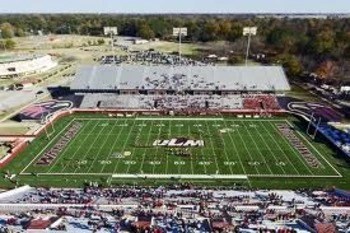
90. Malone Stadium: Louisiana-Monroe Warhawks
The state of Louisiana actually has more college football teams than many people could imagine.
Louisiana-Monroe is another in that long list. This stadium was built in 1978, so it is actually relatively new when it comes to college football stadiums. It has a capacity of 30,427 and hardly ever fills up.
The overall atmosphere here is pretty good, and the stadium is extremely easy to get to.
89. Joe Aillet Stadium: Louisiana Tech Bulldogs
For some surprisingly good tailgating and a WAC game that has a lot to offer, this is the place to go.
Built in 1968, Joe Aillet Stadium seats 30,600, and while it is not always full, there is a loyal fanbase here who comes out to support their Bulldogs.
This is not a bad place to watch a game.
88. FIU Stadium: Florida International Golden Panthers
This tiny stadium is almost completely enclosed, which makes it that much better to watch a college football game.
Built in 1995, it is one of the newest stadiums around, and even though it only holds 23,500, it can get louder than a lot of other stadiums in the Sun Belt Conference.
The Golden Panthers may just have the biggest home-field advantage around.
87. Dix Stadium: Kent State Golden Flashes
Kent State has one of the best stadiums the MAC has to offer.
With a seating capacity of only 20,500, Dix Stadium is not that big, but is updated.
While it was originally built in 1969, this stadium has been well-kept, and the Golden Flashes certainly have a home field advantage in here.
All of the amenities are average at best.
86. Bulldog Stadium: Fresno State Bulldogs
Bulldog Stadium looks much larger than the 41,031 it seats.
That is possibly because there is no upper bowl. Everything is from one basic level.
It was built in 1980, and with a relatively large population in Fresno, people often fill the stadium. The atmosphere here is excellent and one of the best of any stadium so far on the list.
85. Martin Stadium: Washington State Cougars
Martin Stadium is extremely small in comparison to a lot of other Pac-12 schools.
It only seats 35,117 and was built in 1972. The atmosphere here, especially when one of the Pac-12 rivals comes to town, is excellent.
There is not much around the stadium, however, but once inside, there is no bad seat in the house.
84. Aloha Stadium: Hawaii Warriors
Aloha Stadium is home to a lot of different things, and one of them is the Hawaii Warriors.
This team loves to throw the ball around, and the fans enjoy that.
The 50,000-seat stadium was built in 1975. It can get a little loud when points are scored and is not a place that is easy for a road team to win.
The area around it is beautiful. It is Hawaii after all.
83. M.M. Roberts Stadium: Southern Mississippi Golden Eagles
Even though the stadium is very old and the seats may not be the most comfortable, this place does offer a little bit of luxury and a good place to watch a football game.
There are 33 luxury boxes located in the south end zone of this 36,000-seat stadium that was built 80 years ago in 1932 and is affectionately known as “The Rock.”
A newer version of this place would be ideal, but overall, a unique college football experience can be had here.
82. Ryan Field: Northwestern Wildcats
Ryan Field is the first school from the Big Ten on the list, but that does not mean it is a bad place to enjoy a Big Ten battle.
It was built in 1926, which could have a little something to do with why it is so low on the list.
With a seating capacity of 47,130, it is the smallest stadium in the conference as well.
The views are great, but the atmosphere here is just not the same as some other schools in the conference.
81. Rentschler Field: Connecticut Huskies
With a seating capacity of 40,000, Rentschler Field is a mid-size field and is the second Big East field on the list.
It is extremely new, having just opened in 2003, as the Huskies were making the jump to an FBS program shortly before that.
The fans here love the team, even though the area around the stadium has absolutely nothing to offer. A few more winning seasons, and this stadium, along with its fans, could be climbing up the list.
Another of the tiny Louisiana schools is next on the list.
Cajun Field has been around since 1971 and houses 31,000. There are not many teams in the Sun Belt Conference who can brag more about their field than the Rajun’ Cajuns.
It is a college town, with most of the people around having graduated from the university. This can help make for quite a Saturday football experience.
79. Faurot Field: Missouri Tigers
This is the first SEC stadium on the list, and they are a newcomer to the conference.
Faurot Field houses 68,349 people and has been around forever, originally opening up in 1926.
Everything here is just average when it comes to the food and atmosphere. It will likely be a relatively easy road trip for a lot of SEC teams compared to what some of the other stadiums in the conference have to offer.
Q: York County was recently in the news for a lawsuit involving the teaching of intelligent design. What’s your attitude regarding the teaching of evolution in public schools?
A: “I’m a Christian, and I believe in parents being able to provide children with religious instruction without interference from the state. But I also believe our schools are there to teach worldly knowledge and science. I believe in evolution, and I believe there’s a difference between science and faith. That doesn’t make faith any less important than science. It just means they’re two different things. And I think it’s a mistake to try to cloud the teaching of science with theories that frankly don’t hold up to scientific inquiry.”
Is there any purpose in life? Evolution is clear on this point. I have included the first portion of the article by Dr. Jerry Bergman who I have corresponded with in the past.
Humans have always wondered about the meaning of life…life has no higher purpose than to perpetuate the survival of DNA…life has no design, no purpose, no evil and no good, nothing but blind pitiless indifference.1–Richard Dawkins
Evolution is “deceptively simple yet utterly profound in its implications,”2 the first of which is that living creatures “differ from one another, and those variations arise at random, without a plan or purpose.”3 Evolution must be without plan or purpose because its core tenet is the natural selection of the fittest, produced by random copying errors called mutations. Darwin “was keenly aware that admitting any purposefulness whatsoever to the question of the origin of species would put his theory of natural selection on a very slippery slope.”4 Pulitzer Prize author Edward Humes wrote that the fact of evolution was obvious but “few could see it, so trapped were they by the human…desire to find design and purpose in the world.” He concluded:
Darwin’s brilliance was in seeing beyond the appearance of design, and understanding the purposeless, merciless process of natural selection, of life and death in the wild, and how it culled all but the most successful organisms from the tree of life, thereby creating the illusion that a master intellect had designed the world. But close inspection of the watchlike “perfection” of honeybees’ combs or ant trails…reveals that they are a product of random, repetitive, unconscious behaviors, not conscious design.5
The fact that evolution teaches that life has no purpose beyond perpetuating its own survival is not lost on teachers. One testified that teaching evolution “impacted their consciences” because it moved teachers away from the “idea that they were born for a purpose… something completely counter to their mindset and beliefs.”6
In a study on why children resist accepting evolution, Yale psychologists Bloom and Weisberg concluded that the evolutionary way of viewing the world, which the authors call “promiscuous teleology,” makes it difficult for them to accept evolution. Children “naturally see the world in terms of design and purpose.”7 The ultimate purposelessness of evolution, and thus of the life that it produces, was eloquently expressed by Professor Lawrence Krauss as follows: “We’re just a bit of pollution…. If you got rid of us…the universe would be largely the same. We’re completely irrelevant.”8
The Textbooks
To determine what schools are teaching about religious questions such as the purpose of life, I surveyed current science textbooks and found that they tend to teach the view that evolution is both nihilistic and atheistic. One of today’s most widely-used textbooks stated that “evolution works without either plan or purpose…. Evolution is random and undirected.”9 Another text by the same authors added that Darwin knew his theory “required believing in philosophical materialism, the conviction that matter is the stuff of all existence and that all mental and spiritual phenomena are its byproducts.” The authors continued:
Darwinian evolution was not only purposeless but also heartless–a process in which…nature ruthlessly eliminates the unfit. Suddenly, humanity was reduced to just one more species in a world that cared nothing for us. The great human mind was no more than a mass of evolving neurons. Worst of all, there was no divine plan to guide us.10
Another text taught that humans are just “a tiny, largely fortuitous, and late-arising twig on the enormously arborescent bush of life” and the belief that a “progressive, guiding force, consistently pushing evolution to move in a single direction” is now known to be “misguided.”11 Many texts teach that evolution is purposeless and has no goal except to achieve brute survival: the “idea that evolution is not directed towards a final goal or state has been more difficult for many people to accept than the process of evolution itself.”12 One major text openly teaches that humans were created by a blind, deaf, and dumb watchmaker–namely natural selection, which is “totally blind to the future.”
Humans…came from the same evolutionary source as every other species. It is natural selection of selfish genes that has given us our bodies and our brains…. Natural selection…explains…the whole of life, the diversity of life, the complexity of life, |and| the apparent design in life.”13
The Implications
Many texts are very open about the implications of Darwinism for theism. One teaches that Darwin’s immeasurably important contribution to science was to show that, despite life’s apparent evidence of design and purpose, mechanistic causes explain all biological phenomena. The text adds that by coupling “undirected, purposeless variation to the blind, uncaring process of natural selection, Darwin made theological or spiritual explanations of the life processes superfluous.”14 The author concludes by noting that “it was Darwin’s theory of Evolution that provided a crucial plank to the platform of mechanisms and materialism…that has been the stage of most western thought.”15 Another text even stated directly that humans were created by a random process, not a loving, purposeful God, and:
The real difficulty in accepting Darwin’s theory has always been that it seems to diminish our significance…. |Evolution| asked us to accept the proposition that, like all other organisms, we too are the products of a random process that, as far as science can show, we are not created for any special purpose or as part of any universal design.16
These texts are all clearly teaching religious ideas, not science. An excellent example is a text that openly ruled out not only theistic evolution, but any role for God in nature, and demonstrated that Darwinism threatened theism by showing that humans and all life “could be explained by natural selection without the intervention of a god.” Evolutionary “randomness and uncertainty had replaced a deity having conscious, purposeful, human characteristics.”
The Darwinian view that… present-type organisms were not created spontaneously but formed in a succession of selective events that occurred in the past, contradicted the common religious view that there could be no design, biological or otherwise, without an intelligent designer…. In this scheme a god of design and purpose is not necessary…. Religion has been bolstered by… the comforting idea that humanity was created in the image of a god to rule over the world and its creatures. Religion provided emotional solace, a set of ethical and moral values…. Nevertheless, faith in religious dogma has been eroded by natural explanations of its mysteries…. The positions of the creationists and the scientific world appear irreconcilable.”17
Darwin himself taught a totally atheistic, naturalistic view of origins. He even once said, “I would give nothing for the theory of natural selection if it requires miraculous additions at any one stage of descent.”18 John Alcock, an evolutionary biologist, therefore concluded that “we exist solely to propagate the genes within us.”19
Leading Darwin scholar Janet Browne makes it very clear that Darwin’s goal was the “arduous task of reorienting the way Victorians looked at nature.” To do this Darwin had to convince the world that “ideas about a benevolent, nearly perfect natural world” and those that believe “beauty was given to things for a purpose, were wrong–that the idea of a loving God who created all living things and brought men and women into existence was…a fable.”
The world…steeped in moral meaning which helped mankind seek out higher goals in life, was not Darwin’s. Darwin’s view of nature was dark–black…. Where most men and women generally believed in some kind of design in nature–some kind of plan and order–and felt a deep-seated, mostly inexpressible belief that their existence had meaning, Darwin wanted them to see all life as empty of any divine purpose.20
Darwin knew how difficult it was to abandon such a view, but realized that for evolution to work, nature must ultimately be “governed entirely by chance.” Browne concludes:
The pleasant outward face of nature was precisely that–only an outward face. Underneath was perpetual struggle, species against species, individual against individual. Life was ruled by death…destruction was the key to reproductive success. All the theological meaning was thus stripped out by Darwin and replaced by the concept of competition. All the telos, the purpose, on which natural theologians based their ideas of perfect adaptation was redirected into Malthusian–Darwinian–struggle. What most people saw as God-given design he saw as mere adaptations to circumstance, adaptations that were meaningless except for the way in which they helped an animal or plant to survive.21
Neo-Darwinist Richard Dawkins recognized the purposelessness of such a system:
In a universe of blind physical forces and genetic replication some people are going to get hurt, other people are going to get lucky, and you won’t find any rhyme or reason in it, nor any justice. The universe we observe has precisely the properties we should expect if there is, at bottom, no design, no purpose, no evil and no good, nothing but blind, pitiless indifference.22
How widely is this view held by scientists? One study of 149 leading biologists found that 89.9 percent believed that evolution has no ultimate purpose or goal except survival, and we are just a cosmic accident existing at the whim of time and chance. A mere six percent believed that evolution has a purpose.23 Almost all of those who believed that evolution had no purpose were atheists. This is only one example that Sommers and Rosenberg call the “destructive power of Darwinian theory.”24
References
Scheff, Liam. 2007. The Dawkins Delusion. Salvo, 2:94.
Humes, Edward. 2007. Monkey Girl: Evolution, Education, Religion, and the Battle for America’s Soul. New York: Ecco, 119.
Ibid, 119.
Turner, J. Scott. 2007. The Tinkerer’s Accomplice: How Design Emerges from Life Itself. Cambridge, MA: Harvard University Press, 206.
Humes, Monkey Girl, 119.
Ibid, 172.
Bloom, Paul and Deena Skolnick Weisberg. 2007. Childhood Origins to Adult Resistance to Science. Science, 316:996.
Panek, Richard. 2007. Out There. New York Times Magazine, 56.
Miller, Kenneth R. and Joseph S. Levine. Biology. 1998. Fourth Edition, Englewood Cliffs, NJ: Prentice Hall, 658, emphasis in original.
Levine, Joseph S. and Kenneth R. Miller 1994. Biology: Discovering Life. Second Edition, Lexington, MA: D.C. Heath, 161, emphasis in original.
Raven, Peter H. and George B. Johnson. 2002. Biology. Sixth Edition, Boston, MA: McGraw Hill, 16, 443.
Purves, William K., David Sadava, Gordon H. Orians, and H. Craig Keller. 2001. Life: The Science of Biology. Sixth Edition, Sunderland, MA: Sinauer Associates; W.H. Freeman, 3.
Interview with Richard Dawkins in Campbell, Neil A., Jane B. Reece, and Lawrence G. Mitchell. 1999. Biology. Fifth Edition, Menlo Park, CA: Addison Wesley Longman, 412-413.
Futuyma, Douglas J. 1998. Evolutionary Biology. Third Edition, Sunderland, MA: Sinauer Associates, 5.
Ibid, 5.
Curtis, Helena and N. Sue Barnes. 1981. Invitation to Biology. Third Edition, New York, NY: Worth, 475.
Strickberger, Monroe. 2000. Evolution. Third Edition, Sudbury, MA: Jones & Bartlett, 70-71.
Darwin, Francis (editor). 1888. The Life and Letters of Charles Darwin. London: John Murray, 210.




 The Daily Hatch