Category Archives: Current Events

Review of Carl Sagan book (Part 4 of series on Evolution)

Review of Carl Sagan book (Part 4 of series on Evolution)

The Long War against God-Henry Morris, part 5 of 6

Uploaded by  on Aug 30, 2010

I got this from a blogger in April of 2008 concerning candidate Obama’s view on evolution:

Q: York County was recently in the news for a lawsuit involving the teaching of intelligent design. What’s your attitude regarding the teaching of evolution in public schools?

A: “I’m a Christian, and I believe in parents being able to provide children with religious instruction without interference from the state. But I also believe our schools are there to teach worldly knowledge and science. I believe in evolution, and I believe there’s a difference between science and faith. That doesn’t make faith any less important than science. It just means they’re two different things. And I think it’s a mistake to try to cloud the teaching of science with theories that frankly don’t hold up to scientific inquiry.”

This is a review I did a few years ago.

THE DEMON-HAUNTED WORLD: Science as a Candle in the Dark by Carl Sagan. New York: Random House, 1995. 457 pages, extensive references, index. Hardcover; $25.95.
PSCF 48 (December 1996): 263.
Sagan is the David Duncan Professor of Astronomy and Space Sciences at Cornell University. He is author of many best sellers, including Cosmos, which became the most widely read science book ever published in the English language.
In this book Sagan discusses the claims of the paranormal and fringe-science. For instance, he examines closely such issues as astrology (p. 303), crop circles (p. 75), channelers (pp. 203-206), UFO abductees (pp. 185-186), faith-healing fakes (p. 229), and witch-hunting (p. 119). Readers of The Skeptical Inquirer will notice that Sagan’s approach is very similar.
Sagan writes:
The Committee for the Scientific Investigation of Claims of the Paranormal is an organization of scientists, academics, magicians, and others dedicated to skeptical scrutiny of emerging or full-blown pseudo-sciences. It was founded by the University of Buffalo philosopher Paul Kurtz in 1976. I’ve been affiliated with it since its beginning. Its acronym, CSICOP, is pronounced Asci-cop C as if it’s an organization of scientists performing a police function Y CSICOP publishes a bimonthly periodical called AThe Skeptical Inquirer. On the day it arrives, I take it home from the office and pore through its pages, wondering what new misunderstandings will be revealed (p. 299).
Sagan points out that in 1991 two pranksters in England admitted that they had been making crop figures for 15 years. They flattened the wheat with a heavy steel bar. Later on they used planks and ropes, but the media paid brief attention to the confession of these hoaxers. Why? Sagan concludes, ‘Demons sell; hoaxers are boring and in bad taste’ (p. 76).
Christians must admire Sagan’s commitment to critical thinking, logic, and freedom of thought. He takes on many subjects in this book, and the vast majority of his analysis is exceptional. However, his opinions on religious matters are affected by his devotion to scientism. Sagan believes only that which can be proved by science is true. He disputes psychologist Charles Tart’s assertion that scientism is ‘dehumanizing, despiritualizing’ (p. 267). Sagan comments, ‘There is very little doubt that, in the everyday world, matter (and energy) exist. The evidence is all around us. In contrast, as I’ve mentioned earlier the evidence for something non-material called `spirit’ or `soul’ is very much in doubt’ (p. 267).
Science can only prove things about the physical world, and it cannot prove anything about the spiritual world. Does that mean that the mind and soul don’t exist? Of course not! First, we must realize that science is not the only way to truth. Even Sagan must admit that he must justify values like ‘be objective’ or ‘report data honestly’. Where do those values come from? They came from outside science, but they must be in place for science to work.
Sagan gives an illustration that contrasts physics and metaphysics. He shows that the physicist’s idea will have to be discarded if tests fail in the laboratory. Therefore, the main difference between physics and metaphysics is that the metaphysicist has no laboratory. This is a cute story, but can science answer the basic questions that underline all knowledge? Metaphysics is necessary for science to take place. It is not true that science is superior to metaphysics like Sagan would have us believe. The presuppositions of science can only be validated by philosophy. J. P. Moreland has correctly said, ‘The validation of science is a philosophical issue, not a scientific one, and any claim to the contrary will be a self-refuting philosophical claim’ (Scaling the Secular City, p. 197).
Second, the absence of scientific evidence for the soul does not mean the soul does not exist. Sagan himself states,’Absence of evidence is not evidence of absence’ (p. 213).
I was impressed with the way Sagan put his inner thoughts on the table. For instance, he comments, ‘Plainly, there’s something within me that’s ready to believe in life after death…If some good evidence for life after death was announced, I’d be eager to examine it; but it would have to be real scientific data, not mere anecdote’ (pp. 203-204). What kind of evidence is Sagan looking for? It certainly is not vague prophecies. He states, ‘Think of how many religions attempt to validate themselves with prophecy…Think of how many people rely on these prophecies, however vague, however unfulfilled, to support or prop up their beliefs…Yet has there ever been a religion with the prophetic accuracy and reliability of science? (p. 30). The answer to that question is yes. Christianity can point to very clear passages such as Isaiah 53 and Daniel 11 written hundreds of years before the events occurred.
While comparing science to religion, Sagan comments, ‘Science is far from a perfect instrument of knowledge. It’s just the best we have (pp. 27-28). Here Sagan is only half right. Science is imperfect, but it is not better than the Bible.’
The Demon-Haunted Worldis a thought-provoking book that I thoroughly enjoyed. Some of Sagan’s anti-Christian views come through, but on the whole, this book uses critical thinking and logic and applies them to the claims of the paranormal and fringe-science of our day.
Reviewed by Everette Hatcher III, P.O. Box 23416, Little Rock, AR 72221.

Other posts that relate to Carl Sagan:

Atheist says “It’s not about having a purpose in life..” (Arkansas Atheist, Part 1)

The Bible and Archaeology (1/5) The Bible maintains several characteristics that prove it is from God. One of those is the fact that the Bible is accurate in every one of its details. The field of archaeology brings to light this amazing accuracy. _________________________- I want to make two points today. 1. There is no […]

Ancient Sea Monsters (A Creationist point of view Part 3)

Leviathan: the Fire-Breathing Dragon: Kent Hovind [6 of 7] Everybody is trying to get info on this subject. Here is what the Bible has to say about it. Mace Baker wrote the aritcle, “Sea Dragons – The Institute for Creation Research,” and here is the third portion of that article:  Pterosaurs were the flying reptiles of the ancient world. Why […]

By Everette Hatcher III | Posted in Current Events | Edit | Comments (0)Other posts concerning Carl Sagan:

Atheists confronted: How I confronted Carl Sagan the year before he died

In today’s news you will read about Kirk Cameron taking on the atheist Stephen Hawking over some recent assertions he made concerning the existence of heaven. Back in December of 1995 I had the opportunity to correspond with Carl Sagan about a year before his untimely death. Sarah Anne Hughes in her article,”Kirk Cameron criticizes […]

National Championship denied: Tennessee Vols miracle comeback in 1998 killed Razorbacks chance in November to pursue title

University of tennessee football Coach Phillip Fulmer signals for a time out during an October 9, 1993 game against Arkansas.

Photo by HEATHER STONE/KNOXVILLE NEWS SENTINEL

University of tennessee football Coach Phillip Fulmer signals for a time out during an October 9, 1993 game against Arkansas.

I will never forget this game as long as I live. What a sad way for a great game to end for my razorbacks.

Tennessee Volunteers’ 1998 National Championship: Part VII

By

(Senior Analyst) on July 10, 2008

904 reads

6

Use your ← → (arrow) keys to browse more storiesNext

Clint_stoerner_3_crop_340x234


(Note: Updated from an original piece on The 50 Best Vol Games 1989-2005 at SouthEastern Sports Blog, September 7, 2006)

“Oh my goodness, he stumbled and fumbled!”

On November 7, 1998, No. 2 Tennessee was finishing off UAB 37-13 in the fourth quarter when one of those special moments happened in Neyland Stadium.

Those on hand that day with radios or portable TVs were tuned in to the waning moments of No. 1 Ohio State and Michigan State.  As Tennessee’s game ended with around two minutes to play in the Big Ten showdown, no one left their seats as Neyland Stadium PA announcer Bobby Denton began to relay the events from up north.

And when Ohio State was intercepted on their final drive, the celebration began:

The Vols would be the new No. 1 team in the nation. 

Tennessee, after a season of memorable performances against Syracuse, Florida, Georgia, and Alabama, had arrived.

Several hundred miles west in Fayetteville, a young head coach named Houston Nutt was in the midst of his first season.  Danny Ford had been to one bowl game in five years, and the Hogs were coming off consecutive 4-7 seasons when Nutt took over.  Expectations were moderate, but that all changed on September 26.

No. 22 Alabama came into Fayetteville and left on the business end of a 42-6 beatdown.  From that point, Arkansas kept grinding it out and slowly rising in the polls.

They beat Kentucky and Tim Couch 27-20.  On October 31 they went to Auburn and won 24-21.  And after beating Ole Miss the next week, Arkansas was 8-0.

They were disrespected: Only four undefeated teams remained on November 14, but Arkansas was still ranked only 10th.  But a chance for instant credibility was coming in a trip to Knoxville.

Tennessee was not worried—the Vols had seen their share of great teams already in 1998, and the thought was that Arkansas was simply untested.

On a rainy, misty fall afternoon from Neyland Stadium, the Vols ran through the T for the first time as the No. 1 team in the nation since the 1950s.  All was right on Rocky Top.

Arkansas brought their faithful en masse, as a crowd of 106,000-plus was on hand.  The Hogs were very much alive and well in the BCS hunt, and this was a rare SEC showdown—the latest two undefeated SEC teams had met in the season in almost 30 years. 

But we weren’t worried.

Legendary Vol Network radio man John Ward had it right in the pregame:

“Everything…everything…is riding on this football game.”

In the last fifteen years, there have been some incredible individual performances put up against the Tennessee defense.  There have been quarterbacks—most notably Danny Wuerffel—who have lit up the Vol secondary.

There have been running backs—most notably Georgia’s Robert Edwards in 1995 (15 carries for 155 yards when he broke his leg in the third quarter)—who have torched the Vol defense.

And Tennessee has played against some great wide receivers—David Palmer, Hines Ward, any Florida Gator you want to name from the mid-’90s, Terry Glenn, Eric Moulds, and yes, Peter Warrick.

But on this afternoon, Arkansas WR Anthony Lucas would stand alone.  And it’s not close.

It started with a long bomb to Lucas on the game’s opening drive, which Arkansas would convert into a touchdown.  But where it got real was on the first play of the second quarter, when Arkansas QB Clint Stoerner went down the sideline, and Lucas made Vol corner Dwayne Goodrich look bad.  Real bad.

62 yards later, the Hogs were up 14-0—and Lucas looked unstoppable.

Tennessee battled their way to a field goal to cut the lead to 14-3 midway through the second quarter.  But here came Arkansas again.  When Stoerner found Lucas in the end zone again, Arkansas led 21-3 with 3:15 left in the first half.

We all know about the end of this game, and we’ll get to that.  But let’s not forget everything else that happened before it.

The Vols were in deep, deep trouble at this point, because it looked like we had no answers.

You’ve got to understand—after the Vols gave up 33 points to Donovan McNabb and Syracuse, the defense was unrelenting.  Florida’s high-powered offense got 17.  Auburn got nine.  Georgia got three.  Alabama and Shaun Alexander got 18.

Arkansas had 21 before halftime, and they made it look insanely easy.  The fans who weren’t worried were now full of fear.

It’s interesting to note that those who were buying into the “team of destiny” deal at this point may not have been worried in the fourth quarter…but they were chewing fingernails and taking smoke breaks late in the second.  Everybody was.

So one of the biggest plays in the game and the season was when Tee Martin—who struggled all day and finished 10 of 27 for 155 yards—gave the Vols something to think about by rolling out, barely escaping pressure, and firing a teardrop to Peerless Price from 36 yards away for the score just before the half to make it 21-10 going into the locker room.

All the thoughts of “We’ll come out of the locker room and kill them” were answered by more Anthony Lucas and a 33-yard field goal on Arkansas’ first drive of the second half.  Anthony Lucas would finish the day with eight catches for 172 yards and two TDs.  Against the No. 1 team in the country.

Those stats, against the ’98 Vol defense on that stage, make it the most impressive performance by a wide receiver against the Vols that I’ve ever seen, no debate.

Down 24-10 with 11:43 still to play in the third quarter, the march began.

Travis Henry and the offensive line began to push the Arkansas defense back.  When Tee Martin rolled out and kept it himself for a four-yard touchdown, the game was back within reach at 24-17 with half of the third quarter left to play.

Jeff Hall would add to the score, and as the game went to the fourth quarter, Arkansas’ lead was down to 24-20.  We had ourselves a real ballgame now.

But then Arkansas came to life again.  After a series of punts, the Hogs drove to the Tennessee 16 with under six minutes to play.  If Arkansas found the end zone again, it would build a two-possession lead, and with more than half of the fourth quarter gone, it seemed unlikely the Vols would dig out of such a hole. 

But the defense held, setting up a field goal attempt.  Then a rare moment unfolded, where the orange representatives of the 106,000-plus were all screaming, “BLOCK THAT KICK! BLOCK THAT KICK!”…and it actually happened.

The Vols got all of it, rejecting the ball back and allowing Al Wilson to return it 50 yards to the Arkansas 28. 

From this point on, sitting there dry under the overhang in section Z11, I felt like we would win.  Even with what happened later, after seeing all I’d seen so far in ’98, and seeing us keep them out of the end zone on that drive and then block that kick on command from the crowd, I wasn’t worried—even when I should have been.  I think lots of Vol fans reacted that way.

But the realists among us would’ve been uncomfortable to see the Vols unable to score any points off the blocked kick, getting pushed back and choosing to punt.

David Leaverton, however, pinned the Hogs at the one-yard line.  Arkansas avoided a safety for three plays, then lined up to punt.  The snap went sailing over the punter’s head, who kicked the ball (which is illegal) out of the end zone for a safety.

24-22, 2:56 to play, and Tennessee had the ball.  A field goal would win.

Tennessee got one first down to move into Arkansas territory following the free kick, and after Travis Henry ran for one yard on first down, Tee Martin threw an incomplete pass.

Then he threw another incomplete pass.  And suddenly it was 4th-and-9.

Ward: “Last chance, probably.”

And you knew—with under 2:00 to play—that this was crucial.

So when Martin’s pass to Peerless Price was broken up over the middle, the Arkansas faithful went berserk, and the Vols were left with a horribly empty feeling.

Because it wasn’t supposed to be like this.

Maybe the reason I wasn’t worried is because I didn’t have enough time to process it.

The Vols had two timeouts, and thus Arkansas needed one first down to seal it.

Even if Tennessee stopped Arkansas three-and-out, they’d get the ball with just under a minute to play, with no timeouts, in terrible field position.

But we were still in it.  Remember, Arkansas wasn’t trying to take a knee—they needed the first down.

Tennessee called a timeout after a first down run for a short gain, and on second down Arkansas lined up under center.

Ward: “This will be a major upset victory for Arkansas.”

Now, I love me some John Ward.  But if you really want to appreciate what comes next, you need to find the CBS feed and get Sean McDonough’s call:

“Stoerner LOST THE FOOTBALL!!!  Oh my goodness, he stumbled and fumbled!!  And Billy Ratliff recovers!”

Some call it luck.  Some like destiny.  Some say Stoerner was careless.  Others say Ratliff and Darwin Walker got such a push that they drove the center’s leg into Stoerner and created disaster.

Either way, Stoerner lost his balance off the snap and reached down to try and brace himself.  And he left the ball behind.

No matter how you slice it, Tennessee came up with it—and the 1998 season had its lasting image.

Stoerner would later say, “I just lost it.  I don’t know what happened.”

Houston Nutt: “I hate to lose one like that.  I’ve never lost one like that.”

The opening line on the AP story from the game reads, “The name Clint Stoerner will live forever in Tennessee lore and Arkansas infamy.”

And though Stoerner would clear his name the following season by beating the then-No. 2 Vols 365 days later, on this night, he played a definitive role in the National Championship.

Still…the deed wasn’t done.

I’ve heard all kinds of stories from my friends and other Vol fans about fights breaking out in the Neyland Stadium concourse because so many people tried to leave after Martin’s incompletion, but they didn’t get out of the stadium before Stoerner’s fumble, and everyone was trying to get back to their seats in violent fashion.  This is why you never leave early.

While anger and emotion swelled on the concourse, the look on the faces of the Arkansas faithful in the stands was more subdued.  Our season tickets are just above the visiting team allotment, and you could see it in their eyes: “Uh-oh.”

And the Arkansas defense was wearing the same expression when they came back on the field.  And that, combined with the Vol offensive line and Travis Henry, was trouble.

From the 43-yard line—still looking at a 60-yard field goal—Tennessee decided they’d had enough of passing.  They were coming right at you.  And so first it was Henry, breaking four tackles and getting 15 yards on first down.  Ball at the 28.

Then it was Henry again, 15 more yards on the very next play through one of the biggest holes I’ve ever seen.  In three plays, Arkansas had gone from sure victory on offense to having to play red zone defense.

And suddenly, we weren’t thinking about kicking field goals.

Third time’s the charm, right?  Well, this time Henry went for only 11 yards, down to the two.  

43 yards away with only a minute and a half on the clock, down four with only one timeout remaining—and who runs the ball up the middle three straight times?  Travis Henry, to the tune of three carries for 41 yards.  Unbelievable.

They did stop him on the next play at the one, but with the clock at :31 and only on second down, you knew what was coming.  Now you can switch the audio back to John Ward:

“They need to go to Henry…this will be Henry, he dives…GIVE…HIM…SIX!!!!”

Tennessee 28 – Arkansas 24.

That look on the Arkansas fans’ faces after the game?  I’ve seen it before.  Not at that time, but I’ve worn it myself since. 

It has many names in the SEC.  Tennessee fans call it The Jabar Gaffney Face, from his catch/no catch in the final seconds against Florida in 2000.  Or The David Greene Face from his final drive in Knoxville the following year.

Florida fans had broken in The Collins Cooper Face earlier in the 1998 season, but we were all too busy to notice because we hated them so much.

And on this night, Arkansas was introducing themselves to The Clint Stoerner Face.

It’s that look of nothingness.  When you were so sure you had the game won, beyond any shadow of a doubt, and you were in massive celebration mode…and then somehow, inexplicably, it was all taken away from you in rapid, heartbreaking fashion.

If you ever see an aerial shot of a stadium when a team is kicking a game-winning field goal, watch both sets of fans.  If the kick is good, those thousands of people on the winning side look like ants marching, an ocean of movement and sound and joy.

But it’s always the exact opposite from the other side—no movement, no sound, no anger…they just stand there and stare off into the distance, in search of answers, because what they just saw couldn’t really be true.

I’m always a fan of that face when I’m not wearing it.

Arkansas wore that face for a full 90 seconds of game action, between Stoerner’s fumble and Henry’s eventual touchdown to win it, and then for several more minutes before they could walk away. 

The one thing that made you not feel sorry for them was that we thought we’d see these guys again in the SEC Championship Game in three weeks.

When you win a game in such once-in-a-lifetime fashion, you really don’t want to see the same team again on a neutral field with even more on the line only three weeks after you got away with one. 

But then Arkansas was still feeling this one the very next week, and Mississippi State got the best of them.  Suddenly Arkansas had gone from BCS contender to second in the SEC West—and the Pigs would have to wait ’til next year. 

So this game, this night, lives on…. I didn’t appreciate this game in the moment or walking out of the stadium—it felt like it was our year, and as such sometimes you take things for granted.

It wasn’t until the next day or so.  You had to really step away from it, to see that this wasn’t just another “we pulled it out late” game.  This was a classic in its own right that became the resonating moment from the 1998 season.

And for me, considering what was on the line?  I like destiny.

Should Christians support Obama’s re-election?

1 Of 5 / The Bible’s Influence In America / American Heritage Series / David Barton

2 Of 5 / The Bible’s Influence In America / American Heritage Series / David Barton

We need to see more Christian values in our government.

SBC leader questions judgment of Christians who support Obama

By Bob Allen

1-30-12

NASHVILLE, Tenn. (ABP) – The Southern Baptist Convention’s top public-policy expert says that Christians who still support President Obama are not using their heads.

Richard Land, president of the SBC Ethics and Religious Liberty Commission, said on the Jan. 28 broadcast of Richard Land Live that while he believes Obama faces an uphill battle for re-election, he is surprised that so many Christians still back the president.

“I know Christians who support Obama,” Land said. “I don’t question their faith, but I do question their judgment.”

Land said the Obama administration has waged a “full-fledged war to move us from freedom of religion to merely freedom of worship, implying that one’s faith is only a private matter and that exercising that faith in public is not a protected right.”

Land called a new rule requiring insurance plans to cover birth control — including those paid for by religious employers that believe artificial birth control is a sin — a “horrible decision” that poses a problem not just for faiths that object to birth control.

“Will our religious affiliated groups be forced to hire people who oppose our faith?” he asked. “Will the government force a curriculum on our schools and our homeschoolers? Just a few years ago these possibilities seemed beyond the realm of possibility. Now they seem very real.”

Land said people who claim to be conservative, evangelical Christians “are exercising very poor judgment” if “they continue to support a president who is squelching their religious freedoms.” The reason it happens, he said, is that “people are not terribly rational.”

“We have what are called compartmentalized attitude structures,” Land said. “Jimmy Carter is a good example. Jimmy Carter went around campaigning for president in 1976 and said ‘I believe in the basic goodness of the American people,’ and ‘I’m a born-again Christian.’ Well, if you’re a born-again Christian you don’t believe in the basic goodness of anybody, because you believe in original sin. But, you see, he was holding these two contradictory attitudes in the same brain.”

“Many of us of a certain age know people — who when we were children they were adults — who gave every evidence of being really pious Christians but who were racists, and didn’t see any contradiction between their racism and their Christian faith,” he continued.

Land said those people supported candidates like four-time presidential candidate George Wallace and segregationist Mississippi Gov. Ross Barnett “because they failed to see the contradiction between what they were voting and what they believed.”

“I don’t question those people’s faith,” Land said. “I knew some of them. Some of them were older men when I was younger, when I was a boy, and they gave every evidence of being Christians, but they had a huge blind spot on race. So I question their judgment, and I would in fact say that their racism was a sin, but that doesn’t mean they weren’t Christian. So I don’t question their faith; I question their faith understanding when it came to certain issues.”

Land said the Obama administration “has shown from the very beginning that it is hostile to free religious expression.”

“There’s no question about that,” he said. “They have done thing after thing after thing after thing.”

“This is really serious,” Land said. “You’ll hear the Obama administration; they are disciplined in their talking about this. They talk about freedom of worship. They talk about freedom of worship overseas and they talk about freedom of worship at home. We do not have a guarantee of freedom of worship. We have a guarantee to freedom of religion.”

Land said the free-exercise of religion protected by the Constitution “will involve us in much more than just worship.”

“And the government under the Obama administration wants to curtail that and to restrict it to the private sector only,” Land said. “There can be no other explanation for what they have done the last three and a half years.”

Land urged Christians concerned about religious liberty to sign the Manhattan Declaration, a 4,700-word manifesto that has garnered nearly 500,000 online signatures. The document, drafted by Catholic scholar Robert George and Southern Baptists Chuck Colson and Timothy George, says Christians are to respect and obey those who are in authority but not required to obey laws that are “gravely unjust or require those subject to them to do something unjust or otherwise immoral.”

Land said a prime example of effective civil disobedience was Martin Luther King Jr.’s famous letter written from the Birmingham, Ala., jail. “That’s what gave it moral stature,” Land said. “If he had written it from an Atlanta hotel room, it wouldn’t have had the impact it had.”

Land said the question of when civil disobedience becomes a moral option hinges on whether other means of protest are available. “The threshold was lower for Dr. King than it is for us, and the reason is that he and most of the people he was seeking to free couldn’t vote,” Land said.

“We have the right to vote. We have the right to file suit in court,” Land said. “I would argue that there are certain means that need to be exhausted before we reach civil disobedience, but that civil disobedience must always remain the ultimate option if the government forces us to choose between obeying God or man.”

“What I’ve argued is that if we all say we’re going to obey God rather than man — we’re going to not allow them to restrict our religious freedom — if we all hang together, then none of us will have to go to jail,” he said. “If we don’t, we may all end up in jail.”

-30-

Bob Allen is managing editor of Associated Baptist Press.

_______________

3 Of 5 / The Bible’s Influence In America / American

Heritage Series / David Barton

Milton Friedman: The free market price system promotes cooperation and harmony among those with no common interest

Milton Friedman’s illustration of a pencil makes the point in a clear way.

Milton Friedman – Lesson of the Pencil

Uploaded by on Nov 13, 2009

Milton Friedman uses a pencil to illustrate how the free market price system promotes cooperation and harmony among those with no common interest.

_____________

November 21, 2006

Milton Friedman 1912-2006

Milton Friedman’s book “Free to Choose”, co-authored with his wife Rose, was among the first tracts I’ve read on the topic. I don’t remember exactly when I read it, probably in college. I would not be able to explain well the intracacies of monetarist policies and its alternatives, but Friedman’s simple message about free markets has always stuck with me.

He summed up the workings and the benefits of free markets with a simple idea: a pencil. Here is Friedman in his own words, taken from a transcript of a TV version of “Free to Choose”:

“Look at this lead pencil, there is not a single person in the world who could make this pencil. Remarkable statement? Not at all. The wood from which it’s made, for all I know, comes from a tree that was cut down in the State of Washington. To cut down that tree, it took a saw. To make the saw, it took steel. To make the steel, it took iron ore.

“This black center, we call it lead but it’s really compressed graphite, I am not sure where it comes from but I think it comes from some mines in South America. This red top up here, the eraser, a bit of rubber, probably comes from Malaya, where the rubber tree isn’t even native. It was imported from South America by some businessman with the help of the British government. This brass feral – I haven’t the slightest idea where it came from or the yellow paint or the paint that made the black lines – or the glue that holds it together.

“Literally thousands of people cooperated to make this pencil. People who don’t speak the same language; who practice different religions; who might hate one another if they ever met. When you go down to the store and buy this pencil, you are, in effect, trading a few minutes of your time for a few seconds of the time of all of those thousands of people. What brought them together and induced them to cooperate to make this pencil? There was no Commissar sending out orders from some central office. It was the magic of the price system – the impersonal operation of prices that brought them together and got them to cooperate to make this pencil so that you could have it for a trifling sum.

“That is why the operation of the free market is so essential. Not only to promote productive efficiency, but even more, to foster harmony and peace among the peoples of the world.”

Johnny Cash a Christian?

I got to see Johnny Cash perform in Memphis in 1978 and I actually knew his nephew very well. He was an outspoken Christian and evangelical. Here is an article that discusses this.

Johnny Cash’s Complicated Faith

Dave Urbanski

<!–

var fbShare = {
google_analytics: ‘true’,
}

tweetmeme_source = ‘RELEVANTMag’;

–>

photograph of Johnny Cash

Unwrapping the enigma of the Man in Black.

Johnny Cash’s musical accomplishments are storied and staggering. He occupies spots in the Rock and Roll Hall of Fame, the Songwriter’s Hall of Fame, and the Country Music Hall of Fame—he, in fact, was the youngest living person ever inducted into the latter. He sold 50 million albums, recorded more than 1,500 songs, boasted fourteen number-one hits, won scads of awards, and is mentioned in the same breath as The Beatles when it comes to musical impact.

His legendary bass-baritone was a force of nature. Equal parts rolling thunder and John the Baptist, when Cash sang or spoke, his voice commanded attention. And respect. And believability.

But more importantly, throughout his magical career that ended just shy of the half-century mark when he died from diabetes complications on September 12, 2003, Cash tore apart the rulebook more than once, paving the way for other artists to do the same; he always stood up for the underdog (the poor, Native Americans, prisoners, and others) and always stood up to the oppressive; and he beat just about every odd that was stacked against him.

And it’s for those reasons that pinning down Johnny Cash in any way, shape, or form is impossible. He made it impossible. He never intended to be categorized or pigeonholed. He recorded with Bob Dylan, then turned around and played for Richard Nixon. He embraced the radical social justice movements of the ’60s and flew high Old Glory. He protested Vietnam and played for the troops.

The revelation is that Cash lived long enough and hard enough to embody a host of personas—and they’re all true. Songwriter. Six-string strummer. Storyteller. Country boy. Rock star. Folk hero. Preacher. Poet. Drug addict. Rebel. Sinner. Saint. Victim. Survivor. Home wrecker. Husband. Father. And more.

As songwriting friend Kris Kristofferson recently said, “He’s as comfortable with the poor and prisoners as he is with presidents. He’s crossed over all age boundaries. I like to think of him as Abraham Lincoln with a wild side.”

Cash’s cluster of enigmas was so impenetrably deep that even those closest to him never got to see every part of him, every thought, every emotion.

“I think Johnny’s as complex as anything God or man put on this earth,” his brother Tommy once noted. “He’s a man of uncommon characteristics, mentally or physically. Even though you’re his brother, or his wife, or his mother, you never know him completely. I’ve felt myself at times trembling because of my inadequacy around him. ”

“Don’t Put Me in Another Box”

A writer once tried to paint Cash into a corner, baiting him to acknowledge a single denominational persuasion at the center of his heart. Finally, Cash laid down the law: “I—as a believer that Jesus of Nazareth, a Jew, the Christ of the Greeks, was the Anointed One of God (born of the seed of David, upon faith as Abraham has faith, and it was accounted to him for righteousness)—am grafted onto the true vine, and am one of the heirs of God’s covenant with Israel.”

“What?” the writer replied.

“I’m a Christian,” Cash shot back. “Don’t put me in another box.”

So, exactly what “kind” of Christian was Cash?

A staunch, conservative, Bible thumper? It sure seems so if you read the introduction to his 1986 novel about the life of the apostle Paul, Man in White: “Please understand that I believe the Bible, the whole Bible, to be the infallible, indisputable Word of God. I have been careful to take no liberties with the timeless Word.”

But based on a passage from his 1997 autobiography, Cash doesn’t seem as steadfast:

“Once I learned what the Bible is the inspired Word of God (most of it anyway) … “(To be fair, he continues this shadow of doubt with a gushing endorsement of Scripture, noting how “truly exciting” it is to discover new interpretations and applications to his own life.)

“Being a Christian Isn’t for Sissies”

Further, it certainly can be argued that Cash was a private man and preferred to keep his faith to himself. “I don’t compromise my religion,” Cash once declared. “If I’m with someone who doesn’t want to talk about it, I don’t talk about it. I don’t impose myself on anybody in any way, including religion. When you’re imposing you’re offending, I feel. Although I am evangelical, and I’ll give the message to anyone that wants to hear it, or anybody that is willing to listen. But if they let me know that they don’t want to hear it, they ain’t never going to hear it from me. If I think they don’t want to hear it, then I will not bring it up. ”

In short, “telling others is part of our faith all right, but the way we live it speaks louder than we can say it,” Cash said. “The gospel of Christ must always be an open door with a welcome sign for all. ”

“There’s nothing hypocritical about it,” Cash told Rolling Stone scribe Anthony DeCurtis. “There is a spiritual side to me that goes real deep, but I confess right up front that I’m the biggest sinner of them all.” To Cash, even his near deadly bout with drug addiction contained a crucial spiritual element. “I used drugs to escape, and they worked pretty well when I was younger. But they devastated me physically and emotionally—and spiritually … [they put me] in such a low state that I couldn’t communicate with God. There’s no lonelier place to be. I was separated from God, and I wasn’t even trying to call on Him. I knew that there was no line of communication. But He came back. And I came back.”

And while his body suffered under the strain wrought by years of abuse, Cash’s mind stayed strong … and his spirit stayed stronger.

“Being a Christian isn’t for sissies,” Cash said once. “It takes a real man to live for God-a lot more man than to live for the devil, you know? If you really want to live right these days, you gotta be tough.” What’s more, he’s intimately aware of the hard truths about living God’s way: “If you’re going to be a Christian, you’re going to change. You’re going to lose some old friends, not because you want to, but because you need to.”

“I Don’t Give Up”

Even after many people had assumed his career was over, Cash headed back into the studio to begin work on more songs with fellow rebel and producer of nearly a decade, Rick Rubin. Today’s release of American VI: Ain’t No Grave marks the last of those albums. 

And in his final days, despite moment-by-moment battles with various debilitating ailments, the Man in Black was anything but in a black mood. In fact, he was celebrating life-sopping up every second he could, while he could.

”I’m thrilled to death with life,” he told Larry King during an interview. “Life is—the way God has given it to me—was just a platter. A golden platter of life laid out there for me. It’s been beautiful.”

“I don’t give up … and it’s not out of frustration and desperation that I say ‘I don’t give up.’ I don’t give up because I don’t give up. I don’t believe in it.”

Amen to that, Brother Cash.

This article is adapted from The Man Comes Around: The Spiritual Journey of Johnny Cash (RELEVANTBooks).


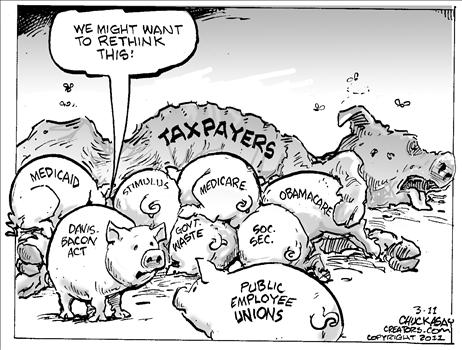
Liberalism’s great question: What do we do when all the money runs out?

Why raise taxes when we have not made real cuts yet? By the way we are about to run out of money!!!!

Question for Leftists: What Happens When There’s Nothing Left to Steal?

December 4, 2011 by Dan Mitchell

More than two years ago, I explained in a TV interview that the looters and moochers should be careful that they don’t kill the geese that lay the golden eggs. After all, parasites need a healthy host.

The collapse of Europe’s welfare states should be a wake-up call for these people, but that hasn’t stopped the demands for more redistribution in Washington. As Michael Barone noted, the folks on the left assume that there will always be someone to plunder.

But at least the piglets in this Chuck Asay cartoon are finally waking up to reality.

Unfortunately, I don’t expect the crowd in Washington to change. Most politicians don’t think more than a couple of years into the future, so they will continue to lure more people into riding in the wagon and continue to penalize those who pull the wagon.

This won’t end well.

Exclusive Interview with Heritage Foundation: John Stossel Says Government Can’t Solve Our Problems

Rob Bluey and Brandon Stewart

April 12, 2012 at 11:51 am

John Stossel on Government, Free Enterprise, and Media

Published on Apr 12, 2012 by

http://blog.heritage.org/2012/04/12/exclusive-interview-john-stossel-says-gov… | John Stossel’s skepticism of government and his storytelling approach about free-market economics have made him a rock star in conservative and libertarian circles.

He spoke at The Heritage Foundation on Wednesday about his new book, “No, They Can’t: Why Government Fails—But Individuals Succeed.” It is Stossel’s latest attempt to debunk the myths that government can solve America’s problems. He tackles everything from crony capitalism and federal regulations to teachers’ unions and gun control.

______________________

John Stossel’s skepticism of government and his storytelling approach about free-market economics have made him a rock star in conservative and libertarian circles.

He spoke at The Heritage Foundation on Wednesday about his new book, “No, They Can’t: Why Government Fails—But Individuals Succeed.” It is Stossel’s latest attempt to debunk the myths that government can solve America’s problems. He tackles everything from crony capitalism and federal regulations to teachers’ unions and gun control.

“Our instinct is to believe in the central planners,” Stossel said in the interview. “It was nuts in the Obama election. It was like he was a magic politician who was going to do these things.”

Yet despite government’s failures, the left never retreats. President Obama’s class-warfare rhetoric, Stossel conceded, is a current example of how liberals shape the narrative.

“I live in the shallow media world,” Stossel said, “and on a subject like that, shallow wins.”

In the interview, Stossel didn’t mince words when asked why he left ABC News in 2009: “Because it sucked there.”

He currently hosts “Stossel,” a one-hour weekly Fox Business Network show and other specials on Fox News. The book reveals his rift with ABC and why Stossel approached Fox for a job.

Here’s what he told us:

They were hostile to these ideas that have made us prosperous and I consider so important. I mean, they tolerated me for years. I got good ratings, so they put the stuff on. They sort of held their nose and put it on. But by the end, they were saying, ‘Ah, you’re predictable Stossel. You use libertarian economics all the time. I don’t want to watch that.’ … I was not offered a job by Fox. I went over and begged, ‘Please, hire me, I cannot stand it anymore.’

The interview runs about five minutes. Hosted by Rob Bluey and produced by Brandon Stewart. For more videos from Heritage, subscribe to our YouTube channel.

Top football stadiums in the country (Part 7)

Final Moments of Kentucky vs. Tennessee Football Game 2011

Uploaded by on Nov 27, 2011

Kentucky wins 10-7 and ends the 26 year losing streak!!

Here is a list of the top football stadiums in the country.

Power Ranking All 124 College Football Stadiums  

By Alex Callos

(Featured Columnist) on April 19, 2012 

When it comes to college football stadiums, for some teams, it is simply not fair. Home-field advantage is a big thing in college football, and some teams have it way more than others.

There are 124 FBS college football teams, and when it comes to the stadiums they play in, they are obviously not all created equal.

There is a monumental difference from the top teams on the list to the bottom teams on the list. Either way, here it is: a complete ranking of the college football stadiums 1-124.

_________________

I want to talk about two Kentucky games that I got to see on tv. Both games were in Lexington.

Here is some info on the Tennessee at Kentucky game in 2011 that ended a 26 year in row of victories for the Vols. Below is a picture of the Vols walking off the field after the game.

Tennessee players leave the field after the 10-7 loss to Kentucky at Commonwealth Stadium in Lexington on Saturday, Nov. 26, 2011. UT lost to UK for the first time since 1984. (AMY SMOTHERMAN BURGESS/NEWS SENTINEL)<br /><br /><br />

Photo by Amy Smotherman Burgess, ©KNS/2011

Tennessee players leave the field after the 10-7 loss to Kentucky at Commonwealth Stadium in Lexington on Saturday, Nov. 26, 2011. UT lost to UK for the first time since 1984. (AMY SMOTHERMAN BURGESS/NEWS SENTINEL)

In the 2003 game, Arkansas won in 7 overtimes. Wikipedia notes:

Seventh overtime

Matt Jones threw an incomplete pass before Decori Birmingham scored on a 25 yard touchdown run to give the Hogs a 69-63 advantage.[4] The all-important two point conversion was a completion to Jason Peters, giving Arkansas a 71-63 cushion.[3] Kentucky first completed a pass for twelve yards, but a fourth and three on the Razorback five proved the game winner, as a Lorenzen fumble was recovered by all-SEC linebacker Tony Bua of Arkansas.[4]

[edit] Aftermath

The game ended at 12:01 am on November 2, 2003.[4] This game also set an NCAA record for the most points scored in a game (after 1950). Arkansas scored 47 points in overtime, breaking their own record of 41. Both teams combined for 86 overtime points, six more than the 2001 seven overtime affair.[3] The game lasted 4 hours and 56 minutes.[4]

78. Davis Wade Stadium: Mississippi State Bulldogs

6a00e553e551d18834010534aaaf06970c-500wi_display_image

Davis Wade Stadium could be considered tiny when it comes to other SEC stadiums.

Built in 1914, it is one of the oldest stadiums out there, with a seating capacity of 55,082. It underwent major renovations about 10 years ago, and while it is still not up to par with some of the larger SEC stadiums, it is improving.

The unique thing about David Wade Stadium is the cowbells that constantly ring out. The atmosphere here is the best of any stadium so far on the list.


77. Carrier Dome: Syracuse Orange

450781027jafaqf_fs_display_image

The Carrier Dome is perhaps better known as the largest college basketball arena in the country.

When it comes to football, it is much less known, but is not a bad place to see a game.

With a seating capacity of 49,262, it is middle of the pack as far as Big East schools are concerned.

Built in 1980, this dome has an excellent atmosphere when the Orange are good.


76. UB Stadium: Buffalo Bulls

386_display_image

This stadium is large by MAC standards with a seating capacity of 29,013 and is relatively new, having been built in 1993.

Buffalo is a newcomer to FBS, and this stadium is one of the best in the MAC.

While everything here is average, the $15 price of a game ticket makes this one of the best deals in the country.

There are a lot of positives as far as this stadium is concerned.


75. Sun Bowl Stadium: UTEP Miners

Sun_bowl_stadium_front_display_image

Originally opening its doors in 1963, this 51,500-seat stadium is home to the Sun Bowl every year, and also the UTEP Miners.

There is beautiful scenery in the surrounding area, and this stadium is a great place to take in a football game, as there is not a bad seat in the house.

It is almost shaped like a bowl and is one big level.


74. Arizona Stadium: Arizona Wildcats

Arizonastadium-arizona_display_image_display_image

Arizona Stadium is known for being loud, and that it certainly is. As far as the rest of the stadium goes, it is average at best.

The stadium is extremely old and was originally built in 1928. It now has a seating capacity of 57,803, and if it was larger, it would be much higher on the list.

While it can get loud and the atmosphere is great, the place is slightly outdated to be ranked any higher.


73. Michie Stadium: Army Black Knights

West_point_michie2_display_image

Built in 1924, Michie Stadium is one of the older stadiums around.

It has that old feel to it and has beautiful scenery in the surrounding area. The stadium, however, leaves a lot to be desired and is outdated to say the least.

Still, the tradition and other interesting aspects of the stadium make it middle of the pack on this list.


72. Reser Stadium: Oregon State Beavers

Reser-280-c_display_image

This medium sized stadium was built in 1953 and seats 45,674. It does offer an excellent home-field advantage for the Beavers, however.

The atmosphere here is great, and it can get really loud, but with the Oregon State team struggling the past few seasons, there is not much to cheer about in here.

Still, a nice venue to take in a game.


71. Glass Bowl: Toledo Rockets

University_of_toledo_glass_bowl_uto2_large_display_image

The Glass Bowl is the cream of the crop when it comes to MAC stadiums.

It was originally built in 1936 and seats 26,248, which is on the higher end as far as MAC standards are concerned.

The outside almost looks like visitors are walking into a fort. The atmosphere here is very good, and things can get a little rowdy on gameday. 


70. Commonwealth Stadium: Kentucky Wildcats

Commonwealth2_display_image

Kentucky is certainly a basketball school, but they have a decent football stadium as well.

Built in 1973 with a capacity of 67,606, Commonwealth Stadium has played host to some major upsets.

It is not nearly as loud as the other SEC fields, but the people here love their Wildcats and be prepared to endure a sea of blue when visiting Lexington.


Woody Allen on politics “Woody Wednesday”

Woody Allen on politics.

Top political strategist Woody Allen thinks Obama would get much more done as dictator; No, really

May 18, 2010 |  2:22 am

Woody Allen

The notorious and formerly funny movie director Woody Allen is apparently frustrated with the cumbersome operations of American democracy too.

The one-time-father-now-husband-of-his-daughter tells the Spanish-language magazine La Vanguardia that the United States’ Democratic Smoker-in-Chief could accomplish a whole lot more from his White House if he didn’t have so many disorderly, annoying people objecting, distracting and criticizing him all the time.

Such social messiness has been known to occur in functioning democracies, even cinematic ones, although less often on celebrity-strewn movie sets under the direction of a dictatorial director.

“It would be good…if (Obama) could be dictator for a few years because he could do a lot of good things quickly,” Allen is quoted as saying.

Allen is also said to have said:

I am pleased with Obama. I think he is brilliant. The Republican Party should get out of his way and stop trying to hurt him.

With healthcare and the economy now fully fixed, no doubt one area in urgent need of sweeping Obama-style reforms would be targeting movie reviewers who write negatively about Hollywood. Or about its politician favorites

Review of Carl Sagan book (Part 3 of series on Evolution)

Review of Carl Sagan book (Part 3 of series on Evolution)

The Long War against God-Henry Morris, part 4 of 6

Uploaded by  on Aug 30, 2010

http://www.icr.org/
http://store.icr.org/prodinfo.asp?number=BLOWA2
http://store.icr.org/prodinfo.asp?number=BLOWASG
http://www.fliptheworldupsidedown.com/blog

______________________________________

I got this from a blogger in April of 2008 concerning candidate Obama’s view on evolution:

Q: York County was recently in the news for a lawsuit involving the teaching of intelligent design. What’s your attitude regarding the teaching of evolution in public schools?

A: “I’m a Christian, and I believe in parents being able to provide children with religious instruction without interference from the state. But I also believe our schools are there to teach worldly knowledge and science. I believe in evolution, and I believe there’s a difference between science and faith. That doesn’t make faith any less important than science. It just means they’re two different things. And I think it’s a mistake to try to cloud the teaching of science with theories that frankly don’t hold up to scientific inquiry.”

I was really enjoyed this review of Carl Sagan’s book “Pale Blue Dot.”

Carl Sagan’s Pale Blue Dot

by Larry Vardiman, Ph.D. *

On December 6, 1994, Carl Sagan, author of Cosmos, well-known astronomer and speaker, appeared before the Commonwealth Club of California in San Francisco to introduce his new book, Pale Blue Dot.1

Earlier in the day I had the opportunity to briefly talk with him during a break in presentations at the fall meeting of the American Geophysical Union. I introduced myself and found him very cordial but extremely animated and energetic in attempting to convince me that the Bible is not a valid source of truth and that science has proven it wrong.

I was puzzled at his enthusiasm until I purchased and read his book. In it he presents the case that the earth and man are not at the center of the universe or God’s attention. In fact, he stresses that science has disproved the Bible and that man is an insignificant species on a remote planet whirling through the vast reaches of space. He suggests space exploration and colonization as a vision for developing anew meaning in life to replace that given historically by religion.

Since Carl Sagan is such an effective spokesman for the naturalistic world view which prevails in the modern scientific community, and for his concept that a creator God is an outdated “geocentrist conceit” concocted by our less enlightened forefathers and foisted upon the human culture, I felt a review and rebuttal of his new book was in order.

REVIEWAt the heart of Dr. Sagan’s argument for a universe without a creator is the progressive disillusionment he believes science has handed those who believe in religion. This he calls “The Great Demotions.” He suggests that observation of the night-time sky by our ancestors led to a misplaced sense of importance of man:

And if the lights in the sky rise and set around us, isn’t it evident that we’re at the center of the Universe? These celestial bodies—so clearly reveals that we are special. The Universe seems designed for human beings. It’s difficult to contemplate these circumstances without experiencing stirrings of pride and reassurance. The entire Universe, made for us! We must really be something.

This satisfying demonstration of our importance, buttressed by daily observations of the heavens, made the geocentrist conceit a transcultural truth—taught in the schools, built into the language, part and parcel of great literature and sacred scripture. Dissenters were discouraged, sometimes with torture and death. It is no wonder that for the vast bulk of human history, no one questioned it.

Over the past 300 years, Sagan says, science began to strip away this “geocentrist conceit” starting with Copernicus’ finding that the earth revolved around the sun rather than the sun around the earth. Next it was determined that our earth is only one of a myriad of worlds, the sun is only one of our galaxy, and our galaxy is only one of a myriad of galaxies in the universe. Apparently, there is nothing special about our position in the universe. Einstein’s theory of relativity then discredited the view held by Newton and all other great classical physicists that the velocity of the earth in space constituted a “privileged frame of reference.” Next, the age of the solar system was calculated to be about 4.5 billion years old and the universe about 15 billion. The final demotion was the conclusion by Darwin that man is not a special creation but, rather, evolved in the primordial ooze from simple, single-celled organisms. Man is simply the end-product in a long chain of evolutionary change.

These “great demotions” lead to the conclusion that there is no meaning or purpose in our existence. Sagan bemoans this loss of meaning by lampooning the Biblical story of the Garden of Eden:

There was a particular tree of which we were not to partake, a tree of knowledge. Knowledge and understanding and wisdom were forbidden to us in this story. We were to be kept ignorant. But we couldn’t help ourselves. We were starving forknowledge—created hungry, you might say. This was the origin of all our troubles. In particular, it is why we no longer live in a garden: We found out too much. So long as we were incurious and obedient, I imagine, we could console ourselves with our importance and centrality, and tell ourselves that we were the reason the Universe was made. As we began to indulge our curiosity, though, to explore, to learn how the Universe really is, we expelled ourselves from Eden. Angels with a flaming sword were set as sentries at the gates of Paradise to bar our return. The gardeners became exiles and wanderers. Occasionally we mourn that lost world, but that, it seems to me, is maudlin and sentimental. We could not happily have remained ignorant forever.

Sagan admits several times in his book that “there is in this Universe much of what seems to be design.” Yet, he can not bring himself to attribute this design to a Designer. He does go so far as to say in one place that, “Maybe there is one [a designer] hiding, maddeningly unwilling to be revealed.” However, he finally concludes that the evidence does not require a Designer. He also admits that without a Designer there is no purpose and without purpose man cannot survive. Sagan has been building a justification for the remainder of his book. He now states in egotistical terms his agenda for the human race:

The significance of our lives and our fragile planet is then determined only by our own wisdom and courage. We are the custodians of life’s meaning. We long for a Parent to care for us, to forgive us our errors, to save us from our childish mistakes. But knowledge is preferable to ignorance. Better by far to embrace the hard truth than a reassuring fable. If we crave some cosmic purpose, then let us find ourselves a worthy goal. On behalf of Earthlife, I urge that, with full knowledge of our limitations, we vastly increase our knowledge of the Solar System and then begin to settle other worlds.

REBUTTALThe crux of Sagan’s arguments is the validity of his “great demotions.” Has science shown the Bible to be untrue and that the earth and man are insignificant random combinations of molecules near a remote star in a vast, uncaring universe? I do not believe that the sun revolves around the earth. However, I strongly hold to the view that man is at the center of God’s care and concern, if not very near the center of His creation.

The Bible nowhere says that the sun revolves around the earth. It simply uses the common everyday reference system we are all familiar with when referring to the motions of the sun. References to sunrise and sunset appear in the newspaper each day, and there is no difficulty in understanding their meaning. Similar terms are used in surveying, nautical navigation, even orbital mechanics. They communicate information just as does the Bible.

In the covenant with Abraham God implied that there is a myriad of stars in the universe. He said, “look now toward heaven, and tell the stars, if thou be able to number them….”Sagan believes some of these stars may have planets circling them with life on them. However, Sagan recently admitted in a radio interview that after 25 years of searching for intelligent life, he has been unable to find evidence of life anywhere else in the universe. (Sagan has stated that he would even be happy to find stupid life.) He went so far as to say, “there must be something unique about the earth.” Einstein’s theories of relativity and the great ages of our solar system and universe both have yet to be proven. If relativity can be shown to be true, some believe the effect could possibly explain the apparent great times of light traveling from distant stars.2

The theory of evolution is the greatest house of cards of all. It flies in the face of the well-founded Second Law of Thermodynamics, cannot be supported by the fossil record, violates common sense in the development of complex systems, and could not even occur in 15 billion years.

These “great demotions” then are the result of misapplying faulty theories rather than validating God’s statements in Scripture regarding our position and purpose.

God has declared our standing as follows:

“In the beginning God created the heavens and the earth” (Genesis 1:1).

“The heavens declare the glory of God; and the firmament sheweth His handiwork” (Psalm 19:1).

“And God said, Let us make man in our image, after our likeness” (Genesis 1:26).

“For God so loved the world, that He gave His only begotten Son, that whosoever believeth in Him should not perish, but have everlasting life” (John 3:16).

It is evident from only these few selected Scripture passages that God created the universe and cares for us to the point of providing His own Son as a sacrifice for our sins. In our finiteness we don’t fully understand an infinite God, but how dare we arrogantly deny such a God.

REACTIONSDr. Sagan is an excellent writer and public speaker. He has a very engaging writing style and dares to discuss controversial issues. His Cosmos series and book sold more copies than any science book ever written in English. He has won the Pulitzer Prize for his writing. However, he is wrong. Carl Sagan is blinded to the evidence that God exists and created man as His special object of love and concern.

This point of view among so many scientists today is described in Romans 1:20: “For the invisible things of Him from the creation of the world are clearly seen, being understood by the things that are made, even His eternal power and Godhead; so that they are without excuse.” Dr. Sagan has rejected out of hand the evidences he has clearly seen for design in the universe. Although he has expressed a reluctant need to find a Designer, he has given up on the search and has constructed his own “Tower of Babel.”

A recurrent theme throughout the book is his allegorizing of the Biblical account and an assumption that it is a transcription of man’s uninformed experiences. No place is given to the possibility that Scripture is inspired by the Creator. Dr. Sagan’s goal in Pale Blue Dot is to substitute his “creation myth” and purpose for “Earthlife” for the creation account and dominion mandate found in Genesis. Sagan even raises the specter of “becoming like the Most High.” I fear for men who would place themselves in such opposition to God and His Word.

CONCLUSIONSBecause of the kinship I feel toward scientists like Carl Sagan, I am saddened greatly by their actions. Scientists have the greatest opportunities of all to see the evidence of God’s marvelous provision for man in His creation. Those who can’t see God’s hand in the universe around them should be encouraged to ask God to reveal Himself to them. God is not hiding. He is waiting for us to see Him. Please pray for Carl Sagan and others like him who, in their conceit declare, “There is no God!” (Psalm 14:1).

REFERENCES

1. C. Sagan. Pale Blue Dot (Random House, 1994), 429 pp.
2. R. Humphries. Starlight and Time (Master Books, 1994), 133 pp.

* Dr. Vardiman is Administrative Vice President and Chairman of the Astro/Geophysics Department at ICR.

Other posts that relate to Carl Sagan:

Atheist says “It’s not about having a purpose in life..” (Arkansas Atheist, Part 1)

The Bible and Archaeology (1/5) The Bible maintains several characteristics that prove it is from God. One of those is the fact that the Bible is accurate in every one of its details. The field of archaeology brings to light this amazing accuracy. _________________________- I want to make two points today. 1. There is no […]

Ancient Sea Monsters (A Creationist point of view Part 3)

Leviathan: the Fire-Breathing Dragon: Kent Hovind [6 of 7] Everybody is trying to get info on this subject. Here is what the Bible has to say about it. Mace Baker wrote the aritcle, “Sea Dragons – The Institute for Creation Research,” and here is the third portion of that article:  Pterosaurs were the flying reptiles of the ancient world. Why […]

By Everette Hatcher III | Posted in Current Events | Edit | Comments (0)Other posts concerning Carl Sagan:

Atheists confronted: How I confronted Carl Sagan the year before he died

In today’s news you will read about Kirk Cameron taking on the atheist Stephen Hawking over some recent assertions he made concerning the existence of heaven. Back in December of 1995 I had the opportunity to correspond with Carl Sagan about a year before his untimely death. Sarah Anne Hughes in her article,”Kirk Cameron criticizes […]