At the rate the federal government spends, it runs out of money on July 31. What programs should be cut to balance the budget and fund the government for the remaining five months of the year? Cutting NASA might buy two days; cutting the Navy could buy fifteen. It seems that balancing the budget may require more than just cutting government programs. What should be done?
____________________
We got to cut wasteful spending out of the government and here is another fine suggestion from the Heritage Foundation.
The massive spending bill, or continuing resolution, released by the Senate this week continues spending on programs which are inappropriate or wasteful and fails to adopt good policies in many areas. Here’s a rundown of some of the worst offenders in the Senate bill:
Postal Service Saturday delivery: $2 billion. The Senate CR continues—by omission—the prior year’s ban on using the Postal Service’s small appropriation to reduce service levels, effectively mandating Saturday service. This, along with other such congressional restriction, limits the Postal Service’s ability to reduce costs and increases the risk of massive federal subsidies in the near future.
—James Gattuso, Senior Research Fellow in Regulatory Policy
NASA Manned Spacecraft: $1.2 billion. The Orion Multi-Purpose Crew Vehicle is the new manned spacecraft NASA is developing for exploration of the Moon and Mars and for other purposes. Manned space flight is vastly more expensive than robotic exploration and is largely a public relations showcase for NASA to market itself to the American people. NASA’s budget should be pared back to a tight focus on cost-effective projects to advance its core missions.
—J. D. Foster, Norman B. Ture Senior Fellow in the Economics of Fiscal Policy
Regular readers know that I get very excited when I see signs that more and more people are realizing that the real fiscal problem is big government. Even if the sound analysis comes from foreigners or international bureaucracies.
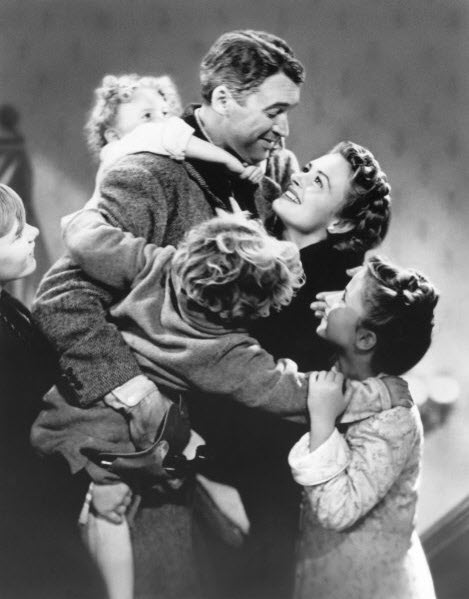
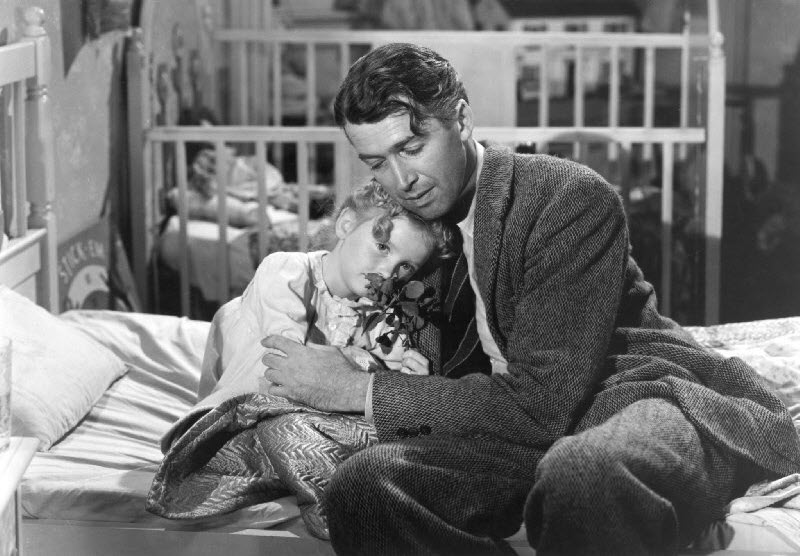
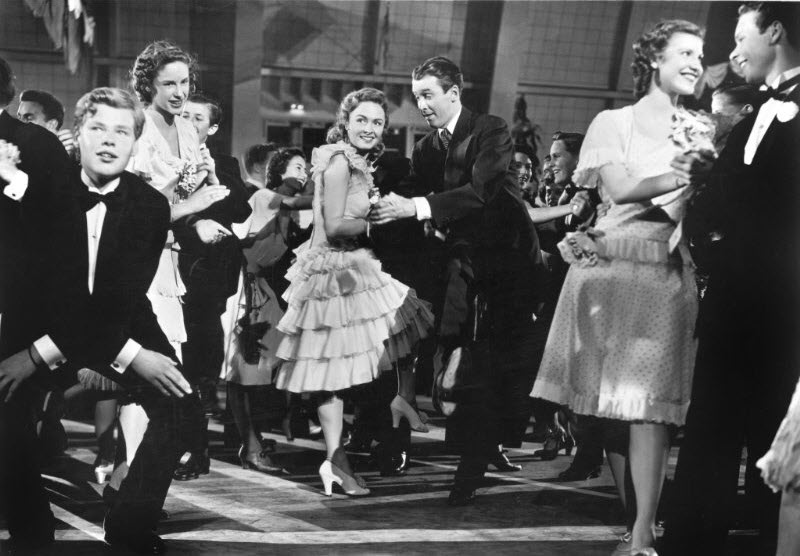
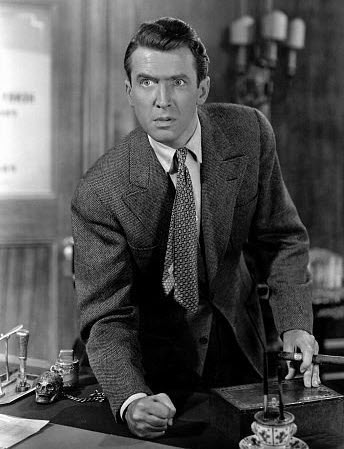
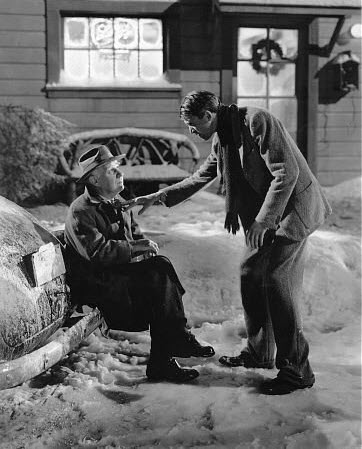
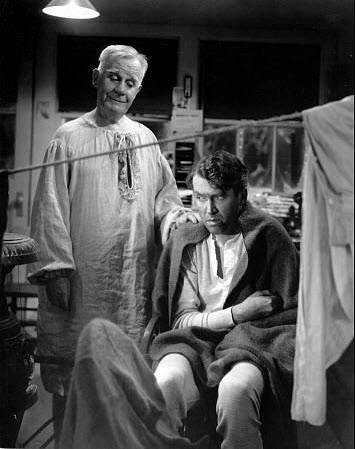
James Stewart (George Bailey), Donna Reed (Mary Hatch Bailey), Lionel Barrymore (Henry F. Potter), Thomas Mitchell (Uncle Billy), Henry Travers (Clarence Oddbody), Beulah Bondi (Mrs. Bailey), Frank Faylen (Ernie Bishop), Ward Bond (Bert the Cop), Gloria Grahame (Violet Bick), H.B. Warner (Mr. Gower), Frank Albertson (Sam Wainwright – a friend of George’s), Todd Karns (Harry Bailey), Samuel S. Hinds (Peter ‘Pa’ Bailey),more »
Director:
Frank Capra—“Mr. Smith Goes to Washington,” “It Happened One Night”
Producer:
Liberty Films, Frank Capra
Distributor:
Republic Studios
“It’s a wonderful laugh! It’s a wonderful love!”
This film was a failure at the box office and at the time marked the beginning of the decline for Christian scientist-turned-director Frank Capra. Because of its failure in every sense of the term, it was discarded by its distributer, RKO (which would soon go bankrupt and pack it in), and fell out of distribution, allowing it to wander the mean streets of television’s extra time slots. It then was aired on Christmas night and built up a cult following and pidgeonholed as a “Christmas movie”. I think this is for good reason.
I first saw this film on a Christmasnight and saw it again a few months later. It has played a very strong part in my being born again with its easily relatable themes of ambition versus obligation. Everything in this film seems to be a struggle.
The story focuses around George Bailey, a man who has a worldly vision for his future that is constantly put aside because of his selfless devotion to the town he lives in and the people in it. The favour of God is upon his life, yet he does not realise it until he almost commits suicide. It is how he is saved from suicide that the film gets into the heavy and involved aspects of the themes portrayed.
I cannot convey enough how Christian this populist piece is. If ever there was a moment in cinema history where the hand of God and the magic of film combined to form a work of art, this is it. Frank Capra made films based primarily on democratic, American ideals. With this film, he explored even deeper ideals and pulled everything off masterfully. He deliberately included scenes involving mild family abuse, drunken behavior and prideto allow for a subjective insight into the workings of George Bailey. The dark side is there to contradict the light—not at the expense of.
This film is purely for the family, but parents may want to block their childrens’ eyes during the later scenes. There seems to be such a strong timelessness about it that may mean the kids once older will be able to make educated opinions on these scenes, in particular. I get the distinct impression that God wants this film as a Christmas movie as a way for our present culture to celebrate Jesus Christ. Would that there could be more like this one. It could very well be the greatest film ever made.
Keith Richards daughter Alexandra Richards by Benjamin Kanarek for Harper’s BAZAAR
PLEASE MENTION ORIGINAL SOURCE LINK BELOW WHEN YOU EMBED OUR VIDEOS: Original Source: http://www.benjaminkanarekblog.com/e6yq Model and DJ Alexandra Richards…
Ca date d’il y a déjà quelques années. Patti donc. Passionnant ? On a jamais dit ça.
Patti Hansen in “Health for Women” magazine
Patti Hansen was the subject of a cover story in the April issue of American Health for Women magazine.
Thanks to Alyson Sadofsky from Undercover for this article!
Curled up on the couch in a friend’s home wearing a floppy gray sweater and slacks sprinkled with dog hair, Patti Hansen – supernova of models in the ’80s and wife of Rolling Stones guitarist Keith Richards – wears almost no makeup. Her only adornment is a delicate gold cross lined with tiny garnets. Her beauty is classic and profound. It’s hard to connect this shy woman with the model who photographer Francesco Scavullo describes in his recent book: “She was completely uninhibited, always running around naked on location shots…nothing fazed her.”
But something does faze Hansen the mother, something that never concerned Hansen the model. For years she has been a stay-at-home mom in Connecticut with her two daughters, Alexandra, 11, and Theodora, 13. Now modeling again at 42, Hansen is disturbed by what she sees as the industry norm of uber-thinness. “Recently, I went to a fashion show where it was awful to see the shape of some girls,” Hansen says. “One girl looked frighteningly thin.”
[snip]Certainly Hansen was not as voluptuous as Monroe, but everything about her photos in the 70’s and 80’s radiated sexuality. As Polly Mellen, creative director of Allure, puts it, “Patti just has that animal thing.” Hansen clearly has always had something. She was discovered at 16, selling hot dogs at a stand on Staten Island. A Wilhemina scout brought her to a party at the famed modeling agency; three months later she was on the cover of Seventeen.
When Hansen met Keith Richards in 1979 at Studio 54, she swears she didn’t exactly know who he was. She was 23 and he was 36. “I knew who the Rolling Stones were,” she says, “but I didn’t listen to that music. I loved the Supremes, Smokey Robinson – soul.” Hansen was smitten. “I just loved this man,” she says. “I loved the way he looked, his eyes, his strength – everything about him.”
Four years later, Hansen and Richards wed. He has two children from a previous marriage; their daughters were born in 1985 and 1986. By all accounts theirs is one of the most solid marriages in the entertainment industry. But now that the Stones are back on tour, and she’s over 40, doesn’t she worry a bit about the temptations of the road? After all, she’s married to the guy who co-wrote “Let’s Spend the Night Together.”
“Last time he was on tour, I took the kids out of school for a year and we traveled with a tutor,” she says. “This time they don’t want to do that. So I’m trying to fly wherever he is and see him at least every two weeks. But he’s good. At least,” she laughs, “I don’t read about anything.”
Considering her wild past, Hansen is surprisingly conservative now, both politically (she voted for Bob Dole) and temperamentally. A born-again Christian who attends a Bible study group (religion is one area where she and Richards agree to disagree), Hansen doesn’t let her daughters see most movies purported to be for kids their age; she forbids cursing and she preaches abstinence before marriage.
As for drugs, Hansen says, “I tell them about the things I’ve done, because I don’t want them to read about me later and be shocked. So I say, ‘When I was drinking a lot, I was dancing on top of bars, acting like a fool. I drank so I could be the life of the party.’ I tell them, ‘You don’t need the crutches.’ People said I was a free spirit. Well, I was out of my mind. In control [professionally], but out of my mind.”
Hansen is very much in control of her life now. At 5’9 1/2″, her weight fluctuates between 135 and 145, up from her modeling weight of 121 to 130. Now that her daughters are older, Hansen is returning to the modeling scene, and she knows that while a wild child in her 20s is still an employable model, a 42-year old party girl is not: “I’m not eating pizza in the middle of the night anymore. You can only do that for so long.” Aside from the occasional evening when she shares a steak at midnight with her nocturnal, meat-and-potatoes husband, most days she eats a lot of fruit and salad and drinks plenty of water.
[snip]Hansen worked out with a trainer until last March, when much of her energy was turned to focus on the eldest of her seven siblings, who was diagnosed with esophageal and lung cancer. Hansen was devastated when her sister died in September. She is just now gearing up to go back to her workout routine.
If Hansen is a role model for staying sensible about food and exercise in an industry that’s overly focused on the superficial, she’s also a poster woman for aging gracefully. “I’m fighting surgery big time,” she says. “I’d like to be natural.” Not that she ruled out the possibility of the surgeon’s arts. “I tell people that when Keith goes for a face lift, I’ll go for a face lift,” she says.
[snip]While Hansen is grateful for her looks, she also genuinely believes that her perfect face and slender body – those sublime accidents of birth – have played no real part in her happiness. She says her greatest joys come from the parts of her life that are available to most women. “My marriage, my children – they’ve changed my life for the better,” she says. “I mean, I had fun times; it’s been an awesome life. And I’m thankful I survived it.”
Sidebar “Patti’s Vitals”
· Age: 42
· Occupation: Supermodel
· Family life: Married for 15 years to Rolling Stones guitarist Keith Richards; mother of Alexandra, 11, and Theodora, 13
· Biggest sins in the 70’s: Sex, drugs and rock’n roll
· Biggest sin in the 90’s: Pizza
· What she worries about: Teens’ adulation and emulation of models
· How she de-stresses: Takes a “hard, hot shower”
· Biggest beauty secret: Drink lots of water
· Her heaven on earth: Noelle Spa for Beauty and Wellness, Stamford, CT
· Advice to her children: “Do as I say, not as I did.”
Given that she has fought and recovered from bladder cancer over the past few years, one would imagine stress to have taken its toll on Patti Hansen’s looks.
But the former supermodel, 55, who is wife of Rolling Stone Keith Richards, looks as stunning as ever pictured alongside her two daughters on the cover of Town & Country magazine.
The trio of blondes posed in cashmere and faux fur on the beach outside their California home.
Blonde beauties: Keith Richard’s Wife and Daughters on the cover of Town & Country. They reveal how hard Patti’s fight with cancer has been for the family
But though the shoot paints a picture of familial bliss, they reveal in the accompanying interview how Patti’s cancer took its toll on every single one of them.
Theodora, 26, who is a model like her mother and sister, admitted: ‘It was absolutely terrifying. Really, mum is the glue that holds us all together.’
Patti was more matter-of-fact: ‘It was depressing. But it wasn’t a shock that I had cancer,’ she told the magazine.
‘I wasn’t like, “Oh woe is me.” You know? I just felt “Ok, well that’s my number.”‘
Hellraisers: Despite a party-girl reputation of her own, Patti is credited with bringing stability to Keith’s rock’n’roll ways
In fact, Alexandra, 25, revealed, it was her father, 67, who struggled most with the diagnosis.
‘Dad did not take it well. We all wanted to stay strong for him.’
The couple met in 1979 at Studio 54, Patti’s reputation preceding her.
‘She was known for stepping off a plane in transparent shorts with no underwear’
Known for taking acid during a photo shoot, she had infamously ‘knock[ed] a photographer senseless after he got too fresh,’ and once ‘stepp[ed] off a plane in transparent shorts with no underwear.’
They married after fittingly rock’n’roll beginnings and a ‘Keef-style courtship’ that saw Keith smashing his guitar on a table the first time he met Patti’s parents, ‘before breaking down in remorseful tears.’
But as much as her past had its wild side, the ‘Bible-believing Christian’ has brought ‘stability’ to her erratic husband’s life.
Beauties: Theodora and Alexandra with their mother Patti at an Ungaro show in Paris. The sisters say they are the very best of friends
Patti, now fully recovered from her ordeal, has recently launched a range of bags with her best friend, taking them jetsetting around the world.
‘Keith’s very amused by it,’ she said. ‘He’s like “Oooh, you can be the breadwinner.”‘
The Richards’ daughters, who are nicknamed T&A after the Stones song. Little T&A, on album Tattoo You, told how they are ‘best friends’.
Theodora even has Alexandra’s initials tattooed on the back of her neck.
Alexandra echoed the sentiment, adding: ‘My sister was born to be my best friend.’
News/ Katy Perry Sings With Mick Jagger at Rolling Stones Concert—Watch Now by Rebecca Macatee Today 5:45 AM PDT The Rolling Stones & Katy Perry – Beast Of Burden – Live – By Request Published on May 12, 2013 The Rolling Stones and special guest Katy Perry perform ‘Beast Of Burden’ at the Las Vegas […]
News/ Katy Perry Sings With Mick Jagger at Rolling Stones Concert—Watch Now by Rebecca Macatee Today 5:45 AM PDT The Rolling Stones & Katy Perry – Beast Of Burden – Live – By Request Published on May 12, 2013 The Rolling Stones and special guest Katy Perry perform ‘Beast Of Burden’ at the Las Vegas […]
_________________________________ Beyond Belief: Carolyn Porco On Science & Religion, Part 1 Uploaded on Dec 4, 2006 At the Beyond Belief conference, astronomer Carolyn Porco describes the spirituality inherent in the scientific view of the Universe. ________________ Dr. Carolyn Porco is the leader of the Cassini Imaging Science team and the Director of the Cassini Imaging […]
_________________________ John E. Walker —– Nobel Prize Winner John Walker pictured below: On November 21, 2014 I received a letter from Nobel Laureate Harry Kroto and it said: …Please click on this URLhttp://vimeo.com/26991975 and you will hear what far smarter people than I have to say on this matter. I agree with them. Harry Kroto […]
_____________ Brian Harrison (historian) Emeritus Fellow of Corpus Christi College On November 21, 2014 I received a letter from Nobel Laureate Harry Kroto and it said: …Please click on this URL http://vimeo.com/26991975 and you will hear what far smarter people than I have to say on this matter. I agree with them. Harry Kroto __________________________ There […]
Wikipedia’s top 18 songs of the Velvet Underground and Nico _____________ Nico – My Heart is Empty Uploaded on Feb 25, 2010 Nico – Camera Obscura [1985] Nico Icon (Documentary)part 5 The Very Best of The Velvet Underground From Wikipedia, the free encyclopedia Jump to: navigation, search There are Velvet Underground compilation albums with similar […]
______________ I have dedicated several posts to this series on the Beatles and I don’t know when this series will end because Francis Schaeffer spent a lot of time talking and writing about them and their impact on the culture of the 1960’s. Lucy in the Sky with Diamonds- The Beatles The Beatles: The […]
________________ I have dedicated several posts to this series on the Beatles and I don’t know when this series will end because Francis Schaeffer spent a lot of time talking and writing about them and their impact on the culture of the 1960’s. The Beatles: The Beatles and their album St. Pepper’s Lonely Hearts Club […]
_____________ Steve Jones (biologist) From Wikipedia, the free encyclopedia Professor Steve Jones FRS Steve Jones (2012) On November 21, 2014 I received a letter from Nobel Laureate Harry Kroto and it said: …Please click on this URLhttp://vimeo.com/26991975 and you will hear what far smarter people than I have to say on this matter. I agree […]
All Tomorrow’s Parties” and “Sunday Morning” are two of the best songs by the Velvet Underground and Nico!!! Nico Icon (Documentary) part6. _________________ The Velvet Underground-Sunday Morning _______________ Velvet Underground-All Tomorrow’s Parties Sunday Morning (The Velvet Underground song) From Wikipedia, the free encyclopedia Jump to: navigation, search “Sunday Morning” Single by The Velvet Underground from the […]
Nardo has written over seventy books; his works include biographies of Charles Darwin, Thomas Jefferson, and H. G. Wells. The Scopes Trial gives the reader a glance at the overall trial and it includes annotated bibliographies, a thorough list of works consulted, and a comprehensive index. Moreover, the purpose of this book is to give the big picture of the trial and to provide sources for further research.
Even though The Scopes Trial is only 96 pages in length, it gives many of the little known details of the trial. For instance, the prosecution team included a local attorney named Sue Hicks (the original Boy named Sue of the Johnny Cash hit song) who had been named for his mother (p. 29). The trial was the first to be broadcast on radio, and Judge Raulston declared, My gavel will be heard around the world (p. 43). Loudspeakers were set up on the courthouse lawn Afor the crowds who were unable to squeeze into the courtroom (p. 46). Ironically, when the jurors were asked to step out of the courthouse, they still heard the testimony (p. 46). Just before William Jennings Bryan took the stand, cracks appeared in the ceiling of the courthouse; as a result, court reconvened on the front lawn (pp. 66-7).
After reading The Scopes Trial, I felt like I had actually been there in Dayton in 1925. This was due in part to Nardo’s excellent choice of over 40 pictures and his discussion of the events of the trial. Nardo writes:
Under Darrow’s relentless and skillful stream of questions, Bryan had revealed his nearly complete ignorance of world history. After more than an hour on the stand, Bryan showed not only that he was ignorant of history, but that he knew practically nothing of the established and universally accepted facts of archaeology, geology, astronomy, and other scholarly disciplines. The man who had so vigorously advocated limiting the teaching of science in the schools had just demonstrated that he had not the foggiest notion of what science was all about (p. 74).
The Scopes Trial does have a weakness though. Nardo fails to mention that much of the evidence presented by the scientists at the trial was later proven faulty. Judge Raulston ruled that all testimony bearing on the meaning of evolution or its truth or falsity had nothing to do with whether John Scopes had broken the law and should therefore be excluded from the trial (p. 59). But the Judge did allow the defense to read some of the expert testimony into the record while the jury was excused (p. 66). Part of that testimony read into the record included the two popular biological arguments for evolution embryonic recapitulation and vestigial structures. Medical science has since disproved both of these views. Furthermore, the evolution of the horse was called conclusive and the Piltdown fossils were said to be supporting evidence for evolution. Needless to say, these two pieces of evolution are no longer presented by evolutionists. In fact, evidence surfaced recently that indicates who the Piltdown hoaxer was (Henry Gee, Box of Bones `Clinches’ Identity of Piltdown Paleontology Hoaxer, Nature, 381 [1996]: 261-2).
On the other hand, creationists too have been guilty Of mistakes. John George, the author of They Never Said It!, pointed out that many creationists have mistakenly attributed these words to Clarence Darrow: “For God’s sake, let the children have their minds kept open! Close no doors to their knowledge; shut no door to them. Let them have both evolution and creation! The truth will win out in the end.” Actually it was Darrow’s co-counsel, Dudley Field Malone, who was the speaker. And what Malone said was rather different: “Make the distinction between theology and science. Let them both be taught.” Nardo states, The speech was so eloquent and passionate that the audience, even including many of the fundamentalists who supported Bryan, gave Malone a long and respectful ovation (p. 63).
In sum, The Scopes Trial is well researched and well written. I highly recommend it to the readers of PSCF.
Reviewed by Everette Hatcher III, P.O. Box 23416, Little Rock, AR 72221.
Over and over in Proverbs you hear the words “fear the Lord.” In fact, some of he references are Proverbs 1:7, 29; 2:5; 8:13; 9:10;14:26,27; 15:16 and many more. Below is a sermon by John MacArthur from the Book of Luke on 3 reasons we should fear the Lord.
What does it mean to fear the Lord? That is what John MacArthur looks at today. I really believe if I feared the Lord more then I would sin less. I am convicted about this and I hope to live a life in the future that will indicate to those around me that I am fearing the Lord.
John MacArthur
I remember hearing Dr. Adrian Rogers say that if he had to do it over again he would read from Proverbs every day to his kids. They turned out to be great kids and they were raised right. Nevertheless, if he had to do it over again he thought a more emphasis on Proverbs is the way to go. That is why I am spending so much time in Proverbs with my kids today.
John MacArthur does a great job on Proverbs and here is a portion of his sermon on Proverbs.
Now in this process of teaching there is one compelling over‑arching consummate summary lesson and that is that we are to teach them wisdom. The word which dominates the Proverbs is the word “wisdom.” Sometimes the word instruction appears, sometimes the word understanding appears, sometimes the word discretion appears. But all of those words are simply elements of wisdom…to know, to understand, to be instructed, to have discretion means to act in wisdom. Wisdom means not simply thought but conduct. It means to live righteously. We are to teach our sons spiritual wisdom is the noblest and greatest and purest pursuit of their life.
In chapter 1 verse 20 wisdom is shouting in the streets, wisdom is personified here. Wisdom is lifting up her voice in the square. She is crying out in verse 22 for people to turn away from being naive, scoffers who are fools and to turn to wisdom.
The call of the whole book of Proverbs is that call, a call to wisdom. In fact, in chapter 2, would you please notice, the call by wisdom comes at the end of chapter 1 as wisdom personified cries out and cries out for men to come to her. In chapter 2 then we find the father encouraging his son to seek wisdom. Verse 4, “If you seek her as silver and search for her as for hidden treasure, then you will discern the fear of the Lord and discover the knowledge of God, for the Lord gives wisdom, from His mouth come knowledge and understanding.” The father is saying pursue wisdom…pursue wisdom…pursue wisdom.
In chapter 8 the whole chapter is about pursuing wisdom, going after wisdom. Verse 11 says wisdom is better than jewels and all desirable things cannot compare with her. Again the pursuit of wisdom. And so, the overarching lesson that a father teaches his son is to pursue wisdom. And chapter 10 verse 1 says a wise son will make a father glad…a foolish son will be a grief to his mother.
We are then, fathers, responsible on this Father’s Day to rethink this priority of teaching our sons wisdom. And I would like us to look at these first ten chapters and just pick and choose the elements that are here that I think make up ten crucial lessons a faithful father must teach his sons. And I want to tell you from my own life that these are the things that I have endeavored as a father to teach my two sons. If a son learns these ten things, he will be a blessing to you and he will be blessed by God. If you want your son to be a blessing to you, to be blessed by God, to bless the culture in which he lives, these are the ten lessons that you must teach your son. The sum of them is spiritual wisdom. This is a listing of the component parts of spiritual wisdom.
Lesson number one, teach your son to fear your God…fear your God. In chapter 1 and verse 7, “The fear of the Lord is the beginning of knowledge,” and chapter 9 verse 10 says, “The fear of the Lord is the beginning of wisdom.” But everything starts with fearing God. Teach your son…”Son, fear your God.”
What do you mean fear? Well it has on the one hand a positive aspect, a reverential respect, a reverential awe. That means that I have to teach my son about God. I have to teach my son what God is like. I have to teach my son the attributes of God. I have to teach my son that God is powerful, that God is holy, that God is omniscient, omnipresent. I have to teach my son that God is immutable, his nature does not change, that He is just, that He is merciful, that He is kind, that He is loving, that He is gracious, that He is merciful, that He orders providentially all the circumstance of human history and the universe for His good, that He is a sovereign, in a word. I must teach my son to reverence the greatness of God.
And then the other side of it is I must teach my son to fear God’s displeasure…to fear God’s right to punish, God’s right to chasten, God’s right to judge. And in that awe of reverencing God’s holy character there is a healthy sense of apprehension because I know as a holy God He has a right to punish sin, including mine. If you want to do your son the greatest favor any father could ever do, teach him the character of God. Teach him what God is like. On the positive side, all of His attributes.
I remember when our children were little we took them through a book, Leading Little Ones To God which taught the attributes of God. We’ve always emphasized the attributes of God. They must know who their God is and they must learn to worship their God…that’s part of fearing Him. Teach your sons to worship. And you teach not only by what you say but by what you do. Do you worship faithfully on the Lord’s day? Are you consistent and faithful in worshiping the Lord? Are you here at the opening of the day in the morning and the closing in the evening service? Are you faithful to worship God in the Word yourself personally? Does your son look at you and see a true worshiper? Because whatever patterns of worship you have established for yourself, you have established for your son and he will likely establish for his son. What kind of legacy are you leaving?
And what about living in a healthy fear of God’s holy right to punish sin? Do you have that healthy fear? Do you understand that God has the right to punish you? Do you so live to avoid that?
Notice chapter 3 of Proverbs verse 5, this is really a description of a worshiping heart. “Trust in the Lord with all your heart and do not lean on your own understanding; in all your ways acknowledge Him and He will make your paths straight.” The point being that if I am completely focused on God, He’s going to guard my life, He’s going to straighten my path. I want to teach my son how to trust the Lord with all his heart. The word trust in the Hebrew originally meant to lie helplessly face down. And there’s a sense of humility there, but there’s also a sense of submission there to the total sovereign control of God in which the worshiper says I not only am humbled in Your presence but I bow in Your presence submissively to anything that You would choose to do, that’s how much I trust You. Teach your son to trust that way. Teach him not to lean on his own understanding. The Hebrew word does not mean to incline, it means to support yourself. Teach him not to support himself by his own wisdom but to support himself by God’s wisdom. In all your ways acknowledge Him. The word there means to be aware of, to know, to have fellowship with.In everything in life teach him to do it in union communion with the living God. Teach him how to trust God for everything. How to lean on God for support totally and how to be aware of God’s consistent presence in his life. And if he so lives with that kind of trust and that kind of leaning and that kind of acknowledging, God’s going to direct his path. Teach him to fear his God.
And I believe that when God is feared, so is sin…so is sin. Proverbs says fearing the Lord prolongs life. You want to give your son that kind of rich full life? Proverbs says fearing the Lord is more profitable than wealth, it brings about life. It keeps one from evil. It results in riches and honor and it breeds humility. Proverbs says that those who fear God sleep satisfied and are untouched by evil. They have confidence, they will be praised and they have their prayers answered. Would you like that for your son? Would you like to know that your son will have his life prolonged to its fullness? Would you like to know that he will be kept from evil, that he will be brought honor and riches? That he would be humble, untouched by evil? Satisfied, confident, praised and have his prayers answered? Then teach him to fear God. This is the most crucial lesson a father could ever teach a son.
_____________
FINAL QUESTION: WHAT DOES PROVERBS 3:5 MEAN?
“Trust in the Lord with all your heart and do not lean on your own understanding; in all your ways acknowledge Him and He will make your paths straight.”
In his book The New Reagan Revolution, Michael Reagan examined six great economic crossroads of the 20th and 21st centuries. These six critical junctures in the history of the United States serve as economic laboratories to test two contrasting economic theories. One theory consistently produced economic expansion and sustained growth. The other theory invariably produced failure and misery. Here are Michael Reagan findings:
1. The “Forgotten Depression” of January 1920. During the last year of Woodrow Wilson’s presidency, the economy nosedived. GNP fell 17 percent; unemployment soared from 4 to almost 12 percent. This was the “Forgotten Depression” of 1920. Wilson’s successor, Warren G. Harding, came into office and immediately cut tax rates for all income brackets, slashed federal spending, and balanced the budget. Long before the world ever heard of Ronald Reagan, Harding practiced “Reaganomics.”
“President Harding applied the principles of Reaganomics,” Michael Reagan observed, “even though Ronald Reagan was at that time a nine-year-old boy living in Dixon, Illinois. Harding was not following an economic theory. He was following common sense. He treated the federal budget as you would treat the family budget: When times are tough, cut spending and stay out of debt. Harding also treated his fellow citizens with commonsense compassion: If folks are going through tough times, government should ease their burden and cut their taxes.”
The Harding recovery was astonishingly rapid, beginning just half a year into his presidency. Unemployment fell to 6.7 percent by 1922, and to 2.4 percent by 1923. Harding’s successor, Calvin Coolidge, maintained Harding’s program of low tax rates, balanced budgets, and limited government. The Harding-Coolidge era of prosperity became known as “the Roaring Twenties”—a time of soaring prosperity, stable prices, and boundless optimism.
Obvious conclusion based on the evidence: Reaganomics works.
2. The Great Depression. Coolidge was succeeded by Herbert Hoover. In the eighth month of Hoover’s presidency, the stock market crashed—the infamous Crash of 1929. Many factors led to the Great Depression, but the Crash was the precipitating event. Hoover had failed to learn the lessons of the Harding-Coolidge years, so he responded by raising taxes (hiking the top marginal rate from 25 to 63 percent), imposing protectionism (the Smoot-Hawley Tariff Act), and boosting government spending by 47 percent, driving America deep into debt. Hoover’s actions worsened the Depression. A defeated Herbert Hoover bequeathed a ruined economy to Franklin Delano Roosevelt
FDR took office at a time when 25 percent of the nation’s workforce was unemployed. He, too, ignored the lessons of the “Forgotten Depression,” and doubled down on Hoover’s failed tax-and-spend policies, applying the economic theory known as Keynesianism (after British economist John Maynard Keynes). The Keynes-FDR approach involved deficit spending, soak-the-rich tax policies, and big-government make-work programs (the New Deal). FDR and a compliant Congress hiked personal and corporate income tax rates, estate taxes, and excise taxes.
Michael Reagan wrote, “From 1937 to 1939, the stock market lost almost half its value, car sales fell by one-third, and business failures increased by one-half. From 1932 to 1939, the U.S. racked up more debt than in all the preceding 150 years of America’s existence. By early 1939, as the Great Depression was in its tenth year, unemployment again climbed past the 20 percent mark.”
Many Americans credit FDR with “getting America through the Depression.” In reality, FDR’s policies prolonged the Depression. In a time of catastrophic unemployment, Roosevelt made it prohibitively expensive to hire people, making a terrible human tragedy even worse. While thousands of U.S banks failed under FDR’s policies, across the border in Canada, not one bank failed—because Canadian banks were not hamstrung by FDR’s foolish over-regulation. In FDR’s Folly, historian Jim Powell questions the disturbing FDR legacy:
Why did New Dealers make it more expensive for employers to hire people? Why did FDR’s Justice Department file some 150 lawsuits threatening big employers? Why did New Deal policies discourage private investment without which private employment was unlikely to revive? Why so many policies to push up the cost of living? Why did New Dealers destroy food while people went hungry? To what extent did New Deal labor laws penalize blacks? Why did New Dealers break up the strongest banks? . . . Why didn’t New Deal public works projects bring about a recovery? Why was so much New Deal relief spending channeled away from the poorest people?
In May 1939, a demoralized and defeated Henry Morgenthau, FDR’s treasury secretary, told the House Ways and Means Committee, “We are spending more than we have ever spent before and it does not work. . . . I want to see people get a job. I want to see people get enough to eat. We have never made good on our promises. . . . After eight years of this administration we have just as much unemployment as when we started. . . . And an enormous debt to boot!”
Many people mistakenly believe that World War II lifted America out of the Great Depression. Not true. What WWII did was take 12 million men out of the workforce and send them into war, which ended unemployment. But all the other signs of a damaged economy remained during the war: low stock prices, depressed private investment, and depressed consumer demand.
Roosevelt and his successor, Harry Truman, had a post-war plan to impose an even bigger Second New Deal after the war. Fortunately, Congress refused, and chose instead to cut taxes and cut spending—the same commonsense “Reaganomics” approach that had produced prosperity during the 1920s. The result: a post-war economic boom from the late 1940s through the 1950s. Had FDR and Truman gotten their way, the country would have slipped right back into recession if not a second Great Depression.
Obvious conclusion based on the evidence: Keynesianomics fails, prolonging economic hardship and misery, while Reaganomics works again.
3. The Recession of 1960 and 1961. When John F. Kennedy came into office, he faced a jobless figure of 7.1 percent. Wanting the economy to keep up with the growing workforce, JFK addressed the Economic Club of New York in December 1962 and proposed a bold notion: “It is a paradoxical truth that tax rates are too high today and tax revenues are too low and the soundest way to raise the revenues in the long run is to cut the rates now. . . . The purpose of cutting taxes now is not to incur a budget deficit, but to achieve the more prosperous, expanding economy which can bring a budget surplus.”
Those are the words of John F. Kennedy—and he was preaching Reaganomics. Kennedy was assassinated less than a year later, but his successor, Lyndon Johnson, lobbied hard for the JFK tax cuts, and he signed them into law in 1964. As a result of JFK’s Reaganesque economic plan, the economy experienced a dramatic 5 percent expansion and personal income increased by 7 percent. Gross national product grew from $628 billion to $672 billion, corporate profits by an explosive 21 percent, auto production rose by 22 percent, steel production grew by 6 percent, and unemployment plummeted to 4.2 percent—an eight-year low. The Kennedy-Johnson tax rate cuts produced a sustained economic expansion for nearly a decade.
Obvious conclusion based on the evidence: Reaganomics works again.
4. The Recession of the 1970s. This recession began in November 1973 under Nixon and ended (technically) in March 1975 under Gerald Ford—a 16-month recession. According to the graphs and charts of the economists, real GDP was on the rise by the spring of 1975, yet unemployment and inflation remained painfully high throughout rest of the 1970s. Americans continue to suffer joblessness amid spiraling prices after the recession officially ended.
In 1976, Ronald Reagan narrowly lost the primary race against Gerald Ford. Reagan was convinced that he knew how to solve the long and painful recession of the 1970s, but he was forced to watch from the sidelines as Gerald Ford and Jimmy Carter—two befuddled, clueless Keynesians!—battled each other for the White House. On October 8, 1976, at the height of the presidential race between Carter and Ford, Reagan outlined the principles of Reaganomics in a syndicated newspaper column entitled “Tax Cuts and Increased Revenue.” He wrote:
Warren Harding did it. John Kennedy did it. But Jimmy Carter and President Ford aren’t talking about it. The ‘it’ that Harding and Kennedy had in common was to cut the income tax. In both cases, federal revenues went up instead of down. . . . Since the idea worked under both Democratic and Republican administrations before, who’s to say it couldn’t work again?”
Reagan had majored in economics at Eureka College and had spent years studying the great free market economists such as Adam Smith (The Wealth of Nations), Friedrich Hayek (The Road to Serfdom), and Milton Friedman (Capitalism and Freedom). While Reagan’s opponents ignorantly wrote him off as an “amiable dunce,” it is clear that Reagan correctly and insightfully diagnosed the ailing economy of the 1970s. Unfortunately, Reagan would have to wait more than four years for the opportunity to put his prescription into practice.
Obvious conclusion based on the evidence: Keynesianism fails again.
5. The Jimmy Carter Stagflation Recession of 1980. After Jimmy Carter was inaugurated in January 1977, he inflicted the failed FDR-style Keynesian approach on the country—an approach which says the federal government can spend its way to prosperity. The result of Carter’s policies was an economic disaster called “stagflation”—slow economic growth coupled with the misery of rampant inflation and high unemployment.
By the 1980 election, America under Carter was in a full-blown recession. The American people had suffered years of double-digit interest rates, double-digit inflation, and double-digit unemployment, plus blocks-long lines at the gas station. Ronald Reagan defeated Carter in a landslide. Newsweek observed: “When Ronald Reagan steps into the White House . . . he will inherit the most dangerous economic crisis since Franklin Roosevelt took office 48 years ago.”
Reagan moved confidently and quickly to slash tax rates and domestic spending. Under his leadership, the top marginal tax rate dropped from 70 percent to 28 percent. Michael Reagan described the results:
Tax cuts generated 4 million jobs in 1983 alone and 16 million jobs over the course of Ronald Reagan’s presidency. Unemployment among African-Americans dropped dramatically, from 19.5 percent in 1983 to 11.4 percent in 1989. . . .
The inflation rate fell from 13.5 percent in 1980 . . . to 3.2 percent in 1983. . . .
The Reagan tax cuts nearly doubled federal revenue. After his 25 percent across-the-board tax rate cuts went into effect, receipts from both individual and corporate income taxes rose dramatically. According to the White House Office of Management and Budget, revenue from individual income taxes went from $244.1 billion in 1980 to $445.7 billion in 1989, an increase of over 82 percent. Revenue from corporate income taxes went from $64.6 billion to $103.3 billion, a 60 percent jump.
This was the fulfillment of the “paradoxical truth” that John F. Kennedy spoke of in his 1962 speech: “Cutting taxes now . . . can bring a budget surplus.” Both JFK and Ronald Reagan predicted that lower tax rates would generate more revenue. This “paradoxical truth” worked exactly as predicted.
At a White House press conference in 1981, President Reagan took reporters to school, explaining that the principles of Reaganomics have been known for centuries. Lower tax rates invariably bring more money into the treasury, he explained, “because of the almost instant stimulant to the economy.” This principle, Reagan added, “goes back at least, I know, as far as the fourteenth century, when a Moslem philosopher named Ibn Khaldun said, ‘In the beginning of the dynasty, great tax revenues were gained from small assessments. At the end of the dynasty, small tax revenues were gained from large assessments.’”
The principles of Reaganomics have been proved true—and Keynesian theory has been exposed as a fraud once more.
6. The Obama Recession. To be fair, what I call “The Obama Recession” actually began under George W. Bush, triggered by the collapse of the housing bubble. I think it’s fair to call it The Obama Recession because, when Barack Obama took office, he threw $814 billion of stimulus money at the recession (plus billions more in corporate bailouts, “Cash for Clunkers,” Solyndra-style green energy boondoggles, and other prime-the-pump schemes). He promised to jump-start the economy and hold unemployment below 8 percent. This was weapons-grade Keynesianism, practiced on a scale never before witnessed in human history. After spending so much money on the “cure,” Obama now owned that recession.
If Keynesian theory works at all, the Obama stimulus plan should have completely turned the economy around. But the stimulus plan—officially known as the American Recovery and Reinvestment Act of 2009—not only failed to make a splash, it didn’t make a ripple. Even after the government pumped nearly a trillion dollars of borrowed money into the economy, unemployment nudged up toward the 10 percent mark. Today, unemployment is officially below 9 percent—but the actual jobless rate is much higher.
In 2010, the Population Reference Bureau calculated the workforce to be at just over 157 million people. The Bureau of Labor Statistics reports that there are 131 million jobs in America. That would leave 26 million people jobless—or about 16 percent of the total workforce. But it gets worse: Many of those jobs are just part-time jobs, and many people hold two or more of those jobs, so the actual jobless number is certainly far higher than 16 percent—maybe 20 percent or higher.
Obvious conclusion based on the evidence: Keynesianomics fails catastrophically.
Unfortunately, the high priests of the Keynesian religion refuse to see the light. President Obama clings to his delusional Keynesian faith, insisting that all we have to do is throw more money at the economy with another stimulus bill! That is economic insanity. Former Reagan aide Peter Ferrara wrote in the Wall Street Journal:
The fallacies of Keynesian economics were exposed decades ago by Friedrich Hayek and Milton Friedman. Keynesian thinking was then discredited in practice in the 1970s, when the Keynesians could neither explain nor cure the double-digit inflation, interest rates, and unemployment that resulted from their policies. Ronald Reagan’s decision to dump Keynesianism in favor of supply-side policies—which emphasize incentives for investment — produced a 25-year economic boom. That boom ended as the Bush administration abandoned every component of Reaganomics one by one, culminating in Treasury Secretary Henry Paulson’s throwback Keynesian stimulus in early 2008.
Mr. Obama showed up in early 2009 with the dismissive certitude that none of this history ever happened, and suddenly national economic policy was back in the 1930s. Instead of the change voters thought they were getting, Mr. Obama quintupled down on Mr. Bush’s 2008 Keynesianism.
Keynesian theory is every bit as superstitious as believing in astrology or a flat Earth or the good-luck powers of a rabbit’s foot. The facts of history are beyond dispute. The old Keynesian superstition has failed every time it was tried. But Keynesian fundamentalists like Barack Obama continue to live in a state of denial.
We know what works. Nearly a century of economic history proves it. Now we need a president and a Congress with the common sense to apply the lessons of history to the economic crisis of today.
I have spent alot of time talking about Woody Allen films on this blog and looking at his worldview. He has a hopeless, meaningless, nihilistic worldview that believes we are going to turn to dust and there is no afterlife. Even though he has this view he has taken the opportunity to look at the weaknesses of his own secular view. I salute him for doing that. That is why I have returned to his work over and over and presented my own Christian worldview as an alternative.
As a homage to Gordon Willis, his long-time friend and cinematographer, he includes a scene where you hear the actors talking outside the shot. Willis encouraged him to do this when they were shooting Annie Hall (1977).
Match Point (2005) was his first film to make money in seven years.
In the early 1960’s, he did stand-up comedy at Enrico’s Café in San Francisco.
The oldest Academy Award winner for Best Original Screenplay (aged 76 in 2012 for Midnight in Paris (2011)).
I don’t want to achieve immortality through my work. I want to achieve it by not dying.
I’m not afraid of dying… I just don’t want to be there when it happens.
[in 1977] This year I’m a star, but what will I be next year? A black hole?
On the plus side, death is one of the few things that can be done just as easily as lying down.
[when asked if he liked the idea of living on on the silver screen] I’d rather live on in my apartment.
[on films] I can’t imagine that the business should be run any other way than that the director has complete control of his films. My situation may be unique, but that doesn’t speak well for the business — it shouldn’t be unique, because the director is the one who has the vision and he’s the one who should put that vision onto film.
Basically I am a low-culture person. I prefer watching baseball with a beer and some meatballs.
There are worse things in life than death. Have you ever spent an evening with an insurance salesman?
Money is better than poverty, if only for financial reasons.
I do the movies just for myself like an institutionalized person who basket-weaves. Busy fingers are happy fingers. I don’t care about the films. I don’t care if they’re flushed down the toilet after I die.
Most of the time I don’t have much fun. The rest of the time I don’t have any fun at all.
[at the Academy Awards in 2002, explaining why he was the one introducing a montage of New York movies] And I said, ‘You know, God, you can do much better than me. You know, you might want to get Martin Scorsese, or, or Mike Nichols, or Spike Lee, or Sidney Lumet…’ I kept naming names, you know, and um, I said, ‘Look, I’ve given you 15 names of guys who are more talented than I am, and, and smarter and classier…’ And they said, ‘Yes, but they weren’t available.’
If my film makes one more person miserable, I’ll feel I’ve done my job.
For some reason I’m more appreciated in France than I am back home. The subtitles must be incredibly good.
My relationship with Hollywood isn’t love-hate, it’s love-contempt. I’ve never had to suffer any of the indignities that one associates with the studio system. I’ve always been independent in New York by sheer good luck. But I have an affection for Hollywood because I’ve had so much pleasure from films that have come out of there. Not a whole lot of them, but a certain amount of them have been very meaningful to me.
Related posts:
I love the movie “Midnight in Paris” by Woody Allen and I have done over 30 posts on the historical characters mentioned in the film. Take a look below:
I have spent alot of time talking about Woody Allen films on this blog and looking at his worldview. He has a hopeless, meaningless, nihilistic worldview that believes we are going to turn to dust and there is no afterlife. Even though he has this view he has taken the opportunity to look at the weaknesses of […]
I have spent alot of time talking about Woody Allen films on this blog and looking at his worldview. He has a hopeless, meaningless, nihilistic worldview that believes we are going to turn to dust and there is no afterlife. Even though he has this view he has taken the opportunity to look at the weaknesses of […]
Woody Allen video interview in France Related posts: “Woody Wednesdays” Woody Allen on God and Death June 6, 2012 – 6:00 am Good website on Woody Allen How can I believe in God when just last week I got my tongue caught in the roller of an electric typewriter? If Jesus Christ came back today and […]
I have spent alot of time talking about Woody Allen films on this blog and looking at his worldview. He has a hopeless, meaningless, nihilistic worldview that believes we are going to turn to dust and there is no afterlife. Even though he has this view he has taken the opportunity to look at the weaknesses of […]
A surprisingly civil discussion between evangelical Billy Graham and agnostic comedian Woody Allen. Skip to 2:00 in the video to hear Graham discuss premarital sex, to 4:30 to hear him respond to Allen’s question about the worst sin and to 7:55 for the comparison between accepting Christ and taking LSD. ___________________ The Christian Post > […]
Crimes and Misdemeanors: A Discussion: Part 1 If you like Woody Allen films as much as I do then join me every Wednesday for another look the man and his movies. Below are some of the posts from the past: “Woody Wednesday” How Allen’s film “Crimes and Misdemeanors makes the point that hell is necessary […]
I really enjoyed this documentary on Woody Allen from PBS. Woody Allen: A Documentary, Part 1 Published on Mar 26, 2012 by NewVideoDigital Beginning with Allen’s childhood and his first professional gigs as a teen – furnishing jokes for comics and publicists – WOODY ALLEN: A DOCUMENTARY chronicles the trajectory and longevity of Allen’s career: […]
Crimes and Misdemeanors: A Discussion: Part 3 Uploaded by camdiscussion on Sep 23, 2007 Part 3 of 3: ‘Is Woody Allen A Romantic Or A Realist?’ A discussion of Woody Allen’s 1989 movie, Crimes and Misdemeanors, perhaps his finest. By Anton Scamvougeras. http://camdiscussion.blogspot.com/antons@mail.ubc.ca ______________ One of my favorite Woody Allen movies and I reviewed […]
Crimes and Misdemeanors: A Discussion: Part 2 Uploaded by camdiscussion on Sep 23, 2007 Part 2 of 3: ‘What Does The Movie Tell Us About Ourselves?’ A discussion of Woody Allen’s 1989 movie, perhaps his finest. By Anton Scamvougeras. http://camdiscussion.blogspot.com/antons@mail.ubc.ca _________________- One of my favorite Woody Allen movies and I reviewed it earlier but […]
I have spent alot of time talking about Woody Allen films on this blog and looking at his worldview. He has a hopeless, meaningless, nihilistic worldview that believes we are going to turn to dust and there is no afterlife. Even though he has this view he has taken the opportunity to look at the weaknesses of […]
Crimes and Misdemeanors: A Discussion: Part 1 If you like Woody Allen films as much as I do then join me every Wednesday for another look the man and his movies. Below are some of the posts from the past: “Woody Wednesday” How Allen’s film “Crimes and Misdemeanors makes the point that hell is necessary […]
I have spent alot of time talking about Woody Allen films on this blog and looking at his worldview. He has a hopeless, meaningless, nihilistic worldview that believes we are going to turn to dust and there is no afterlife. Even though he has this view he has taken the opportunity to look at the weaknesses of […]
Crimes and Misdemeanors: A Discussion: Part 1 Uploaded by camdiscussion on Sep 23, 2007 Part 1 of 3: ‘What Does Judah Believe?’ A discussion of Woody Allen’s 1989 movie, perhaps his finest. By Anton Scamvougeras. http://camdiscussion.blogspot.com/antons@mail.ubc.ca _____________ One of my favorite films is this gem by Woody Allen “Crimes and Misdemeanors”: Film Review By […]
Crimes and Misdemeanors: A Discussion: Part 3 Uploaded by camdiscussion on Sep 23, 2007 Part 3 of 3: ‘Is Woody Allen A Romantic Or A Realist?’ A discussion of Woody Allen’s 1989 movie, Crimes and Misdemeanors, perhaps his finest. By Anton Scamvougeras. http://camdiscussion.blogspot.com/antons@mail.ubc.ca ______________ One of my favorite Woody Allen movies and I reviewed […]
Crimes and Misdemeanors: A Discussion: Part 2 Uploaded by camdiscussion on Sep 23, 2007 Part 2 of 3: ‘What Does The Movie Tell Us About Ourselves?’ A discussion of Woody Allen’s 1989 movie, perhaps his finest. By Anton Scamvougeras. http://camdiscussion.blogspot.com/antons@mail.ubc.ca _________________- One of my favorite Woody Allen movies and I reviewed it earlier but […]
Crimes and Misdemeanors: A Discussion: Part 1 Uploaded by camdiscussion on Sep 23, 2007 Part 1 of 3: ‘What Does Judah Believe?’ A discussion of Woody Allen’s 1989 movie, perhaps his finest. By Anton Scamvougeras. http://camdiscussion.blogspot.com/antons@mail.ubc.ca _____________ Today I am starting a discusssion of the movie “Crimes and Misdemeanors” by Woody Allen. This 1989 […]
Does Government Have a Revenue or Spending Problem?
People say the government has a debt problem. Debt is caused by deficits, which is the difference between what the government collects in tax revenue and the amount of government spending. Every time the government runs a deficit, the government debt increases. So what’s to blame: too much spending, or too little tax revenue? Economics professor Antony Davies examines the data and concludes that the root cause of the debt is too much government spending.
_______________
Will Rogers has a great quote that I love. He noted, “Lord, the money we do spend on Government and it’s not one bit better than the government we got for one-third the money twenty years ago”(Paula McSpadden Love,The Will Rogers Book,(1972) p. 20.)
We got to cut wasteful spending out of the government and here is another fine suggestion from the Heritage Foundation.
The massive spending bill, or continuing resolution, released by the Senate this week continues spending on programs which are inappropriate or wasteful and fails to adopt good policies in many areas. Here’s a rundown of some of the worst offenders in the Senate bill:
Supplemental Nutrition Assistance Program (SNAP):$77.2 billion. The recommendation continues record-high food stamp benefits. Food stamp spending has approximately doubled since President Obama came to office. It is one of the largest and fastest growing federal welfare programs. The federal government operates 80 federal welfare programs at a cost of nearly $1 trillion a year. Over 10 of these provide food assistance.
Food stamp spending should be rolled back to pre-recession levels. Able-bodied adults without dependents who receive food stamp benefits should be required to work or prepare for work as a condition of receiving benefits.
—Rachel Sheffield, Research Associate
Job Corps: $30 million added to the funding level already provided under sequestration. This program should be terminated, because a scientifically rigorous impact evaluation of Job Corps participants were less likely to obtain high school degrees, were no more likely to attend or complete college, and earned only $0.22 more in hourly wages than non-participants. Further, the Department of Labor Office of Inspector General estimates each Job Corps participant who is successfully placed into any job costs taxpayers $76,574.
Violence Against Women Act (VAWA) grants: $416.5 million. VAWA grants should be terminated, because these services should be funded locally. Using federal agencies to fund the routine operations of domestic violence programs that state and local governments could provide is a misuse of federal resources and a distraction from concerns that are truly the province of the federal government.
Office of Justice Programs (OJP) grants: $1.1 billion. OJP grants should be terminated, because these grants assign functions to the federal government that fall within the expertise, jurisdiction, and constitutional responsibilities of state and local governments. Further, the Edward Byrne Memorial Justice Assistance Grants ($392 million) within OJP have been used to place criminals on the street without posting bail.
Office of Juvenile Justice and Delinquency Prevention (OJJDP): $279.5 million. OJJDP grants should be terminated, because these grants fund juvenile justice and prevention programs that fall under the unique responsibilities of state and local governments. Further, there is little evidence that these grants are effective at preventing delinquency.
Community Oriented Policing Services (COPS): $225.5 million. COPS grants should be terminated, because these grants assign functions to the federal government that fall within the expertise, jurisdiction, and constitutional responsibilities of state and local governments. Further COPS grants were used to supplant local funds and had little to no effect on reducing crime.
FEMA Fire Grants: $675 million. Fire grants should be terminated. Fire grants, which subsidize the routine operations of local fire departments, are ineffective at reducing fire-related deaths and injuries of firefighters and civilians. Fire grants incorrectly encourage local fire departments to become increasingly dependent on federal funding.
—David B. Muhlhausen, Ph.D., Research Fellow in Empirical Policy Analysis
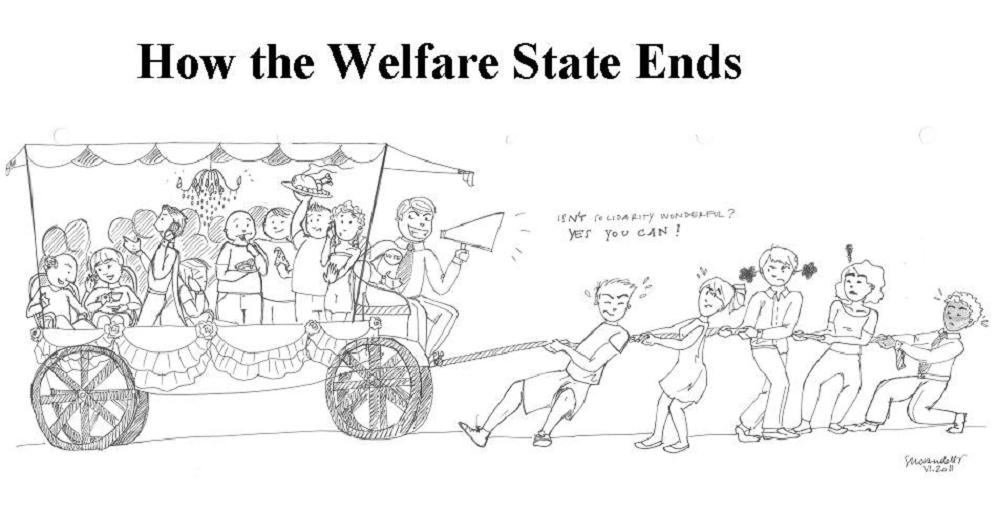
In my speeches, especially when talking about the fiscal crisis in Europe (or the future fiscal crisis in America), I often warn that the welfare state reaches a point-of-no-return when the number of people riding in the wagon begins to outnumber the number of people pulling the wagon.
To be more specific, if more than 50 percent of the population is dependent on government (employed in the bureaucracy, living off welfare, receiving pensions, etc), it becomes rather difficult to form a coalition to fix the mess. This may explain why Greek politicians have resisted significant reforms, even though the nation faces a fiscal death spiral.
But you don’t need me to explain this relationship. One of our Cato interns, Silvia Morandotti, used her artistic skills to create two images (click pictures for better resolution) that show what a welfare state looks like when it first begins and what it eventually becomes.
These images are remarkably accurate. The welfare state starts with small programs targeted at a handful of genuinely needy people. But as politicians figure out the electoral benefits of expanding programs and people figure out the that they can let others work on their behalf, the ratio of producers to consumers begins to worsen.
Then things get really interesting. Small nations such as Greece can rely on permanent bailouts from bigger countries and the IMF, but sooner or later, as larger nations begin to go bankrupt, that approach won’t be feasible.
I often conclude my speeches by joking with the audience that it’s time to stock up on canned goods, bottled water, and ammo. Many people, I’m finding, don’t think that line very funny.
If you spend too much then people won’t want to work anymore.
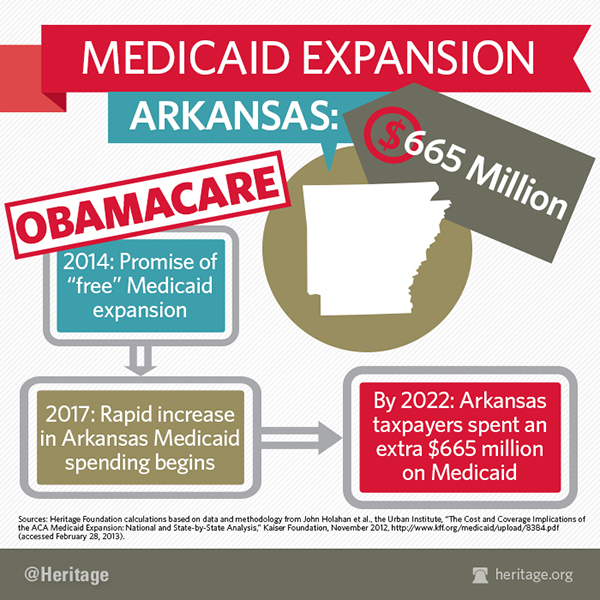
As action to stop Obamacare languishes in Washington, the debate continues at the state level. Heritage is hosting a series of health care reports from our allies in the states to provide an up-close view of state-level action regarding Obamacare.
The states play an important role in protecting citizens against this flawed federal health care law–from challenging the health care law before the Supreme Court, to resisting efforts to establish Obamacare exchanges or expand a failing Medicaid program, to offering alternative proposals that will ensure citizens are not left abandoned when the federal law collapses.
Today, Dan Greenberg—President of the Advance Arkansas Institute—updates Foundry readers on developments in Arkansas.
A bipartisan alliance succeeded in convincing the Arkansas legislature to expand Medicaid. That was because enough Republicans were won over by the legislation’s theoretically pro-market design. However, a closer look suggests a textbook case of a beautiful theory slain by ugly facts.
Republican proponents of expansion claimed that the proposal was fundamentally different from a traditional Medicaid expansion, because it would enroll the new Medicaid clients in private insurance through the state’s Obamacare exchange. They dubbed it the “private option,” and argued that private plans would provide better care at lower cost.
When the arrangement was first proposed, it was greeted with cautious optimism in some quarters. But that optimism predated the “Good Friday memo” from the U.S. Department of Health and Human Services, which clarified that any Medicaid expansion provided through private coverage would still have to conform to standard Medicaid benefit requirements and cost-sharing limitations.
In plain English, the maneuver Arkansas was contemplating would gain the state no additional flexibility on benefits or cost sharing beyond the (very limited) scope allowed under current federal Medicaid rules.
Thus, the notion that the “private option” could somehow produce significantly lower costs and better patient outcomes relative to traditional Medicaid became highly doubtful. At best, it would simply be a variant on the existing and common strategy of states contracting with private managed care companies to deliver Medicaid benefits. Yet, while the policy differences were vanishingly small, to the point of nonexistent, the rhetorical shift was enough for the pro-expansion forces to eke out a win in the end. Given that, it is worth deconstructing the rhetoric offered in support of the Arkansas plan.
The expansion isn’t really an expansion. Medicaid expansion, explained Republican Representative Charlie Collins, “is dead.” The expansion that Republican lawmakers were crafting was supposedly categorically different. Collins argued that the “private option” would take hundreds of thousands of people off the Medicaid rolls. Yet the notion that clients who get their Medicaid benefits through a private plan are somehow not on the Medicaid rolls is as factually incorrect as saying that seniors who get their Medicare benefits through a private Medicare Advantage plan are magically not in Medicare.
Reforming the state’s existing Medicaid program required expanding Medicaid to new enrollees. Private-option advocates argued that a number of taxpayer-friendly Medicaid reforms included in the legislation were part of the private option, implying that those reforms were an inseparable part of Medicaid expansion, but the need for joining these two measures was never explained. Indeed, at no point in the debate did the advocates offer to simply strip out the expansion provisions and then enact the other, meritorious reforms—such as new measures to detect and deter Medicaid fraud and abuse.
Medicaid expansion was linked to tax relief and economic growth. Democratic Governor Mike Beebe claimed that the two were linked, while Republican Speaker of the House Davy Carter provided a more nuanced explanation suggesting that negotiations over tax relief were in conjunction with Medicaid expansion. Speaker Carter also appeared to argue that the private option would increase net state government revenue. Shortly after the votes for Medicaid expansion were secured in the House, multiple tax relief bills began to roll onto the House floor. Yet, after the votes for Medicaid expansion were secured in the Senate, most of those tax relief bills were immediately amended so that they would not take effect until future budget years. If there was, in fact, some deal between the Governor and the legislative leadership that tied tax relief to the Medicaid expansion, its terms were never made public.
Arkansas could exit from expansion if federal promises weren’t kept. The legislation included provisions for the state to reverse the expansion if the federal government’s promised funding declined in the future. Setting aside the political question of how likely it is for politicians to terminate a government program—especially one that creates hundreds of thousands of new clients—once it has begun, there are also legal and constitutional questions about whether the contractual commitments that Medicaid expansion creates might make it a one-way street. To their credit, private-option advocates attempted to minimize the “Hotel California” problem with a last-minute amendment to their bill.
In sum, the advocates of Medicaid expansion in Arkansas built bipartisan political support by linking the Medicaid expansion to conservative reform. Republican Senator Jeremy Hutchinson argued on the Senate floor that the private option was a “down payment” on future reform of “entitlement programs.” Republican Senator Jason Rapert argued that the private option was “essentially what we all say we want—Medicaid block grant funding to allow states to innovate for their own populations.” Indeed, Representative Collins argued that the private option would allow Arkansas to “transcend Obamacare” while Speaker Carter insisted that a vote for the private option is “a vote against Obamacare.”
Such statements are less analytical than rhetorical—and to those who understand the basic workings of Medicaid and Obamacare, they are unpersuasive. In any event, such statements were enough to let Governor Beebe achieve his goal of expanding Arkansas’s Medicaid program.
Dan Greenberg, the President of the Advance Arkansas Institute, is both a former member of the Arkansas legislature and a former Heritage Foundation analyst.
Expanding government is not right. Take a look at this article: APRIL 25, 2013 6:35PM ‘Why Indiana Shouldn’t Fall for Obamacare’s Medicaid Expansion’ By MICHAEL F. CANNON SHARE My latest oped, in the Indy Star: Meanwhile, many [Medicaid] enrollees can’t even find a doctor. One-third of primary care physicians won’t take new Medicaid patients. Only 20 percent of […]
I was glad to see that the true Tea Party Conservatives won the first round in the medicaid expansion debate. According to AFP in the last 5 years Arkansas’ current Medicaid program has run a deficit of a billion dollars. Why expand it willingly with Obama? The “Do Nothing” expansion plan increases spending by […]
CATO Institute Michael Cannon on the OReilly Factor Published on Mar 19, 2013 The CATO Institute’s Michael Cannon spoke at the Arkansas Conservative Caucus on Tuesday March 19th. Several conservatives were present. Cannon talked about how to defeat Obamacare in Arkansas & how the states can stop Obamacare on a national level. Max Brantley of […]
Nic Horton Medicaid Expansion will “Cost Almost Double than Doing Nothing” part II _______ I am hopeful that the Arkansas Republican state lawmakers will not expand the broken medicaid program. Evidently Congressman Rick Crawford feels strongly about this too. Crawford: Even With Arkansas Plan, ObamaCare Is Unaffordable Crawford urges state legislators to reject ObamaCare, because […]
Mike Maharrey talks AR Medicaid Expansion on the PHP ______________ This article from the Heritage Foundation mentions that the lawmakers in Arkansas are getting ready to make a big mistake if they think they will get flexibility from Obamacare on Medicaid expansion. Administration Rules Out “Deals” on Medicaid Expansion Edmund Haislmaier April 3, 2013 at […]
A Red-Ink Train Wreck: The Real Fiscal Cost of Government-Run Healthcare Uploaded on Nov 9, 2009 This CF&P Foundation video explains why healthcare proposals in Washington will result in bloated government and higher deficits. This mini-documentary exposes the pervasive inaccuracy of congressional forecasts and succinctly lists 12 reasons why Obamacare will be a budget […]
CATO Institute Michael Cannon on the OReilly Factor Published on Mar 19, 2013 The CATO Institute’s Michael Cannon spoke at the Arkansas Conservative Caucus on Tuesday March 19th. Several conservatives were present. Cannon talked about how to defeat Obamacare in Arkansas & how the states can stop Obamacare on a national level. __________________ CATO Institute […]
Great article from Heritage Foundation: Chart of the Week: The States That Have Expanded Medicaid T. Elliot Gaiser March 13, 2013 at 5:30 pm «Expanding Medicaid will be costly for most states. The authors of The Patient Protection and Affordable Care Act of 2010 (Obamacare) threatened to strip all federal funding […]
New York is the real winner in medicaid expansion while Arkansas would lose out in the long run. The Arkansas Times has reported that Republican lawmakers were warming up to the idea of expansion recently. The representatives and senators in Arkansas need to take a close look at both this article below and this editorial […]
The Medicaid deals being presented by the federal government seem like great deals until you realize that the taxpayer will end up paying the bill and the taxpayer is us!!!! January 25, 2013 5:09PM Federal Money to the States Isn’t ‘Free’ By Tad DeHaven Share Tweet Like Google+1 Richmond Times-Dispatch columnist A. Barton Hinkle recently […]
Interest payments on U.S. government debt are three times spending in the Iraq and Afghanistan wars already, and that is with the lowest interest rate we have seen since the 1960s. A rise in interest rates would increase interest payments dramatically. What can the U.S. government do today to prevent a crisis from happening when interest rates go up?
___________________
We got to cut wasteful spending out of the government and here is another fine suggestion from the Heritage Foundation.
The massive spending bill, or continuing resolution, released by the Senate this week continues spending on programs which are inappropriate or wasteful and fails to adopt good policies in many areas. Here’s a rundown of some of the worst offenders in the Senate bill:
Consumer Product Safety Commission (CPSC). Unlike the budget passed by the House, the Senate bill seeks to restore government spending to fund the failed CPSC product safety database. CPSC decision making with respect to the database has previously been called “arbitrary and capricious” by the courts.
Since it was implemented in 2011, manufacturers have shown that the CPSC database is seriously flawed. The database allows the public to submit unproven claims of harm with the CPSC and gives manufacturers only 10 days to challenge these claims; however, the CPSC itself has final authority to publish reports of such claims, even if they are disproved by the manufacturer. The accuracy of the CPSC reports is thus seriously questionable, and is a one-stop shop for tort lawyers seeking new clients or seeking “evidence” for their current lawsuits.
Furthermore, last October, in Company Doe v. Inez Tenenbaum, a federal court in Maryland overturned a decision of the CPSC to publish a report as “arbitrary and capricious,” because the CPSC report was “misleading and fail[ed] to relate[] to the [manufacturer’s] product in any way.” Indeed, the CPSC database is a concrete example of government waste: It is a shame that the Senate bill seeks to restore government spending to publishing misleading claims that damage business growth and likely lead to additional frivolous lawsuits.
A similar theme can be found in this great new cartoon from Chuck Asay.
And just in case you think Asay is being unfair, keep in mind that folks like Obama and Pelosi actually have claimed that more unemployment benefits is “stimulus.” Yes, you read correctly. Subsidizing unemployment is good for growth to these strange ideologues.







 “Christmas” movies
 Blonde beauties: Keith Richard’s Wife and Daughters on the cover of Town & Country. They reveal how hard Patti’s fight with cancer has been for the family
 Hellraisers: Despite a party-girl reputation of her own, Patti is credited with bringing stability to Keith’s rock’n’roll ways
 Beauties: Theodora and Alexandra with their mother Patti at an Ungaro show in Paris. The sisters say they are the very best of friends




 The Daily Hatch