The reality is that President Biden, pictured at a ceremony where he signed a bill honoring law enforcement in the Rose Garden of the White House on Aug. 5, couldn’t go a year in office without pleading with oilocracies to hike production. (Photo: Win McNamee/Getty Images)
Last week, the U.N. Intergovernmental Panel on Climate Change ordered a “code red,” releasing a “landmark” report warning that global warming was an existential threat to humanity, “unequivocally” blaming humans for the problem, and demanding rapid action to cut greenhouse gas emissions.
“What the IPCC told us is what President [Joe] Biden has believed all along,” White House press secretary Jen Psaki noted last Tuesday. “Climate change is an urgent threat that requires bold action.”
The very next day, the Biden administration released a statement imploring the OPEC cartel to increase production of oil to help lower worldwide gas prices. “Higher gasoline costs,” the White House said, “if left unchecked, risk harming the ongoing global recovery.” The White House wants OPEC to go above the 400,000-barrels-per-day increase it already promised to implement, which doesn’t seem to jibe with the notion that we are on the precipice of the apocalypse.
As an economic matter, of course, the request makes total sense: By pressuring exporters to pump more oil, a fungible commodity, we lower costs worldwide.
Even though technology continues to create efficiencies that lower emissions, modernity relies heavily on affordable and reliable energy. Economies would collapse without it. And for emerging nations, affordable fossil fuel remains a prerequisite for lifting billions of people out of poverty.
As a political matter, it might seem odd, to say the least, that President Joe Biden is imploring foreign nations to increase supply. Firstly, such a position runs contrary to virtually every “green” plan in existence—almost all of which intentionally, through mandates or bans or taxes or contrived “markets,” exist to make fossil fuels more expensive and reduce use.
Clean energy advocates, including the president, argue that, in the aggregate, going green would be an economic plus. But if slightly higher prices threaten the world’s economic health, what would complete weaning from fossil fuels do to the economy? Biden has promised a “100% clean energy economy” with “net-zero emissions” in only a few decades. Without some technological miracle, this is a fantastical, not to mention suicidal, goal.
The reality is that Biden couldn’t go a year in office without pleading with oilocracies to hike production. In his defense, one assumes, people will point out that COVID-19 presents a historically unique situation. As far as the economics of recovery go, not really. In fact, this manmade downturn should be easier to mend than most. And this is certainly not the last recession or downturn or pandemic or world event that is going to affect the energy market.
Though it’s probably an unpopular position, I’d be content importing cheap oil, or allowing others to flood the market, while saving our own supply for a time when new drilling becomes more economically feasible. But the hypocrisy of all this is that Biden works to restrict energy trade only in North America.
Earlier this year, the president rescinded oil and gas lease sales from most of the nation’s massive state-owned lands and waters, citing climate change as the reason. He then shut down the Keystone XL pipeline, revoking a permit that was needed to build a 1,200-mile project that would have carried around 830,000 barrels per day of Alberta oil sands crude into the United States—probably more than enough to avoid begging OPEC for oil—again citing climate change as the reason.
At the same time, Biden lifted United States sanctions that would have blocked completion of the Nord Stream 2 natural gas pipeline that will transport fuel from Russia to Germany, which, like us, is a signee of the Paris Agreement.
Most European nations aren’t abiding by that agreement (well, without the help of an economy-paralyzing pandemic). Which is a reminder that to merely keep pace with the IPCC recommendations on carbon emissions, Americans, who use around 20 million barrels of petroleum every day, would be compelled to induce a pandemic-level shutdown of the economy every year for 30 years.
Americans, despite what they tell pollsters about climate change, demand affordable gas. You might recall that, despite his best efforts to undermine U.S. energy production, former President Barack Obama took credit for the domestic oil and gas boom. “That was me, people,” he told a crowd in 2018. Political pressure is also why the White House made sure its OPEC statement on gas prices was for public consumption, rather than simply making those requests of OPEC through diplomatic channels.
The Green New Deal, whatever iteration of the plan you care to support, is unfeasible. Biden’s request is just another reminder.
John Stossel: Through 50 years of reporting on scares, only COVID proved true
By John Stossel
Published November 17, 2020 at 7:06pm
I hear that climate change will destroy much of the world.
“There will be irreversible damage to the planet!” warns a CNN anchor.
Joe Biden says he’ll spend $500 billion a year to fight what his website calls an “existential threat to life.”
Really?
I’m a consumer reporter. Over the years, alarmed scientists have passionately warned me about many things they thought were about to kill Americans.
Asbestos in hair dryers, coffee, computer terminals, electric power lines, microwave ovens, cellphones (brain tumors!), electric blankets, herbicides, plastic residue, etc., are causing “America’s cancer epidemic”!
If those things don’t get us, “West Nile Virus will!” Or SARS, Bird Flu, Ebola, flesh-eating bacteria or “killer bees.”
Experts told me millions would die on Jan. 1, 2000, because computers couldn’t handle the switch from 1999. Machines would fail; planes would crash.
The scientists were well-informed specialists in their fields. They were sincerely alarmed. The more knowledge you have about a threat, the more alarmed you get.
Yet, mass death didn’t happen. COVID-19 has been the only time in my 50 years of reporting that a scare proved true.
Maybe you accepted the phrase I used above: “America’s cancer epidemic.” But there is no cancer epidemic. Cancer rates are down. We simply live long enough to get diseases like cancer. But people think there’s a cancer epidemic.
The opposite is true. As we’ve been exposed to more plastics, pesticides, mysterious chemicals, food additives and new technologies, we live longer than ever!
Advertisement – story continues below
That’s why I’m skeptical when I’m told: Climate change is a crisis!
Climate change is real. It’s a problem, but I doubt that it’s “an existential threat.”
Saying that makes alarmists mad.
When Marc Morano says it, activists try to prevent him from speaking.
“They do not want dissent,” says Morano, founder of ClimateDepot.com, a website that rebuts much of what climate activists teach in schools.
“It’s an indoctrination that’s so complete that by the time (kids) get to high school, they’re not even aware that there’s any scientific dissent.”
Morano’s new movie, “Climate Hustle 2,” presents that dissent. My new video this week features his movie.
Morano argues that politicians use fear of global warming to gain power.
“Climate Hustle 2” features Sen. Chuck Schumer shouting: “If we would do more on climate change, we’d have fewer of these hurricanes and other types of storms! Everyone knows that!”
But everyone doesn’t know that. Many scientists refute it. Congress’ own hearings include testimony about how our warmer climate has not caused increases in the number of hurricanes or tornadoes. “Climate Hustle 2” includes many examples like that.
“Why should we believe you?” I ask Morano. “You’re getting money from the fossil fuel industry.” After all, Daily Kos calls him “Evil Personified” and says ExxonMobil funds him.
“Not at all,” he replies. “I’m paid by about 90% individual contributions from around the country. Why would ExxonMobil give me money (when) they want to appear green?”
Morano’s movie frustrates climate activists by pointing out how hypocritical some are.
Actor Leonardo DiCaprio says he lives a “green lifestyle … (using) energy-efficient appliances. I drive a hybrid car.”
Then he flies to Europe to attend a party.
I like watching Morano point out celebrities’ hypocrisy, but think one claim in his movie goes too far.
“Stopping climate change is not about saving the planet,” says narrator Kevin Sorbo. “It’s about climate elites trying to convince us to accept a future where they call all the shots.”
I push back at Morano: “I think they are genuinely concerned, and they want to save us.”
“Their vision of saving us is putting them in charge,” he replies.
And if they’re in charge, he says, they will destroy capitalism.
—-
State of the Union 2013
Published on Feb 13, 2013
Cato Institute scholars Michael Tanner, Alex Nowrasteh, Julian Sanchez, Simon Lester, John Samples, Pat Michaels, Jagadeesh Gokhale, Michael F. Cannon, Jim Harper, Malou Innocent, Juan Carlos Hidalgo, Ilya Shapiro, Trevor Burrus and Neal McCluskey respond to President Obama’s 2013 State of the Union Address.
Video produced by Caleb O. Brown, Austin Bragg and Lester Romero.
Today I am taking a look at the response of the scholars of the Heritage Foundation and the Cato Institute scholars to the 2013 State of the Union Address.
Swept into office four years ago based, in part, on promises to slow sea-level rise, President Obama initiated a radical climate agenda. It seems we are seeing a rerun in 2013. It is worth asking what is different four years after his first State of the Union Address?
There have been four more years of no global warming. In 2010, there had been no significant world temperature increase for over a decade. The streak is now 16 years long. We have four years of costly lessons on the waste and inefficiency of green-energy subsidies.
The scientific basis for catastrophic climate change gets weaker and weaker. The economic argument for green subsidies has already collapsed. It is time for the administration to quit using both arguments to justify a regulatory and fiscal power grab.
– David W. Kreutzer, PhD, research fellow in energy economics and climate change, Center for Data Analysis
Is President Obama gutting the welfare reform that Bill Clinton signed into law? Morning Bell: Obama Denies Gutting Welfare Reform Amy Payne August 8, 2012 at 9:15 am The Obama Administration came out swinging against its critics on welfare reform yesterday, with Press Secretary Jay Carney saying the charge that the Administration gutted the successful […]
Senator Blunt Vows to Keep Pressure on President Obama Over Contraceptive Mandate Uploaded by HeritageFoundation on Feb 13, 2012 http://blog.heritage.org/2012/02/13/sen-blunt-vows-to-keep-pressure-on-obama-… | Sen. Roy Blunt (R-MO) introduced legislation to protect religious organizations from Obamacare’s overreach last summer. Now, as President Obama presses forward with his anti-conscience mandate, Blunt is prepared to keep the pressure on the […]
Max Brantley is wrong about Tom Cotton’s accusation concerning the rise of welfare spending under President Obama. Actually welfare spending has been increasing for the last 12 years and Obama did nothing during his first four years to slow down the rate of increase of welfare spending. Rachel Sheffield of the Heritage Foundation has noted: […]
Sen. Mitch McConnell: Americans Don’t Approve of Anything Obama Has Done Uploaded by HeritageFoundation on Dec 8, 2011 In an exclusive interview at The Heritage Foundation, Senate Minority Leader Mitch McConnell (R-KY) sharply criticized President Obama for engaging in class warfare and accused him of shifting the focus away from his own failed policies in […]
Obamanomics: A Legacy of Wasteful Spending Published on Aug 12, 2012 by CFPEcon101 This mini-documentary from the Center for Freedom and Prosperity Foundation highlights egregious examples of wasteful spending from the so-called stimulus legislation and explains why government spending hurts economic performance. **Links to additional reading material** Thomas Sowell, “Stimulus or Sedative?” http://www.realclearpolitics.com/articles/2010/03/09/stimulus_or_sedative_104… Veronique de […]
President Obama c/o The White House 1600 Pennsylvania Avenue NW Washington, DC 20500 Dear Mr. President, I know that you receive 20,000 letters a day and that you actually read 10 of them every day. I really do respect you for trying to get a pulse on what is going on out here. Is […]
President Obama c/o The White House 1600 Pennsylvania Avenue NW Washington, DC 20500 Dear Mr. President, I know that you receive 20,000 letters a day and that you actually read 10 of them every day. I really do respect you for trying to get a pulse on what is going on out here. The […]
Thomas Sowell (This letter was mailed before September 1, 2012) President Obama c/o The White House 1600 Pennsylvania Avenue NW Washington, DC 20500 Dear Mr. President, I know that you receive 20,000 letters a day and that you actually read 10 of them every day. I really do respect you for trying to get a […]
I have been writing letters to President Obama almost all of 2012. I have received several responses from the White House but none of the responses have been personal responses from the President. Below is a letter I wrote to the President and a form letter response that I got followed by links to other […]
That being said, intervention from Washington is the not the main cause of America’s education problems. The real problem is that we have an inefficient monopoly systemthat is – for all intents and purposes – run for the benefit of teachers and bureaucrats.
But then I read something that almost makes me think that politicians want the system to be a failure.
Here’s a story from Yahoo! News that I first assumed was from the Babylon Bee. But it’s not satire, it really happened.
Oregon Gov. Kate Brown privately signed a bill last month ending the requirement for high school students to prove proficiency in reading, writing, and arithmetic before graduation. Brown, a Democrat, did not hold a public signing or issue a press release regarding the passing of Senate Bill 744…,an unusually quiet approach to enacting legislation, according to the Oregonian. …The bill, which suspends the proficiency requirements for students for three years, has attracted controversy for at least temporarily suspending academic standards… Backers argued…the new standards for graduation would aid Oregon’s “Black, Latino, Latinx, Indigenous, Asian, Pacific Islander, Tribal, and students of color.” …Republicans criticized the proposal for lowering academic standards. “I worry that by adopting this bill, we’re giving up on our kids,” House Republican Leader Christine Drazan said.
I don’t know which part of the story is more reprehensible. Should we be more outraged that state politicians wants to eliminate standards, or should we be more outraged that supporters are implicitly (at the very least) racist in thinking that minority students can’t perform?
This is equivalent to breaking your bathroom scale because you don’t like your weight.
Ethan Chaplin, a Glen Meadow Middle School student, told News 12 last week that while he was twirling a pencil with a pen cap on in math class, a student who bullied him earlier in the day yelled “He’s making gun motions, send him to juvie.” He was suspended for two days and then underwent five hours of a physical and mental exam at Riverview Medical Center’s crisis unit, his father told NJ.com.
We have another crazy example of political correctness run amok, as reported by the New York Post (h/t: Daily Caller).
Meet 8-year-old Asher Palmer, who was tossed out of his special-needs Manhattan school for threatening other kids with a toy “gun’’ — which he made out of rolled-up paper. …[His mom] was incensed that Principal Micaela Bracamonte told other staffers in an email that Asher “had a model for physically aggressive behavior in his immediate family.’’ Spadone thinks Bracamonte was referring to her husband because he served in the military during the Kuwait war. If that was the reason for the comment, she said, “I find it offensive and inappropriate.’’ As far as the toy gun is concerned, she said Asher, a first-year student, made it out of a piece of paper after discussing military weapons with his dad.
I’ve previously shared many stories of anti-gun political correctness in government schools (see here, here, here, here, here, and here). Makes me wonder whether that kind of nonsense is even more counterproductive to kids that some of the excesses of critical race theory.
January 26, 2021
President Biden c/o The White House 1600 Pennsylvania Avenue NW Washington, DC 20500
I have written about 66 heroes of mine in the House of Representatives that voted “no” on the Obama/Biden debt ceiling increase request in 2011. I believe we must have representatives that will vote to restore our freedom and that means voting to cut spending and lower taxes like the Patriots of long ago wanted. Today the Tea Party represented my views the most closely. Lord knows I have written a lot about that in the past. . I have praised over and over and over the 66 House Republicans that voted no on that before. If they did not raise the debt ceiling then we would have a balanced budget instantly. I agree that the Tea Party has made a difference and I have personally posted 49 posts on my blog on different Tea Party heroes of mine.
THIS BRINGS ME TO ONE OF MY BIGGEST ECONOMIC HEROES AND IT IS THE LATE MILTON FRIEDMAN. Friedman had such revolutionary policies such as eliminating welfare and instituting the negative income tax and putting in school vouchers.
The problem in Washington is not lack of revenue but our lack of spending restraint. This video below makes that point.
Free-market economics meets free-market policies at The Heritage Foundation’s Tenth Anniversary dinner in 1983. Nobel Laureate Milton Friedman and his wife Rose with President Ronald Reagan and Heritage President Ed Feulner.
Since the passing of Milton Friedman who was my favorite economist, I have been reading the works of Daniel Mitchell and he quotes Milton Friedman a lot, and you can reach Dan’s website here.
Mitchell in February 2011.
Wikipedia noted concerning Dan:
Mitchell’s career as an economist began in the United States Senate, working for Oregon Senator Bob Packwood and the Senate Finance Committee. He also served on the transition team of President-Elect Bush and Vice President-Elect Quayle in 1988. In 1990, he began work at the Heritage Foundation. At Heritage, Mitchell worked on tax policy issues and began advocating for income tax reform.[1]
In 2007, Mitchell left the Heritage Foundation, and joined the Cato Institute as a Senior Fellow. Mitchell continues to work in tax policy, and deals with issues such as the flat tax and international tax competition.[2]
In addition to his Cato Institute responsibilities, Mitchell co-founded the Center for Freedom and Prosperity, an organization formed to protect international tax competition.[1]
The evidence is in: school choice works. Yesterday, the Friedman Foundation for Educational Choice released their third edition of their report “A Win-Win Solution: The Empirical Evidence on School Choice.” The report provides a literature review of dozens of high-quality studies of school choice programs around the country, including studies from scholars at Harvard University, Stanford University, Cornell University, the University of Arkansas, the Brookings Institution, and the Federal Reserve Bank. The studies examine the impact of school choice programs on the academic performance of participants and public school students, the fiscal impact on taxpayers, racial segregation, and civic values.
The report’s key findings included the following:
Twelve empirical studies have examined academic outcomes for school choice participants using random assignment, the “gold standard” of social science. Of these, 11 find that choice improves student outcomes—six that all students benefit and five that some benefit and some are not affected. One study finds no visible impact. No empirical study has found a negative impact.
Twenty-three empirical studies (including all methods) have examined school choice’s impact on academic outcomes in public schools. Of these, 22 find that choice improves public schools and one finds no visible impact. No empirical study has found that choice harms public schools.
Six empirical studies have examined school choice’s fiscal impact on taxpayers. All six find that school choice saves money for taxpayers. No empirical study has found a negative fiscal impact.
Eight empirical studies have examined school choice and racial segregation in schools. Of these, seven find that school choice moves students from more segregated schools into less segregated schools. One finds no net effect on segregation from school choice. No empirical study has found that choice increases racial segregation.
Seven empirical studies have examined school choice’s impact on civic values and practices such as respect for the rights of others and civic knowledge. Of these, five find that school choice improves civic values and practices. Two find no visible impact from school choice. No empirical study has found that school choice has a negative impact on civic values and practices.
On the same day, a new study from researchers at Harvard University and the Brookings Institution found that a school choice program boosted college enrollment among African-American participants by 24 percent.
While many of the findings show only modest improvement, they consistently show that school choice programs produce the same or superior results across a gamut of measures. Moreover, not all the benefits of choice are easily measurable. Some families are looking for a school that better meets a student’s special needs, instills the parents’ values, inspires a lifelong love of learning, or where a student is safe from bullying. These outcomes are sometimes difficult if not impossible to measure in the aggregate, but parents are in the best position to tell the difference for their own children.
Thank you so much for your time. I know how valuable it is. I also appreciate the fine family that you have and your commitment as a father and a husband.
Sincerely,
Everette Hatcher III, 13900 Cottontail Lane, Alexander, AR 72002, ph 501-920-5733,
Related posts:
Milton Friedman’s Free to Choose (1980), episode 3 – Anatomy of a Crisis. part 1
Milton Friedman The Power of the Market 5-5 How can we have personal freedom without economic freedom? That is why I don’t understand why socialists who value individual freedoms want to take away our economic freedoms. I wanted to share this info below with you from Milton Friedman who has influenced me greatly over the […]
Milton Friedman The Power of the Market 4-5 How can we have personal freedom without economic freedom? That is why I don’t understand why socialists who value individual freedoms want to take away our economic freedoms. I wanted to share this info below with you from Milton Friedman who has influenced me greatly over the […]
Milton Friedman The Power of the Market 3-5 How can we have personal freedom without economic freedom? That is why I don’t understand why socialists who value individual freedoms want to take away our economic freedoms. I wanted to share this info below with you from Milton Friedman who has influenced me greatly over the […]
Milton Friedman The Power of the Market 2-5 How can we have personal freedom without economic freedom? That is why I don’t understand why socialists who value individual freedoms want to take away our economic freedoms. I wanted to share this info below with you from Milton Friedman who has influenced me greatly over the […]
Milton Friedman The Power of the Market 1-5 How can we have personal freedom without economic freedom? That is why I don’t understand why socialists who value individual freedoms want to take away our economic freedoms. I wanted to share this info below with you from Milton Friedman who has influenced me greatly over the […]
The Machine: The Truth Behind Teachers Unions Published on Sep 4, 2012 by ReasonTV America’s public education system is failing. We’re spending more money on education but not getting better results for our children. That’s because the machine that runs the K-12 education system isn’t designed to produce better schools. It’s designed to produce more […]
John Brummett in his article, “A new civil rights struggle in Little Rock?” Arkansas News Burea, August 25, 2011, asserted the main role vouchers should have is “providing new models for regular public schools to emulate, not about replacing regular public schools.” The Heritage Foundation cares nothing about saving the public schools. If the public […]
Milton Friedman – Public Schools / Voucher System Published on May 9, 2012 by BasicEconomics The Machine: The Truth Behind Teachers Unions Published on Sep 4, 2012 by ReasonTV America’s public education system is failing. We’re spending more money on education but not getting better results for our children. That’s because the machine that runs […]
(This letter was mailed before Oct 25, 2012.) President Obama c/o The White House 1600 Pennsylvania Avenue NW Washington, DC 20500 Dear Mr. President, I know that you receive 20,000 letters a day and that you actually read 10 of them every day. I really do respect you for trying to get a pulse on […]
The Machine: The Truth Behind Teachers Unions Published on Sep 4, 2012 by ReasonTV America’s public education system is failing. We’re spending more money on education but not getting better results for our children. That’s because the machine that runs the K-12 education system isn’t designed to produce better schools. It’s designed to produce more […]
Everywhere school vouchers have been tried they have been met with great success. Why do you think President Obama got rid of them in Washington D.C.? It was a political disaster for him because the school unions had always opposed them and their success made Obama’s allies look bad. In 1980 when I first sat […]
Milton Friedman – Public Schools / Voucher System (Q&A) Part 2 Published on May 7, 2012 by BasicEconomics __________ Max Brantley of the Arkansas Times Blog is always critical of the voucher system but has he taken a closer look at what has been going on in the public schools the last few decades with […]
Everywhere school vouchers have been tried they have been met with great success. Why do you think President Obama got rid of them in Washington D.C.? It was a political disaster for him because the school unions had always opposed them and their success made Obama’s allies look bad. In 1980 when I first sat […]
Sixty Six who resisted “Sugar-coated Satan Sandwich” Debt Deal (Part 49) This post today is a part of a series I am doing on the 66 Republican Tea Party favorites that resisted eating the “Sugar-coated Satan Sandwich” Debt Deal. Actually that name did not originate from a representative who agrees with the Tea Party, but […]
Sixty Six who resisted “Sugar-coated Satan Sandwich” Debt Deal (Part 48) This post today is a part of a series I am doing on the 66 Republican Tea Party favorites that resisted eating the “Sugar-coated Satan Sandwich” Debt Deal. Actually that name did not originate from a representative who agrees with the Tea Party, but […]
Sixty Six who resisted “Sugar-coated Satan Sandwich” Debt Deal (Part 47) This post today is a part of a series I am doing on the 66 Republican Tea Party favorites that resisted eating the “Sugar-coated Satan Sandwich” Debt Deal. Actually that name did not originate from a representative who agrees with the Tea Party, but […]
Sixty Six who resisted “Sugar-coated Satan Sandwich” Debt Deal (Part 46) This post today is a part of a series I am doing on the 66 Republican Tea Party favorites that resisted eating the “Sugar-coated Satan Sandwich” Debt Deal. Actually that name did not originate from a representative who agrees with the Tea Party, […]
Sixty Six who resisted “Sugar-coated Satan Sandwich” Debt Deal (Part 45) This post today is a part of a series I am doing on the 66 Republican Tea Party favorites that resisted eating the “Sugar-coated Satan Sandwich” Debt Deal. Actually that name did not originate from a representative who agrees with the Tea Party, but […]
Sixty Six who resisted “Sugar-coated Satan Sandwich” Debt Deal (Part 44) This post today is a part of a series I am doing on the 66 Republican Tea Party favorites that resisted eating the “Sugar-coated Satan Sandwich” Debt Deal. Actually that name did not originate from a representative who agrees with the Tea Party, but […]
Sixty Six who resisted “Sugar-coated Satan Sandwich” Debt Deal (Part 43) This post today is a part of a series I am doing on the 66 Republican Tea Party favorites that resisted eating the “Sugar-coated Satan Sandwich” Debt Deal. Actually that name did not originate from a representative who agrees with the Tea Party, but […]
Sixty Six who resisted “Sugar-coated Satan Sandwich” Debt Deal (Part 42) This post today is a part of a series I am doing on the 66 Republican Tea Party favorites that resisted eating the “Sugar-coated Satan Sandwich” Debt Deal. Actually that name did not originate from a representative who agrees with the Tea Party, but […]
Sixty Six who resisted “Sugar-coated Satan Sandwich” Debt Deal (Part 41) This post today is a part of a series I am doing on the 66 Republican Tea Party favorites that resisted eating the “Sugar-coated Satan Sandwich” Debt Deal. Actually that name did not originate from a representative who agrees with the Tea Party, but […]
Sixty Six who resisted “Sugar-coated Satan Sandwich” Debt Deal (Part 40) This post today is a part of a series I am doing on the 66 Republican Tea Party favorites that resisted eating the “Sugar-coated Satan Sandwich” Debt Deal. Actually that name did not originate from a representative who agrees with the Tea Party, but […]
Sixty Six who resisted “Sugar-coated Satan Sandwich” Debt Deal (Part 39) This post today is a part of a series I am doing on the 66 Republican Tea Party favorites that resisted eating the “Sugar-coated Satan Sandwich” Debt Deal. Actually that name did not originate from a representative who agrees with the Tea Party, but […]
Sixty Six who resisted “Sugar-coated Satan Sandwich” Debt Deal (Part 38) This post today is a part of a series I am doing on the 66 Republican Tea Party favorites that resisted eating the “Sugar-coated Satan Sandwich” Debt Deal. Actually that name did not originate from a representative who agrees with the Tea Party, but […]
Sixty Six who resisted “Sugar-coated Satan Sandwich” Debt Deal (Part 37) This post today is a part of a series I am doing on the 66 Republican Tea Party favorites that resisted eating the “Sugar-coated Satan Sandwich” Debt Deal. Actually that name did not originate from a representative who agrees with the Tea Party, but […]
Sixty Six who resisted “Sugar-coated Satan Sandwich” Debt Deal (Part 36) This post today is a part of a series I am doing on the 66 Republican Tea Party favorites that resisted eating the “Sugar-coated Satan Sandwich” Debt Deal. Actually that name did not originate from a representative who agrees with the Tea Party, but […]
Sixty Six who resisted “Sugar-coated Satan Sandwich” Debt Deal (Part 35) This post today is a part of a series I am doing on the 66 Republican Tea Party favorites that resisted eating the “Sugar-coated Satan Sandwich” Debt Deal. Actually that name did not originate from a representative who agrees with the Tea Party, but […]
Sixty Six who resisted “Sugar-coated Satan Sandwich” Debt Deal (Part 34) This post today is a part of a series I am doing on the 66 Republican Tea Party favorites that resisted eating the “Sugar-coated Satan Sandwich” Debt Deal. Actually that name did not originate from a representative who agrees with the Tea Party, but […]
Sixty Six who resisted “Sugar-coated Satan Sandwich” Debt Deal (Part 33) This post today is a part of a series I am doing on the 66 Republican Tea Party favorites that resisted eating the “Sugar-coated Satan Sandwich” Debt Deal. Actually that name did not originate from a representative who agrees with the Tea Party, but […]
Sixty Six who resisted “Sugar-coated Satan Sandwich” Debt Deal (Part 32) This post today is a part of a series I am doing on the 66 Republican Tea Party favorites that resisted eating the “Sugar-coated Satan Sandwich” Debt Deal. Actually that name did not originate from a representative who agrees with the Tea Party, but […]
Congressmen Tim Huelskamp on the debt ceiling Sixty Six who resisted “Sugar-coated Satan Sandwich” Debt Deal (Part 31) This post today is a part of a series I am doing on the 66 Republican Tea Party favorites that resisted eating the “Sugar-coated Satan Sandwich” Debt Deal. Actually that name did not originate from a representative […]
Sixty Six who resisted “Sugar-coated Satan Sandwich” Debt Deal (Part 30) This post today is a part of a series I am doing on the 66 Republican Tea Party favorites that resisted eating the “Sugar-coated Satan Sandwich” Debt Deal. Actually that name did not originate from a representative who agrees with the Tea Party, but […]
Sixty Six who resisted “Sugar-coated Satan Sandwich” Debt Deal (Part 29) This post today is a part of a series I am doing on the 66 Republican Tea Party favorites that resisted eating the “Sugar-coated Satan Sandwich” Debt Deal. Actually that name did not originate from a representative who agrees with the Tea Party, but […]
The Sixty Six who resisted “Sugar-coated Satan Sandwich” Debt Deal (Part 28) This post today is a part of a series I am doing on the 66 Republican Tea Party favorites that resisted eating the “Sugar-coated Satan Sandwich” Debt Deal. Actually that name did not originate from a representative who agrees with the Tea Party, […]
The Sixty Six who resisted “Sugar-coated Satan Sandwich” Debt Deal (Part 27) This post today is a part of a series I am doing on the 66 Republican Tea Party favorites that resisted eating the “Sugar-coated Satan Sandwich” Debt Deal. Actually that name did not originate from a representative who agrees with the Tea Party, […]
The Sixty Six who resisted “Sugar-coated Satan Sandwich” Debt Deal (Part 26) This post today is a part of a series I am doing on the 66 Republican Tea Party favorites that resisted eating the “Sugar-coated Satan Sandwich” Debt Deal. Actually that name did not originate from a representative who agrees with the Tea Party, […]
Uploaded by RepJoeWalsh on Jun 14, 2011 Our country’s debt continues to grow — it’s eating away at the American Dream. We need to make real cuts now. We need Cut, Cap, and Balance. The Sixty Six who resisted “Sugar-coated Satan Sandwich” Debt Deal (Part 25) This post today is a part of a series […]
The Sixty Six who resisted “Sugar-coated Satan Sandwich” Debt Deal (Part 24) This post today is a part of a series I am doing on the 66 Republican Tea Party favorites that resisted eating the “Sugar-coated Satan Sandwich” Debt Deal. Actually that name did not originate from a representative who agrees with the Tea Party, […]
The Sixty Six who resisted “Sugar-coated Satan Sandwich” Debt Deal (Part 23) This post today is a part of a series I am doing on the 66 Republican Tea Party favorites that resisted eating the “Sugar-coated Satan Sandwich” Debt Deal. Actually that name did not originate from a representative who agrees with the Tea Party, […]
The Sixty Six who resisted “Sugar-coated Satan Sandwich” Debt Deal (Part 22) This post today is a part of a series I am doing on the 66 Republican Tea Party favorites that resisted eating the “Sugar-coated Satan Sandwich” Debt Deal. Actually that name did not originate from a representative who agrees with the Tea Party, […]
The Sixty Six who resisted “Sugar-coated Satan Sandwich” Debt Deal (Part 21) This post today is a part of a series I am doing on the 66 Republican Tea Party favorites that resisted eating the “Sugar-coated Satan Sandwich” Debt Deal. Actually that name did not originate from a representative who agrees with the Tea Party, […]
The Sixty Six who resisted “Sugar-coated Satan Sandwich” Debt Deal (Part 20) This post today is a part of a series I am doing on the 66 Republican Tea Party favorites that resisted eating the “Sugar-coated Satan Sandwich” Debt Deal. Actually that name did not originate from a representative who agrees with the Tea Party, […]
The Sixty Six who resisted “Sugar-coated Satan Sandwich” Debt Deal (Part 19) This post today is a part of a series I am doing on the 66 Republican Tea Party favorites that resisted eating the “Sugar-coated Satan Sandwich” Debt Deal. Actually that name did not originate from a representative who agrees with the Tea Party, […]
The Sixty Six who resisted “Sugar-coated Satan Sandwich” Debt Deal (Part 18) This post today is a part of a series I am doing on the 66 Republican Tea Party favorites that resisted eating the “Sugar-coated Satan Sandwich” Debt Deal. Actually that name did not originate from a representative who agrees with the Tea Party, […]
The Sixty Six who resisted “Sugar-coated Satan Sandwich” Debt Deal (Part 17) This post today is a part of a series I am doing on the 66 Republican Tea Party favorites that resisted eating the “Sugar-coated Satan Sandwich” Debt Deal. Actually that name did not originate from a representative who agrees with the Tea Party, […]
The Sixty Six who resisted “Sugar-coated Satan Sandwich” Debt Deal (Part 16) This post today is a part of a series I am doing on the 66 Republican Tea Party favorites that resisted eating the “Sugar-coated Satan Sandwich” Debt Deal. Actually that name did not originate from a representative who agrees with the Tea Party, […]
Sen Obama in 2006 Against Raising Debt Ceiling The Sixty Six who resisted “Sugar-coated Satan Sandwich” Debt Deal (Part 15) This post today is a part of a series I am doing on the 66 Republican Tea Party favorites that resisted eating the “Sugar-coated Satan Sandwich” Debt Deal. Actually that name did not originate from […]
Medicaid and Medicare are the biggest problems, but let’s focus today on Social Security.
Richard Rahn has a column in the Washington Times that summarizes the program’s grim outlook. Here are some excerpts.
Politicians love to talk about the Social Security “trust fund” and assure us that it will not be raided. But the unfortunate fact is the “trust fund” is an accounting fiction without any real assets. In actuality, Social Security is a giant Ponzi scheme operated by the government. Benefits that are paid to existing retirees come from the current taxes from those working today and borrowing. …But now, Americans have fewer children, and life expectancies are growing rapidly. …There is no easy way out. Future Social Security benefits will be cut (probably by not fully indexing for inflation), and/or taxes will be greatly and continuously increased until the system collapses.
The fact that Social Security is a Ponzi scheme isn’t necessarily fatal. After all, the government has the ability to coerce new workers into the system.
The problem is that there are fewer and fewer of those new workers to support the growing number of people getting benefits.
Here are the numbers from Richard’s column. As the old saying goes, read ’em and weep.
Richard ends his column by fretting that the United States is on a dangerous path.
The world has seen this play before. In 1906, Argentina on a per-capita income basis was one of the richest countries in the world, rivaling the United States. It has bountiful agricultural and mineral resources and had a relatively well-educated population of mainly European origin. But after a century of fascist/socialist/welfare-state governments, it is now a poor country. Venezuela went from a rich country with civil liberties to a poor oppressed country in only two decades. As Margaret Thatcher famously said, “the problem with socialism is that eventually, you run out of other peoples’ money.” The Greeks built a nice welfare state, largely using German taxpayers’ money – the Euro – until the Germans said, “no more.” As a result, the Greeks have seen a drop in real incomes of more than 30 percent in seven or so years.
The good news is that our economic policy won’t be nearly as bad as Argentina and Venezuela, even if some of Biden’s crazy ideas – such a massive per-child handouts – are enacted.
The bad news is that we could become a lot more like Greece.
And that’s where Margaret Thatcher’s famous warning could become an American reality.
There is a solution to this problem, by the way. It’s been implemented in a couple of dozen nations around the world.
P.S. Here are a couple of humorous items about Social Security.
The first one actually understates how bad the trade is because workers actually pay 12.4 percent of their income into the program (the so-called employer share simply means lower pre-tax pay).
And the second item points out that Bernie Madoff was an amateur.
P.P.S. If you want more jokes and cartoons about Social Security, click here. There are other Social Security cartoonshere,here, andhere. And a Social Security jokeif you appreciate grim humor.
Back in 2009 and 2010, when I had less gray hair, I narrated a four-part series on the economic burden of government spending.
Here’s Part II, which discusses the theoretical reasons why big government reduces prosperity.
I provide eight examples to illustrate how and why government spending can hinder economic growth.
The last item is what I called the “stagnation cost,” which is the tendency of politicians and bureaucrats to throw good money after badbecause there is no incentive to adapt.
When giving speeches, I usually refer to this as the “inertia cost.”
But, regardless of what I call it, I explain that every government program has a group of beneficiaries that are strongly motivated to keep their gravy train moving even if money is being wasted.
In an article for National Review, Sean-Michael Pigeon offers one very plausible explanation for why this happens.
He says politicians fall victim to the fallacy of sunk costs.
…we need an understanding of government inefficiency… One reason government spending is so needlessly costly is somewhat paradoxical: The state is wasteful precisely because people are so concerned about wasting money. …This is a classic sunk-cost fallacy: Costs that can’t be recovered are “sunk,” and therefore irrelevant for future decision-making.But while this fallacy is well known in economics, sunk costs are a big deal in the practical world of politics. Nobody wants to waste money, and politicians don’t want to cause waste directly. No member of Congress wants to be publicly responsible for a half-built bridge, especially when they have to tell taxpayers they still have to foot the bill for it. …Congress’s unwillingness to cut the funding of poorly run projects is a significant reason government projects always spend too much. …Politicians are nervous about cutting ongoing projects because they don’t want to leave taxpayers empty-handed, but stomaching sunk costs is worth it. Not only is it economically sound to stop government agencies from bleeding money, but it also sets the precedent that shoddy work will be held accountable. …to save money, sometimes you have to lose money.
In other words, it would be good to stop the bleeding.
But that’s not politically easy. Mr. Pigeon has examples in his column, but he should have included California’s (supposed) high-speed rail project.
That boondoggle has been draining money from state and federal coffers for about a decade. Cost estimates have exploded (something that almost always happens with government projects), yet construction has barely started.
And you won’t be surprised that a big argument from supporters is that we’ve already wasted billions and billions of dollars on the project, so therefore we should continue to waste even more money(sort of like hitting yourself on the head with a hammer because it feels good when you stop).
The big-picture bottom line is that the burden of federal spending should be reduced so that politicians have less ability to waste money.
Simply stated, modest-sized welfare states are sustainable if more and more new taxpayers enter the system to finance benefits for a burgeoning population of old people.
But that’s not happening any more. In most nations, traditional population pyramids are becoming population cylinders because of falling birthrates and increasing longevity.
That’s the bad news.
The good news is that there is growing awareness the demographic changes are happening. Indeed, Damien Cave, Emma Bubola and Choe Sang-Hun have a big article on population decline in the New York Times.
All over the world, countries are confronting population stagnation and a fertility bust, a dizzying reversal unmatched in recorded history that will make first-birthday parties a rarer sight than funerals, and empty homes a common eyesore. Maternity wards are already shutting down in Italy. Ghost cities are appearing in northeastern China. Universities in South Korea can’t find enough students, and in Germany, hundreds of thousands of properties have been razed, with the land turned into parks.…Demographers now predict that by the latter half of the century or possibly earlier, the global population will enter a sustained decline for the first time. …The strain of longer lives and low fertility, leading to fewer workers and more retirees, threatens to upend how societies are organized — around the notion that a surplus of young people will drive economies and help pay for the old. …The change may take decades, but once it starts, decline (just like growth) spirals exponentially. With fewer births, fewer girls grow up to have children, and if they have smaller families than their parents did — which is happening in dozens of countries — the drop starts to look like a rock thrown off a cliff. …according to projections by an international team of scientists published last year in The Lancet, 183 countries and territories — out of 195 — will have fertility rates below replacement level by 2100.
Plenty of interesting data, though remarkably little focus on the fiscal implications. Sort of like writing about 1943 France with almost no reference to World War II.
In any event, the article takes a closer look at the challenges in certain nations., including South Korea.
To goose the birthrate, the government has handed out baby bonuses. It increased child allowances and medical subsidies for fertility treatments and pregnancy. Health officials have showered newborns with gifts of beef, baby clothes and toys. The government is also building kindergartens and day care centers by the hundreds. In Seoul, every bus and subway car has pink seats reserved for pregnant women. But this month, Deputy Prime Minister Hong Nam-ki admitted that the government — which has spent more than $178 billion over the past 15 years encouraging women to have more babies — was not making enough progress.
I was struck by the statement from the Deputy Prime Minister that his nation “was not making enough progress”?
That’s a strange way of describing catastrophic decline in birthrates, as noted in the article.
South Korea’s fertility rate dropped to a record low of 0.92 in 2019 — less than one child per woman, the lowest rate in the developed world. Every month for the past 59 months, the total number of babies born in the country has dropped to a record depth.
Both Singapore and Hong Kong have extremely low birth rates, for instance, but they aren’t facing a huge fiscal crisis because they have very small welfare states and workers are obliged to save for their own retirement.
Other Asian jurisdictions, however, made the mistake of copying Western nations, meaning entitlement programs that become mathematically impossible when populations pyramids become population cylinders (or even upside-down pyramids!).
In addition to South Korea, Japan also faces a major challenge.
And the situation is very grim in Europe, even though birth rates haven’t fallen to the same degree (though the numbers is some Eastern European nations are staggeringly bad).
If you want a rigorous explanation of the issue, my colleague Jeff Miron has a must-read monograph on the topic. You should peruse the entire study, but here’s the key conclusion if you’re pressed for time.
…this paper projects fiscal imbalance as of every year between 1965 and 2014, using data-supported assumptions about gross domestic product (GDP) growth, revenue, and trends in mandatory spending on Social Security, Medicare, Medicaid, and other programs. The projections reveal that the United States has faced a growing fiscal imbalance since the early 1970s, largely as a consequence of continuous growth in mandatory spending. As of 2014, the fiscal imbalance stands at $117.9 trillion, with few signs of future improvement even if GDP growth accelerates or tax revenues increase relative to historic norms. Thus the only viable way to restore fiscal balance is to scale back mandatory spending policies, particularly on large health care programs such as Medicare, Medicaid, and the Affordable Care Act (ACA).
Jeff’s report is filled with sobering charts. I’ve picked out three that deserve special attention.
First, here’s a look back in history at the growing fiscal burden of entitlement programs.
Second, here’s a look forward at how the fiscal burden of entitlement programs will get even worse in coming decades.
Keep in mind, by the way, that the two above charts only show the fiscal burden of entitlement programs (sometimes referred to as “mandatory spending” since the laws “mandate” that money be given to anyone who is “entitled” based on various criteria).
Jeff adds everything together and shows, for each year between 1965 and 2014, the “present value” of the gap between what the government is promising to spend and how much revenue it is projected to collect.
These numbers are especially horrific because “present value” is a measure of how much money the government would have to somehow obtain and set aside in order to have a nest egg capable of offsetting future deficits.
Needless to say, the federal government did not have access to $118 trillion (yes, trillion with a “t”) in 2014. And if there were updated numbers for 2015 and 2016 (which would probably be even higher than $118 trillion), the federal government still wouldn’t have access to that amount of money either.
Especially since the total annual output of the American economy is about $18 trillion.
So now you can understand why international bureaucracies like the IMF, BIS, and OECD estimate that the fiscal challenge in the United States may be even bigger than the problems in decrepit welfare states such as France and Italy.
Let’s get another perspective on the issue. James Capretta of the Ethics and Public Policy Center warns about the scope of the problem.
Despite what presidential candidates Donald Trump and Hillary Clinton have been saying on the campaign trail, the need to reform the nation’s major entitlement programs cannot be wished away. The primary cause of the nation’s fiscal problems, now and in the future, is the rapid rise in entitlement spending. In 1970, spending on Social Security and the major health care entitlement programs was 3.6 percent of GDP. In 2015, spending on these programs was 10.3 percent of GDP. By 2040, CBO expects spending on these programs to reach 14.2 percent of GDP. …entitlement reform is needed to put the federal government’s finances on a more stable foundation.
He outlines his preferred reforms, some of which I heartily embrace and some of what I think are too timid, but the key point is that he succinctly explains the need to act soon to avoid a giant long-term problem.
…reforms are not intended to create budgetary balance in the short-run. Large-scale change cannot be implemented in the major programs without significant transition periods, which means the reforms need to be enacted soon to reduce costs in fifteen, twenty, and twenty-five years. Skeptics may say it’s pointless to worry about fiscal problems that are more than twenty years off. They’re wrong. …The result is a misallocation of resources that undermines long-term economic growth. …Entitlement reform is an absolute necessity, as will soon become evident to everyone, one way or another.
The recent testimony by Nicholas Eberstadt of the American Enterprise Institute also is must reading.
In just two generations, the government…has effectively become an entitlements machine. …transfers have become a major component in the family budget of the average American household-and our dependence on these government transfers continues to rise. …Fifty years into our great social experiment of massive expansion of entitlement programs, there is ample evidence to indicate that the unintended consequences of this reconfigutation of American political and economic life have been major and adverse.
You should read the entire testimony, which is a comprehensive explanation of how entitlements are eroding American exceptionalism.
All I can say for sure is that this combination never was, is not now, and never will be a recipe for national success.
Let’s conclude with some sage observations by George Melloan of theWall Street Journal. He summarizes the problem as being a combination of too much spending and too little political courage. Here’s the too-much-spending part.
…we seem richer than we actually are because we have borrowed so heavily from future generations. …the nation’s slow growth and rising debt are already reducing the opportunities for upward mobility. …Recent projections of the future cost of current government obligations certainly won’t relieve…people’s worries. Those promises have expanded far beyond any reasonable projection of the government’s ability to extract enough revenue to cover them. …The Congressional Budget Office projects a steady rise in “mandatory” (i.e., entitlement) costs as a share of GDP out into the distant future. …The upshot: Americans are deep in debt, mainly thanks to government excesses.
And here’s the too-little-political-courage part.
The only real answer is that the entitlement programs will have to be reformed, and sooner better than later, because the longer reform is postponed the greater the fiscal imbalance will become and the greater its drain will be… Donald Trump is out to lunch on this issue, as he is on most questions that require more than a fatuous sound-bite answer. As for Hillary…, forget about it.
Sigh, how depressing. It seems like America will be “Europeanized.”
For additional background on the issue of debt, unfunded liabilities, and present value, this video is a great tutorial.
The War on Work Testing Milton Friedman: Government Control – Full Video More Great Moments in Federal Government Incompetence April 2, 2016 by Dan Mitchell I used to think the Equal Employment Opportunity Commission was the worst federal bureaucracy. After all, these are the pinheads who are infamous for bone-headed initiatives, such as: The EEOC making […]
Dr. Walter Williams Highlights from – Testing Milton Friedman Milton Friedman PBS Free to Choose 1980 Vol 8 of 10 Who Protects the Worker The Left’s Inequality Fixation Is Economically Foolish and Politically Impotent April 22, 2015 by Dan Mitchell I don’t understand the left’s myopic fixation on income inequality. If they genuinely care about the […]
Dr. Walter Williams Highlights from – Testing Milton Friedman Milton Friedman PBS Free to Choose 1980 Vol 8 of 10 Who Protects the Worker Walter E Williams – A Discussion About Fairness & Redistribution Testing Milton Friedman: Equality of Opportunity – Full Video Walter Williams, Freedom Fighter March 23, 2011 by Dan Mitchell I’ve been fortunate […]
__ Milton Friedman – The Four Ways to Spend Money What establishments are you most unsatisfied with? Probably government organizations like Dept of Motor Vehicles or Public Schools because there is no profit motive and they are not careful in the way they spend our money. Three Cheers for Profits and Free Markets April 7, 2015 […]
Dan Mitchell on Milton Friedman and Adam Smith’s perspective on spending other people’s money!!! Milton Friedman, Adam Smith, and Other People’s Money May 8, 2016 by Dan Mitchell From an economic perspective, too much government spending is harmful to economic performance because politicians and bureaucrats don’t have very good incentives to spend money wisely. More specifically, […]
Milton Friedman – Free Trade vs. Protectionism If Milton Friedman was here he would attack Trump’s proposal for a 45 percent tax on Chinese products! Dissecting Trumponomics March 22, 2016 by Dan Mitchell At this stage, it’s quite likely that Donald Trump will be the Republican presidential nominee. Conventional wisdom suggests that this means Democrats […]
Milton Friedman – Free Trade vs. Protectionism Free to Choose Part 2: The Tyranny of Control (Featuring Milton Friedman Donald Trump: Clueless about free trade Larry Elder rebuts candidate’s ‘they’re taking our jobs’ claim Published: 02/03/2016 at 6:39 PM One of Donald Trump’s talking points and biggest applause lines is how “they” – Japan, […]
Milton Friedman – Free Trade vs. Protectionism Free to Choose Part 2: The Tyranny of Control (Featuring Milton Friedman Mark J. Perry@Mark_J_Perry March 5, 2016 9:26 pm | AEIdeas Some economic lessons about international trade for Donald Trump from Milton Friedman and Henry George Carpe Diem Trump vs Friedman – Trade Policy Debate In […]
Milton Friedman – Free Trade vs. Protectionism Free to Choose Part 2: The Tyranny of Control (Featuring Milton Friedman Eight Questions for Protectionists September 23, 2011 by Dan Mitchell When asked to pick my most frustrating issue, I could list things from my policy field such as class warfare or income redistribution. But based on […]
Milton Friedman – Free Trade vs. Protectionism Free to Choose Part 2: The Tyranny of Control (Featuring Milton Friedman Trump, Sanders, and the Snake-Oil Economics of Protectionism March 19, 2016 by Dan Mitchell John Cowperthwaite deserves a lot of credit for Hong Kong’s prosperity. As a British appointee, he took a hands-off policy and allowed […]
Now we have another editorial from the Post that illustrates this distinction.
The bad news is that the editorial (once again) endorses class-warfare tax policy.
…inequality of wealth is a serious problem in the United States. …to an unhealthy degree, wealth in the United States is being gained through unproductive activity — “rent-seeking”… Well-designed government interventions can reduce inequality from the top down, through more aggressive taxation of capital gains and estates… …everyone, poor and rich, has a lot to gain from curbing wealth inequality. The policies that can achieve that goal are neither radical nor complicated.
The good news is that the Post understands that there are serious consequences of going too far.
What remains to be considered are the counterarguments. …could a more aggressive attack on wealth inequality undermine incentives and result in an economic pie that is smaller and, inevitably, more difficult to distribute? If too aggressive, of course, at the bottom of that slippery slope lies Venezuela’s bankrupt socialism.
I suppose I should be happy that the editorial acknowledges the danger of hard-core leftism.
But my concern is that going in the wrong direction at 60 miles per hour still gets a nation to the wrong destination.
Yes, going in the wrong direction at 90 miles per hour gets to Venezuela even sooner, so I’d rather delay a very bad outcome.
That being said, it would be nice if the Washington Post (or any other rational leftists) drew some lines in the sand about limiting the size and scope of government.
For instance, would they agree that top tax rates should never exceed 60 percent?
Both numbers are far too high, of course, but setting some sort of limit would at least show that there is some long-run difference between the rational left and the AOC crowd.
Let’s conclude with some extracts that show why I’m worried that the Post will always be on the wrong side. After acknowledging that there are risks of going too far to the left, the editorial tell us we shouldn’t worry about going that direction.
In fact, too much inequality can undermine growth, too. …the perpetuation of steep inequalities, over generations, can turn into a drag on output…by wasting the potential of those who might have acquired skills or started businesses if not consigned by poverty to society’s margins. …extreme inequality fosters demands for populist policies, which, in turn, damage growth.
To be fair, the Washington Post is at least semi-good on the issue of school choice, so I take somewhat seriously their concerns about not wasting potential.
And it’s also worth noting that the editorial understands that populist policies (which presumably includes lots of anti-market nonsense such as protectionism) would be misguided. Though I’d feel much better about that part if the editorial recognized the difference between moral and immoral inequality.
I’ve only excerpted three paragraphs, but you should read his entire column. It is very tragic that the vision of liberty put forth by the Founders has been so undermined by modern politicians who swear an oath to the Constitution without having any idea what the document actually says.
In 1794, when Congress appropriated $15,000 to assist some French refugees, James Madison, the acknowledged father of our Constitution, stood on the floor of the House to object, saying, “I cannot undertake to lay my finger on that article of the Constitution which granted a right to Congress of expending, on objects of benevolence, the money of their constituents.” He later added, “(T)he government of the United States is a definite government, confined to specified objects. It is not like the state governments, whose powers are more general. Charity is no part of the legislative duty of the government.” Two hundred years later, at least two-thirds of a multi-trillion-dollar federal budget is spent on charity or “objects of benevolence.” What would the founders think about our respect for democracy and majority rule? Here’s what Thomas Jefferson said: “The majority, oppressing an individual, is guilty of a crime, abuses its strength, and by acting on the law of the strongest breaks up the foundations of society.” John Adams advised, “Remember democracy never lasts long. It soon wastes, exhausts, and murders itself. There never was a democracy yet that did not commit suicide.” The founders envisioned a republican form of government, but as Benjamin Franklin warned, “When the people find they can vote themselves money, that will herald the end of the republic.” What would the founders think about the U.S. Supreme Court’s 2005 Kelo v. City of New London decision where the court sanctioned the taking of private property of one American to hand over to another American? John Adams explained: “The moment the idea is admitted into society that property is not as sacred as the laws of God, and that there is not a force of law and public justice to protect it, anarchy and tyranny commence. If ‘Thou shalt not covet’ and ‘Thou shalt not steal’ were not commandments of Heaven, they must be made inviolable precepts in every society before it can be civilized or made free.”
That grotesque abuse of power largely was designed to weaken opposition to Obama’s statist agenda and make it easier for him to win re-election.
Now there’s a new IRS scandal. In hopes of advancing President Biden’s class-warfare agenda, the bureaucrats have leaked confidential taxpayer information to ProPublica, a left-wing website.
Here’s some of what that group posted.
ProPublica has obtained a vast trove of Internal Revenue Service data on the tax returns of thousands of the nation’s wealthiest people, covering more than 15 years. …ProPublica undertook an analysis that has never been done before.We compared how much in taxes the 25 richest Americans paid each year to how much Forbes estimated their wealth grew in that same time period. We’re going to call this their true tax rate. …those 25 people saw their worth rise a collective $401 billion from 2014 to 2018. They paid a total of $13.6 billion in federal income taxes in those five years, the IRS data shows. That’s a staggering sum, but it amounts to a true tax rate of only 3.4%.
Since I’m a policy wonk, I’ll first point out that ProPublicacreated a make-believe number. We (thankfully) don’t tax wealth in the United States.
So Elon Musk’s income is completely unrelated to what happened to the value of his Tesla shares. The same is true for Jeff Bezos’ income and the value of his Amazon stock.*
And the same thing is true for the rest of us. If our IRA or 401(k) rises in value, that doesn’t mean our taxable income has increased. If our home becomes more valuable, that also doesn’t count as taxable income.
The Wall Street Journalopined on this topic today and made a similar point.
There is no evidence of illegality in the ProPublica story. …ProPublica knows this, so its story tries to invent a scandal by calculatingwhat it calls the “true tax rate” these fellows are paying. This is a phony construct that exists nowhere in the law and compares how much the “wealth” of these individuals increased from 2014 to 2018 compared to how much income tax they paid. …what Americans pay is a tax on income, not wealth.
Some journalists don’t understand this distinction between income and wealth.
Or perhaps they do understand, but pretend otherwise because they see their role as being handmaidens of the Biden Administration.
Consider these excerpts from a column by Binyamin Appelbaum of the New York Times.
Jeff Bezos…added an estimated $99 billion in wealth between 2014 and 2018 but reported only $4.22 billion in taxable income during that period.Warren Buffett, who amassed $24.3 billion in new wealth over those years, reported $125 million in taxable income. …some of the wealthiest people in the United States essentially live under a different system of income taxation from the rest of us.
Mr. Appelbaum is wrong. The rich have a lot more assets than the rest of us, but they operate under the same rules.
If I have an asset that increases in value, that doesn’t count as taxable income. And it isn’t income. It’s merely a change in net wealth.
And the same is true if Bill Gates has an asset that increases in value.
Now that we’ve addressed the policy mistakes, let’s turn our attention to the scandal of IRS misbehavior.
The WSJ‘s editorial addresses the agency’s grotesque actions.
Less than half a year into the Biden Presidency, the Internal Revenue Service is already at the center of an abuse-of-power scandal. …ProPublica, a website whose journalism promotes progressive causes, published information from what it said are 15 years of the tax returns of Jeff Bezos, Warren Buffett and other rich Americans. …The story arrives amid the Biden Administration’s effort to pass the largest tax increase as a share of the economy since 1968. …The timing here is no coincidence, comrade. …someone leaked confidential IRS information about individuals to serve a political agenda. This is the same tax agency that pursued a vendetta against conservative nonprofit groups during the Obama Administration. Remember Lois Lerner? This is also the same IRS that Democrats now want to infuse with $80 billion more… As part of this effort, Mr. Biden wants the IRS to collect “gross inflows and outflows on all business and personal accounts from financial institutions.” Why? So the information can be leaked to ProPublica? …Congress should also not trust the IRS with any more power and money than it already has.
And Charles Cooke of National Review also weighs in on the implications of a weaponized and partisan IRS.
We cannot trust the IRS. “Oh, who cares?” you might ask. “The victims are billionaires!” And indeed, they are. But I care. For a start, they’re American citizens, and they’re entitled to the same rights — and protected by the same laws — as everyone else. …Besides, even if one wants to be entirely amoral about it, one should consider that if their information can be spilled onto the Internet, anyone’s can.…A government that is this reckless or sinister with the information of men who are lawyered to the eyeballs is unlikely to worry too much about being reckless or sinister with your information. …The IRS wields an extraordinary amount of power, and there will always be somebody somewhere who thinks that it should be used to advance their favorite political cause. Our refusal to indulge their calls is one of the many things that prevents us from descending into the caprice and chaos of your average banana republic. …Does that bother you? It should.
What’s especially disgusting is that the Biden Administration wants to reward IRS corruption with giant budget increases, bolstered by utterly fraudulent numbers.
Needless to say, that would be a terrible idea (sadly, Republicans in the past have been sympathetic to expanding the size of the tax bureaucracy).
*Financial assets such as stocks generally increase in value because of an expectation of bigger streams of income in the future (such as dividends). Those income streams are taxed (often multiple times) when (and if) they actually materialize.
Open letter to President Obama (Part 644)
(Emailed to White House on 6-10-13.)
President Obama c/o The White House 1600 Pennsylvania Avenue NW Washington, DC 20500
If you take a group of Democrats who are also unionized government employees, and put them in charge of policing political speech, it doesn’t matter how professional and well-intentioned they are. The result will be much like the debacle in the Cincinnati office of the IRS. …there’s no reason to even posit evil intent by the IRS officials who formulated, approved or executed the inappropriate guidelines for picking groups to scrutinize most closely. …The public servants figuring out which groups qualified for 501(c)4 “social welfare” non-profit status were mostly Democrats surrounded by mostly Democrats. …In the 2012 election, every donation traceable to this office went to President Obama or liberal Sen. Sherrod Brown. This is an environment where even those trying to be fair could develop a disproportionate distrust of the Tea Party. One IRS worker — a member of NTEU and contributor to its PAC, which gives 96 percent of its money to Democratic candidates — explained it this way: “The reason NTEU mostly supports Democratic candidates for office is because Democratic candidates are mostly more supportive of civil servants/government employees.”
Tim concludes with a wise observation.
As long as we have a civil service workforce that leans Left, and as long as we have an income tax system that requires the IRS to police political speech, conservative groups can always expect special IRS scrutiny.
The real issue is the expansive, expensive bureaucratic state and its inherent threat to any system of limited government, rule of law, and individual liberty. …the broader the government’s authority, the greater its need for revenue, the wider its enforcement power, the more expansive the bureaucracy’s discretion, the increasingly important the battle for political control, and the more bitter the partisan fight, the more likely government officials will abuse their positions, violate rules, laws, and Constitution, and sacrifice people’s liberties. The blame falls squarely on Congress, not the IRS.
…the denizens of Capitol Hill also have created a tax code marked by outrageous complexity, special interest electioneering, and systematic social engineering. Legislators have intentionally created avenues for tax avoidance to win votes, and then complained about widespread tax avoidance to win votes.
So what’s the answer?
The most obvious response to the scandal — beyond punishing anyone who violated the law — is tax reform. Implement a flat tax and you’d still have an IRS, but the income tax would be less complex, there would be fewer “preferences” for the agency to police, and rates would be lower, leaving taxpayers with less incentive for aggressive tax avoidance. …Failing to address the broader underlying factors also would merely set the stage for a repeat performance in some form a few years hence. …More fundamentally, government, and especially the national government, should do less. Efficient social engineering may be slightly better than inefficient social engineering, but no social engineering would be far better.
But here’s the challenge. We know the solution, but it will be almost impossible to implement good policy unless we figure out some way to restrain the spending side of the fiscal ledger.
___________________________
At the risk of over-simplifying, we will never get tax reform unless we figure out how to implement entitlement reform.
Here’s another Foden cartoon, which I like because it has the same theme asthis Jerry Holbert cartoon, showing big government as a destructive and malicious force.
_____________
Thank you so much for your time. I know how valuable it is. I also appreciate the fine family that you have and your commitment as a father and a husband.
Sincerely,
Everette Hatcher III, 13900 Cottontail Lane, Alexander, AR 72002, ph 501-920-5733, lowcostsqueegees@yahoo.com
We know the IRS commissioner wasn’t telling the truth in March 2012, when he testified: “There’s absolutely no targeting.”However, Lois Lerner knew different when she misled people with those words. Two important points made by Noonan in the Wall Street Journal in the article below: First, only conservative groups were targeted in this scandal by […]
Ohio Liberty Coalition versus the I.R.S. (Tom Zawistowski) Published on May 20, 2013 The Ohio Liberty Coalition was among tea party groups that received special scrutiny from the I.R.S. Tom Zawistowski says his story is not unique. He argues the kinds of questions the I.R.S. asked his group amounts to little more than “opposition research.” Video […]
Francis Schaeffer: “Whatever Happened to the Human Race?” (Episode 2) SLAUGHTER OF THE INNOCENTS Published on Oct 6, 2012 by AdamMetropolis The 45 minute video above is from the film series created from Francis Schaeffer’s book “Whatever Happened to the Human Race?” with Dr. C. Everett Koop. This book really helped develop my political views concerning […]
We got to lower the size of government so we don’t have these abuses like this in the IRS. Cartoonists v. the IRS May 23, 2013 by Dan Mitchell Call me perverse, but I’m enjoying this IRS scandal. It’s good to see them suffer a tiny fraction of the agony they impose on the American people. I’ve already […]
Dear Senator Pryor, Why not pass the Balanced Budget Amendment? As you know that federal deficit is at all time high (1.6 trillion deficit with revenues of 2.2 trillion and spending at 3.8 trillion). On my blog http://www.HaltingArkansasLiberalswithTruth.com I took you at your word and sent you over 100 emails with specific spending cut ideas. However, […]
Is the irs out of control? Here is the link from cato: MAY 22, 2013 8:47AM Can You Vague That Up for Me? By TREVOR BURRUS SHARE As the IRS scandal thickens, targeted groups are coming out to describe their ordeals in dealing with that most-reviled of government agencies. The Ohio Liberty Coalition was one of […]
Get Ready to Be Reamed May 17, 2013 by Dan Mitchell With so many scandals percolating, there are lots of good cartoons being produced. But I think this Chip Bok gem deserves special praise. It manages to weave together both the costly Obamacare boondoggle with the reprehensible politicization of the IRS. So BOHICA, my friends. If […]
You want to talk about irony then look at President Obama’s speech a few days ago when he joked about a potential audit of Ohio St by the IRS then a few days later the IRS scandal breaks!!!! The I.R.S. Abusing Americans Is Nothing New Published on May 15, 2013 The I.R.S. targeting of tea party […]
Dear Senator Pryor, Why not pass the Balanced Budget Amendment? As you know that federal deficit is at all time high (1.6 trillion deficit with revenues of 2.2 trillion and spending at 3.8 trillion). On my blog http://www.HaltingArkansasLiberalswithTruth.com I took you at your word and sent you over 100 emails with specific spending cut ideas. However, […]
We could put in a flat tax and it would enable us to cut billions out of the IRS budget!!!! May 14, 2013 2:34PM IRS Budget Soars By Chris Edwards Share The revelations of IRS officials targeting conservative and libertarian groups suggest that now is a good time for lawmakers to review a broad range […]
Multitrillion-dollar spending program would reverse Reagan-era tacit understanding that public sector is less efficient than the private in allocating resources
WASHINGTON—President Biden envisions long-term federal spending claiming its biggest share of the American economy in decades. He wants to pay for that program in part by charging the highest-earning Americans the biggest tax rates they’ve faced in years.
The Biden economic team’s ambitions go beyond size to scope. The centerpiece of their program—a multitrillion-dollar proposal to be rolled out starting Wednesday, less than a month after a $1.9 trillion stimulus—seeks to give Washington a new commercial role in matters ranging from charging stations for electric vehicles to child care, and more responsibility for underwriting education, incomes and higher-paying jobs.
It all marks a major turning point for economic policy. The gamble underlying the agenda is a belief that government can be a primary driver for growth. It’s an attempt to recalibrate assumptions that have shaped economic policy of both parties since the 1980s: that the public sector is inherently less efficient than the private, and bureaucrats should generally defer to markets.
The administration’s sweeping plans reflect a calculation that “the risk of doing too little outweighs the risk of doing too much,” said White House National Economic Council Director Brian Deese. “We’re going to be unapologetic about that,” he said. “Government must be a powerful force for good in the lives of Americans.”
The pandemic and lockdown measures that followed have become a Rorschach test for the new economic debate. Former President Donald Trumpargued that the booming economy of 2019 and early 2020 was proof his tax-cutting, deregulating agenda was the best for spurring broadly shared prosperity, and he portrayed the coronavirus and lockdowns as a temporary disruption. The Biden team sees the pandemic as exposing myriad flaws and fragilities that liberals had long identified in the economy, masked by prosperity.
Mr. Biden himself casts his program as a throwback to Lyndon B. Johnson’s 1960s Great Society and Franklin D. Roosevelt’s 1930s New Deal. “This is the first time we’ve been able to, since the Johnson administration and maybe even before that, to begin to change the paradigm,” he said at a White House event in mid-March. Mr. Biden recently spoke with a group of prominent American historians, and his aides have studied FDR’s presidency as they plan his economic agenda.
Mr. Biden’s big plans raise big questions, and big risks. He faces an uphill battle to win over a narrowly divided Congress, with solid Republican opposition plus hesitancy among Democratic moderates who blanch at higher taxes and more spending following nearly $5 trillion in coronavirus relief outlays over the past year.
Conservative-tilting courts, increasingly skeptical of executive authority, might block some of his initiatives. Already, a coalition of Republican state attorneys general has sued to challenge some provisions of the stimulus program and some of his executive orders.
Some economists consider the latest spending plan an overkill response to the temporary, albeit severe, hit from the pandemic and lockdowns. They call recent stirrings in the bond market a warning that the vast increase in government spending and borrowing might prompt a return to the high-inflation/high-interest-rate stagnation of the late 1970s and early 1980s—conditions that fed the long-lasting backlash to expansive FDR-LBJ policies in the first place.
“They’re creating too much demand when it’s not needed. When demand runs away from supply, you get inflation,” said Kevin Hassett, a former Trump chief economic adviser now at Stanford University’s Hoover Institution. “The laws of economics can’t be repealed,” he said.
The Biden agenda rests on the notion those laws have evolved. “There appear to have been a broad-based set of structural changes that have had a very significant effect on how the economy works,” Treasury Secretary Janet Yellen said. “There are a lot of ways in which I think our understanding of the economy has shifted.”
She cited persistently low interest rates and low inflation, defying many conventional forecasts, as reasons to feel more relaxed than before about federal borrowing and low unemployment rates. Ms. Yellen says there’s little sign inflation is in danger of escalating, and is confident that if it does, the Federal Reserve has the tools to contain it.
The administration’s policies are rooted in economic research focused on perceived free-market flaws, much of it conducted and funded by young, left-leaning economists and activists now scattered throughout the administration. Much of the Biden economic agenda is built around the conclusion that climate change in particular is a private-sector breakdown requiring extensive government intervention.
Before joining the Biden Council of Economic Advisers, Heather Boushey ran the Washington Center for Equitable Growth, a think tank devoted to persuading economists and policy makers to take action reducing income inequality. To her and many of her colleagues, the pandemic validates their studies on market failures.
“We’ve talked about inequality—it seems like an abstract concept, but in 2020, this notion of the K-shaped economy became so real,” Ms. Boushey said. She was referring to a recovery where the fortunes of upper-income families—able to keep their jobs, work from home and enjoy gains in their stock portfolios—rose like the letter’s upward-sloping part, while lower-income families were unable to keep jobs in hard-hit service industries such as restaurants.
Plans for selling the administration proposals lean heavily on fears of losing out to China’s model of state-driven capitalism, a concern that resonates across the political spectrum. “China is out-investing us by a long shot, because their plan is to own that future,” Mr. Biden said recently in previewing his program.
In a Wednesday speech in Pittsburgh, the president is preparing to unveil the first part of an economic proposal that would cost $3 trillion or more over 10 years and might be split into multiple pieces of legislation, with more coming in April. The first measure will focus on infrastructure, climate change, domestic manufacturing and research and development. Mr. Biden will find ways to pay for the full cost of the first measure, the White House has said. The second measure will center on child care, healthcare and education.
‘There are a lot of ways in which I think our understanding of the economy has shifted,’ said Treasury Secretary Janet Yellen.
PHOTO: DREW ANGERER/GETTY IMAGES
The multipart package would include higher taxes on corporations, upper-income households and investors. It will call for huge investments in infrastructure and climate programs and provide for universal prekindergarten and tuition-free community college, people familiar with the plan said.
Most Republicans are expected to oppose it, and the president’s advisers are already discussing options for continuing to move some of his proposals without GOP support, including through the process known as budget reconciliation.
Mike Donilon, one of Mr. Biden’s closest advisers, acknowledged the challenges but argued the public supports action. “I don’t think the country is in much mood for relentless obstructionism,” he said.
Critics of big-government projects have long argued that bureaucrats are less skilled than market forces in allocating resources. “What they’re trying to do is re-establish government as a major positive force in the economy, and I believe government is a massive negative force” in it, said Stephen Moore, a former Trump economic adviser. “There really is a micromanagement of the economy from the left.”
Presidents of both parties, hesitant to micromanage, have long steered away from anything smacking of an industrial policy that attempts to bolster specific industries. Biden aides are more willing to target and support certain industries such as the health and high-tech sectors. “We are committed to using the levers of government to encourage more domestic production,” Mr. Deese said.
President Biden held notes on infrastructure while speaking during a news conference in the East Room of the White House on March 25.
PHOTO: OLIVER CONTRERAS/PRESS POOL
The president’s budget and regulatory proposals could disrupt major industries, boosting renewable-energy companies over fossil-fuel firms and expanding markets for emerging technologies. Business groups and Republicans warn that new regulations could stifle growth.
Mr. Biden’s stimulus bill added to federal debt that had already hit peacetime records under Mr. Trump. Mr. Biden has said his full agenda will ultimately be aimed at curbing government borrowing, through tax increases and savings in medical spending.
That will be a challenge. Federal debt, which reached 100% of gross domestic product last fiscal year for the first time since 1946, is expected to rise to a record 107% of economic output by 2031, according to the Congressional Budget Office, fueling concerns that future generations will get stuck with the bill. Fed Chairman Jerome Powell said in March that the federal government can manage its debt at current levels, but policy makers should seek to slow its growth once the economy is stronger.
The long-dominant paradigm Mr. Biden and aides want to change is one widely branded neoliberalism, framed by Ronald Reagan, who declared in his 1981 inaugural address that “government is not the solution to our problem; government is the problem.” He ushered in an era of tax cuts, deregulation and federal programs increasingly designed to work through market forces. That was followed by two of the longest expansions in American history, in the 1980s and the 1990s.
Ronald Reagan speaking at his inauguration on Jan. 20, 1981.
PHOTO: AGENCE FRANCE-PRESSE/GETTY IMAGES
While Democrats controlled the White House for nearly half the time since then, their policies often were constrained by the core Reagan principles, in the view of many progressives. Bill Clinton tried to juggle liberal goals with a focus on balancing the budget, expanding free trade, and deregulating the financial sector. Barack Obama created a new government health program, but to the chagrin of the left, worked through private insurers. His 2009 program to fight the recession was constrained by fears of big deficits.
“For decades now, people have talked about economics as running against government, ignoring how much we need government to be able to build out opportunities,” said Massachusetts Democratic Sen. Elizabeth Warren, who, as an Obama adviser, often tangled with his aides over how aggressively to rein in Wall Street and support homeowners slammed by the 2008-2009 financial crisis.
A confluence of forces since the turn of the century has shaken support for the market-oriented economic model. A sharp increase in income and wealth inequality, combined with longtime wage stagnation that ended just before the pandemic hit, raised questions about how broadly prosperity gets shared absent government intervention. The swift loss of manufacturing jobs undermined support for free trade. China’s success and Wall Street’s collapse in the financial crisis further sowed doubts about free markets.
Those trends animated critics on the left, fueling the 2016 presidential campaigns of self-proclaimed Democratic Socialist Sen. Bernie Sanders of Vermont and the rise to prominence of his allies such as New York Rep. Alexandria Ocasio-Cortez.
Republicans, too, have faced internal challenges to the party’s free-market orientation. Mr. Trump won the presidency in part by attacking bipartisan support for globalization. In office, he launched a trade war with China, regularly criticized big business and intervened to force domestic investments and pressure companies to relocate manufacturing to the U.S. and cut prices of drugs.
“Some establishment Republicans are too willing to do nothing at all with government. They see an all-natural, organic market having its way,” said Missouri GOP Sen. Josh Hawley. Mr. Hawley, a Trump supporter and possible presidential contender, has called for tougher antitrust laws to break up big tech companies and co-sponsored a bill last year with Mr. Sanders to give households $1,200 direct payments.
The first-term senator voted against the latest stimulus bill and opposes many of Mr. Biden’s policies, but he also says that “old-style conservatives have been too quick to wave away policies to strengthen American workers and promote competition rather than monopolies.”
Trends such as wealth disparities and wage stagnation animated the presidential candidacy of Sen. Bernie Sanders of Vermont, seen here speaking at a rally in Manchester, N.H., in August 2015.
PHOTO: RICK FRIEDMAN/CORBIS/GETTY IMAGES
While many of those urging an economic rethink are relatively new voices in the debate, some pillars of the establishment have evolved, including former senior economic aides in the Clinton and George W. Bush administrations. Another Washington veteran whose positions have changed: Joe Biden.
Elected to the Senate in 1972 at age 29, Mr. Biden ousted a Republican incumbent in part by casting himself as more attuned to the needs of the middle class, a theme that became a through-line of his career. He has long espoused the importance of unions, small businesses and a strong working class.
Mr. Biden juggled those causes with a belief in the need to curb government spending and cut taxes. He voted for Mr. Reagan’s historic 1981 tax cuts and backed spending ceilings for most agencies through the 1980s and a balanced-budget constitutional amendment in the 1990s. He regularly floated the idea of limiting Social Security and Medicare.
“For years, a lot of us subscribed to the notion that Milton Friedman warned us about,” that government would harm the economy if it didn’t take a light-touch approach to business, said former Connecticut Democratic Sen. Chris Dodd, a longtime Biden friend, referring to the economist who helped define the small-government neoliberal philosophy.
As Mr. Obama’s vice president during the financial crisis, Mr. Biden walked a tightrope between pushing for spending, especially on infrastructure, and taking the lead in negotiating with Republicans to limit the extent of government expansion. Toward the end of his term, the persistently slow recovery prompted the vice president and his aides to launch a study of wage stagnation, income inequality and ways the government could steer business to do more for workers. That work planted the seeds for his current program.
Joe Biden was first elected to the Senate from Delaware in 1972 after a campaign in which he cast himself as attuned to the needs of the working class.
PHOTO: HENRY GRIFFIN/ASSOCIATED PRESS
Mr. Biden started his 2019 presidential bid determined to lay out more of a big-government agenda than recent Democrats had espoused. But much of the primary field had moved even farther left. He emerged once again as the fiscal scold warning of excessive spending.
The arrival of the pandemic and the killing of George Floyd marked a turning point for Mr. Biden, according to his advisers, bringing into focus what his aides describe as his longstanding desire to “go big.”
Mr. Biden tapped his longtime friend and successor as Delaware senator, Ted Kaufman, to run the transition, and in helping assemble the economic team, Mr. Kaufman said his team focused on people steeped in new economic thinking and steered away from business executives.
“I looked at people who had internalized what Joe Biden’s policy was about, and Joe Biden’s policy was not about taking care of Wall Street or people making over $400,000 a year,” Mr. Kaufman said.
The middle ranks of the administration are filled with academics and activists who have spent the past few years honing a framework for progressive economic policy-making. In March 2019, many of them gathered at a Washington conference called “Bold v. Old.” A panel on toughening antitrust enforcement was led by Jennifer Harris, an official with the Hewlett Foundation—a philanthropy created by one of the founders of Hewlett-PackardCo. —overseeing a program funding researchers seeking to replace the neoliberal paradigm. She was joined by Lina Khan, a young law professor known for laying out the case for breaking upAmazon.com Inc., and Sabeel Rahman, president of Demos, a progressive think tank.
Ms. Harris has joined the Biden National Economic Council. Ms. Khan has been nominated to the Federal Trade Commission. Mr. Rahman works at the Office of Management and Budget.
President Biden at his first press conference as president on March 25.
PHOTO: OLIVER CONTRERAS/PRESS POOL
A change in the Biden approach to economics is a re-evaluation of the costs of government action, which his team says have receded or always been exaggerated. And on the other side of the equation: an assertion that the cost of inaction is greater than previously estimated.
Progressive economists have generated rafts of research, often contested by conservatives, challenging the links between higher tax rates and lower economic activity. “The evidence suggests that the impact of marginal tax rates on labor supply is not as big as we may have once feared,” said Cecilia Rouse, chair of the Council of Economic Advisers.
SHARE YOUR THOUGHTS
Does the government try to do too much or not enough? Join the conversation below.
Liberal academics have produced studies examining the costs to the economy’s productive capacity from inequality and long-term unemployment, work invoked by the Biden team to justify spending big and fast to try to return to full employment as soon as next year. Some critics, including former Clinton and Obama economic adviser Lawrence Summers, have said that spending too aggressively to drive down unemployment could backfire, possibly prompting the Fed to raise interest rates and trigger a recession.
This more relaxed view of previous economic limits has freed the Biden team to plan on a grand scale. They designed a two-step strategy that began with the $1.9 trillion coronavirus relief package, which provided $1,400 direct payments to many Americans, extended a $300 weekly jobless-aid supplement, expanded the child tax credit to provide periodic payments and dropped requirements that recipients work.
That was a symbolically significant shift from the Clinton-era move to tie welfare to work and a nod to the burgeoning progressive demands for a no-strings-attached guaranteed government income floor, at least for families with children.
Biden aides are also preparing an aggressive plan of new regulations and enforcement that can be implemented without Congress.
“The president campaigned on concerns about big tech, about labor market competition, about making sure small businesses can compete with the bigger guys,” Mr. Ramamurti said. “The president has a clear agenda there.”
It appears that only a fraction of the spending proposed in a new $3 trillion to $4 trillion bill would go toward an already too-expansive definition of infrastructure. Pictured: Engineers discuss the progress of an infrastructure construction project. (Photo: Sornranison Prakittrakoon/ Moment/Getty Images)
The media were flooded Monday with news that the Biden administration is working on a colossal new $3 trillion to $4 trillion spending plan.
While full details are not available yet, the plan appears to be another left-wing grab bag of big-government proposals. Rather than stimulating the economy, it would stimulate bigger government while funneling unprecedented amounts of power and money through the hands of politicians in Washington.
All this comes on the heels of President Joe Biden signing into law on March 11 a badly flawed $1.9 trillion legislative package that was originally marketed as a COVID-19 response, but which was more focused on left-wing pet causes, such as bailouts for union pension plans and unnecessary handouts for state governments.
Just a day later, House Speaker Nancy Pelosi, D-Calif., released a statement calling for bipartisan work on legislation that would focus on infrastructure. While there were good reasons to question how beneficial or “bipartisan” such legislation would be, there was at least a chance of finding some across-the-aisle support.
Want to keep up with the 24/7 news cycle? Want to know the most important stories of the day for conservatives? Need news you can trust? Subscribe to The Daily Signal’s email newsletter. Learn more >>
But the potential for bipartisanship was quickly scuttled by news of the latest multitrillion-dollar plan.
It would be bad enough if the latest plan was just a big-spending infrastructure package. However, it appears that only a fraction of the new spending would go toward an already too-expansive definition of infrastructure.
Instead, most of the new spending and tax subsidies would go toward expanding the welfare state, including “free” tuition for community colleges, “free” child care, and other handouts that lack right-of-center support.
This would likely be the largest expansion of the federal government since the “Great Society” of the 1960s, even eclipsing Obamacare in scope.
Reports indicate that Democrats might attempt to split the plan into two bills—one focused on social spending that passes narrowly along party lines, the other focused on actual infrastructure aimed at winning bipartisan support.
However, it’s clear that the $3 trillion-plus total price tag is already souring prospects for bipartisan infrastructure legislation.
House Republicans boycotted the annual Ways and Means Committee “Member’s Day” hearing on Tuesday in the wake of news reports on the plan, since they indicated that Democrats have already made up their minds to pursue as much spending as possible through the legislative procedure known as reconciliation.
Coincidentally, two respected nonpartisan groups released reports this week that show why Biden and Pelosi should pause their aggressive agenda.
First, the Congressional Budget Office published a paper demonstrating what would happen if a sustained increase in federal spending were coupled with big tax increases to pay for the spending.
While the analysis points to different long-term effects from different types of taxes, any tax-and-spend approach would lead to reductions in economic growth and personal income that are larger than the size of the tax hikes.
For example, the analysis found that having 10% more federal government would mean a 12% to 19% reduction in personal consumption.
And that’s a conservative estimate. Most estimates show tax hikes shrink the economy by two to three times more than the revenues they raise.
That doesn’t mean Congress could escape the consequences of a continued spending spree by simply adding to the national debt. The CBO paper cautions that that would not only impose significant costs and divert resources away from the private sector, but it also would be unsustainable and increase the risk of a devastating financial crisis.
Along the same lines, the Government Accountability Office released a sobering reporton the nation’s poor financial health.
Now that Congress has passed a combined total of $6 trillion in legislation in the aftermath of the COVID-19 pandemic (more than $48,000 per household), it must quickly address the unsustainable growth of major benefit programs, such as Social Security, Medicare, and Medicaid.
Even before the pandemic struck, these programs were on a path to bankruptcy. Addressing these shortfalls in a way that is fair to both current retirees and future generations who will have to foot the bill is one of the greatest policy challenges facing the nation.
Unfortunately, Washington is exacerbating the problem by adding excessively to the national debt and potentially stunting economic growth with higher taxes.
While the Biden administration has repeatedly claimed that it will only seek to raise taxes on the wealthy, a government of the size that it’s seeking would require amounts of money that can only be generated through steep across-the-board tax increases on middle-class Americans.
Regardless of whether those taxes are levied tomorrow or in a few years, they would be an inevitable part of expanding the size and scope of the federal government.
Rather than continuing down the path of centralized power and socialism, lawmakers should recognize the costs associated with endless federal spending and chart a course toward financial responsibility and prosperity.
If they don’t, it will be the public’s duty to hold them accountable.
Have an opinion about this article? To sound off, please email letters@DailySignal.com and we will consider publishing your remarks in our regular “We Hear You” feature.
—
March 31, 2021
President Biden c/o The White House
1600 Pennsylvania Avenue NW
Washington, DC 20500
Dear Mr. President,
Please explain to me if you ever do plan to balance the budget while you are President? I have written these things below about you and I really do think that you don’t want to cut spending in order to balance the budget. It seems you ever are daring the Congress to stop you from spending more.
“The credit of the United States ‘is not a bargaining chip,’ Obama said on 1-14-13. However, President Obama keeps getting our country’s credit rating downgraded as he raises the debt ceiling higher and higher!!!!
Washington Could Learn a Lot from a Drug Addict
Just spend more, don’t know how to cut!!! Really!!! That is not living in the real world is it?
Making more dependent on government is not the way to go!!
Why is our government in over 16 trillion dollars in debt? There are many reasons for this but the biggest reason is people say “Let’s spend someone else’s money to solve our problems.” Liberals like Max Brantley have talked this way for years. Brantley will say that conservatives are being harsh when they don’t want the government out encouraging people to be dependent on the government. The Obama adminstration has even promoted a plan for young people to follow like Julia the Moocher.
Imagine standing a baby carrot up next to the 25-story Stephens building in Little Rock. That gives you a picture of the impact on the national debt that federal spending in Arkansas on Medicaid expansion would have, while here at home expansion would give coverage to more than 200,000 of our neediest citizens, create jobs, and save money for the state.
Here’s the thing: while more than a billion dollars a year in federal spending would represent a big-time stimulus for Arkansas, it’s not even a drop in the bucket when it comes to the national debt.
Currently, the national debt is around $16.4 trillion. In fiscal year 2015, the federal government would spend somewhere in the neighborhood of $1.2 billion to fund Medicaid expansion in Arkansas if we say yes. That’s about 1/13,700th of the debt.
It’s hard to get a handle on numbers that big, so to put that in perspective, let’s get back to the baby carrot. Imagine that the height of the Stephens building (365 feet) is the $16 trillion national debt. That $1.2 billion would be the length of a ladybug. Of course, we’re not just talking about one year if we expand. Between now and 2021, the federal government projects to contribute around $10 billion. The federal debt is projected to be around $25 trillion by then, so we’re talking about 1/2,500th of the debt. Compared to the Stephens building? That’s a baby carrot.
______________
Here is how it will all end if everyone feels they should be allowed to have their “baby carrot.”
How sad it is that liberals just don’t get this reality.
While living in Europe in the 1760s, Franklin observed: “in different countries … the more public provisions were made for the poor, the less they provided for themselves, and of course became poorer. And, on the contrary, the less was done for them, the more they did for themselves, and became richer.”
Alexander Fraser Tytler, Lord Woodhouselee(15 October 1747 – 5 January 1813) was a Scottish lawyer, writer, and professor. Tytler was also a historian, and he noted, “A democracy cannot exist as a permanent form of government. It can only exist until the majority discovers it can vote itself largess out of the public treasury. After that, the majority always votes for the candidate promising the most benefits with the result the democracy collapses because of the loose fiscal policy ensuing, always to be followed by a dictatorship, then a monarchy.”
[Jefferson affirms that the main purpose of society is to enable human beings to keep the fruits of their labor.— TGW]
To take from one, because it is thought that his own industry and that of his fathers has acquired too much, in order to spare to others, who, or whose fathers have not exercised equal industry and skill, is to violate arbitrarily the first principle of association, “the guarantee to every one of a free exercise of his industry, and the fruits acquired by it.” If the overgrown wealth of an individual be deemed dangerous to the State, the best corrective is the law of equal inheritance to all in equal degree; and the better, as this enforces a law of nature, while extra taxation violates it.
[From Writings of Thomas Jefferson, ed. Albert E. Bergh (Washington: Thomas Jefferson Memorial Association, 1904), 14:466.]
_______
Jefferson pointed out that to take from the rich and give to the poor through government is just wrong. Franklin knew the poor would have a better path upward without government welfare coming their way. Milton Friedman’s negative income tax is the best method for doing that and by taking away all welfare programs and letting them go to the churches for charity.
_____________
_________
Thank you so much for your time. I know how valuable it is. I also appreciate the fine family that you have and your commitment as a father and a husband.
Sincerely,
Everette Hatcher III, 13900 Cottontail Lane, Alexander, AR 72002, ph 501-920-5733
We got to act fast and get off this path of socialism. Morning Bell: Welfare Spending Shattering All-Time Highs Robert Rector and Amy Payne October 18, 2012 at 9:03 am It’s been a pretty big year for welfare—and a new report shows welfare is bigger than ever. The Obama Administration turned a giant spotlight […]
We need to cut Food Stamp program and not extend it. However, it seems that people tell the taxpayers back home they are going to Washington and cut government spending but once they get up there they just fall in line with everyone else that keeps spending our money. I am glad that at least […]
Government Must Cut Spending Uploaded by HeritageFoundation on Dec 2, 2010 The government can cut roughly $343 billion from the federal budget and they can do so immediately. __________ Liberals argue that the poor need more welfare programs, but I have always argued that these programs enslave the poor to the government. Food Stamps Growth […]
Milton Friedman – The Negative Income Tax Published on May 11, 2012 by LibertyPen In this 1968 interview, Milton Friedman explained the negative income tax, a proposal that at minimum would save taxpayers the 72 percent of our current welfare budget spent on administration. http://www.LibertyPen.com Source: Firing Line with William F Buckley Jr. ________________ Milton […]
Dan Mitchell Commenting on Obama’s Failure to Propose a Fiscal Plan Published on Aug 16, 2012 by danmitchellcato No description available. ___________ After the Welfare State Posted by David Boaz Cato senior fellow Tom G. Palmer, who is lecturing about freedom in Slovenia and Tbilisi this week, asked me to post this announcement of his […]
Is President Obama gutting the welfare reform that Bill Clinton signed into law? Morning Bell: Obama Denies Gutting Welfare Reform Amy Payne August 8, 2012 at 9:15 am The Obama Administration came out swinging against its critics on welfare reform yesterday, with Press Secretary Jay Carney saying the charge that the Administration gutted the successful […]
Thomas Sowell – Welfare Welfare reform was working so good. Why did we have to abandon it? Look at this article from 2003. The Continuing Good News About Welfare Reform By Robert Rector and Patrick Fagan, Ph.D. February 6, 2003 Six years ago, President Bill Clinton signed legislation overhauling part of the nation’s welfare system. […]
Uploaded by ForaTv on May 29, 2009 Complete video at: http://fora.tv/2009/05/18/James_Bartholomew_The_Welfare_State_Were_In Author James Bartholomew argues that welfare benefits actually increase government handouts by ‘ruining’ ambition. He compares welfare to a humane mousetrap. —– Welfare reform was working so good. Why did we have to abandon it? Look at this article from 2003. In the controversial […]
Thomas Sowell If the welfare reform law was successful then why change it? Wasn’t Bill Clinton the president that signed into law? Obama Guts Welfare Reform Robert Rector and Kiki Bradley July 12, 2012 at 4:10 pm Today, the Obama Department of Health and Human Services (HHS) released an official policy directive rewriting the welfare […]
I have been writing President Obama letters and have not received a personal response yet. (He reads 10 letters a day personally and responds to each of them.) However, I did receive a form letter in the form of an email on July 10, 2012. I don’t know which letter of mine generated this response so I have […]
But since I don’t expect the current crowd in Washington has any interest in getting rid of the Department of Transportation, perhaps we should have a more modest goal of eliminating subsidies for mass transit.
After all, there’s no reason why taxpayers across the nation should be subsidizing the cost of railway, bus, and subway travel in a handful of cities.
Getting rid of these handouts would save a decent chunk of money. Here’s a chart from Downsizing Government, which shows the history of pre-pandemic spending by the Federal Transit Administration.
But that chart is now out of date since politicians have used the pandemic as an excuse to dramatically increase the burden of federal spending. Including big handouts for mass transit.
And now they want to raid taxpayers for more transit money as part of a spending spree on infrastructure.
The Wall Street Journaleditorialized about this topic a couple of days ago.
Democrats are accusing Republicans of holding up the Senate infrastructure deal over funding for mass transit. Here’s what’s really going on: Republicans have bowed to most Democratic demands. But now Democrats are also insisting that they acquiesce to spending ever more to rescue broken rail and bus systems in big liberal cities. Mass transit typically receives $13 billion in federal funds each year, and Congress provided an additional $70 billion for urban transit last year in the myriad pandemic spending bills. That’s more than six times the normal transit budget and more than the annual operating and capital spending of every transit agency in the U.S. combined. …But most mass transit systems face a larger structural budget problem that pre-dated the pandemic: Ballooning operating costs from generous labor contracts and pension payments, which are siphoning off money from system improvements and repairs. Many systems have also been losing riders due to lousy service… So Democrats want Republicans to bail out those cities and their public unions. Republicans have agreed to a $48.5 billion supplemental appropriation for mass transit in the deal. But in addition Democrats are demanding that 20% of transportation spending from the highway trust fund—financed by gas tax revenues—go toward transit.
This is throwing good money after bad.
In a column for the Foundation for Economic Education back in 2019, Hans Bader explained that mass transit in an inefficient money pit.
Mass transit is largely a failure and continues to decline despite growing subsidies to many mass transit systems. Light rail systems are white elephants. …South Korea is abolishing its celebrated high-speed rail line from its capital, Seoul, to a nearby major city because it can’t cover even the marginal costs of keeping the trains running. Most people who ride trains don’t need maximum possible speed,and most of those who do will still take the plane to reach distant destinations. …most Japanese don’t take the bullet train either; they take buses because the bullet train is too expensive. Bullet trains do interfere with freight lines, so Japanese freight lines carry much less cargo than in the United States, where railroads—rather than trucks—carry most freight, thereby reducing pollution… California’s so-called bullet train is vastly behind schedule and over budget, and will likely never come close to covering its operating costs once it is built. …Just the first leg of this $77 billion project will cost billions more than budgeted. And the project is already at least 11 years behind schedule.
Government is a big reason why transit is so inefficient and expensive.
Industry expert Randal O’Toole wrote about the harmful impact of socialized systems back in 2018.
Public ownership of transit has significantly increased the cost of transit, creating another disadvantage for the transit industry relative to other modes of travel. Before 1964, transit systems in most American cities were private and profitable, albeit declining. In 1964, Congress gave cities and states incentives to take over transit systems, and within a decade nearly all had been municipalized …followed by a staggering decline in transit productivity. In the decade before 1964, transit systems carried an average of about 59,000 riders per operating employee. This plunged after 1964 and today averages fewer than 27,000 riders per employee… It is doubtful that any American industry has suffered a 54 percent decline in worker productivity over 30 years unless it was another industry taken over by the government and inflicted with all the inefficiencies associated with government control and management.
We’ll close with this chart from O’Toole’s study, which shows total taxpayer subsidies over time.
The bottom line is that government transit systems are a lot like government schools. More and more money gets spent over time with worse and worse results.
P.S. Click here and here to learn more about the boondoggle of government-funded rail.
P.P.S. Click here to learn more about the boondoggle of government-funded subways.
TRY BORROWING AT A BANK WITH A FINANCIAL CONDITION LIKE THE USA HAS:
The problem in Washington is not lack of revenue but our lack of spending restraint. This video below makes that point. WASHINGTON IS A SPENDING ADDICT!!!
I love reading this blog by Dan Mitchell. No two people agree on everything but I sure do agree with most everything Dan writes on this blog of his. However, I disagree silently with something he has written today. I think it is encouraging that the Republicans in the House have been able to accomplish some things in slowing down the growth in spending by Obama. I know Dan would agree that more needs to be done. For instance, why don’t they just vote no on the next increase to the debt ceiling limit. I have praised over and over and over the 66 House Republicans that voted no on that before. If they did not raise the debt ceiling then we would have a balanced budget instantly. I agree that the Tea Party has made a difference and I have personally posted 49 posts on my blog on different Tea Party heroes of mine.
What would happen if the debt ceiling was not increased? Yes President Obama would probably cancel White House tours and he would try to stop mail service or something else to get on our nerves but that is what the Republicans need to do.
In recent months, people have asked me why I’m acting all giddy and optimistic. Am I hooked on cocaine? Have I fallen in love? Did I inherit several million dollars?
…its liberal predecessor passed a trillion-dollar stimulus, enacted a government takeover of health care and institutionalized the power of Wall Street’s Too Big To Fail banks by passing the Dodd-Frank financial regulation law.
Then he explains that the new Tea Party Congress has changed the fiscal outlook.
…if you look at the hard numbers — if you look at the tax-and-spending trajectory that the United States was on before the 112th Congress was sworn into office, and then look at the path the U.S. is on now — you’d see that Republicans in Congress have made tremendous progress in shrinking the size and scope of the federal government.
But is there any proof?
Conn points out that the CBO “baselines” from early 2011 showed government growing very rapidly.
…the nonpartisan Congressional Budget Office released its annual Budget and Economic Outlook for fiscal years 2011 through 2021. That document showed the federal government was on track to spend…a total of almost $50 trillion ($49.8 trillion to be exact) through 2021. At the same time, tax revenues were set to rise from just 14.8 percent of GDP in 2011 to 20.8 percent in 2021.
The same estimates from early this year, by contrast, show government growing at a slower pace.
The CBO’s Budget and Economic Outlook for fiscal years 2013 through 2023 shows just how much House Republicans have actually accomplished. The federal government is now on track to spend just $46.2 trillion through 2021. That is a $3.6 trillion spending cut. And instead of taxes eating up 21 percent of the U.S. economy in 2021, now the government is set to take in just 18.9 percent.
Here are the respective baselines from those CBO publications. Let’s start by looking at how spending is projected to grow at a slower pace for the rest of the decade.
That’s $3.5 trillion of savings. Not genuine spending cuts, of course, but it’s real progress if government doesn’t grow as fast.
Here are the revenue numbers.
This data basically shows that the tax burden will be much smaller than projected because about 98 percent of the Bush tax cuts were made permanent as part of the fiscal cliff deal.
And if you believe in the Starve-the-Beast theory (and you should), this will make it harder for politicians to increase the burden of government spending in the future.
Conn also notes that the unemployment rate has fallen.
Despite all of this supposedly economy-killing “austerity,” unemployment has steadily fallen, too. When Republicans took control of the House in 2011, the nation’s unemployment rate was 9 percent. Today, it has fallen to 7.7 percent.
If this seems like a familiar point, it’s because I share his assessment. I wrote back in February of last year that gridlock was a positive thing for the economy since it reduced the likelihood of new bad policies.
What’s remarkable about these developments, as Conn notes, is that folks were expecting Obama to have momentum as his second term began.
Just three months ago, many in Washington were predicting Obama would steamroll Republicans into accepting higher taxes for millions of earners, undoing the sequester and maybe even passing new stimulus spending. Instead, Republicans have stayed unified, outfoxed Obama, preserved and made permanent most of last decade’s tax cuts (including permanent indexing of the Alternative Minimum Tax) and let the sequester cuts occur on schedule. As a result, Obama’s approval ratings have tumbled, and his entire second-term agenda is in jeopardy.
The final sentence in that excerpt explains why I’m feeling semi-optimistic. Obama’s agenda of more taxes and more spending is being thwarted.
Sixty Six who resisted “Sugar-coated Satan Sandwich” Debt Deal (Part 49) This post today is a part of a series I am doing on the 66 Republican Tea Party favorites that resisted eating the “Sugar-coated Satan Sandwich” Debt Deal. Actually that name did not originate from a representative who agrees with the Tea Party, but […]
Sixty Six who resisted “Sugar-coated Satan Sandwich” Debt Deal (Part 48) This post today is a part of a series I am doing on the 66 Republican Tea Party favorites that resisted eating the “Sugar-coated Satan Sandwich” Debt Deal. Actually that name did not originate from a representative who agrees with the Tea Party, but […]
Sixty Six who resisted “Sugar-coated Satan Sandwich” Debt Deal (Part 47) This post today is a part of a series I am doing on the 66 Republican Tea Party favorites that resisted eating the “Sugar-coated Satan Sandwich” Debt Deal. Actually that name did not originate from a representative who agrees with the Tea Party, but […]
Sixty Six who resisted “Sugar-coated Satan Sandwich” Debt Deal (Part 46) This post today is a part of a series I am doing on the 66 Republican Tea Party favorites that resisted eating the “Sugar-coated Satan Sandwich” Debt Deal. Actually that name did not originate from a representative who agrees with the Tea Party, […]
Sixty Six who resisted “Sugar-coated Satan Sandwich” Debt Deal (Part 45) This post today is a part of a series I am doing on the 66 Republican Tea Party favorites that resisted eating the “Sugar-coated Satan Sandwich” Debt Deal. Actually that name did not originate from a representative who agrees with the Tea Party, but […]
Sixty Six who resisted “Sugar-coated Satan Sandwich” Debt Deal (Part 44) This post today is a part of a series I am doing on the 66 Republican Tea Party favorites that resisted eating the “Sugar-coated Satan Sandwich” Debt Deal. Actually that name did not originate from a representative who agrees with the Tea Party, but […]
Sixty Six who resisted “Sugar-coated Satan Sandwich” Debt Deal (Part 43) This post today is a part of a series I am doing on the 66 Republican Tea Party favorites that resisted eating the “Sugar-coated Satan Sandwich” Debt Deal. Actually that name did not originate from a representative who agrees with the Tea Party, but […]
Sixty Six who resisted “Sugar-coated Satan Sandwich” Debt Deal (Part 42) This post today is a part of a series I am doing on the 66 Republican Tea Party favorites that resisted eating the “Sugar-coated Satan Sandwich” Debt Deal. Actually that name did not originate from a representative who agrees with the Tea Party, but […]
Sixty Six who resisted “Sugar-coated Satan Sandwich” Debt Deal (Part 41) This post today is a part of a series I am doing on the 66 Republican Tea Party favorites that resisted eating the “Sugar-coated Satan Sandwich” Debt Deal. Actually that name did not originate from a representative who agrees with the Tea Party, but […]
Sixty Six who resisted “Sugar-coated Satan Sandwich” Debt Deal (Part 40) This post today is a part of a series I am doing on the 66 Republican Tea Party favorites that resisted eating the “Sugar-coated Satan Sandwich” Debt Deal. Actually that name did not originate from a representative who agrees with the Tea Party, but […]
Sixty Six who resisted “Sugar-coated Satan Sandwich” Debt Deal (Part 39) This post today is a part of a series I am doing on the 66 Republican Tea Party favorites that resisted eating the “Sugar-coated Satan Sandwich” Debt Deal. Actually that name did not originate from a representative who agrees with the Tea Party, but […]
Sixty Six who resisted “Sugar-coated Satan Sandwich” Debt Deal (Part 38) This post today is a part of a series I am doing on the 66 Republican Tea Party favorites that resisted eating the “Sugar-coated Satan Sandwich” Debt Deal. Actually that name did not originate from a representative who agrees with the Tea Party, but […]
Sixty Six who resisted “Sugar-coated Satan Sandwich” Debt Deal (Part 37) This post today is a part of a series I am doing on the 66 Republican Tea Party favorites that resisted eating the “Sugar-coated Satan Sandwich” Debt Deal. Actually that name did not originate from a representative who agrees with the Tea Party, but […]
Sixty Six who resisted “Sugar-coated Satan Sandwich” Debt Deal (Part 36) This post today is a part of a series I am doing on the 66 Republican Tea Party favorites that resisted eating the “Sugar-coated Satan Sandwich” Debt Deal. Actually that name did not originate from a representative who agrees with the Tea Party, but […]
Sixty Six who resisted “Sugar-coated Satan Sandwich” Debt Deal (Part 35) This post today is a part of a series I am doing on the 66 Republican Tea Party favorites that resisted eating the “Sugar-coated Satan Sandwich” Debt Deal. Actually that name did not originate from a representative who agrees with the Tea Party, but […]
Sixty Six who resisted “Sugar-coated Satan Sandwich” Debt Deal (Part 34) This post today is a part of a series I am doing on the 66 Republican Tea Party favorites that resisted eating the “Sugar-coated Satan Sandwich” Debt Deal. Actually that name did not originate from a representative who agrees with the Tea Party, but […]
Sixty Six who resisted “Sugar-coated Satan Sandwich” Debt Deal (Part 33) This post today is a part of a series I am doing on the 66 Republican Tea Party favorites that resisted eating the “Sugar-coated Satan Sandwich” Debt Deal. Actually that name did not originate from a representative who agrees with the Tea Party, but […]
Sixty Six who resisted “Sugar-coated Satan Sandwich” Debt Deal (Part 32) This post today is a part of a series I am doing on the 66 Republican Tea Party favorites that resisted eating the “Sugar-coated Satan Sandwich” Debt Deal. Actually that name did not originate from a representative who agrees with the Tea Party, but […]
Congressmen Tim Huelskamp on the debt ceiling Sixty Six who resisted “Sugar-coated Satan Sandwich” Debt Deal (Part 31) This post today is a part of a series I am doing on the 66 Republican Tea Party favorites that resisted eating the “Sugar-coated Satan Sandwich” Debt Deal. Actually that name did not originate from a representative […]
Sixty Six who resisted “Sugar-coated Satan Sandwich” Debt Deal (Part 30) This post today is a part of a series I am doing on the 66 Republican Tea Party favorites that resisted eating the “Sugar-coated Satan Sandwich” Debt Deal. Actually that name did not originate from a representative who agrees with the Tea Party, but […]
Sixty Six who resisted “Sugar-coated Satan Sandwich” Debt Deal (Part 29) This post today is a part of a series I am doing on the 66 Republican Tea Party favorites that resisted eating the “Sugar-coated Satan Sandwich” Debt Deal. Actually that name did not originate from a representative who agrees with the Tea Party, but […]
The Sixty Six who resisted “Sugar-coated Satan Sandwich” Debt Deal (Part 28) This post today is a part of a series I am doing on the 66 Republican Tea Party favorites that resisted eating the “Sugar-coated Satan Sandwich” Debt Deal. Actually that name did not originate from a representative who agrees with the Tea Party, […]
The Sixty Six who resisted “Sugar-coated Satan Sandwich” Debt Deal (Part 27) This post today is a part of a series I am doing on the 66 Republican Tea Party favorites that resisted eating the “Sugar-coated Satan Sandwich” Debt Deal. Actually that name did not originate from a representative who agrees with the Tea Party, […]
If I was required to put it all in one sentence (sort of), here’s the most important thing to understand about fiscal policy.
This does not mean, by the way, that we should be anarcho-capitalists and oppose all government spending.
But it does mean that all government spending imposes a burden on the economy and that politicians should only spend money to finance “public goods” that generate offsetting benefits.
I’m motivated to address this topic because Philip Klein wrote a column for National Review about Biden’s new spending. He points out that this new spending is bad, regardless of whether it is debt-financed or tax-financed.
As Democrats race toward squandering another $4.1 trillion — perhaps with some Republican help — we are being told over and over how the biggest stumbling block is figuring out how the new spending will be “paid for.” …Senator Joe Manchin (D., W.Va.), who is trying to maintain his image as a moderate, insisted that he doesn’t believe the spending should be passed if it isn’t fully financed.“Everything should be paid for,” Manchin has told reporters. …Republican members of the bipartisan group have also made similar comments. …But it is folly to consider massive amounts of new spending to be “responsible” as long as members of Congress come up with enough taxes to raise… At some point in the next few weeks, Democrats (and possibly Republicans) will announce that they have reached a deal on some sort of major spending compromise. They will claim that it is fully paid for, and assert that it is fiscally responsible. But there is nothing responsible about adding trillions in new obligations at a time when the nation is already heading for fiscal catastrophe.
Klein is correct.
Biden’s spending binge will be just as damaging to prosperity if it is financed with taxes rather than financed by debt.
The key thing to realize is that we’ll have less growth if more of the economy’s output is consumed by government spending.
Giving politicians and bureaucrats more control over the allocation of resources is a very bad idea (as even the World Bank, OECD, and IMF have admitted).
March 31, 2021
President Biden c/o The White House
1600 Pennsylvania Avenue NW
Washington, DC 20500
Dear Mr. President,
Please explain to me if you ever do plan to balance the budget while you are President? I have written these things below about you and I really do think that you don’t want to cut spending in order to balance the budget. It seems you ever are daring the Congress to stop you from spending more.
“The credit of the United States ‘is not a bargaining chip,’ Obama said on 1-14-13. However, President Obama keeps getting our country’s credit rating downgraded as he raises the debt ceiling higher and higher!!!!
Washington Could Learn a Lot from a Drug Addict
Just spend more, don’t know how to cut!!! Really!!! That is not living in the real world is it?
Making more dependent on government is not the way to go!!
Why is our government in over 16 trillion dollars in debt? There are many reasons for this but the biggest reason is people say “Let’s spend someone else’s money to solve our problems.” Liberals like Max Brantley have talked this way for years. Brantley will say that conservatives are being harsh when they don’t want the government out encouraging people to be dependent on the government. The Obama adminstration has even promoted a plan for young people to follow like Julia the Moocher.
Imagine standing a baby carrot up next to the 25-story Stephens building in Little Rock. That gives you a picture of the impact on the national debt that federal spending in Arkansas on Medicaid expansion would have, while here at home expansion would give coverage to more than 200,000 of our neediest citizens, create jobs, and save money for the state.
Here’s the thing: while more than a billion dollars a year in federal spending would represent a big-time stimulus for Arkansas, it’s not even a drop in the bucket when it comes to the national debt.
Currently, the national debt is around $16.4 trillion. In fiscal year 2015, the federal government would spend somewhere in the neighborhood of $1.2 billion to fund Medicaid expansion in Arkansas if we say yes. That’s about 1/13,700th of the debt.
It’s hard to get a handle on numbers that big, so to put that in perspective, let’s get back to the baby carrot. Imagine that the height of the Stephens building (365 feet) is the $16 trillion national debt. That $1.2 billion would be the length of a ladybug. Of course, we’re not just talking about one year if we expand. Between now and 2021, the federal government projects to contribute around $10 billion. The federal debt is projected to be around $25 trillion by then, so we’re talking about 1/2,500th of the debt. Compared to the Stephens building? That’s a baby carrot.
______________
Here is how it will all end if everyone feels they should be allowed to have their “baby carrot.”
How sad it is that liberals just don’t get this reality.
While living in Europe in the 1760s, Franklin observed: “in different countries … the more public provisions were made for the poor, the less they provided for themselves, and of course became poorer. And, on the contrary, the less was done for them, the more they did for themselves, and became richer.”
Alexander Fraser Tytler, Lord Woodhouselee(15 October 1747 – 5 January 1813) was a Scottish lawyer, writer, and professor. Tytler was also a historian, and he noted, “A democracy cannot exist as a permanent form of government. It can only exist until the majority discovers it can vote itself largess out of the public treasury. After that, the majority always votes for the candidate promising the most benefits with the result the democracy collapses because of the loose fiscal policy ensuing, always to be followed by a dictatorship, then a monarchy.”
[Jefferson affirms that the main purpose of society is to enable human beings to keep the fruits of their labor.— TGW]
To take from one, because it is thought that his own industry and that of his fathers has acquired too much, in order to spare to others, who, or whose fathers have not exercised equal industry and skill, is to violate arbitrarily the first principle of association, “the guarantee to every one of a free exercise of his industry, and the fruits acquired by it.” If the overgrown wealth of an individual be deemed dangerous to the State, the best corrective is the law of equal inheritance to all in equal degree; and the better, as this enforces a law of nature, while extra taxation violates it.
[From Writings of Thomas Jefferson, ed. Albert E. Bergh (Washington: Thomas Jefferson Memorial Association, 1904), 14:466.]
_______
Jefferson pointed out that to take from the rich and give to the poor through government is just wrong. Franklin knew the poor would have a better path upward without government welfare coming their way. Milton Friedman’s negative income tax is the best method for doing that and by taking away all welfare programs and letting them go to the churches for charity.
_____________
_________
Thank you so much for your time. I know how valuable it is. I also appreciate the fine family that you have and your commitment as a father and a husband.
Sincerely,
Everette Hatcher III, 13900 Cottontail Lane, Alexander, AR 72002, ph 501-920-5733
We got to act fast and get off this path of socialism. Morning Bell: Welfare Spending Shattering All-Time Highs Robert Rector and Amy Payne October 18, 2012 at 9:03 am It’s been a pretty big year for welfare—and a new report shows welfare is bigger than ever. The Obama Administration turned a giant spotlight […]
We need to cut Food Stamp program and not extend it. However, it seems that people tell the taxpayers back home they are going to Washington and cut government spending but once they get up there they just fall in line with everyone else that keeps spending our money. I am glad that at least […]
Government Must Cut Spending Uploaded by HeritageFoundation on Dec 2, 2010 The government can cut roughly $343 billion from the federal budget and they can do so immediately. __________ Liberals argue that the poor need more welfare programs, but I have always argued that these programs enslave the poor to the government. Food Stamps Growth […]
Milton Friedman – The Negative Income Tax Published on May 11, 2012 by LibertyPen In this 1968 interview, Milton Friedman explained the negative income tax, a proposal that at minimum would save taxpayers the 72 percent of our current welfare budget spent on administration. http://www.LibertyPen.com Source: Firing Line with William F Buckley Jr. ________________ Milton […]
Dan Mitchell Commenting on Obama’s Failure to Propose a Fiscal Plan Published on Aug 16, 2012 by danmitchellcato No description available. ___________ After the Welfare State Posted by David Boaz Cato senior fellow Tom G. Palmer, who is lecturing about freedom in Slovenia and Tbilisi this week, asked me to post this announcement of his […]
Is President Obama gutting the welfare reform that Bill Clinton signed into law? Morning Bell: Obama Denies Gutting Welfare Reform Amy Payne August 8, 2012 at 9:15 am The Obama Administration came out swinging against its critics on welfare reform yesterday, with Press Secretary Jay Carney saying the charge that the Administration gutted the successful […]
Thomas Sowell – Welfare Welfare reform was working so good. Why did we have to abandon it? Look at this article from 2003. The Continuing Good News About Welfare Reform By Robert Rector and Patrick Fagan, Ph.D. February 6, 2003 Six years ago, President Bill Clinton signed legislation overhauling part of the nation’s welfare system. […]
Uploaded by ForaTv on May 29, 2009 Complete video at: http://fora.tv/2009/05/18/James_Bartholomew_The_Welfare_State_Were_In Author James Bartholomew argues that welfare benefits actually increase government handouts by ‘ruining’ ambition. He compares welfare to a humane mousetrap. —– Welfare reform was working so good. Why did we have to abandon it? Look at this article from 2003. In the controversial […]
Thomas Sowell If the welfare reform law was successful then why change it? Wasn’t Bill Clinton the president that signed into law? Obama Guts Welfare Reform Robert Rector and Kiki Bradley July 12, 2012 at 4:10 pm Today, the Obama Department of Health and Human Services (HHS) released an official policy directive rewriting the welfare […]
I have been writing President Obama letters and have not received a personal response yet. (He reads 10 letters a day personally and responds to each of them.) However, I did receive a form letter in the form of an email on July 10, 2012. I don’t know which letter of mine generated this response so I have […]
Back in 2009, there was strong and passionate opposition to Bush’s corrupt TARP scheme and Obama’s fake stimulus boondoggle – both of which had price tags of less than $1 trillion.
Today, Biden has already squandered $1.9 trillion on his version of “stimulus” andhas asked Congress to expand the federal government’s budgetary burden by another $3.5 trillion (plus about $600 billion for so-called infrastructure).
Yet there doesn’t seem to be the same intensity of opposition, even though Biden is proposing policies that are far more costly.
Is this simply because Republicans were corrupted by Trump’s profligacy and are now comfortable with big government?
Or are they distracted by cultural battles over issues such as critical race theory?
I don’t know, but I’m very worried that insufficient opposition may result in Biden’s dependency agenda getting enacted.
And I’m even more worried because we now know that the left intends to increase the spending burden by a lot more than $3.5 trillion. Especially since Bernie Sanders is Chairman of the Senate Budget Committee.
The Wall Street Journalopined on this topic a couple of days ago.
Democrats have provided few details of what they plan to include in Sen. Bernie Sanders’s $3.5 trillion budget proposal, and now we know why. The real cost is $5 trillion or more… Their plan is to include every program but start small and pretend they’re temporary. This will let them skirt the budget-reconciliation rule that spending can’t add to the deficit outside a 10-year budget window without triggering a 60-vote threshold to pass. The nonprofit Committee for a Responsible Federal Budget examined the budget outline… Assuming the major provisions will be made permanent and continue through the 10-year budget window, the group says, the “policies under consideration could cost between $5 trillion and $5.5 trillion over a decade.” …All of this false accounting will let Democrats pretend the overall cost of their budget spending is lower than it really is… Any way you add it up, Democrats are attempting to pass the biggest expansion of government since the 1960s with narrow majorities and no electoral mandate. No wonder they want to disguise its real cost.
By the way, it’s not just Democrats who play this game. Some provisions of the Trump tax cut expire in 2025 because Republicans also finagled to get around restrictions that govern the 10-year budget process.
That being said, I don’t think there’s moral equivalency between proposals to let people keep their own money and the Biden-Bernie scheme to buy votes with other people’s money.
Anyhow, here’s the relevant table from the Committee for a Responsible Federal Budget’s report.
P.S. This battle is not just an issue of dollars and cents. Some of the Biden-Bernie proposals, such as per-child handouts, would increase dependency by undoing Bill Clinton’s welfare reform.
P.P.S. Don’t forget all the debilitating taxes that will accompany all the new spending.
P.P.P.S. But at least we’ll “catch up” with Europe if Biden-Bernie agenda is enacted
They’re right, though they probably don’t realize the seriousness of that looming crisis.
Here’s what you need to know: America’s fiscal crisis is actually a spending crisis, and that spending crisis is driven by entitlements.
More specifically, the vast majority of the problem is the result of Medicaid, Medicare, and Social Security, programs that are poorly designed and unsustainable.
Regular readers know I’m fairly gloomy about the future of liberty, but this is one area where there is a glimmer of hope.
The Chairman of the House Budget Committee actually put together a plan that addresses the two biggest problems (Medicare and Medicaid) and the House of Representatives actually adopted the proposal.
The Senate didn’t act, of course, and Obama would veto any good legislation anyhow, so I don’t want to be crazy optimistic. Depending on how things play out politically in the next six years, I’ll say there’s actually a 20 percent chance to save America.
Have you ever wondered why, in a hypothetical match-up, the American people would elect Ronald Reagan over Barack Obama in a landslide?
And have you ever wondered why Americans rate Reagan as the best post-WWII President and put Obama in last place?
There are probably a couple of reasons for these polling numbers, but I suspect one reason for the gap is that Reaganomics generated much better results than Obamanomics.
He points out that both Reagan and Obama inherited very weak economies. But that’s where the similarity ends. Reagan pushed an agenda of free markets and small government while Obama doubled down on Bush’s statism.
The results, he explains, confirm that big government is the problem rather than solution.
Obama’s economic policy, with the help of a pliant Federal Reserve, has been built on the notion that massive deficit spending and easy money would bring the economy roaring back and “stimulate” job growth. The former strategy was tried during the 1930s. It only succeeded in lengthening the Great Depression, as the nation’s unemployment rate never fell below 12 percent. The fact that Team Obama insisted on making the same mistakes, while at the same time unleashing the federal government’s regulatory apparatus to harass the economy’s productive participants, is enough to make reasonable people question whether this president and his administration have ever truly wanted to see a genuine recovery occur. On the other hand, five years of strong, solid and uninterrupted economic performance following a serious recession is how you create a positive economic legacy. Ronald Reagan’s post-recession economy — an economy which faced arguably greater challenges when he took office, particularly double-digit inflation and a prime interest rate of 20 percent — did just that.
Those are strong words, but I think the accompanying graphics are even more persuasive.
Here’s a chart comparing post-recession growth for both Presidents.
And here’s the data on jobs, including breakdown of private-sector employment gains.
And here are the numbers for median household income. Once again, Obama is presiding over dismal numbers, particularly when compared to the Gipper.
What’s especially ironic, as I explained back in March, is that rich people are the only ones who have experienced income gains during the Obama years.
So Obama claims that his class-warfare policy is designed to hurt the wealthy, but the rest of us are the ones actually paying the price.
Let’s look at one final chart.
These poverty numbers weren’t included in the article, but I think they’re worth sharing because you can see that both the poverty rate and the number of Americans in poverty fell once Reagan’s policies took effect in the early 1980s. Under Obama, by contrast, the best we can say is that the numbers aren’t getting worse.
One final point, I imagine that some leftists will argue that Mr. Blumer is being unfair by looking only at Reagan’s post-1982-recession numbers.
That’s a fair point…but only if you think that the recession was caused by Reagan’s policies. Like most economists, I disagree with that accusation. The recession almost certainly was an unavoidable consequences of inflationary monetary policy in the 1970s.
President Reagan’s Remarks at The Annual National Prayer Breakfast on February 4, 1984 (discusses prayer) President Reagan’s Remarks at an Ecumenical Prayer Breakfast in Dallas, Texas on August 23, 1984 (Compares US founding to French Revolution and shows different results) Uploaded on Jan 4, 2011 President Reagan’s Remarks at an Ecumenical Prayer Breakfast in […]
Bob Chitester Discusses Milton Friedman and ‘Free to Choose’ Published on Jul 30, 2012 by LibertarianismDotOrg “There are very few people over the generations who have ideas that are sufficiently original to materially alter the direction of civilization. Milton is one of those very few people.” That is how former Federal Reserve Chairman Alan Greenspan […]
Some people doubt that Ronald Reagan conservatism still works today like it did in the 1980’s and that those kind of conservatives can still win today but they can!!!! Question of the Week: What’s My Take on “Reform Conservatism”? June 2, 2013 by Dan Mitchell Among the right-leaning policy wonks and intellectuals in Washington, there’s a lot […]
Ronald Reagan said, “We will never compromise our principles and standards.” Are the Republicans in Arkansas true Tea Party Ronald Reagan Republicans? According to Americans for Prosperity in the last 5 years Arkansas’ current Medicaid program has run a deficit of a billion dollars. Why expand it willingly with Obama? The “Do Nothing” expansion plan increases […]
Barack Obama would lose badly to Ronald Reagan!!! The Spirit of Reagan Is Still With Us: The Gipper Crushes Obama in Hypothetical Matchup April 13, 2013 by Dan Mitchell Barack Obama has stated that he wants to be like Reagan, at least in the sense of wanting to be a transformational figure. But almost certainly he has […]
Below is a discussion from Milton Friedman on Bill Clinton and Ronald Reagan. February 10, 1999 | Recorded on February 10, 1999 audio, video, and blogs » uncommon knowledge PRESIDENTIAL REPORT CARD: Milton Friedman on the State of the Union with guest Milton Friedman Milton Friedman, Senior Research Fellow, Hoover Institution and Nobel Laureate in […]
Below is a discussion from Milton Friedman on Bill Clinton and Ronald Reagan. February 10, 1999 | Recorded on February 10, 1999 audio, video, and blogs » uncommon knowledge PRESIDENTIAL REPORT CARD: Milton Friedman on the State of the Union with guest Milton Friedman Milton Friedman, Senior Research Fellow, Hoover Institution and Nobel Laureate in […]
I really enjoyed this article. A Constitutional President: Ronald Reagan and the Founding By Edwin Meese III , Lee Edwards, Ph.D. , James C. Miller III and Steven Hayward January 26, 2012 Abstract: Throughout his presidency, Ronald Reagan was guided by the principles of the American founding, especially the idea of ordered liberty. In the opening of his first inaugural address in 1981, […]
Ronald Reagan was the greatest pro-life president ever. He appointed Dr. C. Everett Koop to his administration and Dr. Koop was responsible for this outstanding pro-life film below: I was thinking about the March for Life that is coming up on Jan 20, 2013 in Little Rock and that is why I posted this today. […]
1/30/84 Part 1 of a speech to the National Religious Broadcasters. June 10, 2004, 10:30 a.m. Abortion and the Conscience of the Nation Ronald Reagan’s pro-life tract. EDITOR’S NOTE: While president, Ronald Reagan penned this article for The Human Life Review, unsolicited. It ran in the Review‘s Spring 1983, issue and is reprinted here with permission. The case […]
Over the past couple of years, one of the most disturbing – and also revealing – things to happen in Washington is when Congresswoman Alexandria Ocasio-Cortez proposed giving more money to people “unwilling to work.”
As discussed in this interview, the left seems to want more dependency.
This is a very unfortunate development. Just four years ago, Joe Biden rejected no-strings-handouts such as “basic income.”
Let’s address one of the specific issues from the interview.
Regarding bonus unemployment benefits. I warned that we should be careful about over-interpreting short-run data. And that’s especially true because the states providing extra payments for joblessness are generally the states that also had the most onerous lockdown policies during the pandemic.
So, if unemployment is dropping in a state, is it because extra benefits have been cancelled, or is it a result of relaxed lockdown policies? Or is it something else, like lower tax rates?
One obvious way of trying to answer these questions is to ask people why they’re not working.
Here are the results of a recent poll, as reported by Λxios.
About 1.8 million out-of-work Americans have turned down jobs because of the generosity of unemployment insurance benefits, according to Morning Consult poll results released Wednesday. …U.S. businesses have been wrestling with labor supply shortages as folks capable of working have opted not to work for a variety of reasons. … Morning Consult surveyed 5,000 U.S. adults from June 22-25, 2021. Of those actively collecting unemployment benefits, 29% said they turned down job offers during the pandemic. In response to a follow-up question, 45% of that group said they turned down jobs specifically because of the generosity of the benefits.
So our friends on the left tell us that bigger handouts have no adverse economic consequences while the people getting the payments openly admit that they aren’t working because they can live off the taxpayers.
P.P.S. Since the interview also included some discussion of basic income, here’s a recent study showing how those universal handouts would cripple work incentives.
Regulatory policy is one of the five ingredients in the recipe for growth and prosperity.
Ideally, there should be a minimal amount of red tape, and it should be governed by sensible cost-benefit analysis (i.e., so it deals with genuine externalities such as pollution).
Unfortunately, politicians rarely favor this light-touch approach, in part because of unseemly “public choice” incentives and in part because they focus only on the benefit side of the cost-benefit equation.
But the cost is very real.
And that means that there are substantial benefits when governments reduce the regulatory burden.
Let’s look at some research published by Italy’s central bank. Sauro Mocetti, Emanuela Ciapanna, and Alessandro Notarpietro investigated the impact of liberalization last decade. Here’s what they looked at.
…the importance of structural reforms, aimed at promoting sustainable and balanced growth, has been at the center of the economic debate, in Italy… Structural reforms are measures designed for modifying the very structure of an economy; they typically act on the supply side,i.e. by removing obstacles to an efficient (and equitable) production of goods and services, and by increasing productivity, so as to improve a country’s capacity to increase its growth potential… The aim of this paper is to assess the macroeconomic impact of three major structural reforms carried out in Italy over the last decade. They include (i)liberalization of services, (ii) incentives to “business innovation” (included in the so-called “Industry 4.0” Plan) and (iii) several measures in the civil justice system aimed at increasing the courts efficiency.
And here are their results.
Our results indicate that the three reforms, introduced in different years and with different timing, starting in 2011 and up to 2017, have already begun to produce their effects on the main macroeconomic variables and on Italy’s potential output. In particular, and taking into account the uncertainty surrounding our micro-econometric estimates, by 2019 GDP was between 3 and 6% higher than it would otherwise have been in the absence of these reforms, with the largest contribution being attributable to the liberalizations in the service sector. A further increase of about 2 percentage points would be reached in the next decade, due to the unfolding of the effects of all the reforms considered here. Therefore, the long-run increase in Italy’s potential output would lie in between 4% and 8%. We also detect non-negligible effects on the labor market: employment would increase in the long term by about 0.4%, while the unemployment rate would be reduced by about 0.3 percentage points.
More output and more jobs. Hard to argue with that outcome.
Here are some charts from the study. Figure 7 shows the impact on some macroeconomic aggregates.
And Figure 8 shows the estimated improvement in the labor market.
These results are good news, but Italy still has a long way to go. It’s only ranked #51 according to Economic Freedom of the World, and it’s score for regulation has only improved by a slight margin over the past decade.
Last year, I shared this video from the Competitive Enterprise Institute to help explain how government bureaucrats are making it harder for Americans to clean their plates, bowls, and silverware.
Washington’s dishwasher mandate is just one example of how red tape diminishes the quality of life.
Bureaucrats have concocted other ways of spreading misery and frustration.
Call me crazy, but I don’t like spending extra time in the shower, flushing more than once, and risking self-immolation when I refill my lawnmower.
But there is a bit of good news. The Trump Administration wants to make it easier for us to clean up after dinner.
The Wall Street Journal’s editorial is a good summary of the issue.
For years American homes have been stuck with dishwashers that take forever and still don’t get the job done. A new Department of Energy rule…will help change that. …Regulations on energy and water usage—tightened in 2013 by the Obama Administration—mean that dishwashers now take at least two hours to complete a full wash cycle.Dishes may still emerge with pieces of last night’s lasagna baked on. …CEI petitioned the Energy Department to allow dishwashers that would reduce the average cycle to one hour from two, while also giving better performance. CEI argued that if the aim of the regulation was to conserve water and energy, it’s unlikely they achieved their purpose. People responded to poor dishwasher performance by pre-rinsing each dish before putting it through their washers, wasting more water… The revised DOE rule is…an example of how common-sense deregulation can deliver real benefits for the public.
And Sam Rutzick of Reason explains this latest development in the battle for clean dishes.
Trump’s Department of Energy finalized a rule establishing a new product class for residential dishwashers that will have a normal cycle time of up to one hour and that can use five gallons of water per cycle. Those rules effectively roll back an Obama-era rule limiting standard dishwashers to use no more than 3.1 gallons of water per cycle.That limit forced dishwasher companies to adjust their products’ cycle lengths. And the supposedly more efficient but less useful dishwashers have been a punchline…the average dishwasher cycle time has jumped from the one-hour cycle that was common a decade ago to more than two hours today. The tighter rules didn’t lead to energy savings for customers. …they actually increased water consumption by 63 billion gallons, as households would have to run their dishwashers multiple cycles, or pre-rinse their dishes by hand, in order to get dishes actually clean.
But Rutzick’s column contains a very important caveat.
Joe Biden may reverse this important bit of deregulation.
Unfortunately, the new rules may not last. While the incoming administration has been vague about which deregulatory efforts they intend to undo, they have spoken in favor of tightening environmental regulations—and the new dishwasher rules could be a casualty. If so, that’ll be bad news for consumers.
But I fear environmentalism is an area where he will push policy significantly to the left.
So I’m not overly optimistic that we’ll have better dishwashers in the future.
The only good news is that Americans, every time they do the dishes, will have an irritating reminder that government is the problem rather than the solution.
P.S. Yes, I realize better dishwashers are not as important as better tax policy (or as important as worse trade policy), but I don’t think politicians should be undermining our quality of life.
Open letter to President Obama (Part 549)
(Emailed to White House on 6-25-13.)
President Obama c/o The White House 1600 Pennsylvania Avenue NW Washington, DC 20500
But the regulatory burden goes way beyond these odd anecdotes. We’re talking about a huge cost to the economy, and it’s been getting worse for the past 12 years.
Team Obama is now the red tape record holder. …pages in the Code of Federal Regulations hit an all-time high of 174,545 in 2012, an increase of more than 21% during the last decade.…the cost of federal rules exceeded $1.8 trillion, roughly equal to the GDP of Canada. These costs are embedded in nearly everything Americans buy…at $14,768 per household, meaning that red tape is now the second largest item in the typical family budget after housing. Last year 4,062 regulations were at various stages of implementation inside the Beltway. The government completed work on 1,172, an increase of 16% over the 1,010 that the feds imposed in 2011, which was a 40% increase over 722 in 2010. …the Obama Administration did not break the all-time record of 81,405 pages it set in 2010. But the 78,961 pages it churned out in 2012 mean that the President has posted three of the four greatest paperwork years on record. And to be fair, if Mr. Obama were ever to acknowledge that this is a problem, he could reasonably blame George W. Bush for setting a lousy example. Despite the Obama myth that the Bush years were an era of deregulation, the Bush Administration routinely generated more than 70,000 pages a year in the Federal Register.
If those numbers don’t make you sit up and take notice, how about these ones?
Today’s Byzantine system is good fortax lawyers, accountants, and bureaucrats, but it’s bad news for America. We need to wipe the slate clean and get rid of this corrupt mess. And you knowhow to make that happen.
_____________
Thank you so much for your time. I know how valuable it is. I also appreciate the fine family that you have and your commitment as a father and a husband.
Sincerely,
Everette Hatcher III, 13900 Cottontail Lane, Alexander, AR 72002, ph 501-920-5733, lowcostsqueegees@yahoo.com
Dan Mitchell Talking about China, Regulation, and Wealth with Cavuto These posts are all dealing with issues that President Obama did not help on in his first term. I am hopeful that he will continue to respond to my letters that I have written him and that he will especially reconsider his view on the […]
I wondered why President Obama was claiming that he was not increasing regulations as much as Bush did. However, the real truth coming out in this article below: Chart of the Week: Obama Tops Bush With More, Costlier Major Regulations Alison Meyer March 18, 2012 at 2:40 pm President Obama famously declared in this year’s […]
In this article below you will see that the American people do not want Obamacare but yet it is being crammed down their throats and all the regulations that go with that too. Sickening Regulation by Michael D. Tanner Michael Tanner is a senior fellow at the Cato Institute and author of Leviathan on the […]
The Heritage Foundation website does it again. Take a look. CAFE Standards: Fleet-Wide Regulations Costly and Unwarranted By Diane Katz November 28, 2011 Automakers would be required to double current fleet-wide fuel economy by 2025 under regulations proposed last week by the Obama Administration. Advocates contend that this crackdown on the internal combustion engine would […]
Arkansas a model for other states on Medicaid expansion, I hope not!!!! This is a great article and I am sad that many of the Republicans in Arkansas are actually trusting the Obama administration to keep their word. Currently we have 3 scandals with this administration and that speaks volumes about their integrity. Think Again: […]
I have put up lots of cartoons from Dan Mitchell’s blog before and they have got lots of hits before. Many of them have dealt with the economy, eternal unemployment benefits, socialism, Greece, welfare state or on gun control. Reagan inherited a sluggish economy like President Obama did but he cut taxes and regulations and got the […]
I have put up lots of cartoons from Dan Mitchell’s blog before and they have got lots of hits before. Many of them have dealt with the economy, eternal unemployment benefits, socialism, Greece, welfare state or on gun control. The sad truth is Obama is wrong about the mean rich people keeping this county down. The Grinch […]
Obama is condemned by his own words from 2008 by encouraging housing loans to unworthy credit borrowers. Housing Finance Nominee: Expect Big Government Housing Policies Doomed to Fail John Ligon May 3, 2013 at 10:00 am Polaris/Newscom President Obama nominated Representative Mel Watt (D–NC) as new chief regulator to the Federal Housing Finance Agency (FHFA), […]
President Biden pushed through $1.9 trillion of new spendingearlier this year, but that so-called stimulus plan was mostly for one-time giveaways. As I warn in this recent discussion on Denver’s KHOW, we should be much more worried about his proposals to permanently expand the welfare state.
When I first got to Washington, I would be upset that politicians wanted to add billions of dollars to the burden of government.
John Cogan and Daniel Heil of the Hoover Institution warned about the consequences of this dependency agenda in a columnfor the Wall Street Journal.
The federal government’s system of entitlements is the largest money-shuffling machine in human history, and President Biden intends to make it a lot bigger. His American Families Plan—which he recently attempted to tie to a bipartisan infrastructure deal—proposes to extend the reach of federal entitlements to 21 million additional Americans, the largest expansion since Lyndon B. Johnson’s Great Society. …more than half of working-age households would be on the entitlement rolls if the plan were enacted in its current form. …57% of all married-couple children would receive federal entitlement benefits, and more than 80% of single-parent households would be on the entitlement rolls.
Many of the handouts would go to people with middle-class incomes.
And higher.
…The American Families Plan proposes several new entitlement programs. One promises students the government will pick up the entire cost of community-college tuition; another promises families earning 1.5 times their state’s median income that Washington will cover all daycare expenses above 7% of family income for children under 5;still another promises workers up to 12 weeks of federally financed wage subsidies to take time off to care for newborns or sick family members. …Two-parent households with two preschool-age children and incomes up to $130,000 would qualify for federal cash assistance for daycare. Single parents with two preschoolers and incomes up to $113,000 would qualify. And some families with incomes over $200,000 would be eligible for health-insurance subsidies. Other parts of the plan, such as paid leave and free community college, have no income limits at all.
The Wall Street Journalopined on this issue last month. Here are the key passages from their editorial.
The entitlements are by far the biggest long-term economic threat from the Biden agenda. …entitlements that spend automatically based on eligibility are nearly impossible to repeal, or even reform, and they represent a huge tax-and-spend wedge far into the future. …We’d highlight two points. First is the dishonesty about costs. Entitlements always start small but then soar. The Biden Families Plan is even more dishonest than usual. For example, it pretends the child tax credit ends in 2025, so its cost is $449 billion over the 10-year budget window that is used for reconciliation bills that require only 51 votes to pass the Senate. But a future Congress will never repeal the credit. …Second, these programs aren’t intended as a “safety net” for the poor or those temporarily down on their luck. They are explicitly designed to make the middle class dependent on government handouts.
The editorial explicitly warns that the United States will economically suffer if politicians copy Europe’s counterproductive redistributionism.
…on present trend the U.S. is falling into the same entitlement trap as Western Europe. Entitlement spending requires higher taxes, which grab 40% or more of GDP. Economic growth declines as more money flows to transfer payments instead of investment. The entitlement state becomes too large to afford but also too politically entrenched to reform. …Only a decade ago the Tea Party fought ObamaCare. Now most Beltway conservatives worry more about Big Tech than they do Big Government. If the Biden Families Plan passes, these conservatives will find themselves spending the rest of their careers as tax collectors for the entitlement state.
Amen. I’m baffled when folks on the left argue that we should “catch up” with Europe.
Are they not aware that American living standards are far higher? Do they not understand that low-income people in the United States often have more income than middle-class people on the other side of the Atlantic Ocean?
P.S. As I mentioned in the interview, the 21st century has been bad news for fiscal policy, with two big-government Republicans and two big-government Democrats.
That grotesque abuse of power largely was designed to weaken opposition to Obama’s statist agenda and make it easier for him to win re-election.
Now there’s a new IRS scandal. In hopes of advancing President Biden’s class-warfare agenda, the bureaucrats have leaked confidential taxpayer information to ProPublica, a left-wing website.
Here’s some of what that group posted.
ProPublica has obtained a vast trove of Internal Revenue Service data on the tax returns of thousands of the nation’s wealthiest people, covering more than 15 years. …ProPublica undertook an analysis that has never been done before.We compared how much in taxes the 25 richest Americans paid each year to how much Forbes estimated their wealth grew in that same time period. We’re going to call this their true tax rate. …those 25 people saw their worth rise a collective $401 billion from 2014 to 2018. They paid a total of $13.6 billion in federal income taxes in those five years, the IRS data shows. That’s a staggering sum, but it amounts to a true tax rate of only 3.4%.
Since I’m a policy wonk, I’ll first point out that ProPublicacreated a make-believe number. We (thankfully) don’t tax wealth in the United States.
So Elon Musk’s income is completely unrelated to what happened to the value of his Tesla shares. The same is true for Jeff Bezos’ income and the value of his Amazon stock.*
And the same thing is true for the rest of us. If our IRA or 401(k) rises in value, that doesn’t mean our taxable income has increased. If our home becomes more valuable, that also doesn’t count as taxable income.
The Wall Street Journalopined on this topic today and made a similar point.
There is no evidence of illegality in the ProPublica story. …ProPublica knows this, so its story tries to invent a scandal by calculatingwhat it calls the “true tax rate” these fellows are paying. This is a phony construct that exists nowhere in the law and compares how much the “wealth” of these individuals increased from 2014 to 2018 compared to how much income tax they paid. …what Americans pay is a tax on income, not wealth.
Some journalists don’t understand this distinction between income and wealth.
Or perhaps they do understand, but pretend otherwise because they see their role as being handmaidens of the Biden Administration.
Consider these excerpts from a column by Binyamin Appelbaum of the New York Times.
Jeff Bezos…added an estimated $99 billion in wealth between 2014 and 2018 but reported only $4.22 billion in taxable income during that period.Warren Buffett, who amassed $24.3 billion in new wealth over those years, reported $125 million in taxable income. …some of the wealthiest people in the United States essentially live under a different system of income taxation from the rest of us.
Mr. Appelbaum is wrong. The rich have a lot more assets than the rest of us, but they operate under the same rules.
If I have an asset that increases in value, that doesn’t count as taxable income. And it isn’t income. It’s merely a change in net wealth.
And the same is true if Bill Gates has an asset that increases in value.
Now that we’ve addressed the policy mistakes, let’s turn our attention to the scandal of IRS misbehavior.
The WSJ‘s editorial addresses the agency’s grotesque actions.
Less than half a year into the Biden Presidency, the Internal Revenue Service is already at the center of an abuse-of-power scandal. …ProPublica, a website whose journalism promotes progressive causes, published information from what it said are 15 years of the tax returns of Jeff Bezos, Warren Buffett and other rich Americans. …The story arrives amid the Biden Administration’s effort to pass the largest tax increase as a share of the economy since 1968. …The timing here is no coincidence, comrade. …someone leaked confidential IRS information about individuals to serve a political agenda. This is the same tax agency that pursued a vendetta against conservative nonprofit groups during the Obama Administration. Remember Lois Lerner? This is also the same IRS that Democrats now want to infuse with $80 billion more… As part of this effort, Mr. Biden wants the IRS to collect “gross inflows and outflows on all business and personal accounts from financial institutions.” Why? So the information can be leaked to ProPublica? …Congress should also not trust the IRS with any more power and money than it already has.
And Charles Cooke of National Review also weighs in on the implications of a weaponized and partisan IRS.
We cannot trust the IRS. “Oh, who cares?” you might ask. “The victims are billionaires!” And indeed, they are. But I care. For a start, they’re American citizens, and they’re entitled to the same rights — and protected by the same laws — as everyone else. …Besides, even if one wants to be entirely amoral about it, one should consider that if their information can be spilled onto the Internet, anyone’s can.…A government that is this reckless or sinister with the information of men who are lawyered to the eyeballs is unlikely to worry too much about being reckless or sinister with your information. …The IRS wields an extraordinary amount of power, and there will always be somebody somewhere who thinks that it should be used to advance their favorite political cause. Our refusal to indulge their calls is one of the many things that prevents us from descending into the caprice and chaos of your average banana republic. …Does that bother you? It should.
What’s especially disgusting is that the Biden Administration wants to reward IRS corruption with giant budget increases, bolstered by utterly fraudulent numbers.
Needless to say, that would be a terrible idea (sadly, Republicans in the past have been sympathetic to expanding the size of the tax bureaucracy).
*Financial assets such as stocks generally increase in value because of an expectation of bigger streams of income in the future (such as dividends). Those income streams are taxed (often multiple times) when (and if) they actually materialize.
Open letter to President Obama (Part 644)
(Emailed to White House on 6-10-13.)
President Obama c/o The White House 1600 Pennsylvania Avenue NW Washington, DC 20500
If you take a group of Democrats who are also unionized government employees, and put them in charge of policing political speech, it doesn’t matter how professional and well-intentioned they are. The result will be much like the debacle in the Cincinnati office of the IRS. …there’s no reason to even posit evil intent by the IRS officials who formulated, approved or executed the inappropriate guidelines for picking groups to scrutinize most closely. …The public servants figuring out which groups qualified for 501(c)4 “social welfare” non-profit status were mostly Democrats surrounded by mostly Democrats. …In the 2012 election, every donation traceable to this office went to President Obama or liberal Sen. Sherrod Brown. This is an environment where even those trying to be fair could develop a disproportionate distrust of the Tea Party. One IRS worker — a member of NTEU and contributor to its PAC, which gives 96 percent of its money to Democratic candidates — explained it this way: “The reason NTEU mostly supports Democratic candidates for office is because Democratic candidates are mostly more supportive of civil servants/government employees.”
Tim concludes with a wise observation.
As long as we have a civil service workforce that leans Left, and as long as we have an income tax system that requires the IRS to police political speech, conservative groups can always expect special IRS scrutiny.
The real issue is the expansive, expensive bureaucratic state and its inherent threat to any system of limited government, rule of law, and individual liberty. …the broader the government’s authority, the greater its need for revenue, the wider its enforcement power, the more expansive the bureaucracy’s discretion, the increasingly important the battle for political control, and the more bitter the partisan fight, the more likely government officials will abuse their positions, violate rules, laws, and Constitution, and sacrifice people’s liberties. The blame falls squarely on Congress, not the IRS.
…the denizens of Capitol Hill also have created a tax code marked by outrageous complexity, special interest electioneering, and systematic social engineering. Legislators have intentionally created avenues for tax avoidance to win votes, and then complained about widespread tax avoidance to win votes.
So what’s the answer?
The most obvious response to the scandal — beyond punishing anyone who violated the law — is tax reform. Implement a flat tax and you’d still have an IRS, but the income tax would be less complex, there would be fewer “preferences” for the agency to police, and rates would be lower, leaving taxpayers with less incentive for aggressive tax avoidance. …Failing to address the broader underlying factors also would merely set the stage for a repeat performance in some form a few years hence. …More fundamentally, government, and especially the national government, should do less. Efficient social engineering may be slightly better than inefficient social engineering, but no social engineering would be far better.
But here’s the challenge. We know the solution, but it will be almost impossible to implement good policy unless we figure out some way to restrain the spending side of the fiscal ledger.
___________________________
At the risk of over-simplifying, we will never get tax reform unless we figure out how to implement entitlement reform.
Here’s another Foden cartoon, which I like because it has the same theme asthis Jerry Holbert cartoon, showing big government as a destructive and malicious force.
_____________
Thank you so much for your time. I know how valuable it is. I also appreciate the fine family that you have and your commitment as a father and a husband.
Sincerely,
Everette Hatcher III, 13900 Cottontail Lane, Alexander, AR 72002, ph 501-920-5733, lowcostsqueegees@yahoo.com
We know the IRS commissioner wasn’t telling the truth in March 2012, when he testified: “There’s absolutely no targeting.”However, Lois Lerner knew different when she misled people with those words. Two important points made by Noonan in the Wall Street Journal in the article below: First, only conservative groups were targeted in this scandal by […]
Ohio Liberty Coalition versus the I.R.S. (Tom Zawistowski) Published on May 20, 2013 The Ohio Liberty Coalition was among tea party groups that received special scrutiny from the I.R.S. Tom Zawistowski says his story is not unique. He argues the kinds of questions the I.R.S. asked his group amounts to little more than “opposition research.” Video […]
Francis Schaeffer: “Whatever Happened to the Human Race?” (Episode 2) SLAUGHTER OF THE INNOCENTS Published on Oct 6, 2012 by AdamMetropolis The 45 minute video above is from the film series created from Francis Schaeffer’s book “Whatever Happened to the Human Race?” with Dr. C. Everett Koop. This book really helped develop my political views concerning […]
We got to lower the size of government so we don’t have these abuses like this in the IRS. Cartoonists v. the IRS May 23, 2013 by Dan Mitchell Call me perverse, but I’m enjoying this IRS scandal. It’s good to see them suffer a tiny fraction of the agony they impose on the American people. I’ve already […]
Dear Senator Pryor, Why not pass the Balanced Budget Amendment? As you know that federal deficit is at all time high (1.6 trillion deficit with revenues of 2.2 trillion and spending at 3.8 trillion). On my blog http://www.HaltingArkansasLiberalswithTruth.com I took you at your word and sent you over 100 emails with specific spending cut ideas. However, […]
Is the irs out of control? Here is the link from cato: MAY 22, 2013 8:47AM Can You Vague That Up for Me? By TREVOR BURRUS SHARE As the IRS scandal thickens, targeted groups are coming out to describe their ordeals in dealing with that most-reviled of government agencies. The Ohio Liberty Coalition was one of […]
Get Ready to Be Reamed May 17, 2013 by Dan Mitchell With so many scandals percolating, there are lots of good cartoons being produced. But I think this Chip Bok gem deserves special praise. It manages to weave together both the costly Obamacare boondoggle with the reprehensible politicization of the IRS. So BOHICA, my friends. If […]
You want to talk about irony then look at President Obama’s speech a few days ago when he joked about a potential audit of Ohio St by the IRS then a few days later the IRS scandal breaks!!!! The I.R.S. Abusing Americans Is Nothing New Published on May 15, 2013 The I.R.S. targeting of tea party […]
Dear Senator Pryor, Why not pass the Balanced Budget Amendment? As you know that federal deficit is at all time high (1.6 trillion deficit with revenues of 2.2 trillion and spending at 3.8 trillion). On my blog http://www.HaltingArkansasLiberalswithTruth.com I took you at your word and sent you over 100 emails with specific spending cut ideas. However, […]
We could put in a flat tax and it would enable us to cut billions out of the IRS budget!!!! May 14, 2013 2:34PM IRS Budget Soars By Chris Edwards Share The revelations of IRS officials targeting conservative and libertarian groups suggest that now is a good time for lawmakers to review a broad range […]




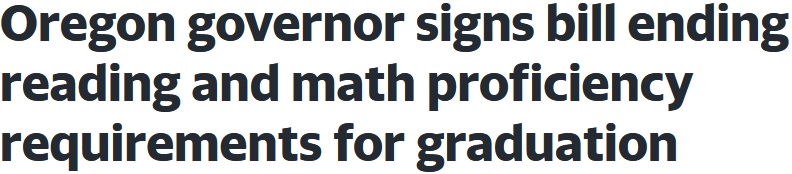


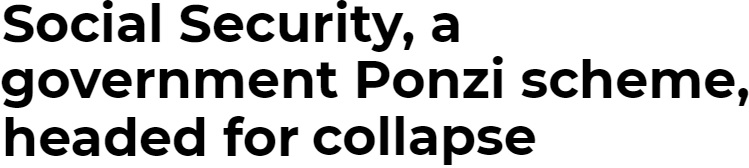
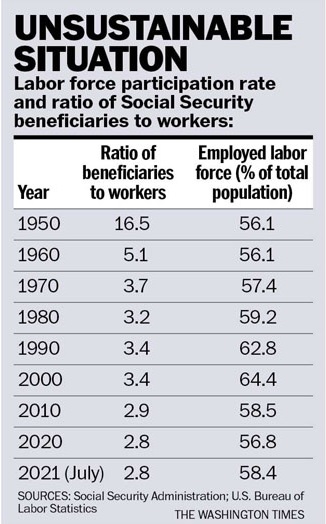

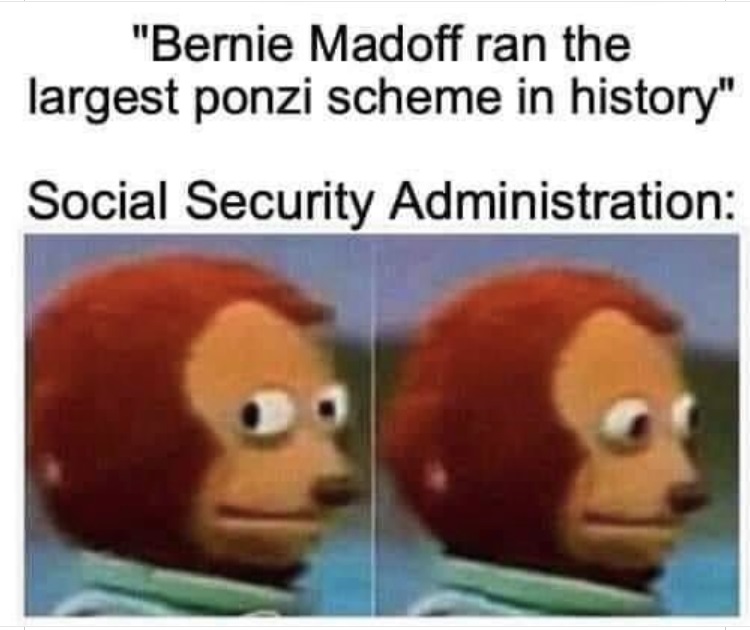
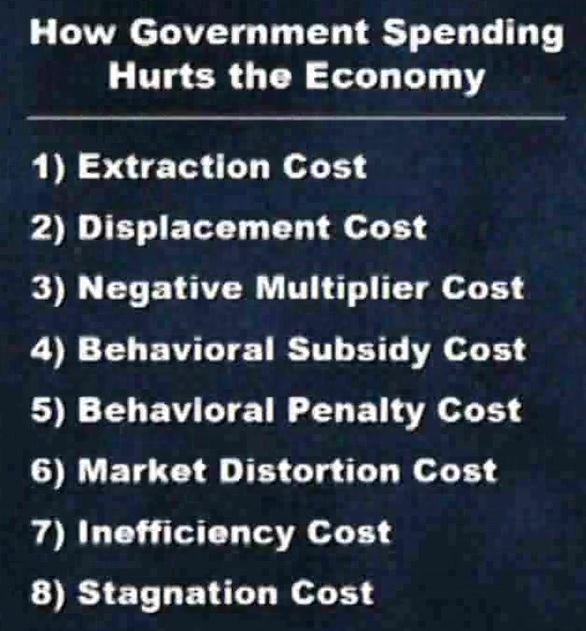


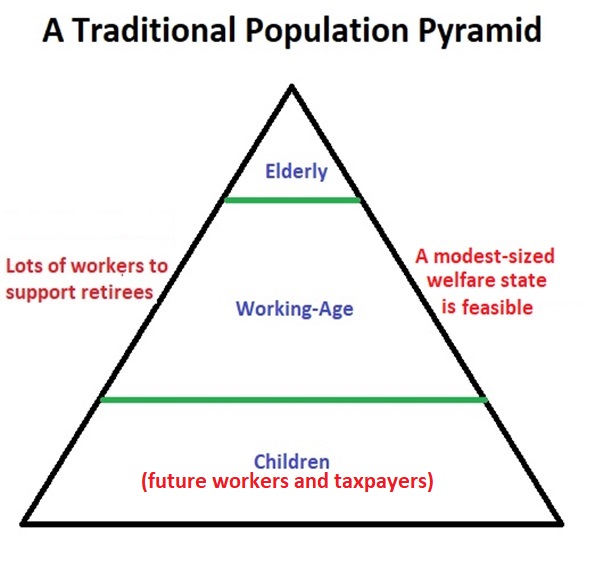


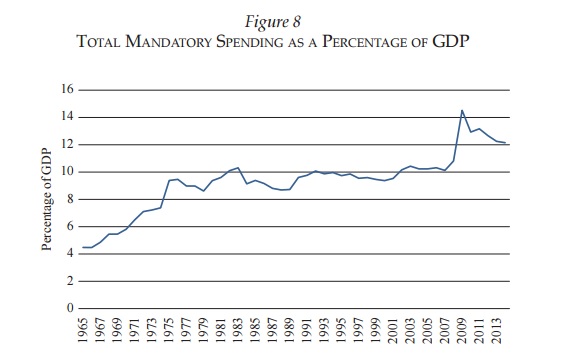
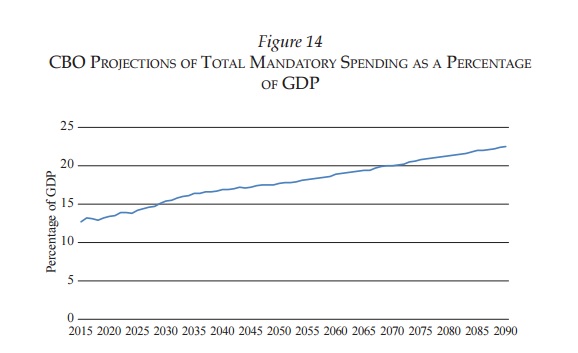
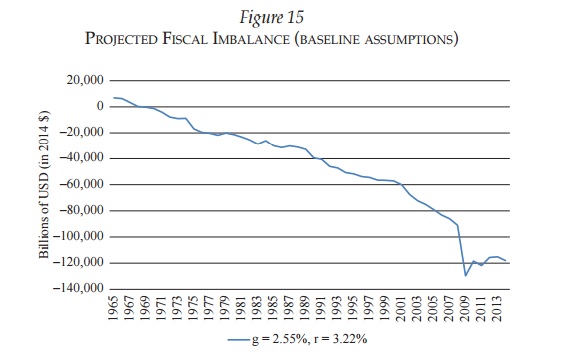


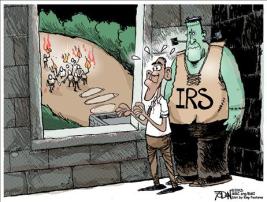
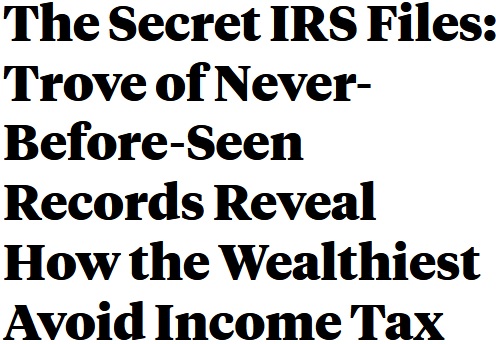





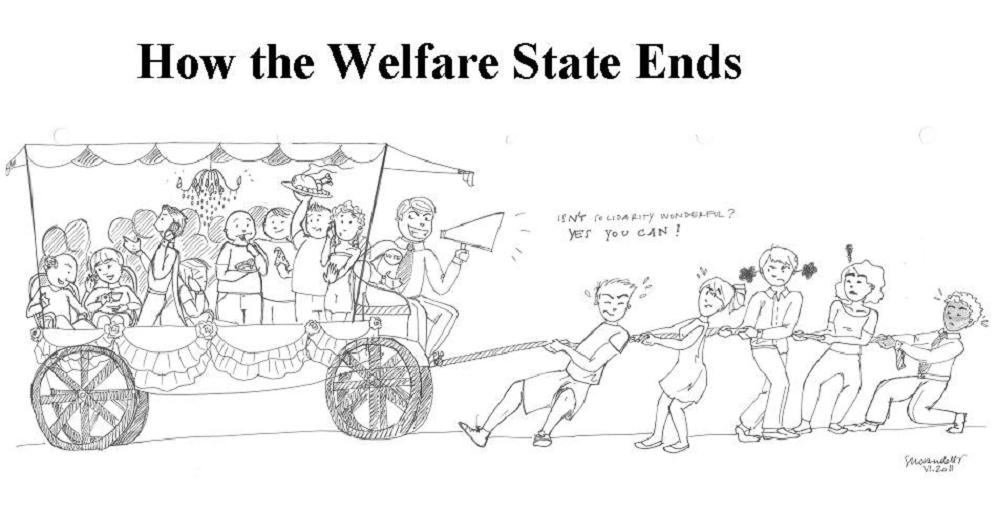



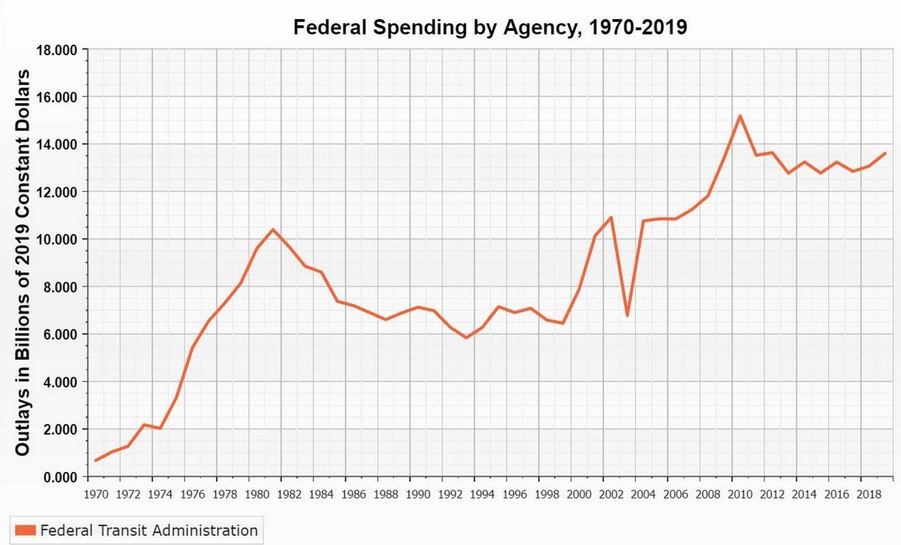


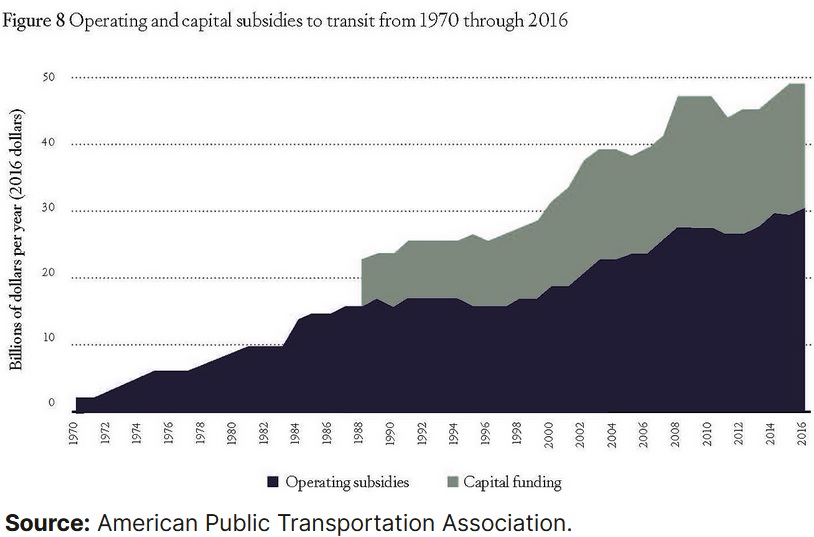
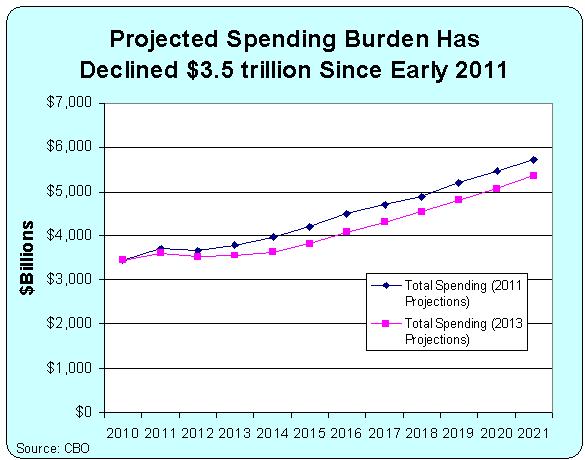
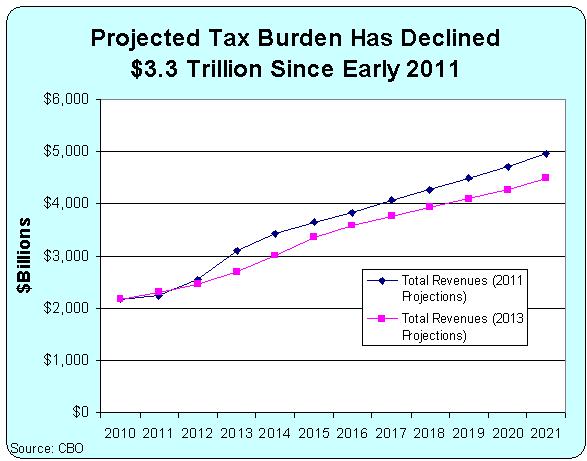
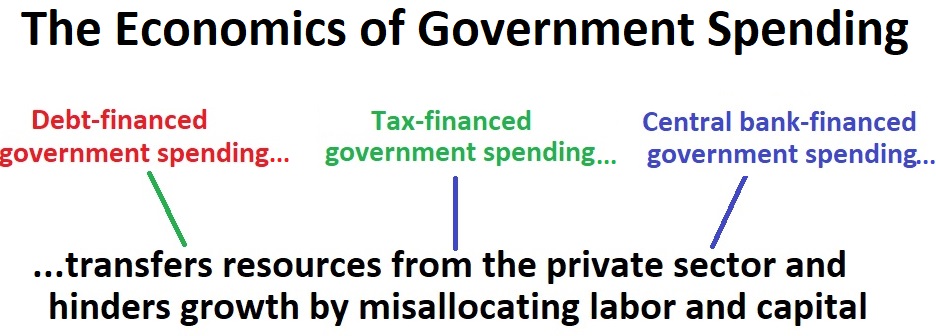

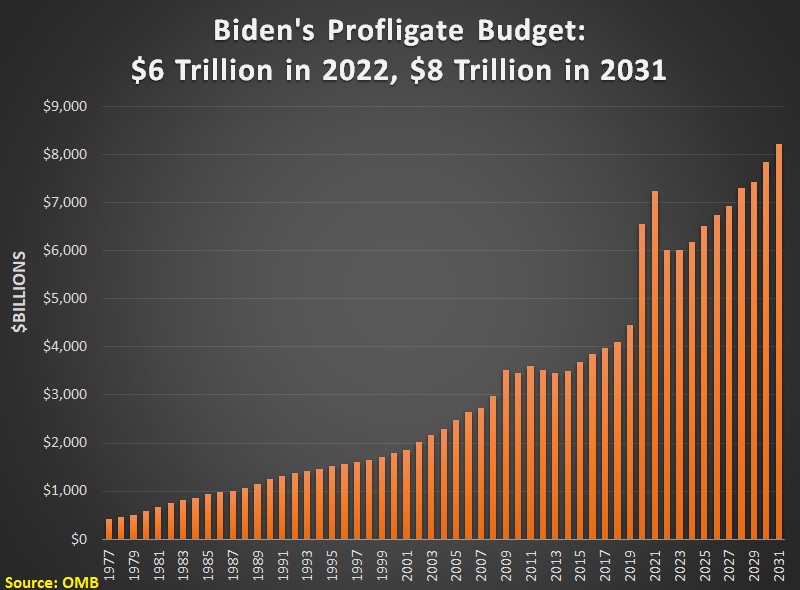
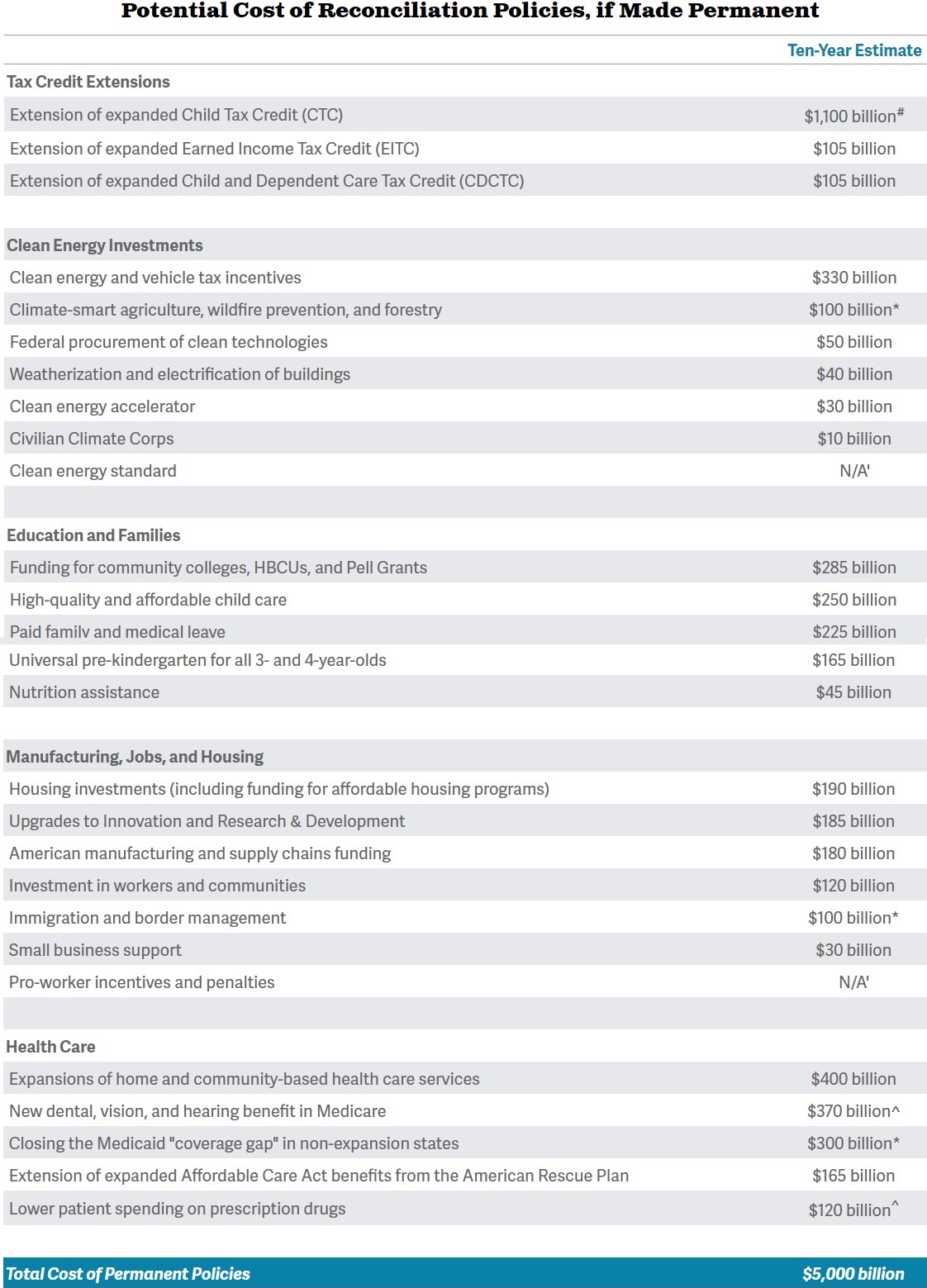


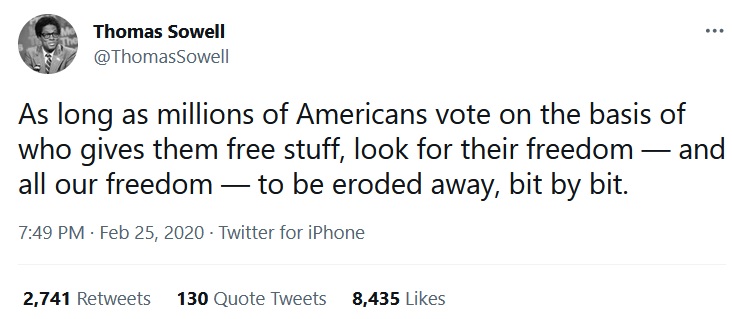


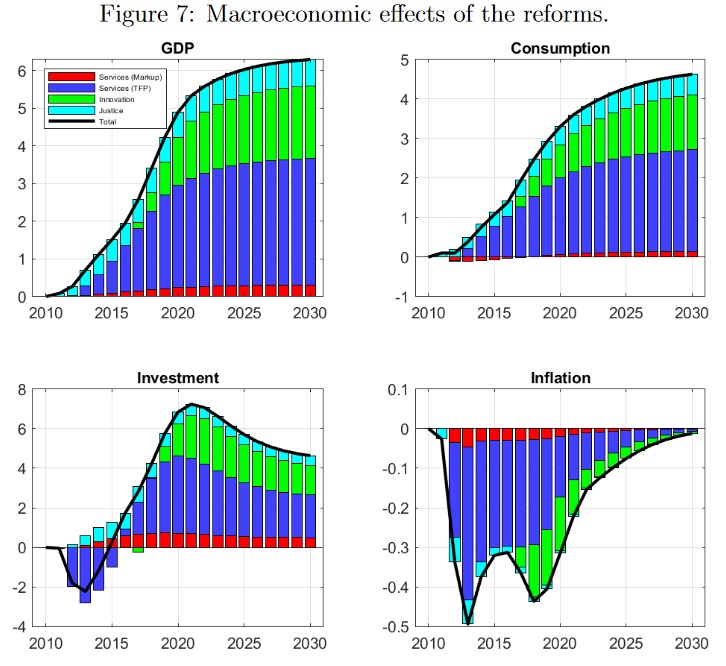


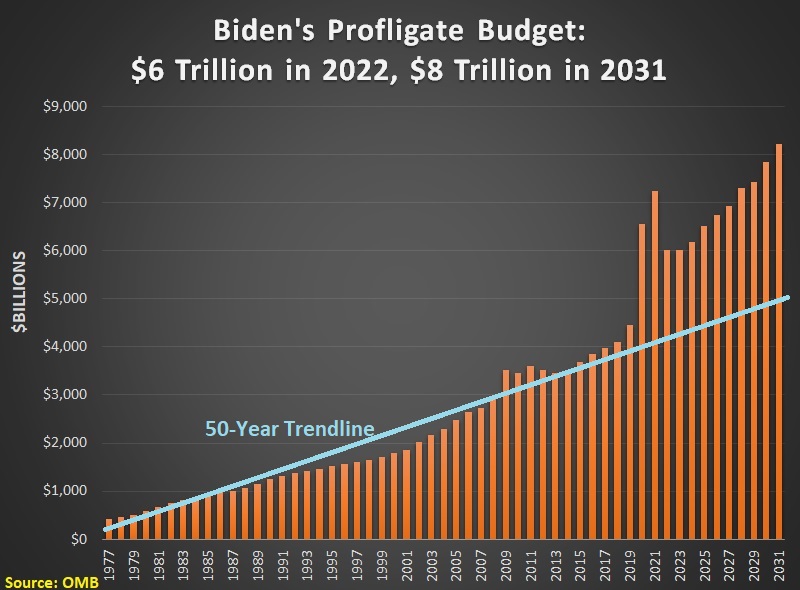



 The Daily Hatch