
—
Best of Carl Sagan on Religion
How Carl Sagan Strengthened My Faith
Below are Francis Schaeffer and his son Franky:
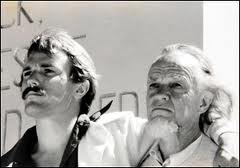
In 1992 I began to write skeptics letters after reading their books and articles and watching their films and I was introduced to Carl Sagan’s name by a book published in 1968 by Francis Schaeffer.
Francis Schaeffer in his book HE IS THERE AND HE IS NOT SILENT (Chapter 4) asserts:
Because men have lost the objective basis for certainty of knowledge in the areas in which they are working, more and more we are going to find them manipulating science according to their own sociological or political desires rather than standing upon concrete objectivity. We are going to find increasingly what I would call sociological science, where men manipulate the scientific facts. Carl Sagan (1934-1996),professor of astronomy and space science at Cornell University, demonstrates that the concept of a manipulated science is not far-fetched. He mixes science and science fiction constantly. He is a true follower of Edgar Rice Burroughs (1875-1950). The media gives him much TV prime time and much space in the press and magazine coverage, and the United State Government spent millions of dollars in the special equipment which was included in the equipment of the Mars probe–at his instigation, to give support to his obsessive certainty that life would be found on Mars, or that even large-sized life would be found there. With Carl Sagan the line concerning objective science is blurred, and the media spreads his mixture of science and science fiction out to the public as exciting fact.

Sagan in 1980
Carl Sagan on the Existence of God
RC Sproul confronts Carl Sagan.

Sagan in Rahway High School‘s 1951 yearbook
Sagan discusses FAITH when there is no evodence
Carl Sagan on Religion
—
The Bible and Archaeology – Is the Bible from God? (Kyle Butt)
Biblical Archaeology is Silencing the critics! Significantly, even liberal theologians, secular academics, and critics generally cannot deny that archaeology has confirmed thebiblical record at many points. Rationalistic detractors of the Bible can attack it all day long, but they cannot dispute archaeological facts.
—

Carl Sagan
Richard Dawkins on Carl Sagan, Einstein and Religion | A How To Academy …
—

Francis Schaeffer the Founder of the L’Abri community
Recently I have been revisiting my correspondence in 1995 with the famous astronomer Carl Sagan who I had the privilege to correspond with in 1994, 1995 and 1996. In 1996 I had a chance to respond to his December 5, 1995letter on January 10, 1996 and I never heard back from him again since his cancer returned and he passed away later in 1996. Below is what Carl Sagan wrote to me in his December 5, 1995 letter:
Thanks for your recent letter about evolution and abortion. The correlation is hardly one to one; there are evolutionists who are anti-abortion and anti-evolutionists who are pro-abortion.You argue that God exists because otherwise we could not understand the world in our consciousness. But if you think God is necessary to understand the world, then why do you not ask the next question of where God came from? And if you say “God was always here,” why not say that the universe was always here? On abortion, my views are contained in the enclosed article (Sagan, Carl and Ann Druyan {1990}, “The Question of Abortion,” Parade Magazine, April 22.)
I was introduced to when reading a book by Francis Schaeffer called HE IS THERE AND HE IS NOT SILENT written in 1968.
In my January 10, 1996 Response letter to Carl Sagan (which I posted earlier) I also included the following insert based on the words of Francis Schaeffer in 1978:
Is man special or not?
Douglas Futuyma has said “Whether people are explicitly religious or not they tend to imagine that humans are in some sense the center of the universe. We are just one product of a very long historical process that has given to an enormous amount of organisms, and we are just one of them. So in some sense there is nothing special about us.”
The following comments were taken from the chapter called “”The Basis for Human Dignity which is in the book and film series co-aurthored by Francis Schaeffer and C. Everett Koop called “Whatever Happened to the Human Race?”
Section 1 Materialistic Humanism: The Worldview of our Age
The West has adopted a worldview which says that all reality is made up only of matter. In this view the universe did not get here because it was created by a “supernatural “ God.
Rather, the universe has existed forever in some form, and it’s present form just happened as a result of chance events way back in time.
Section 2 The search for an adequate worldview
Any worldview must answer 2 basic questions satisfactorily if it is to provide a real base for life and morals. The first is what we will call “the universe and it’s form,” and the second is the “mannishness of man.” The first draws attention to the fact that the universe around us is like an amazing jigsaw puzzle. We see many details, and we want to know how they fit together. That is what science is all about. Scientists look at the details and try to find out how they all cohere. So the first question that has to be answered is: Hiw did the universe get this way? How did it get this form, this pattern, this jigsawlike quality it now has?
Second, “The mannishness of man” draws attention to the fact that human beings are different from all other things in the world. Think, for example, of creativity. People in all cultures of all ages have created many kinds of all things, from “high art” to flower arrangements, from silver ornaments to high-technology supersonic aircraft. This is in contrast to the animals about us. People also fear death, and they remember the past and make projections into the future. One could name other factors, but these are enough to differentiate people from the other things in the world.
What worldview adequately explains the remarkable phenomenon of the distinctiveness of human beings? There is one worldview which explains the existence of the universe, it’s form, and the uniqueness of people— the worldview given to us in the Bible.
Section 3 The humanist base leads to meaningless
An overwhelming number of modern thinkers agree that seeing the universe and man from a humanist base leads to meaningless, both for the universe and for man—not just mankind in general but for each of us as individuals. Professor Steven Weinberg wrote these words in his book THE FIRST 3 MINUTES: A MODERN VIEW OF THE ORIGIN OF THE UNIVERSE while he was looking down from an airplane:
- It is almost irresistible for humans to believe that we have some special relation to the universe, that human life is not just a more-or-less farcical outcome of a chain of accidents reaching back to the first three minutes, but that we were somehow built in from the beginning. … It is very hard to realize that this is all just a tiny part of an overwhelmingly hostile universe. It is even harder to realise that this present universe has evolved from an unspeakably unfamiliar early condition, and faces a future extinction of endless cold or intolerable heat. The more the universe seems comprehensible, the more it also seems pointless.
- (1993), Epilogue, p. 154
When Weinberg says that the universe seems more “comprehensible,” he is, of course, referring to our greater understanding of the physical universe through the advance of science. But it is an understanding, notice, within a materialistic framework, which considers the universe solely in terms of physics and chemistry—-simply machinery.
If everything “faces a future extinction of endless cold or intolerable heat,” all things are meaningless.
Section 4 Tension results when you have an inadequate worldview
The greatest dilemma for those who hold an inadequate worldview is that it is impossible to live consistently within it. The playwright Samuel Beckett can “say” that words do not communicate anything—and that everything, including language, is absurd—yet he must use words to write his plays, even plays about meaninglessness. The list of contradictions can be extended endlessly. The truth is that everyone who rejects the Biblical worldview must live in a state of tension between ideas about reality and reality itself. If a person believes that everything is only matter or energy and carries this through consistently, meaning dies, morality dies, love dies, hope dies. Yet! The individual does love, does hope, does act on the basis of right and wrong. This is what we mean when we say that everyone is caught , regardless of his worldview, simply by the way things are.
Section 5 The Bible is God’s revealed truth and it tells us about our origin.
The scriptures tell us that the universe exists and has form and meaning because it was created purposefully by a personal creator. This being the case, we see that, as we are personal, we are not something strange and out of line with an otherwise impersonal universe. Since we are made in the image of God, we are in line with God. There is a continuity, in other words, between ourselves, though finite, and the infinite creator who stands behind the universe as its final source of meaning. Unlike the evolutionary concept of an impersonal beginning plus time plus chance, the Bible shows how man has personality and dignity and value. Our uniqueness is guaranteed, something which is impossible in the materialistic system!!!!!!
LETTER TO HUMANIST MAGAZINE IN 1994:
Francis Schaeffer once said, “If a man takes a certain non-christian set of presuppositions he will be forced eventually to be in a place of tension. The more consistent he is to his non-christian presuppositions the further he is away from the real world.” In “Ape and Essence,” (July/ August 1994) Edd Doerr is consistent with his humanistic presuppositions when he says “The bottom line is that the great apes are so much like us that there is no logical reason not to treat them as ‘persons’.”
Because Mr. Doerr has embraced evolution, he has been forced to ask himself this logical question: “When in the course of evolution did our ancestors qualify as persons?” But does this type of logic square with what we know to be true in the real world?
Genesis chapter one tells us that man is to rule over all animals because man is made in the image of God. Can animals make moral choices, enjoy poetry, appreciate music, worship God or recognize the beauty of the world around them? Humanism reduces man to a machine, but man’s conscience causes him to fell a tension.
As a young man Charles Darwin believed that the world was created by God, and at that time he was an enthusiastic admirer of fine paintings, classic music and Shakespeare. Furthermore, during a trip to Brazil he was do captivated by the beauty of nature that he later recalled how sure he was at the time that God had to be the designer of this grand and wondrous universe. However, later his presuppositions changed and he said, “My mind seems to have become a kind of machine for grinding general laws out of large collections of facts, but why this should have caused the atrophy of that part of the brain alone, on which the higher tastes depend, I cannot conceive… The loss of these tastes is a loss of happiness, and may possibly be injurious to the intellect, and more probably to the moral character, by enfeebling the emotional part of our nature.”
We are not cousins of apes, and anyone who embraces evolution will be forced eventually to be in a place of tension with the real world if they are consistent.
The Cosmos Is All That Is
Francis Schaeffer wrote in 1981 in CHRISTIAN MANIFESTO chapter 3 The Destruction of Faith and Freedom:
Then there was a shift into materialistic science based on a philosophic change to the materialistic concept of final reality. This shift was based on no addition to the facts known. It was a choice, in faith, to see things that way. No clearer expression of this could be given than Carl Sagan’s arrogant statement on public television–made without any scientific proof for the statement–to 140 million viewers: “The cosmos is all that is or ever was or ever was or ever will be.” He opened the series, COSMOS, with this essentially creedal declaration and went on to build every subsequent conclusion upon it.
How Should We Then Live | Season 1 | Episode 6 | The Scientific Age
FEATURED ARTIST IS Edvard Munch
“When seen as a whole, art derives from a person’s desire to communicate himself to another. I do not believe in an art which is not forced into existence by a human being’s desire to open his heart. All art, literature, and music must be born in your heart’s blood. Art is your heart’s blood.”
Edvard Munch

Edvard Munch – Self-Portrait with a Bottle of Wine – 1906
The expression “ahead of his time” applies to few artists with as much justice as it does to Edvard Munch (1863-1944) . Although for much of the public it seems that Munch painted only one work of interest (the extremely famous “The Scream“, one of the icons of art history), the whole of his work is fascinating and complex, and shows us an innovative artist, an expressionist before expressionism, essential to understand modern painting.
Edvard Munch: “Self-Portrait with a Bottle of Wine”, 1906. 110 × 120 cm. Munch Museum, Oslo.
It is striking that the two great painters currently considered -and rightfully so- as the forerunners of expressionism –Munch and Van Gogh– share the common characteristic of a long history of mental illness. An article by neuropsychologists M. Miranda, E. Miranda and E. Molina noted that “there are reasonable grounds to postulate that Munch possessed a borderline personality structure” (M. Miranda et al, “Edvard Munch: illness and genius”, 2012). But while Van Gogh reached a point where he could no longer bear the cries of his inner demons, Munch lived a long life, coming to accept his condition with a resigned attitude. “I inherited two of the worst enemies of mankind: tuberculosis and mental illness (…) From birth, the angels of fear, pain and death were at my side.”
Edvard Munch was born in a village in the interior of Norway in 1863, although his family moved to Oslo a few months later. His childhood was by no means easy, as his mother died when Munch was just three years old. The young Edvard was raised by his father, an extremely religious man. At the age of fifteen, Munch began his training as an engineer, but he quit just a year later to study painting at the Academy of Art and Design in Oslo.
The young Munch was attracted to impressionism, studying the works of Manet, but soon felt that this style did not allow him to express the emotion he wanted to include in his paintings. In 1889 he exhibited at the Exposition Universelle in Paris, coming into contact with the works of artists such as Van Gogh and Gauguin. In 1891 he painted “Melancholy“, his first important work, which seems to anticipate both Fauvism and Expressionism.After painting this work, he lived in Berlin for four years, completing his training as an artist.
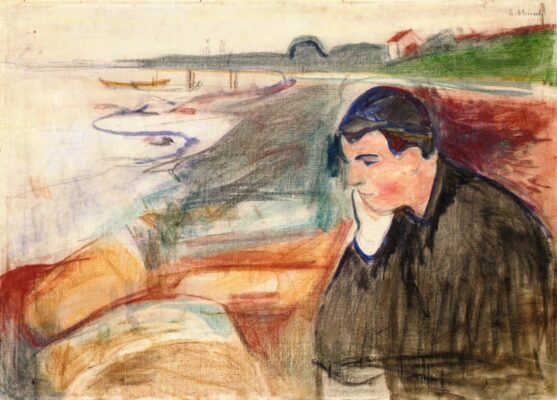

Edvard Munch: “Melancholy”, 1891. 73x 101 cm. Munch Museum, Oslo. ·· Edvard Munch: “The Scream”, 1893. 91 x 73.5 cm. National Museum of Art, Architecture and Design, Oslo.
In Berlin, Munch created what is his most famous work, the aforementioned “The Scream“. Few works in the history of art have been so studied, commented, and even parodied as this painting, a prodigy of expressiveness. In 2006, theartwolf.com selected this painting (of which four versions are preserved, as well as an engraving) as one of the 50 masterpieces in the history of painting. Before the end of the century, he painted several of his best known works, such as “Anxiety” (clearly inspired by “The Scream“), “The Vampire”, of which several versions are preserved, and his famous “Madonna“.
Although “The Scream” is his most famous painting, his most ambitious work was “The Frieze of Life“, a pictorial cycle that includes works such as “The Storm” or “Moonlight“. The works that make up “The Frieze of Life”, as Frederick B. Deknatel pointed out, have, as a whole, no formal similarity, being completely different in scale or style, but “have in common the fact that their themes are related and that each is conveyed with the maximum visual impact possible, regardless of overal visual harmony” (Frederick B. Deknatel, “Edvard Munch”, 1950).
As noted above, his last years were marked by health problems, suffering from anxiety attacks aggravated by his alcohol consumption. In fact, although he did not die until 1944, at the age of 80, his artistic production after World War I is very limited, and in no case of the importance of his works made in the 1890s. However, his “early” works are in themselves enough to consider Munch as one of the pillars of modern art.
G. Fernández · theartwolf.com
Masterworks by Edvard Munch
The Scream
2 min read
Related posts:
Taking on Ark Times Bloggers on various issues Part F “Carl Sagan’s views on how God should try and contact us” includes film “The Basis for Human Dignity”
I have gone back and forth and back and forth with many liberals on the Arkansas Times Blog on many issues such as abortion, human rights, welfare, poverty, gun control and issues dealing with popular culture. Here is another exchange I had with them a while back. My username at the Ark Times Blog is Saline […]
By Everette Hatcher III|Posted in Francis Schaeffer, Prolife|Edit|Comments (0)
Carl Sagan v. Nancy Pearcey
On March 17, 2013 at our worship service at Fellowship Bible Church, Ben Parkinson who is one of our teaching pastors spoke on Genesis 1. He spoke about an issue that I was very interested in. Ben started the sermon by reading the following scripture: Genesis 1-2:3 English Standard Version (ESV) The Creation of the […]
By Everette Hatcher III|Posted in Adrian Rogers, Atheists Confronted, Current Events|TaggedBen Parkinson, Carl Sagan|Edit|Comments (0)
Review of Carl Sagan book (Part 4 of series on Evolution)
Review of Carl Sagan book (Part 4 of series on Evolution) The Long War against God-Henry Morris, part 5 of 6 Uploaded by FLIPWORLDUPSIDEDOWN3 on Aug 30, 2010 http://www.icr.org/ http://store.icr.org/prodinfo.asp?number=BLOWA2http://store.icr.org/prodinfo.asp?number=BLOWASGhttp://www.fliptheworldupsidedown.com/blog _______________________ I got this from a blogger in April of 2008 concerning candidate Obama’s view on evolution: Q: York County was recently in the news […]
By Everette Hatcher III|Posted in Atheists Confronted, Current Events, President Obama|Edit|Comments (0)
Review of Carl Sagan book (Part 3 of series on Evolution)
Review of Carl Sagan book (Part 3 of series on Evolution) The Long War against God-Henry Morris, part 4 of 6 Uploaded by FLIPWORLDUPSIDEDOWN3 on Aug 30, 2010 http://www.icr.org/ http://store.icr.org/prodinfo.asp?number=BLOWA2http://store.icr.org/prodinfo.asp?number=BLOWASGhttp://www.fliptheworldupsidedown.com/blog______________________________________ I got this from a blogger in April of 2008 concerning candidate Obama’s view on evolution: Q: York County was recently in the news […]
By Everette Hatcher III|Posted in Atheists Confronted, Current Events, President Obama|Edit|Comments (0)
Carl Sagan versus RC Sproul
At the end of this post is a message by RC Sproul in which he discusses Sagan. Over the years I have confronted many atheists. Here is one story below: I really believe Hebrews 4:12 when it asserts: For the word of God is living and active and sharper than any two-edged sword, and piercing as far as the […]
By Everette Hatcher III|Posted in Adrian Rogers, Atheists Confronted, Current Events, Francis Schaeffer|Tagged Bill Elliff, Carl Sagan, Jodie Foster, RC Sproul|Edit|Comments (0)
Review of Carl Sagan book (Part 4 of series on Evolution)jh68
Review of Carl Sagan book (Part 4 of series on Evolution) The Long War against God-Henry Morris, part 5 of 6 Uploaded by FLIPWORLDUPSIDEDOWN3 on Aug 30, 2010 http://www.icr.org/ http://store.icr.org/prodinfo.asp?number=BLOWA2http://store.icr.org/prodinfo.asp?number=BLOWASGhttp://www.fliptheworldupsidedown.com/blog _______________________ This is a review I did a few years ago. THE DEMON-HAUNTED WORLD: Science as a Candle in the Dark by Carl […]
By Everette Hatcher III|Posted in Atheists Confronted, Current Events|Edit|Comments (0)
Review of Carl Sagan book (Part 3 of series on Evolution)
Review of Carl Sagan book (Part 3 of series on Evolution) The Long War against God-Henry Morris, part 4 of 6 Uploaded by FLIPWORLDUPSIDEDOWN3 on Aug 30, 2010 http://www.icr.org/ http://store.icr.org/prodinfo.asp?number=BLOWA2http://store.icr.org/prodinfo.asp?number=BLOWASGhttp://www.fliptheworldupsidedown.com/blog______________________________________ I was really enjoyed this review of Carl Sagan’s book “Pale Blue Dot.” Carl Sagan’s Pale Blue Dot by Larry Vardiman, Ph.D. […]
By Everette Hatcher III|Posted in Atheists Confronted, Current Events|Edit|Comments (0)
Atheists confronted: How I confronted Carl Sagan the year before he died jh47
In today’s news you will read about Kirk Cameron taking on the atheist Stephen Hawking over some recent assertions he made concerning the existence of heaven. Back in December of 1995 I had the opportunity to correspond with Carl Sagan about a year before his untimely death. Sarah Anne Hughes in her article,”Kirk Cameron criticizes […]
By Everette Hatcher III|Posted in Atheists Confronted|Edit|Comments (2)
FRANCIS SCHAEFFER ANALYZES ART AND CULTURE Part 18 “Michelangelo’s DAVID is the statement of what humanistic man saw himself as being tomorrow” (Feature on artist Paul McCarthy)
In this post we are going to see that through the years humanist thought has encouraged artists like Michelangelo to think that the future was extremely bright versus the place today where many artist who hold the humanist and secular worldview are very pessimistic. In contrast to Michelangelo’s DAVID when humanist man thought he […]
By Everette Hatcher III|Posted in Francis Schaeffer|Tagged David Leeds, J.I.PACKER, Joe Carter, Massimiliano Gioni, Michelangelo, Michelangelo’s DAVID, Michelangelo’s Florence Pietà, Paul McCarthy, Renaissance, Rick Pearcey, Rush Limbaugh, Tony Bartolucci|Edit|Comments (0)
Was Antony Flew the most prominent atheist of the 20th century?
_________ Antony Flew on God and Atheism Published on Feb 11, 2013 Lee Strobel interviews philosopher and scholar Antony Flew on his conversion from atheism to deism. Much of it has to do with intelligent design. Flew was considered one of the most influential and important thinker for atheism during his time before his death […]
By Everette Hatcher III|Posted in Current Events|Edit|Comments (0)


 The Daily Hatch