
–
A Rhetorical Analysis of Samwise Gamgee’s Epic Speech in Lord of the Rings: The Two Towers
The Speech
At the end of The Two Towers, Sam delivers his speech to a broken and demoralized Frodo in the ruins of Osgiliath. I will be conducting a rhetorical analysis of this speech using Kenneth Burke’s dramatistic pentad. The transcript is here:
“Frodo: I can’t do this, Sam.
Sam: I know. It’s all wrong. By rights we shouldn’t even be here. But we are. It’s like in the great stories, Mr. Frodo. The ones that really mattered. Full of darkness and danger, they were. And sometimes you didn’t want to know the end. Because how could the end be happy? How could the world go back to the way it was when so much bad had happened? But in the end, it’s only a passing thing, this shadow. Even darkness must pass. A new day will come. And when the sun shines it will shine out the clearer. Those were the stories that stayed with you. That meant something, even if you were too small to understand why. But I think, Mr. Frodo, I do understand. I know now. Folk in those stories had lots of chances of turning back, only they didn’t. They kept going. Because they were holding on to something.
Frodo: What are we holding onto, Sam?
Sam: That there’s some good in this world, Mr. Frodo… and it’s worth fighting for.”
Scene
This speech is delivered by Sam to Frodo in Osgiliath, a ruined city under the attack of Orcs and other minions of Sauron. Frodo and Sam were captured by the men responsible for defending the city earlier in the film, and are now trying to escape without being killed or losing the ring. Frodo just survived an encounter with a Black Rider (shown below), but his resolve to accomplish the mission of destroying the ring has been severely shaken.
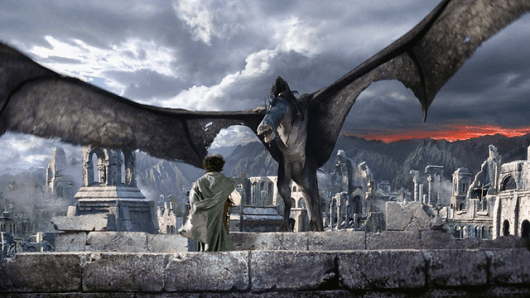
Just before delivering the speech, Sam saves Frodo by tackling him off the ledge (shown above) to escape the grasp of the enemy. Frodo is so rattled from the experience that he draws his sword on Sam after they tumble down a flight of stairs and out of harm’s way. After realizing what he’s done to his friend who just saved him, Frodo says, “I can’t do this, Sam,” which sets off the ensuing speech. It is in this moment that Sam establishes himself as the true backbone of this quest, offering encouragement—as well as physical and emotional support— for Frodo even when the latter begins to feel hopeless and defeated.
Act
Frodo drops his sword after they tumble down the stairs and he instinctively threatens Sam, and both hobbits sit on the ground, appearing fatigued, dirty, despondent, and on the verge of tears: a testament to their perilous journey thus far. Frodo claims he “can’t do this,” and Sam struggles to his feet. He walks over to a window and looks out at the dragon they just escaped as it flies off toward the dark, foreboding, volcanic land of Mordor (where the hobbits need to go). Fighting back tears, Sam begins his speech. The brilliant orchestral music of Howard Shore starts playing a somber but hopeful tune that eventually evolves into a triumphant theme. After Sam asks the question, “how could the end be happy?” the screen changes and we are shown clips of the other characters in the story claiming an unexpected victory on the battlefield at Helm’s Deep, elsewhere in Middle Earth. We hear shouts of victory, we see enemies fleeing and being struck down, and we see smiles on the faces of brave warriors. We also see clips from Isengard, the stronghold of an evil wizard, where a race of giant tree-people called Ents (with the help of the other two hobbits in the story) are flooding out his forges of destruction claiming another victory for the good guys.
As Sam delivers the lines, “Folk in those stories had lots of chances of turning back, only they didn’t. They kept going. Because they were holding on to something,” the camera zooms in on his determined face. Frodo asks, “What are we holding on to, Sam?” to which Sam lifts Frodo to his feet, faces him, and says the iconic line: “That there’s some good in the world, Mr. Frodo, and it’s worth fightin’ for.” Frodo appears to be inspired by Sam’s words, and even the creepy, schizophrenic creature Gollum (who is accompanying the two hobbits and listening from a short distance away) seems to be fighting back tears.
Agent
Obviously, Samwise Gamgee is the primary actor for this speech, but the cinematography of director Peter Jackson and the musical score by Howard Shore both play equally important roles in the delivery of this moving, emotional scene. Furthermore, according to Yahoo! columnist Ethan Alter (2017), this particular speech was added into the movie at the last minute. In his article, Alter quotes actor Sean Astin—who played Samwise Gamgee in the movies: “’That scene was not written in the original script,’ the actor says, explaining that Jackson decided to insert it into the film as a direct response to the Sept. 11 attacks, which had overshadowed the release of The Fellowship of the Ring the previous year” (Alter, 2017).
By layering Sam’s voice over the hopeful and triumphant music of Howard Shore, director Peter Jackson’s depiction of the forces of good in the film overcoming all odds to vanquish the forces of evil becomes even more powerful. The pace, timing, and coordination of these three actors combine to form a cinematic masterpiece that continues to give me goosebumps and chills every time I watch, even 15 years after its original release.
Agency
As mentioned in the previous section, there were audible and visual components that were combined to enhance the delivery of Sam’s speech, along with brilliant script writing that was added after most of the filming had concluded. Specifically, Sam utilizes pace, tone, and inflection to allow his universal message to resonate with audiences on a cinematic and personal level. Throughout the speech, Sam’s voice is fraught with emotion, and we can see the determination on his face. He speaks slowly enough for the audience to digest what he’s saying while also allowing time to show clips of what’s happening elsewhere in the movie and drawing connections between those other events and the hobbits’ current situation.
Purpose
On the surface, Sam delivered this speech to Frodo to motivate him to continue on and see their journey through. This speech was also meant to serve as a conduit between the three storylines of the movie, connect them together, and set the stage for the third movie in the trilogy. But the real beauty of Sam’s speech is its timeless and universal applicability. It was written into the movie as somewhat of an indirect response to the terrorist attacks of 9/11, but J.R.R. Tolkien, the author of the books on which the movie trilogy is based, fought in World War I. None of the words used in the speech refer to movie-specific characters or events, but simply themes of good and evil, of hope and persistence. These can be applied to the largest of world conflicts or to the simplest struggles of everyday life.
As Wassell (2018) puts it, “Sam is talking about Middle Earth, but he’s also talking about life in general…Hope is a small and powerful thing, and we can’t help but listen to Sam’s words and apply them to our own lives, to the things we see going on around us. It’s impossible not to.” That is why the speech resonated with me at age 10, and why it continues to resonate with me (albeit in a slightly different way) at age 25.
Conclusion
Within this analysis using Kenneth Burke’s dramatistic pentad, it would appear that Agent was the dominant term for Sam’s speech in The Two Towers. Without Peter Jackson’s cinematography and script-writing, Howard Shore’s musical score, and Sean Astin’s emotional delivery of his lines, the impact of this speech wouldn’t have been nearly as powerful for audiences. However, each aspect of the pentad had a specific role to play in the presentation of this cinematic monologue, and each reveals new insights into the depth and complexity of the clip. Whether it’s the innocent enthusiasm of a 10-year-old at the theater, or the inquisitive and analytical ramblings of a weary graduate student, this speech (and this movie) is capable of providing hope and purpose to any viewer.
Works Cited
Alter, E. (2017, December 18). “The Two Towers” turns 15: Sean Astin reveals the real-world origins of Sma’s big speech. Yahoo! Entertainment. Retrieved from https://www.yahoo.com/entertainment/two-towers-turns-15-sean-astin-reveals-real-world-origins-sams-big-speech-204233506.html
The Lord of the Rings: The Two Towers [Quotes]. (n.d.). IMDb. Retrieved from https://www.imdb.com/title/tt0167261/quotes
Tracy, S. J. (2013). Qualitative research methods: collecting evidence, crafting analysis, communicating impact. Chichester, West Sussex, UK: Wiley-Blackwell.
Wassell, N. (2018, May 22). Memorable Moments: Sam’s Speech in The Two Towers. Retrieved from https://culturedvultures.com/memorable-moments-the-two-towers/
Today I want to take another approach to the issue of the afterlife and that is the pure and simple fact that without an enforcement factor people can do what they want in this life and get away with it. This is a big glaring weakness in the Humanist Manifestos that have been published so far. All three of them do not recognize the existence of God who is our final judge. (I am not claiming that this is evidence that points to an afterlife, but this post will demonstrate that atheists many times have not thought through the full ramifications of their philosophy of life.) I will simply tell the story of my interaction with Robert L. Mondale.
Male28 May 1904–19 August 2003.
Carl Sagan said that he missed his parents terribly and he wished he could believe in the afterlife but he was not convinced because of the lack of proof. I had the opportunity to correspond back and forth with Carl Sagan. I presented him evidence that the Bible was true and there was an afterlife, but he would not accept the evidence.
I had the unique opportunity to discuss this very issue with Robert Lester Mondale and his wife Rosemary on April 14, 1996 at his cabin in Fredricktown, Missouri , and my visit was very enjoyable and informative. Mr. Mondale had the distinction of being the only person to sign all three of the Humanist Manifestos in 1933, 1973 and 2003. I asked him which signers of Humanist Manifesto Number One did he know well and he said that Raymond B. Bragg, and Edwin H. Wilson and him were known as “the three young radicals of the group.” Harold P. Marley used to have a cabin near his and they used to take long walks together, but Marley’s wife got a job in Hot Springs, Arkansas and they moved down there.
Roy Wood Sellars was a popular professor of philosophy that he knew. I asked if he knew John Dewey and he said he did not, but Dewey did contact him one time to ask him some questions about an article he had written, but Mondale could not recall anything else about that.
Mondale told me some stories about his neighbors and we got to talking about some of his church members when he was an Unitarian pastor. Once during the 1930’s he was told by one of his wealthier Jewish members that he shouldn’t continue to be critical of the Nazis. This member had just come back from Germany and according to him Hitler had done a great job of getting the economy moving and things were good.
Of course, just a few years later after World War II was over Mondale discovered on a second hand basis what exactly had happened over there when he visited with a Lutheran pastor friend who had just returned from Germany. This Lutheran preacher was one of the first to be allowed in after the liberation of the concentration camps in 1945, and he told Mondale what level of devastation and destruction of innocent lives went on inside these camps. As Mondale listened to his friend he could feel his own face turning pale.
I asked, “If those Nazis escaped to Brazil or Argentina and lived out their lives in peace would they face judgment after they died?”
Mondale responded, “I don’t think there is anything after death.”
I told Mr. Mondale that there is sense in me that says justice will be given eventually and God will judge those Nazis even if they evade punishment here on earth. I did point out that in Ecclesiastes 4:1 Solomon did note that without God in the picture the scales may not be balanced in this life and power could reign, but at the same time the Bible teaches that all must face the ultimate Judge.
Then I asked him if he got to watch the O.J. Simpson trial and he said that he did and he thought that the prosecution had plenty of evidence too. Again I asked Mr. Mondale the same question concerning O.J. and he responded, “I don’t think there is a God that will intervene and I don’t believe in the afterlife.”
Dan Guinn posted on his blog at http://www.francisschaefferstudies.org concerning the Nazis and evolution: As Schaeffer points out, “…these ideas helped produce an even more far-reaching yet logical conclusion: the Nazi movement in Germany. Heinrich Himmler (1900-1945), leader of the Gestapo, stated that the law of nature must take its course in the survival of the fittest. The result was the gas chambers. Hitler stated numerous times that Christianity and its notion of charity should be “replaced by the ethic of strength over weakness.” Surely many factors were involved in the rise of National Socialism in Germany. For example, the Christian consensus had largely been lost by the undermining from a rationalistic philosophy and a romantic pantheism on the secular side, and a liberal theology (which was an adoption of rationalism in theological terminology) in the universities and many of the churches. Thus biblical Christianity was no longer giving the consensus for German society. After World War I came political and economic chaos and a flood of moral permissiveness in Germany. Thus, many factors created the situation. But in that setting the theory of the survival of the fittest sanctioned what occurred. ”
Francis Schaeffer notes that this idea ties into today when we are actually talking about making infanticide legal in some academic settings. Look at what these three humanist scholars have written:
- Peter Singer, who recently was seated in an endowed chair at Princeton’s Center for Human Values, said, “Killing a disabled infant is not morally equivalent to killing a person. Very often it is not wrong at all.”
- In May 1973, James D. Watson, the Nobel Prize laureate who discovered the double helix of DNA, granted an interview to Prism magazine, then a publication of the American Medical Association. Time later reported the interview to the general public, quoting Watson as having said, “If a child were not declared alive until three days after birth, then all parents could be allowed the choice only a few are given under the present system. The doctor could allow the child to die if the parents so choose and save a lot of misery and suffering. I believe this view is the only rational, compassionate attitude to have.”
- In January 1978, Francis Crick, also a Nobel laureate, was quoted in the Pacific News Service as saying “… no newborn infant should be declared human until it has passed certain tests regarding its genetic endowment and that if it fails these tests it forfeits the right to live.”
Woody Allen’s 1989 movie, CRIMES AND MISDEMEANORS , was on this very subject of the Nazis that Lester Mondale and I discussed on that day in 1996 at Mondale’s cabin in Missouri. In this film, Allen attacks his own atheistic view of morality. Martin Landau plays a Jewish eye doctor named Judah Rosenthal raised by a religious father who always told him, “The eyes of God are always upon you.” However, Judah later concludes that God doesn’t exist. He has his mistress (played in the film by Anjelica Huston) murdered because she continually threatened to blow the whistle on his past questionable, probably illegal, business activities. She also attempted to break up Judah’s respectable marriage by going public with their two-year affair. Judah struggles with his conscience throughout the remainder of the movie and continues to be haunted by his father’s words: “The eyes of God are always upon you.” This is a very scary phrase to a young boy, Judah observes. He often wondered how penetrating God’s eyes are.
Later in the film, Judah reflects on the conversation his religious father had with Judah ‘s unbelieving Aunt May at the dinner table many years ago:
“Come on Sol, open your eyes. Six million Jews burned to death by the Nazis, and they got away with it because might makes right,” says aunt May
Sol replies, “May, how did they get away with it?”
Judah asks, “If a man kills, then what?”
Sol responds to his son, “Then in one way or another he will be punished.”
Aunt May comments, “I say if he can do it and get away with it and he chooses not to be bothered by the ethics, then he is home free.”
Judah ‘s final conclusion was that might did make right. He observed that one day, because of this conclusion, he woke up and the cloud of guilt was gone. He was, as his aunt said, “home free.”
Woody Allen has exposed a weakness in his own humanistic view that God is not necessary as a basis for good ethics. There must be an enforcement factor in order to convince Judah not to resort to murder. Otherwise, it is fully to Judah ‘s advantage to remove this troublesome woman from his life. CAN A MATERIALIST OR A HUMANIST THAT DOES NOT BELIEVE IN AN AFTERLIFE GIVE JUDAH ONE REASON WHY HE SHOULDN’T HAVE HIS MISTRESS KILLED?
The Bible tells us, “{God} has also set eternity in the hearts of men…” (Ecclesiastes 3:11 NIV). The secularist calls this an illusion, but the Bible tells us that the idea that we will survive the grave was planted in everyone’s heart by God Himself. Romans 1:19-21 tells us that God has instilled a conscience in everyone that points each of them to Him and tells them what is right and wrong (also Romans 2:14 -15).
It’s no wonder, then, that one of Allen’s fellow humanists would comment, “Certain moral truths — such as do not kill, do not steal, and do not lie — do have a special status of being not just ‘mere opinion’ but bulwarks of humanitarian action. I have no intention of saying, ‘I think Hitler was wrong.’ Hitler WAS wrong.” (Gloria Leitner, “A Perspective on Belief,” THE HUMANIST, May/June 1997, pp. 38-39)
Here Leitner is reasoning from her God-given conscience and not from humanist philosophy. It wasn’t long before she received criticism. Humanist Abigail Ann Martin responded, “Neither am I an advocate of Hitler; however, by whose criteria is he evil?” (THE HUMANIST, September/October 1997, p. 2)
On the April 13, 2014 episode of THE GOOD WIFE called “The Materialist,” Alicia in a custody case asks the father Professor Mercer some questions about his own academic publications. She reads from his book that he is a “materialist and he believes that “free-will is just an illusion,” and we are all just products of the physical world and that includes our thoughts and emotions and there is no basis for calling anything right or wrong. Sounds like to me the good professor would agree wholeheartedly with the humanist Abigail Ann Martin’s assertion concerning Hitler’s morality too! Jean-Paul Sartre noted, “No finite point has meaning without an infinite reference point.”
Christians agree with Judah ‘s father that “The eyes of God are always upon us.” Proverbs 5:21 asserts, “For the ways of man are before the eyes of the Lord, and He ponders all his paths.” Revelation 20:12 states, “…And the dead were judged (sentenced) by what they had done (their whole way of feeling and acting, their aims and endeavors) in accordance with what was recorded in the books” (Amplified Version). The Bible is revealed truth from God. It is the basis for our morality. Judah inherited the Jewish ethical values of the Ten Commandments from his father, but, through years of life as a skeptic, his standards had been lowered. Finally, we discover that Judah ‘s secular version of morality does not resemble his father’s biblically-based morality.
Woody Allen’s CRIMES AND MISDEMEANORS forces unbelievers to grapple with the logical conclusions of a purely secular morality, and the secularist has no basis for asserting that Judah is wrong.
Larry King actually mentioned on his show, LARRY KING LIVE, that Chuck Colson had discussed the movie CRIMES AND MISDEMEANORS with him. Colson asked King if life was just a Darwinian struggle where the ruthless come out on top. Colson continued, “When we do wrong, is that our only choice? Either live tormented by guilt, or else kill our conscience and live like beasts?” (BREAKPOINT COMMENTARY, “Finding Common Ground,” September 14, 1993)
Josef Mengele tortured and murdered many Jews and then lived the rest of his long life out in South America in peace. Will he ever face judgment for his actions?
The ironic thing is that at the end of our visit I that pointed out to Mr. Mondale that Paul Kurtz had said in light of the horrible events in World War II that Kurtz witnessed himself in the death camps (Kurtz entered a death camp as an U.S. Soldier to liberate it) that it was obvious that Humanist Manifesto I was way too optimistic and it was necessary to come up with another one. I thought that might encourage Mr. Mondale to comment further on our earlier conversion concerning evil deeds, but he just said, “That doesn’t surprise me that Kurtz would say something like that.”
The second Humanist Manifesto was written in 1973 by Paul Kurtz and Edwin H. Wilson, and was intended to update the previous one. It begins with a statement that the excesses of Nazism and world war had made the first seem “far too optimistic”, and indicated a more hardheaded and realistic approach in its seventeen-point statement, which was much longer and more elaborate than the previous version. Nevertheless, much of the unbridled optimism of the first remained, with hopes stated that war would become obsolete and poverty would be eliminated.
_________________
This is Lester Mondale’s obituary from the American Humanist Association:
R. Lester Mondale of Fredricktown, Missouri died on August 19, 2003, he was ninety-nine years old. Mondale was the last living signer of Humanist Manifesto I (he was the youngest to sign in 1933). He was also the only person to sign all three manifestos.
An AHA member perhaps since the organization’s founding, he received the AHA’s Humanist Pioneer award in 1973 and the Humanist Founder award in 2001. Mondale became a Unitarian minister after being raised a Methodist.
He was very active with the American Humanist Association, the American Ethical Union and served as president of the Fellowship of Religious Humanists in the 60’s and 70’s. Humanists Vice President Sarah Oelberg says that Mondale’s death marks “truly the end of an era” and AHA Director of Planned Giving Bette Chambers calls him “a great man, a great Humanist.”
Lester is survived by his wife, Rosemary, and four daughters: Karen Mondale of St. Louis, Missouri; Julia Jensen of St. Cloud, Minnesota; Tarrie Swenstad of Odin, Minnesota; and Ellen Mondale of Bethesda, Maryland. Also surviving him are his three brothers: Walter Mondale, former vice president of the United States, Pete Mondale, and Morton Mondale. Lester Mondale was also a proud grandparent of seven and a great-grandparent.

______________
Crimes and Misdemeanors: A Discussion: Part 1
Uploaded by camdiscussion on Sep 23, 2007
Part 1 of 3: ‘What Does Judah Believe?’
A discussion of Woody Allen’s 1989 movie, perhaps his finest.
By Anton Scamvougeras.
http://camdiscussion.blogspot.com/
antons@mail.ubc.ca
________________________
Crimes and Misdemeanors: A Discussion: Part 2
Crimes and Misdemeanors: A Discussion: Part 3
Is the Bible historically accurate? Here are some of the posts I have done in the past on the subject: 1. The Babylonian Chronicle, of Nebuchadnezzars Siege of Jerusalem, 2. Hezekiah’s Siloam Tunnel Inscription. 3. Taylor Prism (Sennacherib Hexagonal Prism), 4. Biblical Cities Attested Archaeologically. 5. The Discovery of the Hittites, 6.Shishak Smiting His Captives, 7. Moabite Stone, 8. Black Obelisk of Shalmaneser III, 9A Verification of places in Gospel of John and Book of Acts., 9B Discovery of Ebla Tablets. 10. Cyrus Cylinder, 11. Puru “The lot of Yahali” 9th Century B.C.E., 12. The Uzziah Tablet Inscription, 13. The Pilate Inscription, 14. Caiaphas Ossuary, 14 B Pontius Pilate Part 2, 14c. Three greatest American Archaeologists moved to accept Bible’s accuracy through archaeology.,
The Bible and Archaeology (2/5)
___________________
Related posts:
Former atheist Antony Flew pointed out that natural selection can’t explain the origin of first life and in every other case, information necessarily points to an intelligent source!
______________ Does God Exist? Thomas Warren vs. Antony Flew Published on Jan 2, 2014 Date: September 20-23, 1976 Location: North Texas State University Christian debater: Thomas B. Warren Atheist debater: Antony G.N. Flew For Thomas Warren: http://www.warrenapologeticscenter.org/ ______________________ Antony Flew and his conversion to theism Uploaded on Aug 12, 2011 Antony Flew, a well known spokesperson […]
DARWINISM RECONSIDERED article from 2005 quotes Antony Flew, Richard Dawkins, Jonathan Miller, and Phillip Johnson
______________ William Lane Craig versus Eddie Tabash Debate Uploaded on Feb 6, 2012 Secular Humanism versus Christianity, Lawyer versus Theologian. Evangelical Christian apologist William Lane Craig debates humanist atheist lawyer Eddie Tabash at Pepperdine University, February 8, 1999. Visithttp://www.Infidels.org and http://www.WilliamLaneCraig.com ________________ Antony Flew on God and Atheism Published on Feb 11, 2013 Lee Strobel […]
Antony Flew interviewed by Benjamin Wiker and the two reasons Flew left atheism!!!
_______________________ Discussion (1 of 3): Antony Flew, N.T. Wright, and Gary Habermas Uploaded on Sep 22, 2010 A discussion with Antony Flew, N.T. Wright, and Gary Habermas. This was held at Westminster Chapel March, 2008 Debate – William Lane Craig vs Christopher Hitchens – Does God Exist? Uploaded on Jan 27, 2011 April 4, 2009 – Craig […]
Kyle Butt notes that Antony Flew left Atheism but fell short of making a profession of faith during his lifetime
_________________ Antony Flew – World’s Most Famous Atheist Accepts Existence of God Uploaded on Nov 28, 2008 Has Science Discovered God? A half-century ago, in 1955, Professor Antony Flew set the agenda for modern atheism with his Theology and Falsification, a paper presented in a debate with C.S. Lewis. This work became the most widely […]
Gary Habermas explains the reasons for Antony Flew’s change of mind
_____________ Antony Flew on God and Atheism Published on Feb 11, 2013 Lee Strobel interviews philosopher and scholar Antony Flew on his conversion from atheism to deism. Much of it has to do with intelligent design. Flew was considered one of the most influential and important thinker for atheism during his time before his […]
The finest article on Antony Flew’s long path from Atheism to Theism!!
___________________ This is the finest article yet I have read that traces Antony Flew’s long path from atheism to theism. How Anthony Flew – Flew to God Among the world’s atheists there was hardly any with the intellectual stature of Anthony Flew. He was a contemporary with C.S. Lewis and has been a thorn in […]
Antony Flew incorrectly wrote that George Wald later abandoned atheism!!!
Making Sense of Faith and Science Uploaded on May 16, 2008 Dr. H. Fritz Schaefer confronts the assertion that one cannot believe in God and be a credible scientist. He explains that the theistic world view of Bacon, Kepler, Pascal, Boyle, Newton, Faraday and Maxwell was instrumental in the rise of modern science itself. Presented […]
Antony Flew opened himself up to the possibility of accepting Christian teachings although never making a public profession of faith
Discussion (2 of 3): Antony Flew, N.T. Wright, and Gary Habermas ______________ Atheist Lawrence Krauss loses debate to wiser Christian Published on Sep 13, 2013 http://www.reasonablefaith.org More of this here The Bible and Science (Part 02) The Kalam Cosmological Argument (Scientific Evidence) (Henry Schaefer, PhD) Published on Jun 11, 2012 Scientist Dr. Henry “Fritz” Schaefer gives a lecture […]
Antony Flew, “I was particularly impressed with Gerry Schroeder’s point-by-point refutation of what I call the MONKEY THEOREM” or the “the possibility of life arising by chance using the analogy of a multitude of monkeys banging away on computer keyboards and eventually ending up writing a Shakespearean sonnet!”
____________ Discussion (1 of 3): Antony Flew, N.T. Wright, and Gary Habermas Uploaded on Sep 22, 2010 A discussion with Antony Flew, N.T. Wright, and Gary Habermas. This was held at Westminster Chapel March, 2008 ___________ __________ Antony Flew, “I was particularly impressed with Gerry Schroeder’s point-by-point refutation of what I call the MONKEY […]


 The Daily Hatch