
——
___
Cover Story NEW STATESMAN May 7, 2012
We asked prominent scientists and thinkers two of the biggest questions in their field: is there anything science can’t explain? And is there anything it shouldn’t try to explain?
Dangerous knowledge
Michael Brooks
Author and NS science columnist
History tells us there is no reason to think some things lie beyond scientific explanation; scientists have a good track record in transgressing boundaries. One of the few boundaries yet to be challenged is the strange nature of quantum mechanics atoms existing in two places at once, for example. Richard Feynman said no one can understand how it can be like that. But it is likely we’ll eventually find a theory that lies beneath quantum theory, and that the root of such oddities will be exposed. It’s worth pointing out that “explain” and “prove” are two different things. Exactly how life on earth got started can’t be proved: the fossil record doesn’t contain the earliest chemical progenitors of life. Nor can we prove our hypothesis about how the universe began – all we can do is line up the evidence and decide whether we think it’s convincing (it is).
As for keeping things off-limits, where’s the fun? And there would be no point. If you want something explained, the best thing you can do is tell scientists they mustn’t look into it. There’s no harm in understanding; if need be, you can ignore the inconvenient truths. Neuroscience has made it clear that humans don’t have free will, but that’s not going to make us reform the justice system, any more than our understanding of relative harm is going to make a government reclassify alcohol as a class A drug.

Daniel Dennett Philosopher and cognitive scientist
We should get used to the idea that we’ll probably never be able to find and confirm –a good explanation of the ultimate origin of the universe, though I see no reason to believe that we can’t press much further on this question than we have managed to date. In 50 years –or 20 years, or 200 years our current epistemic horizon (the Big Bang, roughly) may look as parochial as the horizon Newton had to settle for in his day, but no doubt there will still be good questions whose answers elude us. And, of course, we never confirm any scientific answer in any absolute sense. As for questions science shouldn’t tackle, I think we should apply the rule that if nobody can think of any good that might come from knowing the answer, and there is clearly some harm that might come from knowing the answer, we should postpone research on that question indefinitely. Today most people at risk of Huntington’s chorea choose not to take the test that would tell them, with very high probability, whether they will succumb to the disease; the day a cure or treatment comes on line (and there is heartening progress on it, now that the critical proteins have been identified), those same people will want to take the test, because if the result is positive, there will be a course of action for them to take, and not just despair. No doubt advances in medical diagnosis and molecular biology will provide other such opportunities we may want to shelve for the time being.
Paul Davies Theoretical physicist
My feeling is that scientific method has the power to account for and interlink all phenomena in the universe, including its origin, using the laws of nature. But that still leaves the laws unexplained. Scientists normally accept the laws as “given” explaining the laws of nature is above their pay grade. Cosmologists have attempted to account for the day-to-day laws you find in textbooks in terms of fundamental “superlaws”, but the superlaws themselves must still be accepted as brute facts. So maybe the ultimate laws of nature will always be off-limits to science. I hope not, but it’s hard to know what form a scientific explanation of laws would take. A final caution: the ultimate laws to which scientists refer may turn out not to be the eternal, immutable, universal, precise, pre-existing mathematical relationships that scientists assume. Maybe the laws and the universe came into existence together. Then we’d have to find another explanation for physical existence.
Is there anything science should not try to explain? Science is knowledge and knowledge is power –power to do good or evil. Sometimes ignorance is bliss. It is possible that a scientific discovery will be made that humans will later regret because it has awful consequences. The
problem is, we probably would not know in advance and, once the discovery is made, it cannot be undiscovered.
Maggie Aderin-Pocock Space scientist
I spend a significant part of my time participating in science communication activities. Many of these involve speaking with schoolchildren. I give a “Tour of the Universe”, which is a guided tour that starts on our planet, travels through the solar system and ends up with pictures taken from the edge of the perceived universe. One of the favourite questions at the end of the talk is “What came before the Big Bang?” –to which I have usually answered, “As time space and time were created with the Big Bang it is hard to talk about a time before time began.” But now scientists are doing just that and postulating what came before. The difficulty is, any evidence that we get is interpreted by the laws of physics of our universe, which may be very different from anything that came before. I stand and possibly hope to be corrected on this.
On the question of if there is anything science should not try to explain, to me, science is a tool that should be used to explain everything, as only understanding can help us decide whether something is worth pursuing or not. However, the chemical nature of the emotions love or hate may be where I draw the line. I would find it too scary to live in a world where we as individuals, groups or even nations could be put into either state synthetically, just by adding something to the water supply.
Neil deGrasse Tyson
Astrophysicist, American Museum of Natural History
The methods and tools of science perennially breach barriers, granting me confidence that our epic march of insight into the operations of nature will continue without end. I know of no time in human history where ignorance was better than know ledge. Would I like to know if an asteroid is coming that could render life on earth extinct? Certainly. Armed with awareness of this fact, I might seize the opportunity to do something about it –a way of thinking common among scientists, engineers and technologists. If anyone walks among us who prefers not to know, then leave them behind in the cave while the rest of us step forward, discovering all that the universe reveals while using our minds to save the world (if necessary) but, as a minimum, to make life better for us all.
Peter J Bussey Particle physicist
When we are investigating a phy sical system, physics tries to answer three kinds of question –composition, arrangement and behaviour. In other words, what is it made of, how are the parts put together and what laws of nature are operating? The answers provide a “physical explanation” of the system and its properties, and in this way physics achieves much insight into the world around us. In fact, there are those who claim that everything reduces to physics. But there are areas where physics cannot give answers, one such being metaphysics: questions about physics.
More importantly, physics cannot deal with our conscious mental nature and our nature as human persons. The nature of consciousness is beyond the methodology and conceptual apparatus of physics, which confines itself to objective, universal facts, whereas my conscious awareness is associated just with me. Cleverer physical theories are of no avail here –physics has a limited remit and is not set up to address what it really means to be human. Procrustean philosophies that try to cut humanity down to fit into a bed of physics are a dangerous illusion and should be shunned. They are true neither to humanity nor to physics.
Derek Burke
Biochemist
Is there anything science can’t explain? Do we need religious explanations at all? Some say not. One approach was to look for gaps in the scientific account and say “God does this”. The current debate about creationism is full of this. But it is a perilous path. Too often a scientific explanation has been found and then the “God of the Gaps” vanishes. As a Christian, I believe that there is an ultimate purpose in trying to explain the whole of the natural world. But could science and faith both be right? We all know that science works by asking “how” questions: “How does it work?” But we also ask “why” questions: “What purpose does my life have?” This is the sort of question that religious faith claims to answer but science can’t, and never will, because science is not set up to do this. So we have two sorts of questions and two sorts of answers, which complement each other.
Historically, keeping science out has not worked, and I, as a practising Christian, have nothing to fear from inquiry. My faith, though bound into history, is not as insecure as that. I’m happy to pursue science without arbitrary boundaries. But there are certain questions that involve experiments that should not be done – for instance, any involving human torture –and that must limit certain lines of inquiry. Ethical limits to experimentation need not block trying to explain something by science, but may block ways of getting data. So we need ethics and we need values, and these come from outside science. Science is not enough.
Richard Swinburne
Philosopher
Science will never explain why there are laws of nature covering the behaviour of all physical phenomena. This is because scientific explanation of the operation of some lower-level law says that it holds because of the operation of some higherlevel law under certain physical conditions.
Thus, science explains the operation of Gal ileo’s law of fall on earth by the operation of Newton’s laws of gravity on earth in virtue of earth having a certain mass. Today it is trying to explain the operation of the four forces (gravity, electromagnetism, the weak and strong forces) by a “theory of everything” in virtue of some feature of the present circumstances of our universe. Any “theory of everything” will consist of some very highest-level law (or laws). All that the universal operation of such a law amounts to is the enormous coincidence that every physical object has precisely the same powers and liabilities to act as every other physical object –for example, to attract and repel every other physical object in accord with some general formula. This coincidence would, because of the very nature of scientific explanation, be always scientifically inexplicable.
Science will also never explain why that highest-level law (or laws) eventually produced a universe in which there is a planet on which human beings have evolved. It may well be that our universe belongs to a multiverse, in which there are many universes governed by different lower-level laws. But our only grounds for supposing that there is such a multiverse are that the postulation of such a multiverse governed by a highest-level law and having some general physical features (such as an eternally expanding vacuum space) explains the coming into being of our universe. Yet in order for this to happen, the multiverse must have a certain sort of general law and general features. For there are innumerable logically possible multiverses governed by different laws with different general features which would never produce a universe in which there is a planet where human beings could evolve. So if there is a multiverse, what science will never explain is why the multiverse is of such a kind as to produce a universe “fine-tuned” to produce humans.
Precious Lunga
Epidemiologist
I do not think there is a limit to what science can explain in the physical or material world. However, I cannot envisage a time when everything will have been explained by science. Early on in my training I realised that each discovery reveals more complex questions. This is what makes science so exciting. Its ability to provide explanations is determined to a large extent by technology and understanding. Explanations based on know ledge available at one time can be debunked or revised when new evidence comes to light.
There are questions that will take a long time for science to fully illuminate –such as the nature of consciousness, even though with smart experiments and functional imaging we are catching glimpses of the inner workings of the brain. I am certain that in my lifetime science will not have a full explanation of how brain activity produces consciousness; however, I think it is a matter of time rather than an impossibility. Most challenging is for us to explain how the universe came to exist from nothing.
The limits I put on what science should try to explain are ethical boundaries, in terms of avoiding harm to people or the environment. There are questions that lie beyond the material world that are best addressed by philosophy as they are not amenable to the scientific method and consequently not worth trying to explain with science, such as: “What is the point of human existence?” Science can explain almost anything, but it is not the answer to everything.
Denis Alexander
Director, Faraday Institute for Science and Religion,
St Edmund’s College, Cambridge
Science by definition can provide, in principle at least, complete nomological explanations for those items that lie within its domain. But most things that require explanation lie outside the competency of science, including axiological explanations, such as why the First World War happened, why rape is wrong, why I think this painting is beautiful and you don’t, and why the economy is in such a mess. Nor will science ever explain why something exists rather than nothing, because its scope is to investigate “somethings” once they exist, be they quantum fluctuations, mathematical relationships, laws of nature, or elementary particles. The ability to provide explanations regarding things that exist is not the same as explaining why anything exists rather than nothing.
There is nothing that science should not try to explain, provided that it seems reasonable to suppose that what needs explaining lies within the domain of science. Unfortunately, not all scientists have made that distinction, leading to a waste of time and public money, in addition bringing embarrassment to the scientific community. Care should also be taken in distinguishing between science and scientism, the idea that the scientific explanation is the only one that counts. In practice, complex systems require explanations at many different levels, only some of which count as scientific explanations. A scientific explanation of the workings of my brain cannot provide, in principle, an exhaustive explanation. The “I” language of personal agency is complementary to the “it” language of the neuroscientist, providing its own explanations for things based on qualia and conscious experience. It is the explanatory, non-science “I” language of our personal biographies that we care most deeply about.
Martin Rees
Astronomer Royal
Einstein averred that “the most incomprehensible thing about the universe is that it is comprehensible”. He was right to be astonished. It seems sur prising that our minds, which evolved to cope with life on the African savannah and haven’t changed much in 10,000 years, can make sense of phenomena far from our everyday intuitions: the microworld of atoms and the vastness of the cosmos. But our comprehension could one day “hit the buffers”. A monkey is unaware that atoms exist. Likewise, our brainpower may not stretch to the deepest aspects of reality. The bedrock nature of space and time, and the structure of our entire universe, may remain “open frontiers” beyond human grasp. Indeed, our everyday world presents intellectual challenges just as daunting as those of the cosmos and the quantum, and that is where 99 per cent of scientists focus their efforts. Even the smallest insect, with its intricate structure, is far more complex than either an atom or a star.
Everything, however complicated –breaking waves, migrating birds, or tropical forests –is made up of atoms and obeys the equations of quantum physics. That, at least, is what most scientists believe, and there is no reason to doubt it. Yet there are inherent limits to science’s predictive power. Some things, like the orbits of the planets, can be calculated far into the future. But that’s atypical. In most contexts, there is a limit. Even the most fine-grained compu tation can only forecast British weather a few days ahead. There are limits to what can ever be learned about the future, however powerful computers become. And even if we could build a computer with hugely superhuman processing power, which could offer an accurate simulation, that doesn’t mean that we will have the insight to understand it. Some of the “aha” insights that scientists strive for may have to await the emergence of post-human intellects.
Carolyn Porco Space scientist
Those of us engaged in the practice of science come to feel a certain reverence for it, engendered by its demonstrable power to dissect, clarify and explain what previously was unexplainable, and thus to improve the human condition. But one arena where it is pointless to direct legitimate scientific inquiry is the question of “why” in the physical realm. Science is not the means by which we come to understand why physical laws and circumstances are the way they are. When we ask why –assuming the question is really “why” and not “how” –we are really asking to know the motive of some responsible agent capable of reason. Take as an example a question often heard in attempting to justify the existence of God: if there is no God, why is the universe here? Scientific inquiry can’t be expected to answer such a question, not because its methodology is inherently flawed or feeble, but because the question is absurd and the reasoning underlying it is circular.
In asking that question, we are, first, guilty of anthropomorphism, ascribing human-like motivation to an observed phenomenon. But there doesn’t have to be a motive or a reason for the existence of a natural physical phenomenon, and so the question is ill-posed because its premise is faulty: it presumes there was a motive and hence a creator with attributes such as motives, but there needn’t be either. The logic is circular. Moreover, even if there were an agent who created the universe, science can’t be expected to shed light on its motive for taking such an action. Motive may be inferred only when the stimuli in the agent’s environment are open to view and the influences leading an agent to a particular action can be evaluated. But we have no such contextual information and no such insight. We can have fun speculating about why things are the way they are, but don’t look to science to provide any answers.
Richard Dawkins
Evolutionary biologist
There are certainly many things that science has not yet explained, which is one reason a scientific career is so worthwhile. But is there anything that science can never explain? The origin of the laws of physics, perhaps? Subjective consciousness? There are some physicists who think physics will come to an end and reach a quietus, a nirvana. That is a very exciting prospect, but it is also possible that physics will become a never-ending quest, each answered question opening the door on a new question. We don’t know which of these two equally exciting possibilities will transpire. But what we do know is that, if there is a question about the universe that science can never answer, no other discipline will. Science is our best hope for answering the deep questions of existence, but we must be alive to the possibility that the science of the future will be so different from the science of the present as to be scarcely recognisable under the same title. Is there anything science should not try to explain? No.
___
At the 53:00 mark of the following 1963 talk by Francis Schaeffer on the 1962 paper by J. Robert Oppenheimer are these words:
Meaning is always
attained at the cost of leaving things out. …We have freedom of
choice, but we have no escape from the fact
that doing some things must leave out others.
In practical terms, this means, of course, that
our knowledge is finite and never all-encompassing.
Oppenheimer
Matt Zoller Seitz July 19, 2023

For all the pre-release speculation about how analog epic-maker Christopher Nolan’s “Oppenheimer” would re-create the explosion of the first atomic bomb, the film’s most spectacular attraction turns out to be something else: the human face.
This three-plus hour biography of J. Robert Oppenheimer (Cillian Murphy) is a film about faces. They talk, a lot. They listen. They react to good and bad news. And sometimes they get lost in their own heads—none more so than the title character, the supervisor of the nuclear weapons team at Los Alamos whose apocalyptic contribution to science earned him the nickname The American Prometheus (as per the title of Nolan’s primary source, the biography by Kai Bird and Martin J. Sherman). Nolan and cinematographer Hoyte van Hoytema use the large-format IMAX film system not merely to capture the splendor of New Mexico’s desert panoramas but contrast the external coolness and internal turmoil of Oppenheimer, a brilliant mathematician and low-key showman and leader whose impulsive nature and insatiable sexual appetites made his private life a disaster, and whose greatest contribution to civilization was a weapon that could destroy it. Close-up after close-up shows star Cillian Murphy’s face staring into the middle distance, off-screen, and sometimes directly into the lens, while Oppenheimer dissociates from unpleasant interactions, or gets lost inside memories, fantasies, and waking nightmares. “Oppenheimer” rediscovers the power of huge closeups of people’s faces as they grapple with who they are, and who other people have decided that they are, and what they’ve done to themselves and others.
Sometimes the close-ups of people’s faces are interrupted by flash-cuts of events that haven’t happened, or already happened. There are recurring images of flame, debris, and smaller chain-reaction explosions that resemble strings of firecrackers, as well as non-incendiary images that evoke other awful, personal disasters. (There are a lot of gradually expanding flashbacks in this film, where you see a glimpse of something first, then a bit more of it, and then finally the entire thing.) But these don’t just relate to the big bomb that Oppenheimer’s team hopes to detonate in the desert, or the little ones that are constantly detonating in Oppenheimer’s life, sometimes because he personally pushed the big red button in a moment of anger, pride or lust, and other times because he made a naive or thoughtless mistake that pissed somebody off long ago, and the wronged person retaliated with the equivalent of a time-delayed bomb. The “fissile” cutting, to borrow a physics word, is also a metaphor for the domino effect caused by individual decisions, and the chain reaction that makes other things happen as a result. This principle is also visualized by repeated images of ripples in water, starting with the opening closeup of raindrops setting off expanding circles on the surface that foreshadow both the ending of Oppenheimer’s career as a government advisor and public figure and the explosion of the first nuke at Los Alamos (which observers see, then hear, then finally feel, in all its awful impact).
The weight of the film’s interests and meanings are carried by faces—not just Oppenheimer’s, but those of other significant characters, including General Leslie Groves (Matt Damon), Los Alamos’ military supervisor; Robert’s suffering wife Kitty Oppenheimer (Emily Blunt), whose tactical mind could have averted a lot of disasters if her husband would have only listened; and Lewis Strauss (Robert Downey, Jr.), the Atomic Energy Commission chair who despised Oppenheimer for a lot of reasons, including his decision to distance himself from his Jewish roots, and who spent several years trying to derail Oppenheimer’s post-Los Alamos career. The latter constitutes its own adjacent full-length story about pettiness, mediocrity, and jealousy. Strauss is Salieri to Oppenheimer’s Mozart, regularly and often pathetically reminding others that he studied physics, too, back in the day, and that he’s a good person, unlike Oppenheimer the adulterer and communist sympathizer. (This film asserts that Strauss leaked the FBI file on his progressive and communist associations to a third party who then wrote to the bureau’s director, J. Edgar Hoover.)
The film speaks quite often of one of the principles of quantum physics, which holds that observing quantum phenomena by a detector or an instrument can change the results of this experiment. The editing illustrates it by constantly re-framing our perception of an event to change its meaning, and the script does it by adding new information that undermines, contradicts, or expands our sense of why a character did something, or whether they even knew why they did it.
That, I believe, is really what “Oppenheimer” is about, much more so than the atom bomb itself, or even its impact on the war and the Japanese civilian population, which is talked about but never shown. The film does show what the atom bomb does to human flesh, but it’s not recreations of the actual attacks on Japan: the agonized Oppenheimer imagines Americans going through it. This filmmaking decision is likely to antagonize both viewers who wanted a more direct reckoning with the destruction of Hiroshima and Nagasaki, and those who have bought into the arguments advanced by Strauss and others that the bombs had to be dropped because Japan never would have surrendered otherwise. The movie doesn’t indicate whether it thinks that interpretation is true or if it sides more with Oppenheimer and others who insisted that Japan was on its knees by that point in World War II and would have eventually given up without atomic attacks that killed hundreds of thousands of civilians. No, this is a film that permits itself the freedoms and indulgences of novelists, poets, and opera composers. It does what we expect it to do: Dramatize the life of Oppenheimer and other historically significant people in his orbit in an aesthetically daring way while also letting all of the characters and all of the events be used metaphorically and symbolically as well, so that they become pointillistic elements in a much larger canvas that’s about the mysteries of the human personality and the unforeseen impact of decisions made by individuals and societies.
This is another striking thing about “Oppenheimer.” It’s not entirely about Oppenheimer even though Murphy’s baleful face and haunting yet opaque eyes dominate the movie. It’s also about the effect of Oppenheimer’s personality and decisions on other people, from the other strong-willed members of his atom bomb development team (including Benny Safdie’s Edwin Teller, who wanted to skip ahead to create the much more powerful hydrogen bomb, and eventually did) to the beleaguered Kitty; Oppenheimer’s mistress Jean Tatlock (Florence Pugh, who has some of Gloria Grahame’s self-immolating smolder); General Groves, who likes Oppenheimer in spite of his arrogance but isn’t going to side with him over the United States government; and even Harry Truman, the US president who ordered the atom bomb dropped on Hiroshima and Nagasaki (played in a marvelous cameo by Gary Oldman) and who derides Oppenheimer as a naive and narcissistic “crybaby” who sees history mainly in terms of his own feelings.
Jennifer Lame’s editing is prismatic and relentless, often in a faintly Terrence Malick-y way, skipping between three or more time periods within seconds. It’s wedded to virtually nonstop music by Ludwig Göransson that fuses with the equally relentless dialogue and monologues to create an odd but distinctive sort of scientifically expository aria that’s probably what it would feel like to read American Prometheus while listening to a playlist of Philip Glass film scores. Non-linear movies like this one do a better job of capturing the pinball-machine motions of human consciousness than linear movies do, and they also capture what it’s like to read a third-person omniscient book (or a biography that permits itself to imagine what its subjects might have been thinking or feeling). It also paradoxically captures the mental process of reading a text and responding to it emotionally and viscerally as well as intellectually. The mind stays anchored to the text. But it also jumps outside of it, connecting the text to other texts, to external knowledge, and to one’s own experience and imaginings.
This review hasn’t delved into the plot of the film or the real-world history that inspired it, not because it isn’t important (of course it is) but because—as is always the case with Nolan—the main attraction is not the story, itself but how the filmmaker tells it. Nolan has been derided as less a dramatist than half showman, half mathematician, making bombastic, overcomplicated, but ultimately muddled and simplistic blockbusters that are as much puzzles as stories. But whether that characterization was ever entirely true (and I’m increasingly convinced that it never was) it seems beside the point when you see how thoughtfully and rewardingly it’s been applied to a biography of a real person. It seems possible that “Oppenheimer” could retrospectively seem like a turning point in the director’s filmography, when he takes all of the stylistic and technical practices that he’d been honing for the previous twenty years in intellectualized pulp blockbusters and turns them inward, using them to explore the innermost recesses of the mind and heart, not just to move human pieces around on a series of interlinked, multi-dimensional storytelling boards.
The movie is an academic-psychedelic biography in the vein of those 1990s Oliver Stone films that were edited within an inch of their lives (at times it’s as if the park bench scene in “JFK” had been expanded to three hours). There’s also a strain of pitch-black humor, in a Stanley Kubrick mode, as when top government officials meet to go over a list of possible Japanese cities to bomb, and the man reading the list says that he just made an executive decision to delete Kyoto from it because he and his wife honeymooned there. (The Kubrick connection is cemented further by the presence of “Full Metal Jacket” star Matthew Modine, who co-stars as American engineer and inventor Vannevar Bush.) As an example of top-of-the-line, studio-produced popular art with a dash of swagger, “Oppenheimer” draws on Michael Mann’s “The Insider,” late-period Terrence Malick, nonlinearly-edited art cinema touchstones like “Hiroshima Mon Amour,” “The Pawnbroker,” “All That Jazz” and “Picnic at Hanging Rock“; and, inevitably, “Citizen Kane” (there’s even a Rosebud-like mystery surrounding what Oppenheimer and his hero Albert Einstein, played by Tom Conti, talked about on the banks of a Princeton pond). Most of the performances have a bit of an “old movie” feeling, with the actors snapping off their lines and not moving their faces as much as they would in a more modern story. A lot of the dialogue is delivered quickly, producing a screwball comedy energy. This comes through most strongly in the arguments between Robert and Kitty about his sexual indiscretions and refusal to listen to her mostly superb advice; the more abstract debates about power and responsibility between Robert and General Groves, and the scenes between Strauss and a Senate aide (Alden Ehrenreich) who is advising him as he testifies before a committee that he hopes will approve him to serve in President Dwight Eisenhower’s cabinet.
But as a physical experience, “Oppenheimer” is something else entirely—it’s hard to say exactly what, and that’s what’s so fascinating about it. I’ve already heard complaints that the movie is “too long,” that it could’ve ended with the first bomb detonating, and could’ve done without the bits about Oppenheimer’s sex life and the enmity of Strauss, and that it’s perversely self-defeating to devote so much of the running time, including the most of the third hour, to a pair of governmental hearings: the one where Oppenheimer tries to get his security clearance renewed, and Strauss trying to get approved for Eisenhower’s cabinet. But the film’s furiously entropic tendencies complement the theoretical discussions of the how’s and why’s of the individual and collective personality. To greater and lesser degrees, all of the characters are appearing before a tribunal and bring called to account for their contradictions, hypocrisies, and sins. The tribunal is out there in the dark. We’ve been given the information but not told what to decide, which is as it should be.
————-
—
In ‘Oppenheimer,’ Christopher Nolan builds a thrilling, serious blockbuster for adults

ASSOCIATED PRESS
Thursday, July 13, 2023 12:11 p.m.
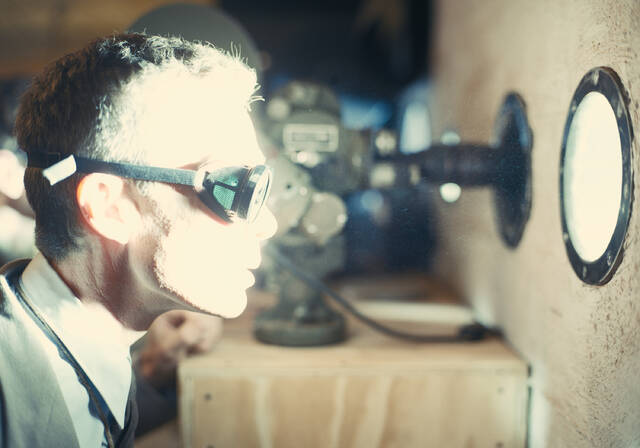
UNIVERSAL PICTURES VIA AP
Cillian Murphy in a scene from “Oppenheimer.”

UNIVERSAL PICTURES VIA AP
Matt Damon as Gen. Leslie Groves, left, and Cillian Murphy as J. Robert Oppenheimer in a scene from “Oppenheimer.”
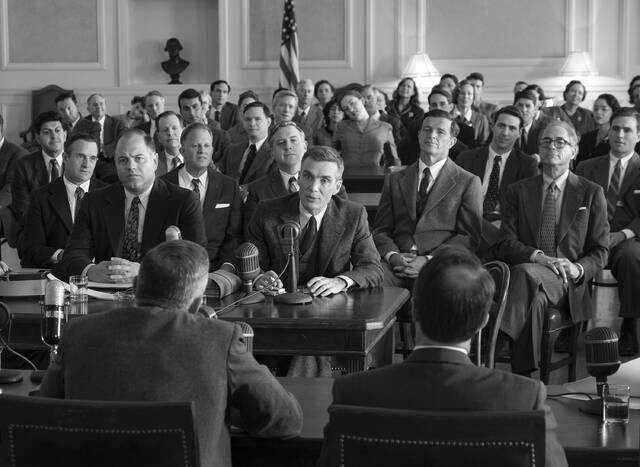
UNIVERSAL PICTURES VIA AP
Cillian Murphy, center, in a scene from “Oppenheimer.”
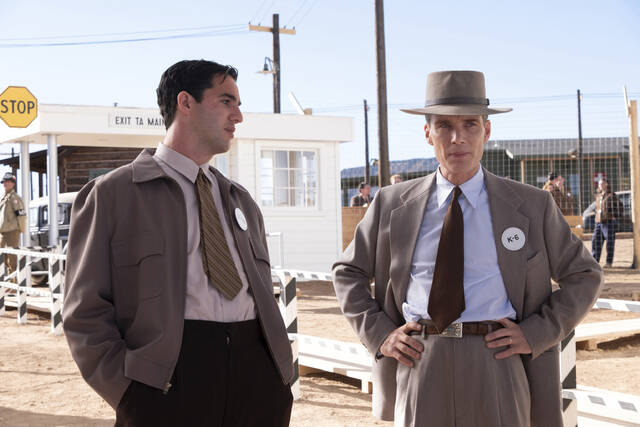
UNIVERSAL PICTURES VIA AP
On Science and Culture by J. Robert Oppenheimer, Encounter (Magazine) October 1962 issue, was the best article that he ever wrote and it touched on a lot of critical issues including the one that Francis Schaeffer discusses in this blog post!
(53:00)
OPPENHEIMER:
Meaning is always
attained at the cost of leaving things out. …We have freedom of
choice, but we have no escape from the fact
that doing some things must leave out others.
In practical terms, this means, of course, that
our knowledge is finite and never all-encompassing.
(53:12)
FRANCIS SCHAEFFER: What he is saying here that we stand and confront the total thing that confronts us, objective reality and including man himself and because we are finite we always have to leave out something in our studies, we can’t study the whole, and this of course becomes more and more specialized. Can’t you see that now you can read it the other way: Only somebody who is infinite can start from his own starting point point and come to absolute knowledge. Oppenheimer is perfectly right. It is a tremendous article. Everything I study I got to exclude something else and this is because we are finite as he points out, consequently beginning with one’s self, one would have to be infinite to come to any absolute meanings. So it is no wonder that he says that science isn’t going to give us a conclusion. Science can’t give us a conclusion. In a sense since we are confronting by such a tremendous thing, the more you study the less of a conclusion you can have, because the more you study the more you have to exclude. Now this isn’t just foolishness this is one of the great scientists of our day, and he is absolutely right.
You know more and more, but every time you choose a field, for instance, if you go from one area of physics to a narrower area of physics, and then a narrower area of physics, and then a narrower area of physics, and then a narrower area of physics, and in each case you exclude something and you exclude and exclude and consequently beginning with a point of finiteness you can never expect to come to the end of the search.
(56:00)
I am not saying anything against the scientific method. I am all for it. I believe the edifice that science is building is valid.
Now then is there a possibility of knowing something really though? We as Christians think there is. We think there is an infinite God that does know things really and who has ultimate meaning really and because of our relationship with God, He can tell us that which will have real meaning. But now what have I have I have said?
Mr. Oppenheimer there is a solution to the dilemma, but in order to come to it you have to shift gears, and not shift gears from 320 to 321, but from one side of antithesis to the opposite of an antithesis. You are absolutely right Mr. Oppenheimer you are not going to arrive at real solutions concerning man. You are not come to this from a humanist starting point, because beginning from a finite viewpoint, never mind infinity, just face to face with the massive stuff you face, every time you make a choice to really study something in detail you have to reject the study of something’s else, so you never get off the ground in a sense. I am not saying anything against the scientific method. I am all for it. I believe the edifice that science is building is valid.
As a Bible believing Christian who believes that God has made all things and all truth is one I am a friend of real science.
Oppenheimer is pointing that you are not going to arrive to a final solution concerning man beginning with your own finite starting point. We as Christians agree, but we do believe though that there is one that does things absolutely because He is not limited and He is not finite and He didn’t begin facing a mass of stuff that He couldn’t comprehend and had to reject certain studies in order to grasp others. It is God. And because man is made in the image of God, this God if He wants to can tell us some things in communication that tells us the thing absolutely. Now there have been scientists that believe that. Who is one of them? Hooray it is Isaac Newton. And Newton didn’t fit in to the Newtonian concept. Remember (the liberal theologian) Richardson? Richardson said he was very appreciative of Newton but he rejected Newton’s cosmology and his view of history. This is exactly what Oppenheimer is touching on here when he said Newton was not Newtonian. So therefore Oppenheimer has a deep grasp of the dilemma, and now he is to the end. ON SCIENCE AND CULTURE is the article, but so far all he has told us is the dilemma from a purely scientific viewpoint. We can read on here:
(59:46)
OPPENHEIMER:
There is always much that we miss, much
that we cannot be aware of because the very act
of learning, of ordering, of finding unity and
meaning, the very power to talk about things
means that we leave out a great deal.
Ask the question: Would another civilisation
based on life on another planet very similar to
ours in its ability to sustain life have the same
physics? One has no idea whether they would
have the same physics or not. We might be
talking about quite different questions. This
makes ours an open world without end.
(1:00:21)
FRANCIS SCHAEFFER: Why? Because their physics might be on different choice they studied and what they left unstudied. In other words they might make an entirely different start and because our physics is not based on the totally reality but it is based on what we decided to study rather than what we have left unstudied. Of course in the terms of old classic physics this wouldn’t make sense, but Oppenheimer is taking about the physics we now understand. So he says you just can’t talk like this.
So Oppenheimer only has a page left and he hasn’t given us the solution of culture yet.
(1:01:24)
OPPENHEIMER:
THE THINGS THAT MAKE US choose one set of
questions, one branch of enquiry rather than
another are embodied in scientific traditions. In
developed sciences each man has only a limited
sense of freedom to shape or alter them; but
they are not themselves wholly determined by
the findings of science. They are largely of an
~esthetic character. The words that we use: simplicity, elegance, beauty: indicate that what we
grope for is not only more knowledge, but
knowledge that has order and harmony in it,
and continuity with the past.
(1:02:09)
FRANCIS SCHAEFFER: Now what is he talking about in line with our lectures on the intellectual climate? He is saying that if you live downstairs you don’t find meaning because this isn’t just in the area just of knowledge. This is in the area of the esthetic. Now these words listen: esthetic character, elegance, beauty, order, harmony, on the basis of everything in the area of science that he has set forth or modern man has set forth in his downstairs so called scientific are, WHAT DO THESE WORDS MEAN? And the answer is absolutely nothing. Don’t you see what he has done. Here is J. Robert Oppenheimer with all his brilliance. He must be a fine man. I have known some men who have known him and they say he is a fine man. With all his brilliance and being a fine man he is really despite of all this really playing a trick under the table on us. He has talked about science, and now he hasn’t built any bridge between science and what he is talking about, he just jumps. That is all. I don’t mean he is dishonest at all. I imagine he is a very honest man, but there is no other way to think in his framework. There is no where else to go. The very words he uses are meaningless based on everything that has proceeded in this article. He says they are of an ecstatic character. In other words they are like a song. For instance, elegance and beauty, what do these words mean in the area he has been talking? Nothing absolutely nothing. Order and Harmony in these areas as he moves over into culture, the words are meaningless. Down a little further.
(1:04:11)
OPPENHEIMER:
I am not here thinking of the popular subject
of “mass culture.” In broaching that, it seems
to me one must be critical but one must, above
all, be human; one must not be a snob; one
must be rather tolerant and almost loving.
(1:04:23)
FRANCIS SCHAEFFER: What do these words mean? Nothing in the area he has given us. He hasn’t given us any framework for these words to have any meaning. Human, tolerant, almost loving, he has moved entirely into a new area. He has gone upstairs. Now we aren’t calling names. I have said I am sure he is a fine man, but on the basis of his own presuppositions he has nowhere else to go. This is the amazing factor. I am sure he is a man of goodwill, but with all his goodwill he has no where else to go. Down at the bottom of page 9 and running page 10.
(1:05:09)
OPPENHEIMER:
Rather, I think loosely of what we may call
the intellectual community: artists, philosophers,
statesmen, teachers, men of most professions,
prophets, scientists.
FRANCIS SCHAEFFER: It is interesting. It is prophets now not ministers you see. Prophets, prophets, it is a scary word. Here are the mediators coming. The mediators of the symbols, he doesn’t say this of course, but that is what scares me to death.
(1:05:33)
OPPENHEIMER:
This is an open group, with no sharp lines separating those that think themselves of it. It is a growing faction of all peoples.
In it is vested the great duty for enlarging,
preserving, and transmitting our knowledge and
skills, and indeed our understanding of the
interrelations, priorities, commitments, injunctions, that help men deal with their joys,
temptations and sorrows, their finiteness, their
beauty. Some of this has to do, as the sciences
so largely do, with propositional truth, with
propositions which say “If you do thus and so
you will see this and that”; these are objective
and can be checked and cross-checked; though it
is always wise from time to time to doubt, there
are ways to put an end to the doubt. This is
how it is with the sciences.
In this community there are other statements
which “emphasise a theme” rather than declare
a fact. They may be statements of connectedness
or relatedness or importance, or they may be in
one way or another statements of commitment.
For them the word “certitude,” which is a
natural norm to apply in the sciences, is not very
sensible–depth, firmness, universality, perhaps
more–but certitude, which applies really to
verification, is not the great criterion in most of
the work of a philosopher, a painter, a poet, or
a playwright. For these are not, in the sense I
have outlined, objective. Yet for any true community, for any society worthy of the name,
they must have an element of community of
being common, of being public, of being relevant and meaningful to man, not necessarily to
everybody, but surely not just to specialists.
(1:07:29)
FRANCIS SCHAEFFER: Now here you see is the total dilemma. Emphasizing a theme
(1:12:40)
—

OPPENHEIMER and EINSTEIN
—

Albert Einstein and Robert Oppenheimer, 1947: Flickr, James Vaughn
—
Francis Schaeffer above
—
Atomic Bombings of Hiroshima and Nagasaki – August 6 and 9, 1945
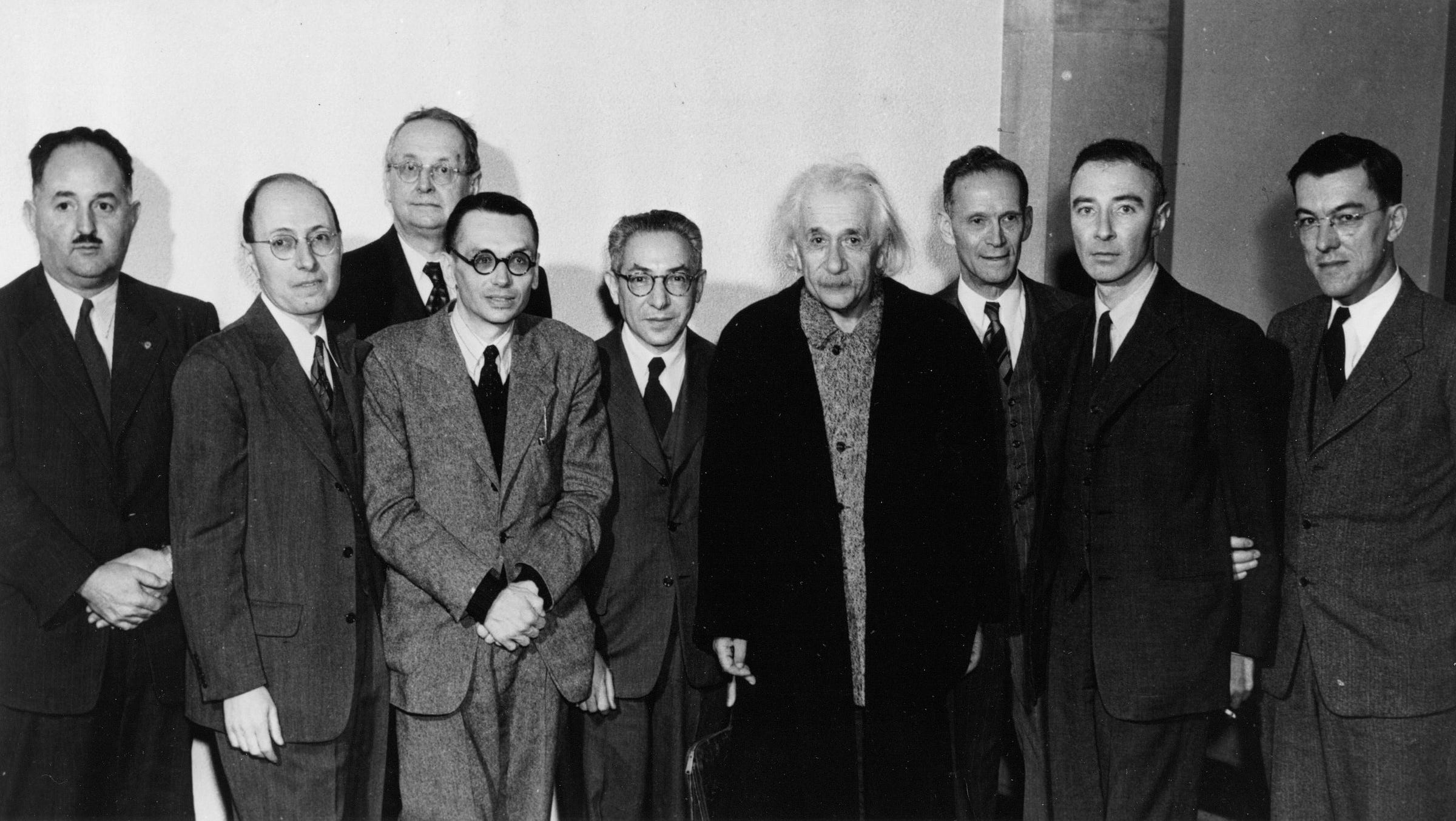
From left to right: Robertson, Wigner, Weyl, Gödel, Rabi, Einstein, Ladenburg, Oppenheimer, and Clemence
Related posts:
Atheists confronted: How I confronted Carl Sagan the year before he died jh47
In today’s news you will read about Kirk Cameron taking on the atheist Stephen Hawking over some recent assertions he made concerning the existence of heaven. Back in December of 1995 I had the opportunity to correspond with Carl Sagan about a year before his untimely death. Sarah Anne Hughes in her article,”Kirk Cameron criticizes […]
By Everette Hatcher III|Posted in Atheists Confronted|Edit|Comments (2)


 The Daily Hatch