
——
At the 53:00 mark of the following 1963 talk by Francis Schaeffer on the 1962 paper by J. Robert Oppenheimer are these words:
Meaning is always
attained at the cost of leaving things out. …We have freedom of
choice, but we have no escape from the fact
that doing some things must leave out others.
In practical terms, this means, of course, that
our knowledge is finite and never all-encompassing.
Oppenheimer
Matt Zoller Seitz July 19, 2023

For all the pre-release speculation about how analog epic-maker Christopher Nolan’s “Oppenheimer” would re-create the explosion of the first atomic bomb, the film’s most spectacular attraction turns out to be something else: the human face.
This three-plus hour biography of J. Robert Oppenheimer (Cillian Murphy) is a film about faces. They talk, a lot. They listen. They react to good and bad news. And sometimes they get lost in their own heads—none more so than the title character, the supervisor of the nuclear weapons team at Los Alamos whose apocalyptic contribution to science earned him the nickname The American Prometheus (as per the title of Nolan’s primary source, the biography by Kai Bird and Martin J. Sherman). Nolan and cinematographer Hoyte van Hoytema use the large-format IMAX film system not merely to capture the splendor of New Mexico’s desert panoramas but contrast the external coolness and internal turmoil of Oppenheimer, a brilliant mathematician and low-key showman and leader whose impulsive nature and insatiable sexual appetites made his private life a disaster, and whose greatest contribution to civilization was a weapon that could destroy it. Close-up after close-up shows star Cillian Murphy’s face staring into the middle distance, off-screen, and sometimes directly into the lens, while Oppenheimer dissociates from unpleasant interactions, or gets lost inside memories, fantasies, and waking nightmares. “Oppenheimer” rediscovers the power of huge closeups of people’s faces as they grapple with who they are, and who other people have decided that they are, and what they’ve done to themselves and others.
Sometimes the close-ups of people’s faces are interrupted by flash-cuts of events that haven’t happened, or already happened. There are recurring images of flame, debris, and smaller chain-reaction explosions that resemble strings of firecrackers, as well as non-incendiary images that evoke other awful, personal disasters. (There are a lot of gradually expanding flashbacks in this film, where you see a glimpse of something first, then a bit more of it, and then finally the entire thing.) But these don’t just relate to the big bomb that Oppenheimer’s team hopes to detonate in the desert, or the little ones that are constantly detonating in Oppenheimer’s life, sometimes because he personally pushed the big red button in a moment of anger, pride or lust, and other times because he made a naive or thoughtless mistake that pissed somebody off long ago, and the wronged person retaliated with the equivalent of a time-delayed bomb. The “fissile” cutting, to borrow a physics word, is also a metaphor for the domino effect caused by individual decisions, and the chain reaction that makes other things happen as a result. This principle is also visualized by repeated images of ripples in water, starting with the opening closeup of raindrops setting off expanding circles on the surface that foreshadow both the ending of Oppenheimer’s career as a government advisor and public figure and the explosion of the first nuke at Los Alamos (which observers see, then hear, then finally feel, in all its awful impact).
The weight of the film’s interests and meanings are carried by faces—not just Oppenheimer’s, but those of other significant characters, including General Leslie Groves (Matt Damon), Los Alamos’ military supervisor; Robert’s suffering wife Kitty Oppenheimer (Emily Blunt), whose tactical mind could have averted a lot of disasters if her husband would have only listened; and Lewis Strauss (Robert Downey, Jr.), the Atomic Energy Commission chair who despised Oppenheimer for a lot of reasons, including his decision to distance himself from his Jewish roots, and who spent several years trying to derail Oppenheimer’s post-Los Alamos career. The latter constitutes its own adjacent full-length story about pettiness, mediocrity, and jealousy. Strauss is Salieri to Oppenheimer’s Mozart, regularly and often pathetically reminding others that he studied physics, too, back in the day, and that he’s a good person, unlike Oppenheimer the adulterer and communist sympathizer. (This film asserts that Strauss leaked the FBI file on his progressive and communist associations to a third party who then wrote to the bureau’s director, J. Edgar Hoover.)
The film speaks quite often of one of the principles of quantum physics, which holds that observing quantum phenomena by a detector or an instrument can change the results of this experiment. The editing illustrates it by constantly re-framing our perception of an event to change its meaning, and the script does it by adding new information that undermines, contradicts, or expands our sense of why a character did something, or whether they even knew why they did it.
That, I believe, is really what “Oppenheimer” is about, much more so than the atom bomb itself, or even its impact on the war and the Japanese civilian population, which is talked about but never shown. The film does show what the atom bomb does to human flesh, but it’s not recreations of the actual attacks on Japan: the agonized Oppenheimer imagines Americans going through it. This filmmaking decision is likely to antagonize both viewers who wanted a more direct reckoning with the destruction of Hiroshima and Nagasaki, and those who have bought into the arguments advanced by Strauss and others that the bombs had to be dropped because Japan never would have surrendered otherwise. The movie doesn’t indicate whether it thinks that interpretation is true or if it sides more with Oppenheimer and others who insisted that Japan was on its knees by that point in World War II and would have eventually given up without atomic attacks that killed hundreds of thousands of civilians. No, this is a film that permits itself the freedoms and indulgences of novelists, poets, and opera composers. It does what we expect it to do: Dramatize the life of Oppenheimer and other historically significant people in his orbit in an aesthetically daring way while also letting all of the characters and all of the events be used metaphorically and symbolically as well, so that they become pointillistic elements in a much larger canvas that’s about the mysteries of the human personality and the unforeseen impact of decisions made by individuals and societies.
This is another striking thing about “Oppenheimer.” It’s not entirely about Oppenheimer even though Murphy’s baleful face and haunting yet opaque eyes dominate the movie. It’s also about the effect of Oppenheimer’s personality and decisions on other people, from the other strong-willed members of his atom bomb development team (including Benny Safdie’s Edwin Teller, who wanted to skip ahead to create the much more powerful hydrogen bomb, and eventually did) to the beleaguered Kitty; Oppenheimer’s mistress Jean Tatlock (Florence Pugh, who has some of Gloria Grahame’s self-immolating smolder); General Groves, who likes Oppenheimer in spite of his arrogance but isn’t going to side with him over the United States government; and even Harry Truman, the US president who ordered the atom bomb dropped on Hiroshima and Nagasaki (played in a marvelous cameo by Gary Oldman) and who derides Oppenheimer as a naive and narcissistic “crybaby” who sees history mainly in terms of his own feelings.
Jennifer Lame’s editing is prismatic and relentless, often in a faintly Terrence Malick-y way, skipping between three or more time periods within seconds. It’s wedded to virtually nonstop music by Ludwig Göransson that fuses with the equally relentless dialogue and monologues to create an odd but distinctive sort of scientifically expository aria that’s probably what it would feel like to read American Prometheus while listening to a playlist of Philip Glass film scores. Non-linear movies like this one do a better job of capturing the pinball-machine motions of human consciousness than linear movies do, and they also capture what it’s like to read a third-person omniscient book (or a biography that permits itself to imagine what its subjects might have been thinking or feeling). It also paradoxically captures the mental process of reading a text and responding to it emotionally and viscerally as well as intellectually. The mind stays anchored to the text. But it also jumps outside of it, connecting the text to other texts, to external knowledge, and to one’s own experience and imaginings.
This review hasn’t delved into the plot of the film or the real-world history that inspired it, not because it isn’t important (of course it is) but because—as is always the case with Nolan—the main attraction is not the story, itself but how the filmmaker tells it. Nolan has been derided as less a dramatist than half showman, half mathematician, making bombastic, overcomplicated, but ultimately muddled and simplistic blockbusters that are as much puzzles as stories. But whether that characterization was ever entirely true (and I’m increasingly convinced that it never was) it seems beside the point when you see how thoughtfully and rewardingly it’s been applied to a biography of a real person. It seems possible that “Oppenheimer” could retrospectively seem like a turning point in the director’s filmography, when he takes all of the stylistic and technical practices that he’d been honing for the previous twenty years in intellectualized pulp blockbusters and turns them inward, using them to explore the innermost recesses of the mind and heart, not just to move human pieces around on a series of interlinked, multi-dimensional storytelling boards.
The movie is an academic-psychedelic biography in the vein of those 1990s Oliver Stone films that were edited within an inch of their lives (at times it’s as if the park bench scene in “JFK” had been expanded to three hours). There’s also a strain of pitch-black humor, in a Stanley Kubrick mode, as when top government officials meet to go over a list of possible Japanese cities to bomb, and the man reading the list says that he just made an executive decision to delete Kyoto from it because he and his wife honeymooned there. (The Kubrick connection is cemented further by the presence of “Full Metal Jacket” star Matthew Modine, who co-stars as American engineer and inventor Vannevar Bush.) As an example of top-of-the-line, studio-produced popular art with a dash of swagger, “Oppenheimer” draws on Michael Mann’s “The Insider,” late-period Terrence Malick, nonlinearly-edited art cinema touchstones like “Hiroshima Mon Amour,” “The Pawnbroker,” “All That Jazz” and “Picnic at Hanging Rock“; and, inevitably, “Citizen Kane” (there’s even a Rosebud-like mystery surrounding what Oppenheimer and his hero Albert Einstein, played by Tom Conti, talked about on the banks of a Princeton pond). Most of the performances have a bit of an “old movie” feeling, with the actors snapping off their lines and not moving their faces as much as they would in a more modern story. A lot of the dialogue is delivered quickly, producing a screwball comedy energy. This comes through most strongly in the arguments between Robert and Kitty about his sexual indiscretions and refusal to listen to her mostly superb advice; the more abstract debates about power and responsibility between Robert and General Groves, and the scenes between Strauss and a Senate aide (Alden Ehrenreich) who is advising him as he testifies before a committee that he hopes will approve him to serve in President Dwight Eisenhower’s cabinet.
But as a physical experience, “Oppenheimer” is something else entirely—it’s hard to say exactly what, and that’s what’s so fascinating about it. I’ve already heard complaints that the movie is “too long,” that it could’ve ended with the first bomb detonating, and could’ve done without the bits about Oppenheimer’s sex life and the enmity of Strauss, and that it’s perversely self-defeating to devote so much of the running time, including the most of the third hour, to a pair of governmental hearings: the one where Oppenheimer tries to get his security clearance renewed, and Strauss trying to get approved for Eisenhower’s cabinet. But the film’s furiously entropic tendencies complement the theoretical discussions of the how’s and why’s of the individual and collective personality. To greater and lesser degrees, all of the characters are appearing before a tribunal and bring called to account for their contradictions, hypocrisies, and sins. The tribunal is out there in the dark. We’ve been given the information but not told what to decide, which is as it should be.
————-
—
In ‘Oppenheimer,’ Christopher Nolan builds a thrilling, serious blockbuster for adults

ASSOCIATED PRESS
Thursday, July 13, 2023 12:11 p.m.
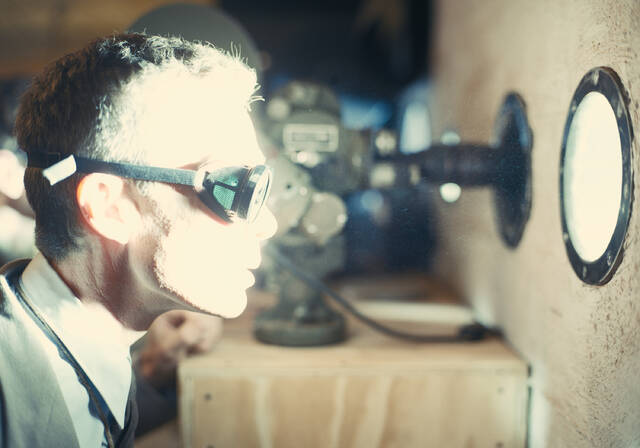
UNIVERSAL PICTURES VIA AP
Cillian Murphy in a scene from “Oppenheimer.”

UNIVERSAL PICTURES VIA AP
Matt Damon as Gen. Leslie Groves, left, and Cillian Murphy as J. Robert Oppenheimer in a scene from “Oppenheimer.”
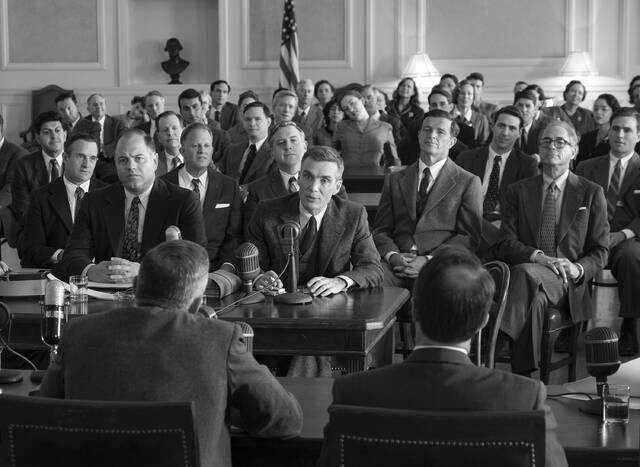
UNIVERSAL PICTURES VIA AP
Cillian Murphy, center, in a scene from “Oppenheimer.”
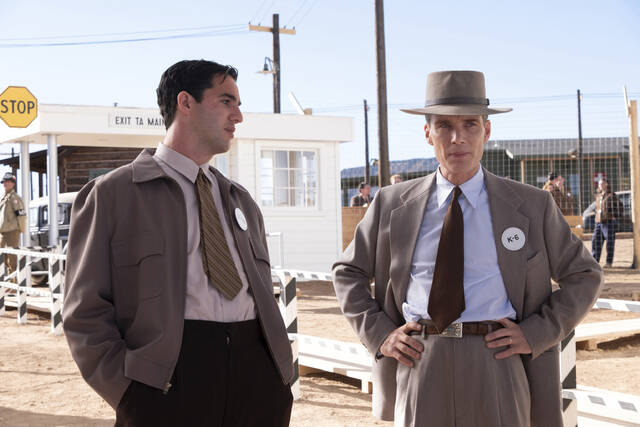
UNIVERSAL PICTURES VIA AP
On Science and Culture by J. Robert Oppenheimer, Encounter (Magazine) October 1962 issue, was the best article that he ever wrote and it touched on a lot of critical issues including the one that Francis Schaeffer discusses in this blog post!
(53:00)
OPPENHEIMER:
Meaning is always
attained at the cost of leaving things out. …We have freedom of
choice, but we have no escape from the fact
that doing some things must leave out others.
In practical terms, this means, of course, that
our knowledge is finite and never all-encompassing.
(53:12)
FRANCIS SCHAEFFER: What he is saying here that we stand and confront the total thing that confronts us, objective reality and including man himself and because we are finite we always have to leave out something in our studies, we can’t study the whole, and this of course becomes more and more specialized. Can’t you see that now you can read it the other way: Only somebody who is infinite can start from his own starting point point and come to absolute knowledge. Oppenheimer is perfectly right. It is a tremendous article. Everything I study I got to exclude something else and this is because we are finite as he points out, consequently beginning with one’s self, one would have to be infinite to come to any absolute meanings. So it is no wonder that he says that science isn’t going to give us a conclusion. Science can’t give us a conclusion. In a sense since we are confronting by such a tremendous thing, the more you study the less of a conclusion you can have, because the more you study the more you have to exclude. Now this isn’t just foolishness this is one of the great scientists of our day, and he is absolutely right.
You know more and more, but every time you choose a field, for instance, if you go from one area of physics to a narrower area of physics, and then a narrower area of physics, and then a narrower area of physics, and then a narrower area of physics, and in each case you exclude something and you exclude and exclude and consequently beginning with a point of finiteness you can never expect to come to the end of the search.
(56:00)
I am not saying anything against the scientific method. I am all for it. I believe the edifice that science is building is valid.
Now then is there a possibility of knowing something really though? We as Christians think there is. We think there is an infinite God that does know things really and who has ultimate meaning really and because of our relationship with God, He can tell us that which will have real meaning. But now what have I have I have said?
Mr. Oppenheimer there is a solution to the dilemma, but in order to come to it you have to shift gears, and not shift gears from 320 to 321, but from one side of antithesis to the opposite of an antithesis. You are absolutely right Mr. Oppenheimer you are not going to arrive at real solutions concerning man. You are not come to this from a humanist starting point, because beginning from a finite viewpoint, never mind infinity, just face to face with the massive stuff you face, every time you make a choice to really study something in detail you have to reject the study of something’s else, so you never get off the ground in a sense. I am not saying anything against the scientific method. I am all for it. I believe the edifice that science is building is valid.
As a Bible believing Christian who believes that God has made all things and all truth is one I am a friend of real science.
Oppenheimer is pointing that you are not going to arrive to a final solution concerning man beginning with your own finite starting point. We as Christians agree, but we do believe though that there is one that does things absolutely because He is not limited and He is not finite and He didn’t begin facing a mass of stuff that He couldn’t comprehend and had to reject certain studies in order to grasp others. It is God. And because man is made in the image of God, this God if He wants to can tell us some things in communication that tells us the thing absolutely. Now there have been scientists that believe that. Who is one of them? Hooray it is Isaac Newton. And Newton didn’t fit in to the Newtonian concept. Remember (the liberal theologian) Richardson? Richardson said he was very appreciative of Newton but he rejected Newton’s cosmology and his view of history. This is exactly what Oppenheimer is touching on here when he said Newton was not Newtonian. So therefore Oppenheimer has a deep grasp of the dilemma, and now he is to the end. ON SCIENCE AND CULTURE is the article, but so far all he has told us is the dilemma from a purely scientific viewpoint. We can read on here:
(59:46)
OPPENHEIMER:
There is always much that we miss, much
that we cannot be aware of because the very act
of learning, of ordering, of finding unity and
meaning, the very power to talk about things
means that we leave out a great deal.
Ask the question: Would another civilisation
based on life on another planet very similar to
ours in its ability to sustain life have the same
physics? One has no idea whether they would
have the same physics or not. We might be
talking about quite different questions. This
makes ours an open world without end.
(1:00:21)
FRANCIS SCHAEFFER: Why? Because their physics might be on different choice they studied and what they left unstudied. In other words they might make an entirely different start and because our physics is not based on the totally reality but it is based on what we decided to study rather than what we have left unstudied. Of course in the terms of old classic physics this wouldn’t make sense, but Oppenheimer is taking about the physics we now understand. So he says you just can’t talk like this.
So Oppenheimer only has a page left and he hasn’t given us the solution of culture yet.
(1:01:24)
OPPENHEIMER:
THE THINGS THAT MAKE US choose one set of
questions, one branch of enquiry rather than
another are embodied in scientific traditions. In
developed sciences each man has only a limited
sense of freedom to shape or alter them; but
they are not themselves wholly determined by
the findings of science. They are largely of an
~esthetic character. The words that we use: simplicity, elegance, beauty: indicate that what we
grope for is not only more knowledge, but
knowledge that has order and harmony in it,
and continuity with the past.
(1:02:09)
FRANCIS SCHAEFFER: Now what is he talking about in line with our lectures on the intellectual climate? He is saying that if you live downstairs you don’t find meaning because this isn’t just in the area just of knowledge. This is in the area of the esthetic. Now these words listen: esthetic character, elegance, beauty, order, harmony, on the basis of everything in the area of science that he has set forth or modern man has set forth in his downstairs so called scientific are, WHAT DO THESE WORDS MEAN? And the answer is absolutely nothing. Don’t you see what he has done. Here is J. Robert Oppenheimer with all his brilliance. He must be a fine man. I have known some men who have known him and they say he is a fine man. With all his brilliance and being a fine man he is really despite of all this really playing a trick under the table on us. He has talked about science, and now he hasn’t built any bridge between science and what he is talking about, he just jumps. That is all. I don’t mean he is dishonest at all. I imagine he is a very honest man, but there is no other way to think in his framework. There is no where else to go. The very words he uses are meaningless based on everything that has proceeded in this article. He says they are of an ecstatic character. In other words they are like a song. For instance, elegance and beauty, what do these words mean in the area he has been talking? Nothing absolutely nothing. Order and Harmony in these areas as he moves over into culture, the words are meaningless. Down a little further.
(1:04:11)
OPPENHEIMER:
I am not here thinking of the popular subject
of “mass culture.” In broaching that, it seems
to me one must be critical but one must, above
all, be human; one must not be a snob; one
must be rather tolerant and almost loving.
(1:04:23)
FRANCIS SCHAEFFER: What do these words mean? Nothing in the area he has given us. He hasn’t given us any framework for these words to have any meaning. Human, tolerant, almost loving, he has moved entirely into a new area. He has gone upstairs. Now we aren’t calling names. I have said I am sure he is a fine man, but on the basis of his own presuppositions he has nowhere else to go. This is the amazing factor. I am sure he is a man of goodwill, but with all his goodwill he has no where else to go. Down at the bottom of page 9 and running page 10.
(1:05:09)
OPPENHEIMER:
Rather, I think loosely of what we may call
the intellectual community: artists, philosophers,
statesmen, teachers, men of most professions,
prophets, scientists.
FRANCIS SCHAEFFER: It is interesting. It is prophets now not ministers you see. Prophets, prophets, it is a scary word. Here are the mediators coming. The mediators of the symbols, he doesn’t say this of course, but that is what scares me to death.
(1:05:33)
OPPENHEIMER:
This is an open group, with no sharp lines separating those that think themselves of it. It is a growing faction of all peoples.
In it is vested the great duty for enlarging,
preserving, and transmitting our knowledge and
skills, and indeed our understanding of the
interrelations, priorities, commitments, injunctions, that help men deal with their joys,
temptations and sorrows, their finiteness, their
beauty. Some of this has to do, as the sciences
so largely do, with propositional truth, with
propositions which say “If you do thus and so
you will see this and that”; these are objective
and can be checked and cross-checked; though it
is always wise from time to time to doubt, there
are ways to put an end to the doubt. This is
how it is with the sciences.
In this community there are other statements
which “emphasise a theme” rather than declare
a fact. They may be statements of connectedness
or relatedness or importance, or they may be in
one way or another statements of commitment.
For them the word “certitude,” which is a
natural norm to apply in the sciences, is not very
sensible–depth, firmness, universality, perhaps
more–but certitude, which applies really to
verification, is not the great criterion in most of
the work of a philosopher, a painter, a poet, or
a playwright. For these are not, in the sense I
have outlined, objective. Yet for any true community, for any society worthy of the name,
they must have an element of community of
being common, of being public, of being relevant and meaningful to man, not necessarily to
everybody, but surely not just to specialists.
(1:07:29)
FRANCIS SCHAEFFER: Now here you see is the total dilemma. Emphasizing a theme
(1:12:40)
—

OPPENHEIMER and EINSTEIN
—

Albert Einstein and Robert Oppenheimer, 1947: Flickr, James Vaughn
—
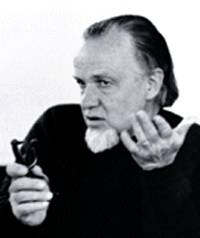
Francis Schaeffer above
—
Atomic Bombings of Hiroshima and Nagasaki – August 6 and 9, 1945
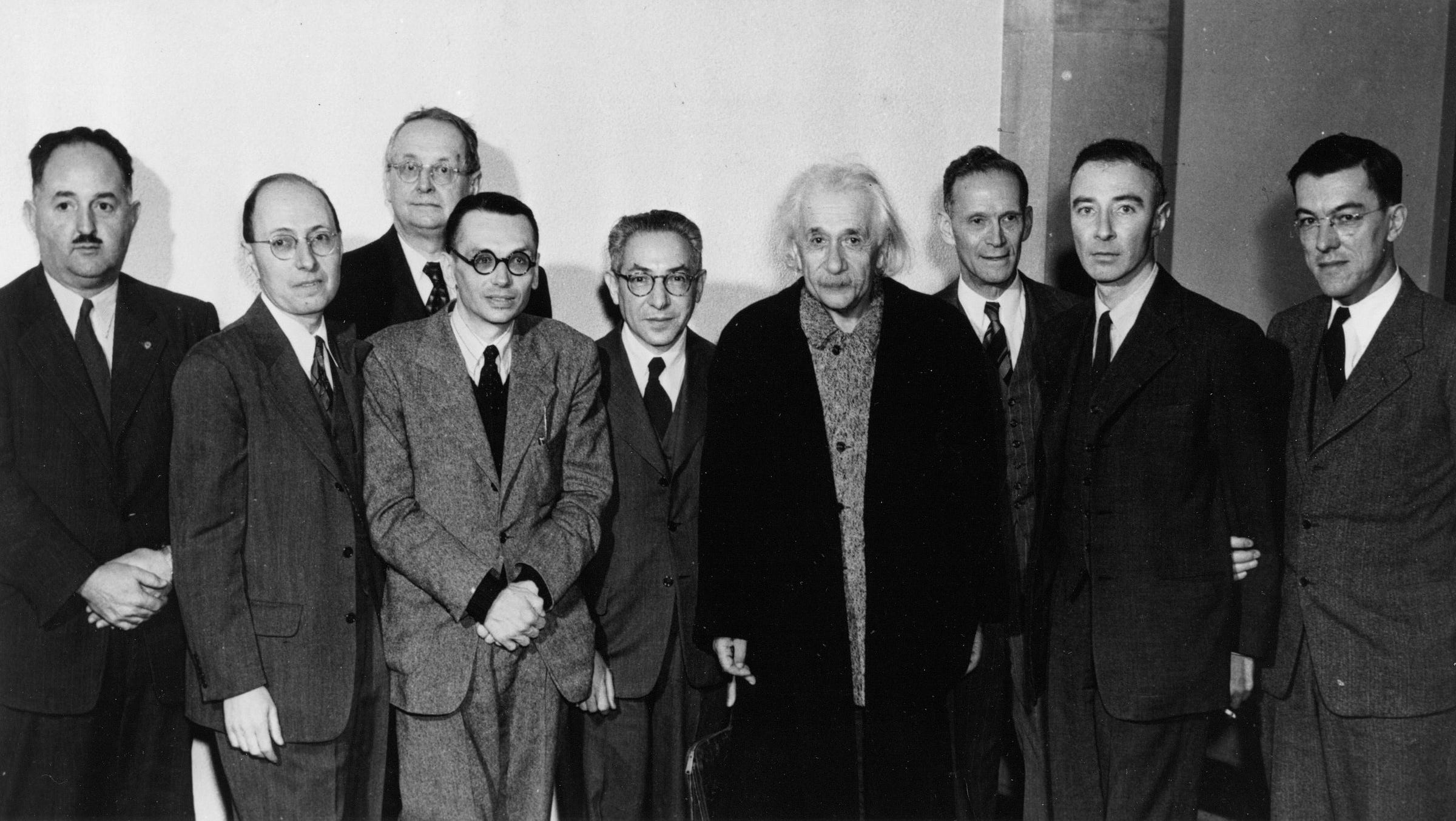
From left to right: Robertson, Wigner, Weyl, Gödel, Rabi, Einstein, Ladenburg, Oppenheimer, and Clemence
Related posts:
Atheists confronted: How I confronted Carl Sagan the year before he died jh47
In today’s news you will read about Kirk Cameron taking on the atheist Stephen Hawking over some recent assertions he made concerning the existence of heaven. Back in December of 1995 I had the opportunity to correspond with Carl Sagan about a year before his untimely death. Sarah Anne Hughes in her article,”Kirk Cameron criticizes […]
By Everette Hatcher III|Posted in Atheists Confronted|Edit|Comments (2)


 The Daily Hatch