
——
At the 42:11 mark of the following 1963 talk by Francis Schaeffer on the 1962 paper by J. Robert Oppenheimer are these words:
EINSTEIN ONCE SAID that a physical theory was
not determined by the facts of nature, but was
a free invention of the human mind. This raises
the question of how necessary is the content of
science–how much is it something that we are
free not to find–how much is it something that
could be otherwise? This is, of course, relevant
to the question of how we may use the words
“objectivity” and “truth.” Do we, when we
find something, “invent” it or “discover” it?…We are free in the start of things. We
are free as to how to go about it; but then the
rock of what the world is, shapes this freedom
with a necessary answer.
———-
—
In ‘Oppenheimer,’ Christopher Nolan builds a thrilling, serious blockbuster for adults

ASSOCIATED PRESS
Thursday, July 13, 2023 12:11 p.m.
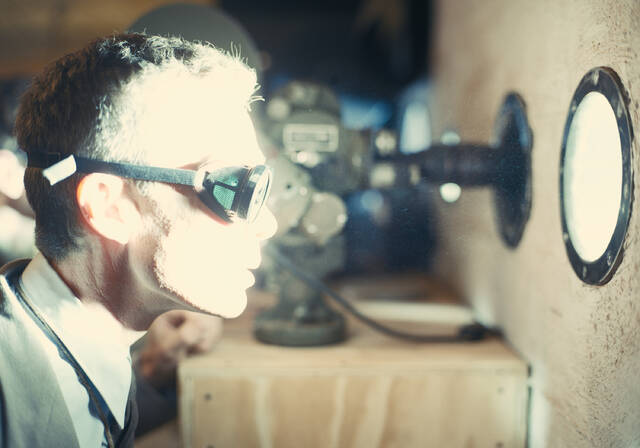
UNIVERSAL PICTURES VIA AP
Cillian Murphy in a scene from “Oppenheimer.”

UNIVERSAL PICTURES VIA AP
Matt Damon as Gen. Leslie Groves, left, and Cillian Murphy as J. Robert Oppenheimer in a scene from “Oppenheimer.”
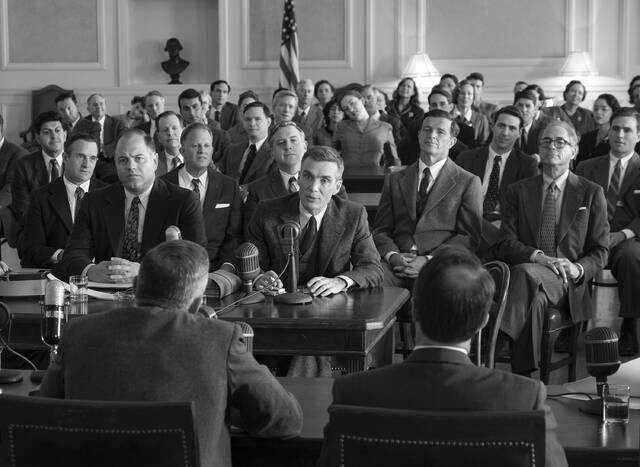
UNIVERSAL PICTURES VIA AP
Cillian Murphy, center, in a scene from “Oppenheimer.”
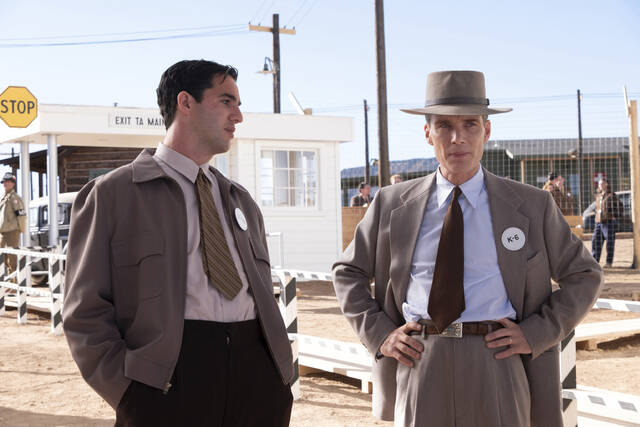
UNIVERSAL PICTURES VIA AP
Benny Safdie as Edward Teller, left, and Cillian Murphy as J. Robert Oppenheimer in a scene from “Oppenheimer.”
NEW YORK — Christopher Nolan has never been one to take the easy or straightforward route while making a movie.
He shoots on large-format film with large, cumbersome cameras to get the best possible cinematic image. He prefers practical effects over computer-generated ones and real locations over soundstages — even when that means recreating an atomic explosion in the harsh winds of the New Mexico desert in the middle of the night for “Oppenheimer,” out July 21.
Though, despite internet rumors, they did not detonate an actual nuclear weapon.
And as for the biography that inspired his newest film, Kai Bird and Martin J. Sherwin’s riveting, linear narrative “American Prometheus” was simply the starting point from which Nolan crafted a beguiling labyrinth of suspense and drama.
It’s why, in his two decades working in Hollywood, Nolan has become a franchise unto himself — the rare auteur writer-director who makes films that are both intellectually stimulating and commercial, accounting for more than $5 billion in box office receipts. That combination is part of the reason why he’s able to attract Oscar winners and movie stars not just to headline his films, but also to turn out for just a scene or two.
“We’ve all been so intoxicated by his films,” said Emily Blunt, who plays J. Robert Oppenheimer’s wife, Kitty. “That exploration of huge themes in an entertaining way doesn’t happen. It just doesn’t happen. That depth, the depth of the material, and yet on this massive epic scale.”
In the vast and complex story of the brilliant theoretical physicist who oversaw the Manhattan Project and the development of the atomic bomb during World War II, Nolan saw exciting possibilities to play with genre and form. There was the race to develop it before the Germans did, espionage, romance, domestic turmoil, a courtroom drama, bruised egos, political machinations, communist panic, and the burden of having created something that could destroy the world.
And then there was the man himself, beloved by most but hated by enough, who, after achieving icon status in American society, saw his reputation and sense of self annihilated by the very institutions that built him.
“It’s such an ambitious story to tell,” said Matt Damon, who plays Gen. Leslie Groves Jr. “Reading the script, I had the same feeling I had when I read ‘Interstellar,’ which was: ‘This is great. How the hell is he going to do this?’”
It’s not so disconnected from Nolan’s other films, either. As critic Tom Shone noted in his book about the director, “Looked at one way, Nolan’s films are all allegories of men who first find their salvation in structure only to find themselves betrayed or engulfed by it.”
Nolan turned to Cillian Murphy to take on the gargantuan task of portraying Oppenheimer. Murphy had already acted in five Nolan films, including the Batman trilogy, “Dunkirk” and “Inception,” but this would be his first time as a lead — something he had secretly pined for.
“You feel a responsibility, but then a great hunger and excitement to try and do it, to see where you can get,” said Murphy, who prepped extensively for six months before filming, working closely with Nolan throughout. “It was an awful lot of work, but I loved it. There is this kind of frisson, this energy when you’re on a Chris Nolan set about the potential for what you’re going to achieve.”
It would be an all-consuming role that would require some physical transformation to approximate that famously thin silhouette. A complex, contradictory figure, Oppenheimer emerged from a somewhat awkward youth to become a renaissance man who seemed to carry equal passion for the Bhagavad Gita, Proust, physics, languages, New Mexico, philosophical questions about disarmament and the perfectly mixed martini. But Murphy knew he was in safe hands with Nolan.
“He’s the most natural director I’ve ever worked with. And the notes that he gives to an actor, are quite remarkable. How he can gently bring you to a different place with your performance is quite stunning in such a subtle, low-key, understated way,” Murphy said. “It can have a profound effect on the way you look at a scene from one take to another take.”
Nolan wrote the main timeline of the film in the first person, to represent Oppenheimer’s subjective experience.
“We want to see everything through Oppenheimer’s point of view,” Nolan said. “That’s a huge challenge for an actor to take on because they’re having to worry about the performance, the truth of the performance, but also make sure that that’s always open to the audience.”
The other timeline, filmed in black and white, is more objective and focused on Lewis Strauss (Robert Downey Jr.), a founding member of the Atomic Energy Commission and a supporter of the development of the more destructive hydrogen bomb.
“Oppenheimer” is Nolan’s first R-rated film since 2002’s “Insomnia,” which after years of working exclusively in PG-13, he’s comfortable with. It fits the gravity of the material.
“We’re dealing with the most serious and adult story you could imagine — very important, dramatic events that changed the world and defined the world we live in today,” Nolan said. “You don’t want to compromise in any way.”
Much of the filming took place in New Mexico, including at the real Los Alamos laboratory where thousands of scientists, technicians and their families lived and worked for two years in the effort to develop the bomb. Nolan enlisted many of his frequent behind-the-scenes collaborators, including his wife and producer Emma Thomas, cinematographer Hoyte Van Hoytema, composer Ludwig Göransson and special effects supervisors Scott Fisher and Andrew Jackson, as well as some newcomers like production designer Ruth de Jong and costume designer Ellen Mirojnick to help bring this world to life.
“It was a very focused set — fun set as well, not too serious. But the work was serious, the sweating of the details was serious,” Blunt said. “Everyone needs to kind of match Chris’ excellence, or want to.”
When it came to recreating the Trinity test, Oppenheimer’s chosen name for the first nuclear detonation, art and life blended in a visceral way.
“We wanted to put the audience there in that bunker,” Nolan said. “That meant really trying to make these things as beautiful and frightening and awe inspiring as they would have been to the people at the time.”
Though no real nukes were used, they did stage a lot of real explosions to approximate the blindingly bright atomic fire and mushroom cloud.
“To do those safely in a real environment out in the nighttime desert, there’s a degree of discipline and focus and adrenaline and just executing that for the film that echoes and mirrors what these guys went through on the grandest scale in a really interesting way,” Nolan said. “I felt everybody had that very, very tight sense of tension and focus around all those shooting nights.”
The weather also “did what it needed to do, as per history,” Murphy said, as the wind picked up and whipped around the set.
“I’m rumored to be very lucky with the weather and it’s not the case. It’s just that we decide to shoot whatever the weather,” Nolan said. “In the case of the Trinity test, it was essential, central to the story that this big storm rolls in with tremendous drama. And it did. That really made the sequence come to life.”
He added: “The extremity of it put me very much in the mindset of what it must have been like for these guys. It really felt like we were out in it.”
Then, of course, there is the experience of watching “Oppenheimer.”
“When you’re making a movie, I feel like you’re on the inside looking out,” Blunt said. “It’s really overwhelming to see it reflected back at you, especially one of this magnitude. … I just felt like my breastplate was going to shatter, it was so intense.”
The hope is that when “Oppenheimer” is unleashed on the world, audiences will be as invested and will seek it out on the biggest screen they can find. The film has a run in IMAX theaters around the country, not something often afforded serious-minded, R-rated movies in the middle of the busy summer season. But this is also the essential Nolan impossibility. As more and more auteurs have had to compromise — to either go smaller or team with streamers to get the kind of budget they might once have had at studios, like even Ridley Scott and Martin Scorsese have had to do this year — Nolan continues to make his movies on the grandest scale.
“Each of his films has been revolutionary in their own way,” Murphy said. “It’s an event every time he releases a film, and rightly so.”
On Science and Culture by J. Robert Oppenheimer, Encounter (Magazine) October 1962 issue, was the best article that he ever wrote and it touched on a lot of critical issues including the one that Francis Schaeffer discusses in this blog post!
42:11)

Albert Einstein and Robert Oppenheimer, 1947: Flickr, James Vaughn
OPPENHEIMER:
EINSTEIN ONCE SAID that a physical theory was
not determined by the facts of nature, but was
a free invention of the human mind. This raises
the question of how necessary is the content of
science–how much is it something that we are
free not to find–how much is it something that
could be otherwise? This is, of course, relevant
to the question of how we may use the words
“objectivity” and “truth.” Do we, when we
find something, “invent” it or “discover” it?
The fact is, of course, just what one would
guess. We are, of course, free in our tradition.
and in our practice, and to a much more limited
extent individually to decide where to look at
nature, and how to look at nature, what questions to put, with what instruments and with
what purpose. But we are not the least bit free to
settle what we find. Man must certainly be free to
invent the idea of mass, as Newton did and as it
has been refined and re-defined; but having done
so, we have not been free to find that the mass of
the light quantum or the neutrino is anything
but zero. We are free in the start of things. We
are free as to how to go about it; but then the
rock of what the world is, shapes this freedom
with a necessary answer.
(43:45)
FRANCIS SCHAEFFER: I want to point out something. We are totally free in the beginning of things, the only time we are not free according to Oppenheimer, is when we come up to the rock of reality and we therefore can measure our previous statement by that which we know enough about to make an exact element of measure. In other words, you put forth a theory and you are free as the wind, as free as the Greek philosophers. Many of the Greek philosophers were not really interested in truth. They were interested in making a nice system in which the balance of the system was more important than what it touched in a certain sense and we haven’t got past this in men’s thinking today. Now the scientist is in the same lovely position. He can step into nature and choose what he wants to study and what he is going to let go unstudied. He can choose what instruments he is going to use. He has tremendous freedom. However, as soon as he proceeds he hits the rock of reality and as he finally comes into the area of reality gradually there shapes up an element of measure whereby he can measure his theories. But he says we are free in the start of things, but if you have a theory hasn’t come down to the hard rock stuff that is sharp enough and clearly enough seen and observed to make an accurate element of measurement then you are still free.
What am I talking about? I am talking about the stuff that is thrown against Christianity is largely still in this area. The Darwinian theory is not yet in the area where it lacks freedom. Simply because it hasn’t come up against enough hard stuff to be measured nor then to act as an element of measurement. Therefore, it is perfectly true that you are only free in the beginnings, but it also true that something like Darwinianism , and especially when one projects the question of evolution beyond organic evolution into the general philosophy of evolution, say social evolution, their men today are as free as the wind because they are in the beginning of things. They are only prolegomenon . We would say the things that are supposedly science that are being thrown at scripture and the Christian view are all in the beginning of things or the start of things. Consequently there all in the area of the philosophy that have shaped them. The presuppositions in these things are still the basic things.
Men for generations held to spontaneous generation and they held to it because they didn’t want the face the question of God. In this they were as free as the wind. A haystack produces mice, slime produces bacteria but then when you came to the time Louis Pasteur, they are no longer are free because they have found enough stuff by this time so their freedom is past and they have to give up the theory spontaneous generation which they held against the concept of a personal God such as the biblical God. They were free for many centuries, but they are no longer free so what do they do? They just push the whole thing into the more sophisticated theory of evolution which is philosophically the same as spontaneous generation which the theory had to give up previously. But now they have pushed evolution back into the start of things. Oppenheimer sets forth that the philosophic presuppositions are the things that shape it but that there is a limitation on this that it is only in the start of things but we would answer yes but modern man, especially at those places where he claims that science is making it untenable to believe the scriptures, this is always in the start of things.
Now we say that is true in archaeology and true in other areas of absolute science and true in something like the critical theories. So when people bring you something called scientific which seems to be against Christianity, then ask a very simple question: IS IT IN THE START OF THINGS OR IS THERE HARD STUFF HERE WHICH IS LIKE A ROCK WHICH THEY HAVE HAD TO CAREFULLY DETERMINE THE REALITY OF THEIR THEORIES IN THE LIGHT OF THE REALITY THAT THEY ARE NOW WORKING IN? If it is just the prolegomenon or in the start of things then it doesn’t cut any ice. Oppenheimer is absolutely right. Back in this area man is free. Back in this area you can’t tell if he is inventing something or discovering it. Back in this area it is the FREE INVENTION OF THE HUMAN MIND and not the facts of nature (quoting Albert Einstein). Now this isn’t running down science and its method. It is all very worthwhile We are for it. You have to put forth theories before you can operate. Keep Oppenheimer thing in mind. When it is in the start of things it is free as the wind to take any direction without limitation based on a man’s presuppositions. It is only when it is in the hard stuff of truth on the basis of experimentation that he is no longer free to use the thing for his own ends philosophically. I am not saying anything against the scientific method. I am all for it. I beleve the edifice that science is building is valid. I would quote Dr. Barnes again that there is a lot of junk in it, but the edifice it is building in valid. I am for it. I am for it. But let’s notice that a man like Oppenheimer puts forth this proposition and it enters into our debate with modern man.
It isn’t a question that the method is wrong. The method is alright. It is that the philosophy of those who hold to the philosophy of the Newtonians against Newton himself, it is the use they make of it. And the use they make of it is without limitation in the start of things.
—

OPPENHEIMER and EINSTEIN
—
Albert Einstein and Robert Oppenheimer, 1947: Flickr, James Vaughn
—
Francis Schaeffer above
—
Atomic Bombings of Hiroshima and Nagasaki – August 6 and 9, 1945
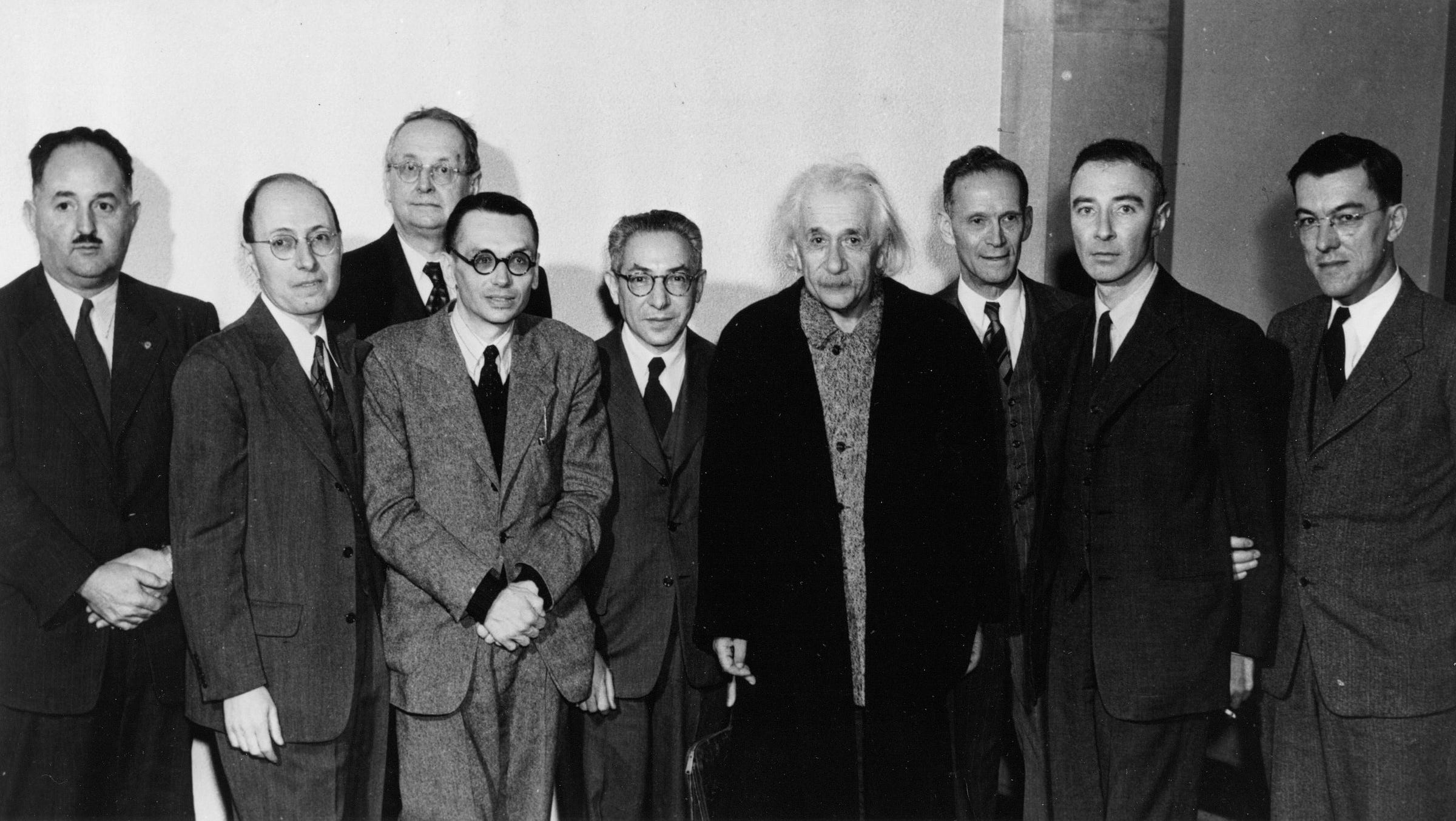
From left to right: Robertson, Wigner, Weyl, Gödel, Rabi, Einstein, Ladenburg, Oppenheimer, and Clemence
Related posts:
Atheists confronted: How I confronted Carl Sagan the year before he died jh47
In today’s news you will read about Kirk Cameron taking on the atheist Stephen Hawking over some recent assertions he made concerning the existence of heaven. Back in December of 1995 I had the opportunity to correspond with Carl Sagan about a year before his untimely death. Sarah Anne Hughes in her article,”Kirk Cameron criticizes […]
By Everette Hatcher III|Posted in Atheists Confronted|Edit|Comments (2)


 The Daily Hatch