
——
At the 22:36 mark of the following 1963 talk by Francis Schaeffer on the 1962 paper by J. Robert Oppenheimer are these words:
The next step in the article and from a man like Oppenheimer it is of great significance, he is going to say that we can’t look to science for the solution of our problems.
———-
—
On Science and Culture by J. Robert Oppenheimer, Encounter (Magazine) October 1962 issue, was the best article that he ever wrote and it touched on a lot of critical issues including the one that Francis Schaeffer discusses in this blog post!
Oppenheimer Became Death, the Destroyer of Worlds. But Was He Religious?
BY RELEVANT
JULY 28, 2022

The first teaser for Christopher Nolan’s wildly anticipated Oppenheimer is here, promising one of Nolan’s sweeping epics about the life of the man whose most remembered contribution to the world is providing it with the means of its own destruction. The movie, starring Cillian Murphy, Florence Pugh and most every other actor who’s not starring in Greta Gerwig’s Barbie (opening on the same day!) has a lot of thematic meat on the bone. J. Robert Oppenheimer was a fascinating person with a terrific mind and a complex sense of morality.
Memorably, he is said to have quoted the Bhagavad Gita upon the first detonation of atomic bomb: “Now I am become Death, the destroyer of worlds.” So clearly he had spirituality on his brain. But was he religious?
Oppenheimer was raised in a secular Jewish family in New York City, and showed a keen, early interest in not only science, but also art, philosophy and literature. A group called the Ethical Culture Society provided Oppenheimer with much of his earlier moral framework, a nuanced and complex moral code that would remain with him through much of his life and study. Though he believed the use of the atomic bomb was justified in World War II, he regretted his involvement and spoke of the blood on his hands, blaming himself and his colleagues for the arms race that followed and growing skeptical that humankind would ever use nuclear power for good instead of evil.
He grew deeply interested in religion as he grew older, reading a wide variety of spiritual texts from many different faith traditions. He admired the ethical teachings and poetry of Hinduism but did not ever subscribe to it as a spiritual belief system. The Bible and other religious texts also became part of his diet. He was not conventionally religious, but religion shaped his view of the world and deeply informed his thoughts on his extraordinarily consequential role in it.
—

OPPENHEIMER and EINSTEIN
(22:36)
OPPENHEIMER:
The knowledge that is being increased in this
extraordinary way is inherently and inevitably
very specialised.
FRANCIS SCHAEFFER: Now then the outline of this article is as follows. Without telling you he is going to present you with a dilemma he starts with a dilemma. Secondly he tells you what great strides science has made. He mentions in passing the unity Now he comes to the fact however, and this is the next step in the article and from a man like Oppenheimer it is of great significance, he is going to say that we can’t look to science for the solution of our problems. This is what he is about to deal with. And he takes off on this by emphasizing that the knowledge is specialized and increasingly specialized.
(23:34)
OPPENHEIMER:
The traditions of science are
specialised traditions; this is their strength. Their
strength is that they use the words, the
machinery, the concepts, the theories, that fit
their subjects; they are not encumbered by
having to try to fit other sorts of things.
(page 7)
…in its terminology it is most
highly specialised, almost unintelligible except to
the men who have worked in the field.
…It cannot be formulated
in terms that can reasonably be defined without
a long period of careful schooling.
(24:37)
FRANCIS SCHAEFFER: In other words, not only are the disciplines in a smaller and smaller area, but less and less people know what you are talking about, but you have to have a long schooling not only to understand the subject but to understand what the man is talking about. Still on page 7
(24:49)
OPPENHEIMER:
This is comparably true in other subjects.
ONE HAS THEN in these specialisations
the professional communities in the
various sciences.
…The specialising habits of the sciences have,
to some extent, because of the tricks of universities, been carried over to other work, to philosophy and to the arts. There is technical
philosophy which is philosophy as a craft,
philosophy for other philosophers, and there is
art for the artists and the critics. To my mind,
whatever virtues the works have for sharpening
professional tools, they are profound misreadings, even profound subversions of the true functions of philosophy and art, which are to
address themselves to the general common
human problem. Not to everybody, but to anybody: not to specialists.
(25:39)
FRANCIS SCHAEFFER: Now we are coming into the dilemma. He says the scientists that are making these tremendous progresses, are scientists in an ever greater specialization and even in communication concerning the truths given by these scientists, less and less people understand what you are talking about because the language is more and more technical and needs more and more education to even know the terminology. Now he says because these things are thrown together in the tricks of the universities this same mentality sometimes is brought over and often is brought over in the areas. For example a philosophy in the arts, and he says there may be a place for this, for philosophers to talk to philosophers and artists to talk to artists but he feels this is a mistake in general. These subjects shouldn’t be more and more specialized but they should be for everyone who is educated. Why is he saying this? Well because science isn’t going to come up with the answers that man needs as man. That is where he is taking us.
He is saying stop art and stop philosophy from going the same way as science. Hooray for science going in this direction but don’t let philosophy be dragged in this direction. H Oppenheimer continues on page 8.
(27:19) OPPENHEIMER:
IT HAS OFTEN BEEN held that the great discoveries in science, coming into the lives of
men, affect their attitudes toward their place
in life, their views, their philosophy. There is
surely some truth in this.*
FRANCIS SCHAEFFER: Now he is saying there is some truth that great discoveries affect men’s philosophy. Then he has a very remarkable note at the bottom of the page.
(27:55)
OPPENHEIMER: (FOOTNOTE: Examples that are usually given include Newton and Darwin. Newton is not a very good example, for ~vhen we look at it closely ~ve are struck by the fact that in the sense of the Enlightenment, the sense of a coupling of faith in scientific progress and man’s reason with a belief in political progress and the secularisation of human life, Newton himself was in no way a Newtonian. His successors were.)
(28:41)
FRANCIS SCHAEFFER: A most remarkable note. Isaac Newton is a case apart. Newton does not fit into this category. A little further down Oppenheimer says:

Albert Einstein and Robert Oppenheimer, 1947: Flickr, James Vaughn
(29:15)
OPPENHEIMER:
Some of the
great discoveries of this century go under the
name of Relativity and Uncertainty, and when
we hear these words we may think, “This is
the way I felt this morning: I was relatively
confused and quite uncertain”: this is not at all
a notion of what technical points are involved
in these great discoveries, or what lessons.
(29:34)
FRANCIS SCHAEFFER: Now he started by saying IT HAS OFTEN BEEN held that the great discoveries in science, coming into the lives of
men, affect their attitudes toward their place
in life, their views, their philosophy. There is
surely some truth in this.* Then he has a footnote that says Examples that are usually given include Newton and Darwin. Newton is not a very good example, Now he comes in the next paragraph and says don’t be overwhelmed by this because really you have to be careful when you say this.
For instance, if you carry relatively and uncertainty and this is Heisenberg’s uncertainty principle and Einstein’s relativity theories, if you carry this over to what men think of relativity and uncertainty in other areas of life then you miss the whole point. There absolutely is no relation between these things. He said at the beginning IT HAS OFTEN BEEN held that the great discoveries in science, coming into the lives of
men, affect their attitudes toward their place
in life, their views, their philosophy. But now he is disengaging himself. Oppenheimer says it isn’t so with Isaac Newton, and he says it isn’t so you people in our generation often think it is so when they think the words Relativity and Uncertainty in the scientific fields carry over into a sense of personal Relativity and Uncertainty. He says there is a chasm between these two points. One would quickly say that no one notice better than Oppenheimer and he is certainly right.
Einstein’s relativity theory doesn’t mean it is really relative. It’s of only one area. It does all the area of physics. It doesn’t even begin with absolute relativity, you still have the speed of light in a vacuum to begin. Heisenberg’s uncertainty Principle has nothing to do with absolute uncertainty. It only has to do with appearance of a particle in a limited field. It has nothing to do with absolute uncertainty.
He said first of all IT HAS OFTEN BEEN held that the great discoveries in science affect …philosophy but really now what he is doing by first disengaging Newton and now by disengaging this you feel he is moving the other direction.
(32:20)
OPPENHEIMER:
Thus I think that the great effects of the
sciences in stimulating and in enriching philosophical life and cultural interests have been
necessarily confined to the rather early times in
the development of a science.
(32:30)
FRANCIS SCHAEFFER: This is extremely important. In other words what he is saying is if there is any impact on men’s worldviews in a philosophy sense or a common view by the sciences it necessarily comes in the first blow of a discovery because it is only at that point that the common people can understand what it is all about. After that it becomes so detailed, so specialized and so technical , that it really doesn’t have an impact except on a small segment of society. The only way the Darwinian theory has an impact, and Oppenheimer brings this in, is as a simple statement, and then it has an impact but when it gets down to the hard stuff of technical research and findings it passes out of the place of general affect on people’s thinking simply because you move into highly technical areas that really don’t touch on the normal things of life at all. Really what Oppenheimer is saying here is tremendous. Just what you would think from a man like this. It is tremendously perceptive. He goes on in a rather long section on page 8. In my marking on this article, I have put A. The fact that he says there is some truth in the fact great discoveries of science affect their philosophies, but by the time you come to the next paragraph he has disengaged himself and he is saying the absolute other, that it is men’s philosophies that are basic to their scientific discoveries. Let me read this to you.
(34:32)
OPPENHEIMER:
The hunger of the
Eighteenth Century to believe in the power of
reason, to wish to throw off authority, to wish
to secularise, to take an optimistic view of man’s
condition, seized on Newton and his discoveries
as an illustration of something which was
already deeply believed in quite apart from the
law of gravity and the laws of motion. The
hunger with which the Nineteenth Century
seized on Darwin had very much to do with the
increasing awareness of history and change,
with the great desire to naturalise man, to put
him into the world of nature, which pre-existed
long before Darwin and which made him welcome. I have seen an example in this century
where the great Danish physicist Niels Bohr
found in the quantum theory when it was
developed thirty years ago this remarkable
trait: it is consistent with describing an atomic
system, only much less completely than we can
describe large-scale objects. We have a certain
choice as to which traits of the atomic system
we wish to study and measure and which to let
go; but we have not the option of doing them
all. This situation, which we all recognise,
sustained in Bohr his long-held view of the
human condition: that there are mutually
exclusive ways of using our words, our minds,
our souls, any one of which is open to us, but
which cannot be combined:
No higher resolution available
(36:37)
FRANCIS SCHAEFFER: If only our Christian brethren could understand what is being put forth here then what a different position we would be in. Oppenheimer first of all states that there is some truth in the fact that great discoveries affect men’s philosophies but by and large it is the other way. The reason that men grasped on Newton’s discoveries and made out of them what they did had nothing to do with the law of gravity and the law of motion, but what it had to do with basically was the 18th century was hungry to believe in the power of reason and wish to throw off authority, wish to promote secularism, to take an optimistic view of man’s condition.
Newton’s discoveries as to gravity and the laws of motion didn’t necessarily produce what they made out of it. It produced what they made out of it because their mind was already set in this direction because of their already held philosophy. This is tremendous. Newton didn’t make out of these discoveries what they made out of them because Newton had a different philosophy and that is why that footnote is so important. Newton as a Christian didn’t take a Newtonian position because he held a Christian philosophy, a Christian worldview. The reason his discoveries led to the later Newtonian viewpoint had nothing to do with the discoveries, it was because of the previous philosophy.
The same things is true about Darwin. What has brought forth the acceptance of Darwin? It is the great desire to naturalize man. There it is. To man merely a part of uniformity (Darwin doesn’t use the word but that’s what it is), to put man right in the middle of uniformity of natural causes and that is the end of it. Therefore, when Darwin came along and of course, Darwin held the opposite view that Newton held in his personal view of life, yet nevertheless, what Oppenheimer is pointing out here is that though Darwin may have been in the direction of what men made of his position, which wasn’t true of Newton, yet nevertheless the reason Darwinism was so readily accepted was because the philosophy was already there which was the proper seedbed for what Darwin is planting.
Now then this thing of Niels Bohr is a highly sophisticated statement of the same thing. As Niels Bohr laid hold of the quantum theory, why did he lay hold to it? He laid hold to it according to Oppenheimer, because it sustained his view of the human condition, that is with man being confronted with the whole of reality, man must make arbitrary choices of what he will touch and what he won’t touch and he must let the rest go. That is exciting!
That is exacting where we are left with quantum position. Now then let us quickly notice, just because Niels Bohr laid hold of it with such graft because of his previous view doesn’t prove the quantum theory is basically wrong. It doesn’t say that. Of course the quantum theory really doesn’t answer anything but just jumps over the problem. But it doesn’t say it is necessarily wrong, but it doesn’t say it is right!
What Oppenheimer is laying down here is the acceptance of the quantum solution rather the acceptance of something else was because of the previous philosophy of Niels Bohr. The reason according to Oppenheimer that Niels Bohr laid hold to this solution rather than let’s say a more classical one was because Niels Bohr had decided that is all there is to life anyway. This is the way that must act in all the areas of life. Now then regardless what we think of his illustration of Niels Bohr, but I find it maybe the must intriguing part of this, but this whole paragraph is overwhelmingly intriguing. In other words instead of the great discoveries of science particularly being the things that affect philosophy, it is the other way around. Men make out of the discoveries what they want to make out of them, men choose what they want to deal with and what they don’t want to deal with on the basis of their previous philosophical presuppositions.
(43:00)
—
Albert Einstein and Robert Oppenheimer, 1947: Flickr, James Vaughn
—
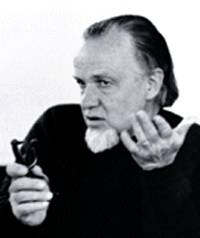
Francis Schaeffer above
—
Atomic Bombings of Hiroshima and Nagasaki – August 6 and 9, 1945
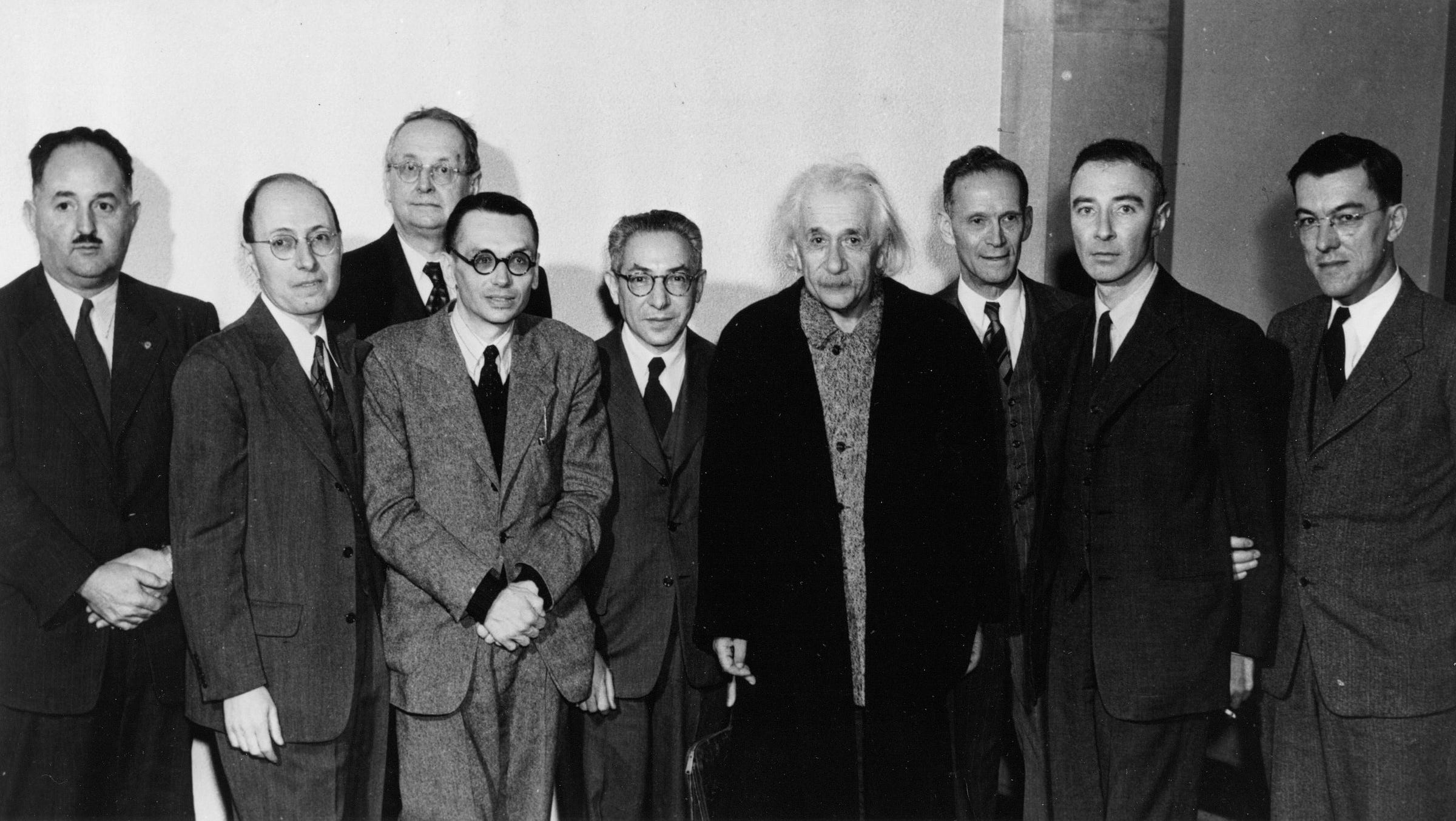
From left to right: Robertson, Wigner, Weyl, Gödel, Rabi, Einstein, Ladenburg, Oppenheimer, and Clemence
Related posts:
Atheists confronted: How I confronted Carl Sagan the year before he died jh47
In today’s news you will read about Kirk Cameron taking on the atheist Stephen Hawking over some recent assertions he made concerning the existence of heaven. Back in December of 1995 I had the opportunity to correspond with Carl Sagan about a year before his untimely death. Sarah Anne Hughes in her article,”Kirk Cameron criticizes […]
By Everette Hatcher III|Posted in Atheists Confronted|Edit|Comments (2)


 The Daily Hatch