
—
—
On Science and Culture by J. Robert Oppenheimer, Encounter (Magazine) October 1962 issue, was the best article that he ever wrote and it touched on a lot of critical issues including the one that Francis Schaeffer discusses in this blog post!
At the 7:00 mark of the following 1963 talk by Francis Schaeffer on the 1962 paper by J. Robert Oppenheimer are these words:
The world will not be the same, no matter what
we do with atomic bombs, because the knowledge of how to make them cannot be exorcised.
Christopher Nolan is a visionary filmmaker renowned for his mind-bending narratives and masterful storytelling. He has captivated audiences worldwide with a unique blend of intellect and spectacle. From Memento to Inception andInterstellar, Nolan’s films challenge conventional boundaries and explore the complexities of time, memory, and identity.
His attention to detail, innovative cinematography, and immersive sound design create a cinematic experience like no other. Nolan’s ability to craft intricate plots and his love for practical effects have earned him critical acclaim and a dedicated fanbase. Now, an actor has claimed that Christian Bale’s The Dark Knight trilogy movies aren’t Nolan’s best anymore.
Cast Member Calls OppenheimerChristopher Nolan’s Best Work
Christopher Nolan, renowned for his ventures into superheroes and mind-bending science fiction, will soon unveil his interpretation of the historical genesis of nuclear power. The highly anticipated film boasts an ensemble of remarkable talent, delving into the life of J. Robert Oppenheimer, revered as the father of the atomic bomb.

Benny Safdie, a notable member of the film’s ensemble cast, took to his personal Instagram to offer an exclusive sneak peek of his initial thoughts. Safdie raved about the highly anticipated project, declaring it as Nolan’s most exceptional work to date.
“I got to see the movie recently, and I can tell you with certainty: This is Chris’ best movie by far. It’s got everything firing on all cylinders.”
Benny Safdie, portraying the Hungarian-American theoretical physicist Edward Teller in Christopher Nolan’s Oppenheimer,astounded fans by sharing his early impressions of the film on social media. Accompanied by a captivating image of his character, Safdie’s first reaction arrived well ahead of the official review embargo for Oppenheimer.
—

OPPENHEIMER and EINSTEIN
On Science and Culture by J. Robert Oppenheimer, Encounter (Magazine) October 1962 issue
Francis Schaeffer comments in 1963 on 1962 article “On Science and Culture” by J. Robert Oppenheimer, Encounter (Magazine) October 1962 issue
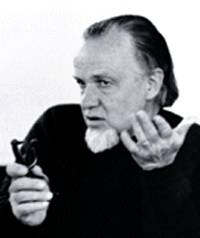
No higher resolution available
FRANCIS SCHAEFFER: (Henderik Roelof) “Hans” Rookmaaker sent me this article “On Science and Culture” by J. Robert Oppenheimer, which it appeared in Encounter (Magazine) October 1962 issue, which is very, very recent. I would say it is an important article and it shows a great deal of perception, and for that reason I think it worth a lecture. Here is a little more than the first page:

Albert Einstein and Robert Oppenheimer, 1947: Flickr, James Vaughn
OPPENHEIMER ARTICLE:
On Science and Culture by J. Robert Oppenheimer
We live in an unusual world, marked
by very great and irreversible changes
that occur within the span of a man’s life. We
live in a time where our knowledge and understanding of the world of nature grows wider
and deeper at an unparalleled rate; and where
the problems of applying this knowledge to
man’s needs and hopes are new, and only a
little illuminated by our past history.
Indeed it has always, in traditional societies,
been the great function of culture to keep things
rather stable, quiet, and unchanging. It has been
the function of tradition to assimilate one epoch
to another, one episode to another, even one
year to another. It has been the function of
culture to bring out meaning, by pointing to the
constant or recurrent traits of human life, which
in easier days one talked about as the eternal
verities.
In the most primitive societies, if one believes
the anthropologists, the principal function of
ritual, religion, of culture is, in fact, almost to
stop change. It is to provide for the social
organism what life provides in such a magic
way for living organisms, a kind of homeostasis,
an ability to remain intact, to respond only very
little to the obvious convulsions and alterations
in the world around.
To-day, culture and tradition have assumed
a very different intellectual and social purpose.
The principal function of the most vital and
living traditions to-day is precisely to provide
the instruments of rapid change. There are
many things which go together to bring about
this alteration in man’s life; but probably the
decisive one is science itself. I will use that word
as broadly as I know, meaning the natural
sciences, meaning the historical sciences, meaning all those matters on which men can converse objectively with each other. I shall not
continually repeat the distinction between
science as an effort to find out about the world
and understand it, on the one hand, and science,
in its applications in technology, as an effort
to do something useful with the knowledge so
acquired. But certain care is called for, because,
if we call this the scientific age, we make
more than one kind of oversimplification. When
we talk about science to-day, we are likely to
think of the biologist with his microscope or the
physicist with his cyclotron; but almost certainly a great deal that is not now the subject
of successful study will later come to be. I think
we probably to-day have under cultivation only
a small part of the terrain which will be natural
for the sciences a century from now. I think of
the enormously rapid growth in many parts of
biology, and of the fact, ominous but not without hope, that man is a part of nature and very
open to study.
The reason for this great change from a
slowly moving, almost static world, to the
world we live in, is the cumulative character,
the firmness, the givenness of what has been
learned about nature. It is true that it is transcended when one goes into other parts of experience. What is true on the scale of the inch
and the centimeter may not be true on the scale
of a billion light-years; it may not be true either
of the scale of a one hundred billionth of a
centimetre; but it stays true where it was proven.
It is fixed. Thus everything that is found out
is added to what was known before, enriches it,
and does not have to be done over again. This
essentially cumulative irreversible character of
learning things is the hallmark of science.
(Page 3)
T H I S M E A N S that in man’s history the
sciences make changes which cannot be
wished away and cannot be undone. Let me
give two quite different examples. There is
much talk about getting rid of atomic bombs.
I like that talk; but we must not fool ourselves.
The world will not be the same, no matter what
we do with atomic bombs, because the knoxvledge of how to make them cannot be exorcised.
It is there; and all our arrangements for living
in a new age must bear in mind its omnipresent
virtual presence, and the fact that one cannot
change that. A different example: we can never
have again the delusions about the centrality
and importance of our physical habitat, now
that we know something of where the earth is
in the solar system, and know that there are
hundreds of billions of suns in our galaxy, and
hundreds of billions of galaxies within reach
of the great telescopes of the world. We can
never again base the dignity of man’s life on
the special character in space and time of the
place where he happens to live.

(7:16)
FRANCIS SCHAEFFER: Beginning at this particular place you notice that he makes the point there is something irreversible in what has been learned by science, and even if you want to get rid of it, you can’t. Then you notice that he also says that we can no longer base the dignity of man’s life on the special character in space and time in place where he happens to live.
Now in reality the rest of the article centers in this. You won’t know it at this particular point, but it is the case. The question “If we can not base the dignity of man’s life upon the special character in space and time where he happens to live,” then what can you base it on? Now this is what this article deals with.
I would say that Oppenheimer’s observation has to be limited in one sense, and that is men can forget knowledge. For instance, one can find things in the old Egyptian culture that men can not do today. Just as a passing thing there is evidence that the Egyptians could temper bronze where you could shave with it. No living person today that I know can temper bronze so you shave with it. Consequently, his statement is a good statement, but with this limitation, and that is men can forget the knowledge that they have.
If something happened and everyone living forgot that the atom had been split then you would return to a time when the atom bomb could be forgotten. This is just an illustration. I am not saying that it will take place.
(10:00)
At the end of the next paragraph he makes a contrast between the scientific knowledge of which he has been speaking and moral progress. Oppenheimer says,
“Moral regress, as we have seen in our day, is
just as possible. Scientific regress is not compatible with the continued practice of science.“
Now actually I suppose he means the continued practice of the science at hand, and not forgotten, but he would point out that in our day we have learned that moral regression is possible. Now he has drawn a comparison. Scientific progress or knowledge is not possible and on the other hand moral regression is.
But I would point out that the distinction is not final. #1 that scientific knowledge can be forgotten and has been. #2 Moral knowledge can be forgotten. Now where is the conflict here? I think the whole article points out the conflict here. He has said that scientific knowledge stands. Never again can you act as though you don’t have it. I have pointed out that men can lose knowledge. However, he seems to be talking about science moving in a straight line (knowledge of a certain area) so we can accept this. But I have added something else. Just as scientific knowledge has been and can be forgotten, moral knowledge has been and can be forgotten. But immediately we have a clash with the sharp distinction he has made. Now I will leave that fro the moment and we will come back to it closer to the conclusion.
Next we go on PAGE 4:
(12:08)
OPPENHEIMER:
]t is not a simple question to answer why the
scientific revolution occurred when it did. It
started, as all serious historians would agree,
in the late Middle Ages and early Renaissance,
and was very slow at first.
FRANCIS SCHAEFFER: Oppenheimer now talks about the origin of the scientific Revolution.
(12:50)
OPPENHEIMER:
No great culture has
been free of curiosity and reflection, of contemplation and thought. “To know the causes of
things” is something that serious mtn have
always wanted, a quest that serious societies
have sustained. No great culture has been free
of inventive genius. If we think of the culture
of Greece, and the following Hellenistic and
Roman period, it is particularly puzzling that
the scientific revolution did not occur then. The
Greeks discovered something without which our
contemporary world would not be what it is:
standards of rigour, the idea of proof, the idea
of logical necessity, the idea that one thing implies another. Without that, science is very
nearly impossible, for unless there is a quasirigid structure of implication and necessity, then
if something turns out not to be what one expected, one will have no way of finding out
where the wrong point is: one has no way of
correcting himself, of finding the error. But this
is something that the Greeks had very early in
their history. They were curious and inventive;
they did not experiment in the scale of modern
days, but they did many experiments; they had
as we have only recendy learned to appreciate
a very high degree of technical and technological
sophistication. They could make very subtle and
complicated instruments; and they did, though
they did not write much about it. Possibly the
Greeks did not make the scientific revolution
because of some flaw in communication. They
were a small society, and it may be that there
were not quite enough people involved.
In a matter of history, we cannot assign a
unique cause, precisely because the event itself
is unique; you cannot test, to see if you have it
right. I think that the best guess is that it took
something that was not present in Chinese
civilisation, that was wholly absent in Indian
clvilisation, and absent also from Greco-Roman
civilisation. It needed an idea of progress, not
limited to better understanding for this idea
the Greeks had. It took an idea of progress
which has more to do with the human condition, which is well expressed by the second
half of the famous Christian dichotomy–faith
and works; the notion that the betterment of
man’s condition, his civility, had meaning; that
we all had a responsibility to it, a duty to it, and
to man. I think that it was when this basic idea
of man’s condition, which supplements the
other worldly aspects of religion, was fortified
and fructified between the 13th and i5th centuries by the re-discovery of the ancient world’s
scientists, philosophers, and mathematicians,
that there was the beginning of the scientific
age.
(16:00)
FRANCIS SCHAEFFER: A very remarkable statement. He is saying that the scientific Revolution began when it did by the bring together of two factors: Christianity and he would say the works part of the Christian dichotomy, the dichotomy being faith and works as he expresses it, with the knowledge that had been previously at hand. In other words, the secret of the thing is not knowledge but a certain viewpoint that brought it forth and we would agree with this. We won’t say faith and works, we would put it in a different framework. Nevertheless, it is intriguing to me that he senses this, feels this and says it strongly. It reminds us of the historian Arnold Joseph Toynbee CH FBA (/ˈtɔɪnbi/; 14 April 1889 – 22 October 1975), who would see the same kind of thing without himself being a Christian.
On the same page 5 we go on.
(Page 5)
(17:20)
OPPENHEIMER:
ONE CAN MEASURE scientific growth in a numberof ways, but it is important not to mistake
things. The excellence of the individual scientist
does not change much with time. His knowledge and his power does, but not the high
quality that makes him great. We do not look
to anyone to be better than Kepler or Newton,
any more than we look to anyone to be better
than Sophocles, or to any doctrine to be better
than the gospel according to St. Matthew. Yet
one can measure things, and it has been done.
One can measure how many people work on
scientific questions: one can count them. One
can notice how much is published.
These two criteria show a doubling of scientific knowledge in every ten years. Casimir
calculated that if the Physical Review continued
to grow as rapidly as it has between i945 and
1960 it would weigh more than the earth
during the next century. In fifteen years, the
volume of chemical abstracts has quadrupled;
in biology the changes are faster still. To-day,
if you talk about scientists and mean by that
people who have devoted their lives to the
acquisition and application of new knowledge,
then 93 percent of us are still alive.
(19:07)
FRANCIS SCHAEFFER: Just think of the impact of this. Of all the scientists under this definition as far as Oppenheimer would know 93% are still alive. Of course this begins to bring something into focus here. The tremendous understanding and uniqueness of our own generation and the impact that science has on our own generation.
I skip page 6.
(19:41)
FRANCIS SCHAEFFER: On page 7 he begins to talk about the unity of science, and he has this paragraph.
OPPENHEIMER:
The unity consists of two things: first and ever
more strikingly, an absence of inconsistency.
Thus we may talk of life in terms of purpose
and adaptation and function, but we have found
in living things no tricks played upon the laws
of physics and chemistry. We have found and
I expect will find a total consistency, and
between the different subjects, even as remote
as genetics and topology, an occasional sharp
mutual relevance. They throw light on each
other; they have something to do with each
other; often the greatest things in the sciences
occur when two different discoveries made in
different worlds turn out to have so much in
common that they are examples of a still greater
discovery.
(20:33)
FRANCIS SCHAEFFER: This is a tremendous paragraph because it not only brings together the unity of science but it also brings together the unity of the thing being studied. Also you have a tool put forward and it is a tool. It is a tool for testing what is true. The tool for testing what is true is that which in the total circle is not playing any tricks on any parts. Now do you all follow this because it is of great importance. In the world of science there is a tremendous unity he is pointing out, but it is not the unity of the disciplines, but it is the unity of the thing being studied and the final test then as one moves across the field of science is that no tricks are being played in the whole by any of the parts that are established. Do you remember About a year ago we pointed out Yang Chen-Ning statement. Yang’s statement that they were observing an unity of the universe not because they came to it from a philosophic background but by observation they were forced to see this here and this is what Oppenheimer is referring to. Incidentally, Oppenheimer at Princeton works with Yang. I don’t if this has any connection or not, but anyway they are talking about the same thing.
An unity of the thing being studied and an instrument to test what you are doing. In other words, no tricks played by the things you are working with or the unity of the thing you are working with, no tricks played with the laws of any of the disciplines that are established such as physics and chemistry.
Yang in 1957 below:

—
Albert Einstein and Robert Oppenheimer, 1947: Flickr, James Vaughn
—
Francis Schaeffer above
—
Atomic Bombings of Hiroshima and Nagasaki – August 6 and 9, 1945
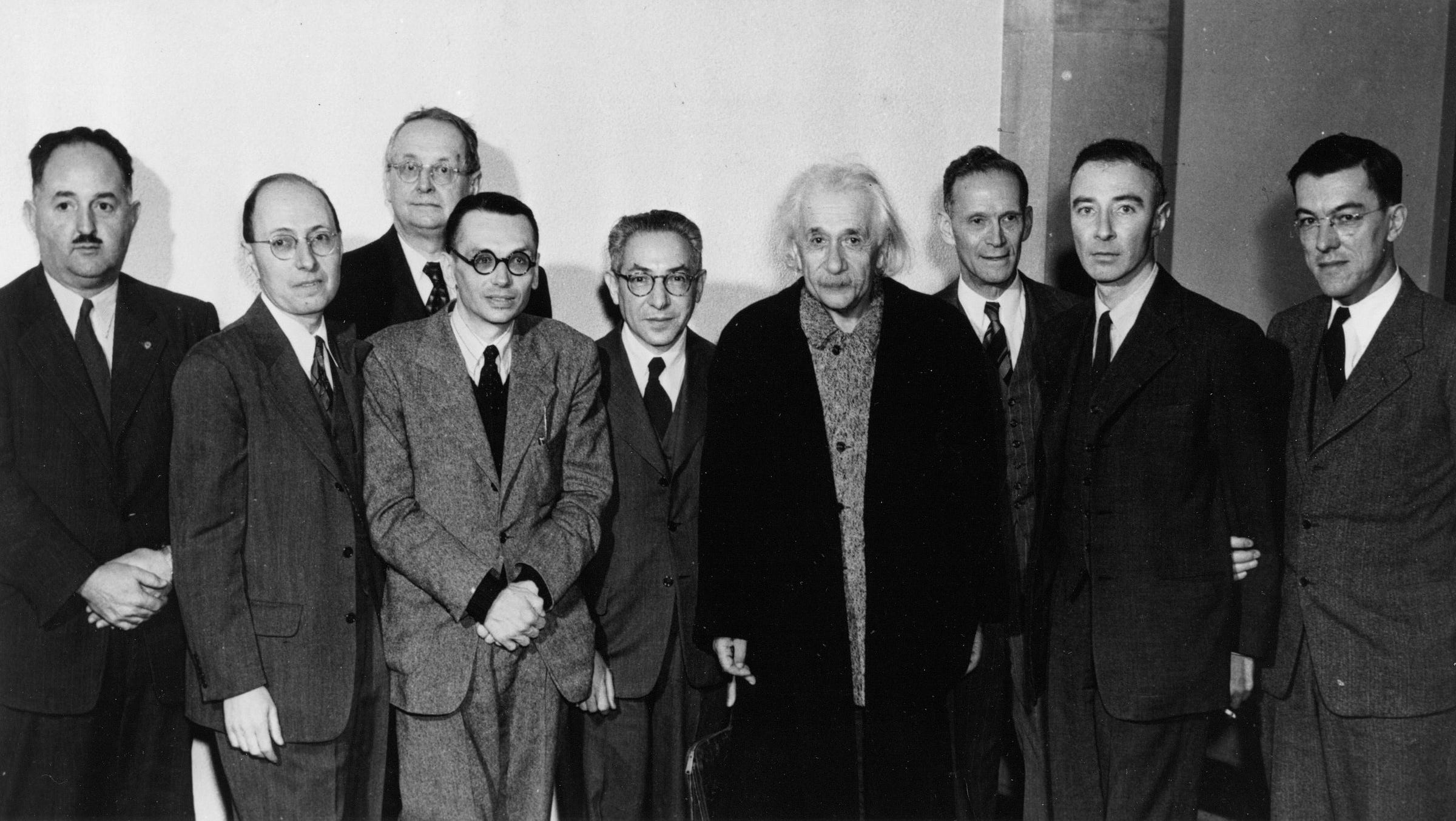
From left to right: Robertson, Wigner, Weyl, Gödel, Rabi, Einstein, Ladenburg, Oppenheimer, and Clemence
Related posts:
Atheists confronted: How I confronted Carl Sagan the year before he died jh47
In today’s news you will read about Kirk Cameron taking on the atheist Stephen Hawking over some recent assertions he made concerning the existence of heaven. Back in December of 1995 I had the opportunity to correspond with Carl Sagan about a year before his untimely death. Sarah Anne Hughes in her article,”Kirk Cameron criticizes […]
By Everette Hatcher III|Posted in Atheists Confronted|Edit|Comments (2)


 The Daily Hatch