
__
—
With the movie OPPENHEIMER coming out soon I thought was a good time to take a look again at the best article he ever wrote!!!
———
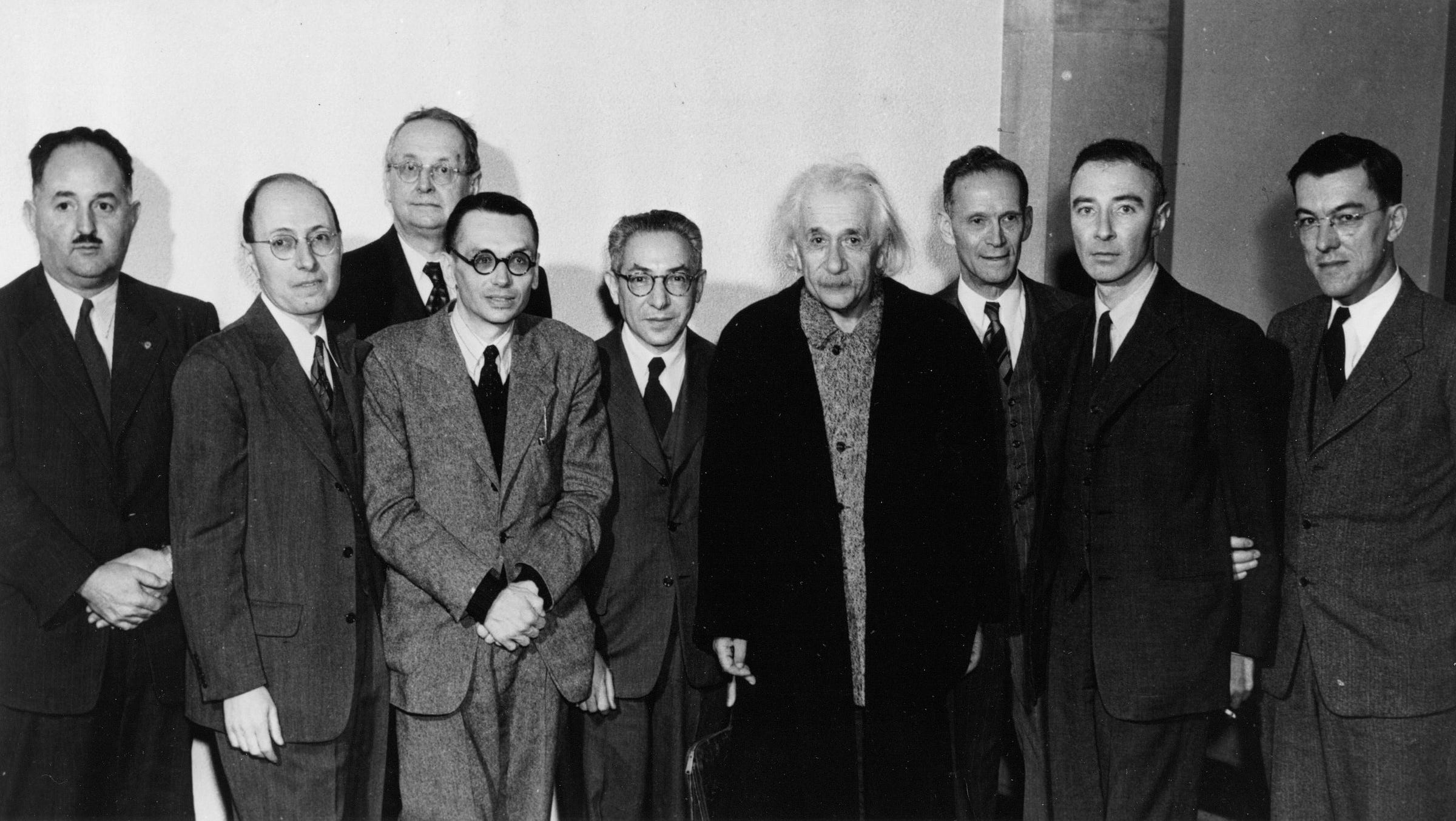
From left to right: Robertson, Wigner, Weyl, Gödel, Rabi, Einstein, Ladenburg, Oppenheimer, and Clemence
On Science and Culture by J. Robert Oppenheimer, Encounter (Magazine) October 1962 issue
We live in an unusual world, marked
by very great and irreversible changes
that occur within the span of a man’s life. We
live in a time where our knowledge and understanding of the world of nature grows wider
and deeper at an unparalleled rate; and where
the problems of applying this knowledge to
man’s needs and hopes are new, and only a
little illuminated by our past history.
Indeed it has always, in traditional societies,
been the great function of culture to keep things
rather stable, quiet, and unchanging. It has been
the function of tradition to assimilate one epoch
to another, one episode to another, even one
year to another. It has been the function of
culture to bring out meaning, by pointing to the
constant or recurrent traits of human life, which
in easier days one talked about as the eternal
verities.
In the most primitive societies, if one believes
the anthropologists, the principal function of
ritual, religion, of culture is, in fact, almost to
stop change. It is to provide for the social
organism what life provides in such a magic
way for living organisms, a kind of homeostasis,
an ability to remain intact, to respond only very
little to the obvious convulsions and alterations
in the world around.
To-day, culture and tradition have assumed
a very different intellectual and social purpose.
The principal function of the most vital and
living traditions to-day is precisely to provide
the instruments of rapid change. There are
many things which go together to bring about
this alteration in man’s life; but probably the
decisive one is science itself. I will use that word
as broadly as I know, meaning the natural
sciences, meaning the historical sciences, meaning all those matters on which men can converse objectively with each other. I shall not
continually repeat the distinction between
science as an effort to find out about the world
and understand it, on the one hand, and science,
in its applications in technology, as an effort
to do something useful with the knowledge so
acquired. But certain care is called for, because,
if we call this the scientific age, we make
more than one kind of oversimplification. When
we talk about science to-day, we are likely to
think of the biologist with his microscope or the
physicist with his cyclotron; but almost certainly a great deal that is not now the subject
of successful study will later come to be. I think
we probably to-day have under cultivation only
a small part of the terrain which will be natural
for the sciences a century from now. I think of
the enormously rapid growth in many parts of
biology, and of the fact, ominous but not without hope, that man is a part of nature and very
open to study.
The reason for this great change from a
slowly moving, almost static world, to the
world we live in, is the cumulative character,
the firmness, the givenness of what has been
learned about nature. It is true that it is transcended when one goes into other parts of experience. What is true on the scale of the inch
and the centimeter may not be true on the scale
of a billion light-years; it may not be true either
of the scale of a one hundred billionth of a
centimetre; but it stays true where it was proven.
It is fixed. Thus everything that is found out
is added to what was known before, enriches it,
and does not have to be done over again. This
essentially cumulative irreversible character of
learning things is the hallmark of science.
3
T H I S M E A N S that in man’s history the
sciences make changes which cannot be
wished away and cannot be undone. Let me
give two quite different examples. There is
much talk about getting rid of atomic bombs.
I like that talk; but we must not fool ourselves.
The world will not be the same, no matter what
we do with atomic bombs, because the knoxvledge of how to make them cannot be exorcised.
It is there; and all our arrangements for living
in a new age must bear in mind its omnipresent
virtual presence, and the fact that one cannot
change that. A different example: we can never
have again the delusions about the centrality
and importance of our physical habitat, now
that we know something of where the earth is
in the solar system, and know that there are
hundreds of billions of suns in our galaxy, and
hundreds of billions of galaxies within reach
of the great telescopes of the world. We can
never again base the dignity of man’s life on
the special character in space and time of the
place where he happens to live.
These are irreversible changes; so it is that
the cumulative character gives a paradigm of
something which is, in other respects, very
much more subject to question: the idea of
human progress. One cannot doubt that in the
sciences the direction of growth is progress.
This is true both of the knowledge of fact, the
understanding of nature, and the knowledge of
skill, of technology, of learning how to do
things. When one applies this to the human
situation, and complains that we make great
progress in automation and computing and
space research but no comparable moral progress, this involves a total misunderstanding
of the difference between the two kinds of progress. I do not mean that moral progress is
impossible; but it is not, in any sense, automatic.
Moral regress, as we have seen in our day, is
just as possible. Scientific regress is not compatible with the continued practice of science.
It is, of course, true, and we pride ourselves on
it that it is true, that science is quite international, and is the same (with minor differences
of emphasis) in Japan, France, the United States,
Russia. But culture is not international; indeed
I am one of those who hope that, in a certain
sense, it never quite will be, that the influence
of our past, of our history, which is for different reasons and different peoples quite
different, will make itself felt and not be lost
in total homogeneity.
I cannot subscribe to the view that science and
culture are co-extensive, that they are the same
thing with different names; and I cannot subscribe to the view that science is something useJ. Robert Oppenheimer
ful, but essentially unrelated to culture. I think
that we live in a time which has few historical
parallels, that there are practical problems of
human institutions, their obsolescence and their
inadequacy, problems of the mind and spirit
which, if not more difficult than ever before, are
different, and difficult. I shall be dealing with
some traits of the sciences which contribute to
the difficulty, and may here give a synopsis of
what they are. They have to do with the question
of why the scientific revolution happened when
it did; with the characteristic growth of the
sciences: with their characteristic internal structure: with the relation of discovery in the sciences
to the general ideas of man in matters which are
not precisely related to the sciences: with freedom and necessity in the sciences, and the question of the creative and the open character of
science, its infinity: and with what direction we
.might try to follow in bringing coherence and
order to our cultural life, in doing what it is
proper for a group of intellectuals, of artists, of
philosophers, teachers, scientists, statesmen to do
to help refashion the sensibility and the institutions of this world, which need re-fashioning if
we are at all to survive.
]t is not a simple question to answer why the
scientific revolution occurred when it did. It
started, as all serious historians would agree,
in the late Middle Ages and early Renaissance,
and was very slow at first. No great culture has
been free of curiosity and reflection, of contemplation and thought. “To know the causes of
things” is something that serious mtn have
always wanted, a quest that serious societies
have sustained. No great culture has been free
of inventive genius. If we think of the culture
of Greece, and the following Hellenistic and
Roman period, it is particularly puzzling that
the scientific revolution did not occur then. The
Greeks discovered something without which our
contemporary world would not be what it is:
standards of rigour, the idea of proof, the idea
of logical necessity, the idea that one thing implies another. Without that, science is very
nearly impossible, for unless there is a quasirigid structure of implication and necessity, then
if something turns out not to be what one expected, one will have no way of finding out
where the wrong point is: one has no way of
correcting himself, of finding the error. But this
is something that the Greeks had very early in
their history. They were curious and inventive;
they did not experiment in the scale of moder
days, but they did many experiments; they had
as we have only recendy learned to appreciate
a very high degree of technical and technological
sophistication. They could make very subtle and
complicated instruments; and they did, though
they did not write much about it. Possibly the
Greeks did not make the scientific revolution
because of some flaw in communication. They
were a small society, and it may be that there
were not quite enough people involved.
In a matter of history, we cannot assign a
unique cause, precisely because the event itself
is unique; you cannot test, to see if you have it
right. I think that the best guess is that it took
something that was not present in Chinese
civilisation, that was wholly absent in Indian
clvilisation, and absent also from Greco-Roman
civilisation. It needed an idea of progress, not
limited to better understanding for this idea
the Greeks had. It took an idea of progress
which has more to do with the human condition, which is well expressed by the second
half of the famous Christian dichotomy–faith
and works; the notion that the betterment of
man’s condition, his civility, had meaning; that
we all had a responsibility to it, a duty to it, and
to man. I think that it was when this basic idea
of man’s condition, which supplements the
other worldly aspects of religion, was fortified
and fructified between the 13th and i5th centuries by the re-discovery of the ancient world’s
scientists, philosophers, and mathematicians,
that there was the beginning of the scientific
age. By the I7th century there were a handful
of men involved in improving human knowledge, or “useful knowledge” as the phrases
went, so that new societies like the Royal Society
and the Academy were formed, where people
could talk to each other and bring to the prosecution of science that indispensable element of
working together, of communication, of correcting the other fellow’s errors and admiring
the other fellow’s skills, thus creating the first
truly scientific communities.
Just before Newton, Hobbes wrote:
The Sciences are small power; because not
eminent; and therefore, not acknowledged inany
man, nor one at all, but in a few; and in them,
but of a few things. For Science is of that nature,
as none can understand it to be, but such as is
good measure have attayned it.
Arts of publique use, as Fortification, making
of Engines, and other Instruments of War; because they conferre to Defence, and Victory, are
Power.
5
It was the next century that put science in a
context of fraternity, even of universal brotherhood. It encouraged a political view which was
egalitarian, permissive, pluralistic, liberal–
everything for which the word “democratic” is
to-day justly and rightly used. The result is
that the scientific world of to-day is also a very
large one: an open world in which, of course,
not everybody does everything, in which not
everybody is a scientist or a prime minister, but
in which we fight very hard against arbitrary
exclusion of people from any works, any deliberation, any discourse, any responsibility for which
their talents and their interests suit them. The
result is that we face our new problems, created
by the practical consequences of technology, and
the great intellectual consequences of science
itself, in the context of a world of two or three
billion people, an enormous society for which
human institutions were not really ever
designed. We are facing a world in which
growth is characteristic, not just of the sciences
themselves, but of the economy, of technology,
of all human institutions; no one can open a
daily paper without seeing the consequences.
ONE CAN MEASURE scientific growth in a numberof ways, but it is important not to mistake
things. The excellence of the individual scientist
does not change much with time. His knowledge and his power does, but not the high
quality that makes him great. We do not look
to anyone to be better than Kepler or Newton,
any more than we look to anyone to be better
than Sophocles, or to any doctrine to be better
than the gospel according to St. Matthew. Yet
one can measure things, and it has been done.
One can measure how many people work on
scientific questions: one can count them. One
can notice how much is published.
These two criteria show a doubling of scientific knowledge in every ten years. Casimir
calculated that if the Physical Review continued
to grow as rapidly as it has between i945 and
~96o, it would weigh more than the earth
during the next century. In fifteen years, the
volume of chemical abstracts has quadrupled;
in biology the changes are faster still. To-day,
if you talk about scientists and mean by that
people who have devoted their lives to the
acquisition and application of new knowledge,
then 93 per cent of us are still alive. This enormously rapid growth, sustained over two centuries, means, of course, that no man learned as a boy more than a small fraction in his own field
of what he ought to know as a grown man.
THERE ARE SEVERAL points to keep in
mind. One would naturally think that if
we are publishing so much, it must be trivial.
I think that this is not true: any scientific community with sane people would protect itself
against that: because we have to read what is
published. The argument not to permit the
accumulation of trivial, unimportant things
which are not really new, which do not add to
what was known before, is overwhelming.
The second point is that one may say that
every new thing renders what was known before
uninteresting, that one can forget as rapidly as
one learns. That is in part true: whenever there
is a great new understanding, a great new
element of order, a new theory, or a new
law of nature, then much that before had to
be remembered in isolation becomes connected
and becomes, to some extent, implied and simplified. Yet one cannot forget what went before,
because usually the meaning of what is discovered in r962 is to be found in terms of things
that were discovered in ~955 or ~95o or earlier.
These are the things in terms of which the new
discoveries are made, the origins of the instruments that give us the new discoveries, the
origins of the concepts in terms of which they
are discovered, the origins of the language and
the tradition.
A third point: if one looks to the future of
something that doubles every ten years, there
must come a time when it stops, just as The
Physical Reuietu cannot weigh more than the
earth. We know that this will saturate, and
probably at a level very much higher than today; there will come a time when the rate of
growth of science is not such that in every ten
years the amount that is known is doubled; but
the amount that is added to knowledge then
will be far greater than it is to-day. For this rate
of growth suggests that, just as the professional
must, if he is to remain professional, live a life
of continuous study, so we may find a clue here
also to the more general behaviour of the intellectual with regard to his own affairs, and those
of his colleagues in somewhat different fields.
In the most practical way a man will have some
choice: he may choose to continue to learn about
his own field in an intimate, detailed, knowledgeable way, so that he knows what there is
to know about it. But then the field will not
be very wide. His knowledge will be highly
partial of science as a whole, but very intimate
and very complete of his own field. He may, on
the other hand, choose to know generally, superficially a good deal about what goes on in
science, but without competence, without
mastery, without intimacy, without depth. The
reason for emphasising this is that the cultural
values of the life of science almost all lie in the
intimate view: here are the new techniques,
the hard lessons, the real choices, the great dis-
;appointments, the great discoveries.
ALL S C I E N C E S grow out of common sense,
out of curiosity, observation, reflection.
One starts by refining one’s observation and
one’s words, and by exploring and pushing
things a little further than they occur in ordinary life. In this novelty there are surprises; one
revises the way one thinks about things to
accommodate the surprises; then the old way of
thinking gets to be so cumbersome and inappropriate that one realises that there is a big
change called for, and one re-creates one’s way
cf thinking about this part of nature.
Through all this one learns to say what one
has done, what one has found, and to be patient
and wait for others to see if they find the same
rlaings, and to reduce, to the point where it
really makes no further difference, the normally
overpoweringly vital element of ambiguity in
human speech. We live by being ambiguous,
by not settling things because they do not have
to be settled, by suggesting more than one thing
because their co-presence in the mind may be a
source of beauty. But in talking about science
one may be as ambiguous as ever until we come
to the heart of it. Then we tell a fellow just
what we did in terms that are intelligible to
him, because he has been schooled to understand them, and we tell him just what we found
and just how we did it. If he does not understand us, we go to visit him and help him; and
if he still does not understand us, we go back
home and do it over again. This is the way in
which the firmness and solidity of science is
established.
How THEN DOES IT GO? In studying the different
parts of nature, one explores with different instruments, explores different objects, and one
gets a branching of what at one time had been
common talk, common sense. Each branch
develops new instruments, ideas, words suitable
for describing that part of the world of nature.
This tree-like structure, all growing from the
common trunk of man’s common primordial
experience, has branches no longer associated
with the same question, nor the same words and
techniques. The unity of science, apart from the
fact that it all has a common origin in man’s
ordinary life, is not a unity of deriving one
part from another, nor of finding an identity
between one part and another, between let us
say, genetics and topology, to take two impossible examples, where there is indeed some connection.
The unity consists of two things: first and ever
more strikingly, an absence of inconsistency.
Thus we may talk of life in terms of purpose
and adaptation and function, but we have found
in living things no tricks played upon the laws
of physics and chemistry. We have found and
I expect will find a total consistency, and
between the different subjects, even as remote
as genetics and topology, an occasional sharp
mutual relevance. They throw light on each
other; they have something to do with each
other; often the greatest things in the sciences
occur when two different discoveries made in
different worlds turn out to have so much in
common that they are examples of a still greater
discovery.
THE IMAGE is not that of an ordered array of
facts in which every one follows somehow from
a more fundamental one. It is rather that of a
living thing: a tree doing something that trees
do not normally do, occasionally having the
branches grow together and part again in a
great network.
The knowledge that is being increased in this
extraordinary way is inherently and inevitably
very specialised. It is different for the physicist,
the astronomer, the micro-biologist, the mathematician. There are connections: there is this
often important mutual relevance. Even in
physics, where we fight very hard to keep the
different parts of our subject from flying apart
(so that one fellow will know one thing and
another fellow will know another, and they do
not talk to each other), we do not entirely succeed, in spite of a passion for unity which is
very strong. The traditions of science are
specialised traditions; this is their strength. Their
strength is that they use the words, the
machinery, the concepts, the theories, that fit
their subjects; they are not encumbered by
having to try to fit other sorts of things. It is the
and Culture
(Page 7)
specialised traditions which give the enormous
thrust and power to the scientific experience.
This also makes for the problem of teaching and
explaining the sciences. When we get to some
very powerful general result which illuminates a
large part of the world of nature, it is by virtue
of its being general in the logical sense, of encompassing an enormous amount of experience
in its concepts; and in its terminology it is most
highly specialised, almost unintelligible except to
the men who have worked in the field. The
great laws of physics to-day, which do not
describe everything (or we would be out of business) but which underlie almost everything that
is ever noticed in ordinary human experience
about the physical world, cannot be formulated
in terms that can reasonably be defined without
a long period of careful schooling. This is comparably true in other subjects.
ONE HAS THEN in these specialisations
the professional communities in the
various sciences. They are very intimate, work
closely together, know each other throughout
the world. They are always excited–sometimes
jealous but usually pleased–when one member
of the community makes a discovery. I think,
for instance, that what we now call psychology will one day perhaps be many sciences,
that there will be many different specialised
communities practising them, who will talk
with one another, each in their own profession
and in their own way.
These specialised communities, or guilds, are
a very moving experience for those who participate. There have been many temptations to
see analogues in them for other human activities.
One that we hear much discussed is this: “If
physicists can work together in countries with
different cultures, in countries with different
politics, in countries of different religions, even
in countries which are politically obviously
hostile, is not this a way to bring the world
together?”
The specialising habits of the sciences have,
to some extent, because of the tricks of universities, been carried over to other work, to philosophy and to the arts. There is technical
philosophy which is philosophy as a craft,
philosophy for other philosophers, and there is
art for the artists and the critics. To my mind,
whatever virtues the works have for sharpening
professional tools, they are profound misreadings, even profound subversions of the true functions of philosophy and art, which are to
address themselves to the general common
human problem. Not to everybody, but to anybody: not to specialists.
It is clear that one is faced here with formidable problems of communication, of telling
People about things. It is an immense job of
teaching on all levels, in every sense of the word,
never ending.
IT HAS OFTEN BEEN held that the great discoveries in science, coming into the lives of
men, affect their attitudes toward their place
in life, their views, their philosophy. There is
surely some truth in this.*
If discoveries in science are to have an honest
effect on human thought and on culture, they
have to be understandable. That is likely to be
true only in the early period of a science, when
it is talking about things which are not too
remote from ordinary experience. Some of the
great discoveries of this century go under the
name of Relativity and Uncertainty, and when
we hear these words we may think, “This is
the way I felt this morning: I was relatively
confused and quite uncertain”: this is not at all
a notion of what technical points are involved
in these great discoveries, or what lessons.
I think that the reason why Darwin’s hypothesis had such an impact was, in part, because
it was a very simple thing in terms of ordinary
life. We cannot talk about the contemporary
discovery in biology in such language, or by
referring only to things that we have all
experienced.
Thus I think that the great effects of the
sciences in stimulating and in enriching philosophical life and cultural interests have been
necessarily confined to the rather early times in
the development of a science. There is another
qualification. Discoveries will really only
resonate and change the thinking of men when
they feed some hope, some need that pre-exists
in the society. I thir~k that the real sources of the
Enlightenment, fed a little by the scientific
events of the time, came in the re-discovery of
(FOOTNOTE: Examples that are usually given include Newton and Darwin. Newton is not a very good example, for ~vhen we look at it closely ~ve are struck by the fact that in the sense of the Enlightenment, the sense of a coupling of faith in scientific progress and man’s reason with a belief in political progress and the secularisation of human life, Newton himself was in no way a Newtonian. His successors were.)
the classics, of classic political theory, perhaps
most of all of the Stoics. The hunger of the
Eighteenth Century to believe in the power of
reason, to wish to throw off authority, to wish
to secularise, to take an optimistic view of man’s
condition, seized on Newton and his discoveries
as an illustration of something which was
already deeply believed in quite apart from the
law of gravity and the laws of motion. The
hunger with which the Nineteenth Century
seized on Darwin had very much to do with the
increasing awareness of history and change,
with the great desire to naturalise man, to put
him into the world of nature, which pre-existed
long before Darwin and which made him welcome. I have seen an example in this century
where the great Danish physicist Niels Bohr
found in the quantum theory when it was
developed thirty years ago this remarkable
trait: it is consistent with describing an atomic
system, only much less completely than we can
describe large-scale objects. We have a certain
choice as to which traits of the atomic system
we wish to study and measure and which to let
go; but we have not the option of doing them
all. This situation, which we all recognise,
sustained in Bohr his long-held view of the
human condition: that there are mutually
exclusive ways of using our words, our minds,
our souls, any one of which ig open to us, but
which cannot be combined: ways as different,
for instance, as preparing to act and entering
into an introspective search for the reasons for
action. This discovery has not, I think, penetrated into general cultural life. I wish it had;
it is a good example of something that would
be relevant, if only it could be understood.
EINSTEIN ONCE SAID that a physical theory was
not determined by the facts of nature, but was
a free invention of the human mind. This raises
the question of how necessary is the content of
science–how much is it something that we are
free not to find–how much is it something that
could be otherwise? This is, of course, relevant
to the question of how we may use the words
“objectivity” and “truth.” Do we, when we
find something, “invent” it or “discover” it?
The fact is, of course, just what one would
guess. We are, of course, free in our tradition.
and in our practice, and to a much more limited
extent individually to decide where to look at
nature, and how to look at nature, what questions to put, with what instruments and with
what purpose. But we are not the least bit free to
settle what we find. Man must certainly be free to
invent the idea of mass, as Newton did and as it
has been refined and re-defined; but having done
so, we have not been free to find that the mass of
the light quantum or the neutrino is anything
but zero. We are free in the start of things. We
are free as to how to go about it; but then the
rock of what the world is, shapes this freedom
with a necessary answer. That is why ontological
interpretations of the word “objective” have
seemed useless, and why we use the word to
describe the clarity, the lack of ambiguity, the
effectiveness of the way we can tell each other
about what we have found.
THUS in the sciences, total statements like
those that involve the word “all,” with no
qualifications, are hardly ever likely to occur.
In every investigation and extension of knowledge we are involved in an action; in every
action we are involved in a choice; and in every
choice we are involved in a loss, the loss of that
we did not do. We find this in the simplest situations. We find this in perception, where the
possibility of perceiving is coextensive with
our ignoring many things that are going on. We
find it in speech where the possibility of understandable speech lies in paying no attention to
a great deal that is in the air, among the sound
waves, in the general scene. Meaning is always
attained at the cost of leaving things out. We
find it in the idea of complementarity here in a
sharp form as a recognition that the attempt
to make one sort of observation on an atomic
system forecloses others. We have freedom of
choice, but we have no escape from the fact
that doing some things must leave out others.
In practical terms, this means, of course, that
our knowledge is finite and never all-encompassing. There is always much that we miss, much
that we cannot be aware of because the very act
of learning, of ordering, of finding unity and
meaning, the very power to talk about things
means that we leave out a great deal.
Ask the question: Would another civilisation
bated on life on another planet very similar to
ours in its ability to sustain life have the same
physics? One has no idea whether they would
have the same physics or not. We might be
talking about quite different questions. This
makes ours an open world without end. I had a
Sanskritist friend in California who used to say
mockingly that, if science were any good, it
should be much easier to be an educated man
and Culture
(Page 9)
now than it was a generation ago. That is
because he thought the world was closed.
THE THINGS THAT MAKE US choose one set of
questions, one branch of enquiry rather than
another are embodied in scientific traditions. In
developed sciences each man has only a limited
sense of freedom to shape or alter them; but
they are not themselves wholly determined by
the findings of science. They are largely of an
~esthetic character. The words that we use: simplicity, elegance, beauty: indicate that what we
grope for is not only more knowledge, but
knowledge that has order and harmony in it,
and continuity with the past. Like all poor
fellows, we want to find something new, but not
something too new. It is when we fail in that,
that the great discoveries follow.
AL T H E S E themes–the origin of science,
its pattern of growth, its branching
reticular structure, its increasing alienation from
the common understanding of man, its freedom,
the character of its objectivity and its openness–
are relevant to the relations of science and
culture. I believe that they can be and should be
far more robust, intimate, and fruitful than they
are to-day.
I am not here thinking of the popular subject
of “mass culture.” In broaching that, it seems
to me one must be critical but one must, above
all, be human; one must not be a snob; one
must be rather tolerant and almost loving. It is
a new problem; one must not expect it to be
solved with the methods of Periclean Athens.
In the problems of mass culture and, above all,
of the mass media, it is not primarily a question
of the absence of excellence. The modest worker,
in Europe or in America, has within reach
probably better music and more good music,
more good art, more good writing than his predecessors have ever had. It seems rather that the good things are lost in such a stream of poor
things, that the noise level is so high, that some
of the conditions for appreciating excellence are
not present. One does not eat well unless one is
hungry; there is a certain frugality to the best
cooking; and something of this sort is wrong
with the mass media. But that is not now my
problem.
Rather, I think loosely of what we may call
the intellectual community: artists, philosophers,
statesmen, teachers, men of most professions,
prophets, scientists. This is an open group, with no sharp lines separating those that think themselves of it. It is a growing faction of all peoples.
In it is vested the great duty for enlarging,
preserving, and transmitting our knowledge and
skills, and indeed our understanding of the
interrelations, priorities, commitments, injunctions, that help men deal with their joys,
temptations and sorrows, their finiteness, their
beauty. Some of this has to do, as the sciences
so largely do, with propositional truth, with
propositions which say “If you do thus and so
you will see this and that”; these are objective
and can be checked and cross-checked; though it
is always wise from time to time to doubt, there
are ways to put an end to the doubt. This is
how it is with the sciences.
In this community there are other statements
which “emphasise a theme” rather than declare
a fact. They may be statements of connectedness
or relatedness or importance, or they may be in
one way or another statements of commitment.
For them the word “certitude,” which is a
natural norm to apply in the sciences, is not very
sensible–depth, firmness, universality, perhaps
more–but certitude, which applies really to
verification, is not the great criterion in most of
the work of a philosopher, a painter, a poet, or
a playwright. For these are not, in the sense I
have outlined, objective. Yet for any true community, for any society worthy of the name,
they must have an element of community of
being common, of being public, of being relevant and meaningful to man, not necessarily to
everybody, but surely not just to specialists.
I HAVE SEEN much concerned that, in this
world of change and scientific growth, we
have so largely lost the ability to talk with one
another, to increase and enrich our common
culture and understanding. And so it is that
the public sector of our lives, what we hold
and have in common, has suffered, as have the
illumination of the arts, the deepening of justice
and virtue, and the ennobling power of our
common discourse. We are less inert for this.
Never in man’s history have the specialised
ta’aditions more flourished than to-day. We have
our private beauties. But in those high undert;tkings when man derives strength and insight
from public excellence, we have been impoverished. We hunger for nobility, the rare words
and acts that harmonise simplicity with truth.
In this default I see some connection with the
great unresolved public problems–survival,
liberty, fraternity.
In this default I see the responsibility that the
irttellectual community has to history and to our
fellows: a responsibility which is a necessary
condition for re-making human institutions as
they need to be re-made to-day that there may
be peace, that they may embody more fully those
ethical commitments without which we cannot
properly live as men.
This may mean for the intellectual community
a very much greater effort than in the past. The
community will grow; but I think that also the
quality and the excellence of what we do must
grow. I think, in fact, that with the growing
wealth of the world, and the possibility that it
will not all be used to make new committees,
ft..ere may indeed be genuine leisure, and that
a high commitment on this leisure is that we reknit the discourse and the understanding
between the members of our community.
In this I think we have, all of us, to preserve
our competence in our own professions, to preserve what we know intimately, to preserve our
mastery. This is, in fact, our only anchor in
honesty. We need also to be open to other and
cc.mplementary lives, not intimidated by them
and not contemptuous of them (as so many are
to-day of the natural and mathematical sciences).
As a start, we must learn again, without contempt and with great patience, to talk to one
another; and we must hear.
Related posts:
Atheists confronted: How I confronted Carl Sagan the year before he died jh47
In today’s news you will read about Kirk Cameron taking on the atheist Stephen Hawking over some recent assertions he made concerning the existence of heaven. Back in December of 1995 I had the opportunity to correspond with Carl Sagan about a year before his untimely death. Sarah Anne Hughes in her article,”Kirk Cameron criticizes […]
By Everette Hatcher III|Posted in Atheists Confronted|Edit|Comments (2)
My correspondence with George Wald and Antony Flew!!!
FRANCIS SCHAEFFER ANALYZES ART AND CULTURE Part 41 Sarvepalli Radhakrishnan (Featured artist is Marina Abramović)
FRANCIS SCHAEFFER ANALYZES ART AND CULTURE Part 40 Timothy Leary (Featured artist is Margaret Keane)
FRANCIS SCHAEFFER ANALYZES ART AND CULTURE Part 39 Tom Wolfe (Featured artist is Richard Serra)
FRANCIS SCHAEFFER ANALYZES ART AND CULTURE Part 38 Woody Allen and Albert Camus “There is but one truly serious philosophical problem, and that is suicide” (Feature on artist Hamish Fulton Photographer )
FRANCIS SCHAEFFER ANALYZES ART AND CULTURE Part 37 Mahatma Gandhi and “Relieving the Tension in the East” (Feature on artist Luc Tuymans)
FRANCIS SCHAEFFER ANALYZES ART AND CULTURE Part 36 Julian Huxley:”God does not in fact exist, but act as if He does!” (Feature on artist Barry McGee)
_


 The Daily Hatch