
—
—
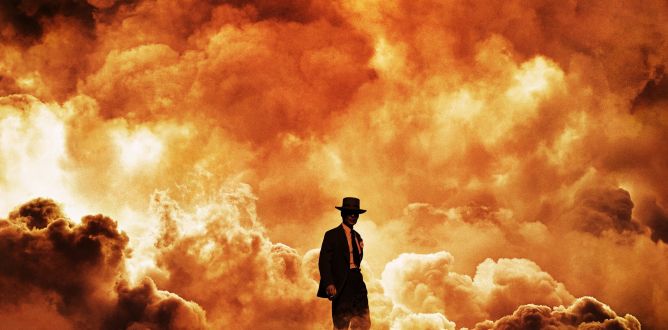
OPPENHEIMER PARENT GUIDE
“Now I am become death, the destroyer of worlds.”
Release date July 21, 2023
Theaters: During World War 2 J. Robert Oppenheimer works on a team to develop a weapon to end the war, if it doesn’t end the world.
Why is Oppenheimer rated ? The MPA rated Oppenheimer
Run Time: 180 minutes
Violence: The creation of nuclear weapons is a significant part of the film. A character has terrifying visions of a nuclear holocaust, complete with burned bodies and radiation sickness. It is implied that a woman is deliberately drowned in her bathtub. There are frequent mentions of bombing raids and associated deaths and injuries. It is suggested that a suicide is not what it appears to be.
Sexual Content: There are two sex scenes that include visible breasts and buttocks. Breasts are also visible in non-sexual contexts.
Profanity: There are over a dozen uses of profanity, including sexual expletives, scatological curses, and terms of deity.
Drugs/Alcohol: Alcohol is consumed in social situations and in an addictive context. Alcoholism is a recurring issue in the film. Characters frequently smoke cigarettes, as is historically accurate for the time period.
On Science and Culture by J. Robert Oppenheimer, Encounter (Magazine) October 1962 issue, was the best article that he ever wrote and it touched on a lot of critical issues including the one that Francis Schaeffer discusses in this blog post!
—

OPPENHEIMER and EINSTEIN
Passage from chapters 3 and 4 from Francis Schaeffer book HE IS THERE AMD HE IS NOT SILENT:
This is where Leonardo da Vinci is so important. He was the first modern mathema- tician, and he really understood this dilemma. It is not that I am reading back into him our dilemma of modern cynicism. He really under- stood it. He understood, in the passage of all these hundreds of years between himself and modern man, where rationalistic man would end up if man failed to find a solution. This is what real genius is—understanding before your time—and Leonardo da Vinci did understand. He understood that if you began on the basis of rationalism—that is, man beginning only from himself, and not having any outside knowledge—you would have only mathematics and particulars and would end up with only mechanics. In other words, he was so far ahead of his time—that he really understood that everything was going to end up only as a ma- chine, and there were not going to be any univ- ersals or meaning at all. The universals were going to be crossed out. So Leonardo really be- came very much like the modern man. He said we should try to paint the universals. This is re- ally very close to the modern concept of the upper-story experience. So he painted and painted and painted, trying to paint the univer- sals. He actually tried to paint the universal just as Plato had had the idea that if we were really to have a knowledge of chairs, there would have to be an ideal chair somewhere that would cover all kinds of chairs. Leonardo, who was a Neo-Platonist, understood this, and he said, “Let man produce the universals.” But what kind of man? The mathematical man? No, not the mathematical man but the painter, the sensitive man. So Leonardo is a very crucial man in the area of humanistic epistemology.
At this point in Escape from Reason, I devel- oped the difference between what I call “mod- ern science” and the “modern modern sci- ence.”
In my earlier books I have referred to Whitehead and Oppenheimer, two scientists—neither one a Christian—who insisted that modern science could not have been born except in the Christian milieu. Bear with me as I repeat this, for I want in this book to carry it a step further, into the area of knowing. As Whitehead so beautifully points out, these men all believed that the universe was created by a reasonable God, and therefore the universe could be found out by reason. This was their base. Modern science is the original science, in which you had men who believed in the unifor- mity of natural causes in a limited system, a system which could be reordered by God and by man made in the image of God. This is a cause and effect system in a limited time span. But from the time of Newton (not with Newton himself, but with the Newtonians who followed him), we have the concept of the “machine” until we are left with the only machine, and you move into the “modern modern science,” in which we have the uniformity of natural causes in a closed system, including sociology and psychology. Man is included in the machine. This is the world in which we live in the area of science today. No longer believing that they can be sure the universe is reasonable because created by a reasonable God, the question is raised that Leonardo da Vinci already under- stood and that the Greeks understood before that: “How does the scientist know; on what basis can he know that what he knows, he really knows?”
So rationalism put forth at this point the epistemological concept of positivism. Posi- tivism is a theory of knowing which assumes that we can know facts and objects with total objectivity. Modern “scientism” is built on it.
It is a truly romantic concept, and while it held sway, rationalistic man stood ten feet tall in his pride. It was based on the notion that without any universals to begin with, finite man could reach out and grasp with finite reason sufficient true knowledge to make universals out of the particulars.
Jean-Jacques Rousseau is crucial at this point, because he changed the formulation from “nature and grace” to “nature and free- dom,” absolute freedom. Rousseau and the men around him saw that in the area of “na- ture,” everything had become the machine. In other words, “downstairs” everything was in the area of positivism, and everything was a ma- chine. “Upstairs” they added the other thing, namely, absolute freedom. In the sense of absolute freedom upstairs, not only is man not to be bound by revelation, but he is not to be bound by society, the polis, either. The concept of autonomous freedom is clearly seen in Gau- gin, the painter. He was getting rid of all the re- straints, not just the restraint of God, but also the restraint of the polis, which for Gaugin was epitomized by the highly developed culture of France. He left France and went to Tahiti to be rid of the culture, the polis. In doing this, he practiced the concept of the noble savage that, of course, Jean-Jacques Rousseau had previ- ously set forth. You get rid of the restraints, you get rid of the polis, you get rid of God or the gods, and then you are free. Unhappily, though not surprisingly, this did not turn out as he ex- pected.
So what we have is not a destructive free- dom only in morals (though it shows itself very quickly in morals, especially quickly, perhaps, in sexual anarchy), but in the area of knowledge as well. In metaphysics, in the area of being, as well as morals, we are supposed to have abso- lute freedom. But then the dilemma comes: How do you know and how do you know you know?
We may imagine the Greeks and Leonardo da Vinci and all the Neo-Platonists at the time of the High Renaissance coming in and asking Rousseau and his followers, “Don’t you see what you have done? Where are the universals? How are you going to know? How are you going to build enough universals out of partic- ulars, even for society to run, let alone build true knowledge, knowledge that you really know and are sure that you know?”
It is only a step, really, from men like Gau- gin to the whole hippie culture, and as a matter of fact, to the whole modern culture. In one sense there is a parenthesis in time from Rousseau until the birth of the hippie culture and the whole modern culture that is founded on the view that there are no universals anywhere—that man is totally, hedonistically free; the individual is totally, hedonistically free—not only morally, but also in the area of knowledge. We can easily see the moral confusion that has resulted from this, but the epistemological confusion is worse. If there are not universals, how do we know reality from non-reality? At this point, we are right in the lap of modern man’s problem, as I will develop later.
Now let us go back to the period immedi- ately after Rousseau, to Immanuel Kant, and Hegel, who changed the whole concept of epistemology. Before this, in epistemology, man always thought in terms of antithesis; the methodology of epistemology had always been antithesis. That is, you learn by saying “a” is not “non-a.” That is the first step of classical logic. In other words, in antithesis, if this is true, then its opposite is not true. You can make an antithesis. That is the classical methodology of epistemology, of knowing. But Hegel argued that antithesis has never turned out well on a rationalistic basis, so he proposed to change the methodology of epistemology. Instead of dealing with antithesis, let us deal with synthesis. So he set up his famous triangle—everything is a thesis, it sets up an antithesis, and the answer is always synthesis. The whole world changed in the area of morals and political science, but it changed more pro- foundly, though less obviously, in the area of knowing and knowing itself. He changed the whole theory of how we know.
In my books I move quickly to Kierkegaard, who took this a step further. He set up, as I have indicated, the absolute dichotomy be- tween reason and non-reason. Kierkegaard, and especially Kierkegaardianism that followed him, teaches that that which would give meaning is always separated from reason; reason only leads to knowledge downstairs, which is mathematical knowledge without any meaning, but upstairs you hope to find a non-rational meaning for the particulars. This is Kierkegaard’s contribution.
All of this flows from four men—Rousseau, Kant, Hegel, and Kierkegaard—and their thinking in the area of epistemology. From Hegel, this kind of think- ing has replaced antithesis with synthesis, so turning the whole theory of knowledge upside down. Today, existentialism has three forms: the French, Jean-Paul Sartre; the German, Hei- degger; and that of Karl Jaspers, who is also a German but lives in Switzerland. The distinc- tions between the forms of existentialism do not change the fact that it is the same system even though it has different expressions with these different men, namely, that rationality only leads to something horrible in every area, including knowledge. Indeed, not including knowledge, but first of all knowledge—principally knowledge. To these men as rationalists the knowledge we can know with our reason is only a mathematical formula in which man is only a machine. Instead of rea- son they hope to find some sort of mystical experience “upstairs,” apart from reason, to provide a universal.
Here we can feel again the whole drift of the hippie movement and the drug culture as well. Man hopes to find something in his head because he cannot know certainly that anything is “out there.” This is where we are. I am con- vinced that the generation gap is basically in the area of epistemology. Before, man had a romantic hope that on the basis of rationalism he was going to be able to find a meaning to life, and put universals over the particulars. But on this side of Rousseau, Kant, Hegel, and Kierkegaard, this hope no longer exists; the hope is given up. Young people today live in a generation that no longer believes in the hope of truth as truth. That is why I use the term “true truth” in my books to emphasize real truth. This is not just a tautology. It is an admission that the word “truth” now means something that before these four men would not have been considered truth at all. So, in desperation, I have coined the expression “true truth” to make the point, but it is hard to make it sharp enough for people to understand how large the problem is.
After Kierkegaard, rationality is seen as leading to pessimism. We can have mathe- matical knowledge, but man is only a machine, and any kind of optimism one could have concerning meaning would have to be in the area of the non-rational, the “upstairs.” So rationality, including modern science, will lead only to pessimism. Man is only the machine; man is only a zero, and nothing has any real meaning. I am nothing—one particular among thousands of particulars. No particulars have meaning, and specifically, man has no meaning—specifically the particular of myself. I have no meaning; I die; man is dead. If stu- dents wonder why they are treated like IBM cards, it is for no less reason than this.
So man makes his leap “upstairs” into all sorts of mysticisms in the area of knowledge—and they are mysticisms, because they are totally separated from all rationality. This is a mysticism like no previous mysticism. Previous mysticisms always assumed something was there. But modern man’s mysticisms are semantic mysticisms that deal only with words; they have nothing to do with anything being there, but are simply concerned with something in one’s own head, or in lan- guage in one form or another. The modern tak- ing of drugs began as one way to try to find meaning within one’s head.
The present situation is one where we have in the area of the rational positivism for “scien- tific fact,” that which leads to mathematical for- mulae and man as a machine; and in the non- rational area we find all kinds of non-rational mysticisms.
Now we must turn our attention again to the “downstairs” positivism. This was the great hope of rationalistic man, but gradually posi- tivism has died. I remember when I first lec- tured at Oxford and Cambridge, one had to change gears between the two great universities because in Oxford they were still teaching log- ical positivism, but in Cambridge it was all lin- guistic analysis. Today it is linguistic analysis almost everywhere in the world. Gradually, positivism has died. For a careful study as to why this has happened, I would recommend Michael Polanyi’s book Personal Knowledge: An Introduction to Post-critical Philosophy. Polanyi is a name that hardly ever appears in the popular press, and he is unknown by many, but he is one of the dominant thinkers in the intellectual world. His book shows why positivism is not a sufficient epistemology, and why the hope of modern science to have any certain knowledge is doomed to failure. And truly there is probably not a chair of philosophy of importance in the world today that teaches positivism. It is still held by the undergraduate and by the naive scientist who, with a happy smile on his face, is building on a foundation that no longer exists. Now we must notice where we have come. The first of the modern scientists—Copernicus, Galileo, up to Newton and Faraday, as White- head pointed out—had the courage to begin to formulate modern science because they be- lieved the universe had been created by a rea- sonable God, and therefore, it was possible to find out that which was true about the universe by reason. But when we come to naturalistic science, that is all destroyed; positivism is put in its place, but now positivism itself is de- stroyed.
Polanyi argues that positivism is inade- quate because it does not consider the knower of what is known. It acts as though the knower may be overlooked and yet have full knowledge of certain things, as though the knower knew without actually being there. Or you might say positivism does not take into account the knower’s theories or presuppositions. You can assume that he approaches the thing without any presuppositions, without any grid through which he feeds his knowledge.
But there is the dilemma, as Polanyi shows, because this simply is not true. There is no scientist in the positivistic position who does not feed knowledge through a grid—a the- ory or worldview through which he sees and finds. The concept of the totally innocent, objective observer is utterly naive. And science cannot exist without an observer.
When I was younger, people would always say that science is completely objective. Then, some years ago in Oxford, it began to be in- sisted that this is not true, that there is no such thing as science without the observer. The observer sets up the experiment and then the observer observes it—then the observer makes the conclusions. Polanyi says the observer is never neutral; he has a grid, he has presuppo- sitions through which he feeds the thing that he finds.
I would go a step further. I have always in- sisted that positivism has an even more basic problem. One must always judge a system in its own total structure; you cannot mix systems, or you get a philosophical chop suey rather than any real thought. Within positivism as a total structure there is no way of saying with certainty that anything exists. Within the system of positivism itself, by the very nature of the case, you simply begin nakedly with nothing there. You have no reason within the system to know that the data is data, or that what is reach- ing you is data. Within the system there is no universal to give you the right to be sure that what is reaching you from outside is data. The system of positivism itself gives you no cer- tainty that anything is there, or that there is re- ally in the first move any difference between reality and fantasy.
There is a further problem. Not only does the positivist not know certainly that anything is there, but even if it is there, he can have no rea- son to think he knows anything truly nor any- where near truly. There is no reason within the system to be sure that there is a correlation be- tween the observer—that is, the subject—and the thing—that is, the object.
To bring it further up to date, Karl Popper, who is another of the well-known thinkers of our own day, has until recently argued that a thing is meaningless unless it is open to verifi- cation and falsification. But in a recent book he has taken a step backwards. He now says there is no possibility of verification. You cannot verify anything—only falsify. That is, you cannot say what a thing is; you can only say certain things that it is not. When Polanyi finished destroying logical positivism so beautifully, he was left with total cynicism in the area of epistemology concerning knowing; in his new book Karl Pop- per has really come to the same place. In sci- ence the same problem is involved with much of the “model” concept. One often finds that the objective reality is getting dim, and all that remains is the model in the scientist’s head.
We are left then with this. Positivism died and has been replaced everywhere by linguistic analysis. Positivism did not leave one with knowledge but only with a set of statistical aver- ages and approximations, with no certainty that anything was there finally and no certainty of continuity in the things that were there.
One can relate this to Alfred Korzybski’s and D. David Bourland’s “General Semantics,” which would not allow the verb “to be” ever to be used. All their books are written without the use of the verb “to be.” Why? Because they say there is no certainty of continuity. I would add that it seems to me also to be related to the stream-of-consciousness psychology that ends up with nothing but a stream-of-consciousness because it is not sure that an “I” is there.
I should like to turn to the philosopher Ludwig Wittgenstein, who is in many ways the key to this whole matter. There is an early Wittgenstein, and there is a later Wittgenstein, but in his Tractatus, to which we refer here, we are concerned with the early Wittgenstein. Later he moved into linguistic analysis, but in this early stage, he argued that down here in the world (in the area of reason) you have facts:
you have the propositions of natural science. This is all that can be said; it is all that you can put into language. This is the limit of language and the limit of logic. “Downstairs” we can speak, but all that can be spoken is the mathe- matical propositions of natural science. Lan- guage is limited to the “downstairs” of reason, and that ends up with mathematical formu- lations.
But, as Bertrand Russell emphasizes, Wittgenstein was a mystic. Even in his early days, there were already the elements of mysti- cism. In the “upper story” he put silence, be- cause you could not talk about anything out- side of the known world of natural science. But man desperately needed values, ethics, mean- ings to it all. Man needs these desperately, but there is only silence there. It was at this point that the title of this present book was born. It is Wittgenstein’s word “silence” that has given me this title. Wittgenstein says that there is only si- lence in the area of the things man desperately needs most—values, ethics, and meanings. Man knows it needs to be there, he argues, but he cannot talk or even think about it. Values, ethics, meanings are all upstairs. No matter how much we need them, there is only silence.
From this he plunged into linguistic anal- ysis, which is now the dominant philosophy all over the world. It was born at this place in the desperation that followed when positivism was seen to be inadequate. The “old” Wittgenstein and the existentialist really are very, very close at this particular point, though if you move from England to the Continent in the study of philosophy you find that people usually assume that they are completely at variance. Yet there is a way of looking at them in which they are very close: at the moment when Wittgenstein says there is no real value or meaning in all these things, only silence.
For those who know Bergman’s film The Silence, this will ring a very familiar bell. Bergman is a philosopher who came to the place where he decided that there would never be anything spoken from this upper level, that God (even as the existentialist would use that word) was meaningless. At that point he made the film The Silence, and Bergman himself changed from that point onward. In other words, he agreed with what Wittgenstein, the brilliant philosopher, had said many years be- fore. So really Bergman and Wittgenstein must be seen together, and the film The Silence was a demonstration of this particular point.
What we are left with, let us notice, is an anti-philosophy, because everything that makes life worthwhile, or gives meaning to life, or binds it together beyond isolated particulars, is in an “upstairs” of total silence.
Thus we are left with two anti-philosophies in the world today. One is existentialism, which is an anti-philosophy because it deals with the big questions but with no rationality. But if we follow the later Wittgenstein’s development, we move into linguistic analysis, and we find that this also is an anti-philosophy, because where it defines words in the area of reason, language leads to language, and that is all. It is not only the certainty of values that is gone but the cer- tainty of knowing.
Speaking of Wittgenstein and his moving into the area of language, as we have seen, it is well to mention at this point the later Hei- degger, who also dealt with language, though in a very different way. Heidegger was originally an existentialist who believed that there was only the angst toward the universe that gave the hope that something was there. But later he moved on into the view that because there is language in the universe, we may hope that there is something there, a nonrational hope of an ultimate meaning to it all. So Heidegger says, “Just listen to the poet,” not the content of the poet who is speaking. In other words, be- cause there is a being—that is, the poet—who speaks, we can hope that Being—that is, existence—has meaning. He adds a different note in an attempt to make his position empir- ical and not just abstract. What he did was to claim that there was, in the far past, in the pre- Socratic age before Aristotle, a great, golden language when there was a direct, “first-order experience” from the universe. This was purely hypothetical. It had no base historically, but he proposed it as an act of desperation in an at- tempt to lay a historical foundation on or under an otherwise purely hypothetical and nebulous concept.
We must understand that these things are not just theoretical in their effects. The later Heidegger is crucially important in theology, in the new hermeneutics. These things have their effect in the student world as well. They are not abstract. They are changing our world.
Let us at this point note an important fac- tor. Whether we are dealing with Heidegger say- ing, “Listen to the poet,” and offering an upper- story semantic mysticism that seems to give hope, or with Wittgenstein who moves in the opposite direction and is more honest in saying that there is only silence upstairs, and there- fore, all we can do is define words, which will never deal finally with meanings or values; whether we look at Heidegger or Wittgenstein, who move in opposite directions at the point of language, the interesting thing is that modern man has come to conclude that the secret of the whole thing lies somehow in language. This is the age of semantics at this very basic point.
Notice what this means to us. The whole question with Heidegger and Wittgenstein—and with Bergman—is whether there is anyone adequately there in the universe to speak. We are surrounded by a sea of anti- philosophy. Positivism, which was an opti- mistic rationalism and the base of naturalistic science, has died. It has been proved to be an insufficient epistemology. But the remaining alternatives—existentialism on the one hand, and linguistic analysis on the other—are anti- philosophies that cause man to be hopeless concerning ethics, values, meaning, and the certainty of knowledge. So in epistemology we are surrounded by a sea of anti-philosophy. Polanyi, for example, who was so magnificent in destroying logical positivism, ends up with pure cynicism in the area of epistemology and knowing. So, as we have seen, does Karl Pop- per. Modern man is stuck right here. Positivism is dead and what is left is cynicism as to know- ing. That is where modern man is, whether the individual man knows it or not.
Those who have been raised in the last couple of decades stand right here in the area of epistemology. The really great problem is not, for example, just drugs or amorality. The problem is knowing. This is a generation of anti-philosophy people caught in an uncer- tainty of knowing. In the downstairs area that modern man ascribes to rationality, and concerning which he talks with meaningful language, he can see himself only as a ma- chine, a totally determined machine, and so has no way to be sure of knowing even the natural world. But in the area of the upstairs, which he ascribes to nonrationality, modern man is com- pletely without categories, for categories are re- lated to reason and antithesis. In the upstairs he has no reason to say that this is right as op- posed to that being wrong (or non-right, per- haps, to use the more modern idiom). In the area of morals, in the upstairs he has no way to say one thing is right as opposed to another thing being non-right. But notice it is more pro- found and more horrible. Equally, living up- stairs he has no way to say that this is true as opposed to that which is non-true. Don’t you feel the desperation? This means that he has no control (and I use the word “control” with the French meaning, the possibility of checking something), he has no way of having such con- trol in the upstairs.
Now we see this vividly in the cinema. I have dealt with this already at some length in Escape from Reason and elsewhere, but it is a necessary part of the picture here, too, and so I am going to repeat myself. Antonioni’s film Blowup is an example of this. The main char- acter is the photographer. He is a perfect choice because what he is dealing with is not a set of human values but an impersonal photo- graphic lens. The camera could be just as easily hooked up to an impersonal computer as to this photographer. The photographer runs around taking his snapshots, a finite human being dealing only with particulars and totally unable to put any meaning into them, and the cold camera lens offers no judgment, no control in any of what it sees. We recall the posters advertising Antonioni’s film: “Murder without guilt, love without meaning.” In other words, there are no categories in the area of morals—murder is without guilt; but equally, there are no categories in the human realm—love is without meaning. So Antonioni pictures the death of categories.
In the area of morality, there is no uni- versal above; we are left only with particulars. The camera can click, click, click, and we are left with a series of particulars and no universals. That is all that rationalistic man can do for him- self, Antonioni says, and he is absolutely right. All the way back to the Greeks, we have for two thousand years the cleverest men who have ever lived trying to find a way to put meaning and certainty of knowledge into the area of rationalistic man, but man, beginning with himself with no other knowledge outside of himself, is a total failure, and Antonioni points it out beautifully in his film.
But the modern cinema and other art forms go beyond the loss of human and moral categories. They point out quite properly that if you have no place for categories, you not only lose categories where moral and human values are concerned, but you also lose any categories that would distinguish between reality and fan- tasy. This is seen in many modern films and novels, for example, Belle de Jour, Juliet of the Spirits, In the Balance, Rendezvous, and—closest to our own moment as I write this, and very well done—the film of Bergman, The Hour of the Wolf.
The drug culture enters into this, too. At the very heart of the thing is the loss of distinc- tion between reality and fantasy by the taking of drugs. But even if modern man does not take drugs, he has no categories once he has moved out of the lower area of reason. Downstairs he is already dead; he is only a machine, and none of these things have any meaning. But as soon as he moves upstairs, into the area of the upper-story mysticism, all that is left is a place with no categories with which to distinguish the inner world from the outer world with any cer- tainty or to distinguish what is in his head from that which is in the external world.
What we are left with today is the fact that modern man has no categories to enable him to be at all sure of the difference between what is real and what is only in his head. Many who come to us at L’Abri have suffered this loss of distinction between reality and fantasy.
There are four groups of categories in- volved here. We have considered three of these: first, the moral category; second, the human; third, the categories of reality and fantasy. The fourth, which we examine now, concerns our knowing other people.
The third group of categories is concerned with moving from inside the head to outside the head with certainty, and being sure that there is any difference between reality and fan- tasy. The fourth group is the reverse: how can two people meeting ever know each other—moving from outside their heads into each other’s heads? How do we have any cate- gories to enable us to move into the other per- son’s thought world? This is the modern man’s alienation; this is the blackness that so many modern people face, the feeling of being totally alienated. A couple can sleep together for ten or fifteen years, but how are they going to get in- side each other’s heads to know anything about the other person as a person, in contrast merely to a language machine? It is easy to know the façade of a language machine, but how can you get in behind the language and know the per- son in this kind of setting? This is a very special modern form of lostness
. I had this brought strongly to my attention a number of years ago when a very modern couple came to L’Abri. We put them in one of the chalets. They keep everyone awake night after night because they would talk all the way through the night until morning—talk, talk, talk. They were driving everyone crazy. Naturally, I became intrigued. I wondered what they were talking about. These people had been together for a long time; what did they talk about all the time? When I got to know them, I found out, and it turned on a new dimension for me as it dawned on me what the dilemma really is. I found out that they talked because they were trying desperately to know each other. They were really in love, and they were talking and talking in order to try to find one sentence or one phrase that they could know exhaustively to- gether so that they could begin to know each other and to move inside of each other’s heads. They had no universals in their world, and thus they had to make a universal by a totally ex- haustive point of contact. Being finite, they could not reach this.
So how do you begin? You are left with only particulars. Moving outward, you have no certainty that there is anything there, outside. Moving inside, inward, you are trying to move into somebody else’s head. How do you know you are touching him? In this setting, human beings are the only ones who are there. There is no one else there to speak—only silence. So if you do not have the exhaustive phrase, how do
you begin? You just cannot begin by knowing something partially; it must be exhaustive be- cause there is no one else anywhere to provide any universals. The universal, the certainty, must be in your own conversation, in one ex- haustive sentence or one exhaustive phrase to begin with. The problem is in the area of episte- mology, and it centers on language.
Modern man is left either downstairs, as a machine with words that do not lead either to values or facts but only to words, or he is left upstairs, in a world without categories in regard to human values, moral values, or the differ- ence between reality and fantasy. Weep for our generation! Man, made in the image of God and intended to be in vertical communication with the One who is there and who is not silent, and meant to have horizontal communication with his own kind, has, because of his proud rationalism, making himself autonomous, come to this place.
I would end this chapter with a quotation from Satyricon of Fellini. Toward the end of the film, a man looks down at his friend, who is dying a ridiculous death, an absolutely absurd death. With all his hopes, he has come to a completely absurd end. Modern man, made in the image of God and meant to be in communi- cation with God and then with his kind, has come to this place of horrible silence. In the film Fellini has the voice say, “O God, how far he lies from his destination now.” There was never a truer word.
PAGE 93 69%
CHAPTER 4 THE EPISTEMOLOGICAL NECESSITY
THE ANSWER
There is a Christian answer to the epistemo- logical problem. Let us begin by remembering that the High Renaissance had a problem of na- ture and grace: their rationalism and humanism had no way to bind nature and grace together. They never achieved an answer to the problem, and the dilemma of the twentieth century really springs from this. Rationalistic and humanistic men, brilliant as they were, could never find the way to bind nature and grace together. How- ever, at about the same time, as I have empha- sized in my earlier books, the Reformation was taking place, and the Reformation had no prob- lem of nature and grace. This is really a tremen- dous distinction. Nature and grace arose as a problem out of the rationalistic, humanistic Re- naissance, and it has never been solved. It is not that Christianity had a tremendous problem at the Reformation, and that the reformers wrestled with all this and then came up with an answer. No, there simply was no problem of na- ture and grace to the Reformation, because the Reformation had verbal, propositional reve- lation, and there was no dichotomy between nature and grace. The historic Christian position had no nature and grace problem be- cause of propositional revelation, and reve- lation deals with language.
In our own generation, we have reached the core of the problem of language. We have already discussed the later Heidegger’s use of language, and also Wittgenstein’s use of lan- guage and linguistic analysis. But the difference is that Heidegger and Wittgenstein realized that there must be something spoken if we are going to know anything, but they had no one there to speak. It is as simple and as profound as that. Is there anyone there to speak? Or do we, being finite, just gather enough facts, enough particulars, to try to make our own universals?
In the Reformation and the Judeo-Christian position in general, we find that there is someone there to speak, and that he has told us about two areas. He has spoken first about himself, not exhaustively, but truly; and second, he has spoken about history and about the cos- mos, not exhaustively, but truly. This being the case, and as he has told us about both things on the basis of propositional, verbalized reve- lation, the Reformation had no nature and grace problem. They had a unity, for the simple rea- son that revelation spoke to both areas, thus the problem simply did not exist. Rationalism could not find an answer, but God, speaking, gives the unity needed for the nature and grace dilemma.
This brings us to a very basic question. Is the biblical position intellectually possible? Is it possible to have intellectual integrity while holding to the position of verbalized, proposi- tional revelation? I would say the answer is this: It is not possible if you hold the presupposition of the uniformity of natural causes in a closed system. If you do, any idea of revelation be- comes nonsense. It is not only that there are problems in such a case, but that it becomes absolute nonsense if you really believe in the uniformity of natural causes in a closed system, namely, that everything is a machine. Whether you begin with a naturalistic view in philosophy or a naturalistic view in theology makes no dif- ference. For the liberal theologian, it is quite impossible to think of real propositional reve- lation. Discussion only about detail is not going to solve the problem. The big thing has to be faced, the question of the presuppo- sitions. If I am completely committed, without question, to the uniformity of natural causes in a closed system, then, whether I express myself in philosophical or religious terms, propositional, verbalized revelation—knowledge that man has from God—is a totally unthinkable concept. This is because by definition everything is a machine, so naturally there is no knowledge from outside—from God. If this is your worldview, and you refuse to consider the possibility of any other, even though your naturalistic world- view leads to the dehumanization of man and is against the facts that we know about man and things, you are a dead end. You must remem- ber you can only hold the uniformity of natural causes in the closed system, which is the monolithic consensus today, by denying what man knows about man. But if you insist upon holding this view, even though it dehumanizes man, and even though it is opposed to the evi- dence of what man knows about man, then you must understand there is no place for revelation. Not only that, but if you are going to hold to the uniformity of natural causes in the closed system, against all the evidence (and I do insist it is against the evidence), then you will never, never be able to consider the other presupposition, which began modern science in the first place: the uniformity of natural caus- es in a limited system, open to reordering by God and by man.
There is an interesting factor here, and that is that in modern, secular anthropology (and I stress secular), the distinction of man against non-man is made in the area of language. It was not always so. The distinction used to be made in the area of man as the toolmaker, so that wherever you found the toolmaker, it was man as against non-man. This is no longer true. The distinction is now language. The secular an- thropologists agree that if we are to determine what is man in contrast to what is non-man, it is not in the area of toolmaking, but in the area of the verbalizer. If it is a verbalizer, it is man. If it is a non-verbalizer, it is not man.
We have now concluded that what marks man as man is verbalization. We communicate propositional communication to each other in spoken or written form in language. Indeed, it is deeper than this because the way we think in- side of our own heads is in language. We can have other things in our heads besides lan- guage, but it always must be linked to language. A book, for example, can be written with much figure of speech, but the figure of speech must have a continuity with the normal use of syntax and a defined use of terms, or nobody knows that the book is about. So whether we are talk- ing about outward communication or inward thought, man is a verbalizer.
Now let us look at this argument from a non-Christian view, from the modern man’s view of the uniformity of natural causes in a closed system. Here all concept of proposi- tonal revelation, and especially verbalized, propositional revelation, is totally nonsense. The question I have often tried to raise in con- nection with this presupposition of the unifor- mity of natural causes in a closed system is whether it is viable in the light of what we know. I would insist it is not. It fails to explain man. It fails to explain the universe and its form. It fails to stand up in the area of epistemology.
It is obvious that verbalized propositional revelation is not possible on the basis of the uniformity of natural causes. But the argument stands or falls upon the question: Is the pre- supposition of the uniformity of natural causes really acceptable? In my earlier books, and in the previous chapters of this book, we have considered whether this presupposition is in fact acceptable, or even reasonable, not upon the basis of Christian faith, but upon the basis of what we know concerning man and the uni- verse as it is.
—

Albert Einstein and Robert Oppenheimer, 1947: Flickr, James Vaughn
—
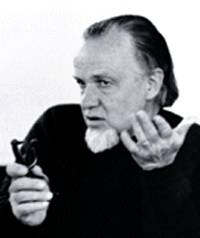
Francis Schaeffer above
—
Atomic Bombings of Hiroshima and Nagasaki – August 6 and 9, 1945
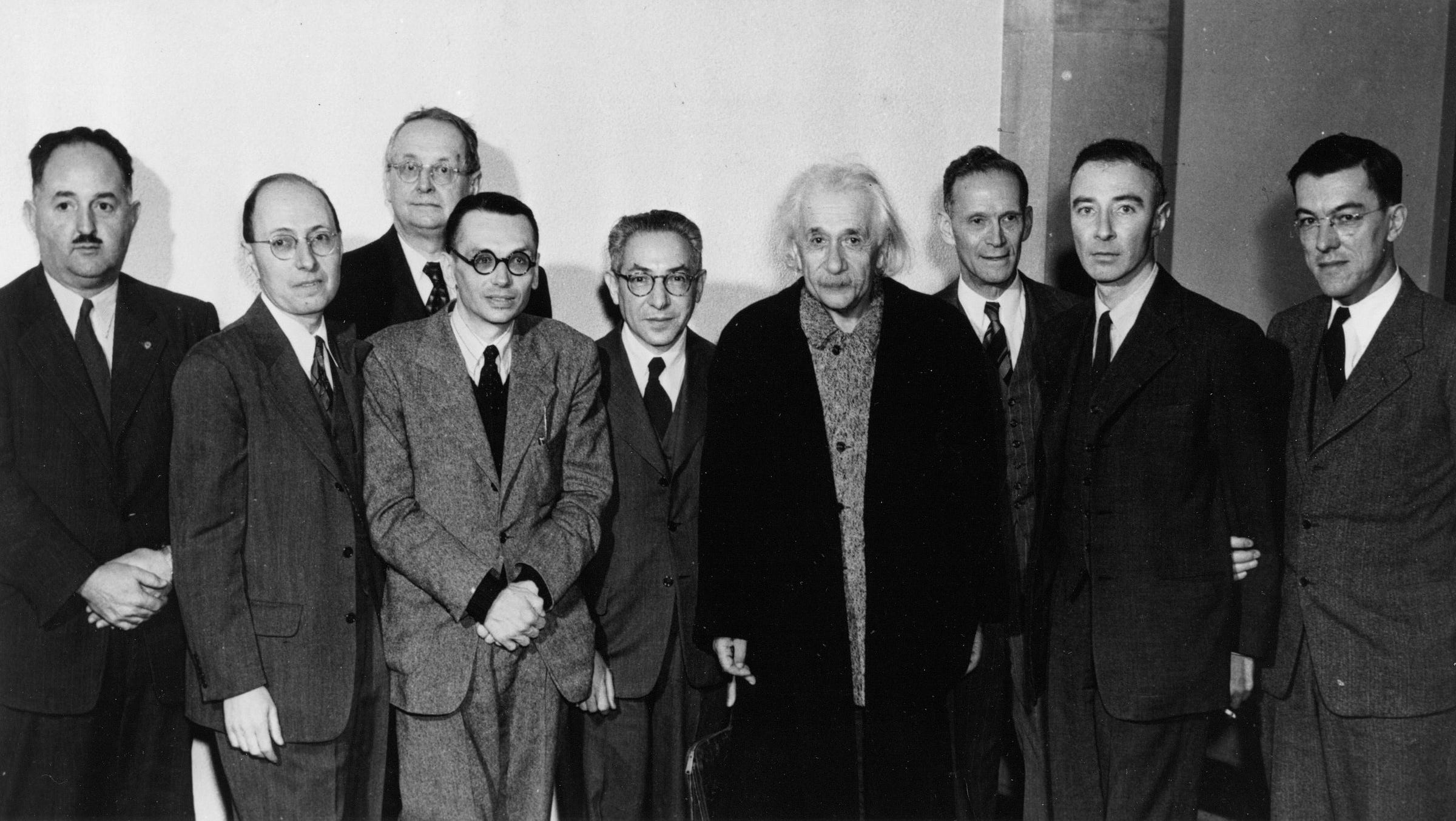
From left to right: Robertson, Wigner, Weyl, Gödel, Rabi, Einstein, Ladenburg, Oppenheimer, and Clemence
Related posts:
Atheists confronted: How I confronted Carl Sagan the year before he died jh47
In today’s news you will read about Kirk Cameron taking on the atheist Stephen Hawking over some recent assertions he made concerning the existence of heaven. Back in December of 1995 I had the opportunity to correspond with Carl Sagan about a year before his untimely death. Sarah Anne Hughes in her article,”Kirk Cameron criticizes […]
By Everette Hatcher III|Posted in Atheists Confronted|Edit|Comments (2)


 The Daily Hatch