
–
Oppenheimer’ First Reactions Praise Christopher Nolan’s ‘Most Impressive Work Yet’: A ‘Spectacular Achievement’ and ‘Total Knockout’
By Zack Sharf

Universal Pictures has finally unveiled Christopher Nolan’s atomic bomb epic “Oppenheimer” at a world premiere event in Paris. First reactions to the nearly three-hour drama are pouring in and are strong across the board, with the film being called a “spectacular achievement” and “audacious.”
Writing for The Los Angeles Times, former critic Kenneth Turan hailed “Oppenheimer” as “arguably Nolan’s most impressive work yet in the way it combines his acknowledged visual mastery with one of the deepest character dives in recent American cinema.”
Matt Maytum, deputy editor of Total Film, said Nolan’s latest left him “stunned,” adding, “[It’s] a character study on the grandest scale, with a sublime central performance by Cillian Murphy. An epic historical drama but with a distinctly Nolan sensibility: the tension, structure, sense of scale, startling sound design, remarkable visuals. Wow.”
Associated Press film writer Lindsey Bahr called the movie “a spectacular achievement in its truthful, concise adaptation, inventive storytelling and nuanced performances from Cillian Murphy, Emily Blunt, Robert Downey Jr., Matt Damon and the many, many others involved.”
On Science and Culture by J. Robert Oppenheimer, Encounter (Magazine) October 1962 issue, was the best article that he ever wrote and it touched on a lot of critical issues including the one that Francis Schaeffer discusses in this blog post!
Passage from Francis Schaeffer THE CHURCH OF THE END OF THE TWENTIETH CENTURY
Page 6
THE RISE OF SCIENCE
The birth of modern science is a good place to begin. Modern science arose out of a Christian mentality. Alfred North Whitehead, for example, emphasizes the fact that modern science was born because it was surrounded by a Christian frame of reference. Galileo, Copernicus, Francis Bacon, Kepler, and scientists up to and including Newton believed that the world was created by a reasonable God, and therefore we could find out the order of the universe by reason.
Oppenheimer stressed the same thing: modern science could not have been born at all without a Christian milieu, a Christian consensus. As Francis Bacon ( 1561-1626 ) said in Novum Organum Scientiarum : ” Man by the Fall fell at the same time from his state of innocence and from his dominion over nature. Both of these losses, however, can even in this life be in some part repaired; the former by religion and faith, the latter by the arts and sciences.” A few years ago I read something from Galileo which was very moving to me. Galileo stressed the fact that when he looked at the universe in all its richness and its beauty ( he did not mean merely aesthetic beauty , but its unity in the midst of its complexity). he was called to only one end–to worship the beauty of the Creator.
This was the birth of our modern thinking in the area of science , and it produced various results It led, for example, to the certainty of the uniformity of natural causes. There was a uniformity of natural causes, not in a closed system, but in one that as open to reordering.
Early modern scientists believed that God and man could operate into the machine and reorder the flow of cause and effect.
This had a number of results . First , it meant that nature was important . Second , it implied a clear distinction between nature as the object and myself as the observer. There was an objective basis for knowledge–something out there–and there was, therefore, a clear distinction between reality and fantasy.
The people who gave birth to modern science knew that God had created the universe , that it was there , not as Eastern thinking has it , as an extension of the essence of God, but as something other than God and as something other than what is spun out of the mind of man. Today the objective basis basis for knowledge has been undermined, and the distinction between reality and fantasy has become difficult—sometimes impossible~~to maintain.
Page 7
Furthermore, as is obvious from the quotation above, Bacon believed that man was wonderful, even though he was fallen. He believed in the fall of man in the biblical sense—that man is a sinner shut away from God on the basis of his moral guilt. Nevertheless, man is wonderful.
This is the very opposite of modern man. Modern man has been told that reason has led to the conclusion that man is a zero. This is a part of the tension of our present generation. It did not exist when modern science began. In those days, in other words, the machine was no threat—neither the machine of the cosmos, not the machines that man made.
Page 10
MODERN SCIENCE AND MODERN MODERN SCIENCE
Later we come to the difference between modern science and what I call modern, modern science. Modern science was born, as I have indicated, from the Christian concept that man on the basis of reason could understand the universe because a God of reason had created it. Modern, modern science, however, extended the idea of the uniformity of natural causes by adding a new phrase — in a closed system. This little phrase changed all of life because it put everything within the machine .
At first science dealt with physics, chemistry and astronomy. You could add a few more subjects perhaps, but there it ended. But later as psychology. was added and then social sciences, man himself was in the machine.
If everything is put into the machine, of course there is no place for God. But also there is no place for man, no place for the significance of man, no place for beauty, for morals or for love. When you come to this place, you have a sea without a shore. Everything is dead. But the presupposition of the uniformity of natural causes in a closed system does not explain the two basic things that are before us: (1) the universe that exists and its form, and (2) the mannishness of man.
As Sartre says, the basic philosophic question is that something is there rather than nothing being there. Einstein adds a note: when we examine the universe, we find that it is like a well-formulated word puzzle: namely, that you can suggest any word , but finally only one will fit. In other words, you not only have that is there that has to be explained, but it is a very special kind of a universe, a universe exceedingly complex and yet with a definite form.
Modern man in his philosophy, his music and his art usually depicts a chaotic situation in the universe. But when you make a Boeing 707, it is beautiful.
Why? Because it fits into the universe. The universe is not really the chaos that they picture.
There is also the problem of the uniqueness of man . Over 60,000 years ago – if you accept modern dating – man buried his dead in flower petals. If we look at Chinese bronzes, though they are far separated from us in time and culture, we find they conform to ourselves. They were made by somebody else , but they are also a part of me . There is the mannishness of man . The cave paintings at 20,000-30,000 B.C. are even more
illustrative. From these one can show that man has always felt himself to be different from non-man.
Modern man says, “No, we are just machines — chemically determined or psychologically determined.” But nobody consistently lives this way in his life. I would insist that here is a presupposition which intellectually, in the laboratory, would be cast out simply because it does not explain what is.
On the other hand, the biblical position, which begins with a personal rather than an impersonal beginning, gives us a different answer. The real issue is to decide, with intellectual integrity, which set of presuppositions conforms to what is. But many of us catch our presuppositions like measles. Why do people fit into the post-Christian world? I would urge that it is not because of facts
, but because our present almost monolithic culture has forced upon us the other answer–namely, the uniformity of natural causes, not in an open system beginning with a personal God, the way the early scientists believed, but in a closed system. It is not that the facts are against the Christian presuppositions , but simply that the Christian view is presented as unthinkable . The better the
the brainwashing tends to be.
The results of following the implications of modern man were clearly developed in the nineteenth century. Nobody has expressed it better than the Marquis de Sade, who was one of the early modern chemical determinists. De Sade’s position (and he lived by it) was that if you have determinism, then whatever is is right. You can say that things are nosocial. Or you can think the liberal theologian Paul Tillich’s concept of the demonic being a force for disintegration rather than for integration, but that is all you can say. You cannot say that anything is right or wrong. Morality is dead. Man is dead.
Nietzsche is a key to this. He was the first man who cried, in the modern sense. “God is dead,” but he was brilliant enough to understand the results. If God is dead, then everything is gone. I believe that it was not just venereal disease in Switzerland which caused him to become insane. I believe that Nietzsche made a philosophic statement in his insanity. He understood that if God is dead, there are no answers to anything and insanity is the end. This is not too far philosophically from the modern Michael Foucault , for example , who says that the only freedom is in insanity .
If we do not begin with a personal Creator, eventually we are left (no matter how we string it out semantically) with the impersonal plus time plus chance. We must explain everything in the uniqueness of man, and we must understand all of the complexity of the universe on the basis of time plus chance.
The difficulty of explaining man and the universe on such a basis was recognized by Darwin himself. In his autobiography and in letters published by his son he wrote: “With my mind I cannot believe that these things come by chance.” He said this as an old man many times over. Twice he added a strange note to this effect: “I know in my mind this can’t be true, but my mind is only a monkey’s mind, and who can trust a mind like that?” On this basis, how could one accept any conclusions of the human mind, including Darwin’s theory?
More recently, Murray Eden at MIT used high-speed computers to ask a question: Beginning with chaos at any acceptable amount of time up to eight billion years ago, could the present complexity come by chance? The answer is absolutely No.
But modern man does in fact assume — wittingly or unwittingly — that the universe and man can be explained by the impersonal plus time plus chance. And in this case man and his aspirations stand in total alienation from what is. And that is precisely where many people today live — in a generation of alienation: alienation in the ghettos, alienation in the university, alienation from parents, alienation on every side. Sometimes this takes the form of “dropping out,” sometimes it takes the form of “joining the system” to get along as easily as possible and to get as much from the system as possible. Those who are only playing with these ideas and have not gotten down into the real guts of it forget that the basic alienation with which they are faced is a cosmic alienation. It is simply this: there is nobody there to respond to you. There is nobody home in the universe. There is no one and nothing to conform to who you are or what you hope. That is the dilemma.
Let me use an illustration I have used previously. Suppose, for example, that the room in which you are seated is the only universe there is. God could have made a universe just this big if he wished. Suppose in making the only universe there were a room made up of solid walls, but filled up to the ceiling with liquids: just liquids and solids and no free gases. Suppose then that fish were swimming in the universe. The fish would not be alienated from the universe because they can conform to the universe by their nature. But suppose if by chance, as the evolutionists see chance, the fish suddenly developed lungs. Would they be higher or lower? Obviously, they would be lower, because they would drown. They would have a cosmic alienation from the universe that surrounded them.
But man has aspirations; he has what I call his mannishness. He desires that love be more than being in bed with a woman, that moral motions be more than merely sociological something-or-others, that his significance lie in being more than one more cog in a vast machine. He wants a relationship to society other than that of a small machine being manipulated by a big machine. On the basis of modern thought, however, all of these would simply be an illusion. And since there are aspirations which separate man from his impersonal universe, man then faces his being caught in a terrible, cosmic, final alienation. He drowns in cosmic alienation, for there is nothing in the universe to fulfill him. That is the position of modern man.
Beginning with rationalism, rationally you come only to pessimism. Man equals the machine. Man is dead. So those who followed Kierkegaard put forth the concept of an optimism in the area of nonrationality. Faith and optimism, they said, are always a leap. Neither has anything to do with reason.
—
—

OPPENHEIMER and EINSTEIN
—

Albert Einstein and Robert Oppenheimer, 1947: Flickr, James Vaughn
—
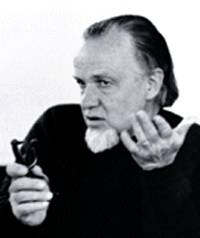
Francis Schaeffer above
—
Atomic Bombings of Hiroshima and Nagasaki – August 6 and 9, 1945
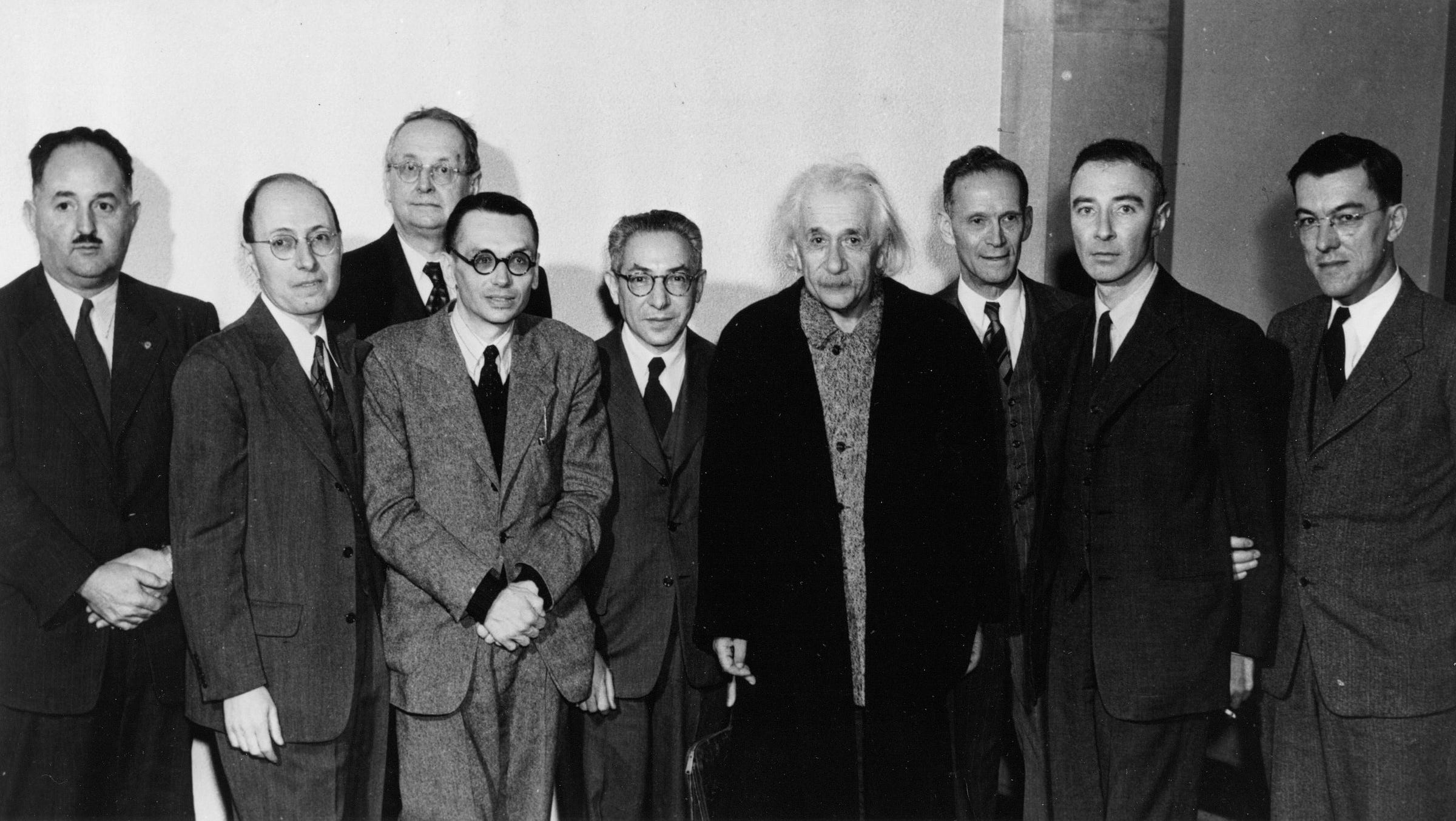
From left to right: Robertson, Wigner, Weyl, Gödel, Rabi, Einstein, Ladenburg, Oppenheimer, and Clemence
Related posts:
Atheists confronted: How I confronted Carl Sagan the year before he died jh47
In today’s news you will read about Kirk Cameron taking on the atheist Stephen Hawking over some recent assertions he made concerning the existence of heaven. Back in December of 1995 I had the opportunity to correspond with Carl Sagan about a year before his untimely death. Sarah Anne Hughes in her article,”Kirk Cameron criticizes […]
By Everette Hatcher III|Posted in Atheists Confronted|Edit|Comments (2)


 The Daily Hatch