
—
Oppenheimer’s Reviews Prove It Has the Thing We Love About All Nolan Films

Oppenheimer is all the buzz these days, and the early reviews from the Paris premiere are proving that the movie is all worth it.
Christopher Nolan’s biopic Oppenheimer has just made its way to Paris, and critics are already loving it. According to the French crème de la crème of the film industry, the movie is “Nolan’s most dense film” to date, comparable only to 2017’s Dunkirk (via a Twitter fan account).
Oppenheimer reportedly features quite a lot of insightful dialogue, various characters, and in the most Nolan-esque way, several timelines. Viewers would be shocked if the renowned filmmaker ever made a film that didn’t make their brains hurt on the first watch.
Speaking of which, the French critics confirm that Oppenheimer follows the traditional complexity that Nolan’s works are famous for. It does take at least two viewings to understand what is going on, which is why the audiences (us included) will absolutely love it. Honestly, are you even a Nolan stan if you get the message of a movie of his on the first try? Doubtful.
The reviews also compare Oppenheimer to masterpieces from the Golden Age of Hollywood, which was roughly the period between 1927 and 1969. Does this mean that the movie has some scenes in black and white or something?
Critics are praising the film’s casting and editing work, as well as the soundtrack by Ludwig Goransson, known for his work on The Mandalorian, Black Panther, and Venom. By the way, this is not the first time Goransson has worked with Nolan – they previously collaborated on 2020’s Tenet.
Still, there are some drawbacks to Oppenheimer too (not even Nolan is perfect). Lack of female character development and lack of emotion are among the ones that come up more often in the reviews.
You will be able to judge Nolan’s Oppenheimer for yourself soon enough. The biopic thriller is scheduled for release on July 21, 2023.
—
—

OPPENHEIMER and EINSTEIN
—

Albert Einstein and Robert Oppenheimer, 1947: Flickr, James Vaughn
—
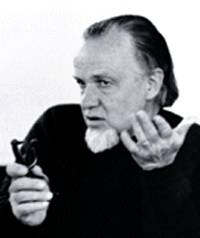
On Science and Culture by J. Robert Oppenheimer, Encounter (Magazine) October 1962 issue, was the best article that he ever wrote and it touched on a lot of critical issues including the one that Francis Schaeffer discusses in this blog post!
Francis Schaeffer above
CHAPTER 7 of HOW SHOULD WE THEN LIVE?
7 The Rise of Modern Science
Two eras in history came almost simulta- neously: the High Renaissance and, in contrast to it, the Reformation. A third phenomenon which we must deal with began at approx- imately the same time. It is often called the Scientific Revolution.
We can date the rise of modern science with Copernicus (1475–1543), the Polish astronomer, and Vesalius (1514–1564) who was Italian. But this is not to say that nothing that could be called science preceded them. The Greeks, the Arabs, and the Chinese had a deep knowledge of the world. The Chinese, however, developed few general scientific theories based on their knowledge, and medieval science largely ac- cepted Aristotle as the ultimate authority. In the Arabic world there was much discussion in this area, but it would seem that the principles by which they comprehended the world were formed under the combined influence of Aris- totelianism and Neo-Platonism. The Arabic scholars did remarkable work, especially in mathematics—in trigonometry and algebra, for example, and in astronomy. Omar Khayyam (c. 1048–c. 1122)—who is better known for his Rubaiyat, in which he carries to its logical con- clusion the Islamic concept of fate—calculated the length of the solar year and carried algebra further than it had been taken before. But with the Arabs as with medieval Europeans, science was considered one aspect of philosophy, with the traditions of the philosophers, especially Aristotle, ruling supreme.
That is, medieval science was based on au- thority rather than observation. It developed through logic rather than experimentation, though there were notable exceptions.
The foundation for modern science can be said to have been laid at Oxford when scholars there attacked Thomas Aquinas’s teaching by proving that his chief authority, Aristotle, made certain mistakes about natural phenomena. Roger Bacon (1214–1294) was a part of this Ox- ford group, but the most important man was Robert Grosseteste (c. 1175–1253) who laid the philosophical foundations for a departure from Aristotelian science. Of course other factors were involved as well, but the challenge to the authority of Aristotle opened the doors for less restricted thought. This challenge to the con- cepts of Aristotle developed fruitfully at the University of Padua in the fifteenth and six- teenth centuries.
When the Roman Church attacked Copernicus and Galileo (1564–1642), it was not because their teaching actually contained any- thing contrary to the Bible. The church author- ities thought it did, but that was because Aris- totelian elements had become part of church orthodoxy, and Galileo’s notions clearly con- flicted with them. In fact, Galileo defended the compatibility of Copernicus and the Bible, and this was one of the factors which brought about his trial.
Let us return to the fact that the Renais- sance and Reformation overlap the Scientific Revolution. Let me emphasize that I am not implying that the Reformation caused the rise of modern science. All I am pointing out at this point is that the High Renaissance, the Refor- mation, and the Scientific Revolution were simultaneous at that point in history. To put the temporal relationship into perspective, let us consider a few dates: Leonardo da Vinci lived between 1452 and 1519. Luther’s Ninety-five Theses were hammered to the church door in 1517. Calvin’s Institutes were published in 1536. In 1546 Luther died. Copernicus, the as- tronomer, lived from 1473 to 1543 and gave a preliminary outline of his theory in 1530—that is, that the earth went around the sun, and not the sun around the earth. In the 1540s, three things happened: first, On the Revolutions of the Heavenly Spheres by Copernicus was published posthumously; second, Vesalius published his book On the Structure of the Human Body (this book is often spoken of as De Fabrica); third, the first edition of a Latin translation of the col- lected works of Archimedes (c. 287–212 B.C.) was published in 1544 in Basel. This introduced some of the mathematical methods essential to the development of modern science.
Francis Bacon lived from 1561 to 1626. He was a lawyer, essayist, and Lord Chancellor of England. Though historians now do not give him as important a place as they used to, he did, nevertheless, fight a battle against the old order of scholasticism with its slavish depen- dence on accepted authorities. He stressed careful observation and a systematic collection of information “to unlock nature’s secrets.” In 1609 Galileo began to use the newly invented telescope and what he saw and wrote about indicated that Aristotle had been mistaken in his pronouncements about the makeup of the universe. Galileo was not the first to rely on ex- perimental evidence. Danish Tycho Brahe (1546–1601) had come to similar conclusions from observation, but Galileo articulated his findings publicly in his lifetime and in his na- tive tongue so that all could read what he wrote. Condemned by the Roman Inquisition in 1632, he was forced to recant; but his writings con- tinued to testify not only that Copernicus was right, but also that Aristotle was wrong.
The rise of modern science did not conflict with what the Bible teaches; indeed, at a crucial point the Scientific Revolution rested upon what the Bible teaches. Both Alfred North Whitehead (1861–1947) and J. Robert Oppen- heimer (1904–1967) have stressed that modern science was born out of the Christian world view. Whitehead was a widely respected math- ematician and philosopher, and Oppenheimer, after he became director of the Institute for Ad- vanced Study at Princeton in 1947, wrote on a wide range of subjects related to science, in addition to writing on his own field on the structure of the atom and atomic energy. As far as I know, neither of the two men were Christians or claimed to be Christians, yet both were straightforward in acknowledging that modern science was born out of the Christian world view.
Oppenheimer, for example, described this in an article “On Science and Culture” in En- counter in October 1962. In the Harvard Univer- sity Lowell Lectures entitled Science and the Modern World (1925), Whitehead said that Christianity is the mother of science because of “the medieval insistence on the rationality of God.” Whitehead also spoke of confidence “in the intelligible rationality of a personal being.” He also says in these lectures that because of the rationality of God, the early scientists had an “inexpugnable belief that every detailed occurrence can be correlated with its an- tecedents in a perfectly definite manner, exem- plifying general principles. Without this belief the incredible labors of scientists would be without hope.” In other words, because the early scientists believed that the world was cre- ated by a reasonable God, they were not sur- prised to discover that people could find out something true about nature and the universe on the basis of reason.
This is a good place to emphasize some things I am not saying. First, the reason- ableness of the created order on the basis of its creation by a reasonable God was not a distinc- tive emphasis of the Reformation, but was held in common by both the pre-Reformation church and the Reformers. The belief White- head describes would have been common to both: the heavens and earth had been created by God, and God is a reasonable God, as the Bible says he is.
Second (as was stressed when considering the art which flowed from the Reformation but should be repeated here), it is not only a Chris- tian who can paint beauty or who has creative stirrings in the area of science. These creative stirrings are rooted in the fact that people are made in the image of God, the great Creator, whether or not an individual knows or acknowl- edges it, and even though the image of God in people is now contorted. This creativeness— whether in art, science, or engineering—is a part of the unique mannishness of man as made in the image of God. Man, in contrast to non-man, is creative. A person’s world view, however, does show through. This includes what happens to people’s creative stirrings in science. The world view determines the direc- tion such creative stirrings will take, and how—and whether the stirrings will continue or dry up.
Third, not all the scientists to be considered in this section were individually consistent Christians. Many of them were, but they were all living within the thought forms brought forth by Christianity. And in this setting man’s creative stirring had a base on which to con- tinue and develop. To quote Whitehead once more, the Christian thought form of the early scientists gave them “the faith in the possibility of science.”
Living within the concept that the world was created by a reasonable God, scientists could move with confidence, expecting to be able to find out about the world by observation and ex- perimentation. This was their epistemological base—the philosophical foundation with which they were sure they could know. (Epistemology is the theory of knowledge—how we know, or how we know we can know.) Since the world had been created by a reasonable God, they were not surprised to find a correlation between themselves as observers and the thing ob- served—that is, between subject and object. This base is normative to one functioning in the Christian framework, whether he is observ- ing a chair or the molecules which make up the chair. Without this foundation, Western mod- ern science would not have been born.
Here one must consider an important ques- tion: Did the work of the Renaissance play a part in the birth of modern science? Of course it did. More than that, the gradual intellectual and cultural awakenings in the Middle Ages also exerted their influence. The increased knowledge of Greek thought—at Padua Univer- sity, for example—opened new doors. Cer- tainly, Renaissance elements and those of the Greek intellectual traditions were involved in the scientific awakening. But to say theoretically that the Greek tradition would have been in it- self a sufficient stimulus for the Scientific Revo- lution comes up against the fact that it was not. It was the Christian factor that made the differ- ence. Whitehead and Oppenheimer are right. Christianity is the mother of modern science because it insists that the God who created the universe has revealed himself in the Bible to be the kind of God he is. Consequently, there is a sufficient basis for science to study the uni- verse. Later, when the Christian base was lost, a tradition and momentum had been set in mo- tion, and the pragmatic necessity of technology, and even control by the state, drives science on, but, as we shall see, with a subtle yet important change in emphasis.
Francis Bacon, who could be called the major prophet of the Scientific Revolution, took the Bible seriously, including the historic Fall, the revolt of man in history. He said in Novum Organum Scientiarum (1620), “Man by the Fall fell at the same time from his state of inno- cence and from his dominion over creation. Both of these losses, however, can even in this life be in some parts repaired; the former by religion and faith, the latter by the arts and sci- ences.” Notice that Bacon did not see science as autonomous. Man, including science, is not autonomous. He is to take seriously what the Bible teaches about history and about that which it teaches has occurred in the cosmos. Yet, upon the base of the Bible’s teaching, sci- ence and art are intrinsically valuable before both men and God. This gave a strong impetus for the creative stirrings of science to continue rather than to be spasmodic.
To continue with the founders of modern science: Johannes Kepler, a German astronomer, lived between 1571 and 1630, the same time as Galileo. He was the first man to show that the planets’ orbits are elliptical, not circular. Sir Isaac Newton (1642–1727), while a young professor in his twenties at Cambridge University, came to the conclusion that there is a universal force of attraction between every body in the universe and that it must be calcu- lable. That force he called gravity. He set this forth later in The Mathematical Principles of Nat- ural Philosophy (1687). This became one of the most influential books in the history of human thought. By experimenting in Neville’s Court in Trinity College at Cambridge University, he was also able to work out the speed of sound by timing the interval between the sound of an ob- ject which he dropped, and the echo coming back to him from a known distance. loyal to what he believed the Bible teaches. It has been said that seventeenth-century scien- tists limited themselves to the how without interest in the why. This is not true. Newton, like other early scientists, had no problem with the why because he began with the existence of a personal God who had created the universe.
In his later years, Newton wrote more about the Bible than about science, though little was published. Humanists have said that they wish he had spent all of his time on his science. They think he wasted the hours he expended on biblical study, but they really are a bit blind when they say this. As Whitehead and Oppen- heimer stressed, if Newton and others had not had a biblical base, they would have had no base for their science at all. That is not to say that one must agree with all of Newton’s speculations on either metaphysics or doctrine.
Throughout his lifetime, Newton tried to be But the point is that Newton’s intense interest in the Bible came out of his view that the same God who had created the universe had given people truth in the Bible. And his view was that the Bible contained the same sort of truth as could be learned from a study of the universe. Newton and these other scientists would have been astonished at a science obsessed with how the universe functions, but professionally failing to ask the question “Why?”
Though later he became disillusioned with science, Blaise Pascal (1623–1662) made the first successful barometer and did important work on the equilibrium of fluids. He was not content to work only in a laboratory, but took a tube of mercury up the mountain Puy de Dôme (in central France) and thus recorded the changes in the mercury level according to altitude. He was also a mathematician of note whose work hastened the development of dif- ferential calculus. By some he is also consid- ered the greatest writer of French prose who ever lived. An outstanding Christian, he empha- sized that he did not see people lost like specks of dust in the universe (which was now so much larger and more complicated than people had thought), for people—as unique—could comprehend something of the universe. People could comprehend the stars; the stars compre- hend nothing. And besides this, for Pascal, people were special because Christ died on the cross for them.
René Descartes (1596–1650) was important for his emphasis on mathematical analysis and theory of science. I personally would reject his philosophic views. But he regarded himself as a good Catholic, and it was his religion which, in light of his philosophic views, saved him from solipsism—that is, from living in the cocoon of himself.
In the early days of the Royal Society of Lon- don for Improving Natural Knowledge, founded in 1662, most of its members were professing Christians. George M. Trevelyan (1876–1962) in English Social History (1942) writes, “Robert Boyle, Isaac Newton and the early members of the Royal Society were religious men, who repu- diated the sceptical doctrines of Hobbes. But they familiarized the minds of their countrymen with the idea of law in the Universe and with scientific methods of enquiry to discover truth. It was believed that these methods would never lead to any conclusions inconsistent with Bib- lical history and miraculous religion; Newton lived and died in that faith.” We must never think that the Christian base hindered science. Rather, the Christian base made modern science possible.
PAGE. 193 44%
41 Sir Isaac Newton engraved by Freeman (top) and Blaise Pascal by Philippe de Champagne. “… early scientists had no problem with the why.” Photos courtesy Radio Times London.
The tradition of Bacon and Newton and the early days of the Royal Society was strongly maintained right through the nineteenth cen- tury. Michael Faraday (1791–1867) made his great contributions in the area of electricity. His crowning discovery was the induction of elec- tric current. Faraday was also a Christian. He belonged to a group whose position was: “Where the Scriptures speak, we speak; where the Scriptures are silent, we are silent.” In the conviction that knowledge concerning God’s creation is for all people to enjoy, and not just a professional elite, he gave famous public demonstrations of his pioneering work in electricity. James Clerk Maxwell (1831–1879), who, like Faraday, worked with electricity, was also a believer in a personal God. Indeed, the majority of those who founded modern sci- ence, from Copernicus to Maxwell, were func- tioning on a Christian base. Many of them were personally Christians, but even those who were not, were living within the thought forms brought forth by Christianity, especially the be- lief that God as the Creator and Lawgiver has implanted laws in his creation which man can discover.
But we may ask, “Isn’t science now in a new stage, one in which the concept of an orderly universe is passé?” It is often said that relativity as a philosophy, as a world view, is supported by Albert Einstein’s (1879–1955) theory of rela- tivity. But this is mistaken because Einstein’s theory of relativity assumes that everywhere in the universe light travels at a constant speed in a vacuum. In other words, we must say with the utmost force that nothing is less relative philosophically than the theory of relativity. Ein- stein himself stood implacably against any such application of his concepts. We can think of his often quoted words from the London Ob- server of April 5, 1964: “I cannot believe that God plays dice with the cosmos.”
One may then ask if Einstein’s views have not been proven old-fashioned by Werner Heisenberg’s (1901–1976) principle of uncer- tainty, or indeterminacy principle (1927), and by the wide acceptance of the concept of quantum. The answer again is no. The principle of indeter- minacy has to do with a certain area of obser- vation, namely, the location of an object and its velocity. For example, if we try to establish the exact position and speed of two atomic particles which are going to collide, we will never be able to determine exactly how they will rebound. The physicist cannot have an accurate observation of both their location and their velocity simultaneously. The quantum theory of either light or particles does not lead to the concept of chance or random universe either. For example, whether viewed as a wave or a particle, light does not function at random and it is an effect which brings forth causes. Even the far-out theoretical existence of “black holes” in space, as set forth by John G. Taylor (1931–), is based on the concept of an orderly universe and calculations resting on that concept.
42 Michael Faraday conducting a public exper- iment. “God’s creation is for all people to enjoy.” Photo courtesy of The Royal Institution.
If an airplane is to fly, it must be con- structed to fit the order of the universe that ex- ists. People, no matter what they have come to believe, still look for the explanation of any happening in terms of other earlier happenings. If this were not possible, not only would expla- nations cease, but science could not be used reliably in technology. It is possible to so func- tion in our universe that, because there is a uni- formity of natural causes, a man may travel hundreds of thousands of miles to the moon and land within a few feet of his planned desti- nation, or he may aim an atomic weapon at a target on the other side of our planet and land it within ten feet of that target. We know we live in a universe that is much more complex than people, including scientists, once thought it to be, but that is much different from the concept of a random universe.
On the Christian base, one could expect to find out something true about the universe by reason. There were certain other results of the Christian world view. For example, there was the certainty of something “there”—an objec- tive reality—for science to examine. What we seem to observe is not just an extension of the essence of God, as Hindu and Buddhist think- ing would have it. The Christian world view gives us a real world which is there to study objectively. Another result of the Christian base was that the world was worth finding out about, for in doing so one was investigating God’s cre- ation. And people were free to investigate na- ture, for nature was not seen as full of gods and therefore taboo. All things were created by God and are open for people’s investigation. God himself had told mankind to have dominion over nature, and as we saw from the quotation from Francis Bacon, to him science had a part in this. There was a reason for continuing one’s interest and pressing on.
43 Assembly of a satellite at the Kennedy Space Center. “… science could not be used.” Photo by Mustafa Arshad.
In this setting, people’s creative stirrings had a base from which to develop and to con- tinue. To quote Bacon again, “To conclude, therefore, let no man out of weak conceit of sobriety, or in ill applied moderation, think or maintain, that a man can search too far or be too well studied in the book of God’s word, or in the book of God’s works.” “The book of God’s word” is the Bible; “the book of God’s works” is the world which God has made. So, for Bacon and other scientists working on the Christian base, there was no separation or final conflict between what the Bible teaches and sci- ence.
The Greeks, the Moslems, and the Chinese eventually lost interest in science. As we said before, the Chinese had an early and profound knowledge of the world. Joseph Needham (1900–), in his book The Grand Titration (1969), explains why this never developed into a full-fledged science: “There was no confi- dence that the code of Nature’s laws could ever be unveiled and read, because there was no assurance that a divine being, even more ratio- nal than ourselves, had ever formulated such a code capable of being read.” But for the scien- tists who were functioning on a Christian base, there was an incentive to continue searching for the objective truth which they had good reason to know was there. Then, too, with the biblical emphasis on the rightness of work and the dig- nity of all vocations, it was natural that the things which were learned should flow over into the practical side and not remain a matter of mere intellectual curiosity and that, in other words, technology, in the beneficial sense, should be born.
What was the view of these modern scien- tists on a Christian base? They held to the con- cept of the uniformity of natural causes in an open system, or, as it may also be expressed, the uniformity of natural causes in a limited time span. God has made a cause-and-effect uni- verse; therefore we can find out something about the causes from the effects. But (and the but is very important) it is an open universe be- cause God and man are outside of the unifor- mity of natural causes. In other words, all that exists is not one big cosmic machine which in- cludes everything. Of course, if a person steps in front of a moving auto, the cause-and-effect universe functions upon him; but God and people are not a part of a total cosmic machine. Things go on in a cause-and-effect sequence, but at a point of time the direction may be changed by God or by people. Consequently, there is a place for God, but there is also a proper place for man.
This carries with it something profound— that the machine, whether the cosmic machine or the machines which people make, is neither a master nor a threat—because the machine does not include everything. There is some- thing which is “outside” of the cosmic ma- chine, and there is a place for man to be man.
—
Atomic Bombings of Hiroshima and Nagasaki – August 6 and 9, 1945
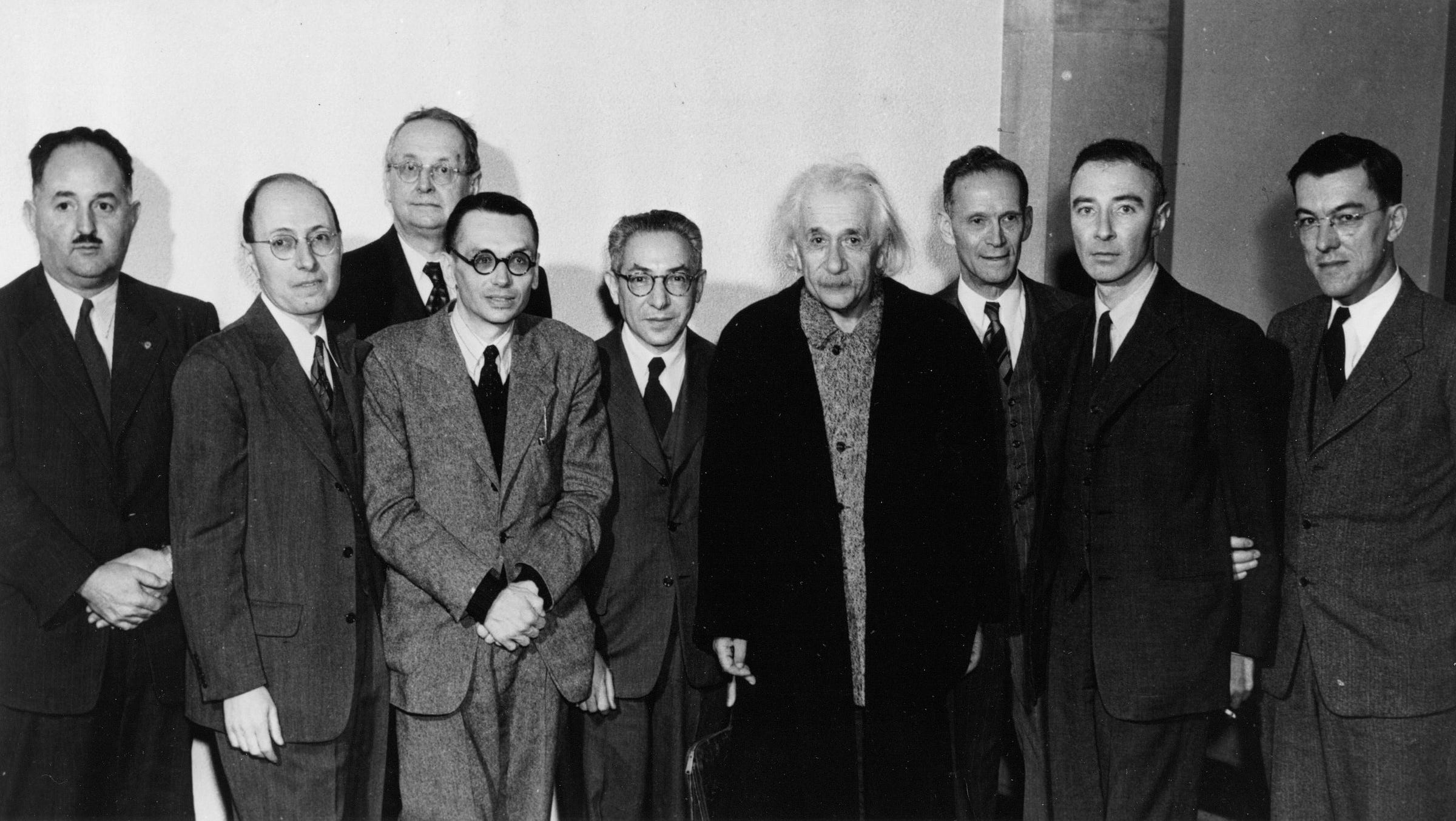
From left to right: Robertson, Wigner, Weyl, Gödel, Rabi, Einstein, Ladenburg, Oppenheimer, and Clemence
Related posts:
Atheists confronted: How I confronted Carl Sagan the year before he died jh47
In today’s news you will read about Kirk Cameron taking on the atheist Stephen Hawking over some recent assertions he made concerning the existence of heaven. Back in December of 1995 I had the opportunity to correspond with Carl Sagan about a year before his untimely death. Sarah Anne Hughes in her article,”Kirk Cameron criticizes […]
By Everette Hatcher III|Posted in Atheists Confronted|Edit|Comments (2)


 The Daily Hatch