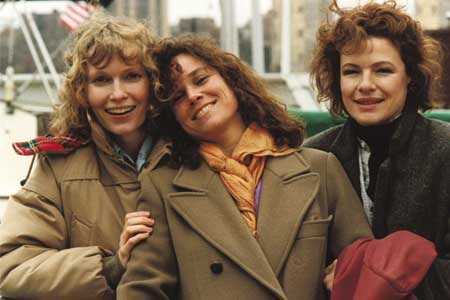
Hannah and Her Sisters (1986)
104 min., rated PG-13.
Grade: A
Woody Allen’s heartfelt, literate, evenly balanced Robert Altman-esque ensemble piece is structured like a chapter novel, revolving around three New York sisters with themes of love, relationships, and faithfulness.
Hannah (Mia Farrow) is the nurturing lamb to her two sisters, Lee (Barbara Hershey), a flighty former alcoholic living in a loft with an artist (Max von Sydow), and Holly (Dianne Wiest) is the free-thinking aspiring actress who owns a catering company with her always-overshadowing friend (Carrie Fisher). Hannah is married to Elliot (Michael Caine), an accountant, who’s in love with Lee, and Hannah’s ex-husband, Mickey (Allen), a hypochondriac TV executive, thinks he’s dying.
Allen intersperses his typically acute sense of humor with sensitivity, and as the film takes place over the span of two years, beginning and ending at Thanksgiving, much has changed from when we first Hannah, Lee, and Holly. Each character has a voice (literally, a voice-over) but it works, they have arcs, and every performance is finely tuned.
Full of warmth, truth, and humor, “Hannah and Her Sisters” is a treasure and quintessential Woody Allen next to “Annie Hall” and “Manhattan.”
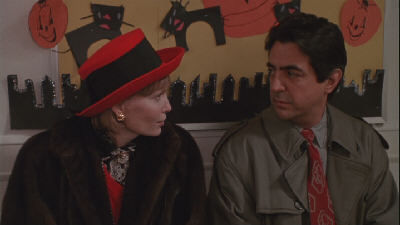
Alice (1990)
106 min., rated PG-13.
Grade: B –
In filmmaker Woody Allen’s “Alice”—a musing, light-as-helium comic variation on “Alice in Wonderland” and Federico Fellini’s “Juliet of the Spirits”—his lamblike muse and girlfriend Mia Farrow snags the title spot.
She’s Alice Tate, a rich, pampered Manhattan housewife who spends her days shopping, pedicuring, and gossiping with her socialite lady friends. At an appointment with Chinese healer Dr. Yang (Keye Luke), an ersatz for psychoanalysis, he treats her with hypnosis and mystical herbs, making her realize that she’s holding onto her youth. When she meets a handsome, gentle divorced dad (an appealing Joe Mantegna), she begins fantasizing about having an affair with him. But while she’s a mousy, goody-goody Mother Teresa and believes in fidelity with her husband (William Hurt), her fantasy becomes reality.
Although Allen takes time off from the lead spotlight, his one-liners slip through and Farrow is virtually in the “Woody role” with her fast-thinking jitteriness. She’s charming. Blythe Danner shines as Alice’s distant but down-to-earth sister, and Bernadette Peters and Alec Baldwin enliven their small roles, respectively, as Alice’s muse and ghostly first love. Unfortunately, Julie Kavner and Judy Davis don’t even register here in bit parts.
“Alice” is certainly Woody-lite, not always comfortably blurring the line between hokey fancy and affirmativeness about a woman’s selfless self-discovery, but it sure is sweet.
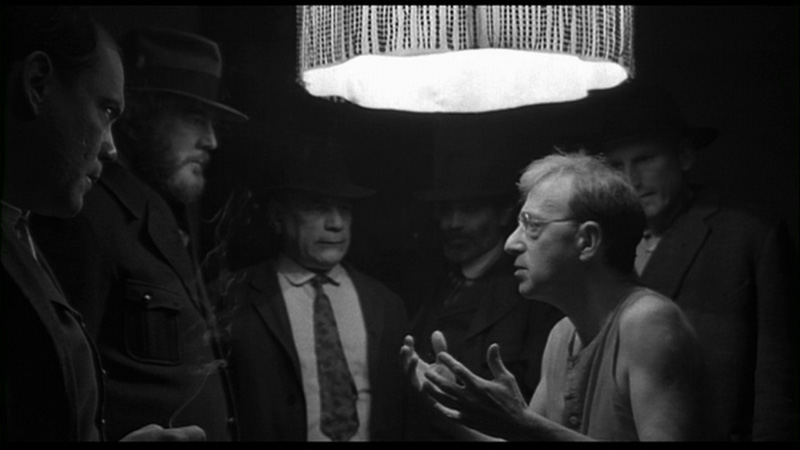
Shadows and Fog (1991)
85 min., rated PG-13.
Grade: C
Woody Allen’s tepid experiment in German expressionist style comes and goes like a puff of smoke. In “Shadows and Fog” (based on the filmmaker’s comedy play “Death”), a Jack the Ripper-esque serial strangler lurks in the shadows of a European city during the 1920s and strikes in the fog!
Allen casts himself as another nebbish schlemiel, a bookkeeping clerk named Max Kleinman who’s roused from his sleep to help a band of vigilantes find the killer. Naturally, Allen peppers the gloom and doom every now and then with his one-liners, but they’re more than mild here.
The real suspense lies in which actor will pop up next, but so little is done with the cast. Allen’s dear Mia Farrow gives the same whiny, lamblike performance here as a sword-swalling circus act, whom we’re supposed to believe is mistaken for a prostitute and wholly desired by John Cusack. John Malkovich is surprisingly dull as a circus clown, Farrow’s husband. Julie Kavner is momentarily amusing as Max’s bitter ex. Lily Tomlin, Kathy Bates, and Jodie Foster show up as the hookers at a brothel, as do Madonna, Katie Nelligan, Donald Pleasence, and Wallace Shawn in bit parts. Allen’s entrapment of the strangler with a magician’s (Kenneth Mars) help is an absurdist highlight.
“Shadows and Fog” would make Fritz Lang and Franz Kafka proud, but will leave Woodyphiles wanting. Nice try but a non-starter in Woody’s canon.
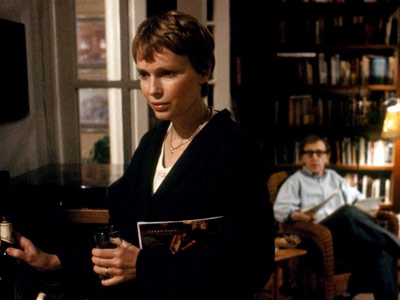
Husbands and Wives (1992)
108 min., rated R.
Grade: A –
“Thou shalt not commit adultery,” obviously at the top of Woody Allen’s commandments, comes out full throttle in “Husbands and Wives,” the Woodman’s most perceptive, witty, and generous look at broken relationships.
Allen casts himself as Gabe, a faithful (New York) writer and English professor who, along with his wife of 10 years, Judy (Mia Farrow, with a haircut that makes her look like Dianne Wiest), get a very formal announcement by their two married best friends, Jack (Sydney Pollack) and Sally (Judy Davis), that they’re splitting up. Of course, Gabe and Judy’s marriage becomes endangered once a student (Juliette Lewis), who’s attracted to older men, looks his way. Then once Sally gets jealous that Jack has already moved on to a chatty airhead (Lysette Anthony), Judy sets Sally up with a sweet colleague, Michael (Liam Neeson). He falls hard for Sally, but Judy is in love with him.
This truthfully messy exploration of marriage has the characters making confessions in a talking-head couch setting to an off-screen voice that’s either a shrink or an interviewer; it’s a device but effectively gets us into these people’s heads. It’s no concidence that life imitates art in “Husbands and Wives,” with much conjunction to Allen and Farrow’s real-life breakup, as Allen allows us to understand the emotionally fragile and confusing period after a breakup, the dull security of marriage, and the excitement of spontaneous sex.
In a well-written scene in a cab with Allen and Lewis (the camera on her the entire time), her dialogue in criticizing Gabe’s book is so pointed about the film’s own themes. Husbands and Wives is so well-acted that we believe these characters exist. Davis is incredibly good as hyperactive, hypocritical Sally. Her character could’ve been a shrew cliché, but the great Davis goes deeper, finding the rage, confused feelings, and vulnerability of Sally. And veteran director Pollack gives a stellar performance as a man sinking in self-delusion. We see him finally crack at a friends’ party where he literally drags his girlfriend out.
Shot documentary-style as if we’re eavesdropping on these couples, the antsy, handhand camera and jump cuts, made to make things feel raw and real, are often distracting and feel overly rigged but don’t break the film.
One of Allen’s most emotionally intimate works to date, “Husbands and Wives” is done with the truth, wit, angst, and irony that we’ve come to expect from the filmmaker’s voice.
Manhattan Murder Mystery (1993)
104 min., rated PG.
Grade: A –
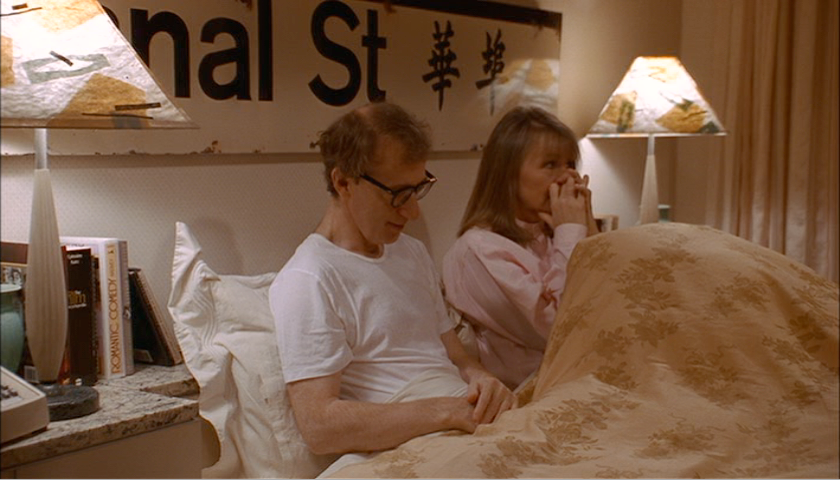
Woody Allen’s “Manhattan Murder Mystery” marks a few great returns. It’s a return to classic, funny Woody (especially after his past work dealt with heavy themes), his first-co-writing collaboration with Marshall Brickman since “Annie Hall” and “Manhattan,” and it’s his first pairing with Diane Keaton since “Manhattan.”
Allen and Keaton play Larry and Carol Lipton, a long-married couple afraid they’re turning dull like their friendly old neighbors, Paul and Lillian House (Jerry Adler, Lynn Cohen). Then Lillian drops dead of a heart attack, case closed. But Carol becomes suspicious of Mr. House acting a little too cheerful as a widower. The Liptons’ old close friend, Ted (Alan Alda), plays along with Carol’s theories and helps her out in her Nancy Drew sleuthing.
“Manhattan Murder Mystery” is a flat-out entertaining caper. The mystery plot is actually pretty clever and suspenseful, kind of a Hitchcockian goof on “Vertigo” and “Double Indemnity.” And the Woodman’s funny quips, phobias, and one-liners are on full display here and so consistent it’s hard to keep up or stop laughing. It’s a pleasure to see the reunited teaming of Allen and Keaton (whose role was originally intended for Mia Farrow), whose frantic verbal rhythms and neuroses go hand in hand. They feel so at ease with one another that their natural chemistry recalls Alvy Singer and Annie Hall. Alda and Anjelica Huston (both appearing last in Allen’s “Crimes and Misdemeanors”) are also very sharp as their friends, respectively, a divorced playwright who still yearns for Carol and a sexy fiction writer that gives Larry the eye.
The one complaint for this very enjoyable film is the same conceit that somewhat plagued last year’s “Husbands and Wives”: Carlo DiPalma’s voyeuristic, roving, handheld cinematography. It’s mostly smooth but is sometimes annoying. But this Allen lark is so fun and involving that it hardly matters.