Monthly Archives: November 2013

Lots of Waste at the Federal Mediation and Conciliation Service!!!!

____________

Lots of Waste at the Federal Mediation and Conciliation Service!!!!

November 5, 2013 12:50PM

ICYMI: FMCS

During the hullaballoo around the government shutdown, the Washington Examiner published a jaw-dropping series of stories about blatant waste in an obscure federal agency called the Federal Mediation and Conciliation Service. These stories shouldn’t be missed.

Reporter Luke Rosiak writes:

One federal employee leased a $53,000 take-home car with taxpayer money in apparent defiance of federal regulations and regularly billed the government for service at shops such as BMW of Fairfax.

Others charged the government monthly for family members’ cell phones and high-end TV packages and Internet at home — and even at second homes.

Managers freely made out checks to employees without requiring documentation of how it would be spent, giving $1,316 directly to one who said she was reimbursing herself for furniture she bought for a “home office” and using convenience checks to give workers bonuses.

Federal bureaucrats dole themselves these perqs in an agency where the median annual salary is already $120,000. Federal pay, of course, is something Chris Edwards has highlighted for a long time.

Rosiak’s stories on FMCS are worth a read. Their worth more than that—like maybe some congressional oversight. Because internal oversight is failing.

“With three whistle-blowers gone,” he concludes, “there is little indication that the spending abuses have stopped.”

Related posts:

Open letter to President Obama (Part 432) A suggestion to cut some wasteful spending out of the government Part 2 (includes editorial cartoon)

(Emailed to White House on 3-15-13.) President Obama c/o The White House 1600 Pennsylvania Avenue NW Washington, DC 20500 Dear Mr. President, I know that you receive 20,000 letters a day and that you actually read 10 of them every day. I really do respect you for trying to get a pulse on what is […]

Dear Senator Pryor, here are some spending cut suggestions (“Thirsty Thursday”, Open letter to Senator Pryor)

Senator Pryor pictured below:  Why do I keep writing and email Senator Pryor suggestions on how to cut our budget? I gave him hundreds of ideas about how to cut spending and as far as I can tell he has taken none of my suggestions. You can find some of my suggestions here, here, here, here, here, here, here, here, here, here, here, here, here, here, here, here, here, here, here,  here, and  here, and they […]

Open letter to President Obama (Part 430) A suggestion to cut some wasteful spending out of the government Part 1 (includes editorial cartoon)

(Emailed to White House on 3-15-13.) President Obama c/o The White House 1600 Pennsylvania Avenue NW Washington, DC 20500 Dear Mr. President, I know that you receive 20,000 letters a day and that you actually read 10 of them every day. I really do respect you for trying to get a pulse on what is […]

The Dysfunction in Washington is Republicans and Democrats that are unwilling to cut spending in order to vote for more programs (Democrats want more food stamps etc but Republicans vote for their pet programs and wars too like No Child Left Behind Act, the Iraq war, the prescription drug entitlement, and the TARP bailout).

The Dysfunction in Washington is Republicans and Democrats that are unwilling to cut spending in order to vote for more programs (Democrats want more food stamps etc but Republicans vote for their pet programs and wars too like No Child Left Behind Act, the Iraq war, the prescription drug entitlement, and the TARP bailout). If […]

Dear Senator Pryor, here are some spending cut suggestions (“Thirsty Thursday”, Open letter to Senator Pryor)

Senator Pryor pictured below:  Why do I keep writing and email Senator Pryor suggestions on how to cut our budget? I gave him hundreds of ideas about how to cut spending and as far as I can tell he has taken none of my suggestions. You can find some of my suggestions here, here, here, here, here, here, here, here, here, here, here, here, here, here, here, here, here, here, here,  here, and  here, and they […]

If you want to cut wasteful spending then the disability program must be reformed radically!!!

If you want to cut wasteful spending then the disability program must be reformed radically!!! October 7, 2013 1:19PM 60 Minutes Disability Investigation By Chris Edwards Share The abuse and overspending in government disability programs is so bad that even National Public Radio and 60 Minutes have taken notice. On the heels of this excellent […]

If you really want to cut wasteful spending then why not shut down Dept of Housing and Urban Development, Dept of Education and SBA?

If you really want to cut wasteful spending then why not shut down Dept of Housing and Urban Development, Dept of Education and SBA? There are many other areas that should be cut but these should be shut down!!!   October 7, 2013 4:57PM Close Washington to Dismantle the Welfare-Warfare State By Doug Bandow Share […]

Dear Senator Pryor, here are some spending cut suggestions (“Thirsty Thursday”, Open letter to Senator Pryor)

Senator Pryor pictured below:  Why do I keep writing and email Senator Pryor suggestions on how to cut our budget? I gave him hundreds of ideas about how to cut spending and as far as I can tell he has taken none of my suggestions. You can find some of my suggestions here, here, here, here, here, here, here, here, here, here, here, here, here, here, here, here, here, here, here,  here, and  here, and they […]

We need to stop wasteful government spending by privatizing the post office!!

We need to stop wasteful government spending by privatizing the post office!! Postal Service Won’t Shut Down but Will Default on Its Debt James Gattuso October 1, 2013 at 9:30 am Newscom The U.S. Postal Service (USPS) defaulted on its debt last night. No, it has nothing to do with the partial shutdown of the […]

We need to stop the stupid spending by Bureaucrats!!!

We need to stop the stupid spending by Bureaucrats!!!   Bureaucrats Gone Wild: Government Spends Recklessly as Fiscal Year Ends Rob Bluey September 29, 2013 at 1:55 pm Credit: Tetra Images/Newscom Washington’s reckless spending is driving America into debt — and yet federal bureaucrats continue their wasteful and frivolous ways. The latest example comes courtesy […]

By Everette Hatcher III | Posted in spending out of control | Edit | Comments (0)

“Music Monday” Don Francisco

Don Francisco – He’s Alive

Adam Where Are You w/ASl & Lyrics – Don Francisco

Gotta Tell Somebody

Don Francisco In South Africa – “Jehoshaphat”

I Could Never Promise You w/ASL – Don Francisco

Dolly Parton – He´s alive (Full song)

I saw Don Francisco in concert in Memphis in the late 70’s with my good friend David Rogers who invited me. Here is more from Wikipedia about Don Francisco.

Don Francisco (born February 28, 1946) is an independent American singer, songwriter, and musician, specializing in the field of contemporary Christian music. He has won two Dove awards, 1980 song of the year (for “He’s Alive”), and 1980 Songwriter of the year.[1]

Contents

 [hide

[edit] Background

Don Francisco was born in Louisville, Kentucky, the son of a Christian seminary professor Clyde T. Francisco. Francisco’s early career centered on the folk-rock music common during the mid-1960s, but after an experience Francisco believed was supernatural, he rededicated his life to God and changed his personal, musical direction. Francisco is married and lives in Colorado with his wife, Wendy, also a recording artist as well as a graphic artist.

In 1977 Don Francisco recorded “I Don’t Care Where You’ve Been Sleeping” for the album Forgiven. According to the Francisco’s website: “We get more letters about the healing impact of this song than any other except ‘He’s Alive.'”[citation needed] It is one of the most uncompromising songs he has ever written and it is considered by many[who?] to be one of his best songs.

Benson re-released the original album Forgiven along with Got to Tell Somebody, and put them both on one CD in 1988. They left that song off in order to fit both albums on one 70-minute CD. However, they did release the Forgiven album in the early 90s with that song on it, along with all others, on their “Right Price” line of CDs.

Eventually after 1994, Don Francisco opted to operate independently, which, while affording him more control, seems to have had no ill effect on his musical output or quality. On the contrary, albums released after have gradually gained the use of further session work and demonstrate an even greater range of styles.

In 2003 Francisco released The Promises, which consists almost entirely of selected and paraphrased readings from the Bible. The disk is a collaboration between Don and Wendy Francisco.

[edit] Musical style

Francisco’s style is fairly distinctive, focusing on acoustic instruments barren of modern production techniques and concentrates on the narratives of the songs, using ballad styles or speaking through the music that interprets Scriptural events or Biblical lessons, specifically with respect to the teachings of Jesus Christ and his messages of “unconditional love” (“I Don’t Care Where You’ve Been Sleeping”), salvation (“Give Your Heart a Home”), and even a lesson against religious self-righteousness and pharisaic condemnation (“Beautiful To Me”). As is the case with many singer-songwriters advocating a specific religious belief or philosophical viewpoint through music, Francisco uses his adaptations and interpretations as the means to convey what he feels are the most important teachings of the JudeoChristian scriptures.

Some of Don Francisco’s songs deal with what his site calls Churchianity where the habit of church life replaces actual Christianity.

[edit] Views on copyright

Don Francisco retains full copyright on all his work but provides chord charts and lyrics for most of his songs. In addition to this, many of his albums have been recorded without lyrics so that an enthusiastic fan might sing them for themselves.

In addition to this rather liberal approach to the base material, his site actively encourages its visitors to create CDs for friends that might appreciate—the site actually states “…might be blessed…”—a custom Don Francisco and Friends CD, with the limits against sale and so forth and the simple requirement that the website URL be written on each CD.

Towards the end of 2006 the members area was opened to the public with the same access that had previously been reserved for members now available to anyone. While fans are now asked to donate should they wish, it is now entirely optional and separate from access to the base material.

[edit] Barred from the UK

Don Francisco was briefly barred from entering the United Kingdom.[2]

[edit] Discography

  • 1976 Brother of the Son
  • 1977 Forgiven
  • 1979 Got to Tell Somebody
  • 1981 The Traveler
  • 1982 The Live Concert
  • 1984 Holiness
  • 1985 One Heart at a Time
  • 1987 The Power
  • 1988 High Praise
  • 1989 Live in the UK
  • 1991 Vision of the Valley
  • 1992 Come Away
  • 1994 Genesis and Job
  • 1999 Grace on Grace
  • 2001 Only Love is Spoken Here
  • 2003 The Promises (Spoken Word)
  • 2005 That I May Know You
  • 2007 The Sower
  • 2009 Let It Ride
  • 2012 Carols on Guitar
Compilations
  • 1985 The Poet
  • 1991 Early Works
  • 1996 Word Pictures
  • 1999 Balladeer Tales
  • 1996 He’s Alive, Collection Vol. I
  • 1998 Beautiful To Me, Collection Vol. II
  • 2004 The Package, Collection Vol. III

Open letter to President Obama (Part 450) Economist Antony Davies’ video “Will Higher Tax Rates Balance the Budget?” (includes editorial cartoon)


(Emailed to White House on 3-20-13.)

President Obama c/o The White House
1600 Pennsylvania Avenue NW
Washington, DC 20500

Dear Mr. President,

I know that you receive 20,000 letters a day and that you actually read 10 of them every day. I really do respect you for trying to get a pulse on what is going on out here.

I don’t think we should keep raising taxes.

Will Higher Tax Rates Balance the Budget?

Published on Apr 11, 2012

As the U.S. debt and deficit grows, some politicians and economist have called for higher tax rates in order to balance the budget. The question becomes: when the government raises taxes, does it actually collect a larger portion of the US economy?

Professor Antony Davies examines 50 years of economic data and finds that regardless of tax rates, the percentage of GDP that the government collects has remained relatively constant. In other words, no matter how high government sets tax rates, the government gets about the same portion. According to Davies, if we’re concerned about balancing the budget, we should worry less about raising tax revenue and more about growing the economy. The recipe for growth? Lower tax rates and a simplified tax code.

_____________

We are taxed too high and raising taxes at this point will not help.

I suppose I should write something serious about Obama’s class-warfare agenda, but I’m in Iceland and it’s almost time to head into Reykjavik for dinner. So let’s simply enjoy some humor that gets across the points I would make anyhow.

We’ll start with this great cartoon from Lisa Benson. In a perfect world, this monster would be named “Big Government.” But I’m not complaining too much since the obvious implication of the cartoon is that the soak-the-rich tax hikes will make the deficit worse – which implies that politicians will spend the money and/or that there will be a Laffer Curve response leading to less revenue than politicians predict.

You can see some of my favorite Benson cartoons here, herehereherehereherehere, hereherehere, and here.

Here’s a similar cartoon. But instead of feeding a deficit monster, it shows that a tax hike will enable a bunch of politicians to continue their binging at our expense.

Holbert is relatively new to me. The only other cartoon of his that I’ve used (at least than I can remember) can be seen here.

Our final cartoon isn’t about Obama’s class-warfare proposal, but it does show where we’re going if we allow the politicians to continue down the path of tax-and-spend dependency.

You can see two additional Glenn Foden cartoons by clicking here and here.

I especially like the “spa” comment in the basket cartoon. Sort of reminds me of the “frog” story showing how it would be impossible to impose statism in one fell swoop. People would recognize the danger and immediately revolt, much as a frog would immediately hop out if you tried to drop it in boiling water. But just as you can lure a frog into danger by putting it in lukewarm water and slowing turning up the heat until it’s been too weakened to escape, you can also slowly but surely hook people on dependency by creating little programs and eventually turning them into big programs.

That’s sort of where we are today. The burden of government spending has exploded and will get even worse if we don’t enact serious entitlement reform. But too many people now can’t envision a world other than the status quo and they are fearful of change – even though inaction eventually means a Greek-style fiscal crisis.

P.S. Given the theme of this post, you will probably enjoy this Chuck Asay cartoon and this Henry Payne cartoon. Or perhaps you won’t enjoy them if you stop and think about what they’re really saying. But they are both gems, so try to focus only on the humor.

____________

Thank you so much for your time. I know how valuable it is. I also appreciate the fine family that you have and your commitment as a father and a husband.

Sincerely,

Everette Hatcher III, 13900 Cottontail Lane, Alexander, AR 72002, ph 501-920-5733, lowcostsqueegees@yahoo.com


Little Rock native David Hodges co-wrote Avril Lavigne song “Hello Heartache”

Little Rock native David Hodges co-wrote Avril Lavigne song “Hello Heartache”

Avril Lavigne – Hello Heartache (Lyric Video)

Avril Lavigne, ‘Avril Lavigne’: Track-By-Track Review

By , New York | November 04, 2013 4:33 PM EST

“A first taste like honey, you were so yum/Can’t wait for a second, cause it’s so fun,” is a line from the song “You Ain’t Seen Nothin’ Yet,” off Avril Lavigne’s self-titled fifth studio album. It’s a line that’s cutesy and cloying, but look, if you can, beyond it, and soak in the beautifully crafted pop song that houses it. From “Sk8er Boi” to “Girlfriend” to the underrated “What The Hell,” Lavigne has always released pop music that defies dissection, ruffling the feathers of scholars with cries of “Hey, hey! You, you! I don’t like your girlfriend,” and disregarding high art for a meaty chorus. The thing is, Lavigne has always been highly skilled at this practice — ever since she began spitting the polysyllabic pile-up of the “Complicated” chorus, Lavigne has stayed in her lane, cranked out an album’s worth of enjoyable pop-rock every three years or so, and kept her image and integrity intact. For someone who often focuses on the irresponsibilities of youth, Lavigne has proven herself as one of mainstream music’s most reliable personalities; her commitment to bestowing us with impudent anthems is almost workmanlike.

There are new faces on “Avril Lavigne” — notably her husband, Nickelback’s Chad Kroeger, who co-wrote most of the album and sings with Lavigne on “Let Me Go.” There is a new label, Epic Records, which reunites Lavigne with Antonio “L.A.” Reid, who helped bring her music to the masses. But for the most part, Lavigne’s fifth full-length encapsulates everything worth loving about the 29-year-old’s long-running artistry. There are zero attempts at growing up, but instead there is “Here’s To Never Growing Up,” the album’s marvelous lead single, as well as a kick in the groin called “Bad Girl,” featuring Marilyn Manson; “Bitchin’ Summer,” about how awesome the summer is going to be; and “Falling Fast,” a love song that could soundtrack a flurry of proms come springtime. In spite of the subject matter, the songwriting has never been sharper, and unlike 2011’s “Goodbye Lullaby,” which featured moments in which Lavigne sounded unsure of herself, the singer is fully in control here. When she concludes that line from “You Ain’t Seen Nothin’ Yet” with “Third base, I’m headed for a home run/Don’t stop baby, don’t stop baby now,” she tries to sell her words with the most charming of poses. Needless to say, she succeeds.

Which songs on “Avril Lavigne” are worth adding to your hottest playlist? Check out our track-by-track breakdown of Avril Lavigne’s new album.

_______________

7. Bad Girl feat. Marilyn Manson – The high-profile collaboration with Marilyn Manson is salacious, sloppy, muddied rock music  — as it damn well should be. As Lavigne writhes in the spotlight, Manson shrieks his encouragement, and the rubber-necking audience is treated to a spitballing session that turned into glorious chaos.

8. Hello Kitty – As compelling of a car-crash “Bad Girl” was, “Hello Kitty” has the opposite effect: it’s a bold stab at a genre outside of Lavigne’s oeuvre (here, dark-edged techno-pop), but it never comes together. By the 20th time “Hello Kitty, you’re so pretty” is declared, the listener’s attention is already on the next track.

9. You Ain’t Seen Nothin’ Yet – Lavigne travels back to her well-worn pop-rock path and spins a tale of quickly forged romance that could have easily fit in on “The Best Damn Thing.” “You Ain’t Seen Nothin’ Yet” is not quite as solid as “Avril Lavigne’s” uptempo singles, but it’s almost there, and the unabashedly joyful bridge is worth a listen on its own.

10. Sippin’ on Sunshine – The first song on the album to shove the bass to the forefront, “Sippin’ on Sunshine” is a light, surprisingly funky hoedown that translates the echoing chorus of “Here’s To Never Growing Up” to a lyrics sheet that could play well on adult contemporary radio.

11. Hello Heartache – “I was champagne/You were Jameson,” Lavigne laments on this straightforward breakup track. The ghouls crowing “la-la-la” in the background amplify Lavigne’s pain, and although the sentiment at the heart of “Hello Heartache” is a simple one, it’s no less impactful.

12. Falling Fast – There are moments on “Avril Lavigne” that the singer seems primed for a country-pop makeover, and “Falling Fast” is the clearest, and best, example of Lavigne’s subtle shift toward Nashville’s biggest genre. The song’s breathy delivery, hushed rock elements and crystallized melody would all be at home on a Taylor Swift album.

13. Hush Hush – The great thing about the songwriting on “Avril Lavigne” is that it always conveys a deeper meaning without overreaching or busting out the thesaurus. The piano-driven “Hush Hush” emits a rush of feelings — regret, anger, desperation, nakedness, and finally, faint hopefulness — and unpacks them tidily while presenting Lavigne as a pop artist one can still trust to handle the job.

Related posts:

Little Rock native David Hodges co-wrote the Avril Lavigne song “Give you what you like”

Little Rock native David Hodges co-wrote the Avril Lavigne song “Give you what you like” Give You What You Like – Avril Lavigne (Sub. English-Español) Here are the lyrics: If you give me what I want Then Ill give you what you like When you turn off the lights I get stars in my eyes […]

Little Rock native David Hodges co-wrote Avril Lavigne song “Let Me Go”

Little Rock native David Hodges co-wrote Avril Lavigne song “Let Me Go” Avril Lavigne – Let Me Go ft. Chad Kroeger Let Me Go (Avril Lavigne song) From Wikipedia, the free encyclopedia Jump to: navigation, search “Let Me Go” Single by Avril Lavigne featuring Chad Kroeger from the album Avril Lavigne Released 15 October 2013 Format Digital download […]

Little Rock native David Hodges co-wrote many of the songs on Avril Lavigne’s new album

Little Rock native David Hodges co-wrote many of the songs on Avril Lavigne’s new album Preview “Avril Lavigne” iTunes 30 Second Snippets According to Wikipedia: Avril Lavigne (album) From Wikipedia, the free encyclopedia Jump to: navigation, search Avril Lavigne Studio album by Avril Lavigne Released 1 November 2013 Recorded 2011–2013 Length 46:07 Label Epic Producer Rickard B. […]

Little Rock native David Hodges co-wrote the hit song “Crush” sung by David Archuleta

David Archuleta – Crush Crush (David Archuleta song) From Wikipedia, the free encyclopedia “Crush” Single by David Archuleta from the album David Archuleta Released August 12, 2008 (See release history) Format CD single, digital download Recorded 2008 Genre Pop Length 3:33 Label Jive Writer(s) Jess Cates, David Hodges, Emanuel Kiriakou Producer Emanuel Kiriakou David Archuleta singles chronology “Crush“ (2008) “A Little Too Not Over You“ […]

Little Rock native David Hodges co-wrote the hit song “What about now” for Daughtry

Uploaded on May 11, 2011 “What About Now” is the seventh single from American rock band Daughtry’s eponymous debut album. The song is a ballad, that was written by Ben Moody, David Hodges (both former members of Evanescence), and Josh Hartzler, who is married to Amy Lee (the lead singer of Evanescence) It is one of […]

Little Rock Native David Hodges co-wrote the top 10 hit Evanescence song “Bring me to Life”

Evanescence – Bring Me To Life From David Hodges website: David Hodges is a Grammy award-winning writer/producer/artist hailing from Little Rock, AR. As the former writer and keyboardist of the band Evanescence, he and his band mates took home Best New Artist as well as the Best Hard Rock Performance trophy for their hit “Bring […]

Little Rock native David Hodges co-wrote the hit song “There’s a Place for Us” sung by Carrie Underwood for the movie “The Chronicles of Narnia”

Carrie Underwood | There’s A Place For Us | Music Video Uploaded on Dec 27, 2010 Music Video of Carrie Underwood – There’s A Place For Us – The Chronicles Of Narnia – Voyage Of The Dawn Treader Soundtrack This video is created using various trailers from the film The Chronicles Of Narnia – Voyage Of The […]

Little Rock Native David Hodges co-wrote the hit Evanescence song “My Immortal”

Evanescence – My Immortal From David Hodges website: David Hodges is a Grammy award-winning writer/producer/artist hailing from Little Rock, AR. As the former writer and keyboardist of the band Evanescence, he and his band mates took home Best New Artist as well as the Best Hard Rock Performance trophy for their hit “Bring Me To […]

Little Rock native David Hodges co-wrote the song “The Lonely” sung by Christina Perri and the theme music of the TV Show “Revenge”

Christina Perri- The Lonely (official music video) Distance (Christina Perri song) From Wikipedia, the free encyclopedia “Distance” Single by Christina Perri featuring Jason Mraz from the album lovestrong. Released March 20, 2012 Format Digital download Recorded 2011 Genre Pop Length 3:55 Label Atlantic Writer(s) Christina Perri, David Hodges Christina Perri singles chronology “A Thousand Years“ (2011) “Distance“ (2012) Jason Mraz singles chronology “I […]

Little Rock Native David Hodges co-wrote the hit Evanescence song “Going Under”

Evanescence – Going Under From David Hodges website: David Hodges is a Grammy award-winning writer/producer/artist hailing from Little Rock, AR. As the former writer and keyboardist of the band Evanescence, he and his band mates took home Best New Artist as well as the Best Hard Rock Performance trophy for their hit “Bring Me To […]

Little Rock Native David Hodges co-wrote top ten hit song “Because of You” sung by Kelly Clarkson

Kelly Clarkson – Because Of You From David Hodges website: David Hodges is a Grammy award-winning writer/producer/artist hailing from Little Rock, AR. As the former writer and keyboardist of the band Evanescence, he and his band mates took home Best New Artist as well as the Best Hard Rock Performance trophy for their hit “Bring […]

Little Rock native David Hodges writes another #1 hit for Carrie Underwood

On June 28, 2013 Underwood was back on top with a song that Little Rock native David Hodges who graduated at Arkansas Baptist High School help write. Carrie Underwood “Sees” No. 1 Again onTop 20 By Sarah Wyland | Leave a Comment Carrie Underwood photo courtesy of Sony Music Nashville. Carrie Underwood current single title is prophetic. She makes […]

Little Rock native David Hodges has song used in “Safe Haven” trailer

Christina Perri ‘Safe Haven’ Interview- New Album Coming! Published on Feb 6, 2013 http://bit.ly/ClevverMusic – Subscribe to ClevverMusic! We caught up with “Jar of Hearts” singer Christina Perri at the Safe Haven movie premiere where her song “Arms” is featured on the soundtrack. We chatted with her on the red carpet about the song, and […]

Little Rock native David Hodges wrote song for “Breaking Dawn Part 2″

David Hodges is a graduate of Arkansas Baptist High School in Little Rock and he co-wrote the song “A Thousand Years,”with Christina Perri. It was featured in the movie “Breaking Dawn Part 2.” David is one of the three founding members of Evanescence and he has written for Kelly Clarkson,  Celine Dion, Reba McEntire, Carrie Underwood, […]

Katharine McPhee’s hit song co-wrote by Little Rock native David Hodges

The “American Idol” contestant-turned-actress is getting positive reviews for her role in “Smash.” The singer plays an actress who is competing for the part of Marilyn Monroe in a Broadway show. The Hollywood Reporter calls it “‘Glee’ for grownups” and Entertainment Weekly calls McPhee “mediocre” but “very likable.” Great song: Uploaded by KatharineMcPheeVEVO on Nov […]

Little Rock native David Hodges co-wrote song for “Breaking Dawn” movie

Little Rock native and Arkansas Baptist High School graduate David Hodges co-wrote a song for the blockbuster movie “Breaking Dawn” that comes out this Friday. Interview: Breaking Dawn’s Christina Perri Twi’s Hard, Dreams Big       By Leah Collins, Dose.ca Nov 1, 2011   More Images »   OMG. Christina Perri went from a […]


“Sanctity of Life Saturday” Francis Schaeffer’s wife Edith passes away on Easter weekend 2013 Part 3 (includes pro-life editorial cartoon)

Francis Schaeffer Whatever Happened to the Human Race (Episode 1) ABORTION

Francis Schaeffer: What Ever Happened to the Human Race? (Full-Length Documentary)


Part 1 on abortion runs from 00:00 to 39:50, Part 2 on Infanticide runs from 39:50 to 1:21:30, Part 3 on Youth Euthanasia runs from 1:21:30 to 1:45:40, Part 4 on the basis of human dignity runs from 1:45:40 to 2:24:45 and Part 5 on the basis of truth runs from 2:24:45 to 3:00:04

Francis Schaeffer “BASIS FOR HUMAN DIGNITY” Whatever…HTTHR

________________

Picture of Francis Schaeffer and his wife Edith from the 1930′s above. I was sad to read about Edith passing away on Easter weekend in 2013. I wanted to pass along this fine article below.

Christian Author, Edith Schaeffer, Dies Easter Sunday

CBNNews.com

Monday, April 01, 2013

Evangelical author and co-founder of L’Abri Fellowship, Edith Shaeffer, died Sunday at the age of 98.

Born Nov. 3, 1914, to Christian missionaries in China, she married Francis Schaeffer in 1935. The two moved to Switzerland with their three daughters in 1948 to serve as missionaries.

A prolific author in her own right, her books include “The Tapestry: The Life and Times of Francis and Edith Schaeffer” and “Christianity is Jewish.”

Her son, Frank Schaeffer, memorialized his mother in a letter entitled, “Goodbye Mom, Edith Schafer 1914 – 2013 RIP.”

“Mom treated everyone she ever met well, spent more time talking to ‘nobodies’ than to the rich and famous, who flocked to her after her books were published and became bestsellers.

“Put it this way: through my experience of being a father (of 3) and grandfather (of 4) I’ve finally been able to test Mom’s life wisdom and spiritual outlook and found out that she was right: Love, Continuity, Beauty, Forgiveness, Art, Life and loving a loving all-forgiving God really are the only things that matter.”

Many will remember Edith Schaeffer for her humanity, humility, and hospitality.

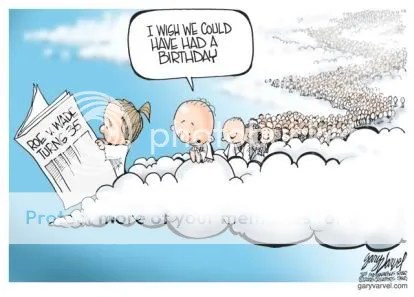
It is sad that over 55 million unborn babies have been aborted in this country. This editorial cartoon makes a very good point.

(Francis did a great job in his film series “How Should we then live?” in looking at how humanism has affected art and culture in the Western World in the last 2000 years. My favorite episodes include his study of the Renaissance, the Revolutionary age, the age of Nonreason, and the age of Fragmentation.)

Related posts:

Francis Schaeffer’s “How should we then live?” Video and outline of episode 10 “Final Choices” (Schaeffer Sundays)

E P I S O D E 1 0   Dr. Francis Schaeffer – Episode X – Final Choices 27 min FINAL CHOICES I. Authoritarianism the Only Humanistic Social Option One man or an elite giving authoritative arbitrary absolutes. A. Society is sole absolute in absence of other absolutes. B. But society has to be […]

Francis Schaeffer’s “How should we then live?” Video and outline of episode 9 “The Age of Personal Peace and Affluence” (Schaeffer Sundays)

E P I S O D E 9 Dr. Francis Schaeffer – Episode IX – The Age of Personal Peace and Affluence 27 min T h e Age of Personal Peace and Afflunce I. By the Early 1960s People Were Bombarded From Every Side by Modern Man’s Humanistic Thought II. Modern Form of Humanistic Thought Leads […]

Francis Schaeffer’s “How should we then live?” Video and outline of episode 8 “The Age of Fragmentation” (Schaeffer Sundays)

E P I S O D E 8 Dr. Francis Schaeffer – Episode VIII – The Age of Fragmentation 27 min I saw this film series in 1979 and it had a major impact on me. T h e Age of FRAGMENTATION I. Art As a Vehicle Of Modern Thought A. Impressionism (Monet, Renoir, Pissarro, Sisley, […]

Francis Schaeffer’s “How should we then live?” Video and outline of episode 7 “The Age of Non-Reason” (Schaeffer Sundays)

E P I S O D E 7 Dr. Francis Schaeffer – Episode VII – The Age of Non Reason I am thrilled to get this film series with you. I saw it first in 1979 and it had such a big impact on me. Today’s episode is where we see modern humanist man act […]

Francis Schaeffer’s “How should we then live?” Video and outline of episode 6 “The Scientific Age” (Schaeffer Sundays)

E P I S O D E 6 How Should We Then Live 6#1 Uploaded by NoMirrorHDDHrorriMoN on Oct 3, 2011 How Should We Then Live? Episode 6 of 12 ________ I am sharing with you a film series that I saw in 1979. In this film Francis Schaeffer asserted that was a shift in […]

Francis Schaeffer’s “How should we then live?” Video and outline of episode 5 “The Revolutionary Age” (Schaeffer Sundays)

E P I S O D E 5 How Should We Then Live? Episode 5: The Revolutionary Age I was impacted by this film series by Francis Schaeffer back in the 1970′s and I wanted to share it with you. Francis Schaeffer noted, “Reformation Did Not Bring Perfection. But gradually on basis of biblical teaching there […]

Francis Schaeffer’s “How should we then live?” Video and outline of episode 4 “The Reformation” (Schaeffer Sundays)

Dr. Francis Schaeffer – Episode IV – The Reformation 27 min I was impacted by this film series by Francis Schaeffer back in the 1970′s and I wanted to share it with you. Schaeffer makes three key points concerning the Reformation: “1. Erasmian Christian humanism rejected by Farel. 2. Bible gives needed answers not only as to […]

“Schaeffer Sundays” Francis Schaeffer’s “How should we then live?” Video and outline of episode 3 “The Renaissance”

Francis Schaeffer’s “How should we then live?” Video and outline of episode 3 “The Renaissance” Francis Schaeffer: “How Should We Then Live?” (Episode 3) THE RENAISSANCE I was impacted by this film series by Francis Schaeffer back in the 1970′s and I wanted to share it with you. Schaeffer really shows why we have so […]

Francis Schaeffer’s “How should we then live?” Video and outline of episode 2 “The Middle Ages” (Schaeffer Sundays)

  Francis Schaeffer: “How Should We Then Live?” (Episode 2) THE MIDDLE AGES I was impacted by this film series by Francis Schaeffer back in the 1970′s and I wanted to share it with you. Schaeffer points out that during this time period unfortunately we have the “Church’s deviation from early church’s teaching in regard […]

Francis Schaeffer’s “How should we then live?” Video and outline of episode 1 “The Roman Age” (Schaeffer Sundays)

Francis Schaeffer: “How Should We Then Live?” (Episode 1) THE ROMAN AGE   Today I am starting a series that really had a big impact on my life back in the 1970′s when I first saw it. There are ten parts and today is the first. Francis Schaeffer takes a look at Rome and why […]

Chris Edwards: “Over the decades, federal efforts to subsidize and manipulate the economy have failed over and over again”

___________

Chris Edwards: “Over the decades, federal efforts to subsidize and manipulate the economy have failed over and over again.”

November 6, 2013 10:04AM

The Sickness of Government

People shouldn’t be surprised about the botched roll-out of Obamacare and all the damaging effects of the law that are now generating headlines. Over the decades, federal efforts to subsidize and manipulate the economy have failed over and over again.

That lesson has been driven home to me in researching Downsizing Government. Farm policies, for example, have been an ongoing boondoggle for more than eight decades. President Herbert Hoover’s Federal Farm Board blew $500 million trying to stabilize crop markets, but it did the opposite by inducing overproduction and depressing prices. Every farm bill since then—including the one moving through Congress right now—has been based on two very dumb ideas: that farm businesses need welfare and that agriculture needs government central planning.

I recently came across “The Sickness of Government,” (PDF) a 1969 essay by famed management theorist Peter Drucker. It is strikingly relevant to the problems we see in Washington today from Obamacare, to farm programs, to IRS abuse, to NSA spying. Unlike, say, Ayn Rand–who at the time was writing about government from the standpoint of individual freedom–Drucker was writing from the practical perspective that Big Government simply wasn’t working.

Here are some excerpts from Drucker, but his whole essay is worth reading:

“Government surely has never been more prominent than today. The most despotic government of 1900 would not have dared probe into the private affairs of its citizens as income tax collectors now do routinely in the freest society. Even the tsar’s secret police did not go in for the security investigations we now take for granted.”…

“For seventy years or so – from the 1890’s to the 1960’s – mankind, especially in the developed countries, was hypnotized by government. We were in love with it and saw no limits to its abilities, or to its good intentions.”

“This belief has been, in effect, only one facet of a much more general illusion from which the educated and the intellectuals in particular have suffered: that by turning tasks over to government, conflict and decision would be made to go away. Once the “wicked private interests” had been eliminated, a decision as to the right course of action would be rational and automatic. There would be neither selfishness nor political passion. Belief in government was thus largely a romantic escape from politics and from responsibility.”

“The greatest factor in the disenchantment with government is that government has not performed. The record over these last thirty or forty years has been dismal. Government has proven itself capable of doing only two things with great effectiveness. It can wage war. And it can inflate the currency.”

“The best we get from government in the welfare state is competent mediocrity. More often we do not even get that; we get incompetence such as we would not tolerate in an insurance company. In every country, there are big areas of government administration where there is no performance whatever – only costs.”

“Modern government has become ungovernable. There is no government today that can still claim control of its bureaucracy and of its various agencies. Government agencies are all becoming autonomous, ends in themselves, and directed by their own desire for power, their own narrow vision rather than by national policy.”

“We are very good at creating administrative agencies. But no sooner are they called into being than they become ends in themselves, acquire their own constituency as well as a “vested right” to grants from the treasury, continuing support by the taxpayer, and immunity to political direction. No sooner, in other words, are they born than they defy public will and public policy.”

“Nothing in history, for instance, can compare in futility with those prize activities of the American government, its welfare policies and its farm policies. Both policies are largely responsible for the disease that they are supposed to cure.”

In the essay, Drucker’s solution for government is decentralization and “reprivatization,” which today is called privatization. Based on his views in this article, he is no libertarian. His conclusions about government are practical in nature, stemming from his long experience studying how organizations work.

I find it depressing that more people don’t share my understanding of individual freedom, the Constitution, and limited government. But it is also depressing that Drucker-style common sense ideas about government failure have so little penetrated the nation’s governing elite. After all these decades, too many people are still “in love” with government and, indeed, “hypnotized” by it, as Drucker noted.

For more of Drucker’s analysis of government, see this 1995 article on Al Gore’s Reinventing Government effort.

Related posts:

Open letter to President Obama (Part 432) A suggestion to cut some wasteful spending out of the government Part 2 (includes editorial cartoon)

(Emailed to White House on 3-15-13.) President Obama c/o The White House 1600 Pennsylvania Avenue NW Washington, DC 20500 Dear Mr. President, I know that you receive 20,000 letters a day and that you actually read 10 of them every day. I really do respect you for trying to get a pulse on what is […]

Dear Senator Pryor, here are some spending cut suggestions (“Thirsty Thursday”, Open letter to Senator Pryor)

Senator Pryor pictured below:  Why do I keep writing and email Senator Pryor suggestions on how to cut our budget? I gave him hundreds of ideas about how to cut spending and as far as I can tell he has taken none of my suggestions. You can find some of my suggestions here, here, here, here, here, here, here, here, here, here, here, here, here, here, here, here, here, here, here,  here, and  here, and they […]

Open letter to President Obama (Part 430) A suggestion to cut some wasteful spending out of the government Part 1 (includes editorial cartoon)

(Emailed to White House on 3-15-13.) President Obama c/o The White House 1600 Pennsylvania Avenue NW Washington, DC 20500 Dear Mr. President, I know that you receive 20,000 letters a day and that you actually read 10 of them every day. I really do respect you for trying to get a pulse on what is […]

The Dysfunction in Washington is Republicans and Democrats that are unwilling to cut spending in order to vote for more programs (Democrats want more food stamps etc but Republicans vote for their pet programs and wars too like No Child Left Behind Act, the Iraq war, the prescription drug entitlement, and the TARP bailout).

The Dysfunction in Washington is Republicans and Democrats that are unwilling to cut spending in order to vote for more programs (Democrats want more food stamps etc but Republicans vote for their pet programs and wars too like No Child Left Behind Act, the Iraq war, the prescription drug entitlement, and the TARP bailout). If […]

Dear Senator Pryor, here are some spending cut suggestions (“Thirsty Thursday”, Open letter to Senator Pryor)

Senator Pryor pictured below:  Why do I keep writing and email Senator Pryor suggestions on how to cut our budget? I gave him hundreds of ideas about how to cut spending and as far as I can tell he has taken none of my suggestions. You can find some of my suggestions here, here, here, here, here, here, here, here, here, here, here, here, here, here, here, here, here, here, here,  here, and  here, and they […]

If you want to cut wasteful spending then the disability program must be reformed radically!!!

If you want to cut wasteful spending then the disability program must be reformed radically!!! October 7, 2013 1:19PM 60 Minutes Disability Investigation By Chris Edwards Share The abuse and overspending in government disability programs is so bad that even National Public Radio and 60 Minutes have taken notice. On the heels of this excellent […]

If you really want to cut wasteful spending then why not shut down Dept of Housing and Urban Development, Dept of Education and SBA?

If you really want to cut wasteful spending then why not shut down Dept of Housing and Urban Development, Dept of Education and SBA? There are many other areas that should be cut but these should be shut down!!!   October 7, 2013 4:57PM Close Washington to Dismantle the Welfare-Warfare State By Doug Bandow Share […]

Dear Senator Pryor, here are some spending cut suggestions (“Thirsty Thursday”, Open letter to Senator Pryor)

Senator Pryor pictured below:  Why do I keep writing and email Senator Pryor suggestions on how to cut our budget? I gave him hundreds of ideas about how to cut spending and as far as I can tell he has taken none of my suggestions. You can find some of my suggestions here, here, here, here, here, here, here, here, here, here, here, here, here, here, here, here, here, here, here,  here, and  here, and they […]

We need to stop wasteful government spending by privatizing the post office!!

We need to stop wasteful government spending by privatizing the post office!! Postal Service Won’t Shut Down but Will Default on Its Debt James Gattuso October 1, 2013 at 9:30 am Newscom The U.S. Postal Service (USPS) defaulted on its debt last night. No, it has nothing to do with the partial shutdown of the […]

We need to stop the stupid spending by Bureaucrats!!!

We need to stop the stupid spending by Bureaucrats!!!   Bureaucrats Gone Wild: Government Spends Recklessly as Fiscal Year Ends Rob Bluey September 29, 2013 at 1:55 pm Credit: Tetra Images/Newscom Washington’s reckless spending is driving America into debt — and yet federal bureaucrats continue their wasteful and frivolous ways. The latest example comes courtesy […]

By Everette Hatcher III | Posted in spending out of control | Edit | Comments (0)

Brian Welch of Korn and his Christian conversion and deliverance from drugs Part 4

Brian Welch of Korn and his Christian conversion  and deliverance from drugs Part 4

_________

brian welch testimony

Korn – Did my time

Uploaded on Jun 27, 2009

Korn – Did my time (Lara Croft Tomb Raider : The Cradle of Life SoundTrack)

________________________

Pulp Fiction (3D, HD) – Overdose Needle Scene in optional Analglyph 3D (b)

Brian ‘Head’ Welch: ‘Life Is About Drugs And Mistakes’

artist: Brian Welch date: 11/21/2011 category: interviews
I like this
103
voted: 13
Brian 'Head' Welch: 'Life Is About Drugs And Mistakes'
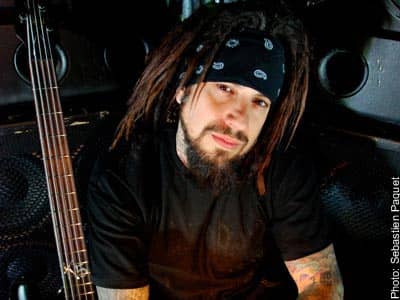
When BrianHeadWelch crawled out of Korn in 2005 he was addicted to drugs and an alcoholic. He finally pulled himself together and in 2008 released Save Me From Myself, a solo album full of dark synths, epic-length songs and tunes all sung by Head himself. Now three years later Welch has returned to the studio to record his follow-up album [maybe an EP]. “Paralyzed” is the first single from the upcoming record and it is a brutal vision punctuated by the staccato guitars Head made famous in Korn. The vocals rise to nasty growls and descend into melodic passages revealing how capable the ex-Kornman is as a vocalist. It has not been an easy road. Sober now for many years, Head looks back at his first solo album, his time with Korn and reflects on those moments with a clear head. He was unabashedly open in this conversation and didn’t try to cover up the things he’d done with smoke and mirrors. As further testament to his newfound sense of professionalism, he called precisely at 1:30 p.m. for our interview. The phone rang, I picked it up and someone on the other end said, “Hi, this is Ed.” I said, “Oh, man, I’m sorry I’m waiting for a call from Brian Welch. Could you please hang up?” There was a laugh on the other end. “This is Head.” The connection wasn’t great and I thought the voice had uttered, “Ed.” He had a laugh and we jumped into the dialog. UG: You left Korn in 2005 and didn’t record Save Me From Myself, your first solo album until 2008. What were you doing for those three years? Brian Welch: First of all I wanted to focus on my life and what I was doing and Who am I now? I was a single father so I was taking care of that. I was working on music off and on and I also wrote a book in 2006 and the whole year I spent writing my autobiography [Save Me From Myself]. So that kept me busy and just doin’ the everyday dad stuff, the school, and that stuff. When did you seriously start thinking about putting together your first solo album? I was thinkin’ about it since ’05 since right when I left but it wasn’t nothin’ in a rush. It just kinda took its time and then it finally was done. Like I was happy with it and it was good enough to release for ’08 and that’s just kinda when it all came together. Were any of the songs that ended up on Save Me From Myself stuff you had written for Korn? I wrote it after I left the band and it was more like an experimental album and there a lot of songs were about my life change and everything. Just being fed up with the party and stuff like that; it was for that time period. In what ways was the album experimental? It was my first one so I was experimenting with like singing and all kinds of stuff. There’s one nine-minute song on the album and a lot of five- and six-minute songs. There was just like stuff we [Korn] would never do like before. I experimented with string sounds a lot of keyboard synth sounds and we never did that. So it was just like one of those albums I just wanted to do new stuff. You brought in Josh Freese on drums and Tony Levin on basswere you looking for something special in a rhythm section? Yeah, totally. My manager at the time knew those people and stuff and so it just kind of clicked and it just happened. And it was fun to see these legends in there tearin’ it up on my stuff. It was good times.

With the Korn guys we were all family but we were dysfunctional and we were drunk the whole time.

You used a rhythm guitarist on the albumArchie J. Muise, Jr.but did you play most of the guitars on Save Me From Myself? Yeah, totally. I did a lot of em but Archie came in and he was nailin’ some stuff better than me on some of the rhythms so I was like, You need to record some stuff. But I did most of it. In Korn, you and Munky did all the guitars together. How different was it being the sole guitar player in the band? Yeah, it was different. It was more on my plate that I had to come up with the stuff like that. Sure, with the Korn guys we were all family but we were dysfunctional and we were drunk the whole time. So it was good to get away from the craziness but I sure missed havin’ someone to collaborate with like that but it was cool. It was new and exciting so I just went for it. You talk about Korn being drunk pretty much all the time. How was the band able to function in the studio if everyone was drinking? We wouldn’t get wasted while we were recording. We’d wake up, most likely have a hangover and stuff like that, and just kinda wake up, eat and just start recording. And not really start drinkin’ til after; we would keep it together. Certainly one of the experimental aspects of Save Me From Myself was you being the lead singer. Were you influenced by watching Jonathan Davis record all those years? Yeah, totally. Some of the stuff where I’m singin’ now, I’m not the best singer so you know how Jonathan sounds sick sometimes when he sings? He sounds disturbed. And so, yeah, I get a lot of that dark sound like that. It just kinda goes with the style that we do. I learned a lot watchin’ him and a lot of the other bands like the Deftones and Tool and stuff like that. Had you done much singing in Korn? I did some screams and I did a couple backups live but I didn’t do a lot on the records except for the early records like the first two. You knew you wanted to be the singer on your album? Yeah, the reason being I wanted to speak about stuff I went through and I didn’t want another person to do that. It would be weird so yeah, I wanted to try it. I always admired vocalists and it was a cool thing for me to try and do. It was awesome. Flush was the first single from Save Me From Myself. Was that song chosen specifically to sort of introduce Head musically post-Korn? Yeah, and some of the other songs were more spiritual sounding you know. I wanted to release one that was more like just rockin’ and just talkin’ about getting sick of being sick. Steven Tyler said once, I’m sick and tired of being sick and tired. That’s kinda what the song’s about and so I thought it would be a good choice to come out with. The video was pretty heavy. Were you concerned about alienating some of your fans? I wanted to do somethin’ visual; I wanted to do a video but I didn’t have my band picked out yet so it was just me. We just did what we could with it. It was pretty heavy but that’s the life. We did interviews with some ex-drug addicts and strippers and all these messed up lives so we just built the video around that. We got some actresses and it was a little heavy but I think it was meant to be for the time. Bob Clearmountain mixed Save Me From Myself. How did you come to work with him? Again that was a manager call. He’s very like well known and everything but I’d never heard of him. My manager was a fan of him and I heard of the artists he’d worked with [Bruce Springsteen; The Rolling Stones; Bon Jovi] and I said, Heck, yeah, let’s go get him. He only mixed four songs and then a friend of mine did the others. How did you feel about your guitar sounds on Save Me From Myself? They’re good and I liked em. I think I’m getting better sounds now on my new stuff. I like the sound of the new song Paralyzed that I put out. The Save Me From Myself record was cool and I had a lot of cool pedal effects and stuff that reminded me of some of the Korn stuff we used to do. But as far as rhythms and stuff I really like the tones we’re getting right now. Washed By Blood was the nine-minute song you mentioned earlier. That had synth strings and big walls of guitars and was a really different-sounding track. Yeah, totally. I just loved the melody and the strings and stuff and that’s how I was feeling back then. I was feeling like peace and I was feelin’ really good about the future. So that’s what came out and it was really good for the time. Is there a fine line between writing songs about your own life and having a lyric come across as too preachy or artificial? Yeah, totally and the new stuff is more about life. Not totally but you’ve got to live and learn. You know what I mean? Everybody warned me too and I was, I don’t care. I’m doing what I want. But I had to do everything in my time. You talked about getting better guitar sounds on the upcoming recorddid you also want to go a bit heavier than Save Me From Myself? Yeah, the producer Jasen Rauch wanted to pull that out of me. That song just came so quickly and he came to me with the idea and then we both worked on it. I’m really stoked on it; it’s really a lot of energy comes when we play live. I’ve been playing it live for a month and I’m really stoked on it. How did you come to work with Jasen Rauch? I signed on with Union Management, the Union Entertainment Group actually, and he’s one of their clients and I liked the band, Red. I liked their stuff so it was just a natural progress that we hooked up. Once we did it it just clicked and we had two songs in three days that I’m really just stoked on. So I’m hitting the studio and looking to finish an EP or an album by November 7th. Who are the musicians on the album? The guys in my band are Michael Valentine playing bass; Dan Johnson on the drums and J.R. is playing guitar too.

I just want the best-sounding product so it’s all working better and it’s gonna be the best thing.

Is this record taking a more band approach than the Save Me From Myself record where you tended to do a lot of it by yourself? Uh, yeah, we’ll track it all separately but it’s all different now because my solo album was all me and that’s how I wanted it to sound and I did that and it was cool and I’m glad. But this time I’m givin’ it to the producer and allowing him to produce me and write with other people. I just want the best-sounding product so it’s all working better and it’s gonna be the best thing. The writing has been going smoothly? Yeah, we’ll have a few done before this year is done; we’ll have like six or seven. Would you mind commenting on some of the Korn stuff? Yeah, no problem. The first Korn record was pretty important in the development of that type of music. When you were making Korn, did you have any idea of what you were creating? A little bit but there was no way no one could predict the impact it had. We knew that it was special and there was a couple people that came to the studio like this guy named McG who is a movie producer now who did Charlie’s Angels. He hadn’t done nothin’ when we met him and he was just a friend of one of the guys that we hooked up with through the record. He came and listened to it while we were recording and he was like, Dude, this stuff is gonna be huge and we’re like, What? You’re crazy. He said, It doesn’t sound like nothin’ out there and sure enough he was right. He did our videos and later on he blew up too and he’s doin’ movies now. Yeah, we knew we had something unique but we didn’t know it was gonna impact that hard. What was it like playing guitar with Munky on that first record? That was always when we were jammin’ in the studio. That was always live and we’d write the songs live. Nowadays it’s differentyou write it on computer and do that but back then it was just get in a room with a bunch of friends, get some beers and jam out. So that was how we did it and it was really fun back then. The first time an audience really heard Korn was with Blind, the first single. Was that a good representation of who the band were at that time? I think it’s really cool; it’s so different. Even now I play Blind in my set. I love some of the stuff we did and I play two or three songs in my set of Korn’s just because I like it and I’m proud of it. So that was a really cool song because it had a fat riff and the verses were really melodic and everything and a chorus that grooved. So I think it was a good introduction song to Korn fans. When you look at the Greatest Hits, Vol. 1 album, how does that collection of songs stand up for you today? Yeah, it’s a trip and it’s humbling. Just really stoked because there’s a lot of musicians out there that are better than us that are just rippers and are just so good. And for us to make it so successful it’s almost a crime. But we did have a unique sound and stuff like that but it’s just funny how we were just these dudes partying, having fun and making music and we just made it so big. I’m pretty thankful to be part of it. What do you remember about recording A.D.I.D.A.S.? Actually it’s funny cause I called in sick that day and they all wrote it without me. There’s like that one and Y’All Want A Single off a later record [Untouchables] and two others off later records that I wasn’t a part of cause I was sick and I didn’t come in. It was a drug sicknessI did drugs the night before and stuff like that so I lied to them at the time cause I didn’t want to feel like a loser [laughs]. I wasn’t a part of that song but I remember they wrote it and A.D.I.D.A.S. stands for all day I dream about sex and they were all reminiscing about their childhood and how they used to say that in school. So everybody was excited about that and I liked it and it was a really cool melody and the guitar part was pretty catchy. The nrr nrr nrr nrr nrr, that thing was catchy. Look In the Mirror album was your last record with Korn. As your final statement with them what do you think about the album? I was on drugs that whole recordI was on crystal methamphetamine. You asked earlier about the studio and I was really havin’ hard time in the studio then. I think that it shows. I think it’s lacking the production and I think it’s not good at all. It’s one of our least-selling records. There are a couple of okay songs but I just really don’t like the drum sounds. It wasn’t horrible or nothin’ but it’s just one of my least favorites and it was in my darkest times so I don’t think it held up as much. I wrote some stuff but I just wasn’t in my primeI was definitely lacking then. So eventually the drugs really did impact on the band. Yeah, totally. In the beginning it didn’t with the alcohol but the drugs took us all down later on in one way or another. It’s strange that bands don’t get into drugs until after they’ve become successful. You’d think that when a band is fighting to become successful is when the drugs and drinking would happen. It’s just a party and everyone wants to party with the band after the show. And everybody wants to go hang out with the girls and stuff and it’s a cycle that most bands go through. It’s pretty jacked up.

There was no way no one could predict the impact the first Korn record had.

If Korn hadn’t been pulled apart by drugs and you stayed with them, what kind of music do you think you’d be making now? I think everything happened the way it was meant to be so I don’t really think about that. I’m glad it happened actually because I got humbled by it and it taught me about what life is really aboutabout drugs and mistakes. Do you talk to any of the guys in Korn? Yeah, totally. Jonathan and Fieldy came and visited us at a solo show about a month ago but I haven’t seen the guitar player, Munky, though. I haven’t seen him or talked to him since ’05. I think there’s some bitterness on his part about that still but we got nothin’ but good vibes towards each other and we’re just doing our own thing. Did you hear any of the last Korn album? Yeah, there’s a couple songs I liked. They’re still doin’ it and I’m proud of em. I interviewed Munky a while ago and he really had nothing but positive things to say about you. Oh, that’s cool. He’s up and down you know. I went and hung out with Jonathan and stuff like that and I just heard about some comments he made because they were talking about us getting back together and stuff. I don’t wanna do thatI’m doin’ my solo stuff and I’m happy doin’ the smaller things that I’m doing. And I have no desire but I heard the comments saying that, I don’t wanna talk to him. We made four records without him. So he’s up and down a little but I think overall we’ve got nothin’ but love for each other. His bitterness about you leaving was probably because he was really hurt when you left. I totally agree with you. You’re finishing up your tour now? Yeah, we have one more show with the band, Red, and then we’re off into the studio for the next three months. I’ll be glad to get home. I’m so stokedI’ve got some good ideas and I’m just really excited to get some new stuff done. Dude, I’m like done playing these songs liveI need new material. I mean it’s ’08 and I’m tourin’ on these songs. I’ve got one single out, Paralyzed a month ago so I’m at my wits end. But I’ve been building up the fanbase and stuff like that so it’s a good time to get some new music. Interview by Steven Rosen Ultimate-Guitar.Com 2011

Related posts:

Jim Morrison’s sad drug death was followed by Pamela Courson’s sad story!!!

Jim Morrison’s sad drug death was followed by Pamela Courson’s sad story!!! pamela courson/ jim morrison interview   Interview with Jim Morrison’s father and sister Uploaded on Aug 9, 2010 This interview is from “When You’re Strange” DVD bonus material. I do not own this video and own no rights to it! Pamela Courson Uploaded […]

I’m Waiting for the Man sung by Nico in 1982 (about waiting for drug fix)

__________ NICO – I’m Waiting For The Man – (1982, Warehouse, Preston, UK)   One of the top 10 songs from The Velvet Underground and Nico is the song “I’m Waiting for the Man I’m Waiting for the Man From Wikipedia, the free encyclopedia Jump to: navigation, search “I’m Waiting for the Man” Song by […]

The life of Lou Reed (includes videos from 1960′s and 1970′s)

The life of Lou Reed (includes videos from 1960′s and 1970′s) ____________ Rock & Roll – Velvet Underground The Velvet Underground – Venus in Furs – Live 1) Lou Reed – Sweet Jane – live in Paris, 1974 Velvet Underground-”Sunday Morning” from “Velvet Underground and Nico” LP Lou Reed From Wikipedia, the free encyclopedia Jump […]

Jim Morrison’s relationship with Nico

Jim Morrison’s relationship with Nico   Nico Icon documentary part 1. Nico Icon documentary part 2. ______________ Jim Morrison at Andy Warhol’s Party.wmv (with Nico) Uploaded on Apr 26, 2010 From the Oliver Stone movie. The Doors. _______________________ nico discusses jim morrison. Uploaded on Jan 2, 2008 nico discusses jim, and how he impacted her […]

Pictures and Videos of Edie Sedgwick and the story of her losing battle against drugs and alcohol Part 2

Pictures and Videos of Edie Sedgwick and the story of her losing battle against drugs and alcohol Part 2 Drugs and alcohol have taken the life of many people and I have posted many times about their unfortunate deaths. Whitney Houston, Amy Winehouse, Gary Thain, Janis Joplin, Jimi Hendrix, Brian Jones, Kurt Cobain, and Jim […]

Pictures and Videos of Edie Sedgwick and the story of her losing battle against drugs and alcohol Part 1

Pictures and Videos of Edie Sedgwick and the story of her losing battle against drugs and alcohol Part 1 Factory Girl – The Real Edie Uploaded on Aug 30, 2011 Friends and family of Edie Sedgwick discuss what the factory girl was really like, and the battles and relationships she went through _____________ Edie Sedgwick Excerpt […]

Crystal Bridges Museum of American Art opens on 11-11-11

  Around 4 years ago I was in Philadelphia and the local radio station had a talk show that was blasting Alice Walton for coming into town and buying  the 1876 Thomas Eakins’ masterpiece “The Gross Clinic” which was hanging at the  Jefferson Medical College. However, the people of Philadelphia were given 45 days to […]

By Everette Hatcher III | Posted in Arkansas Times, Current Events | Tagged , , , , , , | Edit | Comments (0)

Open letter to President Obama (Part 449) (Paul Greenberg on abortion and Dr. C.Everett Koop’s passing, includes cartoon)

Open letter to President Obama (Part 449)

(Emailed to White House on 4-9-13.)

President Obama c/o The White House 1600 Pennsylvania Avenue NW Washington, DC 20500

Dear Mr. President,

I know that you receive 20,000 letters a day and that you actually read 10 of them every day. I really do respect you for trying to get a pulse on what is going on out here.

Mr. President Paul Greenberg used to be pro-abortion just like you but he met a man named Mike Huckabee that challenged him on that and he changed his view. I have included Greenberg’s story below.

___________________

Dr. C. Everett Koop on Baby Doe, euthanasia, abortion

Uploaded on Nov 3, 2008

Dr. Koop answers questions on Baby Doe, euthanasia and abortion during interview at Wheaton College, Wheaton, IL http://www.christianethics.org

Dr. Koop with Al Gore in the White House pictured above.

On 2-25-13 we lost a great man when we lost Dr. C. Everett Koop. I have written over and over the last few years quoting Dr. C. Everett Koop and his good friend Francis Schaeffer. They both came together for the first time in 1973 when Dr. Koop operated on Schaeffer’s daughter and as a result they became close friends. That led to their involvement together in the book and film series “WHATEVER HAPPENED TO THE HUMAN RACE?” in 1979.

Paul Greenberg
Posted:  03/07/2013 12:12 AM

The surgeon general of the United States needn’t be a surgeon. And he may be a general — or admiral — only in name. The rank is essentially a civil office — despite the dress whites and gold braid. Indeed, it was largely an honorary title before Ronald Reagan chose a physician by the name of C. Everett Koop for the appointment.

Dr. Koop, who died last week at the grand old age of 96, was indeed a surgeon and a fine one (his specialty was pediatric surgery at Children’s Hospital in Philadelphia), and he soon became a household name. And a target of equal-but-opposite denunciations from both ends of the political spectrum.

The rabid right didn’t like his crusade against AIDS — he spoke of it openly and treated it as a disease instead of a moral failing — and his campaign for sex education, saying words like condom out loud. Shocking. As for the pro-abortion left — excuse us, the pro-choice left — it objected to his unswerving reverence for human life.

Together with Francis Schaeffer, the doctor would write a small classic of the pro-life movement (“Whatever Happened to the Human Race?”) in which he would say all manner of politically incorrect things, however prophetic. For example:

“Once the value of human life has been depreciated, as in Roe v. Wade and the Baby Doe Case, no one is safe. Once ‘quality of life’ is substituted for the absolute value of human life itself, we all are endangered. Already respected scientists are calling for a time period following birth (a week or so) to decide if newborns have ‘sufficient quality of life’ to be allowed to live. Already committees of ‘medical professionals’ would like to decide whether the ‘quality of life’ of the elderly or anyone seriously ill is high enough to allow them to go on living.”

Dr. Koop had foreseen “death panels” long before the idea had become a volatile topic of political debate — and understood the fatal potentialities in stylish clichés like quality-of-life. It wasn’t just in the medical journals, where he documented his pioneering work as a pediatric surgeon in numerous articles, but in the nation’s conscience that C. Everett Koop left his mark.

The doctor never let his faith interfere with his science, or his science with his faith. He was true to both. He never saw any need to reconcile them because they didn’t conflict. But supported each other. Like intelligence and conscience.

If any of the good doctor’s stands aroused more ire than his views on abortion and the rights of handicapped children, it was his campaign against smoking, which did not please the tobacco industry and powerful lobby, not at all. It was during his tenure as surgeon general — in 1988 — that his office released an irrefutable study on the addictive powers of tobacco.

As early as 1984, the doctor had challenged Americans to “create a smoke-free society in the United States by the year 2000.” The prospect seemed a fantasy then, but year by year, it became closer to reality as this country led the world in fighting the noxious weed. Just during his time as surgeon general, smoking rates in this country dropped from 38 percent to 27 percent. He fought Big Tobacco with scientific evidence, political savvy and, perhaps most effective, social ostracism. He helped made smoking unfashionable, and fashion can be all in such a fight.

Dr. Koop may have made his errors of judgment. For example, he got entirely too close, too profitably to the manufacturers of some of the health products he’d helped develop. But his campaign against smoking, including the second-hand variety, was no mistake; it was more a vision achieved.

As surgeon-in-chief at Children’s, he not only established innovative programs but taught, wrote and generally educated. He proceeded to do much the same as surgeon general of the United States, only on a larger scale and with a host of critics attacking his every pronouncement as he turned his office into a bully pulpit. He remained undaunted. And the target of angry critics. Like any man who takes a stand on moral issues.

Dr. Koop caught it from both sides — the Advanced Thinkers and the Bible Thumpers, too. And he didn’t seem to mind at all. Neither did President Reagan, who stuck by the doc throughout his long and controversial tenure as surgeon general. By its end, whatever Americans might think about his science or religion (he was what used to be called an Iron Presbyterian), he was universally admired and trusted. With that Amish-style beard and family-doctor manner, he’d become a kind of American institution. They called him the nation’s doctor — which is what he had become.

________________

In the film series “WHATEVER HAPPENED TO THE HUMAN RACE?” the arguments are presented  against abortion (Episode 1),  infanticide (Episode 2),   euthenasia (Episode 3), and then there is a discussion of the Christian versus Humanist worldview concerning the issue of “the basis for human dignity” in Episode 4 and then in the last episode a close look at the truth claims of the Bible.

In this 1979 film series they dealt with the big social issues and predicted what social problems we have in the future because of humanism. For instance, they knew that the Jack Kevorkians of the world would be coming down the pike. They predicted that there was a slippery slope from abortion to infanticide to youth euthanasia brought on by the materialistic worldview.

Dr. C. Everett Koop is pictured above.

Francis Schaeffer Whatever Happened to the Human Race (Episode 1) ABORTION

Francis Schaeffer: What Ever Happened to the Human Race? (Full-Length Documentary)


Part 1 on abortion runs from 00:00 to 39:50, Part 2 on Infanticide runs from 39:50 to 1:21:30, Part 3 on Youth Euthanasia runs from 1:21:30 to 1:45:40, Part 4 on the basis of human dignity runs from 1:45:40 to 2:24:45 and Part 5 on the basis of truth runs from 2:24:45 to 3:00:04

Francis Schaeffer “BASIS FOR HUMAN DIGNITY” Whatever…HTTHR

It is a fact that President Obama has done everything in his power to advance abortion rights as this editorial cartoon shows.

Dr. Koop.

C. Everett Koop

______________________

Thank you so much for your time. I know how valuable it is. I also appreciate the fine family that you have and your commitment as a father and a husband.

Sincerely,

Everette Hatcher III, 13900 Cottontail Lane, Alexander, AR 72002, ph 501-920-5733, lowcostsqueegees@yahoo.com

Related posts:

Remembering Dr. C. Everett Koop with pictures and quotes Part 4 (funny editorial cartoon too)

Dr. Koop Gary Brookings of the Richmond Times Dispatch did a very funny editorial cartoon about the time in 1988 when Dr. C. Everett Koop sent the unapproved mail  piece out to millions of homes about AIDS. There were many such cartoons at the time since everyone knew Dr. Koop got the mail piece out […]

Remembering Dr. C. Everett Koop with pictures and quotes Part 3 ( three more editorial cartoons too)

Dr. Koop with Hillary Clinton In 1980 I really was influenced at my highschool by a teacher of mine named Mark Brink. He introduced me to the film series “Whatever happened to the human race?” by Francis Schaeffer and Dr. C. Everett Koop. In this  film series that came out in 1979 they dealt with […]

Remembering Dr. C. Everett Koop with pictures and quotes Part 2 (Doonesbury cartoon by Gary Trudeau included)

Dr. Koop On 2-25-13 we lost a great man when we lost Dr. C. Everett Koop. I have written over and over the last few years quoting Dr. C. Everett Koop and his good friend Francis Schaeffer. They both came together for the first time in 1973 when Dr. Koop operated on Schaeffer’s daughter and […]

Remembering Dr. C. Everett Koop with pictures and quotes Part 1

Dr. C. Everett Koop is pictured above. Francis Schaeffer: “Whatever Happened to the Human Race” (Episode 1) ABORTION OF THE HUMAN RACE Published on Oct 6, 2012 by AdamMetropolis Dr. Koop On 2-25-13 we lost a great man when we lost Dr. C. Everett Koop. I have written over and over the last few years […]

Open letter to President Obama (Part 232 B) Dr. C. Everett Koop and Reagan pictured together

Dr. C. Everett Koop with Ronald Reagan. Dr. Koop was delayed in his confirmation by Ted Kennedy because of his film Whatever Happened to the Human Race? President Obama c/o The White House 1600 Pennsylvania Avenue NW Washington, DC 20500 Dear Mr. President, I know that you receive 20,000 letters a day and that you […]

“Sanctity of Life Saturday” Francis Schaeffer and Dr. C. Everett Koop asked Reagan to issue pro-life proclamation in 1983 (includes video ABORTION OF THE HUMAN RACE)

In the film series “WHATEVER HAPPENED TO THE HUMAN RACE?” the arguments are presented  against abortion (Episode 1),  infanticide (Episode 2),   euthenasia (Episode 3), and then there is a discussion of the Christian versus Humanist worldview concerning the issue of “the basis for human dignity” in Episode 4 and then in the last episode a close […]

Dr. C. Everett Koop on abortion’s 1973 Roe v. Wade impact on child abuse

Dr. C. Everett Koop with Ronald Reagan. Dr. Koop was delayed in his confirmation by Ted Kennedy because of his film Whatever Happened to the Human Race? Watch the film below starting at the 19 minute mark and that will lead into a powerful question from Dr. C. Everett Koop. This 1979 film is WHATEVER […]

Open letter to President Obama (Part 221 B) Dr. C. Everett Koop and Francis Schaeffer rightly called abortion “the watershed issue of our era”

 Dr. Koop was delayed in his confirmation by Ted Kennedy because of his film Whatever Happened to the Human Race? Francis Schaeffer February 21, 1982 (Part 1) Uploaded by DeBunker7 on Feb 21, 2008 READ THIS FIRST: In decline of all civilizations we first see a war against the freedom of ideas. Discussion is limited […]

Francis Schaeffer and C. Everette Koop on the Hippocratic oath (March for Life January 20, 2013)

Dr. C. Everett Koop was appointed to the Reagan administration but was held up in the Senate in his confirmation hearings by Ted Kennedy because of his work in pro-life causes. I was thinking about the March for Life that is coming up on Jan 20, 2013  and that is why I posted this today […]

Ronald Wilson Reagan pictured with Dr. C. Everett Koop

High resolution version (11,426,583 Bytes) Description: The photograph is signed by President Ronald Reagan with the inscription “To Chick Koop, With Best Wishes.” Chick, from chicken coop, was the nickname Koop gained will attending Dartmouth College in the mid-1930s. Koop maintained a cordial relationship with President Reagan, despite his disappointment over Reagan’s refusal to address […]

Francis Schaeffer and C. Everett Koop were prophetic (jh29)

Francis Schaeffer and C. Everett Koop were prophetic (jh29) What Ever Happened to the Human Race? I recently heard this Breakpoint Commentary by Chuck Colson and it just reminded me of how prophetic Francis Schaeffer and C. Everett Koop were in the late 1970′s with their book and film series “Whatever happened to the human […]

Should Michele Bachmann be punished for taking pro-life views from Schaeffer and Koop? (March for Life January 20, 2013)

  Dr. C. Everett Koop I was thinking about the March for Life that is coming up on Jan 20, 2013  and that is why I posted this today Secular leaps of faith 39 Comments Written by Janie B. Cheaney August 15, 2011, 2:17 PM I’m willing to cut Ryan Lizza some slack. His profile […]

“Schaeffer Sundays” Francis Schaeffer’s own words concerning humanism and its bad results

Francis Schaeffer: “Whatever Happened to the Human Race?” (Episode 2) SLAUGHTER OF THE INNOCENTS Published on Oct 6, 2012 by AdamMetropolis The 45 minute video above is from the film series created from Francis Schaeffer’s book “Whatever Happened to the Human Race?” with Dr. C. Everett Koop. This book  really helped develop my political views concerning […]

“Sanctity of Life Saturday”:Derek Melleby’s review of the book “Francis Schaeffer: An Authentic Life” (includes film THE BASIS FOR HUMAN DIGNITY)

  I truly believe that many of the problems we have today in the USA are due to the advancement of humanism in the last few decades in our society. Ronald Reagan appointed the evangelical Dr. C. Everett Koop to the position of Surgeon General in his administration. He partnered with Dr. Francis Schaeffer in making […]

Taking on Ark Times bloggers about abortion on the 40th anniversary date of Roe v. Wade (Part 5) “Slavery issue compared to rights of unborn child”

The best pro-life film I have ever seen below by Francis Schaeffer and Dr. C. Everett Koop “Whatever happened to the human race?” Over the years I have taken on the Ark Times liberal bloggers over and over and over concerning the issue of abortion. I asked over and over again for one liberal blogger […]

Taking on Ark Times bloggers about abortion on the 40th anniversary date of Roe v. Wade (Part 4) “How do pro-lifers react to the movie THE CIDER HOUSE RULES?”

Francis Schaeffer pictured above._________ The best pro-life film I have ever seen below by Francis Schaeffer and Dr. C. Everett Koop “Whatever happened to the human race?” Over the years I have taken on the Ark Times liberal bloggers over and over and over concerning the issue of abortion. I asked over and over again […]

Taking on Ark Times bloggers about abortion on the 40th anniversary date of Roe v. Wade (Part 3) “What should be the punishment for abortion doctors?”

The best pro-life film I have ever seen below by Francis Schaeffer and Dr. C. Everett Koop “Whatever happened to the human race?” On 1-24-13 I took on the child abuse argument put forth by Ark Times Blogger “Deathbyinches,” and the day before I pointed out that because the unborn baby has all the genetic code […]

Taking on Ark Times bloggers about abortion on the 40th anniversary date of Roe v. Wade (Part 2) “The pro-abortion child abuse argument destroyed here”

PHOTO BY STATON BREIDENTHAL from Pro-life march in Little Rock on 1-20-13. Tim Tebow on pro-life super bowl commercial. Over the years I have taken on the Ark Times liberal bloggers over and over and over concerning the issue of abortion. Here is another encounter below. On January 22, 2013 (on the 40th anniversary of the […]

Taking on Ark Times bloggers about abortion on the 40th anniversary date of Roe v. Wade (Part 6) For many pro-abortionists ” …the problem is not determining when actual human life begins, but when the value of that life begins to out weigh other considerations”

The best pro-life film I have ever seen below by Francis Schaeffer and Dr. C. Everett Koop “Whatever happened to the human race?” Francis Schaeffer pictured above._________ The 45 minute video above is from the film series created from Francis Schaeffer’s book “Whatever Happened to the Human Race?” with Dr. C. Everett Koop. This book  really […]

Taking on Ark Times bloggers about abortion on the 40th anniversary date of Roe v. Wade (Part 7) “Poverty not good reason for abortion, why not give up for adoption?”

Dr Richard Land discusses abortion and slavery – 10/14/2004 – part 3 The best pro-life film I have ever seen below by Francis Schaeffer and Dr. C. Everett Koop “Whatever happened to the human race?” Over the years I have taken on the Ark Times liberal bloggers over and over and over concerning the issue […]

Taking on Ark Times bloggers about abortion on the 40th anniversary date of Roe v. Wade (Part 1)

Dr Richard Land discusses abortion and slavery – 10/14/2004 – part 3 The best pro-life film I have ever seen below by Francis Schaeffer and Dr. C. Everett Koop “Whatever happened to the human race?” Over the years I have taken on the Ark Times liberal bloggers over and over and over concerning the issue […]

Paul Greenberg became pro-life because we are all “endowed with certain unalienable rights”

On January 20, 2013 I heard Paul Greenberg talk about the words of Thomas Jefferson that we are all “endowed with certain unalienable rights” and the most important one is the right to life. He mentioned this also in this speech below from 2011: Paul Greenberg Dinner Speech 2011 Fall 2011 Issue Some of you […]

How Pulitzer Prize-winning Paul Greenberg, one of the most respected and honored commentators in America, changed his mind about abortion and endorses now the pro-life view

It is not possible to know where the pro-life evangelicals are coming from unless you look at the work of the person who inspired them the most. That person was Francis Schaeffer.  I do care about economic issues but the pro-life issue is the most important to me. Several years ago Adrian Rogers (past president of […]

“Friedman Friday” Milton Friedman’s legacy by John Chapman

July 31, 2012

The Ongoing Importance of Milton Friedman

By John Chapman

Milton Friedman is a superb economist. There are not, and never have been, many.— William R. Allen, Professor of Economics, UCLA

The true test of a scholar’s work is the judgment that is made, not at the time his work is being done, but twenty-five or fifty years later. — Milton Friedman on ‘Meet the Press’ in October, 1976

Today is the centenary anniversary of the birth of Milton Friedman. Born of humble origin in Brooklyn, New York to two Carpatho-Ruthenian (Hungarian/Ukrainian) immigrants on July 31, 1912, Friedman would go on to become a world-famous economist, the 1976 Nobel Laureate, and perhaps second only to John Maynard Keynes in global influence during the 20th century. Like Keynes, Friedman was famous for being a public intellectual as much as he was technical economist, and in fact with his prodigious output across an active career spanning six decades, he far surpassed the master in the latter capacity. As the 20th century economist most associated with notions of free enterprise, classical liberalism, and limited government, Friedman’s life is worth remembering today for whom he was, what he accomplished, and how he might regard the present challenges in the global economy.

As a testament to the broad-based research agenda that undergirded his prolific writings, Friedman’s technical work was as impressive as it was wide-ranging; he made notable contributions in monetary theory and policy, price theory, the consumption function and permanent-income hypothesis, Friedman-Phelps Phillips Curve-related macro-policy theorizing and findings, international finance and exchange rate policy, empirical methodology, and statistical theory and its applications. As a policy intellectual, he made his mark as a founder of the Mont Pelerin Society, with time spent at the American Enterprise Institute, the Hoover Institution at Stanford, associations with the Cato Institute and Heritage Foundation, and as a key advisor to President Reagan for all eight years of Reagan’s term of office. And as a writer and speaker in the popular literature and media, Friedman’s considerable influence stemmed from his 17-year stint as a columnist for Newsweek (often opposite Paul Samuelson), as the author, creator, and narrator of the wildly successful PBS TV-documentary series known as Free to Choose, and as author of several books and monographs written for popular consumption (his two most popular books, Capitalism and Freedom and Free to Choose, were best-sellers and remain in print and widely read).

Among the many policy changes his positions influenced were those pertaining to lower marginal taxation on capital and income, the military draft, flexible exchange rates, monetary policy rules and Federal Reserve behavior, federal spending trajectory, and educational choice (much to his later regret, Friedman also played an important part in the wartime shift of health care delivery to its centering in the tax-advantaged employer-based insurance scheme that became embedded in the U.S. economy after 1943).

At the University of Chicago, Friedman was an inheritor and then keeper of the long tradition in economic theory of what has come to be known as the Chicago School, built by the likes of Frank Knight, Lloyd Mints, Henry Simons, Ronald Coase, and more recently in addition to Friedman, George Stigler, Gary Becker, and Robert Lucas. The Chicago School is notable for rigorous “neoclassical price theory” (which is a fancy way of saying how supply and demand affect prices and output in individual markets) and its policy concomitant, a commitment to a laissez-faire regime and minimal government interference in markets. While Friedman eschewed intellectual or partisan labels, famously saying once that there was only “good” economics and “bad” economics, he nonetheless was, as an outgrowth of his Chicago association and opposition to Keynesian policies, grouped together with those who adhered to the monetarist label.

The monetarists were key figures on the scene in 20th century economics, as they were the first group of researchers to systematically oppose what became the dominant orthodoxy in theory and policy, Keynesianism. In the landmark Monetary History of the United States: 1867-1960, written with his longtime collaborator Anna Schwartz, Friedman showed conclusively that changes in the quantity of money led to shifts in nominal income, and at least in the short run, often in real incomes and output as well. That the line of causality runs from the money stock to impacting nominal GDP – and not the other way around – is now conventional wisdom in economics, but it had enormous policy implications at the time, in the 1960s and ‘70s.

At the time, Keynesian policy-makers felt that shifts in aggregate spending drove changes in the money stock, monetary policy was often ineffective as a policy tool and neutral even in the short run, and that therefore activist fiscal policy should be the predominant tool to use in “managing” the market economy through slumps. Indeed, this view was precursory to the core paradigm of Keynes’ instability thesis regarding the market economy: wild shifts in business investment, driven by changing whims as manifested in investor sentiment, caused the boom-bust business cycle that seemed to be an inherent feature of a modern capitalist economy. Keynesian theory of course borrows the capitalist instability hypothesis directly from Marx, and prior to Friedman there had been no effective post-war rebuttal of its logic.

This gets to the heart of the contributions Friedman made as a public intellectual and highly influential policy advocate. By showing the nature of monetary/output causality in a conclusive way, Friedman not only proved that inflation was a monetary phenomenon, “anywhere and everywhere,” but more broadly he showed that monetary instability, and not the crazy whims of investors and their animal spirits, was the main source of economic downturns and depressions. As such, Friedman advocated a “rules-based” Federal Reserve for much of his career, in which increases in the quantity of money would be pre-set at a certain growth level (say, 3-5% per year, in line with income and output growth), as opposed to a Fed which engaged in discretionary activism.

This debate about “rules versus discretion” in turn permeated most all else about his pursuits in public policy, and Friedman was in the end so successful because his policy prescriptions were rooted in both rigorous theory as well as significant empirical observations. That a capitalist economy was inherently unstable and in need of activist (viz., discretionary) government intervention was disproven by neoclassical price theory, in which prices shift to clear markets and quickly move resources to their highest and best use, based on changing consumer preferences and production technologies. And one of Friedman’s great talents was to so cogently explain this in an extemporaneous and audience-friendly way, often mixing in “empirical observations” to confirm his point, that his ideas about the superiority of markets and limits of activist government – indeed, to the point where he was able to illustrate the harm caused by government intervention – were manifestly influential in the rise of Reaganism after 1980.

That is to say, in the years running up to the advent of Mr. Reagan, Friedman had a material impact in changing the climate of opinion in the United States in favor of market-oriented solutions to policy challenges (or to say it differently, Friedman was able to show that it was government failure that led to an unstable economy, not market failure). In the dominating era of Keynes, Friedman’s ability to articulate clear explanations of market phenomena, often on the fly in public forums, and in a way “common men” could apprehend his thinking and logic, was instrumental in paving the way for Reagan. Would there have been a Reagan in 1980, and eventual recovery and prosperity, if there had been no Friedman? Probably, but to apprehend the necessity of considering the question is to understand how important Friedman’s impact was on recent U.S. history.

What would Friedman make of the present global torpor? He would of course have been saddened by the debacle led by Fannie and Freddie, both of which he long railed against as corrupt government-sponsored enterprises, and how it was fueled by a hyper-activist Federal Reserve, which poured gas on a global fire. For him the Great Recession would have been confirmation of many of the sub-texts of all his work: the folly of government interventionism in the face of insoluble problems with information and incentives; the waste and corruption endemic to big government programs, even those with the most charitable of intentions; the critical importance of a dependably-valued currency that does not distort asset prices in financial markets any more than it does consumer prices; and the importance of avoiding burdensome government spending and regulations that strangle entrepreneurial initiative and “crowd out” productive private investment.

Professor Friedman would likely approach the challenge of convincing the American public of the folly of current policy in the same manner as he did in so many other policy controversies: paint a convincing picture grounded in both theory and empirical reality – but happily, in a way most people would easily understand. He was fond of pointing out “natural experiments” in public policy, for example, such as the different outcomes in economic performance between East and West Germany, the People’s Republic of China and Taiwan, or North and South Korea, where “all else” could be held constant except the political regime and the associated policy mix. His central point was always the same: the larger the government’s activist footprint in the economy, the smaller is the capacity of the economy to grow, and hence the slower the standard of living can progress. In spite of government’s best intentions, this is an ironclad law of economics, bearing repeating in the current moment.

Mr. Friedman was not perfectly consistent in his advocacy of laissez-faire: for most of his career he was in favor of central banks running fiat currencies, mediated by international freely-floating exchange rates. And he agreed with Keynes’ critique of gold as a “relic.” But even here, at the end of his life, he questioned the efficacy of central banking and any sort of activist monetary policy, and spoke not unfavorably of a role for gold or return to some form of commodity money. And he had great respect for the emerging Austrian school of economists, notably Lawrence White of George Mason University and George Selgin of the University of Georgia, both of whom argue in favor of the abolition of both the Fed and deposit insurance, and a return to commodity money as it arises in a system of freely competitive banking firms. He clearly had come to recognize the folly of too-big-to-fail moral hazard wrought by the Fed and modern policy, and was sympathetic to White’s and Selgin’s scheme to eliminate this with market-generated monetary and banking institutions.

All in all, however, the venerable philosophy that underlies the free market economy has never had a better friend or more articulate spokesman than Milton Friedman. One hopes that the great cause to which he devoted his life, the liberalism of the 19th century, is not yet an historical artifact. RIP at age 100.

John Chapman is an economist with Alhambra Partners, a Miami-based investment management firm, and an analyst at Hill & Cutler Co., an economic research firm based in Washington, D.C. He can be reached at john.chapman@hill-cutler.com.  

Reggie “Fieldy” Arvizu of Korn and his Christian conversion and deliverance from drugs Part 4

_________

Reggie “Fieldy” Arvizu of Korn and his Christian conversion  and deliverance from drugs Part 4

___________

An Interview with Fieldy of Korn

Published on Sep 17, 2013

AltRockLive.com caught up with Fieldy, bassist, of heavy metal band Korn to discuss his faith life, touring, and the new record, The Paradigm Shift, which hits stores on October 8th! Filmed on 9/14/13 at Monster Energy’s Aftershock Festival in Sacramento, CA. All Korn songs featured in this video are owned solely by the artist. Songs included: “Ball Tongue” from Korn and “Never Never” from The Paradigm Shift. Interview by Jacob Wilson, filmed by Jamie Howard.

Korn – Did my time

Uploaded on Jun 27, 2009

Korn – Did my time (Lara Croft Tomb Raider : The Cradle of Life SoundTrack)

________________________

Pulp Fiction (3D, HD) – Overdose Needle Scene in optional Analglyph 3D (b)

I wrote of series of four posts on the conversion to Christ of Brian Walsh of the heavy metal band Korn and that was because my son Hunter told me about Walsh’s Christian testimony. Then I stumbled on the Christian testimony of Reggie “Fieldy” Arvizu of Korn. This subject has always interested me and I have written about Lou Graham of Foreigner, and Kerry Livgren and Dave Hope and their similar experiences. In all of these cases they convert to Christianity and give their lives totally to Christ and then they are delivered from drugs.

From Korn to Christ–Part 2: Interview with Fieldy

Four years after guitarist Brian “Head” Welch left the popular rock band after a Christian conversion, bass player Fieldy talks to Beliefnet about getting sober and becoming a Christian.

BY: Dena Ross

Fieldy from Korn

You may have remembered hearing the news back in 2005 that one of the world’s most popular rock bands, Korn, was losing one of its members–to Jesus. Guitarist Brian “Head” Welch” decided that he wanted to make some major changes in his life–to get off drugs and embrace his Christian faith. Unfortunately for Korn fans, he also decided he could no longer stay in the band if he wanted to stay sober and live his faith.

Now, another member of the band, bassist Reginald “Fieldy” Arvizu has come out publically as a Christian and has co-authored a book, “Got the Life: My Journey of Addiction, Faith, Recovery, and Korn,” (you can browse the book on Harper Collins’ website) which was released earlier this month. However, unlike Head, Fieldy is determined to remain with the band.

In this interview with Beliefnet entertainment editor Dena Ross, Fieldy talks about what brought him to embrace Christianity, how he plans to stay sober, and Korn’s response to his conversion.

Your new book begins with a vivid recounting of a night when you were drunk and physically abusive to your wife. Was that your breaking point–when you knew you had to make a really big change?

That was the beginning of my breaking point. I think it all started coming down when after seven days a week, 20 years straight of partying, my body not being able to take it anymore. And then, to top it off, things like that were happening all the time. That’s one of many stories in the book. And then to really top it off, my dad goes into the hospital and dies.

Your dad was a Christian?

He walked with the Lord for 18 years.

Did you grow up in a Christian household?

Actually, we never had anything like that. Back in the day if people would even mention the name Jesus, I was like, “What? What’s that?” I didn’t even know. I didn’t know anything.

So he became a Christian when you were older?

Yeah. I already lived on my own. But when we did hang out together, there was something about him—he had so much peace; he was just content. I liked that about him.

Now that you’re a Christian, do you experience that same peace that you saw in him?

Yeah. I think I do. It’s somewhat like peace, but it’s not like you become a Christian and [your] problems go away. I still have my everyday struggles of life and situations that come my way. But I found the difference now is when difficult situations come my way, I’m on a strong foundation and I know how to handle the situation. I don’t know how, but following and walking with Christ, He shows me how.

When exactly was the point when you decided to become a Christian?

It was probably after my dad’s death. It was a slow process [that] changed me. Actually, it seems really slow, but it goes really fast—it’s been three-and-a-half years. But, it was real casual and slow, and it still is today.

The only thing that really works for people is loving them where they’re at. To love somebody equals time. You’ve got to give people time and actually hang out [with them]. I guess that’s where my patience comes in. [Some people] dive in so strong and heavy that it’s almost like they’re using it [to] push people away. And I didn’t want to do that. I wasn’t trying to push people away.

Did Brian “Head” Welch [former guitarist for Korn who left the band in 2005 after becoming a Christian] play a role in your embracing Christianity?

I guess he did play a role, in a way, of me almost learning from… not really his mistakes, because that’s his choices of what he wanted to do. But I don’t want to have to quit Korn or do this or do that. I didn’t follow his ways, and I’m glad, because I’m following the way that I’ve been called to follow, and he’s going the way he’s been called to follow. But who knows what tomorrow will bring. Head may be back rocking out with Korn [one day].

So you’re still with the band, and you plan on staying with them?

Yeah. Korn’s actually in the studio right now with the producer that did the first two Korn albums, Ross Robinson. We’ve been in for about a month—me, [guitarist] Munky and [drummer] Ray Luzier and [singer] Jonathan Davis, and we’re working on a new album. We have a tour coming up April 25th, a U.S. tour. Then we take off to Europe in June for a couple of weeks.

Like I said, I was real humble, and changed by action, not by words. And action speaks louder than words, so I kind of just [became a Christian] and really never said anything.

It’s funny, because Jonathan Davis would say something to somebody and he’s, like, “Oh yeah, Fieldy’s a Christian now,” and I’m like, “I never even told you that.” My actions were speaking for me. I’ve had a few friends do that, where I’ve never really said [I became a Christian].

 Related posts:

Jim Morrison’s sad drug death was followed by Pamela Courson’s sad story!!!

Jim Morrison’s sad drug death was followed by Pamela Courson’s sad story!!! pamela courson/ jim morrison interview   Interview with Jim Morrison’s father and sister Uploaded on Aug 9, 2010 This interview is from “When You’re Strange” DVD bonus material. I do not own this video and own no rights to it! Pamela Courson Uploaded […]

I’m Waiting for the Man sung by Nico in 1982 (about waiting for drug fix)

__________ NICO – I’m Waiting For The Man – (1982, Warehouse, Preston, UK)   One of the top 10 songs from The Velvet Underground and Nico is the song “I’m Waiting for the Man I’m Waiting for the Man From Wikipedia, the free encyclopedia Jump to: navigation, search “I’m Waiting for the Man” Song by […]

The life of Lou Reed (includes videos from 1960′s and 1970′s)

The life of Lou Reed (includes videos from 1960′s and 1970′s) ____________ Rock & Roll – Velvet Underground The Velvet Underground – Venus in Furs – Live 1) Lou Reed – Sweet Jane – live in Paris, 1974 Velvet Underground-”Sunday Morning” from “Velvet Underground and Nico” LP Lou Reed From Wikipedia, the free encyclopedia Jump […]

Jim Morrison’s relationship with Nico

Jim Morrison’s relationship with Nico   Nico Icon documentary part 1. Nico Icon documentary part 2. ______________ Jim Morrison at Andy Warhol’s Party.wmv (with Nico) Uploaded on Apr 26, 2010 From the Oliver Stone movie. The Doors. _______________________ nico discusses jim morrison. Uploaded on Jan 2, 2008 nico discusses jim, and how he impacted her […]

Actress from movie SAVANNAH SMILES lived from 1975 to 1997 and lost a battle to drugs

I really enjoyed the movie “Savannah Smiles” last night and afterwards I looked up what happened to Bridgette Andersen and where she is today. IMDB notes: Bridgette Andersen was born on July 11, 1975 to Frank Glass and Teresa Andersen in Inglewood, California and grew up in Malibu. She always considered it good luck to […]

Tim Todd’s amazing story of deliverance from drugs

Today I heard Tim Todd’s testimony about drugs. Related posts: Whitney Houston dead at 48, long history of drugs and alcohol February 11, 2012 – 8:31 pm Sad news about Whitney Houston’s death tonight. I have included some earlier posts about drugs and alcohol and rock stars. LOS ANGELES (AP) — Whitney Houston, who ruled as […]

The most popular posts concerning Rock and Rollers and Drugs on www.thedailyhatch.org

I have written about the “27 Club” several times in the past and I have got a lot of hits in the last 30 days on these blog posts below that deal with Rock and Rollers and drugs. Keith Richards’ wife is a bible believing christian Pete de Freitas of Echo and the Bunnymen is a […]

“Music Monday” Videos of those in 27 club

I’m In A Rock ‘N’ Roll Band – The Singer (Part 1) Jim Morrison – books on tape – w subtitles Light My Fire – The Doors The Rolling Stones – Satisfaction ________________________ The Rolling Stones – The Breakthrough The Rolling Stones – Brian Jones The Rolling Stones- Paint it Black Nirvana – Smells Like […]

Pete de Freitas of Echo and the Bunnymen is a member of the “27 club” (Part 9)

Amy Winehouse died last week and she joined the “27 club.” Pete de Freitas of Echo and the Bunnymen is also a member of the “27 Club.” This is group of rockers that have died at age 27. A tribute to the amazing drummer of one of our biggest influences, Echo & The Bunnymen. We […]

Ron “Pigpen” McKernan of the Grateful Dead is a member of “27 Club” because of alcohol (Part 8)

cc ‘Janis Joplin’ 2/5 from True Hollywood Story (Janis was having affair with Pigpen) Jerry Garcia (guitar, vocals), Ron “Pigpen” McKernan (vocals, harmonica), Bob Weir (guitar, vocals), Phil Lesh (bass), Mickey Hart (drums), Bill Kreutzman (drums). Grateful Dead “Don’t Ease Me In” Live @ Canadian National Exhibition Hall Toronto, CA June 27th, 1970 Grateful Dead […]

Gary Thain of Uriah Heep is a member of the “27 Club” (Part 7)

Amy Winehouse died last week and joined the “27 club” which is a group of rockers that died at age 27. Gary Thain also joined that same group long ago and I wanted to look at his life today. Uriah Heep – Wizard bb By Sean Nelson, Special to MSN Music , July 23, 2011 […]

Janis Joplin joins “27 Club” three weeks after Jimi Hendrix (Part 6)

Recently Amy Winehouse joined the “27 Club” when she died of a drug overdose. The “27 Club” is a group of rockers that died at age 27. Unfortunately Jimi Hendrix died at age 27 in 1970 and Janis Joplin did the same three weeks later. Today we are going to look at her life and […]

Jimi Hendrix one of first members of the “27 club” (Part 5)

JIMI HENDRIX : FINAL INTERVIEW . The other day when Amy Winehouse died she joined the “27 Club” which includes other famous rockers who died at age 27. Most of them died because of drugs. Unfortunately Jimi Hendrix joined the club for the same reason. Something special for all music and Beat Club-Lovers on YouTube: […]

Pete Ham of Bad Finger (Part 4 of series on “27 Club”)

Amy Winehouse died at age 27 and unfornately joined the “27 club” which is made of famous rockers that died at age 27. Pete Ham was a member of Bad Finger which was one of my favorite groups that I followed. “Come and get it” was my favorite song of theirs. ___________________________________ Badfinger perform a […]

Brian Jones’ futile search for satisfaction (Part 3 of series on 27 Club)

Brian’s Blues, Brian Jones on guitar in the early stones years. unreleased track Brian Jones died at age 27 just like Amy Winehouse did. I remember like yesterday when I first heard the song “I can’t get no satisfaction” by the Rolling Stones. I immediately thought about Solomon’s search for satisfaction in the Book of […]

Kurt Cobain’s spiritual search started in a Christian home but ended in Buddhism (Club 27 series part 2)jh41

The Rise And Rise Of Kurt Cobain part 1/3 Amy Winehouse joined the “Club 27 the other day with her early death. I am going through the others one by one. Today is Kurt Cobain.   7. Kurt Cobain very rarely does an artist come along and not just upset the “apple cart” but drops […]

Jim Morrison spiritual search comes up empty (Part 1 of series on “27 Club”)

Pictures and Videos of Edie Sedgwick and the story of her losing battle against drugs and alcohol Part 2

Pictures and Videos of Edie Sedgwick and the story of her losing battle against drugs and alcohol Part 2 Drugs and alcohol have taken the life of many people and I have posted many times about their unfortunate deaths. Whitney Houston, Amy Winehouse, Gary Thain, Janis Joplin, Jimi Hendrix, Brian Jones, Kurt Cobain, and Jim […]

Pictures and Videos of Edie Sedgwick and the story of her losing battle against drugs and alcohol Part 1

Pictures and Videos of Edie Sedgwick and the story of her losing battle against drugs and alcohol Part 1 Factory Girl – The Real Edie Uploaded on Aug 30, 2011 Friends and family of Edie Sedgwick discuss what the factory girl was really like, and the battles and relationships she went through _____________ Edie Sedgwick Excerpt […]

Crystal Bridges Museum of American Art opens on 11-11-11

  Around 4 years ago I was in Philadelphia and the local radio station had a talk show that was blasting Alice Walton for coming into town and buying  the 1876 Thomas Eakins’ masterpiece “The Gross Clinic” which was hanging at the  Jefferson Medical College. However, the people of Philadelphia were given 45 days to […]

By Everette Hatcher III | Posted in Arkansas Times, Current Events | Tagged , , , , , , | Edit | Com