Monthly Archives: January 2013

Bertrand Russell v. Frederick Copleston debate transcript (Part 3)

Great debate

Fr. Frederick C. Copleston vs Bertrand Russell – Part 1

Uploaded by on Jul 15, 2009

BBC Radio Third Programme Recording January 28, 1948. BBC Recording number T7324W. This is an excerpt from the full broadcast from cassette tape A303/5 Open University Course, Problems of Philosophy Units 7-8. Older than 50 years, out of UK/BBC copyright.
Pardon the hissy audio. It was recorded 51 years ago after all. I tried to clean it up but I found that the voices were clearer without any filters. Meh.

This is an excerpt from the famous BBC Radio debate between Father Frederick C. Copleston and Bertrand Russell. In this section, they discuss Leibniz’s Argument from Contingency, which is a form of the Cosmological Argument. It differs from other Cosmological arguments (e.g. Kalam) in that it is consistent with an eternal universe, as it doesn’t appeal to first causes, but rather the principle of sufficient reason. It can be summarized in this way:

(1) Everything that exists contingently has a reason for its existence.
(2) The universe exists contingently.
Therefore:
(3) The universe has a reason for its existence.
(4) If the universe has a reason for its existence then that reason is God.
Therefore:
(5) God exists.

_________________________

There is no audio for part 3.

RELIGIOUS EXPERIENCE

    FATHER COPLESTON
Let’s. Well, perhaps I might say a word about religious experience, and then we can go on to moral experience. I don’t regard religious experience as a strict proof of the existence of God, so the character of the discussion changes somewhat, but I think it’s true to say that the best explanation of it is the existence of God. By religious experience I don’t mean simply feeling good. I mean a loving, but unclear, awareness of some object which irresistibly seems to the experiencer as something transcending the self, something transcending all the normal objects of experience, something which cannot be pictured or conceptualized, but of the reality of which doubt is impossible
— at least during the experience. I should claim that cannot be explained adequately and without residue, simply subjectively. The actual basic experience at any rate is most easily explained on the hypotheses that there is actually some objective cause of that experience.

    BERTRAND RUSSELL
I should reply to that line of argument that the whole argument from our own mental states to something outside us, is a very tricky affair. Even where we all admit its validity, we only feel justified in doing so, I think, because of the consensus of mankind. If there’s a crowd in a room and there’s a clock in a room, they can all see the clock. The face that they can all see it tends to make them think that it’s not an hallucination: whereas these religious experiences do tend to be very private.

    FATHER COPLESTON
Yes, they do. I’m speaking strictly of mystical experience proper, and I certainly don’t include, by the way, what are called visions. I mean simply the experience, and I quite admit it’s indefinable, of the transcendent object or of what seems to be a transcendent object. I remember Julian Huxley in some lecture saying that religious experience, or mystical experience, is as much a real experience as falling in love or appreciating poetry and art. Well, I believe that when we appreciate poetry and art we appreciate definite poems or a definite work of art. If we fall in love, well, we fall in love with somebody and not with nobody.

    BERTRAND RUSSELL
May I interrupt for a moment here. That is by no means always the case. Japanese novelists never consider that they have achieved a success unless large numbers of real people commit suicide for love of the imaginary heroine.

    FATHER COPLESTON
Well, I must take your word for these goings on in Japan. I haven’t committed suicide, I’m glad to say, but I have been strongly influenced in the taking of two important steps in my life by two biographies. However, I must say I see little resemblance between the real influence of those books on me and the mystic experience proper, so far, that is, as an outsider can obtain an idea of that experience.

    BERTRAND RUSSELL
Well, I mean we wouldn’t regard God as being on the same level as the characters in a work of fiction. You’ll admit there’s a distinction here?

    FATHER COPLESTON
I certainly should. But what I’d say is that the best explanation seems to be the not purely subjectivist explanation. Of course, a subjectivist explanation is possible in the case of certain people in whom there is little relation between the experience and life, in the case of deluded people and hallucinated people, and so on. But when you get what one might call the pure type, say St. Francis of Assisi, when you get an experience that results in an overflow of dynamic and creative love, the best explanation of that it seems to me is the actual existence of an objective cause of the experience.

    BERTRAND RUSSELL
Well, I’m not contending in a dogmatic way that there is not a God. What I’m contending is that we don’t know that there is. I can only take what is recorded as I should take other records and I do find that a very great many things are reported, and I am sure you would not accept things about demons and devils and what not — and they’re reported in exactly the same tone of voice and with exactly the same conviction. And the mystic, if his vision is veridical, may be said to know that there are devils. But I don’t know that there are.

    FATHER COPLESTON
But surely in the case of the devils there have been people speaking mainly of visions, appearance, angels or demons and so on. I should rule out the visual appearances, because I think they can be explained apart from the existence of the object which is supposed to be seen.

    BERTRAND RUSSELL
But don’t you think there are abundant recorded cases of people who believe that they’ve heard Satan speaking to them in their hearts, in just the same way as the mystics assert God — and I’m not talking now of an external vision, I’m talking of a purely mental experience. That seems to be an experience of the same sort as mystics’ experience of God, and I don’t seek that from what mystics tell us you can get any argument for God which is not equally an argument for Satan.

    FATHER COPLESTON
I quite agree, of course, that people have imagined or thought they have heard of seen Satan. And I have no wish in passing to deny the existence of Satan. But I do not think that people have claimed to have experienced Satan in the precise way in which mystics claim to have experienced God. Take the case of a non-Christian, Plotinus. He admits the experience is something inexpressible, the object is an object of love, and therefore, not an object that causes horror and disgust. And the effect of that experience is, I should say, borne out, or I mean the validity of th experience is borne out in the records of the life of Plotinus. At any rate it is more reasonable to suppose that he had that experience if we’re willing to accept Porphyry’s account of Plontinus’ general kindness and benevolence.

    BERTRAND RUSSELL
The fact that a belief has a good moral effect upon a man is no evidence whatsoever in favor of its truth.

    FATHER COPLESTON
No, but if it could actually be proved that the belief was actually responsible for a good effect on a man’s life, I should consider it a presumption in favor of some truth, at any rate of the positive part of the belief not of its entire validity. But in any case I am using the character of the life as evidence in favor of the mystic’s veracity and sanity rather than as a proof of the truth of his beliefs.

    BERTRAND RUSSELL
But even that I don’t think is any evidence. I’ve had experiences myself that have altered my character profoundly. And I thought at the time at any rate that it was altered for the good. Those experiences were important, but they did not involve the existence of something outside me, and I don’t think that if I’d thought they did, the fact that they had a wholesome effect would have been any evidence that I was right.

    FATHER COPLESTON
No, but I think that the good effect would attest your veracity in describing your experience. Please remember that I’m not saying that a mystic’s mediation or interpretation of his experience should be immune from discussion or criticism.

    BERTRAND RUSSELL
Obviously the character of a young man may be — and often is — immensely affected for good by reading about some great man in history, and it may happen that the great man is a myth and doesn’t exist, but they boy is just as much affected for good as if he did. There have been such people. Plutarch’s Lives take Lycurgus as an example, who certainly did not exist, but you might be very much influenced by reading Lycurgus under the impression that he had previously existed. You would then be influenced by an object that you’d loved, but it wouldn’t be an existing object.

    FATHER COPLESTON
I agree with you on that, of course, that a man may be influenced by a character in fiction. Without going into the question of what it is precisely that influences him (I should say a real value) I think that the situation of that man and of the mystic are different. After all the man who is influenced by Lycurgus hasn’t got the irresistible impression that he’s experience in some way the ultimate reality.

    BERTRAND RUSSELL
I don’t think you’ve quite got my point about these historical characters — these unhistorical characters in history. I’m not assuming what you call an effect on the reason. I’m assuming that the young man reading about this person and believing him to be real loves him — which is quite easy to happen, and yet he’s loving a phantom.

    FATHER COPLESTON
In one sense he’s loving a phantom that’s perfectly true, in the sense, I mean, that he’s loving X or Y who doesn’t exist. But at the same time, it is not, I think, the phantom as such that the young man loves; he perceives a real value, an idea which he recognizes as objectively valid, and that’s what excites his love.

    BERTRAND RUSSELL
Well, in the same sense we had before about the characters in fiction.

    FATHER COPLESTON
Yes, in one sense the man’s loving a phantom — perfectly true. But in another sense he’s loving what he perceives to be a value.

War Heroes from Arkansas can be found here on www.thedailyhatch.org

Below I have the story of Joe Speaks who fought in Europe and was captured twice by the Germans.

American GI's clamber into a landing craft as they prepare to hit the beaches along France's Normandy coast in June 1944. The World War II operation was part of the massive Allied D-Day invasion to chase German forces out of France. An armada of landing vessels sits in the background under barrage balloons. (AP Photo/Wartime Pool)

Photo by Associated Press

American GI’s clamber into a landing craft as they prepare to hit the beaches along France’s Normandy coast in June 1944. The World War II operation was part of the massive Allied D-Day invasion to chase German forces out of France. An armada of landing vessels sits in the background under barrage balloons. (AP Photo/Wartime Pool)

If you would like to read some great stories about some fine soldiers who fought to defend our country then click on the links below. All the soldiers are from Arkansas and I have been writing their stories for a local paper called “The Benton Courier” (now known as “The Saline Courier”).

A U.S. Coast Guard landing barge, tightly packed with helmeted soldiers, approaches the shore at Normandy, France, during initial Allied landing operations, June 6, 1944. These barges ride back and forth across the English Channel, bringing wave after wave of reinforcement troops to the Allied beachheads. (AP Photo)

Photo by Associated Press

A U.S. Coast Guard landing barge, tightly packed with helmeted soldiers, approaches the shore at Normandy, France, during initial Allied landing operations, June 6, 1944. These barges ride back and forth across the English Channel, bringing wave after wave of reinforcement troops to the Allied beachheads. (AP Photo)

Story of Joe Speaks:

On Sunday June 27th, 2010 in the article “Heroes among us,” Benton Courier, there was a story about Larry’s father Joe. Here is a portion of that article: 

Larry Joe Speaks of Cabot is my wife’s cousin, and recently he told me about his father’s time in World War II. Joe Speaks (originally from Waldron , Ark. ) arrived in Normandy six days after D-Day (June 6, 1944), and he was involved in the Battle of the Bulge and he fought at Bastogne . The Battle of the Bulge was the bloodiest of the battles that U.S. forces experienced in World War II; the 19,000 American dead were unsurpassed by those of any other engagement. 

During one day of intense fighting, Speaks was so focused on shooting and reloading during the heat of the action that he did not realize that his leg had been struck by shrapnel during the battle. As soon as the battle was over, a fellow soldier pointed out that his boot was filled with blood. Speaks said he had not felt a thing.  

In another battle, Speaks was on the second floor of a building involved in a machine gun battle with the Germans. Then in the middle of the battle, the soldier in charge of getting the ammunition from downstairs did not return. So Speaks went downstairs to get the ammunition and discovered the Germans were holding everyone at gunpoint. Speaks asked the lieutenant upstairs to come down because the situation was hopeless, but the lieutenant refused.  

Then the Germans took their prisoners and backed off some and bombed the building. For the next two weeks, the American prisoners were forced to march back and forth next to that building with the lieutenant’s boot still sticking out of the rumble.  

When the Germans were not looking, Speaks and another soldier took off running and escaped. They made it to a farm owned by a German lady, and they made up a story that Hitler had been killed and the lady broke down and cried. She allowed them to stay in the barn until the end of the war.  

Joe Speaks passed away on March 1, 1999, at age 73 and was buried in Sheridan . He had received two Purple Hearts, a Silver Cross and a Silver Eagle. 

In this June 6, 1944 file photo, while under attack of heavy machine gun fire from the German coastal defense forces, American soldiers wade ashore off the ramp of a U.S. Coast Guard landing craft during the Allied landing operations at the Normandy. (AP Photo)

Photo by Associated Press

In this June 6, 1944 file photo, while under attack of heavy machine gun fire from the German coastal defense forces, American soldiers wade ashore off the ramp of a U.S. Coast Guard landing craft during the Allied landing operations at the Normandy. (AP Photo)

Related posts:

Veterans Day 2011 Part 9:Roy “Roxy” Oxenrider survived Korean War’s Toughest Battle

Picture of Roy after he had recovered at the hospital. Picture of Roy below in the hospital recovering from his injuries followed by a picture of Roy encouraging another soldier who was in the hospital:  Below is an article that was published in November of 2010 in the Saline Courier: Saline County War Hero Bryant […]

Veterans Day 2011 Part 8 Leon McDaniel of World War II (second post)

Okinawa – At the Emperor’s Doorstep” episode from “WWII: GI Diary”….. This old 1978 TV docu-drama was narrated by Lloyd Bridges and told the stories of real soldiers/sailors/pilots and their first-hand experiences in battle. Archival footage and good background music really made the stories come alive…..about 25 episodes were made. Video converted from really old […]

Veterans Day 2011 Part 7:You have heard of Jimmy Doolittle, but what about Leon A. McDaniel?

President Reagan and Senator Barry Goldwater present the fourth star to General Jimmy Doolittle during a White House ceremony in the Indian Treaty room, OEOB. 6/20/85. I love the movie “Pearl Harbor” with Ben Affleck and it tells the story of Jimmy Doolittle.  He was born in 1896 and died in 1993. He is pictured […]

Veterans Day 2011 Part 6 (A look back at Okinawa)

This portion below appeared in an article I did for the Saline Courier about 18 months ago: I went to the First Baptist Church in Little Rock from 1983 to 1997, and during that time I became friends with Walter Dickinson Sr. In fact, we used to attend a weekly luncheon together on Thursdays.  Just […]

Veterans Day 2011 Part 5 (A look back at the “Battle of the Bulge”)

The Lost Evidence: The Battle Of The Bulge (1/5) This article was published in the Saline Courier about 18 months ago: When we celebrate July 4th we are focusing on the freedoms that so many soldiers have fought for over the last 234 years. That focus has been highlighted for me since my son Hunter […]

Veterans Day 2011 Part 4

  This is taken from an article that appeared in the Saline Courier about a year ago: Bravery is not just limited to one generation, but Americans have had it in every generation. It makes me think about those who are currently serving in our military. Jon Chris Roberts who is graduate of Benton High […]

Veterans Day 2011 Part 3 (A look back at World War 1)

I was born in Tennessee and everyone in Tennessee knows the name of Alvin York. Above is a clip about his accomplishments in War World I. Cara Gist of Shannon Hills tells me that her grandfather Herbert S. Apple of Salado, Arkansas (near Batesville) fought in World War I. He served in France and fought […]

Veterans Day 2011 Part 2 (Bataan Death March)

My longtime friend Craig Carney is originally  from Jacksonville, and  he told me a couple of years ago about a friend of his parents from Jacksonville, Arkansas named Silas Legrow. Legrow  was going to speak at the Jacksonville Museum of Military History on April 17, 2008 about his experience in the March of 1942 when […]

Veterans Day 2011 (Black Hawk Down and North Little Rock’s Donavan “Bull” Briley)

The Background Facts of The Black Hawk Down (1/7) Uploaded by WarDocumentary on Feb 14, 2011 The movie Black Hawk Down was based on an actual event that took place in Mogadishu, Somalia. This documentary explains the event. _______________________________ On October 3, 2003 my son  played quarterback at the Arkansas Baptist High School Football game […]

War Hero Joe Speaks and D Day pictures

 Below I have the story of Joe Speaks who fought in Europe and was captured twice by the Germans. Photo by Associated Press American GI’s clamber into a landing craft as they prepare to hit the beaches along France’s Normandy coast in June 1944. The World War II operation was part of the massive Allied […]

D-Day Landings,”Saving Private Ryan” most frightening and realistic 15 minutes ever

Saving Private Ryan – Omaha Beach Part 1 – HD Saving Private Ryan – Omaha Beach Scene Part 2 – Super High Quality Saving Private Ryan – Omaha Beach Scene Part 3 – Super High Quality Saving Private Ryan opens with a 30-minute cinematic tour de force that is without a doubt one of the […]

German prisoners of war are led away by Allied forces from Utah Beach, on June 6, 1944, during landing operations at the Normandy coast, France. (AP Photo)

Photo by Associated Press

German prisoners of war are led away by Allied forces from Utah Beach, on June 6, 1944, during landing operations at the Normandy coast, France. (AP Photo)

Gen. Dwight D. Eisenhower visits paratroopers, including Bill Hayes, at center behind Ike's right hand, in England on June 5, 1944, moments before the troops boarded transport planes bound for Normandy and the June 6 D-Day invasion. Hayes, who now lives in Fargo, N.D., recalls how he told Eisenhower that he was 'damned scared' before the mission, his first combat jump of the war.  This photo became a pre-invasion classic and continues to bring Hayes a measure of celebrity. (AP Photo/File)

Photo by Associated Press

Gen. Dwight D. Eisenhower visits paratroopers, including Bill Hayes, at center behind Ike’s right hand, in England on June 5, 1944, moments before the troops boarded transport planes bound for Normandy and the June 6 D-Day invasion. Hayes, who now lives in Fargo, N.D., recalls how he told Eisenhower that he was “damned scared” before the mission, his first combat jump of the war. This photo became a pre-invasion classic and continues to bring Hayes a measure of celebrity. (AP Photo/File)

This was the scene along a section of Omaha Beach in June, 1944 during Operation Overlord, the code name for the Normandy invasion during World War II. Large landing craft put troops and supplies on shore at Omaha, one of five invasion beaches. In background is part of the fleet of 2,727 ships that brought the allied troops from Britain.  In the air are barrage balloons, designed to entangle low-flying attack aircraft in their cables. (AP Photo/files)

Photo by Associated Press

This was the scene along a section of Omaha Beach in June, 1944 during Operation Overlord, the code name for the Normandy invasion during World War II. Large landing craft put troops and supplies on shore at Omaha, one of five invasion beaches. In background is part of the fleet of 2,727 ships that brought the allied troops from Britain. In the air are barrage balloons, designed to entangle low-flying attack aircraft in their cables. (AP Photo/files)

Members of an American landing unit help their exhausted comrades ashore during the Normandy invasion, June 6, 1944. The men reached the zone code-named Utah Beach, near Sainte Mere Eglise, on a life raft after their landing craft was hit and sunk by German coastal defenses.  (AP Photo)

Photo by Associated Press

Members of an American landing unit help their exhausted comrades ashore during the Normandy invasion, June 6, 1944. The men reached the zone code-named Utah Beach, near Sainte Mere Eglise, on a life raft after their landing craft was hit and sunk by German coastal defenses. (AP Photo)

U.S. Air Force photograph of P-38's streaking towards France on D-Day.

Photo by U.S. Air Force

U.S. Air Force photograph of P-38′s streaking towards France on D-Day.

Men of the American assault troops of the 16th Infantry Regiment, injured while storming a coastal area code-named Omaha Beach during the Allied invasion of the Normandy, wait by the chalk cliffs at Collville-sur-Mer for evacuation to a field hospital for further treatment, June 6, 1944.  (AP Photo)

Photo by Associated Press

Men of the American assault troops of the 16th Infantry Regiment, injured while storming a coastal area code-named Omaha Beach during the Allied invasion of the Normandy, wait by the chalk cliffs at Collville-sur-Mer for evacuation to a field hospital for further treatment, June 6, 1944. (AP Photo)


Tomorrow is Hobby Lobby Day!!!

Mike Huckabee does it again.

Sarah Torre

January 4, 2013 at 3:01 pm

Saturday, January 5, is Hobby Lobby Appreciation Day—an opportunity for individuals and communities to support the company and its owners’ brave stand against the anti-conscience mandate’s assault on religious freedom.

Unless the Green family, which founded and runs the company, violates its deeply held beliefs and gets in line with the Administration’s mandate, Hobby Lobby could face fines of up to $1.3 million per day. On January 1, the family-owned arts-and-crafts supply chain that employs more than 22,000 individuals renewed its employee health plan for 2013, triggering enforcement of the Department of Health and Human Services (HHS) mandate.

The Standing with Hobby Lobby Facebook page has more than 30,000 who have pledged to shop at one of Hobby Lobby’s more than 500 stores or online on Saturday in support of Hobby Lobby’s stance. Former Arkansas Governor Mike Huckabee joined the chorus of supporters:

[Hobby Lobby’s] generosity to missions, to the relief of poverty around the world, to Christian education, and to their employees is legendary and exemplifies the kind of business principle that should be applauded and appreciated. Instead they are having to fight in court for the most basic American rights of freedom of religion and freedom of speech.

The Green family, which closes all Hobby Lobby locations on Sundays, simply seeks to operate in accordance with Christian principles, including offering an employee health plan that aligns with those values. Under the coercive Obamacare mandate, however, the company is now forced to provide and pay for coverage of abortion-inducing drugs such as ella (the “week after” pill) and Plan B (the “morning after” pill) or face ruinous fines.

Such non-compliance risks the possibility of draconian government fines. The roughly $1.3 million per day fine Hobby Lobby could face means the company could see financial penalties of roughly $40 million for the month of January alone.

Last Wednesday, in an opinion written by Justice Sonia Sotomayor, the Supreme Court denied a request to temporarily stop enforcement of the mandate against the family-owned business while its appeal moves forward.

However, Hobby Lobby’s lawsuit over the mandate’s unconstitutional coercion continues. Represented by the Becket Fund for Religious Liberty, the Green family maintains hope that a court may eventually strike down the mandate.

Until then, as Kyle Duncan, general counsel for the Becket Fund, explained following the Sotomayor opinion: “[Hobby Lobby] will continue to provide health insurance to all qualified employees. To remain true to their faith, it is not their intention, as a company, to pay for abortion-inducing drugs.”

Those unable to make it to a Hobby Lobby store this Saturday can use a portal set up by the Becket Fund to send thank you notes to the Green family encouraging them in their brave stance against the mandate.

Open letter to President Obama (Part 212)


President Obama c/o The White House
1600 Pennsylvania Avenue NW
Washington, DC 20500

Dear Mr. President,

I know that you receive 20,000 letters a day and that you actually read 10 of them every day. I really do respect you for trying to get a pulse on what is going on out here.

Why can’t we learn the lesson from Europe that we must start to cut spending and balance our budget or we will end up like Greece?

The mess in Europe has been rather frustrating, largely because almost everybody is on the wrong side.

Some folks say they want “austerity,” but that’s largely a code word for higher taxes. They’re fighting against the people who say they want “growth,” but that’s generally a code word for more Keynesian spending.

So you can understand how this debate between higher taxes and higher spending is like nails on a chalkboard for someone who wants smaller government.

And then, to get me even more irritated, lots of people support bailouts because they supposedly are needed to save the euro currency.

When I ask these people why a default in, say, Greece threatens the euro, they look at me as if it’s the year 1491 and I’ve declared the earth isn’t flat.

So I’m delighted that the Wall Street Journal has published some wise observations by a leading French economist (an intellectual heir to Bastiat!), who shares my disdain for the current discussion. Here are some excerpts from Prof. Salin’s column, starting with his common-sense hypothesis.

…there is no “euro crisis.” The single currency doesn’t have to be “saved” or else explode. The present crisis is not a European monetary problem at all, but rather a debt problem in some countries—Greece, Spain and some others—that happen to be members of the euro zone. Specifically, these are public-debt problems, stemming from bad budget management by their governments. But there is no logical link between these countries’ fiscal situations and the functioning of the euro system.

Salin then looks at how the artificial link was created between the euro currency and the fiscal crisis, and he makes a very good analogy (and I think it’s good because I’ve made the same point) to a potential state-level bankruptcy in America.

The public-debt problem becomes a euro problem only insofar as governments arbitrarily decide that there must be some “European solidarity” inside the euro zone. But how does mutual participation in the same currency logically imply that spendthrift governments should get help from the others? When a state in the U.S. has a debt problem, one never hears that there is a “dollar crisis.” There is simply a problem of budget management in that state.

He then says a euro crisis is being created, but only because the European Central Bank has surrendered its independence and is conducting backdoor bailouts.

Because European politicians have decided to create an artificial link between national budget problems and the functioning of the euro system, they have now effectively created a “euro crisis.” To help out badly managed governments, the European Central Bank is now buying public bonds issued by these governments or supplying liquidity to support their failing banks. In so doing, the ECB is violating its own principles and introducing harmful distortions.

Last but not least, Salin warns that politicians are using the crisis as an excuse for more bad policy – sort of the European version of Mitchell’s Law, with one bad policy (excessive spending) being the precursor of additional bad policy (centralization).

Politicians now argue that “saving the euro” will require not only propping up Europe’s irresponsible governments, but also centralizing decision-making. This is now the dominant opinion of politicians in Europe, France in particular. There are a few reasons why politicians in Paris might take that view. They might see themselves being in a similar situation as Greece in the near future, so all the schemes to “save the euro” could also be helpful to them shortly. They might also be looking to shift public attention away from France’s internal problems and toward the rest of Europe instead. It’s easier to complain about what one’s neighbors are doing than to tackle problems at home. France needs drastic tax cuts and far-reaching deregulation and labor-market liberalization. Much simpler to get the media worked up about the next “euro crisis” meeting with Angela Merkel.

This is a bit of a dry topic, but it has enormous implications since Europe already is a mess and the fiscal crisis sooner or later will spread to the supposedly prudent nations such as Germany and the Netherlands. And, thanks to entitlement programs, the United States isn’t that far behind.

So may as well enjoy some humor before the world falls apart, including this cartoon about bailouts to Europe from America, the parody video about Germany and downgrades, this cartoon about Greece deciding to stay in the euro, this “how the Greeks see Europe” map, and this cartoon about Obama’s approach to the European model.

P.S. Here’s a video narrated by a former Cato intern about the five lessons America should learn from the European fiscal crisis.

___________

Thank you so much for your time. I know how valuable it is. I also appreciate the fine family that you have and your commitment as a father and a husband.

Sincerely,

Everette Hatcher III, 13900 Cottontail Lane, Alexander, AR 72002, ph 501-920-5733, lowcostsqueegees@yahoo.com

Capital gains tax rate and the Obama administration


It seems to me if you raise the capital gains tax rate and the revenue declines and if you lower it and it increases revenue that would be prudent and lower it.

Once Obama’s Policies Are Implemented Next Year, U.S. Capital Gains Tax Rate Will be 70 percent Higher than Global Average

December 30, 2012 by Dan Mitchell

Back in September, I shared a very good primer on the capital gains tax from the folks at the Wall Street Journal, which explained why this form of double taxation is so destructive.

I also posted some very good analysis from John Goodman about the issue.

Unfortunately, even though the United States already has a very anti-competitive system – as shown by these two charts, some folks think that the tax rate on capital gains should be even higher.

And it looks like they’re going to succeed, either because we go over the fiscal cliff or because Republicans acquiesce to Obama’s punitive proposal.

But this won’t be good for American competitiveness. Here’s some of what my colleague Chris Edwards just wrote about the issue.

Capital Gains Rates US v OECDNearly every country has reduced tax rates on individual long-term capital gains, with some countries imposing no tax at all. …If the U.S. capital gains tax rate rises next year as scheduled, it will be much higher than the average OECD rate. …Capital gains taxes raise less than five percent of federal revenues, yet they do substantial damage. Higher rates will harm investment, entrepreneurship, and growth, and will raise little, if any, added federal revenue. …Figure 1 shows that the U.S. capital gains tax rate of 19.1 percent in 2012 is higher than the OECD average rate of 16.4 percent.  These figures include both federal and average state-level tax rates on long-term capital gains. Next year, the expiration of the Bush tax cuts will push up the U.S. rate by 5 percentage points, and the new investment tax imposed under the 2010 health care law will push up the rate another 3.8 percent. As a result, the top U.S. capital gains tax rate will be 27.9 percent, which will be far higher than the OECD average. The federal alternative minimum tax and other provisions can increase the U.S. capital gains tax rate even higher.

The worst country is Denmark, at 42 percent, followed by France (32.5 percent), Finland (32 percent), Sweden and Ireland (both 30 percent), and the United Kingdom and Norway (both 28 percent).

Every other developed nations will have a capital gains tax rate below the United States level. And even some of those above the U.S. level often have provisions that spare many taxpayers from this pernicious form of double taxation.

Some countries have exemptions for smaller investors. In Britain, for example, individuals can exempt from tax the first $17,000 of capital gains each year. Eleven OECD countries do not impose taxes on longterm capital gains, nor do some jurisdictions outside of the OECD, such as Hong Kong, Malaysia, and Thailand.

The nations on the list that don’t tax capital gains are Belgium, Czech Republic, Greece, Luxembourg, Mexico, Netherlands, New Zealand, Slovenia, South Korea, Switzerland, and Turkey.

I’m not surprised to see Switzerland on that list since that nation has some very sensible fiscal policies. And the Netherlands, notwithstanding its welfare state and long-run fiscal challenges, is very focused on global competitiveness.

But who would have thought Greece had any good policies?!? Or Belgium? Though maybe that’s one of the reasons why many successful French taxpayers are choosing that nation as a refuge.

Heck, even Russia has abolished its capital gains tax.

In his paper, Chris also gives a good explanation of the underlying tax theory in the capital gains tax debate. Simply stated, the statists like the “Haig-Simons” approach because it justifies class-warfare tax policy.

To maximize growth, we should “tax the fruit of the tree, but not the tree itself.” That is, we should tax the flow of consumption produced by capital assets, not the capital that will provide for future consumption. A Haig-Simons tax base—which includes capital gains—taxes the tree itself.  Why does a Haig-Simons tax base garner support if it is impractical and anti-growth? It appears to be because the liberal idea of “fairness” includes heavy taxation of high earners. Since high earners save more than others, they would be taxed heavily under a Haig-Simons tax base. …Today, many economists favor shifting from an income to a consumption tax base… Under a consumption tax base, savings would not be double-taxed, and capital gains would not face separate taxation because the cashflow from realized gains would be taxed when consumed. With regard to “fairness,” a Haig-Simons tax base penalizes frugal people and rewards the spendthrift. That’s because earnings are taxed a second time when saved, while immediate consumption does not face a further tax. That makes no sense because it is frugal people—savers—who are the benefactors of the economy since their funds get invested in the new businesses and new capital equipment that generates growth.

The right approach is to have a “consumption tax base,” which simply is another way of saying that income shouldn’t be taxed more than one time (as shown in this flowchart).

My video elaborates on all these issues and explains why the right capital gains tax rate is zero.

Writing about the death tax yesterday, I mentioned that it also is a perverse form of double taxation. And just as with the death tax, it’s worth noting that all the major pro-growth tax reform plans  – such as the flat tax or national sales tax – also have no capital gains tax.

It’s bad enough when the IRS gets to tax our income one time. They shouldn’t be allowed more than one bite of the apple.

P.S. Chris makes a very important point about higher capital gains taxes collecting little, if any revenue. Simply stated, there’s a large Laffer Curve effect since investors can choose not to sell an asset if the tax penalty is too high.

Open letter to President Obama (Part 211)


President Obama c/o The White House
1600 Pennsylvania Avenue NW
Washington, DC 20500

Dear Mr. President,

I know that you receive 20,000 letters a day and that you actually read 10 of them every day. I really do respect you for trying to get a pulse on what is going on out here.

The public school system in the inner cities in the USA is appauling. Don’t our inner city kids a better chance of going up the economic ladder? Why did you abolish the opportunity for kids in Washington D.C. to get a better education? It was all over the news a few years ago and at the same time you send your kids to private school.

I’ve criticized union bosses for fighting school reform, and I’ve condemned the so-called civil rights establishment for opposing school choice.

And here’s a powerful video from Reason TV that combines those themes, noting the unholy alliance of teacher unions and the NAACP.

The spiritual leader of the teacher unions?

Fortunately, the statists seem to be losing this issue. Louisiana recently adopted school choice legislation that will give poor children an opportunity to escape failing government schools.

But the left isn’t losing gracefully. In a move that would make George Wallace proud, they are threatening schools that will participate in the new program.

Here’s some powerful criticism of their sleazy tactics from today’s Wall Street Journal.

In some parts of the antebellum South, it was illegal to teach blacks how to read. Are teachers unions in Louisiana trying to turn back the clock? Last week, lawyers for the Louisiana Association of Educators, one of the state’s two major teachers unions, threatened private and parochial schools with lawsuits if the schools accept students participating in a new school choice initiative that starts this year. Education reforms signed into law in April by Governor Bobby Jindal include a publicly funded voucher program that allows low-income families to send their children to private or parochial schools. …lawyers representing the unions faxed letters to about 100 of the 119 schools that are participating in the voucher program. “Our clients have directed us to take whatever means necessary,” the letter reads. Unless the school agrees to turn away voucher students, “we will have no alternative other than to institute litigation.” The letter demanded an answer in writing by the next day. Louisiana’s voucher program is adjusted for family income and is intended above all to give a shot at a decent education to underprivileged minorities, who are more likely to be relegated to the worst public schools. …Demand for vouchers has been overwhelming: There were 10,300 applications for 5,600 slots. Despite claims to the contrary by school-choice opponents, low-income parents can and do act rationally when it comes to the education of their children. State officials have rightly slammed the union’s tactics. A spokesman for the Governor said in a statement that union leaders are “stooping to new lows and trying to strong-arm schools to keep our kids from getting a quality education.” State Superintendent John White said it was “shameful” that the unions were “trying to prevent people from doing what’s right for their children.” The unions claim that vouchers don’t benefit students, but we know from school-choice programs in Washington, D.C., and elsewhere that voucher recipients attend safer schools and enjoy higher graduation rates than their peers in public schools.

As I note in this post (featuring a great column by Jeff Jacoby), I’ve always believed that the school choice issue exposes the dividing line between honest liberals and power-hungry liberals.

Regardless of ideology, any decent person will favor reforms that enable poor kids to escape horrible government schools. Lots of liberals are decent people. The ones who oppose school choice, by contrast, are…well, you can fill in the blank.

P.S. Here’s some wisdom on the issue of school choice from a former University of Georgia quarterback.

P.P.S. Not surprisingly, Thomas Sowell nails the issue, as does Walter Williams, with both criticizing the President for sacrificing the interests of minority children to protect the monopoly privileges of teacher unions.

P.P.P.S. Chile has reformed its education system with vouchers, as have Sweden and the Netherlands, and all those nations are getting good results.

____________

Thank you so much for your time. I know how valuable it is. I also appreciate the fine family that you have and your commitment as a father and a husband.

Sincerely,

Everette Hatcher III, 13900 Cottontail Lane, Alexander, AR 72002, ph 501-920-5733, lowcostsqueegees@yahoo.com

“Friedman Friday” EPISODE “The Failure of Socialism” of Free to Choose in 1990 by Milton Friedman (Part 5)

Milton Friedman: Free To Choose – The Failure Of Socialism With Ronald Reagan (Full)

Published on Mar 19, 2012 by

Milton Friedman’s writings affected me greatly when I first discovered them and I wanted to share with you.

Ronald Reagan introduces this program, and traces a line from Adam Smith’s “The Wealth of Nations” to Milton Friedman’s work, describing Free to Choose as “a survival kit for you, for our nation and for freedom.” Dr. Friedman travels to Hungary and Czechoslovakia to learn how Eastern Europeans are rebuilding their collapsed economies. His conclusion: they must accept the verdict of history that governments create no wealth. Economic freedom is the only source of prosperity. That means free, private markets. Attempts to find a “third way” between socialism and free markets are doomed from the start. If the people of Eastern Europe are given the chance to make their own choices they will achieve a high level of prosperity. Friedman tells us individual stories about how small businesses struggle to survive against the remains of extensive government control. Friedman says, “Everybody knows what needs to be done. The property that is now in the hands of the state, needs to be gotten into the hands of private people who can use it in accordance with their own interests and values.” Eastern Europe has observed the history of free markets in the United States and wants to copy our success. After the documentary, Dr. Friedman talks further about government and the economy with Gary Becker of the University of Chicago and Samuel Bowles of the University of Massachusetts. In a wide-ranging discussion, they disagree about the results of economic controls in countries around the world, with Friedman defending his thesis that the best government role is the smallest one.
___________
Below is a portion of the transcript of the program and above you will find the complete video of the program:
 

DISCUSSION

Hello, I am Linda Chavez and welcome to Free to Choose. Joining Dr. Friedman for a discussion of the failure of socialism are Gary Becker from the University of Chicago and Samuel Bowles of the University of Massachusetts. Dr. Bowles, I think we can all agree that socialism has failed Eastern Europe. Dr. Friedman believes that the path out of that is the free market and I think he thinks there are lessons for the United States. What do you think?

Bowles: The homeless people are homeless because they are poor and they are out of work. They are not homeless because of rent control.

Friedman: I beg your pardon. All of them aren’t. Of course there are some like that, but the existence of rent control has certainly increased the number of homeless.

Becker: Many people are homeless because they are mentally ill. But the homeless is a tiny fraction. Housing policy in the United States should not be oriented around the homeless because that is a tiny part of the problem in any major city, and certainly outside of major cities. If you look at the bulk of housing in the United States, I see no evidence that it cannot be adequately provided by the private sector.

Bowles: Let’s talk about incentives because I know both of you like to talk about incentives a lot. I think incentives are terribly important. Milton says in the show, and I agree with him, that we have to choose between taking orders from the top down, or incentives at the bottom. Now Milton’s idea of how do you get the incentives down at the bottom is essentially a view of an economy in which individuals, through their ownership of property, can own the results of their hard work and their innovation. It is a great idea. It doesn’t exist anywhere and it can’t exist. When I read your stuff Milton and when I watch you on TV, I think, you know, Milton has this idea of, Charlie Brown and Linus are going to have a lemonade stand and Lucy is going to have another lemonade stand and that is your idea of capitalism. But that is a myth. That is not what capitalism is. We don’t have thousands and millions of little firms competing on a level playing field. We have giant industrial corporations that use their power to their own advantage and to the disadvantage of others. That is what you have to be able to deal with you if you want to be relevant to the modern world. That is what the countries that I talked about, Sweden, Korea, Norway, Japan, are very good at doing __ dealing with the problem of economic power so that the power of those institutions can be used by and large for public good. If you ignore them with this lemonade stand capitalism myth, you are simply giving those powerful spenders of wealth and affluence free rein.

Friedman: Gary, it is a strange thing that not a single one of the countries that you have described has a standard of living as high as that of the United States with respect to the bulk of its population.

Bowles: Yes and the United States got its standard of living through precisely the policies that you have opposed such as protecting our industrial base from . . . . . .

Becker: I would be very happy to go back to the 19th century U.S. policy. It was a tiny part. The government, sure they did some things, but as a tiny part of the economy and let’s go back to a resource that went through the government at that time what was it? Ten percent of the maximum. The largest employer of the government was the postal system. That is the main thing the government was doing. Some tariff policies probably hurt us and a few other activities. Let me come back to the other issue raised then. There are millions and millions of companies in the United States. It is true that in some sectors these are very large companies like in manufacturing. But what I think has happened, particularly in the modern world, is these large companies are now having to compete with large countries from elsewhere. It is not capitalism. It is the political sector that is limiting that competition, partly at the behest of these companies, but also at the behest of the employees of these companies to limit the competition from abroad, but most industries, it would be hard put for you to argue now that even the large companies aren’t facing significant competition in the United States markets, not only from domestic companies, but from large companies based abroad.

Bowles: Oh, I agree with that completely. But what I am concerned about is this. If you work at General Motors or IBM and you are a secretary or you are a production worker, what you are getting there is you are getting orders from the top down. You don’t own your work. You don’t own the results of your work. When you talk about incentives from the bottom, if you want to get incentives from the bottom, you have to get the people who work at the bottom to own the results of their work and to have a say in how their work is going to be used. You can do that if you . . . like employee ownership and employee control. That is what made Wierton Steel from almost bankruptcy to one of the most successful steel companies in the United States __ employee ownership and control. The same with Columbia Aluminum, one of the most efficient aluminum companies in the United States. It went from shutdown to being a very successful company through employee ownership and employee control over their production processes. That is what I call putting incentives at the bottom where they belong, but you never advocate that.

Becker: I am not against employee ownership, but you have to permit employee ownership to compete on a level playing field against other forms. We permitted that in the United States, up until 1975, when you had trivial employee ownership in the United States. That to me suggests that workers didn’t want it.

Chavez: Dr. Friedman, who owns companies now? Are these in the hands of a small number of people or is it stockholders?

Friedman: No, it is the stockholders who own it and a very large fraction of that is owned in pension plans which are for the benefit of the employees. But of course, Gary is right, what produced the spate of employee ownership was government subsidy through ESOP’s since 1975.

Friedman: I think that is disgraceful.

Becker: That is the only reason you have gotten the growth of employee ownership in the United States. We have 5,000 or 6,000 employee owned companies now in the United States, and you take away these subsidies and they think that would go down to 1,000 or so, and let them be there, that is fine. Let the market determine which form is most desired and which form is most efficient.

Chavez: Gentlemen, obviously we have not exhausted this subject, but we are out of time. Thank you for watching Free to Choose. Next week we will be discussing the failure of our schools. We send our kids to school hoping that they will receive something that will benefit them in the future for when they go out here and compete in the job market. Unfortunately, none of that is taking place out of Hyde Park.

Open letter to President Obama (Part 210)


President Obama c/o The White House
1600 Pennsylvania Avenue NW
Washington, DC 20500

Dear Mr. President,

I know that you receive 20,000 letters a day and that you actually read 10 of them every day. I really do respect you for trying to get a pulse on what is going on out here.

Your administration has firmly supported a higher death tax. Dan Mitchell notes, “To make matters worse, the United States also has one of the most onerous death taxes in the world.” I just don’t understand why a person has to pay a death tax when he dies. If a person is a very talented pianist is he allowed to pass that teaching and skill along to his children? Parents should not be encouraged to spend their money on wild living versus building up their businesses for their children. How would that affect the economy to encourage people to divide and sell their businesses versus building them up?

On Death Tax, the U.S. Is Worse than Greece, Worse than France, and Even Worse than Venezuela

July 29, 2012 by Dan Mitchell

Considering that every economic theory agrees that living standards and worker compensation are closely correlated with the amount of capital in an economy (this picture is a compelling illustration of the relationship), one would think that politicians – particularly those who say they want to improve wages – would be very anxious not to create tax penalties on saving and investment.

Yet the United States imposes very harsh tax burdens on capital formation, largely thanks to multiple layers of tax on income that is saved and invested.

But we compound the damage with very high tax rates, including the highest corporate tax burden in the developed world.

And the double taxation of dividends and capital gains is nearly the worst in the world (and will get even worse if Obama’s class-warfare proposals are approved).

To make matters worse, the United States also has one of the most onerous death taxes in the world. As you can see from this chart prepared by the Joint Economic Committee, it is more punitive than places such as Greece, France, and Venezuela.

Who would have ever thought that Russia would have the correct death tax rate, while the United States would have one of the world’s worst systems?

Fortunately, not all U.S. tax policies are this bad. Our taxation of labor income is generally not as bad as other industrialized nations. And the burden of government spending in the United States tends to be lower than European nations (though both Bush and Obama have undermined that advantage).

And if you look at broad measures of economic freedom, America tends to be in – or near – the top 10 (though that’s more a reflection of how bad other nations are).

But these mitigating factors don’t change the fact that the U.S. needlessly punishes saving and investment, and workers are the biggest victims. So let’s junk the internal revenue code and adopt a simple and fair flat tax.

__________

Thank you so much for your time. I know how valuable it is. I also appreciate the fine family that you have and your commitment as a father and a husband.

Sincerely,

Everette Hatcher III, 13900 Cottontail Lane, Alexander, AR 72002, ph 501-920-5733, lowcostsqueegees@yahoo.com

Gun control arguments very logical?

It seems to me that most of the gun control arguments I have heard are not very logical.

Even though I don’t own that many guns, I’m an unyielding supporter of the 2nd Amendment. Indeed, I use gun control as a quick and simple of way of deciding whether politicians meet minimum standards of acceptability.

I’m not a single-issue voter, though, since politicians have to pass a number of tests (unwavering opposition to tax hikes, support for entitlement reform, etc) before receiving the Dan Mitchell Seal of Approval. I guess this is why 99 percent of them fail.

But I’m digressing. Back to the topic at hand, my support for private gun ownership and constitutional freedoms has motivated me to post several videos in the past few years.

Here’s another video to add to the collection. It’s a bit snarky and not exactly subtle, but I’ve dealt with almost every one of the arguments you’ll hear from the “liberal.” Enjoy.

Oh, and how could almost forget to include a link to my interview on NRA-TV.

This message in my interview is particularly appropriate since I just gave a speech earlier today to the European Resource Bank conference and cited this OECD and BIS data to explain why it is just a matter of time before most nations in Europe descend into Greek-style fiscal crisis and social chaos. When that happens, it’s preferable to be one of the people with guns (unlike the unfortunate Brits when the riots struck the U.K.).

P.S. For those of you who appreciate humor, these gun control posters that have been very popular (here, here, here, here, and here). I’ve also posted amusing images of t-shirts and bumper stickers on gun control (here, here, and here).

P.P.S. If you want something that defends the 2nd Amendment in a simple, but inspirational, fashion, you’ll really like this powerpoint presentation.

Open letter to President Obama (Part 209)


President Obama c/o The White House
1600 Pennsylvania Avenue NW
Washington, DC 20500

Dear Mr. President,

I know that you receive 20,000 letters a day and that you actually read 10 of them every day. I really do respect you for trying to get a pulse on what is going on out here.

The federal government spends less than 10% of their budget on goods that may help businesses out and then much of the rest of the federal budget does nothing to help out businesses and lots of it is for red tape that businesses have to struggle with. That is the point of this letter today. And by the way, do you really think you were taken out of context?

I made a serious point the other day about how government plays a very important role in the lives of entrepreneurs.

But since I was talking about the staggering burden of red tape and regulation, I wasn’t being very supportive of the President’s assertion that government deserves a big chunk of the credit when a business is successful.

This cartoon makes the same point, but adds taxation to the mix.

As far as I recall (I sound like a politician under oath when I write something like that), this is the first Branco cartoon I’ve used, but I think it’s the best one in this post, so I’m looking forward to more of his (her?) work.

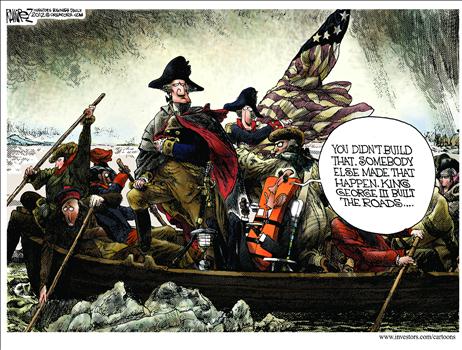
Regular readers know about Michael Ramirez, of course, and he has an amusing take on the you-didn’t-build-that controversy.

I’ve used lots of Ramirez cartoons over the past few years, and you can enjoy some of his work here, here, here, here, here, here, here, here, herehereherehereherehere, and here.

The Obama campaign has been complaining that the President’s words were misinterpreted, so this Eric Allie cartoon is quite amusing and appropriate.

You can laugh at more Allie cartoons here, here, here, and here.

Fortunately for Obama, he has some allies to help him out, as Lisa Benson reminds us.

More funny Lisa Benson cartoons can be seen here, here, herehere, here, here, herehere, and here.

Last but not least, we have another Allie cartoon. I think this is the first time I’ve used two cartoons by the same person, but I think you’ll agree they’re worth sharing.

This gives me an opportunity to end on a serious note. The Obama campaign is asserting that the President was simply stating that private sector prosperity is made possible by the provision of “public goods” such as roads and bridges.

This is a perfectly fair point, as I explain in this video about the Rahn Curve.

But what Obama conveniently overlooks is that spending on so-called public goods is only about 10 percent of the federal budget. The vast majority of government spending is for unambiguously harmful outlays on transfers, consumption, and entitlements.

Which is why the second Allie cartoon is so good. Even when government does something that is theoretically good, it causes a lot of collateral damage because of the excessive size and scope of the welfare state.

Thank you so much for your time. I know how valuable it is. I also appreciate the fine family that you have and your commitment as a father and a husband.

Sincerely,

Everette Hatcher III, 13900 Cottontail Lane, Alexander, AR 72002, ph 501-920-5733, lowcostsqueegees@yahoo.com