Yearly Archives: 2012

Open letter to President Obama (Part 114)

Sen. Rand Paul Urges Colleagues to Vote for his Budget Resolution – 05/16/12

President Obama c/o The White House
1600 Pennsylvania Avenue NW
Washington, DC 20500

Dear Mr. President,

I know that you receive 20,000 letters a day and that you actually read 10 of them every day. I really do respect you for trying to get a pulse on what is going on out here.

What are our choices here in the USA with our huge budget deficit? We could head to Greece or cut our budget until we have it balanced. You would never even consider getting close to a balanced budget while Paul would put in the spending cuts that we need to get the job done.

A few months ago, I wrote some very nice things about a budget plan put together by Senator Rand Paul of Kentucky, noting that:

Senator Paul and his colleagues are highlighting the fact that the plan generates a balanced budget in just five years. That’s a good outcome, but it should be a secondary selling point. All the good results in the plan – including the reduction in red ink and the flat tax – are made possible because the overall burden of federal spending is lowered.

Not surprising, one of the columnists at the Washington Post has a different perspective. In his hyperventilating column today, Dana Milbank says that Senator’s Paul’s proposal is “monstrous” and “nasty” for reining in the federal government.

The tea party darling’s plan would, among other things, cut the average Social Security recipient’s benefits by nearly 40 percent, reduce defense spending by nearly $100 billion below a level the Pentagon calls “devastating,” and end the current Medicare program in two years — even for current recipients, according to the Senate Budget Committee staff. It would eliminate the education, energy, housing and commerce departments, decimate homeland security, eviscerate programs for the poor, and give the wealthy a bonanza by reducing tax rates to 17 percent and eliminating taxes on capital gains and dividends. It is, all in all, quite a nasty piece of work.

Setting aside some of the inaccuracies (Social Security benefits would rise, for instance, but not as fast as they would under current law), I have two reactions to Milbank’s screed.

1. Milbank seems to think that Rand Paul’s budget is heartless and mean. Does that mean it would be nice and caring to let America descend into Greek-style fiscal chaos and economic decline? Should the United States be more like Europe, even though living standards are about 30 percent lower?

2. More amusingly, what does he think about the fact that the Senate voted against Obama’s tax-and-spend budget by a stunning margin of 99-0? That’s even worse than the 97-0 vote against the budget Obama proposed last year. The 16 votes for Rand Paul’s budget may not sound like much, but 16 is a lot more than zero.

Setting aside the snarky comments, all that Rand Paul is proposing is to limit the growth of government so that the federal budget grows by an average of about 2 percent annually.

Other nations, such as Canada and New Zealand were much more frugal when they solved their fiscal problems. But for leftists such as Milbank, any fiscal restraint apparently is “nasty” and “monsrous.”

____________

Thank you so much for your time. I know how valuable it is. I also appreciate the fine family that you have and your commitment as a father and a husband.

Sincerely,

Everette Hatcher III, 13900 Cottontail Lane, Alexander, AR 72002, ph 501-920-5733, lowcostsqueegees@yahoo.com

Pamplona Running of the Bulls 2012 – San Fermin 2012 – Headcam – 07/07/2012

A relative mine who is living in Germany told me that he was planning on running with the bulls this year. Here is some footage I got off the internet of this years’ run.

Pamplona Running of the Bulls 2012 – San Fermin 2012 – Headcam – 07/07/2012

Published on Jul 9, 2012 by

Headcam footage of running of the Bulls, opening run 2012. this got me a €150 fine (for filming in the run)

_______________

Spain’s Running Of The Bulls Injures Another 6

By DANIEL OCHOA DE OLZA AND DANIEL WOOLLS 07/13/12 04:55 AM ET AP

Spain Running Of The Bulls
Get World Alerts:

PAMPLONA, Spain — Six people were injured Friday but none gored during the second-to-last day of the running of the bulls in Pamplona.

Navarra Hospital said all six were hurt – in the back, arm, face or leg – in falls or when they were stepped on during a very fast run with bulls from a Seville ranch known for particularly swift dashes at Spain’s most popular summer festival.

One light brown bull running at the edge of the pack knocked people down as if they were rag dolls.

Half-way through the run, one man fell to the cobblestone streets of the city’s old quarter and got up to find several hulking bulls, along with the bell-tinkling steers that run with them, right on top of him. He managed to scurry away to safety.

The pack spread out fairly early in the two-and-half minute run, which is not good: bulls running on their own can become disoriented, thus are more likely to charge at people. Still, no one got gored.

The hospital said one injured man’s face had been stood on, but it was not clear if it was a human foot or a bull’s hoof that got him.

Two of the injured were Americans: a 36-year-old with a fractured forearm, and a 28-year-old with a face injury. The other injured were three Spaniards and a Jordanian.

The San Fermin festival, known for its virtually non-stop drinking and revelry, became world famous with Ernest Hemingway’s novel “The Sun Also Rises.”

The last of eight runs is Saturday. Afterward, revelers bemoan the end of the party by singing a song called “Pobre de Mi,” which can be translated as “woe is me.”

Top football stadiums in the country (Part 17) (Razorback stadium is #10)

Here is a list of the top football stadiums in the country.

Power Ranking All 124 College Football Stadiums  

By Alex Callos

(Featured Columnist) on April 19, 2012 

When it comes to college football stadiums, for some teams, it is simply not fair. Home-field advantage is a big thing in college football, and some teams have it way more than others.

There are 124 FBS college football teams, and when it comes to the stadiums they play in, they are obviously not all created equal.

There is a monumental difference from the top teams on the list to the bottom teams on the list. Either way, here it is: a complete ranking of the college football stadiums 1-124.

_________________

I have had so many memories in Arkansas Razorback stadium. Some of my favorite were when McFadden was there.

12. Jordan-Hare Stadium: Auburn Tigers

Jordan-hare-stadium_display_image

Not many cities love their team and college like those in Auburn, Alabama.

The Tigers also have an excellent stadium for their fans to cheer them on in.

Jordan-Hare Stadium seats 87,451 and was built in 1939. The fans here are known to be some of the nicest in the country, and the atmosphere here is unbelievable.

The passion of the fans gives the Tigers one of the best home-field advantages in the nation.


11. Camp Randall Stadium: Wisconsin Badgers

45_2_display_image

Camp Randall Stadium has been around since 1917 and is one of the best venues in the Big Ten.

It seats 80,321 and is always jam-packed. The student sections here are loud, and the band is also outstanding.

There are a lot of traditions at Camp Randall Stadium and so much history that has happened over the past 95 years.

Stay after the game to enjoy the fifth quarter.


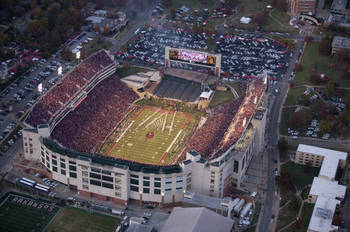
10. Donald W. Reynolds Razorback Stadium: Arkansas Razorbacks

Rdfddvvecledtfq

This venue is not quite as big as some of the other mammoth SEC stadiums, but has a lot to offer in the 76,000-seat facility.

Built in 1938, Razorback Stadium has been known to get so loud that the place literally shakes on big plays.

It cracks the top 10 on this list. There is so much energy here, and the crowd seemingly never stops to take a breath during the entire game.

For a loud and crazy stadium experience, this is the place to go.


9. Los Angeles Memorial Coliseum: USC Trojans

275px-11-11-06-la-coliseum-usc-uo_display_image

With a seating capacity of 93,607, the fans in Los Angeles Memorial Coliseum love to support their USC Trojans.

Having originally opened in 1923, the Coliseum is located right near downtown Los Angeles.

It has an atmosphere that is not as good as some of the big-name schools from the Big Ten and SEC, but still is the best place to watch a college football game on the West Coast.

Related posts:

Top football stadiums in the country (Part 10)

Tennessee Football – Johnny Majors – GREAT – Joining the VOLS in 1952 Uploaded by TheMemphisSlim on Sep 3, 2010 Johnny Majors from Huntland, TN tried out for the UT Football team weighing 150 pounds. His Father, Shirley Majors his HS Coach,encourage him and then 4 younger brothers all to be Vols. Johnny Majors was […]

Top football stadiums in the country (Part 9)

South Carolina D vs Arkansas O 2011 Tennessee ’86 Sugar Bowl Memories by Russ Finley Uploaded by yankeefanintenn on Dec 12, 2009 All video footage is copyright of WATE-TV6 and the University of Tennessee, but legally reproduced here in conjunction with Fair Use laws. Vols feature (1986 win over Miami 35-7 in the USF&G Sugar […]

Top football stadiums in the country (Part 8)

Vanderbilt Highlights vs. Arkansas – Oct. 29, 2011 Memphis 21 Tennessee 17 excerpt from “1996 Tiger Football Here is a list of the top football stadiums in the country. Power Ranking All 124 College Football Stadiums   By Alex Callos (Featured Columnist) on April 19, 2012  When it comes to college football stadiums, for some teams, […]

Top football stadiums in the country (Part 7)

Final Moments of Kentucky vs. Tennessee Football Game 2011 Uploaded by videorocker112 on Nov 27, 2011 Kentucky wins 10-7 and ends the 26 year losing streak!! Here is a list of the top football stadiums in the country. Power Ranking All 124 College Football Stadiums   By Alex Callos (Featured Columnist) on April 19, 2012  When […]

Top football stadiums in the country (Part 6)

THE FLEA KICKER – Nebraska vs. Missouri 1997 Here is a list of the top football stadiums in the country. Power Ranking All 124 College Football Stadiums   By Alex Callos (Featured Columnist) on April 19, 2012  When it comes to college football stadiums, for some teams, it is simply not fair. Home-field advantage is a […]

Top football stadiums in the country (Part 5)

Arkansas vs. Troy (2007 Football) 2010 Music City Bowl North Carolina vs Tennessee Uploaded by piotrkol1 on Jan 1, 2011 Highlights of North Carolina’s win over Tennessee in the 2010 Music City Bowl. Tennessee had the home-field advantage with the game being played at LP Field in Nashville, and the Volunteers thought they had won […]

Top football stadiums in the country (Part 4)

Rice 27 BYU 14 (1997 2nd half) Here is a list of the top football stadiums in the country. Power Ranking All 124 College Football Stadiums   By Alex Callos (Featured Columnist) on April 19, 2012  When it comes to college football stadiums, for some teams, it is simply not fair. Home-field advantage is a big […]

Top football stadiums in the country (Part 3)

Kansas Football 2007 Here is a list of the top football stadiums in the country. Power Ranking All 124 College Football Stadiums   By Alex Callos (Featured Columnist) on April 19, 2012  When it comes to college football stadiums, for some teams, it is simply not fair. Home-field advantage is a big thing in college football, […]

Top football stadiums in the country (Part 2)

2011 Arkansas State Football Highlights Here is a list of the top football stadiums in the country. Power Ranking All 124 College Football Stadiums   By Alex Callos (Featured Columnist) on April 19, 2012  When it comes to college football stadiums, for some teams, it is simply not fair. Home-field advantage is a big thing in […]

Top football stadiums in the country (Part 1)

Arkansas VS Tulsa 2008 Uploaded by jonesark on Nov 2, 2008 Arkansas entering the field to play #19 Tulsa. Here is a list of the top football stadiums in the country. Power Ranking All 124 College Football Stadiums   By Alex Callos (Featured Columnist) on April 19, 2012  When it comes to college football stadiums, for […]


“Feedback Friday” Letter to White House generated form letter response June 22, 2012(part B) on Healthcare (part 11)

I have been writing President Obama letters and have not received a personal response yet.  (He reads 10 letters a day personally and responds to each of them.) However, I did receive a form letter in the form of an email on June 22, 2012. I don’t know which letter of mine generated this response so I have linked several of the letters I sent to him below with the email that I received.  I think it could have been this one 84.4 but maybe not.  Most likely it was this one below:

Religious Liberty: Obamacare’s First Casualty

Uploaded by on Feb 22, 2012

http://blog.heritage.org/2012/02/22/morning-bell-religious-liberty-under-attack/ | The controversy over the Obama Administration’s anti-conscience mandate and the fight for religious liberty only serves to highlight the inherent flaws in Obamacare. This conflict is a natural result of the centralization laid out under Obamacare and will only continue until the law is repealed in full.

___________________________

President Obama c/o The White House
1600 Pennsylvania Avenue NW
Washington, DC 20500

Dear Mr. President,

I know that you receive 20,000 letters a day and that you actually read 10 of them every day. I really do respect you for trying to get a pulse on what is going on out here.

Max Brantley on the Arkansas Times Blog on 3-6-12 again claimed that the Republicans will lose this debate with you on Obamacare and conscience. However, I don’t see how that is true and it clearly interferes unconstitutionally with the liberty of Americans.

David S. Addington

February 29, 2012 at 12:31 pm

Congress recognizes more each day that the Patient Protection and Affordable Care Act, known widely as the Obamacare statute, interferes unconstitutionally with the liberty of Americans.  From the Obamacare individual mandate to buy health insurance that awaits the action of the Supreme Court, to the Obamacare mandate that many religious hospitals, charities, and schools abandon the tenets of their faiths and include in their group health insurance for employees coverage of abortion-inducing drugs, contraception, and sterilization, Obamacare assaults the Constitution and American freedom.

Fortunately, Members of Congress and the American people are waking up to the need to repeal the Obamacare statute and move instead to market-based, patient-centered health care.  Action in Congress this week to defend religious liberty continues to highlight the need to repeal the Obamacare statute.

The Obama Administration continues to trample on religious liberty by applying the Obamacare statute to mandate that many religious institutions’ group health insurance for employees cover abortion-inducing drugs, contraceptives, and sterilization.  The Departments of Health and Human Services (HHS), the Treasury, and Labor published on February 15, 2012 final regulations that compel many religious hospitals, charities, and schools to abandon the tenets of their faiths and comply with that mandate beginning April 16, 2012, or pay fines for maintaining their religious faiths.  The final regulations did not include any changes to respect religious liberty that President Obama had led people to expect.

Although Secretary of HHS Sebelius has said that, for one year, she will simply not perform her duty to enforce the final regulations, her decision not to enforce the regulations temporarily as a matter of grace does not eliminate the mandate’s interference with religious liberty.  Indeed, her pronouncements reflect a failure to understand that religious liberty in America is an unalienable right with which our Creator has endowed us and a right that our Constitution’s First Amendment protects.  Our religious liberty does not arise from the discretion of the Federal Government to do Americans a “favor” and tolerate their religions.  Because President Obama and his agents continue to attack the constitutionally-guaranteed right of these religious institutions to free exercise of religion, Members of Congress are stepping forward to protect the Constitution.

Senator Roy Blunt (R-Missouri) has fought for religious liberty against the Obamacare assault.  He plans to offer this week Senate Amendment No. 1520 to S. 1813, the highway authorization bill, to protect the right to religious liberty against the Obamacare mandate.  The Blunt Amendment notes that, until the enactment of the Obamacare statute in 2010, “the Federal Government has not sought to impose specific coverage or care requirements that infringe on the rights of conscience . . . .”  The Blunt Amendment would override the Obamacare mandate that religious institutions provide coverage for abortion-inducing drugs, contraceptives, and sterilization when it is contrary to their faiths, allowing them to keep their faiths and provide health care coverage for their employees.

Senate Majority Leader Harry Reid (D-Nevada) has announced his intention to keep the Senate from voting on the Blunt Amendment by making a motion to “table” — that is, to refuse to consider — the Blunt Amendment.  Senator Reid said he considered the Blunt Amendment that  protects religious liberty to be a “distracting proposal.”  Senator Reid may treat legislation to protect religious liberty as a “distraction,” but hundreds of millions of Americans hold their right to free exercise of religion to be a precious freedom.

President Obama and Senator Reid can man the ramparts of Castle Obamacare against the people for only so long.  The American people want their liberty and they shall have it.  The Obamacare statute must go.

__________-

Thank you so much for your time. I know how valuable it is. I also appreciate the fine family that you have and your commitment as a father and a husband.

Sincerely,

Everette Hatcher III, 13900 Cottontail Lane, Alexander, AR 72002, ph 501-920-5733, lowcostsqueegees@yahoo.com

___________

Here is the response I got from the White House on June 22, 2012:

The White House, Washington June 22, 2012
 

Dear Friend:

Thank you for writing.  President Obama has heard from many Americans about the Administration’s decision to ensure women have access to preventive care with no co-pays or deductibles, including contraceptive services.  The President is committed to both preserving religious liberty and protecting women’s health.  He appreciates your perspective.


The Affordable Care Act requires insurance companies to cover additional preventive services for women without charging a co-pay or deductible beginning August 1, 2012.  These preventive services include well women visits, domestic violence screening, and contraception.  The independent Institute of Medicine of the National Academy of Science recommended coverage of these procedures to the Secretary of Health and Human Services.  The vast majority of women have relied on contraception at some point in their lives, but too many have struggled to afford it.  The scientists and experts at the Institute of Medicine have documented significant health benefits for women that come from using contraception.

  • Get the facts about the Obama Administration’s plans to implement this policy.

The President understands the importance of the work faith-based organizations do and continues to take the ideas and concerns of religious groups seriously.  On February 10, 2012, President Obama announced his Administration will implement this policy in a manner that fully accommodates religious liberty while protecting the health of women.  After a transition, if a woman’s employer is a religious non-profit organization, such as a charity or hospital, and has a religious objection to providing contraceptive services as part of its health plan, her insurance company—not the employer—will be required to reach out and provide contraceptive care free of charge.  And, consistent with previously existing conscience clauses, no religious doctor will have to prescribe these services.  We will ensure religious liberty remains protected, and that women will receive the critical preventive services guaranteed by the law.

Thank you, again, for writing.


Sincerely,


The White House

You are receiving this one-time email because you contacted the White House about a particular issue.


If you are interested in receiving regular updates from President Obama and senior White House officials, please visit our subscription page to sign up www.WhiteHouse.gov/get-email-updates.


The White House • 1600 Pennsylvania Avenue, N.W. • Washington, D.C.  20500 • 202-456-1111

Related posts:

Open letter to President Obama (Part 95)

Religious Liberty: Obamacare’s First Casualty Uploaded by HeritageFoundation on Feb 22, 2012 http://blog.heritage.org/2012/02/22/morning-bell-religious-liberty-under-attack/ | The controversy over the Obama Administration’s anti-conscience mandate and the fight for religious liberty only serves to highlight the inherent flaws in Obamacare. This conflict is a natural result of the centralization laid out under Obamacare and will only continue until […]

“Feedback Friday” Letter to White House generated form letter response June 15, 2012 on Healthcare (part 8)

I have been writing President Obama letters and have not received a personal response yet.  (He reads 10 letters a day personally and responds to each of them.) However, I did receive a form letter in the form of an email on June 15, 2012. I don’t know which letter of mine generated this response so I have […]

Open letter to President Obama (Part 94)

President Obama c/o The White House 1600 Pennsylvania Avenue NW Washington, DC 20500 Dear Mr. President, I know that you receive 20,000 letters a day and that you actually read 10 of them every day. I really do respect you for trying to get a pulse on what is going on out here. In your […]


Open letter to President Obama (Part 113)

President Obama c/o The White House
1600 Pennsylvania Avenue NW
Washington, DC 20500

Dear Mr. President,

I know that you receive 20,000 letters a day and that you actually read 10 of them every day. I really do respect you for trying to get a pulse on what is going on out here.

I really don’t think that socialism works in the real world because it destroys the motivation to work hard. How you respond to these facts below?

Another great article from Dan Mitchell (an updated version is also posted).

I posted a video making this point earlier in the year, and I also posted a version of this joke back in 2010, but here’s another version that’s worth sharing because of the five lessons to be learned at the conclusion.

=================================

An economics professor at a local college made a statement that he had never failed a single student before, but had recently failed an entire class. That class had insisted that Obama’s socialism worked and that no one would be poor and no one would be rich, a great equalizer.

The professor then said, “OK, we will have an experiment in this class on Obama’s plan”. All grades will be averaged and everyone will receive the same grade so no one will fail and no one will receive an A…. (substituting grades for dollars – something closer to home and more readily understood by all).

After the first test, the grades were averaged and everyone got a B. The students who studied hard were upset and the students who studied little were happy. As the second test rolled around, the students who studied little had studied even less and the ones who studied hard decided they wanted a free ride too so they studied little.

The second test average was a D! No one was happy.

When the 3rd test rolled around, the average was an F.

As the tests proceeded, the scores never increased as bickering, blame and name-calling all resulted in hard feelings and no one would study for the benefit of anyone else.

To their great surprise, ALL FAILED and the professor told them that socialism would also ultimately fail because when the reward is great, the effort to succeed is great, but when government takes all the reward away, no one will try or want to succeed.
It could not be any simpler than that.

There are five morals to this story:

1. You cannot legislate the poor into prosperity by legislating the wealthy out of prosperity.

2. What one person receives without working for, another person must work for without receiving.

3. The government cannot give to anybody anything that the government does not first take from somebody else.

4. You cannot multiply wealth by dividing it!

5. When half of the people get the idea that they do not have to work because the other half is going to take care of them, and when the other half gets the idea that it does no good to work because somebody else is going to get what they work for, that is the beginning of the end of any nation.

=================================

I’ll make one final point. There are five morals to the story, but there are dozens of nations giving us real-world examples every day.

Sort of makes you wonder why some people still believe this nonsense?

__________________

Thank you so much for your time. I know how valuable it is. I also appreciate the fine family that you have and your commitment as a father and a husband.

Sincerely,

Everette Hatcher III, 13900 Cottontail Lane, Alexander, AR 72002, ph 501-920-5733, lowcostsqueegees@yahoo.com

Switchfoot coming to Hot Springs, Arkansas on July 14th!!!!

Saturday 14 July 2012

Switchfoot

Venue

Magic Springs Theme Park 1701 E. Grand Ave. 71901 Hot Springs, AR, US

Venue info and map

Uploaded by  on Aug 20, 2007

Interview with Tim Foreman and Chad Butler airing February 26th, 2007.
Discuss: cowbell, Christianity, fan connection

_______________________________________

SwitchfootSwitchfootCourtesy of: EMI


Making of Stars-Switchfoot


Switchfoot The Documentary


Discussion of Woody Allen’s 1989 movie “Crimes and Misdemeanors” (Part 2)

Crimes and Misdemeanors: A Discussion: Part 2

Uploaded by on Sep 23, 2007

Part 2 of 3: ‘What Does The Movie Tell Us About Ourselves?’
A discussion of Woody Allen’s 1989 movie, perhaps his finest.
By Anton Scamvougeras.

http://camdiscussion.blogspot.com/
antons@mail.ubc.ca

_________________-

One of my favorite Woody Allen movies and I reviewed it earlier but I wanted you to hear from somone else:

Guest Review: Crimes and Misdemeanors

07.13.11 | guest-blogs | FanFare Guests<!–Email this Post | –>Print this Post

Tags:

Crimes and Misdemeanors starring Martin LandauGuest blogger Alex Kittle writes:

Since enjoying Midnight in Paris so much, I’ve been dipping more intoWoody Allen‘s filmography. First up was Crimes and Misdemeanors, which interested me since it’s more of a drama than a romantic comedy (which is primarily what I’ve seen from him, it feels). The sizable cast features a number of loosely interconnected figures, all somehow dealing with love and disappointment. Judah (Martin Landau), a prominent ophthalmologist, is facing threats from his slightly unhinged mistress (Anjelica Huston) and is given a difficult choice to protect his marriage. Meanwhile, struggling documentary filmmaker Cliff (Woody Allen) is filming a special on his asshole brother-in-law (Alan Alda), a successful and lecherous comedy producer. He finds himself falling for the documentary’s producer Halley (Mia Farrow), as his own marriage has been failing. The two men’s lives seem unrelated, but come together through mutual acquaintances at a dinner party.

Crimes and Misdemeanors has a lot going on, balancing traumatic ruminations on death and faith with light-hearted romance and comedic dialogue. It’s a bit off-putting at times, but eventually the very different experiences of the two main characters begin to betray the darkness that can pervade any lifestyle or worldview. Cliff comes off as a slightly silly, intelligent film buff, but it’s clear he uses humor to overcome his own insecurities and cannot responsibly deal with his crumbling marriage. Judah seems so put-together, a wealthy doctor, husband, and father, but his own misgivings about his Jewish background and atheist present lead to a complete shift in ideology after he makes a life-changing decision. Their final meeting at the end is a pivotal scene.

The dialogue and characters are the standout of the film, with the story and tone a little too uneven for me. It’s a decent mix of comedy and drama, but doesn’t quite nail it, plus the ending felt abrupt despite the voiceover montage, somehow. But I loved the interactions between Allen and Farrow (they hang out and watch Singin’ in the Rain!) and his adorable niece. Alan Alda is hilarious and douchebaggy; Martin Landau brings the gravitas. It’s an interesting and entertaining film overall, but I didn’t all-out love it. For one thing, the way it ends with Farrow and Allen’s characters is frustratingly written, and I can’t help but think that this is the sort of thing that influences the one-sided sexism of movies like (500) Days of Summer, wherein women are untrustworthy and fickle just because they don’t fall for the protagonist. That’s a bit extreme, I guess, but I couldn’t help but have that line of thinking.

4/5

Pair This Movie With: Oh jeez. Um. Maybe something kind of noir-y, like The Square.

Alex Kittle is an art, movie, and comic geek with a penchant for nonsensical jokes and exaggerated claims. Her blog Film Forager explores movies of every genre, from weird high-concept sci-fi to classic brooding romance.

Related posts:

Discussion of Woody Allen’s 1989 movie “Crimes and Misdemeanors” (Part 1)

Crimes and Misdemeanors: A Discussion: Part 1 Uploaded by camdiscussion on Sep 23, 2007 Part 1 of 3: ‘What Does Judah Believe?’ A discussion of Woody Allen’s 1989 movie, perhaps his finest. By Anton Scamvougeras. http://camdiscussion.blogspot.com/ antons@mail.ubc.ca _____________ Today I am starting a discusssion of the movie “Crimes and Misdemeanors” by Woody Allen. This 1989 […]

Woody Allen’s movie “Midnight in Paris” wins an academy award (link to complete listing of all historical figures mentioned in “Midnight in Paris”)

Sleepers (1973)   Allen (left) wrote, directed and starred in this oddball love story, set 200 years in the future.  It was his first on-screen collaboration with Diane Keaton (second left), who went on to become one of the director’s muses in the early days of his career.   ___________ I have written more on […]

Can we learn from Woody Allen Films? (Part 2)

Looking at the (sometimes skewed) morality of Woody Allen’s best films. Hannah and Her Sisters (1986) Allen continues the art-as-salvation theme in Hannah and Her Sisters, an ensemble drama about family and infidelity. The film tells three stories, one of which stars Allen as a hypochondriac named Mickey. Terrified of death, Mickey begins a search […]

Chris Martin of Coldplay unknowingly lives out his childhood Christian beliefs (Part 3 of notes from June 23, 2012 Dallas Coldplay Concert, Martin left Christianity because of teaching on hell then he writes bestselling song that teaches hell exists)

Viva La Vida Published on Jun 23, 2012 by TheRyanj64 Coldplay’s Viva La Vida at American Airlines Center in Dallas on June 22, 2012 __________ Coldplay brought confetti, lights and thousands of fans to the American Airlines Center; see photos from their colorful show Photo Gallery News Sports Lifestyles   Comments (0)   5/11 Chris […]

“Woody Wednesdays” Woody Allen on God and Death

Good website on Woody Allen How can I believe in God when just last week I got my tongue caught in the roller of an electric typewriter? If Jesus Christ came back today and saw what was being done in his name, he’d never stop throwing up. If only God would give me some clear […]

Michelangelo Antonioni influenced Woody Allen and was discussed by Francis Schaeffer

Francis Schaeffer discussed modern films and how they showed the state of man. That is why I like Woody Allen’s films so much. He knows what the big issues are in life and even though he present the right answers he does grapple with the right questions. Michelangelo Antonioni heavily influenced Allen and below is […]

Review of “To Rome with Love”

Jesse Eisenberg – Press Conference “To Rome With Love” Published on Apr 21, 2012 by portugal888 Review: Allen’s ‘Rome’ delivers lackluster love Published: Tuesday, June 19 2012 11:06 a.m. MDT By David Germain View 4 photos » This film image released by Sony Pictures Classics shows, : Alec Baldwin as John, left, and Jesse Eisenberg […]

Woody Allen, ‘To Rome With Love’ Director, Talks ‘Midnight In Paris’ Success, Acting Career

How To Recover From a Break Up With Greta Gerwig Published on May 16, 2012 by younghollywood Young Hollywood is hanging out in NYC during the Tribeca film festival, where we chat with rising star Greta Gerwig about her hip slice-of-life movie, ‘Lola Versus’. Greta offers up some advice on how to get over a […]

June 14, 2012 Wall Street Journal interview of Woody Allen and he is still talking about the meaninglessness of existence

TO ROME WITH LOVE – conferenza stampa con Allen, Benigni e Cruz http://WWW.RBCASTING.COM Published on Apr 18, 2012 by RBcasting http://www.rbcasting.com Conferenza stampa del film “To Rome With Love”, scritto e diretto da Woody Allen. Tra gli interpreti, lo stesso Allen, Alec Baldwin, Roberto Benigni, Penelope Cruz, Judy Davis, Jesse Eisenberg, Ellen Page e Greta […]

Woody Allen’s worldview as seen in his movies

  I love the movie Crimes and Misdemeanors and have written on it many times in the past. This quote below sums up Woody Allen’s worldview which I disagree with. In fact, the person who said this actually could not live with its conclusions in the movie and committed suicide.   Because Allen continues to […]

Atheists have no basis for saying that Hitler was wrong!!!!!

On April 30, 2012 (67 years after Hitler killed himself) I stated on the Arkansas Times Blog: Hitler’s last few moments of life were filled with anxiety as they should have been. He went on to face his maker and pay dearly for his many sins. When I look at the never before released pictures […]

“Woody Wednesday” Will Allen and Martin follow same path as Kansas to Christ?

Several members of the 70′s band Kansas became committed Christians after they realized that the world had nothing but meaningless to offer. It seems through the writings of both Woody Allen and Chris Martin of Coldplay that they both are wrestling with the issue of death and what meaning does life bring. Kansas went through […]


The best quarterbacks in the SEC in 2012? (Part 5)

I think Tyler Wilson is the best quarterback in the SEC but here is what others think:

The Southeastern Conference possesses some of college football’s best quarterbacks, and plenty of youngsters ready to emerge.  Here are my rankings of the signal callers headed into the season:

1. A.J. McCarron, Alabama, Jr.

McCarron tops the list, and looks to pick up where he left off in 2011 after he lead the Crimson Tide to an 11-1 regular-season record and a BCS title. McCarron commands an offense that will rely heavily on the run with running back Eddie Lacy. Lacy takes over for Heisman Trophy winner Trent Richardson.

If Lacy does his best Richardson impersonation and McCarron duplicates his 2,400 yard, 16 touchdowns, five interceptions and 66 percent completion percentage performance in 2011—while developing a young talented receiving corps—the Tide will be in the running for another crystal football in 2012.

2. Aaron Murray, Georgia, Jr.

Murray comes into 2012 at the top of many quarterback lists.  Murray’s numbers jump out at you,  with 3,149 yards  and 35 touchdowns in 2011; make a strong case for the top spot, but his slightly less efficient 59 percent completion percentage and 14 interceptions last season have him in the number two spot here.

Nonetheless, Murray looks poised to lead Georgia to another SEC Championship appearance, and could easily be number one at season’s end.

3. Tyler Wilson, Arkansas, Sr.

Wilson had arguably a better 2011 statistically than both McCarron and Murray, with more yards than both, (3,638) fewer interceptions than Murray (6) and more touchdowns than McCarron (24).

The fact that Wilson loses his top two wide receivers from a year ago, senior Colbi Hamilton enters as the only returning upperclassman at that position with experience in the system, and Bobby Petrino’s firing in the middle of spring drills has Wilson’s standing in question. If Wilson overcomes these pitfalls he will challenge Murray for second on the list, if not McCarron for first by the end of 2012.

4. Tyler Bray, Tennessee, Jr.

Bray at No. 4 hinges on the return of Tennessee’s two-headed monster at wide receiver in the persons of juniors Justin Hunter and Da’Rick Rodgers in 2012. Hunter looked poised for a breakout season with Bray in 2011 connecting with Bray for 302 yards and two touchdowns through just two games, but an ACL injury against Florida derailed any chance of that. Rogers picked up the slack leading the SEC in the regular season with 67 receptions and 1,040 yards, and added nine touchdowns on the year.

Bray had injury problems of his own in 2011, a thumb injury sidelined him from October 8-November 19. Despite the injury, Bray threw for 1,983 yards, 17 touchdowns and just 6 interceptions in seven games. If Bray, Rodgers and Hunter stay healthy, look for big things from the Tennessee passing attack in 2012.

5. James Franklin, Missouri, Jr.

Missouri comes into the SEC with its starter on the shelf for the spring recovering from offseason shoulder surgery on his non-throwing shoulder. If healthy, Franklin looks to give SEC defenses fits with his dual threat ability.

In 2011, Franklin threw for 2,865 yards, 21 touchdowns. Franklin rushed for 981 yards and 15 touchdowns. If Franklin enters the season healthy, watch for the Tigers to challenge Georgia, and South Carolina in the SEC East.

6. Connor Shaw, South Carolina, Jr.

Shaw lands at No. 6 thanks to the departure of go-to wide receiver Alshon Jeffery to the NFL and a lack of experience, just 9 starts. Shaw, however, boasts an 8-1 record as a starter, a bowl win and had 1,671 yards 15 touchdowns, eight interceptions in those starts.

Shaw could be the quarterback Head Coach Steve Spurrier has hoped for at South Carolina. It will be interesting to see if Spurrier pulls Shaw at any time if he struggles in 2012.

Rick Crawford again makes conservatives mad

Earlier I posted about Rick Crawford’s mistake where he said he agree to tax increases if the Democrats tried to balance the budget. Now he has allowed a bloated bill that includes Food Stamps to get out of committee and it has angered the conservative Cato Institute.

GOP Freshmen Vote to Move Farm Bill Out of Committee

Posted by Tad DeHaven

In the latest example of the so-called “Tea Party Class” of House Republicans not living up to the hype, GOP freshmen on the House Agriculture Committee voted overwhelmingly to approve a bloated $957 billion farm subsidy/welfare bill.

The overall vote was 35-11. Only 4 Republicans voted against it – the rest appear to be Democrats who weren’t happy that the bill doesn’t spend more money on food stamps. Republican freshmen occupy 16 of the 25 GOP seats on the committee. Only 3 out of the 16 voted against the bill.

  • Bob Gibbs (Ohio)
  • Tim Huelskamp (Kansas)
  • Marlin Stutzman (Indiana)

Here are the names of the 13 GOP freshmen who supported it:

  • Austin Scott (Georgia)
  • Scott Tipton (Colorado)
  • Steve Southerland (Florida)
  • Rick Crawford (Arkansas)
  • Martha Roby (Alabama)
  • Scott DeJarlais (Tennessee)
  • Renee Ellmers (North Carolina)
  • Chris Gibson (New York)
  • Randy Hultgren (Illinois)
  • Vicky Hartzler (MO)
  • Robert Schilling (Illinois)
  • Reid Ribble (Wisconsin)
  • Kristi Noem (South Dakota)

The question now is whether the House Republican leadership will allow the bill to come to the floor. According to the Washington Post, Speaker Boehner hasn’t decided:

Agriculture Chairman Frank Lucas, R-Okla., feels the committee did “an awful lot of good work,” Boehner said at a weekly news conference. But “no decisions about it coming to the floor at this point,” Boehner said…“There are some good reforms in this bill. There are other parts of the farm bill that I have concerns with,” Boehner said. He referred to what he said was “a Soviet-style dairy program in America today and one of the proposals in this farm bill would actually make it worse.”

Boehner has voted against farm bills in the past so he’s probably not eager to get this one to the floor, especially since advocates for free markets and limited government rightly consider the bill to be a disaster. But Boehner helped create this dilemma for himself when his Steering Committee gave Frank Lucas the chairman’s gavel after the 2010 elections. As Chris Edwards and I noted in a recent op-ed, Lucas is a big supporter of farm subsidies and takes pride in having been named a “Wheat Champion” by the National Association of Wheat Growers.

Back in December 2010, I wrote that “An indicator of the incoming House Republican majority’s seriousness about cutting spending will be which members the party selects to head the various committees.” Lucas’s chairmanship indicated that when it comes to bloated farm bills, the House leadership wasn’t serious. If this bill is allowed to reach the floor, any doubts will have been erased.

Russ Vought of the Red State Blog noted:

The fundamental problem with incrementalism is that you can never win the argument, because you never set out to have a debate on principle.

Instead, the debate is always about making some federal program run a little better or cost a little less. It is never about the underlying benefit or activity being fundamentally inconsistent with a limited government or the Constitution. No matter how common sense the reform, the Left immediately demonizes the effort as a “cut,” either scaring the reformers to the sidelines or sparking the same ideological firefight that the reformers were trying to avoid. The reformers get caught unprepared to argue on principle, and the proposed reform itself then proves to be well south of the herculean political effort needed to get it signed into law.

Consider the “farm” bill just passed out of the House Agriculture Committee.

Its $957 billion over ten years. The last farm bill in 2008 was $604 billion over ten years—a 63% increase. 80% of the bill is now food stamp funding. This is because there are now 46 million individuals on food stamps, compared with 17 million in 2000 and 30 million in 2008 respectively. 1 out of every 7 Americans are on food stamps. Chairman Frank Lucas is proposing to tweak the program to save just $16 billion or 2%. The Left is predictably freaking out. The Center on Budget and Policy Priorities claims that the, “Lucas-Peterson proposed farm bill would throw 2 to 3 million people off” food stamps. Assistant Democrat Leader James Clyburn is calling the reforms “an abomination.” This freakout will inevitably result in some compromise that is even more worthless.

This is not the approach that you would take if you were, say, trying to drastically roll back the welfare state. You would take a much harder line. You would break up the food stamp portion from the commodity portion. You would go back to pre-Obama or pre-Bush levels and block grant the program (surely the nation can exist on the same food stamp levels enjoyed by the Clinton Administration, no?). You would be proposing a work requirement for the food stamp program. You might bring back the paper stamps and discontinue the EBT system. In other words, you would force a real debate about food stamps and dependency in America—about what we can afford given our fiscal situation and how to get people off of welfare for their and our benefit.

Despite

Related posts:

Republicans for more food stamps?

Eight Reasons Why Big Government Hurts Economic Growth __________________ We got to cut spending and we must first start with food stamp program and we need some Senators that are willing to make the tough cuts. Food Stamp Republicans Posted by Chris Edwards Newt Gingrich had fun calling President Obama the “food stamp president,” but […]

Obama promotes food stamps but Milton Friedman had a better suggestion

Milton Friedman’s negative income tax explained by Friedman in 1968: We need to cut back on the Food Stamp program and not try to increase it. What really upsets me is that when the government gets involved in welfare there is a welfare trap created for those who become dependent on the program. Once they […]

More Than Half of the President’s Budget Would Be Spent on Entitlement Programs

More Than Half of the President’s Budget Would Be Spent on Entitlement Programs Everyone wants to know more about the budget and here is some key information with a chart from the Heritage Foundation and a video from the Cato Institute. In combination with other entitlements, such as food stamps, unemployment, and housing assistance,Medicare, Medicaid, and Social Security constitute the lion’s share […]

Federal spending continues to skyrocket

Government Spending Doesn’t Create Jobs Uploaded by catoinstitutevideo on Sep 7, 2011 Share this on Facebook: http://on.fb.me/qnjkn9 Tweet it: http://tiny.cc/o9v9t In the debate of job creation and how best to pursue it as a policy goal, one point is forgotten: Government doesn’t create jobs. Government only diverts resources from one use to another, which doesn’t […]

Open letter to President Obama (Part 87)

Uploaded by oversightandreform on Mar 6, 2012 Learn More at http://oversight.house.gov The Oversight Committee is examining reports of food stamp merchants previously disqualified who continue to defraud the program. According to a Scripps Howard News Service report, food stamp fraud costs taxpayers hundreds of millions every year. Watch the Oversight hearing live tomorrow at 930 […]

Obama brags of progress in USA on economy to G-8 audience

1,000 Days Without A Budget Uploaded by HeritageFoundation on Jan 24, 2012 http://blog.heritage.org | Today marks the 1,000th day since the United States Senate has passed a budget. While the House has put forth (and passed) its own budget, the Senate has failed to do the same. To help illustrate how extraordinary this failure has […]

Spending more money on welfare is not the answer

We have spent over 19 trillion on welfare since LBJ started the war on poverty and it has only brought us several generations who are dependent on the government. Welfare: Tackling the Fastest-Growing Part of Government Spending Rachel Sheffield April 20, 2012 at 2:45 pm Multiple reports of welfare abuse have hit the headlines in […]

A handout is not what the poor needs

Welfare Can And Must Be Reformed Uploaded by HeritageFoundation on Jun 29, 2010 If America does not get welfare reform under control, it will bankrupt America. But the Heritage Foundation’s Robert Rector has a five-step plan to reform welfare while protecting our most vulnerable. ______________ I don’t understand why liberals do not see that they […]

Overspending Obama style

This excessive spending by Washington today is not responsible government in action. Obama’s Comments: A Gift that Keeps on Giving Posted by Roger Pilon Today POLITICO Arena asks: Does Senator Grassley’s tweet, that the American people “r not stupid as this x prof of con law,” make an important point or was it disrespectful? Is this […]

400% increase in food stamps since 2000

Welfare Can And Must Be Reformed Uploaded by HeritageFoundation on Jun 29, 2010 If America does not get welfare reform under control, it will bankrupt America. But the Heritage Foundation’s Robert Rector has a five-step plan to reform welfare while protecting our most vulnerable. __________________________ If welfare increases as much as it has in the […]

“Friedman Friday” :“A Nobel Laureate on the American Economy” VTR: 5/31/77 Transcript and video clip (Part 4)

Milton Friedman on the American Economy (4 of 6)


Uploaded by on Aug 9, 2009

THE OPEN MIND
Host: Richard D. Heffner
Guest: Milton Friedman
Title: A Nobel Laureate on the American Economy VTR: 5/31/77
_____________________________________

Below is a transcipt from a portion of an interview that Milton Friedman gave on 5-31-77:

Friedman: “What’s good for General Motors is good for the United Sates and vice versa,” in that famous phrase of Mr. Wilson’s. So I don’t think you can distinguish between these two. I think that politicians and people, everybody, businessmen, politicians, scholars, we’re all seeking to pursue our own interests. We don’t have to interpret it as narrowly. My interests are in ideas as much as they are in dollars and cents or something else. But we’re all seeking to pursue our own interests. Politicians, their interests are closely connected with getting reelected. And therefore they will put primary emphasis on what will get me votes next time.

HEFFNER: Well, I was thinking of an analogy. I was thinking of drawing this comparison with the medical scientists; economic scientist and medical scientists. Medical scientists presumably will disagree minimally about what all other factors…

FRIEDMAN: Not at all. Not at all.

HEFFNER: On certain things they may disagree minimally in terms of the technical means that they should employ to deal with, to treat a patient. But in terms of considering the patients, in terms of considering their needs that are more than technical, they may disagree. And quite honestly, as to the approach to take, wouldn’t it be fair to say that this is as much a consideration as what you consider political, a political consideration among economists, which I would relate to how is my party going to be elected more readily the next time around?

FRIEDMAN: Well, I don’t either want to rule out completely that narrow interpretation, nor rule it in completely. I think economists are human beings like everybody else. Many of them do establish party loyalties. What’s more important, many have very strong private interests that are associated with which party is in power.

HEFFNER: Like what?

FRIEDMAN: Like what jogs they have. Like what prestige they have. Like what outside income they will be able to earn. You know, it was not a joke only, for years that the Brookings Institution in Washington was a home away from home for out-of-power Democratic economists. It’s not a joke now that the American Enterprise Institute is serving a similar function for out-of-power Republican economists. Surely these are not trivial and negligible. But they are not the only thing, I agree with you.

HEFFNER: You don’t really think that determinations of public policy or contributions by major economists in terms of the determination of public policy, that in those determinations one’s job in the next administration has played a major role; or do you?

FRIEDMAN: You know, you want to make it black and white. Human beings are distinguished from animals much more by the ability to rationalize than by the ability to reason. Sincerity is a much overrated virtue. It’s possible for anybody to be sincere about anything. I’m not questioning the sincerity or the motives of anybody. I’m only saying a human being is affected by those things that affect his image.

HEFFNER: Are your economic policies affected in that way?

FRIEDMAN: Of course they must have been. I can’t deny that they could have been.

HEFFNER: No, no, I’m not talking about could have been.

FRIEDMAN: Or that they have been. Or that they have been. I mean, we never know ourselves. And the man who says, “I am objective,” you k now that can’t be the case. We’re all of us imperfect human beings. We’re all of us going to be affected by these things. I’m not saying anybody else is any more or less affected than I am. Some people are less affected; some people are more. I would say on the whole you’ve got to look at it in a more complex and sophisticated way. Most people develop beliefs and ideas. Those beliefs and ideas in turn determine what policies they approve, what directions they move. That in turn reacts on them and affects their beliefs and ideas. And the whole thing is a kind of biological process of creating a complex structure that can/t be dissected into the simple black-and-white category. He is in favor of this policy because if he is in favor of that policy he will get this and this job. You can’t say that. That’s not true. I’m not saying that of anybody.

HEFFNER: Okay. I wondered about that because the question of self-interest did come up, and I was shocked by it.

FRIEDMAN: Well, you see, the economists… Take the economics profession as a whole. Because I think it’s very interesting from this point of view. The economists have a very schizophrenic situation. Our discipline of economics, as a science, predisposes all economists to be in favor of a market system, of a free market. Because that’s our business. We come to understand how a market operates. It’s a much more sensitive and sophisticated instrument than may appear on the surface or that the ordinary man in the street believes it. So every economist has a predisposition to be in favor of a market system. On the other hand, the major growth area for jobs for economists has arisen out of government regulation. So the special interests of economists is to be in favor of government regulation. How do you reconcile this? Again, don’t misunderstand me. I’m not saying anyone is doing this in a Machiavellian way. I’m just describing the unobserved forces that are at work on it. Well, the way in which many economists have implicitly reconciled it is by being in favor of the free market in general, and opposed to the free market in particular. “And this area is a special case that needs regulation, this area is a special case.” You know, the same thing happens to businessmen. Every businessman is in favor of private enterprise.

HEFFNER: Except in his…

FRIEDMAN: Except for himself. And he isn’t – let me emphasize – in both cases, he isn’t being Machiavellian. He isn’t being insincere. He isn’t being devious. He sincerely believes. He knows his own case. And he sincerely is persuaded that his own case is special and that it’s in the national interest to treat it differently than other cases.

HEFFNER: But this concept of the marketplace, has it always been with us?

FRIEDMAN: Yes. Oh, every society is primarily run by the marketplace. But there are many kinds of marketplaces. The political marketplace…

HEFFNER: And aren’t you talking about a particular kind?

FRIEDMAN: I’m talking… But even the particular kind, yes, there are two main kinds of marketplaces. The economic marketplace in which you buy and sell, which has much broader relevance than you might a first suppose. And the political marketplace in which decisions are made by votes or by authority through political position by command.

HEFFNER: I understand. But I just wondered whether this basic agreement that you referred to among economists, all of whom relate to the economic marketplace, I was about to ask where is it written…

FRIEDMAN: (Laughter)

HEFFNER: …where is it written that the concept of the marketplace shall prevail? Isn’t this a rather modern concept? And if it is, why must we tie ourselves to it as tightly as you would have us do, as tightly as you suggest all economists would have us?

FRIEDMAN: Well, let’s answer that in two different ways. You say, “Why must we tie to it?” Because the fact of the matter is that there is no alternative mechanism that has so far been devised which will enable large and complex societies to exist. Consider what seems like the most extreme exception: the Soviet Union. It’s not, in the first instance you would say that’s not a market economy. And yet, the main organization of resources in the Soviet Union is through the marketplace and not through government command. And this is true in all sorts of ways. Anybody who read Hedric Smith’s fascinating book on the Russians will discover that if something goes wrong with you electricity in your house, you don’t call a state office and have them send somebody. You get a government employee on his spare time to come in and fix it for you.

HEFFNER: The same thing is true here, if you can.

FRIEDMAN: Of course, of course. Well, no, if you can here, you hire somebody. But in Russia supposedly you ought to get a state official, governmental official. It’s all done by government agencies. It’s not here, yet.

Go on. Take food. Something like 25, 30, 35 percent of the people in the Soviet Union are required to produce a food. They permit small private plots. Those plots account for two to three percent of the arable land of the Soviet Union. They produce a third of the food in private markets and distributed through markets. If you have, if you look at the way in which labor is organized, the buyers are governmental agencies. But people are attracted to one job or another by the job or by the pay that is offered to them. Fundamentally, the Soviet Union is a market economy, but it’s distorted market economy because the extraordinarily great role of government forces the market into channels which are not efficient and not effective. And so much of its power is wasted in simply overcoming the bureaucratic mess of the government. That’s why the Soviet Union has such a low standard of life. So it’s interesting, on a matter of theory. Well, I don’t like that word. ON a matter of sort of abstract ideal, you can conceptualize a command economy in which the market plays no role. It’s an army. A general gives an order to a colonel, a colonel to a major, a major to a captain, and so on down the line. Or you can visualize a voluntary exchange economy, a pure market economy in which everything is conducted by voluntary agreement among individuals’ purchase and sale.