Monthly Archives: December 2012

All-American Rejects Part 2 (“Finding Satisfaction in Life”)

The All-American Rejects Music Interview Tyson Ritter Full Band only on The Artist Spotlight

The All-American Rejects – The Last Song

The All-American Rejects – It Ends Tonight

I got to go hear the All-American Rejects in Little Rock on 12-13-12. Here are some of my reactions.

Tyson Ritter admitted that he lost his way after the 2008 cd came out and he spent a couple of years in LA searching for happiness through multiple relationships with women but that didn’t work out and he found no satisfaction. Let me suggest finding your satisfaction through Christ. Below are some very popular songs on this same subject.

I Still Haven’t Found What I’m Looking For / U2

The Rolling Stones Satisfaction (rare)


If you want to see the path that Kerry Livgren and Dave Hope of the rock group Kansas took to find true satisfaction then listen to their song “Dust in the Wind” and then read their testimony at this link Tom Brady , Coldplay, Kansas, Solomon and the search for satisfaction (part 3) .

Kansas – Dust In The Wind

Uploaded by on Nov 7, 2009

Music video by Kansas performing Dust In The Wind. (c) 2004 Sony Music Entertainment Inc.

______________

This sermon can be listened to online at http://www.fellowshiponline.com/resources/sermons/

Concerning Philippians 4:10-23 Brandon comments:

Paul is reminding us that in every circumstance and in everything he has gone through that his satisfaction is found deeply in Christ. You think about this guy who is writing from prison. He is in this prison cell and it is a hardship in his life, but him of all people is saying that “I am writing to you but I am content and I am satisfied.” That is a statement you don’t hear from a lot of people these days… A lot of people are discontent and dissatisfied… Think about the poets from your generation or the generation before us. How about the deep theologians called “The Rolling Stones.” Remember them. They wrote this song “I can’t get no satisfaction.” And you what they say after that phrase? “And I try and I try and I try.” I am not sure how deep most of their lyrics are, but they voice the cry of many people. “I can’t get no satisfaction and I try and I am trying and I am trying.”

What about one of those other poets by the name of Bono who wrote a song called, “I still haven’t found what I am looking for.” It is interesting. “I still haven’t found what I am looking for.” It has a nice melody to it but there is probably a reason why it is so popular because there is a lot of people deep down in their soul feel like they haven’t found what they are looking for.

It is true. What is so funny to me is that what is so desired is so elusive. What is so longed for, people want to be content and satisfied, you want to be content with who you are and what you have and where you live but the reality of it is THAT IS NOT THE CASE IN YOUR LIFE. THAT IS NOT THE CASE FOR A LOT OF PEOPLE. A matter of fact in our notes I ask this question: WHY ARE MOST PEOPLE DISATISFIED AND DISCONTENT IN THIS LIFE? It is running rampant. People are longing for, desiring for and chasing after, they want so desperately to be content, to be satisfied with what they have, with who they are, with where they are. Yet the reality is for a lot of people who is not happening and it creates frustration in us and anger in us and sadness in us and loneliness in us.

Why? Some people say they are not compensated enough or not treated fairly enough, or not talented enough, or not attractive enough, or not rewarded enough, or not recognized enough. The list goes on and on and on.

The interesting thing is that even when you feel like you get some contentment in your life there is always a desire for more. It is never enough. Quite frankly some people achieve the american dream and they still want more!!!

TRUE CONTENTMENT FLOWS FROM CONFIDENCE IN GOD AND STAYS REGARDLESS OF CIRCUMSTANCES AND COMES FROM STRENGTH IN CHRIST AND BREEDS GENEROSITY.

Our deepest satisfaction is found in Christ.

Today’s scripture reading was:

Philippians 4:10-23

New American Standard Bible (NASB)

God’s Provisions

 10 But I rejoiced in the Lord greatly, that now at last you have revived your concern for me; indeed, you were concerned before, but you lacked opportunity. 11 Not that I speak [a]from want, for I have learned to be [b]content in whatever circumstances I am. 12 I know how to get along with humble means, and I also know how to live in prosperity; in any and every circumstance I have learned the secret of being filled and going hungry, both of having abundance and suffering need. 13 I can do all things [c]through Him who strengthens me. 14 Nevertheless, you have done well to share with mein my affliction. 15 You yourselves also know, Philippians, that at the [d]first preaching of the gospel, after I left Macedonia, no church shared with me in the matter of giving and receiving but you alone; 16 for even in Thessalonica you sent a gift more than once for my needs. 17 Not that I seek the gift itself, but I seek for the [e]profit which increases to your account. 18 But I have received everything in full and have an abundance; I am [f]amply supplied, having received from Epaphroditus [g]what you have sent, [h]a fragrant aroma, an acceptable sacrifice, well-pleasing to God. 19 And my God will supply [i]all your needs according to His riches in glory in Christ Jesus. 20 Now to our God and Father be the glory [j]forever and ever. Amen.

 21 Greet every [k]saint in Christ Jesus. The brethren who are with me greet you. 22 All the [l]saints greet you, especially those of Caesar’s household.

 23The grace of the Lord Jesus Christbe with your spirit.


Band members

Ritter in 2006

Tyson Ritterlead vocals, bass guitar, piano (1999–present)

  • Tyson Jay Ritter, born April 24, 1984 in Stillwater, Oklahoma, is co-founder of The All-American Rejects. Ritter splits his time between his homes in New York, California and Florida. While he considers Santa Rosa Beach, Florida to be his primary residence, business requires he spend the majority of his time at his LA-area home. Aside from his role in the band, Ritter has worked as a film and television actor. He performed as himself in the American television medical drama House M.D., appearing in the episode “Fetal Position” which aired April 3, 2007 on the Fox Network.[36] He also appeared with his other band members in television series Smallville season six episode 3, titled “Wither”, performing “It Ends Tonight“. He also appeared in his first film, The House Bunny, in 2008. In June 2010, Tyson Ritter sung a duet with R&B singer Timbaland with the song “I’m in Love With You”. The song features as a bonus track on Timbaland’s EP Shock Value II: The Singles.Tyson Ritter and Nick Wheeler also cowrote “Put Me Back Together” for Weezer’s 2010 “Raditude” Album. Tyson Ritter started his own charity called “Don’t Hate On Haiti” to raise money to get water to the people in Haiti, by designing a t-shirt. He is very passionate about Haiti, as he has stated in many interviews and on his personal Twitter account. At Warped Tour 2010, he “sold his body” to raise money, by taking pictures, giving autographs, sidestage passes and even kisses for donating money. In June 2011 he began a campaign for Haiti that entails him keeping silent for 30 days. Many people have began to sponsor his silence by giving money for every day he keeps quiet.[37] “In the end, we’re just a band, close friends, who care deeply about what we do,” says Tyson.

Nick Wheelerlead guitar, backing vocals (1999–present)

  • Nickolas (Don) Von Wheeler was born on March 20, 1982 in Stillwater, Oklahoma, and lived there until moving to his current residence in Destin, Florida. He is a co-founder of The All-American Rejects and is the lead guitarist and backing vocals for the band.

Mike Kennertyrhythm guitar, backing vocals (2002–present)

  • Michael Brian Kennerty, born on July 20, 1980, in Houston, Texas, grew up and lives in Edmond, Oklahoma. He joined the All-American Rejects in 2002 after The All-American Rejects had been completed. Kennerty is a founding member and guitarist of the punk band “These Enzymes”, along with bandmate and drummer, Chris Gaylor. The side project was started after a 2003 tour in England, and includes other members Neil Rubenstein and Andrew Palmer.[38] He produced and played guitar on Ben Weasel‘s album These Ones Are Bitter. He is also the owner of Edmond Records, which specializes in colored vinyl pressings, including Ben Weasel’s latest album.

Chris Gaylordrums, percussion (2002–present)

  • Christopher James Gaylor, born April 11, 1979, lives in Edmond, Oklahoma. After joining the band in 2002, Gaylor has added a muscular edge to the band’s drums. Gaylor is a co-founding member and drummer of “These Enzymes”, and played drums on the Ben Weasel album These Ones Are Bitter.

[edit] Touring members

  • Timothy Jordan IIkeyboards, guitar, backing vocals (2005)
  • Nick Foxer – keyboards, guitar, backing vocals (2006)
  • Kevin Saulnier – keyboards, guitar, percussion, backing vocals (2006-2011)
  • Butch Walker – bass guitar, backing vocals (2006)
  • Ethan Novak – bass guitar, backing vocals (2008-2011)
  • Matt Rubano – bass guitar, keyboards, backing vocals (2011–present)
  • Scott Chesak – keyboards, backing vocals (2011–present)

[edit] Equipment

Using mainly Fender and Gibson guitars, The All-American Rejects use numerous models. The band uses Sennheiser microphones, Ernie Ball guitar strings, and Dunlop Picks.

Lead singer and bassist Tyson Ritter uses two models of Fender; one is a Black P-Bass, and the other model is the recently discontinued Jaguar Bass. Ritter also uses Gibson models, including the Gibson Thunderbird and the Epiphone Flying V.[39]

The lead guitarist of The All-American Rejects, Nick Wheeler, primarily uses Gibson guitars. Wheeler’s main guitar is the Gibson Firebird. He primarily uses a Vintage Sunburst Firebird V. Wheeler owns a rare cherry Firebird VII, which he no longer uses for live shows, as well as a custom Firebird, which is painted in blue glitter. He owns eight Firebirds overall. He also uses a Classic Gibson Firebird. Wheeler frequently uses a Gibson ES-335. This guitar is notably used live for the intro of “Top of the World”, taking the place of the classical guitar originally used in the “Top of the World” recording. It is also commonly used in the songs “It Ends Tonight”, “Real World”, “Stab My Back”, “My Paper Heart”, “Gives You Hell” and “Dance Inside”. Another guitar that Wheeler favors is the Gibson EDS-1275 doubleneck guitar, which he uses live on “The Wind Blows”. He has also been known to occasionally use the Gibson Flying V, namely for the performing “The Last Song” live.[40][41]

Rhythm guitarist Mike Kennerty has used the Gibson SG since joining the band, and also uses Washburn Guitars. Another guitar that Kennerty favors is the PRS Guitars Mira X which came out in early 2009.[42][43]

Chris Gaylor, drummer for the band, uses Remo heads for his drums. Gaylor used to endorse Tama drums, but now he endorses C&C drums. He has a set with a Rootbeer Sparkle wood finish, as well as an acrylic kit. Gaylor’s most-current set-up contains seven drums. He uses a 12×7 rack tom, 14×10, 16×12, and 18×14 floor toms, a 14×6.5 Nickel-Over-Brass snare, a 12×7 effects snare, and a 24×16 bass drum. Gaylor uses Tama hardware.

Also, Gaylor uses Vater Universal drumsticks, and his cymbals are Sabian. His hi-hats are Sabian 14-inch HHX Evolution. His 3 crashes he uses are an 18 inch HHXplosion crash, a 19 inch AAXplosion crash, and a 20-inch HHX stage crash. Gaylor also uses 22-inch HH Power Bell ride cymbal. Gaylor also includes an LP cowbell in his set. The drummer also uses an Alesis ADAT HD24 for recording purposes.[12][44]

[edit] Discography

Studio albums

[edit] Awards and nominations


[edit] External links

Wikimedia Commons has media related to: The All-American Rejects
[hide]

The All-American Rejects
 
  • Tyson Ritter ·
  • Nick Wheeler ·
  • Mike Kennerty ·
  • Chris Gaylor
 
Studio albums
and singles
 
The All-American Rejects
 
Move Along
 
When the World Comes Down
 
Kids in the Street
 
Extended plays
 
DVDs
 
Labels
 
Lists
 

Related posts:

Jeremy Lin’s Christian Faith

Jeremy Lin 4th quarter highlights vs Raptors (GW 3pts.) || 2.14.12 || HD Uploaded by geraldd39 on Feb 14, 2012 Jeremy Lin hits the game-winner to lift Knicks over Raptors for their sixth straight win. _____________________ (Here are some links to other fine articles on Jeremy’s faith.) Another article on Jeremy Lin’s faith: The God […]

The movie “The Grey” and the answer to nihilism

Uploaded by gwain30 on Jan 29, 2012 A review of the new Liam Neeson film, the grey, as iI say there may be some minor spoilers but nothing too drastic, enjoy and dont forget to comment, rate and subscribe ________________ Uploaded by ClevverMovies on Dec 5, 2011 http://bit.ly/clevvermovies – Click to Subscribe! http://Facebook.com/ClevverMovies – Become […]

Danny Woodhead has found satisfaction in his Christian faith, Brady still looking for satisfaction despite 3 Super Bowl rings (Part 3)

Tom Brady “More than this…” Uploaded by EdenWorshipCenter on Jan 22, 2008 EWC sermon illustration showing a clip from the 2005 Tom Brady 60 minutes interview. To Download this video copy the URL to www.vixy.net Below you will see several video clips. Evidently despite all the super bowl rings Brady is still looking for true satisfaction, and Danny […]

Tom Brady has learned what does not bring satisfaction (part 4)

Tom Brady “More than this…” Uploaded by EdenWorshipCenter on Jan 22, 2008 EWC sermon illustration showing a clip from the 2005 Tom Brady 60 minutes interview. To Download this video copy the URL to http://www.vixy.net ___________________ Tom Brady has it all, but he does not have true satisfaction. He has put an enormous amount of […]

Tom Brady , Coldplay, Kansas, Solomon and the search for satisfaction (part 3)

Tom Brady “More than this…” Uploaded by EdenWorshipCenter on Jan 22, 2008 EWC sermon illustration showing a clip from the 2005 Tom Brady 60 minutes interview. _______________________ Tom Brady ESPN Interview Tom Brady has famous wife earned over 76 million dollars last year. However, has Brady found lasting satifaction in his life? It does not […]

Tom Brady, Coldplay, Kansas, Solomon and the search for satisfaction (part 2)

Tom Brady “More than this…” Uploaded by EdenWorshipCenter on Jan 22, 2008 EWC sermon illustration showing a clip from the 2005 Tom Brady 60 minutes interview. To Download this video copy the URL to http://www.vixy.net ________________ Obviously from the video clip above, Tom Brady has realized that even though he has won many Super Bowls […]

Tom Brady, Coldplay, Solomon and the search for satisfaction (part 1)

Tom Brady “More than this…” Uploaded by EdenWorshipCenter on Jan 22, 2008 EWC sermon illustration showing a clip from the 2005 Tom Brady 60 minutes interview. To Download this video copy the URL to http://www.vixy.net Tom Brady is still searching for satisfaction in his life. Over the years I wanted bands like Kansas and Coldplay […]

“True Satisfaction,” Tebow has it, Brady would like to have it

Tom Brady “More than this…” Uploaded by EdenWorshipCenter on Jan 22, 2008 EWC sermon illustration showing a clip from the 2005 Tom Brady 60 minutes interview. To Download this video copy the URL to http://www.vixy.net Below you will see several video clips of both Tom Brady and Tim Tebow. Evidently despite all the super bowl […]

What is God doing with Tim Tebow? Fellowship Bible pastor of Little Rock ponders…

Everyone is wondering if this amazing fourth quarter comeback streak will end for the Denver Broncos and their quarterback Tim Tebow. At the December 11, 2011 early service at Fellowship Bible Church, pastor Mark Henry noted: How many of you have been watching the drama behind Tim Tebow. Tim Tebow is the starting quarterback for […]

“Tip Tuesday” Advice to Gene Simmons (Part 19) Fellowship Bible Church Service July 24th

On the show Gene Simmons Family Jewels, Shannon Tweed, 54 yrs old, is the mother of Gene’s two kids and she has been with Gene for 28 yrs but now she is looking for more committment from Gene. She wants him to stop cheating on her. In the July 19th episode  Nick said to his […]

“Tip Tuesday” Advice for Gene Simmons (Part 11) Fellowship Bible Church July 24th

Gene Simmons and his son Nick (Refer to end of post for more on Nick and Gene) 28 July 2011 Gene Simmons has proposed to long-term girlfriend Shannon Tweed. The Kiss bassist – who claims to have slept with over 2,000 women and has for a long time vowed never to marry – popped the question […]

“Tip Tuesday,” Advice to Gene Simmons Part 9, Fellowship Bible Church July 24th

Gene Simmons and Shannon Tweed John McArthur The Truth About Divorce, #2 (Mark 10:1-12) On the show Gene Simmons has been arguing the point that he admits that he is selfish, but he still feels he has the right to be selfish. In the conclusion of the final episode of the year on July 24th […]

Park Street Church Boston, MA (Part 1)

Uploaded by OBrasilo on Nov 18, 2006 This is the “Nearer My God To Thee” scene from the movie “A Night To Remember” (1958). _____________________________________ The Arkansas Times asked what are some of our favorite hymns. One of my favorites is “Near My God to Thee” which was written played on the Titanic while the […]

Advice to Gene Simmons Part 4, Fellowship Bible Church sermon on purity jh14a

Gene Simmons Proposes To Shannon Tweed Kiss singer/bassist Gene Simmons proposed to his longtime girlfriend Shannon Tweed in Belize recently, TMZ reports. The couple has been together 28 years and share two children, 22-year-old son Nicholas and 18-year-old daughter Sophie. Simmons popped the question on the A&E reality show ‘Gene Simmons Family Jewels,’ which has followed the life of the Simmons brood since […]

Advice to Gene Simmons Part 3, Fellowship Bible Service July 24, 2011

Last Tuesday night I watched Gene Simmons Family Jewels and I commented how I  was struck by the good advice that his son Nick gave him. He told him that he grew up thinking that his father was the best. However, now that the marital infidility has come out, it has made Nick think long and hard […]

Devotional – Fellowship Bible Church – Brandon Barnard

Uploaded by on Feb 25, 2010

Weekly Bible devotional from the pastors of Fellowship Bible Church in Little Rock, Arkansas.
Clinton-Era Spending Levels is what we need

Will Taxing the Rich Fix the Deficit?

Published on Jul 2, 2012

The government’s budget deficit in 2009 was $1.5 trillion. Many have suggested raising taxes on the rich to cover the difference between what the government collected in revenue and what it spent. Is that a realistic solution? Economics professor Antony Davies uses data to demonstrate why taxing the rich will not be sufficient to make the budget deficit disappear. He says, “The budget deficit is so large that there simply aren’t enough rich people to tax to raise enough to balance the budget.” Instead, it’s time to work on legitimate solutions, like cutting spending.

___________

President Clinton is the favorite president that the Democrats want to talk about today but it seems they forget some of the details of what he actually did in office.


Fiscal Cliff: Clinton-Era Spending Levels, Anyone?


Romina Boccia

December 12, 2012 at 12:00 pm

Many are proposing that tax rates for upper-income earners go back to their levels during the Clinton Administration. What you don’t hear is how we can return to Clinton-era spending levels. That would be a real solution to the upcoming fiscal crisis, and the President could lead the way.

The President says he wants Clinton-era marginal tax levels for families and small businesses earning more than $250,000 a year ($200,000 for individuals). However, tax rates for these earners would actually go up much more because of Obamacare tax hikes already signed into law.

Never mind that this would slow growth and hurt job creation. And no, these tax hikes won’t balance the budget—not next year, not the year after, not ever. Under Obama’s budget, federal debt would continue growing by $7.7 trillion even if the President gets his favorite tax hikes.

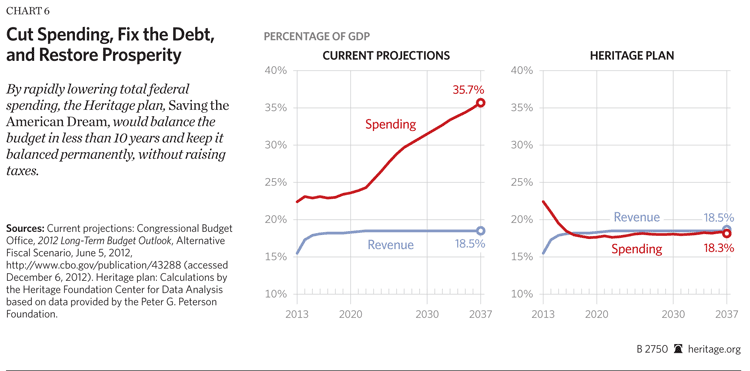
The debate over tax hikes is just a distraction from what is really going on: Washington has a spending problem, not a revenue problem, and President Obama is at the helm. According to the White House Office of Management and Budget, President Obama’s two-term average spending level is projected at 23.4 percent of gross domestic product (GDP).

In comparison, President Clinton’s historical spending average was 19.9 percent of GDP. While revenues are set to return to historical average levels of over 18.1 percent as the economy slowly recovers, spending under current policy is projected to remain well above the historical average of 20.2 percent.

The solution to America’s spending-driven debt crisis is as clear as daylight: Lawmakers must cut spending today and in the future. The Heritage Foundation has a plan, Saving the American Dream, which shows how lawmakers can balance the budget in less than 10 years and reduce the debt by tackling the main drivers of federal spending—entitlements.

A recent paper by Heritage’s J. D. Foster and Alison Fraser draws upon the Heritage plan to present the President with some simple but profound common-sense reforms to programs such as Social Security and Medicare that he could pursue today:

[T]he President must adopt the mantle of leadership, rather than brinksmanship, to steer the nation away from the fiscal cliff and all that is set to follow, and he must start with spending. However, the critical silver lining is that simple, commonsense, and thoroughly vetted solutions…constitute a strong start on the journey to more complete programmatic reforms remedying acknowledged flaws in these programs, and they already enjoy broad support across the political spectrum.

Click here to see the full list of proposals to avoid the fiscal cliff and avert the upcoming fiscal crisis.

Francis Schaeffer’s own words concerning humanist dominated public schools in USA even though country was founded on a Christian base

Francis Schaeffer pictured above with his wife Edith.

Pt 1 of 2 Listen to this Important Message by Francis Schaeffer

Published on Sep 30, 2013

This message “A Christian Manifesto” was given in 1982 by the late Christian Philosopher Francis Schaeffer when he was age 70 at D. James Kennedy’s Corral Ridge Presbyterian Church.
Listen to this important message where Dr. Schaeffer says it is the duty of Christians to disobey the government when it comes in conflict with God’s laws. So many have misinterpreted Romans 13 to mean unconditional obedience to the state. When the state promotes an evil agenda and anti-Christian statues we must obey God rather than men. Acts
I use to watch James Kennedy preach from his TV pulpit with great delight in the 1980’s. Both of these men are gone to be with the Lord now. We need new Christian leaders to rise up in their stead.
To view Part 2 See Francis Schaeffer Lecture- Christian Manifesto Pt 2 of 2 video
The religious and political freedom’s we enjoy as Americans was based on the Bible and the legacy of the Reformation according to Francis Schaeffer. These freedoms will continue to diminish as we cast off the authority of Holy Scripture.
In public schools there is no other view of reality but that final reality is shaped by chance.
Likewise, public television gives us many things that we like culturally but so much of it is mere propaganda shaped by a humanistic world and life view.

_____________________________

Pt 2 -Listen to this Important Message by Francis Schaeffer

I was able to watch Francis Schaeffer deliver a speech on a book he wrote called “A Christian Manifesto” and I heard him in several interviews on it in 1981 and 1982. I listened with great interest since I also read that book over and over again. Below is a portion of one of Schaeffer’s talks  on a crucial subject that is very important today too.
A Christian Manifesto
by Dr. Francis A. Schaeffer
This address was delivered by the late Dr. Schaeffer in 1982 at the Coral Ridge Presbyterian Church, Fort Lauderdale, Florida. It is based on one of his books, which bears the same title.

——–

USA was founded on Christian base but  has humanist dominated public schools

——

This country was founded on a Christian base with all its freedom for everybody. Let me stress that. This country was founded on a Christian base with all its freedom for everybody, not just Christians, but all its freedom for everyone. And now, this is being largely lost. We live not ten years from now, but tonight, in a Humanistic culture and we are rapidly moving at express train speed into a totally Humanistic culture. We’re close to it. We are in a Humanistic culture, as I point out in the public schools and these other things, but we are moving toward a TOTALLY Humanistic culture and moving very quickly.
I would repeat at this place about our public schools because it’s worth saying. Most people don’t realize something. Communism, you know, is not basically an economic theory. It’s materialistic communism, which means that at the very heart of the Marx, Engels, Lenin kind of communism (because you have to put all three together to really understand) is the materialistic concept of the final reality. That is the base for all that occurs in the communist countries.
I am wearing a Solidarity pin — in case you wonder what this is on my lapel. We had two young men from L’Abri take in an 8 ton truck of food into Poland — very bad weather — they almost were killed on the roads. They got in just three days before the crackdown. We, of L’Abri, have taken care of small numbers of each successive wave of Europeans who have been persecuted in the communist nations, the Hungarians, Czechoslovakians, now the Poles. A dear wonderful Christian schoolteacher that we love very much (she’s a wonderful, wonderful Christian young woman, brilliant as brilliant, and she studied at L’Abri for a long time and she was one of the contact points for the destination of the food) — thought that the crackdown might come. So she sent me out this Solidarity pin. This wasn’t made in Newark! This came from Poland. I have a hope. I hope I can wear it until I can hand it back to her and she can wear it again in Poland. That’s my hope! But all the oppression you have ever heard of in Mao’s China, Stalin’s day, Poland, Czechoslovakia — any place that you can name it — Afghanistan — all the oppression is the automatic, the mechanical certainty, that comes from having this other world view of the final reality only being material or energy shaped by pure chance. That’s where it comes from.
And what about our schools? I think I should stress again! By law, you are no more allowed to teach religious values and religious views in our public schools than you are in the schools of Russia tonight. We don’t teach Marxism over here in most of our schools, but as far as all religious teaching (except the religion of Humanism, which is a different kind of a thing) it is just as banned by law from our schools, and our schools are just as secular as the schools in Soviet Russia — just exactly! Not ten years from now. Tonight!
Congress opens with prayer. Why? Because Congress always is opened with prayer. Back there, the founding fathers didn’t consider the 13 provincial congresses that sent representatives to form our country in Philadelphia really open until there was prayer. The Congress in Washington, where Edith and I have just been, speaking to various men in political areas and circles — that Congress is not open until there is prayer. It’s illegal, in many places, for youngsters to merely meet and pray on the geographical location of the public schools. I would repeat, we are not only immoral, we’re stupid. I mean that. I don’t know which is the worst: being immoral or stupid on such an issue. We are not only immoral, we are stupid for the place we have allowed ourselves to come to without noticing.
___________
Related posts:

Francis Schaeffer’s own words concerning religious liberals and humanists

Francis Schaeffer: “Whatever Happened to the Human Race” (Episode 5) TRUTH AND HISTORY Published on Oct 7, 2012 by AdamMetropolis The 45 minute video above is from the film series created from Francis Schaeffer’s book “Whatever Happened to the Human Race?” with Dr. C. Everett Koop. This book  really helped develop my political views concerning abortion, […]

Francis Schaeffer’s own words concerning the possibility that minorities may be mistreated under 51% rule

Francis Schaeffer: “Whatever Happened to the Human Race” (Episode 4) THE BASIS FOR HUMAN DIGNITY Published on Oct 7, 2012 by AdamMetropolis ____________ The 45 minute video above is from the film series created from Francis Schaeffer’s book “Whatever Happened to the Human Race?” with Dr. C. Everett Koop. This book  really helped develop my political […]

Francis Schaeffer’s own words concerning our view of acceptable killing versus Stalin, Mao and Hitler

Francis Schaeffer: “Whatever Happened to the Human Race” (Episode 3) DEATH BY SOMEONE’S CHOICE Published on Oct 6, 2012 by AdamMetropolis _________ The 45 minute video above is from the film series created from Francis Schaeffer’s book “Whatever Happened to the Human Race?” with Dr. C. Everett Koop. This book  really helped develop my political views […]

Francis Schaeffer’s own words concerning infanticide and youth enthansia

Francis Schaeffer: “Whatever Happened to the Human Race?” (Episode 2) SLAUGHTER OF THE INNOCENTS Published on Oct 6, 2012 by AdamMetropolis ___________ The 45 minute video above is from the film series created from Francis Schaeffer’s book “Whatever Happened to the Human Race?” with Dr. C. Everett Koop. This book  really helped develop my political views […]

Francis Schaeffer’s own words concerning tyranny as anti-God agenda pushed through courts

Francis Schaeffer: “Whatever Happened to the Human Race” (Episode 1) ABORTION OF THE HUMAN RACE Published on Oct 6, 2012 by AdamMetropolis ________ The 45 minute video above is from the film series created from Francis Schaeffer’s book “Whatever Happened to the Human Race?” with Dr. C. Everett Koop. This book  really helped develop my political […]

Francis Schaeffer’s own words concerning secular humanism and the public schools in the USA

Francis Schaeffer: “Whatever Happened to the Human Race” (Episode 5) TRUTH AND HISTORY Published on Oct 7, 2012 by AdamMetropolis The 45 minute video above is from the film series created from Francis Schaeffer’s book “Whatever Happened to the Human Race?” with Dr. C. Everett Koop. This book  really helped develop my political views concerning abortion, […]

Francis Schaeffer’s own words concerning the founding fathers and their belief in inalienable rights

Francis Schaeffer: “Whatever Happened to the Human Race” (Episode 4) THE BASIS FOR HUMAN DIGNITY Published on Oct 7, 2012 by AdamMetropolis The 45 minute video above is from the film series created from Francis Schaeffer’s book “Whatever Happened to the Human Race?” with Dr. C. Everett Koop. This book  really helped develop my political views […]

Francis Schaeffer’s own words concerning humanism and its arbitrary laws

Francis Schaeffer: “Whatever Happened to the Human Race” (Episode 3) DEATH BY SOMEONE’S CHOICE Published on Oct 6, 2012 by AdamMetropolis The 45 minute video above is from the film series created from Francis Schaeffer’s book “Whatever Happened to the Human Race?” with Dr. C. Everett Koop. This book  really helped develop my political views concerning […]

Francis Schaeffer’s own words concerning humanism and its bad results

Francis Schaeffer: “Whatever Happened to the Human Race?” (Episode 2) SLAUGHTER OF THE INNOCENTS Published on Oct 6, 2012 by AdamMetropolis The 45 minute video above is from the film series created from Francis Schaeffer’s book “Whatever Happened to the Human Race?” with Dr. C. Everett Koop. This book  really helped develop my political views concerning […]

 Francis Schaeffer’s prayer for us in USA

 Francis Schaeffer: “Whatever Happened to the Human Race” (Episode 1) ABORTION OF THE HUMAN RACE Published on Oct 6, 2012 by AdamMetropolis The 45 minute video above is from the film series created from Francis Schaeffer’s book “Whatever Happened to the Human Race?” with Dr. C. Everett Koop. This book  really helped develop my political views […]

Francis Schaeffer’s “How should we then live?” Video and outline of episode 10 “Final Choices” (Schaeffer Sundays)

E P I S O D E 1 0   Dr. Francis Schaeffer – Episode X – Final Choices 27 min FINAL CHOICES I. Authoritarianism the Only Humanistic Social Option One man or an elite giving authoritative arbitrary absolutes. A. Society is sole absolute in absence of other absolutes. B. But society has to be […]

Francis Schaeffer’s “How should we then live?” Video and outline of episode 9 “The Age of Personal Peace and Affluence” (Schaeffer Sundays)

E P I S O D E 9 Dr. Francis Schaeffer – Episode IX – The Age of Personal Peace and Affluence 27 min T h e Age of Personal Peace and Afflunce I. By the Early 1960s People Were Bombarded From Every Side by Modern Man’s Humanistic Thought II. Modern Form of Humanistic Thought Leads […]

Francis Schaeffer’s “How should we then live?” Video and outline of episode 8 “The Age of Fragmentation” (Schaeffer Sundays)

E P I S O D E 8 Dr. Francis Schaeffer – Episode VIII – The Age of Fragmentation 27 min I saw this film series in 1979 and it had a major impact on me. T h e Age of FRAGMENTATION I. Art As a Vehicle Of Modern Thought A. Impressionism (Monet, Renoir, Pissarro, Sisley, […]

Francis Schaeffer’s “How should we then live?” Video and outline of episode 7 “The Age of Non-Reason” (Schaeffer Sundays)

E P I S O D E 7 Dr. Francis Schaeffer – Episode VII – The Age of Non Reason I am thrilled to get this film series with you. I saw it first in 1979 and it had such a big impact on me. Today’s episode is where we see modern humanist man act […]

Francis Schaeffer’s “How should we then live?” Video and outline of episode 6 “The Scientific Age” (Schaeffer Sundays)

E P I S O D E 6 How Should We Then Live 6#1 Uploaded by NoMirrorHDDHrorriMoN on Oct 3, 2011 How Should We Then Live? Episode 6 of 12 ________ I am sharing with you a film series that I saw in 1979. In this film Francis Schaeffer asserted that was a shift in […]

Francis Schaeffer’s “How should we then live?” Video and outline of episode 5 “The Revolutionary Age” (Schaeffer Sundays)

E P I S O D E 5 How Should We Then Live? Episode 5: The Revolutionary Age I was impacted by this film series by Francis Schaeffer back in the 1970′s and I wanted to share it with you. Francis Schaeffer noted, “Reformation Did Not Bring Perfection. But gradually on basis of biblical teaching there […]

Francis Schaeffer’s “How should we then live?” Video and outline of episode 4 “The Reformation” (Schaeffer Sundays)

Dr. Francis Schaeffer – Episode IV – The Reformation 27 min I was impacted by this film series by Francis Schaeffer back in the 1970′s and I wanted to share it with you. Schaeffer makes three key points concerning the Reformation: “1. Erasmian Christian humanism rejected by Farel. 2. Bible gives needed answers not only as to […]

“Schaeffer Sundays” Francis Schaeffer’s “How should we then live?” Video and outline of episode 3 “The Renaissance”

Francis Schaeffer’s “How should we then live?” Video and outline of episode 3 “The Renaissance” Francis Schaeffer: “How Should We Then Live?” (Episode 3) THE RENAISSANCE I was impacted by this film series by Francis Schaeffer back in the 1970′s and I wanted to share it with you. Schaeffer really shows why we have so […]

Francis Schaeffer’s “How should we then live?” Video and outline of episode 2 “The Middle Ages” (Schaeffer Sundays)

  Francis Schaeffer: “How Should We Then Live?” (Episode 2) THE MIDDLE AGES I was impacted by this film series by Francis Schaeffer back in the 1970′s and I wanted to share it with you. Schaeffer points out that during this time period unfortunately we have the “Church’s deviation from early church’s teaching in regard […]

Francis Schaeffer’s “How should we then live?” Video and outline of episode 1 “The Roman Age” (Schaeffer Sundays)

Francis Schaeffer: “How Should We Then Live?” (Episode 1) THE ROMAN AGE   Today I am starting a series that really had a big impact on my life back in the 1970′s when I first saw it. There are ten parts and today is the first. Francis Schaeffer takes a look at Rome and why […]

Francis Schaeffer: “Whatever Happened to the Human Race” (Episode 5) TRUTH AND HISTORY

Francis Schaeffer: “Whatever Happened to the Human Race” (Episode 5) TRUTH AND HISTORY Published on Oct 7, 2012 by AdamMetropolis This crucial series is narrated by the late Dr. Francis Schaeffer and former Surgeon General Dr. C. Everett Koop. Today, choices are being made that undermine human rights at their most basic level. Practices once […]

Francis Schaeffer: “Whatever Happened to the Human Race” (Episode 4) THE BASIS FOR HUMAN DIGNITY

The opening song at the beginning of this episode is very insightful. Francis Schaeffer: “Whatever Happened to the Human Race” (Episode 4) THE BASIS FOR HUMAN DIGNITY Published on Oct 7, 2012 by AdamMetropolis This crucial series is narrated by the late Dr. Francis Schaeffer and former Surgeon General Dr. C. Everett Koop. Today, choices […]

Francis Schaeffer: “Whatever Happened to the Human Race” (Episode 3) DEATH BY SOMEONE’S CHOICE

Francis Schaeffer: “Whatever Happened to the Human Race” (Episode 3) DEATH BY SOMEONE’S CHOICE Published on Oct 6, 2012 by AdamMetropolis This crucial series is narrated by the late Dr. Francis Schaeffer and former Surgeon General Dr. C. Everett Koop. Today, choices are being made that undermine human rights at their most basic level. Practices […]

Francis Schaeffer: “Whatever Happened to the Human Race?” (Episode 2) SLAUGHTER OF THE INNOCENTS

Francis Schaeffer: “Whatever Happened to the Human Race?” (Episode 2) SLAUGHTER OF THE INNOCENTS Published on Oct 6, 2012 by AdamMetropolis This crucial series is narrated by the late Dr. Francis Schaeffer and former Surgeon General Dr. C. Everett Koop. Today, choices are being made that undermine human rights at their most basic level. Practices […]

Francis Schaeffer: “Whatever Happened to the Human Race” (Episode 1) ABORTION OF THE HUMAN RACE

It is not possible to know where the pro-life evangelicals are coming from unless you look at the work of the person who inspired them the most. That person was Francis Schaeffer.  I do care about economic issues but the pro-life issue is the most important to me. Several years ago Adrian Rogers (past president of […]

The following essay explores the role that Francis Schaeffer played in the rise of the pro-life movement. It examines the place of How Should We Then Live?, Whatever Happened to the Human Race?, and A Christian Manifesto in that process.

This essay below is worth the read. Schaeffer, Francis – “Francis Schaeffer and the Pro-Life Movement” [How Should We Then Live?, Whatever Happened to the Human Race?, A Christian Manifesto] Editor note: <p> </p> [The following essay explores the role that Francis Schaeffer played in the rise of the pro-life movement.  It examines the place of […]

Who was Francis Schaeffer? by Udo Middelmann

Great article on Schaeffer. Who was Dr. Francis A. Schaeffer? By Francis Schaeffer The unique contribution of Dr. Francis Schaeffer on a whole generation was the ability to communicate the truth of historic Biblical Christianity in a way that combined intellectual integrity with practical, loving care. This grew out of his extensive understanding of the Bible […]

Open letter to President Obama (Part 195.1)

Johan Norberg on the Impact of Milton Friedman

Uploaded by on Jun 14, 2010

6/10/10

_________


President Obama c/o The White House
1600 Pennsylvania Avenue NW
Washington, DC 20500

Dear Mr. President,

I know that you receive 20,000 letters a day and that you actually read 10 of them every day. I really do respect you for trying to get a pulse on what is going on out here.

I do not believe the federal government should be in the welfare business. It actually creates a welfare trap that poor people get caught in and hurts their ability to advance up the economic ladder.

I have enjoyed reading this series of reviews by T. Kurt Jaros on Milton and Rose Friedman’s book “Free to Choose.” I hope you enjoy it as much as I did.

I have posted several transcripts and videos of the FREE TO CHOOSE film series on my blog. My favorite episodes are the “Failure of Socialism” and  “Power of the Market.” (This is the 1990 version but the 1980 version is good too.) Today with the increase of the welfare state maybe people should take a long look again at the episode “From Cradle to Grave.” 

Milton Friedman’s  view on vouchers for the schools needs to be heeded now more than ever too. “Created Equal” is probably the episode that I want  you to see the most and I wrote several letters to you suggesting that.

T. Kurt Jaros is currently a Master’s student studying Systematic Theology at King’s College in London.  He holds a B.A. in Philosophy and Political Science cum laude and an M.A. in Christian Apologetics high honors from Biola University, an evangelical Christian university outside of Los Angeles.

He enjoys learning and thinking about theology, specifically historical theology, philosophical theology and philosophy of religion, and issues pertaining to monergism and synergism.  Additionally, he enjoys learning and thinking about political philosophy, economics, American political history, and campaigns.

Cradle to Grave

T. Kurt Jaros on Economics

This is part of a series on Milton Friedman’s “Free to Choose.”

In my previous post, I summarized Friedman’s beliefs about the Federal Reserve, its proper role, and how its failure is what leads us to economic problems (not capitalism). In his following chapter, “Cradle to Grave,” Friedman explains how the welfare state began to take off during the FDR administration.

FDR’s first election “marked a major change in both the public’s perception of the role of government and the actual role assigned to government.” This is clearly seen in the amount of national income spent by the government (national, state and local). For the federal government, FDR’s administration and Congress began to fundamentally change the way our economy had worked. They passed into law a nationwide minimum wage, the Securities and Exchange Commission, the National Labor Relations Board and more. Some of his damage to our economy (such as the National Recovery Administration and the Agricultural Adjustment Administration) was, thankfully, ruled unconstitutional by the Supreme Court.

WWII led to massive budgets and power within the federal government, and because the government was able to employ lots of people for the single purpose, unemployment shrunk and people began to believe in Keynesian principles. However, Friedman explains the problem with this thinking, which is worthy to quote at length:

It is one thing for government to exercise great control temporarily for a single overriding purpose shared by almost all citizens and for which almost all citizens are willing to make heavy sacrifices; it is a very different thing for government to control the economy permanently to promote a vaguely defined ‘public interest’ shaped by the enormously varied and diverse objectives of its citizens.

He thinks it mistaken to believe that Keynesian economics works for something broad and diverse like an economy. WWII had a specific objective for which people could be unified to join together in (which led to people’s willingness to make sacrifices). Yet the public perception was that the government should begin to take care of us. This perception led to the welfare state being inflated by LBJ and his supposed “War on Poverty” (creation of Medicare and Medicaid). Examples such as Jimmy Carter’s Department of Education and Barack Obama’s Patient Protection and Affordable Care Act (better known as “Obamacare”) provide us epitomes of socialism.

The present day examples of central economic planning are not the perfect description of socialism, which is best described as the means of production being planned by the government. But rather, it is a masked version of socialism because it transfers the results of production. And this masking of socialism still has the same consequences, albeit ones that take longer to witness (and perhaps easier to hide or to deceive people into thinking that such results are good). Consider this recent news article which seeks to show that Mitt Romney’s budget would mean guns over butter.

What seems to be more necessary and helpful to a person, a gun or butter? The deception is in the unsaid assumption: “Government should provide butter.” It tugs at our heartstrings that people should have butter (or food), but it duplicitously avoids the truth about how wealth is created or what the role of government ought to be.

In my next post, I’ll provide some examples of how the welfare state is uncontrollable and what Friedman thinks we should do to solve the problems.

__________

Thank you so much for your time. I know how valuable it is. I also appreciate the fine family that you have and your commitment as a father and a husband.

Sincerely,

Everette Hatcher III, 13900 Cottontail Lane, Alexander, AR 72002, ph 501-920-5733, lowcostsqueegees@yahoo.com

Open letter to President Obama (Part 195)


President Obama c/o The White House
1600 Pennsylvania Avenue NW
Washington, DC 20500

Dear Mr. President,

I know that you receive 20,000 letters a day and that you actually read 10 of them every day. I really do respect you for trying to get a pulse on what is going on out here.

We need to make a good effort to cut spending.


Spending Cut Goal: 10% in Two Years

Posted by Chris Edwards

The new issue of International Economy has an article by Canada’s Liberal finance minister from the 1990s, Paul Martin, who succeeded in shrinking that country’s federal government. If a new President Mitt Romney wants to cut spending in Washington, Martin has some tips for him, such as cutting spending broadly, forecasting conservatively, and aiming to eliminate the deficit in a fixed time frame and sticking to it. (I’d also advise President Obama to follow the Canadian example, but he’s issued four budgets so far and seems to be more interested in following the Greek fiscal approach).

Paul Martin says:

I tabled the 1995 Budget in the House of Commons. No department of government escaped untouched. Transfers to the provinces for healthcare and education were reduced, public sector employment was cut by 20 percent, the Department of Transport was cut deeply, historic subsidies in the Department of Agriculture were eliminated, and spending in the Department of Industry was cut by 65 percent.

These were massive cuts, far greater than anything Canada had ever seen. Nor were the cuts simply reduction in the growth of future spending as is so often the case. These were absolute cuts in existing spending, such that by the end of the process the federal government’s expenditures as a percentage of GDP were lower than they had been at anytime in the previous fifty years.

From a libertarian perspective, Canada’s cuts weren’t actually “massive,” but for a Liberal government in a country with a population that had gotten used to government coddling, it was pretty impressive. As I noted in my recent article on Canada, Martin and his team cut the budget by 10 percent in just two years.

So my suggested goal for Romney and team if elected this Fall: at least match the Canadians and push for $380 billion of cuts out of otherwise expected spending in 2015 of $3.8 trillion. And do what the Canadians did: cut everything, including entitlements, aid to subnational governments, defense, business subsidies, farm subsidies, and much more in one big push. Many in Congress will resist of course, but presidents have their most leverage in the first year. Mitt will have nothing to lose but the country into a vortex of debt and economic despair if he doesn’t at least try.

___________

Thank you so much for your time. I know how valuable it is. I also appreciate the fine family that you have and your commitment as a father and a husband.

Sincerely,

Everette Hatcher III, 13900 Cottontail Lane, Alexander, AR 72002, ph 501-920-5733, lowcostsqueegees@yahoo.com

“Music Monday” Video interviews of Gwyneth Paltrow and Chris Martin (Part 2)

As far as I know they have never done an interview together. Therefore, I have included separate interviews that they have done below and I have some links to past posts I have done on them too.

Gwyneth Paltrow & Robert Downey Jr. on Jonathan Ross 2010.04.23 (Part 1)

Coldplay: Chris Martin and Jonny Buckland talk about Mylo Xyloto

Published on Oct 18, 2011 by

Chris Martin and Jonny Buckland from Coldplay talk about Mylo Xyloto, their 5th studio album. Questions in English below.

The interview was conducted by Kirsten Lemaire for Belgian television channel Canvas, and it took place in The Bakery, Coldplay’s very own studio. On the day of the interview they were still working on Xylo Myloto, in that same studio.

0:22 What was the very first plan for this 5th record?

2:25 We were at The Bakery, Coldplay’s main studio. But they also have another studio, The Beehive, just across the street. I wondered if they recorded everything in those two studios.

3:21 I did hear 6 new tracks from Xylo Myloto in advance. Some songs were about love, some songs were about addiction. But I also read that another theme was obsessive-compulsive behaviour. So I asked Chris Martin: is that true?

5:26 The current Coldplay single is Paradise, which definitely has some R’n’B influences. Hence my next question: did they listen to a lot of R’n’B during the making of the new record?

6:40 Last summer, Coldplay premiered some new songs on really big festivals like Rock Werchter. How nervous are they when they’re roadtesting unreleased music in front of 60.000 people or more?

8:37 The interview took place on the day they were actually finishing Mylo Xyloto. Last day in the studio. Must be quite thrilling, because fans have extremely high expectations. But how do the band members feel at such a moment?

10:41 Coldplay is a great live band. But at a certain moment, you have to introduce the new songs to your audience. Do they make more mistakes on stage when they try out new songs?

Chris Martin of Coldplay unknowingly lives out his childhood Christian beliefs (Part 5 of notes from June 23, 2012 Dallas Coldplay Concert)

Coldplay “paradise” Dallas Texas 6/22/12 ( Floor View ) Published on Jun 23, 2012 by ccam cher Awesome concert Coldplay brought confetti, lights and thousands of fans to the American Airlines Center; see photos from their colorful show Photo Gallery News Sports Lifestyles   Comments (0)   9/11 Chris Martin was brought up as an […]


“Music Monday” Countdown of Coldplay’s best albums (part 1)

I like this CD a lot mainly because of it rhythm and how it is the most relaxing of Coldplay’s albums. “YELLOW” “SHIVER” “DON’T PANIC” “TROUBLE” “SPARKS” are all great songs. I would have to say that Parachutes was a good song but it was too short. Altogether I would give this album a 9/10! However, this […]

Tom Brady , Coldplay, Kansas, Solomon and the search for satisfaction (part 3)

Tom Brady “More than this…” Uploaded by EdenWorshipCenter on Jan 22, 2008 EWC sermon illustration showing a clip from the 2005 Tom Brady 60 minutes interview. _______________________ Tom Brady ESPN Interview Tom Brady has famous wife earned over 76 million dollars last year. However, has Brady found lasting satifaction in his life? It does not […]


Coldplay in Madrid concert October 26, 2011

From today. I wonder if Coldplay will continue to be on a spiritual search. Part one of Madrid Concert Look at their latest song and the lyrics: They got one eye on what you knew And one eye on what you do So be careful who it is you’re talking to They got one eye […]

Coldplay gave NPR interview on Oct 22, 2011

Coldplay – Every Teardrop Is A Waterfall Published on Jun 28, 2011 by ColdplayVEVO The new single, taken from Every Teardrop Is A Waterfall EP (featuring two more new tracks). Download it fromhttp://cldp.ly/itunescp Music video by Coldplay performing Every Teardrop Is A Waterfall. (P) 2011 The copyright in this audiovisual recording is owned by EMI Records Ltd […]

Open letter to President Obama (Part 194)


President Obama c/o The White House
1600 Pennsylvania Avenue NW
Washington, DC 20500

Dear Mr. President,

I know that you receive 20,000 letters a day and that you actually read 10 of them every day. I really do respect you for trying to get a pulse on what is going on out here.

We got to lower taxes if we want to encourage job creation.

I am sometimes at a loss for words to describe the stupidity of the Republican Party.

Let’s use an analogy to explain what I mean. Imagine you were playing a game of chess and your opponent openly stated that he wanted you to move your rook to a certain point on the board.

If your IQ was above room temperature, you would probably be suspicious that he wasn’t trying to help you win the game.

Well, the same thing happens in fiscal policy. I quoted the Hill newspaper last year when some Democrats admitted that their top political goal was to seduce the GOP into a tax increase.

Now we have more evidence.

The Democrats’ counter-strategy is a bit more subtle, but has essentially been to find ways to make it very uncomfortable for Republicans to maintain such a rigid anti-tax orthodoxy — to ultimately force Republicans to break their anti-tax pledges and badly splinter their party. That’s what the Buffett Rule is about; that why Dems insist they won’t dismantle the so-called “sequester” — big cuts to defense and even to Medicare — unless Republicans agree to tackle deficits in a balanced way, i.e. by supporting significant new tax revenues. The results have been mixed. They’ve won a small number of GOP votes here and there, and vulnerable members are nowadays more likely to trash or dismiss Grover Norquist in the press than they were last year. But at a very high level within the Democratic Party, there’s a recognition that breaking the GOP on taxes is an absolutely crucial strategic imperative for defending safety net programs over the long term.

That’s a pretty clear statement. We have folks on the left who say they want higher taxes both to prop up big government and to cause internal damage to the GOP.

So we’re now left with a rather strange puzzle. Why would any Republicans (most recently Sen. Lindsey Graham and Jeb Bush) want to help the Democrats achieve those goals?!?

Unless, of course, they’re motivated by a belief in bigger government (high likely) or a suicidal desire to harm their own electoral prospects (highly unlikely since even I don’t think GOPers are that stupid).

____________

Thank you so much for your time. I know how valuable it is. I also appreciate the fine family that you have and your commitment as a father and a husband.

Sincerely,

Everette Hatcher III, 13900 Cottontail Lane, Alexander, AR 72002, ph 501-920-5733, lowcostsqueegees@yahoo.com

Open letter to Speaker of the House John Boehner (Part 54)

Open letter to Speaker of the House John Boehner (Part 54)

John Boehner, Speaker of the House

H-232, The Capital, Washington, DC 20515

Dear Mr. Speaker,

I know that you will have to meet with newly re-elected President Obama soon and he will probably be anxious for you to raise taxes and  federal spending, but he will want you to leave runaway entitlement programs alone. When that happens then you have one thing you can hold over his head and that is the debt ceiling.

You must stand up to him and tell him that you can not raise it. In December of 2012 or January of 2013 at the latest we will be shutting down the government if we don’t increase the debt limit according to the LA Times. You got to listen to the Tea Party heroes like Rep. Todd Rokita, Ben Quayle (R-AZ), Jeff Landry (R, LA-03), Raúl R. Labrador , Tim HuelskampRep. Justin Amash (R-MI),  , Brooks, Mo (AL – 5), Buerkle, Ann Marie (NY – 25),Chabot, Steven (OH – 1),Duncan, Jeff (SC – 3), Fleischmann, Chuck (TN – 3) ,Gowdy, Trey (SC – 4) ,Griffith, H. Morgan (VA – 9) , Harris, Andy (MD – 1) ,Huizenga, Bill (MI – 2) , Mulvaney, Mick (SC – 5) , Pompeo, Mike (KS – 4) , Ribble, Reid (WI – 8), Rigell, E. Scott (VA – 2) , Ross, Dennis (FL – 12) ,Schweikert, David (AZ – 5), Scott, Austin (GA – 8) , Scott, Tim (SC – 1) , Southerland, Steve (FL – 2) , Stutzman, Marlin (IN – 3) , Walberg, Timothy (MI – 7) , Walsh, Joe (IL – 8),and Woodall, Rob (GA – 7) .

__________

Here is another Tea Party hero you need to listen to:

Roby Comments on Debt Limit Vote

Aug 1, 2011 Issues: Spending Cuts and Debt


WASHINGTON—U.S. Rep. Martha Roby (AL-02), a member of the House Committee on Armed Services, made the following comments today regarding the House of Representative’s vote to increase the statutory limit on the national debt:

                “I applaud the efforts of Speaker Boehner, Majority Leader Cantor, Majority Whip McCarthy, and Budget Chairman Ryan over the last month. Every dollar saved under the plan approved tonight is a result of their steadfast advocacy on behalf of the American People. While the final legislation is far from perfect and while many of us would prefer the more fundamental reforms found in the ‘Cut, Cap, and Balance Act,’ this compromise cuts a dollar of spending for every new dollar of debt. That is a significant accomplishment given that Democrats—who wanted new taxes and no spending reductions—outnumbered Republicans two to one at the negotiating table.

                “During this debate, I voted for two separate proposals that would significantly cut future spending, put our nation on firmer financial footing, and avoid a potentially catastrophic default. Each was killed by Senate Democrats.

                “I am pleased that a default has been avoided as a result of the vote tonight. However, I was unable to support this legislation because, after a careful reading of the bill, I fear it could ultimately result in devastating and unjustified cuts to our national security. This bill, unlike previous proposals I supported, has a weak firewall against potentially destructive defense cuts. To be sure, there are savings to be found in the Pentagon’s budget, and I have already voted this year to trim wasteful and unnecessary defense spending. But this bill goes much too far. The legislation would use our defense budget as an insurance policy to guarantee savings in the event that the special joint committee, which this legislation creates, fails to achieve cuts in other areas of the government bureaucracy.

                “Of course we lack a crystal ball to know how it will play out, but my best judgment is that the chances the special joint committee will fail are too high to risk our national defense, which is one of few legitimate government functions enumerated in the Constitution. If required, the cuts would be so deep as to affect the readiness of our troops around the world—a risk I am not willing to take. As important as deficit reduction is, what good is it for a country that is unable to adequately defend the freedom and liberty it cherishes? Certainly there are other places in the massive federal bureaucracy that are more deserving of deep cuts.

                “I reject the idea that we need not worry about these cuts because Washington will never let them happen. To make that suggestion is to say that the legislation does not actually do what we have said it does.

                “In the end, I hope that the special joint committee will find the spending cuts that it is charged to identify, and I look forward to reviewing the product of its work. Our prayer is that the special joint committee members will do their jobs, thereby ensuring that the damaging military cuts that could occur never see the light of day.

                “On the broader question of restoring fiscal responsibility, our work has just begun. This has been a long and convoluted process, but the takeaway is simple: in a short period of time, House Republicans have successfully changed the conversation in Washington from ‘how do we spend more’ to ‘how do we spend less.’ Even so, much work remains, and only a sustained, dedicated effort will truly change the spending culture in Washington.”

# # #

NOTE: Congress debated how best to raise the debt limit for many months. Members considered numerous proposals, and the House of Representatives and the Senate each took several votes on the issue. On May 31, Rep. Martha Roby voted against President Obama’s original request for a clean debtincrease that would expand the government’s ability to borrow money without placing any restrictions on future spending. She saidthat any debt limit increase should be accompanied by “significant” spending cuts. On July 22, Roby voted in favor of the “Cut, Cap, and Balance Act,” referringto the “strong” measure as her “preference.” The Democratic Senaterejected the measure. With the debt deadline looming, Roby supported Speaker Boehner’sproposal on July 29, notingthat it was “far from perfect” but that it cut a dollar of spending for every dollar of additional debt and included no new taxes. Again, the Senaterejected that measure. On July 28, Roby opposed Sen. Reid’s proposal, which she pointed outincluded an unacceptable budget gimmick that would not result in real savings. (The Senatealso rejectedthe Reid proposal.) That vote was followed by the events described in the press release above.

Sincerely,

Everette Hatcher, 13900 Cottontail Lane, Alexander, AR 72002, lowcostsqueegees@yahoo.com, www.thedailyhatch.org, ph 501-920-5733

___________

Related posts:

Government shutdown coming, will there be any tea party heroes available to stand up to Obama?

DEBT LIMIT – A GUIDE TO AMERICAN FEDERAL DEBT MADE EASY. Uploaded by debtlimitusa on Nov 4, 2011 A satirical short film taking a look at the national debt and how it applies to just one family. Watch the guy from the Ferris Bueller Superbowl Spot! Produced by Seth William Meier, DP/Edited by Craig Evans, […]

Some Tea Party heroes (Part 1)

DEBT LIMIT – A GUIDE TO AMERICAN FEDERAL DEBT MADE EASY. Uploaded by debtlimitusa on Nov 4, 2011 A satirical short film taking a look at the national debt and how it applies to just one family. Watch the guy from the Ferris Bueller Superbowl Spot! Produced by Seth William Meier, DP/Edited by Craig Evans, […]

Some Tea Party heroes (Part 8)

Rep Himes and Rep Schweikert Discuss the Debt and Budget Deal Michael Tanner of the Cato Institute in his article, “Hitting the Ceiling,” National Review Online, March 7, 2012 noted: After all, despite all the sturm und drang about spending cuts as part of last year’s debt-ceiling deal, federal spending not only increased from 2011 […]

Some Tea Party heroes (Part 7)

Michael Tanner of the Cato Institute in his article, “Hitting the Ceiling,” National Review Online, March 7, 2012 noted: After all, despite all the sturm und drang about spending cuts as part of last year’s debt-ceiling deal, federal spending not only increased from 2011 to 2012, it rose faster than inflation and population growth combined. […]

Who are the Tea Party Heroes from the 87 Freshmen Republicans?

Here is a study done on the votes of the 87 incoming freshman republicans frm the Club for Growth. Freshman Vote Study In the 2010 election, 87 freshmen House Republicans came to Washington pledging fealty to the Tea Party movement and the ideals of limited government and economic freedom. The mainstream media likes to say […]

Tea Party Conservative Senator Mike Lee interview

Tea Party Conservative Senator Mike Lee interview Here is an excellent interview above with Senator Lee with a fine article below from the Heritage Foundation. Sen. Mike Lee (R-UT) came to Washington as the a tea-party conservative with the goal of fixing the economy, addressing the debt crisis and curbing the growth of the federal […]

Some Tea Party heroes (Part 6)

I feel so strongly about the evil practice of running up our national debt. I was so proud of Rep. Todd Rokita who voted against the Budget Control Act of 2011 on August 11, 2011. He made this comment:   For decades now, we have spent too much money on ourselves and have intentionally allowed our […]

Some Tea Party heroes (Part 5)

Rep. Quayle on Fox News with Neil Cavuto __________________ We have to get people realize that the most important issue is the debt!!! Recently I read a comment by Congressman Ben Quayle (R-AZ) made  after voting against the amended Budget Control Act on August 1, 2011. He said it was important to compel “Congressional Democrats and […]

Some Tea Party heroes (Part 4)

What future does our country have if we never even attempt to balance our budget. I read some wise words by Congressman Jeff Landry (R, LA-03) regarding the  debt ceiling deal that was passed on August 1, 2011:”Throughout this debate, the American people have demanded a real cure to America’s spending addiction – a Balanced Budget […]

Some Tea Party heroes (Part 3)

I read some wise comments by Idaho First District Congressman Raúl R. Labrador concerning the passage of the Budget Control Act on August 1, 2011 and I wanted to point them out: “The legislation  lacks a rock solid commitment to passage of a balanced budget amendment, which I believe is necessary to saving our nation.” I just […]

Some Tea Party heroes (Part 2)

Congressmen Tim Huelskamp on the debt ceiling I just don’t understand why people think we can go on and act like everything is okay when we have a trillion dollar deficit. Sometimes you run across some very wise words like I did the other day. Kansas Congressman Tim Huelskamp made the following comment on the […]

Most significant football games of all time

The fifty most significant games of all-time? That is what the article said. I don’t have time to go through all of them but I have listed a few from that list below.

Here are some games listed below:

October 7, 1916

Yes, there is a most lopsided victory in college football and it belongs to the Georgia Tech Yellow Jackets. 

This record is arguably more unbreakable than anything out there although I personally am not impressed with this particular statistic as some other may be.

Still, Georgia Tech walloped Cumberland College (who did not field an official team that year) by a final score of 222-0 on October 7, 1916.

___________

November 20, 1986 vs. Arkansas

Craig James and Eric Dickerson were known as the “Pony Express” and they were as dynamic as any backfield duo in the history of college football.

However, since SMU’s football program was given the “death penalty” for numerous NCAA violations, the program has not been the same.

The entire 1987 season was cancelled for SMU and they also were banned for two seasons from the postseason. As far as how their final game went against Arkansas, the Razorbacks thumped them 41-0.

_________________

395153_display_image
Vincent Laforet/Getty Images

January 4, 1999

The 1999 Fiesta Bowl was the first ever BCS National Championship game and it featured the two top ranked teams in the country between Tennessee and Florida State (amazing how college football is the only true sport that guarantees you the two best).

The Seminoles have had their fair share of disappointments and struggles in the BCS (1-5), and they lost to the Vols 23-16.

Tennessee’s Tee Martin and Peerless Price stole the show and the victory for Tennessee was their sixth national championship.

Six great economic crossroads of the 20th and 21st centuries examined by Michael Reagan

I found this article very interesting.

The Kennedy-Reagan Truth vs. the Obama Delusion

by Jim Denney

In his book The New Reagan Revolution, Michael Reagan examined six great economic crossroads of the 20th and 21st centuries. These six critical junctures in the history of the United States serve as economic laboratories to test two contrasting economic theories. One theory consistently produced economic expansion and sustained growth. The other theory invariably produced failure and misery. Here are Michael Reagan findings:

1. The “Forgotten Depression” of January 1920. During the last year of Woodrow Wilson’s presidency, the economy nosedived. GNP fell 17 percent; unemployment soared from 4 to almost 12 percent. This was the “Forgotten Depression” of 1920. Wilson’s successor, Warren G. Harding, came into office and immediately cut tax rates for all income brackets, slashed federal spending, and balanced the budget. Long before the world ever heard of Ronald Reagan, Harding practiced “Reaganomics.”

“President Harding applied the principles of Reaganomics,” Michael Reagan observed, “even though Ronald Reagan was at that time a nine-year-old boy living in Dixon, Illinois. Harding was not following an economic theory. He was following common sense. He treated the federal budget as you would treat the family budget: When times are tough, cut spending and stay out of debt. Harding also treated his fellow citizens with commonsense compassion: If folks are going through tough times, government should ease their burden and cut their taxes.”

The Harding recovery was astonishingly rapid, beginning just half a year into his presidency. Unemployment fell to 6.7 percent by 1922, and to 2.4 percent by 1923. Harding’s successor, Calvin Coolidge, maintained Harding’s program of low tax rates, balanced budgets, and limited government. The Harding-Coolidge era of prosperity became known as “the Roaring Twenties”—a time of soaring prosperity, stable prices, and boundless optimism.

Obvious conclusion based on the evidence: Reaganomics works.

2. The Great Depression. Coolidge was succeeded by Herbert Hoover. In the eighth month of Hoover’s presidency, the stock market crashed—the infamous Crash of 1929. Many factors led to the Great Depression, but the Crash was the precipitating event. Hoover had failed to learn the lessons of the Harding-Coolidge years, so he responded by raising taxes (hiking the top marginal rate from 25 to 63 percent), imposing protectionism (the Smoot-Hawley Tariff Act), and boosting government spending by 47 percent, driving America deep into debt. Hoover’s actions worsened the Depression. A defeated Herbert Hoover bequeathed a ruined economy to Franklin Delano Roosevelt

FDR took office at a time when 25 percent of the nation’s workforce was unemployed. He, too, ignored the lessons of the “Forgotten Depression,” and doubled down on Hoover’s failed tax-and-spend policies, applying the economic theory known as Keynesianism (after British economist John Maynard Keynes). The Keynes-FDR approach involved deficit spending, soak-the-rich tax policies, and big-government make-work programs (the New Deal). FDR and a compliant Congress hiked personal and corporate income tax rates, estate taxes, and excise taxes.

Michael Reagan wrote, “From 1937 to 1939, the stock market lost almost half its value, car sales fell by one-third, and business failures increased by one-half. From 1932 to 1939, the U.S. racked up more debt than in all the preceding 150 years of America’s existence. By early 1939, as the Great Depression was in its tenth year, unemployment again climbed past the 20 percent mark.”

Many Americans credit FDR with “getting America through the Depression.” In reality, FDR’s policies prolonged the Depression. In a time of catastrophic unemployment, Roosevelt made it prohibitively expensive to hire people, making a terrible human tragedy even worse. While thousands of U.S banks failed under FDR’s policies, across the border in Canada, not one bank failed—because Canadian banks were not hamstrung by FDR’s foolish over-regulation. In FDR’s Folly, historian Jim Powell questions the disturbing FDR legacy:

Why did New Dealers make it more expensive for employers to hire people? Why did FDR’s Justice Department file some 150 lawsuits threatening big employers? Why did New Deal policies discourage private investment without which private employment was unlikely to revive? Why so many policies to push up the cost of living? Why did New Dealers destroy food while people went hungry? To what extent did New Deal labor laws penalize blacks? Why did New Dealers break up the strongest banks? . . . Why didn’t New Deal public works projects bring about a recovery? Why was so much New Deal relief spending channeled away from the poorest people?

In May 1939, a demoralized and defeated Henry Morgenthau, FDR’s treasury secretary, told the House Ways and Means Committee, “We are spending more than we have ever spent before and it does not work. . . . I want to see people get a job. I want to see people get enough to eat. We have never made good on our promises. . . . After eight years of this administration we have just as much unemployment as when we started. . . . And an enormous debt to boot!”

Many people mistakenly believe that World War II lifted America out of the Great Depression. Not true. What WWII did was take 12 million men out of the workforce and send them into war, which ended unemployment. But all the other signs of a damaged economy remained during the war: low stock prices, depressed private investment, and depressed consumer demand.

Roosevelt and his successor, Harry Truman, had a post-war plan to impose an even bigger Second New Deal after the war. Fortunately, Congress refused, and chose instead to cut taxes and cut spending—the same commonsense “Reaganomics” approach that had produced prosperity during the 1920s. The result: a post-war economic boom from the late 1940s through the 1950s. Had FDR and Truman gotten their way, the country would have slipped right back into recession if not a second Great Depression.

Obvious conclusion based on the evidence: Keynesianomics fails, prolonging economic hardship and misery, while Reaganomics works again.

3. The Recession of 1960 and 1961. When John F. Kennedy came into office, he faced a jobless figure of 7.1 percent. Wanting the economy to keep up with the growing workforce, JFK addressed the Economic Club of New York in December 1962 and proposed a bold notion: “It is a paradoxical truth that tax rates are too high today and tax revenues are too low and the soundest way to raise the revenues in the long run is to cut the rates now. . . . The purpose of cutting taxes now is not to incur a budget deficit, but to achieve the more prosperous, expanding economy which can bring a budget surplus.”

Those are the words of John F. Kennedy—and he was preaching Reaganomics. Kennedy was assassinated less than a year later, but his successor, Lyndon Johnson, lobbied hard for the JFK tax cuts, and he signed them into law in 1964. As a result of JFK’s Reaganesque economic plan, the economy experienced a dramatic 5 percent expansion and personal income increased by 7 percent. Gross national product grew from $628 billion to $672 billion, corporate profits by an explosive 21 percent, auto production rose by 22 percent, steel production grew by 6 percent, and unemployment plummeted to 4.2 percent—an eight-year low. The Kennedy-Johnson tax rate cuts produced a sustained economic expansion for nearly a decade.

Obvious conclusion based on the evidence: Reaganomics works again.

4. The Recession of the 1970s. This recession began in November 1973 under Nixon and ended (technically) in March 1975 under Gerald Ford—a 16-month recession. According to the graphs and charts of the economists, real GDP was on the rise by the spring of 1975, yet unemployment and inflation remained painfully high throughout rest of the 1970s. Americans continue to suffer joblessness amid spiraling prices after the recession officially ended.

In 1976, Ronald Reagan narrowly lost the primary race against Gerald Ford. Reagan was convinced that he knew how to solve the long and painful recession of the 1970s, but he was forced to watch from the sidelines as Gerald Ford and Jimmy Carter—two befuddled, clueless Keynesians!—battled each other for the White House. On October 8, 1976, at the height of the presidential race between Carter and Ford, Reagan outlined the principles of Reaganomics in a syndicated newspaper column entitled “Tax Cuts and Increased Revenue.” He wrote:

Warren Harding did it. John Kennedy did it. But Jimmy Carter and President Ford aren’t talking about it. The ‘it’ that Harding and Kennedy had in common was to cut the income tax. In both cases, federal revenues went up instead of down. . . . Since the idea worked under both Democratic and Republican administrations before, who’s to say it couldn’t work again?”

Reagan had majored in economics at Eureka College and had spent years studying the great free market economists such as Adam Smith (The Wealth of Nations), Friedrich Hayek (The Road to Serfdom), and Milton Friedman (Capitalism and Freedom). While Reagan’s opponents ignorantly wrote him off as an “amiable dunce,” it is clear that Reagan correctly and insightfully diagnosed the ailing economy of the 1970s. Unfortunately, Reagan would have to wait more than four years for the opportunity to put his prescription into practice.

Obvious conclusion based on the evidence: Keynesianism fails again.

5. The Jimmy Carter Stagflation Recession of 1980. After Jimmy Carter was inaugurated in January 1977, he inflicted the failed FDR-style Keynesian approach on the country—an approach which says the federal government can spend its way to prosperity. The result of Carter’s policies was an economic disaster called “stagflation”—slow economic growth coupled with the misery of rampant inflation and high unemployment.

By the 1980 election, America under Carter was in a full-blown recession. The American people had suffered years of double-digit interest rates, double-digit inflation, and double-digit unemployment, plus blocks-long lines at the gas station. Ronald Reagan defeated Carter in a landslide. Newsweek observed: “When Ronald Reagan steps into the White House . . . he will inherit the most dangerous economic crisis since Franklin Roosevelt took office 48 years ago.”

Reagan moved confidently and quickly to slash tax rates and domestic spending. Under his leadership, the top marginal tax rate dropped from 70 percent to 28 percent. Michael Reagan described the results:

Tax cuts generated 4 million jobs in 1983 alone and 16 million jobs over the course of Ronald Reagan’s presidency. Unemployment among African-Americans dropped dramatically, from 19.5 percent in 1983 to 11.4 percent in 1989. . . .

The inflation rate fell from 13.5 percent in 1980 . . . to 3.2 percent in 1983. . . .

The Reagan tax cuts nearly doubled federal revenue. After his 25 percent across-the-board tax rate cuts went into effect, receipts from both individual and corporate income taxes rose dramatically. According to the White House Office of Management and Budget, revenue from individual income taxes went from $244.1 billion in 1980 to $445.7 billion in 1989, an increase of over 82 percent. Revenue from corporate income taxes went from $64.6 billion to $103.3 billion, a 60 percent jump.

This was the fulfillment of the “paradoxical truth” that John F. Kennedy spoke of in his 1962 speech: “Cutting taxes now . . . can bring a budget surplus.” Both JFK and Ronald Reagan predicted that lower tax rates would generate more revenue. This “paradoxical truth” worked exactly as predicted.

At a White House press conference in 1981, President Reagan took reporters to school, explaining that the principles of Reaganomics have been known for centuries. Lower tax rates invariably bring more money into the treasury, he explained, “because of the almost instant stimulant to the economy.” This principle, Reagan added, “goes back at least, I know, as far as the fourteenth century, when a Moslem philosopher named Ibn Khaldun said, ‘In the beginning of the dynasty, great tax revenues were gained from small assessments. At the end of the dynasty, small tax revenues were gained from large assessments.’”

The principles of Reaganomics have been proved true—and Keynesian theory has been exposed as a fraud once more.

6. The Obama Recession. To be fair, what I call “The Obama Recession” actually began under George W. Bush, triggered by the collapse of the housing bubble. I think it’s fair to call it The Obama Recession because, when Barack Obama took office, he threw $814 billion of stimulus money at the recession (plus billions more in corporate bailouts, “Cash for Clunkers,” Solyndra-style green energy boondoggles, and other prime-the-pump schemes). He promised to jump-start the economy and hold unemployment below 8 percent. This was weapons-grade Keynesianism, practiced on a scale never before witnessed in human history. After spending so much money on the “cure,” Obama now owned that recession.

If Keynesian theory works at all, the Obama stimulus plan should have completely turned the economy around. But the stimulus plan—officially known as the American Recovery and Reinvestment Act of 2009—not only failed to make a splash, it didn’t make a ripple. Even after the government pumped nearly a trillion dollars of borrowed money into the economy, unemployment nudged up toward the 10 percent mark. Today, unemployment is officially below 9 percent—but the actual jobless rate is much higher.

In 2010, the Population Reference Bureau calculated the workforce to be at just over 157 million people. The Bureau of Labor Statistics reports that there are 131 million jobs in America. That would leave 26 million people jobless—or about 16 percent of the total workforce. But it gets worse: Many of those jobs are just part-time jobs, and many people hold two or more of those jobs, so the actual jobless number is certainly far higher than 16 percent—maybe 20 percent or higher.

Obvious conclusion based on the evidence: Keynesianomics fails catastrophically.

Unfortunately, the high priests of the Keynesian religion refuse to see the light. President Obama clings to his delusional Keynesian faith, insisting that all we have to do is throw more money at the economy with another stimulus bill! That is economic insanity. Former Reagan aide Peter Ferrara wrote in the Wall Street Journal:

The fallacies of Keynesian economics were exposed decades ago by Friedrich Hayek and Milton Friedman. Keynesian thinking was then discredited in practice in the 1970s, when the Keynesians could neither explain nor cure the double-digit inflation, interest rates, and unemployment that resulted from their policies. Ronald Reagan’s decision to dump Keynesianism in favor of supply-side policies—which emphasize incentives for investment — produced a 25-year economic boom. That boom ended as the Bush administration abandoned every component of Reaganomics one by one, culminating in Treasury Secretary Henry Paulson’s throwback Keynesian stimulus in early 2008.

Mr. Obama showed up in early 2009 with the dismissive certitude that none of this history ever happened, and suddenly national economic policy was back in the 1930s. Instead of the change voters thought they were getting, Mr. Obama quintupled down on Mr. Bush’s 2008 Keynesianism.

Keynesian theory is every bit as superstitious as believing in astrology or a flat Earth or the good-luck powers of a rabbit’s foot. The facts of history are beyond dispute. The old Keynesian superstition has failed every time it was tried. But Keynesian fundamentalists like Barack Obama continue to live in a state of denial.

We know what works. Nearly a century of economic history proves it. Now we need a president and a Congress with the common sense to apply the lessons of history to the economic crisis of today.

______

The Laffer Curve, Part III: Dynamic Scoring