As predicted, the House State Agencies rejected both the Senate compromise map (linked here) passed yesterday with 20 votes and the so called “Luker Amendment” (linked here) named after its author Sen. Luker…
“We can’t have negotiations when the Fayetteville Finger is on the table,” insisted House Republican Minority Leader John Burris. “As long as that map is out there and being discussed as a serious possibility – not only as a serious possibility but by making it a serious possibility by by passing the committee and going straight to the floor vote, until that is ruled out I think negotiations will be very difficult because it is such an irrational position.”
Both the House and the Senate have adjourned until Monday…
Rep. Uvalde Lindsey (D-Fayetteville) prefers the map know as the Luker Amendment and does not mix words regarding his opposition to moving Fayetteville into AR4.
“I think (the Luker map) is by far the of all the maps I have seen the best example of a bipartisan cooperation to give the people of this state a Congressional district that they can have confidence in,” said Lindsey.
Lindsey said he believes the House committee’s rejection of the Senate compromise and the Luker Amendment was an effort to try to persuade the Senate to pull the Fayetteville Finger out of committee with 18 votes which he warns will create a backlash.
The 88th General Assembly completed all but one task by a self-imposed April 1 deadline. State lawmakers passed a series of major bills aimed at tax relief, prison reform and potential highway improvements. They also approved a $4.6 billion balanced budget.
Legislators have yet to settle a once-a-decade challenge of redrawing congressional district lines. Several failed attempts have been unable to garner support from the House and Senate. Lawmakers will regroup next week to continue work on the effort. They will not officially adjourn until April 27.
(b. 1955) – A native of Hot Springs, Thornton was featured on the television series “Hearts A’Fire.” He directed and starred in “Slingblade” a movie he filmed in Benton. He received two Oscar nominations for the film, one for Best Actor and one for Best Screenplay, which he won. He was also nominated for Best Supporting Actor in 1999 for “A Simple Plan.” Thornton has since gone on to star in “Monster’s Ball” (2001), as Davy Crockett in “The Alamo” (2004), “Bad Santa” (2003), and “Astronaut Farmer” (2007). www.billybobthornton.net
Senator Mark Pryor wants our ideas on how to cut federal spending. Take a look at this video clip below:
Senator Pryor has asked us to send our ideas to him at cutspending@pryor.senate.gov and I have done so (at 4:04 pm CST on April 7th, 2011, and will continue to do so in the future. Here are a few more I just emailed to him myself.
In fact, if you look back at the time that we call “The Battle of Britain,” one of the things Winston Churchill said that always stuck with me. He said “Never in the field of human conflict was so much owed by so many to so few.” And he was talking about those brave men who flew those airplanes over Great Britain to protect the skies and protect the British people and really to win the war, to stop Nazi Germany from invading and defeating the British Empire.
The so few that we have today could be named and their names are Tom Coburn, Dick Durbin, Mark Warner, Saxby Chambliss, Mike Crapo, and Kent Conrad. Those few have been meeting for weeks, even months to try and come up with a comprehensive budget agreement based on the blueprint that the debt commission has given us. I would say that these six senators, they’re not politicians. They’re statesmen. They’re trying to do what’s right for the country. They’re trying to do what’s in the country’s best interest, not their own best interest. I can guarantee you, each one of the six will face tremendous criticism from their own parties and from other quarters about what they’re trying to do. To me that’s courage, to me that’s leadership, to me that’s what being a Senator is all about.
We have to start eliminating programs or the USA will end up like the European countries that are heading toward economic disaster. Real courage is facing our problem which is spending too much and deal with it now decisively.
Start with the Defense Department. Obviously, defending America is vital, one of the few necessary tasks of government. But most of what the Pentagon does these days has nothing to do with protecting America…
Perhaps even dumber is subsidizing the defense of Europe, Japan, South Korea, and other populous and prosperous allies. The Europeans have a bigger GDP and population than America, but the U.S. government insists on defending them. Washington redraws national borders in the Balkans and creates alliances in Central Asia. Most of these ventures diminish U.S. security by creating geopolitical threats and liabilities.
If the Pentagon isn’t going to protect us, then there’s a need for something like the Department of Homeland Security. But this bizarre mix of everything from customs to immigration to disaster relief isn’t very good at keeping Americans safe. Especially since Congress is most interested in passing out grants as pork and agency bureaucrats prefer to provide “security theatre” to create the illusion of safety. The best policy would be to stop making additional enemies who want to harm Americans by bombing, invading and occupying additional countries.
(b. 1946) – In the early 70s, 200 women sent soul sensation Al Green a signed petition begging him never to get married. That, in the proverbial nutshell, captures the amazing popularity of this sweet crooner from Forrest City – especially among women. “The phenomenon of women is love,” Green once said, trying to explain his female fans’ attraction to him. “Men are more into their careers, making money and achieving goals in their lives, but a woman will turn down a career to say, I love you, and really mean it.” Al Green’s secret weapon, then, was that he understood love. That and a lot of talent plus some lucky breaks led him from a sharecropper’s shack in the Delta to the top of the soul charts. Soon Green had audiences swooning with his own hits such as “Tired of Being Alone” and “Let’s Stay Together,” followed by “Call Me,” “I’m Still in Love With You,” and “You Ought to Be With Me.” In 1972, Green was named rock “n” roll star of the year by Rolling Stone. But even as he was seducing millions with his songs about secular love, Al Green was feeling a pull toward something else. “I ran from it,” he told Rolling Stone. Green eventually became an ordained minister and bought the Full Gospel Tabernacle Church in Memphis, assuming full-time duties as its pastor. Over time, he gave new meaning to the term “soul” music, blending his sweet R & B style with gospel. In the early 1980s, his “The Lord Will Make a Way” won his first Grammy but not his last. He still preaches every single Sunday. Today, Al Green understands a deeper kind of love. www.rockhall.com/inductee/algreen
Senator Mark Pryor wants our ideas on how to cut federal spending. Take a look at this video clip below:
Senator Pryor has asked us to send our ideas to him at cutspending@pryor.senate.gov and I have just done so at 9:51 Central Standard Time on April 7, 2011. Here is the first portion of my suggestions below in the form of an article by Senator Rand Paul.
Our fiscal challenges that the debt commission has focused on and many of us have focused on, they’re beyond politics. They’re bigger than politics. They’re more important than the next election. In fact, they’re more important than our own personal political fortune. This fiscal situation that we’re in is not about the next election, but it’s about the next generation.
If Senator Pryor really believes this, then why won’t he join Senator Rand Paul and ask for cuts of at least 500 Billion out of the budget this year? If Senator Pryor really believes this is so big that it affects the next generation then why only cut 1.6% like the other Republicans are suggesting, but get more ambitious like Rand Paul does. Below you will see an article that Rand Paul wrote Feb 7, 2011 for the Wall Street Journal.
A Modest $500 Billion Proposal
My spending cuts would keep 85% of government funding and not touch Social Security or Medicare.
After Republicans swept into office in 1994, Bill Clinton famously said in his State of the Union address that the era of big government was over. Nearly $10 trillion of federal debt later, the era of big government is at its zenith.
According to the Congressional Budget Office, this will be the third consecutive year in which the federal government is running a deficit near or greater than $1 trillion. The solution to the government’s fiscal crisis must begin by cutting spending in all areas, particularly in those that can be better run at the state or local level. Last month I introduced legislation to do just that. And though it seems extreme to some—containing over $500 billion in spending cuts enacted over one year—it is a necessary first step toward ending our fiscal crisis.
My proposal would first roll back almost all federal spending to 2008 levels, then initiate reductions at various levels nearly across the board. Cuts to the Departments of Agriculture and Transportation would create over $42 billion in savings each, while cuts to the Departments of Energy and Housing and Urban Development would save about $50 billion each. Removing education from the federal government’s jurisdiction would create almost $80 billion in savings alone. Add to that my proposed reductions in international aid, the Departments of Health and Human Services, Homeland Security and other federal agencies, and we arrive at over $500 billion.
My proposal, not surprisingly, has been greeted skeptically in Washington, where serious spending cuts are a rarity. But it is a modest proposal when measured against the size of our mounting debt. It would keep 85% of our government funding in place and not touch Social Security or Medicare. But by reducing wasteful spending and shuttering departments that are beyond the constitutional role of the federal government, such as the Department of Education, we can cut nearly 40% of our projected deficit and at the same time remove thousands of big-government bureaucrats who stand in the way of efficiency.
Examples of federal waste are more abundant than ever. For example, the Department of Energy’s nuclear-weapons activities should be placed under the purview of the Department of Defense. Many of its other activities amount to nothing more than corporate handouts. It provides research grants and subsidies to energy companies for the development of new, cleaner forms of energy. This means nearly all forms of energy development here in the U.S. are subsidized by the federal government, from oil and coal to nuclear, wind, solar and biofuels. These subsidies often go to research and companies that can survive without them. This drives up the cost of energy for all Americans, both as taxpayers and consumers.
The Commerce Department is another prime example. Consistently labeled for elimination, specifically by House Republicans during the 1990s, one of Commerce’s main functions is delivering corporate welfare to American firms that can compete without it. My proposal would scale back the Commerce Department’s spending by 54% and eliminate corporate welfare.
My proposal would also cut wasteful spending in the Defense Department. Since 2001, our annual defense budget has increased nearly 120%. Even subtracting the costs of the conflicts in Iraq and Afghanistan, spending is up 67%. These levels of spending are unjustifiable and unsustainable. Defense Secretary Robert Gates understands this and has called for spending cuts, saying “We must come to realize that not every defense program is necessary, not every defense dollar is sacred or well-spent, and more of everything is simply not sustainable.”
For those who take issue with any of the spending cuts I have proposed, I have two requests:
First, if you believe a particular program should be exempt from these cuts, I challenge you to find another place in the budget where the same amount can feasibly be cut and we can replace it.
Second, consider this: Is any particular program, whatever its merits, worth borrowing billions of dollars from foreign nations to finance programs that could be administered better at the state and local level, or even taken over by the private sector?
A real discussion about the budget must begin now—our economy cannot wait any longer. For 19 months, unemployment has hovered over 9%. After a nearly $1 trillion government stimulus and $2 trillion in Federal Reserve stimulus, the Washington establishment still believes that we can solve this problem with more federal spending and the printing of more money.
That’s ridiculous, and the American people have had enough.
Many in Washington think that a one-year, $500 billion spending cut is too bold. But the attendees at the newly formed Senate Tea Party Caucus say, “Bring on the cuts! And then, bring on more!” My Republican colleagues say they want a balanced-budget amendment. But to have any semblance of credibility we must begin to discuss where we will cut once it passes. My proposal is a place to start.
Mr. Paul is a Republican senator from Kentucky.
___________________________________________
I am doing a series on Famous Arkansans and today is one of my favorites.
(b. 1936) – A native of Delight in Pike County, the famous pop/country singer and songwriter hosted his own TV variety shows, “The Glen Campbell Goodtime Hour” (1969) and “The Glen Campbell Music Show” (1982). His hit recordings include: “By the Time I Get to Phoenix,” “Wichita Lineman,” “Rhinestone Cowboy” and “Gentle on My Mind.” He appeared in the movies “True Grit” (1969), “Any Which Way You Can” (1980), “Uphill All The Way” (1985), and “Family Prayers” (1993). Campbell, who in 1960 was a session musician playing on recordings by Frank Sinatra, Nat King Cole, Elvis Presley and counless others, now headlines concerts throughout North America and the British Isles. www.glencampbellshow.com
Glen in an interview with Jim Gaver talks about his PBS special and TV shows like Shindig
Ashley County stays in AR4 (which gets several south Arkansas Democrats on board); Pope County stays in tact (bringing on board Rep. Lea) but is moved to AR4 along with Johnson and Yell. Logan is the only county split between AR4 and AR3.
Not a bad map. Relatively smooth edges. Only one county split. No fingers as best I can tell.
My sources says this will likely be introduced in the House State Agencies Committee as an amendment to the map passed today by the Senate. This one has a better chance at 11 committee votes which currently appears to be the biggest hurdle in the House.
_________________________
I think that Tolbert is right in his assessment. Hopefully this will be the last hurdle.
I am doing a series on Famous Arkansans. Here is some info on a wonderful lady from North Little Rock.
Donald Sutherland and Diana Ross presenting Mary Steenburgen with the Oscar® for Best Supporting Actress for her performance in “Melvin and Howard” at the 53rd Academy Awards® in 1981.
(b. 1953) – This Academy Award-winning actress from North Little Rock was discovered by Jack Nicholson. She has starred in “Ragtime” (1981), Woody Allen’s “A Midsummer Night’s Sex Comedy” (1982), “Parenthood” (1989), “Back to the Future III” (1990), “The Butcher’s Wife” (1991) and many other movies. She won an Academy Award for Best Supporting Actress in “Melvin and Howard” in 1981. She produced and starred in “The End of the Line” (1987), a movie filmed in Arkansas. Steenburgen also starred, along with her husband, actor Ted Danson, in the television miniseries “Gulliver’s Travels” (1996) and the television series “Ink” (1997). She last appeared in the television show “Joan of Arcadia.” www.tvguide.com/celebrities/marysteenburgen
Craig Ferguson welcomes to the show Mary Steenburgen who is promoting Step Brothers.
You will notice the interview seen above, Mary mentions how touchy her husband Ted is about his bald spot. I was in the Little Rock Airport about a year ago and I was getting money out of the Bank of America ATM and I turned around to leave and both Ted and Mary were standing right behind me. Ted was fumbling around with his wallet and the first thing I noticed was his bald spot.
April 5 (Bloomberg) — Chris Edwards, director of tax policy studies at the Cato Institute, talks about the possibility of a government shutdown if Democratic and Republican leaders fail to reach a budget compromise by April 8, when current funding authority expires. Edwards, speaking with Deirdre Bolton on Bloomberg Television’s “InsideTrack,” also discusses House Budget Committee Chairman Paul Ryan’s proposed fiscal 2012 budget plan. (Source: Bloomberg)
In Washington, the blame game has become par for the course. It’s become just become politics as usual. In fact, it’s one thing that people in my state are sick and tired of and one of the reasons why they’ve lost confidence in Congress and in our government.
Besides that, how in the world does holding press conferences and pointing fingers at others help resolve anything? It’s not true. The truth of the matter is that we are in this fiscal situation that we’re in today because of decisions that all of us have made over the last decades.
In fact, I saw yesterday in the paper where Speaker Boehner was talking to his caucus about getting ready for the shutdown and there were ovations over there. There are no ovations over here for a government shutdown. We do not want to see it. I’m not just talking about the Democrats in the Senate. I don’t know of any Republicans in the Senate who want to see a shutdown.
One of the tests I use when I look at politicians is the louder they are and the more often they have press conferences to blame other people, it probably means they are more to blame for the problems we have today. I certainly hope as the elections roll around next year the American people will remember many of the politicians’ attempts here in Washington to avoid responsibility for this terrible fiscal crisis.
One thing we need to keep in mind is that we’re talking about this week in terms of shutting down the government. I hope that doesn’t happen. But what we’re talking about this week is really only important for the next six months. We’re only talking about for the rest of this year. The only fight that we need to have is over the long-term fiscal policy of this country. So for the next six months, I don’t want to say that it’s not important because it is but I would say it’s time for us to demonstrate to the American people, to the markets, and to the world that we can come up with political solutions to the very challenging problems that we have.
I’m also very concerned in this fragile economy that if we do shut down the government, that might be something that would shake this economy and, possibly, stop it in its tracks. I hope not reverse it, but I do have concerns about what an abrupt cutoff of government spending will do to the economy.
You will notice the words that I have put in bold print.
One of the tests I use when I look at politicians is the louder they are and the more often they have press conferences to blame other people, it probably means they are more to blame for the problems we have today. I certainly hope as the elections roll around next year the American people will remember many of the politicians’ attempts here in Washington to avoid responsibility for this terrible fiscal crisis.
I too hope the voters will remember who has been in favor of cutting the budget and who has not. That is the cause of the “terrible fiscal crisis.”
Legislators continue to negotiate a budget deal to avoid a federal government shutdown. Most everyone in Washington assumes that the public would be angry if the bureaucrats were sent home. But a new Rasmussen poll indicates that 57% of Americans like the idea if it is the only way to get deeper budget cuts.
No doubt, the budget needs to be pared. Uncle Sam will spend about $3.8 trillion this year. The deficit will run a record $1.65 trillion.
But the Democratic leadership has decided to stand fast on behalf of Big (Really, Really Big) Government. The budget plan released by President Barack Obama earlier this year relied on the usual “rosy scenarios” to understate future outlays and overstate future revenues, yet still predicted that the annual deficit will remain above $600 billion throughout the coming decade. More realistically, the red ink over that period is likely to approach $10 trillion. Congressional Democrats are acting like there is no program, no expenditure in the entire federal Leviathan that is not essential.
Republicans have taken up the cause of the taxpayers. Of course, their conversion to the cause of fiscal responsibility came late: President George W. Bush and his GOP Congress squandered money on virtually every program known to man — and some previously unknown ones too. Republicans share the blame for today’s fiscal mess. But at least they are now using the phrase “budget cuts” in polite company.
It’s obviously hard to quickly close such a huge gap, especially since the 2011 federal fiscal year is about half over. But given the budget crisis facing America, Congress still should make a serious start.
From all of the sound and fury coming out of Washington, one would think that the two parties were arguing about something important. Presumably the GOP is proposing budget cuts of, oh, a few hundred billion dollars? No. How about a couple hundred billion dollars? No. Well, certainly at least $100 billion? No. Think $61 billion. And that amount — about 1.6% of federal outlays — has the Democrats in full battle cry. Imagine! Cutting federal expenditures by 1.6%! Doing so would destroy America!
It makes me wish for last year’s Snowmageddon, which closed the federal government in Washington for an unprecedented four days. Amazingly, the country staggered on without guidance and nurture from Uncle Sam. The economy continued to function, contra President Obama’s recent warnings about the impact of a government shutdown. In fact, Americans did a lot better without having to look over their shoulders those four days.
As the majority of the population recognizes, there’s no reason to fear a government shutdown this year. We have grown far too reliant on Washington. It is time to regain our independence. Even the most essential agencies waste a lot of time and money on non-essential tasks.
(b. 1950) – Born and raised in Mammoth Springs, Arkansas, Tess Harper attended Missouri State University in Springfield and began acting in theater production and appearances in theme parks, dinner theaters and children’s theater. In 1982 she won the role of Robert Duvall’s younger wife in the film “Tender Mercies,” which earned her a Golden Globe nomination. She appeared in the TV mini-series “Chiefs” (1983) and “Celebrity” (1984), as well as many made-for-TV movies. Also in 1983, she was nominated for an Academy Award for Best Supporting Actress as Chick Boyle in “Crimes of the Heart.” She also had roles in “Ishtar” (1987), “Far North” (1988), “The Man in the Moon” (1991), “The Jackal” (1997) and “Loggerheads” (2005). She had a regular role in the CBS TV series “Christy” from 1994 to 1995. She shared a Screen Actors Guild Award in the Best Ensemble Cast category with her fellow cast members in 2007’s Best Picture, “No Country for Old Men.”
Steeling the Mind Bible Conference Pt 3 of 6 David Barton
In the next few days I will post portions of George Washington’s Farewell speech (which really was just a newspaper article) but since it is so long I will put an outline of the speech that is provided by David Barton of Wallbuilders.
Foreign “attachments” are “alarming” because they open the door to foreigners who might:
“tamper with domestic factions”
“practise the arts of seduction”
“mislead public opinion”
influence “Public Councils.”
Washington’s own words:
As avenues to foreign influence in innumerable ways, such attachments are particularly alarming to the truly enlightened and independent patriot. How many opportunities do they afford to tamper with domestic factions, to practise the arts of seduction, to mislead public opinion, to influence or awe the public councils! Such an attachment of a small or weak toward a great and powerful nation dooms the former to be the satellite of the latter. Against the insidious wiles of foreign influence (I conjure you to believe me, fellow-citizens), the jealousy of a free people ought to be constantly awake, since history and experience prove that foreign influence is one of the most baneful foes of republican government. But that jealousy, to be useful, must be impartial, else it becomes the instrument of the very influence to be avoided, instead of a defense against it. Excessive partiality for one foreign nation and excessive dislike of another cause those whom they actuate to see danger only on one side, and serve to veil and even second the arts of influence on the other. Real patriots who may resist the intrigues of the favorite are liable to become suspected and odious, while its tools and dupes usurp the applause and confidence of the people to surrender their interests.
Doyle (1930-1982) and Teddy (1931-2003) Born in Hardy, Arkansas, these brothers were child performers in an act called The Wilburn Family. They were brought to the Grand Ole Opry by Roy Acuff in the 1940s. Due to child labor laws, the Wilburns were forced to leave the Grand Ole Opry after only six months, however, continued to travel and were regulars on the Louisiana Hayride from 1948-51. They had their first hit record in 1954 titled “Sparkling Brown Eyes.” Other hits include “Go Away With Me” (1956), “Which One Is to Blame” (1959), “Trouble’s Back in Town” (1962), “It’s Another World” (1965), and “Hurt Her Once for Me” (1967). The Wilburn Brothers were Opry members from 1953 until Doyle’s death in 1982 and Teddy continued with the Opry as a solo artist until his own death in 2003.
Mr. President. We find ourselves in dangerous territory while Republicans and Democrats continue to point fingers and hold fiery press conferences, a government shutdown is quickly approaching. The blame game is like quicksand. It has the ability to drag down not just the Senate and the House, but our entire economy and even our country. No matter how you look at it, a shutdown would be reckless and irresponsible.
We can get this short-term budget problem resolved if all parties would turn off the rhetoric and stop the campaigning. A few extreme partisans stand in the way of progress, blocking a good-faith effort of many others seeking common ground. I ask them to take to heart what it says in the Book of Isaiah, “Come now, let us reason together.” We need to overcome this budget impasse and live up to the oath we took to the people we represent.
Larger challenges await our attention. It is not in our best interest to see a government shutdown, and I don’t think it is in the best interest of the nation to continue on this deficit spending cycle that we’ve been on. We owe it to the American people and the world watching us to show American leadership on both our short-term and long-term fiscal challenges.
I’d like to see us turn our efforts to the blueprint provided by the debt commission. We must find ways to reduce spending, address entitlement programs, and reform the tax code. And now with all the momentum built up over the last few months, it is the time to lead. We must make the serious decision to get our nation out of the red so that we can be competitive for the future. Again, I’d say let’s turn off the rhetoric and be part of the solution, not the problem.
Senator Pryor does not want us to continue this deficit spending but what does a CR do? It continues the current spending levels!!!!
With the GOP-led House and the Democratic Senate and White House far apart on a measure to pay the federal government’s bills past March 4, Washington is rumbling toward a repeat of the 1995 government-shutdown fight (actually two shutdown fights, one in mid-November of that year and the other in mid-December).
This makes some Republicans nervous. They think Bill Clinton “won” the blame game that year, and they’re afraid they will get the short end of the stick if there is a 1995-type impasse this year.
A timid approach, though, is a recipe for failure. It means that President Obama and Senate Majority Leader Harry Reid can sit on their hands, make zero concessions, and wait for the GOP to surrender any time a deadline approaches.
To put it simply, Republicans need to hold firm and fight hard.
In other words, budget hawks in the House have no choice. They have to fight.
But they can take comfort in the fact that this is not a suicide mission. The conventional wisdom about what happened in November of 1995 is very misleading.
Republicans certainly did not suffer at the polls. They lost only nine House seats, a relatively trivial number after a net gain of 54 in 1994. They actually added to their majority in the Senate, picking up two seats in the 1996 cycle.
More important, they succeeded in dramatically reducing the growth of federal spending. They did not get everything they wanted, to be sure, but government spending grew by just 2.9 percent during the first four years of GOP control, helping to turn a $164 billion deficit in 1995 into a $126 billion surplus in 1999. And they enacted a big tax cut in 1997.
If that’s what happens when Republicans are defeated, I hope the GOP loses again this year.
Dan Mitchell of Cato Institute
__________________________________
I am doing a series on famous Arkansans and today we have a special treat.
(1908-1965) – Born Aleck Ford in Glendora, Mississippi, Sonny Boy Williams was a masterful songwriter and performer. He was one of the most influential blues performers of his generation and, along with Robert Lockwood, was one of the first electric blues acts in the Delta. In the late 1920s he began performing at jukes and parties, traveling throughout Arkansas, Missouri, Mississippi, Louisiana and Tennessee working as a one man band with harmonicas, drums and the zoo thorn at dance halls, lumber camps, carnivals and ballparks. In the mid 1930s he was being called “Little Boy Blue” and worked at the Grand Ole Opry in Nashville, Tennessee. In late 1941, he adopted the “Sonny Boy Williams” name and along with Robert Jr. Lockwood began performing on KFFA in Helena and the “King Biscuit Time” radio program where he performed daily until his death. Some of his songs, “Don’t Start Me Talking,” “The Key,” “Nine Below Zero,” “Help Me” and many more can be found in any serious blues harmonica player’s repertoire today.
Brian Riedl is The Heritage Foundation’s lead budget analyst and has built a solid reputation for interpreting, explaining and reforming the often arcane realm of federal budget policy.
Indeed, much of the current backlash against runaway federal spending can be attributed to Riedl’s work. As far back as 2002 and 2003, his writings exposed the beginnings of a federal spending spree that was pushing real federal spending to more than $20,000 per household for the first time since World War II.
Myth #2: Future deficits are “the result of not paying for two wars, two tax cuts, and an expensive prescription drug program.”
Fact: These policies play a relatively minor role in the growth of future deficits.
During his 2010 State of the Union Address, President Obama asserted:
At the beginning of the last decade, America had a budget surplus of over $200 billion. By the time I took office, we had a one-year deficit of over $1 trillion and projected deficits of $8 trillion over the next decade. Most of this was the result of not paying for two wars, two tax cuts, and an expensive prescription drug program.[7]
In other words, according to President Obama, the massive budget deficits are President Bush’s fault, but the data do not support this assertion. President Bush implemented the three policies mentioned by President Obama in the early 2000s. Yet by 2007—the last year before the recession— the budget deficit had stabilized at $161 billion. Since the combined annual cost of these three Bush-era policies is now relatively stable, they cannot have suddenly caused a trillion-dollar leap in budget deficits beginning in 2009.[8]
President Obama made this claim by comparing the costs of the three policies against a “current-policy budget baseline”—a snapshot of what the budget would look like for the next decade if today’s tax and spending policies are maintained. The President’s claim assumes that the cost of these policies (more than $4 trillion) comprises more than half of the projected $8 trillion baseline deficit over 10 years.
The first problem is the President’s current-policy baseline deficit of “$8 trillion over the next decade.” He likely began with the 10-year, $9 trillion deficit in the White House’s budget baseline released in 2009 and then subtracted his own stimulus law that had already been incorporated.[9]
Yet this $8 trillion baseline vastly understated the 10-year budget deficit. It assumed trillions more in tax revenues than the CBO baseline assumed under the same policies. It also assumed that spending growth on regular discretionary programs, which has doubled over the past decade, would slow to approximately 2 percent annually for most of the decade. This smaller baseline deficit makes the cost of the wars, tax cuts, and Medicare drug entitlement appear larger in proportion to the deficit.
A more realistic and up-to-date measure would begin with budget data from the more neutral CBO. According to CBO data, maintaining today’s tax and spending policies, assuming a gradual troop drawdown in Iraq and Afghanistan, will produce $13 trillion in deficits over the next decade.[10]
In contrast, the 10-year cost of extending the tax cuts ($3.2 trillion), the Medicare drug entitlement ($1 trillion), and Iraq and Afghanistan spending (approximately $500 billion, assuming a gradual troop drawdown) adds up to $4.7 trillion, a little more than one-third of the $13 trillion in baseline deficits.[11] (See Chart 2.) This contradicts the President’s claim that most of the deficits result from those three policies.
My sons Hunter and Wilson traveled to Yosemite with our friend Sherwood Haisty Jr. from March 21 to March 27th.
_____________________________________________
Free-lance columnist Rex Nelson is the president of Arkansas’ Independent Colleges and Universities. He’s also the author of the Southern Fried blog at rexnelsonsouthernfried. com.
.
1. Pick pecans from a Delta pecan orchard on a November afternoon.
2. Have your photo taken on the Arkansas-Texas line in downtown Texarkana. (I have been to the Texarkana post office where the state line splits the post office in two. We used to sell brooms to Buhrman Pharr Hardware in Texarkana, Arkansas until they closed in 2002. Below is a picture of their building.)According to the Texarkana Gazette dated September 21, 1955, W. J. Buhrman of Connecticut came to Texarkana in 1880 with ten cents in his pocket, an unbounded confidence, healthy determination and the will to do. In the 1880’s, Texarkana was a small village. There was a limited number of buildings in the vicinity of the railroad station and dirt roads. Beyond the railroad station, was vast wilderness and small farms. Most of the farmers were poor except for the large planters along the Red River. Apparently, during the late 19th century in Texarkana, sawmills and lumber yards were the main businesses. With his vision and determination, W.J. Buhrman sold the idea of starting a hardware business to J. L. Chatfield.
Buhrman-Pharr Hardware Company Historic District
Elevation drawing of the Buhrman-Pharr Hardware Company retail building
BUHRMAN-PHARR HARDWARE COMPANY HISTORIC DISTRICT, TEXARKANA, MILLER COUNTY
19. 1990 Connecticut-Clemson
With exactly one second left, Uconn guard Tate George catches a full-court pass from Scott Burrell, lands, then squares up to shoots a jumper that goes in the basket at the buzzer to give the Huskies a miraculous 71-70 win over the Clemson Tigers and send Connecticut to their first ever Elite Eight.
The Arkansas State Government is still battling over the Congressional Districts. Maybe it will be resolved soon. You never know with Arkansas politics though. You will notice below a mention of Hot Springs and Lucky Luciano. Back then Luciano was able to take advantage of the crooked politicians running Hot Springs. Politics may get dirty sometimes but hopefully not as bad as it was back then in Hot Springs.
______________________________________
1980 Presidential Debate Reagan v Carter
GOVERNOR REAGAN
Well, that just isn’t true. It has, as I said, delayed the actuarial imbalance falling on us for just a few years with that increase in taxes. And I don’t believe we can go on increasing the tax, because the problem for the young people today is that they’re paying in far more than they can ever expect to get out.
Now, again this statement that somehow I wanted to destroy it. and I just changed my tune, that I am for voluntary social security, which would mean the ruin of it. Mr. President, the voluntary thing that I suggested many years ago was that a young man, orphaned and raised by an aunt who died, his aunt was ineligible for social security insurance, because she was not his mother. And I suggested that if this is an insurance program, certainly the person who’s paying in should be able to name his own beneficiaries. And that’s the closest I’ve ever come to anything voluntary with social security. I, too, am pledged to a social security program that will reassure these senior citizens of ours they’re going to continue to get their money.
There are some changes I’d like to make. I would like to make a change that discriminates in the regulations against a wife who works and finds that she then is faced with a choice between her husband’s benefits, if he dies first, or what she has paid in; but it does not recognize that she has also been paying in herself, and she is entitled to more than she presently can get. I’d like to change that.
_____________________________________________
Free-lance columnist Rex Nelson is the president of Arkansas’ Independent Colleges and Universities. He’s also the author of the Southern Fried blog at rexnelsonsouthernfried. com.
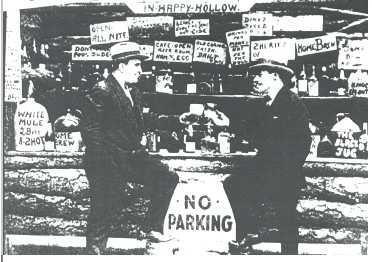
This picture is believed to be Al Capone and an unidentified friend at Happy Hollow in Hot Springs, Arkansas.
(Photo and info. courtesy of the Garland County Historical Society)
Our most famous visitor down through the ages…. must have been Al Capone. During the prohibition era, Capone came from Chicago to strike deals with bootleggers in Hot Springs to stock his clubs in Chicago with alcohol. Not only is Hot Springs a remote town located in the middle of the Ouachita mountains, but the pine trees provide “cover” for the moonshine stills year round. Capone would ship his bootleg liquor in tanker railroad cars, and for protection, he had the words “Mountain Valley Water” painted on the side of the railcars!
In Chicago, Detroit, New York – when the heat was on because of a robbery or murder, the overlords knew where to come to relax in safety. Hot Springs was a sanctuary from prosecution and enemies. Gangsters could enjoy the entertainment of gambling, and be pampered with the hot mineral baths and massages.
At one time, Capone and his entourage occupied the 4th floor of the Arlington Hotel. (Legend has it that Capone always stayed in room 442, and that the Arlington Hotel has locked that room up and will not rent it to anyone to this day) Capone’s arch enemy Bugs Moran and his gang were checked in at the Majestic Hotel, just one block away. There was no conflict, and no violence – both gangsters were on vacation!
In the early 1930s, Luciano lived in a penthouse suite at New York’s Waldorf Towers, where he was registered as Charles Ross. In March 1936, Luciano fled New York after being alerted by a friendly desk clerk that two men who looked like detectives were on their way up to see him. He drove to Philadelphia, Pennsylvania, changed cars, and borrowed $25,000 from friends. He then drove to Cleveland, Ohio, where he took the train to Hot Springs, which at the time was a gambling sanctuary run by fellow gangster Owen “Owney the Killer” Madden.
New York special prosecutor Thomas E. Dewey proclaimed Luciano “Public Enemy Number One” and started a nationwide manhunt to arrest Luciano and return him to New York to face indictment for allegedly running a $12 million prostitution syndicate. Luciano was originally charged with ninety counts of compulsory prostitution, later reduced to sixty-two.
New York detective John J. Brennan went to Hot Springs on an unrelated case and, on April 1, 1936, saw Luciano strolling along Bathhouse Row with Hot Springs’ chief of detectives. Brennan approached Luciano and invited the gangster to return with him to New York. Luciano declined, saying that he was having a good time in Hot Springs.
New York authorities asked Hot Springs and Arkansas officials to extradite Luciano to New York, and he was arrested on April 1, 1936. However, a local judge released Luciano after setting a $5,000 bond. An enraged Dewey contacted Governor J. Marion Futrell and state attorney general Carl E. Bailey, demanding action. Futrell ordered Hot Springs officials to re-capture Luciano, but Hot Springs officials were reluctant to begin extradition hearings. Bailey issued a fugitive warrant on April 3 and ordered Luciano transported to Little Rock (Pulaski County), sending twenty state troopers to Hot Springs to collect Luciano. They removed him from the Hot Springs jail at midnight and rushed him to Little Rock.
A man claiming to be an associate of Madden’s allegedly approached Bailey and offered him $50,000 (ten times his yearly salary) to make sure the extradition was denied. As the extradition hearing was being held in the governor’s conference room on April 6, Bailey made the bribery attempt public, saying Arkansas was not for sale: “Every time a major criminal of this country wants asylum, he heads for Hot Springs. We must show that Arkansas cannot be made an asylum for them.” Bailey’s revelation led to Futrell’s upholding the extradition warrant. Within days, Luciano was returned from Arkansas to New York to stand trial.
On June 18, 1936, Luciano was sentenced to thirty to fifty years at the maximum security Dannemora Prison in New York. It was the longest sentence ever handed down in New York for compulsory prostitution.
He served his time quietly, determined to be a model prisoner. During World War II, Luciano allegedly helped the government by forging ties and collecting intelligence in Sicily prior to the Allied invasion of Italy. He also claimed that he helped prevent maritime sabotage by the enemy in the United States through his connections on the waterfront. In 1946, his sentence was commuted, and Luciano was deported to Italy, as he had never become an American citizen. The U.S. government blocked his attempts to return to the Americas, including Cuba, and he lived the rest of his days in Italy.
While he had several long-term mistresses in the United States and Italy, he never married and claimed no children. Luciano died of a heart attack on January 26, 1962, at Capodichino Airport in Naples, Italy, where he had gone to meet a Hollywood movie producer. Though Luciano was denied entry into the United States during his lifetime, he was buried at St. John’s Cathedral Cemetery in Queens, New York.
For additional information: Buchanan, Edna. “Lucky Luciano.” Time. December 7, 1998, pp. 131–32.
Gosch, Martin, and Richard Hammer. The Last Testament of Lucky Luciano. Boston: Little, Brown and Company, 1974.
Ledbetter, Calvin Jr. “Carl Bailey: A Pragmatic Reformer.” Arkansas Historical Quarterly 57 (Summer 1998): 134–159.
McMath, Sid. Promises Kept. Fayetteville: University of Arkansas Press, 2003.
Reppetto, Thomas. American Mafia: A History of its Rise to Power. New York: Henry Holt & Co., 2004.
Baker Hospital (now the Crescent Hotel) in Eureka Springs (Carroll County); circa early 1940s
The hotel boasted every modern convenience, from electricity to elevators, and was well known for its location near the springs that supposedly held healing waters. The cost for this hotel, declared America’s most opulent resort, was $294,000. The hotel opened its doors to the public on May 1, 1886, with an open house two weeks later. On May 20, a banquet was held for guest of honor James G. Blaine, the 1884 Republican presidential nominee. A gala ball was held for the 400 attendants, with Harry Barton’s orchestra entertaining, followed by a speech from Blaine.
The Crescent enjoyed great success for many years, but as the economy worsened in the 1900s, the hotel opened for business only during the summer months.
The Crescent fell into disrepair for six years, and not until 1946 was the property purchased again and renovated to its original look, reopening on July 4, 1946, as “A Castle in the Air High Atop the Ozarks.”
The hotel has enjoyed a long period of success, despite a fire on the fourth floor in 1967, which damaged some of the building. In 1973, restorations began, and the hotel was again open to the public by May of that year. Renovations came again in 1980 to restore the original luxury to the hotel, and improvements continued to be made until 2002. The hotel remains open as of 2010, with the addition of the New Moon Spa to the basement level, which reflects the original purpose of the hotel as a destination for relaxation and healing. It is also a member of the National Trust Historic Hotels of America and has been featured on the Discovery Channel for its historic Victorian beauty and many reported ghost sightings.
He is right that the actual deficit is caused by direct government spending exceeding income, an imbalance mostly caused, he will tell you with some justification, by the fact that we don’t tax rich people as much as we did in happier and more prosperous times.
The Heritage Foundation’s Brian Riedl discusses the explosion of earmarks and number budget gimmicks included in the fiscal 2008 omnibus spending bill.
Before coming to Heritage in 2001, Riedl worked for then-Gov. Tommy Thompson, former Rep. Mark Green (R-WI)., and the Speaker of the Wisconsin Assembly. Riedl holds a bachelor’s degree in economics and political science from the University of Wisconsin, and a master’s degree in public affairs from Princeton University.
The 2001 and 2003 tax cuts accounted for just 14 percent of the swing from surplus to deficit. Even if these tax cuts had never been enacted, spending and economic factors would have guaranteed more than $4 trillion in deficits over the decade, and kept the budget in deficit every year except 2007.[5]
President Bush’s spending increases played a much larger role in the budget deficits. However, this does not mean that the Democrats, who criticized President Bush for not increasing spending enough, would have been any more responsible. They responded to President Bush’s $400 billion Medicare prescription drug bill with their own $800 billion proposal. They demanded even larger spending hikes than the President’s historic budget increases for education, health research, and veteran benefits. Finally, the largest supplemental appropriations for the wars in Iraq and Afghanistan were provided after the Democrats won control of Congress.[6]
_____________________________________________
Free-lance columnist Rex Nelson is the president of Arkansas’ Independent Colleges and Universities. He’s also the author of the Southern Fried blog at rexnelsonsouthernfried. com.
.
1. Drive across the dike at DeGray Lake just as the sun is setting.
2. Visit the Museum of Automobiles atop Petit Jean Mountain before heading over to the state park to hike. Back in 2003 my son was the quarterback for the Arkansas Baptist Eagle football team and we traveled to Danville, Arkansas to take on the Danville Little Johns. I wondered at the time how did they come up with a name like “Little Johns” and now I know. (See Legend of Petit Jean)
Legend of Petit Jean and French Exploration:
The Legend of Petit Jean, and how the mountain received its name, begins in the 1700’s with the story of a young French Nobleman, Chavet, who lived during the period of the French exploration of the New World. He requested permission to explore a part of the Louisiana Territory, and for a grant to claim part of the land. The King granted Chavet’s approval.
Chavet was engaged to be married to a beautiful young girl form Paris, Adrienne Dumont. When told of his plans, she asked that they be married right away so she could accompany him. Thinking of the hardship and danger on the journey, Chavet refused her request, telling her upon his return if the country was good and safe, they would be married and go to the New World.
Adrienne refused to accept his answer, and disguised herself as a cabin boy and applied to the captain of Chavet’s ship for a position as a cabin boy, calling herself Jean. The girl must have been incredibly clever in her disguise, for it is said that not even Chavet recognized her. The sailors called her Petit Jean, which is French for Little John.
The ocean was crossed in early spring; the vessel ascended the Mississippi River to the Arkansas River, to the foot of the mountain. The Indians on the mountain came to the river and greeted Chavet and invited the sailors to spend time on the mountain. Chavet, Petit Jean, and the sailors spent the summer atop Petit Jean Mountain until fall approached and they began preparations for their voyage back to France. The ship was readied and boarded the evening before departure.
That night, Petit Jean became ill with a sickness that was strange to Chavet and his sailors. It was marked with fever, convulsions, delirium, and finally coma. Her condition was so grave at daylight that the departure was delayed. During the illness, Petit Jean’s identity was, of course, discovered. The girl confessed her deception to Chavet and begged his forgiveness. She requested that if she died, to be carried back to the mountaintop that she had spent her last days on, and be buried at a spot overlooking the river below. The Indians made a stretcher out of deerskins and bore her up the mountain. At sundown, she died.
Many years later a low mound of earth was found at the point we now call Petit Jean’s Grave. Her legend, her death, is said to give the mountain and the overlook an enchanting and delightful quality that draws visitors back again and again.

 (b. 1955) – A native of Hot Springs, Thornton was featured on the television series “Hearts A’Fire.” He directed and starred in “Slingblade” a movie he filmed in Benton. He received two Oscar nominations for the film, one for Best Actor and one for Best Screenplay, which he won. He was also nominated for Best Supporting Actor in 1999 for “A Simple Plan.” Thornton has since gone on to star in “Monster’s Ball” (2001), as Davy Crockett in “The Alamo” (2004), “Bad Santa” (2003), and “Astronaut Farmer” (2007). www.billybobthornton.net







 The Daily Hatch


