As far as I know they have never done an interview together. Therefore, I have included separate interviews that they have done below and I have some links to past posts I have done on them too.
It’s been several years since Gwyneth Paltrow visited Ellen, and they had a lot to talk about! Ellen asked about Gwyneth’s life in London and brought up the possibility that they might be related…
Elusive: Gwyneth Paltrow and Chris Martin in a rare shot together at a beach party in the Hamptons I was very interested in the first single that came out from Coldplay a few weeks ago, but this second single escaped my attention. Then this morning my son Hunter told me all about this second song […]
Here is an article I wrote a couple of years ago: Solomon, Woody Allen, Coldplay and Kansas What does King Solomon, the movie director Woody Allen and the modern rock bands Coldplay and Kansas have in common? All four took on the issues surrounding death, the meaning of life and a possible afterlife, although they all came up with their own conclusions on […]
Coldplay – 42 Live Coldplay perform on the french television channel W9. I wrote this article a couple of years ago: The Spiritual Search for the Afterlife Russ Breimeier rightly noted that it seems that Coldplay is “on the verge of identifying a great Truth” and their latest CD is very provocative. Many songs mention […]
Pt 1 of 2 Listen to this Important Message by Francis Schaeffer
Published on Sep 30, 2013
This message “A Christian Manifesto” was given in 1982 by the late Christian Philosopher Francis Schaeffer when he was age 70 at D. James Kennedy’s Corral Ridge Presbyterian Church.
Listen to this important message where Dr. Schaeffer says it is the duty of Christians to disobey the government when it comes in conflict with God’s laws. So many have misinterpreted Romans 13 to mean unconditional obedience to the state. When the state promotes an evil agenda and anti-Christian statues we must obey God rather than men. Acts
I use to watch James Kennedy preach from his TV pulpit with great delight in the 1980’s. Both of these men are gone to be with the Lord now. We need new Christian leaders to rise up in their stead.
To view Part 2 See Francis Schaeffer Lecture- Christian Manifesto Pt 2 of 2 video
The religious and political freedom’s we enjoy as Americans was based on the Bible and the legacy of the Reformation according to Francis Schaeffer. These freedoms will continue to diminish as we cast off the authority of Holy Scripture.
In public schools there is no other view of reality but that final reality is shaped by chance.
Likewise, public television gives us many things that we like culturally but so much of it is mere propaganda shaped by a humanistic world and life view.
_____________________________
Pt 2 -Listen to this Important Message by Francis Schaeffer
I was able to watch Francis Schaeffer deliver a speech on a book he wrote called “A Christian Manifesto” and I heard him in several interviews on it in 1981 and 1982. I listened with great interest since I also read that book over and over again. Below is a portion of one of Schaeffer’s talks on a crucial subject that is very important today too.
This address was delivered by the late Dr. Schaeffer in 1982 at the Coral Ridge Presbyterian Church, Fort Lauderdale, Florida. It is based on one of his books, which bears the same title.
———-
What does the first amendment mean?
—–
We must absolutely set out to smash the lie of the new and novel concept of the separation of religion from the state which most people now hold and which Christians have just bought a bill of goods. This is new and this is novel. It has no relationship to the meaning of the First Amendment. The First Amendment was that the state would never interfere with religion. THAT’S ALL THE MEANING THERE WAS TO THE FIRST AMENDMENT. Just read Madison and the Spectator Papers if you don’t think so. That’s all it was!
Now we have turned it over and we have put it on its head and what we must do is absolutely insist that we return to what the First Amendment meant in the first place — not that religion can’t have an influence into society and into the state — not that. But we must insist that there’s a freedom that the First Amendment really gave. Now with this we must emphasize, and I said it, but let me say it again, we do not want a theocracy! I personally am opposed to a theocracy. On this side of the New Testament I do not believe there is a place for a theocracy ’till Jesus the King comes back. But that’s a very different thing while saying clearly we are not in favor of a theocracy in name or in fact, from where we are now, where all religious influence is shut out of the processes of the state and the public schools. We are only asking for one thing. We are asking for the freedom that the First Amendment guaranteed. That’s what we should be standing for.
Francis Schaeffer: “Whatever Happened to the Human Race” (Episode 1) ABORTION OF THE HUMAN RACE Published on Oct 6, 2012 by AdamMetropolis The 45 minute video above is from the film series created from Francis Schaeffer’s book “Whatever Happened to the Human Race?” with Dr. C. Everett Koop. This book really helped develop my political views […]
E P I S O D E 1 0 Dr. Francis Schaeffer – Episode X – Final Choices 27 min FINAL CHOICES I. Authoritarianism the Only Humanistic Social Option One man or an elite giving authoritative arbitrary absolutes. A. Society is sole absolute in absence of other absolutes. B. But society has to be […]
E P I S O D E 9 Dr. Francis Schaeffer – Episode IX – The Age of Personal Peace and Affluence 27 min T h e Age of Personal Peace and Afflunce I. By the Early 1960s People Were Bombarded From Every Side by Modern Man’s Humanistic Thought II. Modern Form of Humanistic Thought Leads […]
E P I S O D E 8 Dr. Francis Schaeffer – Episode VIII – The Age of Fragmentation 27 min I saw this film series in 1979 and it had a major impact on me. T h e Age of FRAGMENTATION I. Art As a Vehicle Of Modern Thought A. Impressionism (Monet, Renoir, Pissarro, Sisley, […]
E P I S O D E 7 Dr. Francis Schaeffer – Episode VII – The Age of Non Reason I am thrilled to get this film series with you. I saw it first in 1979 and it had such a big impact on me. Today’s episode is where we see modern humanist man act […]
E P I S O D E 6 How Should We Then Live 6#1 Uploaded by NoMirrorHDDHrorriMoN on Oct 3, 2011 How Should We Then Live? Episode 6 of 12 ________ I am sharing with you a film series that I saw in 1979. In this film Francis Schaeffer asserted that was a shift in […]
E P I S O D E 5 How Should We Then Live? Episode 5: The Revolutionary Age I was impacted by this film series by Francis Schaeffer back in the 1970′s and I wanted to share it with you. Francis Schaeffer noted, “Reformation Did Not Bring Perfection. But gradually on basis of biblical teaching there […]
Dr. Francis Schaeffer – Episode IV – The Reformation 27 min I was impacted by this film series by Francis Schaeffer back in the 1970′s and I wanted to share it with you. Schaeffer makes three key points concerning the Reformation: “1. Erasmian Christian humanism rejected by Farel. 2. Bible gives needed answers not only as to […]
Francis Schaeffer’s “How should we then live?” Video and outline of episode 3 “The Renaissance” Francis Schaeffer: “How Should We Then Live?” (Episode 3) THE RENAISSANCE I was impacted by this film series by Francis Schaeffer back in the 1970′s and I wanted to share it with you. Schaeffer really shows why we have so […]
Francis Schaeffer: “How Should We Then Live?” (Episode 2) THE MIDDLE AGES I was impacted by this film series by Francis Schaeffer back in the 1970′s and I wanted to share it with you. Schaeffer points out that during this time period unfortunately we have the “Church’s deviation from early church’s teaching in regard […]
Francis Schaeffer: “How Should We Then Live?” (Episode 1) THE ROMAN AGE Today I am starting a series that really had a big impact on my life back in the 1970′s when I first saw it. There are ten parts and today is the first. Francis Schaeffer takes a look at Rome and why […]
Francis Schaeffer: “Whatever Happened to the Human Race” (Episode 5) TRUTH AND HISTORY Published on Oct 7, 2012 by AdamMetropolis This crucial series is narrated by the late Dr. Francis Schaeffer and former Surgeon General Dr. C. Everett Koop. Today, choices are being made that undermine human rights at their most basic level. Practices once […]
The opening song at the beginning of this episode is very insightful. Francis Schaeffer: “Whatever Happened to the Human Race” (Episode 4) THE BASIS FOR HUMAN DIGNITY Published on Oct 7, 2012 by AdamMetropolis This crucial series is narrated by the late Dr. Francis Schaeffer and former Surgeon General Dr. C. Everett Koop. Today, choices […]
Francis Schaeffer: “Whatever Happened to the Human Race” (Episode 3) DEATH BY SOMEONE’S CHOICE Published on Oct 6, 2012 by AdamMetropolis This crucial series is narrated by the late Dr. Francis Schaeffer and former Surgeon General Dr. C. Everett Koop. Today, choices are being made that undermine human rights at their most basic level. Practices […]
Francis Schaeffer: “Whatever Happened to the Human Race?” (Episode 2) SLAUGHTER OF THE INNOCENTS Published on Oct 6, 2012 by AdamMetropolis This crucial series is narrated by the late Dr. Francis Schaeffer and former Surgeon General Dr. C. Everett Koop. Today, choices are being made that undermine human rights at their most basic level. Practices […]
It is not possible to know where the pro-life evangelicals are coming from unless you look at the work of the person who inspired them the most. That person was Francis Schaeffer. I do care about economic issues but the pro-life issue is the most important to me. Several years ago Adrian Rogers (past president of […]
This essay below is worth the read. Schaeffer, Francis – “Francis Schaeffer and the Pro-Life Movement” [How Should We Then Live?, Whatever Happened to the Human Race?, A Christian Manifesto] Editor note: <p> </p> [The following essay explores the role that Francis Schaeffer played in the rise of the pro-life movement. It examines the place of […]
Great article on Schaeffer. Who was Dr. Francis A. Schaeffer? By Francis Schaeffer The unique contribution of Dr. Francis Schaeffer on a whole generation was the ability to communicate the truth of historic Biblical Christianity in a way that combined intellectual integrity with practical, loving care. This grew out of his extensive understanding of the Bible […]
I have been writing letters to President Obama almost all of 2012. I have received several responses from the White House but none of the responses have been personal responses from the President.
Below is a letter I wrote to the President and a form letter response that I got followed by links to other letters I have written him.
Science Matters #2: Former supermodel Kathy Ireland tells Mike Huckabee about how she became pro-life after reading what the science books have to say.
President Obama c/o The White House
1600 Pennsylvania Avenue NW
Washington, DC 20500
I wanted to talk to you today about your views on abortion. Everyone remembers Kathy Ireland from her Sports Illustrated days and actually she has became a very successful business person. However, I wanted to talk about her pro-life views.
_____________
Back on April 27, 2009 Fox News ran a story by Hollie McKay(“Supermodel Kathy Ireland Lashes Out Against Pro Choice,”) on Ireland.
It’s no secret that the majority of Hollywood stars are strong advocates for a woman’s right to choose whether or not she wants to terminate a pregnancy, however former “Sports Illustrated” supermodel-turned-entrepreneur-turned-author Kathy Ireland has gone against the grain of the glitterati and spoken out against abortion.
“My entire life I was pro-choice — who was I to tell another woman what she could or couldn’t do with her body? But when I was 18, I became a Christian and I dove into the medical books, I dove into science,” Ireland told Tarts while promoting her insightful new book “Real Solutions for Busy Mom: Your Guide to Success and Sanity.”
“What I read was astounding and I learned that at the moment of conception a new life comes into being. The complete genetic blueprint is there, the DNA is determined, the blood type is determined, the sex is determined, the unique set of fingerprints that nobody has had or ever will have is already there.”
However Ireland admitted that she did everything she could to avoid becoming a believer in pro-life.
“I called Planned Parenthood and begged them to give me their best argument and all they could come up with that it is really just a clump of cells and if you get it early enough it doesn’t even look like a baby. Well, we’re all clumps of cells and the unborn does not look like a baby the same way the baby does not look like a teenager, a teenager does not look like a senior citizen. That unborn baby looks exactly the way human beings are supposed to look at that stage of development. It doesn’t suddenly become a human being at a certain point in time,” Ireland argued. “I’ve also asked leading scientists across our country to please show me some shred of evidence that the unborn is not a human being. I didn’t want to be pro-life, but this is not a woman’s rights issue but a human rights issue.”
My good friend Dr. Kevin R. Henke is a scientist and also an atheistic evolutionist. I had a lot of discussions with Kevin over religious views. I remember going over John 7:17 with him one day. It says:
John 7:17 (Amplified Bible)
17If any man desires to do His will (God’s pleasure), he will know (have the needed illumination to recognize, and can tell for himself) whether the teaching is from God or whether I am speaking from Myself and of My own accord and on My own authority.
I challenged Kevin to read a chapter a day of the Book of John and pray to God and ask God, “Dear God, if you are there then reveal yourself to me, and I pledge to serve you the rest of my life.”
Kevin did that and he even wrote down the thoughts that came to his mind and sent it to me and these thoughts filled a notebook.
Kevin did not become a Christian, but I am still praying for him. I do respect Kevin because he is an honest man. Interestingly enough he told me that he was pro-life because the unborn baby has all the genetic code at the time of conception that they will have for the rest of their life. Below are some other comments by other scientists:
Dr. Hymie Gordon (Mayo Clinic): “By all criteria of modern molecular biology, life is present from the moment of conception.”
Dr. Micheline Matthews-Roth (Harvard University Medical School): “It is scientifically correct to say that an individual human life begins at conception.”
Dr. Alfred Bongioanni (University of Pennsylvania): “I have learned from my earliest medical education that human life begins at the time of conception.”
Dr. Jerome LeJeune, “the Father of Modern Genetics” (University of Descartes, Paris): “To accept the fact that after fertilization has taken place a new human has come into being is no longer a matter of taste or opinion . . . it is plain experimental evidence.”
__
Thank you so much for your time. I know how valuable it is. I also appreciate the fine family that you have and your committment as a father and a husband.
Sincerely,
Everette Hatcher III, 13900 Cottontail Lane, Alexander, AR 72002, ph 501-920-5733, lowcostsqueegees@yahoo.com
_______________
I actually mailed this to President Obama about a week ago and got this email back:
April 16, 2012
Dear Everette:
Thank you for taking the time to share your views on abortion. This is a heart-wrenching issue, and I appreciate your input and thoughts.
I am committed to making my Administration the most open and transparent in history, and part of delivering on that promise is hearing from people like you. I take seriously your opinions and respect your point of view on this issue. Please know that your concerns will be on my mind in the days ahead.
Thank you, again, for writing. I encourage you to visit www.WhiteHouse.gov to learn more about my Administration or to contact me in the future.
Leader Cantor On CNN Responding To President Obama’s State of the Union Address Uploaded by EricCantor on Jan 25, 2012 ______________ President Obama c/o The White House 1600 Pennsylvania Avenue NW Washington, DC 20500 Dear Mr. President, I know that you receive 20,000 letters a day and that you actually read 10 of them every day. I […]
I have been writing President Obama letters and have not received a personal response yet. (He reads 10 letters a day personally and responds to each of them.) However, I did receive a form letter in the form of an email on March 7, 2011. I don’t know which letter of mine generated this response so I have […]
Liam Fox Issues a Warning to America Uploaded by HeritageFoundation on Feb 28, 2012 Britain’s Liam Fox has a warning for America: Fix the debt problem now or suffer the consequences of less power on the world stage. The former U.K. secretary of state for defense visited Heritage to explain why the America’s debt is […]
I have been writing President Obama letters and have not received a personal response yet. (He reads 10 letters a day personally and responds to each of them.) However, I did receive a form letter in the form of an email on January 27, 2011. I don’t know which letter of mine generated this response so I have […]
I have been writing President Obama letters and have not received a personal response yet. (He reads 10 letters a day personally and responds to each of them.) However, I did receive a form letter in the form of an email on January 25, 2011. I don’t know which letter of mine generated this response so I have […]
An open letter to President Obama (Part 48 of my response to State of Union Speech 1-24-12) Rep Michael Burgess response Uploaded by MichaelCBurgessMD on Jan 25, 2012 This week Dr. Burgess provides an update from Washington and responds to President Obama’s State of the Union address. President Obama’s state of the union speech Jan 24, 2012 […]
Corker Says President’s 2012 Budget Proposal Shows “Lack of Urgency” on Spending Uploaded by senatorcorker on Feb 14, 2011 In remarks on the Senate floor today, U.S. Senator Bob Corker, R-Tenn., expressed disappointment in President Obama’s 2012 budget proposal, saying it displayed a “lack of urgency” to get federal spending under control. Corker has introduced […]
President Obama’s state of the union speech Jan 24, 2012 Feb 6, 2012 President Obama c/o The White House 1600 Pennsylvania Avenue NW Washington, DC 20500 Dear Mr. President, I know that you receive 20,000 letters a day and that you actually read 10 of them every day. I really do respect you for trying […]
January 25, 2012 President Obama c/o The White House 1600 Pennsylvania Avenue NW Washington, DC 20500 Dear Mr. President, I know that you receive 20,000 letters a day and that you actually read 10 of them every day. I really do respect you for trying to get a pulse on what is going on […]
Does Government Have a Revenue or Spending Problem?
People say the government has a debt problem. Debt is caused by deficits, which is the difference between what the government collects in tax revenue and the amount of government spending. Every time the government runs a deficit, the government debt increases. So what’s to blame: too much spending, or too little tax revenue? Economics professor Antony Davies examines the data and concludes that the root cause of the debt is too much government spending.
____________
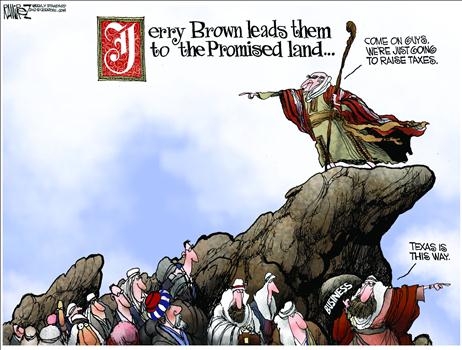
When you try and tax and spend too much then the business community will try and relocate to another state. That is exactly what is happening in California today. We need to lower taxes if we want to grow the economy.
Hopefully we’re all disgusted when insiders rig the system to rip off taxpayers. And I suspect you’re not surprised to see that the worst example on that list comes from California, which is in a race with Illinois to see which state can become the Greece of America.
The numbers are even larger in California, where a state psychiatrist was paid $822,000, a highway patrol officer collected $484,000 in pay and pension benefits and 17 employees got checks of more than $200,000 for unused vacation and leave. The best-paid staff in other states earned far less for the same work, according to the data.
Wow, $822,000 for a state psychiatrist. Not bad for government work. So what is Governor Jerry Brown doing to fix the mess? As you might expect, he’s part of the problem.
…the state’s highest-paid employees make far more than comparable workers elsewhere in almost all job and wage categories, from public safety to health care, base pay to overtime. …California has set a pattern of lax management, inefficient operations and out-of-control costs. …In California, Governor Jerry Brown hasn’t curbed overtime expenses that lead the 12 largest states or limited payments for accumulated vacation time that allowed one employee to collect $609,000 at retirement in 2011. …Last year, Brown waived a cap on accrued leave for prison guards while granting them additional paid days off. California’s liability for the unused leave of its state workers has more than doubled in eight years, to $3.9 billion in 2011, from $1.4 billion in 2003, according to the state’s annual financial reports. …The per-worker costs of delivering services in California vastly exceed those even in New York, New Jersey, Illinois and Ohio.
I suppose the silver lining to that dark cloud is that many bureaucrats now rank as part of the top 1 percent, so they’ll have to recycle some of their loot back to the political vultures in Sacramento.
But the biggest impact of the tax hike – as shown in the Ramirez cartoon – will be to accelerate the shift of entrepreneurs, investors, and small business owners to states that don’t steal as much. Indeed, a study from the Manhattan Institute looks at the exodus to lower-tax states.
The data also reveal the motives that drive individuals and businesses to leave California. One of these, of course, is work. …Taxation also appears to be a factor, especially as it contributes to the business climate and, in turn, jobs. Most of the destination states favored by Californians have lower taxes. States that have gained the most at California’s expense are rated as having better business climates. The data suggest that many cost drivers—taxes, regulations, the high price of housing and commercial real estate, costly electricity, union power, and high labor costs—are prompting businesses to locate outside California, thus helping to drive the exodus.
Dr. Francis Schaeffer – Episode IX – The Age of Personal Peace and Affluence 27 min
T h e Age of Personal Peace and Afflunce
I. By the Early 1960s People Were Bombarded From Every Side by Modern Man’s Humanistic Thought
II. Modern Form of Humanistic Thought Leads to Pessimism
Regarding a Meaning for Life and for Fixed Values
A. General acceptance of selfish values (personal peace and affluence) accompanied rejection of Christian consensus.
1. Personal peace means: I want to be left alone, and I don’t care what happens to the man across the street or across the world. I want my own life-style to be undisturbed regardless of what it will mean — even to my own children and grandchildren.
2. Affluence means things, things, things, always more things — and success is seen as an abundance of things.
B. Students wish to escape meaninglessness of much of adult society.
1. Watershed was Berkeley in 1964.
2. Drug Taking as an ideology: “turning on” the world.
3. Free Speech Movement on Sproul Plaza.
a) At first neither Left nor Right.
b) Soon became the New Left.
(1) Followed Marcuse.
(2) Paris riots.
4. Student analysis of problem was right, but solution wrong.
5. Woodstock, Altamont, and the end of innocence.
6. Drug taking survives the death of ideology but as an escape.
7. Demise of New Left: radical bombings.
8. Apathy supreme. The young accept values of the older generation: their own idea of personal peace and affluence, even though adopting a different life-style.
C. Marxism and Maoism as pseudo-ideals.
1. Vogue for idealistic communism which is another form of leap into the area of non-reason.
2. Solzhenitsyn: violence and expediency as norms of communism.
3. Communist repression in Hungary and Czechoslovakia.
4. Communism has neither philosophic nor historic base for freedom. There is no base for “Communism with a human face.”
5. Utopian Marxism steals its talk of human dignity from Christianity.
6. But when it comes to power, the desire of majority has no meaning.
7. Two streams of communism.
a) Those who hold it as an idealistic leap.
b) Old-line communists who hold orthodox communist ideology and bureaucratic structure as it exists in Russia.
8. Many in West might accept communism if it seemed to give peace and affluence.
III. Legal and Political Results of Attempted Human Autonomy
A. Relativistic law.
1. Base for nonarbitrary law gone; only inertia allows a few principles to survive.
2. Holmes and sociological (variable) law.
3. Sociological law comes from failure of natural law (see evolution of existential from rationalistic theology).
4. Courts are now generating law.
5. Medical, legal, and historical arbitrariness of Supreme Court ruling on abortion and current abortion practice.
B. Sociological law opens door to racism, abrogation of freedoms, euthanasia, and so on.
IV. Social Alternatives After Death of Christian Consensus
A. Hedonism? But might is right when pleasures conflict.
B. Without external absolute, majority vote is absolute. But this justifies a Hitler.
V. Conclusion
A. If there is no absolute by which to judge society, then society is absolute.
B. Humanist thinking—making the individual and mankind the center of all things (autonomous) — has led to death in our culture and in our political life.
Note: Social alternatives after the death of Christian consensus are continued in Episode Ten.
Questions
1. What was the basic cause of campus unrest in the sixties? What has happened to the campus scene since, and why?
2. What elements — in the life and thought of the communist and noncommunist world alike — suggest a possible base for world agreement?
3. “To prophesy doom about Western society is premature. We are, like all others who have lived in times of great change, too close to the details to see the broader picture. One thing we do know:
Society has always gone on, and the most wonderful epochs have followed the greatest depressions. To suggest that our day is the exception says more about our headache than it does about our head.” Debate.
4. As Dr. Schaeffer shows, many apparently isolated events and options gain new meaning when seen in the context of the whole. How far does your own involvement in business, law, financing, and so on reveal an acquiescence to current values?
Key Events and Persons
Oliver Wendell Holmes: 1841-1935
Herbert Marcuse: 1898-1979
Alexander Solzhenitsyn: 1917-
Hungarian Revolution: 1956
Free Speech Movement: 1964
Czechoslovakian repression: 1968
Woodstock and Altamont: 1969
Radical bombings: 1970
Supreme Court abortion ruling: 1973
Solzhenitsyn’s The Gulag Archipelago: 1973-74
Further Study
Keeping one’s eyes and ears open is the most useful study project: the prevalence of pornographic films and books, more and more suggestive advertising and TV shows, and signs of arbitrary absolutes.
The following books will repay careful reading, and Solzhenitsyn, though long and horrifying, should not be skipped.
Os Guinness, The Dust of Death (1973).
Alexander Solzhenitsyn, The Gulag Archipelago: Parts I-II (1973), Parts III-IV (1974).
Milton Friedman in his series “Free to Choose” used a pencil as a simple example to should have the “invisible hand” of the freemarket works (phrase originally used by Adam Smith).
“Milton Friedman is a scholar of first rank whose original contributions to economic science have made him one of the greatest thinkers in modern history.” —President Ronald Reagan
“How grateful I have been over the years for the cogency of Friedman’s ideas which have influenced me. Cherishers of freedom will be indebted to him for generations to come.” —Alan Greenspan, former Chairman, Federal Reserve System
“Right at this moment there are people all over the land, I could put dots on the map, who are trying to prove Milton wrong. At some point, somebody else is trying to prove he’s right That’s what I call influence.” —Paul Samuelson, Nobel Laureate in Economic Science
“Friedman’s influence reaches far beyond the academic community and the world of economics. Rather than lock himself in an ivory tower, he has joined the fray to fight for the survival of this great country of ours.” —William E. Simon, former Secretary of the Treasury
“Milton Friedman is the most original social thinker of the era.” —John Kenneth Galbraith, former Professor of Economics, Harvard University
Perhaps Friedman’s greatest success began in 1979 when he and his wife Rose authored the book, Free to Choose, based on the famous ten-part TV series for PBS by the same title. Both the TV program and the book were drawn from an earlier series of lectures presented by Friedman. Because it aired during a period of critical economic distress during the Carter Administration and in the aftermath of the Vietnam War, Watergate scandal, and Richard Nixon’s resignation as President, the program is widely regarded as being a major factor in shifting American public opinion toward appreciating the need to dismantle government largess. The series was shown in England, Japan, Italy, Australia, Germany, Canada, and many other countries, and the book was translated for distribution around the world, selling more than one million copies.
__________
No other issue is more misunderstood today than equality. President Obama has used class warfare over and over the last few months and according to him equality at the finish line is the equality that we should all be talking about. However, socialism has never worked and it has always killed incentive to produce more. Milton Friedman expressed the conversative’s best and I am glad that I had the chance to be studying his work for over 30 years now.
In 1980 when I first sat down and read the book “Free to Choose” I was involved in Ronald Reagan’s campaign for president and excited about the race. Milton Friedman’s books and film series really helped form my conservative views. Take a look at one of my favorite films of his:
Created Equal [1/7]. Milton Friedman’s Free to Choose (1980)
In this program, Milton Friedman visits India, the U.S., and Britain, examining the question of equality. He points out that our society traditionally has embraced two kinds of equality: equality before God and equality of opportunity. The first of these implies that human beings enjoy a certain dignity simply because they are members of the human community. The second suggests societies should allow the talents and inclinations of individuals to unfold, free from arbitrary barriers. Both of these concepts of equality are consistent with the goal of personal freedom.
In recent years, there has been growing support for a third type of equality, which Dr. Friedman calls “equality of outcome.” This concept of equality assumes that justice demands a more equal distribution of the economic fruits of society. While admitting the good intentions of those supporting the idea of equality of outcome, Dr. Friedman points out that government policies undertaken in support of this objective are inconsistent with the ideal of personal freedom. Advocates of equality of outcome typically argue that consumers must be protected by government from the insensitivities of the free market place.
Dr. Friedman demonstrates that in countries where governments have pursued the goal of equality of outcome, the differences in wealth and well being between the top and the bottom are actually much greater than in countries that have relied on free markets to coordinate economic activity. Indeed, says Dr. Friedman, it is the ordinary citizen who benefits most from the free market system. Dr. Friedman concludes that any society that puts equality ahead of freedom will end up with neither. But the society that puts freedom before equality will end up with both greater freedom and great equality.
Friedman: From the Victorian novelists to modern reformers, a favorite device to stir our emotions is to contrast extremes of wealth and of poverty. We are expected to conclude that the rich are responsible for the deprivations of the poor __ that they are rich at the expense of the poor.
Whether it is in the slums of New Delhi or in the affluence of Las Vegas, it simply isn’t fair that there should be any losers. Life is unfair __ there is nothing fair about one man being born blind and another man being born with sight. There is nothing fair about one man being born of a wealthy parent and one of an indigenous parent. There is nothing fair about Mohammed Ali having been born with a skill that enables him to make millions of dollars one night. There is nothing fair about Marleena Detrich having great legs that we all want to watch. There is nothing fair about any of that. But on the other hand, don’t you think a lot of people who like to look at Marleena Detrich’s legs benefited from nature’s unfairness in producing a Marleena Detrich. What kind of a world would it be if everybody was an absolute identical duplicate of anybody else. You might as well destroy the whole world and just keep one specimen left for a museum. In the same way, it’s unfair that Muhammed Ali should be a great fighter and should be able to earn millions. But would it not be even more unfair to the people who like to watch him if you said that in the pursuit of some abstract idea of equality we’re not going to let Muhammed Ali get more for one nights fight than the lowest man on the totem pole can get for a days unskilled work on the docks. You can do that but the result of that would be to deny people the opportunity to watch Mohammad Ali. I doubt very much he would be willing to subject himself to the kind of fights he’s gone through if he were to get the pay of an unskilled docker.
This beautiful estate, its manicured lawns, its trees, its shrubs, was built by men and women who were taken by force in Africa and sold as slaves in America. These kitchen gardens were planted and tended by them to furnish food for themselves and their master, Thomas Jefferson, the Squire of Monticello. It was Jefferson who wrote these words: We hold these truths to be self-evident that all men are created equal. That they are endowed by their creator with certain inalienable rights, that among these are life, liberty and the pursuit of happiness. These words penned by Thomas Jefferson at the age of 33 when he wrote the Declaration of Independence, have served to define a basic ideal of the United States throughout its history.
Much of our history has revolved about the definition and redefinition of the concept of equality, about the intent to translate it into practice. What did Thomas Jefferson mean by the words all men are created equal? He surely did not mean that they were equal and/or identical in what they could do and what they believed. After all, he was himself a most remarkable person. At the age of 26, he designed this beautiful house of Monticello, supervised its construction and indeed is said to have worked on it with his own hands. He was an inventor, a scholar, an author, a statesman, governor of Virginia, President of the United States, minister to France, he helped shape and create the United States. What he meant by the word “equal” can be seen in the phrase “endowed by their creator”. To Thomas Jefferson, all men are equal in the eyes of God. They all must be treated as individuals who have each separately a right to life, liberty and the pursuit of happiness.
Of course, practice did not conform to the ideals. In Jefferson’s life or in ours as a nation, he agonized repeatedly during his lifetime about the conflict between the institution of slavery and the fine words of the declaration. Yet, during his whole life, he was a slave owner.
This is the City Palace in Jaipur, the capitol of the Indian state of Rajasthan, is just one of the elegant houses that were built here 150 years ago by the prince who ruled this land. There are no more princes, no more Maharajas in India today. All titles were swept away by the government of India in its quest for equality. But as you can see, there are still some people here who live a very privileged life. The descendants of the Maharajas financed this kind of life partly by using other palaces as hotels for tourists __ tourists who come to India to see how the other half lives. This side of India, the exotic glamorous side, is still very real. Everywhere in the world there are gross inequalities of income and wealth. They offend most of us.
A myth has grown up that free market capitalism increases such inequalities, that the rich benefit at the expense of the poor. Nothing could be further from the truth. Wherever the free market has been permitted to operate, the ordinary man has been able to attain levels of living never dreamed of before. Nowhere is the gap between rich and poor. Nowhere are the rich richer and the poor poorer than in those societies that do not permit the free market to operate, whether they be feudal societies where status determines position, or modern, centrally-planned economies where access to government determines position.
Central planning was introduced in India in considerable part in the name of equality. The tragedy is that after 30 years, it is hard to see any significant improvement in the lot of the ordinary person.
Liberals like President Obama want to shoot for an equality of outcome. That system does not work. In fact, our free society allows for the closest gap between the wealthy and the poor. Unlike other countries where free enterprise and other freedoms are not present. This is a seven part series. Created Equal [7/7]. Milton Friedman’s Free to Choose […]
Milton Friedman’s solution to limiting poverty Liberals like Michael Cook just don’t get it. They should listen to Milton Friedman (who is quoted in this video below concerning the best way to limit poverty). New Video Shows the War on Poverty Is a Failure Posted by Daniel J. Mitchell The Center for Freedom and Prosperity has […]
Liberals like President Obama want to shoot for an equality of outcome. That system does not work. In fact, our free society allows for the closest gap between the wealthy and the poor. Unlike other countries where free enterprise and other freedoms are not present. This is a seven part series. Created Equal [6/7]. Milton Friedman’s Free to Choose […]
Liberals like President Obama want to shoot for an equality of outcome. That system does not work. In fact, our free society allows for the closest gap between the wealthy and the poor. Unlike other countries where free enterprise and other freedoms are not present. This is a seven part series. Created Equal [5/7]. Milton Friedman’s Free to Choose […]
Republican debate Oct 18, 2011 (last part) with video clips and transcript Below are video clips and the transcript. pt 5 pt 6 pt 7 COOPER: We’re going to move on to an issue very important here in the state of Nevada and throughout the West. We have a question from the hall. QUESTION: Yeah, […]
Uploaded by YAFTV on Aug 19, 2009 Nobel Laureate Dr. Milton Friedman discusses the principles of Ronald Reagan during this talk for students at Young America’s Foundation’s 25th annual National Conservative Student Conference MILTON FRIEDMAN ON RONALD REAGAN In Friday’s WSJ, Milton Friedman reflectedon Ronald Reagan’s legacy. (The link should work for a few more […]
Liberals like President Obama want to shoot for an equality of outcome. That system does not work. In fact, our free society allows for the closest gap between the wealthy and the poor. Unlike other countries where free enterprise and other freedoms are not present. This is a seven part series. Created Equal [4/7]. Milton Friedman’s Free to Choose […]
Friedman Friday” Free to Choose by Milton Friedman: Episode “Created Equal” (Part 3 of transcript and video) Liberals like President Obama want to shoot for an equality of outcome. That system does not work. In fact, our free society allows for the closest gap between the wealthy and the poor. Unlike other countries where free enterprise and other […]
Free to Choose by Milton Friedman: Episode “Created Equal” (Part 2 of transcript and video) Liberals like President Obama want to shoot for an equality of outcome. That system does not work. In fact, our free society allows for the closest gap between the wealthy and the poor. Unlike other countries where free enterprise and other freedoms are […]
Milton Friedman and Ronald Reagan Liberals like President Obama (and John Brummett) want to shoot for an equality of outcome. That system does not work. In fact, our free society allows for the closest gap between the wealthy and the poor. Unlike other countries where free enterprise and other freedoms are not present. This is a seven part series. […]
Mr. President I have written you over and over and quoted Milton Friedman so many times. He helped Ronald Reagan get the economy going back in the early 1980’s when it was sluggish like it is now. This Friedman fellow was a very a wise man indeed. For instance, Milton Friedman said that getting George Bush I to be his vice president was Reagan’s biggest mistake because he knew that Bush was not a true conservative and sure enough George Bush did raise taxes when he later became President. Below is a speech by George W. Bush honoring Milton Friedman:
Milton Friedman Honored for Lifetime Achievements 2002/5/9
William Buckley is pictured sitting down watching Milton Friedman speak on the tv set. Both men were friends of Ronald Reagan who cut taxes in the early 198o’s which caused a great period of economic growth in the USA.
How Raising Taxes Will Not Balance the Budget: More Evidence
Published on Nov 15, 2012
Although it may seem counterintuitive, raising taxes on the rich does not actually increase the amount of taxes the government collects. How could this possibly be the case? According to Professor Antony Davies, it is because the many loopholes in federal income taxes, capital gains taxes, and many other taxes, enable people to partially avoid these taxes. Perhaps instead of discussing how to raise tax revenues, we should spend our energy simplifying the tax code. This would make it more difficult for people to avoid taxes and, Davies says, “The less time and money we spend trying to work around a complex tax code, the more time and money we will have available to put to more productive uses.”
Do you think that the tax code is too complicated? Let us know in the comments!
___________
Tea Party favorite Congressman Trenk Franks shared a link on facebook on Dec 13, 2012.
Wall Street Journal:
December 11, 2012, 6:47 p.m. ET
Prescott and Ohanian: Taxes Are Much Higher Than You Think
The combined levies on labor income and consumer spending have seriously reduced the hours that Europeans work. The U.S. isn’t too far behind.
President Obama argues that the election gave him a mandate to raise taxes on high earners, and the White House indicates that he won’t compromise on this issue as the so-called fiscal cliff approaches.
But tax rates are already high—much higher than is commonly understood—and increasing them will likely further depress the economy, especially by affecting the number of hours Americans work.
Taking into account all taxes on earnings and consumer spending—including federal, state and local income taxes, Social Security and Medicare payroll taxes, excise taxes, and state and local sales taxes—Edward Prescott has shown (especially in the Quarterly Review of the Federal Reserve Bank of Minneapolis, 2004) that the U.S. average marginal effective tax rate is around 40%. This means that if the average worker earns $100 from additional output, he will be able to consume only an additional $60.
Research by others (including Lee Ohanian, Andrea Raffo and Richard Rogerson in the Journal of Monetary Economics, 2008, and Edward Prescott in the American Economic Review, 2002) indicates that raising tax rates further will significantly reduce U.S. economic activity and by implication will increase tax revenues only a little.
High tax rates—on both labor income and consumption—reduce the incentive to work by making consumption more expensive relative to leisure, for example. The incentive to produce goods for the market is particularly depressed when tax revenue is returned to households either as government transfers or transfers-in-kind—such as public schooling, police and fire protection, food stamps, and health care—that substitute for private consumption.
In the 1950s, when European tax rates were low, many Western Europeans, including the French and the Germans, worked more hours per capita than did Americans. Over time, tax rates that affect earnings and consumption rose substantially in much of Western Europe. Over the decades, these have accounted for much of the nearly 30% decline in work hours in several European countries—to 1,000 hours per adult per year today from around 1,400 in the 1950s.
Changes in tax rates are also important in accounting for the increase in the number of hours worked in the Netherlands in the late 1980s, following the enactment of lower marginal income-tax rates.
In Japan, the tax rate on earnings and consumption is about the same as it is in the U.S., and the average Japanese worker in 2007 (the last nonrecession year) worked 1,363 hours—or about the same as the 1,336 worked by the average American.
All this has major implications for the U.S. Consider California, which just enacted higher rates of income and sales tax. The top California income-tax rate will be 13.3%, and the top sales-tax rate in some areas may rise as high as 10%. Combine these state taxes with a top combined federal rate of 44%, plus federal excise taxes, and the combined marginal tax rate for the highest California earners is likely to be around 60%—as high as in France, Germany and Italy.
Higher labor-income and consumption taxes also have consequences for entrepreneurship and risk-taking. A key factor driving U.S. economic growth has been the remarkable impact of entrepreneurs such as Bill Gates of Microsoft, MSFT +1.38% Steve Jobs of Apple, Fred Smith of FedExFDX +1.60% and others who took substantial risk to implement new ideas, directly and indirectly creating new economic sectors and millions of new jobs.
Entrepreneurship is much lower in Europe, suggesting that high tax rates and poorly designed regulation discourage new business creation. The Economist reports that between 1976 and 2007 only one continental European startup, Norway’s Renewable Energy Corporation, achieved a level of success comparable to that of Microsoft, Apple and other U.S. giants making the Financial Times Index of the world’s 500 largest companies.
U.S. growth is currently weak, and overall output is 13.5% lower than what it would be had we continued on the pre-2008 trend.
The economy now faces two serious risks: the risk of higher marginal tax rates that will depress the number of hours of work, and the risk of continuing policies such as Dodd-Frank, bailouts, and subsidies to specific industries and technologies that depress productivity growth by protecting inefficient producers and restricting the flow of resources to the most productive users.
If these two risks are realized, the U.S. will face a much more serious problem than a 2013 recession. It will face a permanent and growing decline in relative living standards.
These risks loom as the level of U.S. economic activity gradually moves closer to that of the 1930s, when for a decade during the Great Depression output per working-age person declined by nearly 25% relative to trend. The last two quarters of GDP growth—1.3% and 2.7%—have been below trend, which means the U.S. economy is continuing to sink relative to its historical trend.
We have lost more than three years of growth since 2007, and our underachievement will continue unless pro-productivity policies are adopted and marginal tax rates are stabilized or lowered to prevent a decrease in work effort across the board. That means lifting crushing regulatory burdens such as those imposed by Dodd-Frank, and it means reforming immigration policies so that we can substantially increase our base of entrepreneurs by attracting the best and brightest creators from other countries.
Economic growth requires new ideas and new businesses, which in turn require a large group of talented young workers who are willing to take on the considerable risk of starting a business. This requires undoing the impediments that stand in the way of creating new economic activity—and increasing the after-tax returns to succeeding.
Mr. Prescott, co-winner of the 2004 Nobel Prize in Economics, is director of the Center for the Advanced Study in Economic Efficiency at Arizona State University. Mr. Ohanian, the associate director of the center, is a professor of economics at UCLA and a senior fellow at Stanford University’s Hoover Institution.
A version of this article appeared December 11, 2012, on page A19 in the U.S. edition of The Wall Street Journal, with the headline: Taxes Are Much Higher Than You Think.
___________
____________
Thank you so much for your time. I know how valuable it is. I also appreciate the fine family that you have and your commitment as a father and a husband.
Sincerely,
Everette Hatcher III, 13900 Cottontail Lane, Alexander, AR 72002, ph 501-920-5733, lowcostsqueegees@yahoo.com
(Emailed to White House on 12-21-12.) President Obama c/o The White House 1600 Pennsylvania Avenue NW Washington, DC 20500 Dear Mr. President, I know that you receive 20,000 letters a day and that you actually read 10 of them every day. I really do respect you for trying to get a pulse on […]
(Emailed to White House on 12-21-12.) President Obama c/o The White House 1600 Pennsylvania Avenue NW Washington, DC 20500 Dear Mr. President, I know that you receive 20,000 letters a day and that you actually read 10 of them every day. I really do respect you for trying to get a pulse on what is […]
(Emailed to White House on 12-21-12) President Obama c/o The White House 1600 Pennsylvania Avenue NW Washington, DC 20500 Dear Mr. President, I know that you receive 20,000 letters a day and that you actually read 10 of them every day. I really do respect you for trying to get a pulse on what is […]
The federal government has a spending problem and Milton Friedman came up with the negative income tax to help poor people get out of the welfare trap. It seems that the government screws up about everything. Then why is President Obama wanting more taxes? _______________ Milton Friedman – The Negative Income Tax Published on […]
I was sad to read that the Speaker John Boehner has been involved in punishing tea party republicans. Actually I have written letters to several of these same tea party heroes telling them that I have emailed Boehner encouraging him to listen to them. Rep. David Schweikert (R-AZ),Justin Amash (R-MI), and Tim Huelskamp (R-KS). have been contacted […]
Michael Tanner of the Cato Institute in his article, “Hitting the Ceiling,” National Review Online, March 7, 2012 noted: After all, despite all the sturm und drang about spending cuts as part of last year’s debt-ceiling deal, federal spending not only increased from 2011 to 2012, it rose faster than inflation and population growth combined. […]
Some folks say they want “austerity,” but that’s largely a code word for higher taxes. They’re fighting against the people who say they want “growth,” but that’s generally a code word for more Keynesian spending.
And then, to get me even more irritated, lots of people support bailouts because they supposedly are needed to save the euro currency.
When I ask these people why a default in, say, Greece threatens the euro, they look at me as if it’s the year 1491 and I’ve declared the earth isn’t flat.
So I’m delighted that the Wall Street Journal has published some wise observations by a leading French economist (an intellectual heir to Bastiat!), who shares my disdain for the current discussion. Here are some excerpts from Prof. Salin’s column, starting with his common-sense hypothesis.
…there is no “euro crisis.” The single currency doesn’t have to be “saved” or else explode. The present crisis is not a European monetary problem at all, but rather a debt problem in some countries—Greece, Spain and some others—that happen to be members of the euro zone. Specifically, these are public-debt problems, stemming from bad budget management by their governments. But there is no logical link between these countries’ fiscal situations and the functioning of the euro system.
Salin then looks at how the artificial link was created between the euro currency and the fiscal crisis, and he makes a very good analogy (and I think it’s good because I’ve made the same point) to a potential state-level bankruptcy in America.
The public-debt problem becomes a euro problem only insofar as governments arbitrarily decide that there must be some “European solidarity” inside the euro zone. But how does mutual participation in the same currency logically imply that spendthrift governments should get help from the others? When a state in the U.S. has a debt problem, one never hears that there is a “dollar crisis.” There is simply a problem of budget management in that state.
Because European politicians have decided to create an artificial link between national budget problems and the functioning of the euro system, they have now effectively created a “euro crisis.” To help out badly managed governments, the European Central Bank is now buying public bonds issued by these governments or supplying liquidity to support their failing banks. In so doing, the ECB is violating its own principles and introducing harmful distortions.
Last but not least, Salin warns that politicians are using the crisis as an excuse for more bad policy – sort of the European version of Mitchell’s Law, with one bad policy (excessive spending) being the precursor of additional bad policy (centralization).
Politicians now argue that “saving the euro” will require not only propping up Europe’s irresponsible governments, but also centralizing decision-making. This is now the dominant opinion of politicians in Europe, France in particular. There are a few reasons why politicians in Paris might take that view. They might see themselves being in a similar situation as Greece in the near future, so all the schemes to “save the euro” could also be helpful to them shortly. They might also be looking to shift public attention away from France’s internal problems and toward the rest of Europe instead. It’s easier to complain about what one’s neighbors are doing than to tackle problems at home. France needs drastic tax cuts and far-reaching deregulation and labor-market liberalization. Much simpler to get the media worked up about the next “euro crisis” meeting with Angela Merkel.
Back in 1980 Ronald Reagan was elected during a time where the economy of the USA was about what it is now. How did he get the economy to grow? He listened to his old friend Milton Friedman and he put in conservative principles to slow the growth of spending and he cut taxes.
Great article below by Representative Tom McClintock on what we should do now.
Congressman Tom McClintock
House Chamber, Washington, D.C.
December 12, 2012
Mr. Speaker:
To understand the federal budget mess and the so-called fiscal cliff, it’s important to remember three numbers: 39, 37 and 64.
Thirty nine percent is the combined increase of inflation and population over the last ten years. Thirty nine percent.
Thirty seven percent is the increase in revenues during the same period. That’s despite the recession and tax cuts. Not quite keeping pace, but pretty close.
Sixty four is what’s killing us. Sixty four percent is the increase in federal spending in that period. That’s nearly twice the rate of inflation and population over the last ten years.
The spending side of the fiscal cliff is the so-called sequester: automatic cuts in federal spending. To hear some tell it, these cuts will mean the end of western civilization.
Hardly. After a 64 percent increase in expenditures this decade, the sequester doesn’t actually cut spending at all: it simply limits spending growth next year to about a half a percent.
I opposed the budget deal that created the sequester last year because it fell woefully short of what Standard and Poors clearly warned was necessary to preserve the nation’s triple-A credit rating. Sadly, that fear was born out. But now, the sequester is all we have.
It’s true that defense takes the brunt of it, but does our defense spending today really need to be higher – inflation adjusted — than it was at the height of the Vietnam War, when we faced down the Soviet Union and had 500,000 combat troops in the field?
The sequester isn’t stepping off a cliff – it’s taking one step back from the cliff.
The tax increases, however, are a different matter. Without intervention, the federal tax burden will balloon 21 percent at the stroke of midnight on New Year’s Eve, taking somewhere between two and three thousand dollars from an average family. This summer, the House passed legislation to protect our nation from such a calamity, but Mr. Obama vowed to veto it and the Senate blocked it.
Instead, Mr. Obama tells us that he will veto any plan that keeps taxes from going up on those very wealthy folks making over $200,000, who, he says, need to pay their fair share.
(I suppose fairness is in the eye of the beholder. The top one percent earns 17 percent of all income but pays 37 percent of all income taxes. But that’s beside the point).
The fine point of it is that a lot of those very wealthy folks making over $200,000 aren’t very wealthy and they aren’t even folks: they’re 1.3 million struggling small businesses filing under sub-chapter S. Our small businesses produce two-thirds of the new jobs in our economy.
This battle IS very much FOR the middle class. The Congressional Budget Office estimates that Mr. Obama’s tax increase on the so-called wealthy will actually throw some 200,000 middle and working class families into unemployment. Two hundred thousand. And that’s the optimistic estimate. An independent analysis by Ernst and Young puts that figure at closer to 700,000 lost jobs.
That’s because the President’s taxes would slam 84 percent of net small business income – that’s precisely the income used to support and expand the labor force.
In their blind pursuit of an “eat the rich” ideology, Mr. Obama and his acolytes are imposing a policy that would utterly devastate hundreds of thousands of middle class families who depend on the jobs these small businesses provide.
And for what? To wring enough money to fund Mr. Obama’s spending spree for a grand total of eight days. It’s telling that three-fourths of the new taxes he has proposed would be used to finance the new spending that he has also proposed.
Republicans don’t want to see taxes go up on anyone, period. We don’t want to see this government willfully throw hundreds of thousands of Americans out of work by this policy.
The President obviously believes that in the 11th hour, Republicans will have no choice but ultimately to protect as many taxpayers as we possibly can, since the only alternative will be tax increases on everyone, including the job creators. He may be right.
But that would mean a bleak and bitter new year for all those families who will watch helplessly as their jobs evaporate before their eyes.
Let us pray the President has a change of heart before setting this calamity in motion.
__________
Does Government Have a Revenue or Spending Problem?
People say the government has a debt problem. Debt is caused by deficits, which is the difference between what the government collects in tax revenue and the amount of government spending. Every time the government runs a deficit, the government debt increases. So what’s to blame: too much spending, or too little tax revenue? Economics professor Antony Davies examines the data and concludes that the root cause of the debt is too much government spending.
___________
Thank you so much for your time. I know how valuable it is. I also appreciate the fine family that you have and your commitment as a father and a husband.
Sincerely,
Everette Hatcher III, 13900 Cottontail Lane, Alexander, AR 72002, ph 501-920-5733, lowcostsqueegees@yahoo.com
(Emailed to White House on 12-21-12.) President Obama c/o The White House 1600 Pennsylvania Avenue NW Washington, DC 20500 Dear Mr. President, I know that you receive 20,000 letters a day and that you actually read 10 of them every day. I really do respect you for trying to get a pulse on […]
(Emailed to White House on 12-21-12.) President Obama c/o The White House 1600 Pennsylvania Avenue NW Washington, DC 20500 Dear Mr. President, I know that you receive 20,000 letters a day and that you actually read 10 of them every day. I really do respect you for trying to get a pulse on what is […]
(Emailed to White House on 12-21-12) President Obama c/o The White House 1600 Pennsylvania Avenue NW Washington, DC 20500 Dear Mr. President, I know that you receive 20,000 letters a day and that you actually read 10 of them every day. I really do respect you for trying to get a pulse on what is […]
The federal government has a spending problem and Milton Friedman came up with the negative income tax to help poor people get out of the welfare trap. It seems that the government screws up about everything. Then why is President Obama wanting more taxes? _______________ Milton Friedman – The Negative Income Tax Published on […]
I was sad to read that the Speaker John Boehner has been involved in punishing tea party republicans. Actually I have written letters to several of these same tea party heroes telling them that I have emailed Boehner encouraging him to listen to them. Rep. David Schweikert (R-AZ),Justin Amash (R-MI), and Tim Huelskamp (R-KS). have been contacted […]
Michael Tanner of the Cato Institute in his article, “Hitting the Ceiling,” National Review Online, March 7, 2012 noted: After all, despite all the sturm und drang about spending cuts as part of last year’s debt-ceiling deal, federal spending not only increased from 2011 to 2012, it rose faster than inflation and population growth combined. […]
Pt 1 of 2 Listen to this Important Message by Francis Schaeffer
Published on Sep 30, 2013
This message “A Christian Manifesto” was given in 1982 by the late Christian Philosopher Francis Schaeffer when he was age 70 at D. James Kennedy’s Corral Ridge Presbyterian Church.
Listen to this important message where Dr. Schaeffer says it is the duty of Christians to disobey the government when it comes in conflict with God’s laws. So many have misinterpreted Romans 13 to mean unconditional obedience to the state. When the state promotes an evil agenda and anti-Christian statues we must obey God rather than men. Acts
I use to watch James Kennedy preach from his TV pulpit with great delight in the 1980’s. Both of these men are gone to be with the Lord now. We need new Christian leaders to rise up in their stead.
To view Part 2 See Francis Schaeffer Lecture- Christian Manifesto Pt 2 of 2 video
The religious and political freedom’s we enjoy as Americans was based on the Bible and the legacy of the Reformation according to Francis Schaeffer. These freedoms will continue to diminish as we cast off the authority of Holy Scripture.
In public schools there is no other view of reality but that final reality is shaped by chance.
Likewise, public television gives us many things that we like culturally but so much of it is mere propaganda shaped by a humanistic world and life view.
_____________________________
Pt 2 -Listen to this Important Message by Francis Schaeffer
I was able to watch Francis Schaeffer deliver a speech on a book he wrote called “A Christian Manifesto” and I heard him in several interviews on it in 1981 and 1982. I listened with great interest since I also read that book over and over again. Below is a portion of one of Schaeffer’s talks on a crucial subject that is very important today too.
This address was delivered by the late Dr. Schaeffer in 1982 at the Coral Ridge Presbyterian Church, Fort Lauderdale, Florida. It is based on one of his books, which bears the same title.
Reasons why church has failed to meet its obligations socially
——
What I am saying is, that I am afraid that we have forgotten our heritage, and we must go on even when the cost is high.
I think the Church has failed to meet its obligation in these last 40 years for two specific reasons. The first is this false, truncated view of spirituality that doesn’t see true spirituality touching all of life. The other thing is that too many Christians, whether they are doctors, lawyers, pastors, evangelists — whatever they are — too many of them are afraid to really speak out because they did not want to rock the boat for their own project. I am convinced that these two reasons, both of which are a tragedy and really horrible for the Christian, are an explanation of why we have walked the road we have walked in the last 40 years.
We must understand, it’s going to cost you to take a stand on these things. There are doctors who are going to get kicked out of hospitals because they refuse to perform abortions; there are nurses that see a little sign on a crib that says, “Do not feed,” and they feed and they are fired. There’s a cost, but I’d ask you, what is loyalty to Christ worth to you? How much do you believe this is true? Why are you a Christian? Are you a Christian for some lesser reason, or are you a Christian because you know that this is the truth of reality? And then, how much do you love the Lord Jesus Christ? How much are you willing to pay the price for loyalty to the Lord Jesus?
Francis Schaeffer: “Whatever Happened to the Human Race” (Episode 1) ABORTION OF THE HUMAN RACE Published on Oct 6, 2012 by AdamMetropolis The 45 minute video above is from the film series created from Francis Schaeffer’s book “Whatever Happened to the Human Race?” with Dr. C. Everett Koop. This book really helped develop my political views […]
E P I S O D E 1 0 Dr. Francis Schaeffer – Episode X – Final Choices 27 min FINAL CHOICES I. Authoritarianism the Only Humanistic Social Option One man or an elite giving authoritative arbitrary absolutes. A. Society is sole absolute in absence of other absolutes. B. But society has to be […]
E P I S O D E 9 Dr. Francis Schaeffer – Episode IX – The Age of Personal Peace and Affluence 27 min T h e Age of Personal Peace and Afflunce I. By the Early 1960s People Were Bombarded From Every Side by Modern Man’s Humanistic Thought II. Modern Form of Humanistic Thought Leads […]
E P I S O D E 8 Dr. Francis Schaeffer – Episode VIII – The Age of Fragmentation 27 min I saw this film series in 1979 and it had a major impact on me. T h e Age of FRAGMENTATION I. Art As a Vehicle Of Modern Thought A. Impressionism (Monet, Renoir, Pissarro, Sisley, […]
E P I S O D E 7 Dr. Francis Schaeffer – Episode VII – The Age of Non Reason I am thrilled to get this film series with you. I saw it first in 1979 and it had such a big impact on me. Today’s episode is where we see modern humanist man act […]
E P I S O D E 6 How Should We Then Live 6#1 Uploaded by NoMirrorHDDHrorriMoN on Oct 3, 2011 How Should We Then Live? Episode 6 of 12 ________ I am sharing with you a film series that I saw in 1979. In this film Francis Schaeffer asserted that was a shift in […]
E P I S O D E 5 How Should We Then Live? Episode 5: The Revolutionary Age I was impacted by this film series by Francis Schaeffer back in the 1970′s and I wanted to share it with you. Francis Schaeffer noted, “Reformation Did Not Bring Perfection. But gradually on basis of biblical teaching there […]
Dr. Francis Schaeffer – Episode IV – The Reformation 27 min I was impacted by this film series by Francis Schaeffer back in the 1970′s and I wanted to share it with you. Schaeffer makes three key points concerning the Reformation: “1. Erasmian Christian humanism rejected by Farel. 2. Bible gives needed answers not only as to […]
Francis Schaeffer’s “How should we then live?” Video and outline of episode 3 “The Renaissance” Francis Schaeffer: “How Should We Then Live?” (Episode 3) THE RENAISSANCE I was impacted by this film series by Francis Schaeffer back in the 1970′s and I wanted to share it with you. Schaeffer really shows why we have so […]
Francis Schaeffer: “How Should We Then Live?” (Episode 2) THE MIDDLE AGES I was impacted by this film series by Francis Schaeffer back in the 1970′s and I wanted to share it with you. Schaeffer points out that during this time period unfortunately we have the “Church’s deviation from early church’s teaching in regard […]
Francis Schaeffer: “How Should We Then Live?” (Episode 1) THE ROMAN AGE Today I am starting a series that really had a big impact on my life back in the 1970′s when I first saw it. There are ten parts and today is the first. Francis Schaeffer takes a look at Rome and why […]
Francis Schaeffer: “Whatever Happened to the Human Race” (Episode 5) TRUTH AND HISTORY Published on Oct 7, 2012 by AdamMetropolis This crucial series is narrated by the late Dr. Francis Schaeffer and former Surgeon General Dr. C. Everett Koop. Today, choices are being made that undermine human rights at their most basic level. Practices once […]
The opening song at the beginning of this episode is very insightful. Francis Schaeffer: “Whatever Happened to the Human Race” (Episode 4) THE BASIS FOR HUMAN DIGNITY Published on Oct 7, 2012 by AdamMetropolis This crucial series is narrated by the late Dr. Francis Schaeffer and former Surgeon General Dr. C. Everett Koop. Today, choices […]
Francis Schaeffer: “Whatever Happened to the Human Race” (Episode 3) DEATH BY SOMEONE’S CHOICE Published on Oct 6, 2012 by AdamMetropolis This crucial series is narrated by the late Dr. Francis Schaeffer and former Surgeon General Dr. C. Everett Koop. Today, choices are being made that undermine human rights at their most basic level. Practices […]
Francis Schaeffer: “Whatever Happened to the Human Race?” (Episode 2) SLAUGHTER OF THE INNOCENTS Published on Oct 6, 2012 by AdamMetropolis This crucial series is narrated by the late Dr. Francis Schaeffer and former Surgeon General Dr. C. Everett Koop. Today, choices are being made that undermine human rights at their most basic level. Practices […]
It is not possible to know where the pro-life evangelicals are coming from unless you look at the work of the person who inspired them the most. That person was Francis Schaeffer. I do care about economic issues but the pro-life issue is the most important to me. Several years ago Adrian Rogers (past president of […]
This essay below is worth the read. Schaeffer, Francis – “Francis Schaeffer and the Pro-Life Movement” [How Should We Then Live?, Whatever Happened to the Human Race?, A Christian Manifesto] Editor note: <p> </p> [The following essay explores the role that Francis Schaeffer played in the rise of the pro-life movement. It examines the place of […]
Great article on Schaeffer. Who was Dr. Francis A. Schaeffer? By Francis Schaeffer The unique contribution of Dr. Francis Schaeffer on a whole generation was the ability to communicate the truth of historic Biblical Christianity in a way that combined intellectual integrity with practical, loving care. This grew out of his extensive understanding of the Bible […]