I’ll have more to say later on Mitt Romney’s speech on federal spending, but his banal call for making government more “efficient” gave me an opportunity to share some good commentary on the subject. In a recent piece criticizing Indiana’s Republican-led state government for not doing “anything substantive to improve Indiana’s budgetary, fiscal or economic position,” Craig Ladwig, editor of the Indiana Policy Review, nails it:
Most troubling of all is that few in the leadership of either party share our belief that government must be kept small for smallness’ sake. The goal is not to run it “like a business” or make it more efficient (consolidate), but to ensure that government is simple enough that average citizens can understand and monitor its workings. The constitutional ability to do that and a passion for self-government (governing one’s self), thereby reaping the rewards and accepting the consequences, are what is meant by American exceptionalism.
Nor does the current leadership appreciate that government cannot by nature be proactively involved in prosperity, that it cannot create wealth but only refrain from taking it away or destroying it. Even Republicans busy themselves in such neo-mercantile schemes as tax rebates for politically favored companies and industries, or training programs to win more contracts from the federal government. At the same time, they slap a tax on entrepreneurial activity as soon as it finds success, most recently in Internet commerce.
Look, Democrats already work tirelessly to extract from us the revenue to support a bloated, systemically flawed and misguided state government. Do they need Republican help?
Milton Friedman famously described those trying to reform government without changing its makeup as being engaged in an attempt to transform a cat into a dog. This General Assembly may learn to bark, but it will still be a cat.
The “government efficiency” snake-oil salesmanship from politicians has become tiresome, especially when it comes from high-profile Republicans like Mitch Daniels and Mitt Romney. Unfortunately, I don’t see too many people “on the right” taking these people to task for it. So kudos to Craig.
Former Tennessee Football Coach Johnny Majors is to speak at Little Rock Touchdown Club todayat the Embassy Suites hotel. Majors coached at Iowa State from 1968-1972, Pittsburgh from 1973-1976 and 1993-1996, where he led the Panthers to the 1976 national championship and at Tennessee from 1977-1992, where he won three SEC championships.
1976 Sugar Bowl National Championship – Pitt vs. Georgia
Johnny Majors returning to his home again — in Tennessee
Tuesday, June 12, 2007
By Shelly Anderson, Pittsburgh Post-Gazette
It was 1972. President Nixon made historic trips to Beijing and Moscow. The Oakland A’s made a splashy trip to the World Series.
And a man named Joe Mason (wink) made a little fact-finding trip to Pittsburgh.
Post-Gazette archives
Johnny MajorsFormer Pitt coach
Except that it was really Joe Majors, brother and confidant of Johnny Majors, an up-and-coming college football coach who was skeptical about pursuing a job with the University of Pittsburgh in a big city.”I would have never come to Pittsburgh if not for Joe,” Johnny Majors said yesterday. “He came in and scouted the area first. He said, ‘John, they’re ready to make a move. The drive from the airport to downtown Pittsburgh in November is not very exciting, but it’s the job for you. They want to get things done, and you’re the guy who can get it done.’ ”
So Majors, who always had preferred small college towns, interviewed with Pitt, took the job and in four seasons guided the Panthers to the 1976 national championship, recruiting Heisman Trophy winner Tony Dorsett along the way.
For Majors, Pittsburgh was love at first fortnight.
“I came here two weeks and I felt at home,” he said. “It was the easiest adjustment I’ve ever made.”
It’s a feeling that persisted, even when he left after that title season to return to his home state of Tennessee and coach at his alma mater, even when he came back to Pitt in 1993 for four rough seasons, and especially in the past decade while remaining in Pittsburgh and on the Pitt athletic staff.
Now, though, Majors and his wife, Mary Lynn, are going home once more.
In the past couple of weeks, they closed on a sale of their Oakland house — the one they bought from Pitt, the one with a wonderfully landscaped corner lot — and found a place in Knoxville, Tenn.
They’ll make the move before the end of July.
This uprooting is all about family.
Joe is gone. He died in January after a battle with cancer and heart problems. But Majors has a sister, Shirley Ann, and a brother, Bob, in Chattanooga and another brother, Larry, near Sewanee.
The Majors’ son, John Ireland Majors, and daughter, Shirley Ann, are in Tennessee, along with seven grandchildren, including Brandon, 20, who is in junior college after being raised in Pittsburgh by Johnny and Mary Lynn.
This is not about giving up on life.
“I’m in the fourth quarter of my life. I’m not ready to make the final play yet,” said Majors, 72, a Heisman Trophy finalist in 1956 and a member of the College Football Hall of Fame.
Although the move makes sense to him, it has caused a great deal of internal conflict.
“People say, ‘Why are you leaving?’ Well, I wonder myself sometimes. I’ve wondered a lot about it,” he said. “Pittsburgh and Western Pennsylvania are uniquely special. I have so many friends here, I’m talking about really, really great friends. And such a diverse group.”
Majors and his wife are determined to maintain strong ties here. They are considering renting a place so they can make frequent visits for football and basketball games and other events.
He will have to give up his seat on the Pittsburgh Symphony Board, but they’re keeping their symphony tickets. He’ll keep in touch with friends at the Pittsburgh Athletic Association and the Pittsburgh Field Club and with those at Calvary Episcopal Church. Mary Lynn no doubt will remain tight with those at the Garden Club of Allegheny County, where she served as president until about six months ago.
And, of course, Pitt will always be close to Majors’ heart.
“The University of Pittsburgh has been great to me twice,” said Majors, who has been a special assistant to the athletic director and chancellor since his coaching career ended after the 1996 season.
“I’m very appreciative and indebted to the University of Pittsburgh. I told [athletic director] Jeff Long, ‘I’m at your beck and call. I’ll do anything I can because this is a great school and a great town.’ ”
That includes what Majors has done best for the athletic department in recent years — shake hands, share a round of golf over some great storytelling and spread goodwill about Pitt.
Some might find it curious that Majors is returning to Knoxville after his bitter departure from Tennessee in 1992 following what many considered a coup by Phil Fulmer, one of his assistants. For several years after he returned to Pitt, Majors was reluctant to utter the word, “Tennessee,” instead calling it “the place I used to work.”
Those feelings have faded. Not that he’s necessarily going to hang around the Volunteers.
“I’m going to play that by ear,” Majors said. “I can say this: The athletic director [Mike Hamilton] wasn’t there when I was there, and he’s been very pleasant to me. I have some friends who still work at the university. I don’t have any animosity.”
Nor does Majors bemoan the state of the Panthers’ football program in the 1990s, when budgetary and other commitments at Pitt Stadium were lacking and he went 12-32.
“I can say I was not at my best,” he said. “But I’ve always said I felt like we — our staff, our families — could be remembered for leaving a program in better shape when we left than when we came, and they were able to go to a bowl game the year after we left.”
Certainly, Pitt was infinitely better, a national powerhouse, when Majors left the first time in the 1970s.
“The first four years I was here, I never had a more exciting time in my life,” Majors said. “They called when I needed them. I needed that opportunity.”
Senator Mark Pryor wants our ideas on how to cut federal spending. Take a look at this video clip below:
Senator Pryor has asked us to send our ideas to him at cutspending@pryor.senate.gov and I have done so in the past and will continue to do so in the future.
On May 11, 2011, I emailed to this above address and I got this email back from Senator Pryor’s office:
Please note, this is not a monitored email account. Due to the sheer volume of correspondence I receive, I ask that constituents please contact me via my website with any responses or additional concerns. If you would like a specific reply to your message, please visit http://pryor.senate.gov/contact. This system ensures that I will continue to keep Arkansas First by allowing me to better organize the thousands of emails I get from Arkansans each week and ensuring that I have all the information I need to respond to your particular communication in timely manner. I appreciate you writing. I always welcome your input and suggestions. Please do not hesitate to contact me on any issue of concern to you in the future.
Therefore, I went to the website and sent this email below:
Sell Unused Federal Assets: Saves $19 billion
Currently, the government owns or leases 3.87 billion square feet of property. In addition to the property, the federal
government owns or leases 55.7 million acres of land. For every 40 acres of land in the United States, 1 acre is
owned by the government. Citizens Against Government Waste estimates these holdings to be worth $1.2 trillion.
Of that property the Office of Management and Budget (OMB) claims more than 21,800 federal properties are
abandoned assets, which could be sold for approximately $19 billion.
“Music Monday”:Coldplay’s best songs of all time (Part 9)
This is “Music Monday” and I always look at a band with some of their best music. I am currently looking at Coldplay’s best songs. Here are a few followed by another person’s preference:
My son Hunter Hatcher has picked “life in technicolor II” as his 12th favorite Coldplay song. He noted, “This song was perfect for my iraq video i made from my first deployment. Soft and then here comes the hard drive!”
The song “Life in Technicolor II” have some lyrics in it that I have written about before. Did you notice these words in the song: “Time came a creeping, Oh and time’s a loaded gun.” Take a look:
Back in 2008 I wrote a paper on the spiritual themes of Coldplay’s album Viva La Vida and I predicted this spiritual search would continue in the future. Below is the second part of the paper, “Coldplay’s latest musical lyrics indicate a Spiritual Search for the Afterlife.”
_____________________________
Death and the time cycle
Over and over in Coldplay’s latest music you see the theme of death and the time cycle brought up concerning the shortness of a person’s life. Earlier I quoted the song “42” that states “Life is so short” and in the song “Life in Technicolor II” (Prospekt March) : “Time came a creeping, Oh and time’s a loaded gun.” Even more than this do you see death mentioned. The song “42” which I quoted earlier said, “Those who are dead” and the song “Poppyfields” (from Prospekt March) states, “People burying their dead” and later says, “I don’t wanna die on my own in a separate sky.” The song “Violet Hill” states, “When I’m dead and hit the ground” and in the song “Viva La Vida” “Revolutionaries wait for my head on a silver plate.” Needless to say I do not even have to mention that other songs like “Death and All his Friends”and “Cemeteries of London” also deal with death. Solomon had to grapple with the fact of his upcoming death.
Ecclesiastes 3:18-21
18 I also thought about the human condition—how God proves to people that they are like animals. 19 For people and animals share the same fate—both breathe[a] and both must die. So people have no real advantage over the animals. How meaningless! 20 Both go to the same place—they came from dust and they return to dust. 21 For who can prove that the human spirit goes up and the spirit of animals goes down into the earth?
There is another rock group that looked at the logical conclusion of man in the light of death:
In 1978 I heard the song “Dust in the Wind” by Kansas. That song told me that Kerry Livgren the writer of that song and a member of Kansas had come to the conclusion that life without God in the picture was like dust in the wind which was exactly what Solomon said in Ecclesiastes when he talked about life “under the sun.” In fact, in the verses I just listed (3:18-21) Solomon says we are all returning to the dust and there is no reason to think we are going any where else with God out of the picture. Take a look at what Kerry Livgren wrote back in 1978:
DUST IN THE WIND
I close my eyes
Only for a moment and the moment’s gone
All my dreams
Flash before my eyes of curiosity
Dust in the wind
All they are is dust in the wind
Same old song
Just a drop of water in an endless sea
All we do
Crumbles to the ground though we refuse to see
Dust in the wind
All we are is dust in the wind
Now
Don’t hang on
Nothing lasts forever but the Earth and Sky
It slips away
And all your money won’t another minute buy
Dust in the wind
All we are is dust in the wind
Dust in the wind
Everything is dust in the wind
(Dust in the Wind)
Power reigns in this life and the scales are not balanced.
Solomon comes to the realization that powers reigns in this life and the scales are not balanced.
Ecclesiastes 4:1 Again, I observed all the oppression that takes place under the sun. I saw the tears of the oppressed, with no one to comfort them. The oppressors have great power, and their victims are helpless.
Ecclesiastes 7:15
15 I have seen everything in this meaningless life, including the death of good young people and the long life of wicked people.
People that believe there is no afterlife must concede that Hitler will never face the due punishment for his acts. However, in the song “Viva La Vida” the evil king DID NOT MAKE IT TO HEAVEN. “I used to rule the world…Feel the fear in my enemy’s eyes…there was never an honest word and that was when I ruled the world, It was the wicked and wild wind, Blew down the doors to let me in, Shattered windows and the sound of drums, People couldn’t believe what I’d become.”
Later in the song, “For some reason I can’t explain, I KNOW SAINT PETER WON’T CALL MY NAME, Never an honest word, But that was when I ruled the world.”
This last part indicates to me that Coldplay realizes that evil individuals will be judged in an afterlife.
God reveals Himself in two Ways
Lets take a look at the lyrics from the song “Cemeteries of London:”
God is in the houses
And God is in my head
And all the cemeteries of London
I see God come in my garden
But I don’t know what He said
For my heart, it wasn’t open
Not open
Romans chapter one clearly points out that God has revealed Himself through both the created world around us and also in a God-given conscience that testifies to each person that God exists.
Notice in this song that the song writer notes, “I see God come in my garden” and “God is in my head.” These are the exact two places mentioned by the scripture. Romans 1:18-20 (Amplified version)
18For God’s [holy] wrath and indignation are revealed from heaven against all ungodliness and unrighteousness of men, who in their wickedness repress and hinder the truth and make it inoperative.
19For that which is known about God is evident to them and made plain in their inner consciousness, because God [Himself] has shown it to them.
20For ever since the creation of the world His invisible nature and attributes, that is, His eternal power and divinity, have been made intelligible and clearly discernible in and through the things that have been made (His handiworks). So [men] are without excuse [altogether without any defense or justification],(B)
I have shown what thought processes Solomon went through in Ecclesiastes and then compared them to the evident changes that are occurring with Coldplay. By the way, the final chapter of Ecclesiastes finishes with Solomon emphasizing that serving God is the only proper response of man. My prediction: I am hoping that Coldplay’s next album will also come to that same conclusion that Solomon came to in Ecclesiastes 12:13-14:
13 Now all has been heard;
here is the conclusion of the matter:
Fear God and keep his commandments,
for this is the whole duty of man.
14 For God will bring every deed into judgment,
including every hidden thing,
whether it is good or evil.
Kerry Livgren of Kansas found Christ eventually after first trying some Eastern Religions. I remember telling my friends in 1978 when “Dust in the Wind” was the number 6 song in the USA that Kansas had written a philosophical song that came to the same conclusion about humanistic man as Solomon did so long ago and I predicted that some members of that band would come to know the Christ of the Bible in a personal way. You can hear Kerry Livgren’s story from this youtube link:
Coldplay – 42 Live Coldplay perform on the french television channel W9. I wrote this article a couple of years ago: The Spiritual Search for the Afterlife Russ Breimeier rightly noted that it seems that Coldplay is “on the verge of identifying a great Truth” and their latest CD is very provocative. Many songs mention […]
CP I wrote this article a couple of years ago. Are Gwyneth Paltrow and Chris Martin looking for Spiritual Answers? Just like King Solomon’s predicament in the Book of Ecclesiastes, both of these individuals are very wealthy, famous, and successful, but they still are seeking satisfying answers to life’s greatest questions even though it […]
Coldplay seeks to corner the market on earnest and expressive rock music that currently appeals to wide audiences Here is an article I wrote a couple of years ago about Chris Martin’s view of hell. He says he does not believe in it but for some reason he writes a song that teaches that it […]
Views:2 By waymedia Coldplay Coldplay – Life In Technicolor ii Back in 2008 I wrote a paper on the spiritual themes of Coldplay’s album Viva La Vida and I predicted this spiritual search would continue in the future. Below is the second part of the paper, “Coldplay’s latest musical lyrics indicate a Spiritual Search for the […]
Coldplay performing “Glass of Water.” Back in 2008 I wrote a paper on the spiritual themes of Coldplay’s album Viva La Vida and I predicted this spiritual search would continue in the future. Below is the first part of the paper, “Coldplay’s latest musical lyrics indicate a Spiritual Search for the Afterlife.” Coldplay’s latest musical […]
Coldplay – Every Teardrop Is A Waterfall (Official) The new single – download it now from iTunes at http://cldp.ly/itunescp (except in the UK, where it will be released to download stores at 12.01am on Sunday June 5th). Written by Berryman / Buckland / Champion / Martin / Allen / Anderson. Produced by Markus Dravs, Dan […]
Well I might get flack for this list but I’m still a fan so they get a list. This list was tabulated off votes and ranking from Coldplaying.com. Posted on Aug 2008.
The Roots of the Emergent Church by Francis Schaeffer
Francis Shaeffer – The early church (part1)
Francis Shaeffer – The early church (part 2)
Francis Shaeffer – The early church (part 3)
Francis Shaeffer – The early church (part 4)
Francis Shaeffer – The early church (part 5)
How Should We then Live Episode 7 small (Age of Nonreason)
#02 How Should We Then Live? (Promo Clip) Dr. Francis Schaeffer
10 Worldview and Truth
Two Minute Warning: How Then Should We Live?: Francis Schaeffer at 100
Francis Schaeffer Whatever Happened to the Human Race (Episode 1) ABORTION
Francis Schaeffer “BASIS FOR HUMAN DIGNITY” Whatever…HTTHR
_____________
Today I am starting a series that really had a big impact on my life back in the 1970’s when I first saw it. There are ten parts and today is the first.
Francis Schaeffer takes a look at Rome and why it fell. It fell because of inward problems. We have many of these same problems today in the USA.
There is a flow to history and culture. This flow is rooted and has its wellspring in the thoughts of people. People are unique in the inner life of the mind—what they are in their thought world determines how they act. This is true of their value systems and it is true of their creativity …
People have presuppositions, and they will live more consistently on the basis of these presuppositions than even they themselves may realize. By presuppositions we mean the basic way an individual looks at life, his basic world view, the grid through which he sees the world. Presuppositions rest upon that which a person considers to be the truth of what exists. People’s presuppositions lay a grid for all they bring forth into the external world. Their presuppositions also provide the basis for their values and their basis for their decisions.
“As a man thinketh, so is he,” is really most profound. An individual is not just the product of the forces around him. He has a mind, an inner world …
Most people catch their presuppositions from their family and surrounding society the way a child catches measles. But people with more understanding realize that their presuppositions should be chosen after a careful consideration of what world view is true …
It is important to realize what a difference a people’s world view makes in their strength as they are exposed to the pressure of life. That it was the Christians who were able to resist religious mixtures, syncretism, and the effects of the weakness of Roman culture speaks of the strength of the Christian world view. This strength rested on God’s being an infinite-personal God and his speaking in the Old Testament, in the life and teaching of Jesus Christ, and in the gradually growing New Testament. He had spoken in ways people could understand. Thus the Christians not only had knowledge about the universe and mankind that people cannot find out by themselves, but they had absolute, universal values by which to live and by which to judge the society and the political state in which they lived …1
Apathy was the chief mark of the late Empire. One of the ways the apathy showed itself was in a lack of creativity in the arts. One easily observed example of the decadence of officially sponsored art is that the fourth-century work on the Arch of Constantine in Rome stands’ in poor contrast to its second-century sculptures which were borrowed from monuments from the period of Emperor Trajan. The elite abandoned their intellectual pursuits for social life. Officially sponsored art was decadent, and music was increasingly bombastic. Even the portraits on the coins became of poor quality. All of life was marked by the predominant apathy.
As the Roman economy slumped lower and lower, burdened with an aggravated inflation and a costly government, authoritarianism increased to counter the apathy. Since work was no longer done voluntarily, it was brought increasingly under the authority of the state, and freedoms were lost. For example, laws were passed binding small farmers to their land. So, because of the general apathy and its results, and because of oppressive control, few thought the old civilization worth saving.
Rome did not fall because of external forces such as the invasion by the barbarians. Rome had no sufficient inward base; the’ barbarians only completed the breakdown — and Rome gradually became a ruin.
It is important to realize what a difference a people’s world view makes in their strength as they are exposed to the pressure of life. That it was the Christians who were able to resist religious mixtures, syncretism, and the effects of the weaknesses of Roman culture speaks of the strength of the Christian world view. This strength rested on God’s being an infinite-personal God and his speaking in the Old Testament, in the life and teaching of Jesus Christ, and in the gradually growing New Testament. He had spoken in ways people could understand. Thus the Christians not only had knowledge about the universe and mankind that people cannot find out by themselves, but they had absolute, universal values by which to live and by which to judge the society and the political state in which they lived. And they had grounds for the basic dignity and value of the individual as unique in being made in the image of God.
Perhaps no one has presented more vividly to our generation the inner weakness of imperial Rome than has Fellini (1920-) in his film Satyricon. He reminds us that the classical world is not to be romanticized, but that it was both cruel and decadent as it came to the logical conclusion of its world view.
A culture or an individual with a weak base can stand only when the pressure on it is not too great. As an illustration, let us think of a Roman bridge. The Romans built little humpbacked bridges over many of the streams of Europe. People and wagons went over these structures safely for centuries, for two millennia. But if people today drove heavily loaded trucks over these bridges, they would break. It is this way with the lives and value systems of individuals and cultures when they have nothing stronger to build on than their own limitedness, their own finiteness. They can stand when pressures are not too great, but when pressures mount, if then they do not have a sufficient base, they crash-just as a Roman bridge would cave in under the weight of a modern six-wheeled truck. Culture and the freedoms of people are fragile. Without a sufficient base, when such pressures come only time is needed and often not a great deal of time-before there is a collapse.
C. Answer approached through consideration of the past.
D. Any starting point in history would be good; we start with Rome because it is direct ancestor of modern West.
II. Rome: The Empire Triumphant
A. Size and military strength of Empire.
B. Imperial sway evoked by Aventicum (Avenches), Switzerland.
III. Rome: Cultural Analysis
A. Greece and Rome: cultural influences and parallels.
1. Society as the absolute, to give meaning to life.
2. Finite gods as ground of accepted values.
B. Problems arising from Roman culture.
1. No infinite reference point as base for values and society.
2. Collapse of civic ideals therefore inevitable.
C. Results of collapse of ideals.
1. Dictatorship of Julius Caesar a response to civil disorder.
2. Firmly established authoritarian rule of Augustus.
D. Characteristics of regime introduced by Augustus.
1. Claim to give peace and the fruits of civilization.
2. Care to maintain facade of republican constitution.
3. People ready to accept absolute power in return for peace and prosperity.
4. Religious sanction for emperor-dictators: the emperor as God.
E. Christian persecution
1. Religious toleration in the Empire.
2. Christians persecuted because they would worship only the infinite-personal God and not Caesar also. They had an absolute whereby to judge the Roman state and its actions.
F. Viability of presuppositions facing social and political tension.
1. Christians had infinite reference point in God and His revelation in the Old Testament, the revelation through Christ, and the growing New Testament.
2. Christians could confront Roman culture and be untouched by its inner weakness, including its relativism and syncretism.
3. Roman hump-backed bridge, like Roman culture, could only stand if not subjected to overwhelming pressures.
IV. Rome: Eventual Decline and Fall
A. Growth of taste for cruelty.
B. Decadence seen in rampant sexuality and lust for violence.
C. General apathy, as seen in decline in artistic creativity.
D. Economic decline, more expensive government, and tighter centralization.
E. Successful barbarian invasions because of internal rot.
V. Conclusion
There is no foundation strong enough for society or the individual life within the realm of finiteness and beginning from Man alone as autonomous.
Questions
1. Dr. Schaeffer claims that, through looking at history, we can see how presuppositions determine events. Does his discussion bear this out and, if so, how?
2. How can a survey of Roman history in one-half hour be either useful or responsible? Discuss.
3. “History does not repeat itself.” —The parallels between the history of Rome and the twentieth century West are many and obvious.” How may these statements be reconciled?
Key Events and Persons
Julius Caesar: 100-44 B.C.
Augustus Caesar (Octavian): 63 B.C.-A.D. 14
Declared Pontifex Maximus: 12 B.C.
Diocletian: (Emperor) A.D. 284-305
Further Study
Here, as in succeeding suggestions for further study, it will be assumed that if you want to devote a great deal of time to a topic you can consult a library or a good bookstore. Suggestions given below are made on the basis of relevance to the text, readability, and availability.
Not all the books will necessarily agree at all—or in all details—with Dr. Schaeffer’s presentation. But as in the general conduct of life, so in matters of the mind, one must learn to discriminate. If you avoid reading things with which you disagree, you will be naive about what most of the world thinks. On the other hand, if you read everything—but without a critical mind—you will end up accepting by default all that the world (and especially your own moment of history) thinks.
J.P.V.D. Balsdon, Life and Leisure in Ancient Rome (1969).
E.M. Blaiklock, The Christian in Pagean Society (1956).
Samuel Dill, Roman Society in the Last Century of the Western Empire (1962).
E.M.B. Green, Evangelism in the Early Church (1970).
Plutarch, Lives of the Noble Greeks and Romans: A Selection (1972).
Virgil, The Aeneid (1965).
Film: Fellini, Satyricon (1969).
In about A.D. 60, a Jew who was a Christian and who also knew the Greek and Roman thinking of his day wrote a letter to those who lived in Rome. Previously, he had said the same things to Greek thinkers while speaking on Mars Hill in Athens. He had spoken with the Acropolis above him and the ancient marketplace below him, in the place wherethe thinkers of Athens met for discussion. A plaque marks that spot today and gives his talk in the common Greek spoken in his day. He was interrupted in his talk in Athens, but his Letter to the Romans gives us without interruption what he had to say to the thinking people of that period.
He said that the integration points of the Greek and Roman world view were not enough to answer the questions posed either by the existence of the universe and its form, or by the uniqueness of man. He said that they deserved judgment because they knew that they did not have an adequate answer to the questions raised by the universe or by the existence of man, and yet they refused, they suppressed, that which is the answer. To quote his letter:
The retribution of God is revealed from heaven against all ungodliness and unrighteousness of men, who suppress the truth in unrighteousness. Because that which is known of God is evident within them [that is, the uniqueness of man in contrast to non-man], for God made it evident to them. For the invisible things of him since the creation of the world are clearly seen, being perceived by the things that are made [that is, the existence of the universe and its form], even his eternal power and divinity; so that they are without excuse. [Roman 1:18ff.]
Here he is saying that the universe and its form and the mannishness of man speak the same truth that the Bible gives in greater detail. That this God exists and that he has not been silent but has spoken to people in the Bible and through Christ was the basis for the return to a more fully biblical Christianity in the days of the Reformers. It was a message of the possibility that people could return to God on the basis of the death of Christ alone. But with it came many other realities, including form and freedom in the culture and society built on that more biblical Christianity. The freedom brought forth was titanic, and yet, with the forms given in the Scripture, the freedoms did not lead to chaos. And it is this which can give us hope for the future. It is either this or an imposed order.
As I have said in the first chapter, people function on the basis of their world view more consistently than even they themselves may realize. The problem is not outward things. The problem is having, and then acting upon, the right world view — the world view which gives men and women the truth of what is.
E P I S O D E 1 0 Dr. Francis Schaeffer – Episode X – Final Choices 27 min FINAL CHOICES I. Authoritarianism the Only Humanistic Social Option One man or an elite giving authoritative arbitrary absolutes. A. Society is sole absolute in absence of other absolutes. B. But society has to be […]
E P I S O D E 9 Dr. Francis Schaeffer – Episode IX – The Age of Personal Peace and Affluence 27 min T h e Age of Personal Peace and Afflunce I. By the Early 1960s People Were Bombarded From Every Side by Modern Man’s Humanistic Thought II. Modern Form of Humanistic Thought Leads […]
E P I S O D E 8 Dr. Francis Schaeffer – Episode VIII – The Age of Fragmentation 27 min I saw this film series in 1979 and it had a major impact on me. T h e Age of FRAGMENTATION I. Art As a Vehicle Of Modern Thought A. Impressionism (Monet, Renoir, Pissarro, Sisley, […]
E P I S O D E 7 Dr. Francis Schaeffer – Episode VII – The Age of Non Reason I am thrilled to get this film series with you. I saw it first in 1979 and it had such a big impact on me. Today’s episode is where we see modern humanist man act […]
E P I S O D E 6 How Should We Then Live 6#1 Uploaded by NoMirrorHDDHrorriMoN on Oct 3, 2011 How Should We Then Live? Episode 6 of 12 ________ I am sharing with you a film series that I saw in 1979. In this film Francis Schaeffer asserted that was a shift in […]
E P I S O D E 5 How Should We Then Live? Episode 5: The Revolutionary Age I was impacted by this film series by Francis Schaeffer back in the 1970′s and I wanted to share it with you. Francis Schaeffer noted, “Reformation Did Not Bring Perfection. But gradually on basis of biblical teaching there […]
Dr. Francis Schaeffer – Episode IV – The Reformation 27 min I was impacted by this film series by Francis Schaeffer back in the 1970′s and I wanted to share it with you. Schaeffer makes three key points concerning the Reformation: “1. Erasmian Christian humanism rejected by Farel. 2. Bible gives needed answers not only as to […]
Francis Schaeffer’s “How should we then live?” Video and outline of episode 3 “The Renaissance” Francis Schaeffer: “How Should We Then Live?” (Episode 3) THE RENAISSANCE I was impacted by this film series by Francis Schaeffer back in the 1970′s and I wanted to share it with you. Schaeffer really shows why we have so […]
Francis Schaeffer: “How Should We Then Live?” (Episode 2) THE MIDDLE AGES I was impacted by this film series by Francis Schaeffer back in the 1970′s and I wanted to share it with you. Schaeffer points out that during this time period unfortunately we have the “Church’s deviation from early church’s teaching in regard […]
Francis Schaeffer: “How Should We Then Live?” (Episode 1) THE ROMAN AGE Today I am starting a series that really had a big impact on my life back in the 1970′s when I first saw it. There are ten parts and today is the first. Francis Schaeffer takes a look at Rome and why […]
The opening song at the beginning of this episode is very insightful. Francis Schaeffer: “Whatever Happened to the Human Race” (Episode 4) THE BASIS FOR HUMAN DIGNITY Published on Oct 7, 2012 by AdamMetropolis This crucial series is narrated by the late Dr. Francis Schaeffer and former Surgeon General Dr. C. Everett Koop. Today, choices […]
It is not possible to know where the pro-life evangelicals are coming from unless you look at the work of the person who inspired them the most. That person was Francis Schaeffer. I do care about economic issues but the pro-life issue is the most important to me. Several years ago Adrian Rogers (past president of […]
The Yanks are going to have a tough time especially since it’s in Paris. France has a lot of talent and they are going to be hard to stop or even slow down. Frank Ribery is one of the best player’s in Europe and he’s one of the top 15 best players in the world! The US are going to have their hands full on this one. I think France will have an early 1-0 lead and then close it near the end to bring the final score at 2-0.
He claimed on Larry King Live to have a liberal bias, stating, “There is just no question that I, among others, have a liberal bias. I mean, I’m consistently liberal in my opinions.”[30] In a controversial 1999 book Rooney self-identified as agnostic,[31] and in 2008, Rooney said he was an atheist.[32] Over the years, many of his editorials poked fun at the concept of God and organized religion. Increased speculation on this was brought to a head by a series of comments he made regarding Mel Gibson‘s film The Passion of the Christ (2004).[33]
Though Rooney has been called Irish-American, he once said “I’m proud of my Irish heritage, but I’m not Irish. I’m not even Irish-American. I am American, period.”
In 2005, when four people were fired at CBS News perhaps because of the Killian documents controversy, Rooney said, “The people on the front lines got fired while the people most instrumental in getting the broadcast on escaped.” Others at CBS had “kept mum” about the controversy.[34]
“The only thing that I hide from people, that I have never said so far as being blunt and honest goes, is that I am not a religious person. I’m not sure the American public would accept from me that fact. I don’t think that would please them or that it would attract a lot of people to me. And I take the position that it is sort of a personal matter, so I do not ever make an issue of it.” — Andy Rooney
Trivia
In 2003, an e-mail purporting to be a 60 Minutes Transcript began circulating on the Internet. The e-mail assigns numerous political opinions to Rooney. He has said that the remarks were not his and that he did not agree with many of them.
In an interview segment on the satirical program, Da Ali G Show, Rooney erronously criticized the artist for his use of the word racialist. A relatively unused term in the United States, Rooney, among other criticisms of the artist’s speech, refused to accept Ali G’s use of the term and eventually conceded out of annoyance. In the same interview, Rooney thought he corrected Ali G’s grammar in the sentence “does you think the media has changed?”, by telling him it’s “do you think the media has changed”, overlooking the grammatical error he made himself by using the word “has” instead of “have” for the plural noun, “media”. Also in his anger, Rooney claimed that the press has never printed election results before the election was over, which is contrary to the famous case of the Chicago Daily Tribune printing “Dewey defeats Truman”.
An excerpt from an article on Rooney in the November 19, 2004 edition of The Tufts Daily:
Rooney also attributed voters’ reliance on religion in the recent election to ignorance. “I am an atheist,” Rooney said. “I don’t understand religion at all. I’m sure I’ll offend a lot of people by saying this, but I think it’s all nonsense.”
He said Christian fundamentalism is a result of “a lack of education. They haven’t been exposed to what the world has to offer.”
NEW YORK (AP) — It would be interesting to know what Andy Rooney would say now about the great beyond.
But if there’s a hereafter for the once lovably cantankerous commentator on CBS News’ “60 Minutes,” he, even as a new arrival, would already have some pointed reactions – and some bones to pick.
Sure, it’s Paradise. But who can sleep with all that harp-playing? Maybe he’s still miffed about the long line at the Pearly Gates. And, though he was never a fashion plate, he might have a beef with wearing white after Labor Day.
That was Rooney’s style during his 92-year life and remarkable career. He shrewdly observed the world he shared with the rest of us, and then gave voice to the everyday vexations and conundrums that afflict us all.
“I probably haven’t said anything here that you didn’t already know or have already thought,” he declared in his final “60 Minutes” essay – his 1097th – on Oct. 2, 2011. “That’s what a writer does.”
Despite his decades as a “60 Minutes” fixture, Rooney was a writer, not a talking head. Words, not vamping for the camera, were his stock in trade since his first “60 Minutes” essay in 1978, just as words were his business for more than 30 years before that.
Rooney, who died Friday, had been a champion of words on TV ever since he joined CBS in 1949 as a writer for the red-hot “Arthur Godfrey’s Talent Scouts.” Within a few years he was also writing for such CBS News public-affairs such as “The Twentieth Century” and “Calendar.”
A World War II veteran who reported for the military newspaper Stars and Stripes, he came from an ink-on-dead-trees brand of journalism that he never renounced. (During his CBS career, he had a syndicated newspaper column and published 16 books.) So it was logical that he would join “60 Minutes” with its inception in 1968. After all, the legendary creator of “60 Minutes,” Don Hewitt, is well remembered for insisting that, even on the visual medium of TV, the words should come first and the pictures follow. A decade later, Rooney was 59. At an age when many people might be pondering retirement, he took his seat before the camera to deliver his first “60 Minutes” essay.
Beetle-browed and rumpled, he wasn’t telegenic by conventional standards. But nobody minded, or even noticed. Viewers listened to his words and his wry delivery, and he caught on.
One reason is clear: He tapped into experiences common to his audience.
In his opinion pieces, he drew from a wellspring of random nuisances and absurdities, noting how life often doesn’t add up, especially in the modern day. This nettled him mightily, and his essays gave us license to be irked, too, as we tapped into our own inner fuddy-duddy.
One Sunday, for example, Rooney focused on motion-picture credits. There are too many of them. They take too long. Who cares, anyway? Things were better when he was a kid, without all those names cluttering the screen and wasting everybody’s time.
Another week, he marveled that, “If I’m so average American, how come I’ve never heard of most of the musical groups” – such as Justin Bieber, Lady Gaga, Usher – “that millions of other Americans apparently are listening to?”
He raised topics on which we all could readily agree: how packages misleadingly are bigger than the volume of product they contain, and how “computers make it easier to do a lot of things, but most of the things they make it easier to do don’t need to be done.” Amen!
He validated things in his own wry style that everybody knows: Like, how air travel stinks and how “nothing in fine print is ever good news.”
He took notably bold stands on certain major issues. He was one of television’s few voices to strongly oppose the war in Iraq when it began.
But there were easy targets, too. “There are a lot of know-nothing boobs who don’t appreciate the modern art being put up in public places in all our cities,” he declared peevishly one week. “I know this is true, because I’m one of those know-nothing boobs.”
Then, occasionally, he strayed into areas beyond his understanding. For example, he dismissed Kurt Cobain’s 1994 suicide as, in effect, a selfish act. What did Cobain know about suffering? The 27-year-old rock star hadn’t suffered through a war or the Depression! (The next week, he apologized on the air.)
He could play rough.
“One of my major shortcomings – I’m vindictive,” he pleasantly acknowledged in a 1998 interview with The Associated Press. “I don’t know why that is. Even in petty things in my life I tend to strike back. It’s a lot more pleasurable a sensation than feeling threatened.”
He summed up: “There’s no question I have a negative streak, which has served me well.”
Indeed. But if Rooney sometimes championed a get-off-my-lawn brand of crankiness, there was usually a twinkle in his eye and a “we’re-in-this-together” tone to his writing that gave comfort to his flock.
“I’ve done a lot of complaining here,” he acknowledged in his farewell commentary, and voiced a parting complaint: He doesn’t like being famous, nor does he like being bothered by fans. “I walk down the street now or go to a football game and people shout, `Hey, Andy!’ And I hate that.” No autographs, please.
“But of all the things I’ve complained about, I can’t complain about my life.” Without even being told, his fans always knew that beneath Rooney’s grumbling was gratitude for all the good things – his family, his job, his country – that life had given him. His fans identified with that, too.
Oh, sure, there were viewers who grew weary of his act, of his comments on the fleeting and the mundane (which, in a popular parody of Rooney, would begin as “Didja ever notice …?” – a phrase he insisted he had never used). Detractors thought he had long outstayed his welcome.
Even so, as he delivered his final essay – which he titled “My Lucky Life” – he spoke for much of the “60 Minutes” audience when he said, “This is a moment I have dreaded. I wish I could do this forever. I can’t though.”
Then he insisted he wasn’t retiring: “Writers don’t retire and I’ll always be a writer.”
For Rooney, it all came down to the writing, the words: simple, succinct, sometimes pungent, sometimes funny. And not many of them in a single serving.
His voice is stilled now, but never fear: If there are computers in heaven doing needless tasks, or forms containing fine print, or “the dullest” Olympic sport of curling, odds are Rooney is writing a cantankerous response.
Some people have called Steve Jobs an atheist. According to published reports Steve Jobs was a Buddhist and he had a very interesting quote on death which I discussed in another post. Back in 1979 I saw the film series HOW SHOULD WE THEN LIVE? by Francis Schaeffer and I also read the book. Francis Schaeffer observes […]
(If you want to check out other posts I have done about about Steve Jobs:Some say Steve Jobs was an atheist , Steve Jobs and Adoption , What is the eternal impact of Steve Jobs’ life? ,Steve Jobs versus President Obama: Who created more jobs? ,Steve Jobs’ view of death and what the Bible has to say about it ,8 things you might not know about Steve Jobs ,Steve […]
(If you want to check out other posts I have done about about Steve Jobs:Some say Steve Jobs was an atheist , Steve Jobs and Adoption , What is the eternal impact of Steve Jobs’ life? ,Steve Jobs versus President Obama: Who created more jobs? ,Steve Jobs’ view of death and what the Bible has to say about it ,8 things you might not know about Steve Jobs ,Steve […]
(If you want to check out other posts I have done about about Steve Jobs:Some say Steve Jobs was an atheist , Steve Jobs and Adoption , What is the eternal impact of Steve Jobs’ life? ,Steve Jobs versus President Obama: Who created more jobs? ,Steve Jobs’ view of death and what the Bible has to say about it ,8 things you might not know about Steve Jobs ,Steve […]
It is strange that the New Yorker Magazine did no research. (If you want to check out other posts I have done about about Steve Jobs:Some say Steve Jobs was an atheist , Steve Jobs and Adoption , What is the eternal impact of Steve Jobs’ life? ,Steve Jobs versus President Obama: Who created more jobs? ,Steve Jobs’ view of death and what the Bible […]
Steve Jobs’ 2005 Stanford Commencement Address Uploaded by StanfordUniversity on Mar 7, 2008 Drawing from some of the most pivotal points in his life, Steve Jobs, chief executive officer and co-founder of Apple Computer and of Pixar Animation Studios, urged graduates to pursue their dreams and see the opportunities in life’s setbacks — including death […]
We’ve known that Cristiano Ronaldo is a prolific scorer, but now we see just how efficient he can be with his 14-minute hat trick in the first half of Real Madrid’s 4-0 win over Malaga on Saturday. Gonzalo Higuain started the scoring with his goal in the 11th minute, then Ronaldo took over, scoring three times between the 23rd and 38th minutes. And he finished his assault on Malaga when Sergio Ramos headed Angel Di Maria’s corner kick right in front of goal for Ronaldo to volley in with a high karate kick back-heel.
Real Madrid have now scored 25 goals in their last six matches (with three or more goals in each match). Seven have come from Ronaldo and eight from Higuain.
As nice as that was, it still wasn’t his greatest moment of the day (or quarter hour). That honor goes to his Rico Suave style dance routine with Marcelo. Have a look…
If they just get Kaka and Higuain involved, they’ll have a full boy band going on here.
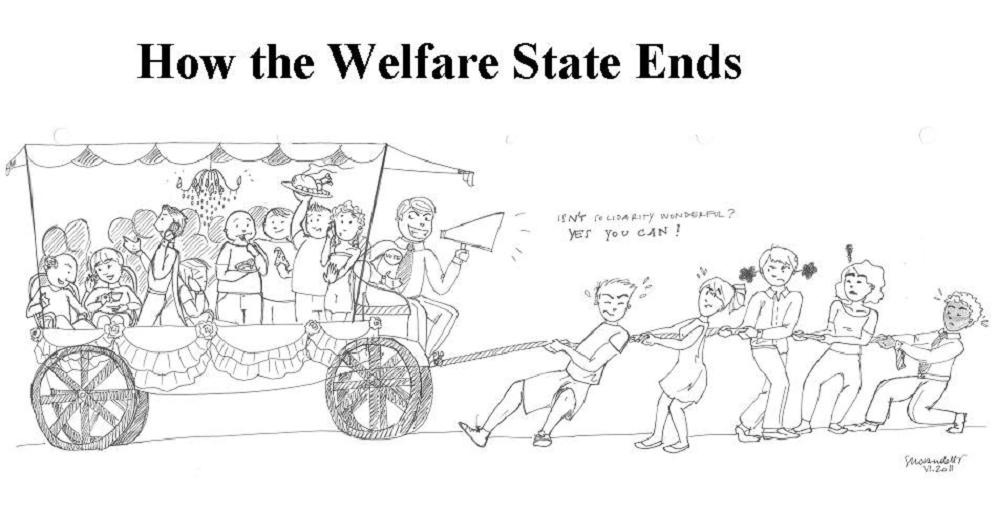
In my speeches, especially when talking about the fiscal crisis in Europe (or the future fiscal crisis in America), I often warn that the welfare state reaches a point-of-no-return when the number of people riding in the wagon begins to outnumber the number of people pulling the wagon.
To be more specific, if more than 50 percent of the population is dependent on government (employed in the bureaucracy, living off welfare, receiving pensions, etc), it becomes rather difficult to form a coalition to fix the mess. This may explain why Greek politicians have resisted significant reforms, even though the nation faces a fiscal death spiral.
But you don’t need me to explain this relationship. One of our Cato interns, Silvia Morandotti, used her artistic skills to create two images (click pictures for better resolution) that show what a welfare state looks like when it first begins and what it eventually becomes.
These images are remarkably accurate. The welfare state starts with small programs targeted at a handful of genuinely needy people. But as politicians figure out the electoral benefits of expanding programs and people figure out the that they can let others work on their behalf, the ratio of producers to consumers begins to worsen.
Then things get really interesting. Small nations such as Greece can rely on permanent bailouts from bigger countries and the IMF, but sooner or later, as larger nations begin to go bankrupt, that approach won’t be feasible.
I often conclude my speeches by joking with the audience that it’s time to stock up on canned goods, bottled water, and ammo. Many people, I’m finding, don’t think that line very funny.
___________________
The Department of Health and Human Services administers the huge and fast-growing Medicare and Medicaid programs. These programs fuel rising health costs, distort health markets, and are plagued by waste and fraud. The department also runs an array of other expensive subsidy programs, including Head Start, TANF, and LIHEAP. Growth in HHS spending is creating a federal financial crisis, and the 2010 health care law sadly makes the situation worse.
The department will spend $910 billion in 2011, or $7,710 for every U.S. household. It employs 68,000 workers and runs more than 420 subsidy programs.
Here are proposed reforms to save $81 billion annually in the short-run and prevent federal health costs from consuming a growing share of the economy in the long-run.
Downsize This!
Medicare Reforms. Medicare should be transformed into a system based on vouchers, individual savings, and competitive insurance markets.
Medicaid Reforms. Federal spending on low-income health care should be converted to block grants for the states.
TANF and Welfare Spending. Welfare reforms in 1996 created Temporary Assistance for Needy Families, but this sort of aid should be provided by private charities.
Head Start and Other Subsidies. HHS funds a vast array of other subsidy programs, many of which are wasteful and ineffective.
2010 Health Care Legislation. The law expanded Medicaid, added new taxes and subsidies, created new bureaucracies, and did little to reduce cost growth in health care.
“The government of the United States is a definite government, confined to specified objects. It is not like the state governments, whose powers are more general. Charity is no part of the legislative duty of the government.”
– James Madison. A paraphrase from Elliot’s Debates regarding a proposed subsidy bill, House of Representatives, January 10, 1794.
On December 6, 1994, Carl Sagan, author of Cosmos, well-known astronomer and speaker, appeared before the Commonwealth Club of California in San Francisco to introduce his new book, Pale Blue Dot.1
Earlier in the day I had the opportunity to briefly talk with him during a break in presentations at the fall meeting of the American Geophysical Union. I introduced myself and found him very cordial but extremely animated and energetic in attempting to convince me that the Bible is not a valid source of truth and that science has proven it wrong.
I was puzzled at his enthusiasm until I purchased and read his book. In it he presents the case that the earth and man are not at the center of the universe or God’s attention. In fact, he stresses that science has disproved the Bible and that man is an insignificant species on a remote planet whirling through the vast reaches of space. He suggests space exploration and colonization as a vision for developing anew meaning in life to replace that given historically by religion.
Since Carl Sagan is such an effective spokesman for the naturalistic world view which prevails in the modern scientific community, and for his concept that a creator God is an outdated “geocentrist conceit” concocted by our less enlightened forefathers and foisted upon the human culture, I felt a review and rebuttal of his new book was in order.
REVIEWAt the heart of Dr. Sagan’s argument for a universe without a creator is the progressive disillusionment he believes science has handed those who believe in religion. This he calls “The Great Demotions.” He suggests that observation of the night-time sky by our ancestors led to a misplaced sense of importance of man:
And if the lights in the sky rise and set around us, isn’t it evident that we’re at the center of the Universe? These celestial bodies—so clearly reveals that we are special. The Universe seems designed for human beings. It’s difficult to contemplate these circumstances without experiencing stirrings of pride and reassurance. The entire Universe, made for us! We must really be something.
This satisfying demonstration of our importance, buttressed by daily observations of the heavens, made the geocentrist conceit a transcultural truth—taught in the schools, built into the language, part and parcel of great literature and sacred scripture. Dissenters were discouraged, sometimes with torture and death. It is no wonder that for the vast bulk of human history, no one questioned it.
Over the past 300 years, Sagan says, science began to strip away this “geocentrist conceit” starting with Copernicus’ finding that the earth revolved around the sun rather than the sun around the earth. Next it was determined that our earth is only one of a myriad of worlds, the sun is only one of our galaxy, and our galaxy is only one of a myriad of galaxies in the universe. Apparently, there is nothing special about our position in the universe. Einstein’s theory of relativity then discredited the view held by Newton and all other great classical physicists that the velocity of the earth in space constituted a “privileged frame of reference.” Next, the age of the solar system was calculated to be about 4.5 billion years old and the universe about 15 billion. The final demotion was the conclusion by Darwin that man is not a special creation but, rather, evolved in the primordial ooze from simple, single-celled organisms. Man is simply the end-product in a long chain of evolutionary change.
These “great demotions” lead to the conclusion that there is no meaning or purpose in our existence. Sagan bemoans this loss of meaning by lampooning the Biblical story of the Garden of Eden:
There was a particular tree of which we were not to partake, a tree of knowledge. Knowledge and understanding and wisdom were forbidden to us in this story. We were to be kept ignorant. But we couldn’t help ourselves. We were starving forknowledge—created hungry, you might say. This was the origin of all our troubles. In particular, it is why we no longer live in a garden: We found out too much. So long as we were incurious and obedient, I imagine, we could console ourselves with our importance and centrality, and tell ourselves that we were the reason the Universe was made. As we began to indulge our curiosity, though, to explore, to learn how the Universe really is, we expelled ourselves from Eden. Angels with a flaming sword were set as sentries at the gates of Paradise to bar our return. The gardeners became exiles and wanderers. Occasionally we mourn that lost world, but that, it seems to me, is maudlin and sentimental. We could not happily have remained ignorant forever.
Sagan admits several times in his book that “there is in this Universe much of what seems to be design.” Yet, he can not bring himself to attribute this design to a Designer. He does go so far as to say in one place that, “Maybe there is one [a designer] hiding, maddeningly unwilling to be revealed.” However, he finally concludes that the evidence does not require a Designer. He also admits that without a Designer there is no purpose and without purpose man cannot survive. Sagan has been building a justification for the remainder of his book. He now states in egotistical terms his agenda for the human race:
The significance of our lives and our fragile planet is then determined only by our own wisdom and courage. We are the custodians of life’s meaning. We long for a Parent to care for us, to forgive us our errors, to save us from our childish mistakes. But knowledge is preferable to ignorance. Better by far to embrace the hard truth than a reassuring fable. If we crave some cosmic purpose, then let us find ourselves a worthy goal. On behalf of Earthlife, I urge that, with full knowledge of our limitations, we vastly increase our knowledge of the Solar System and then begin to settle other worlds.
REBUTTALThe crux of Sagan’s arguments is the validity of his “great demotions.” Has science shown the Bible to be untrue and that the earth and man are insignificant random combinations of molecules near a remote star in a vast, uncaring universe? I do not believe that the sun revolves around the earth. However, I strongly hold to the view that man is at the center of God’s care and concern, if not very near the center of His creation.
The Bible nowhere says that the sun revolves around the earth. It simply uses the common everyday reference system we are all familiar with when referring to the motions of the sun. References to sunrise and sunset appear in the newspaper each day, and there is no difficulty in understanding their meaning. Similar terms are used in surveying, nautical navigation, even orbital mechanics. They communicate information just as does the Bible.
In the covenant with Abraham God implied that there is a myriad of stars in the universe. He said, “look now toward heaven, and tell the stars, if thou be able to number them….”Sagan believes some of these stars may have planets circling them with life on them. However, Sagan recently admitted in a radio interview that after 25 years of searching for intelligent life, he has been unable to find evidence of life anywhere else in the universe. (Sagan has stated that he would even be happy to find stupid life.) He went so far as to say, “there must be something unique about the earth.” Einstein’s theories of relativity and the great ages of our solar system and universe both have yet to be proven. If relativity can be shown to be true, some believe the effect could possibly explain the apparent great times of light traveling from distant stars.2
The theory of evolution is the greatest house of cards of all. It flies in the face of the well-founded Second Law of Thermodynamics, cannot be supported by the fossil record, violates common sense in the development of complex systems, and could not even occur in 15 billion years.
These “great demotions” then are the result of misapplying faulty theories rather than validating God’s statements in Scripture regarding our position and purpose.
God has declared our standing as follows:
“In the beginning God created the heavens and the earth” (Genesis 1:1).
“The heavens declare the glory of God; and the firmament sheweth His handiwork” (Psalm 19:1).
“And God said, Let us make man in our image, after our likeness” (Genesis 1:26).
“For God so loved the world, that He gave His only begotten Son, that whosoever believeth in Him should not perish, but have everlasting life” (John 3:16).
It is evident from only these few selected Scripture passages that God created the universe and cares for us to the point of providing His own Son as a sacrifice for our sins. In our finiteness we don’t fully understand an infinite God, but how dare we arrogantly deny such a God.
REACTIONSDr. Sagan is an excellent writer and public speaker. He has a very engaging writing style and dares to discuss controversial issues. His Cosmos series and book sold more copies than any science book ever written in English. He has won the Pulitzer Prize for his writing. However, he is wrong. Carl Sagan is blinded to the evidence that God exists and created man as His special object of love and concern.
This point of view among so many scientists today is described in Romans 1:20: “For the invisible things of Him from the creation of the world are clearly seen, being understood by the things that are made, even His eternal power and Godhead; so that they are without excuse.” Dr. Sagan has rejected out of hand the evidences he has clearly seen for design in the universe. Although he has expressed a reluctant need to find a Designer, he has given up on the search and has constructed his own “Tower of Babel.”
A recurrent theme throughout the book is his allegorizing of the Biblical account and an assumption that it is a transcription of man’s uninformed experiences. No place is given to the possibility that Scripture is inspired by the Creator. Dr. Sagan’s goal in Pale Blue Dot is to substitute his “creation myth” and purpose for “Earthlife” for the creation account and dominion mandate found in Genesis. Sagan even raises the specter of “becoming like the Most High.” I fear for men who would place themselves in such opposition to God and His Word.
CONCLUSIONSBecause of the kinship I feel toward scientists like Carl Sagan, I am saddened greatly by their actions. Scientists have the greatest opportunities of all to see the evidence of God’s marvelous provision for man in His creation. Those who can’t see God’s hand in the universe around them should be encouraged to ask God to reveal Himself to them. God is not hiding. He is waiting for us to see Him. Please pray for Carl Sagan and others like him who, in their conceit declare, “There is no God!” (Psalm 14:1).
REFERENCES
1. C. Sagan. Pale Blue Dot (Random House, 1994), 429 pp.
2. R. Humphries. Starlight and Time (Master Books, 1994), 133 pp.
* Dr. Vardiman is Administrative Vice President and Chairman of the Astro/Geophysics Department at ICR.
The Bible and Archaeology (1/5) The Bible maintains several characteristics that prove it is from God. One of those is the fact that the Bible is accurate in every one of its details. The field of archaeology brings to light this amazing accuracy. _________________________- I want to make two points today. 1. There is no […]
Leviathan: the Fire-Breathing Dragon: Kent Hovind [6 of 7] Everybody is trying to get info on this subject. Here is what the Bible has to say about it. Mace Baker wrote the aritcle, “Sea Dragons – The Institute for Creation Research,” and here is the third portion of that article: Pterosaurs were the flying reptiles of the ancient world. Why […]
In today’s news you will read about Kirk Cameron taking on the atheist Stephen Hawking over some recent assertions he made concerning the existence of heaven. Back in December of 1995 I had the opportunity to correspond with Carl Sagan about a year before his untimely death. Sarah Anne Hughes in her article,”Kirk Cameron criticizes […]


 Comments