Category Archives: Uncategorized

In a Rebuke to Teachers Unions, School Choice Is Going Gangbusters in the States

—-

In a Rebuke to Teachers Unions, School Choice Is Going Gangbusters in the States

Lindsey Burke  @lindseymburke / March 30, 2021

School Choice

After public schools and teachers unions proved that they could not or would not meet the needs of students during the pandemic, multiple state legislatures are collectively undertaking one of the biggest expansions of school choice in history. (Photo: Klaus Vedfelt/Getty Images)

COMMENTARY BY

Lindsey Burke@lindseymburke

Lindsey M. Burke researches and writes on federal and state education issues as the Will Skillman fellow in education policy at The Heritage Foundation. Read her research.

School districts are slowly beginning to reopen in-person instruction after being closed for nearly a year—or, in many places, for over a year. While this is a wonderful development, it will never erase what parents experienced last year: uncertainty, inconsistency, and, in some cases, ineptitude from public schools.

The events of the last year have demonstrated to many families that public schools are not always the reliable institutions many thought they were. It also opened their eyes to just how powerful the teachers unions are, and revealed what many already suspected: that their modus operandi is not to support teachers who want to teach but to score political wins.

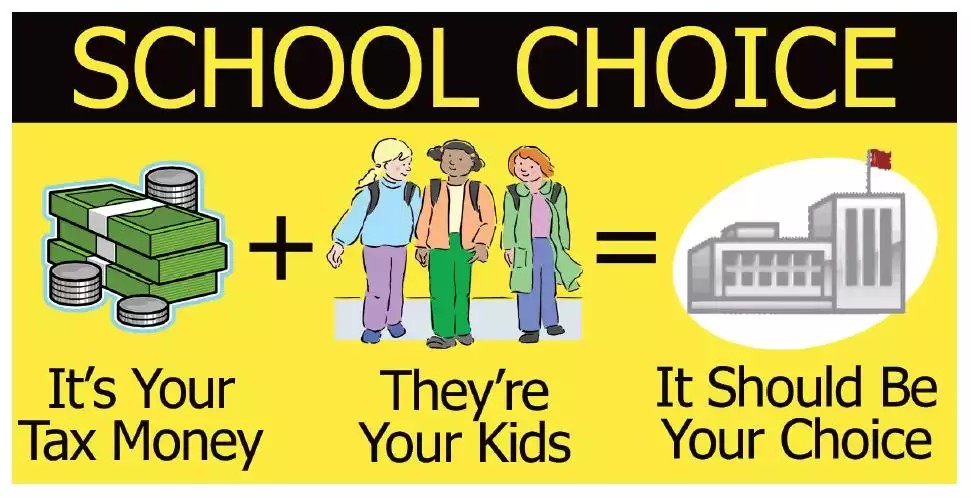
Thankfully, in response to these disappointments, multiple state legislatures are undertaking one of the biggest expansions of school choice in history. Here are some states to watch:

West Virginia. On March 29, West Virginia Gov. Jim Justice signed into law the most expansive school choice program in the country, a nearly universal option for education savings accounts.

Want to keep up with the 24/7 news cycle? Want to know the most important stories of the day for conservatives? Need news you can trust? Subscribe to The Daily Signal’s email newsletter. Learn more >>

This is monumental. It is the nation’s first universal education savings account program open to all children in the state. Students who choose to participate in the education savings account option will receive 100% of what the state would have spent on their education in their prior public school—or approximately $4,600 per year—which they can then use to pay for private school tuition, online learning, private tutoring, and a variety of other education services, products, and providers.

All incoming kindergarteners will be eligible for an education savings account, as will all first through 12th graders, with the condition that they have previously been enrolled in a West Virginia public school for 45 days.

Kentucky. Kentucky followed suit this week with the Legislature overriding Gov. Andy Beshear’s veto of a bill to create the Bluegrass State’s first school choice program—a tax credit-funded education savings account.

Known as Education Opportunity Accounts, students from families with incomes below 175% of the federal poverty line will have access to education savings accounts. The program is available to students living in counties with more than 90,000 residents and will initially be capped at $25 million.

South Dakota. On March 18, Gov. Kristi Noem signed into law an expansion of South Dakota’s tax credit scholarship program, which provides tax credits to insurance companies that provide donations to scholarship-granting organizations, which in turn provide scholarships to eligible students to offset the cost of private school tuition.

Students from families whose income does not exceed 150% of the qualifying amount for free and reduced-price lunch eligibility (approximately $73,000 for a family of four) are eligible. The Legislature expanded the program to now include students who already attend private school.

Georgia. Gov. Brian Kemp will soon have on his desk a bill that expands eligibility for the state’s existing voucher program for students with special needs. The proposal would expand eligibility to students in public schools with 504 plans (meaning they may need additional help in school due to learning impediments).

Approximately 58,000 Georgia students currently have 504 plans and would be eligible for the expanded voucher program.

Florida. The Florida Legislature is considering a proposal to consolidate the state’s five existing school choice programs into two streamlined education savings account options. One of the education savings account programs would be geared toward students with special needs, and the other would be available to the broader student population.

This proposal would fold the McKay Scholarship Program, a voucher program for children with special needs; the Florida Tax Credit Scholarship Program, which provides scholarships to income-eligible students; the Hope Scholarship, which allows individuals to redirect their car sales tax to private school scholarships; and the Family Empowerment Scholarship, which provides scholarships to students to attend a private school of choice who were on the waitlist for the state’s popular tax credit scholarship program, into the existing education savings account structure.

The proposal would bring the flexibility and customization of education savings accounts to the existing voucher and tax credit scholarship programs, updating the current school choice programs. 

The proposal also grows program eligibility by eliminating the prior public school attendance requirements and opening the education savings account program to low-income homeschooled students in the state.

Arizona. In Arizona, the Legislature is considering an expansion of the state’s existing (first-in-the-nation) education savings account program to include students who attend a low-income school. 

It would also make students who live in the attendance zone boundary of a Title I school eligible for the accounts. An estimated 65% of school districts in Arizona are home to Title I schools.

Missouri. Missouri lawmakers have introduced a bill to create a tax credit-funded education savings account program with broad eligibility. The program would be open to all students who previously attended public school in Missouri, or are entering kindergarteners, or who have an active-duty military parent. The program would initially be capped at $50 million.

New Hampshire. New Hampshire officials are likewise considering an education savings account program that would provide eligible families with $4,500 per year. The education savings accounts would be available to students from families earning less than $77,000 per year for a family of four.

Indiana. In Indiana, policymakers have introduced a measure that would expand eligibility for the state’s existing school voucher program and would create education savings accounts. 

Children with special needs, from military families, or from foster families would be eligible for an education savings account worth 90% of what the state would have spent on that child in their public school.

In addition to these nine states, dozens of others are considering measures to expand education freedom and opportunity to students. An unprecedented 29 states have already introduced similar measures this year that will create or expand vouchers, tax credit scholarships, and education savings accounts, according to the Educational Freedom Institute.

According to EdChoice, more than 20 of those states have introduced education savings account options specifically. For families, these proposals represent lifelines to opportunities previously unavailable to them in their public school.

These measures are a swift rebuke to the teachers unions, who have not only stood in the way of education access during the pandemic, but have been the primary obstacles to education choice for decades. 

Have an opinion about this article? To sound off, please email letters@DailySignal.com and we will consider publishing your remarks in our regular “We Hear You” feature.  

MILTON FRIEDMAN ON VOUCHERS

Michelle: You are the grandfather of school vouchers. Do you feel victorious?

Mr. Friedman: Far from victorious, but very optimistic and hopeful. We are at the beginning of the task because as of the moment vouchers are available to only a very small amount of children. Our goal is to have a system in which every family in the U.S. will be able to choose for itself the school to which its children go. We are far from that ultimate result. If we had that, a system of free choice, we would also have a system of competition, innovation, which would change the character of education. You know our educational system is one of the most backwards things in our society in the way we teach people they did 200 years ago. There is a person in the front of the room. There are children sitting down at the bottom, and they are being talked to. Can you name any other industry in the U.S. which is as technologically backward? I can name one and only one: the legislature for the same reason. Both are monopolies. The elementary and secondary school system is the single most socialist industry in the U.S. leaving aside the military, but aside from the military it’s a major socialist industry; it is centralized and the control comes from the center and the difficulty of having a monopoly in which people cannot choose has been exacerbated by the fact that it has been largely taken over by teachers’ unions, the National Education Association and the American Federation of Teachers and the unions. Understandably, I do not blame them, but they are interested in the welfare of their members, not the welfare of the children, and the result is they have introduced a degree of rigidity, which makes it impossible to reform the public school system from within. Reform has to come through competition from the outside and the only way you can get competition is by making it possible for parents to have the ability to choose.

Michelle: Give to me a model, an example of how it would work.

Mr. Friedman: Very simple, take the extreme the government says we are willing to finance schooling for every child. The government compels children. If you look at the role of government in education there are three different levels. There is a level of compulsory. The government says every child must go to school until such and such and age. That is the equivalent of saying if you are going to drive a car you must have a license. The second stage is funding. Not only do we require you to have an education, but the government is willing to pay for that schooling. That would be equivalent to saying the government is willing to pay for your car that you drive. The third level is running the educational industry. That would be the equivalent of the government manufacturing the automobile or, to put it in a different image, consider food stamps today. Food stamps are funds provided by the government. But if that were to be runned (sic) like the schools, they would say everybody has to use these food stamps at a government grocery and each person with food stamps is assigned to a particular government grocer. So the only way you can get your food stamps is by going to that grocer. Do you think those groceries would be very good? We know what the situation is in schooling. People say why now and not 50-75 years ago? Well, when I went to high school that was a long time ago. In the 1920s there were 150,000 school districts in the U.S and the population was half what it is now. Today, there are fewer than 15,000 school districts. So it used to be that you really did have competition cause you had small school districts and parents had a good deal of control over those school districts, but increasingly we have shifted to very large school districts, to centralized control, to a system in which the governmental officials, in which the educational professionals control it. And like every socialist industry, it produces a product that is very expensive and of very low quality. Of course it is not uniform. There are some very good schools do not misunderstand me, but there are also some very bad ones.

Michelle: I interviewed some folks who are against school vouchers and they say that if you really want to help out a school what you should do is provide high-quality early childhood education, small classes, small schools, summer school available to children who want it. Put money to those items, which they claim would work.

Mr. Friedman: They don’t, we have been doing that. The amount of money spent per child adjusted for inflation has something like doubled or tripled over the last 20 years. Twenty years ago we had this report A Nation at Risk that pointed out all of the difficulties I just referred to and which pointed out this was a first generation that was going to be less schooled than its parents. We are now in the next generation and will be even less well schooled. We have had every possible effort you could have from reform from within. It is not just in schools; it is in any area. Reform has to come from outside. It has to come from competition. Let me illustrate that from within the school system. The United States from all accounts ranks number one in higher education. People from all over the world regard the United States’ colleges and universities the best and most varied. On the other hand in every other international comparison we rank near the bottom in elementary and secondary education. Why the difference? One word: choice. The elementary and secondary education, the school picks the child; it picks its customer. In higher education, the customer picks its school, you have choice that makes all the difference in the world. It means competition forces product. Look over the rest of the economy. Is there any area in the U.S. in which progress has not required progress from the outside? Look at the telephone industry when it was broken down into the little bells and opened up the competition. It started a period of rapid innovation and development. The key word is competition and the question is how can you get competition. Only by having the customer choosing.

Michelle: There is concern that money is going to religious schools. That the majority of the students in voucher programs that exist use them to attend schools with religious affiliation?

Mr. Friedman: Why? Because the vouchers are so small in some cases. It is true that of the private schools in the U.S. the great bulk of them are religious. That is for one simple reason. Here is someone selling something for nothing. Somebody down the street is giving away chocolate and you want to get into the business of selling chocolate. That is kind of tough isn’t it? Here at schools, children can attend them. They are not free. They are paying for it in the form of taxes, but there is no specific charge for going to that school. Somebody else is going to offer it. The churches, the religious organizations have had a real advantage in that they were the only ones around who were in a position to subsidize the education and keep the fees down low. If you open it wide, the most recent case was Ohio, Cleveland case. The voucher that they had had a max value of $2,500. Now it is not easy to provide a decent education at $2,500 and make money at it. Make it pay. At the same time the state of Ohio was spending something like over $7,000 per child on schooling. If that voucher had been $7,000 instead of $2,500 I have no doubt that there would have been a whole raft of new private, non-profit, both profit and non-profit schools. That is what has happened in Milwaukee. Milwaukee has a voucher system and today the fraction of the voucher users in Milwaukee going to religious schools is less than the fraction going to religious schools was before this system started because there have been new schools developed and some of them have been religious but many of them are not. In any event, the Supreme Court has settled that issue. They have said that if it is the choice of the parent, if there are alternatives available, there are government schools, charter schools, private non-denominational schools, private denominational schools, so long as the choice is in the hands of the parent that is not a violation of the First Amendment.

Michelle: You have a friend and an ally in the White House when it comes to vouchers.

Mr. Friedman: I should say. Mr. Bush has always been in favor. He is in favor of free choice. Remember vouchers are a means not an end. The purpose of vouchers is to enable parents to have free choice, and the purpose of having free choice is to provide competition and allow the educational industry to get out of the 17th century and get into the 21st century and have more innovation and more evolvement. There is no reason why you cannot have the same kind of change in the provision of education as you have had in industries like the computer industry, the television industry and other things.

Michelle: Is it refreshing to have a president that, Bill Clinton was firmly against vouchers.

Mr. Friedman: No, it is a case of circumstances. When he was governor of Arkansas, he was not against vouchers. He was in favor, but when he became president he came out against vouchers. I should say he did not oppose vouchers as governor and he did as president and that was for political reasons. People don’t recognize how powerful politically the teachers’ unions are. Something like a quarter of all the delegates at the Democratic National Convention are from the teachers’ union. They are probably the most powerful pressure group in the U.S., very large funds, very large number of people and very active politically.

Michelle: We talk in the office about how President Bush has some very Friedmanesqe ideas.

Mr. Friedman: They are not Freidmanesqe. They are just good ideas. I hope that is true anyway. I think very highly of President Bush, and I think in these areas, don’t misunderstand me, that is not a blanket statement. There are some things he has done that I disagree with, but taken as a whole he has been moving in the right direction of trying to move toward a smaller more limited government, trying to provide more freedom and more initiative in all areas. His philosophy on Medicare is the same as his philosophy in schools.

Michelle: Is that refreshing?

Mr. Friedman: It is an interesting thing, if you look at the facts, the one area, the area in which the low-income people of this country, the blacks and the minority, are most disadvantaged is with respect with the kinds of schools they can send their children to. The people who live in Harlem or the slums or the corresponding areas in LA or San Francisco, they can go to the same stores, shop in the same stores everybody else can, they can buy the same automobiles, they can go to supermarket, but they have very limited choice of schools. Everybody agrees that the schools in those areas are the worst. They are poor. Yet, here you have a Democrat who allege their interest is to help the poor and the low-income people. Here you have to take a different point. Every poll has shown that the strongest supporters of vouchers are the low-income blacks, and yet hardly a single black leader has been willing to come out for vouchers. There were some exceptions, Paul Williams in Milwaukee who was responsible for that, and a few others.

Michelle: Why do you think that is?

Mr. Friedman: For obvious reasons, political. It has been to the self interest to the leaders. The school system, as long as it’s governmental it’s a source of power and jobs to hand around and funds to dispose of. If it is privatized that disappears. And the other aspect of it is the power of the teachers’ unions. Right now those of us that are in the upper-income classes have freedom of choice for our children in various ways. We can decide where to live and we can choose places to live that have good schools or we can afford to pay twice for schooling once by taxes and once by paying tuition at a private school. It seems to me utterly unfair that those opportunities should not be open to everybody at all levels of income. If you had a system, the kind I would like to see, the government would say we require every child to get a certain number of years of schooling and in order to make that possible we are going to provide for every parent a voucher equal to a certain number of dollars, which they can use only for schooling, can’t use it for anything else. They can add to it, but they cannot subtract from it. Those will be, those can be used in government schools. Let the government run the school, but force them to be in competition so that all government schools charge tuition, but can be paid for by that voucher. But that same voucher can also be used in private schools of all kinds and then you would have an open; the teachers’ union complained and they insist they are doing a good job. If they are doing a good job then why are they so afraid of some competition?

Copyright: MSNBC, Inc. 2003

Milton Friedman

Related posts:


“Friedman Friday” (“Free to Choose” episode 1 – Power of the Market. part 7 of 7)

March 16, 2012 – 12:25 am

  Michael Harrington:  If you don’t have the expertise, the knowledge technology today, you’re out of the debate. And I think that we have to democratize information and government as well as the economy and society. FRIEDMAN: I am sorry to say Michael Harrington’s solution is not a solution to it. He wants minority rule, I […] By Everette Hatcher III | Posted in Current Events, Milton Friedman | Edit | Comments (0)

“Friedman Friday” (“Free to Choose” episode 1 – Power of the Market. part 6 of 7)

March 9, 2012 – 12:29 am

PETERSON: Well, let me ask you how you would cope with this problem, Dr. Friedman. The people decided that they wanted cool air, and there was tremendous need, and so we built a huge industry, the air conditioning industry, hundreds of thousands of jobs, tremendous earnings opportunities and nearly all of us now have air […] By Everette Hatcher III | Posted in Current Events, Milton Friedman | Edit | Comments (0)

“Friedman Friday” (“Free to Choose” episode 1 – Power of the Market. part 5 of 7)

March 2, 2012 – 12:26 am

Part 5 Milton Friedman: I do not believe it’s proper to put the situation in terms of industrialist versus government. On the contrary, one of the reasons why I am in favor of less government is because when you have more government industrialists take it over, and the two together form a coalition against the ordinary […] By Everette Hatcher III | Posted in Current Events, Milton Friedman | Edit | Comments (0)

“Friedman Friday” (“Free to Choose” episode 1 – Power of the Market. part 4 of 7)

February 24, 2012 – 12:21 am

The fundamental principal of the free society is voluntary cooperation. The economic market, buying and selling, is one example. But it’s only one example. Voluntary cooperation is far broader than that. To take an example that at first sight seems about as far away as you can get __ the language we speak; the words […] By Everette Hatcher III | Posted in Current Events, Milton Friedman | Edit | Comments (0)

“Friedman Friday” (“Free to Choose” episode 1 – Power of the Market. part 3 of 7)

February 17, 2012 – 12:12 am

  _________________________   Pt3  Nowadays there’s a considerable amount of traffic at this border. People cross a little more freely than they use to. Many people from Hong Kong trade in China and the market has helped bring the two countries closer together, but the barriers between them are still very real. On this side […] By Everette Hatcher III | Posted in Current Events, Milton Friedman | Edit | Comments (0)

“Friedman Friday” (“Free to Choose” episode 1 – Power of the Market. part 2 of 7)

February 10, 2012 – 12:09 am

  Aside from its harbor, the only other important resource of Hong Kong is people __ over 4_ million of them. Like America a century ago, Hong Kong in the past few decades has been a haven for people who sought the freedom to make the most of their own abilities. Many of them are […] By Everette Hatcher III | Posted in Current Events, Milton Friedman | Edit | Comments (0)

“Friedman Friday” (“Free to Choose” episode 1 – Power of the Market. part 1of 7)

February 3, 2012 – 12:07 am

“FREE TO CHOOSE” 1: The Power of the Market (Milton Friedman) Free to Choose ^ | 1980 | Milton Friedman Posted on Monday, July 17, 2006 4:20:46 PM by Choose Ye This Day FREE TO CHOOSE: The Power of the Market Friedman: Once all of this was a swamp, covered with forest. The Canarce Indians […]

Milton Friedman The Power of the Market 1-5

Debate on Milton Friedman’s cure for inflation

September 29, 2011 – 7:24 am

If you would like to see the first three episodes on inflation in Milton Friedman’s film series “Free to Choose” then go to a previous post I did. Ep. 9 – How to Cure Inflation [4/7]. Milton Friedman’s Free to Choose (1980) Uploaded by investbligurucom on Jun 16, 2010 While many people have a fairly […]

By Everette Hatcher III | Also posted in Current Events | Tagged dr friedman, expansion history, income tax brackets, political courage, www youtube | Edit | Comments (0)

“Friedman Friday” Milton Friedman believed in liberty (Interview by Charlie Rose of Milton Friedman part 1)

April 19, 2013 – 1:14 am

Charlie Rose interview of Milton Friedman My favorite economist: Milton Friedman : A Great Champion of Liberty  by V. Sundaram   Milton Friedman, the Nobel Prize-winning economist who advocated an unfettered free market and had the ear of three US Presidents – Nixon, Ford and Reagan – died last Thursday (16 November, 2006 ) in San Francisco […] By Everette Hatcher III | Posted in Milton Friedman | Edit | Comments (0)

What were the main proposals of Milton Friedman?

February 21, 2013 – 1:01 am

Stearns Speaks on House Floor in Support of Balanced Budget Amendment Uploaded by RepCliffStearns on Nov 18, 2011 Speaking on House floor in support of Balanced Budget Resolution, 11/18/2011 ___________ Below are some of the main proposals of Milton Friedman. I highly respected his work. David J. Theroux said this about Milton Friedman’s view concerning […] By Everette Hatcher III | Posted in Milton Friedman | Edit | Comments (0)

“Friedman Friday,” EPISODE “The Failure of Socialism” of Free to Choose in 1990 by Milton Friedman (Part 1)

December 7, 2012 – 5:55 am

Milton Friedman: Free To Choose – The Failure Of Socialism With Ronald Reagan (Full) Published on Mar 19, 2012 by NoNationalityNeeded Milton Friedman’s writings affected me greatly when I first discovered them and I wanted to share with you. We must not head down the path of socialism like Greece has done. Abstract: Ronald Reagan […] By Everette Hatcher III | Posted in Milton FriedmanPresident Obama | Edit | Comments (1)

Defending Milton Friedman

July 31, 2012 – 6:45 am

What a great defense of Milton Friedman!!!!   Defaming Milton Friedman by Johan Norberg This article appeared in Reason Online on September 26, 2008  PRINT PAGE  CITE THIS      Sans Serif      Serif Share with your friends: ShareThis In the future, if you tell a student or a journalist that you favor free markets and limited government, there is […]
OPEN LETTER ABOUT SENATOR’S 2017 PRAISE OF FILIBUSTER!!! PLUS Nor is abortion a feminist issue, any more than slavery was only a slave owner’s issue. Senator Mazie Hirono, D-Hawaii

March 30, 2021

Office of Senator Mazie Hirono, D-Hawaii
United States Senate
Washington, D.C. 20510

Dear Senator Hirono,

I noticed that you signed a 2017 letter strongly supporting the filibuster. 
Why are you thinking about abandoning that view now?

Does your change of view have anything to do with Biden now being in office?


Democrats distance themselves from previous pro-filibuster stance, citing GOP obstruction

More than half of current Senate Democrats and VP Harris signed 2017 letter supporting filibuster when GOP was in control

Tyler Olson

By Tyler Olson | Fox News

As progressives push hard for Democrats to eliminate the legislative filibuster after gaining control of the Senate, House and the presidency, many Democratic senators are distancing themselves from a letter they signed in 2017 backing the procedure.

Sens. Susan Collins, R-Maine, and Chris Coons, D-Del., led a letter in 2017 that asked Republican Leader Mitch McConnell, R-Ky., and Democratic Leader Chuck Schumer, D-N.Y., to preserve the legislative filibuster. As it’s existed for decades, the filibuster requires 60 votes in order to end debate on a bill and proceed to a final vote.

“We are writing to urge you to support our efforts to preserve existing rules, practices, and traditions” on the filibuster, the letter said.

Besides Collins and Coons, 59 other senators joined on the letter. Of that group, 27 Democratic signatories still hold federal elected office. Twenty-six still hold their Senate seats, and Vice President Harris assumed her new job on Jan. 20, vacating her former California Senate seat.

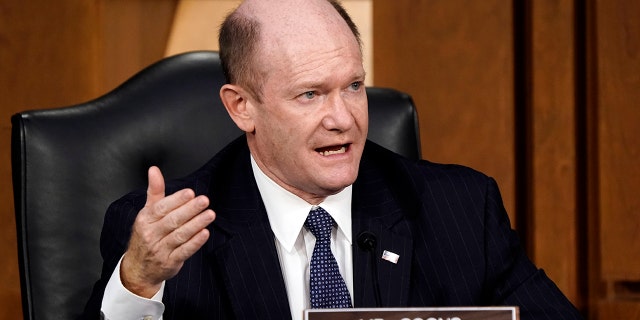
Sen. Chris Coons, D-Del., speaks as the Senate Judiciary Committee hears from legal experts on the final day of the confirmation hearing for Supreme Court nominee Amy Coney Barrett, on Capitol Hill in Washington, Thursday, Oct. 15, 2020. Coons has softened his support for the legislative filibuster in recent years after leading an effort to protect it in 2017. (AP Photo/J. Scott Applewhite)

Sen. Chris Coons, D-Del., speaks as the Senate Judiciary Committee hears from legal experts on the final day of the confirmation hearing for Supreme Court nominee Amy Coney Barrett, on Capitol Hill in Washington, Thursday, Oct. 15, 2020. Coons has softened his support for the legislative filibuster in recent years after leading an effort to protect it in 2017. (AP Photo/J. Scott Applewhite)

But now, the momentum among Senate Democrats is for either full abolition of the filibuster or significantly weakening it. President Biden endorsed the latter idea Tuesday, announcing his support for a “talking filibuster.”

KAMALA HARRIS SUPPORTS CHANGE TO FILIBUSTER IN SENATE TO LIMIT MINORITY PARTY POWER

“I don’t think that you have to eliminate the filibuster, you have to do it what it used to be when I first got to the Senate back in the old days,” Biden told ABC. “You had to stand up and command the floor, you had to keep talking.”

The legislative filibuster has been a 60-vote threshold for what is called a “cloture vote” — or a vote to end debate on a bill — meaning that any 41 senators could prevent a bill from getting to a final vote. If there are not 60 votes, the bill cannot proceed.

The “talking filibuster” — as it was most recently seriously articulated by Sen. Jeff Merkley, D-Ore., in 2012 — would allow 41 senators to prevent a final vote by talking incessantly, around-the-clock, on the Senate floor. But once those senators stop talking, the threshold for a cloture vote is lowered to 51.

Harris’ office confirmed to Fox News Wednesday that she is now aligned with Biden on the filibuster issue. She’d previously taken an even more hostile position to the filibuster, saying she would fully “get rid” of it “to pass a Green New Deal” at a CNN town hall in 2019.

The legislative filibuster has been a 60-vote threshold for what is called a “cloture vote” — or a vote to end debate on a bill — meaning that any 41 senators could prevent a bill from getting to a final vote. If there are not 60 votes, the bill cannot proceed.

The “talking filibuster” — as it was most recently seriously articulated by Sen. Jeff Merkley, D-Ore., in 2012 — would allow 41 senators to prevent a final vote by talking incessantly, around-the-clock, on the Senate floor. But once those senators stop talking, the threshold for a cloture vote is lowered to 51.

Harris’ office confirmed to Fox News Wednesday that she is now aligned with Biden on the filibuster issue. She’d previously taken an even more hostile position to the filibuster, saying she would fully “get rid” of it “to pass a Green New Deal” at a CNN town hall in 2019.

Coons, who led the 2017 letter along with Collins, has also distanced himself from his previous stance.

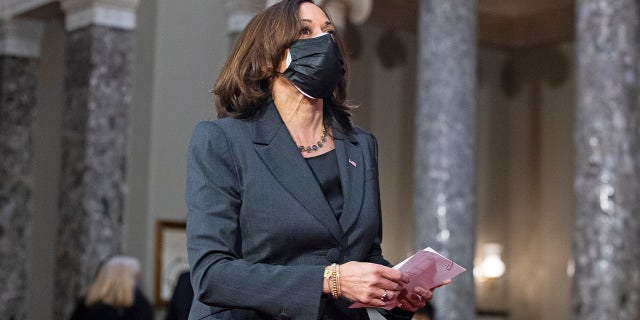
Vice President Kamala Harris attends a ceremonial swearing-in for Sen. Patrick Leahy, D-Vt., as President Pro Tempore of the Senate on Capitol Hill in Washington, Thursday, Feb. 4, 2021. Harris has changed her stance on the legislative filibuster since signing a letter in 2017 backing it. (Michael Reynolds/Pool via AP)

Vice President Kamala Harris attends a ceremonial swearing-in for Sen. Patrick Leahy, D-Vt., as President Pro Tempore of the Senate on Capitol Hill in Washington, Thursday, Feb. 4, 2021. Harris has changed her stance on the legislative filibuster since signing a letter in 2017 backing it. (Michael Reynolds/Pool via AP) (AP)

BIDEN SUPPORTS CHANGING SENATE FILIBUSTER 

“I’m going to try my hardest, first, to work across the aisle,” he said in September when asked about ending the filibuster. “Then, if, tragically, Republicans don’t change the tune or their behavior at all, I would.”

Fox News reached out to all of the other 26 Democratic signatories of the 2017 letter, and they all either distanced themselves from that position or did not respond to Fox News’ inquiry.

“Less than four years ago, when Donald Trump was President and Mitch McConnell was the Majority Leader, 61 Senators, including more than 25 Democrats, signed their names in opposition to any efforts that would curtail the filibuster,” a GOP aide told Fox News. “Other than the occupant of the White House, and the balance of power in the Senate, what’s changed?”

“I’m interested in getting results for the American people, and I hope we will find common ground to advance key priorities,” Sen. Tim Kaine. D-Va., said in a statement. “If Republicans try to use arcane rules to block us from getting results for the American people, then we’ll have a conversation at that time.”

Added Sen. Mark Warner, D-Va: “I am still hopeful that the Senate can work together in a bipartisan way to address the enormous challenges facing the country. But when it comes to fundamental issues like protecting Americans from draconian efforts attacking their constitutional right to vote, it would be a mistake to take any option off the table.”

“Senator Stabenow understands the urgency of passing important legislation, including voting rights, and thinks it warrants a discussion about the filibuster if Republicans refuse to work across the aisle,” Robyn Bryan, a spokesperson for Sen. Debbie Stabenow, D-Mich., said.

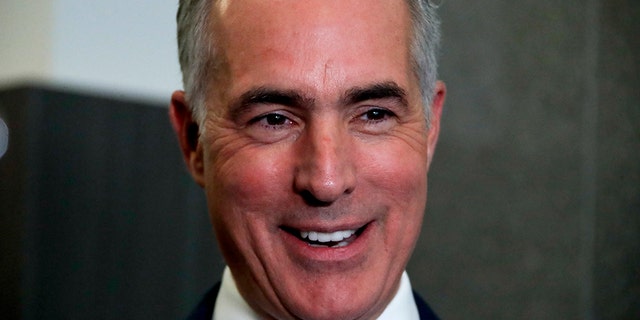
FILE - In this Oct. 26, 2018, file photo, Sen.Bob Casey, D-Pa., speaks to reporters in the studio of KDKA-TV in Pittsburgh. Casey has reversed his stance on the legislative filibuster since signing a 2017 letter in support of it. (AP Photo/Gene J. Puskar, File)

FILE – In this Oct. 26, 2018, file photo, Sen.Bob Casey, D-Pa., speaks to reporters in the studio of KDKA-TV in Pittsburgh. Casey has reversed his stance on the legislative filibuster since signing a 2017 letter in support of it. (AP Photo/Gene J. Puskar, File)

Representatives for Sen. Bob Casey, D-Pa., pointed to recent comments he made on MSNBC.

“Yes, absolutely,” Casey said when asked if he would support a “talking filibuster” or something similar. “Major changes to the filibuster for someone like me would not have been on the agenda even a few years ago. But the Senate does not work like it used to.”

MCCONNELL SAYS SENATE WILL BE ‘100-CAR PILEUP’ IF DEMS NUKE FILIBUSTER

“I hope any Democratic senator who’s not currently in support of changing the rules or altering them substantially, I hope they would change their minds,” Casey added.

Representatives for Sen. Angus King, I-Vt., who caucuses with Democrats, meanwhile, references a Bangor Daily News editorial that said King was completely against the filibuster in 2012 but now believes it’s helpful in stopping bad legislation. It said, however, that King is open to “modifications” similar to a talking filibuster.

The senators who did not respond to questions on their 2017 support of the filibuster were Sens. Joe Manchin. D-W.Va.; Patrick Leahy, D-Vt.; Amy Klobuchar, D-Minn.; Jeanne Shaheen, D-N.H.; Michael Bennet, D-Colo.; Martin Heinrich, D-N.M.; Sherrod Brown, D-Ohio; Dianne Feinstein, D-Calif.; Kirsten Gillibrand, D-N.Y.; Brian Schatz, D-Hawaii; Cory Booker, D-N.J.; Maria Cantwell, D-Wash.; Maize Hirono, D-Hawaii; John Tester, D-Mont.; Tom Carper, D-Del.; Maggie Hassan, D-N.H.; Tammy Duckworth, D-Ill.; Jack Reed, D-R-I.; Ed Markey, D-Mass.; Sheldon Whitehouse, D-R.I.; and Bob Menendez, D-N.J.

Some of these senators, however, have addressed the filibuster in other recent comments.

Sen. Dianne Feinstein, D-Calif., on Wednesday was asked if she supported changing the filibuster threshold by CNN and said she is still opposed to the idea. “Not at this time,” Feinstein said.

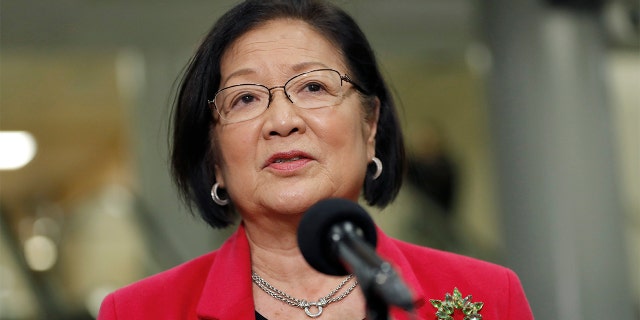
Sen. Mazie Hirono, D-Hawaii, speaks to reporters on Capitol Hill in Washington, Thursday, Jan. 30, 2020, during the impeachment trial of President Donald Trump on charges of abuse of power and obstruction of Congress. Hirono has changed her opinion on the legislative filibuster since signing a 2017 letter supporting it. (AP Photo/Julio Cortez)

Sen. Mazie Hirono, D-Hawaii, speaks to reporters on Capitol Hill in Washington, Thursday, Jan. 30, 2020, during the impeachment trial of President Donald Trump on charges of abuse of power and obstruction of Congress. Hirono has changed her opinion on the legislative filibuster since signing a 2017 letter supporting it. (AP Photo/Julio Cortez)

Sen. Maize Hirono, D-Hawaii, meanwhile said last week she is already for getting rid of the current 60-vote threshold and thinks other Democrats will sign on soon.

“If Mitch McConnell continues to be totally an obstructionist, and he wants to use the 60 votes to stymie everything that President Biden wants to do and that we Democrats want to do that will actually help people,” Hirono said, “then I think the recognition will be among the Democrats that we’re gonna need to.”

The most recent talk about either removing or significantly weakening the filibuster was spurred by comments from Manchin that appeared to indicate he would be open to a talking filibuster. He said filibustering a bill should be more “painful” for a minority.

Manchin appeared to walk back any talk of a talking filibuster on Wednesday, however.

“You know where my position is,” he said. “There’s no little bit of this and a little bit — there’s no little bit here. You either protect the Senate, you protect the institution and you protect democracy or you don’t.”

Manchin and Sen. Kyrsten Sinema, D-Ariz., both committed to supporting the current form of the filibuster earlier this year. Sinema was not in the Senate in 2017.

Senate Minority Mitch McConnell, R-Ky., said their comments gave him the reassurance he needed to drop a demand that Senate Majority Leader Chuck Schumer, D-N.Y., put filibuster protections into the Senate’s organizing resolution.

But with Manchin seeming to flake at least in the eyes of some, other Democrats are beginning to push harder for filibuster changes.

—-

I read this about your views on abortion:

Hirono: I Told Eighth Grade Girls ‘We Have to Fight for Abortion Rights’

Sen. Mazie Hirono (D., Hawaii) told a crowd of protesters in front of the Supreme Court on Tuesday that she informed a group of eighth graders at a public school in Hawaii that “we have to fight for abortion rights.”

“I asked the girls in that group of eighth graders, ‘How many of you girls think that government should be telling us women and if we should be having babies?’ Not a single one of them raised their hands,” Hirono said.

Hirono also said she lectured the boys present at the public school gathering.

“To the boys who were there, among the 60, I said, ‘You know, it’s kind of hard for a woman to get pregnant without you guys.’ They got it,” she said. “‘How many of you boys think government should be telling girls and women when if we’re going to be having babies?’ And not a single one of them raised their hands.”

Hirono has been a strident advocate of abortion in the Senate, advocating for religious tests on judiciary appointmentsas well as opposing a bill that would protect survivors of botched abortions from infanticide.

“I hope supporters of the bills that we’re talking about today, both in the states and in Congress, turn their efforts to improving the lives of the children who are very much here already and who are so poorly served by the Trump administration and its policies,” Hirono said in opposition to Sen. Ben Sasse’s (R., Neb.) Born-Alive Abortion Survivors Protection Act in February.

Senator I wanted to talk about abortion.

Francis Schaeffer noted:

Abortion is not a “Roman Catholic issue.” This must be emphasized. Those who oppose it by conveying the idea that only the Roman Catholic Church is against abortion. We must indeed be glad for the Roman Catholics who have spoken out, but we must not allow the position to be minimized as though it is a “religious” issue. It is not a religious issue. 

This line of attack has been carried so far that some lawyers want to rule out discussion at all, on the basis that it is only a Roman Catholic issue and therefore a violation of the separation of church and state. The issue, however, is not “divided along religious lines,” and it has nothing to do with the separation of church and state. 

(Under footnote 36)

Harold O.J. Brown has this to say about the separation of church and state: “No American historian would seriously contend that the phrase ‘regarding an establishment of religion’ in the First Amendment means anything other than what it says:it forbids the establishment of state churches, as both Massachusetts and Connecticut had them at the time of the amendment’s adoption and retained them for many years to come. The limitations of federal power contained in the Bill of Rights have subsequently been extended to apply to the individual states as well. Yet even when applied to the states, the First Amendment means only that no state may establish a state church, just as the federal government may not establish a national church. It certainly did not mean, in its conception, that nothing in public law or policy may reflect the convictions or insights of any church or of the Christian religion [see Harold O.J. Brown, “The Passivity of American Christians,” CHRISTIANITY TODAY, January 16, 1976].

(End of footnote #36)

The issue of the humanness of the unborn child is one raised by many people across a vast spectrum of religious backgrounds, and, happily, also by thousands who have not religion at all. A picture in the INTERNATIONAL HERALD TIMES of January 25, 1978, showed a Washington protest march on the fifth anniversary of the Supreme Court decision that restricted the rights of states to regulate and thereby curtail the spread of abortion. The most outstanding sign being carried read: IF MY MOM DIDN’T CARE–I MIGHT NOT BE HERE–THANKS MOM! The young girl carrying that sign did not have to be religious to paint and carry it; all she needed was to be glad she was not aborted. And the right of that girl to express her views on life and death to those who represent here in the democratic process and to be heard in the courts depends only on her being a citizen of the United States. Abortion is not a religious issue. It is a human issue!

Nor is abortion a feminist issue, any more than slavery was only a slave owner’s issue. Abortion has been tacked onto the feminist issue, with the feminist issue being used to carry abortion. But there is no intrinsic relationship between them. The fate of the unborn is a question of the fate of the human race. We are one human family. If the rights of one part of that family are denied, it is of concern to each of us. What is at stake is no less than the essence of what freedom and rights are all about. 

(Under footnote 37)

More and more feminists are disgusted with the realities of the abortion situation. One such group is known as Women Exploited. Their leader, Sandra Haun, testified before the Pennsylvania legislature as follows: “The members of our organization have all had abortions and have come to realize, too late, that our decision was wrong. We were encouraged and pushed into a hasty decision that now we find impossible to live with. We were lied to and deliberately misinformed.” 

(End of footnote 37)

Francis Schaeffer

Sincerely, 

Everette Hatcher III, 13900 Cottontail Lane, Alexander, AR 72002, ph 501-920-5733 everettehatcher@gmail.com

Related posts:

Open letter to President Obama (Part 201)Tea Party favorite Representative links article “Prescott and Ohanian: Taxes Are Much Higher Than You Think”

December 21, 2012 – 9:47 am

    (Emailed to White House on 12-21-12.) President Obama c/o The White House 1600 Pennsylvania Avenue NW Washington, DC 20500 Dear Mr. President, I know that you receive 20,000 letters a day and that you actually read 10 of them every day. I really do respect you for trying to get a pulse on […]By Everette Hatcher III | Posted in Milton FriedmanPresident Obamaspending out of controlTaxes | Edit | Comments (0)

Open letter to President Obama (Part 200.2)Tea Party Republican Representative takes on the President concerning fiscal cliff

December 21, 2012 – 9:37 am

(Emailed to White House on 12-21-12.) President Obama c/o The White House 1600 Pennsylvania Avenue NW Washington, DC 20500 Dear Mr. President, I know that you receive 20,000 letters a day and that you actually read 10 of them every day. I really do respect you for trying to get a pulse on what is […]By Everette Hatcher III | Posted in Milton FriedmanPresident ObamaRonald Reaganspending out of controlTaxes | Edit | Comments (0)

Open letter to President Obama (Part 200.1)Tea Party favorite Representative shares link on facebook

December 21, 2012 – 5:10 am

(Emailed to White House on 12-21-12) President Obama c/o The White House 1600 Pennsylvania Avenue NW Washington, DC 20500 Dear Mr. President, I know that you receive 20,000 letters a day and that you actually read 10 of them every day. I really do respect you for trying to get a pulse on what is […]By Everette Hatcher III | Posted in President ObamaRonald Reaganspending out of controlTaxes | Edit | Comments (0)

Open letter to President Obama (Part 199) Tea Party favorite takes on President

December 20, 2012 – 3:09 pm

  The federal government has a spending problem and Milton Friedman came up with the negative income tax to help poor people get out of the welfare trap. It seems that the government screws up about everything. Then why is President Obama wanting more taxes? _______________ Milton Friedman – The Negative Income Tax Published on […]By Everette Hatcher III | Posted in President Obamaspending out of controlTaxes | Edit | Comments (0)

Tea Party Heroes Rep. David Schweikert (R-AZ),Justin Amash (R-MI), Tim Huelskamp (R-KS) have been punished by Boehner

December 6, 2012 – 8:55 am

I was sad to read that the Speaker John Boehner has been involved in punishing tea  party republicans. Actually I have written letters to several of these same tea party heroes telling them that I have emailed Boehner encouraging him to listen to them. Rep. David Schweikert (R-AZ),Justin Amash (R-MI), and Tim Huelskamp (R-KS). have been contacted […]By Everette Hatcher III | Posted in Current EventsSpeaker of the House John Boehnerspending out of control | Edit | Comments (0)

Some Tea Party heroes (Part 10)

November 9, 2012 – 7:47 am

Michael Tanner of the Cato Institute in his article, “Hitting the Ceiling,” National Review Online, March 7, 2012 noted: After all, despite all the sturm und drang about spending cuts as part of last year’s debt-ceiling deal, federal spending not only increased from 2011 to 2012, it rose faster than inflation and population growth combined. […]By Everette Hatcher III | Posted in spending out of controlTaxesEdit | Comments (0)

Some Tea Party heroes (Part 9)

November 9, 2012 – 7:42 am

Michael Tanner of the Cato Institute in his article, “Hitting the Ceiling,” National Review Online, March 7, 2012 noted: After all, despite all the sturm und drang about spending cuts as part of last year’s debt-ceiling deal, federal spending not only increased from 2011 to 2012, it rose faster than inflation and population growth combined. […]By Everette Hatcher III | Posted in spending out of controlTaxesEdit | Comments (0)

49 posts on Tea Party heroes of mine

November 9, 2012 – 7:33 am

Some of the heroes are Mo Brooks, Martha Roby, Jeff Flake, Trent Franks, Duncan Hunter, Tom Mcclintock, Devin Nunes, Scott Tipton, Bill Posey, Steve Southerland and those others below in the following posts. THEY VOTED AGAINST THE DEBT CEILING INCREASE IN 2011 AND WE NEED THAT TYPE OF LEADERSHIP NOW SINCE PRESIDENT OBAMA HAS BEEN […]By Everette Hatcher III | Posted in spending out of controlTaxesEdit | Comments (0)

Some Tea Party Republicans win and some lose

November 7, 2012 – 8:39 am

I hated to see that Allen West may be on the way out. ABC News reported: Nov 7, 2012 7:20am What Happened to the Tea Party (and the Blue Dogs?) Some of the Republican Party‘s most controversial House members are clinging to narrow leads in races where only a few votes are left to count. […]By Everette Hatcher III | Posted in Current Events | Edit | Comments (0)

Some Tea Party heroes (Part 8)

November 6, 2012 – 7:59 am

Rep Himes and Rep Schweikert Discuss the Debt and Budget Deal Michael Tanner of the Cato Institute in his article, “Hitting the Ceiling,” National Review Online, March 7, 2012 noted: After all, despite all the sturm und drang about spending cuts as part of last year’s debt-ceiling deal, federal spending not only increased from 2011 […]By Everette Hatcher III | Posted in spending out of controlTaxesEdit | Comments (0)

OPEN LETTER TO BARACK OBAMA ON HIS AUTOBIOGRAPHY “A PROMISED LAND” Part 129 IMMIGRATION Dan Mitchell noted, “I believe in the rule of law and I’m a bit uncomfortable rewarding those who jumped the line at the expense of those who followed the rules”

Milton Friedman in 2004

Portrait of Milton Friedman.jpg

Power of the Market – Immigration

MILTON FRIEDMAN ON IMMIGRATION

MILTON FRIEDMAN ON IMMIGRATION PART 2

March 30, 2021

Office of Barack and Michelle Obama
P.O. Box 91000
Washington, DC 20066

Dear President Obama,

I wrote you over 700 letters while you were President and I mailed them to the White House and also published them on my blog http://www.thedailyhatch.org .I received several letters back from your staff and I wanted to thank you for those letters. 

There are several issues raised in your book that I would like to discuss with you such as the minimum wage law, the liberal press, the cause of 2007 financial meltdown, and especially your pro-choice (what I call pro-abortion) view which I strongly object to on both religious and scientific grounds, Two of the most impressive things in your book were your dedication to both the National Prayer Breakfast (which spoke at 8 times and your many visits to the sides of wounded warriors!!

I have been reading your autobiography A PROMISED LAND and I have been enjoying it. 

Let me make a few comments on it, and here is the first quote of yours I want to comment on:

WHEN IT CAME to immigration, everyone agreed that the system was broken. The process of immigrating legally to the United States could take a decade or longer, often depending on what country you were coming from and how much money you had.Meanwhile, the economic gulf between us and our southern neighbors drove hundreds of thousands of people to illegally cross the 1,933-mile U.S.-Mexico border each year, searching for work and a better life. Congress had spent billions to harden the border, with fencing, cameras, drones, and an expanded and increasingly militarized border patrol. But rather than stop the flow of immigrants, these steps had spurred an industry of smugglers—coyotes—who made big money transporting human cargo in barbaric and sometimes deadly fashion. And although border crossings by poor Mexican and Central American migrants received most of the attention from politicians and the press, about 40 percent of America’s unauthorized immigrants arrived through airports or other legal ports of entry and then overstayed their visas.
By 2010, an estimated eleven million undocumented persons were living in the United States, in large part thoroughly woven into the fabric of American life.Many were longtime residents, with children who either were U.S. citizens by virtue of having been born on American soil or had been brought to the United States at such an early age that they were American in every respect except for a piece of paper. Entire sectors of the U.S. economy relied on their labor, as undocumented immigrants were often willing to do the toughest, dirtiest work for meager pay—picking the fruits and vegetables that stocked our grocery stores, mopping the floors of offices, washing dishes at restaurants, and providing care to the elderly. But although American consumers benefited from this invisible workforce, many feared that immigrants were taking jobs from citizens, burdening social services programs, and changing the nation’s racial and cultural makeup, which led to demands for the government to crack down on illegal immigration. This sentiment was strongest among Republican constituencies, egged on by an increasingly nativist right-wing press. However, the politics didn’t fall neatly along partisan lines: The traditionally Democratic trade union rank and file, for example, saw the growing presence of undocumented workers on co
    nstruction sites as threatening their livelihoods, while Republican-leaning business groups interested in maintaining a steady supply of cheap labor (or, in the case of Silicon Valley, foreign-born computer programmers and engineers) often took pro-immigration positions.

     Back in 2007, the maverick version of John McCain, along with his sidekick Lindsey Graham, had actually joined Ted Kennedy to put together a comprehensive reform bill that offered citizenship to millions of undocumented immigrants while more tightly securing our borders. Despite strong support from President Bush, it had failed to clear the Senate. The bill did, however, receive twelve Republican votes, indicating the real possibility of a future bipartisan accord. I’d pledged during the campaign to resurrect similar legislation once elected, and I’d appointed former Arizona governor Janet Napolitano as head of the Department of Homeland Security—the agency that oversaw U.S. Immigration and Customs Enforcement (ICE) and U.S. Customs and Border Protection—partly because of her knowledge of border issues and her reputation for having previously managed immigration in a way that was both compassionate and tough.
My hopes for a bill had thus far been dashed. With the economy in crisis and Americans losing jobs,few in Congress had any appetite to take on a hot-button issue like immigration. Kennedy was gone. McCain, having been criticized by the right flank for his relatively moderate immigration stance, showed little interest in taking up the banner again. Worse yet, my administration was deporting undocumented workers at an accelerating rate. This wasn’t a result of any directive from me, but rather it stemmed from a 2008 congressional mandate that both expanded ICE’s budget and increased collaboration between ICE and local law enforcement departments in an effort to deport more undocumented immigrants with criminal records. My team and I had made a strategic choice not to immediately try to reverse the policies we’d inherited in large part because we didn’t want to provide ammunition to critics who claimed that Democrats weren’t willing to enforce existing immigration laws—a perception that we thought could torpedo our chances of passing a future reform bill. But by 2010, immigrant-rights and Latino advocacy groups were criticizing our lack of progress..And although I continued to urge Congress to pass immigration reform, I had no realistic path for delivering a new comprehensive law before the midterms.

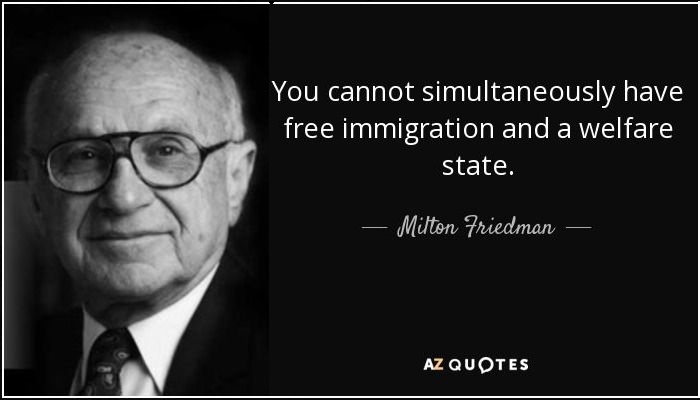
Milton Friedman wisely noted,  “It’s just obvious you can’t have free immigration and a welfare state,” 
Is it prudent to allow illegal immigrants (60 percent of whom are high-school dropouts) access to Social Security, Medicare, and, over time, to 60 federal means-tested welfare programs? I don’t think so either!

Question of the Week: What’s Your Take on the Immigration Debate?

A reader from overseas wonders about my views on immigration, particularly amnesty.

I confess that this is one of those issues where I’m conflicted.

On the general topic of immigration, I think the United States has benefited in the past – and can benefit in the future – from newcomers. And I express that position in this interview for Fox Business News.


But the real issue, which isn’t addressed in the interview, is magnitude. I assume almost nobody wants zero immigration. On the other hand, I also assume that very few people favor totally open borders.

So where do we draw the line? I think we should welcome lots of immigration, particularly people with skills, education, and money. This is the approach that is used to varying degrees by nations such as Australia, Canada, and Switzerland, and I wrote favorably about a similar proposal by Congressman Jared Polis, a Democrat from Colorado.

And I think substantial numbers of low-skilled people who want to work also should be welcome, but I don’t think everybody in the world who wants to come to America should have that right. I haven’t met more than a tiny handful of folks who disagree with Walter Williams’ assertion that, “not…everyone on the planet had a right to live in the U.S.”

Particularly since politicians have redistribution systems that can lure people into a life of dependency. Which is presumably why Milton Friedman warned, to the dismay of some other libertarians, “You cannot simultaneously have free immigration and a welfare state.”

Even the Wall Street Journal, which is a leading voice for both increased immigration and amnesty for existing illegals, also is concerned that a growing welfare state could attract immigrants for the wrong reasons.

Speaking of amnesty, I suppose I should answer the question of how I would deal with people who are in the country illegally? And my response probably depends whether I answer with my heart or my head.

My heart tells me to give these people the benefit of the doubt. Every illegal I’ve met seems to be a good person. And I know if I lived someplace like Mexico, Somalia, or Honduras, I almost certainly would want to improve my family’s position by getting to America, legally or illegally.

On the other hand, I believe in the rule of law and I’m a bit uncomfortable rewarding those who jumped the line at the expense of those who followed the rules.

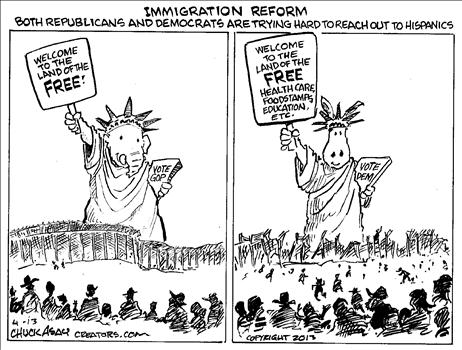
And to be perfectly honest, I also worry about the political implications of any policy that increases the number of people who – on net – will vote for redistribution. I could do without the partisan implications, but this Chuck Asay cartoon captures my concerns.

Immigration Cartoon

I also think that people respond to incentives. Another round of amnesty almost surely will encourage further illegal immigration. Putting myself in the position of a poor person in the developing world, I would logically conclude that it would just be a matter of time, so I would sneak across the border in order to take advantage of that future amnesty.

That doesn’t strike me as a good approach. Far better to figure out how to genuinely reform the system.

By the way, a senior staffer on Capitol Hill floated to me the idea of a new status that enables illegals to stay in the country, but bars them from citizenship unless they get in line and follow the rules. I’m definitely not familiar with the fault lines on these issues, but perhaps that could be a good compromise.

And it goes without saying that I want the strictest possible limits on access to welfare programs and other government handouts for immigrants, regardless of their status.

So, like everybody else, I want border security and some form of legalization as part of a new system that brings people to America for the right reason. See, I’m the epitome of reasonableness.

P.S. If you want to enjoy some immigration-related humor, we have a video about Americans migrating to Peru and a story about American leftists escaping to Canada.

P.P.S. On the issue of birthright citizenship, I’ve shared some interesting analysis from Will Wilkinson and George Wi

Sincerely,

Everette Hatcher III, 13900 Cottontail Lane, Alexander, AR 72002, ph 501-920-5733 everettehatcher@gmail.com

Related posts:

Open letter to President Obama (Part 293) (Founding Fathers’ view on Christianity, Elbridge Gerry of MA)

April 10, 2013 – 7:02 am

President Obama c/o The White House 1600 Pennsylvania Avenue NW Washington, DC 20500 Dear Mr. President, I know that you receive 20,000 letters a day and that you actually read 10 of them every day. I really do respect you for trying to get a pulse on what is going on out here. There have […]By Everette Hatcher III | Posted in David BartonFounding FathersPresident Obama | Edit |Comments (0)

The Founding Fathers views concerning Jesus, Christianity and the Bible (Part 5, John Hancock)

May 8, 2012 – 1:48 am

There have been many articles written by evangelicals like me who fear that our founding fathers would not recognize our country today because secular humanism has rid our nation of spiritual roots. I am deeply troubled by the secular agenda of those who are at war with religion in our public life. Lillian Kwon quoted somebody […]By Everette Hatcher III | Posted in David BartonFounding Fathers | Edit | Comments (0)

The Founding Fathers views concerning Jesus, Christianity and the Bible (Part 4, Elbridge Gerry)

May 7, 2012 – 1:46 am

There have been many articles written by evangelicals like me who fear that our founding fathers would not recognize our country today because secular humanism has rid our nation of spiritual roots. I am deeply troubled by the secular agenda of those who are at war with religion in our public life. Lillian Kwon quoted somebody […]By Everette Hatcher III | Posted in David BartonFounding Fathers | Edit | Comments (0)

The Founding Fathers views concerning Jesus, Christianity and the Bible (Part 3, Samuel Adams)

May 4, 2012 – 1:45 am

There have been many articles written by evangelicals like me who fear that our founding fathers would not recognize our country today because secular humanism has rid our nation of spiritual roots. I am deeply troubled by the secular agenda of those who are at war with religion in our public life. Lillian Kwon quoted somebody […]By Everette Hatcher III | Posted in David BartonFounding Fathers | Edit | Comments (0)

The Founding Fathers views concerning Jesus, Christianity and the Bible (Part 2, John Quincy Adams)

May 3, 2012 – 1:42 am

There have been many articles written by evangelicals like me who fear that our founding fathers would not recognize our country today because secular humanism has rid our nation of spiritual roots. I am deeply troubled by the secular agenda of those who are at war with religion in our public life. Lillian Kwon quoted somebody […]By Everette Hatcher III | Posted in David BartonFounding Fathers | Edit | Comments (0)

The Founding Fathers views concerning Jesus, Christianity and the Bible (Part 1, John Adams)

May 2, 2012 – 1:13 am

There have been many articles written by evangelicals like me who fear that our founding fathers would not recognize our country today because secular humanism has rid our nation of spiritual roots. I am deeply troubled by the secular agenda of those who are at war with religion in our public life. Lillian Kwon quoted somebody […]By Everette Hatcher III | Posted in Founding Fathers | Edit | Comments (0)

President Obama and the Founding Fathers

May 8, 2013 – 9:20 am

President Obama Speaks at The Ohio State University Commencement Ceremony Published on May 5, 2013 President Obama delivers the commencement address at The Ohio State University. May 5, 2013. You can learn a lot about what President Obama thinks the founding fathers were all about from his recent speech at Ohio State. May 7, 2013, […]By Everette Hatcher III | Posted in Founding FathersPresident Obama | Edit | Comments (0)

Francis Schaeffer’s own words concerning the founding fathers and their belief in inalienable rights

December 5, 2012 – 12:38 am

Dr. C. Everett Koop with Bill Graham. Francis Schaeffer: “Whatever Happened to the Human Race” (Episode 4) THE BASIS FOR HUMAN DIGNITY Published on Oct 7, 2012 by AdamMetropolis The 45 minute video above is from the film series created from Francis Schaeffer’s book “Whatever Happened to the Human Race?” with Dr. C. Everett Koop. This […]By Everette Hatcher III | Posted in Founding FathersFrancis SchaefferProlife | Edit |Comments (1)

David Barton: In their words, did the Founding Fathers put their faith in Christ? (Part 4)

May 30, 2012 – 1:35 am

America’s Founding Fathers Deist or Christian? – David Barton 4/6 There have been many articles written by evangelicals like me who fear that our founding fathers would not recognize our country today because secular humanism has rid our nation of spiritual roots. I am deeply troubled by the secular agenda of those who are at […]By Everette Hatcher III | Posted in David BartonFounding Fathers | Tagged governor of connecticutjohn witherspoonjonathan trumbull | Edit | Comments (1)

Were the founding fathers christian?

May 23, 2012 – 7:04 am

3 Of 5 / The Bible’s Influence In America / American Heritage Series / David Barton There were 55 gentlemen who put together the constitution and their church affliation is of public record. Greg Koukl notes: Members of the Constitutional Convention, the most influential group of men shaping the political foundations of our nation, were […]By Everette Hatcher III | Posted in Founding Fathers | Edit | Comments (0)

John Quincy Adams a founding father?

June 29, 2011 – 3:58 pm

I do  not think that John Quincy Adams was a founding father in the same sense that his  father was. However, I do think he was involved in the  early days of our government working with many of the founding fathers. Michele Bachmann got into another history-related tussle on ABC’s “Good  Morning America” today, standing […]By Everette Hatcher III | Posted in David BartonFounding Fathers | Edit | Comments (0)

“Sanctity of Life Saturday” Taking on Ark Times Bloggers on various issues Part E “Moral absolutes and abortion” Francis Schaeffer Quotes part 5(includes the film SLAUGHTER OF THE INNOCENTS) (editorial cartoon)

July 6, 2013 – 1:26 am

I have gone back and forth and back and forth with many liberals on the Arkansas Times Blog on many issues such as abortion, human rights, welfare, poverty, gun control  and issues dealing with popular culture. Here is another exchange I had with them a while back. My username at the Ark Times Blog is Saline […]By Everette Hatcher III | Posted in Arkansas TimesFrancis SchaefferProlife | Edit |Comments (0)

Article from Adrian Rogers, “Bring back the glory”

June 11, 2013 – 12:34 am

I truly believe that many of the problems we have today in the USA are due to the advancement of humanism in the last few decades in our society. Ronald Reagan appointed the evangelical Dr. C. Everett Koop to the position of Surgeon General in his administration. He partnered with Dr. Francis Schaeffer in making the […]By Everette Hatcher III | Posted in Adrian RogersFrancis Schaeffer | Edit | Comments (0)

“Schaeffer Sundays” Francis Schaeffer’s own words concerning the possibility that minorities may be mistreated under 51% rule

June 9, 2013 – 1:21 am

Francis Schaeffer: “Whatever Happened to the Human Race” (Episode 4) THE BASIS FOR HUMAN DIGNITY Published on Oct 7, 2012 by AdamMetropolis ____________ The 45 minute video above is from the film series created from Francis Schaeffer’s book “Whatever Happened to the Human Race?” with Dr. C. Everett Koop. This book  really helped develop my political […]By Everette Hatcher III | Posted in Francis Schaeffer | Edit | Comments (0)

—-

Dan Mitchell article Immigration, Part II: Turning America into a Welfare Magnet

Immigration, Part II: Turning America into a Welfare Magnet

In Part I of this series, I explained why it’s absurd to think illegal immigration can be stopped by sending foreign aid to less-developed countries, such as many of those in Central America.

Simply stated, government-to-government handouts have never been a successful strategy for turning poor nations into rich nations. Indeed, aid actually discourages countries from following the recipe that does deliver prosperity.

In today’s column, let’s address Milton Friedman’s famous dilemma about the incompatibility of open borders and welfare.

Like most libertarians, I want to solve the problem by getting rid of the welfare state.

Immigrants are a big net plus so long as they are coming to work and be productive.

Indeed, because of their entrepreneurial skills and work ethic, immigrants from many nations wind up earning more than native-born Americans.

That’s something to celebrate. The American Dream in action!

But will that story of success continue if the welfare state is expanded?

Two advocates of increased immigration are worried. First, Jason Riley of the Wall Street Journal recently explained that Biden’s agenda is a recipe for immigrant dependency.

…it is a growing belief on the political left that people should be allowed to enter the U.S. on their terms rather than ours, and that it is our collective responsibility to take care of them if they can’t take care of themselves. Milton Friedman said that open immigration and large welfare states are incompatible, and today’s progressives in Congress and the White House are eager to test that proposition.…Another concern is the left’s determination to sever any connection between work and benefits, something all the more worrisome since it is occurring while destitute foreign nationals with little education are being lured here en masse. …Earlier this month, the Biden administration quietly announced that it would no longer enforce a policy that limited the admission of immigrants who were deemed likely to become overly dependent on government benefits. What could go wrong? …In countries like Italy and France, generous aid programs have attracted poor migrants who are more likely than natives to be heavy users of welfare and less likely to be working. It’s a mistake to think it can’t happen here.

In a column last year for Reason, Shikha Dalmia warned that welfare programs undermine support for immigration.

…economists Alberto Alesina, Armando Miano, and Stefanie Stantcheva…administered online questionnaires to 24,000 respondents in six countries: U.S., U.K., France, Germany, Italy, and Sweden. The explicit aim was to study attitudes toward legal, not illegal, immigration. …restrictionists have succeeded most spectacularly is in depicting immigrants as welfare queens. …In America, over 25 percent of respondents said the person with the  ..immigrant-sounding name would pay less in taxes than he collected in welfare… The study’s findings pose a particular dilemma for Democrats like Sen. Elizabeth Warren (D–Mass.), who wants to combine grandiose welfare schemes like free health care, pre-K, and college for everyone with generous immigration policies, because the mere mention of immigration reduces support for such schemes. Respondents who were asked about immigration became less concerned about inequality and less supportive of soak-the-rich schemes. …as long as immigrants are seen as succeeding through their own grit, natives may have no real objection to them. What is most likely to sour the public on immigration are the grandiose universal freebies… Immigrants should be wary of Democrats bearing gifts.

Both Riley and Dalmia raise good points.

My modest contribution to this discussion is to provide a practical example.

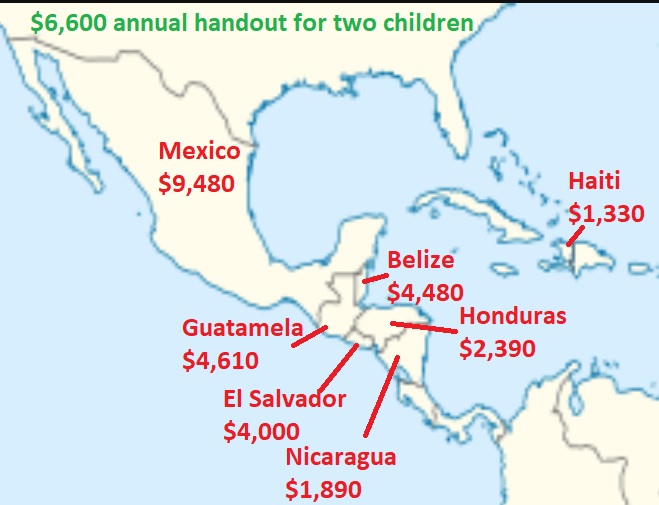
In his so-called American Rescue Plan, Joe Biden included a huge giveaway program that will shower $3,000-$3,600 to non-rich households for every kid they have.

This is a one-year, one-time handout, but many Democrats (and some Republicans!) want to make these enormous per-child payments a permanent part of America’s welfare state.

If that happens, the incentive to move to the United States almost surely will skyrocket.

Here’s a map I made, showing the annual handout for two children in the United States and the average per-capita incomein some nearby nations.

At the risk of stating the obvious, there will be a huge incentive to migrate to America – but not for the right reasons. And my little example doesn’t include the value of any of the dozens of other redistribution programs in Washington.

The bottom line is that we shouldn’t have a welfare system that rewards dependency, whether for people in the country legally or illegally.

And if you like immigration in theory, you should be especially opposed to handouts that will undermine public support for newcomers in practice.

P.S. It’s much better to have immigration policies such as the ones proposed by former Congressman Jared Polis and current George Mason University Professor Tyler Cowen.

Milton Friedman in 2004

Portrait of Milton Friedman.jpg

Power of the Market – Immigration

MILTON FRIEDMAN ON IMMIGRATION

MILTON FRIEDMAN ON IMMIGRATION PART 2

March 18, 2021

Office of Barack and Michelle Obama
P.O. Box 91000
Washington, DC 20066

Dear President Obama,

I wrote you over 700 letters while you were President and I mailed them to the White House and also published them on my blog http://www.thedailyhatch.org .I received several letters back from your staff and I wanted to thank you for those letters. 

There are several issues raised in your book that I would like to discuss with you such as the minimum wage law, the liberal press, the cause of 2007 financial meltdown, and especially your pro-choice (what I call pro-abortion) view which I strongly object to on both religious and scientific grounds, Two of the most impressive things in your book were your dedication to both the National Prayer Breakfast (which spoke at 8 times and your many visits to the sides of wounded warriors!!

I have been reading your autobiography A PROMISED LAND and I have been enjoying it. 

Let me make a few comments on it, and here is the first quote of yours I want to comment on:

WHEN IT CAME to immigration, everyone agreed that the system was broken. The process of immigrating legally to the United States could take a decade or longer, often depending on what country you were coming from and how much money you had.Meanwhile, the economic gulf between us and our southern neighbors drove hundreds of thousands of people to illegally cross the 1,933-mile U.S.-Mexico border each year, searching for work and a better life. Congress had spent billions to harden the border, with fencing, cameras, drones, and an expanded and increasingly militarized border patrol. But rather than stop the flow of immigrants, these steps had spurred an industry of smugglers—coyotes—who made big money transporting human cargo in barbaric and sometimes deadly fashion. And although border crossings by poor Mexican and Central American migrants received most of the attention from politicians and the press, about 40 percent of America’s unauthorized immigrants arrived through airports or other legal ports of entry and then overstayed their visas.
By 2010, an estimated eleven million undocumented persons were living in the United States, in large part thoroughly woven into the fabric of American life.Many were longtime residents, with children who either were U.S. citizens by virtue of having been born on American soil or had been brought to the United States at such an early age that they were American in every respect except for a piece of paper. Entire sectors of the U.S. economy relied on their labor, as undocumented immigrants were often willing to do the toughest, dirtiest work for meager pay—picking the fruits and vegetables that stocked our grocery stores, mopping the floors of offices, washing dishes at restaurants, and providing care to the elderly. But although American consumers benefited from this invisible workforce, many feared that immigrants were taking jobs from citizens, burdening social services programs, and changing the nation’s racial and cultural makeup, which led to demands for the government to crack down on illegal immigration. This sentiment was strongest among Republican constituencies, egged on by an increasingly nativist right-wing press. However, the politics didn’t fall neatly along partisan lines: The traditionally Democratic trade union rank and file, for example, saw the growing presence of undocumented workers on co
    nstruction sites as threatening their livelihoods, while Republican-leaning business groups interested in maintaining a steady supply of cheap labor (or, in the case of Silicon Valley, foreign-born computer programmers and engineers) often took pro-immigration positions.

     Back in 2007, the maverick version of John McCain, along with his sidekick Lindsey Graham, had actually joined Ted Kennedy to put together a comprehensive reform bill that offered citizenship to millions of undocumented immigrants while more tightly securing our borders. Despite strong support from President Bush, it had failed to clear the Senate. The bill did, however, receive twelve Republican votes, indicating the real possibility of a future bipartisan accord. I’d pledged during the campaign to resurrect similar legislation once elected, and I’d appointed former Arizona governor Janet Napolitano as head of the Department of Homeland Security—the agency that oversaw U.S. Immigration and Customs Enforcement (ICE) and U.S. Customs and Border Protection—partly because of her knowledge of border issues and her reputation for having previously managed immigration in a way that was both compassionate and tough.
My hopes for a bill had thus far been dashed. With the economy in crisis and Americans losing jobs,few in Congress had any appetite to take on a hot-button issue like immigration. Kennedy was gone. McCain, having been criticized by the right flank for his relatively moderate immigration stance, showed little interest in taking up the banner again. Worse yet, my administration was deporting undocumented workers at an accelerating rate. This wasn’t a result of any directive from me, but rather it stemmed from a 2008 congressional mandate that both expanded ICE’s budget and increased collaboration between ICE and local law enforcement departments in an effort to deport more undocumented immigrants with criminal records. My team and I had made a strategic choice not to immediately try to reverse the policies we’d inherited in large part because we didn’t want to provide ammunition to critics who claimed that Democrats weren’t willing to enforce existing immigration laws—a perception that we thought could torpedo our chances of passing a future reform bill. But by 2010, immigrant-rights and Latino advocacy groups were criticizing our lack of progress..And although I continued to urge Congress to pass immigration reform, I had no realistic path for delivering a new comprehensive law before the midterms.

Milton Friedman wisely noted,  “It’s just obvious you can’t have free immigration and a welfare state,” 
Is it prudent to allow illegal immigrants (60 percent of whom are high-school dropouts) access to Social Security, Medicare, and, over time, to 60 federal means-tested welfare programs? I don’t think so either!


FREE TO CHOOSE “Who protects the worker?” Video and Transcript Part 

In 1980 I read the book FREE TO CHOOSE by Milton Friedman and it really enlightened me a tremendous amount.  I suggest checking out these episodes and transcripts of Milton Friedman’s film series FREE TO CHOOSE: “The Failure of Socialism” and “What is wrong with our schools?”  and “Created Equal”  and  From Cradle to Grave, and – Power of the Market. Milton Friedman shows in this episode how the worker is best protected and it is not by the government!!!!!!!

The essence of what Milton Friedman is saying in this episode is found in this statement:

“The situation of immigration restrictions really has to do with the question of a welfare state. As I say in the film, I would favor completely free immigration in a society which does not have a welfare system. With a welfare system of the kind we have, you have the problem that people immigrate in order to get welfare, not in order to get employment. You know, it’s a very interesting thing, if you would ask anybody before 1914 the U.S. had no immigration restrictions whatsoever, I’m exaggerating a little bit, there were some immigration restrictions on orientals, but it was essentially, mainly free. If you ask anybody, any American economic historian was that a good thing for America, everybody will say yes it was a wonderful thing for America that we had free immigration. If you ask anybody today, should we have free immigration today, everybody will __ almost everybody will say no. What’s the difference? I think there’s only one difference and that is that when we had free immigration it was immigration of jobs in which everybody benefited. The people who were already here benefited because they got complementary workers, workers who could work with them, make their productivity better, enable them to develop and use the resources of the country better, but today, if you have a system under which you have essentially a governmental guarantee of relief in case of distress, you have a very, very real problem.”

L. WILLIAMS: Dr. Friedman and Walter Williams go back in history and they take a look at a situation where America was empty, where we didn’t have anything like the sophisticated industrial economy we have today, but had a much more agricultural and rural kind of economy and of course when the __ when the impoverished peasants of Europe, my ancestors and most of our ancestors, except for the slaves, which is another situation, but when these people came from Europe and came to a wide open continent with the most fertile soil then available to anyone in the world, naturally there was progress; and I or any of us would be mad to deny progress. But as that developed and as population increased and as we moved into a much more sophisticated industrial economy, we moved then into the situation in the 1930s, or earlier than that , at the end of the century. As some of the more skilled jobs came along, the labor movement didn’t happen by accident. Didn’t happen because there wasn’t a need there. The results of this development, even with all the wealth available in America, the results of this development was that many working people were not having anything like, by standards of civilization or whatever, anything like their fair share in this progress.

MCKENZIE: Now you’re arguing that in a free market, for labor, everyone benefits. Does that mean that you would favor abolition of all immigration restrictions?

FRIEDMAN: The situation of immigration restrictions really has to do with the question of a welfare state. As I say in the film, I would favor completely free immigration in a society which does not have a welfare system. With a welfare system of the kind we have, you have the problem that people immigrate in order to get welfare, not in order to get employment. You know, it’s a very interesting thing, if you would ask anybody before 1914 the U.S. had no immigration restrictions whatsoever, I’m exaggerating a little bit, there were some immigration restrictions on orientals, but it was essentially, mainly free. If you ask anybody, any American economic historian was that a good thing for America, everybody will say yes it was a wonderful thing for America that we had free immigration. If you ask anybody today, should we have free immigration today, everybody will __ almost everybody will say no. What’s the difference? I think there’s only one difference and that is that when we had free immigration it was immigration of jobs in which everybody benefited. The people who were already here benefited because they got complementary workers, workers who could work with them, make their productivity better, enable them to develop and use the resources of the country better, but today, if you have a system under which you have essentially a governmental guarantee of relief in case of distress, you have a very, very real problem.

MCKENZIE: But this is true of every western industrialized country.

FRIEDMAN: That’s right and that’s why today __

MCKENZIE: Yeah.

FRIEDMAN: __ under current circumstances you cannot, unfortunately have free immigration. Not because there’s anything wrong with free immigration, but because we have other policies which make it impossible to adopt free immigration.

MCKENZIE: Well I’d like other reactions. Is it at all feasible to open the door of the labor market internationally now? Bill Brady?

BRADY: I would __ I would say yes providing they open the door to us. I think that the door to not only the labor market, the door to all markets should be __ should be open. That is the product markets.

W. WILLIAMS: My feelings about the undocumented workers of Mexican-Americans are inscribed at the foot of the Statue of Liberty. I think that the people should have the right to come to this country. Now, those who would say, you know, I hear a number of people saying that, well the immigrants are contributing to our unemployment problem. And I point this out to some people, I said, “look, you know, this is the same rhetoric that the Irish used when the blacks were coming up from the north, ” you know, they’re using blacks as scapegoats. They’re saying, “get those people back where they came from so that our members can get jobs, ” you know. Unions were as well doing this, you know, they called them scabs, strikebreakers, etcetera, etcetera. So I do not wish for Mexican-Americans to become the new scapegoats of our particular national problems. They are not the problem, and our nation benefits to the extent that these people come here and work. And to that extent __ to that extent__ so it’s kind of good for them to remain illegal aliens as opposed to being legal aliens where they’re subject to our welfare programs, so that we don’t want them to come here to __

(Several people talking at once.)

GREEN: I think that this country cannot have a group of workers to remain outside the framework of our laws and our protection. And as long as we have workers who are attracted to the United States because of the standards of living; and I think minimum wages play a part in that as part of that attraction. But it seems to me to have undocumented workers without providing either a means of protection for them and it seems to me that we’ve got to go to the question of providing the amnesty for those generations of workers who have come here over a period of time, now two, three, maybe four generations. We have to see that they have the same rights and protection of all other workers. And as it stands now, large numbers of them live outside the framework of the laws and statutes that we have on the __ on our books.

MCKENZIE: Comment Milton.

FRIEDMAN: They do and the tragedy of the situation, as what Walter Williams point out, that as long as they are undocumented and illegal they are a clear net gain, the nation benefits and they benefit. They wouldn’t be here if they didn’t. The tragedy is that we’ve adopted all these other policies so that if we convert them into legal residents it’s no longer clear that we benefit. They may benefit, but it’s no longer clear that we do. What Lynn Williams said before is again a travesty on what was actually going on. The real boost to the trade union movement came after the Great Depression of the 1930s; that Great Depression was not a failure of capitalism; it was not a failure of the private market system as we pointed out in another one of the programs in this series; it was a failure of government. It was not the case that somehow or other there was a decline in the conditions of the working class that produced a great surge of unionism. On the contrary __ unions have never accounted for more than one out of four or one out of five of American workers. The American worker benefited not out of unions, he benefited in spite of unions. He benefited because there was greater opportunity because there were people who were willing to invest their money because there was an opportunity for people to work, to save, to invest. That’s still the case today. You say, we have to provide them with something or other Ernest. Who are the “we”?

Sincerely,

Everette Hatcher III, 13900 Cottontail Lane, Alexander, AR 72002, ph 501-920-5733 everettehatcher@gmail.com

Related posts:

Open letter to President Obama (Part 293) (Founding Fathers’ view on Christianity, Elbridge Gerry of MA)

April 10, 2013 – 7:02 am

President Obama c/o The White House 1600 Pennsylvania Avenue NW Washington, DC 20500 Dear Mr. President, I know that you receive 20,000 letters a day and that you actually read 10 of them every day. I really do respect you for trying to get a pulse on what is going on out here. There have […]By Everette Hatcher III | Posted in David BartonFounding FathersPresident Obama | Edit |Comments (0)

The Founding Fathers views concerning Jesus, Christianity and the Bible (Part 5, John Hancock)

May 8, 2012 – 1:48 am

There have been many articles written by evangelicals like me who fear that our founding fathers would not recognize our country today because secular humanism has rid our nation of spiritual roots. I am deeply troubled by the secular agenda of those who are at war with religion in our public life. Lillian Kwon quoted somebody […]By Everette Hatcher III | Posted in David BartonFounding Fathers | Edit | Comments (0)

The Founding Fathers views concerning Jesus, Christianity and the Bible (Part 4, Elbridge Gerry)

May 7, 2012 – 1:46 am

There have been many articles written by evangelicals like me who fear that our founding fathers would not recognize our country today because secular humanism has rid our nation of spiritual roots. I am deeply troubled by the secular agenda of those who are at war with religion in our public life. Lillian Kwon quoted somebody […]By Everette Hatcher III | Posted in David BartonFounding Fathers | Edit | Comments (0)

The Founding Fathers views concerning Jesus, Christianity and the Bible (Part 3, Samuel Adams)

May 4, 2012 – 1:45 am

There have been many articles written by evangelicals like me who fear that our founding fathers would not recognize our country today because secular humanism has rid our nation of spiritual roots. I am deeply troubled by the secular agenda of those who are at war with religion in our public life. Lillian Kwon quoted somebody […]By Everette Hatcher III | Posted in David BartonFounding Fathers | Edit | Comments (0)

The Founding Fathers views concerning Jesus, Christianity and the Bible (Part 2, John Quincy Adams)

May 3, 2012 – 1:42 am

There have been many articles written by evangelicals like me who fear that our founding fathers would not recognize our country today because secular humanism has rid our nation of spiritual roots. I am deeply troubled by the secular agenda of those who are at war with religion in our public life. Lillian Kwon quoted somebody […]By Everette Hatcher III | Posted in David BartonFounding Fathers | Edit | Comments (0)

The Founding Fathers views concerning Jesus, Christianity and the Bible (Part 1, John Adams)

May 2, 2012 – 1:13 am

There have been many articles written by evangelicals like me who fear that our founding fathers would not recognize our country today because secular humanism has rid our nation of spiritual roots. I am deeply troubled by the secular agenda of those who are at war with religion in our public life. Lillian Kwon quoted somebody […]By Everette Hatcher III | Posted in Founding Fathers | Edit | Comments (0)

President Obama and the Founding Fathers

May 8, 2013 – 9:20 am

President Obama Speaks at The Ohio State University Commencement Ceremony Published on May 5, 2013 President Obama delivers the commencement address at The Ohio State University. May 5, 2013. You can learn a lot about what President Obama thinks the founding fathers were all about from his recent speech at Ohio State. May 7, 2013, […]By Everette Hatcher III | Posted in Founding FathersPresident Obama | Edit | Comments (0)

Francis Schaeffer’s own words concerning the founding fathers and their belief in inalienable rights

December 5, 2012 – 12:38 am

Dr. C. Everett Koop with Bill Graham. Francis Schaeffer: “Whatever Happened to the Human Race” (Episode 4) THE BASIS FOR HUMAN DIGNITY Published on Oct 7, 2012 by AdamMetropolis The 45 minute video above is from the film series created from Francis Schaeffer’s book “Whatever Happened to the Human Race?” with Dr. C. Everett Koop. This […]By Everette Hatcher III | Posted in Founding FathersFrancis SchaefferProlife | Edit |Comments (1)

David Barton: In their words, did the Founding Fathers put their faith in Christ? (Part 4)

May 30, 2012 – 1:35 am

America’s Founding Fathers Deist or Christian? – David Barton 4/6 There have been many articles written by evangelicals like me who fear that our founding fathers would not recognize our country today because secular humanism has rid our nation of spiritual roots. I am deeply troubled by the secular agenda of those who are at […]By Everette Hatcher III | Posted in David BartonFounding Fathers | Tagged governor of connecticutjohn witherspoonjonathan trumbull | Edit | Comments (1)

Were the founding fathers christian?

May 23, 2012 – 7:04 am

3 Of 5 / The Bible’s Influence In America / American Heritage Series / David Barton There were 55 gentlemen who put together the constitution and their church affliation is of public record. Greg Koukl notes: Members of the Constitutional Convention, the most influential group of men shaping the political foundations of our nation, were […]By Everette Hatcher III | Posted in Founding Fathers | Edit | Comments (0)

John Quincy Adams a founding father?

June 29, 2011 – 3:58 pm

I do  not think that John Quincy Adams was a founding father in the same sense that his  father was. However, I do think he was involved in the  early days of our government working with many of the founding fathers. Michele Bachmann got into another history-related tussle on ABC’s “Good  Morning America” today, standing […]By Everette Hatcher III | Posted in David BartonFounding Fathers | Edit | Comments (0)

“Sanctity of Life Saturday” Taking on Ark Times Bloggers on various issues Part E “Moral absolutes and abortion” Francis Schaeffer Quotes part 5(includes the film SLAUGHTER OF THE INNOCENTS) (editorial cartoon)

July 6, 2013 – 1:26 am

I have gone back and forth and back and forth with many liberals on the Arkansas Times Blog on many issues such as abortion, human rights, welfare, poverty, gun control  and issues dealing with popular culture. Here is another exchange I had with them a while back. My username at the Ark Times Blog is Saline […]By Everette Hatcher III | Posted in Arkansas TimesFrancis SchaefferProlife | Edit |Comments (0)

Article from Adrian Rogers, “Bring back the glory”

June 11, 2013 – 12:34 am

I truly believe that many of the problems we have today in the USA are due to the advancement of humanism in the last few decades in our society. Ronald Reagan appointed the evangelical Dr. C. Everett Koop to the position of Surgeon General in his administration. He partnered with Dr. Francis Schaeffer in making the […]By Everette Hatcher III | Posted in Adrian RogersFrancis Schaeffer | Edit | Comments (0)

“Schaeffer Sundays” Francis Schaeffer’s own words concerning the possibility that minorities may be mistreated under 51% rule

June 9, 2013 – 1:21 am

Francis Schaeffer: “Whatever Happened to the Human Race” (Episode 4) THE BASIS FOR HUMAN DIGNITY Published on Oct 7, 2012 by AdamMetropolis ____________ The 45 minute video above is from the film series created from Francis Schaeffer’s book “Whatever Happened to the Human Race?” with Dr. C. Everett Koop. This book  really helped develop my political […]By Everette Hatcher III | Posted in Francis Schaeffer | Edit | Comments (0)

—-

Dan Mitchell article Coronavirus: The Free Market to the Rescue

Coronavirus: The Free Market to the Rescue

I’ve authored a five-part series about coronavirus and the failure of big government (herehereherehere, and here), as well as columns specifically highlighting the failures of the FDACDC, and WHO bureaucracies.

Today, let’s look at how free enterprise came to the rescue when government barriers were reduced. Starting with this video.

To elaborate on this message, millions of lives are now being saved because pharmaceutical companies have produced multiple vaccines.

I even got my first shot yesterday before leaving town for a softball tournament.

Will this save my life? I like to think I’m reasonably healthy and would have survived if I caught the virus, but I’m very happy to now put that possibility in the rear-view mirror.

So I’m feeling very happy that I live in a nation where private companies, in their pursuit of profits, have had a big incentive to produce vaccines.

Yes, I realize the government dumped a bunch of taxpayer money into vaccine production, so I don’t want to pretend Uncle Sam played no role. But I also have great faith that the profit motive would have led to vaccines being developed regardless.

And we would have had the vaccines even sooner if the FDA was even better about getting out of the way.

Allysia Finley celebrated capitalism’s key role in a recent columnfor the Wall Street Journal. Here’s some of what she wrote about the decades of research and investment that enabled pharmaceutical companies to deliver miracles for humanity.

Large corporations are political villains, derided on the left and right. Yet the main, and perhaps only, reason the Covid-19 scourge is easing is vaccines developed by Big Pharma. …There are…lessons for those who think capitalism is merely about rapacious profit. “We would never be in the position where we are today if we had not invested billions of dollars over decades so that we could respond,” Mr. Gorsky, 60, says in an interview…J&J’s vaccine is the third to obtain FDA approval, but preliminary results from trials on AstraZeneca and Novavax suggest they are also highly effective. All these Covid-19 vaccines use innovative technologies that have been developed and tested over decades on other diseases. …The Pfizer-BioNTech and Moderna vaccines inject the virus’s genetic code via mRNA… It seems like an incredible stroke of luck and science that we have so many Covid-19 vaccines so soon. But it’s more than that. Credit years of research and investment by drug makers… “I think this is a golden moment, not only for Johnson & Johnson, but the biopharmaceutical industry,” he says. “We fundamentally believe that having a market-based, innovation-based, biopharmaceutical as well as a medical-technology environment, is critical long term to produce the best overall outcomes for healthcare.”

There are a couple of big lessons for today.

The first lesson, as shown in the video, is that we can save livesby permanently reducing bureaucratic red tape at bureaucracies such as the Food and Drug Administration.

The second lesson is that we should celebrate the profit motive. The desire to make a buck is what drives companies to produce goods and services that make our lives better.

And one takeaway of that second lesson is that we should reject short-sighted policies such as European-style price controls on drug companies. Such an approach would undermine our ability to deal with future pandemics and also reduce the likelihood of new and improved treatments for things such as cancer, dementia, and heart disease.

P.S. I like pharmaceutical companies when they are being honest participants in a free market. I don’t like them when they get in bed with big government.

Joe Biden Signs COVID Bill With the Greatest Expansion of Abortion Funding in a Decade

NATIONAL   STEVEN ERTELT   MAR 11, 2021   |   4:59PM    WASHINGTON, DC 

Share this story:https://www.facebook.com/v2.6/plugins/share_button.php?app_id=172525162793917&channel=https%3A%2F%2Fstaticxx.facebook.com%2Fx%2Fconnect%2Fxd_arbiter%2F%3Fversion%3D46%23cb%3Df3e89f2c1f35cee%26domain%3Dwww.lifenews.com%26origin%3Dhttps%253A%252F%252Fwww.lifenews.com%252Ff12984aafd2427%26relation%3Dparent.parent&container_width=0&href=https%3A%2F%2Fwww.lifenews.com%2F2021%2F03%2F11%2Fjoe-biden-signs-covid-bill-with-the-greatest-expansion-of-abortion-funding-in-a-decade%2F&layout=button_count&locale=en_US&sdk=joeyhttps://platform.twitter.com/widgets/tweet_button.0edc1ef9f8b82d9b79c6115bda79f63f.en.html#dnt=false&id=twitter-widget-1&lang=en&original_referer=https%3A%2F%2Fwww.lifenews.com%2F2021%2F03%2F11%2Fjoe-biden-signs-covid-bill-with-the-greatest-expansion-of-abortion-funding-in-a-decade%2F&size=m&text=Joe%20Biden%20Signs%20COVID%20Bill%20With%20the%20Greatest%20Expansion%20of%20Abortion%20Funding%20in%20a%20Decade&time=1615776366791&type=share&url=https%3A%2F%2Fwww.lifenews.com%2F2021%2F03%2F11%2Fjoe-biden-signs-covid-bill-with-the-greatest-expansion-of-abortion-funding-in-a-decade%2F%23.YE7KbrQHlz8.twitter

Joe Biden today signed the so-called COVID relief bill that is the greatest expansion of abortion in a decade. Although he claims to be a “devout Catholic,” Biden just signed a bill that forces Americans to fund abortions and the Planned Parenthood abortion business. It is the largest expansion of abortion funding since 2010, when Democrats passed Obamacare.

The COVID relief bill that spends all but 9% on COVID relief and will spend tens of millions, perhaps over $100 million on funding abortions and the Planned Parenthood abortion corporation.

In the Senate, Democrats defeated a pro-life amendment that would have stopped the COVID relief bill from using tens of millions and perhaps hundreds of millions of dollars to fund killing babies in abortions. Democrat Senators Joe Manchin and Bob Casey, who both claim to be pro-life, voted for the abortion-funding legislation after the amendment was defeated.

The Senate voted 52-47 to defeat the pro-life amendment offered by Senator James Lankford of Oklahoma to apply the Hyde Amendment to the COVID bill. Every Republican voted for the amendment along with Democrat senators Bob Casey of Pennsylvania, Tim Kaine of Virginia, and Joe Manchin of West Virginia. Senator Sullivan of Alaska did not vote. despite voting for the amendemnt to stop abortion funding, Casey and Manchin eventually voted for the abortion-funding bill.

The amendment failed because it did not reach the 60-vote threshold needed to waive budget rules associated with the legislation. Without the 3/5 majority necessary, the amendment fails and the COVID bill will fund abortions.

Yesterday, the nation’s Catholic bishops slammed Democrats for passing the bill without any protections against abortion funding.

It is “unconscionable” that Congress passed the bill “without critical protections needed to ensure that billions of taxpayer dollars are used for life-affirming health care and not for abortion,” wrote the bishops in a statement.

“Unlike previous COVID [coronavirus] relief bills, sponsors of the American Rescue Plan Act refused to include the longstanding, bi-partisan consensus policy to prohibit taxpayer dollars from funding abortions domestically and internationally,” the bishops declared.

The policy was needed, they continued, “because this bill includes many general references to healthcare that, absent the express exclusion of abortion, have consistently been interpreted by federal courts not only to allow, but to compel, the provision of abortion without meaningful limit.”

“The many important, life-saving provisions in the American Rescue Plan Act have been undermined because it facilitates and funds the destruction of life, which is antithetical to its aim of protecting the most vulnerable Americans in a time of crisis,” they state.

The $350 billion state bailout funds are particularly problematic as the bill doesn’t prevent states and localities from using taxpayer funds to pay for abortions. Under the current guidelines, liberal states like New York and California, which are likely going to receive the lion’s share of the bailout, can funnel millions to abortion giants like Planned Parenthood if they choose.

Please follow LifeNews.com on Gabfor the latest pro-life news and info, free from social media censorship.

The Family Research Council released a lengthy analysis of the funds in the bill that could be used to pay for abortions:

The American Rescue Plan Act lacks key abortion funding restrictions on over $459 billion, breaking decades of congressional precedent on restricting federal funding for abortion.

1. Funds that Can Directly Pay for Abortions (Up To $386.7 Billion):

  • $350 billion in funding for state and local governments with little to no guardrails against funding abortions. The funding formula is tilted towards blue states like California and New York who are more likely to abuse this money to fund abortions directly and bail out Planned Parenthood the abortion industry.
  • $8.5 billion for the Provider Relief Fund, which could be used to directly finance abortions as well as to bail out abortion businesses like Planned Parenthood
  • $7.66 billion for public health workers
  • $7.6 billion for community health centers
  • $800 million for National Health Service Corps
  • $750 million for global health activities under the Center for Disease Control
  • $500 million for rural health clinics
  • $330 million for Teaching Health Centers that operate Graduate Medical Education
  • $200 million for medical reserve corps
  • $200 million for the nurse corps
  • $200 million for programs related to sexual assault and domestic violence
  • Amounts of $10 billion for COVID medical supplies that remain after September 2022 are allowed to be spent on other public health-related activities which can include abortion.

2. Funds that Can Subsidize Abortion ($704 Million) and Abortion Lobbying ($10 Billion) Overseas:

  • $10 billion in foreign assistance funds not subject to the Siljander Amendment, allowing these funds to be used for international abortion lobbying.
  • Of these funds, $500 million in humanitarian response activities for migrants and refugees by the United Nations also lack Helms Amendment protections to prevent the UN from using these funds to pay for abortions.
  • Of these funds, $204 million for State Department Activities also lack Helms Amendment protections, allowing these funds to be used for abortions abroad.
  • Of these funds $8.7 billioncan be spent on contraception and sterilization procedures overseas and are likely to go to the major abortion business like International Planned Parenthood and MSI Reproductive Choices that provide these services.

3. Major Subsidies for Health Plans that Cover Abortion ($81.7 Billion): 

  • For 2021 and 2022, vastly expands Obamacare’s premium tax credits and cost sharing reduction payments, which subsidizes plans that cover abortion. The Joint Committee on Taxation (JCT) estimatesthese subsidies to cost $45.624 billion.
  • Those under 150% of federal poverty level (FPL) would receive a 100% taxpayer subsidy to enroll in silver plans.
  • Those unemployed of any income level (for 2021) would receive a 100% taxpayer subsidy to enroll in a silver plan, and enhanced cost-sharing reduction payments.
  • Those between 150% and 400% FPL would receive a much more generous subsidy than current law.
  • Middle class taxpayers above 400% FPL, ineligible under current law, would become newly eligible for a significant subsidy so that the benchmark silver premium doesn’t exceed 8.5% of household income.
  • For six months, subsidizes 100% of the cost of COBRA continuation coverage. This subsidy covers the cost of health care premiums for the newly unemployed to remain on their employer sponsored health plans, which includes many plans that cover abortion. JCT estimates these subsidies to cost $35.095 billion.

4. Bailout for Abortion Businesses ($50 Million)

  • $50 million for the Title X family planning program – The Biden administration will likely direct these funds to Planned Parenthood and other abortion businesses that withdrew from Title X over pro-life changes that were made by the Trump administration. Longstanding requirements on political lobbying, encouraging parental involvement, and reporting sexual abuse are not included.

The pro-life group SBA List wrote to senators ahead of the Senate vote urging them to adopt pro-life amendments to curb abortion funding.

“While prior bipartisan COVID relief packages have included Hyde protections on funding streams that fall outside of existing limits on abortion funding, this bill departs from the status quo by leaving funds open to use for abortion. COVID relief money should be used for life-affirming purposes… we strongly support and will score in favor of amendments to mitigate the funding of abortion, abortion coverage, or abortion providers,” it wrote.

SBA List President Marjorie Dannenfelser added: “Pro-abortion forces emboldened by Joe Biden and Kamala Harris are shamelessly exploiting the COVID-19 crisis to expand abortion on demand, paid for by taxpayers. By failing to include Hyde Amendment protections and forcing taxpayers to bail out the abortion industry, their so-called ‘rescue plan’ abandons some of the most vulnerable Americans – unborn children and their mothers. Their agenda will divide, rather than unite our nation as this administration promised.”

Tom McClusky, president of March for Life Action also told LifeNews that the pro-life group opposes the bill without pro-life amendments to stop abortion funding.

“The current COVID-19 relief package has the potential to be the largest expansion of abortion funding since Obamacare. Less than 10% of the ‘relief’ actually goes towards combatting the pandemic. Instead, pro-abortion politicians are using this bill to open the floodgates to abortion funding, with billions of dollars unprotected from being used for the life-ending practice both here in the U.S. and abroad. This is radically out of step with the majority of Americans who oppose their tax dollars funding it. Americans who have been suffering from the effects of the pandemic deserve authentic relief, not this pro-abortion bonanza,” he said.

Follow LifeNews on the Parler social media network for the latest pro-life news!

Fortunately one of the abortion funding provisions was removed from the bill prior the Senate vote.

Senator Rand Paul has forced Democrats to remove a pro-abortion provision in their massive $1.9 trillion COVID bill that would have allowed every Planned Parenthood across America to receive free money through the Paycheck Protection Program. Last year, the Planned Parenthood abortion business improperly applied for and received $80 million in federal funds meant to support small businesses as they battle the economic fallout from the coronavirus.

That is despite the fact that the rules and regulations associated with the program specifically prohibited affiliates of larger organizations with more than 500 employees from applying. That covers Planned Parenthood as Planned Parenthood Federation of America (PFFA) alone has had more than 600 employees.

Shockingly, only 9% of the bill’s funding will go to public health issues, and almost half of the funding, not including the proposed stimulus checks, won’t be distributed until 2022 at the earliest.

Recent Marist polling, though, shows Americans overwhelmingly oppose taxpayer funding of abortion overseas. The survey reveals 77 percent of Americans reject the idea of taxpayer dollars funding abortion abroad while a majority of Democrats—55 percent—also oppose taxpayer funding of abortion abroad.

Share this story:https://www.facebook.com/v2.6/plugins/share_button.php?app_id=172525162793917&channel=https%3A%2F%2Fstaticxx.facebook.com%2Fx%2Fconnect%2Fxd_arbiter%2F%3Fversion%3D46%23cb%3Df164e6197e72f68%26domain%3Dwww.lifenews.com%26origin%3Dhttps%253A%252F%252Fwww.lifenews.com%252Ff12984aafd2427%26relation%3Dparent.parent&container_width=0&href=https%3A%2F%2Fwww.lifenews.com%2F2021%2F03%2F11%2Fjoe-biden-signs-covid-bill-with-the-greatest-expansion-of-abortion-funding-in-a-decade%2F&layout=button_count&locale=en_US&sdk=joeyhttps://platform.twitter.com/widgets/tweet_button.0edc1ef9f8b82d9b79c6115bda79f63f.en.html#dnt=false&id=twitter-widget-2&lang=en&original_referer=https%3A%2F%2Fwww.lifenews.com%2F2021%2F03%2F11%2Fjoe-biden-signs-covid-bill-with-the-greatest-expansion-of-abortion-funding-in-a-decade%2F&size=m&text=Joe%20Biden%20Signs%20COVID%20Bill%20With%20the%20Greatest%20Expansion%20of%20Abortion%20Funding%20in%20a%20Decade&time=1615776366792&type=share&url=https%3A%2F%2Fwww.lifenews.com%2F2021%2F03%2F11%2Fjoe-biden-signs-covid-bill-with-the-greatest-expansion-of-abortion-funding-in-a-decade%2F%23.YE7KbotmJ2E.twitter

March 1, 2021

Office of Barack and Michelle Obama
P.O. Box 91000
Washington, DC 20066

Dear President Obama,

I wrote you over 700 letters while you were President and I mailed them to the White House and also published them on my blog http://www.thedailyhatch.org .I received several letters back from your staff and I wanted to thank you for those letters. 

I have been reading your autobiography A PROMISED LAND and I have been enjoying it. 

Let me make a few comments on it, and here is the first quote of yours I want to comment on:


The 1973 Roe v. Wade decision focused further attention on Court appointments with every nomination from that point on triggering a pitched battle between pro-choice and anti-abortion forces. 

I know that you are a professing Christian but I wonder how you the view the Bible? Do you believe like evangelicals that the Bible is the inerrant word of God and is historically accurate? Tony Dungy is an evangelical and like me he is pro-life. Take a look at this article below:

—-

Ex-NFL coach Tony Dungy skeptical about Warnock’s faith after ‘pro-choice pastor’ tweet

DECEMBER 11, 2020 BY RYAN GAYDOS

Former NFL coach Tony Dungy is a man who takes his Christian faith very seriously, and when it comes to Rev. Raphael Warnock, who is running for U.S. Senate in Georgia, he wasn’t so sure about him.

Warnock, a Democrat and pastor at Ebenezer Baptist Church, is in the middle of a runoff election against Sen. Kelly Loeffler, R-Ga.

Warnock tweeted Tuesday he was a “pro-choice pastor,” which inherently goes against the pro-life views of most Christians.

WARNOCK COMPARED AMERICA TO COMMUNIST CUBA, SAID FIDEL CASTRO HAD ‘COMPLEX’ LEGACY IN RESURFACED VIDEO

When a Twitter user pointed out on Wednesday that “pro-choice pastors” do exist, the Super Bowl champion head coach appeared skeptical.

“Rev Warner may be a pastor. My question would be ‘Is he a Christian?’  That is, does he follow the teachings of Jesus and does he believe that the Bible is the absolute word of God?” tweeted, who is a football commentaror for NBC.

He added: “I would think it would be difficult for someone who believes that God sees us when we are in the womb (Psalm 139:13-16) to think that it is OK to choose not to bring that life to fruition.”

On Thursday, another Twitter user said being pro-choice didn’t mean that a person was pro-abortion. Dungy replied, “Please read Psalm 139:13-16.  Then tell me if you think God puts babies in the womb or man does?  If you believe they randomly get there then I have no argument. But if you believe God puts them there, then how does anyone have a right to ‘choose’ which ones survive?”

LOEFFLER AD BLITZ TARGETS WARNOCK’S ALLEGED PAST DISMISSALS OF CRITIQUES ON SOCIALISM

He then clarified his position in another way.

“What if I was advocating for the right to kill someone who was already born? Would that be morally OK?  Of course not. The only question in this debate is what we think of the unborn baby? Is it a life or is it not?”

CLICK HERE FOR MORE SPORTS COVERAGE ON FOXNEWS.COM

Dungy is not one to shy away from his faith. In 2006, it was noted that Dungy nearly put his football career on pause to join the prison ministry. And over the course of his career he worked in community service organizations and was a public speaker for the Fellowship of Christian Athletes.

Sincerely,

Everette Hatcher III, 13900 Cottontail Lane, Alexander, AR 72002, ph 501-920-5733 everettehatcher@gmail.com

Related posts:

Open letter to President Obama (Part 293) (Founding Fathers’ view on Christianity, Elbridge Gerry of MA)

April 10, 2013 – 7:02 am

President Obama c/o The White House 1600 Pennsylvania Avenue NW Washington, DC 20500 Dear Mr. President, I know that you receive 20,000 letters a day and that you actually read 10 of them every day. I really do respect you for trying to get a pulse on what is going on out here. There have […]By Everette Hatcher III | Posted in David BartonFounding FathersPresident Obama | Edit |Comments (0)

The Founding Fathers views concerning Jesus, Christianity and the Bible (Part 5, John Hancock)

May 8, 2012 – 1:48 am

There have been many articles written by evangelicals like me who fear that our founding fathers would not recognize our country today because secular humanism has rid our nation of spiritual roots. I am deeply troubled by the secular agenda of those who are at war with religion in our public life. Lillian Kwon quoted somebody […]By Everette Hatcher III | Posted in David BartonFounding Fathers | Edit | Comments (0)

The Founding Fathers views concerning Jesus, Christianity and the Bible (Part 4, Elbridge Gerry)

May 7, 2012 – 1:46 am

There have been many articles written by evangelicals like me who fear that our founding fathers would not recognize our country today because secular humanism has rid our nation of spiritual roots. I am deeply troubled by the secular agenda of those who are at war with religion in our public life. Lillian Kwon quoted somebody […]By Everette Hatcher III | Posted in David BartonFounding Fathers | Edit | Comments (0)

The Founding Fathers views concerning Jesus, Christianity and the Bible (Part 3, Samuel Adams)

May 4, 2012 – 1:45 am

There have been many articles written by evangelicals like me who fear that our founding fathers would not recognize our country today because secular humanism has rid our nation of spiritual roots. I am deeply troubled by the secular agenda of those who are at war with religion in our public life. Lillian Kwon quoted somebody […]By Everette Hatcher III | Posted in David BartonFounding Fathers | Edit | Comments (0)

The Founding Fathers views concerning Jesus, Christianity and the Bible (Part 2, John Quincy Adams)

May 3, 2012 – 1:42 am

There have been many articles written by evangelicals like me who fear that our founding fathers would not recognize our country today because secular humanism has rid our nation of spiritual roots. I am deeply troubled by the secular agenda of those who are at war with religion in our public life. Lillian Kwon quoted somebody […]By Everette Hatcher III | Posted in David BartonFounding Fathers | Edit | Comments (0)

The Founding Fathers views concerning Jesus, Christianity and the Bible (Part 1, John Adams)

May 2, 2012 – 1:13 am

There have been many articles written by evangelicals like me who fear that our founding fathers would not recognize our country today because secular humanism has rid our nation of spiritual roots. I am deeply troubled by the secular agenda of those who are at war with religion in our public life. Lillian Kwon quoted somebody […]By Everette Hatcher III | Posted in Founding Fathers | Edit | Comments (0)

President Obama and the Founding Fathers

May 8, 2013 – 9:20 am

President Obama Speaks at The Ohio State University Commencement Ceremony Published on May 5, 2013 President Obama delivers the commencement address at The Ohio State University. May 5, 2013. You can learn a lot about what President Obama thinks the founding fathers were all about from his recent speech at Ohio State. May 7, 2013, […]By Everette Hatcher III | Posted in Founding FathersPresident Obama | Edit | Comments (0)

Francis Schaeffer’s own words concerning the founding fathers and their belief in inalienable rights

December 5, 2012 – 12:38 am

Dr. C. Everett Koop with Bill Graham. Francis Schaeffer: “Whatever Happened to the Human Race” (Episode 4) THE BASIS FOR HUMAN DIGNITY Published on Oct 7, 2012 by AdamMetropolis The 45 minute video above is from the film series created from Francis Schaeffer’s book “Whatever Happened to the Human Race?” with Dr. C. Everett Koop. This […]By Everette Hatcher III | Posted in Founding FathersFrancis SchaefferProlife | Edit |Comments (1)

David Barton: In their words, did the Founding Fathers put their faith in Christ? (Part 4)

May 30, 2012 – 1:35 am

America’s Founding Fathers Deist or Christian? – David Barton 4/6 There have been many articles written by evangelicals like me who fear that our founding fathers would not recognize our country today because secular humanism has rid our nation of spiritual roots. I am deeply troubled by the secular agenda of those who are at […]By Everette Hatcher III | Posted in David BartonFounding Fathers | Tagged governor of connecticutjohn witherspoonjonathan trumbull | Edit | Comments (1)

Were the founding fathers christian?

May 23, 2012 – 7:04 am

3 Of 5 / The Bible’s Influence In America / American Heritage Series / David Barton There were 55 gentlemen who put together the constitution and their church affliation is of public record. Greg Koukl notes: Members of the Constitutional Convention, the most influential group of men shaping the political foundations of our nation, were […]By Everette Hatcher III | Posted in Founding Fathers | Edit | Comments (0)

John Quincy Adams a founding father?

June 29, 2011 – 3:58 pm

I do  not think that John Quincy Adams was a founding father in the same sense that his  father was. However, I do think he was involved in the  early days of our government working with many of the founding fathers. Michele Bachmann got into another history-related tussle on ABC’s “Good  Morning America” today, standing […]By Everette Hatcher III | Posted in David BartonFounding Fathers | Edit | Comments (0)

“Sanctity of Life Saturday” Taking on Ark Times Bloggers on various issues Part E “Moral absolutes and abortion” Francis Schaeffer Quotes part 5(includes the film SLAUGHTER OF THE INNOCENTS) (editorial cartoon)

July 6, 2013 – 1:26 am

I have gone back and forth and back and forth with many liberals on the Arkansas Times Blog on many issues such as abortion, human rights, welfare, poverty, gun control  and issues dealing with popular culture. Here is another exchange I had with them a while back. My username at the Ark Times Blog is Saline […]By Everette Hatcher III | Posted in Arkansas TimesFrancis SchaefferProlife | Edit |Comments (0)

Article from Adrian Rogers, “Bring back the glory”

June 11, 2013 – 12:34 am

I truly believe that many of the problems we have today in the USA are due to the advancement of humanism in the last few decades in our society. Ronald Reagan appointed the evangelical Dr. C. Everett Koop to the position of Surgeon General in his administration. He partnered with Dr. Francis Schaeffer in making the […]By Everette Hatcher III | Posted in Adrian RogersFrancis Schaeffer | Edit | Comments (0)

“Schaeffer Sundays” Francis Schaeffer’s own words concerning the possibility that minorities may be mistreated under 51% rule

June 9, 2013 – 1:21 am

Francis Schaeffer: “Whatever Happened to the Human Race” (Episode 4) THE BASIS FOR HUMAN DIGNITY Published on Oct 7, 2012 by AdamMetropolis ____________ The 45 minute video above is from the film series created from Francis Schaeffer’s book “Whatever Happened to the Human Race?” with Dr. C. Everett Koop. This book  really helped develop my political […]By Everette Hatcher III | Posted in Francis Schaeffer | Edit | Comments (0)

—-

OPEN LETTER ABOUT SENATOR’S 2017 PRAISE OF FILIBUSTER!!! PLUS WHY ARE YOU PRO-ABORTION? January 22, 1973, Mr. Justice Blackmun delivered the opinion of the Court. The first section in his opinion was titled “Ancient Attitudes.” In it he referred back to the pre-Christian law. He said, “Greek and Roman law afforded little protection to the unborn. If abortion was prosecuted in some places, it seems to have been based on a concept of a violation of the father’s right to his offspring. Ancient religion did not bar abortion.” Thus, as his first point, Mr. Justice Blackmun based his opinion on the practice of pre-Christian Greek and Roman law. Most people who read this did not realize the logical result concerning babies after their birth. Roman law permitted not only abortion but also infanticide! Senator Tom Carper, Delaware

March 26, 2021

Office of Senator Tom Carper, Delaware
United States Senate
Washington, D.C. 20510

Dear Senator Carper,

I noticed that you signed a 2017 letter strongly supporting the filibuster. 
Why are you thinking about abandoning that view now?

Does your change of view have anything to do with Biden now being in office?


Democrats distance themselves from previous pro-filibuster stance, citing GOP obstruction

More than half of current Senate Democrats and VP Harris signed 2017 letter supporting filibuster when GOP was in control

Tyler Olson

By Tyler Olson | Fox News

As progressives push hard for Democrats to eliminate the legislative filibuster after gaining control of the Senate, House and the presidency, many Democratic senators are distancing themselves from a letter they signed in 2017 backing the procedure.

Sens. Susan Collins, R-Maine, and Chris Coons, D-Del., led a letter in 2017 that asked Republican Leader Mitch McConnell, R-Ky., and Democratic Leader Chuck Schumer, D-N.Y., to preserve the legislative filibuster. As it’s existed for decades, the filibuster requires 60 votes in order to end debate on a bill and proceed to a final vote.

“We are writing to urge you to support our efforts to preserve existing rules, practices, and traditions” on the filibuster, the letter said.

Besides Collins and Coons, 59 other senators joined on the letter. Of that group, 27 Democratic signatories still hold federal elected office. Twenty-six still hold their Senate seats, and Vice President Harris assumed her new job on Jan. 20, vacating her former California Senate seat.

Sen. Chris Coons, D-Del., speaks as the Senate Judiciary Committee hears from legal experts on the final day of the confirmation hearing for Supreme Court nominee Amy Coney Barrett, on Capitol Hill in Washington, Thursday, Oct. 15, 2020. Coons has softened his support for the legislative filibuster in recent years after leading an effort to protect it in 2017. (AP Photo/J. Scott Applewhite)

Sen. Chris Coons, D-Del., speaks as the Senate Judiciary Committee hears from legal experts on the final day of the confirmation hearing for Supreme Court nominee Amy Coney Barrett, on Capitol Hill in Washington, Thursday, Oct. 15, 2020. Coons has softened his support for the legislative filibuster in recent years after leading an effort to protect it in 2017. (AP Photo/J. Scott Applewhite)

But now, the momentum among Senate Democrats is for either full abolition of the filibuster or significantly weakening it. President Biden endorsed the latter idea Tuesday, announcing his support for a “talking filibuster.”

KAMALA HARRIS SUPPORTS CHANGE TO FILIBUSTER IN SENATE TO LIMIT MINORITY PARTY POWER

“I don’t think that you have to eliminate the filibuster, you have to do it what it used to be when I first got to the Senate back in the old days,” Biden told ABC. “You had to stand up and command the floor, you had to keep talking.”

The legislative filibuster has been a 60-vote threshold for what is called a “cloture vote” — or a vote to end debate on a bill — meaning that any 41 senators could prevent a bill from getting to a final vote. If there are not 60 votes, the bill cannot proceed.

The “talking filibuster” — as it was most recently seriously articulated by Sen. Jeff Merkley, D-Ore., in 2012 — would allow 41 senators to prevent a final vote by talking incessantly, around-the-clock, on the Senate floor. But once those senators stop talking, the threshold for a cloture vote is lowered to 51.

Harris’ office confirmed to Fox News Wednesday that she is now aligned with Biden on the filibuster issue. She’d previously taken an even more hostile position to the filibuster, saying she would fully “get rid” of it “to pass a Green New Deal” at a CNN town hall in 2019.

The legislative filibuster has been a 60-vote threshold for what is called a “cloture vote” — or a vote to end debate on a bill — meaning that any 41 senators could prevent a bill from getting to a final vote. If there are not 60 votes, the bill cannot proceed.

The “talking filibuster” — as it was most recently seriously articulated by Sen. Jeff Merkley, D-Ore., in 2012 — would allow 41 senators to prevent a final vote by talking incessantly, around-the-clock, on the Senate floor. But once those senators stop talking, the threshold for a cloture vote is lowered to 51.

Harris’ office confirmed to Fox News Wednesday that she is now aligned with Biden on the filibuster issue. She’d previously taken an even more hostile position to the filibuster, saying she would fully “get rid” of it “to pass a Green New Deal” at a CNN town hall in 2019.

Coons, who led the 2017 letter along with Collins, has also distanced himself from his previous stance.

Vice President Kamala Harris attends a ceremonial swearing-in for Sen. Patrick Leahy, D-Vt., as President Pro Tempore of the Senate on Capitol Hill in Washington, Thursday, Feb. 4, 2021. Harris has changed her stance on the legislative filibuster since signing a letter in 2017 backing it. (Michael Reynolds/Pool via AP)

Vice President Kamala Harris attends a ceremonial swearing-in for Sen. Patrick Leahy, D-Vt., as President Pro Tempore of the Senate on Capitol Hill in Washington, Thursday, Feb. 4, 2021. Harris has changed her stance on the legislative filibuster since signing a letter in 2017 backing it. (Michael Reynolds/Pool via AP) (AP)

BIDEN SUPPORTS CHANGING SENATE FILIBUSTER 

“I’m going to try my hardest, first, to work across the aisle,” he said in September when asked about ending the filibuster. “Then, if, tragically, Republicans don’t change the tune or their behavior at all, I would.”

Fox News reached out to all of the other 26 Democratic signatories of the 2017 letter, and they all either distanced themselves from that position or did not respond to Fox News’ inquiry.

“Less than four years ago, when Donald Trump was President and Mitch McConnell was the Majority Leader, 61 Senators, including more than 25 Democrats, signed their names in opposition to any efforts that would curtail the filibuster,” a GOP aide told Fox News. “Other than the occupant of the White House, and the balance of power in the Senate, what’s changed?”

“I’m interested in getting results for the American people, and I hope we will find common ground to advance key priorities,” Sen. Tim Kaine. D-Va., said in a statement. “If Republicans try to use arcane rules to block us from getting results for the American people, then we’ll have a conversation at that time.”

Added Sen. Mark Warner, D-Va: “I am still hopeful that the Senate can work together in a bipartisan way to address the enormous challenges facing the country. But when it comes to fundamental issues like protecting Americans from draconian efforts attacking their constitutional right to vote, it would be a mistake to take any option off the table.”

“Senator Stabenow understands the urgency of passing important legislation, including voting rights, and thinks it warrants a discussion about the filibuster if Republicans refuse to work across the aisle,” Robyn Bryan, a spokesperson for Sen. Debbie Stabenow, D-Mich., said.

FILE - In this Oct. 26, 2018, file photo, Sen.Bob Casey, D-Pa., speaks to reporters in the studio of KDKA-TV in Pittsburgh. Casey has reversed his stance on the legislative filibuster since signing a 2017 letter in support of it. (AP Photo/Gene J. Puskar, File)

FILE – In this Oct. 26, 2018, file photo, Sen.Bob Casey, D-Pa., speaks to reporters in the studio of KDKA-TV in Pittsburgh. Casey has reversed his stance on the legislative filibuster since signing a 2017 letter in support of it. (AP Photo/Gene J. Puskar, File)

Representatives for Sen. Bob Casey, D-Pa., pointed to recent comments he made on MSNBC.

“Yes, absolutely,” Casey said when asked if he would support a “talking filibuster” or something similar. “Major changes to the filibuster for someone like me would not have been on the agenda even a few years ago. But the Senate does not work like it used to.”

MCCONNELL SAYS SENATE WILL BE ‘100-CAR PILEUP’ IF DEMS NUKE FILIBUSTER

“I hope any Democratic senator who’s not currently in support of changing the rules or altering them substantially, I hope they would change their minds,” Casey added.

Representatives for Sen. Angus King, I-Vt., who caucuses with Democrats, meanwhile, references a Bangor Daily News editorial that said King was completely against the filibuster in 2012 but now believes it’s helpful in stopping bad legislation. It said, however, that King is open to “modifications” similar to a talking filibuster.

The senators who did not respond to questions on their 2017 support of the filibuster were Sens. Joe Manchin. D-W.Va.; Patrick Leahy, D-Vt.; Amy Klobuchar, D-Minn.; Jeanne Shaheen, D-N.H.; Michael Bennet, D-Colo.; Martin Heinrich, D-N.M.; Sherrod Brown, D-Ohio; Dianne Feinstein, D-Calif.; Kirsten Gillibrand, D-N.Y.; Brian Schatz, D-Hawaii; Cory Booker, D-N.J.; Maria Cantwell, D-Wash.; Maize Hirono, D-Hawaii; John Tester, D-Mont.; Tom Carper, D-Del.; Maggie Hassan, D-N.H.; Tammy Duckworth, D-Ill.; Jack Reed, D-R-I.; Ed Markey, D-Mass.; Sheldon Whitehouse, D-R.I.; and Bob Menendez, D-N.J.

Some of these senators, however, have addressed the filibuster in other recent comments.

Sen. Dianne Feinstein, D-Calif., on Wednesday was asked if she supported changing the filibuster threshold by CNN and said she is still opposed to the idea. “Not at this time,” Feinstein said.

Sen. Mazie Hirono, D-Hawaii, speaks to reporters on Capitol Hill in Washington, Thursday, Jan. 30, 2020, during the impeachment trial of President Donald Trump on charges of abuse of power and obstruction of Congress. Hirono has changed her opinion on the legislative filibuster since signing a 2017 letter supporting it. (AP Photo/Julio Cortez)

Sen. Mazie Hirono, D-Hawaii, speaks to reporters on Capitol Hill in Washington, Thursday, Jan. 30, 2020, during the impeachment trial of President Donald Trump on charges of abuse of power and obstruction of Congress. Hirono has changed her opinion on the legislative filibuster since signing a 2017 letter supporting it. (AP Photo/Julio Cortez)

Sen. Maize Hirono, D-Hawaii, meanwhile said last week she is already for getting rid of the current 60-vote threshold and thinks other Democrats will sign on soon.

“If Mitch McConnell continues to be totally an obstructionist, and he wants to use the 60 votes to stymie everything that President Biden wants to do and that we Democrats want to do that will actually help people,” Hirono said, “then I think the recognition will be among the Democrats that we’re gonna need to.”

The most recent talk about either removing or significantly weakening the filibuster was spurred by comments from Manchin that appeared to indicate he would be open to a talking filibuster. He said filibustering a bill should be more “painful” for a minority.

Manchin appeared to walk back any talk of a talking filibuster on Wednesday, however.

“You know where my position is,” he said. “There’s no little bit of this and a little bit — there’s no little bit here. You either protect the Senate, you protect the institution and you protect democracy or you don’t.”

Manchin and Sen. Kyrsten Sinema, D-Ariz., both committed to supporting the current form of the filibuster earlier this year. Sinema was not in the Senate in 2017.

Senate Minority Mitch McConnell, R-Ky., said their comments gave him the reassurance he needed to drop a demand that Senate Majority Leader Chuck Schumer, D-N.Y., put filibuster protections into the Senate’s organizing resolution.

But with Manchin seeming to flake at least in the eyes of some, other Democrats are beginning to push harder for filibuster changes.

I read this article about you:

Delaware, Maryland senators help sink bill to save babies born alive after abortion

By For The Dialog –   26 February 2019, 13:24  2144

WASHINGTON — The Senate in an evening vote Feb. 25 failed to advance a measure sponsored by Sen. Ben Sasse, R-Nebraska, to require that babies born alive after an abortion be given medical attention and “the same protection of law as any newborn.”

The Born-Alive Survivors Protection Act failed in a 53-44 vote. Sixty votes were needed to end a filibuster and bring forward the measure, which Sasse’s press office said was co-sponsored by half the Senate. Among the 44 voting against the measure were Delaware’s Chris Coons and Tom Carper and Maryland’s Ben Cardin and Chris Van Hollen.

“I want to ask each and every one of my colleagues whether we’re OK with infanticide,” Sasse said ahead of the vote. “This language is blunt. I recognize that and it’s too blunt for many people in this body. But frankly, that is what we’re talking about here today. Infanticide is what the Born-Alive Abortion Survivors Protection Act is actually about.”

Protecting babies who “are alive, born outside the womb after having survived a botched abortion … is what this is about,” he said.

Kristan Hawkins, president for Students for Life of America, called Sasse’s bill “the bare minimum standard for valuing infant life, as everyone should be able to look at a baby born during an abortion and understand that a humane response is required.”

“Too many important votes are forgotten, but this one won’t be,” she said in a statement issued after the vote. “These kinds of tactics in which a win is a loss can disillusion voters, but allowing infants to die after being born alive will rally pro-life Americans when it counts.”

On Feb. 4, Sasse had called for unanimous consent on his Born-Alive Abortion Survivors Protection Act. “Everyone in the Senate ought to be able to say unequivocally that killing that little baby is wrong. This doesn’t take any political courage,” he said from the floor.

In response, Sen. Patty Murray, D-Washington, blocked unanimous consent by objecting to the bill.

The next day the chairman of the U.S. bishops’ Committee on Pro-Life Activities called it “unconscionable” that the U.S. Senate failed to “unanimously declare to the nation that infanticide is objectively wrong.”

Naumann
Archbishop Joseph F. Naumann of Kansas City, Kan. (CNS photo/Tyler Orsburn)

“No newborn should be left to suffer or die without medical care. It is barbaric and merciless to leave these vulnerable infants without any care or rights,” Archbishop Joseph F. Naumann of Kansas City, Kansas, said in a Feb. 5 statement.

Senator I wanted to discuss abortion.

Francis Schaeffer shows the inconsistency of the pro choice views espoused by Justice Blackmun in his opinion in Roe v Wade:

Third, when the United States Supreme Court made its ruling about abortion on January 22, 1973, Mr. Justice Blackmun delivered the opinion of the Court. The first section in his opinion was titled “Ancient Attitudes.” In it he referred back to the pre-Christian law. He said, “Greek and Roman law afforded little protection to the unborn. If abortion was prosecuted in some places, it seems to have been based on a concept of a violation of the father’s right to his offspring. Ancient religion did not bar abortion.” Thus, as his first point, Mr. Justice Blackmun based his opinion on the practice of pre-Christian Greek and Roman law. Most people who read this did not realize the logical result concerning babies after their birth. Roman law permitted not only abortion but also infanticide. As we think this over, we ask ourselves, “Now that this door is open, how long will it be before infanticide is socially accepted and perhaps legalized?”

(Page 319) 

Advocates of Infanticide

It frightens us when we see the medical profession
acquiesce to, if not lead in, a trend which in our
judgment will carry us to destruction.  The loss of
humanness shown in allowing malformed babies to
starve to death is not a thing of the future.  It is being
put forward as the accepted thing right now in many
quarters.  All that is left is for it to become totally
accepted and eventually, for economic reasons,
made mandatory by an increasingly authoritarian
government in an increasingly selfish society.

In May 1973, James D. Watson, the Nobel Prize
laureate who discovered the double helix of DNA,
granted an interview to _Prism_ magazine, then a
publication of the American Medical Association.
_Time_ later reported the interview to the general
public, quoting Watson as having said,
If a child were not declared alive until three days
after birth, then all parents could be allowed the
choice only a few are given under the present
system.  The doctor could allow the child to die
if the parents so choose and save a lot of misery
and suffering.  I believe this view is the only
rational, compassionate attitude to have.

In January 1978, Francis Crick, also a Nobel
laureate, was quoted in the _Pacific News Service_
as saying,
. . . no newborn infant should be declared human
until it has passed certain tests regarding its
genetic endowment and that if it fails these tests
it forfeits the right to live.

In _Ideals of Life_, Millard S. Everett, who was
professor of philosophy and humanities at Oklahoma
A&M, writes,
My personal feeling– and I don’t ask anyone to
agree with me– is that eventually, when public
opinion is prepared for it, no child should be
admitted into the society of the living who
would be certain to suffer any social handicap–
for example, any physical or mental defect that
would prevent marriage or would make others
tolerate his company only from the sense of
mercy.
He adds, “This would imply not only eugenic
sterilization but also euthanasia due to accidents of
birth which cannot be foreseen.”44

Perhaps the paper most outspokenly advocating
infanticide was published in the prestigious
167-year-old _New England Journal of Medicine_.
In October 1973, Dr. Raymond S. Duff and Dr.
A.G.M. Campbell of the department of pediatrics at
Yale University School of Medicine wrote, “Moral
and Ethical Dilemmas in the Special-Care
Nursery.”45

Very few parents come of their own volition to a
physician and say, “My baby has a life not worthy to
be lived.”  Duff and Campbell say that the parents in
such a case are not in a condition to give “informed
consent” by themselves.  But any physician in the
emotional circumstances surrounding the birth of a
baby with any kind of a defect can, by innuendo if
not advice, prepare the family to make the decision
the physician wants them to make.  We do not
consider this “informed consent.”

Duff and Campbell acknowledge that the parents’
and …

Sincerely, 

Everette Hatcher III, 13900 Cottontail Lane, Alexander, AR 72002, ph 501-920-5733 everettehatcher@gmail.com

Related posts:

Open letter to President Obama (Part 201)Tea Party favorite Representative links article “Prescott and Ohanian: Taxes Are Much Higher Than You Think”

December 21, 2012 – 9:47 am

    (Emailed to White House on 12-21-12.) President Obama c/o The White House 1600 Pennsylvania Avenue NW Washington, DC 20500 Dear Mr. President, I know that you receive 20,000 letters a day and that you actually read 10 of them every day. I really do respect you for trying to get a pulse on […]By Everette Hatcher III | Posted in Milton FriedmanPresident Obamaspending out of controlTaxes | Edit | Comments (0)

Open letter to President Obama (Part 200.2)Tea Party Republican Representative takes on the President concerning fiscal cliff

December 21, 2012 – 9:37 am

(Emailed to White House on 12-21-12.) President Obama c/o The White House 1600 Pennsylvania Avenue NW Washington, DC 20500 Dear Mr. President, I know that you receive 20,000 letters a day and that you actually read 10 of them every day. I really do respect you for trying to get a pulse on what is […]By Everette Hatcher III | Posted in Milton FriedmanPresident ObamaRonald Reaganspending out of controlTaxes | Edit | Comments (0)

Open letter to President Obama (Part 200.1)Tea Party favorite Representative shares link on facebook

December 21, 2012 – 5:10 am

(Emailed to White House on 12-21-12) President Obama c/o The White House 1600 Pennsylvania Avenue NW Washington, DC 20500 Dear Mr. President, I know that you receive 20,000 letters a day and that you actually read 10 of them every day. I really do respect you for trying to get a pulse on what is […]By Everette Hatcher III | Posted in President ObamaRonald Reaganspending out of controlTaxes | Edit | Comments (0)

Open letter to President Obama (Part 199) Tea Party favorite takes on President

December 20, 2012 – 3:09 pm

  The federal government has a spending problem and Milton Friedman came up with the negative income tax to help poor people get out of the welfare trap. It seems that the government screws up about everything. Then why is President Obama wanting more taxes? _______________ Milton Friedman – The Negative Income Tax Published on […]By Everette Hatcher III | Posted in President Obamaspending out of controlTaxes | Edit | Comments (0)

Tea Party Heroes Rep. David Schweikert (R-AZ),Justin Amash (R-MI), Tim Huelskamp (R-KS) have been punished by Boehner

December 6, 2012 – 8:55 am

I was sad to read that the Speaker John Boehner has been involved in punishing tea  party republicans. Actually I have written letters to several of these same tea party heroes telling them that I have emailed Boehner encouraging him to listen to them. Rep. David Schweikert (R-AZ),Justin Amash (R-MI), and Tim Huelskamp (R-KS). have been contacted […]By Everette Hatcher III | Posted in Current EventsSpeaker of the House John Boehnerspending out of control | Edit | Comments (0)

Some Tea Party heroes (Part 10)

November 9, 2012 – 7:47 am

Michael Tanner of the Cato Institute in his article, “Hitting the Ceiling,” National Review Online, March 7, 2012 noted: After all, despite all the sturm und drang about spending cuts as part of last year’s debt-ceiling deal, federal spending not only increased from 2011 to 2012, it rose faster than inflation and population growth combined. […]By Everette Hatcher III | Posted in spending out of controlTaxesEdit | Comments (0)

Some Tea Party heroes (Part 9)

November 9, 2012 – 7:42 am

Michael Tanner of the Cato Institute in his article, “Hitting the Ceiling,” National Review Online, March 7, 2012 noted: After all, despite all the sturm und drang about spending cuts as part of last year’s debt-ceiling deal, federal spending not only increased from 2011 to 2012, it rose faster than inflation and population growth combined. […]By Everette Hatcher III | Posted in spending out of controlTaxesEdit | Comments (0)

49 posts on Tea Party heroes of mine

November 9, 2012 – 7:33 am

Some of the heroes are Mo Brooks, Martha Roby, Jeff Flake, Trent Franks, Duncan Hunter, Tom Mcclintock, Devin Nunes, Scott Tipton, Bill Posey, Steve Southerland and those others below in the following posts. THEY VOTED AGAINST THE DEBT CEILING INCREASE IN 2011 AND WE NEED THAT TYPE OF LEADERSHIP NOW SINCE PRESIDENT OBAMA HAS BEEN […]By Everette Hatcher III | Posted in spending out of controlTaxesEdit | Comments (0)

Some Tea Party Republicans win and some lose

November 7, 2012 – 8:39 am

I hated to see that Allen West may be on the way out. ABC News reported: Nov 7, 2012 7:20am What Happened to the Tea Party (and the Blue Dogs?) Some of the Republican Party‘s most controversial House members are clinging to narrow leads in races where only a few votes are left to count. […]By Everette Hatcher III | Posted in Current Events | Edit | Comments (0)

Some Tea Party heroes (Part 8)

November 6, 2012 – 7:59 am

Rep Himes and Rep Schweikert Discuss the Debt and Budget Deal Michael Tanner of the Cato Institute in his article, “Hitting the Ceiling,” National Review Online, March 7, 2012 noted: After all, despite all the sturm und drang about spending cuts as part of last year’s debt-ceiling deal, federal spending not only increased from 2011 […]By Everette Hatcher III | Posted in spending out of controlTaxesEdit | Comments (0)

Why Biden’s Blaming Trump for Border Crisis Has Zero Credibility

Why Biden’s Blaming Trump for Border Crisis Has Zero Credibility

Chad Wolf Lora Ries @lora_ries / March 25, 2021

Mexican deportees walk across a U.S.-Mexico border bridge from Texas into Mexico on Feb. 25 in Matamoros, Mexico. Although President Joe Biden attempted to temporarily freeze deportations by executive order, a federal court ruled he could not, and deportations have continued. (Photo: John Moore/Getty Images)

COMMENTARY BY

Chad Wolf

Chad Wolf, acting secretary of the Department of Homeland Security during the Trump administration, is a visiting fellow in The Heritage Foundation’s Davis Institute for National Security and Foreign Policy.

Lora Ries@lora_ries

Lora Ries is director of the Center for Technology Policy and a senior research fellow for homeland security at The Heritage Foundation.

No one believes the Biden White House’s feeble attempt to blame the Trump administration for the current border crisis.

As the Biden administration unsuccessfully tries to deflect blame for the humanitarian disaster now occurring before America’s eyes, despite its directed media blackout, the administration is only succeeding at showing it knows it has a problem.

The Trump administration experienced a border crisis in 2019 when families and unaccompanied children, mostly from Central American countries, surged at our southern border and claimed fear of returning home to obtain entry into the U.S. and disappear into our country’s interior.

No one can forget the images of the caravans of illegal aliens traveling north. The height of the crisis occurred in May 2019, when U.S. Customs and Border Protection encounters reached over 144,000 illegal aliens.

Want to keep up with the 24/7 news cycle? Want to know the most important stories of the day for conservatives? Need news you can trust? Subscribe to The Daily Signal’s email newsletter. Learn more >>

To end the problem, the Trump administration sought help from Congress in the form of additional funding to build the border wall; an end to the Flores Agreement, which a single federal judge expanded over the decades into an unrealistic order that children could not be detained more than 20 days; and a legislative fix so that the Department of Homeland Security could treat unaccompanied alien children from Central America the same as those from Mexico.

Congress refused. House Speaker Nancy Pelosi, D-Calif., and others on the left denied there was a border crisis (sound familiar?) and the government shut down in a stalemate.

The Trump administration had to end the crisis on its own. Choosing a heretofore unused, but statutorily authorized “Remain in Mexico” program, it negotiated with Mexico to house migrants seeking U.S. asylum on the Mexico side of the border during their pending court proceedings.

When would-be migrants learned claiming fear alone was no longer their ticket into the U.S., the caravans stopped coming.

The Trump administration also used leveragewith El Salvador, Guatemala, and Honduras to negotiate Asylum Cooperative Agreements that resulted in those countries (and Mexico) enforcing their own borders to prevent migrant flows, building up their own asylum systems, and receiving nationals back who traversed their country, but had not requested asylum before seeking it at the U.S. border.

In short, the Trump administration imposed consequences for illegal immigration and ended “catch and release.”

It worked.

The number of Customs and Border Protection encounters rapidly declined to 52,000 by September 2019, and fell further to 36,000 in February 2020, before COVID-19 travel restrictions were imposed.

In March 2020, the director of the Centers for Disease Control and Prevention imposed Title 42 public health restrictions, ordering the suspension of admitting individuals traveling from Canada and Mexico, regardless of their country of origin.

Accordingly, the Trump administration immediately returned illegal aliens across the border to prevent further spread of the coronavirus.

Enter presidential candidate Joe Biden. His campaign website read that he would immediately end the Remain in Mexico program; stop building the border wall; surge resources to the border to process all asylum-seekers into the country; immediately rescind the mislabeled “Muslim travel bans”; give amnesty to so-called “Dreamers,” Temporary Protected Status holders, and Deferred Enforced Departure holders, and the rest of the estimated 11 million illegal alien population; only enforce immigration laws against convicted serious criminals; and increase the annual refugee admission ceiling to 125,000.

During a presidential debate, Biden went further, stating we “owe” the Dreamers amnesty.

The smugglers and traffickers got the message loud and clear, and cranked up their business. The number of Customs and Border Protection encounters increased, but the Trump administration continued to return the aliens over the border.

Because it was still applying consequences to illegal immigration, the Trump administration did not face a border crisis in 2020.

That all changed on Jan. 20, when the Biden administration immediately stopped wall construction, ended the Remain in Mexico program, tore up the Cooperative Asylum Agreements, started releasing illegal aliens into the U.S., and ended 90% of Immigration and Customs Enforcement removals.

The Biden administration stopped imposing any consequences for illegal immigration. In fact, it has sought to make illegal immigration easier.

Worse still, it entices more smuggling and trafficking of children every time administration officials state that unaccompanied children will not be expelled from the U.S.

And while Biden hasn’t yet repealed Title 42 public health restrictions, the administration has stopped using the authority in some locations to remove families and in its entirety with respect to unaccompanied children.

The Trump administration warned the Biden transition team that such decisions would quickly result in a border crisis. The Biden administration ignored the warnings, imposed its negligent policy decisions, and has used egregious messaging, such as telling future migrants: “Don’t come right now.”

After just one month, Customs and Border Protection encounters ballooned to more than 100,000, the number of unaccompanied children has risen to 16,500 and continues to climb.

Three convention centers are opening to house those children because the Department of Health and Human Services cannot find enough sponsors for them. The secretary of homeland security has ordered the Federal Emergency Management Agency to assist at the border and activated his own agency’s Volunteer Force to go to the border.

In perhaps the most desperate sign of the crisis, the Border Patrol in Texas is no longer issuing court dates to illegal aliens because it takes too long to complete the paperwork, and it simply needs to process individuals quicker. That’s a truly astonishing development.

This week, the president appointed Vice President Kamala Harris to oversee this crisis. Her appointment and the attempt to blame former President Donald Trump are tacit admissions that they have a crisis on their hands, but Americans know the blame lies squarely at Biden’s feet.

Have an opinion about this article? To sound off, please email letters@DailySignal.com and we will consider publishing your remarks in our regular “We Hear You” feature. 

Milton Friedman

in 2004

Portrait of Milton Friedman.jpg

Power of the Market – Immigration

MILTON FRIEDMAN ON IMMIGRATION

MILTON FRIEDMAN ON IMMIGRATION PART 2

March 18, 2021

Office of Barack and Michelle Obama
P.O. Box 91000
Washington, DC 20066

Dear President Obama,

I wrote you over 700 letters while you were President and I mailed them to the White House and also published them on my blog http://www.thedailyhatch.org .I received several letters back from your staff and I wanted to thank you for those letters. 

There are several issues raised in your book that I would like to discuss with you such as the minimum wage law, the liberal press, the cause of 2007 financial meltdown, and especially your pro-choice (what I call pro-abortion) view which I strongly object to on both religious and scientific grounds, Two of the most impressive things in your book were your dedication to both the National Prayer Breakfast (which spoke at 8 times and your many visits to the sides of wounded warriors!!

I have been reading your autobiography A PROMISED LAND and I have been enjoying it. 

Let me make a few comments on it, and here is the first quote of yours I want to comment on:

WHEN IT CAME to immigration, everyone agreed that the system was broken. The process of immigrating legally to the United States could take a decade or longer, often depending on what country you were coming from and how much money you had.Meanwhile, the economic gulf between us and our southern neighbors drove hundreds of thousands of people to illegally cross the 1,933-mile U.S.-Mexico border each year, searching for work and a better life. Congress had spent billions to harden the border, with fencing, cameras, drones, and an expanded and increasingly militarized border patrol. But rather than stop the flow of immigrants, these steps had spurred an industry of smugglers—coyotes—who made big money transporting human cargo in barbaric and sometimes deadly fashion. And although border crossings by poor Mexican and Central American migrants received most of the attention from politicians and the press, about 40 percent of America’s unauthorized immigrants arrived through airports or other legal ports of entry and then overstayed their visas.
By 2010, an estimated eleven million undocumented persons were living in the United States, in large part thoroughly woven into the fabric of American life.Many were longtime residents, with children who either were U.S. citizens by virtue of having been born on American soil or had been brought to the United States at such an early age that they were American in every respect except for a piece of paper. Entire sectors of the U.S. economy relied on their labor, as undocumented immigrants were often willing to do the toughest, dirtiest work for meager pay—picking the fruits and vegetables that stocked our grocery stores, mopping the floors of offices, washing dishes at restaurants, and providing care to the elderly. But although American consumers benefited from this invisible workforce, many feared that immigrants were taking jobs from citizens, burdening social services programs, and changing the nation’s racial and cultural makeup, which led to demands for the government to crack down on illegal immigration. This sentiment was strongest among Republican constituencies, egged on by an increasingly nativist right-wing press. However, the politics didn’t fall neatly along partisan lines: The traditionally Democratic trade union rank and file, for example, saw the growing presence of undocumented workers on co
    nstruction sites as threatening their livelihoods, while Republican-leaning business groups interested in maintaining a steady supply of cheap labor (or, in the case of Silicon Valley, foreign-born computer programmers and engineers) often took pro-immigration positions.

     Back in 2007, the maverick version of John McCain, along with his sidekick Lindsey Graham, had actually joined Ted Kennedy to put together a comprehensive reform bill that offered citizenship to millions of undocumented immigrants while more tightly securing our borders. Despite strong support from President Bush, it had failed to clear the Senate. The bill did, however, receive twelve Republican votes, indicating the real possibility of a future bipartisan accord. I’d pledged during the campaign to resurrect similar legislation once elected, and I’d appointed former Arizona governor Janet Napolitano as head of the Department of Homeland Security—the agency that oversaw U.S. Immigration and Customs Enforcement (ICE) and U.S. Customs and Border Protection—partly because of her knowledge of border issues and her reputation for having previously managed immigration in a way that was both compassionate and tough.
My hopes for a bill had thus far been dashed. With the economy in crisis and Americans losing jobs,few in Congress had any appetite to take on a hot-button issue like immigration. Kennedy was gone. McCain, having been criticized by the right flank for his relatively moderate immigration stance, showed little interest in taking up the banner again. Worse yet, my administration was deporting undocumented workers at an accelerating rate. This wasn’t a result of any directive from me, but rather it stemmed from a 2008 congressional mandate that both expanded ICE’s budget and increased collaboration between ICE and local law enforcement departments in an effort to deport more undocumented immigrants with criminal records. My team and I had made a strategic choice not to immediately try to reverse the policies we’d inherited in large part because we didn’t want to provide ammunition to critics who claimed that Democrats weren’t willing to enforce existing immigration laws—a perception that we thought could torpedo our chances of passing a future reform bill. But by 2010, immigrant-rights and Latino advocacy groups were criticizing our lack of progress..And although I continued to urge Congress to pass immigration reform, I had no realistic path for delivering a new comprehensive law before the midterms.

Milton Friedman wisely noted,  “It’s just obvious you can’t have free immigration and a welfare state,” 
Is it prudent to allow illegal immigrants (60 percent of whom are high-school dropouts) access to Social Security, Medicare, and, over time, to 60 federal means-tested welfare programs? I don’t think so either!


FREE TO CHOOSE “Who protects the worker?” Video and Transcript Part 

In 1980 I read the book FREE TO CHOOSE by Milton Friedman and it really enlightened me a tremendous amount.  I suggest checking out these episodes and transcripts of Milton Friedman’s film series FREE TO CHOOSE: “The Failure of Socialism” and “What is wrong with our schools?”  and “Created Equal”  and  From Cradle to Grave, and – Power of the Market. Milton Friedman shows in this episode how the worker is best protected and it is not by the government!!!!!!!

The essence of what Milton Friedman is saying in this episode is found in this statement:

“The situation of immigration restrictions really has to do with the question of a welfare state. As I say in the film, I would favor completely free immigration in a society which does not have a welfare system. With a welfare system of the kind we have, you have the problem that people immigrate in order to get welfare, not in order to get employment. You know, it’s a very interesting thing, if you would ask anybody before 1914 the U.S. had no immigration restrictions whatsoever, I’m exaggerating a little bit, there were some immigration restrictions on orientals, but it was essentially, mainly free. If you ask anybody, any American economic historian was that a good thing for America, everybody will say yes it was a wonderful thing for America that we had free immigration. If you ask anybody today, should we have free immigration today, everybody will __ almost everybody will say no. What’s the difference? I think there’s only one difference and that is that when we had free immigration it was immigration of jobs in which everybody benefited. The people who were already here benefited because they got complementary workers, workers who could work with them, make their productivity better, enable them to develop and use the resources of the country better, but today, if you have a system under which you have essentially a governmental guarantee of relief in case of distress, you have a very, very real problem.”

L. WILLIAMS: Dr. Friedman and Walter Williams go back in history and they take a look at a situation where America was empty, where we didn’t have anything like the sophisticated industrial economy we have today, but had a much more agricultural and rural kind of economy and of course when the __ when the impoverished peasants of Europe, my ancestors and most of our ancestors, except for the slaves, which is another situation, but when these people came from Europe and came to a wide open continent with the most fertile soil then available to anyone in the world, naturally there was progress; and I or any of us would be mad to deny progress. But as that developed and as population increased and as we moved into a much more sophisticated industrial economy, we moved then into the situation in the 1930s, or earlier than that , at the end of the century. As some of the more skilled jobs came along, the labor movement didn’t happen by accident. Didn’t happen because there wasn’t a need there. The results of this development, even with all the wealth available in America, the results of this development was that many working people were not having anything like, by standards of civilization or whatever, anything like their fair share in this progress.

MCKENZIE: Now you’re arguing that in a free market, for labor, everyone benefits. Does that mean that you would favor abolition of all immigration restrictions?

FRIEDMAN: The situation of immigration restrictions really has to do with the question of a welfare state. As I say in the film, I would favor completely free immigration in a society which does not have a welfare system. With a welfare system of the kind we have, you have the problem that people immigrate in order to get welfare, not in order to get employment. You know, it’s a very interesting thing, if you would ask anybody before 1914 the U.S. had no immigration restrictions whatsoever, I’m exaggerating a little bit, there were some immigration restrictions on orientals, but it was essentially, mainly free. If you ask anybody, any American economic historian was that a good thing for America, everybody will say yes it was a wonderful thing for America that we had free immigration. If you ask anybody today, should we have free immigration today, everybody will __ almost everybody will say no. What’s the difference? I think there’s only one difference and that is that when we had free immigration it was immigration of jobs in which everybody benefited. The people who were already here benefited because they got complementary workers, workers who could work with them, make their productivity better, enable them to develop and use the resources of the country better, but today, if you have a system under which you have essentially a governmental guarantee of relief in case of distress, you have a very, very real problem.

MCKENZIE: But this is true of every western industrialized country.

FRIEDMAN: That’s right and that’s why today __

MCKENZIE: Yeah.

FRIEDMAN: __ under current circumstances you cannot, unfortunately have free immigration. Not because there’s anything wrong with free immigration, but because we have other policies which make it impossible to adopt free immigration.

MCKENZIE: Well I’d like other reactions. Is it at all feasible to open the door of the labor market internationally now? Bill Brady?

BRADY: I would __ I would say yes providing they open the door to us. I think that the door to not only the labor market, the door to all markets should be __ should be open. That is the product markets.

W. WILLIAMS: My feelings about the undocumented workers of Mexican-Americans are inscribed at the foot of the Statue of Liberty. I think that the people should have the right to come to this country. Now, those who would say, you know, I hear a number of people saying that, well the immigrants are contributing to our unemployment problem. And I point this out to some people, I said, “look, you know, this is the same rhetoric that the Irish used when the blacks were coming up from the north, ” you know, they’re using blacks as scapegoats. They’re saying, “get those people back where they came from so that our members can get jobs, ” you know. Unions were as well doing this, you know, they called them scabs, strikebreakers, etcetera, etcetera. So I do not wish for Mexican-Americans to become the new scapegoats of our particular national problems. They are not the problem, and our nation benefits to the extent that these people come here and work. And to that extent __ to that extent__ so it’s kind of good for them to remain illegal aliens as opposed to being legal aliens where they’re subject to our welfare programs, so that we don’t want them to come here to __

(Several people talking at once.)

GREEN: I think that this country cannot have a group of workers to remain outside the framework of our laws and our protection. And as long as we have workers who are attracted to the United States because of the standards of living; and I think minimum wages play a part in that as part of that attraction. But it seems to me to have undocumented workers without providing either a means of protection for them and it seems to me that we’ve got to go to the question of providing the amnesty for those generations of workers who have come here over a period of time, now two, three, maybe four generations. We have to see that they have the same rights and protection of all other workers. And as it stands now, large numbers of them live outside the framework of the laws and statutes that we have on the __ on our books.

MCKENZIE: Comment Milton.

FRIEDMAN: They do and the tragedy of the situation, as what Walter Williams point out, that as long as they are undocumented and illegal they are a clear net gain, the nation benefits and they benefit. They wouldn’t be here if they didn’t. The tragedy is that we’ve adopted all these other policies so that if we convert them into legal residents it’s no longer clear that we benefit. They may benefit, but it’s no longer clear that we do. What Lynn Williams said before is again a travesty on what was actually going on. The real boost to the trade union movement came after the Great Depression of the 1930s; that Great Depression was not a failure of capitalism; it was not a failure of the private market system as we pointed out in another one of the programs in this series; it was a failure of government. It was not the case that somehow or other there was a decline in the conditions of the working class that produced a great surge of unionism. On the contrary __ unions have never accounted for more than one out of four or one out of five of American workers. The American worker benefited not out of unions, he benefited in spite of unions. He benefited because there was greater opportunity because there were people who were willing to invest their money because there was an opportunity for people to work, to save, to invest. That’s still the case today. You say, we have to provide them with something or other Ernest. Who are the “we”?

Sincerely,

Everette Hatcher III, 13900 Cottontail Lane, Alexander, AR 72002, ph 501-920-5733 everettehatcher@gmail.com

Related posts:

Open letter to President Obama (Part 293) (Founding Fathers’ view on Christianity, Elbridge Gerry of MA)

April 10, 2013 – 7:02 am

President Obama c/o The White House 1600 Pennsylvania Avenue NW Washington, DC 20500 Dear Mr. President, I know that you receive 20,000 letters a day and that you actually read 10 of them every day. I really do respect you for trying to get a pulse on what is going on out here. There have […]By Everette Hatcher III | Posted in David BartonFounding FathersPresident Obama | Edit |Comments (0)

The Founding Fathers views concerning Jesus, Christianity and the Bible (Part 5, John Hancock)

May 8, 2012 – 1:48 am

There have been many articles written by evangelicals like me who fear that our founding fathers would not recognize our country today because secular humanism has rid our nation of spiritual roots. I am deeply troubled by the secular agenda of those who are at war with religion in our public life. Lillian Kwon quoted somebody […]By Everette Hatcher III | Posted in David BartonFounding Fathers | Edit | Comments (0)

The Founding Fathers views concerning Jesus, Christianity and the Bible (Part 4, Elbridge Gerry)

May 7, 2012 – 1:46 am

There have been many articles written by evangelicals like me who fear that our founding fathers would not recognize our country today because secular humanism has rid our nation of spiritual roots. I am deeply troubled by the secular agenda of those who are at war with religion in our public life. Lillian Kwon quoted somebody […]By Everette Hatcher III | Posted in David BartonFounding Fathers | Edit | Comments (0)

The Founding Fathers views concerning Jesus, Christianity and the Bible (Part 3, Samuel Adams)

May 4, 2012 – 1:45 am

There have been many articles written by evangelicals like me who fear that our founding fathers would not recognize our country today because secular humanism has rid our nation of spiritual roots. I am deeply troubled by the secular agenda of those who are at war with religion in our public life. Lillian Kwon quoted somebody […]By Everette Hatcher III | Posted in David BartonFounding Fathers | Edit | Comments (0)

The Founding Fathers views concerning Jesus, Christianity and the Bible (Part 2, John Quincy Adams)

May 3, 2012 – 1:42 am

There have been many articles written by evangelicals like me who fear that our founding fathers would not recognize our country today because secular humanism has rid our nation of spiritual roots. I am deeply troubled by the secular agenda of those who are at war with religion in our public life. Lillian Kwon quoted somebody […]By Everette Hatcher III | Posted in David BartonFounding Fathers | Edit | Comments (0)

The Founding Fathers views concerning Jesus, Christianity and the Bible (Part 1, John Adams)

May 2, 2012 – 1:13 am

There have been many articles written by evangelicals like me who fear that our founding fathers would not recognize our country today because secular humanism has rid our nation of spiritual roots. I am deeply troubled by the secular agenda of those who are at war with religion in our public life. Lillian Kwon quoted somebody […]By Everette Hatcher III | Posted in Founding Fathers | Edit | Comments (0)

President Obama and the Founding Fathers

May 8, 2013 – 9:20 am

President Obama Speaks at The Ohio State University Commencement Ceremony Published on May 5, 2013 President Obama delivers the commencement address at The Ohio State University. May 5, 2013. You can learn a lot about what President Obama thinks the founding fathers were all about from his recent speech at Ohio State. May 7, 2013, […]By Everette Hatcher III | Posted in Founding FathersPresident Obama | Edit | Comments (0)

Francis Schaeffer’s own words concerning the founding fathers and their belief in inalienable rights

December 5, 2012 – 12:38 am

Dr. C. Everett Koop with Bill Graham. Francis Schaeffer: “Whatever Happened to the Human Race” (Episode 4) THE BASIS FOR HUMAN DIGNITY Published on Oct 7, 2012 by AdamMetropolis The 45 minute video above is from the film series created from Francis Schaeffer’s book “Whatever Happened to the Human Race?” with Dr. C. Everett Koop. This […]By Everette Hatcher III | Posted in Founding FathersFrancis SchaefferProlife | Edit |Comments (1)

David Barton: In their words, did the Founding Fathers put their faith in Christ? (Part 4)

May 30, 2012 – 1:35 am

America’s Founding Fathers Deist or Christian? – David Barton 4/6 There have been many articles written by evangelicals like me who fear that our founding fathers would not recognize our country today because secular humanism has rid our nation of spiritual roots. I am deeply troubled by the secular agenda of those who are at […]By Everette Hatcher III | Posted in David BartonFounding Fathers | Tagged governor of connecticutjohn witherspoonjonathan trumbull | Edit | Comments (1)

Were the founding fathers christian?

May 23, 2012 – 7:04 am

3 Of 5 / The Bible’s Influence In America / American Heritage Series / David Barton There were 55 gentlemen who put together the constitution and their church affliation is of public record. Greg Koukl notes: Members of the Constitutional Convention, the most influential group of men shaping the political foundations of our nation, were […]By Everette Hatcher III | Posted in Founding Fathers | Edit | Comments (0)

John Quincy Adams a founding father?

June 29, 2011 – 3:58 pm

I do  not think that John Quincy Adams was a founding father in the same sense that his  father was. However, I do think he was involved in the  early days of our government working with many of the founding fathers. Michele Bachmann got into another history-related tussle on ABC’s “Good  Morning America” today, standing […]By Everette Hatcher III | Posted in David BartonFounding Fathers | Edit | Comments (0)

“Sanctity of Life Saturday” Taking on Ark Times Bloggers on various issues Part E “Moral absolutes and abortion” Francis Schaeffer Quotes part 5(includes the film SLAUGHTER OF THE INNOCENTS) (editorial cartoon)

July 6, 2013 – 1:26 am

I have gone back and forth and back and forth with many liberals on the Arkansas Times Blog on many issues such as abortion, human rights, welfare, poverty, gun control  and issues dealing with popular culture. Here is another exchange I had with them a while back. My username at the Ark Times Blog is Saline […]By Everette Hatcher III | Posted in Arkansas TimesFrancis SchaefferProlife | Edit |Comments (0)

Article from Adrian Rogers, “Bring back the glory”

June 11, 2013 – 12:34 am

I truly believe that many of the problems we have today in the USA are due to the advancement of humanism in the last few decades in our society. Ronald Reagan appointed the evangelical Dr. C. Everett Koop to the position of Surgeon General in his administration. He partnered with Dr. Francis Schaeffer in making the […]By Everette Hatcher III | Posted in Adrian RogersFrancis Schaeffer | Edit | Comments (0)

“Schaeffer Sundays” Francis Schaeffer’s own words concerning the possibility that minorities may be mistreated under 51% rule

June 9, 2013 – 1:21 am

Francis Schaeffer: “Whatever Happened to the Human Race” (Episode 4) THE BASIS FOR HUMAN DIGNITY Published on Oct 7, 2012 by AdamMetropolis ____________ The 45 minute video above is from the film series created from Francis Schaeffer’s book “Whatever Happened to the Human Race?” with Dr. C. Everett Koop. This book  really helped develop my political […]By Everette Hatcher III | Posted in Francis Schaeffer | Edit | Comments (0)

—-

FRANCIS SCHAEFFER ANALYZES ART AND CULTURE PART 364 (Modern Lovers Punk Band) I have lots of young people come to us and [they] can’t find any meaning to life. It’s the meaning of the words “punk rock.” SCHAEFFER TAKES LOOK AT ECCLESIASTES AND THE ISSUE OF SEXUAL PROMISCUITY (Last Letter I Wrote To HUGH HEFNER) Featured artist is Avery Singer

__

—-

—-

Francis Schaeffer noted:

let us think of the sex relationship. What is man’s attitude towards  the girl? It is possible, and common in the  modern setting, to have a “playboy” attitude, or  rather a “plaything” attitude, where the “play-  mate” becomes the “plaything.” Here, the girl is  no more than a sex object.

But what is the Christian view? Somebody  may offer at this point the rather romantic no-  tion, “You shouldn’t look for any pleasure for  yourself; you should just look for the other per-  son’s pleasure.” But that is not what the Bible  says. We are to love our neighbor as ourselves.  We have a right to pleasure, too. But what we  do not have a right to do is to forget that the  girl is a person and not an animal, or a plant, or  a machine. We have the right to have our plea-  sure in a sexual relationship, but we have no  right whatsoever to exploit a partner as a sex  object.

There should be a conscious limitation upon  our pleasure. We impose a limit—a self-imposed  limit—in order to treat the wife fairly as a per-  son. So although a husband could do more, he  does not do everything he could do, because he  must treat her also as a person and not just as  a thing with no value. And if he does so treat  her, eventually he loses, because love is gone,  and all that is left is just a mechanical, chemical  sexuality; humanity is lost as he treats her as  less than human. Eventually not only her  humanity is diminished, but his as well. In con-  trast, if he does less than he could do, even-  tually he has more, for he has a human rela-  tionship; he has love and not just a physical  act. It is like the principle of the boomerang—it  can come full circle and destroy the destroyer.

rock band led by Jonathan Richman in the 1970s and 1980s. The original band existed from 1970 to 1974 but their recordings were not released until 1976 or later. It featured Richman and bassist Ernie Brooks with drummer David Robinson (later of The Cars) and keyboardist Jerry Harrison (later of Talking Heads). The sound of the band owed a great deal to the influence of the Velvet Underground, and is now sometimes classed as “proto-punk“. It pointed the way towards much of the punk rock, new wave, alternative and indie rockmusic of later decades. Their only album, the eponymous The Modern Lovers, contained idiosyncratic songs about dating awkwardness, growing up in Massachusetts, and love of life and the USA.

The Modern Lovers
Also known as Jonathan Richman and The Modern Lovers
Origin Natick, Massachusetts, U.S.
Genres
Years active
  • 1970–1974
  • 1976–1988
Labels
Associated acts
Past members

Later, between 1976 and 1988, Richman used the name Modern Lovers for a variety of backing bands, always billed as “Jonathan Richman and The Modern Lovers”. These bands were quieter and featured more low-key, often near-childlike songs as Richman drew on folk-rock and other genres. Of Richman’s original bandmates, only Robinson was part of any of the other Modern Lovers incarnations.

The original Modern Lovers, 1970-1974Edit

Richman grew up in Natick, Massachusetts, a suburb of Boston, and began playing guitar and writing songs in his mid teens, first performing solo in public in 1967.[1] He became enamored of the Velvet Underground while he was still in high school, and after graduating in 1969, he moved to New York City where he became personally acquainted with the band and on one occasion opened the bill for them. Richman spent a couple of weeks sleeping on Velvets’ manager Steve Sesnick‘s sofa before moving into the Hotel Albert, a residence known for its poor conditions.[2]

After nine months in New York, and a trip to Europe and Israel, Richman moved back to his native Boston. With his childhood friend and neighbor, guitarist John Felice, he organized a band modeled after the Velvets. They quickly recruited drummer David Robinson and bass player Rolfe Anderson, and christened themselves “The Modern Lovers”. They played their first date, supporting Andy Paley’s band the Sidewinders, in September 1970, barely a month after Richman’s return. By this time their setlist already included such noted Richman songs as “Roadrunner“, “She Cracked” and “Hospital”. Richman’s unique character was immediately apparent; he wore short hair and often performed wearing a jacket and tie, and frequently improvised new lyrics and monologues.[2]

In early 1971 Anderson and Felice departed; they were replaced by Harvard students bassist Ernie Brooks, and keyboardist Jerry Harrison, completing the classic lineup of the Modern Lovers. This new configuration became very popular in the Boston area, and by the fall of 1971, enthusiastic word-of-mouth led to the Modern Lovers’ first exposure to a major label when Stuart Love of Warner Bros. Records contacted them and organized the band’s first multi-track session at Intermedia Studio in Boston. The demo produced from this session, and the group’s live performances, generated more attention from the industry, including rave reviews from critic Lillian Roxon, and soon A&M Records was interested in the band as well.

In April 1972, the Modern Lovers traveled to Los Angeles where they held two demo sessions: the first was produced by the Velvet Underground’s John Cale for Warner Bros. while the second was produced by Allan Mason for A&M. These sessions were later used on the band’s debut album. While in California the band also performed live, and one gig at the Long Branch Saloon in Berkeleywas later issued as a live album. Producer Kim Fowley courted the band, traveling to Boston to produce some poor-quality demos in June 1972. Felice rejoined the group for a few months after his graduation, and the band moved together to live in Cohasset, Massachusetts.

The Modern Lovers continued to be a popular live attraction, and on New Year’s Eve 1972 supported the New York Dolls at the Mercer Arts Center on a bill which also included Suicide and Wayne County. Early in 1973 they were finally signed by Warner Brothers. However, before returning to the studio in Los Angeles to work with Cale, the group accepted an offer to play a residency at the Inverurie Hotel in Bermuda. While there, Richman heard and became strongly influenced by the laid-back style of the local musicians, as documented in his later song “Monologue About Bermuda”. There were also growing personality clashes among band members.[2]

Although on the band’s return Richman agreed to record his earlier songs, he was anxious to move in a different musical direction. He wanted to scrap all of the tracks they had recorded and start over with a mellower, more lyrical sound. The rest of the band, while not opposed to such a shift later, insisted that they record as they sounded now. However, the sessions with Cale in September 1973 also coincided with the death of their friend Gram Parsons (a former Harvard student, like Harrison and Brooks), and produced no usable recordings.[1][2] The record company then recruited Kim Fowley to produce more sessions with the band, this time at Gold Star Studios, with better results. Recordings from these sessions with Fowley were later released in 1981 on an album titled The Original Modern Lovers (reissued on CD by Bomp Records in 2000).

Break-up and release of first albumEdit

Following the failure to complete a debut album, Warner Brothers withdrew their support for The Modern Lovers, and Robinson left the band. They continued to perform live for a few months with new drummer Bob Turner, but Richman was increasingly unwilling to perform his old (although still unreleased) songs such as “Roadrunner”, and after a final disagreement between him and Harrison over musical style the band split up in February 1974.[2]

Despite the original group’s premature break-up, many of its members found considerable success elsewhere: founding member John Felice formed The Real Kids, Jerry Harrison later joined Talking Heads, David Robinson co-founded The Cars, and Ernie Brooks would later work with David Johansen, Arthur Russell, Elliott Murphy, and Gary Lucas.

Richman continued recording on his own, eventually moving to California in 1975 to begin working with Beserkley Records whose boss Matthew King Kaufman had met Richman when he worked with A&M. While Richman never returned to the Velvets-inspired sound of the original Modern Lovers, the demo recordings made with that group eventually surfaced in various formats. The first of these releases came in 1976 when Beserkley compiled a posthumous LP from the first two demo sessions produced by Cale and Mason; issued on Beserkley’s Home of the Hits subsidiary, the album was simply titled The Modern Loversand included celebrated tracks such as “Roadrunner”, “She Cracked”, and “Pablo Picasso“.

Richman did not recognize this compilation as his “first album,” preferring to recognize his debut as 1976’s Jonathan Richman & The Modern Lovers, an album pursuing the lighter, softer direction he had in mind with a completely different band (the two collections were released within months of each other). However, The Modern Lovers was given an enthusiastic critical reception, with critic Ira Robbins hailing it as “one of the truly great art rock albums of all time”, and it influenced numerous aspiring punk rock musicians on both sides of the Atlantic, including the Sex Pistols (who covered “Roadrunner” on The Great Rock ‘n’ Roll Swindle).

Jonathan Richman and The Modern Lovers, 1976-1988Edit

In early 1976, Richman put together a new version of The Modern Lovers, with Leroy Radcliffe (guitar), Greg ‘Curly’ Keranen (bass) and the returning David Robinson (drums). Keranen had previously played with The Rubinoos, and Radcliffe with Woody’s Truckstop. They recorded the album Jonathan Richman & The Modern Lovers (1976), but Robinson again left after Richman persisted in reducing the size and volume of his drum kit, and was replaced by D. Sharpe. This band recorded the album Rock ‘N’ Roll with The Modern Lovers (1977) and toured until Keranen left to go to college and was replaced by Asa Brebner, who played on the albums The Modern Lovers Live (1978) and Back in Your Life (1979).[2] David “D.” Sharpe died in 1987, aged 39.[3]

In 1980 Richman again formed a new Modern Lovers, with Keranen, drummer Michael Guardabascio and backing singers Ellie Marshall and Beth Harrington. They recorded the album Jonathan Sings! in 1981/82, but it was not released until 1983. The group toured to support the album, often regarded as one of Richman’s best,[4] but split up after Keranen again left in 1984.

The final version of The Modern Lovers, with Andy Paley, Brennan Totten and (initially) Asa Brebner again, toured and recorded between 1985 and 1988. Richman finally retired The Modern Lovers name after the album Modern Lovers 88.

Richman continues to perform, often solo and preferring acoustic instruments, and currently has no plans to undertake another group like his original band. A tribute album consisting primarily of Modern Lovers songs, If I Were a Richman: a Tribute to the Music of Jonathan Richman, was released by Wampus Multimediain 2001. Asa Brebner died in 2019, aged 65.[5]

InfluenceEdit

The Modern Lovers band was influential on the then-burgeoning punk rock and later new waveand indie musical styles; as viewed in the feature-length 2015 documentary Danny Says.

John Cale, Iggy Pop and David Bowie have all covered “Pablo Picasso“; it was also covered by Los Angeles area rock band Burning Sensations for the soundtrack of the 1984 Alex Cox film Repo Man; additionally the song was covered by the English post-punk band Television Personalities on their album Don’t Cry Baby, It’s Only a Movie.[6]

Seminal punk group the Sex Pistols covered “Roadrunner” on The Great Rock ‘n’ Roll Swindle. Joan Jett sang “Roadrunner” on her cover album, The Hit List. In 2009 Titus Andronicus covered “Roadrunner” on its EP The Innocents Abroad – Live in London 23/02/09; this recording was subsequently included on the fan compilation Feats of Strength. Additional covers of “Roadrunner” include those by Wire and Richman’s labelmates The Greg Kihn Band.

English rock band Echo & the Bunnymencovered “She Cracked” live on Crystal Days in 1985, although with some altered lyrics. Post-punk act Siouxsie and the Banshees revisited “She Cracked” on Downside Up, in 1987. American grunge band Seaweed on the John Peel Sub-Pop Sessions album, in 1994.

Discography

The Modern Lovers Punk Band was obviously obsessed with Picasso and his ability to have many sexual conquests:

Well some people try to pick up girls
And get called a$$&@les
This never happened to Pablo Picasso
He could walk down your street
And girls could not resist his stare and
So Pablo Picasso was never called an a$$&@le
Well the girls would turn the color
Of the avocado when he would drive
Down their street in his El Dorado
He could walk down your street
And girls could not resist his stare
Pablo Picasso never got called an a$$&@le
Not like you
Alright
Well he was only 5’3″
But girls could not resist his stare
Pablo Picasso never got called an a$$&@le
Not in New York
Oh well be not schmuck, be not obnoxious,
Be not bellbottom bummer or a$$&@le
Remember the story of Pablo Picasso
He could walk down your street
And girls could not resist his stare
Pablo Picasso was never called an a$$&@les
Alright this is it

__

I want to talk about what Solomon had to say concerning the search for satisfaction in life UNDER THE SUN (without God in the picture.) Probably his most disappointing discovery was that being a ladies man left him unsatisfied.

Ecclesiastes 2:8-10The Message (MSG)

I piled up silver and gold,
loot from kings and kingdoms.
I gathered a chorus of singers to entertain me with song,
and—most exquisite of all pleasures—
    voluptuous maidens for my bed.

9-10 Oh, how I prospered! I left all my predecessors in Jerusalem far behind, left them behind in the dust. What’s more, I kept a clear head through it all. Everything I wanted I took—I never said no to myself. I gave in to every impulse, held back nothing. I sucked the marrow of pleasure out of every task—my reward to myself for a hard day’s work!

1 Kings 11:1-3 English Standard Version (ESV)

11 Now King Solomon loved many foreign women, along with the daughter of Pharaoh: Moabite, Ammonite, Edomite, Sidonian, and Hittite women, from the nations concerning which the Lord had said to the people of Israel, “You shall not enter into marriage with them, neither shall they with you, for surely they will turn away your heart after their gods.” Solomon clung to these in love. He had 700 wives, who were princesses, and 300 concubines. And his wives turned away his heart.

Francis Schaeffer observed concerning Solomon, “You can not know woman but knowing 1000 women.”

King Solomon in Ecclesiastes 2:11 sums up his search for meaning in the area of the Sexual Revolution with these words, “…behold, all was vanity and a striving after wind, and there was nothing to be gained under the sun.”

__

In fact, the Book of Ecclesiastes shows that Solomon came to the conclusion that NOTHING in life gives true satisfaction without God including knowledge (1:16-18), LADIES and liquor (2:1-3, 8, 10, 11), and great building projects (2:4-6, 18-20). You can only find a lasting meaning to your life by looking above the sun and bring God back into the picture.

Solomon’s experiment was a search for meaning to life “under the sun.” Then in last few words in the Book of Ecclesiastes he looks above the sun and brings God back into the picture: “The conclusion, when all has been heard, is: Fear God and keep His commandments, because this applies to every person. For God will bring every act to judgment, everything which is hidden, whether it is good or evil.”

Francis Schaeffer noted:

I have lots of young people and older ones come to us from the ends of the earth. And as they come to us, they have gone to the end of this logically and they are not living in a romantic setting. They realize what the situation is. They can’t find any meaning to life. It’s the meaning to the black poetry. It’s the meaning of the black plays. It’s the meaning of all this. It’s the meaning of the words “punk rock.”

“They are the natural outcome of a change from a Christian World View to a Humanistic one…
The result is a relativistic value system. A lack of a final meaning to life — that’s first. Why does human life have any value at all, if that is all that reality is? Not only are you going to die individually, but the whole human race is going to die, someday. It may not take the falling of the atom bombs, but someday the world will grow too hot, too cold. That’s what we are told on this other final reality, and someday all you people not only will be individually dead, but the whole conscious life on this world will be dead, and nobody will see the birds fly. And there’s no meaning to life.

As you know, I don’t speak academically, shut off in some scholastic cubicle, as it were. I have lots of young people and older ones come to us from the ends of the earth. And as they come to us, they have gone to the end of this logically and they are not living in a romantic setting. They realize what the situation is. They can’t find any meaning to life. It’s the meaning to the black poetry. It’s the meaning of the black plays. It’s the meaning of all this. It’s the meaning of the words “punk rock.” And I must say, that on the basis of what they are being taught in school, that the final reality is only this material thing, they are not wrong. They’re right! On this other basis there is no meaning to life and not only is there no meaning to life, but there is no value system that is fixed, and we find that the law is based then only on a relativistic basis and that law becomes purely arbitrary.

OUTLINE OF ECCLESIATES BY SCHAEFFER

_______

William Lane Craig on Man’s predicament if God doesn’t exist

Read Waiting for Godot by Samuel Beckett. During this entire play two men carry on trivial conversation while waiting for a third man to arrive, who never does. Our lives are like that, Beckett is saying; we just kill time waiting—for what, we don’t know.

Thus, if there is no God, then life itself becomes meaningless. Man and the universe are without ultimate significance.

Francis Schaeffer looks at Nihilism of Solomon and the causes of it!!!

Notes on Ecclesiastes by Francis Schaeffer

Solomon is the author of Ecclesiastes and he is truly an universal man like Leonardo da Vinci.

Two men of the Renaissance stand above all others – Michelangelo and Leonardo da Vinci and it is in them that one can perhaps grasp a view of the ultimate conclusion of humanism for man. Michelangelo was unequaled as a sculptor in the Renaissance and arguably no one has ever matched his talents.

The other giant of the Renaissance period was Leonardo da Vinci – the perfect Renaissance Man, the man who could do almost anything and does it better than most anyone else. As an inventor, an engineer, an anatomist, an architect, an artist, a chemist, a mathematician, he was almost without equal. It was perhaps his mathematics that lead da Vinci to come to his understanding of the ultimate meaning of Humanism. Leonardo is generally accepted as the first modern mathematician. He not only knew mathematics abstractly but applied it in his Notebooks to all manner of engineering problems. He was one of the unique geniuses of history, and in his brilliance he perceived that beginning humanistically with mathematics one only had particulars. He understood that man beginning from himself would never be able to come to meaning on the basis of mathematics. And he knew that having only individual things, particulars, one never could come to universals or meaning and thus one only ends with mechanics. In this he saw ahead to where our generation has come: everything, including man, is the machine.

Leonardo da Vinci compares well to Solomon and they  both were universal men searching for the meaning in life. Solomon was searching for a meaning in the midst of the details of life. His struggle was to find the meaning of life. Not just plans in life. Anybody can find plans in life. A child can fill up his time with plans of building tomorrow’s sand castle when today’s has been washed away. There is  a difference between finding plans in life and purpose in life. Humanism since the Renaissance and onward has never found it and it has never found it since. Modern man has not found it and it has always got worse and darker in a very real way.

We have here the declaration of Solomon’s universality:

1 Kings 4:30-34

English Standard Version (ESV)

30 so that Solomon’s wisdom surpassed the wisdom of all the people of the east and all the wisdom of Egypt. 31 For he was wiser than all other men, wiser than Ethan the Ezrahite, and Heman, Calcol, and Darda, the sons of Mahol, and his fame was in all the surrounding nations. 32 He also spoke 3,000 proverbs, and his songs were 1,005. 33 He spoke of trees, from the cedar that is in Lebanon to the hyssop that grows out of the wall. He spoke also of beasts, and of birds, and of reptiles, and of fish. 34 And people of all nations came to hear the wisdom of Solomon, and from all the kings of the earth, who had heard of his wisdom.

_________________________

Here is the universal man and his genius. Solomon is the universal man with a empire at his disposal. Solomon had it all.

Ecclesiastes 1:3

English Standard Version (ESV)

What does man gain by all the toil
    at which he toils under the sun?

Schaeffer noted that Solomon took a look at the meaning of life on the basis of human life standing alone between birth and death “under the sun.” This phrase UNDER THE SUN appears over and over in Ecclesiastes.

(Added by me:The Christian Scholar Ravi Zacharias noted, “The key to understanding the Book of Ecclesiastes is the term UNDER THE SUN — What that literally means is you lock God out of a closed system and you are left with only this world of Time plus Chance plus matter.” )

Man is caught in the cycle

Ecclesiastes 1:1-7

English Standard Version (ESV)

All Is Vanity

The words of the Preacher, the son of David, king in Jerusalem.

Vanity of vanities, says the Preacher,
    vanity of vanities! All is vanity.
What does man gain by all the toil
    at which he toils under the sun?
A generation goes, and a generation comes,
    but the earth remains forever.
The sun rises, and the sun goes down,
    and hastens to the place where it rises.
The wind blows to the south
    and goes around to the north;
around and around goes the wind,
    and on its circuits the wind returns.
All streams run to the sea,
    but the sea is not full;
to the place where the streams flow,
    there they flow again.

All things are full of weariness;
    a man cannot utter it;
the eye is not satisfied with seeing,
    nor the ear filled with hearing.
What has been is what will be,
    and what has been done is what will be done,
    and there is nothing new under the sun.
10 Is there a thing of which it is said,
    “See, this is new”?
It has been already
    in the ages before us.

_____________

Solomon is showing a high degree of comprehension of evaporation and the results of it. Seeing also in reality nothing changes. There is change but always in a set framework and that is cycle. You can relate this to the concepts of modern man. Ecclesiastes is the only pessimistic book in the Bible and that is because of the place where Solomon limits himself. He limits himself to the question of human life, life under the sun between birth and death and the answers this would give.

Ecclesiastes 1:4

English Standard Version (ESV)

A generation goes, and a generation comes,
    but the earth remains forever.

___________________

Ecclesiastes 4:16

English Standard Version (ESV)

16 There was no end of all the people, all of whom he led. Yet those who come later will not rejoice in him. Surely this also is vanity and a striving after wind.

__________________________

In verses 1:4 and 4:16 Solomon places man in the cycle. He doesn’t place man outside of the cycle. Man doesn’t escape the cycle. Man is only cycle. Birth and death and youth and old age. With this in mind Solomon makes this statement.

Ecclesiastes 6:12

12 For who knows what is good for a man during his lifetime, during the few years of his futile life? He will spend them like a shadow. For who can tell a man what will be after him under the sun?

____________________

There is no doubt in my mind that Solomon had the same experience in his life that I had as a younger man. I remember standing by the sea and the moon arose and it was copper and beauty. Then the moon did not look like a flat dish but a globe or a sphere since it was close to the horizon. One could feel the global shape of the earth too. Then it occurred to me that I could contemplate the interplay of the spheres and I was exalted because I thought I can look upon them with all their power, might, and size, but they could contempt nothing and I felt as man as God. Then came upon me a horror of great darkness because it suddenly occurred to me that although I could contemplate them and they could contemplate nothing yet they would continue to turn in ongoing cycles when I saw no more forever and I was crushed.

THIS IS SOLOMON’S FEELING TOO. The universal man, Solomon, beyond our intelligence with an empire at his disposal with the opportunity of observation so he could recite these words here in Ecclesiastes 6:12, “For who knows what is good for a man during his lifetime, during the few years of his futile life? He will spend them like a shadow. For who can tell a man what will be after him under the sun?”

Lack of Satisfaction in life

In Ecclesiastes 1:8 he drives this home when he states, “All things are wearisome; Man is not able to tell itThe eye is not satisfied with seeing, Nor is the ear filled with hearing.” Solomon is stating here the fact that there is no final satisfaction because you don’t get to the end of the thing. THERE IS NO FINAL SATISFACTION. This is related to Leonardo da Vinci’s similar search for universals and then meaning in life. 

In Ecclesiastes 5:11 Solomon again pursues this theme, When good things increase, those who consume them increase. So what is the advantage to their owners except to look on?”  Doesn’t that sound modern? It is as modern as this evening. Solomon here is stating the fact there is no reaching completion in anything and this is the reason there is no final satisfaction. There is simply no place to stop. It is impossible when laying up wealth for oneself when to stop. It is impossible to have the satisfaction of completion. 

Pursuing Learning

Now let us look down the details of his searching.

In Ecclesiastes 1: 13a we have the details of the universal man’s procedure. “And I set my mind to seek and explore by wisdom concerning all that has been done under heaven.”

So like any sensible man the instrument that is used is INTELLECT, and RAITIONALITY, and LOGIC. It is to be noted that even men who despise these in their theories begin and use them or they could not speak. There is no other way to begin except in the way they which man is and that is rational and intellectual with movements of that is logical within him. As a Christian I must say gently in passing that is the way God made him.

So we find first of all Solomon turned to WISDOM and logic. Wisdom is not to be confused with knowledge. A man may have great knowledge and no wisdom. Wisdom is the use of rationality and logic. A man can be very wise and have limited knowledge. Here he turns to wisdom in all that implies and the total rationality of man.

Works of Men done Under the Sun

After wisdom Solomon comes to the great WORKS of men. Ecclesiastes 1:14,  “I have seen all the works which have been done under the sun, and behold, all is [p]vanity and striving after wind.” Solomon is the man with an empire at this disposal that speaks. This is the man who has the copper refineries in Ezion-geber. This is the man who made the stables across his empire. This is the man who built the temple in Jerusalem. This is the man who stands on the world trade routes. He is not a provincial. He knew what was happening on the Phonetician coast and he knew what was happening in Egypt. There is no doubt he already knew something of building. This is Solomon and he pursues the greatness of his own construction and his conclusion is VANITY AND VEXATION OF SPIRIT.

Ecclesiastes 2:18-20

18 Thus I hated all the fruit of my labor for which I had labored under the sun, for I must leave it to the man who will come after me. 19 And who knows whether he will be a wise man or a fool? Yet he will have control over all the fruit of my labor for which I have labored by acting wisely under the sun. This too is vanity. 20 Therefore I completely despaired of all the fruit of my labor for which I had labored under the sun.

He looked at the works of his hands, great and multiplied by his wealth and his position and he shrugged his shoulders.

Ecclesiastes 2:22-23

22 For what does a man get in all his labor and in his striving with which he labors under the sun? 23 Because all his days his task is painful and grievous; even at night his mind does not rest. This too is vanity.

Man can not rest and yet he is never done and yet the things which he builds will out live him. If one wants an ironical three phrases these are they. There is a Dutch saying, “The tailor makes many suits but one day he will make a suit that will outlast the tailor.”

God has put eternity in our hearts but we can not know the beginning or the end of the thing from a vantage point of UNDER THE SUN

Ecclesiastes 1:16-18

16 I said to myself, “Behold, I have magnified and increased wisdom more than all who were over Jerusalem before me; and my mind has observed a wealth of wisdom and knowledge.” 17 And I set my mind to know wisdom and to know madness and folly; I realized that this also is striving after wind.18 Because in much wisdom there is much grief, and increasing knowledge results in increasing pain.

Solomon points out that you can not know the beginnings or what follows:

Ecclesiastes 3:11

11 He has made everything  appropriate in its time. He has also set eternity in their heart, yet so that man will not find out the work which God has done from the beginning even to the end.

Ecclesiastes 1:11

11 There is no remembrance of earlier things; And also of the later things which will occur, There will be for them no remembrance among those who will come later still.

Ecclesiastes 2:16

16 For there is no lasting remembrance of the wise man as with the fool, inasmuch as in the coming days all will be forgotten. And how the wise man and the fool alike die!

You bring together here the factor of the beginning and you can’t know what immediately follows after your death and of course you can’t know the final ends. What do you do and the answer is to get drunk and this was not thought of in the RUBAIYAT OF OMAR KAHAYYAM:

Ecclesiastes 2:1-3

I said to myself, “Come now, I will test you with pleasure. So enjoy yourself.” And behold, it too was futility. I said of laughter, “It is madness,” and of pleasure, “What does it accomplish?” I explored with my mind how to stimulate my body with wine while my mind was guiding me wisely, and how to take hold of folly, until I could see what good there is for the sons of men to do under heaven the few years of their lives.

The Daughter of the Vine:

You know, my Friends, with what a brave Carouse
I made a Second Marriage in my house;
Divorced old barren Reason from my Bed,
And took the Daughter of the Vine to Spouse.

from the Rubaiyat of Omar Khayyam (Translation by Edward Fitzgerald)

A perfectly good philosophy coming out of Islam, but Solomon is not the first man that thought of it nor the last. In light of what has been presented by Solomon is the solution just to get intoxicated and black the think out? So many people have taken to alcohol and the dope which so often follows in our day. This approach is incomplete, temporary and immature. Papa Hemingway can find the champagne of Paris sufficient for a time, but one he left his youth he never found it sufficient again. He had a lifetime spent looking back to Paris and that champagne and never finding it enough. It is no solution and Solomon says so too.

Ecclesiastes 2:4-11

I enlarged my works: I built houses for myself, I planted vineyards for myself; I made gardens and parks for myself and I planted in them all kinds of fruit trees; I made ponds of water for myself from which to irrigate a forest of growing trees. I bought male and female slaves and I had homeborn slaves. Also I possessed flocks and herds larger than all who preceded me in Jerusalem. Also, I collected for myself silver and gold and the treasure of kings and provinces. I provided for myself MALE AND  FEMALE SINGERS AND THE PLEASURES OF MEN–MANY CONCUBINES.

Then I became great and increased more than all who preceded me in Jerusalem. My wisdom also stood by me. 10 All that my eyes desired I did not refuse them. I did not withhold my heart from any pleasure, for my heart was pleased because of all my labor and this was my reward for all my labor.11 Thus I considered all my activities which my hands had done and the labor which I had exerted, and behold all was vanity and striving after wind and there was no profit under the sun.

He doesn’t mean there is no temporary profit but there is no real profit. Nothing that lasts. The walls crumble if they are as old as the Pyramids. You only see a shell of the Pyramids and not the glory that they were. This is what Solomon is saying. Look upon Solomon’s wonder and consider the Cedars of Lebanon which were not in his domain but at his disposal.

Ecclesiastes 6:2

a man to whom God has given riches and wealth and honor so that his soul lacks nothing of all that he desires; yet God has not empowered him to eat from them, for a foreigner enjoys them. This is vanity and a severe affliction.

Can someone stuff himself with food he can’t digest? Solomon came to this place of strife and confusion when he went on in his search for meaning.

 Oppressed have no comforter

Ecclesiastes 4:1

 Then I looked again at all the acts of oppression which were being done under the sun. And behold I saw the tears of the oppressed and that they had no one to comfort them; and on the side of their oppressors was power, but they had no one to comfort them.

Between birth and death power rules. Solomon looked over his kingdom and also around the world and proclaimed that right does not rule but power rules.

Ecclesiastes 7:14-15

14 In the day of prosperity be happy, but in the day of adversity consider—God has made the one as well as the other so that man will not discover anything that will be after him.

15 I have seen everything during my lifetime of futility; there is a righteous man who perishes in his righteousness and there is a wicked man who prolongs his life in his wickedness.

Ecclesiastes 8:14

14 There is futility which is done on the earth, that is, there are righteous men to whom it happens according to the deeds of the wicked. On the other hand, there are evil men to whom it happens according to the deeds of the righteous. I say that this too is futility.

We could say it in 20th century language, “The books are not balanced in this life.”

Pursuing Ladies

If one would flee to alcohol, then surely one may choose sexual pursuits to flee to. Solomon looks in this area too.

Ecclesiastes 7:25-28

25 I directed my mind to know, to investigate and to seek wisdom and an explanation, and to know the evil of folly and the foolishness of madness. 26 And I discovered more bitter than death the woman whose heart is snares and nets, whose hands are chains. One who is pleasing to God will escape from her, but the sinner will be captured by her.

27 “Behold, I have discovered this,” says the Preacher, “adding one thing to another to find an explanation, 28 I have looked for other answers but have found none. I found one man in a thousand that I could respect, but not one woman. (Good News Translation on verse 28)

One can understand both Solomon’s expertness in this field and his bitterness.

I Kings 11:1-3 (New American Standard Bible) 

11 Now King Solomon loved many foreign women along with the daughter of Pharaoh: Moabite, Ammonite, Edomite, Sidonian, and Hittite women, from the nations concerning which the Lord had said to the sons of Israel, “You shall not associate with them, nor shall they associate with you, for they will surely turn your heart away after their gods.” Solomon held fast to these in love. He had seven hundred wives, princesses, and three hundred concubines, and his wives turned his heart away.

An expert but also the reason for his bitterness. Certainly there have been many men over the centuries who have daydreamed of Solomon’s wealth in this area [of women], but at the end it was sorry, not only sorry but nothing and less than nothing. The simple fact is that one can not know woman in the real sense by pursuing 1000 women. It is not possible. Woman is not found this way. All that is left in this setting if one were to pursue the meaning of life in this direction is this most bitter word found in Ecclesiastes 7:28, “I have looked for other answers but have found none. I found one man in a thousand that I could respect, but not one woman.” (Good News Translation on verse 28) He was searching in the wrong way. He was searching for the answer to life in the limited circle of that which is beautiful in itself but not an answer finally in sexual life. More than that he finally tried to find it in variety and he didn’t even touch one woman at the end.

—-

Last letter I wrote to Hugh Hefner seen below:

Larry Joe Speaks  (August 20, 1947 to April 7, 2017)

Photo of Larry Joe Speaks

__

__

Image result for bill elliff

________

Image result for king solomon

____

Francis Schaeffer pictured above

_______

June 30, 2017

Hugh Hefner

Playboy Mansion16236 Charing Cross RoadLos Angeles, CA 90024

Dear Hugh,

I started these series of letters on the meaning of it all on April 7, 2017 when  my good friend Larry Speaks died. Larry’s favorite sermon was WHO  IS JESUS? by Adrian Rogers and he gave hundreds of CD copies of that sermon away. I actually ran the copies off  for him and since the sermon was only 37 minutes long and the CD went 60 minutes, I also put on there another sermon by Bill Elliff too called WHAT WILL HAPPEN AT THE END OF TIME? Later in this letter I want to share a portion of that message with you. All of these letters I have written you have dealt with what Solomon had to say concerning the search for satisfaction in life UNDER THE SUN (without God in the picture.) Probably his most disappointing discovery was that being a ladies man left him unsatisfied.

Ecclesiastes 2:8-10The Message (MSG)

I piled up silver and gold,
loot from kings and kingdoms.
I gathered a chorus of singers to entertain me with song,
and—most exquisite of all pleasures—
    voluptuous maidens for my bed.

9-10 Oh, how I prospered! I left all my predecessors in Jerusalem far behind, left them behind in the dust. What’s more, I kept a clear head through it all. Everything I wanted I took—I never said no to myself. I gave in to every impulse, held back nothing. I sucked the marrow of pleasure out of every task—my reward to myself for a hard day’s work!

1 Kings 11:1-3 English Standard Version (ESV)

11 Now King Solomon loved many foreign women, along with the daughter of Pharaoh: Moabite, Ammonite, Edomite, Sidonian, and Hittite women, from the nations concerning which the Lord had said to the people of Israel, “You shall not enter into marriage with them, neither shall they with you, for surely they will turn away your heart after their gods.” Solomon clung to these in love. He had 700 wives, who were princesses, and 300 concubines. And his wives turned away his heart.

Francis Schaeffer observed concerning Solomon, “You can not know woman but knowing 1000 women.”

King Solomon in Ecclesiastes 2:11 sums up his search for meaning in the area of the Sexual Revolution with these words, “…behold, all was vanity and a striving after wind, and there was nothing to be gained under the sun.”

__

In fact, the Book of Ecclesiastes shows that Solomon came to the conclusion that NOTHING in life gives true satisfaction without God including knowledge (1:16-18), LADIES and liquor (2:1-3, 8, 10, 11), and great building projects (2:4-6, 18-20). You can only find a lasting meaning to your life by looking above the sun and bring God back into the picture.

Solomon’s experiment was a search for meaning to life “under the sun.” Then in last few words in the Book of Ecclesiastes he looks above the sun and brings God back into the picture: “The conclusion, when all has been heard, is: Fear God and keep His commandments, because this applies to every person. For God will bring every act to judgment, everything which is hidden, whether it is good or evil.”

Keith Hefner and Hugh Hefner

According to the Bible God will bring every act to judgment!!! Below is a portion of Bill Elliff’s message that deals with this:

WHAT WILL HAPPEN AT THE END OF TIME? I want to look at this picture of what will happen to everyone of us at the end of time. Let’s read our scripture passage.

Luke 12:1-10 English Standard Version (ESV)

Beware of the Leaven of the Pharisees

12 In the meantime, when so many thousands of the people had gathered together that they were trampling one another, he began to say to his disciples first, “Beware of the leaven of the Pharisees, which is hypocrisy. Nothing is covered up that will not be revealed, or hidden that will not be known. Therefore whatever you have said in the dark shall be heard in the light, and what you have whispered in private rooms shall be proclaimed on the housetops.

Have No Fear

“I tell you, my friends, do not fear those who kill the body, and after that have nothing more that they can do. But I will warn you whom to fear: fear him who, after he has killed, has authority to cast into hell. Yes, I tell you, fear him! Are not five sparrows sold for two pennies?[b]And not one of them is forgotten before God. Why, even the hairs of your head are all numbered. Fear not; you are of more value than many sparrows.

Acknowledge Christ Before Men

“And I tell you, everyone who acknowledges me before men, the Son of Man also will acknowledge before the angels of God, but the one who denies me before men will be denied before the angels of God. 10 And everyone who speaks a word against the Son of Man will be forgiven, but the one who blasphemes against the Holy Spirit will not be forgiven.

___________

What will happen at the end of time?

FIRST OF ALL, Jesus says it will be a time of the revelation of the secrets of your life.

A great time of revealing and uncovering, when unknown things to some become known to all. There is coming a day when what you really are will be revealed.

There is something inside us that thinks we can hide things from each other and hide things from God. Have you ever played HIDE AND SEEK with a group of young children? They will hide in plain view but in their mind they are hidden. My smallest children will put their hands over their eyes and they think that since they can’t see me that they are hidden from my sight. But the truth of the matter is that I can see them so clearly and sometimes we think that because we can’t see God that He can’t see us. Last week we read Hebrews 4:13 that says, “And not a creature exists that is concealed from His sight, but all things are open and exposed, and revealed to the eyes of Him with whom we have to give account.” One day the secrets of our heart will be revealed. In the brief days of our life, 20, 30, 40, 50, 60, 70 years that God may give you, or maybe a few years beyond that, we may do a good job of hiding those secrets, but one day the secrets of our lives will be revealed before God.

NEXT after the revelation of the secrets of your life there will be a great revelation of God’s authority.

Do you know what a sovereign is? A sovereign is one who has complete authority. He has the authority and he has the authority to carry it out.

There are 3 kinds of authority. First, voluntary authority such as you choosing to work for an employer. Second, seized authority like a murderer. Third, God is an absolute authority and He is the sovereign and He is over everything. It is right for Him to be over everything because He made everything. He is a God of perfect love,  a God of perfect mercy, a God of perfect grace, a God of perfect compassion, but He is a God of perfect righteousness.  If He was any less than that then He wouldn’t be God. He is a God of perfect holiness and authority. He has wooed us and called us and given us every opportunity to come, but He is a God who one day who will reveal. He has absolute authority over your life.

Look again at verses 4 and 5:

“I tell you, my friends, do not fear those who kill the body, and after that have nothing more that they can do. But I will warn you whom to fear: fear him who, after he has killed, has authority to cast into hell. Yes, I tell you, fear him!

God has the authority to do that. There is coming a day when there will be a great separation and a great dividing. It is all over the scriptures. God has given us the moment of grace to come and trust in Him and give our lives to Him, but one day the door will be closed and then the division will come. He will say to some come into my kingdom that I have prepared for you and he will say to others you are headed to an eternity separated. You have chosen your fate for all eternity. There will permanent separation from God in hell.

FINALLY, it will be a day of the revelation of the substance of your relationship to God.

Look at verses 8 and 9: “And I tell you, everyone who acknowledges me before men, the Son of Man also will acknowledge before the angels of God, but the one who denies me before men will be denied before the angels of God.

The Pharisees said they had a relationship with God but they were hypocrites and there was no substance to their relationship. Jesus is saying that when the secrets of your heart are revealed God will determine the substance of your relationship to God and whether it is real or not.

The answer to find meaning in life is found in putting your faith and trust in Jesus Christ. The Bible is true from cover to cover and can be trusted. Below is a piece of that evidence given by Francis Schaeffer concerning the accuracy of the Bible.

Thanks for your time.

Sincerely,

Everette Hatcher, everettehatcher@gmail.com, http://www.thedailyhatch.org, cell ph 501-920-5733, Box 23416, LittleRock, AR 72221

—-

In 1978 I heard the song “Dust in the Wind” by Kansas when it rose to #6 on the charts. That song told me thatKerry Livgren the writer of that song and a member of Kansas had come to the same conclusion that Solomon had. I remember mentioning to my friends at church that we may soon see some members of Kansas become Christians because their search for the meaning of life had obviously come up empty even though they had risen from being an unknown band to the top of the music business and had all the wealth and fame that came with that. Furthermore, like Solomon and Coldplay, they realized death comes to everyone and “there must be something more.”

Livgren wrote:

“All we do, crumbles to the ground though we refuse to see, Dust in the Wind, All we are is dust in the wind, Don’t hang on, Nothing lasts forever but the Earth and Sky, It slips away, And all your money won’t another minute buy.”

Both Kerry Livgren and Dave Hope of Kansas became Christians eventually. Kerry Livgren first tried Eastern Religions and Dave Hope had to come out of a heavy drug addiction. I was shocked and elated to see their personal testimony on The 700 Club in 1981 and that same  interview can be seen on youtube today. Livgren lives in Topeka, Kansas today where he teaches “Diggers,” a Sunday school class at Topeka Bible Church. Hope is the head of Worship, Evangelism and Outreach at Immanuel Anglican Church in Destin, Florida.

The movie maker Woody Allen has embraced the nihilistic message of the song “Dust in the Wind” by Kansas. David Segal in his article, “Things are Looking Up for the Director Woody Allen. No?” (Washington Post, July 26, 2006), wrote, “Allen is evangelically passionate about a few subjects. None more so than the chilling emptiness of life…The 70-year-old writer and director has been musing about life, sex, work, death and his generally futile search for hope…the world according to Woody is so bereft of meaning, so godless and absurd, that the only proper response is to curl up on a sofa and howl for your mommy.”

The song “Dust in the Wind” recommends, “Don’t hang on.” Allen himself says, “It’s just an awful thing and in that context you’ve got to find an answer to the question: ‘Why go on?’ ”  It is ironic that Chris Martin the leader of Coldplay regards Woody Allen as his favorite director.

Lets sum up the final conclusions of these gentlemen:  Coldplay is still searching for that “something more.” Woody Allen has concluded the search is futile. Livgren and Hope of Kansas have become Christians and are involved in fulltime ministry. Solomon’s experiment was a search for meaning to life “under the sun.” Then in last few words in the Book of Ecclesiastes he looks above the sun and brings God back into the picture: “The conclusion, when all has been heard, is: Fear God and keep His commandments, because this applies to every person. For God will bring every act to judgment, everything which is hidden, whether it is good or evil.”

You can hear Kerry Livgren’s story from this youtube link:

(part 1 ten minutes)

(part 2 ten minutes)

Kansas – Dust In The Wind

Ecclesiastes 1

Published on Sep 4, 2012

Calvary Chapel Spring Valley | Sunday Evening | September 2, 2012 | Pastor Derek Neider

_____________________

Featured artist is Avery Singer

Related posts

_________

__

OPEN LETTER TO BARACK OBAMA ON HIS AUTOBIOGRAPHY “A PROMISED LAND” Part 124 “Getting somebody confirmed to the Supreme Court has never been a slam dunk, in part because the Court’s role in American government has always been controversial”

March 25, 2021

Office of Barack and Michelle Obama
P.O. Box 91000
Washington, DC 20066

Dear President Obama,

I wrote you over 700 letters while you were President and I mailed them to the White House and also published them on my blog http://www.thedailyhatch.org .I received several letters back from your staff and I wanted to thank you for those letters. 

I have been reading your autobiography A PROMISED LAND and I have been enjoying it. 

Let me make a few comments on it, and here is the first quote of yours I want to comment on:

    THE SECOND TURN of events was an opportunity rather than a crisis. At the end of April, Supreme Court justice David Souter called to tell me he was retiring from the bench, giving me my first chance to fill a seat on the highest court in the land.
     Getting somebody confirmed to the Supreme Court has never been a slam dunk, in part because the Court’s role in American government has always been controversial. After all, the idea of giving nine unelected, tenured-for-life lawyers in black robes the power to strike down laws passed by a majority of the people’s representatives doesn’t sound very democratic. But since Marbury v. Madison, the 1803 Supreme Court case that gave the Court final say on the meaning of the U.S. Constitution and established the principle of judicial review over the actions of the Congress and the president, that’s how our system of checks and balances has worked. In theory, Supreme Court justices don’t “make law” when exercising these powers; instead, they’re supposed to merely “interpret” the Constitution, helping to bridge how its provisions were understood by the framers and how they apply to the world we live in today.
     For the bulk of constitutional cases coming before the Court, the theory holds up pretty well. Justices have for the most part felt bound by the text of the Constitution and precedents set by earlier courts, even when doing so results in an outcome they don’t personally agree with. Throughout American history, though, the most important cases have involved deciphering the meaning of phrases like “due process,” “privileges and immunities,” “equal protection,” or “establishment of religion”—terms so vague that it’s doubtful any two Founding Fathers agreed on exactly what they meant. This ambiguity gives individual justices all kinds of room to “interpret” in ways that reflect their moral judgments, political preferences, biases, and fears. That’s why in the 1930s a mostly conservative Court could rule that FDR’s New Deal policies violated the Constitution, while forty years later a mostly liberal Court could rule that the Constitution grants Congress almost unlimited power to regulate the economy. It’s how one set of justices, in Plessy v. Ferguson, could read the Equal Protection Clause to permit “separate but equal,” and another set of justices, in Brown v. Board of Education, could rely on the exact same language to unanimously arrive at the opposite conclusion.
     It turned out that Supreme Court justices made law all the time.
     Over the years, the press and the public started paying more attention to Court decisions and, by extension, to the process of confirming justices. In 1955, southern Democrats—in a fit of pique over the Brown decision—institutionalized the practice of having Supreme Court nominees appear before the Senate Judiciary Committee to be grilled on their legal views. The 1973 Roe v. Wade decision focused further attention on Court appointments, with every nomination from that point on triggering a pitched battle between pro-choice and anti-abortion forces. The high-profile rejection of Robert Bork’s nomination in the late 1980s and the Clarence Thomas–Anita Hill hearings in the early 1990s—in which the nominee was accused of sexual harassment—proved to be irresistible TV drama.

Let me respond to one sentence:

Getting somebody confirmed to the Supreme Court has never been a slam dunk, in part because the Court’s role in American government has always been controversial.

Liberals seem to have their candidates get through with no false accusations of gang banging like Brett Kavanaugh had thrown at him. In fact, Judge Bork was as brilliant and accomplished judge but he was turned down by Democrats for no good reason.

As a professing Christian you should put pro-life judges on the court!!

I wish you would have relied on the Bible to guide you to choose pro-life judges!!!

Saturday, March 17, 2012

Francis Schaeffer Life and Thought Overview


His Life
Looking at the impassioned yet tongue tied young man in the early 1930’s at a Presbyterian youth group, it would be hard to tell that he was going to be one of the most influential Evangelicals of the 20th century. He was Francis Schaeffer. At the youth group meeting Shaeffer had risen to his feet to dispute the claims of a minister who was giving a talk entitled, “Why I Know Jesus is Not the Son of God, and How I Know the Bible is Not the Word of God” (Burson and Walls 37). Although not able to come up with many sound arguments, he felt the urge to confront falsehood. This burning desire would drive him to investigate and find answers to the problems that plagued humanity and Christianity, especially issues relating to the moral decay of western civilization.Francis August Schaeffer was born in 1912 into a blue collar, hard-working family in Germantown Pennsylvania. His parents were not intellectuals by any means, His father worked with his hands and had hopes of Francis becoming an engineer (Burson and Walls 35). His family was not very religious, but did attend a Presbyterian Church that had slipped off into liberalism. Francis was later to discover that liberal theology was one of the greatest maladies of the western world. Francis started reading the Bible around the age of 17 and believed it, he soon realized that he was alone at his church in his conviction, but the Lord quickly lead him to the Ashmead Place church, which held to the authority of God’s word (Burson and Walls 36).Sensing the call of God on his life, Francis enrolled in college in order to get on a trajectory to seminary, which was against his parents wishes. After getting his bachelors he enrolled in Westminister Theological Seminary, where he learned from J. Greshom Machen and Cornelious Van Til. Both of these men had a profound effect on Schaeffer’s understanding of the world. After graduating he became a minister and lived in Missouri for 10 years, then moved his family to Switzerland in 1948 (Burson and Walls 39).This move came about after the American Council of Church’s had asked him to tour Europe in 1947 to asses the need of the church’s in war torn areas. Schaeffer had developed a taste for art and used this trip to visit many of the famous cathedrals and museums. What startled him the most was the amazing beauty of human accomplishment put in contrast with the devastation of human depravity (Burson and Walls 40).
The Schaeffer’s started a ministry in Switzerland called L’Abri, a Christian commune which was like a christian youth hostel and college. He began giving lectures that gave orthodox Christian answers to the problems students were facing. In 1968 he published two books which are still widely influential today, Escape from Reason and The God Who Is There (Morris 12). Over the course of the next 16 years, until his death in 1984, he wrote 21 books in total and many other booklets and articles (Schaeffer, The Great 12).His Thought
Dr. Schaeffer divided his work into three categories, “My earlier books dealt especially with the intellectual questions of philosophy and matters in the area of culture. Then there were the books dealing with the Christian life and the church. More recently my books have dealt especially with the area of civil needs and the need of law and government” (The Great 11). In a summary of Schaeffers work, Thomas Morris divided his apologetic’s up into metaphysics, morality and epistemology (23). This paper is a look at Francis Schaeffer’s views on morality, which will take into perspective books in each of the categories Schaeffer mentioned.
Schaeffer’s book How Should We Then Live; A Study of the Rise and Fall of Western Civilization, explains his view of the origin of the western world and its moral decline. He took the classical view that Western thought originated with the Greek philosophers Socrates, Plato and Aristotle, their ideas influencing Roman culture which in turn spread them over Europe by military conquest. What made his view unique was that he saw the transition in thought to modernism starting with Aquinas, rather than Descartes (Schaeffer, Escape 11).Thomas Aquinas introduced the concept of nature and grace, which Schaeffer saw as the beginning of a long series of divisions between the metaphysical and the actual (Escape 9). Whatever is metaphysical is placed above in what he called the “upper story” and whatever could be known by the senses was placed below. These divisions moved from nature versus grace to universals versus particulars by the neo-platonists of the late 15th century (Schaeffer, Escape 17). Kant brought this division to freedom versus nature (Schaeffer, Escape 33), then Hegel and Kierkegaard brought the division to faith versus rationality (Schaeffer, Escape 42).

Schaeffer saw all these divisions as an attempt to make humanity autonomous. As seen from these divisions, without God, man becomes an irrational nonentity. With the autonomous world view man died “as far as rationality and logic are concerned” (Schaeffer, Escape 53). He realized that man cannot live like this, he has to have meaning; “man made in the image of God cannot live as though he is nothing and thus he places in the upper story all sorts of desperate things” (Schaeffer, Escape 53).
This autonomous view of humanity led to the death of values (Schaeffer, How Should 205). The western world had once been led by a Christian consensus which came out of a long history dating back to the Roman Empire. This consensus had waned at times, but had experienced a re-birth in the reformation and the great awakening, but with the enlightenment and the industrial revolution this consensus began to die. Enlightenment rationalism took control of the arts, music, higher education and eventually theology. The Higher critics of the 18th and 19th century were just the theological out workings of the enlightenment, they excluded God and built their own world view (Schaeffer, The Great 35).

Schaeffer saw human thought working in progressively downward steps, starting with philosophy then art and music, then out to general culture and lastly landing on theology (Escape 43). Once the line of dispair reached theology it was not long before the mainline denominations began to crumble. Splits over Biblical authority and foundational doctrines left the 20th century church in ruins. Schaeffer saw this as the precursor to the moral breakdown of the 1960’s (The Great 35).

After the denominational collapse people were left without any moral foundation. “As the more Christian-dominated consensus weakened, the majority of people adopted two impoverished values: personal peace and affluence” (Schaeffer, How Should 205). The next generation quickly realized that there was no meaning to what their parents believed about life “because the only hope of meaning had been placed in the area of non-reason, drugs were brought into the picture” (Schaeffer, How Should 206).
Drug abuse had been around for a long time, but the existential philosophers promoted it as an ideology; Timothy Leary even went so far as to say that drugs were the sacraments of a new religion (Schaeffer, How Should 206). The other ideology that arose was the “New-Left”, encompassing all types of political ideas that are often classed as “liberal” (Schaeffer, How Should 208). These new left political ideas ranged from feminism to abortion, free speech to nudity. Schaeffer saw all this as a rebellion against the values of their parents generation. “The young people wanted more to life than personal peace and affluence. They were right in their analysis of the problem, but they were mistaken in their solutions” (How Should 208).

Schaeffer showed that the humanistic view of man fails. “It fails to explain man. It fails to explain the universe and its form. It fails to stand up in the area of epistemology” (Schaeffer, He Is There 64).
“Christianity offers an entirely different set of presuppositions
. The other presuppositions simply do not meet the need” (Schaeffer, He Is There 65). A presupposition, as defined by Shaeffer is “a belief or theory which is assumed before the next step in the logical development. Such a prior postulate often consciously or unconsciously affects the way a person subsequently responds” (Morris 18). The presuppositions that Schaeffer was advocating have been summed up into two major assumptions by Morris. First, people have to accept belief in the personal God of the Bible. Second, they need to accept orthodox faith as providing the only answer to their inner and outer experience (Morris 19-21).

These presuppositions are needed as a foundation for the only view of ourselves and the world that matches our experience and gives meaning to humanity. This gives Christianity the authority to stand against those that would either distort the facts of history in order to return to a golden age of Christian dominance, or accommodate to the spirit of the age, distorting the facts of history and orthodox Christian doctrine (Schaeffer, The Great 118).

Works Cited

Burson, Scott R., and Jerry L. Walls. C.S. Lewis & Francis Schaeffer: Lessons for a New Century from the Most Influential Apologists of Our Time. Downers Grove, IL: InterVarsity, 1998. Print.

Morris, Thomas V. Francis Schaeffer’s Apologetics: a Critique. Chicago: Moody, 1976. Print.

Schaeffer, Francis A. Escape from Reason. London: Inter-Varsity Fellowship, 1968. Print.

—. He Is There and He Is Not Silent. Wheaton, IL: Tyndale House, 1972. Print.

—. How Should We Then Live?: the Rise and Decline of Western Thought and Culture. Old Tappan, NJ: F. H. Revell, 1976. Print.

—. The Great Evangelical Disaster. Westchester, IL: Crossway, 1984. Print.

Schaeffer, Francis A., and C. Everett Koop. Whatever Happened to the Human Race? Old

Tappan, NJ: F.H. Revell, 1979. Print.

The New King James Bible: New Testament. Nashville: T. Nelson, 1979. PrintPosted by Michael Donahue at 8:41 AM

Sincerely,

Everette Hatcher III, 13900 Cottontail Lane, Alexander, AR 72002, ph 501-920-5733 everettehatcher@gmail.com

Related posts:

Open letter to President Obama (Part 293) (Founding Fathers’ view on Christianity, Elbridge Gerry of MA)

April 10, 2013 – 7:02 am

President Obama c/o The White House 1600 Pennsylvania Avenue NW Washington, DC 20500 Dear Mr. President, I know that you receive 20,000 letters a day and that you actually read 10 of them every day. I really do respect you for trying to get a pulse on what is going on out here. There have […]By Everette Hatcher III | Posted in David BartonFounding FathersPresident Obama | Edit |Comments (0)

The Founding Fathers views concerning Jesus, Christianity and the Bible (Part 5, John Hancock)

May 8, 2012 – 1:48 am

There have been many articles written by evangelicals like me who fear that our founding fathers would not recognize our country today because secular humanism has rid our nation of spiritual roots. I am deeply troubled by the secular agenda of those who are at war with religion in our public life. Lillian Kwon quoted somebody […]By Everette Hatcher III | Posted in David BartonFounding Fathers | Edit | Comments (0)

The Founding Fathers views concerning Jesus, Christianity and the Bible (Part 4, Elbridge Gerry)

May 7, 2012 – 1:46 am

There have been many articles written by evangelicals like me who fear that our founding fathers would not recognize our country today because secular humanism has rid our nation of spiritual roots. I am deeply troubled by the secular agenda of those who are at war with religion in our public life. Lillian Kwon quoted somebody […]By Everette Hatcher III | Posted in David BartonFounding Fathers | Edit | Comments (0)

The Founding Fathers views concerning Jesus, Christianity and the Bible (Part 3, Samuel Adams)

May 4, 2012 – 1:45 am

There have been many articles written by evangelicals like me who fear that our founding fathers would not recognize our country today because secular humanism has rid our nation of spiritual roots. I am deeply troubled by the secular agenda of those who are at war with religion in our public life. Lillian Kwon quoted somebody […]By Everette Hatcher III | Posted in David BartonFounding Fathers | Edit | Comments (0)

The Founding Fathers views concerning Jesus, Christianity and the Bible (Part 2, John Quincy Adams)

May 3, 2012 – 1:42 am

There have been many articles written by evangelicals like me who fear that our founding fathers would not recognize our country today because secular humanism has rid our nation of spiritual roots. I am deeply troubled by the secular agenda of those who are at war with religion in our public life. Lillian Kwon quoted somebody […]By Everette Hatcher III | Posted in David BartonFounding Fathers | Edit | Comments (0)

The Founding Fathers views concerning Jesus, Christianity and the Bible (Part 1, John Adams)

May 2, 2012 – 1:13 am

There have been many articles written by evangelicals like me who fear that our founding fathers would not recognize our country today because secular humanism has rid our nation of spiritual roots. I am deeply troubled by the secular agenda of those who are at war with religion in our public life. Lillian Kwon quoted somebody […]By Everette Hatcher III | Posted in Founding Fathers | Edit | Comments (0)

President Obama and the Founding Fathers

May 8, 2013 – 9:20 am

President Obama Speaks at The Ohio State University Commencement Ceremony Published on May 5, 2013 President Obama delivers the commencement address at The Ohio State University. May 5, 2013. You can learn a lot about what President Obama thinks the founding fathers were all about from his recent speech at Ohio State. May 7, 2013, […]By Everette Hatcher III | Posted in Founding FathersPresident Obama | Edit | Comments (0)

Francis Schaeffer’s own words concerning the founding fathers and their belief in inalienable rights

December 5, 2012 – 12:38 am

Dr. C. Everett Koop with Bill Graham. Francis Schaeffer: “Whatever Happened to the Human Race” (Episode 4) THE BASIS FOR HUMAN DIGNITY Published on Oct 7, 2012 by AdamMetropolis The 45 minute video above is from the film series created from Francis Schaeffer’s book “Whatever Happened to the Human Race?” with Dr. C. Everett Koop. This […]By Everette Hatcher III | Posted in Founding FathersFrancis SchaefferProlife | Edit |Comments (1)

David Barton: In their words, did the Founding Fathers put their faith in Christ? (Part 4)

May 30, 2012 – 1:35 am

America’s Founding Fathers Deist or Christian? – David Barton 4/6 There have been many articles written by evangelicals like me who fear that our founding fathers would not recognize our country today because secular humanism has rid our nation of spiritual roots. I am deeply troubled by the secular agenda of those who are at […]By Everette Hatcher III | Posted in David BartonFounding Fathers | Tagged governor of connecticutjohn witherspoonjonathan trumbull | Edit | Comments (1)

Were the founding fathers christian?

May 23, 2012 – 7:04 am

3 Of 5 / The Bible’s Influence In America / American Heritage Series / David Barton There were 55 gentlemen who put together the constitution and their church affliation is of public record. Greg Koukl notes: Members of the Constitutional Convention, the most influential group of men shaping the political foundations of our nation, were […]By Everette Hatcher III | Posted in Founding Fathers | Edit | Comments (0)

John Quincy Adams a founding father?

June 29, 2011 – 3:58 pm

I do  not think that John Quincy Adams was a founding father in the same sense that his  father was. However, I do think he was involved in the  early days of our government working with many of the founding fathers. Michele Bachmann got into another history-related tussle on ABC’s “Good  Morning America” today, standing […]By Everette Hatcher III | Posted in David BartonFounding Fathers | Edit | Comments (0)

“Sanctity of Life Saturday” Taking on Ark Times Bloggers on various issues Part E “Moral absolutes and abortion” Francis Schaeffer Quotes part 5(includes the film SLAUGHTER OF THE INNOCENTS) (editorial cartoon)

July 6, 2013 – 1:26 am

I have gone back and forth and back and forth with many liberals on the Arkansas Times Blog on many issues such as abortion, human rights, welfare, poverty, gun control  and issues dealing with popular culture. Here is another exchange I had with them a while back. My username at the Ark Times Blog is Saline […]By Everette Hatcher III | Posted in Arkansas TimesFrancis SchaefferProlife | Edit |Comments (0)

Article from Adrian Rogers, “Bring back the glory”

June 11, 2013 – 12:34 am

I truly believe that many of the problems we have today in the USA are due to the advancement of humanism in the last few decades in our society. Ronald Reagan appointed the evangelical Dr. C. Everett Koop to the position of Surgeon General in his administration. He partnered with Dr. Francis Schaeffer in making the […]By Everette Hatcher III | Posted in Adrian RogersFrancis Schaeffer | Edit | Comments (0)

“Schaeffer Sundays” Francis Schaeffer’s own words concerning the possibility that minorities may be mistreated under 51% rule

June 9, 2013 – 1:21 am

Francis Schaeffer: “Whatever Happened to the Human Race” (Episode 4) THE BASIS FOR HUMAN DIGNITY Published on Oct 7, 2012 by AdamMetropolis ____________ The 45 minute video above is from the film series created from Francis Schaeffer’s book “Whatever Happened to the Human Race?” with Dr. C. Everett Koop. This book  really helped develop my political […]By Everette Hatcher III | Posted in Francis Schaeffer | Edit | Comments (0)

—-

Dan Mitchell article A Huge Victory for Education in West Virginia

—-

A Huge Victory for Education in West Virginia

As a public finance economist, I’m a huge fan of fiscal reforms such as a spending cap or a flat tax.

But, if asked to pick the reform that would have the biggest positive impact for the United States, I’d be very tempted to pick school choice.

Largely because of the pernicious effect of teacher unions, government schools are doing a poor job of educating children. Especially considering the record amounts of money that’s being dumped into the system.

Which is why I’m very excited that we’re about to see a massive expansion of school choice in West Virginia.

The state legislature has enacted and the governor is expected to sign (fingers crossed!) legislation creating education savings accounts (ESAs) providing $4,600 per child.

These accounts, called Hope Scholarships, will be available to all families with kids in government schools (and every single new kindergarten student). Parents then can use the funds for private school tuition, homeschooling expenses, and a range of other approved items.

The state’s leading think tank, the Cardinal Institute, has a primeron the issue.

ESAs allow parents to apply for eligible students to receive the state portion of education funds into a personal, parent-controlled account. Parents are then empowered to customize an education experience that meets the individual needs of their child, using their account to pay for approved services like tuition, therapy, tutoring, textbooks, and more.…the bill would extend ESAs to students who are enrolled in a public elementary or secondary school… parents will only be able to purchase approved items and services. This makes ESAs as—if not more—transparent than any other form of education spending. …The key aspect that distinguishes ESAs from vouchers is parent control and customization. Instead of the state sending funds directly from the state to a specific private school, the state instead deposits funds into a parent-controlled account. These funds can then be spent on wide array of approved education services, not only tuition

Corey DeAngelis and Neal McCluskey address some of the hot-button issues in an article for Reason.

West Virginia’s public schools spend an average of $12,644 per child per year, while the estimated amount of funding that would follow the child under HB 2013 would be about $4,600. If the legislation becomes law, public schools would keep large amounts of funding for children even after they left,meaning they would end up with more money per child. …choice opponents in the state also are claiming that $4,600 is too low to cover private school tuition. But do those same people oppose Pell Grants just because they don’t cover the full cost of attending many universities? …And $4,600 would actually go a long way in West Virginia as the average private school tuition in the state is just $6,068 and the average elementary school cost is $4,890. …The worst thing about anti-school choice myths is that they disproportionately prevent the least advantaged from access to much-needed education options.

Amen to the last point.

School choice should be the civil rights issue of the 21st century since black and brown kids are the biggest victims of the government school monopoly.

I’ll close by observing that teacher unions traditionally have done a very good job of protecting their monopoly. Every time I think a state is poised to make progress on school choice (most recently in Pennsylvania and Colorado), the unions dump tons of money into campaigns so they can maintain their privileges.

Assuming West Virginia’s Republican governor, Jim Justice, doesn’t betray children by unexpectedly vetoing the legislation, the union win streak will have ended.

P.S. Here’s a video explaining the benefits of school choice.

P.P.S. There’s international evidence from SwedenChileCanada, and the Netherlands, all of which shows superior results when competition replaces government education monopolies.

—-

What Chile Teaches Us About School Vouchers

Sound And FuryJanuary 19, 2018Richard MurnaneEmiliana Vegas

Education Secretary Betsy DeVos supports vouchers that allow parents to use taxpayer funds to help pay private-school tuition for their children. Like the noted economist Milton Friedman, she believes that parental choice and competition among schools to attract students in a voucher system would result in better education than that provided by public schools. A corollary of her and Friedman’s perspective is that detailed regulations governing the operation of schools hinder their performance.

While there are many small-scale voucher programs in the United States operated by local communities or states, none has sufficient scale to shed light on the consequences of a universal voucher system. For such evidence we must turn to Chile, a country that shares the U.S.’s strong support for the operation of markets and its high degree of income inequality.

The effects of a nationwide, universal voucher program there show that unregulated school choice led to flat test scores and greater achievement gaps among rich and poor. Only when regulation was added did private school choice begin to deliver on its promise.

[Read More: The Consequences of Educational Voucher Reform in Chile]

In 1981, Chile introduced a universal educational voucher system for students in both its elementary and secondary schools that was very similar to the model Friedman proposed in 1955. Parents could use government-provided vouchers either to pay for a year of education at a public school or to contribute to the tuition charged by a private not-for-profit or profit-seeking school.

The financial value of the voucher did not depend on family income. Private schools that participated in the voucher program could decide what tuition to charge and which students to admit. In contrast, public schools were required to admit any students and could not charge tuition. This basic design of the voucher system remained in effect through 2007.

A number of scholars have examined the consequences of the introduction of vouchers in Chile. The percentage of students enrolled in public schools declined markedly, from 78 percent in 1980 to less than 50 percent in 2007. Student achievement in mathematics and Spanish, as measured on national tests, stagnated, and the gap between the average achievement of children from low- and middle-income families increased.

So did segregation of students by socio-economic background. Students from low-income families ended up attending different schools from those attended by children from more affluent families. If this were the end of the story from Chile, the lesson would be that advocates for improving the education received by children from low-income families should strongly oppose the introduction of vouchers. However, new evidence presents a more complicated picture.

[Read More: Vouchers in D.C.: Choosing Not to Choose]

In January 2008, the Chilean national legislature passed the Preferential School Subsidy Law (SEP) that dramatically altered the regulations governing the nation’s educational voucher system. SEP recognized explicitly that it costs more to educate students from low-income families well, especially in schools serving large percentages of children living in poverty.

Under SEP, the vouchers provided to “Priority students,” basically those whose families were in the bottom 40 percent of the income distribution, were worth 50 percent more than those provided to other students. In addition to the higher-valued vouchers, schools serving large percentages of Priority students received per-student concentration bonuses, the size of which depended on the percentage of Priority students in the school’s student body.

To be eligible to receive the higher-valued vouchers and concentration bonuses, schools had to agree to three requirements of the SEP program. One was not to charge Priority students any tuition. A second was to agree not to select students based on their academic skills, nor expel them on academic grounds. A third requirement was that schools had to participate in a government-administered accountability system that, for the first time, made schools responsible for improving student test scores and for the use of financial resources.

Working with several colleagues, we examined the consequences of the change in the rules governing Chile’s voucher system. We learned that the majority of for-profit private schools found SEP requirements unacceptable and initially decided not to participate. Most not-for-profit private schools and virtually all public schools did choose to participate.

[Read More: What We Know–and What We Need to Know–About Private School Choice]

In the first five years after the passage of SEP, the average test scores of Chilean fourth grade students from both low- and higher-income families increased markedly and income-based gaps in those scores declined by one-third. We found that the key mechanism responsible for these gains was the combination of increased financial support of schools and the SEP accountability system.

We also found that the movement of students away from public schools and into private schools continued under SEP, and that this trend held for low-income as well as those from higher-income families. The segregation of low-income students into different schools from those attended by higher-income students did not decrease in the first five years after the passage of SEP.

Some private schools specialized in serving low-income students, just as had been the case before the passage of SEP. But under SEP, these schools had much more money to work with as well as pressure to improve student test scores. Other private schools specialized in serving students from middle-class families and served relatively few Priority students.

Chile’s long-term experience with universal voucher systems offers two lessons for policymakers concerned with improving the education of all American children, including those from low-income families. The first is that the rules governing the operation of a voucher system matter enormously.

[Read More: Managing School Choice…and the Hypocrisy Around It]

A voucher system that provides the same amount of money to every child and that relies solely on the operation of education markets to monitor the quality of schools is likely to result in more segregated schools and greater inequality of educational outcomes. In contrast, a voucher system that takes into account the especially high cost of educating well children from low-income families, especially when they are concentrated in particular schools, and that provides government monitoring of the performance of individual schools, may result in improved test scores for both low- and higher-income students and a closing of income-related achievement gaps.

The second lesson is that school choice is unlikely to reduce school segregation by income or race. School segregation by income increased in Chile under a voucher system that treated all students equally. It did not markedly decrease during the first five years of SEP, even though this voucher system provided significant financial incentives to schools to recruit students from low-income families. If reducing school segregation is a public policy goal, progress will require something other than providing parents with education vouchers.

Milton Friedman

Related posts:


“Friedman Friday” (“Free to Choose” episode 1 – Power of the Market. part 7 of 7)

March 16, 2012 – 12:25 am

  Michael Harrington:  If you don’t have the expertise, the knowledge technology today, you’re out of the debate. And I think that we have to democratize information and government as well as the economy and society. FRIEDMAN: I am sorry to say Michael Harrington’s solution is not a solution to it. He wants minority rule, I […] By Everette Hatcher III | Posted in Current Events, Milton Friedman | Edit | Comments (0)

“Friedman Friday” (“Free to Choose” episode 1 – Power of the Market. part 6 of 7)

March 9, 2012 – 12:29 am

PETERSON: Well, let me ask you how you would cope with this problem, Dr. Friedman. The people decided that they wanted cool air, and there was tremendous need, and so we built a huge industry, the air conditioning industry, hundreds of thousands of jobs, tremendous earnings opportunities and nearly all of us now have air […] By Everette Hatcher III | Posted in Current Events, Milton Friedman | Edit | Comments (0)

“Friedman Friday” (“Free to Choose” episode 1 – Power of the Market. part 5 of 7)

March 2, 2012 – 12:26 am

Part 5 Milton Friedman: I do not believe it’s proper to put the situation in terms of industrialist versus government. On the contrary, one of the reasons why I am in favor of less government is because when you have more government industrialists take it over, and the two together form a coalition against the ordinary […] By Everette Hatcher III | Posted in Current Events, Milton Friedman | Edit | Comments (0)

“Friedman Friday” (“Free to Choose” episode 1 – Power of the Market. part 4 of 7)

February 24, 2012 – 12:21 am

The fundamental principal of the free society is voluntary cooperation. The economic market, buying and selling, is one example. But it’s only one example. Voluntary cooperation is far broader than that. To take an example that at first sight seems about as far away as you can get __ the language we speak; the words […] By Everette Hatcher III | Posted in Current Events, Milton Friedman | Edit | Comments (0)

“Friedman Friday” (“Free to Choose” episode 1 – Power of the Market. part 3 of 7)

February 17, 2012 – 12:12 am

  _________________________   Pt3  Nowadays there’s a considerable amount of traffic at this border. People cross a little more freely than they use to. Many people from Hong Kong trade in China and the market has helped bring the two countries closer together, but the barriers between them are still very real. On this side […] By Everette Hatcher III | Posted in Current Events, Milton Friedman | Edit | Comments (0)

“Friedman Friday” (“Free to Choose” episode 1 – Power of the Market. part 2 of 7)

February 10, 2012 – 12:09 am

  Aside from its harbor, the only other important resource of Hong Kong is people __ over 4_ million of them. Like America a century ago, Hong Kong in the past few decades has been a haven for people who sought the freedom to make the most of their own abilities. Many of them are […] By Everette Hatcher III | Posted in Current Events, Milton Friedman | Edit | Comments (0)

“Friedman Friday” (“Free to Choose” episode 1 – Power of the Market. part 1of 7)

February 3, 2012 – 12:07 am

“FREE TO CHOOSE” 1: The Power of the Market (Milton Friedman) Free to Choose ^ | 1980 | Milton Friedman Posted on Monday, July 17, 2006 4:20:46 PM by Choose Ye This Day FREE TO CHOOSE: The Power of the Market Friedman: Once all of this was a swamp, covered with forest. The Canarce Indians […]

Milton Friedman The Power of the Market 1-5

Debate on Milton Friedman’s cure for inflation

September 29, 2011 – 7:24 am

If you would like to see the first three episodes on inflation in Milton Friedman’s film series “Free to Choose” then go to a previous post I did. Ep. 9 – How to Cure Inflation [4/7]. Milton Friedman’s Free to Choose (1980) Uploaded by investbligurucom on Jun 16, 2010 While many people have a fairly […]

By Everette Hatcher III | Also posted in Current Events | Tagged dr friedman, expansion history, income tax brackets, political courage, www youtube | Edit | Comments (0)

“Friedman Friday” Milton Friedman believed in liberty (Interview by Charlie Rose of Milton Friedman part 1)

April 19, 2013 – 1:14 am

Charlie Rose interview of Milton Friedman My favorite economist: Milton Friedman : A Great Champion of Liberty  by V. Sundaram   Milton Friedman, the Nobel Prize-winning economist who advocated an unfettered free market and had the ear of three US Presidents – Nixon, Ford and Reagan – died last Thursday (16 November, 2006 ) in San Francisco […] By Everette Hatcher III | Posted in Milton Friedman | Edit | Comments (0)

What were the main proposals of Milton Friedman?

February 21, 2013 – 1:01 am

Stearns Speaks on House Floor in Support of Balanced Budget Amendment Uploaded by RepCliffStearns on Nov 18, 2011 Speaking on House floor in support of Balanced Budget Resolution, 11/18/2011 ___________ Below are some of the main proposals of Milton Friedman. I highly respected his work. David J. Theroux said this about Milton Friedman’s view concerning […] By Everette Hatcher III | Posted in Milton Friedman | Edit | Comments (0)

“Friedman Friday,” EPISODE “The Failure of Socialism” of Free to Choose in 1990 by Milton Friedman (Part 1)

December 7, 2012 – 5:55 am

Milton Friedman: Free To Choose – The Failure Of Socialism With Ronald Reagan (Full) Published on Mar 19, 2012 by NoNationalityNeeded Milton Friedman’s writings affected me greatly when I first discovered them and I wanted to share with you. We must not head down the path of socialism like Greece has done. Abstract: Ronald Reagan […] By Everette Hatcher III | Posted in Milton FriedmanPresident Obama | Edit | Comments (1)

Defending Milton Friedman

July 31, 2012 – 6:45 am

What a great defense of Milton Friedman!!!!   Defaming Milton Friedman by Johan Norberg This article appeared in Reason Online on September 26, 2008  PRINT PAGE  CITE THIS      Sans Serif      Serif Share with your friends: ShareThis In the future, if you tell a student or a journalist that you favor free markets and limited government, there is […]